
PhysicsQ1–50 of 50 questions
Page 1 of 1 · English
1
PhysicsDifficultMCQKVPY · 2014
$A$ uniform thin rod of length $2L$ and mass $m$ lies on a horizontal table. $A$ horizontal impulse $J$ is given to the rod at one end. There is no friction. The total kinetic energy of the rod just after the impulse will be
A
$\frac{J^2}{2m}$
B
$\frac{J^2}{m}$
C
$\frac{2J^2}{m}$
D
$\frac{6J^2}{m}$
Solution
(C) The impulsive force provides both linear momentum and angular momentum to the rod.
Let $v$ be the linear velocity of the center of mass and $\omega$ be the angular velocity of the rod after the impulse is applied.
From the impulse-momentum theorem,the linear impulse $J$ is equal to the change in linear momentum:
$J = mv \Rightarrow v = \frac{J}{m}$
The angular impulse about the center of mass is equal to the change in angular momentum:
$J \times L = I\omega$
Where $I = \frac{m(2L)^2}{12} = \frac{mL^2}{3}$ is the moment of inertia about the center of mass.
$JL = \left(\frac{mL^2}{3}\right)\omega \Rightarrow \omega = \frac{3J}{mL}$
The total kinetic energy $KE$ is the sum of translational and rotational kinetic energy:
$KE = \frac{1}{2}mv^2 + \frac{1}{2}I\omega^2$
$KE = \frac{1}{2}m\left(\frac{J}{m}\right)^2 + \frac{1}{2}\left(\frac{mL^2}{3}\right)\left(\frac{3J}{mL}\right)^2$
$KE = \frac{J^2}{2m} + \frac{1}{2}\left(\frac{mL^2}{3}\right)\left(\frac{9J^2}{m^2L^2}\right)$
$KE = \frac{J^2}{2m} + \frac{3J^2}{2m} = \frac{4J^2}{2m} = \frac{2J^2}{m}$
Let $v$ be the linear velocity of the center of mass and $\omega$ be the angular velocity of the rod after the impulse is applied.
From the impulse-momentum theorem,the linear impulse $J$ is equal to the change in linear momentum:
$J = mv \Rightarrow v = \frac{J}{m}$
The angular impulse about the center of mass is equal to the change in angular momentum:
$J \times L = I\omega$
Where $I = \frac{m(2L)^2}{12} = \frac{mL^2}{3}$ is the moment of inertia about the center of mass.
$JL = \left(\frac{mL^2}{3}\right)\omega \Rightarrow \omega = \frac{3J}{mL}$
The total kinetic energy $KE$ is the sum of translational and rotational kinetic energy:
$KE = \frac{1}{2}mv^2 + \frac{1}{2}I\omega^2$
$KE = \frac{1}{2}m\left(\frac{J}{m}\right)^2 + \frac{1}{2}\left(\frac{mL^2}{3}\right)\left(\frac{3J}{mL}\right)^2$
$KE = \frac{J^2}{2m} + \frac{1}{2}\left(\frac{mL^2}{3}\right)\left(\frac{9J^2}{m^2L^2}\right)$
$KE = \frac{J^2}{2m} + \frac{3J^2}{2m} = \frac{4J^2}{2m} = \frac{2J^2}{m}$
0 likesView Solution
2
PhysicsDifficultMCQKVPY · 2014
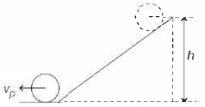
$A$ solid cylinder $P$ rolls without slipping from rest down an inclined plane,attaining a speed $v_p$ at the bottom. Another smooth solid cylinder $Q$ of the same mass and dimensions slides without friction from rest down the inclined plane,attaining a speed $v_q$ at the bottom. The ratio of the speeds $\frac{v_q}{v_p}$ is
A
$\sqrt{\frac{3}{4}}$
B
$\sqrt{\frac{3}{2}}$
C
$\sqrt{\frac{2}{3}}$
D
$\sqrt{\frac{4}{3}}$
Solution
(B) For cylinder $P$ (rolling without slipping):
By the principle of conservation of energy,the initial potential energy is converted into translational and rotational kinetic energy at the bottom:
$mgh = \frac{1}{2}mv_p^2 + \frac{1}{2}I\omega^2$
Since $I = \frac{1}{2}mr^2$ and $v_p = r\omega$,we have:
$mgh = \frac{1}{2}mv_p^2 + \frac{1}{2}(\frac{1}{2}mr^2)(\frac{v_p}{r})^2$
$mgh = \frac{1}{2}mv_p^2 + \frac{1}{4}mv_p^2 = \frac{3}{4}mv_p^2$
$v_p = \sqrt{\frac{4gh}{3}}$
For cylinder $Q$ (sliding without friction):
Since there is no friction,the cylinder does not rotate. All potential energy is converted into translational kinetic energy:
$mgh = \frac{1}{2}mv_q^2$
$v_q = \sqrt{2gh}$
The ratio of the speeds is:
$\frac{v_q}{v_p} = \frac{\sqrt{2gh}}{\sqrt{\frac{4gh}{3}}} = \sqrt{2 \cdot \frac{3}{4}} = \sqrt{\frac{3}{2}}$
By the principle of conservation of energy,the initial potential energy is converted into translational and rotational kinetic energy at the bottom:
$mgh = \frac{1}{2}mv_p^2 + \frac{1}{2}I\omega^2$
Since $I = \frac{1}{2}mr^2$ and $v_p = r\omega$,we have:
$mgh = \frac{1}{2}mv_p^2 + \frac{1}{2}(\frac{1}{2}mr^2)(\frac{v_p}{r})^2$
$mgh = \frac{1}{2}mv_p^2 + \frac{1}{4}mv_p^2 = \frac{3}{4}mv_p^2$
$v_p = \sqrt{\frac{4gh}{3}}$
For cylinder $Q$ (sliding without friction):
Since there is no friction,the cylinder does not rotate. All potential energy is converted into translational kinetic energy:
$mgh = \frac{1}{2}mv_q^2$
$v_q = \sqrt{2gh}$
The ratio of the speeds is:
$\frac{v_q}{v_p} = \frac{\sqrt{2gh}}{\sqrt{\frac{4gh}{3}}} = \sqrt{2 \cdot \frac{3}{4}} = \sqrt{\frac{3}{2}}$
0 likesView Solution
3
PhysicsAdvancedMCQKVPY · 2014
$A$ body moves in a circular orbit of radius $R$ under the action of a central force. The potential due to the central force is given by $V(r) = kr$ ($k$ is a positive constant). The period of revolution of the body is proportional to:
A
$R^{1/2}$
B
$R^{-1/2}$
C
$R^{-3/2}$
D
$R^{-5/2}$
Solution
(A) The force on the particle is given by the negative gradient of the potential:
$F = -\frac{dV}{dr} = -\frac{d}{dr}(kr) = -k$.
Taking the magnitude of the force,we have $F = k$.
For circular motion,this force acts as the centripetal force:
$F = mR\omega^2 = k$.
Substituting $\omega = \frac{2\pi}{T}$,we get:
$mR\left(\frac{2\pi}{T}\right)^2 = k$.
$mR \cdot \frac{4\pi^2}{T^2} = k$.
Rearranging for $T^2$:
$T^2 = \frac{4\pi^2 m}{k} \cdot R$.
Since $\frac{4\pi^2 m}{k}$ is a constant,we have $T^2 \propto R$,which implies $T \propto R^{1/2}$.
$F = -\frac{dV}{dr} = -\frac{d}{dr}(kr) = -k$.
Taking the magnitude of the force,we have $F = k$.
For circular motion,this force acts as the centripetal force:
$F = mR\omega^2 = k$.
Substituting $\omega = \frac{2\pi}{T}$,we get:
$mR\left(\frac{2\pi}{T}\right)^2 = k$.
$mR \cdot \frac{4\pi^2}{T^2} = k$.
Rearranging for $T^2$:
$T^2 = \frac{4\pi^2 m}{k} \cdot R$.
Since $\frac{4\pi^2 m}{k}$ is a constant,we have $T^2 \propto R$,which implies $T \propto R^{1/2}$.
0 likesView Solution
4
PhysicsAdvancedMCQKVPY · 2014
$A$ simple pendulum is attached to a block which slides without friction down an inclined plane $ABC$ having an angle of inclination $\alpha$ as shown below. While the block is sliding down,the pendulum oscillates in such a way that at its mean position,the direction of the string is
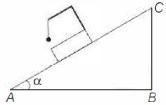
A
at angle $\alpha$ to the perpendicular to the inclined plane $AC$
B
parallel to the inclined plane $AC$
C
vertically downwards
D
perpendicular to the inclined plane $AC$
Solution
(D) The correct option is $(d)$.
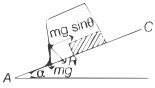
When the block slides down the frictionless inclined plane with an acceleration $a = g \sin \alpha$,we analyze the motion of the pendulum bob in the non-inertial frame of reference of the block.
$(i)$ The forces acting on the pendulum bob in the frame of the block are the gravitational force $mg$ (acting vertically downwards) and the pseudo force $ma = mg \sin \alpha$ (acting upwards parallel to the inclined plane).
$(ii)$ The effective acceleration $g_{eff}$ experienced by the bob is the vector sum of the acceleration due to gravity $\vec{g}$ and the pseudo acceleration $-\vec{a}$.
$(iii)$ The mean position of the pendulum corresponds to the direction of this effective acceleration $\vec{g}_{eff}$.
$(iv)$ By resolving the gravitational force $mg$ into components perpendicular to the plane $(mg \cos \alpha)$ and parallel to the plane $(mg \sin \alpha)$,we see that the parallel component $mg \sin \alpha$ is exactly cancelled by the pseudo force $mg \sin \alpha$ acting in the opposite direction.
$(v)$ Thus,the only remaining component of the effective force is $mg \cos \alpha$,which acts perpendicular to the inclined plane $AC$. Therefore,the string of the pendulum aligns itself perpendicular to the inclined plane at its mean position.
When the block slides down the frictionless inclined plane with an acceleration $a = g \sin \alpha$,we analyze the motion of the pendulum bob in the non-inertial frame of reference of the block.
$(i)$ The forces acting on the pendulum bob in the frame of the block are the gravitational force $mg$ (acting vertically downwards) and the pseudo force $ma = mg \sin \alpha$ (acting upwards parallel to the inclined plane).
$(ii)$ The effective acceleration $g_{eff}$ experienced by the bob is the vector sum of the acceleration due to gravity $\vec{g}$ and the pseudo acceleration $-\vec{a}$.
$(iii)$ The mean position of the pendulum corresponds to the direction of this effective acceleration $\vec{g}_{eff}$.
$(iv)$ By resolving the gravitational force $mg$ into components perpendicular to the plane $(mg \cos \alpha)$ and parallel to the plane $(mg \sin \alpha)$,we see that the parallel component $mg \sin \alpha$ is exactly cancelled by the pseudo force $mg \sin \alpha$ acting in the opposite direction.
$(v)$ Thus,the only remaining component of the effective force is $mg \cos \alpha$,which acts perpendicular to the inclined plane $AC$. Therefore,the string of the pendulum aligns itself perpendicular to the inclined plane at its mean position.
0 likesView Solution
5
PhysicsMediumMCQKVPY · 2014
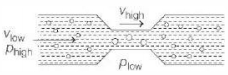
Water containing air bubbles flows without turbulence through a horizontal pipe which has a region of narrow cross-section. In this region,the bubbles
A
move with greater speed and are smaller in size than in the rest of the pipe
B
move with greater speed and are larger in size than in the rest of the pipe
C
move with lesser speed and are smaller in size than in the rest of the pipe
D
move with lesser speed and are of the same size as in the rest of the pipe
Solution
(B) According to the equation of continuity,$A_1 v_1 = A_2 v_2$. In the narrow region,the cross-sectional area $A$ decreases,so the velocity $v$ of the fluid increases $(v \propto \frac{1}{A})$.
According to Bernoulli's principle for a horizontal pipe,$p + \frac{1}{2} \rho v^2 = \text{constant}$. Since the velocity $v$ increases in the narrow region,the pressure $p$ must decrease.
As the external pressure on the air bubbles decreases in the narrow region,the air inside the bubbles expands,causing the bubbles to become larger in size. Thus,the bubbles move with greater speed and are larger in size.
According to Bernoulli's principle for a horizontal pipe,$p + \frac{1}{2} \rho v^2 = \text{constant}$. Since the velocity $v$ increases in the narrow region,the pressure $p$ must decrease.
As the external pressure on the air bubbles decreases in the narrow region,the air inside the bubbles expands,causing the bubbles to become larger in size. Thus,the bubbles move with greater speed and are larger in size.
0 likesView Solution
6
PhysicsDifficultMCQKVPY · 2014
$A$ solid expands upon heating because
A
the potential energy of interaction between atoms in the solid is asymmetric about the equilibrium positions of atoms
B
the frequency of vibration of the atoms increases
C
the heating generates a thermal gradient between opposite sides
D
a fluid called the caloric flows into the interatomic spacing of the solid during heating thereby expanding it
Solution
(A) The correct answer is $(A)$.
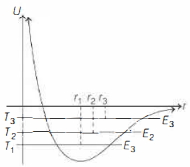
The potential energy $U$ versus interatomic separation $r$ plot for two atoms in a solid is asymmetric about the equilibrium position.
As the temperature increases,the total energy of the atoms increases $(E_3 > E_2 > E_1)$.
Due to the asymmetry of the potential energy curve,the mean separation between the atoms increases as the energy increases $(r_3 > r_2 > r_1)$.
Consequently,crystalline solids generally expand upon heating.
The potential energy $U$ versus interatomic separation $r$ plot for two atoms in a solid is asymmetric about the equilibrium position.
As the temperature increases,the total energy of the atoms increases $(E_3 > E_2 > E_1)$.
Due to the asymmetry of the potential energy curve,the mean separation between the atoms increases as the energy increases $(r_3 > r_2 > r_1)$.
Consequently,crystalline solids generally expand upon heating.
0 likesView Solution
7
PhysicsAdvancedMCQKVPY · 2014
Consider two thermometers $T_1$ and $T_2$ of equal length,which can be used to measure temperature over the range $\theta_1$ to $\theta_2$. $T_1$ contains mercury as the thermometric liquid,while $T_2$ contains bromine. The volumes of the two liquids are the same at the temperature $\theta_1$. The volumetric coefficients of expansion of mercury and bromine are $18 \times 10^{-5} \, K^{-1}$ and $108 \times 10^{-5} \, K^{-1}$,respectively. The increase in length of each liquid is the same for the same increase in temperature. If the diameters of the capillary tubes of the two thermometers are $d_1$ and $d_2$,respectively,then the ratio $d_1: d_2$ is closest to:
A
$6.0$
B
$2.5$
C
$0.6$
D
$0.4$
Solution
(D) The change in volume $\Delta V$ of a liquid is given by $\Delta V = V_0 \gamma \Delta \theta$,where $V_0$ is the initial volume,$\gamma$ is the coefficient of volume expansion,and $\Delta \theta$ is the change in temperature.
Since the increase in length $\Delta l$ is the same for both thermometers,the change in volume is $\Delta V = A \Delta l = \frac{\pi d^2}{4} \Delta l$.
Given that the initial volumes $(V_0)_{Hg} = (V_0)_{Br}$ and the change in length $\Delta l$ is the same for both,we have:
$\Delta V_{Hg} = \frac{\pi d_1^2}{4} \Delta l = V_0 \gamma_{Hg} \Delta \theta$
$\Delta V_{Br} = \frac{\pi d_2^2}{4} \Delta l = V_0 \gamma_{Br} \Delta \theta$
Dividing the two equations:
$\frac{d_1^2}{d_2^2} = \frac{\gamma_{Hg}}{\gamma_{Br}}$
$\frac{d_1}{d_2} = \sqrt{\frac{\gamma_{Hg}}{\gamma_{Br}}}$
Substituting the given values:
$\frac{d_1}{d_2} = \sqrt{\frac{18 \times 10^{-5}}{108 \times 10^{-5}}} = \sqrt{\frac{1}{6}} \approx \sqrt{0.166} \approx 0.408$
Thus,the ratio $d_1: d_2$ is closest to $0.4$.
Since the increase in length $\Delta l$ is the same for both thermometers,the change in volume is $\Delta V = A \Delta l = \frac{\pi d^2}{4} \Delta l$.
Given that the initial volumes $(V_0)_{Hg} = (V_0)_{Br}$ and the change in length $\Delta l$ is the same for both,we have:
$\Delta V_{Hg} = \frac{\pi d_1^2}{4} \Delta l = V_0 \gamma_{Hg} \Delta \theta$
$\Delta V_{Br} = \frac{\pi d_2^2}{4} \Delta l = V_0 \gamma_{Br} \Delta \theta$
Dividing the two equations:
$\frac{d_1^2}{d_2^2} = \frac{\gamma_{Hg}}{\gamma_{Br}}$
$\frac{d_1}{d_2} = \sqrt{\frac{\gamma_{Hg}}{\gamma_{Br}}}$
Substituting the given values:
$\frac{d_1}{d_2} = \sqrt{\frac{18 \times 10^{-5}}{108 \times 10^{-5}}} = \sqrt{\frac{1}{6}} \approx \sqrt{0.166} \approx 0.408$
Thus,the ratio $d_1: d_2$ is closest to $0.4$.
0 likesView Solution
8
PhysicsMediumMCQKVPY · 2014
An ideal gas follows a process described by $p V^2 = C$ from $(p_1, V_1, T_1)$ to $(p_2, V_2, T_2)$,where $C$ is a constant. Then,
A
if $p_1 > p_2$ then $T_2 > T_1$
B
if $V_2 > V_1$ then $T_2 < T_1$
C
if $V_2 > V_1$ then $T_2 > T_1$
D
if $p_1 > p_2$ then $V_1 > V_2$
Solution
(B) Given the process equation: $p V^2 = C$.
For an ideal gas,we know that $p V = n R T$,which implies $p = \frac{n R T}{V}$.
Substituting this into the process equation:
$\left(\frac{n R T}{V}\right) V^2 = C$
$n R T V = C$
Since $n, R,$ and $C$ are constants,we have $T V = \text{constant}$,or $T \propto \frac{1}{V}$.
If $V_2 > V_1$,then according to the relation $T \propto \frac{1}{V}$,the temperature $T_2$ must be less than $T_1$ $(T_2 < T_1)$.
Therefore,option $(b)$ is correct.
For an ideal gas,we know that $p V = n R T$,which implies $p = \frac{n R T}{V}$.
Substituting this into the process equation:
$\left(\frac{n R T}{V}\right) V^2 = C$
$n R T V = C$
Since $n, R,$ and $C$ are constants,we have $T V = \text{constant}$,or $T \propto \frac{1}{V}$.
If $V_2 > V_1$,then according to the relation $T \propto \frac{1}{V}$,the temperature $T_2$ must be less than $T_1$ $(T_2 < T_1)$.
Therefore,option $(b)$ is correct.
0 likesView Solution
9
PhysicsDifficultMCQKVPY · 2014
$A$ whistle emitting a loud sound of frequency $540 \,Hz$ is whirled in a horizontal circle of radius $2 \,m$ at a constant angular speed of $15 \,rad/s$. The speed of sound is $330 \,m/s$. The ratio of the highest to the lowest frequency heard by a listener standing at rest at a large distance from the centre of the circle is
A
$1.0$
B
$1.1$
C
$1.2$
D
$1.4$
Solution
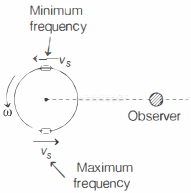
(C) The source of sound is moving in a circle,so its linear speed $v_s$ is given by $v_s = r\omega$.
Given $r = 2 \,m$ and $\omega = 15 \,rad/s$,we have $v_s = 2 \times 15 = 30 \,m/s$.
The speed of sound is $v = 330 \,m/s$.
According to the Doppler effect,when the source moves towards the stationary observer,the observed frequency is $f_{\max} = \left(\frac{v}{v - v_s}\right) f$.
When the source moves away from the stationary observer,the observed frequency is $f_{\min} = \left(\frac{v}{v + v_s}\right) f$.
The ratio of the highest to the lowest frequency is:
$\frac{f_{\max}}{f_{\min}} = \frac{\left(\frac{v}{v - v_s}\right) f}{\left(\frac{v}{v + v_s}\right) f} = \frac{v + v_s}{v - v_s}$.
Substituting the values:
$\frac{f_{\max}}{f_{\min}} = \frac{330 + 30}{330 - 30} = \frac{360}{300} = 1.2$.
Given $r = 2 \,m$ and $\omega = 15 \,rad/s$,we have $v_s = 2 \times 15 = 30 \,m/s$.
The speed of sound is $v = 330 \,m/s$.
According to the Doppler effect,when the source moves towards the stationary observer,the observed frequency is $f_{\max} = \left(\frac{v}{v - v_s}\right) f$.
When the source moves away from the stationary observer,the observed frequency is $f_{\min} = \left(\frac{v}{v + v_s}\right) f$.
The ratio of the highest to the lowest frequency is:
$\frac{f_{\max}}{f_{\min}} = \frac{\left(\frac{v}{v - v_s}\right) f}{\left(\frac{v}{v + v_s}\right) f} = \frac{v + v_s}{v - v_s}$.
Substituting the values:
$\frac{f_{\max}}{f_{\min}} = \frac{330 + 30}{330 - 30} = \frac{360}{300} = 1.2$.
0 likesView Solution
10
PhysicsAdvancedMCQKVPY · 2014
$A$ solid sphere spinning about a horizontal axis with an angular velocity $\omega$ is placed on a horizontal surface. Subsequently,it rolls without slipping with an angular velocity of
A
$2 \omega / 5$
B
$7 \omega / 5$
C
$2 \omega / 7$
D
$\omega$
Solution
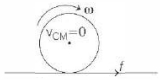
(C) Initially,the sphere is placed on the surface with angular velocity $\omega$ and linear velocity $v_{CM} = 0$. Friction acts at the point of contact to oppose the slipping.
The force of friction $f = \mu_k mg$ acts in the forward direction,causing linear acceleration $a_{CM} = \frac{f}{m} = \mu_k g$.
The torque due to friction about the center of mass is $\tau = -fR = -\mu_k mgR$. The angular deceleration is $\alpha = \frac{\tau}{I} = \frac{-\mu_k mgR}{\frac{2}{5}mR^2} = -\frac{5\mu_k g}{2R}$.
After time $t$,the linear velocity is $v_{CM} = a_{CM}t = \mu_k gt$ and the angular velocity is $\omega_f = \omega + \alpha t = \omega - \frac{5\mu_k g}{2R}t$.
Pure rolling begins when $v_{CM} = \omega_f R$. Substituting the expressions:
$\mu_k gt = \left(\omega - \frac{5\mu_k g}{2R}t\right)R$
$\mu_k gt = \omega R - \frac{5}{2}\mu_k gt$
$\frac{7}{2}\mu_k gt = \omega R \implies \mu_k gt = \frac{2}{7}\omega R$.
Substituting this back into the expression for $\omega_f$:
$\omega_f = \frac{v_{CM}}{R} = \frac{\mu_k gt}{R} = \frac{1}{R} \left(\frac{2}{7}\omega R\right) = \frac{2}{7}\omega$.
The force of friction $f = \mu_k mg$ acts in the forward direction,causing linear acceleration $a_{CM} = \frac{f}{m} = \mu_k g$.
The torque due to friction about the center of mass is $\tau = -fR = -\mu_k mgR$. The angular deceleration is $\alpha = \frac{\tau}{I} = \frac{-\mu_k mgR}{\frac{2}{5}mR^2} = -\frac{5\mu_k g}{2R}$.
After time $t$,the linear velocity is $v_{CM} = a_{CM}t = \mu_k gt$ and the angular velocity is $\omega_f = \omega + \alpha t = \omega - \frac{5\mu_k g}{2R}t$.
Pure rolling begins when $v_{CM} = \omega_f R$. Substituting the expressions:
$\mu_k gt = \left(\omega - \frac{5\mu_k g}{2R}t\right)R$
$\mu_k gt = \omega R - \frac{5}{2}\mu_k gt$
$\frac{7}{2}\mu_k gt = \omega R \implies \mu_k gt = \frac{2}{7}\omega R$.
Substituting this back into the expression for $\omega_f$:
$\omega_f = \frac{v_{CM}}{R} = \frac{\mu_k gt}{R} = \frac{1}{R} \left(\frac{2}{7}\omega R\right) = \frac{2}{7}\omega$.
0 likesView Solution
11
PhysicsMediumMCQKVPY · 2014
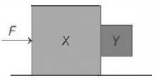
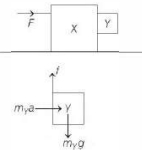
Consider the system shown below. $A$ horizontal force $F$ is applied to a block $X$ of mass $8 \,kg$,such that the block $Y$ of mass $2 \,kg$ adjacent to it does not slip downwards under gravity. There is no friction between the horizontal plane and the base of the block $X$. The coefficient of friction between the surfaces of blocks $X$ and $Y$ is $0.5$. The minimum value of $F$ is ............ $N$ (take acceleration due to gravity to be $10 \,ms^{-2}$).
A
$200$
B
$160$
C
$40$
D
$240$
Solution
(A) Let the acceleration of the system of blocks $X$ and $Y$ be $a$.
Since the blocks move together,the total mass is $M = m_X + m_Y = 8 \,kg + 2 \,kg = 10 \,kg$.
The acceleration of the system is given by $a = \frac{F}{M} = \frac{F}{10} \,ms^{-2}$.
For block $Y$ to not slip downwards,the upward frictional force $f$ must balance its weight $m_Y g$.
$f = m_Y g = 2 \times 10 = 20 \,N$.
The frictional force is also given by $f = \mu R$,where $R$ is the normal reaction between blocks $X$ and $Y$.
From the horizontal motion of block $Y$,the normal reaction $R$ provides the necessary acceleration $a$ to block $Y$:
$R = m_Y a = 2 \times \frac{F}{10} = \frac{F}{5}$.
Substituting the values into the friction equation:
$f = \mu R \Rightarrow 20 = 0.5 \times \frac{F}{5}$.
$20 = \frac{F}{10} \Rightarrow F = 200 \,N$.
Thus,the minimum value of $F$ is $200 \,N$.
Since the blocks move together,the total mass is $M = m_X + m_Y = 8 \,kg + 2 \,kg = 10 \,kg$.
The acceleration of the system is given by $a = \frac{F}{M} = \frac{F}{10} \,ms^{-2}$.
For block $Y$ to not slip downwards,the upward frictional force $f$ must balance its weight $m_Y g$.
$f = m_Y g = 2 \times 10 = 20 \,N$.
The frictional force is also given by $f = \mu R$,where $R$ is the normal reaction between blocks $X$ and $Y$.
From the horizontal motion of block $Y$,the normal reaction $R$ provides the necessary acceleration $a$ to block $Y$:
$R = m_Y a = 2 \times \frac{F}{10} = \frac{F}{5}$.
Substituting the values into the friction equation:
$f = \mu R \Rightarrow 20 = 0.5 \times \frac{F}{5}$.
$20 = \frac{F}{10} \Rightarrow F = 200 \,N$.
Thus,the minimum value of $F$ is $200 \,N$.
0 likesView Solution
12
PhysicsDifficultMCQKVPY · 2014
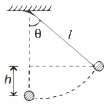
The maximum value attained by the tension in the string of a swinging pendulum is four times the minimum value it attains. There is no slack in the string. The angular amplitude of the pendulum is (in $^{\circ}$)
A
$90$
B
$60$
C
$45$
D
$30$
Solution
(B) For a pendulum with angular amplitude $\theta$,the height $h$ reached by the bob is given by $h = l(1 - \cos \theta)$,where $l$ is the length of the string.
By the law of conservation of energy,the kinetic energy at the mean position is equal to the potential energy at the extreme position:
$\frac{1}{2} m v^2 = m g h = m g l(1 - \cos \theta)$
$v^2 = 2 g l(1 - \cos \theta)$
The maximum tension $T_{\max}$ occurs at the mean position (lowest point) and is given by:
$T_{\max} = m g + \frac{m v^2}{l} = m g + \frac{m(2 g l(1 - \cos \theta))}{l} = m g + 2 m g(1 - \cos \theta) = m g(3 - 2 \cos \theta)$
The minimum tension $T_{\min}$ occurs at the extreme position where the velocity is zero:
$T_{\min} = m g \cos \theta$
Given that $T_{\max} = 4 T_{\min}$:
$m g(3 - 2 \cos \theta) = 4 m g \cos \theta$
$3 - 2 \cos \theta = 4 \cos \theta$
$3 = 6 \cos \theta$
$\cos \theta = \frac{1}{2}$
$\theta = 60^{\circ}$
By the law of conservation of energy,the kinetic energy at the mean position is equal to the potential energy at the extreme position:
$\frac{1}{2} m v^2 = m g h = m g l(1 - \cos \theta)$
$v^2 = 2 g l(1 - \cos \theta)$
The maximum tension $T_{\max}$ occurs at the mean position (lowest point) and is given by:
$T_{\max} = m g + \frac{m v^2}{l} = m g + \frac{m(2 g l(1 - \cos \theta))}{l} = m g + 2 m g(1 - \cos \theta) = m g(3 - 2 \cos \theta)$
The minimum tension $T_{\min}$ occurs at the extreme position where the velocity is zero:
$T_{\min} = m g \cos \theta$
Given that $T_{\max} = 4 T_{\min}$:
$m g(3 - 2 \cos \theta) = 4 m g \cos \theta$
$3 - 2 \cos \theta = 4 \cos \theta$
$3 = 6 \cos \theta$
$\cos \theta = \frac{1}{2}$
$\theta = 60^{\circ}$
0 likesView Solution
13
PhysicsAdvancedMCQKVPY · 2014
One mole of a monoatomic ideal gas is expanded by a process described by $p V^3 = C$,where $C$ is a constant. The heat capacity of the gas during the process is given by ($R$ is the gas constant).
A
$2 R$
B
$\frac{5}{2} R$
C
$\frac{3}{2} R$
D
$R$
Solution
(D) For a polytropic process $p V^x = C$,the molar heat capacity $C_{process}$ is given by the formula $C_{process} = C_V + \frac{R}{1 - x}$.
Here,the given process is $p V^3 = C$,so $x = 3$.
For a monoatomic ideal gas,the molar heat capacity at constant volume is $C_V = \frac{3}{2} R$.
Substituting these values into the formula:
$C_{process} = \frac{3}{2} R + \frac{R}{1 - 3}$
$C_{process} = \frac{3}{2} R + \frac{R}{-2}$
$C_{process} = \frac{3}{2} R - \frac{1}{2} R = R$.
Thus,the heat capacity of the gas during the process is $R$.
Here,the given process is $p V^3 = C$,so $x = 3$.
For a monoatomic ideal gas,the molar heat capacity at constant volume is $C_V = \frac{3}{2} R$.
Substituting these values into the formula:
$C_{process} = \frac{3}{2} R + \frac{R}{1 - 3}$
$C_{process} = \frac{3}{2} R + \frac{R}{-2}$
$C_{process} = \frac{3}{2} R - \frac{1}{2} R = R$.
Thus,the heat capacity of the gas during the process is $R$.
0 likesView Solution
14
PhysicsDifficultMCQKVPY · 2014
The dimensions of Stefan-Boltzmann's constant $\sigma$ can be written in terms of Planck's constant $h$,Boltzmann's constant $k_B$ and the speed of light $c$ as $\sigma=h^\alpha k_B^\beta c^\gamma$. Here,
A
$\alpha=3, \beta=4$ and $\gamma=-3$
B
$\alpha=3, \beta=-4$ and $\gamma=2$
C
$\alpha=-3, \beta=4$ and $\gamma=-2$
D
$\alpha=2, \beta=-3$ and $\gamma=-1$
Solution
(C) The Stefan-Boltzmann constant $\sigma$ has dimensions $[M T^{-3} K^{-4}]$.
The dimensions of the constants are:
$h = [M L^2 T^{-1}]$
$k_B = [M L^2 T^{-2} K^{-1}]$
$c = [L T^{-1}]$
Given $\sigma = h^\alpha k_B^\beta c^\gamma$,we equate the dimensions:
$[M T^{-3} K^{-4}] = [M L^2 T^{-1}]^\alpha [M L^2 T^{-2} K^{-1}]^\beta [L T^{-1}]^\gamma$
$[M T^{-3} K^{-4}] = [M^{\alpha+\beta} L^{2\alpha+2\beta+\gamma} T^{-\alpha-2\beta-\gamma} K^{-\beta}]$
Comparing the exponents of $M, L, T,$ and $K$:
$1$) $M: \alpha + \beta = 0$ (Wait,$\sigma$ is energy per unit area per unit time per unit temperature to the fourth power,so $[M T^{-3} K^{-4}]$ is correct. The mass dimension is $1$,so $\alpha + \beta = 1$)
$2$) $K: -\beta = -4 \implies \beta = 4$
$3$) $M: \alpha + \beta = 1 \implies \alpha + 4 = 1 \implies \alpha = -3$
$4$) $T: -\alpha - 2\beta - \gamma = -3 \implies -(-3) - 2(4) - \gamma = -3 \implies 3 - 8 - \gamma = -3 \implies -5 - \gamma = -3 \implies \gamma = -2$
Thus,$\alpha = -3, \beta = 4, \gamma = -2$.
The dimensions of the constants are:
$h = [M L^2 T^{-1}]$
$k_B = [M L^2 T^{-2} K^{-1}]$
$c = [L T^{-1}]$
Given $\sigma = h^\alpha k_B^\beta c^\gamma$,we equate the dimensions:
$[M T^{-3} K^{-4}] = [M L^2 T^{-1}]^\alpha [M L^2 T^{-2} K^{-1}]^\beta [L T^{-1}]^\gamma$
$[M T^{-3} K^{-4}] = [M^{\alpha+\beta} L^{2\alpha+2\beta+\gamma} T^{-\alpha-2\beta-\gamma} K^{-\beta}]$
Comparing the exponents of $M, L, T,$ and $K$:
$1$) $M: \alpha + \beta = 0$ (Wait,$\sigma$ is energy per unit area per unit time per unit temperature to the fourth power,so $[M T^{-3} K^{-4}]$ is correct. The mass dimension is $1$,so $\alpha + \beta = 1$)
$2$) $K: -\beta = -4 \implies \beta = 4$
$3$) $M: \alpha + \beta = 1 \implies \alpha + 4 = 1 \implies \alpha = -3$
$4$) $T: -\alpha - 2\beta - \gamma = -3 \implies -(-3) - 2(4) - \gamma = -3 \implies 3 - 8 - \gamma = -3 \implies -5 - \gamma = -3 \implies \gamma = -2$
Thus,$\alpha = -3, \beta = 4, \gamma = -2$.
0 likesView Solution
15
PhysicsDifficultMCQKVPY · 2014
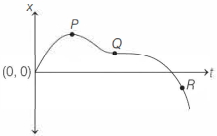
In the following displacement $x$ versus time $t$ graph,at which among the points $P, Q$ and $R$ is the object's speed increasing?
A
$R$ only
B
$P$ only
C
$Q$ and $R$ only
D
$P, Q$ and $R$
Solution
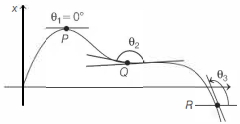
(A) In a displacement-time graph,the velocity at any point is given by the slope of the tangent to the curve at that point.
Speed is the magnitude of velocity,so the magnitude of the slope represents the speed.
At point $P$,the tangent is horizontal,so the slope is $0$,meaning the speed is $0$.
At point $Q$,the slope is small (the curve is relatively flat).
At point $R$,the tangent is very steep,meaning the magnitude of the slope $|m| = |\tan \theta|$ is the largest among the three points.
Since the speed is the magnitude of the slope,the speed is highest at point $R$. Therefore,the speed is increasing as we move towards point $R$ from the preceding region of the graph.
Speed is the magnitude of velocity,so the magnitude of the slope represents the speed.
At point $P$,the tangent is horizontal,so the slope is $0$,meaning the speed is $0$.
At point $Q$,the slope is small (the curve is relatively flat).
At point $R$,the tangent is very steep,meaning the magnitude of the slope $|m| = |\tan \theta|$ is the largest among the three points.
Since the speed is the magnitude of the slope,the speed is highest at point $R$. Therefore,the speed is increasing as we move towards point $R$ from the preceding region of the graph.
0 likesView Solution
16
PhysicsDifficultMCQKVPY · 2014
$A$ box when hung from a spring balance shows a reading of $50 \,kg$. If the same box is hung from the same spring balance inside an evacuated chamber,the reading on the scale will be
A
$50 \,kg$ because the mass of the box remains unchanged.
B
$50 \,kg$ because the effect of the absence of the atmosphere will be identical on the box and the spring balance.
C
less than $50 \,kg$ because the weight of the column of air on the box will be absent.
D
more than $50 \,kg$ because the atmospheric buoyancy force will be absent.
Solution
(D) The reading of a spring balance measures the tension in the spring,which is equal to the apparent weight of the object.
When the box is in the atmosphere,it experiences an upward buoyant force $F_b$ due to the displaced air.
The reading $R$ in the atmosphere is given by $R = W - F_b$,where $W$ is the true weight of the box.
In an evacuated chamber,the buoyant force $F_b$ becomes zero.
Therefore,the new reading $R'$ will be equal to the true weight $W$.
Since $R' = W$ and $R = W - F_b$,it follows that $R' > R$.
Thus,the reading will be more than $50 \,kg$ because the atmospheric buoyancy force is absent.
When the box is in the atmosphere,it experiences an upward buoyant force $F_b$ due to the displaced air.
The reading $R$ in the atmosphere is given by $R = W - F_b$,where $W$ is the true weight of the box.
In an evacuated chamber,the buoyant force $F_b$ becomes zero.
Therefore,the new reading $R'$ will be equal to the true weight $W$.
Since $R' = W$ and $R = W - F_b$,it follows that $R' > R$.
Thus,the reading will be more than $50 \,kg$ because the atmospheric buoyancy force is absent.
0 likesView Solution
17
PhysicsDifficultMCQKVPY · 2014
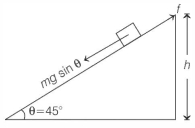
$A$ box when dropped from a certain height reaches the ground with a speed $v$. When it slides from rest from the same height down a rough inclined plane inclined at an angle $45^{\circ}$ to the horizontal,it reaches the ground with a speed $v/3$. The coefficient of sliding friction between the box and the plane is:
A
$\frac{8}{9}$
B
$\frac{1}{9}$
C
$\frac{2}{3}$
D
$\frac{1}{3}$
Solution
(A) When the box is dropped from height $h$,its speed when it reaches the ground is given by the conservation of energy: $v = \sqrt{2gh}$.
When the block slides down the rough inclined plane with angle $\theta = 45^{\circ}$,the net acceleration $a$ is given by:
$a = g(\sin \theta - \mu \cos \theta)$.
Since $\theta = 45^{\circ}$,$\sin 45^{\circ} = \cos 45^{\circ} = \frac{1}{\sqrt{2}}$.
Thus,$a = g \left( \frac{1}{\sqrt{2}} - \mu \frac{1}{\sqrt{2}} \right) = \frac{g}{\sqrt{2}}(1 - \mu)$.
The length of the inclined plane $s$ is related to height $h$ by $s = \frac{h}{\sin \theta} = h \sqrt{2}$.
The final velocity $v'$ at the bottom of the incline is $v' = \sqrt{2as}$.
Substituting $a$ and $s$:
$v' = \sqrt{2 \cdot \frac{g}{\sqrt{2}}(1 - \mu) \cdot h \sqrt{2}} = \sqrt{2gh(1 - \mu)}$.
Given that $v' = \frac{v}{3}$,we have:
$\sqrt{2gh(1 - \mu)} = \frac{1}{3} \sqrt{2gh}$.
Squaring both sides:
$2gh(1 - \mu) = \frac{1}{9} (2gh)$.
$1 - \mu = \frac{1}{9}$.
$\mu = 1 - \frac{1}{9} = \frac{8}{9}$.
When the block slides down the rough inclined plane with angle $\theta = 45^{\circ}$,the net acceleration $a$ is given by:
$a = g(\sin \theta - \mu \cos \theta)$.
Since $\theta = 45^{\circ}$,$\sin 45^{\circ} = \cos 45^{\circ} = \frac{1}{\sqrt{2}}$.
Thus,$a = g \left( \frac{1}{\sqrt{2}} - \mu \frac{1}{\sqrt{2}} \right) = \frac{g}{\sqrt{2}}(1 - \mu)$.
The length of the inclined plane $s$ is related to height $h$ by $s = \frac{h}{\sin \theta} = h \sqrt{2}$.
The final velocity $v'$ at the bottom of the incline is $v' = \sqrt{2as}$.
Substituting $a$ and $s$:
$v' = \sqrt{2 \cdot \frac{g}{\sqrt{2}}(1 - \mu) \cdot h \sqrt{2}} = \sqrt{2gh(1 - \mu)}$.
Given that $v' = \frac{v}{3}$,we have:
$\sqrt{2gh(1 - \mu)} = \frac{1}{3} \sqrt{2gh}$.
Squaring both sides:
$2gh(1 - \mu) = \frac{1}{9} (2gh)$.
$1 - \mu = \frac{1}{9}$.
$\mu = 1 - \frac{1}{9} = \frac{8}{9}$.
0 likesView Solution
18
PhysicsMediumMCQKVPY · 2014
$A$ thin paper cup filled with water does not catch fire when placed over a flame. This is because
A
the water cuts off oxygen supply to the paper cup
B
water is an excellent conductor of heat
C
the paper cup does not become appreciably hotter than the water it contains
D
paper is a poor conductor of heat
Solution
(C) The correct option is $C$.
The thermal resistance of a thin layer of paper is very low. When the cup is placed over a flame,the heat is transferred through the paper to the water inside.
Since water has a high specific heat capacity,it absorbs the heat effectively. As long as there is water in the cup,the temperature of the paper does not rise significantly above the temperature of the water (which is $100^{\circ} C$ at boiling point).
Because the temperature of the paper remains below its ignition (burning) temperature,the paper cup does not catch fire.
The thermal resistance of a thin layer of paper is very low. When the cup is placed over a flame,the heat is transferred through the paper to the water inside.
Since water has a high specific heat capacity,it absorbs the heat effectively. As long as there is water in the cup,the temperature of the paper does not rise significantly above the temperature of the water (which is $100^{\circ} C$ at boiling point).
Because the temperature of the paper remains below its ignition (burning) temperature,the paper cup does not catch fire.
0 likesView Solution
19
PhysicsMediumMCQKVPY · 2014
Ice is used in a cooler in order to cool its contents. Which of the following will speed up the cooling process?
A
Wrap the ice in a metal foil
B
Drain the water from the cooler periodically
C
Put the ice as a single block
D
Crush the ice
Solution
(D) The correct option is $D$.
When ice is crushed,the total surface area of the ice that comes into contact with the surrounding air or the contents of the cooler increases significantly.
According to the principles of heat transfer,the rate of heat exchange is directly proportional to the surface area in contact.
Therefore,increasing the surface area by crushing the ice accelerates the rate of heat absorption from the surroundings,thereby speeding up the cooling process.
When ice is crushed,the total surface area of the ice that comes into contact with the surrounding air or the contents of the cooler increases significantly.
According to the principles of heat transfer,the rate of heat exchange is directly proportional to the surface area in contact.
Therefore,increasing the surface area by crushing the ice accelerates the rate of heat absorption from the surroundings,thereby speeding up the cooling process.
0 likesView Solution
20
PhysicsAdvancedMCQKVPY · 2014
$A$ large number of random snapshots using a camera are taken of a particle in simple harmonic motion between $x = -x_0$ and $x = +x_0$,with the origin $x = 0$ as the mean position. $A$ histogram of the total number of times the particle is recorded about a given position (Event no.) would most closely resemble:
A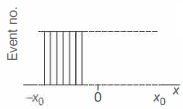
B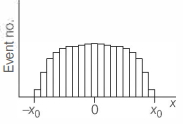
C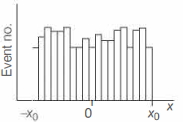
D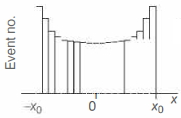
Solution
(D) In simple harmonic motion,the displacement of the particle is given by $x(t) = x_0 \sin(\omega t + \phi)$.
The velocity of the particle is $v = \frac{dx}{dt} = x_0 \omega \cos(\omega t + \phi)$.
The probability $P(x) dx$ of finding the particle in the interval $(x, x + dx)$ is proportional to the time $dt$ it spends in that interval,which is $P(x) \propto \frac{dt}{dx} = \frac{1}{|v|}$.
Since $v = \omega \sqrt{x_0^2 - x^2}$,we have $P(x) \propto \frac{1}{\sqrt{x_0^2 - x^2}}$.
This function has a minimum at the mean position $(x = 0)$ and approaches infinity at the extreme positions $(x = \pm x_0)$.
Graph $D$ shows the number of events (which is proportional to the probability density) being lowest at the center and increasing towards the extreme positions,which matches the behavior of the function $P(x) \propto \frac{1}{\sqrt{x_0^2 - x^2}}$.
The velocity of the particle is $v = \frac{dx}{dt} = x_0 \omega \cos(\omega t + \phi)$.
The probability $P(x) dx$ of finding the particle in the interval $(x, x + dx)$ is proportional to the time $dt$ it spends in that interval,which is $P(x) \propto \frac{dt}{dx} = \frac{1}{|v|}$.
Since $v = \omega \sqrt{x_0^2 - x^2}$,we have $P(x) \propto \frac{1}{\sqrt{x_0^2 - x^2}}$.
This function has a minimum at the mean position $(x = 0)$ and approaches infinity at the extreme positions $(x = \pm x_0)$.
Graph $D$ shows the number of events (which is proportional to the probability density) being lowest at the center and increasing towards the extreme positions,which matches the behavior of the function $P(x) \propto \frac{1}{\sqrt{x_0^2 - x^2}}$.
0 likesView Solution
21
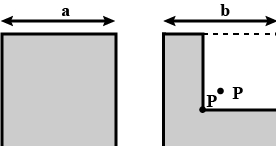
PhysicsAdvancedMCQKVPY · 2014
$A$ uniform square wooden sheet of side $a$ has its centre of mass located at point $O$ as shown in the figure below on the left. $A$ square portion of side $b$ of this sheet is cut out to produce an $L$-shaped sheet as shown in the figure on the right. The centre of mass of the $L$-shaped sheet lies at the point $P$ (in the above diagram),when
A
$a / b=(\sqrt{5}-1) / 2$
B
$a / b=(\sqrt{5}+1) / 2$
C
$a / b=(\sqrt{3}-1) / 2$
D
$a / b=(\sqrt{3}+1) / 2$
Solution
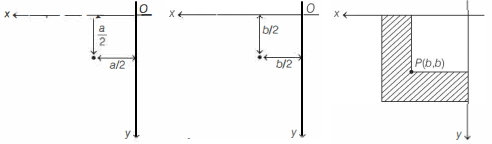
(B) The centre of mass of the original square plate of side $a$ is at its geometric centre. Let the origin be at the top-right corner of the original square. The coordinates of the centre of mass of the original square are $(x_1, y_1) = (a/2, a/2)$.
Let $k$ be the mass per unit area. The mass of the original square is $m_1 = k a^2$.
The removed square portion of side $b$ has its centre of mass at $(x_2, y_2) = (b/2, b/2)$ relative to the same origin.
The mass of the removed portion is $m_2 = k b^2$.
The remaining $L$-shaped sheet has its centre of mass at point $P$,which is given as $(b, b)$ relative to the chosen origin.
Using the formula for the centre of mass of a system with a cavity: $X_{CM} = \frac{m_1 x_1 - m_2 x_2}{m_1 - m_2}$.
Substituting the values: $b = \frac{(k a^2)(a/2) - (k b^2)(b/2)}{k a^2 - k b^2}$.
$b = \frac{a^3 - b^3}{2(a^2 - b^2)}$.
$2b(a^2 - b^2) = a^3 - b^3$.
$2ba^2 - 2b^3 = a^3 - b^3$.
$a^3 - 2ba^2 + b^3 = 0$.
Dividing by $b^3$: $(a/b)^3 - 2(a/b)^2 + 1 = 0$.
Let $x = a/b$. Then $x^3 - 2x^2 + 1 = 0$.
Since $x=1$ is a root,we divide by $(x-1)$: $(x-1)(x^2 - x - 1) = 0$.
Since $a > b$,$x > 1$,so $x^2 - x - 1 = 0$.
Solving for $x$: $x = \frac{1 \pm \sqrt{1 - 4(1)(-1)}}{2} = \frac{1 + \sqrt{5}}{2}$ (taking the positive root).
Thus,$a/b = (\sqrt{5} + 1) / 2$.
Let $k$ be the mass per unit area. The mass of the original square is $m_1 = k a^2$.
The removed square portion of side $b$ has its centre of mass at $(x_2, y_2) = (b/2, b/2)$ relative to the same origin.
The mass of the removed portion is $m_2 = k b^2$.
The remaining $L$-shaped sheet has its centre of mass at point $P$,which is given as $(b, b)$ relative to the chosen origin.
Using the formula for the centre of mass of a system with a cavity: $X_{CM} = \frac{m_1 x_1 - m_2 x_2}{m_1 - m_2}$.
Substituting the values: $b = \frac{(k a^2)(a/2) - (k b^2)(b/2)}{k a^2 - k b^2}$.
$b = \frac{a^3 - b^3}{2(a^2 - b^2)}$.
$2b(a^2 - b^2) = a^3 - b^3$.
$2ba^2 - 2b^3 = a^3 - b^3$.
$a^3 - 2ba^2 + b^3 = 0$.
Dividing by $b^3$: $(a/b)^3 - 2(a/b)^2 + 1 = 0$.
Let $x = a/b$. Then $x^3 - 2x^2 + 1 = 0$.
Since $x=1$ is a root,we divide by $(x-1)$: $(x-1)(x^2 - x - 1) = 0$.
Since $a > b$,$x > 1$,so $x^2 - x - 1 = 0$.
Solving for $x$: $x = \frac{1 \pm \sqrt{1 - 4(1)(-1)}}{2} = \frac{1 + \sqrt{5}}{2}$ (taking the positive root).
Thus,$a/b = (\sqrt{5} + 1) / 2$.
0 likesView Solution
22
PhysicsAdvancedMCQKVPY · 2014
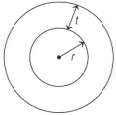
$A$ machine is blowing spherical soap bubbles of different radii filled with helium gas. It is found that,if the bubbles have a radius smaller than $1 \, cm$,then they sink to the floor in still air. Larger bubbles float in the air. Assume that the thickness of the soap film in all bubbles is uniform and equal. Assume that the density of soap solution is same as that of water $\left(= 1000 \, kg \, m^{-3}\right)$. The density of helium inside the bubbles and air are $0.18 \, kg \, m^{-3}$ and $1.23 \, kg \, m^{-3}$,respectively. Then,the thickness of the soap film of the bubbles is .......... $\mu m$ (Note: $1 \, \mu m = 10^{-6} \, m$)
A
$0.50$
B
$1.50$
C
$7.00$
D
$3.50$
Solution
(D) For a soap bubble to float in air,the gravitational force must be equal to the buoyant force.
Gravitational force = Buoyant force
$g \times (\text{mass of helium} + \text{mass of soap film}) = \text{Weight of air displaced by bubble}$
Let $r$ be the inner radius of the soap bubble and $t$ be the thickness of the film.
The volume of helium is $V_{He} = \frac{4}{3} \pi r^3$.
The volume of the soap film is $V_{film} \approx 4 \pi r^2 t$ (since $t \ll r$).
The equation of equilibrium is:
$\frac{4}{3} \pi r^3 \rho_{He} g + (4 \pi r^2 t) \rho_{soap} g = \frac{4}{3} \pi r^3 \rho_{air} g$
Dividing by $g$ and rearranging:
$4 \pi r^2 t \rho_{soap} = \frac{4}{3} \pi r^3 (\rho_{air} - \rho_{He})$
$t = \frac{r}{3} \frac{(\rho_{air} - \rho_{He})}{\rho_{soap}}$
Given $r = 1 \, cm = 10^{-2} \, m$,$\rho_{air} = 1.23 \, kg \, m^{-3}$,$\rho_{He} = 0.18 \, kg \, m^{-3}$,and $\rho_{soap} = 1000 \, kg \, m^{-3}$.
$t = \frac{10^{-2}}{3} \times \frac{(1.23 - 0.18)}{1000}$
$t = \frac{10^{-2}}{3} \times \frac{1.05}{1000} = \frac{1.05 \times 10^{-5}}{3} = 0.35 \times 10^{-5} \, m = 3.5 \times 10^{-6} \, m$.
Since $1 \, \mu m = 10^{-6} \, m$,the thickness $t = 3.50 \, \mu m$.
Gravitational force = Buoyant force
$g \times (\text{mass of helium} + \text{mass of soap film}) = \text{Weight of air displaced by bubble}$
Let $r$ be the inner radius of the soap bubble and $t$ be the thickness of the film.
The volume of helium is $V_{He} = \frac{4}{3} \pi r^3$.
The volume of the soap film is $V_{film} \approx 4 \pi r^2 t$ (since $t \ll r$).
The equation of equilibrium is:
$\frac{4}{3} \pi r^3 \rho_{He} g + (4 \pi r^2 t) \rho_{soap} g = \frac{4}{3} \pi r^3 \rho_{air} g$
Dividing by $g$ and rearranging:
$4 \pi r^2 t \rho_{soap} = \frac{4}{3} \pi r^3 (\rho_{air} - \rho_{He})$
$t = \frac{r}{3} \frac{(\rho_{air} - \rho_{He})}{\rho_{soap}}$
Given $r = 1 \, cm = 10^{-2} \, m$,$\rho_{air} = 1.23 \, kg \, m^{-3}$,$\rho_{He} = 0.18 \, kg \, m^{-3}$,and $\rho_{soap} = 1000 \, kg \, m^{-3}$.
$t = \frac{10^{-2}}{3} \times \frac{(1.23 - 0.18)}{1000}$
$t = \frac{10^{-2}}{3} \times \frac{1.05}{1000} = \frac{1.05 \times 10^{-5}}{3} = 0.35 \times 10^{-5} \, m = 3.5 \times 10^{-6} \, m$.
Since $1 \, \mu m = 10^{-6} \, m$,the thickness $t = 3.50 \, \mu m$.
0 likesView Solution
23
PhysicsMediumMCQKVPY · 2014
An aluminium piece of mass $50 \,g$ initially at $300^{\circ} C$ is dipped quickly and taken out of $1 \,kg$ of water,initially at $30^{\circ} C$. If the temperature of the aluminium piece immediately after being taken out of the water is found to be $160^{\circ} C$,the temperature of the water is ............ $^{\circ} C$. The specific heat capacities of aluminium and water are $900 \,J \,kg^{-1} K^{-1}$ and $4200 \,J \,kg^{-1} K^{-1}$,respectively.
A
$165$
B
$45$
C
$31.5$
D
$28.5$
Solution
(C) According to the principle of calorimetry,heat lost by the aluminium piece is equal to the heat gained by the water.
Let $m_a = 50 \,g = 0.05 \,kg$ be the mass of aluminium,$s_a = 900 \,J \,kg^{-1} K^{-1}$ be its specific heat,and $\Delta T_a = (300^{\circ} C - 160^{\circ} C) = 140^{\circ} C$ be the change in temperature.
Let $m_w = 1 \,kg$ be the mass of water,$s_w = 4200 \,J \,kg^{-1} K^{-1}$ be its specific heat,and $\Delta T_w = (T - 30^{\circ} C)$ be the change in temperature of water.
Heat lost by aluminium = $m_a s_a \Delta T_a = 0.05 \times 900 \times 140 = 6300 \,J$.
Heat gained by water = $m_w s_w \Delta T_w = 1 \times 4200 \times (T - 30) = 4200(T - 30)$.
Equating the two: $6300 = 4200(T - 30)$.
$T - 30 = \frac{6300}{4200} = 1.5$.
$T = 30 + 1.5 = 31.5^{\circ} C$.
Thus,the final temperature of the water is $31.5^{\circ} C$.
Let $m_a = 50 \,g = 0.05 \,kg$ be the mass of aluminium,$s_a = 900 \,J \,kg^{-1} K^{-1}$ be its specific heat,and $\Delta T_a = (300^{\circ} C - 160^{\circ} C) = 140^{\circ} C$ be the change in temperature.
Let $m_w = 1 \,kg$ be the mass of water,$s_w = 4200 \,J \,kg^{-1} K^{-1}$ be its specific heat,and $\Delta T_w = (T - 30^{\circ} C)$ be the change in temperature of water.
Heat lost by aluminium = $m_a s_a \Delta T_a = 0.05 \times 900 \times 140 = 6300 \,J$.
Heat gained by water = $m_w s_w \Delta T_w = 1 \times 4200 \times (T - 30) = 4200(T - 30)$.
Equating the two: $6300 = 4200(T - 30)$.
$T - 30 = \frac{6300}{4200} = 1.5$.
$T = 30 + 1.5 = 31.5^{\circ} C$.
Thus,the final temperature of the water is $31.5^{\circ} C$.
0 likesView Solution
24
PhysicsMediumMCQKVPY · 2014
Monochromatic light passes through a prism. Compared to that in air, inside the prism the light's
A
speed and wavelength are different, but frequency remains same
B
speed and frequency are different, but wavelength remains same
C
wavelength and frequency are different, but speed remains same
D
speed, wavelength and frequency are all different
Solution
(A) When light travels from one medium to another, its frequency $(f)$ remains constant because it is determined by the source of light.
The speed of light $(v)$ in a medium is given by $v = c/n$, where $c$ is the speed of light in vacuum and $n$ is the refractive index of the medium. Since the refractive index of the prism is greater than that of air $(n > 1)$, the speed of light decreases inside the prism.
The relationship between speed, frequency, and wavelength $(\lambda)$ is $v = f \lambda$. Since $v$ decreases and $f$ remains constant, the wavelength $\lambda$ must also decrease inside the prism.
Therefore, the speed and wavelength change, while the frequency remains the same.
The speed of light $(v)$ in a medium is given by $v = c/n$, where $c$ is the speed of light in vacuum and $n$ is the refractive index of the medium. Since the refractive index of the prism is greater than that of air $(n > 1)$, the speed of light decreases inside the prism.
The relationship between speed, frequency, and wavelength $(\lambda)$ is $v = f \lambda$. Since $v$ decreases and $f$ remains constant, the wavelength $\lambda$ must also decrease inside the prism.
Therefore, the speed and wavelength change, while the frequency remains the same.
0 likesView Solution
25
PhysicsDifficultMCQKVPY · 2014
The flat face of a plano-convex lens of focal length $10 \,cm$ is silvered. $A$ point source placed $30 \,cm$ in front of the curved surface will produce a
A
real image $15 \,cm$ away from the lens
B
real image $6 \,cm$ away from the lens
C
virtual image $15 \,cm$ away from the lens
D
virtual image $6 \,cm$ away from the lens
Solution
(B) When a lens is silvered,it acts like a mirror with an equivalent focal length $f_{eq}$.
The formula for the equivalent focal length is given by $\frac{1}{f_{eq}} = \frac{2}{f_l} + \frac{1}{f_m}$,where $f_l$ is the focal length of the lens and $f_m$ is the focal length of the mirror.
For a plano-convex lens,$f_l = 10 \,cm$. The flat surface is silvered,so it acts as a plane mirror,meaning $f_m = \infty$.
Thus,$\frac{1}{f_{eq}} = \frac{2}{10} + \frac{1}{\infty} = \frac{1}{5}$.
Since the system acts as a concave mirror,we take $f_{eq} = -5 \,cm$ (using sign convention for a mirror).
Given the object distance $u = -30 \,cm$,we use the mirror formula: $\frac{1}{f_{eq}} = \frac{1}{v} + \frac{1}{u}$.
Substituting the values: $\frac{1}{-5} = \frac{1}{v} + \frac{1}{-30}$.
$\frac{1}{v} = \frac{1}{-5} + \frac{1}{30} = \frac{-6 + 1}{30} = \frac{-5}{30} = -\frac{1}{6}$.
Therefore,$v = -6 \,cm$.
The negative sign indicates that the image is formed in front of the mirror,which means it is a real image at a distance of $6 \,cm$ from the lens.
The formula for the equivalent focal length is given by $\frac{1}{f_{eq}} = \frac{2}{f_l} + \frac{1}{f_m}$,where $f_l$ is the focal length of the lens and $f_m$ is the focal length of the mirror.
For a plano-convex lens,$f_l = 10 \,cm$. The flat surface is silvered,so it acts as a plane mirror,meaning $f_m = \infty$.
Thus,$\frac{1}{f_{eq}} = \frac{2}{10} + \frac{1}{\infty} = \frac{1}{5}$.
Since the system acts as a concave mirror,we take $f_{eq} = -5 \,cm$ (using sign convention for a mirror).
Given the object distance $u = -30 \,cm$,we use the mirror formula: $\frac{1}{f_{eq}} = \frac{1}{v} + \frac{1}{u}$.
Substituting the values: $\frac{1}{-5} = \frac{1}{v} + \frac{1}{-30}$.
$\frac{1}{v} = \frac{1}{-5} + \frac{1}{30} = \frac{-6 + 1}{30} = \frac{-5}{30} = -\frac{1}{6}$.
Therefore,$v = -6 \,cm$.
The negative sign indicates that the image is formed in front of the mirror,which means it is a real image at a distance of $6 \,cm$ from the lens.
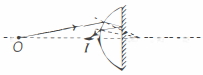
0 likesView Solution
26
PhysicsMediumMCQKVPY · 2014
Two identical metallic square loops $L_1$ and $L_2$ are placed next to each other with their sides parallel on a smooth horizontal table. Loop $L_1$ is fixed and a current which increases as a function of time is passed through it. Then,loop $L_2$ is
A
rotates about its centre of mass
B
moves towards $L_1$
C
remains stationary
D
moves away from $L_1$
Solution
(D) According to Lenz's Law,the induced current in loop $L_2$ will oppose the change in magnetic flux linked with it.
As the current in loop $L_1$ increases with time,the magnetic flux linked with loop $L_2$ also increases.
To oppose this increase in flux,the induced current in loop $L_2$ flows in such a direction that the magnetic field produced by it opposes the magnetic field of $L_1$. This results in currents flowing in opposite directions in the adjacent arms of the two loops.
Since currents in the adjacent arms of $L_1$ and $L_2$ are in opposite directions,there is a repulsive force between them.
Consequently,loop $L_2$ moves away from loop $L_1$.
As the current in loop $L_1$ increases with time,the magnetic flux linked with loop $L_2$ also increases.
To oppose this increase in flux,the induced current in loop $L_2$ flows in such a direction that the magnetic field produced by it opposes the magnetic field of $L_1$. This results in currents flowing in opposite directions in the adjacent arms of the two loops.
Since currents in the adjacent arms of $L_1$ and $L_2$ are in opposite directions,there is a repulsive force between them.
Consequently,loop $L_2$ moves away from loop $L_1$.
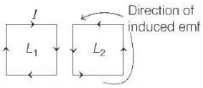
0 likesView Solution
27
PhysicsAdvancedMCQKVPY · 2014
An electron enters a parallel plate capacitor with horizontal speed $u$ and is found to deflect by angle $\theta$ on leaving the capacitor as shown below. It is found that $\tan \theta = 0.4$ and gravity is negligible. If the initial horizontal speed is doubled, then the value of $\tan \theta$ will be
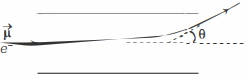
A
$0.1$
B
$0.2$
C
$0.8$
D
$1.6$
Solution
(A) The electron is subjected to an electric force due to the electric field $E$ between the capacitor plates.
The time taken by the electron to cross the region of length $x$ between the plates is $t = \frac{x}{u}$.
In this time, the acceleration of the electron in the $y$-direction is $a_y = \frac{F}{m} = \frac{eE}{m}$.
The vertical velocity component $v_y$ acquired by the electron upon leaving the capacitor is $v_y = a_y t = \left(\frac{eE}{m}\right) \left(\frac{x}{u}\right) = \frac{eEx}{mu}$.
The horizontal velocity component remains constant at $v_x = u$.
The angle of deflection $\theta$ is given by $\tan \theta = \frac{v_y}{v_x} = \frac{eEx/mu}{u} = \frac{eEx}{mu^2}$.
From this expression, we see that $\tan \theta \propto \frac{1}{u^2}$.
Therefore, $\frac{\tan \theta_2}{\tan \theta_1} = \frac{u_1^2}{u_2^2}$.
Given $\tan \theta_1 = 0.4$ and $u_2 = 2u_1$, we have:
$\tan \theta_2 = \tan \theta_1 \left(\frac{u_1}{u_2}\right)^2 = 0.4 \left(\frac{u_1}{2u_1}\right)^2 = 0.4 \left(\frac{1}{4}\right) = 0.1$.
The time taken by the electron to cross the region of length $x$ between the plates is $t = \frac{x}{u}$.
In this time, the acceleration of the electron in the $y$-direction is $a_y = \frac{F}{m} = \frac{eE}{m}$.
The vertical velocity component $v_y$ acquired by the electron upon leaving the capacitor is $v_y = a_y t = \left(\frac{eE}{m}\right) \left(\frac{x}{u}\right) = \frac{eEx}{mu}$.
The horizontal velocity component remains constant at $v_x = u$.
The angle of deflection $\theta$ is given by $\tan \theta = \frac{v_y}{v_x} = \frac{eEx/mu}{u} = \frac{eEx}{mu^2}$.
From this expression, we see that $\tan \theta \propto \frac{1}{u^2}$.
Therefore, $\frac{\tan \theta_2}{\tan \theta_1} = \frac{u_1^2}{u_2^2}$.
Given $\tan \theta_1 = 0.4$ and $u_2 = 2u_1$, we have:
$\tan \theta_2 = \tan \theta_1 \left(\frac{u_1}{u_2}\right)^2 = 0.4 \left(\frac{u_1}{2u_1}\right)^2 = 0.4 \left(\frac{1}{4}\right) = 0.1$.
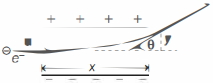
0 likesView Solution
28
PhysicsDifficultMCQKVPY · 2014
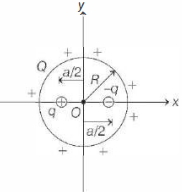
Consider a spherical shell of radius $R$ with a total charge $+Q$ uniformly spread on its surface (centre of the shell lies at the origin $x=0$). Two point charges $+q$ and $-q$ are brought,one after the other,from far away and placed at $x=-a/2$ and $x=+a/2$ $(a < 2R)$,respectively. The magnitude of the work done in this process is:
A
$(Q+q)^2 / 4 \pi \varepsilon_0 a$
B
zero
C
$q^2 / 4 \pi \varepsilon_0 a$
D
$Q q / 4 \pi \varepsilon_0 a$
Solution
(C) The work done in bringing the charges from infinity to their respective positions is equal to the change in the electrostatic potential energy of the system.
Let the shell be charge $1$,the charge $+q$ be charge $2$,and the charge $-q$ be charge $3$.
The potential inside a uniformly charged spherical shell is constant and equal to $V = kQ/R$,where $k = 1 / (4 \pi \varepsilon_0)$.
$1$. Work done to bring charge $+q$ to $x = -a/2$: $W_1 = q \times V_{\text{shell}} = q(kQ/R)$.
$2$. Work done to bring charge $-q$ to $x = +a/2$: $W_2 = (-q) \times V_{\text{shell}} + (-q) \times V_{\text{charge } q} = (-q)(kQ/R) + (-q)(kq / a) = -kQq/R - kq^2/a$.
Total work done $W = W_1 + W_2 = (kQq/R) - (kQq/R) - kq^2/a = -kq^2/a$.
The magnitude of the work done is $|W| = | -kq^2/a | = q^2 / (4 \pi \varepsilon_0 a)$.
Let the shell be charge $1$,the charge $+q$ be charge $2$,and the charge $-q$ be charge $3$.
The potential inside a uniformly charged spherical shell is constant and equal to $V = kQ/R$,where $k = 1 / (4 \pi \varepsilon_0)$.
$1$. Work done to bring charge $+q$ to $x = -a/2$: $W_1 = q \times V_{\text{shell}} = q(kQ/R)$.
$2$. Work done to bring charge $-q$ to $x = +a/2$: $W_2 = (-q) \times V_{\text{shell}} + (-q) \times V_{\text{charge } q} = (-q)(kQ/R) + (-q)(kq / a) = -kQq/R - kq^2/a$.
Total work done $W = W_1 + W_2 = (kQq/R) - (kQq/R) - kq^2/a = -kq^2/a$.
The magnitude of the work done is $|W| = | -kq^2/a | = q^2 / (4 \pi \varepsilon_0 a)$.
0 likesView Solution
29
PhysicsDifficultMCQKVPY · 2014
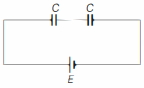
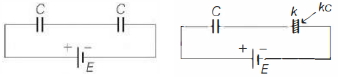
Two identical parallel plate capacitors of capacitance $C$ each are connected in series with a battery of emf $E$ as shown below. If one of the capacitors is now filled with a dielectric of dielectric constant $k$,then the amount of charge which will flow through the battery is (neglect internal resistance of the battery).
A
$\frac{k+1}{2(k-1)} \cdot C E$
B
$\frac{k-1}{2(k+1)} \cdot C E$
C
$\frac{k-2}{k+2} \cdot C E$
D
$\frac{k+2}{k-2} \cdot C E$
Solution
(B) Initially,the equivalent capacitance is $C_{eq} = \frac{C \cdot C}{C + C} = \frac{C}{2}$.
The charge delivered by the battery is $Q_1 = C_{eq} E = \frac{C E}{2}$.
When one of the capacitors is filled with a dielectric of constant $k$,its new capacitance becomes $kC$. The new equivalent capacitance of the series combination is:
$C'_{eq} = \frac{C \cdot (kC)}{C + kC} = \left( \frac{k}{k+1} \right) C$.
Since the battery remains connected,the new charge on the combination is:
$Q_2 = C'_{eq} E = \left( \frac{k}{k+1} \right) C E$.
The amount of charge that flows through the battery is the change in charge:
$\Delta Q = Q_2 - Q_1 = \left( \frac{k}{k+1} - \frac{1}{2} \right) C E$.
$\Delta Q = \left( \frac{2k - (k+1)}{2(k+1)} \right) C E = \frac{k-1}{2(k+1)} C E$.
The charge delivered by the battery is $Q_1 = C_{eq} E = \frac{C E}{2}$.
When one of the capacitors is filled with a dielectric of constant $k$,its new capacitance becomes $kC$. The new equivalent capacitance of the series combination is:
$C'_{eq} = \frac{C \cdot (kC)}{C + kC} = \left( \frac{k}{k+1} \right) C$.
Since the battery remains connected,the new charge on the combination is:
$Q_2 = C'_{eq} E = \left( \frac{k}{k+1} \right) C E$.
The amount of charge that flows through the battery is the change in charge:
$\Delta Q = Q_2 - Q_1 = \left( \frac{k}{k+1} - \frac{1}{2} \right) C E$.
$\Delta Q = \left( \frac{2k - (k+1)}{2(k+1)} \right) C E = \frac{k-1}{2(k+1)} C E$.
0 likesView Solution
30
PhysicsMediumMCQKVPY · 2014
$A$ certain $p-n$ junction,having a depletion region of width $20 \,\mu m$,was found to have a breakdown voltage of $100 \,V$. If the width of the depletion region is reduced to $1 \,\mu m$ during its production,then it can be used as a zener diode for voltage regulation of .......... $V$.
A
$5$
B
$10$
C
$7.5$
D
$2000$
Solution
(A) The breakdown electric field $E$ in a $p-n$ junction is a characteristic property of the material and is independent of the depletion width.
Given,the breakdown voltage $V_1 = 100 \,V$ for a depletion width $d_1 = 20 \,\mu m$.
The electric field $E$ is given by $E = \frac{V}{d}$.
Since the breakdown field $E$ remains constant,we have:
$\frac{V_1}{d_1} = \frac{V_2}{d_2}$
Substituting the given values:
$\frac{100 \,V}{20 \,\mu m} = \frac{V_2}{1 \,\mu m}$
$5 \times 10^6 \,V/m = \frac{V_2}{1 \times 10^{-6} \,m}$
$V_2 = 5 \,V$.
Thus,the Zener diode can be used for voltage regulation of $5 \,V$.
Given,the breakdown voltage $V_1 = 100 \,V$ for a depletion width $d_1 = 20 \,\mu m$.
The electric field $E$ is given by $E = \frac{V}{d}$.
Since the breakdown field $E$ remains constant,we have:
$\frac{V_1}{d_1} = \frac{V_2}{d_2}$
Substituting the given values:
$\frac{100 \,V}{20 \,\mu m} = \frac{V_2}{1 \,\mu m}$
$5 \times 10^6 \,V/m = \frac{V_2}{1 \times 10^{-6} \,m}$
$V_2 = 5 \,V$.
Thus,the Zener diode can be used for voltage regulation of $5 \,V$.
0 likesView Solution
31
PhysicsAdvancedMCQKVPY · 2014
The half-life of a particle of mass $1.6 \times 10^{-26} \,kg$ is $6.9 \,s$. $A$ stream of such particles is travelling with a kinetic energy of $0.05 \,eV$ per particle. The fraction of particles that will decay when they travel a distance of $1 \,m$ is
A
$0.1$
B
$0.01$
C
$0.001$
D
$0.0001$
Solution
(D) The kinetic energy $K$ of the particle is given by $K = \frac{1}{2}mv^2$.
Given $K = 0.05 \,eV = 0.05 \times 1.6 \times 10^{-19} \,J$ and $m = 1.6 \times 10^{-26} \,kg$.
$0.05 \times 1.6 \times 10^{-19} = \frac{1}{2} \times 1.6 \times 10^{-26} \times v^2$.
$v^2 = \frac{0.05 \times 1.6 \times 10^{-19} \times 2}{1.6 \times 10^{-26}} = 0.1 \times 10^7 = 10^6 \,m^2/s^2$.
$v = 10^3 \,m/s$.
The time $t$ taken to travel a distance $D = 1 \,m$ is $t = \frac{D}{v} = \frac{1}{10^3} = 10^{-3} \,s$.
The number of half-lives $n$ is $n = \frac{t}{T_{1/2}} = \frac{10^{-3}}{6.9} \approx 1.45 \times 10^{-4}$.
The fraction of particles remaining is $N/N_0 = (1/2)^n = 2^{-n}$.
The fraction decayed is $1 - 2^{-n} = 1 - e^{-n \ln 2} \approx 1 - (1 - n \ln 2) = n \ln 2$.
Since $n \approx 1.45 \times 10^{-4}$ and $\ln 2 \approx 0.69$,the fraction decayed $\approx 1.45 \times 10^{-4} \times 0.69 \approx 10^{-4} = 0.0001$.
Given $K = 0.05 \,eV = 0.05 \times 1.6 \times 10^{-19} \,J$ and $m = 1.6 \times 10^{-26} \,kg$.
$0.05 \times 1.6 \times 10^{-19} = \frac{1}{2} \times 1.6 \times 10^{-26} \times v^2$.
$v^2 = \frac{0.05 \times 1.6 \times 10^{-19} \times 2}{1.6 \times 10^{-26}} = 0.1 \times 10^7 = 10^6 \,m^2/s^2$.
$v = 10^3 \,m/s$.
The time $t$ taken to travel a distance $D = 1 \,m$ is $t = \frac{D}{v} = \frac{1}{10^3} = 10^{-3} \,s$.
The number of half-lives $n$ is $n = \frac{t}{T_{1/2}} = \frac{10^{-3}}{6.9} \approx 1.45 \times 10^{-4}$.
The fraction of particles remaining is $N/N_0 = (1/2)^n = 2^{-n}$.
The fraction decayed is $1 - 2^{-n} = 1 - e^{-n \ln 2} \approx 1 - (1 - n \ln 2) = n \ln 2$.
Since $n \approx 1.45 \times 10^{-4}$ and $\ln 2 \approx 0.69$,the fraction decayed $\approx 1.45 \times 10^{-4} \times 0.69 \approx 10^{-4} = 0.0001$.
0 likesView Solution
32
PhysicsMediumMCQKVPY · 2014
$A$ $160 \,W$ light source is radiating light of wavelength $6200 \,\mathring A$ uniformly in all directions. The photon flux at a distance of $1.8 \,m$ is of the order of .......... $m^{-2} s^{-1}$ (Planck's constant $= 6.63 \times 10^{-34} \,J \cdot s$)
A
$10^2$
B
$10^{12}$
C
$10^{19}$
D
$10^{25}$
Solution
(C) The photon flux is defined as the number of photons passing through a unit area per unit time.
The energy of a single photon is given by $E = \frac{hc}{\lambda}$.
The intensity $I$ at a distance $r$ from a source of power $P$ is $I = \frac{P}{4 \pi r^2}$.
The photon flux $\Phi$ is given by $\Phi = \frac{I}{E} = \frac{P}{4 \pi r^2} \times \frac{\lambda}{hc}$.
Substituting the given values: $P = 160 \,W$,$\lambda = 6200 \times 10^{-10} \,m$,$r = 1.8 \,m$,$h = 6.63 \times 10^{-34} \,J \cdot s$,and $c = 3 \times 10^8 \,m/s$.
$\Phi = \frac{160 \times 6200 \times 10^{-10}}{4 \times 3.14 \times (1.8)^2 \times 6.63 \times 10^{-34} \times 3 \times 10^8}$.
Calculating the value: $\Phi \approx 1.22 \times 10^{19} \,m^{-2} s^{-1}$.
Thus,the order of magnitude is $10^{19} \,m^{-2} s^{-1}$.
The energy of a single photon is given by $E = \frac{hc}{\lambda}$.
The intensity $I$ at a distance $r$ from a source of power $P$ is $I = \frac{P}{4 \pi r^2}$.
The photon flux $\Phi$ is given by $\Phi = \frac{I}{E} = \frac{P}{4 \pi r^2} \times \frac{\lambda}{hc}$.
Substituting the given values: $P = 160 \,W$,$\lambda = 6200 \times 10^{-10} \,m$,$r = 1.8 \,m$,$h = 6.63 \times 10^{-34} \,J \cdot s$,and $c = 3 \times 10^8 \,m/s$.
$\Phi = \frac{160 \times 6200 \times 10^{-10}}{4 \times 3.14 \times (1.8)^2 \times 6.63 \times 10^{-34} \times 3 \times 10^8}$.
Calculating the value: $\Phi \approx 1.22 \times 10^{19} \,m^{-2} s^{-1}$.
Thus,the order of magnitude is $10^{19} \,m^{-2} s^{-1}$.
0 likesView Solution
33
PhysicsMediumMCQKVPY · 2014
The wavelength of the first Balmer line caused by a transition from the $n=3$ level to the $n=2$ level in hydrogen is $\lambda_1$. The wavelength of the line caused by an electronic transition from $n=5$ to $n=3$ is
A
$\frac{375}{128} \lambda_1$
B
$\frac{125}{64} \lambda_1$
C
$\frac{64}{125} \lambda_1$
D
$\frac{128}{375} \lambda_1$
Solution
(B) Using the Rydberg formula for hydrogen,$\frac{1}{\lambda} = R \left( \frac{1}{n_f^2} - \frac{1}{n_i^2} \right)$.
For the first Balmer line ($n=3$ to $n=2$): $\frac{1}{\lambda_1} = R \left( \frac{1}{2^2} - \frac{1}{3^2} \right) = R \left( \frac{1}{4} - \frac{1}{9} \right) = R \left( \frac{5}{36} \right)$.
For the transition from $n=5$ to $n=3$: $\frac{1}{\lambda_2} = R \left( \frac{1}{3^2} - \frac{1}{5^2} \right) = R \left( \frac{1}{9} - \frac{1}{25} \right) = R \left( \frac{25-9}{225} \right) = R \left( \frac{16}{225} \right)$.
Taking the ratio: $\frac{\lambda_2}{\lambda_1} = \frac{R(5/36)}{R(16/225)} = \frac{5}{36} \times \frac{225}{16} = \frac{5 \times 25}{4 \times 16} = \frac{125}{64}$.
Therefore,$\lambda_2 = \frac{125}{64} \lambda_1$.
For the first Balmer line ($n=3$ to $n=2$): $\frac{1}{\lambda_1} = R \left( \frac{1}{2^2} - \frac{1}{3^2} \right) = R \left( \frac{1}{4} - \frac{1}{9} \right) = R \left( \frac{5}{36} \right)$.
For the transition from $n=5$ to $n=3$: $\frac{1}{\lambda_2} = R \left( \frac{1}{3^2} - \frac{1}{5^2} \right) = R \left( \frac{1}{9} - \frac{1}{25} \right) = R \left( \frac{25-9}{225} \right) = R \left( \frac{16}{225} \right)$.
Taking the ratio: $\frac{\lambda_2}{\lambda_1} = \frac{R(5/36)}{R(16/225)} = \frac{5}{36} \times \frac{225}{16} = \frac{5 \times 25}{4 \times 16} = \frac{125}{64}$.
Therefore,$\lambda_2 = \frac{125}{64} \lambda_1$.
0 likesView Solution
34
PhysicsMediumMCQKVPY · 2014
The binding energy per nucleon of ${ }_5 B ^{10}$ is $8.0 \,MeV$ and that of ${ }_5 B ^{11}$ is $7.5 \,MeV$. The energy required to remove a neutron from ${ }_5 B ^{11}$ is .......... $MeV$.
A
$2.5$
B
$8.0$
C
$0.5$
D
$7.5$
Solution
(A) The reaction for removing a neutron from ${ }_5 B ^{11}$ is given by:
${ }_5 B ^{11} \longrightarrow { }_5 B ^{10} + { }_0 n ^1$
The total binding energy of a nucleus is calculated as:
$BE = (\text{Binding energy per nucleon}) \times (\text{Mass number } A)$
For ${ }_5 B ^{11}$:
$BE({ }_5 B ^{11}) = 7.5 \,MeV \times 11 = 82.5 \,MeV$
For ${ }_5 B ^{10}$:
$BE({ }_5 B ^{10}) = 8.0 \,MeV \times 10 = 80.0 \,MeV$
The energy required to remove the neutron is the difference in binding energies:
$E = BE({ }_5 B ^{11}) - BE({ }_5 B ^{10})$
$E = 82.5 \,MeV - 80.0 \,MeV = 2.5 \,MeV$
${ }_5 B ^{11} \longrightarrow { }_5 B ^{10} + { }_0 n ^1$
The total binding energy of a nucleus is calculated as:
$BE = (\text{Binding energy per nucleon}) \times (\text{Mass number } A)$
For ${ }_5 B ^{11}$:
$BE({ }_5 B ^{11}) = 7.5 \,MeV \times 11 = 82.5 \,MeV$
For ${ }_5 B ^{10}$:
$BE({ }_5 B ^{10}) = 8.0 \,MeV \times 10 = 80.0 \,MeV$
The energy required to remove the neutron is the difference in binding energies:
$E = BE({ }_5 B ^{11}) - BE({ }_5 B ^{10})$
$E = 82.5 \,MeV - 80.0 \,MeV = 2.5 \,MeV$
0 likesView Solution
35
PhysicsAdvancedMCQKVPY · 2014
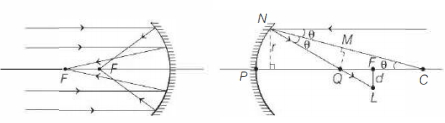
$A$ concave mirror of radius of curvature $R$ has a circular outline of radius $r$. $A$ circular disc is to be placed normal to the axis at the focus,so that it collects all the light that is reflected from the mirror from a beam parallel to the axis. For $r \ll R$,the area of this disc has to be at least
A
$\frac{\pi r^6}{4 R^4}$
B
$\frac{\pi r^4}{4 R^2}$
C
$\frac{\pi r^5}{4 R^3}$
D
$\frac{\pi r^4}{R^2}$
Solution
(A) For a large aperture mirror,rays parallel to the axis do not converge at a single point (focus $F$) due to spherical aberration. Instead,they form a circular patch at the focal plane.
Let $N$ be a point on the periphery of the mirror at a distance $r$ from the axis. Let the ray reflected from $N$ intersect the axis at $Q$. In $\triangle NQC$,where $C$ is the center of curvature,the angle of incidence equals the angle of reflection,both being $\theta$. Thus,$\angle N C P = \theta$ and $\angle N Q C = \theta$.
In $\triangle NQC$,by the law of sines or geometry,$QC = \frac{R}{2 \cos \theta}$.
The distance of $Q$ from the pole $P$ is $PQ = R - QC = R - \frac{R}{2 \cos \theta}$.
The distance of $Q$ from the focus $F$ is $QF = PF - PQ = \frac{R}{2} - (R - \frac{R}{2 \cos \theta}) = \frac{R}{2 \cos \theta} - \frac{R}{2} = \frac{R}{2} (\sec \theta - 1)$.
Let $d$ be the radius of the disc at the focus. From similar triangles formed by the reflected ray,the radius $d$ is given by $d = QF \tan(2\theta)$.
For small $\theta$,$\sin \theta \approx \tan \theta \approx \frac{r}{R}$. Also,$\sec \theta = (1 - \sin^2 \theta)^{-1/2} \approx 1 + \frac{\theta^2}{2} = 1 + \frac{r^2}{2R^2}$.
Substituting these,$QF \approx \frac{R}{2} (1 + \frac{r^2}{2R^2} - 1) = \frac{r^2}{4R}$.
Since $\tan(2\theta) \approx 2\theta \approx 2(\frac{r}{R})$,we have $d = QF \cdot 2\theta = (\frac{r^2}{4R}) \cdot (\frac{2r}{R}) = \frac{r^3}{2R^2}$.
The area of the disc is $A = \pi d^2 = \pi (\frac{r^3}{2R^2})^2 = \frac{\pi r^6}{4R^4}$.
Let $N$ be a point on the periphery of the mirror at a distance $r$ from the axis. Let the ray reflected from $N$ intersect the axis at $Q$. In $\triangle NQC$,where $C$ is the center of curvature,the angle of incidence equals the angle of reflection,both being $\theta$. Thus,$\angle N C P = \theta$ and $\angle N Q C = \theta$.
In $\triangle NQC$,by the law of sines or geometry,$QC = \frac{R}{2 \cos \theta}$.
The distance of $Q$ from the pole $P$ is $PQ = R - QC = R - \frac{R}{2 \cos \theta}$.
The distance of $Q$ from the focus $F$ is $QF = PF - PQ = \frac{R}{2} - (R - \frac{R}{2 \cos \theta}) = \frac{R}{2 \cos \theta} - \frac{R}{2} = \frac{R}{2} (\sec \theta - 1)$.
Let $d$ be the radius of the disc at the focus. From similar triangles formed by the reflected ray,the radius $d$ is given by $d = QF \tan(2\theta)$.
For small $\theta$,$\sin \theta \approx \tan \theta \approx \frac{r}{R}$. Also,$\sec \theta = (1 - \sin^2 \theta)^{-1/2} \approx 1 + \frac{\theta^2}{2} = 1 + \frac{r^2}{2R^2}$.
Substituting these,$QF \approx \frac{R}{2} (1 + \frac{r^2}{2R^2} - 1) = \frac{r^2}{4R}$.
Since $\tan(2\theta) \approx 2\theta \approx 2(\frac{r}{R})$,we have $d = QF \cdot 2\theta = (\frac{r^2}{4R}) \cdot (\frac{2r}{R}) = \frac{r^3}{2R^2}$.
The area of the disc is $A = \pi d^2 = \pi (\frac{r^3}{2R^2})^2 = \frac{\pi r^6}{4R^4}$.
0 likesView Solution
36
PhysicsAdvancedMCQKVPY · 2014
The angles of incidence and refraction of a monochromatic ray of light of wavelength $\lambda$ at an air-glass interface are $i$ and $r$,respectively. $A$ parallel beam of light with a small spread $\delta \lambda$ in wavelength about a mean wavelength $\lambda$ is refracted at the same air-glass interface. The refractive index $\mu$ of glass depends on the wavelength $\lambda$ as $\mu(\lambda)=a+b / \lambda^2$,where $a$ and $b$ are constants. Then,the angular spread in the angle of refraction of the beam is
A
$\left|\frac{\sin i}{\lambda^3 \cos r} \delta \lambda\right|$
B
$\left|\frac{2 b}{\lambda^3} \delta \lambda\right|$
C
$\left|\frac{2 b \tan r}{a \lambda^3+b \lambda} \delta \lambda\right|$
D
$\left|\frac{2 b\left(a+b / \lambda^2\right) \sin i}{\lambda^3} \delta \lambda\right|$
Solution
(C) From Snell's law,we have $\sin i = \mu \sin r$.
Substituting $\mu(\lambda) = a + \frac{b}{\lambda^2}$,we get $\sin i = (a + \frac{b}{\lambda^2}) \sin r$.
Differentiating both sides with respect to $\lambda$,keeping $i$ constant (since the incident angle is fixed):
$0 = \frac{d}{d\lambda} [(a + \frac{b}{\lambda^2}) \sin r]$
$0 = (a + \frac{b}{\lambda^2}) \cos r \frac{dr}{d\lambda} + \sin r (-\frac{2b}{\lambda^3})$.
Rearranging the terms to solve for $\frac{dr}{d\lambda}$:
$(a + \frac{b}{\lambda^2}) \cos r \frac{dr}{d\lambda} = \frac{2b}{\lambda^3} \sin r$.
$\frac{dr}{d\lambda} = \frac{2b \sin r}{\lambda^3 (a + \frac{b}{\lambda^2}) \cos r} = \frac{2b \tan r}{\lambda^3 (a + \frac{b}{\lambda^2})} = \frac{2b \tan r}{\lambda(a\lambda^2 + b)}$.
Thus,the angular spread $\delta r$ is given by $|\frac{dr}{d\lambda}| \delta \lambda = |\frac{2b \tan r}{a\lambda^3 + b\lambda}| \delta \lambda$.
Substituting $\mu(\lambda) = a + \frac{b}{\lambda^2}$,we get $\sin i = (a + \frac{b}{\lambda^2}) \sin r$.
Differentiating both sides with respect to $\lambda$,keeping $i$ constant (since the incident angle is fixed):
$0 = \frac{d}{d\lambda} [(a + \frac{b}{\lambda^2}) \sin r]$
$0 = (a + \frac{b}{\lambda^2}) \cos r \frac{dr}{d\lambda} + \sin r (-\frac{2b}{\lambda^3})$.
Rearranging the terms to solve for $\frac{dr}{d\lambda}$:
$(a + \frac{b}{\lambda^2}) \cos r \frac{dr}{d\lambda} = \frac{2b}{\lambda^3} \sin r$.
$\frac{dr}{d\lambda} = \frac{2b \sin r}{\lambda^3 (a + \frac{b}{\lambda^2}) \cos r} = \frac{2b \tan r}{\lambda^3 (a + \frac{b}{\lambda^2})} = \frac{2b \tan r}{\lambda(a\lambda^2 + b)}$.
Thus,the angular spread $\delta r$ is given by $|\frac{dr}{d\lambda}| \delta \lambda = |\frac{2b \tan r}{a\lambda^3 + b\lambda}| \delta \lambda$.
0 likesView Solution
37
PhysicsMediumMCQKVPY · 2014
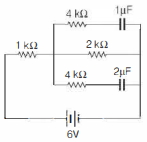
What are the charges stored in the $1 \,\mu F$ and $2 \,\mu F$ capacitors in the circuit below,once the currents become steady?
A
$8 \,\mu C$ and $4 \,\mu C$,respectively
B
$4 \,\mu C$ and $8 \,\mu C$,respectively
C
$3 \,\mu C$ and $6 \,\mu C$,respectively
D
$6 \,\mu C$ and $3 \,\mu C$,respectively
Solution
(B) In steady state (after the capacitors are fully charged),no current flows through the branches containing capacitors. The capacitors act as open circuits.
The circuit simplifies to a series combination of the $1 \,k\Omega$ resistor and the $2 \,k\Omega$ resistor connected to the $6 \,V$ battery.
The total resistance of the circuit is $R_{\text{total}} = 1 \,k\Omega + 2 \,k\Omega = 3 \,k\Omega = 3000 \,\Omega$.
The steady-state current in the circuit is $i = \frac{E}{R_{\text{total}}} = \frac{6 \,V}{3000 \,\Omega} = 2 \times 10^{-3} \,A = 2 \,mA$.
The potential difference across the $2 \,k\Omega$ resistor is $V_{2k} = i \times R = (2 \times 10^{-3} \,A) \times (2000 \,\Omega) = 4 \,V$.
Since the branches containing the capacitors are in parallel with the $2 \,k\Omega$ resistor,the potential difference across both the $1 \,\mu F$ and $2 \,\mu F$ capacitors is equal to the potential difference across the $2 \,k\Omega$ resistor,which is $4 \,V$.
The charge stored in the $1 \,\mu F$ capacitor is $Q_1 = C_1 \times V = (1 \,\mu F) \times (4 \,V) = 4 \,\mu C$.
The charge stored in the $2 \,\mu F$ capacitor is $Q_2 = C_2 \times V = (2 \,\mu F) \times (4 \,V) = 8 \,\mu C$.
Therefore,the charges are $4 \,\mu C$ and $8 \,\mu C$,respectively.
The circuit simplifies to a series combination of the $1 \,k\Omega$ resistor and the $2 \,k\Omega$ resistor connected to the $6 \,V$ battery.
The total resistance of the circuit is $R_{\text{total}} = 1 \,k\Omega + 2 \,k\Omega = 3 \,k\Omega = 3000 \,\Omega$.
The steady-state current in the circuit is $i = \frac{E}{R_{\text{total}}} = \frac{6 \,V}{3000 \,\Omega} = 2 \times 10^{-3} \,A = 2 \,mA$.
The potential difference across the $2 \,k\Omega$ resistor is $V_{2k} = i \times R = (2 \times 10^{-3} \,A) \times (2000 \,\Omega) = 4 \,V$.
Since the branches containing the capacitors are in parallel with the $2 \,k\Omega$ resistor,the potential difference across both the $1 \,\mu F$ and $2 \,\mu F$ capacitors is equal to the potential difference across the $2 \,k\Omega$ resistor,which is $4 \,V$.
The charge stored in the $1 \,\mu F$ capacitor is $Q_1 = C_1 \times V = (1 \,\mu F) \times (4 \,V) = 4 \,\mu C$.
The charge stored in the $2 \,\mu F$ capacitor is $Q_2 = C_2 \times V = (2 \,\mu F) \times (4 \,V) = 8 \,\mu C$.
Therefore,the charges are $4 \,\mu C$ and $8 \,\mu C$,respectively.
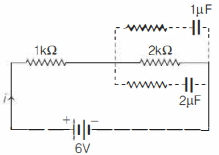
0 likesView Solution
38
PhysicsMediumMCQKVPY · 2014
$A$ $1.5 \,kW$ laser beam of wavelength $6400 \,\mathring A$ is used to levitate a thin aluminium disc of the same area as the cross-section of the beam. The laser light is reflected by the aluminium disc without any absorption. The mass of the foil is close to ......... $kg$.
A
$10^{-9}$
B
$10^{-3}$
C
$10^{-4}$
D
$10^{-6}$
Solution
(D) For a perfectly reflecting surface,the radiation force $F$ exerted by a beam of power $P$ is given by $F = \frac{2P}{c}$,where $c$ is the speed of light.
For the disc to levitate,this radiation force must balance the gravitational force (weight) acting on the disc: $F = mg$.
Equating the two,we get $\frac{2P}{c} = mg$.
Given: $P = 1.5 \,kW = 1.5 \times 10^3 \,W$,$c = 3 \times 10^8 \,m/s$,and taking $g = 10 \,m/s^2$.
Substituting the values: $\frac{2 \times 1.5 \times 10^3}{3 \times 10^8} = m \times 10$.
$\frac{3 \times 10^3}{3 \times 10^8} = 10m$.
$10^{-5} = 10m$.
$m = 10^{-6} \,kg$.
For the disc to levitate,this radiation force must balance the gravitational force (weight) acting on the disc: $F = mg$.
Equating the two,we get $\frac{2P}{c} = mg$.
Given: $P = 1.5 \,kW = 1.5 \times 10^3 \,W$,$c = 3 \times 10^8 \,m/s$,and taking $g = 10 \,m/s^2$.
Substituting the values: $\frac{2 \times 1.5 \times 10^3}{3 \times 10^8} = m \times 10$.
$\frac{3 \times 10^3}{3 \times 10^8} = 10m$.
$10^{-5} = 10m$.
$m = 10^{-6} \,kg$.
0 likesView Solution
39
PhysicsMediumMCQKVPY · 2014
When ultraviolet radiation of a certain frequency falls on a potassium target,the photoelectrons released can be stopped completely by a retarding potential of $0.6 \, V$. If the frequency of the radiation is increased by $10 \%$,this stopping potential rises to $0.9 \, V$. The work function of potassium is ........ $eV$.
A
$2.0$
B
$2.4$
C
$3.0$
D
$2.8$
Solution
(B) According to Einstein's photoelectric equation,the maximum kinetic energy $K_{\max}$ is given by $K_{\max} = eV_0 = hf - \phi_0$,where $V_0$ is the stopping potential,$f$ is the frequency,and $\phi_0$ is the work function.
For the initial case:
$e(0.6) = hf - \phi_0 \quad \dots(i)$
When the frequency is increased by $10 \%$,the new frequency $f' = f + 0.1f = 1.1f$. The new stopping potential is $V_0' = 0.9 \, V$.
$e(0.9) = h(1.1f) - \phi_0 \quad \dots(ii)$
From equation $(i)$,we have $hf = e(0.6) + \phi_0$. Substituting this into equation $(ii)$:
$e(0.9) = 1.1(e(0.6) + \phi_0) - \phi_0$
$e(0.9) = 1.1(e(0.6)) + 1.1\phi_0 - \phi_0$
$e(0.9) = e(0.66) + 0.1\phi_0$
$0.1\phi_0 = e(0.9 - 0.66)$
$0.1\phi_0 = 0.24 \, eV$
$\phi_0 = 2.4 \, eV$.
For the initial case:
$e(0.6) = hf - \phi_0 \quad \dots(i)$
When the frequency is increased by $10 \%$,the new frequency $f' = f + 0.1f = 1.1f$. The new stopping potential is $V_0' = 0.9 \, V$.
$e(0.9) = h(1.1f) - \phi_0 \quad \dots(ii)$
From equation $(i)$,we have $hf = e(0.6) + \phi_0$. Substituting this into equation $(ii)$:
$e(0.9) = 1.1(e(0.6) + \phi_0) - \phi_0$
$e(0.9) = 1.1(e(0.6)) + 1.1\phi_0 - \phi_0$
$e(0.9) = e(0.66) + 0.1\phi_0$
$0.1\phi_0 = e(0.9 - 0.66)$
$0.1\phi_0 = 0.24 \, eV$
$\phi_0 = 2.4 \, eV$.
0 likesView Solution
40
PhysicsDifficultMCQKVPY · 2014
Two positively charged spheres of masses $m_1$ and $m_2$ are suspended from a common point at the ceiling by identical insulating massless strings of length $l$. Charges on the two spheres are $q_1$ and $q_2$,respectively. At equilibrium,both strings make the same angle $\theta$ with the vertical. Then
A
$q_1 m_1 = q_2 m_2$
B
$m_1 = m_2$
C
$m_1 = m_2 \sin \theta$
D
$q_2 m_1 = q_1 m_2$
Solution
(B) In the given situation,the forces acting on each charged sphere are:
$(i)$ Gravitational force $(mg)$
$(ii)$ Electrostatic repulsion force $F_e = \frac{k q_1 q_2}{r^2}$
$(iii)$ Tension in the string $(T)$
For equilibrium,we resolve the tension $T$ into horizontal and vertical components:
$T \sin \theta = F_e = \frac{k q_1 q_2}{r^2}$
$T \cos \theta = mg$
Dividing the two equations,we get:
$\tan \theta = \frac{F_e}{mg} = \frac{k q_1 q_2}{r^2 mg}$
For sphere $1$:
$\tan \theta = \frac{k q_1 q_2}{r^2 m_1 g}$
For sphere $2$:
$\tan \theta = \frac{k q_1 q_2}{r^2 m_2 g}$
Since the angle $\theta$ is the same for both spheres,we equate the expressions:
$\frac{k q_1 q_2}{r^2 m_1 g} = \frac{k q_1 q_2}{r^2 m_2 g}$
This simplifies to:
$m_1 = m_2$
$(i)$ Gravitational force $(mg)$
$(ii)$ Electrostatic repulsion force $F_e = \frac{k q_1 q_2}{r^2}$
$(iii)$ Tension in the string $(T)$
For equilibrium,we resolve the tension $T$ into horizontal and vertical components:
$T \sin \theta = F_e = \frac{k q_1 q_2}{r^2}$
$T \cos \theta = mg$
Dividing the two equations,we get:
$\tan \theta = \frac{F_e}{mg} = \frac{k q_1 q_2}{r^2 mg}$
For sphere $1$:
$\tan \theta = \frac{k q_1 q_2}{r^2 m_1 g}$
For sphere $2$:
$\tan \theta = \frac{k q_1 q_2}{r^2 m_2 g}$
Since the angle $\theta$ is the same for both spheres,we equate the expressions:
$\frac{k q_1 q_2}{r^2 m_1 g} = \frac{k q_1 q_2}{r^2 m_2 g}$
This simplifies to:
$m_1 = m_2$
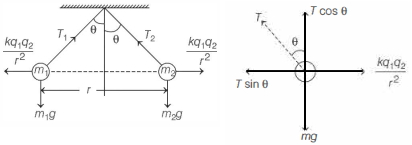
0 likesView Solution
41
PhysicsDifficultMCQKVPY · 2014
The angle of a prism is $60^{\circ}$. When light is incident at an angle of $60^{\circ}$ on the prism,the angle of emergence is $40^{\circ}$. The angle of incidence $i$ for which the light ray will deviate the least is such that
A
$i < 40^{\circ}$
B
$40^{\circ} < i < 50^{\circ}$
C
$50^{\circ} < i < 60^{\circ}$
D
$i > 60^{\circ}$
Solution
(B) For a prism,the deviation $\delta$ is given by $\delta = i + e - A$,where $i$ is the angle of incidence,$e$ is the angle of emergence,and $A$ is the prism angle.
Given $A = 60^{\circ}$,$i = 60^{\circ}$,and $e = 40^{\circ}$.
Thus,the deviation $\delta = 60^{\circ} + 40^{\circ} - 60^{\circ} = 40^{\circ}$.
According to the principle of reversibility of light,if $i = 60^{\circ}$ gives $e = 40^{\circ}$,then $i = 40^{\circ}$ will give $e = 60^{\circ}$,resulting in the same deviation $\delta = 40^{\circ}$.
The graph of deviation $\delta$ versus angle of incidence $i$ is a $U$-shaped curve where the minimum deviation $\delta_m$ occurs at the angle of incidence $i = i_m$.
Since the deviation is the same $(40^{\circ})$ at $i = 40^{\circ}$ and $i = 60^{\circ}$,the minimum deviation must occur at an angle of incidence between these two values.
Therefore,the angle of incidence for minimum deviation lies in the range $40^{\circ} < i < 60^{\circ}$. Looking at the provided graph,the minimum occurs at $i \approx 48^{\circ}$,which falls in the range $40^{\circ} < i < 50^{\circ}$.
Given $A = 60^{\circ}$,$i = 60^{\circ}$,and $e = 40^{\circ}$.
Thus,the deviation $\delta = 60^{\circ} + 40^{\circ} - 60^{\circ} = 40^{\circ}$.
According to the principle of reversibility of light,if $i = 60^{\circ}$ gives $e = 40^{\circ}$,then $i = 40^{\circ}$ will give $e = 60^{\circ}$,resulting in the same deviation $\delta = 40^{\circ}$.
The graph of deviation $\delta$ versus angle of incidence $i$ is a $U$-shaped curve where the minimum deviation $\delta_m$ occurs at the angle of incidence $i = i_m$.
Since the deviation is the same $(40^{\circ})$ at $i = 40^{\circ}$ and $i = 60^{\circ}$,the minimum deviation must occur at an angle of incidence between these two values.
Therefore,the angle of incidence for minimum deviation lies in the range $40^{\circ} < i < 60^{\circ}$. Looking at the provided graph,the minimum occurs at $i \approx 48^{\circ}$,which falls in the range $40^{\circ} < i < 50^{\circ}$.
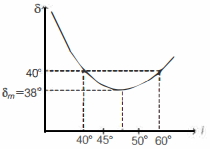
0 likesView Solution
42
PhysicsDifficultMCQKVPY · 2014
$A$ concave lens made of material of refractive index $1.6$ is immersed in a medium of refractive index $2.0$. The two surfaces of the concave lens have the same radius of curvature $0.2 \, m$. The lens will behave as a
A
divergent lens of focal length $0.4 \, m$
B
divergent lens of focal length $0.5 \, m$
C
convergent lens of focal length $0.4 \, m$
D
convergent lens of focal length $0.5 \, m$
Solution
(D) The focal length of a lens in a medium is given by the Lens Maker's Formula:
$\frac{1}{f} = \left( \frac{n_l}{n_m} - 1 \right) \left( \frac{1}{R_1} - \frac{1}{R_2} \right)$
Given:
Refractive index of lens material,$n_l = 1.6$
Refractive index of medium,$n_m = 2.0$
For a concave lens,$R_1 = -0.2 \, m$ and $R_2 = +0.2 \, m$.
Substituting these values into the formula:
$\frac{1}{f} = \left( \frac{1.6}{2.0} - 1 \right) \left( \frac{1}{-0.2} - \frac{1}{0.2} \right)$
$\frac{1}{f} = (0.8 - 1) \left( -5 - 5 \right)$
$\frac{1}{f} = (-0.2) \times (-10)$
$\frac{1}{f} = 2$
$f = 0.5 \, m$
Since the focal length $f$ is positive,the lens behaves as a convergent lens with a focal length of $0.5 \, m$.
$\frac{1}{f} = \left( \frac{n_l}{n_m} - 1 \right) \left( \frac{1}{R_1} - \frac{1}{R_2} \right)$
Given:
Refractive index of lens material,$n_l = 1.6$
Refractive index of medium,$n_m = 2.0$
For a concave lens,$R_1 = -0.2 \, m$ and $R_2 = +0.2 \, m$.
Substituting these values into the formula:
$\frac{1}{f} = \left( \frac{1.6}{2.0} - 1 \right) \left( \frac{1}{-0.2} - \frac{1}{0.2} \right)$
$\frac{1}{f} = (0.8 - 1) \left( -5 - 5 \right)$
$\frac{1}{f} = (-0.2) \times (-10)$
$\frac{1}{f} = 2$
$f = 0.5 \, m$
Since the focal length $f$ is positive,the lens behaves as a convergent lens with a focal length of $0.5 \, m$.
0 likesView Solution
43
PhysicsMediumMCQKVPY · 2014
$A$ charged particle,initially at rest at $O$,follows the trajectory shown alongside when released. Such a trajectory is possible in the presence of:

A
electric field of constant magnitude and varying direction
B
magnetic field of constant magnitude and varying direction
C
electric field of constant magnitude and constant direction
D
electric and magnetic fields of constant magnitudes and constant directions which are parallel to each other
Solution
(A) The correct option is $A$.
$1$. Since the charged particle is initially at rest,a magnetic field cannot exert any force on it because the magnetic force is given by $\vec{F}_m = q(\vec{v} \times \vec{B})$,which is zero when $\vec{v} = 0$. Therefore,an electric field is required to initiate the motion.
$2$. The electric force is given by $\vec{F}_e = q\vec{E}$. This force causes the particle to accelerate in the direction of the electric field.
$3$. If the electric field were constant in both magnitude and direction,the particle would move in a straight line. However,the trajectory shown is a curve.
$4$. For the particle to follow a curved path starting from rest,the direction of the force (and thus the direction of the electric field) must change continuously as the particle moves. Therefore,the electric field must have a constant magnitude but a varying direction.
$1$. Since the charged particle is initially at rest,a magnetic field cannot exert any force on it because the magnetic force is given by $\vec{F}_m = q(\vec{v} \times \vec{B})$,which is zero when $\vec{v} = 0$. Therefore,an electric field is required to initiate the motion.
$2$. The electric force is given by $\vec{F}_e = q\vec{E}$. This force causes the particle to accelerate in the direction of the electric field.
$3$. If the electric field were constant in both magnitude and direction,the particle would move in a straight line. However,the trajectory shown is a curve.
$4$. For the particle to follow a curved path starting from rest,the direction of the force (and thus the direction of the electric field) must change continuously as the particle moves. Therefore,the electric field must have a constant magnitude but a varying direction.
0 likesView Solution
44
PhysicsMediumMCQKVPY · 2014
Two equal charges of magnitude $Q$ each are placed at a distance $d$ apart. Their electrostatic energy is $E$. $A$ third charge $-Q / 2$ is brought midway between these two charges. The electrostatic energy of the system is now
A
$-2 E$
B
$-E$
C
$0$
D
$E$
Solution
(B) The initial electrostatic potential energy of the system of two charges $Q$ and $Q$ separated by distance $d$ is given by:
$E = \frac{k Q^2}{d} \quad \dots(i)$
When a third charge $q_3 = -Q/2$ is placed at the midpoint,the new distance between the charges is $d/2$ for each pair.
The total electrostatic potential energy $E^{\prime}$ of the system is the sum of the potential energies of all pairs:
$E^{\prime} = \frac{k Q_1 Q_2}{r_{12}} + \frac{k Q_2 Q_3}{r_{23}} + \frac{k Q_1 Q_3}{r_{13}}$
Substituting the values $Q_1 = Q$,$Q_2 = Q$,$Q_3 = -Q/2$,$r_{12} = d$,$r_{23} = d/2$,and $r_{13} = d/2$:
$E^{\prime} = \frac{k Q^2}{d} + \frac{k Q (-Q/2)}{d/2} + \frac{k Q (-Q/2)}{d/2}$
$E^{\prime} = \frac{k Q^2}{d} - \frac{k Q^2}{d} - \frac{k Q^2}{d}$
$E^{\prime} = -\frac{k Q^2}{d}$
Comparing this with equation $(i)$,we get $E^{\prime} = -E$.
$E = \frac{k Q^2}{d} \quad \dots(i)$
When a third charge $q_3 = -Q/2$ is placed at the midpoint,the new distance between the charges is $d/2$ for each pair.
The total electrostatic potential energy $E^{\prime}$ of the system is the sum of the potential energies of all pairs:
$E^{\prime} = \frac{k Q_1 Q_2}{r_{12}} + \frac{k Q_2 Q_3}{r_{23}} + \frac{k Q_1 Q_3}{r_{13}}$
Substituting the values $Q_1 = Q$,$Q_2 = Q$,$Q_3 = -Q/2$,$r_{12} = d$,$r_{23} = d/2$,and $r_{13} = d/2$:
$E^{\prime} = \frac{k Q^2}{d} + \frac{k Q (-Q/2)}{d/2} + \frac{k Q (-Q/2)}{d/2}$
$E^{\prime} = \frac{k Q^2}{d} - \frac{k Q^2}{d} - \frac{k Q^2}{d}$
$E^{\prime} = -\frac{k Q^2}{d}$
Comparing this with equation $(i)$,we get $E^{\prime} = -E$.
0 likesView Solution
45
PhysicsMediumMCQKVPY · 2014
$A$ bar magnet falls with its north pole pointing down through the axis of a copper ring. When viewed from above,the current in the ring will be
A
clockwise,while the magnet is above the plane of the ring and counter clockwise,while below the plane of the ring
B
counter clockwise throughout
C
counter clockwise,while the magnet is above the plane of the ring and clockwise,while below the plane of the ring
D
clockwise throughout
Solution
(C) According to Lenz's law,the direction of the induced current is such that it opposes the change in magnetic flux that produced it.
$1$. When the magnet is above the ring and falling towards it,the magnetic flux through the ring increases. To oppose this,the ring develops a north pole on its upper face to repel the falling magnet. $A$ north pole corresponds to a counter-clockwise current when viewed from above.
$2$. When the magnet passes through the ring and moves away below it,the magnetic flux through the ring decreases. To oppose this decrease,the ring develops a south pole on its lower face (which acts as a north pole on its upper face relative to the receding magnet) to attract the magnet. This corresponds to a clockwise current when viewed from above.
Therefore,the current is counter-clockwise while the magnet is above the ring and clockwise while it is below the ring.
$1$. When the magnet is above the ring and falling towards it,the magnetic flux through the ring increases. To oppose this,the ring develops a north pole on its upper face to repel the falling magnet. $A$ north pole corresponds to a counter-clockwise current when viewed from above.
$2$. When the magnet passes through the ring and moves away below it,the magnetic flux through the ring decreases. To oppose this decrease,the ring develops a south pole on its lower face (which acts as a north pole on its upper face relative to the receding magnet) to attract the magnet. This corresponds to a clockwise current when viewed from above.
Therefore,the current is counter-clockwise while the magnet is above the ring and clockwise while it is below the ring.
0 likesView Solution
46
PhysicsDifficultMCQKVPY · 2014
Two identical bar magnets are held perpendicular to each other with a certain separation,as shown below. The area around the magnets is divided into four zones. Given that there is a neutral point,it is located in:
A
zone $I$
B
zone $II$
C
zone $III$
D
zone $IV$
Solution
(A) neutral point is a point where the net magnetic field due to the magnets is zero. This occurs where the magnetic field vectors from the two magnets are equal in magnitude and opposite in direction.
By analyzing the magnetic field lines of the two bar magnets,we can determine the direction of the magnetic field in each zone.
In zone $I$,the magnetic field lines from the horizontal magnet point towards the left,and the magnetic field lines from the vertical magnet also point in a direction that opposes the field from the horizontal magnet. Thus,the fields can cancel each other out in this region.
Therefore,the neutral point is located in zone $I$.
By analyzing the magnetic field lines of the two bar magnets,we can determine the direction of the magnetic field in each zone.
In zone $I$,the magnetic field lines from the horizontal magnet point towards the left,and the magnetic field lines from the vertical magnet also point in a direction that opposes the field from the horizontal magnet. Thus,the fields can cancel each other out in this region.
Therefore,the neutral point is located in zone $I$.
0 likesView Solution
47
PhysicsDifficultMCQKVPY · 2014
In $1911$,the physicist Ernest Rutherford discovered that atoms have a tiny,dense nucleus by shooting positively charged particles at a very thin gold foil. $A$ key physical property which led Rutherford to use gold was that it was
A
electrically conducting
B
highly malleable
C
shiny
D
non-reactive
Solution
(B) The correct answer is $B$.
In the Geiger-Marsden experiment,the objective is to target $\alpha$-particles towards an atom to observe their scattering.
This experiment requires a target that is extremely thin,ideally only a few atoms thick,to ensure that the $\alpha$-particles undergo minimal scattering events.
Gold is known for being highly malleable,which allows it to be beaten into an extremely thin foil (a few micrometers thick). This physical property made it the ideal material for Rutherford's experiment.
In the Geiger-Marsden experiment,the objective is to target $\alpha$-particles towards an atom to observe their scattering.
This experiment requires a target that is extremely thin,ideally only a few atoms thick,to ensure that the $\alpha$-particles undergo minimal scattering events.
Gold is known for being highly malleable,which allows it to be beaten into an extremely thin foil (a few micrometers thick). This physical property made it the ideal material for Rutherford's experiment.
0 likesView Solution
48
PhysicsMediumMCQKVPY · 2014
Consider the following statements:
$I$. All isotopes of an element have the same number of neutrons.
$II$. Only one isotope of an element can be stable and non-radioactive.
$III$. All elements have isotopes.
$IV$. All isotopes of carbon can form chemical compounds with oxygen-$16$.
Choose the correct option regarding an isotope.
$I$. All isotopes of an element have the same number of neutrons.
$II$. Only one isotope of an element can be stable and non-radioactive.
$III$. All elements have isotopes.
$IV$. All isotopes of carbon can form chemical compounds with oxygen-$16$.
Choose the correct option regarding an isotope.
A
Statements $III$ and $IV$ are correct
B
Statements $II, III$ and $IV$ are correct
C
Statements $I, II$ and $III$ are correct
D
Statements $I, III$ and $IV$ are correct
Solution
(A) Statement $I$ is incorrect because isotopes of an element have the same number of protons but different numbers of neutrons.
Statement $II$ is incorrect because some elements have multiple stable isotopes (e.g.,oxygen has three stable isotopes: $^{16}O, ^{17}O, ^{18}O$).
Statement $III$ is correct because every element has isotopes,which are atoms with the same atomic number but different mass numbers.
Statement $IV$ is correct because isotopes of the same element exhibit identical chemical properties; therefore,all carbon isotopes $(^{12}C, ^{13}C, ^{14}C)$ can react with oxygen to form compounds like $CO_2$.
Thus,only statements $III$ and $IV$ are correct.
Statement $II$ is incorrect because some elements have multiple stable isotopes (e.g.,oxygen has three stable isotopes: $^{16}O, ^{17}O, ^{18}O$).
Statement $III$ is correct because every element has isotopes,which are atoms with the same atomic number but different mass numbers.
Statement $IV$ is correct because isotopes of the same element exhibit identical chemical properties; therefore,all carbon isotopes $(^{12}C, ^{13}C, ^{14}C)$ can react with oxygen to form compounds like $CO_2$.
Thus,only statements $III$ and $IV$ are correct.
0 likesView Solution
49
PhysicsAdvancedMCQKVPY · 2014
$A$ ray of light incident parallel to the base $PQ$ of an isosceles right-angled triangular prism $PQR$ suffers two successive total internal reflections at the faces $PQ$ and $QR$ before emerging reversed in direction as shown below. If the refractive index of the material of the prism is $\mu$,then
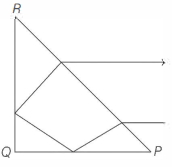
A
$\mu > \sqrt{5}$
B
$\sqrt{3} < \mu < \sqrt{5}$
C
$\sqrt{2} < \mu < \sqrt{3}$
D
$\mu < \sqrt{2}$
Solution
(A) For total internal reflection $(TIR)$ to occur at the faces,the angle of incidence at each face must be greater than the critical angle $\theta_c$.
From the geometry of the prism,the angles of incidence at the two faces are $(45^{\circ} + r)$ and $(45^{\circ} - r)$,where $r$ is the angle of refraction at the first surface.
For $TIR$ to occur at both faces:
$45^{\circ} + r > \theta_c$ and $45^{\circ} - r > \theta_c$.
The more restrictive condition is $45^{\circ} - r > \theta_c$.
Since $\sin r = \frac{\sin 45^{\circ}}{\mu} = \frac{1}{\mu\sqrt{2}}$,we have $r = \arcsin\left(\frac{1}{\mu\sqrt{2}}\right)$.
Substituting this into $45^{\circ} - r > \theta_c$,we get $45^{\circ} - \theta_c > r$.
Taking the sine of both sides: $\sin(45^{\circ} - \theta_c) > \sin r$.
Using the identity $\sin(A-B) = \sin A \cos B - \cos A \sin B$ and knowing $\sin \theta_c = \frac{1}{\mu}$ and $\cos \theta_c = \frac{\sqrt{\mu^2-1}}{\mu}$:
$\frac{1}{\sqrt{2}} \cdot \frac{\sqrt{\mu^2-1}}{\mu} - \frac{1}{\sqrt{2}} \cdot \frac{1}{\mu} > \frac{1}{\mu\sqrt{2}}$.
Multiplying by $\mu\sqrt{2}$,we get $\sqrt{\mu^2-1} - 1 > 1$,which simplifies to $\sqrt{\mu^2-1} > 2$.
Squaring both sides: $\mu^2 - 1 > 4$,so $\mu^2 > 5$,or $\mu > \sqrt{5}$.
From the geometry of the prism,the angles of incidence at the two faces are $(45^{\circ} + r)$ and $(45^{\circ} - r)$,where $r$ is the angle of refraction at the first surface.
For $TIR$ to occur at both faces:
$45^{\circ} + r > \theta_c$ and $45^{\circ} - r > \theta_c$.
The more restrictive condition is $45^{\circ} - r > \theta_c$.
Since $\sin r = \frac{\sin 45^{\circ}}{\mu} = \frac{1}{\mu\sqrt{2}}$,we have $r = \arcsin\left(\frac{1}{\mu\sqrt{2}}\right)$.
Substituting this into $45^{\circ} - r > \theta_c$,we get $45^{\circ} - \theta_c > r$.
Taking the sine of both sides: $\sin(45^{\circ} - \theta_c) > \sin r$.
Using the identity $\sin(A-B) = \sin A \cos B - \cos A \sin B$ and knowing $\sin \theta_c = \frac{1}{\mu}$ and $\cos \theta_c = \frac{\sqrt{\mu^2-1}}{\mu}$:
$\frac{1}{\sqrt{2}} \cdot \frac{\sqrt{\mu^2-1}}{\mu} - \frac{1}{\sqrt{2}} \cdot \frac{1}{\mu} > \frac{1}{\mu\sqrt{2}}$.
Multiplying by $\mu\sqrt{2}$,we get $\sqrt{\mu^2-1} - 1 > 1$,which simplifies to $\sqrt{\mu^2-1} > 2$.
Squaring both sides: $\mu^2 - 1 > 4$,so $\mu^2 > 5$,or $\mu > \sqrt{5}$.
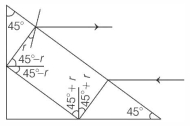
0 likesView Solution
50
PhysicsAdvancedMCQKVPY · 2014
Consider the circuit shown below where all resistors are $1 \,k\Omega$. If a current of magnitude $1 \,mA$ flows through the resistor marked $X$,the potential difference measured between points $P$ and $Q$ is ..............$V$.
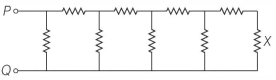
A
$21$
B
$68$
C
$55$
D
$34$
Solution
(D) Let the current through resistor $X$ be $i_1 = 1 \,mA$. All resistors $R = 1 \,k\Omega$.
$1$. At the last section (rightmost),the current $i_1$ flows through $X$ and the series resistor. The potential across the vertical resistor is $i_1 R$. The current through the vertical resistor is $i_2 = i_1 R / R = i_1$. The total current entering this section is $i_3 = i_1 + i_2 = 2i_1$.
$2$. Moving left to the next section,the equivalent resistance of the right part is $R_{eq1} = R + (R \parallel R) = R + R/2 = 1.5R$. The current $i_3$ splits into $i_4$ (through vertical resistor) and $i_3$ (through the series branch). By potential equality,$i_4 R = i_3 (1.5R) \implies i_4 = 1.5 i_3 = 3 i_1$. Total current $i_5 = i_3 + i_4 = 2i_1 + 3i_1 = 5i_1$.
$3$. Continuing this ladder network logic,the current increases as we move towards $P$ and $Q$. For a ladder with $n$ stages,the current $i_n$ follows a recursive relation. For this $4$-stage ladder:
Stage $1$: $i_1 = 1 \,mA$
Stage $2$: $i_2 = 2i_1 = 2 \,mA$
Stage $3$: $i_3 = 5i_1 = 5 \,mA$
Stage $4$: $i_4 = 13i_1 = 13 \,mA$
Stage $5$ (Total): $i_{total} = 34i_1 = 34 \,mA$.
$4$. The total equivalent resistance of the $4$-stage ladder is $R_{eq} = (34/55) \,k\Omega$.
$5$. The potential difference $V_{PQ} = i_{total} \times R_{eq} = (34 \,mA) \times (34/55 \,k\Omega) \approx 34 \,V$ (since $i_1 = 1 \,mA$ and $R = 1 \,k\Omega$,the factors align to give $34 \,V$).
$1$. At the last section (rightmost),the current $i_1$ flows through $X$ and the series resistor. The potential across the vertical resistor is $i_1 R$. The current through the vertical resistor is $i_2 = i_1 R / R = i_1$. The total current entering this section is $i_3 = i_1 + i_2 = 2i_1$.
$2$. Moving left to the next section,the equivalent resistance of the right part is $R_{eq1} = R + (R \parallel R) = R + R/2 = 1.5R$. The current $i_3$ splits into $i_4$ (through vertical resistor) and $i_3$ (through the series branch). By potential equality,$i_4 R = i_3 (1.5R) \implies i_4 = 1.5 i_3 = 3 i_1$. Total current $i_5 = i_3 + i_4 = 2i_1 + 3i_1 = 5i_1$.
$3$. Continuing this ladder network logic,the current increases as we move towards $P$ and $Q$. For a ladder with $n$ stages,the current $i_n$ follows a recursive relation. For this $4$-stage ladder:
Stage $1$: $i_1 = 1 \,mA$
Stage $2$: $i_2 = 2i_1 = 2 \,mA$
Stage $3$: $i_3 = 5i_1 = 5 \,mA$
Stage $4$: $i_4 = 13i_1 = 13 \,mA$
Stage $5$ (Total): $i_{total} = 34i_1 = 34 \,mA$.
$4$. The total equivalent resistance of the $4$-stage ladder is $R_{eq} = (34/55) \,k\Omega$.
$5$. The potential difference $V_{PQ} = i_{total} \times R_{eq} = (34 \,mA) \times (34/55 \,k\Omega) \approx 34 \,V$ (since $i_1 = 1 \,mA$ and $R = 1 \,k\Omega$,the factors align to give $34 \,V$).
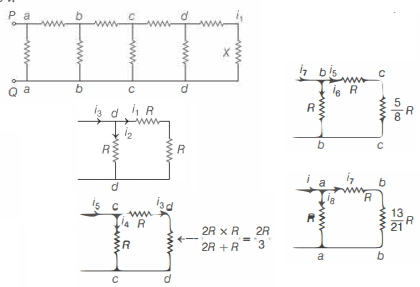
0 likesView Solution
Vedclass Products
For Students
Vedclass Test Series
Mock tests in real KVPY style covering Physics with performance analysis. 5-day free trial.
Start Free TrialFor Teachers
Exam Paper Generator
Generate Set A/B/C/D Physics papers from 7.5L+ questions in 2 minutes. 3 chapters free.
Try FreeFor Institutes
Online Exam Module
Run live KVPY mock exams with unlimited students, 360° analytics & white-label branding.
See DemoFrequently Asked Questions
How many Physics questions are in KVPY 2014?
There are 50 Physics questions from the KVPY 2014 paper on Vedclass, each with a detailed step-by-step solution in English.
Are KVPY 2014 Physics solutions available in English?
Yes. All solutions on this page are in English. You can also switch to English or Hindi using the language buttons above the questions.
Can I practice KVPY 2014 Physics as a timed test?
Yes. Use the Vedclass Test Series to attempt a full KVPY mock test covering Physics with time limits and instant score analysis.
Can teachers create Physics papers from KVPY previous year questions?
Yes. The Vedclass Exam Paper Generator lets teachers mix KVPY Physics questions and generate Set A/B/C/D papers in minutes.
For Teachers & Institutes
Build a Custom Physics Paper
Pick KVPY 2014 Physics questions, set difficulty, and generate Set A/B/C/D in 2 minutes.