
PhysicsQ201–269 of 480 questions
Page 5 of 6 · English
201
PhysicsDifficultMCQJEE Main · 2019
The trajectory of a projectile near the surface of the earth is given as $y = 2x - 9x^2$. If it were launched at an angle $\theta_0$ with speed $v_0$,then $(g = 10 \, ms^{-2})$:
A
$\theta_0 = \cos^{-1} \left( \frac{1}{\sqrt{5}} \right)$ and $v_0 = \frac{5}{3} \, ms^{-1}$
B
$\theta_0 = \cos^{-1} \left( \frac{2}{\sqrt{5}} \right)$ and $v_0 = \frac{3}{5} \, ms^{-1}$
C
$\theta_0 = \sin^{-1} \left( \frac{2}{\sqrt{5}} \right)$ and $v_0 = \frac{3}{5} \, ms^{-1}$
D
$\theta_0 = \sin^{-1} \left( \frac{1}{\sqrt{5}} \right)$ and $v_0 = \frac{5}{3} \, ms^{-1}$
Solution
(A) The standard equation of the trajectory of a projectile is given by $y = x \tan \theta_0 - \frac{g x^2}{2 v_0^2 \cos^2 \theta_0}$.
Comparing this with the given equation $y = 2x - 9x^2$:
$1$. $\tan \theta_0 = 2$. Since $\tan \theta_0 = \frac{\text{opposite}}{\text{adjacent}} = \frac{2}{1}$,the hypotenuse is $\sqrt{2^2 + 1^2} = \sqrt{5}$. Thus,$\cos \theta_0 = \frac{1}{\sqrt{5}}$ and $\sin \theta_0 = \frac{2}{\sqrt{5}}$.
$2$. $\frac{g}{2 v_0^2 \cos^2 \theta_0} = 9$.
Substituting $g = 10$ and $\cos^2 \theta_0 = \left( \frac{1}{\sqrt{5}} \right)^2 = \frac{1}{5}$:
$\frac{10}{2 v_0^2 (1/5)} = 9 \implies \frac{10}{2 v_0^2 / 5} = 9 \implies \frac{25}{v_0^2} = 9 \implies v_0^2 = \frac{25}{9} \implies v_0 = \frac{5}{3} \, ms^{-1}$.
Therefore,$\theta_0 = \cos^{-1} \left( \frac{1}{\sqrt{5}} \right) = \sin^{-1} \left( \frac{2}{\sqrt{5}} \right)$ and $v_0 = \frac{5}{3} \, ms^{-1}$. Comparing with options,option $A$ is correct.
Comparing this with the given equation $y = 2x - 9x^2$:
$1$. $\tan \theta_0 = 2$. Since $\tan \theta_0 = \frac{\text{opposite}}{\text{adjacent}} = \frac{2}{1}$,the hypotenuse is $\sqrt{2^2 + 1^2} = \sqrt{5}$. Thus,$\cos \theta_0 = \frac{1}{\sqrt{5}}$ and $\sin \theta_0 = \frac{2}{\sqrt{5}}$.
$2$. $\frac{g}{2 v_0^2 \cos^2 \theta_0} = 9$.
Substituting $g = 10$ and $\cos^2 \theta_0 = \left( \frac{1}{\sqrt{5}} \right)^2 = \frac{1}{5}$:
$\frac{10}{2 v_0^2 (1/5)} = 9 \implies \frac{10}{2 v_0^2 / 5} = 9 \implies \frac{25}{v_0^2} = 9 \implies v_0^2 = \frac{25}{9} \implies v_0 = \frac{5}{3} \, ms^{-1}$.
Therefore,$\theta_0 = \cos^{-1} \left( \frac{1}{\sqrt{5}} \right) = \sin^{-1} \left( \frac{2}{\sqrt{5}} \right)$ and $v_0 = \frac{5}{3} \, ms^{-1}$. Comparing with options,option $A$ is correct.
0 likesView Solution
202
PhysicsMediumMCQJEE Main · 2019
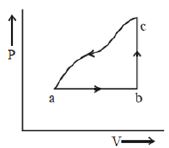
$A$ sample of an ideal gas is taken through the cyclic process $abca$ as shown in the figure. The change in the internal energy of the gas along the path $ca$ is $-180\, J$. The gas absorbs $250\, J$ of heat along the path $ab$ and $60\, J$ along the path $bc$. The work done by the gas along the path $abc$ is ..... $J$.
A
$120$
B
$100$
C
$140$
D
$130$
Solution
(D) For a cyclic process,the total change in internal energy is zero: $\Delta U_{ab} + \Delta U_{bc} + \Delta U_{ca} = 0$.
Given $\Delta U_{ca} = -180\, J$,we have $\Delta U_{ab} + \Delta U_{bc} = 180\, J$.
From the first law of thermodynamics,$\Delta Q = \Delta U + \Delta W$.
For path $bc$,the process is isochoric (vertical line in $P-V$ diagram),so $\Delta W_{bc} = 0$. Thus,$\Delta U_{bc} = \Delta Q_{bc} = 60\, J$.
Substituting this into the cyclic equation: $\Delta U_{ab} + 60 = 180 \implies \Delta U_{ab} = 120\, J$.
Now,for path $ab$,$\Delta W_{ab} = \Delta Q_{ab} - \Delta U_{ab} = 250 - 120 = 130\, J$.
The total work done along path $abc$ is $\Delta W_{abc} = \Delta W_{ab} + \Delta W_{bc} = 130 + 0 = 130\, J$.
Given $\Delta U_{ca} = -180\, J$,we have $\Delta U_{ab} + \Delta U_{bc} = 180\, J$.
From the first law of thermodynamics,$\Delta Q = \Delta U + \Delta W$.
For path $bc$,the process is isochoric (vertical line in $P-V$ diagram),so $\Delta W_{bc} = 0$. Thus,$\Delta U_{bc} = \Delta Q_{bc} = 60\, J$.
Substituting this into the cyclic equation: $\Delta U_{ab} + 60 = 180 \implies \Delta U_{ab} = 120\, J$.
Now,for path $ab$,$\Delta W_{ab} = \Delta Q_{ab} - \Delta U_{ab} = 250 - 120 = 130\, J$.
The total work done along path $abc$ is $\Delta W_{abc} = \Delta W_{ab} + \Delta W_{bc} = 130 + 0 = 130\, J$.
0 likesView Solution
203
PhysicsDifficultMCQJEE Main · 2019
$A$ person of mass $M$ is sitting on a swing of length $L$ and swinging with an angular amplitude $\theta_0$. If the person stands up when the swing passes through its lowest point,the work done by him,assuming that his centre of mass moves by a distance $l$ $(l << L)$,is close to
A
$Mgl(1 + \theta_0^2)$
B
$Mgl(1 - \theta_0^2)$
C
$Mgl$
D
$Mgl(1 + \frac{\theta_0^2}{2})$
Solution
(A) At the lowest point,the velocity of the person is $V_0 = \omega A = \sqrt{\frac{g}{L}} (\theta_0 L) = \theta_0 \sqrt{gL}$.
When the person stands up,the distance of the center of mass from the pivot changes from $L$ to $L-l$. By the conservation of angular momentum about the pivot point:
$M V_0 L = M V_1 (L-l) \implies V_1 = V_0 \frac{L}{L-l} = V_0 (1 - \frac{l}{L})^{-1} \approx V_0 (1 + \frac{l}{L})$.
The work-energy theorem states: $W_g + W_p = \Delta KE$.
Here,$W_g = -Mgl$ (work done against gravity as the center of mass rises).
$\Delta KE = \frac{1}{2} M (V_1^2 - V_0^2) = \frac{1}{2} M [V_0^2 (1 + \frac{l}{L})^2 - V_0^2] \approx \frac{1}{2} M V_0^2 (1 + \frac{2l}{L} - 1) = M V_0^2 \frac{l}{L}$.
Substituting $V_0^2 = \theta_0^2 gL$:
$\Delta KE = M (\theta_0^2 gL) \frac{l}{L} = Mgl \theta_0^2$.
Thus,$W_p = Mgl + \Delta KE = Mgl + Mgl \theta_0^2 = Mgl(1 + \theta_0^2)$.
When the person stands up,the distance of the center of mass from the pivot changes from $L$ to $L-l$. By the conservation of angular momentum about the pivot point:
$M V_0 L = M V_1 (L-l) \implies V_1 = V_0 \frac{L}{L-l} = V_0 (1 - \frac{l}{L})^{-1} \approx V_0 (1 + \frac{l}{L})$.
The work-energy theorem states: $W_g + W_p = \Delta KE$.
Here,$W_g = -Mgl$ (work done against gravity as the center of mass rises).
$\Delta KE = \frac{1}{2} M (V_1^2 - V_0^2) = \frac{1}{2} M [V_0^2 (1 + \frac{l}{L})^2 - V_0^2] \approx \frac{1}{2} M V_0^2 (1 + \frac{2l}{L} - 1) = M V_0^2 \frac{l}{L}$.
Substituting $V_0^2 = \theta_0^2 gL$:
$\Delta KE = M (\theta_0^2 gL) \frac{l}{L} = Mgl \theta_0^2$.
Thus,$W_p = Mgl + \Delta KE = Mgl + Mgl \theta_0^2 = Mgl(1 + \theta_0^2)$.
0 likesView Solution
204
PhysicsDifficultMCQJEE Main · 2019
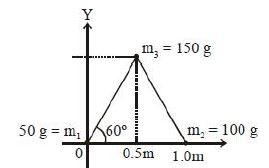
Three particles of masses $50\, g$,$100\, g$,and $150\, g$ are placed at the vertices of an equilateral triangle of side $1\, m$ (as shown in the figure). The $(x, y)$ coordinates of the centre of mass will be
A
$\left( \frac{\sqrt{3}}{7}\,m, \frac{7}{12}\,m \right)$
B
$\left( \frac{7}{12}\,m, \frac{\sqrt{3}}{8}\,m \right)$
C
$\left( \frac{\sqrt{3}}{4}\,m, \frac{5}{12}\,m \right)$
D
$\left( \frac{7}{12}\,m, \frac{\sqrt{3}}{4}\,m \right)$
Solution
(D) The coordinates of the three particles are:
$m_1 = 50\, g$ at $(0, 0)$
$m_2 = 100\, g$ at $(1, 0)$
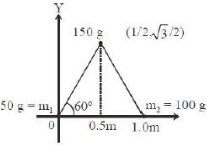
$m_3 = 150\, g$ at $(0.5, \frac{\sqrt{3}}{2})$
The $x$-coordinate of the center of mass is:
$X_{cm} = \frac{m_1x_1 + m_2x_2 + m_3x_3}{m_1 + m_2 + m_3} = \frac{50(0) + 100(1) + 150(0.5)}{50 + 100 + 150} = \frac{100 + 75}{300} = \frac{175}{300} = \frac{7}{12}\, m$
The $y$-coordinate of the center of mass is:
$Y_{cm} = \frac{m_1y_1 + m_2y_2 + m_3y_3}{m_1 + m_2 + m_3} = \frac{50(0) + 100(0) + 150(\frac{\sqrt{3}}{2})}{300} = \frac{75\sqrt{3}}{300} = \frac{\sqrt{3}}{4}\, m$
Thus,the coordinates of the center of mass are $\left( \frac{7}{12}\,m, \frac{\sqrt{3}}{4}\,m \right)$.
$m_1 = 50\, g$ at $(0, 0)$
$m_2 = 100\, g$ at $(1, 0)$
$m_3 = 150\, g$ at $(0.5, \frac{\sqrt{3}}{2})$
The $x$-coordinate of the center of mass is:
$X_{cm} = \frac{m_1x_1 + m_2x_2 + m_3x_3}{m_1 + m_2 + m_3} = \frac{50(0) + 100(1) + 150(0.5)}{50 + 100 + 150} = \frac{100 + 75}{300} = \frac{175}{300} = \frac{7}{12}\, m$
The $y$-coordinate of the center of mass is:
$Y_{cm} = \frac{m_1y_1 + m_2y_2 + m_3y_3}{m_1 + m_2 + m_3} = \frac{50(0) + 100(0) + 150(\frac{\sqrt{3}}{2})}{300} = \frac{75\sqrt{3}}{300} = \frac{\sqrt{3}}{4}\, m$
Thus,the coordinates of the center of mass are $\left( \frac{7}{12}\,m, \frac{\sqrt{3}}{4}\,m \right)$.
0 likesView Solution
205
PhysicsMediumMCQJEE Main · 2019
The ratio of the weights of a body on the Earth's surface to that on the surface of a planet is $9 : 4$. The mass of the planet is $\frac{1}{9}^{th}$ of that of the Earth. If $R$ is the radius of the Earth,what is the radius of the planet? (Assume the planets have the same mass density)
A
$\frac{R}{3}$
B
$\frac{R}{4}$
C
$\frac{R}{9}$
D
$\frac{R}{2}$
Solution
(D) Since the mass of the object remains constant,the weight of the object is proportional to the acceleration due to gravity $g$.
Given: $\frac{W_{earth}}{W_{planet}} = \frac{9}{4} = \frac{g_{earth}}{g_{planet}}$.
We know that $g = \frac{GM}{R^2}$. Since density $\rho$ is constant,$M = \rho \cdot \frac{4}{3}\pi R^3$,so $g = \frac{G \cdot \rho \cdot \frac{4}{3}\pi R^3}{R^2} = G \cdot \rho \cdot \frac{4}{3}\pi R \propto R$.
However,the problem states the mass of the planet is $\frac{1}{9}$ of the Earth's mass. Let $M_p = \frac{M_e}{9}$.
Using $g = \frac{GM}{R^2}$,we have $\frac{g_e}{g_p} = \frac{M_e}{M_p} \cdot \frac{R_p^2}{R_e^2} = 9 \cdot \frac{R_p^2}{R^2}$.
Given $\frac{g_e}{g_p} = \frac{9}{4}$,so $\frac{9}{4} = 9 \cdot \frac{R_p^2}{R^2}$.
$\frac{1}{4} = \frac{R_p^2}{R^2} \implies \frac{R_p}{R} = \frac{1}{2}$.
Therefore,$R_p = \frac{R}{2}$.
Given: $\frac{W_{earth}}{W_{planet}} = \frac{9}{4} = \frac{g_{earth}}{g_{planet}}$.
We know that $g = \frac{GM}{R^2}$. Since density $\rho$ is constant,$M = \rho \cdot \frac{4}{3}\pi R^3$,so $g = \frac{G \cdot \rho \cdot \frac{4}{3}\pi R^3}{R^2} = G \cdot \rho \cdot \frac{4}{3}\pi R \propto R$.
However,the problem states the mass of the planet is $\frac{1}{9}$ of the Earth's mass. Let $M_p = \frac{M_e}{9}$.
Using $g = \frac{GM}{R^2}$,we have $\frac{g_e}{g_p} = \frac{M_e}{M_p} \cdot \frac{R_p^2}{R_e^2} = 9 \cdot \frac{R_p^2}{R^2}$.
Given $\frac{g_e}{g_p} = \frac{9}{4}$,so $\frac{9}{4} = 9 \cdot \frac{R_p^2}{R^2}$.
$\frac{1}{4} = \frac{R_p^2}{R^2} \implies \frac{R_p}{R} = \frac{1}{2}$.
Therefore,$R_p = \frac{R}{2}$.
0 likesView Solution
206
PhysicsMediumMCQJEE Main · 2019
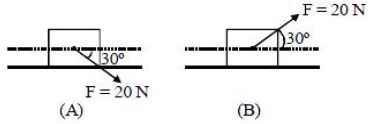
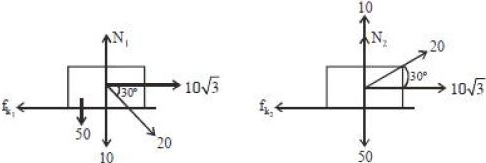
$A$ block of mass $5\, kg$ is $(i)$ pushed in case $(A)$ and $(ii)$ pulled in case $(B)$,by a force $F = 20\, N$,making an angle of $30^o$ with the horizontal,as shown in the figures. The coefficient of friction between the block and floor is $\mu = 0.2$. The difference between the accelerations of the block,in case $(B)$ and case $(A)$ will be ........ $ms^{-2}$ .$(g = 10\, ms^{-2})$
A
$0.4$
B
$3.2$
C
$0$
D
$0.8$
Solution
(D) Case $(A)$ (Pushing):
Vertical forces: $N_1 = mg + F \sin 30^o = 5 \times 10 + 20 \times 0.5 = 50 + 10 = 60\, N$.
Horizontal force: $F_x = F \cos 30^o = 20 \times \frac{\sqrt{3}}{2} = 10\sqrt{3}\, N$.
Friction: $f_1 = \mu N_1 = 0.2 \times 60 = 12\, N$.
Acceleration: $a_1 = \frac{F_x - f_1}{m} = \frac{10\sqrt{3} - 12}{5} = 2\sqrt{3} - 2.4 \approx 3.464 - 2.4 = 1.064\, ms^{-2}$.
Case $(B)$ (Pulling):
Vertical forces: $N_2 = mg - F \sin 30^o = 5 \times 10 - 20 \times 0.5 = 50 - 10 = 40\, N$.
Horizontal force: $F_x = F \cos 30^o = 10\sqrt{3}\, N$.
Friction: $f_2 = \mu N_2 = 0.2 \times 40 = 8\, N$.
Acceleration: $a_2 = \frac{F_x - f_2}{m} = \frac{10\sqrt{3} - 8}{5} = 2\sqrt{3} - 1.6 \approx 3.464 - 1.6 = 1.864\, ms^{-2}$.
Difference: $a_2 - a_1 = (2\sqrt{3} - 1.6) - (2\sqrt{3} - 2.4) = 0.8\, ms^{-2}$.
Vertical forces: $N_1 = mg + F \sin 30^o = 5 \times 10 + 20 \times 0.5 = 50 + 10 = 60\, N$.
Horizontal force: $F_x = F \cos 30^o = 20 \times \frac{\sqrt{3}}{2} = 10\sqrt{3}\, N$.
Friction: $f_1 = \mu N_1 = 0.2 \times 60 = 12\, N$.
Acceleration: $a_1 = \frac{F_x - f_1}{m} = \frac{10\sqrt{3} - 12}{5} = 2\sqrt{3} - 2.4 \approx 3.464 - 2.4 = 1.064\, ms^{-2}$.
Case $(B)$ (Pulling):
Vertical forces: $N_2 = mg - F \sin 30^o = 5 \times 10 - 20 \times 0.5 = 50 - 10 = 40\, N$.
Horizontal force: $F_x = F \cos 30^o = 10\sqrt{3}\, N$.
Friction: $f_2 = \mu N_2 = 0.2 \times 40 = 8\, N$.
Acceleration: $a_2 = \frac{F_x - f_2}{m} = \frac{10\sqrt{3} - 8}{5} = 2\sqrt{3} - 1.6 \approx 3.464 - 1.6 = 1.864\, ms^{-2}$.
Difference: $a_2 - a_1 = (2\sqrt{3} - 1.6) - (2\sqrt{3} - 2.4) = 0.8\, ms^{-2}$.
0 likesView Solution
207
PhysicsMediumMCQJEE Main · 2019
$A$ diatomic gas with rigid molecules does $10 \ J$ of work when expanded at constant pressure. What would be the heat energy absorbed by the gas,in this process ..... $J$.
A
$40$
B
$30$
C
$35$
D
$25$
Solution
(C) For a diatomic gas with rigid molecules,the molar heat capacity at constant pressure is given by $C_{p} = \frac{7}{2} R$.
The work done in an isobaric process is given by $W = P \Delta V = nR \Delta T = 10 \ J$.
The heat energy absorbed by the gas is given by $\Delta Q = n C_{p} \Delta T$.
Substituting $C_{p} = \frac{7}{2} R$,we get $\Delta Q = n \left( \frac{7}{2} R \right) \Delta T = \frac{7}{2} (nR \Delta T)$.
Since $nR \Delta T = W = 10 \ J$,we have $\Delta Q = \frac{7}{2} \times 10 \ J = 35 \ J$.
The work done in an isobaric process is given by $W = P \Delta V = nR \Delta T = 10 \ J$.
The heat energy absorbed by the gas is given by $\Delta Q = n C_{p} \Delta T$.
Substituting $C_{p} = \frac{7}{2} R$,we get $\Delta Q = n \left( \frac{7}{2} R \right) \Delta T = \frac{7}{2} (nR \Delta T)$.
Since $nR \Delta T = W = 10 \ J$,we have $\Delta Q = \frac{7}{2} \times 10 \ J = 35 \ J$.
0 likesView Solution
208
PhysicsDifficultMCQJEE Main · 2019
$A$ small speaker delivers $2\, W$ of audio output. At what distance from the speaker will one detect $120\, dB$ intensity sound in $cm$?
A
$30$
B
$10$
C
$40$
D
$20$
Solution
(C) The loudness level in decibels $(dB)$ is given by the formula: $L = 10 \log_{10} \left( \frac{I}{I_0} \right)$,where $I$ is the intensity of sound and $I_0 = 10^{-12}\, W/m^2$ is the reference intensity.
Given $L = 120\, dB$,we have: $120 = 10 \log_{10} \left( \frac{I}{10^{-12}} \right)$.
Dividing by $10$,we get $12 = \log_{10} \left( \frac{I}{10^{-12}} \right)$,which implies $\frac{I}{10^{-12}} = 10^{12}$.
Thus,$I = 10^{12} \times 10^{-12} = 1\, W/m^2$.
The intensity $I$ at a distance $r$ from a point source is given by $I = \frac{P}{4 \pi r^2}$,where $P = 2\, W$ is the power.
Substituting the values: $1 = \frac{2}{4 \pi r^2}$.
Solving for $r^2$: $r^2 = \frac{2}{4 \pi} = \frac{1}{2 \pi} \approx \frac{1}{6.28} \approx 0.159\, m^2$.
Taking the square root: $r = \sqrt{0.159} \approx 0.399\, m$.
Converting to centimeters: $r \approx 0.399 \times 100 = 39.9\, cm \approx 40\, cm$.
Given $L = 120\, dB$,we have: $120 = 10 \log_{10} \left( \frac{I}{10^{-12}} \right)$.
Dividing by $10$,we get $12 = \log_{10} \left( \frac{I}{10^{-12}} \right)$,which implies $\frac{I}{10^{-12}} = 10^{12}$.
Thus,$I = 10^{12} \times 10^{-12} = 1\, W/m^2$.
The intensity $I$ at a distance $r$ from a point source is given by $I = \frac{P}{4 \pi r^2}$,where $P = 2\, W$ is the power.
Substituting the values: $1 = \frac{2}{4 \pi r^2}$.
Solving for $r^2$: $r^2 = \frac{2}{4 \pi} = \frac{1}{2 \pi} \approx \frac{1}{6.28} \approx 0.159\, m^2$.
Taking the square root: $r = \sqrt{0.159} \approx 0.399\, m$.
Converting to centimeters: $r \approx 0.399 \times 100 = 39.9\, cm \approx 40\, cm$.
0 likesView Solution
209
PhysicsDifficultMCQJEE Main · 2019
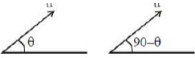
Two particles are projected from the same point with the same speed $u$ such that they have the same range $R$,but different maximum heights,$h_1$ and $h_2$. Which of the following is correct?
A
$R^2 = 4 h_1h_2$
B
$R^2 = 2 h_1h_2$
C
$R^2 = 16 h_1h_2$
D
$R^2 = h_1h_2$
Solution
(C) For the same range $R$,the angles of projection must be complementary,i.e.,$\theta$ and $(90^\circ - \theta)$.
The range $R$ is given by: $R = \frac{u^2 \sin(2\theta)}{g} = \frac{2u^2 \sin\theta \cos\theta}{g}$.
The maximum heights for the two particles are:
$h_1 = \frac{u^2 \sin^2\theta}{2g}$
$h_2 = \frac{u^2 \sin^2(90^\circ - \theta)}{2g} = \frac{u^2 \cos^2\theta}{2g}$
Multiplying $h_1$ and $h_2$:
$h_1 h_2 = \left( \frac{u^2 \sin^2\theta}{2g} \right) \left( \frac{u^2 \cos^2\theta}{2g} \right) = \frac{u^4 \sin^2\theta \cos^2\theta}{4g^2}$
$h_1 h_2 = \frac{1}{16} \left( \frac{4u^4 \sin^2\theta \cos^2\theta}{g^2} \right) = \frac{1}{16} R^2$
Therefore,$R^2 = 16 h_1 h_2$.
The range $R$ is given by: $R = \frac{u^2 \sin(2\theta)}{g} = \frac{2u^2 \sin\theta \cos\theta}{g}$.
The maximum heights for the two particles are:
$h_1 = \frac{u^2 \sin^2\theta}{2g}$
$h_2 = \frac{u^2 \sin^2(90^\circ - \theta)}{2g} = \frac{u^2 \cos^2\theta}{2g}$
Multiplying $h_1$ and $h_2$:
$h_1 h_2 = \left( \frac{u^2 \sin^2\theta}{2g} \right) \left( \frac{u^2 \cos^2\theta}{2g} \right) = \frac{u^4 \sin^2\theta \cos^2\theta}{4g^2}$
$h_1 h_2 = \frac{1}{16} \left( \frac{4u^4 \sin^2\theta \cos^2\theta}{g^2} \right) = \frac{1}{16} R^2$
Therefore,$R^2 = 16 h_1 h_2$.
0 likesView Solution
210
PhysicsDifficultMCQJEE Main · 2019
$A$ particle is moving with speed $v = b\sqrt{x}$ along the positive $x$-axis. Calculate the speed of the particle at time $t = \tau$ (assume that the particle is at the origin at $t = 0$).
A
$b^2\tau$
B
$\frac{b^2\tau}{2}$
C
$\frac{b^2\tau}{\sqrt{2}}$
D
$\frac{b^2\tau}{4}$
Solution
(B) Given the speed $v = b\sqrt{x}$.
We know that $v = \frac{dx}{dt}$,so $\frac{dx}{dt} = b\sqrt{x}$.
Separating the variables,we get $\frac{dx}{\sqrt{x}} = b dt$.
Integrating both sides from $t = 0$ (where $x = 0$) to $t = \tau$ (where $x = x$):
$\int_{0}^{x} x^{-1/2} dx = \int_{0}^{\tau} b dt$
$[2\sqrt{x}]_{0}^{x} = b\tau$
$2\sqrt{x} = b\tau$,which implies $\sqrt{x} = \frac{b\tau}{2}$.
Substituting this into the expression for speed $v = b\sqrt{x}$:
$v = b \left( \frac{b\tau}{2} \right) = \frac{b^2\tau}{2}$.
We know that $v = \frac{dx}{dt}$,so $\frac{dx}{dt} = b\sqrt{x}$.
Separating the variables,we get $\frac{dx}{\sqrt{x}} = b dt$.
Integrating both sides from $t = 0$ (where $x = 0$) to $t = \tau$ (where $x = x$):
$\int_{0}^{x} x^{-1/2} dx = \int_{0}^{\tau} b dt$
$[2\sqrt{x}]_{0}^{x} = b\tau$
$2\sqrt{x} = b\tau$,which implies $\sqrt{x} = \frac{b\tau}{2}$.
Substituting this into the expression for speed $v = b\sqrt{x}$:
$v = b \left( \frac{b\tau}{2} \right) = \frac{b^2\tau}{2}$.
1 likesView Solution
211
PhysicsDifficultMCQJEE Main · 2019
One $kg$ of water, at $20, ^oC$, is heated in an electric kettle whose heating element has a mean (temperature averaged) resistance of $20, \Omega$. The rms voltage in the mains is $200, V$. Ignoring heat loss from the kettle, the time taken for water to evaporate fully is close to.......... $min$. [Specific heat of water $= 4200, J/kg, ^oC$, Latent heat of water $= 2260, kJ/kg$]
A
$3$
B
$10$
C
$22$
D
$16$
Solution
(C) The total heat $Q$ required to raise the temperature of $1, kg$ of water from $20, ^oC$ to $100, ^oC$ and then to evaporate it is given by:
$Q = mc\Delta T + mL$
Here, $m = 1, kg$, $c = 4200, J/kg, ^oC$, $\Delta T = (100 - 20) = 80, ^oC$, and $L = 2260 \times 10^3, J/kg$.
$Q = (1 \times 4200 \times 80) + (1 \times 2260 \times 10^3) = 336000 + 2260000 = 2596000, J$.
The power $P$ dissipated by the heating element is:
$P = \frac{V_{rms}^2}{R} = \frac{200^2}{20} = \frac{40000}{20} = 2000, W$.
The time $t$ taken is given by $t = \frac{Q}{P}$:
$t = \frac{2596000}{2000} = 1298, s$.
Converting to minutes: $t = \frac{1298}{60} \approx 21.63, min \approx 22, min$.
$Q = mc\Delta T + mL$
Here, $m = 1, kg$, $c = 4200, J/kg, ^oC$, $\Delta T = (100 - 20) = 80, ^oC$, and $L = 2260 \times 10^3, J/kg$.
$Q = (1 \times 4200 \times 80) + (1 \times 2260 \times 10^3) = 336000 + 2260000 = 2596000, J$.
The power $P$ dissipated by the heating element is:
$P = \frac{V_{rms}^2}{R} = \frac{200^2}{20} = \frac{40000}{20} = 2000, W$.
The time $t$ taken is given by $t = \frac{Q}{P}$:
$t = \frac{2596000}{2000} = 1298, s$.
Converting to minutes: $t = \frac{1298}{60} \approx 21.63, min \approx 22, min$.
0 likesView Solution
212
PhysicsDifficultMCQJEE Main · 2019
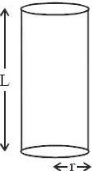
$A$ uniform cylindrical rod of length $L$ and radius $r$ is made from a material whose Young's modulus of elasticity equals $Y$. When this rod is heated by temperature $T$ and simultaneously subjected to a net longitudinal compressional force $F$,its length remains unchanged. The coefficient of volume expansion of the material of the rod is (nearly) equal to:
A
$9F / (\pi r^2 YT)$
B
$F / (3\pi r^2 YT)$
C
$3F / (\pi r^2 YT)$
D
$6F / (\pi r^2 YT)$
Solution
(C) The length of the cylinder remains unchanged,which means the thermal expansion is exactly compensated by the longitudinal compression.
The thermal expansion strain is given by $\Delta L / L = \alpha T$,where $\alpha$ is the coefficient of linear expansion.
The compressive strain due to force $F$ is given by $\Delta L / L = \text{Stress} / Y = F / (A Y) = F / (\pi r^2 Y)$.
Equating the two strains: $\alpha T = F / (\pi r^2 Y)$.
Therefore,$\alpha = F / (\pi r^2 YT)$.
The coefficient of volume expansion $\gamma$ is related to the coefficient of linear expansion $\alpha$ by the relation $\gamma = 3\alpha$.
Substituting the value of $\alpha$,we get $\gamma = 3F / (\pi r^2 YT)$.
The thermal expansion strain is given by $\Delta L / L = \alpha T$,where $\alpha$ is the coefficient of linear expansion.
The compressive strain due to force $F$ is given by $\Delta L / L = \text{Stress} / Y = F / (A Y) = F / (\pi r^2 Y)$.
Equating the two strains: $\alpha T = F / (\pi r^2 Y)$.
Therefore,$\alpha = F / (\pi r^2 YT)$.
The coefficient of volume expansion $\gamma$ is related to the coefficient of linear expansion $\alpha$ by the relation $\gamma = 3\alpha$.
Substituting the value of $\alpha$,we get $\gamma = 3F / (\pi r^2 YT)$.
0 likesView Solution
213
PhysicsDifficultMCQJEE Main · 2019
Two sources of sound $S_1$ and $S_2$ produce sound waves of same frequency $660\, Hz$. $A$ listener is moving from source $S_1$ towards $S_2$ with a constant speed $u\, m/s$ and he hears $10\, \text{beats/s}$. The velocity of sound is $330\, m/s$. Then, $u$ equals ... $m/s$.
A
$15.0$
B
$10.0$
C
$5.5$
D
$2.5$
Solution
(D) Given: Frequency of sources $f = 660\, Hz$, velocity of sound $v = 330\, m/s$, and beat frequency $f_b = 10\, \text{beats/s}$.
When the listener moves away from $S_1$ with speed $u$, the observed frequency $f_1$ is:
$f_1 = f \left( \frac{v - u}{v} \right)$
When the listener moves towards $S_2$ with speed $u$, the observed frequency $f_2$ is:
$f_2 = f \left( \frac{v + u}{v} \right)$
The beat frequency is the difference between the two observed frequencies:
$f_b = f_2 - f_1 = f \left( \frac{v + u}{v} \right) - f \left( \frac{v - u}{v} \right)$
$f_b = \frac{f}{v} [v + u - (v - u)] = \frac{f}{v} [2u]$
Substituting the given values:
$10 = \frac{660}{330} \times 2u$
$10 = 2 \times 2u$
$10 = 4u$
$u = \frac{10}{4} = 2.5\, m/s$.
When the listener moves away from $S_1$ with speed $u$, the observed frequency $f_1$ is:
$f_1 = f \left( \frac{v - u}{v} \right)$
When the listener moves towards $S_2$ with speed $u$, the observed frequency $f_2$ is:
$f_2 = f \left( \frac{v + u}{v} \right)$
The beat frequency is the difference between the two observed frequencies:
$f_b = f_2 - f_1 = f \left( \frac{v + u}{v} \right) - f \left( \frac{v - u}{v} \right)$
$f_b = \frac{f}{v} [v + u - (v - u)] = \frac{f}{v} [2u]$
Substituting the given values:
$10 = \frac{660}{330} \times 2u$
$10 = 2 \times 2u$
$10 = 4u$
$u = \frac{10}{4} = 2.5\, m/s$.

0 likesView Solution
214
PhysicsDifficultMCQJEE Main · 2019
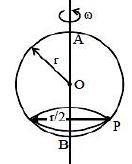
$A$ smooth wire of length $2\pi r$ is bent into a circle and kept in a vertical plane. $A$ bead can slide smoothly on the wire. When the circle is rotating with angular speed $\omega$ about the vertical diameter $AB$,as shown in the figure,the bead is at rest with respect to the circular ring at position $P$ as shown. Then the value of $\omega^2$ is equal to
A
$\frac{\sqrt{3}g}{2r}$
B
$\frac{g\sqrt{3}}{r}$
C
$\frac{2g}{r}$
D
$\frac{2g}{r\sqrt{3}}$
Solution
(D) Let $m$ be the mass of the bead and $N$ be the normal reaction force exerted by the wire on the bead.
The radius of the circular path of the bead is $R_{path} = r/2$.
The forces acting on the bead are the gravitational force $mg$ (downwards) and the normal reaction $N$ (perpendicular to the wire).
Resolving the forces into horizontal and vertical components:
$N \sin \theta = m R_{path} \omega^2 = m (r/2) \omega^2$ ... $(i)$
$N \cos \theta = mg$ ... (ii)
Dividing $(i)$ by (ii),we get:
$\tan \theta = \frac{(r/2) \omega^2}{g} = \frac{r \omega^2}{2g}$
From the geometry of the circle,the distance from the center $O$ to the vertical axis is $r/2$. The angle $\theta$ that the radius vector $OP$ makes with the vertical is given by $\sin \theta = \frac{r/2}{r} = 1/2$,so $\theta = 30^\circ$.
Thus,$\tan 30^\circ = \frac{1}{\sqrt{3}}$.
Equating the two expressions for $\tan \theta$:
$\frac{1}{\sqrt{3}} = \frac{r \omega^2}{2g}$
$\omega^2 = \frac{2g}{r\sqrt{3}}$
The radius of the circular path of the bead is $R_{path} = r/2$.
The forces acting on the bead are the gravitational force $mg$ (downwards) and the normal reaction $N$ (perpendicular to the wire).
Resolving the forces into horizontal and vertical components:
$N \sin \theta = m R_{path} \omega^2 = m (r/2) \omega^2$ ... $(i)$
$N \cos \theta = mg$ ... (ii)
Dividing $(i)$ by (ii),we get:
$\tan \theta = \frac{(r/2) \omega^2}{g} = \frac{r \omega^2}{2g}$
From the geometry of the circle,the distance from the center $O$ to the vertical axis is $r/2$. The angle $\theta$ that the radius vector $OP$ makes with the vertical is given by $\sin \theta = \frac{r/2}{r} = 1/2$,so $\theta = 30^\circ$.
Thus,$\tan 30^\circ = \frac{1}{\sqrt{3}}$.
Equating the two expressions for $\tan \theta$:
$\frac{1}{\sqrt{3}} = \frac{r \omega^2}{2g}$
$\omega^2 = \frac{2g}{r\sqrt{3}}$
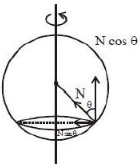
0 likesView Solution
215
PhysicsDifficultMCQJEE Main · 2019
$A$ solid sphere of radius $R$ acquires a terminal velocity $\nu_1$ when falling (due to gravity) through a viscous fluid having a coefficient of viscosity $\eta$. The sphere is broken into $27$ identical solid spheres. If each of these spheres acquires a terminal velocity $\nu_2$ when falling through the same fluid,the ratio $(\nu_1/\nu_2)$ equals:
A
$27$
B
$1/27$
C
$9$
D
$1/9$
Solution
(C) The terminal velocity of a sphere of radius $r$ falling through a viscous fluid is given by Stokes' Law: $v_T = \frac{2}{9} \frac{r^2 (\rho - \sigma) g}{\eta}$,where $\rho$ is the density of the sphere and $\sigma$ is the density of the fluid.
From this formula,we see that $v_T \propto r^2$.
Let the radius of the large sphere be $R$ and the radius of each small sphere be $r$. Since the volume remains constant when the sphere is broken into $27$ smaller identical spheres:
$\frac{4}{3} \pi R^3 = 27 \times \frac{4}{3} \pi r^3$
$R^3 = 27 r^3 \Rightarrow R = 3r \Rightarrow r = R/3$.
Now,the ratio of terminal velocities is:
$\frac{\nu_1}{\nu_2} = \frac{R^2}{r^2} = \frac{R^2}{(R/3)^2} = \frac{R^2}{R^2/9} = 9$.
Thus,the ratio $(\nu_1/\nu_2)$ is $9$.
From this formula,we see that $v_T \propto r^2$.
Let the radius of the large sphere be $R$ and the radius of each small sphere be $r$. Since the volume remains constant when the sphere is broken into $27$ smaller identical spheres:
$\frac{4}{3} \pi R^3 = 27 \times \frac{4}{3} \pi r^3$
$R^3 = 27 r^3 \Rightarrow R = 3r \Rightarrow r = R/3$.
Now,the ratio of terminal velocities is:
$\frac{\nu_1}{\nu_2} = \frac{R^2}{r^2} = \frac{R^2}{(R/3)^2} = \frac{R^2}{R^2/9} = 9$.
Thus,the ratio $(\nu_1/\nu_2)$ is $9$.
1 likesView Solution
216
PhysicsDifficultMCQJEE Main · 2019
The number density of molecules of a gas depends on their distance $r$ from the origin as $n(r) = n_0 e^{-\alpha r^4}$. Then the total number of molecules is proportional to
A
$n_0 \alpha^{-3/4}$
B
$n_0 \alpha^{-3}$
C
$n_0 \alpha^{1/4}$
D
$\sqrt{n_0} \alpha^{1/2}$
Solution
(A) The total number of molecules $N$ is given by the integral of the number density $n(r)$ over the entire volume.
In spherical coordinates,the volume element is $dV = 4\pi r^2 dr$.
Thus,$N = \int_{0}^{\infty} n(r) dV = \int_{0}^{\infty} n_0 e^{-\alpha r^4} (4\pi r^2) dr$.
$N = 4\pi n_0 \int_{0}^{\infty} r^2 e^{-\alpha r^4} dr$.
Let $u = \alpha r^4$,then $r = (u/\alpha)^{1/4}$ and $dr = \frac{1}{4} \alpha^{-1/4} u^{-3/4} du$.
Substituting these into the integral:
$N = 4\pi n_0 \int_{0}^{\infty} (u/\alpha)^{2/4} e^{-u} (\frac{1}{4} \alpha^{-1/4} u^{-3/4}) du$.
$N = \pi n_0 \alpha^{-1/2} \alpha^{-1/4} \int_{0}^{\infty} u^{1/2 - 3/4} e^{-u} du = \pi n_0 \alpha^{-3/4} \int_{0}^{\infty} u^{-1/4} e^{-u} du$.
The integral $\int_{0}^{\infty} u^{-1/4} e^{-u} du$ is a constant (Gamma function $\Gamma(3/4)$).
Therefore,$N \propto n_0 \alpha^{-3/4}$.
In spherical coordinates,the volume element is $dV = 4\pi r^2 dr$.
Thus,$N = \int_{0}^{\infty} n(r) dV = \int_{0}^{\infty} n_0 e^{-\alpha r^4} (4\pi r^2) dr$.
$N = 4\pi n_0 \int_{0}^{\infty} r^2 e^{-\alpha r^4} dr$.
Let $u = \alpha r^4$,then $r = (u/\alpha)^{1/4}$ and $dr = \frac{1}{4} \alpha^{-1/4} u^{-3/4} du$.
Substituting these into the integral:
$N = 4\pi n_0 \int_{0}^{\infty} (u/\alpha)^{2/4} e^{-u} (\frac{1}{4} \alpha^{-1/4} u^{-3/4}) du$.
$N = \pi n_0 \alpha^{-1/2} \alpha^{-1/4} \int_{0}^{\infty} u^{1/2 - 3/4} e^{-u} du = \pi n_0 \alpha^{-3/4} \int_{0}^{\infty} u^{-1/4} e^{-u} du$.
The integral $\int_{0}^{\infty} u^{-1/4} e^{-u} du$ is a constant (Gamma function $\Gamma(3/4)$).
Therefore,$N \propto n_0 \alpha^{-3/4}$.
0 likesView Solution
217
PhysicsMediumMCQJEE Main · 2019
$A$ tuning fork of frequency $480\, Hz$ is used in an experiment for measuring the speed of sound $(\nu)$ in air by the resonance tube method. Resonance is observed to occur at two successive lengths of the air column,$\ell_1 = 30\, cm$ and $\ell_2 = 70\, cm$. Then $\nu$ is equal to ..... $m/s$.
A
$332$
B
$338$
C
$384$
D
$379$
Solution
(C) In a resonance tube experiment,the speed of sound $\nu$ is related to the frequency $f$ and the difference between two successive resonance lengths $\ell_1$ and $\ell_2$ by the formula: $\nu = 2f(\ell_2 - \ell_1)$.
Given:
Frequency $f = 480\, Hz$
$\ell_1 = 30\, cm = 0.30\, m$
$\ell_2 = 70\, cm = 0.70\, m$
Substituting the values into the formula:
$\nu = 2 \times 480 \times (0.70 - 0.30)$
$\nu = 960 \times 0.40$
$\nu = 384\, m/s$.
Given:
Frequency $f = 480\, Hz$
$\ell_1 = 30\, cm = 0.30\, m$
$\ell_2 = 70\, cm = 0.70\, m$
Substituting the values into the formula:
$\nu = 2 \times 480 \times (0.70 - 0.30)$
$\nu = 960 \times 0.40$
$\nu = 384\, m/s$.
0 likesView Solution
218
PhysicsMediumMCQJEE Main · 2019
$A$ spring whose unstretched length is $\ell$ has a force constant $k$. The spring is cut into two pieces of unstretched lengths $\ell_1$ and $\ell_2$ where $\ell_1 = n\ell_2$ and $n$ is an integer. The ratio $k_1/k_2$ of the corresponding force constants $k_1$ and $k_2$ will be:
A
$n$
B
$\frac{1}{n^2}$
C
$n^2$
D
$\frac{1}{n}$
Solution
(D) The force constant $k$ of a spring is inversely proportional to its unstretched length,i.e.,$k \propto \frac{1}{\ell}$,which implies $k\ell = C$ (a constant).
For the two pieces,we have $k_1 \ell_1 = C$ and $k_2 \ell_2 = C$.
Therefore,$k_1 \ell_1 = k_2 \ell_2$.
Rearranging for the ratio,we get $\frac{k_1}{k_2} = \frac{\ell_2}{\ell_1}$.
Given that $\ell_1 = n\ell_2$,we substitute this into the ratio:
$\frac{k_1}{k_2} = \frac{\ell_2}{n\ell_2} = \frac{1}{n}$.
For the two pieces,we have $k_1 \ell_1 = C$ and $k_2 \ell_2 = C$.
Therefore,$k_1 \ell_1 = k_2 \ell_2$.
Rearranging for the ratio,we get $\frac{k_1}{k_2} = \frac{\ell_2}{\ell_1}$.
Given that $\ell_1 = n\ell_2$,we substitute this into the ratio:
$\frac{k_1}{k_2} = \frac{\ell_2}{n\ell_2} = \frac{1}{n}$.
0 likesView Solution
219
PhysicsDifficultMCQJEE Main · 2019
The speed of light $(c)$,gravitational constant $(G)$,and Planck's constant $(h)$ are taken as fundamental units in a system. The dimensions of time in this new system should be
A
$G^{1/2} h^{1/2} c^{-5/2}$
B
$G^{-1/2} h^{1/2} c^{1/2}$
C
$G^{1/2} h^{1/2} c^{-3/2}$
D
$G^{1/2} h^{1/2} c^{1/2}$
Solution
(A) Let time $T \propto c^{x} G^{y} h^{z}$.
$\Rightarrow T = k c^{x} G^{y} h^{z}$.
Taking dimensions on both sides: $[M^{0} L^{0} T^{1}] = [L T^{-1}]^{x} [M^{-1} L^{3} T^{-2}]^{y} [M L^{2} T^{-1}]^{z}$.
$[M^{0} L^{0} T^{1}] = [M^{-y+z} L^{x+3y+2z} T^{-x-2y-z}]$.
Equating powers of $M, L, T$ on both sides:
$-y + z = 0 \implies z = y \quad \dots(1)$
$x + 3y + 2z = 0 \quad \dots(2)$
$-x - 2y - z = 1 \quad \dots(3)$
Adding $(2)$ and $(3)$: $(x + 3y + 2z) + (-x - 2y - z) = 0 + 1 \implies y + z = 1$.
Since $z = y$,we have $2y = 1 \implies y = 1/2$.
Thus,$z = 1/2$.
Substituting into $(2)$: $x + 3(1/2) + 2(1/2) = 0 \implies x + 3/2 + 1 = 0 \implies x = -5/2$.
Therefore,$[T] = [G^{1/2} h^{1/2} c^{-5/2}]$.
$\Rightarrow T = k c^{x} G^{y} h^{z}$.
Taking dimensions on both sides: $[M^{0} L^{0} T^{1}] = [L T^{-1}]^{x} [M^{-1} L^{3} T^{-2}]^{y} [M L^{2} T^{-1}]^{z}$.
$[M^{0} L^{0} T^{1}] = [M^{-y+z} L^{x+3y+2z} T^{-x-2y-z}]$.
Equating powers of $M, L, T$ on both sides:
$-y + z = 0 \implies z = y \quad \dots(1)$
$x + 3y + 2z = 0 \quad \dots(2)$
$-x - 2y - z = 1 \quad \dots(3)$
Adding $(2)$ and $(3)$: $(x + 3y + 2z) + (-x - 2y - z) = 0 + 1 \implies y + z = 1$.
Since $z = y$,we have $2y = 1 \implies y = 1/2$.
Thus,$z = 1/2$.
Substituting into $(2)$: $x + 3(1/2) + 2(1/2) = 0 \implies x + 3/2 + 1 = 0 \implies x = -5/2$.
Therefore,$[T] = [G^{1/2} h^{1/2} c^{-5/2}]$.
1 likesView Solution
220
PhysicsDifficultMCQJEE Main · 2019
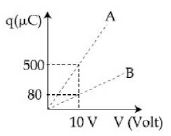
The figure shows the charge $(q)$ versus voltage $(V)$ graph for series and parallel combinations of two given capacitors. The capacitances are:
A
$40\,\mu F$ and $10\, \mu F$
B
$50\,\mu F$ and $30\, \mu F$
C
$60\,\mu F$ and $40\, \mu F$
D
$20\,\mu F$ and $30\, \mu F$
Solution
(A) From the relation $q = CV$, the slope of the $q-V$ graph represents the capacitance $C = q/V$.
For line $A$, the capacitance is $C_A = 500\,\mu C / 10\,V = 50\,\mu F$.
For line $B$, the capacitance is $C_B = 80\,\mu C / 10\,V = 8\,\mu F$.
Since the parallel combination has a higher equivalent capacitance than the series combination, we have $C_{parallel} = 50\,\mu F$ and $C_{series} = 8\,\mu F$.
Let the two capacitors be $C_1$ and $C_2$. Then $C_1 + C_2 = 50$ and $(C_1 C_2) / (C_1 + C_2) = 8$.
Substituting $C_1 + C_2 = 50$ into the series formula: $(C_1 C_2) / 50 = 8$, so $C_1 C_2 = 400$.
Solving the quadratic equation $x^2 - 50x + 400 = 0$, we get $(x - 40)(x - 10) = 0$.
Thus, the capacitances are $40\,\mu F$ and $10\,\mu F$.
For line $A$, the capacitance is $C_A = 500\,\mu C / 10\,V = 50\,\mu F$.
For line $B$, the capacitance is $C_B = 80\,\mu C / 10\,V = 8\,\mu F$.
Since the parallel combination has a higher equivalent capacitance than the series combination, we have $C_{parallel} = 50\,\mu F$ and $C_{series} = 8\,\mu F$.
Let the two capacitors be $C_1$ and $C_2$. Then $C_1 + C_2 = 50$ and $(C_1 C_2) / (C_1 + C_2) = 8$.
Substituting $C_1 + C_2 = 50$ into the series formula: $(C_1 C_2) / 50 = 8$, so $C_1 C_2 = 400$.
Solving the quadratic equation $x^2 - 50x + 400 = 0$, we get $(x - 40)(x - 10) = 0$.
Thus, the capacitances are $40\,\mu F$ and $10\,\mu F$.
0 likesView Solution
221
PhysicsMediumMCQJEE Main · 2019
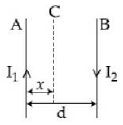
Two wires $A$ and $B$ are carrying currents $I_1$ and $I_2$ as shown in the figure. The separation between them is $d$. $A$ third wire $C$ carrying a current $I$ is to be kept parallel to them at a distance $x$ from $A$ such that the net force acting on it is zero. The possible values of $x$ are
A
$x = \left( \frac{I_1}{I_1 - I_2} \right)d$ and $x = \frac{I_2}{(I_1 + I_2)}d$
B
$x = \pm \frac{I_1 d}{(I_1 - I_2)}$
C
$x = \left( \frac{I_2}{I_1 + I_2} \right)d$ and $x = \frac{I_2}{(I_1 - I_2)}d$
D
$x = \left( \frac{I_1}{I_1 + I_2} \right)d$ and $x = \frac{I_2}{(I_1 - I_2)}d$
Solution
(B) The force per unit length on a wire carrying current $I$ due to another parallel wire carrying current $I'$ at a distance $r$ is given by $F = \frac{\mu_0 I I'}{2 \pi r}$.
For the net force on wire $C$ to be zero,the forces exerted by wires $A$ and $B$ must be equal in magnitude and opposite in direction.
Let wire $C$ be at a distance $x$ from $A$ and $(d-x)$ from $B$. The force per unit length due to $A$ is $F_A = \frac{\mu_0 I_1 I}{2 \pi x}$ (repulsive if currents are in the same direction,attractive if opposite).
The force per unit length due to $B$ is $F_B = \frac{\mu_0 I_2 I}{2 \pi (d-x)}$.
Since the currents $I_1$ and $I_2$ are in opposite directions (as shown in the figure),the forces will be in the same direction if $C$ is between $A$ and $B$. Thus,the equilibrium point must lie outside the region between $A$ and $B$.
Equating the magnitudes of the magnetic fields produced by $A$ and $B$ at the position of $C$:
$\frac{\mu_0 I_1}{2 \pi x} = \frac{\mu_0 I_2}{2 \pi |x - d|}$
$\frac{I_1}{x} = \frac{I_2}{|x - d|}$
Case $1$: $x > d$,then $x - d = x - d$,so $I_1(x - d) = I_2 x \Rightarrow x(I_1 - I_2) = I_1 d \Rightarrow x = \frac{I_1 d}{I_1 - I_2}$.
Case $2$: $x < 0$,then $|x - d| = d - x$,so $I_1(d - x) = I_2 x \Rightarrow I_1 d = x(I_1 + I_2) \Rightarrow x = \frac{I_1 d}{I_1 + I_2}$ (This is not possible as $x$ is distance from $A$).
Re-evaluating the geometry for equilibrium: The point where the net magnetic field is zero is $x = \frac{I_1 d}{I_1 - I_2}$.
For the net force on wire $C$ to be zero,the forces exerted by wires $A$ and $B$ must be equal in magnitude and opposite in direction.
Let wire $C$ be at a distance $x$ from $A$ and $(d-x)$ from $B$. The force per unit length due to $A$ is $F_A = \frac{\mu_0 I_1 I}{2 \pi x}$ (repulsive if currents are in the same direction,attractive if opposite).
The force per unit length due to $B$ is $F_B = \frac{\mu_0 I_2 I}{2 \pi (d-x)}$.
Since the currents $I_1$ and $I_2$ are in opposite directions (as shown in the figure),the forces will be in the same direction if $C$ is between $A$ and $B$. Thus,the equilibrium point must lie outside the region between $A$ and $B$.
Equating the magnitudes of the magnetic fields produced by $A$ and $B$ at the position of $C$:
$\frac{\mu_0 I_1}{2 \pi x} = \frac{\mu_0 I_2}{2 \pi |x - d|}$
$\frac{I_1}{x} = \frac{I_2}{|x - d|}$
Case $1$: $x > d$,then $x - d = x - d$,so $I_1(x - d) = I_2 x \Rightarrow x(I_1 - I_2) = I_1 d \Rightarrow x = \frac{I_1 d}{I_1 - I_2}$.
Case $2$: $x < 0$,then $|x - d| = d - x$,so $I_1(d - x) = I_2 x \Rightarrow I_1 d = x(I_1 + I_2) \Rightarrow x = \frac{I_1 d}{I_1 + I_2}$ (This is not possible as $x$ is distance from $A$).
Re-evaluating the geometry for equilibrium: The point where the net magnetic field is zero is $x = \frac{I_1 d}{I_1 - I_2}$.
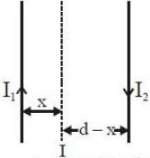
0 likesView Solution
222
PhysicsMediumMCQJEE Main · 2019
$A$ proton,an electron,and a Helium nucleus have the same kinetic energy. They are moving in circular orbits in a plane due to a magnetic field perpendicular to the plane. Let $r_p, r_e$,and $r_{He}$ be their respective radii. Then:
A
$r_e > r_p = r_{He}$
B
$r_e > r_p > r_{He}$
C
$r_e < r_p < r_{He}$
D
$r_e < r_p = r_{He}$
Solution
(D) The radius of a charged particle moving in a magnetic field is given by $r = \frac{mv}{qB}$.
Since kinetic energy $K = \frac{1}{2}mv^2$,we have $mv = \sqrt{2mK}$.
Substituting this into the radius formula,we get $r = \frac{\sqrt{2mK}}{qB}$.
Given that $K$ and $B$ are the same for all particles,$r \propto \frac{\sqrt{m}}{q}$.
For a proton $(p)$: $m_p = m, q_p = e$,so $r_p \propto \frac{\sqrt{m}}{e}$.
For an electron $(e)$: $m_e \approx \frac{m}{1836}, q_e = e$,so $r_e \propto \frac{\sqrt{m/1836}}{e} = \frac{r_p}{\sqrt{1836}}$. Thus,$r_e < r_p$.
For a Helium nucleus $(He^{2+})$: $m_{He} \approx 4m, q_{He} = 2e$,so $r_{He} \propto \frac{\sqrt{4m}}{2e} = \frac{2\sqrt{m}}{2e} = \frac{\sqrt{m}}{e} = r_p$.
Therefore,$r_e < r_p = r_{He}$.
Since kinetic energy $K = \frac{1}{2}mv^2$,we have $mv = \sqrt{2mK}$.
Substituting this into the radius formula,we get $r = \frac{\sqrt{2mK}}{qB}$.
Given that $K$ and $B$ are the same for all particles,$r \propto \frac{\sqrt{m}}{q}$.
For a proton $(p)$: $m_p = m, q_p = e$,so $r_p \propto \frac{\sqrt{m}}{e}$.
For an electron $(e)$: $m_e \approx \frac{m}{1836}, q_e = e$,so $r_e \propto \frac{\sqrt{m/1836}}{e} = \frac{r_p}{\sqrt{1836}}$. Thus,$r_e < r_p$.
For a Helium nucleus $(He^{2+})$: $m_{He} \approx 4m, q_{He} = 2e$,so $r_{He} \propto \frac{\sqrt{4m}}{2e} = \frac{2\sqrt{m}}{2e} = \frac{\sqrt{m}}{e} = r_p$.
Therefore,$r_e < r_p = r_{He}$.
0 likesView Solution
223
PhysicsMediumMCQJEE Main · 2019
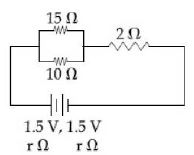
In the given circuit,an ideal voltmeter connected across the $10\,\Omega$ resistance reads $2\,V$. The internal resistance $r$ of each cell is ................... $\Omega$.
A
$1$
B
$0.5$
C
$1.5$
D
$0$
Solution
(B) The circuit consists of two cells of $1.5\,V$ each in series,so the total $EMF$ is $E_{eq} = 1.5 + 1.5 = 3\,V$. The total internal resistance is $r_{eq} = r + r = 2r$.
The external circuit has a $15\,\Omega$ and $10\,\Omega$ resistor in parallel,which are in series with a $2\,\Omega$ resistor.
The equivalent resistance of the parallel part is $R_p = \frac{15 \times 10}{15 + 10} = \frac{150}{25} = 6\,\Omega$.
The total external resistance is $R_{ext} = 6 + 2 = 8\,\Omega$.
The total resistance of the circuit is $R_{total} = 8 + 2r$.
The total current in the circuit is $i = \frac{E_{eq}}{R_{total}} = \frac{3}{8 + 2r}$.
The voltmeter is connected across the $10\,\Omega$ resistor,which is part of the parallel combination. The voltage across the parallel combination is $V_p = i \times R_p = i \times 6$.
Given $V_p = 2\,V$,we have $2 = \frac{3}{8 + 2r} \times 6$.
$2 = \frac{18}{8 + 2r} \Rightarrow 16 + 4r = 18 \Rightarrow 4r = 2 \Rightarrow r = 0.5\,\Omega$.
The external circuit has a $15\,\Omega$ and $10\,\Omega$ resistor in parallel,which are in series with a $2\,\Omega$ resistor.
The equivalent resistance of the parallel part is $R_p = \frac{15 \times 10}{15 + 10} = \frac{150}{25} = 6\,\Omega$.
The total external resistance is $R_{ext} = 6 + 2 = 8\,\Omega$.
The total resistance of the circuit is $R_{total} = 8 + 2r$.
The total current in the circuit is $i = \frac{E_{eq}}{R_{total}} = \frac{3}{8 + 2r}$.
The voltmeter is connected across the $10\,\Omega$ resistor,which is part of the parallel combination. The voltage across the parallel combination is $V_p = i \times R_p = i \times 6$.
Given $V_p = 2\,V$,we have $2 = \frac{3}{8 + 2r} \times 6$.
$2 = \frac{18}{8 + 2r} \Rightarrow 16 + 4r = 18 \Rightarrow 4r = 2 \Rightarrow r = 0.5\,\Omega$.
0 likesView Solution
224
PhysicsMediumMCQJEE Main · 2019
The electric field of a plane electromagnetic wave is given by $\vec E = E_0 \hat i \cos(kz) \cos(\omega t)$. The corresponding magnetic field $\vec B$ is then given by:
A
$\vec B = \frac{E_0}{c} \hat j \sin(kz) \sin(\omega t)$
B
$\vec B = \frac{E_0}{c} \hat k \sin(kz) \cos(\omega t)$
C
$\vec B = \frac{E_0}{c} \hat j \cos(kz) \sin(\omega t)$
D
$\vec B = \frac{E_0}{c} \hat j \sin(kz) \cos(\omega t)$
Solution
(A) The electric field is $\vec E = E_0 \hat i \cos(kz) \cos(\omega t)$.
Since the wave propagates in the $+z$ direction and $\vec E$ is along the $x$-axis,the magnetic field $\vec B$ must be along the $y$-axis.
Using Faraday's Law in differential form: $\nabla \times \vec E = -\frac{\partial \vec B}{\partial t}$.
For a wave propagating in the $z$-direction,$\frac{\partial E_x}{\partial z} = -\frac{\partial B_y}{\partial t}$.
Calculating the derivative of $E_x$ with respect to $z$: $\frac{\partial}{\partial z} [E_0 \cos(kz) \cos(\omega t)] = -k E_0 \sin(kz) \cos(\omega t)$.
Thus,$\frac{\partial B_y}{\partial t} = k E_0 \sin(kz) \cos(\omega t)$.
Integrating with respect to $t$: $B_y = \int k E_0 \sin(kz) \cos(\omega t) dt = \frac{k E_0}{\omega} \sin(kz) \sin(\omega t)$.
Since $c = \frac{\omega}{k}$,we have $\frac{k}{\omega} = \frac{1}{c}$.
Therefore,$\vec B = \frac{E_0}{c} \hat j \sin(kz) \sin(\omega t)$.
Since the wave propagates in the $+z$ direction and $\vec E$ is along the $x$-axis,the magnetic field $\vec B$ must be along the $y$-axis.
Using Faraday's Law in differential form: $\nabla \times \vec E = -\frac{\partial \vec B}{\partial t}$.
For a wave propagating in the $z$-direction,$\frac{\partial E_x}{\partial z} = -\frac{\partial B_y}{\partial t}$.
Calculating the derivative of $E_x$ with respect to $z$: $\frac{\partial}{\partial z} [E_0 \cos(kz) \cos(\omega t)] = -k E_0 \sin(kz) \cos(\omega t)$.
Thus,$\frac{\partial B_y}{\partial t} = k E_0 \sin(kz) \cos(\omega t)$.
Integrating with respect to $t$: $B_y = \int k E_0 \sin(kz) \cos(\omega t) dt = \frac{k E_0}{\omega} \sin(kz) \sin(\omega t)$.
Since $c = \frac{\omega}{k}$,we have $\frac{k}{\omega} = \frac{1}{c}$.
Therefore,$\vec B = \frac{E_0}{c} \hat j \sin(kz) \sin(\omega t)$.
0 likesView Solution
225
PhysicsDifficultMCQJEE Main · 2019
An $npn$ transistor operates as a common emitter amplifier,with a power gain of $60\, dB$. The input circuit resistance is $100\,\Omega$ and the output load resistance is $10\, k\Omega$. The common emitter current gain $\beta$ is:
A
$6\times10^2$
B
$10^2$
C
$60$
D
$10^4$
Solution
(B) The power gain in $dB$ is given by $G_p = 10 \log_{10} \left( \frac{P_{out}}{P_{in}} \right) = 60\, dB$.
Therefore,$\frac{P_{out}}{P_{in}} = 10^{(60/10)} = 10^6$.
Power gain is also expressed as $A_p = \beta^2 \times \frac{R_{out}}{R_{in}}$,where $\beta$ is the current gain,$R_{out} = 10\, k\Omega = 10^4\,\Omega$,and $R_{in} = 100\,\Omega$.
Substituting the values: $10^6 = \beta^2 \times \frac{10^4}{100}$.
$10^6 = \beta^2 \times 10^2$.
$\beta^2 = \frac{10^6}{10^2} = 10^4$.
$\beta = \sqrt{10^4} = 100$.
Therefore,$\frac{P_{out}}{P_{in}} = 10^{(60/10)} = 10^6$.
Power gain is also expressed as $A_p = \beta^2 \times \frac{R_{out}}{R_{in}}$,where $\beta$ is the current gain,$R_{out} = 10\, k\Omega = 10^4\,\Omega$,and $R_{in} = 100\,\Omega$.
Substituting the values: $10^6 = \beta^2 \times \frac{10^4}{100}$.
$10^6 = \beta^2 \times 10^2$.
$\beta^2 = \frac{10^6}{10^2} = 10^4$.
$\beta = \sqrt{10^4} = 100$.
0 likesView Solution
226
PhysicsMediumMCQJEE Main · 2019
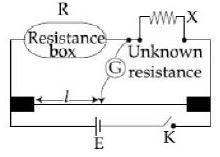
In a meter bridge experiment, the circuit diagram and the corresponding observation table are shown in the figure.
Which of the readings is inconsistent?
| $Sl. No.$ | $R \, (\Omega)$ | $l \, (cm)$ |
| $1.$ | $1000$ | $60$ |
| $2.$ | $100$ | $13$ |
| $3.$ | $10$ | $1.5$ |
| $4.$ | $1$ | $1.0$ |
A
$4$
B
$3$
C
$2$
D
$1$
Solution
(A) In a meter bridge, the unknown resistance $X$ is given by the formula $X = R \frac{l_2}{l_1} = R \frac{(100 - l)}{l}$, where $l$ is the balancing length from the left end.
For reading $1$: $X = 1000 \times \frac{(100 - 60)}{60} = 1000 \times \frac{40}{60} \approx 666.67 \, \Omega$.
For reading $2$: $X = 100 \times \frac{(100 - 13)}{13} = 100 \times \frac{87}{13} \approx 669.23 \, \Omega$.
For reading $3$: $X = 10 \times \frac{(100 - 1.5)}{1.5} = 10 \times \frac{98.5}{1.5} \approx 656.67 \, \Omega$.
For reading $4$: $X = 1 \times \frac{(100 - 1)}{1} = 1 \times 99 = 99 \, \Omega$.
Comparing the calculated values of $X$, the values for readings $1, 2,$ and $3$ are consistent (around $660 \, \Omega$), whereas the value for reading $4$ is significantly different. Thus, reading $4$ is inconsistent.
For reading $1$: $X = 1000 \times \frac{(100 - 60)}{60} = 1000 \times \frac{40}{60} \approx 666.67 \, \Omega$.
For reading $2$: $X = 100 \times \frac{(100 - 13)}{13} = 100 \times \frac{87}{13} \approx 669.23 \, \Omega$.
For reading $3$: $X = 10 \times \frac{(100 - 1.5)}{1.5} = 10 \times \frac{98.5}{1.5} \approx 656.67 \, \Omega$.
For reading $4$: $X = 1 \times \frac{(100 - 1)}{1} = 1 \times 99 = 99 \, \Omega$.
Comparing the calculated values of $X$, the values for readings $1, 2,$ and $3$ are consistent (around $660 \, \Omega$), whereas the value for reading $4$ is significantly different. Thus, reading $4$ is inconsistent.
0 likesView Solution
227
PhysicsMediumMCQJEE Main · 2019
$A$ transformer consisting of $300$ turns in the primary and $150$ turns in the secondary gives output power of $2.2\, kW$. If the current in the secondary coil is $10\, A$,then the input voltage and current in the primary coil are
A
$440\, V$ and $5\, A$
B
$440\, V$ and $20\, A$
C
$220\, V$ and $20\, A$
D
$220\, V$ and $10\, A$
Solution
(A) Given: Number of turns in primary $N_{p} = 300$,Number of turns in secondary $N_{s} = 150$,Output power $P_{s} = 2.2\, kW = 2200\, W$,Secondary current $I_{s} = 10\, A$.
First,calculate the secondary voltage $V_{s}$ using $P_{s} = V_{s} I_{s}$:
$2200 = V_{s} \times 10 \Rightarrow V_{s} = 220\, V$.
Using the transformer ratio $\frac{V_{p}}{V_{s}} = \frac{N_{p}}{N_{s}}$:
$\frac{V_{p}}{220} = \frac{300}{150} = 2 \Rightarrow V_{p} = 440\, V$.
Assuming an ideal transformer,input power $P_{p} = P_{s} = 2200\, W$:
$P_{p} = V_{p} I_{p} \Rightarrow 2200 = 440 \times I_{p} \Rightarrow I_{p} = \frac{2200}{440} = 5\, A$.
Thus,the input voltage is $440\, V$ and the input current is $5\, A$.
First,calculate the secondary voltage $V_{s}$ using $P_{s} = V_{s} I_{s}$:
$2200 = V_{s} \times 10 \Rightarrow V_{s} = 220\, V$.
Using the transformer ratio $\frac{V_{p}}{V_{s}} = \frac{N_{p}}{N_{s}}$:
$\frac{V_{p}}{220} = \frac{300}{150} = 2 \Rightarrow V_{p} = 440\, V$.
Assuming an ideal transformer,input power $P_{p} = P_{s} = 2200\, W$:
$P_{p} = V_{p} I_{p} \Rightarrow 2200 = 440 \times I_{p} \Rightarrow I_{p} = \frac{2200}{440} = 5\, A$.
Thus,the input voltage is $440\, V$ and the input current is $5\, A$.
0 likesView Solution
228
PhysicsDifficultMCQJEE Main · 2019
$A$ uniformly charged ring of radius $3a$ and total charge $q$ is placed in the $xy$-plane centered at the origin. $A$ point charge $q$ is moving towards the ring along the $z$-axis and has speed $v$ at $z = 4a$. The minimum value of $v$ such that it crosses the origin is
A
$\sqrt {\frac{2}{m}} {\left( {\frac{1}{5}\frac{{{q^2}}}{{4\pi { \in _0}a}}} \right)^{1/2}}$
B
$\sqrt {\frac{2}{m}} {\left( {\frac{1}{15}\frac{{{q^2}}}{{4\pi { \in _0}a}}} \right)^{1/2}}$
C
$\sqrt {\frac{2}{m}} {\left( {\frac{4}{15}\frac{{{q^2}}}{{4\pi { \in _0}a}}} \right)^{1/2}}$
D
$\sqrt {\frac{2}{m}} {\left( {\frac{2}{15}\frac{{{q^2}}}{{4\pi { \in _0}a}}} \right)^{1/2}}$
Solution
(D) The potential at a distance $z$ on the axis of a ring of radius $R$ and charge $q$ is $V = \frac{1}{4\pi \epsilon_0} \frac{q}{\sqrt{R^2 + z^2}}$.
Here,$R = 3a$. At $z = 4a$,the potential energy is $U_i = qV = \frac{q^2}{4\pi \epsilon_0 \sqrt{(3a)^2 + (4a)^2}} = \frac{q^2}{4\pi \epsilon_0 (5a)}$.
At the origin $(z = 0)$,the potential energy is $U_f = qV = \frac{q^2}{4\pi \epsilon_0 (3a)}$.
By the law of conservation of energy,$K_i + U_i = K_f + U_f$. For the charge to just cross the origin,$K_f = 0$.
$\frac{1}{2}mv^2 + \frac{q^2}{4\pi \epsilon_0 (5a)} = 0 + \frac{q^2}{4\pi \epsilon_0 (3a)}$.
$\frac{1}{2}mv^2 = \frac{q^2}{4\pi \epsilon_0 a} (\frac{1}{3} - \frac{1}{5}) = \frac{q^2}{4\pi \epsilon_0 a} (\frac{2}{15})$.
$v^2 = \frac{2}{m} \cdot \frac{2}{15} \cdot \frac{q^2}{4\pi \epsilon_0 a}$.
$v = \sqrt{\frac{2}{m}} \left( \frac{2}{15} \frac{q^2}{4\pi \epsilon_0 a} \right)^{1/2}$.
Here,$R = 3a$. At $z = 4a$,the potential energy is $U_i = qV = \frac{q^2}{4\pi \epsilon_0 \sqrt{(3a)^2 + (4a)^2}} = \frac{q^2}{4\pi \epsilon_0 (5a)}$.
At the origin $(z = 0)$,the potential energy is $U_f = qV = \frac{q^2}{4\pi \epsilon_0 (3a)}$.
By the law of conservation of energy,$K_i + U_i = K_f + U_f$. For the charge to just cross the origin,$K_f = 0$.
$\frac{1}{2}mv^2 + \frac{q^2}{4\pi \epsilon_0 (5a)} = 0 + \frac{q^2}{4\pi \epsilon_0 (3a)}$.
$\frac{1}{2}mv^2 = \frac{q^2}{4\pi \epsilon_0 a} (\frac{1}{3} - \frac{1}{5}) = \frac{q^2}{4\pi \epsilon_0 a} (\frac{2}{15})$.
$v^2 = \frac{2}{m} \cdot \frac{2}{15} \cdot \frac{q^2}{4\pi \epsilon_0 a}$.
$v = \sqrt{\frac{2}{m}} \left( \frac{2}{15} \frac{q^2}{4\pi \epsilon_0 a} \right)^{1/2}$.
0 likesView Solution
229
PhysicsMediumMCQJEE Main · 2019
$A$ current of $5\, A$ passes through a copper conductor (resistivity $= 1.7 \times 10^{-8}\, \Omega \, m$) of radius of cross-section $5\, mm$. Find the mobility of the charges if their drift velocity is $1.1 \times 10^{-3}\, m/s$.
A
$1.8$
B
$1.0$
C
$1.3$
D
$1.5$
Solution
(B) The mobility $\mu$ is defined as the ratio of drift velocity $V_d$ to the electric field $E$: $\mu = \frac{V_d}{E}$.
From Ohm's law in vector form,$E = \rho J$,where $\rho$ is resistivity and $J$ is current density.
Current density $J = \frac{I}{A} = \frac{I}{\pi r^2}$.
Given: $I = 5\, A$,$\rho = 1.7 \times 10^{-8}\, \Omega \, m$,$r = 5\, mm = 5 \times 10^{-3}\, m$,and $V_d = 1.1 \times 10^{-3}\, m/s$.
First,calculate the electric field $E$:
$E = \rho \times \frac{I}{\pi r^2} = 1.7 \times 10^{-8} \times \frac{5}{\pi \times (5 \times 10^{-3})^2} = 1.7 \times 10^{-8} \times \frac{5}{\pi \times 25 \times 10^{-6}} = \frac{1.7 \times 10^{-8} \times 5}{78.54 \times 10^{-6}} \approx 1.08 \times 10^{-3}\, V/m$.
Now,calculate mobility $\mu$:
$\mu = \frac{1.1 \times 10^{-3}}{1.08 \times 10^{-3}} \approx 1.01\, m^2/Vs$.
Rounding to the nearest given option,the correct value is $1.0\, m^2/Vs$.
From Ohm's law in vector form,$E = \rho J$,where $\rho$ is resistivity and $J$ is current density.
Current density $J = \frac{I}{A} = \frac{I}{\pi r^2}$.
Given: $I = 5\, A$,$\rho = 1.7 \times 10^{-8}\, \Omega \, m$,$r = 5\, mm = 5 \times 10^{-3}\, m$,and $V_d = 1.1 \times 10^{-3}\, m/s$.
First,calculate the electric field $E$:
$E = \rho \times \frac{I}{\pi r^2} = 1.7 \times 10^{-8} \times \frac{5}{\pi \times (5 \times 10^{-3})^2} = 1.7 \times 10^{-8} \times \frac{5}{\pi \times 25 \times 10^{-6}} = \frac{1.7 \times 10^{-8} \times 5}{78.54 \times 10^{-6}} \approx 1.08 \times 10^{-3}\, V/m$.
Now,calculate mobility $\mu$:
$\mu = \frac{1.1 \times 10^{-3}}{1.08 \times 10^{-3}} \approx 1.01\, m^2/Vs$.
Rounding to the nearest given option,the correct value is $1.0\, m^2/Vs$.
0 likesView Solution
230
PhysicsDifficultMCQJEE Main · 2019
$A$ message signal of frequency $100\, MHz$ and peak voltage $100\, V$ is used to execute amplitude modulation on a carrier wave of frequency $300\, GHz$ and peak voltage $400\, V$. The modulation index and difference between the two sideband frequencies are:
A
$0.25 ; 2\times10^8\, Hz$
B
$4 ; 1\times10^8\, Hz$
C
$0.25 ; 1\times10^8\, Hz$
D
$4 ; 2\times10^8\, Hz$
Solution
(A) Given:
Message signal frequency $f_m = 100\, MHz = 10^8\, Hz$.
Peak voltage of message signal $V_m = 100\, V$.
Carrier wave frequency $f_c = 300\, GHz$.
Peak voltage of carrier wave $V_c = 400\, V$.
The modulation index $\mu$ is given by the formula $\mu = \frac{V_m}{V_c} = \frac{100}{400} = 0.25$.
The two sideband frequencies are $(f_c + f_m)$ and $(f_c - f_m)$.
The difference between the two sideband frequencies is $(f_c + f_m) - (f_c - f_m) = 2f_m$.
Substituting the value of $f_m$,we get $2 \times 10^8\, Hz$.
Message signal frequency $f_m = 100\, MHz = 10^8\, Hz$.
Peak voltage of message signal $V_m = 100\, V$.
Carrier wave frequency $f_c = 300\, GHz$.
Peak voltage of carrier wave $V_c = 400\, V$.
The modulation index $\mu$ is given by the formula $\mu = \frac{V_m}{V_c} = \frac{100}{400} = 0.25$.
The two sideband frequencies are $(f_c + f_m)$ and $(f_c - f_m)$.
The difference between the two sideband frequencies is $(f_c + f_m) - (f_c - f_m) = 2f_m$.
Substituting the value of $f_m$,we get $2 \times 10^8\, Hz$.
0 likesView Solution
231
PhysicsDifficultMCQJEE Main · 2019
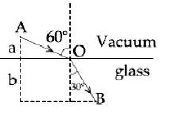
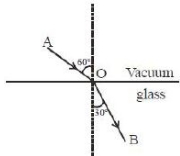
$A$ ray of light $AO$ in vacuum is incident on a glass slab at an angle of $60^o$ and refracted at an angle of $30^o$ along $OB$ as shown in the figure. The optical path length of the light ray from $A$ to $B$ is
A
$2a + \frac{2b}{\sqrt{3}}$
B
$2a + \frac{2b}{3}$
C
$\frac{2\sqrt{3}}{a} + 2b$
D
$2a + 2b$
Solution
(D) According to Snell's law,$n_1 \sin i = n_2 \sin r$.
Here,$n_1 = 1$ (vacuum),$i = 60^o$,$n_2 = \mu$ (glass),and $r = 30^o$.
$1 \cdot \sin 60^o = \mu \cdot \sin 30^o$
$\frac{\sqrt{3}}{2} = \mu \cdot \frac{1}{2} \Rightarrow \mu = \sqrt{3}$.
The optical path length is defined as the sum of the products of refractive index and geometric path length for each medium.
Optical path length $= n_{vacuum} \cdot AO + n_{glass} \cdot OB$.
From the geometry of the figure:
$AO = \frac{a}{\cos 60^o} = \frac{a}{1/2} = 2a$.
$OB = \frac{b}{\cos 30^o} = \frac{b}{\sqrt{3}/2} = \frac{2b}{\sqrt{3}}$.
Optical path length $= 1 \cdot (2a) + \sqrt{3} \cdot \left( \frac{2b}{\sqrt{3}} \right) = 2a + 2b$.
Here,$n_1 = 1$ (vacuum),$i = 60^o$,$n_2 = \mu$ (glass),and $r = 30^o$.
$1 \cdot \sin 60^o = \mu \cdot \sin 30^o$
$\frac{\sqrt{3}}{2} = \mu \cdot \frac{1}{2} \Rightarrow \mu = \sqrt{3}$.
The optical path length is defined as the sum of the products of refractive index and geometric path length for each medium.
Optical path length $= n_{vacuum} \cdot AO + n_{glass} \cdot OB$.
From the geometry of the figure:
$AO = \frac{a}{\cos 60^o} = \frac{a}{1/2} = 2a$.
$OB = \frac{b}{\cos 30^o} = \frac{b}{\sqrt{3}/2} = \frac{2b}{\sqrt{3}}$.
Optical path length $= 1 \cdot (2a) + \sqrt{3} \cdot \left( \frac{2b}{\sqrt{3}} \right) = 2a + 2b$.
0 likesView Solution
232
PhysicsMediumMCQJEE Main · 2019
Two radioactive materials $A$ and $B$ have decay constants $10\lambda$ and $\lambda$,respectively. If initially they have the same number of nuclei,then the ratio of the number of nuclei of $A$ to that of $B$ will be $1/e$ after a time:
A
$\frac{1}{11\lambda}$
B
$\frac{1}{10\lambda}$
C
$\frac{1}{9\lambda}$
D
$\frac{11}{10\lambda}$
Solution
(C) Let $N_0$ be the initial number of nuclei for both materials.
For material $A$,the number of nuclei at time $t$ is $N_A = N_0 e^{-10\lambda t}$.
For material $B$,the number of nuclei at time $t$ is $N_B = N_0 e^{-\lambda t}$.
We are given that the ratio $\frac{N_A}{N_B} = \frac{1}{e}$.
Substituting the expressions,we get $\frac{N_0 e^{-10\lambda t}}{N_0 e^{-\lambda t}} = e^{-1}$.
This simplifies to $e^{-10\lambda t + \lambda t} = e^{-1}$,which means $e^{-9\lambda t} = e^{-1}$.
Equating the exponents,we have $-9\lambda t = -1$.
Therefore,$t = \frac{1}{9\lambda}$.
For material $A$,the number of nuclei at time $t$ is $N_A = N_0 e^{-10\lambda t}$.
For material $B$,the number of nuclei at time $t$ is $N_B = N_0 e^{-\lambda t}$.
We are given that the ratio $\frac{N_A}{N_B} = \frac{1}{e}$.
Substituting the expressions,we get $\frac{N_0 e^{-10\lambda t}}{N_0 e^{-\lambda t}} = e^{-1}$.
This simplifies to $e^{-10\lambda t + \lambda t} = e^{-1}$,which means $e^{-9\lambda t} = e^{-1}$.
Equating the exponents,we have $-9\lambda t = -1$.
Therefore,$t = \frac{1}{9\lambda}$.
0 likesView Solution
233
PhysicsMediumMCQJEE Main · 2019
In a photoelectric effect experiment,the threshold wavelength of incident light is $380 \, nm$. If the wavelength of the incident light is $260 \, nm$,the maximum kinetic energy of emitted electrons will be: .............. $eV$. Given $E \text{ (in } eV) = \frac{1237}{\lambda \text{ (in } nm)}$.
A
$15.1$
B
$1.5$
C
$4.5$
D
$3$
Solution
(B) According to Einstein's photoelectric equation,the maximum kinetic energy $K_{\max}$ is given by:
$K_{\max} = E - \phi$
where $E$ is the energy of the incident photon and $\phi$ is the work function.
Given $E = \frac{1237}{\lambda}$ and $\phi = \frac{1237}{\lambda_0}$,where $\lambda_0 = 380 \, nm$ and $\lambda = 260 \, nm$.
$K_{\max} = \frac{1237}{260} - \frac{1237}{380}$
$K_{\max} = 1237 \times \left( \frac{380 - 260}{380 \times 260} \right)$
$K_{\max} = 1237 \times \left( \frac{120}{98800} \right)$
$K_{\max} \approx 1.5 \, eV$.
$K_{\max} = E - \phi$
where $E$ is the energy of the incident photon and $\phi$ is the work function.
Given $E = \frac{1237}{\lambda}$ and $\phi = \frac{1237}{\lambda_0}$,where $\lambda_0 = 380 \, nm$ and $\lambda = 260 \, nm$.
$K_{\max} = \frac{1237}{260} - \frac{1237}{380}$
$K_{\max} = 1237 \times \left( \frac{380 - 260}{380 \times 260} \right)$
$K_{\max} = 1237 \times \left( \frac{120}{98800} \right)$
$K_{\max} \approx 1.5 \, eV$.
0 likesView Solution
234
PhysicsDifficultMCQJEE Main · 2019
One plano-convex and one plano-concave lens of same radius of curvature $R$ but of different materials are joined side by side as shown in the figure. If the refractive index of the material of $1$ is $\mu_1$ and that of $2$ is $\mu_2$,then the focal length of the combination is

A
$\frac{R}{2(\mu_1 - \mu_2)}$
B
$\frac{2R}{(\mu_1 - \mu_2)}$
C
$\frac{R}{(\mu_1 - \mu_2)}$
D
$\frac{R}{2 - (\mu_1 - \mu_2)}$
Solution
(C) For the $1^{\text{st}}$ lens (plano-convex),using the lens maker's formula: $\frac{1}{f_1} = (\mu_1 - 1) \left( \frac{1}{\infty} - \frac{1}{-R} \right) = \frac{\mu_1 - 1}{R}$.
For the $2^{\text{nd}}$ lens (plano-concave),using the lens maker's formula: $\frac{1}{f_2} = (\mu_2 - 1) \left( \frac{1}{-R} - \frac{1}{\infty} \right) = -\frac{\mu_2 - 1}{R}$.
The equivalent focal length $f_{eq}$ of the combination is given by $\frac{1}{f_{eq}} = \frac{1}{f_1} + \frac{1}{f_2}$.
Substituting the values: $\frac{1}{f_{eq}} = \frac{\mu_1 - 1}{R} - \frac{\mu_2 - 1}{R} = \frac{\mu_1 - 1 - \mu_2 + 1}{R} = \frac{\mu_1 - \mu_2}{R}$.
Therefore,$f_{eq} = \frac{R}{\mu_1 - \mu_2}$.
For the $2^{\text{nd}}$ lens (plano-concave),using the lens maker's formula: $\frac{1}{f_2} = (\mu_2 - 1) \left( \frac{1}{-R} - \frac{1}{\infty} \right) = -\frac{\mu_2 - 1}{R}$.
The equivalent focal length $f_{eq}$ of the combination is given by $\frac{1}{f_{eq}} = \frac{1}{f_1} + \frac{1}{f_2}$.
Substituting the values: $\frac{1}{f_{eq}} = \frac{\mu_1 - 1}{R} - \frac{\mu_2 - 1}{R} = \frac{\mu_1 - 1 - \mu_2 + 1}{R} = \frac{\mu_1 - \mu_2}{R}$.
Therefore,$f_{eq} = \frac{R}{\mu_1 - \mu_2}$.
0 likesView Solution
235
PhysicsMediumMCQJEE Main · 2019
$A$ moving coil galvanometer allows a full-scale current of $10^{-4} \ A$. $A$ series resistance of $2 \ M\Omega$ is required to convert the above galvanometer into a voltmeter of range $0-5 \ V$. Therefore,the value of shunt resistance required to convert the above galvanometer into an ammeter of range $0-10 \ mA$ is .... $\Omega$.
A
$200$
B
$100$
C
$10$
D
None of these
Solution
(D) Let $G$ be the resistance of the galvanometer and $I_g = 10^{-4} \ A$ be the full-scale deflection current.
For a voltmeter of range $V = 5 \ V$ with series resistance $R_s = 2 \ M\Omega = 2 \times 10^6 \ \Omega$:
$V = I_g(R_s + G)$
$5 = 10^{-4}(2 \times 10^6 + G)$
$5 \times 10^4 = 2 \times 10^6 + G$
$G = 50000 - 2000000 = -1950000 \ \Omega$.
Since the resistance $G$ cannot be negative,the problem statement contains inconsistent values. However,assuming the intended series resistance was $R_s = 48 \ k\Omega$ (which would yield $G = 2000 \ \Omega$):
For an ammeter of range $I = 10 \ mA = 10^{-2} \ A$ with shunt resistance $S$:
$S = \frac{I_g G}{I - I_g} = \frac{10^{-4} \times 2000}{10^{-2} - 10^{-4}} = \frac{0.2}{0.0099} \approx 20.2 \ \Omega$.
Given the provided parameters lead to a physical impossibility,the correct choice is $D$.
For a voltmeter of range $V = 5 \ V$ with series resistance $R_s = 2 \ M\Omega = 2 \times 10^6 \ \Omega$:
$V = I_g(R_s + G)$
$5 = 10^{-4}(2 \times 10^6 + G)$
$5 \times 10^4 = 2 \times 10^6 + G$
$G = 50000 - 2000000 = -1950000 \ \Omega$.
Since the resistance $G$ cannot be negative,the problem statement contains inconsistent values. However,assuming the intended series resistance was $R_s = 48 \ k\Omega$ (which would yield $G = 2000 \ \Omega$):
For an ammeter of range $I = 10 \ mA = 10^{-2} \ A$ with shunt resistance $S$:
$S = \frac{I_g G}{I - I_g} = \frac{10^{-4} \times 2000}{10^{-2} - 10^{-4}} = \frac{0.2}{0.0099} \approx 20.2 \ \Omega$.
Given the provided parameters lead to a physical impossibility,the correct choice is $D$.
0 likesView Solution
236
PhysicsMediumMCQJEE Main · 2019
The magnitude of the magnetic field at the centre of an equilateral triangular loop of side $1\,m$ which is carrying a current of $10\,A$ is:......$\mu T$ [Take $\mu _0 = 4\pi \times 10^{-7}\,NA^{-2}$]
A
$9$
B
$1$
C
$3$
D
$18$
Solution
(D) The magnetic field $B$ due to a straight wire of length $L$ at a perpendicular distance $r$ is given by $B = \frac{\mu_0 i}{4\pi r} (\sin \theta_1 + \sin \theta_2)$.
For an equilateral triangle of side $a = 1\,m$,the distance $r$ from the center to the side is $r = \frac{a}{2\tan(60^\circ)} = \frac{a}{2\sqrt{3}}$.
For each side,$\theta_1 = \theta_2 = 60^\circ$,so $\sin \theta_1 + \sin \theta_2 = 2 \sin(60^\circ) = 2 \times \frac{\sqrt{3}}{2} = \sqrt{3}$.
The magnetic field due to one side is $B_1 = \frac{\mu_0 i}{4\pi (a/2\sqrt{3})} \times \sqrt{3} = \frac{\mu_0 i \sqrt{3}}{2\pi a} \times \sqrt{3} = \frac{3\mu_0 i}{2\pi a}$.
Since there are $3$ sides,the total magnetic field at the center is $B = 3 \times B_1 = 3 \times \frac{3\mu_0 i}{2\pi a} = \frac{9\mu_0 i}{2\pi a}$.
Substituting the values: $B = \frac{9 \times (4\pi \times 10^{-7}) \times 10}{2\pi \times 1} = 18 \times 10^{-6}\,T = 18\,\mu T$.
For an equilateral triangle of side $a = 1\,m$,the distance $r$ from the center to the side is $r = \frac{a}{2\tan(60^\circ)} = \frac{a}{2\sqrt{3}}$.
For each side,$\theta_1 = \theta_2 = 60^\circ$,so $\sin \theta_1 + \sin \theta_2 = 2 \sin(60^\circ) = 2 \times \frac{\sqrt{3}}{2} = \sqrt{3}$.
The magnetic field due to one side is $B_1 = \frac{\mu_0 i}{4\pi (a/2\sqrt{3})} \times \sqrt{3} = \frac{\mu_0 i \sqrt{3}}{2\pi a} \times \sqrt{3} = \frac{3\mu_0 i}{2\pi a}$.
Since there are $3$ sides,the total magnetic field at the center is $B = 3 \times B_1 = 3 \times \frac{3\mu_0 i}{2\pi a} = \frac{9\mu_0 i}{2\pi a}$.
Substituting the values: $B = \frac{9 \times (4\pi \times 10^{-7}) \times 10}{2\pi \times 1} = 18 \times 10^{-6}\,T = 18\,\mu T$.
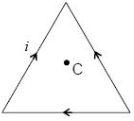
0 likesView Solution
237
PhysicsMediumMCQJEE Main · 2019
Two radioactive substances $A$ and $B$ have decay constants $5\lambda$ and $\lambda$ respectively. At $t = 0$,a sample has the same number of the two nuclei. The time taken for the ratio of the number of nuclei to become $(1/e)^2$ will be
A
$1/\lambda$
B
$1/4\lambda$
C
$2/\lambda$
D
$1/2\lambda$
Solution
(D) Let $N_0$ be the initial number of nuclei for both substances $A$ and $B$.
The number of nuclei remaining at time $t$ is given by $N(t) = N_0 e^{-\lambda t}$.
For substance $A$: $N_A(t) = N_0 e^{-5\lambda t}$.
For substance $B$: $N_B(t) = N_0 e^{-\lambda t}$.
The ratio of the number of nuclei is $\frac{N_A(t)}{N_B(t)} = \frac{N_0 e^{-5\lambda t}}{N_0 e^{-\lambda t}} = e^{-4\lambda t}$.
We are given that this ratio is $(1/e)^2 = e^{-2}$.
So,$e^{-4\lambda t} = e^{-2}$.
Equating the exponents: $-4\lambda t = -2$.
Solving for $t$: $t = \frac{-2}{-4\lambda} = \frac{1}{2\lambda}$.
The number of nuclei remaining at time $t$ is given by $N(t) = N_0 e^{-\lambda t}$.
For substance $A$: $N_A(t) = N_0 e^{-5\lambda t}$.
For substance $B$: $N_B(t) = N_0 e^{-\lambda t}$.
The ratio of the number of nuclei is $\frac{N_A(t)}{N_B(t)} = \frac{N_0 e^{-5\lambda t}}{N_0 e^{-\lambda t}} = e^{-4\lambda t}$.
We are given that this ratio is $(1/e)^2 = e^{-2}$.
So,$e^{-4\lambda t} = e^{-2}$.
Equating the exponents: $-4\lambda t = -2$.
Solving for $t$: $t = \frac{-2}{-4\lambda} = \frac{1}{2\lambda}$.
0 likesView Solution
238
PhysicsDifficultMCQJEE Main · 2019
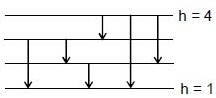
In $Li^{++}$ ion,an electron in the first Bohr orbit is excited to a higher energy level by a radiation of wavelength $\lambda$. When the ion de-excites to the ground state in all possible ways (including intermediate emissions),a total of six spectral lines are observed. What is the value of $\lambda$ in $nm$? (Given: $h = 6.63 \times 10^{-34} \, J \cdot s, c = 3 \times 10^8 \, m/s, 1 \, eV = 1.6 \times 10^{-19} \, J$)
A
$10.8$
B
$11.4$
C
$9.4$
D
$12.3$
Solution
(A) The number of spectral lines emitted when an electron transitions from an excited state $n$ to the ground state $(n=1)$ is given by the formula: $N = \frac{n(n-1)}{2}$.
Given $N = 6$,we have $\frac{n(n-1)}{2} = 6$,which implies $n^2 - n - 12 = 0$. Solving this quadratic equation,we get $(n-4)(n+3) = 0$. Since $n > 0$,the electron is excited to the $n = 4$ level.
The energy of the photon absorbed to excite the electron from $n=1$ to $n=4$ in a hydrogen-like ion with atomic number $Z$ is given by: $\Delta E = 13.6 \cdot Z^2 \left( \frac{1}{n_1^2} - \frac{1}{n_2^2} \right) eV$.
For $Li^{++}$,$Z = 3$. Thus,$\Delta E = 13.6 \times 3^2 \left( \frac{1}{1^2} - \frac{1}{4^2} \right) = 13.6 \times 9 \times \left( 1 - \frac{1}{16} \right) = 13.6 \times 9 \times \frac{15}{16} \approx 114.75 \, eV$.
The wavelength $\lambda$ is given by $\lambda = \frac{hc}{\Delta E}$. Using $hc \approx 1240 \, eV \cdot nm$,we get $\lambda = \frac{1240}{114.75} \approx 10.8 \, nm$.
Given $N = 6$,we have $\frac{n(n-1)}{2} = 6$,which implies $n^2 - n - 12 = 0$. Solving this quadratic equation,we get $(n-4)(n+3) = 0$. Since $n > 0$,the electron is excited to the $n = 4$ level.
The energy of the photon absorbed to excite the electron from $n=1$ to $n=4$ in a hydrogen-like ion with atomic number $Z$ is given by: $\Delta E = 13.6 \cdot Z^2 \left( \frac{1}{n_1^2} - \frac{1}{n_2^2} \right) eV$.
For $Li^{++}$,$Z = 3$. Thus,$\Delta E = 13.6 \times 3^2 \left( \frac{1}{1^2} - \frac{1}{4^2} \right) = 13.6 \times 9 \times \left( 1 - \frac{1}{16} \right) = 13.6 \times 9 \times \frac{15}{16} \approx 114.75 \, eV$.
The wavelength $\lambda$ is given by $\lambda = \frac{hc}{\Delta E}$. Using $hc \approx 1240 \, eV \cdot nm$,we get $\lambda = \frac{1240}{114.75} \approx 10.8 \, nm$.
0 likesView Solution
239
PhysicsMediumMCQJEE Main · 2019
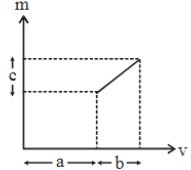
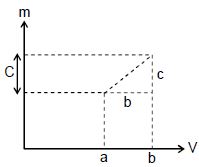
The graph shows how the magnification $m$ produced by a thin lens varies with image distance $v$. What is the focal length of the lens used?
A
$\frac {b^2}{ac}$
B
$\frac {a}{c}$
C
$\frac {b^2c}{a}$
D
$\frac {b}{c}$
Solution
(D) For a thin lens,the magnification $m$ is given by $m = \frac{v}{f} - 1$,where $v$ is the image distance and $f$ is the focal length.
This is a linear equation of the form $y = mx + c$,where the slope is $\frac{1}{f}$.
From the graph,the slope is the change in magnification divided by the change in image distance:
Slope $= \frac{\Delta m}{\Delta v} = \frac{c}{b}$.
Since the slope is also equal to $\frac{1}{f}$,we have $\frac{1}{f} = \frac{c}{b}$.
Therefore,the focal length is $f = \frac{b}{c}$.
This is a linear equation of the form $y = mx + c$,where the slope is $\frac{1}{f}$.
From the graph,the slope is the change in magnification divided by the change in image distance:
Slope $= \frac{\Delta m}{\Delta v} = \frac{c}{b}$.
Since the slope is also equal to $\frac{1}{f}$,we have $\frac{1}{f} = \frac{c}{b}$.
Therefore,the focal length is $f = \frac{b}{c}$.
0 likesView Solution
240
PhysicsMediumMCQJEE Main · 2019
Light is incident normally on a completely absorbing surface with an energy flux of $25\,W\,cm^{-2}.$ If the surface has an area of $25\,cm^2,$ the maximum momentum transferred to the surface in $40\,min$ time duration will be
A
$6.3\times 10^{-4}\,Ns$
B
$3.5\times 10^{-6}\,Ns$
C
$5.0\times 10^{-3}\,Ns$
D
$1.4\times 10^{-6}\,Ns$
Solution
(C) The energy flux $I$ is given as $25\,W/cm^2.$ The total power $P$ incident on the surface is $P = I \times A = 25\,W/cm^2 \times 25\,cm^2 = 625\,W.$
For a completely absorbing surface,the radiation pressure exerts a force $F = \frac{P}{c},$ where $c$ is the speed of light $(3 \times 10^8\,m/s)$.
$F = \frac{625}{3 \times 10^8}\,N.$
The momentum $p$ transferred to the surface in time $t$ is given by $p = F \times t.$
Given time $t = 40\,min = 40 \times 60\,s = 2400\,s.$
$p = \left( \frac{625}{3 \times 10^8} \right) \times 2400 = \frac{625 \times 2400}{3 \times 10^8} = \frac{1500000}{3 \times 10^8} = 500000 \times 10^{-8} = 5.0 \times 10^{-3}\,Ns.$
For a completely absorbing surface,the radiation pressure exerts a force $F = \frac{P}{c},$ where $c$ is the speed of light $(3 \times 10^8\,m/s)$.
$F = \frac{625}{3 \times 10^8}\,N.$
The momentum $p$ transferred to the surface in time $t$ is given by $p = F \times t.$
Given time $t = 40\,min = 40 \times 60\,s = 2400\,s.$
$p = \left( \frac{625}{3 \times 10^8} \right) \times 2400 = \frac{625 \times 2400}{3 \times 10^8} = \frac{1500000}{3 \times 10^8} = 500000 \times 10^{-8} = 5.0 \times 10^{-3}\,Ns.$
0 likesView Solution
241
PhysicsDifficultMCQJEE Main · 2019
Space between two concentric conducting spheres of radii $a$ and $b$ $(b > a)$ is filled with a medium of resistivity $\rho$. The resistance between the two spheres will be
A
$\frac{\rho}{2\pi} \left( \frac{1}{a} + \frac{1}{b} \right)$
B
$\frac{\rho}{2\pi} \left( \frac{1}{a} - \frac{1}{b} \right)$
C
$\frac{\rho}{4\pi} \left( \frac{1}{a} + \frac{1}{b} \right)$
D
$\frac{\rho}{4\pi} \left( \frac{1}{a} - \frac{1}{b} \right)$
Solution
(D) Consider a spherical shell of radius $x$ and thickness $dx$ between the two spheres.
The area of this shell is $A = 4\pi x^2$.
The resistance $dR$ of this thin shell is given by $dR = \rho \frac{dx}{A} = \rho \frac{dx}{4\pi x^2}$.
To find the total resistance $R$ between the spheres,we integrate from $r = a$ to $r = b$:
$R = \int_a^b \frac{\rho}{4\pi x^2} dx$.
$R = \frac{\rho}{4\pi} \int_a^b x^{-2} dx$.
$R = \frac{\rho}{4\pi} \left[ -\frac{1}{x} \right]_a^b$.
$R = \frac{\rho}{4\pi} \left( -\frac{1}{b} - (-\frac{1}{a}) \right) = \frac{\rho}{4\pi} \left( \frac{1}{a} - \frac{1}{b} \right)$.
The area of this shell is $A = 4\pi x^2$.
The resistance $dR$ of this thin shell is given by $dR = \rho \frac{dx}{A} = \rho \frac{dx}{4\pi x^2}$.
To find the total resistance $R$ between the spheres,we integrate from $r = a$ to $r = b$:
$R = \int_a^b \frac{\rho}{4\pi x^2} dx$.
$R = \frac{\rho}{4\pi} \int_a^b x^{-2} dx$.
$R = \frac{\rho}{4\pi} \left[ -\frac{1}{x} \right]_a^b$.
$R = \frac{\rho}{4\pi} \left( -\frac{1}{b} - (-\frac{1}{a}) \right) = \frac{\rho}{4\pi} \left( \frac{1}{a} - \frac{1}{b} \right)$.
0 likesView Solution
242
PhysicsDifficultMCQJEE Main · 2019
The figure represents a voltage regulator circuit using a Zener diode. The breakdown voltage of the Zener diode is $6\,V$ and the load resistance is $R_L = 4\,k\Omega.$ The series resistance of the circuit is $R_i = 1\,k\Omega.$ If the battery voltage $V_B$ varies from $8\,V$ to $16\,V,$ what are the minimum and maximum values of the current through the Zener diode?
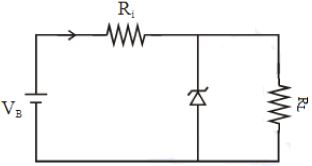
A
$0.5\,mA;\,0.6\,mA$
B
$1\,mA;\,8.5\,mA$
C
$1.5\,mA;\,8.5\,mA$
D
$0.5\,mA;\,8.5\,mA$
Solution
(D) Given: Breakdown voltage of Zener diode $V_Z = 6\,V,$ load resistance $R_L = 4\,k\Omega,$ series resistance $R_i = 1\,k\Omega.$
The current through the load resistance is constant because the Zener diode maintains a constant voltage $V_Z$ across it:
$I_L = \frac{V_Z}{R_L} = \frac{6\,V}{4\,k\Omega} = 1.5\,mA.$
The total current $I_i$ supplied by the battery through the series resistor $R_i$ is given by $I_i = \frac{V_B - V_Z}{R_i}.$
For minimum battery voltage $V_B = 8\,V$:
$I_{i,min} = \frac{8\,V - 6\,V}{1\,k\Omega} = \frac{2\,V}{1\,k\Omega} = 2\,mA.$
The Zener current $I_Z = I_i - I_L = 2\,mA - 1.5\,mA = 0.5\,mA.$
For maximum battery voltage $V_B = 16\,V$:
$I_{i,max} = \frac{16\,V - 6\,V}{1\,k\Omega} = \frac{10\,V}{1\,k\Omega} = 10\,mA.$
The Zener current $I_Z = I_i - I_L = 10\,mA - 1.5\,mA = 8.5\,mA.$
Thus,the minimum and maximum currents through the Zener diode are $0.5\,mA$ and $8.5\,mA$ respectively.
The current through the load resistance is constant because the Zener diode maintains a constant voltage $V_Z$ across it:
$I_L = \frac{V_Z}{R_L} = \frac{6\,V}{4\,k\Omega} = 1.5\,mA.$
The total current $I_i$ supplied by the battery through the series resistor $R_i$ is given by $I_i = \frac{V_B - V_Z}{R_i}.$
For minimum battery voltage $V_B = 8\,V$:
$I_{i,min} = \frac{8\,V - 6\,V}{1\,k\Omega} = \frac{2\,V}{1\,k\Omega} = 2\,mA.$
The Zener current $I_Z = I_i - I_L = 2\,mA - 1.5\,mA = 0.5\,mA.$
For maximum battery voltage $V_B = 16\,V$:
$I_{i,max} = \frac{16\,V - 6\,V}{1\,k\Omega} = \frac{10\,V}{1\,k\Omega} = 10\,mA.$
The Zener current $I_Z = I_i - I_L = 10\,mA - 1.5\,mA = 8.5\,mA.$
Thus,the minimum and maximum currents through the Zener diode are $0.5\,mA$ and $8.5\,mA$ respectively.
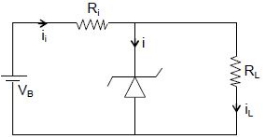
0 likesView Solution
243
PhysicsDifficultMCQJEE Main · 2019
$A$ simple pendulum of length $L$ is placed between the plates of a parallel plate capacitor having an electric field $E,$ as shown in the figure. Its bob has mass $m$ and charge $q.$ The time period of the pendulum is given by:
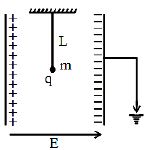
A
$2\pi \sqrt {\frac{L}{{\sqrt {{g^2}\, - \,\frac{{{q^2}{E^2}}}{{{m^2}}}} }}} $
B
$2\pi \sqrt {\frac{L}{{\left( {g\, + \,\frac{{qE}}{m}} \right)}}} $
C
$2\pi \sqrt {\frac{L}{{\left( {g\, - \,\frac{{qE}}{m}} \right)}}} $
D
$2\pi \sqrt {\frac{L}{{\sqrt {{g^2}\, + \,{{\left( {\frac{{qE}}{m}} \right)}^2}} }}} $
Solution
(D) The bob of the pendulum is subjected to two perpendicular forces: the gravitational force $mg$ acting downwards and the electric force $qE$ acting horizontally.
The effective acceleration $g_{eff}$ experienced by the bob is the vector sum of the gravitational acceleration $g$ and the electric acceleration $a_e = \frac{qE}{m}$.
Since these two accelerations are perpendicular to each other,the magnitude of the effective acceleration is given by:
$g_{eff} = \sqrt{g^2 + a_e^2} = \sqrt{g^2 + \left(\frac{qE}{m}\right)^2}$
The time period $T$ of a simple pendulum is given by the formula $T = 2\pi \sqrt{\frac{L}{g_{eff}}}$.
Substituting the value of $g_{eff}$,we get:
$T = 2\pi \sqrt{\frac{L}{\sqrt{g^2 + \left(\frac{qE}{m}\right)^2}}}$
The effective acceleration $g_{eff}$ experienced by the bob is the vector sum of the gravitational acceleration $g$ and the electric acceleration $a_e = \frac{qE}{m}$.
Since these two accelerations are perpendicular to each other,the magnitude of the effective acceleration is given by:
$g_{eff} = \sqrt{g^2 + a_e^2} = \sqrt{g^2 + \left(\frac{qE}{m}\right)^2}$
The time period $T$ of a simple pendulum is given by the formula $T = 2\pi \sqrt{\frac{L}{g_{eff}}}$.
Substituting the value of $g_{eff}$,we get:
$T = 2\pi \sqrt{\frac{L}{\sqrt{g^2 + \left(\frac{qE}{m}\right)^2}}}$
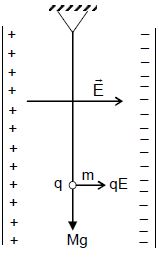
0 likesView Solution
244
PhysicsDifficultMCQJEE Main · 2019
In free space,a particle $A$ of charge $1\,\mu C$ is held fixed at a point $P.$ Another particle $B$ of the same charge and mass $4\,\mu g$ is kept at a distance of $1\,mm$ from $P$. If $B$ is released,then its velocity at a distance of $9\,mm$ from $P$ is [ Take $\frac{1}{4\pi \varepsilon_0} = 9 \times 10^9\,N m^2 C^{-2}$ ]
A
$1.5 \times 10^2\,m/s$
B
$2.0 \times 10^3\,m/s$
C
$1.0\,m/s$
D
None of these
Solution
(D) Given: $q_A = 1\,\mu C = 10^{-6}\,C$,$q_B = 1\,\mu C = 10^{-6}\,C$,$m_B = 4\,\mu g = 4 \times 10^{-9}\,kg$,$r_1 = 1\,mm = 10^{-3}\,m$,$r_2 = 9\,mm = 9 \times 10^{-3}\,m$.
By the law of conservation of energy,the loss in electrostatic potential energy equals the gain in kinetic energy:
$\Delta U = \Delta K$
$k q_A q_B \left( \frac{1}{r_1} - \frac{1}{r_2} \right) = \frac{1}{2} m_B v^2$
Substituting the values:
$9 \times 10^9 \times (10^{-6}) \times (10^{-6}) \left( \frac{1}{10^{-3}} - \frac{1}{9 \times 10^{-3}} \right) = \frac{1}{2} \times 4 \times 10^{-9} \times v^2$
$9 \times 10^{-3} \left( 1000 - \frac{1000}{9} \right) = 2 \times 10^{-9} \times v^2$
$9 \times 10^{-3} \times 1000 \left( 1 - \frac{1}{9} \right) = 2 \times 10^{-9} \times v^2$
$9 \times \frac{8}{9} = 2 \times 10^{-9} \times v^2$
$8 = 2 \times 10^{-9} \times v^2$
$v^2 = 4 \times 10^9$
$v = \sqrt{40 \times 10^8} = 2 \times 10^4 \times \sqrt{10} \approx 6.32 \times 10^4\,m/s$.
Since this value is not among the options,the correct choice is $D$.
By the law of conservation of energy,the loss in electrostatic potential energy equals the gain in kinetic energy:
$\Delta U = \Delta K$
$k q_A q_B \left( \frac{1}{r_1} - \frac{1}{r_2} \right) = \frac{1}{2} m_B v^2$
Substituting the values:
$9 \times 10^9 \times (10^{-6}) \times (10^{-6}) \left( \frac{1}{10^{-3}} - \frac{1}{9 \times 10^{-3}} \right) = \frac{1}{2} \times 4 \times 10^{-9} \times v^2$
$9 \times 10^{-3} \left( 1000 - \frac{1000}{9} \right) = 2 \times 10^{-9} \times v^2$
$9 \times 10^{-3} \times 1000 \left( 1 - \frac{1}{9} \right) = 2 \times 10^{-9} \times v^2$
$9 \times \frac{8}{9} = 2 \times 10^{-9} \times v^2$
$8 = 2 \times 10^{-9} \times v^2$
$v^2 = 4 \times 10^9$
$v = \sqrt{40 \times 10^8} = 2 \times 10^4 \times \sqrt{10} \approx 6.32 \times 10^4\,m/s$.
Since this value is not among the options,the correct choice is $D$.
0 likesView Solution
245
PhysicsDifficultMCQJEE Main · 2019
$A$ $2\,mW$ laser operates at a wavelength of $500\,nm.$ The number of photons that will be emitted per second is [Given Planck's constant $h = 6.6 \times 10^{-34}\,Js,$ speed of light $c = 3.0 \times 10^8\,m/s$]
A
$1 \times 10^{16}$
B
$1.5 \times 10^{16}$
C
$2 \times 10^{16}$
D
$5 \times 10^{15}$
Solution
(D) The power $P$ of the laser is given by $P = n \cdot E_{photon},$ where $n$ is the number of photons emitted per second and $E_{photon} = \frac{hc}{\lambda}.$
Given $P = 2\,mW = 2 \times 10^{-3}\,W,$ $\lambda = 500\,nm = 500 \times 10^{-9}\,m,$ $h = 6.6 \times 10^{-34}\,Js,$ and $c = 3.0 \times 10^8\,m/s.$
Rearranging for $n$: $n = \frac{P \cdot \lambda}{h \cdot c}$
Substituting the values:
$n = \frac{2 \times 10^{-3} \times 500 \times 10^{-9}}{6.6 \times 10^{-34} \times 3.0 \times 10^8}$
$n = \frac{1000 \times 10^{-12}}{19.8 \times 10^{-26}}$
$n = \frac{10^{-9}}{19.8 \times 10^{-26}} \approx 0.0505 \times 10^{17} = 5.05 \times 10^{15} \approx 5 \times 10^{15}.$
Thus,the number of photons emitted per second is $5 \times 10^{15}.$
Given $P = 2\,mW = 2 \times 10^{-3}\,W,$ $\lambda = 500\,nm = 500 \times 10^{-9}\,m,$ $h = 6.6 \times 10^{-34}\,Js,$ and $c = 3.0 \times 10^8\,m/s.$
Rearranging for $n$: $n = \frac{P \cdot \lambda}{h \cdot c}$
Substituting the values:
$n = \frac{2 \times 10^{-3} \times 500 \times 10^{-9}}{6.6 \times 10^{-34} \times 3.0 \times 10^8}$
$n = \frac{1000 \times 10^{-12}}{19.8 \times 10^{-26}}$
$n = \frac{10^{-9}}{19.8 \times 10^{-26}} \approx 0.0505 \times 10^{17} = 5.05 \times 10^{15} \approx 5 \times 10^{15}.$
Thus,the number of photons emitted per second is $5 \times 10^{15}.$
0 likesView Solution
246
PhysicsDifficultMCQJEE Main · 2019
$A$ coil of self-inductance $10\,mH$ and resistance $0.1\,\Omega$ is connected through a switch to a battery of internal resistance $0.9\,\Omega$. After the switch is closed,the time taken for the current to attain $80\%$ of its saturation value is: [take $ln\,5 = 1.6$] (in $,s$)
A
$0.016$
B
$0.324$
C
$0.002$
D
$0.103$
Solution
(A) Given: Self-inductance $L = 10\,mH = 10 \times 10^{-3}\,H$,coil resistance $r_1 = 0.1\,\Omega$,internal resistance $r_2 = 0.9\,\Omega$.
The total resistance of the circuit is $R = r_1 + r_2 = 0.1 + 0.9 = 1.0\,\Omega$.
The time constant of the $LR$ circuit is $\tau = \frac{L}{R} = \frac{10 \times 10^{-3}}{1.0} = 10^{-2}\,s$.
The current at any time $t$ is given by $i = i_0(1 - e^{-t/\tau})$,where $i_0$ is the saturation current.
We want to find $t$ when $i = 0.8 i_0$.
$0.8 i_0 = i_0(1 - e^{-t/\tau})$
$0.8 = 1 - e^{-t/\tau}$
$e^{-t/\tau} = 0.2 = \frac{1}{5}$
$e^{t/\tau} = 5$
Taking natural logarithm on both sides: $\frac{t}{\tau} = \ln 5$.
Given $\ln 5 = 1.6$,so $t = 1.6 \times \tau = 1.6 \times 10^{-2}\,s = 0.016\,s$.
The total resistance of the circuit is $R = r_1 + r_2 = 0.1 + 0.9 = 1.0\,\Omega$.
The time constant of the $LR$ circuit is $\tau = \frac{L}{R} = \frac{10 \times 10^{-3}}{1.0} = 10^{-2}\,s$.
The current at any time $t$ is given by $i = i_0(1 - e^{-t/\tau})$,where $i_0$ is the saturation current.
We want to find $t$ when $i = 0.8 i_0$.
$0.8 i_0 = i_0(1 - e^{-t/\tau})$
$0.8 = 1 - e^{-t/\tau}$
$e^{-t/\tau} = 0.2 = \frac{1}{5}$
$e^{t/\tau} = 5$
Taking natural logarithm on both sides: $\frac{t}{\tau} = \ln 5$.
Given $\ln 5 = 1.6$,so $t = 1.6 \times \tau = 1.6 \times 10^{-2}\,s = 0.016\,s$.
0 likesView Solution
247
PhysicsMediumMCQJEE Main · 2019
In a Young's double slit experiment,the ratio of the slit widths is $4 : 1$. The ratio of the intensity of maxima to minima,close to the central fringe on the screen,will be
A
$9 : 1$
B
$25 : 9$
C
$4 : 1$
D
$16 : 9$
Solution
(A) The intensity of light $I$ is directly proportional to the slit width $w$,so $I_1/I_2 = w_1/w_2 = 4/1$.
Let $I_1 = 4I_0$ and $I_2 = I_0$.
The amplitudes are $a_1 = \sqrt{I_1} = 2\sqrt{I_0}$ and $a_2 = \sqrt{I_2} = \sqrt{I_0}$.
The ratio of maximum to minimum intensity is given by $\frac{I_{\max}}{I_{\min}} = \left( \frac{a_1 + a_2}{a_1 - a_2} \right)^2$.
Substituting the values: $\frac{I_{\max}}{I_{\min}} = \left( \frac{2\sqrt{I_0} + \sqrt{I_0}}{2\sqrt{I_0} - \sqrt{I_0}} \right)^2 = \left( \frac{3\sqrt{I_0}}{\sqrt{I_0}} \right)^2 = (3)^2 = 9/1$.
Let $I_1 = 4I_0$ and $I_2 = I_0$.
The amplitudes are $a_1 = \sqrt{I_1} = 2\sqrt{I_0}$ and $a_2 = \sqrt{I_2} = \sqrt{I_0}$.
The ratio of maximum to minimum intensity is given by $\frac{I_{\max}}{I_{\min}} = \left( \frac{a_1 + a_2}{a_1 - a_2} \right)^2$.
Substituting the values: $\frac{I_{\max}}{I_{\min}} = \left( \frac{2\sqrt{I_0} + \sqrt{I_0}}{2\sqrt{I_0} - \sqrt{I_0}} \right)^2 = \left( \frac{3\sqrt{I_0}}{\sqrt{I_0}} \right)^2 = (3)^2 = 9/1$.
0 likesView Solution
248
PhysicsMediumMCQJEE Main · 2019
$A$ square loop is carrying a steady current $I$ and the magnitude of its magnetic dipole moment is $m$. If this square loop is changed to a circular loop and it carries the same current,the magnitude of the magnetic dipole moment of the circular loop will be
A
$\frac{m}{\pi}$
B
$\frac{3m}{\pi}$
C
$\frac{4m}{\pi}$
D
$\frac{2m}{\pi}$
Solution
(C) For a square loop of side $l$,the perimeter is $P = 4l$ and the area is $A_s = l^2$. The magnetic dipole moment is $m = I A_s = I l^2$.
When reshaped into a circular loop of radius $r$,the perimeter remains the same: $2\pi r = 4l$,which gives $r = \frac{2l}{\pi}$.
The area of the circular loop is $A_c = \pi r^2 = \pi \left(\frac{2l}{\pi}\right)^2 = \frac{4l^2}{\pi}$.
The new magnetic dipole moment $m'$ is $m' = I A_c = I \left(\frac{4l^2}{\pi}\right)$.
Since $m = I l^2$,we substitute this into the expression for $m'$:
$m' = \frac{4}{\pi} (I l^2) = \frac{4m}{\pi}$.
When reshaped into a circular loop of radius $r$,the perimeter remains the same: $2\pi r = 4l$,which gives $r = \frac{2l}{\pi}$.
The area of the circular loop is $A_c = \pi r^2 = \pi \left(\frac{2l}{\pi}\right)^2 = \frac{4l^2}{\pi}$.
The new magnetic dipole moment $m'$ is $m' = I A_c = I \left(\frac{4l^2}{\pi}\right)$.
Since $m = I l^2$,we substitute this into the expression for $m'$:
$m' = \frac{4}{\pi} (I l^2) = \frac{4m}{\pi}$.
0 likesView Solution
249
PhysicsMediumMCQJEE Main · 2019
The value of numerical aperture of the objective lens of a microscope is $1.25$. If light of wavelength $5000\,\mathring{A}$ is used, the minimum separation between two points, to be seen as distinct, will be....$\mu m$
A
$0.48$
B
$0.38$
C
$0.24$
D
$0.12$
Solution
(C) The resolving power of a microscope is defined by the minimum separation $d$ between two points that can be resolved.
The formula for the minimum separation $d$ is given by:
$d = \frac{0.61 \lambda}{\text{NA}}$
Given:
$\lambda = 5000\,\mathring{A} = 5000 \times 10^{-10}\,\text{m} = 5 \times 10^{-7}\,\text{m}$
$\text{NA} = 1.25$
Substituting the values:
$d = \frac{0.61 \times 5 \times 10^{-7}}{1.25}$
$d = \frac{3.05 \times 10^{-7}}{1.25}$
$d = 2.44 \times 10^{-7}\,\text{m}$
Converting to micrometers $(\mu m)$:
$d = 2.44 \times 10^{-7} \times 10^6\,\mu m = 0.244\,\mu m \approx 0.24\,\mu m$
Thus, the correct option is $C$.
The formula for the minimum separation $d$ is given by:
$d = \frac{0.61 \lambda}{\text{NA}}$
Given:
$\lambda = 5000\,\mathring{A} = 5000 \times 10^{-10}\,\text{m} = 5 \times 10^{-7}\,\text{m}$
$\text{NA} = 1.25$
Substituting the values:
$d = \frac{0.61 \times 5 \times 10^{-7}}{1.25}$
$d = \frac{3.05 \times 10^{-7}}{1.25}$
$d = 2.44 \times 10^{-7}\,\text{m}$
Converting to micrometers $(\mu m)$:
$d = 2.44 \times 10^{-7} \times 10^6\,\mu m = 0.244\,\mu m \approx 0.24\,\mu m$
Thus, the correct option is $C$.
0 likesView Solution
250
PhysicsMediumMCQJEE Main · 2019
The resistive network shown below is connected to a $D.C.$ source of $16 \, V$. The power consumed by the network is $4 \, W$. The value of $R$ is ............. $\Omega$.
A
$8$
B
$6$
C
$16$
D
$1$
Solution
(A) First,we calculate the equivalent resistance of the network.
$1$. The first parallel combination of two $4 \, R$ resistors is $R_{p1} = \frac{4R \times 4R}{4R + 4R} = 2R$.
$2$. The second parallel combination of $6 \, R$ and $12 \, R$ resistors is $R_{p2} = \frac{6R \times 12R}{6R + 12R} = \frac{72R^2}{18R} = 4R$.
$3$. The total equivalent resistance $R_{eq}$ is the sum of these in series with the other two $R$ resistors: $R_{eq} = 2R + R + 4R + R = 8R$.
$4$. The power consumed is given by $P = \frac{V^2}{R_{eq}}$.
$5$. Substituting the given values: $4 = \frac{16^2}{8R} \implies 4 = \frac{256}{8R} \implies 4 = \frac{32}{R}$.
$6$. Therefore,$R = \frac{32}{4} = 8 \, \Omega$.
$1$. The first parallel combination of two $4 \, R$ resistors is $R_{p1} = \frac{4R \times 4R}{4R + 4R} = 2R$.
$2$. The second parallel combination of $6 \, R$ and $12 \, R$ resistors is $R_{p2} = \frac{6R \times 12R}{6R + 12R} = \frac{72R^2}{18R} = 4R$.
$3$. The total equivalent resistance $R_{eq}$ is the sum of these in series with the other two $R$ resistors: $R_{eq} = 2R + R + 4R + R = 8R$.
$4$. The power consumed is given by $P = \frac{V^2}{R_{eq}}$.
$5$. Substituting the given values: $4 = \frac{16^2}{8R} \implies 4 = \frac{256}{8R} \implies 4 = \frac{32}{R}$.
$6$. Therefore,$R = \frac{32}{4} = 8 \, \Omega$.
0 likesView Solution
251
PhysicsDifficultMCQJEE Main · 2019
The figure shows a square loop $L$ of side $5\, cm$ which is connected to a network of resistances. The whole setup is moving towards the right with a constant speed of $1\, cm/s$. At some instant,a part of $L$ is in a uniform magnetic field of $1\, T$,perpendicular to the plane of the loop. If the resistance of $L$ is $1.7\, \Omega$,the current in the loop at that instant will be close to.....$\mu A$.
A
$115$
B
$170$
C
$60$
D
$150$
Solution
(D) $1$. Analyze the resistance network: The network is a Wheatstone bridge with arms $1\, \Omega, 2\, \Omega, 1\, \Omega, 2\, \Omega$ and a central $3\, \Omega$ resistor. Since $\frac{1}{1} = \frac{2}{2}$,it is a balanced Wheatstone bridge. The central $3\, \Omega$ resistor carries no current. The equivalent resistance of the bridge is $R_{eq} = \frac{(1+2)(1+2)}{(1+2)+(1+2)} = \frac{3 \times 3}{3+3} = 1.5\, \Omega$.
$2$. Calculate the induced electromotive force $(EMF)$: The motional $EMF$ is given by $\varepsilon = B \ell v$. Here,$B = 1\, T$,$\ell = 5\, cm = 0.05\, m$,and $v = 1\, cm/s = 0.01\, m/s$. Thus,$\varepsilon = 1 \times 0.05 \times 0.01 = 5 \times 10^{-4}\, V$.
$3$. Calculate the total resistance: The total resistance $R_{total} = R_{loop} + R_{eq} = 1.7\, \Omega + 1.5\, \Omega = 3.2\, \Omega$.
$4$. Calculate the current: The current $i = \frac{\varepsilon}{R_{total}} = \frac{5 \times 10^{-4}}{3.2} \approx 1.5625 \times 10^{-4}\, A = 156.25\, \mu A$. The closest option is $150\, \mu A$ or $170\, \mu A$. Re-evaluating the bridge: $R_{eq} = \frac{3 \times 3}{3+3} = 1.5\, \Omega$. Total $R = 1.7 + 1.5 = 3.2\, \Omega$. $i = 156.25\, \mu A$. Given the options,$150\, \mu A$ is the closest value.
$2$. Calculate the induced electromotive force $(EMF)$: The motional $EMF$ is given by $\varepsilon = B \ell v$. Here,$B = 1\, T$,$\ell = 5\, cm = 0.05\, m$,and $v = 1\, cm/s = 0.01\, m/s$. Thus,$\varepsilon = 1 \times 0.05 \times 0.01 = 5 \times 10^{-4}\, V$.
$3$. Calculate the total resistance: The total resistance $R_{total} = R_{loop} + R_{eq} = 1.7\, \Omega + 1.5\, \Omega = 3.2\, \Omega$.
$4$. Calculate the current: The current $i = \frac{\varepsilon}{R_{total}} = \frac{5 \times 10^{-4}}{3.2} \approx 1.5625 \times 10^{-4}\, A = 156.25\, \mu A$. The closest option is $150\, \mu A$ or $170\, \mu A$. Re-evaluating the bridge: $R_{eq} = \frac{3 \times 3}{3+3} = 1.5\, \Omega$. Total $R = 1.7 + 1.5 = 3.2\, \Omega$. $i = 156.25\, \mu A$. Given the options,$150\, \mu A$ is the closest value.
0 likesView Solution
252
PhysicsDifficultMCQJEE Main · 2019
Two identical parallel plate capacitors,of capacitance $C$ each,have plates of area $A$,separated by a distance $d$. The space between the plates of the two capacitors is filled with three dielectrics,of equal thickness and dielectric constants $K_1$,$K_2$,and $K_3$. The first capacitor is filled as shown in fig. $I$,and the second one is filled as shown in fig. $II$. If these two modified capacitors are charged by the same potential $V$,the ratio of the energy stored in the two would be ($E_1$ refers to capacitor $(I)$ and $E_2$ to capacitor $(II)$):
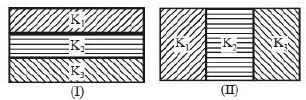
A
$\frac{E_1}{E_2} = \frac{K_1 K_2 K_3}{(K_1 + K_2 + K_3)(K_2 K_3 + K_3 K_1 + K_1 K_2)}$
B
$\frac{E_1}{E_2} = \frac{9 K_1 K_2 K_3}{(K_1 + K_2 + K_3)(K_2 K_3 + K_3 K_1 + K_1 K_2)}$
C
$\frac{E_1}{E_2} = \frac{(K_1 + K_2 + K_3)(K_2 K_3 + K_3 K_1 + K_1 K_2)}{9 K_1 K_2 K_3}$
D
$\frac{E_1}{E_2} = \frac{(K_1 + K_2 + K_3)(K_2 K_3 + K_3 K_1 + K_1 K_2)}{K_1 K_2 K_3}$
Solution
(B) For capacitor $(I)$,the dielectrics are in series. The capacitance of each part is $C_i = \frac{3 \varepsilon_0 A K_i}{d}$.
Since they are in series,$\frac{1}{C_{eq}} = \frac{1}{C_1} + \frac{1}{C_2} + \frac{1}{C_3} = \frac{d}{3 \varepsilon_0 A} (\frac{1}{K_1} + \frac{1}{K_2} + \frac{1}{K_3}) = \frac{d(K_2 K_3 + K_3 K_1 + K_1 K_2)}{3 \varepsilon_0 A K_1 K_2 K_3}$.
Thus,$C_{eq} = \frac{3 \varepsilon_0 A K_1 K_2 K_3}{d(K_1 K_2 + K_2 K_3 + K_3 K_1)}$.
For capacitor $(II)$,the dielectrics are in parallel. The capacitance of each part is $C_i' = \frac{\varepsilon_0 (A/3) K_i}{d} = \frac{\varepsilon_0 A K_i}{3d}$.
Since they are in parallel,$C_{eq}' = C_1' + C_2' + C_3' = \frac{\varepsilon_0 A}{3d} (K_1 + K_2 + K_3)$.
The energy stored is $E = \frac{1}{2} C V^2$. Therefore,$\frac{E_1}{E_2} = \frac{C_{eq}}{C_{eq}'} = \frac{3 \varepsilon_0 A K_1 K_2 K_3}{d(K_1 K_2 + K_2 K_3 + K_3 K_1)} \cdot \frac{3d}{\varepsilon_0 A (K_1 + K_2 + K_3)} = \frac{9 K_1 K_2 K_3}{(K_1 + K_2 + K_3)(K_1 K_2 + K_2 K_3 + K_3 K_1)}$.
Since they are in series,$\frac{1}{C_{eq}} = \frac{1}{C_1} + \frac{1}{C_2} + \frac{1}{C_3} = \frac{d}{3 \varepsilon_0 A} (\frac{1}{K_1} + \frac{1}{K_2} + \frac{1}{K_3}) = \frac{d(K_2 K_3 + K_3 K_1 + K_1 K_2)}{3 \varepsilon_0 A K_1 K_2 K_3}$.
Thus,$C_{eq} = \frac{3 \varepsilon_0 A K_1 K_2 K_3}{d(K_1 K_2 + K_2 K_3 + K_3 K_1)}$.
For capacitor $(II)$,the dielectrics are in parallel. The capacitance of each part is $C_i' = \frac{\varepsilon_0 (A/3) K_i}{d} = \frac{\varepsilon_0 A K_i}{3d}$.
Since they are in parallel,$C_{eq}' = C_1' + C_2' + C_3' = \frac{\varepsilon_0 A}{3d} (K_1 + K_2 + K_3)$.
The energy stored is $E = \frac{1}{2} C V^2$. Therefore,$\frac{E_1}{E_2} = \frac{C_{eq}}{C_{eq}'} = \frac{3 \varepsilon_0 A K_1 K_2 K_3}{d(K_1 K_2 + K_2 K_3 + K_3 K_1)} \cdot \frac{3d}{\varepsilon_0 A (K_1 + K_2 + K_3)} = \frac{9 K_1 K_2 K_3}{(K_1 + K_2 + K_3)(K_1 K_2 + K_2 K_3 + K_3 K_1)}$.
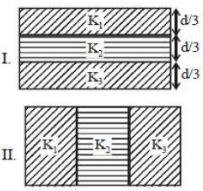
0 likesView Solution
253
PhysicsMediumMCQJEE Main · 2019
The stopping potential $V_0$ (in $volt$) as a function of frequency $(\nu)$ for a sodium emitter is shown in the figure. The work function of sodium,from the data plotted in the figure,will be: ................. $eV$
(Given: Planck's constant $(h) = 6.63 \times 10^{-34} \, Js$,electron charge $e = 1.6 \times 10^{-19} \, C$)
(Given: Planck's constant $(h) = 6.63 \times 10^{-34} \, Js$,electron charge $e = 1.6 \times 10^{-19} \, C$)
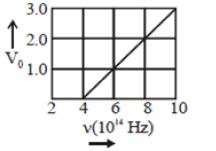
A
$1.82$
B
$1.66$
C
$2.12$
D
$1.95$
Solution
(B) According to Einstein's photoelectric equation:
$h\nu = \phi + eV_0$
Rearranging for the stopping potential $V_0$:
$V_0 = \frac{h\nu}{e} - \frac{\phi}{e}$
From the given graph,the threshold frequency $(\nu_0)$ is the frequency at which the stopping potential $V_0$ becomes zero. Looking at the graph,$V_0 = 0$ when $\nu = 4 \times 10^{14} \, Hz$.
At this point:
$0 = \frac{h\nu_0}{e} - \frac{\phi}{e}$
$\Rightarrow \phi = h\nu_0$
Substituting the values:
$\phi = (6.63 \times 10^{-34} \, Js) \times (4 \times 10^{14} \, Hz)$
$\phi = 26.52 \times 10^{-20} \, J$
To convert the work function into electron-volts $(eV)$:
$\phi (eV) = \frac{26.52 \times 10^{-20} \, J}{1.6 \times 10^{-19} \, C}$
$\phi = 1.6575 \, eV \approx 1.66 \, eV$
$h\nu = \phi + eV_0$
Rearranging for the stopping potential $V_0$:
$V_0 = \frac{h\nu}{e} - \frac{\phi}{e}$
From the given graph,the threshold frequency $(\nu_0)$ is the frequency at which the stopping potential $V_0$ becomes zero. Looking at the graph,$V_0 = 0$ when $\nu = 4 \times 10^{14} \, Hz$.
At this point:
$0 = \frac{h\nu_0}{e} - \frac{\phi}{e}$
$\Rightarrow \phi = h\nu_0$
Substituting the values:
$\phi = (6.63 \times 10^{-34} \, Js) \times (4 \times 10^{14} \, Hz)$
$\phi = 26.52 \times 10^{-20} \, J$
To convert the work function into electron-volts $(eV)$:
$\phi (eV) = \frac{26.52 \times 10^{-20} \, J}{1.6 \times 10^{-19} \, C}$
$\phi = 1.6575 \, eV \approx 1.66 \, eV$
0 likesView Solution
254
PhysicsMediumMCQJEE Main · 2019
$A$ magnetic compass needle oscillates $30$ times per minute at a place where the angle of dip is $45^{\circ}$,and $40$ times per minute where the angle of dip is $30^{\circ}$. If $B_1$ and $B_2$ are respectively the total magnetic field due to the earth at the two places,then the ratio $B_1/B_2$ is best given by:
A
$3.6$
B
$1.8$
C
$2.2$
D
$0.7$
Solution
(D) The frequency of oscillation of a magnetic needle in a magnetic field $B$ is given by $f = \frac{1}{2\pi} \sqrt{\frac{\mu B_H}{I}}$,where $B_H = B \cos \delta$ is the horizontal component of the earth's magnetic field and $\delta$ is the angle of dip.
Given $f_1 = 30 \text{ oscillations/min}$ at $\delta_1 = 45^{\circ}$ and $f_2 = 40 \text{ oscillations/min}$ at $\delta_2 = 30^{\circ}$.
Thus,$f_1^2 \propto B_1 \cos 45^{\circ}$ and $f_2^2 \propto B_2 \cos 30^{\circ}$.
Taking the ratio: $\frac{f_1^2}{f_2^2} = \frac{B_1 \cos 45^{\circ}}{B_2 \cos 30^{\circ}}$.
Substituting the values: $(\frac{30}{40})^2 = \frac{B_1 (1/\sqrt{2})}{B_2 (\sqrt{3}/2)}$.
$\frac{9}{16} = \frac{B_1}{B_2} \times \frac{1}{\sqrt{2}} \times \frac{2}{\sqrt{3}} = \frac{B_1}{B_2} \times \sqrt{\frac{2}{3}}$.
$\frac{B_1}{B_2} = \frac{9}{16} \times \sqrt{\frac{3}{2}} = 0.5625 \times 1.2247 \approx 0.689 \approx 0.7$.
Given $f_1 = 30 \text{ oscillations/min}$ at $\delta_1 = 45^{\circ}$ and $f_2 = 40 \text{ oscillations/min}$ at $\delta_2 = 30^{\circ}$.
Thus,$f_1^2 \propto B_1 \cos 45^{\circ}$ and $f_2^2 \propto B_2 \cos 30^{\circ}$.
Taking the ratio: $\frac{f_1^2}{f_2^2} = \frac{B_1 \cos 45^{\circ}}{B_2 \cos 30^{\circ}}$.
Substituting the values: $(\frac{30}{40})^2 = \frac{B_1 (1/\sqrt{2})}{B_2 (\sqrt{3}/2)}$.
$\frac{9}{16} = \frac{B_1}{B_2} \times \frac{1}{\sqrt{2}} \times \frac{2}{\sqrt{3}} = \frac{B_1}{B_2} \times \sqrt{\frac{2}{3}}$.
$\frac{B_1}{B_2} = \frac{9}{16} \times \sqrt{\frac{3}{2}} = 0.5625 \times 1.2247 \approx 0.689 \approx 0.7$.
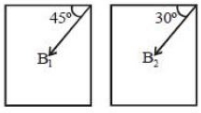
0 likesView Solution
255
PhysicsMediumMCQJEE Main · 2019
An excited $He^+$ ion emits two photons in succession, with wavelengths $108.5 \, nm$ and $30.4 \, nm$, in making a transition to the ground state. The quantum number $n$, corresponding to its initial excited state is $n = ........$ (for a photon of wavelength $\lambda$, energy $E = \frac{1240 \, eV}{\lambda \, (in \, nm)}$).
A
$4$
B
$6$
C
$5$
D
$7$
Solution
(C) The energy of a photon is given by $E = \frac{1240}{\lambda} \, eV$.
For the first transition, $\lambda_1 = 108.5 \, nm$, so $E_1 = \frac{1240}{108.5} \approx 11.43 \, eV$.
For the second transition, $\lambda_2 = 30.4 \, nm$, so $E_2 = \frac{1240}{30.4} \approx 40.79 \, eV$.
The total energy released is $E_{total} = E_1 + E_2 = 11.43 + 40.79 = 52.22 \, eV$.
The energy of an electron in the $n$-th state of a hydrogen-like ion is $E_n = -13.6 \, Z^2 \frac{1}{n^2}$.
For $He^+$, $Z = 2$, so $E_n = -13.6 \times 4 \times \frac{1}{n^2} = -54.4 \frac{1}{n^2} \, eV$.
The transition is from state $n$ to ground state $(n=1)$, so $E_{total} = E_n - E_1 = -54.4 \left(\frac{1}{n^2} - 1\right) = 54.4 \left(1 - \frac{1}{n^2}\right)$.
Setting $54.4 \left(1 - \frac{1}{n^2}\right) = 52.22$, we get $1 - \frac{1}{n^2} = \frac{52.22}{54.4} \approx 0.96$.
$\frac{1}{n^2} = 1 - 0.96 = 0.04$.
$n^2 = \frac{1}{0.04} = 25$, so $n = 5$.
For the first transition, $\lambda_1 = 108.5 \, nm$, so $E_1 = \frac{1240}{108.5} \approx 11.43 \, eV$.
For the second transition, $\lambda_2 = 30.4 \, nm$, so $E_2 = \frac{1240}{30.4} \approx 40.79 \, eV$.
The total energy released is $E_{total} = E_1 + E_2 = 11.43 + 40.79 = 52.22 \, eV$.
The energy of an electron in the $n$-th state of a hydrogen-like ion is $E_n = -13.6 \, Z^2 \frac{1}{n^2}$.
For $He^+$, $Z = 2$, so $E_n = -13.6 \times 4 \times \frac{1}{n^2} = -54.4 \frac{1}{n^2} \, eV$.
The transition is from state $n$ to ground state $(n=1)$, so $E_{total} = E_n - E_1 = -54.4 \left(\frac{1}{n^2} - 1\right) = 54.4 \left(1 - \frac{1}{n^2}\right)$.
Setting $54.4 \left(1 - \frac{1}{n^2}\right) = 52.22$, we get $1 - \frac{1}{n^2} = \frac{52.22}{54.4} \approx 0.96$.
$\frac{1}{n^2} = 1 - 0.96 = 0.04$.
$n^2 = \frac{1}{0.04} = 25$, so $n = 5$.
0 likesView Solution
256
PhysicsDifficultMCQJEE Main · 2019
The transfer characteristic curve of a transistor,having input and output resistance $100\,\Omega$ and $100\,k\Omega$ respectively,is shown in the figure. The voltage and power gain are respectively:
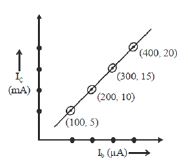
A
$5 \times 10^4, 2.5 \times 10^6$
B
$5 \times 10^4, 5 \times 10^6$
C
$5 \times 10^4, 5 \times 10^5$
D
$2.5 \times 10^4, 2.5 \times 10^6$
Solution
(A) Given: Input resistance $R_{\text{in}} = 100\,\Omega$,Output resistance $R_{\text{out}} = 100\,k\Omega = 10^5\,\Omega$.
From the graph,the current gain $\beta = \frac{\Delta I_C}{\Delta I_B} = \frac{(20 - 5) \times 10^{-3} \text{ A}}{(400 - 100) \times 10^{-6} \text{ A}} = \frac{15 \times 10^{-3}}{300 \times 10^{-6}} = \frac{15000}{300} = 50$.
Voltage gain $A_V = \beta \times \frac{R_{\text{out}}}{R_{\text{in}}} = 50 \times \frac{10^5}{100} = 50 \times 10^3 = 5 \times 10^4$.
Power gain $A_P = \beta \times A_V = 50 \times (5 \times 10^4) = 250 \times 10^4 = 2.5 \times 10^6$.
From the graph,the current gain $\beta = \frac{\Delta I_C}{\Delta I_B} = \frac{(20 - 5) \times 10^{-3} \text{ A}}{(400 - 100) \times 10^{-6} \text{ A}} = \frac{15 \times 10^{-3}}{300 \times 10^{-6}} = \frac{15000}{300} = 50$.
Voltage gain $A_V = \beta \times \frac{R_{\text{out}}}{R_{\text{in}}} = 50 \times \frac{10^5}{100} = 50 \times 10^3 = 5 \times 10^4$.
Power gain $A_P = \beta \times A_V = 50 \times (5 \times 10^4) = 250 \times 10^4 = 2.5 \times 10^6$.
0 likesView Solution
257
PhysicsDifficultMCQJEE Main · 2019
Shown in the figure is a shell made of a conductor. It has inner radius $a$ and outer radius $b$,and carries a total charge $Q$. At its centre is a dipole $\vec{P}$ as shown. In this case,
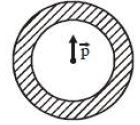
A
Surface charge density on the inner surface of the shell is zero everywhere.
B
Electric field outside the shell is the same as that of a point charge $Q$ at the centre of the shell.
C
Surface charge density on the inner surface is uniform and equal to $\frac{(Q/2)}{4\pi a^2}$.
D
Surface charge density on the outer surface depends on $|\vec{P}|$.
Solution
(B) The total charge of the dipole is $0$,so the net charge induced on the inner surface is $0$. Since the shell is a conductor,the total charge $Q$ resides on the outer surface.
Because the dipole is at the centre,it creates a non-uniform electric field inside the cavity. This induces a non-uniform charge distribution on the inner surface of the shell.
However,for any point outside the shell $(r > b)$,the electric field produced by the induced charges on the inner surface and the dipole itself cancels out due to the principle of superposition and the properties of a conductor in electrostatic equilibrium.
Thus,the electric field outside the shell is solely due to the total charge $Q$ distributed uniformly on the outer surface,which is equivalent to a point charge $Q$ at the centre: $E = \frac{kQ}{r^2}$.
Because the dipole is at the centre,it creates a non-uniform electric field inside the cavity. This induces a non-uniform charge distribution on the inner surface of the shell.
However,for any point outside the shell $(r > b)$,the electric field produced by the induced charges on the inner surface and the dipole itself cancels out due to the principle of superposition and the properties of a conductor in electrostatic equilibrium.
Thus,the electric field outside the shell is solely due to the total charge $Q$ distributed uniformly on the outer surface,which is equivalent to a point charge $Q$ at the centre: $E = \frac{kQ}{r^2}$.
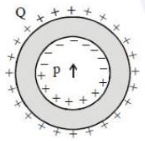
0 likesView Solution
258
PhysicsMediumMCQJEE Main · 2019
Which of the following combinations has the dimension of electrical resistance? (Here,$\varepsilon_0$ is the permittivity of vacuum and $\mu_0$ is the permeability of vacuum.)
A
$\sqrt {\frac{{\varepsilon _0}}{{\mu _0}}} $
B
$\frac{{\mu _0}}{{\varepsilon _0}}$
C
$\frac{{\varepsilon _0}}{{\mu _0}}$
D
$\sqrt {\frac{{\mu _0}}{{\varepsilon _0}}} $
Solution
(D) The dimensional formula for permittivity of vacuum is $[\varepsilon_0] = M^{-1}L^{-3}T^4A^2$.
The dimensional formula for permeability of vacuum is $[\mu_0] = MLT^{-2}A^{-2}$.
The dimensional formula for electrical resistance is $[R] = ML^2T^{-3}A^{-2}$.
Now,consider the expression $\sqrt{\frac{\mu_0}{\varepsilon_0}}$:
$\sqrt{\frac{\mu_0}{\varepsilon_0}} = \sqrt{\frac{MLT^{-2}A^{-2}}{M^{-1}L^{-3}T^4A^2}} = \sqrt{M^2L^4T^{-6}A^{-4}} = ML^2T^{-3}A^{-2}$.
This matches the dimension of electrical resistance $[R]$.
Therefore,the correct option is $D$.
The dimensional formula for permeability of vacuum is $[\mu_0] = MLT^{-2}A^{-2}$.
The dimensional formula for electrical resistance is $[R] = ML^2T^{-3}A^{-2}$.
Now,consider the expression $\sqrt{\frac{\mu_0}{\varepsilon_0}}$:
$\sqrt{\frac{\mu_0}{\varepsilon_0}} = \sqrt{\frac{MLT^{-2}A^{-2}}{M^{-1}L^{-3}T^4A^2}} = \sqrt{M^2L^4T^{-6}A^{-4}} = ML^2T^{-3}A^{-2}$.
This matches the dimension of electrical resistance $[R]$.
Therefore,the correct option is $D$.
0 likesView Solution
259
PhysicsDifficultMCQJEE Main · 2019
$A$ galvanometer of resistance $100\,\Omega$ has $50$ divisions on its scale and a sensitivity of $20\,\mu A/\text{division}$. It is to be converted into a voltmeter with three ranges: $0-2\,V$,$0-10\,V$,and $0-20\,V$. The appropriate circuit to do so is:
A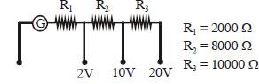
B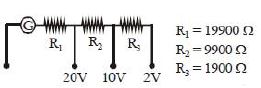
C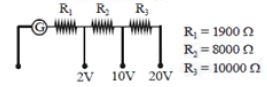
D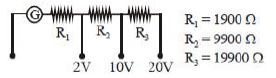
Solution
(D) The full-scale deflection current of the galvanometer is $I_g = 50 \times 20 \times 10^{-6} \, A = 10^{-3} \, A = 1 \, mA$.
The resistance of the galvanometer is $G = 100 \, \Omega$.
For a voltmeter of range $V$,the total resistance required is $R_{total} = V / I_g$.
The series resistance to be added is $R = R_{total} - G$.
For $0-2 \, V$ range: $R_{total} = 2 / 10^{-3} = 2000 \, \Omega$. So,$R_1 = 2000 - 100 = 1900 \, \Omega$.
For $0-10 \, V$ range: $R_{total} = 10 / 10^{-3} = 10000 \, \Omega$. The resistance added in series with $R_1$ is $R_2 = 10000 - 2000 = 8000 \, \Omega$.
For $0-20 \, V$ range: $R_{total} = 20 / 10^{-3} = 20000 \, \Omega$. The resistance added in series with $R_1 + R_2$ is $R_3 = 20000 - 10000 = 10000 \, \Omega$.
Thus,the circuit must have $R_1 = 1900 \, \Omega$,$R_2 = 8000 \, \Omega$,and $R_3 = 10000 \, \Omega$ in series.
The resistance of the galvanometer is $G = 100 \, \Omega$.
For a voltmeter of range $V$,the total resistance required is $R_{total} = V / I_g$.
The series resistance to be added is $R = R_{total} - G$.
For $0-2 \, V$ range: $R_{total} = 2 / 10^{-3} = 2000 \, \Omega$. So,$R_1 = 2000 - 100 = 1900 \, \Omega$.
For $0-10 \, V$ range: $R_{total} = 10 / 10^{-3} = 10000 \, \Omega$. The resistance added in series with $R_1$ is $R_2 = 10000 - 2000 = 8000 \, \Omega$.
For $0-20 \, V$ range: $R_{total} = 20 / 10^{-3} = 20000 \, \Omega$. The resistance added in series with $R_1 + R_2$ is $R_3 = 20000 - 10000 = 10000 \, \Omega$.
Thus,the circuit must have $R_1 = 1900 \, \Omega$,$R_2 = 8000 \, \Omega$,and $R_3 = 10000 \, \Omega$ in series.
0 likesView Solution
260
PhysicsMediumMCQJEE Main · 2019
In a double slit experiment,when a thin film of thickness $t$ having refractive index $\mu$ is introduced in front of one of the slits,the maximum at the centre of the fringe pattern shifts by one fringe width. The value of $t$ is ($\lambda$ is the wavelength of the light used).
A
$\frac{\lambda}{2(\mu - 1)}$
B
$\frac{\lambda}{(\mu - 1)}$
C
$\frac{\lambda}{(2\mu - 1)}$
D
$\frac{2\lambda}{(\mu - 1)}$
Solution
(B) When a thin film of thickness $t$ and refractive index $\mu$ is introduced in front of one of the slits in a Young's double slit experiment,the path difference introduced is $\Delta x = (\mu - 1)t$.
The shift in the fringe pattern is given by $\Delta y = \frac{D}{d} \Delta x = \frac{D}{d} (\mu - 1)t$.
The fringe width is $\beta = \frac{\lambda D}{d}$.
Given that the shift is equal to one fringe width,we have $\Delta y = \beta$.
Therefore,$\frac{D}{d} (\mu - 1)t = \frac{\lambda D}{d}$.
Simplifying this,we get $(\mu - 1)t = \lambda$.
Thus,$t = \frac{\lambda}{\mu - 1}$.
The shift in the fringe pattern is given by $\Delta y = \frac{D}{d} \Delta x = \frac{D}{d} (\mu - 1)t$.
The fringe width is $\beta = \frac{\lambda D}{d}$.
Given that the shift is equal to one fringe width,we have $\Delta y = \beta$.
Therefore,$\frac{D}{d} (\mu - 1)t = \frac{\lambda D}{d}$.
Simplifying this,we get $(\mu - 1)t = \lambda$.
Thus,$t = \frac{\lambda}{\mu - 1}$.
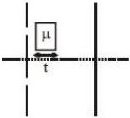
0 likesView Solution
261
PhysicsMediumMCQJEE Main · 2019
$A$ point dipole $\vec{p} = -p_0\hat{x}$ is kept at the origin. The potential and electric field due to this dipole on the $y$-axis at a distance $d$ are,respectively: (Take $V = 0$ at infinity)
A
$\frac{|\vec{p}|}{4\pi\varepsilon_0 d^2}, \frac{-\vec{p}}{4\pi\varepsilon_0 d^3}$
B
$0, \frac{\vec{p}}{4\pi\varepsilon_0 d^3}$
C
$\frac{|\vec{p}|}{4\pi\varepsilon_0 d^2}, \frac{\vec{p}}{4\pi\varepsilon_0 d^3}$
D
$0, \frac{-\vec{p}}{4\pi\varepsilon_0 d^3}$
Solution
(D) The potential $V$ at any point on the equatorial plane (the $y$-axis in this case) of a dipole is zero because the potential due to the positive and negative charges of the dipole cancels out at every point on this plane.
$V = 0$
The electric field $\vec{E}$ at a point on the equatorial plane at a distance $d$ from the dipole is given by the formula:
$\vec{E} = -\frac{1}{4\pi\varepsilon_0} \frac{\vec{p}}{d^3}$
Substituting the given dipole moment $\vec{p} = -p_0\hat{x}$,the electric field is directed along the positive $x$-axis,which is consistent with the direction of $-\vec{p}$.
Thus,the potential is $0$ and the electric field is $-\frac{\vec{p}}{4\pi\varepsilon_0 d^3}$.
$V = 0$
The electric field $\vec{E}$ at a point on the equatorial plane at a distance $d$ from the dipole is given by the formula:
$\vec{E} = -\frac{1}{4\pi\varepsilon_0} \frac{\vec{p}}{d^3}$
Substituting the given dipole moment $\vec{p} = -p_0\hat{x}$,the electric field is directed along the positive $x$-axis,which is consistent with the direction of $-\vec{p}$.
Thus,the potential is $0$ and the electric field is $-\frac{\vec{p}}{4\pi\varepsilon_0 d^3}$.
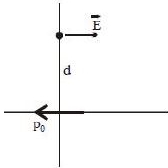
0 likesView Solution
262
PhysicsMediumMCQJEE Main · 2019
An electromagnetic wave is represented by the electric field $\vec{E} = E_0 \hat{n} \sin [\omega t + (6y - 8z)]$. Taking unit vectors in $x, y$ and $z$ directions to be $\hat{i}, \hat{j}$ and $\hat{k}$,the direction of propagation $\hat{s}$ is:
A
$\hat{s} = \left( \frac{-3\hat{j} + 4\hat{k}}{5} \right)$
B
$\hat{s} = \left( \frac{4\hat{j} - 3\hat{k}}{5} \right)$
C
$\hat{s} = \left( \frac{-4\hat{k} + 3\hat{j}}{5} \right)$
D
$\hat{s} = \left( \frac{-3\hat{i} - 4\hat{j}}{5} \right)$
Solution
(A) The general form of an electromagnetic wave is $\vec{E} = E_0 \hat{n} \sin(\omega t + \vec{k} \cdot \vec{r})$.
Comparing this with the given equation $\vec{E} = E_0 \hat{n} \sin[\omega t + (6y - 8z)]$,we have the wave vector $\vec{k} = 6\hat{j} - 8\hat{k}$.
The direction of propagation $\hat{s}$ is given by the unit vector in the direction of $-\vec{k}$.
Thus,$\hat{s} = -\frac{\vec{k}}{|\vec{k}|} = -\frac{6\hat{j} - 8\hat{k}}{\sqrt{6^2 + (-8)^2}} = -\frac{6\hat{j} - 8\hat{k}}{\sqrt{36 + 64}} = -\frac{6\hat{j} - 8\hat{k}}{10} = \frac{-6\hat{j} + 8\hat{k}}{10} = \frac{-3\hat{j} + 4\hat{k}}{5}$.
Comparing this with the given equation $\vec{E} = E_0 \hat{n} \sin[\omega t + (6y - 8z)]$,we have the wave vector $\vec{k} = 6\hat{j} - 8\hat{k}$.
The direction of propagation $\hat{s}$ is given by the unit vector in the direction of $-\vec{k}$.
Thus,$\hat{s} = -\frac{\vec{k}}{|\vec{k}|} = -\frac{6\hat{j} - 8\hat{k}}{\sqrt{6^2 + (-8)^2}} = -\frac{6\hat{j} - 8\hat{k}}{\sqrt{36 + 64}} = -\frac{6\hat{j} - 8\hat{k}}{10} = \frac{-6\hat{j} + 8\hat{k}}{10} = \frac{-3\hat{j} + 4\hat{k}}{5}$.
0 likesView Solution
263
PhysicsMediumMCQJEE Main · 2019
$A$ thin ring of $10 \, cm$ radius carries a uniformly distributed charge. The ring rotates at a constant angular speed of $40 \pi \, rad \, s^{-1}$ about its axis,perpendicular to its plane. If the magnetic field at its centre is $3.8 \times 10^{-9} \, T$,then the charge carried by the ring is close to $\left( \mu_0 = 4 \pi \times 10^{-7} \, N/A^2 \right)$.
A
$2 \times 10^{-6} \, C$
B
$7 \times 10^{-6} \, C$
C
$4 \times 10^{-5} \, C$
D
$3 \times 10^{-5} \, C$
Solution
(D) The magnetic field $B$ at the centre of a rotating charged ring is given by $B = \frac{\mu_0 i}{2R}$.
Here,the equivalent current $i$ is $i = \frac{q}{T} = \frac{q \omega}{2 \pi}$.
Substituting $i$ into the magnetic field formula: $B = \frac{\mu_0 q \omega}{2R(2 \pi)} = \frac{\mu_0 q \omega}{4 \pi R}$.
Given: $R = 0.1 \, m$,$\omega = 40 \pi \, rad/s$,$B = 3.8 \times 10^{-9} \, T$,and $\mu_0 = 4 \pi \times 10^{-7} \, N/A^2$.
Rearranging for $q$: $q = \frac{B \cdot 4 \pi R}{\mu_0 \omega}$.
$q = \frac{3.8 \times 10^{-9} \times 4 \pi \times 0.1}{4 \pi \times 10^{-7} \times 40 \pi}$.
$q = \frac{3.8 \times 10^{-10}}{40 \pi \times 10^{-7}} = \frac{3.8 \times 10^{-3}}{40 \pi} \approx \frac{3.8 \times 10^{-3}}{125.66} \approx 3.02 \times 10^{-5} \, C$.
Thus,the charge is approximately $3 \times 10^{-5} \, C$.
Here,the equivalent current $i$ is $i = \frac{q}{T} = \frac{q \omega}{2 \pi}$.
Substituting $i$ into the magnetic field formula: $B = \frac{\mu_0 q \omega}{2R(2 \pi)} = \frac{\mu_0 q \omega}{4 \pi R}$.
Given: $R = 0.1 \, m$,$\omega = 40 \pi \, rad/s$,$B = 3.8 \times 10^{-9} \, T$,and $\mu_0 = 4 \pi \times 10^{-7} \, N/A^2$.
Rearranging for $q$: $q = \frac{B \cdot 4 \pi R}{\mu_0 \omega}$.
$q = \frac{3.8 \times 10^{-9} \times 4 \pi \times 0.1}{4 \pi \times 10^{-7} \times 40 \pi}$.
$q = \frac{3.8 \times 10^{-10}}{40 \pi \times 10^{-7}} = \frac{3.8 \times 10^{-3}}{40 \pi} \approx \frac{3.8 \times 10^{-3}}{125.66} \approx 3.02 \times 10^{-5} \, C$.
Thus,the charge is approximately $3 \times 10^{-5} \, C$.
0 likesView Solution
264
PhysicsMediumMCQJEE Main · 2019
The truth table for the circuit given in the figure is
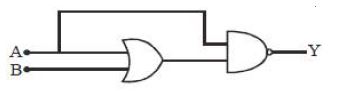
A
| $A$ | $B$ | $Y$ |
| $0$ | $0$ | $1$ |
| $0$ | $1$ | $0$ |
| $1$ | $0$ | $0$ |
| $1$ | $1$ | $0$ |
B
| $A$ | $B$ | $Y$ |
| $0$ | $0$ | $0$ |
| $0$ | $1$ | $0$ |
| $1$ | $0$ | $1$ |
| $1$ | $1$ | $1$ |
C
| $A$ | $B$ | $Y$ |
| $0$ | $0$ | $1$ |
| $0$ | $1$ | $1$ |
| $1$ | $0$ | $1$ |
| $1$ | $1$ | $1$ |
D
| $A$ | $B$ | $Y$ |
| $0$ | $0$ | $1$ |
| $0$ | $1$ | $1$ |
| $1$ | $0$ | $0$ |
| $1$ | $1$ | $0$ |
Solution
(D) The given circuit consists of an $OR$ gate and a $NAND$ gate. Let the output of the $OR$ gate be $C$. Then $C = A + B$.
The inputs to the $NAND$ gate are $A$ and $C$. The output $Y$ of the $NAND$ gate is given by $Y = \overline{A \cdot C}$.
Substituting $C = A + B$ into the expression for $Y$, we get $Y = \overline{A \cdot (A + B)} = \overline{A \cdot A + A \cdot B} = \overline{A + A \cdot B} = \overline{A(1 + B)} = \overline{A}$.
Let us verify this with a truth table:
Comparing this with the given options, the truth table matches option $D$.
The inputs to the $NAND$ gate are $A$ and $C$. The output $Y$ of the $NAND$ gate is given by $Y = \overline{A \cdot C}$.
Substituting $C = A + B$ into the expression for $Y$, we get $Y = \overline{A \cdot (A + B)} = \overline{A \cdot A + A \cdot B} = \overline{A + A \cdot B} = \overline{A(1 + B)} = \overline{A}$.
Let us verify this with a truth table:
| $A$ | $B$ | $C = A + B$ | $A \cdot C$ | $Y = \overline{A \cdot C}$ |
| $0$ | $0$ | $0$ | $0$ | $1$ |
| $0$ | $1$ | $1$ | $0$ | $1$ |
| $1$ | $0$ | $1$ | $1$ | $0$ |
| $1$ | $1$ | $1$ | $1$ | $0$ |
Comparing this with the given options, the truth table matches option $D$.
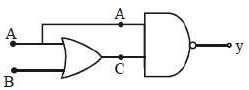
0 likesView Solution
265
PhysicsDifficultMCQJEE Main · 2019
$A$ concave mirror has a radius of curvature of $40\, cm$. It is at the bottom of a glass that has water filled up to $5\, cm$ (see figure). If a small particle is floating on the surface of water,its image as seen from directly above the glass is at a distance $d$ from the surface of water. The value of $d$ is close to ......$cm$ (Refractive index of water $= 1.33$)
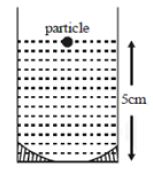
A
$13.4$
B
$8.8$
C
$6.7$
D
$11.7$
Solution
(B) Light incident from particle $P$ will be reflected at the mirror.
For the mirror,the object distance $u = -5\, cm$ and the focal length $f = -R/2 = -20\, cm$.
Using the mirror formula $\frac{1}{v} + \frac{1}{u} = \frac{1}{f}$:
$\frac{1}{v} + \frac{1}{-5} = \frac{1}{-20}$
$\frac{1}{v} = \frac{1}{5} - \frac{1}{20} = \frac{4-1}{20} = \frac{3}{20}$
$v = +\frac{20}{3}\, cm$.
This image acts as a virtual object for the light getting refracted at the water surface.
The distance of this virtual object from the water surface is $d_{obj} = 5 + \frac{20}{3} = \frac{35}{3}\, cm$.
Since the light travels from water $(\mu_1 = 4/3)$ to air $(\mu_2 = 1)$,the apparent depth $d'$ is given by $d' = d_{obj} \times (\mu_2 / \mu_1)$.
$d' = \left( \frac{35}{3} \right) \times \left( \frac{1}{4/3} \right) = \frac{35}{3} \times \frac{3}{4} = \frac{35}{4} = 8.75\, cm$.
Thus,$d \approx 8.8\, cm$.
For the mirror,the object distance $u = -5\, cm$ and the focal length $f = -R/2 = -20\, cm$.
Using the mirror formula $\frac{1}{v} + \frac{1}{u} = \frac{1}{f}$:
$\frac{1}{v} + \frac{1}{-5} = \frac{1}{-20}$
$\frac{1}{v} = \frac{1}{5} - \frac{1}{20} = \frac{4-1}{20} = \frac{3}{20}$
$v = +\frac{20}{3}\, cm$.
This image acts as a virtual object for the light getting refracted at the water surface.
The distance of this virtual object from the water surface is $d_{obj} = 5 + \frac{20}{3} = \frac{35}{3}\, cm$.
Since the light travels from water $(\mu_1 = 4/3)$ to air $(\mu_2 = 1)$,the apparent depth $d'$ is given by $d' = d_{obj} \times (\mu_2 / \mu_1)$.
$d' = \left( \frac{35}{3} \right) \times \left( \frac{1}{4/3} \right) = \frac{35}{3} \times \frac{3}{4} = \frac{35}{4} = 8.75\, cm$.
Thus,$d \approx 8.8\, cm$.
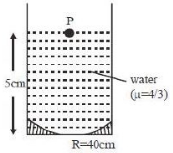
0 likesView Solution
266
PhysicsMediumMCQJEE Main · 2019
To verify Ohm's law,a student connects the voltmeter across the battery as shown in the figure. The measured voltage is plotted as a function of the current,and the following graph is obtained. If $V_0$ is almost zero,identify the correct statement.
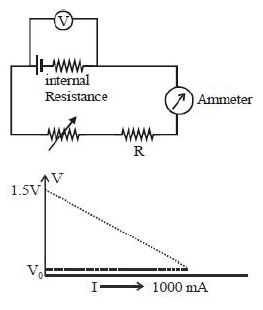
A
The potential difference across the battery is $1.5 \, V$ when it sends a current of $1000 \, mA$.
B
The $emf$ of the battery is $1.5 \, V$ and the value of $R$ is $1.5 \, \Omega$.
C
The $emf$ of the battery is $1.5 \, V$ and its internal resistance is $1.5 \, \Omega$.
D
The value of the resistance $R$ is $1.5 \, \Omega$.
Solution
(C) The terminal potential difference $V$ across a battery is given by $V = E - Ir$,where $E$ is the $emf$ and $r$ is the internal resistance.
From the graph,when the current $I = 0$,the voltage $V = E = 1.5 \, V$.
When the current $I = 1000 \, mA = 1 \, A$,the voltage $V = V_0 \approx 0 \, V$.
Substituting these values into the equation $V = E - Ir$:
$0 = 1.5 - (1 \, A) \times r$
$r = 1.5 \, \Omega$.
Thus,the $emf$ of the battery is $1.5 \, V$ and its internal resistance is $1.5 \, \Omega$.
From the graph,when the current $I = 0$,the voltage $V = E = 1.5 \, V$.
When the current $I = 1000 \, mA = 1 \, A$,the voltage $V = V_0 \approx 0 \, V$.
Substituting these values into the equation $V = E - Ir$:
$0 = 1.5 - (1 \, A) \times r$
$r = 1.5 \, \Omega$.
Thus,the $emf$ of the battery is $1.5 \, V$ and its internal resistance is $1.5 \, \Omega$.
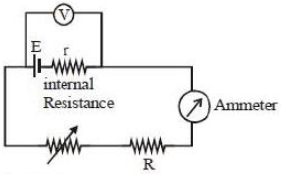
0 likesView Solution
267
PhysicsMediumMCQJEE Main · 2019
The figure shows a $DC$ voltage regulator circuit with a Zener diode of breakdown voltage $= 6\,V$. If the unregulated input voltage varies between $10\,V$ to $16\,V$, then what is the maximum Zener current in $mA$ (in $.5$)?
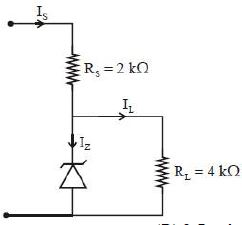
A
$2$
B
$3$
C
$7$
D
$1$
Solution
(B) The Zener diode acts as a voltage regulator, maintaining a constant voltage of $V_Z = 6\,V$ across the load resistance $R_L = 4\,k\Omega$ when it is in the breakdown region.
The load current $I_L$ is constant and is given by:
$I_L = \frac{V_Z}{R_L} = \frac{6\,V}{4\,k\Omega} = 1.5\,mA$
The total source current $I_S$ is given by:
$I_S = \frac{V_{in} - V_Z}{R_S}$
The Zener current $I_Z$ is given by:
$I_Z = I_S - I_L = \frac{V_{in} - 6}{2\,k\Omega} - 1.5\,mA$
To maximize $I_Z$, we must use the maximum input voltage $V_{in} = 16\,V$:
$I_{S,max} = \frac{16\,V - 6\,V}{2\,k\Omega} = \frac{10\,V}{2\,k\Omega} = 5\,mA$
Therefore, the maximum Zener current is:
$I_{Z,max} = I_{S,max} - I_L = 5\,mA - 1.5\,mA = 3.5\,mA$
The load current $I_L$ is constant and is given by:
$I_L = \frac{V_Z}{R_L} = \frac{6\,V}{4\,k\Omega} = 1.5\,mA$
The total source current $I_S$ is given by:
$I_S = \frac{V_{in} - V_Z}{R_S}$
The Zener current $I_Z$ is given by:
$I_Z = I_S - I_L = \frac{V_{in} - 6}{2\,k\Omega} - 1.5\,mA$
To maximize $I_Z$, we must use the maximum input voltage $V_{in} = 16\,V$:
$I_{S,max} = \frac{16\,V - 6\,V}{2\,k\Omega} = \frac{10\,V}{2\,k\Omega} = 5\,mA$
Therefore, the maximum Zener current is:
$I_{Z,max} = I_{S,max} - I_L = 5\,mA - 1.5\,mA = 3.5\,mA$
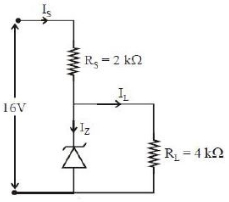
0 likesView Solution
268
PhysicsDifficultMCQJEE Main · 2019
In the given circuit,the charge on the $4\, \mu F$ capacitor will be.....$\mu C$.
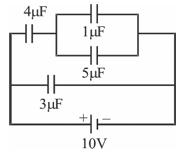
A
$13.4$
B
$24$
C
$9.6$
D
$5.4$
Solution
(B) First,simplify the circuit. The $1\, \mu F$ and $5\, \mu F$ capacitors are in parallel,so their equivalent capacitance is $C_p = 1\, \mu F + 5\, \mu F = 6\, \mu F$.
This $6\, \mu F$ capacitor is in series with the $4\, \mu F$ capacitor. Their equivalent capacitance is $C_s = \frac{4 \times 6}{4 + 6} = 2.4\, \mu F$.
This $2.4\, \mu F$ branch is in parallel with the $3\, \mu F$ capacitor across the $10\, V$ battery.
The charge on the $2.4\, \mu F$ branch is $q = C_s \times V = 2.4\, \mu F \times 10\, V = 24\, \mu C$.
Since the $4\, \mu F$ and $6\, \mu F$ (equivalent of $1\, \mu F$ and $5\, \mu F$) capacitors are in series,the charge on each of them is the same as the total charge on the branch,which is $24\, \mu C$.
This $6\, \mu F$ capacitor is in series with the $4\, \mu F$ capacitor. Their equivalent capacitance is $C_s = \frac{4 \times 6}{4 + 6} = 2.4\, \mu F$.
This $2.4\, \mu F$ branch is in parallel with the $3\, \mu F$ capacitor across the $10\, V$ battery.
The charge on the $2.4\, \mu F$ branch is $q = C_s \times V = 2.4\, \mu F \times 10\, V = 24\, \mu C$.
Since the $4\, \mu F$ and $6\, \mu F$ (equivalent of $1\, \mu F$ and $5\, \mu F$) capacitors are in series,the charge on each of them is the same as the total charge on the branch,which is $24\, \mu C$.
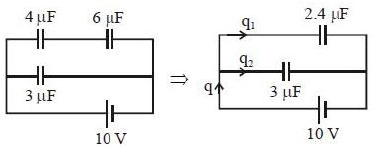
0 likesView Solution
269
PhysicsDifficultMCQJEE Main · 2019
Consider an electron in a hydrogen atom,revolving in its second excited state (having radius $4.65 \, \mathring{A}$). The de-Broglie wavelength of this electron is .... $\mathring{A}$.
A
$12.9$
B
$9.7$
C
$6.6$
D
$3.5$
Solution
(B) For an electron in a hydrogen atom,the condition for a stable orbit according to Bohr's postulate is given by the relation $2 \pi r_n = n \lambda_n$,where $n$ is the principal quantum number,$r_n$ is the radius of the $n^{th}$ orbit,and $\lambda_n$ is the de-Broglie wavelength.
The ground state corresponds to $n=1$,the first excited state to $n=2$,and the second excited state to $n=3$.
Given that the electron is in the second excited state,we have $n=3$ and the radius $r_3 = 4.65 \, \mathring{A}$.
Substituting these values into the formula:
$3 \lambda_3 = 2 \pi r_3$
$\lambda_3 = \frac{2 \pi (4.65 \, \mathring{A})}{3}$
$\lambda_3 = 2 \times 3.14159 \times 1.55 \, \mathring{A}$
$\lambda_3 \approx 9.738 \, \mathring{A}$.
Rounding to one decimal place,we get $\lambda_3 = 9.7 \, \mathring{A}$.
The ground state corresponds to $n=1$,the first excited state to $n=2$,and the second excited state to $n=3$.
Given that the electron is in the second excited state,we have $n=3$ and the radius $r_3 = 4.65 \, \mathring{A}$.
Substituting these values into the formula:
$3 \lambda_3 = 2 \pi r_3$
$\lambda_3 = \frac{2 \pi (4.65 \, \mathring{A})}{3}$
$\lambda_3 = 2 \times 3.14159 \times 1.55 \, \mathring{A}$
$\lambda_3 \approx 9.738 \, \mathring{A}$.
Rounding to one decimal place,we get $\lambda_3 = 9.7 \, \mathring{A}$.
0 likesView Solution
Vedclass Products
For Students
Vedclass Test Series
Mock tests in real JEE Main style covering Physics with performance analysis. 5-day free trial.
Start Free TrialFor Teachers
Exam Paper Generator
Generate Set A/B/C/D Physics papers from 7.5L+ questions in 2 minutes. 3 chapters free.
Try FreeFor Institutes
Online Exam Module
Run live JEE Main mock exams with unlimited students, 360° analytics & white-label branding.
See DemoFrequently Asked Questions
How many Physics questions are in JEE Main 2019?
There are 480 Physics questions from the JEE Main 2019 paper on Vedclass, each with a detailed step-by-step solution in English.
Are JEE Main 2019 Physics solutions available in English?
Yes. All solutions on this page are in English. You can also switch to English or Hindi using the language buttons above the questions.
Can I practice JEE Main 2019 Physics as a timed test?
Yes. Use the Vedclass Test Series to attempt a full JEE Main mock test covering Physics with time limits and instant score analysis.
Can teachers create Physics papers from JEE Main previous year questions?
Yes. The Vedclass Exam Paper Generator lets teachers mix JEE Main Physics questions and generate Set A/B/C/D papers in minutes.
For Teachers & Institutes
Build a Custom Physics Paper
Pick JEE Main 2019 Physics questions, set difficulty, and generate Set A/B/C/D in 2 minutes.