
PhysicsQ251–261 of 480 questions
Page 6 of 6 · English
251
PhysicsDifficultMCQJEE Main · 2019
$A$ system of three polarizers $P_1, P_2, P_3$ is set up such that the pass axis of $P_3$ is crossed with respect to that of $P_1$. The pass axis of $P_2$ is inclined at $60^{\circ}$ to the pass axis of $P_3$. When a beam of unpolarized light of intensity $I_0$ is incident on $P_1$,the intensity of light transmitted by the three polarizers is $I$. The ratio $(I_0/I)$ equals (nearly)
A
$10.67$
B
$1.80$
C
$5.33$
D
$16$
Solution
(A) When unpolarized light of intensity $I_0$ passes through the first polarizer $P_1$,the transmitted intensity is $I_1 = I_0/2$.
The pass axis of $P_3$ is crossed with respect to $P_1$,meaning the angle between their axes is $90^{\circ}$.
The pass axis of $P_2$ is inclined at $60^{\circ}$ to the pass axis of $P_3$. Therefore,the angle between the pass axis of $P_2$ and $P_1$ is $90^{\circ} - 60^{\circ} = 30^{\circ}$.
Using Malus' Law,the intensity transmitted through $P_2$ is $I_2 = I_1 \cos^2(30^{\circ}) = (I_0/2) \times (3/4) = 3I_0/8$.
The angle between the pass axis of $P_3$ and $P_2$ is $60^{\circ}$.
Using Malus' Law again,the final intensity transmitted through $P_3$ is $I = I_2 \cos^2(60^{\circ}) = (3I_0/8) \times (1/4) = 3I_0/32$.
Thus,the ratio $(I_0/I) = 32/3 \approx 10.67$.
The pass axis of $P_3$ is crossed with respect to $P_1$,meaning the angle between their axes is $90^{\circ}$.
The pass axis of $P_2$ is inclined at $60^{\circ}$ to the pass axis of $P_3$. Therefore,the angle between the pass axis of $P_2$ and $P_1$ is $90^{\circ} - 60^{\circ} = 30^{\circ}$.
Using Malus' Law,the intensity transmitted through $P_2$ is $I_2 = I_1 \cos^2(30^{\circ}) = (I_0/2) \times (3/4) = 3I_0/8$.
The angle between the pass axis of $P_3$ and $P_2$ is $60^{\circ}$.
Using Malus' Law again,the final intensity transmitted through $P_3$ is $I = I_2 \cos^2(60^{\circ}) = (3I_0/8) \times (1/4) = 3I_0/32$.
Thus,the ratio $(I_0/I) = 32/3 \approx 10.67$.
0 likesView Solution
252
PhysicsDifficultMCQJEE Main · 2019
Let a total charge $2Q$ be distributed in a sphere of radius $R$,with the charge density given by $\rho(r) = kr$,where $r$ is the distance from the centre. Two charges $A$ and $B$,of $-Q$ each,are placed on diametrically opposite points,at equal distance $a$ from the centre. If $A$ and $B$ do not experience any force,then:
A
$a = \frac{R}{2^{1/4}}$
B
$a = 2^{-1/4}R$
C
$a = 8^{-1/4}R$
D
$a = R/\sqrt{3}$
Solution
(C) First,we find the constant $k$ in terms of $Q$ and $R$ by integrating the charge density over the volume of the sphere:
$2Q = \int_{0}^{R} \rho(r) 4\pi r^2 dr = \int_{0}^{R} (kr) 4\pi r^2 dr = 4\pi k \int_{0}^{R} r^3 dr = 4\pi k \frac{R^4}{4} = \pi k R^4$.
Thus,$k = \frac{2Q}{\pi R^4}$.
Next,we find the electric field $E$ at distance $a$ from the centre using Gauss's Law:
$E(4\pi a^2) = \frac{q_{enc}}{\varepsilon_0} = \frac{1}{\varepsilon_0} \int_{0}^{a} (kr) 4\pi r^2 dr = \frac{4\pi k}{\varepsilon_0} \frac{a^4}{4} = \frac{\pi k a^4}{\varepsilon_0}$.
$E = \frac{k a^2}{4\varepsilon_0} = \frac{(2Q/\pi R^4) a^2}{4\varepsilon_0} = \frac{Q a^2}{2\pi \varepsilon_0 R^4}$.
For charge $A$ (or $B$) to experience no force,the force due to the sphere must be balanced by the force due to the other charge:
$|qE| = \frac{1}{4\pi \varepsilon_0} \frac{|Q||-Q|}{(2a)^2} \implies Q \left( \frac{Q a^2}{2\pi \varepsilon_0 R^4} \right) = \frac{Q^2}{16\pi \varepsilon_0 a^2}$.
Simplifying: $\frac{a^2}{2 R^4} = \frac{1}{16 a^2} \implies a^4 = \frac{R^4}{8} \implies a = \frac{R}{8^{1/4}} = 8^{-1/4}R$.
$2Q = \int_{0}^{R} \rho(r) 4\pi r^2 dr = \int_{0}^{R} (kr) 4\pi r^2 dr = 4\pi k \int_{0}^{R} r^3 dr = 4\pi k \frac{R^4}{4} = \pi k R^4$.
Thus,$k = \frac{2Q}{\pi R^4}$.
Next,we find the electric field $E$ at distance $a$ from the centre using Gauss's Law:
$E(4\pi a^2) = \frac{q_{enc}}{\varepsilon_0} = \frac{1}{\varepsilon_0} \int_{0}^{a} (kr) 4\pi r^2 dr = \frac{4\pi k}{\varepsilon_0} \frac{a^4}{4} = \frac{\pi k a^4}{\varepsilon_0}$.
$E = \frac{k a^2}{4\varepsilon_0} = \frac{(2Q/\pi R^4) a^2}{4\varepsilon_0} = \frac{Q a^2}{2\pi \varepsilon_0 R^4}$.
For charge $A$ (or $B$) to experience no force,the force due to the sphere must be balanced by the force due to the other charge:
$|qE| = \frac{1}{4\pi \varepsilon_0} \frac{|Q||-Q|}{(2a)^2} \implies Q \left( \frac{Q a^2}{2\pi \varepsilon_0 R^4} \right) = \frac{Q^2}{16\pi \varepsilon_0 a^2}$.
Simplifying: $\frac{a^2}{2 R^4} = \frac{1}{16 a^2} \implies a^4 = \frac{R^4}{8} \implies a = \frac{R}{8^{1/4}} = 8^{-1/4}R$.
0 likesView Solution
253
PhysicsDifficultMCQJEE Main · 2019
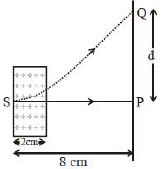
An electron,moving along the $x-$ axis with an initial energy of $100\, eV$,enters a region of magnetic field $\vec B = (1.5 \times 10^{-3} \, T) \hat k$ at $S$ (See figure). The field extends between $x = 0$ and $x = 2 \, cm$. The electron is detected at the point $Q$ on a screen placed $8 \, cm$ away from the point $S$. The distance $d$ between $P$ and $Q$ (on the screen) is :......$cm$ (electron's charge $= 1.6 \times 10^{-19} \, C$,mass of electron $= 9.1 \times 10^{-31} \, kg$)
A
$1.22$
B
$2.25$
C
$12.87$
D
$11.65$
Solution
(C) The radius of the circular path of the electron in the magnetic field is given by $R = \frac{mv}{qB} = \frac{\sqrt{2m(KE)}}{qB}$.
Substituting the given values: $R = \frac{\sqrt{2 \times 9.1 \times 10^{-31} \times 100 \times 1.6 \times 10^{-19}}}{1.6 \times 10^{-19} \times 1.5 \times 10^{-3}} \approx 0.02248 \, m = 2.248 \, cm$.
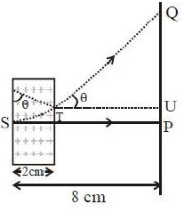
From the geometry,$\sin \theta = \frac{x}{R} = \frac{2}{2.248} \approx 0.8896$,so $\theta \approx 62.8^\circ$.
The vertical displacement $y$ at the exit point $T$ is $y = R(1 - \cos \theta) = 2.248(1 - \cos(62.8^\circ)) \approx 2.248(1 - 0.457) \approx 1.22 \, cm$.
The electron travels in a straight line after leaving the magnetic field. The distance from the exit point $T$ to the screen is $8 \, cm - 2 \, cm = 6 \, cm$.
The additional vertical displacement is $\Delta y = (6 \, cm) \tan \theta = 6 \times \tan(62.8^\circ) \approx 6 \times 1.945 \approx 11.67 \, cm$.
The total distance $d = y + \Delta y = 1.22 + 11.67 = 12.89 \, cm$. The closest option is $12.87 \, cm$.
Substituting the given values: $R = \frac{\sqrt{2 \times 9.1 \times 10^{-31} \times 100 \times 1.6 \times 10^{-19}}}{1.6 \times 10^{-19} \times 1.5 \times 10^{-3}} \approx 0.02248 \, m = 2.248 \, cm$.
From the geometry,$\sin \theta = \frac{x}{R} = \frac{2}{2.248} \approx 0.8896$,so $\theta \approx 62.8^\circ$.
The vertical displacement $y$ at the exit point $T$ is $y = R(1 - \cos \theta) = 2.248(1 - \cos(62.8^\circ)) \approx 2.248(1 - 0.457) \approx 1.22 \, cm$.
The electron travels in a straight line after leaving the magnetic field. The distance from the exit point $T$ to the screen is $8 \, cm - 2 \, cm = 6 \, cm$.
The additional vertical displacement is $\Delta y = (6 \, cm) \tan \theta = 6 \times \tan(62.8^\circ) \approx 6 \times 1.945 \approx 11.67 \, cm$.
The total distance $d = y + \Delta y = 1.22 + 11.67 = 12.89 \, cm$. The closest option is $12.87 \, cm$.
0 likesView Solution
254
PhysicsDifficultMCQJEE Main · 2019
Half-lives of two radioactive nuclei $A$ and $B$ are $10 \, minutes$ and $20 \, minutes$,respectively. If,initially,a sample has an equal number of nuclei,then after $60 \, minutes$,the ratio of the number of decayed nuclei of $A$ and $B$ will be:
A
$9 : 8$
B
$1 : 8$
C
$8 : 1$
D
$3 : 8$
Solution
(A) Let the initial number of nuclei be $N_0$ for both $A$ and $B$.
For nucleus $A$,half-life $T_{1/2, A} = 10 \, min$. After $t = 60 \, min$,the number of half-lives $n_A = 60/10 = 6$.
The number of undecayed nuclei $N_A = N_0 / 2^6 = N_0 / 64$.
The number of decayed nuclei $D_A = N_0 - N_A = N_0(1 - 1/64) = 63N_0 / 64$.
For nucleus $B$,half-life $T_{1/2, B} = 20 \, min$. After $t = 60 \, min$,the number of half-lives $n_B = 60/20 = 3$.
The number of undecayed nuclei $N_B = N_0 / 2^3 = N_0 / 8$.
The number of decayed nuclei $D_B = N_0 - N_B = N_0(1 - 1/8) = 7N_0 / 8$.
The ratio of decayed nuclei $D_A / D_B = (63N_0 / 64) / (7N_0 / 8) = (63/64) \times (8/7) = 9/8$.
For nucleus $A$,half-life $T_{1/2, A} = 10 \, min$. After $t = 60 \, min$,the number of half-lives $n_A = 60/10 = 6$.
The number of undecayed nuclei $N_A = N_0 / 2^6 = N_0 / 64$.
The number of decayed nuclei $D_A = N_0 - N_A = N_0(1 - 1/64) = 63N_0 / 64$.
For nucleus $B$,half-life $T_{1/2, B} = 20 \, min$. After $t = 60 \, min$,the number of half-lives $n_B = 60/20 = 3$.
The number of undecayed nuclei $N_B = N_0 / 2^3 = N_0 / 8$.
The number of decayed nuclei $D_B = N_0 - N_B = N_0(1 - 1/8) = 7N_0 / 8$.
The ratio of decayed nuclei $D_A / D_B = (63N_0 / 64) / (7N_0 / 8) = (63/64) \times (8/7) = 9/8$.
0 likesView Solution
255
PhysicsDifficultMCQJEE Main · 2019
In an amplitude modulator circuit,the carrier wave is given by $C(t) = 4 \sin(20000 \pi t)$ and the modulating signal is given by $m(t) = 2 \sin(2000 \pi t)$. The values of the modulation index and the lower sideband frequency are:
A
$0.5$ and $9 \text{ kHz}$
B
$0.3$ and $9 \text{ kHz}$
C
$0.5$ and $10 \text{ kHz}$
D
$0.4$ and $10 \text{ kHz}$
Solution
(A) The modulation index $\mu$ is defined as the ratio of the amplitude of the modulating signal $(A_m)$ to the amplitude of the carrier wave $(A_c)$:
$\mu = \frac{A_m}{A_c} = \frac{2}{4} = 0.5$.
The carrier frequency $f_c$ is obtained from $2 \pi f_c = 20000 \pi$,which gives $f_c = 10000 \text{ Hz} = 10 \text{ kHz}$.
The modulating frequency $f_m$ is obtained from $2 \pi f_m = 2000 \pi$,which gives $f_m = 1000 \text{ Hz} = 1 \text{ kHz}$.
The lower sideband frequency $(LSB)$ is given by $f_c - f_m = 10 \text{ kHz} - 1 \text{ kHz} = 9 \text{ kHz}$.
Therefore,the modulation index is $0.5$ and the lower sideband frequency is $9 \text{ kHz}$.
$\mu = \frac{A_m}{A_c} = \frac{2}{4} = 0.5$.
The carrier frequency $f_c$ is obtained from $2 \pi f_c = 20000 \pi$,which gives $f_c = 10000 \text{ Hz} = 10 \text{ kHz}$.
The modulating frequency $f_m$ is obtained from $2 \pi f_m = 2000 \pi$,which gives $f_m = 1000 \text{ Hz} = 1 \text{ kHz}$.
The lower sideband frequency $(LSB)$ is given by $f_c - f_m = 10 \text{ kHz} - 1 \text{ kHz} = 9 \text{ kHz}$.
Therefore,the modulation index is $0.5$ and the lower sideband frequency is $9 \text{ kHz}$.
0 likesView Solution
256
PhysicsDifficultMCQJEE Main · 2019
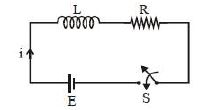
Consider the $LR$ circuit shown in the figure. If the switch $S$ is closed at $t = 0$, then the amount of charge that passes through the battery between $t = 0$ and $t = \frac{L}{R}$ is
A
$\frac{EL}{7.3R^2}$
B
$\frac{EL}{2.7R^2}$
C
$\frac{7.3EL}{R^2}$
D
$\frac{2.7EL}{R^2}$
Solution
(B) The current in an $LR$ circuit as a function of time $t$ after closing the switch is given by
$i(t) = \frac{E}{R}\left(1 - e^{-\frac{Rt}{L}}\right)$.
The charge $q$ that passes through the battery in time interval $t = 0$ to $t = \frac{L}{R}$ is given by the integral of current with respect to time:
$q = \int_{0}^{\frac{L}{R}} i(t)\, dt = \int_{0}^{\frac{L}{R}} \frac{E}{R}\left(1 - e^{-\frac{Rt}{L}}\right) dt$
$q = \frac{E}{R} \int_{0}^{\frac{L}{R}} \left(1 - e^{-\frac{Rt}{L}}\right) dt$
$q = \frac{E}{R} \left[ t + \frac{L}{R} e^{-\frac{Rt}{L}} \right]_{0}^{\frac{L}{R}}$
$q = \frac{E}{R} \left[ \left(\frac{L}{R} + \frac{L}{R} e^{-1}\right) - \left(0 + \frac{L}{R} e^{0}\right) \right]$
$q = \frac{E}{R} \left[ \frac{L}{R} + \frac{L}{Re} - \frac{L}{R} \right]$
$q = \frac{E}{R} \cdot \frac{L}{Re} = \frac{EL}{eR^2}$
Since $e \approx 2.718$, we have:
$q = \frac{EL}{2.7R^2}$
$i(t) = \frac{E}{R}\left(1 - e^{-\frac{Rt}{L}}\right)$.
The charge $q$ that passes through the battery in time interval $t = 0$ to $t = \frac{L}{R}$ is given by the integral of current with respect to time:
$q = \int_{0}^{\frac{L}{R}} i(t)\, dt = \int_{0}^{\frac{L}{R}} \frac{E}{R}\left(1 - e^{-\frac{Rt}{L}}\right) dt$
$q = \frac{E}{R} \int_{0}^{\frac{L}{R}} \left(1 - e^{-\frac{Rt}{L}}\right) dt$
$q = \frac{E}{R} \left[ t + \frac{L}{R} e^{-\frac{Rt}{L}} \right]_{0}^{\frac{L}{R}}$
$q = \frac{E}{R} \left[ \left(\frac{L}{R} + \frac{L}{R} e^{-1}\right) - \left(0 + \frac{L}{R} e^{0}\right) \right]$
$q = \frac{E}{R} \left[ \frac{L}{R} + \frac{L}{Re} - \frac{L}{R} \right]$
$q = \frac{E}{R} \cdot \frac{L}{Re} = \frac{EL}{eR^2}$
Since $e \approx 2.718$, we have:
$q = \frac{EL}{2.7R^2}$
0 likesView Solution
257
PhysicsMediumMCQJEE Main · 2019
$A$ plane electromagnetic wave having a frequency $n = 23.9\, GHz$ propagates along the positive $z-$ direction in free space. The peak value of the electric field is $60\, V/m$. Which among the following is the acceptable magnetic field component in the electromagnetic wave?
A
$\vec B = 2 \times 10^{-7} \sin(1.5 \times 10^2 x + 0.5 \times 10^{11} t) \hat j$
B
$\vec B = 60 \sin(0.5 \times 10^3 x + 1.5 \times 10^{11} t) \hat k$
C
$\vec B = 2 \times 10^{-7} \sin(0.5 \times 10^3 z - 1.5 \times 10^{11} t) \hat i$
D
$\vec B = 2 \times 10^7 \sin(0.5 \times 10^3 z + 1.5 \times 10^{11} t) \hat i$
Solution
(C) The electromagnetic wave propagates in the $+z$ direction,so the wave equation must be of the form $B = B_0 \sin(kz - \omega t)$.
The amplitude of the magnetic field is $B_0 = \frac{E_0}{c} = \frac{60}{3 \times 10^8} = 2 \times 10^{-7} \, T$.
The angular frequency is $\omega = 2\pi n = 2 \times 3.14 \times 23.9 \times 10^9 \approx 1.5 \times 10^{11} \, rad/s$.
The wave number is $k = \frac{\omega}{c} = \frac{1.5 \times 10^{11}}{3 \times 10^8} = 0.5 \times 10^3 \, m^{-1}$.
Since the wave propagates in the $+z$ direction and the electric field is typically in the $x$ or $y$ direction,the magnetic field must be perpendicular to both the direction of propagation $(z)$ and the electric field. Thus,for an electric field in the $y$ direction,the magnetic field is in the $x$ direction. The correct form is $\vec B = 2 \times 10^{-7} \sin(0.5 \times 10^3 z - 1.5 \times 10^{11} t) \hat i$.
The amplitude of the magnetic field is $B_0 = \frac{E_0}{c} = \frac{60}{3 \times 10^8} = 2 \times 10^{-7} \, T$.
The angular frequency is $\omega = 2\pi n = 2 \times 3.14 \times 23.9 \times 10^9 \approx 1.5 \times 10^{11} \, rad/s$.
The wave number is $k = \frac{\omega}{c} = \frac{1.5 \times 10^{11}}{3 \times 10^8} = 0.5 \times 10^3 \, m^{-1}$.
Since the wave propagates in the $+z$ direction and the electric field is typically in the $x$ or $y$ direction,the magnetic field must be perpendicular to both the direction of propagation $(z)$ and the electric field. Thus,for an electric field in the $y$ direction,the magnetic field is in the $x$ direction. The correct form is $\vec B = 2 \times 10^{-7} \sin(0.5 \times 10^3 z - 1.5 \times 10^{11} t) \hat i$.
0 likesView Solution
258
PhysicsDifficultMCQJEE Main · 2019
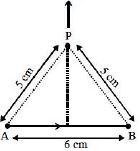
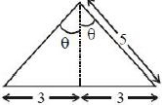
Find the magnetic field at point $P$ due to a straight line segment $AB$ of length $6\, cm$ carrying a current of $5\, A$. (See figure) $(\mu_0 = 4\pi \times 10^{-7}\, T\cdot m/A)$
A
$2.0 \times 10^{-5}\, T$
B
$3.0 \times 10^{-5}\, T$
C
$2.5 \times 10^{-5}\, T$
D
$1.5 \times 10^{-5}\, T$
Solution
(D) The magnetic field $B$ at a distance $d$ from a finite straight wire carrying current $I$ is given by $B = \frac{\mu_0 I}{4\pi d}(\sin \theta_1 + \sin \theta_2)$.
Given,length of wire $AB = 6\, cm$,so the distance from the center to each end is $3\, cm$.
The perpendicular distance $d$ from point $P$ to the wire is $4\, cm$ (from the $3-4-5$ triangle geometry).
Here,$\theta_1 = \theta_2 = \theta$,where $\sin \theta = \frac{\text{opposite}}{\text{hypotenuse}} = \frac{3}{5} = 0.6$.
Thus,$B = \frac{\mu_0 I}{4\pi d}(2 \sin \theta)$.
Substituting the values: $B = \frac{(10^{-7} \times 4\pi) \times 5}{4\pi \times (4 \times 10^{-2})} \times 2 \times \frac{3}{5}$.
$B = \frac{10^{-7} \times 5}{4 \times 10^{-2}} \times \frac{6}{5} = \frac{10^{-5} \times 5}{4} \times 1.2 = 1.25 \times 1.2 \times 10^{-5} = 1.5 \times 10^{-5}\, T$.
Given,length of wire $AB = 6\, cm$,so the distance from the center to each end is $3\, cm$.
The perpendicular distance $d$ from point $P$ to the wire is $4\, cm$ (from the $3-4-5$ triangle geometry).
Here,$\theta_1 = \theta_2 = \theta$,where $\sin \theta = \frac{\text{opposite}}{\text{hypotenuse}} = \frac{3}{5} = 0.6$.
Thus,$B = \frac{\mu_0 I}{4\pi d}(2 \sin \theta)$.
Substituting the values: $B = \frac{(10^{-7} \times 4\pi) \times 5}{4\pi \times (4 \times 10^{-2})} \times 2 \times \frac{3}{5}$.
$B = \frac{10^{-7} \times 5}{4 \times 10^{-2}} \times \frac{6}{5} = \frac{10^{-5} \times 5}{4} \times 1.2 = 1.25 \times 1.2 \times 10^{-5} = 1.5 \times 10^{-5}\, T$.
0 likesView Solution
259
PhysicsDifficultMCQJEE Main · 2019
The electron in a hydrogen atom first jumps from the third excited state to the second excited state and subsequently to the first excited state. The ratio of the respective wavelengths,$\lambda_1/\lambda_2$,of the photons emitted in this process is
A
$20/7$
B
$7/5$
C
$9/7$
D
$27/5$
Solution
(A) The Rydberg formula for the wavelength of emitted photons is given by $\frac{1}{\lambda} = R \left( \frac{1}{n_f^2} - \frac{1}{n_i^2} \right)$.
For the first jump from the third excited state $(n_i = 4)$ to the second excited state $(n_f = 3)$:
$\frac{1}{\lambda_1} = R \left( \frac{1}{3^2} - \frac{1}{4^2} \right) = R \left( \frac{1}{9} - \frac{1}{16} \right) = R \left( \frac{16 - 9}{144} \right) = R \left( \frac{7}{144} \right)$.
For the second jump from the second excited state $(n_i = 3)$ to the first excited state $(n_f = 2)$:
$\frac{1}{\lambda_2} = R \left( \frac{1}{2^2} - \frac{1}{3^2} \right) = R \left( \frac{1}{4} - \frac{1}{9} \right) = R \left( \frac{9 - 4}{36} \right) = R \left( \frac{5}{36} \right)$.
Now,calculating the ratio $\frac{\lambda_1}{\lambda_2} = \frac{1/\lambda_2}{1/\lambda_1} = \frac{R(5/36)}{R(7/144)} = \frac{5}{36} \times \frac{144}{7} = \frac{5 \times 4}{7} = \frac{20}{7}$.
For the first jump from the third excited state $(n_i = 4)$ to the second excited state $(n_f = 3)$:
$\frac{1}{\lambda_1} = R \left( \frac{1}{3^2} - \frac{1}{4^2} \right) = R \left( \frac{1}{9} - \frac{1}{16} \right) = R \left( \frac{16 - 9}{144} \right) = R \left( \frac{7}{144} \right)$.
For the second jump from the second excited state $(n_i = 3)$ to the first excited state $(n_f = 2)$:
$\frac{1}{\lambda_2} = R \left( \frac{1}{2^2} - \frac{1}{3^2} \right) = R \left( \frac{1}{4} - \frac{1}{9} \right) = R \left( \frac{9 - 4}{36} \right) = R \left( \frac{5}{36} \right)$.
Now,calculating the ratio $\frac{\lambda_1}{\lambda_2} = \frac{1/\lambda_2}{1/\lambda_1} = \frac{R(5/36)}{R(7/144)} = \frac{5}{36} \times \frac{144}{7} = \frac{5 \times 4}{7} = \frac{20}{7}$.
0 likesView Solution
260
PhysicsDifficultMCQJEE Main · 2019
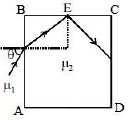
$A$ transparent cube of side $d$,made of a material of refractive index $\mu_2$,is immersed in a liquid of refractive index $\mu_1$ (where $\mu_1 < \mu_2$). $A$ ray is incident on the face $AB$ at an angle $\theta$ (as shown in the figure). Total internal reflection takes place at point $E$ on the face $BC$. The angle $\theta$ must satisfy:
A
$\theta > \sin^{-1} \left( \frac{\mu_1}{\mu_2} \right)$
B
$\theta > \sin^{-1} \sqrt{\frac{\mu_2^2}{\mu_1^2} - 1}$
C
$\theta < \sin^{-1} \left( \frac{\mu_1}{\mu_2} \right)$
D
$\theta < \sin^{-1} \sqrt{\frac{\mu_2^2}{\mu_1^2} - 1}$
Solution
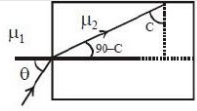
(D) Let $C$ be the critical angle for the interface between the cube $(\mu_2)$ and the liquid $(\mu_1)$.
For total internal reflection $(TIR)$ at point $E$,the angle of incidence $i'$ at face $BC$ must be greater than the critical angle $C$.
Thus,$i' > C$.
From the geometry,the angle of refraction $r$ at face $AB$ is related to $i'$ by $r = 90^\circ - i'$.
Since $i' > C$,we have $90^\circ - r > C$,or $r < 90^\circ - C$.
Applying Snell's Law at face $AB$: $\mu_1 \sin \theta = \mu_2 \sin r$.
Since $\sin$ is an increasing function,$\sin r < \sin(90^\circ - C) = \cos C$.
Therefore,$\mu_1 \sin \theta < \mu_2 \cos C$.
We know $\sin C = \frac{\mu_1}{\mu_2}$,so $\cos C = \sqrt{1 - \sin^2 C} = \sqrt{1 - \frac{\mu_1^2}{\mu_2^2}} = \frac{\sqrt{\mu_2^2 - \mu_1^2}}{\mu_2}$.
Substituting this into the inequality: $\mu_1 \sin \theta < \mu_2 \left( \frac{\sqrt{\mu_2^2 - \mu_1^2}}{\mu_2} \right) = \sqrt{\mu_2^2 - \mu_1^2}$.
$\sin \theta < \frac{\sqrt{\mu_2^2 - \mu_1^2}}{\mu_1} = \sqrt{\frac{\mu_2^2}{\mu_1^2} - 1}$.
Thus,$\theta < \sin^{-1} \sqrt{\frac{\mu_2^2}{\mu_1^2} - 1}$.
For total internal reflection $(TIR)$ at point $E$,the angle of incidence $i'$ at face $BC$ must be greater than the critical angle $C$.
Thus,$i' > C$.
From the geometry,the angle of refraction $r$ at face $AB$ is related to $i'$ by $r = 90^\circ - i'$.
Since $i' > C$,we have $90^\circ - r > C$,or $r < 90^\circ - C$.
Applying Snell's Law at face $AB$: $\mu_1 \sin \theta = \mu_2 \sin r$.
Since $\sin$ is an increasing function,$\sin r < \sin(90^\circ - C) = \cos C$.
Therefore,$\mu_1 \sin \theta < \mu_2 \cos C$.
We know $\sin C = \frac{\mu_1}{\mu_2}$,so $\cos C = \sqrt{1 - \sin^2 C} = \sqrt{1 - \frac{\mu_1^2}{\mu_2^2}} = \frac{\sqrt{\mu_2^2 - \mu_1^2}}{\mu_2}$.
Substituting this into the inequality: $\mu_1 \sin \theta < \mu_2 \left( \frac{\sqrt{\mu_2^2 - \mu_1^2}}{\mu_2} \right) = \sqrt{\mu_2^2 - \mu_1^2}$.
$\sin \theta < \frac{\sqrt{\mu_2^2 - \mu_1^2}}{\mu_1} = \sqrt{\frac{\mu_2^2}{\mu_1^2} - 1}$.
Thus,$\theta < \sin^{-1} \sqrt{\frac{\mu_2^2}{\mu_1^2} - 1}$.
0 likesView Solution
261
PhysicsDifficultMCQJEE Main · 2019
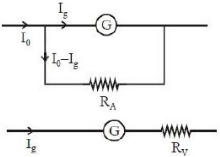
$A$ moving coil galvanometer,having a resistance $G$,produces full scale deflection when a current $I_g$ flows through it. This galvanometer can be converted into $(i)$ an ammeter of range $0$ to $I_0$ $(I_0 > I_g)$ by connecting a shunt resistance $R_A$ to it and $(ii)$ into a voltmeter of range $0$ to $V$ $(V = GI_0)$ by connecting a series resistance $R_V$ to it. Then,
A
$R_A R_V = G^2$ and $\frac{R_A}{R_V} = \frac{I_g}{(I_0 - I_g)}$
B
$R_A R_V = G^2$ and $\frac{R_A}{R_V} = \left( \frac{I_g}{I_0 - I_g} \right)^2$
C
$R_A R_V = G^2 \left( \frac{I_g}{I_0 - I_g} \right)$ and $\frac{R_A}{R_V} = \left( \frac{I_0 - I_g}{I_g} \right)^2$
D
$R_A - R_V = G^2 \left( \frac{I_0 - I_g}{I_g} \right)$ and $\frac{R_A}{R_V} = \left( \frac{I_g}{I_0 - I_g} \right)^2$
Solution
(B) For an ammeter,a shunt resistance $R_A$ is connected in parallel with the galvanometer.
$I_g G = (I_0 - I_g) R_A$
$R_A = \left( \frac{I_g}{I_0 - I_g} \right) G$
For a voltmeter,a series resistance $R_V$ is connected in series with the galvanometer.
$I_g (G + R_V) = V = G I_0$
$G + R_V = \frac{G I_0}{I_g}$
$R_V = \frac{G I_0}{I_g} - G = G \left( \frac{I_0 - I_g}{I_g} \right)$
Now,calculating the product:
$R_A R_V = \left( \frac{I_g}{I_0 - I_g} G \right) \times \left( \frac{I_0 - I_g}{I_g} G \right) = G^2$
Calculating the ratio:
$\frac{R_A}{R_V} = \frac{\left( \frac{I_g}{I_0 - I_g} \right) G}{G \left( \frac{I_0 - I_g}{I_g} \right)} = \left( \frac{I_g}{I_0 - I_g} \right)^2$
$I_g G = (I_0 - I_g) R_A$
$R_A = \left( \frac{I_g}{I_0 - I_g} \right) G$
For a voltmeter,a series resistance $R_V$ is connected in series with the galvanometer.
$I_g (G + R_V) = V = G I_0$
$G + R_V = \frac{G I_0}{I_g}$
$R_V = \frac{G I_0}{I_g} - G = G \left( \frac{I_0 - I_g}{I_g} \right)$
Now,calculating the product:
$R_A R_V = \left( \frac{I_g}{I_0 - I_g} G \right) \times \left( \frac{I_0 - I_g}{I_g} G \right) = G^2$
Calculating the ratio:
$\frac{R_A}{R_V} = \frac{\left( \frac{I_g}{I_0 - I_g} \right) G}{G \left( \frac{I_0 - I_g}{I_g} \right)} = \left( \frac{I_g}{I_0 - I_g} \right)^2$
0 likesView Solution
Vedclass Products
For Students
Vedclass Test Series
Mock tests in real JEE Main style covering Physics with performance analysis. 5-day free trial.
Start Free TrialFor Teachers
Exam Paper Generator
Generate Set A/B/C/D Physics papers from 7.5L+ questions in 2 minutes. 3 chapters free.
Try FreeFor Institutes
Online Exam Module
Run live JEE Main mock exams with unlimited students, 360° analytics & white-label branding.
See DemoFrequently Asked Questions
How many Physics questions are in JEE Main 2019?
There are 480 Physics questions from the JEE Main 2019 paper on Vedclass, each with a detailed step-by-step solution in English.
Are JEE Main 2019 Physics solutions available in English?
Yes. All solutions on this page are in English. You can also switch to English or Hindi using the language buttons above the questions.
Can I practice JEE Main 2019 Physics as a timed test?
Yes. Use the Vedclass Test Series to attempt a full JEE Main mock test covering Physics with time limits and instant score analysis.
Can teachers create Physics papers from JEE Main previous year questions?
Yes. The Vedclass Exam Paper Generator lets teachers mix JEE Main Physics questions and generate Set A/B/C/D papers in minutes.
For Teachers & Institutes
Build a Custom Physics Paper
Pick JEE Main 2019 Physics questions, set difficulty, and generate Set A/B/C/D in 2 minutes.