
ChemistryQ1–51 of 51 questions
Page 1 of 1 · English
1
ChemistryMCQIIT JEE · 2011
Let $P(6, 3)$ be a point on the hyperbola $\frac{x^2}{a^2} - \frac{y^2}{b^2} = 1$. If the normal at point $P$ intersects the $x$-axis at $(9, 0)$,then the eccentricity of the hyperbola is:
A
$\sqrt{\frac{5}{2}}$
B
$\sqrt{\frac{3}{2}}$
C
$\sqrt{2}$
D
$\sqrt{3}$
Solution
(B) The equation of the normal to the hyperbola $\frac{x^2}{a^2} - \frac{y^2}{b^2} = 1$ at point $(x_1, y_1)$ is given by $\frac{a^2x}{x_1} + \frac{b^2y}{y_1} = a^2 + b^2$.
Substituting $(x_1, y_1) = (6, 3)$,we get $\frac{a^2x}{6} + \frac{b^2y}{3} = a^2 + b^2$.
Since the normal passes through $(9, 0)$,we substitute $x = 9$ and $y = 0$:
$\frac{a^2(9)}{6} + 0 = a^2 + b^2$
$\frac{3a^2}{2} = a^2 + b^2$
$\frac{1}{2}a^2 = b^2 \Rightarrow a^2 = 2b^2$.
The eccentricity $e$ of the hyperbola is given by $e = \sqrt{1 + \frac{b^2}{a^2}}$.
Substituting $a^2 = 2b^2$:
$e = \sqrt{1 + \frac{b^2}{2b^2}} = \sqrt{1 + \frac{1}{2}} = \sqrt{\frac{3}{2}}$.
Substituting $(x_1, y_1) = (6, 3)$,we get $\frac{a^2x}{6} + \frac{b^2y}{3} = a^2 + b^2$.
Since the normal passes through $(9, 0)$,we substitute $x = 9$ and $y = 0$:
$\frac{a^2(9)}{6} + 0 = a^2 + b^2$
$\frac{3a^2}{2} = a^2 + b^2$
$\frac{1}{2}a^2 = b^2 \Rightarrow a^2 = 2b^2$.
The eccentricity $e$ of the hyperbola is given by $e = \sqrt{1 + \frac{b^2}{a^2}}$.
Substituting $a^2 = 2b^2$:
$e = \sqrt{1 + \frac{b^2}{2b^2}} = \sqrt{1 + \frac{1}{2}} = \sqrt{\frac{3}{2}}$.
0 likesView Solution
2
ChemistryMCQIIT JEE · 2011
$A$ police car with a siren of frequency $8 \, kHz$ is moving with uniform velocity $36 \, km/hr$ towards a tall building which reflects the sound waves. The speed of sound in air is $320 \, m/s$. The frequency of the siren heard by the car driver is .... $kHz$.
A
$8.50$
B
$8.25$
C
$7.75$
D
$7.50$
Solution
(A) The frequency heard by the driver is due to the reflection of sound from the building. The building acts as a stationary source reflecting the sound.
First,the frequency $f_b$ received by the building is given by the Doppler effect formula for a moving source and stationary observer: $f_b = f \left( \frac{v}{v - v_s} \right)$,where $v = 320 \, m/s$,$v_s = 36 \, km/hr = 10 \, m/s$,and $f = 8 \, kHz$.
$f_b = 8 \left( \frac{320}{320 - 10} \right) = 8 \left( \frac{320}{310} \right) \, kHz$.
Now,the building acts as a stationary source reflecting this frequency $f_b$ back to the moving car (observer). The frequency $f'$ heard by the driver is: $f' = f_b \left( \frac{v + v_o}{v} \right)$,where $v_o = 10 \, m/s$.
$f' = \left( 8 \times \frac{320}{310} \right) \times \left( \frac{320 + 10}{320} \right) = 8 \times \frac{330}{310} \approx 8.516 \, kHz$.
Rounding to the nearest provided option,the correct frequency is $8.50 \, kHz$.
First,the frequency $f_b$ received by the building is given by the Doppler effect formula for a moving source and stationary observer: $f_b = f \left( \frac{v}{v - v_s} \right)$,where $v = 320 \, m/s$,$v_s = 36 \, km/hr = 10 \, m/s$,and $f = 8 \, kHz$.
$f_b = 8 \left( \frac{320}{320 - 10} \right) = 8 \left( \frac{320}{310} \right) \, kHz$.
Now,the building acts as a stationary source reflecting this frequency $f_b$ back to the moving car (observer). The frequency $f'$ heard by the driver is: $f' = f_b \left( \frac{v + v_o}{v} \right)$,where $v_o = 10 \, m/s$.
$f' = \left( 8 \times \frac{320}{310} \right) \times \left( \frac{320 + 10}{320} \right) = 8 \times \frac{330}{310} \approx 8.516 \, kHz$.
Rounding to the nearest provided option,the correct frequency is $8.50 \, kHz$.
0 likesView Solution
3
ChemistryMCQIIT JEE · 2011
$5.6 \, \text{liter}$ of helium gas at $STP$ is adiabatically compressed to $0.7 \, \text{liter}$. Taking the initial temperature to be $T_1$,the work done in the process is
A
$\frac{9}{8} R T_1$
B
$\frac{3}{2} R T_1$
C
$\frac{15}{8} R T_1$
D
$\frac{9}{2} R T_1$
Solution
(A) For an adiabatic process,the relation between temperature and volume is $T_1 V_1^{\gamma-1} = T_2 V_2^{\gamma-1}$.
For helium (a monoatomic gas),the adiabatic index $\gamma = \frac{5}{3}$,so $\gamma - 1 = \frac{2}{3}$.
Given $V_1 = 5.6 \, \text{liter}$ and $V_2 = 0.7 \, \text{liter}$,we have $\frac{V_1}{V_2} = \frac{5.6}{0.7} = 8$.
Substituting these into the relation: $T_2 = T_1 \left( \frac{V_1}{V_2} \right)^{\gamma-1} = T_1 (8)^{2/3} = T_1 (2^3)^{2/3} = T_1 (2^2) = 4 T_1$.
At $STP$,the number of moles $n = \frac{5.6 \, \text{liter}}{22.4 \, \text{liter/mol}} = 0.25 = \frac{1}{4} \, \text{mol}$.
The work done in an adiabatic process is $W = \frac{n R (T_1 - T_2)}{\gamma - 1}$.
Substituting the values: $W = \frac{(1/4) R (T_1 - 4 T_1)}{5/3 - 1} = \frac{(1/4) R (-3 T_1)}{2/3} = \frac{-3/4 R T_1}{2/3} = -\frac{9}{8} R T_1$.
The magnitude of work done on the gas is $\frac{9}{8} R T_1$.
For helium (a monoatomic gas),the adiabatic index $\gamma = \frac{5}{3}$,so $\gamma - 1 = \frac{2}{3}$.
Given $V_1 = 5.6 \, \text{liter}$ and $V_2 = 0.7 \, \text{liter}$,we have $\frac{V_1}{V_2} = \frac{5.6}{0.7} = 8$.
Substituting these into the relation: $T_2 = T_1 \left( \frac{V_1}{V_2} \right)^{\gamma-1} = T_1 (8)^{2/3} = T_1 (2^3)^{2/3} = T_1 (2^2) = 4 T_1$.
At $STP$,the number of moles $n = \frac{5.6 \, \text{liter}}{22.4 \, \text{liter/mol}} = 0.25 = \frac{1}{4} \, \text{mol}$.
The work done in an adiabatic process is $W = \frac{n R (T_1 - T_2)}{\gamma - 1}$.
Substituting the values: $W = \frac{(1/4) R (T_1 - 4 T_1)}{5/3 - 1} = \frac{(1/4) R (-3 T_1)}{2/3} = \frac{-3/4 R T_1}{2/3} = -\frac{9}{8} R T_1$.
The magnitude of work done on the gas is $\frac{9}{8} R T_1$.
0 likesView Solution
4
ChemistryMCQIIT JEE · 2011
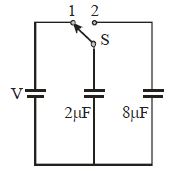
$A$ $2\,\mu F$ capacitor is charged as shown in the figure. The percentage of its stored energy dissipated after the switch $S$ is turned to position $2$ is.....$\%$
A
$0$
B
$20$
C
$75$
D
$80$
Solution
(D) Initially,the $2\,\mu F$ capacitor is charged to a potential $V$. The initial energy stored is $U_i = \frac{1}{2} C_1 V^2$,where $C_1 = 2\,\mu F$.
When the switch $S$ is moved to position $2$,the capacitor $C_1$ is connected in parallel with an uncharged capacitor $C_2 = 8\,\mu F$.
The charge redistributes until both capacitors reach a common potential $V' = \frac{C_1 V}{C_1 + C_2} = \frac{2V}{2+8} = 0.2V$.
The final energy stored in the system is $U_f = \frac{1}{2} (C_1 + C_2) (V')^2 = \frac{1}{2} (10\,\mu F) (0.2V)^2 = 0.2 C_1 V^2$.
The energy dissipated as heat is $\Delta U = U_i - U_f = \frac{1}{2} C_1 V^2 - 0.2 C_1 V^2 = 0.3 C_1 V^2$.
The percentage of energy dissipated is $\frac{\Delta U}{U_i} \times 100 = \frac{0.3 C_1 V^2}{0.5 C_1 V^2} \times 100 = 60\%$.
Wait,using the standard formula for energy loss in charge sharing: $\Delta U = \frac{1}{2} \frac{C_1 C_2}{C_1 + C_2} (V_1 - V_2)^2$.
Here $V_1 = V$ and $V_2 = 0$,so $\Delta U = \frac{1}{2} \frac{2 \times 8}{2 + 8} (V - 0)^2 = \frac{1}{2} \times 1.6 \times V^2 = 0.8 \times \frac{1}{2} C_1 V^2$.
Thus,the percentage of energy dissipated is $\frac{\Delta U}{U_i} \times 100 = \frac{C_2}{C_1 + C_2} \times 100 = \frac{8}{2+8} \times 100 = 80\%$.
When the switch $S$ is moved to position $2$,the capacitor $C_1$ is connected in parallel with an uncharged capacitor $C_2 = 8\,\mu F$.
The charge redistributes until both capacitors reach a common potential $V' = \frac{C_1 V}{C_1 + C_2} = \frac{2V}{2+8} = 0.2V$.
The final energy stored in the system is $U_f = \frac{1}{2} (C_1 + C_2) (V')^2 = \frac{1}{2} (10\,\mu F) (0.2V)^2 = 0.2 C_1 V^2$.
The energy dissipated as heat is $\Delta U = U_i - U_f = \frac{1}{2} C_1 V^2 - 0.2 C_1 V^2 = 0.3 C_1 V^2$.
The percentage of energy dissipated is $\frac{\Delta U}{U_i} \times 100 = \frac{0.3 C_1 V^2}{0.5 C_1 V^2} \times 100 = 60\%$.
Wait,using the standard formula for energy loss in charge sharing: $\Delta U = \frac{1}{2} \frac{C_1 C_2}{C_1 + C_2} (V_1 - V_2)^2$.
Here $V_1 = V$ and $V_2 = 0$,so $\Delta U = \frac{1}{2} \frac{2 \times 8}{2 + 8} (V - 0)^2 = \frac{1}{2} \times 1.6 \times V^2 = 0.8 \times \frac{1}{2} C_1 V^2$.
Thus,the percentage of energy dissipated is $\frac{\Delta U}{U_i} \times 100 = \frac{C_2}{C_1 + C_2} \times 100 = \frac{8}{2+8} \times 100 = 80\%$.
0 likesView Solution
5
ChemistryMCQIIT JEE · 2011
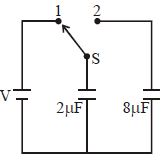
$A$ $2\,\mu F$ capacitor is charged as shown in the figure. The percentage of its stored energy dissipated after the switch $S$ is turned to position $2$ is.....$\%$
A
$0$
B
$20$
C
$75$
D
$80$
Solution
(D) Initial energy stored in the $2\,\mu F$ capacitor when connected to voltage $V$ is:
$U_{i} = \frac{1}{2} C V^{2} = \frac{1}{2} (2 \times 10^{-6}) V^{2} = 10^{-6} V^{2} \text{ J}$.
When the switch $S$ is turned to position $2$,the $2\,\mu F$ capacitor is connected in parallel with the uncharged $8\,\mu F$ capacitor.
The total charge $Q$ remains conserved:
$Q = C_{1} V = (2 \times 10^{-6}) V$.
The common potential $V_{\text{common}}$ after redistribution is:
$V_{\text{common}} = \frac{Q}{C_{1} + C_{2}} = \frac{2 \times 10^{-6} V}{2 \times 10^{-6} + 8 \times 10^{-6}} = \frac{2V}{10} = \frac{V}{5}$.
The final energy stored in the system is:
$U_{f} = \frac{1}{2} (C_{1} + C_{2}) V_{\text{common}}^{2} = \frac{1}{2} (10 \times 10^{-6}) \left(\frac{V}{5}\right)^{2} = 5 \times 10^{-6} \times \frac{V^{2}}{25} = 0.2 \times 10^{-6} V^{2} \text{ J}$.
The energy dissipated is $\Delta U = U_{i} - U_{f} = 10^{-6} V^{2} - 0.2 \times 10^{-6} V^{2} = 0.8 \times 10^{-6} V^{2} \text{ J}$.
The percentage of energy dissipated is:
$\frac{\Delta U}{U_{i}} \times 100 = \frac{0.8 \times 10^{-6} V^{2}}{10^{-6} V^{2}} \times 100 = 80 \%$.
$U_{i} = \frac{1}{2} C V^{2} = \frac{1}{2} (2 \times 10^{-6}) V^{2} = 10^{-6} V^{2} \text{ J}$.
When the switch $S$ is turned to position $2$,the $2\,\mu F$ capacitor is connected in parallel with the uncharged $8\,\mu F$ capacitor.
The total charge $Q$ remains conserved:
$Q = C_{1} V = (2 \times 10^{-6}) V$.
The common potential $V_{\text{common}}$ after redistribution is:
$V_{\text{common}} = \frac{Q}{C_{1} + C_{2}} = \frac{2 \times 10^{-6} V}{2 \times 10^{-6} + 8 \times 10^{-6}} = \frac{2V}{10} = \frac{V}{5}$.
The final energy stored in the system is:
$U_{f} = \frac{1}{2} (C_{1} + C_{2}) V_{\text{common}}^{2} = \frac{1}{2} (10 \times 10^{-6}) \left(\frac{V}{5}\right)^{2} = 5 \times 10^{-6} \times \frac{V^{2}}{25} = 0.2 \times 10^{-6} V^{2} \text{ J}$.
The energy dissipated is $\Delta U = U_{i} - U_{f} = 10^{-6} V^{2} - 0.2 \times 10^{-6} V^{2} = 0.8 \times 10^{-6} V^{2} \text{ J}$.
The percentage of energy dissipated is:
$\frac{\Delta U}{U_{i}} \times 100 = \frac{0.8 \times 10^{-6} V^{2}}{10^{-6} V^{2}} \times 100 = 80 \%$.
0 likesView Solution
6
ChemistryMCQIIT JEE · 2011
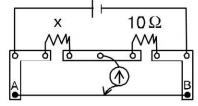
$A$ meter bridge is set up as shown,to determine an unknown resistance '$X$' using a standard $10 \, \Omega$ resistor. The galvanometer shows a null point when the tapping-key is at the $52 \, cm$ mark. The end corrections are $1 \, cm$ and $2 \, cm$ respectively for the ends $A$ and $B$. The determined value of '$X$' is $.......... \Omega$.
A
$10.2$
B
$10.6$
C
$10.8$
D
$11.1$
Solution
(B) In a meter bridge,the balance condition is given by $\frac{X}{R} = \frac{\ell_1 + \alpha}{\ell_2 + \beta}$,where $\alpha$ and $\beta$ are the end corrections at ends $A$ and $B$ respectively.
Given:
Unknown resistance = $X$
Standard resistance $R = 10 \, \Omega$
Null point position $\ell_1 = 52 \, cm$
Length of wire $\ell = 100 \, cm$,so $\ell_2 = 100 - 52 = 48 \, cm$
End correction at $A$,$\alpha = 1 \, cm$
End correction at $B$,$\beta = 2 \, cm$
Substituting the values in the formula:
$\frac{X}{10} = \frac{52 + 1}{48 + 2}$
$\frac{X}{10} = \frac{53}{50}$
$X = \frac{53 \times 10}{50} = \frac{53}{5} = 10.6 \, \Omega$
Therefore,the determined value of '$X$' is $10.6 \, \Omega$.
Given:
Unknown resistance = $X$
Standard resistance $R = 10 \, \Omega$
Null point position $\ell_1 = 52 \, cm$
Length of wire $\ell = 100 \, cm$,so $\ell_2 = 100 - 52 = 48 \, cm$
End correction at $A$,$\alpha = 1 \, cm$
End correction at $B$,$\beta = 2 \, cm$
Substituting the values in the formula:
$\frac{X}{10} = \frac{52 + 1}{48 + 2}$
$\frac{X}{10} = \frac{53}{50}$
$X = \frac{53 \times 10}{50} = \frac{53}{5} = 10.6 \, \Omega$
Therefore,the determined value of '$X$' is $10.6 \, \Omega$.
0 likesView Solution
7
ChemistryDifficultMCQIIT JEE · 2011
According to the kinetic theory of gases,which of the following statements are correct?
$A$. Collisions are always elastic.
$B$. Heavier molecules transfer more momentum to the wall of the container.
$C$. Only a small number of molecules have very high velocity.
$D$. Between collisions,the molecules move in straight lines with constant velocities.
$A$. Collisions are always elastic.
$B$. Heavier molecules transfer more momentum to the wall of the container.
$C$. Only a small number of molecules have very high velocity.
$D$. Between collisions,the molecules move in straight lines with constant velocities.
A
$A, C, D$
B
$A, B, C$
C
$B, C, D$
D
$A, B, D$
Solution
(A) . According to the postulates of the kinetic theory of gases,collisions between molecules and with the walls of the container are perfectly elastic.
$B$. The momentum transferred to the wall is $\Delta p = 2mu$. Since momentum is proportional to mass $(m)$,heavier molecules transfer more momentum upon collision.
$C$. According to the Maxwell-Boltzmann distribution,the fraction of molecules with very high or very low velocities is extremely small.
$D$. Between two successive collisions,molecules move in straight lines with constant velocity due to the absence of intermolecular forces.
$B$. The momentum transferred to the wall is $\Delta p = 2mu$. Since momentum is proportional to mass $(m)$,heavier molecules transfer more momentum upon collision.
$C$. According to the Maxwell-Boltzmann distribution,the fraction of molecules with very high or very low velocities is extremely small.
$D$. Between two successive collisions,molecules move in straight lines with constant velocity due to the absence of intermolecular forces.
0 likesView Solution
8
ChemistryDifficultMCQIIT JEE · 2011
Amongst the given options,the compound$(s)$ in which all the atoms are in one plane in all the possible conformations (if any),is (are):
$(A)$ $CH_2=CH-CH=CH_2$
$(B)$ $HC\equiv C-CH=CH_2$
$(C)$ $H_2C=C=O$
$(D)$ $H_2C=C=CH_2$
$(A)$ $CH_2=CH-CH=CH_2$
$(B)$ $HC\equiv C-CH=CH_2$
$(C)$ $H_2C=C=O$
$(D)$ $H_2C=C=CH_2$
A
$(B,D)$
B
$(A,D)$
C
$(B,C)$
D
$(A,C)$
Solution
(C) To determine if all atoms lie in one plane,we analyze the hybridization and geometry of each molecule:
$(A)$ $CH_2=CH-CH=CH_2$ ($1,3$-butadiene): Due to rotation around the central $C-C$ single bond,it can exist in $s$-cis and $s$-trans conformations. While the $s$-cis form is planar,the molecule can rotate,and not all conformations are necessarily planar.
$(B)$ $HC\equiv C-CH=CH_2$ (but$-1-$en$-3-$yne): The $HC\equiv C-$ group is linear ($sp$-hybridized). The $-CH=CH_2$ group is planar ($sp^2$-hybridized). Since the linear group is attached to the planar group,the entire molecule remains planar.
$(C)$ $H_2C=C=O$ (ketene): The central carbon is $sp$-hybridized,but the terminal $CH_2$ group is $sp^2$-hybridized. The two $H$-atoms on the $CH_2$ group lie in the same plane as the $C=C=O$ backbone.
$(D)$ $H_2C=C=CH_2$ (allene): The central carbon is $sp$-hybridized. The two terminal $CH_2$ groups lie in perpendicular planes to each other,making the molecule non-planar.
Thus,in compounds $(B)$ and $(C)$,all atoms lie in the same plane.
$(A)$ $CH_2=CH-CH=CH_2$ ($1,3$-butadiene): Due to rotation around the central $C-C$ single bond,it can exist in $s$-cis and $s$-trans conformations. While the $s$-cis form is planar,the molecule can rotate,and not all conformations are necessarily planar.
$(B)$ $HC\equiv C-CH=CH_2$ (but$-1-$en$-3-$yne): The $HC\equiv C-$ group is linear ($sp$-hybridized). The $-CH=CH_2$ group is planar ($sp^2$-hybridized). Since the linear group is attached to the planar group,the entire molecule remains planar.
$(C)$ $H_2C=C=O$ (ketene): The central carbon is $sp$-hybridized,but the terminal $CH_2$ group is $sp^2$-hybridized. The two $H$-atoms on the $CH_2$ group lie in the same plane as the $C=C=O$ backbone.
$(D)$ $H_2C=C=CH_2$ (allene): The central carbon is $sp$-hybridized. The two terminal $CH_2$ groups lie in perpendicular planes to each other,making the molecule non-planar.
Thus,in compounds $(B)$ and $(C)$,all atoms lie in the same plane.
0 likesView Solution
9
ChemistryDifficultMCQIIT JEE · 2011
An acyclic hydrocarbon $P$ with molecular formula $C_6H_{10}$ produces acetone as the only organic product through the following reaction sequence,where $Q$ is an intermediate organic compound:
$P (C_6H_{10})$ $\xrightarrow[(ii) NaBH_4/ethanol, (iii) dil. acid]{(i) dil. H_2SO_4/HgSO_4} Q$ $\xrightarrow[(ii) O_3, (iii) Zn/H_2O]{(i) conc. H_2SO_4 (catalytic amount), (-H_2O)} 2 CH_3COCH_3$
$1.$ The structure of compound $P$ is:
$(A)$ $CH_3CH_2CH_2CH_2-C \equiv C-H$
$(B)$ $H_3CH_2C-C \equiv C-CH_2CH_3$
$(C)$ $(CH_3)_2CH-C \equiv C-CH_3$
$(D)$ $(CH_3)_2CH-C \equiv C-H$
$2.$ The structure of compound $Q$ is:
$(A)$ $(CH_3)_2CH-CH(OH)-CH_2CH_3$
$(B)$ $(CH_3)_2CH-CH(OH)-CH_3$
$(C)$ $(CH_3)_2CH-CH_2CH(OH)CH_3$
$(D)$ $CH_3CH_2CH_2CH(OH)CH_2CH_3$
Identify the correct options for $1$ and $2$.
$P (C_6H_{10})$ $\xrightarrow[(ii) NaBH_4/ethanol, (iii) dil. acid]{(i) dil. H_2SO_4/HgSO_4} Q$ $\xrightarrow[(ii) O_3, (iii) Zn/H_2O]{(i) conc. H_2SO_4 (catalytic amount), (-H_2O)} 2 CH_3COCH_3$
$1.$ The structure of compound $P$ is:
$(A)$ $CH_3CH_2CH_2CH_2-C \equiv C-H$
$(B)$ $H_3CH_2C-C \equiv C-CH_2CH_3$
$(C)$ $(CH_3)_2CH-C \equiv C-CH_3$
$(D)$ $(CH_3)_2CH-C \equiv C-H$
$2.$ The structure of compound $Q$ is:
$(A)$ $(CH_3)_2CH-CH(OH)-CH_2CH_3$
$(B)$ $(CH_3)_2CH-CH(OH)-CH_3$
$(C)$ $(CH_3)_2CH-CH_2CH(OH)CH_3$
$(D)$ $CH_3CH_2CH_2CH(OH)CH_2CH_3$
Identify the correct options for $1$ and $2$.
A
$(B, D)$
B
$(D, B)$
C
$(A, D)$
D
$(C, D)$
Solution
(B) Step $1$: Analyze the final product. The final product is $2$ moles of acetone $(CH_3COCH_3)$. This implies that the intermediate $Q$ must be $2,3$-dimethylbut-$2$-ene,which upon ozonolysis gives $2$ moles of acetone.
Step $2$: Analyze the conversion of $Q$ to acetone. $Q$ undergoes acid-catalyzed dehydration followed by ozonolysis. $2,3$-dimethylbut-$2$-ene is formed by the dehydration of $2,3$-dimethylbutan-$2$-ol. Thus,$Q$ is $(CH_3)_2CH-CH(OH)-CH_3$ (Option $B$).
Step $3$: Analyze the formation of $Q$ from $P$. $P$ $(C_6H_{10})$ reacts with $dil. H_2SO_4/HgSO_4$ to form a ketone,which is then reduced by $NaBH_4$ to an alcohol $Q$. For $Q$ to be $2,3$-dimethylbutan-$2$-ol,the ketone must be $3,3$-dimethylbutan-$2$-one. This ketone is formed from the hydration of $3,3$-dimethylbut-$1$-yne $(P)$. Thus,$P$ is $(CH_3)_2CH-C \equiv C-H$ (Option $D$).
Therefore,$P$ is $D$ and $Q$ is $B$.
Step $2$: Analyze the conversion of $Q$ to acetone. $Q$ undergoes acid-catalyzed dehydration followed by ozonolysis. $2,3$-dimethylbut-$2$-ene is formed by the dehydration of $2,3$-dimethylbutan-$2$-ol. Thus,$Q$ is $(CH_3)_2CH-CH(OH)-CH_3$ (Option $B$).
Step $3$: Analyze the formation of $Q$ from $P$. $P$ $(C_6H_{10})$ reacts with $dil. H_2SO_4/HgSO_4$ to form a ketone,which is then reduced by $NaBH_4$ to an alcohol $Q$. For $Q$ to be $2,3$-dimethylbutan-$2$-ol,the ketone must be $3,3$-dimethylbutan-$2$-one. This ketone is formed from the hydration of $3,3$-dimethylbut-$1$-yne $(P)$. Thus,$P$ is $(CH_3)_2CH-C \equiv C-H$ (Option $D$).
Therefore,$P$ is $D$ and $Q$ is $B$.
0 likesView Solution
10
ChemistryDifficultMCQIIT JEE · 2011
The difference in the oxidation numbers of the two types of sulphur atoms in $Na_2S_4O_6$ is
A
$5$
B
$6$
C
$7$
D
$9$
Solution
(A) The structure of $Na_2S_4O_6$ is shown below:
$Na^+O^--S(=O)_2-S-S-S(=O)_2-O^-Na^+$
In $Na_2S_4O_6$ (sodium tetrathionate),there are two types of sulphur atoms:
$1$. The two terminal sulphur atoms are bonded to three oxygen atoms (two via double bonds and one via a single bond) and one sulphur atom. Their oxidation number is calculated as $+5$.
$2$. The two central sulphur atoms are bonded only to two other sulphur atoms. Since the electronegativity of identical atoms is the same,their oxidation number is $0$.
The difference in the oxidation numbers of the two types of sulphur atoms is $|5 - 0| = 5$.
$Na^+O^--S(=O)_2-S-S-S(=O)_2-O^-Na^+$
In $Na_2S_4O_6$ (sodium tetrathionate),there are two types of sulphur atoms:
$1$. The two terminal sulphur atoms are bonded to three oxygen atoms (two via double bonds and one via a single bond) and one sulphur atom. Their oxidation number is calculated as $+5$.
$2$. The two central sulphur atoms are bonded only to two other sulphur atoms. Since the electronegativity of identical atoms is the same,their oxidation number is $0$.
The difference in the oxidation numbers of the two types of sulphur atoms is $|5 - 0| = 5$.
0 likesView Solution
11
ChemistryDifficultMCQIIT JEE · 2011
Reaction of $Br_2$ with $Na_2CO_3$ in aqueous solution gives sodium bromide and sodium bromate with evolution of $CO_2$ gas. The number of sodium bromide molecules involved in the balanced chemical equation is
A
$1$
B
$5$
C
$8$
D
$4$
Solution
(B) The balanced chemical equation for the reaction of bromine with sodium carbonate in aqueous solution is:
$3 Na_2CO_3 + 3 Br_2 \rightarrow 5 NaBr + NaBrO_3 + 3 CO_2$
From the balanced equation,the coefficient of sodium bromide $(NaBr)$ is $5$.
$3 Na_2CO_3 + 3 Br_2 \rightarrow 5 NaBr + NaBrO_3 + 3 CO_2$
From the balanced equation,the coefficient of sodium bromide $(NaBr)$ is $5$.
0 likesView Solution
12
ChemistryDifficultMCQIIT JEE · 2011
The maximum number of electrons that can have principal quantum number,$n=3$,and spin quantum number,$m_s=-1/2$,is
A
$2$
B
$7$
C
$9$
D
$5$
Solution
(C) For a shell with principal quantum number $n$,the total number of orbitals is $n^2$.
For $n=3$,the total number of orbitals is $3^2 = 9$.
Each orbital can hold a maximum of $2$ electrons,one with $m_s = +1/2$ and one with $m_s = -1/2$.
Therefore,for $n=3$,there are $9$ orbitals,and each can accommodate exactly one electron with $m_s = -1/2$.
Thus,the maximum number of electrons with $n=3$ and $m_s = -1/2$ is $9$.
For $n=3$,the total number of orbitals is $3^2 = 9$.
Each orbital can hold a maximum of $2$ electrons,one with $m_s = +1/2$ and one with $m_s = -1/2$.
Therefore,for $n=3$,there are $9$ orbitals,and each can accommodate exactly one electron with $m_s = -1/2$.
Thus,the maximum number of electrons with $n=3$ and $m_s = -1/2$ is $9$.
0 likesView Solution
13
ChemistryDifficultMCQIIT JEE · 2011
The work function $(\phi)$ of some metals is listed below. The number of metals which will show photoelectric effect when light of $300 \ nm$ wavelength falls on the metal is
| Metal | $Li, Na, K, Mg, Cu, Ag, Fe, Pt, W$ |
| $\phi \ (eV)$ | $2.4, 2.3, 2.2, 3.7, 4.8, 4.3, 4.7, 6.3, 4.75$ |
A
$4$
B
$5$
C
$6$
D
$7$
Solution
(A) The energy of the incident photon is given by $E = \frac{hc}{\lambda}$.
Using $h = 6.626 \times 10^{-34} \ J \cdot s$,$c = 3 \times 10^8 \ m/s$,and $\lambda = 300 \times 10^{-9} \ m$:
$E = \frac{6.626 \times 10^{-34} \times 3 \times 10^8}{300 \times 10^{-9}} \ J = 6.626 \times 10^{-19} \ J$.
Converting to $eV$ by dividing by $1.602 \times 10^{-19} \ J/eV$:
$E = \frac{6.626 \times 10^{-19}}{1.602 \times 10^{-19}} \approx 4.136 \ eV$.
Photoelectric effect occurs if the work function $\phi < E$. Thus,metals with $\phi < 4.136 \ eV$ will show the effect.
Comparing the given values: $Li \ (2.4)$,$Na \ (2.3)$,$K \ (2.2)$,and $Mg \ (3.7)$ are all less than $4.136 \ eV$.
Therefore,there are $4$ such metals.
Using $h = 6.626 \times 10^{-34} \ J \cdot s$,$c = 3 \times 10^8 \ m/s$,and $\lambda = 300 \times 10^{-9} \ m$:
$E = \frac{6.626 \times 10^{-34} \times 3 \times 10^8}{300 \times 10^{-9}} \ J = 6.626 \times 10^{-19} \ J$.
Converting to $eV$ by dividing by $1.602 \times 10^{-19} \ J/eV$:
$E = \frac{6.626 \times 10^{-19}}{1.602 \times 10^{-19}} \approx 4.136 \ eV$.
Photoelectric effect occurs if the work function $\phi < E$. Thus,metals with $\phi < 4.136 \ eV$ will show the effect.
Comparing the given values: $Li \ (2.4)$,$Na \ (2.3)$,$K \ (2.2)$,and $Mg \ (3.7)$ are all less than $4.136 \ eV$.
Therefore,there are $4$ such metals.
0 likesView Solution
14
ChemistryDifficultMCQIIT JEE · 2011
To an evacuated vessel with a movable piston under an external pressure of $1 \ atm$,$0.1 \ mol$ of $He$ and $1.0 \ mol$ of an unknown compound (vapour pressure $0.68 \ atm$ at $0^{\circ} C$) are introduced. Considering ideal gas behaviour,the total volume (in litres) of the gases at $0^{\circ} C$ is close to:
A
$6$
B
$7$
C
$3$
D
$4$
Solution
(B) The total pressure inside the vessel is equal to the external pressure,which is $P_{total} = 1 \ atm$.
The unknown compound exerts a vapour pressure of $0.68 \ atm$. Since it is in equilibrium with its vapour,the partial pressure of the unknown compound is $P_{unknown} = 0.68 \ atm$.
The partial pressure of $He$ is $P_{He} = P_{total} - P_{unknown} = 1 \ atm - 0.68 \ atm = 0.32 \ atm$.
Using the ideal gas law for $He$: $PV = nRT$.
$0.32 \ atm \times V = 0.1 \ mol \times 0.0821 \ L \cdot atm \cdot K^{-1} \cdot mol^{-1} \times 273 \ K$.
$0.32 \times V = 2.24133$.
$V = \frac{2.24133}{0.32} \approx 7.004 \ L$.
Thus,the total volume is close to $7 \ L$.
The unknown compound exerts a vapour pressure of $0.68 \ atm$. Since it is in equilibrium with its vapour,the partial pressure of the unknown compound is $P_{unknown} = 0.68 \ atm$.
The partial pressure of $He$ is $P_{He} = P_{total} - P_{unknown} = 1 \ atm - 0.68 \ atm = 0.32 \ atm$.
Using the ideal gas law for $He$: $PV = nRT$.
$0.32 \ atm \times V = 0.1 \ mol \times 0.0821 \ L \cdot atm \cdot K^{-1} \cdot mol^{-1} \times 273 \ K$.
$0.32 \times V = 2.24133$.
$V = \frac{2.24133}{0.32} \approx 7.004 \ L$.
Thus,the total volume is close to $7 \ L$.
0 likesView Solution
15
ChemistryDifficultMCQIIT JEE · 2011
The total number of alkenes possible by dehydrobromination of $3$-bromo-$3$-cyclopentylhexane using alcoholic $KOH$ is
A
$5$
B
$6$
C
$7$
D
$3$
Solution
(A) $3$-Bromo-$3$-cyclopentylhexane has three different types of $\beta$-hydrogens (not $\alpha$-hydrogens as $\alpha$ is the carbon attached to $Br$). These are marked as $(a)$,$(b)$,and $(c)$ in the structure.
Dehydrobromination leads to the formation of three structurally isomeric alkenes:
$1$. From $\beta$-hydrogen $(a)$: $CH_3CH_2CH=C(cyclopentyl)CH_2CH_3$ (exists as $E$ and $Z$ isomers).
$2$. From $\beta$-hydrogen $(b)$: $CH_3CH_2CH_2C(cyclopentyl)=CHCH_3$ (exists as $E$ and $Z$ isomers).
$3$. From $\beta$-hydrogen $(c)$: $CH_3CH_2CH_2C(cyclopentyl)=CHCH_2CH_3$ (this is the same as the product from $(b)$).
Wait,re-evaluating the structure: The $\beta$-carbons are the two $CH_2$ groups of the hexane chain and the $CH$ group of the cyclopentyl ring.
- Removal of $H$ from $CH_2$ (position $a$): $CH_3CH_2CH=C(cyclopentyl)CH_2CH_3$ ($E/Z$ isomers).
- Removal of $H$ from $CH_2$ (position $b$): $CH_3CH_2CH_2C(cyclopentyl)=CHCH_3$ ($E/Z$ isomers).
- Removal of $H$ from $CH$ (position $c$): $CH_3CH_2CH_2C(cyclopentyl)=C(CH_2CH_3)_2$ (this is a different alkene,no $E/Z$ isomerism).
Total alkenes = $2 (E/Z) + 2 (E/Z) + 1 = 5$.
Dehydrobromination leads to the formation of three structurally isomeric alkenes:
$1$. From $\beta$-hydrogen $(a)$: $CH_3CH_2CH=C(cyclopentyl)CH_2CH_3$ (exists as $E$ and $Z$ isomers).
$2$. From $\beta$-hydrogen $(b)$: $CH_3CH_2CH_2C(cyclopentyl)=CHCH_3$ (exists as $E$ and $Z$ isomers).
$3$. From $\beta$-hydrogen $(c)$: $CH_3CH_2CH_2C(cyclopentyl)=CHCH_2CH_3$ (this is the same as the product from $(b)$).
Wait,re-evaluating the structure: The $\beta$-carbons are the two $CH_2$ groups of the hexane chain and the $CH$ group of the cyclopentyl ring.
- Removal of $H$ from $CH_2$ (position $a$): $CH_3CH_2CH=C(cyclopentyl)CH_2CH_3$ ($E/Z$ isomers).
- Removal of $H$ from $CH_2$ (position $b$): $CH_3CH_2CH_2C(cyclopentyl)=CHCH_3$ ($E/Z$ isomers).
- Removal of $H$ from $CH$ (position $c$): $CH_3CH_2CH_2C(cyclopentyl)=C(CH_2CH_3)_2$ (this is a different alkene,no $E/Z$ isomerism).
Total alkenes = $2 (E/Z) + 2 (E/Z) + 1 = 5$.
0 likesView Solution
16
ChemistryMCQIIT JEE · 2011
Let $\vec{a}=\hat{i}+\hat{j}+\hat{k}$,$\vec{b}=\hat{i}-\hat{j}+\hat{k}$ and $\vec{c}=\hat{i}-\hat{j}-\hat{k}$ be three vectors. $A$ vector $\vec{v}$ in the plane of $\vec{a}$ and $\vec{b}$,whose projection on $\vec{c}$ is $\frac{1}{\sqrt{3}}$,is given by
A
$\hat{i}-3 \hat{j}+3 \hat{k}$
B
$-3 \hat{i}-3 \hat{j}-\hat{k}$
C
$3 \hat{i}-\hat{j}+3 \hat{k}$
D
$\hat{i}+3 \hat{j}-3 \hat{k}$
Solution
(C) Let $\vec{v} = \lambda \vec{a} + \mu \vec{b}$.
Substituting the vectors $\vec{a}$ and $\vec{b}$,we get $\vec{v} = \lambda(\hat{i} + \hat{j} + \hat{k}) + \mu(\hat{i} - \hat{j} + \hat{k}) = (\lambda + \mu)\hat{i} + (\lambda - \mu)\hat{j} + (\lambda + \mu)\hat{k}$.
The projection of $\vec{v}$ on $\vec{c}$ is given by $\frac{\vec{v} \cdot \vec{c}}{|\vec{c}|} = \frac{1}{\sqrt{3}}$.
Given $\vec{c} = \hat{i} - \hat{j} - \hat{k}$,we have $|\vec{c}| = \sqrt{1^2 + (-1)^2 + (-1)^2} = \sqrt{3}$.
Thus,$\frac{(\lambda + \mu)(1) + (\lambda - \mu)(-1) + (\lambda + \mu)(-1)}{\sqrt{3}} = \frac{1}{\sqrt{3}}$.
$\Rightarrow \lambda + \mu - \lambda + \mu - \lambda - \mu = 1$.
$\Rightarrow \mu - \lambda = 1$,or $\mu = \lambda + 1$.
Substituting $\mu$ back into $\vec{v}$,we get $\vec{v} = (2\lambda + 1)\hat{i} - \hat{j} + (2\lambda + 1)\hat{k}$.
For $\lambda = 1$,we get $\vec{v} = 3\hat{i} - \hat{j} + 3\hat{k}$,which matches option $C$.
Substituting the vectors $\vec{a}$ and $\vec{b}$,we get $\vec{v} = \lambda(\hat{i} + \hat{j} + \hat{k}) + \mu(\hat{i} - \hat{j} + \hat{k}) = (\lambda + \mu)\hat{i} + (\lambda - \mu)\hat{j} + (\lambda + \mu)\hat{k}$.
The projection of $\vec{v}$ on $\vec{c}$ is given by $\frac{\vec{v} \cdot \vec{c}}{|\vec{c}|} = \frac{1}{\sqrt{3}}$.
Given $\vec{c} = \hat{i} - \hat{j} - \hat{k}$,we have $|\vec{c}| = \sqrt{1^2 + (-1)^2 + (-1)^2} = \sqrt{3}$.
Thus,$\frac{(\lambda + \mu)(1) + (\lambda - \mu)(-1) + (\lambda + \mu)(-1)}{\sqrt{3}} = \frac{1}{\sqrt{3}}$.
$\Rightarrow \lambda + \mu - \lambda + \mu - \lambda - \mu = 1$.
$\Rightarrow \mu - \lambda = 1$,or $\mu = \lambda + 1$.
Substituting $\mu$ back into $\vec{v}$,we get $\vec{v} = (2\lambda + 1)\hat{i} - \hat{j} + (2\lambda + 1)\hat{k}$.
For $\lambda = 1$,we get $\vec{v} = 3\hat{i} - \hat{j} + 3\hat{k}$,which matches option $C$.
0 likesView Solution
17
ChemistryMCQIIT JEE · 2011
Let $P = \{\theta : \sin \theta - \cos \theta = \sqrt{2} \cos \theta\}$ and $Q = \{\theta : \sin \theta + \cos \theta = \sqrt{2} \sin \theta\}$ be two sets. Then
A
$P \subset Q$ and $Q - P \neq \varnothing$
B
$Q \not \subset P$
C
$P \not \subset Q$
D
$P = Q$
Solution
(D) For set $P$,we have $\sin \theta - \cos \theta = \sqrt{2} \cos \theta$.
This simplifies to $\sin \theta = (\sqrt{2} + 1) \cos \theta$,which implies $\tan \theta = \sqrt{2} + 1$.
For set $Q$,we have $\sin \theta + \cos \theta = \sqrt{2} \sin \theta$.
This simplifies to $\cos \theta = (\sqrt{2} - 1) \sin \theta$,which implies $\tan \theta = \frac{1}{\sqrt{2} - 1}$.
Rationalizing the denominator,$\tan \theta = \frac{1(\sqrt{2} + 1)}{(\sqrt{2} - 1)(\sqrt{2} + 1)} = \frac{\sqrt{2} + 1}{2 - 1} = \sqrt{2} + 1$.
Since both sets $P$ and $Q$ represent the same condition $\tan \theta = \sqrt{2} + 1$,it follows that $P = Q$.
Therefore,option $(D)$ is the correct answer.
This simplifies to $\sin \theta = (\sqrt{2} + 1) \cos \theta$,which implies $\tan \theta = \sqrt{2} + 1$.
For set $Q$,we have $\sin \theta + \cos \theta = \sqrt{2} \sin \theta$.
This simplifies to $\cos \theta = (\sqrt{2} - 1) \sin \theta$,which implies $\tan \theta = \frac{1}{\sqrt{2} - 1}$.
Rationalizing the denominator,$\tan \theta = \frac{1(\sqrt{2} + 1)}{(\sqrt{2} - 1)(\sqrt{2} + 1)} = \frac{\sqrt{2} + 1}{2 - 1} = \sqrt{2} + 1$.
Since both sets $P$ and $Q$ represent the same condition $\tan \theta = \sqrt{2} + 1$,it follows that $P = Q$.
Therefore,option $(D)$ is the correct answer.
0 likesView Solution
18
ChemistryMCQIIT JEE · 2011
$A$ straight line $L$ through the point $(3, -2)$ is inclined at an angle $60^{\circ}$ to the line $\sqrt{3}x + y = 1$. If $L$ also intersects the $x$-axis,then the equation of $L$ is
A
$y + \sqrt{3}x + 2 - 3\sqrt{3} = 0$
B
$y - \sqrt{3}x + 2 + 3\sqrt{3} = 0$
C
$\sqrt{3}y - x + 3 + 2\sqrt{3} = 0$
D
$\sqrt{3}y + x - 3 + 2\sqrt{3} = 0$
Solution
(B) Let the slope of line $L$ be $m$. The slope of the given line $\sqrt{3}x + y = 1$ is $m_1 = -\sqrt{3}$.
Given the angle between the lines is $60^{\circ}$,we have $\tan 60^{\circ} = \left| \frac{m - m_1}{1 + m \cdot m_1} \right|$.
$\sqrt{3} = \left| \frac{m - (-\sqrt{3})}{1 + m(-\sqrt{3})} \right| = \left| \frac{m + \sqrt{3}}{1 - \sqrt{3}m} \right|$.
Case $1$: $\frac{m + \sqrt{3}}{1 - \sqrt{3}m} = \sqrt{3}$ $\Rightarrow m + \sqrt{3} = \sqrt{3} - 3m$ $\Rightarrow 4m = 0$ $\Rightarrow m = 0$.
The equation of line $L$ is $y - (-2) = 0(x - 3) \Rightarrow y + 2 = 0$.
Case $2$: $\frac{m + \sqrt{3}}{1 - \sqrt{3}m} = -\sqrt{3}$ $\Rightarrow m + \sqrt{3} = -\sqrt{3} + 3m$ $\Rightarrow 2m = 2\sqrt{3}$ $\Rightarrow m = \sqrt{3}$.
The equation of line $L$ is $y - (-2) = \sqrt{3}(x - 3)$ $\Rightarrow y + 2 = \sqrt{3}x - 3\sqrt{3}$ $\Rightarrow y - \sqrt{3}x + 2 + 3\sqrt{3} = 0$.
Given the angle between the lines is $60^{\circ}$,we have $\tan 60^{\circ} = \left| \frac{m - m_1}{1 + m \cdot m_1} \right|$.
$\sqrt{3} = \left| \frac{m - (-\sqrt{3})}{1 + m(-\sqrt{3})} \right| = \left| \frac{m + \sqrt{3}}{1 - \sqrt{3}m} \right|$.
Case $1$: $\frac{m + \sqrt{3}}{1 - \sqrt{3}m} = \sqrt{3}$ $\Rightarrow m + \sqrt{3} = \sqrt{3} - 3m$ $\Rightarrow 4m = 0$ $\Rightarrow m = 0$.
The equation of line $L$ is $y - (-2) = 0(x - 3) \Rightarrow y + 2 = 0$.
Case $2$: $\frac{m + \sqrt{3}}{1 - \sqrt{3}m} = -\sqrt{3}$ $\Rightarrow m + \sqrt{3} = -\sqrt{3} + 3m$ $\Rightarrow 2m = 2\sqrt{3}$ $\Rightarrow m = \sqrt{3}$.
The equation of line $L$ is $y - (-2) = \sqrt{3}(x - 3)$ $\Rightarrow y + 2 = \sqrt{3}x - 3\sqrt{3}$ $\Rightarrow y - \sqrt{3}x + 2 + 3\sqrt{3} = 0$.
0 likesView Solution
19
ChemistryDifficultMCQIIT JEE · 2011
Reduction of the metal centre in aqueous permanganate ion involves
A
$A, C, D$
B
$A, B, C$
C
$B, C, D$
D
$A, B, D$
Solution
(A) In neutral medium:
$MnO_4^- + 2H_2O + 3e^- \rightarrow MnO_2 + 4OH^-$
(Involves $3$ electrons)
In alkaline medium:
$MnO_4^- + e^- \rightarrow MnO_4^{2-}$
$MnO_4^{2-} + 2H_2O + 2e^- \rightarrow MnO_2 + 4OH^-$
Overall: $MnO_4^- + 2H_2O + 3e^- \rightarrow MnO_2 + 4OH^-$
(Involves $3$ electrons)
In acidic medium:
$MnO_4^- + 8H^+ + 5e^- \rightarrow Mn^{2+} + 4H_2O$
(Involves $5$ electrons)
Comparing with the options:
$A$: $3$ electrons in neutral medium (Correct)
$B$: $5$ electrons in neutral medium (Incorrect)
$C$: $3$ electrons in alkaline medium (Correct)
$D$: $5$ electrons in acidic medium (Correct)
Thus,the correct combination is $A, C, D$.
$MnO_4^- + 2H_2O + 3e^- \rightarrow MnO_2 + 4OH^-$
(Involves $3$ electrons)
In alkaline medium:
$MnO_4^- + e^- \rightarrow MnO_4^{2-}$
$MnO_4^{2-} + 2H_2O + 2e^- \rightarrow MnO_2 + 4OH^-$
Overall: $MnO_4^- + 2H_2O + 3e^- \rightarrow MnO_2 + 4OH^-$
(Involves $3$ electrons)
In acidic medium:
$MnO_4^- + 8H^+ + 5e^- \rightarrow Mn^{2+} + 4H_2O$
(Involves $5$ electrons)
Comparing with the options:
$A$: $3$ electrons in neutral medium (Correct)
$B$: $5$ electrons in neutral medium (Incorrect)
$C$: $3$ electrons in alkaline medium (Correct)
$D$: $5$ electrons in acidic medium (Correct)
Thus,the correct combination is $A, C, D$.
0 likesView Solution
20
ChemistryDifficultMCQIIT JEE · 2011
The equilibrium $2 Cu^{+} \rightleftharpoons Cu + Cu^{2+}$ in aqueous medium at $25^{\circ} C$ shifts towards the left in the presence of
$(A)$ $NO_3^{-}$ $(B)$ $Cl^{-}$ $(C)$ $SCN^{-}$ $(D)$ $CN^{-}$
$(A)$ $NO_3^{-}$ $(B)$ $Cl^{-}$ $(C)$ $SCN^{-}$ $(D)$ $CN^{-}$
A
$(B, C, D)$
B
$(A, B, C)$
C
$(A, B, D)$
D
$(A, C, D)$
Solution
(A) The equilibrium $2 Cu^{+} \rightleftharpoons Cu + Cu^{2+}$ shifts to the left if the concentration of $Cu^{+}$ is increased or the concentration of $Cu^{2+}$ is decreased,or if $Cu^{+}$ is removed from the solution by precipitation or complexation.
$Cu(I)$ forms insoluble compounds such as $CuCl$,$CuCN$,and $CuSCN$.
When $Cl^{-}$,$CN^{-}$,or $SCN^{-}$ are added,they react with $Cu^{+}$ to form these insoluble precipitates,effectively removing $Cu^{+}$ from the equilibrium mixture.
According to Le Chatelier's principle,removing a product (or in this case,a reactant $Cu^{+}$) shifts the equilibrium to the left (backward direction) to counteract the change.
Therefore,the presence of $Cl^{-}$,$SCN^{-}$,and $CN^{-}$ shifts the equilibrium to the left.
$Cu(I)$ forms insoluble compounds such as $CuCl$,$CuCN$,and $CuSCN$.
When $Cl^{-}$,$CN^{-}$,or $SCN^{-}$ are added,they react with $Cu^{+}$ to form these insoluble precipitates,effectively removing $Cu^{+}$ from the equilibrium mixture.
According to Le Chatelier's principle,removing a product (or in this case,a reactant $Cu^{+}$) shifts the equilibrium to the left (backward direction) to counteract the change.
Therefore,the presence of $Cl^{-}$,$SCN^{-}$,and $CN^{-}$ shifts the equilibrium to the left.
0 likesView Solution
21
ChemistryDifficultMCQIIT JEE · 2011
In $1 \ L$ saturated solution of $AgCl$ $[K_{sp}(AgCl)=1.6 \times 10^{-10}]$,$0.1 \ mol$ of $CuCl$ $[K_{sp}(CuCl)=1.0 \times 10^{-6}]$ is added. The resultant concentration of $Ag^{+}$ in the solution is $1.6 \times 10^{-x}$. The value of $x$ is
A
$7$
B
$8$
C
$9$
D
$2$
Solution
(A) This is a case of simultaneous solubility of salts with a common ion $(Cl^{-})$.
Since $K_{sp}(CuCl) \gg K_{sp}(AgCl)$,the concentration of $Cl^{-}$ ions in the solution is primarily determined by the dissolution of $CuCl$.
For $CuCl \rightleftharpoons Cu^{+} + Cl^{-}$,let $s$ be the solubility.
$K_{sp}(CuCl) = s^2 = 1.0 \times 10^{-6} \Rightarrow s = 10^{-3} \ M$.
Thus,$[Cl^{-}] \approx 10^{-3} \ M$.
Now,for $AgCl \rightleftharpoons Ag^{+} + Cl^{-}$,the solubility product expression is:
$K_{sp}(AgCl) = [Ag^{+}][Cl^{-}] = 1.6 \times 10^{-10}$.
Substituting the value of $[Cl^{-}]$:
$[Ag^{+}] \times 10^{-3} = 1.6 \times 10^{-10}$.
$[Ag^{+}] = 1.6 \times 10^{-7} \ M$.
Comparing this with $1.6 \times 10^{-x}$,we get $x = 7$.
Since $K_{sp}(CuCl) \gg K_{sp}(AgCl)$,the concentration of $Cl^{-}$ ions in the solution is primarily determined by the dissolution of $CuCl$.
For $CuCl \rightleftharpoons Cu^{+} + Cl^{-}$,let $s$ be the solubility.
$K_{sp}(CuCl) = s^2 = 1.0 \times 10^{-6} \Rightarrow s = 10^{-3} \ M$.
Thus,$[Cl^{-}] \approx 10^{-3} \ M$.
Now,for $AgCl \rightleftharpoons Ag^{+} + Cl^{-}$,the solubility product expression is:
$K_{sp}(AgCl) = [Ag^{+}][Cl^{-}] = 1.6 \times 10^{-10}$.
Substituting the value of $[Cl^{-}]$:
$[Ag^{+}] \times 10^{-3} = 1.6 \times 10^{-10}$.
$[Ag^{+}] = 1.6 \times 10^{-7} \ M$.
Comparing this with $1.6 \times 10^{-x}$,we get $x = 7$.
0 likesView Solution
22
ChemistryDifficultMCQIIT JEE · 2011
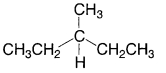
The maximum number of isomers (including stereoisomers) that are possible on monochlorination of the following compound is:
A
$7$
B
$8$
C
$9$
D
$1$
Solution
(B) The given compound is $3$-methylpentane,$CH_3CH_2CH(CH_3)CH_2CH_3$.
Monochlorination can occur at different positions:
$1$. Substitution at the terminal $CH_3$ group (equivalent to $CH_2CH_2Cl$): This creates a chiral center at the $C-3$ position. It forms a pair of enantiomers ($2$ isomers).
$2$. Substitution at the $CH_2$ group: This creates two chiral centers (at $C-2$ and $C-3$). This results in $2^2 = 4$ stereoisomers (two pairs of enantiomers).
$3$. Substitution at the $CH$ group: The resulting product is $3$-chloro-$3$-methylpentane,which is achiral ($1$ isomer).
$4$. Substitution at the $CH_3$ group attached to the $CH$ (i.e.,$CH_2Cl$): This creates a chiral center at the $C-3$ position ($1$ isomer).
Total isomers = $2 + 4 + 1 + 1 = 8$.
Monochlorination can occur at different positions:
$1$. Substitution at the terminal $CH_3$ group (equivalent to $CH_2CH_2Cl$): This creates a chiral center at the $C-3$ position. It forms a pair of enantiomers ($2$ isomers).
$2$. Substitution at the $CH_2$ group: This creates two chiral centers (at $C-2$ and $C-3$). This results in $2^2 = 4$ stereoisomers (two pairs of enantiomers).
$3$. Substitution at the $CH$ group: The resulting product is $3$-chloro-$3$-methylpentane,which is achiral ($1$ isomer).
$4$. Substitution at the $CH_3$ group attached to the $CH$ (i.e.,$CH_2Cl$): This creates a chiral center at the $C-3$ position ($1$ isomer).
Total isomers = $2 + 4 + 1 + 1 = 8$.
0 likesView Solution
23
ChemistryDifficultMCQIIT JEE · 2011
The total number of contributing structures showing hyperconjugation (involving $C-H$ bonds) for the following carbocation is
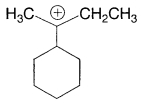
A
$4$
B
$5$
C
$6$
D
$7$
Solution
(C) The carbon atom directly attached to the positively charged carbon is called the $\alpha$-carbon,and the hydrogen atoms attached to these $\alpha$-carbons are called $\alpha$-hydrogens.
In the given carbocation,the central carbocation is attached to:
$1$. $A$ methyl group $(-CH_3)$,which has $3$ $\alpha$-hydrogens.
$2$. An ethyl group $(-CH_2CH_3)$,which has $2$ $\alpha$-hydrogens.
$3$. $A$ cyclohexyl group,which has $1$ $\alpha$-hydrogen (at the bridgehead position attached to the carbocation).
Total number of $\alpha$-hydrogens = $3 + 2 + 1 = 6$.
The number of hyperconjugative structures is equal to the number of $\alpha$-hydrogens,which is $6$.
In the given carbocation,the central carbocation is attached to:
$1$. $A$ methyl group $(-CH_3)$,which has $3$ $\alpha$-hydrogens.
$2$. An ethyl group $(-CH_2CH_3)$,which has $2$ $\alpha$-hydrogens.
$3$. $A$ cyclohexyl group,which has $1$ $\alpha$-hydrogen (at the bridgehead position attached to the carbocation).
Total number of $\alpha$-hydrogens = $3 + 2 + 1 = 6$.
The number of hyperconjugative structures is equal to the number of $\alpha$-hydrogens,which is $6$.
0 likesView Solution
24
ChemistryDifficultMCQIIT JEE · 2011
Match the transformations in column $I$ with appropriate options in column $II$.
| Column $I$ | Column $II$ |
| $A$. $CO_{2(s)} \rightarrow CO_{2(g)}$ | $p$. phase transition |
| $B$. $CaCO_{3(s)} \rightarrow CaO_{(s)} + CO_{2(g)}$ | $q$. allotropic change |
| $C$. $2H_{(g)} \rightarrow H_{2(g)}$ | $r$. $\Delta H$ is positive |
| $D$. $P_{(\text{white, solid})} \rightarrow P_{(\text{red, solid})}$ | $s$. $\Delta S$ is positive |
| $t$. $\Delta S$ is negative |
A
$A$ $\rightarrow p, r, s; B$ $\rightarrow r, s; C$ $\rightarrow t; D$ $\rightarrow p, q, t$
B
$A$ $\rightarrow p, r, t; B$ $\rightarrow p, q; C$ $\rightarrow s; D$ $\rightarrow p, r, s$
C
$A$ $\rightarrow p, q, r; B$ $\rightarrow p, s; C$ $\rightarrow p; D$ $\rightarrow p, q, r$
D
$A$ $\rightarrow r, s, t; B$ $\rightarrow r, t; C$ $\rightarrow r; D$ $\rightarrow p, s, t$
Solution
(A) . $CO_{2(s)} \rightarrow CO_{2(g)}$: This is a phase transition (sublimation). It is endothermic $(\Delta H > 0)$ and the entropy increases $(\Delta S > 0)$. Thus,$A \rightarrow p, r, s$.
$B$. $CaCO_{3(s)} \rightarrow CaO_{(s)} + CO_{2(g)}$: This is a chemical decomposition. It is endothermic $(\Delta H > 0)$ and the entropy increases $(\Delta S > 0)$ due to the formation of gas. Thus,$B \rightarrow r, s$.
$C$. $2H_{(g)} \rightarrow H_{2(g)}$: $A$ chemical bond is formed,which is exothermic $(\Delta H < 0)$. The system becomes more ordered,so entropy decreases $(\Delta S < 0)$. Thus,$C \rightarrow t$.
$D$. $P_{(\text{white, solid})} \rightarrow P_{(\text{red, solid})}$: This is a phase transition and an allotropic change. Red phosphorus is more stable and ordered than white phosphorus,so entropy decreases $(\Delta S < 0)$. Thus,$D \rightarrow p, q, t$.
$B$. $CaCO_{3(s)} \rightarrow CaO_{(s)} + CO_{2(g)}$: This is a chemical decomposition. It is endothermic $(\Delta H > 0)$ and the entropy increases $(\Delta S > 0)$ due to the formation of gas. Thus,$B \rightarrow r, s$.
$C$. $2H_{(g)} \rightarrow H_{2(g)}$: $A$ chemical bond is formed,which is exothermic $(\Delta H < 0)$. The system becomes more ordered,so entropy decreases $(\Delta S < 0)$. Thus,$C \rightarrow t$.
$D$. $P_{(\text{white, solid})} \rightarrow P_{(\text{red, solid})}$: This is a phase transition and an allotropic change. Red phosphorus is more stable and ordered than white phosphorus,so entropy decreases $(\Delta S < 0)$. Thus,$D \rightarrow p, q, t$.
0 likesView Solution
25
ChemistryAdvancedMCQIIT JEE · 2011
Match the reactions in column $I$ with appropriate types of steps/reactive intermediate involved in these reactions as given in column $II$.
| Column $I$ | Column $II$ |
| :--- | :--- |
| $(A)$ $1-$phenylpentane$-1,4-$dione $\xrightarrow{aq. NaOH}$ $3-$phenylcyclopent$-2-$en$-1-$one | $(p)$ Nucleophilic substitution |
| $(B)$ $4-$chloro$-1-$phenylbutan$-1-$one $\xrightarrow{CH_3MgI}$ $2-$methyl$-2-$phenyltetrahydrofuran | $(q)$ Electrophilic substitution |
| $(C)$ $4-$hydroxy$-1-$phenylbutan$-1-$one $\xrightarrow{H_2SO_4}$ $2-$phenyl$-4,5-$dihydrofuran | $(r)$ Dehydration |
| $(D)$ $4-$methyl$-4-$phenylpentan$-1-$ol $\xrightarrow{H_2SO_4}$ $1,1-$dimethyl$-1,2,3,4-$tetrahydronaphthalene | $(s)$ Nucleophilic addition |
| | $(t)$ Carbanion |
| Column $I$ | Column $II$ |
| :--- | :--- |
| $(A)$ $1-$phenylpentane$-1,4-$dione $\xrightarrow{aq. NaOH}$ $3-$phenylcyclopent$-2-$en$-1-$one | $(p)$ Nucleophilic substitution |
| $(B)$ $4-$chloro$-1-$phenylbutan$-1-$one $\xrightarrow{CH_3MgI}$ $2-$methyl$-2-$phenyltetrahydrofuran | $(q)$ Electrophilic substitution |
| $(C)$ $4-$hydroxy$-1-$phenylbutan$-1-$one $\xrightarrow{H_2SO_4}$ $2-$phenyl$-4,5-$dihydrofuran | $(r)$ Dehydration |
| $(D)$ $4-$methyl$-4-$phenylpentan$-1-$ol $\xrightarrow{H_2SO_4}$ $1,1-$dimethyl$-1,2,3,4-$tetrahydronaphthalene | $(s)$ Nucleophilic addition |
| | $(t)$ Carbanion |
A
$A$ $\rightarrow r, s \ and \ t, B$ $\rightarrow p \ and \ s, C$ $\rightarrow r \ and \ s, D$ $\rightarrow q \ and \ r$
B
$A$ $\rightarrow p, s \ and \ t, B$ $\rightarrow p \ and \ r, C$ $\rightarrow p \ and \ q, D$ $\rightarrow p \ and \ s$
C
$A$ $\rightarrow r, q \ and \ t, B$ $\rightarrow p \ and \ t, C$ $\rightarrow r \ and \ s, D$ $\rightarrow q \ and \ t$
D
$A$ $\rightarrow p, q \ and \ t, B$ $\rightarrow q \ and \ r, C$ $\rightarrow p \ and \ s, D$ $\rightarrow p \ and \ t$
Solution
(A) Reaction $(A)$ is an intramolecular aldol condensation. It involves the formation of a carbanion $(t)$,followed by nucleophilic addition $(s)$ to the carbonyl group,and finally dehydration $(r)$ to form the conjugated enone.
Reaction $(B)$ involves the reaction of a Grignard reagent with a ketone,which is a nucleophilic addition $(s)$,followed by an intramolecular nucleophilic substitution $(p)$ by the oxygen atom on the carbon bearing the chlorine atom.
Reaction $(C)$ is an acid-catalyzed intramolecular cyclization (acetal/ether formation),which involves nucleophilic addition $(s)$ of the hydroxyl group to the carbonyl,followed by dehydration $(r)$.
Reaction $(D)$ is an acid-catalyzed cyclization involving the formation of a carbocation,followed by an intramolecular electrophilic substitution $(q)$ on the benzene ring,and dehydration $(r)$ to restore aromaticity.
Thus,the correct matches are: $A \rightarrow r, s, t$; $B \rightarrow p, s$; $C \rightarrow r, s$; $D \rightarrow q, r$. The correct option is $A$.
Reaction $(B)$ involves the reaction of a Grignard reagent with a ketone,which is a nucleophilic addition $(s)$,followed by an intramolecular nucleophilic substitution $(p)$ by the oxygen atom on the carbon bearing the chlorine atom.
Reaction $(C)$ is an acid-catalyzed intramolecular cyclization (acetal/ether formation),which involves nucleophilic addition $(s)$ of the hydroxyl group to the carbonyl,followed by dehydration $(r)$.
Reaction $(D)$ is an acid-catalyzed cyclization involving the formation of a carbocation,followed by an intramolecular electrophilic substitution $(q)$ on the benzene ring,and dehydration $(r)$ to restore aromaticity.
Thus,the correct matches are: $A \rightarrow r, s, t$; $B \rightarrow p, s$; $C \rightarrow r, s$; $D \rightarrow q, r$. The correct option is $A$.
0 likesView Solution
26
ChemistryMCQIIT JEE · 2011
Let $P = \{\theta : \sin \theta - \cos \theta = \sqrt{2} \cos \theta\}$ and $Q = \{\theta : \sin \theta + \cos \theta = \sqrt{2} \sin \theta\}$ be two sets,then:
A
$P \subset Q$ and $Q - P \neq \phi$
B
$Q \not \subset P$
C
$P \not \subset Q$
D
$P = Q$
Solution
(D) For set $P$: $\sin \theta - \cos \theta = \sqrt{2} \cos \theta$
$\Rightarrow \sin \theta = (\sqrt{2} + 1) \cos \theta$
$\Rightarrow \tan \theta = \sqrt{2} + 1$
For set $Q$: $\sin \theta + \cos \theta = \sqrt{2} \sin \theta$
$\Rightarrow \cos \theta = (\sqrt{2} - 1) \sin \theta$
$\Rightarrow \frac{1}{\sqrt{2} - 1} = \tan \theta$
$\Rightarrow \tan \theta = \frac{\sqrt{2} + 1}{(\sqrt{2} - 1)(\sqrt{2} + 1)} = \sqrt{2} + 1$
Since both sets $P$ and $Q$ represent the same set of values for $\theta$ satisfying $\tan \theta = \sqrt{2} + 1$,we have $P = Q$.
$\Rightarrow \sin \theta = (\sqrt{2} + 1) \cos \theta$
$\Rightarrow \tan \theta = \sqrt{2} + 1$
For set $Q$: $\sin \theta + \cos \theta = \sqrt{2} \sin \theta$
$\Rightarrow \cos \theta = (\sqrt{2} - 1) \sin \theta$
$\Rightarrow \frac{1}{\sqrt{2} - 1} = \tan \theta$
$\Rightarrow \tan \theta = \frac{\sqrt{2} + 1}{(\sqrt{2} - 1)(\sqrt{2} + 1)} = \sqrt{2} + 1$
Since both sets $P$ and $Q$ represent the same set of values for $\theta$ satisfying $\tan \theta = \sqrt{2} + 1$,we have $P = Q$.
0 likesView Solution
27
ChemistryMCQIIT JEE · 2011
Let $\overline{a}=\hat{i}+\hat{j}+\hat{k}$,$\overline{b}=\hat{i}-\hat{j}+\hat{k}$ and $\overline{c}=\hat{i}-\hat{j}-\hat{k}$ be three vectors. $A$ vector $\overline{v}$ in the plane of $\overline{a}$ and $\overline{b}$,whose projection on $\overline{c}$ is $\frac{1}{\sqrt{3}}$,is given by
A
$\hat{i}-3 \hat{j}+3 \hat{k}$
B
$-3 \hat{i}-3 \hat{j}-\hat{k}$
C
$3 \hat{i}-\hat{j}+3 \hat{k}$
D
$\hat{i}+3 \hat{j}-3 \hat{k}$
Solution
(C) Given $\overline{a}=\hat{i}+\hat{j}+\hat{k}$,$\overline{b}=\hat{i}-\hat{j}+\hat{k}$ and $\overline{c}=\hat{i}-\hat{j}-\hat{k}$.
Since $\overline{v}$ lies in the plane of $\overline{a}$ and $\overline{b}$,we can write $\overline{v} = m\overline{a} + n\overline{b}$.
$\overline{v} = m(\hat{i}+\hat{j}+\hat{k}) + n(\hat{i}-\hat{j}+\hat{k}) = (m+n)\hat{i} + (m-n)\hat{j} + (m+n)\hat{k} \quad \dots(i)$
The projection of $\overline{v}$ on $\overline{c}$ is given by $\frac{\overline{v} \cdot \overline{c}}{|\overline{c}|} = \frac{1}{\sqrt{3}}$.
$|\overline{c}| = \sqrt{1^2 + (-1)^2 + (-1)^2} = \sqrt{3}$.
So,$\frac{(m+n)(1) + (m-n)(-1) + (m+n)(-1)}{\sqrt{3}} = \frac{1}{\sqrt{3}}$.
$m+n - m+n - m-n = 1 \implies n-m = 1 \implies n = m+1$.
Substituting $n = m+1$ into $(i)$:
$\overline{v} = (m+m+1)\hat{i} + (m-(m+1))\hat{j} + (m+m+1)\hat{k} = (2m+1)\hat{i} - \hat{j} + (2m+1)\hat{k}$.
For $m=1$,$\overline{v} = 3\hat{i} - \hat{j} + 3\hat{k}$,which matches option $C$.
Since $\overline{v}$ lies in the plane of $\overline{a}$ and $\overline{b}$,we can write $\overline{v} = m\overline{a} + n\overline{b}$.
$\overline{v} = m(\hat{i}+\hat{j}+\hat{k}) + n(\hat{i}-\hat{j}+\hat{k}) = (m+n)\hat{i} + (m-n)\hat{j} + (m+n)\hat{k} \quad \dots(i)$
The projection of $\overline{v}$ on $\overline{c}$ is given by $\frac{\overline{v} \cdot \overline{c}}{|\overline{c}|} = \frac{1}{\sqrt{3}}$.
$|\overline{c}| = \sqrt{1^2 + (-1)^2 + (-1)^2} = \sqrt{3}$.
So,$\frac{(m+n)(1) + (m-n)(-1) + (m+n)(-1)}{\sqrt{3}} = \frac{1}{\sqrt{3}}$.
$m+n - m+n - m-n = 1 \implies n-m = 1 \implies n = m+1$.
Substituting $n = m+1$ into $(i)$:
$\overline{v} = (m+m+1)\hat{i} + (m-(m+1))\hat{j} + (m+m+1)\hat{k} = (2m+1)\hat{i} - \hat{j} + (2m+1)\hat{k}$.
For $m=1$,$\overline{v} = 3\hat{i} - \hat{j} + 3\hat{k}$,which matches option $C$.
0 likesView Solution
28
ChemistryDifficultMCQIIT JEE · 2011
Extra pure $N_2$ can be obtained by heating
A
$NH_3$ with $CuO$
B
$NH_4NO_3$
C
$(NH_4)_2Cr_2O_7$
D
$Ba(N_3)_2$
Solution
(D) Very pure nitrogen can be obtained by the thermal decomposition of sodium or barium azide.
$2NaN_3 \xrightarrow{573 \ K} 2Na + 3N_2$
Azide salt of barium can be obtained in the purest form as well as the decomposition product contains solid $Ba$ as a by-product along with gaseous nitrogen,hence no additional step of separation is required.
$Ba(N_3)_2 \xrightarrow{\text{heat}} Ba + 3N_2$
Hence,option $D$ is correct.
$2NaN_3 \xrightarrow{573 \ K} 2Na + 3N_2$
Azide salt of barium can be obtained in the purest form as well as the decomposition product contains solid $Ba$ as a by-product along with gaseous nitrogen,hence no additional step of separation is required.
$Ba(N_3)_2 \xrightarrow{\text{heat}} Ba + 3N_2$
Hence,option $D$ is correct.
0 likesView Solution
29
ChemistryDifficultMCQIIT JEE · 2011
Geometrical shapes of the complexes formed by the reaction of $Ni^{2+}$ with $Cl^{-}$,$CN^{-}$,and $H_2O$,respectively,are
A
octahedral,tetrahedral and square planar
B
tetrahedral,square planar and octahedral
C
square planar,tetrahedral and octahedral
D
octahedral,square planar and octahedral
Solution
(B) $Ni^{2+}$ has a $3d^8$ electronic configuration.
$1$. For $[NiCl_4]^{2-}$,$Cl^{-}$ is a weak field ligand,so it does not cause pairing of electrons. The hybridization is $sp^3$,resulting in a tetrahedral geometry.
$2$. For $[Ni(CN)_4]^{2-}$,$CN^{-}$ is a strong field ligand,which causes pairing of $3d$ electrons. The hybridization is $dsp^2$,resulting in a square planar geometry.
$3$. For $[Ni(H_2O)_6]^{2+}$,$H_2O$ is a ligand that forms an octahedral complex with $Ni^{2+}$ involving $sp^3d^2$ hybridization.
Thus,the shapes are tetrahedral,square planar,and octahedral,respectively. Therefore,option $B$ is correct.
$1$. For $[NiCl_4]^{2-}$,$Cl^{-}$ is a weak field ligand,so it does not cause pairing of electrons. The hybridization is $sp^3$,resulting in a tetrahedral geometry.
$2$. For $[Ni(CN)_4]^{2-}$,$CN^{-}$ is a strong field ligand,which causes pairing of $3d$ electrons. The hybridization is $dsp^2$,resulting in a square planar geometry.
$3$. For $[Ni(H_2O)_6]^{2+}$,$H_2O$ is a ligand that forms an octahedral complex with $Ni^{2+}$ involving $sp^3d^2$ hybridization.
Thus,the shapes are tetrahedral,square planar,and octahedral,respectively. Therefore,option $B$ is correct.
0 likesView Solution
30
ChemistryDifficultMCQIIT JEE · 2011
Bombardment of aluminum by $\alpha$-particle leads to its artificial disintegration in two ways,$(i)$ and $(ii)$ as shown. Products $X,$ $Y$ and $Z$ respectively are,
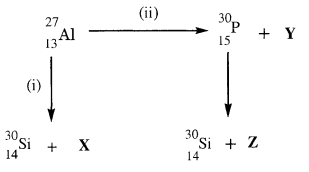
A
proton,neutron,positron
B
neutron,positron,proton
C
proton,positron,neutron
D
positron,proton,neutron
Solution
(A) The reaction for path $(i)$ is: ${ }_{13}^{27} Al +{ }_2^4 \alpha \rightarrow{ }_{14}^{30} Si +{ }_1^1 p (X)$.
Here,$X$ is a proton $({ }_1^1 p)$ because the mass number and atomic number are conserved ($27+4 = 30+1$ and $13+2 = 14+1$).
The reaction for path $(ii)$ is: ${ }_{13}^{27} Al +{ }_2^4 \alpha \rightarrow{ }_{15}^{30} P +{ }_0^1 n (Y)$.
Here,$Y$ is a neutron $({ }_0^1 n)$ because the mass number and atomic number are conserved ($27+4 = 30+1$ and $13+2 = 15+0$).
The subsequent decay of phosphorus is: ${ }_{15}^{30} P \rightarrow{ }_{14}^{30} Si +{ }_{+1}^{0} e (Z)$.
Here,$Z$ is a positron $({ }_{+1}^{0} e)$ because the atomic number decreases by $1$.
Therefore,$X$ is proton,$Y$ is neutron,and $Z$ is positron.
Thus,the correct option is $A$.
Here,$X$ is a proton $({ }_1^1 p)$ because the mass number and atomic number are conserved ($27+4 = 30+1$ and $13+2 = 14+1$).
The reaction for path $(ii)$ is: ${ }_{13}^{27} Al +{ }_2^4 \alpha \rightarrow{ }_{15}^{30} P +{ }_0^1 n (Y)$.
Here,$Y$ is a neutron $({ }_0^1 n)$ because the mass number and atomic number are conserved ($27+4 = 30+1$ and $13+2 = 15+0$).
The subsequent decay of phosphorus is: ${ }_{15}^{30} P \rightarrow{ }_{14}^{30} Si +{ }_{+1}^{0} e (Z)$.
Here,$Z$ is a positron $({ }_{+1}^{0} e)$ because the atomic number decreases by $1$.
Therefore,$X$ is proton,$Y$ is neutron,and $Z$ is positron.
Thus,the correct option is $A$.
0 likesView Solution
31
ChemistryDifficultMCQIIT JEE · 2011
Dissolving $120 \ g$ of urea (mol. wt. $60$) in $1000 \ g$ of water gave a solution of density $1.15 \ g / mL$. The molarity of the solution is (in $M$)
A
$1.78$
B
$2.00$
C
$2.05$
D
$2.22$
Solution
(C) Molarity is defined as the number of moles of solute dissolved in per litre of solution.
Molarity,$M = \frac{n}{V}$
$n =$ number of moles of solute = mass $/$ molar mass
$V =$ volume of solution
Mass of urea = $120 \ g$
Molar mass of urea = $60 \ g / mol$
Mass of water = $1000 \ g$
Density of solution,$\rho = 1.15 \ g / mL$
$n = \frac{120}{60} = 2 \ mol$
Total mass of solution = $m_{solute} + m_{solvent} = 120 \ g + 1000 \ g = 1120 \ g$
Volume of solution,$V = \frac{\text{mass}}{\text{density}} = \frac{1120 \ g}{1.15 \ g / mL} \approx 973.91 \ mL = 0.97391 \ L$
Molarity,$M = \frac{n}{V} = \frac{2 \ mol}{0.97391 \ L} \approx 2.05 \ M$
Hence,the correct option is $C$.
Molarity,$M = \frac{n}{V}$
$n =$ number of moles of solute = mass $/$ molar mass
$V =$ volume of solution
Mass of urea = $120 \ g$
Molar mass of urea = $60 \ g / mol$
Mass of water = $1000 \ g$
Density of solution,$\rho = 1.15 \ g / mL$
$n = \frac{120}{60} = 2 \ mol$
Total mass of solution = $m_{solute} + m_{solvent} = 120 \ g + 1000 \ g = 1120 \ g$
Volume of solution,$V = \frac{\text{mass}}{\text{density}} = \frac{1120 \ g}{1.15 \ g / mL} \approx 973.91 \ mL = 0.97391 \ L$
Molarity,$M = \frac{n}{V} = \frac{2 \ mol}{0.97391 \ L} \approx 2.05 \ M$
Hence,the correct option is $C$.
0 likesView Solution
32
ChemistryDifficultMCQIIT JEE · 2011
$AgNO_3$ (aq.) was added to an aqueous $KCl$ solution gradually and the conductivity of the solution was measured. The plot of conductance ( $\Lambda$ ) versus the volume of $AgNO_3$ is
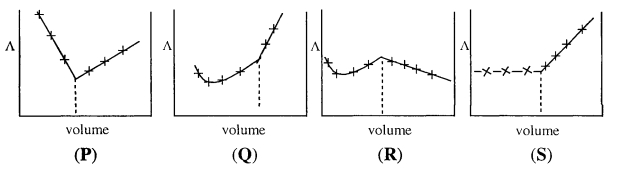
A
$(P)$
B
$(Q)$
C
$(R)$
D
$(S)$
Solution
(A) The reaction between $AgNO_3$ and $KCl$ is: $Ag^+(aq) + NO_3^-(aq) + K^+(aq) + Cl^-(aq) \rightarrow AgCl(s) + K^+(aq) + NO_3^-(aq)$.
Initially,the solution contains $K^+$ and $Cl^-$ ions. As $AgNO_3$ is added,$Ag^+$ ions react with $Cl^-$ ions to form $AgCl$ precipitate.
Since $AgCl$ is insoluble,the $Cl^-$ ions are replaced by $NO_3^-$ ions in the solution.
The ionic mobility of $Cl^-$ is higher than that of $NO_3^-$,so the conductance of the solution decreases until the equivalence point is reached.
After the equivalence point,adding more $AgNO_3$ increases the concentration of $Ag^+$ and $NO_3^-$ ions in the solution,which leads to an increase in the conductance.
Therefore,the graph shows a decrease followed by an increase,which corresponds to plot $(P)$.
Initially,the solution contains $K^+$ and $Cl^-$ ions. As $AgNO_3$ is added,$Ag^+$ ions react with $Cl^-$ ions to form $AgCl$ precipitate.
Since $AgCl$ is insoluble,the $Cl^-$ ions are replaced by $NO_3^-$ ions in the solution.
The ionic mobility of $Cl^-$ is higher than that of $NO_3^-$,so the conductance of the solution decreases until the equivalence point is reached.
After the equivalence point,adding more $AgNO_3$ increases the concentration of $Ag^+$ and $NO_3^-$ ions in the solution,which leads to an increase in the conductance.
Therefore,the graph shows a decrease followed by an increase,which corresponds to plot $(P)$.
0 likesView Solution
33
ChemistryDifficultMCQIIT JEE · 2011
Among the following compounds,the most acidic is
A
$p$-nitrophenol
B
$p$-hydroxybenzoic acid
C
$o$-hydroxybenzoic acid
D
$p$-toluic acid
Solution
(C) The acidity of carboxylic acids is significantly influenced by substituents on the benzene ring.
$o$-hydroxybenzoic acid (salicylic acid) exhibits the ortho-effect,where the proximity of the hydroxyl group to the carboxyl group stabilizes the conjugate base through intramolecular hydrogen bonding and steric factors,making it more acidic than the other options provided.
$o$-hydroxybenzoic acid (salicylic acid) exhibits the ortho-effect,where the proximity of the hydroxyl group to the carboxyl group stabilizes the conjugate base through intramolecular hydrogen bonding and steric factors,making it more acidic than the other options provided.
0 likesView Solution
34
ChemistryDifficultMCQIIT JEE · 2011
The major product of the following reaction is:
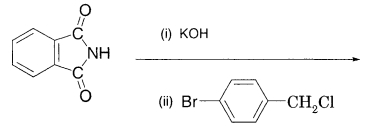
A
$N$-($4$-bromobenzyl)phthalimide
B
$N$-($4$-chloromethylphenyl)phthalimide
C
$2-$($4$-bromobenzyloxy)isoindole
D
$2-$($4$-chloromethylphenoxy)isoindole
Solution
(A) The reaction shown is the first step of the Gabriel phthalimide synthesis.
Phthalimide reacts with $KOH$ to form potassium phthalimide,which acts as a nucleophile.
This nucleophile then undergoes an $S_N2$ reaction with the alkyl halide,$4-bromobenzyl chloride$ $(Br-C_6H_4-CH_2Cl)$.
In $S_N2$ reactions,the nucleophile attacks the carbon atom attached to the leaving group.
Since the $CH_2Cl$ group is more reactive towards $S_N2$ than the aryl bromide ($C-Br$ bond),the nitrogen of the phthalimide attacks the $CH_2$ carbon,displacing the $Cl^-$ ion.
Therefore,the product is $N-(4-bromobenzyl)phthalimide$.
Phthalimide reacts with $KOH$ to form potassium phthalimide,which acts as a nucleophile.
This nucleophile then undergoes an $S_N2$ reaction with the alkyl halide,$4-bromobenzyl chloride$ $(Br-C_6H_4-CH_2Cl)$.
In $S_N2$ reactions,the nucleophile attacks the carbon atom attached to the leaving group.
Since the $CH_2Cl$ group is more reactive towards $S_N2$ than the aryl bromide ($C-Br$ bond),the nitrogen of the phthalimide attacks the $CH_2$ carbon,displacing the $Cl^-$ ion.
Therefore,the product is $N-(4-bromobenzyl)phthalimide$.
0 likesView Solution
35
ChemistryDifficultMCQIIT JEE · 2011
Extraction of metal from the ore cassiterite involves
A
$A, D$
B
$A, B$
C
$B, D$
D
$C, D$
Solution
(A) The ore cassiterite is $SnO_{2}$.
$1$. The extraction involves the reduction of the oxide ore $SnO_{2}$ using carbon (smelting): $SnO_{2} + 2C \rightarrow Sn + 2CO$.
$2$. Cassiterite often contains iron as an impurity in the form of $FeWO_{4}$ (ferberite) or other iron oxides. This is removed by magnetic separation or by converting it into slag during the smelting process.
Therefore,the process involves carbon reduction of an oxide ore and the removal of iron impurity.
$1$. The extraction involves the reduction of the oxide ore $SnO_{2}$ using carbon (smelting): $SnO_{2} + 2C \rightarrow Sn + 2CO$.
$2$. Cassiterite often contains iron as an impurity in the form of $FeWO_{4}$ (ferberite) or other iron oxides. This is removed by magnetic separation or by converting it into slag during the smelting process.
Therefore,the process involves carbon reduction of an oxide ore and the removal of iron impurity.
0 likesView Solution
36
ChemistryDifficultMCQIIT JEE · 2011
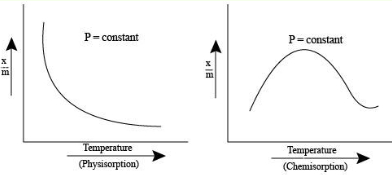
The correct statement$(s)$ pertaining to the adsorption of a gas on a solid surface is (are):
$(A)$ Adsorption is always exothermic.
$(B)$ Physisorption may transform into chemisorption at high temperature.
$(C)$ Physisorption increases with increasing temperature but chemisorption decreases with increasing temperature.
$(D)$ Chemisorption is more exothermic than physisorption,however it is very slow due to higher energy of activation.
$(A)$ Adsorption is always exothermic.
$(B)$ Physisorption may transform into chemisorption at high temperature.
$(C)$ Physisorption increases with increasing temperature but chemisorption decreases with increasing temperature.
$(D)$ Chemisorption is more exothermic than physisorption,however it is very slow due to higher energy of activation.
A
$(A, B, C)$
B
$(A, B, D)$
C
$(A, C, D)$
D
$(B, C, D)$
Solution
(B) Adsorption is always exothermic because it involves the release of energy as surface forces are satisfied.
$(B)$ Physisorption is reversible and weak,but at higher temperatures,it can provide enough activation energy for chemical bond formation,transforming into chemisorption.
$(C)$ This statement is incorrect. Physisorption decreases with an increase in temperature. Chemisorption initially increases with temperature (due to activation energy) and then decreases at very high temperatures.
$(D)$ Chemisorption involves chemical bond formation,which releases more energy than the weak van der Waals forces in physisorption. It is slow because it requires a significant activation energy.
$(B)$ Physisorption is reversible and weak,but at higher temperatures,it can provide enough activation energy for chemical bond formation,transforming into chemisorption.
$(C)$ This statement is incorrect. Physisorption decreases with an increase in temperature. Chemisorption initially increases with temperature (due to activation energy) and then decreases at very high temperatures.
$(D)$ Chemisorption involves chemical bond formation,which releases more energy than the weak van der Waals forces in physisorption. It is slow because it requires a significant activation energy.
0 likesView Solution
37
ChemistryAdvancedMCQIIT JEE · 2011
When a metal rod $M$ is dipped into an aqueous colourless concentrated solution of compound $N$,the solution turns light blue. Addition of aqueous $NaCl$ to the blue solution gives a white precipitate $O$. Addition of aqueous $NH_3$ dissolves $O$ and gives an intense blue solution.
$1.$ The metal rod $M$ is
$(A)$ $Fe$ $(B)$ $Cu$ $(C)$ $Ni$ $(D)$ $Co$
$2.$ The compound $N$ is
$(A)$ $AgNO_3$ $(B)$ $Zn(NO_3)_2$
$(C)$ $Al(NO_3)_3$ $(D)$ $Pb(NO_3)_2$
$3.$ The final solution contains
$(A)$ $[Pb(NH_3)_4]^{2+}$ and $[CoCl_4]^{2-}$
$(B)$ $[Al(NH_3)_4]^{3+}$ and $[Cu(NH_3)_4]^{2+}$
$(C)$ $[Ag(NH_3)_2]^{+}$ and $[Cu(NH_3)_4]^{2+}$
$(D)$ $[Ag(NH_3)_2]^{+}$ and $[Ni(NH_3)_6]^{2+}$
Give the answer for questions $1$,$2$ and $3$.
$1.$ The metal rod $M$ is
$(A)$ $Fe$ $(B)$ $Cu$ $(C)$ $Ni$ $(D)$ $Co$
$2.$ The compound $N$ is
$(A)$ $AgNO_3$ $(B)$ $Zn(NO_3)_2$
$(C)$ $Al(NO_3)_3$ $(D)$ $Pb(NO_3)_2$
$3.$ The final solution contains
$(A)$ $[Pb(NH_3)_4]^{2+}$ and $[CoCl_4]^{2-}$
$(B)$ $[Al(NH_3)_4]^{3+}$ and $[Cu(NH_3)_4]^{2+}$
$(C)$ $[Ag(NH_3)_2]^{+}$ and $[Cu(NH_3)_4]^{2+}$
$(D)$ $[Ag(NH_3)_2]^{+}$ and $[Ni(NH_3)_6]^{2+}$
Give the answer for questions $1$,$2$ and $3$.
A
$(B, A, C)$
B
$(A, B, C)$
C
$(A, B, D)$
D
$(B, C, D)$
Solution
(A) $1.$ When $Cu$ rod $(M)$ is dipped in $AgNO_3$ $(N)$,$Cu$ displaces $Ag^+$ ions: $Cu(s) + 2Ag^+(aq) \rightarrow Cu^{2+}(aq) + 2Ag(s)$. The formation of $Cu^{2+}$ turns the solution light blue.
$2.$ Addition of $NaCl$ to the solution results in the precipitation of $AgCl$ $(O)$: $Ag^+(aq) + Cl^-(aq) \rightarrow AgCl(s)$ (white precipitate).
$3.$ Addition of excess $NH_3$ dissolves the $AgCl$ precipitate by forming a soluble complex: $AgCl(s) + 2NH_3(aq) \rightarrow [Ag(NH_3)_2]^+(aq) + Cl^-(aq)$. Simultaneously,$Cu^{2+}$ ions react with $NH_3$ to form an intense blue complex: $Cu^{2+}(aq) + 4NH_3(aq) \rightarrow [Cu(NH_3)_4]^{2+}(aq)$.
Thus,$M = Cu$,$N = AgNO_3$,and the final solution contains $[Ag(NH_3)_2]^+$ and $[Cu(NH_3)_4]^{2+}$. The correct option is $(A)$.
$2.$ Addition of $NaCl$ to the solution results in the precipitation of $AgCl$ $(O)$: $Ag^+(aq) + Cl^-(aq) \rightarrow AgCl(s)$ (white precipitate).
$3.$ Addition of excess $NH_3$ dissolves the $AgCl$ precipitate by forming a soluble complex: $AgCl(s) + 2NH_3(aq) \rightarrow [Ag(NH_3)_2]^+(aq) + Cl^-(aq)$. Simultaneously,$Cu^{2+}$ ions react with $NH_3$ to form an intense blue complex: $Cu^{2+}(aq) + 4NH_3(aq) \rightarrow [Cu(NH_3)_4]^{2+}(aq)$.
Thus,$M = Cu$,$N = AgNO_3$,and the final solution contains $[Ag(NH_3)_2]^+$ and $[Cu(NH_3)_4]^{2+}$. The correct option is $(A)$.
0 likesView Solution
38
ChemistryDifficultMCQIIT JEE · 2011
$A$ decapeptide (Mol. Wt. $796$) on complete hydrolysis gives glycine (Mol. Wt. $75$),alanine,and phenylalanine. Glycine contributes $47.0 \%$ to the total weight of the hydrolysed products. The number of glycine units present in the decapeptide is
A
$4$
B
$5$
C
$6$
D
$7$
Solution
(C) Molecular weight of decapeptide $= 796 \ g/mol$.
$A$ decapeptide contains $10$ amino acid units,so it has $(10-1) = 9$ peptide bonds.
Upon complete hydrolysis,$9$ molecules of water are added.
Total weight of water added $= 9 \times 18 \ g/mol = 162 \ g/mol$.
Total weight of hydrolysis products $= 796 + 162 = 958 \ g$.
Total weight of glycine in the product $= \frac{47.0}{100} \times 958 \ g = 450.26 \ g \approx 450 \ g$.
Molecular weight of glycine $= 75 \ g/mol$.
Number of glycine units $= \frac{450 \ g}{75 \ g/mol} = 6$.
$A$ decapeptide contains $10$ amino acid units,so it has $(10-1) = 9$ peptide bonds.
Upon complete hydrolysis,$9$ molecules of water are added.
Total weight of water added $= 9 \times 18 \ g/mol = 162 \ g/mol$.
Total weight of hydrolysis products $= 796 + 162 = 958 \ g$.
Total weight of glycine in the product $= \frac{47.0}{100} \times 958 \ g = 450.26 \ g \approx 450 \ g$.
Molecular weight of glycine $= 75 \ g/mol$.
Number of glycine units $= \frac{450 \ g}{75 \ g/mol} = 6$.
0 likesView Solution
39
ChemistryDifficultMCQIIT JEE · 2011
Oxidation states of the metal in the minerals haematite and magnetite,respectively,are
A
$II, III$ in haematite and $III$ in magnetite
B
$II, III$ in haematite and $II$ in magnetite
C
$II$ in haematite and $II, III$ in magnetite
D
$III$ in haematite and $II, III$ in magnetite
Solution
(D) Haematite is $Fe_2O_3$,where the oxidation state of iron is $+3$.
Magnetite is $Fe_3O_4$,which is a mixed oxide represented as $FeO \cdot Fe_2O_3$.
In $FeO$,the oxidation state of iron is $+2$,and in $Fe_2O_3$,it is $+3$.
Therefore,the oxidation states of iron in haematite and magnetite are $III$ and $II, III$ respectively.
Magnetite is $Fe_3O_4$,which is a mixed oxide represented as $FeO \cdot Fe_2O_3$.
In $FeO$,the oxidation state of iron is $+2$,and in $Fe_2O_3$,it is $+3$.
Therefore,the oxidation states of iron in haematite and magnetite are $III$ and $II, III$ respectively.
0 likesView Solution
40
ChemistryDifficultMCQIIT JEE · 2011
Among the following complexes $(K-P)$,
$K_3[Fe(CN)_6]$ $(K)$,$[Co(NH_3)_6]Cl_3$ $(L)$,$Na_3[Co(ox)_3]$ $(M)$,$[Ni(H_2O)_6]Cl_2$ $(N)$,$K_2[Pt(CN)_4]$ $(O)$ and $[Zn(H_2O)_6](NO_3)_2$ $(P)$,the diamagnetic complexes are
$K_3[Fe(CN)_6]$ $(K)$,$[Co(NH_3)_6]Cl_3$ $(L)$,$Na_3[Co(ox)_3]$ $(M)$,$[Ni(H_2O)_6]Cl_2$ $(N)$,$K_2[Pt(CN)_4]$ $(O)$ and $[Zn(H_2O)_6](NO_3)_2$ $(P)$,the diamagnetic complexes are
A
$K, L, M, N$
B
$K, M, O, P$
C
$L, M, O, P$
D
$L, M, N, O$
Solution
(C) $K \Rightarrow K_3[Fe(CN)_6], Fe^{3+} = 3d^5$ (has $5$ unpaired electrons). It is paramagnetic.
$L \Rightarrow [Co(NH_3)_6]Cl_3, Co^{3+} = 3d^6$. $NH_3$ is a strong field ligand,causing pairing. It is diamagnetic.
$M \Rightarrow Na_3[Co(ox)_3], Co^{3+} = 3d^6$. Oxalate $(ox^{2-})$ acts as a strong field ligand with $Co^{3+}$,causing pairing. It is diamagnetic.
$N \Rightarrow [Ni(H_2O)_6]Cl_2, Ni^{2+} = 3d^8$ (has $2$ unpaired electrons). It is paramagnetic.
$O \Rightarrow K_2[Pt(CN)_4], Pt^{2+} = 5d^8$. $CN^{-}$ is a strong field ligand and $5d$ orbitals have large splitting. It is diamagnetic.
$P \Rightarrow [Zn(H_2O)_6](NO_3)_2, Zn^{2+} = 3d^{10}$. All electrons are paired. It is diamagnetic.
Therefore,the diamagnetic complexes are $L, M, O, P$.
$L \Rightarrow [Co(NH_3)_6]Cl_3, Co^{3+} = 3d^6$. $NH_3$ is a strong field ligand,causing pairing. It is diamagnetic.
$M \Rightarrow Na_3[Co(ox)_3], Co^{3+} = 3d^6$. Oxalate $(ox^{2-})$ acts as a strong field ligand with $Co^{3+}$,causing pairing. It is diamagnetic.
$N \Rightarrow [Ni(H_2O)_6]Cl_2, Ni^{2+} = 3d^8$ (has $2$ unpaired electrons). It is paramagnetic.
$O \Rightarrow K_2[Pt(CN)_4], Pt^{2+} = 5d^8$. $CN^{-}$ is a strong field ligand and $5d$ orbitals have large splitting. It is diamagnetic.
$P \Rightarrow [Zn(H_2O)_6](NO_3)_2, Zn^{2+} = 3d^{10}$. All electrons are paired. It is diamagnetic.
Therefore,the diamagnetic complexes are $L, M, O, P$.
0 likesView Solution
41
ChemistryDifficultMCQIIT JEE · 2011
Passing $H_2S$ gas into a mixture of $Mn^{2+}$,$Ni^{2+}$,$Cu^{2+}$ and $Hg^{2+}$ ions in an acidified aqueous solution precipitates
A
$CuS$ and $HgS$
B
$MnS$ and $CuS$
C
$MnS$ and $NiS$
D
$NiS$ and $HgS$
Solution
(A) In an acidified aqueous solution,the concentration of $S^{2-}$ ions is very low due to the common ion effect of $H^+$ ions from the acid.
Only the sulphides of Group $II$ cations,such as $Cu^{2+}$ and $Hg^{2+}$,have a sufficiently low solubility product $(K_{sp})$ to precipitate under these conditions.
The sulphides of $Mn^{2+}$ and $Ni^{2+}$ (Group $III$ and $IV$ cations) have higher $K_{sp}$ values and remain in the solution.
Therefore,$CuS$ and $HgS$ are precipitated.
Hence,the correct option is $A$.
Only the sulphides of Group $II$ cations,such as $Cu^{2+}$ and $Hg^{2+}$,have a sufficiently low solubility product $(K_{sp})$ to precipitate under these conditions.
The sulphides of $Mn^{2+}$ and $Ni^{2+}$ (Group $III$ and $IV$ cations) have higher $K_{sp}$ values and remain in the solution.
Therefore,$CuS$ and $HgS$ are precipitated.
Hence,the correct option is $A$.
0 likesView Solution
42
ChemistryDifficultMCQIIT JEE · 2011
Consider the following cell reaction:
$2 Fe_{(s)} + O_{2_{(g)}} + 4 H_{(aq)}^{+} \rightarrow 2 Fe_{(aq)}^{2+} + 2 H_2O_{(l)} \quad E^{\circ} = 1.67 \ V$. At $[Fe^{2+}] = 10^{-3} \ M, P(O_2) = 0.1 \ atm$ and $pH = 3$,the cell potential at $25^{\circ} C$ is (in $V$)
$2 Fe_{(s)} + O_{2_{(g)}} + 4 H_{(aq)}^{+} \rightarrow 2 Fe_{(aq)}^{2+} + 2 H_2O_{(l)} \quad E^{\circ} = 1.67 \ V$. At $[Fe^{2+}] = 10^{-3} \ M, P(O_2) = 0.1 \ atm$ and $pH = 3$,the cell potential at $25^{\circ} C$ is (in $V$)
A
$1.47$
B
$1.77$
C
$1.87$
D
$1.57$
Solution
(D) The Nernst equation for the given cell reaction is:
$E_{cell} = E^{\circ}_{cell} - \frac{0.0591}{n} \log Q$
Here,$n = 4$ (number of electrons transferred).
The reaction quotient $Q$ is given by:
$Q = \frac{[Fe^{2+}]^2}{P(O_2) \times [H^+]^4}$
Given $[Fe^{2+}] = 10^{-3} \ M$,$P(O_2) = 0.1 \ atm$,and $pH = 3$,so $[H^+] = 10^{-3} \ M$.
$Q = \frac{(10^{-3})^2}{0.1 \times (10^{-3})^4} = \frac{10^{-6}}{0.1 \times 10^{-12}} = \frac{10^{-6}}{10^{-13}} = 10^7$
Now,substitute the values into the Nernst equation:
$E_{cell} = 1.67 - \frac{0.0591}{4} \log(10^7)$
$E_{cell} = 1.67 - \frac{0.0591 \times 7}{4}$
$E_{cell} = 1.67 - 0.1034 \approx 1.57 \ V$
$E_{cell} = E^{\circ}_{cell} - \frac{0.0591}{n} \log Q$
Here,$n = 4$ (number of electrons transferred).
The reaction quotient $Q$ is given by:
$Q = \frac{[Fe^{2+}]^2}{P(O_2) \times [H^+]^4}$
Given $[Fe^{2+}] = 10^{-3} \ M$,$P(O_2) = 0.1 \ atm$,and $pH = 3$,so $[H^+] = 10^{-3} \ M$.
$Q = \frac{(10^{-3})^2}{0.1 \times (10^{-3})^4} = \frac{10^{-6}}{0.1 \times 10^{-12}} = \frac{10^{-6}}{10^{-13}} = 10^7$
Now,substitute the values into the Nernst equation:
$E_{cell} = 1.67 - \frac{0.0591}{4} \log(10^7)$
$E_{cell} = 1.67 - \frac{0.0591 \times 7}{4}$
$E_{cell} = 1.67 - 0.1034 \approx 1.57 \ V$
0 likesView Solution
43
ChemistryDifficultMCQIIT JEE · 2011
The freezing point (in ${}^{\circ}C$) of a solution containing $0.1 \ g$ of $K_3[Fe(CN)_6]$ (Mol. Wt. $329$) in $100 \ g$ of water $(K_f = 1.86 \ K \ kg \ mol^{-1})$ is
A
$-2.3 \times 10^{-2}$
B
$-5.7 \times 10^{-2}$
C
$-5.7 \times 10^{-3}$
D
$-1.2 \times 10^{-2}$
Solution
(A) The dissociation of $K_3[Fe(CN)_6]$ is given by: $K_3[Fe(CN)_6] \rightarrow 3K^{+} + [Fe(CN)_6]^{3-}$.
Since $1 \ mol$ of $K_3[Fe(CN)_6]$ produces $4 \ mol$ of ions,the van't Hoff factor $i = 4$.
The formula for depression in freezing point is $\Delta T_f = i \times K_f \times m$.
Here,molality $m = \frac{w_2 \times 1000}{M_2 \times w_1} = \frac{0.1 \times 1000}{329 \times 100} = \frac{1}{329} \ mol \ kg^{-1}$.
$\Delta T_f = 4 \times 1.86 \times \frac{1}{329} \approx 0.0226 \ K \approx 0.023 \ K$.
Since the freezing point of pure water is $0 \ {}^{\circ}C$,the freezing point of the solution is $T_f = 0 - \Delta T_f = -0.023 \ {}^{\circ}C = -2.3 \times 10^{-2} \ {}^{\circ}C$.
Since $1 \ mol$ of $K_3[Fe(CN)_6]$ produces $4 \ mol$ of ions,the van't Hoff factor $i = 4$.
The formula for depression in freezing point is $\Delta T_f = i \times K_f \times m$.
Here,molality $m = \frac{w_2 \times 1000}{M_2 \times w_1} = \frac{0.1 \times 1000}{329 \times 100} = \frac{1}{329} \ mol \ kg^{-1}$.
$\Delta T_f = 4 \times 1.86 \times \frac{1}{329} \approx 0.0226 \ K \approx 0.023 \ K$.
Since the freezing point of pure water is $0 \ {}^{\circ}C$,the freezing point of the solution is $T_f = 0 - \Delta T_f = -0.023 \ {}^{\circ}C = -2.3 \times 10^{-2} \ {}^{\circ}C$.
0 likesView Solution
44
ChemistryDifficultMCQIIT JEE · 2011
Amongst the compounds given,the one that would form a brilliant colored dye on treatment with $NaNO_2$ in dil. $HCl$ followed by addition to an alkaline solution of $\beta$-naphthol is
A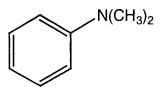
B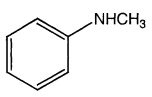
C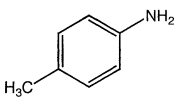
D
Solution
(C) The reaction described is the azo coupling reaction,which is characteristic of primary aromatic amines.
Primary aromatic amines react with $NaNO_2$ and $HCl$ at $0-5 \ ^{\circ}C$ to form stable diazonium salts.
These diazonium salts then undergo electrophilic substitution (coupling) with electron-rich aromatic compounds like $\beta$-naphthol in an alkaline medium to form intensely colored azo dyes.
Among the given options:
$A$ is $N,N$-dimethylaniline (tertiary aromatic amine).
$B$ is $N$-methylaniline (secondary aromatic amine).
$C$ is $p$-toluidine (primary aromatic amine).
$D$ is benzylamine (primary aliphatic amine,which forms an unstable diazonium salt that decomposes to form alcohols).
Thus,$p$-toluidine $(C)$ is the correct compound that forms a stable diazonium salt and subsequently an azo dye.
Primary aromatic amines react with $NaNO_2$ and $HCl$ at $0-5 \ ^{\circ}C$ to form stable diazonium salts.
These diazonium salts then undergo electrophilic substitution (coupling) with electron-rich aromatic compounds like $\beta$-naphthol in an alkaline medium to form intensely colored azo dyes.
Among the given options:
$A$ is $N,N$-dimethylaniline (tertiary aromatic amine).
$B$ is $N$-methylaniline (secondary aromatic amine).
$C$ is $p$-toluidine (primary aromatic amine).
$D$ is benzylamine (primary aliphatic amine,which forms an unstable diazonium salt that decomposes to form alcohols).
Thus,$p$-toluidine $(C)$ is the correct compound that forms a stable diazonium salt and subsequently an azo dye.
0 likesView Solution
45
ChemistryDifficultMCQIIT JEE · 2011
The major product of the following reaction is
A
a hemiacetal
B
an acetal
C
an ether
D
an ester
Solution
(B) The reaction involves the acid-catalyzed addition of an alcohol $(RCH_2OH)$ to the double bond of $3,4-dihydro-2H-pyran$.
This reaction proceeds through the formation of a resonance-stabilized oxocarbenium ion intermediate.
The alcohol acts as a nucleophile and attacks the electrophilic carbon of the oxocarbenium ion.
After the loss of a proton $(H^+)$,the final product formed is a tetrahydropyranyl ether.
Since the product contains an alkoxy group attached to a carbon atom that is also bonded to another oxygen atom (part of the ring),it is classified as an acetal (specifically,a cyclic acetal).
This reaction proceeds through the formation of a resonance-stabilized oxocarbenium ion intermediate.
The alcohol acts as a nucleophile and attacks the electrophilic carbon of the oxocarbenium ion.
After the loss of a proton $(H^+)$,the final product formed is a tetrahydropyranyl ether.
Since the product contains an alkoxy group attached to a carbon atom that is also bonded to another oxygen atom (part of the ring),it is classified as an acetal (specifically,a cyclic acetal).
0 likesView Solution
46
ChemistryDifficultMCQIIT JEE · 2011
The following carbohydrate is
A
a ketohexose
B
an aldohexose
C
an $\alpha$-furanose
D
an $\alpha$-pyranose
Solution
(B) The given structure is a six-membered pyranose ring.
At the anomeric carbon $(C1)$,the $-OH$ group is in the equatorial (up) position,which identifies it as the $\beta$-anomer.
Since the substituent at the anomeric carbon is a hydrogen atom $(-H)$ rather than a hydroxymethyl group $(-CH_2OH)$,it is an aldohexose (specifically $\beta$-$D$-glucopyranose).
Therefore,the correct option is $B$.
At the anomeric carbon $(C1)$,the $-OH$ group is in the equatorial (up) position,which identifies it as the $\beta$-anomer.
Since the substituent at the anomeric carbon is a hydrogen atom $(-H)$ rather than a hydroxymethyl group $(-CH_2OH)$,it is an aldohexose (specifically $\beta$-$D$-glucopyranose).
Therefore,the correct option is $B$.
0 likesView Solution
47
ChemistryDifficultMCQIIT JEE · 2011
For the first order reaction $2 N_2O_{5(g)} \rightarrow 4 NO_{2(g)} + O_{2(g)}$,which of the following statements are correct?
$A.$ The concentration of the reactant decreases exponentially with time.
$B.$ The half-life of the reaction decreases with increasing temperature.
$C.$ The half-life of the reaction depends on the initial concentration of the reactant.
$D.$ The reaction proceeds to $99.6 \%$ completion in eight half-life durations.
$A.$ The concentration of the reactant decreases exponentially with time.
$B.$ The half-life of the reaction decreases with increasing temperature.
$C.$ The half-life of the reaction depends on the initial concentration of the reactant.
$D.$ The reaction proceeds to $99.6 \%$ completion in eight half-life durations.
A
$A, B, D$
B
$A, B, C$
C
$A, C, D$
D
$B, C, D$
Solution
(A) For a first-order reaction,the concentration at time $t$ is given by $C_t = C_0 e^{-kt}$,which shows exponential decay. Thus,statement $A$ is correct.
The half-life is $t_{1/2} = \frac{\ln 2}{k}$. Since the rate constant $k$ increases with temperature according to the Arrhenius equation,$t_{1/2}$ decreases as temperature increases. Thus,statement $B$ is correct.
For a first-order reaction,$t_{1/2} = \frac{0.693}{k}$,which is independent of the initial concentration $C_0$. Thus,statement $C$ is incorrect.
After $n$ half-lives,the remaining reactant is $C_t = \frac{C_0}{2^n}$. For $n = 8$,$C_t = \frac{C_0}{2^8} = \frac{C_0}{256}$.
Percentage completion = $\frac{C_0 - C_t}{C_0} \times 100 = \frac{C_0 - \frac{C_0}{256}}{C_0} \times 100 = (1 - \frac{1}{256}) \times 100 \approx 99.6 \%$. Thus,statement $D$ is correct.
Therefore,statements $A, B,$ and $D$ are correct.
The half-life is $t_{1/2} = \frac{\ln 2}{k}$. Since the rate constant $k$ increases with temperature according to the Arrhenius equation,$t_{1/2}$ decreases as temperature increases. Thus,statement $B$ is correct.
For a first-order reaction,$t_{1/2} = \frac{0.693}{k}$,which is independent of the initial concentration $C_0$. Thus,statement $C$ is incorrect.
After $n$ half-lives,the remaining reactant is $C_t = \frac{C_0}{2^n}$. For $n = 8$,$C_t = \frac{C_0}{2^8} = \frac{C_0}{256}$.
Percentage completion = $\frac{C_0 - C_t}{C_0} \times 100 = \frac{C_0 - \frac{C_0}{256}}{C_0} \times 100 = (1 - \frac{1}{256}) \times 100 \approx 99.6 \%$. Thus,statement $D$ is correct.
Therefore,statements $A, B,$ and $D$ are correct.
0 likesView Solution
48
ChemistryDifficultMCQIIT JEE · 2011
The correct functional group $X$ and the reagent/reaction conditions $Y$ in the following scheme are:
$X-(CH_2)_4-X \xrightarrow{Y} \text{condensation polymer}$
$(i) \text{ with } HOOC-(CH_2)_4-COOH / \text{heat}$
$(A) X = COOCH_3, Y = H_2 / Ni / \text{heat}$
$(B) X = CONH_2, Y = H_2 / Ni / \text{heat}$
$(C) X = CONH_2, Y = Br_2 / NaOH$
$(D) X = CN, Y = H_2 / Ni / \text{heat}$
$X-(CH_2)_4-X \xrightarrow{Y} \text{condensation polymer}$
$(i) \text{ with } HOOC-(CH_2)_4-COOH / \text{heat}$
$(A) X = COOCH_3, Y = H_2 / Ni / \text{heat}$
$(B) X = CONH_2, Y = H_2 / Ni / \text{heat}$
$(C) X = CONH_2, Y = Br_2 / NaOH$
$(D) X = CN, Y = H_2 / Ni / \text{heat}$
A
$(C, D)$
B
$(B, D)$
C
$(A, D)$
D
$(A, B)$
Solution
(A) To form a condensation polymer with adipic acid $(HOOC-(CH_2)_4-COOH)$,we need a diamine $(NH_2-(CH_2)_n-NH_2)$.
$1$. If $X = CONH_2$,the reaction with $Br_2 / NaOH$ (Hofmann bromamide degradation) gives $NH_2-(CH_2)_4-NH_2$. This is a diamine,which reacts with adipic acid to form a polyamide (Nylon-$6$,$4$).
$2$. If $X = CN$,the reaction with $H_2 / Ni / \text{heat}$ (catalytic hydrogenation) gives $NH_2-(CH_2)_6-NH_2$. This is a diamine,which reacts with adipic acid to form a polyamide (Nylon-$6$,$6$).
Both $(C)$ and $(D)$ result in the formation of a diamine,which can undergo condensation polymerization with the given dicarboxylic acid. Thus,the correct pairs are $(C)$ and $(D)$.
$1$. If $X = CONH_2$,the reaction with $Br_2 / NaOH$ (Hofmann bromamide degradation) gives $NH_2-(CH_2)_4-NH_2$. This is a diamine,which reacts with adipic acid to form a polyamide (Nylon-$6$,$4$).
$2$. If $X = CN$,the reaction with $H_2 / Ni / \text{heat}$ (catalytic hydrogenation) gives $NH_2-(CH_2)_6-NH_2$. This is a diamine,which reacts with adipic acid to form a polyamide (Nylon-$6$,$6$).
Both $(C)$ and $(D)$ result in the formation of a diamine,which can undergo condensation polymerization with the given dicarboxylic acid. Thus,the correct pairs are $(C)$ and $(D)$.
0 likesView Solution
49
ChemistryDifficultMCQIIT JEE · 2011
Among the following,the number of compounds that can react with $PCl_5$ to give $POCl_3$ is $O_2, CO_2, SO_2, H_2O, H_2SO_4, P_4O_{10}$.
A
$4$
B
$5$
C
$6$
D
$3$
Solution
(A) $PCl_5$ reacts with compounds containing oxygen to form $POCl_3$ under specific conditions. Let us analyze each compound:
$1$. $O_2$: Does not react with $PCl_5$.
$2$. $CO_2$: Does not react with $PCl_5$.
$3$. $SO_2$: $PCl_5 + SO_2 \rightarrow POCl_3 + SOCl_2$. (Reacts)
$4$. $H_2O$: $PCl_5 + H_2O \rightarrow POCl_3 + 2HCl$. (Reacts with limited water)
$5$. $H_2SO_4$: $2PCl_5 + H_2SO_4 \rightarrow 2POCl_3 + SO_2Cl_2 + 2HCl$. (Reacts)
$6$. $P_4O_{10}$: $6PCl_5 + P_4O_{10} \rightarrow 10POCl_3$. (Reacts)
Thus,the compounds that react to give $POCl_3$ are $SO_2, H_2O, H_2SO_4$,and $P_4O_{10}$. The total number of such compounds is $4$.
$1$. $O_2$: Does not react with $PCl_5$.
$2$. $CO_2$: Does not react with $PCl_5$.
$3$. $SO_2$: $PCl_5 + SO_2 \rightarrow POCl_3 + SOCl_2$. (Reacts)
$4$. $H_2O$: $PCl_5 + H_2O \rightarrow POCl_3 + 2HCl$. (Reacts with limited water)
$5$. $H_2SO_4$: $2PCl_5 + H_2SO_4 \rightarrow 2POCl_3 + SO_2Cl_2 + 2HCl$. (Reacts)
$6$. $P_4O_{10}$: $6PCl_5 + P_4O_{10} \rightarrow 10POCl_3$. (Reacts)
Thus,the compounds that react to give $POCl_3$ are $SO_2, H_2O, H_2SO_4$,and $P_4O_{10}$. The total number of such compounds is $4$.
0 likesView Solution
50
ChemistryDifficultMCQIIT JEE · 2011
The volume (in $mL$) of $0.1 \ M$ $AgNO_3$ required for complete precipitation of chloride ions present in $30 \ mL$ of $0.01 \ M$ solution of $[Cr(H_2O)_5Cl]Cl_2$, as silver chloride is close to
A
$6$
B
$7$
C
$8$
D
$9$
Solution
(A) The complex $[Cr(H_2O)_5Cl]Cl_2$ dissociates in water to release $2$ moles of ionizable $Cl^-$ ions per mole of the complex.
Number of millimoles of $[Cr(H_2O)_5Cl]Cl_2 = 30 \ mL \times 0.01 \ M = 0.3 \ mmol$.
Since each mole of complex provides $2$ moles of $Cl^-$, the total millimoles of $Cl^- = 0.3 \times 2 = 0.6 \ mmol$.
For complete precipitation, $Ag^+$ reacts with $Cl^-$ in a $1:1$ molar ratio $(Ag^+ + Cl^- \rightarrow AgCl(s))$.
Therefore, millimoles of $AgNO_3$ required $= 0.6 \ mmol$.
Using the formula $M = \frac{n}{V(in \ L)}$ or $M = \frac{mmol}{V(in \ mL)}$, we have $0.1 = \frac{0.6}{V}$.
$V = \frac{0.6}{0.1} = 6 \ mL$.
Number of millimoles of $[Cr(H_2O)_5Cl]Cl_2 = 30 \ mL \times 0.01 \ M = 0.3 \ mmol$.
Since each mole of complex provides $2$ moles of $Cl^-$, the total millimoles of $Cl^- = 0.3 \times 2 = 0.6 \ mmol$.
For complete precipitation, $Ag^+$ reacts with $Cl^-$ in a $1:1$ molar ratio $(Ag^+ + Cl^- \rightarrow AgCl(s))$.
Therefore, millimoles of $AgNO_3$ required $= 0.6 \ mmol$.
Using the formula $M = \frac{n}{V(in \ L)}$ or $M = \frac{mmol}{V(in \ mL)}$, we have $0.1 = \frac{0.6}{V}$.
$V = \frac{0.6}{0.1} = 6 \ mL$.
0 likesView Solution
51
ChemistryDifficultMCQIIT JEE · 2011
The number of hexagonal faces that are present in a truncated octahedron is
A
$5$
B
$8$
C
$9$
D
$1$
Solution
(B) truncated octahedron is an Archimedean solid.
It is formed by cutting off the corners of a regular octahedron.
It consists of $6$ square faces and $8$ hexagonal faces.
Therefore,the number of hexagonal faces present in a truncated octahedron is $8$.
It is formed by cutting off the corners of a regular octahedron.
It consists of $6$ square faces and $8$ hexagonal faces.
Therefore,the number of hexagonal faces present in a truncated octahedron is $8$.
0 likesView Solution
Vedclass Products
For Students
Vedclass Test Series
Mock tests in real IIT JEE style covering Chemistry with performance analysis. 5-day free trial.
Start Free TrialFor Teachers
Exam Paper Generator
Generate Set A/B/C/D Chemistry papers from 7.5L+ questions in 2 minutes. 3 chapters free.
Try FreeFor Institutes
Online Exam Module
Run live IIT JEE mock exams with unlimited students, 360° analytics & white-label branding.
See DemoFrequently Asked Questions
How many Chemistry questions are in IIT JEE 2011?
There are 51 Chemistry questions from the IIT JEE 2011 paper on Vedclass, each with a detailed step-by-step solution in English.
Are IIT JEE 2011 Chemistry solutions available in English?
Yes. All solutions on this page are in English. You can also switch to English or Hindi using the language buttons above the questions.
Can I practice IIT JEE 2011 Chemistry as a timed test?
Yes. Use the Vedclass Test Series to attempt a full IIT JEE mock test covering Chemistry with time limits and instant score analysis.
Can teachers create Chemistry papers from IIT JEE previous year questions?
Yes. The Vedclass Exam Paper Generator lets teachers mix IIT JEE Chemistry questions and generate Set A/B/C/D papers in minutes.
For Teachers & Institutes
Build a Custom Chemistry Paper
Pick IIT JEE 2011 Chemistry questions, set difficulty, and generate Set A/B/C/D in 2 minutes.