
PhysicsQ1–30 of 30 questions
Page 1 of 1 · English
1
PhysicsDifficultMCQIIT JEE · 2004
In the relation $P = \frac{\alpha}{\beta} e^{-\frac{\alpha Z}{k\theta}}$,$P$ is pressure,$Z$ is distance,$k$ is Boltzmann constant,and $\theta$ is temperature. The dimensional formula of $\beta$ is:
A
$[M^0 L^2 T^0]$
B
$[M^1 L^2 T^1]$
C
$[M^1 L^0 T^{-1}]$
D
$[M^0 L^2 T^{-1}]$
Solution
(A) In the given equation,the exponent $-\frac{\alpha Z}{k\theta}$ must be dimensionless.
Therefore,the dimensions of $\frac{\alpha Z}{k\theta}$ are $[M^0 L^0 T^0]$.
Since $[k\theta]$ represents energy,its dimension is $[M L^2 T^{-2}]$.
Thus,$[\alpha] = \frac{[k\theta]}{[Z]} = \frac{[M L^2 T^{-2}]}{[L]} = [M L T^{-2}]$.
Given $P = \frac{\alpha}{\beta}$,we have $[\beta] = \frac{[\alpha]}{[P]}$.
The dimension of pressure $P$ is $[M L^{-1} T^{-2}]$.
Therefore,$[\beta] = \frac{[M L T^{-2}]}{[M L^{-1} T^{-2}]} = [M^0 L^2 T^0]$.
Therefore,the dimensions of $\frac{\alpha Z}{k\theta}$ are $[M^0 L^0 T^0]$.
Since $[k\theta]$ represents energy,its dimension is $[M L^2 T^{-2}]$.
Thus,$[\alpha] = \frac{[k\theta]}{[Z]} = \frac{[M L^2 T^{-2}]}{[L]} = [M L T^{-2}]$.
Given $P = \frac{\alpha}{\beta}$,we have $[\beta] = \frac{[\alpha]}{[P]}$.
The dimension of pressure $P$ is $[M L^{-1} T^{-2}]$.
Therefore,$[\beta] = \frac{[M L T^{-2}]}{[M L^{-1} T^{-2}]} = [M^0 L^2 T^0]$.
0 likesView Solution
2
PhysicsMediumMCQIIT JEE · 2004
$A$ wire has a mass $0.3 \pm 0.003 \, g$,radius $0.5 \pm 0.005 \, mm$ and length $6 \pm 0.06 \, cm$. The maximum percentage error in the measurement of its density is .......... $\%$
A
$1$
B
$2$
C
$3$
D
$4$
Solution
(D) Density $\rho$ is given by the formula $\rho = \frac{M}{V} = \frac{M}{\pi r^2 L}$.
The relative error in density is given by $\frac{\Delta \rho}{\rho} = \frac{\Delta M}{M} + 2\frac{\Delta r}{r} + \frac{\Delta L}{L}$.
Given values are $M = 0.3 \, g, \Delta M = 0.003 \, g$; $r = 0.5 \, mm, \Delta r = 0.005 \, mm$; $L = 6 \, cm, \Delta L = 0.06 \, cm$.
Substituting these values:
$\frac{\Delta \rho}{\rho} = \frac{0.003}{0.3} + 2 \times \frac{0.005}{0.5} + \frac{0.06}{6}$.
$\frac{\Delta \rho}{\rho} = 0.01 + 2 \times 0.01 + 0.01 = 0.01 + 0.02 + 0.01 = 0.04$.
Percentage error $= \frac{\Delta \rho}{\rho} \times 100 = 0.04 \times 100 = 4\%$.
The relative error in density is given by $\frac{\Delta \rho}{\rho} = \frac{\Delta M}{M} + 2\frac{\Delta r}{r} + \frac{\Delta L}{L}$.
Given values are $M = 0.3 \, g, \Delta M = 0.003 \, g$; $r = 0.5 \, mm, \Delta r = 0.005 \, mm$; $L = 6 \, cm, \Delta L = 0.06 \, cm$.
Substituting these values:
$\frac{\Delta \rho}{\rho} = \frac{0.003}{0.3} + 2 \times \frac{0.005}{0.5} + \frac{0.06}{6}$.
$\frac{\Delta \rho}{\rho} = 0.01 + 2 \times 0.01 + 0.01 = 0.01 + 0.02 + 0.01 = 0.04$.
Percentage error $= \frac{\Delta \rho}{\rho} \times 100 = 0.04 \times 100 = 4\%$.
1 likesView Solution
3
PhysicsMediumMCQIIT JEE · 2004
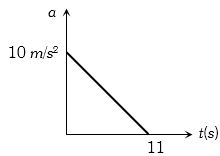
$A$ particle starts from rest. Its acceleration $(a)$ versus time $(t)$ graph is as shown in the figure. The maximum speed of the particle will be.....$m/s$.
A
$110$
B
$55$
C
$550$
D
$660$
Solution
(B) The area under the acceleration-time graph gives the change in velocity of the particle.
Since the particle starts from rest,its initial velocity $u = 0$.
The maximum velocity is achieved at $t = 11 \, s$,where the acceleration becomes zero.
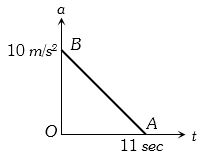
Thus,the maximum velocity $v_{\max}$ is equal to the area of the triangle $OAB$ in the given graph.
$v_{\max} = \text{Area of } \Delta OAB = \frac{1}{2} \times \text{base} \times \text{height}$
$v_{\max} = \frac{1}{2} \times 11 \, s \times 10 \, m/s^2 = 55 \, m/s$.
Therefore,the maximum speed of the particle is $55 \, m/s$.
Since the particle starts from rest,its initial velocity $u = 0$.
The maximum velocity is achieved at $t = 11 \, s$,where the acceleration becomes zero.
Thus,the maximum velocity $v_{\max}$ is equal to the area of the triangle $OAB$ in the given graph.
$v_{\max} = \text{Area of } \Delta OAB = \frac{1}{2} \times \text{base} \times \text{height}$
$v_{\max} = \frac{1}{2} \times 11 \, s \times 10 \, m/s^2 = 55 \, m/s$.
Therefore,the maximum speed of the particle is $55 \, m/s$.
0 likesView Solution
4
PhysicsMediumMCQIIT JEE · 2004
$A$ small block slides without friction down an inclined plane starting from rest. Let $S_n$ be the distance travelled from time $t = n - 1$ to $t = n$. Then $\frac{S_n}{S_{n+1}}$ is
A
$\frac{2n - 1}{2n}$
B
$\frac{2n + 1}{2n - 1}$
C
$\frac{2n - 1}{2n + 1}$
D
$\frac{2n}{2n + 1}$
Solution
(C) The distance travelled by an object in the $n^{th}$ second is given by the formula: $S_n = u + \frac{a}{2}(2n - 1)$.
Since the block starts from rest,the initial velocity $u = 0$.
Therefore,the distance travelled in the $n^{th}$ second is $S_n = \frac{a}{2}(2n - 1)$.
Similarly,the distance travelled in the $(n+1)^{th}$ second is $S_{n+1} = \frac{a}{2}(2(n+1) - 1) = \frac{a}{2}(2n + 2 - 1) = \frac{a}{2}(2n + 1)$.
Taking the ratio of these two distances:
$\frac{S_n}{S_{n+1}} = \frac{\frac{a}{2}(2n - 1)}{\frac{a}{2}(2n + 1)} = \frac{2n - 1}{2n + 1}$.
Since the block starts from rest,the initial velocity $u = 0$.
Therefore,the distance travelled in the $n^{th}$ second is $S_n = \frac{a}{2}(2n - 1)$.
Similarly,the distance travelled in the $(n+1)^{th}$ second is $S_{n+1} = \frac{a}{2}(2(n+1) - 1) = \frac{a}{2}(2n + 2 - 1) = \frac{a}{2}(2n + 1)$.
Taking the ratio of these two distances:
$\frac{S_n}{S_{n+1}} = \frac{\frac{a}{2}(2n - 1)}{\frac{a}{2}(2n + 1)} = \frac{2n - 1}{2n + 1}$.
0 likesView Solution
5
PhysicsDifficultMCQIIT JEE · 2004
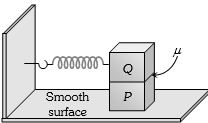
$A$ block $P$ of mass $m$ is placed on a frictionless horizontal surface. Another block $Q$ of the same mass $m$ is kept on $P$ and connected to a wall with the help of a spring of spring constant $k$ as shown in the figure. $\mu_s$ is the coefficient of static friction between $P$ and $Q$. The blocks move together performing simple harmonic motion $(SHM)$ of amplitude $A$. The maximum value of the friction force between $P$ and $Q$ is
A
$kA$
B
$\frac{kA}{2}$
C
Zero
D
$\mu_s mg$
Solution
(B) When two blocks perform simple harmonic motion together,the system acts as a single body of mass $2m$ attached to a spring of constant $k$.
The acceleration of the system at any displacement $x$ is given by $a = -\omega^2 x$,where $\omega^2 = \frac{k}{2m}$.
At the extreme position,the displacement is $x = A$,so the magnitude of acceleration is $a_{max} = \omega^2 A = \frac{k}{2m} A = \frac{kA}{2m}$.
The friction force $f$ acting on block $P$ provides the necessary acceleration to it. Since block $P$ has mass $m$,the friction force is $f = m \cdot a$.
At the extreme position,the friction force reaches its maximum value: $f_{max} = m \cdot a_{max} = m \left( \frac{kA}{2m} \right) = \frac{kA}{2}$.
The acceleration of the system at any displacement $x$ is given by $a = -\omega^2 x$,where $\omega^2 = \frac{k}{2m}$.
At the extreme position,the displacement is $x = A$,so the magnitude of acceleration is $a_{max} = \omega^2 A = \frac{k}{2m} A = \frac{kA}{2m}$.
The friction force $f$ acting on block $P$ provides the necessary acceleration to it. Since block $P$ has mass $m$,the friction force is $f = m \cdot a$.
At the extreme position,the friction force reaches its maximum value: $f_{max} = m \cdot a_{max} = m \left( \frac{kA}{2m} \right) = \frac{kA}{2}$.
0 likesView Solution
6
PhysicsEasyMCQIIT JEE · 2004
$A$ particle is placed at the origin and a force $F = kx$ is acting on it (where $k$ is a positive constant). If $U(0) = 0$,the graph of $U(x)$ versus $x$ will be (where $U$ is the potential energy function):
A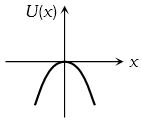
B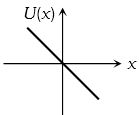
C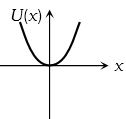
D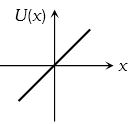
Solution
(A) The relationship between force $F$ and potential energy $U$ is given by $F = -\frac{dU}{dx}$.
Given $F = kx$,we have $-\frac{dU}{dx} = kx$.
Integrating both sides with respect to $x$:
$\int dU = -\int kx \, dx$
$U(x) = -\frac{1}{2}kx^2 + C$
Given $U(0) = 0$,we find $C = 0$.
Thus,$U(x) = -\frac{1}{2}kx^2$.
This is the equation of a downward-opening parabola symmetric about the $U$-axis,as shown in option $A$.
Given $F = kx$,we have $-\frac{dU}{dx} = kx$.
Integrating both sides with respect to $x$:
$\int dU = -\int kx \, dx$
$U(x) = -\frac{1}{2}kx^2 + C$
Given $U(0) = 0$,we find $C = 0$.
Thus,$U(x) = -\frac{1}{2}kx^2$.
This is the equation of a downward-opening parabola symmetric about the $U$-axis,as shown in option $A$.
0 likesView Solution
7
PhysicsDifficultMCQIIT JEE · 2004
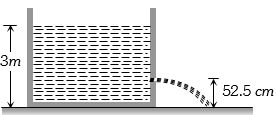
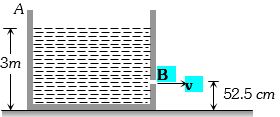
Water is filled in a cylindrical container to a height of $3 \ m$. The ratio of the cross-sectional area of the orifice and the beaker is $0.1$. The square of the speed of the liquid coming out from the orifice is ....... $m^2/s^2$ $(g = 10 \ m/s^2)$.
A
$50$
B
$50.5$
C
$51$
D
$52$
Solution
(A) Let $A$ be the cross-sectional area of the tank and $a$ be the cross-sectional area of the orifice.
Let $V$ be the velocity with which the water level decreases in the tank and $v$ be the velocity of efflux from the orifice.
From the equation of continuity,$av = AV$,so $V = \frac{av}{A}$.
Applying Bernoulli's theorem between the top surface of the water (point $1$) and the orifice (point $2$):
$P_0 + \rho g h_1 + \frac{1}{2} \rho V^2 = P_0 + \rho g h_2 + \frac{1}{2} \rho v^2$
Here,$h_1 = 3 \ m$ and $h_2 = 0.525 \ m$. The effective height of the water column above the orifice is $h = h_1 - h_2 = 3 - 0.525 = 2.475 \ m$.
Rearranging the equation: $\frac{1}{2} \rho v^2 - \frac{1}{2} \rho V^2 = \rho g h$
$v^2 - V^2 = 2gh$
Substituting $V = \frac{a}{A}v$:
$v^2 - (\frac{a}{A})^2 v^2 = 2gh$
$v^2 [1 - (\frac{a}{A})^2] = 2gh$
Given $\frac{a}{A} = 0.1$,$g = 10 \ m/s^2$,and $h = 2.475 \ m$:
$v^2 [1 - (0.1)^2] = 2 \times 10 \times 2.475$
$v^2 [1 - 0.01] = 49.5$
$v^2 [0.99] = 49.5$
$v^2 = \frac{49.5}{0.99} = 50 \ m^2/s^2$.
Let $V$ be the velocity with which the water level decreases in the tank and $v$ be the velocity of efflux from the orifice.
From the equation of continuity,$av = AV$,so $V = \frac{av}{A}$.
Applying Bernoulli's theorem between the top surface of the water (point $1$) and the orifice (point $2$):
$P_0 + \rho g h_1 + \frac{1}{2} \rho V^2 = P_0 + \rho g h_2 + \frac{1}{2} \rho v^2$
Here,$h_1 = 3 \ m$ and $h_2 = 0.525 \ m$. The effective height of the water column above the orifice is $h = h_1 - h_2 = 3 - 0.525 = 2.475 \ m$.
Rearranging the equation: $\frac{1}{2} \rho v^2 - \frac{1}{2} \rho V^2 = \rho g h$
$v^2 - V^2 = 2gh$
Substituting $V = \frac{a}{A}v$:
$v^2 - (\frac{a}{A})^2 v^2 = 2gh$
$v^2 [1 - (\frac{a}{A})^2] = 2gh$
Given $\frac{a}{A} = 0.1$,$g = 10 \ m/s^2$,and $h = 2.475 \ m$:
$v^2 [1 - (0.1)^2] = 2 \times 10 \times 2.475$
$v^2 [1 - 0.01] = 49.5$
$v^2 [0.99] = 49.5$
$v^2 = \frac{49.5}{0.99} = 50 \ m^2/s^2$.
0 likesView Solution
8
PhysicsMediumMCQIIT JEE · 2004
Water of volume $2 \, L$ in a container is heated with a coil of $1 \, kW$ at $27 \, ^\circ C$. The lid of the container is open and energy dissipates at a rate of $160 \, J/s$. In how much time will the temperature rise from $27 \, ^\circ C$ to $77 \, ^\circ C$? [Given: specific heat of water is $4.2 \, kJ/(kg \cdot K)$]
A
$8 \, min \, 20 \, s$
B
$6 \, min \, 2 \, s$
C
$7 \, min$
D
$14 \, min$
Solution
(A) The heat required to raise the temperature of the water is given by $Q = mc \Delta \theta$.
Here,mass $m = 2 \, kg$ (since density of water is $1 \, kg/L$),$c = 4.2 \times 10^3 \, J/(kg \cdot K)$,and $\Delta \theta = 77 - 27 = 50 \, ^\circ C$.
So,$Q = 2 \times 4.2 \times 10^3 \times 50 = 4.2 \times 10^5 \, J$.
The net power supplied to the water is $P_{net} = P_{coil} - P_{loss} = 1000 \, W - 160 \, W = 840 \, W$.
The time taken $t$ is given by $t = Q / P_{net}$.
$t = (4.2 \times 10^5) / 840 = 500 \, s$.
Converting to minutes: $500 \, s = 8 \, min \, 20 \, s$.
Here,mass $m = 2 \, kg$ (since density of water is $1 \, kg/L$),$c = 4.2 \times 10^3 \, J/(kg \cdot K)$,and $\Delta \theta = 77 - 27 = 50 \, ^\circ C$.
So,$Q = 2 \times 4.2 \times 10^3 \times 50 = 4.2 \times 10^5 \, J$.
The net power supplied to the water is $P_{net} = P_{coil} - P_{loss} = 1000 \, W - 160 \, W = 840 \, W$.
The time taken $t$ is given by $t = Q / P_{net}$.
$t = (4.2 \times 10^5) / 840 = 500 \, s$.
Converting to minutes: $500 \, s = 8 \, min \, 20 \, s$.
0 likesView Solution
9
PhysicsMediumMCQIIT JEE · 2004
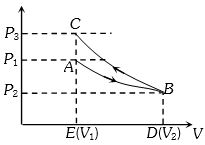
An ideal gas expands isothermally from a volume $V_1$ to $V_2$ and then is compressed to the original volume $V_1$ adiabatically. The initial pressure is $P_1$ and the final pressure is $P_3$. If the total work done is $W$,then:
A
$P_3 > P_1, W > 0$
B
$P_3 < P_1, W < 0$
C
$P_3 > P_1, W < 0$
D
$P_3 = P_1, W = 0$
Solution
(C) From the $P-V$ graph,it is clear that the final pressure $P_3$ at volume $V_1$ is greater than the initial pressure $P_1$ at the same volume $V_1$,so $P_3 > P_1$.
The work done in an isothermal expansion $(A \rightarrow B)$ is the area under the curve $AB$ with respect to the volume axis,which is positive $(W_{iso} > 0)$.
The work done in an adiabatic compression $(B \rightarrow C)$ is the negative of the area under the curve $BC$ with respect to the volume axis,which is negative $(W_{adia} < 0)$.
Since the adiabatic curve is steeper than the isothermal curve,the magnitude of the work done during adiabatic compression is greater than the work done during isothermal expansion $(|W_{adia}| > |W_{iso}|)$.
Therefore,the net work done $W = W_{iso} + W_{adia}$ is negative,i.e.,$W < 0$.
The work done in an isothermal expansion $(A \rightarrow B)$ is the area under the curve $AB$ with respect to the volume axis,which is positive $(W_{iso} > 0)$.
The work done in an adiabatic compression $(B \rightarrow C)$ is the negative of the area under the curve $BC$ with respect to the volume axis,which is negative $(W_{adia} < 0)$.
Since the adiabatic curve is steeper than the isothermal curve,the magnitude of the work done during adiabatic compression is greater than the work done during isothermal expansion $(|W_{adia}| > |W_{iso}|)$.
Therefore,the net work done $W = W_{iso} + W_{adia}$ is negative,i.e.,$W < 0$.
0 likesView Solution
10
PhysicsDifficultMCQIIT JEE · 2004
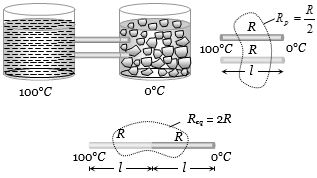
Two identical conducting rods are first connected independently in parallel to two vessels,one containing water at $100^oC$ and the other containing ice at $0^oC$. In the second case,the rods are joined end to end (in series) and connected to the same vessels. Let $q_1$ and $q_2$ $g/s$ be the rate of melting of ice in the two cases respectively. The ratio of $q_1/q_2$ is
A
$1/2$
B
$2/1$
C
$4/1$
D
$1/4$
Solution
(C) Let $R$ be the thermal resistance of each rod. The rate of heat flow is given by $H = \frac{dQ}{dt} = \frac{\Delta T}{R_{eq}}$. The rate of melting of ice is $q = \frac{1}{L} \frac{dQ}{dt}$,where $L$ is the latent heat of fusion of ice.
Case $1$: The rods are connected in parallel. The equivalent thermal resistance is $R_p = \frac{R \times R}{R + R} = \frac{R}{2}$.
The rate of heat flow is $H_1 = \frac{100 - 0}{R/2} = \frac{200}{R}$.
Thus,$q_1 = \frac{H_1}{L} = \frac{200}{RL}$.
Case $2$: The rods are connected in series. The equivalent thermal resistance is $R_s = R + R = 2R$.
The rate of heat flow is $H_2 = \frac{100 - 0}{2R} = \frac{100}{2R} = \frac{50}{R}$.
Thus,$q_2 = \frac{H_2}{L} = \frac{50}{RL}$.
Taking the ratio,$\frac{q_1}{q_2} = \frac{200/RL}{50/RL} = \frac{200}{50} = \frac{4}{1}$.
Case $1$: The rods are connected in parallel. The equivalent thermal resistance is $R_p = \frac{R \times R}{R + R} = \frac{R}{2}$.
The rate of heat flow is $H_1 = \frac{100 - 0}{R/2} = \frac{200}{R}$.
Thus,$q_1 = \frac{H_1}{L} = \frac{200}{RL}$.
Case $2$: The rods are connected in series. The equivalent thermal resistance is $R_s = R + R = 2R$.
The rate of heat flow is $H_2 = \frac{100 - 0}{2R} = \frac{100}{2R} = \frac{50}{R}$.
Thus,$q_2 = \frac{H_2}{L} = \frac{50}{RL}$.
Taking the ratio,$\frac{q_1}{q_2} = \frac{200/RL}{50/RL} = \frac{200}{50} = \frac{4}{1}$.
0 likesView Solution
11
PhysicsDifficultMCQIIT JEE · 2004
Three discs $A, B$ and $C$ having radii $2\; m, 4\; m,$ and $6\; m$ respectively are coated with carbon black on their outer surfaces. The wavelengths corresponding to maximum intensity are $300\; nm, 400\; nm$ and $500\; nm$ respectively. The power radiated by them are $Q_A, Q_B$ and $Q_C$ respectively. Which of the following is true?
A
$Q_A$ is maximum
B
$Q_B$ is maximum
C
$Q_C$ is maximum
D
$Q_A = Q_B = Q_C$
Solution
(B) The power radiated by a black body is given by the Stefan-Boltzmann law: $P = A \sigma T^4$,where $A$ is the surface area,$\sigma$ is the Stefan-Boltzmann constant,and $T$ is the absolute temperature.
Since the discs are coated with carbon black,they act as black bodies $(\varepsilon = 1)$.
The area of a disc is $A = \pi r^2$,so $P \propto r^2 T^4$.
According to Wien's displacement law,$\lambda_m T = b$ (constant),which implies $T \propto \frac{1}{\lambda_m}$.
Substituting this into the power equation: $P \propto r^2 \left(\frac{1}{\lambda_m}\right)^4 = \frac{r^2}{\lambda_m^4}$.
Now,calculating the relative values for $Q_A, Q_B,$ and $Q_C$:
$Q_A \propto \frac{2^2}{300^4} = \frac{4}{81 \times 10^8} \approx 0.049 \times 10^{-8}$
$Q_B \propto \frac{4^2}{400^4} = \frac{16}{256 \times 10^8} = 0.0625 \times 10^{-8}$
$Q_C \propto \frac{6^2}{500^4} = \frac{36}{625 \times 10^8} \approx 0.0576 \times 10^{-8}$
Comparing these values,$Q_B$ is the maximum.
Since the discs are coated with carbon black,they act as black bodies $(\varepsilon = 1)$.
The area of a disc is $A = \pi r^2$,so $P \propto r^2 T^4$.
According to Wien's displacement law,$\lambda_m T = b$ (constant),which implies $T \propto \frac{1}{\lambda_m}$.
Substituting this into the power equation: $P \propto r^2 \left(\frac{1}{\lambda_m}\right)^4 = \frac{r^2}{\lambda_m^4}$.
Now,calculating the relative values for $Q_A, Q_B,$ and $Q_C$:
$Q_A \propto \frac{2^2}{300^4} = \frac{4}{81 \times 10^8} \approx 0.049 \times 10^{-8}$
$Q_B \propto \frac{4^2}{400^4} = \frac{16}{256 \times 10^8} = 0.0625 \times 10^{-8}$
$Q_C \propto \frac{6^2}{500^4} = \frac{36}{625 \times 10^8} \approx 0.0576 \times 10^{-8}$
Comparing these values,$Q_B$ is the maximum.
0 likesView Solution
12
PhysicsEasyMCQIIT JEE · 2004
$A$ source of sound of frequency $600 Hz$ is placed inside water. The speed of sound in water is $1500 m/s$ and in air is $300 m/s.$ The frequency of sound recorded by an observer who is standing in air is .... $Hz$
A
$200$
B
$3000$
C
$120$
D
$600$
Solution
(D) The frequency of a sound wave is a characteristic property of the source itself.
When a sound wave travels from one medium (water) to another medium (air),its speed and wavelength change,but the frequency remains constant.
Therefore,the frequency of the sound recorded by an observer in the air will be the same as the frequency of the source.
Frequency = $600 Hz$.
When a sound wave travels from one medium (water) to another medium (air),its speed and wavelength change,but the frequency remains constant.
Therefore,the frequency of the sound recorded by an observer in the air will be the same as the frequency of the source.
Frequency = $600 Hz$.
0 likesView Solution
13
PhysicsDifficultMCQIIT JEE · 2004
$A$ closed organ pipe of length $L$ and an open organ pipe contain gases of densities ${\rho _1}$ and ${\rho _2}$ respectively. The compressibility of gases is equal in both the pipes. Both the pipes are vibrating in their first overtone with the same frequency. The length of the open organ pipe is
A
$\frac{L}{3}$
B
$\frac{4L}{3}$
C
$\frac{4L}{3}\sqrt{\frac{\rho_1}{\rho_2}}$
D
$\frac{4L}{3}\sqrt{\frac{\rho_2}{\rho_1}}$
Solution
(C) The frequency of the first overtone of a closed organ pipe of length $L_1 = L$ is given by $f_1 = \frac{3v_1}{4L_1}$,where $v_1 = \sqrt{\frac{1}{\beta \rho_1}}$ and $\beta$ is the compressibility.
The frequency of the first overtone of an open organ pipe of length $L_2$ is given by $f_2 = \frac{2v_2}{2L_2} = \frac{v_2}{L_2}$,where $v_2 = \sqrt{\frac{1}{\beta \rho_2}}$.
Given that the frequencies are equal $(f_1 = f_2)$:
$\frac{3}{4L} \sqrt{\frac{1}{\beta \rho_1}} = \frac{1}{L_2} \sqrt{\frac{1}{\beta \rho_2}}$
Canceling the common term $\sqrt{\frac{1}{\beta}}$ from both sides:
$\frac{3}{4L\sqrt{\rho_1}} = \frac{1}{L_2\sqrt{\rho_2}}$
Solving for $L_2$:
$L_2 = \frac{4L}{3} \sqrt{\frac{\rho_1}{\rho_2}}$
The frequency of the first overtone of an open organ pipe of length $L_2$ is given by $f_2 = \frac{2v_2}{2L_2} = \frac{v_2}{L_2}$,where $v_2 = \sqrt{\frac{1}{\beta \rho_2}}$.
Given that the frequencies are equal $(f_1 = f_2)$:
$\frac{3}{4L} \sqrt{\frac{1}{\beta \rho_1}} = \frac{1}{L_2} \sqrt{\frac{1}{\beta \rho_2}}$
Canceling the common term $\sqrt{\frac{1}{\beta}}$ from both sides:
$\frac{3}{4L\sqrt{\rho_1}} = \frac{1}{L_2\sqrt{\rho_2}}$
Solving for $L_2$:
$L_2 = \frac{4L}{3} \sqrt{\frac{\rho_1}{\rho_2}}$
0 likesView Solution
14
PhysicsEasyMCQIIT JEE · 2004
$A$ boy stands with his hands folded at the center of a platform rotating about its central axis. The kinetic energy of the system is $K$. The boy now stretches his hands out, which doubles the moment of inertia of the system. The kinetic energy of the system will become
A
$2 K$
B
$K/2$
C
$K/4$
D
$4K$
Solution
(B) The angular momentum $L$ of the system remains conserved because no external torque acts on the system $(L = I\omega = \text{constant})$.
The rotational kinetic energy $K$ is given by $K = \frac{L^2}{2I}$.
Since $L$ is constant, we have $K \propto \frac{1}{I}$.
Let the initial moment of inertia be $I_1 = I$ and the initial kinetic energy be $K_1 = K$.
When the boy stretches his hands, the new moment of inertia becomes $I_2 = 2I$.
The new kinetic energy $K_2$ is given by $K_2 = \frac{L^2}{2I_2} = \frac{L^2}{2(2I)} = \frac{1}{2} \left( \frac{L^2}{2I} \right) = \frac{K}{2}$.
Therefore, the kinetic energy of the system becomes $K/2$.
The rotational kinetic energy $K$ is given by $K = \frac{L^2}{2I}$.
Since $L$ is constant, we have $K \propto \frac{1}{I}$.
Let the initial moment of inertia be $I_1 = I$ and the initial kinetic energy be $K_1 = K$.
When the boy stretches his hands, the new moment of inertia becomes $I_2 = 2I$.
The new kinetic energy $K_2$ is given by $K_2 = \frac{L^2}{2I_2} = \frac{L^2}{2(2I)} = \frac{1}{2} \left( \frac{L^2}{2I} \right) = \frac{K}{2}$.
Therefore, the kinetic energy of the system becomes $K/2$.
0 likesView Solution
15
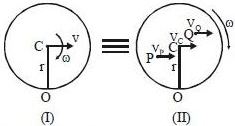
PhysicsMediumMCQIIT JEE · 2004
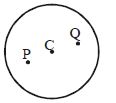
$A$ disc is rolling (without slipping) on a horizontal surface. $C$ is its centre and $Q$ and $P$ are two points on the same horizontal line passing through $C$,such that $Q$ is at a distance $r$ from $C$ and $P$ is at a distance $r$ from $C$ on the opposite side. Let $V_P, V_Q$ and $V_C$ be the magnitudes of velocities of points $P, Q$ and $C$ respectively,then:
A
$V_Q > V_C > V_P$
B
$V_Q < V_C < V_P$
C
$V_Q = V_P, V_C = \frac{1}{2} V_P$
D
$V_Q = V_C = V_P$
Solution
(A) rolling motion can be considered as a combination of pure translation of the centre of mass $C$ with velocity $V_C = R\omega$ and pure rotation about the centre $C$ with angular velocity $\omega$.
For any point at a distance $r$ from the centre $C$,the velocity due to rotation is $v_{rot} = r\omega$.
The velocity of any point is the vector sum of the translational velocity $\vec{V}_C$ and the rotational velocity $\vec{v}_{rot}$.
For points $P$ and $Q$ on the horizontal diameter:
$1$. At point $Q$,the rotational velocity is in the same direction as the translational velocity. Thus,$V_Q = V_C + r\omega = R\omega + r\omega = (R+r)\omega$.
$2$. At point $P$,the rotational velocity is in the opposite direction to the translational velocity. Thus,$V_P = |V_C - r\omega| = |R\omega - r\omega| = (R-r)\omega$.
Since $R > r$,we have $V_Q > V_C > V_P$.
For any point at a distance $r$ from the centre $C$,the velocity due to rotation is $v_{rot} = r\omega$.
The velocity of any point is the vector sum of the translational velocity $\vec{V}_C$ and the rotational velocity $\vec{v}_{rot}$.
For points $P$ and $Q$ on the horizontal diameter:
$1$. At point $Q$,the rotational velocity is in the same direction as the translational velocity. Thus,$V_Q = V_C + r\omega = R\omega + r\omega = (R+r)\omega$.
$2$. At point $P$,the rotational velocity is in the opposite direction to the translational velocity. Thus,$V_P = |V_C - r\omega| = |R\omega - r\omega| = (R-r)\omega$.
Since $R > r$,we have $V_Q > V_C > V_P$.
0 likesView Solution
16
PhysicsEasyMCQIIT JEE · 2004
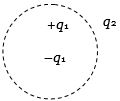
Consider the charge configuration and spherical Gaussian surface as shown in the figure. When calculating the flux of the electric field over the spherical surface,the electric field will be due to:
A
$q_2$
B
Only the positive charges
C
All the charges
D
$+q_1$ and $-q_1$
Solution
(C) According to Gauss's Law,the electric flux $\Phi_E$ through a closed surface is given by $\Phi_E = \frac{q_{\text{enclosed}}}{\epsilon_0}$.
However,the electric field $\vec{E}$ at any point on the Gaussian surface is the resultant electric field due to all charges present in the vicinity,whether they are inside or outside the Gaussian surface.
Therefore,the electric field at the surface is due to all the charges ($+q_1, -q_1$,and $q_2$).
However,the electric field $\vec{E}$ at any point on the Gaussian surface is the resultant electric field due to all charges present in the vicinity,whether they are inside or outside the Gaussian surface.
Therefore,the electric field at the surface is due to all the charges ($+q_1, -q_1$,and $q_2$).
0 likesView Solution
17
PhysicsMediumMCQIIT JEE · 2004
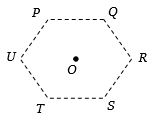
Six charges,three positive and three negative of equal magnitude,are to be placed at the vertices of a regular hexagon such that the electric field at $O$ is double the electric field when only one positive charge of the same magnitude is placed at $R$. Which of the following arrangements of charges is possible for $P, Q, R, S, T,$ and $U$ respectively?
A
$+, -, +, -, -, +$
B
$+, -, +, -, +, -$
C
$+, +, -, +, -, -$
D
$-, +, +, -, +, -$
Solution
(D) Let the magnitude of each charge be $q$ and the distance from the center $O$ to any vertex be $a$. The electric field at $O$ due to a charge $q$ at a vertex is $E = \frac{kq}{a^2}$.
If only one positive charge $q$ is at $R$,the electric field at $O$ is $E_0 = E$ (directed away from $R$).
We want the resultant electric field at $O$ to be $2E$.
For the arrangement in option $(d)$,the charges are: $P(-), Q(+), R(+), S(-), T(+), U(-)$.
The electric field at $O$ due to $P$ and $S$ (both negative) cancel each other because they are opposite. Similarly,the electric field due to $Q$ and $T$ (both positive) cancel each other.
This leaves the charges at $R$ and $U$. $R$ has a positive charge $+q$,creating a field $E$ directed away from $R$. $U$ has a negative charge $-q$,creating a field $E$ directed towards $U$. Since $R$ and $U$ are diametrically opposite,the field from $U$ (towards $U$) is in the same direction as the field from $R$ (away from $R$).
Thus,the total electric field is $E + E = 2E$.
If only one positive charge $q$ is at $R$,the electric field at $O$ is $E_0 = E$ (directed away from $R$).
We want the resultant electric field at $O$ to be $2E$.
For the arrangement in option $(d)$,the charges are: $P(-), Q(+), R(+), S(-), T(+), U(-)$.
The electric field at $O$ due to $P$ and $S$ (both negative) cancel each other because they are opposite. Similarly,the electric field due to $Q$ and $T$ (both positive) cancel each other.
This leaves the charges at $R$ and $U$. $R$ has a positive charge $+q$,creating a field $E$ directed away from $R$. $U$ has a negative charge $-q$,creating a field $E$ directed towards $U$. Since $R$ and $U$ are diametrically opposite,the field from $U$ (towards $U$) is in the same direction as the field from $R$ (away from $R$).
Thus,the total electric field is $E + E = 2E$.
0 likesView Solution
18
PhysicsMediumMCQIIT JEE · 2004
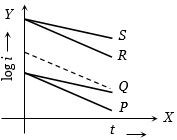
In an $RC$ circuit while charging,the graph of $\log i$ versus time is as shown by the dotted line in the diagram,where $i$ is the current. When the value of the resistance is doubled,which of the solid curves best represents the variation of $\log i$ versus time?
A
$P$
B
$Q$
C
$R$
D
$S$
Solution
(B) For an $RC$ circuit during charging,the current $i$ at time $t$ is given by $i = \frac{E}{R} e^{-t/RC}$.
Taking the natural logarithm on both sides,we get $\ln i = -\frac{t}{RC} + \ln(\frac{E}{R})$.
This is an equation of a straight line $y = mx + c$,where the slope $m = -\frac{1}{RC}$ and the intercept $c = \ln(\frac{E}{R})$.
When the resistance $R$ is doubled $(R' = 2R)$:
$1$. The intercept $c' = \ln(\frac{E}{2R}) = \ln(\frac{E}{R}) - \ln 2$. Since $\ln 2 > 0$,the new intercept $c'$ is lower than the original intercept $c$.
$2$. The magnitude of the slope $|m'| = \frac{1}{R'C} = \frac{1}{2RC} = \frac{1}{2} |m|$. The new slope is half the magnitude of the original slope,meaning the line becomes less steep.
Comparing these changes with the given graph,curve $Q$ starts at a lower intercept and has a smaller magnitude of slope compared to the dotted line. Therefore,curve $Q$ represents the variation.
Taking the natural logarithm on both sides,we get $\ln i = -\frac{t}{RC} + \ln(\frac{E}{R})$.
This is an equation of a straight line $y = mx + c$,where the slope $m = -\frac{1}{RC}$ and the intercept $c = \ln(\frac{E}{R})$.
When the resistance $R$ is doubled $(R' = 2R)$:
$1$. The intercept $c' = \ln(\frac{E}{2R}) = \ln(\frac{E}{R}) - \ln 2$. Since $\ln 2 > 0$,the new intercept $c'$ is lower than the original intercept $c$.
$2$. The magnitude of the slope $|m'| = \frac{1}{R'C} = \frac{1}{2RC} = \frac{1}{2} |m|$. The new slope is half the magnitude of the original slope,meaning the line becomes less steep.
Comparing these changes with the given graph,curve $Q$ starts at a lower intercept and has a smaller magnitude of slope compared to the dotted line. Therefore,curve $Q$ represents the variation.
0 likesView Solution
19
PhysicsDifficultMCQIIT JEE · 2004
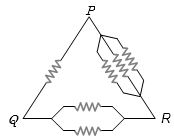
Six equal resistances $R$ are connected between points $P$,$Q$,and $R$ as shown in the figure. Then the net resistance will be maximum between:
A
$P$ and $Q$
B
$Q$ and $R$
C
$P$ and $R$
D
Any two points
Solution
(A) Based on the figure,the connections are as follows:
Between $P$ and $Q$: One resistor $R$ is in parallel with a combination of two resistors in series (which are in parallel with another resistor). Wait,let's re-examine the diagram:
- Branch $PQ$ has $1$ resistor.
- Branch $QR$ has $2$ resistors in parallel,equivalent to $R/2$.
- Branch $PR$ has $3$ resistors in parallel,equivalent to $R/3$.
Now,calculating equivalent resistance between points:
$1$. Between $P$ and $Q$: The path $PQ$ $(R)$ is in parallel with the path $PRQ$ $(R/3 + R/2 = 5R/6)$.
$R_{PQ} = \frac{R \times (5R/6)}{R + 5R/6} = \frac{5R^2/6}{11R/6} = \frac{5}{11}R \approx 0.454R$.
$2$. Between $Q$ and $R$: The path $QR$ $(R/2)$ is in parallel with the path $QPR$ $(R + R/3 = 4R/3)$.
$R_{QR} = \frac{(R/2) \times (4R/3)}{R/2 + 4R/3} = \frac{2R^2/3}{11R/6} = \frac{2}{3} \times \frac{6}{11}R = \frac{4}{11}R \approx 0.363R$.
$3$. Between $P$ and $R$: The path $PR$ $(R/3)$ is in parallel with the path $PQR$ $(R + R/2 = 3R/2)$.
$R_{PR} = \frac{(R/3) \times (3R/2)}{R/3 + 3R/2} = \frac{R^2/2}{11R/6} = \frac{1}{2} \times \frac{6}{11}R = \frac{3}{11}R \approx 0.272R$.
Comparing the values,$R_{PQ} = \frac{5}{11}R$ is the maximum.
Between $P$ and $Q$: One resistor $R$ is in parallel with a combination of two resistors in series (which are in parallel with another resistor). Wait,let's re-examine the diagram:
- Branch $PQ$ has $1$ resistor.
- Branch $QR$ has $2$ resistors in parallel,equivalent to $R/2$.
- Branch $PR$ has $3$ resistors in parallel,equivalent to $R/3$.
Now,calculating equivalent resistance between points:
$1$. Between $P$ and $Q$: The path $PQ$ $(R)$ is in parallel with the path $PRQ$ $(R/3 + R/2 = 5R/6)$.
$R_{PQ} = \frac{R \times (5R/6)}{R + 5R/6} = \frac{5R^2/6}{11R/6} = \frac{5}{11}R \approx 0.454R$.
$2$. Between $Q$ and $R$: The path $QR$ $(R/2)$ is in parallel with the path $QPR$ $(R + R/3 = 4R/3)$.
$R_{QR} = \frac{(R/2) \times (4R/3)}{R/2 + 4R/3} = \frac{2R^2/3}{11R/6} = \frac{2}{3} \times \frac{6}{11}R = \frac{4}{11}R \approx 0.363R$.
$3$. Between $P$ and $R$: The path $PR$ $(R/3)$ is in parallel with the path $PQR$ $(R + R/2 = 3R/2)$.
$R_{PR} = \frac{(R/3) \times (3R/2)}{R/3 + 3R/2} = \frac{R^2/2}{11R/6} = \frac{1}{2} \times \frac{6}{11}R = \frac{3}{11}R \approx 0.272R$.
Comparing the values,$R_{PQ} = \frac{5}{11}R$ is the maximum.
0 likesView Solution
20
PhysicsMediumMCQIIT JEE · 2004
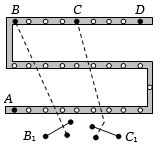
In a post office box arrangement used to determine the value of an unknown resistance,the unknown resistance should be connected between:
A
$B$ and $C$
B
$C$ and $D$
C
$A$ and $D$
D
$B_1$ and $C_1$
Solution
(C) post office box is a practical form of a Wheatstone bridge. In this arrangement,the unknown resistance $X$ is connected between terminals $A$ and $D$. The arms $AB$ and $BC$ act as the ratio arms ($P$ and $Q$),while the arm $CD$ contains the known resistance box $(R)$. When the bridge is balanced,the unknown resistance is given by $X = (Q/P) \times R$.
0 likesView Solution
21
PhysicsMediumMCQIIT JEE · 2004
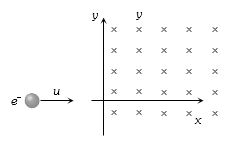
An electron moving with a speed $u$ along the positive $x$-axis at $y = 0$ enters a region of uniform magnetic field $\overrightarrow B = -B_0 \hat k$ which exists to the right of the $y$-axis. The electron exits from the region after some time with the speed $v$ at coordinate $y$,then
A
$v > u, y < 0$
B
$v = u, y > 0$
C
$v > u, y > 0$
D
$v = u, y < 0$
Solution
(D) The magnetic force acting on a charged particle is given by $\overrightarrow F = q(\overrightarrow v \times \overrightarrow B)$.
Since the magnetic force is always perpendicular to the velocity of the particle,it does no work on the electron. Therefore,the kinetic energy of the electron remains constant,which implies that the speed $v$ of the electron remains equal to its initial speed $u$,so $v = u$.
Using the right-hand rule for the magnetic force on a negative charge (electron): the velocity $\overrightarrow v$ is along the $+x$-direction and the magnetic field $\overrightarrow B$ is along the $-z$-direction $(-B_0 \hat k)$. The force $\overrightarrow F = -e(\overrightarrow v \times \overrightarrow B) = -e(u \hat i \times -B_0 \hat k) = -e(u B_0 \hat j) = -e u B_0 \hat j$. Thus,the initial force is in the negative $y$-direction.
The electron will follow a circular path in the clockwise direction and will exit the magnetic field region at a point where $y < 0$.
Since the magnetic force is always perpendicular to the velocity of the particle,it does no work on the electron. Therefore,the kinetic energy of the electron remains constant,which implies that the speed $v$ of the electron remains equal to its initial speed $u$,so $v = u$.
Using the right-hand rule for the magnetic force on a negative charge (electron): the velocity $\overrightarrow v$ is along the $+x$-direction and the magnetic field $\overrightarrow B$ is along the $-z$-direction $(-B_0 \hat k)$. The force $\overrightarrow F = -e(\overrightarrow v \times \overrightarrow B) = -e(u \hat i \times -B_0 \hat k) = -e(u B_0 \hat j) = -e u B_0 \hat j$. Thus,the initial force is in the negative $y$-direction.
The electron will follow a circular path in the clockwise direction and will exit the magnetic field region at a point where $y < 0$.
0 likesView Solution
22
PhysicsMediumMCQIIT JEE · 2004
The variation of induced emf $(E)$ with time $(t)$ in a coil if a short bar magnet is moved along its axis with a constant velocity is best represented as

A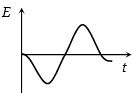
B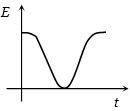
C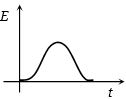
D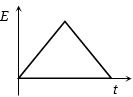
Solution
(A) According to Faraday's law of electromagnetic induction,the induced emf $(E)$ is given by $E = -\frac{d\phi}{dt}$.
As the north pole of the bar magnet approaches the coil,the magnetic flux through the coil increases,leading to an induced emf of a certain polarity (let's say negative).
As the magnet passes through the center of the coil,the rate of change of flux becomes zero,and then as it moves away,the flux decreases,causing the induced emf to change its polarity (becoming positive).
Thus,the graph of induced emf $(E)$ versus time $(t)$ shows a negative peak followed by a positive peak as the magnet moves through the coil.
As the north pole of the bar magnet approaches the coil,the magnetic flux through the coil increases,leading to an induced emf of a certain polarity (let's say negative).
As the magnet passes through the center of the coil,the rate of change of flux becomes zero,and then as it moves away,the flux decreases,causing the induced emf to change its polarity (becoming positive).
Thus,the graph of induced emf $(E)$ versus time $(t)$ shows a negative peak followed by a positive peak as the magnet moves through the coil.
0 likesView Solution
23
PhysicsMediumMCQIIT JEE · 2004
$A$ photon and an electron have equal energy $E$. The ratio $\lambda_{\text{photon}} / \lambda_{\text{electron}}$ is proportional to:
A
$\sqrt{E}$
B
$1/\sqrt{E}$
C
$1/E$
D
Does not depend upon $E$
Solution
(B) For a photon,the energy is given by $E = \frac{hc}{\lambda_{\text{photon}}}$,which implies $\lambda_{\text{photon}} = \frac{hc}{E}$.
For an electron,the de Broglie wavelength is given by $\lambda_{\text{electron}} = \frac{h}{p} = \frac{h}{\sqrt{2mE}}$,where $m$ is the mass of the electron and $E$ is its kinetic energy.
Taking the ratio of the two wavelengths:
$\frac{\lambda_{\text{photon}}}{\lambda_{\text{electron}}} = \frac{hc/E}{h/\sqrt{2mE}} = \frac{hc}{E} \cdot \frac{\sqrt{2mE}}{h} = c \sqrt{\frac{2m}{E}}$.
Since $c$ and $m$ are constants,we have $\frac{\lambda_{\text{photon}}}{\lambda_{\text{electron}}} \propto \frac{1}{\sqrt{E}}$.
For an electron,the de Broglie wavelength is given by $\lambda_{\text{electron}} = \frac{h}{p} = \frac{h}{\sqrt{2mE}}$,where $m$ is the mass of the electron and $E$ is its kinetic energy.
Taking the ratio of the two wavelengths:
$\frac{\lambda_{\text{photon}}}{\lambda_{\text{electron}}} = \frac{hc/E}{h/\sqrt{2mE}} = \frac{hc}{E} \cdot \frac{\sqrt{2mE}}{h} = c \sqrt{\frac{2m}{E}}$.
Since $c$ and $m$ are constants,we have $\frac{\lambda_{\text{photon}}}{\lambda_{\text{electron}}} \propto \frac{1}{\sqrt{E}}$.
0 likesView Solution
24
PhysicsMediumMCQIIT JEE · 2004
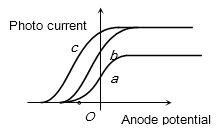
The figure shows the variation of photocurrent with anode potential for a photo-sensitive surface for three different radiations. Let ${I_a}, {I_b}$ and ${I_c}$ be the intensities and ${f_a}, {f_b}$ and ${f_c}$ be the frequencies for the curves $a, b$ and $c$ respectively.
A
${f_a} = {f_b}$ and ${I_a} \neq {I_b}$
B
${f_a} = {f_c}$ and ${I_a} = {I_c}$
C
${f_a} = {f_b}$ and ${I_a} = {I_b}$
D
${f_b} = {f_c}$ and ${I_b} = {I_c}$
Solution
(A) In the photoelectric effect,the stopping potential depends only on the frequency of the incident radiation,while the saturation current depends on the intensity of the incident radiation.
$1$. From the graph,curves $a$ and $b$ intersect the anode potential axis at the same point,which means they have the same stopping potential. Therefore,the frequencies are equal: ${f_a} = {f_b}$.
$2$. The saturation current (the maximum value of photocurrent) for curve $b$ is higher than that for curve $a$. Since saturation current is directly proportional to the intensity of incident radiation,we have ${I_a} < {I_b}$.
$3$. Thus,${f_a} = {f_b}$ and ${I_a} \neq {I_b}$.
$1$. From the graph,curves $a$ and $b$ intersect the anode potential axis at the same point,which means they have the same stopping potential. Therefore,the frequencies are equal: ${f_a} = {f_b}$.
$2$. The saturation current (the maximum value of photocurrent) for curve $b$ is higher than that for curve $a$. Since saturation current is directly proportional to the intensity of incident radiation,we have ${I_a} < {I_b}$.
$3$. Thus,${f_a} = {f_b}$ and ${I_a} \neq {I_b}$.
0 likesView Solution
25
PhysicsMediumMCQIIT JEE · 2004
After $280$ days,the activity of a radioactive sample is $6000 \, dps$. The activity reduces to $3000 \, dps$ after another $140$ days. The initial activity of the sample in $dps$ is
A
$6000$
B
$9000$
C
$3000$
D
$24000$
Solution
(D) The activity of a radioactive sample follows the law $A = A_0 (1/2)^n$,where $n$ is the number of half-lives.
Given that the activity reduces from $6000 \, dps$ to $3000 \, dps$ in $140$ days,the half-life $T_{1/2}$ is $140$ days.
After $280$ days,the number of half-lives elapsed is $n = 280 / 140 = 2$.
Let $A_{280}$ be the activity after $280$ days,which is $6000 \, dps$.
Using the formula $A_{280} = A_{initial} \times (1/2)^n$,we get $6000 = A_{initial} \times (1/2)^2$.
$6000 = A_{initial} \times (1/4)$.
$A_{initial} = 6000 \times 4 = 24000 \, dps$.
Given that the activity reduces from $6000 \, dps$ to $3000 \, dps$ in $140$ days,the half-life $T_{1/2}$ is $140$ days.
After $280$ days,the number of half-lives elapsed is $n = 280 / 140 = 2$.
Let $A_{280}$ be the activity after $280$ days,which is $6000 \, dps$.
Using the formula $A_{280} = A_{initial} \times (1/2)^n$,we get $6000 = A_{initial} \times (1/2)^2$.
$6000 = A_{initial} \times (1/4)$.
$A_{initial} = 6000 \times 4 = 24000 \, dps$.
0 likesView Solution
26
PhysicsDifficultMCQIIT JEE · 2004
$A$ radioactive sample of $U^{238}$ decays to $Pb$ through a process for which the half-life is $4.5 \times 10^9$ years. Find the ratio of the number of nuclei of $Pb$ to $U^{238}$ after a time of $1.5 \times 10^9$ years (given $2^{1/3} = 1.26$).
A
$0.12$
B
$0.26$
C
$1.2$
D
$0.37$
Solution
(B) The number of half-lives $n$ is given by $n = \frac{t}{T_{1/2}} = \frac{1.5 \times 10^9}{4.5 \times 10^9} = \frac{1}{3}$.
The remaining number of $U^{238}$ nuclei $N_U$ is given by $N_U = N_0 \left( \frac{1}{2} \right)^n = N_0 \left( \frac{1}{2} \right)^{1/3}$.
Given $2^{1/3} = 1.26$,we have $\left( \frac{1}{2} \right)^{1/3} = \frac{1}{1.26} \approx 0.7937$.
Thus,$N_U = N_0 \times 0.7937$.
The number of $Pb$ nuclei formed is $N_{Pb} = N_0 - N_U = N_0(1 - 0.7937) = N_0(0.2063)$.
Alternatively,using the ratio: $\frac{N_U}{N_0} = \frac{1}{1.26}$.
Since $N_0 = N_U + N_{Pb}$,we have $\frac{N_U}{N_U + N_{Pb}} = \frac{1}{1.26}$.
$1.26 N_U = N_U + N_{Pb} \implies N_{Pb} = 0.26 N_U$.
Therefore,the ratio $\frac{N_{Pb}}{N_U} = 0.26$.
The remaining number of $U^{238}$ nuclei $N_U$ is given by $N_U = N_0 \left( \frac{1}{2} \right)^n = N_0 \left( \frac{1}{2} \right)^{1/3}$.
Given $2^{1/3} = 1.26$,we have $\left( \frac{1}{2} \right)^{1/3} = \frac{1}{1.26} \approx 0.7937$.
Thus,$N_U = N_0 \times 0.7937$.
The number of $Pb$ nuclei formed is $N_{Pb} = N_0 - N_U = N_0(1 - 0.7937) = N_0(0.2063)$.
Alternatively,using the ratio: $\frac{N_U}{N_0} = \frac{1}{1.26}$.
Since $N_0 = N_U + N_{Pb}$,we have $\frac{N_U}{N_U + N_{Pb}} = \frac{1}{1.26}$.
$1.26 N_U = N_U + N_{Pb} \implies N_{Pb} = 0.26 N_U$.
Therefore,the ratio $\frac{N_{Pb}}{N_U} = 0.26$.
0 likesView Solution
27
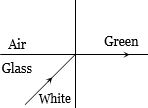
PhysicsMediumMCQIIT JEE · 2004
White light is incident on the interface of glass and air as shown in the figure. If green light is just totally internally reflected,then the emerging ray in air contains:
A
Yellow,orange,red
B
Violet,indigo,blue
C
All colours
D
All colours except green
Solution
(A) The critical angle $C$ is given by $C = \sin^{-1}(1/\mu)$.
According to Cauchy's equation,the refractive index $\mu$ is inversely proportional to the wavelength $\lambda$ (i.e.,$\mu \propto 1/\lambda$).
Since the wavelength of yellow,orange,and red light is greater than that of green light,their refractive index $\mu$ will be lower.
Consequently,the critical angle $C$ for these colors will be higher than that of green light.
If green light is just totally internally reflected (i.e.,the angle of incidence equals the critical angle for green),then for colors with a higher critical angle (yellow,orange,red),the angle of incidence will be less than their respective critical angles.
Therefore,yellow,orange,and red rays will refract and emerge out into the air.
According to Cauchy's equation,the refractive index $\mu$ is inversely proportional to the wavelength $\lambda$ (i.e.,$\mu \propto 1/\lambda$).
Since the wavelength of yellow,orange,and red light is greater than that of green light,their refractive index $\mu$ will be lower.
Consequently,the critical angle $C$ for these colors will be higher than that of green light.
If green light is just totally internally reflected (i.e.,the angle of incidence equals the critical angle for green),then for colors with a higher critical angle (yellow,orange,red),the angle of incidence will be less than their respective critical angles.
Therefore,yellow,orange,and red rays will refract and emerge out into the air.
0 likesView Solution
28
PhysicsMediumMCQIIT JEE · 2004
$A$ point object is placed at the center of a glass sphere of radius $6 \ cm$ and refractive index $1.5$. The distance of the virtual image from the surface of the sphere is.......$cm$
A
$2$
B
$4$
C
$6$
D
$12$
Solution
(C) The refraction formula at a spherical surface is given by $\frac{\mu_2}{v} - \frac{\mu_1}{u} = \frac{\mu_2 - \mu_1}{R}$.
Here,the light travels from glass $(\mu_1 = 1.5)$ to air $(\mu_2 = 1.0)$.
The object is at the center,so the distance $u = -6 \ cm$.
The radius of curvature $R = -6 \ cm$ (since the center of curvature is to the left of the surface).
Substituting these values: $\frac{1.0}{v} - \frac{1.5}{-6} = \frac{1.0 - 1.5}{-6}$.
$\frac{1}{v} + \frac{1.5}{6} = \frac{-0.5}{-6}$.
$\frac{1}{v} + 0.25 = \frac{0.5}{6}$.
$\frac{1}{v} = \frac{1}{12} - \frac{1}{4} = \frac{1 - 3}{12} = -\frac{2}{12} = -\frac{1}{6}$.
Thus,$v = -6 \ cm$.
The negative sign indicates that the image is virtual and formed on the same side as the object,at a distance of $6 \ cm$ from the surface.
Here,the light travels from glass $(\mu_1 = 1.5)$ to air $(\mu_2 = 1.0)$.
The object is at the center,so the distance $u = -6 \ cm$.
The radius of curvature $R = -6 \ cm$ (since the center of curvature is to the left of the surface).
Substituting these values: $\frac{1.0}{v} - \frac{1.5}{-6} = \frac{1.0 - 1.5}{-6}$.
$\frac{1}{v} + \frac{1.5}{6} = \frac{-0.5}{-6}$.
$\frac{1}{v} + 0.25 = \frac{0.5}{6}$.
$\frac{1}{v} = \frac{1}{12} - \frac{1}{4} = \frac{1 - 3}{12} = -\frac{2}{12} = -\frac{1}{6}$.
Thus,$v = -6 \ cm$.
The negative sign indicates that the image is virtual and formed on the same side as the object,at a distance of $6 \ cm$ from the surface.
0 likesView Solution
29
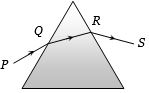
PhysicsEasyMCQIIT JEE · 2004
$A$ ray of light is incident on an equilateral glass prism placed on a horizontal table. For minimum deviation,which of the following is true?
A
$PQ$ is horizontal
B
$QR$ is horizontal
C
$RS$ is horizontal
D
Either $PQ$ or $RS$ is horizontal
Solution
(B) In the position of minimum deviation,the refracted ray inside the prism is parallel to the base of the prism.
Since the prism is placed on a horizontal table,its base is horizontal.
Therefore,for the refracted ray $QR$ to be parallel to the base,$QR$ must also be horizontal.
Since the prism is placed on a horizontal table,its base is horizontal.
Therefore,for the refracted ray $QR$ to be parallel to the base,$QR$ must also be horizontal.
0 likesView Solution
30
PhysicsDifficultMCQIIT JEE · 2004
In a $YDSE$,bi-chromatic light of wavelengths $400 \, nm$ and $560 \, nm$ are used. The distance between the slits is $0.1 \, mm$ and the distance between the plane of the slits and the screen is $1 \, m$. The minimum distance between two successive regions of complete darkness is......$mm$.
A
$4$
B
$5.6$
C
$14$
D
$28$
Solution
(D) The condition for the $n^{th}$ minima of wavelength $\lambda_1$ is $y_n = (2n - 1) \frac{\lambda_1 D}{2d}$.
For the two wavelengths $\lambda_1 = 400 \, nm$ and $\lambda_2 = 560 \, nm$ to have overlapping minima,we set $(2n - 1) \lambda_1 = (2m - 1) \lambda_2$.
$(2n - 1) 400 = (2m - 1) 560 \implies \frac{2n - 1}{2m - 1} = \frac{560}{400} = \frac{7}{5}$.
The first overlapping minima occurs at $2n-1 = 7$ and $2m-1 = 5$.
The position is $y_1 = 7 \times \frac{400 \times 10^{-9} \times 1}{2 \times 0.1 \times 10^{-3}} = 14 \, mm$.
The next overlapping minima occurs for the next odd ratio,which is $\frac{21}{15}$ (since $7 \times 3 = 21$ and $5 \times 3 = 15$).
The position is $y_2 = 21 \times \frac{400 \times 10^{-9} \times 1}{2 \times 0.1 \times 10^{-3}} = 42 \, mm$.
The distance between two successive regions of complete darkness is $\Delta y = y_2 - y_1 = 42 - 14 = 28 \, mm$.
For the two wavelengths $\lambda_1 = 400 \, nm$ and $\lambda_2 = 560 \, nm$ to have overlapping minima,we set $(2n - 1) \lambda_1 = (2m - 1) \lambda_2$.
$(2n - 1) 400 = (2m - 1) 560 \implies \frac{2n - 1}{2m - 1} = \frac{560}{400} = \frac{7}{5}$.
The first overlapping minima occurs at $2n-1 = 7$ and $2m-1 = 5$.
The position is $y_1 = 7 \times \frac{400 \times 10^{-9} \times 1}{2 \times 0.1 \times 10^{-3}} = 14 \, mm$.
The next overlapping minima occurs for the next odd ratio,which is $\frac{21}{15}$ (since $7 \times 3 = 21$ and $5 \times 3 = 15$).
The position is $y_2 = 21 \times \frac{400 \times 10^{-9} \times 1}{2 \times 0.1 \times 10^{-3}} = 42 \, mm$.
The distance between two successive regions of complete darkness is $\Delta y = y_2 - y_1 = 42 - 14 = 28 \, mm$.
0 likesView Solution
Vedclass Products
For Students
Vedclass Test Series
Mock tests in real IIT JEE style covering Physics with performance analysis. 5-day free trial.
Start Free TrialFor Teachers
Exam Paper Generator
Generate Set A/B/C/D Physics papers from 7.5L+ questions in 2 minutes. 3 chapters free.
Try FreeFor Institutes
Online Exam Module
Run live IIT JEE mock exams with unlimited students, 360° analytics & white-label branding.
See DemoFrequently Asked Questions
How many Physics questions are in IIT JEE 2004?
There are 30 Physics questions from the IIT JEE 2004 paper on Vedclass, each with a detailed step-by-step solution in English.
Are IIT JEE 2004 Physics solutions available in English?
Yes. All solutions on this page are in English. You can also switch to English or Hindi using the language buttons above the questions.
Can I practice IIT JEE 2004 Physics as a timed test?
Yes. Use the Vedclass Test Series to attempt a full IIT JEE mock test covering Physics with time limits and instant score analysis.
Can teachers create Physics papers from IIT JEE previous year questions?
Yes. The Vedclass Exam Paper Generator lets teachers mix IIT JEE Physics questions and generate Set A/B/C/D papers in minutes.
For Teachers & Institutes
Build a Custom Physics Paper
Pick IIT JEE 2004 Physics questions, set difficulty, and generate Set A/B/C/D in 2 minutes.