
ChemistryQ1–56 of 56 questions
Page 1 of 1 · English
1
ChemistryMediumMCQIIT JEE · 2004
The radius of which of the following orbits is the same as that of the first Bohr's orbit of the hydrogen atom?
A
$He^{+}(n = 2)$
B
$Li^{2+}(n = 2)$
C
$Li^{2+}(n = 3)$
D
$Be^{3+}(n = 2)$
Solution
(D) The radius of an orbit in a hydrogen-like species is given by the formula: $r_n = 0.529 \times \frac{n^2}{Z} \ \mathring{A}$.
For the first Bohr orbit of the hydrogen atom $(H)$: $n = 1$ and $Z = 1$. Thus,$r_H = 0.529 \times \frac{1^2}{1} = 0.529 \ \mathring{A}$.
Now,checking the options:
For $Be^{3+}$: $Z = 4$ and $n = 2$. Thus,$r = 0.529 \times \frac{2^2}{4} = 0.529 \times \frac{4}{4} = 0.529 \ \mathring{A}$.
Since the radius of $Be^{3+}$ $(n = 2)$ is equal to the radius of the first Bohr orbit of hydrogen,the correct option is $D$.
For the first Bohr orbit of the hydrogen atom $(H)$: $n = 1$ and $Z = 1$. Thus,$r_H = 0.529 \times \frac{1^2}{1} = 0.529 \ \mathring{A}$.
Now,checking the options:
For $Be^{3+}$: $Z = 4$ and $n = 2$. Thus,$r = 0.529 \times \frac{2^2}{4} = 0.529 \times \frac{4}{4} = 0.529 \ \mathring{A}$.
Since the radius of $Be^{3+}$ $(n = 2)$ is equal to the radius of the first Bohr orbit of hydrogen,the correct option is $D$.
0 likesView Solution
2
ChemistryMediumMCQIIT JEE · 2004
According to molecular orbital theory,which of the following statements about the magnetic character and bond order is correct regarding $O_2^+$?
A
Paramagnetic and bond order $< O_2$
B
Paramagnetic and bond order $> O_2$
C
Diamagnetic and bond order $< O_2$
D
Diamagnetic and bond order $> O_2$
Solution
(B) The molecular orbital configuration for $O_2$ is $(\sigma 1s)^2(\sigma^* 1s)^2(\sigma 2s)^2(\sigma^* 2s)^2(\sigma 2p_z)^2(\pi 2p_x^2 \equiv \pi 2p_y^2)(\pi^* 2p_x^1 \equiv \pi^* 2p_y^1)$.
Bond order of $O_2 = \frac{10-6}{2} = 2.0$. It has two unpaired electrons,so it is paramagnetic.
The molecular orbital configuration for $O_2^+$ is $(\sigma 1s)^2(\sigma^* 1s)^2(\sigma 2s)^2(\sigma^* 2s)^2(\sigma 2p_z)^2(\pi 2p_x^2 \equiv \pi 2p_y^2)(\pi^* 2p_x^1 \equiv \pi^* 2p_y^0)$.
Bond order of $O_2^+ = \frac{10-5}{2} = 2.5$.
Since $O_2^+$ has one unpaired electron,it is paramagnetic.
Comparing the values,$2.5 > 2.0$,so the bond order of $O_2^+ > O_2$.
Bond order of $O_2 = \frac{10-6}{2} = 2.0$. It has two unpaired electrons,so it is paramagnetic.
The molecular orbital configuration for $O_2^+$ is $(\sigma 1s)^2(\sigma^* 1s)^2(\sigma 2s)^2(\sigma^* 2s)^2(\sigma 2p_z)^2(\pi 2p_x^2 \equiv \pi 2p_y^2)(\pi^* 2p_x^1 \equiv \pi^* 2p_y^0)$.
Bond order of $O_2^+ = \frac{10-5}{2} = 2.5$.
Since $O_2^+$ has one unpaired electron,it is paramagnetic.
Comparing the values,$2.5 > 2.0$,so the bond order of $O_2^+ > O_2$.
0 likesView Solution
3
ChemistryMediumMCQIIT JEE · 2004
The root mean square velocity of one mole of a monoatomic gas having molar mass $M$ is $V_{rms}$. The relation between the average kinetic energy $(E)$ and the $V_{rms}$ is
A
$V_{rms} = \sqrt{\frac{3E}{2M}}$
B
$V_{rms} = \sqrt{\frac{2E}{3M}}$
C
$V_{rms} = \sqrt{\frac{2E}{M}}$
D
$V_{rms} = \sqrt{\frac{E}{3M}}$
Solution
(C) The root mean square velocity of one mole of a monoatomic gas is given by $V_{rms} = \sqrt{\frac{3RT}{M}} \dots (1)$.
The average kinetic energy $(E)$ of one mole of a monoatomic gas is given by $E = \frac{3}{2}RT$.
From this,we can express $RT$ as $RT = \frac{2E}{3} \dots (2)$.
Substituting equation $(2)$ into equation $(1)$:
$V_{rms} = \sqrt{\frac{3}{M} \times \frac{2E}{3}}$
$V_{rms} = \sqrt{\frac{2E}{M}}$.
The average kinetic energy $(E)$ of one mole of a monoatomic gas is given by $E = \frac{3}{2}RT$.
From this,we can express $RT$ as $RT = \frac{2E}{3} \dots (2)$.
Substituting equation $(2)$ into equation $(1)$:
$V_{rms} = \sqrt{\frac{3}{M} \times \frac{2E}{3}}$
$V_{rms} = \sqrt{\frac{2E}{M}}$.
0 likesView Solution
4
ChemistryMediumMCQIIT JEE · 2004
$A$ weak acid $HX$ has the dissociation constant $1 \times 10^{-5} \ M$. It forms a salt $NaX$ on reaction with alkali. The degree of hydrolysis of $0.1 \ M$ solution of $NaX$ is......$\%$
A
$0.0001$
B
$0.01$
C
$0.1$
D
$0.15$
Solution
(B) The salt $NaX$ is formed from a weak acid $HX$ and a strong base $NaOH$. The hydrolysis reaction is: $X^{-} + H_2O ⇌ HX + OH^{-}$.
The hydrolysis constant $K_h$ is given by $K_h = \frac{K_w}{K_a} = \frac{10^{-14}}{10^{-5}} = 10^{-9}$.
The degree of hydrolysis $h$ for a salt of a weak acid and strong base is given by $h = \sqrt{\frac{K_h}{C}}$,where $C = 0.1 \ M$.
$h = \sqrt{\frac{10^{-9}}{0.1}} = \sqrt{10^{-8}} = 10^{-4}$.
To express this as a percentage: $h \times 100 = 10^{-4} \times 100 = 0.01 \%$.
The hydrolysis constant $K_h$ is given by $K_h = \frac{K_w}{K_a} = \frac{10^{-14}}{10^{-5}} = 10^{-9}$.
The degree of hydrolysis $h$ for a salt of a weak acid and strong base is given by $h = \sqrt{\frac{K_h}{C}}$,where $C = 0.1 \ M$.
$h = \sqrt{\frac{10^{-9}}{0.1}} = \sqrt{10^{-8}} = 10^{-4}$.
To express this as a percentage: $h \times 100 = 10^{-4} \times 100 = 0.01 \%$.
0 likesView Solution
5
ChemistryMediumMCQIIT JEE · 2004
The enthalpy of vapourization of a liquid is $30 \ kJ \ mol^{-1}$ and entropy of vapourization is $75 \ J \ mol^{-1} \ K^{-1}$. The boiling point of the liquid at $1 \ atm$ is.......$K$
A
$250$
B
$400$
C
$450$
D
$600$
Solution
(B) At the boiling point,the process of vaporization is in equilibrium,so $\Delta G = 0$.
Using the relation $\Delta G = \Delta H - T\Delta S$,we get $\Delta H = T\Delta S$.
Given $\Delta H = 30 \ kJ \ mol^{-1} = 30000 \ J \ mol^{-1}$ and $\Delta S = 75 \ J \ mol^{-1} \ K^{-1}$.
$T = \frac{\Delta H}{\Delta S} = \frac{30000 \ J \ mol^{-1}}{75 \ J \ mol^{-1} \ K^{-1}} = 400 \ K$.
Using the relation $\Delta G = \Delta H - T\Delta S$,we get $\Delta H = T\Delta S$.
Given $\Delta H = 30 \ kJ \ mol^{-1} = 30000 \ J \ mol^{-1}$ and $\Delta S = 75 \ J \ mol^{-1} \ K^{-1}$.
$T = \frac{\Delta H}{\Delta S} = \frac{30000 \ J \ mol^{-1}}{75 \ J \ mol^{-1} \ K^{-1}} = 400 \ K$.
0 likesView Solution
6
ChemistryEasyMCQIIT JEE · 2004
Two mole of an ideal gas is expanded isothermally and reversibly from $1 \ L$ to $10 \ L$ at $300 \ K$. The enthalpy change (in $kJ$) for the process is .....$kJ$
A
$11.4$
B
$-11.4$
C
$0$
D
$4.8$
Solution
(C) For an ideal gas,the enthalpy change $\Delta H$ is given by the formula $\Delta H = n C_p \Delta T$.
Since the process is isothermal,the change in temperature $\Delta T = 0$.
Therefore,$\Delta H = n C_p \times 0 = 0 \ kJ$.
Since the process is isothermal,the change in temperature $\Delta T = 0$.
Therefore,$\Delta H = n C_p \times 0 = 0 \ kJ$.
0 likesView Solution
7
ChemistryDifficultMCQIIT JEE · 2004
The product of oxidation of $I^{-}$ with $MnO_4^{-}$ in alkaline medium is
A
$IO_3^{-}$
B
$I_2$
C
$IO^{-}$
D
$IO_4^{-}$
Solution
(A) In an alkaline medium,the permanganate ion $(MnO_4^{-})$ acts as an oxidizing agent and oxidizes the iodide ion $(I^{-})$ to the iodate ion $(IO_3^{-})$.
The balanced chemical equation for this reaction is:
$I^{-} + 6OH^{-} + 6MnO_4^{-} \rightarrow IO_3^{-} + 6MnO_4^{2-} + 3H_2O$
Thus,the correct product is $IO_3^{-}$.
The balanced chemical equation for this reaction is:
$I^{-} + 6OH^{-} + 6MnO_4^{-} \rightarrow IO_3^{-} + 6MnO_4^{2-} + 3H_2O$
Thus,the correct product is $IO_3^{-}$.
0 likesView Solution
8
ChemistryMCQIIT JEE · 2004
Heating $(NH_4)_2Cr_2O_7$ liberates a gas. The same gas is obtained by:
A
Heating $NH_4NO_2$
B
Heating $NH_4NO_3$
C
Treating $H_2O_2$ with $NaNO_2$
D
Treating $Mg_3N_2$ with $H_2O$
Solution
(A) The thermal decomposition of ammonium dichromate is given by: $(NH_4)_2Cr_2O_7 \xrightarrow{\Delta} N_2 \uparrow + Cr_2O_3 + 4H_2O$. The gas liberated is nitrogen $(N_2)$.
Similarly,the thermal decomposition of ammonium nitrite is: $NH_4NO_2 \xrightarrow{\Delta} N_2 \uparrow + 2H_2O$.
Thus,both reactions produce nitrogen gas.
Similarly,the thermal decomposition of ammonium nitrite is: $NH_4NO_2 \xrightarrow{\Delta} N_2 \uparrow + 2H_2O$.
Thus,both reactions produce nitrogen gas.
0 likesView Solution
9
ChemistryMediumMCQIIT JEE · 2004
An organic compound on analysis gave the following results: $C = 54.5\%$,$O = 36.4\%$,$H = 9.1\%$. The empirical formula of the compound is:
A
$C_2H_4O$
B
$C_2H_6O$
C
$C_3H_4O$
D
$C_4H_8O$
Solution
(A) To find the empirical formula,we calculate the mole ratio of each element:
The ratio of $C:H:O$ is $2:4:1$. Therefore,the empirical formula is $C_2H_4O$.
| Element | Percentage / Atomic Mass | Moles | Simple Ratio |
|---|---|---|---|
| $C$ | $54.5 / 12$ | $4.54$ | $4.54 / 2.27 = 2$ |
| $H$ | $9.1 / 1$ | $9.1$ | $9.1 / 2.27 = 4$ |
| $O$ | $36.4 / 16$ | $2.27$ | $2.27 / 2.27 = 1$ |
The ratio of $C:H:O$ is $2:4:1$. Therefore,the empirical formula is $C_2H_4O$.
0 likesView Solution
10
ChemistryDifficultMCQIIT JEE · 2004
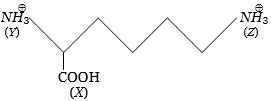
In the compound given below,the correct order of the acidity of the positions $(X)$,$(Y)$ and $(Z)$ is:
A
$(Z) > (X) > (Y)$
B
$(X) > (Y) > (Z)$
C
$(X) > (Z) > (Y)$
D
$(Y) > (X) > (Z)$
Solution
(B) The acidity of a proton depends on the stability of its conjugate base.
$1$. Position $(X)$ is the carboxylic acid group $(-COOH)$,which is inherently more acidic than the ammonium groups $(-NH_3^+)$.
$2$. Between the two ammonium groups $(Y)$ and $(Z)$,the position $(Y)$ is closer to the electron-withdrawing $-COOH$ group. The inductive effect ($-I$ effect) of the $-COOH$ group destabilizes the positive charge on the adjacent $-NH_3^+$ group at $(Y)$ more than at $(Z)$,making the proton at $(Y)$ more acidic than the one at $(Z)$.
$3$. Therefore,the order of acidity is $(X) > (Y) > (Z)$.
$1$. Position $(X)$ is the carboxylic acid group $(-COOH)$,which is inherently more acidic than the ammonium groups $(-NH_3^+)$.
$2$. Between the two ammonium groups $(Y)$ and $(Z)$,the position $(Y)$ is closer to the electron-withdrawing $-COOH$ group. The inductive effect ($-I$ effect) of the $-COOH$ group destabilizes the positive charge on the adjacent $-NH_3^+$ group at $(Y)$ more than at $(Z)$,making the proton at $(Y)$ more acidic than the one at $(Z)$.
$3$. Therefore,the order of acidity is $(X) > (Y) > (Z)$.
0 likesView Solution
11
ChemistryDifficultMCQIIT JEE · 2004
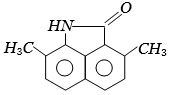
The major product obtained when the following compound is treated with $Br_2/Fe$ is:
A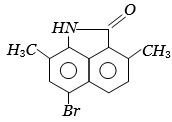
B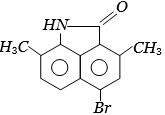
C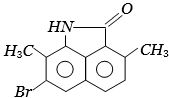
D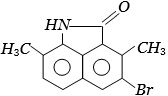
Solution
(D) The given molecule is a bicyclic system where one ring is attached to an $-NH-$ group (which is an activating group due to the lone pair on nitrogen) and the other ring is attached to a $-C(=O)-$ group (which is a deactivating group).
Electrophilic aromatic substitution,such as bromination using $Br_2/Fe$,occurs preferentially on the more electron-rich ring.
The ring containing the $-NH-$ group is activated,making it more susceptible to electrophilic attack.
The $-NH-$ group is ortho/para directing. Due to steric hindrance from the methyl group at the ortho position,the bromination occurs at the para position relative to the $-NH-$ group.
Thus,the bromine atom will be substituted at the para position of the activated ring.
Electrophilic aromatic substitution,such as bromination using $Br_2/Fe$,occurs preferentially on the more electron-rich ring.
The ring containing the $-NH-$ group is activated,making it more susceptible to electrophilic attack.
The $-NH-$ group is ortho/para directing. Due to steric hindrance from the methyl group at the ortho position,the bromination occurs at the para position relative to the $-NH-$ group.
Thus,the bromine atom will be substituted at the para position of the activated ring.
0 likesView Solution
12
ChemistryMediumMCQIIT JEE · 2004
The product of acid catalyzed hydration of $2-$phenylpropene is
A
$3-$phenylpropan$-2-$ol
B
$1-$phenylpropan$-2-$ol
C
$2-$phenylpropan$-2-$ol
D
$2-$phenylpropan$-1-$ol
Solution
(C) Acid catalyzed hydration of alkenes follows Markovnikov's rule.
$2-$phenylpropene $(CH_3-C(Ph)=CH_2)$ reacts with $H_3O^{+}$ to form a stable carbocation intermediate.
The proton $(H^{+})$ adds to the terminal carbon $(CH_2)$ to form a tertiary benzylic carbocation $(CH_3-C^{+}(Ph)-CH_3)$.
Water then attacks this carbocation to form $2-$phenylpropan$-2-$ol $(CH_3-C(OH)(Ph)-CH_3)$.
$2-$phenylpropene $(CH_3-C(Ph)=CH_2)$ reacts with $H_3O^{+}$ to form a stable carbocation intermediate.
The proton $(H^{+})$ adds to the terminal carbon $(CH_2)$ to form a tertiary benzylic carbocation $(CH_3-C^{+}(Ph)-CH_3)$.
Water then attacks this carbocation to form $2-$phenylpropan$-2-$ol $(CH_3-C(OH)(Ph)-CH_3)$.
0 likesView Solution
13
ChemistryMediumMCQIIT JEE · 2004
Which of the following is used for the conversion of $2$-hexyne into $trans$-$2$-hexene?
A
$H_2/Pd/BaSO_4$
B
$H_2, PtO_2$
C
$NaBH_4$
D
$Li/NH_3(l)$
Solution
(D) The conversion of an internal alkyne like $2$-hexyne into a $trans$-alkene is achieved by Birch reduction using an alkali metal (like $Li$ or $Na$) in liquid ammonia $(NH_3)$.
This reaction proceeds via a $trans$-vinylic radical anion intermediate,which leads to the formation of the thermodynamically more stable $trans$-alkene product.
This reaction proceeds via a $trans$-vinylic radical anion intermediate,which leads to the formation of the thermodynamically more stable $trans$-alkene product.
0 likesView Solution
14
ChemistryMCQIIT JEE · 2004
The angle between the tangents drawn from the point $(1, 4)$ to the parabola ${y^2} = 4x$ is
A
$\frac{\pi}{2}$
B
$\frac{\pi}{3}$
C
$\frac{\pi}{4}$
D
$\frac{\pi}{6}$
Solution
(B) The equation of any tangent to the parabola ${y^2} = 4x$ is given by $y = mx + \frac{1}{m}$.
Since the tangent passes through the point $(1, 4)$,we substitute these coordinates into the equation:
$4 = m(1) + \frac{1}{m}$
Multiplying by $m$,we get the quadratic equation:
${m^2} - 4m + 1 = 0$
Let the roots be ${m_1}$ and ${m_2}$. From the properties of quadratic equations:
${m_1} + {m_2} = 4$ and ${m_1}{m_2} = 1$.
The difference between the slopes is given by:
$|{m_1} - {m_2}| = \sqrt{({m_1} + {m_2})^2 - 4{m_1}{m_2}} = \sqrt{4^2 - 4(1)} = \sqrt{16 - 4} = \sqrt{12} = 2\sqrt{3}$.
If $\theta$ is the angle between the tangents,then:
$\tan \theta = \left| \frac{{m_1} - {m_2}}{1 + {m_1}{m_2}} \right| = \frac{2\sqrt{3}}{1 + 1} = \frac{2\sqrt{3}}{2} = \sqrt{3}$.
Therefore,$\theta = \arctan(\sqrt{3}) = \frac{\pi}{3}$.
Since the tangent passes through the point $(1, 4)$,we substitute these coordinates into the equation:
$4 = m(1) + \frac{1}{m}$
Multiplying by $m$,we get the quadratic equation:
${m^2} - 4m + 1 = 0$
Let the roots be ${m_1}$ and ${m_2}$. From the properties of quadratic equations:
${m_1} + {m_2} = 4$ and ${m_1}{m_2} = 1$.
The difference between the slopes is given by:
$|{m_1} - {m_2}| = \sqrt{({m_1} + {m_2})^2 - 4{m_1}{m_2}} = \sqrt{4^2 - 4(1)} = \sqrt{16 - 4} = \sqrt{12} = 2\sqrt{3}$.
If $\theta$ is the angle between the tangents,then:
$\tan \theta = \left| \frac{{m_1} - {m_2}}{1 + {m_1}{m_2}} \right| = \frac{2\sqrt{3}}{1 + 1} = \frac{2\sqrt{3}}{2} = \sqrt{3}$.
Therefore,$\theta = \arctan(\sqrt{3}) = \frac{\pi}{3}$.
0 likesView Solution
15
ChemistryMCQIIT JEE · 2004
If $a = i + j + k$,$a \cdot b = 1$ and $a \times b = j - k$,then $b = \dots$
A
$i$
B
$i - j + k$
C
$2j - k$
D
$2i$
Solution
(A) Let $b = b_1 i + b_2 j + b_3 k$.
Given $a \times b = j - k$,we have:
$j - k = \begin{vmatrix} i & j & k \\ 1 & 1 & 1 \\ b_1 & b_2 & b_3 \end{vmatrix}$
Expanding the determinant:
$j - k = i(b_3 - b_2) - j(b_3 - b_1) + k(b_2 - b_1)$
Comparing coefficients:
$b_3 - b_2 = 0 \Rightarrow b_3 = b_2$
$-(b_3 - b_1) = 1 \Rightarrow b_1 - b_3 = 1 \Rightarrow b_1 = b_3 + 1$
$b_2 - b_1 = -1$
Substituting $b_3 = b_2$ into $b_1 = b_3 + 1$,we get $b_1 = b_2 + 1$.
Given $a \cdot b = 1$,we have:
$(i + j + k) \cdot (b_1 i + b_2 j + b_3 k) = 1$
$b_1 + b_2 + b_3 = 1$
Substituting $b_1 = b_2 + 1$ and $b_3 = b_2$:
$(b_2 + 1) + b_2 + b_2 = 1$
$3b_2 + 1 = 1$
$3b_2 = 0 \Rightarrow b_2 = 0$
Thus,$b_3 = 0$ and $b_1 = 0 + 1 = 1$.
Therefore,$b = 1i + 0j + 0k = i$.
Given $a \times b = j - k$,we have:
$j - k = \begin{vmatrix} i & j & k \\ 1 & 1 & 1 \\ b_1 & b_2 & b_3 \end{vmatrix}$
Expanding the determinant:
$j - k = i(b_3 - b_2) - j(b_3 - b_1) + k(b_2 - b_1)$
Comparing coefficients:
$b_3 - b_2 = 0 \Rightarrow b_3 = b_2$
$-(b_3 - b_1) = 1 \Rightarrow b_1 - b_3 = 1 \Rightarrow b_1 = b_3 + 1$
$b_2 - b_1 = -1$
Substituting $b_3 = b_2$ into $b_1 = b_3 + 1$,we get $b_1 = b_2 + 1$.
Given $a \cdot b = 1$,we have:
$(i + j + k) \cdot (b_1 i + b_2 j + b_3 k) = 1$
$b_1 + b_2 + b_3 = 1$
Substituting $b_1 = b_2 + 1$ and $b_3 = b_2$:
$(b_2 + 1) + b_2 + b_2 = 1$
$3b_2 + 1 = 1$
$3b_2 = 0 \Rightarrow b_2 = 0$
Thus,$b_3 = 0$ and $b_1 = 0 + 1 = 1$.
Therefore,$b = 1i + 0j + 0k = i$.
0 likesView Solution
16
ChemistryMCQIIT JEE · 2004
An ideal gas expands isothermally from a volume $V_1$ to $V_2$ and is then compressed to the original volume $V_1$ adiabatically. The initial pressure is $P_1$ and the final pressure is $P_3$. The total work done is $W$. Then:
A
$P_3 > P_1$,$W > 0$
B
$P_3 < P_1$,$W < 0$
C
$P_3 > P_1$,$W < 0$
D
$P_3 = P_1$,$W = 0$
Solution
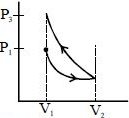
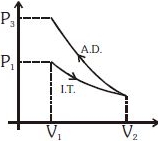
(C) $1$. In the $P-V$ diagram,the isothermal expansion from $V_1$ to $V_2$ follows a curve with a smaller slope compared to the adiabatic compression from $V_2$ to $V_1$.
$2$. Since the adiabatic curve is steeper than the isothermal curve,the final pressure $P_3$ at volume $V_1$ must be greater than the initial pressure $P_1$ $(P_3 > P_1)$.
$3$. The work done in a cyclic process is represented by the area enclosed by the $P-V$ loop. Since the process is counter-clockwise (expansion at lower pressure,compression at higher pressure),the net work done on the gas is positive,meaning the work done by the gas $(W)$ is negative $(W < 0)$.
$2$. Since the adiabatic curve is steeper than the isothermal curve,the final pressure $P_3$ at volume $V_1$ must be greater than the initial pressure $P_1$ $(P_3 > P_1)$.
$3$. The work done in a cyclic process is represented by the area enclosed by the $P-V$ loop. Since the process is counter-clockwise (expansion at lower pressure,compression at higher pressure),the net work done on the gas is positive,meaning the work done by the gas $(W)$ is negative $(W < 0)$.
0 likesView Solution
17
ChemistryMCQIIT JEE · 2004
If the lines $\frac{x - 1}{2} = \frac{y + 1}{3} = \frac{z - 1}{4}$ and $\frac{x - 3}{1} = \frac{y - k}{2} = \frac{z}{1}$ intersect,then $k =$
A
$\frac{2}{9}$
B
$\frac{9}{2}$
C
$0$
D
None of these
Solution
(B) Any point on the line $\frac{x-1}{2}=\frac{y+1}{3}=\frac{z-1}{4}=\lambda$ is given by $(2\lambda+1, 3\lambda-1, 4\lambda+1)$.
Any point on the line $\frac{x-3}{1}=\frac{y-k}{2}=\frac{z}{1}=\mu$ is given by $(\mu+3, 2\mu+k, \mu)$.
For the lines to intersect,there must exist values of $\lambda$ and $\mu$ such that:
$2\lambda+1 = \mu+3$ $(i)$
$3\lambda-1 = 2\mu+k$ $(ii)$
$4\lambda+1 = \mu$ $(iii)$
Substituting $\mu = 4\lambda+1$ from $(iii)$ into $(i)$:
$2\lambda+1 = (4\lambda+1)+3$
$2\lambda+1 = 4\lambda+4$
$-2\lambda = 3 \Rightarrow \lambda = -\frac{3}{2}$.
Now,find $\mu$ using $(iii)$:
$\mu = 4(-\frac{3}{2})+1 = -6+1 = -5$.
Substitute $\lambda = -\frac{3}{2}$ and $\mu = -5$ into $(ii)$:
$3(-\frac{3}{2})-1 = 2(-5)+k$
$-\frac{9}{2}-1 = -10+k$
$-\frac{11}{2} = -10+k$
$k = 10 - \frac{11}{2} = \frac{20-11}{2} = \frac{9}{2}$.
Any point on the line $\frac{x-3}{1}=\frac{y-k}{2}=\frac{z}{1}=\mu$ is given by $(\mu+3, 2\mu+k, \mu)$.
For the lines to intersect,there must exist values of $\lambda$ and $\mu$ such that:
$2\lambda+1 = \mu+3$ $(i)$
$3\lambda-1 = 2\mu+k$ $(ii)$
$4\lambda+1 = \mu$ $(iii)$
Substituting $\mu = 4\lambda+1$ from $(iii)$ into $(i)$:
$2\lambda+1 = (4\lambda+1)+3$
$2\lambda+1 = 4\lambda+4$
$-2\lambda = 3 \Rightarrow \lambda = -\frac{3}{2}$.
Now,find $\mu$ using $(iii)$:
$\mu = 4(-\frac{3}{2})+1 = -6+1 = -5$.
Substitute $\lambda = -\frac{3}{2}$ and $\mu = -5$ into $(ii)$:
$3(-\frac{3}{2})-1 = 2(-5)+k$
$-\frac{9}{2}-1 = -10+k$
$-\frac{11}{2} = -10+k$
$k = 10 - \frac{11}{2} = \frac{20-11}{2} = \frac{9}{2}$.
0 likesView Solution
18
ChemistryMCQIIT JEE · 2004
If the area bounded by $y = ax^2$ and $x = ay^2$ for $a > 0$ is $1$,then $a =$
A
$1$
B
$\frac{1}{\sqrt{3}}$
C
$\frac{1}{3}$
D
None
Solution
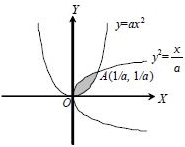
(B) The curves are $y = ax^2$ and $x = ay^2$ (which is $y = \sqrt{x/a}$ for $y \ge 0$).
To find the intersection point,substitute $y = ax^2$ into $x = ay^2$:
$x = a(ax^2)^2 = a^3x^4$
$x(a^3x^3 - 1) = 0$
Since $a > 0$,the intersection points are $x = 0$ and $x = 1/a$.
The area $A$ is given by:
$A = \int_{0}^{1/a} (\sqrt{x/a} - ax^2) dx = 1$
$\frac{1}{\sqrt{a}} \int_{0}^{1/a} x^{1/2} dx - a \int_{0}^{1/a} x^2 dx = 1$
$\frac{1}{\sqrt{a}} [\frac{2}{3} x^{3/2}]_{0}^{1/a} - a [\frac{x^3}{3}]_{0}^{1/a} = 1$
$\frac{1}{\sqrt{a}} \cdot \frac{2}{3} \cdot (\frac{1}{a})^{3/2} - \frac{a}{3} \cdot (\frac{1}{a})^3 = 1$
$\frac{2}{3a^2} - \frac{1}{3a^2} = 1$
$\frac{1}{3a^2} = 1$
$a^2 = \frac{1}{3} \implies a = \frac{1}{\sqrt{3}}$ (since $a > 0$).
To find the intersection point,substitute $y = ax^2$ into $x = ay^2$:
$x = a(ax^2)^2 = a^3x^4$
$x(a^3x^3 - 1) = 0$
Since $a > 0$,the intersection points are $x = 0$ and $x = 1/a$.
The area $A$ is given by:
$A = \int_{0}^{1/a} (\sqrt{x/a} - ax^2) dx = 1$
$\frac{1}{\sqrt{a}} \int_{0}^{1/a} x^{1/2} dx - a \int_{0}^{1/a} x^2 dx = 1$
$\frac{1}{\sqrt{a}} [\frac{2}{3} x^{3/2}]_{0}^{1/a} - a [\frac{x^3}{3}]_{0}^{1/a} = 1$
$\frac{1}{\sqrt{a}} \cdot \frac{2}{3} \cdot (\frac{1}{a})^{3/2} - \frac{a}{3} \cdot (\frac{1}{a})^3 = 1$
$\frac{2}{3a^2} - \frac{1}{3a^2} = 1$
$\frac{1}{3a^2} = 1$
$a^2 = \frac{1}{3} \implies a = \frac{1}{\sqrt{3}}$ (since $a > 0$).
0 likesView Solution
19
ChemistryMCQIIT JEE · 2004
The correct order of reactivity of $PhMgBr$ with: $(I)$ $Ph-CO-Ph$,$(II)$ $CH_3-CHO$,$(III)$ $CH_3-CO-CH_3$ is:
A
$I > II > III$
B
$III > I > II$
C
$II > III > I$
D
$II > I > III$
Solution
(C) The reactivity of Grignard reagents $(RMgX)$ with carbonyl compounds depends on steric hindrance and the electrophilicity of the carbonyl carbon.
$1.$ Aldehydes are generally more reactive than ketones due to less steric hindrance and higher electrophilicity of the carbonyl carbon. Thus,$(II)$ $CH_3-CHO$ is the most reactive.
$2.$ Among ketones,as the size of the alkyl or aryl groups increases,steric hindrance increases and reactivity decreases. Also,the $+I$ effect of methyl groups and resonance in phenyl groups reduce the positive charge on the carbonyl carbon.
$3.$ $(III)$ $CH_3-CO-CH_3$ (Acetone) is more reactive than $(I)$ $Ph-CO-Ph$ (Benzophenone) because phenyl groups are much bulkier than methyl groups and provide resonance stabilization.
Therefore,the correct order is $II > III > I$.
$1.$ Aldehydes are generally more reactive than ketones due to less steric hindrance and higher electrophilicity of the carbonyl carbon. Thus,$(II)$ $CH_3-CHO$ is the most reactive.
$2.$ Among ketones,as the size of the alkyl or aryl groups increases,steric hindrance increases and reactivity decreases. Also,the $+I$ effect of methyl groups and resonance in phenyl groups reduce the positive charge on the carbonyl carbon.
$3.$ $(III)$ $CH_3-CO-CH_3$ (Acetone) is more reactive than $(I)$ $Ph-CO-Ph$ (Benzophenone) because phenyl groups are much bulkier than methyl groups and provide resonance stabilization.
Therefore,the correct order is $II > III > I$.
0 likesView Solution
20
ChemistryMCQIIT JEE · 2004
The species having tetrahedral shape is
A
$[PdCl_4]^{2-}$
B
$[Ni(CN)_4]^{2-}$
C
$[Pd(CN)_4]^{2-}$
D
$[NiCl_4]^{2-}$
Solution
(D) The electronic configuration of $Ni^{2+}$ is $3d^8$.
In $[NiCl_4]^{2-}$,$Cl^-$ is a weak field ligand,so it does not cause pairing of electrons.
Thus,the hybridization is $sp^3$,which results in a tetrahedral geometry.
In contrast,$[PdCl_4]^{2-}$,$[Ni(CN)_4]^{2-}$,and $[Pd(CN)_4]^{2-}$ involve $4d$ or $5d$ metals or strong field ligands,leading to $dsp^2$ hybridization and square planar geometry.
In $[NiCl_4]^{2-}$,$Cl^-$ is a weak field ligand,so it does not cause pairing of electrons.
Thus,the hybridization is $sp^3$,which results in a tetrahedral geometry.
In contrast,$[PdCl_4]^{2-}$,$[Ni(CN)_4]^{2-}$,and $[Pd(CN)_4]^{2-}$ involve $4d$ or $5d$ metals or strong field ligands,leading to $dsp^2$ hybridization and square planar geometry.
0 likesView Solution
21
ChemistryMCQIIT JEE · 2004
Let $f(x) = x^3 + bx^2 + cx + d$ where $0 < b^2 < c$. Then $f(x)$:
A
is bounded
B
has a local maxima
C
has a local minima
D
is strictly increasing
Solution
(D) Given $f(x) = x^3 + bx^2 + cx + d$.
Find the derivative: $f'(x) = 3x^2 + 2bx + c$.
To determine the nature of the function,check the discriminant $D$ of the quadratic $f'(x)$:
$D = (2b)^2 - 4(3)(c) = 4b^2 - 12c = 4(b^2 - 3c)$.
Given $0 < b^2 < c$,we know that $b^2 - 3c < 0$ because $b^2 < c$ implies $b^2 - 3c < c - 3c = -2c < 0$.
Since the leading coefficient of $f'(x)$ is $3 > 0$ and $D < 0$,$f'(x) > 0$ for all $x \in \mathbb{R}$.
Therefore,$f(x)$ is strictly increasing.
Find the derivative: $f'(x) = 3x^2 + 2bx + c$.
To determine the nature of the function,check the discriminant $D$ of the quadratic $f'(x)$:
$D = (2b)^2 - 4(3)(c) = 4b^2 - 12c = 4(b^2 - 3c)$.
Given $0 < b^2 < c$,we know that $b^2 - 3c < 0$ because $b^2 < c$ implies $b^2 - 3c < c - 3c = -2c < 0$.
Since the leading coefficient of $f'(x)$ is $3 > 0$ and $D < 0$,$f'(x) > 0$ for all $x \in \mathbb{R}$.
Therefore,$f(x)$ is strictly increasing.
0 likesView Solution
22
ChemistryMCQIIT JEE · 2004
An ideal gas expands isothermally from a volume $V_1$ to $V_2$ and then is compressed to the original volume $V_1$ adiabatically. The initial pressure is $P_1$ and the final pressure is $P_3$. The total work done is $W$. Then:
A
$P_3 > P_1, W > 0$
B
$P_3 < P_1, W < 0$
C
$P_3 > P_1, W < 0$
D
$P_3 = P_1, W = 0$
Solution
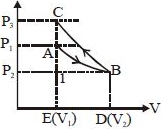
(C) $1$. In the $P-V$ diagram,the process $AB$ represents an isothermal expansion from $V_1$ to $V_2$,and the process $BC$ represents an adiabatic compression from $V_2$ back to $V_1$.
$2$. From the graph,it is clear that the final pressure $P_3$ at point $C$ is greater than the initial pressure $P_1$ at point $A$ $(P_3 > P_1)$.
$3$. The work done in an isothermal expansion $(W_{iso})$ is the area under the curve $AB$,which is positive. The work done in an adiabatic compression $(W_{adia})$ is the negative of the area under the curve $BC$,which is negative.
$4$. Since the adiabatic curve $BC$ is steeper than the isothermal curve $AB$,the magnitude of work done during adiabatic compression is greater than the work done during isothermal expansion $(|W_{adia}| > |W_{iso}|)$.
$5$. Therefore,the net work done $W = W_{iso} + W_{adia}$ is negative $(W < 0)$.
$2$. From the graph,it is clear that the final pressure $P_3$ at point $C$ is greater than the initial pressure $P_1$ at point $A$ $(P_3 > P_1)$.
$3$. The work done in an isothermal expansion $(W_{iso})$ is the area under the curve $AB$,which is positive. The work done in an adiabatic compression $(W_{adia})$ is the negative of the area under the curve $BC$,which is negative.
$4$. Since the adiabatic curve $BC$ is steeper than the isothermal curve $AB$,the magnitude of work done during adiabatic compression is greater than the work done during isothermal expansion $(|W_{adia}| > |W_{iso}|)$.
$5$. Therefore,the net work done $W = W_{iso} + W_{adia}$ is negative $(W < 0)$.
0 likesView Solution
23
ChemistryMCQIIT JEE · 2004
An ideal gas expands isothermally from a volume $V_1$ to $V_2$ and is then compressed to the original volume $V_1$ adiabatically. The initial pressure is $P_1$ and the final pressure is $P_3$. If the total work done is $W$,then:
A
$P_3 > P_1, W > 0$
B
$P_3 < P_1, W < 0$
C
$P_3 > P_1, W < 0$
D
$P_3 = P_1, W = 0$
Solution
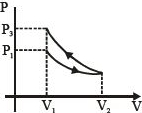
(C) $1$. In an isothermal expansion from $V_1$ to $V_2$,the work done by the gas is positive $(W_{iso} > 0)$.
$2$. In an adiabatic compression from $V_2$ to $V_1$,the work done on the gas is negative $(W_{adia} < 0)$.
$3$. The slope of an adiabatic process is $\gamma$ times the slope of an isothermal process. Since the adiabatic curve is steeper,the final pressure $P_3$ at volume $V_1$ after adiabatic compression will be greater than the initial pressure $P_1$ $(P_3 > P_1)$.
$4$. The total work done $W$ is the area enclosed by the cycle. Since the cycle is traversed in an anti-clockwise direction,the net work done is negative $(W < 0)$.
$2$. In an adiabatic compression from $V_2$ to $V_1$,the work done on the gas is negative $(W_{adia} < 0)$.
$3$. The slope of an adiabatic process is $\gamma$ times the slope of an isothermal process. Since the adiabatic curve is steeper,the final pressure $P_3$ at volume $V_1$ after adiabatic compression will be greater than the initial pressure $P_1$ $(P_3 > P_1)$.
$4$. The total work done $W$ is the area enclosed by the cycle. Since the cycle is traversed in an anti-clockwise direction,the net work done is negative $(W < 0)$.
0 likesView Solution
24
ChemistryMCQIIT JEE · 2004
$A$ radioactive sample of $U^{238}$ decays to $Pb$ through a process for which the half-life is $4.5 \times 10^9 \text{ years}$. What is the ratio of the number of nuclei of $Pb$ to $U^{238}$ after a time of $1.5 \times 10^9 \text{ years}$? (Given $2^{1/3} = 1.26$)
A
$0.12$
B
$0.26$
C
$1.2$
D
$0.37$
Solution
(B) The number of half-lives $n$ is given by $n = \frac{t}{T_{1/2}} = \frac{1.5 \times 10^9}{4.5 \times 10^9} = \frac{1}{3}$.
The number of remaining $U^{238}$ nuclei $(N_U)$ is given by $N_U = N_0 \left(\frac{1}{2}\right)^n = N_0 \left(\frac{1}{2}\right)^{1/3}$.
Given $2^{1/3} = 1.26$,we have $N_U = \frac{N_0}{1.26}$.
The number of $Pb$ nuclei formed is $N_{Pb} = N_0 - N_U = N_0 - \frac{N_0}{1.26} = N_0 \left(1 - \frac{1}{1.26}\right) = N_0 \left(\frac{0.26}{1.26}\right)$.
The ratio of the number of nuclei of $Pb$ to $U^{238}$ is $\frac{N_{Pb}}{N_U} = \frac{N_0 (0.26 / 1.26)}{N_0 / 1.26} = 0.26$.
The number of remaining $U^{238}$ nuclei $(N_U)$ is given by $N_U = N_0 \left(\frac{1}{2}\right)^n = N_0 \left(\frac{1}{2}\right)^{1/3}$.
Given $2^{1/3} = 1.26$,we have $N_U = \frac{N_0}{1.26}$.
The number of $Pb$ nuclei formed is $N_{Pb} = N_0 - N_U = N_0 - \frac{N_0}{1.26} = N_0 \left(1 - \frac{1}{1.26}\right) = N_0 \left(\frac{0.26}{1.26}\right)$.
The ratio of the number of nuclei of $Pb$ to $U^{238}$ is $\frac{N_{Pb}}{N_U} = \frac{N_0 (0.26 / 1.26)}{N_0 / 1.26} = 0.26$.
0 likesView Solution
25
ChemistryMCQIIT JEE · 2004
$A$ weak acid $HX$ has the dissociation constant $1 \times 10^{-5} \text{ } M$. It forms a salt $NaX$ on reaction with alkali. The percentage hydrolysis of $0.1 \text{ } M$ solution of $NaX$ is ............... $\%$
A
$0.0001$
B
$0.01$
C
$0.1$
D
$0.15$
Solution
(B) $NaX$ is a salt of a weak acid and a strong base.
For such a salt,the degree of hydrolysis $h$ is given by the formula:
$h = \sqrt{\frac{K_w}{K_a \times C}}$
Given:
$K_w = 10^{-14}$
$K_a = 1 \times 10^{-5}$
$C = 0.1 \text{ } M$
Substituting the values:
$h = \sqrt{\frac{10^{-14}}{10^{-5} \times 0.1}} = \sqrt{\frac{10^{-14}}{10^{-6}}} = \sqrt{10^{-8}} = 10^{-4}$
Percentage hydrolysis $= h \times 100 = 10^{-4} \times 100 = 0.01 \%$
For such a salt,the degree of hydrolysis $h$ is given by the formula:
$h = \sqrt{\frac{K_w}{K_a \times C}}$
Given:
$K_w = 10^{-14}$
$K_a = 1 \times 10^{-5}$
$C = 0.1 \text{ } M$
Substituting the values:
$h = \sqrt{\frac{10^{-14}}{10^{-5} \times 0.1}} = \sqrt{\frac{10^{-14}}{10^{-6}}} = \sqrt{10^{-8}} = 10^{-4}$
Percentage hydrolysis $= h \times 100 = 10^{-4} \times 100 = 0.01 \%$
0 likesView Solution
26
ChemistryMCQIIT JEE · 2004
After $280\,days$,the activity of a radioactive sample is $6000\,dps$. The activity reduces to $3000\,dps$ after another $140\,days$. The initial activity of the sample in $dps$ is
A
$6000$
B
$9000$
C
$3000$
D
$24000$
Solution
(D) The activity of a radioactive sample follows the law $A = A_0 (1/2)^n$,where $n$ is the number of half-lives.
Given that the activity reduces from $6000\,dps$ to $3000\,dps$ in $140\,days$,the half-life $T_{1/2}$ is $140\,days$.
At $t = 280\,days$,the number of half-lives elapsed is $n = 280 / 140 = 2$.
Let $A_i$ be the initial activity. At $t = 280\,days$,the activity $A_{280} = 6000\,dps$.
Using the formula $A_{280} = A_i (1/2)^n$,we have $6000 = A_i (1/2)^2$.
$6000 = A_i / 4$.
$A_i = 6000 \times 4 = 24000\,dps$.
Given that the activity reduces from $6000\,dps$ to $3000\,dps$ in $140\,days$,the half-life $T_{1/2}$ is $140\,days$.
At $t = 280\,days$,the number of half-lives elapsed is $n = 280 / 140 = 2$.
Let $A_i$ be the initial activity. At $t = 280\,days$,the activity $A_{280} = 6000\,dps$.
Using the formula $A_{280} = A_i (1/2)^n$,we have $6000 = A_i (1/2)^2$.
$6000 = A_i / 4$.
$A_i = 6000 \times 4 = 24000\,dps$.
0 likesView Solution
27
ChemistryMCQIIT JEE · 2004
$A$ weak acid $HX$ has the dissociation constant $1 \times 10^{-5} \ M$. It forms a salt $NaX$ on reaction with alkali. The percentage hydrolysis of $0.1 \ M$ solution of $NaX$ is ........ $\%$.
A
$0.0001$
B
$0.01$
C
$0.1$
D
$0.15$
Solution
(B) $NaX$ is a salt of a weak acid and a strong base.
For such a salt,the degree of hydrolysis $h$ is given by the formula:
$h = \sqrt{\frac{K_w}{K_a \times C}}$
Given:
$K_w = 10^{-14}$
$K_a = 1 \times 10^{-5}$
$C = 0.1 \ M$
Substituting the values:
$h = \sqrt{\frac{10^{-14}}{10^{-5} \times 0.1}} = \sqrt{\frac{10^{-14}}{10^{-6}}} = \sqrt{10^{-8}} = 10^{-4}$
Percentage hydrolysis $= h \times 100 = 10^{-4} \times 100 = 0.01 \ \%$.
For such a salt,the degree of hydrolysis $h$ is given by the formula:
$h = \sqrt{\frac{K_w}{K_a \times C}}$
Given:
$K_w = 10^{-14}$
$K_a = 1 \times 10^{-5}$
$C = 0.1 \ M$
Substituting the values:
$h = \sqrt{\frac{10^{-14}}{10^{-5} \times 0.1}} = \sqrt{\frac{10^{-14}}{10^{-6}}} = \sqrt{10^{-8}} = 10^{-4}$
Percentage hydrolysis $= h \times 100 = 10^{-4} \times 100 = 0.01 \ \%$.
0 likesView Solution
28
ChemistryMCQIIT JEE · 2004
The radius of which of the following orbits is the same as that of the $1^{st}$ orbit of $H$ atom?
A
$He^{+} \ (n = 2)$
B
$Li^{2+} \ (n = 2)$
C
$Li^{2+} \ (n = 3)$
D
$Be^{3+} \ (n = 2)$
Solution
(D) The radius of the $n^{th}$ orbit of a hydrogen-like species is given by the formula: $r_n = 0.529 \times \frac{n^2}{Z} \ \mathring{A}$.
For the $1^{st}$ orbit of $H$ atom,$n=1$ and $Z=1$,so $r_H = 0.529 \times \frac{1^2}{1} = 0.529 \ \mathring{A}$.
Checking the options:
$A$: For $He^{+} \ (n=2, Z=2)$,$r = 0.529 \times \frac{2^2}{2} = 0.529 \times 2 = 1.058 \ \mathring{A}$.
$B$: For $Li^{2+} \ (n=2, Z=3)$,$r = 0.529 \times \frac{2^2}{3} = 0.529 \times \frac{4}{3} = 0.705 \ \mathring{A}$.
$C$: For $Li^{2+} \ (n=3, Z=3)$,$r = 0.529 \times \frac{3^2}{3} = 0.529 \times 3 = 1.587 \ \mathring{A}$.
$D$: For $Be^{3+} \ (n=2, Z=4)$,$r = 0.529 \times \frac{2^2}{4} = 0.529 \times 1 = 0.529 \ \mathring{A}$.
Thus,the radius of $Be^{3+} \ (n=2)$ is the same as that of the $1^{st}$ orbit of $H$ atom.
For the $1^{st}$ orbit of $H$ atom,$n=1$ and $Z=1$,so $r_H = 0.529 \times \frac{1^2}{1} = 0.529 \ \mathring{A}$.
Checking the options:
$A$: For $He^{+} \ (n=2, Z=2)$,$r = 0.529 \times \frac{2^2}{2} = 0.529 \times 2 = 1.058 \ \mathring{A}$.
$B$: For $Li^{2+} \ (n=2, Z=3)$,$r = 0.529 \times \frac{2^2}{3} = 0.529 \times \frac{4}{3} = 0.705 \ \mathring{A}$.
$C$: For $Li^{2+} \ (n=3, Z=3)$,$r = 0.529 \times \frac{3^2}{3} = 0.529 \times 3 = 1.587 \ \mathring{A}$.
$D$: For $Be^{3+} \ (n=2, Z=4)$,$r = 0.529 \times \frac{2^2}{4} = 0.529 \times 1 = 0.529 \ \mathring{A}$.
Thus,the radius of $Be^{3+} \ (n=2)$ is the same as that of the $1^{st}$ orbit of $H$ atom.
0 likesView Solution
29
ChemistryMCQIIT JEE · 2004
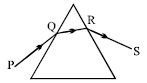
$A$ ray of light is incident on an equilateral glass prism placed on a horizontal table. For minimum deviation,which of the following is true?
A
$PQ$ is horizontal
B
$QR$ is horizontal
C
$RS$ is horizontal
D
Either $PQ$ or $RS$ is horizontal
Solution
(B) When a light ray passes through a prism in the position of minimum deviation,the angle of incidence is equal to the angle of emergence $(i = e)$.
In this specific condition,the refracted ray inside the prism $(QR)$ becomes parallel to the base of the prism.
Since the prism is placed on a horizontal table,its base is horizontal.
Therefore,the refracted ray $QR$ inside the prism must be horizontal.
In this specific condition,the refracted ray inside the prism $(QR)$ becomes parallel to the base of the prism.
Since the prism is placed on a horizontal table,its base is horizontal.
Therefore,the refracted ray $QR$ inside the prism must be horizontal.
0 likesView Solution
30
ChemistryMCQIIT JEE · 2004
The species having tetrahedral shape is
A
$[PdCl_4]^{2-}$
B
$[Ni(CN)_4]^{2-}$
C
$[Pd(CN)_4]^{2-}$
D
$[NiCl_4]^{2-}$
Solution
(D) The hybridization of $[NiCl_4]^{2-}$ is $sp^3$.
The shape of $[NiCl_4]^{2-}$ is tetrahedral.
The oxidation state of $Ni$ in this complex is $+2$. The electronic configuration of $Ni^{2+}$ is $3d^8$.
Since the chloride ion $(Cl^-)$ is a weak field ligand,it does not cause electron pairing in the $3d$ orbitals.
Therefore,one $4s$ orbital and three $4p$ orbitals hybridize to form four $sp^3$ hybrid orbitals,which overlap with the orbitals of the four $Cl^-$ ligands,resulting in a tetrahedral geometry.
The shape of $[NiCl_4]^{2-}$ is tetrahedral.
The oxidation state of $Ni$ in this complex is $+2$. The electronic configuration of $Ni^{2+}$ is $3d^8$.
Since the chloride ion $(Cl^-)$ is a weak field ligand,it does not cause electron pairing in the $3d$ orbitals.
Therefore,one $4s$ orbital and three $4p$ orbitals hybridize to form four $sp^3$ hybrid orbitals,which overlap with the orbitals of the four $Cl^-$ ligands,resulting in a tetrahedral geometry.
0 likesView Solution
31
ChemistryMCQIIT JEE · 2004
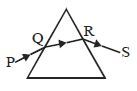
$A$ ray of light is incident on an equilateral glass prism placed on a horizontal table. For minimum deviation,which of the following is true?
A
$PQ$ is horizontal
B
$QR$ is horizontal
C
$RS$ is horizontal
D
Either $PQ$ or $RS$ is horizontal
Solution
(B) When a light ray passes through a prism in the position of minimum deviation,the angle of incidence is equal to the angle of emergence $(i = e)$.
In this condition,the refracted ray inside the prism $(QR)$ becomes parallel to the base of the prism.
Since the prism is placed on a horizontal table,its base is horizontal.
Therefore,the ray $QR$ inside the prism must be horizontal.
In this condition,the refracted ray inside the prism $(QR)$ becomes parallel to the base of the prism.
Since the prism is placed on a horizontal table,its base is horizontal.
Therefore,the ray $QR$ inside the prism must be horizontal.
0 likesView Solution
32
ChemistryMCQIIT JEE · 2004
An ideal gas expands isothermally from a volume $V_1$ to $V_2$ and is then compressed to the original volume $V_1$ adiabatically. The initial pressure is $P_1$ and the final pressure is $P_3$. If the total work done is $W$,then:
A
$P_3 > P_1, W > 0$
B
$P_3 < P_1, W < 0$
C
$P_3 > P_1, W < 0$
D
$P_3 = P_1, W = 0$
Solution
(C) $1$. In an isothermal expansion from $V_1$ to $V_2$,the work done by the gas is positive $(W_{iso} > 0)$.
$2$. In an adiabatic compression from $V_2$ back to $V_1$,the work done on the gas is negative $(W_{adia} < 0)$.
$3$. On a $P-V$ diagram,the adiabatic curve is steeper than the isothermal curve. Since the adiabatic compression returns to $V_1$ from a lower pressure point at $V_2$,the final pressure $P_3$ must be greater than the initial pressure $P_1$ $(P_3 > P_1)$.
$4$. The net work done $W = W_{iso} + W_{adia}$ corresponds to the area enclosed by the cycle. Since the cycle is traversed in a counter-clockwise direction,the net work done is negative $(W < 0)$.
$2$. In an adiabatic compression from $V_2$ back to $V_1$,the work done on the gas is negative $(W_{adia} < 0)$.
$3$. On a $P-V$ diagram,the adiabatic curve is steeper than the isothermal curve. Since the adiabatic compression returns to $V_1$ from a lower pressure point at $V_2$,the final pressure $P_3$ must be greater than the initial pressure $P_1$ $(P_3 > P_1)$.
$4$. The net work done $W = W_{iso} + W_{adia}$ corresponds to the area enclosed by the cycle. Since the cycle is traversed in a counter-clockwise direction,the net work done is negative $(W < 0)$.
0 likesView Solution
33
ChemistryMCQIIT JEE · 2004
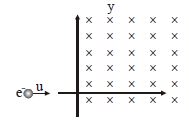
An electron moving with a speed $u$ along the positive $x-$ axis at $y = 0$ enters a region of uniform magnetic field $\vec{B} = -B_0\hat{k}$ which exists to the right of the $y-$ axis. The electron exits from the region after some time with the speed $v$ at coordinate $y$. Then:
A
$v > u, y < 0$
B
$v = u, y > 0$
C
$v > u, y > 0$
D
$v = u, y < 0$
Solution
(D) The magnetic force acting on a charged particle is given by $\vec{F} = q(\vec{v} \times \vec{B})$. Since the magnetic force is always perpendicular to the velocity of the particle,it does no work on the particle. Therefore,the kinetic energy and the speed of the electron remain constant. Thus,$v = u$.
Using the right-hand rule for the magnetic force on an electron (charge $q = -e$): $\vec{F} = -e(\vec{v} \times \vec{B})$. Given $\vec{v} = u\hat{i}$ and $\vec{B} = -B_0\hat{k}$,we have $\vec{F} = -e(u\hat{i} \times -B_0\hat{k}) = -e(uB_0\hat{j}) = -euB_0\hat{j}$.
Initially,the force is directed along the negative $y-$ axis. This causes the electron to follow a circular path that curves downwards. Consequently,when the electron exits the magnetic field region,its coordinate $y$ will be negative $(y < 0)$.
Using the right-hand rule for the magnetic force on an electron (charge $q = -e$): $\vec{F} = -e(\vec{v} \times \vec{B})$. Given $\vec{v} = u\hat{i}$ and $\vec{B} = -B_0\hat{k}$,we have $\vec{F} = -e(u\hat{i} \times -B_0\hat{k}) = -e(uB_0\hat{j}) = -euB_0\hat{j}$.
Initially,the force is directed along the negative $y-$ axis. This causes the electron to follow a circular path that curves downwards. Consequently,when the electron exits the magnetic field region,its coordinate $y$ will be negative $(y < 0)$.
0 likesView Solution
34
ChemistryMCQIIT JEE · 2004
An ideal gas expands isothermally from a volume $V_1$ to $V_2$ and then is compressed to the original volume $V_1$ adiabatically. The initial pressure is $P_1$ and the final pressure is $P_3$. The total work done is $W$. Then:
A
$P_3 > P_1, W > 0$
B
$P_3 < P_1, W < 0$
C
$P_3 > P_1, W < 0$
D
$P_3 = P_1, W = 0$
Solution
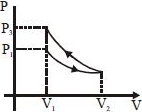
(C) $1$. In an isothermal expansion from $V_1$ to $V_2$,the work done by the gas is positive $(W_{iso} > 0)$,and the area under the curve represents this work.
$2$. In an adiabatic compression from $V_2$ to $V_1$,the work done on the gas is negative $(W_{adia} < 0)$,and the area under the curve represents this work.
$3$. On a $P-V$ diagram,the adiabatic curve is steeper than the isothermal curve. Since the compression happens from $V_2$ to $V_1$ along the adiabatic path,the final pressure $P_3$ will be higher than the initial pressure $P_1$ $(P_3 > P_1)$.
$4$. The total work done $W$ is the sum of the work done in both processes. Since the area under the adiabatic compression curve (which is negative work) is greater than the area under the isothermal expansion curve (which is positive work),the net work done $W$ is negative $(W < 0)$.
$2$. In an adiabatic compression from $V_2$ to $V_1$,the work done on the gas is negative $(W_{adia} < 0)$,and the area under the curve represents this work.
$3$. On a $P-V$ diagram,the adiabatic curve is steeper than the isothermal curve. Since the compression happens from $V_2$ to $V_1$ along the adiabatic path,the final pressure $P_3$ will be higher than the initial pressure $P_1$ $(P_3 > P_1)$.
$4$. The total work done $W$ is the sum of the work done in both processes. Since the area under the adiabatic compression curve (which is negative work) is greater than the area under the isothermal expansion curve (which is positive work),the net work done $W$ is negative $(W < 0)$.
0 likesView Solution
35
ChemistryMCQIIT JEE · 2004
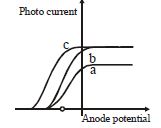
The figure shows the variation of photocurrent with anode potential for a photo-sensitive surface for three different radiations. Let $I_a, I_b$ and $I_c$ be the intensities and $f_a, f_b$ and $f_c$ be the frequencies for the curves $a, b$ and $c$ respectively.
A
$f_a = f_b$ and $I_a \neq I_b$
B
$f_a = f_c$ and $I_a = I_c$
C
$f_a = f_b$ and $I_a = I_b$
D
$f_a = f_c$ and $I_b = I_c$
Solution
(A) According to Einstein's photoelectric equation,$hv - \phi_0 = eV_0$,where $V_0$ is the stopping potential.
$1$. From the graph,curves $a$ and $b$ intersect the anode potential axis at the same point,which means they have the same stopping potential $(V_0)$. Since the stopping potential depends only on the frequency of the incident radiation,we conclude that $f_a = f_b$.
$2$. The saturation current is directly proportional to the intensity of the incident radiation. From the graph,the saturation current for curve $b$ is higher than that for curve $a$. Therefore,the intensities are different,i.e.,$I_a \neq I_b$.
$1$. From the graph,curves $a$ and $b$ intersect the anode potential axis at the same point,which means they have the same stopping potential $(V_0)$. Since the stopping potential depends only on the frequency of the incident radiation,we conclude that $f_a = f_b$.
$2$. The saturation current is directly proportional to the intensity of the incident radiation. From the graph,the saturation current for curve $b$ is higher than that for curve $a$. Therefore,the intensities are different,i.e.,$I_a \neq I_b$.
0 likesView Solution
36
ChemistryMCQIIT JEE · 2004
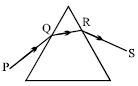
$A$ ray of light is incident on an equilateral glass prism placed on a horizontal table. For minimum deviation,which of the following is true?
A
$PQ$ is horizontal
B
$QR$ is horizontal
C
$RS$ is horizontal
D
Either $PQ$ or $RS$ is horizontal
Solution
(B) In the condition of minimum deviation for a prism,the angle of incidence is equal to the angle of emergence $(i = e)$.
As a result,the refracted ray inside the prism $(QR)$ becomes parallel to the base of the prism.
Since the prism is placed on a horizontal table,its base is horizontal.
Therefore,the refracted ray $QR$ inside the prism must be horizontal.
As a result,the refracted ray inside the prism $(QR)$ becomes parallel to the base of the prism.
Since the prism is placed on a horizontal table,its base is horizontal.
Therefore,the refracted ray $QR$ inside the prism must be horizontal.
0 likesView Solution
37
ChemistryMCQIIT JEE · 2004
$A$ photon and an electron have equal energy $E$. The ratio $\lambda_{\text{photon}} / \lambda_{\text{electron}}$ is proportional to:
A
$\sqrt{E}$
B
$1 / \sqrt{E}$
C
$1 / E$
D
Does not depend upon $E$
Solution
(B) The wavelength of a photon with energy $E$ is given by $\lambda_{\text{photon}} = \frac{hc}{E}$.
The de Broglie wavelength of an electron with kinetic energy $E$ is given by $\lambda_{\text{electron}} = \frac{h}{p} = \frac{h}{\sqrt{2mE}}$.
Taking the ratio of the two wavelengths:
$\frac{\lambda_{\text{photon}}}{\lambda_{\text{electron}}} = \frac{hc/E}{h/\sqrt{2mE}} = \frac{hc}{E} \cdot \frac{\sqrt{2mE}}{h} = c \sqrt{2m} \cdot \frac{\sqrt{E}}{E} = c \sqrt{2m} \cdot \frac{1}{\sqrt{E}}$.
Therefore,$\frac{\lambda_{\text{photon}}}{\lambda_{\text{electron}}} \propto \frac{1}{\sqrt{E}}$.
The de Broglie wavelength of an electron with kinetic energy $E$ is given by $\lambda_{\text{electron}} = \frac{h}{p} = \frac{h}{\sqrt{2mE}}$.
Taking the ratio of the two wavelengths:
$\frac{\lambda_{\text{photon}}}{\lambda_{\text{electron}}} = \frac{hc/E}{h/\sqrt{2mE}} = \frac{hc}{E} \cdot \frac{\sqrt{2mE}}{h} = c \sqrt{2m} \cdot \frac{\sqrt{E}}{E} = c \sqrt{2m} \cdot \frac{1}{\sqrt{E}}$.
Therefore,$\frac{\lambda_{\text{photon}}}{\lambda_{\text{electron}}} \propto \frac{1}{\sqrt{E}}$.
0 likesView Solution
38
ChemistryMCQIIT JEE · 2004
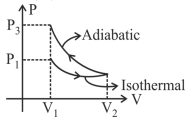
An ideal gas expands isothermally from volume $V_1$ to $V_2$ and is then compressed to the original volume $V_1$ adiabatically. If the initial pressure is $P_1$ and the final pressure is $P_3$,and the total work done is $W$,then:
A
$P_3 > P_1 ; W > 0$
B
$P_3 < P_1 ; W < 0$
C
$P_3 > P_1 ; W < 0$
D
$P_3 = P_1 ; W = 0$
Solution
(C) $1$. In the $P-V$ diagram,the isothermal expansion from $V_1$ to $V_2$ follows a curve with a smaller slope compared to the adiabatic compression from $V_2$ to $V_1$.
$2$. Since the adiabatic curve is steeper than the isothermal curve,returning to the same volume $V_1$ results in a final pressure $P_3$ that is greater than the initial pressure $P_1$ $(P_3 > P_1)$.
$3$. The total work done $W$ is the area enclosed by the cycle. Since the process is counter-clockwise (expansion at lower pressure,compression at higher pressure),the net work done on the gas is positive,meaning the work done by the gas is negative $(W < 0)$.
$2$. Since the adiabatic curve is steeper than the isothermal curve,returning to the same volume $V_1$ results in a final pressure $P_3$ that is greater than the initial pressure $P_1$ $(P_3 > P_1)$.
$3$. The total work done $W$ is the area enclosed by the cycle. Since the process is counter-clockwise (expansion at lower pressure,compression at higher pressure),the net work done on the gas is positive,meaning the work done by the gas is negative $(W < 0)$.
0 likesView Solution
39
ChemistryMCQIIT JEE · 2004
The angle between the tangents drawn from the point $(1,4)$ to the parabola $y^2=4x$ is
A
$\frac{\pi}{6}$
B
$\frac{\pi}{4}$
C
$\frac{\pi}{3}$
D
$\frac{\pi}{2}$
Solution
(C) The equation of the parabola is $y^2 = 4x$,which is of the form $y^2 = 4ax$,where $a = 1$.
Any tangent to the parabola $y^2 = 4ax$ is given by $y = mx + \frac{a}{m}$.
Substituting $a = 1$,we get $y = mx + \frac{1}{m}$.
Since the tangent passes through the point $(1, 4)$,we have $4 = m(1) + \frac{1}{m}$.
Multiplying by $m$,we get $4m = m^2 + 1$,or $m^2 - 4m + 1 = 0$.
Let the slopes of the two tangents be $m_1$ and $m_2$. Then $m_1 + m_2 = 4$ and $m_1 m_2 = 1$.
The angle $\theta$ between the tangents is given by $\tan \theta = |\frac{m_1 - m_2}{1 + m_1 m_2}|$.
We know that $(m_1 - m_2)^2 = (m_1 + m_2)^2 - 4m_1 m_2 = 4^2 - 4(1) = 16 - 4 = 12$.
Thus,$|m_1 - m_2| = \sqrt{12} = 2\sqrt{3}$.
Substituting these values,$\tan \theta = |\frac{2\sqrt{3}}{1 + 1}| = \frac{2\sqrt{3}}{2} = \sqrt{3}$.
Therefore,$\theta = \tan^{-1}(\sqrt{3}) = \frac{\pi}{3}$.
Any tangent to the parabola $y^2 = 4ax$ is given by $y = mx + \frac{a}{m}$.
Substituting $a = 1$,we get $y = mx + \frac{1}{m}$.
Since the tangent passes through the point $(1, 4)$,we have $4 = m(1) + \frac{1}{m}$.
Multiplying by $m$,we get $4m = m^2 + 1$,or $m^2 - 4m + 1 = 0$.
Let the slopes of the two tangents be $m_1$ and $m_2$. Then $m_1 + m_2 = 4$ and $m_1 m_2 = 1$.
The angle $\theta$ between the tangents is given by $\tan \theta = |\frac{m_1 - m_2}{1 + m_1 m_2}|$.
We know that $(m_1 - m_2)^2 = (m_1 + m_2)^2 - 4m_1 m_2 = 4^2 - 4(1) = 16 - 4 = 12$.
Thus,$|m_1 - m_2| = \sqrt{12} = 2\sqrt{3}$.
Substituting these values,$\tan \theta = |\frac{2\sqrt{3}}{1 + 1}| = \frac{2\sqrt{3}}{2} = \sqrt{3}$.
Therefore,$\theta = \tan^{-1}(\sqrt{3}) = \frac{\pi}{3}$.
0 likesView Solution
40
ChemistryMCQIIT JEE · 2004
The angle between the tangents drawn from the point $(1,4)$ to the parabola $y^2=4x$ is
A
$\frac{\pi}{6}$
B
$\frac{\pi}{4}$
C
$\frac{\pi}{3}$
D
$\frac{\pi}{2}$
Solution
(C) The equation of any tangent to the parabola $y^2=4x$ is $y=mx+\frac{1}{m}$.
Since the tangents pass through the point $(1,4)$,we have $4=m(1)+\frac{1}{m}$.
Multiplying by $m$,we get $m^2-4m+1=0$.
Let the slopes of the two tangents be $m_1$ and $m_2$. Then $m_1+m_2=4$ and $m_1m_2=1$.
The difference between the slopes is $|m_1-m_2| = \sqrt{(m_1+m_2)^2-4m_1m_2} = \sqrt{16-4} = \sqrt{12} = 2\sqrt{3}$.
The angle $\theta$ between the tangents is given by $\tan \theta = \left|\frac{m_1-m_2}{1+m_1m_2}\right|$.
Substituting the values,$\tan \theta = \left|\frac{2\sqrt{3}}{1+1}\right| = \frac{2\sqrt{3}}{2} = \sqrt{3}$.
Therefore,$\theta = \tan^{-1}(\sqrt{3}) = \frac{\pi}{3}$.
Since the tangents pass through the point $(1,4)$,we have $4=m(1)+\frac{1}{m}$.
Multiplying by $m$,we get $m^2-4m+1=0$.
Let the slopes of the two tangents be $m_1$ and $m_2$. Then $m_1+m_2=4$ and $m_1m_2=1$.
The difference between the slopes is $|m_1-m_2| = \sqrt{(m_1+m_2)^2-4m_1m_2} = \sqrt{16-4} = \sqrt{12} = 2\sqrt{3}$.
The angle $\theta$ between the tangents is given by $\tan \theta = \left|\frac{m_1-m_2}{1+m_1m_2}\right|$.
Substituting the values,$\tan \theta = \left|\frac{2\sqrt{3}}{1+1}\right| = \frac{2\sqrt{3}}{2} = \sqrt{3}$.
Therefore,$\theta = \tan^{-1}(\sqrt{3}) = \frac{\pi}{3}$.
0 likesView Solution
41
ChemistryMCQIIT JEE · 2004
The angle between the tangents drawn to the parabola $y^2=4x$ from the point $(1,4)$ is
A
$\frac{\pi}{4}$
B
$\frac{\pi}{3}$
C
$\frac{2\pi}{5}$
D
$\frac{\pi}{6}$
Solution
(B) The equation of a tangent to the parabola $y^2=4ax$ (where $a=1$) is $y=mx+\frac{a}{m}$,which simplifies to $y=mx+\frac{1}{m}$.
Since the tangent passes through the point $(1,4)$,we substitute these coordinates into the equation:
$4 = m(1) + \frac{1}{m}$
$4 = m + \frac{1}{m}$
$m^2 - 4m + 1 = 0$
Let the slopes of the two tangents be $m_1$ and $m_2$. From the quadratic equation,we have:
$m_1 + m_2 = 4$ and $m_1 m_2 = 1$.
The angle $\theta$ between the two tangents is given by:
$\tan \theta = \left| \frac{m_1 - m_2}{1 + m_1 m_2} \right|$
Using the identity $(m_1 - m_2)^2 = (m_1 + m_2)^2 - 4m_1 m_2$:
$(m_1 - m_2)^2 = (4)^2 - 4(1) = 16 - 4 = 12$
$|m_1 - m_2| = \sqrt{12} = 2\sqrt{3}$
Therefore,$\tan \theta = \left| \frac{2\sqrt{3}}{1 + 1} \right| = \frac{2\sqrt{3}}{2} = \sqrt{3}$.
Since $\tan \theta = \sqrt{3}$,we have $\theta = \frac{\pi}{3}$.
Since the tangent passes through the point $(1,4)$,we substitute these coordinates into the equation:
$4 = m(1) + \frac{1}{m}$
$4 = m + \frac{1}{m}$
$m^2 - 4m + 1 = 0$
Let the slopes of the two tangents be $m_1$ and $m_2$. From the quadratic equation,we have:
$m_1 + m_2 = 4$ and $m_1 m_2 = 1$.
The angle $\theta$ between the two tangents is given by:
$\tan \theta = \left| \frac{m_1 - m_2}{1 + m_1 m_2} \right|$
Using the identity $(m_1 - m_2)^2 = (m_1 + m_2)^2 - 4m_1 m_2$:
$(m_1 - m_2)^2 = (4)^2 - 4(1) = 16 - 4 = 12$
$|m_1 - m_2| = \sqrt{12} = 2\sqrt{3}$
Therefore,$\tan \theta = \left| \frac{2\sqrt{3}}{1 + 1} \right| = \frac{2\sqrt{3}}{2} = \sqrt{3}$.
Since $\tan \theta = \sqrt{3}$,we have $\theta = \frac{\pi}{3}$.
0 likesView Solution
42
ChemistryMediumMCQIIT JEE · 2004
The acid having $O - O$ bond is
A
$H_2S_2O_3$
B
$H_2S_2O_6$
C
$H_2S_2O_8$
D
$H_2S_4O_6$
Solution
(C) $H_2S_2O_8$ (Peroxodisulfuric acid or Marshall's acid) contains a peroxide linkage ($O - O$ bond).
Its structure is $HO - SO_2 - O - O - SO_2 - OH$.
Its structure is $HO - SO_2 - O - O - SO_2 - OH$.
0 likesView Solution
43
ChemistryDifficultMCQIIT JEE · 2004
$A$ $0.004 \ M$ solution of $Na_2SO_4$ is isotonic with a $0.010 \ M$ solution of glucose at the same temperature. The apparent degree of dissociation of $Na_2SO_4$ is $..... \ \%$.
A
$25$
B
$50$
C
$75$
D
$85$
Solution
(C) For isotonic solutions,the osmotic pressure is equal,so the van't Hoff factor multiplied by concentration is equal: $i_1 C_1 = i_2 C_2$.
For glucose (non-electrolyte),$i_2 = 1$,so $i_2 C_2 = 1 \times 0.010 = 0.010 \ M$.
For $Na_2SO_4$,the dissociation is $Na_2SO_4 \rightleftharpoons 2Na^{+} + SO_4^{2-}$.
Let $\alpha$ be the degree of dissociation. The van't Hoff factor $i_1 = 1 + (n-1)\alpha$,where $n=3$.
So,$i_1 = 1 + (3-1)\alpha = 1 + 2\alpha$.
The condition $i_1 C_1 = 0.010$ becomes $(1 + 2\alpha) \times 0.004 = 0.010$.
$1 + 2\alpha = \frac{0.010}{0.004} = 2.5$.
$2\alpha = 1.5$.
$\alpha = 0.75$.
Therefore,the percentage of dissociation is $0.75 \times 100 = 75 \%$.
For glucose (non-electrolyte),$i_2 = 1$,so $i_2 C_2 = 1 \times 0.010 = 0.010 \ M$.
For $Na_2SO_4$,the dissociation is $Na_2SO_4 \rightleftharpoons 2Na^{+} + SO_4^{2-}$.
Let $\alpha$ be the degree of dissociation. The van't Hoff factor $i_1 = 1 + (n-1)\alpha$,where $n=3$.
So,$i_1 = 1 + (3-1)\alpha = 1 + 2\alpha$.
The condition $i_1 C_1 = 0.010$ becomes $(1 + 2\alpha) \times 0.004 = 0.010$.
$1 + 2\alpha = \frac{0.010}{0.004} = 2.5$.
$2\alpha = 1.5$.
$\alpha = 0.75$.
Therefore,the percentage of dissociation is $0.75 \times 100 = 75 \%$.
0 likesView Solution
44
ChemistryEasyMCQIIT JEE · 2004
Adsorption of gases on a solid surface is generally exothermic because
A
Enthalpy is positive
B
Entropy decreases
C
Entropy increases
D
Free energy increases
Solution
(B) The adsorption process involves the trapping of gas molecules on a solid surface,which restricts their movement. This leads to a decrease in the randomness of the particles,meaning the entropy $(S)$ decreases. Since $\Delta G = \Delta H - T\Delta S$ and for a spontaneous process $\Delta G < 0$,the decrease in entropy $(\Delta S < 0)$ makes the $-T\Delta S$ term positive. For the process to be spontaneous,the enthalpy change $(\Delta H)$ must be negative,making the process exothermic.
0 likesView Solution
45
ChemistryDifficultMCQIIT JEE · 2004
$A$ sodium salt on treatment with $MgCl_2$ gives white precipitate only on heating. The anion of the sodium salt is
A
$HCO_3^-$
B
$CO_3^{2-}$
C
$NO_3^-$
D
$SO_4^{2-}$
Solution
(A) The sodium salt is sodium bicarbonate $(NaHCO_3)$.
When $NaHCO_3$ reacts with $MgCl_2$,it forms magnesium bicarbonate,which is soluble in water at room temperature: $2NaHCO_3 + MgCl_2 \to Mg(HCO_3)_2 + 2NaCl$.
Upon heating,magnesium bicarbonate decomposes to form magnesium carbonate,which is a white precipitate: $Mg(HCO_3)_2 \xrightarrow{\Delta} MgCO_3 \downarrow + H_2O + CO_2 \uparrow$.
Therefore,the anion is $HCO_3^-$.
When $NaHCO_3$ reacts with $MgCl_2$,it forms magnesium bicarbonate,which is soluble in water at room temperature: $2NaHCO_3 + MgCl_2 \to Mg(HCO_3)_2 + 2NaCl$.
Upon heating,magnesium bicarbonate decomposes to form magnesium carbonate,which is a white precipitate: $Mg(HCO_3)_2 \xrightarrow{\Delta} MgCO_3 \downarrow + H_2O + CO_2 \uparrow$.
Therefore,the anion is $HCO_3^-$.
0 likesView Solution
46
ChemistryMediumMCQIIT JEE · 2004
Total number of lone pairs of electrons in $XeOF_4$ is
A
$0$
B
$1$
C
$2$
D
$3$
Solution
(B) The central atom $Xe$ has $8$ valence electrons.
In $XeOF_4$,$Xe$ forms $4$ single bonds with $F$ atoms and $1$ double bond with the $O$ atom.
Total electrons involved in bonding $= 4 + 2 = 6$.
Number of lone pair electrons on $Xe = (8 - 6) / 2 = 1$ lone pair.
Thus,the total number of lone pairs on the central atom $Xe$ is $1$.
In $XeOF_4$,$Xe$ forms $4$ single bonds with $F$ atoms and $1$ double bond with the $O$ atom.
Total electrons involved in bonding $= 4 + 2 = 6$.
Number of lone pair electrons on $Xe = (8 - 6) / 2 = 1$ lone pair.
Thus,the total number of lone pairs on the central atom $Xe$ is $1$.
0 likesView Solution
47
ChemistryDifficultMCQIIT JEE · 2004
The e.m.f. of the cell $Zn | Zn^{2+} (0.01 \ M) || Fe^{2+} (0.001 \ M) | Fe$ at $298 \ K$ is $0.2905 \ V$. The value of the equilibrium constant for the cell reaction is:
A
$0.32 / e^{0.0295}$
B
$0.32 / 10^{0.0295}$
C
$0.26 / 10^{0.0295}$
D
$0.32 / 10^{0.0591}$
Solution
(B) The cell reaction is: $Zn(s) + Fe^{2+}(aq) \to Zn^{2+}(aq) + Fe(s)$.
Using the Nernst equation: $E_{cell} = E^0_{cell} - \frac{0.0591}{n} \log \frac{[Zn^{2+}]}{[Fe^{2+}]}$.
Given $E_{cell} = 0.2905 \ V$,$n = 2$,$[Zn^{2+}] = 0.01 \ M$,and $[Fe^{2+}] = 0.001 \ M$.
$0.2905 = E^0_{cell} - \frac{0.0591}{2} \log \frac{10^{-2}}{10^{-3}} = E^0_{cell} - 0.02955 \log(10) = E^0_{cell} - 0.02955$.
$E^0_{cell} = 0.2905 + 0.02955 = 0.32005 \approx 0.32 \ V$.
At equilibrium,$E_{cell} = 0$,so $E^0_{cell} = \frac{0.0591}{n} \log K_c$.
$0.32 = \frac{0.0591}{2} \log K_c = 0.02955 \log K_c$.
$\log K_c = \frac{0.32}{0.02955} \approx \frac{0.32}{0.0295}$.
Therefore,$K_c = 10^{\frac{0.32}{0.0295}}$. Note: The provided option $B$ is represented as $10^{0.32/0.0295}$ in standard notation,but based on the provided options,$B$ is the intended choice.
Using the Nernst equation: $E_{cell} = E^0_{cell} - \frac{0.0591}{n} \log \frac{[Zn^{2+}]}{[Fe^{2+}]}$.
Given $E_{cell} = 0.2905 \ V$,$n = 2$,$[Zn^{2+}] = 0.01 \ M$,and $[Fe^{2+}] = 0.001 \ M$.
$0.2905 = E^0_{cell} - \frac{0.0591}{2} \log \frac{10^{-2}}{10^{-3}} = E^0_{cell} - 0.02955 \log(10) = E^0_{cell} - 0.02955$.
$E^0_{cell} = 0.2905 + 0.02955 = 0.32005 \approx 0.32 \ V$.
At equilibrium,$E_{cell} = 0$,so $E^0_{cell} = \frac{0.0591}{n} \log K_c$.
$0.32 = \frac{0.0591}{2} \log K_c = 0.02955 \log K_c$.
$\log K_c = \frac{0.32}{0.02955} \approx \frac{0.32}{0.0295}$.
Therefore,$K_c = 10^{\frac{0.32}{0.0295}}$. Note: The provided option $B$ is represented as $10^{0.32/0.0295}$ in standard notation,but based on the provided options,$B$ is the intended choice.
0 likesView Solution
48
ChemistryDifficultMCQIIT JEE · 2004
$Pb$ and $Sn$ are extracted from their chief ores by:
A
Carbon reduction and self-reduction.
B
Self-reduction and carbon reduction.
C
Electrolysis and self-reduction.
D
Self-reduction and electrolysis.
Solution
(B) The extraction of $Pb$ (Lead) from its ore $PbS$ (Galena) involves self-reduction.
$2PbO + PbS \xrightarrow{\Delta} 3Pb + SO_2 \uparrow$
$PbSO_4 + PbS \xrightarrow{\Delta} 2Pb + 2SO_2 \uparrow$
The extraction of $Sn$ (Tin) from its ore $SnO_2$ (Cassiterite) involves carbon reduction.
$SnO_2 + 2C \xrightarrow{\Delta} Sn + 2CO$
Therefore,$Pb$ is extracted by self-reduction and $Sn$ is extracted by carbon reduction.
$2PbO + PbS \xrightarrow{\Delta} 3Pb + SO_2 \uparrow$
$PbSO_4 + PbS \xrightarrow{\Delta} 2Pb + 2SO_2 \uparrow$
The extraction of $Sn$ (Tin) from its ore $SnO_2$ (Cassiterite) involves carbon reduction.
$SnO_2 + 2C \xrightarrow{\Delta} Sn + 2CO$
Therefore,$Pb$ is extracted by self-reduction and $Sn$ is extracted by carbon reduction.
0 likesView Solution
49
ChemistryMediumMCQIIT JEE · 2004
The spin magnetic moment of cobalt in the compound $Hg[Co(SCN)_4]$ is (in $B.M.$)
A
$1.73$
B
$2.828$
C
$3.87$
D
$4.89$
Solution
(C) In the complex $Hg[Co(SCN)_4]$,the oxidation state of $Co$ is $+2$.
The electronic configuration of $Co^{2+}$ is $[Ar] 3d^7$.
In a tetrahedral field,$Co^{2+}$ has $3$ unpaired electrons $(n = 3)$.
The spin-only magnetic moment is calculated using the formula $\mu = \sqrt{n(n + 2)} \ B.M.$
$\mu = \sqrt{3(3 + 2)} = \sqrt{15} \approx 3.87 \ B.M.$
The electronic configuration of $Co^{2+}$ is $[Ar] 3d^7$.
In a tetrahedral field,$Co^{2+}$ has $3$ unpaired electrons $(n = 3)$.
The spin-only magnetic moment is calculated using the formula $\mu = \sqrt{n(n + 2)} \ B.M.$
$\mu = \sqrt{3(3 + 2)} = \sqrt{15} \approx 3.87 \ B.M.$
0 likesView Solution
50
ChemistryMediumMCQIIT JEE · 2004
The pair of compounds in which both the metals are in the highest possible oxidation state is
A
$[Fe(CN)_6]^{3-}, [Co(CN)_6]^{3-}$
B
$CrO_2Cl_2, MnO_4^-$
C
$TiO_3, MnO_2$
D
$[Co(CN)_6]^{3-}, MnO_3$
Solution
(B) In $CrO_2Cl_2$,the oxidation state of $Cr$ is $x + 2(-2) + 2(-1) = 0$,so $x = +6$. This is the group oxidation state of $Cr$ $(3d^5 4s^1)$.
In $MnO_4^-$,the oxidation state of $Mn$ is $x + 4(-2) = -1$,so $x = +7$. This is the group oxidation state of $Mn$ $(3d^5 4s^2)$.
Both $Cr$ and $Mn$ are in their highest possible oxidation states in these compounds.
In $MnO_4^-$,the oxidation state of $Mn$ is $x + 4(-2) = -1$,so $x = +7$. This is the group oxidation state of $Mn$ $(3d^5 4s^2)$.
Both $Cr$ and $Mn$ are in their highest possible oxidation states in these compounds.
0 likesView Solution
51
ChemistryMediumMCQIIT JEE · 2004
The species having tetrahedral shape is
A
$[PdCl_4]^{2-}$
B
$[Ni(CN)_4]^{2-}$
C
$[Pd(CN)_4]^{2-}$
D
$[NiCl_4]^{2-}$
Solution
(D) The geometry of coordination complexes depends on the nature of the ligand and the central metal ion.
$1$. $[NiCl_4]^{2-}$: $Ni^{2+}$ has a $d^8$ configuration. $Cl^-$ is a weak field ligand,so it does not cause pairing of electrons. The hybridization is $sp^3$,resulting in a tetrahedral geometry.
$2$. $[PdCl_4]^{2-}$,$[Ni(CN)_4]^{2-}$,and $[Pd(CN)_4]^{2-}$: These complexes involve $Pd^{2+}$ or strong field ligands like $CN^-$,which cause pairing of electrons. They undergo $dsp^2$ hybridization,resulting in a square planar geometry.
$1$. $[NiCl_4]^{2-}$: $Ni^{2+}$ has a $d^8$ configuration. $Cl^-$ is a weak field ligand,so it does not cause pairing of electrons. The hybridization is $sp^3$,resulting in a tetrahedral geometry.
$2$. $[PdCl_4]^{2-}$,$[Ni(CN)_4]^{2-}$,and $[Pd(CN)_4]^{2-}$: These complexes involve $Pd^{2+}$ or strong field ligands like $CN^-$,which cause pairing of electrons. They undergo $dsp^2$ hybridization,resulting in a square planar geometry.
0 likesView Solution
52
ChemistryMediumMCQIIT JEE · 2004
The correct order of reactivity of $PhMgBr$ with:
$(I)$ $Ph-CO-Ph$
$(II)$ $CH_3-CHO$
$(III)$ $CH_3-CO-CH_3$
is:
$(I)$ $Ph-CO-Ph$
$(II)$ $CH_3-CHO$
$(III)$ $CH_3-CO-CH_3$
is:
A
$(I) > (II) > (III)$
B
$(III) > (II) > (I)$
C
$(II) > (III) > (I)$
D
$(I) > (III) > (II)$
Solution
(C) The reactivity of carbonyl compounds towards nucleophilic addition reactions (such as with Grignard reagents like $PhMgBr$) depends on two main factors:
$1.$ Steric hindrance: As the size and number of groups attached to the carbonyl carbon increase,the approach of the nucleophile becomes more difficult,decreasing reactivity.
$2.$ Electronic effect: Electron-donating groups (like alkyl groups via $+I$ effect) or resonance stabilization (like phenyl groups) decrease the positive charge on the carbonyl carbon,making it less electrophilic.
Comparing the given compounds:
$(II)$ Acetaldehyde $(CH_3-CHO)$ has the least steric hindrance and only one $+I$ group.
$(III)$ Acetone $(CH_3-CO-CH_3)$ has two $+I$ groups and more hindrance than acetaldehyde.
$(I)$ Benzophenone $(Ph-CO-Ph)$ has two bulky phenyl groups and significant resonance,making it the least reactive.
Therefore,the correct order is $(II) > (III) > (I)$.
$1.$ Steric hindrance: As the size and number of groups attached to the carbonyl carbon increase,the approach of the nucleophile becomes more difficult,decreasing reactivity.
$2.$ Electronic effect: Electron-donating groups (like alkyl groups via $+I$ effect) or resonance stabilization (like phenyl groups) decrease the positive charge on the carbonyl carbon,making it less electrophilic.
Comparing the given compounds:
$(II)$ Acetaldehyde $(CH_3-CHO)$ has the least steric hindrance and only one $+I$ group.
$(III)$ Acetone $(CH_3-CO-CH_3)$ has two $+I$ groups and more hindrance than acetaldehyde.
$(I)$ Benzophenone $(Ph-CO-Ph)$ has two bulky phenyl groups and significant resonance,making it the least reactive.
Therefore,the correct order is $(II) > (III) > (I)$.
0 likesView Solution
53
ChemistryMediumMCQIIT JEE · 2004
The pair of compounds in which both the compounds give positive test with Tollen's reagent is
A
Glucose and Sucrose
B
Fructose and Sucrose
C
Acetophenone and Hexanal
D
Glucose and Fructose
Solution
(D) Tollen's reagent oxidizes compounds containing an aldehyde group,such as glucose.
It also oxidizes $\alpha$-hydroxy ketones that possess a $-COCH_2OH$ group,such as fructose,because they undergo tautomerization to form an aldehyde in an alkaline medium.
It also oxidizes $\alpha$-hydroxy ketones that possess a $-COCH_2OH$ group,such as fructose,because they undergo tautomerization to form an aldehyde in an alkaline medium.
0 likesView Solution
54
ChemistryDifficultMCQIIT JEE · 2004
Benzamide on reaction with $POCl_3$ gives
A
Aniline
B
Chlorobenzene
C
Benzyl amine
D
Benzonitrile
Solution
(D) When benzamide $(C_6H_5CONH_2)$ is treated with a dehydrating agent like phosphorus oxychloride $(POCl_3)$,it undergoes dehydration to form benzonitrile $(C_6H_5CN)$.
The reaction is as follows:
$C_6H_5CONH_2 \xrightarrow{POCl_3, \Delta} C_6H_5CN + H_2O$
Therefore,the correct option is $(D)$.
The reaction is as follows:
$C_6H_5CONH_2 \xrightarrow{POCl_3, \Delta} C_6H_5CN + H_2O$
Therefore,the correct option is $(D)$.
0 likesView Solution
55
ChemistryMediumMCQIIT JEE · 2004
On monochlorination of $2-$methylbutane,the total number of chiral compounds is
A
$2$
B
$4$
C
$6$
D
$8$
Solution
(B) The structure of $2-$methylbutane is $CH_3-CH(CH_3)-CH_2-CH_3$.
Monochlorination can occur at four different types of hydrogen atoms:
$1$. At $C-1$ (terminal methyl): $CH_2Cl-CH(CH_3)-CH_2-CH_3$ (achiral).
$2$. At $C-2$ (tertiary carbon): $CH_3-C(Cl)(CH_3)-CH_2-CH_3$ (chiral,exists as $(+)$ and $(-)$ enantiomers).
$3$. At $C-3$ (secondary carbon): $CH_3-CH(CH_3)-CHCl-CH_3$ (chiral,exists as $(+)$ and $(-)$ enantiomers).
$4$. At $C-4$ (terminal methyl): $CH_3-CH(CH_3)-CH_2-CH_2Cl$ (achiral).
Thus,the chiral products are the enantiomers formed by substitution at $C-2$ and $C-3$.
Total number of chiral compounds = $2$ (from $C-2$) + $2$ (from $C-3$) = $4$.
Monochlorination can occur at four different types of hydrogen atoms:
$1$. At $C-1$ (terminal methyl): $CH_2Cl-CH(CH_3)-CH_2-CH_3$ (achiral).
$2$. At $C-2$ (tertiary carbon): $CH_3-C(Cl)(CH_3)-CH_2-CH_3$ (chiral,exists as $(+)$ and $(-)$ enantiomers).
$3$. At $C-3$ (secondary carbon): $CH_3-CH(CH_3)-CHCl-CH_3$ (chiral,exists as $(+)$ and $(-)$ enantiomers).
$4$. At $C-4$ (terminal methyl): $CH_3-CH(CH_3)-CH_2-CH_2Cl$ (achiral).
Thus,the chiral products are the enantiomers formed by substitution at $C-2$ and $C-3$.
Total number of chiral compounds = $2$ (from $C-2$) + $2$ (from $C-3$) = $4$.
0 likesView Solution
56
ChemistryDifficultMCQIIT JEE · 2004
Heating $(NH_4)_2Cr_2O_7$ liberates a gas. The same gas is obtained by:
A
Heating $NH_4NO_2$
B
Treating $H_2O_2$ with $NaNO_2$
C
Treating $Mg_3N_2$ with $H_2O$
D
Heating $NH_4NO_3$
Solution
(A) The thermal decomposition of ammonium dichromate $(NH_4)_2Cr_2O_7$ produces nitrogen gas $(N_2)$:
$(NH_4)_2Cr_2O_7 \stackrel{\Delta}{\longrightarrow} N_2 \uparrow + Cr_2O_3 + 4H_2O$
Similarly,ammonium nitrite $(NH_4NO_2)$ on heating also liberates nitrogen gas $(N_2)$:
$NH_4NO_2 \stackrel{\Delta}{\longrightarrow} N_2 \uparrow + 2H_2O$
Thus,the same gas is obtained by heating $NH_4NO_2$.
$(NH_4)_2Cr_2O_7 \stackrel{\Delta}{\longrightarrow} N_2 \uparrow + Cr_2O_3 + 4H_2O$
Similarly,ammonium nitrite $(NH_4NO_2)$ on heating also liberates nitrogen gas $(N_2)$:
$NH_4NO_2 \stackrel{\Delta}{\longrightarrow} N_2 \uparrow + 2H_2O$
Thus,the same gas is obtained by heating $NH_4NO_2$.
0 likesView Solution
Vedclass Products
For Students
Vedclass Test Series
Mock tests in real IIT JEE style covering Chemistry with performance analysis. 5-day free trial.
Start Free TrialFor Teachers
Exam Paper Generator
Generate Set A/B/C/D Chemistry papers from 7.5L+ questions in 2 minutes. 3 chapters free.
Try FreeFor Institutes
Online Exam Module
Run live IIT JEE mock exams with unlimited students, 360° analytics & white-label branding.
See DemoFrequently Asked Questions
How many Chemistry questions are in IIT JEE 2004?
There are 56 Chemistry questions from the IIT JEE 2004 paper on Vedclass, each with a detailed step-by-step solution in English.
Are IIT JEE 2004 Chemistry solutions available in English?
Yes. All solutions on this page are in English. You can also switch to English or Hindi using the language buttons above the questions.
Can I practice IIT JEE 2004 Chemistry as a timed test?
Yes. Use the Vedclass Test Series to attempt a full IIT JEE mock test covering Chemistry with time limits and instant score analysis.
Can teachers create Chemistry papers from IIT JEE previous year questions?
Yes. The Vedclass Exam Paper Generator lets teachers mix IIT JEE Chemistry questions and generate Set A/B/C/D papers in minutes.
For Teachers & Institutes
Build a Custom Chemistry Paper
Pick IIT JEE 2004 Chemistry questions, set difficulty, and generate Set A/B/C/D in 2 minutes.