
PhysicsQ1–43 of 43 questions
Page 1 of 1 · English
1
PhysicsDifficultMCQIIT JEE · 2018
The potential energy of a particle of mass $m$ at a distance $r$ from a fixed point $O$ is given by $V(r) = kr^2 / 2$,where $k$ is a positive constant of appropriate dimensions. This particle is moving in a circular orbit of radius $R$ about the point $O$. If $v$ is the speed of the particle and $L$ is the magnitude of its angular momentum about $O$,which of the following statements is (are) true?
$(A)$ $v = \sqrt{\frac{k}{2m}} R$
$(B)$ $v = \sqrt{\frac{k}{m}} R$
$(C)$ $L = \sqrt{mk} R^2$
$(D)$ $L = \sqrt{\frac{mk}{2}} R^2$
$(A)$ $v = \sqrt{\frac{k}{2m}} R$
$(B)$ $v = \sqrt{\frac{k}{m}} R$
$(C)$ $L = \sqrt{mk} R^2$
$(D)$ $L = \sqrt{\frac{mk}{2}} R^2$
A
$A, C$
B
$B, C$
C
$A, D$
D
$A, C, D$
Solution
(B) The potential energy of the particle is given by $V(r) = \frac{kr^2}{2}$.
The force acting on the particle is $F = -\frac{dV}{dr} = -\frac{d}{dr}(\frac{kr^2}{2}) = -kr$.
The magnitude of the force is $F = kr$. This force acts as the centripetal force required for circular motion.
Equating the force to the centripetal force: $kr = \frac{mv^2}{r}$.
At $r = R$,we have $kR = \frac{mv^2}{R}$,which gives $v^2 = \frac{kR^2}{m}$,so $v = \sqrt{\frac{k}{m}} R$. Thus,statement $(B)$ is correct.
The angular momentum $L$ is given by $L = mvr$.
Substituting $v = \sqrt{\frac{k}{m}} R$ and $r = R$,we get $L = m \left( \sqrt{\frac{k}{m}} R \right) R = \sqrt{mk} R^2$. Thus,statement $(C)$ is correct.
Therefore,the correct statements are $(B)$ and $(C)$.
The force acting on the particle is $F = -\frac{dV}{dr} = -\frac{d}{dr}(\frac{kr^2}{2}) = -kr$.
The magnitude of the force is $F = kr$. This force acts as the centripetal force required for circular motion.
Equating the force to the centripetal force: $kr = \frac{mv^2}{r}$.
At $r = R$,we have $kR = \frac{mv^2}{R}$,which gives $v^2 = \frac{kR^2}{m}$,so $v = \sqrt{\frac{k}{m}} R$. Thus,statement $(B)$ is correct.
The angular momentum $L$ is given by $L = mvr$.
Substituting $v = \sqrt{\frac{k}{m}} R$ and $r = R$,we get $L = m \left( \sqrt{\frac{k}{m}} R \right) R = \sqrt{mk} R^2$. Thus,statement $(C)$ is correct.
Therefore,the correct statements are $(B)$ and $(C)$.

0 likesView Solution
2
PhysicsAdvancedMCQIIT JEE · 2018
Consider a body of mass $1.0 \ kg$ at rest at the origin at time $t=0$. $A$ force $\overrightarrow{F}=(\alpha t \hat{i}+\beta \hat{j})$ is applied on the body,where $\alpha=1.0 \ Ns^{-1}$ and $\beta=1.0 \ N$. The torque acting on the body about the origin at time $t=1.0 \ s$ is $\vec{\tau}$. Which of the following statements is (are) true?
$(A)$ $|\vec{\tau}|=\frac{1}{3} \ Nm$
$(B)$ The torque $\vec{\tau}$ is in the direction of the unit vector $+\hat{k}$
$(C)$ The velocity of the body at $t=1 \ s$ is $\overrightarrow{v}=\frac{1}{2}(\hat{i}+2 \hat{j}) \ ms^{-1}$
$(D)$ The magnitude of displacement of the body at $t=1 \ s$ is $\frac{1}{6} \ m$
$(A)$ $|\vec{\tau}|=\frac{1}{3} \ Nm$
$(B)$ The torque $\vec{\tau}$ is in the direction of the unit vector $+\hat{k}$
$(C)$ The velocity of the body at $t=1 \ s$ is $\overrightarrow{v}=\frac{1}{2}(\hat{i}+2 \hat{j}) \ ms^{-1}$
$(D)$ The magnitude of displacement of the body at $t=1 \ s$ is $\frac{1}{6} \ m$
A
$A, C$
B
$A, B$
C
$A, D$
D
$A, C, D$
Solution
(A) The force applied on the body is $\overrightarrow{F}=(\alpha t) \hat{i}+\beta \hat{j}$.
Given $\alpha=1.0 \ Ns^{-1}$ and $\beta=1.0 \ N$,we have $\overrightarrow{F}=t \hat{i}+\hat{j}$.
Using Newton's second law,$m \frac{d\overrightarrow{v}}{dt} = \overrightarrow{F}$,with $m=1.0 \ kg$,we get $\frac{d\overrightarrow{v}}{dt} = t \hat{i}+\hat{j}$.
Integrating with respect to time $t$ (with $\overrightarrow{v}=0$ at $t=0$),we get $\overrightarrow{v} = \int_{0}^{t} (t \hat{i}+\hat{j}) dt = \frac{t^2}{2} \hat{i} + t \hat{j}$.
At $t=1 \ s$,$\overrightarrow{v} = \frac{1}{2} \hat{i} + \hat{j} = \frac{1}{2}(\hat{i} + 2\hat{j}) \ ms^{-1}$. Thus,statement $(C)$ is true.
Integrating velocity to find position $\overrightarrow{r}$ (with $\overrightarrow{r}=0$ at $t=0$),we get $\overrightarrow{r} = \int_{0}^{t} (\frac{t^2}{2} \hat{i} + t \hat{j}) dt = \frac{t^3}{6} \hat{i} + \frac{t^2}{2} \hat{j}$.
At $t=1 \ s$,$\overrightarrow{r} = \frac{1}{6} \hat{i} + \frac{1}{2} \hat{j}$.
The displacement is $\overrightarrow{s} = \overrightarrow{r}(1) - \overrightarrow{r}(0) = \frac{1}{6} \hat{i} + \frac{1}{2} \hat{j}$.
The magnitude of displacement is $|\overrightarrow{s}| = \sqrt{(\frac{1}{6})^2 + (\frac{1}{2})^2} = \sqrt{\frac{1}{36} + \frac{9}{36}} = \sqrt{\frac{10}{36}} = \frac{\sqrt{10}}{6} \ m$. Thus,statement $(D)$ is false.
The torque is $\vec{\tau} = \overrightarrow{r} \times \overrightarrow{F} = (\frac{t^3}{6} \hat{i} + \frac{t^2}{2} \hat{j}) \times (t \hat{i} + \hat{j})$.
At $t=1 \ s$,$\vec{\tau} = (\frac{1}{6} \hat{i} + \frac{1}{2} \hat{j}) \times (1 \hat{i} + 1 \hat{j}) = (\frac{1}{6} - \frac{1}{2}) \hat{k} = -\frac{1}{3} \hat{k} \ Nm$.
The magnitude is $|\vec{\tau}| = \frac{1}{3} \ Nm$. Thus,statement $(A)$ is true and $(B)$ is false.
Given $\alpha=1.0 \ Ns^{-1}$ and $\beta=1.0 \ N$,we have $\overrightarrow{F}=t \hat{i}+\hat{j}$.
Using Newton's second law,$m \frac{d\overrightarrow{v}}{dt} = \overrightarrow{F}$,with $m=1.0 \ kg$,we get $\frac{d\overrightarrow{v}}{dt} = t \hat{i}+\hat{j}$.
Integrating with respect to time $t$ (with $\overrightarrow{v}=0$ at $t=0$),we get $\overrightarrow{v} = \int_{0}^{t} (t \hat{i}+\hat{j}) dt = \frac{t^2}{2} \hat{i} + t \hat{j}$.
At $t=1 \ s$,$\overrightarrow{v} = \frac{1}{2} \hat{i} + \hat{j} = \frac{1}{2}(\hat{i} + 2\hat{j}) \ ms^{-1}$. Thus,statement $(C)$ is true.
Integrating velocity to find position $\overrightarrow{r}$ (with $\overrightarrow{r}=0$ at $t=0$),we get $\overrightarrow{r} = \int_{0}^{t} (\frac{t^2}{2} \hat{i} + t \hat{j}) dt = \frac{t^3}{6} \hat{i} + \frac{t^2}{2} \hat{j}$.
At $t=1 \ s$,$\overrightarrow{r} = \frac{1}{6} \hat{i} + \frac{1}{2} \hat{j}$.
The displacement is $\overrightarrow{s} = \overrightarrow{r}(1) - \overrightarrow{r}(0) = \frac{1}{6} \hat{i} + \frac{1}{2} \hat{j}$.
The magnitude of displacement is $|\overrightarrow{s}| = \sqrt{(\frac{1}{6})^2 + (\frac{1}{2})^2} = \sqrt{\frac{1}{36} + \frac{9}{36}} = \sqrt{\frac{10}{36}} = \frac{\sqrt{10}}{6} \ m$. Thus,statement $(D)$ is false.
The torque is $\vec{\tau} = \overrightarrow{r} \times \overrightarrow{F} = (\frac{t^3}{6} \hat{i} + \frac{t^2}{2} \hat{j}) \times (t \hat{i} + \hat{j})$.
At $t=1 \ s$,$\vec{\tau} = (\frac{1}{6} \hat{i} + \frac{1}{2} \hat{j}) \times (1 \hat{i} + 1 \hat{j}) = (\frac{1}{6} - \frac{1}{2}) \hat{k} = -\frac{1}{3} \hat{k} \ Nm$.
The magnitude is $|\vec{\tau}| = \frac{1}{3} \ Nm$. Thus,statement $(A)$ is true and $(B)$ is false.
0 likesView Solution
3
PhysicsAdvancedMCQIIT JEE · 2018
$A$ uniform capillary tube of inner radius $r$ is dipped vertically into a beaker filled with water. The water rises to a height $h$ in the capillary tube above the water surface in the beaker. The surface tension of water is $\sigma$. The angle of contact between water and the wall of the capillary tube is $\theta$. Ignore the mass of water in the meniscus. Which of the following statements is (are) true?
$(A)$ For a given material of the capillary tube,$h$ decreases with increase in $r$.
$(B)$ For a given material of the capillary tube,$h$ is independent of $\sigma$.
$(C)$ If this experiment is performed in a lift going up with a constant acceleration,then $h$ decreases.
$(D)$ $h$ is proportional to contact angle $\theta$.
$(A)$ For a given material of the capillary tube,$h$ decreases with increase in $r$.
$(B)$ For a given material of the capillary tube,$h$ is independent of $\sigma$.
$(C)$ If this experiment is performed in a lift going up with a constant acceleration,then $h$ decreases.
$(D)$ $h$ is proportional to contact angle $\theta$.
A
$A, B$
B
$A, C$
C
$A, D$
D
$A, B, C$
Solution
(B) The pressure balance at the meniscus is given by $\frac{2 \sigma}{R} = \rho g h$,where $R$ is the radius of the meniscus.
From the geometry of the meniscus,$R = \frac{r}{\cos \theta}$,where $r$ is the radius of the capillary and $\theta$ is the angle of contact.
Substituting $R$ into the height equation: $h = \frac{2 \sigma \cos \theta}{\rho g r}$.
$(A)$ For a given material,$\theta$ is constant,so $h \propto \frac{1}{r}$. Thus,$h$ decreases as $r$ increases. This is true.
$(B)$ From the formula,$h \propto \sigma$,so $h$ depends on $\sigma$. This is false.
$(C)$ If the lift accelerates upward with acceleration $a$,the effective gravity becomes $g_{\text{eff}} = g + a$. The new height is $h' = \frac{2 \sigma \cos \theta}{\rho (g+a) r}$. Since $g+a > g$,$h'$ decreases. This is true.
$(D)$ From the formula,$h \propto \cos \theta$,not $\theta$. This is false.
Therefore,statements $(A)$ and $(C)$ are true.
From the geometry of the meniscus,$R = \frac{r}{\cos \theta}$,where $r$ is the radius of the capillary and $\theta$ is the angle of contact.
Substituting $R$ into the height equation: $h = \frac{2 \sigma \cos \theta}{\rho g r}$.
$(A)$ For a given material,$\theta$ is constant,so $h \propto \frac{1}{r}$. Thus,$h$ decreases as $r$ increases. This is true.
$(B)$ From the formula,$h \propto \sigma$,so $h$ depends on $\sigma$. This is false.
$(C)$ If the lift accelerates upward with acceleration $a$,the effective gravity becomes $g_{\text{eff}} = g + a$. The new height is $h' = \frac{2 \sigma \cos \theta}{\rho (g+a) r}$. Since $g+a > g$,$h'$ decreases. This is true.
$(D)$ From the formula,$h \propto \cos \theta$,not $\theta$. This is false.
Therefore,statements $(A)$ and $(C)$ are true.
0 likesView Solution
4
PhysicsMediumMCQIIT JEE · 2018
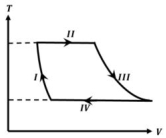
One mole of a monatomic ideal gas undergoes a cyclic process as shown in the figure (where $V$ is the volume and $T$ is the temperature). Which of the statements below is (are) true?
$(A)$ Process $I$ is an isochoric process
$(B)$ In process $II$,gas absorbs heat
$(C)$ In process $IV$,gas releases heat
$(D)$ Processes $I$ and $III$ are $not$ isobaric
$(A)$ Process $I$ is an isochoric process
$(B)$ In process $II$,gas absorbs heat
$(C)$ In process $IV$,gas releases heat
$(D)$ Processes $I$ and $III$ are $not$ isobaric
A
$A, B, C$
B
$A, B, D$
C
$B, C, D$
D
$A, C$
Solution
(C) In the given $T-V$ diagram:
Process $I$: $V$ is changing,so it is not isochoric. Statement $(A)$ is false.
Process $II$: This is an isothermal expansion ($T$ is constant,$V$ increases). Since $W > 0$ and $\Delta U = 0$,the gas absorbs heat $(\Delta Q = W > 0)$. Statement $(B)$ is true.
Process $III$: This is an isothermal compression ($T$ is constant,$V$ decreases). Since $W < 0$ and $\Delta U = 0$,the gas releases heat $(\Delta Q = W < 0)$. Statement $(C)$ is true.
Process $IV$: This is an isobaric compression ($T$ is constant,$V$ decreases). Wait,looking at the graph,$IV$ is a horizontal line at constant $T$,which is isothermal. Let's re-evaluate: Process $I$ and $III$ are curves,not linear,so they are not isobaric. Statement $(D)$ is true.
Therefore,statements $(B), (C),$ and $(D)$ are true.
Process $I$: $V$ is changing,so it is not isochoric. Statement $(A)$ is false.
Process $II$: This is an isothermal expansion ($T$ is constant,$V$ increases). Since $W > 0$ and $\Delta U = 0$,the gas absorbs heat $(\Delta Q = W > 0)$. Statement $(B)$ is true.
Process $III$: This is an isothermal compression ($T$ is constant,$V$ decreases). Since $W < 0$ and $\Delta U = 0$,the gas releases heat $(\Delta Q = W < 0)$. Statement $(C)$ is true.
Process $IV$: This is an isobaric compression ($T$ is constant,$V$ decreases). Wait,looking at the graph,$IV$ is a horizontal line at constant $T$,which is isothermal. Let's re-evaluate: Process $I$ and $III$ are curves,not linear,so they are not isobaric. Statement $(D)$ is true.
Therefore,statements $(B), (C),$ and $(D)$ are true.
0 likesView Solution
5
PhysicsMediumMCQIIT JEE · 2018
Two vectors $\vec{A}$ and $\vec{B}$ are defined as $\vec{A} = a \hat{i}$ and $\vec{B} = a(\cos \omega t \hat{i} + \sin \omega t \hat{j})$,where $a$ is a constant and $\omega = \pi / 6 \text{ rad s}^{-1}$. If $|\vec{A} + \vec{B}| = \sqrt{3}|\vec{A} - \vec{B}|$ at time $t = \tau$ for the first time,the value of $\tau$,in seconds,is . . . . . .
A
$1$
B
$2$
C
$5$
D
$6$
Solution
(B) Given $\vec{A} = a \hat{i}$ and $\vec{B} = a \cos \omega t \hat{i} + a \sin \omega t \hat{j}$.
$\vec{A} + \vec{B} = a(1 + \cos \omega t) \hat{i} + a \sin \omega t \hat{j}$.
$|\vec{A} + \vec{B}|^2 = a^2(1 + \cos \omega t)^2 + a^2 \sin^2 \omega t = a^2(1 + 2 \cos \omega t + \cos^2 \omega t + \sin^2 \omega t) = a^2(2 + 2 \cos \omega t) = 2a^2(1 + \cos \omega t) = 4a^2 \cos^2(\omega t / 2)$.
So,$|\vec{A} + \vec{B}| = 2a \cos(\omega t / 2)$.
Similarly,$\vec{A} - \vec{B} = a(1 - \cos \omega t) \hat{i} - a \sin \omega t \hat{j}$.
$|\vec{A} - \vec{B}|^2 = a^2(1 - \cos \omega t)^2 + a^2 \sin^2 \omega t = a^2(1 - 2 \cos \omega t + \cos^2 \omega t + \sin^2 \omega t) = a^2(2 - 2 \cos \omega t) = 4a^2 \sin^2(\omega t / 2)$.
So,$|\vec{A} - \vec{B}| = 2a \sin(\omega t / 2)$.
Given $|\vec{A} + \vec{B}| = \sqrt{3}|\vec{A} - \vec{B}|$,we have $2a \cos(\omega t / 2) = \sqrt{3} \cdot 2a \sin(\omega t / 2)$.
$\tan(\omega t / 2) = 1 / \sqrt{3}$.
$\omega t / 2 = \pi / 6 \implies \omega t = \pi / 3$.
Since $\omega = \pi / 6 \text{ rad s}^{-1}$,we get $(\pi / 6) \cdot t = \pi / 3$.
Therefore,$t = 2 \text{ s}$.
$\vec{A} + \vec{B} = a(1 + \cos \omega t) \hat{i} + a \sin \omega t \hat{j}$.
$|\vec{A} + \vec{B}|^2 = a^2(1 + \cos \omega t)^2 + a^2 \sin^2 \omega t = a^2(1 + 2 \cos \omega t + \cos^2 \omega t + \sin^2 \omega t) = a^2(2 + 2 \cos \omega t) = 2a^2(1 + \cos \omega t) = 4a^2 \cos^2(\omega t / 2)$.
So,$|\vec{A} + \vec{B}| = 2a \cos(\omega t / 2)$.
Similarly,$\vec{A} - \vec{B} = a(1 - \cos \omega t) \hat{i} - a \sin \omega t \hat{j}$.
$|\vec{A} - \vec{B}|^2 = a^2(1 - \cos \omega t)^2 + a^2 \sin^2 \omega t = a^2(1 - 2 \cos \omega t + \cos^2 \omega t + \sin^2 \omega t) = a^2(2 - 2 \cos \omega t) = 4a^2 \sin^2(\omega t / 2)$.
So,$|\vec{A} - \vec{B}| = 2a \sin(\omega t / 2)$.
Given $|\vec{A} + \vec{B}| = \sqrt{3}|\vec{A} - \vec{B}|$,we have $2a \cos(\omega t / 2) = \sqrt{3} \cdot 2a \sin(\omega t / 2)$.
$\tan(\omega t / 2) = 1 / \sqrt{3}$.
$\omega t / 2 = \pi / 6 \implies \omega t = \pi / 3$.
Since $\omega = \pi / 6 \text{ rad s}^{-1}$,we get $(\pi / 6) \cdot t = \pi / 3$.
Therefore,$t = 2 \text{ s}$.
0 likesView Solution
6
PhysicsAdvancedMCQIIT JEE · 2018
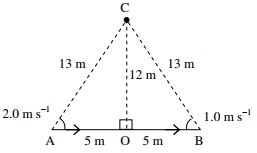
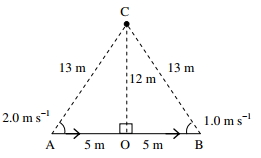
Two men are walking along a horizontal straight line in the same direction. The man in front walks at a speed of $1.0 \,m \,s^{-1}$ and the man behind walks at a speed of $2.0 \,m \,s^{-1}$. $A$ third man is standing at a height of $12 \,m$ above the same horizontal line such that all three men are in a vertical plane. The two walking men are blowing identical whistles which emit a sound of frequency $1430 \,Hz$. The speed of sound in air is $330 \,m \,s^{-1}$. At the instant when the moving men are $10 \,m$ apart,the stationary man is equidistant from them. The frequency of beats in $Hz$ heard by the stationary man at this instant is:
A
$5$
B
$8$
C
$9$
D
$12$
Solution
(A) Let the stationary man be at point $C$ and the horizontal line be $AB$. Let $O$ be the point on the line $AB$ directly below $C$. Given $CO = 12 \,m$. The men are at $A$ and $B$ such that $AO = OB = 5 \,m$. The distance $AC = BC = \sqrt{12^2 + 5^2} = 13 \,m$. The angle $\theta$ between the line $AC$ (or $BC$) and the vertical $CO$ is given by $\cos \theta = \frac{12}{13}$ and $\sin \theta = \frac{5}{13}$.
The man at $A$ (behind) is moving towards $O$ with velocity $v_A = 2.0 \,m \,s^{-1}$. The component of his velocity along the line $AC$ is $v_{A, \text{eff}} = v_A \sin \theta = 2.0 \times \frac{5}{13} \,m \,s^{-1}$. Since he is moving towards $C$,the observed frequency is $f_A = f \left( \frac{v}{v - v_A \sin \theta} \right) = 1430 \left( \frac{330}{330 - 2 \times \frac{5}{13}} \right) \approx 1430 \left( 1 + \frac{10}{13 \times 330} \right)$.
The man at $B$ (front) is moving away from $O$ with velocity $v_B = 1.0 \,m \,s^{-1}$. The component of his velocity along the line $BC$ is $v_{B, \text{eff}} = v_B \sin \theta = 1.0 \times \frac{5}{13} \,m \,s^{-1}$. Since he is moving away from $C$,the observed frequency is $f_B = f \left( \frac{v}{v + v_B \sin \theta} \right) = 1430 \left( \frac{330}{330 + 1 \times \frac{5}{13}} \right) \approx 1430 \left( 1 - \frac{5}{13 \times 330} \right)$.
The beat frequency is $\Delta f = |f_A - f_B| = 1430 \left( \frac{10}{13 \times 330} + \frac{5}{13 \times 330} \right) = 1430 \left( \frac{15}{13 \times 330} \right) = \frac{1430}{330} \times \frac{15}{13} = \frac{13}{3} \times \frac{15}{13} = 5 \,Hz$.
The man at $A$ (behind) is moving towards $O$ with velocity $v_A = 2.0 \,m \,s^{-1}$. The component of his velocity along the line $AC$ is $v_{A, \text{eff}} = v_A \sin \theta = 2.0 \times \frac{5}{13} \,m \,s^{-1}$. Since he is moving towards $C$,the observed frequency is $f_A = f \left( \frac{v}{v - v_A \sin \theta} \right) = 1430 \left( \frac{330}{330 - 2 \times \frac{5}{13}} \right) \approx 1430 \left( 1 + \frac{10}{13 \times 330} \right)$.
The man at $B$ (front) is moving away from $O$ with velocity $v_B = 1.0 \,m \,s^{-1}$. The component of his velocity along the line $BC$ is $v_{B, \text{eff}} = v_B \sin \theta = 1.0 \times \frac{5}{13} \,m \,s^{-1}$. Since he is moving away from $C$,the observed frequency is $f_B = f \left( \frac{v}{v + v_B \sin \theta} \right) = 1430 \left( \frac{330}{330 + 1 \times \frac{5}{13}} \right) \approx 1430 \left( 1 - \frac{5}{13 \times 330} \right)$.
The beat frequency is $\Delta f = |f_A - f_B| = 1430 \left( \frac{10}{13 \times 330} + \frac{5}{13 \times 330} \right) = 1430 \left( \frac{15}{13 \times 330} \right) = \frac{1430}{330} \times \frac{15}{13} = \frac{13}{3} \times \frac{15}{13} = 5 \,Hz$.
0 likesView Solution
7
PhysicsAdvancedMCQIIT JEE · 2018
$A$ ring and a disc are initially at rest, side by side, at the top of an inclined plane which makes an angle $60^{\circ}$ with the horizontal. They start to roll without slipping at the same instant of time along the shortest path. If the time difference between their reaching the ground is $(2-\sqrt{3}) / \sqrt{10} \,s$, then the height of the top of the inclined plane, in metres, is. . . . . . Take $g=10 \,m \,s^{-2}$.
A
$0.60$
B
$0.70$
C
$0.75$
D
$0.80$
Solution
(C) The acceleration of a body rolling down an inclined plane is given by $a = \frac{g \sin \theta}{1 + \frac{k^2}{R^2}}$.
For a ring, $k^2 = R^2$, so $a_R = \frac{g \sin \theta}{1 + 1} = \frac{g \sin \theta}{2}$.
For a disc, $k^2 = \frac{R^2}{2}$, so $a_D = \frac{g \sin \theta}{1 + 0.5} = \frac{2g \sin \theta}{3}$.
The distance traveled along the incline is $d = \frac{h}{\sin \theta}$.
Using $d = \frac{1}{2} a t^2$, we have $t = \sqrt{\frac{2d}{a}} = \sqrt{\frac{2h}{a \sin \theta}}$.
For the ring: $t_R = \sqrt{\frac{2h}{(g \sin \theta / 2) \sin \theta}} = \sqrt{\frac{4h}{g \sin^2 \theta}}$.
For the disc: $t_D = \sqrt{\frac{2h}{(2g \sin \theta / 3) \sin \theta}} = \sqrt{\frac{3h}{g \sin^2 \theta}}$.
Given $\theta = 60^{\circ}$, $\sin \theta = \frac{\sqrt{3}}{2}$, so $\sin^2 \theta = \frac{3}{4}$.
$t_R = \sqrt{\frac{4h}{g(3/4)}} = \sqrt{\frac{16h}{3g}}$ and $t_D = \sqrt{\frac{3h}{g(3/4)}} = \sqrt{\frac{4h}{g}}$.
Given $t_R - t_D = \frac{2-\sqrt{3}}{\sqrt{10}}$, we have $\sqrt{\frac{h}{g}} \left( \frac{4}{\sqrt{3}} - 2 \right) = \frac{2-\sqrt{3}}{\sqrt{10}}$.
$\sqrt{\frac{h}{10}} \left( \frac{4-2\sqrt{3}}{\sqrt{3}} \right) = \frac{2-\sqrt{3}}{\sqrt{10}}$.
$\sqrt{h} \left( \frac{2(2-\sqrt{3})}{\sqrt{3}} \right) = 2-\sqrt{3} \Rightarrow \sqrt{h} = \frac{\sqrt{3}}{2} \Rightarrow h = \frac{3}{4} = 0.75 \,m$.
For a ring, $k^2 = R^2$, so $a_R = \frac{g \sin \theta}{1 + 1} = \frac{g \sin \theta}{2}$.
For a disc, $k^2 = \frac{R^2}{2}$, so $a_D = \frac{g \sin \theta}{1 + 0.5} = \frac{2g \sin \theta}{3}$.
The distance traveled along the incline is $d = \frac{h}{\sin \theta}$.
Using $d = \frac{1}{2} a t^2$, we have $t = \sqrt{\frac{2d}{a}} = \sqrt{\frac{2h}{a \sin \theta}}$.
For the ring: $t_R = \sqrt{\frac{2h}{(g \sin \theta / 2) \sin \theta}} = \sqrt{\frac{4h}{g \sin^2 \theta}}$.
For the disc: $t_D = \sqrt{\frac{2h}{(2g \sin \theta / 3) \sin \theta}} = \sqrt{\frac{3h}{g \sin^2 \theta}}$.
Given $\theta = 60^{\circ}$, $\sin \theta = \frac{\sqrt{3}}{2}$, so $\sin^2 \theta = \frac{3}{4}$.
$t_R = \sqrt{\frac{4h}{g(3/4)}} = \sqrt{\frac{16h}{3g}}$ and $t_D = \sqrt{\frac{3h}{g(3/4)}} = \sqrt{\frac{4h}{g}}$.
Given $t_R - t_D = \frac{2-\sqrt{3}}{\sqrt{10}}$, we have $\sqrt{\frac{h}{g}} \left( \frac{4}{\sqrt{3}} - 2 \right) = \frac{2-\sqrt{3}}{\sqrt{10}}$.
$\sqrt{\frac{h}{10}} \left( \frac{4-2\sqrt{3}}{\sqrt{3}} \right) = \frac{2-\sqrt{3}}{\sqrt{10}}$.
$\sqrt{h} \left( \frac{2(2-\sqrt{3})}{\sqrt{3}} \right) = 2-\sqrt{3} \Rightarrow \sqrt{h} = \frac{\sqrt{3}}{2} \Rightarrow h = \frac{3}{4} = 0.75 \,m$.

0 likesView Solution
8
PhysicsAdvancedMCQIIT JEE · 2018
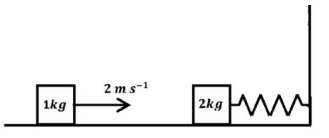
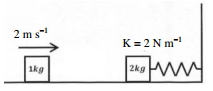
$A$ spring-block system is resting on a frictionless floor as shown in the figure. The spring constant is $2.0 \,N \,m^{-1}$ and the mass of the block is $2.0 \,kg$. Ignore the mass of the spring. Initially, the spring is in an unstretched condition. Another block of mass $1.0 \,kg$ moving with a speed of $2.0 \,m \,s^{-1}$ collides elastically with the first block. The collision is such that the $2.0 \,kg$ block does not hit the wall. The distance, in metres, between the two blocks when the spring returns to its unstretched position for the first time after the collision is. . . .
A
$2.07$
B
$2.08$
C
$2.09$
D
$2.10$
Solution
(C) Let $m_1 = 1.0 \,kg$ and $m_2 = 2.0 \,kg$. Initial velocity of $m_1$ is $u_1 = 2.0 \,m \,s^{-1}$ and $m_2$ is $u_2 = 0$.
By conservation of linear momentum: $m_1 u_1 = m_1 v_1 + m_2 v_2 \implies 1(2) = 1(v_1) + 2(v_2) \implies v_1 + 2v_2 = 2$ $(i)$
For an elastic collision, the coefficient of restitution $e = 1$: $v_2 - v_1 = e(u_1 - u_2) = 1(2 - 0) = 2$ $(ii)$
Solving $(i)$ and $(ii)$: Adding them gives $3v_2 = 4 \implies v_2 = \frac{4}{3} \,m \,s^{-1}$. Substituting into $(ii)$, $v_1 = v_2 - 2 = \frac{4}{3} - 2 = -\frac{2}{3} \,m \,s^{-1}$.
The $2.0 \,kg$ block attached to the spring undergoes simple harmonic motion. The time taken for the spring to return to its unstretched position is half the time period: $\Delta t = \frac{T}{2} = \pi \sqrt{\frac{m_2}{k}} = \pi \sqrt{\frac{2}{2}} = \pi \,s$.
During this time, the $1.0 \,kg$ block moves with constant velocity $v_1 = -\frac{2}{3} \,m \,s^{-1}$ (moving left). The $2.0 \,kg$ block moves to the right, compresses the spring, and returns to the equilibrium position.
Displacement of $1.0 \,kg$ block: $s_1 = v_1 \Delta t = -\frac{2}{3} \pi \,m$.
Displacement of $2.0 \,kg$ block: $s_2 = 0$ (as it returns to the starting position).
The distance between the blocks is $|s_2 - s_1| = |0 - (- \frac{2}{3} \pi)| = \frac{2}{3} \pi = \frac{2 \times 3.14159}{3} \approx 2.094 \,m$. Rounded to two decimal places, the distance is $2.09 \,m$.
By conservation of linear momentum: $m_1 u_1 = m_1 v_1 + m_2 v_2 \implies 1(2) = 1(v_1) + 2(v_2) \implies v_1 + 2v_2 = 2$ $(i)$
For an elastic collision, the coefficient of restitution $e = 1$: $v_2 - v_1 = e(u_1 - u_2) = 1(2 - 0) = 2$ $(ii)$
Solving $(i)$ and $(ii)$: Adding them gives $3v_2 = 4 \implies v_2 = \frac{4}{3} \,m \,s^{-1}$. Substituting into $(ii)$, $v_1 = v_2 - 2 = \frac{4}{3} - 2 = -\frac{2}{3} \,m \,s^{-1}$.
The $2.0 \,kg$ block attached to the spring undergoes simple harmonic motion. The time taken for the spring to return to its unstretched position is half the time period: $\Delta t = \frac{T}{2} = \pi \sqrt{\frac{m_2}{k}} = \pi \sqrt{\frac{2}{2}} = \pi \,s$.
During this time, the $1.0 \,kg$ block moves with constant velocity $v_1 = -\frac{2}{3} \,m \,s^{-1}$ (moving left). The $2.0 \,kg$ block moves to the right, compresses the spring, and returns to the equilibrium position.
Displacement of $1.0 \,kg$ block: $s_1 = v_1 \Delta t = -\frac{2}{3} \pi \,m$.
Displacement of $2.0 \,kg$ block: $s_2 = 0$ (as it returns to the starting position).
The distance between the blocks is $|s_2 - s_1| = |0 - (- \frac{2}{3} \pi)| = \frac{2}{3} \pi = \frac{2 \times 3.14159}{3} \approx 2.094 \,m$. Rounded to two decimal places, the distance is $2.09 \,m$.
0 likesView Solution
9
PhysicsMediumMCQIIT JEE · 2018
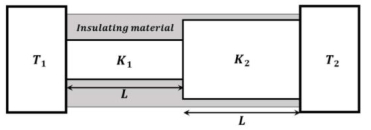
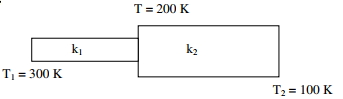
Two conducting cylinders of equal length but different radii are connected in series between two heat baths kept at temperatures $T_1=300 \ K$ and $T_2=100 \ K$,as shown in the figure. The radius of the bigger cylinder is twice that of the smaller one and the thermal conductivities of the materials of the smaller and the larger cylinders are $K_1$ and $K_2$ respectively. If the temperature at the junction of the two cylinders in the steady state is $200 \ K$,then $K_1 / K_2 = . . . . . .$
A
$4$
B
$8$
C
$9$
D
$10$
Solution
(A) In the steady state,the rate of heat flow through both cylinders is the same.
Let $r_1$ be the radius of the smaller cylinder and $r_2$ be the radius of the larger cylinder.
Given $r_2 = 2 r_1$,the cross-sectional areas are $A_1 = \pi r_1^2$ and $A_2 = \pi r_2^2 = \pi (2 r_1)^2 = 4 \pi r_1^2 = 4 A_1$.
The rate of heat flow is given by $\frac{dQ}{dt} = \frac{K A \Delta T}{L}$.
For the first cylinder: $\frac{dQ}{dt} = \frac{K_1 A_1 (300 - 200)}{L} = \frac{K_1 A_1 (100)}{L}$.
For the second cylinder: $\frac{dQ}{dt} = \frac{K_2 A_2 (200 - 100)}{L} = \frac{K_2 (4 A_1) (100)}{L}$.
Equating the two rates of heat flow:
$\frac{K_1 A_1 (100)}{L} = \frac{K_2 (4 A_1) (100)}{L}$.
$K_1 = 4 K_2$.
Therefore,$\frac{K_1}{K_2} = 4$.
Let $r_1$ be the radius of the smaller cylinder and $r_2$ be the radius of the larger cylinder.
Given $r_2 = 2 r_1$,the cross-sectional areas are $A_1 = \pi r_1^2$ and $A_2 = \pi r_2^2 = \pi (2 r_1)^2 = 4 \pi r_1^2 = 4 A_1$.
The rate of heat flow is given by $\frac{dQ}{dt} = \frac{K A \Delta T}{L}$.
For the first cylinder: $\frac{dQ}{dt} = \frac{K_1 A_1 (300 - 200)}{L} = \frac{K_1 A_1 (100)}{L}$.
For the second cylinder: $\frac{dQ}{dt} = \frac{K_2 A_2 (200 - 100)}{L} = \frac{K_2 (4 A_1) (100)}{L}$.
Equating the two rates of heat flow:
$\frac{K_1 A_1 (100)}{L} = \frac{K_2 (4 A_1) (100)}{L}$.
$K_1 = 4 K_2$.
Therefore,$\frac{K_1}{K_2} = 4$.
0 likesView Solution
10
PhysicsAdvancedMCQIIT JEE · 2018
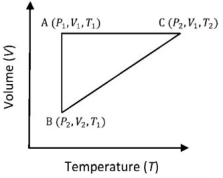
$A$ reversible cyclic process for an ideal gas is shown below. Here,$P, V$,and $T$ are pressure,volume,and temperature,respectively. The thermodynamic parameters $q, w, H$,and $U$ are heat,work,enthalpy,and internal energy,respectively.
The correct option$(s)$ is (are):
$(A)$ $q_{AC} = \Delta U_{BC}$ and $W_{AB} = P_2(V_2 - V_1)$
$(B)$ $W_{BC} = P_2(V_2 - V_1)$ and $q_{BC} = H_{AC}$
$(C)$ $\Delta H_{CA} < \Delta U_{CA}$ and $q_{AC} = \Delta U_{BC}$
$(D)$ $q_{BC} = \Delta H_{AC}$ and $\Delta H_{CA} > \Delta U_{CA}$
The correct option$(s)$ is (are):
$(A)$ $q_{AC} = \Delta U_{BC}$ and $W_{AB} = P_2(V_2 - V_1)$
$(B)$ $W_{BC} = P_2(V_2 - V_1)$ and $q_{BC} = H_{AC}$
$(C)$ $\Delta H_{CA} < \Delta U_{CA}$ and $q_{AC} = \Delta U_{BC}$
$(D)$ $q_{BC} = \Delta H_{AC}$ and $\Delta H_{CA} > \Delta U_{CA}$
A
$A, B, C$
B
$B, C$
C
$A, C$
D
$A, B$
Solution
(C) From the $V-T$ graph:
$1$. Process $AB$: Temperature is constant $(T_1)$,so it is an isothermal process. For an ideal gas,$\Delta U = 0$.
$2$. Process $AC$: Volume is constant $(V_1)$,so it is an isochoric process. Heat exchanged $q_{AC} = \Delta U_{AC} = nC_v(T_2 - T_1)$.
$3$. Process $BC$: Pressure is constant $(P_2)$,so it is an isobaric process. Heat exchanged $q_{BC} = \Delta H_{BC} = nC_p(T_2 - T_1)$.
Analyzing the options:
- For process $AC$ (isochoric),$q_{AC} = \Delta U_{AC} = nC_v(T_2 - T_1)$.
- For process $BC$ (isobaric),$\Delta U_{BC} = nC_v(T_1 - T_2) = -nC_v(T_2 - T_1)$. Thus,$q_{AC} = -\Delta U_{BC}$ is not generally true.
- For process $CA$ (isochoric),$\Delta H_{CA} = nC_p(T_1 - T_2)$ and $\Delta U_{CA} = nC_v(T_1 - T_2)$. Since $C_p > C_v$ and $(T_1 - T_2) < 0$,we have $\Delta H_{CA} < \Delta U_{CA}$.
- For process $BC$ (isobaric),$W_{BC} = P_2(V_1 - V_2) = -P_2(V_2 - V_1)$.
Given the standard interpretation of such problems,option $(C)$ is correct as $\Delta H_{CA} < \Delta U_{CA}$ holds true.
$1$. Process $AB$: Temperature is constant $(T_1)$,so it is an isothermal process. For an ideal gas,$\Delta U = 0$.
$2$. Process $AC$: Volume is constant $(V_1)$,so it is an isochoric process. Heat exchanged $q_{AC} = \Delta U_{AC} = nC_v(T_2 - T_1)$.
$3$. Process $BC$: Pressure is constant $(P_2)$,so it is an isobaric process. Heat exchanged $q_{BC} = \Delta H_{BC} = nC_p(T_2 - T_1)$.
Analyzing the options:
- For process $AC$ (isochoric),$q_{AC} = \Delta U_{AC} = nC_v(T_2 - T_1)$.
- For process $BC$ (isobaric),$\Delta U_{BC} = nC_v(T_1 - T_2) = -nC_v(T_2 - T_1)$. Thus,$q_{AC} = -\Delta U_{BC}$ is not generally true.
- For process $CA$ (isochoric),$\Delta H_{CA} = nC_p(T_1 - T_2)$ and $\Delta U_{CA} = nC_v(T_1 - T_2)$. Since $C_p > C_v$ and $(T_1 - T_2) < 0$,we have $\Delta H_{CA} < \Delta U_{CA}$.
- For process $BC$ (isobaric),$W_{BC} = P_2(V_1 - V_2) = -P_2(V_2 - V_1)$.
Given the standard interpretation of such problems,option $(C)$ is correct as $\Delta H_{CA} < \Delta U_{CA}$ holds true.
0 likesView Solution
11
PhysicsAdvancedMCQIIT JEE · 2018
Two men are walking along a horizontal straight line in the same direction. The man in front walks at a speed $1.0 \ m \ s^{-1}$ and the man behind walks at a speed $2.0 \ m \ s^{-1}$. $A$ third man is standing at a height $12 \ m$ above the same horizontal line such that all three men are in a vertical plane. The two walking men are blowing identical whistles which emit a sound of frequency $1430 \ Hz$. The speed of sound in air is $330 \ m \ s^{-1}$. At the instant when the moving men are $10 \ m$ apart,the stationary man is equidistant from them. The frequency of beats in $Hz$ heard by the stationary man at this instant is:
A
$4$
B
$5$
C
$8$
D
$10$
Solution
(B) Let the stationary man be at point $C$ and the two moving men be at $A$ and $B$. The distance $CO = 12 \ m$. Since the men are $10 \ m$ apart and the stationary man is equidistant,$AO = OB = 5 \ m$.
The distance $AC = BC = \sqrt{12^2 + 5^2} = 13 \ m$.
The angle $\theta$ between the line of motion and the line joining the observer to the source is given by $\cos \theta = \frac{5}{13}$.
For the man behind $(A)$ moving towards $O$ with speed $v_s = 2.0 \ m \ s^{-1}$,the component of velocity along the line $AC$ is $v_s \cos \theta$ towards $C$. The observed frequency is $f_A = f \left( \frac{v}{v - v_s \cos \theta} \right) = 1430 \left( \frac{330}{330 - 2 \cos \theta} \right) \approx 1430 \left( 1 + \frac{2 \cos \theta}{330} \right)$.
For the man in front $(B)$ moving away from $O$ with speed $v_s = 1.0 \ m \ s^{-1}$,the component of velocity along the line $BC$ is $v_s \cos \theta$ away from $C$. The observed frequency is $f_B = f \left( \frac{v}{v + v_s \cos \theta} \right) = 1430 \left( \frac{330}{330 + 1 \cos \theta} \right) \approx 1430 \left( 1 - \frac{\cos \theta}{330} \right)$.
The beat frequency is $\Delta f = f_A - f_B = 1430 \left( \frac{2 \cos \theta + \cos \theta}{330} \right) = 1430 \left( \frac{3 \cos \theta}{330} \right) = 13 \cos \theta$.
Substituting $\cos \theta = \frac{5}{13}$,we get $\Delta f = 13 \times \frac{5}{13} = 5 \ Hz$.
The distance $AC = BC = \sqrt{12^2 + 5^2} = 13 \ m$.
The angle $\theta$ between the line of motion and the line joining the observer to the source is given by $\cos \theta = \frac{5}{13}$.
For the man behind $(A)$ moving towards $O$ with speed $v_s = 2.0 \ m \ s^{-1}$,the component of velocity along the line $AC$ is $v_s \cos \theta$ towards $C$. The observed frequency is $f_A = f \left( \frac{v}{v - v_s \cos \theta} \right) = 1430 \left( \frac{330}{330 - 2 \cos \theta} \right) \approx 1430 \left( 1 + \frac{2 \cos \theta}{330} \right)$.
For the man in front $(B)$ moving away from $O$ with speed $v_s = 1.0 \ m \ s^{-1}$,the component of velocity along the line $BC$ is $v_s \cos \theta$ away from $C$. The observed frequency is $f_B = f \left( \frac{v}{v + v_s \cos \theta} \right) = 1430 \left( \frac{330}{330 + 1 \cos \theta} \right) \approx 1430 \left( 1 - \frac{\cos \theta}{330} \right)$.
The beat frequency is $\Delta f = f_A - f_B = 1430 \left( \frac{2 \cos \theta + \cos \theta}{330} \right) = 1430 \left( \frac{3 \cos \theta}{330} \right) = 13 \cos \theta$.
Substituting $\cos \theta = \frac{5}{13}$,we get $\Delta f = 13 \times \frac{5}{13} = 5 \ Hz$.
0 likesView Solution
12
PhysicsMediumMCQIIT JEE · 2018
$A$ ring and a disc are initially at rest,side by side,at the top of an inclined plane which makes an angle $60^{\circ}$ with the horizontal. They start to roll without slipping at the same instant of time along the shortest path. If the time difference between their reaching the ground is $(2-\sqrt{3}) / \sqrt{10} \ s$,then the height of the top of the inclined plane,in metres,is. . . . . . . . Take $g=10 \ m \ s^{-2}$.
A
$0.70$
B
$0.75$
C
$0.80$
D
$0.85$
Solution
(B) The acceleration $a$ of a body rolling down an inclined plane is given by $a = \frac{g \sin \theta}{1 + \frac{k^2}{R^2}}$.
For a ring,$k^2 = R^2$,so $a_R = \frac{g \sin \theta}{1+1} = \frac{g \sin \theta}{2}$.
For a disc,$k^2 = R^2/2$,so $a_D = \frac{g \sin \theta}{1+0.5} = \frac{2g \sin \theta}{3}$.
The distance to be covered along the incline is $d = \frac{h}{\sin \theta}$.
Using $d = \frac{1}{2} a t^2$,we have $t = \sqrt{\frac{2d}{a}} = \sqrt{\frac{2h}{a \sin \theta}}$.
For the ring: $t_R = \sqrt{\frac{2h}{(g \sin \theta / 2) \sin \theta}} = \sqrt{\frac{4h}{g \sin^2 \theta}} = \sqrt{\frac{4h}{g (3/4)}} = \sqrt{\frac{16h}{3g}}$.
For the disc: $t_D = \sqrt{\frac{2h}{(2g \sin \theta / 3) \sin \theta}} = \sqrt{\frac{3h}{g \sin^2 \theta}} = \sqrt{\frac{3h}{g (3/4)}} = \sqrt{\frac{4h}{g}}$.
Given $t_R - t_D = \frac{2-\sqrt{3}}{\sqrt{10}}$,we have $\sqrt{\frac{h}{g}} \left( \sqrt{\frac{16}{3}} - 2 \right) = \frac{2-\sqrt{3}}{\sqrt{10}}$.
$\sqrt{\frac{h}{10}} \left( \frac{4 - 2\sqrt{3}}{\sqrt{3}} \right) = \frac{2-\sqrt{3}}{\sqrt{10}}$.
$\sqrt{h} \left( \frac{2(2-\sqrt{3})}{\sqrt{3}} \right) = 2-\sqrt{3}$.
$\sqrt{h} = \frac{\sqrt{3}}{2} \implies h = \frac{3}{4} = 0.75 \ m$.
For a ring,$k^2 = R^2$,so $a_R = \frac{g \sin \theta}{1+1} = \frac{g \sin \theta}{2}$.
For a disc,$k^2 = R^2/2$,so $a_D = \frac{g \sin \theta}{1+0.5} = \frac{2g \sin \theta}{3}$.
The distance to be covered along the incline is $d = \frac{h}{\sin \theta}$.
Using $d = \frac{1}{2} a t^2$,we have $t = \sqrt{\frac{2d}{a}} = \sqrt{\frac{2h}{a \sin \theta}}$.
For the ring: $t_R = \sqrt{\frac{2h}{(g \sin \theta / 2) \sin \theta}} = \sqrt{\frac{4h}{g \sin^2 \theta}} = \sqrt{\frac{4h}{g (3/4)}} = \sqrt{\frac{16h}{3g}}$.
For the disc: $t_D = \sqrt{\frac{2h}{(2g \sin \theta / 3) \sin \theta}} = \sqrt{\frac{3h}{g \sin^2 \theta}} = \sqrt{\frac{3h}{g (3/4)}} = \sqrt{\frac{4h}{g}}$.
Given $t_R - t_D = \frac{2-\sqrt{3}}{\sqrt{10}}$,we have $\sqrt{\frac{h}{g}} \left( \sqrt{\frac{16}{3}} - 2 \right) = \frac{2-\sqrt{3}}{\sqrt{10}}$.
$\sqrt{\frac{h}{10}} \left( \frac{4 - 2\sqrt{3}}{\sqrt{3}} \right) = \frac{2-\sqrt{3}}{\sqrt{10}}$.
$\sqrt{h} \left( \frac{2(2-\sqrt{3})}{\sqrt{3}} \right) = 2-\sqrt{3}$.
$\sqrt{h} = \frac{\sqrt{3}}{2} \implies h = \frac{3}{4} = 0.75 \ m$.

0 likesView Solution
13
PhysicsAdvancedMCQIIT JEE · 2018
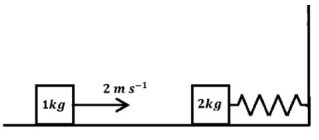
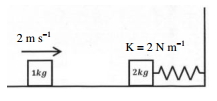
$A$ spring-block system is resting on a frictionless floor as shown in the figure. The spring constant is $2.0 \ N \ m^{-1}$ and the mass of the block is $2.0 \ kg$. Ignore the mass of the spring. Initially,the spring is in an unstretched condition. Another block of mass $1.0 \ kg$ moving with a speed of $2.0 \ m \ s^{-1}$ collides elastically with the first block. The collision is such that the $2.0 \ kg$ block does not hit the wall. The distance,in metres,between the two blocks when the spring returns to its unstretched position for the first time after the collision is . . . . .
A
$2.01$
B
$2.08$
C
$2.09$
D
$2.07$
Solution
(C) Let $m_1 = 1.0 \ kg$ and $m_2 = 2.0 \ kg$. Initial velocity of $m_1$ is $u_1 = 2.0 \ m \ s^{-1}$ and $m_2$ is $u_2 = 0$. Let $v_1$ and $v_2$ be their velocities after the elastic collision.
Using conservation of linear momentum: $m_1 u_1 = m_1 v_1 + m_2 v_2 \implies 1(2) = 1(v_1) + 2(v_2) \implies v_1 + 2v_2 = 2$ . . . . . $(1)$
Using the coefficient of restitution for an elastic collision $(e=1)$: $v_2 - v_1 = e(u_1 - u_2) = 1(2 - 0) = 2$ . . . . . $(2)$
Solving equations $(1)$ and $(2)$,we get $v_2 = 4/3 \ m \ s^{-1}$ and $v_1 = -2/3 \ m \ s^{-1}$.
The $2.0 \ kg$ block attached to the spring undergoes simple harmonic motion. The time period is $T = 2\pi \sqrt{m_2/k} = 2\pi \sqrt{2/2} = 2\pi \ s$.
The spring returns to its unstretched position after half the time period,i.e.,$\Delta t = T/2 = \pi \ s$.
During this time,the $1.0 \ kg$ block moves with constant velocity $v_1 = -2/3 \ m \ s^{-1}$ (away from the spring). Its displacement is $\Delta x_1 = v_1 \Delta t = (-2/3) \times \pi = -2\pi/3 \ m$.
The $2.0 \ kg$ block moves from $x=0$ to $x_{max}$ and back to $x=0$. Its displacement is $\Delta x_2 = 0$.
The distance between the blocks is $|\Delta x_1 - \Delta x_2| = |-2\pi/3 - 0| = 2\pi/3 \approx 2(3.14)/3 = 6.28/3 \approx 2.09 \ m$.
Using conservation of linear momentum: $m_1 u_1 = m_1 v_1 + m_2 v_2 \implies 1(2) = 1(v_1) + 2(v_2) \implies v_1 + 2v_2 = 2$ . . . . . $(1)$
Using the coefficient of restitution for an elastic collision $(e=1)$: $v_2 - v_1 = e(u_1 - u_2) = 1(2 - 0) = 2$ . . . . . $(2)$
Solving equations $(1)$ and $(2)$,we get $v_2 = 4/3 \ m \ s^{-1}$ and $v_1 = -2/3 \ m \ s^{-1}$.
The $2.0 \ kg$ block attached to the spring undergoes simple harmonic motion. The time period is $T = 2\pi \sqrt{m_2/k} = 2\pi \sqrt{2/2} = 2\pi \ s$.
The spring returns to its unstretched position after half the time period,i.e.,$\Delta t = T/2 = \pi \ s$.
During this time,the $1.0 \ kg$ block moves with constant velocity $v_1 = -2/3 \ m \ s^{-1}$ (away from the spring). Its displacement is $\Delta x_1 = v_1 \Delta t = (-2/3) \times \pi = -2\pi/3 \ m$.
The $2.0 \ kg$ block moves from $x=0$ to $x_{max}$ and back to $x=0$. Its displacement is $\Delta x_2 = 0$.
The distance between the blocks is $|\Delta x_1 - \Delta x_2| = |-2\pi/3 - 0| = 2\pi/3 \approx 2(3.14)/3 = 6.28/3 \approx 2.09 \ m$.
0 likesView Solution
14
PhysicsAdvancedMCQIIT JEE · 2018
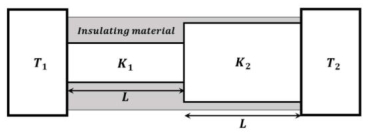
Two conducting cylinders of equal length but different radii are connected in series between two heat baths kept at temperatures $T_1 = 300 \ K$ and $T_2 = 100 \ K$,as shown in the figure. The radius of the bigger cylinder is twice that of the smaller one and the thermal conductivities of the materials of the smaller and the larger cylinders are $K_1$ and $K_2$ respectively. If the temperature at the junction of the two cylinders in the steady state is $200 \ K$,then $K_1 / K_2 = \dots$
A
$5$
B
$7$
C
$4$
D
$8$
Solution
(C) In the steady state,the rate of heat flow through both cylinders is the same.
Let $r_1$ be the radius of the smaller cylinder and $r_2$ be the radius of the larger cylinder.
Given $r_2 = 2r_1$.
The cross-sectional areas are $A_1 = \pi r_1^2$ and $A_2 = \pi r_2^2 = \pi (2r_1)^2 = 4\pi r_1^2 = 4A_1$.
The rate of heat flow is given by $\frac{dQ}{dt} = \frac{KA(T_{high} - T_{low})}{L}$.
For the first cylinder: $\frac{dQ}{dt} = \frac{K_1 A_1 (300 - 200)}{L} = \frac{K_1 A_1 (100)}{L}$.
For the second cylinder: $\frac{dQ}{dt} = \frac{K_2 A_2 (200 - 100)}{L} = \frac{K_2 (4A_1) (100)}{L}$.
Equating the rates of heat flow:
$\frac{K_1 A_1 (100)}{L} = \frac{K_2 (4A_1) (100)}{L}$.
$K_1 = 4K_2$.
Therefore,$K_1 / K_2 = 4$.
Let $r_1$ be the radius of the smaller cylinder and $r_2$ be the radius of the larger cylinder.
Given $r_2 = 2r_1$.
The cross-sectional areas are $A_1 = \pi r_1^2$ and $A_2 = \pi r_2^2 = \pi (2r_1)^2 = 4\pi r_1^2 = 4A_1$.
The rate of heat flow is given by $\frac{dQ}{dt} = \frac{KA(T_{high} - T_{low})}{L}$.
For the first cylinder: $\frac{dQ}{dt} = \frac{K_1 A_1 (300 - 200)}{L} = \frac{K_1 A_1 (100)}{L}$.
For the second cylinder: $\frac{dQ}{dt} = \frac{K_2 A_2 (200 - 100)}{L} = \frac{K_2 (4A_1) (100)}{L}$.
Equating the rates of heat flow:
$\frac{K_1 A_1 (100)}{L} = \frac{K_2 (4A_1) (100)}{L}$.
$K_1 = 4K_2$.
Therefore,$K_1 / K_2 = 4$.
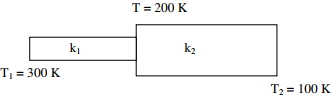
0 likesView Solution
15
PhysicsAdvancedMCQIIT JEE · 2018
In electromagnetic theory, electric and magnetic phenomena are related to each other. Therefore, the dimensions of electric and magnetic quantities must also be related. In the questions below, $[E]$ and $[B]$ stand for dimensions of electric and magnetic fields respectively, while $[\varepsilon_0]$ and $[\mu_0]$ stand for dimensions of the permittivity and permeability of free space respectively. $[L]$ and $[T]$ are dimensions of length and time respectively. All quantities are in $SI$ units.
$(1)$ The relation between $[E]$ and $[B]$ is:
$(A)$ $[E] = [B][L][T]$
$(B)$ $[E] = [B][L]^{-1}[T]$
$(C)$ $[E] = [B][L][T]^{-1}$
$(D)$ $[E] = [B][L]^{-1}[T]^{-1}$
$(2)$ The relation between $[\varepsilon_0]$ and $[\mu_0]$ is:
$(A)$ $[\mu_0] = [\varepsilon_0][L]^2[T]^{-2}$
$(B)$ $[\mu_0] = [\varepsilon_0][L]^{-2}[T]^2$
$(C)$ $[\mu_0] = [\varepsilon_0]^{-1}[L]^2[T]^{-2}$
$(D)$ $[\mu_0] = [\varepsilon_0]^{-1}[L]^{-2}[T]^2$
Give the answers for questions $(1)$ and $(2)$.
$(1)$ The relation between $[E]$ and $[B]$ is:
$(A)$ $[E] = [B][L][T]$
$(B)$ $[E] = [B][L]^{-1}[T]$
$(C)$ $[E] = [B][L][T]^{-1}$
$(D)$ $[E] = [B][L]^{-1}[T]^{-1}$
$(2)$ The relation between $[\varepsilon_0]$ and $[\mu_0]$ is:
$(A)$ $[\mu_0] = [\varepsilon_0][L]^2[T]^{-2}$
$(B)$ $[\mu_0] = [\varepsilon_0][L]^{-2}[T]^2$
$(C)$ $[\mu_0] = [\varepsilon_0]^{-1}[L]^2[T]^{-2}$
$(D)$ $[\mu_0] = [\varepsilon_0]^{-1}[L]^{-2}[T]^2$
Give the answers for questions $(1)$ and $(2)$.
A
$C, D$
B
$C, A$
C
$C, B$
D
$B, C, D$
Solution
$(C, D)$ $(1)$ The Lorentz force on a charge $q$ moving with velocity $v$ is given by $F = qE + q(v \times B)$. For the dimensions to be consistent, the magnitude of the electric force $qE$ must be equal to the magnitude of the magnetic force $qvB$.
Thus, $qE = qvB$, which implies $E = vB$.
Since the dimension of velocity $v$ is $[L][T]^{-1}$, we have $[E] = [L][T]^{-1}[B]$. This matches option $(C)$.
$(2)$ The speed of light $c$ in free space is related to permittivity $\varepsilon_0$ and permeability $\mu_0$ by the relation $c = \frac{1}{\sqrt{\mu_0 \varepsilon_0}}$.
Squaring both sides, we get $c^2 = \frac{1}{\mu_0 \varepsilon_0}$, or $\mu_0 = \frac{1}{\varepsilon_0 c^2}$.
Since the dimension of $c$ is $[L][T]^{-1}$, the dimension of $c^2$ is $[L]^2[T]^{-2}$.
Therefore, $[\mu_0] = [\varepsilon_0]^{-1} ([L]^2[T]^{-2})^{-1} = [\varepsilon_0]^{-1}[L]^{-2}[T]^2$. This matches option $(D)$.
Thus, $qE = qvB$, which implies $E = vB$.
Since the dimension of velocity $v$ is $[L][T]^{-1}$, we have $[E] = [L][T]^{-1}[B]$. This matches option $(C)$.
$(2)$ The speed of light $c$ in free space is related to permittivity $\varepsilon_0$ and permeability $\mu_0$ by the relation $c = \frac{1}{\sqrt{\mu_0 \varepsilon_0}}$.
Squaring both sides, we get $c^2 = \frac{1}{\mu_0 \varepsilon_0}$, or $\mu_0 = \frac{1}{\varepsilon_0 c^2}$.
Since the dimension of $c$ is $[L][T]^{-1}$, the dimension of $c^2$ is $[L]^2[T]^{-2}$.
Therefore, $[\mu_0] = [\varepsilon_0]^{-1} ([L]^2[T]^{-2})^{-1} = [\varepsilon_0]^{-1}[L]^{-2}[T]^2$. This matches option $(D)$.
0 likesView Solution
16
PhysicsMediumMCQIIT JEE · 2018
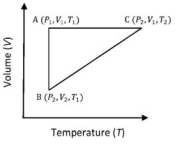
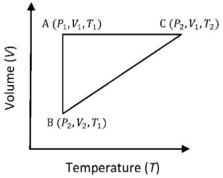
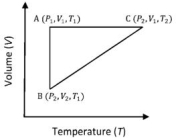
$A$ reversible cyclic process for an ideal gas is shown below. Here,$P, V$,and $T$ are pressure,volume,and temperature,respectively. The thermodynamic parameters $q, w, H$,and $U$ are heat,work,enthalpy,and internal energy,respectively.
The correct option$(s)$ is (are):
$(A)$ $q_{AC} = \Delta U_{AC}$ and $W_{AB} = 0$
$(B)$ $W_{BC} = P_2(V_1 - V_2)$ and $q_{BC} = \Delta H_{BC}$
$(C)$ $\Delta H_{CA} < \Delta U_{CA}$ and $q_{AC} = \Delta U_{AC}$
$(D)$ $q_{BC} = \Delta H_{BC}$ and $\Delta H_{CA} > \Delta U_{CA}$
The correct option$(s)$ is (are):
$(A)$ $q_{AC} = \Delta U_{AC}$ and $W_{AB} = 0$
$(B)$ $W_{BC} = P_2(V_1 - V_2)$ and $q_{BC} = \Delta H_{BC}$
$(C)$ $\Delta H_{CA} < \Delta U_{CA}$ and $q_{AC} = \Delta U_{AC}$
$(D)$ $q_{BC} = \Delta H_{BC}$ and $\Delta H_{CA} > \Delta U_{CA}$
A
$(A), (B)$
B
$(A), (C)$
C
$(B), (C)$
D
$(B), (D)$
Solution
(D) From the $V-T$ graph:
$AB$: $T$ is constant $(T_1)$,so it is an isothermal process. Thus,$\Delta U_{AB} = 0$ and $W_{AB} = nRT_1 \ln(V_2/V_1)$.
$AC$: $V$ is constant $(V_1)$,so it is an isochoric process. Thus,$W_{AC} = 0$ and $q_{AC} = \Delta U_{AC} = nC_v(T_2 - T_1)$.
$BC$: $P$ is constant $(P_2)$,so it is an isobaric process. Thus,$W_{BC} = P_2(V_1 - V_2)$ and $q_{BC} = \Delta H_{BC} = nC_p(T_1 - T_2)$.
For process $CA$: $\Delta H_{CA} = nC_p(T_1 - T_2)$ and $\Delta U_{CA} = nC_v(T_1 - T_2)$. Since $C_p > C_v$ and $(T_1 - T_2) < 0$,we have $\Delta H_{CA} < \Delta U_{CA}$.
Therefore,options $(B)$ and $(D)$ are correct.
$AB$: $T$ is constant $(T_1)$,so it is an isothermal process. Thus,$\Delta U_{AB} = 0$ and $W_{AB} = nRT_1 \ln(V_2/V_1)$.
$AC$: $V$ is constant $(V_1)$,so it is an isochoric process. Thus,$W_{AC} = 0$ and $q_{AC} = \Delta U_{AC} = nC_v(T_2 - T_1)$.
$BC$: $P$ is constant $(P_2)$,so it is an isobaric process. Thus,$W_{BC} = P_2(V_1 - V_2)$ and $q_{BC} = \Delta H_{BC} = nC_p(T_1 - T_2)$.
For process $CA$: $\Delta H_{CA} = nC_p(T_1 - T_2)$ and $\Delta U_{CA} = nC_v(T_1 - T_2)$. Since $C_p > C_v$ and $(T_1 - T_2) < 0$,we have $\Delta H_{CA} < \Delta U_{CA}$.
Therefore,options $(B)$ and $(D)$ are correct.
0 likesView Solution
17
PhysicsMediumMCQIIT JEE · 2018
$A$ particle of mass $m$ is initially at rest at the origin. It is subjected to a force and starts moving along the $x$-axis. Its kinetic energy $K$ changes with time as $dK/dt = \gamma t$,where $\gamma$ is a positive constant of appropriate dimensions. Which of the following statements is (are) true?
$(A)$ The force applied on the particle is constant
$(B)$ The speed of the particle is proportional to time
$(C)$ The distance of the particle from the origin increases linearly with time
$(D)$ The force is conservative
$(A)$ The force applied on the particle is constant
$(B)$ The speed of the particle is proportional to time
$(C)$ The distance of the particle from the origin increases linearly with time
$(D)$ The force is conservative
A
$(A), (B)$
B
$(A), (B), (D)$
C
$(B), (C)$
D
$(A), (C)$
Solution
(B) Given $\frac{dK}{dt} = \gamma t$. Since $K = \frac{1}{2}mv^2$,we have $\frac{dK}{dt} = mv \frac{dv}{dt} = \gamma t$.
Thus,$v \frac{dv}{dt} = \frac{\gamma t}{m}$.
Integrating both sides,$\int v dv = \int \frac{\gamma}{m} t dt$,which gives $\frac{v^2}{2} = \frac{\gamma t^2}{2m}$.
Therefore,$v = \sqrt{\frac{\gamma}{m}} t$. This shows that speed is proportional to time,so $(B)$ is true.
The acceleration $a = \frac{dv}{dt} = \sqrt{\frac{\gamma}{m}}$,which is a constant. Since $F = ma$,the force $F = \sqrt{\gamma m}$ is also constant,so $(A)$ is true.
Since $v = \frac{dx}{dt} = \sqrt{\frac{\gamma}{m}} t$,integrating gives $x = \int \sqrt{\frac{\gamma}{m}} t dt = \frac{1}{2} \sqrt{\frac{\gamma}{m}} t^2$. The distance increases quadratically with time,not linearly,so $(C)$ is false.
Since the force is constant,it is a conservative force,so $(D)$ is true.
Thus,statements $(A), (B),$ and $(D)$ are true.
Thus,$v \frac{dv}{dt} = \frac{\gamma t}{m}$.
Integrating both sides,$\int v dv = \int \frac{\gamma}{m} t dt$,which gives $\frac{v^2}{2} = \frac{\gamma t^2}{2m}$.
Therefore,$v = \sqrt{\frac{\gamma}{m}} t$. This shows that speed is proportional to time,so $(B)$ is true.
The acceleration $a = \frac{dv}{dt} = \sqrt{\frac{\gamma}{m}}$,which is a constant. Since $F = ma$,the force $F = \sqrt{\gamma m}$ is also constant,so $(A)$ is true.
Since $v = \frac{dx}{dt} = \sqrt{\frac{\gamma}{m}} t$,integrating gives $x = \int \sqrt{\frac{\gamma}{m}} t dt = \frac{1}{2} \sqrt{\frac{\gamma}{m}} t^2$. The distance increases quadratically with time,not linearly,so $(C)$ is false.
Since the force is constant,it is a conservative force,so $(D)$ is true.
Thus,statements $(A), (B),$ and $(D)$ are true.
0 likesView Solution
18
PhysicsMediumMCQIIT JEE · 2018
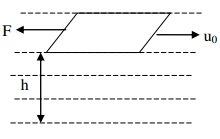
Consider a thin square plate floating on a viscous liquid in a large tank. The height $h$ of the liquid in the tank is much less than the width of the tank. The floating plate is pulled horizontally with a constant velocity $u_0$. Which of the following statements is (are) true?
$(A)$ The resistive force of liquid on the plate is inversely proportional to $h$
$(B)$ The resistive force of liquid on the plate is independent of the area of the plate
$(C)$ The tangential (shear) stress on the floor of the tank increases with $u_0$
$(D)$ The tangential (shear) stress on the plate varies linearly with the viscosity $\eta$ of the liquid
$(A)$ The resistive force of liquid on the plate is inversely proportional to $h$
$(B)$ The resistive force of liquid on the plate is independent of the area of the plate
$(C)$ The tangential (shear) stress on the floor of the tank increases with $u_0$
$(D)$ The tangential (shear) stress on the plate varies linearly with the viscosity $\eta$ of the liquid
A
$A, B, C$
B
$A, B$
C
$A, C, D$
D
$A, C$
Solution
(C) According to Newton's law of viscosity,the viscous force $F$ acting on a plate of area $A$ moving with velocity $u_0$ over a liquid layer of thickness $h$ is given by:
$F = \eta A \frac{dv}{dx} = \eta A \frac{u_0}{h}$
From this expression:
$1$. The resistive force $F$ is inversely proportional to $h$ $(F \propto 1/h)$. Thus,statement $(A)$ is true.
$2$. The resistive force $F$ is directly proportional to the area $A$ $(F \propto A)$. Thus,statement $(B)$ is false.
$3$. The tangential (shear) stress $\tau$ is defined as $\tau = F/A = \eta \frac{u_0}{h}$.
$4$. Since $\tau = \eta \frac{u_0}{h}$,the shear stress on the floor (or plate) is directly proportional to $u_0$. Thus,statement $(C)$ is true.
$5$. Since $\tau = \eta \frac{u_0}{h}$,the shear stress is directly proportional to the viscosity $\eta$. Thus,statement $(D)$ is true.
Therefore,statements $(A), (C),$ and $(D)$ are true.
$F = \eta A \frac{dv}{dx} = \eta A \frac{u_0}{h}$
From this expression:
$1$. The resistive force $F$ is inversely proportional to $h$ $(F \propto 1/h)$. Thus,statement $(A)$ is true.
$2$. The resistive force $F$ is directly proportional to the area $A$ $(F \propto A)$. Thus,statement $(B)$ is false.
$3$. The tangential (shear) stress $\tau$ is defined as $\tau = F/A = \eta \frac{u_0}{h}$.
$4$. Since $\tau = \eta \frac{u_0}{h}$,the shear stress on the floor (or plate) is directly proportional to $u_0$. Thus,statement $(C)$ is true.
$5$. Since $\tau = \eta \frac{u_0}{h}$,the shear stress is directly proportional to the viscosity $\eta$. Thus,statement $(D)$ is true.
Therefore,statements $(A), (C),$ and $(D)$ are true.
0 likesView Solution
19
PhysicsDifficultMCQIIT JEE · 2018
In an experiment to measure the speed of sound by a resonating air column,a tuning fork of frequency $500 \text{ Hz}$ is used. The length of the air column is varied by changing the level of water in the resonance tube. Two successive resonances are heard at air columns of length $50.7 \text{ cm}$ and $83.9 \text{ cm}$. Which of the following statements is (are) true?
$(A)$ The speed of sound determined from this experiment is $332 \text{ m s}^{-1}$
$(B)$ The end correction in this experiment is $0.9 \text{ cm}$
$(C)$ The wavelength of the sound wave is $66.4 \text{ cm}$
$(D)$ The resonance at $50.7 \text{ cm}$ corresponds to the fundamental harmonic
$(A)$ The speed of sound determined from this experiment is $332 \text{ m s}^{-1}$
$(B)$ The end correction in this experiment is $0.9 \text{ cm}$
$(C)$ The wavelength of the sound wave is $66.4 \text{ cm}$
$(D)$ The resonance at $50.7 \text{ cm}$ corresponds to the fundamental harmonic
A
$A, B$
B
$A, C$
C
$A, B, C$
D
$A, D$
Solution
(B) For two successive resonances at lengths $L_1$ and $L_2$,the half-wavelength is given by $\lambda/2 = L_2 - L_1$.
$\lambda/2 = 83.9 \text{ cm} - 50.7 \text{ cm} = 33.2 \text{ cm}$.
Therefore,the wavelength $\lambda = 2 \times 33.2 \text{ cm} = 66.4 \text{ cm}$. (Statement $C$ is true).
Speed of sound $v = f \lambda = 500 \text{ Hz} \times 0.664 \text{ m} = 332 \text{ m s}^{-1}$. (Statement $A$ is true).
For the first resonance,$L_1 + e = \lambda/4$,where $e$ is the end correction.
$50.7 \text{ cm} + e = 66.4 \text{ cm} / 4 = 16.6 \text{ cm}$.
$e = 16.6 \text{ cm} - 50.7 \text{ cm} = -34.1 \text{ cm}$.
Note: The problem setup implies $L_1$ and $L_2$ are the $2^{\text{nd}}$ and $3^{\text{rd}}$ harmonics (or higher) because $L_1$ is quite large. The end correction $e$ is typically small and positive. Given the options,$A$ and $C$ are correct.
$\lambda/2 = 83.9 \text{ cm} - 50.7 \text{ cm} = 33.2 \text{ cm}$.
Therefore,the wavelength $\lambda = 2 \times 33.2 \text{ cm} = 66.4 \text{ cm}$. (Statement $C$ is true).
Speed of sound $v = f \lambda = 500 \text{ Hz} \times 0.664 \text{ m} = 332 \text{ m s}^{-1}$. (Statement $A$ is true).
For the first resonance,$L_1 + e = \lambda/4$,where $e$ is the end correction.
$50.7 \text{ cm} + e = 66.4 \text{ cm} / 4 = 16.6 \text{ cm}$.
$e = 16.6 \text{ cm} - 50.7 \text{ cm} = -34.1 \text{ cm}$.
Note: The problem setup implies $L_1$ and $L_2$ are the $2^{\text{nd}}$ and $3^{\text{rd}}$ harmonics (or higher) because $L_1$ is quite large. The end correction $e$ is typically small and positive. Given the options,$A$ and $C$ are correct.
0 likesView Solution
20
PhysicsDifficultMCQIIT JEE · 2018
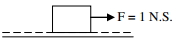
$A$ solid horizontal surface is covered with a thin layer of oil. $A$ rectangular block of mass $m = 0.4 \ kg$ is at rest on this surface. An impulse of $1.0 \ N \ s$ is applied to the block at time $t = 0$ so that it starts moving along the $x$-axis with a velocity $v(t) = v_0 e^{-t/\tau}$,where $v_0$ is a constant and $\tau = 4 \ s$. The displacement of the block,in metres,at $t = \tau$ is. . . . . . . Take $e^{-1} = 0.37$.
A
$6.2$
B
$6.3$
C
$6.4$
D
$6.5$
Solution
(B) Given,$m = 0.4 \ kg$,Impulse $J = 1.0 \ N \ s$,$\tau = 4 \ s$,and $v(t) = v_0 e^{-t/\tau}$.
At $t = 0$,the velocity is $v(0) = v_0 e^0 = v_0$.
From the impulse-momentum theorem,$J = \Delta p = m \Delta v = m(v(0) - 0) = m v_0$.
Therefore,$v_0 = J/m = 1.0 / 0.4 = 2.5 \ m/s$.
The displacement $S$ at $t = \tau$ is given by the integral of velocity:
$S = \int_0^{\tau} v(t) \ dt = \int_0^{\tau} v_0 e^{-t/\tau} \ dt$.
$S = v_0 \left[ -\tau e^{-t/\tau} \right]_0^{\tau} = v_0 \tau (1 - e^{-1})$.
Substituting the values: $S = (2.5) \times (4) \times (1 - 0.37)$.
$S = 10 \times 0.63 = 6.3 \ m$.
At $t = 0$,the velocity is $v(0) = v_0 e^0 = v_0$.
From the impulse-momentum theorem,$J = \Delta p = m \Delta v = m(v(0) - 0) = m v_0$.
Therefore,$v_0 = J/m = 1.0 / 0.4 = 2.5 \ m/s$.
The displacement $S$ at $t = \tau$ is given by the integral of velocity:
$S = \int_0^{\tau} v(t) \ dt = \int_0^{\tau} v_0 e^{-t/\tau} \ dt$.
$S = v_0 \left[ -\tau e^{-t/\tau} \right]_0^{\tau} = v_0 \tau (1 - e^{-1})$.
Substituting the values: $S = (2.5) \times (4) \times (1 - 0.37)$.
$S = 10 \times 0.63 = 6.3 \ m$.
0 likesView Solution
21
PhysicsAdvancedMCQIIT JEE · 2018
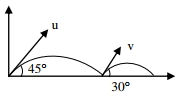
$A$ ball is projected from the ground at an angle of $45^{\circ}$ with the horizontal surface. It reaches a maximum height of $120 \ m$ and returns to the ground. Upon hitting the ground for the first time, it loses half of its kinetic energy. Immediately after the bounce, the velocity of the ball makes an angle of $30^{\circ}$ with the horizontal surface. The maximum height it reaches after the bounce, in metres, is.
A
$20$
B
$30$
C
$40$
D
$50$
Solution
(B) Let the initial velocity be $u$. The maximum height $H$ is given by $H = \frac{u^2 \sin^2 45^{\circ}}{2g} = 120 \ m$.
Since $\sin 45^{\circ} = \frac{1}{\sqrt{2}}$, we have $H = \frac{u^2 (1/2)}{2g} = \frac{u^2}{4g} = 120 \ m$, so $u^2 = 480g$.
The kinetic energy before the bounce is $K_i = \frac{1}{2}mu^2$.
After the bounce, the kinetic energy is $K_f = \frac{1}{2}K_i = \frac{1}{4}mu^2 = \frac{1}{2}mv^2$, where $v$ is the velocity after the bounce.
Thus, $v^2 = \frac{u^2}{2} = \frac{480g}{2} = 240g$.
The new maximum height $h$ is given by $h = \frac{v^2 \sin^2 30^{\circ}}{2g}$.
Substituting $v^2 = 240g$ and $\sin 30^{\circ} = \frac{1}{2}$, we get $h = \frac{240g \times (1/2)^2}{2g} = \frac{240g \times (1/4)}{2g} = \frac{60}{2} = 30 \ m$.
Since $\sin 45^{\circ} = \frac{1}{\sqrt{2}}$, we have $H = \frac{u^2 (1/2)}{2g} = \frac{u^2}{4g} = 120 \ m$, so $u^2 = 480g$.
The kinetic energy before the bounce is $K_i = \frac{1}{2}mu^2$.
After the bounce, the kinetic energy is $K_f = \frac{1}{2}K_i = \frac{1}{4}mu^2 = \frac{1}{2}mv^2$, where $v$ is the velocity after the bounce.
Thus, $v^2 = \frac{u^2}{2} = \frac{480g}{2} = 240g$.
The new maximum height $h$ is given by $h = \frac{v^2 \sin^2 30^{\circ}}{2g}$.
Substituting $v^2 = 240g$ and $\sin 30^{\circ} = \frac{1}{2}$, we get $h = \frac{240g \times (1/2)^2}{2g} = \frac{240g \times (1/4)}{2g} = \frac{60}{2} = 30 \ m$.
0 likesView Solution
22
PhysicsMediumMCQIIT JEE · 2018
$A$ steel wire of diameter $0.5 \text{ mm}$ and Young's modulus $2 \times 10^{11} \text{ N m}^{-2}$ carries a load of mass $M$. The length of the wire with the load is $1.0 \text{ m}$. $A$ vernier scale with $10$ divisions is attached to the end of this wire. Next to the steel wire is a reference wire to which a main scale,of least count $1.0 \text{ mm}$,is attached. The $10$ divisions of the vernier scale correspond to $9$ divisions of the main scale. Initially,the zero of vernier scale coincides with the zero of main scale. If the load on the steel wire is increased by $1.2 \text{ kg}$,the vernier scale division which coincides with a main scale division is. . . . Take $g = 10 \text{ m s}^{-2}$ and $\pi = 3.2$.
A
$3$
B
$5$
C
$8$
D
$9$
Solution
(A) The change in length $\Delta L$ is given by the formula $\Delta L = \frac{FL}{AY}$.
Given: $F = mg = 1.2 \times 10 = 12 \text{ N}$,$L = 1.0 \text{ m}$,$d = 0.5 \times 10^{-3} \text{ m}$,$Y = 2 \times 10^{11} \text{ N m}^{-2}$,and $\pi = 3.2$.
Area $A = \pi r^2 = \pi \left(\frac{d}{2}\right)^2 = 3.2 \times \frac{(0.5 \times 10^{-3})^2}{4} = 0.8 \times 0.25 \times 10^{-6} = 0.2 \times 10^{-6} \text{ m}^2$.
Calculating $\Delta L$: $\Delta L = \frac{12 \times 1.0}{0.2 \times 10^{-6} \times 2 \times 10^{11}} = \frac{12}{0.4 \times 10^5} = 30 \times 10^{-5} \text{ m} = 0.3 \text{ mm}$.
The Least Count $(LC)$ of the vernier scale is $LC = \text{Main Scale Division} - \text{Vernier Scale Division} = 1.0 \text{ mm} - \frac{9}{10} \times 1.0 \text{ mm} = 0.1 \text{ mm}$.
The reading on the vernier scale is given by $\Delta L = n \times LC$,where $n$ is the vernier division coinciding with the main scale.
$0.3 \text{ mm} = n \times 0.1 \text{ mm} \implies n = 3$.
Given: $F = mg = 1.2 \times 10 = 12 \text{ N}$,$L = 1.0 \text{ m}$,$d = 0.5 \times 10^{-3} \text{ m}$,$Y = 2 \times 10^{11} \text{ N m}^{-2}$,and $\pi = 3.2$.
Area $A = \pi r^2 = \pi \left(\frac{d}{2}\right)^2 = 3.2 \times \frac{(0.5 \times 10^{-3})^2}{4} = 0.8 \times 0.25 \times 10^{-6} = 0.2 \times 10^{-6} \text{ m}^2$.
Calculating $\Delta L$: $\Delta L = \frac{12 \times 1.0}{0.2 \times 10^{-6} \times 2 \times 10^{11}} = \frac{12}{0.4 \times 10^5} = 30 \times 10^{-5} \text{ m} = 0.3 \text{ mm}$.
The Least Count $(LC)$ of the vernier scale is $LC = \text{Main Scale Division} - \text{Vernier Scale Division} = 1.0 \text{ mm} - \frac{9}{10} \times 1.0 \text{ mm} = 0.1 \text{ mm}$.
The reading on the vernier scale is given by $\Delta L = n \times LC$,where $n$ is the vernier division coinciding with the main scale.
$0.3 \text{ mm} = n \times 0.1 \text{ mm} \implies n = 3$.
0 likesView Solution
23
PhysicsMediumMCQIIT JEE · 2018
One mole of a monatomic ideal gas undergoes an adiabatic expansion in which its volume becomes eight times its initial value. If the initial temperature of the gas is $100 K$ and the universal gas constant $R = 8.0 J mol^{-1} K^{-1}$,the decrease in its internal energy,in Joule,is. . . . .
A
$500$
B
$600$
C
$900$
D
$100$
Solution
(C) For an adiabatic process,the relation between temperature and volume is $T_1 V_1^{\gamma-1} = T_2 V_2^{\gamma-1}$.
For a monatomic gas,the adiabatic index $\gamma = \frac{5}{3}$,so $\gamma - 1 = \frac{2}{3}$.
Given $V_2 = 8 V_1$ and $T_1 = 100 K$.
$T_2 = T_1 \left(\frac{V_1}{V_2}\right)^{\gamma-1} = 100 \times \left(\frac{1}{8}\right)^{2/3} = 100 \times \left(\frac{1}{4}\right) = 25 K$.
The change in internal energy is given by $\Delta U = n C_v \Delta T$.
For a monatomic gas,$C_v = \frac{3}{2} R$.
$\Delta U = 1 \times \frac{3}{2} \times 8.0 \times (25 - 100) = 12 \times (-75) = -900 J$.
The decrease in internal energy is $|\Delta U| = 900 J$.
For a monatomic gas,the adiabatic index $\gamma = \frac{5}{3}$,so $\gamma - 1 = \frac{2}{3}$.
Given $V_2 = 8 V_1$ and $T_1 = 100 K$.
$T_2 = T_1 \left(\frac{V_1}{V_2}\right)^{\gamma-1} = 100 \times \left(\frac{1}{8}\right)^{2/3} = 100 \times \left(\frac{1}{4}\right) = 25 K$.
The change in internal energy is given by $\Delta U = n C_v \Delta T$.
For a monatomic gas,$C_v = \frac{3}{2} R$.
$\Delta U = 1 \times \frac{3}{2} \times 8.0 \times (25 - 100) = 12 \times (-75) = -900 J$.
The decrease in internal energy is $|\Delta U| = 900 J$.
0 likesView Solution
24
PhysicsDifficultMCQIIT JEE · 2018
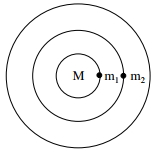
$A$ planet of mass $M$ has two natural satellites with masses $m_1$ and $m_2$. The radii of their circular orbits are $R_1$ and $R_2$ respectively. Ignore the gravitational force between the satellites. Define $v_1, L_1, K_1$ and $T_1$ to be,respectively,the orbital speed,angular momentum,kinetic energy,and time period of revolution of satellite $1$; and $v_2, L_2, K_2$ and $T_2$ to be the corresponding quantities of satellite $2$. Given $m_1/m_2 = 2$ and $R_1/R_2 = 1/4$,match the ratios in List-$I$ to the numbers in List-$II$.
| List-$I$ | List-$II$ |
| $P. \frac{v_1}{v_2}$ | $1. \frac{1}{8}$ |
| $Q. \frac{L_1}{L_2}$ | $2. 1$ |
| $R. \frac{K_1}{K_2}$ | $3. 2$ |
| $S. \frac{T_1}{T_2}$ | $4. 8$ |
A
$P \rightarrow 4; Q \rightarrow 2; R \rightarrow 1; S \rightarrow 3$
B
$P \rightarrow 3; Q \rightarrow 2; R \rightarrow 4; S \rightarrow 1$
C
$P \rightarrow 2; Q \rightarrow 3; R \rightarrow 1; S \rightarrow 4$
D
$P \rightarrow 2; Q \rightarrow 3; R \rightarrow 4; S \rightarrow 1$
Solution
(B) Given: $\frac{m_1}{m_2} = 2$ and $\frac{R_1}{R_2} = \frac{1}{4}$.
$(P)$ For orbital speed $v = \sqrt{\frac{GM}{R}}$:
$\frac{v_1}{v_2} = \sqrt{\frac{R_2}{R_1}} = \sqrt{4} = 2$. Thus,$P \rightarrow 3$.
$(Q)$ For angular momentum $L = mvr = m\sqrt{GMR}$:
$\frac{L_1}{L_2} = \frac{m_1}{m_2} \sqrt{\frac{R_1}{R_2}} = 2 \times \sqrt{\frac{1}{4}} = 2 \times \frac{1}{2} = 1$. Thus,$Q \rightarrow 2$.
$(R)$ For kinetic energy $K = \frac{GMm}{2R}$:
$\frac{K_1}{K_2} = \frac{m_1}{m_2} \times \frac{R_2}{R_1} = 2 \times 4 = 8$. Thus,$R \rightarrow 4$.
$(S)$ For time period $T = 2\pi \sqrt{\frac{R^3}{GM}}$:
$\frac{T_1}{T_2} = \left(\frac{R_1}{R_2}\right)^{3/2} = \left(\frac{1}{4}\right)^{3/2} = \frac{1}{8}$. Thus,$S \rightarrow 1$.
Therefore,the correct matching is $P \rightarrow 3, Q \rightarrow 2, R \rightarrow 4, S \rightarrow 1$.
$(P)$ For orbital speed $v = \sqrt{\frac{GM}{R}}$:
$\frac{v_1}{v_2} = \sqrt{\frac{R_2}{R_1}} = \sqrt{4} = 2$. Thus,$P \rightarrow 3$.
$(Q)$ For angular momentum $L = mvr = m\sqrt{GMR}$:
$\frac{L_1}{L_2} = \frac{m_1}{m_2} \sqrt{\frac{R_1}{R_2}} = 2 \times \sqrt{\frac{1}{4}} = 2 \times \frac{1}{2} = 1$. Thus,$Q \rightarrow 2$.
$(R)$ For kinetic energy $K = \frac{GMm}{2R}$:
$\frac{K_1}{K_2} = \frac{m_1}{m_2} \times \frac{R_2}{R_1} = 2 \times 4 = 8$. Thus,$R \rightarrow 4$.
$(S)$ For time period $T = 2\pi \sqrt{\frac{R^3}{GM}}$:
$\frac{T_1}{T_2} = \left(\frac{R_1}{R_2}\right)^{3/2} = \left(\frac{1}{4}\right)^{3/2} = \frac{1}{8}$. Thus,$S \rightarrow 1$.
Therefore,the correct matching is $P \rightarrow 3, Q \rightarrow 2, R \rightarrow 4, S \rightarrow 1$.
0 likesView Solution
25
PhysicsAdvancedMCQIIT JEE · 2018
In the List-$I$ below, four different paths of a particle are given as functions of time. In these functions, $\alpha$ and $\beta$ are positive constants of appropriate dimensions and $\alpha \neq \beta$. In each case, the force acting on the particle is either zero or conservative. In List-$II$, five physical quantities of the particle are mentioned: $\overrightarrow{p}$ is the linear momentum, $\overrightarrow{L}$ is the angular momentum about the origin, $K$ is the kinetic energy, $U$ is the potential energy and $E$ is the total energy. Match each path in List-$I$ with those quantities in List-$II$, which are conserved for that path.
| List-$I$ | List-$II$ |
| $P$. $\vec{r}(t) = \alpha t \hat{i} + \beta t \hat{j}$ | $1$. $\overrightarrow{p}$ |
| $Q$. $\vec{r}(t) = \alpha \cos \omega t \hat{i} + \beta \sin \omega t \hat{j}$ | $2$. $\overrightarrow{L}$ |
| $R$. $\vec{r}(t) = \alpha(\cos \omega t \hat{i} + \sin \omega t \hat{j})$ | $3$. $K$ |
| $S$. $\vec{r}(t) = \alpha t \hat{i} + \frac{\beta}{2} t^2 \hat{j}$ | $4$. $U$ |
| $5$. $E$ |
A
$P \rightarrow 1, 2, 3, 4, 5; \quad Q \rightarrow 2, 5; \quad R \rightarrow 2, 3, 4, 5; \quad S \rightarrow 5$
B
$P \rightarrow 1, 2, 3, 4, 5; \quad Q \rightarrow 3, 5; \quad R \rightarrow 2, 3, 4, 5; \quad S \rightarrow 2, 5$
C
$P \rightarrow 2, 3, 4; \quad Q \rightarrow 5; \quad R \rightarrow 1, 2, 4; \quad S \rightarrow 2, 5$
D
$P \rightarrow 1, 2, 3, 5; \quad Q \rightarrow 2, 5; \quad R \rightarrow 2, 3, 4, 5; \quad S \rightarrow 2, 5$
Solution
(A) For path $P$: $\vec{r} = \alpha t \hat{i} + \beta t \hat{j}$. Velocity $\vec{v} = \alpha \hat{i} + \beta \hat{j}$ (constant), so acceleration $\vec{a} = 0$ and force $\vec{F} = 0$. Linear momentum $\vec{p} = m\vec{v}$ is constant. Angular momentum $\vec{L} = \vec{r} \times \vec{p} = m(\alpha t \hat{i} + \beta t \hat{j}) \times (\alpha \hat{i} + \beta \hat{j}) = m(\alpha\beta t - \beta\alpha t)\hat{k} = 0$ (constant). Since $\vec{F}=0$, $K$, $U$, and $E$ are constant. Thus, $P \rightarrow 1, 2, 3, 4, 5$.
For path $Q$: $\vec{r} = \alpha \cos \omega t \hat{i} + \beta \sin \omega t \hat{j}$. This is an elliptical path. The force is central, so angular momentum $\vec{L}$ is conserved. Since the force is conservative, total energy $E$ is conserved. Thus, $Q \rightarrow 2, 5$.
For path $R$: $\vec{r} = \alpha(\cos \omega t \hat{i} + \sin \omega t \hat{j})$. This is a circular path with constant speed $v = \alpha\omega$. Thus, $K$ is constant. Since the force is central, $\vec{L}$ is conserved. For a circular path in a central potential, $U$ and $E$ are also constant. Thus, $R \rightarrow 2, 3, 4, 5$.
For path $S$: $\vec{r} = \alpha t \hat{i} + \frac{\beta}{2} t^2 \hat{j}$. Velocity $\vec{v} = \alpha \hat{i} + \beta t \hat{j}$ (time-dependent), so $\vec{p}$ is not constant. Acceleration $\vec{a} = \beta \hat{j}$ (constant force). $\vec{L} = m(\alpha t \hat{i} + \frac{\beta}{2} t^2 \hat{j}) \times (\alpha \hat{i} + \beta t \hat{j}) = m(\alpha\beta t^2 - \frac{\alpha\beta}{2} t^2)\hat{k} = \frac{m\alpha\beta t^2}{2}\hat{k}$ (time-dependent). Only total energy $E$ is conserved. Thus, $S \rightarrow 5$.
For path $Q$: $\vec{r} = \alpha \cos \omega t \hat{i} + \beta \sin \omega t \hat{j}$. This is an elliptical path. The force is central, so angular momentum $\vec{L}$ is conserved. Since the force is conservative, total energy $E$ is conserved. Thus, $Q \rightarrow 2, 5$.
For path $R$: $\vec{r} = \alpha(\cos \omega t \hat{i} + \sin \omega t \hat{j})$. This is a circular path with constant speed $v = \alpha\omega$. Thus, $K$ is constant. Since the force is central, $\vec{L}$ is conserved. For a circular path in a central potential, $U$ and $E$ are also constant. Thus, $R \rightarrow 2, 3, 4, 5$.
For path $S$: $\vec{r} = \alpha t \hat{i} + \frac{\beta}{2} t^2 \hat{j}$. Velocity $\vec{v} = \alpha \hat{i} + \beta t \hat{j}$ (time-dependent), so $\vec{p}$ is not constant. Acceleration $\vec{a} = \beta \hat{j}$ (constant force). $\vec{L} = m(\alpha t \hat{i} + \frac{\beta}{2} t^2 \hat{j}) \times (\alpha \hat{i} + \beta t \hat{j}) = m(\alpha\beta t^2 - \frac{\alpha\beta}{2} t^2)\hat{k} = \frac{m\alpha\beta t^2}{2}\hat{k}$ (time-dependent). Only total energy $E$ is conserved. Thus, $S \rightarrow 5$.
0 likesView Solution
26
PhysicsAdvancedIIT JEE · 2018
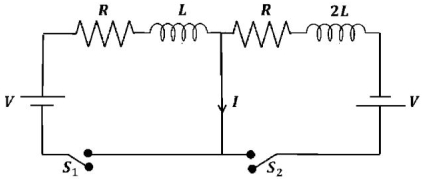
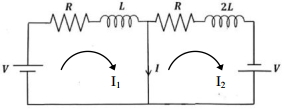
In the figure below,the switches $S_1$ and $S_2$ are closed simultaneously at $t=0$ and a current starts to flow in the circuit. Both the batteries have the same magnitude of the electromotive force (emf) $V$ and the polarities are as indicated in the figure. Ignore mutual inductance between the inductors. The current $I$ in the middle wire reaches its maximum magnitude $I_{\max}$ at time $t=T$. Which of the following statements is (are) true?
$(A)$ $I_{\max}=\frac{V}{2R}$
$(B)$ $I_{\max}=\frac{V}{4R}$
$(C)$ $T=\frac{L}{R} \ln 2$
$(D)$ $T=\frac{2L}{R} \ln 2$
$(A)$ $I_{\max}=\frac{V}{2R}$
$(B)$ $I_{\max}=\frac{V}{4R}$
$(C)$ $T=\frac{L}{R} \ln 2$
$(D)$ $T=\frac{2L}{R} \ln 2$
Solution
(D) Let $I_1$ be the current in the left loop and $I_2$ be the current in the right loop. The current $I$ in the middle wire is $I = I_2 - I_1$.
For the left loop: $V - I_1 R - L \frac{dI_1}{dt} = 0 \implies I_1(t) = \frac{V}{R}(1 - e^{-(R/L)t})$.
For the right loop: $V - I_2 R - 2L \frac{dI_2}{dt} = 0 \implies I_2(t) = \frac{V}{R}(1 - e^{-(R/2L)t})$.
The current in the middle wire is $I(t) = I_2(t) - I_1(t) = \frac{V}{R} [e^{-(R/L)t} - e^{-(R/2L)t}]$.
To find the maximum current,set $\frac{dI}{dt} = 0$:
$\frac{dI}{dt} = \frac{V}{R} [-\frac{R}{L} e^{-(R/L)t} + \frac{R}{2L} e^{-(R/2L)t}] = 0$.
$\frac{1}{L} e^{-(R/L)t} = \frac{1}{2L} e^{-(R/2L)t} \implies e^{-(R/2L)t} = \frac{1}{2}$.
Taking the natural logarithm on both sides: $-\frac{R}{2L} T = \ln(1/2) = -\ln 2 \implies T = \frac{2L}{R} \ln 2$.
Substituting $T$ back into the expression for $I(t)$:
$I_{\max} = \frac{V}{R} [e^{-(R/L) \cdot (2L/R) \ln 2} - e^{-(R/2L) \cdot (2L/R) \ln 2}] = \frac{V}{R} [e^{-2 \ln 2} - e^{-\ln 2}] = \frac{V}{R} [\frac{1}{4} - \frac{1}{2}] = -\frac{V}{4R}$.
The magnitude is $I_{\max} = \frac{V}{4R}$.
Thus,statements $(B)$ and $(D)$ are true.
For the left loop: $V - I_1 R - L \frac{dI_1}{dt} = 0 \implies I_1(t) = \frac{V}{R}(1 - e^{-(R/L)t})$.
For the right loop: $V - I_2 R - 2L \frac{dI_2}{dt} = 0 \implies I_2(t) = \frac{V}{R}(1 - e^{-(R/2L)t})$.
The current in the middle wire is $I(t) = I_2(t) - I_1(t) = \frac{V}{R} [e^{-(R/L)t} - e^{-(R/2L)t}]$.
To find the maximum current,set $\frac{dI}{dt} = 0$:
$\frac{dI}{dt} = \frac{V}{R} [-\frac{R}{L} e^{-(R/L)t} + \frac{R}{2L} e^{-(R/2L)t}] = 0$.
$\frac{1}{L} e^{-(R/L)t} = \frac{1}{2L} e^{-(R/2L)t} \implies e^{-(R/2L)t} = \frac{1}{2}$.
Taking the natural logarithm on both sides: $-\frac{R}{2L} T = \ln(1/2) = -\ln 2 \implies T = \frac{2L}{R} \ln 2$.
Substituting $T$ back into the expression for $I(t)$:
$I_{\max} = \frac{V}{R} [e^{-(R/L) \cdot (2L/R) \ln 2} - e^{-(R/2L) \cdot (2L/R) \ln 2}] = \frac{V}{R} [e^{-2 \ln 2} - e^{-\ln 2}] = \frac{V}{R} [\frac{1}{4} - \frac{1}{2}] = -\frac{V}{4R}$.
The magnitude is $I_{\max} = \frac{V}{4R}$.
Thus,statements $(B)$ and $(D)$ are true.
0 likesView Solution
27
PhysicsAdvancedMCQIIT JEE · 2018
Two infinitely long straight wires lie in the $xy$-plane along the lines $x=+R$ and $x=-R$. The wire located at $x=+R$ carries a constant current $I_1$ and the wire located at $x=-R$ carries a constant current $I_2$. A circular loop of radius $R$ is suspended with its centre at $(0,0, \sqrt{3} R)$ and in a plane parallel to the $xy$-plane. This loop carries a constant current $I$ in the clockwise direction as seen from above the loop. The current in the wire is taken to be positive if it is in the $+\hat{j}$ direction. Which of the following statements regarding the magnetic field $\vec{B}$ is (are) true?
$(A)$ If $I_1=I_2$, then $\vec{B}$ cannot be equal to zero at the origin $(0,0,0)$.
$(B)$ If $I_1 > 0$ and $I_2 < 0$, then $\vec{B}$ can be equal to zero at the origin $(0,0,0)$.
$(C)$ If $I_1 < 0$ and $I_2 > 0$, then $\vec{B}$ can be equal to zero at the origin $(0,0,0)$.
$(D)$ If $I_1=I_2$, then the $z$-component of the magnetic field at the centre of the loop is $\left(-\frac{\mu_0 I}{2 R}\right)$.
$(A)$ If $I_1=I_2$, then $\vec{B}$ cannot be equal to zero at the origin $(0,0,0)$.
$(B)$ If $I_1 > 0$ and $I_2 < 0$, then $\vec{B}$ can be equal to zero at the origin $(0,0,0)$.
$(C)$ If $I_1 < 0$ and $I_2 > 0$, then $\vec{B}$ can be equal to zero at the origin $(0,0,0)$.
$(D)$ If $I_1=I_2$, then the $z$-component of the magnetic field at the centre of the loop is $\left(-\frac{\mu_0 I}{2 R}\right)$.
A
$A, B, D$
B
$A, B$
C
$A, C$
D
$A, B, C$
Solution
(A) The magnetic field at the origin due to the wire at $x=R$ is $\vec{B}_1 = \frac{\mu_0 I_1}{2 \pi R} (\hat{k})$ and due to the wire at $x=-R$ is $\vec{B}_2 = \frac{\mu_0 I_2}{2 \pi R} (-\hat{k})$.
$(A)$ If $I_1=I_2$, the magnetic field due to the wires at the origin is $\vec{B}_{wires} = \vec{B}_1 + \vec{B}_2 = 0$. However, the circular loop creates a non-zero magnetic field at the origin. Thus, the net magnetic field $\vec{B}_{net} \neq 0$. Statement $(A)$ is true.
$(B)$ If $I_1 > 0$ and $I_2 < 0$, the magnetic field due to the wires at the origin is $\vec{B}_{wires} = \frac{\mu_0}{2 \pi R} (I_1 - I_2) \hat{k}$. Since $I_1 > 0$ and $I_2 < 0$, $(I_1 - I_2) > 0$, so $\vec{B}_{wires}$ is along $+\hat{k}$. The magnetic field due to the loop at the origin is along $-\hat{k}$. Since both fields are along the $z$-axis, they can cancel each other out. Statement $(B)$ is true.
$(C)$ If $I_1 < 0$ and $I_2 > 0$, $\vec{B}_{wires}$ is along $-\hat{k}$. The magnetic field due to the loop at the origin is also along $-\hat{k}$. They cannot cancel each other out. Statement $(C)$ is false.
$(D)$ The magnetic field due to the wires at the center of the loop $(0, 0, \sqrt{3}R)$ is purely along the $x$-axis. The $z$-component of the magnetic field at the center is solely due to the loop, which is $\left(-\frac{\mu_0 I}{2 R}\right)$. Statement $(D)$ is true.
$(A)$ If $I_1=I_2$, the magnetic field due to the wires at the origin is $\vec{B}_{wires} = \vec{B}_1 + \vec{B}_2 = 0$. However, the circular loop creates a non-zero magnetic field at the origin. Thus, the net magnetic field $\vec{B}_{net} \neq 0$. Statement $(A)$ is true.
$(B)$ If $I_1 > 0$ and $I_2 < 0$, the magnetic field due to the wires at the origin is $\vec{B}_{wires} = \frac{\mu_0}{2 \pi R} (I_1 - I_2) \hat{k}$. Since $I_1 > 0$ and $I_2 < 0$, $(I_1 - I_2) > 0$, so $\vec{B}_{wires}$ is along $+\hat{k}$. The magnetic field due to the loop at the origin is along $-\hat{k}$. Since both fields are along the $z$-axis, they can cancel each other out. Statement $(B)$ is true.
$(C)$ If $I_1 < 0$ and $I_2 > 0$, $\vec{B}_{wires}$ is along $-\hat{k}$. The magnetic field due to the loop at the origin is also along $-\hat{k}$. They cannot cancel each other out. Statement $(C)$ is false.
$(D)$ The magnetic field due to the wires at the center of the loop $(0, 0, \sqrt{3}R)$ is purely along the $x$-axis. The $z$-component of the magnetic field at the center is solely due to the loop, which is $\left(-\frac{\mu_0 I}{2 R}\right)$. Statement $(D)$ is true.
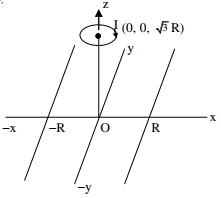
0 likesView Solution
28
PhysicsMediumMCQIIT JEE · 2018
Three identical capacitors $C_1, C_2$ and $C_3$ have a capacitance of $1.0 \mu F$ each and they are uncharged initially. They are connected in a circuit as shown in the figure and $C_1$ is then filled completely with a dielectric material of relative permittivity $\varepsilon_{r}$. The cell electromotive force (emf) $V_0=8 \,V$. First the switch $S_1$ is closed while the switch $S_2$ is kept open. When the capacitor $C_3$ is fully charged,$S_1$ is opened and $S_2$ is closed simultaneously. When all the capacitors reach equilibrium,the charge on $C_3$ is found to be $5 \mu C$. The value of $\varepsilon_{r}$ is:
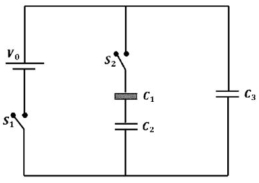
A
$1.50$
B
$1.60$
C
$1.70$
D
$1.80$
Solution
(A) $1$. Initially,$S_1$ is closed and $S_2$ is open. Capacitor $C_3$ is connected directly across the battery of emf $V_0 = 8 \,V$.
$2$. The charge on $C_3$ becomes $Q_3 = C_3 V_0 = (1.0 \mu F)(8 \,V) = 8 \mu C$.
$3$. When $S_1$ is opened and $S_2$ is closed,$C_3$ is connected in parallel with the series combination of $C_1$ (with dielectric $\varepsilon_r$) and $C_2$.
$4$. Let the final charge on $C_3$ be $Q_3' = 5 \mu C$. The potential difference across $C_3$ is $V = \frac{Q_3'}{C_3} = \frac{5 \mu C}{1.0 \mu F} = 5 \,V$.
$5$. The charge lost by $C_3$ is $8 \mu C - 5 \mu C = 3 \mu C$. This charge flows to the series combination of $C_1$ and $C_2$.
$6$. The capacitance of $C_1$ with dielectric is $C_1' = \varepsilon_r C_1 = \varepsilon_r (1.0 \mu F)$.
$7$. The equivalent capacitance of $C_1'$ and $C_2$ in series is $C_{eq} = \frac{C_1' C_2}{C_1' + C_2} = \frac{\varepsilon_r (1.0)}{\varepsilon_r + 1.0} \mu F$.
$8$. The charge on this series combination is $3 \mu C$. Thus,$V = \frac{Q}{C_{eq}} \implies 5 \,V = \frac{3 \mu C}{\frac{\varepsilon_r}{\varepsilon_r + 1} \mu F}$.
$9$. $5 = \frac{3(\varepsilon_r + 1)}{\varepsilon_r} \implies 5\varepsilon_r = 3\varepsilon_r + 3 \implies 2\varepsilon_r = 3 \implies \varepsilon_r = 1.50$.
$2$. The charge on $C_3$ becomes $Q_3 = C_3 V_0 = (1.0 \mu F)(8 \,V) = 8 \mu C$.
$3$. When $S_1$ is opened and $S_2$ is closed,$C_3$ is connected in parallel with the series combination of $C_1$ (with dielectric $\varepsilon_r$) and $C_2$.
$4$. Let the final charge on $C_3$ be $Q_3' = 5 \mu C$. The potential difference across $C_3$ is $V = \frac{Q_3'}{C_3} = \frac{5 \mu C}{1.0 \mu F} = 5 \,V$.
$5$. The charge lost by $C_3$ is $8 \mu C - 5 \mu C = 3 \mu C$. This charge flows to the series combination of $C_1$ and $C_2$.
$6$. The capacitance of $C_1$ with dielectric is $C_1' = \varepsilon_r C_1 = \varepsilon_r (1.0 \mu F)$.
$7$. The equivalent capacitance of $C_1'$ and $C_2$ in series is $C_{eq} = \frac{C_1' C_2}{C_1' + C_2} = \frac{\varepsilon_r (1.0)}{\varepsilon_r + 1.0} \mu F$.
$8$. The charge on this series combination is $3 \mu C$. Thus,$V = \frac{Q}{C_{eq}} \implies 5 \,V = \frac{3 \mu C}{\frac{\varepsilon_r}{\varepsilon_r + 1} \mu F}$.
$9$. $5 = \frac{3(\varepsilon_r + 1)}{\varepsilon_r} \implies 5\varepsilon_r = 3\varepsilon_r + 3 \implies 2\varepsilon_r = 3 \implies \varepsilon_r = 1.50$.
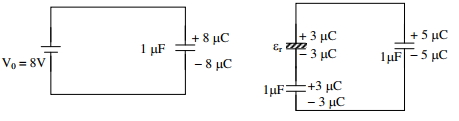
0 likesView Solution
29
PhysicsAdvancedMCQIIT JEE · 2018
In the $xy$-plane, the region $y > 0$ has a uniform magnetic field $B_1 \hat{k}$ and the region $y < 0$ has another uniform magnetic field $B_2 \hat{k}$. A positively charged particle is projected from the origin along the positive $y$-axis with speed $v_0 = \pi \text{ m s}^{-1}$ at $t = 0$, as shown in the figure. Neglect gravity in this problem. Let $t = T$ be the time when the particle crosses the $x$-axis from below for the first time. If $B_2 = 4 B_1$, the average speed of the particle, in $\text{m s}^{-1}$, along the $x$-axis in the time interval $T$ is. . . .
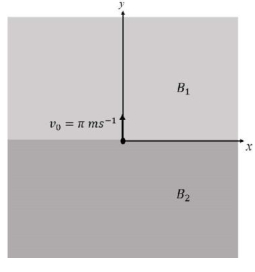
A
$1$
B
$0$
C
$2$
D
$5$
Solution
(C) The radius of the circular path of a charged particle in a magnetic field is given by $R = \frac{mv}{qB}$.
For the region $y > 0$, the radius is $R_1 = \frac{mv_0}{qB_1}$.
For the region $y < 0$, the radius is $R_2 = \frac{mv_0}{qB_2}$.
Given $B_2 = 4B_1$, we have $R_2 = \frac{mv_0}{q(4B_1)} = \frac{R_1}{4}$.
The particle moves in a semicircle in the region $y > 0$ and then in a semicircle in the region $y < 0$ before crossing the $x$-axis again.
The total displacement along the $x$-axis is $\Delta x = 2R_1 + 2R_2 = 2R_1 + 2(\frac{R_1}{4}) = 2R_1 + \frac{R_1}{2} = \frac{5R_1}{2}$.
The time taken to complete a semicircle in region $y > 0$ is $t_1 = \frac{\pi m}{qB_1}$.
The time taken to complete a semicircle in region $y < 0$ is $t_2 = \frac{\pi m}{qB_2} = \frac{\pi m}{q(4B_1)} = \frac{t_1}{4}$.
The total time taken is $T = t_1 + t_2 = t_1 + \frac{t_1}{4} = \frac{5t_1}{4}$.
The average speed along the $x$-axis is $v_{avg} = \frac{\Delta x}{T} = \frac{5R_1/2}{5t_1/4} = \frac{5R_1}{2} \times \frac{4}{5t_1} = \frac{2R_1}{t_1}$.
Substituting $R_1 = \frac{mv_0}{qB_1}$ and $t_1 = \frac{\pi m}{qB_1}$, we get $v_{avg} = \frac{2(mv_0/qB_1)}{\pi m/qB_1} = \frac{2v_0}{\pi}$.
Given $v_0 = \pi \text{ m s}^{-1}$, the average speed is $v_{avg} = \frac{2(\pi)}{\pi} = 2 \text{ m s}^{-1}$.
For the region $y > 0$, the radius is $R_1 = \frac{mv_0}{qB_1}$.
For the region $y < 0$, the radius is $R_2 = \frac{mv_0}{qB_2}$.
Given $B_2 = 4B_1$, we have $R_2 = \frac{mv_0}{q(4B_1)} = \frac{R_1}{4}$.
The particle moves in a semicircle in the region $y > 0$ and then in a semicircle in the region $y < 0$ before crossing the $x$-axis again.
The total displacement along the $x$-axis is $\Delta x = 2R_1 + 2R_2 = 2R_1 + 2(\frac{R_1}{4}) = 2R_1 + \frac{R_1}{2} = \frac{5R_1}{2}$.
The time taken to complete a semicircle in region $y > 0$ is $t_1 = \frac{\pi m}{qB_1}$.
The time taken to complete a semicircle in region $y < 0$ is $t_2 = \frac{\pi m}{qB_2} = \frac{\pi m}{q(4B_1)} = \frac{t_1}{4}$.
The total time taken is $T = t_1 + t_2 = t_1 + \frac{t_1}{4} = \frac{5t_1}{4}$.
The average speed along the $x$-axis is $v_{avg} = \frac{\Delta x}{T} = \frac{5R_1/2}{5t_1/4} = \frac{5R_1}{2} \times \frac{4}{5t_1} = \frac{2R_1}{t_1}$.
Substituting $R_1 = \frac{mv_0}{qB_1}$ and $t_1 = \frac{\pi m}{qB_1}$, we get $v_{avg} = \frac{2(mv_0/qB_1)}{\pi m/qB_1} = \frac{2v_0}{\pi}$.
Given $v_0 = \pi \text{ m s}^{-1}$, the average speed is $v_{avg} = \frac{2(\pi)}{\pi} = 2 \text{ m s}^{-1}$.
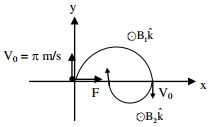
0 likesView Solution
30
PhysicsDifficultMCQIIT JEE · 2018
In electromagnetic theory, electric and magnetic phenomena are related to each other. Therefore, the dimensions of electric and magnetic quantities must also be related. In the questions below, $[E]$ and $[B]$ stand for dimensions of electric and magnetic fields respectively, while $[\varepsilon_0]$ and $[\mu_0]$ stand for dimensions of the permittivity and permeability of free space respectively. $L$ and $T$ are dimensions of length and time respectively. All quantities are in $SI$ units.
$(1)$ The relation between $[E]$ and $[B]$ is:
$(A)$ $[E]=[B][L][T]^{-1}$
$(B)$ $[E]=[B][L][T]$
$(C)$ $[E]=[B][L]^{-1}[T]$
$(D)$ $[E]=[B][L]^{-1}[T]^{-1}$
$(2)$ The relation between $[\varepsilon_0]$ and $[\mu_0]$ is:
$(A)$ $[\mu_0]=[\varepsilon_0][L]^2[T]^{-2}$
$(B)$ $[\mu_0]=[\varepsilon_0]^{-1}[L]^{-2}[T]^2$
$(C)$ $[\mu_0]=[\varepsilon_0][L]^{-2}[T]^2$
$(D)$ $[\mu_0]=[\varepsilon_0]^{-1}[L]^2[T]^{-2}$
Select the correct options for $(1)$ and $(2)$.
$(1)$ The relation between $[E]$ and $[B]$ is:
$(A)$ $[E]=[B][L][T]^{-1}$
$(B)$ $[E]=[B][L][T]$
$(C)$ $[E]=[B][L]^{-1}[T]$
$(D)$ $[E]=[B][L]^{-1}[T]^{-1}$
$(2)$ The relation between $[\varepsilon_0]$ and $[\mu_0]$ is:
$(A)$ $[\mu_0]=[\varepsilon_0][L]^2[T]^{-2}$
$(B)$ $[\mu_0]=[\varepsilon_0]^{-1}[L]^{-2}[T]^2$
$(C)$ $[\mu_0]=[\varepsilon_0][L]^{-2}[T]^2$
$(D)$ $[\mu_0]=[\varepsilon_0]^{-1}[L]^2[T]^{-2}$
Select the correct options for $(1)$ and $(2)$.
A
$A, B$
B
$A, C$
C
$C, D$
D
$A, D$
Solution
(B) For $(1)$: The force on a charge $q$ moving with velocity $v$ in an electric field $E$ and magnetic field $B$ is given by the Lorentz force law: $F = qE + q(v \times B)$. For the dimensions to be consistent, the units of $E$ and $vB$ must be the same. Thus, $E = vB$. Since the dimension of velocity $v$ is $[L][T]^{-1}$, we have $[E] = [L][T]^{-1}[B]$. This matches option $(A)$.
For $(2)$: The speed of light $c$ in free space is related to permittivity $\varepsilon_0$ and permeability $\mu_0$ by the relation $c = \frac{1}{\sqrt{\mu_0 \varepsilon_0}}$. Squaring both sides, we get $c^2 = \frac{1}{\mu_0 \varepsilon_0}$, which implies $\mu_0 = \frac{1}{\varepsilon_0 c^2}$. Since the dimension of $c$ is $[L][T]^{-1}$, the dimension of $c^2$ is $[L]^2[T]^{-2}$. Therefore, $[\mu_0] = [\varepsilon_0]^{-1} ([L]^2[T]^{-2})^{-1} = [\varepsilon_0]^{-1}[L]^{-2}[T]^2$. This matches option $(B)$.
For $(2)$: The speed of light $c$ in free space is related to permittivity $\varepsilon_0$ and permeability $\mu_0$ by the relation $c = \frac{1}{\sqrt{\mu_0 \varepsilon_0}}$. Squaring both sides, we get $c^2 = \frac{1}{\mu_0 \varepsilon_0}$, which implies $\mu_0 = \frac{1}{\varepsilon_0 c^2}$. Since the dimension of $c$ is $[L][T]^{-1}$, the dimension of $c^2$ is $[L]^2[T]^{-2}$. Therefore, $[\mu_0] = [\varepsilon_0]^{-1} ([L]^2[T]^{-2})^{-1} = [\varepsilon_0]^{-1}[L]^{-2}[T]^2$. This matches option $(B)$.
1 likesView Solution
31
PhysicsAdvancedMCQIIT JEE · 2018
If the measurement errors in all the independent quantities are known,then it is possible to determine the error in any dependent quantity. This is done by the use of series expansion and truncating the expansion at the first power of the error. For example,consider the relation $z = x / y$. If the errors in $x, y$ and $z$ are $\Delta x, \Delta y$ and $\Delta z$,respectively,then $z \pm \Delta z = \frac{x \pm \Delta x}{y \pm \Delta y} = \frac{x}{y}(1 \pm \frac{\Delta x}{x})(1 \pm \frac{\Delta y}{y})^{-1}$. The series expansion for $(1 \pm \frac{\Delta y}{y})^{-1}$,to first power in $\Delta y / y$,is $1 \mp(\Delta y / y)$. The relative errors in independent variables are always added. So the error in $z$ will be $\Delta z = z(\frac{\Delta x}{x} + \frac{\Delta y}{y})$. The above derivation makes the assumption that $\Delta x / x \ll 1, \Delta y / y \ll 1$. Therefore,the higher powers of these quantities are neglected.
$(1)$ Consider the ratio $r = \frac{(1-a)}{(1+a)}$ to be determined by measuring a dimensionless quantity $a$. If the error in the measurement of $a$ is $\Delta a$ $(\Delta a / a \ll 1)$,then what is the error $\Delta r$?
$(2)$ In an experiment,the initial number of radioactive nuclei is $3000$. It is found that $1000 \pm 40$ nuclei decayed in the first $1.0 \ s$. For $|x| \ll 1$,$\ln(1+x) \approx x$ up to the first power in $x$. The error $\Delta \lambda$,in the determination of the decay constant $\lambda$,in $s^{-1}$,is:
$(1)$ Consider the ratio $r = \frac{(1-a)}{(1+a)}$ to be determined by measuring a dimensionless quantity $a$. If the error in the measurement of $a$ is $\Delta a$ $(\Delta a / a \ll 1)$,then what is the error $\Delta r$?
$(2)$ In an experiment,the initial number of radioactive nuclei is $3000$. It is found that $1000 \pm 40$ nuclei decayed in the first $1.0 \ s$. For $|x| \ll 1$,$\ln(1+x) \approx x$ up to the first power in $x$. The error $\Delta \lambda$,in the determination of the decay constant $\lambda$,in $s^{-1}$,is:
A
$B, C$
B
$B, D$
C
$B, A$
D
$B, C, D$
Solution
(C) $(1)$ Given $r = \frac{1-a}{1+a}$. Taking the natural logarithm on both sides: $\ln r = \ln(1-a) - \ln(1+a)$. Differentiating both sides: $\frac{dr}{r} = \frac{-da}{1-a} - \frac{da}{1+a}$. Since errors are always added,$\frac{\Delta r}{r} = \frac{\Delta a}{1-a} + \frac{\Delta a}{1+a} = \Delta a \frac{(1+a) + (1-a)}{(1-a)(1+a)} = \frac{2 \Delta a}{1-a^2}$. Thus,$\Delta r = r \cdot \frac{2 \Delta a}{1-a^2} = \frac{1-a}{1+a} \cdot \frac{2 \Delta a}{(1-a)(1+a)} = \frac{2 \Delta a}{(1+a)^2}$. The correct option is $B$.
$(2)$ The number of nuclei remaining is $N = N_0 - N_{decayed} = 3000 - 1000 = 2000$. The decay law is $N = N_0 e^{-\lambda t}$,so $\ln N = \ln N_0 - \lambda t$. Differentiating,$\frac{dN}{N} = -t \cdot d\lambda$. Considering magnitudes for errors,$\Delta \lambda = \frac{\Delta N}{N \cdot t}$. Here $\Delta N = 40$,$N = 2000$,and $t = 1.0 \ s$. Therefore,$\Delta \lambda = \frac{40}{2000 \times 1} = 0.02 \ s^{-1}$. The correct option is $C$.
$(2)$ The number of nuclei remaining is $N = N_0 - N_{decayed} = 3000 - 1000 = 2000$. The decay law is $N = N_0 e^{-\lambda t}$,so $\ln N = \ln N_0 - \lambda t$. Differentiating,$\frac{dN}{N} = -t \cdot d\lambda$. Considering magnitudes for errors,$\Delta \lambda = \frac{\Delta N}{N \cdot t}$. Here $\Delta N = 40$,$N = 2000$,and $t = 1.0 \ s$. Therefore,$\Delta \lambda = \frac{40}{2000 \times 1} = 0.02 \ s^{-1}$. The correct option is $C$.
0 likesView Solution
32
PhysicsAdvancedMCQIIT JEE · 2018
Three identical capacitors $C_1, C_2$ and $C_3$ have a capacitance of $1.0 \mu F$ each and they are uncharged initially. They are connected in a circuit as shown in the figure and $C_1$ is then filled completely with a dielectric material of relative permittivity $\varepsilon_r$. The cell electromotive force (emf) $V_0 = 8 \ V$. First,the switch $S_1$ is closed while the switch $S_2$ is kept open. When the capacitor $C_3$ is fully charged,$S_1$ is opened and $S_2$ is closed simultaneously. When all the capacitors reach equilibrium,the charge on $C_3$ is found to be $5 \mu C$. The value of $\varepsilon_r = . . . . $
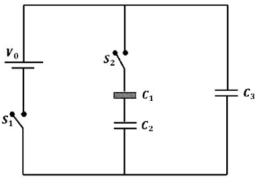
A
$1.40$
B
$1.30$
C
$1.20$
D
$1.50$
Solution
(D) $1$. Initially,$S_1$ is closed and $S_2$ is open. $C_3$ is connected directly to the battery $V_0 = 8 \ V$. The charge on $C_3$ becomes $Q_3 = C_3 V_0 = (1.0 \mu F)(8 \ V) = 8 \mu C$.
$2$. When $S_1$ is opened and $S_2$ is closed,the charge $8 \mu C$ on $C_3$ redistributes among the capacitors $C_1, C_2$ and $C_3$. Let the final charge on $C_3$ be $Q_3' = 5 \mu C$. Since $C_3$ is in parallel with the series combination of $C_1$ and $C_2$,the voltage across $C_3$ must equal the sum of voltages across $C_1$ and $C_2$.
$3$. The voltage across $C_3$ is $V_3 = \frac{Q_3'}{C_3} = \frac{5 \mu C}{1 \mu F} = 5 \ V$.
$4$. The charge remaining for the series combination of $C_1$ and $C_2$ is $Q_{12} = Q_{initial} - Q_3' = 8 \mu C - 5 \mu C = 3 \mu C$. Thus,$Q_1 = Q_2 = 3 \mu C$.
$5$. The voltage across $C_1$ is $V_1 = \frac{Q_1}{C_1'} = \frac{3 \mu C}{\varepsilon_r (1 \mu F)} = \frac{3}{\varepsilon_r} \ V$,where $C_1' = \varepsilon_r C_1$.
$6$. The voltage across $C_2$ is $V_2 = \frac{Q_2}{C_2} = \frac{3 \mu C}{1 \mu F} = 3 \ V$.
$7$. Applying the loop rule: $V_3 = V_1 + V_2 \implies 5 = \frac{3}{\varepsilon_r} + 3$.
$8$. Solving for $\varepsilon_r$: $2 = \frac{3}{\varepsilon_r} \implies \varepsilon_r = \frac{3}{2} = 1.50$.
$2$. When $S_1$ is opened and $S_2$ is closed,the charge $8 \mu C$ on $C_3$ redistributes among the capacitors $C_1, C_2$ and $C_3$. Let the final charge on $C_3$ be $Q_3' = 5 \mu C$. Since $C_3$ is in parallel with the series combination of $C_1$ and $C_2$,the voltage across $C_3$ must equal the sum of voltages across $C_1$ and $C_2$.
$3$. The voltage across $C_3$ is $V_3 = \frac{Q_3'}{C_3} = \frac{5 \mu C}{1 \mu F} = 5 \ V$.
$4$. The charge remaining for the series combination of $C_1$ and $C_2$ is $Q_{12} = Q_{initial} - Q_3' = 8 \mu C - 5 \mu C = 3 \mu C$. Thus,$Q_1 = Q_2 = 3 \mu C$.
$5$. The voltage across $C_1$ is $V_1 = \frac{Q_1}{C_1'} = \frac{3 \mu C}{\varepsilon_r (1 \mu F)} = \frac{3}{\varepsilon_r} \ V$,where $C_1' = \varepsilon_r C_1$.
$6$. The voltage across $C_2$ is $V_2 = \frac{Q_2}{C_2} = \frac{3 \mu C}{1 \mu F} = 3 \ V$.
$7$. Applying the loop rule: $V_3 = V_1 + V_2 \implies 5 = \frac{3}{\varepsilon_r} + 3$.
$8$. Solving for $\varepsilon_r$: $2 = \frac{3}{\varepsilon_r} \implies \varepsilon_r = \frac{3}{2} = 1.50$.
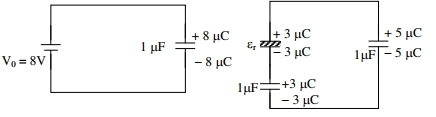
0 likesView Solution
33
PhysicsAdvancedMCQIIT JEE · 2018
In the $xy$-plane,the region $y > 0$ has a uniform magnetic field $B_1 \hat{k}$ and the region $y < 0$ has another uniform magnetic field $B_2 \hat{k}$. $A$ positively charged particle is projected from the origin along the positive $y$-axis with speed $v_0 = \pi \text{ m s}^{-1}$ at $t = 0$,as shown in the figure. Neglect gravity in this problem. Let $t = T$ be the time when the particle crosses the $x$-axis from below for the first time. If $B_2 = 4 B_1$,the average speed of the particle,in $\text{m s}^{-1}$,along the $x$-axis in the time interval $T$ is. . . . . .
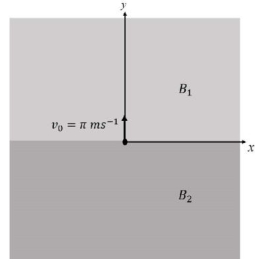
A
$2$
B
$5$
C
$10$
D
$15$
Solution
(A) The radius of the circular path of a charged particle in a magnetic field is given by $R = \frac{mv}{qB}$.
For the region $y > 0$,the radius is $R_1 = \frac{mv_0}{qB_1}$.
For the region $y < 0$,the radius is $R_2 = \frac{mv_0}{qB_2}$.
Given $B_2 = 4B_1$,we have $R_2 = \frac{mv_0}{q(4B_1)} = \frac{R_1}{4}$.
The particle moves in a semicircle of radius $R_1$ in the region $y > 0$ and then in a semicircle of radius $R_2$ in the region $y < 0$.
The total distance traveled along the $x$-axis is $\Delta x = 2R_1 + 2R_2 = 2R_1 + 2(\frac{R_1}{4}) = 2R_1 + \frac{R_1}{2} = \frac{5R_1}{2}$.
The time taken to complete a semicircle in region $y > 0$ is $t_1 = \frac{\pi m}{qB_1}$.
The time taken to complete a semicircle in region $y < 0$ is $t_2 = \frac{\pi m}{qB_2} = \frac{\pi m}{q(4B_1)} = \frac{t_1}{4}$.
The total time $T = t_1 + t_2 = t_1 + \frac{t_1}{4} = \frac{5t_1}{4}$.
The average speed along the $x$-axis is $v_{avg} = \frac{\Delta x}{T} = \frac{5R_1/2}{5t_1/4} = \frac{5R_1}{2} \times \frac{4}{5t_1} = 2 \frac{R_1}{t_1}$.
Substituting $R_1 = \frac{mv_0}{qB_1}$ and $t_1 = \frac{\pi m}{qB_1}$,we get $v_{avg} = 2 \frac{mv_0/qB_1}{\pi m/qB_1} = 2 \frac{v_0}{\pi}$.
Given $v_0 = \pi \text{ m s}^{-1}$,the average speed is $v_{avg} = 2 \frac{\pi}{\pi} = 2 \text{ m s}^{-1}$.
For the region $y > 0$,the radius is $R_1 = \frac{mv_0}{qB_1}$.
For the region $y < 0$,the radius is $R_2 = \frac{mv_0}{qB_2}$.
Given $B_2 = 4B_1$,we have $R_2 = \frac{mv_0}{q(4B_1)} = \frac{R_1}{4}$.
The particle moves in a semicircle of radius $R_1$ in the region $y > 0$ and then in a semicircle of radius $R_2$ in the region $y < 0$.
The total distance traveled along the $x$-axis is $\Delta x = 2R_1 + 2R_2 = 2R_1 + 2(\frac{R_1}{4}) = 2R_1 + \frac{R_1}{2} = \frac{5R_1}{2}$.
The time taken to complete a semicircle in region $y > 0$ is $t_1 = \frac{\pi m}{qB_1}$.
The time taken to complete a semicircle in region $y < 0$ is $t_2 = \frac{\pi m}{qB_2} = \frac{\pi m}{q(4B_1)} = \frac{t_1}{4}$.
The total time $T = t_1 + t_2 = t_1 + \frac{t_1}{4} = \frac{5t_1}{4}$.
The average speed along the $x$-axis is $v_{avg} = \frac{\Delta x}{T} = \frac{5R_1/2}{5t_1/4} = \frac{5R_1}{2} \times \frac{4}{5t_1} = 2 \frac{R_1}{t_1}$.
Substituting $R_1 = \frac{mv_0}{qB_1}$ and $t_1 = \frac{\pi m}{qB_1}$,we get $v_{avg} = 2 \frac{mv_0/qB_1}{\pi m/qB_1} = 2 \frac{v_0}{\pi}$.
Given $v_0 = \pi \text{ m s}^{-1}$,the average speed is $v_{avg} = 2 \frac{\pi}{\pi} = 2 \text{ m s}^{-1}$.
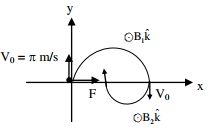
0 likesView Solution
34
PhysicsAdvancedMCQIIT JEE · 2018
Sunlight of intensity $1.3 \text{ kW m}^{-2}$ is incident normally on a thin convex lens of focal length $20 \text{ cm}$. Ignore the energy loss of light due to the lens and assume that the lens aperture size is much smaller than its focal length. The average intensity of light,in $\text{kW m}^{-2}$,at a distance $22 \text{ cm}$ from the lens on the other side is. . . . .
A
$120$
B
$130$
C
$140$
D
$150$
Solution
(B) Given: Intensity of incident light $I_0 = 1.3 \text{ kW m}^{-2}$,focal length $f = 20 \text{ cm}$.
Let $R$ be the radius of the lens aperture and $r$ be the radius of the light beam at a distance $d = 22 \text{ cm}$ from the lens.
The distance of this plane from the focus $F$ is $x = d - f = 22 \text{ cm} - 20 \text{ cm} = 2 \text{ cm}$.
By similar triangles $\Delta ABF$ and $\Delta PQF$ (where $AB$ is the diameter of the lens and $PQ$ is the diameter of the beam at the given plane):
$\frac{r}{R} = \frac{x}{f} = \frac{2 \text{ cm}}{20 \text{ cm}} = \frac{1}{10}$.
The area of the lens is $A = \pi R^2$ and the area of the beam at the given plane is $a = \pi r^2$.
Thus,$\frac{a}{A} = \left(\frac{r}{R}\right)^2 = \left(\frac{1}{10}\right)^2 = \frac{1}{100}$.
Since the total power $P$ incident on the lens is conserved and passes through the area $a$,the intensity $I$ at this plane is given by $I \times a = I_0 \times A$.
Therefore,$I = I_0 \times \left(\frac{A}{a}\right) = 1.3 \times 100 = 130 \text{ kW m}^{-2}$.
Let $R$ be the radius of the lens aperture and $r$ be the radius of the light beam at a distance $d = 22 \text{ cm}$ from the lens.
The distance of this plane from the focus $F$ is $x = d - f = 22 \text{ cm} - 20 \text{ cm} = 2 \text{ cm}$.
By similar triangles $\Delta ABF$ and $\Delta PQF$ (where $AB$ is the diameter of the lens and $PQ$ is the diameter of the beam at the given plane):
$\frac{r}{R} = \frac{x}{f} = \frac{2 \text{ cm}}{20 \text{ cm}} = \frac{1}{10}$.
The area of the lens is $A = \pi R^2$ and the area of the beam at the given plane is $a = \pi r^2$.
Thus,$\frac{a}{A} = \left(\frac{r}{R}\right)^2 = \left(\frac{1}{10}\right)^2 = \frac{1}{100}$.
Since the total power $P$ incident on the lens is conserved and passes through the area $a$,the intensity $I$ at this plane is given by $I \times a = I_0 \times A$.
Therefore,$I = I_0 \times \left(\frac{A}{a}\right) = 1.3 \times 100 = 130 \text{ kW m}^{-2}$.
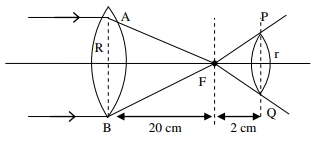
0 likesView Solution
35
PhysicsAdvancedMCQIIT JEE · 2018
If the measurement errors in all the independent quantities are known,then it is possible to determine the error in any dependent quantity. This is done by the use of series expansion and truncating the expansion at the first power of the error. For example,consider the relation $z = x / y$. If the errors in $x, y$ and $z$ are $\Delta x, \Delta y$ and $\Delta z$,respectively,then $z \pm \Delta z = \frac{x \pm \Delta x}{y \pm \Delta y} = \frac{x}{y} (1 \pm \frac{\Delta x}{x}) (1 \pm \frac{\Delta y}{y})^{-1}$. The series expansion for $(1 \pm \frac{\Delta y}{y})^{-1}$,to first power in $\Delta y / y$,is $1 \mp (\Delta y / y)$. The relative errors in independent variables are always added. So the error in $z$ will be $\Delta z = z (\frac{\Delta x}{x} + \frac{\Delta y}{y})$. The above derivation makes the assumption that $\Delta x / x \ll 1, \Delta y / y \ll 1$. Therefore,the higher powers of these quantities are neglected.
$(1)$ Consider the ratio $r = \frac{(1 - a)}{(1 + a)}$ to be determined by measuring a dimensionless quantity $a$. If the error in the measurement of $a$ is $\Delta a$ $(\Delta a / a \ll 1)$,then what is the error $\Delta r$?
$(2)$ In an experiment,the initial number of radioactive nuclei is $3000$. It is found that $1000 \pm 40$ nuclei decayed in the first $1.0 \ s$. For $|x| < 1$,$\ln(1 + x) = x$ up to first power in $x$. The error $\Delta \lambda$,in the determination of the decay constant $\lambda$,in $s^{-1}$,is:
$(1)$ Consider the ratio $r = \frac{(1 - a)}{(1 + a)}$ to be determined by measuring a dimensionless quantity $a$. If the error in the measurement of $a$ is $\Delta a$ $(\Delta a / a \ll 1)$,then what is the error $\Delta r$?
$(2)$ In an experiment,the initial number of radioactive nuclei is $3000$. It is found that $1000 \pm 40$ nuclei decayed in the first $1.0 \ s$. For $|x| < 1$,$\ln(1 + x) = x$ up to first power in $x$. The error $\Delta \lambda$,in the determination of the decay constant $\lambda$,in $s^{-1}$,is:
A
$A, B$
B
$A, C$
C
$B, C$
D
$B, D$
Solution
(B, C) $(1)$ Given $r = \frac{1 - a}{1 + a}$.
Taking the natural logarithm: $\ln r = \ln(1 - a) - \ln(1 + a)$.
Differentiating: $\frac{dr}{r} = \frac{-da}{1 - a} - \frac{da}{1 + a}$.
Taking magnitudes for maximum error: $\frac{\Delta r}{r} = \frac{\Delta a}{1 - a} + \frac{\Delta a}{1 + a} = \Delta a \left( \frac{1 + a + 1 - a}{1 - a^2} \right) = \frac{2 \Delta a}{1 - a^2}$.
Substituting $r = \frac{1 - a}{1 + a}$: $\Delta r = r \left( \frac{2 \Delta a}{1 - a^2} \right) = \left( \frac{1 - a}{1 + a} \right) \left( \frac{2 \Delta a}{(1 - a)(1 + a)} \right) = \frac{2 \Delta a}{(1 + a)^2}$.
$(2)$ Given $N = N_0 e^{-\lambda t}$,where $N_0 = 3000$.
Number of decayed nuclei is $1000 \pm 40$,so remaining nuclei $N = 3000 - 1000 = 2000$. The error in $N$ is $\Delta N = 40$.
Taking $\ln$: $\ln N = \ln N_0 - \lambda t$.
Differentiating: $\frac{dN}{N} = -d(\lambda t) \implies \Delta \lambda = \frac{\Delta N}{N \cdot t}$.
Substituting values: $\Delta \lambda = \frac{40}{2000 \times 1.0} = 0.02 \ s^{-1}$.
Taking the natural logarithm: $\ln r = \ln(1 - a) - \ln(1 + a)$.
Differentiating: $\frac{dr}{r} = \frac{-da}{1 - a} - \frac{da}{1 + a}$.
Taking magnitudes for maximum error: $\frac{\Delta r}{r} = \frac{\Delta a}{1 - a} + \frac{\Delta a}{1 + a} = \Delta a \left( \frac{1 + a + 1 - a}{1 - a^2} \right) = \frac{2 \Delta a}{1 - a^2}$.
Substituting $r = \frac{1 - a}{1 + a}$: $\Delta r = r \left( \frac{2 \Delta a}{1 - a^2} \right) = \left( \frac{1 - a}{1 + a} \right) \left( \frac{2 \Delta a}{(1 - a)(1 + a)} \right) = \frac{2 \Delta a}{(1 + a)^2}$.
$(2)$ Given $N = N_0 e^{-\lambda t}$,where $N_0 = 3000$.
Number of decayed nuclei is $1000 \pm 40$,so remaining nuclei $N = 3000 - 1000 = 2000$. The error in $N$ is $\Delta N = 40$.
Taking $\ln$: $\ln N = \ln N_0 - \lambda t$.
Differentiating: $\frac{dN}{N} = -d(\lambda t) \implies \Delta \lambda = \frac{\Delta N}{N \cdot t}$.
Substituting values: $\Delta \lambda = \frac{40}{2000 \times 1.0} = 0.02 \ s^{-1}$.
0 likesView Solution
36
PhysicsDifficultMCQIIT JEE · 2018
An infinitely long thin non-conducting wire is parallel to the $z$-axis and carries a uniform line charge density $\lambda$. It pierces a thin non-conducting spherical shell of radius $R$ in such a way that the arc $PQ$ subtends an angle $120^{\circ}$ at the centre $O$ of the spherical shell,as shown in the figure. The permittivity of free space is $\epsilon_0$. Which of the following statements is (are) true?
$(A)$ The electric flux through the shell is $\sqrt{3} R \lambda / \epsilon_0$
$(B)$ The $z$-component of the electric field is zero at all the points on the surface of the shell
$(C)$ The electric flux through the shell is $\sqrt{2} R \lambda / \epsilon_0$
$(D)$ The electric field is normal to the surface of the shell at all points
$(A)$ The electric flux through the shell is $\sqrt{3} R \lambda / \epsilon_0$
$(B)$ The $z$-component of the electric field is zero at all the points on the surface of the shell
$(C)$ The electric flux through the shell is $\sqrt{2} R \lambda / \epsilon_0$
$(D)$ The electric field is normal to the surface of the shell at all points
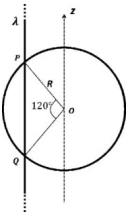
A
$A, B$
B
$A, C$
C
$A, D$
D
$B, C$
Solution
(A) According to Gauss's law,the electric flux $\phi$ through a closed surface is given by $\phi = \frac{Q_{\text{enclosed}}}{\epsilon_0}$.
The length of the wire segment $PQ$ inside the spherical shell is $L = 2R \sin(120^{\circ}/2) = 2R \sin(60^{\circ}) = 2R \times \frac{\sqrt{3}}{2} = R\sqrt{3}$.
The charge enclosed by the shell is $Q_{\text{enclosed}} = \lambda L = \lambda R \sqrt{3}$.
Therefore,the electric flux through the shell is $\phi = \frac{\lambda R \sqrt{3}}{\epsilon_0}$. Thus,statement $(A)$ is true and $(C)$ is false.
Since the wire is parallel to the $z$-axis,the electric field lines are directed radially outward from the wire in the $xy$-plane. Therefore,the electric field has no component along the $z$-axis. Thus,statement $(B)$ is true.
The electric field is only normal to the surface of the shell if the charge distribution is spherically symmetric,which is not the case here. Thus,statement $(D)$ is false.
Therefore,the correct statements are $(A)$ and $(B)$.
The length of the wire segment $PQ$ inside the spherical shell is $L = 2R \sin(120^{\circ}/2) = 2R \sin(60^{\circ}) = 2R \times \frac{\sqrt{3}}{2} = R\sqrt{3}$.
The charge enclosed by the shell is $Q_{\text{enclosed}} = \lambda L = \lambda R \sqrt{3}$.
Therefore,the electric flux through the shell is $\phi = \frac{\lambda R \sqrt{3}}{\epsilon_0}$. Thus,statement $(A)$ is true and $(C)$ is false.
Since the wire is parallel to the $z$-axis,the electric field lines are directed radially outward from the wire in the $xy$-plane. Therefore,the electric field has no component along the $z$-axis. Thus,statement $(B)$ is true.
The electric field is only normal to the surface of the shell if the charge distribution is spherically symmetric,which is not the case here. Thus,statement $(D)$ is false.
Therefore,the correct statements are $(A)$ and $(B)$.
0 likesView Solution
37
PhysicsAdvancedMCQIIT JEE · 2018
$A$ wire is bent in the shape of a right-angled triangle and is placed in front of a concave mirror of focal length $f$,as shown in the figure. Which of the figures shown in the four options qualitatively represent$(s)$ the shape of the image of the bent wire? (These figures are not to scale.)
A
B
C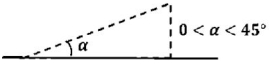
D
Solution
(B) The wire is placed between $f/2$ and $f$. For a concave mirror,the mirror formula is $\frac{1}{v} + \frac{1}{u} = \frac{1}{f}$.
Let a point $P$ on the hypotenuse be at a distance $x$ from the focus $f$,so $u = -(f-x)$.
Substituting this into the mirror formula: $\frac{1}{v} - \frac{1}{f-x} = -\frac{1}{f}$.
$\frac{1}{v} = \frac{1}{f-x} - \frac{1}{f} = \frac{x}{f(f-x)}$.
Thus,$v = \frac{f(f-x)}{x}$.
The magnification $M = -\frac{v}{u} = -\frac{f(f-x)/x}{-(f-x)} = \frac{f}{x}$.
For the vertical leg of the triangle at $u = -f/2$,the image is at $v = -f$ (real,inverted,magnified by $2$).
For the point at the focus $(u = -f)$,the image is at infinity $(v \rightarrow \infty)$.
As $x$ increases from $0$ to $f/2$,the magnification $M = f/x$ decreases from $\infty$ to $2$. The image of the hypotenuse is a curve that extends to infinity,consistent with option $B$.
Let a point $P$ on the hypotenuse be at a distance $x$ from the focus $f$,so $u = -(f-x)$.
Substituting this into the mirror formula: $\frac{1}{v} - \frac{1}{f-x} = -\frac{1}{f}$.
$\frac{1}{v} = \frac{1}{f-x} - \frac{1}{f} = \frac{x}{f(f-x)}$.
Thus,$v = \frac{f(f-x)}{x}$.
The magnification $M = -\frac{v}{u} = -\frac{f(f-x)/x}{-(f-x)} = \frac{f}{x}$.
For the vertical leg of the triangle at $u = -f/2$,the image is at $v = -f$ (real,inverted,magnified by $2$).
For the point at the focus $(u = -f)$,the image is at infinity $(v \rightarrow \infty)$.
As $x$ increases from $0$ to $f/2$,the magnification $M = f/x$ decreases from $\infty$ to $2$. The image of the hypotenuse is a curve that extends to infinity,consistent with option $B$.
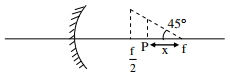
0 likesView Solution
38
PhysicsMediumMCQIIT JEE · 2018
In a radioactive decay chain,${ }_{90}^{232} Th$ nucleus decays to ${ }_{82}^{212} Pb$ nucleus. Let $N_{\alpha}$ and $N_{\beta}$ be the number of $\alpha$ and $\beta^{-}$ particles,respectively,emitted in this decay process. Which of the following statements is (are) true?
$(A)$ $N_{\alpha}=5$
$(B)$ $N_{\alpha}=6$
$(C)$ $N_{\beta}=2$
$(D)$ $N_{\beta}=4$
$(A)$ $N_{\alpha}=5$
$(B)$ $N_{\alpha}=6$
$(C)$ $N_{\beta}=2$
$(D)$ $N_{\beta}=4$
A
$A, C$
B
$A, D$
C
$B, C$
D
$B, D$
Solution
(B) The decay process is represented as: ${ }_{90}^{232} Th \rightarrow { }_{82}^{212} Pb + N_{\alpha} { }_{2}^{4} He + N_{\beta} { }_{-1}^{0} e$.
First,consider the change in mass number $(\Delta A)$:
$\Delta A = 232 - 212 = 20$.
Since each $\alpha$-particle has a mass number of $4$,the number of $\alpha$-particles emitted is $N_{\alpha} = \frac{20}{4} = 5$.
Next,consider the change in atomic number $(\Delta Z)$:
$\Delta Z = 90 - 82 = 8$.
In the decay,the change in atomic number is given by $2N_{\alpha} - N_{\beta} = \Delta Z$.
Substituting the values: $2(5) - N_{\beta} = 8$.
$10 - N_{\beta} = 8$,which gives $N_{\beta} = 2$.
Thus,$N_{\alpha} = 5$ and $N_{\beta} = 2$. The correct statements are $(A)$ and $(C)$.
First,consider the change in mass number $(\Delta A)$:
$\Delta A = 232 - 212 = 20$.
Since each $\alpha$-particle has a mass number of $4$,the number of $\alpha$-particles emitted is $N_{\alpha} = \frac{20}{4} = 5$.
Next,consider the change in atomic number $(\Delta Z)$:
$\Delta Z = 90 - 82 = 8$.
In the decay,the change in atomic number is given by $2N_{\alpha} - N_{\beta} = \Delta Z$.
Substituting the values: $2(5) - N_{\beta} = 8$.
$10 - N_{\beta} = 8$,which gives $N_{\beta} = 2$.
Thus,$N_{\alpha} = 5$ and $N_{\beta} = 2$. The correct statements are $(A)$ and $(C)$.
0 likesView Solution
39
PhysicsDifficultMCQIIT JEE · 2018
$A$ particle,of mass $10^{-3} \ kg$ and charge $1.0 \ C$,is initially at rest. At time $t = 0$,the particle comes under the influence of an electric field $\vec{E}(t) = E_0 \sin(\omega t) \hat{i}$,where $E_0 = 1.0 \ N \ C^{-1}$ and $\omega = 10^3 \ rad \ s^{-1}$. Consider the effect of only the electrical force on the particle. Then the maximum speed,in $m \ s^{-1}$,attained by the particle at subsequent times is . . . . . .
A
$2$
B
$5$
C
$8$
D
$9$
Solution
(A) The force on the particle is given by $F = qE = qE_0 \sin(\omega t)$.
Using Newton's second law,$F = ma$,we have $a = \frac{qE_0}{m} \sin(\omega t)$.
Since $a = \frac{dv}{dt}$,we integrate with respect to time:
$v(t) = \int_0^t \frac{qE_0}{m} \sin(\omega t') dt' = \frac{qE_0}{m\omega} [-\cos(\omega t')]_0^t = \frac{qE_0}{m\omega} (1 - \cos(\omega t))$.
The speed is maximum when $\cos(\omega t) = -1$,which occurs at $\omega t = \pi, 3\pi, \dots$.
At these times,$v_{\max} = \frac{qE_0}{m\omega} (1 - (-1)) = \frac{2qE_0}{m\omega}$.
Substituting the given values: $q = 1.0 \ C$,$E_0 = 1.0 \ N \ C^{-1}$,$m = 10^{-3} \ kg$,and $\omega = 10^3 \ rad \ s^{-1}$.
$v_{\max} = \frac{2 \times 1.0 \times 1.0}{10^{-3} \times 10^3} = \frac{2}{1} = 2 \ m \ s^{-1}$.
Using Newton's second law,$F = ma$,we have $a = \frac{qE_0}{m} \sin(\omega t)$.
Since $a = \frac{dv}{dt}$,we integrate with respect to time:
$v(t) = \int_0^t \frac{qE_0}{m} \sin(\omega t') dt' = \frac{qE_0}{m\omega} [-\cos(\omega t')]_0^t = \frac{qE_0}{m\omega} (1 - \cos(\omega t))$.
The speed is maximum when $\cos(\omega t) = -1$,which occurs at $\omega t = \pi, 3\pi, \dots$.
At these times,$v_{\max} = \frac{qE_0}{m\omega} (1 - (-1)) = \frac{2qE_0}{m\omega}$.
Substituting the given values: $q = 1.0 \ C$,$E_0 = 1.0 \ N \ C^{-1}$,$m = 10^{-3} \ kg$,and $\omega = 10^3 \ rad \ s^{-1}$.
$v_{\max} = \frac{2 \times 1.0 \times 1.0}{10^{-3} \times 10^3} = \frac{2}{1} = 2 \ m \ s^{-1}$.
0 likesView Solution
40
PhysicsMediumMCQIIT JEE · 2018
$A$ moving coil galvanometer has $50$ turns and each turn has an area $2 \times 10^{-4} \ m^2$. The magnetic field produced by the magnet inside the galvanometer is $0.02 \ T$. The torsional constant of the suspension wire is $10^{-4} \ N \ m \ rad^{-1}$. When a current flows through the galvanometer,a full-scale deflection occurs if the coil rotates by $0.2 \ rad$. The resistance of the coil of the galvanometer is $50 \ \Omega$. This galvanometer is to be converted into an ammeter capable of measuring current in the range $0-1.0 \ A$. For this purpose,a shunt resistance is to be added in parallel to the galvanometer. The value of this shunt resistance,in ohms,is:
A
$5.40$
B
$5.50$
C
$5.56$
D
$5.60$
Solution
(C) Given:
Number of turns $n = 50$
Area $A = 2 \times 10^{-4} \ m^2$
Magnetic field $B = 0.02 \ T$
Torsional constant $C = 10^{-4} \ N \ m \ rad^{-1}$
Full-scale deflection angle $\theta = 0.2 \ rad$
Galvanometer resistance $G = 50 \ \Omega$
The torque balance equation for a moving coil galvanometer is given by:
$C \theta = n i_g A B$
Where $i_g$ is the full-scale deflection current.
$i_g = \frac{C \theta}{n A B} = \frac{10^{-4} \times 0.2}{50 \times 2 \times 10^{-4} \times 0.02} = \frac{0.2 \times 10^{-4}}{200 \times 10^{-4} \times 0.02} = \frac{0.2}{4} = 0.05 \ A$
Wait,recalculating: $i_g = \frac{0.2 \times 10^{-4}}{50 \times 2 \times 10^{-4} \times 0.02} = \frac{0.2}{50 \times 2 \times 0.02} = \frac{0.2}{2} = 0.1 \ A$
To convert the galvanometer into an ammeter of range $I = 1.0 \ A$,a shunt resistance $S$ is connected in parallel.
The current through the shunt is $I_s = I - i_g = 1.0 - 0.1 = 0.9 \ A$.
Since the galvanometer and shunt are in parallel,the voltage across them is equal:
$i_g G = I_s S$
$0.1 \times 50 = 0.9 \times S$
$S = \frac{5}{0.9} = \frac{50}{9} \approx 5.56 \ \Omega$
Number of turns $n = 50$
Area $A = 2 \times 10^{-4} \ m^2$
Magnetic field $B = 0.02 \ T$
Torsional constant $C = 10^{-4} \ N \ m \ rad^{-1}$
Full-scale deflection angle $\theta = 0.2 \ rad$
Galvanometer resistance $G = 50 \ \Omega$
The torque balance equation for a moving coil galvanometer is given by:
$C \theta = n i_g A B$
Where $i_g$ is the full-scale deflection current.
$i_g = \frac{C \theta}{n A B} = \frac{10^{-4} \times 0.2}{50 \times 2 \times 10^{-4} \times 0.02} = \frac{0.2 \times 10^{-4}}{200 \times 10^{-4} \times 0.02} = \frac{0.2}{4} = 0.05 \ A$
Wait,recalculating: $i_g = \frac{0.2 \times 10^{-4}}{50 \times 2 \times 10^{-4} \times 0.02} = \frac{0.2}{50 \times 2 \times 0.02} = \frac{0.2}{2} = 0.1 \ A$
To convert the galvanometer into an ammeter of range $I = 1.0 \ A$,a shunt resistance $S$ is connected in parallel.
The current through the shunt is $I_s = I - i_g = 1.0 - 0.1 = 0.9 \ A$.
Since the galvanometer and shunt are in parallel,the voltage across them is equal:
$i_g G = I_s S$
$0.1 \times 50 = 0.9 \times S$
$S = \frac{5}{0.9} = \frac{50}{9} \approx 5.56 \ \Omega$
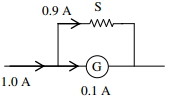
0 likesView Solution
41
PhysicsDifficultMCQIIT JEE · 2018
In a photoelectric experiment,a parallel beam of monochromatic light with power of $200 \ W$ is incident on a perfectly absorbing cathode of work function $6.25 \ eV$. The frequency of light is just above the threshold frequency so that the photoelectrons are emitted with negligible kinetic energy. Assume that the photoelectron emission efficiency is $100 \%$. $A$ potential difference of $500 \ V$ is applied between the cathode and the anode. All the emitted electrons are incident normally on the anode and are absorbed. The anode experiences a force $F = n \times 10^{-4} \ N$ due to the impact of the electrons. The value of $n$ is. . . . .
Mass of the electron $m_e = 9 \times 10^{-31} \ kg$ and $1.0 \ eV = 1.6 \times 10^{-19} \ J$.
Mass of the electron $m_e = 9 \times 10^{-31} \ kg$ and $1.0 \ eV = 1.6 \times 10^{-19} \ J$.
A
$20$
B
$24$
C
$30$
D
$40$
Solution
(B) Given power $P = 200 \ W$ and work function $\phi = 6.25 \ eV$.
Since the frequency is just above the threshold frequency,the initial kinetic energy of photoelectrons is zero.
Energy of one photon $E_1 = h\nu = \phi = 6.25 \ eV = 6.25 \times 1.6 \times 10^{-19} \ J = 10^{-18} \ J$.
Number of photons incident per second $N = P / E_1 = 200 / 10^{-18} = 2 \times 10^{20} \ s^{-1}$.
Since efficiency is $100 \%$,the number of electrons emitted per second is also $N = 2 \times 10^{20} \ s^{-1}$.
When these electrons are accelerated by a potential $V = 500 \ V$,their final kinetic energy $K = eV = 1.6 \times 10^{-19} \times 500 = 8 \times 10^{-17} \ J$.
The momentum of each electron upon impact is $p = \sqrt{2m_eK} = \sqrt{2 \times 9 \times 10^{-31} \times 8 \times 10^{-17}} = \sqrt{144 \times 10^{-48}} = 12 \times 10^{-24} \ kg \ m/s$.
The force exerted on the anode is $F = N \times p = (2 \times 10^{20}) \times (12 \times 10^{-24}) = 24 \times 10^{-4} \ N$.
Comparing with $F = n \times 10^{-4} \ N$,we get $n = 24$.
Since the frequency is just above the threshold frequency,the initial kinetic energy of photoelectrons is zero.
Energy of one photon $E_1 = h\nu = \phi = 6.25 \ eV = 6.25 \times 1.6 \times 10^{-19} \ J = 10^{-18} \ J$.
Number of photons incident per second $N = P / E_1 = 200 / 10^{-18} = 2 \times 10^{20} \ s^{-1}$.
Since efficiency is $100 \%$,the number of electrons emitted per second is also $N = 2 \times 10^{20} \ s^{-1}$.
When these electrons are accelerated by a potential $V = 500 \ V$,their final kinetic energy $K = eV = 1.6 \times 10^{-19} \times 500 = 8 \times 10^{-17} \ J$.
The momentum of each electron upon impact is $p = \sqrt{2m_eK} = \sqrt{2 \times 9 \times 10^{-31} \times 8 \times 10^{-17}} = \sqrt{144 \times 10^{-48}} = 12 \times 10^{-24} \ kg \ m/s$.
The force exerted on the anode is $F = N \times p = (2 \times 10^{20}) \times (12 \times 10^{-24}) = 24 \times 10^{-4} \ N$.
Comparing with $F = n \times 10^{-4} \ N$,we get $n = 24$.
0 likesView Solution
42
PhysicsMediumMCQIIT JEE · 2018
Consider a hydrogen-like ionized atom with atomic number $Z$ with a single electron. In the emission spectrum of this atom,the photon emitted in the $n = 2$ to $n = 1$ transition has energy $74.8 \ eV$ higher than the photon emitted in the $n = 3$ to $n = 2$ transition. The ionization energy of the hydrogen atom is $13.6 \ eV$. The value of $Z$ is:
A
$3$
B
$5$
C
$8$
D
$9$
Solution
(A) The energy of a photon emitted during a transition from $n_2$ to $n_1$ in a hydrogen-like atom is given by $\Delta E = 13.6 Z^2 \left[ \frac{1}{n_1^2} - \frac{1}{n_2^2} \right] \ eV$.
For the transition $n = 2$ to $n = 1$:
$E_1 = 13.6 Z^2 \left[ \frac{1}{1^2} - \frac{1}{2^2} \right] = 13.6 Z^2 \left( 1 - \frac{1}{4} \right) = 13.6 Z^2 \left( \frac{3}{4} \right)$.
For the transition $n = 3$ to $n = 2$:
$E_2 = 13.6 Z^2 \left[ \frac{1}{2^2} - \frac{1}{3^2} \right] = 13.6 Z^2 \left( \frac{1}{4} - \frac{1}{9} \right) = 13.6 Z^2 \left( \frac{5}{36} \right)$.
According to the problem,$E_1 - E_2 = 74.8 \ eV$:
$13.6 Z^2 \left( \frac{3}{4} - \frac{5}{36} \right) = 74.8$.
Calculating the term in the bracket:
$\frac{3}{4} - \frac{5}{36} = \frac{27 - 5}{36} = \frac{22}{36} = \frac{11}{18}$.
Substituting back:
$13.6 Z^2 \times \frac{11}{18} = 74.8$.
$Z^2 = \frac{74.8 \times 18}{13.6 \times 11} = 5.5 \times \frac{18}{11} = 0.5 \times 18 = 9$.
$Z = 3$.
For the transition $n = 2$ to $n = 1$:
$E_1 = 13.6 Z^2 \left[ \frac{1}{1^2} - \frac{1}{2^2} \right] = 13.6 Z^2 \left( 1 - \frac{1}{4} \right) = 13.6 Z^2 \left( \frac{3}{4} \right)$.
For the transition $n = 3$ to $n = 2$:
$E_2 = 13.6 Z^2 \left[ \frac{1}{2^2} - \frac{1}{3^2} \right] = 13.6 Z^2 \left( \frac{1}{4} - \frac{1}{9} \right) = 13.6 Z^2 \left( \frac{5}{36} \right)$.
According to the problem,$E_1 - E_2 = 74.8 \ eV$:
$13.6 Z^2 \left( \frac{3}{4} - \frac{5}{36} \right) = 74.8$.
Calculating the term in the bracket:
$\frac{3}{4} - \frac{5}{36} = \frac{27 - 5}{36} = \frac{22}{36} = \frac{11}{18}$.
Substituting back:
$13.6 Z^2 \times \frac{11}{18} = 74.8$.
$Z^2 = \frac{74.8 \times 18}{13.6 \times 11} = 5.5 \times \frac{18}{11} = 0.5 \times 18 = 9$.
$Z = 3$.
0 likesView Solution
43
PhysicsAdvancedMCQIIT JEE · 2018
The electric field $E$ is measured at a point $P(0, 0, d)$ generated due to various charge distributions and the dependence of $E$ on $d$ is found to be different for different charge distributions. List-$I$ contains different relations between $E$ and $d$. List-$II$ describes different electric charge distributions,along with their locations. Match the functions in List-$I$ with the related charge distributions in List-$II$.
| List-$I$ | List-$II$ |
|---|---|
| $P$. $E$ is independent of $d$ | $1$. $A$ point charge $Q$ at the origin |
| $Q$. $E \propto \frac{1}{d}$ | $2$. $A$ small dipole with point charges $Q$ at $(0, 0, l)$ and $-Q$ at $(0, 0, -l)$. Take $2l \ll d$. |
| $R$. $E \propto \frac{1}{d^2}$ | $3$. An infinite line charge coincident with the $x$-axis,with uniform linear charge density $\lambda$ |
| $S$. $E \propto \frac{1}{d^3}$ | $4$. Two infinite wires carrying uniform linear charge density parallel to the $x$-axis. The one along $(y=0, z=l)$ has a charge density $+\lambda$ and the one along $(y=0, z=-l)$ has a charge density $-\lambda$. Take $2l \ll d$ |
| $5$. Infinite plane with uniform surface charge density |
A
$P \rightarrow 5; Q \rightarrow 3, 4; R \rightarrow 1; S \rightarrow 2$
B
$P \rightarrow 5; Q \rightarrow 3; R \rightarrow 1, 4; S \rightarrow 2$
C
$P \rightarrow 5; Q \rightarrow 3; R \rightarrow 1, 2; S \rightarrow 4$
D
$P \rightarrow 4; Q \rightarrow 2, 3; R \rightarrow 1; S \rightarrow 5$
Solution
(B) $(1)$ Electric field due to a point charge at the origin is $E = \frac{kQ}{d^2}$,so $E \propto \frac{1}{d^2}$.
$(2)$ Electric field at any point on the axis of a dipole is $E = \frac{2kp}{d^3} = \frac{4kQl}{d^3}$,so $E \propto \frac{1}{d^3}$.
$(3)$ Electric field due to an infinite long line charge is $E = \frac{2k\lambda}{d}$,so $E \propto \frac{1}{d}$.
$(4)$ Electric field due to two infinite long wires is $\vec{E} = \vec{E}_1 + \vec{E}_2 = \frac{2k\lambda}{d-l} - \frac{2k\lambda}{d+l} = \frac{4k\lambda l}{d^2-l^2}$. If $d \gg l$,then $E = \frac{4k\lambda l}{d^2}$,so $E \propto \frac{1}{d^2}$.
$(5)$ Electric field due to an infinite plane charge is $E = \frac{\sigma}{2\epsilon_0}$,which is independent of $d$.
Matching: $P \rightarrow 5$,$Q \rightarrow 3$,$R \rightarrow 1, 4$,$S \rightarrow 2$. Thus,option $B$ is correct.
$(2)$ Electric field at any point on the axis of a dipole is $E = \frac{2kp}{d^3} = \frac{4kQl}{d^3}$,so $E \propto \frac{1}{d^3}$.
$(3)$ Electric field due to an infinite long line charge is $E = \frac{2k\lambda}{d}$,so $E \propto \frac{1}{d}$.
$(4)$ Electric field due to two infinite long wires is $\vec{E} = \vec{E}_1 + \vec{E}_2 = \frac{2k\lambda}{d-l} - \frac{2k\lambda}{d+l} = \frac{4k\lambda l}{d^2-l^2}$. If $d \gg l$,then $E = \frac{4k\lambda l}{d^2}$,so $E \propto \frac{1}{d^2}$.
$(5)$ Electric field due to an infinite plane charge is $E = \frac{\sigma}{2\epsilon_0}$,which is independent of $d$.
Matching: $P \rightarrow 5$,$Q \rightarrow 3$,$R \rightarrow 1, 4$,$S \rightarrow 2$. Thus,option $B$ is correct.
0 likesView Solution
Vedclass Products
For Students
Vedclass Test Series
Mock tests in real IIT JEE style covering Physics with performance analysis. 5-day free trial.
Start Free TrialFor Teachers
Exam Paper Generator
Generate Set A/B/C/D Physics papers from 7.5L+ questions in 2 minutes. 3 chapters free.
Try FreeFor Institutes
Online Exam Module
Run live IIT JEE mock exams with unlimited students, 360° analytics & white-label branding.
See DemoFrequently Asked Questions
How many Physics questions are in IIT JEE 2018?
There are 43 Physics questions from the IIT JEE 2018 paper on Vedclass, each with a detailed step-by-step solution in English.
Are IIT JEE 2018 Physics solutions available in English?
Yes. All solutions on this page are in English. You can also switch to English or Hindi using the language buttons above the questions.
Can I practice IIT JEE 2018 Physics as a timed test?
Yes. Use the Vedclass Test Series to attempt a full IIT JEE mock test covering Physics with time limits and instant score analysis.
Can teachers create Physics papers from IIT JEE previous year questions?
Yes. The Vedclass Exam Paper Generator lets teachers mix IIT JEE Physics questions and generate Set A/B/C/D papers in minutes.
For Teachers & Institutes
Build a Custom Physics Paper
Pick IIT JEE 2018 Physics questions, set difficulty, and generate Set A/B/C/D in 2 minutes.