
PhysicsQ1–34 of 34 questions
Page 1 of 1 · English
1
PhysicsAdvancedMCQIIT JEE · 2019
$A$ current-carrying wire heats a metal rod. The wire provides a constant power $(P)$ to the rod. The metal rod is enclosed in an insulated container. It is observed that the temperature $(T)$ in the metal rod changes with time $(t)$ as:
$T(t) = T_0(1 + \beta t^{1/4})$
where $\beta$ is a constant with appropriate dimensions,while $T_0$ is a constant with the dimension of temperature. The heat capacity of the metal is:
$T(t) = T_0(1 + \beta t^{1/4})$
where $\beta$ is a constant with appropriate dimensions,while $T_0$ is a constant with the dimension of temperature. The heat capacity of the metal is:
A
$\frac{4 P (T(t) - T_0)^3}{\beta^4 T_0^4}$
B
$\frac{4 P (T(t) - T_0)}{\beta^4 T_0^2}$
C
$\frac{4 P (T(t) - T_0)^4}{\beta^4 T_0^5}$
D
$\frac{4 P (T(t) - T_0)^2}{\beta^4 T_0^3}$
Solution
(A) Given power $P = \frac{dQ}{dt}$.
Heat capacity $S = \frac{dQ}{dT} = \frac{dQ/dt}{dT/dt} = \frac{P}{dT/dt}$.
Given $T(t) = T_0(1 + \beta t^{1/4})$.
Differentiating with respect to $t$:
$\frac{dT}{dt} = T_0 \cdot \beta \cdot \frac{1}{4} t^{-3/4} = \frac{\beta T_0}{4} t^{-3/4}$.
Substituting this into the expression for $S$:
$S = \frac{P}{(\beta T_0 / 4) t^{-3/4}} = \frac{4P}{\beta T_0} t^{3/4}$.
From the given equation,$\beta t^{1/4} = \frac{T(t) - T_0}{T_0}$.
Therefore,$t^{1/4} = \frac{T(t) - T_0}{\beta T_0}$.
Raising both sides to the power of $3$:
$t^{3/4} = \left( \frac{T(t) - T_0}{\beta T_0} \right)^3$.
Substituting $t^{3/4}$ back into the expression for $S$:
$S = \frac{4P}{\beta T_0} \cdot \frac{(T(t) - T_0)^3}{\beta^3 T_0^3} = \frac{4P(T(t) - T_0)^3}{\beta^4 T_0^4}$.
Heat capacity $S = \frac{dQ}{dT} = \frac{dQ/dt}{dT/dt} = \frac{P}{dT/dt}$.
Given $T(t) = T_0(1 + \beta t^{1/4})$.
Differentiating with respect to $t$:
$\frac{dT}{dt} = T_0 \cdot \beta \cdot \frac{1}{4} t^{-3/4} = \frac{\beta T_0}{4} t^{-3/4}$.
Substituting this into the expression for $S$:
$S = \frac{P}{(\beta T_0 / 4) t^{-3/4}} = \frac{4P}{\beta T_0} t^{3/4}$.
From the given equation,$\beta t^{1/4} = \frac{T(t) - T_0}{T_0}$.
Therefore,$t^{1/4} = \frac{T(t) - T_0}{\beta T_0}$.
Raising both sides to the power of $3$:
$t^{3/4} = \left( \frac{T(t) - T_0}{\beta T_0} \right)^3$.
Substituting $t^{3/4}$ back into the expression for $S$:
$S = \frac{4P}{\beta T_0} \cdot \frac{(T(t) - T_0)^3}{\beta^3 T_0^3} = \frac{4P(T(t) - T_0)^3}{\beta^4 T_0^4}$.
0 likesView Solution
2
PhysicsAdvancedMCQIIT JEE · 2019
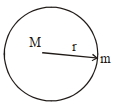
Consider a spherical gaseous cloud of mass density $\rho(r)$ in free space,where $r$ is the radial distance from its center. The gaseous cloud is made of particles of equal mass $m$ moving in circular orbits about the common center with the same kinetic energy $K$. The force acting on the particles is their mutual gravitational force. If $\rho(r)$ is constant in time,the particle number density $n(r) = \rho(r) / m$ is:
[$G$ is the universal gravitational constant]
[$G$ is the universal gravitational constant]
A
$\frac{K}{\pi r^2 m^2 G}$
B
$\frac{K}{6 \pi^2 m^2 G}$
C
$\frac{3K}{\pi^2 m^2 G}$
D
$\frac{K}{2 \pi r^2 m^2 G}$
Solution
(D) Let $M$ be the total mass enclosed within a sphere of radius $r$.
For a particle of mass $m$ moving in a circular orbit of radius $r$,the gravitational force provides the necessary centripetal force:
$\frac{GMm}{r^2} = \frac{mv^2}{r}$
Since the kinetic energy $K = \frac{1}{2}mv^2$,we have $mv^2 = 2K$. Substituting this into the force equation:
$\frac{GMm}{r^2} = \frac{2K}{r} \Rightarrow M = \frac{2Kr}{Gm}$
Differentiating both sides with respect to $r$ to find the mass $dM$ in a shell of thickness $dr$:
$dM = \frac{2K}{Gm} dr$
Also,the mass of the shell is $dM = \rho(r) \cdot 4 \pi r^2 dr$. Equating the two expressions for $dM$:
$4 \pi r^2 \rho(r) dr = \frac{2K}{Gm} dr$
Solving for density $\rho(r)$:
$\rho(r) = \frac{2K}{4 \pi r^2 Gm} = \frac{K}{2 \pi r^2 Gm}$
The particle number density $n(r)$ is given by $\rho(r) / m$:
$n(r) = \frac{K}{2 \pi r^2 m^2 G}$
For a particle of mass $m$ moving in a circular orbit of radius $r$,the gravitational force provides the necessary centripetal force:
$\frac{GMm}{r^2} = \frac{mv^2}{r}$
Since the kinetic energy $K = \frac{1}{2}mv^2$,we have $mv^2 = 2K$. Substituting this into the force equation:
$\frac{GMm}{r^2} = \frac{2K}{r} \Rightarrow M = \frac{2Kr}{Gm}$
Differentiating both sides with respect to $r$ to find the mass $dM$ in a shell of thickness $dr$:
$dM = \frac{2K}{Gm} dr$
Also,the mass of the shell is $dM = \rho(r) \cdot 4 \pi r^2 dr$. Equating the two expressions for $dM$:
$4 \pi r^2 \rho(r) dr = \frac{2K}{Gm} dr$
Solving for density $\rho(r)$:
$\rho(r) = \frac{2K}{4 \pi r^2 Gm} = \frac{K}{2 \pi r^2 Gm}$
The particle number density $n(r)$ is given by $\rho(r) / m$:
$n(r) = \frac{K}{2 \pi r^2 m^2 G}$
0 likesView Solution
3
PhysicsAdvancedMCQIIT JEE · 2019
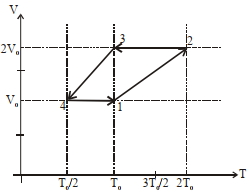
One mole of a monoatomic ideal gas goes through a thermodynamic cycle,as shown in the volume versus temperature $(V-T)$ diagram. The correct statement$(s)$ is/are :
[$R$ is the gas constant]
$(1)$ Work done in this thermodynamic cycle $(1 \rightarrow 2 \rightarrow 3 \rightarrow 4 \rightarrow 1)$ is $|W| = \frac{1}{2} RT_0$
$(2)$ The ratio of heat transfer during processes $1 \rightarrow 2$ and $2 \rightarrow 3$ is $\left|\frac{Q_{1 \rightarrow 2}}{Q_{2 \rightarrow 3}}\right| = \frac{5}{3}$
$(3)$ The above thermodynamic cycle exhibits only isochoric and adiabatic processes.
$(4)$ The ratio of heat transfer during processes $1 \rightarrow 2$ and $3 \rightarrow 4$ is $\left|\frac{Q_{1 \rightarrow 2}}{Q_{3 \rightarrow 4}}\right| = \frac{1}{2}$
[$R$ is the gas constant]
$(1)$ Work done in this thermodynamic cycle $(1 \rightarrow 2 \rightarrow 3 \rightarrow 4 \rightarrow 1)$ is $|W| = \frac{1}{2} RT_0$
$(2)$ The ratio of heat transfer during processes $1 \rightarrow 2$ and $2 \rightarrow 3$ is $\left|\frac{Q_{1 \rightarrow 2}}{Q_{2 \rightarrow 3}}\right| = \frac{5}{3}$
$(3)$ The above thermodynamic cycle exhibits only isochoric and adiabatic processes.
$(4)$ The ratio of heat transfer during processes $1 \rightarrow 2$ and $3 \rightarrow 4$ is $\left|\frac{Q_{1 \rightarrow 2}}{Q_{3 \rightarrow 4}}\right| = \frac{1}{2}$
A
$1, 3$
B
$1, 2$
C
$1, 4$
D
$1, 3, 4$
Solution
(B) From the $V-T$ diagram:
Process $1 \rightarrow 2$: $V$ increases linearly with $T$ passing through origin,so $V \propto T$,which means pressure $P$ is constant (isobaric). $P_1 = P_2 = \frac{RT_0}{V_0}$.
Process $2 \rightarrow 3$: $V$ is constant $(2V_0)$,so it is isochoric.
Process $3 \rightarrow 4$: $V$ is constant $(V_0)$,so it is isochoric.
Process $4 \rightarrow 1$: $V$ is constant $(V_0)$,so it is isochoric.
Wait,looking at the graph: $1 \rightarrow 2$ is isobaric,$2 \rightarrow 3$ is isochoric,$3 \rightarrow 4$ is isobaric,$4 \rightarrow 1$ is isochoric.
Work done $W = \text{Area of cycle in } P-V \text{ diagram}$.
$P_1 = \frac{RT_0}{V_0}$,$P_3 = \frac{RT_0}{V_0}$ (Wait,$P_3 = \frac{R(T_0/2)}{V_0} = \frac{RT_0}{2V_0}$).
$W = (P_{12} - P_{34}) \Delta V = (\frac{RT_0}{V_0} - \frac{RT_0}{2V_0}) (2V_0 - V_0) = \frac{RT_0}{2V_0} \cdot V_0 = \frac{1}{2} RT_0$. Statement $(1)$ is correct.
$Q_{1 \rightarrow 2} = n C_p \Delta T = 1 \cdot \frac{5R}{2} \cdot (2T_0 - T_0) = \frac{5}{2} RT_0$.
$Q_{2 \rightarrow 3} = n C_v \Delta T = 1 \cdot \frac{3R}{2} \cdot (T_0 - 2T_0) = -\frac{3}{2} RT_0$. Ratio $|Q_{1 \rightarrow 2} / Q_{2 \rightarrow 3}| = 5/3$. Statement $(2)$ is correct.
Statement $(3)$ is incorrect as it involves isobaric processes.
$Q_{3 \rightarrow 4} = n C_p \Delta T = 1 \cdot \frac{5R}{2} \cdot (T_0/2 - T_0) = -\frac{5}{4} RT_0$. Ratio $|Q_{1 \rightarrow 2} / Q_{3 \rightarrow 4}| = |(5/2) / (-5/4)| = 2$. Statement $(4)$ is incorrect.
Process $1 \rightarrow 2$: $V$ increases linearly with $T$ passing through origin,so $V \propto T$,which means pressure $P$ is constant (isobaric). $P_1 = P_2 = \frac{RT_0}{V_0}$.
Process $2 \rightarrow 3$: $V$ is constant $(2V_0)$,so it is isochoric.
Process $3 \rightarrow 4$: $V$ is constant $(V_0)$,so it is isochoric.
Process $4 \rightarrow 1$: $V$ is constant $(V_0)$,so it is isochoric.
Wait,looking at the graph: $1 \rightarrow 2$ is isobaric,$2 \rightarrow 3$ is isochoric,$3 \rightarrow 4$ is isobaric,$4 \rightarrow 1$ is isochoric.
Work done $W = \text{Area of cycle in } P-V \text{ diagram}$.
$P_1 = \frac{RT_0}{V_0}$,$P_3 = \frac{RT_0}{V_0}$ (Wait,$P_3 = \frac{R(T_0/2)}{V_0} = \frac{RT_0}{2V_0}$).
$W = (P_{12} - P_{34}) \Delta V = (\frac{RT_0}{V_0} - \frac{RT_0}{2V_0}) (2V_0 - V_0) = \frac{RT_0}{2V_0} \cdot V_0 = \frac{1}{2} RT_0$. Statement $(1)$ is correct.
$Q_{1 \rightarrow 2} = n C_p \Delta T = 1 \cdot \frac{5R}{2} \cdot (2T_0 - T_0) = \frac{5}{2} RT_0$.
$Q_{2 \rightarrow 3} = n C_v \Delta T = 1 \cdot \frac{3R}{2} \cdot (T_0 - 2T_0) = -\frac{3}{2} RT_0$. Ratio $|Q_{1 \rightarrow 2} / Q_{2 \rightarrow 3}| = 5/3$. Statement $(2)$ is correct.
Statement $(3)$ is incorrect as it involves isobaric processes.
$Q_{3 \rightarrow 4} = n C_p \Delta T = 1 \cdot \frac{5R}{2} \cdot (T_0/2 - T_0) = -\frac{5}{4} RT_0$. Ratio $|Q_{1 \rightarrow 2} / Q_{3 \rightarrow 4}| = |(5/2) / (-5/4)| = 2$. Statement $(4)$ is incorrect.
0 likesView Solution
4
PhysicsEasyMCQIIT JEE · 2019
Let us consider a system of units in which mass and angular momentum are dimensionless. If length has dimension of $L$,which of the following statement$(s)$ is/are correct?
$(1)$ The dimension of force is $L^{-3}$
$(2)$ The dimension of energy is $L^{-2}$
$(3)$ The dimension of power is $L^{-5}$
$(4)$ The dimension of linear momentum is $L^{-1}$
$(1)$ The dimension of force is $L^{-3}$
$(2)$ The dimension of energy is $L^{-2}$
$(3)$ The dimension of power is $L^{-5}$
$(4)$ The dimension of linear momentum is $L^{-1}$
A
$1, 2, 4$
B
$1, 2, 3$
C
$1, 2$
D
$1, 3$
Solution
(A) Given that mass $(M)$ and angular momentum $(L_{ang} = Mvr)$ are dimensionless,we have:
$M = M^0 L^0 T^0$
$L_{ang} = M^1 L^2 T^{-1} = M^0 L^0 T^0$
Since $M$ is dimensionless,$L^2 T^{-1} = 1$,which implies $T = L^2$.
$(1)$ Force $(F = M L T^{-2})$: Since $M$ is dimensionless and $T = L^2$,$F = L^1 (L^2)^{-2} = L^1 L^{-4} = L^{-3}$. (Correct)
$(2)$ Energy $(E = M L^2 T^{-2})$: $E = L^2 (L^2)^{-2} = L^2 L^{-4} = L^{-2}$. (Correct)
$(3)$ Power $(P = E/T = M L^2 T^{-3})$: $P = L^2 (L^2)^{-3} = L^2 L^{-6} = L^{-4}$. (Incorrect)
$(4)$ Linear momentum $(p = M L T^{-1})$: $p = L^1 (L^2)^{-1} = L^1 L^{-2} = L^{-1}$. (Correct)
Thus,statements $(1), (2),$ and $(4)$ are correct.
$M = M^0 L^0 T^0$
$L_{ang} = M^1 L^2 T^{-1} = M^0 L^0 T^0$
Since $M$ is dimensionless,$L^2 T^{-1} = 1$,which implies $T = L^2$.
$(1)$ Force $(F = M L T^{-2})$: Since $M$ is dimensionless and $T = L^2$,$F = L^1 (L^2)^{-2} = L^1 L^{-4} = L^{-3}$. (Correct)
$(2)$ Energy $(E = M L^2 T^{-2})$: $E = L^2 (L^2)^{-2} = L^2 L^{-4} = L^{-2}$. (Correct)
$(3)$ Power $(P = E/T = M L^2 T^{-3})$: $P = L^2 (L^2)^{-3} = L^2 L^{-6} = L^{-4}$. (Incorrect)
$(4)$ Linear momentum $(p = M L T^{-1})$: $p = L^1 (L^2)^{-1} = L^1 L^{-2} = L^{-1}$. (Correct)
Thus,statements $(1), (2),$ and $(4)$ are correct.
0 likesView Solution
5
PhysicsDifficultMCQIIT JEE · 2019
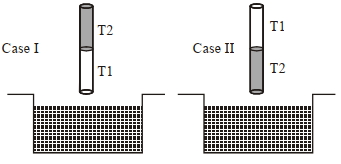
$A$ cylindrical capillary tube of $0.2 \ mm$ radius is made by joining two capillaries $T_1$ and $T_2$ of different materials having water contact angles of $0^{\circ}$ and $60^{\circ}$,respectively. The capillary tube is dipped vertically in water in two different configurations,case $I$ and $II$ as shown in the figure. Which of the following option$(s)$ is(are) correct?
(Surface tension of water $= 0.075 \ N/m$,density of water $= 1000 \ kg/m^3$,take $g = 10 \ m/s^2$)
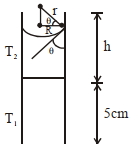
$(1)$ The correction in the height of the water column raised in the tube,due to the weight of water contained in the meniscus,will be different for both cases.
$(2)$ For case $I$,if the capillary joint is $5 \ cm$ above the water surface,the height of the water column raised in the tube will be more than $8.75 \ cm$. (Neglect the weight of the water in the meniscus)
$(3)$ For case $I$,if the joint is kept at $8 \ cm$ above the water surface,the height of the water column in the tube will be $7.5 \ cm$. (Neglect the weight of the water in the meniscus)
$(4)$ For case $II$,if the capillary joint is $5 \ cm$ above the water surface,the height of the water column raised in the tube will be $3.75 \ cm$. (Neglect the weight of the water in the meniscus)
(Surface tension of water $= 0.075 \ N/m$,density of water $= 1000 \ kg/m^3$,take $g = 10 \ m/s^2$)
$(1)$ The correction in the height of the water column raised in the tube,due to the weight of water contained in the meniscus,will be different for both cases.
$(2)$ For case $I$,if the capillary joint is $5 \ cm$ above the water surface,the height of the water column raised in the tube will be more than $8.75 \ cm$. (Neglect the weight of the water in the meniscus)
$(3)$ For case $I$,if the joint is kept at $8 \ cm$ above the water surface,the height of the water column in the tube will be $7.5 \ cm$. (Neglect the weight of the water in the meniscus)
$(4)$ For case $II$,if the capillary joint is $5 \ cm$ above the water surface,the height of the water column raised in the tube will be $3.75 \ cm$. (Neglect the weight of the water in the meniscus)
A
$1, 2, 3$
B
$1, 3, 4$
C
$1, 2, 4$
D
$1, 2$
Solution
(B) The capillary rise is given by $h = \frac{2T \cos \theta}{\rho g R}$.
For $T_1$ $(\theta = 0^{\circ})$: $h_1 = \frac{2 \times 0.075 \times \cos 0^{\circ}}{1000 \times 10 \times 0.2 \times 10^{-3}} = 0.075 \ m = 7.5 \ cm$.
For $T_2$ $(\theta = 60^{\circ})$: $h_2 = \frac{2 \times 0.075 \times \cos 60^{\circ}}{1000 \times 10 \times 0.2 \times 10^{-3}} = 0.0375 \ m = 3.75 \ cm$.
$(1)$ Since the contact angles are different,the meniscus shape and the weight of the water in the meniscus will be different for both cases. Thus,the correction will be different. Statement $(1)$ is correct.
$(2)$ In case $I$,$T_1$ is at the bottom. The water rises to $7.5 \ cm$. If the joint is at $5 \ cm$,the water crosses the joint. However,the pressure balance at the interface in $T_2$ would require a height $h'$ such that $\rho g(5 \times 10^{-2} + h') = \frac{2T \cos 60^{\circ}}{R}$. This leads to $h' = 3.75 - 5 = -1.25 \ cm$. Since $h' < 0$,the water cannot rise further into $T_2$. It stays at the joint. Statement $(2)$ is incorrect.
$(3)$ In case $I$,if the joint is at $8 \ cm$,the water rises in $T_1$ to its maximum height of $7.5 \ cm$. Since $7.5 \ cm < 8 \ cm$,it does not reach the joint. Statement $(3)$ is correct.
$(4)$ In case $II$,$T_2$ is at the bottom. The water rises in $T_2$ to its maximum height of $3.75 \ cm$. Since $3.75 \ cm < 5 \ cm$,it does not reach the joint. Statement $(4)$ is correct.
For $T_1$ $(\theta = 0^{\circ})$: $h_1 = \frac{2 \times 0.075 \times \cos 0^{\circ}}{1000 \times 10 \times 0.2 \times 10^{-3}} = 0.075 \ m = 7.5 \ cm$.
For $T_2$ $(\theta = 60^{\circ})$: $h_2 = \frac{2 \times 0.075 \times \cos 60^{\circ}}{1000 \times 10 \times 0.2 \times 10^{-3}} = 0.0375 \ m = 3.75 \ cm$.
$(1)$ Since the contact angles are different,the meniscus shape and the weight of the water in the meniscus will be different for both cases. Thus,the correction will be different. Statement $(1)$ is correct.
$(2)$ In case $I$,$T_1$ is at the bottom. The water rises to $7.5 \ cm$. If the joint is at $5 \ cm$,the water crosses the joint. However,the pressure balance at the interface in $T_2$ would require a height $h'$ such that $\rho g(5 \times 10^{-2} + h') = \frac{2T \cos 60^{\circ}}{R}$. This leads to $h' = 3.75 - 5 = -1.25 \ cm$. Since $h' < 0$,the water cannot rise further into $T_2$. It stays at the joint. Statement $(2)$ is incorrect.
$(3)$ In case $I$,if the joint is at $8 \ cm$,the water rises in $T_1$ to its maximum height of $7.5 \ cm$. Since $7.5 \ cm < 8 \ cm$,it does not reach the joint. Statement $(3)$ is correct.
$(4)$ In case $II$,$T_2$ is at the bottom. The water rises in $T_2$ to its maximum height of $3.75 \ cm$. Since $3.75 \ cm < 5 \ cm$,it does not reach the joint. Statement $(4)$ is correct.
0 likesView Solution
6
PhysicsAdvancedMCQIIT JEE · 2019
$A$ block of weight $100 \ N$ is suspended by copper and steel wires of same cross-sectional area $0.5 \ cm^2$ and lengths $\sqrt{3} \ m$ and $1 \ m$,respectively. Their other ends are fixed on a ceiling as shown in the figure. The angles subtended by the copper and steel wires with the ceiling are $30^{\circ}$ and $60^{\circ}$,respectively. If the elongation in the copper wire is $\Delta \ell_C$ and the elongation in the steel wire is $\Delta \ell_S$,then the ratio $\frac{\Delta \ell_C}{\Delta \ell_S}$ is. . . . . .
[Young's modulus for copper and steel are $1 \times 10^{11} \ N/m^2$ and $2 \times 10^{11} \ N/m^2$ respectively]
[Young's modulus for copper and steel are $1 \times 10^{11} \ N/m^2$ and $2 \times 10^{11} \ N/m^2$ respectively]
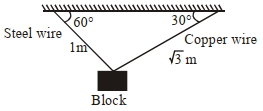
A
$1$
B
$0$
C
$2$
D
$3$
Solution
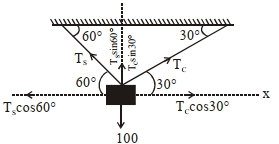
(C) Let $T_S$ be the tension in the steel wire and $T_C$ be the tension in the copper wire.
Resolving forces in the horizontal $(x)$ direction:
$T_C \cos 30^{\circ} = T_S \cos 60^{\circ}$
$T_C \times \frac{\sqrt{3}}{2} = T_S \times \frac{1}{2}$
$T_S = \sqrt{3} T_C \quad \dots (i)$
Resolving forces in the vertical $(y)$ direction:
$T_C \sin 30^{\circ} + T_S \sin 60^{\circ} = 100$
$\frac{T_C}{2} + \frac{T_S \sqrt{3}}{2} = 100 \quad \dots (ii)$
Substituting $(i)$ into $(ii)$:
$\frac{T_C}{2} + \frac{(\sqrt{3} T_C) \sqrt{3}}{2} = 100$
$\frac{T_C}{2} + \frac{3 T_C}{2} = 100 \implies 2 T_C = 100 \implies T_C = 50 \ N$
$T_S = \sqrt{3} \times 50 = 50\sqrt{3} \ N$
Using the formula for elongation $\Delta \ell = \frac{FL}{AY}$:
$\frac{\Delta \ell_C}{\Delta \ell_S} = \frac{T_C L_C}{A_C Y_C} \times \frac{A_S Y_S}{T_S L_S}$
Given $A_C = A_S = 0.5 \ cm^2$,$L_C = \sqrt{3} \ m$,$L_S = 1 \ m$,$Y_C = 1 \times 10^{11} \ N/m^2$,$Y_S = 2 \times 10^{11} \ N/m^2$:
$\frac{\Delta \ell_C}{\Delta \ell_S} = \left( \frac{50 \times \sqrt{3}}{0.5 \times 10^{11}} \right) \times \left( \frac{0.5 \times 2 \times 10^{11}}{50\sqrt{3} \times 1} \right) = \frac{50\sqrt{3}}{50\sqrt{3}} \times \frac{2}{1} = 2$
Thus,the ratio is $2$.
Resolving forces in the horizontal $(x)$ direction:
$T_C \cos 30^{\circ} = T_S \cos 60^{\circ}$
$T_C \times \frac{\sqrt{3}}{2} = T_S \times \frac{1}{2}$
$T_S = \sqrt{3} T_C \quad \dots (i)$
Resolving forces in the vertical $(y)$ direction:
$T_C \sin 30^{\circ} + T_S \sin 60^{\circ} = 100$
$\frac{T_C}{2} + \frac{T_S \sqrt{3}}{2} = 100 \quad \dots (ii)$
Substituting $(i)$ into $(ii)$:
$\frac{T_C}{2} + \frac{(\sqrt{3} T_C) \sqrt{3}}{2} = 100$
$\frac{T_C}{2} + \frac{3 T_C}{2} = 100 \implies 2 T_C = 100 \implies T_C = 50 \ N$
$T_S = \sqrt{3} \times 50 = 50\sqrt{3} \ N$
Using the formula for elongation $\Delta \ell = \frac{FL}{AY}$:
$\frac{\Delta \ell_C}{\Delta \ell_S} = \frac{T_C L_C}{A_C Y_C} \times \frac{A_S Y_S}{T_S L_S}$
Given $A_C = A_S = 0.5 \ cm^2$,$L_C = \sqrt{3} \ m$,$L_S = 1 \ m$,$Y_C = 1 \times 10^{11} \ N/m^2$,$Y_S = 2 \times 10^{11} \ N/m^2$:
$\frac{\Delta \ell_C}{\Delta \ell_S} = \left( \frac{50 \times \sqrt{3}}{0.5 \times 10^{11}} \right) \times \left( \frac{0.5 \times 2 \times 10^{11}}{50\sqrt{3} \times 1} \right) = \frac{50\sqrt{3}}{50\sqrt{3}} \times \frac{2}{1} = 2$
Thus,the ratio is $2$.
0 likesView Solution
7
PhysicsAdvancedMCQIIT JEE · 2019
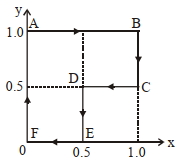
$A$ particle is moved along a path $A-B-C-D-E-F-A$,as shown in the figure,in the presence of a force $\vec{F} = (\alpha y \hat{i} + 2 \alpha x \hat{j}) \ N$,where $x$ and $y$ are in meters and $\alpha = -1 \ N/m$. The work done on the particle by this force $\vec{F}$ will be . . . . . . Joule.
A
$0.60$
B
$0.70$
C
$0.75$
D
$0.65$
Solution
(C) The work done is given by $W = \int \vec{F} \cdot d\vec{r} = \int (\alpha y dx + 2 \alpha x dy)$. Given $\alpha = -1$,$W = \int (-y dx - 2x dy)$.
Along $AB$: $y=1, dy=0, x: 0 \to 1$. $W_{AB} = \int_0^1 (-1) dx = -1 \ J$.
Along $BC$: $x=1, dx=0, y: 1 \to 0.5$. $W_{BC} = \int_1^{0.5} -2(1) dy = -2(0.5 - 1) = 1 \ J$.
Along $CD$: $y=0.5, dy=0, x: 1 \to 0.5$. $W_{CD} = \int_1^{0.5} -0.5 dx = -0.5(-0.5) = 0.25 \ J$.
Along $DE$: $x=0.5, dx=0, y: 0.5 \to 0$. $W_{DE} = \int_{0.5}^0 -2(0.5) dy = -1(-0.5) = 0.5 \ J$.
Along $EF$: $y=0, dy=0, x: 0.5 \to 0$. $W_{EF} = \int_{0.5}^0 0 dx = 0 \ J$.
Along $FA$: $x=0, dx=0, y: 0 \to 1$. $W_{FA} = \int_0^1 -2(0) dy = 0 \ J$.
Total work $W = W_{AB} + W_{BC} + W_{CD} + W_{DE} + W_{EF} + W_{FA} = -1 + 1 + 0.25 + 0.5 + 0 + 0 = 0.75 \ J$.
Along $AB$: $y=1, dy=0, x: 0 \to 1$. $W_{AB} = \int_0^1 (-1) dx = -1 \ J$.
Along $BC$: $x=1, dx=0, y: 1 \to 0.5$. $W_{BC} = \int_1^{0.5} -2(1) dy = -2(0.5 - 1) = 1 \ J$.
Along $CD$: $y=0.5, dy=0, x: 1 \to 0.5$. $W_{CD} = \int_1^{0.5} -0.5 dx = -0.5(-0.5) = 0.25 \ J$.
Along $DE$: $x=0.5, dx=0, y: 0.5 \to 0$. $W_{DE} = \int_{0.5}^0 -2(0.5) dy = -1(-0.5) = 0.5 \ J$.
Along $EF$: $y=0, dy=0, x: 0.5 \to 0$. $W_{EF} = \int_{0.5}^0 0 dx = 0 \ J$.
Along $FA$: $x=0, dx=0, y: 0 \to 1$. $W_{FA} = \int_0^1 -2(0) dy = 0 \ J$.
Total work $W = W_{AB} + W_{BC} + W_{CD} + W_{DE} + W_{EF} + W_{FA} = -1 + 1 + 0.25 + 0.5 + 0 + 0 = 0.75 \ J$.
0 likesView Solution
8
PhysicsMediumMCQIIT JEE · 2019
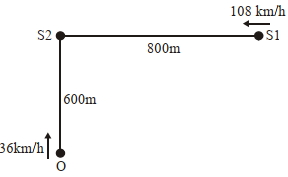
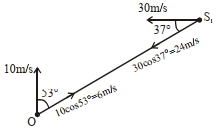
$A$ train $S_1$,moving with a uniform velocity of $108 \ km/h$,approaches another train $S_2$ standing on a platform. An observer $O$ moves with a uniform velocity of $36 \ km/h$ towards $S_2$,as shown in the figure. Both the trains are blowing whistles of the same frequency $120 \ Hz$. When $O$ is $600 \ m$ away from $S_2$ and the distance between $S_1$ and $S_2$ is $800 \ m$,the number of beats heard by $O$ is: [Speed of sound $= 330 \ m/s$]
A
$5$
B
$8$
C
$7$
D
$9$
Solution
(B) First,convert the velocities from $km/h$ to $m/s$:
$v_{S1} = 108 \times \frac{5}{18} = 30 \ m/s$
$v_O = 36 \times \frac{5}{18} = 10 \ m/s$
For observer $O$ and source $S_2$:
The source $S_2$ is stationary $(v_s = 0)$. The observer $O$ moves towards $S_2$ with a velocity component along the line joining them. Since $O$ moves directly towards $S_2$,the velocity of the observer is $v_o = 10 \ m/s$.
Using the Doppler effect formula: $f_2 = f_0 \left( \frac{v + v_o}{v} \right) = 120 \left( \frac{330 + 10}{330} \right) = 120 \left( \frac{340}{330} \right) \approx 123.64 \ Hz$.
For observer $O$ and source $S_1$:
The distance between $S_1$ and $S_2$ is $800 \ m$,and $O$ is $600 \ m$ from $S_2$. The distance $OS_1 = \sqrt{800^2 + 600^2} = 1000 \ m$.
The angle $\theta$ such that $\cos \theta = \frac{800}{1000} = 0.8$ and $\sin \theta = \frac{600}{1000} = 0.6$.
The velocity component of $S_1$ towards $O$ is $v_{s1} = v_{S1} \cos \theta = 30 \times 0.8 = 24 \ m/s$.
The velocity component of $O$ towards $S_1$ is $v_{o1} = v_O \sin \theta = 10 \times 0.6 = 6 \ m/s$.
Using the Doppler effect formula: $f_1 = f_0 \left( \frac{v + v_{o1}}{v - v_{s1}} \right) = 120 \left( \frac{330 + 6}{330 - 24} \right) = 120 \left( \frac{336}{306} \right) \approx 131.76 \ Hz$.
Beat frequency $= |f_1 - f_2| = 131.76 - 123.64 = 8.12 \ Hz$.
The number of beats heard is approximately $8$.
$v_{S1} = 108 \times \frac{5}{18} = 30 \ m/s$
$v_O = 36 \times \frac{5}{18} = 10 \ m/s$
For observer $O$ and source $S_2$:
The source $S_2$ is stationary $(v_s = 0)$. The observer $O$ moves towards $S_2$ with a velocity component along the line joining them. Since $O$ moves directly towards $S_2$,the velocity of the observer is $v_o = 10 \ m/s$.
Using the Doppler effect formula: $f_2 = f_0 \left( \frac{v + v_o}{v} \right) = 120 \left( \frac{330 + 10}{330} \right) = 120 \left( \frac{340}{330} \right) \approx 123.64 \ Hz$.
For observer $O$ and source $S_1$:
The distance between $S_1$ and $S_2$ is $800 \ m$,and $O$ is $600 \ m$ from $S_2$. The distance $OS_1 = \sqrt{800^2 + 600^2} = 1000 \ m$.
The angle $\theta$ such that $\cos \theta = \frac{800}{1000} = 0.8$ and $\sin \theta = \frac{600}{1000} = 0.6$.
The velocity component of $S_1$ towards $O$ is $v_{s1} = v_{S1} \cos \theta = 30 \times 0.8 = 24 \ m/s$.
The velocity component of $O$ towards $S_1$ is $v_{o1} = v_O \sin \theta = 10 \times 0.6 = 6 \ m/s$.
Using the Doppler effect formula: $f_1 = f_0 \left( \frac{v + v_{o1}}{v - v_{s1}} \right) = 120 \left( \frac{330 + 6}{330 - 24} \right) = 120 \left( \frac{336}{306} \right) \approx 131.76 \ Hz$.
Beat frequency $= |f_1 - f_2| = 131.76 - 123.64 = 8.12 \ Hz$.
The number of beats heard is approximately $8$.
0 likesView Solution
9
PhysicsAdvancedMCQIIT JEE · 2019
$A$ liquid at $30^{\circ} C$ is poured very slowly into a calorimeter at $110^{\circ} C$. The boiling point of the liquid is $80^{\circ} C$. It is observed that the first $5 \ gm$ of the liquid evaporates completely. After adding another $80 \ gm$ of the liquid,the equilibrium temperature is found to be $50^{\circ} C$. What is the ratio of the latent heat of the liquid to its specific heat? [Neglect heat exchange with the surroundings]
A
$260$
B
$250$
C
$270$
D
$280$
Solution
(C) Let the mass of the calorimeter be $m$,the specific heat of the calorimeter be $x$,the specific heat of the liquid be $s$,and the latent heat of the liquid be $L$.
When $5 \ gm$ of liquid at $30^{\circ} C$ is added to the calorimeter at $110^{\circ} C$,the calorimeter cools down to $80^{\circ} C$ and the liquid evaporates:
$m \cdot x \cdot (110 - 80) = 5 \cdot s \cdot (80 - 30) + 5 \cdot L$
$30 \cdot mx = 250s + 5L$ ... $(i)$
Now,$80 \ gm$ of liquid at $30^{\circ} C$ is added to the calorimeter at $80^{\circ} C$ and the final equilibrium temperature becomes $50^{\circ} C$:
$m \cdot x \cdot (80 - 50) = 80 \cdot s \cdot (50 - 30)$
$30 \cdot mx = 1600s$ ... $(ii)$
Comparing equations $(i)$ and $(ii)$:
$250s + 5L = 1600s$
$5L = 1350s$
$\frac{L}{s} = \frac{1350}{5} = 270$
When $5 \ gm$ of liquid at $30^{\circ} C$ is added to the calorimeter at $110^{\circ} C$,the calorimeter cools down to $80^{\circ} C$ and the liquid evaporates:
$m \cdot x \cdot (110 - 80) = 5 \cdot s \cdot (80 - 30) + 5 \cdot L$
$30 \cdot mx = 250s + 5L$ ... $(i)$
Now,$80 \ gm$ of liquid at $30^{\circ} C$ is added to the calorimeter at $80^{\circ} C$ and the final equilibrium temperature becomes $50^{\circ} C$:
$m \cdot x \cdot (80 - 50) = 80 \cdot s \cdot (50 - 30)$
$30 \cdot mx = 1600s$ ... $(ii)$
Comparing equations $(i)$ and $(ii)$:
$250s + 5L = 1600s$
$5L = 1350s$
$\frac{L}{s} = \frac{1350}{5} = 270$
0 likesView Solution
10
PhysicsMediumMCQIIT JEE · 2019
$A$ mixture of ideal gas containing $5$ moles of monatomic gas and $1$ mole of rigid diatomic gas is initially at pressure $P_0$,volume $V_0$ and temperature $T_0$. If the gas mixture is adiabatically compressed to a volume $V_0 / 4$,then the correct statement$(s)$ is/are:
(Given $2^{1.2}=2.3$; $2^{3.2}=9.2$; $R$ is gas constant)
$(1)$ The final pressure of the gas mixture after compression is in between $9 P_0$ and $10 P_0$.
$(2)$ The average kinetic energy of the gas mixture after compression is in between $18 RT_0$ and $19 RT_0$.
$(3)$ The work $|W|$ done during the process is $13 RT_0$.
$(4)$ Adiabatic constant of the gas mixture is $1.6$.
(Given $2^{1.2}=2.3$; $2^{3.2}=9.2$; $R$ is gas constant)
$(1)$ The final pressure of the gas mixture after compression is in between $9 P_0$ and $10 P_0$.
$(2)$ The average kinetic energy of the gas mixture after compression is in between $18 RT_0$ and $19 RT_0$.
$(3)$ The work $|W|$ done during the process is $13 RT_0$.
$(4)$ Adiabatic constant of the gas mixture is $1.6$.
A
$1, 2, 3$
B
$1, 2, 4$
C
$1, 3, 4$
D
$1, 4$
Solution
(D) For the mixture: $n_1 = 5$ (monatomic),$C_{v1} = 3R/2$; $n_2 = 1$ (diatomic),$C_{v2} = 5R/2$.
Total moles $n = 5 + 1 = 6$.
$(C_v)_m = \frac{n_1 C_{v1} + n_2 C_{v2}}{n_1 + n_2} = \frac{5(3R/2) + 1(5R/2)}{6} = \frac{10R}{6} = \frac{5R}{3}$.
$(C_p)_m = (C_v)_m + R = \frac{5R}{3} + R = \frac{8R}{3}$.
Adiabatic constant $\gamma_m = \frac{(C_p)_m}{(C_v)_m} = \frac{8/3}{5/3} = 1.6$. Thus,$(4)$ is correct.
For adiabatic compression: $P_0 V_0^{\gamma} = P_f (V_0/4)^{\gamma}$.
$P_f = P_0 (4)^{1.6} = P_0 (2^2)^{1.6} = P_0 (2^{3.2}) = 9.2 P_0$. Thus,$(1)$ is correct.
Using $T_f V_f^{\gamma-1} = T_0 V_0^{\gamma-1}$,$T_f = T_0 (V_0 / (V_0/4))^{0.6} = T_0 (4)^{0.6} = T_0 (2^{1.2}) = 2.3 T_0$.
Total internal energy $U = n_1 (3/2 RT) + n_2 (5/2 RT) = 5(1.5 RT) + 1(2.5 RT) = 10 RT$.
$U_f = 10 R (2.3 T_0) = 23 RT_0$. Thus,$(2)$ is incorrect.
Work done $|W| = |\Delta U| = |n_f C_{vm} T_f - n_i C_{vm} T_i| = |6 \times (5R/6) \times (2.3 T_0 - T_0)| = |5R \times 1.3 T_0| = 6.5 RT_0$. Thus,$(3)$ is incorrect.
Correct statements are $(1)$ and $(4)$.
Total moles $n = 5 + 1 = 6$.
$(C_v)_m = \frac{n_1 C_{v1} + n_2 C_{v2}}{n_1 + n_2} = \frac{5(3R/2) + 1(5R/2)}{6} = \frac{10R}{6} = \frac{5R}{3}$.
$(C_p)_m = (C_v)_m + R = \frac{5R}{3} + R = \frac{8R}{3}$.
Adiabatic constant $\gamma_m = \frac{(C_p)_m}{(C_v)_m} = \frac{8/3}{5/3} = 1.6$. Thus,$(4)$ is correct.
For adiabatic compression: $P_0 V_0^{\gamma} = P_f (V_0/4)^{\gamma}$.
$P_f = P_0 (4)^{1.6} = P_0 (2^2)^{1.6} = P_0 (2^{3.2}) = 9.2 P_0$. Thus,$(1)$ is correct.
Using $T_f V_f^{\gamma-1} = T_0 V_0^{\gamma-1}$,$T_f = T_0 (V_0 / (V_0/4))^{0.6} = T_0 (4)^{0.6} = T_0 (2^{1.2}) = 2.3 T_0$.
Total internal energy $U = n_1 (3/2 RT) + n_2 (5/2 RT) = 5(1.5 RT) + 1(2.5 RT) = 10 RT$.
$U_f = 10 R (2.3 T_0) = 23 RT_0$. Thus,$(2)$ is incorrect.
Work done $|W| = |\Delta U| = |n_f C_{vm} T_f - n_i C_{vm} T_i| = |6 \times (5R/6) \times (2.3 T_0 - T_0)| = |5R \times 1.3 T_0| = 6.5 RT_0$. Thus,$(3)$ is incorrect.
Correct statements are $(1)$ and $(4)$.
0 likesView Solution
11
PhysicsAdvancedMCQIIT JEE · 2019
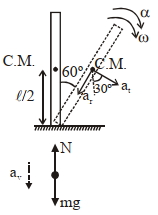
$A$ thin and uniform rod of mass $M$ and length $L$ is held vertical on a floor with large friction. The rod is released from rest so that it falls by rotating about its contact-point with the floor without slipping. Which of the following statement$(s)$ is/are correct,when the rod makes an angle $60^{\circ}$ with vertical? [$g$ is the acceleration due to gravity]
$(1)$ The radial acceleration of the rod's center of mass will be $\frac{3g}{4}$
$(2)$ The angular acceleration of the rod will be $\frac{3\sqrt{3}g}{4L}$
$(3)$ The angular speed of the rod will be $\sqrt{\frac{3g}{2L}}$
$(4)$ The normal reaction force from the floor on the rod will be $\frac{Mg}{16}$
$(1)$ The radial acceleration of the rod's center of mass will be $\frac{3g}{4}$
$(2)$ The angular acceleration of the rod will be $\frac{3\sqrt{3}g}{4L}$
$(3)$ The angular speed of the rod will be $\sqrt{\frac{3g}{2L}}$
$(4)$ The normal reaction force from the floor on the rod will be $\frac{Mg}{16}$
A
$1, 2, 3$
B
$1, 2, 4$
C
$1, 3, 4$
D
$1, 2$
Solution
(C) We treat the contact point as a hinge.
Applying the work-energy theorem:
$W_g = \Delta K.E.$
$Mg \left( \frac{L}{2} (1 - \cos 60^{\circ}) \right) = \frac{1}{2} I \omega^2$
$Mg \left( \frac{L}{2} \cdot \frac{1}{2} \right) = \frac{1}{2} \left( \frac{ML^2}{3} \right) \omega^2$
$\frac{MgL}{4} = \frac{ML^2}{6} \omega^2 \Rightarrow \omega = \sqrt{\frac{3g}{2L}}$ (Statement $3$ is correct).
Radial acceleration of $C.M.$: $a_r = \left( \frac{L}{2} \right) \omega^2 = \frac{L}{2} \cdot \frac{3g}{2L} = \frac{3g}{4}$ (Statement $1$ is correct).
Using $\tau = I \alpha$ about the contact point:
$Mg \left( \frac{L}{2} \sin 60^{\circ} \right) = \left( \frac{ML^2}{3} \right) \alpha$
$\alpha = \frac{3g}{2L} \sin 60^{\circ} = \frac{3g}{2L} \cdot \frac{\sqrt{3}}{2} = \frac{3\sqrt{3}g}{4L}$ (Statement $2$ is correct).
Net vertical acceleration of $C.M.$: $a_v = a_r \cos 60^{\circ} + a_t \cos 30^{\circ}$
$a_v = \left( \frac{3g}{4} \right) \left( \frac{1}{2} \right) + \left( \alpha \frac{L}{2} \right) \cos 30^{\circ} = \frac{3g}{8} + \left( \frac{3\sqrt{3}g}{4L} \cdot \frac{L}{2} \right) \frac{\sqrt{3}}{2} = \frac{3g}{8} + \frac{9g}{16} = \frac{15g}{16}$.
Applying $F_{net} = Ma_v$ in the vertical direction:
$Mg - N = M \left( \frac{15g}{16} \right) \Rightarrow N = \frac{Mg}{16}$ (Statement $4$ is correct).
Thus,statements $1, 3, 4$ are correct.
Applying the work-energy theorem:
$W_g = \Delta K.E.$
$Mg \left( \frac{L}{2} (1 - \cos 60^{\circ}) \right) = \frac{1}{2} I \omega^2$
$Mg \left( \frac{L}{2} \cdot \frac{1}{2} \right) = \frac{1}{2} \left( \frac{ML^2}{3} \right) \omega^2$
$\frac{MgL}{4} = \frac{ML^2}{6} \omega^2 \Rightarrow \omega = \sqrt{\frac{3g}{2L}}$ (Statement $3$ is correct).
Radial acceleration of $C.M.$: $a_r = \left( \frac{L}{2} \right) \omega^2 = \frac{L}{2} \cdot \frac{3g}{2L} = \frac{3g}{4}$ (Statement $1$ is correct).
Using $\tau = I \alpha$ about the contact point:
$Mg \left( \frac{L}{2} \sin 60^{\circ} \right) = \left( \frac{ML^2}{3} \right) \alpha$
$\alpha = \frac{3g}{2L} \sin 60^{\circ} = \frac{3g}{2L} \cdot \frac{\sqrt{3}}{2} = \frac{3\sqrt{3}g}{4L}$ (Statement $2$ is correct).
Net vertical acceleration of $C.M.$: $a_v = a_r \cos 60^{\circ} + a_t \cos 30^{\circ}$
$a_v = \left( \frac{3g}{4} \right) \left( \frac{1}{2} \right) + \left( \alpha \frac{L}{2} \right) \cos 30^{\circ} = \frac{3g}{8} + \left( \frac{3\sqrt{3}g}{4L} \cdot \frac{L}{2} \right) \frac{\sqrt{3}}{2} = \frac{3g}{8} + \frac{9g}{16} = \frac{15g}{16}$.
Applying $F_{net} = Ma_v$ in the vertical direction:
$Mg - N = M \left( \frac{15g}{16} \right) \Rightarrow N = \frac{Mg}{16}$ (Statement $4$ is correct).
Thus,statements $1, 3, 4$ are correct.
0 likesView Solution
12
PhysicsAdvancedMCQIIT JEE · 2019
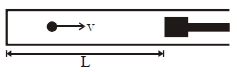
$A$ small particle of mass $m$ moving inside a heavy, hollow and straight tube along the tube axis undergoes elastic collision at two ends. The tube has no friction and it is closed at one end by a flat surface while the other end is fitted with a heavy movable flat piston as shown in the figure. When the distance of the piston from the closed end is $L = L_0$, the particle speed is $v = v_0$. The piston is moved inward at a very low speed $V$ such that $V \ll \frac{dL}{L} v_0$, where $dL$ is the infinitely small displacement of the piston. Which of the following statement(s) is/are correct?
$(1)$ The rate at which the particle strikes the piston is $v / (2L)$
$(2)$ After each collision with the piston, the particle speed increases by $2V$
$(3)$ The particle's kinetic energy increases by a factor of $4$ when the piston is moved inward from $L_0$ to $L_0 / 2$
$(4)$ If the piston moves inward by $dL$, the particle speed increases by $v \frac{dL}{L}$
$(1)$ The rate at which the particle strikes the piston is $v / (2L)$
$(2)$ After each collision with the piston, the particle speed increases by $2V$
$(3)$ The particle's kinetic energy increases by a factor of $4$ when the piston is moved inward from $L_0$ to $L_0 / 2$
$(4)$ If the piston moves inward by $dL$, the particle speed increases by $v \frac{dL}{L}$
A
$2, 3$
B
$2, 4$
C
$1, 3$
D
$1, 2, 3$
Solution
(A) The particle moves between two walls separated by distance $L$. The time taken for one round trip is $\Delta t = 2L/v$. The frequency of collision with the piston is $f = 1/\Delta t = v/(2L)$. Thus, statement $(1)$ is incorrect as it states $v/L$.
In an elastic collision with a piston moving at speed $V$ towards the particle, the velocity of the particle changes from $v$ to $v + 2V$. The change in speed is $(v + 2V) - v = 2V$. Thus, statement $(2)$ is correct.
For a small displacement $dL$ of the piston, the change in speed is $dv = 2V \times (\text{number of collisions in time } dt)$. Since $dt = dL/V$, the number of collisions is $dt / (2L/v) = (dL/V) \cdot (v/2L) = v dL / (2LV)$.
Therefore, $dv = 2V \cdot (v dL / 2LV) = v dL / L$. Thus, statement $(4)$ is incorrect as it states $2v dL/L$.
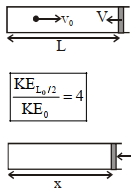
Integrating $dv/v = dL/L$ (with $L$ decreasing, $dv/v = -dL/L$), we get $\ln(v/v_0) = -\ln(L/L_0) = \ln(L_0/L)$, so $vL = v_0 L_0$. If $L$ becomes $L_0/2$, then $v = 2v_0$. The kinetic energy $KE = \frac{1}{2}mv^2$ becomes $\frac{1}{2}m(2v_0)^2 = 4 \times (\frac{1}{2}mv_0^2) = 4 KE_0$. Thus, statement $(3)$ is correct.
The correct statements are $(2)$ and $(3)$.
In an elastic collision with a piston moving at speed $V$ towards the particle, the velocity of the particle changes from $v$ to $v + 2V$. The change in speed is $(v + 2V) - v = 2V$. Thus, statement $(2)$ is correct.
For a small displacement $dL$ of the piston, the change in speed is $dv = 2V \times (\text{number of collisions in time } dt)$. Since $dt = dL/V$, the number of collisions is $dt / (2L/v) = (dL/V) \cdot (v/2L) = v dL / (2LV)$.
Therefore, $dv = 2V \cdot (v dL / 2LV) = v dL / L$. Thus, statement $(4)$ is incorrect as it states $2v dL/L$.
Integrating $dv/v = dL/L$ (with $L$ decreasing, $dv/v = -dL/L$), we get $\ln(v/v_0) = -\ln(L/L_0) = \ln(L_0/L)$, so $vL = v_0 L_0$. If $L$ becomes $L_0/2$, then $v = 2v_0$. The kinetic energy $KE = \frac{1}{2}mv^2$ becomes $\frac{1}{2}m(2v_0)^2 = 4 \times (\frac{1}{2}mv_0^2) = 4 KE_0$. Thus, statement $(3)$ is correct.
The correct statements are $(2)$ and $(3)$.
0 likesView Solution
13
PhysicsAdvancedMCQIIT JEE · 2019
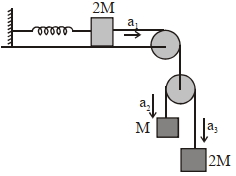
$A$ block of mass $2M$ is attached to a massless spring with spring-constant $k$. This block is connected to two other blocks of masses $M$ and $2M$ using two massless pulleys and strings. The accelerations of the blocks are $a_1, a_2$ and $a_3$ as shown in the figure. The system is released from rest with the spring in its unstretched state. The maximum extension of the spring is $x_0$. Which of the following option$(s)$ is/are correct? [$g$ is the acceleration due to gravity. Neglect friction]
A
$x_0 = \frac{4Mg}{k}$
B
When the spring achieves an extension of $\frac{x_0}{2}$ for the first time,the speed of the block connected to the spring is $3g \sqrt{\frac{M}{5k}}$
C
$a_2 - a_1 = a_1 - a_3$
D
At an extension of $\frac{x_0}{4}$ of the spring,the magnitude of acceleration of the block connected to the spring is $\frac{3g}{10}$
Solution
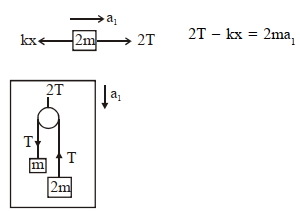
(C) Let $T$ be the tension in the string connecting the two hanging blocks. For the movable pulley,the tension in the string connected to the block of mass $2M$ is $2T$. The equation of motion for the block of mass $2M$ is $2T - kx = 2Ma_1$. For the hanging system,the relative acceleration of the blocks $M$ and $2M$ with respect to the movable pulley is $a_{rel}$. The equations are $Mg - T = M(a_1 - a_{rel})$ and $2Mg - T = 2M(a_1 + a_{rel})$. Solving these gives $T = \frac{4}{3}Mg$ and $a_{rel} = \frac{g}{3}$. The acceleration of block $M$ is $a_2 = a_1 + a_{rel}$ and for $2M$ is $a_3 = a_1 - a_{rel}$. Thus,$a_2 - a_1 = a_1 - a_3 = a_{rel} = \frac{g}{3}$. Substituting $T$ into the first equation: $2(\frac{4}{3}Mg) - kx = 2Ma_1 \implies a_1 = \frac{4g}{3} - \frac{kx}{2M}$. At maximum extension $x_0$,$a_1 = 0$,so $x_0 = \frac{8Mg}{3k}$. Option $A$ is incorrect. For option $C$,$a_2 - a_1 = a_{rel}$ and $a_1 - a_3 = a_{rel}$,so $a_2 - a_1 = a_1 - a_3$ is correct. At $x = \frac{x_0}{4}$,$a_1 = \frac{4g}{3} - \frac{k(8Mg/12k)}{2M} = \frac{4g}{3} - \frac{g}{3} = g$. Option $D$ is incorrect.
0 likesView Solution
14
PhysicsAdvancedMCQIIT JEE · 2019
$A$ ball is thrown from the ground at an angle $\theta$ with the horizontal and with an initial speed $u_0$. For the resulting projectile motion,the magnitude of the average velocity of the ball up to the point when it hits the ground for the first time is $V_1$. After hitting the ground,the ball rebounds at the same angle $\theta$ but with a reduced speed of $u_0 / \alpha$. Its motion continues for a long time as shown in the figure. If the magnitude of the average velocity of the ball for the entire duration of motion is $0.8 V_1$,the value of $\alpha$ is:

A
$2$
B
$3$
C
$4$
D
$5$
Solution
(C) For a projectile launched with speed $u$ at angle $\theta$,the time of flight is $T = \frac{2u \sin \theta}{g}$ and the horizontal range is $R = \frac{u^2 \sin 2\theta}{g}$.
The average velocity $V_1$ for the first flight is the displacement divided by time: $V_1 = \frac{R}{T} = \frac{u_0^2 \sin 2\theta / g}{2u_0 \sin \theta / g} = u_0 \cos \theta$.
For the entire motion,the total displacement $S_{total}$ is the sum of all ranges: $S_{total} = R_1 + R_2 + R_3 + \dots = R_1 (1 + \frac{1}{\alpha^2} + \frac{1}{\alpha^4} + \dots) = \frac{R_1}{1 - 1/\alpha^2} = \frac{R_1 \alpha^2}{\alpha^2 - 1}$.
The total time $T_{total}$ is the sum of all flight times: $T_{total} = T_1 + T_2 + T_3 + \dots = T_1 (1 + \frac{1}{\alpha} + \frac{1}{\alpha^2} + \dots) = \frac{T_1}{1 - 1/\alpha} = \frac{T_1 \alpha}{\alpha - 1}$.
The average velocity for the entire motion is $V_{avg} = \frac{S_{total}}{T_{total}} = \frac{R_1 \alpha^2 / (\alpha^2 - 1)}{T_1 \alpha / (\alpha - 1)} = \frac{R_1}{T_1} \cdot \frac{\alpha^2}{\alpha^2 - 1} \cdot \frac{\alpha - 1}{\alpha} = V_1 \cdot \frac{\alpha}{\alpha + 1}$.
Given $V_{avg} = 0.8 V_1$,we have $\frac{\alpha}{\alpha + 1} = 0.8$.
$\alpha = 0.8 \alpha + 0.8 \implies 0.2 \alpha = 0.8 \implies \alpha = 4$.
The average velocity $V_1$ for the first flight is the displacement divided by time: $V_1 = \frac{R}{T} = \frac{u_0^2 \sin 2\theta / g}{2u_0 \sin \theta / g} = u_0 \cos \theta$.
For the entire motion,the total displacement $S_{total}$ is the sum of all ranges: $S_{total} = R_1 + R_2 + R_3 + \dots = R_1 (1 + \frac{1}{\alpha^2} + \frac{1}{\alpha^4} + \dots) = \frac{R_1}{1 - 1/\alpha^2} = \frac{R_1 \alpha^2}{\alpha^2 - 1}$.
The total time $T_{total}$ is the sum of all flight times: $T_{total} = T_1 + T_2 + T_3 + \dots = T_1 (1 + \frac{1}{\alpha} + \frac{1}{\alpha^2} + \dots) = \frac{T_1}{1 - 1/\alpha} = \frac{T_1 \alpha}{\alpha - 1}$.
The average velocity for the entire motion is $V_{avg} = \frac{S_{total}}{T_{total}} = \frac{R_1 \alpha^2 / (\alpha^2 - 1)}{T_1 \alpha / (\alpha - 1)} = \frac{R_1}{T_1} \cdot \frac{\alpha^2}{\alpha^2 - 1} \cdot \frac{\alpha - 1}{\alpha} = V_1 \cdot \frac{\alpha}{\alpha + 1}$.
Given $V_{avg} = 0.8 V_1$,we have $\frac{\alpha}{\alpha + 1} = 0.8$.
$\alpha = 0.8 \alpha + 0.8 \implies 0.2 \alpha = 0.8 \implies \alpha = 4$.
0 likesView Solution
15
PhysicsAdvancedIIT JEE · 2019
Answer the following by appropriately matching the lists based on the information given in the paragraph.
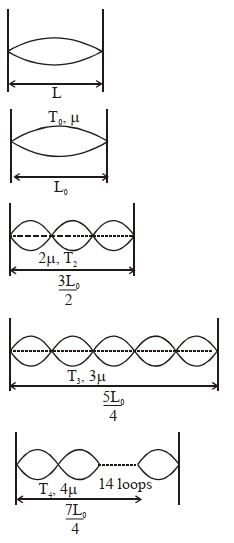
$A$ musical instrument is made using four different metal strings,$1, 2, 3$ and $4$ with mass per unit length $\mu, 2\mu, 3\mu$ and $4\mu$ respectively. The instrument is played by vibrating the strings by varying the free length in between the range $L_0$ and $2L_0$. It is found that in string-$1$ $(\mu)$ at free length $L_0$ and tension $T_0$ the fundamental mode frequency is $f_0$.
$List-I$ gives the above four strings while $List-II$ lists the magnitude of some quantity.
$(1)$ If the tension in each string is $T_0$,the correct match for the fundamental frequency in $f_0$ units will be,
$(1)$ $I \rightarrow P, II \rightarrow R, III \rightarrow S, IV \rightarrow Q$
$(2)$ $I \rightarrow P, II \rightarrow Q, III \rightarrow T, IV \rightarrow S$
$(3)$ $I \rightarrow Q, II \rightarrow S, III \rightarrow R, IV \rightarrow P$
$(4)$ $I \rightarrow Q, II \rightarrow P, III \rightarrow R, IV \rightarrow T$
$(2)$ The lengths of the strings $1, 2, 3$ and $4$ are kept fixed at $L_0, 3L_0/2, 5L_0/4$ and $7L_0/4$,respectively. Strings $1, 2, 3$ and $4$ are vibrated at their $1^{st}, 3^{rd}, 5^{th}$ and $14^{th}$ harmonics,respectively,such that all the strings have the same frequency. The correct match for the tension in the four strings in the units of $T_0$ will be.
$(1)$ $I \rightarrow P, II \rightarrow Q, III \rightarrow T, IV \rightarrow U$
$(2)$ $I \rightarrow T, II \rightarrow Q, III \rightarrow R, IV \rightarrow U$
$(3)$ $I \rightarrow P, II \rightarrow Q, III \rightarrow R, IV \rightarrow T$
$(4)$ $I \rightarrow P, II \rightarrow R, III \rightarrow T, IV \rightarrow U$
$A$ musical instrument is made using four different metal strings,$1, 2, 3$ and $4$ with mass per unit length $\mu, 2\mu, 3\mu$ and $4\mu$ respectively. The instrument is played by vibrating the strings by varying the free length in between the range $L_0$ and $2L_0$. It is found that in string-$1$ $(\mu)$ at free length $L_0$ and tension $T_0$ the fundamental mode frequency is $f_0$.
$List-I$ gives the above four strings while $List-II$ lists the magnitude of some quantity.
| $List-I$ | $List-II$ |
| $(I)$ String-$1$ $(\mu)$ | $(P) 1$ |
| $(II)$ String-$2$ $(2\mu)$ | $(Q) 1/2$ |
| $(III)$ String-$3$ $(3\mu)$ | $(R) 1/\sqrt{2}$ |
| $(IV)$ String-$4$ $(4\mu)$ | $(S) 1/\sqrt{3}$ |
| $(T) 3/16$ | |
| $(U) 1/16$ |
$(1)$ If the tension in each string is $T_0$,the correct match for the fundamental frequency in $f_0$ units will be,
$(1)$ $I \rightarrow P, II \rightarrow R, III \rightarrow S, IV \rightarrow Q$
$(2)$ $I \rightarrow P, II \rightarrow Q, III \rightarrow T, IV \rightarrow S$
$(3)$ $I \rightarrow Q, II \rightarrow S, III \rightarrow R, IV \rightarrow P$
$(4)$ $I \rightarrow Q, II \rightarrow P, III \rightarrow R, IV \rightarrow T$
$(2)$ The lengths of the strings $1, 2, 3$ and $4$ are kept fixed at $L_0, 3L_0/2, 5L_0/4$ and $7L_0/4$,respectively. Strings $1, 2, 3$ and $4$ are vibrated at their $1^{st}, 3^{rd}, 5^{th}$ and $14^{th}$ harmonics,respectively,such that all the strings have the same frequency. The correct match for the tension in the four strings in the units of $T_0$ will be.
$(1)$ $I \rightarrow P, II \rightarrow Q, III \rightarrow T, IV \rightarrow U$
$(2)$ $I \rightarrow T, II \rightarrow Q, III \rightarrow R, IV \rightarrow U$
$(3)$ $I \rightarrow P, II \rightarrow Q, III \rightarrow R, IV \rightarrow T$
$(4)$ $I \rightarrow P, II \rightarrow R, III \rightarrow T, IV \rightarrow U$
Solution
(A) For the fundamental mode,the frequency is given by $f = \frac{n}{2L} \sqrt{\frac{T}{\mu}}$.
$(1)$ With $T = T_0$ and $L = L_0$,$f_n = \frac{n}{2L_0} \sqrt{\frac{T_0}{\mu_n}}$.
For string $1$: $f_1 = \frac{1}{2L_0} \sqrt{\frac{T_0}{\mu}} = f_0 \rightarrow (P)$.
For string $2$: $f_2 = \frac{1}{2L_0} \sqrt{\frac{T_0}{2\mu}} = \frac{f_0}{\sqrt{2}} \rightarrow (R)$.
For string $3$: $f_3 = \frac{1}{2L_0} \sqrt{\frac{T_0}{3\mu}} = \frac{f_0}{\sqrt{3}} \rightarrow (S)$.
For string $4$: $f_4 = \frac{1}{2L_0} \sqrt{\frac{T_0}{4\mu}} = \frac{f_0}{2} \rightarrow (Q)$.
Thus,$I \rightarrow P, II \rightarrow R, III \rightarrow S, IV \rightarrow Q$.
$(2)$ Given $f = f_0$ for all strings.
For string $1$: $f_0 = \frac{1}{2L_0} \sqrt{\frac{T_1}{\mu}} = f_0 \Rightarrow T_1 = T_0 \rightarrow (P)$.
For string $2$: $f_0 = \frac{3}{2(3L_0/2)} \sqrt{\frac{T_2}{2\mu}} = \frac{1}{L_0} \sqrt{\frac{T_2}{2\mu}} = f_0 \Rightarrow T_2 = T_0/2 \rightarrow (Q)$.
For string $3$: $f_0 = \frac{5}{2(5L_0/4)} \sqrt{\frac{T_3}{3\mu}} = \frac{2}{L_0} \sqrt{\frac{T_3}{3\mu}} = f_0 \Rightarrow T_3 = 3T_0/16 \rightarrow (T)$.
For string $4$: $f_0 = \frac{14}{2(7L_0/4)} \sqrt{\frac{T_4}{4\mu}} = \frac{4}{L_0} \sqrt{\frac{T_4}{4\mu}} = f_0 \Rightarrow T_4 = T_0/16 \rightarrow (U)$.
Thus,$I \rightarrow P, II \rightarrow Q, III \rightarrow T, IV \rightarrow U$.
$(1)$ With $T = T_0$ and $L = L_0$,$f_n = \frac{n}{2L_0} \sqrt{\frac{T_0}{\mu_n}}$.
For string $1$: $f_1 = \frac{1}{2L_0} \sqrt{\frac{T_0}{\mu}} = f_0 \rightarrow (P)$.
For string $2$: $f_2 = \frac{1}{2L_0} \sqrt{\frac{T_0}{2\mu}} = \frac{f_0}{\sqrt{2}} \rightarrow (R)$.
For string $3$: $f_3 = \frac{1}{2L_0} \sqrt{\frac{T_0}{3\mu}} = \frac{f_0}{\sqrt{3}} \rightarrow (S)$.
For string $4$: $f_4 = \frac{1}{2L_0} \sqrt{\frac{T_0}{4\mu}} = \frac{f_0}{2} \rightarrow (Q)$.
Thus,$I \rightarrow P, II \rightarrow R, III \rightarrow S, IV \rightarrow Q$.
$(2)$ Given $f = f_0$ for all strings.
For string $1$: $f_0 = \frac{1}{2L_0} \sqrt{\frac{T_1}{\mu}} = f_0 \Rightarrow T_1 = T_0 \rightarrow (P)$.
For string $2$: $f_0 = \frac{3}{2(3L_0/2)} \sqrt{\frac{T_2}{2\mu}} = \frac{1}{L_0} \sqrt{\frac{T_2}{2\mu}} = f_0 \Rightarrow T_2 = T_0/2 \rightarrow (Q)$.
For string $3$: $f_0 = \frac{5}{2(5L_0/4)} \sqrt{\frac{T_3}{3\mu}} = \frac{2}{L_0} \sqrt{\frac{T_3}{3\mu}} = f_0 \Rightarrow T_3 = 3T_0/16 \rightarrow (T)$.
For string $4$: $f_0 = \frac{14}{2(7L_0/4)} \sqrt{\frac{T_4}{4\mu}} = \frac{4}{L_0} \sqrt{\frac{T_4}{4\mu}} = f_0 \Rightarrow T_4 = T_0/16 \rightarrow (U)$.
Thus,$I \rightarrow P, II \rightarrow Q, III \rightarrow T, IV \rightarrow U$.
0 likesView Solution
16
PhysicsAdvancedIIT JEE · 2019
Answer the following by appropriately matching the lists based on the information given in the paragraph.
In a thermodynamics process on an ideal monatomic gas,the infinitesimal heat absorbed by the gas is given by $T \Delta X$,where $T$ is the temperature of the system and $\Delta X$ is the infinitesimal change in a thermodynamic quantity $X$ of the system. For a mole of monatomic ideal gas,$X = \frac{3}{2} R \ln \left(\frac{T}{T_A}\right) + R \ln \left(\frac{V}{V_A}\right)$. Here,$R$ is the gas constant,$V$ is the volume of the gas,$T_A$ and $V_A$ are constants.
The $List-I$ below gives some quantities involved in a process and $List-II$ gives some possible values of these quantities.
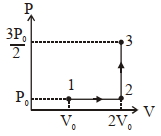
If the process carried out on one mole of monatomic ideal gas is as shown in the figure in the $PV$-diagram with $P_0 V_0 = \frac{1}{3} R T_0$,the correct match is:
$(1)$ $I \rightarrow Q, II \rightarrow R, III \rightarrow P, IV \rightarrow U$
$(2)$ $I \rightarrow S, II \rightarrow R, III \rightarrow Q, IV \rightarrow T$
$(3)$ $I \rightarrow Q, II \rightarrow R, III \rightarrow S, IV \rightarrow U$
$(4)$ $I \rightarrow Q, II \rightarrow S, III \rightarrow R, IV \rightarrow U$
If the process on one mole of monatomic ideal gas is as shown in the $TV$-diagram with $P_0 V_0 = \frac{1}{3} R T_0$,the correct match is:
$(1)$ $I \rightarrow S, II \rightarrow T, III \rightarrow Q, IV \rightarrow U$
$(2)$ $I \rightarrow P, II \rightarrow R, III \rightarrow T, IV \rightarrow S$
$(3)$ $I \rightarrow P, II \rightarrow R, III \rightarrow Q, IV \rightarrow T$
$(4)$ $I \rightarrow P, II \rightarrow R, III \rightarrow T, IV \rightarrow P$
Give the answer for question $(1)$ and $(2)$.
In a thermodynamics process on an ideal monatomic gas,the infinitesimal heat absorbed by the gas is given by $T \Delta X$,where $T$ is the temperature of the system and $\Delta X$ is the infinitesimal change in a thermodynamic quantity $X$ of the system. For a mole of monatomic ideal gas,$X = \frac{3}{2} R \ln \left(\frac{T}{T_A}\right) + R \ln \left(\frac{V}{V_A}\right)$. Here,$R$ is the gas constant,$V$ is the volume of the gas,$T_A$ and $V_A$ are constants.
The $List-I$ below gives some quantities involved in a process and $List-II$ gives some possible values of these quantities.
| List-$I$ | List-$II$ |
| $(I)$ Work done by the system in process $1 \rightarrow 2 \rightarrow 3$ | $(P)$ $\frac{1}{3} R T_0 \ln 2$ |
| $(II)$ Change in internal energy in process $1 \rightarrow 2 \rightarrow 3$ | $(Q)$ $\frac{1}{3} R T_0$ |
| $(III)$ Heat absorbed by the system in process $1 \rightarrow 2 \rightarrow 3$ | $(R)$ $R T_0$ |
| $(IV)$ Heat absorbed by the system in process $1 \rightarrow 2$ | $(S)$ $\frac{4}{3} R T_0$ |
| $(T)$ $\frac{1}{3} R T_0 (3 + \ln 2)$ | |
| $(U)$ $\frac{5}{6} R T_0$ |
If the process carried out on one mole of monatomic ideal gas is as shown in the figure in the $PV$-diagram with $P_0 V_0 = \frac{1}{3} R T_0$,the correct match is:
$(1)$ $I \rightarrow Q, II \rightarrow R, III \rightarrow P, IV \rightarrow U$
$(2)$ $I \rightarrow S, II \rightarrow R, III \rightarrow Q, IV \rightarrow T$
$(3)$ $I \rightarrow Q, II \rightarrow R, III \rightarrow S, IV \rightarrow U$
$(4)$ $I \rightarrow Q, II \rightarrow S, III \rightarrow R, IV \rightarrow U$
If the process on one mole of monatomic ideal gas is as shown in the $TV$-diagram with $P_0 V_0 = \frac{1}{3} R T_0$,the correct match is:
$(1)$ $I \rightarrow S, II \rightarrow T, III \rightarrow Q, IV \rightarrow U$
$(2)$ $I \rightarrow P, II \rightarrow R, III \rightarrow T, IV \rightarrow S$
$(3)$ $I \rightarrow P, II \rightarrow R, III \rightarrow Q, IV \rightarrow T$
$(4)$ $I \rightarrow P, II \rightarrow R, III \rightarrow T, IV \rightarrow P$
Give the answer for question $(1)$ and $(2)$.
Solution
(B) For the $PV$-diagram process:
$(I)$ Work done $W = P_0(2V_0 - V_0) = P_0 V_0 = \frac{1}{3} R T_0 \Rightarrow (Q)$.
$(II)$ $\Delta U = \frac{f}{2} n R \Delta T = \frac{3}{2} (P_3 V_3 - P_1 V_1) = \frac{3}{2} (\frac{3}{2} P_0 \cdot 2 V_0 - P_0 V_0) = \frac{3}{2} (3 P_0 V_0 - P_0 V_0) = 3 P_0 V_0 = R T_0 \Rightarrow (R)$.
$(III)$ $\Delta Q = \Delta U + W = R T_0 + \frac{1}{3} R T_0 = \frac{4}{3} R T_0 \Rightarrow (S)$.
$(IV)$ For $1 \rightarrow 2$,$\Delta Q = \Delta U + W = \frac{3}{2} (P_0 \cdot 2 V_0 - P_0 V_0) + P_0 V_0 = \frac{3}{2} P_0 V_0 + P_0 V_0 = \frac{5}{2} P_0 V_0 = \frac{5}{6} R T_0 \Rightarrow (U)$.
Thus,for $(1)$,the match is $I \rightarrow Q, II \rightarrow R, III \rightarrow S, IV \rightarrow U$,which is option $(3)$.
For the $TV$-diagram process:
$(I)$ $W = W_{1 \rightarrow 2} + W_{2 \rightarrow 3} = n R T \ln(V_2/V_1) + 0 = \frac{R T_0}{3} \ln 2 \Rightarrow (P)$.
$(II)$ $\Delta U = \frac{3}{2} R (T_3 - T_1) = \frac{3}{2} R (T_0 - T_0/3) = R T_0 \Rightarrow (R)$.
$(III)$ $\Delta Q = \Delta U + W = R T_0 + \frac{1}{3} R T_0 \ln 2 = \frac{1}{3} R T_0 (3 + \ln 2) \Rightarrow (T)$.
$(IV)$ For $1 \rightarrow 2$ (isothermal),$\Delta Q = W = \frac{1}{3} R T_0 \ln 2 \Rightarrow (P)$.
Thus,for $(2)$,the match is $I \rightarrow P, II \rightarrow R, III \rightarrow T, IV \rightarrow P$,which is option $(4)$.
$(I)$ Work done $W = P_0(2V_0 - V_0) = P_0 V_0 = \frac{1}{3} R T_0 \Rightarrow (Q)$.
$(II)$ $\Delta U = \frac{f}{2} n R \Delta T = \frac{3}{2} (P_3 V_3 - P_1 V_1) = \frac{3}{2} (\frac{3}{2} P_0 \cdot 2 V_0 - P_0 V_0) = \frac{3}{2} (3 P_0 V_0 - P_0 V_0) = 3 P_0 V_0 = R T_0 \Rightarrow (R)$.
$(III)$ $\Delta Q = \Delta U + W = R T_0 + \frac{1}{3} R T_0 = \frac{4}{3} R T_0 \Rightarrow (S)$.
$(IV)$ For $1 \rightarrow 2$,$\Delta Q = \Delta U + W = \frac{3}{2} (P_0 \cdot 2 V_0 - P_0 V_0) + P_0 V_0 = \frac{3}{2} P_0 V_0 + P_0 V_0 = \frac{5}{2} P_0 V_0 = \frac{5}{6} R T_0 \Rightarrow (U)$.
Thus,for $(1)$,the match is $I \rightarrow Q, II \rightarrow R, III \rightarrow S, IV \rightarrow U$,which is option $(3)$.
For the $TV$-diagram process:
$(I)$ $W = W_{1 \rightarrow 2} + W_{2 \rightarrow 3} = n R T \ln(V_2/V_1) + 0 = \frac{R T_0}{3} \ln 2 \Rightarrow (P)$.
$(II)$ $\Delta U = \frac{3}{2} R (T_3 - T_1) = \frac{3}{2} R (T_0 - T_0/3) = R T_0 \Rightarrow (R)$.
$(III)$ $\Delta Q = \Delta U + W = R T_0 + \frac{1}{3} R T_0 \ln 2 = \frac{1}{3} R T_0 (3 + \ln 2) \Rightarrow (T)$.
$(IV)$ For $1 \rightarrow 2$ (isothermal),$\Delta Q = W = \frac{1}{3} R T_0 \ln 2 \Rightarrow (P)$.
Thus,for $(2)$,the match is $I \rightarrow P, II \rightarrow R, III \rightarrow T, IV \rightarrow P$,which is option $(4)$.
0 likesView Solution
17
PhysicsAdvancedMCQIIT JEE · 2019
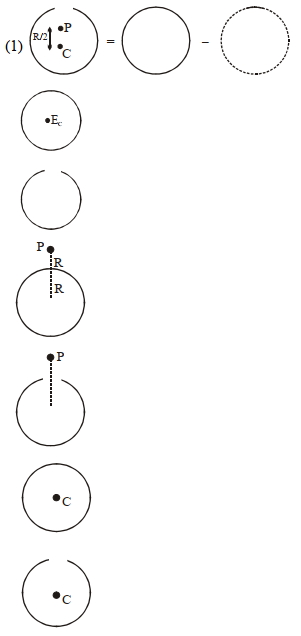
$A$ thin spherical insulating shell of radius $R$ carries a uniformly distributed charge such that the potential at its surface is $V_0$. $A$ hole with a small area $\alpha 4 \pi R^2$ (where $\alpha \ll 1$) is made on the shell without affecting the rest of the shell. Which one of the following statements is correct?
A
The ratio of the potential at the center of the shell to that of the point at $\frac{1}{2} R$ from the center towards the hole is $\frac{1-\alpha}{1-2\alpha}$.
B
The magnitude of the electric field at the center of the shell is reduced by $\frac{\alpha V_0}{2R}$.
C
The magnitude of the electric field at a point,located on a line passing through the hole and the shell's center at a distance $2R$ from the center of the spherical shell,will be reduced by $\frac{\alpha V_0}{R}$.
D
The potential at the center of the shell is reduced by $2\alpha V_0$.
Solution
(A) Let the initial charge on the sphere be $Q$. Thus,$V_0 = \frac{kQ}{R}$.
When a small hole of area $\alpha(4\pi R^2)$ is made,the charge removed is $q = \alpha Q$.
$(1)$ Potential at the center $(V_c)$ and at a point $P$ at distance $R/2$ from the center towards the hole $(V_p)$:
The potential at any point is the sum of the potential due to the complete sphere and the potential due to the removed charge element (treated as a negative point charge at the surface).
$V_c = \frac{kQ}{R} - \frac{kq}{R} = \frac{kQ}{R}(1-\alpha) = V_0(1-\alpha)$.
$V_p = \frac{kQ}{R} - \frac{kq}{R/2} = \frac{kQ}{R} - \frac{2kq}{R} = \frac{kQ}{R}(1-2\alpha) = V_0(1-2\alpha)$.
Therefore,the ratio $\frac{V_c}{V_p} = \frac{1-\alpha}{1-2\alpha}$. Thus,option $(A)$ is correct.
$(2)$ Electric field at the center $(E_c)$:
Initially,$E_c = 0$. After removing charge $q$,$E_c = \frac{kq}{R^2} = \frac{k(\alpha Q)}{R^2} = \alpha \frac{V_0}{R}$. The field increases.
$(3)$ Electric field at a point $P'$ at distance $2R$ from the center:
Initially,$E_{P'} = \frac{kQ}{(2R)^2} = \frac{kQ}{4R^2}$.
After removing charge $q$ from the surface,the field due to the hole at $P'$ is $\frac{kq}{R^2}$ (since $P'$ is at distance $R$ from the hole).
$E_{P', \text{final}} = \frac{kQ}{4R^2} - \frac{kq}{R^2} = \frac{kQ}{4R^2} - \frac{k(\alpha Q)}{R^2} = \frac{kQ}{4R^2} - \frac{4k\alpha Q}{4R^2} = \frac{kQ}{4R^2}(1-4\alpha)$.
Change in field $\Delta E = \frac{kq}{R^2} = \frac{k(\alpha Q)}{R^2} = \frac{\alpha V_0}{R}$.
When a small hole of area $\alpha(4\pi R^2)$ is made,the charge removed is $q = \alpha Q$.
$(1)$ Potential at the center $(V_c)$ and at a point $P$ at distance $R/2$ from the center towards the hole $(V_p)$:
The potential at any point is the sum of the potential due to the complete sphere and the potential due to the removed charge element (treated as a negative point charge at the surface).
$V_c = \frac{kQ}{R} - \frac{kq}{R} = \frac{kQ}{R}(1-\alpha) = V_0(1-\alpha)$.
$V_p = \frac{kQ}{R} - \frac{kq}{R/2} = \frac{kQ}{R} - \frac{2kq}{R} = \frac{kQ}{R}(1-2\alpha) = V_0(1-2\alpha)$.
Therefore,the ratio $\frac{V_c}{V_p} = \frac{1-\alpha}{1-2\alpha}$. Thus,option $(A)$ is correct.
$(2)$ Electric field at the center $(E_c)$:
Initially,$E_c = 0$. After removing charge $q$,$E_c = \frac{kq}{R^2} = \frac{k(\alpha Q)}{R^2} = \alpha \frac{V_0}{R}$. The field increases.
$(3)$ Electric field at a point $P'$ at distance $2R$ from the center:
Initially,$E_{P'} = \frac{kQ}{(2R)^2} = \frac{kQ}{4R^2}$.
After removing charge $q$ from the surface,the field due to the hole at $P'$ is $\frac{kq}{R^2}$ (since $P'$ is at distance $R$ from the hole).
$E_{P', \text{final}} = \frac{kQ}{4R^2} - \frac{kq}{R^2} = \frac{kQ}{4R^2} - \frac{k(\alpha Q)}{R^2} = \frac{kQ}{4R^2} - \frac{4k\alpha Q}{4R^2} = \frac{kQ}{4R^2}(1-4\alpha)$.
Change in field $\Delta E = \frac{kq}{R^2} = \frac{k(\alpha Q)}{R^2} = \frac{\alpha V_0}{R}$.
0 likesView Solution
18
PhysicsAdvancedMCQIIT JEE · 2019
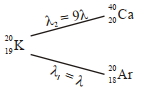
In a radioactive sample,${ }_{19}^{40} K$ nuclei decay into stable ${ }_{20}^{40} Ca$ nuclei with a decay constant of $4.5 \times 10^{-10} \text{ per year}$ or into stable ${ }_{18}^{40} Ar$ nuclei with a decay constant of $0.5 \times 10^{-10} \text{ per year}$. Given that in this sample,all the stable ${ }_{20}^{40} Ca$ and ${ }_{18}^{40} Ar$ nuclei are produced by the ${ }_{19}^{40} K$ nuclei only. In time $t \times 10^9 \text{ years}$,if the ratio of the sum of stable ${ }_{20}^{40} Ca$ and ${ }_{18}^{40} Ar$ nuclei to the radioactive ${ }_{19}^{40} K$ nuclei is $99$,the value of $t$ will be: [Given $\ln 10 = 2.3$]
A
$9.2$
B
$1.15$
C
$4.6$
D
$2.3$
Solution
(A) The total decay constant $\lambda$ is the sum of the individual decay constants for the two branches:
$\lambda = \lambda_1 + \lambda_2 = 4.5 \times 10^{-10} + 0.5 \times 10^{-10} = 5.0 \times 10^{-10} \text{ per year}$.
Let $N_0$ be the initial number of ${ }_{19}^{40} K$ nuclei and $N$ be the number of radioactive nuclei at time $t$.
The number of stable nuclei produced is $N_s = N_0 - N$.
According to the problem,the ratio of stable nuclei to radioactive nuclei is $99$:
$\frac{N_0 - N}{N} = 99 \Rightarrow \frac{N_0}{N} - 1 = 99 \Rightarrow \frac{N_0}{N} = 100$.
Using the radioactive decay law $N = N_0 e^{-\lambda t}$,we have $\frac{N}{N_0} = e^{-\lambda t} = \frac{1}{100} = 10^{-2}$.
Taking the natural logarithm on both sides:
$-\lambda t = \ln(10^{-2}) = -2 \ln 10$.
Given $\ln 10 = 2.3$,we get $\lambda t = 2 \times 2.3 = 4.6$.
Substituting $\lambda = 5 \times 10^{-10} \text{ per year}$:
$(5 \times 10^{-10}) \times t = 4.6 \Rightarrow t = \frac{4.6}{5} \times 10^{10} = 0.92 \times 10^{10} = 9.2 \times 10^9 \text{ years}$.
Thus,the value of $t$ is $9.2$.
$\lambda = \lambda_1 + \lambda_2 = 4.5 \times 10^{-10} + 0.5 \times 10^{-10} = 5.0 \times 10^{-10} \text{ per year}$.
Let $N_0$ be the initial number of ${ }_{19}^{40} K$ nuclei and $N$ be the number of radioactive nuclei at time $t$.
The number of stable nuclei produced is $N_s = N_0 - N$.
According to the problem,the ratio of stable nuclei to radioactive nuclei is $99$:
$\frac{N_0 - N}{N} = 99 \Rightarrow \frac{N_0}{N} - 1 = 99 \Rightarrow \frac{N_0}{N} = 100$.
Using the radioactive decay law $N = N_0 e^{-\lambda t}$,we have $\frac{N}{N_0} = e^{-\lambda t} = \frac{1}{100} = 10^{-2}$.
Taking the natural logarithm on both sides:
$-\lambda t = \ln(10^{-2}) = -2 \ln 10$.
Given $\ln 10 = 2.3$,we get $\lambda t = 2 \times 2.3 = 4.6$.
Substituting $\lambda = 5 \times 10^{-10} \text{ per year}$:
$(5 \times 10^{-10}) \times t = 4.6 \Rightarrow t = \frac{4.6}{5} \times 10^{10} = 0.92 \times 10^{10} = 9.2 \times 10^9 \text{ years}$.
Thus,the value of $t$ is $9.2$.
0 likesView Solution
19
PhysicsDifficultMCQIIT JEE · 2019
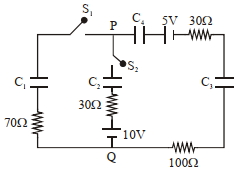
In the circuit shown,initially there is no charge on capacitors and keys $S_1$ and $S_2$ are open. The values of the capacitors are $C_1=10 \mu F$,$C_2=30 \mu F$,and $C_3=C_4=80 \mu F$.
Which of the statement$(s)$ is/are correct?
$(1)$ The key $S_1$ is kept closed for a long time such that capacitors are fully charged. Now key $S_2$ is closed. At this time,the instantaneous current across the $30 \Omega$ resistor (between points $P$ and $Q$) will be $0.2 A$.
$(2)$ If key $S_1$ is kept closed for a long time such that capacitors are fully charged,the voltage difference between points $P$ and $Q$ will be $10 V$.
$(3)$ At time $t=0$,the key $S_1$ is closed,the instantaneous current in the closed circuit will be $25 mA$.
$(4)$ If key $S_1$ is kept closed for a long time such that capacitors are fully charged,the voltage across the capacitor $C_1$ will be $4 V$.
Which of the statement$(s)$ is/are correct?
$(1)$ The key $S_1$ is kept closed for a long time such that capacitors are fully charged. Now key $S_2$ is closed. At this time,the instantaneous current across the $30 \Omega$ resistor (between points $P$ and $Q$) will be $0.2 A$.
$(2)$ If key $S_1$ is kept closed for a long time such that capacitors are fully charged,the voltage difference between points $P$ and $Q$ will be $10 V$.
$(3)$ At time $t=0$,the key $S_1$ is closed,the instantaneous current in the closed circuit will be $25 mA$.
$(4)$ If key $S_1$ is kept closed for a long time such that capacitors are fully charged,the voltage across the capacitor $C_1$ will be $4 V$.
A
$1, 2$
B
$1, 3$
C
$1, 4$
D
$3, 4$
Solution
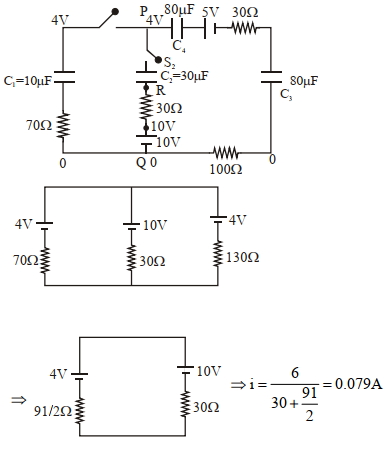
(D) For statement $(3)$: At $t=0$,capacitors act as short circuits. The circuit consists of a $5 V$ battery and total resistance $R_{eq} = 30 \Omega + 100 \Omega + 70 \Omega = 200 \Omega$. The current $i = \frac{5 V}{200 \Omega} = 0.025 A = 25 mA$. Thus,$(3)$ is correct.
For statement $(4)$: At steady state,capacitors act as open circuits. The circuit is a series loop with a $5 V$ battery and capacitors $C_1, C_4, C_3$ in series. The equivalent capacitance $C_{eq} = (1/10 + 1/80 + 1/80)^{-1} = (8/80 + 1/80 + 1/80)^{-1} = 80/10 = 8 \mu F$. The charge $Q = C_{eq} V = 8 \mu F \times 5 V = 40 \mu C$. The voltage across $C_1$ is $V_1 = Q/C_1 = 40 \mu C / 10 \mu F = 4 V$. Thus,$(4)$ is correct.
For statement $(1)$: After $S_1$ is closed for a long time,$V_P - V_Q = 4 V$ (potential across $C_1$). When $S_2$ is closed,we analyze the circuit using Kirchhoff's laws. The equivalent resistance and voltage sources lead to an instantaneous current of approximately $0.079 A$,not $0.2 A$. Thus,$(1)$ is incorrect.
For statement $(2)$: As calculated above,the potential difference between $P$ and $Q$ is $4 V$,not $10 V$. Thus,$(2)$ is incorrect.
Therefore,statements $(3)$ and $(4)$ are correct.
For statement $(4)$: At steady state,capacitors act as open circuits. The circuit is a series loop with a $5 V$ battery and capacitors $C_1, C_4, C_3$ in series. The equivalent capacitance $C_{eq} = (1/10 + 1/80 + 1/80)^{-1} = (8/80 + 1/80 + 1/80)^{-1} = 80/10 = 8 \mu F$. The charge $Q = C_{eq} V = 8 \mu F \times 5 V = 40 \mu C$. The voltage across $C_1$ is $V_1 = Q/C_1 = 40 \mu C / 10 \mu F = 4 V$. Thus,$(4)$ is correct.
For statement $(1)$: After $S_1$ is closed for a long time,$V_P - V_Q = 4 V$ (potential across $C_1$). When $S_2$ is closed,we analyze the circuit using Kirchhoff's laws. The equivalent resistance and voltage sources lead to an instantaneous current of approximately $0.079 A$,not $0.2 A$. Thus,$(1)$ is incorrect.
For statement $(2)$: As calculated above,the potential difference between $P$ and $Q$ is $4 V$,not $10 V$. Thus,$(2)$ is incorrect.
Therefore,statements $(3)$ and $(4)$ are correct.
0 likesView Solution
20
PhysicsDifficultMCQIIT JEE · 2019
$A$ thin convex lens is made of two materials with refractive indices $n_1$ and $n_2$,as shown in the figure. The radii of curvature of the left and right spherical surfaces are equal. $f$ is the focal length of the lens when $n_1 = n_2 = n$. The focal length is $f + \Delta f$ when $n_1 = n$ and $n_2 = n + \Delta n$. Assuming $\Delta n \ll (n - 1)$ and $1 < n < 2$,which of the following statement$(s)$ is/are correct?
$(1)$ The relation between $\frac{\Delta f}{f}$ and $\frac{\Delta n}{n}$ remains unchanged if both the convex surfaces are replaced by concave surfaces of the same radius of curvature.
$(2)$ $\left|\frac{\Delta f}{f}\right| < \left|\frac{\Delta n}{n}\right|$
$(3)$ For $n = 1.5, \Delta n = 10^{-3}$ and $f = 20 \text{ cm}$,the value of $|\Delta f|$ will be $0.04 \text{ cm}$.
$(4)$ If $\frac{\Delta n}{n} < 0$ then $\frac{\Delta f}{f} > 0$.
$(1)$ The relation between $\frac{\Delta f}{f}$ and $\frac{\Delta n}{n}$ remains unchanged if both the convex surfaces are replaced by concave surfaces of the same radius of curvature.
$(2)$ $\left|\frac{\Delta f}{f}\right| < \left|\frac{\Delta n}{n}\right|$
$(3)$ For $n = 1.5, \Delta n = 10^{-3}$ and $f = 20 \text{ cm}$,the value of $|\Delta f|$ will be $0.04 \text{ cm}$.
$(4)$ If $\frac{\Delta n}{n} < 0$ then $\frac{\Delta f}{f} > 0$.
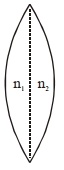
A
$1, 2, 3$
B
$1, 2, 4$
C
$1, 3, 4$
D
$1, 4$
Solution
(D) When $n_1 = n_2 = n$,the lens acts as a single convex lens with focal length $f$ given by the Lens Maker's Formula:
$\frac{1}{f} = (n - 1) \left( \frac{1}{R} - \frac{1}{-R} \right) = (n - 1) \frac{2}{R} \implies f = \frac{R}{2(n - 1)}$.
In the second case,the lens is composed of two plano-convex lenses in contact. The focal lengths are:
$\frac{1}{f_1} = \frac{n - 1}{R}$ and $\frac{1}{f_2} = \frac{(n + \Delta n) - 1}{R}$.
The equivalent focal length $f' = f + \Delta f$ is given by:
$\frac{1}{f + \Delta f} = \frac{1}{f_1} + \frac{1}{f_2} = \frac{n - 1 + n + \Delta n - 1}{R} = \frac{2n + \Delta n - 2}{R} = \frac{2(n - 1) + \Delta n}{R}$.
Since $f = \frac{R}{2(n - 1)}$,we have $\frac{1}{f} = \frac{2(n - 1)}{R}$.
$\frac{1}{f + \Delta f} = \frac{1}{f} + \frac{\Delta n}{R} = \frac{1}{f} \left( 1 + \frac{\Delta n}{R} \cdot f \right) = \frac{1}{f} \left( 1 + \frac{\Delta n}{R} \cdot \frac{R}{2(n - 1)} \right) = \frac{1}{f} \left( 1 + \frac{\Delta n}{2(n - 1)} \right)$.
Using the binomial approximation $(1 + x)^{-1} \approx 1 - x$ for small $x$:
$\frac{1}{f + \Delta f} \approx \frac{1}{f} \left( 1 - \frac{\Delta n}{2(n - 1)} \right) \implies f + \Delta f \approx f \left( 1 - \frac{\Delta n}{2(n - 1)} \right) = f - f \frac{\Delta n}{2(n - 1)}$.
Thus,$\frac{\Delta f}{f} = -\frac{\Delta n}{2(n - 1)}$.
$(1)$ The relation $\frac{\Delta f}{f} = -\frac{\Delta n}{2(n - 1)}$ is independent of $R$,so it holds for concave surfaces as well. Correct.
$(2)$ Since $1 < n < 2$,then $n - 1 < 1$,so $2(n - 1) < 2$. Thus,$\left| \frac{\Delta f}{f} \right| = \frac{1}{2(n - 1)} \left| \frac{\Delta n}{n} \right| \cdot n = \frac{n}{2(n - 1)} \left| \frac{\Delta n}{n} \right|$. Since $\frac{n}{2(n - 1)} > 1$ for $n < 2$,$\left| \frac{\Delta f}{f} \right| > \left| \frac{\Delta n}{n} \right|$. Incorrect.
$(3)$ $|\Delta f| = f \cdot \frac{\Delta n}{2(n - 1)} = 20 \cdot \frac{10^{-3}}{2(1.5 - 1)} = 20 \cdot \frac{10^{-3}}{1} = 0.02 \text{ cm}$. The statement says $0.04 \text{ cm}$. Incorrect.
$(4)$ If $\frac{\Delta n}{n} < 0$,then $\Delta n < 0$. From $\frac{\Delta f}{f} = -\frac{\Delta n}{2(n - 1)}$,if $\Delta n < 0$,then $\frac{\Delta f}{f} > 0$. Correct.
$\frac{1}{f} = (n - 1) \left( \frac{1}{R} - \frac{1}{-R} \right) = (n - 1) \frac{2}{R} \implies f = \frac{R}{2(n - 1)}$.
In the second case,the lens is composed of two plano-convex lenses in contact. The focal lengths are:
$\frac{1}{f_1} = \frac{n - 1}{R}$ and $\frac{1}{f_2} = \frac{(n + \Delta n) - 1}{R}$.
The equivalent focal length $f' = f + \Delta f$ is given by:
$\frac{1}{f + \Delta f} = \frac{1}{f_1} + \frac{1}{f_2} = \frac{n - 1 + n + \Delta n - 1}{R} = \frac{2n + \Delta n - 2}{R} = \frac{2(n - 1) + \Delta n}{R}$.
Since $f = \frac{R}{2(n - 1)}$,we have $\frac{1}{f} = \frac{2(n - 1)}{R}$.
$\frac{1}{f + \Delta f} = \frac{1}{f} + \frac{\Delta n}{R} = \frac{1}{f} \left( 1 + \frac{\Delta n}{R} \cdot f \right) = \frac{1}{f} \left( 1 + \frac{\Delta n}{R} \cdot \frac{R}{2(n - 1)} \right) = \frac{1}{f} \left( 1 + \frac{\Delta n}{2(n - 1)} \right)$.
Using the binomial approximation $(1 + x)^{-1} \approx 1 - x$ for small $x$:
$\frac{1}{f + \Delta f} \approx \frac{1}{f} \left( 1 - \frac{\Delta n}{2(n - 1)} \right) \implies f + \Delta f \approx f \left( 1 - \frac{\Delta n}{2(n - 1)} \right) = f - f \frac{\Delta n}{2(n - 1)}$.
Thus,$\frac{\Delta f}{f} = -\frac{\Delta n}{2(n - 1)}$.
$(1)$ The relation $\frac{\Delta f}{f} = -\frac{\Delta n}{2(n - 1)}$ is independent of $R$,so it holds for concave surfaces as well. Correct.
$(2)$ Since $1 < n < 2$,then $n - 1 < 1$,so $2(n - 1) < 2$. Thus,$\left| \frac{\Delta f}{f} \right| = \frac{1}{2(n - 1)} \left| \frac{\Delta n}{n} \right| \cdot n = \frac{n}{2(n - 1)} \left| \frac{\Delta n}{n} \right|$. Since $\frac{n}{2(n - 1)} > 1$ for $n < 2$,$\left| \frac{\Delta f}{f} \right| > \left| \frac{\Delta n}{n} \right|$. Incorrect.
$(3)$ $|\Delta f| = f \cdot \frac{\Delta n}{2(n - 1)} = 20 \cdot \frac{10^{-3}}{2(1.5 - 1)} = 20 \cdot \frac{10^{-3}}{1} = 0.02 \text{ cm}$. The statement says $0.04 \text{ cm}$. Incorrect.
$(4)$ If $\frac{\Delta n}{n} < 0$,then $\Delta n < 0$. From $\frac{\Delta f}{f} = -\frac{\Delta n}{2(n - 1)}$,if $\Delta n < 0$,then $\frac{\Delta f}{f} > 0$. Correct.
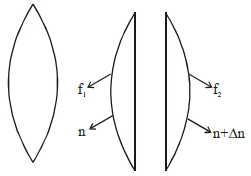
0 likesView Solution
21
PhysicsMediumMCQIIT JEE · 2019
Two identical moving coil galvanometers have $10 \Omega$ resistance and full scale deflection at $2 \mu A$ current. One of them is converted into a voltmeter of $100 \text{ mV}$ full scale reading and the other into an ammeter of $1 \text{ mA}$ full scale current using appropriate resistors. These are then used to measure the voltage and current in the Ohm's law experiment with $R = 1000 \Omega$ resistor by using an ideal cell. Which of the following statement$(s)$ is/are correct?
$(1)$ The measured value of $R$ will be $980.2 \Omega$.
$(2)$ The resistance of the voltmeter will be $50 \text{ k} \Omega$.
$(3)$ The resistance of the ammeter will be $0.02 \Omega$ (rounded off to the $2^{\text{nd}}$ decimal place).
$(4)$ If the ideal cell is replaced by a cell having internal resistance of $5 \Omega$,then the measured value of $R$ will be more than $1000 \Omega$.
$(1)$ The measured value of $R$ will be $980.2 \Omega$.
$(2)$ The resistance of the voltmeter will be $50 \text{ k} \Omega$.
$(3)$ The resistance of the ammeter will be $0.02 \Omega$ (rounded off to the $2^{\text{nd}}$ decimal place).
$(4)$ If the ideal cell is replaced by a cell having internal resistance of $5 \Omega$,then the measured value of $R$ will be more than $1000 \Omega$.
A
$1, 2$
B
$1, 4$
C
$2, 3$
D
$1, 3$
Solution
(C) $1$. Voltmeter conversion: $V = I_g(R_g + R_v) \implies 0.1 = 2 \times 10^{-6} (10 + R_v) \implies 50000 = 10 + R_v \implies R_v = 49990 \Omega \approx 50 \text{ k} \Omega$. Statement $(2)$ is correct.
$2$. Ammeter conversion: $I_g R_g = (I - I_g) R_s \implies 2 \times 10^{-6} \times 10 = (10^{-3} - 2 \times 10^{-6}) R_s \implies 2 \times 10^{-5} = 0.998 \times 10^{-3} R_s \implies R_s \approx 0.02004 \Omega$. The total resistance of the ammeter is $R_A = \frac{R_g R_s}{R_g + R_s} \approx R_s \approx 0.02 \Omega$. Statement $(3)$ is correct.
$3$. Measured resistance: The voltmeter is in parallel with $R = 1000 \Omega$. The equivalent resistance is $R_{eq} = \frac{R \times R_v}{R + R_v} = \frac{1000 \times 50000}{1000 + 50000} = \frac{50000}{51} \approx 980.39 \Omega$. Statement $(1)$ is incorrect.
$4$. Internal resistance: Adding internal resistance $r = 5 \Omega$ in series with the circuit reduces the total current $x$ flowing through the ammeter,but the measured value of $R$ is determined by the ratio of voltage across the voltmeter to the current through the resistor $R$. Since the voltmeter is in parallel with $R$,the measured resistance remains $R_{eq} \approx 980.39 \Omega$,which is independent of the internal resistance of the cell. Statement $(4)$ is incorrect.
Thus,statements $(2)$ and $(3)$ are correct.
$2$. Ammeter conversion: $I_g R_g = (I - I_g) R_s \implies 2 \times 10^{-6} \times 10 = (10^{-3} - 2 \times 10^{-6}) R_s \implies 2 \times 10^{-5} = 0.998 \times 10^{-3} R_s \implies R_s \approx 0.02004 \Omega$. The total resistance of the ammeter is $R_A = \frac{R_g R_s}{R_g + R_s} \approx R_s \approx 0.02 \Omega$. Statement $(3)$ is correct.
$3$. Measured resistance: The voltmeter is in parallel with $R = 1000 \Omega$. The equivalent resistance is $R_{eq} = \frac{R \times R_v}{R + R_v} = \frac{1000 \times 50000}{1000 + 50000} = \frac{50000}{51} \approx 980.39 \Omega$. Statement $(1)$ is incorrect.
$4$. Internal resistance: Adding internal resistance $r = 5 \Omega$ in series with the circuit reduces the total current $x$ flowing through the ammeter,but the measured value of $R$ is determined by the ratio of voltage across the voltmeter to the current through the resistor $R$. Since the voltmeter is in parallel with $R$,the measured resistance remains $R_{eq} \approx 980.39 \Omega$,which is independent of the internal resistance of the cell. Statement $(4)$ is incorrect.
Thus,statements $(2)$ and $(3)$ are correct.
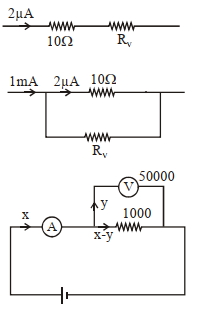
0 likesView Solution
22
PhysicsAdvancedMCQIIT JEE · 2019
$A$ charged shell of radius $R$ carries a total charge $Q$. Let $\Phi$ be the flux of the electric field through a closed cylindrical surface of height $h$,radius $r$,with its center coinciding with that of the shell. The center of the cylinder is a point on the axis of the cylinder equidistant from its top and bottom surfaces. Which of the following option$(s)$ is/are correct? [$\epsilon_0$ is the permittivity of free space]
$(1)$ If $h > 2R$ and $r > R$,then $\Phi = \frac{Q}{\epsilon_0}$
$(2)$ If $h < \frac{8R}{5}$ and $r = \frac{3R}{5}$,then $\Phi = 0$
$(3)$ If $h > 2R$ and $r = \frac{4R}{5}$,then $\Phi = \frac{2Q}{5\epsilon_0}$
$(4)$ If $h > 2R$ and $r = \frac{3R}{5}$,then $\Phi = \frac{Q}{5\epsilon_0}$
$(1)$ If $h > 2R$ and $r > R$,then $\Phi = \frac{Q}{\epsilon_0}$
$(2)$ If $h < \frac{8R}{5}$ and $r = \frac{3R}{5}$,then $\Phi = 0$
$(3)$ If $h > 2R$ and $r = \frac{4R}{5}$,then $\Phi = \frac{2Q}{5\epsilon_0}$
$(4)$ If $h > 2R$ and $r = \frac{3R}{5}$,then $\Phi = \frac{Q}{5\epsilon_0}$
A
$1, 2, 3$
B
$1, 2, 4$
C
$1, 2$
D
$1, 3, 4$
Solution
(A-D) According to Gauss's Law,the flux $\Phi$ through a closed surface is $\frac{q_{enclosed}}{\epsilon_0}$.
$(1)$ If $h > 2R$ and $r > R$,the entire shell is enclosed by the cylinder. Thus,$q_{enclosed} = Q$ and $\Phi = \frac{Q}{\epsilon_0}$. This is correct.
$(2)$ If $h < \frac{8R}{5}$ and $r = \frac{3R}{5}$,the cylinder is entirely inside the shell. Since the electric field inside a charged shell is zero,the flux through the cylinder is $\Phi = 0$. This is correct.
$(3)$ If $h > 2R$ and $r = \frac{4R}{5}$,the cylinder intersects the shell. The flux is due to the charge on the spherical caps cut by the cylinder. The solid angle subtended by a cap is $\Omega = 2\pi(1 - \cos\theta)$,where $\sin\theta = \frac{r}{R} = \frac{4}{5}$,so $\cos\theta = \frac{3}{5}$. The flux through one cap is $\frac{Q}{4\pi\epsilon_0} \times \Omega = \frac{Q}{2\epsilon_0}(1 - \cos\theta)$. For two caps,$\Phi = \frac{Q}{\epsilon_0}(1 - \frac{3}{5}) = \frac{2Q}{5\epsilon_0}$. This is correct.
$(4)$ If $h > 2R$ and $r = \frac{3R}{5}$,then $\sin\theta = \frac{3}{5}$,so $\cos\theta = \frac{4}{5}$. The flux is $\Phi = \frac{Q}{\epsilon_0}(1 - \frac{4}{5}) = \frac{Q}{5\epsilon_0}$. This is correct.
$(1)$ If $h > 2R$ and $r > R$,the entire shell is enclosed by the cylinder. Thus,$q_{enclosed} = Q$ and $\Phi = \frac{Q}{\epsilon_0}$. This is correct.
$(2)$ If $h < \frac{8R}{5}$ and $r = \frac{3R}{5}$,the cylinder is entirely inside the shell. Since the electric field inside a charged shell is zero,the flux through the cylinder is $\Phi = 0$. This is correct.
$(3)$ If $h > 2R$ and $r = \frac{4R}{5}$,the cylinder intersects the shell. The flux is due to the charge on the spherical caps cut by the cylinder. The solid angle subtended by a cap is $\Omega = 2\pi(1 - \cos\theta)$,where $\sin\theta = \frac{r}{R} = \frac{4}{5}$,so $\cos\theta = \frac{3}{5}$. The flux through one cap is $\frac{Q}{4\pi\epsilon_0} \times \Omega = \frac{Q}{2\epsilon_0}(1 - \cos\theta)$. For two caps,$\Phi = \frac{Q}{\epsilon_0}(1 - \frac{3}{5}) = \frac{2Q}{5\epsilon_0}$. This is correct.
$(4)$ If $h > 2R$ and $r = \frac{3R}{5}$,then $\sin\theta = \frac{3}{5}$,so $\cos\theta = \frac{4}{5}$. The flux is $\Phi = \frac{Q}{\epsilon_0}(1 - \frac{4}{5}) = \frac{Q}{5\epsilon_0}$. This is correct.
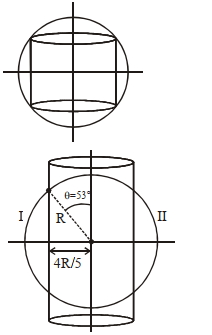
0 likesView Solution
23
PhysicsMediumMCQIIT JEE · 2019
$A$ conducting wire of parabolic shape,initially $y=x^2$,is moving with velocity $\vec{V} = V_0 \hat{i}$ in a non-uniform magnetic field $\vec{B} = B_0 \left(1 + \left(\frac{y}{L}\right)^\beta\right) \hat{k}$,as shown in the figure. If $V_0, B_0, L$ and $\beta$ are positive constants and $\Delta \phi$ is the potential difference developed between the ends of the wire,then the correct statement$(s)$ is/are:
$(1)$ $|\Delta \phi|$ remains the same if the parabolic wire is replaced by a straight wire,$y=x$ initially,of length $\sqrt{2} L$.
$(2)$ $|\Delta \phi|$ is proportional to the length of the wire projected on the $y$-axis.
$(3)$ $|\Delta \phi| = \frac{1}{2} B_0 V_0 L$ for $\beta = 0$.
$(4)$ $|\Delta \phi| = \frac{4}{3} B_0 V_0 L$ for $\beta = 2$.
$(1)$ $|\Delta \phi|$ remains the same if the parabolic wire is replaced by a straight wire,$y=x$ initially,of length $\sqrt{2} L$.
$(2)$ $|\Delta \phi|$ is proportional to the length of the wire projected on the $y$-axis.
$(3)$ $|\Delta \phi| = \frac{1}{2} B_0 V_0 L$ for $\beta = 0$.
$(4)$ $|\Delta \phi| = \frac{4}{3} B_0 V_0 L$ for $\beta = 2$.
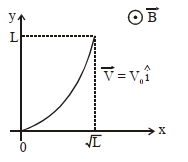
A
$1, 2, 3$
B
$1, 2$
C
$1, 2, 4$
D
$1, 3$
Solution
(C) The motional electromotive force $(EMF)$ induced in a small element $dy$ of the wire moving with velocity $\vec{V} = V_0 \hat{i}$ in a magnetic field $\vec{B} = B(y) \hat{k}$ is given by $d\phi = |(\vec{V} \times \vec{B}) \cdot d\vec{l}|$. Since $\vec{V} = V_0 \hat{i}$ and $\vec{B} = B(y) \hat{k}$,the cross product $\vec{V} \times \vec{B} = V_0 B(y) (\hat{i} \times \hat{k}) = -V_0 B(y) \hat{j}$.
The potential difference between the ends of the wire is $\Delta \phi = \int_0^L V_0 B(y) dy$.
Substituting $B(y) = B_0 \left(1 + \left(\frac{y}{L}\right)^\beta\right)$:
$\Delta \phi = \int_0^L V_0 B_0 \left(1 + \frac{y^\beta}{L^\beta}\right) dy = V_0 B_0 \left[ y + \frac{y^{\beta+1}}{L^\beta (\beta+1)} \right]_0^L = V_0 B_0 \left( L + \frac{L}{\beta+1} \right) = V_0 B_0 L \left( 1 + \frac{1}{\beta+1} \right)$.
$(1)$ The integral depends only on the range of $y$ (from $0$ to $L$). Thus,replacing the wire with any shape that spans the same $y$-range results in the same $\Delta \phi$. Statement $(1)$ is correct.
$(2)$ Since $\Delta \phi = V_0 B_0 L \left( \frac{\beta+2}{\beta+1} \right)$,it is proportional to $L$ (the projection on the $y$-axis). Statement $(2)$ is correct.
$(3)$ For $\beta = 0$,$\Delta \phi = V_0 B_0 L (1 + 1) = 2 V_0 B_0 L$. Statement $(3)$ is incorrect.
$(4)$ For $\beta = 2$,$\Delta \phi = V_0 B_0 L (1 + 1/3) = \frac{4}{3} V_0 B_0 L$. Statement $(4)$ is correct.
Therefore,the correct statements are $(1), (2),$ and $(4)$.
The potential difference between the ends of the wire is $\Delta \phi = \int_0^L V_0 B(y) dy$.
Substituting $B(y) = B_0 \left(1 + \left(\frac{y}{L}\right)^\beta\right)$:
$\Delta \phi = \int_0^L V_0 B_0 \left(1 + \frac{y^\beta}{L^\beta}\right) dy = V_0 B_0 \left[ y + \frac{y^{\beta+1}}{L^\beta (\beta+1)} \right]_0^L = V_0 B_0 \left( L + \frac{L}{\beta+1} \right) = V_0 B_0 L \left( 1 + \frac{1}{\beta+1} \right)$.
$(1)$ The integral depends only on the range of $y$ (from $0$ to $L$). Thus,replacing the wire with any shape that spans the same $y$-range results in the same $\Delta \phi$. Statement $(1)$ is correct.
$(2)$ Since $\Delta \phi = V_0 B_0 L \left( \frac{\beta+2}{\beta+1} \right)$,it is proportional to $L$ (the projection on the $y$-axis). Statement $(2)$ is correct.
$(3)$ For $\beta = 0$,$\Delta \phi = V_0 B_0 L (1 + 1) = 2 V_0 B_0 L$. Statement $(3)$ is incorrect.
$(4)$ For $\beta = 2$,$\Delta \phi = V_0 B_0 L (1 + 1/3) = \frac{4}{3} V_0 B_0 L$. Statement $(4)$ is correct.
Therefore,the correct statements are $(1), (2),$ and $(4)$.
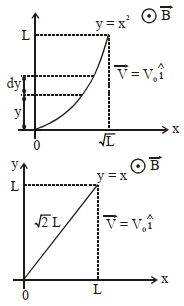
0 likesView Solution
24
PhysicsAdvancedMCQIIT JEE · 2019
$A$ planar structure of length $L$ and width $W$ is made of two different optical media of refractive indices $n_1=1.5$ and $n_2=1.44$ as shown in the figure. If $L \gg W$,a ray entering from end $AB$ will emerge from end $CD$ only if the total internal reflection condition is met inside the structure. For $L = 9.6 \ m$,if the incident angle $\theta$ is varied,the maximum time taken by a ray to exit the plane $CD$ is $t \times 10^{-9} \ s$,where $t$ is. . . . . . . [Speed of light $c = 3 \times 10^8 \ m/s$]
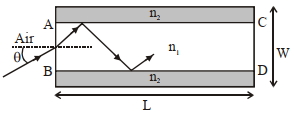
A
$51$
B
$50$
C
$55$
D
$60$
Solution
(B) For the maximum time,the ray of light must undergo $TIR$ at all surfaces at the minimum possible angle,which is the critical angle $\theta_c$.
For $TIR$,the condition is $n_1 \sin \theta_c = n_2$.
$\sin \theta_c = \frac{n_2}{n_1} = \frac{1.44}{1.5} = 0.96$.
The speed of light in the medium $n_1$ is $v = \frac{c}{n_1} = \frac{3 \times 10^8}{1.5} = 2 \times 10^8 \ m/s$.
Let the total path length of the ray inside the structure be $D$. The horizontal length is $L$. The angle the ray makes with the normal to the surface is $\theta_c$. Therefore,the horizontal component of the path is $D \sin \theta_c = L$.
Thus,$D = \frac{L}{\sin \theta_c}$.
The time taken is $t_{total} = \frac{D}{v} = \frac{L}{v \sin \theta_c} = \frac{9.6}{(2 \times 10^8) \times 0.96} = \frac{9.6}{1.92 \times 10^8} = 5 \times 10^{-8} \ s = 50 \times 10^{-9} \ s$.
Therefore,$t = 50$.
For $TIR$,the condition is $n_1 \sin \theta_c = n_2$.
$\sin \theta_c = \frac{n_2}{n_1} = \frac{1.44}{1.5} = 0.96$.
The speed of light in the medium $n_1$ is $v = \frac{c}{n_1} = \frac{3 \times 10^8}{1.5} = 2 \times 10^8 \ m/s$.
Let the total path length of the ray inside the structure be $D$. The horizontal length is $L$. The angle the ray makes with the normal to the surface is $\theta_c$. Therefore,the horizontal component of the path is $D \sin \theta_c = L$.
Thus,$D = \frac{L}{\sin \theta_c}$.
The time taken is $t_{total} = \frac{D}{v} = \frac{L}{v \sin \theta_c} = \frac{9.6}{(2 \times 10^8) \times 0.96} = \frac{9.6}{1.92 \times 10^8} = 5 \times 10^{-8} \ s = 50 \times 10^{-9} \ s$.
Therefore,$t = 50$.
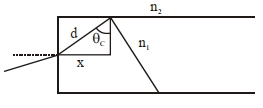
0 likesView Solution
25
PhysicsAdvancedMCQIIT JEE · 2019
$A$ parallel plate capacitor of capacitance $C$ has spacing $d$ between two plates having area $A$. The region between the plates is filled with $N$ dielectric layers,parallel to its plates,each with thickness $\delta = \frac{d}{N}$. The dielectric constant of the $m^{\text{th}}$ layer is $K_m = K(1 + \frac{m}{N})$. For a very large $N (> 10^3)$,the capacitance $C$ is $\alpha \left( \frac{K \varepsilon_0 A}{d \ln 2} \right)$. The value of $\alpha$ will be. . . . . . . .
[$\varepsilon_0$ is the permittivity of free space]
[$\varepsilon_0$ is the permittivity of free space]
A
$1$
B
$3$
C
$5$
D
$6$
Solution
(A) The capacitor is equivalent to a series combination of $N$ capacitors,each of thickness $\delta = dx = \frac{d}{N}$.
For a large $N$,we can treat this as a continuous variation where $\frac{m}{N} = \frac{x}{d}$.
The dielectric constant varies as $K(x) = K(1 + \frac{x}{d})$.
The equivalent capacitance $C_{eq}$ for capacitors in series is given by $\frac{1}{C_{eq}} = \int \frac{dx}{C(x)}$,where $C(x) = \frac{K(x) \varepsilon_0 A}{dx}$.
Substituting the values: $\frac{1}{C_{eq}} = \int_0^d \frac{dx}{\frac{K(1 + x/d) \varepsilon_0 A}{dx}} = \frac{1}{K \varepsilon_0 A} \int_0^d \frac{dx}{1 + x/d}$.
Let $u = 1 + \frac{x}{d}$,then $du = \frac{dx}{d}$,so $dx = d \cdot du$.
$\frac{1}{C_{eq}} = \frac{d}{K \varepsilon_0 A} \int_1^2 \frac{du}{u} = \frac{d}{K \varepsilon_0 A} [\ln u]_1^2 = \frac{d}{K \varepsilon_0 A} \ln 2$.
Thus,$C_{eq} = \frac{K \varepsilon_0 A}{d \ln 2}$.
Comparing this with the given expression $C = \alpha \left( \frac{K \varepsilon_0 A}{d \ln 2} \right)$,we get $\alpha = 1$.
For a large $N$,we can treat this as a continuous variation where $\frac{m}{N} = \frac{x}{d}$.
The dielectric constant varies as $K(x) = K(1 + \frac{x}{d})$.
The equivalent capacitance $C_{eq}$ for capacitors in series is given by $\frac{1}{C_{eq}} = \int \frac{dx}{C(x)}$,where $C(x) = \frac{K(x) \varepsilon_0 A}{dx}$.
Substituting the values: $\frac{1}{C_{eq}} = \int_0^d \frac{dx}{\frac{K(1 + x/d) \varepsilon_0 A}{dx}} = \frac{1}{K \varepsilon_0 A} \int_0^d \frac{dx}{1 + x/d}$.
Let $u = 1 + \frac{x}{d}$,then $du = \frac{dx}{d}$,so $dx = d \cdot du$.
$\frac{1}{C_{eq}} = \frac{d}{K \varepsilon_0 A} \int_1^2 \frac{du}{u} = \frac{d}{K \varepsilon_0 A} [\ln u]_1^2 = \frac{d}{K \varepsilon_0 A} \ln 2$.
Thus,$C_{eq} = \frac{K \varepsilon_0 A}{d \ln 2}$.
Comparing this with the given expression $C = \alpha \left( \frac{K \varepsilon_0 A}{d \ln 2} \right)$,we get $\alpha = 1$.
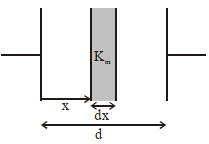
0 likesView Solution
26
PhysicsMediumMCQIIT JEE · 2019
An electric dipole with dipole moment $\vec{p} = \frac{p_0}{\sqrt{2}}(\hat{i}+\hat{j})$ is held fixed at the origin $O$ in the presence of a uniform electric field $\vec{E} = E_0 \hat{i}$. If the potential is constant on a circle of radius $R$ centered at the origin as shown in the figure,then the correct statement$(s)$ is/are:
($\varepsilon_0$ is the permittivity of free space,$R \gg$ dipole size)
$(1)$ $R = \left(\frac{p_0}{4 \pi \varepsilon_0 E_0}\right)^{1/3}$
$(2)$ The magnitude of the total electric field on any two points of the circle will be the same.
$(3)$ The total electric field at point $A$ is $\vec{E}_A = \sqrt{2} E_0(\hat{i}+\hat{j})$
$(4)$ The total electric field at point $B$ is $\vec{E}_B = 0$
($\varepsilon_0$ is the permittivity of free space,$R \gg$ dipole size)
$(1)$ $R = \left(\frac{p_0}{4 \pi \varepsilon_0 E_0}\right)^{1/3}$
$(2)$ The magnitude of the total electric field on any two points of the circle will be the same.
$(3)$ The total electric field at point $A$ is $\vec{E}_A = \sqrt{2} E_0(\hat{i}+\hat{j})$
$(4)$ The total electric field at point $B$ is $\vec{E}_B = 0$
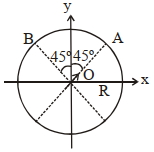
A
$1, 2$
B
$1, 3$
C
$1, 4$
D
$2, 3$
Solution
(C) The potential $V$ at a point $(r, \theta)$ due to a dipole $\vec{p}$ is $V_{dip} = \frac{k \vec{p} \cdot \hat{r}}{r^2}$. In a uniform field $\vec{E} = E_0 \hat{i}$,the potential is $V_{ext} = -E_0 x = -E_0 r \cos \theta$.
For the circle to be equipotential,the total potential $V = V_{dip} + V_{ext}$ must be independent of $\theta$.
Given $\vec{p} = \frac{p_0}{\sqrt{2}}(\hat{i}+\hat{j})$,in polar coordinates,$\vec{p} = p_0(\cos 45^\circ \hat{i} + \sin 45^\circ \hat{j})$.
The potential at distance $R$ is $V = \frac{k p_0 \cos(\theta - 45^\circ)}{R^2} - E_0 R \cos \theta$.
Expanding $\cos(\theta - 45^\circ) = \cos \theta \cos 45^\circ + \sin \theta \sin 45^\circ = \frac{1}{\sqrt{2}}(\cos \theta + \sin \theta)$.
$V = \frac{k p_0}{R^2 \sqrt{2}}(\cos \theta + \sin \theta) - E_0 R \cos \theta = \left(\frac{k p_0}{R^2 \sqrt{2}} - E_0 R\right) \cos \theta + \left(\frac{k p_0}{R^2 \sqrt{2}}\right) \sin \theta$.
For $V$ to be constant,the coefficients of $\cos \theta$ and $\sin \theta$ must be zero,which is not possible for all $\theta$. However,the problem implies the circle is an equipotential surface where the tangential component of the net electric field is zero.
At point $B$ (at $135^\circ$),the tangential component of the dipole field cancels the tangential component of the uniform field. This leads to $R = \left(\frac{p_0}{4 \pi \varepsilon_0 E_0}\right)^{1/3}$. Thus,statement $(1)$ is correct.
Since the net field is the vector sum of a uniform field and a non-uniform dipole field,the magnitude varies along the circle. Thus,$(2)$ is incorrect.
At point $B$,the radial and tangential components cancel out,resulting in $\vec{E}_B = 0$. Thus,$(4)$ is correct.
For the circle to be equipotential,the total potential $V = V_{dip} + V_{ext}$ must be independent of $\theta$.
Given $\vec{p} = \frac{p_0}{\sqrt{2}}(\hat{i}+\hat{j})$,in polar coordinates,$\vec{p} = p_0(\cos 45^\circ \hat{i} + \sin 45^\circ \hat{j})$.
The potential at distance $R$ is $V = \frac{k p_0 \cos(\theta - 45^\circ)}{R^2} - E_0 R \cos \theta$.
Expanding $\cos(\theta - 45^\circ) = \cos \theta \cos 45^\circ + \sin \theta \sin 45^\circ = \frac{1}{\sqrt{2}}(\cos \theta + \sin \theta)$.
$V = \frac{k p_0}{R^2 \sqrt{2}}(\cos \theta + \sin \theta) - E_0 R \cos \theta = \left(\frac{k p_0}{R^2 \sqrt{2}} - E_0 R\right) \cos \theta + \left(\frac{k p_0}{R^2 \sqrt{2}}\right) \sin \theta$.
For $V$ to be constant,the coefficients of $\cos \theta$ and $\sin \theta$ must be zero,which is not possible for all $\theta$. However,the problem implies the circle is an equipotential surface where the tangential component of the net electric field is zero.
At point $B$ (at $135^\circ$),the tangential component of the dipole field cancels the tangential component of the uniform field. This leads to $R = \left(\frac{p_0}{4 \pi \varepsilon_0 E_0}\right)^{1/3}$. Thus,statement $(1)$ is correct.
Since the net field is the vector sum of a uniform field and a non-uniform dipole field,the magnitude varies along the circle. Thus,$(2)$ is incorrect.
At point $B$,the radial and tangential components cancel out,resulting in $\vec{E}_B = 0$. Thus,$(4)$ is correct.
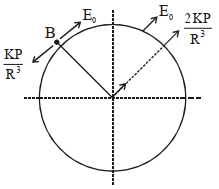
0 likesView Solution
27
PhysicsMediumMCQIIT JEE · 2019
Three glass cylinders of equal height $H = 30 \text{ cm}$ and same refractive index $n = 1.5$ are placed on a horizontal surface as shown in the figure. Cylinder $I$ has a flat top,cylinder $II$ has a convex top,and cylinder $III$ has a concave top. The radii of curvature of the two curved tops are same $(R = 3 \text{ m})$. If $H_1, H_2$ and $H_3$ are the apparent depths of a point $X$ on the bottom of the three cylinders,respectively,the correct statement$(s)$ is/are:
$(1) H_3 > H_1$
$(2) 0.8 \text{ cm} < (H_2 - H_1) < 0.9 \text{ cm}$
$(3) H_2 > H_3$
$(4) H_2 > H_1$
$(1) H_3 > H_1$
$(2) 0.8 \text{ cm} < (H_2 - H_1) < 0.9 \text{ cm}$
$(3) H_2 > H_3$
$(4) H_2 > H_1$
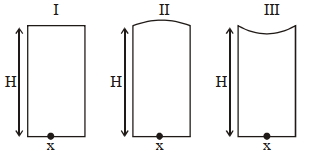
A
$1, 3$
B
$1, 4$
C
$2, 3$
D
$3, 4$
Solution
(B) For refraction at a single spherical surface,the formula is: $\frac{n_2}{v} - \frac{n_1}{u} = \frac{n_2 - n_1}{R}$. Here,$n_1 = 1.5$,$n_2 = 1$,and $u = -H = -30 \text{ cm} = -0.3 \text{ m}$.
For cylinder $I$ (flat top): $R = \infty$. The apparent depth $H_1 = \frac{H}{n} = \frac{30}{1.5} = 20 \text{ cm} = 0.2 \text{ m}$.
For cylinder $II$ (convex top): $R = +3 \text{ m}$.
$\frac{1}{v} - \frac{1.5}{-0.3} = \frac{1 - 1.5}{3} \implies \frac{1}{v} + 5 = -\frac{0.5}{3} = -\frac{1}{6} \implies \frac{1}{v} = -\frac{1}{6} - 5 = -\frac{31}{6} \implies v = -\frac{6}{31} \text{ m} \approx -19.35 \text{ cm}$.
Thus,$H_2 = 19.35 \text{ cm}$.
For cylinder $III$ (concave top): $R = -3 \text{ m}$.
$\frac{1}{v} - \frac{1.5}{-0.3} = \frac{1 - 1.5}{-3} \implies \frac{1}{v} + 5 = \frac{-0.5}{-3} = \frac{1}{6} \implies \frac{1}{v} = \frac{1}{6} - 5 = -\frac{29}{6} \implies v = -\frac{6}{29} \text{ m} \approx -20.69 \text{ cm}$.
Thus,$H_3 = 20.69 \text{ cm}$.
Comparing the values: $H_3 (20.69 \text{ cm}) > H_1 (20 \text{ cm}) > H_2 (19.35 \text{ cm})$.
Therefore,statements $(1)$ and $(4)$ are correct.
For cylinder $I$ (flat top): $R = \infty$. The apparent depth $H_1 = \frac{H}{n} = \frac{30}{1.5} = 20 \text{ cm} = 0.2 \text{ m}$.
For cylinder $II$ (convex top): $R = +3 \text{ m}$.
$\frac{1}{v} - \frac{1.5}{-0.3} = \frac{1 - 1.5}{3} \implies \frac{1}{v} + 5 = -\frac{0.5}{3} = -\frac{1}{6} \implies \frac{1}{v} = -\frac{1}{6} - 5 = -\frac{31}{6} \implies v = -\frac{6}{31} \text{ m} \approx -19.35 \text{ cm}$.
Thus,$H_2 = 19.35 \text{ cm}$.
For cylinder $III$ (concave top): $R = -3 \text{ m}$.
$\frac{1}{v} - \frac{1.5}{-0.3} = \frac{1 - 1.5}{-3} \implies \frac{1}{v} + 5 = \frac{-0.5}{-3} = \frac{1}{6} \implies \frac{1}{v} = \frac{1}{6} - 5 = -\frac{29}{6} \implies v = -\frac{6}{29} \text{ m} \approx -20.69 \text{ cm}$.
Thus,$H_3 = 20.69 \text{ cm}$.
Comparing the values: $H_3 (20.69 \text{ cm}) > H_1 (20 \text{ cm}) > H_2 (19.35 \text{ cm})$.
Therefore,statements $(1)$ and $(4)$ are correct.
0 likesView Solution
28
PhysicsAdvancedMCQIIT JEE · 2019
In a Young's double slit experiment,the slit separation $d$ is $0.3 \text{ mm}$ and the screen distance $D$ is $1 \text{ m}$. $A$ parallel beam of light of wavelength $600 \text{ nm}$ is incident on the slits at angle $\alpha$ as shown in the figure. On the screen,the point $O$ is equidistant from the slits and the distance $PO$ is $11.0 \text{ mm}$. Which of the following statement$(s)$ is/are correct?
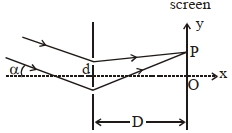
A
For $\alpha = \frac{0.36}{\pi}$ degree,there will be destructive interference at point $O$.
B
Fringe spacing depends on $\alpha$.
C
For $\alpha = \frac{0.36}{\pi}$ degree,there will be destructive interference at point $P$.
D
For $\alpha = 0$,there will be constructive interference at point $P$.
Solution
(C) Given: $d = 0.3 \text{ mm} = 3 \times 10^{-4} \text{ m}$,$D = 1 \text{ m}$,$\lambda = 600 \text{ nm} = 6 \times 10^{-7} \text{ m}$,$PO = y = 11 \text{ mm} = 1.1 \times 10^{-2} \text{ m}$.
$(1)$ At point $O$ $(y=0)$,the path difference is $\Delta x = d \sin \alpha \approx d \alpha$ (for small $\alpha$).
Given $\alpha = \frac{0.36}{\pi} \text{ degrees} = \frac{0.36}{\pi} \times \frac{\pi}{180} \text{ radians} = 2 \times 10^{-3} \text{ rad}$.
Path difference $\Delta x = (3 \times 10^{-4} \text{ m}) \times (2 \times 10^{-3} \text{ rad}) = 6 \times 10^{-7} \text{ m} = \lambda$.
Since $\Delta x = n\lambda$ (where $n=1$),there is constructive interference at $O$. Thus,statement $(A)$ is incorrect.
$(2)$ Fringe spacing $\beta = \frac{D\lambda}{d}$. This depends only on $D, \lambda, d$,not on $\alpha$. Thus,statement $(B)$ is incorrect.
$(3)$ At point $P$,path difference $\Delta x_P = d \sin \alpha + \frac{dy}{D} \approx d \alpha + \frac{dy}{D}$.
$\Delta x_P = (3 \times 10^{-4})(2 \times 10^{-3}) + \frac{(3 \times 10^{-4})(1.1 \times 10^{-2})}{1} = 6 \times 10^{-7} + 33 \times 10^{-7} = 39 \times 10^{-7} \text{ m}$.
$\frac{\Delta x_P}{\lambda} = \frac{39 \times 10^{-7}}{6 \times 10^{-7}} = 6.5$. Since it is a half-integer multiple,there is destructive interference at $P$. Thus,statement $(C)$ is correct.
$(4)$ For $\alpha = 0$,$\Delta x_P = \frac{dy}{D} = 33 \times 10^{-7} \text{ m}$.
$\frac{\Delta x_P}{\lambda} = \frac{33 \times 10^{-7}}{6 \times 10^{-7}} = 5.5$. Since it is a half-integer multiple,there is destructive interference at $P$. Thus,statement $(D)$ is incorrect.
$(1)$ At point $O$ $(y=0)$,the path difference is $\Delta x = d \sin \alpha \approx d \alpha$ (for small $\alpha$).
Given $\alpha = \frac{0.36}{\pi} \text{ degrees} = \frac{0.36}{\pi} \times \frac{\pi}{180} \text{ radians} = 2 \times 10^{-3} \text{ rad}$.
Path difference $\Delta x = (3 \times 10^{-4} \text{ m}) \times (2 \times 10^{-3} \text{ rad}) = 6 \times 10^{-7} \text{ m} = \lambda$.
Since $\Delta x = n\lambda$ (where $n=1$),there is constructive interference at $O$. Thus,statement $(A)$ is incorrect.
$(2)$ Fringe spacing $\beta = \frac{D\lambda}{d}$. This depends only on $D, \lambda, d$,not on $\alpha$. Thus,statement $(B)$ is incorrect.
$(3)$ At point $P$,path difference $\Delta x_P = d \sin \alpha + \frac{dy}{D} \approx d \alpha + \frac{dy}{D}$.
$\Delta x_P = (3 \times 10^{-4})(2 \times 10^{-3}) + \frac{(3 \times 10^{-4})(1.1 \times 10^{-2})}{1} = 6 \times 10^{-7} + 33 \times 10^{-7} = 39 \times 10^{-7} \text{ m}$.
$\frac{\Delta x_P}{\lambda} = \frac{39 \times 10^{-7}}{6 \times 10^{-7}} = 6.5$. Since it is a half-integer multiple,there is destructive interference at $P$. Thus,statement $(C)$ is correct.
$(4)$ For $\alpha = 0$,$\Delta x_P = \frac{dy}{D} = 33 \times 10^{-7} \text{ m}$.
$\frac{\Delta x_P}{\lambda} = \frac{33 \times 10^{-7}}{6 \times 10^{-7}} = 5.5$. Since it is a half-integer multiple,there is destructive interference at $P$. Thus,statement $(D)$ is incorrect.
0 likesView Solution
29
PhysicsAdvancedMCQIIT JEE · 2019
$A$ free hydrogen atom after absorbing a photon of wavelength $\lambda_{a}$ gets excited from the state $n=1$ to the state $n=4$. Immediately after that,the electron jumps to $n=m$ state by emitting a photon of wavelength $\lambda_{e}$. Let the change in momentum of the atom due to the absorption and the emission be $\Delta p_{a}$ and $\Delta p_{e}$,respectively. If $\lambda_{a} / \lambda_{e} = 1/5$,which of the following options is/are correct?
[Use $hc = 1242 \text{ eV nm}$; $1 \text{ nm} = 10^{-9} \text{ m}$,$h$ and $c$ are Planck's constant and speed of light,respectively]
$(1)$ $\lambda_{e} = 418 \text{ nm}$
$(2)$ The ratio of kinetic energy of the electron in the state $n=m$ to the state $n=1$ is $1/4$
$(3)$ $m=2$
$(4)$ $\Delta p_{a} / \Delta p_{e} = 1/2$
[Use $hc = 1242 \text{ eV nm}$; $1 \text{ nm} = 10^{-9} \text{ m}$,$h$ and $c$ are Planck's constant and speed of light,respectively]
$(1)$ $\lambda_{e} = 418 \text{ nm}$
$(2)$ The ratio of kinetic energy of the electron in the state $n=m$ to the state $n=1$ is $1/4$
$(3)$ $m=2$
$(4)$ $\Delta p_{a} / \Delta p_{e} = 1/2$
A
$2, 3$
B
$2, 4$
C
$3, 2$
D
$1, 3$
Solution
(A) The energy of the absorbed photon is $\frac{hc}{\lambda_{a}} = 13.6 \text{ eV} \times \left[\frac{1}{1^2} - \frac{1}{4^2}\right] = 13.6 \times \frac{15}{16} \text{ eV} \quad (i)$
The energy of the emitted photon is $\frac{hc}{\lambda_{e}} = 13.6 \text{ eV} \times \left[\frac{1}{m^2} - \frac{1}{4^2}\right] \quad (ii)$
Given $\frac{\lambda_{a}}{\lambda_{e}} = \frac{1}{5}$,we divide $(ii)$ by $(i)$:
$\frac{\lambda_{a}}{\lambda_{e}} = \frac{13.6 \times [1 - 1/16]}{13.6 \times [1/m^2 - 1/16]} = 5 \implies \frac{15/16}{1/m^2 - 1/16} = 5$
$\frac{15}{16} = 5 \times \left(\frac{1}{m^2} - \frac{1}{16}\right) \implies \frac{3}{16} = \frac{1}{m^2} - \frac{1}{16}$
$\frac{1}{m^2} = \frac{4}{16} = \frac{1}{4} \implies m = 2$. Thus,option $(3)$ is correct.
For kinetic energy,$K_n \propto \frac{1}{n^2}$. So,$\frac{K_{m=2}}{K_{n=1}} = \frac{1/2^2}{1/1^2} = \frac{1}{4}$. Thus,option $(2)$ is correct.
For momentum,$\Delta p = \frac{h}{\lambda}$. So,$\frac{\Delta p_{a}}{\Delta p_{e}} = \frac{\lambda_{e}}{\lambda_{a}} = 5$. Thus,option $(4)$ is incorrect.
The energy of the emitted photon is $\frac{hc}{\lambda_{e}} = 13.6 \text{ eV} \times \left[\frac{1}{m^2} - \frac{1}{4^2}\right] \quad (ii)$
Given $\frac{\lambda_{a}}{\lambda_{e}} = \frac{1}{5}$,we divide $(ii)$ by $(i)$:
$\frac{\lambda_{a}}{\lambda_{e}} = \frac{13.6 \times [1 - 1/16]}{13.6 \times [1/m^2 - 1/16]} = 5 \implies \frac{15/16}{1/m^2 - 1/16} = 5$
$\frac{15}{16} = 5 \times \left(\frac{1}{m^2} - \frac{1}{16}\right) \implies \frac{3}{16} = \frac{1}{m^2} - \frac{1}{16}$
$\frac{1}{m^2} = \frac{4}{16} = \frac{1}{4} \implies m = 2$. Thus,option $(3)$ is correct.
For kinetic energy,$K_n \propto \frac{1}{n^2}$. So,$\frac{K_{m=2}}{K_{n=1}} = \frac{1/2^2}{1/1^2} = \frac{1}{4}$. Thus,option $(2)$ is correct.
For momentum,$\Delta p = \frac{h}{\lambda}$. So,$\frac{\Delta p_{a}}{\Delta p_{e}} = \frac{\lambda_{e}}{\lambda_{a}} = 5$. Thus,option $(4)$ is incorrect.
0 likesView Solution
30
PhysicsAdvancedMCQIIT JEE · 2019
$A$ perfectly reflecting mirror of mass $M$ mounted on a spring constitutes a spring-mass system of angular frequency $\Omega$ such that $\frac{4 \pi M \Omega}{h} = 10^{24} \text{ m}^{-2}$,where $h$ is Planck's constant. $N$ photons of wavelength $\lambda = 8 \pi \times 10^{-6} \text{ m}$ strike the mirror simultaneously at normal incidence such that the mirror gets displaced by $1 \mu\text{m}$. If the value of $N$ is $x \times 10^{12}$,then the value of $x$ is. . . . . . . . [Consider the spring as massless]
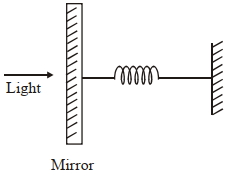
A
$0$
B
$1$
C
$2$
D
$3$
Solution
(B) The momentum of one photon is $p = \frac{h}{\lambda}$.
When $N$ photons strike the mirror,the total momentum transferred to the mirror is $\Delta P = 2Np = \frac{2Nh}{\lambda}$.
By the conservation of linear momentum,this impulse imparts an initial velocity $v$ to the mirror of mass $M$ at the equilibrium position:
$Mv = \frac{2Nh}{\lambda} \implies v = \frac{2Nh}{M\lambda}$.
For a spring-mass system,the maximum displacement (amplitude $A$) is related to the velocity at the mean position by $v = A\Omega$.
Given $A = 1 \mu\text{m} = 10^{-6} \text{ m}$,we have:
$A\Omega = \frac{2Nh}{M\lambda} \implies N = \frac{M\Omega A \lambda}{2h}$.
Rearranging the given expression $\frac{4 \pi M \Omega}{h} = 10^{24} \text{ m}^{-2}$,we get $\frac{M\Omega}{h} = \frac{10^{24}}{4\pi} \text{ m}^{-2}$.
Substituting the values:
$N = \left( \frac{10^{24}}{4\pi} \right) \times \frac{A \lambda}{2} = \frac{10^{24}}{4\pi} \times \frac{10^{-6} \times 8\pi \times 10^{-6}}{2}$.
$N = \frac{10^{24} \times 8\pi \times 10^{-12}}{8\pi} = 10^{12}$.
Since $N = x \times 10^{12}$,we find $x = 1$.
When $N$ photons strike the mirror,the total momentum transferred to the mirror is $\Delta P = 2Np = \frac{2Nh}{\lambda}$.
By the conservation of linear momentum,this impulse imparts an initial velocity $v$ to the mirror of mass $M$ at the equilibrium position:
$Mv = \frac{2Nh}{\lambda} \implies v = \frac{2Nh}{M\lambda}$.
For a spring-mass system,the maximum displacement (amplitude $A$) is related to the velocity at the mean position by $v = A\Omega$.
Given $A = 1 \mu\text{m} = 10^{-6} \text{ m}$,we have:
$A\Omega = \frac{2Nh}{M\lambda} \implies N = \frac{M\Omega A \lambda}{2h}$.
Rearranging the given expression $\frac{4 \pi M \Omega}{h} = 10^{24} \text{ m}^{-2}$,we get $\frac{M\Omega}{h} = \frac{10^{24}}{4\pi} \text{ m}^{-2}$.
Substituting the values:
$N = \left( \frac{10^{24}}{4\pi} \right) \times \frac{A \lambda}{2} = \frac{10^{24}}{4\pi} \times \frac{10^{-6} \times 8\pi \times 10^{-6}}{2}$.
$N = \frac{10^{24} \times 8\pi \times 10^{-12}}{8\pi} = 10^{12}$.
Since $N = x \times 10^{12}$,we find $x = 1$.
0 likesView Solution
31
PhysicsAdvancedMCQIIT JEE · 2019
$A$ $10 \text{ cm}$ long perfectly conducting wire $PQ$ is moving with a velocity $1 \text{ cm/s}$ on a pair of horizontal rails of zero resistance. One side of the rails is connected to an inductor $L = 1 \text{ mH}$ and a resistance $R = 1 \ \Omega$ as shown in the figure. The horizontal rails,$L$,and $R$ lie in the same plane with a uniform magnetic field $B = 1 \text{ T}$ perpendicular to the plane. If the key $S$ is closed at a certain instant,the current in the circuit after $1 \text{ millisecond}$ is $x \times 10^{-3} \text{ A}$,where the value of $x$ is. . . . . . [Assume the velocity of wire $PQ$ remains constant $(1 \text{ cm/s})$ after key $S$ is closed. Given: $e^{-1} = 0.37$,where $e$ is the base of the natural logarithm]
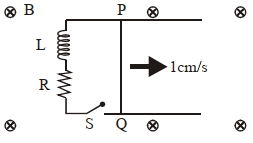
A
$0.63$
B
$0.65$
C
$0.70$
D
$0.75$
Solution
(A) The motional electromotive force (emf) induced in the wire $PQ$ is given by $\varepsilon = Blv$.
Given: $B = 1 \text{ T}$,$l = 10 \text{ cm} = 0.1 \text{ m}$,$v = 1 \text{ cm/s} = 0.01 \text{ m/s}$.
$\varepsilon = 1 \times 0.1 \times 0.01 = 10^{-3} \text{ V}$.
When the key $S$ is closed,the circuit acts as an $LR$ series circuit with a constant voltage source $\varepsilon$. The current $i$ at time $t$ is given by $i(t) = \frac{\varepsilon}{R} (1 - e^{-Rt/L})$.
Given: $R = 1 \ \Omega$,$L = 1 \text{ mH} = 10^{-3} \text{ H}$,$t = 1 \text{ ms} = 10^{-3} \text{ s}$.
Substituting the values:
$i = \frac{10^{-3}}{1} (1 - e^{-(1 \times 10^{-3}) / 10^{-3}})$
$i = 10^{-3} (1 - e^{-1})$
Using $e^{-1} = 0.37$:
$i = 10^{-3} (1 - 0.37) = 10^{-3} (0.63) = 0.63 \times 10^{-3} \text{ A}$.
Comparing this with $x \times 10^{-3} \text{ A}$,we get $x = 0.63$.
Given: $B = 1 \text{ T}$,$l = 10 \text{ cm} = 0.1 \text{ m}$,$v = 1 \text{ cm/s} = 0.01 \text{ m/s}$.
$\varepsilon = 1 \times 0.1 \times 0.01 = 10^{-3} \text{ V}$.
When the key $S$ is closed,the circuit acts as an $LR$ series circuit with a constant voltage source $\varepsilon$. The current $i$ at time $t$ is given by $i(t) = \frac{\varepsilon}{R} (1 - e^{-Rt/L})$.
Given: $R = 1 \ \Omega$,$L = 1 \text{ mH} = 10^{-3} \text{ H}$,$t = 1 \text{ ms} = 10^{-3} \text{ s}$.
Substituting the values:
$i = \frac{10^{-3}}{1} (1 - e^{-(1 \times 10^{-3}) / 10^{-3}})$
$i = 10^{-3} (1 - e^{-1})$
Using $e^{-1} = 0.37$:
$i = 10^{-3} (1 - 0.37) = 10^{-3} (0.63) = 0.63 \times 10^{-3} \text{ A}$.
Comparing this with $x \times 10^{-3} \text{ A}$,we get $x = 0.63$.
0 likesView Solution
32
PhysicsMediumMCQIIT JEE · 2019
$A$ monochromatic light is incident from air on a refracting surface of a prism of angle $A = 75^{\circ}$ and refractive index $n_0 = \sqrt{3}$. The other refracting surface of the prism is coated by a thin film of material of refractive index $n$ as shown in the figure. The light suffers total internal reflection at the coated prism surface for an incidence angle of $\theta \leq 60^{\circ}$. The value of $n^2$ is:
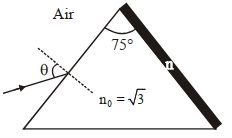
A
$1.30$
B
$1.40$
C
$1.50$
D
$1.60$
Solution
(C) For total internal reflection $(TIR)$ to occur at the second surface for all $\theta \leq 60^{\circ}$,the condition must be satisfied at the minimum angle of incidence within the prism.
Let $r_1$ be the angle of refraction at the first surface and $r_2$ be the angle of incidence at the second surface.
From the geometry of the prism,$r_1 + r_2 = A = 75^{\circ}$.
For $TIR$ at the second surface,the angle of incidence $r_2$ must be greater than or equal to the critical angle $C$,where $\sin C = \frac{n}{n_0}$.
As $\theta$ decreases,$r_1$ decreases,and consequently $r_2 = 75^{\circ} - r_1$ increases.
The condition for $TIR$ is most easily satisfied at the maximum value of $r_2$,which occurs at the minimum value of $r_1$. However,the problem states $TIR$ occurs for $\theta \leq 60^{\circ}$. The boundary condition is at $\theta = 60^{\circ}$.
At $\theta = 60^{\circ}$,by Snell's law at the first surface: $1 \cdot \sin 60^{\circ} = \sqrt{3} \cdot \sin r_1 \Rightarrow \frac{\sqrt{3}}{2} = \sqrt{3} \sin r_1 \Rightarrow r_1 = 30^{\circ}$.
Then,$r_2 = 75^{\circ} - 30^{\circ} = 45^{\circ}$.
For $TIR$ at this surface,$r_2 \geq C$,so $45^{\circ} \geq C$,which means $\sin 45^{\circ} \geq \sin C = \frac{n}{\sqrt{3}}$.
$\frac{1}{\sqrt{2}} \geq \frac{n}{\sqrt{3}} \Rightarrow n \leq \sqrt{\frac{3}{2}}$.
The limiting value is $n = \sqrt{1.5}$,so $n^2 = 1.5$.
Let $r_1$ be the angle of refraction at the first surface and $r_2$ be the angle of incidence at the second surface.
From the geometry of the prism,$r_1 + r_2 = A = 75^{\circ}$.
For $TIR$ at the second surface,the angle of incidence $r_2$ must be greater than or equal to the critical angle $C$,where $\sin C = \frac{n}{n_0}$.
As $\theta$ decreases,$r_1$ decreases,and consequently $r_2 = 75^{\circ} - r_1$ increases.
The condition for $TIR$ is most easily satisfied at the maximum value of $r_2$,which occurs at the minimum value of $r_1$. However,the problem states $TIR$ occurs for $\theta \leq 60^{\circ}$. The boundary condition is at $\theta = 60^{\circ}$.
At $\theta = 60^{\circ}$,by Snell's law at the first surface: $1 \cdot \sin 60^{\circ} = \sqrt{3} \cdot \sin r_1 \Rightarrow \frac{\sqrt{3}}{2} = \sqrt{3} \sin r_1 \Rightarrow r_1 = 30^{\circ}$.
Then,$r_2 = 75^{\circ} - 30^{\circ} = 45^{\circ}$.
For $TIR$ at this surface,$r_2 \geq C$,so $45^{\circ} \geq C$,which means $\sin 45^{\circ} \geq \sin C = \frac{n}{\sqrt{3}}$.
$\frac{1}{\sqrt{2}} \geq \frac{n}{\sqrt{3}} \Rightarrow n \leq \sqrt{\frac{3}{2}}$.
The limiting value is $n = \sqrt{1.5}$,so $n^2 = 1.5$.
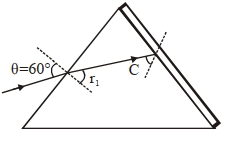
0 likesView Solution
33
PhysicsAdvancedMCQIIT JEE · 2019
Suppose a ${ }_{88}^{226} Ra$ nucleus at rest and in the ground state undergoes $\alpha$-decay to a ${ }_{86}^{222} Rn$ nucleus in its excited state. The kinetic energy of the emitted $\alpha$ particle is found to be $4.44 \text{ MeV}$. The ${ }_{86}^{222} Rn$ nucleus then goes to its ground state by $\gamma$-decay. The energy of the emitted $\gamma$-photon is . . . . . . . $\text{keV}$.
[Given: atomic mass of ${ }_{88}^{226} Ra = 226.005 \text{ u}$,atomic mass of ${ }_{86}^{222} Rn = 222.000 \text{ u}$,atomic mass of $\alpha$ particle $= 4.000 \text{ u}$,$1 \text{ u} = 931 \text{ MeV}/c^2$]
[Given: atomic mass of ${ }_{88}^{226} Ra = 226.005 \text{ u}$,atomic mass of ${ }_{86}^{222} Rn = 222.000 \text{ u}$,atomic mass of $\alpha$ particle $= 4.000 \text{ u}$,$1 \text{ u} = 931 \text{ MeV}/c^2$]
A
$120$
B
$125$
C
$130$
D
$135$
Solution
(D) The $\alpha$-decay reaction is: ${ }_{88}^{226} Ra \longrightarrow { }_{86}^{222} Rn^* + { }_{2}^{4} \alpha$.
The total energy released ($Q$-value) is given by: $Q = (M_{Ra} - M_{Rn} - M_{\alpha}) \times 931 \text{ MeV}$.
$Q = (226.005 - 222.000 - 4.000) \times 931 \text{ MeV} = 0.005 \times 931 \text{ MeV} = 4.655 \text{ MeV}$.
Let $E_{\gamma}$ be the excitation energy of the ${ }_{86}^{222} Rn$ nucleus. The energy available for kinetic energy is $(Q - E_{\gamma})$.
The kinetic energy of the $\alpha$ particle is $K_{\alpha} = \frac{A-4}{A} (Q - E_{\gamma})$,where $A = 226$.
$4.44 \text{ MeV} = \frac{222}{226} (4.655 - E_{\gamma})$.
$4.655 - E_{\gamma} = 4.44 \times \frac{226}{222} \approx 4.44 \times 1.018 = 4.520 \text{ MeV}$.
$E_{\gamma} = 4.655 - 4.520 = 0.135 \text{ MeV}$.
Since $1 \text{ MeV} = 1000 \text{ keV}$,$E_{\gamma} = 0.135 \times 1000 = 135 \text{ keV}$.
The total energy released ($Q$-value) is given by: $Q = (M_{Ra} - M_{Rn} - M_{\alpha}) \times 931 \text{ MeV}$.
$Q = (226.005 - 222.000 - 4.000) \times 931 \text{ MeV} = 0.005 \times 931 \text{ MeV} = 4.655 \text{ MeV}$.
Let $E_{\gamma}$ be the excitation energy of the ${ }_{86}^{222} Rn$ nucleus. The energy available for kinetic energy is $(Q - E_{\gamma})$.
The kinetic energy of the $\alpha$ particle is $K_{\alpha} = \frac{A-4}{A} (Q - E_{\gamma})$,where $A = 226$.
$4.44 \text{ MeV} = \frac{222}{226} (4.655 - E_{\gamma})$.
$4.655 - E_{\gamma} = 4.44 \times \frac{226}{222} \approx 4.44 \times 1.018 = 4.520 \text{ MeV}$.
$E_{\gamma} = 4.655 - 4.520 = 0.135 \text{ MeV}$.
Since $1 \text{ MeV} = 1000 \text{ keV}$,$E_{\gamma} = 0.135 \times 1000 = 135 \text{ keV}$.
0 likesView Solution
34
PhysicsMediumMCQIIT JEE · 2019
An optical bench has a $1.5 m$ long scale having four equal divisions in each $cm$. While measuring the focal length of a convex lens,the lens is kept at the $75 cm$ mark of the scale and the object pin is kept at the $45 cm$ mark. The image of the object pin on the other side of the lens overlaps with the image pin that is kept at the $135 cm$ mark. In this experiment,the percentage error in the measurement of the focal length of the lens is. . . . .
A
$0.69$
B
$0.75$
C
$0.80$
D
$0.85$
Solution
(A) Given,the lens is at $75 cm$,object pin at $45 cm$,and image pin at $135 cm$.
Object distance $u = 45 - 75 = -30 cm$.
Image distance $v = 135 - 75 = 60 cm$.
Using the lens formula $\frac{1}{f} = \frac{1}{v} - \frac{1}{u}$,we get $\frac{1}{f} = \frac{1}{60} - \frac{1}{-30} = \frac{1+2}{60} = \frac{3}{60} = \frac{1}{20}$. Thus,$f = 20 cm$.
The scale has $4$ divisions per $cm$,so the least count $\Delta u = \Delta v = \frac{1}{4} cm = 0.25 cm$.
Differentiating the lens formula $\frac{1}{f} = \frac{1}{v} - \frac{1}{u}$,we get $-\frac{df}{f^2} = -\frac{dv}{v^2} + \frac{du}{u^2}$.
Taking magnitudes for maximum error: $\frac{df}{f^2} = \frac{dv}{v^2} + \frac{du}{u^2}$.
Percentage error $\frac{df}{f} \times 100 = f \left[ \frac{dv}{v^2} + \frac{du}{u^2} \right] \times 100$.
Substituting values: $\frac{df}{f} \times 100 = 20 \left[ \frac{0.25}{60^2} + \frac{0.25}{30^2} \right] \times 100$.
$= 20 \times 0.25 \left[ \frac{1}{3600} + \frac{1}{900} \right] \times 100 = 5 \left[ \frac{1+4}{3600} \right] \times 100 = 5 \times \frac{5}{36} = \frac{25}{36} \% \approx 0.69 \%$.
Object distance $u = 45 - 75 = -30 cm$.
Image distance $v = 135 - 75 = 60 cm$.
Using the lens formula $\frac{1}{f} = \frac{1}{v} - \frac{1}{u}$,we get $\frac{1}{f} = \frac{1}{60} - \frac{1}{-30} = \frac{1+2}{60} = \frac{3}{60} = \frac{1}{20}$. Thus,$f = 20 cm$.
The scale has $4$ divisions per $cm$,so the least count $\Delta u = \Delta v = \frac{1}{4} cm = 0.25 cm$.
Differentiating the lens formula $\frac{1}{f} = \frac{1}{v} - \frac{1}{u}$,we get $-\frac{df}{f^2} = -\frac{dv}{v^2} + \frac{du}{u^2}$.
Taking magnitudes for maximum error: $\frac{df}{f^2} = \frac{dv}{v^2} + \frac{du}{u^2}$.
Percentage error $\frac{df}{f} \times 100 = f \left[ \frac{dv}{v^2} + \frac{du}{u^2} \right] \times 100$.
Substituting values: $\frac{df}{f} \times 100 = 20 \left[ \frac{0.25}{60^2} + \frac{0.25}{30^2} \right] \times 100$.
$= 20 \times 0.25 \left[ \frac{1}{3600} + \frac{1}{900} \right] \times 100 = 5 \left[ \frac{1+4}{3600} \right] \times 100 = 5 \times \frac{5}{36} = \frac{25}{36} \% \approx 0.69 \%$.
1 likesView Solution
Vedclass Products
For Students
Vedclass Test Series
Mock tests in real IIT JEE style covering Physics with performance analysis. 5-day free trial.
Start Free TrialFor Teachers
Exam Paper Generator
Generate Set A/B/C/D Physics papers from 7.5L+ questions in 2 minutes. 3 chapters free.
Try FreeFor Institutes
Online Exam Module
Run live IIT JEE mock exams with unlimited students, 360° analytics & white-label branding.
See DemoFrequently Asked Questions
How many Physics questions are in IIT JEE 2019?
There are 34 Physics questions from the IIT JEE 2019 paper on Vedclass, each with a detailed step-by-step solution in English.
Are IIT JEE 2019 Physics solutions available in English?
Yes. All solutions on this page are in English. You can also switch to English or Hindi using the language buttons above the questions.
Can I practice IIT JEE 2019 Physics as a timed test?
Yes. Use the Vedclass Test Series to attempt a full IIT JEE mock test covering Physics with time limits and instant score analysis.
Can teachers create Physics papers from IIT JEE previous year questions?
Yes. The Vedclass Exam Paper Generator lets teachers mix IIT JEE Physics questions and generate Set A/B/C/D papers in minutes.
For Teachers & Institutes
Build a Custom Physics Paper
Pick IIT JEE 2019 Physics questions, set difficulty, and generate Set A/B/C/D in 2 minutes.