
ChemistryQ1–45 of 45 questions
Page 1 of 1 · English
1
ChemistryMCQIIT JEE · 2001
Three positive charges of equal value $q$ are placed at the vertices of an equilateral triangle. The resulting lines of force should be sketched as in
A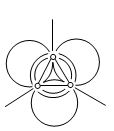
B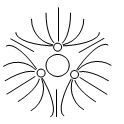
C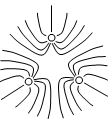
D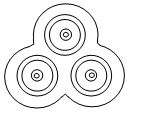
Solution
(C) The electric field lines for a system of positive charges must originate from the charges and extend to infinity.
$1$. Since all three charges are positive,the electric field lines will repel each other and cannot terminate on any of the charges.
$2$. Option $A$ shows lines terminating on other charges,which is incorrect for like charges.
$3$. Option $B$ and $D$ show closed loops,which is impossible for electrostatic fields as they are conservative.
$4$. Option $C$ correctly depicts the field lines originating from each positive charge and moving outwards,repelling each other,which is the characteristic behavior of a system of identical positive charges.
Therefore,the correct representation is option $C$.
$1$. Since all three charges are positive,the electric field lines will repel each other and cannot terminate on any of the charges.
$2$. Option $A$ shows lines terminating on other charges,which is incorrect for like charges.
$3$. Option $B$ and $D$ show closed loops,which is impossible for electrostatic fields as they are conservative.
$4$. Option $C$ correctly depicts the field lines originating from each positive charge and moving outwards,repelling each other,which is the characteristic behavior of a system of identical positive charges.
Therefore,the correct representation is option $C$.
0 likesView Solution
2
ChemistryMediumMCQIIT JEE · 2001
The common features among the species $CN^{-}$,$CO$ and $NO^{+}$ are
A
Bond order three and isoelectronic
B
Bond order three and weak field ligands
C
Bond order two and $\pi$-acceptors
D
Isoelectronic and weak field ligands
Solution
(A) The total number of electrons in each species is as follows:
$CN^{-} = 6 + 7 + 1 = 14$ electrons.
$CO = 6 + 8 = 14$ electrons.
$NO^{+} = 7 + 8 - 1 = 14$ electrons.
Since all species have $14$ electrons,they are isoelectronic.
Using the molecular orbital theory,the bond order is calculated as:
$B.O. = \frac{1}{2} [N_b - N_a] = \frac{1}{2} [10 - 4] = 3$.
Thus,they all have a bond order of $3$ and are isoelectronic.
$CN^{-} = 6 + 7 + 1 = 14$ electrons.
$CO = 6 + 8 = 14$ electrons.
$NO^{+} = 7 + 8 - 1 = 14$ electrons.
Since all species have $14$ electrons,they are isoelectronic.
Using the molecular orbital theory,the bond order is calculated as:
$B.O. = \frac{1}{2} [N_b - N_a] = \frac{1}{2} [10 - 4] = 3$.
Thus,they all have a bond order of $3$ and are isoelectronic.
0 likesView Solution
3
ChemistryMediumMCQIIT JEE · 2001
The number of $S-S$ bonds in sulphur trioxide trimer $S_3O_9$ is
A
$3$
B
$2$
C
$1$
D
$0$
Solution
(D) The structure of the $SO_3$ trimer $(S_3O_9)$ consists of a cyclic ring of alternating $S$ and $O$ atoms,where each $S$ atom is also bonded to two terminal oxygen atoms via double bonds.
In this structure,there are no direct $S-S$ bonds.
Therefore,the number of $S-S$ bonds is $0$.
In this structure,there are no direct $S-S$ bonds.
Therefore,the number of $S-S$ bonds is $0$.
0 likesView Solution
4
ChemistryDifficultMCQIIT JEE · 2001
At constant temperature,the equilibrium constant $(K_p)$ for the decomposition reaction $N_2O_4 \rightleftharpoons 2NO_2$ is expressed by $K_p = \frac{4x^2P}{1 - x^2}$,where $P = \text{pressure}$,$x = \text{extent of decomposition}$. Which one of the following statements is true?
A
$K_p$ increases with increase of $P$
B
$K_p$ increases with increase of $x$
C
$K_p$ increases with decrease of $x$
D
$K_p$ remains constant with change in $P$ and $x$
Solution
(D) The equilibrium constant $(K_p)$ for a given reaction depends only on temperature.
It is independent of the initial pressure $(P)$ and the extent of decomposition $(x)$.
Therefore,$K_p$ remains constant even if $P$ or $x$ changes at a constant temperature.
It is independent of the initial pressure $(P)$ and the extent of decomposition $(x)$.
Therefore,$K_p$ remains constant even if $P$ or $x$ changes at a constant temperature.
0 likesView Solution
5
ChemistryMediumMCQIIT JEE · 2001
The set representing the correct order of first ionisation potential is
A
$K > Na > Li$
B
$Be > Mg > Ca$
C
$B > C > N$
D
$Ge > Si > C$
Solution
(B) The first ionisation potential $(I.P.)$ generally decreases as we move down a group due to the increase in atomic size and shielding effect.
In Group $2$ $(Be, Mg, Ca)$,the order of $I.P.$ is $Be > Mg > Ca$.
In Group $1$ $(Li, Na, K)$,the order is $Li > Na > K$.
In Group $14$ $(C, Si, Ge)$,the order is $C > Si > Ge$.
In Group $13$ $(B, Al, Ga)$,the order is $B > Al > Ga$.
Therefore,the correct set is $Be > Mg > Ca$.
In Group $2$ $(Be, Mg, Ca)$,the order of $I.P.$ is $Be > Mg > Ca$.
In Group $1$ $(Li, Na, K)$,the order is $Li > Na > K$.
In Group $14$ $(C, Si, Ge)$,the order is $C > Si > Ge$.
In Group $13$ $(B, Al, Ga)$,the order is $B > Al > Ga$.
Therefore,the correct set is $Be > Mg > Ca$.
0 likesView Solution
6
ChemistryDifficultMCQIIT JEE · 2001
An aqueous solution of $6.3 \ g$ oxalic acid dihydrate is made up to $250 \ mL$. The volume of $0.1 \ N \ NaOH$ required to completely neutralize $10 \ mL$ of this solution is $...... \ mL$.
A
$40$
B
$20$
C
$10$
D
$4$
Solution
(A) The molar mass of oxalic acid dihydrate $(H_2C_2O_4 \cdot 2H_2O)$ is $126 \ g/mol$.
The $n$-factor for oxalic acid is $2$.
Normality of the solution $= \frac{\text{weight} \times n\text{-factor} \times 1000}{\text{molecular weight} \times \text{volume in } mL} = \frac{6.3 \times 2 \times 1000}{126 \times 250} = 0.4 \ N$.
Using the law of equivalence,$N_1 V_1 = N_2 V_2$ for neutralization:
$0.4 \times 10 = 0.1 \times V_2$.
$V_2 = \frac{4}{0.1} = 40 \ mL$.
The $n$-factor for oxalic acid is $2$.
Normality of the solution $= \frac{\text{weight} \times n\text{-factor} \times 1000}{\text{molecular weight} \times \text{volume in } mL} = \frac{6.3 \times 2 \times 1000}{126 \times 250} = 0.4 \ N$.
Using the law of equivalence,$N_1 V_1 = N_2 V_2$ for neutralization:
$0.4 \times 10 = 0.1 \times V_2$.
$V_2 = \frac{4}{0.1} = 40 \ mL$.
0 likesView Solution
7
ChemistryAdvancedMCQIIT JEE · 2001
The number of isomers for the compound with molecular formula $C_2BrClFI$ is
A
$3$
B
$4$
C
$5$
D
$6$
Solution
(D) The molecular formula $C_2BrClFI$ corresponds to a haloalkene where each carbon of the double bond is substituted with two different halogens.
For a general alkene $C(ab)=C(cd)$,if $a \neq b$ and $c \neq d$,the molecule exhibits geometrical isomerism ($E$ and $Z$ forms).
In the case of $C_2BrClFI$,we can arrange the four different halogens $(Br, Cl, F, I)$ on the two carbons in different ways.
There are $3$ possible structural skeletons based on the relative positions of the halogens:
$1$. $Br-C(Cl)=C(F)-I$
$2$. $Br-C(F)=C(Cl)-I$
$3$. $Br-C(I)=C(Cl)-F$
Each of these $3$ structural isomers can exist as a pair of geometrical isomers ($E$ and $Z$).
Therefore,the total number of stereoisomers is $3 \times 2 = 6$.
For a general alkene $C(ab)=C(cd)$,if $a \neq b$ and $c \neq d$,the molecule exhibits geometrical isomerism ($E$ and $Z$ forms).
In the case of $C_2BrClFI$,we can arrange the four different halogens $(Br, Cl, F, I)$ on the two carbons in different ways.
There are $3$ possible structural skeletons based on the relative positions of the halogens:
$1$. $Br-C(Cl)=C(F)-I$
$2$. $Br-C(F)=C(Cl)-I$
$3$. $Br-C(I)=C(Cl)-F$
Each of these $3$ structural isomers can exist as a pair of geometrical isomers ($E$ and $Z$).
Therefore,the total number of stereoisomers is $3 \times 2 = 6$.
0 likesView Solution
8
ChemistryAdvancedMCQIIT JEE · 2001
Hydrogenation of the compound shown below in the presence of a poisoned palladium catalyst (Lindlar's catalyst) gives:
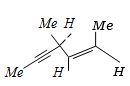
A
An optically active compound
B
An optically inactive compound
C
$A$ racemic mixture
D
$A$ diastereomeric mixture
Solution
(B) The given compound is $CH_3-C \equiv C-CH(CH_3)-CH=CH_2$.
Hydrogenation with a poisoned palladium catalyst (Lindlar's catalyst) results in $syn$-addition of hydrogen to the triple bond,converting it into a $cis$-double bond.
The resulting product is $CH_3-CH=CH-CH(CH_3)-CH=CH_2$.
Due to the specific geometry and the presence of internal symmetry elements or the formation of a meso-like structure depending on the configuration,the product formed is optically inactive.
Hydrogenation with a poisoned palladium catalyst (Lindlar's catalyst) results in $syn$-addition of hydrogen to the triple bond,converting it into a $cis$-double bond.
The resulting product is $CH_3-CH=CH-CH(CH_3)-CH=CH_2$.
Due to the specific geometry and the presence of internal symmetry elements or the formation of a meso-like structure depending on the configuration,the product formed is optically inactive.
0 likesView Solution
9
ChemistryMediumMCQIIT JEE · 2001
In the presence of peroxide,hydrogen chloride and hydrogen iodide do not give anti-Markovnikov's addition to alkenes because
A
Both are highly ionic
B
One is oxidising and the other is reducing
C
One of the steps is endothermic in both the cases
D
All the steps are exothermic in both the cases
Solution
(C) The anti-Markovnikov addition of $HX$ to alkenes proceeds via a free radical mechanism.
For $HCl$,the bond dissociation energy is very high,making the homolytic cleavage of the $H-Cl$ bond endothermic.
For $HI$,the addition of the iodine radical to the alkene is an endothermic step.
Since one of the propagation steps is endothermic for both $HCl$ and $HI$,the overall reaction does not proceed via the anti-Markovnikov pathway in the presence of peroxide.
For $HCl$,the bond dissociation energy is very high,making the homolytic cleavage of the $H-Cl$ bond endothermic.
For $HI$,the addition of the iodine radical to the alkene is an endothermic step.
Since one of the propagation steps is endothermic for both $HCl$ and $HI$,the overall reaction does not proceed via the anti-Markovnikov pathway in the presence of peroxide.
0 likesView Solution
10
ChemistryMediumMCQIIT JEE · 2001
The reaction of propene with $HOCl$ proceeds via the addition of
A
$H^{+}$ in the first step
B
$Cl^{+}$ in the first step
C
$OH^{-}$ in the first step
D
$Cl^{+}$ and $OH^{-}$ in a single step
Solution
(B) Alkenes undergo electrophilic addition reactions.
$HOCl$ acts as a source of the electrophile $Cl^{+}$.
In the first step,the electrophile $Cl^{+}$ attacks the double bond of propene to form a cyclic chloronium ion intermediate.
Subsequently,the nucleophile $OH^{-}$ attacks the more substituted carbon atom to form the final product,chlorohydrin.
$HOCl$ acts as a source of the electrophile $Cl^{+}$.
In the first step,the electrophile $Cl^{+}$ attacks the double bond of propene to form a cyclic chloronium ion intermediate.
Subsequently,the nucleophile $OH^{-}$ attacks the more substituted carbon atom to form the final product,chlorohydrin.
0 likesView Solution
11
ChemistryMCQIIT JEE · 2001
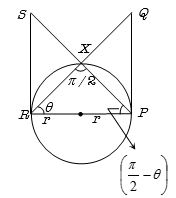
Let $PQ$ and $RS$ be tangents at the extremities of the diameter $PR$ of a circle of radius $r$. If $PS$ and $RQ$ intersect at a point $X$ on the circumference of the circle,then $2r$ equals
A
$\sqrt{PQ \cdot RS}$
B
$\frac{PQ + RS}{2}$
C
$\frac{2PQ \cdot RS}{PQ + RS}$
D
$\sqrt{\frac{PQ^2 + RS^2}{2}}$
Solution
(A) Let $\angle PRQ = \theta$. Since $PQ$ is a tangent at $P$ and $PR$ is the diameter,$\angle RPQ = 90^{\circ}$.
In $\triangle RPQ$,$\tan \theta = \frac{PQ}{PR} = \frac{PQ}{2r}$.
Since $RS$ is a tangent at $R$ and $PR$ is the diameter,$\angle PRS = 90^{\circ}$.
Given $X$ is on the circumference,$\angle RXP = 90^{\circ}$ (angle in a semicircle).
In $\triangle RXP$,$\angle XRP = 90^{\circ} - \theta$.
In $\triangle PRS$,$\tan(90^{\circ} - \theta) = \frac{RS}{PR} = \frac{RS}{2r}$.
Thus,$\cot \theta = \frac{RS}{2r}$.
Multiplying the two expressions: $\tan \theta \cdot \cot \theta = \left(\frac{PQ}{2r}\right) \cdot \left(\frac{RS}{2r}\right) = 1$.
$1 = \frac{PQ \cdot RS}{4r^2} \implies 4r^2 = PQ \cdot RS \implies 2r = \sqrt{PQ \cdot RS}$.
In $\triangle RPQ$,$\tan \theta = \frac{PQ}{PR} = \frac{PQ}{2r}$.
Since $RS$ is a tangent at $R$ and $PR$ is the diameter,$\angle PRS = 90^{\circ}$.
Given $X$ is on the circumference,$\angle RXP = 90^{\circ}$ (angle in a semicircle).
In $\triangle RXP$,$\angle XRP = 90^{\circ} - \theta$.
In $\triangle PRS$,$\tan(90^{\circ} - \theta) = \frac{RS}{PR} = \frac{RS}{2r}$.
Thus,$\cot \theta = \frac{RS}{2r}$.
Multiplying the two expressions: $\tan \theta \cdot \cot \theta = \left(\frac{PQ}{2r}\right) \cdot \left(\frac{RS}{2r}\right) = 1$.
$1 = \frac{PQ \cdot RS}{4r^2} \implies 4r^2 = PQ \cdot RS \implies 2r = \sqrt{PQ \cdot RS}$.
0 likesView Solution
12
ChemistryMCQIIT JEE · 2001
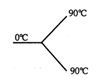
Three rods made of the same material and having the same cross-section are joined as shown in the figure. Each rod is of the same length. The left and right ends are kept at $0^{\circ}C$ and $90^{\circ}C$ respectively. The temperature of the junction of the three rods will be ...... $^{\circ}C$.
A
$45$
B
$60$
C
$30$
D
$20$
Solution
(B) Let the temperature of the junction be $\theta$.
Since the rods are made of the same material and have the same length and cross-section,they have the same thermal resistance $R$.
According to the principle of conservation of energy (steady state),the heat flowing into the junction must equal the heat flowing out of the junction.
Let the heat flow from the $90^{\circ}C$ ends towards the junction and then towards the $0^{\circ}C$ end.
$Q_{in} = Q_{out}$
$\frac{90 - \theta}{R} + \frac{90 - \theta}{R} = \frac{\theta - 0}{R}$
$2(90 - \theta) = \theta$
$180 - 2\theta = \theta$
$3\theta = 180$
$\theta = 60^{\circ}C$.
Since the rods are made of the same material and have the same length and cross-section,they have the same thermal resistance $R$.
According to the principle of conservation of energy (steady state),the heat flowing into the junction must equal the heat flowing out of the junction.
Let the heat flow from the $90^{\circ}C$ ends towards the junction and then towards the $0^{\circ}C$ end.
$Q_{in} = Q_{out}$
$\frac{90 - \theta}{R} + \frac{90 - \theta}{R} = \frac{\theta - 0}{R}$
$2(90 - \theta) = \theta$
$180 - 2\theta = \theta$
$3\theta = 180$
$\theta = 60^{\circ}C$.
0 likesView Solution
13
ChemistryMCQIIT JEE · 2001
An aqueous solution of $6.3 \ g$ of oxalic acid dihydrate is made up to $250 \ mL$. The volume of $0.1 \ N \ NaOH$ required to completely neutralize $10 \ mL$ of this solution is ............. $mL$.
A
$40$
B
$20$
C
$10$
D
$4$
Solution
(A) The molar mass of oxalic acid dihydrate $(H_2C_2O_4 \cdot 2H_2O)$ is $126 \ g/mol$.
Since it is a dibasic acid,its equivalent mass is $126 / 2 = 63 \ g/eq$.
First,calculate the normality $(N_1)$ of the oxalic acid solution:
$N_1 = \frac{\text{mass}}{\text{equivalent mass}} \times \frac{1000}{V(mL)} = \frac{6.3}{63} \times \frac{1000}{250} = 0.1 \times 4 = 0.4 \ N$.
Using the law of equivalence for neutralization:
$N_1 V_1 = N_2 V_2$
$(0.4 \ N) \times (10 \ mL) = (0.1 \ N) \times V_2$
$V_2 = \frac{0.4 \times 10}{0.1} = 40 \ mL$.
Since it is a dibasic acid,its equivalent mass is $126 / 2 = 63 \ g/eq$.
First,calculate the normality $(N_1)$ of the oxalic acid solution:
$N_1 = \frac{\text{mass}}{\text{equivalent mass}} \times \frac{1000}{V(mL)} = \frac{6.3}{63} \times \frac{1000}{250} = 0.1 \times 4 = 0.4 \ N$.
Using the law of equivalence for neutralization:
$N_1 V_1 = N_2 V_2$
$(0.4 \ N) \times (10 \ mL) = (0.1 \ N) \times V_2$
$V_2 = \frac{0.4 \times 10}{0.1} = 40 \ mL$.
0 likesView Solution
14
ChemistryMediumMCQIIT JEE · 2001
The quantum numbers $+1/2$ and $-1/2$ for the electron spin represent
A
Rotation of the electron in clockwise and anticlockwise direction respectively
B
Rotation of the electron in anticlockwise and clockwise direction respectively
C
Magnetic moment of the electron pointing up and down respectively
D
$A$ or $C$ both
Solution
(D) The spin quantum number $(m_s)$ describes the intrinsic angular momentum of an electron.
Historically,it was visualized as the electron spinning on its axis,where $+1/2$ corresponds to clockwise rotation and $-1/2$ corresponds to anticlockwise rotation.
Alternatively,it represents the orientation of the electron's magnetic moment,where $+1/2$ indicates the magnetic moment is pointing up and $-1/2$ indicates it is pointing down.
Therefore,both statements $A$ and $C$ are accepted interpretations.
Historically,it was visualized as the electron spinning on its axis,where $+1/2$ corresponds to clockwise rotation and $-1/2$ corresponds to anticlockwise rotation.
Alternatively,it represents the orientation of the electron's magnetic moment,where $+1/2$ indicates the magnetic moment is pointing up and $-1/2$ indicates it is pointing down.
Therefore,both statements $A$ and $C$ are accepted interpretations.
0 likesView Solution
15
ChemistryDifficultMCQIIT JEE · 2001
For a sparingly soluble salt $A_pB_q$,the relationship of its solubility product $(L_S)$ with its solubility $(S)$ is
A
$L_S = S^{p + q} \cdot p^p \cdot q^q$
B
$L_S = S^{p + q} \cdot p^q \cdot q^p$
C
$L_S = S^{pq} \cdot p^p \cdot q^q$
D
$L_S = S^{pq} \cdot (p \cdot q)^{p + q}$
Solution
(A) The dissociation of the sparingly soluble salt $A_pB_q$ is given by:
$A_pB_q(s) \rightleftharpoons pA^{q+}(aq) + qB^{p-}(aq)$
If $S$ is the solubility of the salt,then the concentration of ions at equilibrium is:
$[A^{q+}] = p \cdot S$
$[B^{p-}] = q \cdot S$
The solubility product $(L_S)$ is defined as:
$L_S = [A^{q+}]^p [B^{p-}]^q$
Substituting the concentrations:
$L_S = (p \cdot S)^p \cdot (q \cdot S)^q$
$L_S = p^p \cdot S^p \cdot q^q \cdot S^q$
$L_S = S^{p + q} \cdot p^p \cdot q^q$
$A_pB_q(s) \rightleftharpoons pA^{q+}(aq) + qB^{p-}(aq)$
If $S$ is the solubility of the salt,then the concentration of ions at equilibrium is:
$[A^{q+}] = p \cdot S$
$[B^{p-}] = q \cdot S$
The solubility product $(L_S)$ is defined as:
$L_S = [A^{q+}]^p [B^{p-}]^q$
Substituting the concentrations:
$L_S = (p \cdot S)^p \cdot (q \cdot S)^q$
$L_S = p^p \cdot S^p \cdot q^q \cdot S^q$
$L_S = S^{p + q} \cdot p^p \cdot q^q$
0 likesView Solution
16
ChemistryMCQIIT JEE · 2001
If $\alpha + \beta = \frac{\pi}{2}$ and $\beta + \gamma = \alpha$,then $\tan \alpha$ equals
A
$2(\tan \beta + \tan \gamma)$
B
$\tan \beta + \tan \gamma$
C
$\tan \beta + 2\tan \gamma$
D
$2\tan \beta + \tan \gamma$
Solution
(C) Given $\alpha + \beta = \frac{\pi}{2}$,we have $\beta = \frac{\pi}{2} - \alpha$,so $\tan \beta = \cot \alpha = \frac{1}{\tan \alpha}$.
Also,$\beta + \gamma = \alpha$,so $\tan(\beta + \gamma) = \tan \alpha$.
Using the formula $\tan(A+B) = \frac{\tan A + \tan B}{1 - \tan A \tan B}$,we get $\tan \alpha = \frac{\tan \beta + \tan \gamma}{1 - \tan \beta \tan \gamma}$.
Substituting $\tan \beta = \cot \alpha$:
$\tan \alpha = \frac{\cot \alpha + \tan \gamma}{1 - \cot \alpha \tan \gamma}$.
Multiply both sides by $(1 - \cot \alpha \tan \gamma)$:
$\tan \alpha (1 - \cot \alpha \tan \gamma) = \cot \alpha + \tan \gamma$.
$\tan \alpha - (\tan \alpha \cot \alpha) \tan \gamma = \cot \alpha + \tan \gamma$.
Since $\tan \alpha \cot \alpha = 1$,we have $\tan \alpha - \tan \gamma = \cot \alpha + \tan \gamma$.
Since $\cot \alpha = \tan \beta$,we get $\tan \alpha = \tan \beta + 2\tan \gamma$.
Also,$\beta + \gamma = \alpha$,so $\tan(\beta + \gamma) = \tan \alpha$.
Using the formula $\tan(A+B) = \frac{\tan A + \tan B}{1 - \tan A \tan B}$,we get $\tan \alpha = \frac{\tan \beta + \tan \gamma}{1 - \tan \beta \tan \gamma}$.
Substituting $\tan \beta = \cot \alpha$:
$\tan \alpha = \frac{\cot \alpha + \tan \gamma}{1 - \cot \alpha \tan \gamma}$.
Multiply both sides by $(1 - \cot \alpha \tan \gamma)$:
$\tan \alpha (1 - \cot \alpha \tan \gamma) = \cot \alpha + \tan \gamma$.
$\tan \alpha - (\tan \alpha \cot \alpha) \tan \gamma = \cot \alpha + \tan \gamma$.
Since $\tan \alpha \cot \alpha = 1$,we have $\tan \alpha - \tan \gamma = \cot \alpha + \tan \gamma$.
Since $\cot \alpha = \tan \beta$,we get $\tan \alpha = \tan \beta + 2\tan \gamma$.
0 likesView Solution
17
ChemistryMCQIIT JEE · 2001
The equation of the directrix of the parabola ${y^2} + 4y + 4x + 2 = 0$ is
A
$x = -1$
B
$x = 1$
C
$x = -\frac{3}{2}$
D
$x = \frac{3}{2}$
Solution
(D) Given equation: ${y^2} + 4y + 4x + 2 = 0$
Rewrite as: ${y^2} + 4y + 4 = -4x + 2$
${(y + 2)^2} = -4x + 2$
${(y + 2)^2} = -4(x - \frac{1}{2})$
Comparing with standard form ${Y^2} = -4aX$,where $Y = y + 2$,$X = x - \frac{1}{2}$,and $4a = 4 \implies a = 1$.
The directrix of ${Y^2} = -4aX$ is $X = a$.
Substituting the values: $x - \frac{1}{2} = 1$
$x = 1 + \frac{1}{2} = \frac{3}{2}$.
Rewrite as: ${y^2} + 4y + 4 = -4x + 2$
${(y + 2)^2} = -4x + 2$
${(y + 2)^2} = -4(x - \frac{1}{2})$
Comparing with standard form ${Y^2} = -4aX$,where $Y = y + 2$,$X = x - \frac{1}{2}$,and $4a = 4 \implies a = 1$.
The directrix of ${Y^2} = -4aX$ is $X = a$.
Substituting the values: $x - \frac{1}{2} = 1$
$x = 1 + \frac{1}{2} = \frac{3}{2}$.
0 likesView Solution
18
ChemistryMCQIIT JEE · 2001
$A$ wire of length $L$ and $3$ identical cells of negligible internal resistances are connected in series. Due to the current,the temperature of the wire is raised by $\Delta T$ in time $t$. $N$ number of similar cells is now connected in series with a wire of the same material and cross section but of length $2L$. The temperature of the wire is raised by the same amount $\Delta T$ in the same time $t$. The value of $N$ is:
A
$4$
B
$6$
C
$8$
D
$9$
Solution
(B) Let $E$ be the $EMF$ of each cell and $R$ be the resistance of the wire of length $L$. The mass of the wire is $m = \rho A L$,where $\rho$ is density and $A$ is cross-sectional area.
In the first case,the heat produced is equal to the heat absorbed by the wire:
$\frac{(3E)^2}{R} t = m s \Delta T$ ....................... $(i)$
When the length is doubled to $2L$,the new resistance becomes $2R$ and the new mass becomes $2m$.
In the second case,with $N$ cells in series:
$\frac{(NE)^2}{2R} t = (2m) s \Delta T$ ....................... $(ii)$
Dividing equation $(ii)$ by equation $(i)$:
$\frac{(NE)^2 / 2R}{(3E)^2 / R} = \frac{2m s \Delta T}{m s \Delta T}$
$\frac{N^2}{2 \times 9} = 2$
$N^2 = 36$
$N = 6$
In the first case,the heat produced is equal to the heat absorbed by the wire:
$\frac{(3E)^2}{R} t = m s \Delta T$ ....................... $(i)$
When the length is doubled to $2L$,the new resistance becomes $2R$ and the new mass becomes $2m$.
In the second case,with $N$ cells in series:
$\frac{(NE)^2}{2R} t = (2m) s \Delta T$ ....................... $(ii)$
Dividing equation $(ii)$ by equation $(i)$:
$\frac{(NE)^2 / 2R}{(3E)^2 / R} = \frac{2m s \Delta T}{m s \Delta T}$
$\frac{N^2}{2 \times 9} = 2$
$N^2 = 36$
$N = 6$
0 likesView Solution
19
ChemistryMCQIIT JEE · 2001
Two particles of masses $m_1$ and $m_2$ in projectile motion have velocities $\vec{v}_1$ and $\vec{v}_2$ respectively at time $t = 0$. They collide at time $t_0$. Their velocities become $\vec{v}_1'$ and $\vec{v}_2'$ at time $2t_0$ while still moving in air. The value of $|(m_1 \vec{v}_1' + m_2 \vec{v}_2') - (m_1 \vec{v}_1 + m_2 \vec{v}_2)|$ is
A
Zero
B
$(m_1 + m_2)gt_0$
C
$2(m_1 + m_2)gt_0$
D
$\frac{1}{2}(m_1 + m_2)gt_0$
Solution
(C) The total momentum of the system at time $t = 0$ is $\vec{P}_i = m_1 \vec{v}_1 + m_2 \vec{v}_2$.
The collision between the two particles is an internal interaction and does not change the total momentum of the system.
The only external force acting on the system throughout the motion is the gravitational force,which is $\vec{F}_{ext} = (m_1 + m_2)g$ acting downwards.
According to the impulse-momentum theorem,the change in momentum is equal to the impulse of the external force: $\Delta \vec{P} = \int_{t_1}^{t_2} \vec{F}_{ext} dt$.
Here,the time interval is from $t = 0$ to $t = 2t_0$,so $\Delta t = 2t_0$.
Since the force is constant,the impulse is $\vec{J} = \vec{F}_{ext} \times \Delta t = (m_1 + m_2)g \times 2t_0$.
Therefore,the magnitude of the change in momentum is $|(m_1 \vec{v}_1' + m_2 \vec{v}_2') - (m_1 \vec{v}_1 + m_2 \vec{v}_2)| = 2(m_1 + m_2)gt_0$.
The collision between the two particles is an internal interaction and does not change the total momentum of the system.
The only external force acting on the system throughout the motion is the gravitational force,which is $\vec{F}_{ext} = (m_1 + m_2)g$ acting downwards.
According to the impulse-momentum theorem,the change in momentum is equal to the impulse of the external force: $\Delta \vec{P} = \int_{t_1}^{t_2} \vec{F}_{ext} dt$.
Here,the time interval is from $t = 0$ to $t = 2t_0$,so $\Delta t = 2t_0$.
Since the force is constant,the impulse is $\vec{J} = \vec{F}_{ext} \times \Delta t = (m_1 + m_2)g \times 2t_0$.
Therefore,the magnitude of the change in momentum is $|(m_1 \vec{v}_1' + m_2 \vec{v}_2') - (m_1 \vec{v}_1 + m_2 \vec{v}_2)| = 2(m_1 + m_2)gt_0$.
0 likesView Solution
20
ChemistryMediumMCQIIT JEE · 2001
The quantum numbers $+1/2$ and $-1/2$ for the electron spin represent
A
rotation of the electron in clockwise and anticlockwise direction respectively
B
rotation of the electron in anticlockwise and clockwise direction respectively
C
magnetic moment of the electron pointing up and down respectively
D
two quantum mechanical spin states which have no classical analogue
Solution
(D) The electron spin quantum number $(m_s)$ describes the intrinsic angular momentum of an electron.
While it is often visualized as the electron spinning on its axis,this is a simplified model.
In quantum mechanics,the values $+1/2$ and $-1/2$ represent two distinct quantum mechanical spin states that do not have a direct classical analogue.
While it is often visualized as the electron spinning on its axis,this is a simplified model.
In quantum mechanics,the values $+1/2$ and $-1/2$ represent two distinct quantum mechanical spin states that do not have a direct classical analogue.
0 likesView Solution
21
ChemistryMCQIIT JEE · 2001
The quantum numbers $+1/2$ and $-1/2$ for the electron spin represent
A
rotation of the electron in clockwise and anticlockwise direction respectively
B
rotation of the electron in anticlockwise and clockwise direction respectively
C
magnetic moment of the electron pointing up and down respectively
D
two quantum mechanical spin states which have no classical analogue
Solution
(D) The electron spin quantum number $(m_s)$ describes the intrinsic angular momentum of an electron.
While it is often visualized as the electron spinning about its axis,this is a semi-classical model.
In quantum mechanics,these values ($+1/2$ and $-1/2$) represent two distinct quantum mechanical spin states that have no true classical analogue.
While it is often visualized as the electron spinning about its axis,this is a semi-classical model.
In quantum mechanics,these values ($+1/2$ and $-1/2$) represent two distinct quantum mechanical spin states that have no true classical analogue.
0 likesView Solution
22
ChemistryMCQIIT JEE · 2001
The complex ion which has no $d$ electrons in the central metal atom is:
A
$[Co(NH_3)_6]^{3+}$
B
$[Fe(CN)_6]^{3-}$
C
$[Cr(H_2O)_6]^{3+}$
D
$[MnO_4]^-$
Solution
(D) To determine the number of $d$ electrons,we calculate the oxidation state of the central metal atom:
$1$. In $[Co(NH_3)_6]^{3+}$,$Co$ is in $+3$ state. $Co$ $(Z=27)$ is $[Ar] 3d^7 4s^2$,so $Co^{3+}$ is $3d^6$.
$2$. In $[Fe(CN)_6]^{3-}$,$Fe$ is in $+3$ state. $Fe$ $(Z=26)$ is $[Ar] 3d^6 4s^2$,so $Fe^{3+}$ is $3d^5$.
$3$. In $[Cr(H_2O)_6]^{3+}$,$Cr$ is in $+3$ state. $Cr$ $(Z=24)$ is $[Ar] 3d^5 4s^1$,so $Cr^{3+}$ is $3d^3$.
$4$. In $[MnO_4]^-$,$Mn$ is in $+7$ state. $Mn$ $(Z=25)$ is $[Ar] 3d^5 4s^2$,so $Mn^{7+}$ is $3d^0$.
Therefore,$[MnO_4]^-$ has no $d$ electrons.
$1$. In $[Co(NH_3)_6]^{3+}$,$Co$ is in $+3$ state. $Co$ $(Z=27)$ is $[Ar] 3d^7 4s^2$,so $Co^{3+}$ is $3d^6$.
$2$. In $[Fe(CN)_6]^{3-}$,$Fe$ is in $+3$ state. $Fe$ $(Z=26)$ is $[Ar] 3d^6 4s^2$,so $Fe^{3+}$ is $3d^5$.
$3$. In $[Cr(H_2O)_6]^{3+}$,$Cr$ is in $+3$ state. $Cr$ $(Z=24)$ is $[Ar] 3d^5 4s^1$,so $Cr^{3+}$ is $3d^3$.
$4$. In $[MnO_4]^-$,$Mn$ is in $+7$ state. $Mn$ $(Z=25)$ is $[Ar] 3d^5 4s^2$,so $Mn^{7+}$ is $3d^0$.
Therefore,$[MnO_4]^-$ has no $d$ electrons.
0 likesView Solution
23
ChemistryMCQIIT JEE · 2001
If $\vec{a}, \vec{b}, \text{ and } \vec{c}$ are unit vectors,then $|\vec{a} - \vec{b}|^2 + |\vec{b} - \vec{c}|^2 + |\vec{c} - \vec{a}|^2$ does not exceed:
A
$4$
B
$9$
C
$8$
D
$6$
Solution
(B) Given that $\vec{a}, \vec{b}, \text{ and } \vec{c}$ are unit vectors,we have $|\vec{a}| = |\vec{b}| = |\vec{c}| = 1$.
We know that $|\vec{x} - \vec{y}|^2 = |\vec{x}|^2 + |\vec{y}|^2 - 2(\vec{x} \cdot \vec{y})$.
Expanding the expression:
$|\vec{a} - \vec{b}|^2 + |\vec{b} - \vec{c}|^2 + |\vec{c} - \vec{a}|^2 = (|\vec{a}|^2 + |\vec{b}|^2 - 2\vec{a} \cdot \vec{b}) + (|\vec{b}|^2 + |vec{c}|^2 - 2\vec{b} \cdot \vec{c}) + (|\vec{c}|^2 + |\vec{a}|^2 - 2\vec{c} \cdot \vec{a})$.
Since $|\vec{a}| = |\vec{b}| = |\vec{c}| = 1$,this simplifies to:
$2(1+1+1) - 2(\vec{a} \cdot \vec{b} + \vec{b} \cdot \vec{c} + \vec{c} \cdot \vec{a}) = 6 - 2(\vec{a} \cdot \vec{b} + \vec{b} \cdot \vec{c} + \vec{c} \cdot \vec{a})$.
We also know that $|\vec{a} + \vec{b} + \vec{c}|^2 = |\vec{a}|^2 + |\vec{b}|^2 + |\vec{c}|^2 + 2(\vec{a} \cdot \vec{b} + \vec{b} \cdot \vec{c} + \vec{c} \cdot \vec{a}) = 3 + 2(\vec{a} \cdot \vec{b} + \vec{b} \cdot \vec{c} + \vec{c} \cdot \vec{a})$.
Thus,$2(\vec{a} \cdot \vec{b} + \vec{b} \cdot \vec{c} + \vec{c} \cdot \vec{a}) = |\vec{a} + \vec{b} + \vec{c}|^2 - 3$.
Substituting this back into the expression:
$6 - (|\vec{a} + \vec{b} + \vec{c}|^2 - 3) = 9 - |\vec{a} + \vec{b} + \vec{c}|^2$.
Since $|\vec{a} + \vec{b} + \vec{c}|^2 \geq 0$,the maximum value of the expression is $9$.
We know that $|\vec{x} - \vec{y}|^2 = |\vec{x}|^2 + |\vec{y}|^2 - 2(\vec{x} \cdot \vec{y})$.
Expanding the expression:
$|\vec{a} - \vec{b}|^2 + |\vec{b} - \vec{c}|^2 + |\vec{c} - \vec{a}|^2 = (|\vec{a}|^2 + |\vec{b}|^2 - 2\vec{a} \cdot \vec{b}) + (|\vec{b}|^2 + |vec{c}|^2 - 2\vec{b} \cdot \vec{c}) + (|\vec{c}|^2 + |\vec{a}|^2 - 2\vec{c} \cdot \vec{a})$.
Since $|\vec{a}| = |\vec{b}| = |\vec{c}| = 1$,this simplifies to:
$2(1+1+1) - 2(\vec{a} \cdot \vec{b} + \vec{b} \cdot \vec{c} + \vec{c} \cdot \vec{a}) = 6 - 2(\vec{a} \cdot \vec{b} + \vec{b} \cdot \vec{c} + \vec{c} \cdot \vec{a})$.
We also know that $|\vec{a} + \vec{b} + \vec{c}|^2 = |\vec{a}|^2 + |\vec{b}|^2 + |\vec{c}|^2 + 2(\vec{a} \cdot \vec{b} + \vec{b} \cdot \vec{c} + \vec{c} \cdot \vec{a}) = 3 + 2(\vec{a} \cdot \vec{b} + \vec{b} \cdot \vec{c} + \vec{c} \cdot \vec{a})$.
Thus,$2(\vec{a} \cdot \vec{b} + \vec{b} \cdot \vec{c} + \vec{c} \cdot \vec{a}) = |\vec{a} + \vec{b} + \vec{c}|^2 - 3$.
Substituting this back into the expression:
$6 - (|\vec{a} + \vec{b} + \vec{c}|^2 - 3) = 9 - |\vec{a} + \vec{b} + \vec{c}|^2$.
Since $|\vec{a} + \vec{b} + \vec{c}|^2 \geq 0$,the maximum value of the expression is $9$.
0 likesView Solution
24
ChemistryMCQIIT JEE · 2001
The quantum numbers $+1/2$ and $-1/2$ for the electron spin represent:
A
Rotation of the electron in clockwise and anticlockwise direction respectively.
B
Rotation of the electron in anticlockwise and clockwise direction respectively.
C
Magnetic moment of the electron pointing up and down respectively.
D
Two quantum mechanical spin states which have no classical analogue.
Solution
(D) The electron spin quantum number $(m_s)$ describes the intrinsic angular momentum of an electron.
While it is often visualized as the electron spinning about its axis,this is a quantum mechanical property.
These two values,$+\frac{1}{2}$ and $-\frac{1}{2}$,represent two distinct quantum mechanical spin states that do not have a direct classical analogue.
While it is often visualized as the electron spinning about its axis,this is a quantum mechanical property.
These two values,$+\frac{1}{2}$ and $-\frac{1}{2}$,represent two distinct quantum mechanical spin states that do not have a direct classical analogue.
0 likesView Solution
25
ChemistryMCQIIT JEE · 2001
In a Young's double slit experiment,$12$ fringes are observed to be formed in a certain segment of the screen,when light of wavelength $600 \, nm$ is used. If the wavelength of light is changed to $400 \, nm$,the number of fringes observed in the same segment of the screen will be
A
$12$
B
$18$
C
$24$
D
$30$
Solution
(B) The width of the segment on the screen is given by $x = n \beta$,where $\beta = \frac{\lambda D}{d}$ is the fringe width.
Since the segment length $x$ remains constant,we have $n_1 \beta_1 = n_2 \beta_2$.
Substituting the formula for fringe width: $n_1 \left( \frac{\lambda_1 D}{d} \right) = n_2 \left( \frac{\lambda_2 D}{d} \right)$.
This simplifies to $n_1 \lambda_1 = n_2 \lambda_2$.
Given $n_1 = 12$,$\lambda_1 = 600 \, nm$,and $\lambda_2 = 400 \, nm$,we find $n_2 = \frac{n_1 \lambda_1}{\lambda_2}$.
$n_2 = \frac{12 \times 600}{400} = 12 \times 1.5 = 18$.
Therefore,the number of fringes observed is $18$.
Since the segment length $x$ remains constant,we have $n_1 \beta_1 = n_2 \beta_2$.
Substituting the formula for fringe width: $n_1 \left( \frac{\lambda_1 D}{d} \right) = n_2 \left( \frac{\lambda_2 D}{d} \right)$.
This simplifies to $n_1 \lambda_1 = n_2 \lambda_2$.
Given $n_1 = 12$,$\lambda_1 = 600 \, nm$,and $\lambda_2 = 400 \, nm$,we find $n_2 = \frac{n_1 \lambda_1}{\lambda_2}$.
$n_2 = \frac{12 \times 600}{400} = 12 \times 1.5 = 18$.
Therefore,the number of fringes observed is $18$.
0 likesView Solution
26
ChemistryMCQIIT JEE · 2001
Two circular coils can be arranged in any of the three situations shown in the figure. Their mutual inductance will be:
A
Maximum in situation $(A)$
B
Maximum in situation $(B)$
C
Maximum in situation $(C)$
D
The same in all situations
Solution
(A) The mutual inductance $M$ between two coils depends on the magnetic flux linkage between them.
$M$ is directly proportional to the amount of magnetic flux produced by one coil that passes through the area of the second coil.
In situation $(A)$,the two coils are placed coaxially with their planes parallel to each other. This configuration allows the maximum number of magnetic field lines produced by the first coil to pass through the second coil,resulting in the maximum flux linkage.
In situations $(B)$ and $(C)$,the coils are either perpendicular or at an angle,which significantly reduces the effective flux linkage.
Therefore,the mutual inductance is maximum in situation $(A)$.
$M$ is directly proportional to the amount of magnetic flux produced by one coil that passes through the area of the second coil.
In situation $(A)$,the two coils are placed coaxially with their planes parallel to each other. This configuration allows the maximum number of magnetic field lines produced by the first coil to pass through the second coil,resulting in the maximum flux linkage.
In situations $(B)$ and $(C)$,the coils are either perpendicular or at an angle,which significantly reduces the effective flux linkage.
Therefore,the mutual inductance is maximum in situation $(A)$.
0 likesView Solution
27
ChemistryMCQIIT JEE · 2001
The ends of a stretched wire of length $L$ are fixed at $x = 0$ and $x = L$. In one experiment,the displacement of the wire is $y_1 = A \sin(\pi x/L) \sin(\omega t)$ and the energy is $E_1$. In another experiment,its displacement is $y_2 = A \sin(2\pi x/L) \sin(2\omega t)$ and the energy is $E_2$. Then:
A
$E_2 = E_1$
B
$E_2 = 2E_1$
C
$E_2 = 4E_1$
D
$E_2 = 16E_1$
Solution
(C) The energy $E$ of a standing wave is proportional to the square of the amplitude $(A)$ and the square of the angular frequency $(\omega)$.
Mathematically,$E \propto A^2 \omega^2$.
In the first case,the displacement is $y_1 = A \sin(\pi x/L) \sin(\omega t)$,so the amplitude is $A$ and the angular frequency is $\omega$. Thus,$E_1 = k A^2 \omega^2$ (where $k$ is a constant).
In the second case,the displacement is $y_2 = A \sin(2\pi x/L) \sin(2\omega t)$,so the amplitude is $A$ and the angular frequency is $2\omega$.
Thus,$E_2 = k A^2 (2\omega)^2 = k A^2 (4\omega^2) = 4(k A^2 \omega^2)$.
Comparing the two,we get $E_2 = 4E_1$.
Mathematically,$E \propto A^2 \omega^2$.
In the first case,the displacement is $y_1 = A \sin(\pi x/L) \sin(\omega t)$,so the amplitude is $A$ and the angular frequency is $\omega$. Thus,$E_1 = k A^2 \omega^2$ (where $k$ is a constant).
In the second case,the displacement is $y_2 = A \sin(2\pi x/L) \sin(2\omega t)$,so the amplitude is $A$ and the angular frequency is $2\omega$.
Thus,$E_2 = k A^2 (2\omega)^2 = k A^2 (4\omega^2) = 4(k A^2 \omega^2)$.
Comparing the two,we get $E_2 = 4E_1$.
0 likesView Solution
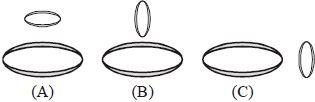
28
ChemistryMCQIIT JEE · 2001
Two circular coils can be arranged in any of the three situations shown in the figure. Their mutual inductance will be
A
Maximum in situation $(A)$
B
Maximum in situation $(B)$
C
Maximum in situation $(C)$
D
The same in all situations
Solution
(A) The mutual inductance $M$ between two coils depends on the magnetic flux linkage between them. The flux linkage is maximum when the magnetic field lines produced by one coil pass through the area of the other coil most effectively.
In situation $(A)$,the planes of the two coils are parallel to each other. This orientation allows the maximum number of magnetic field lines produced by the larger coil to pass through the area of the smaller coil,resulting in the maximum magnetic flux linkage.
In situation $(B)$,the smaller coil is placed perpendicular to the plane of the larger coil. In this case,the magnetic field lines from the larger coil are mostly parallel to the plane of the smaller coil,resulting in minimal flux linkage.
In situation $(C)$,the smaller coil is placed in the same plane as the larger coil but shifted to the side. This also results in a lower flux linkage compared to situation $(A)$.
Therefore,the mutual inductance is maximum in situation $(A)$.
In situation $(A)$,the planes of the two coils are parallel to each other. This orientation allows the maximum number of magnetic field lines produced by the larger coil to pass through the area of the smaller coil,resulting in the maximum magnetic flux linkage.
In situation $(B)$,the smaller coil is placed perpendicular to the plane of the larger coil. In this case,the magnetic field lines from the larger coil are mostly parallel to the plane of the smaller coil,resulting in minimal flux linkage.
In situation $(C)$,the smaller coil is placed in the same plane as the larger coil but shifted to the side. This also results in a lower flux linkage compared to situation $(A)$.
Therefore,the mutual inductance is maximum in situation $(A)$.
0 likesView Solution
29
ChemistryMCQIIT JEE · 2001
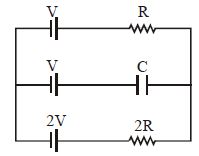
In the given circuit,with steady current,the potential drop across the capacitor must be
A
$V$
B
$V/2$
C
$V/3$
D
$2V/3$
Solution
(D) In a steady state,the capacitor acts as an open circuit,so no current flows through the middle branch.
The current $I$ flows through the outer loop containing the $V$ and $2V$ batteries and the $R$ and $2R$ resistors.
Applying Kirchhoff's voltage law to the outer loop:
$2V - V = I(R + 2R)$
$V = I(3R)$
$I = \frac{V}{3R}$
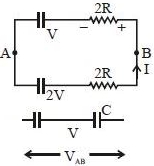
The potential difference across the capacitor $C$ is equal to the potential difference between the two nodes to which it is connected.
Let the left node be $A$ and the right node be $B$. The potential difference $V_{AB}$ across the capacitor branch is:
$V_{AB} = V - I \times R$ (or $V_{AB} = 2V - I \times 2R$)
$V_{AB} = V - (\frac{V}{3R}) \times R = V - \frac{V}{3} = \frac{2V}{3}$
Thus,the potential drop across the capacitor is $\frac{2V}{3}$.
The current $I$ flows through the outer loop containing the $V$ and $2V$ batteries and the $R$ and $2R$ resistors.
Applying Kirchhoff's voltage law to the outer loop:
$2V - V = I(R + 2R)$
$V = I(3R)$
$I = \frac{V}{3R}$
The potential difference across the capacitor $C$ is equal to the potential difference between the two nodes to which it is connected.
Let the left node be $A$ and the right node be $B$. The potential difference $V_{AB}$ across the capacitor branch is:
$V_{AB} = V - I \times R$ (or $V_{AB} = 2V - I \times 2R$)
$V_{AB} = V - (\frac{V}{3R}) \times R = V - \frac{V}{3} = \frac{2V}{3}$
Thus,the potential drop across the capacitor is $\frac{2V}{3}$.
0 likesView Solution
30
ChemistryMCQIIT JEE · 2001
$A$ coil having $N$ turns is wound tightly in the form of a spiral with inner and outer radii $a$ and $b$ respectively. When a current $I$ passes through the coil,the magnetic field at the centre is
A
$\frac{\mu_0 NI}{b}$
B
$\frac{2\mu_0 NI}{a}$
C
$\frac{\mu_0 NI}{2(b - a)} \ln \left( \frac{b}{a} \right)$
D
$\frac{\mu_0 IN}{(b - a)} \ln \left( \frac{b}{a} \right)$
Solution
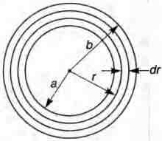
(C) Consider a small elemental ring of radius $r$ and thickness $dr$ within the spiral coil.
The number of turns in this elemental ring is $dn = \frac{N}{b - a} dr$.
The magnetic field at the centre due to this elemental ring is $dB = \frac{\mu_0 (dn) I}{2r} = \frac{\mu_0 N I}{2(b - a)} \frac{dr}{r}$.
To find the total magnetic field $B$ at the centre,we integrate $dB$ from $r = a$ to $r = b$:
$B = \int_{a}^{b} \frac{\mu_0 N I}{2(b - a)} \frac{dr}{r} = \frac{\mu_0 N I}{2(b - a)} [\ln r]_{a}^{b}$.
$B = \frac{\mu_0 N I}{2(b - a)} \ln \left( \frac{b}{a} \right)$.
The number of turns in this elemental ring is $dn = \frac{N}{b - a} dr$.
The magnetic field at the centre due to this elemental ring is $dB = \frac{\mu_0 (dn) I}{2r} = \frac{\mu_0 N I}{2(b - a)} \frac{dr}{r}$.
To find the total magnetic field $B$ at the centre,we integrate $dB$ from $r = a$ to $r = b$:
$B = \int_{a}^{b} \frac{\mu_0 N I}{2(b - a)} \frac{dr}{r} = \frac{\mu_0 N I}{2(b - a)} [\ln r]_{a}^{b}$.
$B = \frac{\mu_0 N I}{2(b - a)} \ln \left( \frac{b}{a} \right)$.
0 likesView Solution
31
ChemistryMCQIIT JEE · 2001
Two beams of light having intensities $I$ and $4I$ interfere to produce a fringe pattern on a screen. The phase difference between the beams is $\pi/2$ at point $A$ and $\pi$ at point $B$. Then the difference between the resultant intensities at $A$ and $B$ is (in $I$)
A
$2$
B
$4$
C
$5$
D
$7$
Solution
(B) The resultant intensity $I_{net}$ for two interfering beams is given by the formula: $I_{net} = I_1 + I_2 + 2\sqrt{I_1 I_2} \cos(\Delta \phi)$.
At point $A$,the phase difference $\Delta \phi = \pi/2$. Substituting the values $I_1 = I$ and $I_2 = 4I$:
$I_A = I + 4I + 2\sqrt{I \cdot 4I} \cos(\pi/2) = 5I + 2(2I)(0) = 5I$.
At point $B$,the phase difference $\Delta \phi = \pi$. Substituting the values:
$I_B = I + 4I + 2\sqrt{I \cdot 4I} \cos(\pi) = 5I + 2(2I)(-1) = 5I - 4I = I$.
The difference between the resultant intensities at $A$ and $B$ is:
$|I_A - I_B| = |5I - I| = 4I$.
At point $A$,the phase difference $\Delta \phi = \pi/2$. Substituting the values $I_1 = I$ and $I_2 = 4I$:
$I_A = I + 4I + 2\sqrt{I \cdot 4I} \cos(\pi/2) = 5I + 2(2I)(0) = 5I$.
At point $B$,the phase difference $\Delta \phi = \pi$. Substituting the values:
$I_B = I + 4I + 2\sqrt{I \cdot 4I} \cos(\pi) = 5I + 2(2I)(-1) = 5I - 4I = I$.
The difference between the resultant intensities at $A$ and $B$ is:
$|I_A - I_B| = |5I - I| = 4I$.
0 likesView Solution
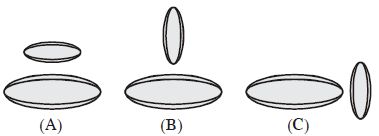
32
ChemistryMCQIIT JEE · 2001
Two circular coils can be arranged in any of the three situations shown in the figure. Their mutual inductance will be
A
Maximum in situation $(A)$
B
Maximum in situation $(B)$
C
Maximum in situation $(C)$
D
The same in all situations
Solution
(A) The mutual inductance $M$ between two coils depends on the magnetic flux linkage between them.
Mutual inductance is directly proportional to the amount of magnetic flux produced by one coil that passes through the area of the other coil.
In situation $(A)$,the planes of the two circular coils are parallel to each other. This orientation allows the maximum number of magnetic field lines produced by one coil to pass through the area of the second coil,resulting in maximum flux linkage.
In situations $(B)$ and $(C)$,the coils are placed perpendicular to each other,which results in minimum or zero flux linkage.
Therefore,the mutual inductance is maximum in situation $(A)$.
Mutual inductance is directly proportional to the amount of magnetic flux produced by one coil that passes through the area of the other coil.
In situation $(A)$,the planes of the two circular coils are parallel to each other. This orientation allows the maximum number of magnetic field lines produced by one coil to pass through the area of the second coil,resulting in maximum flux linkage.
In situations $(B)$ and $(C)$,the coils are placed perpendicular to each other,which results in minimum or zero flux linkage.
Therefore,the mutual inductance is maximum in situation $(A)$.
0 likesView Solution
33
ChemistryMCQIIT JEE · 2001
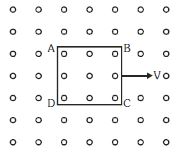
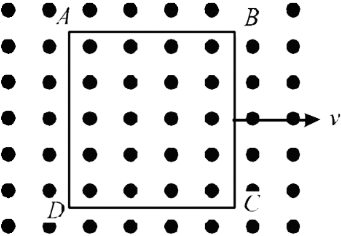
$A$ metallic square loop $ABCD$ is moving in its own plane with velocity $v$ in a uniform magnetic field perpendicular to its plane as shown in the figure. Electric field is induced:
A
in $AD$,but not in $BC$
B
in $BC$,but not in $AD$
C
neither in $AD$ nor in $BC$
D
in both $AD$ and $BC$
Solution
(D) When a conductor moves in a magnetic field,a motional electromotive force $(EMF)$ is induced across its ends,which is given by $\varepsilon = \int (\vec{v} \times \vec{B}) \cdot d\vec{l}$.
This induced $EMF$ corresponds to an induced electric field $\vec{E} = \vec{v} \times \vec{B}$.
In this problem,the square loop $ABCD$ moves with velocity $\vec{v}$ in a uniform magnetic field $\vec{B}$ perpendicular to the plane of the loop.
For any segment of the loop,if the velocity $\vec{v}$ is perpendicular to the magnetic field $\vec{B}$,an electric field $\vec{E} = \vec{v} \times \vec{B}$ is induced along the conductor.
Since the segments $AD$ and $BC$ are perpendicular to the velocity $\vec{v}$ and the magnetic field $\vec{B}$ is uniform and perpendicular to the plane,the cross product $\vec{v} \times \vec{B}$ is non-zero for both segments $AD$ and $BC$.
Therefore,an electric field is induced in both $AD$ and $BC$.
This induced $EMF$ corresponds to an induced electric field $\vec{E} = \vec{v} \times \vec{B}$.
In this problem,the square loop $ABCD$ moves with velocity $\vec{v}$ in a uniform magnetic field $\vec{B}$ perpendicular to the plane of the loop.
For any segment of the loop,if the velocity $\vec{v}$ is perpendicular to the magnetic field $\vec{B}$,an electric field $\vec{E} = \vec{v} \times \vec{B}$ is induced along the conductor.
Since the segments $AD$ and $BC$ are perpendicular to the velocity $\vec{v}$ and the magnetic field $\vec{B}$ is uniform and perpendicular to the plane,the cross product $\vec{v} \times \vec{B}$ is non-zero for both segments $AD$ and $BC$.
Therefore,an electric field is induced in both $AD$ and $BC$.
0 likesView Solution
34
ChemistryMCQIIT JEE · 2001
Two beams of light having intensities $I$ and $4I$ interfere to produce a fringe pattern on a screen. The phase difference between the beams is $\pi / 2$ at point $A$ and $\pi$ at point $B$. Then the difference between the resultant intensities at $A$ and $B$ is (in $I$)
A
$2$
B
$4$
C
$5$
D
$7$
Solution
(B) The resultant intensity $I_R$ for two interfering beams is given by the formula: $I_R = I_1 + I_2 + 2\sqrt{I_1 I_2} \cos \phi$,where $\phi$ is the phase difference.
Given $I_1 = I$ and $I_2 = 4I$.
At point $A$,the phase difference $\phi_A = \pi / 2$. Therefore,$I_A = I + 4I + 2\sqrt{I \cdot 4I} \cos(\pi / 2) = 5I + 4I(0) = 5I$.
At point $B$,the phase difference $\phi_B = \pi$. Therefore,$I_B = I + 4I + 2\sqrt{I \cdot 4I} \cos(\pi) = 5I + 4I(-1) = 5I - 4I = I$.
The difference between the resultant intensities at $A$ and $B$ is $I_A - I_B = 5I - I = 4I$.
Given $I_1 = I$ and $I_2 = 4I$.
At point $A$,the phase difference $\phi_A = \pi / 2$. Therefore,$I_A = I + 4I + 2\sqrt{I \cdot 4I} \cos(\pi / 2) = 5I + 4I(0) = 5I$.
At point $B$,the phase difference $\phi_B = \pi$. Therefore,$I_B = I + 4I + 2\sqrt{I \cdot 4I} \cos(\pi) = 5I + 4I(-1) = 5I - 4I = I$.
The difference between the resultant intensities at $A$ and $B$ is $I_A - I_B = 5I - I = 4I$.
0 likesView Solution
35
ChemistryMCQIIT JEE · 2001
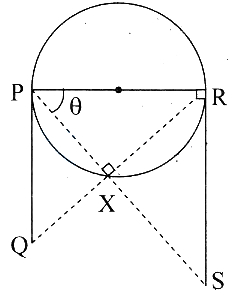
Let $PQ$ and $RS$ be tangents at the extremities of the diameter $PR$ of a circle of radius $r$. If $PS$ and $RQ$ intersect at a point $X$ on the circumference of the circle,then $2r$ equals
A
$\sqrt{PQ \cdot RS}$
B
$\frac{PQ+RS}{2}$
C
$\frac{2 \cdot PQ \cdot RS}{PQ+RS}$
D
$\sqrt{\frac{PQ^2+RS^2}{2}}$
Solution
(A) Let the diameter be $PR = 2r$. Since $PQ$ and $RS$ are tangents at $P$ and $R$ respectively,$PQ \perp PR$ and $RS \perp PR$.
In $\triangle PXR$,$\angle PXR = 90^{\circ}$ because it is an angle in a semicircle.
Let $\angle RPX = \theta$. Then $\angle PRX = 90^{\circ} - \theta$.
In $\triangle PQR$,$\angle PQR = 90^{\circ} - \theta$ and $\angle PRQ = 90^{\circ}$.
Thus,$\tan(\angle RPX) = \tan \theta = \frac{RS}{PR} = \frac{RS}{2r}$.
Also,in $\triangle PQR$,$\tan(\angle PRQ) = \tan(90^{\circ} - \theta) = \cot \theta = \frac{PQ}{PR} = \frac{PQ}{2r}$.
Therefore,$\tan \theta = \frac{2r}{PQ}$.
Equating the two expressions for $\tan \theta$:
$\frac{RS}{2r} = \frac{2r}{PQ} \implies (2r)^2 = PQ \cdot RS \implies 2r = \sqrt{PQ \cdot RS}$.
In $\triangle PXR$,$\angle PXR = 90^{\circ}$ because it is an angle in a semicircle.
Let $\angle RPX = \theta$. Then $\angle PRX = 90^{\circ} - \theta$.
In $\triangle PQR$,$\angle PQR = 90^{\circ} - \theta$ and $\angle PRQ = 90^{\circ}$.
Thus,$\tan(\angle RPX) = \tan \theta = \frac{RS}{PR} = \frac{RS}{2r}$.
Also,in $\triangle PQR$,$\tan(\angle PRQ) = \tan(90^{\circ} - \theta) = \cot \theta = \frac{PQ}{PR} = \frac{PQ}{2r}$.
Therefore,$\tan \theta = \frac{2r}{PQ}$.
Equating the two expressions for $\tan \theta$:
$\frac{RS}{2r} = \frac{2r}{PQ} \implies (2r)^2 = PQ \cdot RS \implies 2r = \sqrt{PQ \cdot RS}$.
0 likesView Solution
36
ChemistryDifficultMCQIIT JEE · 2001
The correct order of hybridization of the central atom in the following species $NH_3$,$[PtCl_4]^{2-}$,$PCl_5$,and $BCl_3$ is
A
$dsp^2$,$dsp^3$,$sp^2$,and $sp^3$
B
$sp^3$,$dsp^2$,$sp^3d$,$sp^2$
C
$dsp^2$,$sp^2$,$sp^3$,$dsp^3$
D
$dsp^2$,$sp^3$,$sp^2$,$dsp^3$
Solution
(B) The hybridization of the central atom in each species is determined as follows:
$1$. In $NH_3$,the central atom $N$ has $3$ bond pairs and $1$ lone pair,resulting in $sp^3$ hybridization.
$2$. In $[PtCl_4]^{2-}$,$Pt^{2+}$ has a $d^8$ configuration,which undergoes $dsp^2$ hybridization to form a square planar geometry.
$3$. In $PCl_5$,the central atom $P$ has $5$ bond pairs,resulting in $sp^3d$ hybridization.
$4$. In $BCl_3$,the central atom $B$ has $3$ bond pairs,resulting in $sp^2$ hybridization.
Thus,the correct order is $sp^3$,$dsp^2$,$sp^3d$,$sp^2$.
$1$. In $NH_3$,the central atom $N$ has $3$ bond pairs and $1$ lone pair,resulting in $sp^3$ hybridization.
$2$. In $[PtCl_4]^{2-}$,$Pt^{2+}$ has a $d^8$ configuration,which undergoes $dsp^2$ hybridization to form a square planar geometry.
$3$. In $PCl_5$,the central atom $P$ has $5$ bond pairs,resulting in $sp^3d$ hybridization.
$4$. In $BCl_3$,the central atom $B$ has $3$ bond pairs,resulting in $sp^2$ hybridization.
Thus,the correct order is $sp^3$,$dsp^2$,$sp^3d$,$sp^2$.
0 likesView Solution
37
ChemistryMediumMCQIIT JEE · 2001
In the standardization of $Na_2S_2O_3$ using $K_2Cr_2O_7$ by iodometry,the equivalent weight of $K_2Cr_2O_7$ is
A
$(Molecular \text{ } weight)/2$
B
$(Molecular \text{ } weight)/6$
C
$(Molecular \text{ } weight)/3$
D
$Same \text{ } as \text{ } molecular \text{ } weight$
Solution
(B) In the iodometric titration,$K_2Cr_2O_7$ acts as an oxidizing agent.
The reduction half-reaction is: $Cr_2O_7^{2-} + 14H^+ + 6e^- \rightarrow 2Cr^{3+} + 7H_2O$.
Here,the change in oxidation state of $Cr$ is from $+6$ to $+3$ for each $Cr$ atom. Since there are two $Cr$ atoms in $K_2Cr_2O_7$,the total change in oxidation state is $2 \times (6 - 3) = 6$.
Therefore,the $n$-factor for $K_2Cr_2O_7$ is $6$.
Equivalent weight = $\frac{Molecular \text{ } weight}{n\text{-}factor} = \frac{Molecular \text{ } weight}{6}$.
The reduction half-reaction is: $Cr_2O_7^{2-} + 14H^+ + 6e^- \rightarrow 2Cr^{3+} + 7H_2O$.
Here,the change in oxidation state of $Cr$ is from $+6$ to $+3$ for each $Cr$ atom. Since there are two $Cr$ atoms in $K_2Cr_2O_7$,the total change in oxidation state is $2 \times (6 - 3) = 6$.
Therefore,the $n$-factor for $K_2Cr_2O_7$ is $6$.
Equivalent weight = $\frac{Molecular \text{ } weight}{n\text{-}factor} = \frac{Molecular \text{ } weight}{6}$.
0 likesView Solution
38
ChemistryDifficultMCQIIT JEE · 2001
In a solid $AB$ having the $NaCl$ structure,$A$ atoms occupy the corners of the cubic unit cell. If all the face-centered atoms along one of the axes are removed,then the resultant stoichiometry of the solid is
A
$AB_2$
B
$A_2B$
C
$A_4B_3$
D
$A_3B_4$
Solution
(D) In an $NaCl$ structure,$A$ atoms (cations) occupy the corners and face centers,while $B$ atoms (anions) occupy the edge centers and body center.
Initial number of $A$ atoms per unit cell $= 8 \times \frac{1}{8} (\text{corners}) + 6 \times \frac{1}{2} (\text{face-centers}) = 1 + 3 = 4$.
Initial number of $B$ atoms per unit cell $= 12 \times \frac{1}{4} (\text{edge-centers}) + 1 (\text{body-center}) = 3 + 1 = 4$.
Removing face-centered atoms along one of the axes means removing $2$ face-centered $A$ atoms.
New number of $A$ atoms $= 4 - 2 = 2$.
Wait,the question states $A$ atoms occupy corners. In $NaCl$,$A$ is typically the cation. If $A$ is at corners and face centers,and $B$ is at edge centers and body center,removing $2$ face-centered $A$ atoms leaves $A = 8 \times \frac{1}{8} + 4 \times \frac{1}{2} = 1 + 2 = 3$.
Number of $B$ atoms remains $4$.
Therefore,the stoichiometry is $A_3B_4$.
Initial number of $A$ atoms per unit cell $= 8 \times \frac{1}{8} (\text{corners}) + 6 \times \frac{1}{2} (\text{face-centers}) = 1 + 3 = 4$.
Initial number of $B$ atoms per unit cell $= 12 \times \frac{1}{4} (\text{edge-centers}) + 1 (\text{body-center}) = 3 + 1 = 4$.
Removing face-centered atoms along one of the axes means removing $2$ face-centered $A$ atoms.
New number of $A$ atoms $= 4 - 2 = 2$.
Wait,the question states $A$ atoms occupy corners. In $NaCl$,$A$ is typically the cation. If $A$ is at corners and face centers,and $B$ is at edge centers and body center,removing $2$ face-centered $A$ atoms leaves $A = 8 \times \frac{1}{8} + 4 \times \frac{1}{2} = 1 + 2 = 3$.
Number of $B$ atoms remains $4$.
Therefore,the stoichiometry is $A_3B_4$.
0 likesView Solution
39
ChemistryDifficultMCQIIT JEE · 2001
If $I$ is the intensity of absorbed light and $C$ is the concentration of $AB$ for the photochemical process $AB + h\nu \to AB^*$,the rate of formation of $AB^*$ is directly proportional to
A
$C$
B
$I$
C
$I^2$
D
$C \cdot I$
Solution
(B) In a photochemical reaction,the rate of formation of the excited species $AB^*$ is governed by the primary photochemical process.
According to the Stark-Einstein law of photochemical equivalence,the rate of a primary photochemical process is directly proportional to the intensity of the absorbed light $(I)$.
According to the Stark-Einstein law of photochemical equivalence,the rate of a primary photochemical process is directly proportional to the intensity of the absorbed light $(I)$.
0 likesView Solution
40
ChemistryDifficultMCQIIT JEE · 2001
The slag obtained during the extraction of copper from copper pyrites is composed mainly of
A
$CaSiO_3$
B
$FeSiO_3$
C
$CuSiO_3$
D
$SiO_2$
Solution
(B) During the extraction of copper from copper pyrites $(CuFeS_2)$,the iron impurity $(FeO)$ is removed by adding silica $(SiO_2)$ as a flux.
The reaction is: $FeO (s) + SiO_2 (s) \to FeSiO_3 (l)$ (slag).
Thus,the slag formed is iron silicate $(FeSiO_3)$.
The reaction is: $FeO (s) + SiO_2 (s) \to FeSiO_3 (l)$ (slag).
Thus,the slag formed is iron silicate $(FeSiO_3)$.
0 likesView Solution
41
ChemistryDifficultMCQIIT JEE · 2001
The complex ion which has no $d$ electrons in the central metal atom is
A
$[MnO_4]^-$
B
$[Co(NH_3)_6]^{3+}$
C
$[Fe(CN)_6]^{3-}$
D
$[Cr(H_2O)_6]^{3+}$
Solution
(A) The complex ion $[MnO_4]^-$ has no $d$-electron in the central metal atom.
The electronic configuration of $Mn$ is $[Ar] 3d^5 4s^2$. In $[MnO_4]^-$,the oxidation number of $Mn$ is $+7$,meaning all the $3d$ and $4s$ electrons are lost to form the $[MnO_4]^-$ complex.
Thus,the electronic configuration of $Mn(VII)$ is $[Ar] 3d^0 4s^0$,confirming it has no $d$-electrons.
In contrast,the central metal atoms in $[Co(NH_3)_6]^{3+}$,$[Fe(CN)_6]^{3-}$,and $[Cr(H_2O)_6]^{3+}$ have $6$,$5$,and $3$ $d$-electrons respectively.
The electronic configuration of $Mn$ is $[Ar] 3d^5 4s^2$. In $[MnO_4]^-$,the oxidation number of $Mn$ is $+7$,meaning all the $3d$ and $4s$ electrons are lost to form the $[MnO_4]^-$ complex.
Thus,the electronic configuration of $Mn(VII)$ is $[Ar] 3d^0 4s^0$,confirming it has no $d$-electrons.
In contrast,the central metal atoms in $[Co(NH_3)_6]^{3+}$,$[Fe(CN)_6]^{3-}$,and $[Cr(H_2O)_6]^{3+}$ have $6$,$5$,and $3$ $d$-electrons respectively.
0 likesView Solution
42
ChemistryDifficultMCQIIT JEE · 2001
The compound that will react most readily with $NaOH$ to form methanol is
A
$(CH_3)_4N^{+}I^{-}$
B
$CH_3OCH_3$
C
$(CH_3)_3S^{+}I^{-}$
D
$(CH_3)_3CCl$
Solution
(A) The reaction involves a nucleophilic substitution $(S_N2)$ where $OH^-$ acts as the nucleophile.
In $(CH_3)_4N^+I^-$,the quaternary ammonium salt acts as a good leaving group (trimethylamine,$(CH_3)_3N$) because the positive charge on the nitrogen atom makes the attached methyl group highly electrophilic.
$(CH_3)_4N^+I^- + OH^- \rightarrow CH_3OH + (CH_3)_3N + I^-$.
This reaction proceeds readily due to the high reactivity of the methyl group attached to the positively charged nitrogen atom.
In $(CH_3)_4N^+I^-$,the quaternary ammonium salt acts as a good leaving group (trimethylamine,$(CH_3)_3N$) because the positive charge on the nitrogen atom makes the attached methyl group highly electrophilic.
$(CH_3)_4N^+I^- + OH^- \rightarrow CH_3OH + (CH_3)_3N + I^-$.
This reaction proceeds readily due to the high reactivity of the methyl group attached to the positively charged nitrogen atom.
0 likesView Solution
43
ChemistryDifficultMCQIIT JEE · 2001
$A$ mixture of benzaldehyde and formaldehyde on heating with aqueous $NaOH$ solution gives:
A
Benzyl alcohol and sodium formate
B
Sodium benzoate and methyl alcohol
C
Sodium benzoate and sodium formate
D
Benzyl alcohol and methyl alcohol
Solution
(A) The reaction between benzaldehyde $(C_6H_5CHO)$ and formaldehyde $(HCHO)$ in the presence of aqueous $NaOH$ is a $Crossed \ Cannizzaro \ reaction$.
In this reaction,the more reactive aldehyde (formaldehyde) undergoes oxidation to form a formate salt,while the less reactive aldehyde (benzaldehyde) undergoes reduction to form an alcohol.
$C_6H_5CHO + HCHO \xrightarrow{NaOH_{(aq)}} C_6H_5CH_2OH + HCOONa$
Thus,the products are benzyl alcohol $(C_6H_5CH_2OH)$ and sodium formate $(HCOONa)$.
In this reaction,the more reactive aldehyde (formaldehyde) undergoes oxidation to form a formate salt,while the less reactive aldehyde (benzaldehyde) undergoes reduction to form an alcohol.
$C_6H_5CHO + HCHO \xrightarrow{NaOH_{(aq)}} C_6H_5CH_2OH + HCOONa$
Thus,the products are benzyl alcohol $(C_6H_5CH_2OH)$ and sodium formate $(HCOONa)$.
0 likesView Solution
44
ChemistryMediumMCQIIT JEE · 2001
The correct order of basicities of the following compounds is:
$1. CH_3-C(=NH)NH_2$ (Acetamidine)
$2. (CH_3)_2NH$ (Dimethylamine)
$3. CH_3-CH_2-NH_2$ (Ethylamine)
$4. CH_3-CONH_2$ (Acetamide)
$1. CH_3-C(=NH)NH_2$ (Acetamidine)
$2. (CH_3)_2NH$ (Dimethylamine)
$3. CH_3-CH_2-NH_2$ (Ethylamine)
$4. CH_3-CONH_2$ (Acetamide)
A
$1 > 2 > 3 > 4$
B
$1 > 3 > 2 > 4$
C
$3 > 1 > 2 > 4$
D
$1 > 2 > 4 > 3$
Solution
(A) The basicity of the given compounds is determined by the availability of the lone pair on the nitrogen atom:
$1$. $CH_3-C(=NH)NH_2$ (Acetamidine): It is a very strong base because the conjugate acid is stabilized by resonance across two equivalent nitrogen atoms.
$2$. $(CH_3)_2NH$ (Dimethylamine): $A$ secondary aliphatic amine,which is a strong base due to the inductive effect $(+I)$ of two methyl groups.
$3$. $CH_3-CH_2-NH_2$ (Ethylamine): $A$ primary aliphatic amine,which is a strong base,but less basic than the secondary amine due to fewer $+I$ groups.
$4$. $CH_3-CONH_2$ (Acetamide): The lone pair on the nitrogen is involved in resonance with the carbonyl group $(C=O)$,making it very weakly basic.
Thus,the correct order of basicity is $1 > 2 > 3 > 4$.
$1$. $CH_3-C(=NH)NH_2$ (Acetamidine): It is a very strong base because the conjugate acid is stabilized by resonance across two equivalent nitrogen atoms.
$2$. $(CH_3)_2NH$ (Dimethylamine): $A$ secondary aliphatic amine,which is a strong base due to the inductive effect $(+I)$ of two methyl groups.
$3$. $CH_3-CH_2-NH_2$ (Ethylamine): $A$ primary aliphatic amine,which is a strong base,but less basic than the secondary amine due to fewer $+I$ groups.
$4$. $CH_3-CONH_2$ (Acetamide): The lone pair on the nitrogen is involved in resonance with the carbonyl group $(C=O)$,making it very weakly basic.
Thus,the correct order of basicity is $1 > 2 > 3 > 4$.
0 likesView Solution
45
ChemistryMediumMCQIIT JEE · 2001
An aqueous solution of $6.3 \ g$ of oxalic acid dihydrate is made up to $250 \ mL$. The volume of $0.1 \ N \ NaOH$ required to completely neutralise $10 \ mL$ of this solution is.......$mL$
A
$20$
B
$40$
C
$10$
D
$4$
Solution
(B) The molar mass of oxalic acid dihydrate $(H_2C_2O_4 \cdot 2H_2O)$ is $126 \ g/mol$.
Since it is a dibasic acid,its equivalent mass is $\frac{126}{2} = 63 \ g/eq$.
Normality of the oxalic acid solution = $\frac{\text{mass}}{\text{equivalent mass} \times \text{volume in L}} = \frac{6.3}{63 \times 0.250} = 0.4 \ N$.
Using the titration formula $N_1 V_1 = N_2 V_2$ for $10 \ mL$ of the solution:
$0.4 \ N \times 10 \ mL = 0.1 \ N \times V_2$.
$V_2 = \frac{4}{0.1} = 40 \ mL$.
Since it is a dibasic acid,its equivalent mass is $\frac{126}{2} = 63 \ g/eq$.
Normality of the oxalic acid solution = $\frac{\text{mass}}{\text{equivalent mass} \times \text{volume in L}} = \frac{6.3}{63 \times 0.250} = 0.4 \ N$.
Using the titration formula $N_1 V_1 = N_2 V_2$ for $10 \ mL$ of the solution:
$0.4 \ N \times 10 \ mL = 0.1 \ N \times V_2$.
$V_2 = \frac{4}{0.1} = 40 \ mL$.
0 likesView Solution
Vedclass Products
For Students
Vedclass Test Series
Mock tests in real IIT JEE style covering Chemistry with performance analysis. 5-day free trial.
Start Free TrialFor Teachers
Exam Paper Generator
Generate Set A/B/C/D Chemistry papers from 7.5L+ questions in 2 minutes. 3 chapters free.
Try FreeFor Institutes
Online Exam Module
Run live IIT JEE mock exams with unlimited students, 360° analytics & white-label branding.
See DemoFrequently Asked Questions
How many Chemistry questions are in IIT JEE 2001?
There are 45 Chemistry questions from the IIT JEE 2001 paper on Vedclass, each with a detailed step-by-step solution in English.
Are IIT JEE 2001 Chemistry solutions available in English?
Yes. All solutions on this page are in English. You can also switch to English or Hindi using the language buttons above the questions.
Can I practice IIT JEE 2001 Chemistry as a timed test?
Yes. Use the Vedclass Test Series to attempt a full IIT JEE mock test covering Chemistry with time limits and instant score analysis.
Can teachers create Chemistry papers from IIT JEE previous year questions?
Yes. The Vedclass Exam Paper Generator lets teachers mix IIT JEE Chemistry questions and generate Set A/B/C/D papers in minutes.
For Teachers & Institutes
Build a Custom Chemistry Paper
Pick IIT JEE 2001 Chemistry questions, set difficulty, and generate Set A/B/C/D in 2 minutes.