
PhysicsQ1–32 of 32 questions
Page 1 of 1 · English
1
PhysicsMediumMCQIIT JEE · 2001
$A$ small block is shot into each of the four tracks as shown below. Each of the tracks rises to the same height. The speed with which the block enters the track is the same in all cases. At the highest point of the track,the normal reaction is maximum in
A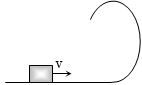
B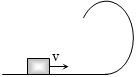
C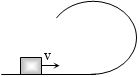
D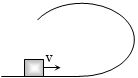
Solution
(A) Let the initial speed of the block be $v$ and the height of the track be $h$. By the law of conservation of energy,the speed $v'$ of the block at the highest point of the track is given by:
$\frac{1}{2}mv^2 = \frac{1}{2}m(v')^2 + mgh$
$v' = \sqrt{v^2 - 2gh}$
Since $v$ and $h$ are the same for all tracks,the speed $v'$ at the highest point is the same for all tracks.
At the highest point,the forces acting on the block are the normal reaction $N$ (downwards) and the weight $mg$ (downwards). These provide the necessary centripetal force:
$N + mg = \frac{m(v')^2}{r}$
$N = \frac{m(v')^2}{r} - mg$
where $r$ is the radius of curvature at the highest point.
For $N$ to be maximum,the term $\frac{m(v')^2}{r}$ must be maximum. Since $m$ and $v'$ are constant,$N$ is maximum when the radius of curvature $r$ is minimum.
Comparing the four tracks,the track in option $A$ has the smallest radius of curvature at its highest point. Therefore,the normal reaction is maximum in track $A$.
$\frac{1}{2}mv^2 = \frac{1}{2}m(v')^2 + mgh$
$v' = \sqrt{v^2 - 2gh}$
Since $v$ and $h$ are the same for all tracks,the speed $v'$ at the highest point is the same for all tracks.
At the highest point,the forces acting on the block are the normal reaction $N$ (downwards) and the weight $mg$ (downwards). These provide the necessary centripetal force:
$N + mg = \frac{m(v')^2}{r}$
$N = \frac{m(v')^2}{r} - mg$
where $r$ is the radius of curvature at the highest point.
For $N$ to be maximum,the term $\frac{m(v')^2}{r}$ must be maximum. Since $m$ and $v'$ are constant,$N$ is maximum when the radius of curvature $r$ is minimum.
Comparing the four tracks,the track in option $A$ has the smallest radius of curvature at its highest point. Therefore,the normal reaction is maximum in track $A$.
0 likesView Solution
2
PhysicsMediumMCQIIT JEE · 2001
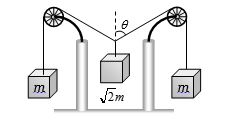
The pulleys and strings shown in the figure are smooth and of negligible mass. For the system to remain in equilibrium,the angle $\theta$ should be ........ $^o$.
A
$0$
B
$30$
C
$45$
D
$60$
Solution
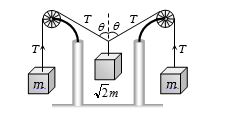
(C) For the side masses $m$ to be in equilibrium,the tension $T$ in the strings must be equal to the weight of the masses: $T = mg$.
Now,consider the equilibrium of the central mass $\sqrt{2}m$. The forces acting on it are the downward gravitational force $\sqrt{2}mg$ and the upward components of the tension $T$ from the two strings.
Resolving the tension $T$ into vertical components,we have $2T \cos \theta = \sqrt{2}mg$.
Substituting $T = mg$ into the equation:
$2(mg) \cos \theta = \sqrt{2}mg$
$2 \cos \theta = \sqrt{2}$
$\cos \theta = \frac{\sqrt{2}}{2} = \frac{1}{\sqrt{2}}$
Therefore,$\theta = 45^\circ$.
Now,consider the equilibrium of the central mass $\sqrt{2}m$. The forces acting on it are the downward gravitational force $\sqrt{2}mg$ and the upward components of the tension $T$ from the two strings.
Resolving the tension $T$ into vertical components,we have $2T \cos \theta = \sqrt{2}mg$.
Substituting $T = mg$ into the equation:
$2(mg) \cos \theta = \sqrt{2}mg$
$2 \cos \theta = \sqrt{2}$
$\cos \theta = \frac{\sqrt{2}}{2} = \frac{1}{\sqrt{2}}$
Therefore,$\theta = 45^\circ$.
0 likesView Solution
3
PhysicsMediumMCQIIT JEE · 2001
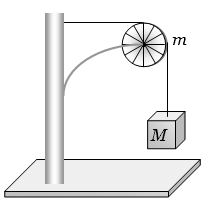
$A$ string of negligible mass going over a clamped pulley of mass $m$ supports a block of mass $M$ as shown in the figure. The force on the pulley by the clamp is given by
A
$\sqrt 2 Mg$
B
$\sqrt 2 mg$
C
$\sqrt {{{(M + m)}^2} + {m^2}} g$
D
$\sqrt {{{(M + m)}^2} + {M^2}} g$
Solution
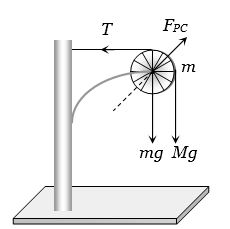
(D) The forces acting on the pulley are:
$1$. The tension $T$ in the horizontal part of the string,where $T = Mg$.
$2$. The tension $T$ in the vertical part of the string,where $T = Mg$.
$3$. The weight of the pulley,$mg$,acting downwards.
$4$. The force exerted by the clamp on the pulley,$F_{pc}$.
For the pulley to be in equilibrium,the vector sum of all forces must be zero. The forces acting on the pulley are the horizontal tension $T$ to the left,the vertical tension $T$ downwards,and the weight $mg$ downwards.
Total horizontal force $F_x = T = Mg$.
Total vertical force $F_y = T + mg = Mg + mg = (M + m)g$.
The magnitude of the force exerted by the clamp on the pulley is the resultant of these two perpendicular forces:
$F_{pc} = \sqrt{F_x^2 + F_y^2}$
$F_{pc} = \sqrt{(Mg)^2 + ((M + m)g)^2}$
$F_{pc} = \sqrt{M^2 + (M + m)^2} g$
$1$. The tension $T$ in the horizontal part of the string,where $T = Mg$.
$2$. The tension $T$ in the vertical part of the string,where $T = Mg$.
$3$. The weight of the pulley,$mg$,acting downwards.
$4$. The force exerted by the clamp on the pulley,$F_{pc}$.
For the pulley to be in equilibrium,the vector sum of all forces must be zero. The forces acting on the pulley are the horizontal tension $T$ to the left,the vertical tension $T$ downwards,and the weight $mg$ downwards.
Total horizontal force $F_x = T = Mg$.
Total vertical force $F_y = T + mg = Mg + mg = (M + m)g$.
The magnitude of the force exerted by the clamp on the pulley is the resultant of these two perpendicular forces:
$F_{pc} = \sqrt{F_x^2 + F_y^2}$
$F_{pc} = \sqrt{(Mg)^2 + ((M + m)g)^2}$
$F_{pc} = \sqrt{M^2 + (M + m)^2} g$
0 likesView Solution
4
PhysicsDifficultMCQIIT JEE · 2001
Two particles of masses $m_1$ and $m_2$ in projectile motion have velocities $\vec{v}_1$ and $\vec{v}_2$ respectively at time $t = 0$. They collide at time $t_0$. Their velocities become $\vec{v}_1'$ and $\vec{v}_2'$ at time $2t_0$ while still moving in air. The value of $|(m_1\vec{v}_1' + m_2\vec{v}_2') - (m_1\vec{v}_1 + m_2\vec{v}_2)|$ is
A
Zero
B
$(m_1 + m_2)gt_0$
C
$2(m_1 + m_2)gt_0$
D
$\frac{1}{2}(m_1 + m_2)gt_0$
Solution
(C) The initial momentum of the two-particle system at $t = 0$ is $\vec{P}_i = m_1\vec{v}_1 + m_2\vec{v}_2$.
Collision between the two particles is an internal interaction and does not affect the total momentum of the system.
The only external force acting on the system is gravity,which is $\vec{F}_{ext} = (m_1 + m_2)g$ acting downwards.
According to the impulse-momentum theorem,the change in momentum $\Delta \vec{P}$ is equal to the impulse of the external force: $\Delta \vec{P} = \int_{0}^{2t_0} \vec{F}_{ext} dt$.
Since the force is constant,$\Delta \vec{P} = (m_1 + m_2)g \times (2t_0 - 0) = 2(m_1 + m_2)gt_0$.
Therefore,the magnitude of the change in momentum is $|(m_1\vec{v}_1' + m_2\vec{v}_2') - (m_1\vec{v}_1 + m_2\vec{v}_2)| = 2(m_1 + m_2)gt_0$.
Collision between the two particles is an internal interaction and does not affect the total momentum of the system.
The only external force acting on the system is gravity,which is $\vec{F}_{ext} = (m_1 + m_2)g$ acting downwards.
According to the impulse-momentum theorem,the change in momentum $\Delta \vec{P}$ is equal to the impulse of the external force: $\Delta \vec{P} = \int_{0}^{2t_0} \vec{F}_{ext} dt$.
Since the force is constant,$\Delta \vec{P} = (m_1 + m_2)g \times (2t_0 - 0) = 2(m_1 + m_2)gt_0$.
Therefore,the magnitude of the change in momentum is $|(m_1\vec{v}_1' + m_2\vec{v}_2') - (m_1\vec{v}_1 + m_2\vec{v}_2)| = 2(m_1 + m_2)gt_0$.
0 likesView Solution
5
PhysicsMediumMCQIIT JEE · 2001
$A$ simple pendulum has a time period $T_1$ when on the earth's surface and $T_2$ when taken to a height $R$ above the earth's surface,where $R$ is the radius of the earth. The value of $T_2/T_1$ is
A
$1$
B
$\sqrt{2}$
C
$4$
D
$2$
Solution
(D) The time period of a simple pendulum is given by $T = 2\pi \sqrt{l/g}$.
On the surface of the earth,the acceleration due to gravity is $g$. Thus,$T_1 = 2\pi \sqrt{l/g}$.
At a height $h = R$ above the earth's surface,the acceleration due to gravity $g'$ is given by $g' = g \left( \frac{R}{R+h} \right)^2$.
Substituting $h = R$,we get $g' = g \left( \frac{R}{R+R} \right)^2 = g \left( \frac{R}{2R} \right)^2 = \frac{g}{4}$.
The time period at height $R$ is $T_2 = 2\pi \sqrt{l/g'} = 2\pi \sqrt{l/(g/4)} = 2 \times 2\pi \sqrt{l/g}$.
Therefore,$T_2/T_1 = 2$.
On the surface of the earth,the acceleration due to gravity is $g$. Thus,$T_1 = 2\pi \sqrt{l/g}$.
At a height $h = R$ above the earth's surface,the acceleration due to gravity $g'$ is given by $g' = g \left( \frac{R}{R+h} \right)^2$.
Substituting $h = R$,we get $g' = g \left( \frac{R}{R+R} \right)^2 = g \left( \frac{R}{2R} \right)^2 = \frac{g}{4}$.
The time period at height $R$ is $T_2 = 2\pi \sqrt{l/g'} = 2\pi \sqrt{l/(g/4)} = 2 \times 2\pi \sqrt{l/g}$.
Therefore,$T_2/T_1 = 2$.
0 likesView Solution
6
PhysicsEasyMCQIIT JEE · 2001
In a given process for an ideal gas,$dW = 0$ and $dQ < 0$. Then for the gas:
A
The temperature will decrease
B
The volume will increase
C
The pressure will remain constant
D
The temperature will increase
Solution
(A) According to the First Law of Thermodynamics $(FLOT)$,the change in internal energy $dU$ is given by $dU = dQ - dW$.
Given that $dW = 0$ (isochoric process) and $dQ < 0$ (heat is released by the system).
Substituting these values,we get $dU = dQ - 0 = dQ$.
Since $dQ < 0$,it follows that $dU < 0$.
For an ideal gas,internal energy $U$ is a function of temperature $T$ only $(U \propto T)$.
Therefore,a decrease in internal energy $(dU < 0)$ implies a decrease in temperature $(dT < 0)$.
Given that $dW = 0$ (isochoric process) and $dQ < 0$ (heat is released by the system).
Substituting these values,we get $dU = dQ - 0 = dQ$.
Since $dQ < 0$,it follows that $dU < 0$.
For an ideal gas,internal energy $U$ is a function of temperature $T$ only $(U \propto T)$.
Therefore,a decrease in internal energy $(dU < 0)$ implies a decrease in temperature $(dT < 0)$.
0 likesView Solution
7
PhysicsMediumMCQIIT JEE · 2001
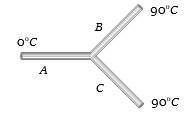
Three rods made of the same material and having the same cross-section have been joined as shown in the figure. Each rod is of the same length. The left and right ends are kept at $0^{\circ}C$ and $90^{\circ}C$ respectively. The temperature of the junction of the three rods will be ...... $^{\circ}C$.
A
$45$
B
$60$
C
$30$
D
$20$
Solution
(B) Let the temperature of the junction be $\theta$.
Since rods $B$ and $C$ are connected in parallel to rod $A$,we can calculate the equivalent thermal resistance of the parallel combination of $B$ and $C$.
Let the thermal resistance of each rod be $R$.
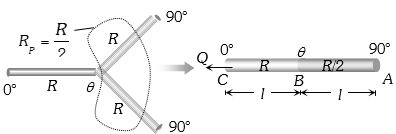
Since rods $B$ and $C$ are in parallel,their equivalent resistance $R_p$ is given by $\frac{1}{R_p} = \frac{1}{R} + \frac{1}{R} = \frac{2}{R}$,which implies $R_p = \frac{R}{2}$.
Now,the system acts as two resistances $R$ and $\frac{R}{2}$ in series.
The rate of heat flow $\frac{dQ}{dt}$ through the junction must be conserved.
Thus,the heat flowing from the $90^{\circ}C$ ends through the parallel combination must equal the heat flowing through rod $A$ to the $0^{\circ}C$ end.
Using the formula $\frac{dQ}{dt} = \frac{\Delta T}{R_{eq}}$:
$\frac{90 - \theta}{R/2} = \frac{\theta - 0}{R}$
$2(90 - \theta) = \theta$
$180 - 2\theta = \theta$
$3\theta = 180$
$\theta = 60^{\circ}C$.
Since rods $B$ and $C$ are connected in parallel to rod $A$,we can calculate the equivalent thermal resistance of the parallel combination of $B$ and $C$.
Let the thermal resistance of each rod be $R$.
Since rods $B$ and $C$ are in parallel,their equivalent resistance $R_p$ is given by $\frac{1}{R_p} = \frac{1}{R} + \frac{1}{R} = \frac{2}{R}$,which implies $R_p = \frac{R}{2}$.
Now,the system acts as two resistances $R$ and $\frac{R}{2}$ in series.
The rate of heat flow $\frac{dQ}{dt}$ through the junction must be conserved.
Thus,the heat flowing from the $90^{\circ}C$ ends through the parallel combination must equal the heat flowing through rod $A$ to the $0^{\circ}C$ end.
Using the formula $\frac{dQ}{dt} = \frac{\Delta T}{R_{eq}}$:
$\frac{90 - \theta}{R/2} = \frac{\theta - 0}{R}$
$2(90 - \theta) = \theta$
$180 - 2\theta = \theta$
$3\theta = 180$
$\theta = 60^{\circ}C$.
0 likesView Solution
8
PhysicsMediumMCQIIT JEE · 2001
$A$ particle executes simple harmonic motion (amplitude $= A$) between $x = -A$ and $x = +A$. The time taken for it to go from $x = 0$ to $x = A/2$ is ${T_1}$ and to go from $x = A/2$ to $x = A$ is ${T_2}$. Then:
A
${T_1} < {T_2}$
B
${T_1} > {T_2}$
C
${T_1} = {T_2}$
D
${T_1} = 2{T_2}$
Solution
(A) Using the equation of motion $x = A \sin(\omega t)$.
For $x = A/2$,we have $\sin(\omega T_1) = 1/2$,which implies $\omega T_1 = \pi/6$,so $T_1 = \frac{\pi}{6\omega}$.
For the particle to reach $x = A$,the total time is $T_1 + T_2$. Thus,$\sin(\omega(T_1 + T_2)) = 1$,which implies $\omega(T_1 + T_2) = \pi/2$,so $T_1 + T_2 = \frac{\pi}{2\omega}$.
Substituting $T_1$,we get $T_2 = \frac{\pi}{2\omega} - \frac{\pi}{6\omega} = \frac{3\pi - \pi}{6\omega} = \frac{2\pi}{6\omega} = \frac{\pi}{3\omega}$.
Comparing the two,$T_1 = \frac{\pi}{6\omega}$ and $T_2 = \frac{\pi}{3\omega}$,we find that ${T_1} < {T_2}$.
Alternatively,in Simple Harmonic Motion,the speed of the particle is maximum at the mean position $(x = 0)$ and zero at the extreme position $(x = A)$. Since the particle moves faster near the mean position,it covers the distance from $0$ to $A/2$ in less time than it takes to cover the distance from $A/2$ to $A$ where it is slowing down.
For $x = A/2$,we have $\sin(\omega T_1) = 1/2$,which implies $\omega T_1 = \pi/6$,so $T_1 = \frac{\pi}{6\omega}$.
For the particle to reach $x = A$,the total time is $T_1 + T_2$. Thus,$\sin(\omega(T_1 + T_2)) = 1$,which implies $\omega(T_1 + T_2) = \pi/2$,so $T_1 + T_2 = \frac{\pi}{2\omega}$.
Substituting $T_1$,we get $T_2 = \frac{\pi}{2\omega} - \frac{\pi}{6\omega} = \frac{3\pi - \pi}{6\omega} = \frac{2\pi}{6\omega} = \frac{\pi}{3\omega}$.
Comparing the two,$T_1 = \frac{\pi}{6\omega}$ and $T_2 = \frac{\pi}{3\omega}$,we find that ${T_1} < {T_2}$.
Alternatively,in Simple Harmonic Motion,the speed of the particle is maximum at the mean position $(x = 0)$ and zero at the extreme position $(x = A)$. Since the particle moves faster near the mean position,it covers the distance from $0$ to $A/2$ in less time than it takes to cover the distance from $A/2$ to $A$ where it is slowing down.
0 likesView Solution
9
PhysicsMediumMCQIIT JEE · 2001
The ends of a stretched wire of length $L$ are fixed at $x = 0$ and $x = L.$ In one experiment,the displacement of the wire is ${y_1} = A\sin (\pi x/L)\sin \omega t$ and energy is ${E_1}$,and in another experiment its displacement is ${y_2} = A\sin (2\pi x/L)\sin 2\omega t$ and energy is ${E_2}$. Then
A
${E_2} = {E_1}$
B
${E_2} = 2{E_1}$
C
${E_2} = 4{E_1}$
D
${E_2} = 16{E_1}$
Solution
(C) The total energy $E$ of a standing wave is given by the formula $E = \frac{1}{4} m \omega^2 A^2$,where $m$ is the mass of the wire,$\omega$ is the angular frequency,and $A$ is the amplitude.
In the first experiment,the frequency is $\omega_1 = \omega$ and the amplitude is $A_1 = A$. Thus,$E_1 = \frac{1}{4} m \omega^2 A^2$.
In the second experiment,the frequency is $\omega_2 = 2\omega$ and the amplitude is $A_2 = A$. Thus,$E_2 = \frac{1}{4} m (2\omega)^2 A^2 = 4 \times (\frac{1}{4} m \omega^2 A^2) = 4E_1$.
Therefore,the energy in the second experiment is four times the energy in the first experiment,i.e.,${E_2} = 4{E_1}$.
In the first experiment,the frequency is $\omega_1 = \omega$ and the amplitude is $A_1 = A$. Thus,$E_1 = \frac{1}{4} m \omega^2 A^2$.
In the second experiment,the frequency is $\omega_2 = 2\omega$ and the amplitude is $A_2 = A$. Thus,$E_2 = \frac{1}{4} m (2\omega)^2 A^2 = 4 \times (\frac{1}{4} m \omega^2 A^2) = 4E_1$.
Therefore,the energy in the second experiment is four times the energy in the first experiment,i.e.,${E_2} = 4{E_1}$.
0 likesView Solution
10
PhysicsMediumMCQIIT JEE · 2001
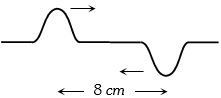
Two pulses in a stretched string whose centres are initially $8 \ cm$ apart are moving towards each other as shown in the figure. The speed of each pulse is $2 \ cm/s$. After $2 \ seconds$,the total energy of the pulses will be
A
Zero
B
Purely kinetic
C
Purely potential
D
Partly kinetic and partly potential
Solution
(B) The initial distance between the centres of the two pulses is $d = 8 \ cm$.
Each pulse moves towards the other with a speed of $v = 2 \ cm/s$.
The relative speed of the two pulses is $v_{rel} = v + v = 2 + 2 = 4 \ cm/s$.
The time taken for the pulses to meet is $t = d / v_{rel} = 8 \ cm / 4 \ cm/s = 2 \ s$.
After $2 \ s$,the two pulses overlap completely.
Since the pulses have opposite phases (one is a crest and the other is a trough of equal magnitude),their displacements cancel each other out at every point,making the string momentarily straight.
Because the string is straight,there is no deformation,and thus the potential energy is zero.
However,the particles of the string still possess velocity at this instant,so the total energy of the system is purely kinetic.
Each pulse moves towards the other with a speed of $v = 2 \ cm/s$.
The relative speed of the two pulses is $v_{rel} = v + v = 2 + 2 = 4 \ cm/s$.
The time taken for the pulses to meet is $t = d / v_{rel} = 8 \ cm / 4 \ cm/s = 2 \ s$.
After $2 \ s$,the two pulses overlap completely.
Since the pulses have opposite phases (one is a crest and the other is a trough of equal magnitude),their displacements cancel each other out at every point,making the string momentarily straight.
Because the string is straight,there is no deformation,and thus the potential energy is zero.
However,the particles of the string still possess velocity at this instant,so the total energy of the system is purely kinetic.
0 likesView Solution
11
PhysicsDifficultMCQIIT JEE · 2001
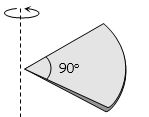
$A$ one-quarter sector is cut from a uniform circular disc of radius $R$. This sector has mass $M$. It is made to rotate about a line perpendicular to its plane and passing through the centre of the original disc. Its moment of inertia about the axis of rotation is
A
$\frac{1}{2}MR^2$
B
$\frac{1}{4}MR^2$
C
$\frac{1}{8}MR^2$
D
$\sqrt{2}MR^2$
Solution
(A) Let the mass of the complete circular disc be $M_{total}$. Since the sector is one-quarter of the disc,its mass $M = \frac{M_{total}}{4}$,which implies $M_{total} = 4M$.
The moment of inertia $(I)$ of a complete uniform circular disc of mass $M_{total}$ and radius $R$ about an axis passing through its centre and perpendicular to its plane is given by $I_{total} = \frac{1}{2}M_{total}R^2$.
Substituting $M_{total} = 4M$ into the formula,we get:
$I_{total} = \frac{1}{2}(4M)R^2 = 2MR^2$.
By the principle of symmetry,the moment of inertia of the quarter sector $(I_{sector})$ about the same axis is one-fourth of the moment of inertia of the complete disc:
$I_{sector} = \frac{I_{total}}{4} = \frac{2MR^2}{4} = \frac{1}{2}MR^2$.
The moment of inertia $(I)$ of a complete uniform circular disc of mass $M_{total}$ and radius $R$ about an axis passing through its centre and perpendicular to its plane is given by $I_{total} = \frac{1}{2}M_{total}R^2$.
Substituting $M_{total} = 4M$ into the formula,we get:
$I_{total} = \frac{1}{2}(4M)R^2 = 2MR^2$.
By the principle of symmetry,the moment of inertia of the quarter sector $(I_{sector})$ about the same axis is one-fourth of the moment of inertia of the complete disc:
$I_{sector} = \frac{I_{total}}{4} = \frac{2MR^2}{4} = \frac{1}{2}MR^2$.
0 likesView Solution
12
PhysicsDifficultMCQIIT JEE · 2001
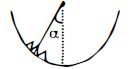
An insect crawls up a hemispherical surface very slowly. The coefficient of friction between the insect and the surface is $1/3$. If the line joining the centre of the hemispherical surface to the insect makes an angle $\alpha$ with the vertical,the maximum possible value of $\alpha$ so that the insect does not slip is given by
A
$\cot \alpha = 3$
B
$\sec \alpha = 3$
C
$\csc \alpha = 3$
D
$\cos \alpha = 3$
Solution
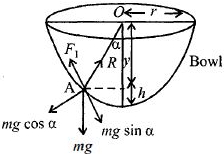
(A) Let the mass of the insect be $m$. The forces acting on the insect are its weight $mg$ (downwards),the normal reaction $R$ (radially outwards),and the frictional force $f$ (tangentially upwards along the surface).
At any angle $\alpha$ with the vertical,the components of the weight are $mg \cos \alpha$ (radially inwards) and $mg \sin \alpha$ (tangentially downwards).
For the insect to be in equilibrium without slipping,the forces must be balanced:
$R = mg \cos \alpha$ $(i)$
$f = mg \sin \alpha$ (ii)
For the limiting condition of friction,$f = \mu R$,where $\mu = 1/3$.
Substituting equations $(i)$ and (ii) into the limiting friction condition:
$mg \sin \alpha = \mu (mg \cos \alpha)$
$\tan \alpha = \mu = 1/3$
Since $\tan \alpha = 1/3$,we have $\cot \alpha = 3$.
At any angle $\alpha$ with the vertical,the components of the weight are $mg \cos \alpha$ (radially inwards) and $mg \sin \alpha$ (tangentially downwards).
For the insect to be in equilibrium without slipping,the forces must be balanced:
$R = mg \cos \alpha$ $(i)$
$f = mg \sin \alpha$ (ii)
For the limiting condition of friction,$f = \mu R$,where $\mu = 1/3$.
Substituting equations $(i)$ and (ii) into the limiting friction condition:
$mg \sin \alpha = \mu (mg \cos \alpha)$
$\tan \alpha = \mu = 1/3$
Since $\tan \alpha = 1/3$,we have $\cot \alpha = 3$.
0 likesView Solution
13
PhysicsMediumMCQIIT JEE · 2001
The quantity $X = \frac{\varepsilon_0 LV}{t}$,where $\varepsilon_0$ is the permittivity of free space,$L$ is length,$V$ is potential difference,and $t$ is time. The dimensions of $X$ are the same as those of:
A
Resistance
B
Charge
C
Voltage
D
Current
Solution
(D) We know that the capacitance $C$ of a parallel plate capacitor is given by $C = \frac{\varepsilon_0 A}{d}$.
Since $A$ has dimensions of $L^2$ and $d$ has dimensions of $L$,the dimensions of $\varepsilon_0 L$ are equivalent to the dimensions of capacitance $C$.
Substituting this into the expression for $X$:
$X = \frac{(\varepsilon_0 L) V}{t} = \frac{C V}{t}$.
Since $Q = CV$,we have $X = \frac{Q}{t}$.
The rate of flow of charge $Q$ with respect to time $t$ is defined as current $I$.
Therefore,the dimensions of $X$ are the same as those of current.
Since $A$ has dimensions of $L^2$ and $d$ has dimensions of $L$,the dimensions of $\varepsilon_0 L$ are equivalent to the dimensions of capacitance $C$.
Substituting this into the expression for $X$:
$X = \frac{(\varepsilon_0 L) V}{t} = \frac{C V}{t}$.
Since $Q = CV$,we have $X = \frac{Q}{t}$.
The rate of flow of charge $Q$ with respect to time $t$ is defined as current $I$.
Therefore,the dimensions of $X$ are the same as those of current.
0 likesView Solution
14
PhysicsEasyMCQIIT JEE · 2001
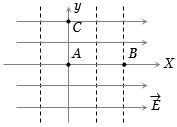
$A$ uniform electric field pointing in the positive $x$-direction exists in a region. Let $A$ be the origin,$B$ be the point on the $x$-axis at $x = +1 \, cm$,and $C$ be the point on the $y$-axis at $y = +1 \, cm$. Then the potentials at the points $A$,$B$,and $C$ satisfy
A
$V_A < V_B$
B
$V_A > V_B$
C
$V_A < V_C$
D
$V_A > V_C$
Solution
(B) The electric potential decreases in the direction of the electric field.
Since the electric field $\vec{E}$ is in the positive $x$-direction,the potential decreases as $x$ increases.
Point $A$ is at $x = 0$ and point $B$ is at $x = +1 \, cm$. Since $A$ is at a smaller $x$-coordinate than $B$,$V_A > V_B$.
Points $A$ and $C$ lie on the same equipotential line (a line perpendicular to the electric field lines),therefore $V_A = V_C$.
Thus,the correct relationship is $V_A > V_B$ and $V_A = V_C$.
Since the electric field $\vec{E}$ is in the positive $x$-direction,the potential decreases as $x$ increases.
Point $A$ is at $x = 0$ and point $B$ is at $x = +1 \, cm$. Since $A$ is at a smaller $x$-coordinate than $B$,$V_A > V_B$.
Points $A$ and $C$ lie on the same equipotential line (a line perpendicular to the electric field lines),therefore $V_A = V_C$.
Thus,the correct relationship is $V_A > V_B$ and $V_A = V_C$.
0 likesView Solution
15
PhysicsEasyMCQIIT JEE · 2001
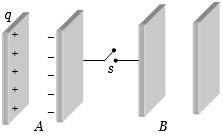
Consider the situation shown in the figure. Capacitor $A$ has a charge $q$ on it,whereas $B$ is uncharged. The charge appearing on capacitor $B$ a long time after the switch $S$ is closed is
A
Zero
B
$q/2$
C
$q$
D
$2q$
Solution
(A) The charges $\pm q$ on the plates of capacitor $A$ are bound charges due to the electric field between them.
Since capacitor $B$ is initially uncharged and is isolated from any external source of charge,closing the switch $S$ connects the inner plate of $A$ to the inner plate of $B$.
However,because the charges on the plates of $A$ are bound by the electrostatic attraction between them,they cannot move to plate $B$.
Therefore,no charge will flow to capacitor $B$,and it will remain uncharged.
Thus,the charge on $B$ is zero.
Since capacitor $B$ is initially uncharged and is isolated from any external source of charge,closing the switch $S$ connects the inner plate of $A$ to the inner plate of $B$.
However,because the charges on the plates of $A$ are bound by the electrostatic attraction between them,they cannot move to plate $B$.
Therefore,no charge will flow to capacitor $B$,and it will remain uncharged.
Thus,the charge on $B$ is zero.
0 likesView Solution
16
PhysicsMediumMCQIIT JEE · 2001
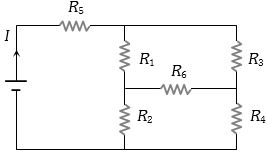
In the given circuit,it is observed that the current $I$ is independent of the value of the resistance $R_6$. Then the resistance values must satisfy
A
$R_1 R_2 R_5 = R_3 R_4 R_6$
B
$\frac{1}{R_5} + \frac{1}{R_6} = \frac{1}{R_1 + R_2} + \frac{1}{R_3 + R_4}$
C
$R_1 R_4 = R_2 R_3$
D
$R_1 R_3 = R_2 R_4 = R_5 R_6$
Solution
(C) For the current $I$ to be independent of the resistance $R_6$,the potential difference across $R_6$ must be zero,or no current should flow through $R_6$.
This occurs when the circuit forms a balanced Wheatstone bridge.
In the given circuit,$R_1, R_2, R_3,$ and $R_4$ form the arms of a Wheatstone bridge with $R_6$ as the central galvanometer arm.
The condition for a balanced Wheatstone bridge is that the ratio of resistances in opposite arms must be equal,which is $\frac{R_1}{R_2} = \frac{R_3}{R_4}$.
Cross-multiplying this gives $R_1 R_4 = R_2 R_3$.
This occurs when the circuit forms a balanced Wheatstone bridge.
In the given circuit,$R_1, R_2, R_3,$ and $R_4$ form the arms of a Wheatstone bridge with $R_6$ as the central galvanometer arm.
The condition for a balanced Wheatstone bridge is that the ratio of resistances in opposite arms must be equal,which is $\frac{R_1}{R_2} = \frac{R_3}{R_4}$.
Cross-multiplying this gives $R_1 R_4 = R_2 R_3$.
0 likesView Solution
17
PhysicsDifficultMCQIIT JEE · 2001
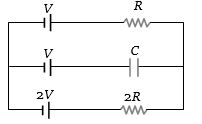
In the given circuit,with steady current,the potential drop across the capacitor must be
A
$V$
B
$V / 2$
C
$V / 3$
D
$2V / 3$
Solution
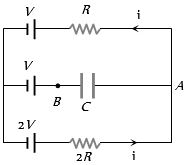
(A) In a steady state,the capacitor acts as an open circuit,so no current flows through the middle branch containing the capacitor $C$.
Let the potential at the right junction be $0$ and at the left junction be $V_L$.
Applying Kirchhoff's loop law to the outer loop (top and bottom branches):
The current $i$ flows through the top branch (resistance $R$) and the bottom branch (resistance $2R$).
Using the loop equation: $V - iR - 2iR + 2V = 0$
$3V = 3iR$
$i = V / R$
Now,find the potential at the right junction $(V_A)$ and left junction $(V_L)$.
Let the potential at the right junction be $0$.
Then the potential at the left junction is $V_L = V - iR = V - (V/R)R = 0$.
Alternatively,$V_L = 2V - i(2R) = 2V - (V/R)(2R) = 0$.
So,the potential at the right junction is $0$ and at the left junction is $0$.
The potential difference across the middle branch is the potential across the capacitor $C$ and the battery $V$.
Since no current flows through the middle branch,the potential drop across the capacitor $V_C$ must balance the battery $V$ in that branch.
Thus,$V_C = V$.
Let the potential at the right junction be $0$ and at the left junction be $V_L$.
Applying Kirchhoff's loop law to the outer loop (top and bottom branches):
The current $i$ flows through the top branch (resistance $R$) and the bottom branch (resistance $2R$).
Using the loop equation: $V - iR - 2iR + 2V = 0$
$3V = 3iR$
$i = V / R$
Now,find the potential at the right junction $(V_A)$ and left junction $(V_L)$.
Let the potential at the right junction be $0$.
Then the potential at the left junction is $V_L = V - iR = V - (V/R)R = 0$.
Alternatively,$V_L = 2V - i(2R) = 2V - (V/R)(2R) = 0$.
So,the potential at the right junction is $0$ and at the left junction is $0$.
The potential difference across the middle branch is the potential across the capacitor $C$ and the battery $V$.
Since no current flows through the middle branch,the potential drop across the capacitor $V_C$ must balance the battery $V$ in that branch.
Thus,$V_C = V$.
0 likesView Solution
18
PhysicsMediumMCQIIT JEE · 2001
$A$ wire of length $L$ and $3$ identical cells of negligible internal resistances are connected in series. Due to current,the temperature of the wire is raised by $\Delta T$ in a time $t$. $A$ number $N$ of similar cells is now connected in series with a wire of the same material and cross-section but of length $2L$. The temperature of the wire is raised by the same amount $\Delta T$ in the same time $t$. The value of $N$ is
A
$4$
B
$6$
C
$8$
D
$9$
Solution
(B) Let $R$ be the resistance and $m$ be the mass of the first wire. The second wire has length $2L$,so its resistance is $2R$ and its mass is $2m$.
Let $E$ be the $EMF$ of each cell and $S$ be the specific heat capacity of the material.
For the first wire,the current is $i_1 = \frac{3E}{R}$. The heat produced is $H_1 = i_1^2 R t = m S \Delta T$.
Substituting $i_1$,we get $(\frac{3E}{R})^2 R t = m S \Delta T \implies \frac{9E^2 t}{R} = m S \Delta T$.
For the second wire,the current is $i_2 = \frac{NE}{2R}$. The heat produced is $H_2 = i_2^2 (2R) t = (2m) S \Delta T$.
Substituting $i_2$,we get $(\frac{NE}{2R})^2 (2R) t = 2m S \Delta T \implies \frac{N^2 E^2 t}{4R^2} \cdot 2R = 2m S \Delta T \implies \frac{N^2 E^2 t}{2R} = 2m S \Delta T$.
Dividing the two heat equations: $\frac{9E^2 t / R}{N^2 E^2 t / 2R} = \frac{m S \Delta T}{2m S \Delta T} \implies \frac{18}{N^2} = \frac{1}{2} \implies N^2 = 36 \implies N = 6$.
Let $E$ be the $EMF$ of each cell and $S$ be the specific heat capacity of the material.
For the first wire,the current is $i_1 = \frac{3E}{R}$. The heat produced is $H_1 = i_1^2 R t = m S \Delta T$.
Substituting $i_1$,we get $(\frac{3E}{R})^2 R t = m S \Delta T \implies \frac{9E^2 t}{R} = m S \Delta T$.
For the second wire,the current is $i_2 = \frac{NE}{2R}$. The heat produced is $H_2 = i_2^2 (2R) t = (2m) S \Delta T$.
Substituting $i_2$,we get $(\frac{NE}{2R})^2 (2R) t = 2m S \Delta T \implies \frac{N^2 E^2 t}{4R^2} \cdot 2R = 2m S \Delta T \implies \frac{N^2 E^2 t}{2R} = 2m S \Delta T$.
Dividing the two heat equations: $\frac{9E^2 t / R}{N^2 E^2 t / 2R} = \frac{m S \Delta T}{2m S \Delta T} \implies \frac{18}{N^2} = \frac{1}{2} \implies N^2 = 36 \implies N = 6$.
0 likesView Solution
19
PhysicsMediumMCQIIT JEE · 2001
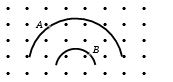
Two particles $A$ and $B$ of masses $m_A$ and $m_B$ respectively,having the same charge,are moving in a plane. $A$ uniform magnetic field exists perpendicular to this plane. The speeds of the particles are $v_A$ and $v_B$ respectively,and the trajectories are as shown in the figure. Then:
A
$m_A v_A < m_B v_B$
B
$m_A v_A > m_B v_B$
C
$m_A < m_B$ and $v_A < v_B$
D
$m_A = m_B$ and $v_A = v_B$
Solution
(B) When a charged particle moves in a uniform magnetic field perpendicular to its velocity,it follows a circular path.
The radius $r$ of this circular path is given by the formula $r = \frac{mv}{qB}$.
Since the charge $q$ and the magnetic field $B$ are the same for both particles,we have $r \propto mv$.
From the figure,it is clear that the radius of the trajectory of particle $A$ is greater than the radius of the trajectory of particle $B$,i.e.,$r_A > r_B$.
Therefore,$m_A v_A > m_B v_B$.
The radius $r$ of this circular path is given by the formula $r = \frac{mv}{qB}$.
Since the charge $q$ and the magnetic field $B$ are the same for both particles,we have $r \propto mv$.
From the figure,it is clear that the radius of the trajectory of particle $A$ is greater than the radius of the trajectory of particle $B$,i.e.,$r_A > r_B$.
Therefore,$m_A v_A > m_B v_B$.
0 likesView Solution
20
PhysicsDifficultMCQIIT JEE · 2001
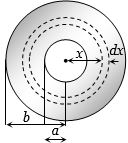
$A$ coil having $N$ turns is wound tightly in the form of a spiral with inner and outer radii $a$ and $b$ respectively. When a current $I$ passes through the coil,the magnetic field at the centre is
A
$\frac{{\mu _0}NI}{b}$
B
$\frac{{2{\mu _0}NI}}{a}$
C
$\frac{{\mu _0}NI}{{2(b - a)}}\ln \frac{b}{a}$
D
$\frac{{\mu _0}{I^N}}{{2(b - a)}}\ln \frac{b}{a}$
Solution
(C) The number of turns per unit width is $n = \frac{N}{b - a}$.
Consider an elemental ring of radius $x$ and thickness $dx$.
The number of turns in this elemental ring is $dN = n \cdot dx = \frac{N}{b - a} dx$.
The magnetic field at the centre due to this elemental ring is given by $dB = \frac{\mu_0 (dN) I}{2x}$.
Substituting $dN$,we get $dB = \frac{\mu_0 I}{2x} \cdot \frac{N}{b - a} dx = \frac{\mu_0 NI}{2(b - a)} \cdot \frac{dx}{x}$.
To find the total magnetic field $B$ at the centre,we integrate $dB$ from $x = a$ to $x = b$:
$B = \int_a^b \frac{\mu_0 NI}{2(b - a)} \frac{dx}{x} = \frac{\mu_0 NI}{2(b - a)} \int_a^b \frac{dx}{x}$.
$B = \frac{\mu_0 NI}{2(b - a)} [\ln x]_a^b = \frac{\mu_0 NI}{2(b - a)} \ln \frac{b}{a}$.
Consider an elemental ring of radius $x$ and thickness $dx$.
The number of turns in this elemental ring is $dN = n \cdot dx = \frac{N}{b - a} dx$.
The magnetic field at the centre due to this elemental ring is given by $dB = \frac{\mu_0 (dN) I}{2x}$.
Substituting $dN$,we get $dB = \frac{\mu_0 I}{2x} \cdot \frac{N}{b - a} dx = \frac{\mu_0 NI}{2(b - a)} \cdot \frac{dx}{x}$.
To find the total magnetic field $B$ at the centre,we integrate $dB$ from $x = a$ to $x = b$:
$B = \int_a^b \frac{\mu_0 NI}{2(b - a)} \frac{dx}{x} = \frac{\mu_0 NI}{2(b - a)} \int_a^b \frac{dx}{x}$.
$B = \frac{\mu_0 NI}{2(b - a)} [\ln x]_a^b = \frac{\mu_0 NI}{2(b - a)} \ln \frac{b}{a}$.
0 likesView Solution
21
PhysicsDifficultMCQIIT JEE · 2001
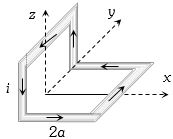
$A$ non-planar loop of conducting wire carrying a current $I$ is placed as shown in the figure. Each of the straight sections of the loop is of length $2a$. The magnetic field due to this loop at the point $P(a, 0, a)$ points in the direction:
A
$\frac{1}{\sqrt{2}}(-\hat{j} + \hat{k})$
B
$\frac{1}{\sqrt{3}}(-\hat{j} + \hat{k} + \hat{i})$
C
$\frac{1}{\sqrt{3}}(\hat{i} + \hat{j} + \hat{k})$
D
$\frac{1}{\sqrt{2}}(\hat{i} + \hat{k})$
Solution
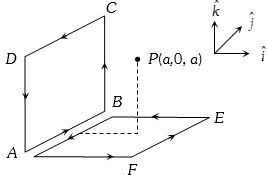
(D) The magnetic field at point $P(a, 0, a)$ due to the entire loop can be calculated by considering the loop as a combination of two planar loops: $ABCDA$ (in the $xz$-plane) and $AFEBA$ (in the $xy$-plane).
$1$. The magnetic field produced by the loop $ABCDA$ at point $P$ is directed along the positive $x$-axis (i.e.,in the $\hat{i}$ direction) due to the right-hand rule.
$2$. The magnetic field produced by the loop $AFEBA$ at point $P$ is directed along the positive $z$-axis (i.e.,in the $\hat{k}$ direction) due to the right-hand rule.
$3$. Since the geometry of both loops relative to point $P$ is identical,the magnitudes of the magnetic fields produced by both loops are equal.
$4$. Let the magnitude of the magnetic field from each loop be $B_0$. The total magnetic field vector at $P$ is $\vec{B} = B_0\hat{i} + B_0\hat{k}$.
$5$. The direction of the resultant magnetic field is given by the unit vector $\hat{n} = \frac{B_0\hat{i} + B_0\hat{k}}{\sqrt{B_0^2 + B_0^2}} = \frac{1}{\sqrt{2}}(\hat{i} + \hat{k})$.
$1$. The magnetic field produced by the loop $ABCDA$ at point $P$ is directed along the positive $x$-axis (i.e.,in the $\hat{i}$ direction) due to the right-hand rule.
$2$. The magnetic field produced by the loop $AFEBA$ at point $P$ is directed along the positive $z$-axis (i.e.,in the $\hat{k}$ direction) due to the right-hand rule.
$3$. Since the geometry of both loops relative to point $P$ is identical,the magnitudes of the magnetic fields produced by both loops are equal.
$4$. Let the magnitude of the magnetic field from each loop be $B_0$. The total magnetic field vector at $P$ is $\vec{B} = B_0\hat{i} + B_0\hat{k}$.
$5$. The direction of the resultant magnetic field is given by the unit vector $\hat{n} = \frac{B_0\hat{i} + B_0\hat{k}}{\sqrt{B_0^2 + B_0^2}} = \frac{1}{\sqrt{2}}(\hat{i} + \hat{k})$.
0 likesView Solution
22
PhysicsMediumMCQIIT JEE · 2001
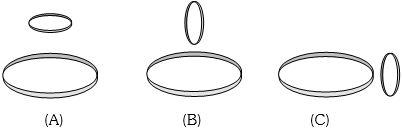
Two circular coils can be arranged in any of the three situations shown in the figure. Their mutual inductance will be
A
Maximum in situation $(A)$
B
Maximum in situation $(B)$
C
Maximum in situation $(C)$
D
The same in all situations
Solution
(A) The mutual inductance $M$ between two coils depends on the magnetic flux linkage between them. The flux linkage is maximum when the magnetic field lines produced by one coil pass through the area of the other coil most effectively.
In situation $(A)$,the planes of the two coils are parallel to each other. This orientation allows the maximum number of magnetic field lines produced by the larger coil to pass through the smaller coil,resulting in the highest magnetic flux linkage.
In situation $(B)$,the plane of the smaller coil is perpendicular to the plane of the larger coil. In this case,the magnetic field lines from the larger coil are mostly parallel to the plane of the smaller coil,leading to minimal flux linkage.
In situation $(C)$,the coils are placed side-by-side with their planes perpendicular to each other,which also results in very low flux linkage.
Therefore,the mutual inductance is maximum in situation $(A)$.
In situation $(A)$,the planes of the two coils are parallel to each other. This orientation allows the maximum number of magnetic field lines produced by the larger coil to pass through the smaller coil,resulting in the highest magnetic flux linkage.
In situation $(B)$,the plane of the smaller coil is perpendicular to the plane of the larger coil. In this case,the magnetic field lines from the larger coil are mostly parallel to the plane of the smaller coil,leading to minimal flux linkage.
In situation $(C)$,the coils are placed side-by-side with their planes perpendicular to each other,which also results in very low flux linkage.
Therefore,the mutual inductance is maximum in situation $(A)$.
0 likesView Solution
23
PhysicsEasyMCQIIT JEE · 2001
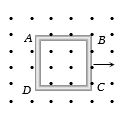
$A$ metallic square loop $ABCD$ is moving in its own plane with velocity $v$ in a uniform magnetic field perpendicular to its plane as shown in the figure. An electric field is induced:
A
In $AD$,but not in $BC$
B
In $BC$,but not in $AD$
C
Neither in $AD$ nor in $BC$
D
In both $AD$ and $BC$
Solution
(D) When a conductor moves in a magnetic field,a motional electromotive force (emf) is induced across its ends,given by $\varepsilon = \int (\vec{v} \times \vec{B}) \cdot d\vec{l}$.
This motional emf is associated with an induced electric field $\vec{E} = \vec{v} \times \vec{B}$ within the conductor.
In the given figure,the square loop $ABCD$ is moving with velocity $v$ in a uniform magnetic field $B$ perpendicular to the plane of the loop.
For the side $AD$,the velocity $\vec{v}$ is perpendicular to the magnetic field $\vec{B}$,so an electric field is induced along $AD$.
Similarly,for the side $BC$,the velocity $\vec{v}$ is also perpendicular to the magnetic field $\vec{B}$,so an electric field is also induced along $BC$.
Since both sides $AD$ and $BC$ are moving through the magnetic field,an electric field is induced in both conductors.
Therefore,the correct option is $(d)$.
This motional emf is associated with an induced electric field $\vec{E} = \vec{v} \times \vec{B}$ within the conductor.
In the given figure,the square loop $ABCD$ is moving with velocity $v$ in a uniform magnetic field $B$ perpendicular to the plane of the loop.
For the side $AD$,the velocity $\vec{v}$ is perpendicular to the magnetic field $\vec{B}$,so an electric field is induced along $AD$.
Similarly,for the side $BC$,the velocity $\vec{v}$ is also perpendicular to the magnetic field $\vec{B}$,so an electric field is also induced along $BC$.
Since both sides $AD$ and $BC$ are moving through the magnetic field,an electric field is induced in both conductors.
Therefore,the correct option is $(d)$.
0 likesView Solution
24
PhysicsEasyMCQIIT JEE · 2001
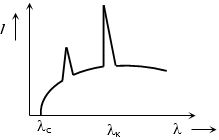
The intensity of $X$-rays from a Coolidge tube is plotted against wavelength as shown in the figure. The minimum wavelength found is ${\lambda _c}$ and the wavelength of the ${K_\alpha }$ line is ${\lambda _k}$. As the accelerating voltage is increased:
A
$({\lambda _K} - {\lambda _C})$ increases
B
$({\lambda _K} - {\lambda _C})$ decreases
C
${\lambda _K}$ increases
D
${\lambda _K}$ decreases
Solution
(A) The wavelength of the characteristic $X$-ray line,such as the ${K_\alpha }$ line $({\lambda _k})$,depends only on the material of the target and is independent of the accelerating voltage $(V)$.
The minimum wavelength of the continuous $X$-ray spectrum $({\lambda _c})$ is given by the Duane-Hunt law: ${\lambda _c} = \frac{hc}{eV}$.
From this relation,it is clear that ${\lambda _c}$ is inversely proportional to the accelerating voltage $(V)$.
As the accelerating voltage $(V)$ is increased,${\lambda _c}$ decreases,while ${\lambda _k}$ remains constant.
Therefore,the difference $({\lambda _K} - {\lambda _C})$ will increase.
The minimum wavelength of the continuous $X$-ray spectrum $({\lambda _c})$ is given by the Duane-Hunt law: ${\lambda _c} = \frac{hc}{eV}$.
From this relation,it is clear that ${\lambda _c}$ is inversely proportional to the accelerating voltage $(V)$.
As the accelerating voltage $(V)$ is increased,${\lambda _c}$ decreases,while ${\lambda _k}$ remains constant.
Therefore,the difference $({\lambda _K} - {\lambda _C})$ will increase.
0 likesView Solution
25
PhysicsEasyMCQIIT JEE · 2001
The electron emitted in beta radiation originates from
A
Inner orbits of atoms
B
Free electrons existing in nuclei
C
Decay of a neutron in a nucleus
D
Photon escaping from the nucleus
Solution
(C) During $\beta$-decay,a neutron inside the nucleus transforms into a proton,an electron,and an antineutrino. The process is represented as: $n \rightarrow p + e^- + \bar{\nu}_e$. Since the electron is created during this transformation process within the nucleus,it is emitted as beta radiation.
0 likesView Solution
26
PhysicsMediumMCQIIT JEE · 2001
$A$ radioactive sample consists of two distinct species having an equal number of atoms initially. The mean life time of one species is $\tau$ and that of the other is $5 \tau$. The decay products in both cases are stable. $A$ plot is made of the total number of radioactive nuclei as a function of time. Which of the following figures best represents the form of this plot?
A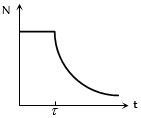
B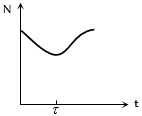
C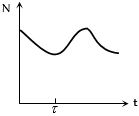
D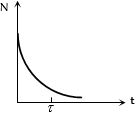
Solution
(D) Let $N_0$ be the initial number of atoms of each species. The number of radioactive nuclei of the first species at time $t$ is $N_1(t) = N_0 e^{-t/\tau}$.
The number of radioactive nuclei of the second species at time $t$ is $N_2(t) = N_0 e^{-t/(5\tau)}$.
The total number of radioactive nuclei is $N(t) = N_1(t) + N_2(t) = N_0(e^{-t/\tau} + e^{-t/(5\tau)})$.
At $t = 0$,$N(0) = 2N_0$. As $t \to \infty$,$N(t) \to 0$.
Since both $e^{-t/\tau}$ and $e^{-t/(5\tau)}$ are monotonically decreasing functions of time,their sum $N(t)$ must also be a monotonically decreasing function of time.
Therefore,the total number of radioactive nuclei will continuously decrease with time,which is represented by the graph in option $(d)$.
The number of radioactive nuclei of the second species at time $t$ is $N_2(t) = N_0 e^{-t/(5\tau)}$.
The total number of radioactive nuclei is $N(t) = N_1(t) + N_2(t) = N_0(e^{-t/\tau} + e^{-t/(5\tau)})$.
At $t = 0$,$N(0) = 2N_0$. As $t \to \infty$,$N(t) \to 0$.
Since both $e^{-t/\tau}$ and $e^{-t/(5\tau)}$ are monotonically decreasing functions of time,their sum $N(t)$ must also be a monotonically decreasing function of time.
Therefore,the total number of radioactive nuclei will continuously decrease with time,which is represented by the graph in option $(d)$.
0 likesView Solution
27
PhysicsEasyMCQIIT JEE · 2001
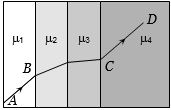
$A$ ray of light passes through four transparent media with refractive indices $\mu_1, \mu_2, \mu_3$ and $\mu_4$ as shown in the figure. The surfaces of all media are parallel. If the emergent ray $CD$ is parallel to the incident ray $AB$,we must have
A
$\mu_1 = \mu_2$
B
$\mu_2 = \mu_3$
C
$\mu_3 = \mu_4$
D
$\mu_4 = \mu_1$
Solution
(D) According to Snell's law for multiple parallel interfaces,the product of the refractive index and the sine of the angle of incidence at each interface remains constant.
Let $\theta_1$ be the angle of incidence in the first medium and $\theta_4$ be the angle of refraction in the fourth medium.
Applying Snell's law at each interface:
$\mu_1 \sin \theta_1 = \mu_2 \sin \theta_2 = \mu_3 \sin \theta_3 = \mu_4 \sin \theta_4$.
Since the emergent ray $CD$ is parallel to the incident ray $AB$,the angle of incidence $\theta_1$ must be equal to the angle of emergence $\theta_4$ (i.e.,$\theta_1 = \theta_4$).
Substituting this into the equation,we get $\mu_1 \sin \theta_1 = \mu_4 \sin \theta_1$.
Therefore,$\mu_1 = \mu_4$.
Let $\theta_1$ be the angle of incidence in the first medium and $\theta_4$ be the angle of refraction in the fourth medium.
Applying Snell's law at each interface:
$\mu_1 \sin \theta_1 = \mu_2 \sin \theta_2 = \mu_3 \sin \theta_3 = \mu_4 \sin \theta_4$.
Since the emergent ray $CD$ is parallel to the incident ray $AB$,the angle of incidence $\theta_1$ must be equal to the angle of emergence $\theta_4$ (i.e.,$\theta_1 = \theta_4$).
Substituting this into the equation,we get $\mu_1 \sin \theta_1 = \mu_4 \sin \theta_1$.
Therefore,$\mu_1 = \mu_4$.
0 likesView Solution
28
PhysicsEasyMCQIIT JEE · 2001
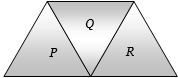
$A$ given ray of light suffers minimum deviation in an equilateral prism $P$. Additional prisms $Q$ and $R$ of identical shape and material are now added to $P$ as shown in the figure. The ray will suffer
A
Greater deviation
B
Same deviation
C
No deviation
D
Total internal reflection
Solution
(B) The prisms $Q$ and $R$ are of the same material and have an identical shape to prism $P$.
When these prisms are arranged as shown in the figure,the combination of prisms $Q$ and $R$ effectively acts as a glass slab with parallel faces.
$A$ light ray passing through a glass slab with parallel faces undergoes lateral displacement but no net angular deviation.
Therefore,the total deviation experienced by the light ray remains the same as the deviation caused by prism $P$ alone,which is the minimum deviation.
When these prisms are arranged as shown in the figure,the combination of prisms $Q$ and $R$ effectively acts as a glass slab with parallel faces.
$A$ light ray passing through a glass slab with parallel faces undergoes lateral displacement but no net angular deviation.
Therefore,the total deviation experienced by the light ray remains the same as the deviation caused by prism $P$ alone,which is the minimum deviation.
0 likesView Solution
29
PhysicsMediumMCQIIT JEE · 2001
Two beams of light having intensities $I$ and $4I$ interfere to produce a fringe pattern on a screen. The phase difference between the beams is $\frac{\pi}{2}$ at point $A$ and $\pi$ at point $B$. Then the difference between the resultant intensities at $A$ and $B$ is (in $I$)
A
$2$
B
$4$
C
$5$
D
$7$
Solution
(B) The resultant intensity $I_R$ for two interfering beams with intensities $I_1$ and $I_2$ and phase difference $\phi$ is given by $I_R = I_1 + I_2 + 2\sqrt{I_1 I_2} \cos \phi$.
Given $I_1 = I$ and $I_2 = 4I$.
At point $A$,the phase difference $\phi_A = \frac{\pi}{2}$.
$I_A = I + 4I + 2\sqrt{I \cdot 4I} \cos(\frac{\pi}{2}) = 5I + 0 = 5I$.
At point $B$,the phase difference $\phi_B = \pi$.
$I_B = I + 4I + 2\sqrt{I \cdot 4I} \cos(\pi) = 5I + 2(2I)(-1) = 5I - 4I = I$.
The difference between the resultant intensities at $A$ and $B$ is $|I_A - I_B| = |5I - I| = 4I$.
Given $I_1 = I$ and $I_2 = 4I$.
At point $A$,the phase difference $\phi_A = \frac{\pi}{2}$.
$I_A = I + 4I + 2\sqrt{I \cdot 4I} \cos(\frac{\pi}{2}) = 5I + 0 = 5I$.
At point $B$,the phase difference $\phi_B = \pi$.
$I_B = I + 4I + 2\sqrt{I \cdot 4I} \cos(\pi) = 5I + 2(2I)(-1) = 5I - 4I = I$.
The difference between the resultant intensities at $A$ and $B$ is $|I_A - I_B| = |5I - I| = 4I$.
0 likesView Solution
30
PhysicsMediumMCQIIT JEE · 2001
In a Young's double slit experiment,$12$ fringes are observed to be formed in a certain segment of the screen when light of wavelength $600 \ nm$ is used. If the wavelength of light is changed to $400 \ nm$,the number of fringes observed in the same segment of the screen is:
A
$12$
B
$18$
C
$24$
D
$30$
Solution
(B) The width of the segment on the screen is given by $W = n \beta$,where $n$ is the number of fringes and $\beta$ is the fringe width.
Since $\beta = \frac{\lambda D}{d}$,the width of the segment is $W = n \frac{\lambda D}{d}$.
For a fixed segment $W$,the product $n \lambda$ remains constant because $D$ and $d$ are constant.
Therefore,$n_1 \lambda_1 = n_2 \lambda_2$.
Given $n_1 = 12$,$\lambda_1 = 600 \ nm$,and $\lambda_2 = 400 \ nm$.
Substituting the values: $12 \times 600 = n_2 \times 400$.
$n_2 = \frac{12 \times 600}{400} = 12 \times 1.5 = 18$.
Thus,$18$ fringes will be observed.
Since $\beta = \frac{\lambda D}{d}$,the width of the segment is $W = n \frac{\lambda D}{d}$.
For a fixed segment $W$,the product $n \lambda$ remains constant because $D$ and $d$ are constant.
Therefore,$n_1 \lambda_1 = n_2 \lambda_2$.
Given $n_1 = 12$,$\lambda_1 = 600 \ nm$,and $\lambda_2 = 400 \ nm$.
Substituting the values: $12 \times 600 = n_2 \times 400$.
$n_2 = \frac{12 \times 600}{400} = 12 \times 1.5 = 18$.
Thus,$18$ fringes will be observed.
0 likesView Solution
31
PhysicsEasyMCQIIT JEE · 2001
The transition from the state $n = 4$ to $n = 3$ in a hydrogen-like atom results in ultraviolet radiation. Infrared radiation will be obtained in the transition from:
A
$2 \rightarrow 1$
B
$3 \rightarrow 2$
C
$4 \rightarrow 2$
D
$5 \rightarrow 4$
Solution
(D) The energy of a photon emitted during a transition between energy levels $n_i$ and $n_f$ is given by $\Delta E = 13.6 Z^2 (\frac{1}{n_f^2} - \frac{1}{n_i^2}) \text{ eV}$.
Ultraviolet radiation corresponds to higher energy transitions (Lyman series),while infrared radiation corresponds to lower energy transitions (Paschen,Brackett,or Pfund series).
Given that the transition $n=4 \rightarrow n=3$ results in ultraviolet radiation for this specific atom,it implies that the energy gap $\Delta E_{4 \rightarrow 3}$ is quite large.
To obtain infrared radiation,we need a transition with a significantly smaller energy gap than $\Delta E_{4 \rightarrow 3}$.
Comparing the options:
$(A)$ $2 \rightarrow 1$: This is a transition between lower energy levels,resulting in a larger energy gap than $4 \rightarrow 3$.
$(B)$ $3 \rightarrow 2$: This is also a transition between lower energy levels,resulting in a larger energy gap than $4 \rightarrow 3$.
$(C)$ $4 \rightarrow 2$: This involves a larger jump in quantum numbers,resulting in a larger energy gap.
$(D)$ $5 \rightarrow 4$: This transition occurs between higher energy levels where the energy difference between consecutive levels is much smaller. Thus,$5 \rightarrow 4$ will have the smallest energy gap and will result in infrared radiation.
Ultraviolet radiation corresponds to higher energy transitions (Lyman series),while infrared radiation corresponds to lower energy transitions (Paschen,Brackett,or Pfund series).
Given that the transition $n=4 \rightarrow n=3$ results in ultraviolet radiation for this specific atom,it implies that the energy gap $\Delta E_{4 \rightarrow 3}$ is quite large.
To obtain infrared radiation,we need a transition with a significantly smaller energy gap than $\Delta E_{4 \rightarrow 3}$.
Comparing the options:
$(A)$ $2 \rightarrow 1$: This is a transition between lower energy levels,resulting in a larger energy gap than $4 \rightarrow 3$.
$(B)$ $3 \rightarrow 2$: This is also a transition between lower energy levels,resulting in a larger energy gap than $4 \rightarrow 3$.
$(C)$ $4 \rightarrow 2$: This involves a larger jump in quantum numbers,resulting in a larger energy gap.
$(D)$ $5 \rightarrow 4$: This transition occurs between higher energy levels where the energy difference between consecutive levels is much smaller. Thus,$5 \rightarrow 4$ will have the smallest energy gap and will result in infrared radiation.
0 likesView Solution
32
PhysicsMediumMCQIIT JEE · 2001
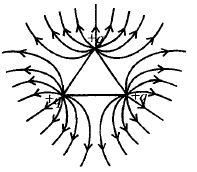
Three positive charges of equal value $q$ are placed at the vertices of an equilateral triangle. The resulting lines of force should be sketched as in:
A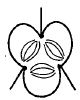
B
C
D
Solution
(C) Electric lines of force due to a positive charge are directed radially outward and are spherically symmetric. Since all three charges are positive and equal in magnitude,they exert a repulsive force on each other. Consequently,the electric field lines originate from each charge and move away from each other. No electric field lines can enter the region between the charges because the fields from the three charges repel each other,creating a neutral point at the centroid of the triangle. The resulting pattern of electric field lines is shown in the provided solution image.
0 likesView Solution
Vedclass Products
For Students
Vedclass Test Series
Mock tests in real IIT JEE style covering Physics with performance analysis. 5-day free trial.
Start Free TrialFor Teachers
Exam Paper Generator
Generate Set A/B/C/D Physics papers from 7.5L+ questions in 2 minutes. 3 chapters free.
Try FreeFor Institutes
Online Exam Module
Run live IIT JEE mock exams with unlimited students, 360° analytics & white-label branding.
See DemoFrequently Asked Questions
How many Physics questions are in IIT JEE 2001?
There are 32 Physics questions from the IIT JEE 2001 paper on Vedclass, each with a detailed step-by-step solution in English.
Are IIT JEE 2001 Physics solutions available in English?
Yes. All solutions on this page are in English. You can also switch to English or Hindi using the language buttons above the questions.
Can I practice IIT JEE 2001 Physics as a timed test?
Yes. Use the Vedclass Test Series to attempt a full IIT JEE mock test covering Physics with time limits and instant score analysis.
Can teachers create Physics papers from IIT JEE previous year questions?
Yes. The Vedclass Exam Paper Generator lets teachers mix IIT JEE Physics questions and generate Set A/B/C/D papers in minutes.
For Teachers & Institutes
Build a Custom Physics Paper
Pick IIT JEE 2001 Physics questions, set difficulty, and generate Set A/B/C/D in 2 minutes.