
MathematicsQ1–35 of 35 questions
Page 1 of 1 · English
1
MathematicsDifficultMCQIIT JEE · 2001
Let ${z_1}$ and ${z_2}$ be $n^{th}$ roots of unity which are ends of a line segment that subtend a right angle at the origin. Then $n$ must be of the form
A
$4k + 1$
B
$4k + 2$
C
$4k + 3$
D
$4k$
Solution
(D) The $n^{th}$ roots of unity are given by ${z_r} = \cos \frac{2r\pi}{n} + i\sin \frac{2r\pi}{n}$ for $r = 0, 1, \dots, n-1$.
Let ${z_1} = \cos \frac{2r_1\pi}{n} + i\sin \frac{2r_1\pi}{n}$ and ${z_2} = \cos \frac{2r_2\pi}{n} + i\sin \frac{2r_2\pi}{n}$.
The angle subtended by the segment joining ${z_1}$ and ${z_2}$ at the origin is given by the argument of the ratio $\frac{z_1}{z_2}$.
$\text{arg}\left(\frac{z_1}{z_2}\right) = \text{arg}(z_1) - \text{arg}(z_2) = \frac{2(r_1 - r_2)\pi}{n}$.
Since the angle is a right angle,we have $\frac{2(r_1 - r_2)\pi}{n} = \pm \frac{\pi}{2}$.
This implies $\frac{2(r_1 - r_2)}{n} = \pm \frac{1}{2}$,which simplifies to $n = \pm 4(r_1 - r_2)$.
Since $r_1$ and $r_2$ are integers,$n$ must be a multiple of $4$,i.e.,$n = 4k$ for some integer $k$.
Let ${z_1} = \cos \frac{2r_1\pi}{n} + i\sin \frac{2r_1\pi}{n}$ and ${z_2} = \cos \frac{2r_2\pi}{n} + i\sin \frac{2r_2\pi}{n}$.
The angle subtended by the segment joining ${z_1}$ and ${z_2}$ at the origin is given by the argument of the ratio $\frac{z_1}{z_2}$.
$\text{arg}\left(\frac{z_1}{z_2}\right) = \text{arg}(z_1) - \text{arg}(z_2) = \frac{2(r_1 - r_2)\pi}{n}$.
Since the angle is a right angle,we have $\frac{2(r_1 - r_2)\pi}{n} = \pm \frac{\pi}{2}$.
This implies $\frac{2(r_1 - r_2)}{n} = \pm \frac{1}{2}$,which simplifies to $n = \pm 4(r_1 - r_2)$.
Since $r_1$ and $r_2$ are integers,$n$ must be a multiple of $4$,i.e.,$n = 4k$ for some integer $k$.
0 likesView Solution
2
MathematicsEasyMCQIIT JEE · 2001
If the sum of the first $2n$ terms of $2, 5, 8, \dots$ is equal to the sum of the first $n$ terms of $57, 59, 61, \dots$,then $n$ is equal to
A
$10$
B
$12$
C
$11$
D
$13$
Solution
(C) For the first arithmetic progression $2, 5, 8, \dots$,the first term $a_1 = 2$ and common difference $d_1 = 3$. The sum of the first $2n$ terms is $S_{2n} = \frac{2n}{2} [2(2) + (2n - 1)3] = n[4 + 6n - 3] = n(6n + 1)$.
For the second arithmetic progression $57, 59, 61, \dots$,the first term $a_2 = 57$ and common difference $d_2 = 2$. The sum of the first $n$ terms is $S_n = \frac{n}{2} [2(57) + (n - 1)2] = \frac{n}{2} [114 + 2n - 2] = \frac{n}{2} [112 + 2n] = n(56 + n)$.
Given that $S_{2n} = S_n$,we have $n(6n + 1) = n(56 + n)$.
Since $n \neq 0$,we divide by $n$: $6n + 1 = 56 + n$.
$5n = 55$,which gives $n = 11$.
For the second arithmetic progression $57, 59, 61, \dots$,the first term $a_2 = 57$ and common difference $d_2 = 2$. The sum of the first $n$ terms is $S_n = \frac{n}{2} [2(57) + (n - 1)2] = \frac{n}{2} [114 + 2n - 2] = \frac{n}{2} [112 + 2n] = n(56 + n)$.
Given that $S_{2n} = S_n$,we have $n(6n + 1) = n(56 + n)$.
Since $n \neq 0$,we divide by $n$: $6n + 1 = 56 + n$.
$5n = 55$,which gives $n = 11$.
0 likesView Solution
3
MathematicsEasyMCQIIT JEE · 2001
Let the positive numbers $a, b, c, d$ be in $A.P.$,then $abc, abd, acd, bcd$ are
A
Not in $A.P./G.P./H.P.$
B
In $A.P.$
C
In $G.P.$
D
In $H.P.$
Solution
(D) Given that $a, b, c, d$ are in $A.P.$
Dividing each term by the product $abcd$,we get:
$\frac{a}{abcd}, \frac{b}{abcd}, \frac{c}{abcd}, \frac{d}{abcd}$ are in $A.P.$
This simplifies to:
$\frac{1}{bcd}, \frac{1}{acd}, \frac{1}{abd}, \frac{1}{abc}$ are in $A.P.$
By the definition of $H.P.$,the reciprocals of terms in $A.P.$ are in $H.P.$
Therefore,$bcd, acd, abd, abc$ are in $H.P.$
Reversing the order,$abc, abd, acd, bcd$ are also in $H.P.$
Dividing each term by the product $abcd$,we get:
$\frac{a}{abcd}, \frac{b}{abcd}, \frac{c}{abcd}, \frac{d}{abcd}$ are in $A.P.$
This simplifies to:
$\frac{1}{bcd}, \frac{1}{acd}, \frac{1}{abd}, \frac{1}{abc}$ are in $A.P.$
By the definition of $H.P.$,the reciprocals of terms in $A.P.$ are in $H.P.$
Therefore,$bcd, acd, abd, abc$ are in $H.P.$
Reversing the order,$abc, abd, acd, bcd$ are also in $H.P.$
0 likesView Solution
4
MathematicsEasyMCQIIT JEE · 2001
The number of solutions of $\log_{4}(x - 1) = \log_{2}(x - 3)$ is:
A
$3$
B
$1$
C
$2$
D
$0$
Solution
(B) Given equation: $\log_{4}(x - 1) = \log_{2}(x - 3)$
Using the base change formula $\log_{a^n}(b) = \frac{1}{n} \log_{a}(b)$,we have $\log_{4}(x - 1) = \frac{1}{2} \log_{2}(x - 1)$.
So,$\frac{1}{2} \log_{2}(x - 1) = \log_{2}(x - 3)$
$\log_{2}(x - 1) = 2 \log_{2}(x - 3)$
$\log_{2}(x - 1) = \log_{2}((x - 3)^2)$
$x - 1 = (x - 3)^2$
$x - 1 = x^2 - 6x + 9$
$x^2 - 7x + 10 = 0$
$(x - 5)(x - 2) = 0$
Thus,$x = 5$ or $x = 2$.
Check the domain: For $\log_{2}(x - 3)$ to be defined,$x - 3 > 0$,so $x > 3$.
For $x = 2$,$x - 3 = -1$,which is not allowed.
For $x = 5$,$x - 3 = 2 > 0$,which is valid.
Therefore,there is only $1$ solution.
Using the base change formula $\log_{a^n}(b) = \frac{1}{n} \log_{a}(b)$,we have $\log_{4}(x - 1) = \frac{1}{2} \log_{2}(x - 1)$.
So,$\frac{1}{2} \log_{2}(x - 1) = \log_{2}(x - 3)$
$\log_{2}(x - 1) = 2 \log_{2}(x - 3)$
$\log_{2}(x - 1) = \log_{2}((x - 3)^2)$
$x - 1 = (x - 3)^2$
$x - 1 = x^2 - 6x + 9$
$x^2 - 7x + 10 = 0$
$(x - 5)(x - 2) = 0$
Thus,$x = 5$ or $x = 2$.
Check the domain: For $\log_{2}(x - 3)$ to be defined,$x - 3 > 0$,so $x > 3$.
For $x = 2$,$x - 3 = -1$,which is not allowed.
For $x = 5$,$x - 3 = 2 > 0$,which is valid.
Therefore,there is only $1$ solution.
0 likesView Solution
5
MathematicsDifficultMCQIIT JEE · 2001
Let $\alpha, \beta$ be the roots of $x^2 - x + p = 0$ and $\gamma, \delta$ be the roots of $x^2 - 4x + q = 0$. If $\alpha, \beta, \gamma, \delta$ are in $G.P.$,then the integral values of $p, q$ are respectively:
A
$-2, -32$
B
$-2, 3$
C
$-6, 3$
D
$-6, -32$
Solution
(A) Let $r$ be the common ratio of the $G.P.$ $\alpha, \beta, \gamma, \delta$. Then $\beta = \alpha r, \gamma = \alpha r^2, \delta = \alpha r^3$.
From the sum and product of roots:
$\alpha + \beta = 1 \Rightarrow \alpha(1 + r) = 1$ $(i)$
$\alpha \beta = p \Rightarrow \alpha^2 r = p$ $(ii)$
$\gamma + \delta = 4 \Rightarrow \alpha r^2(1 + r) = 4$ $(iii)$
$\gamma \delta = q \Rightarrow \alpha^2 r^5 = q$ $(iv)$
Dividing $(iii)$ by $(i)$,we get $r^2 = 4$,so $r = \pm 2$.
If $r = 2$,then $\alpha(1+2) = 1 \Rightarrow \alpha = 1/3$ (not an integer).
If $r = -2$,then $\alpha(1-2) = 1 \Rightarrow \alpha = -1$.
Substituting $r = -2$ and $\alpha = -1$ into $(ii)$ and $(iv)$:
$p = (-1)^2(-2) = -2$
$q = (-1)^2(-2)^5 = -32$
Thus,$(p, q) = (-2, -32)$.
From the sum and product of roots:
$\alpha + \beta = 1 \Rightarrow \alpha(1 + r) = 1$ $(i)$
$\alpha \beta = p \Rightarrow \alpha^2 r = p$ $(ii)$
$\gamma + \delta = 4 \Rightarrow \alpha r^2(1 + r) = 4$ $(iii)$
$\gamma \delta = q \Rightarrow \alpha^2 r^5 = q$ $(iv)$
Dividing $(iii)$ by $(i)$,we get $r^2 = 4$,so $r = \pm 2$.
If $r = 2$,then $\alpha(1+2) = 1 \Rightarrow \alpha = 1/3$ (not an integer).
If $r = -2$,then $\alpha(1-2) = 1 \Rightarrow \alpha = -1$.
Substituting $r = -2$ and $\alpha = -1$ into $(ii)$ and $(iv)$:
$p = (-1)^2(-2) = -2$
$q = (-1)^2(-2)^5 = -32$
Thus,$(p, q) = (-2, -32)$.
0 likesView Solution
6
MathematicsMediumMCQIIT JEE · 2001
Let $T_n$ denote the number of triangles which can be formed using the vertices of a regular polygon of $n$ sides. If $T_{n+1} - T_n = 21$,then $n$ equals
A
$5$
B
$7$
C
$6$
D
$4$
Solution
(B) The number of triangles formed by $n$ vertices is given by $T_n = ^nC_3$.
Given the equation $T_{n+1} - T_n = 21$,we substitute the formula:
$^{n+1}C_3 - ^nC_3 = 21$.
Using the Pascal identity property,$^nC_r + ^nC_{r-1} = ^{n+1}C_r$,we can write $^{n+1}C_3 = ^nC_3 + ^nC_2$.
Substituting this into the equation:
$(^nC_3 + ^nC_2) - ^nC_3 = 21$
$^nC_2 = 21$.
Expanding the combination formula:
$\frac{n(n-1)}{2} = 21$
$n(n-1) = 42$
$n(n-1) = 7 \times 6$.
Thus,$n = 7$.
Given the equation $T_{n+1} - T_n = 21$,we substitute the formula:
$^{n+1}C_3 - ^nC_3 = 21$.
Using the Pascal identity property,$^nC_r + ^nC_{r-1} = ^{n+1}C_r$,we can write $^{n+1}C_3 = ^nC_3 + ^nC_2$.
Substituting this into the equation:
$(^nC_3 + ^nC_2) - ^nC_3 = 21$
$^nC_2 = 21$.
Expanding the combination formula:
$\frac{n(n-1)}{2} = 21$
$n(n-1) = 42$
$n(n-1) = 7 \times 6$.
Thus,$n = 7$.
0 likesView Solution
7
MathematicsMediumMCQIIT JEE · 2001
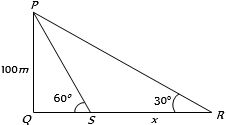
$A$ man from the top of a $100 \ m$ high tower sees a car moving towards the tower at an angle of depression of $30^\circ$. After some time,the angle of depression becomes $60^\circ$. The distance (in meters) travelled by the car during the time is
A
$100\sqrt{3}$
B
$\frac{200\sqrt{3}}{3}$
C
$\frac{100\sqrt{3}}{3}$
D
$200\sqrt{3}$
Solution
(B) Let the height of the tower be $PQ = 100 \ m$. Let the initial position of the car be $R$ and the final position be $S$. The distance travelled by the car is $x = RS$.
In $\triangle PQS$,$\tan{60^\circ} = \frac{PQ}{QS} \implies \sqrt{3} = \frac{100}{QS} \implies QS = \frac{100}{\sqrt{3}} \ m$.
In $\triangle PQR$,$\tan{30^\circ} = \frac{PQ}{QR} \implies \frac{1}{\sqrt{3}} = \frac{100}{QR} \implies QR = 100\sqrt{3} \ m$.
The distance travelled by the car is $x = QR - QS = 100\sqrt{3} - \frac{100}{\sqrt{3}} = \frac{300 - 100}{\sqrt{3}} = \frac{200}{\sqrt{3}} = \frac{200\sqrt{3}}{3} \ m$.
In $\triangle PQS$,$\tan{60^\circ} = \frac{PQ}{QS} \implies \sqrt{3} = \frac{100}{QS} \implies QS = \frac{100}{\sqrt{3}} \ m$.
In $\triangle PQR$,$\tan{30^\circ} = \frac{PQ}{QR} \implies \frac{1}{\sqrt{3}} = \frac{100}{QR} \implies QR = 100\sqrt{3} \ m$.
The distance travelled by the car is $x = QR - QS = 100\sqrt{3} - \frac{100}{\sqrt{3}} = \frac{300 - 100}{\sqrt{3}} = \frac{200}{\sqrt{3}} = \frac{200\sqrt{3}}{3} \ m$.
0 likesView Solution
8
MathematicsEasyMCQIIT JEE · 2001
The number of integral values of $m$,for which the $x$-coordinate of the point of intersection of the lines $3x + 4y = 9$ and $y = mx + 1$ is an integer,is:
A
$2$
B
$0$
C
$4$
D
$1$
Solution
(A) Given the lines $3x + 4y = 9$ and $y = mx + 1$.
Substitute $y$ from the second equation into the first:
$3x + 4(mx + 1) = 9$
$3x + 4mx + 4 = 9$
$x(3 + 4m) = 5$
$x = \frac{5}{3 + 4m}$
For $x$ to be an integer,$(3 + 4m)$ must be a divisor of $5$. The divisors of $5$ are $\pm 1$ and $\pm 5$.
Case $1$: $3 + 4m = 1 \implies 4m = -2 \implies m = -0.5$ (not an integer).
Case $2$: $3 + 4m = -1 \implies 4m = -4 \implies m = -1$ (integer).
Case $3$: $3 + 4m = 5 \implies 4m = 2 \implies m = 0.5$ (not an integer).
Case $4$: $3 + 4m = -5 \implies 4m = -8 \implies m = -2$ (integer).
The integral values of $m$ are $-1$ and $-2$. Thus,there are $2$ such values.
Substitute $y$ from the second equation into the first:
$3x + 4(mx + 1) = 9$
$3x + 4mx + 4 = 9$
$x(3 + 4m) = 5$
$x = \frac{5}{3 + 4m}$
For $x$ to be an integer,$(3 + 4m)$ must be a divisor of $5$. The divisors of $5$ are $\pm 1$ and $\pm 5$.
Case $1$: $3 + 4m = 1 \implies 4m = -2 \implies m = -0.5$ (not an integer).
Case $2$: $3 + 4m = -1 \implies 4m = -4 \implies m = -1$ (integer).
Case $3$: $3 + 4m = 5 \implies 4m = 2 \implies m = 0.5$ (not an integer).
Case $4$: $3 + 4m = -5 \implies 4m = -8 \implies m = -2$ (integer).
The integral values of $m$ are $-1$ and $-2$. Thus,there are $2$ such values.
0 likesView Solution
9
MathematicsDifficultMCQIIT JEE · 2001
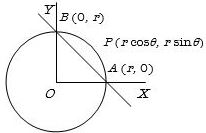
Let $AB$ be a chord of the circle $x^2 + y^2 = r^2$ subtending a right angle at the centre. Then the locus of the centroid of the $\Delta PAB$ as $P$ moves on the circle is
A
$A$ parabola
B
$A$ circle
C
An ellipse
D
$A$ pair of straight lines
Solution
(B) Let the coordinates of $A$ be $(r, 0)$ and $B$ be $(0, r)$ such that $\angle AOB = 90^\circ$. Let $P$ be a point on the circle given by $(r \cos \theta, r \sin \theta)$.
The centroid $G(\alpha, \beta)$ of $\Delta PAB$ is given by:
$\alpha = \frac{r \cos \theta + r + 0}{3} = \frac{r(\cos \theta + 1)}{3}$
$\beta = \frac{r \sin \theta + 0 + r}{3} = \frac{r(\sin \theta + 1)}{3}$
Rearranging,we get:
$\cos \theta = \frac{3\alpha}{r} - 1$
$\sin \theta = \frac{3\beta}{r} - 1$
Using the identity $\cos^2 \theta + \sin^2 \theta = 1$:
$\left(\frac{3\alpha}{r} - 1\right)^2 + \left(\frac{3\beta}{r} - 1\right)^2 = 1$
$\frac{9}{r^2} \left(\alpha - \frac{r}{3}\right)^2 + \frac{9}{r^2} \left(\beta - \frac{r}{3}\right)^2 = 1$
$\left(\alpha - \frac{r}{3}\right)^2 + \left(\beta - \frac{r}{3}\right)^2 = \left(\frac{r}{3}\right)^2$
Thus,the locus is $(x - \frac{r}{3})^2 + (y - \frac{r}{3})^2 = (\frac{r}{3})^2$,which represents a circle.
The centroid $G(\alpha, \beta)$ of $\Delta PAB$ is given by:
$\alpha = \frac{r \cos \theta + r + 0}{3} = \frac{r(\cos \theta + 1)}{3}$
$\beta = \frac{r \sin \theta + 0 + r}{3} = \frac{r(\sin \theta + 1)}{3}$
Rearranging,we get:
$\cos \theta = \frac{3\alpha}{r} - 1$
$\sin \theta = \frac{3\beta}{r} - 1$
Using the identity $\cos^2 \theta + \sin^2 \theta = 1$:
$\left(\frac{3\alpha}{r} - 1\right)^2 + \left(\frac{3\beta}{r} - 1\right)^2 = 1$
$\frac{9}{r^2} \left(\alpha - \frac{r}{3}\right)^2 + \frac{9}{r^2} \left(\beta - \frac{r}{3}\right)^2 = 1$
$\left(\alpha - \frac{r}{3}\right)^2 + \left(\beta - \frac{r}{3}\right)^2 = \left(\frac{r}{3}\right)^2$
Thus,the locus is $(x - \frac{r}{3})^2 + (y - \frac{r}{3})^2 = (\frac{r}{3})^2$,which represents a circle.
0 likesView Solution
10
MathematicsDifficultMCQIIT JEE · 2001
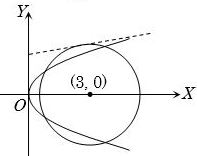
The equation of the common tangent touching the circle $(x - 3)^2 + y^2 = 9$ and the parabola $y^2 = 4x$ above the $x$-axis is
A
$\sqrt{3}y = 3x + 1$
B
$\sqrt{3}y = -(x + 3)$
C
$\sqrt{3}y = x + 3$
D
$\sqrt{3}y = -(3x + 1)$
Solution
(C) Any tangent to the parabola $y^2 = 4x$ is of the form $y = mx + \frac{1}{m}$.
This line touches the circle $(x - 3)^2 + y^2 = 9$ (with center $(3, 0)$ and radius $3$) if the perpendicular distance from the center to the line equals the radius:
$3 = \left| \frac{m(3) - 0 + \frac{1}{m}}{\sqrt{m^2 + 1}} \right|$
Squaring both sides:
$9(m^2 + 1) = (3m + \frac{1}{m})^2$
$9m^2 + 9 = 9m^2 + 6 + \frac{1}{m^2}$
$3 = \frac{1}{m^2} \implies m^2 = \frac{1}{3} \implies m = \pm \frac{1}{\sqrt{3}}$.
Since the tangent is above the $x$-axis,we choose the positive slope $m = \frac{1}{\sqrt{3}}$.
Substituting $m$ into the tangent equation:
$y = \frac{1}{\sqrt{3}}x + \sqrt{3}$
Multiplying by $\sqrt{3}$:
$\sqrt{3}y = x + 3$.
This line touches the circle $(x - 3)^2 + y^2 = 9$ (with center $(3, 0)$ and radius $3$) if the perpendicular distance from the center to the line equals the radius:
$3 = \left| \frac{m(3) - 0 + \frac{1}{m}}{\sqrt{m^2 + 1}} \right|$
Squaring both sides:
$9(m^2 + 1) = (3m + \frac{1}{m})^2$
$9m^2 + 9 = 9m^2 + 6 + \frac{1}{m^2}$
$3 = \frac{1}{m^2} \implies m^2 = \frac{1}{3} \implies m = \pm \frac{1}{\sqrt{3}}$.
Since the tangent is above the $x$-axis,we choose the positive slope $m = \frac{1}{\sqrt{3}}$.
Substituting $m$ into the tangent equation:
$y = \frac{1}{\sqrt{3}}x + \sqrt{3}$
Multiplying by $\sqrt{3}$:
$\sqrt{3}y = x + 3$.
0 likesView Solution
11
MathematicsMediumMCQIIT JEE · 2001
$\mathop {\lim }\limits_{x \to 0} \frac{{\sin (\pi {{\cos }^2}x)}}{{{x^2}}} = $
A
$\pi /2$
B
$\pi $
C
$2\pi $
D
$1$
Solution
(B) We need to evaluate the limit $L = \mathop {\lim }\limits_{x \to 0} \frac{{\sin (\pi {{\cos }^2}x)}}{{{x^2}}}$.
Since $\cos^2 x = 1 - \sin^2 x$,we can rewrite the expression as:
$L = \mathop {\lim }\limits_{x \to 0} \frac{{\sin (\pi (1 - \sin^2 x))}}{{{x^2}}}$
$L = \mathop {\lim }\limits_{x \to 0} \frac{{\sin (\pi - \pi \sin^2 x)}}{{{x^2}}}$
Using the identity $\sin(\pi - \theta) = \sin \theta$,we get:
$L = \mathop {\lim }\limits_{x \to 0} \frac{{\sin (\pi \sin^2 x)}}{{{x^2}}}$
Multiply and divide by $\pi \sin^2 x$:
$L = \mathop {\lim }\limits_{x \to 0} \left( \frac{{\sin (\pi \sin^2 x)}}{{\pi \sin^2 x}} \right) \times \frac{{\pi \sin^2 x}}{{{x^2}}}$
As $x \to 0$,$\pi \sin^2 x \to 0$,so $\frac{{\sin (\pi \sin^2 x)}}{{\pi \sin^2 x}} \to 1$.
Also,$\mathop {\lim }\limits_{x \to 0} \frac{{\sin^2 x}}{{{x^2}}} = 1$.
Therefore,$L = 1 \times \pi \times 1 = \pi $.
Since $\cos^2 x = 1 - \sin^2 x$,we can rewrite the expression as:
$L = \mathop {\lim }\limits_{x \to 0} \frac{{\sin (\pi (1 - \sin^2 x))}}{{{x^2}}}$
$L = \mathop {\lim }\limits_{x \to 0} \frac{{\sin (\pi - \pi \sin^2 x)}}{{{x^2}}}$
Using the identity $\sin(\pi - \theta) = \sin \theta$,we get:
$L = \mathop {\lim }\limits_{x \to 0} \frac{{\sin (\pi \sin^2 x)}}{{{x^2}}}$
Multiply and divide by $\pi \sin^2 x$:
$L = \mathop {\lim }\limits_{x \to 0} \left( \frac{{\sin (\pi \sin^2 x)}}{{\pi \sin^2 x}} \right) \times \frac{{\pi \sin^2 x}}{{{x^2}}}$
As $x \to 0$,$\pi \sin^2 x \to 0$,so $\frac{{\sin (\pi \sin^2 x)}}{{\pi \sin^2 x}} \to 1$.
Also,$\mathop {\lim }\limits_{x \to 0} \frac{{\sin^2 x}}{{{x^2}}} = 1$.
Therefore,$L = 1 \times \pi \times 1 = \pi $.
0 likesView Solution
12
MathematicsDifficultMCQIIT JEE · 2001
Let $f(x) = (1 + b^2)x^2 + 2bx + 1$ and $m(b)$ be the minimum value of $f(x)$ for a given $b$. As $b$ varies,the range of $m(b)$ is
A
$[0, 1]$
B
$(0, \frac{1}{2}]$
C
$[\frac{1}{2}, 1]$
D
$(0, 1]$
Solution
(D) The given function is a quadratic in $x$ of the form $f(x) = Ax^2 + Bx + C$,where $A = 1 + b^2$,$B = 2b$,and $C = 1$.
Since $A = 1 + b^2 > 0$ for all real $b$,the function has a minimum value at $x = -\frac{B}{2A}$.
The minimum value $m(b)$ is given by $f(-\frac{B}{2A}) = C - \frac{B^2}{4A}$.
Substituting the values: $m(b) = 1 - \frac{(2b)^2}{4(1 + b^2)} = 1 - \frac{4b^2}{4(1 + b^2)} = 1 - \frac{b^2}{1 + b^2}$.
Simplifying this,we get $m(b) = \frac{1 + b^2 - b^2}{1 + b^2} = \frac{1}{1 + b^2}$.
Since $b^2 \ge 0$,we have $1 + b^2 \ge 1$,which implies $0 < \frac{1}{1 + b^2} \le 1$.
Thus,the range of $m(b)$ is $(0, 1]$.
Since $A = 1 + b^2 > 0$ for all real $b$,the function has a minimum value at $x = -\frac{B}{2A}$.
The minimum value $m(b)$ is given by $f(-\frac{B}{2A}) = C - \frac{B^2}{4A}$.
Substituting the values: $m(b) = 1 - \frac{(2b)^2}{4(1 + b^2)} = 1 - \frac{4b^2}{4(1 + b^2)} = 1 - \frac{b^2}{1 + b^2}$.
Simplifying this,we get $m(b) = \frac{1 + b^2 - b^2}{1 + b^2} = \frac{1}{1 + b^2}$.
Since $b^2 \ge 0$,we have $1 + b^2 \ge 1$,which implies $0 < \frac{1}{1 + b^2} \le 1$.
Thus,the range of $m(b)$ is $(0, 1]$.
0 likesView Solution
13
MathematicsMediumMCQIIT JEE · 2001
In the binomial expansion of $(a - b)^n, n \ge 5,$ the sum of the $5^{th}$ and $6^{th}$ terms is zero. Then $a/b$ equals:
A
$\frac{n - 5}{6}$
B
$\frac{n - 4}{5}$
C
$\frac{5}{n - 4}$
D
$\frac{6}{n - 5}$
Solution
(B) The general term in the expansion of $(a - b)^n$ is given by $T_{r+1} = ^nC_r a^{n-r} (-b)^r$.
For the $5^{th}$ term $(r=4)$: $T_5 = ^nC_4 a^{n-4} (-b)^4 = ^nC_4 a^{n-4} b^4$.
For the $6^{th}$ term $(r=5)$: $T_6 = ^nC_5 a^{n-5} (-b)^5 = -^nC_5 a^{n-5} b^5$.
Given $T_5 + T_6 = 0$,we have:
$^nC_4 a^{n-4} b^4 - ^nC_5 a^{n-5} b^5 = 0$.
Rearranging the terms:
$^nC_4 a^{n-4} b^4 = ^nC_5 a^{n-5} b^5$.
Dividing both sides by $a^{n-5} b^4$:
$\frac{a}{b} = \frac{^nC_5}{^nC_4}$.
Using the formula $\frac{^nC_r}{^nC_{r-1}} = \frac{n-r+1}{r}$:
$\frac{a}{b} = \frac{n-5+1}{5} = \frac{n-4}{5}$.
For the $5^{th}$ term $(r=4)$: $T_5 = ^nC_4 a^{n-4} (-b)^4 = ^nC_4 a^{n-4} b^4$.
For the $6^{th}$ term $(r=5)$: $T_6 = ^nC_5 a^{n-5} (-b)^5 = -^nC_5 a^{n-5} b^5$.
Given $T_5 + T_6 = 0$,we have:
$^nC_4 a^{n-4} b^4 - ^nC_5 a^{n-5} b^5 = 0$.
Rearranging the terms:
$^nC_4 a^{n-4} b^4 = ^nC_5 a^{n-5} b^5$.
Dividing both sides by $a^{n-5} b^4$:
$\frac{a}{b} = \frac{^nC_5}{^nC_4}$.
Using the formula $\frac{^nC_r}{^nC_{r-1}} = \frac{n-r+1}{r}$:
$\frac{a}{b} = \frac{n-5+1}{5} = \frac{n-4}{5}$.
0 likesView Solution
14
MathematicsDifficultMCQIIT JEE · 2001
In the binomial expansion of $(a - b)^n, n \ge 5,$ the sum of the $5^{th}$ and $6^{th}$ terms is zero. Then $\frac{a}{b}$ is equal to
A
$\frac{1}{6}(n - 5)$
B
$\frac{1}{5}(n - 4)$
C
$\frac{5}{n - 4}$
D
$\frac{6}{n - 5}$
Solution
(B) The general term in the expansion of $(a - b)^n$ is given by $T_{r + 1} = {}^nC_r a^{n - r} (-b)^r$.
The $5^{th}$ term is $T_5 = T_{4 + 1} = {}^nC_4 a^{n - 4} (-b)^4 = {}^nC_4 a^{n - 4} b^4$.
The $6^{th}$ term is $T_6 = T_{5 + 1} = {}^nC_5 a^{n - 5} (-b)^5 = -{}^nC_5 a^{n - 5} b^5$.
Given that $T_5 + T_6 = 0$,we have:
${}^nC_4 a^{n - 4} b^4 - {}^nC_5 a^{n - 5} b^5 = 0$
Rearranging the terms:
${}^nC_4 a^{n - 4} b^4 = {}^nC_5 a^{n - 5} b^5$
Dividing both sides by $a^{n - 5} b^4$:
$\frac{a}{b} = \frac{{}^nC_5}{{}^nC_4}$
Using the formula ${}^nC_r = \frac{n!}{r!(n - r)!}$:
$\frac{a}{b} = \frac{n!}{5!(n - 5)!} \times \frac{4!(n - 4)!}{n!}$
$\frac{a}{b} = \frac{(n - 4)!}{(n - 5)!} \times \frac{4!}{5!}$
$\frac{a}{b} = \frac{n - 4}{5}$.
The $5^{th}$ term is $T_5 = T_{4 + 1} = {}^nC_4 a^{n - 4} (-b)^4 = {}^nC_4 a^{n - 4} b^4$.
The $6^{th}$ term is $T_6 = T_{5 + 1} = {}^nC_5 a^{n - 5} (-b)^5 = -{}^nC_5 a^{n - 5} b^5$.
Given that $T_5 + T_6 = 0$,we have:
${}^nC_4 a^{n - 4} b^4 - {}^nC_5 a^{n - 5} b^5 = 0$
Rearranging the terms:
${}^nC_4 a^{n - 4} b^4 = {}^nC_5 a^{n - 5} b^5$
Dividing both sides by $a^{n - 5} b^4$:
$\frac{a}{b} = \frac{{}^nC_5}{{}^nC_4}$
Using the formula ${}^nC_r = \frac{n!}{r!(n - r)!}$:
$\frac{a}{b} = \frac{n!}{5!(n - 5)!} \times \frac{4!(n - 4)!}{n!}$
$\frac{a}{b} = \frac{(n - 4)!}{(n - 5)!} \times \frac{4!}{5!}$
$\frac{a}{b} = \frac{n - 4}{5}$.
0 likesView Solution
15
MathematicsDifficultMCQIIT JEE · 2001
The maximum value of $\cos \alpha_1 \cdot \cos \alpha_2 \cdots \cos \alpha_n$ under the restrictions $0 \le \alpha_1, \alpha_2, \dots, \alpha_n \le \frac{\pi}{2}$ and $\cot \alpha_1 \cdot \cot \alpha_2 \cdots \cot \alpha_n = 1$ is
A
$\frac{1}{2^{n/2}}$
B
$\frac{1}{2^n}$
C
$\frac{1}{2n}$
D
$1$
Solution
(A) Given $\cot \alpha_1 \cdot \cot \alpha_2 \cdots \cot \alpha_n = 1$.
This implies $\frac{\cos \alpha_1}{\sin \alpha_1} \cdot \frac{\cos \alpha_2}{\sin \alpha_2} \cdots \frac{\cos \alpha_n}{\sin \alpha_n} = 1$,so $\cos \alpha_1 \cdot \cos \alpha_2 \cdots \cos \alpha_n = \sin \alpha_1 \cdot \sin \alpha_2 \cdots \sin \alpha_n$.
Let $P = \cos \alpha_1 \cdot \cos \alpha_2 \cdots \cos \alpha_n$.
Then $P^2 = (\cos \alpha_1 \cdot \cos \alpha_2 \cdots \cos \alpha_n) \cdot (\sin \alpha_1 \cdot \sin \alpha_2 \cdots \sin \alpha_n)$.
Using the identity $\sin \theta \cos \theta = \frac{1}{2} \sin 2\theta$,we get $P^2 = \frac{1}{2^n} \sin 2\alpha_1 \cdot \sin 2\alpha_2 \cdots \sin 2\alpha_n$.
Since $\sin 2\alpha_i \le 1$ for all $i$,we have $P^2 \le \frac{1}{2^n}$.
Taking the square root,$P \le \sqrt{\frac{1}{2^n}} = \frac{1}{2^{n/2}}$.
The maximum value is $\frac{1}{2^{n/2}}$.
This implies $\frac{\cos \alpha_1}{\sin \alpha_1} \cdot \frac{\cos \alpha_2}{\sin \alpha_2} \cdots \frac{\cos \alpha_n}{\sin \alpha_n} = 1$,so $\cos \alpha_1 \cdot \cos \alpha_2 \cdots \cos \alpha_n = \sin \alpha_1 \cdot \sin \alpha_2 \cdots \sin \alpha_n$.
Let $P = \cos \alpha_1 \cdot \cos \alpha_2 \cdots \cos \alpha_n$.
Then $P^2 = (\cos \alpha_1 \cdot \cos \alpha_2 \cdots \cos \alpha_n) \cdot (\sin \alpha_1 \cdot \sin \alpha_2 \cdots \sin \alpha_n)$.
Using the identity $\sin \theta \cos \theta = \frac{1}{2} \sin 2\theta$,we get $P^2 = \frac{1}{2^n} \sin 2\alpha_1 \cdot \sin 2\alpha_2 \cdots \sin 2\alpha_n$.
Since $\sin 2\alpha_i \le 1$ for all $i$,we have $P^2 \le \frac{1}{2^n}$.
Taking the square root,$P \le \sqrt{\frac{1}{2^n}} = \frac{1}{2^{n/2}}$.
The maximum value is $\frac{1}{2^{n/2}}$.
0 likesView Solution
16
MathematicsDifficultMCQIIT JEE · 2001
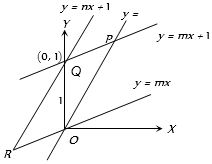
The area of the parallelogram formed by the lines $y = mx$,$y = mx + 1$,$y = nx$,and $y = nx + 1$ is equal to
A
$\frac{|m + n|}{(m - n)^2}$
B
$\frac{2}{|m + n|}$
C
$\frac{1}{|m + n|}$
D
$\frac{1}{|m - n|}$
Solution
(D) The given lines are $y - mx = 0$,$y - mx - 1 = 0$,$y - nx = 0$,and $y - nx - 1 = 0$.
These lines form a parallelogram.
The area of a parallelogram formed by lines $a_1x + b_1y + c_1 = 0$,$a_1x + b_1y + c_2 = 0$,$a_2x + b_2y + d_1 = 0$,and $a_2x + b_2y + d_2 = 0$ is given by the formula:
$\text{Area} = \left| \frac{(c_1 - c_2)(d_1 - d_2)}{a_1b_2 - a_2b_1} \right|$
Here,the equations are:
$mx - y + 0 = 0$
$mx - y + 1 = 0$
$nx - y + 0 = 0$
$nx - y + 1 = 0$
Comparing with the formula,we have $c_1 = 0, c_2 = 1, d_1 = 0, d_2 = 1, a_1 = m, b_1 = -1, a_2 = n, b_2 = -1$.
$\text{Area} = \left| \frac{(0 - 1)(0 - 1)}{m(-1) - n(-1)} \right| = \left| \frac{(-1)(-1)}{-m + n} \right| = \left| \frac{1}{n - m} \right| = \frac{1}{|m - n|}$.
These lines form a parallelogram.
The area of a parallelogram formed by lines $a_1x + b_1y + c_1 = 0$,$a_1x + b_1y + c_2 = 0$,$a_2x + b_2y + d_1 = 0$,and $a_2x + b_2y + d_2 = 0$ is given by the formula:
$\text{Area} = \left| \frac{(c_1 - c_2)(d_1 - d_2)}{a_1b_2 - a_2b_1} \right|$
Here,the equations are:
$mx - y + 0 = 0$
$mx - y + 1 = 0$
$nx - y + 0 = 0$
$nx - y + 1 = 0$
Comparing with the formula,we have $c_1 = 0, c_2 = 1, d_1 = 0, d_2 = 1, a_1 = m, b_1 = -1, a_2 = n, b_2 = -1$.
$\text{Area} = \left| \frac{(0 - 1)(0 - 1)}{m(-1) - n(-1)} \right| = \left| \frac{(-1)(-1)}{-m + n} \right| = \left| \frac{1}{n - m} \right| = \frac{1}{|m - n|}$.
0 likesView Solution
17
MathematicsMediumMCQIIT JEE · 2001
The equation of the directrix of the parabola $y^2+4y+4x+2=0$ is
A
$x=-1$
B
$x=1$
C
$x=\frac{-3}{2}$
D
$x=\frac{3}{2}$
Solution
(D) Given the equation of the parabola: $y^2+4y+4x+2=0$.
Rearranging the terms to complete the square for $y$:
$y^2+4y = -4x-2$.
Adding $4$ to both sides:
$y^2+4y+4 = -4x-2+4$.
$(y+2)^2 = -4x+2$.
$(y+2)^2 = -4(x-\frac{1}{2})$.
Comparing this with the standard form $(y-k)^2 = -4a(x-h)$,we get:
$h = \frac{1}{2}$,$k = -2$,and $4a = 4 \implies a = 1$.
The equation of the directrix for a left-opening parabola is $x = h+a$.
Substituting the values: $x = \frac{1}{2} + 1 = \frac{3}{2}$.
Thus,the correct option is $D$.
Rearranging the terms to complete the square for $y$:
$y^2+4y = -4x-2$.
Adding $4$ to both sides:
$y^2+4y+4 = -4x-2+4$.
$(y+2)^2 = -4x+2$.
$(y+2)^2 = -4(x-\frac{1}{2})$.
Comparing this with the standard form $(y-k)^2 = -4a(x-h)$,we get:
$h = \frac{1}{2}$,$k = -2$,and $4a = 4 \implies a = 1$.
The equation of the directrix for a left-opening parabola is $x = h+a$.
Substituting the values: $x = \frac{1}{2} + 1 = \frac{3}{2}$.
Thus,the correct option is $D$.
0 likesView Solution
18
MathematicsEasyMCQIIT JEE · 2001
If $\alpha+\beta=\frac{\pi}{2}$ and $\beta+\gamma=\alpha$,then $\tan \alpha$ equals
A
$2(\tan \beta+\tan \gamma)$
B
$\tan \beta+\tan \gamma$
C
$\tan \beta+2 \tan \gamma$
D
$2 \tan \beta+\tan \gamma$
Solution
(C) Given,$\alpha = \beta + \gamma$.
Since $\alpha + \beta = \frac{\pi}{2}$,we have $\beta = \frac{\pi}{2} - \alpha$.
Substituting $\beta$ in the first equation: $\alpha = (\frac{\pi}{2} - \alpha) + \gamma$,which implies $\gamma = 2\alpha - \frac{\pi}{2}$.
Alternatively,using $\gamma = \alpha - \beta$:
$\tan \gamma = \tan(\alpha - \beta) = \frac{\tan \alpha - \tan \beta}{1 + \tan \alpha \tan \beta}$.
Since $\beta = \frac{\pi}{2} - \alpha$,then $\tan \beta = \cot \alpha = \frac{1}{\tan \alpha}$.
Substituting this: $\tan \gamma = \frac{\tan \alpha - \tan \beta}{1 + \tan \alpha (\frac{1}{\tan \alpha})} = \frac{\tan \alpha - \tan \beta}{1 + 1} = \frac{\tan \alpha - \tan \beta}{2}$.
Therefore,$2 \tan \gamma = \tan \alpha - \tan \beta$,which gives $\tan \alpha = \tan \beta + 2 \tan \gamma$.
Since $\alpha + \beta = \frac{\pi}{2}$,we have $\beta = \frac{\pi}{2} - \alpha$.
Substituting $\beta$ in the first equation: $\alpha = (\frac{\pi}{2} - \alpha) + \gamma$,which implies $\gamma = 2\alpha - \frac{\pi}{2}$.
Alternatively,using $\gamma = \alpha - \beta$:
$\tan \gamma = \tan(\alpha - \beta) = \frac{\tan \alpha - \tan \beta}{1 + \tan \alpha \tan \beta}$.
Since $\beta = \frac{\pi}{2} - \alpha$,then $\tan \beta = \cot \alpha = \frac{1}{\tan \alpha}$.
Substituting this: $\tan \gamma = \frac{\tan \alpha - \tan \beta}{1 + \tan \alpha (\frac{1}{\tan \alpha})} = \frac{\tan \alpha - \tan \beta}{1 + 1} = \frac{\tan \alpha - \tan \beta}{2}$.
Therefore,$2 \tan \gamma = \tan \alpha - \tan \beta$,which gives $\tan \alpha = \tan \beta + 2 \tan \gamma$.
0 likesView Solution
19
MathematicsMediumMCQIIT JEE · 2001
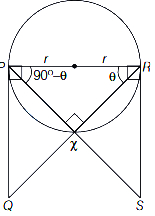
Let $PQ$ and $RS$ be tangents at the extremities of a diameter $PR$ of a circle of radius $r$ such that $PS$ and $RQ$ intersect at a point $X$ on the circumference of the circle,then $2r$ equals
A
$\sqrt{PQ \cdot RS}$
B
$\frac{PQ+RS}{2}$
C
$\frac{2PQ \cdot RS}{PQ+RS}$
D
$\sqrt{\frac{(PQ)^2+(RS)^2}{2}}$
Solution
(A) Let the diameter be $PR = 2r$. Since $PQ$ and $RS$ are tangents at $P$ and $R$ respectively,$PQ \perp PR$ and $RS \perp PR$.
Let $\angle PRQ = \theta$. In $\triangle PQR$,$\tan \theta = \frac{PQ}{PR}$,so $PR = PQ \cot \theta$.
Since $X$ lies on the circle and $PR$ is the diameter,$\angle PXR = 90^{\circ}$.
In $\triangle PXR$,$\angle XPR = 90^{\circ} - \theta$ and $\angle XRP = \theta$.
In $\triangle PXS$,$\angle XPS = 90^{\circ} - \theta$ and $\angle XSP = \theta$. Thus,$\tan \theta = \frac{RS}{PR}$,so $PR = RS \tan \theta$.
Equating the two expressions for $PR$:
$PQ \cot \theta = RS \tan \theta$
$\tan^2 \theta = \frac{PQ}{RS} \Rightarrow \tan \theta = \sqrt{\frac{PQ}{RS}}$.
Substituting this back into $PR = RS \tan \theta$:
$PR = RS \cdot \sqrt{\frac{PQ}{RS}} = \sqrt{PQ \cdot RS}$.
Since $PR = 2r$,we have $2r = \sqrt{PQ \cdot RS}$.
Let $\angle PRQ = \theta$. In $\triangle PQR$,$\tan \theta = \frac{PQ}{PR}$,so $PR = PQ \cot \theta$.
Since $X$ lies on the circle and $PR$ is the diameter,$\angle PXR = 90^{\circ}$.
In $\triangle PXR$,$\angle XPR = 90^{\circ} - \theta$ and $\angle XRP = \theta$.
In $\triangle PXS$,$\angle XPS = 90^{\circ} - \theta$ and $\angle XSP = \theta$. Thus,$\tan \theta = \frac{RS}{PR}$,so $PR = RS \tan \theta$.
Equating the two expressions for $PR$:
$PQ \cot \theta = RS \tan \theta$
$\tan^2 \theta = \frac{PQ}{RS} \Rightarrow \tan \theta = \sqrt{\frac{PQ}{RS}}$.
Substituting this back into $PR = RS \tan \theta$:
$PR = RS \cdot \sqrt{\frac{PQ}{RS}} = \sqrt{PQ \cdot RS}$.
Since $PR = 2r$,we have $2r = \sqrt{PQ \cdot RS}$.
0 likesView Solution
20
MathematicsEasyMCQIIT JEE · 2001
Let $a = i - k$, $b = xi + j + (1 - x)k$, and $c = yi + xj + (1 + x - y)k$. Then $[a\,b\,c]$ depends on
A
Only $x$
B
Only $y$
C
Neither $x$ nor $y$
D
Both $x$ and $y$
Solution
(C) The scalar triple product $[a\,b\,c]$ is given by the determinant of the components of the vectors $a$, $b$, and $c$:
$[a\,b\,c] = \begin{vmatrix} 1 & 0 & -1 \\ x & 1 & 1 - x \\ y & x & 1 + x - y \end{vmatrix}$
Applying the column operation $C_3 \to C_3 + C_1$:
$[a\,b\,c] = \begin{vmatrix} 1 & 0 & 0 \\ x & 1 & 1 \\ y & x & 1 + x \end{vmatrix}$
Expanding along the first row:
$[a\,b\,c] = 1 \times \begin{vmatrix} 1 & 1 \\ x & 1 + x \end{vmatrix} - 0 + 0 = (1 + x) - x = 1$.
Since the result is a constant $1$, the value of $[a\,b\,c]$ does not depend on $x$ or $y$.
$[a\,b\,c] = \begin{vmatrix} 1 & 0 & -1 \\ x & 1 & 1 - x \\ y & x & 1 + x - y \end{vmatrix}$
Applying the column operation $C_3 \to C_3 + C_1$:
$[a\,b\,c] = \begin{vmatrix} 1 & 0 & 0 \\ x & 1 & 1 \\ y & x & 1 + x \end{vmatrix}$
Expanding along the first row:
$[a\,b\,c] = 1 \times \begin{vmatrix} 1 & 1 \\ x & 1 + x \end{vmatrix} - 0 + 0 = (1 + x) - x = 1$.
Since the result is a constant $1$, the value of $[a\,b\,c]$ does not depend on $x$ or $y$.
0 likesView Solution
21
MathematicsDifficultMCQIIT JEE · 2001
If $a$,$b$,and $c$ are unit vectors,then $|a - b|^2 + |b - c|^2 + |c - a|^2$ does not exceed
A
$4$
B
$9$
C
$8$
D
$6$
Solution
(B) Given that $a$,$b$,and $c$ are unit vectors,so $|a| = |b| = |c| = 1$.
We know that $|a - b|^2 = |a|^2 + |b|^2 - 2(a \cdot b) = 1 + 1 - 2(a \cdot b) = 2 - 2(a \cdot b)$.
Similarly,$|b - c|^2 = 2 - 2(b \cdot c)$ and $|c - a|^2 = 2 - 2(c \cdot a)$.
Adding these three expressions:
$|a - b|^2 + |b - c|^2 + |c - a|^2 = 6 - 2(a \cdot b + b \cdot c + c \cdot a)$.
We also know that $|a + b + c|^2 = |a|^2 + |b|^2 + |c|^2 + 2(a \cdot b + b \cdot c + c \cdot a) = 3 + 2(a \cdot b + b \cdot c + c \cdot a)$.
Therefore,$2(a \cdot b + b \cdot c + c \cdot a) = |a + b + c|^2 - 3$.
Substituting this into the sum:
$|a - b|^2 + |b - c|^2 + |c - a|^2 = 6 - (|a + b + c|^2 - 3) = 9 - |a + b + c|^2$.
Since $|a + b + c|^2 \ge 0$,the maximum value of the expression is $9 - 0 = 9$.
Thus,the expression does not exceed $9$.
We know that $|a - b|^2 = |a|^2 + |b|^2 - 2(a \cdot b) = 1 + 1 - 2(a \cdot b) = 2 - 2(a \cdot b)$.
Similarly,$|b - c|^2 = 2 - 2(b \cdot c)$ and $|c - a|^2 = 2 - 2(c \cdot a)$.
Adding these three expressions:
$|a - b|^2 + |b - c|^2 + |c - a|^2 = 6 - 2(a \cdot b + b \cdot c + c \cdot a)$.
We also know that $|a + b + c|^2 = |a|^2 + |b|^2 + |c|^2 + 2(a \cdot b + b \cdot c + c \cdot a) = 3 + 2(a \cdot b + b \cdot c + c \cdot a)$.
Therefore,$2(a \cdot b + b \cdot c + c \cdot a) = |a + b + c|^2 - 3$.
Substituting this into the sum:
$|a - b|^2 + |b - c|^2 + |c - a|^2 = 6 - (|a + b + c|^2 - 3) = 9 - |a + b + c|^2$.
Since $|a + b + c|^2 \ge 0$,the maximum value of the expression is $9 - 0 = 9$.
Thus,the expression does not exceed $9$.
0 likesView Solution
22
MathematicsEasyMCQIIT JEE · 2001
The domain of $f(x) = \frac{{\log_2(x + 3)}}{{x^2 + 3x + 2}}$ is
A
$R - \{-1, -2\}$
B
$(-2, +\infty)$
C
$R - \{-1, -2, -3\}$
D
$(-3, +\infty) - \{-1, -2\}$
Solution
(D) For the function $f(x) = \frac{\log_2(x + 3)}{x^2 + 3x + 2}$ to be defined:
$1$. The argument of the logarithm must be positive: $x + 3 > 0 \implies x > -3$.
$2$. The denominator must not be zero: $x^2 + 3x + 2 \neq 0$.
Factorizing the denominator: $(x + 1)(x + 2) \neq 0$,which implies $x \neq -1$ and $x \neq -2$.
Combining these conditions,the domain is $x \in (-3, \infty)$ excluding the points $\{-1, -2\}$.
Thus,the domain is $(-3, \infty) - \{-1, -2\}$.
$1$. The argument of the logarithm must be positive: $x + 3 > 0 \implies x > -3$.
$2$. The denominator must not be zero: $x^2 + 3x + 2 \neq 0$.
Factorizing the denominator: $(x + 1)(x + 2) \neq 0$,which implies $x \neq -1$ and $x \neq -2$.
Combining these conditions,the domain is $x \in (-3, \infty)$ excluding the points $\{-1, -2\}$.
Thus,the domain is $(-3, \infty) - \{-1, -2\}$.
0 likesView Solution
23
MathematicsMediumMCQIIT JEE · 2001
Let $g(x) = 1 + x - [x]$ and $f(x) = \begin{cases} -1, & x < 0 \\ 0, & x = 0 \\ 1, & x > 0 \end{cases}$. Then for all $x$,$f(g(x))$ is equal to
A
$x$
B
$1$
C
$f(x)$
D
$g(x)$
Solution
(B) Given $g(x) = 1 + x - [x]$.
We know that $x - [x] = \{x\}$,where $\{x\}$ is the fractional part of $x$.
Thus,$g(x) = 1 + \{x\}$.
Since $0 \le \{x\} < 1$,it follows that $1 \le g(x) < 2$.
Therefore,$g(x) > 0$ for all $x \in \mathbb{R}$.
Now,$f(g(x))$ is defined as:
$f(g(x)) = \begin{cases} -1, & g(x) < 0 \\ 0, & g(x) = 0 \\ 1, & g(x) > 0 \end{cases}$.
Since $g(x) > 0$ for all $x$,we have $f(g(x)) = 1$ for all $x$.
We know that $x - [x] = \{x\}$,where $\{x\}$ is the fractional part of $x$.
Thus,$g(x) = 1 + \{x\}$.
Since $0 \le \{x\} < 1$,it follows that $1 \le g(x) < 2$.
Therefore,$g(x) > 0$ for all $x \in \mathbb{R}$.
Now,$f(g(x))$ is defined as:
$f(g(x)) = \begin{cases} -1, & g(x) < 0 \\ 0, & g(x) = 0 \\ 1, & g(x) > 0 \end{cases}$.
Since $g(x) > 0$ for all $x$,we have $f(g(x)) = 1$ for all $x$.
0 likesView Solution
24
MathematicsMediumMCQIIT JEE · 2001
If $f(x) = \frac{\alpha x}{x + 1}, x \neq -1$. Then,for what value of $\alpha$ is $f(f(x)) = x$?
A
$\sqrt{2}$
B
$-\sqrt{2}$
C
$1$
D
$-1$
Solution
(D) Given $f(x) = \frac{\alpha x}{x + 1}$.
We need to find $\alpha$ such that $f(f(x)) = x$.
First,calculate $f(f(x)) = \frac{\alpha f(x)}{f(x) + 1}$.
Substitute $f(x) = \frac{\alpha x}{x + 1}$ into the expression:
$f(f(x)) = \frac{\alpha \left( \frac{\alpha x}{x + 1} \right)}{\frac{\alpha x}{x + 1} + 1} = \frac{\frac{\alpha^2 x}{x + 1}}{\frac{\alpha x + x + 1}{x + 1}} = \frac{\alpha^2 x}{(\alpha + 1)x + 1}$.
We are given $f(f(x)) = x$,so:
$\frac{\alpha^2 x}{(\alpha + 1)x + 1} = x$.
Assuming $x \neq 0$,we have $\frac{\alpha^2}{(\alpha + 1)x + 1} = 1$.
$\alpha^2 = (\alpha + 1)x + 1$.
For this to hold for all $x$ in the domain,the coefficients of $x$ must be zero and the constant terms must be equal:
$\alpha + 1 = 0 \implies \alpha = -1$.
Checking the constant term: $\alpha^2 = 1$. If $\alpha = -1$,then $(-1)^2 = 1$,which is true.
Thus,the value of $\alpha$ is $-1$.
We need to find $\alpha$ such that $f(f(x)) = x$.
First,calculate $f(f(x)) = \frac{\alpha f(x)}{f(x) + 1}$.
Substitute $f(x) = \frac{\alpha x}{x + 1}$ into the expression:
$f(f(x)) = \frac{\alpha \left( \frac{\alpha x}{x + 1} \right)}{\frac{\alpha x}{x + 1} + 1} = \frac{\frac{\alpha^2 x}{x + 1}}{\frac{\alpha x + x + 1}{x + 1}} = \frac{\alpha^2 x}{(\alpha + 1)x + 1}$.
We are given $f(f(x)) = x$,so:
$\frac{\alpha^2 x}{(\alpha + 1)x + 1} = x$.
Assuming $x \neq 0$,we have $\frac{\alpha^2}{(\alpha + 1)x + 1} = 1$.
$\alpha^2 = (\alpha + 1)x + 1$.
For this to hold for all $x$ in the domain,the coefficients of $x$ must be zero and the constant terms must be equal:
$\alpha + 1 = 0 \implies \alpha = -1$.
Checking the constant term: $\alpha^2 = 1$. If $\alpha = -1$,then $(-1)^2 = 1$,which is true.
Thus,the value of $\alpha$ is $-1$.
0 likesView Solution
25
MathematicsMediumMCQIIT JEE · 2001
The left-hand derivative of $f(x) = [x]\sin(\pi x)$ at $x = k$,where $k$ is an integer and $[x]$ denotes the greatest integer function $\le x$,is:
A
$(-1)^k(k - 1)\pi$
B
$(-1)^{k-1}(k - 1)\pi$
C
$(-1)^k k\pi$
D
$(-1)^{k-1} k\pi$
Solution
(A) The left-hand derivative at $x = k$ is defined as $f'(k^-) = \lim_{h \to 0^+} \frac{f(k - h) - f(k)}{-h}$.
Given $f(x) = [x]\sin(\pi x)$,we have $f(k) = [k]\sin(\pi k) = k \times 0 = 0$.
For small $h > 0$,$[k - h] = k - 1$.
Thus,$f(k - h) = (k - 1)\sin(\pi(k - h)) = (k - 1)\sin(\pi k - \pi h) = (k - 1)(\sin(\pi k)\cos(\pi h) - \cos(\pi k)\sin(\pi h))$.
Since $\sin(\pi k) = 0$ and $\cos(\pi k) = (-1)^k$,we get $f(k - h) = (k - 1)(0 - (-1)^k \sin(\pi h)) = -(k - 1)(-1)^k \sin(\pi h) = (k - 1)(-1)^{k+1} \sin(\pi h)$.
Substituting this into the limit: $f'(k^-) = \lim_{h \to 0^+} \frac{(k - 1)(-1)^{k+1} \sin(\pi h) - 0}{-h}$.
Using $\lim_{h \to 0} \frac{\sin(\pi h)}{\pi h} = 1$,we get $f'(k^-) = (k - 1)(-1)^{k+1} \times (-\pi) = (k - 1)(-1)^{k+1} (-1) \pi = (k - 1)(-1)^{k+2} \pi = (k - 1)(-1)^k \pi$.
Given $f(x) = [x]\sin(\pi x)$,we have $f(k) = [k]\sin(\pi k) = k \times 0 = 0$.
For small $h > 0$,$[k - h] = k - 1$.
Thus,$f(k - h) = (k - 1)\sin(\pi(k - h)) = (k - 1)\sin(\pi k - \pi h) = (k - 1)(\sin(\pi k)\cos(\pi h) - \cos(\pi k)\sin(\pi h))$.
Since $\sin(\pi k) = 0$ and $\cos(\pi k) = (-1)^k$,we get $f(k - h) = (k - 1)(0 - (-1)^k \sin(\pi h)) = -(k - 1)(-1)^k \sin(\pi h) = (k - 1)(-1)^{k+1} \sin(\pi h)$.
Substituting this into the limit: $f'(k^-) = \lim_{h \to 0^+} \frac{(k - 1)(-1)^{k+1} \sin(\pi h) - 0}{-h}$.
Using $\lim_{h \to 0} \frac{\sin(\pi h)}{\pi h} = 1$,we get $f'(k^-) = (k - 1)(-1)^{k+1} \times (-\pi) = (k - 1)(-1)^{k+1} (-1) \pi = (k - 1)(-1)^{k+2} \pi = (k - 1)(-1)^k \pi$.
0 likesView Solution
26
MathematicsDifficultMCQIIT JEE · 2001
If $f(x) = x e^{x(1 - x)}$,then $f(x)$ is
A
Increasing on $\left[ -\frac{1}{2}, 1 \right]$
B
Decreasing on $R$
C
Increasing on $R$
D
Decreasing on $\left[ -\frac{1}{2}, 1 \right]$
Solution
(A) Given $f(x) = x e^{x(1 - x)}$.
Applying the product rule for differentiation,we get:
$f'(x) = 1 \cdot e^{x(1 - x)} + x \cdot e^{x(1 - x)} \cdot \frac{d}{dx}(x - x^2)$
$f'(x) = e^{x(1 - x)} + x \cdot e^{x(1 - x)} \cdot (1 - 2x)$
$f'(x) = e^{x(1 - x)} \{1 + x(1 - 2x)\}$
$f'(x) = e^{x(1 - x)} \cdot (1 + x - 2x^2)$
$f'(x) = e^{x(1 - x)} \cdot (1 - x)(1 + 2x)$
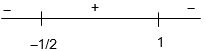
Since $e^{x(1 - x)}$ is always positive for all real $x$,the sign of $f'(x)$ depends on the quadratic expression $(1 - x)(1 + 2x)$.
The roots of the quadratic are $x = 1$ and $x = -\frac{1}{2}$.
Testing the intervals:
For $x \in \left[ -\frac{1}{2}, 1 \right]$,$f'(x) \ge 0$.
Thus,$f(x)$ is increasing on the interval $\left[ -\frac{1}{2}, 1 \right]$.
Applying the product rule for differentiation,we get:
$f'(x) = 1 \cdot e^{x(1 - x)} + x \cdot e^{x(1 - x)} \cdot \frac{d}{dx}(x - x^2)$
$f'(x) = e^{x(1 - x)} + x \cdot e^{x(1 - x)} \cdot (1 - 2x)$
$f'(x) = e^{x(1 - x)} \{1 + x(1 - 2x)\}$
$f'(x) = e^{x(1 - x)} \cdot (1 + x - 2x^2)$
$f'(x) = e^{x(1 - x)} \cdot (1 - x)(1 + 2x)$
Since $e^{x(1 - x)}$ is always positive for all real $x$,the sign of $f'(x)$ depends on the quadratic expression $(1 - x)(1 + 2x)$.
The roots of the quadratic are $x = 1$ and $x = -\frac{1}{2}$.
Testing the intervals:
For $x \in \left[ -\frac{1}{2}, 1 \right]$,$f'(x) \ge 0$.
Thus,$f(x)$ is increasing on the interval $\left[ -\frac{1}{2}, 1 \right]$.
0 likesView Solution
27
MathematicsDifficultMCQIIT JEE · 2001
Let $f:(0, +\infty) \to \mathbb{R}$ and $F(x) = \int_0^{x^2} f(t) dt$. If $F(x) = x^2(1 + x)$,then $f(4)$ equals
A
$5/4$
B
$7$
C
$4$
D
$2$
Solution
(C) Given $F(x) = \int_0^{x^2} f(t) dt = x^2(1 + x)$.
Applying the Leibniz rule for differentiation under the integral sign,we differentiate both sides with respect to $x$:
$\frac{d}{dx} \left( \int_0^{x^2} f(t) dt \right) = \frac{d}{dx} (x^2 + x^3)$.
Using the chain rule,$f(x^2) \cdot \frac{d}{dx}(x^2) = 2x + 3x^2$.
$f(x^2) \cdot 2x = 2x + 3x^2$.
For $x > 0$,we can divide by $2x$:
$f(x^2) = \frac{2x + 3x^2}{2x} = 1 + \frac{3}{2}x$.
To find $f(4)$,we set $x^2 = 4$,which implies $x = 2$ (since $x > 0$):
$f(4) = 1 + \frac{3}{2}(2) = 1 + 3 = 4$.
Applying the Leibniz rule for differentiation under the integral sign,we differentiate both sides with respect to $x$:
$\frac{d}{dx} \left( \int_0^{x^2} f(t) dt \right) = \frac{d}{dx} (x^2 + x^3)$.
Using the chain rule,$f(x^2) \cdot \frac{d}{dx}(x^2) = 2x + 3x^2$.
$f(x^2) \cdot 2x = 2x + 3x^2$.
For $x > 0$,we can divide by $2x$:
$f(x^2) = \frac{2x + 3x^2}{2x} = 1 + \frac{3}{2}x$.
To find $f(4)$,we set $x^2 = 4$,which implies $x = 2$ (since $x > 0$):
$f(4) = 1 + \frac{3}{2}(2) = 1 + 3 = 4$.
0 likesView Solution
28
MathematicsDifficultMCQIIT JEE · 2001
The value of $\int_{-\pi}^{\pi} \frac{\cos^2 x}{1 + a^x} dx, a > 0$ is
A
$\pi$
B
$a\pi$
C
$\frac{\pi}{2}$
D
$2\pi$
Solution
(C) Let $I = \int_{-\pi}^{\pi} \frac{\cos^2 x}{1 + a^x} dx$.
Using the property $\int_{a}^{b} f(x) dx = \int_{a}^{b} f(a+b-x) dx$,we replace $x$ with $-\pi + \pi - x = -x$:
$I = \int_{-\pi}^{\pi} \frac{\cos^2(-x)}{1 + a^{-x}} dx = \int_{-\pi}^{\pi} \frac{\cos^2 x}{1 + \frac{1}{a^x}} dx = \int_{-\pi}^{\pi} \frac{a^x \cos^2 x}{a^x + 1} dx$.
Adding the two expressions for $I$:
$2I = \int_{-\pi}^{\pi} \frac{\cos^2 x}{1 + a^x} dx + \int_{-\pi}^{\pi} \frac{a^x \cos^2 x}{1 + a^x} dx = \int_{-\pi}^{\pi} \frac{(1 + a^x) \cos^2 x}{1 + a^x} dx = \int_{-\pi}^{\pi} \cos^2 x dx$.
Since $\cos^2 x$ is an even function,$2I = 2 \int_{0}^{\pi} \cos^2 x dx = \int_{0}^{\pi} (1 + \cos 2x) dx$.
$2I = [x + \frac{\sin 2x}{2}]_{0}^{\pi} = (\pi + 0) - (0 + 0) = \pi$.
Therefore,$I = \frac{\pi}{2}$.
Using the property $\int_{a}^{b} f(x) dx = \int_{a}^{b} f(a+b-x) dx$,we replace $x$ with $-\pi + \pi - x = -x$:
$I = \int_{-\pi}^{\pi} \frac{\cos^2(-x)}{1 + a^{-x}} dx = \int_{-\pi}^{\pi} \frac{\cos^2 x}{1 + \frac{1}{a^x}} dx = \int_{-\pi}^{\pi} \frac{a^x \cos^2 x}{a^x + 1} dx$.
Adding the two expressions for $I$:
$2I = \int_{-\pi}^{\pi} \frac{\cos^2 x}{1 + a^x} dx + \int_{-\pi}^{\pi} \frac{a^x \cos^2 x}{1 + a^x} dx = \int_{-\pi}^{\pi} \frac{(1 + a^x) \cos^2 x}{1 + a^x} dx = \int_{-\pi}^{\pi} \cos^2 x dx$.
Since $\cos^2 x$ is an even function,$2I = 2 \int_{0}^{\pi} \cos^2 x dx = \int_{0}^{\pi} (1 + \cos 2x) dx$.
$2I = [x + \frac{\sin 2x}{2}]_{0}^{\pi} = (\pi + 0) - (0 + 0) = \pi$.
Therefore,$I = \frac{\pi}{2}$.
0 likesView Solution
29
MathematicsMediumMCQIIT JEE · 2001
The number of distinct real roots of $\left| {\begin{array}{*{20}{c}}{\sin x}&{\cos x}&{\cos x}\\{\cos x}&{\sin x}&{\cos x}\\{\cos x}&{\cos x}&{\sin x}\end{array}} \right| = 0$ in the interval $-\frac{\pi}{4} \le x \le \frac{\pi}{4}$ is
A
$0$
B
$2$
C
$1$
D
$3$
Solution
(C) Let the given determinant be $\Delta$. Adding $R_2$ and $R_3$ to $R_1$,we get:
$\Delta = \left| {\begin{array}{*{20}{c}}{\sin x + 2\cos x}&{\sin x + 2\cos x}&{\sin x + 2\cos x}\\{\cos x}&{\sin x}&{\cos x}\\{\cos x}&{\cos x}&{\sin x}\end{array}} \right| = 0$
Taking $(\sin x + 2\cos x)$ common from $R_1$:
$\Delta = (\sin x + 2\cos x) \left| {\begin{array}{*{20}{c}}1&1&1\\{\cos x}&{\sin x}&{\cos x}\\{\cos x}&{\cos x}&{\sin x}\end{array}} \right| = 0$
Applying $C_2 \to C_2 - C_1$ and $C_3 \to C_3 - C_1$:
$\Delta = (\sin x + 2\cos x) \left| {\begin{array}{*{20}{c}}1&0&0\\{\cos x}&{\sin x - \cos x}&0\\{\cos x}&0&{\sin x - \cos x}\end{array}} \right| = 0$
$\Delta = (\sin x + 2\cos x)(\sin x - \cos x)^2 = 0$
This implies $\sin x + 2\cos x = 0$ or $(\sin x - \cos x)^2 = 0$.
Case $1$: $\tan x = -2$. In the interval $[-\frac{\pi}{4}, \frac{\pi}{4}]$,$\tan x$ ranges from $-1$ to $1$. Thus,$\tan x = -2$ has no solution.
Case $2$: $\sin x = \cos x \implies \tan x = 1$. In the interval $[-\frac{\pi}{4}, \frac{\pi}{4}]$,$\tan x = 1$ at $x = \frac{\pi}{4}$.
Thus,there is only $1$ distinct real root.
$\Delta = \left| {\begin{array}{*{20}{c}}{\sin x + 2\cos x}&{\sin x + 2\cos x}&{\sin x + 2\cos x}\\{\cos x}&{\sin x}&{\cos x}\\{\cos x}&{\cos x}&{\sin x}\end{array}} \right| = 0$
Taking $(\sin x + 2\cos x)$ common from $R_1$:
$\Delta = (\sin x + 2\cos x) \left| {\begin{array}{*{20}{c}}1&1&1\\{\cos x}&{\sin x}&{\cos x}\\{\cos x}&{\cos x}&{\sin x}\end{array}} \right| = 0$
Applying $C_2 \to C_2 - C_1$ and $C_3 \to C_3 - C_1$:
$\Delta = (\sin x + 2\cos x) \left| {\begin{array}{*{20}{c}}1&0&0\\{\cos x}&{\sin x - \cos x}&0\\{\cos x}&0&{\sin x - \cos x}\end{array}} \right| = 0$
$\Delta = (\sin x + 2\cos x)(\sin x - \cos x)^2 = 0$
This implies $\sin x + 2\cos x = 0$ or $(\sin x - \cos x)^2 = 0$.
Case $1$: $\tan x = -2$. In the interval $[-\frac{\pi}{4}, \frac{\pi}{4}]$,$\tan x$ ranges from $-1$ to $1$. Thus,$\tan x = -2$ has no solution.
Case $2$: $\sin x = \cos x \implies \tan x = 1$. In the interval $[-\frac{\pi}{4}, \frac{\pi}{4}]$,$\tan x = 1$ at $x = \frac{\pi}{4}$.
Thus,there is only $1$ distinct real root.
0 likesView Solution
30
MathematicsMediumMCQIIT JEE · 2001
If ${\sin ^{ - 1}}\left( {x - \frac{{{x^2}}}{2} + \frac{{{x^3}}}{4} - \dots} \right) + {\cos ^{ - 1}}\left( {{x^2} - \frac{{{x^4}}}{2} + \frac{{{x^6}}}{4} - \dots} \right) = \frac{\pi }{2}$ for $0 < |x| < \sqrt 2$,then $x$ equals
A
$1/2$
B
$1$
C
$-1/2$
D
$-1$
Solution
(B) We know that ${\sin ^{ - 1}}y + {\cos ^{ - 1}}y = \frac{\pi }{2}$ for $|y| \le 1$.
Given the equation ${\sin ^{ - 1}}\left( {x - \frac{{{x^2}}}{2} + \frac{{{x^3}}}{4} - \dots} \right) + {\cos ^{ - 1}}\left( {{x^2} - \frac{{{x^4}}}{2} + \frac{{{x^6}}}{4} - \dots} \right) = \frac{\pi }{2}$,it implies that the arguments of the inverse trigonometric functions must be equal.
Let $y = x - \frac{{{x^2}}}{2} + \frac{{{x^3}}}{4} - \dots$. This is a geometric series with first term $a = x$ and common ratio $r = -x/2$. The sum is $\frac{x}{1 - (-x/2)} = \frac{x}{1 + x/2} = \frac{2x}{2 + x}$.
Similarly,the second argument is $x^2 - \frac{{{x^4}}}{2} + \frac{{{x^6}}}{4} - \dots$,which is a geometric series with $a = x^2$ and $r = -x^2/2$. The sum is $\frac{x^2}{1 + x^2/2} = \frac{2x^2}{2 + x^2}$.
Equating the two: $\frac{2x}{2 + x} = \frac{2x^2}{2 + x^2}$.
Since $x \neq 0$,we can divide by $2x$: $\frac{1}{2 + x} = \frac{x}{2 + x^2}$.
Cross-multiplying gives $2 + x^2 = 2x + x^2$,which simplifies to $2 = 2x$,so $x = 1$.
Given the equation ${\sin ^{ - 1}}\left( {x - \frac{{{x^2}}}{2} + \frac{{{x^3}}}{4} - \dots} \right) + {\cos ^{ - 1}}\left( {{x^2} - \frac{{{x^4}}}{2} + \frac{{{x^6}}}{4} - \dots} \right) = \frac{\pi }{2}$,it implies that the arguments of the inverse trigonometric functions must be equal.
Let $y = x - \frac{{{x^2}}}{2} + \frac{{{x^3}}}{4} - \dots$. This is a geometric series with first term $a = x$ and common ratio $r = -x/2$. The sum is $\frac{x}{1 - (-x/2)} = \frac{x}{1 + x/2} = \frac{2x}{2 + x}$.
Similarly,the second argument is $x^2 - \frac{{{x^4}}}{2} + \frac{{{x^6}}}{4} - \dots$,which is a geometric series with $a = x^2$ and $r = -x^2/2$. The sum is $\frac{x^2}{1 + x^2/2} = \frac{2x^2}{2 + x^2}$.
Equating the two: $\frac{2x}{2 + x} = \frac{2x^2}{2 + x^2}$.
Since $x \neq 0$,we can divide by $2x$: $\frac{1}{2 + x} = \frac{x}{2 + x^2}$.
Cross-multiplying gives $2 + x^2 = 2x + x^2$,which simplifies to $2 = 2x$,so $x = 1$.
0 likesView Solution
31
MathematicsMediumMCQIIT JEE · 2001
Let $E = \{ 1, 2, 3, 4 \} $ and $F = \{ 1, 2 \} $. Then the number of onto functions from $E$ to $F$ is
A
$14$
B
$16$
C
$12$
D
$8$
Solution
(A) The total number of functions from a set $E$ with $n$ elements to a set $F$ with $m$ elements is $m^n$.
Here,$n = |E| = 4$ and $m = |F| = 2$.
So,the total number of functions is $2^4 = 16$.
An onto function (surjective function) means every element in the codomain $F$ must have at least one pre-image in the domain $E$.
The only functions that are not onto are those where all elements of $E$ map to either ${1}$ or ${2}$.
There are exactly $2$ such constant functions: $f(x) = 1$ for all $x \in E$ and $f(x) = 2$ for all $x \in E$.
Therefore,the number of onto functions is $16 - 2 = 14$.
Here,$n = |E| = 4$ and $m = |F| = 2$.
So,the total number of functions is $2^4 = 16$.
An onto function (surjective function) means every element in the codomain $F$ must have at least one pre-image in the domain $E$.
The only functions that are not onto are those where all elements of $E$ map to either ${1}$ or ${2}$.
There are exactly $2$ such constant functions: $f(x) = 1$ for all $x \in E$ and $f(x) = 2$ for all $x \in E$.
Therefore,the number of onto functions is $16 - 2 = 14$.
0 likesView Solution
32
MathematicsMediumMCQIIT JEE · 2001
If $f:[1, +\infty) \to [2, +\infty)$ is given by $f(x) = x + \frac{1}{x}$,then ${f^{-1}}(x)$ equals:
A
$\frac{x + \sqrt{x^2 - 4}}{2}$
B
$\frac{x}{1 + x^2}$
C
$\frac{x - \sqrt{x^2 - 4}}{2}$
D
$1 + \sqrt{x^2 - 4}$
Solution
(A) Given $y = f(x) = x + \frac{1}{x}$ where $x \ge 1$ and $y \ge 2$.
Multiplying by $x$,we get $yx = x^2 + 1$,which rearranges to the quadratic equation $x^2 - yx + 1 = 0$.
Using the quadratic formula $x = \frac{-b \pm \sqrt{b^2 - 4ac}}{2a}$,we get $x = \frac{y \pm \sqrt{y^2 - 4}}{2}$.
Since the domain of $f$ is $[1, +\infty)$,we must have $x \ge 1$.
If we take the negative sign,$x = \frac{y - \sqrt{y^2 - 4}}{2}$. For $y \ge 2$,this value is $\le 1$. Specifically,as $y \to \infty$,this expression approaches $0$.
Thus,to satisfy $x \ge 1$,we must take the positive sign: $x = \frac{y + \sqrt{y^2 - 4}}{2}$.
Replacing $y$ with $x$,we obtain ${f^{-1}}(x) = \frac{x + \sqrt{x^2 - 4}}{2}$.
Multiplying by $x$,we get $yx = x^2 + 1$,which rearranges to the quadratic equation $x^2 - yx + 1 = 0$.
Using the quadratic formula $x = \frac{-b \pm \sqrt{b^2 - 4ac}}{2a}$,we get $x = \frac{y \pm \sqrt{y^2 - 4}}{2}$.
Since the domain of $f$ is $[1, +\infty)$,we must have $x \ge 1$.
If we take the negative sign,$x = \frac{y - \sqrt{y^2 - 4}}{2}$. For $y \ge 2$,this value is $\le 1$. Specifically,as $y \to \infty$,this expression approaches $0$.
Thus,to satisfy $x \ge 1$,we must take the positive sign: $x = \frac{y + \sqrt{y^2 - 4}}{2}$.
Replacing $y$ with $x$,we obtain ${f^{-1}}(x) = \frac{x + \sqrt{x^2 - 4}}{2}$.
0 likesView Solution
33
MathematicsDifficultMCQIIT JEE · 2001
Let $f:R \to R$ be a function defined by $f(x) = \max \,(x, x^3).$ The set of all points where $f(x)$ is not differentiable is
A
$\{ - 1, 1\}$
B
$\{ - 1, 0\}$
C
$\{ 0, 1\}$
D
$\{ - 1, 0, 1\}$
Solution
(D) To find the points where $f(x) = \max(x, x^3)$ is not differentiable,we analyze the behavior of $x$ and $x^3$ in different intervals:
$1$. If $x < -1$,then $x^3 < x$,so $f(x) = x$.
$2$. If $-1 < x < 0$,then $x^3 > x$,so $f(x) = x^3$.
$3$. If $0 < x < 1$,then $x > x^3$,so $f(x) = x$.
$4$. If $x > 1$,then $x^3 > x$,so $f(x) = x^3$.
At the transition points $x = -1, 0, 1$,we check the left-hand and right-hand derivatives:
At $x = -1$: $f'( -1^-) = 1$ and $f'( -1^+) = 3(-1)^2 = 3$. Since $1 \neq 3$,it is not differentiable.
At $x = 0$: $f'( 0^-) = 3(0)^2 = 0$ and $f'( 0^+) = 1$. Since $0 \neq 1$,it is not differentiable.
At $x = 1$: $f'( 1^-) = 1$ and $f'( 1^+) = 3(1)^2 = 3$. Since $1 \neq 3$,it is not differentiable.
Thus,the set of points where $f(x)$ is not differentiable is $\{ -1, 0, 1\}$.
$1$. If $x < -1$,then $x^3 < x$,so $f(x) = x$.
$2$. If $-1 < x < 0$,then $x^3 > x$,so $f(x) = x^3$.
$3$. If $0 < x < 1$,then $x > x^3$,so $f(x) = x$.
$4$. If $x > 1$,then $x^3 > x$,so $f(x) = x^3$.
At the transition points $x = -1, 0, 1$,we check the left-hand and right-hand derivatives:
At $x = -1$: $f'( -1^-) = 1$ and $f'( -1^+) = 3(-1)^2 = 3$. Since $1 \neq 3$,it is not differentiable.
At $x = 0$: $f'( 0^-) = 3(0)^2 = 0$ and $f'( 0^+) = 1$. Since $0 \neq 1$,it is not differentiable.
At $x = 1$: $f'( 1^-) = 1$ and $f'( 1^+) = 3(1)^2 = 3$. Since $1 \neq 3$,it is not differentiable.
Thus,the set of points where $f(x)$ is not differentiable is $\{ -1, 0, 1\}$.
0 likesView Solution
34
MathematicsDifficultMCQIIT JEE · 2001
Which of the following functions is differentiable at $x = 0$?
A
$\cos (|x|) + |x|$
B
$\cos (|x|) - |x|$
C
$\sin (|x|) + |x|$
D
$\sin (|x|) - |x|$
Solution
(D) Let $f(x) = \sin(|x|) - |x|$. We check the differentiability at $x = 0$ by calculating the Left Hand Derivative $(LHD)$ and Right Hand Derivative $(RHD)$.
For $x < 0$,$|x| = -x$,so $f(x) = \sin(-x) - (-x) = -\sin x + x$. The derivative is $f'(x) = -\cos x + 1$. Thus,$LHD = \lim_{x \to 0^-} (-\cos x + 1) = -\cos(0) + 1 = -1 + 1 = 0$.
For $x > 0$,$|x| = x$,so $f(x) = \sin x - x$. The derivative is $f'(x) = \cos x - 1$. Thus,$RHD = \lim_{x \to 0^+} (\cos x - 1) = \cos(0) - 1 = 1 - 1 = 0$.
Since $LHD = RHD = 0$,the function $\sin(|x|) - |x|$ is differentiable at $x = 0$.
For the other options,$\cos(|x|)$ is differentiable at $x=0$ but $|x|$ is not,so their sum or difference is not differentiable at $x=0$. Similarly,$\sin(|x|) + |x|$ has $LHD = -2$ and $RHD = 2$,so it is not differentiable.
For $x < 0$,$|x| = -x$,so $f(x) = \sin(-x) - (-x) = -\sin x + x$. The derivative is $f'(x) = -\cos x + 1$. Thus,$LHD = \lim_{x \to 0^-} (-\cos x + 1) = -\cos(0) + 1 = -1 + 1 = 0$.
For $x > 0$,$|x| = x$,so $f(x) = \sin x - x$. The derivative is $f'(x) = \cos x - 1$. Thus,$RHD = \lim_{x \to 0^+} (\cos x - 1) = \cos(0) - 1 = 1 - 1 = 0$.
Since $LHD = RHD = 0$,the function $\sin(|x|) - |x|$ is differentiable at $x = 0$.
For the other options,$\cos(|x|)$ is differentiable at $x=0$ but $|x|$ is not,so their sum or difference is not differentiable at $x=0$. Similarly,$\sin(|x|) + |x|$ has $LHD = -2$ and $RHD = 2$,so it is not differentiable.
0 likesView Solution
35
MathematicsMediumMCQIIT JEE · 2001
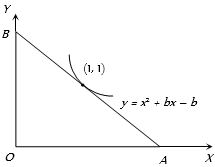
The triangle formed by the tangent to the curve $f(x) = x^2 + bx - b$ at the point $(1, 1)$ and the coordinate axes lies in the first quadrant. If its area is $2$,then the value of $b$ is
A
$-1$
B
$3$
C
$-3$
D
$1$
Solution
(C) Given the curve $f(x) = x^2 + bx - b$. Since the point $(1, 1)$ lies on the curve,we have $1 = 1^2 + b(1) - b$,which is $1 = 1$,confirming the point is on the curve for any $b$.
First,find the derivative: $\frac{dy}{dx} = 2x + b$.
At the point $(1, 1)$,the slope of the tangent is $m = 2(1) + b = 2 + b$.
The equation of the tangent line at $(1, 1)$ is $y - 1 = (2 + b)(x - 1)$.
Simplifying,$y - 1 = (2 + b)x - (2 + b)$,which gives $(2 + b)x - y = 1 + b$.
To find the intercepts,set $y = 0$ to get $x = \frac{1 + b}{2 + b}$ (point $A$),and set $x = 0$ to get $y = -(1 + b)$ (point $B$).
Since the triangle lies in the first quadrant,the intercepts must be positive: $\frac{1 + b}{2 + b} > 0$ and $-(1 + b) > 0$.
This implies $1 + b < 0$ and $2 + b < 0$,so $b < -2$.
The area of the triangle is $\frac{1}{2} \times |OA| \times |OB| = \frac{1}{2} \times \left| \frac{1 + b}{2 + b} \right| \times |-(1 + b)| = 2$.
Since $b < -2$,$1 + b$ is negative and $2 + b$ is negative,so $\frac{1 + b}{2 + b} > 0$ and $-(1 + b) > 0$.
Thus,$\frac{1}{2} \cdot \frac{1 + b}{2 + b} \cdot (-(1 + b)) = 2$.
$-(1 + b)^2 = 4(2 + b) \Rightarrow -(1 + 2b + b^2) = 8 + 4b \Rightarrow b^2 + 6b + 9 = 0$.
$(b + 3)^2 = 0$,so $b = -3$. This satisfies $b < -2$.
First,find the derivative: $\frac{dy}{dx} = 2x + b$.
At the point $(1, 1)$,the slope of the tangent is $m = 2(1) + b = 2 + b$.
The equation of the tangent line at $(1, 1)$ is $y - 1 = (2 + b)(x - 1)$.
Simplifying,$y - 1 = (2 + b)x - (2 + b)$,which gives $(2 + b)x - y = 1 + b$.
To find the intercepts,set $y = 0$ to get $x = \frac{1 + b}{2 + b}$ (point $A$),and set $x = 0$ to get $y = -(1 + b)$ (point $B$).
Since the triangle lies in the first quadrant,the intercepts must be positive: $\frac{1 + b}{2 + b} > 0$ and $-(1 + b) > 0$.
This implies $1 + b < 0$ and $2 + b < 0$,so $b < -2$.
The area of the triangle is $\frac{1}{2} \times |OA| \times |OB| = \frac{1}{2} \times \left| \frac{1 + b}{2 + b} \right| \times |-(1 + b)| = 2$.
Since $b < -2$,$1 + b$ is negative and $2 + b$ is negative,so $\frac{1 + b}{2 + b} > 0$ and $-(1 + b) > 0$.
Thus,$\frac{1}{2} \cdot \frac{1 + b}{2 + b} \cdot (-(1 + b)) = 2$.
$-(1 + b)^2 = 4(2 + b) \Rightarrow -(1 + 2b + b^2) = 8 + 4b \Rightarrow b^2 + 6b + 9 = 0$.
$(b + 3)^2 = 0$,so $b = -3$. This satisfies $b < -2$.
0 likesView Solution
Vedclass Products
For Students
Vedclass Test Series
Mock tests in real IIT JEE style covering Mathematics with performance analysis. 5-day free trial.
Start Free TrialFor Teachers
Exam Paper Generator
Generate Set A/B/C/D Mathematics papers from 7.5L+ questions in 2 minutes. 3 chapters free.
Try FreeFor Institutes
Online Exam Module
Run live IIT JEE mock exams with unlimited students, 360° analytics & white-label branding.
See DemoFrequently Asked Questions
How many Mathematics questions are in IIT JEE 2001?
There are 35 Mathematics questions from the IIT JEE 2001 paper on Vedclass, each with a detailed step-by-step solution in English.
Are IIT JEE 2001 Mathematics solutions available in English?
Yes. All solutions on this page are in English. You can also switch to English or Hindi using the language buttons above the questions.
Can I practice IIT JEE 2001 Mathematics as a timed test?
Yes. Use the Vedclass Test Series to attempt a full IIT JEE mock test covering Mathematics with time limits and instant score analysis.
Can teachers create Mathematics papers from IIT JEE previous year questions?
Yes. The Vedclass Exam Paper Generator lets teachers mix IIT JEE Mathematics questions and generate Set A/B/C/D papers in minutes.
For Teachers & Institutes
Build a Custom Mathematics Paper
Pick IIT JEE 2001 Mathematics questions, set difficulty, and generate Set A/B/C/D in 2 minutes.