
PhysicsQ1–34 of 34 questions
Page 1 of 1 · English
1
PhysicsEasyMCQIIT JEE · 1999
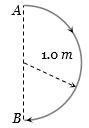
In $1.0 \, s$,a particle moves from point $A$ to point $B$ along a semicircle of radius $1.0 \, m$ (see figure). The magnitude of the average velocity is ......... $m/s$.
A
$3.14$
B
$2.0$
C
$1.0$
D
$0$
Solution
(B) The average velocity is defined as the total displacement divided by the total time taken.
Displacement is the shortest distance between the initial point $A$ and the final point $B$.
Since the particle moves along a semicircle of radius $r = 1.0 \, m$,the displacement is equal to the diameter of the semicircle.
Displacement $= 2 \times r = 2 \times 1.0 \, m = 2.0 \, m$.
The time taken is $1.0 \, s$.
Therefore,the magnitude of the average velocity $= \frac{\text{Total displacement}}{\text{Total time}} = \frac{2.0 \, m}{1.0 \, s} = 2.0 \, m/s$.
Displacement is the shortest distance between the initial point $A$ and the final point $B$.
Since the particle moves along a semicircle of radius $r = 1.0 \, m$,the displacement is equal to the diameter of the semicircle.
Displacement $= 2 \times r = 2 \times 1.0 \, m = 2.0 \, m$.
The time taken is $1.0 \, s$.
Therefore,the magnitude of the average velocity $= \frac{\text{Total displacement}}{\text{Total time}} = \frac{2.0 \, m}{1.0 \, s} = 2.0 \, m/s$.
0 likesView Solution
2
PhysicsDifficultMCQIIT JEE · 1999
The coordinates of a particle moving in a plane are given by $x = a \cos(pt)$ and $y = b \sin(pt)$,where $a, b (b < a)$ and $p$ are positive constants of appropriate dimensions. Then:
A
The path of the particle is an ellipse.
B
The velocity and acceleration of the particle are normal to each other at $t = \pi / (2p)$.
C
The acceleration of the particle is always directed towards a focus.
D
Both $(a)$ and $(b)$.
Solution
(D) $x = a \cos(pt)$ and $y = b \sin(pt)$ (given).
$\therefore \cos(pt) = x/a$ and $\sin(pt) = y/b$.
By squaring and adding:
$\cos^2(pt) + \sin^2(pt) = \frac{x^2}{a^2} + \frac{y^2}{b^2} = 1$.
Hence,the path of the particle is an ellipse.
Now,differentiating $x$ and $y$ with respect to time:
$v_x = \frac{dx}{dt} = -ap \sin(pt)$ and $v_y = \frac{dy}{dt} = bp \cos(pt)$.
$\vec{v} = -ap \sin(pt) \hat{i} + bp \cos(pt) \hat{j}$.
Acceleration $\vec{a} = \frac{d\vec{v}}{dt} = -ap^2 \cos(pt) \hat{i} - bp^2 \sin(pt) \hat{j}$.
At $t = \frac{\pi}{2p}$:
$\vec{v} = -ap \sin(\pi/2) \hat{i} + bp \cos(\pi/2) \hat{j} = -ap \hat{i}$.
$\vec{a} = -ap^2 \cos(\pi/2) \hat{i} - bp^2 \sin(\pi/2) \hat{j} = -bp^2 \hat{j}$.
Since $\vec{v} \cdot \vec{a} = (-ap \hat{i}) \cdot (-bp^2 \hat{j}) = 0$,the velocity and acceleration are perpendicular (normal) to each other at $t = \frac{\pi}{2p}$.
$\therefore \cos(pt) = x/a$ and $\sin(pt) = y/b$.
By squaring and adding:
$\cos^2(pt) + \sin^2(pt) = \frac{x^2}{a^2} + \frac{y^2}{b^2} = 1$.
Hence,the path of the particle is an ellipse.
Now,differentiating $x$ and $y$ with respect to time:
$v_x = \frac{dx}{dt} = -ap \sin(pt)$ and $v_y = \frac{dy}{dt} = bp \cos(pt)$.
$\vec{v} = -ap \sin(pt) \hat{i} + bp \cos(pt) \hat{j}$.
Acceleration $\vec{a} = \frac{d\vec{v}}{dt} = -ap^2 \cos(pt) \hat{i} - bp^2 \sin(pt) \hat{j}$.
At $t = \frac{\pi}{2p}$:
$\vec{v} = -ap \sin(\pi/2) \hat{i} + bp \cos(\pi/2) \hat{j} = -ap \hat{i}$.
$\vec{a} = -ap^2 \cos(\pi/2) \hat{i} - bp^2 \sin(\pi/2) \hat{j} = -bp^2 \hat{j}$.
Since $\vec{v} \cdot \vec{a} = (-ap \hat{i}) \cdot (-bp^2 \hat{j}) = 0$,the velocity and acceleration are perpendicular (normal) to each other at $t = \frac{\pi}{2p}$.
0 likesView Solution
3
PhysicsDifficultMCQIIT JEE · 1999
$A$ particle free to move along the $x$-axis has potential energy given by $U(x) = k[1 - \exp(-x^2)]$ for $-\infty \le x \le +\infty$,where $k$ is a positive constant of appropriate dimensions. Then:
A
At points away from the origin,the particle is in unstable equilibrium
B
For any finite non-zero value of $x$,there is a force directed away from the origin
C
If its total mechanical energy is $k/2$,it has its minimum kinetic energy at the origin
D
For small displacements from $x = 0$,the motion is simple harmonic
Solution
(D) The potential energy of the particle is given by $U(x) = k(1 - e^{-x^2})$.
The force acting on the particle is $F = -\frac{dU}{dx}$.
$F = -\frac{d}{dx} [k(1 - e^{-x^2})] = -k[0 - e^{-x^2} \cdot (-2x)] = -2kxe^{-x^2}$.
For small displacements from the origin $(x \approx 0)$,we can use the Taylor expansion $e^{-x^2} \approx 1 - x^2 + \dots \approx 1$.
Thus,$F \approx -2kx$.
Since $F \propto -x$,the restoring force is proportional to the displacement,which is the condition for simple harmonic motion $(SHM)$.
The force acting on the particle is $F = -\frac{dU}{dx}$.
$F = -\frac{d}{dx} [k(1 - e^{-x^2})] = -k[0 - e^{-x^2} \cdot (-2x)] = -2kxe^{-x^2}$.
For small displacements from the origin $(x \approx 0)$,we can use the Taylor expansion $e^{-x^2} \approx 1 - x^2 + \dots \approx 1$.
Thus,$F \approx -2kx$.
Since $F \propto -x$,the restoring force is proportional to the displacement,which is the condition for simple harmonic motion $(SHM)$.
0 likesView Solution
4
PhysicsDifficultMCQIIT JEE · 1999
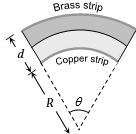
$A$ bimetallic strip is formed out of two identical strips,one of copper and the other of brass. The coefficients of linear expansion of the two metals are $\alpha_C$ and $\alpha_B$. On heating,the temperature of the strip increases by $\Delta T$ and the strip bends to form an arc of radius of curvature $R$. Then $R$ is:
A
Proportional to $\Delta T$
B
Inversely proportional to $\Delta T$
C
Inversely proportional to $|\alpha_B - \alpha_C|$
D
Both $(B)$ and $(C)$
Solution
(D) Let $L_0$ be the initial length of each strip before heating.
Let $d$ be the total thickness of the bimetallic strip.
After heating,the lengths of the brass and copper strips are:
$L_B = L_0(1 + \alpha_B \Delta T) = (R + d)\theta$
$L_C = L_0(1 + \alpha_C \Delta T) = R\theta$
Dividing the two equations:
$\frac{R + d}{R} = \frac{1 + \alpha_B \Delta T}{1 + \alpha_C \Delta T}$
$1 + \frac{d}{R} = \frac{1 + \alpha_B \Delta T}{1 + \alpha_C \Delta T}$
$\frac{d}{R} = \frac{1 + \alpha_B \Delta T}{1 + \alpha_C \Delta T} - 1 = \frac{1 + \alpha_B \Delta T - 1 - \alpha_C \Delta T}{1 + \alpha_C \Delta T} = \frac{(\alpha_B - \alpha_C)\Delta T}{1 + \alpha_C \Delta T}$
Since $\alpha \Delta T \ll 1$,we can approximate $1 + \alpha_C \Delta T \approx 1$.
Thus,$R = \frac{d}{(\alpha_B - \alpha_C)\Delta T}$.
Therefore,$R \propto \frac{1}{\Delta T}$ and $R \propto \frac{1}{|\alpha_B - \alpha_C|}$.
Hence,both $(B)$ and $(C)$ are correct.
Let $d$ be the total thickness of the bimetallic strip.
After heating,the lengths of the brass and copper strips are:
$L_B = L_0(1 + \alpha_B \Delta T) = (R + d)\theta$
$L_C = L_0(1 + \alpha_C \Delta T) = R\theta$
Dividing the two equations:
$\frac{R + d}{R} = \frac{1 + \alpha_B \Delta T}{1 + \alpha_C \Delta T}$
$1 + \frac{d}{R} = \frac{1 + \alpha_B \Delta T}{1 + \alpha_C \Delta T}$
$\frac{d}{R} = \frac{1 + \alpha_B \Delta T}{1 + \alpha_C \Delta T} - 1 = \frac{1 + \alpha_B \Delta T - 1 - \alpha_C \Delta T}{1 + \alpha_C \Delta T} = \frac{(\alpha_B - \alpha_C)\Delta T}{1 + \alpha_C \Delta T}$
Since $\alpha \Delta T \ll 1$,we can approximate $1 + \alpha_C \Delta T \approx 1$.
Thus,$R = \frac{d}{(\alpha_B - \alpha_C)\Delta T}$.
Therefore,$R \propto \frac{1}{\Delta T}$ and $R \propto \frac{1}{|\alpha_B - \alpha_C|}$.
Hence,both $(B)$ and $(C)$ are correct.
0 likesView Solution
5
PhysicsMediumMCQIIT JEE · 1999
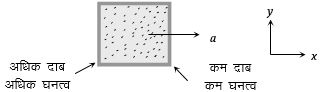
$A$ closed compartment containing gas is moving with some acceleration in a horizontal direction. Neglect the effect of gravity. Then the pressure in the compartment is
A
Same everywhere
B
Lower in the front side
C
Lower in the rear side
D
Lower in the upper side
Solution
(B) Consider the compartment in an accelerated frame of reference moving with acceleration $a$ in the positive $x$-direction.
In this non-inertial frame,a pseudo force acts on each gas molecule in the direction opposite to the acceleration (i.e.,in the negative $x$-direction).
Due to this pseudo force,the gas molecules tend to accumulate towards the rear side of the compartment.
As a result,the density of the gas increases at the rear side and decreases at the front side.
Since the pressure of a gas is directly proportional to its density (from the ideal gas law $P = \rho RT/M$),the pressure will be higher at the rear side and lower at the front side.
Therefore,the pressure is lower in the front side.
In this non-inertial frame,a pseudo force acts on each gas molecule in the direction opposite to the acceleration (i.e.,in the negative $x$-direction).
Due to this pseudo force,the gas molecules tend to accumulate towards the rear side of the compartment.
As a result,the density of the gas increases at the rear side and decreases at the front side.
Since the pressure of a gas is directly proportional to its density (from the ideal gas law $P = \rho RT/M$),the pressure will be higher at the rear side and lower at the front side.
Therefore,the pressure is lower in the front side.
0 likesView Solution
6
PhysicsMediumMCQIIT JEE · 1999
$A$ gas mixture consists of $2$ moles of $O_2$ and $4$ moles of $Ar$ at temperature $T$. Neglecting all vibrational modes,the total internal energy of the system is (in $RT$)
A
$4$
B
$15$
C
$9$
D
$11$
Solution
(D) The total internal energy $U$ of a gas mixture is the sum of the internal energies of its components.
$U = U_{O_2} + U_{Ar} = \mu_1 \frac{f_1}{2} RT + \mu_2 \frac{f_2}{2} RT$
For $O_2$ (a diatomic gas),the degrees of freedom $f_1 = 5$ (neglecting vibrational modes).
For $Ar$ (a monatomic gas),the degrees of freedom $f_2 = 3$.
Given $\mu_1 = 2$ moles and $\mu_2 = 4$ moles.
Substituting the values:
$U = 2 \times \frac{5}{2} RT + 4 \times \frac{3}{2} RT$
$U = 5 RT + 6 RT = 11 RT$
$U = U_{O_2} + U_{Ar} = \mu_1 \frac{f_1}{2} RT + \mu_2 \frac{f_2}{2} RT$
For $O_2$ (a diatomic gas),the degrees of freedom $f_1 = 5$ (neglecting vibrational modes).
For $Ar$ (a monatomic gas),the degrees of freedom $f_2 = 3$.
Given $\mu_1 = 2$ moles and $\mu_2 = 4$ moles.
Substituting the values:
$U = 2 \times \frac{5}{2} RT + 4 \times \frac{3}{2} RT$
$U = 5 RT + 6 RT = 11 RT$
0 likesView Solution
7
PhysicsMediumMCQIIT JEE · 1999
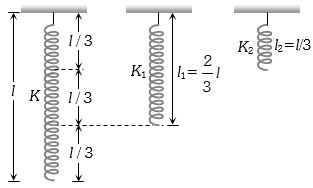
$A$ spring of force constant $k$ is cut into two pieces such that one piece is double the length of the other. Then the long piece will have a force constant of
A
$(2/3)k$
B
$(3/2)k$
C
$3k$
D
$6k$
Solution
(B) The force constant $k$ of a spring is inversely proportional to its length $l$, i.e., $k \propto 1/l$ or $kl = \text{constant}$.
Let the total length of the spring be $l$ and its force constant be $k$.
The spring is cut into two pieces such that one piece is double the length of the other. Let the lengths of the two pieces be $l_1$ and $l_2$.
Given $l_1 = 2l_2$ and $l_1 + l_2 = l$.
Substituting $l_1$, we get $2l_2 + l_2 = l \Rightarrow 3l_2 = l \Rightarrow l_2 = l/3$.
Then $l_1 = 2l/3$.
For the long piece of length $l_1 = 2l/3$, let the new force constant be $k_1$.
Using $k_1 l_1 = kl$, we have $k_1 (2l/3) = kl$.
$k_1 = k / (2/3) = (3/2)k$.
Let the total length of the spring be $l$ and its force constant be $k$.
The spring is cut into two pieces such that one piece is double the length of the other. Let the lengths of the two pieces be $l_1$ and $l_2$.
Given $l_1 = 2l_2$ and $l_1 + l_2 = l$.
Substituting $l_1$, we get $2l_2 + l_2 = l \Rightarrow 3l_2 = l \Rightarrow l_2 = l/3$.
Then $l_1 = 2l/3$.
For the long piece of length $l_1 = 2l/3$, let the new force constant be $k_1$.
Using $k_1 l_1 = kl$, we have $k_1 (2l/3) = kl$.
$k_1 = k / (2/3) = (3/2)k$.
0 likesView Solution
8
PhysicsDifficultMCQIIT JEE · 1999
Three simple harmonic motions in the same direction having the same amplitude $a$ and same period are superposed. If each differs in phase from the next by $45^\circ$,then:
A
The resultant amplitude is $(1 + \sqrt{2})a$
B
The phase of the resultant motion relative to the first is $90^\circ$
C
The energy associated with the resulting motion is $(3 + 2\sqrt{2})$ times the energy associated with any single motion
D
Both $(a)$ and $(c)$
Solution
(D) Let the three simple harmonic motions be represented by:
$y_1 = a \sin(\omega t - 45^\circ)$
$y_2 = a \sin(\omega t)$
$y_3 = a \sin(\omega t + 45^\circ)$
On superimposing,the resultant $SHM$ is $y = y_1 + y_2 + y_3$
$y = a[\sin(\omega t - 45^\circ) + \sin(\omega t) + \sin(\omega t + 45^\circ)]$
Using the identity $\sin(A-B) + \sin(A+B) = 2\sin A \cos B$:
$y = a[2\sin(\omega t)\cos(45^\circ) + \sin(\omega t)]$
Since $\cos(45^\circ) = \frac{1}{\sqrt{2}}$:
$y = a[2\sin(\omega t) \cdot \frac{1}{\sqrt{2}} + \sin(\omega t)]$
$y = a[\sqrt{2}\sin(\omega t) + \sin(\omega t)] = a(1 + \sqrt{2})\sin(\omega t)$
The resultant amplitude is $A = (1 + \sqrt{2})a$.
Energy $E$ in $SHM$ is proportional to the square of the amplitude $(E \propto A^2)$:
$\frac{E_{\text{resultant}}}{E_{\text{single}}} = \left(\frac{A}{a}\right)^2 = (1 + \sqrt{2})^2 = 1 + 2 + 2\sqrt{2} = (3 + 2\sqrt{2})$
Thus,$E_{\text{resultant}} = (3 + 2\sqrt{2})E_{\text{single}}$.
$y_1 = a \sin(\omega t - 45^\circ)$
$y_2 = a \sin(\omega t)$
$y_3 = a \sin(\omega t + 45^\circ)$
On superimposing,the resultant $SHM$ is $y = y_1 + y_2 + y_3$
$y = a[\sin(\omega t - 45^\circ) + \sin(\omega t) + \sin(\omega t + 45^\circ)]$
Using the identity $\sin(A-B) + \sin(A+B) = 2\sin A \cos B$:
$y = a[2\sin(\omega t)\cos(45^\circ) + \sin(\omega t)]$
Since $\cos(45^\circ) = \frac{1}{\sqrt{2}}$:
$y = a[2\sin(\omega t) \cdot \frac{1}{\sqrt{2}} + \sin(\omega t)]$
$y = a[\sqrt{2}\sin(\omega t) + \sin(\omega t)] = a(1 + \sqrt{2})\sin(\omega t)$
The resultant amplitude is $A = (1 + \sqrt{2})a$.
Energy $E$ in $SHM$ is proportional to the square of the amplitude $(E \propto A^2)$:
$\frac{E_{\text{resultant}}}{E_{\text{single}}} = \left(\frac{A}{a}\right)^2 = (1 + \sqrt{2})^2 = 1 + 2 + 2\sqrt{2} = (3 + 2\sqrt{2})$
Thus,$E_{\text{resultant}} = (3 + 2\sqrt{2})E_{\text{single}}$.
0 likesView Solution
9
PhysicsMediumMCQIIT JEE · 1999
The ratio of the speed of sound in nitrogen gas to that in helium gas,at $300 K$ is
A
$\sqrt{2/7}$
B
$\sqrt{1/7}$
C
$\sqrt{3}/5$
D
$\sqrt{6}/5$
Solution
(C) The speed of sound in an ideal gas is given by the formula $v = \sqrt{\frac{\gamma RT}{M}}$,where $\gamma$ is the adiabatic index,$R$ is the universal gas constant,$T$ is the temperature,and $M$ is the molar mass of the gas.
Since the temperature $T$ is the same for both gases,the ratio of the speeds is given by $\frac{v_{N_2}}{v_{He}} = \sqrt{\frac{\gamma_{N_2}}{\gamma_{He}} \times \frac{M_{He}}{M_{N_2}}}$.
For nitrogen $(N_2)$,which is a diatomic gas,$\gamma_{N_2} = 1.4 = 7/5$ and the molar mass $M_{N_2} = 28 \ g/mol$.
For helium $(He)$,which is a monatomic gas,$\gamma_{He} = 1.67 = 5/3$ and the molar mass $M_{He} = 4 \ g/mol$.
Substituting these values: $\frac{v_{N_2}}{v_{He}} = \sqrt{\frac{7/5}{5/3} \times \frac{4}{28}} = \sqrt{\frac{7}{5} \times \frac{3}{5} \times \frac{1}{7}} = \sqrt{\frac{3}{25}} = \frac{\sqrt{3}}{5}$.
Since the temperature $T$ is the same for both gases,the ratio of the speeds is given by $\frac{v_{N_2}}{v_{He}} = \sqrt{\frac{\gamma_{N_2}}{\gamma_{He}} \times \frac{M_{He}}{M_{N_2}}}$.
For nitrogen $(N_2)$,which is a diatomic gas,$\gamma_{N_2} = 1.4 = 7/5$ and the molar mass $M_{N_2} = 28 \ g/mol$.
For helium $(He)$,which is a monatomic gas,$\gamma_{He} = 1.67 = 5/3$ and the molar mass $M_{He} = 4 \ g/mol$.
Substituting these values: $\frac{v_{N_2}}{v_{He}} = \sqrt{\frac{7/5}{5/3} \times \frac{4}{28}} = \sqrt{\frac{7}{5} \times \frac{3}{5} \times \frac{1}{7}} = \sqrt{\frac{3}{25}} = \frac{\sqrt{3}}{5}$.
0 likesView Solution
10
PhysicsMediumMCQIIT JEE · 1999
As a wave propagates:
A
The wave intensity remains constant for a plane wave.
B
Total intensity (power) of the spherical wave over the spherical surface centered at the source remains constant at all times.
C
The wave intensity decreases as the inverse square of the distance from the source for a spherical wave.
D
All of the above.
Solution
(D) The correct answer is $(d)$.
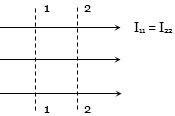
For a plane wave,the wavefronts are parallel planes,and the energy is distributed uniformly,so the intensity remains constant as the wave propagates.
For a spherical wave,the energy emitted by the source spreads over an increasing surface area $A = 4\pi r^2$. Thus,the intensity $I = P / A = P / (4\pi r^2)$ is inversely proportional to the square of the distance $r$ from the source.
The total power $P$ (often referred to as total intensity in this context) passing through any spherical surface centered at the source remains constant,as energy is conserved.
For a plane wave,the wavefronts are parallel planes,and the energy is distributed uniformly,so the intensity remains constant as the wave propagates.
For a spherical wave,the energy emitted by the source spreads over an increasing surface area $A = 4\pi r^2$. Thus,the intensity $I = P / A = P / (4\pi r^2)$ is inversely proportional to the square of the distance $r$ from the source.
The total power $P$ (often referred to as total intensity in this context) passing through any spherical surface centered at the source remains constant,as energy is conserved.
0 likesView Solution
11
PhysicsEasyMCQIIT JEE · 1999
Standing waves can be produced:
A
On a string clamped at both ends.
B
On a string clamped at one end and free at the other.
C
When an incident wave is reflected from a wall.
D
All of the above.
Solution
(D) Standing waves are formed by the superposition of two waves of the same frequency and speed traveling in opposite directions.
$(a)$ $A$ string clamped at both ends allows for the reflection of waves at the boundaries,creating standing waves.
$(b)$ $A$ string clamped at one end and free at the other also allows for reflection,resulting in standing waves.
$(c)$ When an incident wave hits a wall,it reflects back,and the superposition of the incident and reflected waves creates standing waves.
Therefore,all the given conditions can produce standing waves. The correct option is $D$.
$(a)$ $A$ string clamped at both ends allows for the reflection of waves at the boundaries,creating standing waves.
$(b)$ $A$ string clamped at one end and free at the other also allows for reflection,resulting in standing waves.
$(c)$ When an incident wave hits a wall,it reflects back,and the superposition of the incident and reflected waves creates standing waves.
Therefore,all the given conditions can produce standing waves. The correct option is $D$.
0 likesView Solution
12
PhysicsMediumMCQIIT JEE · 1999
In a wave motion $y = a \sin (kx - \omega t)$,$y$ can represent
A
Electric field
B
Magnetic field
C
Displacement
D
All of the above.
Solution
(D) The equation $y = a \sin (kx - \omega t)$ represents a general traveling wave equation.
In the case of mechanical waves (like sound waves),$y$ can represent the displacement of particles or pressure variations.
In the case of electromagnetic waves,$y$ represents the oscillating electric field $(E)$ or magnetic field $(B)$ components.
Therefore,$y$ is a general physical quantity that oscillates and propagates through space.
Thus,the correct option is $D$.
In the case of mechanical waves (like sound waves),$y$ can represent the displacement of particles or pressure variations.
In the case of electromagnetic waves,$y$ represents the oscillating electric field $(E)$ or magnetic field $(B)$ components.
Therefore,$y$ is a general physical quantity that oscillates and propagates through space.
Thus,the correct option is $D$.
0 likesView Solution
13
PhysicsMediumMCQIIT JEE · 1999
$A$ smooth sphere $A$ is moving on a frictionless horizontal plane with angular speed $\omega$ and center of mass with velocity $v$. It collides elastically and head-on with an identical sphere $B$ at rest. Neglect friction everywhere. After the collision,their angular speeds are $\omega_A$ and $\omega_B$ respectively. Then
A
$\omega_A < \omega_B$
B
$\omega_A = \omega_B$
C
$\omega_A = \omega$
D
$\omega = \omega_B$
Solution
(C) Since the spheres are smooth,there is no friction between them during the collision.
Friction is the only source of torque that could change the angular momentum of a sphere about its center of mass.
Because there is no friction,there is no torque acting on either sphere.
Consequently,the angular momentum of each sphere remains constant.
For sphere $A$,the initial angular momentum is $L_A = I\omega$. Since no torque acts on it,its final angular momentum remains $I\omega_A = I\omega$,which implies $\omega_A = \omega$.
For sphere $B$,which was initially at rest,its initial angular momentum is $0$. Since no torque acts on it,its final angular momentum remains $0$,which implies $\omega_B = 0$.
Friction is the only source of torque that could change the angular momentum of a sphere about its center of mass.
Because there is no friction,there is no torque acting on either sphere.
Consequently,the angular momentum of each sphere remains constant.
For sphere $A$,the initial angular momentum is $L_A = I\omega$. Since no torque acts on it,its final angular momentum remains $I\omega_A = I\omega$,which implies $\omega_A = \omega$.
For sphere $B$,which was initially at rest,its initial angular momentum is $0$. Since no torque acts on it,its final angular momentum remains $0$,which implies $\omega_B = 0$.
0 likesView Solution
14
PhysicsMediumMCQIIT JEE · 1999
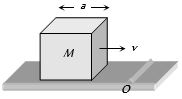
$A$ cubical block of side $a$ is moving with velocity $v$ on a horizontal smooth plane as shown. It hits a ridge at point $O$. The angular speed of the block after it hits $O$ is
A
$3v/4a$
B
$3v/2a$
C
$\frac{\sqrt{3}v}{\sqrt{2}a}$
D
Zero
Solution
(A) When the block hits the ridge at $O$,it starts rotating about an axis passing through $O$ and perpendicular to the plane of motion. Since no external torque acts on the block about point $O$ during the impact,the angular momentum is conserved.
Initial angular momentum $L_i$ about point $O$ is given by the product of linear momentum and the perpendicular distance from $O$ to the line of motion of the center of mass:
$L_i = Mv \times (a/2) = \frac{Mva}{2}$
After hitting the ridge,the block rotates about point $O$. The final angular momentum is $L_f = I_O \omega$,where $I_O$ is the moment of inertia of the cube about the axis passing through $O$.
The moment of inertia of a cube about an axis passing through its center of mass $C$ is $I_C = \frac{Ma^2}{6}$.
Using the parallel axis theorem,$I_O = I_C + Mr^2$,where $r$ is the distance from the center of mass to point $O$. Here,$r^2 = (a/2)^2 + (a/2)^2 = a^2/2$.
Thus,$I_O = \frac{Ma^2}{6} + M(a^2/2) = \frac{Ma^2 + 3Ma^2}{6} = \frac{4Ma^2}{6} = \frac{2}{3}Ma^2$.
Equating initial and final angular momentum: $L_i = L_f$
$\frac{Mva}{2} = \frac{2}{3}Ma^2 \omega$
Solving for $\omega$: $\omega = \frac{Mva}{2} \times \frac{3}{2Ma^2} = \frac{3v}{4a}$.
Initial angular momentum $L_i$ about point $O$ is given by the product of linear momentum and the perpendicular distance from $O$ to the line of motion of the center of mass:
$L_i = Mv \times (a/2) = \frac{Mva}{2}$
After hitting the ridge,the block rotates about point $O$. The final angular momentum is $L_f = I_O \omega$,where $I_O$ is the moment of inertia of the cube about the axis passing through $O$.
The moment of inertia of a cube about an axis passing through its center of mass $C$ is $I_C = \frac{Ma^2}{6}$.
Using the parallel axis theorem,$I_O = I_C + Mr^2$,where $r$ is the distance from the center of mass to point $O$. Here,$r^2 = (a/2)^2 + (a/2)^2 = a^2/2$.
Thus,$I_O = \frac{Ma^2}{6} + M(a^2/2) = \frac{Ma^2 + 3Ma^2}{6} = \frac{4Ma^2}{6} = \frac{2}{3}Ma^2$.
Equating initial and final angular momentum: $L_i = L_f$
$\frac{Mva}{2} = \frac{2}{3}Ma^2 \omega$
Solving for $\omega$: $\omega = \frac{Mva}{2} \times \frac{3}{2Ma^2} = \frac{3v}{4a}$.
0 likesView Solution
15
PhysicsMediumMCQIIT JEE · 1999
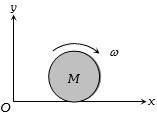
$A$ disc of mass $M$ and radius $R$ is rolling on a horizontal surface with an angular speed $\omega$. The angular momentum of the disc about the origin $O$ is:
A
$\frac{1}{2}M{R^2}\omega$
B
$M{R^2}\omega$
C
$\frac{3}{2}M{R^2}\omega$
D
$2M{R^2}\omega$
Solution
(C) The angular momentum of a rolling body about the point of contact (origin $O$) is the sum of the angular momentum due to linear motion and the angular momentum due to rotation about its center of mass.
$L = L_{\text{linear}} + L_{\text{rotational}}$
$L = MvR + I_c\omega$
Since the disc is rolling without slipping,the linear velocity of the center of mass is $v = R\omega$.
The moment of inertia of a disc about its center of mass is $I_c = \frac{1}{2}MR^2$.
Substituting these values:
$L = M(R\omega)R + (\frac{1}{2}MR^2)\omega$
$L = MR^2\omega + \frac{1}{2}MR^2\omega$
$L = \frac{3}{2}MR^2\omega$
$L = L_{\text{linear}} + L_{\text{rotational}}$
$L = MvR + I_c\omega$
Since the disc is rolling without slipping,the linear velocity of the center of mass is $v = R\omega$.
The moment of inertia of a disc about its center of mass is $I_c = \frac{1}{2}MR^2$.
Substituting these values:
$L = M(R\omega)R + (\frac{1}{2}MR^2)\omega$
$L = MR^2\omega + \frac{1}{2}MR^2\omega$
$L = \frac{3}{2}MR^2\omega$
0 likesView Solution
16
PhysicsEasyMCQIIT JEE · 1999
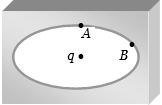
An ellipsoidal cavity is carved within a perfect conductor. $A$ positive charge $q$ is placed at the centre of the cavity. The points $A$ and $B$ are on the cavity surface as shown in the figure. Then
A
Electric field near $A$ in the cavity = Electric field near $B$ in the cavity
B
Total electric field flux through the surface of the cavity is $q/{\varepsilon _0}$
C
Potential at $A = $ Potential at $B$
D
Both $(b)$ and $(c)$
Solution
(D) Under electrostatic conditions,the entire volume of a conductor is an equipotential region. Since points $A$ and $B$ lie on the surface of the conductor,they must be at the same potential. Thus,Potential at $A = $ Potential at $B$.
According to Gauss's Law,the total electric flux $\phi$ through any closed surface enclosing a charge $q$ is given by $\phi = q/\varepsilon_0$. Since the cavity surface encloses the charge $q$,the total flux through it is $q/\varepsilon_0$.
For an ellipsoidal cavity,the electric field near the surface depends on the local curvature,so the electric field at $A$ is not necessarily equal to the electric field at $B$. Therefore,options $(b)$ and $(c)$ are correct.
According to Gauss's Law,the total electric flux $\phi$ through any closed surface enclosing a charge $q$ is given by $\phi = q/\varepsilon_0$. Since the cavity surface encloses the charge $q$,the total flux through it is $q/\varepsilon_0$.
For an ellipsoidal cavity,the electric field near the surface depends on the local curvature,so the electric field at $A$ is not necessarily equal to the electric field at $B$. Therefore,options $(b)$ and $(c)$ are correct.
0 likesView Solution
17
PhysicsDifficultMCQIIT JEE · 1999
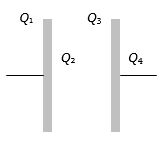
In an isolated parallel plate capacitor of capacitance $C$,the four surfaces have charges $Q_1$,$Q_2$,$Q_3$,and $Q_4$ as shown. The potential difference between the plates is
A
$\frac{Q_1 + Q_2 + Q_3 + Q_4}{2C}$
B
$\frac{Q_2 + Q_3}{2C}$
C
$\frac{Q_2 - Q_3}{2C}$
D
$\frac{Q_1 + Q_4}{2C}$
Solution
(C) For a parallel plate capacitor,the charges on the inner surfaces facing each other must be equal in magnitude and opposite in sign. Therefore,$Q_2 = -Q_3$.
The potential difference $V$ between the plates of a capacitor is given by the ratio of the charge on the inner surface of the positive plate to the capacitance $C$.
$V = \frac{Q_2}{C}$
Since $Q_3 = -Q_2$,we can write $Q_2 = \frac{Q_2 - Q_3}{2}$.
Substituting this into the potential difference formula:
$V = \frac{Q_2 - Q_3}{2C}$
The potential difference $V$ between the plates of a capacitor is given by the ratio of the charge on the inner surface of the positive plate to the capacitance $C$.
$V = \frac{Q_2}{C}$
Since $Q_3 = -Q_2$,we can write $Q_2 = \frac{Q_2 - Q_3}{2}$.
Substituting this into the potential difference formula:
$V = \frac{Q_2 - Q_3}{2C}$
0 likesView Solution
18
PhysicsMediumMCQIIT JEE · 1999
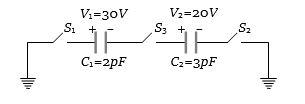
For the circuit shown,which of the following statements is true?
A
With $S_1$ closed,$V_1 = 15\,V, V_2 = 20\,V$
B
With $S_3$ closed,$V_1 = V_2 = 25\,V$
C
With $S_1$ and $S_2$ closed,$V_1 = V_2 = 0$
D
With $S_1$ and $S_3$ closed,$V_1 = 30\,V, V_2 = 20\,V$
Solution
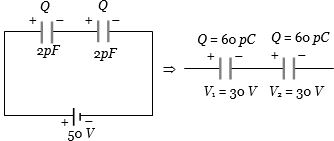
(D) Initially,the capacitors are charged as $Q_1 = C_1 V_1 = (2\,pF)(30\,V) = 60\,pC$ and $Q_2 = C_2 V_2 = (3\,pF)(20\,V) = 60\,pC$.
When switches $S_1$ and $S_3$ are closed,the plates are connected to the ground. The potential difference across $C_1$ remains $30\,V$ (as the left plate is grounded and the right plate is connected to the potential of the junction) and across $C_2$ remains $20\,V$ because the charge on the capacitors remains trapped and unchanged as the circuit is not forming a closed loop with an external source to redistribute charge.
Thus,the potential differences $V_1 = 30\,V$ and $V_2 = 20\,V$ remain unchanged.
When switches $S_1$ and $S_3$ are closed,the plates are connected to the ground. The potential difference across $C_1$ remains $30\,V$ (as the left plate is grounded and the right plate is connected to the potential of the junction) and across $C_2$ remains $20\,V$ because the charge on the capacitors remains trapped and unchanged as the circuit is not forming a closed loop with an external source to redistribute charge.
Thus,the potential differences $V_1 = 30\,V$ and $V_2 = 20\,V$ remain unchanged.
0 likesView Solution
19
PhysicsEasyMCQIIT JEE · 1999
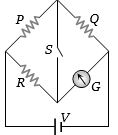
In the circuit shown,$P \ne R$. The reading of the galvanometer is the same with switch $S$ open or closed. Then:
A
$I_R = I_G$
B
$I_P = I_G$
C
$I_Q = I_G$
D
$I_Q = I_R$
Solution
(A) The reading of the galvanometer remains the same whether switch $S$ is open or closed.
This implies that the potential difference across the switch $S$ is zero,or that no current flows through the switch when it is closed.
If no current flows through the switch,the branch containing $R$ and the branch containing the galvanometer $G$ effectively act as a single series circuit path between the nodes.
Therefore,the same current must flow through both $R$ and $G$.
Thus,$I_R = I_G$.
This implies that the potential difference across the switch $S$ is zero,or that no current flows through the switch when it is closed.
If no current flows through the switch,the branch containing $R$ and the branch containing the galvanometer $G$ effectively act as a single series circuit path between the nodes.
Therefore,the same current must flow through both $R$ and $G$.
Thus,$I_R = I_G$.
0 likesView Solution
20
PhysicsEasyMCQIIT JEE · 1999
$A$ charged particle is released from rest in a region of steady uniform electric and magnetic fields which are parallel to each other. The particle will move in a:
A
Straight line
B
Circle
C
Helix
D
Cycloid
Solution
(A) The force on a charged particle $q$ moving with velocity $\vec{v}$ in electric field $\vec{E}$ and magnetic field $\vec{B}$ is given by the Lorentz force equation: $\vec{F} = q(\vec{E} + \vec{v} \times \vec{B})$.
Since the particle is released from rest,its initial velocity $\vec{v} = 0$.
Initially,the magnetic force $\vec{F}_m = q(\vec{v} \times \vec{B}) = 0$.
The electric force $\vec{F}_e = q\vec{E}$ acts on the particle,causing it to accelerate in the direction of the electric field.
As the particle gains velocity $\vec{v}$ in the direction of $\vec{E}$,and since $\vec{E}$ and $\vec{B}$ are parallel,the velocity $\vec{v}$ remains parallel to the magnetic field $\vec{B}$ at all times.
Therefore,the magnetic force $\vec{F}_m = q(\vec{v} \times \vec{B}) = 0$ throughout the motion because the angle between $\vec{v}$ and $\vec{B}$ is $0^\circ$.
The particle continues to accelerate in a straight line due to the electric field.
Since the particle is released from rest,its initial velocity $\vec{v} = 0$.
Initially,the magnetic force $\vec{F}_m = q(\vec{v} \times \vec{B}) = 0$.
The electric force $\vec{F}_e = q\vec{E}$ acts on the particle,causing it to accelerate in the direction of the electric field.
As the particle gains velocity $\vec{v}$ in the direction of $\vec{E}$,and since $\vec{E}$ and $\vec{B}$ are parallel,the velocity $\vec{v}$ remains parallel to the magnetic field $\vec{B}$ at all times.
Therefore,the magnetic force $\vec{F}_m = q(\vec{v} \times \vec{B}) = 0$ throughout the motion because the angle between $\vec{v}$ and $\vec{B}$ is $0^\circ$.
The particle continues to accelerate in a straight line due to the electric field.
0 likesView Solution
21
PhysicsEasyMCQIIT JEE · 1999
$A$ circular loop of radius $R$ carrying current $I$ lies in the $x-y$ plane with its centre at the origin. The total magnetic flux through the $x-y$ plane is:
A
Directly proportional to $I$
B
Directly proportional to $R$
C
Directly proportional to $R^2$
D
Zero
Solution
(D) circular loop carrying current $I$ behaves as a magnetic dipole.
Magnetic field lines emerge from the North pole and enter the South pole.
Since the loop lies in the $x-y$ plane,the magnetic field lines pass through the loop and then loop back around to form closed paths.
For every magnetic field line that passes through the $x-y$ plane in one direction (e.g.,upwards),an equal number of field lines must pass back through the $x-y$ plane in the opposite direction (e.g.,downwards) to complete the closed loop.
Therefore,the net magnetic flux through the entire $x-y$ plane is zero.
Magnetic field lines emerge from the North pole and enter the South pole.
Since the loop lies in the $x-y$ plane,the magnetic field lines pass through the loop and then loop back around to form closed paths.
For every magnetic field line that passes through the $x-y$ plane in one direction (e.g.,upwards),an equal number of field lines must pass back through the $x-y$ plane in the opposite direction (e.g.,downwards) to complete the closed loop.
Therefore,the net magnetic flux through the entire $x-y$ plane is zero.
0 likesView Solution
22
PhysicsEasyMCQIIT JEE · 1999
Two identical circular loops of metal wire are lying on a table without touching each other. $Loop-A$ carries a current which increases with time. In response,the $loop-B$
A
Remains stationary
B
Is attracted by the $loop-A$
C
Is repelled by the $loop-A$
D
Rotates about its $CM$,with $CM$ fixed ($CM$ is the centre of mass)
Solution
(C) According to Faraday's law of electromagnetic induction,a changing current in $Loop-A$ creates a changing magnetic flux through $Loop-B$.
According to Lenz's law,the induced current in $Loop-B$ will flow in such a direction as to oppose the cause producing it.
Since the current in $Loop-A$ is increasing,the magnetic flux through $Loop-B$ is increasing.
To oppose this increase,$Loop-B$ will develop an induced current that creates a magnetic field opposing the field of $Loop-A$.
Two parallel loops with currents flowing in opposite directions repel each other.
Therefore,$Loop-B$ is repelled by $Loop-A$.
According to Lenz's law,the induced current in $Loop-B$ will flow in such a direction as to oppose the cause producing it.
Since the current in $Loop-A$ is increasing,the magnetic flux through $Loop-B$ is increasing.
To oppose this increase,$Loop-B$ will develop an induced current that creates a magnetic field opposing the field of $Loop-A$.
Two parallel loops with currents flowing in opposite directions repel each other.
Therefore,$Loop-B$ is repelled by $Loop-A$.
0 likesView Solution
23
PhysicsMediumMCQIIT JEE · 1999
$A$ coil of inductance $8.4 \, mH$ and resistance $6 \, \Omega$ is connected to a $12 \, V$ battery. The current in the coil is $1.0 \, A$ at approximately the time
A
$500 \, s$
B
$20 \, s$
C
$35 \, ms$
D
$1 \, ms$
Solution
(D) The maximum current in the circuit is given by $i_0 = \frac{V}{R} = \frac{12 \, V}{6 \, \Omega} = 2 \, A$.
The current in an $LR$ circuit at time $t$ is given by $i(t) = i_0(1 - e^{-Rt/L})$.
We want to find the time $t$ when $i(t) = 1.0 \, A$. Substituting the values:
$1.0 = 2(1 - e^{-6t / (8.4 \times 10^{-3})})$
$0.5 = 1 - e^{-6t / (8.4 \times 10^{-3})}$
$e^{-6t / (8.4 \times 10^{-3})} = 0.5$
Taking the natural logarithm on both sides:
$-\frac{6t}{8.4 \times 10^{-3}} = \ln(0.5) \approx -0.693$
$t = 0.693 \times \frac{8.4 \times 10^{-3}}{6} = 0.693 \times 1.4 \times 10^{-3} \approx 0.97 \times 10^{-3} \, s \approx 1 \, ms$.
The current in an $LR$ circuit at time $t$ is given by $i(t) = i_0(1 - e^{-Rt/L})$.
We want to find the time $t$ when $i(t) = 1.0 \, A$. Substituting the values:
$1.0 = 2(1 - e^{-6t / (8.4 \times 10^{-3})})$
$0.5 = 1 - e^{-6t / (8.4 \times 10^{-3})}$
$e^{-6t / (8.4 \times 10^{-3})} = 0.5$
Taking the natural logarithm on both sides:
$-\frac{6t}{8.4 \times 10^{-3}} = \ln(0.5) \approx -0.693$
$t = 0.693 \times \frac{8.4 \times 10^{-3}}{6} = 0.693 \times 1.4 \times 10^{-3} \approx 0.97 \times 10^{-3} \, s \approx 1 \, ms$.
0 likesView Solution
24
PhysicsMediumMCQIIT JEE · 1999
$A$ particle of mass $M$ at rest decays into two particles of masses $m_1$ and $m_2$,having non-zero velocities. The ratio of the de-Broglie wavelengths of the particles,$\lambda_1 / \lambda_2$ is
A
$m_1 / m_2$
B
$m_2 / m_1$
C
$1$
D
$\sqrt{m_2} / \sqrt{m_1}$
Solution
(C) According to the law of conservation of linear momentum,the initial momentum of the system is zero.
$0 = m_1 \vec{v}_1 + m_2 \vec{v}_2$
$\Rightarrow m_1 \vec{v}_1 = -m_2 \vec{v}_2$
Taking the magnitude,we get $m_1 v_1 = m_2 v_2$,which implies that the magnitudes of the momenta of the two particles are equal $(p_1 = p_2 = p)$.
The de-Broglie wavelength is given by $\lambda = h / p$.
Since both particles have the same magnitude of momentum $p$,their de-Broglie wavelengths will be $\lambda_1 = h / p$ and $\lambda_2 = h / p$.
Therefore,the ratio $\lambda_1 / \lambda_2 = (h / p) / (h / p) = 1$.
$0 = m_1 \vec{v}_1 + m_2 \vec{v}_2$
$\Rightarrow m_1 \vec{v}_1 = -m_2 \vec{v}_2$
Taking the magnitude,we get $m_1 v_1 = m_2 v_2$,which implies that the magnitudes of the momenta of the two particles are equal $(p_1 = p_2 = p)$.
The de-Broglie wavelength is given by $\lambda = h / p$.
Since both particles have the same magnitude of momentum $p$,their de-Broglie wavelengths will be $\lambda_1 = h / p$ and $\lambda_2 = h / p$.
Therefore,the ratio $\lambda_1 / \lambda_2 = (h / p) / (h / p) = 1$.
0 likesView Solution
25
PhysicsDifficultMCQIIT JEE · 1999
The order of magnitude of the density of a uranium nucleus is: (Given: ${m_p} = 1.67 \times 10^{-27} \ kg$)
A
${10^{20}} \ kg/m^3$
B
${10^{17}} \ kg/m^3$
C
${10^{14}} \ kg/m^3$
D
${10^{11}} \ kg/m^3$
Solution
(B) The mass of a nucleus with mass number $A$ is approximately $m = A \times m_p$,where $m_p$ is the mass of a proton.
The radius of a nucleus is given by $R = R_0 A^{1/3}$,where $R_0 \approx 1.2 \times 10^{-15} \ m$.
The volume of the nucleus is $V = \frac{4}{3} \pi R^3 = \frac{4}{3} \pi (R_0 A^{1/3})^3 = \frac{4}{3} \pi R_0^3 A$.
The density $\rho$ is given by $\rho = \frac{m}{V} = \frac{A \times m_p}{\frac{4}{3} \pi R_0^3 A} = \frac{m_p}{\frac{4}{3} \pi R_0^3}$.
Substituting the values: $\rho = \frac{1.67 \times 10^{-27}}{\frac{4}{3} \times 3.14 \times (1.2 \times 10^{-15})^3} \approx \frac{1.67 \times 10^{-27}}{7.24 \times 10^{-45}} \approx 2.3 \times 10^{17} \ kg/m^3$.
Thus,the order of magnitude is $10^{17} \ kg/m^3$.
The radius of a nucleus is given by $R = R_0 A^{1/3}$,where $R_0 \approx 1.2 \times 10^{-15} \ m$.
The volume of the nucleus is $V = \frac{4}{3} \pi R^3 = \frac{4}{3} \pi (R_0 A^{1/3})^3 = \frac{4}{3} \pi R_0^3 A$.
The density $\rho$ is given by $\rho = \frac{m}{V} = \frac{A \times m_p}{\frac{4}{3} \pi R_0^3 A} = \frac{m_p}{\frac{4}{3} \pi R_0^3}$.
Substituting the values: $\rho = \frac{1.67 \times 10^{-27}}{\frac{4}{3} \times 3.14 \times (1.2 \times 10^{-15})^3} \approx \frac{1.67 \times 10^{-27}}{7.24 \times 10^{-45}} \approx 2.3 \times 10^{17} \ kg/m^3$.
Thus,the order of magnitude is $10^{17} \ kg/m^3$.
0 likesView Solution
26
PhysicsEasyMCQIIT JEE · 1999
Which of the following is a correct statement?
A
Beta rays are same as cathode rays
B
Gamma rays are high energy neutrons
C
Alpha particles are singly ionized helium atoms
D
Protons and neutrons have exactly the same mass
Solution
(A) The correct statement is that $\beta$-rays are the same as cathode rays because both consist of high-speed electrons.
$\gamma$-rays are high-energy electromagnetic waves,not neutrons.
$\alpha$-particles are doubly ionized helium atoms $(He^{2+})$,not singly ionized.
Protons and neutrons have approximately the same mass,but not exactly the same mass.
$\gamma$-rays are high-energy electromagnetic waves,not neutrons.
$\alpha$-particles are doubly ionized helium atoms $(He^{2+})$,not singly ionized.
Protons and neutrons have approximately the same mass,but not exactly the same mass.
0 likesView Solution
27
PhysicsEasyMCQIIT JEE · 1999
$^{22}Ne$ nucleus after absorbing energy decays into two $\alpha$-particles and an unknown nucleus. The unknown nucleus is
A
Nitrogen
B
Carbon
C
Boron
D
Oxygen
Solution
(B) The nuclear reaction is given by: $_{10}^{22}Ne \to 2(_2^4He) + _Z^A X$
Applying the law of conservation of mass number: $22 = 2(4) + A \implies 22 = 8 + A \implies A = 14$
Applying the law of conservation of atomic number: $10 = 2(2) + Z \implies 10 = 4 + Z \implies Z = 6$
The nucleus with atomic number $Z = 6$ is Carbon $(C)$.
Therefore,the unknown nucleus is Carbon.
Applying the law of conservation of mass number: $22 = 2(4) + A \implies 22 = 8 + A \implies A = 14$
Applying the law of conservation of atomic number: $10 = 2(2) + Z \implies 10 = 4 + Z \implies Z = 6$
The nucleus with atomic number $Z = 6$ is Carbon $(C)$.
Therefore,the unknown nucleus is Carbon.
0 likesView Solution
28
PhysicsMediumMCQIIT JEE · 1999
The half-life period of a radioactive element $X$ is the same as the mean life time of another radioactive element $Y$. Initially,both of them have the same number of atoms. Then:
A
$X$ and $Y$ have the same decay rate initially.
B
$X$ and $Y$ decay at the same rate always.
C
$Y$ will decay at a faster rate than $X$.
D
$X$ will decay at a faster rate than $Y$.
Solution
(C) Given that the half-life of $X$ is equal to the mean life of $Y$:
$({T_{1/2}})_X = ({\tau})_Y$
We know that ${T_{1/2}} = \frac{0.693}{\lambda}$ and ${\tau} = \frac{1}{\lambda}$.
Substituting these,we get:
$\frac{0.693}{\lambda_X} = \frac{1}{\lambda_Y}$
$\Rightarrow \lambda_X = 0.693 \lambda_Y$
Since $0.693 < 1$,it follows that $\lambda_X < \lambda_Y$.
The rate of decay is given by $R = \lambda N$.
Initially,the number of atoms $N$ is the same for both.
Since $\lambda_Y > \lambda_X$,the decay rate $R_Y = \lambda_Y N$ will be greater than $R_X = \lambda_X N$.
Therefore,$Y$ will decay at a faster rate than $X$.
$({T_{1/2}})_X = ({\tau})_Y$
We know that ${T_{1/2}} = \frac{0.693}{\lambda}$ and ${\tau} = \frac{1}{\lambda}$.
Substituting these,we get:
$\frac{0.693}{\lambda_X} = \frac{1}{\lambda_Y}$
$\Rightarrow \lambda_X = 0.693 \lambda_Y$
Since $0.693 < 1$,it follows that $\lambda_X < \lambda_Y$.
The rate of decay is given by $R = \lambda N$.
Initially,the number of atoms $N$ is the same for both.
Since $\lambda_Y > \lambda_X$,the decay rate $R_Y = \lambda_Y N$ will be greater than $R_X = \lambda_X N$.
Therefore,$Y$ will decay at a faster rate than $X$.
0 likesView Solution
29
PhysicsDifficultMCQIIT JEE · 1999
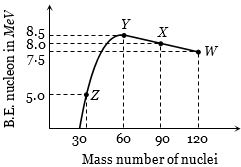
The binding energy per nucleon versus mass number curve for nuclei is shown in the figure. $W, X, Y$ and $Z$ are four nuclei indicated on the curve. The process that would release energy is
A
$Y \to 2Z$
B
$W \to X + Z$
C
$W \to 2Y$
D
$X \to Y + Z$
Solution
(C) Energy is released in a nuclear process when the total binding energy $(B.E.)$ of the products is greater than the total binding energy of the reactants.
From the graph, we can identify the mass number $(A)$ and binding energy per nucleon $(B.E./A)$ for each nucleus:
For $W$: $A = 120, B.E./A = 7.5 \, MeV \implies \text{Total } B.E. = 120 \times 7.5 = 900 \, MeV$
For $X$: $A = 90, B.E./A = 8.0 \, MeV \implies \text{Total } B.E. = 90 \times 8.0 = 720 \, MeV$
For $Y$: $A = 60, B.E./A = 8.5 \, MeV \implies \text{Total } B.E. = 60 \times 8.5 = 510 \, MeV$
For $Z$: $A = 30, B.E./A = 5.0 \, MeV \implies \text{Total } B.E. = 30 \times 5.0 = 150 \, MeV$
Now, checking option $(c)$: $W \to 2Y$
Total $B.E.$ of reactants $= 900 \, MeV$
Total $B.E.$ of products $= 2 \times (510) = 1020 \, MeV$
Since the total $B.E.$ of products $(1020 \, MeV)$ is greater than the total $B.E.$ of reactants $(900 \, MeV)$, energy is released in this process.
From the graph, we can identify the mass number $(A)$ and binding energy per nucleon $(B.E./A)$ for each nucleus:
For $W$: $A = 120, B.E./A = 7.5 \, MeV \implies \text{Total } B.E. = 120 \times 7.5 = 900 \, MeV$
For $X$: $A = 90, B.E./A = 8.0 \, MeV \implies \text{Total } B.E. = 90 \times 8.0 = 720 \, MeV$
For $Y$: $A = 60, B.E./A = 8.5 \, MeV \implies \text{Total } B.E. = 60 \times 8.5 = 510 \, MeV$
For $Z$: $A = 30, B.E./A = 5.0 \, MeV \implies \text{Total } B.E. = 30 \times 5.0 = 150 \, MeV$
Now, checking option $(c)$: $W \to 2Y$
Total $B.E.$ of reactants $= 900 \, MeV$
Total $B.E.$ of products $= 2 \times (510) = 1020 \, MeV$
Since the total $B.E.$ of products $(1020 \, MeV)$ is greater than the total $B.E.$ of reactants $(900 \, MeV)$, energy is released in this process.
0 likesView Solution
30
PhysicsMediumMCQIIT JEE · 1999
When a potential difference is applied across,the current passing through:
A
An insulator at $0 \ K$ is zero.
B
$A$ semiconductor at $0 \ K$ is zero.
C
$A$ $P-N$ diode at $300 \ K$ is finite,if it is reverse biased.
D
All of the above.
Solution
(D) The correct answer is $D$.
$1$. At $0 \ K$,an insulator has no free charge carriers,so the current is zero.
$2$. At $0 \ K$,a semiconductor behaves as a perfect insulator because all valence electrons are bound,so the current is zero.
$3$. In a $P-N$ junction diode at $300 \ K$,when reverse biased,a small finite current (reverse saturation current) flows due to the presence of minority charge carriers.
Since all these statements are correct,the answer is $D$.
$1$. At $0 \ K$,an insulator has no free charge carriers,so the current is zero.
$2$. At $0 \ K$,a semiconductor behaves as a perfect insulator because all valence electrons are bound,so the current is zero.
$3$. In a $P-N$ junction diode at $300 \ K$,when reverse biased,a small finite current (reverse saturation current) flows due to the presence of minority charge carriers.
Since all these statements are correct,the answer is $D$.
0 likesView Solution
31
PhysicsMediumMCQIIT JEE · 1999
$A$ concave lens of glass,refractive index $1.5$,has both surfaces of same radius of curvature $R$. On immersion in a medium of refractive index $1.75$,it will behave as a
A
Convergent lens of focal length $3.5 R$
B
Convergent lens of focal length $3.0 R$
C
Divergent lens of focal length $3.5 R$
D
Divergent lens of focal length $3.0 R$
Solution
(A) The lens maker's formula is given by $\frac{1}{f} = (\mu_{rel} - 1) \left( \frac{1}{R_1} - \frac{1}{R_2} \right)$.
For a concave lens in air,$R_1 = -R$ and $R_2 = +R$,so $\frac{1}{f_a} = (1.5 - 1) \left( \frac{1}{-R} - \frac{1}{R} \right) = 0.5 \left( -\frac{2}{R} \right) = -\frac{1}{R}$,which means $f_a = -R$.
When immersed in a medium of refractive index $\mu_m = 1.75$,the relative refractive index is $\mu_{rel} = \frac{\mu_g}{\mu_m} = \frac{1.5}{1.75} = \frac{6}{7}$.
The new focal length $f_l$ is given by $\frac{1}{f_l} = \left( \frac{6}{7} - 1 \right) \left( -\frac{2}{R} \right) = \left( -\frac{1}{7} \right) \left( -\frac{2}{R} \right) = \frac{2}{7R}$.
Thus,$f_l = +3.5 R$.
Since the focal length is positive,the lens behaves as a convergent (convex) lens.
For a concave lens in air,$R_1 = -R$ and $R_2 = +R$,so $\frac{1}{f_a} = (1.5 - 1) \left( \frac{1}{-R} - \frac{1}{R} \right) = 0.5 \left( -\frac{2}{R} \right) = -\frac{1}{R}$,which means $f_a = -R$.
When immersed in a medium of refractive index $\mu_m = 1.75$,the relative refractive index is $\mu_{rel} = \frac{\mu_g}{\mu_m} = \frac{1.5}{1.75} = \frac{6}{7}$.
The new focal length $f_l$ is given by $\frac{1}{f_l} = \left( \frac{6}{7} - 1 \right) \left( -\frac{2}{R} \right) = \left( -\frac{1}{7} \right) \left( -\frac{2}{R} \right) = \frac{2}{7R}$.
Thus,$f_l = +3.5 R$.
Since the focal length is positive,the lens behaves as a convergent (convex) lens.
0 likesView Solution
32
PhysicsEasyMCQIIT JEE · 1999
Yellow light is used in a single slit diffraction experiment with a slit width of $0.6 \, mm$. If the yellow light is replaced by $X$-rays,then the pattern will reveal:
A
That the central maxima is narrower
B
No diffraction pattern
C
More number of fringes
D
Less number of fringes
Solution
(B) Diffraction occurs when the slit width is comparable to the wavelength of the incident electromagnetic waves.
The wavelength of yellow light is approximately $589 \, nm$ $(5.89 \times 10^{-7} \, m)$,which is of the order of the slit width $(0.6 \, mm = 6 \times 10^{-4} \, m)$.
The wavelength of $X$-rays is typically in the range of $0.01 \, nm$ to $10 \, nm$ ($10^{-11} \, m$ to $10^{-8} \, m$).
Since the wavelength of $X$-rays is extremely small compared to the slit width $(0.6 \, mm)$,the condition for diffraction is not satisfied.
Therefore,no diffraction pattern will be observed.
The wavelength of yellow light is approximately $589 \, nm$ $(5.89 \times 10^{-7} \, m)$,which is of the order of the slit width $(0.6 \, mm = 6 \times 10^{-4} \, m)$.
The wavelength of $X$-rays is typically in the range of $0.01 \, nm$ to $10 \, nm$ ($10^{-11} \, m$ to $10^{-8} \, m$).
Since the wavelength of $X$-rays is extremely small compared to the slit width $(0.6 \, mm)$,the condition for diffraction is not satisfied.
Therefore,no diffraction pattern will be observed.
0 likesView Solution
33
PhysicsEasyMCQIIT JEE · 1999
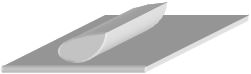
$A$ thin slice is cut out of a glass cylinder along a plane parallel to its axis. The slice is placed on a flat glass plate as shown. The observed interference fringes from this combination shall be
A
Straight
B
Circular
C
Equally spaced
D
Having fringe spacing which increases as we go outwards
Solution
(A) The cylindrical surface touches the glass plate along a line parallel to the axis of the cylinder.
The thickness of the air wedge formed between the cylindrical surface and the flat glass plate increases symmetrically on both sides of this line of contact.
The locus of points with equal path difference corresponds to lines running parallel to the axis of the cylinder.
Since the path difference is constant along these lines,the interference fringes observed will be straight and parallel to the axis of the cylinder.
The thickness of the air wedge formed between the cylindrical surface and the flat glass plate increases symmetrically on both sides of this line of contact.
The locus of points with equal path difference corresponds to lines running parallel to the axis of the cylinder.
Since the path difference is constant along these lines,the interference fringes observed will be straight and parallel to the axis of the cylinder.
0 likesView Solution
34
PhysicsMediumMCQIIT JEE · 1999
In the hydrogen spectrum,the wavelength of the ${H_\alpha}$ line is $656 \ nm$,whereas in the spectrum of a distant galaxy,the ${H_\alpha}$ line wavelength is $706 \ nm$. The estimated speed of the galaxy with respect to the Earth is:
A
$2 \times 10^8 \ m/s$
B
$2 \times 10^7 \ m/s$
C
$2 \times 10^6 \ m/s$
D
$2 \times 10^5 \ m/s$
Solution
(B) The Doppler shift for light is given by the formula $\frac{\Delta \lambda}{\lambda} = \frac{v}{c}$,where $v$ is the relative speed of the source and $c$ is the speed of light.
Given: $\lambda = 656 \ nm$,$\Delta \lambda = 706 \ nm - 656 \ nm = 50 \ nm$,and $c = 3 \times 10^8 \ m/s$.
Substituting the values into the formula $v = \frac{c \Delta \lambda}{\lambda}$:
$v = \frac{3 \times 10^8 \times 50}{656}$
$v = \frac{1500}{656} \times 10^7 \ m/s$
$v \approx 2.28 \times 10^7 \ m/s$.
Rounding to the nearest provided option,we get $v = 2 \times 10^7 \ m/s$.
Given: $\lambda = 656 \ nm$,$\Delta \lambda = 706 \ nm - 656 \ nm = 50 \ nm$,and $c = 3 \times 10^8 \ m/s$.
Substituting the values into the formula $v = \frac{c \Delta \lambda}{\lambda}$:
$v = \frac{3 \times 10^8 \times 50}{656}$
$v = \frac{1500}{656} \times 10^7 \ m/s$
$v \approx 2.28 \times 10^7 \ m/s$.
Rounding to the nearest provided option,we get $v = 2 \times 10^7 \ m/s$.
0 likesView Solution
Vedclass Products
For Students
Vedclass Test Series
Mock tests in real IIT JEE style covering Physics with performance analysis. 5-day free trial.
Start Free TrialFor Teachers
Exam Paper Generator
Generate Set A/B/C/D Physics papers from 7.5L+ questions in 2 minutes. 3 chapters free.
Try FreeFor Institutes
Online Exam Module
Run live IIT JEE mock exams with unlimited students, 360° analytics & white-label branding.
See DemoFrequently Asked Questions
How many Physics questions are in IIT JEE 1999?
There are 34 Physics questions from the IIT JEE 1999 paper on Vedclass, each with a detailed step-by-step solution in English.
Are IIT JEE 1999 Physics solutions available in English?
Yes. All solutions on this page are in English. You can also switch to English or Hindi using the language buttons above the questions.
Can I practice IIT JEE 1999 Physics as a timed test?
Yes. Use the Vedclass Test Series to attempt a full IIT JEE mock test covering Physics with time limits and instant score analysis.
Can teachers create Physics papers from IIT JEE previous year questions?
Yes. The Vedclass Exam Paper Generator lets teachers mix IIT JEE Physics questions and generate Set A/B/C/D papers in minutes.
For Teachers & Institutes
Build a Custom Physics Paper
Pick IIT JEE 1999 Physics questions, set difficulty, and generate Set A/B/C/D in 2 minutes.