
ChemistryQ1–60 of 60 questions
Page 1 of 1 · English
1
ChemistryMCQIIT JEE · 1999
$A$ closed compartment containing gas is moving with some acceleration in the horizontal direction. Neglect the effect of gravity. Then the pressure in the compartment is
A
Same everywhere
B
Lower in the front side
C
Lower in the rear side
D
Lower in the upper side
Solution
(B) Consider a gas-filled compartment moving with acceleration $a$ in the horizontal direction.
In the non-inertial frame of reference of the compartment,a fictitious force acts on the gas molecules in the direction opposite to the acceleration (i.e.,towards the rear side).
This causes the gas molecules to crowd towards the rear side of the compartment.
As a result,the density and consequently the pressure of the gas increase at the rear side.
Conversely,the density and pressure decrease at the front side of the compartment.
Therefore,the pressure is lower in the front side.
In the non-inertial frame of reference of the compartment,a fictitious force acts on the gas molecules in the direction opposite to the acceleration (i.e.,towards the rear side).
This causes the gas molecules to crowd towards the rear side of the compartment.
As a result,the density and consequently the pressure of the gas increase at the rear side.
Conversely,the density and pressure decrease at the front side of the compartment.
Therefore,the pressure is lower in the front side.
0 likesView Solution
2
ChemistryMCQIIT JEE · 1999
$A$ gas mixture consists of $2$ moles of oxygen and $4$ moles of argon at temperature $T$. Neglecting all vibrational modes,the total internal energy of the system is: (in $RT$)
A
$4$
B
$15$
C
$9$
D
$11$
Solution
(D) Oxygen is a diatomic gas,so its internal energy for $n_1 = 2$ moles is given by $U_1 = n_1 \times \frac{f_1}{2} RT$,where $f_1 = 5$ (degrees of freedom for diatomic gas).
$U_1 = 2 \times \frac{5}{2} RT = 5 RT$.
Argon is a monoatomic gas,so its internal energy for $n_2 = 4$ moles is given by $U_2 = n_2 \times \frac{f_2}{2} RT$,where $f_2 = 3$ (degrees of freedom for monoatomic gas).
$U_2 = 4 \times \frac{3}{2} RT = 6 RT$.
The total internal energy of the system is $U_{total} = U_1 + U_2 = 5 RT + 6 RT = 11 RT$.
$U_1 = 2 \times \frac{5}{2} RT = 5 RT$.
Argon is a monoatomic gas,so its internal energy for $n_2 = 4$ moles is given by $U_2 = n_2 \times \frac{f_2}{2} RT$,where $f_2 = 3$ (degrees of freedom for monoatomic gas).
$U_2 = 4 \times \frac{3}{2} RT = 6 RT$.
The total internal energy of the system is $U_{total} = U_1 + U_2 = 5 RT + 6 RT = 11 RT$.
0 likesView Solution
3
ChemistryMediumMCQIIT JEE · 1999
One mole of calcium phosphide on reaction with excess of water gives
A
One mole of phosphine
B
Two moles of phosphoric acid
C
Two moles of phosphine
D
One mole of phosphorus pentoxide
Solution
(C) The chemical reaction between calcium phosphide $(Ca_3P_2)$ and water is as follows:
$Ca_3P_2 + 6H_2O \to 2PH_3 + 3Ca(OH)_2$
According to the stoichiometry of the balanced chemical equation,$1 \text{ mole}$ of $Ca_3P_2$ reacts with $6 \text{ moles}$ of $H_2O$ to produce $2 \text{ moles}$ of phosphine $(PH_3)$ and $3 \text{ moles}$ of calcium hydroxide $(Ca(OH)_2)$.
Therefore,the correct option is $C$.
$Ca_3P_2 + 6H_2O \to 2PH_3 + 3Ca(OH)_2$
According to the stoichiometry of the balanced chemical equation,$1 \text{ mole}$ of $Ca_3P_2$ reacts with $6 \text{ moles}$ of $H_2O$ to produce $2 \text{ moles}$ of phosphine $(PH_3)$ and $3 \text{ moles}$ of calcium hydroxide $(Ca(OH)_2)$.
Therefore,the correct option is $C$.
0 likesView Solution
4
ChemistryEasyMCQIIT JEE · 1999
In the compound $CH_2 = CH - CH_2 - CH_2 - C \equiv CH$,the $C_2 - C_3$ bond is of the type
A
$sp - sp^2$
B
$sp^3 - sp^3$
C
$sp - sp^3$
D
$sp^2 - sp^3$
Solution
(D) To determine the hybridization of the carbon atoms,we number the chain: $C_1H_2 = C_2H - C_3H_2 - C_4H_2 - C_5 \equiv C_6H$.
$C_1$ is $sp^2$ hybridized.
$C_2$ is $sp^2$ hybridized.
$C_3$ is $sp^3$ hybridized.
$C_4$ is $sp^3$ hybridized.
$C_5$ is $sp$ hybridized.
$C_6$ is $sp$ hybridized.
The bond between $C_2$ and $C_3$ involves an $sp^2$ hybridized carbon and an $sp^3$ hybridized carbon.
Therefore,the bond type is $sp^2 - sp^3$.
$C_1$ is $sp^2$ hybridized.
$C_2$ is $sp^2$ hybridized.
$C_3$ is $sp^3$ hybridized.
$C_4$ is $sp^3$ hybridized.
$C_5$ is $sp$ hybridized.
$C_6$ is $sp$ hybridized.
The bond between $C_2$ and $C_3$ involves an $sp^2$ hybridized carbon and an $sp^3$ hybridized carbon.
Therefore,the bond type is $sp^2 - sp^3$.
0 likesView Solution
5
ChemistryMediumMCQIIT JEE · 1999
The correct order of increasing $C - O$ bond length of $CO, CO_3^{2-}, CO_2$ is
A
$CO_3^{2-} < CO_2 < CO$
B
$CO_2 < CO_3^{2-} < CO$
C
$CO < CO_3^{2-} < CO_2$
D
$CO < CO_2 < CO_3^{2-}$
Solution
(D) The bond order $(B.O.)$ is inversely proportional to the bond length.
For $CO$,the bond order is $3$.
For $CO_2$ $(O=C=O)$,the bond order is $2$.
For $CO_3^{2-}$,the resonance hybrid results in a bond order of $1.33$.
Since bond length increases as bond order decreases,the order of increasing bond length is $CO < CO_2 < CO_3^{2-}$.
Therefore,option $(D)$ is correct.
For $CO$,the bond order is $3$.
For $CO_2$ $(O=C=O)$,the bond order is $2$.
For $CO_3^{2-}$,the resonance hybrid results in a bond order of $1.33$.
Since bond length increases as bond order decreases,the order of increasing bond length is $CO < CO_2 < CO_3^{2-}$.
Therefore,option $(D)$ is correct.
0 likesView Solution
6
ChemistryMediumMCQIIT JEE · 1999
$A$ gas is said to behave like an ideal gas when the relation $PV/T = \text{constant}$. When do you expect a real gas to behave like an ideal gas?
A
When the temperature is low
B
When both the temperature and pressure are low
C
When both the temperature and pressure are high
D
When the temperature is high and pressure is low
Solution
(D) The ideal gas equation is $PV = nRT$.
Real gases approach ideal behavior under conditions of high temperature and low pressure,where the intermolecular forces are negligible and the volume of the gas particles is insignificant compared to the total volume of the container.
Real gases approach ideal behavior under conditions of high temperature and low pressure,where the intermolecular forces are negligible and the volume of the gas particles is insignificant compared to the total volume of the container.
0 likesView Solution
7
ChemistryEasyMCQIIT JEE · 1999
For the chemical reaction $3X_{(g)} + Y_{(g)} \rightleftharpoons X_3Y_{(g)}$,the amount of $X_3Y$ at equilibrium is affected by
A
Temperature and pressure
B
Temperature only
C
Pressure only
D
Temperature,pressure and catalyst
Solution
(A) The reaction is $3X_{(g)} + Y_{(g)} \rightleftharpoons X_3Y_{(g)}$.
Since the number of moles of gaseous reactants $(4 \ mol)$ is different from the number of moles of gaseous products $(1 \ mol)$,the equilibrium position is affected by pressure.
Since chemical reactions involve enthalpy changes,the equilibrium constant and the position of equilibrium are affected by temperature.
$A$ catalyst only increases the rate of the forward and backward reactions equally and does not affect the equilibrium position or the amount of product at equilibrium.
Therefore,the amount of $X_3Y$ at equilibrium is affected by temperature and pressure.
Since the number of moles of gaseous reactants $(4 \ mol)$ is different from the number of moles of gaseous products $(1 \ mol)$,the equilibrium position is affected by pressure.
Since chemical reactions involve enthalpy changes,the equilibrium constant and the position of equilibrium are affected by temperature.
$A$ catalyst only increases the rate of the forward and backward reactions equally and does not affect the equilibrium position or the amount of product at equilibrium.
Therefore,the amount of $X_3Y$ at equilibrium is affected by temperature and pressure.
0 likesView Solution
8
ChemistryMediumMCQIIT JEE · 1999
$A$ buffer solution can be prepared from a mixture of
A
Sodium acetate and acetic acid in water
B
Sodium acetate and hydrochloric acid in water
C
Ammonia and ammonium chloride in water
D
$A$ and $C$ both
Solution
(D) The correct answer is $D$.
$A$ buffer solution is prepared by mixing a weak acid with its conjugate base (salt of a strong base) or a weak base with its conjugate acid (salt of a strong acid).
$1$. Sodium acetate $(CH_3COONa)$ and acetic acid $(CH_3COOH)$ form an acidic buffer because acetic acid is a weak acid and sodium acetate is its salt with a strong base $(NaOH)$.
$2$. Ammonia $(NH_3)$ and ammonium chloride $(NH_4Cl)$ form a basic buffer because ammonia is a weak base and ammonium chloride is its salt with a strong acid $(HCl)$.
$3$. Sodium acetate and hydrochloric acid $(HCl)$ react to form acetic acid and sodium chloride,which does not constitute a buffer system in the required proportions.
Therefore,both $A$ and $C$ are correct.
$A$ buffer solution is prepared by mixing a weak acid with its conjugate base (salt of a strong base) or a weak base with its conjugate acid (salt of a strong acid).
$1$. Sodium acetate $(CH_3COONa)$ and acetic acid $(CH_3COOH)$ form an acidic buffer because acetic acid is a weak acid and sodium acetate is its salt with a strong base $(NaOH)$.
$2$. Ammonia $(NH_3)$ and ammonium chloride $(NH_4Cl)$ form a basic buffer because ammonia is a weak base and ammonium chloride is its salt with a strong acid $(HCl)$.
$3$. Sodium acetate and hydrochloric acid $(HCl)$ react to form acetic acid and sodium chloride,which does not constitute a buffer system in the required proportions.
Therefore,both $A$ and $C$ are correct.
0 likesView Solution
9
ChemistryDifficultMCQIIT JEE · 1999
The $pH$ of $0.1 \ M$ solution of the following salts increases in the order:
A
$HCl < NH_4Cl < NaCl < NaCN$
B
$HCl < NaCl < NaCN < NH_4Cl$
C
$NaCN < NH_4Cl < NaCl < HCl$
D
$HCl < NH_4Cl < NaCl < NaCN$
Solution
(A) $HCl$ is a strong acid,so its $pH$ is the lowest $(pH \approx 1)$.
$NH_4Cl$ is a salt of a strong acid $(HCl)$ and a weak base $(NH_4OH)$,so it undergoes cationic hydrolysis,resulting in an acidic solution $(pH < 7)$.
$NaCl$ is a salt of a strong acid $(HCl)$ and a strong base $(NaOH)$,so it is neutral $(pH = 7)$.
$NaCN$ is a salt of a weak acid $(HCN)$ and a strong base $(NaOH)$,so it undergoes anionic hydrolysis,resulting in a basic solution $(pH > 7)$.
Therefore,the order of increasing $pH$ is: $HCl < NH_4Cl < NaCl < NaCN$.
$NH_4Cl$ is a salt of a strong acid $(HCl)$ and a weak base $(NH_4OH)$,so it undergoes cationic hydrolysis,resulting in an acidic solution $(pH < 7)$.
$NaCl$ is a salt of a strong acid $(HCl)$ and a strong base $(NaOH)$,so it is neutral $(pH = 7)$.
$NaCN$ is a salt of a weak acid $(HCN)$ and a strong base $(NaOH)$,so it undergoes anionic hydrolysis,resulting in a basic solution $(pH > 7)$.
Therefore,the order of increasing $pH$ is: $HCl < NH_4Cl < NaCl < NaCN$.
0 likesView Solution
10
ChemistryMediumMCQIIT JEE · 1999
Which of the following is (are) an endothermic reaction?
A
Conversion of graphite to diamond
B
Decomposition of water
C
Dehydrogenation of ethane to ethylene
D
Both $(a), (b)$ and $(c)$
Solution
(D) The correct option is $(D)$. All the given reactions are endothermic because they proceed by the absorption of heat from the surroundings.
$1$. Conversion of graphite to diamond: $C_{\text{graphite}} \rightarrow C_{\text{diamond}}$ $(\Delta H > 0)$
$2$. Decomposition of water: $2H_2O_{(l)} \rightarrow 2H_{2(g)} + O_{2(g)}$ $(\Delta H > 0)$
$3$. Dehydrogenation of ethane: $C_2H_{6(g)} \rightarrow C_2H_{4(g)} + H_{2(g)}$ $(\Delta H > 0)$
Since all these processes require energy input,they are endothermic.
$1$. Conversion of graphite to diamond: $C_{\text{graphite}} \rightarrow C_{\text{diamond}}$ $(\Delta H > 0)$
$2$. Decomposition of water: $2H_2O_{(l)} \rightarrow 2H_{2(g)} + O_{2(g)}$ $(\Delta H > 0)$
$3$. Dehydrogenation of ethane: $C_2H_{6(g)} \rightarrow C_2H_{4(g)} + H_{2(g)}$ $(\Delta H > 0)$
Since all these processes require energy input,they are endothermic.
1 likesView Solution
11
ChemistryMediumMCQIIT JEE · 1999
The oxidation numbers of sulphur in $S_8$,$S_2F_2$,and $H_2S$ respectively,are:
A
$0, +1, -2$
B
$+2, +1, -2$
C
$0, +1, +2$
D
$-2, +1, -2$
Solution
(A) $1$. For $S_8$: Since it is an elemental form of sulphur,the oxidation number is $0$.
$2$. For $S_2F_2$: Let the oxidation number of $S$ be $x$. Since the oxidation number of $F$ is $-1$,we have $2x + 2(-1) = 0$,which gives $2x = 2$,so $x = +1$.
$3$. For $H_2S$: Let the oxidation number of $S$ be $x$. Since the oxidation number of $H$ is $+1$,we have $2(+1) + x = 0$,which gives $x = -2$.
Therefore,the oxidation numbers are $0, +1, -2$.
$2$. For $S_2F_2$: Let the oxidation number of $S$ be $x$. Since the oxidation number of $F$ is $-1$,we have $2x + 2(-1) = 0$,which gives $2x = 2$,so $x = +1$.
$3$. For $H_2S$: Let the oxidation number of $S$ be $x$. Since the oxidation number of $H$ is $+1$,we have $2(+1) + x = 0$,which gives $x = -2$.
Therefore,the oxidation numbers are $0, +1, -2$.
0 likesView Solution
12
ChemistryMediumMCQIIT JEE · 1999
Which of the following represents the correct order of ionic radii?
A
$Ti^{4+} < Mn^{7+}$
B
$^{35}Cl^{-} < ^{37}Cl^{-}$
C
$K^{+} > Cl^{-}$
D
$P^{3+} > P^{5+}$
Solution
(D) The ionic radius depends on the effective nuclear charge and the number of shells.
$(A)$ $Ti^{4+}$ $(Z=22)$ and $Mn^{7+}$ $(Z=25)$ are isoelectronic ($18$ electrons). As nuclear charge increases,size decreases,so $Ti^{4+} > Mn^{7+}$.
$(B)$ $^{35}Cl^{-}$ and $^{37}Cl^{-}$ are isotopes. Isotopes have the same number of electrons and protons,so their ionic radii are equal.
$(C)$ $K^{+}$ and $Cl^{-}$ are isoelectronic ($18$ electrons). $K^{+}$ has a higher nuclear charge $(Z=19)$ than $Cl^{-}$ $(Z=17)$,so $K^{+} < Cl^{-}$.
$(D)$ $P^{3+}$ and $P^{5+}$ are ions of the same element. $P^{5+}$ has lost more electrons than $P^{3+}$,resulting in a higher effective nuclear charge per electron,making $P^{3+} > P^{5+}$.
Thus,the correct statement is $(D)$.
$(A)$ $Ti^{4+}$ $(Z=22)$ and $Mn^{7+}$ $(Z=25)$ are isoelectronic ($18$ electrons). As nuclear charge increases,size decreases,so $Ti^{4+} > Mn^{7+}$.
$(B)$ $^{35}Cl^{-}$ and $^{37}Cl^{-}$ are isotopes. Isotopes have the same number of electrons and protons,so their ionic radii are equal.
$(C)$ $K^{+}$ and $Cl^{-}$ are isoelectronic ($18$ electrons). $K^{+}$ has a higher nuclear charge $(Z=19)$ than $Cl^{-}$ $(Z=17)$,so $K^{+} < Cl^{-}$.
$(D)$ $P^{3+}$ and $P^{5+}$ are ions of the same element. $P^{5+}$ has lost more electrons than $P^{3+}$,resulting in a higher effective nuclear charge per electron,making $P^{3+} > P^{5+}$.
Thus,the correct statement is $(D)$.
0 likesView Solution
13
ChemistryMediumMCQIIT JEE · 1999
One mole of calcium phosphide on reaction with excess water gives
A
One mole of phosphene
B
Two moles of phosphoric acid
C
Two moles of phosphene
D
One mole of phosphorus pentaoxide
Solution
(C) $Ca_3P_2 + 6H_2O \rightarrow 2PH_3 + 3Ca(OH)_2$
According to the balanced chemical equation,$1 \text{ mole}$ of calcium phosphide $(Ca_3P_2)$ reacts with excess water to produce $2 \text{ moles}$ of phosphine $(PH_3)$ and $3 \text{ moles}$ of calcium hydroxide $(Ca(OH)_2)$.
According to the balanced chemical equation,$1 \text{ mole}$ of calcium phosphide $(Ca_3P_2)$ reacts with excess water to produce $2 \text{ moles}$ of phosphine $(PH_3)$ and $3 \text{ moles}$ of calcium hydroxide $(Ca(OH)_2)$.
0 likesView Solution
14
ChemistryMCQIIT JEE · 1999
One mole of calcium phosphide on reaction with excess water gives
A
One mole of phosphine
B
Two moles of phosphoric acid
C
Two moles of phosphine
D
One mole of phosphorous pentoxide
Solution
(C) The chemical reaction between calcium phosphide $(Ca_3P_2)$ and water is given by the equation:
$Ca_3P_2 + 6H_2O \to 3Ca(OH)_2 + 2PH_3$
From the stoichiometry of the balanced equation,$1 \text{ mole}$ of $Ca_3P_2$ reacts with $6 \text{ moles}$ of $H_2O$ to produce $2 \text{ moles}$ of phosphine $(PH_3)$ and $3 \text{ moles}$ of calcium hydroxide $(Ca(OH)_2)$.
$Ca_3P_2 + 6H_2O \to 3Ca(OH)_2 + 2PH_3$
From the stoichiometry of the balanced equation,$1 \text{ mole}$ of $Ca_3P_2$ reacts with $6 \text{ moles}$ of $H_2O$ to produce $2 \text{ moles}$ of phosphine $(PH_3)$ and $3 \text{ moles}$ of calcium hydroxide $(Ca(OH)_2)$.
0 likesView Solution
15
ChemistryMediumMCQIIT JEE · 1999
In compounds of type $ECl_3$,where $E = B, P, As$ or $Bi$,the angles $\angle Cl-E-Cl$ for different $E$ are in the order
A
$B > P = As = Bi$
B
$B > P > As > Bi$
C
$B < P = As = Bi$
D
$B < P < As < Bi$
Solution
(B) The correct order is $BCl_3 > PCl_3 > AsCl_3 > BiCl_3$.
$BCl_3$ has a trigonal planar geometry with a bond angle of $120^{\circ}$ due to $sp^2$ hybridization.
In the case of $PCl_3$,$AsCl_3$,and $BiCl_3$,the central atom is $sp^3$ hybridized with one lone pair,resulting in a pyramidal geometry.
As we move down the group from $P$ to $Bi$,the electronegativity of the central atom decreases,causing the bond pairs to move further away from the central atom.
Consequently,the bond angle decreases as we move down the group.
$BCl_3$ has a trigonal planar geometry with a bond angle of $120^{\circ}$ due to $sp^2$ hybridization.
In the case of $PCl_3$,$AsCl_3$,and $BiCl_3$,the central atom is $sp^3$ hybridized with one lone pair,resulting in a pyramidal geometry.
As we move down the group from $P$ to $Bi$,the electronegativity of the central atom decreases,causing the bond pairs to move further away from the central atom.
Consequently,the bond angle decreases as we move down the group.
0 likesView Solution
16
ChemistryAdvancedMCQIIT JEE · 1999
The optically active tartaric acid is named as $D-(+)-$ tartaric acid because it has a positive
A
Optical rotation and is derived from $D-$ glucose
B
$pH$ in organic solvent
C
Optical rotation and is derived from $D-(+)$ glyceraldehyde
D
Optical rotation only when substituted by deuterium
Solution
(C) $D-(+)-$ tartaric acid is named based on its configuration relative to $D-(+)$ glyceraldehyde and its positive optical rotation.
0 likesView Solution
17
ChemistryMediumMCQIIT JEE · 1999
The product$(s)$ obtained via oxymercuration $(HgSO_4 + H_2SO_4)$ of $1$-butyne would be:
A
$CH_3-CH_2-C(=O)-CH_3$
B
$CH_3-CH_2-CH_2-CHO$
C
$CH_3-CH_2-CHO + HCHO$
D
$CH_3-CH_2-COOH + HCOOH$
Solution
(A) The hydration of $1$-butyne $(CH_3-CH_2-C \equiv CH)$ in the presence of $HgSO_4$ and $H_2SO_4$ follows Markovnikov's rule.
Water adds across the triple bond to form an unstable enol intermediate $(CH_3-CH_2-C(OH)=CH_2)$.
This enol then tautomerizes to form the more stable ketone,$2$-butanone $(CH_3-CH_2-C(=O)-CH_3)$.
Water adds across the triple bond to form an unstable enol intermediate $(CH_3-CH_2-C(OH)=CH_2)$.
This enol then tautomerizes to form the more stable ketone,$2$-butanone $(CH_3-CH_2-C(=O)-CH_3)$.
0 likesView Solution
18
ChemistryEasyMCQIIT JEE · 1999
The normality of $0.3 \ M$ phosphorous acid $(H_3PO_3)$ is
A
$0.1$
B
$0.9$
C
$0.3$
D
$0.6$
Solution
(D) The formula for normality is $\text{Normality} = \text{Molarity} \times \text{n-factor}$.
For phosphorous acid $(H_3PO_3)$,the structure contains two $P-OH$ bonds,making it a dibasic acid.
Therefore,the n-factor (basicity) of $H_3PO_3$ is $2$.
$\text{Normality} = 0.3 \ M \times 2 = 0.6 \ N$.
For phosphorous acid $(H_3PO_3)$,the structure contains two $P-OH$ bonds,making it a dibasic acid.
Therefore,the n-factor (basicity) of $H_3PO_3$ is $2$.
$\text{Normality} = 0.3 \ M \times 2 = 0.6 \ N$.
0 likesView Solution
19
ChemistryMediumMCQIIT JEE · 1999
The product$(s)$ obtained via oxymercuration $(HgSO_4 + H_2SO_4)$ of $but-1-yne$ would be
A
$CH_3CH_2COCH_3$
B
$CH_3CH_2CH_2CHO$
C
$CH_3CH_2CHO + HCHO$
D
$CH_3CH_2COOH + HCOOH$
Solution
(A) The hydration of terminal alkynes like $but-1-yne$ in the presence of $HgSO_4$ and $H_2SO_4$ follows Markovnikov's rule.
Step $1$: The alkyne reacts with water to form an unstable enol intermediate: $CH_3-CH_2-C \equiv CH + H_2O \xrightarrow{HgSO_4/H_2SO_4} [CH_3-CH_2-C(OH)=CH_2]$.
Step $2$: The enol undergoes tautomerization to form a stable ketone: $[CH_3-CH_2-C(OH)=CH_2] ightarrow CH_3-CH_2-COCH_3$ $(Butan-2-one)$.
Therefore,the correct product is $Butan-2-one$.
Step $1$: The alkyne reacts with water to form an unstable enol intermediate: $CH_3-CH_2-C \equiv CH + H_2O \xrightarrow{HgSO_4/H_2SO_4} [CH_3-CH_2-C(OH)=CH_2]$.
Step $2$: The enol undergoes tautomerization to form a stable ketone: $[CH_3-CH_2-C(OH)=CH_2] ightarrow CH_3-CH_2-COCH_3$ $(Butan-2-one)$.
Therefore,the correct product is $Butan-2-one$.
0 likesView Solution
20
ChemistryMCQIIT JEE · 1999
$\mathop {\lim }\limits_{x \to 0} \frac{{x\tan 2x - 2x\tan x}}{{{{(1 - \cos 2x)}^2}}}$ is
A
$2$
B
$-2$
C
$\frac{1}{2}$
D
$-\frac{1}{2}$
Solution
(C) Let $L = \mathop {\lim }\limits_{x \to 0} \frac{{x\tan 2x - 2x\tan x}}{{{{(1 - \cos 2x)}^2}}}$
Using the identity $1 - \cos 2x = 2\sin^2 x$,we get:
$L = \mathop {\lim }\limits_{x \to 0} \frac{{x(\tan 2x - 2\tan x)}}{{{{(2\sin^2 x)}^2}}} = \mathop {\lim }\limits_{x \to 0} \frac{{x(\tan 2x - 2\tan x)}}{{4\sin^4 x}}$
Using the Taylor series expansion $\tan \theta = \theta + \frac{\theta^3}{3} + \dots$ and $\sin x \approx x$ as $x \to 0$:
$L = \mathop {\lim }\limits_{x \to 0} \frac{{x \left[ (2x + \frac{(2x)^3}{3} + \dots) - 2(x + \frac{x^3}{3} + \dots) \right]}}{{4x^4}}$
$L = \mathop {\lim }\limits_{x \to 0} \frac{{x \left[ 2x + \frac{8x^3}{3} - 2x - \frac{2x^3}{3} \right]}}{{4x^4}}$
$L = \mathop {\lim }\limits_{x \to 0} \frac{{x \cdot (2x^3)}}{{4x^4}} = \mathop {\lim }\limits_{x \to 0} \frac{{2x^4}}{{4x^4}} = \frac{2}{4} = \frac{1}{2}$.
Using the identity $1 - \cos 2x = 2\sin^2 x$,we get:
$L = \mathop {\lim }\limits_{x \to 0} \frac{{x(\tan 2x - 2\tan x)}}{{{{(2\sin^2 x)}^2}}} = \mathop {\lim }\limits_{x \to 0} \frac{{x(\tan 2x - 2\tan x)}}{{4\sin^4 x}}$
Using the Taylor series expansion $\tan \theta = \theta + \frac{\theta^3}{3} + \dots$ and $\sin x \approx x$ as $x \to 0$:
$L = \mathop {\lim }\limits_{x \to 0} \frac{{x \left[ (2x + \frac{(2x)^3}{3} + \dots) - 2(x + \frac{x^3}{3} + \dots) \right]}}{{4x^4}}$
$L = \mathop {\lim }\limits_{x \to 0} \frac{{x \left[ 2x + \frac{8x^3}{3} - 2x - \frac{2x^3}{3} \right]}}{{4x^4}}$
$L = \mathop {\lim }\limits_{x \to 0} \frac{{x \cdot (2x^3)}}{{4x^4}} = \mathop {\lim }\limits_{x \to 0} \frac{{2x^4}}{{4x^4}} = \frac{2}{4} = \frac{1}{2}$.
0 likesView Solution
21
ChemistryMCQIIT JEE · 1999
If the roots of the equation $x^2 - 2ax + a^2 + a - 3 = 0$ are real and less than $3$,then:
A
$a < 2$
B
$2 \leq a \leq 3$
C
$3 < a < 4$
D
$a > 4$
Solution
(A) Let $f(x) = x^2 - 2ax + a^2 + a - 3$.
For the roots to be real and less than $3$,we must satisfy three conditions:
$1$. Discriminant $D \geq 0$:
$D = (-2a)^2 - 4(1)(a^2 + a - 3) = 4a^2 - 4a^2 - 4a + 12 = 12 - 4a \geq 0 \implies a \leq 3$.
$2$. Vertex $x_v < 3$:
$x_v = -b/(2a) = 2a/2 = a < 3$.
$3$. $f(3) > 0$:
$f(3) = 3^2 - 2a(3) + a^2 + a - 3 = 9 - 6a + a^2 + a - 3 = a^2 - 5a + 6 > 0$.
$(a - 2)(a - 3) > 0 \implies a < 2$ or $a > 3$.
Combining all conditions: $a \leq 3$ $AND$ $a < 3$ $AND$ ($a < 2$ or $a > 3$).
The intersection is $a < 2$.
For the roots to be real and less than $3$,we must satisfy three conditions:
$1$. Discriminant $D \geq 0$:
$D = (-2a)^2 - 4(1)(a^2 + a - 3) = 4a^2 - 4a^2 - 4a + 12 = 12 - 4a \geq 0 \implies a \leq 3$.
$2$. Vertex $x_v < 3$:
$x_v = -b/(2a) = 2a/2 = a < 3$.
$3$. $f(3) > 0$:
$f(3) = 3^2 - 2a(3) + a^2 + a - 3 = 9 - 6a + a^2 + a - 3 = a^2 - 5a + 6 > 0$.
$(a - 2)(a - 3) > 0 \implies a < 2$ or $a > 3$.
Combining all conditions: $a \leq 3$ $AND$ $a < 3$ $AND$ ($a < 2$ or $a > 3$).
The intersection is $a < 2$.
0 likesView Solution
22
ChemistryMCQIIT JEE · 1999
If two distinct chords drawn from the point $(p, q)$ to the circle $x^{2} + y^{2} = px + qy$ (where $pq \neq 0$) are bisected by the $x$-axis,then:
A
$p^{2} = q^{2}$
B
$p^{2} = 8q^{2}$
C
$p^{2} < 8q^{2}$
D
$p^{2} > 8q^{2}$
Solution
(D) Let the point on the $x$-axis be $(h, 0)$. The equation of the chord with midpoint $(h, 0)$ is given by $T = S_1$.
The equation of the circle is $x^{2} + y^{2} - px - qy = 0$.
The equation of the chord is $xh + y(0) - \frac{p}{2}(x + h) - \frac{q}{2}(y + 0) = h^{2} + 0^{2} - ph - q(0)$.
$xh - \frac{p}{2}(x + h) - \frac{qy}{2} = h^{2} - ph$.
Since this chord passes through $(p, q)$,we substitute $x = p$ and $y = q$:
$ph - \frac{p}{2}(p + h) - \frac{q^{2}}{2} = h^{2} - ph$.
Multiplying by $2$: $2ph - p^{2} - ph - q^{2} = 2h^{2} - 2ph$.
$2h^{2} - 3ph + p^{2} + q^{2} = 0$.
Since there are two distinct chords,the quadratic equation in $h$ must have two distinct real roots,so the discriminant $D > 0$.
$D = (-3p)^{2} - 4(2)(p^{2} + q^{2}) > 0$.
$9p^{2} - 8p^{2} - 8q^{2} > 0$.
$p^{2} - 8q^{2} > 0 \Rightarrow p^{2} > 8q^{2}$.
The equation of the circle is $x^{2} + y^{2} - px - qy = 0$.
The equation of the chord is $xh + y(0) - \frac{p}{2}(x + h) - \frac{q}{2}(y + 0) = h^{2} + 0^{2} - ph - q(0)$.
$xh - \frac{p}{2}(x + h) - \frac{qy}{2} = h^{2} - ph$.
Since this chord passes through $(p, q)$,we substitute $x = p$ and $y = q$:
$ph - \frac{p}{2}(p + h) - \frac{q^{2}}{2} = h^{2} - ph$.
Multiplying by $2$: $2ph - p^{2} - ph - q^{2} = 2h^{2} - 2ph$.
$2h^{2} - 3ph + p^{2} + q^{2} = 0$.
Since there are two distinct chords,the quadratic equation in $h$ must have two distinct real roots,so the discriminant $D > 0$.
$D = (-3p)^{2} - 4(2)(p^{2} + q^{2}) > 0$.
$9p^{2} - 8p^{2} - 8q^{2} > 0$.
$p^{2} - 8q^{2} > 0 \Rightarrow p^{2} > 8q^{2}$.
0 likesView Solution
23
ChemistryMCQIIT JEE · 1999
$A$ gas mixture consists of $2$ moles of $O_2$ and $4$ moles of $Ar$ at temperature $T$. Neglecting all vibrational modes,the total internal energy of the system is: (in $RT$)
A
$4$
B
$15$
C
$9$
D
$11$
Solution
(D) The internal energy $U$ of $n$ moles of an ideal gas is given by $U = \frac{f}{2} nRT$,where $f$ is the number of degrees of freedom.
For $O_2$ (diatomic gas),the number of degrees of freedom $f_1 = 5$ (neglecting vibrational modes).
Internal energy of $2$ moles of $O_2$ is $U_1 = \frac{5}{2} \times 2 \times RT = 5 RT$.
For $Ar$ (monatomic gas),the number of degrees of freedom $f_2 = 3$.
Internal energy of $4$ moles of $Ar$ is $U_2 = \frac{3}{2} \times 4 \times RT = 6 RT$.
The total internal energy of the system is $U_{total} = U_1 + U_2 = 5 RT + 6 RT = 11 RT$.
For $O_2$ (diatomic gas),the number of degrees of freedom $f_1 = 5$ (neglecting vibrational modes).
Internal energy of $2$ moles of $O_2$ is $U_1 = \frac{5}{2} \times 2 \times RT = 5 RT$.
For $Ar$ (monatomic gas),the number of degrees of freedom $f_2 = 3$.
Internal energy of $4$ moles of $Ar$ is $U_2 = \frac{3}{2} \times 4 \times RT = 6 RT$.
The total internal energy of the system is $U_{total} = U_1 + U_2 = 5 RT + 6 RT = 11 RT$.
0 likesView Solution
24
ChemistryMCQIIT JEE · 1999
The electrons identified by quantum numbers $n$ and $l$: $(i)$ $n = 4, l = 1$; $(ii)$ $n = 4, l = 0$; $(iii)$ $n = 3, l = 2$; $(iv)$ $n = 3, l = 1$ can be placed in order of increasing energy from the lowest to highest,as
A
$iv < ii < iii < i$
B
$ii < iv < i < iii$
C
$i < iii < ii < iv$
D
$iii < i < iv < ii$
Solution
(A) The energy of an orbital is determined by the $(n + l)$ rule.
$(i)$ $n = 4, l = 1 \implies n + l = 5$ ($4p$ orbital).
$(ii)$ $n = 4, l = 0 \implies n + l = 4$ ($4s$ orbital).
$(iii)$ $n = 3, l = 2 \implies n + l = 5$ ($3d$ orbital).
$(iv)$ $n = 3, l = 1 \implies n + l = 4$ ($3p$ orbital).
For orbitals with the same $(n + l)$ value,the one with the lower $n$ value has lower energy.
Comparing $(ii)$ $(n=4)$ and $(iv)$ $(n=3)$,$(iv)$ has lower energy.
Comparing $(i)$ $(n=4)$ and $(iii)$ $(n=3)$,$(iii)$ has lower energy.
Thus,the order of increasing energy is $(iv) < (ii) < (iii) < (i)$.
$(i)$ $n = 4, l = 1 \implies n + l = 5$ ($4p$ orbital).
$(ii)$ $n = 4, l = 0 \implies n + l = 4$ ($4s$ orbital).
$(iii)$ $n = 3, l = 2 \implies n + l = 5$ ($3d$ orbital).
$(iv)$ $n = 3, l = 1 \implies n + l = 4$ ($3p$ orbital).
For orbitals with the same $(n + l)$ value,the one with the lower $n$ value has lower energy.
Comparing $(ii)$ $(n=4)$ and $(iv)$ $(n=3)$,$(iv)$ has lower energy.
Comparing $(i)$ $(n=4)$ and $(iii)$ $(n=3)$,$(iii)$ has lower energy.
Thus,the order of increasing energy is $(iv) < (ii) < (iii) < (i)$.
0 likesView Solution
25
ChemistryMediumMCQIIT JEE · 1999
The ground state electronic configuration of a nitrogen atom $(Z = 7)$ can be represented by which of the following orbital diagrams?
A
| $1s^2, 2s^2, 2p_x^1, 2p_y^1, 2p_z^1$ |
| $\uparrow\downarrow$ $\uparrow\downarrow$ $\uparrow$ $\uparrow$ $\uparrow$ |
B
| $\uparrow\downarrow$ $\uparrow\downarrow$ $\uparrow$ $\downarrow$ $\uparrow$ |
C
| $\uparrow\downarrow$ $\uparrow\downarrow$ $\downarrow$ $\downarrow$ $\downarrow$ |
D
None of these
Solution
(A) The atomic number of nitrogen is $Z = 7$. The electronic configuration is $1s^2, 2s^2, 2p^3$.
According to Hund's rule of maximum multiplicity,for a given electron configuration,the term with the maximum multiplicity has the lowest energy.
Therefore,the three electrons in the $2p$ orbitals must occupy separate orbitals with parallel spins.
This corresponds to the configuration $1s^2, 2s^2, 2p_x^1, 2p_y^1, 2p_z^1$,which is represented by option $A$.
According to Hund's rule of maximum multiplicity,for a given electron configuration,the term with the maximum multiplicity has the lowest energy.
Therefore,the three electrons in the $2p$ orbitals must occupy separate orbitals with parallel spins.
This corresponds to the configuration $1s^2, 2s^2, 2p_x^1, 2p_y^1, 2p_z^1$,which is represented by option $A$.
0 likesView Solution
26
ChemistryMediumMCQIIT JEE · 1999
The geometry of $H_2S$ and its dipole moment are
A
Angular and non-zero
B
Angular and zero
C
Linear and non-zero
D
Linear and zero
Solution
(A) The central atom $S$ in $H_2S$ has $6$ valence electrons. It forms $2$ bond pairs with $H$ atoms and has $2$ lone pairs of electrons.
According to $VSEPR$ theory,the presence of $2$ lone pairs causes the molecule to adopt a bent or angular geometry.
Due to the difference in electronegativity between $S$ and $H$ and the angular shape,the bond dipoles do not cancel each other out.
Therefore,$H_2S$ has a non-zero dipole moment.
According to $VSEPR$ theory,the presence of $2$ lone pairs causes the molecule to adopt a bent or angular geometry.
Due to the difference in electronegativity between $S$ and $H$ and the angular shape,the bond dipoles do not cancel each other out.
Therefore,$H_2S$ has a non-zero dipole moment.
0 likesView Solution
27
ChemistryMCQIIT JEE · 1999
The $pH$ of $0.1 \ M$ solution of the following salts increases in the order
A
$NaCl < NH_4Cl < NaCN < HCl$
B
$HCl < NH_4Cl < NaCl < NaCN$
C
$NaCN < NH_4Cl < NaCl < HCl$
D
$HCl < NaCl < NaCN < NH_4Cl$
Solution
(B) $HCl$ is a strong acid. In its $0.1 \ M$ solution,$[H^{+}] = 0.1 \ M$,hence $pH = 1$.
$NH_4Cl$ is a salt of a strong acid $(HCl)$ and a weak base $(NH_4OH)$,so it undergoes cationic hydrolysis to form an acidic solution $(pH < 7)$.
$NaCl$ is a salt of a strong acid $(HCl)$ and a strong base $(NaOH)$,so it does not undergo hydrolysis,resulting in a neutral solution $(pH = 7)$.
$NaCN$ is a salt of a weak acid $(HCN)$ and a strong base $(NaOH)$,so it undergoes anionic hydrolysis to form an alkaline solution $(pH > 7)$.
Therefore,the $pH$ increases in the order: $HCl < NH_4Cl < NaCl < NaCN$.
$NH_4Cl$ is a salt of a strong acid $(HCl)$ and a weak base $(NH_4OH)$,so it undergoes cationic hydrolysis to form an acidic solution $(pH < 7)$.
$NaCl$ is a salt of a strong acid $(HCl)$ and a strong base $(NaOH)$,so it does not undergo hydrolysis,resulting in a neutral solution $(pH = 7)$.
$NaCN$ is a salt of a weak acid $(HCN)$ and a strong base $(NaOH)$,so it undergoes anionic hydrolysis to form an alkaline solution $(pH > 7)$.
Therefore,the $pH$ increases in the order: $HCl < NH_4Cl < NaCl < NaCN$.
0 likesView Solution
28
ChemistryMediumMCQIIT JEE · 1999
The most unlikely representation of resonance structures of $p-$nitrophenoxide ion is
A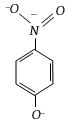
B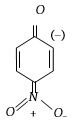
C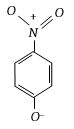
D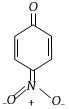
Solution
(C) In resonance structures,the nitrogen atom $(N)$ in the nitro group has a valency of $4$ (forming $4$ bonds).
If $N$ forms $5$ bonds,it would exceed its octet,which is not possible for second-period elements like nitrogen.
Structure $(C)$ shows the nitrogen atom forming $5$ bonds (one double bond with the ring,two double bonds with oxygens,and one single bond with the other oxygen),which violates the octet rule.
Therefore,it is the most unlikely representation.
If $N$ forms $5$ bonds,it would exceed its octet,which is not possible for second-period elements like nitrogen.
Structure $(C)$ shows the nitrogen atom forming $5$ bonds (one double bond with the ring,two double bonds with oxygens,and one single bond with the other oxygen),which violates the octet rule.
Therefore,it is the most unlikely representation.
0 likesView Solution
29
ChemistryMCQIIT JEE · 1999
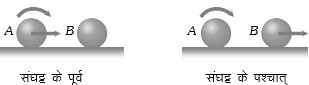
$A$ smooth sphere $A$ is moving on a frictionless horizontal plane with an angular velocity $\omega$ and a linear velocity $v$ of its center of mass. It undergoes an elastic head-on collision with an identical sphere $B$ which is at rest. If there is no friction anywhere,then after the collision,their angular speeds are $\omega_A$ and $\omega_B$ respectively. Then:
A
$\omega_A < \omega_B$
B
$\omega_A = \omega_B$
C
$\omega_A = \omega$
D
$\omega = \omega_B$
Solution
(C) Since this is a head-on elastic collision between two identical spheres,their linear velocities will be exchanged. Sphere $A$ comes to rest,and sphere $B$ moves with a linear velocity $v$.
Since the surface is frictionless,there is no torque acting on the spheres about their centers of mass. Therefore,their angular velocities remain unchanged.
Thus,$\omega_A = \omega$ and $\omega_B = 0$.
Consequently,after the collision,sphere $A$ will only perform rotational motion (without linear motion),and sphere $B$ will only perform linear motion (without rotation).
Since the surface is frictionless,there is no torque acting on the spheres about their centers of mass. Therefore,their angular velocities remain unchanged.
Thus,$\omega_A = \omega$ and $\omega_B = 0$.
Consequently,after the collision,sphere $A$ will only perform rotational motion (without linear motion),and sphere $B$ will only perform linear motion (without rotation).
0 likesView Solution
30
ChemistryMCQIIT JEE · 1999
The function $f(x) = (x^2 - 1) | x^2 - 3x + 2 | + \cos(| x |)$ is not differentiable at
A
$1$
B
$2$
C
$0$
D
$-1$
Solution
(B) The function is given by $f(x) = (x^2 - 1) |(x - 1)(x - 2)| + \cos(|x|)$.
First,consider the term $|(x - 1)(x - 2)|$. This term is non-differentiable at the roots of the quadratic expression inside the absolute value,which are $x = 1$ and $x = 2$.
However,we must check if the factor $(x^2 - 1)$ compensates for this non-differentiability.
At $x = 1$,$f(x) = (x^2 - 1) |(x - 1)(x - 2)| + \cos(|x|)$. The term $(x^2 - 1)$ has a factor of $(x - 1)$,so $(x^2 - 1)|x - 1| = (x + 1)(x - 1)|x - 1|$. Since $\lim_{x \to 1} (x - 1)|x - 1| = 0$ and the derivative of $(x - 1)|x - 1|$ at $x = 1$ is $0$,the function is differentiable at $x = 1$.
At $x = 2$,the term $|x - 2|$ is not differentiable. The expression is $f(x) = (x^2 - 1)|x - 1||x - 2| + \cos(|x|)$. Since $(x^2 - 1)|x - 1|$ is non-zero at $x = 2$ (specifically,$(2^2 - 1)|2 - 1| = 3 \neq 0$),the product $3|x - 2|$ is not differentiable at $x = 2$.
Finally,consider $\cos(|x|)$. This is $\cos(x)$ for $x \ge 0$ and $\cos(-x) = \cos(x)$ for $x < 0$. The derivative of $\cos(|x|)$ at $x = 0$ is $\lim_{h \to 0^+} \frac{\cos(h) - 1}{h} = 0$ and $\lim_{h \to 0^-} \frac{\cos(-h) - 1}{h} = 0$. Thus,$\cos(|x|)$ is differentiable at $x = 0$.
Therefore,the function is not differentiable at $x = 2$.
First,consider the term $|(x - 1)(x - 2)|$. This term is non-differentiable at the roots of the quadratic expression inside the absolute value,which are $x = 1$ and $x = 2$.
However,we must check if the factor $(x^2 - 1)$ compensates for this non-differentiability.
At $x = 1$,$f(x) = (x^2 - 1) |(x - 1)(x - 2)| + \cos(|x|)$. The term $(x^2 - 1)$ has a factor of $(x - 1)$,so $(x^2 - 1)|x - 1| = (x + 1)(x - 1)|x - 1|$. Since $\lim_{x \to 1} (x - 1)|x - 1| = 0$ and the derivative of $(x - 1)|x - 1|$ at $x = 1$ is $0$,the function is differentiable at $x = 1$.
At $x = 2$,the term $|x - 2|$ is not differentiable. The expression is $f(x) = (x^2 - 1)|x - 1||x - 2| + \cos(|x|)$. Since $(x^2 - 1)|x - 1|$ is non-zero at $x = 2$ (specifically,$(2^2 - 1)|2 - 1| = 3 \neq 0$),the product $3|x - 2|$ is not differentiable at $x = 2$.
Finally,consider $\cos(|x|)$. This is $\cos(x)$ for $x \ge 0$ and $\cos(-x) = \cos(x)$ for $x < 0$. The derivative of $\cos(|x|)$ at $x = 0$ is $\lim_{h \to 0^+} \frac{\cos(h) - 1}{h} = 0$ and $\lim_{h \to 0^-} \frac{\cos(-h) - 1}{h} = 0$. Thus,$\cos(|x|)$ is differentiable at $x = 0$.
Therefore,the function is not differentiable at $x = 2$.
0 likesView Solution
31
ChemistryMCQIIT JEE · 1999
If for a real number $y$,$[y]$ is the greatest integer less than or equal to $y$,then the value of the integral $\int_{\frac{\pi}{2}}^{\frac{3\pi}{2}} [2 \sin x] \,dx$ is
A
$-\pi$
B
$0$
C
$-\frac{\pi}{2}$
D
$\frac{\pi}{2}$
Solution
(C) We need to evaluate $I = \int_{\frac{\pi}{2}}^{\frac{3\pi}{2}} [2 \sin x] \,dx$.
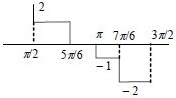
For $x \in [\frac{\pi}{2}, \frac{3\pi}{2}]$,$\sin x$ ranges from $1$ to $-1$,so $2 \sin x$ ranges from $2$ to $-2$.
We break the integral based on the values of $[2 \sin x]$:
$1) \text{ For } x \in [\frac{\pi}{2}, \frac{5\pi}{6}], \frac{1}{2} \leq \sin x \leq 1 \Rightarrow 1 \leq 2 \sin x \leq 2$. Thus $[2 \sin x] = 1$ for $x \in [\frac{\pi}{2}, \frac{5\pi}{6})$ and $2$ at $x = \frac{\pi}{2}$.
$2) \text{ For } x \in [\frac{5\pi}{6}, \pi], 0 \leq \sin x \leq \frac{1}{2} \Rightarrow 0 \leq 2 \sin x \leq 1$. Thus $[2 \sin x] = 0$ for $x \in [\frac{5\pi}{6}, \pi)$.
$3) \text{ For } x \in [\pi, \frac{7\pi}{6}], -\frac{1}{2} \leq \sin x \leq 0 \Rightarrow -1 \leq 2 \sin x \leq 0$. Thus $[2 \sin x] = -1$ for $x \in [\pi, \frac{7\pi}{6})$.
$4) \text{ For } x \in [\frac{7\pi}{6}, \frac{3\pi}{2}], -1 \leq \sin x \leq -\frac{1}{2} \Rightarrow -2 \leq 2 \sin x \leq -1$. Thus $[2 \sin x] = -2$ for $x \in [\frac{7\pi}{6}, \frac{3\pi}{2})$.
$I = \int_{\frac{\pi}{2}}^{\frac{5\pi}{6}} (1) \,dx + \int_{\frac{5\pi}{6}}^{\pi} (0) \,dx + \int_{\pi}^{\frac{7\pi}{6}} (-1) \,dx + \int_{\frac{7\pi}{6}}^{\frac{3\pi}{2}} (-2) \,dx$
$I = (\frac{5\pi}{6} - \frac{\pi}{2}) + 0 - (\frac{7\pi}{6} - \pi) - 2(\frac{3\pi}{2} - \frac{7\pi}{6})$
$I = \frac{\pi}{3} - \frac{\pi}{6} - 2(\frac{9\pi - 7\pi}{6}) = \frac{\pi}{6} - 2(\frac{2\pi}{6}) = \frac{\pi}{6} - \frac{2\pi}{3} = \frac{\pi - 4\pi}{6} = -\frac{3\pi}{6} = -\frac{\pi}{2}$.
For $x \in [\frac{\pi}{2}, \frac{3\pi}{2}]$,$\sin x$ ranges from $1$ to $-1$,so $2 \sin x$ ranges from $2$ to $-2$.
We break the integral based on the values of $[2 \sin x]$:
$1) \text{ For } x \in [\frac{\pi}{2}, \frac{5\pi}{6}], \frac{1}{2} \leq \sin x \leq 1 \Rightarrow 1 \leq 2 \sin x \leq 2$. Thus $[2 \sin x] = 1$ for $x \in [\frac{\pi}{2}, \frac{5\pi}{6})$ and $2$ at $x = \frac{\pi}{2}$.
$2) \text{ For } x \in [\frac{5\pi}{6}, \pi], 0 \leq \sin x \leq \frac{1}{2} \Rightarrow 0 \leq 2 \sin x \leq 1$. Thus $[2 \sin x] = 0$ for $x \in [\frac{5\pi}{6}, \pi)$.
$3) \text{ For } x \in [\pi, \frac{7\pi}{6}], -\frac{1}{2} \leq \sin x \leq 0 \Rightarrow -1 \leq 2 \sin x \leq 0$. Thus $[2 \sin x] = -1$ for $x \in [\pi, \frac{7\pi}{6})$.
$4) \text{ For } x \in [\frac{7\pi}{6}, \frac{3\pi}{2}], -1 \leq \sin x \leq -\frac{1}{2} \Rightarrow -2 \leq 2 \sin x \leq -1$. Thus $[2 \sin x] = -2$ for $x \in [\frac{7\pi}{6}, \frac{3\pi}{2})$.
$I = \int_{\frac{\pi}{2}}^{\frac{5\pi}{6}} (1) \,dx + \int_{\frac{5\pi}{6}}^{\pi} (0) \,dx + \int_{\pi}^{\frac{7\pi}{6}} (-1) \,dx + \int_{\frac{7\pi}{6}}^{\frac{3\pi}{2}} (-2) \,dx$
$I = (\frac{5\pi}{6} - \frac{\pi}{2}) + 0 - (\frac{7\pi}{6} - \pi) - 2(\frac{3\pi}{2} - \frac{7\pi}{6})$
$I = \frac{\pi}{3} - \frac{\pi}{6} - 2(\frac{9\pi - 7\pi}{6}) = \frac{\pi}{6} - 2(\frac{2\pi}{6}) = \frac{\pi}{6} - \frac{2\pi}{3} = \frac{\pi - 4\pi}{6} = -\frac{3\pi}{6} = -\frac{\pi}{2}$.
0 likesView Solution
32
ChemistryMCQIIT JEE · 1999
The electrons,identified by quantum numbers $n$ and $l,$ $(i)$ $n = 4, l = 1$ $(ii)$ $n = 4, l = 0$ $(iii)$ $n = 3, l = 2$ $(iv)$ $n = 3, l = 1$ can be placed in order of increasing energy,from the lowest to highest,as
A
$iv < ii < iii < i$
B
$ii < iv < i < iii$
C
$i < iii < ii < iv$
D
$iii < i < iv < ii$
Solution
(A) According to the $(n+l)$ rule,the energy of an orbital increases as the value of $(n+l)$ increases.
If the $(n+l)$ values are the same,the orbital with the lower value of $n$ has lower energy.
Calculating $(n+l)$ values for each:
$(i)$ $n=4, l=1 \implies n+l=5$
$(ii)$ $n=4, l=0 \implies n+l=4$
$(iii)$ $n=3, l=2 \implies n+l=5$
$(iv)$ $n=3, l=1 \implies n+l=4$
Comparing the values:
For $(n+l)=4$: $(iv)$ has $n=3$ and $(ii)$ has $n=4$. Thus,$iv < ii$.
For $(n+l)=5$: $(iii)$ has $n=3$ and $(i)$ has $n=4$. Thus,$iii < i$.
Combining these,the order of increasing energy is: $iv < ii < iii < i$.
If the $(n+l)$ values are the same,the orbital with the lower value of $n$ has lower energy.
Calculating $(n+l)$ values for each:
$(i)$ $n=4, l=1 \implies n+l=5$
$(ii)$ $n=4, l=0 \implies n+l=4$
$(iii)$ $n=3, l=2 \implies n+l=5$
$(iv)$ $n=3, l=1 \implies n+l=4$
Comparing the values:
For $(n+l)=4$: $(iv)$ has $n=3$ and $(ii)$ has $n=4$. Thus,$iv < ii$.
For $(n+l)=5$: $(iii)$ has $n=3$ and $(i)$ has $n=4$. Thus,$iii < i$.
Combining these,the order of increasing energy is: $iv < ii < iii < i$.
0 likesView Solution
33
ChemistryMCQIIT JEE · 1999
The electrons,identified by quantum numbers $n$ and $l$: $(i) n = 4, l = 1$,$(ii) n = 4, l = 0$,$(iii) n = 3, l = 2$,$(iv) n = 3, l = 1$,can be placed in order of increasing energy,from the lowest to highest,as:
A
$(iv) < (ii) < (iii) < (i)$
B
$(ii) < (iv) < (i) < (iii)$
C
$(i) < (iii) < (ii) < (iv)$
D
$(iii) < (i) < (iv) < (ii)$
Solution
(A) According to the $(n+l)$ rule,the energy of an orbital increases as the value of $(n+l)$ increases. If two orbitals have the same $(n+l)$ value,the one with the lower $n$ value has lower energy.
Calculating $(n+l)$ for each:
$(i) n = 4, l = 1 \implies n+l = 4+1 = 5$
$(ii) n = 4, l = 0 \implies n+l = 4+0 = 4$
$(iii) n = 3, l = 2 \implies n+l = 3+2 = 5$
$(iv) n = 3, l = 1 \implies n+l = 3+1 = 4$
Comparing the values:
For $(ii)$ and $(iv)$,$(n+l) = 4$. Since $(iv)$ has a lower $n$ value $(3 < 4)$,$(iv) < (ii)$.
For $(i)$ and $(iii)$,$(n+l) = 5$. Since $(iii)$ has a lower $n$ value $(3 < 4)$,$(iii) < (i)$.
Combining these,the order of increasing energy is $(iv) < (ii) < (iii) < (i)$.
Calculating $(n+l)$ for each:
$(i) n = 4, l = 1 \implies n+l = 4+1 = 5$
$(ii) n = 4, l = 0 \implies n+l = 4+0 = 4$
$(iii) n = 3, l = 2 \implies n+l = 3+2 = 5$
$(iv) n = 3, l = 1 \implies n+l = 3+1 = 4$
Comparing the values:
For $(ii)$ and $(iv)$,$(n+l) = 4$. Since $(iv)$ has a lower $n$ value $(3 < 4)$,$(iv) < (ii)$.
For $(i)$ and $(iii)$,$(n+l) = 5$. Since $(iii)$ has a lower $n$ value $(3 < 4)$,$(iii) < (i)$.
Combining these,the order of increasing energy is $(iv) < (ii) < (iii) < (i)$.
0 likesView Solution
34
ChemistryMCQIIT JEE · 1999
One mole of calcium phosphide on reaction with excess of water gives
A
one mole of phosphine
B
two moles of phosphoric acid
C
two moles of phosphine
D
one mole of phosphorus penta-oxide
Solution
(C) The chemical reaction between calcium phosphide and water is represented as:
$Ca_3P_2 + 6H_2O \rightarrow 2PH_3 + 3Ca(OH)_2$
From the stoichiometry of the balanced equation,$1 \text{ mole}$ of $Ca_3P_2$ reacts with $6 \text{ moles}$ of $H_2O$ to produce $2 \text{ moles}$ of phosphine $(PH_3)$ and $3 \text{ moles}$ of calcium hydroxide $(Ca(OH)_2)$.
Therefore,one mole of calcium phosphide yields $2 \text{ moles}$ of phosphine.
$Ca_3P_2 + 6H_2O \rightarrow 2PH_3 + 3Ca(OH)_2$
From the stoichiometry of the balanced equation,$1 \text{ mole}$ of $Ca_3P_2$ reacts with $6 \text{ moles}$ of $H_2O$ to produce $2 \text{ moles}$ of phosphine $(PH_3)$ and $3 \text{ moles}$ of calcium hydroxide $(Ca(OH)_2)$.
Therefore,one mole of calcium phosphide yields $2 \text{ moles}$ of phosphine.
0 likesView Solution
35
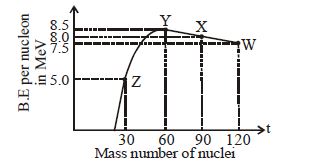
ChemistryMCQIIT JEE · 1999
The binding energy per nucleon versus mass number curve for nuclei is shown in the figure. $W, X, Y$ and $Z$ are four nuclei indicated on the curve. The process that would release energy is
A
$Y \to 2Z$
B
$W \to X + Z$
C
$W \to 2Y$
D
$X \to Y + Z$
Solution
(C) Energy is released in a nuclear reaction if the total binding energy of the products is greater than the total binding energy of the reactants. This corresponds to an increase in the binding energy per nucleon.
For nuclear fission,a heavy nucleus splits into lighter nuclei with higher binding energy per nucleon. For nuclear fusion,lighter nuclei combine to form a heavier nucleus with higher binding energy per nucleon.
Looking at the graph:
- $Z$ has a mass number of $30$ and a binding energy per nucleon of $5.0 \text{ MeV}$.
- $Y$ has a mass number of $60$ and a binding energy per nucleon of $8.5 \text{ MeV}$.
- $X$ has a mass number of $90$ and a binding energy per nucleon of $8.0 \text{ MeV}$.
- $W$ has a mass number of $120$ and a binding energy per nucleon of $7.5 \text{ MeV}$.
In the process $W \to 2Y$:
- Reactant $W$ $(A=120)$ has a total binding energy of $120 \times 7.5 = 900 \text{ MeV}$.
- Products $2Y$ $(2 \times 60 = 120)$ have a total binding energy of $2 \times (60 \times 8.5) = 1020 \text{ MeV}$.
- Since the total binding energy of the products $(1020 \text{ MeV})$ is greater than that of the reactant $(900 \text{ MeV})$,energy is released.
For nuclear fission,a heavy nucleus splits into lighter nuclei with higher binding energy per nucleon. For nuclear fusion,lighter nuclei combine to form a heavier nucleus with higher binding energy per nucleon.
Looking at the graph:
- $Z$ has a mass number of $30$ and a binding energy per nucleon of $5.0 \text{ MeV}$.
- $Y$ has a mass number of $60$ and a binding energy per nucleon of $8.5 \text{ MeV}$.
- $X$ has a mass number of $90$ and a binding energy per nucleon of $8.0 \text{ MeV}$.
- $W$ has a mass number of $120$ and a binding energy per nucleon of $7.5 \text{ MeV}$.
In the process $W \to 2Y$:
- Reactant $W$ $(A=120)$ has a total binding energy of $120 \times 7.5 = 900 \text{ MeV}$.
- Products $2Y$ $(2 \times 60 = 120)$ have a total binding energy of $2 \times (60 \times 8.5) = 1020 \text{ MeV}$.
- Since the total binding energy of the products $(1020 \text{ MeV})$ is greater than that of the reactant $(900 \text{ MeV})$,energy is released.
0 likesView Solution
36
ChemistryMCQIIT JEE · 1999
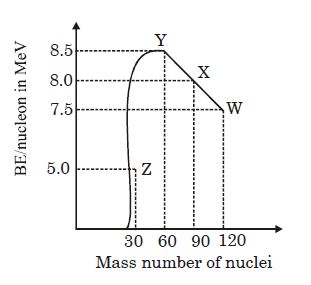
The binding energy per nucleon versus mass number curve for nuclei is shown in the figure. $W, X, Y$ and $Z$ are four nuclei indicated on the curve. The process that would release energy is:
A
$Y \to 2Z$
B
$W \to X + Y$
C
$W \to 2Y$
D
$X \to Y + Z$
Solution
(C) Energy is released in a nuclear process if the total binding energy of the products is greater than the total binding energy of the reactants.
From the graph:
For $Z$: Mass number $A = 30$,$BE/A = 5.0 \text{ MeV}$
For $Y$: Mass number $A = 60$,$BE/A = 8.5 \text{ MeV}$
For $X$: Mass number $A = 90$,$BE/A = 8.0 \text{ MeV}$
For $W$: Mass number $A = 120$,$BE/A = 7.5 \text{ MeV}$
Let's evaluate option $(c)$: $W \to 2Y$
Total $BE$ of reactant $W = 120 \times 7.5 = 900 \text{ MeV}$
Total $BE$ of products $2Y = 2 \times (60 \times 8.5) = 2 \times 510 = 1020 \text{ MeV}$
Since the total $BE$ of the products $(1020 \text{ MeV})$ is greater than the total $BE$ of the reactant $(900 \text{ MeV})$,energy is released in this process.
From the graph:
For $Z$: Mass number $A = 30$,$BE/A = 5.0 \text{ MeV}$
For $Y$: Mass number $A = 60$,$BE/A = 8.5 \text{ MeV}$
For $X$: Mass number $A = 90$,$BE/A = 8.0 \text{ MeV}$
For $W$: Mass number $A = 120$,$BE/A = 7.5 \text{ MeV}$
Let's evaluate option $(c)$: $W \to 2Y$
Total $BE$ of reactant $W = 120 \times 7.5 = 900 \text{ MeV}$
Total $BE$ of products $2Y = 2 \times (60 \times 8.5) = 2 \times 510 = 1020 \text{ MeV}$
Since the total $BE$ of the products $(1020 \text{ MeV})$ is greater than the total $BE$ of the reactant $(900 \text{ MeV})$,energy is released in this process.
0 likesView Solution
37
ChemistryMCQIIT JEE · 1999
The coordination number of a metal crystallizing in a hexagonal close-packed structure is
A
$12$
B
$4$
C
$8$
D
$6$
Solution
(A) In a hexagonal close-packed $(HCP)$ structure,each atom is surrounded by $12$ nearest neighbors.
Specifically,an atom in a given layer is in contact with $6$ atoms in its own layer,$3$ atoms in the layer above,and $3$ atoms in the layer below,totaling $6 + 3 + 3 = 12$.
Specifically,an atom in a given layer is in contact with $6$ atoms in its own layer,$3$ atoms in the layer above,and $3$ atoms in the layer below,totaling $6 + 3 + 3 = 12$.
0 likesView Solution
38
ChemistryMCQIIT JEE · 1999
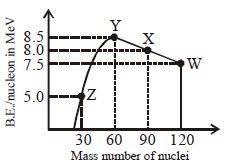
The binding energy per nucleon versus mass number curve for nuclei is shown in the figure. $W, X, Y$ and $Z$ are four nuclei indicated on the curve. The process that would release energy is
A
$Y \to 2Z$
B
$W \to X + Z$
C
$W \to 2Y$
D
$X \to Y + Z$
Solution
(C) Energy is released in a nuclear process if the total binding energy of the products is greater than the total binding energy of the reactants.
From the graph, we identify the mass numbers $(A)$ and binding energy per nucleon $(BE/A)$ for the nuclei:
For $W$: $A = 120, BE/A = 7.5 \, MeV \implies \text{Total } BE = 120 \times 7.5 = 900 \, MeV$.
For $Y$: $A = 60, BE/A = 8.5 \, MeV \implies \text{Total } BE = 60 \times 8.5 = 510 \, MeV$.
Now, let us check option $(c)$: $W \to 2Y$.
Total $BE$ of reactants $= 900 \, MeV$.
Total $BE$ of products $= 2 \times (510) = 1020 \, MeV$.
Since the total binding energy of the products $(1020 \, MeV)$ is greater than that of the reactants $(900 \, MeV)$, energy is released in this process.
From the graph, we identify the mass numbers $(A)$ and binding energy per nucleon $(BE/A)$ for the nuclei:
For $W$: $A = 120, BE/A = 7.5 \, MeV \implies \text{Total } BE = 120 \times 7.5 = 900 \, MeV$.
For $Y$: $A = 60, BE/A = 8.5 \, MeV \implies \text{Total } BE = 60 \times 8.5 = 510 \, MeV$.
Now, let us check option $(c)$: $W \to 2Y$.
Total $BE$ of reactants $= 900 \, MeV$.
Total $BE$ of products $= 2 \times (510) = 1020 \, MeV$.
Since the total binding energy of the products $(1020 \, MeV)$ is greater than that of the reactants $(900 \, MeV)$, energy is released in this process.
0 likesView Solution
39
ChemistryMCQIIT JEE · 1999
$A$ particle of mass $M$ at rest decays into two particles of masses $m_1$ and $m_2$ having non-zero velocities. The ratio of the de-Broglie wavelengths of the particles,$\lambda_1/\lambda_2$ is
A
$m_1/m_2$
B
$m_2/m_1$
C
$1.0$
D
$\sqrt{m_2}/\sqrt{m_1}$
Solution
(C) According to the law of conservation of linear momentum,since the initial particle is at rest,the total momentum before and after decay must be zero.
$0 = m_1 \vec{v}_1 + m_2 \vec{v}_2 \Rightarrow m_1 \vec{v}_1 = -m_2 \vec{v}_2$.
Taking the magnitude of the momenta,we have $|p_1| = |p_2| = p$,where $p = m_1 v_1 = m_2 v_2$.
The de-Broglie wavelength is given by $\lambda = h/p$.
Since both particles have the same magnitude of momentum $p$,their de-Broglie wavelengths are $\lambda_1 = h/p$ and $\lambda_2 = h/p$.
Therefore,the ratio $\lambda_1/\lambda_2 = (h/p) / (h/p) = 1.0$.
$0 = m_1 \vec{v}_1 + m_2 \vec{v}_2 \Rightarrow m_1 \vec{v}_1 = -m_2 \vec{v}_2$.
Taking the magnitude of the momenta,we have $|p_1| = |p_2| = p$,where $p = m_1 v_1 = m_2 v_2$.
The de-Broglie wavelength is given by $\lambda = h/p$.
Since both particles have the same magnitude of momentum $p$,their de-Broglie wavelengths are $\lambda_1 = h/p$ and $\lambda_2 = h/p$.
Therefore,the ratio $\lambda_1/\lambda_2 = (h/p) / (h/p) = 1.0$.
0 likesView Solution
40
ChemistryMCQIIT JEE · 1999
On heating ammonium dichromate,the gas evolved is
A
Oxygen
B
Ammonia
C
Nitrous oxide
D
Nitrogen
Solution
(D) The thermal decomposition of ammonium dichromate is an exothermic reaction.
The chemical equation for the reaction is:
$(NH_4)_2Cr_2O_7 \rightarrow N_2 + Cr_2O_3 + 4H_2O$
As shown in the equation,the gas evolved is nitrogen $(N_2)$.
The chemical equation for the reaction is:
$(NH_4)_2Cr_2O_7 \rightarrow N_2 + Cr_2O_3 + 4H_2O$
As shown in the equation,the gas evolved is nitrogen $(N_2)$.
0 likesView Solution
41
ChemistryMCQIIT JEE · 1999
The half-life period of a radioactive element $X$ is the same as the mean lifetime of another radioactive element $Y$. Initially, both of them have the same number of atoms. Then:
A
$X$ and $Y$ have the same decay rate initially.
B
$X$ and $Y$ decay at the same rate always.
C
$Y$ will decay at a faster rate than $X$.
D
$X$ will decay at a faster rate than $Y$.
Solution
(C) Given that the half-life of $X$ equals the mean life of $Y$: $(T_{1/2})_X = (\tau)_Y$.
We know that $(T_{1/2})_X = \frac{0.693}{\lambda_X}$ and $(\tau)_Y = \frac{1}{\lambda_Y}$.
Equating these, we get $\frac{0.693}{\lambda_X} = \frac{1}{\lambda_Y}$, which implies $\lambda_X = 0.693 \lambda_Y$.
Since $0.693 < 1$, it follows that $\lambda_X < \lambda_Y$.
The rate of decay is given by $R = \lambda N$.
Initially, the number of atoms $N$ is the same for both elements. Since $\lambda_Y > \lambda_X$, the decay rate $R_Y = \lambda_Y N$ will be greater than $R_X = \lambda_X N$.
Therefore, $Y$ will decay at a faster rate than $X$.
We know that $(T_{1/2})_X = \frac{0.693}{\lambda_X}$ and $(\tau)_Y = \frac{1}{\lambda_Y}$.
Equating these, we get $\frac{0.693}{\lambda_X} = \frac{1}{\lambda_Y}$, which implies $\lambda_X = 0.693 \lambda_Y$.
Since $0.693 < 1$, it follows that $\lambda_X < \lambda_Y$.
The rate of decay is given by $R = \lambda N$.
Initially, the number of atoms $N$ is the same for both elements. Since $\lambda_Y > \lambda_X$, the decay rate $R_Y = \lambda_Y N$ will be greater than $R_X = \lambda_X N$.
Therefore, $Y$ will decay at a faster rate than $X$.
0 likesView Solution
42
ChemistryMCQIIT JEE · 1999
$A$ gas mixture consists of $2$ moles of oxygen and $4$ moles of argon at temperature $T$. Neglecting all vibrational modes,the total internal energy of the system is (in $, RT$)
A
$4$
B
$15$
C
$9$
D
$11$
Solution
(D) The total internal energy $U$ of a gas mixture is the sum of the internal energies of its individual components: $U = U_1 + U_2$.
For oxygen $(O_2)$,which is a diatomic gas,the degrees of freedom $f_1 = 5$ (neglecting vibrational modes). Thus,$C_{v1} = \frac{f_1}{2}R = \frac{5}{2}R$.
For argon $(Ar)$,which is a monatomic gas,the degrees of freedom $f_2 = 3$. Thus,$C_{v2} = \frac{f_2}{2}R = \frac{3}{2}R$.
Given $n_1 = 2$ moles of oxygen and $n_2 = 4$ moles of argon:
$U = n_1 C_{v1} T + n_2 C_{v2} T$
$U = 2 \times (\frac{5}{2}R)T + 4 \times (\frac{3}{2}R)T$
$U = 5RT + 6RT = 11RT$.
For oxygen $(O_2)$,which is a diatomic gas,the degrees of freedom $f_1 = 5$ (neglecting vibrational modes). Thus,$C_{v1} = \frac{f_1}{2}R = \frac{5}{2}R$.
For argon $(Ar)$,which is a monatomic gas,the degrees of freedom $f_2 = 3$. Thus,$C_{v2} = \frac{f_2}{2}R = \frac{3}{2}R$.
Given $n_1 = 2$ moles of oxygen and $n_2 = 4$ moles of argon:
$U = n_1 C_{v1} T + n_2 C_{v2} T$
$U = 2 \times (\frac{5}{2}R)T + 4 \times (\frac{3}{2}R)T$
$U = 5RT + 6RT = 11RT$.
0 likesView Solution
43
ChemistryMCQIIT JEE · 1999
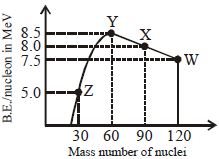
The binding energy per nucleon versus mass number curve for nuclei is shown in the figure. $W, X, Y$ and $Z$ are four nuclei indicated on the curve. The process that would release energy is
A
$Y \to 2Z$
B
$W \to X + Z$
C
$W \to 2Y$
D
$X \to Y + Z$
Solution
(C) Energy is released in a nuclear process when the total binding energy $(B.E.)$ of the products is greater than the total binding energy of the reactants.
From the graph, we can identify the mass number $(A)$ and binding energy per nucleon $(B.E./A)$ for each nucleus:
For $W: A = 120, B.E./A = 7.5 \, MeV \implies \text{Total } B.E. = 120 \times 7.5 = 900 \, MeV$
For $Y: A = 60, B.E./A = 8.5 \, MeV \implies \text{Total } B.E. = 60 \times 8.5 = 510 \, MeV$
For $X: A = 90, B.E./A = 8.0 \, MeV \implies \text{Total } B.E. = 90 \times 8.0 = 720 \, MeV$
For $Z: A = 30, B.E./A = 5.0 \, MeV \implies \text{Total } B.E. = 30 \times 5.0 = 150 \, MeV$
Now, let us check the options:
$(A)$ $Y \to 2Z$: Reactant $B.E. = 510 \, MeV$, Product $B.E. = 2 \times 150 = 300 \, MeV$. (Energy absorbed)
$(B)$ $W \to X + Z$: Reactant $B.E. = 900 \, MeV$, Product $B.E. = 720 + 150 = 870 \, MeV$. (Energy absorbed)
$(C)$ $W \to 2Y$: Reactant $B.E. = 900 \, MeV$, Product $B.E. = 2 \times 510 = 1020 \, MeV$. (Energy released as $1020 > 900$)
$(D)$ $X \to Y + Z$: Reactant $B.E. = 720 \, MeV$, Product $B.E. = 510 + 150 = 660 \, MeV$. (Energy absorbed)
Therefore, the correct process is $W \to 2Y$.
From the graph, we can identify the mass number $(A)$ and binding energy per nucleon $(B.E./A)$ for each nucleus:
For $W: A = 120, B.E./A = 7.5 \, MeV \implies \text{Total } B.E. = 120 \times 7.5 = 900 \, MeV$
For $Y: A = 60, B.E./A = 8.5 \, MeV \implies \text{Total } B.E. = 60 \times 8.5 = 510 \, MeV$
For $X: A = 90, B.E./A = 8.0 \, MeV \implies \text{Total } B.E. = 90 \times 8.0 = 720 \, MeV$
For $Z: A = 30, B.E./A = 5.0 \, MeV \implies \text{Total } B.E. = 30 \times 5.0 = 150 \, MeV$
Now, let us check the options:
$(A)$ $Y \to 2Z$: Reactant $B.E. = 510 \, MeV$, Product $B.E. = 2 \times 150 = 300 \, MeV$. (Energy absorbed)
$(B)$ $W \to X + Z$: Reactant $B.E. = 900 \, MeV$, Product $B.E. = 720 + 150 = 870 \, MeV$. (Energy absorbed)
$(C)$ $W \to 2Y$: Reactant $B.E. = 900 \, MeV$, Product $B.E. = 2 \times 510 = 1020 \, MeV$. (Energy released as $1020 > 900$)
$(D)$ $X \to Y + Z$: Reactant $B.E. = 720 \, MeV$, Product $B.E. = 510 + 150 = 660 \, MeV$. (Energy absorbed)
Therefore, the correct process is $W \to 2Y$.
0 likesView Solution
44
ChemistryMCQIIT JEE · 1999
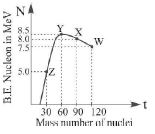
The binding energy per nucleon versus mass number curve for nuclei is shown in the figure. $W, X, Y$ and $Z$ are four nuclei indicated on the curve. The process that would release energy is
A
$Y \to 2Z$
B
$W \to X + Z$
C
$W \to 2Y$
D
$X \to Y + Z$
Solution
(C) Energy is released in a nuclear reaction if the total binding energy of the products is greater than the total binding energy of the reactants.
From the graph:
For nucleus $W$: Mass number $A = 120$,$BE/A = 7.5 \, MeV$.
For nucleus $Y$: Mass number $A = 60$,$BE/A = 8.5 \, MeV$.
For nucleus $Z$: Mass number $A = 30$,$BE/A = 5.0 \, MeV$.
Let us check option $(c)$: $W \to 2Y$
Total $BE$ of reactant $W = 120 \times 7.5 = 900 \, MeV$.
Total $BE$ of products $= 2 \times (60 \times 8.5) = 1020 \, MeV$.
Since the total $BE$ of products $(1020 \, MeV)$ is greater than the total $BE$ of the reactant $(900 \, MeV)$,energy is released in this process.
From the graph:
For nucleus $W$: Mass number $A = 120$,$BE/A = 7.5 \, MeV$.
For nucleus $Y$: Mass number $A = 60$,$BE/A = 8.5 \, MeV$.
For nucleus $Z$: Mass number $A = 30$,$BE/A = 5.0 \, MeV$.
Let us check option $(c)$: $W \to 2Y$
Total $BE$ of reactant $W = 120 \times 7.5 = 900 \, MeV$.
Total $BE$ of products $= 2 \times (60 \times 8.5) = 1020 \, MeV$.
Since the total $BE$ of products $(1020 \, MeV)$ is greater than the total $BE$ of the reactant $(900 \, MeV)$,energy is released in this process.
0 likesView Solution
45
ChemistryMediumMCQIIT JEE · 1999
The electrons,identified by quantum numbers $n$ and $l$ as $(i) n = 4, l = 1$,$(ii) n = 4, l = 0$,$(iii) n = 3, l = 2$,$(iv) n = 3, l = 1$,can be placed in order of increasing energy,from the lowest to highest,as:
A
$(iv) < (ii) < (iii) < (i)$
B
$(ii) < (iv) < (i) < (iii)$
C
$(i) < (iii) < (ii) < (iv)$
D
$(iii) < (i) < (iv) < (ii)$
Solution
(A) According to the $(n+l)$ rule,the higher the value of $(n+l)$,the higher is the energy of the orbital.
If the $(n+l)$ values are the same,the orbital with the lower value of $n$ has lower energy.
Calculating $(n+l)$ values:
$(i) n=4, l=1 \implies n+l = 5$
$(ii) n=4, l=0 \implies n+l = 4$
$(iii) n=3, l=2 \implies n+l = 5$
$(iv) n=3, l=1 \implies n+l = 4$
Comparing the values:
For $(iv)$ and $(ii)$,both have $(n+l) = 4$. Since $n=3 < n=4$,$(iv) < (ii)$.
For $(i)$ and $(iii)$,both have $(n+l) = 5$. Since $n=3 < n=4$,$(iii) < (i)$.
Combining these,the order of increasing energy is $(iv) < (ii) < (iii) < (i)$.
If the $(n+l)$ values are the same,the orbital with the lower value of $n$ has lower energy.
Calculating $(n+l)$ values:
$(i) n=4, l=1 \implies n+l = 5$
$(ii) n=4, l=0 \implies n+l = 4$
$(iii) n=3, l=2 \implies n+l = 5$
$(iv) n=3, l=1 \implies n+l = 4$
Comparing the values:
For $(iv)$ and $(ii)$,both have $(n+l) = 4$. Since $n=3 < n=4$,$(iv) < (ii)$.
For $(i)$ and $(iii)$,both have $(n+l) = 5$. Since $n=3 < n=4$,$(iii) < (i)$.
Combining these,the order of increasing energy is $(iv) < (ii) < (iii) < (i)$.
0 likesView Solution
46
ChemistryDifficultMCQIIT JEE · 1999
In the dichromate dianion $(Cr_2O_7^{2-})$,which of the following statements is correct regarding the $Cr-O$ bonds?
A
$4$ $Cr-O$ bonds are equivalent
B
$6$ $Cr-O$ bonds are equivalent
C
All $Cr-O$ bonds are equivalent
D
All $Cr-O$ bonds are non-equivalent
Solution
(B) The structure of the dichromate dianion $(Cr_2O_7^{2-})$ consists of two $CrO_4$ tetrahedra sharing a common oxygen atom.
In this structure,there are $6$ terminal $Cr-O$ bonds (three on each chromium atom) and $2$ bridging $Cr-O-Cr$ bonds.
The $6$ terminal $Cr-O$ bonds are equivalent due to resonance,while the $2$ bridging bonds are different from the terminal ones.
Therefore,$6$ $Cr-O$ bonds are equivalent.
In this structure,there are $6$ terminal $Cr-O$ bonds (three on each chromium atom) and $2$ bridging $Cr-O-Cr$ bonds.
The $6$ terminal $Cr-O$ bonds are equivalent due to resonance,while the $2$ bridging bonds are different from the terminal ones.
Therefore,$6$ $Cr-O$ bonds are equivalent.
0 likesView Solution
47
ChemistryMediumMCQIIT JEE · 1999
In the commercial electrochemical process for aluminium extraction,the electrolyte used is
A
$Al(OH)_3$ in $NaOH$ solution
B
An aqueous solution of $Al_2(SO_4)_3$
C
$A$ molten mixture of $Al_2O_3$ and $Na_3AlF_6$
D
$A$ molten mixture of $AlO(OH)$ and $Al(OH)_3$
Solution
(C) In the commercial electrochemical process for aluminium extraction,known as the Hall-$H$éroult process,the electrolyte used is a molten mixture of $Al_2O_3$ (alumina),$Na_3AlF_6$ (cryolite),and $CaF_2$ (fluorspar).
Cryolite lowers the melting point of the mixture and increases its electrical conductivity.
Cryolite lowers the melting point of the mixture and increases its electrical conductivity.
0 likesView Solution
48
ChemistryEasyMCQIIT JEE · 1999
On heating ammonium dichromate,the gas evolved is
A
Oxygen
B
Ammonia
C
Nitrous oxide
D
Nitrogen
Solution
(D) The thermal decomposition of ammonium dichromate is given by the following reaction:
$(NH_4)_2Cr_2O_7 \to N_2 + Cr_2O_3 + 4H_2O$
As shown in the equation,the gas evolved is nitrogen $(N_2)$.
$(NH_4)_2Cr_2O_7 \to N_2 + Cr_2O_3 + 4H_2O$
As shown in the equation,the gas evolved is nitrogen $(N_2)$.
0 likesView Solution
49
ChemistryMediumMCQIIT JEE · 1999
Ammonia on reaction with hypochlorite anion,can form
A
$NO$
B
$NH_4Cl$
C
$N_2H_4$
D
Both $(b)$ and $(c)$
Solution
(D) The reaction of ammonia $(NH_3)$ with hypochlorite anion $(OCl^-)$ is a method for the preparation of hydrazine $(N_2H_4)$.
The balanced chemical equation is:
$2NH_3 + OCl^- \to N_2H_4 + Cl^- + H_2O$
However,in the presence of excess ammonia and specific conditions,the reaction can also produce ammonium chloride $(NH_4Cl)$ as a byproduct.
Therefore,both $NH_4Cl$ and $N_2H_4$ can be formed.
The balanced chemical equation is:
$2NH_3 + OCl^- \to N_2H_4 + Cl^- + H_2O$
However,in the presence of excess ammonia and specific conditions,the reaction can also produce ammonium chloride $(NH_4Cl)$ as a byproduct.
Therefore,both $NH_4Cl$ and $N_2H_4$ can be formed.
0 likesView Solution
50
ChemistryDifficultMCQIIT JEE · 1999
$A$ solution of $D(+)-1-$chloro$-1-$phenylethane in toluene racemises slowly in the presence of a small amount of $SbCl_5$,due to the formation of:
A
Carbanion
B
Carbene
C
Free radical
D
Carbocation
Solution
(D) $SbCl_5$ is a strong Lewis acid. It reacts with the $C-Cl$ bond of $1-$chloro$-1-$phenylethane to abstract the chloride ion,forming a stable benzylic carbocation intermediate: $Ph-CH(CH_3)-Cl + SbCl_5 \rightarrow [Ph-CH^+(CH_3)] + [SbCl_6]^-$.
Since the carbocation is planar,the chloride ion can attack from either side,leading to the formation of a racemic mixture of the $(d)$ and $(l)$ forms.
Since the carbocation is planar,the chloride ion can attack from either side,leading to the formation of a racemic mixture of the $(d)$ and $(l)$ forms.
0 likesView Solution
51
ChemistryMediumMCQIIT JEE · 1999
In the depression of freezing point experiment,it is found that the:
A
Vapour pressure of the solution is less than that of pure solvent
B
Only solvent molecules solidify at the freezing point
C
Only solute molecules solidify at the freezing point
D
$A$ and $B$
Solution
(D) The freezing point of a solution is the temperature at which the vapour pressure of the solution becomes equal to the vapour pressure of the pure solid solvent.
At the freezing point,only the solvent molecules solidify,while the solute molecules remain in the liquid phase.
Furthermore,the addition of a non-volatile solute lowers the vapour pressure of the solvent,which leads to a depression in the freezing point.
Therefore,both statements $A$ and $B$ are correct.
At the freezing point,only the solvent molecules solidify,while the solute molecules remain in the liquid phase.
Furthermore,the addition of a non-volatile solute lowers the vapour pressure of the solvent,which leads to a depression in the freezing point.
Therefore,both statements $A$ and $B$ are correct.
0 likesView Solution
52
ChemistryMediumMCQIIT JEE · 1999
The coordination number of a metal crystallizing in a hexagonal close packed structure is
A
$4$
B
$12$
C
$8$
D
$6$
Solution
(B) In a hexagonal close packed $(hcp)$ structure,each atom is in contact with $12$ other atoms.
Therefore,the coordination number of a metal crystallizing in an $hcp$ structure is $12$.
Therefore,the coordination number of a metal crystallizing in an $hcp$ structure is $12$.
0 likesView Solution
53
ChemistryDifficultMCQIIT JEE · 1999
Which of the following statement$(s)$ is (are) correct?
A
$A$ plot of $\log \, K_p$ versus $1/T$ is linear.
B
$A$ plot of $\log \, [X]$ versus time is linear for a first order reaction $X \to P$.
C
$A$ plot of $P$ versus $1/V$ is linear at constant temperature.
D
All of the above.
Solution
(D) $1$. According to the Van't Hoff equation,$\ln K_p = -\frac{\Delta H^o}{RT} + C$. Thus,a plot of $\log \, K_p$ versus $1/T$ is linear. Statement $(a)$ is correct.
$2$. For a first-order reaction,$\ln [X]_t = -kt + \ln [X]_0$. Converting to base $10$,$\log \, [X]_t = -\frac{kt}{2.303} + \log \, [X]_0$. Thus,a plot of $\log \, [X]$ versus time is linear. Statement $(b)$ is correct.
$3$. According to Boyle's law,at constant temperature,$P \propto 1/V$,which implies $P = k(1/V)$. Thus,a plot of $P$ versus $1/V$ is linear. Statement $(c)$ is correct.
$4$. Since $(a)$,$(b)$,and $(c)$ are all correct,the correct option is $(d)$.
$2$. For a first-order reaction,$\ln [X]_t = -kt + \ln [X]_0$. Converting to base $10$,$\log \, [X]_t = -\frac{kt}{2.303} + \log \, [X]_0$. Thus,a plot of $\log \, [X]$ versus time is linear. Statement $(b)$ is correct.
$3$. According to Boyle's law,at constant temperature,$P \propto 1/V$,which implies $P = k(1/V)$. Thus,a plot of $P$ versus $1/V$ is linear. Statement $(c)$ is correct.
$4$. Since $(a)$,$(b)$,and $(c)$ are all correct,the correct option is $(d)$.
0 likesView Solution
54
ChemistryMediumMCQIIT JEE · 1999
$A$ gas $X$ at $1 \, atm$ is bubbled through a solution containing a mixture of $1 \, M \, Y^{-}$ and $1 \, M \, Z^{-}$ at $25 \, ^oC$. If the reduction potential of $Z > Y > X$,then
A
$Y$ will oxidize $X$ and not $Z$
B
$Y$ will oxidize $Z$ and not $X$
C
$Y$ will oxidize both $X$ and $Z$
D
$Y$ will reduce both $X$ and $Z$
Solution
(A) The reduction potential represents the tendency to gain electrons. Given the order $Z > Y > X$,$Z$ has the highest tendency to be reduced,followed by $Y$,and then $X$.
An oxidizing agent is a substance that gets reduced itself and oxidizes others. $A$ species with a higher reduction potential can oxidize a species with a lower reduction potential.
Since the reduction potential of $Y > X$,$Y$ can oxidize $X$.
Since the reduction potential of $Z > Y$,$Y$ cannot oxidize $Z$ (in fact,$Z$ would oxidize $Y$).
Therefore,$Y$ will oxidize $X$ but not $Z$.
An oxidizing agent is a substance that gets reduced itself and oxidizes others. $A$ species with a higher reduction potential can oxidize a species with a lower reduction potential.
Since the reduction potential of $Y > X$,$Y$ can oxidize $X$.
Since the reduction potential of $Z > Y$,$Y$ cannot oxidize $Z$ (in fact,$Z$ would oxidize $Y$).
Therefore,$Y$ will oxidize $X$ but not $Z$.
1 likesView Solution
55
ChemistryMediumMCQIIT JEE · 1999
When ammonium dichromate is heated,the gas formed is
A
$N_2$
B
$O_2$
C
$H_2$
D
$NH_3$
Solution
(A) The thermal decomposition of ammonium dichromate is given by the following equation:
$(NH_4)_2Cr_2O_7 \rightarrow N_2 + 4H_2O + Cr_2O_3$
As shown in the reaction,the gas evolved is nitrogen $(N_2)$.
$(NH_4)_2Cr_2O_7 \rightarrow N_2 + 4H_2O + Cr_2O_3$
As shown in the reaction,the gas evolved is nitrogen $(N_2)$.
0 likesView Solution
56
ChemistryDifficultMCQIIT JEE · 1999
The geometry of $Ni(CO)_4$ and $Ni(PPh_3)_2Cl_2$ are
A
Both square planar
B
Tetrahedral and square planar respectively
C
Square planar and tetrahedral respectively
D
Both tetrahedral
Solution
(D) In $Ni(CO)_4$,the oxidation state of $Ni$ is $0$. The configuration is $3d^8 4s^2$. Due to the strong field ligand $CO$,electrons pair up,resulting in $sp^3$ hybridization,which gives a tetrahedral geometry.
In $Ni(PPh_3)_2Cl_2$,the oxidation state of $Ni$ is $+2$. The configuration is $3d^8$. $PPh_3$ is a bulky ligand,and $Cl^-$ is a weak field ligand. This complex also undergoes $sp^3$ hybridization,resulting in a tetrahedral geometry.
Therefore,both complexes are tetrahedral.
In $Ni(PPh_3)_2Cl_2$,the oxidation state of $Ni$ is $+2$. The configuration is $3d^8$. $PPh_3$ is a bulky ligand,and $Cl^-$ is a weak field ligand. This complex also undergoes $sp^3$ hybridization,resulting in a tetrahedral geometry.
Therefore,both complexes are tetrahedral.
0 likesView Solution
57
ChemistryMediumMCQIIT JEE · 1999
The ether $C_6H_5-O-CH_2-C_6H_5$ when treated with $HI$ produces:
A
$C_6H_5-CH_2I + C_6H_5OH$
B
$C_6H_5-CH_2OH + C_6H_5I$
C
$C_6H_5-CH_2I + C_6H_5I$
D
$C_6H_5-CH_2OH + C_6H_5OH$
Solution
(A) The reaction of an alkyl aryl ether with $HI$ involves the cleavage of the $C-O$ bond.
In the given ether,$C_6H_5-O-CH_2-C_6H_5$,the oxygen is attached to a phenyl group $(C_6H_5-)$ and a benzyl group $(-CH_2-C_6H_5)$.
The $C-O$ bond between the oxygen and the phenyl group is stronger due to partial double bond character (resonance),while the $C-O$ bond between the oxygen and the benzyl group is weaker because the resulting carbocation $(C_6H_5CH_2^+)$ is resonance-stabilized.
Therefore,the $HI$ attacks the benzyl carbon,leading to the formation of benzyl iodide $(C_6H_5CH_2I)$ and phenol $(C_6H_5OH)$.
In the given ether,$C_6H_5-O-CH_2-C_6H_5$,the oxygen is attached to a phenyl group $(C_6H_5-)$ and a benzyl group $(-CH_2-C_6H_5)$.
The $C-O$ bond between the oxygen and the phenyl group is stronger due to partial double bond character (resonance),while the $C-O$ bond between the oxygen and the benzyl group is weaker because the resulting carbocation $(C_6H_5CH_2^+)$ is resonance-stabilized.
Therefore,the $HI$ attacks the benzyl carbon,leading to the formation of benzyl iodide $(C_6H_5CH_2I)$ and phenol $(C_6H_5OH)$.
0 likesView Solution
58
ChemistryDifficultMCQIIT JEE · 1999
The enol form of acetone,after treatment with $D_2O$,gives:
A
$CH_3-C(OD)=CH_2$
B
$CD_3-CO-CD_3$
C
$CH_2=C(OH)-CH_2D$
D
$CD_2=C(OD)-CD_3$
Solution
(B) Acetone $(CH_3-CO-CH_3)$ undergoes keto-enol tautomerism in the presence of $D_2O$.
The $\alpha$-hydrogens are acidic and exchange with deuterium atoms from $D_2O$.
This exchange process continues until all six $\alpha$-hydrogens are replaced by deuterium,resulting in the formation of hexadeuteroacetone $(CD_3-CO-CD_3)$.
The $\alpha$-hydrogens are acidic and exchange with deuterium atoms from $D_2O$.
This exchange process continues until all six $\alpha$-hydrogens are replaced by deuterium,resulting in the formation of hexadeuteroacetone $(CD_3-CO-CD_3)$.
0 likesView Solution
59
ChemistryMediumMCQIIT JEE · 1999
When propionic acid is treated with aqueous sodium bicarbonate,$CO_2$ is liberated. The '$C$' of $CO_2$ comes from:
A
Methyl group
B
Carboxylic acid group
C
Methylene group
D
Bicarbonate
Solution
(D) The reaction between propionic acid and sodium bicarbonate is an acid-base reaction:
$CH_3CH_2COOH_{(aq)} + NaHCO_{3(aq)} \to CH_3CH_2COONa_{(aq)} + H_2O_{(l)} + CO_{2(g)}$
In this reaction,the carboxylic acid $(R-COOH)$ acts as a proton donor,and the bicarbonate ion $(HCO_3^-)$ acts as a base.
The $HCO_3^-$ ion accepts a proton to form carbonic acid $(H_2CO_3)$,which then decomposes into $H_2O$ and $CO_2$.
Therefore,the carbon atom in the evolved $CO_2$ gas originates from the bicarbonate ion $(NaHCO_3)$.
Thus,the correct option is $(D)$.
$CH_3CH_2COOH_{(aq)} + NaHCO_{3(aq)} \to CH_3CH_2COONa_{(aq)} + H_2O_{(l)} + CO_{2(g)}$
In this reaction,the carboxylic acid $(R-COOH)$ acts as a proton donor,and the bicarbonate ion $(HCO_3^-)$ acts as a base.
The $HCO_3^-$ ion accepts a proton to form carbonic acid $(H_2CO_3)$,which then decomposes into $H_2O$ and $CO_2$.
Therefore,the carbon atom in the evolved $CO_2$ gas originates from the bicarbonate ion $(NaHCO_3)$.
Thus,the correct option is $(D)$.
0 likesView Solution
60
ChemistryDifficultMCQIIT JEE · 1999
$A$ positive carbylamine test is given by
A
$N, N$-dimethylaniline
B
$2, 4$-dimethylaniline
C
$N$-methyl-$o$-methylaniline
D
$p$-methylbenzylamine
Solution
(B) The carbylamine test is a characteristic reaction for primary $(1^\circ)$ amines (both aliphatic and aromatic).
$2, 4$-dimethylaniline is a primary aromatic amine $(Ar-NH_2)$,so it reacts with chloroform $(CHCl_3)$ and alcoholic potassium hydroxide $(KOH)$ to form an isocyanide (carbylamine),which has a foul smell.
$N, N$-dimethylaniline is a tertiary $(3^\circ)$ amine.
$N$-methyl-$o$-methylaniline is a secondary $(2^\circ)$ amine.
$p$-methylbenzylamine is a primary amine,but the question specifically refers to the structure provided in the image,which is $2, 4$-dimethylaniline (also known as $2, 4$-xylidine).
$2, 4$-dimethylaniline is a primary aromatic amine $(Ar-NH_2)$,so it reacts with chloroform $(CHCl_3)$ and alcoholic potassium hydroxide $(KOH)$ to form an isocyanide (carbylamine),which has a foul smell.
$N, N$-dimethylaniline is a tertiary $(3^\circ)$ amine.
$N$-methyl-$o$-methylaniline is a secondary $(2^\circ)$ amine.
$p$-methylbenzylamine is a primary amine,but the question specifically refers to the structure provided in the image,which is $2, 4$-dimethylaniline (also known as $2, 4$-xylidine).
0 likesView Solution
Vedclass Products
For Students
Vedclass Test Series
Mock tests in real IIT JEE style covering Chemistry with performance analysis. 5-day free trial.
Start Free TrialFor Teachers
Exam Paper Generator
Generate Set A/B/C/D Chemistry papers from 7.5L+ questions in 2 minutes. 3 chapters free.
Try FreeFor Institutes
Online Exam Module
Run live IIT JEE mock exams with unlimited students, 360° analytics & white-label branding.
See DemoFrequently Asked Questions
How many Chemistry questions are in IIT JEE 1999?
There are 60 Chemistry questions from the IIT JEE 1999 paper on Vedclass, each with a detailed step-by-step solution in English.
Are IIT JEE 1999 Chemistry solutions available in English?
Yes. All solutions on this page are in English. You can also switch to English or Hindi using the language buttons above the questions.
Can I practice IIT JEE 1999 Chemistry as a timed test?
Yes. Use the Vedclass Test Series to attempt a full IIT JEE mock test covering Chemistry with time limits and instant score analysis.
Can teachers create Chemistry papers from IIT JEE previous year questions?
Yes. The Vedclass Exam Paper Generator lets teachers mix IIT JEE Chemistry questions and generate Set A/B/C/D papers in minutes.
For Teachers & Institutes
Build a Custom Chemistry Paper
Pick IIT JEE 1999 Chemistry questions, set difficulty, and generate Set A/B/C/D in 2 minutes.