
MathematicsQ1–33 of 33 questions
Page 1 of 1 · English
1
MathematicsDifficultMCQIIT JEE · 1999
If $i = \sqrt{-1}$,then $4 + 5\left(-\frac{1}{2} + \frac{i\sqrt{3}}{2}\right)^{334} + 3\left(-\frac{1}{2} + \frac{i\sqrt{3}}{2}\right)^{365}$ is equal to
A
$1 - i\sqrt{3}$
B
$-1 + i\sqrt{3}$
C
$i\sqrt{3}$
D
$-i\sqrt{3}$
Solution
(C) Let $\omega = -\frac{1}{2} + i\frac{\sqrt{3}}{2}$ be the complex cube root of unity,where $\omega^3 = 1$.
Given expression is $4 + 5\omega^{334} + 3\omega^{365}$.
Since $\omega^3 = 1$,we have $\omega^{334} = \omega^{333} \cdot \omega = (\omega^3)^{111} \cdot \omega = 1^{111} \cdot \omega = \omega$.
Similarly,$\omega^{365} = \omega^{363} \cdot \omega^2 = (\omega^3)^{121} \cdot \omega^2 = 1^{121} \cdot \omega^2 = \omega^2$.
Substituting these values into the expression:
$4 + 5\omega + 3\omega^2$.
Using the property $1 + \omega + \omega^2 = 0$,we have $\omega^2 = -1 - \omega$.
Substituting this:
$4 + 5\omega + 3(-1 - \omega) = 4 + 5\omega - 3 - 3\omega = 1 + 2\omega$.
Substituting $\omega = -\frac{1}{2} + i\frac{\sqrt{3}}{2}$:
$1 + 2\left(-\frac{1}{2} + i\frac{\sqrt{3}}{2}\right) = 1 - 1 + i\sqrt{3} = i\sqrt{3}$.
Given expression is $4 + 5\omega^{334} + 3\omega^{365}$.
Since $\omega^3 = 1$,we have $\omega^{334} = \omega^{333} \cdot \omega = (\omega^3)^{111} \cdot \omega = 1^{111} \cdot \omega = \omega$.
Similarly,$\omega^{365} = \omega^{363} \cdot \omega^2 = (\omega^3)^{121} \cdot \omega^2 = 1^{121} \cdot \omega^2 = \omega^2$.
Substituting these values into the expression:
$4 + 5\omega + 3\omega^2$.
Using the property $1 + \omega + \omega^2 = 0$,we have $\omega^2 = -1 - \omega$.
Substituting this:
$4 + 5\omega + 3(-1 - \omega) = 4 + 5\omega - 3 - 3\omega = 1 + 2\omega$.
Substituting $\omega = -\frac{1}{2} + i\frac{\sqrt{3}}{2}$:
$1 + 2\left(-\frac{1}{2} + i\frac{\sqrt{3}}{2}\right) = 1 - 1 + i\sqrt{3} = i\sqrt{3}$.
0 likesView Solution
2
MathematicsDifficultMCQIIT JEE · 1999
Let $S_1, S_2, \dots$ be squares such that for each $n \ge 1$,the length of a side of $S_n$ equals the length of a diagonal of $S_{n+1}$. If the length of a side of $S_1$ is $10 \ cm$,then for which of the following values of $n$ is the area of $S_n$ less than $1 \ cm^2$?
A
$8$
B
$9$
C
$10$
D
All of these
Solution
(D) Let $x_n$ be the side length of square $S_n$. Given that the side of $S_n$ equals the diagonal of $S_{n+1}$,we have $x_n = x_{n+1} \sqrt{2}$.
This implies $x_{n+1} = \frac{x_n}{\sqrt{2}}$.
Thus,$x_n = x_1 \left(\frac{1}{\sqrt{2}}\right)^{n-1}$.
The area of $S_n$ is $A_n = x_n^2 = x_1^2 \left(\frac{1}{2}\right)^{n-1} = \frac{100}{2^{n-1}}$.
We want $A_n < 1$,so $\frac{100}{2^{n-1}} < 1$,which means $2^{n-1} > 100$.
Since $2^6 = 64$ and $2^7 = 128$,we require $n-1 \ge 7$,which implies $n \ge 8$.
Therefore,for $n = 8, 9, 10, \dots$,the area is less than $1 \ cm^2$.
This implies $x_{n+1} = \frac{x_n}{\sqrt{2}}$.
Thus,$x_n = x_1 \left(\frac{1}{\sqrt{2}}\right)^{n-1}$.
The area of $S_n$ is $A_n = x_n^2 = x_1^2 \left(\frac{1}{2}\right)^{n-1} = \frac{100}{2^{n-1}}$.
We want $A_n < 1$,so $\frac{100}{2^{n-1}} < 1$,which means $2^{n-1} > 100$.
Since $2^6 = 64$ and $2^7 = 128$,we require $n-1 \ge 7$,which implies $n \ge 8$.
Therefore,for $n = 8, 9, 10, \dots$,the area is less than $1 \ cm^2$.
0 likesView Solution
3
MathematicsEasyMCQIIT JEE · 1999
The harmonic mean of the roots of the equation $(5 + \sqrt{2})x^2 - (4 + \sqrt{5})x + 8 + 2\sqrt{5} = 0$ is
A
$2$
B
$4$
C
$6$
D
$8$
Solution
(B) Given equation is $(5 + \sqrt{2})x^2 - (4 + \sqrt{5})x + 8 + 2\sqrt{5} = 0$.
Let the roots be $x_1$ and $x_2$.
Sum of roots: $x_1 + x_2 = \frac{4 + \sqrt{5}}{5 + \sqrt{2}}$.
Product of roots: $x_1x_2 = \frac{8 + 2\sqrt{5}}{5 + \sqrt{2}} = \frac{2(4 + \sqrt{5})}{5 + \sqrt{2}} = 2(x_1 + x_2)$.
Harmonic mean $H = \frac{2x_1x_2}{x_1 + x_2}$.
Substituting $x_1x_2 = 2(x_1 + x_2)$ into the formula:
$H = \frac{2 \times 2(x_1 + x_2)}{x_1 + x_2} = 4$.
Let the roots be $x_1$ and $x_2$.
Sum of roots: $x_1 + x_2 = \frac{4 + \sqrt{5}}{5 + \sqrt{2}}$.
Product of roots: $x_1x_2 = \frac{8 + 2\sqrt{5}}{5 + \sqrt{2}} = \frac{2(4 + \sqrt{5})}{5 + \sqrt{2}} = 2(x_1 + x_2)$.
Harmonic mean $H = \frac{2x_1x_2}{x_1 + x_2}$.
Substituting $x_1x_2 = 2(x_1 + x_2)$ into the formula:
$H = \frac{2 \times 2(x_1 + x_2)}{x_1 + x_2} = 4$.
0 likesView Solution
4
MathematicsDifficultMCQIIT JEE · 1999
If the roots of the equation $x^2 - 2ax + a^2 + a - 3 = 0$ are real and less than $3$,then
A
$a < 2$
B
$2 \le a \le 3$
C
$3 < a \le 4$
D
$a > 4$
Solution
(A) Given equation is $x^2 - 2ax + a^2 + a - 3 = 0$.
For real roots,the discriminant $D \ge 0$:
$D = (-2a)^2 - 4(1)(a^2 + a - 3) \ge 0$
$4a^2 - 4a^2 - 4a + 12 \ge 0$
$-4a + 12 \ge 0 \Rightarrow a \le 3$.
Let $f(x) = x^2 - 2ax + a^2 + a - 3$. Since the roots are less than $3$,the vertex of the parabola $x = -b/(2a) = a$ must be less than $3$,and $f(3) > 0$:
$1$) $a < 3$
$2$) $f(3) = 3^2 - 2a(3) + a^2 + a - 3 > 0$
$9 - 6a + a^2 + a - 3 > 0$
$a^2 - 5a + 6 > 0$
$(a - 2)(a - 3) > 0$
This implies $a < 2$ or $a > 3$.
Combining $a \le 3$,$a < 3$,and ($a < 2$ or $a > 3$),we get $a < 2$.
For real roots,the discriminant $D \ge 0$:
$D = (-2a)^2 - 4(1)(a^2 + a - 3) \ge 0$
$4a^2 - 4a^2 - 4a + 12 \ge 0$
$-4a + 12 \ge 0 \Rightarrow a \le 3$.
Let $f(x) = x^2 - 2ax + a^2 + a - 3$. Since the roots are less than $3$,the vertex of the parabola $x = -b/(2a) = a$ must be less than $3$,and $f(3) > 0$:
$1$) $a < 3$
$2$) $f(3) = 3^2 - 2a(3) + a^2 + a - 3 > 0$
$9 - 6a + a^2 + a - 3 > 0$
$a^2 - 5a + 6 > 0$
$(a - 2)(a - 3) > 0$
This implies $a < 2$ or $a > 3$.
Combining $a \le 3$,$a < 3$,and ($a < 2$ or $a > 3$),we get $a < 2$.
0 likesView Solution
5
MathematicsDifficultMCQIIT JEE · 1999
If in the expansion of $(1 + x)^m(1 - x)^n$,the coefficients of $x$ and $x^2$ are $3$ and $-6$ respectively,then $m$ is:
A
$6$
B
$9$
C
$12$
D
$24$
Solution
(C) The expansion is given by $(1 + x)^m(1 - x)^n = (1 + mx + \frac{m(m - 1)}{2}x^2 + \dots)(1 - nx + \frac{n(n - 1)}{2}x^2 - \dots)$.
Multiplying the terms,we get $1 + (m - n)x + [\frac{n(n - 1)}{2} - mn + \frac{m(m - 1)}{2}]x^2 + \dots$.
Given the coefficient of $x$ is $3$,we have $m - n = 3$,so $n = m - 3$.
Given the coefficient of $x^2$ is $-6$,we have $\frac{n^2 - n}{2} - mn + \frac{m^2 - m}{2} = -6$.
Substituting $n = m - 3$ into the equation:
$\frac{(m - 3)(m - 4)}{2} - m(m - 3) + \frac{m^2 - m}{2} = -6$.
Multiplying by $2$: $(m^2 - 7m + 12) - 2(m^2 - 3m) + (m^2 - m) = -12$.
$m^2 - 7m + 12 - 2m^2 + 6m + m^2 - m = -12$.
$-2m + 12 = -12$.
$-2m = -24$,which gives $m = 12$.
Multiplying the terms,we get $1 + (m - n)x + [\frac{n(n - 1)}{2} - mn + \frac{m(m - 1)}{2}]x^2 + \dots$.
Given the coefficient of $x$ is $3$,we have $m - n = 3$,so $n = m - 3$.
Given the coefficient of $x^2$ is $-6$,we have $\frac{n^2 - n}{2} - mn + \frac{m^2 - m}{2} = -6$.
Substituting $n = m - 3$ into the equation:
$\frac{(m - 3)(m - 4)}{2} - m(m - 3) + \frac{m^2 - m}{2} = -6$.
Multiplying by $2$: $(m^2 - 7m + 12) - 2(m^2 - 3m) + (m^2 - m) = -12$.
$m^2 - 7m + 12 - 2m^2 + 6m + m^2 - m = -12$.
$-2m + 12 = -12$.
$-2m = -24$,which gives $m = 12$.
0 likesView Solution
6
MathematicsEasyMCQIIT JEE · 1999
For a positive integer $n$,let $a(n) = 1 + \frac{1}{2} + \frac{1}{3} + \frac{1}{4} + \dots + \frac{1}{2^n - 1}$. Then:
A
$a(100) \le 100$
B
$a(100) > 100$
C
$a(200) > 100$
D
Both $A$ and $C$
Solution
(D) We analyze the sum $a(n) = \sum_{k=1}^{2^n-1} \frac{1}{k}$.
By grouping terms,we can observe that $a(n) = 1 + (\frac{1}{2} + \frac{1}{3}) + (\frac{1}{4} + \dots + \frac{1}{7}) + \dots + (\frac{1}{2^{n-1}} + \dots + \frac{1}{2^n-1})$.
Each group of the form $\sum_{k=2^{m-1}}^{2^m-1} \frac{1}{k}$ is greater than $\frac{1}{2}$.
Since there are $n$ such groups,$a(n) > \frac{n}{2}$.
For $n=200$,$a(200) > \frac{200}{2} = 100$.
Also,it is a known property that $a(n) \le n$ for these sums.
Thus,$a(100) \le 100$ and $a(200) > 100$ are both true.
By grouping terms,we can observe that $a(n) = 1 + (\frac{1}{2} + \frac{1}{3}) + (\frac{1}{4} + \dots + \frac{1}{7}) + \dots + (\frac{1}{2^{n-1}} + \dots + \frac{1}{2^n-1})$.
Each group of the form $\sum_{k=2^{m-1}}^{2^m-1} \frac{1}{k}$ is greater than $\frac{1}{2}$.
Since there are $n$ such groups,$a(n) > \frac{n}{2}$.
For $n=200$,$a(200) > \frac{200}{2} = 100$.
Also,it is a known property that $a(n) \le n$ for these sums.
Thus,$a(100) \le 100$ and $a(200) > 100$ are both true.
0 likesView Solution
7
MathematicsDifficultMCQIIT JEE · 1999
In a triangle $PQR$,$\angle R = \frac{\pi}{2}$. If $\tan(\frac{P}{2})$ and $\tan(\frac{Q}{2})$ are the roots of the equation $ax^2 + bx + c = 0$ $(a \neq 0)$,then:
A
$a + b = c$
B
$b + c = a$
C
$a + c = b$
D
$b = c$
Solution
(A) In $\triangle PQR$,$\angle R = \frac{\pi}{2}$,so $P + Q = \frac{\pi}{2}$,which implies $\frac{P}{2} + \frac{Q}{2} = \frac{\pi}{4}$.
Given that $\tan(\frac{P}{2})$ and $\tan(\frac{Q}{2})$ are roots of $ax^2 + bx + c = 0$,we have:
Sum of roots: $\tan(\frac{P}{2}) + \tan(\frac{Q}{2}) = -\frac{b}{a}$
Product of roots: $\tan(\frac{P}{2}) \tan(\frac{Q}{2}) = \frac{c}{a}$
Using the identity $\tan(A+B) = \frac{\tan A + \tan B}{1 - \tan A \tan B}$:
$\tan(\frac{P}{2} + \frac{Q}{2}) = \tan(\frac{\pi}{4}) = 1$
$\frac{\tan(\frac{P}{2}) + \tan(\frac{Q}{2})}{1 - \tan(\frac{P}{2}) \tan(\frac{Q}{2})} = 1$
Substituting the sum and product of roots:
$\frac{-b/a}{1 - c/a} = 1$
$\frac{-b/a}{(a-c)/a} = 1$
$-b = a - c$
$c = a + b$.
Given that $\tan(\frac{P}{2})$ and $\tan(\frac{Q}{2})$ are roots of $ax^2 + bx + c = 0$,we have:
Sum of roots: $\tan(\frac{P}{2}) + \tan(\frac{Q}{2}) = -\frac{b}{a}$
Product of roots: $\tan(\frac{P}{2}) \tan(\frac{Q}{2}) = \frac{c}{a}$
Using the identity $\tan(A+B) = \frac{\tan A + \tan B}{1 - \tan A \tan B}$:
$\tan(\frac{P}{2} + \frac{Q}{2}) = \tan(\frac{\pi}{4}) = 1$
$\frac{\tan(\frac{P}{2}) + \tan(\frac{Q}{2})}{1 - \tan(\frac{P}{2}) \tan(\frac{Q}{2})} = 1$
Substituting the sum and product of roots:
$\frac{-b/a}{1 - c/a} = 1$
$\frac{-b/a}{(a-c)/a} = 1$
$-b = a - c$
$c = a + b$.
0 likesView Solution
8
MathematicsDifficultMCQIIT JEE · 1999
Let $L_1$ be a straight line passing through the origin and $L_2$ be the straight line $x + y = 1$. If the intercepts made by the circle $x^2 + y^2 - x + 3y = 0$ on $L_1$ and $L_2$ are equal,then which of the following equations can represent $L_1$?
A
$x + y = 0$
B
$x - y = 0$
C
$x + 7y = 0$
D
$x - y = 0$ and $x + 7y = 0$
Solution
(D) Let the equation of the line $L_1$ passing through the origin be $y = mx$.
Substituting $y = mx$ into the circle equation $x^2 + y^2 - x + 3y = 0$:
$x^2 + m^2x^2 - x + 3mx = 0$
$x[x(1 + m^2) - (1 - 3m)] = 0$
The points of intersection are $(0, 0)$ and $(\frac{1 - 3m}{1 + m^2}, \frac{m(1 - 3m)}{1 + m^2})$.
The length of the intercept $I_1$ is $\sqrt{(\frac{1 - 3m}{1 + m^2})^2 + (\frac{m(1 - 3m)}{1 + m^2})^2} = |\frac{1 - 3m}{1 + m^2}| \sqrt{1 + m^2} = \frac{|1 - 3m|}{\sqrt{1 + m^2}}$.
For the line $L_2: x + y = 1$,substitute $y = 1 - x$ into the circle equation:
$x^2 + (1 - x)^2 - x + 3(1 - x) = 0$
$x^2 + x^2 - 2x + 1 - x + 3 - 3x = 0$
$2x^2 - 6x + 4 = 0 \Rightarrow x^2 - 3x + 2 = 0$.
The roots are $x = 1, 2$. Corresponding $y$ values are $y = 0, -1$.
The length of the intercept $I_2$ is $\sqrt{(1 - 2)^2 + (0 - (-1))^2} = \sqrt{(-1)^2 + 1^2} = \sqrt{2}$.
Equating $I_1^2 = I_2^2$: $\frac{(1 - 3m)^2}{1 + m^2} = 2$.
$(1 - 3m)^2 = 2(1 + m^2) \Rightarrow 1 - 6m + 9m^2 = 2 + 2m^2$.
$7m^2 - 6m - 1 = 0 \Rightarrow (7m + 1)(m - 1) = 0$.
So,$m = 1$ or $m = -1/7$.
The lines are $y = x$ $(x - y = 0)$ and $y = -\frac{1}{7}x$ $(x + 7y = 0)$.
Substituting $y = mx$ into the circle equation $x^2 + y^2 - x + 3y = 0$:
$x^2 + m^2x^2 - x + 3mx = 0$
$x[x(1 + m^2) - (1 - 3m)] = 0$
The points of intersection are $(0, 0)$ and $(\frac{1 - 3m}{1 + m^2}, \frac{m(1 - 3m)}{1 + m^2})$.
The length of the intercept $I_1$ is $\sqrt{(\frac{1 - 3m}{1 + m^2})^2 + (\frac{m(1 - 3m)}{1 + m^2})^2} = |\frac{1 - 3m}{1 + m^2}| \sqrt{1 + m^2} = \frac{|1 - 3m|}{\sqrt{1 + m^2}}$.
For the line $L_2: x + y = 1$,substitute $y = 1 - x$ into the circle equation:
$x^2 + (1 - x)^2 - x + 3(1 - x) = 0$
$x^2 + x^2 - 2x + 1 - x + 3 - 3x = 0$
$2x^2 - 6x + 4 = 0 \Rightarrow x^2 - 3x + 2 = 0$.
The roots are $x = 1, 2$. Corresponding $y$ values are $y = 0, -1$.
The length of the intercept $I_2$ is $\sqrt{(1 - 2)^2 + (0 - (-1))^2} = \sqrt{(-1)^2 + 1^2} = \sqrt{2}$.
Equating $I_1^2 = I_2^2$: $\frac{(1 - 3m)^2}{1 + m^2} = 2$.
$(1 - 3m)^2 = 2(1 + m^2) \Rightarrow 1 - 6m + 9m^2 = 2 + 2m^2$.
$7m^2 - 6m - 1 = 0 \Rightarrow (7m + 1)(m - 1) = 0$.
So,$m = 1$ or $m = -1/7$.
The lines are $y = x$ $(x - y = 0)$ and $y = -\frac{1}{7}x$ $(x + 7y = 0)$.
0 likesView Solution
9
MathematicsDifficultMCQIIT JEE · 1999
If two distinct chords,drawn from the point $(p, q)$ on the circle ${x^2} + {y^2} = px + qy$ (where $pq \neq 0$),are bisected by the $x$-axis,then:
A
${p^2} = {q^2}$
B
${p^2} = 8{q^2}$
C
${p^2} < 8{q^2}$
D
${p^2} > 8{q^2}$
Solution
(D) The equation of the circle is ${x^2} + {y^2} - px - qy = 0$.
Let the midpoint of a chord be $(h, 0)$ on the $x$-axis.
The equation of the chord with midpoint $(x_1, y_1)$ is $T = S_1$,where $T = xx_1 + yy_1 - \frac{p}{2}(x + x_1) - \frac{q}{2}(y + y_1)$ and $S_1 = x_1^2 + y_1^2 - px_1 - qy_1$.
Substituting $(x_1, y_1) = (h, 0)$,we get:
$xh - \frac{p}{2}(x + h) - \frac{q}{2}y = h^2 - ph$.
Since the chord passes through $(p, q)$,we substitute $x = p$ and $y = q$:
$ph - \frac{p}{2}(p + h) - \frac{q^2}{2} = h^2 - ph$.
Multiplying by $2$:
$2ph - p^2 - ph - q^2 = 2h^2 - 2ph$.
Rearranging terms:
$2h^2 - 3ph + p^2 + q^2 = 0$.
For two distinct chords to exist,the quadratic equation in $h$ must have two distinct real roots.
Thus,the discriminant $D > 0$:
$D = (-3p)^2 - 4(2)(p^2 + q^2) > 0$.
$9p^2 - 8p^2 - 8q^2 > 0$.
$p^2 - 8q^2 > 0$.
Therefore,$p^2 > 8q^2$.
Let the midpoint of a chord be $(h, 0)$ on the $x$-axis.
The equation of the chord with midpoint $(x_1, y_1)$ is $T = S_1$,where $T = xx_1 + yy_1 - \frac{p}{2}(x + x_1) - \frac{q}{2}(y + y_1)$ and $S_1 = x_1^2 + y_1^2 - px_1 - qy_1$.
Substituting $(x_1, y_1) = (h, 0)$,we get:
$xh - \frac{p}{2}(x + h) - \frac{q}{2}y = h^2 - ph$.
Since the chord passes through $(p, q)$,we substitute $x = p$ and $y = q$:
$ph - \frac{p}{2}(p + h) - \frac{q^2}{2} = h^2 - ph$.
Multiplying by $2$:
$2ph - p^2 - ph - q^2 = 2h^2 - 2ph$.
Rearranging terms:
$2h^2 - 3ph + p^2 + q^2 = 0$.
For two distinct chords to exist,the quadratic equation in $h$ must have two distinct real roots.
Thus,the discriminant $D > 0$:
$D = (-3p)^2 - 4(2)(p^2 + q^2) > 0$.
$9p^2 - 8p^2 - 8q^2 > 0$.
$p^2 - 8q^2 > 0$.
Therefore,$p^2 > 8q^2$.
0 likesView Solution
10
MathematicsMediumMCQIIT JEE · 1999
On the ellipse $4x^2 + 9y^2 = 1$,the points at which the tangents are parallel to the line $8x = 9y$ are
A
$\left( \frac{2}{5}, \frac{1}{5} \right)$
B
$\left( -\frac{2}{5}, \frac{1}{5} \right)$
C
$\left( \frac{2}{5}, -\frac{1}{5} \right)$
D
$B$ and $C$ both
Solution
(D) The given ellipse is $4x^2 + 9y^2 = 1$,which can be written as $\frac{x^2}{1/4} + \frac{y^2}{1/9} = 1$.
The slope of the line $8x = 9y$ is $m = \frac{8}{9}$.
Let the point of tangency be $(x_1, y_1)$. The equation of the tangent at $(x_1, y_1)$ is $4xx_1 + 9yy_1 = 1$.
The slope of this tangent is $-\frac{4x_1}{9y_1}$.
Since the tangent is parallel to the line,we have $-\frac{4x_1}{9y_1} = \frac{8}{9}$,which simplifies to $x_1 = -2y_1$.
Substituting $x_1 = -2y_1$ into the ellipse equation $4x_1^2 + 9y_1^2 = 1$:
$4(-2y_1)^2 + 9y_1^2 = 1$
$16y_1^2 + 9y_1^2 = 1$
$25y_1^2 = 1 \implies y_1 = \pm \frac{1}{5}$.
If $y_1 = \frac{1}{5}$,then $x_1 = -2(\frac{1}{5}) = -\frac{2}{5}$.
If $y_1 = -\frac{1}{5}$,then $x_1 = -2(-\frac{1}{5}) = \frac{2}{5}$.
Thus,the points are $\left( -\frac{2}{5}, \frac{1}{5} \right)$ and $\left( \frac{2}{5}, -\frac{1}{5} \right)$.
The slope of the line $8x = 9y$ is $m = \frac{8}{9}$.
Let the point of tangency be $(x_1, y_1)$. The equation of the tangent at $(x_1, y_1)$ is $4xx_1 + 9yy_1 = 1$.
The slope of this tangent is $-\frac{4x_1}{9y_1}$.
Since the tangent is parallel to the line,we have $-\frac{4x_1}{9y_1} = \frac{8}{9}$,which simplifies to $x_1 = -2y_1$.
Substituting $x_1 = -2y_1$ into the ellipse equation $4x_1^2 + 9y_1^2 = 1$:
$4(-2y_1)^2 + 9y_1^2 = 1$
$16y_1^2 + 9y_1^2 = 1$
$25y_1^2 = 1 \implies y_1 = \pm \frac{1}{5}$.
If $y_1 = \frac{1}{5}$,then $x_1 = -2(\frac{1}{5}) = -\frac{2}{5}$.
If $y_1 = -\frac{1}{5}$,then $x_1 = -2(-\frac{1}{5}) = \frac{2}{5}$.
Thus,the points are $\left( -\frac{2}{5}, \frac{1}{5} \right)$ and $\left( \frac{2}{5}, -\frac{1}{5} \right)$.
0 likesView Solution
11
MathematicsDifficultMCQIIT JEE · 1999
If $x = 9$ is the chord of contact of the hyperbola $x^2 - y^2 = 9$,then the equation of the corresponding pair of tangents is
A
$9x^2 - 8y^2 + 18x - 9 = 0$
B
$9x^2 - 8y^2 - 18x + 9 = 0$
C
$9x^2 - 8y^2 - 18x - 9 = 0$
D
$9x^2 - 8y^2 + 18x + 9 = 0$
Solution
(B) The equation of the chord of contact for a point $(h, k)$ with respect to the hyperbola $S: x^2 - y^2 - 9 = 0$ is given by $T = 0$,which is $xh - yk - 9 = 0$.
Comparing this with the given chord $x = 9$ (or $x - 9 = 0$),we get $h = 1$ and $k = 0$.
The equation of the pair of tangents from a point $(h, k)$ to the hyperbola is given by $SS_1 = T^2$.
Here,$S = x^2 - y^2 - 9$,$S_1 = (1)^2 - (0)^2 - 9 = 1 - 9 = -8$,and $T = x(1) - y(0) - 9 = x - 9$.
Substituting these into the formula: $(x^2 - y^2 - 9)(-8) = (x - 9)^2$.
$-8x^2 + 8y^2 + 72 = x^2 - 18x + 81$.
Rearranging the terms: $9x^2 - 8y^2 - 18x + 9 = 0$.
Comparing this with the given chord $x = 9$ (or $x - 9 = 0$),we get $h = 1$ and $k = 0$.
The equation of the pair of tangents from a point $(h, k)$ to the hyperbola is given by $SS_1 = T^2$.
Here,$S = x^2 - y^2 - 9$,$S_1 = (1)^2 - (0)^2 - 9 = 1 - 9 = -8$,and $T = x(1) - y(0) - 9 = x - 9$.
Substituting these into the formula: $(x^2 - y^2 - 9)(-8) = (x - 9)^2$.
$-8x^2 + 8y^2 + 72 = x^2 - 18x + 81$.
Rearranging the terms: $9x^2 - 8y^2 - 18x + 9 = 0$.
0 likesView Solution
12
MathematicsDifficultMCQIIT JEE · 1999
The probabilities that a student passes in Mathematics,Physics,and Chemistry are $m, p$,and $c$ respectively. The student has a $75\%$ chance of passing in at least one,a $50\%$ chance of passing in at least two,and a $40\%$ chance of passing in exactly two. Which of the following relations are true?
A
$p + m + c = \frac{19}{20}$
B
$p + m + c = \frac{27}{20}$
C
$pmc = \frac{1}{10}$
D
$pmc = \frac{1}{4}$
Solution
(B) Let $M, P$,and $C$ be the events of passing in Mathematics,Physics,and Chemistry respectively.
Given:
$P(M \cup P \cup C) = \frac{75}{100} = \frac{3}{4}$
$P(\text{at least two}) = P(M \cap P) + P(P \cap C) + P(M \cap C) - 2P(M \cap P \cap C) = \frac{50}{100} = \frac{1}{2}$
$P(\text{exactly two}) = P(M \cap P) + P(P \cap C) + P(M \cap C) - 3P(M \cap P \cap C) = \frac{40}{100} = \frac{2}{5}$
Subtracting the two equations:
$P(M \cap P \cap C) = \frac{1}{2} - \frac{2}{5} = \frac{1}{10}$
Using the inclusion-exclusion principle:
$P(M \cup P \cup C) = (m + p + c) - (mp + pc + mc) + mpc = \frac{3}{4}$
From the 'at least two' condition:
$(mp + pc + mc) - 2mpc = \frac{1}{2} \Rightarrow (mp + pc + mc) = \frac{1}{2} + 2(\frac{1}{10}) = \frac{7}{10}$
Substituting these into the inclusion-exclusion equation:
$(m + p + c) - \frac{7}{10} + \frac{1}{10} = \frac{3}{4}$
$m + p + c = \frac{3}{4} + \frac{6}{10} = \frac{15 + 12}{20} = \frac{27}{20}$.
Given:
$P(M \cup P \cup C) = \frac{75}{100} = \frac{3}{4}$
$P(\text{at least two}) = P(M \cap P) + P(P \cap C) + P(M \cap C) - 2P(M \cap P \cap C) = \frac{50}{100} = \frac{1}{2}$
$P(\text{exactly two}) = P(M \cap P) + P(P \cap C) + P(M \cap C) - 3P(M \cap P \cap C) = \frac{40}{100} = \frac{2}{5}$
Subtracting the two equations:
$P(M \cap P \cap C) = \frac{1}{2} - \frac{2}{5} = \frac{1}{10}$
Using the inclusion-exclusion principle:
$P(M \cup P \cup C) = (m + p + c) - (mp + pc + mc) + mpc = \frac{3}{4}$
From the 'at least two' condition:
$(mp + pc + mc) - 2mpc = \frac{1}{2} \Rightarrow (mp + pc + mc) = \frac{1}{2} + 2(\frac{1}{10}) = \frac{7}{10}$
Substituting these into the inclusion-exclusion equation:
$(m + p + c) - \frac{7}{10} + \frac{1}{10} = \frac{3}{4}$
$m + p + c = \frac{3}{4} + \frac{6}{10} = \frac{15 + 12}{20} = \frac{27}{20}$.
0 likesView Solution
13
MathematicsMediumMCQIIT JEE · 1999
If ${x_1}, {x_2}, {x_3}$ as well as ${y_1}, {y_2}, {y_3}$ are in $G$.$P$. with the same common ratio,then the points $({x_1}, {y_1}), ({x_2}, {y_2})$ and $({x_3}, {y_3})$:
A
Lie on a straight line
B
Lie on an ellipse
C
Lie on a circle
D
Are vertices of a triangle
Solution
(A) Given that ${x_1}, {x_2}, {x_3}$ and ${y_1}, {y_2}, {y_3}$ are in $G$.$P$. with the same common ratio $r$,we have:
${x_2} = r{x_1}, {x_3} = {r^2}{x_1}$
${y_2} = r{y_1}, {y_3} = {r^2}{y_1}$
To check if the points are collinear,we calculate the area of the triangle formed by these points:
$\text{Area} = \frac{1}{2} |x_1(y_2 - y_3) + x_2(y_3 - y_1) + x_3(y_1 - y_2)|$
Substituting the values:
$\text{Area} = \frac{1}{2} |x_1(ry_1 - r^2y_1) + rx_1(r^2y_1 - y_1) + r^2x_1(y_1 - ry_1)|$
$\text{Area} = \frac{1}{2} |x_1y_1(r - r^2) + x_1y_1(r^3 - r) + x_1y_1(r^2 - r^3)|$
$\text{Area} = \frac{1}{2} |x_1y_1(r - r^2 + r^3 - r + r^2 - r^3)| = 0$
Since the area is $0$,the points lie on a straight line.
${x_2} = r{x_1}, {x_3} = {r^2}{x_1}$
${y_2} = r{y_1}, {y_3} = {r^2}{y_1}$
To check if the points are collinear,we calculate the area of the triangle formed by these points:
$\text{Area} = \frac{1}{2} |x_1(y_2 - y_3) + x_2(y_3 - y_1) + x_3(y_1 - y_2)|$
Substituting the values:
$\text{Area} = \frac{1}{2} |x_1(ry_1 - r^2y_1) + rx_1(r^2y_1 - y_1) + r^2x_1(y_1 - ry_1)|$
$\text{Area} = \frac{1}{2} |x_1y_1(r - r^2) + x_1y_1(r^3 - r) + x_1y_1(r^2 - r^3)|$
$\text{Area} = \frac{1}{2} |x_1y_1(r - r^2 + r^3 - r + r^2 - r^3)| = 0$
Since the area is $0$,the points lie on a straight line.
0 likesView Solution
14
MathematicsDifficultMCQIIT JEE · 1999
Let ${a_1, a_2, \dots, a_{10}}$ be in $A.P.$ and ${h_1, h_2, \dots, h_{10}}$ be in $H.P.$ If ${a_1 = h_1 = 2}$ and ${a_{10} = h_{10} = 3}$,then the value of ${a_4 h_7}$ is:
A
$2$
B
$3$
C
$5$
D
$6$
Solution
(D) Given ${a_1 = h_1 = 2}$ and ${a_{10} = h_{10} = 3}$.
For the $A.P.$,${a_{10} = a_1 + 9d = 3}$,so ${2 + 9d = 3}$,which gives ${d = \frac{1}{9}}$.
Thus,${a_4 = a_1 + 3d = 2 + 3(\frac{1}{9}) = 2 + \frac{1}{3} = \frac{7}{3}}$.
For the $H.P.$,the reciprocals $\frac{1}{h_n}$ are in $A.P.$ Let ${H_n = \frac{1}{h_n}}$.
Then ${H_1 = \frac{1}{2}}$ and ${H_{10} = \frac{1}{3}}$.
${H_{10} = H_1 + 9D = \frac{1}{3}}$,so ${9D = \frac{1}{3} - \frac{1}{2} = -\frac{1}{6}}$,which gives ${D = -\frac{1}{54}}$.
Then ${H_7 = H_1 + 6D = \frac{1}{2} + 6(-\frac{1}{54}) = \frac{1}{2} - \frac{1}{9} = \frac{9-2}{18} = \frac{7}{18}}$.
Since ${h_7 = \frac{1}{H_7}}$,we have ${h_7 = \frac{18}{7}}$.
Therefore,${a_4 h_7 = \frac{7}{3} \times \frac{18}{7} = 6}$.
For the $A.P.$,${a_{10} = a_1 + 9d = 3}$,so ${2 + 9d = 3}$,which gives ${d = \frac{1}{9}}$.
Thus,${a_4 = a_1 + 3d = 2 + 3(\frac{1}{9}) = 2 + \frac{1}{3} = \frac{7}{3}}$.
For the $H.P.$,the reciprocals $\frac{1}{h_n}$ are in $A.P.$ Let ${H_n = \frac{1}{h_n}}$.
Then ${H_1 = \frac{1}{2}}$ and ${H_{10} = \frac{1}{3}}$.
${H_{10} = H_1 + 9D = \frac{1}{3}}$,so ${9D = \frac{1}{3} - \frac{1}{2} = -\frac{1}{6}}$,which gives ${D = -\frac{1}{54}}$.
Then ${H_7 = H_1 + 6D = \frac{1}{2} + 6(-\frac{1}{54}) = \frac{1}{2} - \frac{1}{9} = \frac{9-2}{18} = \frac{7}{18}}$.
Since ${h_7 = \frac{1}{H_7}}$,we have ${h_7 = \frac{18}{7}}$.
Therefore,${a_4 h_7 = \frac{7}{3} \times \frac{18}{7} = 6}$.
0 likesView Solution
15
MathematicsDifficultMCQIIT JEE · 1999
For a positive integer $n$,let ${f_n}(\theta ) = \left( {\tan \frac{\theta }{2}} \right)(1 + \sec \theta )(1 + \sec 2\theta )(1 + \sec 4\theta ) \dots (1 + \sec {2^n}\theta ).$ Then
A
${f_2}\left( {\frac{\pi }{{16}}} \right) = 1$
B
${f_3}\left( {\frac{\pi }{{32}}} \right) = 1$
C
${f_4}\left( {\frac{\pi }{{64}}} \right) = 1$
D
All the above
Solution
(D) We know that $1 + \sec \theta = 1 + \frac{1}{\cos \theta} = \frac{\cos \theta + 1}{\cos \theta} = \frac{2\cos^2(\theta/2)}{\cos \theta}$.
Given ${f_n}(\theta ) = \tan(\theta/2) \cdot (1 + \sec \theta) \cdot (1 + \sec 2\theta) \dots (1 + \sec 2^n \theta)$.
Substituting the identity: ${f_n}(\theta ) = \frac{\sin(\theta/2)}{\cos(\theta/2)} \cdot \frac{2\cos^2(\theta/2)}{\cos \theta} \cdot \frac{2\cos^2 \theta}{\cos 2\theta} \dots \frac{2\cos^2(2^{n-1}\theta)}{\cos(2^n \theta)}$.
Simplifying step by step:
${f_n}(\theta ) = \frac{2\sin(\theta/2)\cos(\theta/2)}{\cos \theta} \cdot \frac{2\cos^2 \theta}{\cos 2\theta} \dots = \frac{\sin \theta}{\cos \theta} \cdot \frac{2\cos^2 \theta}{\cos 2\theta} \dots = \tan \theta \cdot \frac{2\cos^2 \theta}{\cos 2\theta} \dots = \tan 2\theta \cdot \frac{2\cos^2 2\theta}{\cos 4\theta} \dots$
Continuing this process,we get ${f_n}(\theta ) = \tan(2^n \theta)$.
Now checking the options:
$1$) ${f_2}(\pi/16) = \tan(2^2 \cdot \pi/16) = \tan(\pi/4) = 1$.
$2$) ${f_3}(\pi/32) = \tan(2^3 \cdot \pi/32) = \tan(\pi/4) = 1$.
$3$) ${f_4}(\pi/64) = \tan(2^4 \cdot \pi/64) = \tan(\pi/4) = 1$.
Thus,all the above are correct.
Given ${f_n}(\theta ) = \tan(\theta/2) \cdot (1 + \sec \theta) \cdot (1 + \sec 2\theta) \dots (1 + \sec 2^n \theta)$.
Substituting the identity: ${f_n}(\theta ) = \frac{\sin(\theta/2)}{\cos(\theta/2)} \cdot \frac{2\cos^2(\theta/2)}{\cos \theta} \cdot \frac{2\cos^2 \theta}{\cos 2\theta} \dots \frac{2\cos^2(2^{n-1}\theta)}{\cos(2^n \theta)}$.
Simplifying step by step:
${f_n}(\theta ) = \frac{2\sin(\theta/2)\cos(\theta/2)}{\cos \theta} \cdot \frac{2\cos^2 \theta}{\cos 2\theta} \dots = \frac{\sin \theta}{\cos \theta} \cdot \frac{2\cos^2 \theta}{\cos 2\theta} \dots = \tan \theta \cdot \frac{2\cos^2 \theta}{\cos 2\theta} \dots = \tan 2\theta \cdot \frac{2\cos^2 2\theta}{\cos 4\theta} \dots$
Continuing this process,we get ${f_n}(\theta ) = \tan(2^n \theta)$.
Now checking the options:
$1$) ${f_2}(\pi/16) = \tan(2^2 \cdot \pi/16) = \tan(\pi/4) = 1$.
$2$) ${f_3}(\pi/32) = \tan(2^3 \cdot \pi/32) = \tan(\pi/4) = 1$.
$3$) ${f_4}(\pi/64) = \tan(2^4 \cdot \pi/64) = \tan(\pi/4) = 1$.
Thus,all the above are correct.
0 likesView Solution
16
MathematicsDifficultMCQIIT JEE · 1999
The curve described parametrically by $x = t^2 + t + 1$ and $y = t^2 - t + 1$ represents:
A
$A$ pair of straight lines
B
An ellipse
C
$A$ parabola
D
$A$ hyperbola
Solution
(C) Given $x = t^2 + t + 1$ and $y = t^2 - t + 1$.
Adding the two equations: $x + y = 2t^2 + 2 = 2(t^2 + 1)$.
Subtracting the two equations: $x - y = 2t$,which implies $t = \frac{x - y}{2}$.
Substituting $t$ into the expression for $x + y$:
$x + y = 2\left(\left(\frac{x - y}{2}\right)^2 + 1\right) = 2\left(\frac{(x - y)^2}{4} + 1\right) = \frac{(x - y)^2}{2} + 2$.
Multiplying by $2$: $2(x + y) = (x - y)^2 + 4$.
Expanding: $2x + 2y = x^2 - 2xy + y^2 + 4$.
Rearranging: $x^2 - 2xy + y^2 - 2x - 2y + 4 = 0$.
Comparing with the general second-degree equation $ax^2 + 2hxy + by^2 + 2gx + 2fy + c = 0$,we have $a = 1, h = -1, b = 1$.
Since $h^2 - ab = (-1)^2 - (1)(1) = 1 - 1 = 0$,the curve represents a parabola.
Adding the two equations: $x + y = 2t^2 + 2 = 2(t^2 + 1)$.
Subtracting the two equations: $x - y = 2t$,which implies $t = \frac{x - y}{2}$.
Substituting $t$ into the expression for $x + y$:
$x + y = 2\left(\left(\frac{x - y}{2}\right)^2 + 1\right) = 2\left(\frac{(x - y)^2}{4} + 1\right) = \frac{(x - y)^2}{2} + 2$.
Multiplying by $2$: $2(x + y) = (x - y)^2 + 4$.
Expanding: $2x + 2y = x^2 - 2xy + y^2 + 4$.
Rearranging: $x^2 - 2xy + y^2 - 2x - 2y + 4 = 0$.
Comparing with the general second-degree equation $ax^2 + 2hxy + by^2 + 2gx + 2fy + c = 0$,we have $a = 1, h = -1, b = 1$.
Since $h^2 - ab = (-1)^2 - (1)(1) = 1 - 1 = 0$,the curve represents a parabola.
0 likesView Solution
17
MathematicsDifficultMCQIIT JEE · 1999
$\lim _{x \rightarrow 0} \frac{x \tan 2x - 2x \tan x}{(1 - \cos 2x)^2}$ is
A
$2$
B
$-2$
C
$\frac{1}{2}$
D
$-\frac{1}{2}$
Solution
(C) We evaluate the limit: $\lim _{x \rightarrow 0} \frac{x \tan 2x - 2x \tan x}{(1 - \cos 2x)^2}$.
Using the identity $1 - \cos 2x = 2 \sin^2 x$,the denominator becomes $(2 \sin^2 x)^2 = 4 \sin^4 x$.
So,the expression is $\lim _{x \rightarrow 0} \frac{x(\tan 2x - 2 \tan x)}{4 \sin^4 x}$.
Using Taylor series expansions: $\tan \theta = \theta + \frac{\theta^3}{3} + \dots$ and $\sin x \approx x$.
$\tan 2x = 2x + \frac{(2x)^3}{3} + O(x^5) = 2x + \frac{8x^3}{3} + O(x^5)$.
$2 \tan x = 2(x + \frac{x^3}{3} + O(x^5)) = 2x + \frac{2x^3}{3} + O(x^5)$.
Numerator: $x[(2x + \frac{8x^3}{3}) - (2x + \frac{2x^3}{3})] = x[\frac{6x^3}{3}] = 2x^4$.
Denominator: $4 \sin^4 x \approx 4x^4$.
Limit: $\lim _{x \rightarrow 0} \frac{2x^4}{4x^4} = \frac{2}{4} = \frac{1}{2}$.
Using the identity $1 - \cos 2x = 2 \sin^2 x$,the denominator becomes $(2 \sin^2 x)^2 = 4 \sin^4 x$.
So,the expression is $\lim _{x \rightarrow 0} \frac{x(\tan 2x - 2 \tan x)}{4 \sin^4 x}$.
Using Taylor series expansions: $\tan \theta = \theta + \frac{\theta^3}{3} + \dots$ and $\sin x \approx x$.
$\tan 2x = 2x + \frac{(2x)^3}{3} + O(x^5) = 2x + \frac{8x^3}{3} + O(x^5)$.
$2 \tan x = 2(x + \frac{x^3}{3} + O(x^5)) = 2x + \frac{2x^3}{3} + O(x^5)$.
Numerator: $x[(2x + \frac{8x^3}{3}) - (2x + \frac{2x^3}{3})] = x[\frac{6x^3}{3}] = 2x^4$.
Denominator: $4 \sin^4 x \approx 4x^4$.
Limit: $\lim _{x \rightarrow 0} \frac{2x^4}{4x^4} = \frac{2}{4} = \frac{1}{2}$.
0 likesView Solution
18
MathematicsDifficultMCQIIT JEE · 1999
The number of real solutions of $\tan^{-1}\sqrt{x(x + 1)} + \sin^{-1}\sqrt{x^2 + x + 1} = \frac{\pi}{2}$ is
A
$0$
B
$1$
C
$2$
D
Infinite
Solution
(C) The given equation is $\tan^{-1}\sqrt{x(x + 1)} + \sin^{-1}\sqrt{x^2 + x + 1} = \frac{\pi}{2}$.
For $\tan^{-1}\sqrt{x(x + 1)}$ to be defined,we must have $x(x + 1) \ge 0$.
For $\sin^{-1}\sqrt{x^2 + x + 1}$ to be defined,the argument must satisfy $0 \le \sqrt{x^2 + x + 1} \le 1$,which implies $0 \le x^2 + x + 1 \le 1$.
Since $x^2 + x + 1 = (x + \frac{1}{2})^2 + \frac{3}{4}$,the minimum value of $x^2 + x + 1$ is $\frac{3}{4}$.
Thus,the condition $0 \le x^2 + x + 1 \le 1$ simplifies to $\frac{3}{4} \le x^2 + x + 1 \le 1$,which implies $x^2 + x \le 0$.
Combining $x(x + 1) \ge 0$ and $x(x + 1) \le 0$,we must have $x(x + 1) = 0$.
This gives $x = 0$ or $x = -1$.
Checking $x = 0$: $\tan^{-1}(0) + \sin^{-1}(1) = 0 + \frac{\pi}{2} = \frac{\pi}{2}$. This is a solution.
Checking $x = -1$: $\tan^{-1}(0) + \sin^{-1}(1) = 0 + \frac{\pi}{2} = \frac{\pi}{2}$. This is a solution.
Therefore,there are $2$ real solutions.
For $\tan^{-1}\sqrt{x(x + 1)}$ to be defined,we must have $x(x + 1) \ge 0$.
For $\sin^{-1}\sqrt{x^2 + x + 1}$ to be defined,the argument must satisfy $0 \le \sqrt{x^2 + x + 1} \le 1$,which implies $0 \le x^2 + x + 1 \le 1$.
Since $x^2 + x + 1 = (x + \frac{1}{2})^2 + \frac{3}{4}$,the minimum value of $x^2 + x + 1$ is $\frac{3}{4}$.
Thus,the condition $0 \le x^2 + x + 1 \le 1$ simplifies to $\frac{3}{4} \le x^2 + x + 1 \le 1$,which implies $x^2 + x \le 0$.
Combining $x(x + 1) \ge 0$ and $x(x + 1) \le 0$,we must have $x(x + 1) = 0$.
This gives $x = 0$ or $x = -1$.
Checking $x = 0$: $\tan^{-1}(0) + \sin^{-1}(1) = 0 + \frac{\pi}{2} = \frac{\pi}{2}$. This is a solution.
Checking $x = -1$: $\tan^{-1}(0) + \sin^{-1}(1) = 0 + \frac{\pi}{2} = \frac{\pi}{2}$. This is a solution.
Therefore,there are $2$ real solutions.
0 likesView Solution
19
MathematicsDifficultMCQIIT JEE · 1999
Given that $a$ and $b$ are two unit non-collinear vectors,if $u = a - (a \cdot b)b$ and $v = a \times b$,then find $|v| =$.
A
$|u|$
B
$|u| + |u \cdot a|$
C
$|u| + |u \cdot b|$
D
Both $(A)$ and $(C)$
Solution
(D) Let $\theta$ be the angle between $a$ and $b$. Since $a$ and $b$ are unit vectors,$|a| = 1$ and $|b| = 1$.
$v = a \times b$,so $|v| = |a||b| \sin \theta = \sin \theta$.
Now,$u = a - (a \cdot b)b = a - (\cos \theta)b$.
Calculating $|u|^2 = u \cdot u = (a - \cos \theta \, b) \cdot (a - \cos \theta \, b) = |a|^2 + \cos^2 \theta |b|^2 - 2 \cos \theta (a \cdot b) = 1 + \cos^2 \theta - 2 \cos^2 \theta = 1 - \cos^2 \theta = \sin^2 \theta$.
Thus,$|u| = \sin \theta$.
Comparing $|v|$ and $|u|$,we get $|v| = |u|$.
Also,$u \cdot b = (a - \cos \theta \, b) \cdot b = a \cdot b - \cos \theta (b \cdot b) = \cos \theta - \cos \theta = 0$.
Therefore,$|u| + |u \cdot b| = |u| + 0 = |u| = |v|$.
Both options $(A)$ and $(C)$ are correct.
$v = a \times b$,so $|v| = |a||b| \sin \theta = \sin \theta$.
Now,$u = a - (a \cdot b)b = a - (\cos \theta)b$.
Calculating $|u|^2 = u \cdot u = (a - \cos \theta \, b) \cdot (a - \cos \theta \, b) = |a|^2 + \cos^2 \theta |b|^2 - 2 \cos \theta (a \cdot b) = 1 + \cos^2 \theta - 2 \cos^2 \theta = 1 - \cos^2 \theta = \sin^2 \theta$.
Thus,$|u| = \sin \theta$.
Comparing $|v|$ and $|u|$,we get $|v| = |u|$.
Also,$u \cdot b = (a - \cos \theta \, b) \cdot b = a \cdot b - \cos \theta (b \cdot b) = \cos \theta - \cos \theta = 0$.
Therefore,$|u| + |u \cdot b| = |u| + 0 = |u| = |v|$.
Both options $(A)$ and $(C)$ are correct.
0 likesView Solution
20
MathematicsDifficultMCQIIT JEE · 1999
Let $a = 2i + j - 2k$ and $b = i + j$. If $c$ is a vector such that $a \cdot c = |c|$,$|c - a| = 2\sqrt{2}$,and the angle between $(a \times b)$ and $c$ is $30^\circ$,then $|(a \times b) \times c| = $
A
$\frac{2}{3}$
B
$\frac{3}{2}$
C
$2$
D
$3$
Solution
(B) First,calculate the cross product $a \times b$:
$a \times b = \begin{vmatrix} i & j & k \\ 2 & 1 & -2 \\ 1 & 1 & 0 \end{vmatrix} = i(0 - (-2)) - j(0 - (-2)) + k(2 - 1) = 2i - 2j + k$.
Next,find the magnitude of $a \times b$:
$|a \times b| = \sqrt{2^2 + (-2)^2 + 1^2} = \sqrt{4 + 4 + 1} = \sqrt{9} = 3$.
Given $|c - a| = 2\sqrt{2}$,square both sides:
$|c - a|^2 = (2\sqrt{2})^2 = 8$.
$|c|^2 - 2(a \cdot c) + |a|^2 = 8$.
Since $a \cdot c = |c|$ and $|a|^2 = 2^2 + 1^2 + (-2)^2 = 9$:
$|c|^2 - 2|c| + 9 = 8 \Rightarrow |c|^2 - 2|c| + 1 = 0 \Rightarrow (|c| - 1)^2 = 0 \Rightarrow |c| = 1$.
Finally,calculate the magnitude of the cross product $|(a \times b) \times c|$ using the formula $|u \times v| = |u||v|\sin\theta$:
$|(a \times b) \times c| = |a \times b| |c| \sin 30^\circ = 3 \times 1 \times \frac{1}{2} = \frac{3}{2}$.
$a \times b = \begin{vmatrix} i & j & k \\ 2 & 1 & -2 \\ 1 & 1 & 0 \end{vmatrix} = i(0 - (-2)) - j(0 - (-2)) + k(2 - 1) = 2i - 2j + k$.
Next,find the magnitude of $a \times b$:
$|a \times b| = \sqrt{2^2 + (-2)^2 + 1^2} = \sqrt{4 + 4 + 1} = \sqrt{9} = 3$.
Given $|c - a| = 2\sqrt{2}$,square both sides:
$|c - a|^2 = (2\sqrt{2})^2 = 8$.
$|c|^2 - 2(a \cdot c) + |a|^2 = 8$.
Since $a \cdot c = |c|$ and $|a|^2 = 2^2 + 1^2 + (-2)^2 = 9$:
$|c|^2 - 2|c| + 9 = 8 \Rightarrow |c|^2 - 2|c| + 1 = 0 \Rightarrow (|c| - 1)^2 = 0 \Rightarrow |c| = 1$.
Finally,calculate the magnitude of the cross product $|(a \times b) \times c|$ using the formula $|u \times v| = |u||v|\sin\theta$:
$|(a \times b) \times c| = |a \times b| |c| \sin 30^\circ = 3 \times 1 \times \frac{1}{2} = \frac{3}{2}$.
0 likesView Solution
21
MathematicsDifficultMCQIIT JEE · 1999
Let $a = 2i + j + k$ and $b = i + 2j - k$. If a unit vector $c$ is coplanar with $a$ and $b$,and $c$ is perpendicular to $a$,then $c$ is:
A
$\frac{1}{\sqrt{2}}(-j + k)$
B
$\frac{1}{\sqrt{3}}(-i - j - k)$
C
$\frac{1}{\sqrt{5}}(i - 2j)$
D
$\frac{1}{\sqrt{3}}(i - j - k)$
Solution
(A) Since $c$ is coplanar with $a$ and $b$,we can write $c = xa + yb$ for some scalars $x$ and $y$.
Substituting the given vectors:
$c = x(2i + j + k) + y(i + 2j - k) = (2x + y)i + (x + 2y)j + (x - y)k$.
Given that $c$ is perpendicular to $a$,their dot product must be zero:
$a \cdot c = 0 \implies 2(2x + y) + 1(x + 2y) + 1(x - y) = 0$.
$4x + 2y + x + 2y + x - y = 0 \implies 6x + 3y = 0 \implies y = -2x$.
Substituting $y = -2x$ into the expression for $c$:
$c = (2x - 2x)i + (x - 4x)j + (x + 2x)k = -3xj + 3xk = 3x(-j + k)$.
Since $c$ is a unit vector,$|c| = 1$:
$|3x(-j + k)| = 1 \implies |3x| \sqrt{(-1)^2 + 1^2} = 1 \implies |3x| \sqrt{2} = 1 \implies x = \pm \frac{1}{3\sqrt{2}}$.
Thus,$c = 3(\pm \frac{1}{3\sqrt{2}})(-j + k) = \pm \frac{1}{\sqrt{2}}(-j + k)$.
Comparing with the given options,the correct answer is $\frac{1}{\sqrt{2}}(-j + k)$.
Substituting the given vectors:
$c = x(2i + j + k) + y(i + 2j - k) = (2x + y)i + (x + 2y)j + (x - y)k$.
Given that $c$ is perpendicular to $a$,their dot product must be zero:
$a \cdot c = 0 \implies 2(2x + y) + 1(x + 2y) + 1(x - y) = 0$.
$4x + 2y + x + 2y + x - y = 0 \implies 6x + 3y = 0 \implies y = -2x$.
Substituting $y = -2x$ into the expression for $c$:
$c = (2x - 2x)i + (x - 4x)j + (x + 2x)k = -3xj + 3xk = 3x(-j + k)$.
Since $c$ is a unit vector,$|c| = 1$:
$|3x(-j + k)| = 1 \implies |3x| \sqrt{(-1)^2 + 1^2} = 1 \implies |3x| \sqrt{2} = 1 \implies x = \pm \frac{1}{3\sqrt{2}}$.
Thus,$c = 3(\pm \frac{1}{3\sqrt{2}})(-j + k) = \pm \frac{1}{\sqrt{2}}(-j + k)$.
Comparing with the given options,the correct answer is $\frac{1}{\sqrt{2}}(-j + k)$.
0 likesView Solution
22
MathematicsDifficultMCQIIT JEE · 1999
If the function $f:[1, \infty) \to [1, \infty)$ is defined by $f(x) = 2^{x(x - 1)}$,then $f^{-1}(x)$ is
A
$(\frac{1}{2})^{x(x - 1)}$
B
$\frac{1}{2}(1 + \sqrt{1 + 4\log_2 x})$
C
$\frac{1}{2}(1 - \sqrt{1 + 4\log_2 x})$
D
Not defined
Solution
(B) Given $f(x) = 2^{x(x - 1)}$.
To find the inverse,let $y = f(x) = 2^{x(x - 1)}$.
Taking $\log_2$ on both sides,we get $\log_2 y = x(x - 1)$.
This simplifies to the quadratic equation $x^2 - x - \log_2 y = 0$.
Using the quadratic formula $x = \frac{-b \pm \sqrt{b^2 - 4ac}}{2a}$,we get $x = \frac{1 \pm \sqrt{1 + 4\log_2 y}}{2}$.
Since the domain of $f$ is $[1, \infty)$,we must have $x \ge 1$.
If we choose the negative sign,$x = \frac{1 - \sqrt{1 + 4\log_2 y}}{2} < 1$ for $y \ge 1$.
Thus,we must choose the positive sign: $x = \frac{1 + \sqrt{1 + 4\log_2 y}}{2}$.
Replacing $y$ with $x$,we get $f^{-1}(x) = \frac{1}{2}(1 + \sqrt{1 + 4\log_2 x})$.
To find the inverse,let $y = f(x) = 2^{x(x - 1)}$.
Taking $\log_2$ on both sides,we get $\log_2 y = x(x - 1)$.
This simplifies to the quadratic equation $x^2 - x - \log_2 y = 0$.
Using the quadratic formula $x = \frac{-b \pm \sqrt{b^2 - 4ac}}{2a}$,we get $x = \frac{1 \pm \sqrt{1 + 4\log_2 y}}{2}$.
Since the domain of $f$ is $[1, \infty)$,we must have $x \ge 1$.
If we choose the negative sign,$x = \frac{1 - \sqrt{1 + 4\log_2 y}}{2} < 1$ for $y \ge 1$.
Thus,we must choose the positive sign: $x = \frac{1 + \sqrt{1 + 4\log_2 y}}{2}$.
Replacing $y$ with $x$,we get $f^{-1}(x) = \frac{1}{2}(1 + \sqrt{1 + 4\log_2 x})$.
0 likesView Solution
23
MathematicsDifficultMCQIIT JEE · 1999
The function $f(x) = (x^2 - 1)|x^2 - 3x + 2| + \cos(|x|)$ is not differentiable at
A
$-1$
B
$0$
C
$1$
D
$2$
Solution
(D) The function $f(x) = (x^2 - 1)|(x - 1)(x - 2)| + \cos(|x|)$.
First,consider the term $\cos(|x|)$. The function $|x|$ is not differentiable at $x = 0$,so $\cos(|x|)$ is not differentiable at $x = 0$.
Next,consider the term $(x^2 - 1)|(x - 1)(x - 2)|$. The expression $|(x - 1)(x - 2)|$ is not differentiable at the roots of $(x - 1)(x - 2) = 0$,which are $x = 1$ and $x = 2$.
At $x = 1$,$f(x) = (x^2 - 1)|(x - 1)(x - 2)| + \cos(|x|)$. Since $(x^2 - 1)$ has a factor $(x - 1)$,the product $(x^2 - 1)|(x - 1)(x - 2)|$ becomes differentiable at $x = 1$ because the zero of the polynomial cancels the non-differentiability of the absolute value.
At $x = 2$,the term $(x^2 - 1)$ is $3 \neq 0$. Thus,the non-differentiability of $|(x - 1)(x - 2)|$ at $x = 2$ persists.
Checking $x = 2$:
$Lf'(2) = \lim_{h \to 0^-} \frac{f(2+h) - f(2)}{h} = -3 - \sin(2)$
$Rf'(2) = \lim_{h \to 0^+} \frac{f(2+h) - f(2)}{h} = 3 - \sin(2)$
Since $Lf'(2) \neq Rf'(2)$,the function is not differentiable at $x = 2$.
First,consider the term $\cos(|x|)$. The function $|x|$ is not differentiable at $x = 0$,so $\cos(|x|)$ is not differentiable at $x = 0$.
Next,consider the term $(x^2 - 1)|(x - 1)(x - 2)|$. The expression $|(x - 1)(x - 2)|$ is not differentiable at the roots of $(x - 1)(x - 2) = 0$,which are $x = 1$ and $x = 2$.
At $x = 1$,$f(x) = (x^2 - 1)|(x - 1)(x - 2)| + \cos(|x|)$. Since $(x^2 - 1)$ has a factor $(x - 1)$,the product $(x^2 - 1)|(x - 1)(x - 2)|$ becomes differentiable at $x = 1$ because the zero of the polynomial cancels the non-differentiability of the absolute value.
At $x = 2$,the term $(x^2 - 1)$ is $3 \neq 0$. Thus,the non-differentiability of $|(x - 1)(x - 2)|$ at $x = 2$ persists.
Checking $x = 2$:
$Lf'(2) = \lim_{h \to 0^-} \frac{f(2+h) - f(2)}{h} = -3 - \sin(2)$
$Rf'(2) = \lim_{h \to 0^+} \frac{f(2+h) - f(2)}{h} = 3 - \sin(2)$
Since $Lf'(2) \neq Rf'(2)$,the function is not differentiable at $x = 2$.
0 likesView Solution
24
MathematicsMediumMCQIIT JEE · 1999
The function $f(x) = [x]^2 - [x^2]$,(where $[y]$ is the greatest integer less than or equal to $y$),is discontinuous at
A
All integers
B
All integers except $0$ and $1$
C
All integers except $0$
D
All integers except $1$
Solution
(D) Given $f(x) = [x]^2 - [x^2]$.
For $-1 < x < 0$,$[x] = -1$ and $[x^2] = 0$,so $f(x) = (-1)^2 - 0 = 1$.
For $x = 0$,$f(0) = 0^2 - 0 = 0$.
For $0 < x < 1$,$[x] = 0$ and $[x^2] = 0$,so $f(x) = 0^2 - 0 = 0$.
For $x = 1$,$f(1) = 1^2 - 1 = 0$.
For $1 < x < \sqrt{2}$,$[x] = 1$ and $[x^2] = 1$,so $f(x) = 1^2 - 1 = 0$.
For $x = \sqrt{2}$,$f(\sqrt{2}) = 1^2 - 2 = -1$.
For $\sqrt{2} < x < \sqrt{3}$,$[x] = 1$ and $[x^2] = 2$,so $f(x) = 1^2 - 2 = -1$.
For $x = \sqrt{3}$,$f(\sqrt{3}) = 1^2 - 3 = -2$.
For $\sqrt{3} < x < 2$,$[x] = 1$ and $[x^2] = 3$,so $f(x) = 1^2 - 3 = -2$.
For $x = 2$,$f(2) = 2^2 - 4 = 0$.
For $2 < x < \sqrt{5}$,$[x] = 2$ and $[x^2] = 4$,so $f(x) = 2^2 - 4 = 0$.
For $x = \sqrt{5}$,$f(\sqrt{5}) = 2^2 - 5 = -1$.
By analyzing the behavior at integers $n$,we find that the function is discontinuous at all integers except $x = 1$.
For $-1 < x < 0$,$[x] = -1$ and $[x^2] = 0$,so $f(x) = (-1)^2 - 0 = 1$.
For $x = 0$,$f(0) = 0^2 - 0 = 0$.
For $0 < x < 1$,$[x] = 0$ and $[x^2] = 0$,so $f(x) = 0^2 - 0 = 0$.
For $x = 1$,$f(1) = 1^2 - 1 = 0$.
For $1 < x < \sqrt{2}$,$[x] = 1$ and $[x^2] = 1$,so $f(x) = 1^2 - 1 = 0$.
For $x = \sqrt{2}$,$f(\sqrt{2}) = 1^2 - 2 = -1$.
For $\sqrt{2} < x < \sqrt{3}$,$[x] = 1$ and $[x^2] = 2$,so $f(x) = 1^2 - 2 = -1$.
For $x = \sqrt{3}$,$f(\sqrt{3}) = 1^2 - 3 = -2$.
For $\sqrt{3} < x < 2$,$[x] = 1$ and $[x^2] = 3$,so $f(x) = 1^2 - 3 = -2$.
For $x = 2$,$f(2) = 2^2 - 4 = 0$.
For $2 < x < \sqrt{5}$,$[x] = 2$ and $[x^2] = 4$,so $f(x) = 2^2 - 4 = 0$.
For $x = \sqrt{5}$,$f(\sqrt{5}) = 2^2 - 5 = -1$.
By analyzing the behavior at integers $n$,we find that the function is discontinuous at all integers except $x = 1$.
0 likesView Solution
25
MathematicsDifficultMCQIIT JEE · 1999
The function $f(x) = \int_{-1}^x {t({e^t} - 1)(t - 1){(t - 2)}^3{(t - 3)}^5} dt$ has a local minimum at $x = $ ..........
A
$0$
B
$1$
C
$2$
D
None of these
Solution
(B) Given $f(x) = \int_{-1}^x {t({e^t} - 1)(t - 1){(t - 2)}^3{(t - 3)}^5} dt$.
By the Fundamental Theorem of Calculus,$f'(x) = x({e^x} - 1)(x - 1){(x - 2)}^3{(x - 3)}^5$.
For local extrema,we set $f'(x) = 0$,which gives critical points $x = 0, 1, 2, 3$.
We examine the sign change of $f'(x)$ around these points:
$1$. At $x = 0$: $f'(x)$ changes from negative to negative (no extremum).
$2$. At $x = 1$: $f'(x)$ changes from negative to positive (local minimum).
$3$. At $x = 2$: $f'(x)$ changes from positive to negative (local maximum).
$4$. At $x = 3$: $f'(x)$ changes from negative to positive (local minimum).
Thus,the function has local minima at $x = 1$ and $x = 3$. Since $1$ is an option,the correct answer is $1$.
By the Fundamental Theorem of Calculus,$f'(x) = x({e^x} - 1)(x - 1){(x - 2)}^3{(x - 3)}^5$.
For local extrema,we set $f'(x) = 0$,which gives critical points $x = 0, 1, 2, 3$.
We examine the sign change of $f'(x)$ around these points:
$1$. At $x = 0$: $f'(x)$ changes from negative to negative (no extremum).
$2$. At $x = 1$: $f'(x)$ changes from negative to positive (local minimum).
$3$. At $x = 2$: $f'(x)$ changes from positive to negative (local maximum).
$4$. At $x = 3$: $f'(x)$ changes from negative to positive (local minimum).
Thus,the function has local minima at $x = 1$ and $x = 3$. Since $1$ is an option,the correct answer is $1$.
0 likesView Solution
26
MathematicsDifficultMCQIIT JEE · 1999
The function $f(x) = \sin^4 x + \cos^4 x$ increases,if
A
$0 < x < \frac{\pi}{8}$
B
$\frac{\pi}{4} < x < \frac{3\pi}{8}$
C
$\frac{3\pi}{8} < x < \frac{5\pi}{8}$
D
$\frac{5\pi}{8} < x < \frac{3\pi}{4}$
Solution
(B) Given $f(x) = \sin^4 x + \cos^4 x$.
We can rewrite this as $f(x) = (\sin^2 x + \cos^2 x)^2 - 2\sin^2 x \cos^2 x$.
Since $\sin^2 x + \cos^2 x = 1$,we have $f(x) = 1 - 2\sin^2 x \cos^2 x$.
Using the identity $\sin 2x = 2\sin x \cos x$,we get $f(x) = 1 - \frac{1}{2}(2\sin x \cos x)^2 = 1 - \frac{1}{2}\sin^2 2x$.
Using $\sin^2 \theta = \frac{1 - \cos 2\theta}{2}$,we have $f(x) = 1 - \frac{1}{2} \left( \frac{1 - \cos 4x}{2} \right) = 1 - \frac{1}{4} + \frac{1}{4}\cos 4x = \frac{3}{4} + \frac{1}{4}\cos 4x$.
For the function to be increasing,$f'(x) > 0$.
$f'(x) = \frac{d}{dx} \left( \frac{3}{4} + \frac{1}{4}\cos 4x \right) = -\sin 4x$.
Setting $f'(x) > 0$,we get $-\sin 4x > 0$,which implies $\sin 4x < 0$.
The sine function is negative in the interval $(\pi, 2\pi)$.
Thus,$\pi < 4x < 2\pi$.
Dividing by $4$,we get $\frac{\pi}{4} < x < \frac{\pi}{2}$.
Comparing this with the given options,the interval $\frac{\pi}{4} < x < \frac{3\pi}{8}$ is a subset of this range,so the function is increasing in this interval.
We can rewrite this as $f(x) = (\sin^2 x + \cos^2 x)^2 - 2\sin^2 x \cos^2 x$.
Since $\sin^2 x + \cos^2 x = 1$,we have $f(x) = 1 - 2\sin^2 x \cos^2 x$.
Using the identity $\sin 2x = 2\sin x \cos x$,we get $f(x) = 1 - \frac{1}{2}(2\sin x \cos x)^2 = 1 - \frac{1}{2}\sin^2 2x$.
Using $\sin^2 \theta = \frac{1 - \cos 2\theta}{2}$,we have $f(x) = 1 - \frac{1}{2} \left( \frac{1 - \cos 4x}{2} \right) = 1 - \frac{1}{4} + \frac{1}{4}\cos 4x = \frac{3}{4} + \frac{1}{4}\cos 4x$.
For the function to be increasing,$f'(x) > 0$.
$f'(x) = \frac{d}{dx} \left( \frac{3}{4} + \frac{1}{4}\cos 4x \right) = -\sin 4x$.
Setting $f'(x) > 0$,we get $-\sin 4x > 0$,which implies $\sin 4x < 0$.
The sine function is negative in the interval $(\pi, 2\pi)$.
Thus,$\pi < 4x < 2\pi$.
Dividing by $4$,we get $\frac{\pi}{4} < x < \frac{\pi}{2}$.
Comparing this with the given options,the interval $\frac{\pi}{4} < x < \frac{3\pi}{8}$ is a subset of this range,so the function is increasing in this interval.
0 likesView Solution
27
MathematicsMediumMCQIIT JEE · 1999
$\int_{\pi /4}^{3\pi /4} \frac{dx}{1 + \cos x}$ is equal to
A
$2$
B
$-2$
C
$\frac{1}{2}$
D
$-\frac{1}{2}$
Solution
(A) Let $I = \int_{\pi /4}^{3\pi /4} \frac{dx}{1 + \cos x}$.
Using the identity $1 + \cos x = 2\cos^2(x/2)$,we have:
$I = \int_{\pi /4}^{3\pi /4} \frac{dx}{2\cos^2(x/2)} = \frac{1}{2} \int_{\pi /4}^{3\pi /4} \sec^2(x/2) dx$.
Integrating $\sec^2(x/2)$,we get:
$I = \frac{1}{2} [2 \tan(x/2)]_{\pi /4}^{3\pi /4} = [\tan(x/2)]_{\pi /4}^{3\pi /4}$.
Evaluating at the limits:
$I = \tan(3\pi /8) - \tan(\pi /8)$.
Using $\tan(3\pi /8) = \cot(\pi /8)$:
$I = \cot(\pi /8) - \tan(\pi /8) = \frac{\cos(\pi /8)}{\sin(\pi /8)} - \frac{\sin(\pi /8)}{\cos(\pi /8)} = \frac{\cos^2(\pi /8) - \sin^2(\pi /8)}{\sin(\pi /8)\cos(\pi /8)}$.
Using $\cos(2\theta) = \cos^2\theta - \sin^2\theta$ and $2\sin\theta\cos\theta = \sin(2\theta)$:
$I = \frac{\cos(\pi /4)}{\frac{1}{2}\sin(\pi /4)} = 2 \cot(\pi /4) = 2(1) = 2$.
Using the identity $1 + \cos x = 2\cos^2(x/2)$,we have:
$I = \int_{\pi /4}^{3\pi /4} \frac{dx}{2\cos^2(x/2)} = \frac{1}{2} \int_{\pi /4}^{3\pi /4} \sec^2(x/2) dx$.
Integrating $\sec^2(x/2)$,we get:
$I = \frac{1}{2} [2 \tan(x/2)]_{\pi /4}^{3\pi /4} = [\tan(x/2)]_{\pi /4}^{3\pi /4}$.
Evaluating at the limits:
$I = \tan(3\pi /8) - \tan(\pi /8)$.
Using $\tan(3\pi /8) = \cot(\pi /8)$:
$I = \cot(\pi /8) - \tan(\pi /8) = \frac{\cos(\pi /8)}{\sin(\pi /8)} - \frac{\sin(\pi /8)}{\cos(\pi /8)} = \frac{\cos^2(\pi /8) - \sin^2(\pi /8)}{\sin(\pi /8)\cos(\pi /8)}$.
Using $\cos(2\theta) = \cos^2\theta - \sin^2\theta$ and $2\sin\theta\cos\theta = \sin(2\theta)$:
$I = \frac{\cos(\pi /4)}{\frac{1}{2}\sin(\pi /4)} = 2 \cot(\pi /4) = 2(1) = 2$.
0 likesView Solution
28
MathematicsDifficultMCQIIT JEE · 1999
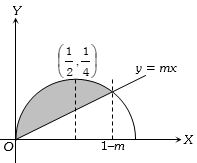
For which of the following values of $m$,the area of the region bounded by the curve $y = x - x^2$ and the line $y = mx$ equals $\frac{9}{2}$?
A
$-4$
B
$-2$
C
$2$
D
$4$
Solution
(B) The equation of the curve is $y = x - x^2$.
The points of intersection of the curve $y = x - x^2$ and the line $y = mx$ are found by setting $x - x^2 = mx$,which gives $x(1 - x - m) = 0$. Thus,$x = 0$ or $x = 1 - m$.
The area $A$ of the region bounded by the curve and the line is given by the integral:
$A = \int_{0}^{1-m} (x - x^2 - mx) dx = \int_{0}^{1-m} ((1 - m)x - x^2) dx$
Evaluating the integral:
$A = \left[ (1 - m)\frac{x^2}{2} - \frac{x^3}{3} \right]_{0}^{1-m}$
$A = (1 - m)\frac{(1 - m)^2}{2} - \frac{(1 - m)^3}{3} = \frac{(1 - m)^3}{2} - \frac{(1 - m)^3}{3} = \frac{(1 - m)^3}{6}$
Given that the area is $\frac{9}{2}$,we have:
$\frac{(1 - m)^3}{6} = \frac{9}{2}$
$(1 - m)^3 = 27$
$1 - m = 3$
$m = -2$
Thus,the correct value of $m$ is $-2$.
The points of intersection of the curve $y = x - x^2$ and the line $y = mx$ are found by setting $x - x^2 = mx$,which gives $x(1 - x - m) = 0$. Thus,$x = 0$ or $x = 1 - m$.
The area $A$ of the region bounded by the curve and the line is given by the integral:
$A = \int_{0}^{1-m} (x - x^2 - mx) dx = \int_{0}^{1-m} ((1 - m)x - x^2) dx$
Evaluating the integral:
$A = \left[ (1 - m)\frac{x^2}{2} - \frac{x^3}{3} \right]_{0}^{1-m}$
$A = (1 - m)\frac{(1 - m)^2}{2} - \frac{(1 - m)^3}{3} = \frac{(1 - m)^3}{2} - \frac{(1 - m)^3}{3} = \frac{(1 - m)^3}{6}$
Given that the area is $\frac{9}{2}$,we have:
$\frac{(1 - m)^3}{6} = \frac{9}{2}$
$(1 - m)^3 = 27$
$1 - m = 3$
$m = -2$
Thus,the correct value of $m$ is $-2$.
0 likesView Solution
29
MathematicsDifficultMCQIIT JEE · 1999
If for a real number $y$,$[y]$ is the greatest integer less than or equal to $y$,then the value of the integral $\int_{\pi /2}^{3\pi /2} [2\sin x] \, dx$ is
A
$-\pi$
B
$0$
C
$-\frac{\pi}{2}$
D
$\frac{\pi}{2}$
Solution
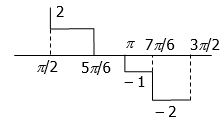
(C) We know that for $x \in [\pi/2, 3\pi/2]$,$\sin x$ ranges from $-1$ to $1$,so $2\sin x$ ranges from $-2$ to $2$.
We break the integral at points where $[2\sin x]$ changes its value:
$I = \int_{\pi/2}^{3\pi/2} [2\sin x] \, dx$
$= \int_{\pi/2}^{5\pi/6} [2\sin x] \, dx + \int_{5\pi/6}^{\pi} [2\sin x] \, dx + \int_{\pi}^{7\pi/6} [2\sin x] \, dx + \int_{7\pi/6}^{3\pi/2} [2\sin x] \, dx$
In the interval $[\pi/2, 5\pi/6]$,$1 \le 2\sin x < 2$,so $[2\sin x] = 1$.
In the interval $[5\pi/6, \pi]$,$0 \le 2\sin x < 1$,so $[2\sin x] = 0$.
In the interval $[\pi, 7\pi/6]$,$-1 \le 2\sin x < 0$,so $[2\sin x] = -1$.
In the interval $[7\pi/6, 3\pi/2]$,$-2 \le 2\sin x < -1$,so $[2\sin x] = -2$.
Substituting these values:
$I = \int_{\pi/2}^{5\pi/6} (1) \, dx + \int_{5\pi/6}^{\pi} (0) \, dx + \int_{\pi}^{7\pi/6} (-1) \, dx + \int_{7\pi/6}^{3\pi/2} (-2) \, dx$
$I = (5\pi/6 - \pi/2) + 0 - (7\pi/6 - \pi) - 2(3\pi/2 - 7\pi/6)$
$I = (2\pi/6) - (\pi/6) - 2(2\pi/6) = \pi/6 - 4\pi/6 = -3\pi/6 = -\pi/2$.
We break the integral at points where $[2\sin x]$ changes its value:
$I = \int_{\pi/2}^{3\pi/2} [2\sin x] \, dx$
$= \int_{\pi/2}^{5\pi/6} [2\sin x] \, dx + \int_{5\pi/6}^{\pi} [2\sin x] \, dx + \int_{\pi}^{7\pi/6} [2\sin x] \, dx + \int_{7\pi/6}^{3\pi/2} [2\sin x] \, dx$
In the interval $[\pi/2, 5\pi/6]$,$1 \le 2\sin x < 2$,so $[2\sin x] = 1$.
In the interval $[5\pi/6, \pi]$,$0 \le 2\sin x < 1$,so $[2\sin x] = 0$.
In the interval $[\pi, 7\pi/6]$,$-1 \le 2\sin x < 0$,so $[2\sin x] = -1$.
In the interval $[7\pi/6, 3\pi/2]$,$-2 \le 2\sin x < -1$,so $[2\sin x] = -2$.
Substituting these values:
$I = \int_{\pi/2}^{5\pi/6} (1) \, dx + \int_{5\pi/6}^{\pi} (0) \, dx + \int_{\pi}^{7\pi/6} (-1) \, dx + \int_{7\pi/6}^{3\pi/2} (-2) \, dx$
$I = (5\pi/6 - \pi/2) + 0 - (7\pi/6 - \pi) - 2(3\pi/2 - 7\pi/6)$
$I = (2\pi/6) - (\pi/6) - 2(2\pi/6) = \pi/6 - 4\pi/6 = -3\pi/6 = -\pi/2$.
0 likesView Solution
30
MathematicsMediumMCQIIT JEE · 1999
The differential equation representing the family of curves ${y^2} = 2c(x + \sqrt{c}),$ where $c$ is a positive parameter,is of
A
Order $1$
B
Order $2$
C
Degree $3$
D
Both $(a)$ and $(c)$
Solution
(D) Given curve is ${y^2} = 2c(x + \sqrt{c}).$
Differentiating with respect to $x$,we get $2y \frac{dy}{dx} = 2c$,which implies $c = y \frac{dy}{dx}.$
Substituting $c$ into the original equation:
${y^2} = 2 \left( y \frac{dy}{dx} \right) \left( x + \sqrt{y \frac{dy}{dx}} \right).$
Rearranging the terms:
$\frac{y}{2(dy/dx)} - x = \sqrt{y \frac{dy}{dx}}.$
Squaring both sides:
$\left( \frac{y}{2(dy/dx)} - x \right)^2 = y \frac{dy}{dx}.$
Multiplying by $4(dy/dx)^2$:
$(y - 2x(dy/dx))^2 = 4y(dy/dx)^3.$
Expanding the square:
${y^2} - 4xy \frac{dy}{dx} + 4{x^2} \left( \frac{dy}{dx} \right)^2 = 4y \left( \frac{dy}{dx} \right)^3.$
Rearranging into the standard form:
$4y \left( \frac{dy}{dx} \right)^3 - 4{x^2} \left( \frac{dy}{dx} \right)^2 + 4xy \frac{dy}{dx} - {y^2} = 0.$
The highest order derivative present is $\frac{dy}{dx}$,so the order is $1$. The highest power of the highest order derivative is $3$,so the degree is $3$.
Thus,the differential equation is of order $1$ and degree $3$.
Differentiating with respect to $x$,we get $2y \frac{dy}{dx} = 2c$,which implies $c = y \frac{dy}{dx}.$
Substituting $c$ into the original equation:
${y^2} = 2 \left( y \frac{dy}{dx} \right) \left( x + \sqrt{y \frac{dy}{dx}} \right).$
Rearranging the terms:
$\frac{y}{2(dy/dx)} - x = \sqrt{y \frac{dy}{dx}}.$
Squaring both sides:
$\left( \frac{y}{2(dy/dx)} - x \right)^2 = y \frac{dy}{dx}.$
Multiplying by $4(dy/dx)^2$:
$(y - 2x(dy/dx))^2 = 4y(dy/dx)^3.$
Expanding the square:
${y^2} - 4xy \frac{dy}{dx} + 4{x^2} \left( \frac{dy}{dx} \right)^2 = 4y \left( \frac{dy}{dx} \right)^3.$
Rearranging into the standard form:
$4y \left( \frac{dy}{dx} \right)^3 - 4{x^2} \left( \frac{dy}{dx} \right)^2 + 4xy \frac{dy}{dx} - {y^2} = 0.$
The highest order derivative present is $\frac{dy}{dx}$,so the order is $1$. The highest power of the highest order derivative is $3$,so the degree is $3$.
Thus,the differential equation is of order $1$ and degree $3$.
0 likesView Solution
31
MathematicsMediumMCQIIT JEE · 1999
$A$ solution of the differential equation ${\left( {\frac{{dy}}{{dx}}} \right)^2} - x\frac{{dy}}{{dx}} + y = 0$ is
A
$y = 2$
B
$y = 2x$
C
$y = 2x - 4$
D
$y = 2{x^2} - 4$
Solution
(C) The given differential equation is ${\left( {\frac{{dy}}{{dx}}} \right)^2} - x\frac{{dy}}{{dx}} + y = 0$.
This can be rewritten as $y = x\frac{{dy}}{{dx}} - {\left( {\frac{{dy}}{{dx}}} \right)^2}$.
Let $\frac{{dy}}{{dx}} = p$. Then the equation becomes $y = px - {p^2}$.
Differentiating both sides with respect to $x$,we get:
$\frac{{dy}}{{dx}} = p + x\frac{{dp}}{{dx}} - 2p\frac{{dp}}{{dx}}$.
Since $\frac{{dy}}{{dx}} = p$,we have $p = p + (x - 2p)\frac{{dp}}{{dx}}$.
This simplifies to $(x - 2p)\frac{{dp}}{{dx}} = 0$.
Case $1$: $\frac{{dp}}{{dx}} = 0$,which implies $p = c$ (a constant).
Substituting $p = c$ into $y = px - {p^2}$,we get the general solution $y = cx - {c^2}$.
For $c = 2$,we get $y = 2x - {2^2}$,which is $y = 2x - 4$.
Thus,$y = 2x - 4$ is a solution.
This can be rewritten as $y = x\frac{{dy}}{{dx}} - {\left( {\frac{{dy}}{{dx}}} \right)^2}$.
Let $\frac{{dy}}{{dx}} = p$. Then the equation becomes $y = px - {p^2}$.
Differentiating both sides with respect to $x$,we get:
$\frac{{dy}}{{dx}} = p + x\frac{{dp}}{{dx}} - 2p\frac{{dp}}{{dx}}$.
Since $\frac{{dy}}{{dx}} = p$,we have $p = p + (x - 2p)\frac{{dp}}{{dx}}$.
This simplifies to $(x - 2p)\frac{{dp}}{{dx}} = 0$.
Case $1$: $\frac{{dp}}{{dx}} = 0$,which implies $p = c$ (a constant).
Substituting $p = c$ into $y = px - {p^2}$,we get the general solution $y = cx - {c^2}$.
For $c = 2$,we get $y = 2x - {2^2}$,which is $y = 2x - 4$.
Thus,$y = 2x - 4$ is a solution.
0 likesView Solution
32
MathematicsDifficultMCQIIT JEE · 1999
If the integers $m$ and $n$ are chosen at random between $1$ and $100$,then the probability that a number of the form $7^m + 7^n$ is divisible by $5$ equals
A
$\frac{1}{4}$
B
$\frac{1}{7}$
C
$\frac{1}{8}$
D
$\frac{1}{49}$
Solution
(A) The last digit of $7^k$ follows a cycle of length $4$: $7^1=7, 7^2=9, 7^3=3, 7^4=1, 7^5=7, \dots$
For $7^m + 7^n$ to be divisible by $5$,the last digit of the sum must be $0$ or $5$.
Since the last digits of powers of $7$ are ${1, 3, 7, 9}$,the possible sums of last digits are:
$1+1=2, 1+3=4, 1+7=8, 1+9=10$ (divisible by $5$)
$3+1=4, 3+3=6, 3+7=10$ (divisible by $5$),$3+9=12$
$7+1=8, 7+3=10$ (divisible by $5$),$7+7=14, 7+9=16$
$9+1=10$ (divisible by $5$),$9+3=12, 9+7=16, 9+9=18$
In each cycle of $4$ for $m$ and $n$,there are $4 \times 4 = 16$ pairs. The pairs $(m, n) \pmod 4$ that result in a sum divisible by $5$ are $(1, 3), (3, 1), (2, 4), (4, 2)$.
There are $4$ such pairs out of $16$ total possibilities in each $4 \times 4$ block.
Since $100$ is a multiple of $4$,the probability is $\frac{4}{16} = \frac{1}{4}$.
For $7^m + 7^n$ to be divisible by $5$,the last digit of the sum must be $0$ or $5$.
Since the last digits of powers of $7$ are ${1, 3, 7, 9}$,the possible sums of last digits are:
$1+1=2, 1+3=4, 1+7=8, 1+9=10$ (divisible by $5$)
$3+1=4, 3+3=6, 3+7=10$ (divisible by $5$),$3+9=12$
$7+1=8, 7+3=10$ (divisible by $5$),$7+7=14, 7+9=16$
$9+1=10$ (divisible by $5$),$9+3=12, 9+7=16, 9+9=18$
In each cycle of $4$ for $m$ and $n$,there are $4 \times 4 = 16$ pairs. The pairs $(m, n) \pmod 4$ that result in a sum divisible by $5$ are $(1, 3), (3, 1), (2, 4), (4, 2)$.
There are $4$ such pairs out of $16$ total possibilities in each $4 \times 4$ block.
Since $100$ is a multiple of $4$,the probability is $\frac{4}{16} = \frac{1}{4}$.
0 likesView Solution
33
MathematicsDifficultMCQIIT JEE · 1999
If $f(x) = \left| \begin{array}{ccc} 1 & x & x + 1 \\ 2x & x(x - 1) & (x + 1)x \\ 3x(x - 1) & x(x - 1)(x - 2) & (x + 1)x(x - 1) \end{array} \right|$,then $f(100)$ is equal to
A
$0$
B
$1$
C
$100$
D
$-100$
Solution
(A) Given determinant is $f(x) = \left| \begin{array}{ccc} 1 & x & x + 1 \\ 2x & x(x - 1) & (x + 1)x \\ 3x(x - 1) & x(x - 1)(x - 2) & (x + 1)x(x - 1) \end{array} \right|$.
Taking $x$ common from $C_2$ and $(x+1)$ common from $C_3$ is not directly possible,but we can factor out $x$ from the second column and $x(x+1)$ from the third row.
Alternatively,observe the columns. Notice that $C_3 = C_2 + C_1$ is not immediately obvious,but let's simplify by taking common factors:
$f(x) = x(x-1) \cdot x \cdot \left| \begin{array}{ccc} 1 & 1 & x+1 \\ 2x & x-1 & x(x+1) \\ 3x(x-1) & (x-2) & (x+1)x \end{array} \right|$.
Actually,a simpler way is to notice that for any $x$,the rows are linearly dependent. Let $R_3 = R_3 - (x-2)R_2$.
Performing row operations or expanding the determinant shows that the expression simplifies to $0$ for all $x$.
Specifically,$f(x) = 0$ for all $x \in \mathbb{R}$.
Therefore,$f(100) = 0$.
Taking $x$ common from $C_2$ and $(x+1)$ common from $C_3$ is not directly possible,but we can factor out $x$ from the second column and $x(x+1)$ from the third row.
Alternatively,observe the columns. Notice that $C_3 = C_2 + C_1$ is not immediately obvious,but let's simplify by taking common factors:
$f(x) = x(x-1) \cdot x \cdot \left| \begin{array}{ccc} 1 & 1 & x+1 \\ 2x & x-1 & x(x+1) \\ 3x(x-1) & (x-2) & (x+1)x \end{array} \right|$.
Actually,a simpler way is to notice that for any $x$,the rows are linearly dependent. Let $R_3 = R_3 - (x-2)R_2$.
Performing row operations or expanding the determinant shows that the expression simplifies to $0$ for all $x$.
Specifically,$f(x) = 0$ for all $x \in \mathbb{R}$.
Therefore,$f(100) = 0$.
0 likesView Solution
Vedclass Products
For Students
Vedclass Test Series
Mock tests in real IIT JEE style covering Mathematics with performance analysis. 5-day free trial.
Start Free TrialFor Teachers
Exam Paper Generator
Generate Set A/B/C/D Mathematics papers from 7.5L+ questions in 2 minutes. 3 chapters free.
Try FreeFor Institutes
Online Exam Module
Run live IIT JEE mock exams with unlimited students, 360° analytics & white-label branding.
See DemoFrequently Asked Questions
How many Mathematics questions are in IIT JEE 1999?
There are 33 Mathematics questions from the IIT JEE 1999 paper on Vedclass, each with a detailed step-by-step solution in English.
Are IIT JEE 1999 Mathematics solutions available in English?
Yes. All solutions on this page are in English. You can also switch to English or Hindi using the language buttons above the questions.
Can I practice IIT JEE 1999 Mathematics as a timed test?
Yes. Use the Vedclass Test Series to attempt a full IIT JEE mock test covering Mathematics with time limits and instant score analysis.
Can teachers create Mathematics papers from IIT JEE previous year questions?
Yes. The Vedclass Exam Paper Generator lets teachers mix IIT JEE Mathematics questions and generate Set A/B/C/D papers in minutes.
For Teachers & Institutes
Build a Custom Mathematics Paper
Pick IIT JEE 1999 Mathematics questions, set difficulty, and generate Set A/B/C/D in 2 minutes.