
MathematicsQ1–28 of 28 questions
Page 1 of 1 · English
1
MathematicsEasyMCQIIT JEE · 1992
The partial fractions of $\frac{x^2}{(x - 1)^3(x - 2)}$ are
A
$\frac{-1}{(x - 1)^3} + \frac{3}{(x - 1)^2} - \frac{4}{(x - 1)} + \frac{4}{(x - 2)}$
B
$\frac{-1}{(x - 1)^3} - \frac{3}{(x - 1)^2} + \frac{4}{(x - 1)} + \frac{4}{(x - 2)}$
C
$\frac{-1}{(x - 1)^3} + \frac{-3}{(x - 1)^2} + \frac{-4}{(x - 1)} + \frac{4}{(x - 2)}$
D
None of these
Solution
(C) Let $x - 1 = y$,so $x = y + 1$.
Then,$\frac{x^2}{(x - 1)^3(x - 2)} = \frac{(1 + y)^2}{y^3(y - 1)} = \frac{1 + 2y + y^2}{y^3(y - 1)} = -\frac{1 + 2y + y^2}{y^3(1 - y)}$.
Dividing $(1 + 2y + y^2)$ by $(y - 1)$ gives $(y^2 + 2y + 1) = (y - 1)(y + 3) + 4$.
Thus,$\frac{y^2 + 2y + 1}{y^3(y - 1)} = \frac{(y - 1)(y + 3) + 4}{y^3(y - 1)} = \frac{y + 3}{y^3} + \frac{4}{y^3(y - 1)}$.
Using partial fractions for $\frac{4}{y^3(y - 1)} = \frac{A}{y} + \frac{B}{y^2} + \frac{C}{y^3} + \frac{D}{y - 1}$,we find $D = 4$,$C = -4$,$B = -4$,$A = -4$.
Substituting back,the expression becomes $\frac{-1}{(x - 1)^3} + \frac{-3}{(x - 1)^2} + \frac{-4}{(x - 1)} + \frac{4}{(x - 2)}$.
Then,$\frac{x^2}{(x - 1)^3(x - 2)} = \frac{(1 + y)^2}{y^3(y - 1)} = \frac{1 + 2y + y^2}{y^3(y - 1)} = -\frac{1 + 2y + y^2}{y^3(1 - y)}$.
Dividing $(1 + 2y + y^2)$ by $(y - 1)$ gives $(y^2 + 2y + 1) = (y - 1)(y + 3) + 4$.
Thus,$\frac{y^2 + 2y + 1}{y^3(y - 1)} = \frac{(y - 1)(y + 3) + 4}{y^3(y - 1)} = \frac{y + 3}{y^3} + \frac{4}{y^3(y - 1)}$.
Using partial fractions for $\frac{4}{y^3(y - 1)} = \frac{A}{y} + \frac{B}{y^2} + \frac{C}{y^3} + \frac{D}{y - 1}$,we find $D = 4$,$C = -4$,$B = -4$,$A = -4$.
Substituting back,the expression becomes $\frac{-1}{(x - 1)^3} + \frac{-3}{(x - 1)^2} + \frac{-4}{(x - 1)} + \frac{4}{(x - 2)}$.
0 likesView Solution
2
MathematicsDifficultMCQIIT JEE · 1992
If the ratio of $H.M.$ and $G.M.$ between two numbers $a$ and $b$ is $4:5$,then the ratio of the two numbers will be
A
$1:2$
B
$1:4$
C
$4:1$
D
$1:4$ and $4:1$
Solution
(D) We have $H.M. = \frac{2ab}{a + b}$ and $G.M. = \sqrt{ab}$.
Given $\frac{H.M.}{G.M.} = \frac{4}{5}$.
$\Rightarrow \frac{2ab/(a + b)}{\sqrt{ab}} = \frac{4}{5}$ $\Rightarrow \frac{2\sqrt{ab}}{a + b} = \frac{4}{5}$.
$\Rightarrow \frac{a + b}{2\sqrt{ab}} = \frac{5}{4}$.
Applying componendo and dividendo:
$\frac{a + b + 2\sqrt{ab}}{a + b - 2\sqrt{ab}} = \frac{5 + 4}{5 - 4}$ $\Rightarrow \frac{(\sqrt{a} + \sqrt{b})^2}{(\sqrt{a} - \sqrt{b})^2} = \frac{9}{1}$.
Taking square root on both sides:
$\frac{\sqrt{a} + \sqrt{b}}{\sqrt{a} - \sqrt{b}} = \frac{3}{1}$.
Applying componendo and dividendo again:
$\frac{(\sqrt{a} + \sqrt{b}) + (\sqrt{a} - \sqrt{b})}{(\sqrt{a} + \sqrt{b}) - (\sqrt{a} - \sqrt{b})} = \frac{3 + 1}{3 - 1}$ $\Rightarrow \frac{2\sqrt{a}}{2\sqrt{b}} = \frac{4}{2} = 2$.
Squaring both sides:
$\frac{a}{b} = 2^2 = 4$.
Thus,$a:b = 4:1$ or $b:a = 1:4$.
Given $\frac{H.M.}{G.M.} = \frac{4}{5}$.
$\Rightarrow \frac{2ab/(a + b)}{\sqrt{ab}} = \frac{4}{5}$ $\Rightarrow \frac{2\sqrt{ab}}{a + b} = \frac{4}{5}$.
$\Rightarrow \frac{a + b}{2\sqrt{ab}} = \frac{5}{4}$.
Applying componendo and dividendo:
$\frac{a + b + 2\sqrt{ab}}{a + b - 2\sqrt{ab}} = \frac{5 + 4}{5 - 4}$ $\Rightarrow \frac{(\sqrt{a} + \sqrt{b})^2}{(\sqrt{a} - \sqrt{b})^2} = \frac{9}{1}$.
Taking square root on both sides:
$\frac{\sqrt{a} + \sqrt{b}}{\sqrt{a} - \sqrt{b}} = \frac{3}{1}$.
Applying componendo and dividendo again:
$\frac{(\sqrt{a} + \sqrt{b}) + (\sqrt{a} - \sqrt{b})}{(\sqrt{a} + \sqrt{b}) - (\sqrt{a} - \sqrt{b})} = \frac{3 + 1}{3 - 1}$ $\Rightarrow \frac{2\sqrt{a}}{2\sqrt{b}} = \frac{4}{2} = 2$.
Squaring both sides:
$\frac{a}{b} = 2^2 = 4$.
Thus,$a:b = 4:1$ or $b:a = 1:4$.
0 likesView Solution
3
MathematicsEasyMCQIIT JEE · 1992
If $\alpha, \beta$ are the roots of $(x - a)(x - b) = c$,where $c \neq 0$,then the roots of $(x - \alpha)(x - \beta) + c = 0$ are
A
$a, c$
B
$b, c$
C
$a, b$
D
$a + c, b + c$
Solution
(C) Given that $\alpha$ and $\beta$ are the roots of $(x - a)(x - b) - c = 0$.
Expanding this,we get $x^2 - (a + b)x + ab - c = 0$.
Comparing this with the standard quadratic equation $x^2 - (\alpha + \beta)x + \alpha\beta = 0$,we have:
$\alpha + \beta = a + b$ and $\alpha\beta = ab - c$.
Now,consider the equation $(x - \alpha)(x - \beta) + c = 0$.
Expanding this,we get $x^2 - (\alpha + \beta)x + \alpha\beta + c = 0$.
Substituting the values of $(\alpha + \beta)$ and $\alpha\beta$ into this equation:
$x^2 - (a + b)x + (ab - c) + c = 0$
$x^2 - (a + b)x + ab = 0$
$(x - a)(x - b) = 0$.
Thus,the roots of the equation are $a$ and $b$.
Expanding this,we get $x^2 - (a + b)x + ab - c = 0$.
Comparing this with the standard quadratic equation $x^2 - (\alpha + \beta)x + \alpha\beta = 0$,we have:
$\alpha + \beta = a + b$ and $\alpha\beta = ab - c$.
Now,consider the equation $(x - \alpha)(x - \beta) + c = 0$.
Expanding this,we get $x^2 - (\alpha + \beta)x + \alpha\beta + c = 0$.
Substituting the values of $(\alpha + \beta)$ and $\alpha\beta$ into this equation:
$x^2 - (a + b)x + (ab - c) + c = 0$
$x^2 - (a + b)x + ab = 0$
$(x - a)(x - b) = 0$.
Thus,the roots of the equation are $a$ and $b$.
0 likesView Solution
4
MathematicsDifficultMCQIIT JEE · 1992
There are four balls of different colours and four boxes of colours same as those of the balls. The number of ways in which the balls,one in each box,could be placed such that a ball does not go to the box of its own colour is
A
$8$
B
$7$
C
$9$
D
None of these
Solution
(C) This is a problem of derangements where $n = 4$ items are to be placed in $n$ boxes such that no item goes into its correct box.
The number of derangements $D_n$ is given by the formula:
$D_n = n! \left( 1 - \frac{1}{1!} + \frac{1}{2!} - \frac{1}{3!} + \dots + \frac{(-1)^n}{n!} \right)$
For $n = 4$:
$D_4 = 4! \left( \frac{1}{2!} - \frac{1}{3!} + \frac{1}{4!} \right)$
$D_4 = 24 \left( \frac{1}{2} - \frac{1}{6} + \frac{1}{24} \right)$
$D_4 = 12 - 4 + 1 = 9$.
Thus,there are $9$ ways.
The number of derangements $D_n$ is given by the formula:
$D_n = n! \left( 1 - \frac{1}{1!} + \frac{1}{2!} - \frac{1}{3!} + \dots + \frac{(-1)^n}{n!} \right)$
For $n = 4$:
$D_4 = 4! \left( \frac{1}{2!} - \frac{1}{3!} + \frac{1}{4!} \right)$
$D_4 = 24 \left( \frac{1}{2} - \frac{1}{6} + \frac{1}{24} \right)$
$D_4 = 12 - 4 + 1 = 9$.
Thus,there are $9$ ways.
0 likesView Solution
5
MathematicsEasyMCQIIT JEE · 1992
The maximum value of $\sin \left( x + \frac{\pi}{6} \right) + \cos \left( x + \frac{\pi}{6} \right)$ in the interval $\left( 0, \frac{\pi}{2} \right)$ is attained at
A
$x = \frac{\pi}{12}$
B
$x = \frac{\pi}{6}$
C
$x = \frac{\pi}{3}$
D
$x = \frac{\pi}{2}$
Solution
(A) Let $f(x) = \sin \left( x + \frac{\pi}{6} \right) + \cos \left( x + \frac{\pi}{6} \right)$.
We can rewrite this as $f(x) = \sqrt{2} \left( \frac{1}{\sqrt{2}} \sin \left( x + \frac{\pi}{6} \right) + \frac{1}{\sqrt{2}} \cos \left( x + \frac{\pi}{6} \right) \right)$.
Using the identity $\sin(A+B) = \sin A \cos B + \cos A \sin B$,we get $f(x) = \sqrt{2} \sin \left( x + \frac{\pi}{6} + \frac{\pi}{4} \right) = \sqrt{2} \sin \left( x + \frac{5\pi}{12} \right)$.
The maximum value of $\sin \theta$ is $1$,which occurs when $\theta = \frac{\pi}{2}$.
Setting $x + \frac{5\pi}{12} = \frac{\pi}{2}$,we get $x = \frac{\pi}{2} - \frac{5\pi}{12} = \frac{6\pi - 5\pi}{12} = \frac{\pi}{12}$.
Since $\frac{\pi}{12}$ lies in the interval $\left( 0, \frac{\pi}{2} \right)$,the maximum value is attained at $x = \frac{\pi}{12}$.
We can rewrite this as $f(x) = \sqrt{2} \left( \frac{1}{\sqrt{2}} \sin \left( x + \frac{\pi}{6} \right) + \frac{1}{\sqrt{2}} \cos \left( x + \frac{\pi}{6} \right) \right)$.
Using the identity $\sin(A+B) = \sin A \cos B + \cos A \sin B$,we get $f(x) = \sqrt{2} \sin \left( x + \frac{\pi}{6} + \frac{\pi}{4} \right) = \sqrt{2} \sin \left( x + \frac{5\pi}{12} \right)$.
The maximum value of $\sin \theta$ is $1$,which occurs when $\theta = \frac{\pi}{2}$.
Setting $x + \frac{5\pi}{12} = \frac{\pi}{2}$,we get $x = \frac{\pi}{2} - \frac{5\pi}{12} = \frac{6\pi - 5\pi}{12} = \frac{\pi}{12}$.
Since $\frac{\pi}{12}$ lies in the interval $\left( 0, \frac{\pi}{2} \right)$,the maximum value is attained at $x = \frac{\pi}{12}$.
0 likesView Solution
6
MathematicsDifficultMCQIIT JEE · 1992
The value of $\frac{\tan x}{\tan 3x}$,whenever defined,never lies between
A
$1/3$ and $3$
B
$1/4$ and $4$
C
$1/5$ and $5$
D
$5$ and $6$
Solution
(A) Let $y = \frac{\tan x}{\tan 3x}$.
Using the formula $\tan 3x = \frac{3\tan x - \tan^3 x}{1 - 3\tan^2 x}$,we get:
$y = \frac{\tan x}{\frac{3\tan x - \tan^3 x}{1 - 3\tan^2 x}} = \frac{1 - 3\tan^2 x}{3 - \tan^2 x}$.
Let $t = \tan^2 x$,where $t \ge 0$. Then $y = \frac{1 - 3t}{3 - t}$.
To find the range,let $y = \frac{3(1 - 3t)}{3(3 - t)} = \frac{3 - 9t}{3(3 - t)} = \frac{(3 - t) - 8t}{3(3 - t)} = \frac{1}{3} - \frac{8t}{3(3 - t)}$.
Alternatively,solving for $t$: $y(3 - t) = 1 - 3t \implies 3y - yt = 1 - 3t \implies t(3 - y) = 1 - 3y \implies t = \frac{1 - 3y}{3 - y}$.
Since $t = \tan^2 x \ge 0$,we have $\frac{1 - 3y}{3 - y} \ge 0$.
This inequality holds when $y \in [1/3, 3)$.
Thus,the value of $y$ never lies in the interval $(1/3, 3)$.
Using the formula $\tan 3x = \frac{3\tan x - \tan^3 x}{1 - 3\tan^2 x}$,we get:
$y = \frac{\tan x}{\frac{3\tan x - \tan^3 x}{1 - 3\tan^2 x}} = \frac{1 - 3\tan^2 x}{3 - \tan^2 x}$.
Let $t = \tan^2 x$,where $t \ge 0$. Then $y = \frac{1 - 3t}{3 - t}$.
To find the range,let $y = \frac{3(1 - 3t)}{3(3 - t)} = \frac{3 - 9t}{3(3 - t)} = \frac{(3 - t) - 8t}{3(3 - t)} = \frac{1}{3} - \frac{8t}{3(3 - t)}$.
Alternatively,solving for $t$: $y(3 - t) = 1 - 3t \implies 3y - yt = 1 - 3t \implies t(3 - y) = 1 - 3y \implies t = \frac{1 - 3y}{3 - y}$.
Since $t = \tan^2 x \ge 0$,we have $\frac{1 - 3y}{3 - y} \ge 0$.
This inequality holds when $y \in [1/3, 3)$.
Thus,the value of $y$ never lies in the interval $(1/3, 3)$.
0 likesView Solution
7
MathematicsEasyMCQIIT JEE · 1992
The solution of the equation $\cos^2 \theta + \sin \theta + 1 = 0$ lies in the interval
A
$\left( -\frac{\pi}{4}, \frac{\pi}{4} \right)$
B
$\left( \frac{\pi}{4}, \frac{3\pi}{4} \right)$
C
$\left( \frac{3\pi}{4}, \frac{5\pi}{4} \right)$
D
$\left( \frac{5\pi}{4}, \frac{7\pi}{4} \right)$
Solution
(D) Given equation: $\cos^2 \theta + \sin \theta + 1 = 0$
Using the identity $\cos^2 \theta = 1 - \sin^2 \theta$,we get:
$1 - \sin^2 \theta + \sin \theta + 1 = 0$
$-\sin^2 \theta + \sin \theta + 2 = 0$
Multiplying by $-1$:
$\sin^2 \theta - \sin \theta - 2 = 0$
Factoring the quadratic equation:
$(\sin \theta - 2)(\sin \theta + 1) = 0$
This gives $\sin \theta = 2$ or $\sin \theta = -1$.
Since the range of $\sin \theta$ is $[-1, 1]$,$\sin \theta = 2$ is impossible.
Thus,$\sin \theta = -1$.
The general solution is $\theta = 2n\pi - \frac{\pi}{2}$.
For $n=1$,$\theta = 2\pi - \frac{\pi}{2} = \frac{3\pi}{2}$.
Since $\frac{5\pi}{4} < \frac{3\pi}{2} < \frac{7\pi}{4}$,the solution lies in the interval $\left( \frac{5\pi}{4}, \frac{7\pi}{4} \right)$.
Using the identity $\cos^2 \theta = 1 - \sin^2 \theta$,we get:
$1 - \sin^2 \theta + \sin \theta + 1 = 0$
$-\sin^2 \theta + \sin \theta + 2 = 0$
Multiplying by $-1$:
$\sin^2 \theta - \sin \theta - 2 = 0$
Factoring the quadratic equation:
$(\sin \theta - 2)(\sin \theta + 1) = 0$
This gives $\sin \theta = 2$ or $\sin \theta = -1$.
Since the range of $\sin \theta$ is $[-1, 1]$,$\sin \theta = 2$ is impossible.
Thus,$\sin \theta = -1$.
The general solution is $\theta = 2n\pi - \frac{\pi}{2}$.
For $n=1$,$\theta = 2\pi - \frac{\pi}{2} = \frac{3\pi}{2}$.
Since $\frac{5\pi}{4} < \frac{3\pi}{2} < \frac{7\pi}{4}$,the solution lies in the interval $\left( \frac{5\pi}{4}, \frac{7\pi}{4} \right)$.
0 likesView Solution
8
MathematicsEasyMCQIIT JEE · 1992
The number of solutions of the equation $2 \cos(e^x) = 5^x + 5^{-x}$ is:
A
No solution
B
One solution
C
Two solutions
D
Infinitely many solutions
Solution
(A) We know that for any real $x$,by the $A.M. \ge G.M.$ inequality,$\frac{5^x + 5^{-x}}{2} \ge \sqrt{5^x \cdot 5^{-x}} = 1$.
This implies $5^x + 5^{-x} \ge 2$.
Also,we know that the range of the cosine function is $[-1, 1]$,so $\cos(e^x) \le 1$.
This implies $2 \cos(e^x) \le 2$.
For the equation $2 \cos(e^x) = 5^x + 5^{-x}$ to hold,both sides must be equal to $2$.
This requires $5^x + 5^{-x} = 2$,which occurs only at $x = 0$.
Substituting $x = 0$ into the left side,we get $2 \cos(e^0) = 2 \cos(1)$.
Since $\cos(1) \approx 0.54$,$2 \cos(1) \approx 1.08 \neq 2$.
Therefore,there is no value of $x$ that satisfies the equation.
This implies $5^x + 5^{-x} \ge 2$.
Also,we know that the range of the cosine function is $[-1, 1]$,so $\cos(e^x) \le 1$.
This implies $2 \cos(e^x) \le 2$.
For the equation $2 \cos(e^x) = 5^x + 5^{-x}$ to hold,both sides must be equal to $2$.
This requires $5^x + 5^{-x} = 2$,which occurs only at $x = 0$.
Substituting $x = 0$ into the left side,we get $2 \cos(e^0) = 2 \cos(1)$.
Since $\cos(1) \approx 0.54$,$2 \cos(1) \approx 1.08 \neq 2$.
Therefore,there is no value of $x$ that satisfies the equation.
0 likesView Solution
9
MathematicsDifficultMCQIIT JEE · 1992
The perimeter of a $\Delta ABC$ is $6$ times the arithmetic mean of the sines of its angles. If the side $a$ is $1$,then the angle $A$ is
A
$\frac{\pi}{6}$
B
$\frac{\pi}{3}$
C
$\frac{\pi}{2}$
D
$\pi$
Solution
(A) The perimeter of $\Delta ABC$ is $a + b + c$. The arithmetic mean of the sines of its angles is $\frac{\sin A + \sin B + \sin C}{3}$.
Given: $a + b + c = 6 \times \frac{\sin A + \sin B + \sin C}{3} = 2(\sin A + \sin B + \sin C)$.
Using the Sine Rule,$a = k \sin A$,$b = k \sin B$,and $c = k \sin C$,where $k = 2R$ (the diameter of the circumcircle).
Substituting these into the equation: $k(\sin A + \sin B + \sin C) = 2(\sin A + \sin B + \sin C)$.
Since $\sin A + \sin B + \sin C \neq 0$ for a triangle,we have $k = 2$.
Given $a = 1$,we use $a = k \sin A$:
$1 = 2 \sin A \implies \sin A = \frac{1}{2}$.
Since $A$ is an angle of a triangle,$A = \frac{\pi}{6}$ or $A = \frac{5\pi}{6}$. Given the options,$A = \frac{\pi}{6}$.
Given: $a + b + c = 6 \times \frac{\sin A + \sin B + \sin C}{3} = 2(\sin A + \sin B + \sin C)$.
Using the Sine Rule,$a = k \sin A$,$b = k \sin B$,and $c = k \sin C$,where $k = 2R$ (the diameter of the circumcircle).
Substituting these into the equation: $k(\sin A + \sin B + \sin C) = 2(\sin A + \sin B + \sin C)$.
Since $\sin A + \sin B + \sin C \neq 0$ for a triangle,we have $k = 2$.
Given $a = 1$,we use $a = k \sin A$:
$1 = 2 \sin A \implies \sin A = \frac{1}{2}$.
Since $A$ is an angle of a triangle,$A = \frac{\pi}{6}$ or $A = \frac{5\pi}{6}$. Given the options,$A = \frac{\pi}{6}$.
0 likesView Solution
10
MathematicsDifficultMCQIIT JEE · 1992
If the radius of the circumcircle of an isosceles triangle $PQR$ is equal to $PQ$ (where $PQ = PR$),then the angle $P$ is
A
$\frac{\pi}{6}$
B
$\frac{\pi}{3}$
C
$\frac{\pi}{2}$
D
$\frac{2\pi}{3}$
Solution
(D) Let $R$ be the circumradius of $\Delta PQR$. Given $R = PQ = PR$.
By the sine rule,$R = \frac{PQ}{2 \sin R} = \frac{PR}{2 \sin Q} = \frac{QR}{2 \sin P}$.
Since $R = PQ$,we have $PQ = \frac{PQ}{2 \sin R}$,which implies $\sin R = \frac{1}{2}$.
Thus,$\angle R = \frac{\pi}{6}$.
Since $PQ = PR$,the triangle is isosceles,so $\angle Q = \angle R = \frac{\pi}{6}$.
The sum of angles in a triangle is $\pi$. Therefore,$\angle P = \pi - (\angle Q + \angle R) = \pi - (\frac{\pi}{6} + \frac{\pi}{6}) = \pi - \frac{\pi}{3} = \frac{2\pi}{3}$.
By the sine rule,$R = \frac{PQ}{2 \sin R} = \frac{PR}{2 \sin Q} = \frac{QR}{2 \sin P}$.
Since $R = PQ$,we have $PQ = \frac{PQ}{2 \sin R}$,which implies $\sin R = \frac{1}{2}$.
Thus,$\angle R = \frac{\pi}{6}$.
Since $PQ = PR$,the triangle is isosceles,so $\angle Q = \angle R = \frac{\pi}{6}$.
The sum of angles in a triangle is $\pi$. Therefore,$\angle P = \pi - (\angle Q + \angle R) = \pi - (\frac{\pi}{6} + \frac{\pi}{6}) = \pi - \frac{\pi}{3} = \frac{2\pi}{3}$.
0 likesView Solution
11
MathematicsEasyMCQIIT JEE · 1992
$A$ line passes through $(2, 2)$ and is perpendicular to the line $3x + y = 3$. Its $y$-intercept is
A
$1/3$
B
$2/3$
C
$1$
D
$4/3$
Solution
(D) The given line is $3x + y = 3$,which can be written as $y = -3x + 3$. The slope of this line is $m_1 = -3$.
The slope of a line perpendicular to this line is $m_2 = -1/m_1 = -1/(-3) = 1/3$.
The equation of the line passing through $(2, 2)$ with slope $m_2 = 1/3$ is given by $y - y_1 = m_2(x - x_1)$.
Substituting the values,we get $y - 2 = \frac{1}{3}(x - 2)$.
Multiplying by $3$,we get $3y - 6 = x - 2$,which simplifies to $x - 3y + 4 = 0$.
To find the $y$-intercept,we set $x = 0$ in the equation: $0 - 3y + 4 = 0$,which gives $3y = 4$ or $y = 4/3$.
Thus,the $y$-intercept is $4/3$.
The slope of a line perpendicular to this line is $m_2 = -1/m_1 = -1/(-3) = 1/3$.
The equation of the line passing through $(2, 2)$ with slope $m_2 = 1/3$ is given by $y - y_1 = m_2(x - x_1)$.
Substituting the values,we get $y - 2 = \frac{1}{3}(x - 2)$.
Multiplying by $3$,we get $3y - 6 = x - 2$,which simplifies to $x - 3y + 4 = 0$.
To find the $y$-intercept,we set $x = 0$ in the equation: $0 - 3y + 4 = 0$,which gives $3y = 4$ or $y = 4/3$.
Thus,the $y$-intercept is $4/3$.
0 likesView Solution
12
MathematicsMediumMCQIIT JEE · 1992
If the sum of the distances of a point from two perpendicular lines in a plane is $1$,then its locus is
A
Square
B
Circle
C
Straight line
D
Two intersecting lines
Solution
(A) Let the two perpendicular lines be the coordinate axes,$X$-axis and $Y$-axis. Let the point be $P(x, y)$.
The distance of point $P$ from the $X$-axis is $|y|$ and from the $Y$-axis is $|x|$.
According to the problem,the sum of these distances is $1$,so $|x| + |y| = 1$.
If the point lies in the first quadrant,$x > 0$ and $y > 0$,so $x + y = 1$.
If the point lies in the second quadrant,$x < 0$ and $y > 0$,so $-x + y = 1$.
If the point lies in the third quadrant,$x < 0$ and $y < 0$,so $-x - y = 1$.
If the point lies in the fourth quadrant,$x > 0$ and $y < 0$,so $x - y = 1$.
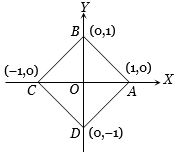
These four equations represent the sides of a square with vertices at $(1, 0), (0, 1), (-1, 0),$ and $(0, -1)$.
Thus,the locus is a square.
The distance of point $P$ from the $X$-axis is $|y|$ and from the $Y$-axis is $|x|$.
According to the problem,the sum of these distances is $1$,so $|x| + |y| = 1$.
If the point lies in the first quadrant,$x > 0$ and $y > 0$,so $x + y = 1$.
If the point lies in the second quadrant,$x < 0$ and $y > 0$,so $-x + y = 1$.
If the point lies in the third quadrant,$x < 0$ and $y < 0$,so $-x - y = 1$.
If the point lies in the fourth quadrant,$x > 0$ and $y < 0$,so $x - y = 1$.
These four equations represent the sides of a square with vertices at $(1, 0), (0, 1), (-1, 0),$ and $(0, -1)$.
Thus,the locus is a square.
0 likesView Solution
13
MathematicsDifficultMCQIIT JEE · 1992
$A$ circle passes through $(0, 0)$ and $(1, 0)$ and touches the circle ${x^2} + {y^2} = 9$. Find the centre of the circle.
A
$\left( \frac{3}{2}, \frac{1}{2} \right)$
B
$\left( \frac{1}{2}, \frac{3}{2} \right)$
C
$\left( \frac{1}{2}, \frac{1}{2} \right)$
D
$\left( \frac{1}{2}, \pm \sqrt{2} \right)$
Solution
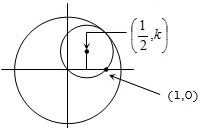
(D) Let the centre of the circle be $(h, k)$. Since the circle passes through $(0, 0)$ and $(1, 0)$,the perpendicular bisector of the chord joining $(0, 0)$ and $(1, 0)$ must contain the centre. The midpoint is $(1/2, 0)$ and the line is $x = 1/2$. Thus,$h = 1/2$.
Since the circle passes through $(0, 0)$,its radius $r$ is the distance from $(1/2, k)$ to $(0, 0)$,so $r^2 = (1/2)^2 + k^2 = 1/4 + k^2$.
The circle touches $x^2 + y^2 = 9$,which has centre $(0, 0)$ and radius $R = 3$. The distance between the centres is $\sqrt{(1/2)^2 + k^2} = \sqrt{1/4 + k^2} = r$.
For the circles to touch,the distance between centres must be $|R \pm r|$. Here,the distance between centres is $r$,so $r = |3 \pm r|$.
Case $1$: $r = 3 - r$ $\Rightarrow 2r = 3$ $\Rightarrow r = 3/2$.
Then $r^2 = 9/4$,so $1/4 + k^2 = 9/4$ $\Rightarrow k^2 = 8/4 = 2$ $\Rightarrow k = \pm \sqrt{2}$.
Thus,the centre is $\left( \frac{1}{2}, \pm \sqrt{2} \right)$.
Since the circle passes through $(0, 0)$,its radius $r$ is the distance from $(1/2, k)$ to $(0, 0)$,so $r^2 = (1/2)^2 + k^2 = 1/4 + k^2$.
The circle touches $x^2 + y^2 = 9$,which has centre $(0, 0)$ and radius $R = 3$. The distance between the centres is $\sqrt{(1/2)^2 + k^2} = \sqrt{1/4 + k^2} = r$.
For the circles to touch,the distance between centres must be $|R \pm r|$. Here,the distance between centres is $r$,so $r = |3 \pm r|$.
Case $1$: $r = 3 - r$ $\Rightarrow 2r = 3$ $\Rightarrow r = 3/2$.
Then $r^2 = 9/4$,so $1/4 + k^2 = 9/4$ $\Rightarrow k^2 = 8/4 = 2$ $\Rightarrow k = \pm \sqrt{2}$.
Thus,the centre is $\left( \frac{1}{2}, \pm \sqrt{2} \right)$.
0 likesView Solution
14
MathematicsMediumMCQIIT JEE · 1992
$\mathop {\lim }\limits_{x \to 0} \left( \frac{x}{\tan^{-1} 2x} \right) = $
A
$0$
B
$\frac{1}{2}$
C
$1$
D
$\infty$
Solution
(B) Let $\tan^{-1} 2x = \theta$.
Then $2x = \tan \theta$,which implies $x = \frac{1}{2} \tan \theta$.
As $x \to 0$,$\theta \to 0$.
Substituting these into the limit:
$\mathop {\lim }\limits_{x \to 0} \frac{x}{\tan^{-1} 2x} = \mathop {\lim }\limits_{\theta \to 0} \frac{\frac{1}{2} \tan \theta}{\theta} = \frac{1}{2} \mathop {\lim }\limits_{\theta \to 0} \frac{\tan \theta}{\theta}$.
Since $\mathop {\lim }\limits_{\theta \to 0} \frac{\tan \theta}{\theta} = 1$,the result is $\frac{1}{2} \times 1 = \frac{1}{2}$.
Then $2x = \tan \theta$,which implies $x = \frac{1}{2} \tan \theta$.
As $x \to 0$,$\theta \to 0$.
Substituting these into the limit:
$\mathop {\lim }\limits_{x \to 0} \frac{x}{\tan^{-1} 2x} = \mathop {\lim }\limits_{\theta \to 0} \frac{\frac{1}{2} \tan \theta}{\theta} = \frac{1}{2} \mathop {\lim }\limits_{\theta \to 0} \frac{\tan \theta}{\theta}$.
Since $\mathop {\lim }\limits_{\theta \to 0} \frac{\tan \theta}{\theta} = 1$,the result is $\frac{1}{2} \times 1 = \frac{1}{2}$.
0 likesView Solution
15
MathematicsMediumMCQIIT JEE · 1992
$\mathop {\lim }\limits_{x \to \infty } \frac{{{x^n}}}{{{e^x}}} = 0$ for
A
No value of $n$
B
$n$ is any whole number
C
$n = 0$ only
D
$n = 2$ only
Solution
(B) Using $L$'$H$ôpital's Rule repeatedly,we differentiate the numerator and denominator $n$ times:
$\mathop {\lim }\limits_{x \to \infty } \frac{{{x^n}}}{{{e^x}}} = \mathop {\lim }\limits_{x \to \infty } \frac{{n \cdot x^{n-1}}}{{{e^x}}} = \mathop {\lim }\limits_{x \to \infty } \frac{{n(n-1) \cdot x^{n-2}}}{{{e^x}}} = \dots = \mathop {\lim }\limits_{x \to \infty } \frac{{n!}}{{{e^x}}}$.
Since $\mathop {\lim }\limits_{x \to \infty } e^x = \infty$,we have $\frac{n!}{\infty} = 0$.
This holds true for any whole number $n \ge 0$.
$\mathop {\lim }\limits_{x \to \infty } \frac{{{x^n}}}{{{e^x}}} = \mathop {\lim }\limits_{x \to \infty } \frac{{n \cdot x^{n-1}}}{{{e^x}}} = \mathop {\lim }\limits_{x \to \infty } \frac{{n(n-1) \cdot x^{n-2}}}{{{e^x}}} = \dots = \mathop {\lim }\limits_{x \to \infty } \frac{{n!}}{{{e^x}}}$.
Since $\mathop {\lim }\limits_{x \to \infty } e^x = \infty$,we have $\frac{n!}{\infty} = 0$.
This holds true for any whole number $n \ge 0$.
0 likesView Solution
16
MathematicsMediumMCQIIT JEE · 1992
If ${\log _{10}}3 = 0.477$,the number of digits in ${3^{40}}$ is
A
$18$
B
$19$
C
$20$
D
$21$
Solution
(C) Let $y = 3^{40}$.
Taking $\log_{10}$ on both sides,we get $\log_{10} y = \log_{10} (3^{40})$.
Using the property $\log(a^b) = b \log a$,we have $\log_{10} y = 40 \times \log_{10} 3$.
Given $\log_{10} 3 = 0.477$,so $\log_{10} y = 40 \times 0.477 = 19.08$.
The number of digits in $3^{40}$ is given by $\lfloor \log_{10} y \rfloor + 1$.
Here,$\lfloor 19.08 \rfloor + 1 = 19 + 1 = 20$.
Therefore,the number of digits is $20$.
Taking $\log_{10}$ on both sides,we get $\log_{10} y = \log_{10} (3^{40})$.
Using the property $\log(a^b) = b \log a$,we have $\log_{10} y = 40 \times \log_{10} 3$.
Given $\log_{10} 3 = 0.477$,so $\log_{10} y = 40 \times 0.477 = 19.08$.
The number of digits in $3^{40}$ is given by $\lfloor \log_{10} y \rfloor + 1$.
Here,$\lfloor 19.08 \rfloor + 1 = 19 + 1 = 20$.
Therefore,the number of digits is $20$.
0 likesView Solution
17
MathematicsMediumMCQIIT JEE · 1992
If $\alpha$ and $\beta$ are different complex numbers with $|\beta| = 1$,then $\left| \frac{\beta - \alpha}{1 - \overline{\alpha}\beta} \right|$ is equal to
A
$0$
B
$3$
C
$1$
D
$2$
Solution
(C) Let $z = \frac{\beta - \alpha}{1 - \overline{\alpha}\beta}$.
We calculate $|z|^2 = z \cdot \overline{z} = \left( \frac{\beta - \alpha}{1 - \overline{\alpha}\beta} \right) \left( \frac{\overline{\beta} - \overline{\alpha}}{1 - \alpha\overline{\beta}} \right)$.
Expanding the numerator: $(\beta - \alpha)(\overline{\beta} - \overline{\alpha}) = \beta\overline{\beta} - \beta\overline{\alpha} - \alpha\overline{\beta} + \alpha\overline{\alpha} = |\beta|^2 - \beta\overline{\alpha} - \alpha\overline{\beta} + |\alpha|^2$.
Expanding the denominator: $(1 - \overline{\alpha}\beta)(1 - \alpha\overline{\beta}) = 1 - \alpha\overline{\beta} - \overline{\alpha}\beta + \alpha\overline{\alpha}\beta\overline{\beta} = 1 - \alpha\overline{\beta} - \overline{\alpha}\beta + |\alpha|^2|\beta|^2$.
Since $|\beta| = 1$,we have $|\beta|^2 = 1$.
Substituting $|\beta|^2 = 1$ into the expressions:
Numerator: $1 - \beta\overline{\alpha} - \alpha\overline{\beta} + |\alpha|^2$.
Denominator: $1 - \alpha\overline{\beta} - \overline{\alpha}\beta + |\alpha|^2(1) = 1 - \alpha\overline{\beta} - \overline{\alpha}\beta + |\alpha|^2$.
Since the numerator and denominator are equal,$|z|^2 = 1$,which implies $|z| = 1$.
We calculate $|z|^2 = z \cdot \overline{z} = \left( \frac{\beta - \alpha}{1 - \overline{\alpha}\beta} \right) \left( \frac{\overline{\beta} - \overline{\alpha}}{1 - \alpha\overline{\beta}} \right)$.
Expanding the numerator: $(\beta - \alpha)(\overline{\beta} - \overline{\alpha}) = \beta\overline{\beta} - \beta\overline{\alpha} - \alpha\overline{\beta} + \alpha\overline{\alpha} = |\beta|^2 - \beta\overline{\alpha} - \alpha\overline{\beta} + |\alpha|^2$.
Expanding the denominator: $(1 - \overline{\alpha}\beta)(1 - \alpha\overline{\beta}) = 1 - \alpha\overline{\beta} - \overline{\alpha}\beta + \alpha\overline{\alpha}\beta\overline{\beta} = 1 - \alpha\overline{\beta} - \overline{\alpha}\beta + |\alpha|^2|\beta|^2$.
Since $|\beta| = 1$,we have $|\beta|^2 = 1$.
Substituting $|\beta|^2 = 1$ into the expressions:
Numerator: $1 - \beta\overline{\alpha} - \alpha\overline{\beta} + |\alpha|^2$.
Denominator: $1 - \alpha\overline{\beta} - \overline{\alpha}\beta + |\alpha|^2(1) = 1 - \alpha\overline{\beta} - \overline{\alpha}\beta + |\alpha|^2$.
Since the numerator and denominator are equal,$|z|^2 = 1$,which implies $|z| = 1$.
0 likesView Solution
18
MathematicsMediumMCQIIT JEE · 1992
Let ${a_n}$ be the ${n^{th}}$ term of a $G$.$P$. of positive numbers. Let $\sum\limits_{n = 1}^{100} {{a_{2n}}} = \alpha$ and $\sum\limits_{n = 1}^{100} {{a_{2n - 1}}} = \beta$,such that $\alpha \ne \beta$,then the common ratio is
A
$\frac{\alpha}{\beta}$
B
$\frac{\beta}{\alpha}$
C
$\sqrt{\frac{\alpha}{\beta}}$
D
$\sqrt{\frac{\beta}{\alpha}}$
Solution
(A) Let the $G$.$P$. be $a, ar, ar^2, \dots$ where $a > 0$ and $r > 0$.
Given $\alpha = \sum\limits_{n = 1}^{100} {{a_{2n}}} = a_2 + a_4 + \dots + a_{200}$.
This is a $G$.$P$. with first term $ar$ and common ratio $r^2$ having $100$ terms.
So,$\alpha = ar(1 + r^2 + r^4 + \dots + r^{198})$.
Given $\beta = \sum\limits_{n = 1}^{100} {{a_{2n - 1}}} = a_1 + a_3 + \dots + a_{199}$.
This is a $G$.$P$. with first term $a$ and common ratio $r^2$ having $100$ terms.
So,$\beta = a(1 + r^2 + r^4 + \dots + r^{198})$.
Dividing $\alpha$ by $\beta$:
$\frac{\alpha}{\beta} = \frac{ar(1 + r^2 + r^4 + \dots + r^{198})}{a(1 + r^2 + r^4 + \dots + r^{198})} = r$.
Thus,the common ratio is $\frac{\alpha}{\beta}$.
Given $\alpha = \sum\limits_{n = 1}^{100} {{a_{2n}}} = a_2 + a_4 + \dots + a_{200}$.
This is a $G$.$P$. with first term $ar$ and common ratio $r^2$ having $100$ terms.
So,$\alpha = ar(1 + r^2 + r^4 + \dots + r^{198})$.
Given $\beta = \sum\limits_{n = 1}^{100} {{a_{2n - 1}}} = a_1 + a_3 + \dots + a_{199}$.
This is a $G$.$P$. with first term $a$ and common ratio $r^2$ having $100$ terms.
So,$\beta = a(1 + r^2 + r^4 + \dots + r^{198})$.
Dividing $\alpha$ by $\beta$:
$\frac{\alpha}{\beta} = \frac{ar(1 + r^2 + r^4 + \dots + r^{198})}{a(1 + r^2 + r^4 + \dots + r^{198})} = r$.
Thus,the common ratio is $\frac{\alpha}{\beta}$.
0 likesView Solution
19
MathematicsDifficultMCQIIT JEE · 1992
If ${\log _{10}}3 = 0.477$,then the number of digits in ${3^{40}}$ is
A
$18$
B
$19$
C
$20$
D
$21$
Solution
(C) Let $y = 3^{40}$.
Taking $\log_{10}$ on both sides:
$\log_{10} y = \log_{10} (3^{40})$
$\log_{10} y = 40 \times \log_{10} 3$
Given $\log_{10} 3 = 0.477$,so:
$\log_{10} y = 40 \times 0.477 = 19.08$
The number of digits in $y$ is given by $\lfloor \log_{10} y \rfloor + 1$.
Number of digits $= 19 + 1 = 20$.
Taking $\log_{10}$ on both sides:
$\log_{10} y = \log_{10} (3^{40})$
$\log_{10} y = 40 \times \log_{10} 3$
Given $\log_{10} 3 = 0.477$,so:
$\log_{10} y = 40 \times 0.477 = 19.08$
The number of digits in $y$ is given by $\lfloor \log_{10} y \rfloor + 1$.
Number of digits $= 19 + 1 = 20$.
0 likesView Solution
20
MathematicsDifficultMCQIIT JEE · 1992
If $A = \log_2 \log_2 \log_4 256 + 2 \log_{\sqrt{2}} 2$,then the value of $A$ is:
A
$2$
B
$3$
C
$5$
D
$7$
Solution
(C) Given $A = \log_2 \log_2 \log_4 256 + 2 \log_{\sqrt{2}} 2$.
First,evaluate $\log_4 256$:
Since $256 = 4^4$,$\log_4 256 = 4$.
Next,evaluate $\log_2 \log_2 4$:
Since $\log_2 4 = 2$,we have $\log_2 2 = 1$.
Now,evaluate $2 \log_{\sqrt{2}} 2$:
Since $\sqrt{2} = 2^{1/2}$,$\log_{2^{1/2}} 2 = \frac{1}{1/2} \log_2 2 = 2 \times 1 = 2$.
Thus,$2 \log_{\sqrt{2}} 2 = 2 \times 2 = 4$.
Finally,$A = 1 + 4 = 5$.
First,evaluate $\log_4 256$:
Since $256 = 4^4$,$\log_4 256 = 4$.
Next,evaluate $\log_2 \log_2 4$:
Since $\log_2 4 = 2$,we have $\log_2 2 = 1$.
Now,evaluate $2 \log_{\sqrt{2}} 2$:
Since $\sqrt{2} = 2^{1/2}$,$\log_{2^{1/2}} 2 = \frac{1}{1/2} \log_2 2 = 2 \times 1 = 2$.
Thus,$2 \log_{\sqrt{2}} 2 = 2 \times 2 = 4$.
Finally,$A = 1 + 4 = 5$.
0 likesView Solution
21
MathematicsDifficultMCQIIT JEE · 1992
The partial fraction of $\frac{x^2}{(x - 1)^3(x - 2)}$ is
A
$\frac{-1}{(x - 1)^3} + \frac{3}{(x - 1)^2} - \frac{4}{(x - 1)} + \frac{4}{(x - 2)}$
B
$\frac{-1}{(x - 1)^3} - \frac{3}{(x - 1)^2} + \frac{4}{(x - 1)} + \frac{4}{(x - 2)}$
C
$\frac{-1}{(x - 1)^3} + \frac{-3}{(x - 1)^2} + \frac{-4}{(x - 1)} + \frac{4}{(x - 2)}$
D
None of these
Solution
(C) Let $(x - 1) = y$,then $x = y + 1$.
Substituting this into the expression:
$\frac{x^2}{(x - 1)^3(x - 2)} = \frac{(1 + y)^2}{y^3(y - 1)} = \frac{1 + 2y + y^2}{y^3(y - 1)} = \frac{1 + 2y + y^2}{y^3(y - 1)}$.
Performing division of $(y^2 + 2y + 1)$ by $(y - 1)$:
$\frac{y^2 + 2y + 1}{y - 1} = (y + 3) + \frac{4}{y - 1}$.
Thus,$\frac{1 + 2y + y^2}{y^3(y - 1)} = \frac{1}{y^3} \left( \frac{y^2 + 2y + 1}{y - 1} \right) = \frac{1}{y^3} \left( y + 3 + \frac{4}{y - 1} \right) = \frac{1}{y^2} + \frac{3}{y^3} + \frac{4}{y^3(y - 1)}$.
Alternatively,using partial fraction decomposition for $\frac{x^2}{(x - 1)^3(x - 2)} = \frac{A}{x - 1} + \frac{B}{(x - 1)^2} + \frac{C}{(x - 1)^3} + \frac{D}{x - 2}$.
Solving for coefficients gives $A = -4, B = -3, C = -1, D = 4$.
Therefore,the expression is $\frac{-4}{x - 1} - \frac{3}{(x - 1)^2} - \frac{1}{(x - 1)^3} + \frac{4}{x - 2}$.
Substituting this into the expression:
$\frac{x^2}{(x - 1)^3(x - 2)} = \frac{(1 + y)^2}{y^3(y - 1)} = \frac{1 + 2y + y^2}{y^3(y - 1)} = \frac{1 + 2y + y^2}{y^3(y - 1)}$.
Performing division of $(y^2 + 2y + 1)$ by $(y - 1)$:
$\frac{y^2 + 2y + 1}{y - 1} = (y + 3) + \frac{4}{y - 1}$.
Thus,$\frac{1 + 2y + y^2}{y^3(y - 1)} = \frac{1}{y^3} \left( \frac{y^2 + 2y + 1}{y - 1} \right) = \frac{1}{y^3} \left( y + 3 + \frac{4}{y - 1} \right) = \frac{1}{y^2} + \frac{3}{y^3} + \frac{4}{y^3(y - 1)}$.
Alternatively,using partial fraction decomposition for $\frac{x^2}{(x - 1)^3(x - 2)} = \frac{A}{x - 1} + \frac{B}{(x - 1)^2} + \frac{C}{(x - 1)^3} + \frac{D}{x - 2}$.
Solving for coefficients gives $A = -4, B = -3, C = -1, D = 4$.
Therefore,the expression is $\frac{-4}{x - 1} - \frac{3}{(x - 1)^2} - \frac{1}{(x - 1)^3} + \frac{4}{x - 2}$.
0 likesView Solution
22
MathematicsDifficultMCQIIT JEE · 1992
If $f(x)$ is a function satisfying $f(x + y) = f(x)f(y)$ for all $x, y \in N$ such that $f(1) = 3$ and $\sum_{x=1}^n f(x) = 120$,then the value of $n$ is
A
$4$
B
$5$
C
$6$
D
None of these
Solution
(A) Given $f(x + y) = f(x)f(y)$ for all $x, y \in N$.
For $x = 1$,$f(2) = f(1+1) = f(1)f(1) = 3^2 = 9$.
For $x = 3$,$f(3) = f(2+1) = f(2)f(1) = 3^2 \times 3 = 3^3 = 27$.
By induction,$f(x) = 3^x$.
We are given $\sum_{x=1}^n f(x) = 120$.
Substituting $f(x) = 3^x$,we get $\sum_{x=1}^n 3^x = 120$.
This is a geometric progression with first term $a = 3$,common ratio $r = 3$,and $n$ terms.
The sum is $S_n = \frac{a(r^n - 1)}{r - 1} = \frac{3(3^n - 1)}{3 - 1} = 120$.
$\frac{3(3^n - 1)}{2} = 120$.
$3(3^n - 1) = 240$.
$3^n - 1 = 80$.
$3^n = 81$.
Since $81 = 3^4$,we have $n = 4$.
For $x = 1$,$f(2) = f(1+1) = f(1)f(1) = 3^2 = 9$.
For $x = 3$,$f(3) = f(2+1) = f(2)f(1) = 3^2 \times 3 = 3^3 = 27$.
By induction,$f(x) = 3^x$.
We are given $\sum_{x=1}^n f(x) = 120$.
Substituting $f(x) = 3^x$,we get $\sum_{x=1}^n 3^x = 120$.
This is a geometric progression with first term $a = 3$,common ratio $r = 3$,and $n$ terms.
The sum is $S_n = \frac{a(r^n - 1)}{r - 1} = \frac{3(3^n - 1)}{3 - 1} = 120$.
$\frac{3(3^n - 1)}{2} = 120$.
$3(3^n - 1) = 240$.
$3^n - 1 = 80$.
$3^n = 81$.
Since $81 = 3^4$,we have $n = 4$.
0 likesView Solution
23
MathematicsEasyMCQIIT JEE · 1992
If $\sin^{-1} x = \frac{\pi}{5}$ for some $x \in (-1, 1)$,then the value of $\cos^{-1} x$ is
A
$\frac{3\pi}{10}$
B
$\frac{5\pi}{10}$
C
$\frac{7\pi}{10}$
D
$\frac{9\pi}{10}$
Solution
(A) We know the identity for inverse trigonometric functions: $\sin^{-1} x + \cos^{-1} x = \frac{\pi}{2}$ for all $x \in [-1, 1]$.
Given that $\sin^{-1} x = \frac{\pi}{5}$.
Substituting this value into the identity,we get: $\frac{\pi}{5} + \cos^{-1} x = \frac{\pi}{2}$.
Therefore,$\cos^{-1} x = \frac{\pi}{2} - \frac{\pi}{5}$.
Taking the least common multiple $(LCM)$ of $2$ and $5$,which is $10$,we get: $\cos^{-1} x = \frac{5\pi - 2\pi}{10} = \frac{3\pi}{10}$.
Given that $\sin^{-1} x = \frac{\pi}{5}$.
Substituting this value into the identity,we get: $\frac{\pi}{5} + \cos^{-1} x = \frac{\pi}{2}$.
Therefore,$\cos^{-1} x = \frac{\pi}{2} - \frac{\pi}{5}$.
Taking the least common multiple $(LCM)$ of $2$ and $5$,which is $10$,we get: $\cos^{-1} x = \frac{5\pi - 2\pi}{10} = \frac{3\pi}{10}$.
0 likesView Solution
24
MathematicsDifficultMCQIIT JEE · 1992
$A$ unit vector which is coplanar to vectors $i + j + 2k$ and $i + 2j + k$ and perpendicular to $i + j + k$ is
A
$\frac{i - j}{\sqrt{2}}$
B
$\pm \frac{j - k}{\sqrt{2}}$
C
$\frac{k - i}{\sqrt{2}}$
D
$\frac{i + j + k}{\sqrt{3}}$
Solution
(B) Let the required vector be $\vec{v} = ai + bj + ck$.
For $\vec{v}$ to be coplanar with $\vec{u_1} = i + j + 2k$ and $\vec{u_2} = i + 2j + k$,it must be a linear combination of $\vec{u_1}$ and $\vec{u_2}$.
So,$\vec{v} = p(i + j + 2k) + r(i + 2j + k) = (p+r)i + (p+2r)j + (2p+r)k$.
Comparing components,we get $a = p+r$,$b = p+2r$,and $c = 2p+r$.
Since $\vec{v}$ is perpendicular to $\vec{w} = i + j + k$,their dot product is zero:
$(ai + bj + ck) \cdot (i + j + k) = a + b + c = 0$.
Substituting the expressions for $a, b, c$:
$(p+r) + (p+2r) + (2p+r) = 4p + 4r = 0$,which implies $p = -r$.
Substituting $p = -r$ into the expressions for $a, b, c$:
$a = -r + r = 0$,
$b = -r + 2r = r$,
$c = 2(-r) + r = -r$.
Thus,$\vec{v} = r(j - k)$.
For $\vec{v}$ to be a unit vector,$|\vec{v}| = 1$:
$\sqrt{0^2 + r^2 + (-r)^2} = 1 \Rightarrow \sqrt{2r^2} = 1 \Rightarrow |r|\sqrt{2} = 1 \Rightarrow r = \pm \frac{1}{\sqrt{2}}$.
Therefore,the required unit vector is $\pm \frac{1}{\sqrt{2}}(j - k)$.
For $\vec{v}$ to be coplanar with $\vec{u_1} = i + j + 2k$ and $\vec{u_2} = i + 2j + k$,it must be a linear combination of $\vec{u_1}$ and $\vec{u_2}$.
So,$\vec{v} = p(i + j + 2k) + r(i + 2j + k) = (p+r)i + (p+2r)j + (2p+r)k$.
Comparing components,we get $a = p+r$,$b = p+2r$,and $c = 2p+r$.
Since $\vec{v}$ is perpendicular to $\vec{w} = i + j + k$,their dot product is zero:
$(ai + bj + ck) \cdot (i + j + k) = a + b + c = 0$.
Substituting the expressions for $a, b, c$:
$(p+r) + (p+2r) + (2p+r) = 4p + 4r = 0$,which implies $p = -r$.
Substituting $p = -r$ into the expressions for $a, b, c$:
$a = -r + r = 0$,
$b = -r + 2r = r$,
$c = 2(-r) + r = -r$.
Thus,$\vec{v} = r(j - k)$.
For $\vec{v}$ to be a unit vector,$|\vec{v}| = 1$:
$\sqrt{0^2 + r^2 + (-r)^2} = 1 \Rightarrow \sqrt{2r^2} = 1 \Rightarrow |r|\sqrt{2} = 1 \Rightarrow r = \pm \frac{1}{\sqrt{2}}$.
Therefore,the required unit vector is $\pm \frac{1}{\sqrt{2}}(j - k)$.
0 likesView Solution
25
MathematicsMediumMCQIIT JEE · 1992
If $y = \cot^{-1}(\cos 2x)^{1/2}$,then the value of $\frac{dy}{dx}$ at $x = \frac{\pi}{6}$ is:
A
$\left(\frac{2}{3}\right)^{1/2}$
B
$\left(\frac{1}{3}\right)^{1/2}$
C
$\sqrt{3}$
D
$\sqrt{6}$
Solution
(A) Given $y = \cot^{-1}(\sqrt{\cos 2x})$.
Using the chain rule,$\frac{dy}{dx} = -\frac{1}{1 + (\sqrt{\cos 2x})^2} \cdot \frac{d}{dx}(\sqrt{\cos 2x})$.
$\frac{dy}{dx} = -\frac{1}{1 + \cos 2x} \cdot \frac{1}{2\sqrt{\cos 2x}} \cdot (-\sin 2x \cdot 2)$.
$\frac{dy}{dx} = \frac{\sin 2x}{(1 + \cos 2x)\sqrt{\cos 2x}}$.
Using the identities $\sin 2x = 2\sin x \cos x$ and $1 + \cos 2x = 2\cos^2 x$,we get:
$\frac{dy}{dx} = \frac{2\sin x \cos x}{2\cos^2 x \sqrt{\cos 2x}} = \frac{\tan x}{\sqrt{\cos 2x}}$.
At $x = \frac{\pi}{6}$,$\tan(\frac{\pi}{6}) = \frac{1}{\sqrt{3}}$ and $\cos 2(\frac{\pi}{6}) = \cos(\frac{\pi}{3}) = \frac{1}{2}$.
Substituting these values: $\frac{dy}{dx} = \frac{1/\sqrt{3}}{\sqrt{1/2}} = \frac{1}{\sqrt{3}} \cdot \sqrt{2} = \sqrt{\frac{2}{3}} = \left(\frac{2}{3}\right)^{1/2}$.
Using the chain rule,$\frac{dy}{dx} = -\frac{1}{1 + (\sqrt{\cos 2x})^2} \cdot \frac{d}{dx}(\sqrt{\cos 2x})$.
$\frac{dy}{dx} = -\frac{1}{1 + \cos 2x} \cdot \frac{1}{2\sqrt{\cos 2x}} \cdot (-\sin 2x \cdot 2)$.
$\frac{dy}{dx} = \frac{\sin 2x}{(1 + \cos 2x)\sqrt{\cos 2x}}$.
Using the identities $\sin 2x = 2\sin x \cos x$ and $1 + \cos 2x = 2\cos^2 x$,we get:
$\frac{dy}{dx} = \frac{2\sin x \cos x}{2\cos^2 x \sqrt{\cos 2x}} = \frac{\tan x}{\sqrt{\cos 2x}}$.
At $x = \frac{\pi}{6}$,$\tan(\frac{\pi}{6}) = \frac{1}{\sqrt{3}}$ and $\cos 2(\frac{\pi}{6}) = \cos(\frac{\pi}{3}) = \frac{1}{2}$.
Substituting these values: $\frac{dy}{dx} = \frac{1/\sqrt{3}}{\sqrt{1/2}} = \frac{1}{\sqrt{3}} \cdot \sqrt{2} = \sqrt{\frac{2}{3}} = \left(\frac{2}{3}\right)^{1/2}$.
0 likesView Solution
26
MathematicsEasyMCQIIT JEE · 1992
To find the numerical value of $\int_{-2}^{2} (px^2 + qx + s) \, dx$,it is necessary to know the values of which constants?
A
$p$
B
$q$
C
$s$
D
$p$ and $s$
Solution
(D) Let the given integral be $I = \int_{-2}^{2} (px^2 + qx + s) \, dx$.
We can split this into three integrals:
$I = p \int_{-2}^{2} x^2 \, dx + q \int_{-2}^{2} x \, dx + s \int_{-2}^{2} 1 \, dx$.
Since $f(x) = x$ is an odd function,$\int_{-2}^{2} x \, dx = 0$.
Since $f(x) = x^2$ and $f(x) = 1$ are even functions,we can use the property $\int_{-a}^{a} f(x) \, dx = 2 \int_{0}^{a} f(x) \, dx$.
Thus,$I = 2p \int_{0}^{2} x^2 \, dx + 0 + 2s \int_{0}^{2} 1 \, dx$.
$I = 2p \left[ \frac{x^3}{3} \right]_{0}^{2} + 2s [x]_{0}^{2}$.
$I = 2p \left( \frac{8}{3} \right) + 2s(2) = \frac{16p}{3} + 4s$.
Therefore,to find the numerical value of $I$,it is necessary to know the values of $p$ and $s$.
We can split this into three integrals:
$I = p \int_{-2}^{2} x^2 \, dx + q \int_{-2}^{2} x \, dx + s \int_{-2}^{2} 1 \, dx$.
Since $f(x) = x$ is an odd function,$\int_{-2}^{2} x \, dx = 0$.
Since $f(x) = x^2$ and $f(x) = 1$ are even functions,we can use the property $\int_{-a}^{a} f(x) \, dx = 2 \int_{0}^{a} f(x) \, dx$.
Thus,$I = 2p \int_{0}^{2} x^2 \, dx + 0 + 2s \int_{0}^{2} 1 \, dx$.
$I = 2p \left[ \frac{x^3}{3} \right]_{0}^{2} + 2s [x]_{0}^{2}$.
$I = 2p \left( \frac{8}{3} \right) + 2s(2) = \frac{16p}{3} + 4s$.
Therefore,to find the numerical value of $I$,it is necessary to know the values of $p$ and $s$.
0 likesView Solution
27
MathematicsMediumMCQIIT JEE · 1992
$\int_{-\pi}^{\pi} (\cos px - \sin qx)^2 dx$ is equal to (where $p$ and $q$ are integers).
A
$-\pi$
B
$0$
C
$\pi$
D
$2\pi$
Solution
(D) Let $I = \int_{-\pi}^{\pi} (\cos^2 px + \sin^2 qx - 2 \sin qx \cos px) dx$.
Using the property $\int_{-a}^{a} f(x) dx = 2 \int_{0}^{a} f(x) dx$ if $f(x)$ is even and $0$ if $f(x)$ is odd:
$I = \int_{-\pi}^{\pi} \cos^2 px dx + \int_{-\pi}^{\pi} \sin^2 qx dx - 2 \int_{-\pi}^{\pi} \sin qx \cos px dx$.
Since $\sin qx \cos px$ is an odd function,its integral over $[-\pi, \pi]$ is $0$.
$I = \int_{-\pi}^{\pi} \frac{1 + \cos 2px}{2} dx + \int_{-\pi}^{\pi} \frac{1 - \cos 2qx}{2} dx$.
$I = \frac{1}{2} [x + \frac{\sin 2px}{2p}]_{-\pi}^{\pi} + \frac{1}{2} [x - \frac{\sin 2qx}{2q}]_{-\pi}^{\pi}$.
$I = \frac{1}{2} [(\pi - (-\pi)) + 0] + \frac{1}{2} [(\pi - (-\pi)) - 0] = \frac{1}{2} (2\pi) + \frac{1}{2} (2\pi) = \pi + \pi = 2\pi$.
Using the property $\int_{-a}^{a} f(x) dx = 2 \int_{0}^{a} f(x) dx$ if $f(x)$ is even and $0$ if $f(x)$ is odd:
$I = \int_{-\pi}^{\pi} \cos^2 px dx + \int_{-\pi}^{\pi} \sin^2 qx dx - 2 \int_{-\pi}^{\pi} \sin qx \cos px dx$.
Since $\sin qx \cos px$ is an odd function,its integral over $[-\pi, \pi]$ is $0$.
$I = \int_{-\pi}^{\pi} \frac{1 + \cos 2px}{2} dx + \int_{-\pi}^{\pi} \frac{1 - \cos 2qx}{2} dx$.
$I = \frac{1}{2} [x + \frac{\sin 2px}{2p}]_{-\pi}^{\pi} + \frac{1}{2} [x - \frac{\sin 2qx}{2q}]_{-\pi}^{\pi}$.
$I = \frac{1}{2} [(\pi - (-\pi)) + 0] + \frac{1}{2} [(\pi - (-\pi)) - 0] = \frac{1}{2} (2\pi) + \frac{1}{2} (2\pi) = \pi + \pi = 2\pi$.
0 likesView Solution
28
MathematicsDifficultMCQIIT JEE · 1992
India plays two matches each with West Indies and Australia. In any match,the probabilities of India getting $0, 1,$ and $2$ points are $0.45, 0.05,$ and $0.50$ respectively. Assuming that the outcomes are independent,the probability of India getting at least $7$ points is:
A
$0.8750$
B
$0.0875$
C
$0.0625$
D
$0.0250$
Solution
(B) India plays a total of $4$ matches. The maximum points in any single match is $2$.
Therefore,the maximum total points in $4$ matches is $8$.
To get at least $7$ points,India must get either $7$ points or $8$ points.
Let $X_i$ be the points in the $i$-th match,where $P(X_i=0)=0.45, P(X_i=1)=0.05, P(X_i=2)=0.50$.
For a total of $8$ points,India must score $2$ points in all $4$ matches:
$P(8) = (0.50)^4 = 0.0625$.
For a total of $7$ points,India must score $2$ points in $3$ matches and $1$ point in $1$ match:
$P(7) = \binom{4}{1} \times (0.50)^3 \times (0.05)^1 = 4 \times 0.125 \times 0.05 = 0.0250$.
The probability of getting at least $7$ points is $P(7) + P(8) = 0.0250 + 0.0625 = 0.0875$.
Therefore,the maximum total points in $4$ matches is $8$.
To get at least $7$ points,India must get either $7$ points or $8$ points.
Let $X_i$ be the points in the $i$-th match,where $P(X_i=0)=0.45, P(X_i=1)=0.05, P(X_i=2)=0.50$.
For a total of $8$ points,India must score $2$ points in all $4$ matches:
$P(8) = (0.50)^4 = 0.0625$.
For a total of $7$ points,India must score $2$ points in $3$ matches and $1$ point in $1$ match:
$P(7) = \binom{4}{1} \times (0.50)^3 \times (0.05)^1 = 4 \times 0.125 \times 0.05 = 0.0250$.
The probability of getting at least $7$ points is $P(7) + P(8) = 0.0250 + 0.0625 = 0.0875$.
0 likesView Solution
Vedclass Products
For Students
Vedclass Test Series
Mock tests in real IIT JEE style covering Mathematics with performance analysis. 5-day free trial.
Start Free TrialFor Teachers
Exam Paper Generator
Generate Set A/B/C/D Mathematics papers from 7.5L+ questions in 2 minutes. 3 chapters free.
Try FreeFor Institutes
Online Exam Module
Run live IIT JEE mock exams with unlimited students, 360° analytics & white-label branding.
See DemoFrequently Asked Questions
How many Mathematics questions are in IIT JEE 1992?
There are 28 Mathematics questions from the IIT JEE 1992 paper on Vedclass, each with a detailed step-by-step solution in English.
Are IIT JEE 1992 Mathematics solutions available in English?
Yes. All solutions on this page are in English. You can also switch to English or Hindi using the language buttons above the questions.
Can I practice IIT JEE 1992 Mathematics as a timed test?
Yes. Use the Vedclass Test Series to attempt a full IIT JEE mock test covering Mathematics with time limits and instant score analysis.
Can teachers create Mathematics papers from IIT JEE previous year questions?
Yes. The Vedclass Exam Paper Generator lets teachers mix IIT JEE Mathematics questions and generate Set A/B/C/D papers in minutes.
For Teachers & Institutes
Build a Custom Mathematics Paper
Pick IIT JEE 1992 Mathematics questions, set difficulty, and generate Set A/B/C/D in 2 minutes.