
PhysicsQ1–20 of 20 questions
Page 1 of 1 · English
1
PhysicsMediumMCQIIT JEE · 1992
If the dimensions of length are expressed as ${G^x}{c^y}{h^z}$; where $G, c$ and $h$ are the universal gravitational constant,speed of light,and Planck's constant respectively,then:
A
$x = \frac{1}{2}, y = \frac{1}{2}$
B
$x = \frac{1}{2}, z = \frac{1}{2}$
C
$y = -\frac{3}{2}, z = \frac{1}{2}$
D
$(b)$ and $(c)$ both
Solution
(D) Let the dimension of length be $L = G^x c^y h^z$.
The dimensions are:
$G = [M^{-1} L^3 T^{-2}]$
$c = [L T^{-1}]$
$h = [M L^2 T^{-1}]$
Substituting these into the equation:
$[M^0 L^1 T^0] = [M^{-1} L^3 T^{-2}]^x [L T^{-1}]^y [M L^2 T^{-1}]^z$
$[M^0 L^1 T^0] = M^{-x+z} L^{3x+y+2z} T^{-2x-y-z}$
Comparing the powers on both sides:
$1$) $-x + z = 0 \implies x = z$
$2$) $3x + y + 2z = 1$
$3$) $-2x - y - z = 0 \implies y = -2x - z$
Substitute $x=z$ into $(3)$: $y = -2x - x = -3x$.
Substitute $x=z$ and $y=-3x$ into $(2)$:
$3x + (-3x) + 2x = 1$
$2x = 1 \implies x = 1/2$.
Since $x=z$,$z = 1/2$.
Since $y = -3x$,$y = -3/2$.
Thus,$x = 1/2, y = -3/2, z = 1/2$. Both options $(b)$ and $(c)$ are correct.
The dimensions are:
$G = [M^{-1} L^3 T^{-2}]$
$c = [L T^{-1}]$
$h = [M L^2 T^{-1}]$
Substituting these into the equation:
$[M^0 L^1 T^0] = [M^{-1} L^3 T^{-2}]^x [L T^{-1}]^y [M L^2 T^{-1}]^z$
$[M^0 L^1 T^0] = M^{-x+z} L^{3x+y+2z} T^{-2x-y-z}$
Comparing the powers on both sides:
$1$) $-x + z = 0 \implies x = z$
$2$) $3x + y + 2z = 1$
$3$) $-2x - y - z = 0 \implies y = -2x - z$
Substitute $x=z$ into $(3)$: $y = -2x - x = -3x$.
Substitute $x=z$ and $y=-3x$ into $(2)$:
$3x + (-3x) + 2x = 1$
$2x = 1 \implies x = 1/2$.
Since $x=z$,$z = 1/2$.
Since $y = -3x$,$y = -3/2$.
Thus,$x = 1/2, y = -3/2, z = 1/2$. Both options $(b)$ and $(c)$ are correct.
0 likesView Solution
2
PhysicsDifficultMCQIIT JEE · 1992
$A$ highly rigid cubical block $A$ of small mass $M$ and side $L$ is fixed rigidly onto another cubical block $B$ of the same dimensions and of low modulus of rigidity $\eta$ such that the lower face of $A$ completely covers the upper face of $B$. The lower face of $B$ is rigidly held on a horizontal surface. $A$ small force $F$ is applied perpendicular to one of the side faces of $A$. After the force is withdrawn,block $A$ executes small oscillations. The time period of which is given by:
A
$2\pi \sqrt {\frac{M\eta}{L}}$
B
$2\pi \sqrt {\frac{L}{M\eta}}$
C
$2\pi \sqrt {\frac{ML}{\eta}}$
D
$2\pi \sqrt {\frac{M}{\eta L}}$
Solution
(D) The block $A$ acts as a mass $M$ and the block $B$ acts as a spring with a spring constant $k$.
For a block of side $L$ and modulus of rigidity $\eta$,the shear force $F$ is related to the displacement $x$ by $F = \eta A \frac{x}{L}$,where $A = L^2$ is the area.
Thus,$F = \eta L^2 \frac{x}{L} = (\eta L)x$.
Comparing this with Hooke's law $F = kx$,we get the spring constant $k = \eta L$.
The time period $T$ of a simple harmonic oscillator is given by $T = 2\pi \sqrt{\frac{M}{k}}$.
Substituting $k = \eta L$,we get $T = 2\pi \sqrt{\frac{M}{\eta L}}$.
For a block of side $L$ and modulus of rigidity $\eta$,the shear force $F$ is related to the displacement $x$ by $F = \eta A \frac{x}{L}$,where $A = L^2$ is the area.
Thus,$F = \eta L^2 \frac{x}{L} = (\eta L)x$.
Comparing this with Hooke's law $F = kx$,we get the spring constant $k = \eta L$.
The time period $T$ of a simple harmonic oscillator is given by $T = 2\pi \sqrt{\frac{M}{k}}$.
Substituting $k = \eta L$,we get $T = 2\pi \sqrt{\frac{M}{\eta L}}$.
0 likesView Solution
3
PhysicsMediumMCQIIT JEE · 1992
Choose the correct match:
| List-$I$ | List-$II$ |
|---|---|
| $(i)$ Curie | $(A)$ $MLT^{-2}$ |
| $(ii)$ Light year | $(B)$ $M$ |
| $(iii)$ Dielectric strength | $(C)$ Dimensionless |
| $(iv)$ Atomic weight | $(D)$ $T$ |
| $(v)$ Decibel | $(E)$ $ML^2T^{-2}$ |
| $(F)$ $MT^{-3}$ | |
| $(G)$ $T^{-1}$ | |
| $(H)$ $L$ | |
| $(I)$ $MLT^{-3}I^{-1}$ | |
| $(J)$ $LT^{-1}$ |
A
$(i)-G, (ii)-H, (iii)-I, (iv)-B, (v)-C$
B
$(i)-D, (ii)-H, (iii)-I, (iv)-B, (v)-G$
C
$(i)-G, (ii)-H, (iii)-I, (iv)-B, (v)-G$
D
None of the above
Solution
(A) $1$. Curie is a unit of radioactivity,defined as the number of disintegrations per second. Its dimension is $[T^{-1}]$,which corresponds to $(G)$.
$2$. Light year is a unit of distance. Its dimension is $[L]$,which corresponds to $(H)$.
$3$. Dielectric strength is the maximum electric field a material can withstand. Electric field $E = F/q$. Dimension: $[MLT^{-2}] / [IT] = [MLT^{-3}I^{-1}]$,which corresponds to $(I)$.
$4$. Atomic weight is a dimensionless ratio of masses. Its dimension is $[M^0L^0T^0]$,but since it represents mass,it is often associated with $[M]$ in specific contexts,which corresponds to $(B)$.
$5$. Decibel is a logarithmic unit used to express the ratio of two values of a physical quantity,such as power or intensity. It is dimensionless,which corresponds to $(C)$.
Thus,the correct match is $(i)-G, (ii)-H, (iii)-I, (iv)-B, (v)-C$.
$2$. Light year is a unit of distance. Its dimension is $[L]$,which corresponds to $(H)$.
$3$. Dielectric strength is the maximum electric field a material can withstand. Electric field $E = F/q$. Dimension: $[MLT^{-2}] / [IT] = [MLT^{-3}I^{-1}]$,which corresponds to $(I)$.
$4$. Atomic weight is a dimensionless ratio of masses. Its dimension is $[M^0L^0T^0]$,but since it represents mass,it is often associated with $[M]$ in specific contexts,which corresponds to $(B)$.
$5$. Decibel is a logarithmic unit used to express the ratio of two values of a physical quantity,such as power or intensity. It is dimensionless,which corresponds to $(C)$.
Thus,the correct match is $(i)-G, (ii)-H, (iii)-I, (iv)-B, (v)-C$.
0 likesView Solution
4
PhysicsDifficultMCQIIT JEE · 1992
$A$ particle moving in a straight line covers half the distance with a speed of $3 \, m/s$. The other half of the distance is covered in two equal time intervals with speeds of $4.5 \, m/s$ and $7.5 \, m/s$ respectively. The average speed of the particle during this motion is...... $\, m/s$
A
$4$
B
$5$
C
$5.5$
D
$4.8$
Solution
(A) Let the total distance be $x$. The first half distance is $x/2$ covered with speed $v_1 = 3 \, m/s$. The time taken is $t_1 = \frac{x/2}{3} = \frac{x}{6}$.
The second half distance $x/2$ is covered in two equal time intervals,say $t_2$ each. Let the speeds be $v_2 = 4.5 \, m/s$ and $v_3 = 7.5 \, m/s$.
Distance covered in the second half is $(v_2 \cdot t_2) + (v_3 \cdot t_2) = x/2$.
$(4.5 + 7.5) t_2 = x/2 \Rightarrow 12 t_2 = x/2 \Rightarrow t_2 = x/24$.
The total time taken for the second half is $2 t_2 = 2(x/24) = x/12$.
Total time $T = t_1 + 2 t_2 = \frac{x}{6} + \frac{x}{12} = \frac{2x + x}{12} = \frac{3x}{12} = \frac{x}{4}$.
Average speed $v_{avg} = \frac{\text{Total distance}}{\text{Total time}} = \frac{x}{x/4} = 4 \, m/s$.
The second half distance $x/2$ is covered in two equal time intervals,say $t_2$ each. Let the speeds be $v_2 = 4.5 \, m/s$ and $v_3 = 7.5 \, m/s$.
Distance covered in the second half is $(v_2 \cdot t_2) + (v_3 \cdot t_2) = x/2$.
$(4.5 + 7.5) t_2 = x/2 \Rightarrow 12 t_2 = x/2 \Rightarrow t_2 = x/24$.
The total time taken for the second half is $2 t_2 = 2(x/24) = x/12$.
Total time $T = t_1 + 2 t_2 = \frac{x}{6} + \frac{x}{12} = \frac{2x + x}{12} = \frac{3x}{12} = \frac{x}{4}$.
Average speed $v_{avg} = \frac{\text{Total distance}}{\text{Total time}} = \frac{x}{x/4} = 4 \, m/s$.
0 likesView Solution
5
PhysicsDifficultMCQIIT JEE · 1992
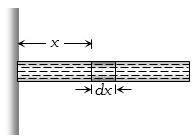
$A$ tube of length $L$ is filled completely with an incompressible liquid of mass $M$ and closed at both the ends. The tube is then rotated in a horizontal plane about one of its ends with a uniform angular velocity $\omega$. The force exerted by the liquid at the other end is
A
$\frac{ML\omega^2}{2}$
B
$ML\omega^2$
C
$\frac{M\omega L^2}{2}$
D
$\frac{ML^2\omega^2}{2}$
Solution
(A) Consider a small element of the liquid of length $dx$ at a distance $x$ from the axis of rotation. The mass of this element is $dM = (M/L)dx$.
The centripetal force required for this element to rotate in a circle of radius $x$ is $dF = (dM)\omega^2 x$.
Substituting $dM$,we get $dF = (M/L)dx \cdot \omega^2 x = (M\omega^2/L)x dx$.
The total force $F$ exerted by the liquid at the outer end is the integral of these centripetal forces from $x = 0$ to $x = L$:
$F = \int_0^L \frac{M\omega^2}{L} x dx = \frac{M\omega^2}{L} \left[ \frac{x^2}{2} \right]_0^L = \frac{M\omega^2}{L} \cdot \frac{L^2}{2} = \frac{1}{2}ML\omega^2$.
The centripetal force required for this element to rotate in a circle of radius $x$ is $dF = (dM)\omega^2 x$.
Substituting $dM$,we get $dF = (M/L)dx \cdot \omega^2 x = (M\omega^2/L)x dx$.
The total force $F$ exerted by the liquid at the outer end is the integral of these centripetal forces from $x = 0$ to $x = L$:
$F = \int_0^L \frac{M\omega^2}{L} x dx = \frac{M\omega^2}{L} \left[ \frac{x^2}{2} \right]_0^L = \frac{M\omega^2}{L} \cdot \frac{L^2}{2} = \frac{1}{2}ML\omega^2$.
0 likesView Solution
6
PhysicsMediumMCQIIT JEE · 1992
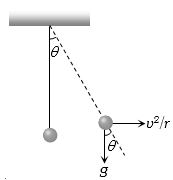
$A$ car is moving on a circular horizontal track of radius $10 \, m$ with a constant speed of $10 \, m/s$. $A$ plumb bob is suspended from the roof of the car by a light rigid rod of length $1.00 \, m$. The angle made by the rod with the vertical is ........ $^o$.
A
$0$
B
$30$
C
$45$
D
$60$
Solution
(C) When the car moves in a circular path,the plumb bob experiences a pseudo-force (centrifugal force) in the frame of the car,directed radially outward,given by $F_c = \frac{mv^2}{r}$.
The gravitational force acting on the bob is $mg$,directed vertically downward.
Let $\theta$ be the angle the rod makes with the vertical. In the equilibrium position,the net force on the bob in the car's frame is zero.
Taking the ratio of the horizontal force to the vertical force,we get:
$\tan \theta = \frac{F_c}{mg} = \frac{mv^2/r}{mg} = \frac{v^2}{rg}$.
Given $v = 10 \, m/s$,$r = 10 \, m$,and taking $g = 10 \, m/s^2$:
$\tan \theta = \frac{10^2}{10 \times 10} = \frac{100}{100} = 1$.
Therefore,$\theta = \tan^{-1}(1) = 45^\circ$.
The gravitational force acting on the bob is $mg$,directed vertically downward.
Let $\theta$ be the angle the rod makes with the vertical. In the equilibrium position,the net force on the bob in the car's frame is zero.
Taking the ratio of the horizontal force to the vertical force,we get:
$\tan \theta = \frac{F_c}{mg} = \frac{mv^2/r}{mg} = \frac{v^2}{rg}$.
Given $v = 10 \, m/s$,$r = 10 \, m$,and taking $g = 10 \, m/s^2$:
$\tan \theta = \frac{10^2}{10 \times 10} = \frac{100}{100} = 1$.
Therefore,$\theta = \tan^{-1}(1) = 45^\circ$.
0 likesView Solution
7
PhysicsMediumMCQIIT JEE · 1992
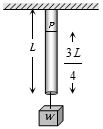
One end of a uniform wire of length $L$ and weight $W$ is attached rigidly to a point in the roof,and a weight $W_1$ is suspended from its lower end. If $S$ is the area of cross-section of the wire,the stress in the wire at a height $3L/4$ from its lower end is
A
$\frac{W_1}{S}$
B
$\frac{W_1 + (W/4)}{S}$
C
$\frac{W_1 + (3W/4)}{S}$
D
$\frac{W_1 + W}{S}$
Solution
(C) The stress at any point in the wire is defined as the force acting on the cross-section at that point divided by the area of cross-section $S$.
At a height $3L/4$ from the lower end,the total force acting on the cross-section is the sum of the weight $W_1$ suspended at the bottom and the weight of the portion of the wire below that point.
Since the wire is uniform,the weight of a portion of the wire is proportional to its length.
The length of the wire below the point at height $3L/4$ from the lower end is $3L/4$.
Therefore,the weight of this portion of the wire is $(3/4)W$.
The total force at this cross-section is $F = W_1 + (3W/4)$.
Thus,the stress is $\sigma = \frac{F}{S} = \frac{W_1 + (3W/4)}{S}$.
At a height $3L/4$ from the lower end,the total force acting on the cross-section is the sum of the weight $W_1$ suspended at the bottom and the weight of the portion of the wire below that point.
Since the wire is uniform,the weight of a portion of the wire is proportional to its length.
The length of the wire below the point at height $3L/4$ from the lower end is $3L/4$.
Therefore,the weight of this portion of the wire is $(3/4)W$.
The total force at this cross-section is $F = W_1 + (3W/4)$.
Thus,the stress is $\sigma = \frac{F}{S} = \frac{W_1 + (3W/4)}{S}$.
0 likesView Solution
8
PhysicsEasyMCQIIT JEE · 1992
An elastic material of Young's modulus $Y$ is subjected to a stress $S$. The elastic energy stored per unit volume of the material is
A
$\frac{2Y}{S^2}$
B
$\frac{S^2}{2Y}$
C
$\frac{S}{2Y}$
D
$\frac{S^2}{Y}$
Solution
(B) The elastic potential energy stored per unit volume $(u)$ in a material is given by the formula:
$u = \frac{1}{2} \times \text{stress} \times \text{strain}$
We know that Young's modulus $(Y)$ is defined as the ratio of stress $(S)$ to strain $(\epsilon)$:
$Y = \frac{S}{\epsilon} \implies \epsilon = \frac{S}{Y}$
Substituting the expression for strain into the energy formula:
$u = \frac{1}{2} \times S \times \left( \frac{S}{Y} \right)$
$u = \frac{S^2}{2Y}$
Thus,the correct option is $B$.
$u = \frac{1}{2} \times \text{stress} \times \text{strain}$
We know that Young's modulus $(Y)$ is defined as the ratio of stress $(S)$ to strain $(\epsilon)$:
$Y = \frac{S}{\epsilon} \implies \epsilon = \frac{S}{Y}$
Substituting the expression for strain into the energy formula:
$u = \frac{1}{2} \times S \times \left( \frac{S}{Y} \right)$
$u = \frac{S^2}{2Y}$
Thus,the correct option is $B$.
0 likesView Solution
9
PhysicsEasyMCQIIT JEE · 1992
Two metal strips that constitute a thermostat must necessarily differ in their
A
Mass
B
Length
C
Resistivity
D
Coefficient of linear expansion
Solution
(D) thermostat is a device used in electric appliances like refrigerators and irons for automatic temperature control.
It consists of a bimetallic strip made of two different metals joined together.
When the temperature changes, the two metals expand by different amounts because they have different coefficients of linear expansion $(\alpha)$.
This difference in expansion causes the strip to bend, which triggers the switching mechanism to turn the appliance on or off.
Therefore, the two metal strips must necessarily differ in their coefficient of linear expansion.
It consists of a bimetallic strip made of two different metals joined together.
When the temperature changes, the two metals expand by different amounts because they have different coefficients of linear expansion $(\alpha)$.
This difference in expansion causes the strip to bend, which triggers the switching mechanism to turn the appliance on or off.
Therefore, the two metal strips must necessarily differ in their coefficient of linear expansion.
0 likesView Solution
10
PhysicsMediumMCQIIT JEE · 1992
$A$ substance of mass $m \ kg$ requires a power input of $P \ W$ to remain in the molten state at its melting point. When the power is turned off,the sample completely solidifies in time $t \ s$. What is the latent heat of fusion of the substance?
A
$\frac{Pm}{t}$
B
$\frac{Pt}{m}$
C
$\frac{m}{Pt}$
D
$\frac{t}{Pm}$
Solution
(B) The power $P$ supplied is used to maintain the substance in the molten state by compensating for the heat lost to the surroundings.
When the power is turned off,the substance solidifies by releasing its latent heat of fusion $L$ over time $t$.
The total heat released during solidification is $Q = mL$.
The rate of heat loss is $\frac{Q}{t} = \frac{mL}{t}$.
Since the power $P$ was required to maintain the molten state,it must be equal to the rate of heat loss: $P = \frac{mL}{t}$.
Solving for $L$,we get $L = \frac{Pt}{m}$.
When the power is turned off,the substance solidifies by releasing its latent heat of fusion $L$ over time $t$.
The total heat released during solidification is $Q = mL$.
The rate of heat loss is $\frac{Q}{t} = \frac{mL}{t}$.
Since the power $P$ was required to maintain the molten state,it must be equal to the rate of heat loss: $P = \frac{mL}{t}$.
Solving for $L$,we get $L = \frac{Pt}{m}$.
0 likesView Solution
11
PhysicsMediumMCQIIT JEE · 1992
Three closed vessels $A, B$ and $C$ are at the same temperature $T$ and contain gases which obey the Maxwellian distribution of velocities. Vessel $A$ contains only $O_2$,$B$ only $N_2$ and $C$ a mixture of equal quantities of $O_2$ and $N_2$. If the average speed of the $O_2$ molecules in vessel $A$ is $V_1$,and that of the $N_2$ molecules in vessel $B$ is $V_2$,what is the average speed of the $O_2$ molecules in vessel $C$?
A
$(V_1 + V_2)/2$
B
$V_1$
C
$(V_1 V_2)^{1/2}$
D
$\sqrt{3kT/M}$
Solution
(B) The average speed of gas molecules is given by the formula $V_{av} = \sqrt{\frac{8RT}{\pi M}}$.
Since the temperature $T$ is the same for all vessels and the molar mass $M$ of $O_2$ is constant,the average speed of $O_2$ molecules depends only on the temperature and the molar mass of the gas.
In vessel $C$,the $O_2$ and $N_2$ molecules behave independently as an ideal gas mixture.
Therefore,the average speed of $O_2$ molecules in vessel $C$ remains the same as in vessel $A$,which is $V_1$.
Since the temperature $T$ is the same for all vessels and the molar mass $M$ of $O_2$ is constant,the average speed of $O_2$ molecules depends only on the temperature and the molar mass of the gas.
In vessel $C$,the $O_2$ and $N_2$ molecules behave independently as an ideal gas mixture.
Therefore,the average speed of $O_2$ molecules in vessel $C$ remains the same as in vessel $A$,which is $V_1$.
0 likesView Solution
12
PhysicsDifficultMCQIIT JEE · 1992
The displacement $y$ of a particle executing periodic motion is given by $y = 4\cos^2(t/2)\sin(1000t)$. This expression may be considered to be a result of the superposition of $..........$ independent harmonic motions.
A
$2$
B
$3$
C
$4$
D
$5$
Solution
(B) Given the displacement equation: $y = 4\cos^2(t/2)\sin(1000t)$.
Using the trigonometric identity $2\cos^2(\theta) = 1 + \cos(2\theta)$,we can rewrite the expression as:
$y = 2(2\cos^2(t/2))\sin(1000t) = 2(1 + \cos(t))\sin(1000t)$.
Expanding this,we get:
$y = 2\sin(1000t) + 2\cos(t)\sin(1000t)$.
Using the product-to-sum identity $2\sin(A)\cos(B) = \sin(A+B) + \sin(A-B)$,where $A = 1000t$ and $B = t$:
$y = 2\sin(1000t) + \sin(1000t + t) + \sin(1000t - t)$.
$y = 2\sin(1000t) + \sin(1001t) + \sin(999t)$.
This expression is the sum of $3$ independent simple harmonic motions ($S$.$H$.$M$.).
Therefore,the correct option is $B$.
Using the trigonometric identity $2\cos^2(\theta) = 1 + \cos(2\theta)$,we can rewrite the expression as:
$y = 2(2\cos^2(t/2))\sin(1000t) = 2(1 + \cos(t))\sin(1000t)$.
Expanding this,we get:
$y = 2\sin(1000t) + 2\cos(t)\sin(1000t)$.
Using the product-to-sum identity $2\sin(A)\cos(B) = \sin(A+B) + \sin(A-B)$,where $A = 1000t$ and $B = t$:
$y = 2\sin(1000t) + \sin(1000t + t) + \sin(1000t - t)$.
$y = 2\sin(1000t) + \sin(1001t) + \sin(999t)$.
This expression is the sum of $3$ independent simple harmonic motions ($S$.$H$.$M$.).
Therefore,the correct option is $B$.
0 likesView Solution
13
PhysicsEasyMCQIIT JEE · 1992
Two travelling waves ${y_1} = A\sin [k(x - ct)]$ and ${y_2} = A\sin [k(x + ct)]$ are superimposed on a string. The distance between adjacent nodes is
A
$ct/\pi$
B
$ct/2\pi$
C
$\pi /2k$
D
$\pi /k$
Solution
(D) The superposition of two waves travelling in opposite directions with the same frequency and amplitude results in a stationary wave.
Using the principle of superposition,the resultant wave is $y = y_1 + y_2 = A\sin[k(x - ct)] + A\sin[k(x + ct)]$.
Using the trigonometric identity $\sin(C) + \sin(D) = 2\sin(\frac{C+D}{2})\cos(\frac{C-D}{2})$,we get:
$y = 2A\sin(kx)\cos(kct)$.
Nodes occur where the displacement is zero for all time $t$,which happens when $\sin(kx) = 0$.
This implies $kx = n\pi$,where $n = 0, 1, 2, \dots$.
The positions of the nodes are $x = \frac{n\pi}{k}$.
The distance between two adjacent nodes is the difference between consecutive positions:
$\Delta x = \frac{(n+1)\pi}{k} - \frac{n\pi}{k} = \frac{\pi}{k}$.
Alternatively,since $k = \frac{2\pi}{\lambda}$,the distance between adjacent nodes is $\frac{\lambda}{2} = \frac{\pi}{k}$.
Using the principle of superposition,the resultant wave is $y = y_1 + y_2 = A\sin[k(x - ct)] + A\sin[k(x + ct)]$.
Using the trigonometric identity $\sin(C) + \sin(D) = 2\sin(\frac{C+D}{2})\cos(\frac{C-D}{2})$,we get:
$y = 2A\sin(kx)\cos(kct)$.
Nodes occur where the displacement is zero for all time $t$,which happens when $\sin(kx) = 0$.
This implies $kx = n\pi$,where $n = 0, 1, 2, \dots$.
The positions of the nodes are $x = \frac{n\pi}{k}$.
The distance between two adjacent nodes is the difference between consecutive positions:
$\Delta x = \frac{(n+1)\pi}{k} - \frac{n\pi}{k} = \frac{\pi}{k}$.
Alternatively,since $k = \frac{2\pi}{\lambda}$,the distance between adjacent nodes is $\frac{\lambda}{2} = \frac{\pi}{k}$.
0 likesView Solution
14
PhysicsDifficultMCQIIT JEE · 1992
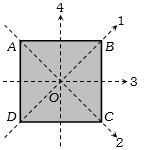
The moment of inertia of a thin square plate $ABCD$ of uniform thickness about an axis passing through the centre $O$ and perpendicular to the plane of the plate is given by which of the following expressions? Here,$I_1, I_2, I_3,$ and $I_4$ are the moments of inertia about axes $1, 2, 3,$ and $4$ respectively,which lie in the plane of the plate as shown in the figure.
A
$I_1 + I_2$
B
$I_3 + I_4$
C
$I_1 + I_3$
D
All of the above
Solution
(D) According to the theorem of perpendicular axes,the moment of inertia $I_z$ of a planar body about an axis perpendicular to its plane and passing through a point $O$ is equal to the sum of the moments of inertia about two mutually perpendicular axes in the plane of the body,both passing through $O$.
In the given figure,axes $1$ and $2$ are the diagonals of the square,which are mutually perpendicular. Thus,$I_0 = I_1 + I_2$.
Axes $3$ and $4$ are lines passing through the centre $O$ and parallel to the sides of the square. These are also mutually perpendicular. Thus,$I_0 = I_3 + I_4$.
Furthermore,due to the symmetry of the square,the moment of inertia about any axis passing through the centre and lying in the plane of the plate is the same if the angle of the axis is the same relative to the sides. Specifically,for a square plate,$I_1 = I_2 = I_3 = I_4 = \frac{ML^2}{12}$.
Therefore,$I_0 = I_1 + I_2 = I_3 + I_4 = I_1 + I_3$ (since $I_1 = I_3$).
Thus,all the given options are correct.
In the given figure,axes $1$ and $2$ are the diagonals of the square,which are mutually perpendicular. Thus,$I_0 = I_1 + I_2$.
Axes $3$ and $4$ are lines passing through the centre $O$ and parallel to the sides of the square. These are also mutually perpendicular. Thus,$I_0 = I_3 + I_4$.
Furthermore,due to the symmetry of the square,the moment of inertia about any axis passing through the centre and lying in the plane of the plate is the same if the angle of the axis is the same relative to the sides. Specifically,for a square plate,$I_1 = I_2 = I_3 = I_4 = \frac{ML^2}{12}$.
Therefore,$I_0 = I_1 + I_2 = I_3 + I_4 = I_1 + I_3$ (since $I_1 = I_3$).
Thus,all the given options are correct.
0 likesView Solution
15
PhysicsMediumMCQIIT JEE · 1992
The electric potential $V$ at any point $(x, y, z)$ (all in metres) in space is given by $V = 4x^2 \text{ volt}$. The electric field at the point $(1 \text{ m}, 0, 2 \text{ m})$ in $\text{volt/metre}$ is
A
$8$ along negative $X$-axis
B
$8$ along positive $X$-axis
C
$16$ along negative $X$-axis
D
$16$ along positive $Z$-axis
Solution
(A) The electric potential is given by $V(x, y, z) = 4x^2 \text{ volt}$.
The electric field $\vec{E}$ is related to the potential $V$ by the relation $\vec{E} = -\nabla V = -\left( \hat{i} \frac{\partial V}{\partial x} + \hat{j} \frac{\partial V}{\partial y} + \hat{k} \frac{\partial V}{\partial z} \right)$.
Calculating the partial derivatives:
$\frac{\partial V}{\partial x} = \frac{d}{dx}(4x^2) = 8x$
$\frac{\partial V}{\partial y} = 0$
$\frac{\partial V}{\partial z} = 0$
Substituting these into the expression for $\vec{E}$:
$\vec{E} = -(8x \hat{i} + 0 \hat{j} + 0 \hat{k}) = -8x \hat{i} \text{ V/m}$.
At the point $(1 \text{ m}, 0, 2 \text{ m})$,the $x$-coordinate is $1 \text{ m}$.
Therefore,$\vec{E} = -8(1) \hat{i} = -8 \hat{i} \text{ V/m}$.
The negative sign indicates that the electric field is directed along the negative $X$-axis with a magnitude of $8 \text{ V/m}$.
The electric field $\vec{E}$ is related to the potential $V$ by the relation $\vec{E} = -\nabla V = -\left( \hat{i} \frac{\partial V}{\partial x} + \hat{j} \frac{\partial V}{\partial y} + \hat{k} \frac{\partial V}{\partial z} \right)$.
Calculating the partial derivatives:
$\frac{\partial V}{\partial x} = \frac{d}{dx}(4x^2) = 8x$
$\frac{\partial V}{\partial y} = 0$
$\frac{\partial V}{\partial z} = 0$
Substituting these into the expression for $\vec{E}$:
$\vec{E} = -(8x \hat{i} + 0 \hat{j} + 0 \hat{k}) = -8x \hat{i} \text{ V/m}$.
At the point $(1 \text{ m}, 0, 2 \text{ m})$,the $x$-coordinate is $1 \text{ m}$.
Therefore,$\vec{E} = -8(1) \hat{i} = -8 \hat{i} \text{ V/m}$.
The negative sign indicates that the electric field is directed along the negative $X$-axis with a magnitude of $8 \text{ V/m}$.
0 likesView Solution
16
PhysicsEasyMCQIIT JEE · 1992
For the structural analysis of crystals, $X-$ rays are used because
A
$X-$ rays have a wavelength of the order of interatomic spacing.
B
$X-$ rays are highly penetrating radiations.
C
The wavelength of $X-$ rays is of the order of nuclear size.
D
$X-$ rays are coherent radiations.
Solution
(A) The structural analysis of crystals relies on the phenomenon of diffraction. For diffraction to occur, the wavelength of the incident radiation must be comparable to the spacing between the scattering centers (atoms) in the crystal lattice. The interatomic spacing in crystals is typically in the range of $0.1 \, nm$ to $0.5 \, nm$ ($1 \, \text{AA}$ to $5 \, \text{AA}$). $X-$ rays possess wavelengths in this same range, making them ideal for probing the atomic structure of crystals through $X-$ ray diffraction $(XRD)$. Therefore, option $A$ is correct.
0 likesView Solution
17
PhysicsMediumMCQIIT JEE · 1992
When a point source of monochromatic light is at a distance of $0.2 \ m$ from a photoelectric cell,the cut-off voltage and the saturation current are $0.6 \ V$ and $18 \ mA$ respectively. If the same source is placed $0.6 \ m$ away from the photoelectric cell,then:
A
The stopping potential will be $0.2 \ V$
B
The stopping potential will be $0.6 \ V$
C
The saturation current will be $6 \ mA$
D
The saturation current will be $18 \ mA$
Solution
(B) The cut-off voltage (stopping potential) depends only on the frequency of the incident light,not on its intensity. Therefore,it remains $0.6 \ V$.
The intensity of light from a point source follows the inverse square law,$I \propto \frac{1}{d^2}$.
When the distance increases from $0.2 \ m$ to $0.6 \ m$,the distance becomes $3$ times $(d' = 3d)$.
Thus,the intensity becomes $I' = \frac{I}{3^2} = \frac{I}{9}$.
Since the saturation current is directly proportional to the intensity of incident light,the new saturation current will be $I'_{sat} = \frac{18 \ mA}{9} = 2 \ mA$.
Comparing this with the given options,option $(b)$ is correct regarding the stopping potential.
The intensity of light from a point source follows the inverse square law,$I \propto \frac{1}{d^2}$.
When the distance increases from $0.2 \ m$ to $0.6 \ m$,the distance becomes $3$ times $(d' = 3d)$.
Thus,the intensity becomes $I' = \frac{I}{3^2} = \frac{I}{9}$.
Since the saturation current is directly proportional to the intensity of incident light,the new saturation current will be $I'_{sat} = \frac{18 \ mA}{9} = 2 \ mA$.
Comparing this with the given options,option $(b)$ is correct regarding the stopping potential.
0 likesView Solution
18
PhysicsEasyMCQIIT JEE · 1992
The energy released in a typical nuclear fusion reaction is approximately..........$MeV$.
A
$25$
B
$200$
C
$800$
D
$1050$
Solution
(A) In a typical nuclear fusion reaction,such as the fusion of two deuterium nuclei $(^2H + ^2H \rightarrow ^3He + n + 3.27 \ MeV)$ or the fusion of deuterium and tritium $(^2H + ^3H \rightarrow ^4He + n + 17.6 \ MeV)$,the energy released per reaction is relatively small compared to fission.
However,when considering the energy released per unit mass,fusion is much more efficient.
For a typical fusion reaction involving light nuclei,the energy released is in the range of a few $MeV$ to about $25 \ MeV$.
Therefore,among the given options,$25 \ MeV$ is the most appropriate value for a typical fusion reaction.
However,when considering the energy released per unit mass,fusion is much more efficient.
For a typical fusion reaction involving light nuclei,the energy released is in the range of a few $MeV$ to about $25 \ MeV$.
Therefore,among the given options,$25 \ MeV$ is the most appropriate value for a typical fusion reaction.
0 likesView Solution
19
PhysicsDifficultMCQIIT JEE · 1992
The typical ionisation energy of a donor in silicon is.....$eV$
A
$10$
B
$1$
C
$0.1$
D
$0.001$
Solution
(C) When a donor impurity ($+5$ valence) is added to pure silicon ($+4$ valence),the donor atom replaces a silicon atom in the crystal lattice.
Since the donor atom has one extra valence electron,it creates a net positive charge of $+1e$ at the site.
The four valence electrons form covalent bonds with neighboring silicon atoms.
The fifth electron is loosely bound to the donor site and can be modeled as an electron revolving around a $+1e$ charge in a medium with permittivity $\varepsilon = \varepsilon_0 \varepsilon_r$.
The energy levels are given by $E_n = -\frac{13.6 \times m^* / m_e}{\varepsilon_r^2 n^2} \text{ eV}$.
For silicon,the relative permittivity $\varepsilon_r \approx 12$.
Substituting $n=1$ and accounting for the effective mass of the electron in the crystal,the ionization energy is approximately $E \approx -\frac{13.6}{12^2} \approx -0.094 \text{ eV}$,which is approximately $0.1 \text{ eV}$.
Since the donor atom has one extra valence electron,it creates a net positive charge of $+1e$ at the site.
The four valence electrons form covalent bonds with neighboring silicon atoms.
The fifth electron is loosely bound to the donor site and can be modeled as an electron revolving around a $+1e$ charge in a medium with permittivity $\varepsilon = \varepsilon_0 \varepsilon_r$.
The energy levels are given by $E_n = -\frac{13.6 \times m^* / m_e}{\varepsilon_r^2 n^2} \text{ eV}$.
For silicon,the relative permittivity $\varepsilon_r \approx 12$.
Substituting $n=1$ and accounting for the effective mass of the electron in the crystal,the ionization energy is approximately $E \approx -\frac{13.6}{12^2} \approx -0.094 \text{ eV}$,which is approximately $0.1 \text{ eV}$.
0 likesView Solution
20
PhysicsDifficultMCQIIT JEE · 1992
$A$ planet is observed by an astronomical refracting telescope having an objective of focal length $16 \, m$ and an eye-piece of focal length $2 \, cm$. Which of the following statements is correct?
A
The distance between the objective and the eye-piece is $16.02 \, m$.
B
The angular magnification of the planet is $800$.
C
The image of the planet is inverted.
D
All of the above.
Solution
(D) For an astronomical telescope in normal adjustment,the distance between the objective and the eye-piece is $L = f_o + f_e$. Given $f_o = 16 \, m$ and $f_e = 2 \, cm = 0.02 \, m$,so $L = 16 + 0.02 = 16.02 \, m$. Statement $A$ is correct.
The angular magnification $m$ is given by $m = -f_o / f_e = -16 / 0.02 = -800$. The magnitude of magnification is $800$. Statement $B$ is correct.
The negative sign in the magnification indicates that the final image formed by an astronomical telescope is inverted with respect to the object. Statement $C$ is correct.
Since all statements $A, B,$ and $C$ are correct,the correct option is $D$.
The angular magnification $m$ is given by $m = -f_o / f_e = -16 / 0.02 = -800$. The magnitude of magnification is $800$. Statement $B$ is correct.
The negative sign in the magnification indicates that the final image formed by an astronomical telescope is inverted with respect to the object. Statement $C$ is correct.
Since all statements $A, B,$ and $C$ are correct,the correct option is $D$.
0 likesView Solution
Vedclass Products
For Students
Vedclass Test Series
Mock tests in real IIT JEE style covering Physics with performance analysis. 5-day free trial.
Start Free TrialFor Teachers
Exam Paper Generator
Generate Set A/B/C/D Physics papers from 7.5L+ questions in 2 minutes. 3 chapters free.
Try FreeFor Institutes
Online Exam Module
Run live IIT JEE mock exams with unlimited students, 360° analytics & white-label branding.
See DemoFrequently Asked Questions
How many Physics questions are in IIT JEE 1992?
There are 20 Physics questions from the IIT JEE 1992 paper on Vedclass, each with a detailed step-by-step solution in English.
Are IIT JEE 1992 Physics solutions available in English?
Yes. All solutions on this page are in English. You can also switch to English or Hindi using the language buttons above the questions.
Can I practice IIT JEE 1992 Physics as a timed test?
Yes. Use the Vedclass Test Series to attempt a full IIT JEE mock test covering Physics with time limits and instant score analysis.
Can teachers create Physics papers from IIT JEE previous year questions?
Yes. The Vedclass Exam Paper Generator lets teachers mix IIT JEE Physics questions and generate Set A/B/C/D papers in minutes.
For Teachers & Institutes
Build a Custom Physics Paper
Pick IIT JEE 1992 Physics questions, set difficulty, and generate Set A/B/C/D in 2 minutes.