
ChemistryQ1–28 of 28 questions
Page 1 of 1 · English
1
ChemistryMediumMCQIIT JEE · 1992
Which one of the following explains light both as a stream of particles and as wave motion?
A
Diffraction
B
$\lambda = h/p$
C
Interference
D
Photoelectric effect
Solution
(B) The de-Broglie equation,$\lambda = \frac{h}{p} = \frac{h}{mv}$,relates the wavelength (wave property) to the momentum (particle property) of a moving object,including photons. This equation provides the mathematical basis for the wave-particle duality of light and matter.
0 likesView Solution
2
ChemistryMediumMCQIIT JEE · 1992
The maximum possible number of hydrogen bonds in which an $H_2O$ molecule can participate is
A
$1$
B
$2$
C
$3$
D
$4$
Solution
(D) An $H_2O$ molecule has two hydrogen atoms attached to an oxygen atom through covalent bonds.
Each hydrogen atom can form one hydrogen bond with the lone pair of an oxygen atom of a neighboring $H_2O$ molecule.
The oxygen atom has two lone pairs,each of which can accept a hydrogen bond from a hydrogen atom of a neighboring $H_2O$ molecule.
Therefore,an $H_2O$ molecule can participate in a total of $4$ hydrogen bonds ($2$ as a donor and $2$ as an acceptor).
Each hydrogen atom can form one hydrogen bond with the lone pair of an oxygen atom of a neighboring $H_2O$ molecule.
The oxygen atom has two lone pairs,each of which can accept a hydrogen bond from a hydrogen atom of a neighboring $H_2O$ molecule.
Therefore,an $H_2O$ molecule can participate in a total of $4$ hydrogen bonds ($2$ as a donor and $2$ as an acceptor).
0 likesView Solution
3
ChemistryMediumMCQIIT JEE · 1992
The type of hybrid orbitals used by the chlorine atom in $ClO_2^-$ is
A
$sp^3$
B
$sp^2$
C
$sp$
D
None of these
Solution
(A) The hybridization of the central atom is calculated using the formula: $H = \frac{1}{2}(V + M - C + A)$,where $V$ is the number of valence electrons,$M$ is the number of monovalent atoms,$C$ is the cationic charge,and $A$ is the anionic charge.
For $ClO_2^-$,$V = 7$ (for $Cl$),$M = 0$ (oxygen is divalent),$C = 0$,and $A = 1$.
$H = \frac{1}{2}(7 + 0 - 0 + 1) = \frac{8}{2} = 4$.
$A$ value of $4$ corresponds to $sp^3$ hybridization.
Therefore,the chlorine atom in $ClO_2^-$ is $sp^3$ hybridized,resulting in an angular (bent) shape due to the presence of two lone pairs.
For $ClO_2^-$,$V = 7$ (for $Cl$),$M = 0$ (oxygen is divalent),$C = 0$,and $A = 1$.
$H = \frac{1}{2}(7 + 0 - 0 + 1) = \frac{8}{2} = 4$.
$A$ value of $4$ corresponds to $sp^3$ hybridization.
Therefore,the chlorine atom in $ClO_2^-$ is $sp^3$ hybridized,resulting in an angular (bent) shape due to the presence of two lone pairs.
0 likesView Solution
4
ChemistryDifficultMCQIIT JEE · 1992
At constant volume,for a fixed number of moles of a gas,the pressure of the gas increases with an increase in temperature due to:
A
Increase in the average molecular speed
B
Increased rate of collision amongst molecules
C
Increase in molecular attraction
D
Decrease in mean free path
Solution
(A) According to the kinetic theory of gases,the average kinetic energy of gas molecules is directly proportional to the absolute temperature $(T)$.
As the temperature increases,the average speed of the molecules increases.
When these faster-moving molecules collide with the walls of the container,they transfer more momentum per collision.
Since pressure is defined as the force exerted per unit area,and force is the rate of change of momentum,the increased momentum transfer results in an increase in the pressure exerted by the gas on the container walls.
Therefore,the correct option is $(A)$.
As the temperature increases,the average speed of the molecules increases.
When these faster-moving molecules collide with the walls of the container,they transfer more momentum per collision.
Since pressure is defined as the force exerted per unit area,and force is the rate of change of momentum,the increased momentum transfer results in an increase in the pressure exerted by the gas on the container walls.
Therefore,the correct option is $(A)$.
0 likesView Solution
5
ChemistryEasyMCQIIT JEE · 1992
Van der Waals equation of state is obeyed by real gases. For $n$ moles of a real gas,the expression will be
A
$\left( \frac{P}{n} + \frac{na}{V^2} \right) \left( \frac{V}{n-b} \right) = RT$
B
$\left( P + \frac{a}{V^2} \right) (V - b) = nRT$
C
$\left( P + \frac{na}{V^2} \right) (nV - b) = nRT$
D
$\left( P + \frac{n^2 a}{V^2} \right) (V - nb) = nRT$
Solution
(D) The Van der Waals equation for $1$ mole of a real gas is given by $\left( P + \frac{a}{V_m^2} \right) (V_m - b) = RT$,where $V_m$ is the molar volume $(V_m = V/n)$.
Substituting $V_m = V/n$ into the equation:
$\left( P + \frac{a}{(V/n)^2} \right) (V/n - b) = RT$
$\left( P + \frac{n^2 a}{V^2} \right) \left( \frac{V - nb}{n} \right) = RT$
Multiplying both sides by $n$ gives the expression for $n$ moles:
$\left( P + \frac{n^2 a}{V^2} \right) (V - nb) = nRT$
Substituting $V_m = V/n$ into the equation:
$\left( P + \frac{a}{(V/n)^2} \right) (V/n - b) = RT$
$\left( P + \frac{n^2 a}{V^2} \right) \left( \frac{V - nb}{n} \right) = RT$
Multiplying both sides by $n$ gives the expression for $n$ moles:
$\left( P + \frac{n^2 a}{V^2} \right) (V - nb) = nRT$
0 likesView Solution
6
ChemistryMediumMCQIIT JEE · 1992
An equilibrium mixture of the reaction $2H_2S_{(g)} \rightleftharpoons 2H_{2(g)} + S_{2(g)}$ had $0.5 mol$ $H_2S$,$0.10 mol$ $H_2$,and $0.4 mol$ $S_2$ in a $1 L$ vessel. The value of the equilibrium constant $(K_c)$ in $mol L^{-1}$ is:
A
$0.004$
B
$0.008$
C
$0.016$
D
$0.16$
Solution
(C) The given reaction is $2H_2S_{(g)} \rightleftharpoons 2H_{2(g)} + S_{2(g)}$.
Since the volume of the vessel is $1 L$,the molar concentrations are equal to the number of moles:
$[H_2S] = 0.5 mol L^{-1}$
$[H_2] = 0.10 mol L^{-1}$
$[S_2] = 0.4 mol L^{-1}$
The expression for the equilibrium constant $K_c$ is:
$K_c = \frac{[H_2]^2 [S_2]}{[H_2S]^2}$
Substituting the values:
$K_c = \frac{(0.10)^2 \times (0.4)}{(0.5)^2} = \frac{0.01 \times 0.4}{0.25} = \frac{0.004}{0.25} = 0.016 mol L^{-1}$.
Since the volume of the vessel is $1 L$,the molar concentrations are equal to the number of moles:
$[H_2S] = 0.5 mol L^{-1}$
$[H_2] = 0.10 mol L^{-1}$
$[S_2] = 0.4 mol L^{-1}$
The expression for the equilibrium constant $K_c$ is:
$K_c = \frac{[H_2]^2 [S_2]}{[H_2S]^2}$
Substituting the values:
$K_c = \frac{(0.10)^2 \times (0.4)}{(0.5)^2} = \frac{0.01 \times 0.4}{0.25} = \frac{0.004}{0.25} = 0.016 mol L^{-1}$.
0 likesView Solution
7
ChemistryDifficultMCQIIT JEE · 1992
The precipitate of $CaF_2$ $(K_{sp} = 1.7 \times 10^{-10})$ is obtained when equal volumes of the following are mixed:
A
$10^{-4} \ M \ Ca^{2+} + 10^{-4} \ M \ F^{-}$
B
$10^{-2} \ M \ Ca^{2+} + 10^{-3} \ M \ F^{-}$
C
Both
D
None of these
Solution
(B) When equal volumes are mixed,the concentration of each ion is halved.
For option $(A)$: $[Ca^{2+}] = 0.5 \times 10^{-4} \ M$,$[F^-] = 0.5 \times 10^{-4} \ M$.
Ionic Product $(IP)$ = $[Ca^{2+}][F^-]^2 = (0.5 \times 10^{-4}) \times (0.5 \times 10^{-4})^2 = 1.25 \times 10^{-13}$.
Since $IP < K_{sp}$,no precipitate is formed.
For option $(B)$: $[Ca^{2+}] = 0.5 \times 10^{-2} \ M$,$[F^-] = 0.5 \times 10^{-3} \ M$.
Ionic Product $(IP)$ = $[Ca^{2+}][F^-]^2 = (0.5 \times 10^{-2}) \times (0.5 \times 10^{-3})^2 = 0.5 \times 10^{-2} \times 0.25 \times 10^{-6} = 1.25 \times 10^{-9}$.
Since $IP > K_{sp}$ $(1.25 \times 10^{-9} > 1.7 \times 10^{-10})$,precipitation occurs.
For option $(A)$: $[Ca^{2+}] = 0.5 \times 10^{-4} \ M$,$[F^-] = 0.5 \times 10^{-4} \ M$.
Ionic Product $(IP)$ = $[Ca^{2+}][F^-]^2 = (0.5 \times 10^{-4}) \times (0.5 \times 10^{-4})^2 = 1.25 \times 10^{-13}$.
Since $IP < K_{sp}$,no precipitate is formed.
For option $(B)$: $[Ca^{2+}] = 0.5 \times 10^{-2} \ M$,$[F^-] = 0.5 \times 10^{-3} \ M$.
Ionic Product $(IP)$ = $[Ca^{2+}][F^-]^2 = (0.5 \times 10^{-2}) \times (0.5 \times 10^{-3})^2 = 0.5 \times 10^{-2} \times 0.25 \times 10^{-6} = 1.25 \times 10^{-9}$.
Since $IP > K_{sp}$ $(1.25 \times 10^{-9} > 1.7 \times 10^{-10})$,precipitation occurs.
0 likesView Solution
8
ChemistryMediumMCQIIT JEE · 1992
Which of the following equations correctly represents the standard heat of formation $(\Delta H_f^o)$ of methane?
A
$C(\text{diamond}) + 2H_{2(g)} \rightarrow CH_{4(g)}$
B
$C(\text{graphite}) + 2H_{2(g)} \rightarrow CH_{4(l)}$
C
$C(\text{graphite}) + 2H_{2(g)} \rightarrow CH_{4(g)}$
D
$C(\text{graphite}) + 4H_{(g)} \rightarrow CH_{4(g)}$
Solution
(C) The standard heat of formation $(\Delta H_f^o)$ is defined as the enthalpy change when $1 \text{ mole}$ of a substance is formed from its constituent elements in their most stable standard states.
For methane $(CH_{4(g)})$,the constituent elements are carbon and hydrogen.
The most stable state of carbon at standard conditions is graphite.
The most stable state of hydrogen is diatomic gas $(H_{2(g)})$.
Therefore,the correct equation is: $C(\text{graphite}) + 2H_{2(g)} \rightarrow CH_{4(g)}$.
For methane $(CH_{4(g)})$,the constituent elements are carbon and hydrogen.
The most stable state of carbon at standard conditions is graphite.
The most stable state of hydrogen is diatomic gas $(H_{2(g)})$.
Therefore,the correct equation is: $C(\text{graphite}) + 2H_{2(g)} \rightarrow CH_{4(g)}$.
0 likesView Solution
9
ChemistryDifficultMCQIIT JEE · 1992
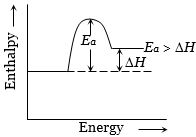
For an endothermic reaction where $\Delta H$ represents the enthalpy of the reaction in $kJ/mole$,the minimum value for the energy of activation $(E_a)$ will be:
A
Less than $\Delta H$
B
Zero
C
More than $\Delta H$
D
Equal to $\Delta H$
Solution
(C) In an endothermic reaction,the products have higher enthalpy than the reactants,so $\Delta H > 0$.
From the energy profile diagram,the activation energy $(E_a)$ is the energy difference between the transition state and the reactants.
Since the products are at a higher energy level than the reactants,the energy barrier $(E_a)$ must be greater than the net enthalpy change $(\Delta H)$ of the reaction.
Therefore,$E_a > \Delta H$.
From the energy profile diagram,the activation energy $(E_a)$ is the energy difference between the transition state and the reactants.
Since the products are at a higher energy level than the reactants,the energy barrier $(E_a)$ must be greater than the net enthalpy change $(\Delta H)$ of the reaction.
Therefore,$E_a > \Delta H$.
0 likesView Solution
10
ChemistryMediumMCQIIT JEE · 1992
For the redox reaction $MnO_4^- + C_2O_4^{2-} + H^{+} \to Mn^{2+} + CO_2 + H_2O$,the correct coefficients of the reactants for the balanced reaction are:
$MnO_4^-$ : $C_2O_4^{2-}$ : $H^{+}$
$MnO_4^-$ : $C_2O_4^{2-}$ : $H^{+}$
A
$2, 5, 16$
B
$16, 5, 2$
C
$5, 16, 2$
D
$2, 16, 5$
Solution
(A) The half-reactions are:
Reduction: $(MnO_4^- + 8H^{+} + 5e^- \to Mn^{2+} + 4H_2O) \times 2$
Oxidation: $(C_2O_4^{2-} \to 2CO_2 + 2e^-) \times 5$
Adding the two half-reactions to balance the electrons:
$2MnO_4^- + 16H^{+} + 10e^- + 5C_2O_4^{2-} \to 2Mn^{2+} + 8H_2O + 10CO_2 + 10e^-$
The balanced equation is:
$2MnO_4^- + 5C_2O_4^{2-} + 16H^{+} \to 2Mn^{2+} + 10CO_2 + 8H_2O$
Thus,the coefficients of $MnO_4^-$,$C_2O_4^{2-}$,and $H^{+}$ are $2, 5$,and $16$ respectively.
Reduction: $(MnO_4^- + 8H^{+} + 5e^- \to Mn^{2+} + 4H_2O) \times 2$
Oxidation: $(C_2O_4^{2-} \to 2CO_2 + 2e^-) \times 5$
Adding the two half-reactions to balance the electrons:
$2MnO_4^- + 16H^{+} + 10e^- + 5C_2O_4^{2-} \to 2Mn^{2+} + 8H_2O + 10CO_2 + 10e^-$
The balanced equation is:
$2MnO_4^- + 5C_2O_4^{2-} + 16H^{+} \to 2Mn^{2+} + 10CO_2 + 8H_2O$
Thus,the coefficients of $MnO_4^-$,$C_2O_4^{2-}$,and $H^{+}$ are $2, 5$,and $16$ respectively.
0 likesView Solution
11
ChemistryMediumMCQIIT JEE · 1992
The statement that is not correct for the periodic classification of elements is
A
The properties of elements are the periodic functions of their atomic numbers
B
Non-metallic elements are lesser in number than metallic elements
C
The first ionisation energies along a period do not vary in a regular manner with increase in atomic number
D
For transition elements the $d$-sub-shells are filled with electrons monotonically with increase in atomic number
Solution
(D) The correct answer is $D$.
For transition elements,the filling of $d$-sub-shells is not strictly monotonic due to the stability of half-filled and fully-filled configurations (e.g.,$Cr$ is $3d^5 4s^1$ and $Cu$ is $3d^{10} 4s^1$).
Therefore,the statement that $d$-sub-shells are filled monotonically is incorrect.
For transition elements,the filling of $d$-sub-shells is not strictly monotonic due to the stability of half-filled and fully-filled configurations (e.g.,$Cr$ is $3d^5 4s^1$ and $Cu$ is $3d^{10} 4s^1$).
Therefore,the statement that $d$-sub-shells are filled monotonically is incorrect.
0 likesView Solution
12
ChemistryMediumMCQIIT JEE · 1992
The cyanide ion,$CN^{-}$ and $N_2$ are isoelectronic. But in contrast to $CN^{-}$,$N_2$ is chemically inert because of
A
Low bond energy
B
Absence of bond polarity
C
Unsymmetrical electron distribution
D
Presence of more number of electrons in bonding orbitals
Solution
(B) Both $CN^{-}$ and $N_2$ are isoelectronic,having $14$ electrons each and a triple bond between the atoms.
However,$N_2$ is a homonuclear diatomic molecule,meaning it has no bond polarity (the electronegativity difference is zero).
In contrast,$CN^{-}$ is a heteronuclear ion with a significant difference in electronegativity between $C$ and $N$,resulting in a polar bond.
The absence of bond polarity in $N_2$ makes it chemically inert compared to $CN^{-}$.
However,$N_2$ is a homonuclear diatomic molecule,meaning it has no bond polarity (the electronegativity difference is zero).
In contrast,$CN^{-}$ is a heteronuclear ion with a significant difference in electronegativity between $C$ and $N$,resulting in a polar bond.
The absence of bond polarity in $N_2$ makes it chemically inert compared to $CN^{-}$.
0 likesView Solution
13
ChemistryMediumMCQIIT JEE · 1992
The type of hybrid orbitals used by the chlorine atom in $ClO_2^-$ is:
A
$sp^3$
B
$sp^2$
C
$sp$
D
None of these
Solution
(A) To determine the hybridization of the chlorine atom in $ClO_2^-$,we use the formula: $H = \frac{1}{2} [V + M - C + A]$
Where $V$ is the number of valence electrons of the central atom $(Cl = 7)$,
$M$ is the number of monovalent atoms attached ($0$ in this case,as oxygen is divalent),
$C$ is the cationic charge $(0)$,
$A$ is the anionic charge $(1)$.
$H = \frac{1}{2} [7 + 0 - 0 + 1] = \frac{8}{2} = 4$.
$A$ value of $4$ corresponds to $sp^3$ hybridization.
$ClO_2^-$ has two lone pairs on the chlorine atom,which results in a $V$-shaped or bent structure.
Where $V$ is the number of valence electrons of the central atom $(Cl = 7)$,
$M$ is the number of monovalent atoms attached ($0$ in this case,as oxygen is divalent),
$C$ is the cationic charge $(0)$,
$A$ is the anionic charge $(1)$.
$H = \frac{1}{2} [7 + 0 - 0 + 1] = \frac{8}{2} = 4$.
$A$ value of $4$ corresponds to $sp^3$ hybridization.
$ClO_2^-$ has two lone pairs on the chlorine atom,which results in a $V$-shaped or bent structure.
0 likesView Solution
14
ChemistryDifficultMCQIIT JEE · 1992
Homolytic fission of $C-C$ bond in ethane gives an intermediate in which carbon is
A
$sp^3$ hybridised
B
$sp^2$ hybridised
C
$sp$ hybridised
D
$sp^2d$ hybridised
Solution
(B) The homolytic fission of the $C-C$ bond in ethane $(CH_3-CH_3)$ results in the formation of two methyl free radicals $(CH_3^{\bullet})$.
$CH_3-CH_3 \xrightarrow{\text{Homolytic fission}} 2CH_3^{\bullet}$
In the methyl free radical,the central carbon atom is bonded to three hydrogen atoms and possesses one unpaired electron in an unhybridized $p$-orbital.
Therefore,the carbon atom is $sp^2$-hybridized with a trigonal planar geometry.
$CH_3-CH_3 \xrightarrow{\text{Homolytic fission}} 2CH_3^{\bullet}$
In the methyl free radical,the central carbon atom is bonded to three hydrogen atoms and possesses one unpaired electron in an unhybridized $p$-orbital.
Therefore,the carbon atom is $sp^2$-hybridized with a trigonal planar geometry.
0 likesView Solution
15
ChemistryMCQIIT JEE · 1992
When a point source of monochromatic light is placed at a distance of $0.2 \ m$ from a photoelectric cell,the cut-off voltage and saturation current are $0.6 \ V$ and $18 \ mA$ respectively. If the same source is placed at a distance of $0.6 \ m$ from the photoelectric cell,then:
A
The stopping potential will be $0.2 \ V$.
B
The stopping potential will be $0.6 \ V$.
C
The saturation current will be $6 \ mA$.
D
The saturation current will be $18 \ mA$.
Solution
(B) The stopping potential $(V_S)$ depends only on the frequency of the incident light and the work function of the metal surface. It is independent of the intensity of light or the distance of the source from the cell.
Therefore,the stopping potential remains $0.6 \ V$.
The saturation current $(I_S)$ is directly proportional to the intensity of the incident light. Since the source is a point source,the intensity $I$ follows the inverse square law: $I \propto \frac{1}{r^2}$.
Given $r_1 = 0.2 \ m$ and $r_2 = 0.6 \ m$,the ratio of intensities is $\frac{I_2}{I_1} = \left(\frac{r_1}{r_2}\right)^2 = \left(\frac{0.2}{0.6}\right)^2 = \left(\frac{1}{3}\right)^2 = \frac{1}{9}$.
Since $I_S \propto I$,the new saturation current $I_{S2} = I_{S1} \times \frac{1}{9} = 18 \ mA \times \frac{1}{9} = 2 \ mA$.
Comparing the options,the correct statements are that the stopping potential remains $0.6 \ V$ (Option $B$) and the saturation current becomes $2 \ mA$ (which is not listed,but $B$ is a correct statement).
Therefore,the stopping potential remains $0.6 \ V$.
The saturation current $(I_S)$ is directly proportional to the intensity of the incident light. Since the source is a point source,the intensity $I$ follows the inverse square law: $I \propto \frac{1}{r^2}$.
Given $r_1 = 0.2 \ m$ and $r_2 = 0.6 \ m$,the ratio of intensities is $\frac{I_2}{I_1} = \left(\frac{r_1}{r_2}\right)^2 = \left(\frac{0.2}{0.6}\right)^2 = \left(\frac{1}{3}\right)^2 = \frac{1}{9}$.
Since $I_S \propto I$,the new saturation current $I_{S2} = I_{S1} \times \frac{1}{9} = 18 \ mA \times \frac{1}{9} = 2 \ mA$.
Comparing the options,the correct statements are that the stopping potential remains $0.6 \ V$ (Option $B$) and the saturation current becomes $2 \ mA$ (which is not listed,but $B$ is a correct statement).
0 likesView Solution
16
ChemistryMediumMCQIIT JEE · 1992
The law of multiple proportions was proposed by
A
Lavoisier
B
Dalton
C
Proust
D
Gay-Lussac
Solution
(B) The law of multiple proportions was proposed by John Dalton in $1803$ and was later verified by Jons Jacob Berzelius.
0 likesView Solution
17
ChemistryDifficultMCQIIT JEE · 1992
Which of the following solutions will have $pH$ close to $1.0$?
A
$100 \ mL$ of $\frac{M}{10} \ HCl + 100 \ mL$ of $\frac{M}{10} \ NaOH$
B
$55 \ mL$ of $\frac{M}{10} \ HCl + 45 \ mL$ of $\frac{M}{10} \ NaOH$
C
$10 \ mL$ of $\frac{M}{10} \ HCl + 90 \ mL$ of $\frac{M}{10} \ NaOH$
D
$75 \ mL$ of $\frac{M}{5} \ HCl + 25 \ mL$ of $\frac{M}{5} \ NaOH$
Solution
(D) For $pH = 1.0$,the concentration of $[H^{+}]$ must be $10^{-1} \ M = 0.1 \ M$.
Option $(d)$:
$M.eq. \ of \ HCl = 75 \ mL \times \frac{1}{5} \ M = 15 \ mmol$.
$M.eq. \ of \ NaOH = 25 \ mL \times \frac{1}{5} \ M = 5 \ mmol$.
Remaining $H^{+}$ ions $= 15 - 5 = 10 \ mmol$.
Total volume $= 75 + 25 = 100 \ mL$.
$[H^{+}] = \frac{10 \ mmol}{100 \ mL} = 0.1 \ M = 10^{-1} \ M$.
Therefore,$pH = -\log(10^{-1}) = 1.0$.
Option $(d)$:
$M.eq. \ of \ HCl = 75 \ mL \times \frac{1}{5} \ M = 15 \ mmol$.
$M.eq. \ of \ NaOH = 25 \ mL \times \frac{1}{5} \ M = 5 \ mmol$.
Remaining $H^{+}$ ions $= 15 - 5 = 10 \ mmol$.
Total volume $= 75 + 25 = 100 \ mL$.
$[H^{+}] = \frac{10 \ mmol}{100 \ mL} = 0.1 \ M = 10^{-1} \ M$.
Therefore,$pH = -\log(10^{-1}) = 1.0$.
0 likesView Solution
18
ChemistryMCQIIT JEE · 1992
When a point source of monochromatic light is at a distance of $0.2\, m$ from a photoelectric cell,the cut-off voltage and the saturation current are $0.6\, V$ and $18\, mA$ respectively. If the same source is placed $0.6\, m$ away from the photoelectric cell,then:
A
The stopping potential will be $0.2\, V$
B
The stopping potential will be $0.6\, V$
C
The saturation current will be $6\, mA$
D
The saturation current will be $2\, mA$
Solution
(B) The stopping potential (cut-off voltage) depends only on the frequency of the incident light and the work function of the metal surface. It is independent of the intensity of the light.
Since the distance of the source is increased,the intensity of light decreases,but the frequency remains constant. Therefore,the stopping potential remains unchanged at $0.6\, V$.
The saturation current is directly proportional to the intensity of the incident light. Intensity $I$ follows the inverse square law,$I \propto 1/d^2$.
When the distance increases from $0.2\, m$ to $0.6\, m$ (a factor of $3$),the intensity becomes $(1/3)^2 = 1/9$ of the original value.
Thus,the new saturation current will be $18\, mA / 9 = 2\, mA$.
Therefore,both options $B$ and $D$ (if corrected) are physically correct,but typically in such problems,the focus is on the invariance of the stopping potential. Given the standard format,$B$ is the primary conceptual answer.
Since the distance of the source is increased,the intensity of light decreases,but the frequency remains constant. Therefore,the stopping potential remains unchanged at $0.6\, V$.
The saturation current is directly proportional to the intensity of the incident light. Intensity $I$ follows the inverse square law,$I \propto 1/d^2$.
When the distance increases from $0.2\, m$ to $0.6\, m$ (a factor of $3$),the intensity becomes $(1/3)^2 = 1/9$ of the original value.
Thus,the new saturation current will be $18\, mA / 9 = 2\, mA$.
Therefore,both options $B$ and $D$ (if corrected) are physically correct,but typically in such problems,the focus is on the invariance of the stopping potential. Given the standard format,$B$ is the primary conceptual answer.
0 likesView Solution
19
ChemistryMCQIIT JEE · 1992
The compound which does not show paramagnetism is :-
A
$[Cu(NH_3)_4]Cl_2$
B
$[Ag(NH_3)_2]Cl$
C
$NO$
D
$NO_2$
Solution
(B) Paramagnetism is exhibited by species that possess one or more unpaired electrons.
$1$. In $[Cu(NH_3)_4]Cl_2$,$Cu$ is in the $+2$ oxidation state ($3d^9$ configuration),which has one unpaired electron.
$2$. In $[Ag(NH_3)_2]Cl$,$Ag$ is in the $+1$ oxidation state ($4d^{10}$ configuration),which has no unpaired electrons,making it diamagnetic.
$3$. $NO$ has $15$ valence electrons (odd number),so it has an unpaired electron.
$4$. $NO_2$ has $17$ valence electrons (odd number),so it has an unpaired electron.
Therefore,$[Ag(NH_3)_2]Cl$ is the compound that does not show paramagnetism.
$1$. In $[Cu(NH_3)_4]Cl_2$,$Cu$ is in the $+2$ oxidation state ($3d^9$ configuration),which has one unpaired electron.
$2$. In $[Ag(NH_3)_2]Cl$,$Ag$ is in the $+1$ oxidation state ($4d^{10}$ configuration),which has no unpaired electrons,making it diamagnetic.
$3$. $NO$ has $15$ valence electrons (odd number),so it has an unpaired electron.
$4$. $NO_2$ has $17$ valence electrons (odd number),so it has an unpaired electron.
Therefore,$[Ag(NH_3)_2]Cl$ is the compound that does not show paramagnetism.
0 likesView Solution
20
ChemistryMCQIIT JEE · 1992
The solution of the equation $\cos^2 \theta + \sin \theta + 1 = 0$ lies in the interval
A
$\left( -\frac{\pi}{3}, \frac{\pi}{4} \right)$
B
$\left( \frac{\pi}{4}, \frac{3\pi}{4} \right)$
C
$\left( \frac{3\pi}{4}, \frac{5\pi}{4} \right)$
D
$\left( \frac{5\pi}{4}, \frac{7\pi}{4} \right)$
Solution
(D) Given equation: $\cos^2 \theta + \sin \theta + 1 = 0$
Using the identity $\cos^2 \theta = 1 - \sin^2 \theta$,we get:
$1 - \sin^2 \theta + \sin \theta + 1 = 0$
Rearranging the terms:
$-\sin^2 \theta + \sin \theta + 2 = 0$
Multiplying by $-1$:
$\sin^2 \theta - \sin \theta - 2 = 0$
Factoring the quadratic equation:
$(\sin \theta - 2)(\sin \theta + 1) = 0$
Since $\sin \theta = 2$ is impossible (as $-1 \le \sin \theta \le 1$),we must have:
$\sin \theta = -1$
For $\sin \theta = -1$,the general solution is $\theta = 2n\pi + \frac{3\pi}{2}$.
For $n=0$,$\theta = \frac{3\pi}{2}$.
Since $\frac{5\pi}{4} < \frac{3\pi}{2} < \frac{7\pi}{4}$,the solution lies in the interval $\left( \frac{5\pi}{4}, \frac{7\pi}{4} \right)$.
Using the identity $\cos^2 \theta = 1 - \sin^2 \theta$,we get:
$1 - \sin^2 \theta + \sin \theta + 1 = 0$
Rearranging the terms:
$-\sin^2 \theta + \sin \theta + 2 = 0$
Multiplying by $-1$:
$\sin^2 \theta - \sin \theta - 2 = 0$
Factoring the quadratic equation:
$(\sin \theta - 2)(\sin \theta + 1) = 0$
Since $\sin \theta = 2$ is impossible (as $-1 \le \sin \theta \le 1$),we must have:
$\sin \theta = -1$
For $\sin \theta = -1$,the general solution is $\theta = 2n\pi + \frac{3\pi}{2}$.
For $n=0$,$\theta = \frac{3\pi}{2}$.
Since $\frac{5\pi}{4} < \frac{3\pi}{2} < \frac{7\pi}{4}$,the solution lies in the interval $\left( \frac{5\pi}{4}, \frac{7\pi}{4} \right)$.
0 likesView Solution
21
ChemistryMCQIIT JEE · 1992
Which of the following is the strongest oxidizing agent?
A
$Br_2$
B
$I_2$
C
$Cl_2$
D
$F_2$
Solution
(D) The standard reduction potential of halogens is positive and decreases from $F_2$ to $I_2$.
Therefore,halogens act as oxidizing agents,and their oxidizing power decreases in the order: $F_2 > Cl_2 > Br_2 > I_2$.
Thus,$F_2$ is the strongest oxidizing agent.
Therefore,halogens act as oxidizing agents,and their oxidizing power decreases in the order: $F_2 > Cl_2 > Br_2 > I_2$.
Thus,$F_2$ is the strongest oxidizing agent.
0 likesView Solution
22
ChemistryEasyMCQIIT JEE · 1992
Which of the following is the strongest oxidizing agent?
A
$F_2$
B
$Cl_2$
C
$Br_2$
D
$I_2$
Solution
(A) $F_2$ is the strongest oxidizing agent in the periodic table.
The oxidizing power of halogens is determined by their standard reduction potential $(E^\circ)$,which is influenced by factors such as enthalpy of atomization,electron gain enthalpy,and hydration enthalpy.
The standard reduction potentials ($E^\circ$ in $V$) for halogens are:
$F_2: +2.87 \ V$
$Cl_2: +1.36 \ V$
$Br_2: +1.07 \ V$
$I_2: +0.54 \ V$
Due to the low bond dissociation enthalpy of $F-F$ and high hydration enthalpy of the $F^-$ ion,$F_2$ exhibits the highest reduction potential,making it the strongest oxidizing agent.
The oxidizing power of halogens is determined by their standard reduction potential $(E^\circ)$,which is influenced by factors such as enthalpy of atomization,electron gain enthalpy,and hydration enthalpy.
The standard reduction potentials ($E^\circ$ in $V$) for halogens are:
$F_2: +2.87 \ V$
$Cl_2: +1.36 \ V$
$Br_2: +1.07 \ V$
$I_2: +0.54 \ V$
Due to the low bond dissociation enthalpy of $F-F$ and high hydration enthalpy of the $F^-$ ion,$F_2$ exhibits the highest reduction potential,making it the strongest oxidizing agent.
0 likesView Solution
23
ChemistryDifficultMCQIIT JEE · 1992
$A$ substance on treatment with dilute $H_2SO_4$ liberates a colourless gas which produces:
$(i)$ turbidity with baryta water and
$(ii)$ turns acidified dichromate solution green.
The reaction indicates the presence of:
$(i)$ turbidity with baryta water and
$(ii)$ turns acidified dichromate solution green.
The reaction indicates the presence of:
A
$CO_3^{2-}$
B
$S^{2-}$
C
$SO_3^{2-}$
D
$NO_2^-$
Solution
(C) The gas liberated is $SO_2$ (sulphur dioxide).
$(i)$ $SO_2$ reacts with baryta water $(Ba(OH)_2)$ to form $BaSO_3$,which causes turbidity: $Ba(OH)_2 + SO_2 \to BaSO_3 \downarrow + H_2O$.
$(ii)$ $SO_2$ reduces acidified potassium dichromate $(K_2Cr_2O_7)$ to chromium$(III)$ sulphate,which is green in colour: $K_2Cr_2O_7 + 3SO_2 + H_2SO_4 \to K_2SO_4 + Cr_2(SO_4)_3 + H_2O$.
These tests are characteristic of the sulphite ion $(SO_3^{2-})$.
$(i)$ $SO_2$ reacts with baryta water $(Ba(OH)_2)$ to form $BaSO_3$,which causes turbidity: $Ba(OH)_2 + SO_2 \to BaSO_3 \downarrow + H_2O$.
$(ii)$ $SO_2$ reduces acidified potassium dichromate $(K_2Cr_2O_7)$ to chromium$(III)$ sulphate,which is green in colour: $K_2Cr_2O_7 + 3SO_2 + H_2SO_4 \to K_2SO_4 + Cr_2(SO_4)_3 + H_2O$.
These tests are characteristic of the sulphite ion $(SO_3^{2-})$.
0 likesView Solution
24
ChemistryMediumMCQIIT JEE · 1992
For an endothermic reaction,where $\Delta H$ represents the enthalpy of the reaction in $kJ/mol$,the minimum value for the energy of activation will be
A
Less than $\Delta H$
B
Zero
C
More than $\Delta H$
D
Equal to $\Delta H$
Solution
(C) For an endothermic reaction,the enthalpy change $\Delta H$ is positive.
The relationship between the activation energy of the forward reaction $(E_{a(f)})$,the activation energy of the backward reaction $(E_{a(b)})$,and the enthalpy of the reaction is given by the equation: $E_{a(f)} = E_{a(b)} + \Delta H$.
Since $E_{a(b)}$ must always be a positive value for any reaction to occur,it follows that $E_{a(f)} > \Delta H$.
Therefore,the minimum value for the energy of activation is more than $\Delta H$.
The relationship between the activation energy of the forward reaction $(E_{a(f)})$,the activation energy of the backward reaction $(E_{a(b)})$,and the enthalpy of the reaction is given by the equation: $E_{a(f)} = E_{a(b)} + \Delta H$.
Since $E_{a(b)}$ must always be a positive value for any reaction to occur,it follows that $E_{a(f)} > \Delta H$.
Therefore,the minimum value for the energy of activation is more than $\Delta H$.
1 likesView Solution
25
ChemistryMediumMCQIIT JEE · 1992
Which of the following minerals does not contain $Al$?
A
Cryolite
B
Mica
C
Feldspar
D
Fluorspar
Solution
(D) The chemical formulas for the given minerals are:
$1$. Cryolite: $Na_{3}AlF_{6}$ (contains $Al$)
$2$. Mica: $K_{2}O \cdot 3Al_{2}O_{3} \cdot 6SiO_{2} \cdot 2H_{2}O$ (contains $Al$)
$3$. Feldspar: $KAlSi_{3}O_{8}$ (contains $Al$)
$4$. Fluorspar: $CaF_{2}$ (does not contain $Al$)
Therefore,Fluorspar is the correct answer.
$1$. Cryolite: $Na_{3}AlF_{6}$ (contains $Al$)
$2$. Mica: $K_{2}O \cdot 3Al_{2}O_{3} \cdot 6SiO_{2} \cdot 2H_{2}O$ (contains $Al$)
$3$. Feldspar: $KAlSi_{3}O_{8}$ (contains $Al$)
$4$. Fluorspar: $CaF_{2}$ (does not contain $Al$)
Therefore,Fluorspar is the correct answer.
0 likesView Solution
26
ChemistryDifficultMCQIIT JEE · 1992
The compound which does not show paramagnetism is
A
$[Cu(NH_3)_4]Cl_2$
B
$[Ag(NH_3)_2]Cl$
C
$NO$
D
$NO_2$
Solution
(B) . In $[Ag(NH_3)_2]Cl$,the central metal ion is $Ag^+$,which has a $d^{10}$ electronic configuration,meaning all electrons are paired,making it diamagnetic.
In $[Cu(NH_3)_4]Cl_2$,$Cu^{2+}$ has a $d^9$ configuration,which has one unpaired electron.
$NO$ and $NO_2$ are odd-electron molecules,which are paramagnetic.
In $[Cu(NH_3)_4]Cl_2$,$Cu^{2+}$ has a $d^9$ configuration,which has one unpaired electron.
$NO$ and $NO_2$ are odd-electron molecules,which are paramagnetic.
0 likesView Solution
27
ChemistryMediumMCQIIT JEE · 1992
In the following reaction,product $P$ is: $RCOCl \xrightarrow{H_2, Pd-BaSO_4} P$
A
$RCH_2OH$
B
$RCOOH$
C
$RCHO$
D
$RCH_3$
Solution
(C) The reaction of an acid chloride with $H_2$ in the presence of $Pd-BaSO_4$ is known as the Rosenmund reduction.
This reaction specifically reduces the acid chloride group $(-COCl)$ to an aldehyde group $(-CHO)$.
Therefore,the product $P$ is $RCHO$.
This reaction specifically reduces the acid chloride group $(-COCl)$ to an aldehyde group $(-CHO)$.
Therefore,the product $P$ is $RCHO$.
0 likesView Solution
28
ChemistryMediumMCQIIT JEE · 1992
Reaction of ethyl formate with excess of $CH_3MgI$ followed by hydrolysis gives
A
$n$-propyl alcohol
B
Ethanal
C
Propanal
D
Isopropyl alcohol
Solution
(D) The reaction of ethyl formate $(HCOOC_2H_5)$ with excess $CH_3MgI$ proceeds in two steps.
First,the nucleophilic attack of $CH_3^-$ on the carbonyl carbon of ethyl formate leads to the formation of an intermediate,which eliminates an ethoxide ion to form acetaldehyde $(CH_3CHO)$.
Since $CH_3MgI$ is in excess,it further reacts with the formed acetaldehyde to produce an alkoxide intermediate.
Finally,upon hydrolysis,this intermediate yields a secondary alcohol.
The overall reaction is: $HCOOC_2H_5 + 2CH_3MgI \xrightarrow{H_3O^+} (CH_3)_2CHOH + Mg(OH)I + C_2H_5OH$.
The product formed is isopropyl alcohol $(CH_3CH(OH)CH_3)$.
First,the nucleophilic attack of $CH_3^-$ on the carbonyl carbon of ethyl formate leads to the formation of an intermediate,which eliminates an ethoxide ion to form acetaldehyde $(CH_3CHO)$.
Since $CH_3MgI$ is in excess,it further reacts with the formed acetaldehyde to produce an alkoxide intermediate.
Finally,upon hydrolysis,this intermediate yields a secondary alcohol.
The overall reaction is: $HCOOC_2H_5 + 2CH_3MgI \xrightarrow{H_3O^+} (CH_3)_2CHOH + Mg(OH)I + C_2H_5OH$.
The product formed is isopropyl alcohol $(CH_3CH(OH)CH_3)$.
0 likesView Solution
Vedclass Products
For Students
Vedclass Test Series
Mock tests in real IIT JEE style covering Chemistry with performance analysis. 5-day free trial.
Start Free TrialFor Teachers
Exam Paper Generator
Generate Set A/B/C/D Chemistry papers from 7.5L+ questions in 2 minutes. 3 chapters free.
Try FreeFor Institutes
Online Exam Module
Run live IIT JEE mock exams with unlimited students, 360° analytics & white-label branding.
See DemoFrequently Asked Questions
How many Chemistry questions are in IIT JEE 1992?
There are 28 Chemistry questions from the IIT JEE 1992 paper on Vedclass, each with a detailed step-by-step solution in English.
Are IIT JEE 1992 Chemistry solutions available in English?
Yes. All solutions on this page are in English. You can also switch to English or Hindi using the language buttons above the questions.
Can I practice IIT JEE 1992 Chemistry as a timed test?
Yes. Use the Vedclass Test Series to attempt a full IIT JEE mock test covering Chemistry with time limits and instant score analysis.
Can teachers create Chemistry papers from IIT JEE previous year questions?
Yes. The Vedclass Exam Paper Generator lets teachers mix IIT JEE Chemistry questions and generate Set A/B/C/D papers in minutes.
For Teachers & Institutes
Build a Custom Chemistry Paper
Pick IIT JEE 1992 Chemistry questions, set difficulty, and generate Set A/B/C/D in 2 minutes.