
MathematicsQ1–35 of 35 questions
Page 1 of 1 · English
1
MathematicsMediumMCQIIT JEE · 1984
If $1, \omega, \omega^2, \omega^3, \dots, \omega^{n-1}$ are the $n^{th}$ roots of unity,then $(1 - \omega)(1 - \omega^2) \dots (1 - \omega^{n-1})$ equals
A
$0$
B
$1$
C
$n$
D
$n^2$
Solution
(C) Since $1, \omega, \omega^2, \dots, \omega^{n-1}$ are the $n^{th}$ roots of unity,they are the roots of the equation $x^n - 1 = 0$.
Therefore,we can write the polynomial as:
$x^n - 1 = (x - 1)(x - \omega)(x - \omega^2) \dots (x - \omega^{n-1})$
Dividing both sides by $(x - 1)$,we get:
$\frac{x^n - 1}{x - 1} = (x - \omega)(x - \omega^2) \dots (x - \omega^{n-1})$
Using the geometric series formula,the left side simplifies to:
$x^{n-1} + x^{n-2} + \dots + x + 1 = (x - \omega)(x - \omega^2) \dots (x - \omega^{n-1})$
Now,taking the limit as $x \to 1$ or simply substituting $x = 1$ on both sides:
$1^{n-1} + 1^{n-2} + \dots + 1 + 1 = (1 - \omega)(1 - \omega^2) \dots (1 - \omega^{n-1})$
Since there are $n$ terms on the left side,the sum is $n$.
Thus,$(1 - \omega)(1 - \omega^2) \dots (1 - \omega^{n-1}) = n$.
Therefore,we can write the polynomial as:
$x^n - 1 = (x - 1)(x - \omega)(x - \omega^2) \dots (x - \omega^{n-1})$
Dividing both sides by $(x - 1)$,we get:
$\frac{x^n - 1}{x - 1} = (x - \omega)(x - \omega^2) \dots (x - \omega^{n-1})$
Using the geometric series formula,the left side simplifies to:
$x^{n-1} + x^{n-2} + \dots + x + 1 = (x - \omega)(x - \omega^2) \dots (x - \omega^{n-1})$
Now,taking the limit as $x \to 1$ or simply substituting $x = 1$ on both sides:
$1^{n-1} + 1^{n-2} + \dots + 1 + 1 = (1 - \omega)(1 - \omega^2) \dots (1 - \omega^{n-1})$
Since there are $n$ terms on the left side,the sum is $n$.
Thus,$(1 - \omega)(1 - \omega^2) \dots (1 - \omega^{n-1}) = n$.
0 likesView Solution
2
MathematicsEasyMCQIIT JEE · 1984
The ${n^{th}}$ term of the series $3 \cdot 8 + 6 \cdot 11 + 9 \cdot 14 + 12 \cdot 17 + \dots$ will be
A
$3n(3n + 5)$
B
$3n(n + 5)$
C
$n(3n + 5)$
D
$n(n + 5)$
Solution
(A) The given series is $3 \cdot 8 + 6 \cdot 11 + 9 \cdot 14 + 12 \cdot 17 + \dots$
The first factors of the terms are $3, 6, 9, 12, \dots$,which form an arithmetic progression with the first term $a = 3$ and common difference $d = 3$. The ${n^{th}}$ term is $a_n = 3 + (n - 1)3 = 3n$.
The second factors of the terms are $8, 11, 14, 17, \dots$,which form an arithmetic progression with the first term $a = 8$ and common difference $d = 3$. The ${n^{th}}$ term is $b_n = 8 + (n - 1)3 = 3n + 5$.
Therefore,the ${n^{th}}$ term of the given series is $T_n = a_n \cdot b_n = 3n(3n + 5)$.
The first factors of the terms are $3, 6, 9, 12, \dots$,which form an arithmetic progression with the first term $a = 3$ and common difference $d = 3$. The ${n^{th}}$ term is $a_n = 3 + (n - 1)3 = 3n$.
The second factors of the terms are $8, 11, 14, 17, \dots$,which form an arithmetic progression with the first term $a = 8$ and common difference $d = 3$. The ${n^{th}}$ term is $b_n = 8 + (n - 1)3 = 3n + 5$.
Therefore,the ${n^{th}}$ term of the given series is $T_n = a_n \cdot b_n = 3n(3n + 5)$.
0 likesView Solution
3
MathematicsMediumMCQIIT JEE · 1984
The sum of integers from $1$ to $100$ that are divisible by $2$ or $5$ is
A
$3000$
B
$3050$
C
$4050$
D
None of these
Solution
(B) Let $S_2$ be the sum of integers divisible by $2$,$S_5$ be the sum of integers divisible by $5$,and $S_{10}$ be the sum of integers divisible by both $2$ and $5$ (i.e.,divisible by $10$).
$S_2 = 2 + 4 + \dots + 100 = \frac{50}{2}(2 + 100) = 25 \times 102 = 2550$.
$S_5 = 5 + 10 + \dots + 100 = \frac{20}{2}(5 + 100) = 10 \times 105 = 1050$.
$S_{10} = 10 + 20 + \dots + 100 = \frac{10}{2}(10 + 100) = 5 \times 110 = 550$.
By the Principle of Inclusion-Exclusion,the required sum is $S_2 + S_5 - S_{10} = 2550 + 1050 - 550 = 3050$.
$S_2 = 2 + 4 + \dots + 100 = \frac{50}{2}(2 + 100) = 25 \times 102 = 2550$.
$S_5 = 5 + 10 + \dots + 100 = \frac{20}{2}(5 + 100) = 10 \times 105 = 1050$.
$S_{10} = 10 + 20 + \dots + 100 = \frac{10}{2}(10 + 100) = 5 \times 110 = 550$.
By the Principle of Inclusion-Exclusion,the required sum is $S_2 + S_5 - S_{10} = 2550 + 1050 - 550 = 3050$.
1 likesView Solution
4
MathematicsEasyMCQIIT JEE · 1984
How many roots does the equation $x - \frac{2}{x - 1} = 1 - \frac{2}{x - 1}$ have?
A
One
B
Two
C
Infinite
D
None
Solution
(D) Given the equation: $x - \frac{2}{x - 1} = 1 - \frac{2}{x - 1}$.
For the expression to be defined,the denominator must not be zero,so $x - 1 \neq 0$,which implies $x \neq 1$.
Adding $\frac{2}{x - 1}$ to both sides of the equation,we get $x = 1$.
However,we have the condition $x \neq 1$ from the original equation.
Since the only potential solution $x = 1$ is excluded by the domain of the equation,there are no roots.
For the expression to be defined,the denominator must not be zero,so $x - 1 \neq 0$,which implies $x \neq 1$.
Adding $\frac{2}{x - 1}$ to both sides of the equation,we get $x = 1$.
However,we have the condition $x \neq 1$ from the original equation.
Since the only potential solution $x = 1$ is excluded by the domain of the equation,there are no roots.
0 likesView Solution
5
MathematicsDifficultMCQIIT JEE · 1984
If $x$ is real,the function $f(x) = \frac{(x - a)(x - b)}{(x - c)}$ will assume all real values,provided
A
$a > b > c$
B
$a < b < c$
C
$a > c < b$
D
$a < c < b$
Solution
(D) Let $y = \frac{(x - a)(x - b)}{(x - c)}$.
Then $y(x - c) = x^2 - (a + b)x + ab$,which rearranges to $x^2 - (a + b + y)x + (ab + cy) = 0$.
For $x$ to be real,the discriminant $D$ must be $\ge 0$:
$D = (a + b + y)^2 - 4(ab + cy) \ge 0$.
Expanding this,we get $y^2 + 2y(a + b - 2c) + (a - b)^2 \ge 0$.
For the function to assume all real values $y$,this quadratic in $y$ must be non-negative for all $y$. However,since the coefficient of $y^2$ is positive,this quadratic will take all real values if its discriminant $D_y < 0$.
$D_y = [2(a + b - 2c)]^2 - 4(a - b)^2 < 0$.
$4(a + b - 2c)^2 - 4(a - b)^2 < 0$.
$(a + b - 2c)^2 - (a - b)^2 < 0$.
Using $A^2 - B^2 = (A-B)(A+B)$:
$(a + b - 2c - a + b)(a + b - 2c + a - b) < 0$.
$(2b - 2c)(2a - 2c) < 0$.
$4(b - c)(a - c) < 0$.
$(c - b)(c - a) < 0$.
This inequality holds if $c$ lies between $a$ and $b$,i.e.,$a < c < b$ or $b < c < a$.
Then $y(x - c) = x^2 - (a + b)x + ab$,which rearranges to $x^2 - (a + b + y)x + (ab + cy) = 0$.
For $x$ to be real,the discriminant $D$ must be $\ge 0$:
$D = (a + b + y)^2 - 4(ab + cy) \ge 0$.
Expanding this,we get $y^2 + 2y(a + b - 2c) + (a - b)^2 \ge 0$.
For the function to assume all real values $y$,this quadratic in $y$ must be non-negative for all $y$. However,since the coefficient of $y^2$ is positive,this quadratic will take all real values if its discriminant $D_y < 0$.
$D_y = [2(a + b - 2c)]^2 - 4(a - b)^2 < 0$.
$4(a + b - 2c)^2 - 4(a - b)^2 < 0$.
$(a + b - 2c)^2 - (a - b)^2 < 0$.
Using $A^2 - B^2 = (A-B)(A+B)$:
$(a + b - 2c - a + b)(a + b - 2c + a - b) < 0$.
$(2b - 2c)(2a - 2c) < 0$.
$4(b - c)(a - c) < 0$.
$(c - b)(c - a) < 0$.
This inequality holds if $c$ lies between $a$ and $b$,i.e.,$a < c < b$ or $b < c < a$.
0 likesView Solution
6
MathematicsDifficultMCQIIT JEE · 1984
If $x$ is real,then the maximum and minimum values of the expression $\frac{x^2 - 3x + 4}{x^2 + 3x + 4}$ are
A
$2, 1$
B
$5, \frac{1}{5}$
C
$7, \frac{1}{7}$
D
None of these
Solution
(C) Let $y = \frac{x^2 - 3x + 4}{x^2 + 3x + 4}$.
Multiplying both sides by $(x^2 + 3x + 4)$,we get $y(x^2 + 3x + 4) = x^2 - 3x + 4$.
Rearranging the terms,we get $(y - 1)x^2 + 3(y + 1)x + 4(y - 1) = 0$.
Since $x$ is real,the discriminant $D$ must be greater than or equal to $0$.
$D = [3(y + 1)]^2 - 4(y - 1)(4(y - 1)) \ge 0$.
$9(y + 1)^2 - 16(y - 1)^2 \ge 0$.
$(3(y + 1))^2 - (4(y - 1))^2 \ge 0$.
Using the identity $a^2 - b^2 = (a - b)(a + b)$,we get $(3y + 3 - 4y + 4)(3y + 3 + 4y - 4) \ge 0$.
$(-y + 7)(7y - 1) \ge 0$.
Multiplying by $-1$,we get $(y - 7)(7y - 1) \le 0$.
This inequality holds when $\frac{1}{7} \le y \le 7$.
Thus,the maximum value is $7$ and the minimum value is $\frac{1}{7}$.
Multiplying both sides by $(x^2 + 3x + 4)$,we get $y(x^2 + 3x + 4) = x^2 - 3x + 4$.
Rearranging the terms,we get $(y - 1)x^2 + 3(y + 1)x + 4(y - 1) = 0$.
Since $x$ is real,the discriminant $D$ must be greater than or equal to $0$.
$D = [3(y + 1)]^2 - 4(y - 1)(4(y - 1)) \ge 0$.
$9(y + 1)^2 - 16(y - 1)^2 \ge 0$.
$(3(y + 1))^2 - (4(y - 1))^2 \ge 0$.
Using the identity $a^2 - b^2 = (a - b)(a + b)$,we get $(3y + 3 - 4y + 4)(3y + 3 + 4y - 4) \ge 0$.
$(-y + 7)(7y - 1) \ge 0$.
Multiplying by $-1$,we get $(y - 7)(7y - 1) \le 0$.
This inequality holds when $\frac{1}{7} \le y \le 7$.
Thus,the maximum value is $7$ and the minimum value is $\frac{1}{7}$.
0 likesView Solution
7
MathematicsDifficultMCQIIT JEE · 1984
If $a < b < c < d$,then the roots of the equation $(x - a)(x - c) + 2(x - b)(x - d) = 0$ are
A
Real and distinct
B
Real and equal
C
Imaginary
D
None of these
Solution
(A) Let $f(x) = (x - a)(x - c) + 2(x - b)(x - d)$.
Since $f(x)$ is a quadratic polynomial with a positive leading coefficient,we evaluate $f(x)$ at $x = a, b, c, d$:
$f(a) = (a - a)(a - c) + 2(a - b)(a - d) = 2(a - b)(a - d)$. Since $a < b$ and $a < d$,$(a - b) < 0$ and $(a - d) < 0$,so $f(a) > 0$.
$f(b) = (b - a)(b - c) + 2(b - b)(b - d) = (b - a)(b - c)$. Since $b > a$ and $b < c$,$(b - a) > 0$ and $(b - c) < 0$,so $f(b) < 0$.
$f(c) = (c - a)(c - c) + 2(c - b)(c - d) = 2(c - b)(c - d)$. Since $c > b$ and $c < d$,$(c - b) > 0$ and $(c - d) < 0$,so $f(c) < 0$.
$f(d) = (d - a)(d - c) + 2(d - b)(d - d) = (d - a)(d - c)$. Since $d > a$ and $d > c$,$(d - a) > 0$ and $(d - c) > 0$,so $f(d) > 0$.
Since $f(a) > 0$ and $f(b) < 0$,there exists a root in $(a, b)$.
Since $f(c) < 0$ and $f(d) > 0$,there exists a root in $(c, d)$.
Thus,the equation has two real and distinct roots.
Since $f(x)$ is a quadratic polynomial with a positive leading coefficient,we evaluate $f(x)$ at $x = a, b, c, d$:
$f(a) = (a - a)(a - c) + 2(a - b)(a - d) = 2(a - b)(a - d)$. Since $a < b$ and $a < d$,$(a - b) < 0$ and $(a - d) < 0$,so $f(a) > 0$.
$f(b) = (b - a)(b - c) + 2(b - b)(b - d) = (b - a)(b - c)$. Since $b > a$ and $b < c$,$(b - a) > 0$ and $(b - c) < 0$,so $f(b) < 0$.
$f(c) = (c - a)(c - c) + 2(c - b)(c - d) = 2(c - b)(c - d)$. Since $c > b$ and $c < d$,$(c - b) > 0$ and $(c - d) < 0$,so $f(c) < 0$.
$f(d) = (d - a)(d - c) + 2(d - b)(d - d) = (d - a)(d - c)$. Since $d > a$ and $d > c$,$(d - a) > 0$ and $(d - c) > 0$,so $f(d) > 0$.
Since $f(a) > 0$ and $f(b) < 0$,there exists a root in $(a, b)$.
Since $f(c) < 0$ and $f(d) > 0$,there exists a root in $(c, d)$.
Thus,the equation has two real and distinct roots.
0 likesView Solution
8
MathematicsMediumMCQIIT JEE · 1984
If the product of roots of the equation ${x^2} - 3kx + 2{e^{2\log k}} - 1 = 0$ is $7$,then its roots will be real when:
A
$k = 1$
B
$k = 2$
C
$k = 3$
D
None of these
Solution
(B) The given equation is ${x^2} - 3kx + 2{e^{2\log k}} - 1 = 0$.
Since ${e^{2\log k}} = {e^{\log {k^2}}} = {k^2}$,the equation becomes ${x^2} - 3kx + 2{k^2} - 1 = 0$.
The product of the roots of a quadratic equation $ax^2 + bx + c = 0$ is $\frac{c}{a}$.
Here,the product of roots is $2{k^2} - 1$.
Given that the product of roots is $7$,we have $2{k^2} - 1 = 7$,which implies $2{k^2} = 8$,so ${k^2} = 4$,giving $k = \pm 2$.
Since the term $\log k$ exists in the original equation,$k$ must be positive,so $k = 2$.
For the roots to be real,the discriminant $D = b^2 - 4ac$ must be $\ge 0$.
$D = (-3k)^2 - 4(1)(2{k^2} - 1) = 9{k^2} - 8{k^2} + 4 = {k^2} + 4$.
Since ${k^2} + 4 > 0$ for all real $k$,the roots are always real for any real $k$.
However,given the options and the condition $k=2$,the roots are real when $k=2$.
Since ${e^{2\log k}} = {e^{\log {k^2}}} = {k^2}$,the equation becomes ${x^2} - 3kx + 2{k^2} - 1 = 0$.
The product of the roots of a quadratic equation $ax^2 + bx + c = 0$ is $\frac{c}{a}$.
Here,the product of roots is $2{k^2} - 1$.
Given that the product of roots is $7$,we have $2{k^2} - 1 = 7$,which implies $2{k^2} = 8$,so ${k^2} = 4$,giving $k = \pm 2$.
Since the term $\log k$ exists in the original equation,$k$ must be positive,so $k = 2$.
For the roots to be real,the discriminant $D = b^2 - 4ac$ must be $\ge 0$.
$D = (-3k)^2 - 4(1)(2{k^2} - 1) = 9{k^2} - 8{k^2} + 4 = {k^2} + 4$.
Since ${k^2} + 4 > 0$ for all real $k$,the roots are always real for any real $k$.
However,given the options and the condition $k=2$,the roots are real when $k=2$.
0 likesView Solution
9
MathematicsDifficultMCQIIT JEE · 1984
$\left( {1 + \cos \frac{\pi }{8}} \right)\,\left( {1 + \cos \frac{{3\pi }}{8}} \right)\,\left( {1 + \cos \frac{{5\pi }}{8}} \right)\,\left( {1 + \cos \frac{{7\pi }}{8}} \right) = $
A
$\frac{1}{2}$
B
$\frac{1}{4}$
C
$\frac{1}{8}$
D
$\frac{1}{{16}}$
Solution
(C) We know that $\cos(\pi - \theta) = -\cos \theta$.
Therefore,$\cos \frac{{7\pi }}{8} = \cos(\pi - \frac{\pi }{8}) = -\cos \frac{\pi }{8}$ and $\cos \frac{{5\pi }}{8} = \cos(\pi - \frac{{3\pi }}{8}) = -\cos \frac{{3\pi }}{8}$.
Substituting these into the expression:
$E = \left( {1 + \cos \frac{\pi }{8}} \right)\left( {1 + \cos \frac{{3\pi }}{8}} \right)\left( {1 - \cos \frac{{3\pi }}{8}} \right)\left( {1 - \cos \frac{\pi }{8}} \right)$
Grouping the terms:
$E = \left( {1 + \cos \frac{\pi }{8}} \right)\left( {1 - \cos \frac{\pi }{8}} \right)\left( {1 + \cos \frac{{3\pi }}{8}} \right)\left( {1 - \cos \frac{{3\pi }}{8}} \right)$
Using the identity $(a+b)(a-b) = a^2 - b^2$:
$E = \left( {1 - \cos^2 \frac{\pi }{8}} \right)\left( {1 - \cos^2 \frac{{3\pi }}{8}} \right)$
$E = \sin^2 \frac{\pi }{8} \sin^2 \frac{{3\pi }}{8}$
Using the identity $2\sin A \sin B = \cos(A-B) - \cos(A+B)$:
$E = \left( \sin \frac{\pi }{8} \sin \frac{{3\pi }}{8} \right)^2 = \left( \frac{1}{2} \left( \cos \frac{{2\pi }}{8} - \cos \frac{{4\pi }}{8} \right) \right)^2$
$E = \left( \frac{1}{2} \left( \cos \frac{\pi }{4} - \cos \frac{\pi }{2} \right) \right)^2$
Since $\cos \frac{\pi }{4} = \frac{1}{\sqrt{2}}$ and $\cos \frac{\pi }{2} = 0$:
$E = \left( \frac{1}{2} \left( \frac{1}{\sqrt{2}} - 0 \right) \right)^2 = \left( \frac{1}{2\sqrt{2}} \right)^2 = \frac{1}{8}$.
Therefore,$\cos \frac{{7\pi }}{8} = \cos(\pi - \frac{\pi }{8}) = -\cos \frac{\pi }{8}$ and $\cos \frac{{5\pi }}{8} = \cos(\pi - \frac{{3\pi }}{8}) = -\cos \frac{{3\pi }}{8}$.
Substituting these into the expression:
$E = \left( {1 + \cos \frac{\pi }{8}} \right)\left( {1 + \cos \frac{{3\pi }}{8}} \right)\left( {1 - \cos \frac{{3\pi }}{8}} \right)\left( {1 - \cos \frac{\pi }{8}} \right)$
Grouping the terms:
$E = \left( {1 + \cos \frac{\pi }{8}} \right)\left( {1 - \cos \frac{\pi }{8}} \right)\left( {1 + \cos \frac{{3\pi }}{8}} \right)\left( {1 - \cos \frac{{3\pi }}{8}} \right)$
Using the identity $(a+b)(a-b) = a^2 - b^2$:
$E = \left( {1 - \cos^2 \frac{\pi }{8}} \right)\left( {1 - \cos^2 \frac{{3\pi }}{8}} \right)$
$E = \sin^2 \frac{\pi }{8} \sin^2 \frac{{3\pi }}{8}$
Using the identity $2\sin A \sin B = \cos(A-B) - \cos(A+B)$:
$E = \left( \sin \frac{\pi }{8} \sin \frac{{3\pi }}{8} \right)^2 = \left( \frac{1}{2} \left( \cos \frac{{2\pi }}{8} - \cos \frac{{4\pi }}{8} \right) \right)^2$
$E = \left( \frac{1}{2} \left( \cos \frac{\pi }{4} - \cos \frac{\pi }{2} \right) \right)^2$
Since $\cos \frac{\pi }{4} = \frac{1}{\sqrt{2}}$ and $\cos \frac{\pi }{2} = 0$:
$E = \left( \frac{1}{2} \left( \frac{1}{\sqrt{2}} - 0 \right) \right)^2 = \left( \frac{1}{2\sqrt{2}} \right)^2 = \frac{1}{8}$.
0 likesView Solution
10
MathematicsMediumMCQIIT JEE · 1984
If in a triangle $ABC$,$\cos A + \cos B + \cos C = \frac{3}{2}$,then the triangle is
A
Isosceles
B
Equilateral
C
Right angled
D
None of these
Solution
(B) We know that for any triangle $ABC$,the maximum value of $\cos A + \cos B + \cos C$ is $\frac{3}{2}$,which occurs if and only if $A = B = C = 60^{\circ}$.
Alternatively,using the identity $\cos A + \cos B + \cos C = 1 + 4 \sin(\frac{A}{2}) \sin(\frac{B}{2}) \sin(\frac{C}{2}) = \frac{3}{2}$,we get $\sin(\frac{A}{2}) \sin(\frac{B}{2}) \sin(\frac{C}{2}) = \frac{1}{8}$.
Since the maximum value of $\sin(\frac{A}{2}) \sin(\frac{B}{2}) \sin(\frac{C}{2})$ is $\frac{1}{8}$ (by Jensen's inequality for concave functions),this equality holds only when $\frac{A}{2} = \frac{B}{2} = \frac{C}{2} = 30^{\circ}$,i.e.,$A = B = C = 60^{\circ}$.
Thus,the triangle is equilateral.
Alternatively,using the identity $\cos A + \cos B + \cos C = 1 + 4 \sin(\frac{A}{2}) \sin(\frac{B}{2}) \sin(\frac{C}{2}) = \frac{3}{2}$,we get $\sin(\frac{A}{2}) \sin(\frac{B}{2}) \sin(\frac{C}{2}) = \frac{1}{8}$.
Since the maximum value of $\sin(\frac{A}{2}) \sin(\frac{B}{2}) \sin(\frac{C}{2})$ is $\frac{1}{8}$ (by Jensen's inequality for concave functions),this equality holds only when $\frac{A}{2} = \frac{B}{2} = \frac{C}{2} = 30^{\circ}$,i.e.,$A = B = C = 60^{\circ}$.
Thus,the triangle is equilateral.
0 likesView Solution
11
MathematicsDifficultMCQIIT JEE · 1984
The equations of two equal sides of an isosceles triangle are $7x - y + 3 = 0$ and $x + y - 3 = 0$. If the third side passes through the point $(1, -10)$,then the equation of the third side is:
A
$y = \sqrt{3}x + 9$ but not $y = -\sqrt{3}x + 9$
B
$3x + y + 7 = 0$ but not $3x + y - 7 = 0$
C
$3x + y + 7 = 0$ or $x - 3y - 31 = 0$
D
Neither $3x + y + 7 = 0$ nor $x - 3y - 31 = 0$
Solution
(C) Let the slope of the third side be $m$. The equation of the line passing through $(1, -10)$ is $y + 10 = m(x - 1)$,which simplifies to $mx - y - (m + 10) = 0$.
Since the triangle is isosceles,the third side makes equal angles with the two given sides. The slopes of the given lines are $m_1 = 7$ and $m_2 = -1$.
Using the formula for the angle between two lines,$\tan \theta = |\frac{m - m_1}{1 + m \cdot m_1}| = |\frac{m - m_2}{1 + m \cdot m_2}|$,we get:
$|\frac{m - 7}{1 + 7m}| = |\frac{m - (-1)}{1 + m(-1)}| = |\frac{m + 1}{1 - m}|$.
Solving $|\frac{m - 7}{1 + 7m}| = |\frac{m + 1}{1 - m}|$:
Case $1$: $\frac{m - 7}{1 + 7m} = \frac{m + 1}{1 - m}$ $\Rightarrow (m - 7)(1 - m) = (m + 1)(1 + 7m)$ $\Rightarrow m - m^2 - 7 + 7m = m + 7m^2 + 1 + 7m$ $\Rightarrow 8m^2 - m + 8 = 0$. This gives no real roots.
Case $2$: $\frac{m - 7}{1 + 7m} = -(\frac{m + 1}{1 - m})$ $\Rightarrow (m - 7)(1 - m) = -(m + 1)(1 + 7m)$ $\Rightarrow -m^2 + 8m - 7 = -(7m^2 + 8m + 1)$ $\Rightarrow 6m^2 + 16m - 6 = 0$ $\Rightarrow 3m^2 + 8m - 3 = 0$.
Factoring gives $(3m - 1)(m + 3) = 0$,so $m = \frac{1}{3}$ or $m = -3$.
For $m = \frac{1}{3}$,the equation is $y + 10 = \frac{1}{3}(x - 1)$ $\Rightarrow 3y + 30 = x - 1$ $\Rightarrow x - 3y - 31 = 0$.
For $m = -3$,the equation is $y + 10 = -3(x - 1)$ $\Rightarrow y + 10 = -3x + 3$ $\Rightarrow 3x + y + 7 = 0$.
Since the triangle is isosceles,the third side makes equal angles with the two given sides. The slopes of the given lines are $m_1 = 7$ and $m_2 = -1$.
Using the formula for the angle between two lines,$\tan \theta = |\frac{m - m_1}{1 + m \cdot m_1}| = |\frac{m - m_2}{1 + m \cdot m_2}|$,we get:
$|\frac{m - 7}{1 + 7m}| = |\frac{m - (-1)}{1 + m(-1)}| = |\frac{m + 1}{1 - m}|$.
Solving $|\frac{m - 7}{1 + 7m}| = |\frac{m + 1}{1 - m}|$:
Case $1$: $\frac{m - 7}{1 + 7m} = \frac{m + 1}{1 - m}$ $\Rightarrow (m - 7)(1 - m) = (m + 1)(1 + 7m)$ $\Rightarrow m - m^2 - 7 + 7m = m + 7m^2 + 1 + 7m$ $\Rightarrow 8m^2 - m + 8 = 0$. This gives no real roots.
Case $2$: $\frac{m - 7}{1 + 7m} = -(\frac{m + 1}{1 - m})$ $\Rightarrow (m - 7)(1 - m) = -(m + 1)(1 + 7m)$ $\Rightarrow -m^2 + 8m - 7 = -(7m^2 + 8m + 1)$ $\Rightarrow 6m^2 + 16m - 6 = 0$ $\Rightarrow 3m^2 + 8m - 3 = 0$.
Factoring gives $(3m - 1)(m + 3) = 0$,so $m = \frac{1}{3}$ or $m = -3$.
For $m = \frac{1}{3}$,the equation is $y + 10 = \frac{1}{3}(x - 1)$ $\Rightarrow 3y + 30 = x - 1$ $\Rightarrow x - 3y - 31 = 0$.
For $m = -3$,the equation is $y + 10 = -3(x - 1)$ $\Rightarrow y + 10 = -3x + 3$ $\Rightarrow 3x + y + 7 = 0$.
0 likesView Solution
12
MathematicsEasyMCQIIT JEE · 1984
If the lines $3x - 4y + 4 = 0$ and $6x - 8y - 7 = 0$ are tangents to a circle,then the radius of the circle is
A
$3/2$
B
$3/4$
C
$1/10$
D
$1/20$
Solution
(B) The given lines are $3x - 4y + 4 = 0$ and $6x - 8y - 7 = 0$.
Dividing the second equation by $2$,we get $3x - 4y - 3.5 = 0$.
Since the lines are parallel,the distance between them is the diameter of the circle.
The distance $d$ between two parallel lines $ax + by + c_1 = 0$ and $ax + by + c_2 = 0$ is given by $d = \frac{|c_1 - c_2|}{\sqrt{a^2 + b^2}}$.
Here,$a = 3, b = -4, c_1 = 4, c_2 = -3.5$.
$d = \frac{|4 - (-3.5)|}{\sqrt{3^2 + (-4)^2}} = \frac{|7.5|}{\sqrt{9 + 16}} = \frac{7.5}{5} = 1.5$.
Since the diameter is $1.5$,the radius $r = \frac{d}{2} = \frac{1.5}{2} = 0.75 = \frac{3}{4}$.
Dividing the second equation by $2$,we get $3x - 4y - 3.5 = 0$.
Since the lines are parallel,the distance between them is the diameter of the circle.
The distance $d$ between two parallel lines $ax + by + c_1 = 0$ and $ax + by + c_2 = 0$ is given by $d = \frac{|c_1 - c_2|}{\sqrt{a^2 + b^2}}$.
Here,$a = 3, b = -4, c_1 = 4, c_2 = -3.5$.
$d = \frac{|4 - (-3.5)|}{\sqrt{3^2 + (-4)^2}} = \frac{|7.5|}{\sqrt{9 + 16}} = \frac{7.5}{5} = 1.5$.
Since the diameter is $1.5$,the radius $r = \frac{d}{2} = \frac{1.5}{2} = 0.75 = \frac{3}{4}$.
0 likesView Solution
13
MathematicsDifficultMCQIIT JEE · 1984
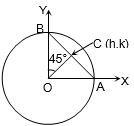
The locus of the middle points of those chords of the circle $x^2 + y^2 = 4$ which subtend a right angle at the origin is
A
$x^2 + y^2 - 2x - 2y = 0$
B
$x^2 + y^2 = 4$
C
$x^2 + y^2 = 2$
D
$(x - 1)^2 + (y - 2)^2 = 5$
Solution
(C) Let the mid-point of the chord be $C(h, k)$.
Since the chord subtends a right angle at the origin $O(0, 0)$,the triangle formed by the origin and the endpoints of the chord is an isosceles right-angled triangle.
The distance from the origin to the midpoint $C(h, k)$ is $d = \sqrt{h^2 + k^2}$.
In the right-angled triangle formed by the origin,the midpoint,and one endpoint of the chord,the angle at the origin is $45^\circ$.
Using trigonometry,$\cos(45^\circ) = \frac{d}{r}$,where $r$ is the radius of the circle.
Given $r = 2$,we have $\frac{1}{\sqrt{2}} = \frac{\sqrt{h^2 + k^2}}{2}$.
Squaring both sides,$\frac{1}{2} = \frac{h^2 + k^2}{4}$,which simplifies to $h^2 + k^2 = 2$.
Replacing $(h, k)$ with $(x, y)$,the locus is $x^2 + y^2 = 2$.
Since the chord subtends a right angle at the origin $O(0, 0)$,the triangle formed by the origin and the endpoints of the chord is an isosceles right-angled triangle.
The distance from the origin to the midpoint $C(h, k)$ is $d = \sqrt{h^2 + k^2}$.
In the right-angled triangle formed by the origin,the midpoint,and one endpoint of the chord,the angle at the origin is $45^\circ$.
Using trigonometry,$\cos(45^\circ) = \frac{d}{r}$,where $r$ is the radius of the circle.
Given $r = 2$,we have $\frac{1}{\sqrt{2}} = \frac{\sqrt{h^2 + k^2}}{2}$.
Squaring both sides,$\frac{1}{2} = \frac{h^2 + k^2}{4}$,which simplifies to $h^2 + k^2 = 2$.
Replacing $(h, k)$ with $(x, y)$,the locus is $x^2 + y^2 = 2$.
1 likesView Solution
14
MathematicsDifficultMCQIIT JEE · 1984
The abscissae of $A$ and $B$ are the roots of the equation $x^2 + 2ax - b^2 = 0$ and their ordinates are the roots of the equation $y^2 + 2py - q^2 = 0$. Find the equation of the circle with $AB$ as the diameter.
A
$x^2 + y^2 + 2ax + 2py - b^2 - q^2 = 0$
B
$x^2 + y^2 + 2ax + py - b^2 - q^2 = 0$
C
$x^2 + y^2 + 2ax + 2py + b^2 + q^2 = 0$
D
None of these
Solution
(A) Let the coordinates of $A$ be $(x_1, y_1)$ and $B$ be $(x_2, y_2)$.
From the given equations,the roots for abscissae are $x_1, x_2$,so $x_1 + x_2 = -2a$ and $x_1x_2 = -b^2$.
Similarly,the roots for ordinates are $y_1, y_2$,so $y_1 + y_2 = -2p$ and $y_1y_2 = -q^2$.
The equation of a circle with diameter $AB$ is given by $(x - x_1)(x - x_2) + (y - y_1)(y - y_2) = 0$.
Expanding this,we get $x^2 - (x_1 + x_2)x + x_1x_2 + y^2 - (y_1 + y_2)y + y_1y_2 = 0$.
Substituting the values,we get $x^2 - (-2a)x + (-b^2) + y^2 - (-2p)y + (-q^2) = 0$.
This simplifies to $x^2 + y^2 + 2ax + 2py - b^2 - q^2 = 0$.
From the given equations,the roots for abscissae are $x_1, x_2$,so $x_1 + x_2 = -2a$ and $x_1x_2 = -b^2$.
Similarly,the roots for ordinates are $y_1, y_2$,so $y_1 + y_2 = -2p$ and $y_1y_2 = -q^2$.
The equation of a circle with diameter $AB$ is given by $(x - x_1)(x - x_2) + (y - y_1)(y - y_2) = 0$.
Expanding this,we get $x^2 - (x_1 + x_2)x + x_1x_2 + y^2 - (y_1 + y_2)y + y_1y_2 = 0$.
Substituting the values,we get $x^2 - (-2a)x + (-b^2) + y^2 - (-2p)y + (-q^2) = 0$.
This simplifies to $x^2 + y^2 + 2ax + 2py - b^2 - q^2 = 0$.
0 likesView Solution
15
MathematicsMediumMCQIIT JEE · 1984
$\mathop {\lim }\limits_{n \to \infty } \left[ {\frac{1}{{1 - {n^2}}} + \frac{2}{{1 - {n^2}}} + \frac{3}{{1 - {n^2}}} + \dots + \frac{n}{{1 - {n^2}}}} \right] =$
A
$0$
B
$-\frac{1}{2}$
C
$1/2$
D
None of these
Solution
(B) The given expression is $\mathop {\lim }\limits_{n \to \infty } \left[ {\frac{1 + 2 + 3 + \dots + n}{1 - {n^2}}} \right]$.
Using the formula for the sum of the first $n$ natural numbers,$\sum_{k=1}^{n} k = \frac{n(n+1)}{2}$,the expression becomes:
$\mathop {\lim }\limits_{n \to \infty } \frac{n(n+1)}{2(1 - {n^2})}$
$= \mathop {\lim }\limits_{n \to \infty } \frac{n^2 + n}{2 - 2n^2}$
Dividing the numerator and denominator by $n^2$:
$= \mathop {\lim }\limits_{n \to \infty } \frac{1 + \frac{1}{n}}{\frac{2}{n^2} - 2} = \frac{1 + 0}{0 - 2} = -\frac{1}{2}$.
Using the formula for the sum of the first $n$ natural numbers,$\sum_{k=1}^{n} k = \frac{n(n+1)}{2}$,the expression becomes:
$\mathop {\lim }\limits_{n \to \infty } \frac{n(n+1)}{2(1 - {n^2})}$
$= \mathop {\lim }\limits_{n \to \infty } \frac{n^2 + n}{2 - 2n^2}$
Dividing the numerator and denominator by $n^2$:
$= \mathop {\lim }\limits_{n \to \infty } \frac{1 + \frac{1}{n}}{\frac{2}{n^2} - 2} = \frac{1 + 0}{0 - 2} = -\frac{1}{2}$.
0 likesView Solution
16
MathematicsMediumMCQIIT JEE · 1984
$\mathop {\lim }\limits_{x \to 1} (1 - x)\tan \left( {\frac{{\pi x}}{2}} \right) = $
A
$\frac{\pi }{2}$
B
$\pi $
C
$\frac{2}{\pi }$
D
$0$
Solution
(C) Let $L = \mathop {\lim }\limits_{x \to 1} (1 - x)\tan \left( {\frac{{\pi x}}{2}} \right)$.
Substitute $y = 1 - x$,so as $x \to 1$,$y \to 0$ and $x = 1 - y$.
Then $L = \mathop {\lim }\limits_{y \to 0} y \tan \left( {\frac{{\pi (1 - y)}}{2}} \right) = \mathop {\lim }\limits_{y \to 0} y \tan \left( {\frac{\pi }{2} - \frac{{\pi y}}{2}} \right)$.
Using the identity $\tan \left( {\frac{\pi }{2} - \theta } \right) = \cot \theta$,we get:
$L = \mathop {\lim }\limits_{y \to 0} y \cot \left( {\frac{{\pi y}}{2}} \right) = \mathop {\lim }\limits_{y \to 0} \frac{y}{\tan \left( {\frac{{\pi y}}{2}} \right)}$.
Multiply and divide by $\frac{\pi }{2}$:
$L = \mathop {\lim }\limits_{y \to 0} \frac{1}{\frac{\pi }{2}} \cdot \frac{{\frac{{\pi y}}{2}}}{{\tan \left( {\frac{{\pi y}}{2}} \right)}} = \frac{2}{\pi } \cdot 1 = \frac{2}{\pi }$.
Substitute $y = 1 - x$,so as $x \to 1$,$y \to 0$ and $x = 1 - y$.
Then $L = \mathop {\lim }\limits_{y \to 0} y \tan \left( {\frac{{\pi (1 - y)}}{2}} \right) = \mathop {\lim }\limits_{y \to 0} y \tan \left( {\frac{\pi }{2} - \frac{{\pi y}}{2}} \right)$.
Using the identity $\tan \left( {\frac{\pi }{2} - \theta } \right) = \cot \theta$,we get:
$L = \mathop {\lim }\limits_{y \to 0} y \cot \left( {\frac{{\pi y}}{2}} \right) = \mathop {\lim }\limits_{y \to 0} \frac{y}{\tan \left( {\frac{{\pi y}}{2}} \right)}$.
Multiply and divide by $\frac{\pi }{2}$:
$L = \mathop {\lim }\limits_{y \to 0} \frac{1}{\frac{\pi }{2}} \cdot \frac{{\frac{{\pi y}}{2}}}{{\tan \left( {\frac{{\pi y}}{2}} \right)}} = \frac{2}{\pi } \cdot 1 = \frac{2}{\pi }$.
0 likesView Solution
17
MathematicsEasyMCQIIT JEE · 1984
Three identical dice are rolled. The probability that the same number will appear on each of them is:
A
$\frac{1}{6}$
B
$\frac{1}{36}$
C
$\frac{1}{18}$
D
$\frac{3}{28}$
Solution
(B) When three dice are rolled,the total number of possible outcomes is $6 \times 6 \times 6 = 216$.
The favorable outcomes where the same number appears on each die are $(1, 1, 1), (2, 2, 2), (3, 3, 3), (4, 4, 4), (5, 5, 5), \text{ and } (6, 6, 6)$.
There are $6$ such favorable outcomes.
Therefore,the required probability is $\frac{6}{216} = \frac{1}{36}$.
The favorable outcomes where the same number appears on each die are $(1, 1, 1), (2, 2, 2), (3, 3, 3), (4, 4, 4), (5, 5, 5), \text{ and } (6, 6, 6)$.
There are $6$ such favorable outcomes.
Therefore,the required probability is $\frac{6}{216} = \frac{1}{36}$.
0 likesView Solution
18
MathematicsEasyMCQIIT JEE · 1984
If $A$ and $B$ are any two events,then the probability that exactly one of them occurs is
A
$P(A) + P(B) - P(A \cap B)$
B
$P(A) + P(B) - 2P(A \cap B)$
C
$P(A) + P(B) - P(A \cup B)$
D
$P(A) + P(B) - 2P(A \cup B)$
Solution
(B) The probability that exactly one of the events $A$ or $B$ occurs is given by the probability of the symmetric difference of $A$ and $B$,denoted as $P(A \Delta B)$.
This is equivalent to the probability that $A$ occurs and $B$ does not,or $B$ occurs and $A$ does not:
$P(A \cap \bar{B}) + P(\bar{A} \cap B)$
Using the property $P(A \cap \bar{B}) = P(A) - P(A \cap B)$ and $P(\bar{A} \cap B) = P(B) - P(A \cap B)$:
$= (P(A) - P(A \cap B)) + (P(B) - P(A \cap B))$
$= P(A) + P(B) - 2P(A \cap B)$.
This is equivalent to the probability that $A$ occurs and $B$ does not,or $B$ occurs and $A$ does not:
$P(A \cap \bar{B}) + P(\bar{A} \cap B)$
Using the property $P(A \cap \bar{B}) = P(A) - P(A \cap B)$ and $P(\bar{A} \cap B) = P(B) - P(A \cap B)$:
$= (P(A) - P(A \cap B)) + (P(B) - P(A \cap B))$
$= P(A) + P(B) - 2P(A \cap B)$.
0 likesView Solution
19
MathematicsEasyMCQIIT JEE · 1984
If the complex numbers $z_1, z_2, z_3$ represent the vertices of an equilateral triangle such that $|z_1| = |z_2| = |z_3|$,then $z_1 + z_2 + z_3 = $
A
$0$
B
$1$
C
$-1$
D
None of these
Solution
(A) Let the complex numbers $z_1, z_2, z_3$ denote the vertices $A, B, C$ of an equilateral triangle $ABC$.
Since $|z_1| = |z_2| = |z_3|$,the origin $O$ is equidistant from all vertices $A, B, C$.
This implies that the origin $O$ is the circumcenter of the equilateral triangle $ABC$.
For an equilateral triangle,the circumcenter,centroid,and orthocenter coincide.
If $G$ is the centroid,then $G = \frac{z_1 + z_2 + z_3}{3}$.
Since the centroid $G$ coincides with the circumcenter $O$ (which is the origin $0$),we have $\frac{z_1 + z_2 + z_3}{3} = 0$.
Therefore,$z_1 + z_2 + z_3 = 0$.
Since $|z_1| = |z_2| = |z_3|$,the origin $O$ is equidistant from all vertices $A, B, C$.
This implies that the origin $O$ is the circumcenter of the equilateral triangle $ABC$.
For an equilateral triangle,the circumcenter,centroid,and orthocenter coincide.
If $G$ is the centroid,then $G = \frac{z_1 + z_2 + z_3}{3}$.
Since the centroid $G$ coincides with the circumcenter $O$ (which is the origin $0$),we have $\frac{z_1 + z_2 + z_3}{3} = 0$.
Therefore,$z_1 + z_2 + z_3 = 0$.
0 likesView Solution
20
MathematicsMediumMCQIIT JEE · 1984
If $a, b, c$ are in $A.P.$,then the straight line $ax + by + c = 0$ will always pass through the point
A
$(-1, -2)$
B
$(1, -2)$
C
$(-1, 2)$
D
$(1, 2)$
Solution
(B) Given that $a, b, c$ are in $A.P.$,we have the relation $2b = a + c$,which can be rewritten as $a - 2b + c = 0$.
The equation of the straight line is $ax + by + c = 0$.
Comparing this with the condition $a(1) + b(-2) + c = 0$,we can see that the line satisfies the equation for the point $(x, y) = (1, -2)$.
Therefore,the line $ax + by + c = 0$ always passes through the point $(1, -2)$.
The equation of the straight line is $ax + by + c = 0$.
Comparing this with the condition $a(1) + b(-2) + c = 0$,we can see that the line satisfies the equation for the point $(x, y) = (1, -2)$.
Therefore,the line $ax + by + c = 0$ always passes through the point $(1, -2)$.
0 likesView Solution
21
MathematicsMediumMCQIIT JEE · 1984
The sides $AB, BC, CA$ of a triangle $ABC$ have respectively $3, 4$ and $5$ points lying on them. The number of triangles that can be constructed using these points as vertices is
A
$205$
B
$220$
C
$210$
D
None of these
Solution
(A) Total number of points = $3 + 4 + 5 = 12$.
The total number of ways to select $3$ points out of $12$ is $^{12}C_3 = \frac{12 \times 11 \times 10}{3 \times 2 \times 1} = 220$.
However,points lying on the same side are collinear and cannot form a triangle. We must subtract the cases where $3$ points are selected from the same side:
$1$. Points on side $AB$: $^{3}C_3 = 1$ way.
$2$. Points on side $BC$: $^{4}C_3 = 4$ ways.
$3$. Points on side $CA$: $^{5}C_3 = 10$ ways.
Total collinear sets = $1 + 4 + 10 = 15$.
Number of triangles = $220 - 15 = 205$.
The total number of ways to select $3$ points out of $12$ is $^{12}C_3 = \frac{12 \times 11 \times 10}{3 \times 2 \times 1} = 220$.
However,points lying on the same side are collinear and cannot form a triangle. We must subtract the cases where $3$ points are selected from the same side:
$1$. Points on side $AB$: $^{3}C_3 = 1$ way.
$2$. Points on side $BC$: $^{4}C_3 = 4$ ways.
$3$. Points on side $CA$: $^{5}C_3 = 10$ ways.
Total collinear sets = $1 + 4 + 10 = 15$.
Number of triangles = $220 - 15 = 205$.
0 likesView Solution
22
MathematicsDifficultMCQIIT JEE · 1984
If $x \cos \theta = y \cos \left( \theta + \frac{2\pi}{3} \right) = z \cos \left( \theta + \frac{4\pi}{3} \right)$,then the value of $\frac{1}{x} + \frac{1}{y} + \frac{1}{z}$ is equal to
A
$1$
B
$2$
C
$0$
D
$3 \cos \theta$
0 likesView Solution
23
MathematicsMediumMCQIIT JEE · 1984
The system of equations $\lambda x + y + z = 0, -x + \lambda y + z = 0, -x - y + \lambda z = 0$ will have a non-zero solution if real values of $\lambda$ are given by
A
$0$
B
$1$
C
$3$
D
$\sqrt{3}$
Solution
(A) For a system of homogeneous linear equations to have a non-zero solution,the determinant of the coefficient matrix must be equal to zero.
The coefficient matrix is given by:
$A = \begin{bmatrix} \lambda & 1 & 1 \\ -1 & \lambda & 1 \\ -1 & -1 & \lambda \end{bmatrix}$
Setting the determinant to zero:
$\begin{vmatrix} \lambda & 1 & 1 \\ -1 & \lambda & 1 \\ -1 & -1 & \lambda \end{vmatrix} = 0$
Expanding along the first row:
$\lambda(\lambda^2 - (-1)) - 1(-\lambda - (-1)) + 1(1 - (-\lambda)) = 0$
$\lambda(\lambda^2 + 1) - 1(-\lambda + 1) + 1(1 + \lambda) = 0$
$\lambda^3 + \lambda + \lambda - 1 + 1 + \lambda = 0$
$\lambda^3 + 3\lambda = 0$
$\lambda(\lambda^2 + 3) = 0$
This gives $\lambda = 0$ or $\lambda^2 = -3$. Since $\lambda$ must be a real value,$\lambda^2 = -3$ has no real solutions.
Therefore,the only real value for $\lambda$ is $0$.
The coefficient matrix is given by:
$A = \begin{bmatrix} \lambda & 1 & 1 \\ -1 & \lambda & 1 \\ -1 & -1 & \lambda \end{bmatrix}$
Setting the determinant to zero:
$\begin{vmatrix} \lambda & 1 & 1 \\ -1 & \lambda & 1 \\ -1 & -1 & \lambda \end{vmatrix} = 0$
Expanding along the first row:
$\lambda(\lambda^2 - (-1)) - 1(-\lambda - (-1)) + 1(1 - (-\lambda)) = 0$
$\lambda(\lambda^2 + 1) - 1(-\lambda + 1) + 1(1 + \lambda) = 0$
$\lambda^3 + \lambda + \lambda - 1 + 1 + \lambda = 0$
$\lambda^3 + 3\lambda = 0$
$\lambda(\lambda^2 + 3) = 0$
This gives $\lambda = 0$ or $\lambda^2 = -3$. Since $\lambda$ must be a real value,$\lambda^2 = -3$ has no real solutions.
Therefore,the only real value for $\lambda$ is $0$.
0 likesView Solution
24
MathematicsMediumMCQIIT JEE · 1984
$\tan \left[ 2\tan^{-1}\left( \frac{1}{5} \right) - \frac{\pi}{4} \right] = $
A
$\frac{17}{7}$
B
$-\frac{17}{7}$
C
$\frac{7}{17}$
D
$-\frac{7}{17}$
Solution
(D) We use the formula $2\tan^{-1}(x) = \tan^{-1}\left( \frac{2x}{1-x^2} \right)$.
First,calculate $2\tan^{-1}\left( \frac{1}{5} \right)$:
$2\tan^{-1}\left( \frac{1}{5} \right) = \tan^{-1}\left( \frac{2(1/5)}{1-(1/5)^2} \right) = \tan^{-1}\left( \frac{2/5}{1-1/25} \right) = \tan^{-1}\left( \frac{2/5}{24/25} \right) = \tan^{-1}\left( \frac{2}{5} \times \frac{25}{24} \right) = \tan^{-1}\left( \frac{5}{12} \right)$.
Now,substitute this into the expression:
$\tan \left[ \tan^{-1}\left( \frac{5}{12} \right) - \frac{\pi}{4} \right] = \tan \left[ \tan^{-1}\left( \frac{5}{12} \right) - \tan^{-1}(1) \right]$.
Using the formula $\tan^{-1}(x) - \tan^{-1}(y) = \tan^{-1}\left( \frac{x-y}{1+xy} \right)$:
$\tan \left[ \tan^{-1}\left( \frac{5/12 - 1}{1 + (5/12)(1)} \right) \right] = \frac{5/12 - 1}{1 + 5/12} = \frac{-7/12}{17/12} = -\frac{7}{17}$.
First,calculate $2\tan^{-1}\left( \frac{1}{5} \right)$:
$2\tan^{-1}\left( \frac{1}{5} \right) = \tan^{-1}\left( \frac{2(1/5)}{1-(1/5)^2} \right) = \tan^{-1}\left( \frac{2/5}{1-1/25} \right) = \tan^{-1}\left( \frac{2/5}{24/25} \right) = \tan^{-1}\left( \frac{2}{5} \times \frac{25}{24} \right) = \tan^{-1}\left( \frac{5}{12} \right)$.
Now,substitute this into the expression:
$\tan \left[ \tan^{-1}\left( \frac{5}{12} \right) - \frac{\pi}{4} \right] = \tan \left[ \tan^{-1}\left( \frac{5}{12} \right) - \tan^{-1}(1) \right]$.
Using the formula $\tan^{-1}(x) - \tan^{-1}(y) = \tan^{-1}\left( \frac{x-y}{1+xy} \right)$:
$\tan \left[ \tan^{-1}\left( \frac{5/12 - 1}{1 + (5/12)(1)} \right) \right] = \frac{5/12 - 1}{1 + 5/12} = \frac{-7/12}{17/12} = -\frac{7}{17}$.
0 likesView Solution
25
MathematicsEasyMCQIIT JEE · 1984
The magnitudes of mutually perpendicular forces $a, b$ and $c$ are $2, 10$ and $11$ respectively. Then the magnitude of its resultant is
A
$12$
B
$15$
C
$9$
D
None
Solution
(B) Since the forces $a, b$ and $c$ are mutually perpendicular,they can be represented along the $x, y$ and $z$ axes respectively.
Let the vectors be $\vec{a} = 2\hat{i}$,$\vec{b} = 10\hat{j}$,and $\vec{c} = 11\hat{k}$.
The resultant vector is $\vec{R} = \vec{a} + \vec{b} + \vec{c} = 2\hat{i} + 10\hat{j} + 11\hat{k}$.
The magnitude of the resultant is given by $|\vec{R}| = \sqrt{(2)^2 + (10)^2 + (11)^2}$.
$|\vec{R}| = \sqrt{4 + 100 + 121} = \sqrt{225} = 15$.
Let the vectors be $\vec{a} = 2\hat{i}$,$\vec{b} = 10\hat{j}$,and $\vec{c} = 11\hat{k}$.
The resultant vector is $\vec{R} = \vec{a} + \vec{b} + \vec{c} = 2\hat{i} + 10\hat{j} + 11\hat{k}$.
The magnitude of the resultant is given by $|\vec{R}| = \sqrt{(2)^2 + (10)^2 + (11)^2}$.
$|\vec{R}| = \sqrt{4 + 100 + 121} = \sqrt{225} = 15$.
0 likesView Solution
26
MathematicsMediumMCQIIT JEE · 1984
Three points whose position vectors are $a + b$,$a - b$,and $a + kb$ will be collinear if the value of $k$ is:
A
Zero
B
Only negative real number
C
Only positive real number
D
Every real number
Solution
(D) Let the points be $A$,$B$,and $C$ with position vectors $\vec{OA} = a + b$,$\vec{OB} = a - b$,and $\vec{OC} = a + kb$.
For the points to be collinear,the vectors $\vec{AB}$ and $\vec{BC}$ must be parallel,meaning $\vec{AB} = \lambda \vec{BC}$ for some scalar $\lambda$.
Calculate $\vec{AB} = \vec{OB} - \vec{OA} = (a - b) - (a + b) = -2b$.
Calculate $\vec{BC} = \vec{OC} - \vec{OB} = (a + kb) - (a - b) = (k + 1)b$.
For collinearity,$-2b = \lambda(k + 1)b$.
This implies $-2 = \lambda(k + 1)$. Since $\lambda$ can be any non-zero real number,$k$ can take any real value except for the case where the points coincide. However,in the context of vector collinearity,the condition holds for any $k \in \mathbb{R}$ as long as the vectors are linearly dependent.
Thus,the points are collinear for every real number $k$.
For the points to be collinear,the vectors $\vec{AB}$ and $\vec{BC}$ must be parallel,meaning $\vec{AB} = \lambda \vec{BC}$ for some scalar $\lambda$.
Calculate $\vec{AB} = \vec{OB} - \vec{OA} = (a - b) - (a + b) = -2b$.
Calculate $\vec{BC} = \vec{OC} - \vec{OB} = (a + kb) - (a - b) = (k + 1)b$.
For collinearity,$-2b = \lambda(k + 1)b$.
This implies $-2 = \lambda(k + 1)$. Since $\lambda$ can be any non-zero real number,$k$ can take any real value except for the case where the points coincide. However,in the context of vector collinearity,the condition holds for any $k \in \mathbb{R}$ as long as the vectors are linearly dependent.
Thus,the points are collinear for every real number $k$.
0 likesView Solution
27
MathematicsDifficultMCQIIT JEE · 1984
$A$ vector $\vec{a}$ has components $2p$ and $1$ with respect to a rectangular Cartesian system. The system is rotated through a certain angle about the origin in the anti-clockwise sense. If $\vec{a}$ has components $p+1$ and $1$ with respect to the new system,then:
A
$p = 0$
B
$p = 1$ or $p = -\frac{1}{3}$
C
$p = -1$ or $p = \frac{1}{3}$
D
$p = 1$ or $p = -1$
Solution
(B) The magnitude of a vector remains invariant under rotation of the coordinate axes.
Given the original components are $(2p, 1)$ and the new components are $(p+1, 1)$.
The square of the magnitude is given by $x^2 + y^2$.
Therefore,$(2p)^2 + 1^2 = (p+1)^2 + 1^2$.
$4p^2 + 1 = p^2 + 2p + 1 + 1$.
$3p^2 - 2p - 1 = 0$.
Solving the quadratic equation: $3p^2 - 3p + p - 1 = 0$.
$3p(p-1) + 1(p-1) = 0$.
$(3p+1)(p-1) = 0$.
Thus,$p = 1$ or $p = -\frac{1}{3}$.
Given the original components are $(2p, 1)$ and the new components are $(p+1, 1)$.
The square of the magnitude is given by $x^2 + y^2$.
Therefore,$(2p)^2 + 1^2 = (p+1)^2 + 1^2$.
$4p^2 + 1 = p^2 + 2p + 1 + 1$.
$3p^2 - 2p - 1 = 0$.
Solving the quadratic equation: $3p^2 - 3p + p - 1 = 0$.
$3p(p-1) + 1(p-1) = 0$.
$(3p+1)(p-1) = 0$.
Thus,$p = 1$ or $p = -\frac{1}{3}$.
0 likesView Solution
28
MathematicsEasyMCQIIT JEE · 1984
If $y = f(x) = \frac{x + 2}{x - 1}$,then $x = $
A
$f(y)$
B
$2f(y)$
C
$\frac{1}{f(y)}$
D
None of these
Solution
(A) Given the function $y = \frac{x + 2}{x - 1}$.
To find $x$ in terms of $y$,we perform the following steps:
$y(x - 1) = x + 2$
$yx - y = x + 2$
$yx - x = y + 2$
$x(y - 1) = y + 2$
$x = \frac{y + 2}{y - 1}$
Since $f(y) = \frac{y + 2}{y - 1}$,we conclude that $x = f(y)$.
To find $x$ in terms of $y$,we perform the following steps:
$y(x - 1) = x + 2$
$yx - y = x + 2$
$yx - x = y + 2$
$x(y - 1) = y + 2$
$x = \frac{y + 2}{y - 1}$
Since $f(y) = \frac{y + 2}{y - 1}$,we conclude that $x = f(y)$.
0 likesView Solution
29
MathematicsMediumMCQIIT JEE · 1984
Let $f(x) = \begin{cases} 0, & x < 0 \\ x^2, & x \ge 0 \end{cases}$,then for all values of $x$
A
$f$ is continuous but not differentiable
B
$f$ is differentiable but not continuous
C
$f'$ is continuous but not differentiable
D
$f'$ is continuous and differentiable
Solution
(C) Given $f(x) = \begin{cases} 0, & x < 0 \\ x^2, & x \ge 0 \end{cases}$.
First,we check the continuity at $x = 0$:
$\lim_{x \to 0^-} f(x) = \lim_{h \to 0} f(0 - h) = 0$.
$\lim_{x \to 0^+} f(x) = \lim_{h \to 0} f(0 + h) = \lim_{h \to 0} (0 + h)^2 = 0$.
Since $\lim_{x \to 0^-} f(x) = \lim_{x \to 0^+} f(x) = f(0) = 0$,$f(x)$ is continuous at $x = 0$.
Next,we check the differentiability at $x = 0$:
$Lf'(0) = \lim_{h \to 0} \frac{f(0 - h) - f(0)}{-h} = \lim_{h \to 0} \frac{0 - 0}{-h} = 0$.
$Rf'(0) = \lim_{h \to 0} \frac{f(0 + h) - f(0)}{h} = \lim_{h \to 0} \frac{h^2 - 0}{h} = \lim_{h \to 0} h = 0$.
Since $Lf'(0) = Rf'(0) = 0$,$f(x)$ is differentiable at $x = 0$ and $f'(0) = 0$.
The derivative is $f'(x) = \begin{cases} 0, & x < 0 \\ 2x, & x \ge 0 \end{cases}$.
Now,check the continuity of $f'(x)$ at $x = 0$:
$\lim_{x \to 0^-} f'(x) = 0$ and $\lim_{x \to 0^+} f'(x) = \lim_{x \to 0^+} 2x = 0$.
Since $\lim_{x \to 0^-} f'(x) = \lim_{x \to 0^+} f'(x) = f'(0) = 0$,$f'(x)$ is continuous at $x = 0$.
Finally,check the differentiability of $f'(x)$ at $x = 0$:
$Lf''(0) = \lim_{h \to 0} \frac{f'(0 - h) - f'(0)}{-h} = \lim_{h \to 0} \frac{0 - 0}{-h} = 0$.
$Rf''(0) = \lim_{h \to 0} \frac{f'(0 + h) - f'(0)}{h} = \lim_{h \to 0} \frac{2(0 + h) - 0}{h} = \lim_{h \to 0} \frac{2h}{h} = 2$.
Since $Lf''(0) \neq Rf''(0)$,$f'(x)$ is not differentiable at $x = 0$.
First,we check the continuity at $x = 0$:
$\lim_{x \to 0^-} f(x) = \lim_{h \to 0} f(0 - h) = 0$.
$\lim_{x \to 0^+} f(x) = \lim_{h \to 0} f(0 + h) = \lim_{h \to 0} (0 + h)^2 = 0$.
Since $\lim_{x \to 0^-} f(x) = \lim_{x \to 0^+} f(x) = f(0) = 0$,$f(x)$ is continuous at $x = 0$.
Next,we check the differentiability at $x = 0$:
$Lf'(0) = \lim_{h \to 0} \frac{f(0 - h) - f(0)}{-h} = \lim_{h \to 0} \frac{0 - 0}{-h} = 0$.
$Rf'(0) = \lim_{h \to 0} \frac{f(0 + h) - f(0)}{h} = \lim_{h \to 0} \frac{h^2 - 0}{h} = \lim_{h \to 0} h = 0$.
Since $Lf'(0) = Rf'(0) = 0$,$f(x)$ is differentiable at $x = 0$ and $f'(0) = 0$.
The derivative is $f'(x) = \begin{cases} 0, & x < 0 \\ 2x, & x \ge 0 \end{cases}$.
Now,check the continuity of $f'(x)$ at $x = 0$:
$\lim_{x \to 0^-} f'(x) = 0$ and $\lim_{x \to 0^+} f'(x) = \lim_{x \to 0^+} 2x = 0$.
Since $\lim_{x \to 0^-} f'(x) = \lim_{x \to 0^+} f'(x) = f'(0) = 0$,$f'(x)$ is continuous at $x = 0$.
Finally,check the differentiability of $f'(x)$ at $x = 0$:
$Lf''(0) = \lim_{h \to 0} \frac{f'(0 - h) - f'(0)}{-h} = \lim_{h \to 0} \frac{0 - 0}{-h} = 0$.
$Rf''(0) = \lim_{h \to 0} \frac{f'(0 + h) - f'(0)}{h} = \lim_{h \to 0} \frac{2(0 + h) - 0}{h} = \lim_{h \to 0} \frac{2h}{h} = 2$.
Since $Lf''(0) \neq Rf''(0)$,$f'(x)$ is not differentiable at $x = 0$.
0 likesView Solution
30
MathematicsMediumMCQIIT JEE · 1984
$\int \frac{x \sin^{-1} x}{\sqrt{1 - x^2}} \, dx = $
A
$x - \sqrt{1 - x^2} \sin^{-1} x + c$
B
$x + \sqrt{1 - x^2} \sin^{-1} x + c$
C
$\sqrt{1 - x^2} \sin^{-1} x - x + c$
D
None of these
Solution
(A) Let $I = \int \frac{x \sin^{-1} x}{\sqrt{1 - x^2}} \, dx$.
Substitute $t = \sin^{-1} x$,then $x = \sin t$ and $dt = \frac{1}{\sqrt{1 - x^2}} \, dx$.
The integral becomes $I = \int t \sin t \, dt$.
Using integration by parts: $\int u \, dv = uv - \int v \, du$.
Let $u = t$ and $dv = \sin t \, dt$. Then $du = dt$ and $v = -\cos t$.
$I = -t \cos t - \int (-\cos t) \, dt = -t \cos t + \sin t + c$.
Since $t = \sin^{-1} x$,we have $\sin t = x$ and $\cos t = \sqrt{1 - \sin^2 t} = \sqrt{1 - x^2}$.
Substituting these back,we get $I = -(\sin^{-1} x) \sqrt{1 - x^2} + x + c = x - \sqrt{1 - x^2} \sin^{-1} x + c$.
Substitute $t = \sin^{-1} x$,then $x = \sin t$ and $dt = \frac{1}{\sqrt{1 - x^2}} \, dx$.
The integral becomes $I = \int t \sin t \, dt$.
Using integration by parts: $\int u \, dv = uv - \int v \, du$.
Let $u = t$ and $dv = \sin t \, dt$. Then $du = dt$ and $v = -\cos t$.
$I = -t \cos t - \int (-\cos t) \, dt = -t \cos t + \sin t + c$.
Since $t = \sin^{-1} x$,we have $\sin t = x$ and $\cos t = \sqrt{1 - \sin^2 t} = \sqrt{1 - x^2}$.
Substituting these back,we get $I = -(\sin^{-1} x) \sqrt{1 - x^2} + x + c = x - \sqrt{1 - x^2} \sin^{-1} x + c$.
0 likesView Solution
31
MathematicsDifficultMCQIIT JEE · 1984
$\int \frac{dx}{\sin x + \sin 2x} = $
A
$\frac{1}{6}\log |1 - \cos x| + \frac{1}{2}\log |1 + \cos x| - \frac{2}{3}\log |1 + 2\cos x| + C$
B
$6\log |1 - \cos x| + 2\log |1 + \cos x| - \frac{2}{3}\log |1 + 2\cos x| + C$
C
$6\log |1 - \cos x| + \frac{1}{2}\log |1 + \cos x| + \frac{2}{3}\log |1 + 2\cos x| + C$
D
None of these
Solution
(A) Let $I = \int \frac{dx}{\sin x + \sin 2x} = \int \frac{dx}{\sin x(1 + 2\cos x)}$.
Multiply numerator and denominator by $\sin x$:
$I = \int \frac{\sin x \, dx}{\sin^2 x(1 + 2\cos x)} = \int \frac{\sin x \, dx}{(1 - \cos^2 x)(1 + 2\cos x)} = \int \frac{\sin x \, dx}{(1 - \cos x)(1 + \cos x)(1 + 2\cos x)}$.
Let $\cos x = t$,then $-\sin x \, dx = dt$,so $\sin x \, dx = -dt$.
$I = - \int \frac{dt}{(1 - t)(1 + t)(1 + 2t)}$.
Using partial fractions:
$\frac{1}{(1 - t)(1 + t)(1 + 2t)} = \frac{A}{1 - t} + \frac{B}{1 + t} + \frac{C}{1 + 2t}$.
Solving for coefficients,we get $A = \frac{1}{6}$,$B = -\frac{1}{2}$,$C = \frac{4}{3}$.
$I = - \int \left( \frac{1/6}{1 - t} - \frac{1/2}{1 + t} + \frac{4/3}{1 + 2t} \right) dt$.
$I = - \left[ \frac{1}{6} \frac{\log |1 - t|}{-1} - \frac{1}{2} \log |1 + t| + \frac{4}{3} \cdot \frac{1}{2} \log |1 + 2t| \right] + C$.
$I = \frac{1}{6} \log |1 - t| + \frac{1}{2} \log |1 + t| - \frac{2}{3} \log |1 + 2t| + C$.
Substituting $t = \cos x$ back:
$I = \frac{1}{6} \log |1 - \cos x| + \frac{1}{2} \log |1 + \cos x| - \frac{2}{3} \log |1 + 2\cos x| + C$.
Multiply numerator and denominator by $\sin x$:
$I = \int \frac{\sin x \, dx}{\sin^2 x(1 + 2\cos x)} = \int \frac{\sin x \, dx}{(1 - \cos^2 x)(1 + 2\cos x)} = \int \frac{\sin x \, dx}{(1 - \cos x)(1 + \cos x)(1 + 2\cos x)}$.
Let $\cos x = t$,then $-\sin x \, dx = dt$,so $\sin x \, dx = -dt$.
$I = - \int \frac{dt}{(1 - t)(1 + t)(1 + 2t)}$.
Using partial fractions:
$\frac{1}{(1 - t)(1 + t)(1 + 2t)} = \frac{A}{1 - t} + \frac{B}{1 + t} + \frac{C}{1 + 2t}$.
Solving for coefficients,we get $A = \frac{1}{6}$,$B = -\frac{1}{2}$,$C = \frac{4}{3}$.
$I = - \int \left( \frac{1/6}{1 - t} - \frac{1/2}{1 + t} + \frac{4/3}{1 + 2t} \right) dt$.
$I = - \left[ \frac{1}{6} \frac{\log |1 - t|}{-1} - \frac{1}{2} \log |1 + t| + \frac{4}{3} \cdot \frac{1}{2} \log |1 + 2t| \right] + C$.
$I = \frac{1}{6} \log |1 - t| + \frac{1}{2} \log |1 + t| - \frac{2}{3} \log |1 + 2t| + C$.
Substituting $t = \cos x$ back:
$I = \frac{1}{6} \log |1 - \cos x| + \frac{1}{2} \log |1 + \cos x| - \frac{2}{3} \log |1 + 2\cos x| + C$.
0 likesView Solution
32
MathematicsEasyMCQIIT JEE · 1984
$\int_0^{1/2} \frac{x \sin^{-1} x}{\sqrt{1 - x^2}} \, dx = $
A
$\frac{1}{2} + \frac{\sqrt{3} \pi}{12}$
B
$\frac{1}{2} - \frac{\sqrt{3} \pi}{12}$
C
$\frac{1}{2} \pm \frac{\sqrt{3\pi}}{12}$
D
None of these
Solution
(B) Let $t = \sin^{-1} x$.
Then $dt = \frac{1}{\sqrt{1 - x^2}} dx$.
When $x = 0$,$t = 0$.
When $x = 1/2$,$t = \sin^{-1}(1/2) = \pi/6$.
Also,$x = \sin t$.
Substituting these into the integral:
$\int_0^{\pi/6} t \sin t \, dt$.
Using integration by parts: $\int u \, dv = uv - \int v \, du$.
Let $u = t$,$dv = \sin t \, dt$.
Then $du = dt$,$v = -\cos t$.
$\int t \sin t \, dt = -t \cos t - \int (-\cos t) \, dt = -t \cos t + \sin t$.
Evaluating the definite integral:
$[-t \cos t + \sin t]_0^{\pi/6} = (-\frac{\pi}{6} \cos(\frac{\pi}{6}) + \sin(\frac{\pi}{6})) - (0 + 0)$.
$= -\frac{\pi}{6} \cdot \frac{\sqrt{3}}{2} + \frac{1}{2} = \frac{1}{2} - \frac{\sqrt{3} \pi}{12}$.
Then $dt = \frac{1}{\sqrt{1 - x^2}} dx$.
When $x = 0$,$t = 0$.
When $x = 1/2$,$t = \sin^{-1}(1/2) = \pi/6$.
Also,$x = \sin t$.
Substituting these into the integral:
$\int_0^{\pi/6} t \sin t \, dt$.
Using integration by parts: $\int u \, dv = uv - \int v \, du$.
Let $u = t$,$dv = \sin t \, dt$.
Then $du = dt$,$v = -\cos t$.
$\int t \sin t \, dt = -t \cos t - \int (-\cos t) \, dt = -t \cos t + \sin t$.
Evaluating the definite integral:
$[-t \cos t + \sin t]_0^{\pi/6} = (-\frac{\pi}{6} \cos(\frac{\pi}{6}) + \sin(\frac{\pi}{6})) - (0 + 0)$.
$= -\frac{\pi}{6} \cdot \frac{\sqrt{3}}{2} + \frac{1}{2} = \frac{1}{2} - \frac{\sqrt{3} \pi}{12}$.
0 likesView Solution
33
MathematicsMediumMCQIIT JEE · 1984
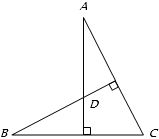
The position vectors of coplanar points $A, B, C,$ and $D$ are $\vec{a}, \vec{b}, \vec{c},$ and $\vec{d}$ respectively,such that $(\vec{a} - \vec{d}) \cdot (\vec{b} - \vec{c}) = 0$ and $(\vec{b} - \vec{d}) \cdot (\vec{c} - \vec{a}) = 0.$ Then the point $D$ of the triangle $ABC$ is
A
Incentre
B
Circumcentre
C
Orthocentre
D
None of these
Solution
(C) Given the conditions:
$(\vec{a} - \vec{d}) \cdot (\vec{b} - \vec{c}) = 0$
$(\vec{b} - \vec{d}) \cdot (\vec{c} - \vec{a}) = 0$
These can be written in terms of vectors as:
$\vec{DA} \cdot \vec{CB} = 0 \Rightarrow \vec{DA} \perp \vec{CB}$
$\vec{DB} \cdot \vec{AC} = 0 \Rightarrow \vec{DB} \perp \vec{AC}$
Since $\vec{DA}$ is perpendicular to the side $BC$ and $\vec{DB}$ is perpendicular to the side $AC,$ the point $D$ is the intersection of the altitudes of $\Delta ABC.$
Therefore,the point $D$ is the orthocentre of $\Delta ABC.$
$(\vec{a} - \vec{d}) \cdot (\vec{b} - \vec{c}) = 0$
$(\vec{b} - \vec{d}) \cdot (\vec{c} - \vec{a}) = 0$
These can be written in terms of vectors as:
$\vec{DA} \cdot \vec{CB} = 0 \Rightarrow \vec{DA} \perp \vec{CB}$
$\vec{DB} \cdot \vec{AC} = 0 \Rightarrow \vec{DB} \perp \vec{AC}$
Since $\vec{DA}$ is perpendicular to the side $BC$ and $\vec{DB}$ is perpendicular to the side $AC,$ the point $D$ is the intersection of the altitudes of $\Delta ABC.$
Therefore,the point $D$ is the orthocentre of $\Delta ABC.$
0 likesView Solution
34
MathematicsEasyMCQIIT JEE · 1984
The lines $x = ay + b, z = cy + d$ and $x = a'y + b', z = c'y + d'$ are perpendicular to each other,if
A
$aa' + cc' = 1$
B
$aa' + cc' = -1$
C
$ac + a'c' = 1$
D
$ac + a'c' = -1$
Solution
(B) The given lines can be written in symmetric form as follows:
For the first line $x = ay + b$ and $z = cy + d$,we have $\frac{x - b}{a} = y = \frac{z - d}{c}$.
Thus,the direction ratios of the first line are $(a, 1, c)$.
For the second line $x = a'y + b'$ and $z = c'y + d'$,we have $\frac{x - b'}{a'} = y = \frac{z - d'}{c'}$.
Thus,the direction ratios of the second line are $(a', 1, c')$.
Two lines with direction ratios $(a_1, b_1, c_1)$ and $(a_2, b_2, c_2)$ are perpendicular if $a_1 a_2 + b_1 b_2 + c_1 c_2 = 0$.
Substituting the direction ratios,we get $(a)(a') + (1)(1) + (c)(c') = 0$.
Therefore,$aa' + 1 + cc' = 0$,which implies $aa' + cc' = -1$.
For the first line $x = ay + b$ and $z = cy + d$,we have $\frac{x - b}{a} = y = \frac{z - d}{c}$.
Thus,the direction ratios of the first line are $(a, 1, c)$.
For the second line $x = a'y + b'$ and $z = c'y + d'$,we have $\frac{x - b'}{a'} = y = \frac{z - d'}{c'}$.
Thus,the direction ratios of the second line are $(a', 1, c')$.
Two lines with direction ratios $(a_1, b_1, c_1)$ and $(a_2, b_2, c_2)$ are perpendicular if $a_1 a_2 + b_1 b_2 + c_1 c_2 = 0$.
Substituting the direction ratios,we get $(a)(a') + (1)(1) + (c)(c') = 0$.
Therefore,$aa' + 1 + cc' = 0$,which implies $aa' + cc' = -1$.
0 likesView Solution
35
MathematicsDifficultMCQIIT JEE · 1984
$\int \frac{1}{x^2(x^4 + 1)^{3/4}} dx = $
A
$\frac{(x^4 + 1)^{1/4}}{x} + c$
B
$-\frac{(x^4 + 1)^{1/4}}{x} + c$
C
$\frac{3}{4} \frac{(x^4 + 1)^{3/4}}{x} + c$
D
$\frac{4}{3} \frac{(x^4 + 1)^{3/4}}{x} + c$
Solution
(B) We have the integral $I = \int \frac{1}{x^2(x^4 + 1)^{3/4}} dx$.
Taking $x^4$ common from the bracket,we get:
$I = \int \frac{1}{x^2 [x^4(1 + \frac{1}{x^4})]^{3/4}} dx = \int \frac{1}{x^2 \cdot x^3 (1 + \frac{1}{x^4})^{3/4}} dx = \int \frac{1}{x^5 (1 + \frac{1}{x^4})^{3/4}} dx$.
Let $t = 1 + \frac{1}{x^4}$.
Then $dt = -\frac{4}{x^5} dx$,which implies $\frac{dx}{x^5} = -\frac{1}{4} dt$.
Substituting these into the integral:
$I = \int -\frac{1}{4} t^{-3/4} dt = -\frac{1}{4} \cdot \frac{t^{1/4}}{1/4} + c = -t^{1/4} + c$.
Substituting $t$ back:
$I = -(1 + \frac{1}{x^4})^{1/4} + c = -(\frac{x^4 + 1}{x^4})^{1/4} + c = -\frac{(x^4 + 1)^{1/4}}{x} + c$.
Taking $x^4$ common from the bracket,we get:
$I = \int \frac{1}{x^2 [x^4(1 + \frac{1}{x^4})]^{3/4}} dx = \int \frac{1}{x^2 \cdot x^3 (1 + \frac{1}{x^4})^{3/4}} dx = \int \frac{1}{x^5 (1 + \frac{1}{x^4})^{3/4}} dx$.
Let $t = 1 + \frac{1}{x^4}$.
Then $dt = -\frac{4}{x^5} dx$,which implies $\frac{dx}{x^5} = -\frac{1}{4} dt$.
Substituting these into the integral:
$I = \int -\frac{1}{4} t^{-3/4} dt = -\frac{1}{4} \cdot \frac{t^{1/4}}{1/4} + c = -t^{1/4} + c$.
Substituting $t$ back:
$I = -(1 + \frac{1}{x^4})^{1/4} + c = -(\frac{x^4 + 1}{x^4})^{1/4} + c = -\frac{(x^4 + 1)^{1/4}}{x} + c$.
0 likesView Solution
Vedclass Products
For Students
Vedclass Test Series
Mock tests in real IIT JEE style covering Mathematics with performance analysis. 5-day free trial.
Start Free TrialFor Teachers
Exam Paper Generator
Generate Set A/B/C/D Mathematics papers from 7.5L+ questions in 2 minutes. 3 chapters free.
Try FreeFor Institutes
Online Exam Module
Run live IIT JEE mock exams with unlimited students, 360° analytics & white-label branding.
See DemoFrequently Asked Questions
How many Mathematics questions are in IIT JEE 1984?
There are 35 Mathematics questions from the IIT JEE 1984 paper on Vedclass, each with a detailed step-by-step solution in English.
Are IIT JEE 1984 Mathematics solutions available in English?
Yes. All solutions on this page are in English. You can also switch to English or Hindi using the language buttons above the questions.
Can I practice IIT JEE 1984 Mathematics as a timed test?
Yes. Use the Vedclass Test Series to attempt a full IIT JEE mock test covering Mathematics with time limits and instant score analysis.
Can teachers create Mathematics papers from IIT JEE previous year questions?
Yes. The Vedclass Exam Paper Generator lets teachers mix IIT JEE Mathematics questions and generate Set A/B/C/D papers in minutes.
For Teachers & Institutes
Build a Custom Mathematics Paper
Pick IIT JEE 1984 Mathematics questions, set difficulty, and generate Set A/B/C/D in 2 minutes.