
PhysicsQ1–11 of 11 questions
Page 1 of 1 · English
1
PhysicsDifficultMCQIIT JEE · 1984
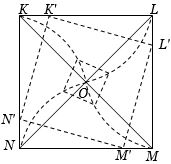
Four persons $K, L, M$ and $N$ are initially at the corners of a square of side length $d$. If every person starts moving with speed $v$ such that $K$ is always headed towards $L$,$L$ towards $M$,$M$ towards $N$,and $N$ towards $K$,then the four persons will meet after
A
$\frac{d}{v} \text{ s}$
B
$\frac{\sqrt{2}d}{v} \text{ s}$
C
$\frac{d}{\sqrt{2}v} \text{ s}$
D
$\frac{d}{2v} \text{ s}$
Solution
(A) Due to symmetry,at any instant,the four persons will be at the corners of a square whose side length gradually decreases. They will eventually meet at the center $O$ of the square.
The velocity of each person is $v$. At any instant,the velocity component of a person directed towards the center $O$ is $v \cos(45^{\circ}) = \frac{v}{\sqrt{2}}$.
The initial distance of each person from the center $O$ is half the diagonal of the square,which is $\frac{d\sqrt{2}}{2} = \frac{d}{\sqrt{2}}$.
The time taken to reach the center is the distance divided by the velocity component along the radial direction:
$t = \frac{\text{distance}}{\text{velocity component}} = \frac{d/\sqrt{2}}{v/\sqrt{2}} = \frac{d}{v}$.
The velocity of each person is $v$. At any instant,the velocity component of a person directed towards the center $O$ is $v \cos(45^{\circ}) = \frac{v}{\sqrt{2}}$.
The initial distance of each person from the center $O$ is half the diagonal of the square,which is $\frac{d\sqrt{2}}{2} = \frac{d}{\sqrt{2}}$.
The time taken to reach the center is the distance divided by the velocity component along the radial direction:
$t = \frac{\text{distance}}{\text{velocity component}} = \frac{d/\sqrt{2}}{v/\sqrt{2}} = \frac{d}{v}$.
0 likesView Solution
2
PhysicsDifficultMCQIIT JEE · 1984
$A$ body is moved along a straight line by a machine delivering constant power. The distance moved by the body in time $t$ is proportional to
A
$t^{1/2}$
B
$t^{3/4}$
C
$t^{3/2}$
D
$t^2$
Solution
(C) Given that power $P$ is constant. We know that $P = Fv = mav = m \left( \frac{dv}{dt} \right) v$.
Integrating this expression: $\frac{P}{m} dt = v dv$.
Integrating both sides: $\int \frac{P}{m} dt = \int v dv \implies \frac{P}{m} t = \frac{v^2}{2}$.
Thus,$v^2 = \frac{2P}{m} t$,which gives $v = \sqrt{\frac{2P}{m}} t^{1/2}$.
Since $v = \frac{ds}{dt}$,we have $ds = \sqrt{\frac{2P}{m}} t^{1/2} dt$.
Integrating with respect to $t$: $s = \int \sqrt{\frac{2P}{m}} t^{1/2} dt = \sqrt{\frac{2P}{m}} \left( \frac{t^{3/2}}{3/2} \right) = \sqrt{\frac{2P}{m}} \left( \frac{2}{3} t^{3/2} \right)$.
Therefore,$s \propto t^{3/2}$.
Integrating this expression: $\frac{P}{m} dt = v dv$.
Integrating both sides: $\int \frac{P}{m} dt = \int v dv \implies \frac{P}{m} t = \frac{v^2}{2}$.
Thus,$v^2 = \frac{2P}{m} t$,which gives $v = \sqrt{\frac{2P}{m}} t^{1/2}$.
Since $v = \frac{ds}{dt}$,we have $ds = \sqrt{\frac{2P}{m}} t^{1/2} dt$.
Integrating with respect to $t$: $s = \int \sqrt{\frac{2P}{m}} t^{1/2} dt = \sqrt{\frac{2P}{m}} \left( \frac{t^{3/2}}{3/2} \right) = \sqrt{\frac{2P}{m}} \left( \frac{2}{3} t^{3/2} \right)$.
Therefore,$s \propto t^{3/2}$.
0 likesView Solution
3
PhysicsDifficultMCQIIT JEE · 1984
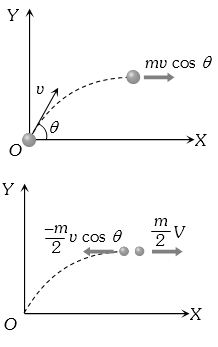
$A$ shell is fired from a cannon with velocity $v \text{ m/s}$ at an angle $\theta$ with the horizontal direction. At the highest point in its path,it explodes into two pieces of equal mass. One of the pieces retraces its path to the cannon. The speed in $\text{m/s}$ of the other piece immediately after the explosion is:
A
$3v \cos \theta$
B
$2v \cos \theta$
C
$\frac{3}{2}v \cos \theta$
D
$\frac{\sqrt{3}}{2}v \cos \theta$
Solution
(A) Let the mass of the shell be $M$. When fired with velocity $v$ at an angle $\theta$,its velocity at the highest point is $v_x = v \cos \theta$ in the horizontal direction.
The momentum of the shell just before the explosion is $P_i = Mv \cos \theta$.
After the explosion,the shell splits into two equal pieces of mass $m = M/2$.
One piece retraces its path,meaning its velocity becomes $-v \cos \theta$ (opposite to the original horizontal direction).
Let the velocity of the other piece be $V$. By the law of conservation of linear momentum:
$P_i = P_f$
$Mv \cos \theta = m(-v \cos \theta) + mV$
Since $m = M/2$,we have:
$Mv \cos \theta = \frac{M}{2}(-v \cos \theta) + \frac{M}{2}V$
Dividing by $M/2$:
$2v \cos \theta = -v \cos \theta + V$
$V = 3v \cos \theta$
Thus,the speed of the other piece is $3v \cos \theta$.
The momentum of the shell just before the explosion is $P_i = Mv \cos \theta$.
After the explosion,the shell splits into two equal pieces of mass $m = M/2$.
One piece retraces its path,meaning its velocity becomes $-v \cos \theta$ (opposite to the original horizontal direction).
Let the velocity of the other piece be $V$. By the law of conservation of linear momentum:
$P_i = P_f$
$Mv \cos \theta = m(-v \cos \theta) + mV$
Since $m = M/2$,we have:
$Mv \cos \theta = \frac{M}{2}(-v \cos \theta) + \frac{M}{2}V$
Dividing by $M/2$:
$2v \cos \theta = -v \cos \theta + V$
$V = 3v \cos \theta$
Thus,the speed of the other piece is $3v \cos \theta$.
0 likesView Solution
4
PhysicsMediumMCQIIT JEE · 1984
At room temperature,the $r.m.s.$ speed of the molecules of a certain diatomic gas is found to be $1920\, m/s$. The gas is
A
$H_2$
B
$F_2$
C
$O_2$
D
$Cl_2$
Solution
(A) The formula for $r.m.s.$ speed is $v_{rms} = \sqrt{\frac{3RT}{M}}$.
Rearranging for molar mass $M$,we get $M = \frac{3RT}{v_{rms}^2}$.
Given: $R = 8.3\, J/(mol \cdot K)$,$T = 300\, K$ (room temperature),and $v_{rms} = 1920\, m/s$.
Substituting the values: $M = \frac{3 \times 8.3 \times 300}{(1920)^2}$.
$M = \frac{7470}{3686400} \approx 0.002026\, kg/mol \approx 2 \times 10^{-3}\, kg/mol = 2\, g/mol$.
The molar mass of $H_2$ is $2\, g/mol$. Therefore,the gas is $H_2$.
Rearranging for molar mass $M$,we get $M = \frac{3RT}{v_{rms}^2}$.
Given: $R = 8.3\, J/(mol \cdot K)$,$T = 300\, K$ (room temperature),and $v_{rms} = 1920\, m/s$.
Substituting the values: $M = \frac{3 \times 8.3 \times 300}{(1920)^2}$.
$M = \frac{7470}{3686400} \approx 0.002026\, kg/mol \approx 2 \times 10^{-3}\, kg/mol = 2\, g/mol$.
The molar mass of $H_2$ is $2\, g/mol$. Therefore,the gas is $H_2$.
0 likesView Solution
5
PhysicsDifficultMCQIIT JEE · 1984
$A$ transverse wave is described by the equation $Y = Y_0 \sin 2\pi \left( ft - \frac{x}{\lambda} \right)$. The maximum particle velocity is four times the wave velocity if:
A
$\lambda = \frac{\pi Y_0}{4}$
B
$\lambda = \frac{\pi Y_0}{2}$
C
$\lambda = \pi Y_0$
D
$\lambda = 2\pi Y_0$
Solution
(B) Comparing the given equation $Y = Y_0 \sin 2\pi \left( ft - \frac{x}{\lambda} \right)$ with the standard wave equation $y = a \sin(\omega t - kx)$:
We identify the amplitude $a = Y_0$,angular frequency $\omega = 2\pi f$,and wave number $k = \frac{2\pi}{\lambda}$.
The maximum particle velocity is given by $(v_{\max})_{\text{particle}} = a\omega = Y_0 \times 2\pi f$.
The wave velocity (phase velocity) is given by $v_{\text{wave}} = \frac{\omega}{k} = \frac{2\pi f}{2\pi / \lambda} = f\lambda$.
According to the problem,the maximum particle velocity is four times the wave velocity:
$(v_{\max})_{\text{particle}} = 4 v_{\text{wave}}$
$Y_0 \times 2\pi f = 4 f\lambda$
Dividing both sides by $4f$,we get:
$\lambda = \frac{2\pi Y_0}{4} = \frac{\pi Y_0}{2}$.
We identify the amplitude $a = Y_0$,angular frequency $\omega = 2\pi f$,and wave number $k = \frac{2\pi}{\lambda}$.
The maximum particle velocity is given by $(v_{\max})_{\text{particle}} = a\omega = Y_0 \times 2\pi f$.
The wave velocity (phase velocity) is given by $v_{\text{wave}} = \frac{\omega}{k} = \frac{2\pi f}{2\pi / \lambda} = f\lambda$.
According to the problem,the maximum particle velocity is four times the wave velocity:
$(v_{\max})_{\text{particle}} = 4 v_{\text{wave}}$
$Y_0 \times 2\pi f = 4 f\lambda$
Dividing both sides by $4f$,we get:
$\lambda = \frac{2\pi Y_0}{4} = \frac{\pi Y_0}{2}$.
0 likesView Solution
6
PhysicsMediumMCQIIT JEE · 1984
If $L, C$ and $R$ represent inductance,capacitance and resistance respectively,then which of the following does not represent the dimensions of frequency?
A
$\frac{1}{RC}$
B
$\frac{R}{L}$
C
$\frac{1}{\sqrt{LC}}$
D
$\frac{C}{L}$
Solution
(D) The dimensions of the given quantities are:
$L = [M L^2 T^{-2} A^{-2}]$
$C = [M^{-1} L^{-2} T^4 A^2]$
$R = [M L^2 T^{-3} A^{-2}]$
$1$. For $\frac{1}{RC}$: The time constant $\tau = RC$ has dimensions of time $[T]$. Thus,$\frac{1}{RC}$ has dimensions of $[T^{-1}]$,which is frequency.
$2$. For $\frac{R}{L}$: The ratio $\frac{R}{L}$ has dimensions $[M L^2 T^{-3} A^{-2}] / [M L^2 T^{-2} A^{-2}] = [T^{-1}]$,which is frequency.
$3$. For $\frac{1}{\sqrt{LC}}$: The resonant frequency $\omega = \frac{1}{\sqrt{LC}}$ has dimensions $[T^{-1}]$,which is frequency.
$4$. For $\frac{C}{L}$: The dimensions are $[M^{-1} L^{-2} T^4 A^2] / [M L^2 T^{-2} A^{-2}] = [M^{-2} L^{-4} T^6 A^4]$. This does not represent frequency.
Therefore,the correct option is $D$.
$L = [M L^2 T^{-2} A^{-2}]$
$C = [M^{-1} L^{-2} T^4 A^2]$
$R = [M L^2 T^{-3} A^{-2}]$
$1$. For $\frac{1}{RC}$: The time constant $\tau = RC$ has dimensions of time $[T]$. Thus,$\frac{1}{RC}$ has dimensions of $[T^{-1}]$,which is frequency.
$2$. For $\frac{R}{L}$: The ratio $\frac{R}{L}$ has dimensions $[M L^2 T^{-3} A^{-2}] / [M L^2 T^{-2} A^{-2}] = [T^{-1}]$,which is frequency.
$3$. For $\frac{1}{\sqrt{LC}}$: The resonant frequency $\omega = \frac{1}{\sqrt{LC}}$ has dimensions $[T^{-1}]$,which is frequency.
$4$. For $\frac{C}{L}$: The dimensions are $[M^{-1} L^{-2} T^4 A^2] / [M L^2 T^{-2} A^{-2}] = [M^{-2} L^{-4} T^6 A^4]$. This does not represent frequency.
Therefore,the correct option is $D$.
0 likesView Solution
7
PhysicsDifficultMCQIIT JEE · 1984
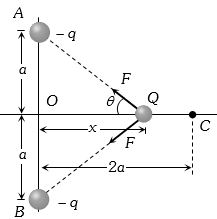
Two equal negative charges $-q$ are fixed at the points $(0, a)$ and $(0, -a)$ on the $Y$-axis. $A$ positive charge $Q$ is released from rest at the point $(2a, 0)$ on the $X$-axis. The charge $Q$ will:
A
Execute simple harmonic motion about the origin
B
Move to the origin and remain at rest
C
Move to infinity
D
Execute oscillatory but not simple harmonic motion
Solution
(D) By the symmetry of the problem,the components of the force on $Q$ due to the charges at $A$ and $B$ along the $Y$-axis will cancel each other,while the components along the $X$-axis will add up and be directed towards the origin $O$. Under the action of this force,the charge $Q$ will move towards $O$.
If at any time the charge $Q$ is at a distance $x$ from $O$,the net force on charge $Q$ is:
$F_{net} = 2F \cos \theta = 2 \left( \frac{1}{4\pi \varepsilon_0} \frac{qQ}{a^2 + x^2} \right) \left( \frac{x}{\sqrt{a^2 + x^2}} \right)$
$F_{net} = - \frac{1}{4\pi \varepsilon_0} \frac{2qQx}{(a^2 + x^2)^{3/2}}$
Since the restoring force $F_{net}$ is not proportional to the displacement $x$ (it is not linear),the motion will be oscillatory (with an amplitude of $2a$) but not simple harmonic.
If at any time the charge $Q$ is at a distance $x$ from $O$,the net force on charge $Q$ is:
$F_{net} = 2F \cos \theta = 2 \left( \frac{1}{4\pi \varepsilon_0} \frac{qQ}{a^2 + x^2} \right) \left( \frac{x}{\sqrt{a^2 + x^2}} \right)$
$F_{net} = - \frac{1}{4\pi \varepsilon_0} \frac{2qQx}{(a^2 + x^2)^{3/2}}$
Since the restoring force $F_{net}$ is not proportional to the displacement $x$ (it is not linear),the motion will be oscillatory (with an amplitude of $2a$) but not simple harmonic.
0 likesView Solution
8
PhysicsDifficultMCQIIT JEE · 1984
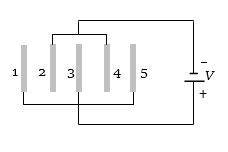
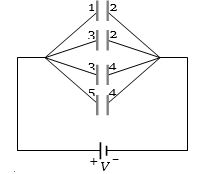
Five identical plates each of area $A$ are joined as shown in the figure. The distance between the plates is $d$. The plates are connected to a potential difference of $V \text{ volts}$. The charge on plates $1$ and $4$ will be
A
$\frac{\varepsilon_0 AV}{d}, \frac{2\varepsilon_0 AV}{d}$
B
$\frac{\varepsilon_0 AV}{d}, \frac{\varepsilon_0 AV}{d}$
C
$\frac{\varepsilon_0 AV}{d}, \frac{-2\varepsilon_0 AV}{d}$
D
$\frac{-\varepsilon_0 AV}{d}, \frac{-2\varepsilon_0 AV}{d}$
Solution
(C) The given circuit consists of $4$ capacitors connected in parallel. Each capacitor is formed by two adjacent plates with area $A$ and separation $d$. The capacitance of each capacitor is $C = \frac{\varepsilon_0 A}{d}$.
Plate $1$ is connected to the positive terminal of the battery. It forms one capacitor with plate $2$. The charge on plate $1$ is $q_1 = +CV = +\frac{\varepsilon_0 AV}{d}$.
Plate $4$ is connected to the negative terminal of the battery. It acts as one plate for two capacitors: one with plate $3$ and one with plate $5$. Since plate $4$ is connected to the negative terminal,the charge on both sides of plate $4$ will be negative. The total charge on plate $4$ is $q_4 = -CV - CV = -2CV = -\frac{2\varepsilon_0 AV}{d}$.
Thus,the charges on plates $1$ and $4$ are $\frac{\varepsilon_0 AV}{d}$ and $-\frac{2\varepsilon_0 AV}{d}$ respectively.
Plate $1$ is connected to the positive terminal of the battery. It forms one capacitor with plate $2$. The charge on plate $1$ is $q_1 = +CV = +\frac{\varepsilon_0 AV}{d}$.
Plate $4$ is connected to the negative terminal of the battery. It acts as one plate for two capacitors: one with plate $3$ and one with plate $5$. Since plate $4$ is connected to the negative terminal,the charge on both sides of plate $4$ will be negative. The total charge on plate $4$ is $q_4 = -CV - CV = -2CV = -\frac{2\varepsilon_0 AV}{d}$.
Thus,the charges on plates $1$ and $4$ are $\frac{\varepsilon_0 AV}{d}$ and $-\frac{2\varepsilon_0 AV}{d}$ respectively.
0 likesView Solution
9
PhysicsMediumMCQIIT JEE · 1984
From the following equations,pick out the possible nuclear reactions.
A
$_6C^{13} + _1H^1 \to _6C^{14} + 4.3 \text{ MeV}$
B
$_6C^{12} + _1H^1 \to _7N^{13} + 2 \text{ MeV}$
C
$_7N^{14} + _1H^1 \to _8O^{15} + 7.3 \text{ MeV}$
D
Both $(b)$ and $(c)$
Solution
(D) Nuclear reactions occur when nuclei interact to form new products. In the carbon-nitrogen cycle,the reactions $_6C^{12} + _1H^1 \to _7N^{13} + 2 \text{ MeV}$ and $_7N^{14} + _1H^1 \to _8O^{15} + 7.3 \text{ MeV}$ are well-known,experimentally verified nuclear fusion processes that occur in stars. The reaction in option $(a)$ is not a standard nuclear fusion reaction in this context. Therefore,both $(b)$ and $(c)$ are possible nuclear reactions.
0 likesView Solution
10
PhysicsEasyMCQIIT JEE · 1984
Select the correct statements from the following:
A
$A$. $A$ diode can be used as a rectifier.
B
$B$. $A$ triode cannot be used as a rectifier.
C
$C$. The linear portion of the $I-V$ characteristic of a triode is used for amplification without distortion.
D
$D$. Both $(A)$ and $(C)$.
Solution
(D) diode acts as a unidirectional switch,allowing current to flow in one direction,which makes it suitable for rectification. Thus,statement $(A)$ is correct.
$A$ triode can also be used as a rectifier by connecting its grid to the cathode,effectively making it act like a diode. However,in standard electronic circuit theory,a triode is primarily used for amplification. Statement $(B)$ is technically incorrect because a triode can be used as a rectifier.
The amplification of a signal by a triode is achieved by operating it in the linear region of its $I-V$ characteristic curve,which ensures that the output signal is a faithful reproduction of the input signal without distortion. Thus,statement $(C)$ is correct.
Since both $(A)$ and $(C)$ are correct,the correct option is $(D)$.
$A$ triode can also be used as a rectifier by connecting its grid to the cathode,effectively making it act like a diode. However,in standard electronic circuit theory,a triode is primarily used for amplification. Statement $(B)$ is technically incorrect because a triode can be used as a rectifier.
The amplification of a signal by a triode is achieved by operating it in the linear region of its $I-V$ characteristic curve,which ensures that the output signal is a faithful reproduction of the input signal without distortion. Thus,statement $(C)$ is correct.
Since both $(A)$ and $(C)$ are correct,the correct option is $(D)$.
0 likesView Solution
11
PhysicsDifficultMCQIIT JEE · 1984
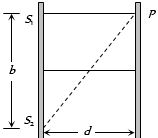
In Young's double slit experiment,white light is used. The separation between the slits is $b$. The screen is at a distance $d$ $(d >> b)$ from the slits. Some wavelengths are missing exactly in front of one slit. These wavelengths are
A
$\lambda = \frac{b^2}{d}$
B
$\lambda = \frac{2b^2}{d}$
C
$\lambda = \frac{b^2}{3d}$
D
Both $(a)$ and $(c)$
Solution
(D) Let $P$ be the point on the screen directly in front of slit $S_1$. The path difference between the light rays reaching $P$ from $S_1$ and $S_2$ is given by:
$\Delta x = S_2P - S_1P = \sqrt{b^2 + d^2} - d$
Using binomial expansion for $d >> b$:
$\Delta x = d(1 + \frac{b^2}{d^2})^{1/2} - d \approx d(1 + \frac{b^2}{2d^2}) - d = \frac{b^2}{2d}$
For destructive interference (missing wavelengths),the path difference must be an odd multiple of $\frac{\lambda}{2}$:
$\Delta x = (2n - 1)\frac{\lambda}{2}$,where $n = 1, 2, 3, ...$
Equating the two expressions for path difference:
$\frac{b^2}{2d} = (2n - 1)\frac{\lambda}{2}$
$\lambda = \frac{b^2}{(2n - 1)d}$
For $n = 1$,$\lambda = \frac{b^2}{d}$.
For $n = 2$,$\lambda = \frac{b^2}{3d}$.
Thus,both $(a)$ and $(c)$ are correct.
$\Delta x = S_2P - S_1P = \sqrt{b^2 + d^2} - d$
Using binomial expansion for $d >> b$:
$\Delta x = d(1 + \frac{b^2}{d^2})^{1/2} - d \approx d(1 + \frac{b^2}{2d^2}) - d = \frac{b^2}{2d}$
For destructive interference (missing wavelengths),the path difference must be an odd multiple of $\frac{\lambda}{2}$:
$\Delta x = (2n - 1)\frac{\lambda}{2}$,where $n = 1, 2, 3, ...$
Equating the two expressions for path difference:
$\frac{b^2}{2d} = (2n - 1)\frac{\lambda}{2}$
$\lambda = \frac{b^2}{(2n - 1)d}$
For $n = 1$,$\lambda = \frac{b^2}{d}$.
For $n = 2$,$\lambda = \frac{b^2}{3d}$.
Thus,both $(a)$ and $(c)$ are correct.
0 likesView Solution
Vedclass Products
For Students
Vedclass Test Series
Mock tests in real IIT JEE style covering Physics with performance analysis. 5-day free trial.
Start Free TrialFor Teachers
Exam Paper Generator
Generate Set A/B/C/D Physics papers from 7.5L+ questions in 2 minutes. 3 chapters free.
Try FreeFor Institutes
Online Exam Module
Run live IIT JEE mock exams with unlimited students, 360° analytics & white-label branding.
See DemoFrequently Asked Questions
How many Physics questions are in IIT JEE 1984?
There are 11 Physics questions from the IIT JEE 1984 paper on Vedclass, each with a detailed step-by-step solution in English.
Are IIT JEE 1984 Physics solutions available in English?
Yes. All solutions on this page are in English. You can also switch to English or Hindi using the language buttons above the questions.
Can I practice IIT JEE 1984 Physics as a timed test?
Yes. Use the Vedclass Test Series to attempt a full IIT JEE mock test covering Physics with time limits and instant score analysis.
Can teachers create Physics papers from IIT JEE previous year questions?
Yes. The Vedclass Exam Paper Generator lets teachers mix IIT JEE Physics questions and generate Set A/B/C/D papers in minutes.
For Teachers & Institutes
Build a Custom Physics Paper
Pick IIT JEE 1984 Physics questions, set difficulty, and generate Set A/B/C/D in 2 minutes.