
MathematicsQ1–47 of 47 questions
Page 1 of 1 · English
1
MathematicsMediumMCQIIT JEE · 1983
The points $z_1, z_2, z_3, z_4$ in the complex plane are the vertices of a parallelogram taken in order,if and only if
A
$z_1 + z_4 = z_2 + z_3$
B
$z_1 + z_3 = z_2 + z_4$
C
$z_1 + z_2 = z_3 + z_4$
D
None of these
Solution
(B) In a parallelogram $ABCD$,the diagonals $AC$ and $BD$ bisect each other at the same midpoint.
The midpoint of diagonal $AC$ is given by $\frac{z_1 + z_3}{2}$.
The midpoint of diagonal $BD$ is given by $\frac{z_2 + z_4}{2}$.
Since the diagonals bisect each other,we have $\frac{z_1 + z_3}{2} = \frac{z_2 + z_4}{2}$.
Therefore,$z_1 + z_3 = z_2 + z_4$.
The midpoint of diagonal $AC$ is given by $\frac{z_1 + z_3}{2}$.
The midpoint of diagonal $BD$ is given by $\frac{z_2 + z_4}{2}$.
Since the diagonals bisect each other,we have $\frac{z_1 + z_3}{2} = \frac{z_2 + z_4}{2}$.
Therefore,$z_1 + z_3 = z_2 + z_4$.
0 likesView Solution
2
MathematicsMediumMCQIIT JEE · 1983
If $z = x + iy$ and $\omega = \frac{1 - iz}{z - i}$,then $|\omega| = 1$ shows that in the complex plane:
A
$z$ lies on the imaginary axis
B
$z$ lies on the real axis
C
$z$ lies on the unit circle
D
None of these
Solution
(B) Given $\omega = \frac{1 - iz}{z - i}$ and $|\omega| = 1$.
$|\frac{1 - iz}{z - i}| = 1$
$|1 - iz| = |z - i|$
Substitute $z = x + iy$:
$|1 - i(x + iy)| = |x + iy - i|$
$|1 - ix + y| = |x + i(y - 1)|$
$|(1 + y) - ix| = |x + i(y - 1)|$
Squaring both sides:
$(1 + y)^2 + (-x)^2 = x^2 + (y - 1)^2$
$1 + y^2 + 2y + x^2 = x^2 + y^2 + 1 - 2y$
$2y = -2y$
$4y = 0 \implies y = 0$.
Since $z = x + iy$ and $y = 0$,$z = x$,which means $z$ lies on the real axis.
$|\frac{1 - iz}{z - i}| = 1$
$|1 - iz| = |z - i|$
Substitute $z = x + iy$:
$|1 - i(x + iy)| = |x + iy - i|$
$|1 - ix + y| = |x + i(y - 1)|$
$|(1 + y) - ix| = |x + i(y - 1)|$
Squaring both sides:
$(1 + y)^2 + (-x)^2 = x^2 + (y - 1)^2$
$1 + y^2 + 2y + x^2 = x^2 + y^2 + 1 - 2y$
$2y = -2y$
$4y = 0 \implies y = 0$.
Since $z = x + iy$ and $y = 0$,$z = x$,which means $z$ lies on the real axis.
0 likesView Solution
3
MathematicsDifficultMCQIIT JEE · 1983
If the complex numbers $z_1, z_2$ and the origin form an equilateral triangle,then $z_1^2 + z_2^2 = $
A
$z_1 z_2$
B
$z_1 \overline{z_2}$
C
$\overline{z_2} z_1$
D
$|z_1|^2 = |z_2|^2$
Solution
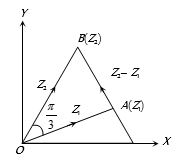
(A) Let the vertices of the triangle be $O(0), A(z_1),$ and $B(z_2)$. Since $\Delta OAB$ is an equilateral triangle,the rotation of vector $OA$ by $60^\circ$ ($\pi/3$ radians) about the origin $O$ must coincide with the vector $OB$ (or vice versa).
Thus,we have $z_2 = z_1 e^{\pm i\pi/3}$.
This implies $\frac{z_2}{z_1} = \cos(\pi/3) \pm i \sin(\pi/3) = \frac{1}{2} \pm i \frac{\sqrt{3}}{2}$.
Rearranging gives $2z_2 = z_1(1 \pm i\sqrt{3})$,or $2z_2 - z_1 = \pm i\sqrt{3} z_1$.
Squaring both sides: $(2z_2 - z_1)^2 = -3z_1^2$.
$4z_2^2 - 4z_1 z_2 z_1^2 = -3z_1^2$.
$4z_1^2 4z_2^2 = 4z_1 z_2$.
Dividing by $4$,we get $z_1^2 z_2^2 = z_1 z_2$.
Thus,we have $z_2 = z_1 e^{\pm i\pi/3}$.
This implies $\frac{z_2}{z_1} = \cos(\pi/3) \pm i \sin(\pi/3) = \frac{1}{2} \pm i \frac{\sqrt{3}}{2}$.
Rearranging gives $2z_2 = z_1(1 \pm i\sqrt{3})$,or $2z_2 - z_1 = \pm i\sqrt{3} z_1$.
Squaring both sides: $(2z_2 - z_1)^2 = -3z_1^2$.
$4z_2^2 - 4z_1 z_2 z_1^2 = -3z_1^2$.
$4z_1^2 4z_2^2 = 4z_1 z_2$.
Dividing by $4$,we get $z_1^2 z_2^2 = z_1 z_2$.
0 likesView Solution
4
MathematicsMediumMCQIIT JEE · 1983
$2.\overline{357} = $
A
$\frac{2355}{1001}$
B
$\frac{2370}{997}$
C
$\frac{2355}{999}$
D
$\text{None of these}$
Solution
(C) Let $x = 2.\overline{357} = 2.357357357...$
This can be written as $x = 2 + 0.357357357...$
Let $y = 0.357357357... = \frac{357}{1000} + \frac{357}{1000^2} + \frac{357}{1000^3} + ...$
This is an infinite geometric series with first term $a = \frac{357}{1000}$ and common ratio $r = \frac{1}{1000}$.
The sum $S_{\infty} = \frac{a}{1-r} = \frac{\frac{357}{1000}}{1 - \frac{1}{1000}} = \frac{\frac{357}{1000}}{\frac{999}{1000}} = \frac{357}{999}$.
Therefore,$x = 2 + \frac{357}{999} = \frac{2 \times 999 + 357}{999} = \frac{1998 + 357}{999} = \frac{2355}{999}$.
This can be written as $x = 2 + 0.357357357...$
Let $y = 0.357357357... = \frac{357}{1000} + \frac{357}{1000^2} + \frac{357}{1000^3} + ...$
This is an infinite geometric series with first term $a = \frac{357}{1000}$ and common ratio $r = \frac{1}{1000}$.
The sum $S_{\infty} = \frac{a}{1-r} = \frac{\frac{357}{1000}}{1 - \frac{1}{1000}} = \frac{\frac{357}{1000}}{\frac{999}{1000}} = \frac{357}{999}$.
Therefore,$x = 2 + \frac{357}{999} = \frac{2 \times 999 + 357}{999} = \frac{1998 + 357}{999} = \frac{2355}{999}$.
0 likesView Solution
5
MathematicsEasyMCQIIT JEE · 1983
The roots of the quadratic equation $2x^2 + 3x + 1 = 0$ are:
A
Irrational
B
Rational
C
Imaginary
D
None of these
Solution
(B) Given the quadratic equation $2x^2 + 3x + 1 = 0$.
Comparing this with $ax^2 + bx + c = 0$,we get $a = 2, b = 3, c = 1$.
The discriminant $D = b^2 - 4ac = (3)^2 - 4(2)(1) = 9 - 8 = 1$.
Since $D > 0$ and $D$ is a perfect square,the roots are real and rational.
Using the quadratic formula $x = \frac{-b \pm \sqrt{D}}{2a}$,we get $x = \frac{-3 \pm \sqrt{1}}{2(2)} = \frac{-3 \pm 1}{4}$.
Thus,the roots are $x = \frac{-2}{4} = -\frac{1}{2}$ and $x = \frac{-4}{4} = -1$.
Both roots are rational numbers.
Comparing this with $ax^2 + bx + c = 0$,we get $a = 2, b = 3, c = 1$.
The discriminant $D = b^2 - 4ac = (3)^2 - 4(2)(1) = 9 - 8 = 1$.
Since $D > 0$ and $D$ is a perfect square,the roots are real and rational.
Using the quadratic formula $x = \frac{-b \pm \sqrt{D}}{2a}$,we get $x = \frac{-3 \pm \sqrt{1}}{2(2)} = \frac{-3 \pm 1}{4}$.
Thus,the roots are $x = \frac{-2}{4} = -\frac{1}{2}$ and $x = \frac{-4}{4} = -1$.
Both roots are rational numbers.
0 likesView Solution
6
MathematicsDifficultMCQIIT JEE · 1983
If one root of the quadratic equation $ax^2 + bx + c = 0$ is equal to the $n^{th}$ power of the other root,then the value of $(ac^n)^{\frac{1}{n+1}} + (a^nc)^{\frac{1}{n+1}} = $
A
$b$
B
$-b$
C
$b^{\frac{1}{n+1}}$
D
$-b^{\frac{1}{n+1}}$
Solution
(B) Let the roots be $\alpha$ and $\alpha^n$.
From the relation between roots and coefficients,we have:
$\alpha + \alpha^n = -\frac{b}{a}$ and $\alpha \cdot \alpha^n = \alpha^{n+1} = \frac{c}{a}$.
From the second equation,$\alpha = (\frac{c}{a})^{\frac{1}{n+1}}$.
Substituting this into the first equation:
$(\frac{c}{a})^{\frac{1}{n+1}} + ((\frac{c}{a})^{\frac{1}{n+1}})^n = -\frac{b}{a}$
$(\frac{c}{a})^{\frac{1}{n+1}} + (\frac{c}{a})^{\frac{n}{n+1}} = -\frac{b}{a}$
Multiply both sides by $a$:
$a \cdot \frac{c^{\frac{1}{n+1}}}{a^{\frac{1}{n+1}}} + a \cdot \frac{c^{\frac{n}{n+1}}}{a^{\frac{n}{n+1}}} = -b$
$a^{1 - \frac{1}{n+1}} c^{\frac{1}{n+1}} + a^{1 - \frac{n}{n+1}} c^{\frac{n}{n+1}} = -b$
$a^{\frac{n}{n+1}} c^{\frac{1}{n+1}} + a^{\frac{1}{n+1}} c^{\frac{n}{n+1}} = -b$
$(a^n c)^{\frac{1}{n+1}} + (a c^n)^{\frac{1}{n+1}} = -b$.
From the relation between roots and coefficients,we have:
$\alpha + \alpha^n = -\frac{b}{a}$ and $\alpha \cdot \alpha^n = \alpha^{n+1} = \frac{c}{a}$.
From the second equation,$\alpha = (\frac{c}{a})^{\frac{1}{n+1}}$.
Substituting this into the first equation:
$(\frac{c}{a})^{\frac{1}{n+1}} + ((\frac{c}{a})^{\frac{1}{n+1}})^n = -\frac{b}{a}$
$(\frac{c}{a})^{\frac{1}{n+1}} + (\frac{c}{a})^{\frac{n}{n+1}} = -\frac{b}{a}$
Multiply both sides by $a$:
$a \cdot \frac{c^{\frac{1}{n+1}}}{a^{\frac{1}{n+1}}} + a \cdot \frac{c^{\frac{n}{n+1}}}{a^{\frac{n}{n+1}}} = -b$
$a^{1 - \frac{1}{n+1}} c^{\frac{1}{n+1}} + a^{1 - \frac{n}{n+1}} c^{\frac{n}{n+1}} = -b$
$a^{\frac{n}{n+1}} c^{\frac{1}{n+1}} + a^{\frac{1}{n+1}} c^{\frac{n}{n+1}} = -b$
$(a^n c)^{\frac{1}{n+1}} + (a c^n)^{\frac{1}{n+1}} = -b$.
0 likesView Solution
7
MathematicsMediumMCQIIT JEE · 1983
$m$ men and $n$ women are to be seated in a row so that no two women sit together. If $m > n$,then the number of ways in which they can be seated is
A
$\frac{m! (m + 1)!}{(m - n + 1)!}$
B
$\frac{m! (m - 1)!}{(m - n + 1)!}$
C
$\frac{(m - 1)! (m + 1)!}{(m - n + 1)!}$
D
None of these
Solution
(A) First,arrange $m$ men in a row in $m!$ ways.
Since $n < m$ and no two women can sit together,we consider the gaps between the men.
In any one of the $m!$ arrangements,there are $(m + 1)$ available spaces (including the ends) where $n$ women can be placed.
The number of ways to arrange $n$ women in these $(m + 1)$ spaces is given by $^{m+1}P_n$.
Therefore,by the fundamental principle of counting,the total number of arrangements is $m! \times {}^{m+1}P_n$.
$= m! \times \frac{(m + 1)!}{(m + 1 - n)!} = \frac{m! (m + 1)!}{(m - n + 1)!}$.
Since $n < m$ and no two women can sit together,we consider the gaps between the men.
In any one of the $m!$ arrangements,there are $(m + 1)$ available spaces (including the ends) where $n$ women can be placed.
The number of ways to arrange $n$ women in these $(m + 1)$ spaces is given by $^{m+1}P_n$.
Therefore,by the fundamental principle of counting,the total number of arrangements is $m! \times {}^{m+1}P_n$.
$= m! \times \frac{(m + 1)!}{(m + 1 - n)!} = \frac{m! (m + 1)!}{(m - n + 1)!}$.
0 likesView Solution
8
MathematicsEasyMCQIIT JEE · 1983
In the expansion of $\left( \frac{x}{2} - \frac{3}{x^2} \right)^{10}$,the coefficient of $x^4$ is
A
$\frac{405}{256}$
B
$\frac{504}{259}$
C
$\frac{450}{263}$
D
None of these
Solution
(A) The general term in the expansion of $\left( \frac{x}{2} - \frac{3}{x^2} \right)^{10}$ is given by $T_{r+1} = {}^{10}C_r \left( \frac{x}{2} \right)^{10-r} \left( -\frac{3}{x^2} \right)^r$.
Simplifying this,we get $T_{r+1} = {}^{10}C_r (-1)^r \frac{3^r}{2^{10-r}} x^{10-r-2r} = {}^{10}C_r (-1)^r \frac{3^r}{2^{10-r}} x^{10-3r}$.
To find the coefficient of $x^4$,we set the exponent of $x$ equal to $4$:
$10 - 3r = 4$ $\Rightarrow 3r = 6$ $\Rightarrow r = 2$.
Substituting $r = 2$ into the expression for the term:
$T_{2+1} = {}^{10}C_2 (-1)^2 \frac{3^2}{2^{10-2}} x^4 = \frac{10 \times 9}{2 \times 1} \times 1 \times \frac{9}{2^8} x^4$.
$T_3 = 45 \times \frac{9}{256} x^4 = \frac{405}{256} x^4$.
Thus,the coefficient of $x^4$ is $\frac{405}{256}$.
Simplifying this,we get $T_{r+1} = {}^{10}C_r (-1)^r \frac{3^r}{2^{10-r}} x^{10-r-2r} = {}^{10}C_r (-1)^r \frac{3^r}{2^{10-r}} x^{10-3r}$.
To find the coefficient of $x^4$,we set the exponent of $x$ equal to $4$:
$10 - 3r = 4$ $\Rightarrow 3r = 6$ $\Rightarrow r = 2$.
Substituting $r = 2$ into the expression for the term:
$T_{2+1} = {}^{10}C_2 (-1)^2 \frac{3^2}{2^{10-2}} x^4 = \frac{10 \times 9}{2 \times 1} \times 1 \times \frac{9}{2^8} x^4$.
$T_3 = 45 \times \frac{9}{256} x^4 = \frac{405}{256} x^4$.
Thus,the coefficient of $x^4$ is $\frac{405}{256}$.
0 likesView Solution
9
MathematicsMediumMCQIIT JEE · 1983
If $(1 + ax)^n = 1 + 8x + 24x^2 + ....,$ then the value of $a$ and $n$ is
A
$2, 4$
B
$2, 3$
C
$3, 6$
D
$1, 2$
Solution
(A) Given the binomial expansion: $(1 + ax)^n = 1 + n(ax) + \frac{n(n - 1)}{2}(ax)^2 + .... = 1 + 8x + 24x^2 + ....$
Comparing the coefficients of $x$ and $x^2$:
$na = 8$ --- $(1)$
$\frac{n(n - 1)}{2}a^2 = 24$ --- $(2)$
From $(1)$,$n = \frac{8}{a}$. Substituting this into $(2)$:
$\frac{(\frac{8}{a})(\frac{8}{a} - 1)}{2}a^2 = 24$
$\frac{8}{2a} \times (8 - a) \times a = 24$
$4(8 - a) = 24$
$8 - a = 6$
$a = 2$
Substituting $a = 2$ into $(1)$:
$n(2) = 8 \Rightarrow n = 4$.
Thus,the values are $a = 2$ and $n = 4$.
Comparing the coefficients of $x$ and $x^2$:
$na = 8$ --- $(1)$
$\frac{n(n - 1)}{2}a^2 = 24$ --- $(2)$
From $(1)$,$n = \frac{8}{a}$. Substituting this into $(2)$:
$\frac{(\frac{8}{a})(\frac{8}{a} - 1)}{2}a^2 = 24$
$\frac{8}{2a} \times (8 - a) \times a = 24$
$4(8 - a) = 24$
$8 - a = 6$
$a = 2$
Substituting $a = 2$ into $(1)$:
$n(2) = 8 \Rightarrow n = 4$.
Thus,the values are $a = 2$ and $n = 4$.
0 likesView Solution
10
MathematicsEasyMCQIIT JEE · 1983
If $\tan A = \frac{1 - \cos B}{\sin B},$ find $\tan 2A$ in terms of $\tan B$.
A
$\tan 2A = \tan B$
B
$\tan 2A = \tan^2 B$
C
$\tan 2A = \tan^2 B + 2\tan B$
D
None of the above
Solution
(A) Given $\tan A = \frac{1 - \cos B}{\sin B}$.
Using the half-angle formulas $1 - \cos B = 2\sin^2(B/2)$ and $\sin B = 2\sin(B/2)\cos(B/2)$:
$\tan A = \frac{2\sin^2(B/2)}{2\sin(B/2)\cos(B/2)} = \frac{\sin(B/2)}{\cos(B/2)} = \tan(B/2)$.
Thus,$A = B/2$,which implies $2A = B$.
Therefore,$\tan 2A = \tan B$.
Using the half-angle formulas $1 - \cos B = 2\sin^2(B/2)$ and $\sin B = 2\sin(B/2)\cos(B/2)$:
$\tan A = \frac{2\sin^2(B/2)}{2\sin(B/2)\cos(B/2)} = \frac{\sin(B/2)}{\cos(B/2)} = \tan(B/2)$.
Thus,$A = B/2$,which implies $2A = B$.
Therefore,$\tan 2A = \tan B$.
0 likesView Solution
11
MathematicsEasyMCQIIT JEE · 1983
From the top of a lighthouse $60 \ m$ high with its base at the sea level,the angle of depression of a boat is $15^\circ$. The distance of the boat from the foot of the lighthouse is:
A
$60 \left( \frac{\sqrt{3} - 1}{\sqrt{3} + 1} \right) \ m$
B
$60 \left( \frac{\sqrt{3} + 1}{\sqrt{3} - 1} \right) \ m$
C
$60 \left( \sqrt{3} + 1 \right) \ m$
D
None of these
Solution
(B) Let the height of the lighthouse be $h = 60 \ m$ and the distance of the boat from the foot of the lighthouse be $x \ m$.
In the right-angled triangle formed by the lighthouse and the sea level,the angle of elevation of the top from the boat is equal to the angle of depression,which is $15^\circ$.
Thus,$\tan(15^\circ) = \frac{\text{height}}{\text{distance}} = \frac{60}{x}$.
Therefore,$x = \frac{60}{\tan(15^\circ)} = 60 \cot(15^\circ)$.
Using the value $\cot(15^\circ) = \frac{\cos(15^\circ)}{\sin(15^\circ)} = \frac{\sqrt{3} + 1}{\sqrt{3} - 1}$.
So,$x = 60 \left( \frac{\sqrt{3} + 1}{\sqrt{3} - 1} \right) \ m$.
Thus,the correct option is $B$.
In the right-angled triangle formed by the lighthouse and the sea level,the angle of elevation of the top from the boat is equal to the angle of depression,which is $15^\circ$.
Thus,$\tan(15^\circ) = \frac{\text{height}}{\text{distance}} = \frac{60}{x}$.
Therefore,$x = \frac{60}{\tan(15^\circ)} = 60 \cot(15^\circ)$.
Using the value $\cot(15^\circ) = \frac{\cos(15^\circ)}{\sin(15^\circ)} = \frac{\sqrt{3} + 1}{\sqrt{3} - 1}$.
So,$x = 60 \left( \frac{\sqrt{3} + 1}{\sqrt{3} - 1} \right) \ m$.
Thus,the correct option is $B$.
0 likesView Solution
12
MathematicsEasyMCQIIT JEE · 1983
The points $(0, 8/3)$,$(1, 3)$ and $(82, 30)$ are the vertices of
A
An equilateral triangle
B
An isosceles triangle
C
$A$ right angled triangle
D
None of these
Solution
(D) Let the points be $A(0, 8/3)$,$B(1, 3)$,and $C(82, 30)$.
To check if these points form a triangle,we calculate the area of the triangle using the formula:
$\text{Area} = \frac{1}{2} |x_1(y_2 - y_3) + x_2(y_3 - y_1) + x_3(y_1 - y_2)|$
Substituting the values:
$\text{Area} = \frac{1}{2} |0(3 - 30) + 1(30 - 8/3) + 82(8/3 - 3)|$
$\text{Area} = \frac{1}{2} |0 + (90 - 8)/3 + 82(-1/3)|$
$\text{Area} = \frac{1}{2} |82/3 - 82/3| = 0$
Since the area is $0$,the points are collinear and do not form a triangle. Therefore,the correct option is $D$.
To check if these points form a triangle,we calculate the area of the triangle using the formula:
$\text{Area} = \frac{1}{2} |x_1(y_2 - y_3) + x_2(y_3 - y_1) + x_3(y_1 - y_2)|$
Substituting the values:
$\text{Area} = \frac{1}{2} |0(3 - 30) + 1(30 - 8/3) + 82(8/3 - 3)|$
$\text{Area} = \frac{1}{2} |0 + (90 - 8)/3 + 82(-1/3)|$
$\text{Area} = \frac{1}{2} |82/3 - 82/3| = 0$
Since the area is $0$,the points are collinear and do not form a triangle. Therefore,the correct option is $D$.
0 likesView Solution
13
MathematicsEasyMCQIIT JEE · 1983
Three points are $A(6, 3)$,$B(-3, 5)$,and $C(4, -2)$. If $P(x, y)$ is a point,then the ratio of the area of $\Delta PBC$ to the area of $\Delta ABC$ is:
A
$\left| \frac{x + y - 2}{7} \right|$
B
$\left| \frac{x - y + 2}{2} \right|$
C
$\left| \frac{x - y - 2}{7} \right|$
D
None of these
Solution
(A) The area of a triangle with vertices $(x_1, y_1)$,$(x_2, y_2)$,and $(x_3, y_3)$ is given by $\frac{1}{2} |x_1(y_2 - y_3) + x_2(y_3 - y_1) + x_3(y_1 - y_2)|$.
Area of $\Delta ABC = \frac{1}{2} |6(5 - (-2)) + (-3)(-2 - 3) + 4(3 - 5)| = \frac{1}{2} |6(7) - 3(-5) + 4(-2)| = \frac{1}{2} |42 + 15 - 8| = \frac{1}{2} |49| = 24.5$.
Area of $\Delta PBC = \frac{1}{2} |x(5 - (-2)) + (-3)(-2 - y) + 4(y - 5)| = \frac{1}{2} |7x + 6 + 3y + 4y - 20| = \frac{1}{2} |7x + 7y - 14| = \frac{7}{2} |x + y - 2|$.
Ratio = $\frac{\text{Area}(\Delta PBC)}{\text{Area}(\Delta ABC)} = \frac{\frac{7}{2} |x + y - 2|}{\frac{49}{2}} = \left| \frac{x + y - 2}{7} \right|$.
Area of $\Delta ABC = \frac{1}{2} |6(5 - (-2)) + (-3)(-2 - 3) + 4(3 - 5)| = \frac{1}{2} |6(7) - 3(-5) + 4(-2)| = \frac{1}{2} |42 + 15 - 8| = \frac{1}{2} |49| = 24.5$.
Area of $\Delta PBC = \frac{1}{2} |x(5 - (-2)) + (-3)(-2 - y) + 4(y - 5)| = \frac{1}{2} |7x + 6 + 3y + 4y - 20| = \frac{1}{2} |7x + 7y - 14| = \frac{7}{2} |x + y - 2|$.
Ratio = $\frac{\text{Area}(\Delta PBC)}{\text{Area}(\Delta ABC)} = \frac{\frac{7}{2} |x + y - 2|}{\frac{49}{2}} = \left| \frac{x + y - 2}{7} \right|$.
0 likesView Solution
14
MathematicsMediumMCQIIT JEE · 1983
The vertices of a triangle are $(at_1t_2, a(t_1 + t_2))$,$(at_2t_3, a(t_2 + t_3))$,and $(at_3t_1, a(t_3 + t_1))$. Find the coordinates of its orthocentre.
A
$(a, a(t_1 + t_2 + t_3 + t_1t_2t_3))$
B
$(-a, a(t_1 + t_2 + t_3 + t_1t_2t_3))$
C
$(-a(t_1 + t_2 + t_3 + t_1t_2t_3), a)$
D
None of these
Solution
(B) Let the vertices be $A(at_1t_2, a(t_1 + t_2))$,$B(at_2t_3, a(t_2 + t_3))$,and $C(at_3t_1, a(t_3 + t_1))$.
The slope of $BC$ is $m_{BC} = \frac{a(t_2 + t_3) - a(t_3 + t_1)}{at_2t_3 - at_3t_1} = \frac{a(t_2 - t_1)}{at_3(t_2 - t_1)} = \frac{1}{t_3}$.
The slope of the altitude from $A$ to $BC$ is $-t_3$. The equation of this altitude is $y - a(t_1 + t_2) = -t_3(x - at_1t_2)$,which simplifies to $t_3x + y = a(t_1 + t_2 + t_1t_2t_3)$.
Similarly,the equation of the altitude from $B$ to $AC$ is $t_1x + y = a(t_2 + t_3 + t_1t_2t_3)$.
Subtracting the two equations: $(t_3 - t_1)x = a(t_1 - t_3)$,so $x = -a$.
Substituting $x = -a$ into the first altitude equation: $-at_3 + y = a(t_1 + t_2 + t_1t_2t_3)$,which gives $y = a(t_1 + t_2 + t_3 + t_1t_2t_3)$.
Thus,the orthocentre is $(-a, a(t_1 + t_2 + t_3 + t_1t_2t_3))$.
The slope of $BC$ is $m_{BC} = \frac{a(t_2 + t_3) - a(t_3 + t_1)}{at_2t_3 - at_3t_1} = \frac{a(t_2 - t_1)}{at_3(t_2 - t_1)} = \frac{1}{t_3}$.
The slope of the altitude from $A$ to $BC$ is $-t_3$. The equation of this altitude is $y - a(t_1 + t_2) = -t_3(x - at_1t_2)$,which simplifies to $t_3x + y = a(t_1 + t_2 + t_1t_2t_3)$.
Similarly,the equation of the altitude from $B$ to $AC$ is $t_1x + y = a(t_2 + t_3 + t_1t_2t_3)$.
Subtracting the two equations: $(t_3 - t_1)x = a(t_1 - t_3)$,so $x = -a$.
Substituting $x = -a$ into the first altitude equation: $-at_3 + y = a(t_1 + t_2 + t_1t_2t_3)$,which gives $y = a(t_1 + t_2 + t_3 + t_1t_2t_3)$.
Thus,the orthocentre is $(-a, a(t_1 + t_2 + t_3 + t_1t_2t_3))$.
0 likesView Solution
15
MathematicsEasyMCQIIT JEE · 1983
The straight line that passes through the point of intersection of the straight lines $x + 2y - 10 = 0$ and $2x + y + 5 = 0$ is:
A
$5x - 4y = 0$
B
$5x + 4y = 0$
C
$4x - 5y = 0$
D
$4x + 5y = 0$
Solution
(B) To find the point of intersection of the lines $x + 2y - 10 = 0$ and $2x + y + 5 = 0$,we solve them simultaneously.
Multiply the first equation by $2$: $2x + 4y - 20 = 0$.
Subtract the second equation from this: $(2x + 4y - 20) - (2x + y + 5) = 0$,which simplifies to $3y - 25 = 0$,so $y = 25/3$.
Substitute $y = 25/3$ into $x + 2y - 10 = 0$: $x + 2(25/3) - 10 = 0 \implies x + 50/3 - 30/3 = 0 \implies x = -20/3$.
The point of intersection is $(-20/3, 25/3)$.
Testing the options,for $5x + 4y = 0$:
$5(-20/3) + 4(25/3) = -100/3 + 100/3 = 0$.
Thus,the line $5x + 4y = 0$ passes through the point of intersection.
Multiply the first equation by $2$: $2x + 4y - 20 = 0$.
Subtract the second equation from this: $(2x + 4y - 20) - (2x + y + 5) = 0$,which simplifies to $3y - 25 = 0$,so $y = 25/3$.
Substitute $y = 25/3$ into $x + 2y - 10 = 0$: $x + 2(25/3) - 10 = 0 \implies x + 50/3 - 30/3 = 0 \implies x = -20/3$.
The point of intersection is $(-20/3, 25/3)$.
Testing the options,for $5x + 4y = 0$:
$5(-20/3) + 4(25/3) = -100/3 + 100/3 = 0$.
Thus,the line $5x + 4y = 0$ passes through the point of intersection.
0 likesView Solution
16
MathematicsDifficultMCQIIT JEE · 1983
The equation of the bisector of the acute angle between the lines $3x - 4y + 7 = 0$ and $12x + 5y - 2 = 0$ is
A
$21x + 77y - 101 = 0$
B
$11x - 3y + 9 = 0$
C
$31x + 77y + 101 = 0$
D
$11x - 3y - 9 = 0$
Solution
(B) The equations of the angle bisectors are given by $\frac{3x - 4y + 7}{\sqrt{3^2 + (-4)^2}} = \pm \frac{12x + 5y - 2}{\sqrt{12^2 + 5^2}}$
$\frac{3x - 4y + 7}{5} = \pm \frac{12x + 5y - 2}{13}$
Case $1$: $13(3x - 4y + 7) = 5(12x + 5y - 2)$ $\Rightarrow 39x - 52y + 91 = 60x + 25y - 10
$ $\Rightarrow 21x + 77y - 101 = 0$
Case $2$: $13(3x - 4y + 7) = -5(12x + 5y - 2)$ $\Rightarrow 39x - 52y + 91 = -60x - 25y + 10
$ $\Rightarrow 99x - 27y + 81 = 0$ $\Rightarrow 11x - 3y + 9 = 0$
To identify the acute angle bisector,check the sign of $a_1a_2 + b_1b_2$. Here $a_1=3, b_1=-4, a_2=12, b_2=5$.
$a_1a_2 + b_1b_2 = (3)(12) + (-4)(5) = 36 - 20 = 16 > 0$.
Since the expression is positive,the equation $\frac{a_1x + b_1y + c_1}{\sqrt{a_1^2 + b_1^2}} = -\frac{a_2x + b_2y + c_2}{\sqrt{a_2^2 + b_2^2}}$ gives the acute angle bisector.
This corresponds to $13(3x - 4y + 7) = -5(12x + 5y - 2)$,which simplifies to $11x - 3y + 9 = 0$.
$\frac{3x - 4y + 7}{5} = \pm \frac{12x + 5y - 2}{13}$
Case $1$: $13(3x - 4y + 7) = 5(12x + 5y - 2)$ $\Rightarrow 39x - 52y + 91 = 60x + 25y - 10
$ $\Rightarrow 21x + 77y - 101 = 0$
Case $2$: $13(3x - 4y + 7) = -5(12x + 5y - 2)$ $\Rightarrow 39x - 52y + 91 = -60x - 25y + 10
$ $\Rightarrow 99x - 27y + 81 = 0$ $\Rightarrow 11x - 3y + 9 = 0$
To identify the acute angle bisector,check the sign of $a_1a_2 + b_1b_2$. Here $a_1=3, b_1=-4, a_2=12, b_2=5$.
$a_1a_2 + b_1b_2 = (3)(12) + (-4)(5) = 36 - 20 = 16 > 0$.
Since the expression is positive,the equation $\frac{a_1x + b_1y + c_1}{\sqrt{a_1^2 + b_1^2}} = -\frac{a_2x + b_2y + c_2}{\sqrt{a_2^2 + b_2^2}}$ gives the acute angle bisector.
This corresponds to $13(3x - 4y + 7) = -5(12x + 5y - 2)$,which simplifies to $11x - 3y + 9 = 0$.
0 likesView Solution
17
MathematicsMediumMCQIIT JEE · 1983
The equation of the base of an equilateral triangle is $x + y = 2$ and the vertex is $(2, -1)$. The length of the side of the triangle is
A
$\sqrt{3/2}$
B
$\sqrt{2}$
C
$\sqrt{2/3}$
D
None of these
Solution
(C) Let $p$ be the length of the perpendicular from the vertex $(2, -1)$ to the base $x + y - 2 = 0$.
The formula for the perpendicular distance from a point $(x_1, y_1)$ to the line $Ax + By + C = 0$ is $p = \frac{|Ax_1 + By_1 + C|}{\sqrt{A^2 + B^2}}$.
Substituting the values,we get $p = \frac{|1(2) + 1(-1) - 2|}{\sqrt{1^2 + 1^2}} = \frac{|2 - 1 - 2|}{\sqrt{2}} = \frac{1}{\sqrt{2}}$.
For an equilateral triangle with side length $a$,the altitude $p$ is given by $p = a \sin(60^{\circ}) = \frac{a\sqrt{3}}{2}$.
Equating the two expressions for $p$: $\frac{1}{\sqrt{2}} = \frac{a\sqrt{3}}{2}$.
Solving for $a$: $a = \frac{2}{\sqrt{2} \times \sqrt{3}} = \frac{\sqrt{2}}{\sqrt{3}} = \sqrt{\frac{2}{3}}$.
The formula for the perpendicular distance from a point $(x_1, y_1)$ to the line $Ax + By + C = 0$ is $p = \frac{|Ax_1 + By_1 + C|}{\sqrt{A^2 + B^2}}$.
Substituting the values,we get $p = \frac{|1(2) + 1(-1) - 2|}{\sqrt{1^2 + 1^2}} = \frac{|2 - 1 - 2|}{\sqrt{2}} = \frac{1}{\sqrt{2}}$.
For an equilateral triangle with side length $a$,the altitude $p$ is given by $p = a \sin(60^{\circ}) = \frac{a\sqrt{3}}{2}$.
Equating the two expressions for $p$: $\frac{1}{\sqrt{2}} = \frac{a\sqrt{3}}{2}$.
Solving for $a$: $a = \frac{2}{\sqrt{2} \times \sqrt{3}} = \frac{\sqrt{2}}{\sqrt{3}} = \sqrt{\frac{2}{3}}$.
0 likesView Solution
18
MathematicsEasyMCQIIT JEE · 1983
The triangle formed by the lines $x + y - 4 = 0,$ $3x + y = 4,$ and $x + 3y = 4$ is
A
Isosceles
B
Equilateral
C
Right-angled
D
None of these
Solution
(A) The vertices of the triangle are the intersection points of the given lines.
Solving the pairs of equations:
$1$) $x + y = 4$ and $3x + y = 4$: Subtracting gives $2x = 0 \implies x = 0, y = 4$. Vertex $A(0, 4)$.
$2$) $3x + y = 4$ and $x + 3y = 4$: Solving gives $x = 1, y = 1$. Vertex $B(1, 1)$.
$3$) $x + y = 4$ and $x + 3y = 4$: Subtracting gives $2y = 0 \implies y = 0, x = 4$. Vertex $C(4, 0)$.
Now,calculate the lengths of the sides:
$AB = \sqrt{(1-0)^2 + (1-4)^2} = \sqrt{1^2 + (-3)^2} = \sqrt{10}$
$BC = \sqrt{(4-1)^2 + (0-1)^2} = \sqrt{3^2 + (-1)^2} = \sqrt{10}$
$AC = \sqrt{(4-0)^2 + (0-4)^2} = \sqrt{4^2 + (-4)^2} = \sqrt{32} = 4\sqrt{2}$
Since $AB = BC$,the triangle is isosceles.
Solving the pairs of equations:
$1$) $x + y = 4$ and $3x + y = 4$: Subtracting gives $2x = 0 \implies x = 0, y = 4$. Vertex $A(0, 4)$.
$2$) $3x + y = 4$ and $x + 3y = 4$: Solving gives $x = 1, y = 1$. Vertex $B(1, 1)$.
$3$) $x + y = 4$ and $x + 3y = 4$: Subtracting gives $2y = 0 \implies y = 0, x = 4$. Vertex $C(4, 0)$.
Now,calculate the lengths of the sides:
$AB = \sqrt{(1-0)^2 + (1-4)^2} = \sqrt{1^2 + (-3)^2} = \sqrt{10}$
$BC = \sqrt{(4-1)^2 + (0-1)^2} = \sqrt{3^2 + (-1)^2} = \sqrt{10}$
$AC = \sqrt{(4-0)^2 + (0-4)^2} = \sqrt{4^2 + (-4)^2} = \sqrt{32} = 4\sqrt{2}$
Since $AB = BC$,the triangle is isosceles.
0 likesView Solution
19
MathematicsEasyMCQIIT JEE · 1983
The points of intersection of the line $4x - 3y - 10 = 0$ and the circle $x^2 + y^2 - 2x + 4y - 20 = 0$ are
A
$(-2, -6), (4, 2)$
B
$(2, 6), (-4, -2)$
C
$(-2, 6), (-4, 2)$
D
None of these
Solution
(A) Given line: $4x - 3y - 10 = 0 \implies x = \frac{3y + 10}{4}$.
Substituting this into the circle equation $x^2 + y^2 - 2x + 4y - 20 = 0$:
$(\frac{3y + 10}{4})^2 + y^2 - 2(\frac{3y + 10}{4}) + 4y - 20 = 0$.
Multiplying by $16$ to clear the denominator:
$(3y + 10)^2 + 16y^2 - 8(3y + 10) + 64y - 320 = 0$.
$9y^2 + 60y + 100 + 16y^2 - 24y - 80 + 64y - 320 = 0$.
$25y^2 + 100y - 300 = 0$.
$y^2 + 4y - 12 = 0$.
$(y + 6)(y - 2) = 0$.
So,$y = -6$ or $y = 2$.
For $y = -6$,$x = \frac{3(-6) + 10}{4} = \frac{-8}{4} = -2$.
For $y = 2$,$x = \frac{3(2) + 10}{4} = \frac{16}{4} = 4$.
The points are $(-2, -6)$ and $(4, 2)$.
Substituting this into the circle equation $x^2 + y^2 - 2x + 4y - 20 = 0$:
$(\frac{3y + 10}{4})^2 + y^2 - 2(\frac{3y + 10}{4}) + 4y - 20 = 0$.
Multiplying by $16$ to clear the denominator:
$(3y + 10)^2 + 16y^2 - 8(3y + 10) + 64y - 320 = 0$.
$9y^2 + 60y + 100 + 16y^2 - 24y - 80 + 64y - 320 = 0$.
$25y^2 + 100y - 300 = 0$.
$y^2 + 4y - 12 = 0$.
$(y + 6)(y - 2) = 0$.
So,$y = -6$ or $y = 2$.
For $y = -6$,$x = \frac{3(-6) + 10}{4} = \frac{-8}{4} = -2$.
For $y = 2$,$x = \frac{3(2) + 10}{4} = \frac{16}{4} = 4$.
The points are $(-2, -6)$ and $(4, 2)$.
0 likesView Solution
20
MathematicsDifficultMCQIIT JEE · 1983
The equation of the chord of the circle $x^2 + y^2 = a^2$ having $(x_1, y_1)$ as its mid-point is
A
$x y_1 + y x_1 = a^2$
B
$x_1 + y_1 = a$
C
$x x_1 + y y_1 = x_1^2 + y_1^2$
D
$x x_1 + y y_1 = a^2$
Solution
(C) The equation of a chord of a circle $S = 0$ with mid-point $(x_1, y_1)$ is given by $T = S_1$,where $T = x x_1 + y y_1 - a^2$ and $S_1 = x_1^2 + y_1^2 - a^2$.
Substituting these into the formula:
$x x_1 + y y_1 - a^2 = x_1^2 + y_1^2 - a^2$
Adding $a^2$ to both sides,we get:
$x x_1 + y y_1 = x_1^2 + y_1^2$.
Substituting these into the formula:
$x x_1 + y y_1 - a^2 = x_1^2 + y_1^2 - a^2$
Adding $a^2$ to both sides,we get:
$x x_1 + y y_1 = x_1^2 + y_1^2$.
0 likesView Solution
21
MathematicsMediumMCQIIT JEE · 1983
The equation of a circle passing through the points of intersection of the circles $x^2 + y^2 + 13x - 3y = 0$ and $2x^2 + 2y^2 + 4x - 7y - 25 = 0$ and the point $(1, 1)$ is
A
$4x^2 + 4y^2 - 30x - 10y - 25 = 0$
B
$4x^2 + 4y^2 + 30x - 13y - 25 = 0$
C
$4x^2 + 4y^2 - 17x - 10y + 25 = 0$
D
None of these
Solution
(B) The equation of a family of circles passing through the intersection of two circles $S_1 = 0$ and $S_2 = 0$ is given by $S_1 + \lambda S_2 = 0$.
Given $S_1: x^2 + y^2 + 13x - 3y = 0$ and $S_2: 2x^2 + 2y^2 + 4x - 7y - 25 = 0$.
The required equation is $(x^2 + y^2 + 13x - 3y) + \lambda (2x^2 + 2y^2 + 4x - 7y - 25) = 0$.
Since the circle passes through $(1, 1)$,we substitute $x = 1$ and $y = 1$:
$(1^2 + 1^2 + 13(1) - 3(1)) + \lambda (2(1^2) + 2(1^2) + 4(1) - 7(1) - 25) = 0$
$(1 + 1 + 13 - 3) + \lambda (2 + 2 + 4 - 7 - 25) = 0$
$12 + \lambda (-24) = 0$
$12 = 24\lambda \implies \lambda = \frac{1}{2}$.
Substituting $\lambda = \frac{1}{2}$ into the family equation:
$(x^2 + y^2 + 13x - 3y) + \frac{1}{2}(2x^2 + 2y^2 + 4x - 7y - 25) = 0$
Multiply by $2$:
$2x^2 + 2y^2 + 26x - 6y + 2x^2 + 2y^2 + 4x - 7y - 25 = 0$
$4x^2 + 4y^2 + 30x - 13y - 25 = 0$.
Given $S_1: x^2 + y^2 + 13x - 3y = 0$ and $S_2: 2x^2 + 2y^2 + 4x - 7y - 25 = 0$.
The required equation is $(x^2 + y^2 + 13x - 3y) + \lambda (2x^2 + 2y^2 + 4x - 7y - 25) = 0$.
Since the circle passes through $(1, 1)$,we substitute $x = 1$ and $y = 1$:
$(1^2 + 1^2 + 13(1) - 3(1)) + \lambda (2(1^2) + 2(1^2) + 4(1) - 7(1) - 25) = 0$
$(1 + 1 + 13 - 3) + \lambda (2 + 2 + 4 - 7 - 25) = 0$
$12 + \lambda (-24) = 0$
$12 = 24\lambda \implies \lambda = \frac{1}{2}$.
Substituting $\lambda = \frac{1}{2}$ into the family equation:
$(x^2 + y^2 + 13x - 3y) + \frac{1}{2}(2x^2 + 2y^2 + 4x - 7y - 25) = 0$
Multiply by $2$:
$2x^2 + 2y^2 + 26x - 6y + 2x^2 + 2y^2 + 4x - 7y - 25 = 0$
$4x^2 + 4y^2 + 30x - 13y - 25 = 0$.
0 likesView Solution
22
MathematicsDifficultMCQIIT JEE · 1983
The centre of the circle passing through the point $(0, 1)$ and touching the curve $y = x^2$ at $(2, 4)$ is
A
$\left( \frac{-16}{5}, \frac{27}{10} \right)$
B
$\left( \frac{-16}{7}, \frac{5}{10} \right)$
C
$\left( \frac{-16}{5}, \frac{53}{10} \right)$
D
None of these
Solution
(C) The tangent to the parabola $y = x^2$ at $(2, 4)$ is given by $\frac{1}{2}(y + 4) = x(2)$,which simplifies to $4x - y - 4 = 0$.
Since the circle touches the parabola at $(2, 4)$,the centre $(h, k)$ of the circle must lie on the normal to the parabola at $(2, 4)$.
The slope of the tangent is $4$,so the slope of the normal is $-\frac{1}{4}$.
The equation of the normal at $(2, 4)$ is $y - 4 = -\frac{1}{4}(x - 2)$,which simplifies to $x + 4y = 18$.
Thus,$h + 4k = 18$ $(i)$.
Since the circle passes through $(0, 1)$ and $(2, 4)$,the distance from the centre $(h, k)$ to these points must be equal:
$(h - 2)^2 + (k - 4)^2 = (h - 0)^2 + (k - 1)^2$.
Expanding this,$h^2 - 4h + 4 + k^2 - 8k + 16 = h^2 + k^2 - 2k + 1$,which simplifies to $4h + 6k = 19$ $(ii)$.
Solving equations $(i)$ and $(ii)$ simultaneously: from $(i)$,$h = 18 - 4k$. Substituting into $(ii)$ gives $4(18 - 4k) + 6k = 19$,so $72 - 16k + 6k = 19$,which means $10k = 53$,so $k = \frac{53}{10}$.
Then $h = 18 - 4(\frac{53}{10}) = 18 - \frac{106}{5} = \frac{90 - 106}{5} = -\frac{16}{5}$.
The centre is $\left( -\frac{16}{5}, \frac{53}{10} \right)$.
Since the circle touches the parabola at $(2, 4)$,the centre $(h, k)$ of the circle must lie on the normal to the parabola at $(2, 4)$.
The slope of the tangent is $4$,so the slope of the normal is $-\frac{1}{4}$.
The equation of the normal at $(2, 4)$ is $y - 4 = -\frac{1}{4}(x - 2)$,which simplifies to $x + 4y = 18$.
Thus,$h + 4k = 18$ $(i)$.
Since the circle passes through $(0, 1)$ and $(2, 4)$,the distance from the centre $(h, k)$ to these points must be equal:
$(h - 2)^2 + (k - 4)^2 = (h - 0)^2 + (k - 1)^2$.
Expanding this,$h^2 - 4h + 4 + k^2 - 8k + 16 = h^2 + k^2 - 2k + 1$,which simplifies to $4h + 6k = 19$ $(ii)$.
Solving equations $(i)$ and $(ii)$ simultaneously: from $(i)$,$h = 18 - 4k$. Substituting into $(ii)$ gives $4(18 - 4k) + 6k = 19$,so $72 - 16k + 6k = 19$,which means $10k = 53$,so $k = \frac{53}{10}$.
Then $h = 18 - 4(\frac{53}{10}) = 18 - \frac{106}{5} = \frac{90 - 106}{5} = -\frac{16}{5}$.
The centre is $\left( -\frac{16}{5}, \frac{53}{10} \right)$.
0 likesView Solution
23
MathematicsEasyMCQIIT JEE · 1983
$\mathop {\lim }\limits_{x \to 0} \frac{{{2^x} - 1}}{{{{(1 + x)}^{1/2}} - 1}} = $
A
$\log 2$
B
$\log 4$
C
$\log \sqrt{2}$
D
None of these
Solution
(B) Using $L$'$H$ôpital's rule,we differentiate the numerator and denominator with respect to $x$:
$\mathop {\lim }\limits_{x \to 0} \frac{{{2^x} - 1}}{{{{(1 + x)}^{1/2}} - 1}} = \mathop {\lim }\limits_{x \to 0} \frac{{\frac{d}{{dx}}({2^x} - 1)}}{{\frac{d}{{dx}}({{(1 + x)}^{1/2}} - 1)}}$
$= \mathop {\lim }\limits_{x \to 0} \frac{{{2^x}\ln 2}}{{\frac{1}{2}{{(1 + x)}^{ - 1/2}}}}$
Substituting $x = 0$:
$= \frac{{{2^0}\ln 2}}{{\frac{1}{2}{{(1 + 0)}^{ - 1/2}}}} = \frac{{1 \cdot \ln 2}}{{\frac{1}{2}}} = 2\ln 2 = \ln({2^2}) = \ln 4$.
$\mathop {\lim }\limits_{x \to 0} \frac{{{2^x} - 1}}{{{{(1 + x)}^{1/2}} - 1}} = \mathop {\lim }\limits_{x \to 0} \frac{{\frac{d}{{dx}}({2^x} - 1)}}{{\frac{d}{{dx}}({{(1 + x)}^{1/2}} - 1)}}$
$= \mathop {\lim }\limits_{x \to 0} \frac{{{2^x}\ln 2}}{{\frac{1}{2}{{(1 + x)}^{ - 1/2}}}}$
Substituting $x = 0$:
$= \frac{{{2^0}\ln 2}}{{\frac{1}{2}{{(1 + 0)}^{ - 1/2}}}} = \frac{{1 \cdot \ln 2}}{{\frac{1}{2}}} = 2\ln 2 = \ln({2^2}) = \ln 4$.
0 likesView Solution
24
MathematicsDifficultMCQIIT JEE · 1983
The letters of the word $ASSASSIN$ are written down at random in a row. The probability that no two $S$ occur together is
A
$\frac{1}{35}$
B
$\frac{1}{14}$
C
$\frac{1}{15}$
D
None of these
Solution
(B) The word $ASSASSIN$ contains $8$ letters: $A(2), S(4), I(1), N(1)$.
Total number of arrangements $ = \frac{8!}{2!4!1!1!} = \frac{40320}{2 \times 24} = 840$.
To ensure no two $S$ occur together,we first arrange the remaining letters $A, A, I, N$. The number of ways to arrange these $4$ letters is $\frac{4!}{2!} = 12$.
These $4$ letters create $5$ gaps (including ends): $\_ L_1 \_ L_2 \_ L_3 \_ L_4 \_$.
We need to place $4$ $S$'s in these $5$ gaps. The number of ways to choose $4$ gaps out of $5$ is $\binom{5}{4} = 5$.
Favorable arrangements $ = 12 \times 5 = 60$.
Required probability $ = \frac{60}{840} = \frac{1}{14}$.
Total number of arrangements $ = \frac{8!}{2!4!1!1!} = \frac{40320}{2 \times 24} = 840$.
To ensure no two $S$ occur together,we first arrange the remaining letters $A, A, I, N$. The number of ways to arrange these $4$ letters is $\frac{4!}{2!} = 12$.
These $4$ letters create $5$ gaps (including ends): $\_ L_1 \_ L_2 \_ L_3 \_ L_4 \_$.
We need to place $4$ $S$'s in these $5$ gaps. The number of ways to choose $4$ gaps out of $5$ is $\binom{5}{4} = 5$.
Favorable arrangements $ = 12 \times 5 = 60$.
Required probability $ = \frac{60}{840} = \frac{1}{14}$.
0 likesView Solution
25
MathematicsEasyMCQIIT JEE · 1983
If $P(A) = 0.3, P(B) = 0.4, P(C) = 0.8, P(AB) = 0.08, P(AC) = 0.28, P(ABC) = 0.09, P(A \cup B \cup C) \ge 0.75$ and $P(BC) = x$,then find the range of $x$.
A
$0.23 \le x \le 0.48$
B
$0.32 \le x \le 0.84$
C
$0.25 \le x \le 0.73$
D
None of these
Solution
(D) The inclusion-exclusion principle states that $P(A \cup B \cup C) = P(A) + P(B) + P(C) - P(AB) - P(BC) - P(AC) + P(ABC)$.
Substituting the given values: $P(A \cup B \cup C) = 0.3 + 0.4 + 0.8 - 0.08 - x - 0.28 + 0.09 = 1.23 - x$.
Given $P(A \cup B \cup C) \ge 0.75$,we have $1.23 - x \ge 0.75$,which implies $x \le 0.48$.
Also,for any events $B$ and $C$,$P(BC) \ge P(ABC) = 0.09$.
Furthermore,$P(B \cup C) = P(B) + P(C) - P(BC) = 0.4 + 0.8 - x = 1.2 - x \le 1$,so $x \ge 0.2$.
Additionally,$P(BC) \ge P(ABC) + P(AB) - P(A) = 0.09 + 0.08 - 0.3 = -0.13$ (always true).
However,the condition $P(BC) \ge P(ABC) + P(AC) - P(A) = 0.09 + 0.28 - 0.3 = 0.07$ must hold.
Also,$P(B \cap C \cap A^c) = P(BC) - P(ABC) = x - 0.09 \ge 0$,so $x \ge 0.09$.
Since $P(B \cup C) \le 1$,$x \ge 0.2$. Combining these,$0.2 \le x \le 0.48$. None of the options match this range.
Substituting the given values: $P(A \cup B \cup C) = 0.3 + 0.4 + 0.8 - 0.08 - x - 0.28 + 0.09 = 1.23 - x$.
Given $P(A \cup B \cup C) \ge 0.75$,we have $1.23 - x \ge 0.75$,which implies $x \le 0.48$.
Also,for any events $B$ and $C$,$P(BC) \ge P(ABC) = 0.09$.
Furthermore,$P(B \cup C) = P(B) + P(C) - P(BC) = 0.4 + 0.8 - x = 1.2 - x \le 1$,so $x \ge 0.2$.
Additionally,$P(BC) \ge P(ABC) + P(AB) - P(A) = 0.09 + 0.08 - 0.3 = -0.13$ (always true).
However,the condition $P(BC) \ge P(ABC) + P(AC) - P(A) = 0.09 + 0.28 - 0.3 = 0.07$ must hold.
Also,$P(B \cap C \cap A^c) = P(BC) - P(ABC) = x - 0.09 \ge 0$,so $x \ge 0.09$.
Since $P(B \cup C) \le 1$,$x \ge 0.2$. Combining these,$0.2 \le x \le 0.48$. None of the options match this range.
0 likesView Solution
26
MathematicsDifficultMCQIIT JEE · 1983
Cards are drawn one by one at random from a well-shuffled full pack of $52$ cards until two aces are obtained for the first time. If $N$ is the number of cards required to be drawn,then $P(N = n)$,where $2 \le n \le 50$,is
A
$\frac{(n - 1)(52 - n)(51 - n)}{50 \times 49 \times 17 \times 13}$
B
$\frac{2(n - 1)(52 - n)(51 - n)}{50 \times 49 \times 17 \times 13}$
C
$\frac{3(n - 1)(52 - n)(51 - n)}{50 \times 49 \times 17 \times 13}$
D
$\frac{4(n - 1)(52 - n)(51 - n)}{50 \times 49 \times 17 \times 13}$
Solution
(A) The total number of ways to draw $n$ cards from $52$ is $52 \times 51 \times \dots \times (52 - n + 1)$.
For the $n^{th}$ card to be the second ace,we must have exactly one ace in the first $(n-1)$ cards and an ace on the $n^{th}$ draw.
The number of ways to choose the position of the first ace in the first $(n-1)$ draws is $(n-1)$.
The number of ways to choose the first ace is $4$,and the remaining $(n-2)$ cards are chosen from the $48$ non-ace cards in $P(48, n-2)$ ways.
The number of ways to choose the second ace on the $n^{th}$ draw is $3$.
The total number of favorable outcomes is $(n-1) \times 4 \times P(48, n-2) \times 3$.
The total number of outcomes for $n$ draws is $P(52, n)$.
$P(N=n) = \frac{(n-1) \times 4 \times 3 \times \frac{48!}{(48-(n-2))!}}{\frac{52!}{(52-n)!}} = \frac{12(n-1) \times 48! \times (52-n)!}{52! \times (50-n)!} = \frac{12(n-1)(52-n)(51-n)}{52 \times 51 \times 50 \times 49} = \frac{(n-1)(52-n)(51-n)}{50 \times 49 \times 17 \times 13}$.
For the $n^{th}$ card to be the second ace,we must have exactly one ace in the first $(n-1)$ cards and an ace on the $n^{th}$ draw.
The number of ways to choose the position of the first ace in the first $(n-1)$ draws is $(n-1)$.
The number of ways to choose the first ace is $4$,and the remaining $(n-2)$ cards are chosen from the $48$ non-ace cards in $P(48, n-2)$ ways.
The number of ways to choose the second ace on the $n^{th}$ draw is $3$.
The total number of favorable outcomes is $(n-1) \times 4 \times P(48, n-2) \times 3$.
The total number of outcomes for $n$ draws is $P(52, n)$.
$P(N=n) = \frac{(n-1) \times 4 \times 3 \times \frac{48!}{(48-(n-2))!}}{\frac{52!}{(52-n)!}} = \frac{12(n-1) \times 48! \times (52-n)!}{52! \times (50-n)!} = \frac{12(n-1)(52-n)(51-n)}{52 \times 51 \times 50 \times 49} = \frac{(n-1)(52-n)(51-n)}{50 \times 49 \times 17 \times 13}$.
0 likesView Solution
27
MathematicsDifficultMCQIIT JEE · 1983
If for positive integers $r > 1$ and $n > 2$,the coefficients of the $(3r)^{th}$ and $(r + 2)^{th}$ powers of $x$ in the expansion of $(1 + x)^{2n}$ are equal,then:
A
$n = 2r$
B
$n = 3r$
C
$n = 2r + 1$
D
None of these
Solution
(C) In the expansion of $(1 + x)^{2n}$,the coefficient of $x^k$ is given by $^{2n}C_k$,where $0 \le k \le 2n$.
Given that the coefficients of $x^{3r}$ and $x^{r+2}$ are equal,we have $^{2n}C_{3r} = ^{2n}C_{r+2}$.
Using the property $^{n}C_a = ^{n}C_b$,which implies $a = b$ or $a + b = n$,we get two cases:
Case $1$: $3r = r + 2$ $\Rightarrow 2r = 2$ $\Rightarrow r = 1$. However,it is given that $r > 1$,so this case is rejected.
Case $2$: $3r + (r + 2) = 2n$ $\Rightarrow 4r + 2 = 2n$ $\Rightarrow 2n = 4r + 2$ $\Rightarrow n = 2r + 1$.
Thus,the correct relation is $n = 2r + 1$.
Given that the coefficients of $x^{3r}$ and $x^{r+2}$ are equal,we have $^{2n}C_{3r} = ^{2n}C_{r+2}$.
Using the property $^{n}C_a = ^{n}C_b$,which implies $a = b$ or $a + b = n$,we get two cases:
Case $1$: $3r = r + 2$ $\Rightarrow 2r = 2$ $\Rightarrow r = 1$. However,it is given that $r > 1$,so this case is rejected.
Case $2$: $3r + (r + 2) = 2n$ $\Rightarrow 4r + 2 = 2n$ $\Rightarrow 2n = 4r + 2$ $\Rightarrow n = 2r + 1$.
Thus,the correct relation is $n = 2r + 1$.
0 likesView Solution
28
MathematicsMediumMCQIIT JEE · 1983
Given the points $A(0,4)$ and $B(0, -4)$. Then the equation of the locus of the point $P(x,y)$ such that $|AP - BP| = 6$,is
A
$\frac{x^2}{7} + \frac{y^2}{9} = 1$
B
$\frac{x^2}{9} + \frac{y^2}{7} = 1$
C
$\frac{x^2}{7} - \frac{y^2}{9} = 1$
D
$\frac{y^2}{9} - \frac{x^2}{7} = 1$
Solution
(D) The locus of point $P(x,y)$ is defined by the condition $|AP - BP| = 6$.
Here,$A = (0,4)$ and $B = (0,-4)$.
$AP = \sqrt{x^2 + (y-4)^2}$ and $BP = \sqrt{x^2 + (y+4)^2}$.
$|\sqrt{x^2 + (y-4)^2} - \sqrt{x^2 + (y+4)^2}| = 6$.
This is the definition of a hyperbola with foci at $(0,4)$ and $(0,-4)$.
The distance between foci $2ae = 8$,so $ae = 4$.
The constant difference $2a = 6$,so $a = 3$.
Since $b^2 = a^2(e^2 - 1) = (ae)^2 - a^2 = 4^2 - 3^2 = 16 - 9 = 7$.
The center is at $(0,0)$ and the transverse axis is along the $y$-axis.
The equation is $\frac{y^2}{a^2} - \frac{x^2}{b^2} = 1$,which is $\frac{y^2}{9} - \frac{x^2}{7} = 1$.
Here,$A = (0,4)$ and $B = (0,-4)$.
$AP = \sqrt{x^2 + (y-4)^2}$ and $BP = \sqrt{x^2 + (y+4)^2}$.
$|\sqrt{x^2 + (y-4)^2} - \sqrt{x^2 + (y+4)^2}| = 6$.
This is the definition of a hyperbola with foci at $(0,4)$ and $(0,-4)$.
The distance between foci $2ae = 8$,so $ae = 4$.
The constant difference $2a = 6$,so $a = 3$.
Since $b^2 = a^2(e^2 - 1) = (ae)^2 - a^2 = 4^2 - 3^2 = 16 - 9 = 7$.
The center is at $(0,0)$ and the transverse axis is along the $y$-axis.
The equation is $\frac{y^2}{a^2} - \frac{x^2}{b^2} = 1$,which is $\frac{y^2}{9} - \frac{x^2}{7} = 1$.
0 likesView Solution
29
MathematicsDifficultMCQIIT JEE · 1983
Two vertices of a triangle are $(5, -1)$ and $(-2, 3)$. If the orthocentre is the origin,then the coordinates of the third vertex are:
A
$(7, 4)$
B
$(-4, 7)$
C
$(4, -7)$
D
$(-4, -7)$
Solution
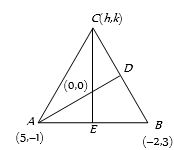
(D) Let the vertices be $A(5, -1)$,$B(-2, 3)$,and $C(h, k)$. The orthocentre $H$ is $(0, 0)$.
Since $CH \perp AB$,the slope of $AB$ is $m_{AB} = \frac{3 - (-1)}{-2 - 5} = \frac{4}{-7} = -\frac{4}{7}$.
The slope of the altitude $CH$ is $m_{CH} = -\frac{1}{m_{AB}} = \frac{7}{4}$.
Since $CH$ passes through $(0, 0)$ and $(h, k)$,its slope is $\frac{k}{h} = \frac{7}{4}$,which implies $7h - 4k = 0$ ---$(1)$.
Similarly,since $AH \perp BC$,the slope of $BC$ is $m_{BC} = \frac{k - 3}{h - (-2)} = \frac{k - 3}{h + 2}$.
The slope of the altitude $AH$ is $m_{AH} = \frac{0 - (-1)}{0 - 5} = -\frac{1}{5}$.
Since $AH \perp BC$,$m_{BC} \times m_{AH} = -1$,so $\left(\frac{k - 3}{h + 2}\right) \times \left(-\frac{1}{5}\right) = -1$.
$\frac{k - 3}{h + 2} = 5$ $\Rightarrow k - 3 = 5h + 10$ $\Rightarrow 5h - k + 13 = 0$ ---$(2)$.
Solving equations $(1)$ and $(2)$: From $(1)$,$k = \frac{7h}{4}$. Substituting into $(2)$: $5h - \frac{7h}{4} + 13 = 0$.
$\frac{20h - 7h}{4} + 13 = 0$ $\Rightarrow 13h = -52$ $\Rightarrow h = -4$.
Then $k = \frac{7(-4)}{4} = -7$.
Thus,the third vertex is $(-4, -7)$.
Since $CH \perp AB$,the slope of $AB$ is $m_{AB} = \frac{3 - (-1)}{-2 - 5} = \frac{4}{-7} = -\frac{4}{7}$.
The slope of the altitude $CH$ is $m_{CH} = -\frac{1}{m_{AB}} = \frac{7}{4}$.
Since $CH$ passes through $(0, 0)$ and $(h, k)$,its slope is $\frac{k}{h} = \frac{7}{4}$,which implies $7h - 4k = 0$ ---$(1)$.
Similarly,since $AH \perp BC$,the slope of $BC$ is $m_{BC} = \frac{k - 3}{h - (-2)} = \frac{k - 3}{h + 2}$.
The slope of the altitude $AH$ is $m_{AH} = \frac{0 - (-1)}{0 - 5} = -\frac{1}{5}$.
Since $AH \perp BC$,$m_{BC} \times m_{AH} = -1$,so $\left(\frac{k - 3}{h + 2}\right) \times \left(-\frac{1}{5}\right) = -1$.
$\frac{k - 3}{h + 2} = 5$ $\Rightarrow k - 3 = 5h + 10$ $\Rightarrow 5h - k + 13 = 0$ ---$(2)$.
Solving equations $(1)$ and $(2)$: From $(1)$,$k = \frac{7h}{4}$. Substituting into $(2)$: $5h - \frac{7h}{4} + 13 = 0$.
$\frac{20h - 7h}{4} + 13 = 0$ $\Rightarrow 13h = -52$ $\Rightarrow h = -4$.
Then $k = \frac{7(-4)}{4} = -7$.
Thus,the third vertex is $(-4, -7)$.
0 likesView Solution
30
MathematicsMediumMCQIIT JEE · 1983
If $-9$ is a root of the equation $\left| \begin{array}{ccc} x & 3 & 7 \\ 2 & x & 2 \\ 7 & 6 & x \end{array} \right| = 0$,then the other two roots are:
A
$2, 7$
B
$-2, 7$
C
$2, -7$
D
$-2, -7$
Solution
(A) Given the determinant equation: $\left| \begin{array}{ccc} x & 3 & 7 \\ 2 & x & 2 \\ 7 & 6 & x \end{array} \right| = 0$.
Applying the row operation $R_1 \to R_1 + R_2 + R_3$,we get:
$\left| \begin{array}{ccc} x+9 & x+9 & x+9 \\ 2 & x & 2 \\ 7 & 6 & x \end{array} \right| = 0$.
Taking $(x+9)$ as a common factor from $R_1$:
$(x+9) \left| \begin{array}{ccc} 1 & 1 & 1 \\ 2 & x & 2 \\ 7 & 6 & x \end{array} \right| = 0$.
Expanding the determinant:
$(x+9) [1(x^2 - 12) - 1(2x - 14) + 1(12 - 7x)] = 0$.
$(x+9) [x^2 - 12 - 2x + 14 + 12 - 7x] = 0$.
$(x+9) (x^2 - 9x + 14) = 0$.
Factoring the quadratic expression:
$(x+9) (x-2) (x-7) = 0$.
Thus,the roots are $x = -9, 2, 7$.
The other two roots are $2$ and $7$.
Applying the row operation $R_1 \to R_1 + R_2 + R_3$,we get:
$\left| \begin{array}{ccc} x+9 & x+9 & x+9 \\ 2 & x & 2 \\ 7 & 6 & x \end{array} \right| = 0$.
Taking $(x+9)$ as a common factor from $R_1$:
$(x+9) \left| \begin{array}{ccc} 1 & 1 & 1 \\ 2 & x & 2 \\ 7 & 6 & x \end{array} \right| = 0$.
Expanding the determinant:
$(x+9) [1(x^2 - 12) - 1(2x - 14) + 1(12 - 7x)] = 0$.
$(x+9) [x^2 - 12 - 2x + 14 + 12 - 7x] = 0$.
$(x+9) (x^2 - 9x + 14) = 0$.
Factoring the quadratic expression:
$(x+9) (x-2) (x-7) = 0$.
Thus,the roots are $x = -9, 2, 7$.
The other two roots are $2$ and $7$.
0 likesView Solution
31
MathematicsEasyMCQIIT JEE · 1983
$\tan \left[ \cos^{-1} \frac{4}{5} + \tan^{-1} \frac{2}{3} \right] =$
A
$6/17$
B
$17/6$
C
$7/16$
D
$16/7$
Solution
(B) Let $\theta = \cos^{-1} \frac{4}{5}$. Then $\cos \theta = \frac{4}{5}$.
Since $\tan \theta = \frac{\sqrt{1 - \cos^2 \theta}}{\cos \theta} = \frac{\sqrt{1 - (16/25)}}{4/5} = \frac{3/5}{4/5} = \frac{3}{4}$,we have $\theta = \tan^{-1} \frac{3}{4}$.
Substituting this into the expression,we get $\tan \left[ \tan^{-1} \frac{3}{4} + \tan^{-1} \frac{2}{3} \right]$.
Using the formula $\tan^{-1} x + \tan^{-1} y = \tan^{-1} \left( \frac{x+y}{1-xy} \right)$,we have:
$\tan \left[ \tan^{-1} \left( \frac{3/4 + 2/3}{1 - (3/4)(2/3)} \right) \right]$
$= \tan \left[ \tan^{-1} \left( \frac{9/12 + 8/12}{1 - 6/12} \right) \right]$
$= \tan \left[ \tan^{-1} \left( \frac{17/12}{6/12} \right) \right]$
$= \tan \left[ \tan^{-1} \left( \frac{17}{6} \right) \right] = \frac{17}{6}$.
Since $\tan \theta = \frac{\sqrt{1 - \cos^2 \theta}}{\cos \theta} = \frac{\sqrt{1 - (16/25)}}{4/5} = \frac{3/5}{4/5} = \frac{3}{4}$,we have $\theta = \tan^{-1} \frac{3}{4}$.
Substituting this into the expression,we get $\tan \left[ \tan^{-1} \frac{3}{4} + \tan^{-1} \frac{2}{3} \right]$.
Using the formula $\tan^{-1} x + \tan^{-1} y = \tan^{-1} \left( \frac{x+y}{1-xy} \right)$,we have:
$\tan \left[ \tan^{-1} \left( \frac{3/4 + 2/3}{1 - (3/4)(2/3)} \right) \right]$
$= \tan \left[ \tan^{-1} \left( \frac{9/12 + 8/12}{1 - 6/12} \right) \right]$
$= \tan \left[ \tan^{-1} \left( \frac{17/12}{6/12} \right) \right]$
$= \tan \left[ \tan^{-1} \left( \frac{17}{6} \right) \right] = \frac{17}{6}$.
0 likesView Solution
32
MathematicsEasyMCQIIT JEE · 1983
If $a = i + 2j + 2k$ and $b = 3i + 6j + 2k,$ then a vector in the direction of $a$ and having magnitude as $|b|$ is
A
$7\,(i + j + k)$
B
$\frac{7}{3}\,(i + 2j + 2k)$
C
$\frac{7}{9}\,(i + 2j + 2k)$
D
None of these
Solution
(B) Given vectors are $a = i + 2j + 2k$ and $b = 3i + 6j + 2k.$
First,calculate the magnitude of vector $b$:
$|b| = \sqrt{3^2 + 6^2 + 2^2} = \sqrt{9 + 36 + 4} = \sqrt{49} = 7.$
Next,find the unit vector in the direction of $a$,denoted as $\hat{a}$:
$|a| = \sqrt{1^2 + 2^2 + 2^2} = \sqrt{1 + 4 + 4} = \sqrt{9} = 3.$
$\hat{a} = \frac{a}{|a|} = \frac{i + 2j + 2k}{3}.$
The required vector has magnitude $|b|$ and direction $\hat{a}$,so it is $|b|\hat{a}$:
$7 \times \left( \frac{i + 2j + 2k}{3} \right) = \frac{7}{3}(i + 2j + 2k).$
Thus,the correct option is $B$.
First,calculate the magnitude of vector $b$:
$|b| = \sqrt{3^2 + 6^2 + 2^2} = \sqrt{9 + 36 + 4} = \sqrt{49} = 7.$
Next,find the unit vector in the direction of $a$,denoted as $\hat{a}$:
$|a| = \sqrt{1^2 + 2^2 + 2^2} = \sqrt{1 + 4 + 4} = \sqrt{9} = 3.$
$\hat{a} = \frac{a}{|a|} = \frac{i + 2j + 2k}{3}.$
The required vector has magnitude $|b|$ and direction $\hat{a}$,so it is $|b|\hat{a}$:
$7 \times \left( \frac{i + 2j + 2k}{3} \right) = \frac{7}{3}(i + 2j + 2k).$
Thus,the correct option is $B$.
0 likesView Solution
33
MathematicsEasyMCQIIT JEE · 1983
If $\overrightarrow {AO} + \overrightarrow {OB} = \overrightarrow {BO} + \overrightarrow {OC} ,$ then $A, B, C$ form
A
Equilateral triangle
B
Right angled triangle
C
Isosceles triangle
D
Line
Solution
(C) Given the equation: $\overrightarrow {AO} + \overrightarrow {OB} = \overrightarrow {BO} + \overrightarrow {OC}$.
By the triangle law of vector addition,$\overrightarrow {AO} + \overrightarrow {OB} = \overrightarrow {AB}$.
Similarly,$\overrightarrow {BO} + \overrightarrow {OC} = \overrightarrow {BC}$.
Therefore,$\overrightarrow {AB} = \overrightarrow {BC}$.
This implies that the magnitude of vector $\overrightarrow {AB}$ is equal to the magnitude of vector $\overrightarrow {BC}$,i.e.,$|\overrightarrow {AB}| = |\overrightarrow {BC}|$.
Since the lengths of the two sides $AB$ and $BC$ are equal,the points $A, B, C$ form an isosceles triangle.
By the triangle law of vector addition,$\overrightarrow {AO} + \overrightarrow {OB} = \overrightarrow {AB}$.
Similarly,$\overrightarrow {BO} + \overrightarrow {OC} = \overrightarrow {BC}$.
Therefore,$\overrightarrow {AB} = \overrightarrow {BC}$.
This implies that the magnitude of vector $\overrightarrow {AB}$ is equal to the magnitude of vector $\overrightarrow {BC}$,i.e.,$|\overrightarrow {AB}| = |\overrightarrow {BC}|$.
Since the lengths of the two sides $AB$ and $BC$ are equal,the points $A, B, C$ form an isosceles triangle.
0 likesView Solution
34
MathematicsMediumMCQIIT JEE · 1983
The points with position vectors $60\,i + 3\,j$,$40\,i - 8\,j$,and $a\,i - 52\,j$ are collinear,if $a = $
A
$-40$
B
$40$
C
$20$
D
None of these
Solution
(A) Let the points be $A(60, 3)$,$B(40, -8)$,and $C(a, -52)$.
Since the points are collinear,the vector $\overrightarrow{AB}$ must be parallel to the vector $\overrightarrow{BC}$.
$\overrightarrow{AB} = (40 - 60)i + (-8 - 3)j = -20i - 11j$.
$\overrightarrow{BC} = (a - 40)i + (-52 - (-8))j = (a - 40)i - 44j$.
For collinearity,$\overrightarrow{AB} = k\overrightarrow{BC}$ for some scalar $k$.
$-20i - 11j = k((a - 40)i - 44j)$.
Comparing the coefficients of $j$: $-11 = -44k$,which gives $k = \frac{11}{44} = \frac{1}{4}$.
Comparing the coefficients of $i$: $-20 = k(a - 40)$.
Substituting $k = \frac{1}{4}$: $-20 = \frac{1}{4}(a - 40)$.
$-80 = a - 40$.
$a = -80 + 40 = -40$.
Since the points are collinear,the vector $\overrightarrow{AB}$ must be parallel to the vector $\overrightarrow{BC}$.
$\overrightarrow{AB} = (40 - 60)i + (-8 - 3)j = -20i - 11j$.
$\overrightarrow{BC} = (a - 40)i + (-52 - (-8))j = (a - 40)i - 44j$.
For collinearity,$\overrightarrow{AB} = k\overrightarrow{BC}$ for some scalar $k$.
$-20i - 11j = k((a - 40)i - 44j)$.
Comparing the coefficients of $j$: $-11 = -44k$,which gives $k = \frac{11}{44} = \frac{1}{4}$.
Comparing the coefficients of $i$: $-20 = k(a - 40)$.
Substituting $k = \frac{1}{4}$: $-20 = \frac{1}{4}(a - 40)$.
$-80 = a - 40$.
$a = -80 + 40 = -40$.
0 likesView Solution
35
MathematicsDifficultMCQIIT JEE · 1983
The horizontal force and the force inclined at an angle $60^\circ$ with the vertical,whose resultant is in the vertical direction with a magnitude of $P \ kg$,are:
A
$P, 2P$
B
$P, P\sqrt{3}$
C
$2P, P\sqrt{3}$
D
None of these
Solution
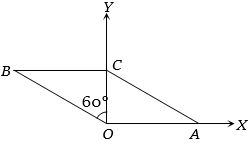
(C) Let the horizontal force be $\vec{F_1} = P_1 \hat{i}$ and the inclined force be $\vec{F_2}$.
The resultant force $\vec{R}$ is in the vertical direction,so $\vec{R} = P \hat{j}$.
From the parallelogram law of vector addition,$\vec{R} = \vec{F_1} + \vec{F_2}$,so $\vec{F_2} = \vec{R} - \vec{F_1} = -P_1 \hat{i} + P \hat{j}$.
The angle between $\vec{F_2}$ and the vertical axis (y-axis) is $60^\circ$.
Using the dot product formula: $\cos 60^\circ = \frac{\vec{F_2} \cdot \hat{j}}{|\vec{F_2}| |\hat{j}|}$.
$\frac{1}{2} = \frac{(-P_1 \hat{i} + P \hat{j}) \cdot \hat{j}}{\sqrt{(-P_1)^2 + P^2}} = \frac{P}{\sqrt{P_1^2 + P^2}}$.
Squaring both sides: $\frac{1}{4} = \frac{P^2}{P_1^2 + P^2} \Rightarrow P_1^2 + P^2 = 4P^2 \Rightarrow P_1^2 = 3P^2 \Rightarrow P_1 = P\sqrt{3}$.
The magnitude of the inclined force is $|\vec{F_2}| = \sqrt{P_1^2 + P^2} = \sqrt{3P^2 + P^2} = \sqrt{4P^2} = 2P$.
Thus,the two forces are $P\sqrt{3}$ and $2P$.
The resultant force $\vec{R}$ is in the vertical direction,so $\vec{R} = P \hat{j}$.
From the parallelogram law of vector addition,$\vec{R} = \vec{F_1} + \vec{F_2}$,so $\vec{F_2} = \vec{R} - \vec{F_1} = -P_1 \hat{i} + P \hat{j}$.
The angle between $\vec{F_2}$ and the vertical axis (y-axis) is $60^\circ$.
Using the dot product formula: $\cos 60^\circ = \frac{\vec{F_2} \cdot \hat{j}}{|\vec{F_2}| |\hat{j}|}$.
$\frac{1}{2} = \frac{(-P_1 \hat{i} + P \hat{j}) \cdot \hat{j}}{\sqrt{(-P_1)^2 + P^2}} = \frac{P}{\sqrt{P_1^2 + P^2}}$.
Squaring both sides: $\frac{1}{4} = \frac{P^2}{P_1^2 + P^2} \Rightarrow P_1^2 + P^2 = 4P^2 \Rightarrow P_1^2 = 3P^2 \Rightarrow P_1 = P\sqrt{3}$.
The magnitude of the inclined force is $|\vec{F_2}| = \sqrt{P_1^2 + P^2} = \sqrt{3P^2 + P^2} = \sqrt{4P^2} = 2P$.
Thus,the two forces are $P\sqrt{3}$ and $2P$.
0 likesView Solution
36
MathematicsMediumMCQIIT JEE · 1983
$A$ unit vector perpendicular to the plane determined by the points $A(1, -1, 2)$,$B(2, 0, -1)$,and $C(0, 2, 1)$ is:
A
$\pm \frac{1}{\sqrt{6}}(2i + j + k)$
B
$\frac{1}{\sqrt{6}}(i + 2j + k)$
C
$\frac{1}{\sqrt{6}}(i + j + k)$
D
$\frac{1}{\sqrt{6}}(2i - j - k)$
Solution
(A) Let the points be $A(1, -1, 2)$,$B(2, 0, -1)$,and $C(0, 2, 1)$.
Define two vectors in the plane: $\vec{AB} = (2-1)i + (0-(-1))j + (-1-2)k = i + j - 3k$ and $\vec{AC} = (0-1)i + (2-(-1))j + (1-2)k = -i + 3j - k$.
Alternatively,using the provided solution vectors: $\vec{u} = \vec{AB} = i + j - 3k$ and $\vec{v} = \vec{BC} = (0-2)i + (2-0)j + (1-(-1))k = -2i + 2j + 2k$.
The normal vector $\vec{n}$ to the plane is given by the cross product $\vec{u} \times \vec{v}$:
$\vec{n} = \begin{vmatrix} i & j & k \\ 1 & 1 & -3 \\ -2 & 2 & 2 \end{vmatrix} = i(2 - (-6)) - j(2 - 6) + k(2 - (-2)) = 8i + 4j + 4k$.
The unit vector is $\hat{n} = \pm \frac{\vec{n}}{|\vec{n}|} = \pm \frac{8i + 4j + 4k}{\sqrt{8^2 + 4^2 + 4^2}} = \pm \frac{8i + 4j + 4k}{\sqrt{64 + 16 + 16}} = \pm \frac{8i + 4j + 4k}{\sqrt{96}} = \pm \frac{8i + 4j + 4k}{4\sqrt{6}} = \pm \frac{2i + j + k}{\sqrt{6}}$.
Define two vectors in the plane: $\vec{AB} = (2-1)i + (0-(-1))j + (-1-2)k = i + j - 3k$ and $\vec{AC} = (0-1)i + (2-(-1))j + (1-2)k = -i + 3j - k$.
Alternatively,using the provided solution vectors: $\vec{u} = \vec{AB} = i + j - 3k$ and $\vec{v} = \vec{BC} = (0-2)i + (2-0)j + (1-(-1))k = -2i + 2j + 2k$.
The normal vector $\vec{n}$ to the plane is given by the cross product $\vec{u} \times \vec{v}$:
$\vec{n} = \begin{vmatrix} i & j & k \\ 1 & 1 & -3 \\ -2 & 2 & 2 \end{vmatrix} = i(2 - (-6)) - j(2 - 6) + k(2 - (-2)) = 8i + 4j + 4k$.
The unit vector is $\hat{n} = \pm \frac{\vec{n}}{|\vec{n}|} = \pm \frac{8i + 4j + 4k}{\sqrt{8^2 + 4^2 + 4^2}} = \pm \frac{8i + 4j + 4k}{\sqrt{64 + 16 + 16}} = \pm \frac{8i + 4j + 4k}{\sqrt{96}} = \pm \frac{8i + 4j + 4k}{4\sqrt{6}} = \pm \frac{2i + j + k}{\sqrt{6}}$.
0 likesView Solution
37
MathematicsEasyMCQIIT JEE · 1983
The area of a triangle whose vertices are $A(1, -1, 2)$,$B(2, 1, -1)$ and $C(3, -1, 2)$ is
A
$13$
B
$\sqrt{13}$
C
$6$
D
$\sqrt{6}$
Solution
(B) The vertices of the triangle are $A(1, -1, 2)$,$B(2, 1, -1)$,and $C(3, -1, 2)$.
First,we find the vectors $\overrightarrow{AB}$ and $\overrightarrow{AC}$:
$\overrightarrow{AB} = (2-1)\hat{i} + (1-(-1))\hat{j} + (-1-2)\hat{k} = \hat{i} + 2\hat{j} - 3\hat{k}$
$\overrightarrow{AC} = (3-1)\hat{i} + (-1-(-1))\hat{j} + (2-2)\hat{k} = 2\hat{i} + 0\hat{j} + 0\hat{k} = 2\hat{i}$
The area of the triangle is given by $\frac{1}{2} |\overrightarrow{AB} \times \overrightarrow{AC}|$.
Calculating the cross product:
$\overrightarrow{AB} \times \overrightarrow{AC} = \begin{vmatrix} \hat{i} & \hat{j} & \hat{k} \\ 1 & 2 & -3 \\ 2 & 0 & 0 \end{vmatrix} = \hat{i}(0 - 0) - \hat{j}(0 - (-6)) + \hat{k}(0 - 4) = -6\hat{j} - 4\hat{k}$.
Now,find the magnitude:
$|\overrightarrow{AB} \times \overrightarrow{AC}| = \sqrt{(-6)^2 + (-4)^2} = \sqrt{36 + 16} = \sqrt{52} = 2\sqrt{13}$.
Therefore,the area of the triangle is $\frac{1}{2} \times 2\sqrt{13} = \sqrt{13}$ square units.
First,we find the vectors $\overrightarrow{AB}$ and $\overrightarrow{AC}$:
$\overrightarrow{AB} = (2-1)\hat{i} + (1-(-1))\hat{j} + (-1-2)\hat{k} = \hat{i} + 2\hat{j} - 3\hat{k}$
$\overrightarrow{AC} = (3-1)\hat{i} + (-1-(-1))\hat{j} + (2-2)\hat{k} = 2\hat{i} + 0\hat{j} + 0\hat{k} = 2\hat{i}$
The area of the triangle is given by $\frac{1}{2} |\overrightarrow{AB} \times \overrightarrow{AC}|$.
Calculating the cross product:
$\overrightarrow{AB} \times \overrightarrow{AC} = \begin{vmatrix} \hat{i} & \hat{j} & \hat{k} \\ 1 & 2 & -3 \\ 2 & 0 & 0 \end{vmatrix} = \hat{i}(0 - 0) - \hat{j}(0 - (-6)) + \hat{k}(0 - 4) = -6\hat{j} - 4\hat{k}$.
Now,find the magnitude:
$|\overrightarrow{AB} \times \overrightarrow{AC}| = \sqrt{(-6)^2 + (-4)^2} = \sqrt{36 + 16} = \sqrt{52} = 2\sqrt{13}$.
Therefore,the area of the triangle is $\frac{1}{2} \times 2\sqrt{13} = \sqrt{13}$ square units.
0 likesView Solution
38
MathematicsEasyMCQIIT JEE · 1983
If the vectors $2i - 3j$,$i + j - k$,and $3i - k$ form three concurrent edges of a parallelepiped,then the volume of the parallelepiped is
A
$8$
B
$10$
C
$4$
D
$14$
Solution
(C) Let the vectors be $\vec{a} = 2i - 3j + 0k$,$\vec{b} = i + j - k$,and $\vec{c} = 3i + 0j - k$.
The volume of a parallelepiped with concurrent edges $\vec{a}, \vec{b}, \vec{c}$ is given by the scalar triple product $|[\vec{a} \, \vec{b} \, \vec{c}]|$.
This is calculated as the determinant of the matrix formed by the components of the vectors:
$V = |\det \begin{bmatrix} 2 & -3 & 0 \\ 1 & 1 & -1 \\ 3 & 0 & -1 \end{bmatrix}|$
Expanding the determinant along the first row:
$V = |2(1(-1) - (-1)(0)) - (-3)(1(-1) - (-1)(3)) + 0|$
$V = |2(-1) + 3(-1 + 3)|$
$V = |-2 + 3(2)|$
$V = |-2 + 6| = |4| = 4$.
Thus,the volume of the parallelepiped is $4$ cubic units.
The volume of a parallelepiped with concurrent edges $\vec{a}, \vec{b}, \vec{c}$ is given by the scalar triple product $|[\vec{a} \, \vec{b} \, \vec{c}]|$.
This is calculated as the determinant of the matrix formed by the components of the vectors:
$V = |\det \begin{bmatrix} 2 & -3 & 0 \\ 1 & 1 & -1 \\ 3 & 0 & -1 \end{bmatrix}|$
Expanding the determinant along the first row:
$V = |2(1(-1) - (-1)(0)) - (-3)(1(-1) - (-1)(3)) + 0|$
$V = |2(-1) + 3(-1 + 3)|$
$V = |-2 + 3(2)|$
$V = |-2 + 6| = |4| = 4$.
Thus,the volume of the parallelepiped is $4$ cubic units.
0 likesView Solution
39
MathematicsEasyMCQIIT JEE · 1983
If $x \cdot a = 0, x \cdot b = 0$ and $x \cdot c = 0$ for some non-zero vector $x$,then the true statement is
A
$[a, b, c] = 0$
B
$[a, b, c] \neq 0$
C
$[a, b, c] = 1$
D
None of these
Solution
(A) Given that $x$ is a non-zero vector such that $x \cdot a = 0, x \cdot b = 0$,and $x \cdot c = 0$.
This implies that the vector $x$ is perpendicular to each of the vectors $a, b$,and $c$.
If $x$ is a non-zero vector perpendicular to $a, b$,and $c$,then $a, b$,and $c$ must lie in a plane perpendicular to $x$.
Therefore,the vectors $a, b$,and $c$ are coplanar.
For any three coplanar vectors,their scalar triple product is zero,i.e.,$[a, b, c] = 0$.
This implies that the vector $x$ is perpendicular to each of the vectors $a, b$,and $c$.
If $x$ is a non-zero vector perpendicular to $a, b$,and $c$,then $a, b$,and $c$ must lie in a plane perpendicular to $x$.
Therefore,the vectors $a, b$,and $c$ are coplanar.
For any three coplanar vectors,their scalar triple product is zero,i.e.,$[a, b, c] = 0$.
0 likesView Solution
40
MathematicsMediumMCQIIT JEE · 1983
If $f(x) = \cos (\log x)$,then $f(x)f(y) - \frac{1}{2}[f(x/y) + f(xy)] = $
A
$ - 1$
B
$\frac{1}{2}$
C
$ - 2$
D
$0$
Solution
(D) Given $f(x) = \cos (\log x)$.
Then $f(y) = \cos (\log y)$.
We need to evaluate $f(x)f(y) - \frac{1}{2}[f(x/y) + f(xy)]$.
Using the property $\log(a/b) = \log a - \log b$ and $\log(ab) = \log a + \log b$:
$f(x/y) = \cos(\log(x/y)) = \cos(\log x - \log y)$
$f(xy) = \cos(\log(xy)) = \cos(\log x + \log y)$
Now,substitute these into the expression:
$f(x)f(y) - \frac{1}{2}[\cos(\log x - \log y) + \cos(\log x + \log y)]$
Using the trigonometric identity $\cos(A - B) + \cos(A + B) = 2\cos A \cos B$,where $A = \log x$ and $B = \log y$:
$= \cos(\log x)\cos(\log y) - \frac{1}{2}[2\cos(\log x)\cos(\log y)]$
$= \cos(\log x)\cos(\log y) - \cos(\log x)\cos(\log y) = 0$.
Then $f(y) = \cos (\log y)$.
We need to evaluate $f(x)f(y) - \frac{1}{2}[f(x/y) + f(xy)]$.
Using the property $\log(a/b) = \log a - \log b$ and $\log(ab) = \log a + \log b$:
$f(x/y) = \cos(\log(x/y)) = \cos(\log x - \log y)$
$f(xy) = \cos(\log(xy)) = \cos(\log x + \log y)$
Now,substitute these into the expression:
$f(x)f(y) - \frac{1}{2}[\cos(\log x - \log y) + \cos(\log x + \log y)]$
Using the trigonometric identity $\cos(A - B) + \cos(A + B) = 2\cos A \cos B$,where $A = \log x$ and $B = \log y$:
$= \cos(\log x)\cos(\log y) - \frac{1}{2}[2\cos(\log x)\cos(\log y)]$
$= \cos(\log x)\cos(\log y) - \cos(\log x)\cos(\log y) = 0$.
0 likesView Solution
41
MathematicsEasyMCQIIT JEE · 1983
If $f(x) = (a - x^n)^{1/n},$ where $a > 0$ and $n$ is a positive integer,then $f[f(x)] = $
A
$x^3$
B
$x^2$
C
$x$
D
None of these
Solution
(C) Given $f(x) = (a - x^n)^{1/n}$.
To find $f[f(x)]$,we substitute $f(x)$ into the function $f$:
$f[f(x)] = (a - [f(x)]^n)^{1/n}$
Substitute the expression for $f(x)$:
$f[f(x)] = (a - [(a - x^n)^{1/n}]^n)^{1/n}$
Simplify the inner term:
$f[f(x)] = (a - (a - x^n))^{1/n}$
$f[f(x)] = (a - a + x^n)^{1/n}$
$f[f(x)] = (x^n)^{1/n}$
$f[f(x)] = x$.
To find $f[f(x)]$,we substitute $f(x)$ into the function $f$:
$f[f(x)] = (a - [f(x)]^n)^{1/n}$
Substitute the expression for $f(x)$:
$f[f(x)] = (a - [(a - x^n)^{1/n}]^n)^{1/n}$
Simplify the inner term:
$f[f(x)] = (a - (a - x^n))^{1/n}$
$f[f(x)] = (a - a + x^n)^{1/n}$
$f[f(x)] = (x^n)^{1/n}$
$f[f(x)] = x$.
0 likesView Solution
42
MathematicsDifficultMCQIIT JEE · 1983
The function $f(x) = \frac{\log(1 + ax) - \log(1 - bx)}{x}$ is not defined at $x = 0$. The value which should be assigned to $f$ at $x = 0$ so that it is continuous at $x = 0$ is:
A
$a - b$
B
$a + b$
C
$\log a + \log b$
D
$\log a - \log b$
Solution
(B) For the function $f(x)$ to be continuous at $x = 0$,the value $f(0)$ must be equal to $\lim_{x \to 0} f(x)$.
Given $f(x) = \frac{\log(1 + ax) - \log(1 - bx)}{x}$.
Using the standard limit $\lim_{x \to 0} \frac{\log(1 + kx)}{x} = k$,we can rewrite the limit as:
$\lim_{x \to 0} f(x) = \lim_{x \to 0} \left( \frac{\log(1 + ax)}{x} - \frac{\log(1 - bx)}{x} \right)$
$= \lim_{x \to 0} \left( a \cdot \frac{\log(1 + ax)}{ax} - (-b) \cdot \frac{\log(1 - bx)}{-bx} \right)$
$= a(1) + b(1) = a + b$.
Therefore,$f(0) = a + b$.
Given $f(x) = \frac{\log(1 + ax) - \log(1 - bx)}{x}$.
Using the standard limit $\lim_{x \to 0} \frac{\log(1 + kx)}{x} = k$,we can rewrite the limit as:
$\lim_{x \to 0} f(x) = \lim_{x \to 0} \left( \frac{\log(1 + ax)}{x} - \frac{\log(1 - bx)}{x} \right)$
$= \lim_{x \to 0} \left( a \cdot \frac{\log(1 + ax)}{ax} - (-b) \cdot \frac{\log(1 - bx)}{-bx} \right)$
$= a(1) + b(1) = a + b$.
Therefore,$f(0) = a + b$.
0 likesView Solution
43
MathematicsDifficultMCQIIT JEE · 1983
$\int {\frac{{x - 1}}{{{{(x + 1)}^3}}}{e^x}\,dx = } $
A
$\frac{{ - {e^x}}}{{{{(x + 1)}^2}}} + c$
B
$\frac{{{e^x}}}{{{{(x + 1)}^2}}} + c$
C
$\frac{{{e^x}}}{{{{(x + 1)}^3}}} + c$
D
$\frac{{ - {e^x}}}{{{{(x + 1)}^3}}} + c$
Solution
(B) We use the standard integral formula: $\int e^x [f(x) + f'(x)] \, dx = e^x f(x) + c$.
Rewrite the integrand as:
$\frac{x - 1}{(x + 1)^3} = \frac{(x + 1) - 2}{(x + 1)^3} = \frac{1}{(x + 1)^2} - \frac{2}{(x + 1)^3}$.
Let $f(x) = \frac{1}{(x + 1)^2}$.
Then $f'(x) = \frac{d}{dx} [(x + 1)^{-2}] = -2(x + 1)^{-3} = -\frac{2}{(x + 1)^3}$.
Thus,the integral becomes:
$\int e^x \left[ \frac{1}{(x + 1)^2} - \frac{2}{(x + 1)^3} \right] \, dx = \int e^x [f(x) + f'(x)] \, dx = e^x f(x) + c$.
Substituting $f(x)$ back,we get:
$\frac{e^x}{(x + 1)^2} + c$.
Rewrite the integrand as:
$\frac{x - 1}{(x + 1)^3} = \frac{(x + 1) - 2}{(x + 1)^3} = \frac{1}{(x + 1)^2} - \frac{2}{(x + 1)^3}$.
Let $f(x) = \frac{1}{(x + 1)^2}$.
Then $f'(x) = \frac{d}{dx} [(x + 1)^{-2}] = -2(x + 1)^{-3} = -\frac{2}{(x + 1)^3}$.
Thus,the integral becomes:
$\int e^x \left[ \frac{1}{(x + 1)^2} - \frac{2}{(x + 1)^3} \right] \, dx = \int e^x [f(x) + f'(x)] \, dx = e^x f(x) + c$.
Substituting $f(x)$ back,we get:
$\frac{e^x}{(x + 1)^2} + c$.
0 likesView Solution
44
MathematicsDifficultMCQIIT JEE · 1983
$\int_0^{\pi /4} {\frac{{\sin x + \cos x}}{{9 + 16\sin 2x}}\,dx = } $
A
$\frac{1}{{20}}\log 3$
B
$\log 3$
C
$\frac{1}{{20}}\log 5$
D
None of these
Solution
(A) Let $I = \int_0^{\pi /4} {\frac{{\sin x + \cos x}}{{9 + 16\sin 2x}}\,dx}$.
Substitute $t = \sin x - \cos x$,then $dt = (\cos x + \sin x)dx$.
When $x = 0$,$t = \sin 0 - \cos 0 = -1$.
When $x = \pi /4$,$t = \sin(\pi /4) - \cos(\pi /4) = 0$.
Also,$t^2 = (\sin x - \cos x)^2 = \sin^2 x + \cos^2 x - 2\sin x \cos x = 1 - \sin 2x$,so $\sin 2x = 1 - t^2$.
Substituting these into the integral:
$I = \int_{-1}^0 \frac{dt}{9 + 16(1 - t^2)} = \int_{-1}^0 \frac{dt}{9 + 16 - 16t^2} = \int_{-1}^0 \frac{dt}{25 - 16t^2}$.
Using the formula $\int \frac{dx}{a^2 - x^2} = \frac{1}{2a} \log \left| \frac{a+x}{a-x} \right|$,we have:
$I = \frac{1}{16} \int_{-1}^0 \frac{dt}{(5/4)^2 - t^2} = \frac{1}{16} \cdot \frac{1}{2(5/4)} \left[ \log \left| \frac{5/4 + t}{5/4 - t} \right| \right]_{-1}^0$.
$I = \frac{1}{16} \cdot \frac{2}{5} \left[ \log \left| \frac{5 + 4t}{5 - 4t} \right| \right]_{-1}^0 = \frac{1}{40} \left[ \log(1) - \log \left| \frac{5 - 4}{5 + 4} \right| \right]$.
$I = \frac{1}{40} [0 - \log(1/9)] = \frac{1}{40} \log(9) = \frac{1}{40} \log(3^2) = \frac{2}{40} \log 3 = \frac{1}{20} \log 3$.
Substitute $t = \sin x - \cos x$,then $dt = (\cos x + \sin x)dx$.
When $x = 0$,$t = \sin 0 - \cos 0 = -1$.
When $x = \pi /4$,$t = \sin(\pi /4) - \cos(\pi /4) = 0$.
Also,$t^2 = (\sin x - \cos x)^2 = \sin^2 x + \cos^2 x - 2\sin x \cos x = 1 - \sin 2x$,so $\sin 2x = 1 - t^2$.
Substituting these into the integral:
$I = \int_{-1}^0 \frac{dt}{9 + 16(1 - t^2)} = \int_{-1}^0 \frac{dt}{9 + 16 - 16t^2} = \int_{-1}^0 \frac{dt}{25 - 16t^2}$.
Using the formula $\int \frac{dx}{a^2 - x^2} = \frac{1}{2a} \log \left| \frac{a+x}{a-x} \right|$,we have:
$I = \frac{1}{16} \int_{-1}^0 \frac{dt}{(5/4)^2 - t^2} = \frac{1}{16} \cdot \frac{1}{2(5/4)} \left[ \log \left| \frac{5/4 + t}{5/4 - t} \right| \right]_{-1}^0$.
$I = \frac{1}{16} \cdot \frac{2}{5} \left[ \log \left| \frac{5 + 4t}{5 - 4t} \right| \right]_{-1}^0 = \frac{1}{40} \left[ \log(1) - \log \left| \frac{5 - 4}{5 + 4} \right| \right]$.
$I = \frac{1}{40} [0 - \log(1/9)] = \frac{1}{40} \log(9) = \frac{1}{40} \log(3^2) = \frac{2}{40} \log 3 = \frac{1}{20} \log 3$.
0 likesView Solution
45
MathematicsEasyMCQIIT JEE · 1983
$\int_0^{\pi /2} \frac{\sqrt{\cot x}}{\sqrt{\cot x} + \sqrt{\tan x}} \, dx = $
A
$\pi$
B
$\frac{\pi}{2}$
C
$\frac{\pi}{4}$
D
$\frac{\pi}{3}$
Solution
(C) Let $I = \int_0^{\pi /2} \frac{\sqrt{\cot x}}{\sqrt{\cot x} + \sqrt{\tan x}} \, dx$ ..... $(i)$
Using the property $\int_0^a f(x) \, dx = \int_0^a f(a-x) \, dx$,we get:
$I = \int_0^{\pi /2} \frac{\sqrt{\cot(\pi/2 - x)}}{\sqrt{\cot(\pi/2 - x)} + \sqrt{\tan(\pi/2 - x)}} \, dx$
Since $\cot(\pi/2 - x) = \tan x$ and $\tan(\pi/2 - x) = \cot x$,we have:
$I = \int_0^{\pi /2} \frac{\sqrt{\tan x}}{\sqrt{\tan x} + \sqrt{\cot x}} \, dx$ ..... $(ii)$
Adding $(i)$ and $(ii)$:
$2I = \int_0^{\pi /2} \frac{\sqrt{\cot x} + \sqrt{\tan x}}{\sqrt{\cot x} + \sqrt{\tan x}} \, dx$
$2I = \int_0^{\pi /2} 1 \, dx$
$2I = [x]_0^{\pi /2} = \frac{\pi}{2} - 0 = \frac{\pi}{2}$
$I = \frac{\pi}{4}$
Using the property $\int_0^a f(x) \, dx = \int_0^a f(a-x) \, dx$,we get:
$I = \int_0^{\pi /2} \frac{\sqrt{\cot(\pi/2 - x)}}{\sqrt{\cot(\pi/2 - x)} + \sqrt{\tan(\pi/2 - x)}} \, dx$
Since $\cot(\pi/2 - x) = \tan x$ and $\tan(\pi/2 - x) = \cot x$,we have:
$I = \int_0^{\pi /2} \frac{\sqrt{\tan x}}{\sqrt{\tan x} + \sqrt{\cot x}} \, dx$ ..... $(ii)$
Adding $(i)$ and $(ii)$:
$2I = \int_0^{\pi /2} \frac{\sqrt{\cot x} + \sqrt{\tan x}}{\sqrt{\cot x} + \sqrt{\tan x}} \, dx$
$2I = \int_0^{\pi /2} 1 \, dx$
$2I = [x]_0^{\pi /2} = \frac{\pi}{2} - 0 = \frac{\pi}{2}$
$I = \frac{\pi}{4}$
0 likesView Solution
46
MathematicsDifficultMCQIIT JEE · 1983
If the ordinate $x = a$ divides the area bounded by the curve $y = \left( 1 + \frac{8}{x^2} \right)$,the $x$-axis,and the ordinates $x = 2$ and $x = 4$ into two equal parts,then $a = $
A
$8$
B
$2\sqrt{2}$
C
$2$
D
$\sqrt{2}$
Solution
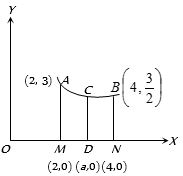
(B) Let the ordinate at $x = a$ divide the area into two equal parts.
The total area $A$ bounded by the curve $y = 1 + \frac{8}{x^2}$,the $x$-axis,and the lines $x = 2$ and $x = 4$ is given by:
$A = \int_{2}^{4} \left( 1 + \frac{8}{x^2} \right) dx$
$A = \left[ x - \frac{8}{x} \right]_{2}^{4}$
$A = \left( 4 - \frac{8}{4} \right) - \left( 2 - \frac{8}{2} \right) = (4 - 2) - (2 - 4) = 2 - (-2) = 4$ square units.
Since the ordinate $x = a$ divides this area into two equal parts,the area from $x = 2$ to $x = a$ must be half of the total area,which is $4 / 2 = 2$.
$\int_{2}^{a} \left( 1 + \frac{8}{x^2} \right) dx = 2$
$\left[ x - \frac{8}{x} \right]_{2}^{a} = 2$
$\left( a - \frac{8}{a} \right) - \left( 2 - \frac{8}{2} \right) = 2$
$a - \frac{8}{a} - (2 - 4) = 2$
$a - \frac{8}{a} + 2 = 2$
$a - \frac{8}{a} = 0$
$a^2 - 8 = 0$
$a^2 = 8$
$a = \pm 2\sqrt{2}$.
Since the region is in the first quadrant where $x > 0$,we have $a = 2\sqrt{2}$.
The total area $A$ bounded by the curve $y = 1 + \frac{8}{x^2}$,the $x$-axis,and the lines $x = 2$ and $x = 4$ is given by:
$A = \int_{2}^{4} \left( 1 + \frac{8}{x^2} \right) dx$
$A = \left[ x - \frac{8}{x} \right]_{2}^{4}$
$A = \left( 4 - \frac{8}{4} \right) - \left( 2 - \frac{8}{2} \right) = (4 - 2) - (2 - 4) = 2 - (-2) = 4$ square units.
Since the ordinate $x = a$ divides this area into two equal parts,the area from $x = 2$ to $x = a$ must be half of the total area,which is $4 / 2 = 2$.
$\int_{2}^{a} \left( 1 + \frac{8}{x^2} \right) dx = 2$
$\left[ x - \frac{8}{x} \right]_{2}^{a} = 2$
$\left( a - \frac{8}{a} \right) - \left( 2 - \frac{8}{2} \right) = 2$
$a - \frac{8}{a} - (2 - 4) = 2$
$a - \frac{8}{a} + 2 = 2$
$a - \frac{8}{a} = 0$
$a^2 - 8 = 0$
$a^2 = 8$
$a = \pm 2\sqrt{2}$.
Since the region is in the first quadrant where $x > 0$,we have $a = 2\sqrt{2}$.
0 likesView Solution
47
MathematicsMediumMCQIIT JEE · 1983
$A$ box contains $15$ tickets numbered $1, 2, \dots, 15$. Seven tickets are drawn at random one after the other with replacement. The probability that the greatest number on a drawn ticket is $9$ is:
A
$(\frac{9}{10})^6$
B
$(\frac{8}{15})^7$
C
$(\frac{3}{5})^7$
D
None of these
Solution
(D) Let $X$ be the random variable representing the number on a drawn ticket. Since the tickets are drawn with replacement,each draw is independent.
For each draw,the probability that the number on the ticket is less than or equal to $9$ is $P(X \le 9) = \frac{9}{15} = \frac{3}{5}$.
The probability that the greatest number on the $7$ drawn tickets is $9$ is given by $P(\text{max} = 9) = P(\text{max} \le 9) - P(\text{max} \le 8)$.
$P(\text{max} \le 9) = (\frac{9}{15})^7 = (\frac{3}{5})^7$.
$P(\text{max} \le 8) = (\frac{8}{15})^7$.
Therefore,the required probability is $(\frac{9}{15})^7 - (\frac{8}{15})^7 = (\frac{3}{5})^7 - (\frac{8}{15})^7$.
Since this result is not among the given options,the correct choice is $D$.
For each draw,the probability that the number on the ticket is less than or equal to $9$ is $P(X \le 9) = \frac{9}{15} = \frac{3}{5}$.
The probability that the greatest number on the $7$ drawn tickets is $9$ is given by $P(\text{max} = 9) = P(\text{max} \le 9) - P(\text{max} \le 8)$.
$P(\text{max} \le 9) = (\frac{9}{15})^7 = (\frac{3}{5})^7$.
$P(\text{max} \le 8) = (\frac{8}{15})^7$.
Therefore,the required probability is $(\frac{9}{15})^7 - (\frac{8}{15})^7 = (\frac{3}{5})^7 - (\frac{8}{15})^7$.
Since this result is not among the given options,the correct choice is $D$.
0 likesView Solution
Vedclass Products
For Students
Vedclass Test Series
Mock tests in real IIT JEE style covering Mathematics with performance analysis. 5-day free trial.
Start Free TrialFor Teachers
Exam Paper Generator
Generate Set A/B/C/D Mathematics papers from 7.5L+ questions in 2 minutes. 3 chapters free.
Try FreeFor Institutes
Online Exam Module
Run live IIT JEE mock exams with unlimited students, 360° analytics & white-label branding.
See DemoFrequently Asked Questions
How many Mathematics questions are in IIT JEE 1983?
There are 47 Mathematics questions from the IIT JEE 1983 paper on Vedclass, each with a detailed step-by-step solution in English.
Are IIT JEE 1983 Mathematics solutions available in English?
Yes. All solutions on this page are in English. You can also switch to English or Hindi using the language buttons above the questions.
Can I practice IIT JEE 1983 Mathematics as a timed test?
Yes. Use the Vedclass Test Series to attempt a full IIT JEE mock test covering Mathematics with time limits and instant score analysis.
Can teachers create Mathematics papers from IIT JEE previous year questions?
Yes. The Vedclass Exam Paper Generator lets teachers mix IIT JEE Mathematics questions and generate Set A/B/C/D papers in minutes.
For Teachers & Institutes
Build a Custom Mathematics Paper
Pick IIT JEE 1983 Mathematics questions, set difficulty, and generate Set A/B/C/D in 2 minutes.