
PhysicsQ1–15 of 15 questions
Page 1 of 1 · English
1
PhysicsMediumMCQIIT JEE · 1983
The dimensional formula for latent heat is
A
${M^0}{L^2}{T^{ - 2}}$
B
$ML{T^{ - 2}}$
C
$M{L^2}{T^{ - 2}}$
D
$M{L^2}{T^{ - 1}}$
Solution
(A) The formula for heat energy $Q$ required to change the state of a substance of mass $m$ is given by $Q = mL$,where $L$ is the latent heat.
Therefore,the latent heat $L$ is given by $L = \frac{Q}{m}$.
Since heat $Q$ is a form of energy,its dimensional formula is $[M^1 L^2 T^{-2}]$.
The dimensional formula for mass $m$ is $[M^1]$.
Substituting these into the formula for $L$:
$L = \frac{[M^1 L^2 T^{-2}]}{[M^1]} = [M^0 L^2 T^{-2}]$.
Thus,the correct option is $A$.
Therefore,the latent heat $L$ is given by $L = \frac{Q}{m}$.
Since heat $Q$ is a form of energy,its dimensional formula is $[M^1 L^2 T^{-2}]$.
The dimensional formula for mass $m$ is $[M^1]$.
Substituting these into the formula for $L$:
$L = \frac{[M^1 L^2 T^{-2}]}{[M^1]} = [M^0 L^2 T^{-2}]$.
Thus,the correct option is $A$.
0 likesView Solution
2
PhysicsMediumMCQIIT JEE · 1983
The dimensional formula for angular momentum is
A
$M{L^2}{T^{ - 2}}$
B
$M{L^2}{T^{ - 1}}$
C
$ML{T^{ - 1}}$
D
${M^0}{L^2}{T^{ - 2}}$
Solution
(B) Angular momentum $(L)$ is defined as the product of linear momentum $(p)$ and the perpendicular distance $(r)$ from the axis of rotation.
Mathematically,$L = p \times r$.
Since linear momentum $p = m \times v$,where $m$ is mass and $v$ is velocity.
The dimensional formula for mass $m$ is $[M]$.
The dimensional formula for velocity $v$ is $[L{T^{ - 1}}]$.
The dimensional formula for distance $r$ is $[L]$.
Therefore,the dimensional formula for angular momentum is $[M] \times [L{T^{ - 1}}] \times [L] = [M{L^2}{T^{ - 1}}]$.
Mathematically,$L = p \times r$.
Since linear momentum $p = m \times v$,where $m$ is mass and $v$ is velocity.
The dimensional formula for mass $m$ is $[M]$.
The dimensional formula for velocity $v$ is $[L{T^{ - 1}}]$.
The dimensional formula for distance $r$ is $[L]$.
Therefore,the dimensional formula for angular momentum is $[M] \times [L{T^{ - 1}}] \times [L] = [M{L^2}{T^{ - 1}}]$.
0 likesView Solution
3
PhysicsMediumMCQIIT JEE · 1983
The dimensional formula of capacitance is:
A
$M^{-1}L^{-2}T^4A^2$
B
$ML^2T^4A^{-2}$
C
$MLT^{-4}A^2$
D
$M^{-1}L^{-2}T^{-4}A^{-2}$
Solution
(A) The capacitance $C$ is defined as the ratio of charge $Q$ to potential difference $V$,given by $C = \frac{Q}{V}$.
Since $V = \frac{W}{Q}$,where $W$ is work done,we can write $C = \frac{Q^2}{W}$.
The dimensional formula for charge $Q$ is $[A^1T^1]$.
The dimensional formula for work $W$ is $[M^1L^2T^{-2}]$.
Substituting these into the formula: $C = \frac{[A^1T^1]^2}{[M^1L^2T^{-2}]} = \frac{[A^2T^2]}{[M^1L^2T^{-2}]}$.
Simplifying the expression,we get $[C] = [M^{-1}L^{-2}T^4A^2]$.
Since $V = \frac{W}{Q}$,where $W$ is work done,we can write $C = \frac{Q^2}{W}$.
The dimensional formula for charge $Q$ is $[A^1T^1]$.
The dimensional formula for work $W$ is $[M^1L^2T^{-2}]$.
Substituting these into the formula: $C = \frac{[A^1T^1]^2}{[M^1L^2T^{-2}]} = \frac{[A^2T^2]}{[M^1L^2T^{-2}]}$.
Simplifying the expression,we get $[C] = [M^{-1}L^{-2}T^4A^2]$.
0 likesView Solution
4
PhysicsMediumMCQIIT JEE · 1983
Inductance $L$ can be dimensionally represented as
A
$M L^2 T^{-2} A^{-2}$
B
$M L^2 T^{-4} A^{-3}$
C
$M L^{-2} T^{-2} A^{-2}$
D
$M L^2 T^4 A^3$
Solution
(A) The energy $E$ stored in an inductor is given by the formula $E = \frac{1}{2} L i^2$.
Rearranging for $L$,we get $L = \frac{2E}{i^2}$.
The dimensional formula for energy $E$ is $[M L^2 T^{-2}]$.
The dimensional formula for current $i$ is $[A]$.
Substituting these into the expression for $L$:
$L = \frac{[M L^2 T^{-2}]}{[A]^2} = [M L^2 T^{-2} A^{-2}]$.
Thus,the correct option is $A$.
Rearranging for $L$,we get $L = \frac{2E}{i^2}$.
The dimensional formula for energy $E$ is $[M L^2 T^{-2}]$.
The dimensional formula for current $i$ is $[A]$.
Substituting these into the expression for $L$:
$L = \frac{[M L^2 T^{-2}]}{[A]^2} = [M L^2 T^{-2} A^{-2}]$.
Thus,the correct option is $A$.
0 likesView Solution
5
PhysicsEasyMCQIIT JEE · 1983
Dimensional formula for torque is
A
$[M{L^2}{T^{ - 2}}]$
B
$[M{L^{ - 1}}{T^{ - 2}}]$
C
$[M{L^2}{T^{ - 3}}]$
D
$[ML{T^{ - 2}}]$
Solution
(A) Torque $( \tau)$ is defined as the product of force and the perpendicular distance from the axis of rotation.
Mathematically,$\tau = \text{Force} \times \text{Distance}$.
The dimensional formula for force is $[M L T^{-2}]$.
The dimensional formula for distance is $[L]$.
Therefore,the dimensional formula for torque is $[M L T^{-2}] \times [L] = [M L^2 T^{-2}]$.
Thus,the correct option is $A$.
Mathematically,$\tau = \text{Force} \times \text{Distance}$.
The dimensional formula for force is $[M L T^{-2}]$.
The dimensional formula for distance is $[L]$.
Therefore,the dimensional formula for torque is $[M L T^{-2}] \times [L] = [M L^2 T^{-2}]$.
Thus,the correct option is $A$.
0 likesView Solution
6
PhysicsMediumMCQIIT JEE · 1983
$A$ thin circular ring of mass $M$ and radius $r$ is rotating about its axis with a constant angular velocity $\omega$. Two objects,each of mass $m$,are attached gently to the opposite ends of a diameter of the ring. The ring will now rotate with an angular velocity:
A
$\frac{\omega (M - 2m)}{M + 2m}$
B
$\frac{\omega M}{M + 2m}$
C
$\frac{\omega M}{M + m}$
D
$\frac{\omega (M + 2m)}{M}$
Solution
(B) The initial moment of inertia of the ring about its axis is $I = Mr^2$.
The initial angular momentum is $L = I\omega = Mr^2\omega$.
When two objects of mass $m$ are attached to the opposite ends of a diameter,the new moment of inertia $I'$ becomes the sum of the ring's moment of inertia and the moment of inertia of the two point masses: $I' = Mr^2 + m(r)^2 + m(r)^2 = (M + 2m)r^2$.
According to the principle of conservation of angular momentum,the external torque is zero,so $L_{initial} = L_{final}$.
$Mr^2\omega = (M + 2m)r^2\omega'$
Solving for the new angular velocity $\omega'$:
$\omega' = \frac{Mr^2\omega}{(M + 2m)r^2} = \frac{M\omega}{M + 2m}$.
The initial angular momentum is $L = I\omega = Mr^2\omega$.
When two objects of mass $m$ are attached to the opposite ends of a diameter,the new moment of inertia $I'$ becomes the sum of the ring's moment of inertia and the moment of inertia of the two point masses: $I' = Mr^2 + m(r)^2 + m(r)^2 = (M + 2m)r^2$.
According to the principle of conservation of angular momentum,the external torque is zero,so $L_{initial} = L_{final}$.
$Mr^2\omega = (M + 2m)r^2\omega'$
Solving for the new angular velocity $\omega'$:
$\omega' = \frac{Mr^2\omega}{(M + 2m)r^2} = \frac{M\omega}{M + 2m}$.
1 likesView Solution
7
PhysicsEasyMCQIIT JEE · 1983
$A$ hollow metal sphere of radius $5\, cm$ is charged such that the potential on its surface is $10\, V$. The potential at the centre of the sphere is
A
$0\, V$
B
$10\, V$
C
Same as at a point $5\, cm$ away from the surface
D
Same as at a point $25\, cm$ away from the surface
Solution
(B) For a charged hollow metal sphere,the electric field inside the sphere is zero $(E = 0)$.
Since the electric field is the negative gradient of the potential $(E = -dV/dr)$,if $E = 0$,then the potential $V$ must be constant throughout the interior of the sphere.
Therefore,the potential at any point inside the sphere,including the centre,is equal to the potential on its surface.
Given that the potential on the surface is $10\, V$,the potential at the centre is also $10\, V$.
Since the electric field is the negative gradient of the potential $(E = -dV/dr)$,if $E = 0$,then the potential $V$ must be constant throughout the interior of the sphere.
Therefore,the potential at any point inside the sphere,including the centre,is equal to the potential on its surface.
Given that the potential on the surface is $10\, V$,the potential at the centre is also $10\, V$.
0 likesView Solution
8
PhysicsDifficultMCQIIT JEE · 1983
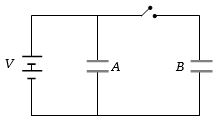
The figure given below shows two identical parallel plate capacitors connected to a battery with switch $S$ closed. The switch is now opened and the free space between the plates of both capacitors is filled with a dielectric of dielectric constant $K = 3$. What will be the ratio of the total electrostatic energy stored in both capacitors before and after the introduction of the dielectric?
A
$3:1$
B
$5:1$
C
$3:5$
D
$5:3$
Solution
(C) Initially,the switch $S$ is closed. Both capacitors $A$ and $B$ are connected in parallel to the battery of potential $V$. The capacitance of each capacitor is $C$.
The initial total energy stored in the system is:
$U_1 = \frac{1}{2}CV^2 + \frac{1}{2}CV^2 = CV^2$ --- $(i)$
When the switch $S$ is opened,capacitor $A$ remains connected to the battery,so its potential difference remains $V$. Capacitor $B$ is disconnected from the battery,so its charge $Q$ remains constant. The initial charge on capacitor $B$ was $Q = CV$.
After filling the space with a dielectric of constant $K = 3$,the new capacitance of each capacitor becomes $C' = KC = 3C$.
For capacitor $A$,the potential difference remains $V$. The new energy is $U_{A}' = \frac{1}{2}C'V^2 = \frac{1}{2}(3C)V^2 = \frac{3}{2}CV^2$.
For capacitor $B$,the charge $Q = CV$ remains constant. The new energy is $U_{B}' = \frac{Q^2}{2C'} = \frac{(CV)^2}{2(3C)} = \frac{1}{6}CV^2$.
The final total energy stored in the system is:
$U_2 = U_{A}' + U_{B}' = \frac{3}{2}CV^2 + \frac{1}{6}CV^2 = \left(\frac{9+1}{6}\right)CV^2 = \frac{10}{6}CV^2 = \frac{5}{3}CV^2$ --- (ii)
The ratio of total electrostatic energy before and after is:
$\frac{U_1}{U_2} = \frac{CV^2}{(5/3)CV^2} = \frac{3}{5}$
The initial total energy stored in the system is:
$U_1 = \frac{1}{2}CV^2 + \frac{1}{2}CV^2 = CV^2$ --- $(i)$
When the switch $S$ is opened,capacitor $A$ remains connected to the battery,so its potential difference remains $V$. Capacitor $B$ is disconnected from the battery,so its charge $Q$ remains constant. The initial charge on capacitor $B$ was $Q = CV$.
After filling the space with a dielectric of constant $K = 3$,the new capacitance of each capacitor becomes $C' = KC = 3C$.
For capacitor $A$,the potential difference remains $V$. The new energy is $U_{A}' = \frac{1}{2}C'V^2 = \frac{1}{2}(3C)V^2 = \frac{3}{2}CV^2$.
For capacitor $B$,the charge $Q = CV$ remains constant. The new energy is $U_{B}' = \frac{Q^2}{2C'} = \frac{(CV)^2}{2(3C)} = \frac{1}{6}CV^2$.
The final total energy stored in the system is:
$U_2 = U_{A}' + U_{B}' = \frac{3}{2}CV^2 + \frac{1}{6}CV^2 = \left(\frac{9+1}{6}\right)CV^2 = \frac{10}{6}CV^2 = \frac{5}{3}CV^2$ --- (ii)
The ratio of total electrostatic energy before and after is:
$\frac{U_1}{U_2} = \frac{CV^2}{(5/3)CV^2} = \frac{3}{5}$
0 likesView Solution
9
PhysicsMediumMCQIIT JEE · 1983
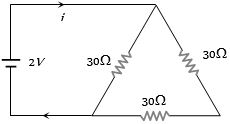
The current $i$ in the adjoining circuit will be:
A
$\frac{1}{45} \, A$
B
$\frac{1}{15} \, A$
C
$\frac{1}{10} \, A$
D
$\frac{1}{5} \, A$
Solution
(C) The circuit consists of a $2 \, V$ battery connected to a delta network of three $30 \, \Omega$ resistors.
One node of the triangle is connected to the negative terminal,and the opposite side is connected to the positive terminal.
This results in two $30 \, \Omega$ resistors being in series,and this combination being in parallel with the third $30 \, \Omega$ resistor.
Equivalent resistance $R_{eq} = \frac{(30 + 30) \times 30}{(30 + 30) + 30} = \frac{60 \times 30}{90} = 20 \, \Omega$.
Using Ohm's law,the current $i = \frac{V}{R_{eq}} = \frac{2}{20} = \frac{1}{10} \, A$.
One node of the triangle is connected to the negative terminal,and the opposite side is connected to the positive terminal.
This results in two $30 \, \Omega$ resistors being in series,and this combination being in parallel with the third $30 \, \Omega$ resistor.
Equivalent resistance $R_{eq} = \frac{(30 + 30) \times 30}{(30 + 30) + 30} = \frac{60 \times 30}{90} = 20 \, \Omega$.
Using Ohm's law,the current $i = \frac{V}{R_{eq}} = \frac{2}{20} = \frac{1}{10} \, A$.
0 likesView Solution
10
PhysicsEasyMCQIIT JEE · 1983
$A$ conducting circular loop of radius $r$ carries a constant current $i$. It is placed in a uniform magnetic field $\overrightarrow{B}$,such that $\overrightarrow{B}$ is perpendicular to the plane of the loop. The magnetic force acting on the loop is
A
$ir\overrightarrow{B}$
B
$2\pi ri\overrightarrow{B}$
C
Zero
D
$\pi ri\overrightarrow{B}$
Solution
(C) The magnetic force on a small current element $d\overrightarrow{l}$ in a magnetic field $\overrightarrow{B}$ is given by $d\overrightarrow{F} = i(d\overrightarrow{l} \times \overrightarrow{B})$.
For a closed loop,the net magnetic force is $\overrightarrow{F} = \oint i(d\overrightarrow{l} \times \overrightarrow{B})$.
Since the magnetic field $\overrightarrow{B}$ is uniform,it can be taken out of the integral: $\overrightarrow{F} = i(\oint d\overrightarrow{l}) \times \overrightarrow{B}$.
For any closed loop,the vector sum of all infinitesimal length elements $\oint d\overrightarrow{l}$ is zero.
Therefore,the net magnetic force $\overrightarrow{F} = i(0) \times \overrightarrow{B} = 0$.
For a closed loop,the net magnetic force is $\overrightarrow{F} = \oint i(d\overrightarrow{l} \times \overrightarrow{B})$.
Since the magnetic field $\overrightarrow{B}$ is uniform,it can be taken out of the integral: $\overrightarrow{F} = i(\oint d\overrightarrow{l}) \times \overrightarrow{B}$.
For any closed loop,the vector sum of all infinitesimal length elements $\oint d\overrightarrow{l}$ is zero.
Therefore,the net magnetic force $\overrightarrow{F} = i(0) \times \overrightarrow{B} = 0$.
0 likesView Solution
11
PhysicsMediumMCQIIT JEE · 1983
If in nature there may not be an element for which the principal quantum number $n > 4,$ then the total possible number of elements will be
A
$60$
B
$32$
C
$4$
D
$64$
Solution
(A) The maximum number of electrons (and thus elements) that can be accommodated in a shell with principal quantum number $n$ is given by the formula $2n^2$.
For $n = 1$,the number of elements is $2(1)^2 = 2$.
For $n = 2$,the number of elements is $2(2)^2 = 8$.
For $n = 3$,the number of elements is $2(3)^2 = 18$.
For $n = 4$,the number of elements is $2(4)^2 = 32$.
Since the principal quantum number $n$ cannot exceed $4$,the total number of possible elements is the sum of elements in shells $n=1, 2, 3,$ and $4$.
Total elements $= 2 + 8 + 18 + 32 = 60$.
For $n = 1$,the number of elements is $2(1)^2 = 2$.
For $n = 2$,the number of elements is $2(2)^2 = 8$.
For $n = 3$,the number of elements is $2(3)^2 = 18$.
For $n = 4$,the number of elements is $2(4)^2 = 32$.
Since the principal quantum number $n$ cannot exceed $4$,the total number of possible elements is the sum of elements in shells $n=1, 2, 3,$ and $4$.
Total elements $= 2 + 8 + 18 + 32 = 60$.
0 likesView Solution
12
PhysicsMediumMCQIIT JEE · 1983
In the following atoms and molecules,for the transition from $n = 2$ to $n = 1$,the spectral line of minimum wavelength will be produced by:
A
Hydrogen atom
B
Deuterium atom
C
Uni-ionized helium
D
Di-ionized lithium
Solution
(D) The wavelength $\lambda$ of the spectral line emitted during a transition between energy levels is given by the Rydberg formula: $\frac{1}{\lambda} = R Z^2 \left( \frac{1}{n_1^2} - \frac{1}{n_2^2} \right)$.
For a transition from $n_2 = 2$ to $n_1 = 1$,the term $\left( \frac{1}{1^2} - \frac{1}{2^2} \right) = \frac{3}{4}$ is constant for all hydrogen-like species.
Therefore,$\frac{1}{\lambda} \propto Z^2$,which implies $\lambda \propto \frac{1}{Z^2}$.
To obtain the minimum wavelength $\lambda$,the atomic number $Z$ must be maximum.
- Hydrogen atom $(H)$: $Z = 1$
- Deuterium atom $(D)$: $Z = 1$
- Uni-ionized helium $(He^+)$: $Z = 2$
- Di-ionized lithium $(Li^{2+})$: $Z = 3$
Since $Li^{2+}$ has the highest atomic number $(Z = 3)$,it produces the spectral line with the minimum wavelength.
For a transition from $n_2 = 2$ to $n_1 = 1$,the term $\left( \frac{1}{1^2} - \frac{1}{2^2} \right) = \frac{3}{4}$ is constant for all hydrogen-like species.
Therefore,$\frac{1}{\lambda} \propto Z^2$,which implies $\lambda \propto \frac{1}{Z^2}$.
To obtain the minimum wavelength $\lambda$,the atomic number $Z$ must be maximum.
- Hydrogen atom $(H)$: $Z = 1$
- Deuterium atom $(D)$: $Z = 1$
- Uni-ionized helium $(He^+)$: $Z = 2$
- Di-ionized lithium $(Li^{2+})$: $Z = 3$
Since $Li^{2+}$ has the highest atomic number $(Z = 3)$,it produces the spectral line with the minimum wavelength.
0 likesView Solution
13
PhysicsEasyMCQIIT JEE · 1983
$\beta$-rays emitted by a radioactive material are
A
Electromagnetic radiation
B
The electrons orbiting around the nucleus
C
Charged particles emitted by the nucleus
D
Neutral particles
Solution
(C) Radioactive decay involves the transformation of a neutron into a proton and an electron (or vice versa) within the nucleus.
$\beta$-particles are high-energy electrons or positrons emitted from the nucleus during this process.
Since they are electrons or positrons,they carry a net electric charge (negative for $\beta^-$ and positive for $\beta^+$).
Therefore,$\beta$-rays are charged particles emitted by the nucleus.
$\beta$-particles are high-energy electrons or positrons emitted from the nucleus during this process.
Since they are electrons or positrons,they carry a net electric charge (negative for $\beta^-$ and positive for $\beta^+$).
Therefore,$\beta$-rays are charged particles emitted by the nucleus.
0 likesView Solution
14
PhysicsMediumMCQIIT JEE · 1983
From a newly formed radioactive substance (half-life $2$ hours), the intensity of radiation is $64$ times the permissible safe level. The minimum time after which work can be done safely from this source is .......... $hours$.
A
$6$
B
$12$
C
$24$
D
$128$
Solution
(B) The intensity of radiation $I$ decreases according to the law of radioactive decay: $I = I_0 \left( \frac{1}{2} \right)^n$, where $n$ is the number of half-lives.
Given that the initial intensity $I_0 = 64 I_{\text{safe}}$, we need the intensity to reach $I_{\text{safe}}$.
Thus, $\frac{I_{\text{safe}}}{64 I_{\text{safe}}} = \left( \frac{1}{2} \right)^n$.
$\frac{1}{64} = \left( \frac{1}{2} \right)^n$.
Since $64 = 2^6$, we have $\left( \frac{1}{2} \right)^6 = \left( \frac{1}{2} \right)^n$, which implies $n = 6$.
The total time $t$ is given by $t = n \times T_{1/2}$, where $T_{1/2} = 2 \text{ hours}$.
$t = 6 \times 2 = 12 \text{ hours}$.
Given that the initial intensity $I_0 = 64 I_{\text{safe}}$, we need the intensity to reach $I_{\text{safe}}$.
Thus, $\frac{I_{\text{safe}}}{64 I_{\text{safe}}} = \left( \frac{1}{2} \right)^n$.
$\frac{1}{64} = \left( \frac{1}{2} \right)^n$.
Since $64 = 2^6$, we have $\left( \frac{1}{2} \right)^6 = \left( \frac{1}{2} \right)^n$, which implies $n = 6$.
The total time $t$ is given by $t = n \times T_{1/2}$, where $T_{1/2} = 2 \text{ hours}$.
$t = 6 \times 2 = 12 \text{ hours}$.
0 likesView Solution
15
PhysicsMediumMCQIIT JEE · 1983
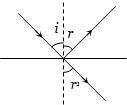
$A$ ray of light is incident at an angle $i$ from a denser to a rarer medium. The reflected and the refracted rays are mutually perpendicular. The angle of reflection is $r$ and the angle of refraction is $r'$. Then the critical angle $C$ will be:
A
$\sin^{-1}(\sin r)$
B
$\sin^{-1}(\tan r')$
C
$\sin^{-1}(\tan i)$
D
$\tan^{-1}(\sin i)$
Solution
(C) According to the law of reflection,the angle of incidence $i$ is equal to the angle of reflection $r$,so $i = r$.
Given that the reflected ray and the refracted ray are mutually perpendicular,the sum of the angle of reflection $r$,the angle between the reflected ray and the refracted ray $(90^{\circ})$,and the angle of refraction $r'$ is $180^{\circ}$.
Thus,$r + 90^{\circ} + r' = 180^{\circ}$,which implies $r' = 90^{\circ} - r$. Since $i = r$,we have $r' = 90^{\circ} - i$.
Applying Snell's law at the interface,the refractive index of the denser medium with respect to the rarer medium is given by $\mu = \frac{\sin r'}{\sin i}$.
We know that the critical angle $C$ is related to the refractive index by $\sin C = \frac{1}{\mu}$.
Therefore,$\sin C = \frac{\sin i}{\sin r'} = \frac{\sin i}{\sin(90^{\circ} - i)} = \frac{\sin i}{\cos i} = \tan i$.
Hence,the critical angle is $C = \sin^{-1}(\tan i)$.
Given that the reflected ray and the refracted ray are mutually perpendicular,the sum of the angle of reflection $r$,the angle between the reflected ray and the refracted ray $(90^{\circ})$,and the angle of refraction $r'$ is $180^{\circ}$.
Thus,$r + 90^{\circ} + r' = 180^{\circ}$,which implies $r' = 90^{\circ} - r$. Since $i = r$,we have $r' = 90^{\circ} - i$.
Applying Snell's law at the interface,the refractive index of the denser medium with respect to the rarer medium is given by $\mu = \frac{\sin r'}{\sin i}$.
We know that the critical angle $C$ is related to the refractive index by $\sin C = \frac{1}{\mu}$.
Therefore,$\sin C = \frac{\sin i}{\sin r'} = \frac{\sin i}{\sin(90^{\circ} - i)} = \frac{\sin i}{\cos i} = \tan i$.
Hence,the critical angle is $C = \sin^{-1}(\tan i)$.
0 likesView Solution
Vedclass Products
For Students
Vedclass Test Series
Mock tests in real IIT JEE style covering Physics with performance analysis. 5-day free trial.
Start Free TrialFor Teachers
Exam Paper Generator
Generate Set A/B/C/D Physics papers from 7.5L+ questions in 2 minutes. 3 chapters free.
Try FreeFor Institutes
Online Exam Module
Run live IIT JEE mock exams with unlimited students, 360° analytics & white-label branding.
See DemoFrequently Asked Questions
How many Physics questions are in IIT JEE 1983?
There are 15 Physics questions from the IIT JEE 1983 paper on Vedclass, each with a detailed step-by-step solution in English.
Are IIT JEE 1983 Physics solutions available in English?
Yes. All solutions on this page are in English. You can also switch to English or Hindi using the language buttons above the questions.
Can I practice IIT JEE 1983 Physics as a timed test?
Yes. Use the Vedclass Test Series to attempt a full IIT JEE mock test covering Physics with time limits and instant score analysis.
Can teachers create Physics papers from IIT JEE previous year questions?
Yes. The Vedclass Exam Paper Generator lets teachers mix IIT JEE Physics questions and generate Set A/B/C/D papers in minutes.
For Teachers & Institutes
Build a Custom Physics Paper
Pick IIT JEE 1983 Physics questions, set difficulty, and generate Set A/B/C/D in 2 minutes.