
BiologyQ1–21 of 21 questions
Page 1 of 1 · English
1
BiologyEasyMCQGUJCET · 2020
Which option is correct for mycorrhiza?
$(i)$ It absorbs phosphorus from soil.
(ii) It forms root nodules with Rhizobium bacteria.
(iii) Resistance to root-borne pathogens.
(iv) It fixes nitrogen from the atmosphere.
$(i)$ It absorbs phosphorus from soil.
(ii) It forms root nodules with Rhizobium bacteria.
(iii) Resistance to root-borne pathogens.
(iv) It fixes nitrogen from the atmosphere.
A
$(i)$ and (ii)
B
$(i)$ and (iii)
C
$(i)$,(ii) and (iii)
D
(ii) and (iv)
Solution
(B) Mycorrhiza is a symbiotic association between a fungus and the roots of higher plants.
$(i)$ The fungal symbiont in these associations absorbs phosphorus from the soil and passes it to the plant. This statement is correct.
(ii) Root nodules are formed by $Rhizobium$ bacteria in leguminous plants,not by mycorrhiza. This statement is incorrect.
(iii) Mycorrhiza provides resistance to root-borne pathogens to the host plant. This statement is correct.
(iv) Nitrogen fixation is performed by bacteria like $Rhizobium$ or $Azotobacter$,not by mycorrhiza. This statement is incorrect.
Therefore,statements $(i)$ and (iii) are correct. The correct option is $B$.
$(i)$ The fungal symbiont in these associations absorbs phosphorus from the soil and passes it to the plant. This statement is correct.
(ii) Root nodules are formed by $Rhizobium$ bacteria in leguminous plants,not by mycorrhiza. This statement is incorrect.
(iii) Mycorrhiza provides resistance to root-borne pathogens to the host plant. This statement is correct.
(iv) Nitrogen fixation is performed by bacteria like $Rhizobium$ or $Azotobacter$,not by mycorrhiza. This statement is incorrect.
Therefore,statements $(i)$ and (iii) are correct. The correct option is $B$.
0 likesView Solution
2
BiologyEasyMCQGUJCET · 2020
The largely tropical Amazonian rain forest in South America has . . . . . . numbers of bird species.
A
$3000$
B
$427$
C
$1300$
D
$378$
Solution
(C) The Amazonian rain forest,located in South America,is the largest tropical rain forest on Earth and is known for its immense biodiversity. According to the data provided in the $NCERT$ biology textbook,this region is home to more than $1300$ species of birds. Therefore,the correct option is $C$.
0 likesView Solution
3
BiologyEasyMCQGUJCET · 2020
What type of protein-rich milk is found in the first transgenic cow 'Rosie'?
A
Casein
B
Paracasein
C
Alpha-lactalbumin
D
Albumin
Solution
(C) The first transgenic cow,named 'Rosie',was produced in $1997$.
This cow produced human protein-enriched milk.
The milk contained the human alpha-lactalbumin protein,which is nutritionally more balanced for human babies than natural cow milk.
Therefore,the correct option is $C$.
This cow produced human protein-enriched milk.
The milk contained the human alpha-lactalbumin protein,which is nutritionally more balanced for human babies than natural cow milk.
Therefore,the correct option is $C$.
0 likesView Solution
4
BiologyEasyMCQGUJCET · 2020
Which of the following is not true for transgenic plants?
A
Increase dependency on chemical pesticides
B
Increase efficiency of mineral usage by plants
C
Increase nutritional value of food
D
Made crops more tolerant to abiotic stresses (cold,drought,salt,heat)
Solution
(A) Transgenic plants are genetically modified organisms designed to improve agricultural productivity and sustainability. One of their primary goals is to reduce the reliance on chemical pesticides by incorporating genes that provide resistance to pests (e.g.,$Bt$ cotton). Therefore,increasing dependency on chemical pesticides is not a goal or a characteristic of transgenic plants. Options $B$,$C$,and $D$ are all recognized benefits of transgenic technology.
0 likesView Solution
5
BiologyEasyMCQGUJCET · 2020
Bacterial and fungal enzymes degrade detritus into simpler inorganic substances. This process is called as . . . . . . .
A
Catabolism
B
Mineralisation
C
Humification
D
Fragmentation
Solution
(A) The correct answer is $B$.
$1$. Fragmentation is the process of breaking down detritus into smaller particles by detritivores.
$2$. Catabolism is the process where bacterial and fungal enzymes degrade detritus into simpler inorganic substances.
$3$. Humification leads to the accumulation of a dark-colored amorphous substance called humus.
$4$. Mineralisation is the process by which inorganic nutrients are released from the humus by the action of certain microbes.
Therefore,the degradation of detritus into simpler inorganic substances by microbial enzymes is specifically referred to as $Catabolism$.
$1$. Fragmentation is the process of breaking down detritus into smaller particles by detritivores.
$2$. Catabolism is the process where bacterial and fungal enzymes degrade detritus into simpler inorganic substances.
$3$. Humification leads to the accumulation of a dark-colored amorphous substance called humus.
$4$. Mineralisation is the process by which inorganic nutrients are released from the humus by the action of certain microbes.
Therefore,the degradation of detritus into simpler inorganic substances by microbial enzymes is specifically referred to as $Catabolism$.
0 likesView Solution
6
BiologyEasyMCQGUJCET · 2020
Which of the following had the lowest brain capacity during human evolution?
A
Neanderthal man
B
Homo sapiens
C
Homo habilis
D
Homo erectus
Solution
(C) The brain capacities of the mentioned hominids are as follows:
$1$. $Homo$ $habilis$: $650-800$ $cc$
$2$. $Homo$ $erectus$: $800-1100$ $cc$
$3$. $Neanderthal$ $man$: $1400-1500$ $cc$
$4$. $Homo$ $sapiens$: $1300-1600$ $cc$
Comparing these values, $Homo$ $habilis$ had the lowest brain capacity among the given options. Therefore, the correct option is $C$.
$1$. $Homo$ $habilis$: $650-800$ $cc$
$2$. $Homo$ $erectus$: $800-1100$ $cc$
$3$. $Neanderthal$ $man$: $1400-1500$ $cc$
$4$. $Homo$ $sapiens$: $1300-1600$ $cc$
Comparing these values, $Homo$ $habilis$ had the lowest brain capacity among the given options. Therefore, the correct option is $C$.
0 likesView Solution
7
BiologyEasyMCQGUJCET · 2020
If a person develops chronic swelling of the lymphatic vessels in the appendages and deformity of the genitals, which disease will the person have?
A
Amoebiasis
B
Ascariasis
C
Filariasis
D
Malaria
Solution
(C) The disease described is $Filariasis$ (also known as $Elephantiasis$).
It is caused by filarial worms such as $Wuchereria$ $bancrofti$ and $Wuchereria$ $malayi$.
These parasites live in the lymphatic vessels, causing chronic inflammation and obstruction, which leads to swelling of the limbs (appendages) and often results in gross deformities of the genital organs.
It is caused by filarial worms such as $Wuchereria$ $bancrofti$ and $Wuchereria$ $malayi$.
These parasites live in the lymphatic vessels, causing chronic inflammation and obstruction, which leads to swelling of the limbs (appendages) and often results in gross deformities of the genital organs.
0 likesView Solution
8
BiologyEasyMCQGUJCET · 2020
The foetus develops its limbs and digits in . . . . . . during embryonic development.
A
Four weeks
B
Eight weeks
C
Twelve weeks
D
Two weeks
Solution
(B) During human embryonic development,the heart is formed after one month of pregnancy. By the end of the second month (eight weeks) of pregnancy,the foetus develops limbs and digits. By the end of the first trimester (twelve weeks),most of the major organ systems are formed.
0 likesView Solution
9
BiologyEasyMCQGUJCET · 2020
Which is the correct graphical representation of the pituitary hormone and ovarian hormone levels during the menstrual cycle?
A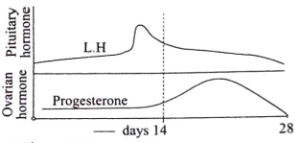
B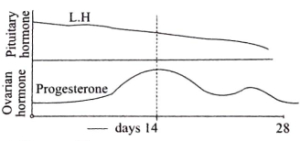
C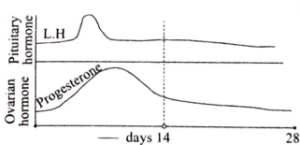
D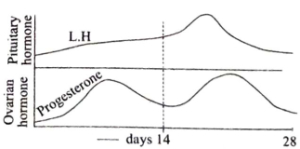
Solution
(A) During the menstrual cycle,the levels of pituitary hormones ($LH$ and $FSH$) and ovarian hormones (estrogen and progesterone) fluctuate in a specific pattern.
$1$. The $LH$ surge occurs around the $14^{th}$ day of the cycle,which triggers ovulation.
$2$. After ovulation,the corpus luteum is formed,which secretes large amounts of progesterone.
$3$. Consequently,progesterone levels rise significantly during the luteal phase (days $15-28$) to maintain the endometrium.
$4$. Comparing the given graphs,the graph in option $A$ correctly shows the $LH$ surge at day $14$ and the subsequent rise in progesterone levels during the luteal phase.
$1$. The $LH$ surge occurs around the $14^{th}$ day of the cycle,which triggers ovulation.
$2$. After ovulation,the corpus luteum is formed,which secretes large amounts of progesterone.
$3$. Consequently,progesterone levels rise significantly during the luteal phase (days $15-28$) to maintain the endometrium.
$4$. Comparing the given graphs,the graph in option $A$ correctly shows the $LH$ surge at day $14$ and the subsequent rise in progesterone levels during the luteal phase.
0 likesView Solution
10
BiologyEasyMCQGUJCET · 2020
Which part of the fallopian tube is closest to the ovary?
A
Infundibulum
B
Isthmus
C
Ampulla
D
Fimbriae
Solution
(A) The fallopian tube consists of three main parts: the infundibulum,the ampulla,and the isthmus.
$1$. The $Infundibulum$ is the funnel-shaped part closest to the ovary.
$2$. The edges of the infundibulum possess finger-like projections called $Fimbriae$,which help in the collection of the ovum after ovulation.
$3$. Since the $Fimbriae$ are part of the infundibulum and are the structures directly adjacent to the ovary to catch the released egg,the $Infundibulum$ is the correct anatomical region.
$1$. The $Infundibulum$ is the funnel-shaped part closest to the ovary.
$2$. The edges of the infundibulum possess finger-like projections called $Fimbriae$,which help in the collection of the ovum after ovulation.
$3$. Since the $Fimbriae$ are part of the infundibulum and are the structures directly adjacent to the ovary to catch the released egg,the $Infundibulum$ is the correct anatomical region.
0 likesView Solution
11
BiologyEasyMCQGUJCET · 2020
Which is used as an immunosuppressive drug during organ transplant?
A
Statin
B
Cyclosporin-$A$
C
Streptokinase
D
Lipase
Solution
(B) $Cyclosporin-A$ is a bioactive molecule produced by the fungus $Trichoderma$ $polysporum$.
It is widely used as an immunosuppressive agent in patients undergoing organ transplantation.
It works by inhibiting the activation of $T$-cells,thereby preventing the immune system from rejecting the transplanted organ.
Therefore,the correct option is $B$.
It is widely used as an immunosuppressive agent in patients undergoing organ transplantation.
It works by inhibiting the activation of $T$-cells,thereby preventing the immune system from rejecting the transplanted organ.
Therefore,the correct option is $B$.
0 likesView Solution
12
BiologyEasyMCQGUJCET · 2020
In the 'Lac Operon' concept,the structural genes ($z$,$y$,and $a$) code for which of the following enzymes respectively?
A
$\beta$-galactosidase; lipase; transacetylase
B
$\beta$-galactosidase; carboxylase; transacetylase
C
$\beta$-galactosidase; permease; transacetylase
D
$\beta$-galactosidase; permease; acetylase
Solution
(C) In the 'Lac Operon' model,there are three structural genes:
$1$. The $z$ gene codes for the enzyme $\beta$-galactosidase,which is responsible for the hydrolysis of lactose into glucose and galactose.
$2$. The $y$ gene codes for the enzyme permease,which increases the permeability of the cell to $\beta$-galactosides.
$3$. The $a$ gene codes for the enzyme transacetylase,which transfers an acetyl group from acetyl-CoA to $\beta$-galactosides.
Therefore,the correct sequence is $\beta$-galactosidase,permease,and transacetylase.
$1$. The $z$ gene codes for the enzyme $\beta$-galactosidase,which is responsible for the hydrolysis of lactose into glucose and galactose.
$2$. The $y$ gene codes for the enzyme permease,which increases the permeability of the cell to $\beta$-galactosides.
$3$. The $a$ gene codes for the enzyme transacetylase,which transfers an acetyl group from acetyl-CoA to $\beta$-galactosides.
Therefore,the correct sequence is $\beta$-galactosidase,permease,and transacetylase.
0 likesView Solution
13
BiologyEasyMCQGUJCET · 2020
'Central dogma' was proposed by $X$ and these are the processes $Y$,$Z$ comes in it respectively. Choose the correct option.
A
$X$ - Watson and Crick,$Y$ - transformation,$Z$ - replication
B
$X$ - Francis Crick,$Y$ - transcription,$Z$ - translation
C
$X$ - Frederick Griffith,$Y$ - transformation,$Z$ - transcription
D
$X$ - Hershey and Chase,$Y$ - replication,$Z$ - translation
Solution
(B) The 'Central dogma' of molecular biology was proposed by Francis Crick in $1958$.
It describes the flow of genetic information within a biological system.
The process involves the flow of information from $DNA$ to $RNA$ (transcription) and from $RNA$ to protein (translation).
Therefore,$X$ is Francis Crick,$Y$ is transcription,and $Z$ is translation.
The correct option is $B$.
It describes the flow of genetic information within a biological system.
The process involves the flow of information from $DNA$ to $RNA$ (transcription) and from $RNA$ to protein (translation).
Therefore,$X$ is Francis Crick,$Y$ is transcription,and $Z$ is translation.
The correct option is $B$.
0 likesView Solution
14
BiologyEasyMCQGUJCET · 2020
What will be the percentage of affected sons,whose father is colour-blind and mother is normal (in $\%$)?
A
$0$
B
$50$
C
$25$
D
$100$
Solution
(A) Colour blindness is an $X$-linked recessive disorder.
Let $X^C$ be the allele for colour blindness and $X$ be the normal allele.
The father is colour-blind,so his genotype is $X^C Y$.
The mother is normal,so her genotype is $X X$.
When these parents cross: $X^C Y \times X X$.
The possible offspring genotypes are:
$1$. $X X^C$ (Carrier daughter)
$2$. $X X^C$ (Carrier daughter)
$3$. $X Y$ (Normal son)
$4$. $X Y$ (Normal son)
Since all sons receive their $X$ chromosome from their mother and $Y$ chromosome from their father,and the mother is normal $(X X)$,all sons will be normal.
Therefore,the percentage of affected sons is $0 \%$.
Let $X^C$ be the allele for colour blindness and $X$ be the normal allele.
The father is colour-blind,so his genotype is $X^C Y$.
The mother is normal,so her genotype is $X X$.
When these parents cross: $X^C Y \times X X$.
The possible offspring genotypes are:
$1$. $X X^C$ (Carrier daughter)
$2$. $X X^C$ (Carrier daughter)
$3$. $X Y$ (Normal son)
$4$. $X Y$ (Normal son)
Since all sons receive their $X$ chromosome from their mother and $Y$ chromosome from their father,and the mother is normal $(X X)$,all sons will be normal.
Therefore,the percentage of affected sons is $0 \%$.
0 likesView Solution
15
BiologyEasyMCQGUJCET · 2020
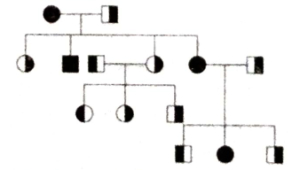
Choose the correct option for the pedigree analysis given below:
A
Autosomal dominant pedigree
B
Autosomal recessive pedigree
C
$X$-linked dominant pedigree
D
$X$-linked recessive pedigree
Solution
(A) The given pedigree shows that the trait is present in every generation,which indicates that it is a dominant trait.
Since both males and females are affected and the trait is transmitted from affected parents to both sons and daughters,it is an autosomal dominant trait.
In autosomal dominant inheritance,an affected individual must have at least one affected parent.
Therefore,the correct option is $A$.
Since both males and females are affected and the trait is transmitted from affected parents to both sons and daughters,it is an autosomal dominant trait.
In autosomal dominant inheritance,an affected individual must have at least one affected parent.
Therefore,the correct option is $A$.
0 likesView Solution
16
BiologyEasyMCQGUJCET · 2020
In the $\beta$-globin chain of haemoglobin of an individual,if the sixth amino acid,Glutamic acid (Glu),is replaced by Valine (Val),then the individual will be suffering from:
A
Albinism
B
Haemophilia
C
Sickle-cell anaemia
D
Phenylketonuria
Solution
(C) Sickle-cell anaemia is an autosome-linked recessive trait that can be transmitted from parents to the offspring when both the partners are carrier for the gene. The disease is controlled by a single pair of allele,$Hb^A$ and $Hb^S$. The defect is caused by the substitution of Glutamic acid (Glu) by Valine (Val) at the sixth position of the $\beta$-globin chain of the haemoglobin molecule. This substitution occurs due to the single base substitution at the sixth codon of the $\beta$-globin gene from $GAG$ to $GUG$.
0 likesView Solution
17
BiologyEasyMCQGUJCET · 2020
$ . . . . . . $ is a natural contraceptive method.
A
Sterilization
B
Use of pills
C
Periodic abstinence
D
Use of condoms
Solution
(C) Periodic abstinence is a natural method of contraception.
This method works on the principle of avoiding or abstaining from coitus from day $10$ to $17$ of the menstrual cycle when ovulation could be expected.
As chances of fertilization are very high during this period,it is called the fertile period.
Therefore,by abstaining from coitus during this period,conception could be prevented.
This method works on the principle of avoiding or abstaining from coitus from day $10$ to $17$ of the menstrual cycle when ovulation could be expected.
As chances of fertilization are very high during this period,it is called the fertile period.
Therefore,by abstaining from coitus during this period,conception could be prevented.
0 likesView Solution
18
BiologyEasyMCQGUJCET · 2020
Multiload $375$ is a . . . . . . type of $IUDs$.
A
Non-medicinal
B
Cu releasing
C
Hormone releasing
D
Mg releasing
Solution
(B) Multiload $375$ is a copper-releasing Intrauterine Device $(IUD)$.
These devices increase phagocytosis of sperms within the uterus and the copper ions released suppress sperm motility and the fertilizing capacity of sperms.
Therefore,the correct option is $B$.
These devices increase phagocytosis of sperms within the uterus and the copper ions released suppress sperm motility and the fertilizing capacity of sperms.
Therefore,the correct option is $B$.
0 likesView Solution
19
BiologyEasyMCQGUJCET · 2020
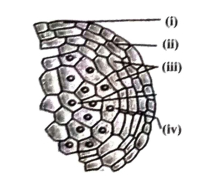
Which of the following is the correct option for the labels in the figure given below representing the wall layers of a microsporangium?
A
$(i)$ Epidermis (ii) Endothecium (iii) Middle layer (iv) Tapetum
B
$(i)$ Epidermis (ii) Middle layer (iii) Endothecium (iv) Tapetum
C
$(i)$ Tapetum (ii) Middle layer (iii) Endothecium (iv) Epidermis
D
$(i)$ Epidermis (ii) Tapetum (iii) Middle layer (iv) Endothecium
Solution
(A) The figure shows a cross-section of a young anther (microsporangium). The wall layers of a typical microsporangium are arranged from the outside to the inside as follows:
$(i)$ Epidermis: The outermost protective layer.
(ii) Endothecium: The layer lying just below the epidermis.
(iii) Middle layers: One to three layers of cells located between the endothecium and the tapetum.
(iv) Tapetum: The innermost nutritive layer that surrounds the sporogenous tissue.
Therefore,the correct sequence is $(i)$ Epidermis,(ii) Endothecium,(iii) Middle layer,(iv) Tapetum. Thus,option $A$ is correct.
$(i)$ Epidermis: The outermost protective layer.
(ii) Endothecium: The layer lying just below the epidermis.
(iii) Middle layers: One to three layers of cells located between the endothecium and the tapetum.
(iv) Tapetum: The innermost nutritive layer that surrounds the sporogenous tissue.
Therefore,the correct sequence is $(i)$ Epidermis,(ii) Endothecium,(iii) Middle layer,(iv) Tapetum. Thus,option $A$ is correct.
0 likesView Solution
20
BiologyEasyMCQGUJCET · 2020
Statement-$X$: Apomixis is seen in a few flowering plants such as some species of $Asteraceae$ and grasses.
Statement-$Y$: Apomixis is a form of asexual reproduction that mimics sexual reproduction.
Statement-$Z$: In some species of apomictic seeds,the diploid egg cell is formed without reduction division.
Statement-$Y$: Apomixis is a form of asexual reproduction that mimics sexual reproduction.
Statement-$Z$: In some species of apomictic seeds,the diploid egg cell is formed without reduction division.
A
$X$ and $Y$ are correct and $Z$ is incorrect.
B
$X$ is correct and $Y$ and $Z$ are incorrect.
C
$X$ is incorrect and $Y$ and $Z$ are correct.
D
All the above $X, Y$ and $Z$ statements are correct.
Solution
(D) Statement-$X$ is correct: Apomixis is indeed observed in families like $Asteraceae$ and grasses.
Statement-$Y$ is correct: Apomixis is a specialized form of asexual reproduction that produces seeds without fertilization,effectively mimicking sexual reproduction.
Statement-$Z$ is correct: In many apomictic species,the embryo sac develops from a diploid megaspore mother cell without undergoing meiosis (reduction division),leading to the formation of a diploid egg cell.
Therefore,all three statements are correct.
Statement-$Y$ is correct: Apomixis is a specialized form of asexual reproduction that produces seeds without fertilization,effectively mimicking sexual reproduction.
Statement-$Z$ is correct: In many apomictic species,the embryo sac develops from a diploid megaspore mother cell without undergoing meiosis (reduction division),leading to the formation of a diploid egg cell.
Therefore,all three statements are correct.
0 likesView Solution
21
BiologyEasyMCQGUJCET · 2020
. . . . . . is the region on which,the ovule is connected to the funicle.
A
Chalaza
B
Hilum
C
Micropylar region
D
Nucellus
Solution
(B) The $Hilum$ is the junction or the point of attachment where the body of the ovule is fused with the funicle. The funicle is the stalk that attaches the ovule to the placenta of the ovary. Therefore,the correct option is $B$.
0 likesView Solution
Vedclass Products
For Students
Vedclass Test Series
Mock tests in real GUJCET style covering Biology with performance analysis. 5-day free trial.
Start Free TrialFor Teachers
Exam Paper Generator
Generate Set A/B/C/D Biology papers from 7.5L+ questions in 2 minutes. 3 chapters free.
Try FreeFor Institutes
Online Exam Module
Run live GUJCET mock exams with unlimited students, 360° analytics & white-label branding.
See DemoFrequently Asked Questions
How many Biology questions are in GUJCET 2020?
There are 21 Biology questions from the GUJCET 2020 paper on Vedclass, each with a detailed step-by-step solution in English.
Are GUJCET 2020 Biology solutions available in English?
Yes. All solutions on this page are in English. You can also switch to English or Hindi using the language buttons above the questions.
Can I practice GUJCET 2020 Biology as a timed test?
Yes. Use the Vedclass Test Series to attempt a full GUJCET mock test covering Biology with time limits and instant score analysis.
Can teachers create Biology papers from GUJCET previous year questions?
Yes. The Vedclass Exam Paper Generator lets teachers mix GUJCET Biology questions and generate Set A/B/C/D papers in minutes.
For Teachers & Institutes
Build a Custom Biology Paper
Pick GUJCET 2020 Biology questions, set difficulty, and generate Set A/B/C/D in 2 minutes.