
PhysicsQ1–21 of 21 questions
Page 1 of 1 · English
1
PhysicsEasyMCQGUJCET · 2006
An alternating voltage of $V = V_{0} \sin \omega t$ is applied across a circuit. As a result, a current $I = I_{0} \sin (\omega t - \frac{\pi}{2})$ flows in it. The power consumed per cycle is . . . . . . .
A
$1.919 V_{0} I_{0}$ watt
B
$0$ watt
C
$0.5 V_{0} I_{0}$ watt
D
$0.707 V_{0} I_{0}$ watt
Solution
(B) The instantaneous power in an $AC$ circuit is given by $P = V_{rms} I_{rms} \cos \phi$, where $\phi$ is the phase difference between voltage and current.
Given voltage $V = V_{0} \sin \omega t$ and current $I = I_{0} \sin (\omega t - \frac{\pi}{2})$.
The phase difference $\phi = \frac{\pi}{2}$.
The power consumed is $P = V_{rms} I_{rms} \cos \phi = \frac{V_{0}}{\sqrt{2}} \cdot \frac{I_{0}}{\sqrt{2}} \cdot \cos(\frac{\pi}{2})$.
Since $\cos(\frac{\pi}{2}) = 0$, the power consumed $P = 0$ watt.
Given voltage $V = V_{0} \sin \omega t$ and current $I = I_{0} \sin (\omega t - \frac{\pi}{2})$.
The phase difference $\phi = \frac{\pi}{2}$.
The power consumed is $P = V_{rms} I_{rms} \cos \phi = \frac{V_{0}}{\sqrt{2}} \cdot \frac{I_{0}}{\sqrt{2}} \cdot \cos(\frac{\pi}{2})$.
Since $\cos(\frac{\pi}{2}) = 0$, the power consumed $P = 0$ watt.
0 likesView Solution
2
PhysicsEasyMCQGUJCET · 2006
$A$ transformer with $80 \%$ efficiency works at $4 \text{ kW}$ and $100 \text{ V}$. If the secondary voltage is $240 \text{ V}$, then the primary current is . . . . . . . (in $A$)
A
$0.4$
B
$40$
C
$10$
D
$4$
Solution
(B) Given: Power input $P_{in} = 4 \text{ kW} = 4000 \text{ W}$, Primary voltage $V_p = 100 \text{ V}$, Efficiency $\eta = 80 \% = 0.8$.
The power input to a transformer is given by the product of primary voltage and primary current: $P_{in} = V_p \times I_p$.
Rearranging the formula to solve for the primary current $I_p$:
$I_p = \frac{P_{in}}{V_p}$
Substituting the given values:
$I_p = \frac{4000 \text{ W}}{100 \text{ V}} = 40 \text{ A}$.
Thus, the primary current is $40 \text{ A}$.
The power input to a transformer is given by the product of primary voltage and primary current: $P_{in} = V_p \times I_p$.
Rearranging the formula to solve for the primary current $I_p$:
$I_p = \frac{P_{in}}{V_p}$
Substituting the given values:
$I_p = \frac{4000 \text{ W}}{100 \text{ V}} = 40 \text{ A}$.
Thus, the primary current is $40 \text{ A}$.
0 likesView Solution
3
PhysicsEasyMCQGUJCET · 2006
What is the ratio of inductive reactance to capacitive reactance in an $AC$ circuit?
A
Zero
B
$\omega^{2} L$
C
$\omega^{2} LC$
D
$1$
Solution
(C) The inductive reactance is given by $X_{L} = \omega L$.
The capacitive reactance is given by $X_{C} = \frac{1}{\omega C}$.
The ratio of inductive reactance to capacitive reactance is:
$\frac{X_{L}}{X_{C}} = \frac{\omega L}{\frac{1}{\omega C}} = \omega L \cdot \omega C = \omega^{2} LC$.
The capacitive reactance is given by $X_{C} = \frac{1}{\omega C}$.
The ratio of inductive reactance to capacitive reactance is:
$\frac{X_{L}}{X_{C}} = \frac{\omega L}{\frac{1}{\omega C}} = \omega L \cdot \omega C = \omega^{2} LC$.
0 likesView Solution
4
PhysicsEasyMCQGUJCET · 2006
The equivalent quantity of mass in electricity is . . . . . . .
A
Electric potential
B
Electric charge
C
Electric current
D
Self inductance
Solution
(D) In mechanics,mass $(m)$ represents the inertia of an object,which is the resistance to a change in its state of motion. In an $LC$ circuit,the self-inductance $(L)$ represents the inertia of the electrical system,as it opposes any change in the electric current $(I)$. The energy stored in a mechanical system is $\frac{1}{2}mv^2$,while the energy stored in an inductor is $\frac{1}{2}LI^2$. Thus,self-inductance is the electrical equivalent of mass.
0 likesView Solution
5
PhysicsEasyMCQGUJCET · 2006
If the electric current in a lamp decreases by $5 \ \%$,then the power output decreases by . . . . . . . (in $\%$)
A
$5$
B
$20$
C
$2.5$
D
$10$
Solution
(D) The power $P$ dissipated in a lamp is given by the formula $P = I^2 R$,where $I$ is the current and $R$ is the resistance.
Taking the logarithmic differentiation of the equation,we get $\frac{dP}{P} = 2 \frac{dI}{I}$.
Given that the current decreases by $5 \ \%$,we have $\frac{dI}{I} = -0.05$.
Substituting this value into the equation,we get $\frac{dP}{P} = 2 \times (-0.05) = -0.10$.
This indicates that the power output decreases by $10 \ \%$.
Taking the logarithmic differentiation of the equation,we get $\frac{dP}{P} = 2 \frac{dI}{I}$.
Given that the current decreases by $5 \ \%$,we have $\frac{dI}{I} = -0.05$.
Substituting this value into the equation,we get $\frac{dP}{P} = 2 \times (-0.05) = -0.10$.
This indicates that the power output decreases by $10 \ \%$.
0 likesView Solution
6
PhysicsEasyMCQGUJCET · 2006
Two electric bulbs of $40 \text{ W}$ each are connected in series. The power consumed by the combination will be . . . . . . . (in $\text{ W}$)
A
$40$
B
$60$
C
$20$
D
$100$
Solution
(C) Given: $P_1 = 40 \text{ W}$ and $P_2 = 40 \text{ W}$.
For bulbs connected in series, the equivalent power $P$ is given by the formula:
$P = \frac{P_1 \times P_2}{P_1 + P_2}$
Substituting the values:
$P = \frac{40 \times 40}{40 + 40}$
$P = \frac{1600}{80}$
$P = 20 \text{ W}$.
Thus, the power consumed by the combination is $20 \text{ W}$.
For bulbs connected in series, the equivalent power $P$ is given by the formula:
$P = \frac{P_1 \times P_2}{P_1 + P_2}$
Substituting the values:
$P = \frac{40 \times 40}{40 + 40}$
$P = \frac{1600}{80}$
$P = 20 \text{ W}$.
Thus, the power consumed by the combination is $20 \text{ W}$.
0 likesView Solution
7
PhysicsEasyMCQGUJCET · 2006
$A$ wire is stretched to increase its length by $2\%$,then the percentage change in its resistance is . . . . . . . (in $\%$)
A
$8$
B
$1$
C
$3$
D
$4$
Solution
(D) The resistance of a wire is given by $R = \frac{\rho l}{A}$.
Since volume $V = A \times l$ remains constant during stretching,we can write $A = \frac{V}{l}$.
Substituting this into the resistance formula: $R = \frac{\rho l^2}{V}$.
Since $\rho$ and $V$ are constant,$R \propto l^2$.
Given the change in length $\frac{\Delta l}{l} = 2\% = 0.02$.
Using the differential method for small changes: $\frac{\Delta R}{R} = 2 \frac{\Delta l}{l}$.
$\frac{\Delta R}{R} = 2 \times 2\% = 4\%$.
Alternatively,using the ratio method:
$R_1 \propto l^2$ and $R_2 \propto (1.02l)^2 = 1.0404l^2$.
$\frac{R_2 - R_1}{R_1} \times 100\% = (1.0404 - 1) \times 100\% = 4.04\% \approx 4\%$.
Since volume $V = A \times l$ remains constant during stretching,we can write $A = \frac{V}{l}$.
Substituting this into the resistance formula: $R = \frac{\rho l^2}{V}$.
Since $\rho$ and $V$ are constant,$R \propto l^2$.
Given the change in length $\frac{\Delta l}{l} = 2\% = 0.02$.
Using the differential method for small changes: $\frac{\Delta R}{R} = 2 \frac{\Delta l}{l}$.
$\frac{\Delta R}{R} = 2 \times 2\% = 4\%$.
Alternatively,using the ratio method:
$R_1 \propto l^2$ and $R_2 \propto (1.02l)^2 = 1.0404l^2$.
$\frac{R_2 - R_1}{R_1} \times 100\% = (1.0404 - 1) \times 100\% = 4.04\% \approx 4\%$.
0 likesView Solution
8
PhysicsEasyMCQGUJCET · 2006
You are given $n$ resistors each of resistance $r$. They are first connected to get the minimum possible resistance. In the second case,they are again connected differently to get the maximum possible resistance. Calculate the ratio between minimum and maximum values of resistance so obtained.
A
$n^2$
B
$\frac{1}{n^2}$
C
$\frac{1}{n}$
D
$n$
Solution
(B) To obtain the minimum possible resistance,all $n$ resistors must be connected in parallel.
The equivalent resistance in parallel is given by $R_{\text{min}} = \frac{r}{n}$.
To obtain the maximum possible resistance,all $n$ resistors must be connected in series.
The equivalent resistance in series is given by $R_{\text{max}} = n \times r$.
The ratio of the minimum resistance to the maximum resistance is $\frac{R_{\text{min}}}{R_{\text{max}}} = \frac{r/n}{nr} = \frac{r}{n^2 r} = \frac{1}{n^2}$.
The equivalent resistance in parallel is given by $R_{\text{min}} = \frac{r}{n}$.
To obtain the maximum possible resistance,all $n$ resistors must be connected in series.
The equivalent resistance in series is given by $R_{\text{max}} = n \times r$.
The ratio of the minimum resistance to the maximum resistance is $\frac{R_{\text{min}}}{R_{\text{max}}} = \frac{r/n}{nr} = \frac{r}{n^2 r} = \frac{1}{n^2}$.
0 likesView Solution
9
PhysicsEasyMCQGUJCET · 2006
$A$ piece of copper and another of Germanium are cooled from room temperature to $40 \ K$. The resistance of . . . . . . .
A
copper decreases and germanium increases.
B
each of them decreases.
C
each of them increases.
D
copper increases and germanium decreases.
Solution
(A) The resistance of a conductor (like copper) is directly proportional to its temperature. As the temperature decreases,the resistance of copper decreases.
The resistance of a semiconductor (like germanium) is inversely proportional to its temperature because the number of charge carriers decreases significantly as the temperature drops. As the temperature decreases,the resistance of germanium increases.
Therefore,when both are cooled from room temperature to $40 \ K$,the resistance of copper decreases and the resistance of germanium increases.
The resistance of a semiconductor (like germanium) is inversely proportional to its temperature because the number of charge carriers decreases significantly as the temperature drops. As the temperature decreases,the resistance of germanium increases.
Therefore,when both are cooled from room temperature to $40 \ K$,the resistance of copper decreases and the resistance of germanium increases.
0 likesView Solution
10
PhysicsEasyMCQGUJCET · 2006
In a hydrogen atom,the electron moves around the nucleus in an orbit of radius $5 \times 10^{-11} \ m$. Its time period is $1.5 \times 10^{-16} \ s$. The current associated with the electron motion is $........$ (charge of electron is $1.6 \times 10^{-19} \ C$)
A
$1.066 \times 10^{-3} \ A$
B
$1.66 \times 10^{-3} \ A$
C
$1.00 \ \text{A}$
D
$1.81 \times 10^{-3} \ A$
Solution
(A) The electric current $I$ is defined as the rate of flow of charge,given by $I = \frac{q}{t}$.
In the case of an electron revolving in an orbit,the charge $q$ is the elementary charge $e = 1.6 \times 10^{-19} \ C$,and the time $t$ is the time period $T = 1.5 \times 10^{-16} \ s$.
Substituting the values:
$I = \frac{1.6 \times 10^{-19} \ C}{1.5 \times 10^{-16} \ s}$
$I = 1.066 \times 10^{-3} \ A$.
In the case of an electron revolving in an orbit,the charge $q$ is the elementary charge $e = 1.6 \times 10^{-19} \ C$,and the time $t$ is the time period $T = 1.5 \times 10^{-16} \ s$.
Substituting the values:
$I = \frac{1.6 \times 10^{-19} \ C}{1.5 \times 10^{-16} \ s}$
$I = 1.066 \times 10^{-3} \ A$.
0 likesView Solution
11
PhysicsEasyMCQGUJCET · 2006
Two charged spheres of radius $R_1$ and $R_2$ respectively are charged and joined by a wire. The ratio of the electric field at the surfaces of the spheres is . . . . . . .
A
$\frac{R_2}{R_1}$
B
$\frac{R_1}{R_2}$
C
$\frac{R_2^2}{R_1^2}$
D
$\frac{R_1^2}{R_2^2}$
Solution
(A) When two charged conducting spheres are connected by a wire,charge flows until their electric potentials become equal.
Therefore,$V_1 = V_2$.
The potential of a charged sphere is given by $V = \frac{KQ}{R}$.
Thus,$\frac{KQ_1}{R_1} = \frac{KQ_2}{R_2}$.
The electric field at the surface of a sphere is $E = \frac{KQ}{R^2}$.
We can rewrite the potential equation as $\frac{KQ_1}{R_1^2} \cdot R_1 = \frac{KQ_2}{R_2^2} \cdot R_2$.
Substituting $E = \frac{KQ}{R^2}$,we get $E_1 R_1 = E_2 R_2$.
Therefore,the ratio of the electric fields is $\frac{E_1}{E_2} = \frac{R_2}{R_1}$.
Therefore,$V_1 = V_2$.
The potential of a charged sphere is given by $V = \frac{KQ}{R}$.
Thus,$\frac{KQ_1}{R_1} = \frac{KQ_2}{R_2}$.
The electric field at the surface of a sphere is $E = \frac{KQ}{R^2}$.
We can rewrite the potential equation as $\frac{KQ_1}{R_1^2} \cdot R_1 = \frac{KQ_2}{R_2^2} \cdot R_2$.
Substituting $E = \frac{KQ}{R^2}$,we get $E_1 R_1 = E_2 R_2$.
Therefore,the ratio of the electric fields is $\frac{E_1}{E_2} = \frac{R_2}{R_1}$.
0 likesView Solution
12
PhysicsEasyMCQGUJCET · 2006
When air is replaced by a dielectric medium of constant $K$,the maximum force of attraction between two charges separated by distance '$d$' is . . . . . . .
A
increases $K^2$ times
B
decreases $K$ times
C
increases $K$ times
D
remains unchanged
Solution
(B) The force between two point charges $q_1$ and $q_2$ separated by a distance $d$ in air is given by Coulomb's Law: $F_{\text{air}} = \frac{1}{4\pi\epsilon_0} \frac{q_1 q_2}{d^2}$.
When the medium is replaced by a dielectric of constant $K$ (also known as relative permittivity $\epsilon_r$),the permittivity of the medium becomes $\epsilon = K\epsilon_0$.
The force in the medium is given by: $F_{\text{medium}} = \frac{1}{4\pi\epsilon} \frac{q_1 q_2}{d^2} = \frac{1}{4\pi(K\epsilon_0)} \frac{q_1 q_2}{d^2}$.
Therefore,$F_{\text{medium}} = \frac{1}{K} \left( \frac{1}{4\pi\epsilon_0} \frac{q_1 q_2}{d^2} \right) = \frac{F_{\text{air}}}{K}$.
Thus,the force decreases $K$ times.
When the medium is replaced by a dielectric of constant $K$ (also known as relative permittivity $\epsilon_r$),the permittivity of the medium becomes $\epsilon = K\epsilon_0$.
The force in the medium is given by: $F_{\text{medium}} = \frac{1}{4\pi\epsilon} \frac{q_1 q_2}{d^2} = \frac{1}{4\pi(K\epsilon_0)} \frac{q_1 q_2}{d^2}$.
Therefore,$F_{\text{medium}} = \frac{1}{K} \left( \frac{1}{4\pi\epsilon_0} \frac{q_1 q_2}{d^2} \right) = \frac{F_{\text{air}}}{K}$.
Thus,the force decreases $K$ times.
0 likesView Solution
13
PhysicsEasyMCQGUJCET · 2006
The unit of electric field intensity is . . . . . . .
A
$A m^{-1}$
B
$N C^{-1}$
C
$C m$
D
$V m^{-1}$
Solution
(D) The electric field intensity $E$ is defined as the force $F$ experienced by a unit positive charge $q$ placed at a point,given by $E = F/q$.
The $SI$ unit of force is Newton $(N)$ and the $SI$ unit of charge is Coulomb $(C)$,so the unit of electric field is $N C^{-1}$.
Alternatively,electric field is also defined as the potential gradient,$E = -dV/dr$.
The $SI$ unit of potential $V$ is Volt $(V)$ and the $SI$ unit of distance $r$ is meter $(m)$,so the unit of electric field is $V m^{-1}$.
Both $N C^{-1}$ and $V m^{-1}$ are equivalent units for electric field intensity. Given the options,$V m^{-1}$ is the correct choice.
The $SI$ unit of force is Newton $(N)$ and the $SI$ unit of charge is Coulomb $(C)$,so the unit of electric field is $N C^{-1}$.
Alternatively,electric field is also defined as the potential gradient,$E = -dV/dr$.
The $SI$ unit of potential $V$ is Volt $(V)$ and the $SI$ unit of distance $r$ is meter $(m)$,so the unit of electric field is $V m^{-1}$.
Both $N C^{-1}$ and $V m^{-1}$ are equivalent units for electric field intensity. Given the options,$V m^{-1}$ is the correct choice.
0 likesView Solution
14
PhysicsEasyMCQGUJCET · 2006
An electric dipole is placed in a non-uniform electric field such that the angle between $\vec{p}$ and $\vec{E}$ is not $0^{\circ}$ or $180^{\circ}$. It experiences . . . . . . .
A
no torque and no net force.
B
both a torque and net force.
C
only a force but no torque.
D
only a torque but no net force.
Solution
(B) When an electric dipole is placed in a non-uniform electric field,the electric field strength varies at different points along the dipole.
Since the field is non-uniform,the force on the two charges $+q$ and $-q$ will not be equal and opposite,resulting in a non-zero net force $(F_{net} \neq 0)$.
Additionally,because the angle between the dipole moment $\vec{p}$ and the electric field $\vec{E}$ is not $0^{\circ}$ or $180^{\circ}$,the forces acting on the charges create a couple,which exerts a torque $(\tau = \vec{p} \times \vec{E} \neq 0)$ on the dipole.
Therefore,the dipole experiences both a torque and a net force.
Since the field is non-uniform,the force on the two charges $+q$ and $-q$ will not be equal and opposite,resulting in a non-zero net force $(F_{net} \neq 0)$.
Additionally,because the angle between the dipole moment $\vec{p}$ and the electric field $\vec{E}$ is not $0^{\circ}$ or $180^{\circ}$,the forces acting on the charges create a couple,which exerts a torque $(\tau = \vec{p} \times \vec{E} \neq 0)$ on the dipole.
Therefore,the dipole experiences both a torque and a net force.
0 likesView Solution
15
PhysicsEasyMCQGUJCET · 2006
The instantaneous magnetic flux associated with a closed loop of resistance $10 \ \Omega$ is given by $\phi = 2t^2 - 5t + 1$. The magnitude of the induced current at $t = 0.25 \ s$ will be . . . . . . . (in $A$)
A
$0.4$
B
$1$
C
$4.0$
D
$0.04$
Solution
(A) Given: Magnetic flux $\phi = 2t^2 - 5t + 1$ and resistance $R = 10 \ \Omega$.
According to Faraday's law of electromagnetic induction,the induced electromotive force (emf) is given by $\varepsilon = -\frac{d\phi}{dt}$.
Differentiating $\phi$ with respect to $t$: $\frac{d\phi}{dt} = \frac{d}{dt}(2t^2 - 5t + 1) = 4t - 5$.
Thus,$\varepsilon = -(4t - 5) = 5 - 4t$.
At $t = 0.25 \ s$,the induced emf is $\varepsilon = 5 - 4(0.25) = 5 - 1 = 4 \ V$.
The magnitude of the induced current $I$ is given by $I = \frac{|\varepsilon|}{R}$.
$I = \frac{4 \ V}{10 \ \Omega} = 0.4 \ A$.
According to Faraday's law of electromagnetic induction,the induced electromotive force (emf) is given by $\varepsilon = -\frac{d\phi}{dt}$.
Differentiating $\phi$ with respect to $t$: $\frac{d\phi}{dt} = \frac{d}{dt}(2t^2 - 5t + 1) = 4t - 5$.
Thus,$\varepsilon = -(4t - 5) = 5 - 4t$.
At $t = 0.25 \ s$,the induced emf is $\varepsilon = 5 - 4(0.25) = 5 - 1 = 4 \ V$.
The magnitude of the induced current $I$ is given by $I = \frac{|\varepsilon|}{R}$.
$I = \frac{4 \ V}{10 \ \Omega} = 0.4 \ A$.
0 likesView Solution
16
PhysicsEasyMCQGUJCET · 2006
The electric potential at the surface of an atomic nucleus $(Z=50)$ of radius $9 \times 10^{-15} \ m$ is . . . . . . .
A
$9 \ V$
B
$9 \times 10^5 \ V$
C
$80 \ V$
D
$8 \times 10^6 \ V$
Solution
(D) The electric potential $V$ at the surface of a nucleus is given by the formula: $V = \frac{k Q}{r}$.
Here,$k = 9 \times 10^9 \ N \ m^2/C^2$,$Q = Ze = 50 \times 1.6 \times 10^{-19} \ C$,and $r = 9 \times 10^{-15} \ m$.
Substituting these values into the formula:
$V = \frac{(9 \times 10^9) \times (50 \times 1.6 \times 10^{-19})}{9 \times 10^{-15}}$
$V = \frac{9 \times 10^9 \times 80 \times 10^{-19}}{9 \times 10^{-15}}$
$V = 80 \times 10^{-10} \times 10^{15} \ V$
$V = 80 \times 10^5 \ V = 8 \times 10^6 \ V$.
Therefore,the correct option is $D$.
Here,$k = 9 \times 10^9 \ N \ m^2/C^2$,$Q = Ze = 50 \times 1.6 \times 10^{-19} \ C$,and $r = 9 \times 10^{-15} \ m$.
Substituting these values into the formula:
$V = \frac{(9 \times 10^9) \times (50 \times 1.6 \times 10^{-19})}{9 \times 10^{-15}}$
$V = \frac{9 \times 10^9 \times 80 \times 10^{-19}}{9 \times 10^{-15}}$
$V = 80 \times 10^{-10} \times 10^{15} \ V$
$V = 80 \times 10^5 \ V = 8 \times 10^6 \ V$.
Therefore,the correct option is $D$.
0 likesView Solution
17
PhysicsEasyMCQGUJCET · 2006
Two capacitors $C_1$ and $C_2$ are connected in parallel. If a charge $Q$ is given to the combination,the charge gets shared. Then the ratio of charge on $C_1$ to charge on $C_2$ is . . . . . . .
A
$C_1 + C_2$
B
$\frac{C_1}{C_2}$
C
$C_1 C_2$
D
$\frac{C_2}{C_1}$
Solution
(B) When capacitors are connected in parallel,the potential difference $V$ across each capacitor is the same.
Given that $C_1$ and $C_2$ are in parallel,the potential $V$ across both is equal,i.e.,$V_1 = V_2 = V$.
The charge on a capacitor is given by $q = CV$.
Therefore,the charge on $C_1$ is $q_1 = C_1 V$ and the charge on $C_2$ is $q_2 = C_2 V$.
The ratio of the charge on $C_1$ to the charge on $C_2$ is $\frac{q_1}{q_2} = \frac{C_1 V}{C_2 V} = \frac{C_1}{C_2}$.
Thus,the correct option is $B$.
Given that $C_1$ and $C_2$ are in parallel,the potential $V$ across both is equal,i.e.,$V_1 = V_2 = V$.
The charge on a capacitor is given by $q = CV$.
Therefore,the charge on $C_1$ is $q_1 = C_1 V$ and the charge on $C_2$ is $q_2 = C_2 V$.
The ratio of the charge on $C_1$ to the charge on $C_2$ is $\frac{q_1}{q_2} = \frac{C_1 V}{C_2 V} = \frac{C_1}{C_2}$.
Thus,the correct option is $B$.
0 likesView Solution
18
PhysicsEasyMCQGUJCET · 2006
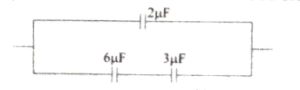
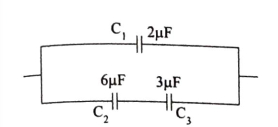
As shown in the circuit below,the effective capacitance is . . . . . . $\mu F$.
A
$4$
B
$1$
C
$\frac{30}{11}$
D
$\frac{8}{11}$
Solution
(A) The circuit consists of a capacitor $C_1 = 2 \mu F$ in parallel with a series combination of two capacitors $C_2 = 6 \mu F$ and $C_3 = 3 \mu F$.
First,calculate the equivalent capacitance $C'$ of the series combination of $C_2$ and $C_3$:
$\frac{1}{C'} = \frac{1}{C_2} + \frac{1}{C_3} = \frac{1}{6} + \frac{1}{3} = \frac{1+2}{6} = \frac{3}{6} = \frac{1}{2} \mu F^{-1}$
Therefore,$C' = 2 \mu F$.
Next,calculate the total equivalent capacitance $C_{eq}$ of the parallel combination of $C_1$ and $C'$:
$C_{eq} = C_1 + C' = 2 \mu F + 2 \mu F = 4 \mu F$.
Thus,the effective capacitance is $4 \mu F$.
First,calculate the equivalent capacitance $C'$ of the series combination of $C_2$ and $C_3$:
$\frac{1}{C'} = \frac{1}{C_2} + \frac{1}{C_3} = \frac{1}{6} + \frac{1}{3} = \frac{1+2}{6} = \frac{3}{6} = \frac{1}{2} \mu F^{-1}$
Therefore,$C' = 2 \mu F$.
Next,calculate the total equivalent capacitance $C_{eq}$ of the parallel combination of $C_1$ and $C'$:
$C_{eq} = C_1 + C' = 2 \mu F + 2 \mu F = 4 \mu F$.
Thus,the effective capacitance is $4 \mu F$.
0 likesView Solution
19
PhysicsEasyMCQGUJCET · 2006
If the unit of magnetic flux is in weber,then the unit of magnetic field is . . . . . . .
A
$Wb \times m^2$
B
$\frac{Wb}{m}$
C
$\frac{Wb}{m^2}$
D
$Wb \times m$
Solution
(C) The correct option is $C$.
The magnetic flux $\phi$ is defined as the product of the magnetic field $B$ and the area $A$ perpendicular to the field,given by the formula $\phi = B \times A$.
To find the unit of the magnetic field $B$,we rearrange the formula: $B = \frac{\phi}{A}$.
Since the unit of magnetic flux $\phi$ is weber $(Wb)$ and the unit of area $A$ is square meters $(m^2)$,the unit of magnetic field $B$ is $\frac{Wb}{m^2}$.
The magnetic flux $\phi$ is defined as the product of the magnetic field $B$ and the area $A$ perpendicular to the field,given by the formula $\phi = B \times A$.
To find the unit of the magnetic field $B$,we rearrange the formula: $B = \frac{\phi}{A}$.
Since the unit of magnetic flux $\phi$ is weber $(Wb)$ and the unit of area $A$ is square meters $(m^2)$,the unit of magnetic field $B$ is $\frac{Wb}{m^2}$.
0 likesView Solution
20
PhysicsEasyMCQGUJCET · 2006
Magnetic flux is in weber,the unit of magnetic field intensity is . . . . . . .
A
$Wb \times m^2$
B
$\frac{Wb}{m}$
C
$\frac{Wb}{m^2}$
D
$Wb \times m$
Solution
(C) The correct option is $C$.
Magnetic flux $\phi$ is defined as the product of magnetic field intensity $B$ and the area $A$ perpendicular to the field,given by the formula $\phi = B \times A$.
To find the unit of magnetic field intensity $B$,we rearrange the formula: $B = \frac{\phi}{A}$.
Since the unit of magnetic flux $\phi$ is weber $(Wb)$ and the unit of area $A$ is square meters $(m^2)$,the unit of magnetic field intensity $B$ is $\frac{Wb}{m^2}$ (also known as Tesla).
Magnetic flux $\phi$ is defined as the product of magnetic field intensity $B$ and the area $A$ perpendicular to the field,given by the formula $\phi = B \times A$.
To find the unit of magnetic field intensity $B$,we rearrange the formula: $B = \frac{\phi}{A}$.
Since the unit of magnetic flux $\phi$ is weber $(Wb)$ and the unit of area $A$ is square meters $(m^2)$,the unit of magnetic field intensity $B$ is $\frac{Wb}{m^2}$ (also known as Tesla).
0 likesView Solution
21
PhysicsEasyMCQGUJCET · 2006
Neutrino is a particle which $\qquad$
A
has no charge but has mass nearly that of an electron
B
has no charge and no spin
C
has no charge but has spin
D
is charged like an electron and has spin
Solution
(C) neutrino is an elementary subatomic particle that is electrically neutral. It has a very small mass (nearly zero) and possesses an intrinsic angular momentum known as spin,which is $1/2$ in units of $\hbar$. Therefore,it has no charge but has spin.
0 likesView Solution
Vedclass Products
For Students
Vedclass Test Series
Mock tests in real GUJCET style covering Physics with performance analysis. 5-day free trial.
Start Free TrialFor Teachers
Exam Paper Generator
Generate Set A/B/C/D Physics papers from 7.5L+ questions in 2 minutes. 3 chapters free.
Try FreeFor Institutes
Online Exam Module
Run live GUJCET mock exams with unlimited students, 360° analytics & white-label branding.
See DemoFrequently Asked Questions
How many Physics questions are in GUJCET 2006?
There are 21 Physics questions from the GUJCET 2006 paper on Vedclass, each with a detailed step-by-step solution in English.
Are GUJCET 2006 Physics solutions available in English?
Yes. All solutions on this page are in English. You can also switch to English or Hindi using the language buttons above the questions.
Can I practice GUJCET 2006 Physics as a timed test?
Yes. Use the Vedclass Test Series to attempt a full GUJCET mock test covering Physics with time limits and instant score analysis.
Can teachers create Physics papers from GUJCET previous year questions?
Yes. The Vedclass Exam Paper Generator lets teachers mix GUJCET Physics questions and generate Set A/B/C/D papers in minutes.
For Teachers & Institutes
Build a Custom Physics Paper
Pick GUJCET 2006 Physics questions, set difficulty, and generate Set A/B/C/D in 2 minutes.