
PhysicsQ51–79 of 79 questions
Page 2 of 2 · English
51
PhysicsEasyMCQGSEB · 2024
$A$ conducting ring of radius $R$ and one turn is formed from a conducting wire of length $L$ and on passing current $I$ the obtained magnetic dipole moment is $m$. If this wire is then converted to a ring of two turns and on passing electric current $I$,the new magnetic dipole moment obtained is . . . . . . .
A
$\frac{m}{2}$
B
$\frac{m}{4}$
C
$2m$
D
$4m$
Solution
(A) The magnetic dipole moment of a current-carrying loop is given by $m = NIA$,where $N$ is the number of turns,$I$ is the current,and $A$ is the area of the loop.
For the first case,$N_1 = 1$,$R_1 = R$,and $A_1 = \pi R^2$. Thus,$m = I \pi R^2$.
When the wire of length $L$ is converted into a ring of $N_2 = 2$ turns,the circumference of the new ring is $2 \times (2 \pi R_2) = L$. Since $L = 2 \pi R$,we have $4 \pi R_2 = 2 \pi R$,which gives $R_2 = \frac{R}{2}$.
The new area is $A_2 = \pi R_2^2 = \pi (\frac{R}{2})^2 = \frac{\pi R^2}{4}$.
The new magnetic dipole moment $m'$ is $m' = N_2 I A_2 = 2 \times I \times \frac{\pi R^2}{4} = \frac{I \pi R^2}{2}$.
Since $m = I \pi R^2$,we get $m' = \frac{m}{2}$.
For the first case,$N_1 = 1$,$R_1 = R$,and $A_1 = \pi R^2$. Thus,$m = I \pi R^2$.
When the wire of length $L$ is converted into a ring of $N_2 = 2$ turns,the circumference of the new ring is $2 \times (2 \pi R_2) = L$. Since $L = 2 \pi R$,we have $4 \pi R_2 = 2 \pi R$,which gives $R_2 = \frac{R}{2}$.
The new area is $A_2 = \pi R_2^2 = \pi (\frac{R}{2})^2 = \frac{\pi R^2}{4}$.
The new magnetic dipole moment $m'$ is $m' = N_2 I A_2 = 2 \times I \times \frac{\pi R^2}{4} = \frac{I \pi R^2}{2}$.
Since $m = I \pi R^2$,we get $m' = \frac{m}{2}$.
0 likesView Solution
52
PhysicsEasyMCQGSEB · 2024
$A$ closely wound solenoid of $1000$ turns and area of cross-section $2 \times 10^{-4} \ m^2$ carrying a current of $5.0 \ A$. The magnetic moment is . . . . . . $A \ m^2$.
A
$4$
B
$3$
C
$2$
D
$1$
Solution
(D) Given:
Number of turns,$N = 1000$
Area of cross-section,$A = 2 \times 10^{-4} \ m^2$
Current,$I = 5.0 \ A$
The magnetic moment $\mu$ of a solenoid is given by the formula:
$\mu = N \cdot I \cdot A$
Substituting the given values:
$\mu = 1000 \times 5.0 \times (2 \times 10^{-4})$
$\mu = 5000 \times 2 \times 10^{-4}$
$\mu = 10000 \times 10^{-4}$
$\mu = 1 \ A \ m^2$
Therefore,the correct option is $D$.
Number of turns,$N = 1000$
Area of cross-section,$A = 2 \times 10^{-4} \ m^2$
Current,$I = 5.0 \ A$
The magnetic moment $\mu$ of a solenoid is given by the formula:
$\mu = N \cdot I \cdot A$
Substituting the given values:
$\mu = 1000 \times 5.0 \times (2 \times 10^{-4})$
$\mu = 5000 \times 2 \times 10^{-4}$
$\mu = 10000 \times 10^{-4}$
$\mu = 1 \ A \ m^2$
Therefore,the correct option is $D$.
0 likesView Solution
53
PhysicsEasyMCQGSEB · 2024
Two very long straight parallel conductors of negligible cross-section carrying equal electric current of $1 \text{ mA}$ are placed one metre apart in a vacuum. The force produced per metre length is $\qquad \text{ N}$. (Given: $\mu_0 = 4\pi \times 10^{-7} \text{ T m A}^{-1}$)
A
$2 \times 10^{-7}$
B
$2 \times 10^{-13}$
C
$2 \times 10^{-10}$
D
$2 \times 10^{-4}$
Solution
(B) The force per unit length $f$ between two parallel conductors carrying currents $I_1$ and $I_2$ separated by a distance $d$ is given by the formula: $f = \frac{\mu_0 I_1 I_2}{2 \pi d}$.
Given values are $I_1 = I_2 = 1 \text{ mA} = 10^{-3} \text{ A}$,$d = 1 \text{ m}$,and $\mu_0 = 4\pi \times 10^{-7} \text{ T m A}^{-1}$.
Substituting these values into the formula:
$f = \frac{(4\pi \times 10^{-7}) \times (10^{-3}) \times (10^{-3})}{2 \pi \times 1}$
$f = 2 \times 10^{-7} \times 10^{-6}$
$f = 2 \times 10^{-13} \text{ N/m}$.
Thus,the correct option is $B$.
Given values are $I_1 = I_2 = 1 \text{ mA} = 10^{-3} \text{ A}$,$d = 1 \text{ m}$,and $\mu_0 = 4\pi \times 10^{-7} \text{ T m A}^{-1}$.
Substituting these values into the formula:
$f = \frac{(4\pi \times 10^{-7}) \times (10^{-3}) \times (10^{-3})}{2 \pi \times 1}$
$f = 2 \times 10^{-7} \times 10^{-6}$
$f = 2 \times 10^{-13} \text{ N/m}$.
Thus,the correct option is $B$.
0 likesView Solution
54
PhysicsEasyMCQGSEB · 2024
$A$ closely wound solenoid $120 \ cm$ long has $4$ layers of windings of $400$ turns each. The diameter of the solenoid is $1.8 \ cm$. If the current carried is $8.0 \ A$,estimate the magnitude of $B$ inside the solenoid near its centre.
A
$5.12 \pi \times 10^{-7} \ T$
B
$4.27 \pi \times 10^{-3} \ T$
C
$5.12 \pi \times 10^{-3} \ T$
D
$8 \pi \times 10^{-3} \ T$
Solution
(B) The magnetic field $B$ inside a long solenoid near its centre is given by the formula $B = \mu_0 n I$,where $n$ is the number of turns per unit length.
Given:
Length of solenoid $L = 120 \ cm = 1.2 \ m$.
Number of layers $= 4$.
Turns per layer $= 400$.
Total number of turns $N = 4 \times 400 = 1600$.
Current $I = 8.0 \ A$.
Number of turns per unit length $n = \frac{N}{L} = \frac{1600}{1.2} = \frac{4000}{3} \ m^{-1}$.
Substituting the values into the formula:
$B = (4 \pi \times 10^{-7} \ T \cdot m/A) \times (\frac{4000}{3} \ m^{-1}) \times (8.0 \ A)$.
$B = 4 \pi \times 10^{-7} \times \frac{32000}{3} \ T$.
$B = \frac{128000}{3} \pi \times 10^{-7} \ T$.
$B \approx 42666.67 \pi \times 10^{-7} \ T$.
$B \approx 4.266 \pi \times 10^{-3} \ T$.
Rounding to two decimal places,we get $B \approx 4.27 \pi \times 10^{-3} \ T$.
Given:
Length of solenoid $L = 120 \ cm = 1.2 \ m$.
Number of layers $= 4$.
Turns per layer $= 400$.
Total number of turns $N = 4 \times 400 = 1600$.
Current $I = 8.0 \ A$.
Number of turns per unit length $n = \frac{N}{L} = \frac{1600}{1.2} = \frac{4000}{3} \ m^{-1}$.
Substituting the values into the formula:
$B = (4 \pi \times 10^{-7} \ T \cdot m/A) \times (\frac{4000}{3} \ m^{-1}) \times (8.0 \ A)$.
$B = 4 \pi \times 10^{-7} \times \frac{32000}{3} \ T$.
$B = \frac{128000}{3} \pi \times 10^{-7} \ T$.
$B \approx 42666.67 \pi \times 10^{-7} \ T$.
$B \approx 4.266 \pi \times 10^{-3} \ T$.
Rounding to two decimal places,we get $B \approx 4.27 \pi \times 10^{-3} \ T$.
0 likesView Solution
55
PhysicsEasyMCQGSEB · 2024
Which of the following graphs represents the magnetic field $(B)$ versus distance $(r)$ from the centre of a long straight conducting wire of uniform cross-sectional area carrying a steady current $I$ and having radius $a$?
A
B
C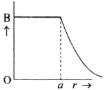
D
Solution
(B) For a point inside the wire $(r < a)$:
The magnetic field is given by $B_{in} = \frac{\mu_0 I r}{2 \pi a^2}$.
Thus, $B_{in} \propto r$, which represents a straight line passing through the origin.
For a point outside the wire $(r > a)$:
The magnetic field is given by $B_{out} = \frac{\mu_0 I}{2 \pi r}$.
Thus, $B_{out} \propto \frac{1}{r}$, which represents a rectangular hyperbola.
At the surface $(r = a)$, the magnetic field is maximum: $B_{max} = \frac{\mu_0 I}{2 \pi a}$.
Therefore, the graph shows a linear increase up to $r = a$ and then a hyperbolic decrease for $r > a$.
The magnetic field is given by $B_{in} = \frac{\mu_0 I r}{2 \pi a^2}$.
Thus, $B_{in} \propto r$, which represents a straight line passing through the origin.
For a point outside the wire $(r > a)$:
The magnetic field is given by $B_{out} = \frac{\mu_0 I}{2 \pi r}$.
Thus, $B_{out} \propto \frac{1}{r}$, which represents a rectangular hyperbola.
At the surface $(r = a)$, the magnetic field is maximum: $B_{max} = \frac{\mu_0 I}{2 \pi a}$.
Therefore, the graph shows a linear increase up to $r = a$ and then a hyperbolic decrease for $r > a$.
0 likesView Solution
56
PhysicsEasyMCQGSEB · 2024
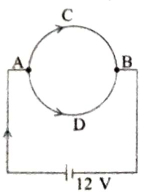
If a battery of $12 \text{ V}$ is connected across the diametrically opposite points $A$ and $B$ of a conducting ring of radius $R$ and the current drawn from the battery is $I$,then the magnetic field produced at the centre of the ring due to the ring is . . . . . . .
A
Zero
B
$\frac{\mu_0 I }{4 \pi R }$
C
$\frac{\mu_0 I }{2 R }$
D
$\frac{\mu_0 I }{ R }$
Solution
(A) When the battery is connected across the diametrically opposite points $A$ and $B$,the ring is divided into two equal semicircular arcs,$ACB$ and $ADB$.
Since the arcs are in parallel,the potential difference across both is the same $(12 \text{ V})$.
Let $R_1$ and $R_2$ be the resistances of the two semicircular parts. Since they have equal lengths and cross-sectional areas,$R_1 = R_2 = R_{arc}$.
By Ohm's law,the current $I_1$ through arc $ACB$ and $I_2$ through arc $ADB$ will be equal because the resistances are equal $(I_1 = I_2 = I/2)$.
The magnetic field at the centre due to a semicircular arc carrying current $I'$ is $B = \frac{\mu_0 I'}{4R}$.
The magnetic field due to arc $ACB$ $(B_1)$ at the centre is $\frac{\mu_0 (I/2)}{4R}$ directed into the plane (using the right-hand rule).
The magnetic field due to arc $ADB$ $(B_2)$ at the centre is $\frac{\mu_0 (I/2)}{4R}$ directed out of the plane.
Since the magnitudes are equal and the directions are opposite,the net magnetic field at the centre is $B_{net} = B_1 - B_2 = 0$.
Since the arcs are in parallel,the potential difference across both is the same $(12 \text{ V})$.
Let $R_1$ and $R_2$ be the resistances of the two semicircular parts. Since they have equal lengths and cross-sectional areas,$R_1 = R_2 = R_{arc}$.
By Ohm's law,the current $I_1$ through arc $ACB$ and $I_2$ through arc $ADB$ will be equal because the resistances are equal $(I_1 = I_2 = I/2)$.
The magnetic field at the centre due to a semicircular arc carrying current $I'$ is $B = \frac{\mu_0 I'}{4R}$.
The magnetic field due to arc $ACB$ $(B_1)$ at the centre is $\frac{\mu_0 (I/2)}{4R}$ directed into the plane (using the right-hand rule).
The magnetic field due to arc $ADB$ $(B_2)$ at the centre is $\frac{\mu_0 (I/2)}{4R}$ directed out of the plane.
Since the magnitudes are equal and the directions are opposite,the net magnetic field at the centre is $B_{net} = B_1 - B_2 = 0$.
0 likesView Solution
57
PhysicsEasyMCQGSEB · 2024
The density of a nucleus is $\qquad$ the atomic mass number $A$.
A
Directly proportional to
B
Directly proportional to the square of
C
Inversely proportional to
D
Independent of
Solution
(D) The correct answer is $D$.
Let $m$ be the average mass of a nucleon and $A$ be the mass number.
The mass of the nucleus is given by $M = m A$.
The radius of the nucleus is given by $R = R_0 A^{1/3}$,where $R_0$ is a constant.
The volume of the nucleus is $V = \frac{4}{3} \pi R^3 = \frac{4}{3} \pi (R_0 A^{1/3})^3 = \frac{4}{3} \pi R_0^3 A$.
The density of the nucleus $\rho$ is defined as the ratio of mass to volume:
$\rho = \frac{M}{V} = \frac{m A}{\frac{4}{3} \pi R_0^3 A} = \frac{m}{\frac{4}{3} \pi R_0^3}$.
Since $m$ and $R_0$ are constants,the density $\rho$ is independent of the mass number $A$.
Let $m$ be the average mass of a nucleon and $A$ be the mass number.
The mass of the nucleus is given by $M = m A$.
The radius of the nucleus is given by $R = R_0 A^{1/3}$,where $R_0$ is a constant.
The volume of the nucleus is $V = \frac{4}{3} \pi R^3 = \frac{4}{3} \pi (R_0 A^{1/3})^3 = \frac{4}{3} \pi R_0^3 A$.
The density of the nucleus $\rho$ is defined as the ratio of mass to volume:
$\rho = \frac{M}{V} = \frac{m A}{\frac{4}{3} \pi R_0^3 A} = \frac{m}{\frac{4}{3} \pi R_0^3}$.
Since $m$ and $R_0$ are constants,the density $\rho$ is independent of the mass number $A$.
0 likesView Solution
58
PhysicsEasyMCQGSEB · 2024
Complete the following nuclear reaction:
${ }_{0}^{1} n+{ }_{92}^{235} U \rightarrow{ }_{92}^{236} U \rightarrow$ $\qquad$ $+{ }_{41}^{99} Nb+$ $\qquad$.
${ }_{0}^{1} n+{ }_{92}^{235} U \rightarrow{ }_{92}^{236} U \rightarrow$ $\qquad$ $+{ }_{41}^{99} Nb+$ $\qquad$.

A
${ }_{56}^{144} Ba, 3{ }_{0}^{1} n$
B
${ }_{51}^{133} Sb, 4{ }_{0}^{1} n$
C
${ }_{54}^{140} Xe, 2{ }_{0}^{1} n$
D
${ }_{51}^{130} Sb, 2{ }_{0}^{1} n$
Solution
(B) In a nuclear fission reaction,both the total mass number $(A)$ and the total atomic number $(Z)$ must be conserved.
Given reaction: ${ }_{0}^{1} n+{ }_{92}^{235} U \rightarrow{ }_{92}^{236} U \rightarrow X + { }_{41}^{99} Nb + Y{ }_{0}^{1} n$.
Conservation of atomic number $(Z)$:
$92 = Z_X + 41 \Rightarrow Z_X = 92 - 41 = 51$.
Conservation of mass number $(A)$:
$236 = A_X + 99 + Y(1)$.
For option $(B)$,$X = { }_{51}^{133} Sb$ and $Y = 4$.
$A_X = 133$.
$133 + 99 + 4 = 236$.
Since both $A$ and $Z$ are conserved,option $(B)$ is correct.
Given reaction: ${ }_{0}^{1} n+{ }_{92}^{235} U \rightarrow{ }_{92}^{236} U \rightarrow X + { }_{41}^{99} Nb + Y{ }_{0}^{1} n$.
Conservation of atomic number $(Z)$:
$92 = Z_X + 41 \Rightarrow Z_X = 92 - 41 = 51$.
Conservation of mass number $(A)$:
$236 = A_X + 99 + Y(1)$.
For option $(B)$,$X = { }_{51}^{133} Sb$ and $Y = 4$.
$A_X = 133$.
$133 + 99 + 4 = 236$.
Since both $A$ and $Z$ are conserved,option $(B)$ is correct.
0 likesView Solution
59
PhysicsEasyMCQGSEB · 2024
The ratio of the nuclear radii of the gold isotope ${}_{79}^{197}Au$ and the silver isotope ${}_{47}^{107}Ag$ is $ . . . . . . $.
A
$2.13$
B
$3.12$
C
$1.23$
D
$2.31$
Solution
(C) The nuclear radius $R$ is given by the formula $R = R_0 A^{1/3}$,where $A$ is the mass number and $R_0$ is a constant.
Therefore,the ratio of the radii is given by $\frac{R_{Au}}{R_{Ag}} = \left( \frac{A_{Au}}{A_{Ag}} \right)^{1/3}$.
Given $A_{Au} = 197$ and $A_{Ag} = 107$,we have:
$\frac{R_{Au}}{R_{Ag}} = \left( \frac{197}{107} \right)^{1/3}$.
Calculating the value: $\frac{197}{107} \approx 1.841$.
Then,$(1.841)^{1/3} \approx 1.2256$.
Rounding to two decimal places,we get $1.23$.
Therefore,the ratio of the radii is given by $\frac{R_{Au}}{R_{Ag}} = \left( \frac{A_{Au}}{A_{Ag}} \right)^{1/3}$.
Given $A_{Au} = 197$ and $A_{Ag} = 107$,we have:
$\frac{R_{Au}}{R_{Ag}} = \left( \frac{197}{107} \right)^{1/3}$.
Calculating the value: $\frac{197}{107} \approx 1.841$.
Then,$(1.841)^{1/3} \approx 1.2256$.
Rounding to two decimal places,we get $1.23$.
0 likesView Solution
60
PhysicsEasyMCQGSEB · 2024
${ }_{92}^{238} U$ and ${ }_{90}^{236} Th$ are $\qquad$ of each other.
A
isotopes
B
isotones
C
isobars
D
isomers
Solution
(B) The correct answer is $B$ (isotones).
For ${ }_{92}^{238} U$,the number of neutrons $N$ is calculated as $N = A - Z = 238 - 92 = 146$.
For ${ }_{90}^{236} Th$,the number of neutrons $N$ is calculated as $N = A - Z = 236 - 90 = 146$.
Since both nuclei have the same number of neutrons $(N = 146)$,they are isotones.
For ${ }_{92}^{238} U$,the number of neutrons $N$ is calculated as $N = A - Z = 238 - 92 = 146$.
For ${ }_{90}^{236} Th$,the number of neutrons $N$ is calculated as $N = A - Z = 236 - 90 = 146$.
Since both nuclei have the same number of neutrons $(N = 146)$,they are isotones.
0 likesView Solution
61
PhysicsEasyMCQGSEB · 2024
The atomic masses of two isotopes of an element are $34.98 \ u$ and $36.98 \ u$ and their relative abundances are $75.4 \%$ and $24.6 \%$ respectively. The average atomic mass of the element is: (in $u$)
A
$34.51$
B
$35.47$
C
$36.46$
D
$35.99$
Solution
(B) The average atomic mass is calculated by taking the weighted average of the isotopic masses based on their relative abundances.
Average atomic mass $= \frac{(m_1 \times p_1) + (m_2 \times p_2)}{100}$
$= \frac{(34.98 \times 75.4) + (36.98 \times 24.6)}{100}$
$= \frac{2637.492 + 909.708}{100}$
$= \frac{3547.2}{100}$
$= 35.47 \ u$
Average atomic mass $= \frac{(m_1 \times p_1) + (m_2 \times p_2)}{100}$
$= \frac{(34.98 \times 75.4) + (36.98 \times 24.6)}{100}$
$= \frac{2637.492 + 909.708}{100}$
$= \frac{3547.2}{100}$
$= 35.47 \ u$
0 likesView Solution
62
PhysicsEasyMCQGSEB · 2024
According to Einstein's mass-energy equivalence relation,the energy equivalent of $1 \mu g$ of substance is $\qquad$ . (Speed of light in vacuum $c = 3 \times 10^{8} \ m/s$)
A
$9 \times 10^{13} \ J$
B
$9 \times 10^{-13} \ J$
C
$9 \times 10^{10} \ J$
D
$9 \times 10^{-10} \ J$
Solution
(C) According to Einstein's mass-energy equivalence relation,the energy $E$ is given by $E = mc^2$.
Given mass $m = 1 \mu g = 1 \times 10^{-6} \ kg$.
Speed of light $c = 3 \times 10^{8} \ m/s$.
Substituting the values into the formula:
$E = (1 \times 10^{-6} \ kg) \times (3 \times 10^{8} \ m/s)^2$
$E = 1 \times 10^{-6} \times 9 \times 10^{16} \ J$
$E = 9 \times 10^{10} \ J$.
Therefore,the correct option is $C$.
Given mass $m = 1 \mu g = 1 \times 10^{-6} \ kg$.
Speed of light $c = 3 \times 10^{8} \ m/s$.
Substituting the values into the formula:
$E = (1 \times 10^{-6} \ kg) \times (3 \times 10^{8} \ m/s)^2$
$E = 1 \times 10^{-6} \times 9 \times 10^{16} \ J$
$E = 9 \times 10^{10} \ J$.
Therefore,the correct option is $C$.
0 likesView Solution
63
PhysicsEasyMCQGSEB · 2024
Which of the following elements has the maximum binding energy per nucleon?
A
Tungsten
B
Uranium
C
Lithium
D
Iron
Solution
(D) The correct answer is $D$. Iron $(Fe)$.
The binding energy per nucleon curve shows that the binding energy per nucleon increases with the mass number $A$ for light nuclei and reaches a maximum value for nuclei with mass numbers between $40$ and $120$.
For Iron $(^{56}Fe)$,the binding energy per nucleon is approximately $8.75 \text{ MeV}$,which is the highest among the given options.
Therefore,Iron is the most stable nucleus among the choices provided.
The binding energy per nucleon curve shows that the binding energy per nucleon increases with the mass number $A$ for light nuclei and reaches a maximum value for nuclei with mass numbers between $40$ and $120$.
For Iron $(^{56}Fe)$,the binding energy per nucleon is approximately $8.75 \text{ MeV}$,which is the highest among the given options.
Therefore,Iron is the most stable nucleus among the choices provided.
0 likesView Solution
64
PhysicsEasyMCQGSEB · 2024
The radius of the nucleus of ${ }_{13}^{27} Al$ is $\qquad$ . (Given: $R_{0}=1.2 \text{ fm}$)
A
$3.0 \times 10^{-15} \text{ m}$
B
$3.2 \times 10^{-14} \text{ m}$
C
$3.6 \times 10^{-15} \text{ m}$
D
$3.6 \times 10^{-12} \text{ m}$
Solution
(C) The radius of a nucleus is given by the formula $R = R_{0} A^{1/3}$,where $R_{0} = 1.2 \text{ fm} = 1.2 \times 10^{-15} \text{ m}$ and $A$ is the mass number.
For ${ }_{13}^{27} Al$,the mass number $A = 27$.
Substituting the values into the formula:
$R = 1.2 \times 10^{-15} \times (27)^{1/3} \text{ m}$
Since $(27)^{1/3} = 3$,we get:
$R = 1.2 \times 10^{-15} \times 3 \text{ m}$
$R = 3.6 \times 10^{-15} \text{ m}$
Thus,the correct option is $C$.
For ${ }_{13}^{27} Al$,the mass number $A = 27$.
Substituting the values into the formula:
$R = 1.2 \times 10^{-15} \times (27)^{1/3} \text{ m}$
Since $(27)^{1/3} = 3$,we get:
$R = 1.2 \times 10^{-15} \times 3 \text{ m}$
$R = 3.6 \times 10^{-15} \text{ m}$
Thus,the correct option is $C$.
0 likesView Solution
65
PhysicsEasyMCQGSEB · 2024
Choosing the correct option, complete the given nuclear fusion reaction that occurs in the sun.
${ }_1^3 H +{ }_1^3 H \rightarrow{ }_2^4 He +{ }_1^1 H +{ }_1^1 H +$ . . . . . . . (in $\text{ MeV}$)
${ }_1^3 H +{ }_1^3 H \rightarrow{ }_2^4 He +{ }_1^1 H +{ }_1^1 H +$ . . . . . . . (in $\text{ MeV}$)
A
$0.42$
B
$12.86$
C
$1.02$
D
$5.49$
Solution
(B) The given nuclear fusion reaction is: ${ }_1^3 H + { }_1^3 H \rightarrow { }_2^4 He + { }_1^1 H + { }_1^1 H + Q$.
To find the energy released $(Q)$, we calculate the mass defect $(\Delta m)$:
Mass of reactants: $2 \times M({ }_1^3 H) = 2 \times 3.016049 \text{ u} = 6.032098 \text{ u}$.
Mass of products: $M({ }_2^4 He) + 2 \times M({ }_1^1 H) = 4.002603 \text{ u} + 2 \times 1.007825 \text{ u} = 4.002603 + 2.015650 = 6.018253 \text{ u}$.
Mass defect $\Delta m = 6.032098 \text{ u} - 6.018253 \text{ u} = 0.013845 \text{ u}$.
Energy released $Q = \Delta m \times 931.5 \text{ MeV/u} = 0.013845 \times 931.5 \approx 12.89 \text{ MeV}$.
Rounding to the nearest provided option, the correct value is $12.86 \text{ MeV}$.
To find the energy released $(Q)$, we calculate the mass defect $(\Delta m)$:
Mass of reactants: $2 \times M({ }_1^3 H) = 2 \times 3.016049 \text{ u} = 6.032098 \text{ u}$.
Mass of products: $M({ }_2^4 He) + 2 \times M({ }_1^1 H) = 4.002603 \text{ u} + 2 \times 1.007825 \text{ u} = 4.002603 + 2.015650 = 6.018253 \text{ u}$.
Mass defect $\Delta m = 6.032098 \text{ u} - 6.018253 \text{ u} = 0.013845 \text{ u}$.
Energy released $Q = \Delta m \times 931.5 \text{ MeV/u} = 0.013845 \times 931.5 \approx 12.89 \text{ MeV}$.
Rounding to the nearest provided option, the correct value is $12.86 \text{ MeV}$.
0 likesView Solution
66
PhysicsEasyMCQGSEB · 2024
$A$ small telescope has an objective lens of focal length $140 \ cm$ and an eyepiece of focal length $5 \ cm$. The magnifying power of the telescope for viewing a distant object when the telescope is in normal adjustment is . . . . . . .
A
$145$
B
$28$
C
$70$
D
$35$
Solution
(B) The magnifying power $m$ of a telescope in normal adjustment is given by the ratio of the focal length of the objective lens $(f_o)$ to the focal length of the eyepiece $(f_e)$.
Given:
$f_o = 140 \ cm$
$f_e = 5 \ cm$
Using the formula:
$m = \frac{f_o}{f_e}$
$m = \frac{140}{5} = 28$
Therefore,the magnifying power is $28$.
Given:
$f_o = 140 \ cm$
$f_e = 5 \ cm$
Using the formula:
$m = \frac{f_o}{f_e}$
$m = \frac{140}{5} = 28$
Therefore,the magnifying power is $28$.
0 likesView Solution
67
PhysicsEasyMCQGSEB · 2024
The speed of light in a medium of refractive index $1.25$ is . . . . . . .
(Speed of light in vacuum is $3 \times 10^{8} \,m \,s^{-1}$)
(Speed of light in vacuum is $3 \times 10^{8} \,m \,s^{-1}$)
A
$2.4 \times 10^{8} \,m \,s^{-1}$
B
$1.5 \times 10^{8} \,m \,s^{-1}$
C
$2.0 \times 10^{8} \,m \,s^{-1}$
D
$1.25 \times 10^{8} \,m \,s^{-1}$
Solution
(A) The refractive index $n$ of a medium is defined as the ratio of the speed of light in vacuum $c$ to the speed of light in the medium $v$.
The formula is given by $n = \frac{c}{v}$.
Rearranging the formula to solve for $v$,we get $v = \frac{c}{n}$.
Given $c = 3 \times 10^{8} \,m \,s^{-1}$ and $n = 1.25$.
Substituting the values: $v = \frac{3 \times 10^{8}}{1.25} = 2.4 \times 10^{8} \,m \,s^{-1}$.
Therefore,the correct option is $A$.
The formula is given by $n = \frac{c}{v}$.
Rearranging the formula to solve for $v$,we get $v = \frac{c}{n}$.
Given $c = 3 \times 10^{8} \,m \,s^{-1}$ and $n = 1.25$.
Substituting the values: $v = \frac{3 \times 10^{8}}{1.25} = 2.4 \times 10^{8} \,m \,s^{-1}$.
Therefore,the correct option is $A$.
0 likesView Solution
68
PhysicsEasyMCQGSEB · 2024
Which of the following is an inorganic compound semiconductor?
A
$GaAs$
B
$Si$
C
$Ge$
D
$C$
Solution
(A) The correct answer is $GaAs$.
Semiconductors are classified into elemental and compound semiconductors.
$Si$ (Silicon),$Ge$ (Germanium),and $C$ (Carbon) are elemental semiconductors as they consist of only one type of atom.
$GaAs$ (Gallium Arsenide) is an inorganic compound semiconductor because it is formed by the combination of two different elements,Gallium $(Ga)$ and Arsenic $(As)$.
Semiconductors are classified into elemental and compound semiconductors.
$Si$ (Silicon),$Ge$ (Germanium),and $C$ (Carbon) are elemental semiconductors as they consist of only one type of atom.
$GaAs$ (Gallium Arsenide) is an inorganic compound semiconductor because it is formed by the combination of two different elements,Gallium $(Ga)$ and Arsenic $(As)$.
0 likesView Solution
69
PhysicsEasyMCQGSEB · 2024
Carbon,Silicon,and Germanium have four valence electrons each. These are characterized by valence and conduction bands separated by energy band gaps respectively equal to $(E_g)_C, (E_g)_{Si},$ and $(E_g)_{Ge}$. Which of the following statements is true?
A
$(E_g)_{Si} < (E_g)_{Ge} < (E_g)_C$
B
$(E_g)_C < (E_g)_{Ge} > (E_g)_{Si}$
C
$(E_g)_C > (E_g)_{Si} > (E_g)_{Ge}$
D
$(E_g)_C = (E_g)_{Si} = (E_g)_{Ge}$
Solution
(C) The energy band gap $(E_g)$ is the energy difference between the conduction band and the valence band.
For Carbon (diamond),the band gap is approximately $5.4 \ eV$.
For Silicon,the band gap is approximately $1.1 \ eV$.
For Germanium,the band gap is approximately $0.7 \ eV$.
Comparing these values,we find that $(E_g)_C > (E_g)_{Si} > (E_g)_{Ge}$.
Therefore,option $(C)$ is correct.
For Carbon (diamond),the band gap is approximately $5.4 \ eV$.
For Silicon,the band gap is approximately $1.1 \ eV$.
For Germanium,the band gap is approximately $0.7 \ eV$.
Comparing these values,we find that $(E_g)_C > (E_g)_{Si} > (E_g)_{Ge}$.
Therefore,option $(C)$ is correct.
0 likesView Solution
70
PhysicsEasyMCQGSEB · 2024
In an $n$-type silicon,which of the following statements is true?
A
Electrons are majority carriers and trivalent atoms are the dopants.
B
Electrons are minority carriers and pentavalent atoms are the dopants.
C
Holes are majority carriers and trivalent atoms are the dopants.
D
Holes are minority carriers and pentavalent atoms are the dopants.
Solution
(D) In an $n$-type semiconductor,the material is doped with pentavalent impurity atoms (such as Phosphorus,Arsenic,or Antimony) to provide extra electrons.
Since these pentavalent atoms provide free electrons,electrons become the majority charge carriers.
Conversely,holes are generated only due to thermal excitation,making them the minority charge carriers.
Therefore,the correct statement is that holes are minority carriers and pentavalent atoms are the dopants.
Since these pentavalent atoms provide free electrons,electrons become the majority charge carriers.
Conversely,holes are generated only due to thermal excitation,making them the minority charge carriers.
Therefore,the correct statement is that holes are minority carriers and pentavalent atoms are the dopants.
0 likesView Solution
71
PhysicsEasyMCQGSEB · 2024
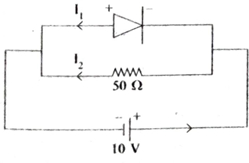
If a diode having infinite reverse bias resistance is connected in a circuit as shown in the figure,then $I_1$ and $I_2$ are respectively:
A
$0.0 \ A, 0.2 \ A$
B
$0.2 \ A, 0.0 \ A$
C
$10.0 \ A, 0.0 \ A$
D
$0.0 \ A, 0.0 \ A$
Solution
(A) In the given circuit,the diode is connected in reverse bias because the positive terminal of the battery is connected to the $n$-side (cathode) and the negative terminal is connected to the $p$-side (anode) of the diode.
Since the diode has infinite reverse bias resistance,the current $I_1$ flowing through the diode branch is $I_1 = 0.0 \ A$.
The resistor of $50 \ \Omega$ is connected in parallel to the battery of $10 \ V$. Therefore,the current $I_2$ flowing through the resistor is given by Ohm's law:
$I_2 = \frac{V}{R} = \frac{10 \ V}{50 \ \Omega} = 0.2 \ A$.
Thus,$I_1 = 0.0 \ A$ and $I_2 = 0.2 \ A$.
Since the diode has infinite reverse bias resistance,the current $I_1$ flowing through the diode branch is $I_1 = 0.0 \ A$.
The resistor of $50 \ \Omega$ is connected in parallel to the battery of $10 \ V$. Therefore,the current $I_2$ flowing through the resistor is given by Ohm's law:
$I_2 = \frac{V}{R} = \frac{10 \ V}{50 \ \Omega} = 0.2 \ A$.
Thus,$I_1 = 0.0 \ A$ and $I_2 = 0.2 \ A$.
0 likesView Solution
72
PhysicsEasyMCQGSEB · 2024
Which of the following substances has an energy gap $(E_g)$ greater than $3 \ eV$?
A
Metals
B
Semiconductors
C
Alloys
D
Insulators (Non-metals)
Solution
(D) The energy gap $(E_g)$ is the energy difference between the valence band and the conduction band.
- For metals,the valence and conduction bands overlap,so $E_g = 0$.
- For semiconductors,the energy gap is small,typically $E_g < 3 \ eV$ (e.g.,Silicon is $1.1 \ eV$,Germanium is $0.7 \ eV$).
- For insulators (often referred to as non-metals in this context),the energy gap is very large,typically $E_g > 3 \ eV$.
Therefore,the correct answer is insulators or non-metals.
- For metals,the valence and conduction bands overlap,so $E_g = 0$.
- For semiconductors,the energy gap is small,typically $E_g < 3 \ eV$ (e.g.,Silicon is $1.1 \ eV$,Germanium is $0.7 \ eV$).
- For insulators (often referred to as non-metals in this context),the energy gap is very large,typically $E_g > 3 \ eV$.
Therefore,the correct answer is insulators or non-metals.
0 likesView Solution
73
PhysicsEasyMCQGSEB · 2024
What type of semiconductor is $CdS$?
A
Elemental
B
Inorganic
C
Organic
D
Organic Polymer
Solution
(B) $CdS$ (Cadmium Sulfide) is a compound semiconductor.
It is composed of elements from groups $12$ and $16$ of the periodic table.
Since it is a compound formed by inorganic elements,it is classified as an inorganic semiconductor.
Therefore,the correct option is $B$.
It is composed of elements from groups $12$ and $16$ of the periodic table.
Since it is a compound formed by inorganic elements,it is classified as an inorganic semiconductor.
Therefore,the correct option is $B$.
0 likesView Solution
74
PhysicsEasyMCQGSEB · 2024
When a forward bias is applied to a $p-n$ junction,it $\qquad$ .
A
raises the potential barrier.
B
lowers the potential barrier.
C
reduces the majority carrier to zero.
D
potential barrier remains same.
Solution
(B) When a $p-n$ junction is forward biased,the positive terminal of the external battery is connected to the $p$-side and the negative terminal to the $n$-side.
This external electric field opposes the internal electric field of the depletion region.
As a result,the width of the depletion layer decreases,and the potential barrier height is lowered.
Therefore,the correct option is $B$.
This external electric field opposes the internal electric field of the depletion region.
As a result,the width of the depletion layer decreases,and the potential barrier height is lowered.
Therefore,the correct option is $B$.
0 likesView Solution
75
PhysicsEasyMCQGSEB · 2024
In a $p$-type semiconductor,which of the following statements is true?
A
Electrons are majority charge carriers and trivalent atoms are the dopants.
B
Holes are minority carriers and pentavalent atoms are the dopants.
C
Electrons are minority charge carriers and pentavalent atoms are the dopants.
D
Holes are majority carriers and trivalent atoms are the dopants.
Solution
(D) In a $p$-type semiconductor,the material is doped with trivalent impurity atoms (such as Boron,Aluminum,or Indium).
These trivalent atoms create vacancies in the crystal lattice,which act as holes.
Therefore,holes become the majority charge carriers,while electrons are the minority charge carriers.
Thus,the correct statement is that holes are majority carriers and trivalent atoms are the dopants.
These trivalent atoms create vacancies in the crystal lattice,which act as holes.
Therefore,holes become the majority charge carriers,while electrons are the minority charge carriers.
Thus,the correct statement is that holes are majority carriers and trivalent atoms are the dopants.
0 likesView Solution
76
PhysicsEasyMCQGSEB · 2024
According to Huygen's argument,the amplitude of the secondary wavelet is . . . . . . in the forward direction and . . . . . . in the backward direction.
A
Zero,maximum
B
Maximum,zero
C
Zero,zero
D
Maximum,maximum
Solution
(B) According to Huygen's principle,every point on a wavefront acts as a source of secondary wavelets. The amplitude of these secondary wavelets is given by the factor $(1 + \cos \theta) / 2$,where $\theta$ is the angle between the normal to the wavefront and the direction of the secondary wavelet.
$1$. In the forward direction,$\theta = 0^\circ$,so the amplitude factor is $(1 + \cos 0^\circ) / 2 = (1 + 1) / 2 = 1$ (Maximum).
$2$. In the backward direction,$\theta = 180^\circ$,so the amplitude factor is $(1 + \cos 180^\circ) / 2 = (1 - 1) / 2 = 0$ (Zero).
Therefore,the amplitude is maximum in the forward direction and zero in the backward direction.
$1$. In the forward direction,$\theta = 0^\circ$,so the amplitude factor is $(1 + \cos 0^\circ) / 2 = (1 + 1) / 2 = 1$ (Maximum).
$2$. In the backward direction,$\theta = 180^\circ$,so the amplitude factor is $(1 + \cos 180^\circ) / 2 = (1 - 1) / 2 = 0$ (Zero).
Therefore,the amplitude is maximum in the forward direction and zero in the backward direction.
0 likesView Solution
77
PhysicsEasyMCQGSEB · 2024
When a plane wavefront is incident on a convex lens,the emerging wavefront becomes . . . . . . .
A
plane
B
cylindrical
C
spherical
D
appropriate choice is not given
Solution
(C) When a plane wavefront is incident on a convex lens,the lens causes the light rays to converge at the focal point.
Since the wavefront is always perpendicular to the direction of light propagation (rays),the converging rays result in a spherical wavefront that is converging towards the focal point.
Therefore,the emerging wavefront is spherical.
Since the wavefront is always perpendicular to the direction of light propagation (rays),the converging rays result in a spherical wavefront that is converging towards the focal point.
Therefore,the emerging wavefront is spherical.
0 likesView Solution
78
PhysicsEasyMCQGSEB · 2024
Two waves having same intensity $I_{0}$ and originated from two non-coherent sources superpose at a point. The average intensity at that point is . . . . . . .
A
$I_{0}$
B
$3 I_{0}$
C
$2 I_{0}$
D
$4 I_{0}$
Solution
(C) The resultant intensity $I$ of two superposing waves is given by the formula: $I = I_{1} + I_{2} + 2\sqrt{I_{1}I_{2}} \cos \phi$.
For non-coherent sources,the phase difference $\phi$ changes randomly with time.
Therefore,the average value of the interference term $\langle 2\sqrt{I_{1}I_{2}} \cos \phi \rangle$ over time is $0$ because the average value of $\cos \phi$ is $0$.
Given that $I_{1} = I_{2} = I_{0}$,the resultant average intensity is:
$I_{avg} = I_{1} + I_{2} = I_{0} + I_{0} = 2I_{0}$.
For non-coherent sources,the phase difference $\phi$ changes randomly with time.
Therefore,the average value of the interference term $\langle 2\sqrt{I_{1}I_{2}} \cos \phi \rangle$ over time is $0$ because the average value of $\cos \phi$ is $0$.
Given that $I_{1} = I_{2} = I_{0}$,the resultant average intensity is:
$I_{avg} = I_{1} + I_{2} = I_{0} + I_{0} = 2I_{0}$.
0 likesView Solution
79
PhysicsEasyMCQGSEB · 2024
Which of the following figures is correct on the basis of Huygens' principle for the refraction of a plane wave by a thin prism?
A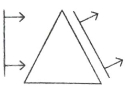
B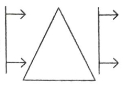
C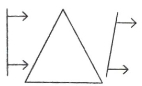
D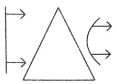
Solution
(C) According to Huygens' principle,the speed of light in a denser medium (glass) is less than in a rarer medium (air).
When a plane wavefront passes through a prism,the portion of the wavefront passing through the base of the prism travels through a greater thickness of glass compared to the portion passing through the apex.
Since the speed of light is lower in glass,the part of the wavefront traveling through the thicker part of the prism is delayed more than the part traveling through the thinner part.
This results in a tilt in the emerging wavefront,as correctly depicted in Figure $C$.
When a plane wavefront passes through a prism,the portion of the wavefront passing through the base of the prism travels through a greater thickness of glass compared to the portion passing through the apex.
Since the speed of light is lower in glass,the part of the wavefront traveling through the thicker part of the prism is delayed more than the part traveling through the thinner part.
This results in a tilt in the emerging wavefront,as correctly depicted in Figure $C$.
0 likesView Solution
Vedclass Products
For Students
Vedclass Test Series
Mock tests in real GSEB style covering Physics with performance analysis. 5-day free trial.
Start Free TrialFor Teachers
Exam Paper Generator
Generate Set A/B/C/D Physics papers from 7.5L+ questions in 2 minutes. 3 chapters free.
Try FreeFor Institutes
Online Exam Module
Run live GSEB mock exams with unlimited students, 360° analytics & white-label branding.
See DemoFrequently Asked Questions
How many Physics questions are in GSEB 2024?
There are 79 Physics questions from the GSEB 2024 paper on Vedclass, each with a detailed step-by-step solution in English.
Are GSEB 2024 Physics solutions available in English?
Yes. All solutions on this page are in English. You can also switch to English or Hindi using the language buttons above the questions.
Can I practice GSEB 2024 Physics as a timed test?
Yes. Use the Vedclass Test Series to attempt a full GSEB mock test covering Physics with time limits and instant score analysis.
Can teachers create Physics papers from GSEB previous year questions?
Yes. The Vedclass Exam Paper Generator lets teachers mix GSEB Physics questions and generate Set A/B/C/D papers in minutes.
For Teachers & Institutes
Build a Custom Physics Paper
Pick GSEB 2024 Physics questions, set difficulty, and generate Set A/B/C/D in 2 minutes.