
ChemistryQ1–10 of 10 questions
Page 1 of 1 · English
1
ChemistryMCQGSEB · 2020
$A$ feasible solution to an $LP$ problem,
A
must satisfy all of the problem's constraints simultaneously.
B
need not satisfy all of the constraints,only some of them.
C
must be a corner point of the feasible region.
D
must optimize the value of the objective function.
Solution
(A) In a Linear Programming $(LP)$ problem,the feasible region is defined as the set of all points that satisfy all the given constraints simultaneously,including the non-negativity restrictions.
Any point within or on the boundary of this feasible region is called a feasible solution.
Therefore,by definition,a feasible solution must satisfy all the constraints of the problem simultaneously.
Any point within or on the boundary of this feasible region is called a feasible solution.
Therefore,by definition,a feasible solution must satisfy all the constraints of the problem simultaneously.
0 likesView Solution
2
ChemistryEasyMCQGSEB · 2020
The role of a catalyst is to change $ . . . . . . $.
A
Equilibrium constant of reaction
B
Enthalpy of reaction
C
Gibbs energy of reaction
D
Activation energy of reaction
Solution
(D) catalyst is a substance that increases the rate of a chemical reaction without itself undergoing any permanent chemical change.
It functions by providing an alternative reaction pathway with a lower $Activation \ energy$ $(E_a)$.
It does not alter the $Gibbs \ energy$ $(\Delta G)$,$Enthalpy$ $(\Delta H)$,or the $Equilibrium \ constant$ $(K_{eq})$ of the reaction.
Therefore,the correct option is $D$.
It functions by providing an alternative reaction pathway with a lower $Activation \ energy$ $(E_a)$.
It does not alter the $Gibbs \ energy$ $(\Delta G)$,$Enthalpy$ $(\Delta H)$,or the $Equilibrium \ constant$ $(K_{eq})$ of the reaction.
Therefore,the correct option is $D$.
0 likesView Solution
3
ChemistryEasyMCQGSEB · 2020
Which of the following graphs for $\ln k$ versus $\frac{1}{T}$ is correct?
A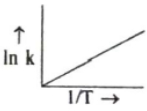
B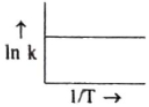
C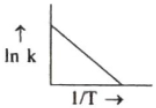
D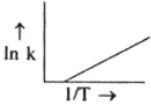
Solution
(C) The Arrhenius equation is given by $k = A e^{-E_a / RT}$.
Taking the natural logarithm on both sides,we get:
$\ln k = \ln A - \frac{E_a}{RT}$
This equation is in the form of a straight line $y = mx + c$,where:
$y = \ln k$
$x = \frac{1}{T}$
$m = -\frac{E_a}{R}$ (slope)
$c = \ln A$ (intercept)
Since the slope is negative $(-\frac{E_a}{R})$,the graph of $\ln k$ versus $\frac{1}{T}$ is a straight line with a negative slope and a positive intercept on the $y$-axis.
This corresponds to the graph shown in option $C$.
Taking the natural logarithm on both sides,we get:
$\ln k = \ln A - \frac{E_a}{RT}$
This equation is in the form of a straight line $y = mx + c$,where:
$y = \ln k$
$x = \frac{1}{T}$
$m = -\frac{E_a}{R}$ (slope)
$c = \ln A$ (intercept)
Since the slope is negative $(-\frac{E_a}{R})$,the graph of $\ln k$ versus $\frac{1}{T}$ is a straight line with a negative slope and a positive intercept on the $y$-axis.
This corresponds to the graph shown in option $C$.
0 likesView Solution
4
ChemistryEasyMCQGSEB · 2020
The decomposition of $NH_3$ on a platinum surface is a zero-order reaction. What is the rate of production of $N_2$ if $k = 2.5 \times 10^{-4} \ mol \ L^{-1} \ s^{-1}$?
A
$7.5 \times 10^{-4} \ mol \ L^{-1} \ s^{-1}$
B
$8.3 \times 10^{-5} \ mol \ L^{-1} \ s^{-1}$
C
$2.5 \times 10^{-4} \ mol \ L^{-1} \ s^{-1}$
D
$5 \times 10^{-4} \ mol \ L^{-1} \ s^{-1}$
Solution
(C) The decomposition reaction is: $2NH_{3(g)} \rightarrow N_{2(g)} + 3H_{2(g)}$
For a zero-order reaction,the rate of reaction is equal to the rate constant $k$.
$\text{Rate} = k = 2.5 \times 10^{-4} \ mol \ L^{-1} \ s^{-1}$.
The rate of reaction is expressed as: $\text{Rate} = -\frac{1}{2} \frac{d[NH_3]}{dt} = \frac{d[N_2]}{dt} = \frac{1}{3} \frac{d[H_2]}{dt}$.
Therefore,the rate of production of $N_2$ is equal to the rate of the reaction.
$\frac{d[N_2]}{dt} = \text{Rate} = 2.5 \times 10^{-4} \ mol \ L^{-1} \ s^{-1}$.
For a zero-order reaction,the rate of reaction is equal to the rate constant $k$.
$\text{Rate} = k = 2.5 \times 10^{-4} \ mol \ L^{-1} \ s^{-1}$.
The rate of reaction is expressed as: $\text{Rate} = -\frac{1}{2} \frac{d[NH_3]}{dt} = \frac{d[N_2]}{dt} = \frac{1}{3} \frac{d[H_2]}{dt}$.
Therefore,the rate of production of $N_2$ is equal to the rate of the reaction.
$\frac{d[N_2]}{dt} = \text{Rate} = 2.5 \times 10^{-4} \ mol \ L^{-1} \ s^{-1}$.
0 likesView Solution
5
ChemistryEasyMCQGSEB · 2020
The molecular formula of tetraammineaquachloridocobalt$(III)$ chloride is . . . . . . .
A
$[Co(NH_3)_4(H_2O)Cl]Cl_3$
B
$[Co(NH_3)_4(H_2O)Cl]Cl_2$
C
$[Co(NH_3)_4(H_2O)Cl_2]Cl$
D
$[Co(NH_3)_4(H_2O)Cl_3]$
Solution
(B) The $IUPAC$ name is tetraammineaquachloridocobalt$(III)$ chloride.
$1$. The central metal ion is $Co$ with an oxidation state of $+3$.
$2$. The ligands are four ammine $(NH_3)$,one aqua $(H_2O)$,and one chlorido $(Cl^-)$ group inside the coordination sphere.
$3$. The total charge of the coordination sphere is calculated as: $x + 4(0) + 1(0) + 1(-1) = +3$,which gives $x = +4$. However,the oxidation state is $+3$,so the sphere charge is $3 - 1 = +2$.
$4$. To balance the $+2$ charge of the complex $[Co(NH_3)_4(H_2O)Cl]^{2+}$,two chloride ions $(Cl^-)$ are required outside the coordination sphere.
$5$. Thus,the formula is $[Co(NH_3)_4(H_2O)Cl]Cl_2$.
$1$. The central metal ion is $Co$ with an oxidation state of $+3$.
$2$. The ligands are four ammine $(NH_3)$,one aqua $(H_2O)$,and one chlorido $(Cl^-)$ group inside the coordination sphere.
$3$. The total charge of the coordination sphere is calculated as: $x + 4(0) + 1(0) + 1(-1) = +3$,which gives $x = +4$. However,the oxidation state is $+3$,so the sphere charge is $3 - 1 = +2$.
$4$. To balance the $+2$ charge of the complex $[Co(NH_3)_4(H_2O)Cl]^{2+}$,two chloride ions $(Cl^-)$ are required outside the coordination sphere.
$5$. Thus,the formula is $[Co(NH_3)_4(H_2O)Cl]Cl_2$.
0 likesView Solution
6
ChemistryEasyMCQGSEB · 2020
Which of the following are amphoteric oxides?
$Mn_2O_7, CrO_3, Cr_2O_3, CrO, V_2O_5, V_2O_4$
$Mn_2O_7, CrO_3, Cr_2O_3, CrO, V_2O_5, V_2O_4$
A
$Mn_2O_7, CrO$
B
$CrO_3, V_2O_4$
C
$V_2O_5, Cr_2O_3$
D
$Cr_2O_3, Mn_2O_7$
Solution
(C) Amphoteric oxides are those that react with both acids and bases.
$Cr_2O_3$ is a well-known amphoteric oxide.
$V_2O_5$ also exhibits amphoteric character,although it is predominantly acidic,it reacts with strong bases to form vanadates and with strong acids to form oxovanadium ions.
$Mn_2O_7$ and $CrO_3$ are acidic oxides.
$CrO$ is a basic oxide.
$V_2O_4$ is a basic oxide.
Therefore,the correct pair is $V_2O_5$ and $Cr_2O_3$.
$Cr_2O_3$ is a well-known amphoteric oxide.
$V_2O_5$ also exhibits amphoteric character,although it is predominantly acidic,it reacts with strong bases to form vanadates and with strong acids to form oxovanadium ions.
$Mn_2O_7$ and $CrO_3$ are acidic oxides.
$CrO$ is a basic oxide.
$V_2O_4$ is a basic oxide.
Therefore,the correct pair is $V_2O_5$ and $Cr_2O_3$.
0 likesView Solution
7
ChemistryEasyMCQGSEB · 2020
$\Lambda_{m(HAc)}^0$ is equal to . . . . . . .
A
$\Lambda_{m(KCl)}^0 + \Lambda_{m(KAc)}^0 - \Lambda_{m(HCl)}^0$
B
$\Lambda_{m(HCl)}^0 + \Lambda_{m(NaAc)}^0 - \Lambda_{m(NaCl)}^0$
C
$\Lambda_{m(AcH)}^0 + \Lambda_{m(KAc)}^0 - \Lambda_{m(NaAc)}^0$
D
$\Lambda_{m(KCl)}^0 + \Lambda_{m(NaAc)}^0 - \Lambda_{m(NaCl)}^0$
Solution
(B) According to Kohlrausch's law of independent migration of ions,the molar conductivity of a weak electrolyte at infinite dilution can be calculated using the molar conductivities of strong electrolytes.
For acetic acid $(HAc)$,the expression is:
$\Lambda_{m(HAc)}^0 = \lambda_{H^+} + \lambda_{Ac^-}$
Using strong electrolytes $HCl$,$NaAc$,and $NaCl$:
$\Lambda_{m(HCl)}^0 = \lambda_{H^+} + \lambda_{Cl^-}$
$\Lambda_{m(NaAc)}^0 = \lambda_{Na^+} + \lambda_{Ac^-}$
$\Lambda_{m(NaCl)}^0 = \lambda_{Na^+} + \lambda_{Cl^-}$
Therefore,$\Lambda_{m(HCl)}^0 + \Lambda_{m(NaAc)}^0 - \Lambda_{m(NaCl)}^0 = (\lambda_{H^+} + \lambda_{Cl^-}) + (\lambda_{Na^+} + \lambda_{Ac^-}) - (\lambda_{Na^+} + \lambda_{Cl^-}) = \lambda_{H^+} + \lambda_{Ac^-} = \Lambda_{m(HAc)}^0$.
Thus,the correct option is $B$.
For acetic acid $(HAc)$,the expression is:
$\Lambda_{m(HAc)}^0 = \lambda_{H^+} + \lambda_{Ac^-}$
Using strong electrolytes $HCl$,$NaAc$,and $NaCl$:
$\Lambda_{m(HCl)}^0 = \lambda_{H^+} + \lambda_{Cl^-}$
$\Lambda_{m(NaAc)}^0 = \lambda_{Na^+} + \lambda_{Ac^-}$
$\Lambda_{m(NaCl)}^0 = \lambda_{Na^+} + \lambda_{Cl^-}$
Therefore,$\Lambda_{m(HCl)}^0 + \Lambda_{m(NaAc)}^0 - \Lambda_{m(NaCl)}^0 = (\lambda_{H^+} + \lambda_{Cl^-}) + (\lambda_{Na^+} + \lambda_{Ac^-}) - (\lambda_{Na^+} + \lambda_{Cl^-}) = \lambda_{H^+} + \lambda_{Ac^-} = \Lambda_{m(HAc)}^0$.
Thus,the correct option is $B$.
0 likesView Solution
8
ChemistryEasyMCQGSEB · 2020
Which is the increasing order of reducing power of the following metals on the basis of standard electrode potential? $Ag^{+}/Ag = 0.80 \ V$,$Mg^{2+}/Mg = -2.37 \ V$,$Hg^{2+}/Hg = 0.79 \ V$,$Cr^{3+}/Cr = -0.74 \ V$
A
$Mg < Cr < Hg < Ag$
B
$Cr < Mg < Ag < Hg$
C
$Hg < Ag < Mg < Cr$
D
$Ag < Hg < Cr < Mg$
Solution
(D) Reducing power is inversely proportional to the standard reduction potential $(E^\circ)$. The lower (more negative) the $E^\circ$ value,the stronger the reducing agent.
Given standard reduction potentials:
$E^\circ_{Ag^{+}/Ag} = 0.80 \ V$
$E^\circ_{Hg^{2+}/Hg} = 0.79 \ V$
$E^\circ_{Cr^{3+}/Cr} = -0.74 \ V$
$E^\circ_{Mg^{2+}/Mg} = -2.37 \ V$
Comparing these values,the increasing order of reducing power is: $Ag < Hg < Cr < Mg$.
Given standard reduction potentials:
$E^\circ_{Ag^{+}/Ag} = 0.80 \ V$
$E^\circ_{Hg^{2+}/Hg} = 0.79 \ V$
$E^\circ_{Cr^{3+}/Cr} = -0.74 \ V$
$E^\circ_{Mg^{2+}/Mg} = -2.37 \ V$
Comparing these values,the increasing order of reducing power is: $Ag < Hg < Cr < Mg$.
0 likesView Solution
9
ChemistryEasyMCQGSEB · 2020
An electrochemical cell can behave like an electrolytic cell when . . . . . . .
A
$E_{cell} = E_{ext}$
B
$E_{cell} < E_{ext}$
C
$E_{cell} > E_{ext}$
D
$E_{cell} = 0$
Solution
(B) When an external opposing potential $(E_{ext})$ is applied to an electrochemical cell and increased slowly,the reaction continues to take place in the same direction until $E_{ext} = E_{cell}$.
If $E_{ext}$ is increased further such that $E_{ext} > E_{cell}$,the reaction reverses and the cell behaves as an electrolytic cell.
If $E_{ext}$ is increased further such that $E_{ext} > E_{cell}$,the reaction reverses and the cell behaves as an electrolytic cell.
0 likesView Solution
10
ChemistryEasyMCQGSEB · 2020
Molality of $30 \% \ w/w$ aqueous solution of $NaOH$ is . . . . . . . (in $m$)
A
$7.5$
B
$8.32$
C
$10.71$
D
$9.17$
Solution
(C) Given: $30 \% \ w/w$ $NaOH$ solution.
This means $30 \ g$ of $NaOH$ is present in $100 \ g$ of the solution.
Mass of solute $(NaOH)$ $= 30 \ g$.
Mass of solvent (water) $= 100 \ g - 30 \ g = 70 \ g = 0.07 \ kg$.
Molar mass of $NaOH = 23 + 16 + 1 = 40 \ g/mol$.
Moles of $NaOH = \frac{30 \ g}{40 \ g/mol} = 0.75 \ mol$.
Molality $(m)$ $= \frac{\text{moles of solute}}{\text{mass of solvent in kg}} = \frac{0.75 \ mol}{0.07 \ kg} = 10.71 \ m$.
This means $30 \ g$ of $NaOH$ is present in $100 \ g$ of the solution.
Mass of solute $(NaOH)$ $= 30 \ g$.
Mass of solvent (water) $= 100 \ g - 30 \ g = 70 \ g = 0.07 \ kg$.
Molar mass of $NaOH = 23 + 16 + 1 = 40 \ g/mol$.
Moles of $NaOH = \frac{30 \ g}{40 \ g/mol} = 0.75 \ mol$.
Molality $(m)$ $= \frac{\text{moles of solute}}{\text{mass of solvent in kg}} = \frac{0.75 \ mol}{0.07 \ kg} = 10.71 \ m$.
0 likesView Solution
Vedclass Products
For Students
Vedclass Test Series
Mock tests in real GSEB style covering Chemistry with performance analysis. 5-day free trial.
Start Free TrialFor Teachers
Exam Paper Generator
Generate Set A/B/C/D Chemistry papers from 7.5L+ questions in 2 minutes. 3 chapters free.
Try FreeFor Institutes
Online Exam Module
Run live GSEB mock exams with unlimited students, 360° analytics & white-label branding.
See DemoFrequently Asked Questions
How many Chemistry questions are in GSEB 2020?
There are 10 Chemistry questions from the GSEB 2020 paper on Vedclass, each with a detailed step-by-step solution in English.
Are GSEB 2020 Chemistry solutions available in English?
Yes. All solutions on this page are in English. You can also switch to English or Hindi using the language buttons above the questions.
Can I practice GSEB 2020 Chemistry as a timed test?
Yes. Use the Vedclass Test Series to attempt a full GSEB mock test covering Chemistry with time limits and instant score analysis.
Can teachers create Chemistry papers from GSEB previous year questions?
Yes. The Vedclass Exam Paper Generator lets teachers mix GSEB Chemistry questions and generate Set A/B/C/D papers in minutes.
For Teachers & Institutes
Build a Custom Chemistry Paper
Pick GSEB 2020 Chemistry questions, set difficulty, and generate Set A/B/C/D in 2 minutes.