
PhysicsQ1–39 of 39 questions
Page 1 of 1 · English
1
PhysicsMediumMCQAP EAMCET · 2015
$A$ body is projected vertically from the surface of the earth of radius $R$ with a velocity equal to half of the escape velocity. The maximum height reached by the body is
A
$R/5$
B
$R/3$
C
$R/2$
D
$R/4$
Solution
(B) Let the mass of the body be $m$ and the mass of the earth be $M$. The escape velocity is $v_e = \sqrt{\frac{2GM}{R}}$.
The initial velocity of the body is $v = \frac{v_e}{2} = \frac{1}{2} \sqrt{\frac{2GM}{R}}$.
Using the law of conservation of mechanical energy between the surface of the earth and the maximum height $h$ (where final velocity is $0$):
$K_i + U_i = K_f + U_f$
$\frac{1}{2}mv^2 - \frac{GMm}{R} = 0 - \frac{GMm}{R+h}$
Substituting $v^2 = \frac{1}{4} \cdot \frac{2GM}{R} = \frac{GM}{2R}$:
$\frac{1}{2}m \left( \frac{GM}{2R} \right) - \frac{GMm}{R} = - \frac{GMm}{R+h}$
$\frac{GMm}{4R} - \frac{GMm}{R} = - \frac{GMm}{R+h}$
$-\frac{3GMm}{4R} = - \frac{GMm}{R+h}$
$\frac{3}{4R} = \frac{1}{R+h}$
$3(R+h) = 4R$
$3R + 3h = 4R$
$3h = R$
$h = R/3$
The initial velocity of the body is $v = \frac{v_e}{2} = \frac{1}{2} \sqrt{\frac{2GM}{R}}$.
Using the law of conservation of mechanical energy between the surface of the earth and the maximum height $h$ (where final velocity is $0$):
$K_i + U_i = K_f + U_f$
$\frac{1}{2}mv^2 - \frac{GMm}{R} = 0 - \frac{GMm}{R+h}$
Substituting $v^2 = \frac{1}{4} \cdot \frac{2GM}{R} = \frac{GM}{2R}$:
$\frac{1}{2}m \left( \frac{GM}{2R} \right) - \frac{GMm}{R} = - \frac{GMm}{R+h}$
$\frac{GMm}{4R} - \frac{GMm}{R} = - \frac{GMm}{R+h}$
$-\frac{3GMm}{4R} = - \frac{GMm}{R+h}$
$\frac{3}{4R} = \frac{1}{R+h}$
$3(R+h) = 4R$
$3R + 3h = 4R$
$3h = R$
$h = R/3$
0 likesView Solution
2
PhysicsDifficultMCQAP EAMCET · 2015
$A$ ball $P$ moving with a speed of $v \ ms^{-1}$ collides directly with another identical ball $Q$ moving with a speed $10 \ ms^{-1}$ in the opposite direction. $P$ comes to rest after the collision. If the coefficient of restitution is $0.6$,the value of $v$ is (in $ms^{-1}$)
A
$30$
B
$40$
C
$50$
D
$60$
Solution
(B) Let the mass of both balls be $m$. Let the initial velocities be $u_P = v$ and $u_Q = -10 \ ms^{-1}$.
After the collision,the final velocity of ball $P$ is $v_P = 0$ and let the final velocity of ball $Q$ be $v_Q$.
By the law of conservation of linear momentum:
$m(v) + m(-10) = m(0) + m(v_Q)$
$v - 10 = v_Q$
Now,using the coefficient of restitution formula $e = \frac{\text{velocity of separation}}{\text{velocity of approach}}$:
$e = \frac{v_Q - v_P}{u_P - u_Q}$
Given $e = 0.6$,$v_P = 0$,$u_P = v$,and $u_Q = -10$:
$0.6 = \frac{v_Q - 0}{v - (-10)}$
$0.6 = \frac{v_Q}{v + 10}$
Substitute $v_Q = v - 10$ into the equation:
$0.6 = \frac{v - 10}{v + 10}$
$0.6(v + 10) = v - 10$
$0.6v + 6 = v - 10$
$16 = 0.4v$
$v = \frac{16}{0.4} = 40 \ ms^{-1}$
After the collision,the final velocity of ball $P$ is $v_P = 0$ and let the final velocity of ball $Q$ be $v_Q$.
By the law of conservation of linear momentum:
$m(v) + m(-10) = m(0) + m(v_Q)$
$v - 10 = v_Q$
Now,using the coefficient of restitution formula $e = \frac{\text{velocity of separation}}{\text{velocity of approach}}$:
$e = \frac{v_Q - v_P}{u_P - u_Q}$
Given $e = 0.6$,$v_P = 0$,$u_P = v$,and $u_Q = -10$:
$0.6 = \frac{v_Q - 0}{v - (-10)}$
$0.6 = \frac{v_Q}{v + 10}$
Substitute $v_Q = v - 10$ into the equation:
$0.6 = \frac{v - 10}{v + 10}$
$0.6(v + 10) = v - 10$
$0.6v + 6 = v - 10$
$16 = 0.4v$
$v = \frac{16}{0.4} = 40 \ ms^{-1}$
0 likesView Solution
3
PhysicsDifficultMCQAP EAMCET · 2015
$A$ body is projected vertically upwards from the surface of a planet of radius $R$ with a velocity equal to half the escape velocity of that planet. Then,the maximum height attained by the body is
A
$\frac{R}{3}$
B
$\frac{R}{2}$
C
$\frac{R}{4}$
D
$\frac{R}{5}$
Solution
(A) Using the principle of conservation of energy,the total energy at the surface equals the total energy at the maximum height $h$.
At the surface: $E_i = K_i + U_i = \frac{1}{2}mv^2 - \frac{GMm}{R}$
At maximum height $h$: $E_f = K_f + U_f = 0 - \frac{GMm}{R+h}$
Since $E_i = E_f$,we have $\frac{1}{2}mv^2 - \frac{GMm}{R} = - \frac{GMm}{R+h}$
Given $v = \frac{v_e}{2} = \frac{1}{2}\sqrt{\frac{2GM}{R}}$,so $v^2 = \frac{GM}{2R}$.
Substituting $v^2$ into the energy equation:
$\frac{1}{2}m(\frac{GM}{2R}) - \frac{GMm}{R} = - \frac{GMm}{R+h}$
$\frac{GMm}{4R} - \frac{GMm}{R} = - \frac{GMm}{R+h}$
$-\frac{3GMm}{4R} = - \frac{GMm}{R+h}$
$\frac{3}{4R} = \frac{1}{R+h} \Rightarrow 3(R+h) = 4R \Rightarrow 3R + 3h = 4R \Rightarrow 3h = R \Rightarrow h = \frac{R}{3}$
At the surface: $E_i = K_i + U_i = \frac{1}{2}mv^2 - \frac{GMm}{R}$
At maximum height $h$: $E_f = K_f + U_f = 0 - \frac{GMm}{R+h}$
Since $E_i = E_f$,we have $\frac{1}{2}mv^2 - \frac{GMm}{R} = - \frac{GMm}{R+h}$
Given $v = \frac{v_e}{2} = \frac{1}{2}\sqrt{\frac{2GM}{R}}$,so $v^2 = \frac{GM}{2R}$.
Substituting $v^2$ into the energy equation:
$\frac{1}{2}m(\frac{GM}{2R}) - \frac{GMm}{R} = - \frac{GMm}{R+h}$
$\frac{GMm}{4R} - \frac{GMm}{R} = - \frac{GMm}{R+h}$
$-\frac{3GMm}{4R} = - \frac{GMm}{R+h}$
$\frac{3}{4R} = \frac{1}{R+h} \Rightarrow 3(R+h) = 4R \Rightarrow 3R + 3h = 4R \Rightarrow 3h = R \Rightarrow h = \frac{R}{3}$
0 likesView Solution
4
PhysicsMediumMCQAP EAMCET · 2015
$A$ satellite revolving around a planet has an orbital velocity of $10 \ km/s$. The additional velocity required for the satellite to escape from the gravitational field of the planet is: (in $km/s$)
A
$14.14$
B
$11.2$
C
$4.14$
D
$41.4$
Solution
(C) The orbital velocity of a satellite is given by $v_0 = \sqrt{\frac{GM}{R}}$.
The escape velocity of a satellite is given by $v_e = \sqrt{\frac{2GM}{R}}$.
Therefore,the relationship between escape velocity and orbital velocity is $v_e = \sqrt{2} v_0$.
The additional velocity required to escape is $\Delta v = v_e - v_0$.
Substituting the values: $\Delta v = \sqrt{2} v_0 - v_0 = v_0(\sqrt{2} - 1)$.
Given $v_0 = 10 \ km/s$ and $\sqrt{2} \approx 1.414$,we get:
$\Delta v = 10 \times (1.414 - 1) = 10 \times 0.414 = 4.14 \ km/s$.
The escape velocity of a satellite is given by $v_e = \sqrt{\frac{2GM}{R}}$.
Therefore,the relationship between escape velocity and orbital velocity is $v_e = \sqrt{2} v_0$.
The additional velocity required to escape is $\Delta v = v_e - v_0$.
Substituting the values: $\Delta v = \sqrt{2} v_0 - v_0 = v_0(\sqrt{2} - 1)$.
Given $v_0 = 10 \ km/s$ and $\sqrt{2} \approx 1.414$,we get:
$\Delta v = 10 \times (1.414 - 1) = 10 \times 0.414 = 4.14 \ km/s$.
0 likesView Solution
5
PhysicsEasyMCQAP EAMCET · 2015
The specific heat of helium at constant volume is $12.6 \ J \ mol^{-1} \ K^{-1}$. The specific heat of helium at constant pressure in $J \ mol^{-1} \ K^{-1}$ is about (Assume the temperature of the gas is moderate,universal gas constant,$R=8.314 \ J \ mol^{-1} \ K^{-1}$)
A
$12.6$
B
$16.8$
C
$18.9$
D
$21$
Solution
(D) Helium is a monoatomic gas. For an ideal gas,the relationship between molar specific heat at constant pressure $(C_p)$ and molar specific heat at constant volume $(C_V)$ is given by Mayer's relation: $C_p - C_V = R$.
Given: $C_V = 12.6 \ J \ mol^{-1} \ K^{-1}$ and $R = 8.314 \ J \ mol^{-1} \ K^{-1}$.
Substituting these values into the equation: $C_p = C_V + R$.
$C_p = 12.6 + 8.314 = 20.914 \ J \ mol^{-1} \ K^{-1}$.
Rounding this value to the nearest integer,we get $C_p \approx 21 \ J \ mol^{-1} \ K^{-1}$.
Given: $C_V = 12.6 \ J \ mol^{-1} \ K^{-1}$ and $R = 8.314 \ J \ mol^{-1} \ K^{-1}$.
Substituting these values into the equation: $C_p = C_V + R$.
$C_p = 12.6 + 8.314 = 20.914 \ J \ mol^{-1} \ K^{-1}$.
Rounding this value to the nearest integer,we get $C_p \approx 21 \ J \ mol^{-1} \ K^{-1}$.
0 likesView Solution
6
PhysicsEasyMCQAP EAMCET · 2015
$A$ flask contains argon and chlorine in the ratio of $2:1$ by mass. The temperature of the mixture is $27^{\circ} C$. The ratio of average kinetic energies of two gases per molecule is (in $:1$)
A
$1$
B
$2$
C
$3$
D
$6$
Solution
(A) The average kinetic energy of a gas molecule is given by the formula $KE_{av} = \frac{3}{2} k_B T$,where $k_B$ is the Boltzmann constant and $T$ is the absolute temperature of the gas.
Since the argon and chlorine gases are in the same flask and in thermal equilibrium,they are at the same temperature $T = 27^{\circ} C = 300 \ K$.
Because the average kinetic energy per molecule depends only on the temperature $T$ and is independent of the mass or the nature of the gas molecules,the ratio of the average kinetic energies of the two gases is $1:1$.
Since the argon and chlorine gases are in the same flask and in thermal equilibrium,they are at the same temperature $T = 27^{\circ} C = 300 \ K$.
Because the average kinetic energy per molecule depends only on the temperature $T$ and is independent of the mass or the nature of the gas molecules,the ratio of the average kinetic energies of the two gases is $1:1$.
0 likesView Solution
7
PhysicsDifficultMCQAP EAMCET · 2015
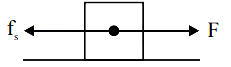
$A$ horizontal force just sufficient to move a body of mass $4 \,kg$ lying on a rough horizontal surface is applied on it. The coefficients of static and kinetic friction are $0.8$ and $0.6$ respectively. If the force continues to act even after the body has started moving, the acceleration of the body is (take $g=10 \,ms^{-2}$). (in $\,ms^{-2}$)
A
$6$
B
$8$
C
$2$
D
$4$
Solution
(C) The force $F$ required to just move the body is equal to the limiting static friction force $f_s$.
$f_s = \mu_s N = \mu_s mg$
Given $\mu_s = 0.8$, $m = 4 \,kg$, and $g = 10 \,ms^{-2}$.
$F = 0.8 \times 4 \times 10 = 32 \,N$.
Once the body starts moving, the kinetic friction force $f_k$ acts on it.
$f_k = \mu_k N = \mu_k mg$
Given $\mu_k = 0.6$.
$f_k = 0.6 \times 4 \times 10 = 24 \,N$.
The net force acting on the body is $F_{net} = F - f_k$.
$F_{net} = 32 - 24 = 8 \,N$.
Using Newton's second law, $F_{net} = ma$.
$8 = 4 \times a$.
$a = 2 \,ms^{-2}$.
$f_s = \mu_s N = \mu_s mg$
Given $\mu_s = 0.8$, $m = 4 \,kg$, and $g = 10 \,ms^{-2}$.
$F = 0.8 \times 4 \times 10 = 32 \,N$.
Once the body starts moving, the kinetic friction force $f_k$ acts on it.
$f_k = \mu_k N = \mu_k mg$
Given $\mu_k = 0.6$.
$f_k = 0.6 \times 4 \times 10 = 24 \,N$.
The net force acting on the body is $F_{net} = F - f_k$.
$F_{net} = 32 - 24 = 8 \,N$.
Using Newton's second law, $F_{net} = ma$.
$8 = 4 \times a$.
$a = 2 \,ms^{-2}$.
0 likesView Solution
8
PhysicsEasyMCQAP EAMCET · 2015
$A$ force $(2 \hat{i} + \hat{j} - \hat{k}) \text{ N}$ acts on a body, which is initially at rest. At the end of $20 \text{ s}$, the velocity of the body is $(4 \hat{i} + 2 \hat{j} - 2 \hat{k}) \text{ ms}^{-1}$. The mass of the body is: (in $\text{ kg}$)
A
$8$
B
$10$
C
$5$
D
$4.5$
Solution
(B) Given force vector $\vec{F} = (2 \hat{i} + \hat{j} - \hat{k}) \text{ N}$.
Initial velocity $\vec{u} = 0 \text{ ms}^{-1}$.
Final velocity $\vec{v} = (4 \hat{i} + 2 \hat{j} - 2 \hat{k}) \text{ ms}^{-1}$.
Time $t = 20 \text{ s}$.
Using Newton's Second Law, $\vec{F} = m \vec{a} = m \left( \frac{\vec{v} - \vec{u}}{t} \right)$.
Rearranging for mass: $m = \frac{\vec{F} \cdot t}{\vec{v} - \vec{u}}$.
Since $\vec{v} - \vec{u} = (4 \hat{i} + 2 \hat{j} - 2 \hat{k}) = 2(2 \hat{i} + \hat{j} - \hat{k}) = 2 \vec{F}$.
Substituting the values: $m = \frac{\vec{F} \cdot 20}{2 \vec{F}} = \frac{20}{2} = 10 \text{ kg}$.
Initial velocity $\vec{u} = 0 \text{ ms}^{-1}$.
Final velocity $\vec{v} = (4 \hat{i} + 2 \hat{j} - 2 \hat{k}) \text{ ms}^{-1}$.
Time $t = 20 \text{ s}$.
Using Newton's Second Law, $\vec{F} = m \vec{a} = m \left( \frac{\vec{v} - \vec{u}}{t} \right)$.
Rearranging for mass: $m = \frac{\vec{F} \cdot t}{\vec{v} - \vec{u}}$.
Since $\vec{v} - \vec{u} = (4 \hat{i} + 2 \hat{j} - 2 \hat{k}) = 2(2 \hat{i} + \hat{j} - \hat{k}) = 2 \vec{F}$.
Substituting the values: $m = \frac{\vec{F} \cdot 20}{2 \vec{F}} = \frac{20}{2} = 10 \text{ kg}$.
0 likesView Solution
9
PhysicsMediumMCQAP EAMCET · 2015
The pressure on a circular plate is measured by measuring the force on the plate and the radius of the plate. If the errors in measurement of the force and the radius are $5 \%$ and $3 \%$ respectively,the percentage of error in the measurement of pressure is (in $\%$)
A
$8$
B
$14$
C
$11$
D
$12$
Solution
(C) The pressure $p$ on a circular plate is given by the formula $p = \frac{F}{A}$,where $F$ is the force and $A$ is the area of the plate. Since the plate is circular,$A = \pi R^2$,where $R$ is the radius.
Therefore,$p = \frac{F}{\pi R^2}$.
Using the rules of propagation of errors,the relative error in $p$ is given by:
$\frac{\Delta p}{p} = \frac{\Delta F}{F} + 2 \frac{\Delta R}{R}$.
To find the percentage error,we multiply by $100$:
$\frac{\Delta p}{p} \times 100 = \left( \frac{\Delta F}{F} \times 100 \right) + 2 \left( \frac{\Delta R}{R} \times 100 \right)$.
Given that the percentage error in force $\frac{\Delta F}{F} \times 100 = 5 \%$ and the percentage error in radius $\frac{\Delta R}{R} \times 100 = 3 \%$,we substitute these values:
$\text{Percentage error in } p = 5 \% + 2(3 \%) = 5 \% + 6 \% = 11 \%$.
Thus,the percentage error in the measurement of pressure is $11 \%$.
Therefore,$p = \frac{F}{\pi R^2}$.
Using the rules of propagation of errors,the relative error in $p$ is given by:
$\frac{\Delta p}{p} = \frac{\Delta F}{F} + 2 \frac{\Delta R}{R}$.
To find the percentage error,we multiply by $100$:
$\frac{\Delta p}{p} \times 100 = \left( \frac{\Delta F}{F} \times 100 \right) + 2 \left( \frac{\Delta R}{R} \times 100 \right)$.
Given that the percentage error in force $\frac{\Delta F}{F} \times 100 = 5 \%$ and the percentage error in radius $\frac{\Delta R}{R} \times 100 = 3 \%$,we substitute these values:
$\text{Percentage error in } p = 5 \% + 2(3 \%) = 5 \% + 6 \% = 11 \%$.
Thus,the percentage error in the measurement of pressure is $11 \%$.
0 likesView Solution
10
PhysicsMediumMCQAP EAMCET · 2015
The average depth of the Indian Ocean is about $3000 \,m$. The value of fractional compression $\left(\frac{\Delta V}{V}\right)$ of water at the bottom of the ocean is (given that the bulk modulus of water is $2.2 \times 10^9 \,N/m^2$,$g = 9.8 \,m/s^2$,$\rho_{H_2O} = 1000 \,kg/m^3$):
A
$3.4 \times 10^{-2}$
B
$1.34 \times 10^{-2}$
C
$4.13 \times 10^{-2}$
D
$13.4 \times 10^{-2}$
Solution
(B) The pressure at depth $h$ is given by $\Delta P = h \rho g$.
Bulk modulus $B$ is defined as $B = \frac{\Delta P}{\Delta V / V}$.
Therefore,the fractional compression is $\frac{\Delta V}{V} = \frac{\Delta P}{B} = \frac{h \rho g}{B}$.
Given: $h = 3000 \,m$,$\rho = 1000 \,kg/m^3$,$g = 9.8 \,m/s^2$,and $B = 2.2 \times 10^9 \,N/m^2$.
Substituting these values:
$\frac{\Delta V}{V} = \frac{3000 \times 1000 \times 9.8}{2.2 \times 10^9} = \frac{2.94 \times 10^7}{2.2 \times 10^9} = 1.336 \times 10^{-2} \approx 1.34 \times 10^{-2}$.
Bulk modulus $B$ is defined as $B = \frac{\Delta P}{\Delta V / V}$.
Therefore,the fractional compression is $\frac{\Delta V}{V} = \frac{\Delta P}{B} = \frac{h \rho g}{B}$.
Given: $h = 3000 \,m$,$\rho = 1000 \,kg/m^3$,$g = 9.8 \,m/s^2$,and $B = 2.2 \times 10^9 \,N/m^2$.
Substituting these values:
$\frac{\Delta V}{V} = \frac{3000 \times 1000 \times 9.8}{2.2 \times 10^9} = \frac{2.94 \times 10^7}{2.2 \times 10^9} = 1.336 \times 10^{-2} \approx 1.34 \times 10^{-2}$.
0 likesView Solution
11
PhysicsEasyMCQAP EAMCET · 2015
The length of a metal wire is $l_1$ when the tension in it is $F_1$ and $l_2$ when the tension is $F_2$. Then,the original length of the wire is
A
$\frac{l_1 F_1+l_2 F_2}{F_1+F_2}$
B
$\frac{l_2-l_1}{F_2-F_1}$
C
$\frac{l_1 F_2-l_2 F_1}{F_2-F_1}$
D
$\frac{l_1 F_1-l_2 F_2}{F_2-F_1}$
Solution
(C) According to Hooke's Law,the extension in a wire is proportional to the applied force: $F = k(l - l_0)$,where $l_0$ is the original length and $k$ is the force constant.
For the first case: $F_1 = k(l_1 - l_0)$ -- $(1)$
For the second case: $F_2 = k(l_2 - l_0)$ -- $(2)$
Dividing $(1)$ by $(2)$,we get: $\frac{F_1}{F_2} = \frac{l_1 - l_0}{l_2 - l_0}$
Cross-multiplying: $F_1(l_2 - l_0) = F_2(l_1 - l_0)$
$F_1 l_2 - F_1 l_0 = F_2 l_1 - F_2 l_0$
$F_2 l_0 - F_1 l_0 = F_2 l_1 - F_1 l_2$
$l_0(F_2 - F_1) = F_2 l_1 - F_1 l_2$
$l_0 = \frac{F_2 l_1 - F_1 l_2}{F_2 - F_1}$
For the first case: $F_1 = k(l_1 - l_0)$ -- $(1)$
For the second case: $F_2 = k(l_2 - l_0)$ -- $(2)$
Dividing $(1)$ by $(2)$,we get: $\frac{F_1}{F_2} = \frac{l_1 - l_0}{l_2 - l_0}$
Cross-multiplying: $F_1(l_2 - l_0) = F_2(l_1 - l_0)$
$F_1 l_2 - F_1 l_0 = F_2 l_1 - F_2 l_0$
$F_2 l_0 - F_1 l_0 = F_2 l_1 - F_1 l_2$
$l_0(F_2 - F_1) = F_2 l_1 - F_1 l_2$
$l_0 = \frac{F_2 l_1 - F_1 l_2}{F_2 - F_1}$
0 likesView Solution
12
PhysicsDifficultMCQAP EAMCET · 2015
$A$ particle aimed at a target,projected with an angle $15^{\circ}$ with the horizontal,is short of the target by $10 \ m$. If projected with an angle of $45^{\circ}$,it is away from the target by $15 \ m$. Then the angle of projection to hit the target is:
A
$\frac{1}{2} \sin ^{-1}\left(\frac{1}{10}\right)$
B
$\frac{1}{2} \sin ^{-1}\left(\frac{3}{10}\right)$
C
$\frac{1}{2} \sin ^{-1}\left(\frac{9}{10}\right)$
D
$\frac{1}{2} \sin ^{-1}\left(\frac{7}{10}\right)$
Solution
(D) The horizontal range $R$ of a projectile is given by $R = \frac{u^2 \sin 2\theta}{g}$.
Let $R$ be the distance to the target.
For $\theta_1 = 15^{\circ}$,the range is $R_1 = R - 10$. So,$R - 10 = \frac{u^2 \sin 30^{\circ}}{g} = \frac{u^2}{2g}$.
For $\theta_2 = 45^{\circ}$,the range is $R_2 = R + 15$. So,$R + 15 = \frac{u^2 \sin 90^{\circ}}{g} = \frac{u^2}{g}$.
Dividing the two equations: $\frac{R - 10}{R + 15} = \frac{u^2/2g}{u^2/g} = \frac{1}{2}$.
$2R - 20 = R + 15 \Rightarrow R = 35 \ m$.
Now,$R + 15 = \frac{u^2}{g} \Rightarrow 35 + 15 = \frac{u^2}{g} \Rightarrow \frac{u^2}{g} = 50 \ m$.
To hit the target,the range must be $R = 35 \ m$. Thus,$35 = 50 \sin 2\theta$.
$\sin 2\theta = \frac{35}{50} = \frac{7}{10}$.
$\theta = \frac{1}{2} \sin^{-1}\left(\frac{7}{10}\right)$.
Let $R$ be the distance to the target.
For $\theta_1 = 15^{\circ}$,the range is $R_1 = R - 10$. So,$R - 10 = \frac{u^2 \sin 30^{\circ}}{g} = \frac{u^2}{2g}$.
For $\theta_2 = 45^{\circ}$,the range is $R_2 = R + 15$. So,$R + 15 = \frac{u^2 \sin 90^{\circ}}{g} = \frac{u^2}{g}$.
Dividing the two equations: $\frac{R - 10}{R + 15} = \frac{u^2/2g}{u^2/g} = \frac{1}{2}$.
$2R - 20 = R + 15 \Rightarrow R = 35 \ m$.
Now,$R + 15 = \frac{u^2}{g} \Rightarrow 35 + 15 = \frac{u^2}{g} \Rightarrow \frac{u^2}{g} = 50 \ m$.
To hit the target,the range must be $R = 35 \ m$. Thus,$35 = 50 \sin 2\theta$.
$\sin 2\theta = \frac{35}{50} = \frac{7}{10}$.
$\theta = \frac{1}{2} \sin^{-1}\left(\frac{7}{10}\right)$.
0 likesView Solution
13
PhysicsMediumMCQAP EAMCET · 2015
$A$ man running at a speed of $5 \text{ km/h}$ finds that the rain falls vertically. When he stops running,he finds that the rain is falling at an angle of $60^{\circ}$ with the horizontal. The velocity of rain with respect to the running man is
A
$\frac{5}{\sqrt{3}} \text{ km/h}$
B
$\frac{5\sqrt{3}}{2} \text{ km/h}$
C
$\frac{4\sqrt{3}}{2} \text{ km/h}$
D
$5\sqrt{3} \text{ km/h}$
Solution
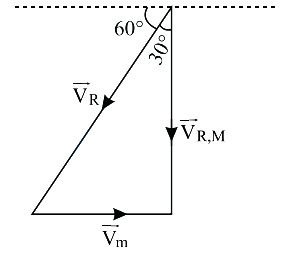
(D) Let $\vec{v}_m$ be the velocity of the man,$\vec{v}_r$ be the velocity of the rain,and $\vec{v}_{rm}$ be the velocity of the rain with respect to the man.
Given,$\vec{v}_{rm} = \vec{v}_r - \vec{v}_m$.
When the man is running,the rain appears to fall vertically,meaning $\vec{v}_{rm}$ is vertical.
When the man stops,the rain falls at $60^{\circ}$ with the horizontal,meaning $\vec{v}_r$ makes an angle of $60^{\circ}$ with the horizontal.
From the vector triangle,the angle between $\vec{v}_r$ and the vertical is $90^{\circ} - 60^{\circ} = 30^{\circ}$.
In the right-angled triangle formed by $\vec{v}_m$,$\vec{v}_r$,and $\vec{v}_{rm}$:
$\tan(30^{\circ}) = \frac{|\vec{v}_m|}{|\vec{v}_{rm}|}$
$\frac{1}{\sqrt{3}} = \frac{5}{|\vec{v}_{rm}|}$
$|\vec{v}_{rm}| = 5\sqrt{3} \text{ km/h}$.
Given,$\vec{v}_{rm} = \vec{v}_r - \vec{v}_m$.
When the man is running,the rain appears to fall vertically,meaning $\vec{v}_{rm}$ is vertical.
When the man stops,the rain falls at $60^{\circ}$ with the horizontal,meaning $\vec{v}_r$ makes an angle of $60^{\circ}$ with the horizontal.
From the vector triangle,the angle between $\vec{v}_r$ and the vertical is $90^{\circ} - 60^{\circ} = 30^{\circ}$.
In the right-angled triangle formed by $\vec{v}_m$,$\vec{v}_r$,and $\vec{v}_{rm}$:
$\tan(30^{\circ}) = \frac{|\vec{v}_m|}{|\vec{v}_{rm}|}$
$\frac{1}{\sqrt{3}} = \frac{5}{|\vec{v}_{rm}|}$
$|\vec{v}_{rm}| = 5\sqrt{3} \text{ km/h}$.
0 likesView Solution
14
PhysicsMediumMCQAP EAMCET · 2015
The amplitude of a simple pendulum is $10 \ cm$. When the pendulum is at a displacement of $4 \ cm$ from the mean position,the ratio of kinetic and potential energies at that point is
A
$5.25$
B
$2.5$
C
$4.5$
D
$7.5$
Solution
(A) The kinetic energy $(KE)$ of a simple harmonic oscillator is given by $KE = \frac{1}{2} m \omega^2 (A^2 - x^2)$.
The potential energy $(PE)$ is given by $PE = \frac{1}{2} m \omega^2 x^2$.
Here,$A = 10 \ cm$ and $x = 4 \ cm$.
The ratio of kinetic energy to potential energy is $\frac{KE}{PE} = \frac{\frac{1}{2} m \omega^2 (A^2 - x^2)}{\frac{1}{2} m \omega^2 x^2} = \frac{A^2 - x^2}{x^2}$.
Substituting the values: $\frac{KE}{PE} = \frac{10^2 - 4^2}{4^2} = \frac{100 - 16}{16} = \frac{84}{16}$.
Calculating the result: $\frac{84}{16} = 5.25$.
The potential energy $(PE)$ is given by $PE = \frac{1}{2} m \omega^2 x^2$.
Here,$A = 10 \ cm$ and $x = 4 \ cm$.
The ratio of kinetic energy to potential energy is $\frac{KE}{PE} = \frac{\frac{1}{2} m \omega^2 (A^2 - x^2)}{\frac{1}{2} m \omega^2 x^2} = \frac{A^2 - x^2}{x^2}$.
Substituting the values: $\frac{KE}{PE} = \frac{10^2 - 4^2}{4^2} = \frac{100 - 16}{16} = \frac{84}{16}$.
Calculating the result: $\frac{84}{16} = 5.25$.
0 likesView Solution
15
PhysicsEasyMCQAP EAMCET · 2015
The ratio of energies of radiation emitted by a black body at $600 \ K$ and $900 \ K$ when the surrounding temperature is $300 \ K$ is: (in $/16$)
A
$5$
B
$7$
C
$3$
D
$9$
Solution
(C) According to the Stefan-Boltzmann law,the net rate of energy emission $E$ by a black body at temperature $T$ in surroundings at temperature $T_S$ is given by $E = \sigma A (T^4 - T_S^4)$.
Given $T_1 = 600 \ K$,$T_2 = 900 \ K$,and $T_S = 300 \ K$.
The ratio of energies is $\frac{E_1}{E_2} = \frac{T_1^4 - T_S^4}{T_2^4 - T_S^4}$.
Substituting the values: $\frac{E_1}{E_2} = \frac{(600)^4 - (300)^4}{(900)^4 - (300)^4}$.
Factoring out $(300)^4$: $\frac{E_1}{E_2} = \frac{(300)^4 [2^4 - 1^4]}{(300)^4 [3^4 - 1^4]}$.
$\frac{E_1}{E_2} = \frac{16 - 1}{81 - 1} = \frac{15}{80} = \frac{3}{16}$.
Given $T_1 = 600 \ K$,$T_2 = 900 \ K$,and $T_S = 300 \ K$.
The ratio of energies is $\frac{E_1}{E_2} = \frac{T_1^4 - T_S^4}{T_2^4 - T_S^4}$.
Substituting the values: $\frac{E_1}{E_2} = \frac{(600)^4 - (300)^4}{(900)^4 - (300)^4}$.
Factoring out $(300)^4$: $\frac{E_1}{E_2} = \frac{(300)^4 [2^4 - 1^4]}{(300)^4 [3^4 - 1^4]}$.
$\frac{E_1}{E_2} = \frac{16 - 1}{81 - 1} = \frac{15}{80} = \frac{3}{16}$.
0 likesView Solution
16
PhysicsEasyMCQAP EAMCET · 2015
The relation between the efficiency $\eta$ of a heat engine and the coefficient of performance $\alpha$ of a refrigerator is:
A
$\eta=\frac{1}{1-\alpha}$
B
$\eta=\frac{1}{1+\alpha}$
C
$\eta = 1 + \alpha$
D
$\eta = 1 - \alpha$
Solution
(B) For a heat engine,efficiency is defined as $\eta = \frac{W}{Q_H} = 1 - \frac{Q_L}{Q_H}$.
For a refrigerator,the coefficient of performance is defined as $\alpha = \frac{Q_L}{W} = \frac{Q_L}{Q_H - Q_L}$.
Taking the reciprocal,$\frac{1}{\alpha} = \frac{Q_H - Q_L}{Q_L} = \frac{Q_H}{Q_L} - 1$.
Thus,$\frac{Q_H}{Q_L} = 1 + \frac{1}{\alpha} = \frac{\alpha + 1}{\alpha}$.
Therefore,$\frac{Q_L}{Q_H} = \frac{\alpha}{1 + \alpha}$.
Substituting this into the efficiency formula: $\eta = 1 - \frac{Q_L}{Q_H} = 1 - \frac{\alpha}{1 + \alpha} = \frac{1 + \alpha - \alpha}{1 + \alpha} = \frac{1}{1 + \alpha}$.
For a refrigerator,the coefficient of performance is defined as $\alpha = \frac{Q_L}{W} = \frac{Q_L}{Q_H - Q_L}$.
Taking the reciprocal,$\frac{1}{\alpha} = \frac{Q_H - Q_L}{Q_L} = \frac{Q_H}{Q_L} - 1$.
Thus,$\frac{Q_H}{Q_L} = 1 + \frac{1}{\alpha} = \frac{\alpha + 1}{\alpha}$.
Therefore,$\frac{Q_L}{Q_H} = \frac{\alpha}{1 + \alpha}$.
Substituting this into the efficiency formula: $\eta = 1 - \frac{Q_L}{Q_H} = 1 - \frac{\alpha}{1 + \alpha} = \frac{1 + \alpha - \alpha}{1 + \alpha} = \frac{1}{1 + \alpha}$.
0 likesView Solution
17
PhysicsMediumMCQAP EAMCET · 2015
$A$ gas does $4.5 \,J$ of external work during adiabatic expansion. If its temperature falls by $2 \,K$, then its internal energy will be
A
increased by $4.5 \,J$
B
decreased by $4.5 \,J$
C
decreased by $2.25 \,J$
D
increased by $9.0 \,J$
Solution
(B) From the first law of thermodynamics, we have the equation $dQ = dU + dW$.
In an adiabatic process, there is no exchange of heat with the surroundings, so $dQ = 0$.
Substituting this into the equation, we get $0 = dU + dW$, which implies $dU = -dW$.
Given that the gas does $4.5 \,J$ of external work, $dW = 4.5 \,J$.
Therefore, $dU = -4.5 \,J$.
Since the change in internal energy $dU$ is negative, the internal energy decreases by $4.5 \,J$.
In an adiabatic process, there is no exchange of heat with the surroundings, so $dQ = 0$.
Substituting this into the equation, we get $0 = dU + dW$, which implies $dU = -dW$.
Given that the gas does $4.5 \,J$ of external work, $dW = 4.5 \,J$.
Therefore, $dU = -4.5 \,J$.
Since the change in internal energy $dU$ is negative, the internal energy decreases by $4.5 \,J$.
0 likesView Solution
18
PhysicsEasyMCQAP EAMCET · 2015
$A$ transverse wave is represented by the equation $y=2 \sin (30 t-40 x)$ where the measurements of distances are in meters,then the velocity of propagation is (in $ms^{-1}$)
A
$15$
B
$0.75$
C
$3.75$
D
$300$
Solution
(B) The given equation of the transverse wave is $y=2 \sin (30 t-40 x)$.
Comparing this with the standard wave equation $y=A \sin (\omega t-k x)$,we get the angular frequency $\omega = 30 \ rad/s$ and the wave number $k = 40 \ m^{-1}$.
The velocity of propagation $v$ is given by the formula $v = \frac{\omega}{k}$.
Substituting the values,we get $v = \frac{30}{40} = 0.75 \ ms^{-1}$.
Comparing this with the standard wave equation $y=A \sin (\omega t-k x)$,we get the angular frequency $\omega = 30 \ rad/s$ and the wave number $k = 40 \ m^{-1}$.
The velocity of propagation $v$ is given by the formula $v = \frac{\omega}{k}$.
Substituting the values,we get $v = \frac{30}{40} = 0.75 \ ms^{-1}$.
0 likesView Solution
19
PhysicsEasyMCQAP EAMCET · 2015
Two closed pipes have the same fundamental frequency. One is filled with oxygen and the other with hydrogen at the same temperature. The ratio of their lengths respectively is
A
$1:4$
B
$4:1$
C
$1:2$
D
$2:1$
Solution
(A) The fundamental frequency of a closed pipe is given by $f = \frac{v}{4l}$,where $v$ is the speed of sound in the gas and $l$ is the length of the pipe.
Since $v = \sqrt{\frac{\gamma RT}{M}}$,we have $f = \frac{1}{4l} \sqrt{\frac{\gamma RT}{M}}$.
Given that the fundamental frequency $f$ and temperature $T$ are the same for both pipes,we have $l \propto \frac{1}{\sqrt{M}}$,where $M$ is the molar mass of the gas.
For oxygen $(O_2)$,$M_1 = 32 \ g/mol$. For hydrogen $(H_2)$,$M_2 = 2 \ g/mol$.
The ratio of their lengths is $\frac{l_1}{l_2} = \sqrt{\frac{M_2}{M_1}} = \sqrt{\frac{2}{32}} = \sqrt{\frac{1}{16}} = \frac{1}{4}$.
Thus,the ratio of their lengths is $1:4$.
Since $v = \sqrt{\frac{\gamma RT}{M}}$,we have $f = \frac{1}{4l} \sqrt{\frac{\gamma RT}{M}}$.
Given that the fundamental frequency $f$ and temperature $T$ are the same for both pipes,we have $l \propto \frac{1}{\sqrt{M}}$,where $M$ is the molar mass of the gas.
For oxygen $(O_2)$,$M_1 = 32 \ g/mol$. For hydrogen $(H_2)$,$M_2 = 2 \ g/mol$.
The ratio of their lengths is $\frac{l_1}{l_2} = \sqrt{\frac{M_2}{M_1}} = \sqrt{\frac{2}{32}} = \sqrt{\frac{1}{16}} = \frac{1}{4}$.
Thus,the ratio of their lengths is $1:4$.
0 likesView Solution
20
PhysicsMediumMCQAP EAMCET · 2015
$A$ man of mass $50 \ kg$ carries an object to a height of $20 \ m$ in a time of $10 \ s$. The power used by the man in this process is $2000 \ W$. Find the mass of the object carried by the man (take $g = 10 \ m/s^2$). (in $kg$)
A
$100$
B
$25$
C
$50$
D
$10$
Solution
(C) The power $P$ is defined as the work done $W$ per unit time $t$,given by $P = \frac{W}{t}$.
Here,the work done is against gravity to lift the man and the object: $W = (m + M)gh$,where $m$ is the mass of the object and $M$ is the mass of the man.
Given: $P = 2000 \ W$,$M = 50 \ kg$,$h = 20 \ m$,$t = 10 \ s$,and $g = 10 \ m/s^2$.
Substituting the values into the power formula: $P = \frac{(m + M)gh}{t}$.
$2000 = \frac{(m + 50) \times 10 \times 20}{10}$.
$2000 = (m + 50) \times 20$.
Dividing both sides by $20$: $100 = m + 50$.
Therefore,$m = 100 - 50 = 50 \ kg$.
Here,the work done is against gravity to lift the man and the object: $W = (m + M)gh$,where $m$ is the mass of the object and $M$ is the mass of the man.
Given: $P = 2000 \ W$,$M = 50 \ kg$,$h = 20 \ m$,$t = 10 \ s$,and $g = 10 \ m/s^2$.
Substituting the values into the power formula: $P = \frac{(m + M)gh}{t}$.
$2000 = \frac{(m + 50) \times 10 \times 20}{10}$.
$2000 = (m + 50) \times 20$.
Dividing both sides by $20$: $100 = m + 50$.
Therefore,$m = 100 - 50 = 50 \ kg$.
0 likesView Solution
21
PhysicsEasyMCQAP EAMCET · 2015
In an $AC$ circuit,$V$ and $I$ are given below. Find the power dissipated in the circuit:
$V = 50 \sin(50t) \ V$
$I = 50 \sin(50t + \frac{\pi}{3}) \ mA$ (in $W$)
$V = 50 \sin(50t) \ V$
$I = 50 \sin(50t + \frac{\pi}{3}) \ mA$ (in $W$)
A
$0.625$
B
$1.25$
C
$2.50$
D
$5.0$
Solution
(A) The power dissipated in an $AC$ circuit is given by the formula:
$P = V_{rms} I_{rms} \cos \phi$
Given:
$V_0 = 50 \ V$
$I_0 = 50 \ mA = 50 \times 10^{-3} \ A$
Phase difference $\phi = \frac{\pi}{3}$
The $RMS$ values are $V_{rms} = \frac{V_0}{\sqrt{2}}$ and $I_{rms} = \frac{I_0}{\sqrt{2}}$.
Substituting these into the power formula:
$P = \frac{V_0}{\sqrt{2}} \times \frac{I_0}{\sqrt{2}} \times \cos \phi = \frac{V_0 I_0}{2} \cos \phi$
$P = \frac{50 \times 50 \times 10^{-3}}{2} \times \cos(\frac{\pi}{3})$
Since $\cos(\frac{\pi}{3}) = 0.5$:
$P = \frac{2500 \times 10^{-3}}{2} \times 0.5 = 1.25 \times 0.5 = 0.625 \ W$
$P = V_{rms} I_{rms} \cos \phi$
Given:
$V_0 = 50 \ V$
$I_0 = 50 \ mA = 50 \times 10^{-3} \ A$
Phase difference $\phi = \frac{\pi}{3}$
The $RMS$ values are $V_{rms} = \frac{V_0}{\sqrt{2}}$ and $I_{rms} = \frac{I_0}{\sqrt{2}}$.
Substituting these into the power formula:
$P = \frac{V_0}{\sqrt{2}} \times \frac{I_0}{\sqrt{2}} \times \cos \phi = \frac{V_0 I_0}{2} \cos \phi$
$P = \frac{50 \times 50 \times 10^{-3}}{2} \times \cos(\frac{\pi}{3})$
Since $\cos(\frac{\pi}{3}) = 0.5$:
$P = \frac{2500 \times 10^{-3}}{2} \times 0.5 = 1.25 \times 0.5 = 0.625 \ W$
0 likesView Solution
22
PhysicsDifficultMCQAP EAMCET · 2015
The ratio of longest wavelength lines in the Balmer and Paschen series of hydrogen spectrum is
A
$\frac{5}{36}$
B
$\frac{7}{20}$
C
$\frac{7}{144}$
D
$\frac{5}{27}$
Solution
(B) The Rydberg formula for the wavelength $\lambda$ of a spectral line is given by $\frac{1}{\lambda} = R \left( \frac{1}{n_1^2} - \frac{1}{n_2^2} \right)$.
For the longest wavelength line,the transition occurs between adjacent energy levels,i.e.,$n_2 = n_1 + 1$.
For the Balmer series,$n_1 = 2$,so $n_2 = 3$. The longest wavelength $\lambda_{BL}$ is:
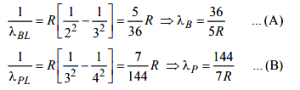
$\frac{1}{\lambda_{BL}} = R \left( \frac{1}{2^2} - \frac{1}{3^2} \right) = R \left( \frac{1}{4} - \frac{1}{9} \right) = R \left( \frac{5}{36} \right) \implies \lambda_{BL} = \frac{36}{5R} \quad ... (A)$
For the Paschen series,$n_1 = 3$,so $n_2 = 4$. The longest wavelength $\lambda_{PL}$ is:
$\frac{1}{\lambda_{PL}} = R \left( \frac{1}{3^2} - \frac{1}{4^2} \right) = R \left( \frac{1}{9} - \frac{1}{16} \right) = R \left( \frac{7}{144} \right) \implies \lambda_{PL} = \frac{144}{7R} \quad ... (B)$
Taking the ratio of the longest wavelengths:
$\frac{\lambda_{BL}}{\lambda_{PL}} = \frac{36}{5R} \times \frac{7R}{144} = \frac{36 \times 7}{5 \times 144} = \frac{7}{5 \times 4} = \frac{7}{20}$.
For the longest wavelength line,the transition occurs between adjacent energy levels,i.e.,$n_2 = n_1 + 1$.
For the Balmer series,$n_1 = 2$,so $n_2 = 3$. The longest wavelength $\lambda_{BL}$ is:
$\frac{1}{\lambda_{BL}} = R \left( \frac{1}{2^2} - \frac{1}{3^2} \right) = R \left( \frac{1}{4} - \frac{1}{9} \right) = R \left( \frac{5}{36} \right) \implies \lambda_{BL} = \frac{36}{5R} \quad ... (A)$
For the Paschen series,$n_1 = 3$,so $n_2 = 4$. The longest wavelength $\lambda_{PL}$ is:
$\frac{1}{\lambda_{PL}} = R \left( \frac{1}{3^2} - \frac{1}{4^2} \right) = R \left( \frac{1}{9} - \frac{1}{16} \right) = R \left( \frac{7}{144} \right) \implies \lambda_{PL} = \frac{144}{7R} \quad ... (B)$
Taking the ratio of the longest wavelengths:
$\frac{\lambda_{BL}}{\lambda_{PL}} = \frac{36}{5R} \times \frac{7R}{144} = \frac{36 \times 7}{5 \times 144} = \frac{7}{5 \times 4} = \frac{7}{20}$.
0 likesView Solution
23
PhysicsDifficultMCQAP EAMCET · 2015
The energy of a parallel plate capacitor when connected to a battery is $E$. With the battery still in connection,if the plates of the capacitor are separated so that the distance between them is twice the original distance,then the electrostatic energy becomes
A
$2\ E$
B
$\frac{E}{4}$
C
$\frac{E}{2}$
D
$4\ E$
Solution
(C) The energy stored in a capacitor is given by $E = \frac{1}{2} C V^2$.
Since the battery remains connected,the potential difference $V$ across the plates remains constant.
The capacitance of a parallel plate capacitor is $C = \frac{A \epsilon_0}{d}$,which implies $C \propto \frac{1}{d}$.
If the distance $d$ is doubled $(d' = 2d)$,the new capacitance $C'$ becomes $C' = \frac{C}{2}$.
The new energy $E'$ is given by $E' = \frac{1}{2} C' V^2$.
Substituting $C' = \frac{C}{2}$,we get $E' = \frac{1}{2} (\frac{C}{2}) V^2 = \frac{1}{2} (\frac{1}{2} C V^2) = \frac{E}{2}$.
Since the battery remains connected,the potential difference $V$ across the plates remains constant.
The capacitance of a parallel plate capacitor is $C = \frac{A \epsilon_0}{d}$,which implies $C \propto \frac{1}{d}$.
If the distance $d$ is doubled $(d' = 2d)$,the new capacitance $C'$ becomes $C' = \frac{C}{2}$.
The new energy $E'$ is given by $E' = \frac{1}{2} C' V^2$.
Substituting $C' = \frac{C}{2}$,we get $E' = \frac{1}{2} (\frac{C}{2}) V^2 = \frac{1}{2} (\frac{1}{2} C V^2) = \frac{E}{2}$.
0 likesView Solution
24
PhysicsEasyMCQAP EAMCET · 2015
The maximum amplitude of an amplitude modulated wave is $16 \,V$, while the minimum amplitude is $4 \,V$. The modulation index is
A
$0.4$
B
$0.5$
C
$0.6$
D
$4$
Solution
(C) The modulation index $m$ is defined as the ratio of the difference and the sum of the maximum and minimum amplitudes of the modulated wave.
Formula: $m = \frac{E_{\max} - E_{\min}}{E_{\max} + E_{\min}}$
Given: $E_{\max} = 16 \,V$ and $E_{\min} = 4 \,V$
Substituting the values into the formula:
$m = \frac{16 - 4}{16 + 4}$
$m = \frac{12}{20}$
$m = \frac{3}{5} = 0.6$
Therefore, the modulation index is $0.6$.
Formula: $m = \frac{E_{\max} - E_{\min}}{E_{\max} + E_{\min}}$
Given: $E_{\max} = 16 \,V$ and $E_{\min} = 4 \,V$
Substituting the values into the formula:
$m = \frac{16 - 4}{16 + 4}$
$m = \frac{12}{20}$
$m = \frac{3}{5} = 0.6$
Therefore, the modulation index is $0.6$.
0 likesView Solution
25
PhysicsMediumMCQAP EAMCET · 2015
$A$ constant potential difference is applied between the ends of a wire. If the length of the wire is elongated to $4$ times its original length,then the drift velocity of electrons will be:
A
increases $4$ times
B
decreases $4$ times
C
increases $2$ times
D
decreases $2$ times
Solution
(B) The drift velocity $v_d$ is given by the formula $v_d = \frac{eE\tau}{m}$,where $E = \frac{V}{l}$.
Substituting $E$,we get $v_d = \frac{eV\tau}{ml}$.
Since the potential difference $V$ is constant,$v_d \propto \frac{1}{l}$.
If the length $l$ is increased to $4l$,the new drift velocity $v_{d'}$ becomes $v_{d'} = \frac{eV\tau}{m(4l)} = \frac{v_d}{4}$.
Therefore,the drift velocity decreases by $4$ times.
Substituting $E$,we get $v_d = \frac{eV\tau}{ml}$.
Since the potential difference $V$ is constant,$v_d \propto \frac{1}{l}$.
If the length $l$ is increased to $4l$,the new drift velocity $v_{d'}$ becomes $v_{d'} = \frac{eV\tau}{m(4l)} = \frac{v_d}{4}$.
Therefore,the drift velocity decreases by $4$ times.
0 likesView Solution
26
PhysicsDifficultMCQAP EAMCET · 2015
In a meter bridge,the gaps are enclosed by resistances of $2 \ \Omega$ and $3 \ \Omega$. The value of shunt to be added to the $3 \ \Omega$ resistor to shift the balancing point by $22.5 \ cm$ is (in $Omega$)
A
$1$
B
$2$
C
$2.5$
D
$5$
Solution
(B) Let the initial resistances be $R_1 = 2 \ \Omega$ and $R_2 = 3 \ \Omega$. Let the initial balancing length be $l_1$.
Using the meter bridge principle: $\frac{R_1}{R_2} = \frac{l_1}{100 - l_1} \Rightarrow \frac{2}{3} = \frac{l_1}{100 - l_1} \Rightarrow 200 - 2l_1 = 3l_1 \Rightarrow 5l_1 = 200 \Rightarrow l_1 = 40 \ cm$.
When a shunt $S$ is added in parallel to $3 \ \Omega$,the new resistance $R_2'$ becomes $\frac{3S}{3+S}$.
The new balancing length $l_2$ is shifted by $22.5 \ cm$. Since $R_2$ decreases,the balancing point shifts towards the $3 \ \Omega$ side,so $l_2 = 40 + 22.5 = 62.5 \ cm$.
Using the new balance condition: $\frac{R_1}{R_2'} = \frac{l_2}{100 - l_2} \Rightarrow \frac{2}{\frac{3S}{3+S}} = \frac{62.5}{100 - 62.5} = \frac{62.5}{37.5} = \frac{5}{3}$.
$\frac{2(3+S)}{3S} = \frac{5}{3} \Rightarrow \frac{6+2S}{S} = 5 \Rightarrow 6 + 2S = 5S \Rightarrow 3S = 6 \Rightarrow S = 2 \ \Omega$.
Using the meter bridge principle: $\frac{R_1}{R_2} = \frac{l_1}{100 - l_1} \Rightarrow \frac{2}{3} = \frac{l_1}{100 - l_1} \Rightarrow 200 - 2l_1 = 3l_1 \Rightarrow 5l_1 = 200 \Rightarrow l_1 = 40 \ cm$.
When a shunt $S$ is added in parallel to $3 \ \Omega$,the new resistance $R_2'$ becomes $\frac{3S}{3+S}$.
The new balancing length $l_2$ is shifted by $22.5 \ cm$. Since $R_2$ decreases,the balancing point shifts towards the $3 \ \Omega$ side,so $l_2 = 40 + 22.5 = 62.5 \ cm$.
Using the new balance condition: $\frac{R_1}{R_2'} = \frac{l_2}{100 - l_2} \Rightarrow \frac{2}{\frac{3S}{3+S}} = \frac{62.5}{100 - 62.5} = \frac{62.5}{37.5} = \frac{5}{3}$.
$\frac{2(3+S)}{3S} = \frac{5}{3} \Rightarrow \frac{6+2S}{S} = 5 \Rightarrow 6 + 2S = 5S \Rightarrow 3S = 6 \Rightarrow S = 2 \ \Omega$.
0 likesView Solution
27
PhysicsEasyMCQAP EAMCET · 2015
The ratio of the de-Broglie wavelengths for the electron and proton moving with the same velocity is ($m_p$ = mass of proton,$m_e$ = mass of electron).
A
$m_p : m_e$
B
$m_p^2 : m_e^2$
C
$m_e : m_p$
D
$m_e^2 : m_p^2$
Solution
(A) The de-Broglie wavelength $\lambda$ is given by the formula $\lambda = \frac{h}{mv}$,where $h$ is Planck's constant,$m$ is the mass,and $v$ is the velocity of the particle.
Since both the electron and the proton are moving with the same velocity $v$,the wavelength is inversely proportional to the mass of the particle: $\lambda \propto \frac{1}{m}$.
Therefore,the ratio of the de-Broglie wavelength of the electron $(\lambda_e)$ to that of the proton $(\lambda_p)$ is given by $\frac{\lambda_e}{\lambda_p} = \frac{m_p}{m_e}$.
Thus,the ratio is $m_p : m_e$.
Since both the electron and the proton are moving with the same velocity $v$,the wavelength is inversely proportional to the mass of the particle: $\lambda \propto \frac{1}{m}$.
Therefore,the ratio of the de-Broglie wavelength of the electron $(\lambda_e)$ to that of the proton $(\lambda_p)$ is given by $\frac{\lambda_e}{\lambda_p} = \frac{m_p}{m_e}$.
Thus,the ratio is $m_p : m_e$.
0 likesView Solution
28
PhysicsDifficultMCQAP EAMCET · 2015
Light with an energy flux of $9 \ Wcm^{-2}$ falls on a non-reflecting surface at normal incidence. If the surface has an area of $20 \ cm^2$, the total momentum delivered for complete absorption in one hour is:
A
$2.16 \times 10^{-4} \ kgms^{-1}$
B
$1.16 \times 10^{-3} \ kgms^{-1}$
C
$2.16 \times 10^{-3} \ kgms^{-1}$
D
$3.16 \times 10^{-4} \ kgms^{-1}$
Solution
(C) The energy flux $I = 9 \ Wcm^{-2} = 9 \times 10^4 \ Wm^{-2}$.
The area $A = 20 \ cm^2 = 20 \times 10^{-4} \ m^2$.
The time $t = 1 \ hour = 3600 \ s$.
The speed of light $c = 3 \times 10^8 \ ms^{-1}$.
For a non-reflecting surface, the momentum $p$ delivered by radiation is given by $p = \frac{U}{c} = \frac{IAt}{c}$.
Substituting the values:
$p = \frac{(9 \times 10^4) \times (20 \times 10^{-4}) \times 3600}{3 \times 10^8}$.
$p = \frac{180 \times 3600}{3 \times 10^8} = \frac{648000}{3 \times 10^8} = 216000 \times 10^{-8} \ kgms^{-1}$.
$p = 2.16 \times 10^{-3} \ kgms^{-1}$.
The area $A = 20 \ cm^2 = 20 \times 10^{-4} \ m^2$.
The time $t = 1 \ hour = 3600 \ s$.
The speed of light $c = 3 \times 10^8 \ ms^{-1}$.
For a non-reflecting surface, the momentum $p$ delivered by radiation is given by $p = \frac{U}{c} = \frac{IAt}{c}$.
Substituting the values:
$p = \frac{(9 \times 10^4) \times (20 \times 10^{-4}) \times 3600}{3 \times 10^8}$.
$p = \frac{180 \times 3600}{3 \times 10^8} = \frac{648000}{3 \times 10^8} = 216000 \times 10^{-8} \ kgms^{-1}$.
$p = 2.16 \times 10^{-3} \ kgms^{-1}$.
0 likesView Solution
29
PhysicsEasyMCQAP EAMCET · 2015
The magnitude of the induced emf in a coil of inductance $30 \ mH$ in which the current changes from $6 \ A$ to $2 \ A$ in $2 \ s$ is: (in $V$)
A
$0.06$
B
$0.6$
C
$1.06$
D
$6$
Solution
(A) The formula for induced emf $(e)$ in an inductor is given by $e = -L \frac{di}{dt}$.
Given:
Inductance $L = 30 \ mH = 30 \times 10^{-3} \ H$.
Initial current $i_1 = 6 \ A$.
Final current $i_2 = 2 \ A$.
Time interval $dt = 2 \ s$.
Change in current $di = i_2 - i_1 = 2 \ A - 6 \ A = -4 \ A$.
Substituting the values:
$e = - (30 \times 10^{-3} \ H) \times \left( \frac{-4 \ A}{2 \ s} \right)$.
$e = - (30 \times 10^{-3}) \times (-2) = 60 \times 10^{-3} \ V = 0.06 \ V$.
The magnitude of the induced emf is $0.06 \ V$.
Given:
Inductance $L = 30 \ mH = 30 \times 10^{-3} \ H$.
Initial current $i_1 = 6 \ A$.
Final current $i_2 = 2 \ A$.
Time interval $dt = 2 \ s$.
Change in current $di = i_2 - i_1 = 2 \ A - 6 \ A = -4 \ A$.
Substituting the values:
$e = - (30 \times 10^{-3} \ H) \times \left( \frac{-4 \ A}{2 \ s} \right)$.
$e = - (30 \times 10^{-3}) \times (-2) = 60 \times 10^{-3} \ V = 0.06 \ V$.
The magnitude of the induced emf is $0.06 \ V$.
0 likesView Solution
30
PhysicsEasyMCQAP EAMCET · 2015
If the dielectric constant of a substance is $K = \frac{4}{3}$,then the electric susceptibility $\chi_{e}$ is
A
$\frac{\varepsilon_0}{3}$
B
$3 \varepsilon_0$
C
$\frac{4}{3} \varepsilon_0$
D
$\frac{3}{4} \varepsilon_0$
Solution
(A) The relationship between the dielectric constant $K$ and the electric susceptibility $\chi_{e}$ is given by the formula:
$K = 1 + \frac{\chi_{e}}{\varepsilon_0}$
Given that $K = \frac{4}{3}$,we substitute this value into the equation:
$\frac{4}{3} = 1 + \frac{\chi_{e}}{\varepsilon_0}$
Subtracting $1$ from both sides:
$\frac{\chi_{e}}{\varepsilon_0} = \frac{4}{3} - 1$
$\frac{\chi_{e}}{\varepsilon_0} = \frac{1}{3}$
Therefore,the electric susceptibility is:
$\chi_{e} = \frac{\varepsilon_0}{3}$
$K = 1 + \frac{\chi_{e}}{\varepsilon_0}$
Given that $K = \frac{4}{3}$,we substitute this value into the equation:
$\frac{4}{3} = 1 + \frac{\chi_{e}}{\varepsilon_0}$
Subtracting $1$ from both sides:
$\frac{\chi_{e}}{\varepsilon_0} = \frac{4}{3} - 1$
$\frac{\chi_{e}}{\varepsilon_0} = \frac{1}{3}$
Therefore,the electric susceptibility is:
$\chi_{e} = \frac{\varepsilon_0}{3}$
0 likesView Solution
31
PhysicsMediumMCQAP EAMCET · 2015
Two point charges $+8 \mu C$ and $+12 \mu C$ repel each other with a force of $48 \ N$. When an additional charge of $-10 \mu C$ is given to each of these charges (the distance between the charges is unaltered),then the new force is:
A
repulsive force of $24 \ N$
B
attractive force of $24 \ N$
C
repulsive force of $12 \ N$
D
attractive force of $2 \ N$
Solution
(D) According to Coulomb's Law,the force between two point charges is given by $F = k \frac{|q_1 q_2|}{r^2}$.
Initially,$q_1 = +8 \mu C$ and $q_2 = +12 \mu C$,and the force $F_1 = 48 \ N$.
When an additional charge of $-10 \mu C$ is added to each,the new charges are:
$q_1' = 8 \mu C - 10 \mu C = -2 \mu C$
$q_2' = 12 \mu C - 10 \mu C = +2 \mu C$
Since the distance $r$ remains unchanged,the ratio of the forces is:
$\frac{F_2}{F_1} = \frac{|q_1' q_2'|}{|q_1 q_2|} = \frac{|(-2) \times 2|}{|8 \times 12|} = \frac{4}{96} = \frac{1}{24}$
Therefore,$F_2 = \frac{F_1}{24} = \frac{48 \ N}{24} = 2 \ N$.
Since the charges have opposite signs (one is negative and one is positive),the force is attractive.
Initially,$q_1 = +8 \mu C$ and $q_2 = +12 \mu C$,and the force $F_1 = 48 \ N$.
When an additional charge of $-10 \mu C$ is added to each,the new charges are:
$q_1' = 8 \mu C - 10 \mu C = -2 \mu C$
$q_2' = 12 \mu C - 10 \mu C = +2 \mu C$
Since the distance $r$ remains unchanged,the ratio of the forces is:
$\frac{F_2}{F_1} = \frac{|q_1' q_2'|}{|q_1 q_2|} = \frac{|(-2) \times 2|}{|8 \times 12|} = \frac{4}{96} = \frac{1}{24}$
Therefore,$F_2 = \frac{F_1}{24} = \frac{48 \ N}{24} = 2 \ N$.
Since the charges have opposite signs (one is negative and one is positive),the force is attractive.
0 likesView Solution
32
PhysicsEasyMCQAP EAMCET · 2015
In a region of uniform electric field of intensity $E$,an electron of mass $m_e$ is released from rest. The distance travelled by the electron in a time $t$ is
A
$\frac{2 m_e t^2}{e}$
B
$\frac{e E t^2}{2 m_e}$
C
$\frac{m_e g t^2}{e E}$
D
$\frac{2 E t^2}{e m_e}$
Solution
(B) The force experienced by an electron of charge $e$ in an electric field $E$ is given by $F = eE$.
According to Newton's second law,the acceleration $a$ of the electron is $a = \frac{F}{m_e} = \frac{eE}{m_e}$.
Since the electron is released from rest,its initial velocity $u = 0$.
Using the kinematic equation for distance $S$ travelled in time $t$:
$S = ut + \frac{1}{2}at^2$
$S = 0 \cdot t + \frac{1}{2} \left( \frac{eE}{m_e} \right) t^2$
$S = \frac{eEt^2}{2m_e}$.
According to Newton's second law,the acceleration $a$ of the electron is $a = \frac{F}{m_e} = \frac{eE}{m_e}$.
Since the electron is released from rest,its initial velocity $u = 0$.
Using the kinematic equation for distance $S$ travelled in time $t$:
$S = ut + \frac{1}{2}at^2$
$S = 0 \cdot t + \frac{1}{2} \left( \frac{eE}{m_e} \right) t^2$
$S = \frac{eEt^2}{2m_e}$.
0 likesView Solution
33
PhysicsEasyMCQAP EAMCET · 2015
Two long straight parallel conductors $10 \text{ cm}$ apart,carry equal currents of magnitude $3 \text{ A}$ in the same direction. Then,the magnetic induction at a point midway between them is
A
$2 \times 10^{-5} \text{ T}$
B
$3 \times 10^{-5} \text{ T}$
C
zero
D
$4 \times 10^{-5} \text{ T}$
Solution
(C) The magnetic field $B$ at a distance $r$ from a long straight current-carrying conductor is given by $B = \frac{\mu_0 I}{2 \pi r}$.
Let the two conductors be placed at a distance $d = 10 \text{ cm} = 0.1 \text{ m}$.
At the midpoint,the distance from each conductor is $r = \frac{d}{2} = 0.05 \text{ m}$.
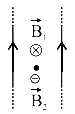
For the first conductor,the magnetic field $B_1$ at the midpoint is directed into the plane (using the right-hand thumb rule).
For the second conductor,the magnetic field $B_2$ at the midpoint is directed out of the plane.
Since the currents are equal $(I_1 = I_2 = 3 \text{ A})$ and the distances are equal,the magnitudes of the magnetic fields are equal: $B_1 = B_2 = \frac{\mu_0 I}{2 \pi r}$.
Since the fields are equal in magnitude and opposite in direction,the net magnetic field $B_{net} = B_1 - B_2 = 0$.
Let the two conductors be placed at a distance $d = 10 \text{ cm} = 0.1 \text{ m}$.
At the midpoint,the distance from each conductor is $r = \frac{d}{2} = 0.05 \text{ m}$.
For the first conductor,the magnetic field $B_1$ at the midpoint is directed into the plane (using the right-hand thumb rule).
For the second conductor,the magnetic field $B_2$ at the midpoint is directed out of the plane.
Since the currents are equal $(I_1 = I_2 = 3 \text{ A})$ and the distances are equal,the magnitudes of the magnetic fields are equal: $B_1 = B_2 = \frac{\mu_0 I}{2 \pi r}$.
Since the fields are equal in magnitude and opposite in direction,the net magnetic field $B_{net} = B_1 - B_2 = 0$.
0 likesView Solution
34
PhysicsMediumMCQAP EAMCET · 2015
In a crossed field, the magnetic field induction is $2.0 \,T$ and electric field intensity is $20 \times 10^3 \,V/m$. At which velocity will the electron travel in a straight line without being deflected by the electric and magnetic fields?
A
$1.25 \times 10^3 \,m/s$
B
$10 \times 10^3 \,m/s$
C
$20 \times 10^3 \,m/s$
D
$40 \times 10^3 \,m/s$
Solution
(B) For an electron to travel in a straight line in a crossed field (where electric and magnetic fields are perpendicular), the net Lorentz force must be zero.
$F_{net} = F_e + F_m = 0$
$eE = evB$
Where $e$ is the electronic charge, $E$ is the electric field intensity, $v$ is the velocity, and $B$ is the magnetic field induction.
$v = \frac{E}{B}$
Given $E = 20 \times 10^3 \,V/m$ and $B = 2.0 \,T$.
$v = \frac{20 \times 10^3}{2.0} = 10 \times 10^3 \,m/s$.
$F_{net} = F_e + F_m = 0$
$eE = evB$
Where $e$ is the electronic charge, $E$ is the electric field intensity, $v$ is the velocity, and $B$ is the magnetic field induction.
$v = \frac{E}{B}$
Given $E = 20 \times 10^3 \,V/m$ and $B = 2.0 \,T$.
$v = \frac{20 \times 10^3}{2.0} = 10 \times 10^3 \,m/s$.
0 likesView Solution
35
PhysicsMediumMCQAP EAMCET · 2015
$A$ material of $0.25 \ cm^2$ cross-sectional area is placed in a magnetic field of strength $(H) 1000 \ Am^{-1}$. Then,the magnetic flux produced is (Susceptibility of material is $313$) (Permeability of free space,$\mu_0 = 4 \pi \times 10^{-7} \ Hm^{-1}$)
A
$8.33 \times 10^{-8} \ Wb$
B
$1.84 \times 10^{-6} \ Wb$
C
$9.87 \times 10^{-6} \ Wb$
D
$3.16 \times 10^{-6} \ Wb$
Solution
(C) The magnetic flux $\phi$ is given by the formula $\phi = B \cdot A$.
Since $B = \mu H$ and $\mu = \mu_0(1 + \chi_m)$,we have $\phi = \mu_0(1 + \chi_m) H A$.
Given:
Area $A = 0.25 \ cm^2 = 0.25 \times 10^{-4} \ m^2$.
Magnetic field strength $H = 1000 \ Am^{-1}$.
Susceptibility $\chi_m = 313$.
Permeability of free space $\mu_0 = 4 \pi \times 10^{-7} \ Hm^{-1}$.
Substituting the values:
$\phi = (4 \pi \times 10^{-7}) \times (1 + 313) \times 1000 \times (0.25 \times 10^{-4})$
$\phi = (4 \pi \times 10^{-7}) \times 314 \times 10^3 \times 0.25 \times 10^{-4}$
$\phi = 4 \pi \times 314 \times 0.25 \times 10^{-8}$
$\phi = 314 \pi \times 10^{-8} \approx 986.45 \times 10^{-8} \approx 9.87 \times 10^{-6} \ Wb$.
Since $B = \mu H$ and $\mu = \mu_0(1 + \chi_m)$,we have $\phi = \mu_0(1 + \chi_m) H A$.
Given:
Area $A = 0.25 \ cm^2 = 0.25 \times 10^{-4} \ m^2$.
Magnetic field strength $H = 1000 \ Am^{-1}$.
Susceptibility $\chi_m = 313$.
Permeability of free space $\mu_0 = 4 \pi \times 10^{-7} \ Hm^{-1}$.
Substituting the values:
$\phi = (4 \pi \times 10^{-7}) \times (1 + 313) \times 1000 \times (0.25 \times 10^{-4})$
$\phi = (4 \pi \times 10^{-7}) \times 314 \times 10^3 \times 0.25 \times 10^{-4}$
$\phi = 4 \pi \times 314 \times 0.25 \times 10^{-8}$
$\phi = 314 \pi \times 10^{-8} \approx 986.45 \times 10^{-8} \approx 9.87 \times 10^{-6} \ Wb$.
0 likesView Solution
36
PhysicsEasyMCQAP EAMCET · 2015
In the following nuclear reaction,$x$ stands for: $n \rightarrow p + e^{-} + x$
A
$\alpha$-particle
B
positron
C
neutrino
D
antineutrino
Solution
(D) The given reaction is $n \rightarrow p + e^{-} + \bar{\nu}$.
This represents the $\beta^{-}$ decay process,where a neutron transforms into a proton,an electron,and an antineutrino.
In $\beta^{-}$ decay,the conservation of lepton number requires the emission of an antineutrino $(\bar{\nu})$ to balance the electron (lepton number $+1$) produced in the reaction.
Therefore,$x$ stands for antineutrino.
This represents the $\beta^{-}$ decay process,where a neutron transforms into a proton,an electron,and an antineutrino.
In $\beta^{-}$ decay,the conservation of lepton number requires the emission of an antineutrino $(\bar{\nu})$ to balance the electron (lepton number $+1$) produced in the reaction.
Therefore,$x$ stands for antineutrino.
0 likesView Solution
37
PhysicsDifficultMCQAP EAMCET · 2015
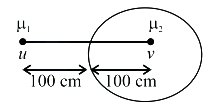
An image is formed at a distance of $100 \ cm$ from the glass surface when light from a point source in air falls on a spherical glass surface with a refractive index of $1.5$. The distance of the light source from the glass surface is $100 \ cm$. The radius of curvature is (in $cm$)
A
$20$
B
$40$
C
$30$
D
$50$
Solution
(A) The refraction formula at a spherical surface is given by:
$\frac{\mu_2}{v} - \frac{\mu_1}{u} = \frac{\mu_2 - \mu_1}{R}$
Given values:
$\mu_1 = 1$ (air),$\mu_2 = 1.5$ (glass)
$u = -100 \ cm$ (distance of object from the surface,taken as negative by sign convention)
$v = +100 \ cm$ (distance of image from the surface,taken as positive as it is formed inside the glass)
Substituting these values into the formula:
$\frac{1.5}{100} - \frac{1}{-100} = \frac{1.5 - 1}{R}$
$\frac{1.5}{100} + \frac{1}{100} = \frac{0.5}{R}$
$\frac{2.5}{100} = \frac{0.5}{R}$
$R = \frac{0.5 \times 100}{2.5} = \frac{50}{2.5} = 20 \ cm$
Thus,the radius of curvature is $20 \ cm$.
$\frac{\mu_2}{v} - \frac{\mu_1}{u} = \frac{\mu_2 - \mu_1}{R}$
Given values:
$\mu_1 = 1$ (air),$\mu_2 = 1.5$ (glass)
$u = -100 \ cm$ (distance of object from the surface,taken as negative by sign convention)
$v = +100 \ cm$ (distance of image from the surface,taken as positive as it is formed inside the glass)
Substituting these values into the formula:
$\frac{1.5}{100} - \frac{1}{-100} = \frac{1.5 - 1}{R}$
$\frac{1.5}{100} + \frac{1}{100} = \frac{0.5}{R}$
$\frac{2.5}{100} = \frac{0.5}{R}$
$R = \frac{0.5 \times 100}{2.5} = \frac{50}{2.5} = 20 \ cm$
Thus,the radius of curvature is $20 \ cm$.
0 likesView Solution
38
PhysicsMediumMCQAP EAMCET · 2015
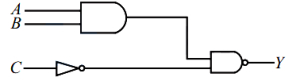
In the following circuit,the output $Y$ becomes zero for which of the following input combinations?
A
$A=1, B=0, C=0$
B
$A=0, B=1, C=1$
C
$A=0, B=0, C=0$
D
$A=1, B=1, C=0$
Solution
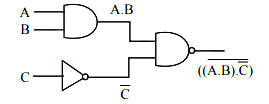
(D) The circuit consists of an $AND$ gate followed by a $NAND$ gate. The inputs to the $AND$ gate are $A$ and $B$,so its output is $A \cdot B$.
The input $C$ passes through a $NOT$ gate,so its output is $\bar{C}$.
These two signals are the inputs to the $NAND$ gate,which produces the final output $Y$.
Thus,$Y = \overline{(A \cdot B) \cdot \bar{C}}$.
Using De Morgan's law,$Y = \overline{A \cdot B} + \overline{\bar{C}} = \bar{A} + \bar{B} + C$.
For the output $Y$ to be zero $(Y=0)$,we must have $\bar{A} + \bar{B} + C = 0$.
This requires $\bar{A} = 0$,$\bar{B} = 0$,and $C = 0$ simultaneously.
Therefore,$A = 1$,$B = 1$,and $C = 0$.
The input $C$ passes through a $NOT$ gate,so its output is $\bar{C}$.
These two signals are the inputs to the $NAND$ gate,which produces the final output $Y$.
Thus,$Y = \overline{(A \cdot B) \cdot \bar{C}}$.
Using De Morgan's law,$Y = \overline{A \cdot B} + \overline{\bar{C}} = \bar{A} + \bar{B} + C$.
For the output $Y$ to be zero $(Y=0)$,we must have $\bar{A} + \bar{B} + C = 0$.
This requires $\bar{A} = 0$,$\bar{B} = 0$,and $C = 0$ simultaneously.
Therefore,$A = 1$,$B = 1$,and $C = 0$.
0 likesView Solution
39
PhysicsEasyMCQAP EAMCET · 2015
Two coherent sources of intensity ratio $9:4$ produce interference. The intensity ratio of maxima and minima of the interference pattern is
A
$13:6$
B
$5:1$
C
$25:1$
D
$3:2$
Solution
(C) Given the ratio of intensities of two coherent sources is $\frac{I_1}{I_2} = \frac{9}{4}$.
Let $I_1 = 9k$ and $I_2 = 4k$,where $k$ is a constant.
The ratio of maximum intensity to minimum intensity in an interference pattern is given by the formula:
$\frac{I_{\max}}{I_{\min}} = \left(\frac{\sqrt{I_1} + \sqrt{I_2}}{\sqrt{I_1} - \sqrt{I_2}}\right)^2$
Substituting the values:
$\frac{I_{\max}}{I_{\min}} = \left(\frac{\sqrt{9k} + \sqrt{4k}}{\sqrt{9k} - \sqrt{4k}}\right)^2$
$\frac{I_{\max}}{I_{\min}} = \left(\frac{3\sqrt{k} + 2\sqrt{k}}{3\sqrt{k} - 2\sqrt{k}}\right)^2$
$\frac{I_{\max}}{I_{\min}} = \left(\frac{5\sqrt{k}}{\sqrt{k}}\right)^2 = (5)^2 = 25$
Thus,the ratio is $25:1$.
Let $I_1 = 9k$ and $I_2 = 4k$,where $k$ is a constant.
The ratio of maximum intensity to minimum intensity in an interference pattern is given by the formula:
$\frac{I_{\max}}{I_{\min}} = \left(\frac{\sqrt{I_1} + \sqrt{I_2}}{\sqrt{I_1} - \sqrt{I_2}}\right)^2$
Substituting the values:
$\frac{I_{\max}}{I_{\min}} = \left(\frac{\sqrt{9k} + \sqrt{4k}}{\sqrt{9k} - \sqrt{4k}}\right)^2$
$\frac{I_{\max}}{I_{\min}} = \left(\frac{3\sqrt{k} + 2\sqrt{k}}{3\sqrt{k} - 2\sqrt{k}}\right)^2$
$\frac{I_{\max}}{I_{\min}} = \left(\frac{5\sqrt{k}}{\sqrt{k}}\right)^2 = (5)^2 = 25$
Thus,the ratio is $25:1$.
0 likesView Solution
Vedclass Products
For Students
Vedclass Test Series
Mock tests in real AP EAMCET style covering Physics with performance analysis. 5-day free trial.
Start Free TrialFor Teachers
Exam Paper Generator
Generate Set A/B/C/D Physics papers from 7.5L+ questions in 2 minutes. 3 chapters free.
Try FreeFor Institutes
Online Exam Module
Run live AP EAMCET mock exams with unlimited students, 360° analytics & white-label branding.
See DemoFrequently Asked Questions
How many Physics questions are in AP EAMCET 2015?
There are 39 Physics questions from the AP EAMCET 2015 paper on Vedclass, each with a detailed step-by-step solution in English.
Are AP EAMCET 2015 Physics solutions available in English?
Yes. All solutions on this page are in English. You can also switch to English or Hindi using the language buttons above the questions.
Can I practice AP EAMCET 2015 Physics as a timed test?
Yes. Use the Vedclass Test Series to attempt a full AP EAMCET mock test covering Physics with time limits and instant score analysis.
Can teachers create Physics papers from AP EAMCET previous year questions?
Yes. The Vedclass Exam Paper Generator lets teachers mix AP EAMCET Physics questions and generate Set A/B/C/D papers in minutes.
For Teachers & Institutes
Build a Custom Physics Paper
Pick AP EAMCET 2015 Physics questions, set difficulty, and generate Set A/B/C/D in 2 minutes.