
ChemistryQ1–75 of 193 questions
Page 1 of 4 · English
1
ChemistryDifficultMCQAP EAMCET · 2006
The uncertainties in the velocities of two particles,$A$ and $B$ are $0.05 \ ms^{-1}$ and $0.02 \ ms^{-1}$ respectively. The mass of $B$ is five times that of the mass of $A$. What is the ratio of uncertainties $\frac{\Delta x_A}{\Delta x_B}$ in their positions?
A
$2$
B
$0.25$
C
$4$
D
$1$
Solution
(A) According to Heisenberg's uncertainty principle,the relation is $\Delta x \cdot \Delta v \cdot m = \frac{h}{4 \pi}$.
Thus,$\Delta x = \frac{h}{4 \pi m \cdot \Delta v}$.
For particle $A$: $\Delta x_A = \frac{h}{4 \pi m_A \cdot \Delta v_A} = \frac{h}{4 \pi m_A \cdot 0.05}$.
For particle $B$: $\Delta x_B = \frac{h}{4 \pi m_B \cdot \Delta v_B} = \frac{h}{4 \pi (5m_A) \cdot 0.02}$.
Taking the ratio $\frac{\Delta x_A}{\Delta x_B} = \frac{h}{4 \pi m_A \cdot 0.05} \times \frac{4 \pi (5m_A) \cdot 0.02}{h}$.
$\frac{\Delta x_A}{\Delta x_B} = \frac{5 \times 0.02}{0.05} = \frac{0.10}{0.05} = 2$.
Thus,$\Delta x = \frac{h}{4 \pi m \cdot \Delta v}$.
For particle $A$: $\Delta x_A = \frac{h}{4 \pi m_A \cdot \Delta v_A} = \frac{h}{4 \pi m_A \cdot 0.05}$.
For particle $B$: $\Delta x_B = \frac{h}{4 \pi m_B \cdot \Delta v_B} = \frac{h}{4 \pi (5m_A) \cdot 0.02}$.
Taking the ratio $\frac{\Delta x_A}{\Delta x_B} = \frac{h}{4 \pi m_A \cdot 0.05} \times \frac{4 \pi (5m_A) \cdot 0.02}{h}$.
$\frac{\Delta x_A}{\Delta x_B} = \frac{5 \times 0.02}{0.05} = \frac{0.10}{0.05} = 2$.
0 likesView Solution
2
ChemistryEasyMCQAP EAMCET · 2006
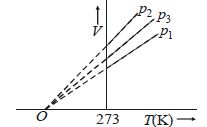
The volume-temperature graphs of a given mass of an ideal gas at different constant pressures are shown below. What is the correct order of pressures?
A
$p_1 > p_3 > p_2$
B
$p_1 > p_2 > p_3$
C
$p_2 > p_3 > p_1$
D
$p_2 > p_1 > p_3$
Solution
(A) According to the ideal gas equation,$PV = nRT$,which can be rearranged as $V = (\frac{nR}{P})T$.
This represents a straight line equation $y = mx$,where the slope $m = \frac{nR}{P}$.
Since the slope is inversely proportional to pressure $(m \propto \frac{1}{P})$,the line with the smallest slope corresponds to the highest pressure.
Looking at the graph,the slope of the line for $p_1$ is the smallest,followed by $p_3$,and then $p_2$.
Therefore,the correct order of pressures is $p_1 > p_3 > p_2$.
This represents a straight line equation $y = mx$,where the slope $m = \frac{nR}{P}$.
Since the slope is inversely proportional to pressure $(m \propto \frac{1}{P})$,the line with the smallest slope corresponds to the highest pressure.
Looking at the graph,the slope of the line for $p_1$ is the smallest,followed by $p_3$,and then $p_2$.
Therefore,the correct order of pressures is $p_1 > p_3 > p_2$.
0 likesView Solution
3
ChemistryMCQAP EAMCET · 2006
Ethyl chloride reacts with sodium ethoxide to form a compound $A$. Which of the following reactions also yields $A$?
A
$C_2H_5Cl, KOH$ (alc.),$\Delta$
B
$2 C_2H_5OH, \text{conc. } H_2SO_4, 140^{\circ}C$
C
$C_2H_5Cl, Mg$ (dry ether)
D
$C_2H_2, \text{dil. } H_2SO_4, HgSO_4$
Solution
(B) Ethyl chloride reacts with sodium ethoxide to form diethyl ether $(A)$ via the Williamson ether synthesis:
$C_2H_5Cl + C_2H_5ONa \rightarrow C_2H_5OC_2H_5 + NaCl$
Diethyl ether is also obtained by the intermolecular dehydration of ethyl alcohol with concentrated $H_2SO_4$ at $140^{\circ}C$:
$2 C_2H_5OH \xrightarrow{H_2SO_4, 140^{\circ}C} C_2H_5OC_2H_5 + H_2O$
$C_2H_5Cl + C_2H_5ONa \rightarrow C_2H_5OC_2H_5 + NaCl$
Diethyl ether is also obtained by the intermolecular dehydration of ethyl alcohol with concentrated $H_2SO_4$ at $140^{\circ}C$:
$2 C_2H_5OH \xrightarrow{H_2SO_4, 140^{\circ}C} C_2H_5OC_2H_5 + H_2O$
0 likesView Solution
4
ChemistryMCQAP EAMCET · 2006
Which of the products is formed when acetone is reacted with barium hydroxide solution?
A
$CH_3-CO-CH_2-C(OH)(CH_3)_2$
B
$CH_3-CO-CH(CH_3)-CH(OH)-CH_3$
C
$CH_3-CO-CH(OH)-CH(CH_3)-CH_3$
D
$CH_3-C(OH)(CH_3)-C(OH)(CH_3)_2$
Solution
(A) When acetone $(CH_3COCH_3)$ is treated with a base like barium hydroxide $(Ba(OH)_2)$,it undergoes an aldol condensation reaction.
Two molecules of acetone react to form $4$-hydroxy-$4$-methylpentan-$2$-one,which is commonly known as diacetone alcohol.
The reaction is: $2CH_3COCH_3 \xrightarrow{Ba(OH)_2} CH_3-C(OH)(CH_3)-CH_2-COCH_3$.
Two molecules of acetone react to form $4$-hydroxy-$4$-methylpentan-$2$-one,which is commonly known as diacetone alcohol.
The reaction is: $2CH_3COCH_3 \xrightarrow{Ba(OH)_2} CH_3-C(OH)(CH_3)-CH_2-COCH_3$.
0 likesView Solution
5
ChemistryMCQAP EAMCET · 2006
When acetaldehyde is heated with Fehling solution,a red precipitate is formed. Which of the following is that?
A
$Cu_2O$
B
$Cu$
C
$CuO$
D
$CuSO_4$
Solution
(A) When acetaldehyde $(CH_3CHO)$ is heated with Fehling solution,it undergoes oxidation to form acetate ions,while the $Cu^{2+}$ ions in the Fehling solution are reduced to $Cu^+$ ions.
This results in the formation of a red precipitate of cuprous oxide $(Cu_2O)$.
The chemical equation is:
$CH_3CHO + 2Cu(OH)_2 + NaOH \longrightarrow CH_3COONa + Cu_2O \downarrow (\text{Red}) + 3H_2O$
This results in the formation of a red precipitate of cuprous oxide $(Cu_2O)$.
The chemical equation is:
$CH_3CHO + 2Cu(OH)_2 + NaOH \longrightarrow CH_3COONa + Cu_2O \downarrow (\text{Red}) + 3H_2O$
0 likesView Solution
6
ChemistryMCQAP EAMCET · 2006
Which of the following reactions can produce aniline as the main product?
A
$C_6H_5NO_2 + Zn / KOH$
B
$C_6H_5NO_2 + Zn / NH_4Cl$
C
$C_6H_5NO_2 + LiAlH_4$
D
$C_6H_5NO_2 + Zn / HCl$
Solution
(D) The reduction of nitrobenzene $(C_6H_5NO_2)$ in an acidic medium using $Zn / HCl$ results in the formation of aniline $(C_6H_5NH_2)$ as the main product.
The chemical reaction is represented as:
$C_6H_5NO_2 + 6[H] \xrightarrow{Zn/HCl} C_6H_5NH_2 + 2H_2O$
The chemical reaction is represented as:
$C_6H_5NO_2 + 6[H] \xrightarrow{Zn/HCl} C_6H_5NH_2 + 2H_2O$
0 likesView Solution
7
ChemistryMCQAP EAMCET · 2006
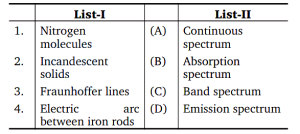
Match the appropriate pairs from List-$I$ and List-$II$ :
| List-$I$ | List-$II$ |
|---|---|
| $1$. Nitrogen molecules | $(A)$ Continuous spectrum |
| $2$. Incandescent solids | $(B)$ Absorption spectrum |
| $3$. Fraunhoffer lines | $(C)$ Band spectrum |
| $4$. Electric arc between iron rods | $(D)$ Emission spectrum |
A
$1-C, 2-A, 3-B, 4-D$
B
$1-B, 2-A, 3-D, 4-C$
C
$1-D, 2-A, 3-B, 4-C$
D
$1-A, 2-C, 3-D, 4-B$
Solution
(A) The correct matching is as follows:
$1$. Nitrogen molecules produce a band spectrum because molecular spectra consist of bands due to vibrational and rotational energy levels. Thus,$1-C$.
$2$. Incandescent solids emit a continuous spectrum because the atoms are closely packed,leading to overlapping energy levels. Thus,$2-A$.
$3$. Fraunhoffer lines are dark lines observed in the solar spectrum,which are caused by the absorption of light by gases in the solar atmosphere. Thus,$3-B$.
$4$. An electric arc between iron rods produces a line emission spectrum characteristic of the iron atoms. Thus,$4-D$.
Therefore,the correct sequence is $1-C, 2-A, 3-B, 4-D$.
$1$. Nitrogen molecules produce a band spectrum because molecular spectra consist of bands due to vibrational and rotational energy levels. Thus,$1-C$.
$2$. Incandescent solids emit a continuous spectrum because the atoms are closely packed,leading to overlapping energy levels. Thus,$2-A$.
$3$. Fraunhoffer lines are dark lines observed in the solar spectrum,which are caused by the absorption of light by gases in the solar atmosphere. Thus,$3-B$.
$4$. An electric arc between iron rods produces a line emission spectrum characteristic of the iron atoms. Thus,$4-D$.
Therefore,the correct sequence is $1-C, 2-A, 3-B, 4-D$.
0 likesView Solution
8
ChemistryMCQAP EAMCET · 2006
An oil drop having a mass $4.8 \times 10^{-13} ~kg$ and charge $2.4 \times 10^{-18} ~C$ stands still between two charged horizontal plates separated by a distance of $1 ~cm$. If now the polarity of the plates is changed,the instantaneous acceleration of the drop is: $(g = 10 ~ms^{-2})$ (in $~ms^{-2}$)
A
$5$
B
$10$
C
$15$
D
$20$
Solution
(D) Initially,the oil drop is in equilibrium between the plates. The downward gravitational force $mg$ is balanced by the upward electric force $qE$. Thus,$qE = mg$.
When the polarity of the plates is reversed,the electric force $qE$ now acts downwards,in the same direction as gravity.
The net force on the drop becomes $F_{net} = mg + qE$.
Since $qE = mg$,we have $F_{net} = mg + mg = 2mg$.
The instantaneous acceleration $a$ is given by $a = \frac{F_{net}}{m} = \frac{2mg}{m} = 2g$.
Given $g = 10 ~ms^{-2}$,the acceleration $a = 2 \times 10 = 20 ~ms^{-2}$.
When the polarity of the plates is reversed,the electric force $qE$ now acts downwards,in the same direction as gravity.
The net force on the drop becomes $F_{net} = mg + qE$.
Since $qE = mg$,we have $F_{net} = mg + mg = 2mg$.
The instantaneous acceleration $a$ is given by $a = \frac{F_{net}}{m} = \frac{2mg}{m} = 2g$.
Given $g = 10 ~ms^{-2}$,the acceleration $a = 2 \times 10 = 20 ~ms^{-2}$.
0 likesView Solution
9
ChemistryMCQAP EAMCET · 2006
Which of the following compounds when heated with $CO$ at $150^{\circ} C$ and $500 \ atm$ pressure in the presence of $BF_3$ forms ethyl propionate?
A
$C_2H_5OH$
B
$CH_3OCH_3$
C
$C_2H_5OC_2H_5$
D
$CH_3OC_2H_5$
Solution
(C) The reaction of diethyl ether $(C_2H_5OC_2H_5)$ with carbon monoxide $(CO)$ in the presence of a Lewis acid catalyst like $BF_3$ at $150^{\circ} C$ and $500 \ atm$ pressure leads to the carbonylation of the ether to form ethyl propionate $(C_2H_5COOC_2H_5)$.
The chemical equation is: $C_2H_5OC_2H_5 + CO \xrightarrow{BF_3, 150^{\circ} C, 500 \ atm} C_2H_5COOC_2H_5$.
The chemical equation is: $C_2H_5OC_2H_5 + CO \xrightarrow{BF_3, 150^{\circ} C, 500 \ atm} C_2H_5COOC_2H_5$.
0 likesView Solution
10
ChemistryMCQAP EAMCET · 2006
The number of sigma $(\sigma)$ and pi $(\pi)$ bonds present in benzene respectively are:
A
$12, 6$
B
$6, 6$
C
$6, 12$
D
$12, 3$
Solution
(D) Benzene $(C_6H_6)$ consists of a hexagonal ring of six carbon atoms,each bonded to one hydrogen atom.
There are $6$ $C-C$ bonds and $6$ $C-H$ bonds.
In the ring,there are $3$ double bonds and $3$ single bonds.
Each single bond is a $\sigma$ bond,and each double bond consists of one $\sigma$ bond and one $\pi$ bond.
Total $\sigma$ bonds = $6$ ($C-C$ $\sigma$ bonds) + $6$ ($C-H$ $\sigma$ bonds) = $12$ $\sigma$ bonds.
Total $\pi$ bonds = $3$ $\pi$ bonds.
Thus,benzene contains $12$ $\sigma$ bonds and $3$ $\pi$ bonds.
There are $6$ $C-C$ bonds and $6$ $C-H$ bonds.
In the ring,there are $3$ double bonds and $3$ single bonds.
Each single bond is a $\sigma$ bond,and each double bond consists of one $\sigma$ bond and one $\pi$ bond.
Total $\sigma$ bonds = $6$ ($C-C$ $\sigma$ bonds) + $6$ ($C-H$ $\sigma$ bonds) = $12$ $\sigma$ bonds.
Total $\pi$ bonds = $3$ $\pi$ bonds.
Thus,benzene contains $12$ $\sigma$ bonds and $3$ $\pi$ bonds.
0 likesView Solution
11
ChemistryMCQAP EAMCET · 2006
$A$ molecule $(X)$ has $(i)$ four sigma bonds formed by the overlap of $sp^2$ and $s$ orbitals,$(ii)$ one sigma bond formed by $sp^2$ and $sp^2$ orbitals,and $(iii)$ one $\pi$ bond formed by $p_z$ and $p_z$ orbitals. Which of the following is $X$?
A
$C_2H_6$
B
$C_2H_3Cl$
C
$C_2H_2Cl_2$
D
$C_2H_4$
Solution
(D) The molecule $C_2H_4$ (ethene) has the structure $CH_2=CH_2$.
Each carbon atom is $sp^2$ hybridized.
$(i)$ There are four $C-H$ sigma bonds formed by the overlap of $sp^2$ orbitals of carbon and $s$ orbitals of hydrogen.
$(ii)$ There is one $C-C$ sigma bond formed by the overlap of $sp^2$ and $sp^2$ orbitals.
$(iii)$ There is one $\pi$ bond formed by the lateral overlap of unhybridized $p_z$ orbitals on each carbon atom.
Thus,the molecule $(X)$ is $C_2H_4$.
Each carbon atom is $sp^2$ hybridized.
$(i)$ There are four $C-H$ sigma bonds formed by the overlap of $sp^2$ orbitals of carbon and $s$ orbitals of hydrogen.
$(ii)$ There is one $C-C$ sigma bond formed by the overlap of $sp^2$ and $sp^2$ orbitals.
$(iii)$ There is one $\pi$ bond formed by the lateral overlap of unhybridized $p_z$ orbitals on each carbon atom.
Thus,the molecule $(X)$ is $C_2H_4$.
0 likesView Solution
12
ChemistryMCQAP EAMCET · 2006
Which of the following is not a characteristic property of chemical equilibrium?
A
Rate of forward reaction is equal to rate of backward reaction at equilibrium.
B
After reaching the chemical equilibrium,the concentrations of reactants and products remain unchanged with time.
C
For $A_{(g)} \rightleftharpoons B_{(g)}$,$K_c$ is $10^{-2}$. If this reaction is carried out in the presence of catalyst,the value of $K_c$ decreases.
D
After reaching the equilibrium,both forward and backward reactions continue to take place.
Solution
(C) catalyst increases the rate of both forward and backward reactions equally,allowing the system to reach equilibrium faster.
It does not change the position of equilibrium or the value of the equilibrium constant $(K_c)$.
Therefore,the statement in option $(c)$ is incorrect.
It does not change the position of equilibrium or the value of the equilibrium constant $(K_c)$.
Therefore,the statement in option $(c)$ is incorrect.
0 likesView Solution
13
ChemistryMCQAP EAMCET · 2006
Observe the following statements :
$I$. The physical and chemical properties of elements are periodic functions of their electronic configuration.
$II$. Electronegativity of fluorine is less than the electronegativity of chlorine.
$III$. Electropositive nature decreases from top to bottom in a group.
The correct answer is :
$I$. The physical and chemical properties of elements are periodic functions of their electronic configuration.
$II$. Electronegativity of fluorine is less than the electronegativity of chlorine.
$III$. Electropositive nature decreases from top to bottom in a group.
The correct answer is :
A
$I$,$II$ and $III$ are correct
B
only $I$ is correct
C
only $I$ and $II$ are correct
D
only $II$ and $III$ are correct
Solution
(B) Statement $I$ is correct because the modern periodic law states that physical and chemical properties of elements are periodic functions of their atomic numbers,which is equivalent to their electronic configuration.
Statement $II$ is incorrect because fluorine $(F)$ has the highest electronegativity $(4.0)$ among all elements,which is greater than that of chlorine ($Cl$,$3.0$).
Statement $III$ is incorrect because electropositive nature (metallic character) increases from top to bottom in a group due to the increase in atomic size and decrease in ionization enthalpy.
Therefore,only statement $I$ is correct.
Statement $II$ is incorrect because fluorine $(F)$ has the highest electronegativity $(4.0)$ among all elements,which is greater than that of chlorine ($Cl$,$3.0$).
Statement $III$ is incorrect because electropositive nature (metallic character) increases from top to bottom in a group due to the increase in atomic size and decrease in ionization enthalpy.
Therefore,only statement $I$ is correct.
0 likesView Solution
14
ChemistryMCQAP EAMCET · 2006
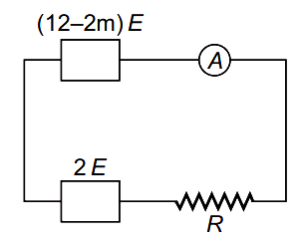
Twelve cells,each having emf $E$ volts,are connected in series and are kept in a closed box. Some of these cells are wrongly connected with positive and negative terminals reversed. This $12$-cell battery is connected in series with an ammeter,an external resistance $R$ ohms,and a two-cell battery (two cells of the same type used earlier,connected perfectly in series). The current in the circuit when the $12$-cell battery and $2$-cell battery aid each other is $3 \text{ A}$,and it is $2 \text{ A}$ when they oppose each other. Then,the number of cells in the $12$-cell battery that are connected wrongly is:
A
$4$
B
$3$
C
$2$
D
$1$
Solution
(D) Let $m$ be the number of cells in the $12$-cell battery that are wrongly connected. Each wrongly connected cell cancels the emf of one correctly connected cell. Thus,the effective emf of the $12$-cell battery is $(12 - m)E - mE = (12 - 2m)E$.
When the $12$-cell battery and the $2$-cell battery aid each other,the total emf in the circuit is $(12 - 2m)E + 2E = (14 - 2m)E$. The current is given by $i_1 = \frac{(14 - 2m)E}{R} = 3 \text{ A}$ ... $(i)$.
When they oppose each other,the total emf in the circuit is $(12 - 2m)E - 2E = (10 - 2m)E$. The current is given by $i_2 = \frac{(10 - 2m)E}{R} = 2 \text{ A}$ ... (ii).
Dividing equation $(i)$ by equation (ii),we get:
$\frac{3}{2} = \frac{14 - 2m}{10 - 2m}$
$3(10 - 2m) = 2(14 - 2m)$
$30 - 6m = 28 - 4m$
$2 = 2m$
$m = 1$.
Therefore,the number of wrongly connected cells is $1$.
When the $12$-cell battery and the $2$-cell battery aid each other,the total emf in the circuit is $(12 - 2m)E + 2E = (14 - 2m)E$. The current is given by $i_1 = \frac{(14 - 2m)E}{R} = 3 \text{ A}$ ... $(i)$.
When they oppose each other,the total emf in the circuit is $(12 - 2m)E - 2E = (10 - 2m)E$. The current is given by $i_2 = \frac{(10 - 2m)E}{R} = 2 \text{ A}$ ... (ii).
Dividing equation $(i)$ by equation (ii),we get:
$\frac{3}{2} = \frac{14 - 2m}{10 - 2m}$
$3(10 - 2m) = 2(14 - 2m)$
$30 - 6m = 28 - 4m$
$2 = 2m$
$m = 1$.
Therefore,the number of wrongly connected cells is $1$.
0 likesView Solution
15
ChemistryMCQAP EAMCET · 2006
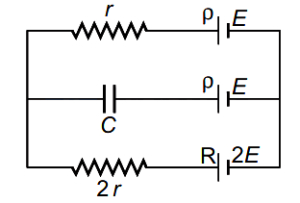
One end each of a resistance $r$,a capacitor $C$,and a resistance $2r$ are connected together. The other ends are respectively connected to the positive terminals of batteries $P, Q,$ and $R$ having emf's $E, E,$ and $2E$. The negative terminals of the batteries are then connected together. In this circuit,with steady current,the potential drop across the capacitor is:
A
$\frac{E}{3}$
B
$\frac{E}{2}$
C
$\frac{2E}{3}$
D
$E$
Solution
(A) In the steady state,no current flows through the capacitor branch.
Let the common junction point of the resistors and capacitor be $A$ and the common junction of the negative terminals of the batteries be $B$. Let the potential at $B$ be $0 \text{ V}$.
Let the potential at $A$ be $V_A$.
The current $i$ flows through the top and bottom branches:
$i = \frac{(2E - E)}{(r + 2r)} = \frac{E}{3r}$.
The potential at $A$ can be calculated using the top branch:
$V_A - 0 = E - i \cdot r = E - (\frac{E}{3r}) \cdot r = E - \frac{E}{3} = \frac{2E}{3}$.
Since no current flows through the middle branch,the potential drop across the capacitor is equal to the potential difference between $A$ and the positive terminal of the battery $Q$ (which is at potential $E$ relative to $B$).
Potential drop across capacitor $V_C = |E - V_A| = |E - \frac{2E}{3}| = \frac{E}{3}$.
Let the common junction point of the resistors and capacitor be $A$ and the common junction of the negative terminals of the batteries be $B$. Let the potential at $B$ be $0 \text{ V}$.
Let the potential at $A$ be $V_A$.
The current $i$ flows through the top and bottom branches:
$i = \frac{(2E - E)}{(r + 2r)} = \frac{E}{3r}$.
The potential at $A$ can be calculated using the top branch:
$V_A - 0 = E - i \cdot r = E - (\frac{E}{3r}) \cdot r = E - \frac{E}{3} = \frac{2E}{3}$.
Since no current flows through the middle branch,the potential drop across the capacitor is equal to the potential difference between $A$ and the positive terminal of the battery $Q$ (which is at potential $E$ relative to $B$).
Potential drop across capacitor $V_C = |E - V_A| = |E - \frac{2E}{3}| = \frac{E}{3}$.
0 likesView Solution
16
ChemistryMCQAP EAMCET · 2006
Which of the following statements is not correct?
A
In oxyhaemoglobin $Fe^{2+}$ is paramagnetic
B
During respiration the size of $Fe^{2+}$ increases when it changes from diamagnetic to paramagnetic state.
C
Four heme groups are present in haemoglobin
D
Heme is the prosthetic group and it is non-protein part.
Solution
(A) In oxyhaemoglobin,$Fe^{2+}$ is in a low-spin state,which is diamagnetic. Therefore,the statement that $Fe^{2+}$ is paramagnetic in oxyhaemoglobin is incorrect.
0 likesView Solution
17
ChemistryMCQAP EAMCET · 2006
What is the correct order of spin only magnetic moment (in $BM$) of $Mn^{2+}, Cr^{2+}$ and $V^{2+}$?
A
$Mn^{2+} > V^{2+} > Cr^{2+}$
B
$V^{2+} > Cr^{2+} > Mn^{2+}$
C
$Mn^{2+} > Cr^{2+} > V^{2+}$
D
$Cr^{2+} > V^{2+} > Mn^{2+}$
Solution
(C) Spin only magnetic moments depend upon the number of unpaired electrons; more the number of unpaired electrons,greater will be the spin only magnetic moment.
For $Mn$ $(Z=25)$: $[Ar] 3d^5 4s^2$. Thus,$Mn^{2+} = [Ar] 3d^5$. Number of unpaired electrons = $5$.
For $Cr$ $(Z=24)$: $[Ar] 3d^5 4s^1$. Thus,$Cr^{2+} = [Ar] 3d^4$. Number of unpaired electrons = $4$.
For $V$ $(Z=23)$: $[Ar] 3d^3 4s^2$. Thus,$V^{2+} = [Ar] 3d^3$. Number of unpaired electrons = $3$.
Since the magnetic moment $\mu = \sqrt{n(n+2)} \ BM$,where $n$ is the number of unpaired electrons,the order is $Mn^{2+} (5) > Cr^{2+} (4) > V^{2+} (3)$.
For $Mn$ $(Z=25)$: $[Ar] 3d^5 4s^2$. Thus,$Mn^{2+} = [Ar] 3d^5$. Number of unpaired electrons = $5$.
For $Cr$ $(Z=24)$: $[Ar] 3d^5 4s^1$. Thus,$Cr^{2+} = [Ar] 3d^4$. Number of unpaired electrons = $4$.
For $V$ $(Z=23)$: $[Ar] 3d^3 4s^2$. Thus,$V^{2+} = [Ar] 3d^3$. Number of unpaired electrons = $3$.
Since the magnetic moment $\mu = \sqrt{n(n+2)} \ BM$,where $n$ is the number of unpaired electrons,the order is $Mn^{2+} (5) > Cr^{2+} (4) > V^{2+} (3)$.
0 likesView Solution
18
ChemistryMCQAP EAMCET · 2006
When compound $X$ is oxidised by acidified potassium dichromate,compound $Y$ is formed. Compound $Y$ on reduction with $LiAlH_4$ gives $X$. $X$ and $Y$ respectively are :
A
$C_2H_5OH, CH_3COOH$
B
$CH_3COCH_3, CH_3COOH$
C
$C_2H_5OH, CH_3COCH_3$
D
$CH_3CHO, CH_3COCH_3$
Solution
(A) When ethyl alcohol $(X)$ is oxidised by acidified potassium dichromate,acetic acid $(Y)$ is obtained as follows:
$3 CH_3CH_2OH(X) + 2 K_2Cr_2O_7 + 8 H_2SO_4 \longrightarrow 3 CH_3COOH(Y) + 2 Cr_2(SO_4)_3 + 2 K_2SO_4 + 11 H_2O$
Carboxylic acids undergo reduction with $LiAlH_4$ to give primary alcohols as follows:
$CH_3COOH(Y) \xrightarrow{LiAlH_4, \text{ether}} CH_3CH_2OH(X)$
Thus,$X$ is $C_2H_5OH$ and $Y$ is $CH_3COOH$.
$3 CH_3CH_2OH(X) + 2 K_2Cr_2O_7 + 8 H_2SO_4 \longrightarrow 3 CH_3COOH(Y) + 2 Cr_2(SO_4)_3 + 2 K_2SO_4 + 11 H_2O$
Carboxylic acids undergo reduction with $LiAlH_4$ to give primary alcohols as follows:
$CH_3COOH(Y) \xrightarrow{LiAlH_4, \text{ether}} CH_3CH_2OH(X)$
Thus,$X$ is $C_2H_5OH$ and $Y$ is $CH_3COOH$.
0 likesView Solution
19
ChemistryMCQAP EAMCET · 2006
Assertion $(A)$: $A$ current of $96.5 \ A$ is passed into aqueous $AgNO_3$ solution for $100 \ s$. The weight of silver deposited is $10.8 \ g$ (At. wt. of $Ag = 108$).
Reason $(R)$: The mass of a substance deposited during the electrolysis of an electrolyte is inversely proportional to the quantity of electricity passing through the electrolyte.
The correct answer is:
Reason $(R)$: The mass of a substance deposited during the electrolysis of an electrolyte is inversely proportional to the quantity of electricity passing through the electrolyte.
The correct answer is:
A
Both $(A)$ and $(R)$ are true and $(R)$ is the correct explanation of $(A)$
B
Both $(A)$ and $(R)$ are true but $(R)$ is not the correct explanation of $(A)$
C
$(A)$ is true but $(R)$ is false
D
$(A)$ is false but $(R)$ is true
Solution
(C) Given: $i = 96.5 \ A$,$t = 100 \ s$,Atomic weight of $Ag = 108 \ g/mol$.
Charge $Q = i \times t = 96.5 \times 100 = 9650 \ C$.
According to Faraday's first law of electrolysis,$w = \frac{M \times i \times t}{n \times F}$.
For $Ag^+ + e^- \rightarrow Ag$,$n = 1$.
$w = \frac{108 \times 9650}{1 \times 96500} = 10.8 \ g$.
Thus,Assertion $(A)$ is true.
Reason $(R)$ states that mass is inversely proportional to the quantity of electricity,which is incorrect. According to Faraday's law,the mass deposited is directly proportional to the quantity of electricity $(w \propto Q)$.
Therefore,$(A)$ is true but $(R)$ is false.
Charge $Q = i \times t = 96.5 \times 100 = 9650 \ C$.
According to Faraday's first law of electrolysis,$w = \frac{M \times i \times t}{n \times F}$.
For $Ag^+ + e^- \rightarrow Ag$,$n = 1$.
$w = \frac{108 \times 9650}{1 \times 96500} = 10.8 \ g$.
Thus,Assertion $(A)$ is true.
Reason $(R)$ states that mass is inversely proportional to the quantity of electricity,which is incorrect. According to Faraday's law,the mass deposited is directly proportional to the quantity of electricity $(w \propto Q)$.
Therefore,$(A)$ is true but $(R)$ is false.
0 likesView Solution
20
ChemistryMCQAP EAMCET · 2006
What is the time (in $sec$) required for depositing all the silver present in $125 \ mL$ of $1 \ M \ AgNO_3$ solution by passing a current of $241.25 \ A$? $(1 \ F = 96500 \ C)$
A
$10$
B
$50$
C
$1000$
D
$100$
Solution
(B) The reaction for the deposition of silver is: $Ag^+ + e^- \rightarrow Ag(s)$.
Number of moles of $Ag^+$ ions $= \text{Molarity} \times \text{Volume in Liters} = 1 \ M \times 0.125 \ L = 0.125 \ mol$.
Since $1 \ mol$ of $Ag^+$ requires $1 \ mol$ of electrons $(1 \ F)$ for deposition,the total charge $Q$ required is $0.125 \ F$.
$Q = 0.125 \times 96500 \ C = 12062.5 \ C$.
Using the formula $Q = I \times t$,where $I = 241.25 \ A$:
$t = \frac{Q}{I} = \frac{12062.5 \ C}{241.25 \ A} = 50 \ sec$.
Number of moles of $Ag^+$ ions $= \text{Molarity} \times \text{Volume in Liters} = 1 \ M \times 0.125 \ L = 0.125 \ mol$.
Since $1 \ mol$ of $Ag^+$ requires $1 \ mol$ of electrons $(1 \ F)$ for deposition,the total charge $Q$ required is $0.125 \ F$.
$Q = 0.125 \times 96500 \ C = 12062.5 \ C$.
Using the formula $Q = I \times t$,where $I = 241.25 \ A$:
$t = \frac{Q}{I} = \frac{12062.5 \ C}{241.25 \ A} = 50 \ sec$.
0 likesView Solution
21
ChemistryMCQAP EAMCET · 2006
The standard reduction potentials of $Zn^{2+}|Zn$,$Cu^{2+}|Cu$ and $Ag^{+}|Ag$ are respectively $-0.76 \ V$,$0.34 \ V$ and $0.8 \ V$. The following cells were constructed:
$(1)$ $Zn|Zn^{2+}||Cu^{2+}|Cu$
$(2)$ $Zn|Zn^{2+}||Ag^{+}|Ag$
$(3)$ $Cu|Cu^{2+}||Ag^{+}|Ag$
What is the correct order of $E_{cell}^{\circ}$ of these cells?
$(1)$ $Zn|Zn^{2+}||Cu^{2+}|Cu$
$(2)$ $Zn|Zn^{2+}||Ag^{+}|Ag$
$(3)$ $Cu|Cu^{2+}||Ag^{+}|Ag$
What is the correct order of $E_{cell}^{\circ}$ of these cells?
A
$2 > 3 > 1$
B
$2 > 1 > 3$
C
$1 > 2 > 3$
D
$3 > 1 > 2$
Solution
(B) Given standard reduction potentials:
$E^{\circ}_{Zn^{2+}|Zn} = -0.76 \ V$
$E^{\circ}_{Cu^{2+}|Cu} = 0.34 \ V$
$E^{\circ}_{Ag^{+}|Ag} = 0.8 \ V$
For cell $(1)$: $Zn|Zn^{2+}||Cu^{2+}|Cu$
$E^{\circ}_{cell(1)} = E^{\circ}_{cathode} - E^{\circ}_{anode} = 0.34 - (-0.76) = 1.10 \ V$
For cell $(2)$: $Zn|Zn^{2+}||Ag^{+}|Ag$
$E^{\circ}_{cell(2)} = E^{\circ}_{cathode} - E^{\circ}_{anode} = 0.8 - (-0.76) = 1.56 \ V$
For cell $(3)$: $Cu|Cu^{2+}||Ag^{+}|Ag$
$E^{\circ}_{cell(3)} = E^{\circ}_{cathode} - E^{\circ}_{anode} = 0.8 - 0.34 = 0.46 \ V$
Comparing the values: $1.56 \ V (2) > 1.10 \ V (1) > 0.46 \ V (3)$.
Therefore,the correct order is $2 > 1 > 3$.
$E^{\circ}_{Zn^{2+}|Zn} = -0.76 \ V$
$E^{\circ}_{Cu^{2+}|Cu} = 0.34 \ V$
$E^{\circ}_{Ag^{+}|Ag} = 0.8 \ V$
For cell $(1)$: $Zn|Zn^{2+}||Cu^{2+}|Cu$
$E^{\circ}_{cell(1)} = E^{\circ}_{cathode} - E^{\circ}_{anode} = 0.34 - (-0.76) = 1.10 \ V$
For cell $(2)$: $Zn|Zn^{2+}||Ag^{+}|Ag$
$E^{\circ}_{cell(2)} = E^{\circ}_{cathode} - E^{\circ}_{anode} = 0.8 - (-0.76) = 1.56 \ V$
For cell $(3)$: $Cu|Cu^{2+}||Ag^{+}|Ag$
$E^{\circ}_{cell(3)} = E^{\circ}_{cathode} - E^{\circ}_{anode} = 0.8 - 0.34 = 0.46 \ V$
Comparing the values: $1.56 \ V (2) > 1.10 \ V (1) > 0.46 \ V (3)$.
Therefore,the correct order is $2 > 1 > 3$.
0 likesView Solution
22
ChemistryMCQAP EAMCET · 2006
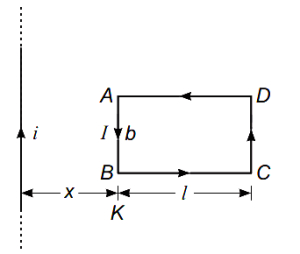
$A$ rectangular loop of length $l$ and breadth $b$ is placed at a distance of $x$ from an infinitely long wire carrying current $i$ such that the direction of the current is parallel to the breadth. If the loop moves away from the current-carrying wire in a direction perpendicular to it with a velocity $v$,the magnitude of the induced emf in the loop is: ($\mu_0=$ permeability of free space)
A
$\frac{\mu_0 i v}{2 \pi x}\left(\frac{l+b}{b}\right)$
B
$\frac{\mu_0 i^2 v}{4 \pi^2 x} \log \left(\frac{b}{l}\right)$
C
$\frac{\mu_0 i l b v}{2 \pi x(l+x)}$
D
$\frac{\mu_0 i l b v}{2 \pi} \log \left(\frac{x+l}{x}\right)$
Solution
(C) The magnetic field $B$ at a distance $r$ from an infinitely long wire is given by $B = \frac{\mu_0 i}{2 \pi r}$.
The loop has two sides of length $b$ parallel to the wire at distances $x$ and $x+l$ from the wire.
The motional emf induced in a conductor moving in a magnetic field is $e = B v L$.
The emf induced in the side at distance $x$ is $e_1 = B_1 v b = \left(\frac{\mu_0 i}{2 \pi x}\right) v b$.
The emf induced in the side at distance $x+l$ is $e_2 = B_2 v b = \left(\frac{\mu_0 i}{2 \pi (x+l)}\right) v b$.
Since the loop moves away,these emfs oppose each other. The net magnitude of the emf is $|e| = |e_1 - e_2|$.
$|e| = \frac{\mu_0 i v b}{2 \pi} \left( \frac{1}{x} - \frac{1}{x+l} \right) = \frac{\mu_0 i v b}{2 \pi} \left( \frac{x+l-x}{x(x+l)} \right) = \frac{\mu_0 i l b v}{2 \pi x(x+l)}$.
The loop has two sides of length $b$ parallel to the wire at distances $x$ and $x+l$ from the wire.
The motional emf induced in a conductor moving in a magnetic field is $e = B v L$.
The emf induced in the side at distance $x$ is $e_1 = B_1 v b = \left(\frac{\mu_0 i}{2 \pi x}\right) v b$.
The emf induced in the side at distance $x+l$ is $e_2 = B_2 v b = \left(\frac{\mu_0 i}{2 \pi (x+l)}\right) v b$.
Since the loop moves away,these emfs oppose each other. The net magnitude of the emf is $|e| = |e_1 - e_2|$.
$|e| = \frac{\mu_0 i v b}{2 \pi} \left( \frac{1}{x} - \frac{1}{x+l} \right) = \frac{\mu_0 i v b}{2 \pi} \left( \frac{x+l-x}{x(x+l)} \right) = \frac{\mu_0 i l b v}{2 \pi x(x+l)}$.
0 likesView Solution
23
ChemistryMCQAP EAMCET · 2006
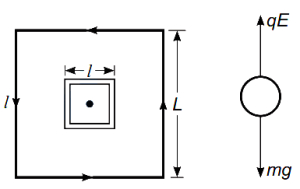
$A$ small square loop of wire of side $l$ is placed inside a large square loop of side $L$ $(L \gg l)$. If the loops are coplanar and their centres coincide,the mutual inductance of the system is directly proportional to :
A
$\frac{L}{l}$
B
$\frac{l}{L}$
C
$\frac{L^2}{l}$
D
$\frac{l^2}{L}$
Solution
(D) The magnetic field $B$ produced by a square loop of side $L$ carrying current $I$ at its centre is given by the sum of fields due to four wires of length $L$ at a distance $d = L/2$ from the centre.
For one wire,the field is $B_{wire} = \frac{\mu_0 I}{4 \pi d} (\sin 45^\circ + \sin 45^\circ) = \frac{\mu_0 I}{4 \pi (L/2)} (2 \times \frac{1}{\sqrt{2}}) = \frac{\mu_0 I}{\sqrt{2} \pi L}$.
Since there are four such wires,the total magnetic field at the centre is $B = 4 \times \frac{\mu_0 I}{\sqrt{2} \pi L} = \frac{2 \sqrt{2} \mu_0 I}{\pi L}$.
Since $L \gg l$,we can assume the magnetic field $B$ is uniform over the area of the smaller loop $S_2 = l^2$.
The magnetic flux linked with the smaller loop is $\phi_2 = B \times S_2 = \frac{2 \sqrt{2} \mu_0 I}{\pi L} \times l^2$.
The mutual inductance $M$ is defined as $M = \frac{\phi_2}{I} = \frac{2 \sqrt{2} \mu_0}{\pi} \frac{l^2}{L}$.
Therefore,$M \propto \frac{l^2}{L}$.
For one wire,the field is $B_{wire} = \frac{\mu_0 I}{4 \pi d} (\sin 45^\circ + \sin 45^\circ) = \frac{\mu_0 I}{4 \pi (L/2)} (2 \times \frac{1}{\sqrt{2}}) = \frac{\mu_0 I}{\sqrt{2} \pi L}$.
Since there are four such wires,the total magnetic field at the centre is $B = 4 \times \frac{\mu_0 I}{\sqrt{2} \pi L} = \frac{2 \sqrt{2} \mu_0 I}{\pi L}$.
Since $L \gg l$,we can assume the magnetic field $B$ is uniform over the area of the smaller loop $S_2 = l^2$.
The magnetic flux linked with the smaller loop is $\phi_2 = B \times S_2 = \frac{2 \sqrt{2} \mu_0 I}{\pi L} \times l^2$.
The mutual inductance $M$ is defined as $M = \frac{\phi_2}{I} = \frac{2 \sqrt{2} \mu_0}{\pi} \frac{l^2}{L}$.
Therefore,$M \propto \frac{l^2}{L}$.
0 likesView Solution
24
ChemistryMCQAP EAMCET · 2006
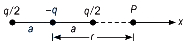
Along the $x$-axis,three charges $\frac{q}{2}, -q$ and $\frac{q}{2}$ are placed at $x=0, x=a$ and $x=2a$ respectively. The resultant electric potential at a point $P$ located at a distance $r$ from the charge $-q$ (where $r > a$) is ($\varepsilon_0$ is the permittivity of free space):
A
$\frac{q a}{4 \pi \varepsilon_0 r^2}$
B
$\frac{q a^2}{4 \pi \varepsilon_0 r^3}$
C
$\frac{q a^2}{16 \pi \varepsilon_0 r^3}$
D
$\frac{q}{4 \pi \varepsilon_0 r}$
Solution
(B) The charges are located at $x=0$ $(q/2)$,$x=a$ $(-q)$,and $x=2a$ $(q/2)$.
The point $P$ is at a distance $r$ from the charge $-q$ at $x=a$. Since $P$ is on the $x$-axis to the right of the charges,its coordinate is $x_P = a + r$.
The distances of point $P$ from the three charges are:
$1$. From $q/2$ at $x=0$: $d_1 = (a+r) - 0 = r+a$
$2$. From $-q$ at $x=a$: $d_2 = (a+r) - a = r$
$3$. From $q/2$ at $x=2a$: $d_3 = (a+r) - 2a = r-a$
The total electric potential $V$ at point $P$ is the sum of potentials due to individual charges:
$V = \frac{1}{4 \pi \varepsilon_0} \left[ \frac{q/2}{r+a} - \frac{q}{r} + \frac{q/2}{r-a} \right]$
$V = \frac{q}{8 \pi \varepsilon_0} \left[ \frac{1}{r+a} - \frac{2}{r} + \frac{1}{r-a} \right]$
$V = \frac{q}{8 \pi \varepsilon_0} \left[ \frac{r(r-a) - 2(r^2-a^2) + r(r+a)}{r(r^2-a^2)} \right]$
$V = \frac{q}{8 \pi \varepsilon_0} \left[ \frac{r^2 - ar - 2r^2 + 2a^2 + r^2 + ar}{r(r^2-a^2)} \right]$
$V = \frac{q}{8 \pi \varepsilon_0} \left[ \frac{2a^2}{r(r^2-a^2)} \right]$
Since $r \gg a$,we can approximate $r^2 - a^2 \approx r^2$:
$V \approx \frac{q}{8 \pi \varepsilon_0} \cdot \frac{2a^2}{r^3} = \frac{q a^2}{4 \pi \varepsilon_0 r^3}$
The point $P$ is at a distance $r$ from the charge $-q$ at $x=a$. Since $P$ is on the $x$-axis to the right of the charges,its coordinate is $x_P = a + r$.
The distances of point $P$ from the three charges are:
$1$. From $q/2$ at $x=0$: $d_1 = (a+r) - 0 = r+a$
$2$. From $-q$ at $x=a$: $d_2 = (a+r) - a = r$
$3$. From $q/2$ at $x=2a$: $d_3 = (a+r) - 2a = r-a$
The total electric potential $V$ at point $P$ is the sum of potentials due to individual charges:
$V = \frac{1}{4 \pi \varepsilon_0} \left[ \frac{q/2}{r+a} - \frac{q}{r} + \frac{q/2}{r-a} \right]$
$V = \frac{q}{8 \pi \varepsilon_0} \left[ \frac{1}{r+a} - \frac{2}{r} + \frac{1}{r-a} \right]$
$V = \frac{q}{8 \pi \varepsilon_0} \left[ \frac{r(r-a) - 2(r^2-a^2) + r(r+a)}{r(r^2-a^2)} \right]$
$V = \frac{q}{8 \pi \varepsilon_0} \left[ \frac{r^2 - ar - 2r^2 + 2a^2 + r^2 + ar}{r(r^2-a^2)} \right]$
$V = \frac{q}{8 \pi \varepsilon_0} \left[ \frac{2a^2}{r(r^2-a^2)} \right]$
Since $r \gg a$,we can approximate $r^2 - a^2 \approx r^2$:
$V \approx \frac{q}{8 \pi \varepsilon_0} \cdot \frac{2a^2}{r^3} = \frac{q a^2}{4 \pi \varepsilon_0 r^3}$
0 likesView Solution
25
ChemistryMCQAP EAMCET · 2006
Along the $X$-axis,three charges $\frac{q}{2}, -q$ and $\frac{q}{2}$ are placed at $x=0, x=a$ and $x=2a$ respectively. The resultant electric potential at $x=a+r$ (if $a \ll r$) is: ($\varepsilon_0$ is the permittivity of free space)
A
$\frac{q a}{4 \pi \varepsilon_0 r^2}$
B
$\frac{q a^2}{4 \pi \varepsilon_0 r^3}$
C
$\frac{q(a^2/4)}{4 \pi \varepsilon_0 r^3}$
D
$\frac{q}{4 \pi \varepsilon_0 r}$
Solution
(B) The electric potential $V$ at a point due to a system of charges is the algebraic sum of the potentials due to individual charges.
The positions of the charges are $x_1 = 0$,$x_2 = a$,and $x_3 = 2a$. The point $P$ is at $x = a+r$.
The distances of point $P$ from the charges are:
$r_1 = (a+r) - 0 = r+a$
$r_2 = (a+r) - a = r$
$r_3 = (a+r) - 2a = r-a$
The total potential $V_P$ is:
$V_P = \frac{1}{4 \pi \varepsilon_0} \left[ \frac{q/2}{r+a} - \frac{q}{r} + \frac{q/2}{r-a} \right]$
$V_P = \frac{q}{4 \pi \varepsilon_0} \left[ \frac{1}{2(r+a)} - \frac{1}{r} + \frac{1}{2(r-a)} \right]$
$V_P = \frac{q}{4 \pi \varepsilon_0} \left[ \frac{r(r-a) - 2(r^2-a^2) + r(r+a)}{2r(r^2-a^2)} \right]$
$V_P = \frac{q}{4 \pi \varepsilon_0} \left[ \frac{r^2 - ar - 2r^2 + 2a^2 + r^2 + ar}{2r(r^2-a^2)} \right]$
$V_P = \frac{q}{4 \pi \varepsilon_0} \left[ \frac{2a^2}{2r(r^2-a^2)} \right] = \frac{q a^2}{4 \pi \varepsilon_0 r(r^2-a^2)}$
Since $a \ll r$,we have $r^2 - a^2 \approx r^2$.
Therefore,$V_P = \frac{q a^2}{4 \pi \varepsilon_0 r^3}$.
The positions of the charges are $x_1 = 0$,$x_2 = a$,and $x_3 = 2a$. The point $P$ is at $x = a+r$.
The distances of point $P$ from the charges are:
$r_1 = (a+r) - 0 = r+a$
$r_2 = (a+r) - a = r$
$r_3 = (a+r) - 2a = r-a$
The total potential $V_P$ is:
$V_P = \frac{1}{4 \pi \varepsilon_0} \left[ \frac{q/2}{r+a} - \frac{q}{r} + \frac{q/2}{r-a} \right]$
$V_P = \frac{q}{4 \pi \varepsilon_0} \left[ \frac{1}{2(r+a)} - \frac{1}{r} + \frac{1}{2(r-a)} \right]$
$V_P = \frac{q}{4 \pi \varepsilon_0} \left[ \frac{r(r-a) - 2(r^2-a^2) + r(r+a)}{2r(r^2-a^2)} \right]$
$V_P = \frac{q}{4 \pi \varepsilon_0} \left[ \frac{r^2 - ar - 2r^2 + 2a^2 + r^2 + ar}{2r(r^2-a^2)} \right]$
$V_P = \frac{q}{4 \pi \varepsilon_0} \left[ \frac{2a^2}{2r(r^2-a^2)} \right] = \frac{q a^2}{4 \pi \varepsilon_0 r(r^2-a^2)}$
Since $a \ll r$,we have $r^2 - a^2 \approx r^2$.
Therefore,$V_P = \frac{q a^2}{4 \pi \varepsilon_0 r^3}$.

0 likesView Solution
26
ChemistryMCQAP EAMCET · 2006
$CFCl_3$ is responsible for the decomposition of ozone to oxygen. Which of the following reacts with ozone to form oxygen?
A
$Cl_2$
B
$Cl^{-}$
C
$F^{-}$
D
$Cl^{\bullet}$
Solution
(D) Chlorofluorocarbons $(CFCs)$ are responsible for the depletion of the ozone layer in the stratosphere.
$CFCl_3$ decomposes in the presence of ultraviolet radiation to produce chlorine free radicals $(Cl^{\bullet})$.
These chlorine free radicals react with ozone $(O_3)$ to form chlorine monoxide $(ClO^{\bullet})$ and oxygen $(O_2)$:
$Cl^{\bullet} + O_3 \rightarrow ClO^{\bullet} + O_2$
Thus,the chlorine free radical $(Cl^{\bullet})$ is the species that reacts with ozone.
$CFCl_3$ decomposes in the presence of ultraviolet radiation to produce chlorine free radicals $(Cl^{\bullet})$.
These chlorine free radicals react with ozone $(O_3)$ to form chlorine monoxide $(ClO^{\bullet})$ and oxygen $(O_2)$:
$Cl^{\bullet} + O_3 \rightarrow ClO^{\bullet} + O_2$
Thus,the chlorine free radical $(Cl^{\bullet})$ is the species that reacts with ozone.
0 likesView Solution
27
ChemistryMCQAP EAMCET · 2006
What are the metal ions present in carnallite?
A
$Mg^{2+}, K^{+}$
B
$Al^{3+}, Na^{+}$
C
$Na^{+}, Mg^{2+}$
D
$Zn^{2+}, Mg^{2+}$
Solution
(A) The chemical formula of carnallite is $KCl \cdot MgCl_2 \cdot 6 H_2 O$.
Therefore,the metal ions present in carnallite are $K^{+}$ and $Mg^{2+}$.
Therefore,the metal ions present in carnallite are $K^{+}$ and $Mg^{2+}$.
0 likesView Solution
28
ChemistryMCQAP EAMCET · 2006
Which of the following is added to chloroform to slow down its aerial oxidation in the presence of light?
A
Carbonyl chloride
B
Ethyl alcohol
C
Sodium hydroxide
D
Nitric acid
Solution
(B) Chloroform $(CHCl_3)$ undergoes aerial oxidation in the presence of light to form a highly poisonous gas called phosgene $(COCl_2)$.
$2CHCl_3 + O_2 \xrightarrow{light} 2COCl_2 + 2HCl$
To prevent this,a small amount of ethyl alcohol $(C_2H_5OH)$ is added to chloroform.
Ethyl alcohol acts as a negative catalyst and converts any phosgene formed back into harmless diethyl carbonate.
$2CHCl_3 + O_2 \xrightarrow{light} 2COCl_2 + 2HCl$
To prevent this,a small amount of ethyl alcohol $(C_2H_5OH)$ is added to chloroform.
Ethyl alcohol acts as a negative catalyst and converts any phosgene formed back into harmless diethyl carbonate.
0 likesView Solution
29
ChemistryMCQAP EAMCET · 2006
Which of the following reagents when heated with ethyl chloride,forms ethylene?
A
Aqueous $KOH$
B
$Zn / HCl$
C
Alcoholic $KOH$
D
$HI$
Solution
(C) Only alcoholic $KOH$ undergoes dehydrohalogenation reaction with alkyl halides. When ethyl chloride $(CH_3CH_2Cl)$ is heated with alcoholic $KOH$,it eliminates a molecule of $HCl$ to form ethylene $(CH_2=CH_2)$.
The reaction is as follows:
$CH_3-CH_2Cl + KOH (\text{alc.}) \rightarrow CH_2=CH_2 + KCl + H_2O$
The reaction is as follows:
$CH_3-CH_2Cl + KOH (\text{alc.}) \rightarrow CH_2=CH_2 + KCl + H_2O$
0 likesView Solution
30
ChemistryMCQAP EAMCET · 2006
Which of the following reacts with benzene in the presence of anhydrous aluminum chloride to form acetophenone?
A
$CH_3Cl$
B
$CH_3COOH$
C
$CH_3CHO$
D
$CH_3COCl$
Solution
(D) Friedel-Crafts acylation involves the reaction of benzene with an acyl halide (such as $CH_3COCl$) or an acid anhydride in the presence of a Lewis acid catalyst like anhydrous aluminum chloride $(AlCl_3)$.
The reaction is as follows:
$C_6H_6 + CH_3COCl \xrightarrow{AlCl_3} C_6H_5COCH_3 + HCl$
Thus,benzene reacts with acetyl chloride $(CH_3COCl)$ to form acetophenone.
The reaction is as follows:
$C_6H_6 + CH_3COCl \xrightarrow{AlCl_3} C_6H_5COCH_3 + HCl$
Thus,benzene reacts with acetyl chloride $(CH_3COCl)$ to form acetophenone.
0 likesView Solution
31
ChemistryMediumMCQAP EAMCET · 2006
Electrolysis of $X$ gives $Y$ at anode. Vacuum distillation of $Y$ gives $H_2O_2$. The number of peroxy $(O-O)$ bonds present in $X$ and $Y$ respectively are :
A
$1, 1$
B
$1, 2$
C
zero,$1$
D
zero,zero
Solution
(C) $30 \%$ solution of hydrogen peroxide can be obtained by the electrolysis of $50 \%$ sulphuric acid followed by vacuum distillation.
The first product of electrolysis is perdisulphuric acid $(H_2S_2O_8)$,which reacts with water during distillation to form $H_2O_2$.
$2H_2SO_4 \longrightarrow 2H^{+} + 2HSO_4^-$
$2HSO_4^- \longrightarrow H_2S_2O_8 + 2e^-$ (At anode)
$H_2S_2O_8 + 2H_2O \longrightarrow 2H_2SO_4 + H_2O_2$
Here,'$X$' is $H_2SO_4$ and '$Y$' is $H_2S_2O_8$.
$H_2SO_4$ (sulphuric acid) contains zero peroxy bonds.
$H_2S_2O_8$ (Marshall's acid) contains one peroxy bond $(-O-O-)$.
Therefore,the number of peroxy bonds in $X$ and $Y$ are zero and $1$ respectively.
The first product of electrolysis is perdisulphuric acid $(H_2S_2O_8)$,which reacts with water during distillation to form $H_2O_2$.
$2H_2SO_4 \longrightarrow 2H^{+} + 2HSO_4^-$
$2HSO_4^- \longrightarrow H_2S_2O_8 + 2e^-$ (At anode)
$H_2S_2O_8 + 2H_2O \longrightarrow 2H_2SO_4 + H_2O_2$
Here,'$X$' is $H_2SO_4$ and '$Y$' is $H_2S_2O_8$.
$H_2SO_4$ (sulphuric acid) contains zero peroxy bonds.
$H_2S_2O_8$ (Marshall's acid) contains one peroxy bond $(-O-O-)$.
Therefore,the number of peroxy bonds in $X$ and $Y$ are zero and $1$ respectively.
0 likesView Solution
32
ChemistryMCQAP EAMCET · 2006
To the free end of a spring hanging from a rigid support,a block of mass $m$ is hung and slowly allowed to come to its equilibrium position. Then the stretching in the spring is $d$. If the same block is attached to the same spring and allowed to fall suddenly,the amount of stretching is: (force constant,$k$)
A
$\frac{m g}{k}$
B
$2 d$
C
$\frac{m g}{3 k}$
D
$4 d$
Solution
(B) When the block is lowered slowly,the equilibrium position is reached when the spring force equals the gravitational force: $k d = m g$,which implies $d = \frac{m g}{k}$.
When the block is allowed to fall suddenly from the unstretched position,the block undergoes simple harmonic motion. At the maximum extension $x$,the change in gravitational potential energy equals the elastic potential energy stored in the spring:
$m g x = \frac{1}{2} k x^2$
Solving for $x$ (where $x \neq 0$):
$x = \frac{2 m g}{k}$
Since $d = \frac{m g}{k}$,we substitute this into the equation:
$x = 2 d$.
When the block is allowed to fall suddenly from the unstretched position,the block undergoes simple harmonic motion. At the maximum extension $x$,the change in gravitational potential energy equals the elastic potential energy stored in the spring:
$m g x = \frac{1}{2} k x^2$
Solving for $x$ (where $x \neq 0$):
$x = \frac{2 m g}{k}$
Since $d = \frac{m g}{k}$,we substitute this into the equation:
$x = 2 d$.
0 likesView Solution
33
ChemistryMCQAP EAMCET · 2006
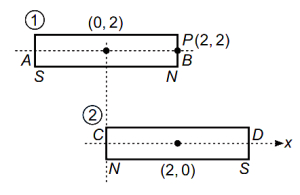
Two short magnets $AB$ and $CD$ are in the $X-Y$ plane and are parallel to the $X$-axis. The coordinates of their centers are $(0,2)$ and $(2,0)$ respectively. The line joining the north-south poles of $CD$ is opposite to that of $AB$ and lies along the positive $X$-axis. The resultant magnetic field induction due to $AB$ and $CD$ at point $P(2,2)$ is $100 \times 10^{-7} \ T$. When the poles of the magnet $CD$ are reversed,the resultant magnetic field induction is $50 \times 10^{-7} \ T$. The values of the magnetic moments of $AB$ and $CD$ (in $Am^2$) are:
A
$300; 200$
B
$600; 400$
C
$200; 100$
D
$300; 150$
Solution
(A) Let $M_1$ be the magnetic moment of magnet $AB$ and $M_2$ be the magnetic moment of magnet $CD$. Point $P(2,2)$ lies on the axial line of magnet $AB$ at a distance $r_1 = 2$ from its center $(0,2)$,and on the equatorial line of magnet $CD$ at a distance $r_2 = 2$ from its center $(2,0)$.
The magnetic field at $P$ due to $AB$ (axial) is $B_1 = \frac{\mu_0}{4\pi} \frac{2M_1}{r_1^3} = 10^{-7} \times \frac{2M_1}{2^3} = 10^{-7} \times \frac{M_1}{4}$.
The magnetic field at $P$ due to $CD$ (equatorial) is $B_2 = \frac{\mu_0}{4\pi} \frac{M_2}{r_2^3} = 10^{-7} \times \frac{M_2}{2^3} = 10^{-7} \times \frac{M_2}{8}$.
Given the resultant field $B = B_1 + B_2 = 100 \times 10^{-7} \ T$:
$10^{-7} (\frac{M_1}{4} + \frac{M_2}{8}) = 100 \times 10^{-7} \Rightarrow 2M_1 + M_2 = 800$ (Eq. $i$).
When the poles of $CD$ are reversed,the direction of $B_2$ is reversed,so $B' = B_1 - B_2 = 50 \times 10^{-7} \ T$:
$10^{-7} (\frac{M_1}{4} - \frac{M_2}{8}) = 50 \times 10^{-7} \Rightarrow 2M_1 - M_2 = 400$ (Eq. $ii$).
Adding (Eq. $i$) and (Eq. $ii$): $4M_1 = 1200 \Rightarrow M_1 = 300 \ Am^2$.
Substituting $M_1$ in (Eq. $i$): $2(300) + M_2 = 800 \Rightarrow M_2 = 200 \ Am^2$.
The magnetic field at $P$ due to $AB$ (axial) is $B_1 = \frac{\mu_0}{4\pi} \frac{2M_1}{r_1^3} = 10^{-7} \times \frac{2M_1}{2^3} = 10^{-7} \times \frac{M_1}{4}$.
The magnetic field at $P$ due to $CD$ (equatorial) is $B_2 = \frac{\mu_0}{4\pi} \frac{M_2}{r_2^3} = 10^{-7} \times \frac{M_2}{2^3} = 10^{-7} \times \frac{M_2}{8}$.
Given the resultant field $B = B_1 + B_2 = 100 \times 10^{-7} \ T$:
$10^{-7} (\frac{M_1}{4} + \frac{M_2}{8}) = 100 \times 10^{-7} \Rightarrow 2M_1 + M_2 = 800$ (Eq. $i$).
When the poles of $CD$ are reversed,the direction of $B_2$ is reversed,so $B' = B_1 - B_2 = 50 \times 10^{-7} \ T$:
$10^{-7} (\frac{M_1}{4} - \frac{M_2}{8}) = 50 \times 10^{-7} \Rightarrow 2M_1 - M_2 = 400$ (Eq. $ii$).
Adding (Eq. $i$) and (Eq. $ii$): $4M_1 = 1200 \Rightarrow M_1 = 300 \ Am^2$.
Substituting $M_1$ in (Eq. $i$): $2(300) + M_2 = 800 \Rightarrow M_2 = 200 \ Am^2$.
0 likesView Solution
34
ChemistryMCQAP EAMCET · 2006
$A$ proton, a deuteron (nucleus of ${ }_1 H^2$) and an $\alpha$-particle with the same kinetic energy enter a region of uniform magnetic field moving at right angles to the field. The ratio of the radii of their circular paths is:
A
$1: 2: 4$
B
$1: \sqrt{2}: 1$
C
$2: \sqrt{2}: 1$
D
$1: 1: 2$
Solution
(B) The radius of a circular path of a charged particle in a magnetic field is given by $r = \frac{mv}{qB} = \frac{\sqrt{2mK}}{qB}$.
Since kinetic energy $K$ and magnetic field $B$ are the same for all particles, we have $r \propto \frac{\sqrt{m}}{q}$.
For a proton $(p)$: mass $m_p = m$, charge $q_p = q$. So, $r_p \propto \frac{\sqrt{m}}{q}$.
For a deuteron $(d)$: mass $m_d = 2m$, charge $q_d = q$. So, $r_d \propto \frac{\sqrt{2m}}{q}$.
For an $\alpha$-particle $(\alpha)$: mass $m_\alpha = 4m$, charge $q_\alpha = 2q$. So, $r_\alpha \propto \frac{\sqrt{4m}}{2q} = \frac{2\sqrt{m}}{2q} = \frac{\sqrt{m}}{q}$.
Thus, the ratio $r_p : r_d : r_\alpha = \frac{\sqrt{m}}{q} : \frac{\sqrt{2m}}{q} : \frac{\sqrt{m}}{q} = 1 : \sqrt{2} : 1$.
Since kinetic energy $K$ and magnetic field $B$ are the same for all particles, we have $r \propto \frac{\sqrt{m}}{q}$.
For a proton $(p)$: mass $m_p = m$, charge $q_p = q$. So, $r_p \propto \frac{\sqrt{m}}{q}$.
For a deuteron $(d)$: mass $m_d = 2m$, charge $q_d = q$. So, $r_d \propto \frac{\sqrt{2m}}{q}$.
For an $\alpha$-particle $(\alpha)$: mass $m_\alpha = 4m$, charge $q_\alpha = 2q$. So, $r_\alpha \propto \frac{\sqrt{4m}}{2q} = \frac{2\sqrt{m}}{2q} = \frac{\sqrt{m}}{q}$.
Thus, the ratio $r_p : r_d : r_\alpha = \frac{\sqrt{m}}{q} : \frac{\sqrt{2m}}{q} : \frac{\sqrt{m}}{q} = 1 : \sqrt{2} : 1$.
0 likesView Solution
35
ChemistryMCQAP EAMCET · 2006
When a positively charged particle enters a uniform magnetic field with uniform velocity,its trajectory can be :
$(1)$ a straight line
$(2)$ a circle
$(3)$ a helix
$(1)$ a straight line
$(2)$ a circle
$(3)$ a helix
A
$(1)$ only
B
$(1)$ or $(2)$
C
$(1)$ or $(3)$
D
any one of $(1)$,$(2)$ and $(3)$
Solution
(D) The magnetic force on a charged particle is given by $\vec{F} = q(\vec{v} \times \vec{B})$.
$1$. If the velocity $\vec{v}$ is parallel or anti-parallel to the magnetic field $\vec{B}$,then $\vec{v} \times \vec{B} = 0$,so $\vec{F} = 0$. The particle continues in a straight line.
$2$. If the velocity $\vec{v}$ is perpendicular to the magnetic field $\vec{B}$,the force acts as a centripetal force,causing the particle to move in a circle.
$3$. If the velocity $\vec{v}$ makes an angle $\theta$ (where $\theta \neq 0^\circ, 90^\circ, 180^\circ$) with the magnetic field $\vec{B}$,the velocity component parallel to the field remains constant,while the perpendicular component causes circular motion. This results in a helical trajectory.
Therefore,all three trajectories are possible depending on the angle between $\vec{v}$ and $\vec{B}$.
$1$. If the velocity $\vec{v}$ is parallel or anti-parallel to the magnetic field $\vec{B}$,then $\vec{v} \times \vec{B} = 0$,so $\vec{F} = 0$. The particle continues in a straight line.
$2$. If the velocity $\vec{v}$ is perpendicular to the magnetic field $\vec{B}$,the force acts as a centripetal force,causing the particle to move in a circle.
$3$. If the velocity $\vec{v}$ makes an angle $\theta$ (where $\theta \neq 0^\circ, 90^\circ, 180^\circ$) with the magnetic field $\vec{B}$,the velocity component parallel to the field remains constant,while the perpendicular component causes circular motion. This results in a helical trajectory.
Therefore,all three trajectories are possible depending on the angle between $\vec{v}$ and $\vec{B}$.
0 likesView Solution
36
ChemistryMCQAP EAMCET · 2006
The effect due to a uniform magnetic field on a freely suspended magnetic needle is as follows:
A
both torque and net force are present
B
torque is present but no net force
C
both torque and net force are absent
D
net force is present but not torque
Solution
(B) When a magnetic needle is placed in a uniform magnetic field $B$,the north pole experiences a force $F = mB$ and the south pole experiences a force $F = -mB$,where $m$ is the pole strength.
Since the forces are equal in magnitude and opposite in direction,the net force $F_{net} = F + (-F) = 0$.
However,because these forces act at different points,they create a torque $\tau = p_m \times B$,which tends to rotate the needle to align it with the magnetic field.
Therefore,torque is present but there is no net force.
Since the forces are equal in magnitude and opposite in direction,the net force $F_{net} = F + (-F) = 0$.
However,because these forces act at different points,they create a torque $\tau = p_m \times B$,which tends to rotate the needle to align it with the magnetic field.
Therefore,torque is present but there is no net force.
0 likesView Solution
37
ChemistryMCQAP EAMCET · 2006
$\sqrt{12-\sqrt{68+48 \sqrt{2}}}$ is equal to :
A
$\sqrt{2}-3$
B
$2+\sqrt{2}$
C
$2-\sqrt{2}$
D
$6-2 \sqrt{8}$
Solution
(C) Given expression: $\sqrt{12-\sqrt{68+48 \sqrt{2}}}$
We simplify the inner radical $\sqrt{68+48 \sqrt{2}}$:
$68+48 \sqrt{2} = 68+2 \times 24 \times \sqrt{2} = 68+2 \times 6 \times 4 \sqrt{2}$
$= (6)^2 + (4 \sqrt{2})^2 + 2 \times 6 \times 4 \sqrt{2} = (6+4 \sqrt{2})^2$
So,$\sqrt{68+48 \sqrt{2}} = 6+4 \sqrt{2}$
Now substitute this back into the expression:
$\sqrt{12-(6+4 \sqrt{2})} = \sqrt{6-4 \sqrt{2}}$
$= \sqrt{6-2 \times 2 \times 2 \sqrt{2}} = \sqrt{6-2 \times 2 \times \sqrt{8}}$
$= \sqrt{(2)^2 + (\sqrt{2})^2 - 2 \times 2 \times \sqrt{2}} = \sqrt{(2-\sqrt{2})^2}$
$= 2-\sqrt{2}$
We simplify the inner radical $\sqrt{68+48 \sqrt{2}}$:
$68+48 \sqrt{2} = 68+2 \times 24 \times \sqrt{2} = 68+2 \times 6 \times 4 \sqrt{2}$
$= (6)^2 + (4 \sqrt{2})^2 + 2 \times 6 \times 4 \sqrt{2} = (6+4 \sqrt{2})^2$
So,$\sqrt{68+48 \sqrt{2}} = 6+4 \sqrt{2}$
Now substitute this back into the expression:
$\sqrt{12-(6+4 \sqrt{2})} = \sqrt{6-4 \sqrt{2}}$
$= \sqrt{6-2 \times 2 \times 2 \sqrt{2}} = \sqrt{6-2 \times 2 \times \sqrt{8}}$
$= \sqrt{(2)^2 + (\sqrt{2})^2 - 2 \times 2 \times \sqrt{2}} = \sqrt{(2-\sqrt{2})^2}$
$= 2-\sqrt{2}$
0 likesView Solution
38
ChemistryMCQAP EAMCET · 2006
If $\alpha, \beta, \gamma$ are the roots of the equation $x^3-6x^2+11x+6=0$,then $\Sigma \alpha^2 \beta+\Sigma \alpha \beta^2$ is equal to :
A
$80$
B
$84$
C
$90$
D
$-84$
Solution
(B) Given that $\alpha, \beta, \gamma$ are the roots of the equation $x^3-6x^2+11x+6=0$.
From the relation between roots and coefficients:
$\alpha+\beta+\gamma = 6$
$\alpha \beta+\beta \gamma+\gamma \alpha = 11$
$\alpha \beta \gamma = -6$
We need to find the value of $\Sigma \alpha^2 \beta+\Sigma \alpha \beta^2$.
$\Sigma \alpha^2 \beta+\Sigma \alpha \beta^2 = \alpha^2 \beta+\beta^2 \gamma+\gamma^2 \alpha+\alpha \beta^2+\beta \gamma^2+\gamma \alpha^2$
$= \alpha \beta(\alpha+\beta)+\beta \gamma(\beta+\gamma)+\gamma \alpha(\gamma+\alpha)$
$= \alpha \beta(6-\gamma)+\beta \gamma(6-\alpha)+\gamma \alpha(6-\beta)$
$= 6(\alpha \beta+\beta \gamma+\gamma \alpha)-3 \alpha \beta \gamma$
$= 6(11)-3(-6)$
$= 66+18 = 84$.
From the relation between roots and coefficients:
$\alpha+\beta+\gamma = 6$
$\alpha \beta+\beta \gamma+\gamma \alpha = 11$
$\alpha \beta \gamma = -6$
We need to find the value of $\Sigma \alpha^2 \beta+\Sigma \alpha \beta^2$.
$\Sigma \alpha^2 \beta+\Sigma \alpha \beta^2 = \alpha^2 \beta+\beta^2 \gamma+\gamma^2 \alpha+\alpha \beta^2+\beta \gamma^2+\gamma \alpha^2$
$= \alpha \beta(\alpha+\beta)+\beta \gamma(\beta+\gamma)+\gamma \alpha(\gamma+\alpha)$
$= \alpha \beta(6-\gamma)+\beta \gamma(6-\alpha)+\gamma \alpha(6-\beta)$
$= 6(\alpha \beta+\beta \gamma+\gamma \alpha)-3 \alpha \beta \gamma$
$= 6(11)-3(-6)$
$= 66+18 = 84$.
0 likesView Solution
39
ChemistryMCQAP EAMCET · 2006
The quadratic equation whose roots are $\sin ^2 18^{\circ}$ and $\cos ^2 36^{\circ}$ is :
A
$16 x^2-12 x+1=0$
B
$16 x^2+12 x+1=0$
C
$16 x^2-12 x-1=0$
D
$16 x^2+10 x+1=0$
Solution
(A) Given roots are $\alpha = \sin ^2 18^{\circ}$ and $\beta = \cos ^2 36^{\circ}$.
We know that $\sin 18^{\circ} = \frac{\sqrt{5}-1}{4}$ and $\cos 36^{\circ} = \frac{\sqrt{5}+1}{4}$.
Sum of roots $= \sin ^2 18^{\circ} + \cos ^2 36^{\circ} = \left(\frac{\sqrt{5}-1}{4}\right)^2 + \left(\frac{\sqrt{5}+1}{4}\right)^2$.
$= \frac{5+1-2\sqrt{5}}{16} + \frac{5+1+2\sqrt{5}}{16} = \frac{12}{16} = \frac{3}{4}$.
Product of roots $= \sin ^2 18^{\circ} \cdot \cos ^2 36^{\circ} = \left(\frac{\sqrt{5}-1}{4}\right)^2 \cdot \left(\frac{\sqrt{5}+1}{4}\right)^2$.
$= \left(\frac{(\sqrt{5}-1)(\sqrt{5}+1)}{16}\right)^2 = \left(\frac{5-1}{16}\right)^2 = \left(\frac{4}{16}\right)^2 = \left(\frac{1}{4}\right)^2 = \frac{1}{16}$.
The quadratic equation is given by $x^2 - (\text{sum of roots})x + (\text{product of roots}) = 0$.
$x^2 - \frac{3}{4}x + \frac{1}{16} = 0$.
Multiplying by $16$,we get $16x^2 - 12x + 1 = 0$.
We know that $\sin 18^{\circ} = \frac{\sqrt{5}-1}{4}$ and $\cos 36^{\circ} = \frac{\sqrt{5}+1}{4}$.
Sum of roots $= \sin ^2 18^{\circ} + \cos ^2 36^{\circ} = \left(\frac{\sqrt{5}-1}{4}\right)^2 + \left(\frac{\sqrt{5}+1}{4}\right)^2$.
$= \frac{5+1-2\sqrt{5}}{16} + \frac{5+1+2\sqrt{5}}{16} = \frac{12}{16} = \frac{3}{4}$.
Product of roots $= \sin ^2 18^{\circ} \cdot \cos ^2 36^{\circ} = \left(\frac{\sqrt{5}-1}{4}\right)^2 \cdot \left(\frac{\sqrt{5}+1}{4}\right)^2$.
$= \left(\frac{(\sqrt{5}-1)(\sqrt{5}+1)}{16}\right)^2 = \left(\frac{5-1}{16}\right)^2 = \left(\frac{4}{16}\right)^2 = \left(\frac{1}{4}\right)^2 = \frac{1}{16}$.
The quadratic equation is given by $x^2 - (\text{sum of roots})x + (\text{product of roots}) = 0$.
$x^2 - \frac{3}{4}x + \frac{1}{16} = 0$.
Multiplying by $16$,we get $16x^2 - 12x + 1 = 0$.
0 likesView Solution
40
ChemistryMCQAP EAMCET · 2006
The product of the distinct $(2n)^{\text{th}}$ roots of $1+i\sqrt{3}$ is equal to:
A
$0$
B
$-1-i\sqrt{3}$
C
$1+i\sqrt{3}$
D
$-1+i\sqrt{3}$
Solution
(C) Let $z = 1+i\sqrt{3}$. The roots are given by $z_k = r^{1/2n} e^{i(\theta + 2k\pi)/2n}$ for $k = 0, 1, \dots, 2n-1$,where $r = |z| = 2$ and $\theta = \pi/3$.
The product of the $m$ roots of $z^m = A$ is given by $(-1)^{m-1} (-A)$.
Here,$m = 2n$ and $A = 1+i\sqrt{3}$.
Product $= (-1)^{2n-1} (-(1+i\sqrt{3}))$.
Since $2n-1$ is odd,$(-1)^{2n-1} = -1$.
Product $= (-1) \times (-(1+i\sqrt{3})) = 1+i\sqrt{3}$.
The product of the $m$ roots of $z^m = A$ is given by $(-1)^{m-1} (-A)$.
Here,$m = 2n$ and $A = 1+i\sqrt{3}$.
Product $= (-1)^{2n-1} (-(1+i\sqrt{3}))$.
Since $2n-1$ is odd,$(-1)^{2n-1} = -1$.
Product $= (-1) \times (-(1+i\sqrt{3})) = 1+i\sqrt{3}$.
0 likesView Solution
41
ChemistryMCQAP EAMCET · 2006
An air bubble of radius $1 \ cm$ rises from the bottom portion through a liquid of density $1.5 \ g/cc$ at a constant speed of $0.25 \ cm/s$. If the density of air is neglected,the coefficient of viscosity of the liquid is approximately,(in $Pa \cdot s$):
A
$13000$
B
$1300$
C
$130$
D
$13$
Solution
(C) The terminal velocity $v$ of an air bubble rising in a liquid is given by the formula: $v = \frac{2}{9} \frac{r^2 \rho g}{\eta}$,where $\rho$ is the density of the liquid,$r$ is the radius,and $\eta$ is the coefficient of viscosity.
Rearranging for $\eta$: $\eta = \frac{2}{9} \frac{r^2 \rho g}{v}$.
Given values: $r = 1 \ cm = 10^{-2} \ m$,$\rho = 1.5 \ g/cc = 1.5 \times 10^3 \ kg/m^3$,$v = 0.25 \ cm/s = 0.25 \times 10^{-2} \ m/s$,and $g = 9.8 \ m/s^2$.
Substituting the values: $\eta = \frac{2}{9} \cdot \frac{(10^{-2})^2 \cdot (1.5 \times 10^3) \cdot 9.8}{0.25 \times 10^{-2}}$.
$\eta = \frac{2}{9} \cdot \frac{10^{-4} \cdot 1500 \cdot 9.8}{0.0025} = \frac{2}{9} \cdot \frac{0.15 \cdot 9.8}{0.0025} = \frac{2}{9} \cdot \frac{1.47}{0.0025} = \frac{2}{9} \cdot 588 \approx 130.6 \ Pa \cdot s$.
Thus,the coefficient of viscosity is approximately $130 \ Pa \cdot s$.
Rearranging for $\eta$: $\eta = \frac{2}{9} \frac{r^2 \rho g}{v}$.
Given values: $r = 1 \ cm = 10^{-2} \ m$,$\rho = 1.5 \ g/cc = 1.5 \times 10^3 \ kg/m^3$,$v = 0.25 \ cm/s = 0.25 \times 10^{-2} \ m/s$,and $g = 9.8 \ m/s^2$.
Substituting the values: $\eta = \frac{2}{9} \cdot \frac{(10^{-2})^2 \cdot (1.5 \times 10^3) \cdot 9.8}{0.25 \times 10^{-2}}$.
$\eta = \frac{2}{9} \cdot \frac{10^{-4} \cdot 1500 \cdot 9.8}{0.0025} = \frac{2}{9} \cdot \frac{0.15 \cdot 9.8}{0.0025} = \frac{2}{9} \cdot \frac{1.47}{0.0025} = \frac{2}{9} \cdot 588 \approx 130.6 \ Pa \cdot s$.
Thus,the coefficient of viscosity is approximately $130 \ Pa \cdot s$.
0 likesView Solution
42
ChemistryMCQAP EAMCET · 2006
Two blocks of masses $1 ~kg$ and $2 ~kg$ are connected by a metal wire going over a smooth pulley as shown in the figure. The breaking stress of the metal is $2 \times 10^9 ~N/m^2$. What should be the minimum radius of the wire used if it is not to break? Take $g = 10 ~m/s^2$.
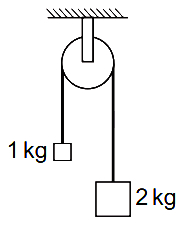
A
$4.6 \times 10^{-5} ~m$
B
$4.6 \times 10^{-6} ~m$
C
$2.5 \times 10^{-6} ~m$
D
$2.5 \times 10^{-5} ~m$
Solution
(A) The stress in the wire is given by $\text{Stress} = \frac{\text{Tension}}{\text{Area of cross-section}}$.
To avoid breaking,the stress in the wire must not exceed the breaking stress.
Let the tension in the wire be $T$ and the acceleration of the system be $a$.
The equations of motion for the two blocks are:
For the $1 ~kg$ block: $T - 1(10) = 1a \implies T - 10 = a$
For the $2 ~kg$ block: $2(10) - T = 2a \implies 20 - T = 2a$
Adding the two equations: $(T - 10) + (20 - T) = a + 2a \implies 10 = 3a \implies a = \frac{10}{3} ~m/s^2$.
Substituting $a$ into the first equation: $T = 10 + \frac{10}{3} = \frac{40}{3} ~N$.
The area of cross-section of the wire is $A = \pi r^2$.
The stress is $\frac{T}{A} = \frac{40/3}{\pi r^2}$.
Equating this to the breaking stress: $\frac{40/3}{\pi r^2} = 2 \times 10^9$.
$r^2 = \frac{40}{3 \times \pi \times 2 \times 10^9} = \frac{20}{3 \pi \times 10^9} \approx \frac{20}{9.4247 \times 10^9} \approx 2.122 \times 10^{-9} ~m^2$.
$r = \sqrt{2.122 \times 10^{-9}} \approx 4.606 \times 10^{-5} ~m$.
To avoid breaking,the stress in the wire must not exceed the breaking stress.
Let the tension in the wire be $T$ and the acceleration of the system be $a$.
The equations of motion for the two blocks are:
For the $1 ~kg$ block: $T - 1(10) = 1a \implies T - 10 = a$
For the $2 ~kg$ block: $2(10) - T = 2a \implies 20 - T = 2a$
Adding the two equations: $(T - 10) + (20 - T) = a + 2a \implies 10 = 3a \implies a = \frac{10}{3} ~m/s^2$.
Substituting $a$ into the first equation: $T = 10 + \frac{10}{3} = \frac{40}{3} ~N$.
The area of cross-section of the wire is $A = \pi r^2$.
The stress is $\frac{T}{A} = \frac{40/3}{\pi r^2}$.
Equating this to the breaking stress: $\frac{40/3}{\pi r^2} = 2 \times 10^9$.
$r^2 = \frac{40}{3 \times \pi \times 2 \times 10^9} = \frac{20}{3 \pi \times 10^9} \approx \frac{20}{9.4247 \times 10^9} \approx 2.122 \times 10^{-9} ~m^2$.
$r = \sqrt{2.122 \times 10^{-9}} \approx 4.606 \times 10^{-5} ~m$.
0 likesView Solution
43
ChemistryMCQAP EAMCET · 2006
$A$ body is projected from the earth at an angle of $30^{\circ}$ with the horizontal with some initial velocity. If its range is $20 \ m$,the maximum height reached by it is (in meters):
A
$5 \sqrt{3}$
B
$\frac{5}{\sqrt{3}}$
C
$\frac{10}{\sqrt{3}}$
D
$10 \sqrt{3}$
Solution
(B) The formula for the horizontal range $R$ is given by $R = \frac{u^2 \sin 2\theta}{g}$.
Given $R = 20 \ m$ and $\theta = 30^{\circ}$,we have $20 = \frac{u^2 \sin(60^{\circ})}{g}$.
Thus,$\frac{u^2}{g} = \frac{20}{\sin 60^{\circ}} = \frac{20}{\sqrt{3}/2} = \frac{40}{\sqrt{3}}$.
The formula for maximum height $H$ is $H = \frac{u^2 \sin^2 \theta}{2g}$.
Substituting the values,$H = \frac{1}{2} \times \left(\frac{u^2}{g}\right) \times \sin^2 30^{\circ}$.
$H = \frac{1}{2} \times \frac{40}{\sqrt{3}} \times \left(\frac{1}{2}\right)^2$.
$H = \frac{20}{\sqrt{3}} \times \frac{1}{4} = \frac{5}{\sqrt{3}} \ m$.
Given $R = 20 \ m$ and $\theta = 30^{\circ}$,we have $20 = \frac{u^2 \sin(60^{\circ})}{g}$.
Thus,$\frac{u^2}{g} = \frac{20}{\sin 60^{\circ}} = \frac{20}{\sqrt{3}/2} = \frac{40}{\sqrt{3}}$.
The formula for maximum height $H$ is $H = \frac{u^2 \sin^2 \theta}{2g}$.
Substituting the values,$H = \frac{1}{2} \times \left(\frac{u^2}{g}\right) \times \sin^2 30^{\circ}$.
$H = \frac{1}{2} \times \frac{40}{\sqrt{3}} \times \left(\frac{1}{2}\right)^2$.
$H = \frac{20}{\sqrt{3}} \times \frac{1}{4} = \frac{5}{\sqrt{3}} \ m$.
0 likesView Solution
44
ChemistryMCQAP EAMCET · 2006
$A$ man standing on a road has to hold his umbrella at $30^{\circ}$ with the vertical to keep the rain away. He throws the umbrella and starts running at $10 ~km/h$. He finds that raindrops are hitting his head vertically. The actual speed of raindrops is:
A
$20 ~km/h$
B
$10 \sqrt{3} ~km/h$
C
$20 \sqrt{3} ~km/h$
D
$10 ~km/h$
Solution
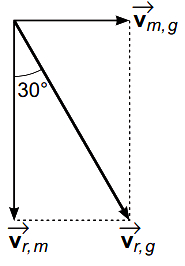
(A) Let $\vec{v}_{r,g}$ be the velocity of rain with respect to the ground,$\vec{v}_{m,g}$ be the velocity of the man with respect to the ground,and $\vec{v}_{r,m}$ be the velocity of rain with respect to the man.
When the man is at rest,the rain appears to fall at $30^{\circ}$ with the vertical,which is the direction of $\vec{v}_{r,g}$.
When the man runs at $10 ~km/h$,the rain hits him vertically,meaning the horizontal component of $\vec{v}_{r,m}$ is zero.
The relative velocity is given by $\vec{v}_{r,m} = \vec{v}_{r,g} - \vec{v}_{m,g}$.
For $\vec{v}_{r,m}$ to be vertical,the horizontal component of $\vec{v}_{r,g}$ must be equal to the horizontal component of $\vec{v}_{m,g}$.
Thus,$v_{r,g} \sin 30^{\circ} = v_{m,g} = 10 ~km/h$.
$v_{r,g} = \frac{10}{\sin 30^{\circ}} = \frac{10}{0.5} = 20 ~km/h$.
When the man is at rest,the rain appears to fall at $30^{\circ}$ with the vertical,which is the direction of $\vec{v}_{r,g}$.
When the man runs at $10 ~km/h$,the rain hits him vertically,meaning the horizontal component of $\vec{v}_{r,m}$ is zero.
The relative velocity is given by $\vec{v}_{r,m} = \vec{v}_{r,g} - \vec{v}_{m,g}$.
For $\vec{v}_{r,m}$ to be vertical,the horizontal component of $\vec{v}_{r,g}$ must be equal to the horizontal component of $\vec{v}_{m,g}$.
Thus,$v_{r,g} \sin 30^{\circ} = v_{m,g} = 10 ~km/h$.
$v_{r,g} = \frac{10}{\sin 30^{\circ}} = \frac{10}{0.5} = 20 ~km/h$.
0 likesView Solution
45
ChemistryMCQAP EAMCET · 2006
The bob of a simple pendulum is hanging vertically down from a fixed identical bob by means of a string of length $l$. If both bobs are charged with a charge $q$ each,what is the time period of the pendulum? (Ignore the radii of the bobs.)
A
$2 \pi \sqrt{\frac{l}{g+\frac{q^2}{l^2 m}}}$
B
$2 \pi \sqrt{\frac{l}{g-\frac{q^2}{l^2 m}}}$
C
$2 \pi \sqrt{\frac{l}{g}}$
D
$2 \pi \sqrt{\frac{l}{g-\frac{q^2}{l}}}$
Solution
(C) In this system,the fixed bob is located directly above the oscillating bob.
Since the string is vertical,the electrostatic force of repulsion between the two identical charges $q$ acts along the line of the string.
This electrostatic force acts in the same direction as the tension in the string and does not have any component perpendicular to the string.
Therefore,the restoring force for the small oscillations of the pendulum remains solely dependent on the component of gravity,$mg \sin \theta$.
Since the electrostatic force does not affect the restoring torque or the effective acceleration due to gravity for the oscillating bob,the time period remains unchanged.
Thus,the time period is $T = 2 \pi \sqrt{\frac{l}{g}}$.
Since the string is vertical,the electrostatic force of repulsion between the two identical charges $q$ acts along the line of the string.
This electrostatic force acts in the same direction as the tension in the string and does not have any component perpendicular to the string.
Therefore,the restoring force for the small oscillations of the pendulum remains solely dependent on the component of gravity,$mg \sin \theta$.
Since the electrostatic force does not affect the restoring torque or the effective acceleration due to gravity for the oscillating bob,the time period remains unchanged.
Thus,the time period is $T = 2 \pi \sqrt{\frac{l}{g}}$.
0 likesView Solution
46
ChemistryMCQAP EAMCET · 2006
Which of the following is used for making optical instruments?
A
$SiO_2$
B
$Si$
C
$SiH_4$
D
$SiC$
Solution
(A) Silica,represented as $SiO_2$,is widely used in the manufacturing of optical instruments due to its high transparency and thermal stability.
0 likesView Solution
47
ChemistryMCQAP EAMCET · 2006
Hydrolysis of $NCl_3$ gives $NH_3$ and $X$. Which of the following is $X$?
A
$HClO_4$
B
$HClO_3$
C
$HOCl$
D
$HClO_2$
Solution
(C) The hydrolysis of nitrogen trichloride $(NCl_3)$ involves the reaction with water to produce ammonia $(NH_3)$ and hypochlorous acid $(HOCl)$.
The balanced chemical equation is:
$NCl_3 + 3H_2O \longrightarrow NH_3 + 3HOCl$
Therefore,$X$ is $HOCl$.
The balanced chemical equation is:
$NCl_3 + 3H_2O \longrightarrow NH_3 + 3HOCl$
Therefore,$X$ is $HOCl$.
0 likesView Solution
48
ChemistryMCQAP EAMCET · 2006
Which of the following is not correct?
A
$3 O_2 \underset{\text{silent electric discharge}}{\rightleftharpoons} 2 O_3; \Delta H = -284.5 \ kJ$
B
Ozone undergoes addition reaction with unsaturated carbon compounds.
C
Sodium thiosulphate reacts with $I_2$ to form sodium tetrathionate and sodium iodide.
D
Ozone oxidises lead sulphide to lead sulphate.
Solution
(A) The formation of ozone from oxygen is an endothermic reaction,not an exothermic reaction.
$3 O_2 \underset{\text{silent electric discharge}}{\rightleftharpoons} 2 O_3 \quad \Delta H = +284.5 \ kJ \ \text{mol}^{-1}$.
Therefore,the statement $3 O_2 \underset{\text{silent electric discharge}}{\rightleftharpoons} 2 O_3; \Delta H = -284.5 \ kJ$ is incorrect because the enthalpy change is positive,not negative.
$3 O_2 \underset{\text{silent electric discharge}}{\rightleftharpoons} 2 O_3 \quad \Delta H = +284.5 \ kJ \ \text{mol}^{-1}$.
Therefore,the statement $3 O_2 \underset{\text{silent electric discharge}}{\rightleftharpoons} 2 O_3; \Delta H = -284.5 \ kJ$ is incorrect because the enthalpy change is positive,not negative.
0 likesView Solution
49
ChemistryMCQAP EAMCET · 2006
Observe the following statements :
$I$. Bleaching powder is used in the preparation of chloroform.
$II$. Bleaching powder decomposes in the presence of $CoCl_2$ to liberate $O_2$.
$III$. Aqueous $KHF_2$ is used in the preparation of fluorine.
The correct combination is :
$I$. Bleaching powder is used in the preparation of chloroform.
$II$. Bleaching powder decomposes in the presence of $CoCl_2$ to liberate $O_2$.
$III$. Aqueous $KHF_2$ is used in the preparation of fluorine.
The correct combination is :
A
$I$,$II$ and $III$ are correct
B
Only $II$ is correct
C
Only $I$ and $III$ are correct
D
Only $I$ and $II$ are correct
Solution
(D) $I$. Bleaching powder $(CaOCl_2)$ reacts with ethanol or acetone to produce chloroform $(CHCl_3)$. This is a standard laboratory preparation method.
$II$. Bleaching powder decomposes in the presence of cobalt chloride $(CoCl_2)$ catalyst to release oxygen gas: $2CaOCl_2 \xrightarrow{CoCl_2} 2CaCl_2 + O_2$.
$III$. Fluorine is prepared by the electrolysis of a fused mixture of potassium hydrogen fluoride $(KHF_2)$ and anhydrous hydrogen fluoride $(HF)$. Aqueous $KHF_2$ cannot be used because water would be oxidized to oxygen instead of fluoride ions being oxidized to fluorine gas.
Therefore,statements $I$ and $II$ are correct.
$II$. Bleaching powder decomposes in the presence of cobalt chloride $(CoCl_2)$ catalyst to release oxygen gas: $2CaOCl_2 \xrightarrow{CoCl_2} 2CaCl_2 + O_2$.
$III$. Fluorine is prepared by the electrolysis of a fused mixture of potassium hydrogen fluoride $(KHF_2)$ and anhydrous hydrogen fluoride $(HF)$. Aqueous $KHF_2$ cannot be used because water would be oxidized to oxygen instead of fluoride ions being oxidized to fluorine gas.
Therefore,statements $I$ and $II$ are correct.
0 likesView Solution
50
ChemistryMCQAP EAMCET · 2006
What is the correct order of occurrence ($\%$ by weight) in air of $Ne, Ar$ and $Kr$?
A
$Ne > Ar > Kr$
B
$Ar > Ne > Kr$
C
$Ar > Kr > Ne$
D
$Ne > Kr > Ar$
Solution
(B) The abundance of noble gases in the atmosphere by volume/weight is as follows:
$Ar \approx 0.93\%$,$Ne \approx 0.0018\%$,$Kr \approx 0.00011\%$.
Therefore,the correct order of occurrence is $Ar > Ne > Kr$.
$Ar \approx 0.93\%$,$Ne \approx 0.0018\%$,$Kr \approx 0.00011\%$.
Therefore,the correct order of occurrence is $Ar > Ne > Kr$.
0 likesView Solution
51
ChemistryDifficultMCQAP EAMCET · 2006
$CH_3 CH_2 OH \underset{\text{step-}1}{\stackrel{Cl_2}{\longrightarrow}} CH_3 CHO$ $\underset{\text{step-}2}{\stackrel{3 Cl_2}{\longrightarrow}} Cl_3 CCHO$
In the above reactions,the role of $Cl_2$ in step-$1$ and step-$2$ respectively is:
In the above reactions,the role of $Cl_2$ in step-$1$ and step-$2$ respectively is:
A
oxidation,chlorination
B
reduction,chlorination
C
oxidation,addition
D
reduction,substitution
Solution
(A) In step-$1$,$CH_3 CH_2 OH$ is converted to $CH_3 CHO$ by $Cl_2$. This is an oxidation reaction where the primary alcohol group $(-CH_2 OH)$ is oxidized to an aldehyde group $(-CHO)$.
In step-$2$,$CH_3 CHO$ reacts with $3 Cl_2$ to form $Cl_3 C CHO$. This is a chlorination reaction where the hydrogen atoms of the methyl group are substituted by chlorine atoms.
In step-$2$,$CH_3 CHO$ reacts with $3 Cl_2$ to form $Cl_3 C CHO$. This is a chlorination reaction where the hydrogen atoms of the methyl group are substituted by chlorine atoms.
0 likesView Solution
52
ChemistryEasyMCQAP EAMCET · 2006
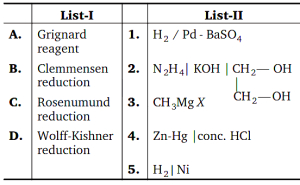
Match the following lists:
A
| $A$. Grignard reagent | $1$. $H_2 / Pd-BaSO_4$ |
| $B$. Clemmensen reduction | $2$. $N_2H_4 / KOH / \text{ethylene glycol}$ |
| $C$. Rosenmund reduction | $3$. $CH_3MgX$ |
| $D$. Wolff-Kishner reduction | $4$. $Zn-Hg / conc. HCl$ |
| $5$. $H_2 / Ni$ |
B
$A-3, B-4, C-1, D-2$
C
$A-3, B-4, C-1, D-2$
D
$A-2, B-1, C-4, D-5$
Solution
(B) The correct matches are as follows:
$A$. Grignard reagent is $CH_3MgX$ $(3)$.
$B$. Clemmensen reduction uses $Zn-Hg / conc. HCl$ $(4)$.
$C$. Rosenmund reduction uses $H_2 / Pd-BaSO_4$ $(1)$.
$D$. Wolff-Kishner reduction uses $N_2H_4 / KOH$ in ethylene glycol $(2)$.
Thus,the correct sequence is $A-3, B-4, C-1, D-2$.
$A$. Grignard reagent is $CH_3MgX$ $(3)$.
$B$. Clemmensen reduction uses $Zn-Hg / conc. HCl$ $(4)$.
$C$. Rosenmund reduction uses $H_2 / Pd-BaSO_4$ $(1)$.
$D$. Wolff-Kishner reduction uses $N_2H_4 / KOH$ in ethylene glycol $(2)$.
Thus,the correct sequence is $A-3, B-4, C-1, D-2$.
0 likesView Solution
53
ChemistryMediumMCQAP EAMCET · 2006
Which among the following represents the expression for the $\left(\frac{3}{4}\right)^{\text{th}}$ life of a $1^{\text{st}}$ order reaction?
A
$\frac{k}{2.303} \log \left(\frac{4}{3}\right)$
B
$\frac{2.303}{k} \log \left(\frac{3}{4}\right)$
C
$\frac{2.303}{k} \log (4)$
D
$\frac{2.303}{k} \log (3)$
Solution
(C) For a $1^{\text{st}}$ order reaction,the integrated rate equation is given by:
$t = \frac{2.303}{k} \log \left(\frac{a}{a-x}\right)$
For the $\left(\frac{3}{4}\right)^{\text{th}}$ life,$x = \frac{3}{4}a$.
Substituting this value into the equation:
$t_{3/4} = \frac{2.303}{k} \log \left(\frac{a}{a - \frac{3}{4}a}\right)$
$t_{3/4} = \frac{2.303}{k} \log \left(\frac{a}{\frac{1}{4}a}\right)$
$t_{3/4} = \frac{2.303}{k} \log (4)$
$t = \frac{2.303}{k} \log \left(\frac{a}{a-x}\right)$
For the $\left(\frac{3}{4}\right)^{\text{th}}$ life,$x = \frac{3}{4}a$.
Substituting this value into the equation:
$t_{3/4} = \frac{2.303}{k} \log \left(\frac{a}{a - \frac{3}{4}a}\right)$
$t_{3/4} = \frac{2.303}{k} \log \left(\frac{a}{\frac{1}{4}a}\right)$
$t_{3/4} = \frac{2.303}{k} \log (4)$
0 likesView Solution
54
ChemistryMediumMCQAP EAMCET · 2006
$CH_3 CH_2 OH$ $\xrightarrow{Cl_2} CH_3 CHO$ $\xrightarrow{3 Cl_2} Cl_3 CCHO$. In the above reactions,the role of $Cl_2$ in step-$1$ and step-$2$ respectively is:
A
oxidation,chlorination
B
reduction,chlorination
C
oxidation,addition
D
reduction,substitution
Solution
(A) In step-$1$: $CH_3 CH_2 OH + Cl_2 \rightarrow CH_3 CHO + 2HCl$. Here,$Cl_2$ acts as an oxidizing agent,converting the primary alcohol $(-CH_2OH)$ into an aldehyde $(-CHO)$.
In step-$2$: $CH_3 CHO + 3Cl_2 \rightarrow CCl_3 CHO + 3HCl$. Here,$Cl_2$ replaces the hydrogen atoms of the methyl group with chlorine atoms,which is a chlorination reaction (specifically,a substitution reaction).
In step-$2$: $CH_3 CHO + 3Cl_2 \rightarrow CCl_3 CHO + 3HCl$. Here,$Cl_2$ replaces the hydrogen atoms of the methyl group with chlorine atoms,which is a chlorination reaction (specifically,a substitution reaction).
0 likesView Solution
55
ChemistryMediumMCQAP EAMCET · 2006
Ethyl chloride reacts with sodium ethoxide to form a compound $A$. Which of the following reactions also yields $A$?
A
$C_2H_5Cl, KOH$ (alc.),$\Delta$
B
$2C_2H_5OH$,conc. $H_2SO_4, 140^{\circ}C$
C
$C_2H_5Cl, Mg$ (dry ether)
D
$C_2H_2$,dil. $H_2SO_4, HgSO_4$
Solution
(B) The reaction of ethyl chloride $(C_2H_5Cl)$ with sodium ethoxide $(C_2H_5ONa)$ is a Williamson ether synthesis,which produces diethyl ether $(C_2H_5-O-C_2H_5)$ as compound $A$.
The reaction is: $C_2H_5Cl + C_2H_5ONa \rightarrow C_2H_5-O-C_2H_5 + NaCl$.
Diethyl ether is also obtained by the intermolecular dehydration of ethyl alcohol $(C_2H_5OH)$ in the presence of concentrated $H_2SO_4$ at $140^{\circ}C$ $(413 \ K)$:
$2C_2H_5OH \xrightarrow{conc. H_2SO_4, 140^{\circ}C} C_2H_5-O-C_2H_5 + H_2O$.
The reaction is: $C_2H_5Cl + C_2H_5ONa \rightarrow C_2H_5-O-C_2H_5 + NaCl$.
Diethyl ether is also obtained by the intermolecular dehydration of ethyl alcohol $(C_2H_5OH)$ in the presence of concentrated $H_2SO_4$ at $140^{\circ}C$ $(413 \ K)$:
$2C_2H_5OH \xrightarrow{conc. H_2SO_4, 140^{\circ}C} C_2H_5-O-C_2H_5 + H_2O$.
0 likesView Solution
56
ChemistryMediumMCQAP EAMCET · 2006
Match the following lists:
| List-$I$ | List-$II$ |
|---|---|
| $A$. Grignard reagent | $1$. $H_2 / Pd-BaSO_4$ |
| $B$. Clemmensen reduction | $2$. $N_2H_4 / KOH / (CH_2OH)_2$ |
| $C$. Rosenmund reduction | $3$. $CH_3MgX$ |
| $D$. Wolff-Kishner reduction | $4$. $Zn-Hg / \text{conc. } HCl$ |
| $5$. $H_2 / Ni$ |
A
$A-3, B-4, C-2, D-1$
B
$A-3, B-4, C-1, D-2$
C
$A-2, B-1, C-4, D-5$
D
$A-5, B-3, C-2, D-1$
Solution
(B) The correct matches are:
$A$. Grignard reagent is $CH_3MgX$ $(3)$.
$B$. Clemmensen reduction uses $Zn-Hg / \text{conc. } HCl$ $(4)$.
$C$. Rosenmund reduction uses $H_2 / Pd-BaSO_4$ $(1)$.
$D$. Wolff-Kishner reduction uses $N_2H_4 / KOH / (CH_2OH)_2$ $(2)$.
Thus,the correct matching is $A-3, B-4, C-1, D-2$.
$A$. Grignard reagent is $CH_3MgX$ $(3)$.
$B$. Clemmensen reduction uses $Zn-Hg / \text{conc. } HCl$ $(4)$.
$C$. Rosenmund reduction uses $H_2 / Pd-BaSO_4$ $(1)$.
$D$. Wolff-Kishner reduction uses $N_2H_4 / KOH / (CH_2OH)_2$ $(2)$.
Thus,the correct matching is $A-3, B-4, C-1, D-2$.
0 likesView Solution
57
ChemistryMediumMCQAP EAMCET · 2006
Which of the products is formed when acetone is reacted with barium hydroxide solution?
A
$CH_3-CO-CH_2-C(OH)(CH_3)_2$
B
$CH_3-CO-CH(CH_3)-CH(OH)-CH_3$
C
$CH_3-CO-CH(OH)-CH(CH_3)-CH_3$
D
$CH_3-C(OH)(CH_3)-C(OH)(CH_3)_2$
Solution
(A) When acetone $(CH_3COCH_3)$ is treated with a base like barium hydroxide $(Ba(OH)_2)$,it undergoes an aldol condensation reaction.
Two molecules of acetone react to form $4$-hydroxy-$4$-methylpentan-$2$-one,which is commonly known as diacetone alcohol.
The reaction is as follows:
$2CH_3COCH_3 \xrightarrow{Ba(OH)_2} CH_3-CO-CH_2-C(OH)(CH_3)_2$
Therefore,the correct product is represented by option $A$.
Two molecules of acetone react to form $4$-hydroxy-$4$-methylpentan-$2$-one,which is commonly known as diacetone alcohol.
The reaction is as follows:
$2CH_3COCH_3 \xrightarrow{Ba(OH)_2} CH_3-CO-CH_2-C(OH)(CH_3)_2$
Therefore,the correct product is represented by option $A$.
0 likesView Solution
58
ChemistryEasyMCQAP EAMCET · 2006
When acetaldehyde is heated with Fehling solution,a red precipitate is formed. Which of the following is that?
A
$Cu_2O$
B
$Cu$
C
$CuO$
D
$CuSO_4$
Solution
(A) When acetaldehyde $(CH_3CHO)$ is heated with Fehling solution,it undergoes oxidation to form acetate ions,while the $Cu^{2+}$ ions in the Fehling solution are reduced to $Cu^+$ ions.
This results in the formation of a red precipitate of cuprous oxide $(Cu_2O)$.
The chemical reaction is:
$CH_3CHO + 2Cu(OH)_2 + NaOH \longrightarrow CH_3COONa + Cu_2O \downarrow (\text{Red}) + 3H_2O$
This results in the formation of a red precipitate of cuprous oxide $(Cu_2O)$.
The chemical reaction is:
$CH_3CHO + 2Cu(OH)_2 + NaOH \longrightarrow CH_3COONa + Cu_2O \downarrow (\text{Red}) + 3H_2O$
0 likesView Solution
59
ChemistryEasyMCQAP EAMCET · 2006
Which of the following reactions can produce aniline as the main product?
A
$C_6H_5NO_2 + Zn / KOH$
B
$C_6H_5NO_2 + Zn / NH_4Cl$
C
$C_6H_5NO_2 + LiAlH_4$
D
$C_6H_5NO_2 + Zn / HCl$
Solution
(D) The reduction of nitrobenzene $(C_6H_5NO_2)$ in an acidic medium using $Zn / HCl$ results in the formation of aniline $(C_6H_5NH_2)$ as the main product.
The chemical reaction is:
$C_6H_5NO_2 + 6[H] \xrightarrow{Zn/HCl} C_6H_5NH_2 + 2H_2O$
The chemical reaction is:
$C_6H_5NO_2 + 6[H] \xrightarrow{Zn/HCl} C_6H_5NH_2 + 2H_2O$
0 likesView Solution
60
ChemistryDifficultMCQAP EAMCET · 2006
Which of the following compounds when heated with $CO$ at $150^{\circ} C$ and $500 \ atm$ pressure in the presence of $BF_3$ forms ethyl propionate?
A
$C_2H_5OH$
B
$CH_3OCH_3$
C
$C_2H_5OC_2H_5$
D
$CH_3OC_2H_5$
Solution
(C) The reaction of ethers with carbon monoxide $(CO)$ in the presence of a Lewis acid catalyst like $BF_3$ at high temperature $(150^{\circ} C)$ and high pressure $(500 \ atm)$ is a carbonylation reaction.
Diethyl ether $(C_2H_5OC_2H_5)$ reacts with $CO$ to form ethyl propionate $(C_2H_5COOC_2H_5)$ according to the following equation:
$C_2H_5OC_2H_5 + CO \xrightarrow{BF_3, 150^{\circ} C, 500 \ atm} C_2H_5COOC_2H_5$.
Diethyl ether $(C_2H_5OC_2H_5)$ reacts with $CO$ to form ethyl propionate $(C_2H_5COOC_2H_5)$ according to the following equation:
$C_2H_5OC_2H_5 + CO \xrightarrow{BF_3, 150^{\circ} C, 500 \ atm} C_2H_5COOC_2H_5$.
0 likesView Solution
61
ChemistryMediumMCQAP EAMCET · 2006
Which of the following statements is not correct?
A
In oxyhaemoglobin $Fe^{2+}$ is paramagnetic
B
During respiration the size of $Fe^{2+}$ increases when it changes from diamagnetic to paramagnetic state.
C
Four heme groups are present in haemoglobin
D
Heme is the prosthetic group and it is non-protein part.
Solution
(A) In oxyhaemoglobin,$Fe^{2+}$ is in a low-spin state,which makes it diamagnetic. Therefore,the statement that $Fe^{2+}$ is paramagnetic in oxyhaemoglobin is incorrect.
0 likesView Solution
62
ChemistryMediumMCQAP EAMCET · 2006
What is the correct order of spin only magnetic moment (in $BM$) of $Mn^{2+}, Cr^{2+}$ and $V^{2+}$?
A
$Mn^{2+} > V^{2+} > Cr^{2+}$
B
$V^{2+} > Cr^{2+} > Mn^{2+}$
C
$Mn^{2+} > Cr^{2+} > V^{2+}$
D
$Cr^{2+} > V^{2+} > Mn^{2+}$
Solution
(C) Spin only magnetic moments depend upon the number of unpaired electrons; the greater the number of unpaired electrons,the greater will be the spin only magnetic moment.
$Mn$ $(Z=25)$: $[Ar] 3d^5 4s^2$
$Mn^{2+}$: $[Ar] 3d^5$,number of unpaired electrons = $5$
$Cr$ $(Z=24)$: $[Ar] 3d^5 4s^1$
$Cr^{2+}$: $[Ar] 3d^4$,number of unpaired electrons = $4$
$V$ $(Z=23)$: $[Ar] 3d^3 4s^2$
$V^{2+}$: $[Ar] 3d^3$,number of unpaired electrons = $3$
Since the magnetic moment $\mu = \sqrt{n(n+2)} \ BM$,where $n$ is the number of unpaired electrons,the order of magnetic moment is $Mn^{2+} > Cr^{2+} > V^{2+}$.
$Mn$ $(Z=25)$: $[Ar] 3d^5 4s^2$
$Mn^{2+}$: $[Ar] 3d^5$,number of unpaired electrons = $5$
$Cr$ $(Z=24)$: $[Ar] 3d^5 4s^1$
$Cr^{2+}$: $[Ar] 3d^4$,number of unpaired electrons = $4$
$V$ $(Z=23)$: $[Ar] 3d^3 4s^2$
$V^{2+}$: $[Ar] 3d^3$,number of unpaired electrons = $3$
Since the magnetic moment $\mu = \sqrt{n(n+2)} \ BM$,where $n$ is the number of unpaired electrons,the order of magnetic moment is $Mn^{2+} > Cr^{2+} > V^{2+}$.
0 likesView Solution
63
ChemistryMediumMCQAP EAMCET · 2006
When compound $X$ is oxidised by acidified potassium dichromate,compound $Y$ is formed. Compound $Y$ on reduction with $LiAlH_4$ gives $X$. $X$ and $Y$ respectively are:
A
$C_2 H_5 OH, CH_3 COOH$
B
$CH_3 COCH_3, CH_3 COOH$
C
$C_2 H_5 OH, CH_3 COCH_3$
D
$CH_3 CHO, CH_3 COCH_3$
Solution
(A) When ethyl alcohol $(X)$ is oxidised by acidified potassium dichromate,acetic acid $(Y)$ is formed:
$3 CH_3 CH_2 OH + 2 K_2 Cr_2 O_7 + 8 H_2 SO_4 \longrightarrow 3 CH_3 COOH + 2 Cr_2(SO_4)_3 + 2 K_2 SO_4 + 11 H_2 O$
Carboxylic acids undergo reduction with $LiAlH_4$ to give primary alcohols:
$CH_3 COOH \xrightarrow{LiAlH_4} CH_3 CH_2 OH$
Thus,$X$ is $C_2 H_5 OH$ and $Y$ is $CH_3 COOH$.
$3 CH_3 CH_2 OH + 2 K_2 Cr_2 O_7 + 8 H_2 SO_4 \longrightarrow 3 CH_3 COOH + 2 Cr_2(SO_4)_3 + 2 K_2 SO_4 + 11 H_2 O$
Carboxylic acids undergo reduction with $LiAlH_4$ to give primary alcohols:
$CH_3 COOH \xrightarrow{LiAlH_4} CH_3 CH_2 OH$
Thus,$X$ is $C_2 H_5 OH$ and $Y$ is $CH_3 COOH$.
0 likesView Solution
64
ChemistryMediumMCQAP EAMCET · 2006
$Assertion (A)$: $A$ current of $96.5 \ A$ is passed into aqueous $AgNO_3$ solution for $100 \ s$. The weight of silver deposited is $10.8 \ g$ (At. wt. of $Ag = 108$).
$Reason (R)$: The mass of a substance deposited during the electrolysis of an electrolyte is inversely proportional to the quantity of electricity passing through the electrolyte.
The correct answer is :
$Reason (R)$: The mass of a substance deposited during the electrolysis of an electrolyte is inversely proportional to the quantity of electricity passing through the electrolyte.
The correct answer is :
A
Both $(A)$ and $(R)$ are true and $(R)$ is the correct explanation of $(A)$
B
Both $(A)$ and $(R)$ are true but $(R)$ is not the correct explanation of $(A)$
C
$(A)$ is true but $(R)$ is false
D
$(A)$ is false but $(R)$ is true
Solution
(C) Given: $i = 96.5 \ A$,$t = 100 \ s$,Atomic weight of $Ag = 108 \ g/mol$.
Using Faraday's law: $Q = i \times t = 96.5 \ A \times 100 \ s = 9650 \ C$.
According to the reaction $Ag^+ + e^- \rightarrow Ag$,$1 \ mole$ of $e^-$ $(96500 \ C)$ deposits $108 \ g$ of $Ag$.
Mass of $Ag$ deposited $= \frac{108 \times 9650}{96500} = 10.8 \ g$.
Thus,statement $(A)$ is true.
Faraday's first law of electrolysis states that the mass of a substance deposited is directly proportional to the quantity of electricity passed $(w = Z \times Q)$.
Therefore,statement $(R)$ is false.
Using Faraday's law: $Q = i \times t = 96.5 \ A \times 100 \ s = 9650 \ C$.
According to the reaction $Ag^+ + e^- \rightarrow Ag$,$1 \ mole$ of $e^-$ $(96500 \ C)$ deposits $108 \ g$ of $Ag$.
Mass of $Ag$ deposited $= \frac{108 \times 9650}{96500} = 10.8 \ g$.
Thus,statement $(A)$ is true.
Faraday's first law of electrolysis states that the mass of a substance deposited is directly proportional to the quantity of electricity passed $(w = Z \times Q)$.
Therefore,statement $(R)$ is false.
0 likesView Solution
65
ChemistryDifficultMCQAP EAMCET · 2006
What is the time (in $sec$) required for depositing all the silver present in $125 \ mL$ of $1 \ M \ AgNO_3$ solution by passing a current of $241.25 \ A$? $(1 \ F = 96500 \ C)$
A
$10$
B
$50$
C
$1000$
D
$100$
Solution
(B) The reaction for the deposition of silver is: $Ag^+ + e^- \rightarrow Ag(s)$.
Number of moles of $Ag^+$ in $125 \ mL$ of $1 \ M \ AgNO_3$ solution is: $n = M \times V(L) = 1 \times 0.125 = 0.125 \ mol$.
Since $1 \ mol$ of $Ag^+$ requires $1 \ mol$ of electrons $(1 \ F)$ to deposit,$0.125 \ mol$ of $Ag^+$ requires $0.125 \ F$.
Total charge $Q = 0.125 \times 96500 \ C = 12062.5 \ C$.
Using the formula $Q = I \times t$,where $I = 241.25 \ A$:
$t = \frac{Q}{I} = \frac{12062.5}{241.25} = 50 \ sec$.
Number of moles of $Ag^+$ in $125 \ mL$ of $1 \ M \ AgNO_3$ solution is: $n = M \times V(L) = 1 \times 0.125 = 0.125 \ mol$.
Since $1 \ mol$ of $Ag^+$ requires $1 \ mol$ of electrons $(1 \ F)$ to deposit,$0.125 \ mol$ of $Ag^+$ requires $0.125 \ F$.
Total charge $Q = 0.125 \times 96500 \ C = 12062.5 \ C$.
Using the formula $Q = I \times t$,where $I = 241.25 \ A$:
$t = \frac{Q}{I} = \frac{12062.5}{241.25} = 50 \ sec$.
0 likesView Solution
66
ChemistryMediumMCQAP EAMCET · 2006
The standard reduction potentials of $Zn^{2+}|Zn$,$Cu^{2+}|Cu$ and $Ag^{+}|Ag$ are respectively $-0.76 \ V$,$0.34 \ V$ and $0.80 \ V$. The following cells were constructed:
$(1)$ $Zn|Zn^{2+}||Cu^{2+}|Cu$
$(2)$ $Zn|Zn^{2+}||Ag^{+}|Ag$
$(3)$ $Cu|Cu^{2+}||Ag^{+}|Ag$
What is the correct order of $E_{\text{cell}}^{\circ}$ of these cells?
$(1)$ $Zn|Zn^{2+}||Cu^{2+}|Cu$
$(2)$ $Zn|Zn^{2+}||Ag^{+}|Ag$
$(3)$ $Cu|Cu^{2+}||Ag^{+}|Ag$
What is the correct order of $E_{\text{cell}}^{\circ}$ of these cells?
A
$2 > 3 > 1$
B
$2 > 1 > 3$
C
$1 > 2 > 3$
D
$3 > 1 > 2$
Solution
(B) Given standard reduction potentials:
$E^{\circ}_{Zn^{2+}|Zn} = -0.76 \ V$
$E^{\circ}_{Cu^{2+}|Cu} = 0.34 \ V$
$E^{\circ}_{Ag^{+}|Ag} = 0.80 \ V$
For cell $(1)$: $Zn|Zn^{2+}||Cu^{2+}|Cu$
$E^{\circ}_{cell} = E^{\circ}_{cathode} - E^{\circ}_{anode} = 0.34 - (-0.76) = 1.10 \ V$
For cell $(2)$: $Zn|Zn^{2+}||Ag^{+}|Ag$
$E^{\circ}_{cell} = E^{\circ}_{cathode} - E^{\circ}_{anode} = 0.80 - (-0.76) = 1.56 \ V$
For cell $(3)$: $Cu|Cu^{2+}||Ag^{+}|Ag$
$E^{\circ}_{cell} = E^{\circ}_{cathode} - E^{\circ}_{anode} = 0.80 - 0.34 = 0.46 \ V$
Comparing the values: $1.56 \ V (2) > 1.10 \ V (1) > 0.46 \ V (3)$.
Therefore,the correct order is $2 > 1 > 3$.
$E^{\circ}_{Zn^{2+}|Zn} = -0.76 \ V$
$E^{\circ}_{Cu^{2+}|Cu} = 0.34 \ V$
$E^{\circ}_{Ag^{+}|Ag} = 0.80 \ V$
For cell $(1)$: $Zn|Zn^{2+}||Cu^{2+}|Cu$
$E^{\circ}_{cell} = E^{\circ}_{cathode} - E^{\circ}_{anode} = 0.34 - (-0.76) = 1.10 \ V$
For cell $(2)$: $Zn|Zn^{2+}||Ag^{+}|Ag$
$E^{\circ}_{cell} = E^{\circ}_{cathode} - E^{\circ}_{anode} = 0.80 - (-0.76) = 1.56 \ V$
For cell $(3)$: $Cu|Cu^{2+}||Ag^{+}|Ag$
$E^{\circ}_{cell} = E^{\circ}_{cathode} - E^{\circ}_{anode} = 0.80 - 0.34 = 0.46 \ V$
Comparing the values: $1.56 \ V (2) > 1.10 \ V (1) > 0.46 \ V (3)$.
Therefore,the correct order is $2 > 1 > 3$.
0 likesView Solution
67
ChemistryEasyMCQAP EAMCET · 2006
Which of the following is added to chloroform to slow down its aerial oxidation in the presence of light?
A
Carbonyl chloride
B
Ethyl alcohol
C
Sodium hydroxide
D
Nitric acid
Solution
(B) Chloroform $(CHCl_3)$ undergoes aerial oxidation in the presence of light to form a highly poisonous gas called phosgene $(COCl_2)$.
$2CHCl_3 + O_2 \xrightarrow{light} 2COCl_2 + 2HCl$
To prevent this,$1\%$ of ethyl alcohol $(C_2H_5OH)$ is added to chloroform.
Ethyl alcohol acts as a negative catalyst and converts any phosgene formed back into harmless diethyl carbonate.
$2CHCl_3 + O_2 \xrightarrow{light} 2COCl_2 + 2HCl$
To prevent this,$1\%$ of ethyl alcohol $(C_2H_5OH)$ is added to chloroform.
Ethyl alcohol acts as a negative catalyst and converts any phosgene formed back into harmless diethyl carbonate.
0 likesView Solution
68
ChemistryMediumMCQAP EAMCET · 2006
Which of the following reagents,when heated with ethyl chloride,forms ethylene?
A
Aqueous $KOH$
B
$Zn / HCl$
C
Alcoholic $KOH$
D
$HI$
Solution
(C) Only alcoholic $KOH$ undergoes a dehydrohalogenation reaction with alkyl halides. When ethyl chloride $(CH_3CH_2Cl)$ is heated with alcoholic $KOH$,it undergoes elimination to form ethylene $(CH_2=CH_2)$.
The reaction is as follows:
$CH_3CH_2Cl + KOH (alc.) \rightarrow CH_2=CH_2 + KCl + H_2O$
The reaction is as follows:
$CH_3CH_2Cl + KOH (alc.) \rightarrow CH_2=CH_2 + KCl + H_2O$
0 likesView Solution
69
ChemistryMediumMCQAP EAMCET · 2006
Hydrolysis of $NCl_3$ gives $NH_3$ and $X$. Which of the following is $X$?
A
$HClO_4$
B
$HClO_3$
C
$HOCl$
D
$HClO_2$
Solution
(C) The hydrolysis of nitrogen trichloride $(NCl_3)$ involves the reaction with water to produce ammonia $(NH_3)$ and hypochlorous acid $(HOCl)$.
The balanced chemical equation is:
$NCl_3 + 3H_2O \longrightarrow NH_3 + 3HOCl$
Therefore,$X$ is $HOCl$.
The balanced chemical equation is:
$NCl_3 + 3H_2O \longrightarrow NH_3 + 3HOCl$
Therefore,$X$ is $HOCl$.
0 likesView Solution
70
ChemistryMediumMCQAP EAMCET · 2006
Which of the following is not correct?
A
$3 O_2 \underset{\text{silent electric discharge}}{\rightleftharpoons} 2 O_3 ; \Delta H = -284.5 \ kJ$
B
Ozone undergoes addition reaction with unsaturated carbon compounds.
C
Sodium thiosulphate reacts with $I_2$ to form sodium tetrathionate and sodium iodide.
D
Ozone oxidises lead sulphide to lead sulphate.
Solution
(A) The formation of ozone from oxygen is an endothermic reaction,not an exothermic reaction.
The correct reaction is: $3 O_2 \underset{\text{silent electric discharge}}{\rightleftharpoons} 2 O_3 ; \Delta H = +284.5 \ kJ$.
Therefore,the statement $3 O_2 \underset{\text{silent electric discharge}}{\rightleftharpoons} 2 O_3 ; \Delta H = -284.5 \ kJ$ is incorrect.
The correct reaction is: $3 O_2 \underset{\text{silent electric discharge}}{\rightleftharpoons} 2 O_3 ; \Delta H = +284.5 \ kJ$.
Therefore,the statement $3 O_2 \underset{\text{silent electric discharge}}{\rightleftharpoons} 2 O_3 ; \Delta H = -284.5 \ kJ$ is incorrect.
0 likesView Solution
71
ChemistryMediumMCQAP EAMCET · 2006
Observe the following statements :
$I$. Bleaching powder is used in the preparation of chloroform.
$II$. Bleaching powder decomposes in the presence of $CoCl_2$ to liberate $O_2$.
$III$. Aqueous $KHF_2$ is used in the preparation of fluorine.
The correct combination is :
$I$. Bleaching powder is used in the preparation of chloroform.
$II$. Bleaching powder decomposes in the presence of $CoCl_2$ to liberate $O_2$.
$III$. Aqueous $KHF_2$ is used in the preparation of fluorine.
The correct combination is :
A
$I, II$ and $III$ are correct
B
Only $II$ is correct
C
Only $I$ and $III$ are correct
D
Only $I$ and $II$ are correct
Solution
(D) $I$. Bleaching powder $(CaOCl_2)$ reacts with ethanol to produce chloroform $(CHCl_3)$. This is a standard laboratory preparation method.
$II$. Bleaching powder decomposes in the presence of cobalt chloride $(CoCl_2)$ catalyst to release oxygen gas: $2CaOCl_2 \xrightarrow{CoCl_2} 2CaCl_2 + O_2$.
$III$. Fluorine is prepared by the electrolysis of a fused mixture of potassium hydrogen fluoride $(KHF_2)$ and anhydrous hydrogen fluoride $(HF)$. Aqueous $KHF_2$ cannot be used because water would be oxidized to oxygen instead of fluoride ions being oxidized to fluorine.
Thus,statements $I$ and $II$ are correct.
$II$. Bleaching powder decomposes in the presence of cobalt chloride $(CoCl_2)$ catalyst to release oxygen gas: $2CaOCl_2 \xrightarrow{CoCl_2} 2CaCl_2 + O_2$.
$III$. Fluorine is prepared by the electrolysis of a fused mixture of potassium hydrogen fluoride $(KHF_2)$ and anhydrous hydrogen fluoride $(HF)$. Aqueous $KHF_2$ cannot be used because water would be oxidized to oxygen instead of fluoride ions being oxidized to fluorine.
Thus,statements $I$ and $II$ are correct.
0 likesView Solution
72
ChemistryEasyMCQAP EAMCET · 2006
What is the correct order of occurrence (\% by weight) in air of $Ne, Ar$ and $Kr$?
A
$Ne > Ar > Kr$
B
$Ar > Ne > Kr$
C
$Ar > Kr > Ne$
D
$Ne > Kr > Ar$
Solution
(B) The abundance of noble gases in the atmosphere by volume (which is proportional to weight for these gases) is as follows:
$Ar$ $(0.934\%)$ > $Ne$ $(0.0018\%)$ > $Kr$ $(0.00011\%)$.
Therefore,the correct order is $Ar > Ne > Kr$.
$Ar$ $(0.934\%)$ > $Ne$ $(0.0018\%)$ > $Kr$ $(0.00011\%)$.
Therefore,the correct order is $Ar > Ne > Kr$.
0 likesView Solution
73
ChemistryEasyMCQAP EAMCET · 2006
Which of the following sets of variables gives a straight line with a negative slope when plotted? ($P =$ vapour pressure,$T =$ Temperature in $K$)
A
| $y$-axis | $x$-axis |
| $P$ | $T$ |
B
| $y$-axis | $x$-axis |
| $\log_{10} P$ | $T$ |
C
| $y$-axis | $x$-axis |
| $\log_{10} P$ | $\frac{1}{T}$ |
D
| $y$-axis | $x$-axis |
| $\log_{10} P$ | $\log_{10} \frac{1}{T}$ |
Solution
(C) According to the Clausius-Clapeyron equation,the relationship between vapour pressure $(P)$ and temperature $(T)$ is given by: $\log_{10} P = -\frac{\Delta H_{vap}}{2.303 R} \cdot \frac{1}{T} + C$.
Comparing this with the equation of a straight line $y = mx + c$,where $y = \log_{10} P$ and $x = \frac{1}{T}$,the slope $m = -\frac{\Delta H_{vap}}{2.303 R}$ is negative.
Therefore,plotting $\log_{10} P$ on the $y$-axis and $\frac{1}{T}$ on the $x$-axis yields a straight line with a negative slope.
Comparing this with the equation of a straight line $y = mx + c$,where $y = \log_{10} P$ and $x = \frac{1}{T}$,the slope $m = -\frac{\Delta H_{vap}}{2.303 R}$ is negative.
Therefore,plotting $\log_{10} P$ on the $y$-axis and $\frac{1}{T}$ on the $x$-axis yields a straight line with a negative slope.
0 likesView Solution
74
ChemistryMediumMCQAP EAMCET · 2006
Which of the following is not correct?
A
Nuclei of atoms participate in nuclear reactions
B
$_{20}Ca^{40}$ and $_{18}Ar^{40}$ are isotones
C
$1 \ amu$ of mass defect is approximately equal to $931.5 \ MeV$
D
Uranium $(U^{238})$ series is known as $(4n+2)$ series
Solution
(B) Isotones are species having the same number of neutrons.
In $_{20}Ca^{40}$,the number of neutrons is $40 - 20 = 20$.
In $_{18}Ar^{40}$,the number of neutrons is $40 - 18 = 22$.
Since the number of neutrons is different,$_{20}Ca^{40}$ and $_{18}Ar^{40}$ are not isotones.
Therefore,the statement in option $B$ is incorrect.
In $_{20}Ca^{40}$,the number of neutrons is $40 - 20 = 20$.
In $_{18}Ar^{40}$,the number of neutrons is $40 - 18 = 22$.
Since the number of neutrons is different,$_{20}Ca^{40}$ and $_{18}Ar^{40}$ are not isotones.
Therefore,the statement in option $B$ is incorrect.
0 likesView Solution
75
ChemistryEasyMCQAP EAMCET · 2006
The disperse phase,dispersion medium and nature of colloidal solution (lyophilic or lyophobic) of 'gold sol' respectively are :
A
solid,solid,lyophobic
B
liquid,liquid,lyophobic
C
solid,liquid,lyophobic
D
solid,liquid,lyophilic
Solution
(C) The colloidal solution of gold is prepared by dispersing solid gold particles in a liquid medium (usually water).
Since gold is a metal,it does not have an affinity for the dispersion medium.
Therefore,it cannot be prepared by simple mixing and requires special methods.
Such colloids are classified as lyophobic (solvent-hating) colloids.
Since gold is a metal,it does not have an affinity for the dispersion medium.
Therefore,it cannot be prepared by simple mixing and requires special methods.
Such colloids are classified as lyophobic (solvent-hating) colloids.
0 likesView Solution
Vedclass Products
For Students
Vedclass Test Series
Mock tests in real AP EAMCET style covering Chemistry with performance analysis. 5-day free trial.
Start Free TrialFor Teachers
Exam Paper Generator
Generate Set A/B/C/D Chemistry papers from 7.5L+ questions in 2 minutes. 3 chapters free.
Try FreeFor Institutes
Online Exam Module
Run live AP EAMCET mock exams with unlimited students, 360° analytics & white-label branding.
See DemoFrequently Asked Questions
How many Chemistry questions are in AP EAMCET 2006?
There are 193 Chemistry questions from the AP EAMCET 2006 paper on Vedclass, each with a detailed step-by-step solution in English.
Are AP EAMCET 2006 Chemistry solutions available in English?
Yes. All solutions on this page are in English. You can also switch to English or Hindi using the language buttons above the questions.
Can I practice AP EAMCET 2006 Chemistry as a timed test?
Yes. Use the Vedclass Test Series to attempt a full AP EAMCET mock test covering Chemistry with time limits and instant score analysis.
Can teachers create Chemistry papers from AP EAMCET previous year questions?
Yes. The Vedclass Exam Paper Generator lets teachers mix AP EAMCET Chemistry questions and generate Set A/B/C/D papers in minutes.
For Teachers & Institutes
Build a Custom Chemistry Paper
Pick AP EAMCET 2006 Chemistry questions, set difficulty, and generate Set A/B/C/D in 2 minutes.