
ChemistryQ51–100 of 193 questions
Page 2 of 4 · English
51
ChemistryMCQAP EAMCET · 2006
For all values of $\theta$,the values of $3-\cos \theta+\cos \left(\theta+\frac{\pi}{3}\right)$ lie in the interval :
A
$[2,4]$
B
$[1,5]$
C
$[-2,3]$
D
$[-2,1]$
Solution
(A) Let $f(\theta) = 3-\cos \theta+\cos \left(\theta+\frac{\pi}{3}\right)$.
Using the identity $\cos(A+B) = \cos A \cos B - \sin A \sin B$:
$f(\theta) = 3-\cos \theta + \left(\cos \theta \cdot \cos \frac{\pi}{3} - \sin \theta \cdot \sin \frac{\pi}{3}\right)$
$f(\theta) = 3-\cos \theta + \frac{1}{2} \cos \theta - \frac{\sqrt{3}}{2} \sin \theta$
$f(\theta) = 3 - \frac{1}{2} \cos \theta - \frac{\sqrt{3}}{2} \sin \theta$
$f(\theta) = 3 - \left(\cos \theta \cdot \cos \frac{\pi}{3} + \sin \theta \cdot \sin \frac{\pi}{3}\right)$
$f(\theta) = 3 - \cos \left(\theta - \frac{\pi}{3}\right)$
Since $-1 \leq \cos \left(\theta - \frac{\pi}{3}\right) \leq 1$,
$3 - (1) \leq f(\theta) \leq 3 - (-1)$
$2 \leq f(\theta) \leq 4$.
Thus,the interval is $[2,4]$.
Using the identity $\cos(A+B) = \cos A \cos B - \sin A \sin B$:
$f(\theta) = 3-\cos \theta + \left(\cos \theta \cdot \cos \frac{\pi}{3} - \sin \theta \cdot \sin \frac{\pi}{3}\right)$
$f(\theta) = 3-\cos \theta + \frac{1}{2} \cos \theta - \frac{\sqrt{3}}{2} \sin \theta$
$f(\theta) = 3 - \frac{1}{2} \cos \theta - \frac{\sqrt{3}}{2} \sin \theta$
$f(\theta) = 3 - \left(\cos \theta \cdot \cos \frac{\pi}{3} + \sin \theta \cdot \sin \frac{\pi}{3}\right)$
$f(\theta) = 3 - \cos \left(\theta - \frac{\pi}{3}\right)$
Since $-1 \leq \cos \left(\theta - \frac{\pi}{3}\right) \leq 1$,
$3 - (1) \leq f(\theta) \leq 3 - (-1)$
$2 \leq f(\theta) \leq 4$.
Thus,the interval is $[2,4]$.
0 likesView Solution
52
ChemistryMCQAP EAMCET · 2006
$e^{\log (\cosh^{-1} 2)}$ is equal to :
A
$\log (2-\sqrt{3})$
B
$\log (\sqrt{3}-2)$
C
$\log (2+\sqrt{3})$
D
$\log (2+\sqrt{5})$
Solution
(C) We know that $e^{\log (x)} = x$.
Therefore,$e^{\log (\cosh^{-1} 2)} = \cosh^{-1} 2$.
Using the logarithmic form of the inverse hyperbolic cosine function,$\cosh^{-1} x = \log (x + \sqrt{x^2 - 1})$.
Substituting $x = 2$,we get $\cosh^{-1} 2 = \log (2 + \sqrt{2^2 - 1})$.
$= \log (2 + \sqrt{4 - 1}) = \log (2 + \sqrt{3})$.
Therefore,$e^{\log (\cosh^{-1} 2)} = \cosh^{-1} 2$.
Using the logarithmic form of the inverse hyperbolic cosine function,$\cosh^{-1} x = \log (x + \sqrt{x^2 - 1})$.
Substituting $x = 2$,we get $\cosh^{-1} 2 = \log (2 + \sqrt{2^2 - 1})$.
$= \log (2 + \sqrt{4 - 1}) = \log (2 + \sqrt{3})$.
0 likesView Solution
53
ChemistryMCQAP EAMCET · 2006
If $5 \cos x + 12 \cos y = 13$,then the maximum value of $5 \sin x + 12 \sin y$ is:
A
$12$
B
$\sqrt{120}$
C
$\sqrt{20}$
D
$13$
Solution
(B) Given $5 \cos x + 12 \cos y = 13$.
Squaring both sides,we get $(5 \cos x + 12 \cos y)^2 = 169$.
Let $S = 5 \sin x + 12 \sin y$.
Consider $S^2 + 13^2 = (5 \sin x + 12 \sin y)^2 + (5 \cos x + 12 \cos y)^2$.
$= 25(\sin^2 x + \cos^2 x) + 144(\sin^2 y + \cos^2 y) + 120(\sin x \sin y + \cos x \cos y)$.
$= 25 + 144 + 120 \cos(x - y) = 169 + 120 \cos(x - y)$.
Thus,$S^2 = 169 + 120 \cos(x - y) - 169 = 120 \cos(x - y)$.
Since the maximum value of $\cos(x - y)$ is $1$,the maximum value of $S^2$ is $120$.
Therefore,the maximum value of $S$ is $\sqrt{120}$.
Squaring both sides,we get $(5 \cos x + 12 \cos y)^2 = 169$.
Let $S = 5 \sin x + 12 \sin y$.
Consider $S^2 + 13^2 = (5 \sin x + 12 \sin y)^2 + (5 \cos x + 12 \cos y)^2$.
$= 25(\sin^2 x + \cos^2 x) + 144(\sin^2 y + \cos^2 y) + 120(\sin x \sin y + \cos x \cos y)$.
$= 25 + 144 + 120 \cos(x - y) = 169 + 120 \cos(x - y)$.
Thus,$S^2 = 169 + 120 \cos(x - y) - 169 = 120 \cos(x - y)$.
Since the maximum value of $\cos(x - y)$ is $1$,the maximum value of $S^2$ is $120$.
Therefore,the maximum value of $S$ is $\sqrt{120}$.
0 likesView Solution
54
ChemistryMCQAP EAMCET · 2006
The lines $x-y-2=0$,$x+y-4=0$ and $x+3y=6$ meet at a common point:
A
$(1,2)$
B
$(2,2)$
C
$(3,1)$
D
$(1,1)$
Solution
(C) The equations of the lines are:
$x-y-2=0$ ...$(i)$
$x+y-4=0$ ...(ii)
$x+3y=6$ ...(iii)
Adding equations $(i)$ and (ii):
$(x-y-2) + (x+y-4) = 0$
$2x - 6 = 0 \implies x = 3$
Substituting $x=3$ in equation (ii):
$3 + y - 4 = 0 \implies y = 1$
Now,check if the point $(3,1)$ satisfies equation (iii):
$3 + 3(1) = 3 + 3 = 6$
Since the point $(3,1)$ satisfies all three equations,the lines are concurrent at $(3,1)$.
$x-y-2=0$ ...$(i)$
$x+y-4=0$ ...(ii)
$x+3y=6$ ...(iii)
Adding equations $(i)$ and (ii):
$(x-y-2) + (x+y-4) = 0$
$2x - 6 = 0 \implies x = 3$
Substituting $x=3$ in equation (ii):
$3 + y - 4 = 0 \implies y = 1$
Now,check if the point $(3,1)$ satisfies equation (iii):
$3 + 3(1) = 3 + 3 = 6$
Since the point $(3,1)$ satisfies all three equations,the lines are concurrent at $(3,1)$.
0 likesView Solution
55
ChemistryMCQAP EAMCET · 2006
The lines represented by the equation $x^2-y^2-x+3y-2=0$ are :
A
$x+y-1=0, x-y+2=0$
B
$x-y-2=0, x+y+1=0$
C
$x+y+2=0, x-y-1=0$
D
$x-y+1=0, x+y-2=0$
Solution
(D) The given equation is $x^2-y^2-x+3y-2=0$.
We can rearrange the terms as $x^2 - (y^2 - 3y + 2) - x = 0$.
Factoring the quadratic in $y$: $y^2 - 3y + 2 = (y-1)(y-2)$.
To factor the whole expression,we look for factors of the form $(x+ay+b)(x+cy+d)$.
Expanding $(x-y+1)(x+y-2) = x^2 + xy - 2x - xy - y^2 + 2y + x + y - 2 = x^2 - y^2 - x + 3y - 2$.
Thus,the equation represents the lines $x-y+1=0$ and $x+y-2=0$.
We can rearrange the terms as $x^2 - (y^2 - 3y + 2) - x = 0$.
Factoring the quadratic in $y$: $y^2 - 3y + 2 = (y-1)(y-2)$.
To factor the whole expression,we look for factors of the form $(x+ay+b)(x+cy+d)$.
Expanding $(x-y+1)(x+y-2) = x^2 + xy - 2x - xy - y^2 + 2y + x + y - 2 = x^2 - y^2 - x + 3y - 2$.
Thus,the equation represents the lines $x-y+1=0$ and $x+y-2=0$.
0 likesView Solution
56
ChemistryMCQAP EAMCET · 2006
The transformed equation of $x^2+6xy+8y^2=10$ when the axes are rotated through an angle $\frac{\pi}{4}$ is:
A
$15x^2-14xy+3y^2=20$
B
$15x^2+14xy-3y^2=20$
C
$15x^2+14xy+3y^2=20$
D
$15x^2-14xy-3y^2=20$
Solution
(C) The given equation is $x^2+6xy+8y^2=10$ $\dots$ $(i)$.
Since the axes are rotated through an angle $\theta = \frac{\pi}{4}$,we use the transformation formulas:
$x = x_1 \cos \frac{\pi}{4} - y_1 \sin \frac{\pi}{4} = \frac{x_1-y_1}{\sqrt{2}}$
$y = x_1 \sin \frac{\pi}{4} + y_1 \cos \frac{\pi}{4} = \frac{x_1+y_1}{\sqrt{2}}$
Substituting these into the original equation:
$\left(\frac{x_1-y_1}{\sqrt{2}}\right)^2 + 6\left(\frac{x_1-y_1}{\sqrt{2}}\right)\left(\frac{x_1+y_1}{\sqrt{2}}\right) + 8\left(\frac{x_1+y_1}{\sqrt{2}}\right)^2 = 10$
$\frac{x_1^2+y_1^2-2x_1y_1}{2} + \frac{6(x_1^2-y_1^2)}{2} + \frac{8(x_1^2+y_1^2+2x_1y_1)}{2} = 10$
Multiplying by $2$:
$(x_1^2+y_1^2-2x_1y_1) + (6x_1^2-6y_1^2) + (8x_1^2+8y_1^2+16x_1y_1) = 20$
Combining like terms:
$(1+6+8)x_1^2 + (1-6+8)y_1^2 + (-2+16)x_1y_1 = 20$
$15x_1^2 + 3y_1^2 + 14x_1y_1 = 20$
Thus,the transformed equation is $15x^2+14xy+3y^2=20$.
Since the axes are rotated through an angle $\theta = \frac{\pi}{4}$,we use the transformation formulas:
$x = x_1 \cos \frac{\pi}{4} - y_1 \sin \frac{\pi}{4} = \frac{x_1-y_1}{\sqrt{2}}$
$y = x_1 \sin \frac{\pi}{4} + y_1 \cos \frac{\pi}{4} = \frac{x_1+y_1}{\sqrt{2}}$
Substituting these into the original equation:
$\left(\frac{x_1-y_1}{\sqrt{2}}\right)^2 + 6\left(\frac{x_1-y_1}{\sqrt{2}}\right)\left(\frac{x_1+y_1}{\sqrt{2}}\right) + 8\left(\frac{x_1+y_1}{\sqrt{2}}\right)^2 = 10$
$\frac{x_1^2+y_1^2-2x_1y_1}{2} + \frac{6(x_1^2-y_1^2)}{2} + \frac{8(x_1^2+y_1^2+2x_1y_1)}{2} = 10$
Multiplying by $2$:
$(x_1^2+y_1^2-2x_1y_1) + (6x_1^2-6y_1^2) + (8x_1^2+8y_1^2+16x_1y_1) = 20$
Combining like terms:
$(1+6+8)x_1^2 + (1-6+8)y_1^2 + (-2+16)x_1y_1 = 20$
$15x_1^2 + 3y_1^2 + 14x_1y_1 = 20$
Thus,the transformed equation is $15x^2+14xy+3y^2=20$.
0 likesView Solution
57
ChemistryMCQAP EAMCET · 2006
The transformed equation of $x^2+6xy+8y^2=10$ when the axes are rotated through an angle $\frac{\pi}{4}$ is:
A
$15x^2-14xy+3y^2=20$
B
$15x^2+14xy-3y^2=20$
C
$15x^2+14xy+3y^2=20$
D
$15x^2-14xy-3y^2=20$
Solution
(C) The given equation is $x^2+6xy+8y^2=10$ $\dots$ $(i)$.
Since the axes are rotated through an angle $\theta = \frac{\pi}{4}$,we use the transformation formulas:
$x = x' \cos \theta - y' \sin \theta = \frac{x'-y'}{\sqrt{2}}$
$y = x' \sin \theta + y' \cos \theta = \frac{x'+y'}{\sqrt{2}}$
Substituting these into $(i)$:
$\left(\frac{x'-y'}{\sqrt{2}}\right)^2 + 6\left(\frac{x'-y'}{\sqrt{2}}\right)\left(\frac{x'+y'}{\sqrt{2}}\right) + 8\left(\frac{x'+y'}{\sqrt{2}}\right)^2 = 10$
$\frac{x'^2+y'^2-2x'y'}{2} + 6\left(\frac{x'^2-y'^2}{2}\right) + 8\left(\frac{x'^2+y'^2+2x'y'}{2}\right) = 10$
Multiplying by $2$:
$(x'^2+y'^2-2x'y') + 6(x'^2-y'^2) + 8(x'^2+y'^2+2x'y') = 20$
$x'^2+y'^2-2x'y' + 6x'^2-6y'^2 + 8x'^2+8y'^2+16x'y' = 20$
$(1+6+8)x'^2 + (1-6+8)y'^2 + (-2+16)x'y' = 20$
$15x'^2 + 3y'^2 + 14x'y' = 20$
Replacing $x', y'$ with $x, y$,the transformed equation is $15x^2+14xy+3y^2=20$.
Since the axes are rotated through an angle $\theta = \frac{\pi}{4}$,we use the transformation formulas:
$x = x' \cos \theta - y' \sin \theta = \frac{x'-y'}{\sqrt{2}}$
$y = x' \sin \theta + y' \cos \theta = \frac{x'+y'}{\sqrt{2}}$
Substituting these into $(i)$:
$\left(\frac{x'-y'}{\sqrt{2}}\right)^2 + 6\left(\frac{x'-y'}{\sqrt{2}}\right)\left(\frac{x'+y'}{\sqrt{2}}\right) + 8\left(\frac{x'+y'}{\sqrt{2}}\right)^2 = 10$
$\frac{x'^2+y'^2-2x'y'}{2} + 6\left(\frac{x'^2-y'^2}{2}\right) + 8\left(\frac{x'^2+y'^2+2x'y'}{2}\right) = 10$
Multiplying by $2$:
$(x'^2+y'^2-2x'y') + 6(x'^2-y'^2) + 8(x'^2+y'^2+2x'y') = 20$
$x'^2+y'^2-2x'y' + 6x'^2-6y'^2 + 8x'^2+8y'^2+16x'y' = 20$
$(1+6+8)x'^2 + (1-6+8)y'^2 + (-2+16)x'y' = 20$
$15x'^2 + 3y'^2 + 14x'y' = 20$
Replacing $x', y'$ with $x, y$,the transformed equation is $15x^2+14xy+3y^2=20$.
0 likesView Solution
58
ChemistryMCQAP EAMCET · 2006
The centroid of the triangle formed by the pair of straight lines $12x^2 - 20xy + 7y^2 = 0$ and the line $2x - 3y + 4 = 0$ is:
A
$\left(-\frac{7}{3}, \frac{7}{3}\right)$
B
$\left(-\frac{8}{3}, \frac{8}{3}\right)$
C
$\left(\frac{8}{3}, \frac{8}{3}\right)$
D
$\left(\frac{4}{3}, \frac{4}{3}\right)$
Solution
(C) The given pair of lines is $12x^2 - 20xy + 7y^2 = 0$. Factoring this,we get $(6x - 7y)(2x - y) = 0$.
Thus,the equations of the two lines are $6x - 7y = 0$ $(i)$ and $2x - y = 0$ (ii).
The third line is $2x - 3y + 4 = 0$ (iii).
Solving $(i)$ and (ii): $6x - 7y = 0$ and $2x - y = 0 \implies x=0, y=0$. Vertex $A = (0, 0)$.
Solving $(i)$ and (iii): $6x - 7y = 0$ and $2x - 3y = -4$. Multiplying (iii) by $3$: $6x - 9y = -12$. Subtracting from $(i)$: $2y = 12 \implies y = 6, x = 7$. Vertex $B = (7, 6)$.
Solving (ii) and (iii): $2x - y = 0$ and $2x - 3y = -4$. Subtracting: $2y = 4 \implies y = 2, x = 1$. Vertex $C = (1, 2)$.
The centroid is $\left(\frac{x_1+x_2+x_3}{3}, \frac{y_1+y_2+y_3}{3}\right) = \left(\frac{0+7+1}{3}, \frac{0+6+2}{3}\right) = \left(\frac{8}{3}, \frac{8}{3}\right)$.
Thus,the equations of the two lines are $6x - 7y = 0$ $(i)$ and $2x - y = 0$ (ii).
The third line is $2x - 3y + 4 = 0$ (iii).
Solving $(i)$ and (ii): $6x - 7y = 0$ and $2x - y = 0 \implies x=0, y=0$. Vertex $A = (0, 0)$.
Solving $(i)$ and (iii): $6x - 7y = 0$ and $2x - 3y = -4$. Multiplying (iii) by $3$: $6x - 9y = -12$. Subtracting from $(i)$: $2y = 12 \implies y = 6, x = 7$. Vertex $B = (7, 6)$.
Solving (ii) and (iii): $2x - y = 0$ and $2x - 3y = -4$. Subtracting: $2y = 4 \implies y = 2, x = 1$. Vertex $C = (1, 2)$.
The centroid is $\left(\frac{x_1+x_2+x_3}{3}, \frac{y_1+y_2+y_3}{3}\right) = \left(\frac{0+7+1}{3}, \frac{0+6+2}{3}\right) = \left(\frac{8}{3}, \frac{8}{3}\right)$.
0 likesView Solution
59
ChemistryMCQAP EAMCET · 2006
The polar equation of the circle with centre $\left(2, \frac{\pi}{2}\right)$ and radius $3$ units is :
A
$r^2+4 r \cos \theta=5$
B
$r^2+4 r \sin \theta=5$
C
$r^2-4 r \sin \theta=5$
D
$r^2-4 r \cos \theta=5$
Solution
(C) The Cartesian coordinates of the centre $(h, k)$ are given by $h = r_0 \cos \theta_0$ and $k = r_0 \sin \theta_0$,where $(r_0, \theta_0) = (2, \frac{\pi}{2})$.
$h = 2 \cos(\frac{\pi}{2}) = 0$ and $k = 2 \sin(\frac{\pi}{2}) = 2$.
So,the centre is $(0, 2)$ and the radius $a = 3$.
The Cartesian equation of the circle is $(x - h)^2 + (y - k)^2 = a^2$.
$(x - 0)^2 + (y - 2)^2 = 3^2$.
$x^2 + y^2 - 4y + 4 = 9$.
$x^2 + y^2 - 4y = 5$.
Using the polar coordinate relations $x = r \cos \theta$,$y = r \sin \theta$,and $x^2 + y^2 = r^2$:
$r^2 - 4(r \sin \theta) = 5$.
$r^2 - 4r \sin \theta = 5$.
$h = 2 \cos(\frac{\pi}{2}) = 0$ and $k = 2 \sin(\frac{\pi}{2}) = 2$.
So,the centre is $(0, 2)$ and the radius $a = 3$.
The Cartesian equation of the circle is $(x - h)^2 + (y - k)^2 = a^2$.
$(x - 0)^2 + (y - 2)^2 = 3^2$.
$x^2 + y^2 - 4y + 4 = 9$.
$x^2 + y^2 - 4y = 5$.
Using the polar coordinate relations $x = r \cos \theta$,$y = r \sin \theta$,and $x^2 + y^2 = r^2$:
$r^2 - 4(r \sin \theta) = 5$.
$r^2 - 4r \sin \theta = 5$.
0 likesView Solution
60
ChemistryMCQAP EAMCET · 2006
The length of the tangent drawn to the circle $x^2+y^2-2x+4y-11=0$ from the point $(1,3)$ is:
A
$1$
B
$2$
C
$3$
D
$4$
Solution
(C) The length of the tangent drawn from a point $(x_1, y_1)$ to a circle $x^2+y^2+2gx+2fy+c=0$ is given by $\sqrt{x_1^2+y_1^2+2gx_1+2fy_1+c}$.
Given the circle equation $x^2+y^2-2x+4y-11=0$ and the point $(1,3)$.
Substituting the point $(1,3)$ into the expression:
Length $= \sqrt{1^2+3^2-2(1)+4(3)-11}$
$= \sqrt{1+9-2+12-11}$
$= \sqrt{22-13}$
$= \sqrt{9}$
$= 3$
Given the circle equation $x^2+y^2-2x+4y-11=0$ and the point $(1,3)$.
Substituting the point $(1,3)$ into the expression:
Length $= \sqrt{1^2+3^2-2(1)+4(3)-11}$
$= \sqrt{1+9-2+12-11}$
$= \sqrt{22-13}$
$= \sqrt{9}$
$= 3$
0 likesView Solution
61
ChemistryMCQAP EAMCET · 2006
The number of common tangents to the two circles $x^2+y^2-8x+2y=0$ and $x^2+y^2-2x-16y+25=0$ is:
A
$1$
B
$2$
C
$3$
D
$4$
Solution
(B) The equations of the circles are $x^2+y^2-8x+2y=0$ and $x^2+y^2-2x-16y+25=0$.
For the first circle,the center $C_1 = (4, -1)$ and the radius $r_1 = \sqrt{4^2 + (-1)^2 - 0} = \sqrt{17}$.
For the second circle,the center $C_2 = (1, 8)$ and the radius $r_2 = \sqrt{1^2 + 8^2 - 25} = \sqrt{1 + 64 - 25} = \sqrt{40}$.
The distance between the centers is $C_1C_2 = \sqrt{(1-4)^2 + (8 - (-1))^2} = \sqrt{(-3)^2 + 9^2} = \sqrt{9 + 81} = \sqrt{90}$.
We compare $C_1C_2$ with the sum and difference of the radii:
$r_1 + r_2 = \sqrt{17} + \sqrt{40} \approx 4.12 + 6.32 = 10.44$.
$|r_1 - r_2| = |\sqrt{17} - \sqrt{40}| \approx |4.12 - 6.32| = 2.20$.
Since $|r_1 - r_2| < C_1C_2 < r_1 + r_2$ (because $2.20 < 9.48 < 10.44$),the two circles intersect at two distinct points.
Therefore,the number of common tangents is $2$.
For the first circle,the center $C_1 = (4, -1)$ and the radius $r_1 = \sqrt{4^2 + (-1)^2 - 0} = \sqrt{17}$.
For the second circle,the center $C_2 = (1, 8)$ and the radius $r_2 = \sqrt{1^2 + 8^2 - 25} = \sqrt{1 + 64 - 25} = \sqrt{40}$.
The distance between the centers is $C_1C_2 = \sqrt{(1-4)^2 + (8 - (-1))^2} = \sqrt{(-3)^2 + 9^2} = \sqrt{9 + 81} = \sqrt{90}$.
We compare $C_1C_2$ with the sum and difference of the radii:
$r_1 + r_2 = \sqrt{17} + \sqrt{40} \approx 4.12 + 6.32 = 10.44$.
$|r_1 - r_2| = |\sqrt{17} - \sqrt{40}| \approx |4.12 - 6.32| = 2.20$.
Since $|r_1 - r_2| < C_1C_2 < r_1 + r_2$ (because $2.20 < 9.48 < 10.44$),the two circles intersect at two distinct points.
Therefore,the number of common tangents is $2$.
0 likesView Solution
62
ChemistryMCQAP EAMCET · 2006
Observe the following statements :
$I$. The circle $x^2+y^2-6x-4y-7=0$ touches the $y$-axis.
$II$. The circle $x^2+y^2+6x+4y-7=0$ touches the $x$-axis.
Which of the following is a correct statement?
$I$. The circle $x^2+y^2-6x-4y-7=0$ touches the $y$-axis.
$II$. The circle $x^2+y^2+6x+4y-7=0$ touches the $x$-axis.
Which of the following is a correct statement?
A
Both $I$ and $II$ are true
B
Neither $I$ nor $II$ is true
C
$I$ is true,$II$ is false
D
$I$ is false,$II$ is true
Solution
(B) For a circle $x^2+y^2+2gx+2fy+c=0$ to touch the $y$-axis,the condition is $g^2=c$.
For a circle to touch the $x$-axis,the condition is $f^2=c$.
$I$. For $x^2+y^2-6x-4y-7=0$,$g=-3$ and $c=-7$. Since $g^2 = (-3)^2 = 9 \neq -7$,it does not touch the $y$-axis.
$II$. For $x^2+y^2+6x+4y-7=0$,$f=2$ and $c=-7$. Since $f^2 = (2)^2 = 4 \neq -7$,it does not touch the $x$-axis.
Therefore,neither $I$ nor $II$ is true.
For a circle to touch the $x$-axis,the condition is $f^2=c$.
$I$. For $x^2+y^2-6x-4y-7=0$,$g=-3$ and $c=-7$. Since $g^2 = (-3)^2 = 9 \neq -7$,it does not touch the $y$-axis.
$II$. For $x^2+y^2+6x+4y-7=0$,$f=2$ and $c=-7$. Since $f^2 = (2)^2 = 4 \neq -7$,it does not touch the $x$-axis.
Therefore,neither $I$ nor $II$ is true.
0 likesView Solution
63
ChemistryMCQAP EAMCET · 2006
If $b$ and $c$ are the lengths of the segments of any focal chord of a parabola $y^2 = 4ax$,then the length of the semi-latus rectum is:
A
$\frac{bc}{b+c}$
B
$\sqrt{bc}$
C
$\frac{b+c}{2}$
D
$\frac{2bc}{b+c}$
Solution
(D) The semi-latus rectum of a parabola is the harmonic mean of the segments of any focal chord.
Let $l$ be the length of the semi-latus rectum.
Since $l$ is the harmonic mean between $b$ and $c$,we have:
$l = \frac{2}{\frac{1}{b} + \frac{1}{c}}$
$l = \frac{2bc}{b+c}$
Let $l$ be the length of the semi-latus rectum.
Since $l$ is the harmonic mean between $b$ and $c$,we have:
$l = \frac{2}{\frac{1}{b} + \frac{1}{c}}$
$l = \frac{2bc}{b+c}$
0 likesView Solution
64
ChemistryMCQAP EAMCET · 2006
Let $O$ be the origin and $A$ be a point on the curve $y^2=4x$. Then the locus of the midpoint of $OA$ is:
A
$x^2=4y$
B
$x^2=2y$
C
$y^2=16x$
D
$y^2=2x$
Solution
(D) Let the coordinates of point $A$ on the parabola $y^2=4x$ be $(t^2, 2t)$,where $a=1$.
Since $O$ is the origin $(0,0)$,the midpoint $M(h, k)$ of $OA$ is given by:
$h = \frac{0+t^2}{2} = \frac{t^2}{2} \implies t^2 = 2h$
$k = \frac{0+2t}{2} = t \implies t = k$
Substituting $t=k$ into $t^2=2h$,we get $k^2 = 2h$.
Replacing $(h, k)$ with $(x, y)$,the locus is $y^2=2x$.
Since $O$ is the origin $(0,0)$,the midpoint $M(h, k)$ of $OA$ is given by:
$h = \frac{0+t^2}{2} = \frac{t^2}{2} \implies t^2 = 2h$
$k = \frac{0+2t}{2} = t \implies t = k$
Substituting $t=k$ into $t^2=2h$,we get $k^2 = 2h$.
Replacing $(h, k)$ with $(x, y)$,the locus is $y^2=2x$.
0 likesView Solution
65
ChemistryMCQAP EAMCET · 2006
The coefficient of $x^n$ in $\frac{1-2x}{e^x}$ is:
A
$\frac{1+2n}{n!}$
B
$(-1)^n \cdot \frac{1+2n}{n!}$
C
$(-1)^n \cdot \frac{1-2n}{n!}$
D
$(-1)^n \cdot \frac{1+4n}{n!}$
Solution
(B) We have $\frac{1-2x}{e^x} = (1-2x)e^{-x}$.
Using the expansion $e^{-x} = \sum_{k=0}^{\infty} \frac{(-1)^k x^k}{k!}$,we get:
$(1-2x) \sum_{k=0}^{\infty} \frac{(-1)^k x^k}{k!} = \sum_{k=0}^{\infty} \frac{(-1)^k x^k}{k!} - 2x \sum_{k=0}^{\infty} \frac{(-1)^k x^k}{k!}$.
The coefficient of $x^n$ is obtained from the first term when $k=n$ and from the second term when $k=n-1$:
Coefficient $= \frac{(-1)^n}{n!} - 2 \cdot \frac{(-1)^{n-1}}{(n-1)!}$.
Since $(-1)^{n-1} = -(-1)^n$,we have:
Coefficient $= \frac{(-1)^n}{n!} + 2 \cdot \frac{(-1)^n}{(n-1)!} = \frac{(-1)^n}{n!} [1 + 2n] = (-1)^n \cdot \frac{1+2n}{n!}$.
Using the expansion $e^{-x} = \sum_{k=0}^{\infty} \frac{(-1)^k x^k}{k!}$,we get:
$(1-2x) \sum_{k=0}^{\infty} \frac{(-1)^k x^k}{k!} = \sum_{k=0}^{\infty} \frac{(-1)^k x^k}{k!} - 2x \sum_{k=0}^{\infty} \frac{(-1)^k x^k}{k!}$.
The coefficient of $x^n$ is obtained from the first term when $k=n$ and from the second term when $k=n-1$:
Coefficient $= \frac{(-1)^n}{n!} - 2 \cdot \frac{(-1)^{n-1}}{(n-1)!}$.
Since $(-1)^{n-1} = -(-1)^n$,we have:
Coefficient $= \frac{(-1)^n}{n!} + 2 \cdot \frac{(-1)^n}{(n-1)!} = \frac{(-1)^n}{n!} [1 + 2n] = (-1)^n \cdot \frac{1+2n}{n!}$.
0 likesView Solution
66
ChemistryMCQAP EAMCET · 2006
If $|x| < 1$ and $y = x - \frac{x^2}{2} + \frac{x^3}{3} - \frac{x^4}{4} + \ldots$,then $x$ is equal to :
A
$y + \frac{y^2}{2!} + \frac{y^3}{3!} + \ldots$
B
$y - \frac{y^2}{2!} + \frac{y^3}{3!} - \frac{y^4}{4!} + \ldots$
C
$y + \frac{y^2}{2} + \frac{y^3}{3} + \ldots$
D
$y - \frac{y^2}{2} + \frac{y^3}{3} - \frac{y^4}{4} + \ldots$
Solution
(A) Given the series expansion: $y = x - \frac{x^2}{2} + \frac{x^3}{3} - \frac{x^4}{4} + \ldots$
This is the logarithmic series expansion for $\log(1+x)$.
So,$y = \log(1+x)$.
Taking the exponential of both sides: $e^y = 1+x$.
Therefore,$x = e^y - 1$.
The expansion of $e^y$ is $1 + y + \frac{y^2}{2!} + \frac{y^3}{3!} + \ldots$.
Substituting this into the expression for $x$:
$x = (1 + y + \frac{y^2}{2!} + \frac{y^3}{3!} + \ldots) - 1$
$x = y + \frac{y^2}{2!} + \frac{y^3}{3!} + \ldots$
This is the logarithmic series expansion for $\log(1+x)$.
So,$y = \log(1+x)$.
Taking the exponential of both sides: $e^y = 1+x$.
Therefore,$x = e^y - 1$.
The expansion of $e^y$ is $1 + y + \frac{y^2}{2!} + \frac{y^3}{3!} + \ldots$.
Substituting this into the expression for $x$:
$x = (1 + y + \frac{y^2}{2!} + \frac{y^3}{3!} + \ldots) - 1$
$x = y + \frac{y^2}{2!} + \frac{y^3}{3!} + \ldots$
0 likesView Solution
67
ChemistryMCQAP EAMCET · 2006
Equations of the latus rectum of the ellipse $9x^2 + 4y^2 - 18x - 8y - 23 = 0$ are:
A
$y = \pm \sqrt{5}$
B
$x = \pm \sqrt{5}$
C
$y = 1 \pm \sqrt{5}$
D
$x = -1 \pm \sqrt{5}$
Solution
(C) The given equation of the ellipse is $9x^2 + 4y^2 - 18x - 8y - 23 = 0$.
Completing the square,we get:
$9(x^2 - 2x + 1) - 9 + 4(y^2 - 2y + 1) - 4 - 23 = 0$
$9(x - 1)^2 + 4(y - 1)^2 = 36$
Dividing by $36$,we obtain the standard form:
$\frac{(x - 1)^2}{4} + \frac{(y - 1)^2}{9} = 1$
Here,$a^2 = 4$ and $b^2 = 9$,so $a^2 < b^2$.
The eccentricity $e$ is given by $e = \sqrt{1 - \frac{a^2}{b^2}} = \sqrt{1 - \frac{4}{9}} = \sqrt{\frac{5}{9}} = \frac{\sqrt{5}}{3}$.
The equations of the latus rectum for a vertical ellipse are $y - k = \pm be$,where $(h, k) = (1, 1)$.
$y - 1 = \pm 3 \times \frac{\sqrt{5}}{3}$
$y - 1 = \pm \sqrt{5}$
$y = 1 \pm \sqrt{5}$
Completing the square,we get:
$9(x^2 - 2x + 1) - 9 + 4(y^2 - 2y + 1) - 4 - 23 = 0$
$9(x - 1)^2 + 4(y - 1)^2 = 36$
Dividing by $36$,we obtain the standard form:
$\frac{(x - 1)^2}{4} + \frac{(y - 1)^2}{9} = 1$
Here,$a^2 = 4$ and $b^2 = 9$,so $a^2 < b^2$.
The eccentricity $e$ is given by $e = \sqrt{1 - \frac{a^2}{b^2}} = \sqrt{1 - \frac{4}{9}} = \sqrt{\frac{5}{9}} = \frac{\sqrt{5}}{3}$.
The equations of the latus rectum for a vertical ellipse are $y - k = \pm be$,where $(h, k) = (1, 1)$.
$y - 1 = \pm 3 \times \frac{\sqrt{5}}{3}$
$y - 1 = \pm \sqrt{5}$
$y = 1 \pm \sqrt{5}$
0 likesView Solution
68
ChemistryMCQAP EAMCET · 2006
If the eccentricity of a hyperbola is $\sqrt{3}$,then the eccentricity of its conjugate hyperbola is:
A
$\sqrt{2}$
B
$\sqrt{3}$
C
$\sqrt{\frac{3}{2}}$
D
$2 \sqrt{3}$
Solution
(C) Let $e$ and $e^{\prime}$ be the eccentricities of a hyperbola and its conjugate hyperbola respectively.
We know that the relationship between them is given by $\frac{1}{e^2} + \frac{1}{(e^{\prime})^2} = 1$.
Given that $e = \sqrt{3}$,we have $e^2 = 3$.
Substituting this into the formula: $\frac{1}{3} + \frac{1}{(e^{\prime})^2} = 1$.
$\frac{1}{(e^{\prime})^2} = 1 - \frac{1}{3} = \frac{2}{3}$.
Therefore,$(e^{\prime})^2 = \frac{3}{2}$,which implies $e^{\prime} = \sqrt{\frac{3}{2}}$.
We know that the relationship between them is given by $\frac{1}{e^2} + \frac{1}{(e^{\prime})^2} = 1$.
Given that $e = \sqrt{3}$,we have $e^2 = 3$.
Substituting this into the formula: $\frac{1}{3} + \frac{1}{(e^{\prime})^2} = 1$.
$\frac{1}{(e^{\prime})^2} = 1 - \frac{1}{3} = \frac{2}{3}$.
Therefore,$(e^{\prime})^2 = \frac{3}{2}$,which implies $e^{\prime} = \sqrt{\frac{3}{2}}$.
0 likesView Solution
69
ChemistryMCQAP EAMCET · 2006
If $l_1 = \lim_{x \rightarrow 2^{+}} (x + [x])$,$l_2 = \lim_{x \rightarrow 2^{-}} (2x - [x])$ and $l_3 = \lim_{x \rightarrow \pi / 2} \frac{\cos x}{x - \pi / 2}$,then:
A
$l_1 < l_2 < l_3$
B
$l_2 < l_3 < l_1$
C
$l_3 < l_2 < l_1$
D
$l_1 < l_3 < l_2$
Solution
(C) For $l_1 = \lim_{x \rightarrow 2^{+}} (x + [x])$: Let $x = 2 + h$ where $h \rightarrow 0^{+}$. Then $[x] = 2$. So,$l_1 = \lim_{h \rightarrow 0} (2 + h + 2) = 4$.
For $l_2 = \lim_{x \rightarrow 2^{-}} (2x - [x])$: Let $x = 2 - h$ where $h \rightarrow 0^{+}$. Then $[x] = 1$. So,$l_2 = \lim_{h \rightarrow 0} (2(2 - h) - 1) = 4 - 1 = 3$.
For $l_3 = \lim_{x \rightarrow \pi / 2} \frac{\cos x}{x - \pi / 2}$: Using $L'\text{Hospital's rule}$,we differentiate the numerator and denominator with respect to $x$: $\lim_{x \rightarrow \pi / 2} \frac{-\sin x}{1} = -\sin(\pi / 2) = -1$.
Comparing the values: $l_3 = -1$,$l_2 = 3$,$l_1 = 4$. Thus,$-1 < 3 < 4$,which implies $l_3 < l_2 < l_1$.
For $l_2 = \lim_{x \rightarrow 2^{-}} (2x - [x])$: Let $x = 2 - h$ where $h \rightarrow 0^{+}$. Then $[x] = 1$. So,$l_2 = \lim_{h \rightarrow 0} (2(2 - h) - 1) = 4 - 1 = 3$.
For $l_3 = \lim_{x \rightarrow \pi / 2} \frac{\cos x}{x - \pi / 2}$: Using $L'\text{Hospital's rule}$,we differentiate the numerator and denominator with respect to $x$: $\lim_{x \rightarrow \pi / 2} \frac{-\sin x}{1} = -\sin(\pi / 2) = -1$.
Comparing the values: $l_3 = -1$,$l_2 = 3$,$l_1 = 4$. Thus,$-1 < 3 < 4$,which implies $l_3 < l_2 < l_1$.
0 likesView Solution
70
ChemistryMCQAP EAMCET · 2006
$\lim _{x \rightarrow \infty}\left[\sqrt{x^2+2 x-1}-x\right]$ is equal to :
A
$\infty$
B
$\frac{1}{2}$
C
$4$
D
$1$
Solution
(D) To evaluate the limit $\lim _{x \rightarrow \infty}\left[\sqrt{x^2+2 x-1}-x\right]$,we rationalize the expression by multiplying and dividing by the conjugate $\left(\sqrt{x^2+2 x-1}+x\right)$:
$\lim _{x}$ ${\rightarrow \infty}\left[\frac{\left(\sqrt{x^2+2 x-1}-x\right)\left(\sqrt{x^2+2 x-1}+x\right)}{\sqrt{x^2+2 x-1}+x}\right]$
$= \lim _{x \rightarrow \infty}\left[\frac{x^2+2 x-1-x^2}{\sqrt{x^2+2 x-1}+x}\right]$
$= \lim _{x \rightarrow \infty}\left[\frac{2x-1}{\sqrt{x^2+2 x-1}+x}\right]$
Divide the numerator and denominator by $x$:
$= \lim _{x \rightarrow \infty}\left[\frac{2-\frac{1}{x}}{\sqrt{1+\frac{2}{x}-\frac{1}{x^2}}+1}\right]$
As $x \rightarrow \infty$,$\frac{1}{x} \rightarrow 0$ and $\frac{1}{x^2} \rightarrow 0$:
$= \frac{2-0}{\sqrt{1+0-0}+1} = \frac{2}{1+1} = \frac{2}{2} = 1$
$\lim _{x}$ ${\rightarrow \infty}\left[\frac{\left(\sqrt{x^2+2 x-1}-x\right)\left(\sqrt{x^2+2 x-1}+x\right)}{\sqrt{x^2+2 x-1}+x}\right]$
$= \lim _{x \rightarrow \infty}\left[\frac{x^2+2 x-1-x^2}{\sqrt{x^2+2 x-1}+x}\right]$
$= \lim _{x \rightarrow \infty}\left[\frac{2x-1}{\sqrt{x^2+2 x-1}+x}\right]$
Divide the numerator and denominator by $x$:
$= \lim _{x \rightarrow \infty}\left[\frac{2-\frac{1}{x}}{\sqrt{1+\frac{2}{x}-\frac{1}{x^2}}+1}\right]$
As $x \rightarrow \infty$,$\frac{1}{x} \rightarrow 0$ and $\frac{1}{x^2} \rightarrow 0$:
$= \frac{2-0}{\sqrt{1+0-0}+1} = \frac{2}{1+1} = \frac{2}{2} = 1$
0 likesView Solution
71
ChemistryMCQAP EAMCET · 2006
If $\lim _{x \rightarrow 0}\left(\frac{\cos 4 x+a \cos 2 x+b}{x^4}\right)$ is finite,then the values of $a, b$ are respectively :
A
$5, -4$
B
$-5, -4$
C
$-4, 3$
D
$4, 5$
Solution
(C) Let $f(x) = \cos 4x + a \cos 2x + b$. For the limit to be finite as $x \rightarrow 0$,the numerator must approach $0$ at a rate of at least $x^4$.
Using the Taylor series expansion: $\cos \theta = 1 - \frac{\theta^2}{2!} + \frac{\theta^4}{4!} - \dots$
$\cos 4x = 1 - \frac{(4x)^2}{2} + \frac{(4x)^4}{24} = 1 - 8x^2 + \frac{32}{3}x^4$
$a \cos 2x = a(1 - \frac{(2x)^2}{2} + \frac{(2x)^4}{24}) = a - 2ax^2 + \frac{2a}{3}x^4$
Substituting these into the numerator: $(1 + a + b) + (-8 - 2a)x^2 + (\frac{32}{3} + \frac{2a}{3})x^4$.
For the limit to be finite,the coefficients of $x^0$ and $x^2$ must be zero.
$1 + a + b = 0$ and $-8 - 2a = 0$.
From $-8 - 2a = 0$,we get $a = -4$.
Substituting $a = -4$ into $1 + a + b = 0$: $1 - 4 + b = 0 \implies b = 3$.
Thus,the values are $a = -4, b = 3$.
Using the Taylor series expansion: $\cos \theta = 1 - \frac{\theta^2}{2!} + \frac{\theta^4}{4!} - \dots$
$\cos 4x = 1 - \frac{(4x)^2}{2} + \frac{(4x)^4}{24} = 1 - 8x^2 + \frac{32}{3}x^4$
$a \cos 2x = a(1 - \frac{(2x)^2}{2} + \frac{(2x)^4}{24}) = a - 2ax^2 + \frac{2a}{3}x^4$
Substituting these into the numerator: $(1 + a + b) + (-8 - 2a)x^2 + (\frac{32}{3} + \frac{2a}{3})x^4$.
For the limit to be finite,the coefficients of $x^0$ and $x^2$ must be zero.
$1 + a + b = 0$ and $-8 - 2a = 0$.
From $-8 - 2a = 0$,we get $a = -4$.
Substituting $a = -4$ into $1 + a + b = 0$: $1 - 4 + b = 0 \implies b = 3$.
Thus,the values are $a = -4, b = 3$.
0 likesView Solution
72
ChemistryMCQAP EAMCET · 2006
If $0 < p < q$,then $\lim _{n \rightarrow \infty}\left(q^n+p^n\right)^{1 / n}$ is equal to :
A
$e$
B
$p$
C
$q$
D
$0$
Solution
(C) Given the limit $L = \lim _{n \rightarrow \infty}\left(q^n+p^n\right)^{1 / n}$.
Since $0 < p < q$,we can factor out $q^n$ from the expression:
$L = \lim _{n \rightarrow \infty} \left[ q^n \left( 1 + \left( \frac{p}{q} \right)^n \right) \right]^{1/n}$
$L = \lim _{n \rightarrow \infty} q \left( 1 + \left( \frac{p}{q} \right)^n \right)^{1/n}$
Since $0 < \frac{p}{q} < 1$,as $n \rightarrow \infty$,the term $\left( \frac{p}{q} \right)^n \rightarrow 0$.
Therefore,$L = q \cdot (1 + 0)^0 = q \cdot 1 = q$.
Since $0 < p < q$,we can factor out $q^n$ from the expression:
$L = \lim _{n \rightarrow \infty} \left[ q^n \left( 1 + \left( \frac{p}{q} \right)^n \right) \right]^{1/n}$
$L = \lim _{n \rightarrow \infty} q \left( 1 + \left( \frac{p}{q} \right)^n \right)^{1/n}$
Since $0 < \frac{p}{q} < 1$,as $n \rightarrow \infty$,the term $\left( \frac{p}{q} \right)^n \rightarrow 0$.
Therefore,$L = q \cdot (1 + 0)^0 = q \cdot 1 = q$.
0 likesView Solution
73
ChemistryMCQAP EAMCET · 2006
In a $\triangle ABC$,if $3a = b + c$,then $\cot \frac{B}{2} \cot \frac{C}{2}$ is equal to :
A
$1$
B
$2$
C
$3$
D
$4$
Solution
(B) We know the half-angle formulas for a triangle: $\cot \frac{B}{2} = \sqrt{\frac{s(s-b)}{(s-a)(s-c)}}$ and $\cot \frac{C}{2} = \sqrt{\frac{s(s-c)}{(s-a)(s-b)}}$.
Multiplying these,we get $\cot \frac{B}{2} \cot \frac{C}{2} = \sqrt{\frac{s(s-b)}{(s-a)(s-c)} \cdot \frac{s(s-c)}{(s-a)(s-b)}} = \sqrt{\frac{s^2}{(s-a)^2}} = \frac{s}{s-a}$.
Since $s = \frac{a+b+c}{2}$,we have $2s = a+b+c$.
Thus,$\frac{s}{s-a} = \frac{2s}{2s-2a} = \frac{a+b+c}{a+b+c-2a} = \frac{a+b+c}{b+c-a}$.
Given $b+c = 3a$,we substitute this into the expression:
$\frac{a + 3a}{3a - a} = \frac{4a}{2a} = 2$.
Multiplying these,we get $\cot \frac{B}{2} \cot \frac{C}{2} = \sqrt{\frac{s(s-b)}{(s-a)(s-c)} \cdot \frac{s(s-c)}{(s-a)(s-b)}} = \sqrt{\frac{s^2}{(s-a)^2}} = \frac{s}{s-a}$.
Since $s = \frac{a+b+c}{2}$,we have $2s = a+b+c$.
Thus,$\frac{s}{s-a} = \frac{2s}{2s-2a} = \frac{a+b+c}{a+b+c-2a} = \frac{a+b+c}{b+c-a}$.
Given $b+c = 3a$,we substitute this into the expression:
$\frac{a + 3a}{3a - a} = \frac{4a}{2a} = 2$.
0 likesView Solution
74
ChemistryMCQAP EAMCET · 2006
If,in a $\triangle ABC$,$\tan \frac{A}{2} = \frac{5}{6}$ and $\tan \frac{C}{2} = \frac{2}{5}$,then $a, b, c$ are such that :
A
$b^2 = ac$
B
$2b = a + c$
C
$2ac = b(a + c)$
D
$a + b = c$
Solution
(B) We know that $\tan \frac{A}{2} = \sqrt{\frac{(s-b)(s-c)}{s(s-a)}}$ and $\tan \frac{C}{2} = \sqrt{\frac{(s-a)(s-b)}{s(s-c)}}$.
Multiplying these,we get $\tan \frac{A}{2} \tan \frac{C}{2} = \sqrt{\frac{(s-b)(s-c)}{s(s-a)} \cdot \frac{(s-a)(s-b)}{s(s-c)}} = \sqrt{\frac{(s-b)^2}{s^2}} = \frac{s-b}{s}$.
Given $\tan \frac{A}{2} = \frac{5}{6}$ and $\tan \frac{C}{2} = \frac{2}{5}$,we have $\frac{s-b}{s} = \frac{5}{6} \cdot \frac{2}{5} = \frac{1}{3}$.
Thus,$3(s-b) = s$ $\Rightarrow 3s - 3b = s$ $\Rightarrow 2s = 3b$.
Since $2s = a + b + c$,we have $a + b + c = 3b$,which simplifies to $a + c = 2b$.
Multiplying these,we get $\tan \frac{A}{2} \tan \frac{C}{2} = \sqrt{\frac{(s-b)(s-c)}{s(s-a)} \cdot \frac{(s-a)(s-b)}{s(s-c)}} = \sqrt{\frac{(s-b)^2}{s^2}} = \frac{s-b}{s}$.
Given $\tan \frac{A}{2} = \frac{5}{6}$ and $\tan \frac{C}{2} = \frac{2}{5}$,we have $\frac{s-b}{s} = \frac{5}{6} \cdot \frac{2}{5} = \frac{1}{3}$.
Thus,$3(s-b) = s$ $\Rightarrow 3s - 3b = s$ $\Rightarrow 2s = 3b$.
Since $2s = a + b + c$,we have $a + b + c = 3b$,which simplifies to $a + c = 2b$.
0 likesView Solution
75
ChemistryMCQAP EAMCET · 2006
The angles of a triangle are in the ratio $3: 5: 10$. Then the ratio of the smallest side to the greatest side is:
A
$1: \sin 10^{\circ}$
B
$1: 2 \sin 10^{\circ}$
C
$1: \cos 10^{\circ}$
D
$1: 2 \cos 10^{\circ}$
Solution
(D) Let the angles of the triangle be $3x, 5x,$ and $10x$.
Since the sum of angles in a triangle is $180^{\circ}$,we have $3x + 5x + 10x = 180^{\circ}$.
$18x = 180^{\circ} \Rightarrow x = 10^{\circ}$.
The angles are $30^{\circ}, 50^{\circ},$ and $100^{\circ}$.
By the Sine Rule,the ratio of sides is $\sin A : \sin B : \sin C$.
The smallest side is opposite the smallest angle $(30^{\circ})$ and the greatest side is opposite the greatest angle $(100^{\circ})$.
Ratio $= \sin 30^{\circ} : \sin 100^{\circ}$.
$= \frac{1}{2} : \sin(90^{\circ} + 10^{\circ})$.
$= \frac{1}{2} : \cos 10^{\circ}$.
$= 1 : 2 \cos 10^{\circ}$.
Since the sum of angles in a triangle is $180^{\circ}$,we have $3x + 5x + 10x = 180^{\circ}$.
$18x = 180^{\circ} \Rightarrow x = 10^{\circ}$.
The angles are $30^{\circ}, 50^{\circ},$ and $100^{\circ}$.
By the Sine Rule,the ratio of sides is $\sin A : \sin B : \sin C$.
The smallest side is opposite the smallest angle $(30^{\circ})$ and the greatest side is opposite the greatest angle $(100^{\circ})$.
Ratio $= \sin 30^{\circ} : \sin 100^{\circ}$.
$= \frac{1}{2} : \sin(90^{\circ} + 10^{\circ})$.
$= \frac{1}{2} : \cos 10^{\circ}$.
$= 1 : 2 \cos 10^{\circ}$.
0 likesView Solution
76
ChemistryMCQAP EAMCET · 2006
If $b+c=3a$,then $\cot \frac{B}{2} \cot \frac{C}{2}$ is equal to :
A
$3$
B
$1$
C
$4$
D
$2$
Solution
(D) We know that $\cot \frac{B}{2} = \sqrt{\frac{s(s-b)}{(s-a)(s-c)}}$ and $\cot \frac{C}{2} = \sqrt{\frac{s(s-c)}{(s-a)(s-b)}}$.
Multiplying these,we get $\cot \frac{B}{2} \cdot \cot \frac{C}{2} = \sqrt{\frac{s(s-b)}{(s-a)(s-c)} \cdot \frac{s(s-c)}{(s-a)(s-b)}} = \sqrt{\frac{s^2}{(s-a)^2}} = \frac{s}{s-a}$.
Given $b+c=3a$,the semi-perimeter $s = \frac{a+b+c}{2} = \frac{a+3a}{2} = 2a$.
Substituting $s=2a$ into the expression,we get $\frac{2a}{2a-a} = \frac{2a}{a} = 2$.
Multiplying these,we get $\cot \frac{B}{2} \cdot \cot \frac{C}{2} = \sqrt{\frac{s(s-b)}{(s-a)(s-c)} \cdot \frac{s(s-c)}{(s-a)(s-b)}} = \sqrt{\frac{s^2}{(s-a)^2}} = \frac{s}{s-a}$.
Given $b+c=3a$,the semi-perimeter $s = \frac{a+b+c}{2} = \frac{a+3a}{2} = 2a$.
Substituting $s=2a$ into the expression,we get $\frac{2a}{2a-a} = \frac{2a}{a} = 2$.
0 likesView Solution
77
ChemistryMCQAP EAMCET · 2006
The perimeter of a sector is a constant. If its area is to be maximum,the sectorial angle is:
A
$ \frac{\pi^c}{6} $
B
$ \frac{\pi^c}{4} $
C
$ 4^c $
D
$ 2^c $
Solution
(D) Let the radius of the sector be $r$ and the sectorial angle be $\theta$ (in radians).
The arc length $l = r\theta$.
The perimeter $P = l + 2r = r\theta + 2r = r(\theta + 2)$.
Thus,$r = \frac{P}{\theta + 2}$.
The area of the sector $A = \frac{1}{2}r^2\theta$.
Substituting $r$,we get $A = \frac{1}{2} \left( \frac{P}{\theta + 2} \right)^2 \theta = \frac{P^2}{2} \cdot \frac{\theta}{(\theta + 2)^2}$.
To maximize $A$,we differentiate with respect to $\theta$ and set to $0$:
$\frac{dA}{d\theta} = \frac{P^2}{2} \left[ \frac{(\theta + 2)^2 - \theta \cdot 2(\theta + 2)}{(\theta + 2)^4} \right] = 0$.
This implies $(\theta + 2) - 2\theta = 0$,so $2 - \theta = 0$,which gives $\theta = 2 \text{ radians}$.
Therefore,the sectorial angle for maximum area is $2^c$.
The arc length $l = r\theta$.
The perimeter $P = l + 2r = r\theta + 2r = r(\theta + 2)$.
Thus,$r = \frac{P}{\theta + 2}$.
The area of the sector $A = \frac{1}{2}r^2\theta$.
Substituting $r$,we get $A = \frac{1}{2} \left( \frac{P}{\theta + 2} \right)^2 \theta = \frac{P^2}{2} \cdot \frac{\theta}{(\theta + 2)^2}$.
To maximize $A$,we differentiate with respect to $\theta$ and set to $0$:
$\frac{dA}{d\theta} = \frac{P^2}{2} \left[ \frac{(\theta + 2)^2 - \theta \cdot 2(\theta + 2)}{(\theta + 2)^4} \right] = 0$.
This implies $(\theta + 2) - 2\theta = 0$,so $2 - \theta = 0$,which gives $\theta = 2 \text{ radians}$.
Therefore,the sectorial angle for maximum area is $2^c$.
0 likesView Solution
78
ChemistryMCQAP EAMCET · 2006
If $A = \begin{bmatrix} 1 & 2 & 2 \\ 2 & 1 & 2 \\ 2 & 2 & 1 \end{bmatrix}$,then $A^3 - 4A^2 - 6A$ is equal to:
A
$0$
B
$A$
C
$-A$
D
$I$
Solution
(C) Given $A = \begin{bmatrix} 1 & 2 & 2 \\ 2 & 1 & 2 \\ 2 & 2 & 1 \end{bmatrix}$.
First,calculate $A^2 = A \cdot A$:
$A^2 = \begin{bmatrix} 1 & 2 & 2 \\ 2 & 1 & 2 \\ 2 & 2 & 1 \end{bmatrix} \begin{bmatrix} 1 & 2 & 2 \\ 2 & 1 & 2 \\ 2 & 2 & 1 \end{bmatrix} = \begin{bmatrix} 9 & 8 & 8 \\ 8 & 9 & 8 \\ 8 & 8 & 9 \end{bmatrix}$.
Next,calculate $A^3 = A^2 \cdot A$:
$A^3 = \begin{bmatrix} 9 & 8 & 8 \\ 8 & 9 & 8 \\ 8 & 8 & 9 \end{bmatrix} \begin{bmatrix} 1 & 2 & 2 \\ 2 & 1 & 2 \\ 2 & 2 & 1 \end{bmatrix} = \begin{bmatrix} 41 & 42 & 42 \\ 42 & 41 & 42 \\ 42 & 42 & 41 \end{bmatrix}$.
Now,compute the expression $A^3 - 4A^2 - 6A$:
$A^3 - 4A^2 - 6A = \begin{bmatrix} 41 & 42 & 42 \\ 42 & 41 & 42 \\ 42 & 42 & 41 \end{bmatrix} - 4 \begin{bmatrix} 9 & 8 & 8 \\ 8 & 9 & 8 \\ 8 & 8 & 9 \end{bmatrix} - 6 \begin{bmatrix} 1 & 2 & 2 \\ 2 & 1 & 2 \\ 2 & 2 & 1 \end{bmatrix}$
$= \begin{bmatrix} 41-36-6 & 42-32-12 & 42-32-12 \\ 42-32-12 & 41-36-6 & 42-32-12 \\ 42-32-12 & 42-32-12 & 41-36-6 \end{bmatrix}$
$= \begin{bmatrix} -1 & -2 & -2 \\ -2 & -1 & -2 \\ -2 & -2 & -1 \end{bmatrix} = -\begin{bmatrix} 1 & 2 & 2 \\ 2 & 1 & 2 \\ 2 & 2 & 1 \end{bmatrix} = -A$.
First,calculate $A^2 = A \cdot A$:
$A^2 = \begin{bmatrix} 1 & 2 & 2 \\ 2 & 1 & 2 \\ 2 & 2 & 1 \end{bmatrix} \begin{bmatrix} 1 & 2 & 2 \\ 2 & 1 & 2 \\ 2 & 2 & 1 \end{bmatrix} = \begin{bmatrix} 9 & 8 & 8 \\ 8 & 9 & 8 \\ 8 & 8 & 9 \end{bmatrix}$.
Next,calculate $A^3 = A^2 \cdot A$:
$A^3 = \begin{bmatrix} 9 & 8 & 8 \\ 8 & 9 & 8 \\ 8 & 8 & 9 \end{bmatrix} \begin{bmatrix} 1 & 2 & 2 \\ 2 & 1 & 2 \\ 2 & 2 & 1 \end{bmatrix} = \begin{bmatrix} 41 & 42 & 42 \\ 42 & 41 & 42 \\ 42 & 42 & 41 \end{bmatrix}$.
Now,compute the expression $A^3 - 4A^2 - 6A$:
$A^3 - 4A^2 - 6A = \begin{bmatrix} 41 & 42 & 42 \\ 42 & 41 & 42 \\ 42 & 42 & 41 \end{bmatrix} - 4 \begin{bmatrix} 9 & 8 & 8 \\ 8 & 9 & 8 \\ 8 & 8 & 9 \end{bmatrix} - 6 \begin{bmatrix} 1 & 2 & 2 \\ 2 & 1 & 2 \\ 2 & 2 & 1 \end{bmatrix}$
$= \begin{bmatrix} 41-36-6 & 42-32-12 & 42-32-12 \\ 42-32-12 & 41-36-6 & 42-32-12 \\ 42-32-12 & 42-32-12 & 41-36-6 \end{bmatrix}$
$= \begin{bmatrix} -1 & -2 & -2 \\ -2 & -1 & -2 \\ -2 & -2 & -1 \end{bmatrix} = -\begin{bmatrix} 1 & 2 & 2 \\ 2 & 1 & 2 \\ 2 & 2 & 1 \end{bmatrix} = -A$.
0 likesView Solution
79
ChemistryMCQAP EAMCET · 2006
If $A$ is an invertible matrix of order $n$,then the determinant of $\operatorname{adj} A$ is equal to :
A
$|A|^n$
B
$|A|^{n+1}$
C
$|A|^{n-1}$
D
$|A|^{n+2}$
Solution
(C) We know that for any square matrix $A$ of order $n$,the property of the adjoint matrix is given by $A(\operatorname{adj} A) = |A|I_n$,where $I_n$ is the identity matrix of order $n$.
Taking the determinant on both sides,we get $|A(\operatorname{adj} A)| = ||A|I_n|$.
Using the property $|AB| = |A||B|$ and $|kA| = k^n|A|$ for a matrix of order $n$,we have $|A| \cdot |\operatorname{adj} A| = |A|^n \cdot |I_n|$.
Since $|I_n| = 1$,we have $|A| \cdot |\operatorname{adj} A| = |A|^n$.
Since $A$ is invertible,$|A| \neq 0$,so we can divide by $|A|$ to get $|\operatorname{adj} A| = |A|^{n-1}$.
Taking the determinant on both sides,we get $|A(\operatorname{adj} A)| = ||A|I_n|$.
Using the property $|AB| = |A||B|$ and $|kA| = k^n|A|$ for a matrix of order $n$,we have $|A| \cdot |\operatorname{adj} A| = |A|^n \cdot |I_n|$.
Since $|I_n| = 1$,we have $|A| \cdot |\operatorname{adj} A| = |A|^n$.
Since $A$ is invertible,$|A| \neq 0$,so we can divide by $|A|$ to get $|\operatorname{adj} A| = |A|^{n-1}$.
0 likesView Solution
80
ChemistryMCQAP EAMCET · 2006
$\left|\begin{array}{ccc} \log e & \log e^2 & \log e^3 \\ \log e^2 & \log e^3 & \log e^4 \\ \log e^3 & \log e^4 & \log e^5 \end{array}\right|$ is equal to :
A
$0$
B
$1$
C
$4 \log e$
D
$5 \log e$
Solution
(A) Given determinant is $\Delta = \left|\begin{array}{ccc} \log e & \log e^2 & \log e^3 \\ \log e^2 & \log e^3 & \log e^4 \\ \log e^3 & \log e^4 & \log e^5 \end{array}\right|$.
Using the property $\log a^n = n \log a$,we get:
$\Delta = \left|\begin{array}{ccc} \log e & 2 \log e & 3 \log e \\ 2 \log e & 3 \log e & 4 \log e \\ 3 \log e & 4 \log e & 5 \log e \end{array}\right|$.
Taking $\log e$ common from each column,we get:
$\Delta = (\log e)^3 \left|\begin{array}{ccc} 1 & 2 & 3 \\ 2 & 3 & 4 \\ 3 & 4 & 5 \end{array}\right|$.
Applying $C_2 \rightarrow C_2 - C_1$ and $C_3 \rightarrow C_3 - C_2$:
$\Delta = (\log e)^3 \left|\begin{array}{ccc} 1 & 1 & 1 \\ 2 & 1 & 1 \\ 3 & 1 & 1 \end{array}\right|$.
Since column $C_2$ and column $C_3$ are identical,the value of the determinant is $0$.
Using the property $\log a^n = n \log a$,we get:
$\Delta = \left|\begin{array}{ccc} \log e & 2 \log e & 3 \log e \\ 2 \log e & 3 \log e & 4 \log e \\ 3 \log e & 4 \log e & 5 \log e \end{array}\right|$.
Taking $\log e$ common from each column,we get:
$\Delta = (\log e)^3 \left|\begin{array}{ccc} 1 & 2 & 3 \\ 2 & 3 & 4 \\ 3 & 4 & 5 \end{array}\right|$.
Applying $C_2 \rightarrow C_2 - C_1$ and $C_3 \rightarrow C_3 - C_2$:
$\Delta = (\log e)^3 \left|\begin{array}{ccc} 1 & 1 & 1 \\ 2 & 1 & 1 \\ 3 & 1 & 1 \end{array}\right|$.
Since column $C_2$ and column $C_3$ are identical,the value of the determinant is $0$.
0 likesView Solution
81
ChemistryMCQAP EAMCET · 2006
If $f: R \rightarrow R$ is defined by $f(x)=[2x]-2[x]$ for $x \in R$,where $[x]$ is the greatest integer function,then the range of $f$ is:
A
$\{x \in R: 0 \leq x \leq 1\}$
B
$\{0, 1\}$
C
$\{x \in R: x > 0\}$
D
$\{x \in R: x \leq 0\}$
Solution
(B) Given $f(x) = [2x] - 2[x]$.
Case $1$: If $x$ is an integer,let $x = n$ where $n \in Z$.
Then $f(n) = [2n] - 2[n] = 2n - 2n = 0$.
Case $2$: If $x$ is not an integer,let $x = n + f$ where $n \in Z$ and $0 < f < 1$.
Then $f(x) = [2(n + f)] - 2[n + f] = [2n + 2f] - 2n = 2n + [2f] - 2n = [2f]$.
Since $0 < f < 1$,$0 < 2f < 2$. Thus,$[2f]$ can be $0$ (if $0 < f < 0.5$) or $1$ (if $0.5 \leq f < 1$).
However,for any non-integer $x$,$[2x] - 2[x]$ always evaluates to $1$.
Therefore,the range of $f$ is $\{0, 1\}$.
Case $1$: If $x$ is an integer,let $x = n$ where $n \in Z$.
Then $f(n) = [2n] - 2[n] = 2n - 2n = 0$.
Case $2$: If $x$ is not an integer,let $x = n + f$ where $n \in Z$ and $0 < f < 1$.
Then $f(x) = [2(n + f)] - 2[n + f] = [2n + 2f] - 2n = 2n + [2f] - 2n = [2f]$.
Since $0 < f < 1$,$0 < 2f < 2$. Thus,$[2f]$ can be $0$ (if $0 < f < 0.5$) or $1$ (if $0.5 \leq f < 1$).
However,for any non-integer $x$,$[2x] - 2[x]$ always evaluates to $1$.
Therefore,the range of $f$ is $\{0, 1\}$.
0 likesView Solution
82
ChemistryMCQAP EAMCET · 2006
If $f: R \rightarrow R$ is defined by $f(x)=x-[x]-\frac{1}{2}$ for $x \in R$,where $[x]$ is the greatest integer not exceeding $x$,then $\{x \in R: f(x)=\frac{1}{2}\}$ is equal to :
A
$Z$,the set of all integers
B
$N$,the set of all natural numbers
C
$\phi$,the empty set
D
$R$
Solution
(C) Given the function $f(x) = x - [x] - \frac{1}{2}$.
We are looking for $x$ such that $f(x) = \frac{1}{2}$.
Substituting the expression for $f(x)$,we get $\frac{1}{2} = x - [x] - \frac{1}{2}$.
Adding $\frac{1}{2}$ to both sides,we get $x - [x] = 1$.
By definition of the fractional part function,${x} = x - [x]$,where $0 \le \{x\} < 1$.
Thus,the equation becomes ${x} = 1$.
Since the fractional part of any real number $x$ must be strictly less than $1$,there is no real number $x$ that satisfies this condition.
Therefore,the set $\{x \in R: f(x) = \frac{1}{2}\}$ is the empty set,denoted by $\phi$.
We are looking for $x$ such that $f(x) = \frac{1}{2}$.
Substituting the expression for $f(x)$,we get $\frac{1}{2} = x - [x] - \frac{1}{2}$.
Adding $\frac{1}{2}$ to both sides,we get $x - [x] = 1$.
By definition of the fractional part function,${x} = x - [x]$,where $0 \le \{x\} < 1$.
Thus,the equation becomes ${x} = 1$.
Since the fractional part of any real number $x$ must be strictly less than $1$,there is no real number $x$ that satisfies this condition.
Therefore,the set $\{x \in R: f(x) = \frac{1}{2}\}$ is the empty set,denoted by $\phi$.
0 likesView Solution
83
ChemistryMCQAP EAMCET · 2006
If $u=\sin ^{-1}\left(\frac{x^2+y^2}{x+y}\right)$ then $x \frac{\partial u}{\partial x}+y \frac{\partial u}{\partial y}$ is equal to:
A
$\sin u$
B
$\tan u$
C
$\cos u$
D
$\cot u$
Solution
(B) Given $u=\sin ^{-1}\left(\frac{x^2+y^2}{x+y}\right)$.
This implies $\sin u = \frac{x^2+y^2}{x+y}$.
Let $f(x, y) = \sin u = \frac{x^2+y^2}{x+y}$.
Here,$f(x, y)$ is a homogeneous function of degree $n = 1$ because $f(tx, ty) = \frac{(tx)^2+(ty)^2}{tx+ty} = t \frac{x^2+y^2}{x+y} = t^1 f(x, y)$.
According to Euler's theorem for homogeneous functions,$x \frac{\partial f}{\partial x} + y \frac{\partial f}{\partial y} = n f$.
Substituting $f = \sin u$ and $n = 1$:
$x \frac{\partial}{\partial x}(\sin u) + y \frac{\partial}{\partial y}(\sin u) = 1 \cdot \sin u$.
Using the chain rule,$\frac{\partial}{\partial x}(\sin u) = \cos u \frac{\partial u}{\partial x}$ and $\frac{\partial}{\partial y}(\sin u) = \cos u \frac{\partial u}{\partial y}$.
So,$x \cos u \frac{\partial u}{\partial x} + y \cos u \frac{\partial u}{\partial y} = \sin u$.
Dividing both sides by $\cos u$:
$x \frac{\partial u}{\partial x} + y \frac{\partial u}{\partial y} = \frac{\sin u}{\cos u} = \tan u$.
This implies $\sin u = \frac{x^2+y^2}{x+y}$.
Let $f(x, y) = \sin u = \frac{x^2+y^2}{x+y}$.
Here,$f(x, y)$ is a homogeneous function of degree $n = 1$ because $f(tx, ty) = \frac{(tx)^2+(ty)^2}{tx+ty} = t \frac{x^2+y^2}{x+y} = t^1 f(x, y)$.
According to Euler's theorem for homogeneous functions,$x \frac{\partial f}{\partial x} + y \frac{\partial f}{\partial y} = n f$.
Substituting $f = \sin u$ and $n = 1$:
$x \frac{\partial}{\partial x}(\sin u) + y \frac{\partial}{\partial y}(\sin u) = 1 \cdot \sin u$.
Using the chain rule,$\frac{\partial}{\partial x}(\sin u) = \cos u \frac{\partial u}{\partial x}$ and $\frac{\partial}{\partial y}(\sin u) = \cos u \frac{\partial u}{\partial y}$.
So,$x \cos u \frac{\partial u}{\partial x} + y \cos u \frac{\partial u}{\partial y} = \sin u$.
Dividing both sides by $\cos u$:
$x \frac{\partial u}{\partial x} + y \frac{\partial u}{\partial y} = \frac{\sin u}{\cos u} = \tan u$.
0 likesView Solution
84
ChemistryMCQAP EAMCET · 2006
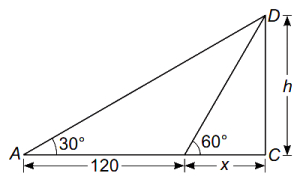
The angle of elevation of an object on a hill is observed from a certain point in the horizontal plane through its base to be $30^{\circ}$. After walking $120 \ m$ towards it on level ground,the angle of elevation is found to be $60^{\circ}$. The height of the object (in metres) is:
A
$120$
B
$60 \sqrt{3}$
C
$120 \sqrt{3}$
D
$60$
Solution
(B) Let $h$ be the height of the object and $x$ be the distance from the second point to the base of the hill.
In $\triangle ACD$,$\tan 30^{\circ} = \frac{h}{120 + x}$ $\Rightarrow \frac{1}{\sqrt{3}} = \frac{h}{120 + x}$ $\Rightarrow 120 + x = h\sqrt{3} \quad \dots(i)$
In $\triangle BCD$,$\tan 60^{\circ} = \frac{h}{x}$ $\Rightarrow \sqrt{3} = \frac{h}{x}$ $\Rightarrow x = \frac{h}{\sqrt{3}} \quad \dots(ii)$
Substituting $(ii)$ into $(i)$:
$120 + \frac{h}{\sqrt{3}} = h\sqrt{3}$
$120 = h\sqrt{3} - \frac{h}{\sqrt{3}} = h \left( \frac{3 - 1}{\sqrt{3}} \right) = \frac{2h}{\sqrt{3}}$
$h = \frac{120 \times \sqrt{3}}{2} = 60\sqrt{3} \ m$.
In $\triangle ACD$,$\tan 30^{\circ} = \frac{h}{120 + x}$ $\Rightarrow \frac{1}{\sqrt{3}} = \frac{h}{120 + x}$ $\Rightarrow 120 + x = h\sqrt{3} \quad \dots(i)$
In $\triangle BCD$,$\tan 60^{\circ} = \frac{h}{x}$ $\Rightarrow \sqrt{3} = \frac{h}{x}$ $\Rightarrow x = \frac{h}{\sqrt{3}} \quad \dots(ii)$
Substituting $(ii)$ into $(i)$:
$120 + \frac{h}{\sqrt{3}} = h\sqrt{3}$
$120 = h\sqrt{3} - \frac{h}{\sqrt{3}} = h \left( \frac{3 - 1}{\sqrt{3}} \right) = \frac{2h}{\sqrt{3}}$
$h = \frac{120 \times \sqrt{3}}{2} = 60\sqrt{3} \ m$.
0 likesView Solution
85
ChemistryMCQAP EAMCET · 2006
Observe the following statements :
$A: \int \left(\frac{x^2-1}{x^2}\right) e^{\frac{x^2+1}{x}} d x = e^{\frac{x^2+1}{x}} + c$
$R: \int f^{\prime}(x) e^{f(x)} d x = f(x) + c$
Then which of the following is true?
$A: \int \left(\frac{x^2-1}{x^2}\right) e^{\frac{x^2+1}{x}} d x = e^{\frac{x^2+1}{x}} + c$
$R: \int f^{\prime}(x) e^{f(x)} d x = f(x) + c$
Then which of the following is true?
A
Both $A$ and $R$ are true and $R$ is not the correct reason for $A$
B
Both $A$ and $R$ are true and $R$ is the correct reason for $A$
C
$A$ is true,$R$ is false
D
$A$ is false,$R$ is true
Solution
(C) For statement $A$: Let $I = \int \left(\frac{x^2-1}{x^2}\right) e^{\left(\frac{x^2+1}{x}\right)} d x$.
We can rewrite the integrand as $I = \int \left(1 - \frac{1}{x^2}\right) e^{\left(x + \frac{1}{x}\right)} d x$.
Let $t = x + \frac{1}{x}$,then $d t = \left(1 - \frac{1}{x^2}\right) d x$.
Substituting these into the integral,we get $I = \int e^t d t = e^t + c = e^{x + \frac{1}{x}} + c = e^{\frac{x^2+1}{x}} + c$.
Thus,statement $A$ is true.
For statement $R$: The integral $\int f^{\prime}(x) e^{f(x)} d x$ is a standard form. Let $u = f(x)$,then $d u = f^{\prime}(x) d x$.
The integral becomes $\int e^u d u = e^u + c = e^{f(x)} + c$.
The statement $R$ claims the result is $f(x) + c$,which is incorrect. Therefore,$R$ is false.
We can rewrite the integrand as $I = \int \left(1 - \frac{1}{x^2}\right) e^{\left(x + \frac{1}{x}\right)} d x$.
Let $t = x + \frac{1}{x}$,then $d t = \left(1 - \frac{1}{x^2}\right) d x$.
Substituting these into the integral,we get $I = \int e^t d t = e^t + c = e^{x + \frac{1}{x}} + c = e^{\frac{x^2+1}{x}} + c$.
Thus,statement $A$ is true.
For statement $R$: The integral $\int f^{\prime}(x) e^{f(x)} d x$ is a standard form. Let $u = f(x)$,then $d u = f^{\prime}(x) d x$.
The integral becomes $\int e^u d u = e^u + c = e^{f(x)} + c$.
The statement $R$ claims the result is $f(x) + c$,which is incorrect. Therefore,$R$ is false.
0 likesView Solution
86
ChemistryMCQAP EAMCET · 2006
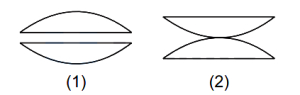
The two surfaces of a biconvex lens have the same radii of curvature. This lens is made of glass with a refractive index of $1.5$ and has a focal length of $10 ~cm$ in air. The lens is cut into two equal halves along a plane perpendicular to its principal axis to yield two plano-convex lenses. The two pieces are glued such that the convex surfaces touch each other. If this combination lens is immersed in water (refractive index $=$ $4/3$),its focal length (in $cm$) is:
A
$5$
B
$10$
C
$20$
D
$40$
Solution
(D) For a biconvex lens of focal length $f$ and refractive index $\mu_g = 1.5$,the lens maker's formula in air is $\frac{1}{f} = (\mu_g - 1)(\frac{1}{R} - \frac{1}{-R}) = (0.5)(\frac{2}{R}) = \frac{1}{R}$. Given $f = 10 ~cm$,we have $R = 10 ~cm$.
When the lens is cut perpendicular to the principal axis,each plano-convex lens has a focal length $f'$ given by $\frac{1}{f'} = (\mu_g - 1)(\frac{1}{R} - \frac{1}{\infty}) = \frac{0.5}{R} = \frac{0.5}{10} = \frac{1}{20}$. Thus,$f' = 20 ~cm$.
When these two plano-convex lenses are joined such that their convex surfaces touch,the combination acts as a biconvex lens with the same focal length $F = 10 ~cm$ in air.
When immersed in water (refractive index $\mu_w = 4/3$),the new focal length $F'$ is given by $\frac{1}{F'} = (\frac{\mu_g}{\mu_w} - 1)(\frac{1}{R_1} - \frac{1}{R_2})$.
For the combination,the effective power is $\frac{1}{F'} = (\frac{1.5}{4/3} - 1)(\frac{1}{R} - \frac{1}{-R}) = (\frac{4.5}{4} - 1)(\frac{2}{R}) = (1.125 - 1)(\frac{2}{10}) = 0.125 \times 0.2 = 0.025$.
Therefore,$F' = \frac{1}{0.025} = 40 ~cm$.
When the lens is cut perpendicular to the principal axis,each plano-convex lens has a focal length $f'$ given by $\frac{1}{f'} = (\mu_g - 1)(\frac{1}{R} - \frac{1}{\infty}) = \frac{0.5}{R} = \frac{0.5}{10} = \frac{1}{20}$. Thus,$f' = 20 ~cm$.
When these two plano-convex lenses are joined such that their convex surfaces touch,the combination acts as a biconvex lens with the same focal length $F = 10 ~cm$ in air.
When immersed in water (refractive index $\mu_w = 4/3$),the new focal length $F'$ is given by $\frac{1}{F'} = (\frac{\mu_g}{\mu_w} - 1)(\frac{1}{R_1} - \frac{1}{R_2})$.
For the combination,the effective power is $\frac{1}{F'} = (\frac{1.5}{4/3} - 1)(\frac{1}{R} - \frac{1}{-R}) = (\frac{4.5}{4} - 1)(\frac{2}{R}) = (1.125 - 1)(\frac{2}{10}) = 0.125 \times 0.2 = 0.025$.
Therefore,$F' = \frac{1}{0.025} = 40 ~cm$.
0 likesView Solution
87
ChemistryMCQAP EAMCET · 2006
Dispersive power depends on the following:
A
material of the prism
B
shape of the prism
C
size of the prism
D
size,shape and material of the prism
Solution
(A) The dispersive power $(\omega)$ of a prism is defined as the ratio of the angular dispersion $(\delta_v - \delta_r)$ to the mean deviation $(\delta_y)$.
Mathematically,$\omega = \frac{\delta_v - \delta_r}{\delta_y} = \frac{(\mu_v - 1)A - (\mu_r - 1)A}{(\mu_y - 1)A} = \frac{\mu_v - \mu_r}{\mu_y - 1}$.
From this formula,it is evident that the dispersive power depends only on the refractive indices $(\mu_v, \mu_r, \mu_y)$ of the material of the prism for different colors.
It is independent of the angle of the prism $(A)$,the shape of the prism,and the size of the prism.
Therefore,the correct option is $A$.
Mathematically,$\omega = \frac{\delta_v - \delta_r}{\delta_y} = \frac{(\mu_v - 1)A - (\mu_r - 1)A}{(\mu_y - 1)A} = \frac{\mu_v - \mu_r}{\mu_y - 1}$.
From this formula,it is evident that the dispersive power depends only on the refractive indices $(\mu_v, \mu_r, \mu_y)$ of the material of the prism for different colors.
It is independent of the angle of the prism $(A)$,the shape of the prism,and the size of the prism.
Therefore,the correct option is $A$.
0 likesView Solution
88
ChemistryMCQAP EAMCET · 2006
The concentration of oxalic acid is '$x$' $mol \ L^{-1}$. $40 \ mL$ of this solution reacts with $16 \ mL$ of $0.05 \ M$ acidified $KMnO_4$. What is the $pH$ of '$x$' $M$ oxalic acid solution? (Assume that oxalic acid dissociates completely)
A
$1.3$
B
$1.699$
C
$1$
D
$2$
Solution
(A) The balanced chemical equation for the reaction is: $2KMnO_4 + 5H_2C_2O_4 + 3H_2SO_4 \rightarrow K_2SO_4 + 2MnSO_4 + 8H_2O + 10CO_2$.
From the stoichiometry,$2 \text{ moles of } KMnO_4$ react with $5 \text{ moles of } H_2C_2O_4$.
Using the relation $n_{KMnO_4} / 2 = n_{H_2C_2O_4} / 5$:
$(0.05 \ M \times 16 \ mL) / 2 = (x \ M \times 40 \ mL) / 5$.
$0.4 / 2 = 40x / 5 \implies 0.2 = 8x \implies x = 0.025 \ M$.
Since oxalic acid $(H_2C_2O_4)$ is a diprotic acid and dissociates completely:
$[H^+] = 2 \times [H_2C_2O_4] = 2 \times 0.025 = 0.05 \ M$.
$pH = -\log[H^+] = -\log(0.05) = -\log(5 \times 10^{-2}) = 2 - \log 5 = 2 - 0.699 = 1.301 \approx 1.3$.
From the stoichiometry,$2 \text{ moles of } KMnO_4$ react with $5 \text{ moles of } H_2C_2O_4$.
Using the relation $n_{KMnO_4} / 2 = n_{H_2C_2O_4} / 5$:
$(0.05 \ M \times 16 \ mL) / 2 = (x \ M \times 40 \ mL) / 5$.
$0.4 / 2 = 40x / 5 \implies 0.2 = 8x \implies x = 0.025 \ M$.
Since oxalic acid $(H_2C_2O_4)$ is a diprotic acid and dissociates completely:
$[H^+] = 2 \times [H_2C_2O_4] = 2 \times 0.025 = 0.05 \ M$.
$pH = -\log[H^+] = -\log(0.05) = -\log(5 \times 10^{-2}) = 2 - \log 5 = 2 - 0.699 = 1.301 \approx 1.3$.
0 likesView Solution
89
ChemistryMediumMCQAP EAMCET · 2006
Which of the following reactions does not liberate a gaseous product?
A
$AlCl_3 + NaOH \longrightarrow$
B
$NaOH + P_4 (\text{white}) + H_2O \longrightarrow$
C
$Al + NaOH \xrightarrow{\Delta} \dots$
D
$Zn + NaOH \xrightarrow{\Delta} \dots$
Solution
(A) $1$. $AlCl_3 + 4NaOH \longrightarrow NaAlO_2 + 3NaCl + 2H_2O$. This reaction forms aqueous sodium meta-aluminate and does not release any gas.
$2$. $3NaOH + P_4 + 3H_2O \longrightarrow PH_3 (\text{gas}) + 3NaH_2PO_2$. This releases phosphine gas.
$3$. $2Al + 2NaOH + 2H_2O \xrightarrow{\Delta} 2NaAlO_2 + 3H_2 (\text{gas})$. This releases hydrogen gas.
$4$. $Zn + 2NaOH \xrightarrow{\Delta} Na_2ZnO_2 + H_2 (\text{gas})$. This releases hydrogen gas.
Therefore,the reaction between $AlCl_3$ and $NaOH$ does not liberate a gaseous product.
$2$. $3NaOH + P_4 + 3H_2O \longrightarrow PH_3 (\text{gas}) + 3NaH_2PO_2$. This releases phosphine gas.
$3$. $2Al + 2NaOH + 2H_2O \xrightarrow{\Delta} 2NaAlO_2 + 3H_2 (\text{gas})$. This releases hydrogen gas.
$4$. $Zn + 2NaOH \xrightarrow{\Delta} Na_2ZnO_2 + H_2 (\text{gas})$. This releases hydrogen gas.
Therefore,the reaction between $AlCl_3$ and $NaOH$ does not liberate a gaseous product.
0 likesView Solution
90
ChemistryMCQAP EAMCET · 2006
Consider a $p-n$ junction as a capacitor,formed with $p$ and $n$-materials acting as thin metal electrodes and depletion layer width acting as separation between them. Basing on this,assume that an $n-p-n$ transistor is working as an amplifier in $CE$ configuration. If $C_1$ and $C_2$ are the base-emitter and collector-emitter junction capacitances,then :
A
$C_1 > C_2$
B
$C_1 < C_2$
C
$C_1 = C_2$
D
$C_1 = C_2 = 0$
Solution
(A) In an $n-p-n$ transistor,the base-emitter junction is forward-biased,while the collector-base junction is reverse-biased.
Capacitance $C$ is given by $C = \frac{\epsilon A}{d}$,where $d$ is the width of the depletion layer.
For a forward-biased junction (base-emitter),the depletion layer width $d_1$ is very small.
For a reverse-biased junction (collector-base),the depletion layer width $d_2$ is significantly larger.
Since $C \propto \frac{1}{d}$,a smaller depletion width leads to a larger capacitance.
Therefore,$C_1$ (base-emitter capacitance) is greater than $C_2$ (collector-base capacitance).
Thus,$C_1 > C_2$.
Capacitance $C$ is given by $C = \frac{\epsilon A}{d}$,where $d$ is the width of the depletion layer.
For a forward-biased junction (base-emitter),the depletion layer width $d_1$ is very small.
For a reverse-biased junction (collector-base),the depletion layer width $d_2$ is significantly larger.
Since $C \propto \frac{1}{d}$,a smaller depletion width leads to a larger capacitance.
Therefore,$C_1$ (base-emitter capacitance) is greater than $C_2$ (collector-base capacitance).
Thus,$C_1 > C_2$.
0 likesView Solution
91
ChemistryMCQAP EAMCET · 2006
The solution of $(1+x^2) \frac{dy}{dx} + 2xy - 4x^2 = 0$ is:
A
$3x(1+y^2) = 4y^3 + c$
B
$3y(1+x^2) = 4x^3 + c$
C
$3x(1-y^2) = 4y^3 + c$
D
$3y(1+y^2) = 4x^3 + c$
Solution
(B) Given the linear differential equation: $(1+x^2) \frac{dy}{dx} + 2xy = 4x^2$.
Divide by $(1+x^2)$ to get the standard form $\frac{dy}{dx} + Py = Q$:
$\frac{dy}{dx} + \left(\frac{2x}{1+x^2}\right)y = \frac{4x^2}{1+x^2}$.
Here,$P = \frac{2x}{1+x^2}$ and $Q = \frac{4x^2}{1+x^2}$.
The Integrating Factor ($I$.$F$.) is $e^{\int P dx} = e^{\int \frac{2x}{1+x^2} dx} = e^{\ln(1+x^2)} = 1+x^2$.
The general solution is $y \cdot (I.F.) = \int Q \cdot (I.F.) dx + c$.
Substituting the values: $y(1+x^2) = \int \left(\frac{4x^2}{1+x^2}\right)(1+x^2) dx + c$.
$y(1+x^2) = \int 4x^2 dx + c$.
$y(1+x^2) = \frac{4x^3}{3} + c$.
Multiplying by $3$,we get $3y(1+x^2) = 4x^3 + c$.
Divide by $(1+x^2)$ to get the standard form $\frac{dy}{dx} + Py = Q$:
$\frac{dy}{dx} + \left(\frac{2x}{1+x^2}\right)y = \frac{4x^2}{1+x^2}$.
Here,$P = \frac{2x}{1+x^2}$ and $Q = \frac{4x^2}{1+x^2}$.
The Integrating Factor ($I$.$F$.) is $e^{\int P dx} = e^{\int \frac{2x}{1+x^2} dx} = e^{\ln(1+x^2)} = 1+x^2$.
The general solution is $y \cdot (I.F.) = \int Q \cdot (I.F.) dx + c$.
Substituting the values: $y(1+x^2) = \int \left(\frac{4x^2}{1+x^2}\right)(1+x^2) dx + c$.
$y(1+x^2) = \int 4x^2 dx + c$.
$y(1+x^2) = \frac{4x^3}{3} + c$.
Multiplying by $3$,we get $3y(1+x^2) = 4x^3 + c$.
0 likesView Solution
92
ChemistryMCQAP EAMCET · 2006
The solution of $\frac{dx}{dy} + \frac{x}{y} = x^2$ is:
A
$\frac{1}{y} = cx - x \log x$
B
$\frac{1}{x} = cy - y \log y$
C
$\frac{1}{x} = cx + x \log y$
D
$\frac{1}{y} = cx - y \log x$
Solution
(B) Given the differential equation: $\frac{dx}{dy} + \frac{x}{y} = x^2$
Divide both sides by $x^2$: $\frac{1}{x^2} \frac{dx}{dy} + \frac{1}{xy} = 1$
Let $t = \frac{1}{x}$,then $\frac{dt}{dy} = -\frac{1}{x^2} \frac{dx}{dy}$
Substituting this into the equation: $-\frac{dt}{dy} + \frac{t}{y} = 1$
Rearranging gives the linear differential equation: $\frac{dt}{dy} - \frac{t}{y} = -1$
Here,$P = -\frac{1}{y}$ and $Q = -1$
Integrating Factor ($I$.$F$.) $= e^{\int P dy} = e^{-\int \frac{1}{y} dy} = e^{-\log y} = \frac{1}{y}$
The general solution is $t \cdot (I.F.) = \int Q \cdot (I.F.) dy + c$
$t \cdot \frac{1}{y} = \int (-1) \cdot \frac{1}{y} dy + c$
$\frac{1}{xy} = -\log y + c$
Multiplying by $y$: $\frac{1}{x} = cy - y \log y$
Divide both sides by $x^2$: $\frac{1}{x^2} \frac{dx}{dy} + \frac{1}{xy} = 1$
Let $t = \frac{1}{x}$,then $\frac{dt}{dy} = -\frac{1}{x^2} \frac{dx}{dy}$
Substituting this into the equation: $-\frac{dt}{dy} + \frac{t}{y} = 1$
Rearranging gives the linear differential equation: $\frac{dt}{dy} - \frac{t}{y} = -1$
Here,$P = -\frac{1}{y}$ and $Q = -1$
Integrating Factor ($I$.$F$.) $= e^{\int P dy} = e^{-\int \frac{1}{y} dy} = e^{-\log y} = \frac{1}{y}$
The general solution is $t \cdot (I.F.) = \int Q \cdot (I.F.) dy + c$
$t \cdot \frac{1}{y} = \int (-1) \cdot \frac{1}{y} dy + c$
$\frac{1}{xy} = -\log y + c$
Multiplying by $y$: $\frac{1}{x} = cy - y \log y$
0 likesView Solution
93
ChemistryMCQAP EAMCET · 2006
If $\overrightarrow{a}+\overrightarrow{b}+\overrightarrow{c}=\overrightarrow{0}$ and $|\overrightarrow{a}|=3, |\overrightarrow{b}|=4$ and $|\overrightarrow{c}|=\sqrt{37}$,then the angle between $\overrightarrow{a}$ and $\overrightarrow{b}$ is:
A
$\frac{\pi}{4}$
B
$\frac{\pi}{2}$
C
$\frac{\pi}{6}$
D
$\frac{\pi}{3}$
Solution
(D) Given that $\overrightarrow{a}+\overrightarrow{b}+\overrightarrow{c}=\overrightarrow{0}$.
We can write this as $\overrightarrow{a}+\overrightarrow{b}=-\overrightarrow{c}$.
Squaring both sides,we get $(\overrightarrow{a}+\overrightarrow{b})^2=(-\overrightarrow{c})^2$.
Expanding the dot product,we have $|\overrightarrow{a}|^2+|\overrightarrow{b}|^2+2|\overrightarrow{a}||\overrightarrow{b}| \cos \theta=|\overrightarrow{c}|^2$,where $\theta$ is the angle between $\overrightarrow{a}$ and $\overrightarrow{b}$.
Substituting the given values: $3^2+4^2+2(3)(4) \cos \theta = (\sqrt{37})^2$.
$9+16+24 \cos \theta = 37$.
$25+24 \cos \theta = 37$.
$24 \cos \theta = 37-25 = 12$.
$\cos \theta = \frac{12}{24} = \frac{1}{2}$.
Since $\cos \theta = \frac{1}{2}$,we have $\theta = \frac{\pi}{3}$.
We can write this as $\overrightarrow{a}+\overrightarrow{b}=-\overrightarrow{c}$.
Squaring both sides,we get $(\overrightarrow{a}+\overrightarrow{b})^2=(-\overrightarrow{c})^2$.
Expanding the dot product,we have $|\overrightarrow{a}|^2+|\overrightarrow{b}|^2+2|\overrightarrow{a}||\overrightarrow{b}| \cos \theta=|\overrightarrow{c}|^2$,where $\theta$ is the angle between $\overrightarrow{a}$ and $\overrightarrow{b}$.
Substituting the given values: $3^2+4^2+2(3)(4) \cos \theta = (\sqrt{37})^2$.
$9+16+24 \cos \theta = 37$.
$25+24 \cos \theta = 37$.
$24 \cos \theta = 37-25 = 12$.
$\cos \theta = \frac{12}{24} = \frac{1}{2}$.
Since $\cos \theta = \frac{1}{2}$,we have $\theta = \frac{\pi}{3}$.
0 likesView Solution
94
ChemistryMCQAP EAMCET · 2006
If the volume of a parallelepiped with coterminous edges $4 \hat{i} + 5 \hat{j} + \hat{k}$,$-\hat{j} + \hat{k}$,and $3 \hat{i} + 9 \hat{j} + p \hat{k}$ is $34$ cubic units,then $p$ is equal to:
A
$4$
B
$-13$
C
$13$
D
$6$
Solution
(B) The volume of a parallelepiped with coterminous edges $\vec{a}, \vec{b}, \vec{c}$ is given by the scalar triple product $|\vec{a} \cdot (\vec{b} \times \vec{c})|$,which is equal to the absolute value of the determinant of the matrix formed by these vectors.
Given edges: $\vec{a} = 4 \hat{i} + 5 \hat{j} + \hat{k}$,$\vec{b} = 0 \hat{i} - 1 \hat{j} + 1 \hat{k}$,$\vec{c} = 3 \hat{i} + 9 \hat{j} + p \hat{k}$.
Volume $= |\text{det}(\vec{a}, \vec{b}, \vec{c})| = 34$.
$\Rightarrow \left|\begin{array}{rrr} 4 & 5 & 1 \\ 0 & -1 & 1 \\ 3 & 9 & p \end{array}\right| = \pm 34$.
Expanding the determinant along the first row:
$4(-p - 9) - 5(0 - 3) + 1(0 - (-3)) = \pm 34$.
$-4p - 36 + 15 + 3 = \pm 34$.
$-4p - 18 = \pm 34$.
Case $1$: $-4p - 18 = 34 \Rightarrow -4p = 52 \Rightarrow p = -13$.
Case $2$: $-4p - 18 = -34 \Rightarrow -4p = -16 \Rightarrow p = 4$.
Since $-13$ is one of the options,the correct value is $-13$.
Given edges: $\vec{a} = 4 \hat{i} + 5 \hat{j} + \hat{k}$,$\vec{b} = 0 \hat{i} - 1 \hat{j} + 1 \hat{k}$,$\vec{c} = 3 \hat{i} + 9 \hat{j} + p \hat{k}$.
Volume $= |\text{det}(\vec{a}, \vec{b}, \vec{c})| = 34$.
$\Rightarrow \left|\begin{array}{rrr} 4 & 5 & 1 \\ 0 & -1 & 1 \\ 3 & 9 & p \end{array}\right| = \pm 34$.
Expanding the determinant along the first row:
$4(-p - 9) - 5(0 - 3) + 1(0 - (-3)) = \pm 34$.
$-4p - 36 + 15 + 3 = \pm 34$.
$-4p - 18 = \pm 34$.
Case $1$: $-4p - 18 = 34 \Rightarrow -4p = 52 \Rightarrow p = -13$.
Case $2$: $-4p - 18 = -34 \Rightarrow -4p = -16 \Rightarrow p = 4$.
Since $-13$ is one of the options,the correct value is $-13$.
0 likesView Solution
95
ChemistryMCQAP EAMCET · 2006
If $OA$ is equally inclined to $OX, OY$ and $OZ$ and if $A$ is $\sqrt{3}$ units from the origin,then $A$ is:
A
$(3,3,3)$
B
$(-1,1,-1)$
C
$(-1,1,1)$
D
$(1,1,1)$
Solution
(D) Let the coordinates of point $A$ be $(x, y, z)$.
Since $OA$ is equally inclined to the axes $OX, OY$ and $OZ$,the direction cosines $l, m, n$ are equal.
Thus,$l = m = n$.
Since $l^2 + m^2 + n^2 = 1$,we have $3l^2 = 1$,which implies $l = m = n = \pm \frac{1}{\sqrt{3}}$.
The coordinates of $A$ are given by $(r l, r m, r n)$,where $r$ is the distance from the origin.
Given $r = \sqrt{3}$,the coordinates are $(\sqrt{3} \times \pm \frac{1}{\sqrt{3}}, \sqrt{3} \times \pm \frac{1}{\sqrt{3}}, \sqrt{3} \times \pm \frac{1}{\sqrt{3}})$.
This simplifies to $(1, 1, 1)$ or $(-1, -1, -1)$.
Comparing with the given options,the correct coordinate is $(1, 1, 1)$.
Since $OA$ is equally inclined to the axes $OX, OY$ and $OZ$,the direction cosines $l, m, n$ are equal.
Thus,$l = m = n$.
Since $l^2 + m^2 + n^2 = 1$,we have $3l^2 = 1$,which implies $l = m = n = \pm \frac{1}{\sqrt{3}}$.
The coordinates of $A$ are given by $(r l, r m, r n)$,where $r$ is the distance from the origin.
Given $r = \sqrt{3}$,the coordinates are $(\sqrt{3} \times \pm \frac{1}{\sqrt{3}}, \sqrt{3} \times \pm \frac{1}{\sqrt{3}}, \sqrt{3} \times \pm \frac{1}{\sqrt{3}})$.
This simplifies to $(1, 1, 1)$ or $(-1, -1, -1)$.
Comparing with the given options,the correct coordinate is $(1, 1, 1)$.
0 likesView Solution
96
ChemistryMCQAP EAMCET · 2006
If the direction cosines of two lines are such that $l+m+n=0$ and $l^2+m^2-n^2=0$,then the angle between them is:
A
$\pi$
B
$\pi / 3$
C
$\pi / 4$
D
$\pi / 2$
Solution
(B) Given equations for direction cosines $(l, m, n)$ are:
$l+m+n=0$ $\dots(i)$
$l^2+m^2-n^2=0$ $\dots(ii)$
We also know that for direction cosines,$l^2+m^2+n^2=1$ $\dots(iii)$
From $(i)$,$l+m = -n$. Squaring both sides: $l^2+m^2+2lm = n^2$.
Substituting $l^2+m^2 = n^2$ from $(ii)$ into this,we get $n^2+2lm = n^2$,which implies $2lm = 0$,so $l=0$ or $m=0$.
Case $1$: If $l=0$,then $m+n=0 \implies m=-n$. Substituting into $(iii)$,$0^2+(-n)^2+n^2=1 \implies 2n^2=1 \implies n = \pm 1/\sqrt{2}$. Thus,$(l_1, m_1, n_1) = (0, -1/\sqrt{2}, 1/\sqrt{2})$ and $(0, 1/\sqrt{2}, -1/\sqrt{2})$.
Case $2$: If $m=0$,then $l+n=0 \implies l=-n$. Substituting into $(iii)$,$(-n)^2+0^2+n^2=1 \implies 2n^2=1 \implies n = \pm 1/\sqrt{2}$. Thus,$(l_2, m_2, n_2) = (-1/\sqrt{2}, 0, 1/\sqrt{2})$ and $(1/\sqrt{2}, 0, -1/\sqrt{2})$.
The angle $\theta$ between two lines with direction cosines $(l_1, m_1, n_1)$ and $(l_2, m_2, n_2)$ is given by $\cos \theta = |l_1l_2 + m_1m_2 + n_1n_2|$.
Taking $L_1 = (0, -1/\sqrt{2}, 1/\sqrt{2})$ and $L_2 = (-1/\sqrt{2}, 0, 1/\sqrt{2})$:
$\cos \theta = |(0)(-1/\sqrt{2}) + (-1/\sqrt{2})(0) + (1/\sqrt{2})(1/\sqrt{2})| = |0 + 0 + 1/2| = 1/2$.
Therefore,$\theta = \cos^{-1}(1/2) = \pi/3$.
$l+m+n=0$ $\dots(i)$
$l^2+m^2-n^2=0$ $\dots(ii)$
We also know that for direction cosines,$l^2+m^2+n^2=1$ $\dots(iii)$
From $(i)$,$l+m = -n$. Squaring both sides: $l^2+m^2+2lm = n^2$.
Substituting $l^2+m^2 = n^2$ from $(ii)$ into this,we get $n^2+2lm = n^2$,which implies $2lm = 0$,so $l=0$ or $m=0$.
Case $1$: If $l=0$,then $m+n=0 \implies m=-n$. Substituting into $(iii)$,$0^2+(-n)^2+n^2=1 \implies 2n^2=1 \implies n = \pm 1/\sqrt{2}$. Thus,$(l_1, m_1, n_1) = (0, -1/\sqrt{2}, 1/\sqrt{2})$ and $(0, 1/\sqrt{2}, -1/\sqrt{2})$.
Case $2$: If $m=0$,then $l+n=0 \implies l=-n$. Substituting into $(iii)$,$(-n)^2+0^2+n^2=1 \implies 2n^2=1 \implies n = \pm 1/\sqrt{2}$. Thus,$(l_2, m_2, n_2) = (-1/\sqrt{2}, 0, 1/\sqrt{2})$ and $(1/\sqrt{2}, 0, -1/\sqrt{2})$.
The angle $\theta$ between two lines with direction cosines $(l_1, m_1, n_1)$ and $(l_2, m_2, n_2)$ is given by $\cos \theta = |l_1l_2 + m_1m_2 + n_1n_2|$.
Taking $L_1 = (0, -1/\sqrt{2}, 1/\sqrt{2})$ and $L_2 = (-1/\sqrt{2}, 0, 1/\sqrt{2})$:
$\cos \theta = |(0)(-1/\sqrt{2}) + (-1/\sqrt{2})(0) + (1/\sqrt{2})(1/\sqrt{2})| = |0 + 0 + 1/2| = 1/2$.
Therefore,$\theta = \cos^{-1}(1/2) = \pi/3$.
0 likesView Solution
97
ChemistryMCQAP EAMCET · 2006
Seven balls are drawn simultaneously from a bag containing $5$ white and $6$ green balls. The probability of drawing $3$ white and $4$ green balls is:
A
$\frac{7}{{ }^{11} C_7}$
B
$\frac{{ }^5 C_3+{ }^6 C_4}{{ }^{11} C_7}$
C
$\frac{{ }^5 C_3 \times { }^6 C_4}{{ }^{11} C_7}$
D
$\frac{{ }^6 C_3 \times { }^5 C_4}{{ }^{11} C_7}$
Solution
(C) Total number of balls $= 5 + 6 = 11$.
Total number of ways to draw $7$ balls from $11$ is ${ }^{11} C_7$.
Number of ways to draw $3$ white balls from $5$ is ${ }^5 C_3$.
Number of ways to draw $4$ green balls from $6$ is ${ }^6 C_4$.
Therefore,the number of favorable outcomes is ${ }^5 C_3 \times { }^6 C_4$.
Required probability $= \frac{{ }^5 C_3 \times { }^6 C_4}{{ }^{11} C_7}$.
Total number of ways to draw $7$ balls from $11$ is ${ }^{11} C_7$.
Number of ways to draw $3$ white balls from $5$ is ${ }^5 C_3$.
Number of ways to draw $4$ green balls from $6$ is ${ }^6 C_4$.
Therefore,the number of favorable outcomes is ${ }^5 C_3 \times { }^6 C_4$.
Required probability $= \frac{{ }^5 C_3 \times { }^6 C_4}{{ }^{11} C_7}$.
0 likesView Solution
98
ChemistryMCQAP EAMCET · 2006
$A$ number $n$ is chosen at random from $\{1, 2, 3, 4, \ldots, 1000\}$. The probability that $n$ is a number that leaves remainder $1$ when divided by $7$ is:
A
$\frac{71}{500}$
B
$\frac{143}{1000}$
C
$\frac{72}{500}$
D
$\frac{71}{1000}$
Solution
(B) The set of numbers is $S = \{1, 2, 3, \ldots, 1000\}$,so $n(S) = 1000$.
We are looking for numbers $n$ such that $n \equiv 1 \pmod{7}$.
These numbers are of the form $n = 7k + 1$ for $k \ge 0$.
For $1 \le 7k + 1 \le 1000$,we have $0 \le 7k \le 999$,which implies $0 \le k \le \frac{999}{7} \approx 142.71$.
Since $k$ must be an integer,$k \in \{0, 1, 2, \ldots, 142\}$.
The number of such values is $142 - 0 + 1 = 143$.
The probability is $P = \frac{143}{1000}$.
We are looking for numbers $n$ such that $n \equiv 1 \pmod{7}$.
These numbers are of the form $n = 7k + 1$ for $k \ge 0$.
For $1 \le 7k + 1 \le 1000$,we have $0 \le 7k \le 999$,which implies $0 \le k \le \frac{999}{7} \approx 142.71$.
Since $k$ must be an integer,$k \in \{0, 1, 2, \ldots, 142\}$.
The number of such values is $142 - 0 + 1 = 143$.
The probability is $P = \frac{143}{1000}$.
0 likesView Solution
99
ChemistryMCQAP EAMCET · 2006
In a book of $500$ pages,it is found that there are $250$ typing errors. Assume that Poisson law holds for the number of errors per page. Then,the probability that a random sample of $2$ pages will contain no error,is :
A
$e^{-0.3}$
B
$e^{-0.5}$
C
$e^{-1}$
D
$e^{-2}$
Solution
(C) The average number of errors per page is $\lambda_{page} = \frac{250}{500} = 0.5$.
For a sample of $n = 2$ pages,the average number of errors is $\lambda = n \times \lambda_{page} = 2 \times 0.5 = 1$.
According to the Poisson distribution,the probability of finding $X$ errors is given by $P(X=k) = \frac{e^{-\lambda} \lambda^k}{k!}$.
For no errors,we set $k = 0$:
$P(X=0) = \frac{e^{-1} \times 1^0}{0!} = e^{-1} \times 1 = e^{-1}$.
For a sample of $n = 2$ pages,the average number of errors is $\lambda = n \times \lambda_{page} = 2 \times 0.5 = 1$.
According to the Poisson distribution,the probability of finding $X$ errors is given by $P(X=k) = \frac{e^{-\lambda} \lambda^k}{k!}$.
For no errors,we set $k = 0$:
$P(X=0) = \frac{e^{-1} \times 1^0}{0!} = e^{-1} \times 1 = e^{-1}$.
0 likesView Solution
100
ChemistryMCQAP EAMCET · 2006
In the random experiment of tossing two unbiased dice,let $E$ be the event of getting the sum $8$ and $F$ be the event of getting even numbers on both the dice. Then:
$I. P(E) = \frac{7}{36}$
$II. P(F) = \frac{1}{3}$
Which of the following is a correct statement?
$I. P(E) = \frac{7}{36}$
$II. P(F) = \frac{1}{3}$
Which of the following is a correct statement?
A
Both $I$ and $II$ are true
B
Neither $I$ nor $II$ is true
C
$I$ is true,$II$ is false
D
$I$ is false,$II$ is true
Solution
(B) The total number of outcomes when tossing two dice is $n(S) = 6 \times 6 = 36$.
For event $E$ (sum is $8$): The outcomes are $\{(2,6), (3,5), (4,4), (5,3), (6,2)\}$. Thus,$n(E) = 5$ and $P(E) = \frac{5}{36}$. So,statement $I$ is false.
For event $F$ (even numbers on both dice): The possible even numbers on a die are $\{2, 4, 6\}$. The outcomes are $\{(2,2), (2,4), (2,6), (4,2), (4,4), (4,6), (6,2), (6,4), (6,6)\}$. Thus,$n(F) = 9$ and $P(F) = \frac{9}{36} = \frac{1}{4}$. So,statement $II$ is false.
Therefore,neither $I$ nor $II$ is true.
For event $E$ (sum is $8$): The outcomes are $\{(2,6), (3,5), (4,4), (5,3), (6,2)\}$. Thus,$n(E) = 5$ and $P(E) = \frac{5}{36}$. So,statement $I$ is false.
For event $F$ (even numbers on both dice): The possible even numbers on a die are $\{2, 4, 6\}$. The outcomes are $\{(2,2), (2,4), (2,6), (4,2), (4,4), (4,6), (6,2), (6,4), (6,6)\}$. Thus,$n(F) = 9$ and $P(F) = \frac{9}{36} = \frac{1}{4}$. So,statement $II$ is false.
Therefore,neither $I$ nor $II$ is true.
0 likesView Solution
Vedclass Products
For Students
Vedclass Test Series
Mock tests in real AP EAMCET style covering Chemistry with performance analysis. 5-day free trial.
Start Free TrialFor Teachers
Exam Paper Generator
Generate Set A/B/C/D Chemistry papers from 7.5L+ questions in 2 minutes. 3 chapters free.
Try FreeFor Institutes
Online Exam Module
Run live AP EAMCET mock exams with unlimited students, 360° analytics & white-label branding.
See DemoFrequently Asked Questions
How many Chemistry questions are in AP EAMCET 2006?
There are 193 Chemistry questions from the AP EAMCET 2006 paper on Vedclass, each with a detailed step-by-step solution in English.
Are AP EAMCET 2006 Chemistry solutions available in English?
Yes. All solutions on this page are in English. You can also switch to English or Hindi using the language buttons above the questions.
Can I practice AP EAMCET 2006 Chemistry as a timed test?
Yes. Use the Vedclass Test Series to attempt a full AP EAMCET mock test covering Chemistry with time limits and instant score analysis.
Can teachers create Chemistry papers from AP EAMCET previous year questions?
Yes. The Vedclass Exam Paper Generator lets teachers mix AP EAMCET Chemistry questions and generate Set A/B/C/D papers in minutes.
For Teachers & Institutes
Build a Custom Chemistry Paper
Pick AP EAMCET 2006 Chemistry questions, set difficulty, and generate Set A/B/C/D in 2 minutes.