
ChemistryQ151–168 of 193 questions
Page 4 of 4 · English
151
ChemistryMCQAP EAMCET · 2006
Dividing the interval $[0,6]$ into $6$ equal parts and by using the trapezoidal rule,the value of $\int_0^6 x^3 dx$ is approximately:
A
$330$
B
$331$
C
$332$
D
$333$
Solution
(D) Given the interval $[0, 6]$ is divided into $n = 6$ equal parts.
The width of each sub-interval is $h = \frac{b-a}{n} = \frac{6-0}{6} = 1$.
The values of $f(x) = x^3$ at $x = 0, 1, 2, 3, 4, 5, 6$ are:
$y_0 = f(0) = 0^3 = 0$
$y_1 = f(1) = 1^3 = 1$
$y_2 = f(2) = 2^3 = 8$
$y_3 = f(3) = 3^3 = 27$
$y_4 = f(4) = 4^3 = 64$
$y_5 = f(5) = 5^3 = 125$
$y_6 = f(6) = 6^3 = 216$
By the trapezoidal rule:
$\int_0^6 x^3 dx \approx \frac{h}{2} \{y_0 + y_6 + 2(y_1 + y_2 + y_3 + y_4 + y_5)\}$
$= \frac{1}{2} \{0 + 216 + 2(1 + 8 + 27 + 64 + 125)\}$
$= \frac{1}{2} \{216 + 2(225)\}$
$= \frac{1}{2} \{216 + 450\}$
$= \frac{666}{2} = 333$.
The width of each sub-interval is $h = \frac{b-a}{n} = \frac{6-0}{6} = 1$.
The values of $f(x) = x^3$ at $x = 0, 1, 2, 3, 4, 5, 6$ are:
$y_0 = f(0) = 0^3 = 0$
$y_1 = f(1) = 1^3 = 1$
$y_2 = f(2) = 2^3 = 8$
$y_3 = f(3) = 3^3 = 27$
$y_4 = f(4) = 4^3 = 64$
$y_5 = f(5) = 5^3 = 125$
$y_6 = f(6) = 6^3 = 216$
By the trapezoidal rule:
$\int_0^6 x^3 dx \approx \frac{h}{2} \{y_0 + y_6 + 2(y_1 + y_2 + y_3 + y_4 + y_5)\}$
$= \frac{1}{2} \{0 + 216 + 2(1 + 8 + 27 + 64 + 125)\}$
$= \frac{1}{2} \{216 + 2(225)\}$
$= \frac{1}{2} \{216 + 450\}$
$= \frac{666}{2} = 333$.
0 likesView Solution
152
ChemistryMCQAP EAMCET · 2006
If $x^y=y^x$,then $x(x-y \log x) \frac{d y}{d x}$ is equal to :
A
$y(y-x \log y)$
B
$y(y+x \log y)$
C
$x(x+y \log x)$
D
$x(y-x \log y)$
Solution
(A) Given equation is $x^y = y^x$.
Taking natural logarithm on both sides,we get $y \log x = x \log y$.
Differentiating both sides with respect to $x$ using the product rule:
$y \cdot \frac{1}{x} + \log x \cdot \frac{dy}{dx} = x \cdot \frac{1}{y} \cdot \frac{dy}{dx} + \log y$.
Rearranging the terms to isolate $\frac{dy}{dx}$:
$\frac{dy}{dx} \left( \log x - \frac{x}{y} \right) = \log y - \frac{y}{x}$.
$\frac{dy}{dx} \left( \frac{y \log x - x}{y} \right) = \frac{x \log y - y}{x}$.
Multiplying both sides by $x$ and rearranging:
$x \left( \frac{y \log x - x}{y} \right) \frac{dy}{dx} = x \log y - y$.
Multiplying by $-1$ to match the required form:
$x \left( \frac{x - y \log x}{y} \right) \frac{dy}{dx} = y - x \log y$.
Therefore,$x(x - y \log x) \frac{dy}{dx} = y(y - x \log y)$.
Taking natural logarithm on both sides,we get $y \log x = x \log y$.
Differentiating both sides with respect to $x$ using the product rule:
$y \cdot \frac{1}{x} + \log x \cdot \frac{dy}{dx} = x \cdot \frac{1}{y} \cdot \frac{dy}{dx} + \log y$.
Rearranging the terms to isolate $\frac{dy}{dx}$:
$\frac{dy}{dx} \left( \log x - \frac{x}{y} \right) = \log y - \frac{y}{x}$.
$\frac{dy}{dx} \left( \frac{y \log x - x}{y} \right) = \frac{x \log y - y}{x}$.
Multiplying both sides by $x$ and rearranging:
$x \left( \frac{y \log x - x}{y} \right) \frac{dy}{dx} = x \log y - y$.
Multiplying by $-1$ to match the required form:
$x \left( \frac{x - y \log x}{y} \right) \frac{dy}{dx} = y - x \log y$.
Therefore,$x(x - y \log x) \frac{dy}{dx} = y(y - x \log y)$.
0 likesView Solution
153
ChemistryMCQAP EAMCET · 2006
The solution of $(x^2+y^2) dx = 2xy dy$ is:
A
$c(x^2-y^2) = x$
B
$c(x^2+y^2) = x$
C
$c(x^2-y^2) = y$
D
$c(x^2+y^2) = y$
Solution
(A) Given differential equation is $(x^2+y^2) dx = 2xy dy$.
Rearranging,we get $\frac{dy}{dx} = \frac{x^2+y^2}{2xy}$.
This is a homogeneous differential equation. Let $y = vx$,then $\frac{dy}{dx} = v + x \frac{dv}{dx}$.
Substituting these into the equation: $v + x \frac{dv}{dx} = \frac{x^2 + (vx)^2}{2x(vx)} = \frac{x^2(1+v^2)}{2x^2v} = \frac{1+v^2}{2v}$.
$x \frac{dv}{dx} = \frac{1+v^2}{2v} - v = \frac{1+v^2-2v^2}{2v} = \frac{1-v^2}{2v}$.
Separating variables: $\frac{2v}{1-v^2} dv = \frac{1}{x} dx$.
Integrating both sides: $\int \frac{2v}{1-v^2} dv = \int \frac{1}{x} dx$.
Let $1-v^2 = t$,then $-2v dv = dt$.
$-\int \frac{dt}{t} = \log|x| + \log|c|$.
$-\log|1-v^2| = \log|cx|$.
$\log|\frac{1}{1-v^2}| = \log|cx| \Rightarrow \frac{1}{1-v^2} = cx$.
Substituting $v = \frac{y}{x}$: $\frac{1}{1-(y^2/x^2)} = cx \Rightarrow \frac{x^2}{x^2-y^2} = cx$.
$x = c(x^2-y^2)$.
Rearranging,we get $\frac{dy}{dx} = \frac{x^2+y^2}{2xy}$.
This is a homogeneous differential equation. Let $y = vx$,then $\frac{dy}{dx} = v + x \frac{dv}{dx}$.
Substituting these into the equation: $v + x \frac{dv}{dx} = \frac{x^2 + (vx)^2}{2x(vx)} = \frac{x^2(1+v^2)}{2x^2v} = \frac{1+v^2}{2v}$.
$x \frac{dv}{dx} = \frac{1+v^2}{2v} - v = \frac{1+v^2-2v^2}{2v} = \frac{1-v^2}{2v}$.
Separating variables: $\frac{2v}{1-v^2} dv = \frac{1}{x} dx$.
Integrating both sides: $\int \frac{2v}{1-v^2} dv = \int \frac{1}{x} dx$.
Let $1-v^2 = t$,then $-2v dv = dt$.
$-\int \frac{dt}{t} = \log|x| + \log|c|$.
$-\log|1-v^2| = \log|cx|$.
$\log|\frac{1}{1-v^2}| = \log|cx| \Rightarrow \frac{1}{1-v^2} = cx$.
Substituting $v = \frac{y}{x}$: $\frac{1}{1-(y^2/x^2)} = cx \Rightarrow \frac{x^2}{x^2-y^2} = cx$.
$x = c(x^2-y^2)$.
0 likesView Solution
154
ChemistryMCQAP EAMCET · 2006
For all integers $n \geq 1$,which of the following is divisible by $9$?
A
$8^n+1$
B
$4^n-3n-1$
C
$3^{2n}+3n+1$
D
$10^n+1$
Solution
(B) Using the binomial expansion,we have $4^n = (1+3)^n$.
By the binomial theorem,$(1+x)^n = 1 + nx + \frac{n(n-1)}{2!}x^2 + \dots + x^n$.
Substituting $x=3$,we get $4^n = 1 + 3n + \frac{n(n-1)}{2!} \cdot 3^2 + \dots + 3^n$.
Rearranging the terms,we get $4^n - 3n - 1 = \frac{n(n-1)}{2} \cdot 9 + \dots + 3^n$.
Since every term on the right side contains a factor of $9$ (or a higher power of $3$ which is divisible by $9$),the expression $4^n - 3n - 1$ is divisible by $9$ for all integers $n \geq 2$.
For $n=1$,$4^1 - 3(1) - 1 = 0$,which is divisible by $9$ (as $0 = 9 \times 0$).
Thus,$4^n - 3n - 1$ is divisible by $9$ for all $n \geq 1$.
By the binomial theorem,$(1+x)^n = 1 + nx + \frac{n(n-1)}{2!}x^2 + \dots + x^n$.
Substituting $x=3$,we get $4^n = 1 + 3n + \frac{n(n-1)}{2!} \cdot 3^2 + \dots + 3^n$.
Rearranging the terms,we get $4^n - 3n - 1 = \frac{n(n-1)}{2} \cdot 9 + \dots + 3^n$.
Since every term on the right side contains a factor of $9$ (or a higher power of $3$ which is divisible by $9$),the expression $4^n - 3n - 1$ is divisible by $9$ for all integers $n \geq 2$.
For $n=1$,$4^1 - 3(1) - 1 = 0$,which is divisible by $9$ (as $0 = 9 \times 0$).
Thus,$4^n - 3n - 1$ is divisible by $9$ for all $n \geq 1$.
0 likesView Solution
155
ChemistryMCQAP EAMCET · 2006
If $\overrightarrow{a} \cdot \hat{i} = \overrightarrow{a} \cdot (2 \hat{i} + \hat{j}) = \overrightarrow{a} \cdot (\hat{i} + \hat{j} + 3 \hat{k}) = 1$,then $\overrightarrow{a}$ is equal to :
A
$\hat{i} - \hat{k}$
B
$\frac{1}{3}(3 \hat{i} + 3 \hat{j} + \hat{k})$
C
$\frac{1}{3}(\hat{i} + \hat{j} + \hat{k})$
D
$\frac{1}{3}(3 \hat{i} - 3 \hat{j} + \hat{k})$
Solution
(D) Let $\overrightarrow{a} = a_1 \hat{i} + a_2 \hat{j} + a_3 \hat{k}$.
Given $\overrightarrow{a} \cdot \hat{i} = 1$,we have $(a_1 \hat{i} + a_2 \hat{j} + a_3 \hat{k}) \cdot \hat{i} = 1$,which implies $a_1 = 1$.
Next,$\overrightarrow{a} \cdot (2 \hat{i} + \hat{j}) = 1$,so $(a_1 \hat{i} + a_2 \hat{j} + a_3 \hat{k}) \cdot (2 \hat{i} + \hat{j}) = 1$.
This gives $2a_1 + a_2 = 1$. Substituting $a_1 = 1$,we get $2(1) + a_2 = 1$,so $a_2 = -1$.
Finally,$\overrightarrow{a} \cdot (\hat{i} + \hat{j} + 3 \hat{k}) = 1$,so $(a_1 \hat{i} + a_2 \hat{j} + a_3 \hat{k}) \cdot (\hat{i} + \hat{j} + 3 \hat{k}) = 1$.
This gives $a_1 + a_2 + 3a_3 = 1$. Substituting $a_1 = 1$ and $a_2 = -1$,we get $1 - 1 + 3a_3 = 1$,which implies $3a_3 = 1$,so $a_3 = \frac{1}{3}$.
Thus,$\overrightarrow{a} = \hat{i} - \hat{j} + \frac{1}{3} \hat{k} = \frac{1}{3}(3 \hat{i} - 3 \hat{j} + \hat{k})$.
Given $\overrightarrow{a} \cdot \hat{i} = 1$,we have $(a_1 \hat{i} + a_2 \hat{j} + a_3 \hat{k}) \cdot \hat{i} = 1$,which implies $a_1 = 1$.
Next,$\overrightarrow{a} \cdot (2 \hat{i} + \hat{j}) = 1$,so $(a_1 \hat{i} + a_2 \hat{j} + a_3 \hat{k}) \cdot (2 \hat{i} + \hat{j}) = 1$.
This gives $2a_1 + a_2 = 1$. Substituting $a_1 = 1$,we get $2(1) + a_2 = 1$,so $a_2 = -1$.
Finally,$\overrightarrow{a} \cdot (\hat{i} + \hat{j} + 3 \hat{k}) = 1$,so $(a_1 \hat{i} + a_2 \hat{j} + a_3 \hat{k}) \cdot (\hat{i} + \hat{j} + 3 \hat{k}) = 1$.
This gives $a_1 + a_2 + 3a_3 = 1$. Substituting $a_1 = 1$ and $a_2 = -1$,we get $1 - 1 + 3a_3 = 1$,which implies $3a_3 = 1$,so $a_3 = \frac{1}{3}$.
Thus,$\overrightarrow{a} = \hat{i} - \hat{j} + \frac{1}{3} \hat{k} = \frac{1}{3}(3 \hat{i} - 3 \hat{j} + \hat{k})$.
0 likesView Solution
156
ChemistryMCQAP EAMCET · 2006
The position vector of a point lying on the line joining the points whose position vectors are $\hat{i}+\hat{j}-\hat{k}$ and $\hat{i}-\hat{j}+\hat{k}$ is:
A
$\hat{j}$
B
$\hat{i}$
C
$\hat{k}$
D
$\overrightarrow{0}$
Solution
(B) The position vector of a point on the line joining two points with position vectors $\vec{a}$ and $\vec{b}$ is given by the section formula $\vec{r} = (1-t)\vec{a} + t\vec{b}$ for some scalar $t$.
If we consider the midpoint (where $t = 0.5$),the position vector is:
$\vec{r} = \frac{(\hat{i}+\hat{j}-\hat{k}) + (\hat{i}-\hat{j}+\hat{k})}{2}$
$= \frac{2\hat{i} + 0\hat{j} + 0\hat{k}}{2}$
$= \hat{i}$
Thus,the position vector of the midpoint is $\hat{i}$.
If we consider the midpoint (where $t = 0.5$),the position vector is:
$\vec{r} = \frac{(\hat{i}+\hat{j}-\hat{k}) + (\hat{i}-\hat{j}+\hat{k})}{2}$
$= \frac{2\hat{i} + 0\hat{j} + 0\hat{k}}{2}$
$= \hat{i}$
Thus,the position vector of the midpoint is $\hat{i}$.
0 likesView Solution
157
ChemistryMCQAP EAMCET · 2006
If $A$ and $B$ are two independent events such that $P(B)=\frac{2}{7}$ and $P(A \cup B^c)=0.8$,then $P(A)$ is equal to:
A
$0.1$
B
$0.2$
C
$0.3$
D
$0.4$
Solution
(C) Given that $A$ and $B$ are independent events,$A$ and $B^c$ are also independent events.
$P(B) = \frac{2}{7}$,so $P(B^c) = 1 - P(B) = 1 - \frac{2}{7} = \frac{5}{7}$.
We are given $P(A \cup B^c) = 0.8$.
Using the formula $P(A \cup B^c) = P(A) + P(B^c) - P(A \cap B^c)$ and the independence property $P(A \cap B^c) = P(A) \cdot P(B^c)$:
$0.8 = P(A) + \frac{5}{7} - P(A) \cdot \frac{5}{7}$
$0.8 - \frac{5}{7} = P(A) \cdot (1 - \frac{5}{7})$
$\frac{5.6 - 5}{7} = P(A) \cdot \frac{2}{7}$
$\frac{0.6}{7} = P(A) \cdot \frac{2}{7}$
$P(A) = \frac{0.6}{2} = 0.3$.
$P(B) = \frac{2}{7}$,so $P(B^c) = 1 - P(B) = 1 - \frac{2}{7} = \frac{5}{7}$.
We are given $P(A \cup B^c) = 0.8$.
Using the formula $P(A \cup B^c) = P(A) + P(B^c) - P(A \cap B^c)$ and the independence property $P(A \cap B^c) = P(A) \cdot P(B^c)$:
$0.8 = P(A) + \frac{5}{7} - P(A) \cdot \frac{5}{7}$
$0.8 - \frac{5}{7} = P(A) \cdot (1 - \frac{5}{7})$
$\frac{5.6 - 5}{7} = P(A) \cdot \frac{2}{7}$
$\frac{0.6}{7} = P(A) \cdot \frac{2}{7}$
$P(A) = \frac{0.6}{2} = 0.3$.
0 likesView Solution
158
ChemistryMCQAP EAMCET · 2006
Two soap bubbles combine to form a single bubble. In this process,the change in volume and surface area are respectively $V$ and $A$. If $P$ is the atmospheric pressure,and $T$ is the surface tension of the soap solution,the following relation is true :
A
$4 P V+3 T A=0$
B
$3 P V-4 T A=0$
C
$4 P V-3 T A=0$
D
$3 P V+4 T A=0$
Solution
(D) Let the radii of the two soap bubbles be $a$ and $b$ respectively,and the radius of the resulting single larger bubble be $c$.
The excess pressure inside a soap bubble is $\Delta P = \frac{4 T}{r}$,where $T$ is surface tension and $r$ is the radius.
The internal pressure of the bubbles are $P_a = P + \frac{4 T}{a}$,$P_b = P + \frac{4 T}{b}$,and $P_c = P + \frac{4 T}{c}$.
Assuming isothermal conditions and conservation of the number of moles of air,$P_a V_a + P_b V_b = P_c V_c$.
Substituting the volumes $V_a = \frac{4}{3} \pi a^3$,$V_b = \frac{4}{3} \pi b^3$,and $V_c = \frac{4}{3} \pi c^3$,we get:
$(P + \frac{4 T}{a})(\frac{4}{3} \pi a^3) + (P + \frac{4 T}{b})(\frac{4}{3} \pi b^3) = (P + \frac{4 T}{c})(\frac{4}{3} \pi c^3)$.
Simplifying,$P(a^3 + b^3 - c^3) + 4 T(a^2 + b^2 - c^2) = 0$.
The change in volume is $V = V_c - (V_a + V_b) = \frac{4}{3} \pi (c^3 - a^3 - b^3)$,so $a^3 + b^3 - c^3 = -\frac{3 V}{4 \pi}$.
The change in surface area is $A = 4 \pi c^2 - (4 \pi a^2 + 4 \pi b^2) = 4 \pi (c^2 - a^2 - b^2)$,so $a^2 + b^2 - c^2 = -\frac{A}{4 \pi}$.
Substituting these into the equation: $P(-\frac{3 V}{4 \pi}) + 4 T(-\frac{A}{4 \pi}) = 0$.
Multiplying by $-4 \pi$,we get $3 P V + 4 T A = 0$.
The excess pressure inside a soap bubble is $\Delta P = \frac{4 T}{r}$,where $T$ is surface tension and $r$ is the radius.
The internal pressure of the bubbles are $P_a = P + \frac{4 T}{a}$,$P_b = P + \frac{4 T}{b}$,and $P_c = P + \frac{4 T}{c}$.
Assuming isothermal conditions and conservation of the number of moles of air,$P_a V_a + P_b V_b = P_c V_c$.
Substituting the volumes $V_a = \frac{4}{3} \pi a^3$,$V_b = \frac{4}{3} \pi b^3$,and $V_c = \frac{4}{3} \pi c^3$,we get:
$(P + \frac{4 T}{a})(\frac{4}{3} \pi a^3) + (P + \frac{4 T}{b})(\frac{4}{3} \pi b^3) = (P + \frac{4 T}{c})(\frac{4}{3} \pi c^3)$.
Simplifying,$P(a^3 + b^3 - c^3) + 4 T(a^2 + b^2 - c^2) = 0$.
The change in volume is $V = V_c - (V_a + V_b) = \frac{4}{3} \pi (c^3 - a^3 - b^3)$,so $a^3 + b^3 - c^3 = -\frac{3 V}{4 \pi}$.
The change in surface area is $A = 4 \pi c^2 - (4 \pi a^2 + 4 \pi b^2) = 4 \pi (c^2 - a^2 - b^2)$,so $a^2 + b^2 - c^2 = -\frac{A}{4 \pi}$.
Substituting these into the equation: $P(-\frac{3 V}{4 \pi}) + 4 T(-\frac{A}{4 \pi}) = 0$.
Multiplying by $-4 \pi$,we get $3 P V + 4 T A = 0$.
0 likesView Solution
159
ChemistryMCQAP EAMCET · 2006
Assertion $(A)$: Ductile metals are used to prepare thin wires.
Reason $(R)$: In the stress-strain curve of ductile metals,the length between the points representing elastic limit and breaking point is very small.
Reason $(R)$: In the stress-strain curve of ductile metals,the length between the points representing elastic limit and breaking point is very small.
A
Both $(A)$ and $(R)$ are true and $(R)$ is the correct explanation of $(A)$
B
Both $(A)$ and $(R)$ are true but $(R)$ is not the correct explanation of $(A)$
C
$(A)$ is true but $(R)$ is false
D
$(A)$ is false but $(R)$ is true
Solution
(C) Ductile materials are those that can be drawn into thin wires. This property is due to the fact that they undergo a large plastic deformation before breaking.
In the stress-strain curve of ductile metals,the region between the elastic limit and the breaking point (fracture point) is very large,not small. This large plastic region allows the material to be stretched significantly without breaking.
Therefore,the Assertion $(A)$ is true,but the Reason $(R)$ is false.
In the stress-strain curve of ductile metals,the region between the elastic limit and the breaking point (fracture point) is very large,not small. This large plastic region allows the material to be stretched significantly without breaking.
Therefore,the Assertion $(A)$ is true,but the Reason $(R)$ is false.
0 likesView Solution
160
ChemistryEasyMCQAP EAMCET · 2006
Which of the following is used for making optical instruments?
A
$SiO_2$
B
$Si$
C
$SiH_4$
D
$SiC$
Solution
(A) Silica $(SiO_2)$ is used for making optical instruments due to its high transparency and thermal stability.
0 likesView Solution
161
ChemistryDifficultMCQAP EAMCET · 2006
The concentration of oxalic acid is '$x$' $mol \ L^{-1}$. $40 \ mL$ of this solution reacts with $16 \ mL$ of $0.05 \ M$ acidified $KMnO_4$. What is the $pH$ of '$x$' $M$ oxalic acid solution? (Assume that oxalic acid dissociates completely)
A
$1.3$
B
$1.699$
C
$1$
D
$2$
Solution
(C) The balanced chemical equation for the reaction between oxalic acid $(H_2C_2O_4)$ and acidified $KMnO_4$ is:
$2MnO_4^- + 5H_2C_2O_4 + 6H^+ \rightarrow 2Mn^{2+} + 10CO_2 + 8H_2O$
From the stoichiometry,$5$ moles of $H_2C_2O_4$ react with $2$ moles of $MnO_4^-$.
Using the relation $n_{H_2C_2O_4} / 5 = n_{MnO_4^-} / 2$:
$(40 \times 10^{-3} \times x) / 5 = (16 \times 10^{-3} \times 0.05) / 2$
$8 \times 10^{-3} \times x = 4 \times 10^{-4}$
$x = (4 \times 10^{-4}) / (8 \times 10^{-3}) = 0.05 \ M$
Oxalic acid is a diprotic acid: $H_2C_2O_4 \rightarrow 2H^+ + C_2O_4^{2-}$.
Assuming complete dissociation,$[H^+] = 2 \times [H_2C_2O_4] = 2 \times 0.05 = 0.1 \ M$.
$pH = -\log[H^+] = -\log(0.1) = 1$.
$2MnO_4^- + 5H_2C_2O_4 + 6H^+ \rightarrow 2Mn^{2+} + 10CO_2 + 8H_2O$
From the stoichiometry,$5$ moles of $H_2C_2O_4$ react with $2$ moles of $MnO_4^-$.
Using the relation $n_{H_2C_2O_4} / 5 = n_{MnO_4^-} / 2$:
$(40 \times 10^{-3} \times x) / 5 = (16 \times 10^{-3} \times 0.05) / 2$
$8 \times 10^{-3} \times x = 4 \times 10^{-4}$
$x = (4 \times 10^{-4}) / (8 \times 10^{-3}) = 0.05 \ M$
Oxalic acid is a diprotic acid: $H_2C_2O_4 \rightarrow 2H^+ + C_2O_4^{2-}$.
Assuming complete dissociation,$[H^+] = 2 \times [H_2C_2O_4] = 2 \times 0.05 = 0.1 \ M$.
$pH = -\log[H^+] = -\log(0.1) = 1$.
0 likesView Solution
162
ChemistryMediumMCQAP EAMCET · 2006
Which of the following reactions does not liberate a gaseous product?
A
$AlCl_3 + NaOH \longrightarrow Al(OH)_3 + NaCl$
B
$P_4 + 3NaOH + 3H_2O \longrightarrow PH_3(g) + 3NaH_2PO_2$
C
$2Al + 2NaOH + 2H_2O \longrightarrow 2NaAlO_2 + 3H_2(g)$
D
$Zn + 2NaOH \longrightarrow Na_2ZnO_2 + H_2(g)$
Solution
(A) $1$. In option $A$,the reaction is $AlCl_3 + 3NaOH \longrightarrow Al(OH)_3(s) + 3NaCl(aq)$. This reaction produces a precipitate of aluminum hydroxide and aqueous sodium chloride; no gas is evolved.
$2$. In option $B$,white phosphorus reacts with $NaOH$ to produce phosphine gas $(PH_3)$.
$3$. In option $C$,aluminum reacts with $NaOH$ to produce sodium aluminate and hydrogen gas $(H_2)$.
$4$. In option $D$,zinc reacts with $NaOH$ to produce sodium zincate and hydrogen gas $(H_2)$.
Therefore,the reaction that does not liberate a gaseous product is $A$.
$2$. In option $B$,white phosphorus reacts with $NaOH$ to produce phosphine gas $(PH_3)$.
$3$. In option $C$,aluminum reacts with $NaOH$ to produce sodium aluminate and hydrogen gas $(H_2)$.
$4$. In option $D$,zinc reacts with $NaOH$ to produce sodium zincate and hydrogen gas $(H_2)$.
Therefore,the reaction that does not liberate a gaseous product is $A$.
0 likesView Solution
163
ChemistryDifficultMCQAP EAMCET · 2006
At $T \ K$,$100 \ L$ of dry oxygen is present in a sealed container. It is subjected to silent electric discharge,until the volumes of oxygen and ozone become equal. What is the volume (in litres) of ozone formed at $T \ K$?
A
$50$
B
$60$
C
$30$
D
$40$
Solution
(D) The chemical reaction for the formation of ozone is: $3O_2(g) \rightarrow 2O_3(g)$.
Let the initial volume of $O_2$ be $100 \ L$.
Let $x \ L$ of $O_2$ be converted into ozone.
According to the stoichiometry,$3 \ L$ of $O_2$ produces $2 \ L$ of $O_3$.
Therefore,$x \ L$ of $O_2$ will produce $\frac{2}{3}x \ L$ of $O_3$.
The remaining volume of $O_2$ is $(100 - x) \ L$.
The volume of $O_3$ formed is $\frac{2}{3}x \ L$.
Given that the volumes of $O_2$ and $O_3$ become equal:
$100 - x = \frac{2}{3}x$
$100 = x + \frac{2}{3}x = \frac{5}{3}x$
$x = \frac{100 \times 3}{5} = 60 \ L$.
The volume of ozone formed is $\frac{2}{3}x = \frac{2}{3} \times 60 = 40 \ L$.
Let the initial volume of $O_2$ be $100 \ L$.
Let $x \ L$ of $O_2$ be converted into ozone.
According to the stoichiometry,$3 \ L$ of $O_2$ produces $2 \ L$ of $O_3$.
Therefore,$x \ L$ of $O_2$ will produce $\frac{2}{3}x \ L$ of $O_3$.
The remaining volume of $O_2$ is $(100 - x) \ L$.
The volume of $O_3$ formed is $\frac{2}{3}x \ L$.
Given that the volumes of $O_2$ and $O_3$ become equal:
$100 - x = \frac{2}{3}x$
$100 = x + \frac{2}{3}x = \frac{5}{3}x$
$x = \frac{100 \times 3}{5} = 60 \ L$.
The volume of ozone formed is $\frac{2}{3}x = \frac{2}{3} \times 60 = 40 \ L$.
0 likesView Solution
164
ChemistryMCQAP EAMCET · 2006
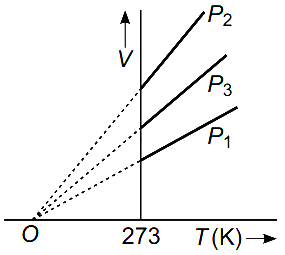
The volume-temperature graphs of a given mass of an ideal gas at constant pressures are shown below. What is the correct order of pressures?
A
$P_1 > P_3 > P_2$
B
$P_1 > P_2 > P_3$
C
$P_2 > P_3 > P_1$
D
$P_2 > P_1 > P_3$
Solution
(A) According to the ideal gas equation,$PV = nRT$,which can be rearranged as $V = (\frac{nR}{P})T$.
This is the equation of a straight line $V = mT$,where the slope $m = \frac{nR}{P}$.
Since $n$ and $R$ are constants,the slope is inversely proportional to pressure $(m \propto \frac{1}{P})$.
From the given graph,the slope of the lines follows the order: $m_2 > m_3 > m_1$.
Therefore,the order of pressures is $P_1 > P_3 > P_2$.
This is the equation of a straight line $V = mT$,where the slope $m = \frac{nR}{P}$.
Since $n$ and $R$ are constants,the slope is inversely proportional to pressure $(m \propto \frac{1}{P})$.
From the given graph,the slope of the lines follows the order: $m_2 > m_3 > m_1$.
Therefore,the order of pressures is $P_1 > P_3 > P_2$.
0 likesView Solution
165
ChemistryEasyMCQAP EAMCET · 2006
The energy of a photon is $3 \times 10^{-12} \ erg$. What is its wavelength in $nm$? $(h = 6.62 \times 10^{-27} \ erg \cdot s; \ c = 3 \times 10^{10} \ cm/s)$
A
$662$
B
$1324$
C
$66.2$
D
$6.62$
Solution
(A) Given: $E = 3 \times 10^{-12} \ erg$,$h = 6.62 \times 10^{-27} \ erg \cdot s$,$c = 3 \times 10^{10} \ cm/s$.
Using the formula $E = \frac{hc}{\lambda}$,we get $\lambda = \frac{hc}{E}$.
$\lambda = \frac{6.62 \times 10^{-27} \times 3 \times 10^{10}}{3 \times 10^{-12}} \ cm$.
$\lambda = 6.62 \times 10^{-5} \ cm$.
Since $1 \ cm = 10^7 \ nm$,$\lambda = 6.62 \times 10^{-5} \times 10^7 \ nm = 6.62 \times 10^2 \ nm = 662 \ nm$.
Using the formula $E = \frac{hc}{\lambda}$,we get $\lambda = \frac{hc}{E}$.
$\lambda = \frac{6.62 \times 10^{-27} \times 3 \times 10^{10}}{3 \times 10^{-12}} \ cm$.
$\lambda = 6.62 \times 10^{-5} \ cm$.
Since $1 \ cm = 10^7 \ nm$,$\lambda = 6.62 \times 10^{-5} \times 10^7 \ nm = 6.62 \times 10^2 \ nm = 662 \ nm$.
0 likesView Solution
166
ChemistryMCQAP EAMCET · 2006
The uncertainties in the velocities of two particles $A$ and $B$ are $0.05 \ m \ s^{-1}$ and $0.02 \ m \ s^{-1}$ respectively. The mass of $B$ is five times that of mass $A$. What is the ratio of uncertainties $\left(\frac{\Delta x_A}{\Delta x_B}\right)$ in their positions?
A
$2$
B
$0.25$
C
$4$
D
$1$
Solution
(A) According to Heisenberg's uncertainty principle: $\Delta x \cdot m \cdot \Delta v = \frac{h}{4 \pi}$.
Let the mass of particle $A$ be $m_A = m$ and the mass of particle $B$ be $m_B = 5m$.
The uncertainties in velocities are $\Delta v_A = 0.05 \ m \ s^{-1}$ and $\Delta v_B = 0.02 \ m \ s^{-1}$.
For particle $A$: $\Delta x_A \cdot m \cdot 0.05 = \frac{h}{4 \pi} \dots (i)$.
For particle $B$: $\Delta x_B \cdot 5m \cdot 0.02 = \frac{h}{4 \pi} \dots (ii)$.
Equating $(i)$ and $(ii)$ since both equal $\frac{h}{4 \pi}$:
$\Delta x_A \cdot m \cdot 0.05 = \Delta x_B \cdot 5m \cdot 0.02$.
$\Delta x_A \cdot 0.05 = \Delta x_B \cdot 0.10$.
$\frac{\Delta x_A}{\Delta x_B} = \frac{0.10}{0.05} = 2$.
Let the mass of particle $A$ be $m_A = m$ and the mass of particle $B$ be $m_B = 5m$.
The uncertainties in velocities are $\Delta v_A = 0.05 \ m \ s^{-1}$ and $\Delta v_B = 0.02 \ m \ s^{-1}$.
For particle $A$: $\Delta x_A \cdot m \cdot 0.05 = \frac{h}{4 \pi} \dots (i)$.
For particle $B$: $\Delta x_B \cdot 5m \cdot 0.02 = \frac{h}{4 \pi} \dots (ii)$.
Equating $(i)$ and $(ii)$ since both equal $\frac{h}{4 \pi}$:
$\Delta x_A \cdot m \cdot 0.05 = \Delta x_B \cdot 5m \cdot 0.02$.
$\Delta x_A \cdot 0.05 = \Delta x_B \cdot 0.10$.
$\frac{\Delta x_A}{\Delta x_B} = \frac{0.10}{0.05} = 2$.
0 likesView Solution
167
ChemistryMediumMCQAP EAMCET · 2006
Identify the reaction for which $\Delta H \neq \Delta E$ :
A
$S_{(s)} + O_{2(g)} \longrightarrow SO_{2(g)}$
B
$N_{2(g)} + O_{2(g)} \longrightarrow 2 NO_{(g)}$
C
$H_{2(g)} + Cl_{2(g)} \longrightarrow 2 HCl_{(g)}$
D
$CO_{(g)} + \frac{1}{2} O_{2(g)} \longrightarrow CO_{2(g)}$
Solution
(D) The relationship between enthalpy change $(\Delta H)$ and internal energy change $(\Delta E)$ is given by $\Delta H = \Delta E + \Delta n_g RT$.
For $\Delta H \neq \Delta E$,the change in the number of gaseous moles $(\Delta n_g)$ must not be equal to $0$.
$(A)$ $\Delta n_g = 1 - 1 = 0$.
$(B)$ $\Delta n_g = 2 - (1 + 1) = 0$.
$(C)$ $\Delta n_g = 2 - (1 + 1) = 0$.
$(D)$ $\Delta n_g = 1 - (1 + 0.5) = -0.5$.
Since $\Delta n_g \neq 0$ for option $D$,$\Delta H \neq \Delta E$ for this reaction.
For $\Delta H \neq \Delta E$,the change in the number of gaseous moles $(\Delta n_g)$ must not be equal to $0$.
$(A)$ $\Delta n_g = 1 - 1 = 0$.
$(B)$ $\Delta n_g = 2 - (1 + 1) = 0$.
$(C)$ $\Delta n_g = 2 - (1 + 1) = 0$.
$(D)$ $\Delta n_g = 1 - (1 + 0.5) = -0.5$.
Since $\Delta n_g \neq 0$ for option $D$,$\Delta H \neq \Delta E$ for this reaction.
0 likesView Solution
168
ChemistryMediumMCQAP EAMCET · 2006
$AB$ is an ionic solid. The ionic radii of $A^{+}$ and $B^{-}$ are respectively $r_c$ and $r_a$. Lattice energy of $AB$ is proportional to:
A
$\frac{r_c}{r_a}$
B
$(r_c + r_a)$
C
$\frac{r_a}{r_c}$
D
$\frac{1}{(r_c + r_a)}$
Solution
(D) The lattice energy $(U)$ of an ionic crystal is defined as the energy released when gaseous ions combine to form one mole of the solid ionic crystal.
According to the Born-Landé equation,the lattice energy is inversely proportional to the inter-ionic distance $(r_0)$.
Since the inter-ionic distance $r_0$ is the sum of the ionic radii of the cation $(r_c)$ and the anion $(r_a)$,we have $r_0 = r_c + r_a$.
Therefore,the lattice energy $U$ is proportional to $\frac{1}{(r_c + r_a)}$.
According to the Born-Landé equation,the lattice energy is inversely proportional to the inter-ionic distance $(r_0)$.
Since the inter-ionic distance $r_0$ is the sum of the ionic radii of the cation $(r_c)$ and the anion $(r_a)$,we have $r_0 = r_c + r_a$.
Therefore,the lattice energy $U$ is proportional to $\frac{1}{(r_c + r_a)}$.
0 likesView Solution
Vedclass Products
For Students
Vedclass Test Series
Mock tests in real AP EAMCET style covering Chemistry with performance analysis. 5-day free trial.
Start Free TrialFor Teachers
Exam Paper Generator
Generate Set A/B/C/D Chemistry papers from 7.5L+ questions in 2 minutes. 3 chapters free.
Try FreeFor Institutes
Online Exam Module
Run live AP EAMCET mock exams with unlimited students, 360° analytics & white-label branding.
See DemoFrequently Asked Questions
How many Chemistry questions are in AP EAMCET 2006?
There are 193 Chemistry questions from the AP EAMCET 2006 paper on Vedclass, each with a detailed step-by-step solution in English.
Are AP EAMCET 2006 Chemistry solutions available in English?
Yes. All solutions on this page are in English. You can also switch to English or Hindi using the language buttons above the questions.
Can I practice AP EAMCET 2006 Chemistry as a timed test?
Yes. Use the Vedclass Test Series to attempt a full AP EAMCET mock test covering Chemistry with time limits and instant score analysis.
Can teachers create Chemistry papers from AP EAMCET previous year questions?
Yes. The Vedclass Exam Paper Generator lets teachers mix AP EAMCET Chemistry questions and generate Set A/B/C/D papers in minutes.
For Teachers & Institutes
Build a Custom Chemistry Paper
Pick AP EAMCET 2006 Chemistry questions, set difficulty, and generate Set A/B/C/D in 2 minutes.