
PhysicsQ1–49 of 49 questions
Page 1 of 1 · English
1
PhysicsMediumMCQAIPMT · 1998
The width of the river is $1 \; km$. The velocity of the boat is $5 \; km/hr$. The boat covers the width of the river along the shortest possible path in $15 \; min$. The velocity of the river stream is:
A
$\sqrt{29} \; km/hr$
B
$3 \; km/hr$
C
$4 \; km/hr$
D
$\sqrt{41} \; km/hr$
Solution
(B) The shortest path to cross a river is the straight line perpendicular to the river flow.
Let $v_b = 5 \; km/hr$ be the velocity of the boat and $u$ be the velocity of the river stream.
The resultant velocity $v_r$ of the boat relative to the ground,when crossing the river along the shortest path,is given by $v_r = \sqrt{v_b^2 - u^2}$.
Given width $d = 1 \; km$ and time $t = 15 \; min = 0.25 \; hr = \frac{1}{4} \; hr$.
The resultant velocity is $v_r = \frac{d}{t} = \frac{1}{1/4} = 4 \; km/hr$.
Substituting the values: $4 = \sqrt{5^2 - u^2}$.
Squaring both sides: $16 = 25 - u^2$.
$u^2 = 25 - 16 = 9$.
$u = 3 \; km/hr$.
Let $v_b = 5 \; km/hr$ be the velocity of the boat and $u$ be the velocity of the river stream.
The resultant velocity $v_r$ of the boat relative to the ground,when crossing the river along the shortest path,is given by $v_r = \sqrt{v_b^2 - u^2}$.
Given width $d = 1 \; km$ and time $t = 15 \; min = 0.25 \; hr = \frac{1}{4} \; hr$.
The resultant velocity is $v_r = \frac{d}{t} = \frac{1}{1/4} = 4 \; km/hr$.
Substituting the values: $4 = \sqrt{5^2 - u^2}$.
Squaring both sides: $16 = 25 - u^2$.
$u^2 = 25 - 16 = 9$.
$u = 3 \; km/hr$.
0 likesView Solution
2
PhysicsMediumMCQAIPMT · 1998
$A$ car moving with a speed of $40 \, km/h$ can be stopped by applying brakes after at least $2 \, m$. If the same car is moving with a speed of $80 \, km/h$,what is the minimum stopping distance in meters?
A
$8$
B
$2$
C
$4$
D
$6$
Solution
(A) The stopping distance $S$ of a vehicle is given by the formula $S = \frac{u^2}{2a}$,where $u$ is the initial velocity and $a$ is the magnitude of deceleration.
Since $a$ is constant for the same car and same braking force,we have $S \propto u^2$.
Given $u_1 = 40 \, km/h$ and $S_1 = 2 \, m$.
For $u_2 = 80 \, km/h$,we have the ratio $\frac{S_2}{S_1} = \left( \frac{u_2}{u_1} \right)^2$.
Substituting the values: $\frac{S_2}{2} = \left( \frac{80}{40} \right)^2 = (2)^2 = 4$.
Therefore,$S_2 = 2 \times 4 = 8 \, m$.
Since $a$ is constant for the same car and same braking force,we have $S \propto u^2$.
Given $u_1 = 40 \, km/h$ and $S_1 = 2 \, m$.
For $u_2 = 80 \, km/h$,we have the ratio $\frac{S_2}{S_1} = \left( \frac{u_2}{u_1} \right)^2$.
Substituting the values: $\frac{S_2}{2} = \left( \frac{80}{40} \right)^2 = (2)^2 = 4$.
Therefore,$S_2 = 2 \times 4 = 8 \, m$.
0 likesView Solution
3
PhysicsEasyMCQAIPMT · 1998
$A$ ball of mass $0.25 \, kg$ attached to the end of a string of length $1.96 \, m$ is moving in a horizontal circle. The string will break if the tension is more than $25 \, N$. The maximum speed with which the ball can be moved is .......... $m/s$.
A
$14$
B
$3$
C
$3.92$
D
$5$
Solution
(A) The tension $T$ in the string provides the necessary centripetal force for the horizontal circular motion.
$T = \frac{mv^2}{r}$
Given: $m = 0.25 \, kg$,$r = 1.96 \, m$,and $T_{max} = 25 \, N$.
Substituting the values into the formula:
$25 = \frac{0.25 \times v^2}{1.96}$
$v^2 = \frac{25 \times 1.96}{0.25}$
$v^2 = 100 \times 1.96 = 196$
$v = \sqrt{196} = 14 \, m/s$.
Thus,the maximum speed is $14 \, m/s$.
$T = \frac{mv^2}{r}$
Given: $m = 0.25 \, kg$,$r = 1.96 \, m$,and $T_{max} = 25 \, N$.
Substituting the values into the formula:
$25 = \frac{0.25 \times v^2}{1.96}$
$v^2 = \frac{25 \times 1.96}{0.25}$
$v^2 = 100 \times 1.96 = 196$
$v = \sqrt{196} = 14 \, m/s$.
Thus,the maximum speed is $14 \, m/s$.
0 likesView Solution
4
PhysicsMediumMCQAIPMT · 1998
$A$ mass $1\, kg$ is suspended by a thread. It is
$(i)$ lifted up with an acceleration $4.9\, m/s^2$
$(ii)$ lowered with an acceleration $4.9\, m/s^2$.
The ratio of the tensions is
$(i)$ lifted up with an acceleration $4.9\, m/s^2$
$(ii)$ lowered with an acceleration $4.9\, m/s^2$.
The ratio of the tensions is
A
$3:1$
B
$1:3$
C
$1:2$
D
$2:1$
Solution
(A) Given mass $m = 1\, kg$ and acceleration $a = 4.9\, m/s^2$. Taking $g = 9.8\, m/s^2$,we note that $a = g/2$.
Case $(i)$: When the mass is lifted up with acceleration $a$,the tension $T_1$ is given by $T_1 = m(g + a)$.
$T_1 = 1 \times (g + g/2) = 3g/2$.
Case $(ii)$: When the mass is lowered with acceleration $a$,the tension $T_2$ is given by $T_2 = m(g - a)$.
$T_2 = 1 \times (g - g/2) = g/2$.
The ratio of the tensions is $\frac{T_1}{T_2} = \frac{3g/2}{g/2} = \frac{3}{1}$.
Case $(i)$: When the mass is lifted up with acceleration $a$,the tension $T_1$ is given by $T_1 = m(g + a)$.
$T_1 = 1 \times (g + g/2) = 3g/2$.
Case $(ii)$: When the mass is lowered with acceleration $a$,the tension $T_2$ is given by $T_2 = m(g - a)$.
$T_2 = 1 \times (g - g/2) = g/2$.
The ratio of the tensions is $\frac{T_1}{T_2} = \frac{3g/2}{g/2} = \frac{3}{1}$.
0 likesView Solution
5
PhysicsMediumMCQAIPMT · 1998
$A$ $5000\, kg$ rocket is set for vertical firing. The exhaust speed is $800\, m/s$. To give an initial upward acceleration of $20\, m/s^2$,the amount of gas ejected per second to supply the needed thrust will be ........... $kg/s$ $(g = 10\, m/s^2)$. (in $.5$)
A
$127$
B
$187$
C
$185$
D
$137$
Solution
(B) The thrust force $F$ required to lift the rocket with an upward acceleration $a$ is given by the equation: $F = v_{ex} \cdot \frac{dm}{dt} = m(g + a)$.
Here,$m = 5000\, kg$ is the mass of the rocket,$g = 10\, m/s^2$ is the acceleration due to gravity,$a = 20\, m/s^2$ is the required upward acceleration,and $v_{ex} = 800\, m/s$ is the exhaust speed.
Rearranging the formula to solve for the rate of mass ejection $\frac{dm}{dt}$:
$\frac{dm}{dt} = \frac{m(g + a)}{v_{ex}}$
Substituting the given values:
$\frac{dm}{dt} = \frac{5000 \times (10 + 20)}{800}$
$\frac{dm}{dt} = \frac{5000 \times 30}{800} = \frac{150000}{800} = 187.5\, kg/s$.
Thus,the amount of gas ejected per second is $187.5\, kg/s$.
Here,$m = 5000\, kg$ is the mass of the rocket,$g = 10\, m/s^2$ is the acceleration due to gravity,$a = 20\, m/s^2$ is the required upward acceleration,and $v_{ex} = 800\, m/s$ is the exhaust speed.
Rearranging the formula to solve for the rate of mass ejection $\frac{dm}{dt}$:
$\frac{dm}{dt} = \frac{m(g + a)}{v_{ex}}$
Substituting the given values:
$\frac{dm}{dt} = \frac{5000 \times (10 + 20)}{800}$
$\frac{dm}{dt} = \frac{5000 \times 30}{800} = \frac{150000}{800} = 187.5\, kg/s$.
Thus,the amount of gas ejected per second is $187.5\, kg/s$.
0 likesView Solution
6
PhysicsDifficultMCQAIPMT · 1998
$A$ bullet is fired from a gun. The force on the bullet is given by $F = 600 - 2 \times 10^5 t$,where $F$ is in newtons and $t$ is in seconds. The force on the bullet becomes zero as soon as it leaves the barrel. What is the impulse imparted to the bullet in $N-s$?
A
$9$
B
$0$
C
$0.9$
D
$1.8$
Solution
(C) The force on the bullet is given by $F = 600 - 2 \times 10^5 t$.
When the bullet leaves the barrel,the force becomes zero,so $F = 0$.
$600 - 2 \times 10^5 t = 0$
$2 \times 10^5 t = 600$
$t = \frac{600}{2 \times 10^5} = 3 \times 10^{-3} \ s$.
Impulse $I$ is defined as the integral of force with respect to time: $I = \int_{0}^{t} F \ dt$.
$I = \int_{0}^{3 \times 10^{-3}} (600 - 2 \times 10^5 t) \ dt$
$I = [600t - 10^5 t^2]_{0}^{3 \times 10^{-3}}$
$I = 600(3 \times 10^{-3}) - 10^5(3 \times 10^{-3})^2$
$I = 1.8 - 10^5(9 \times 10^{-6})$
$I = 1.8 - 0.9 = 0.9 \ N-s$.
When the bullet leaves the barrel,the force becomes zero,so $F = 0$.
$600 - 2 \times 10^5 t = 0$
$2 \times 10^5 t = 600$
$t = \frac{600}{2 \times 10^5} = 3 \times 10^{-3} \ s$.
Impulse $I$ is defined as the integral of force with respect to time: $I = \int_{0}^{t} F \ dt$.
$I = \int_{0}^{3 \times 10^{-3}} (600 - 2 \times 10^5 t) \ dt$
$I = [600t - 10^5 t^2]_{0}^{3 \times 10^{-3}}$
$I = 600(3 \times 10^{-3}) - 10^5(3 \times 10^{-3})^2$
$I = 1.8 - 10^5(9 \times 10^{-6})$
$I = 1.8 - 0.9 = 0.9 \ N-s$.
0 likesView Solution
7
PhysicsMediumMCQAIPMT · 1998
$A$ force acts on a $3 \,g$ particle in such a way that the position of the particle as a function of time is given by $x = 3t - 4t^2 + t^3$,where $x$ is in metres and $t$ is in seconds. The work done during the first $4 \,s$ is ..... $mJ$.
A
$528$
B
$450$
C
$490$
D
$576$
Solution
(A) According to the Work-Energy Theorem,the work done $W$ is equal to the change in kinetic energy: $W = \Delta K = \frac{1}{2} m(v_f^2 - v_i^2)$.
Given $x = 3t - 4t^2 + t^3$,the velocity $v$ is the derivative of position with respect to time: $v = \frac{dx}{dt} = 3 - 8t + 3t^2$.
At $t = 0 \,s$,$v_i = 3 - 8(0) + 3(0)^2 = 3 \,m/s$.
At $t = 4 \,s$,$v_f = 3 - 8(4) + 3(4)^2 = 3 - 32 + 48 = 19 \,m/s$.
The mass $m = 3 \,g = 0.003 \,kg$.
Substituting the values: $W = \frac{1}{2} \times 0.003 \times (19^2 - 3^2) = 0.0015 \times (361 - 9) = 0.0015 \times 352 = 0.528 \,J$.
Since $1 \,J = 1000 \,mJ$,the work done is $0.528 \times 1000 = 528 \,mJ$.
Given $x = 3t - 4t^2 + t^3$,the velocity $v$ is the derivative of position with respect to time: $v = \frac{dx}{dt} = 3 - 8t + 3t^2$.
At $t = 0 \,s$,$v_i = 3 - 8(0) + 3(0)^2 = 3 \,m/s$.
At $t = 4 \,s$,$v_f = 3 - 8(4) + 3(4)^2 = 3 - 32 + 48 = 19 \,m/s$.
The mass $m = 3 \,g = 0.003 \,kg$.
Substituting the values: $W = \frac{1}{2} \times 0.003 \times (19^2 - 3^2) = 0.0015 \times (361 - 9) = 0.0015 \times 352 = 0.528 \,J$.
Since $1 \,J = 1000 \,mJ$,the work done is $0.528 \times 1000 = 528 \,mJ$.
0 likesView Solution
8
PhysicsEasyMCQAIPMT · 1998
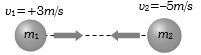
Two equal masses $m_1$ and $m_2$ moving along the same straight line with velocities $+3 \, m/s$ and $-5 \, m/s$ respectively collide elastically. Their velocities after the collision will be respectively
A
$+4 \, m/s$ for both
B
$-3 \, m/s$ and $+5 \, m/s$
C
$-4 \, m/s$ and $+4 \, m/s$
D
$-5 \, m/s$ and $+3 \, m/s$
Solution
(D) In a one-dimensional elastic collision between two bodies of equal mass,the velocities of the bodies are interchanged after the collision.
Given: Initial velocity of mass $m_1$ is $u_1 = +3 \, m/s$ and initial velocity of mass $m_2$ is $u_2 = -5 \, m/s$.
Since $m_1 = m_2$,after the elastic collision,the final velocity of mass $m_1$ becomes $v_1 = u_2 = -5 \, m/s$ and the final velocity of mass $m_2$ becomes $v_2 = u_1 = +3 \, m/s$.
Given: Initial velocity of mass $m_1$ is $u_1 = +3 \, m/s$ and initial velocity of mass $m_2$ is $u_2 = -5 \, m/s$.
Since $m_1 = m_2$,after the elastic collision,the final velocity of mass $m_1$ becomes $v_1 = u_2 = -5 \, m/s$ and the final velocity of mass $m_2$ becomes $v_2 = u_1 = +3 \, m/s$.
0 likesView Solution
9
PhysicsDifficultMCQAIPMT · 1998
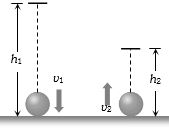
$A$ rubber ball is dropped from a height of $5 \, m$ on a planet where the acceleration due to gravity is not known. On bouncing,it rises to $1.8 \, m$. The ball loses its velocity on bouncing by a factor of
A
$16/25$
B
$2/5$
C
$3/5$
D
$9/25$
Solution
(B) Let the initial height be $h_1 = 5 \, m$ and the height after the bounce be $h_2 = 1.8 \, m$.
The velocity of the ball just before the impact is $v_1 = \sqrt{2gh_1}$ and the velocity just after the impact is $v_2 = \sqrt{2gh_2}$.
The coefficient of restitution $e$ is given by the ratio of velocities:
$e = \frac{v_2}{v_1} = \frac{\sqrt{2gh_2}}{\sqrt{2gh_1}} = \sqrt{\frac{h_2}{h_1}}$
Substituting the given values:
$e = \sqrt{\frac{1.8}{5}} = \sqrt{\frac{18}{50}} = \sqrt{\frac{9}{25}} = \frac{3}{5}$
The velocity after the bounce is $v_2 = e v_1 = \frac{3}{5} v_1$.
The loss in velocity is $\Delta v = v_1 - v_2 = v_1 - \frac{3}{5} v_1 = \frac{2}{5} v_1$.
Therefore,the factor by which the ball loses its velocity is $\frac{\Delta v}{v_1} = \frac{2}{5}$.
The velocity of the ball just before the impact is $v_1 = \sqrt{2gh_1}$ and the velocity just after the impact is $v_2 = \sqrt{2gh_2}$.
The coefficient of restitution $e$ is given by the ratio of velocities:
$e = \frac{v_2}{v_1} = \frac{\sqrt{2gh_2}}{\sqrt{2gh_1}} = \sqrt{\frac{h_2}{h_1}}$
Substituting the given values:
$e = \sqrt{\frac{1.8}{5}} = \sqrt{\frac{18}{50}} = \sqrt{\frac{9}{25}} = \frac{3}{5}$
The velocity after the bounce is $v_2 = e v_1 = \frac{3}{5} v_1$.
The loss in velocity is $\Delta v = v_1 - v_2 = v_1 - \frac{3}{5} v_1 = \frac{2}{5} v_1$.
Therefore,the factor by which the ball loses its velocity is $\frac{\Delta v}{v_1} = \frac{2}{5}$.
0 likesView Solution
10
PhysicsMediumMCQAIPMT · 1998
If the ratio of specific heat of a gas at constant pressure to that at constant volume is $\gamma$,the change in internal energy of a mass of gas,when the volume changes from $V$ to $2V$ at constant pressure $p$,is
A
$R/(\gamma - 1)$
B
$pV$
C
$pV/(\gamma - 1)$
D
$\gamma pV/(\gamma - 1)$
Solution
(C) The change in internal energy $\Delta U$ for an ideal gas is given by the formula $\Delta U = n C_V \Delta T$.
Since $C_V = R/(\gamma - 1)$,we have $\Delta U = n (R/(\gamma - 1)) \Delta T$.
Using the ideal gas law $pV = nRT$,at constant pressure $p$,we have $p \Delta V = nR \Delta T$.
Substituting $n R \Delta T = p \Delta V$ into the equation,we get $\Delta U = p \Delta V / (\gamma - 1)$.
Given the volume changes from $V$ to $2V$,the change in volume is $\Delta V = 2V - V = V$.
Therefore,$\Delta U = pV / (\gamma - 1)$.
Since $C_V = R/(\gamma - 1)$,we have $\Delta U = n (R/(\gamma - 1)) \Delta T$.
Using the ideal gas law $pV = nRT$,at constant pressure $p$,we have $p \Delta V = nR \Delta T$.
Substituting $n R \Delta T = p \Delta V$ into the equation,we get $\Delta U = p \Delta V / (\gamma - 1)$.
Given the volume changes from $V$ to $2V$,the change in volume is $\Delta V = 2V - V = V$.
Therefore,$\Delta U = pV / (\gamma - 1)$.
0 likesView Solution
11
PhysicsEasyMCQAIPMT · 1998
If $\Delta U$ and $\Delta W$ represent the increase in internal energy and work done by the system respectively in a thermodynamical process,which of the following is true?
A
$\Delta U = - \Delta W$ in an adiabatic process
B
$\Delta U = \Delta W$ in an isothermal process
C
$\Delta U = - \Delta W$ in an isothermal process
D
$\Delta U = \Delta W$ in an adiabatic process
Solution
(A) According to the first law of thermodynamics,the heat supplied to the system $(\Delta Q)$ is equal to the sum of the change in internal energy $(\Delta U)$ and the work done by the system $(\Delta W)$:
$\Delta Q = \Delta U + \Delta W$
In an adiabatic process,there is no exchange of heat with the surroundings,so $\Delta Q = 0$.
Substituting $\Delta Q = 0$ into the equation,we get:
$0 = \Delta U + \Delta W$
Therefore,$\Delta U = - \Delta W$.
$\Delta Q = \Delta U + \Delta W$
In an adiabatic process,there is no exchange of heat with the surroundings,so $\Delta Q = 0$.
Substituting $\Delta Q = 0$ into the equation,we get:
$0 = \Delta U + \Delta W$
Therefore,$\Delta U = - \Delta W$.
0 likesView Solution
12
PhysicsMediumMCQAIPMT · 1998
The radiant energy from the sun incident normally at the surface of the earth is $20 \, kcal/(m^2 \cdot min)$. What would have been the radiant energy incident normally on the earth,if the sun had a temperature twice of the present one? (in $kcal/(m^2 \cdot min)$)
A
$160$
B
$40$
C
$320$
D
$80$
Solution
(C) According to the Stefan-Boltzmann law,the radiant energy emitted by a black body is proportional to the fourth power of its absolute temperature,i.e.,$E \propto T^4$.
Let $E_1$ be the initial radiant energy incident on the earth and $T_1$ be the initial temperature of the sun.
Given $E_1 = 20 \, kcal/(m^2 \cdot min)$.
Let $E_2$ be the new radiant energy when the temperature of the sun becomes $T_2 = 2T_1$.
Using the ratio formula:
$\frac{E_2}{E_1} = \left( \frac{T_2}{T_1} \right)^4$
Substituting the values:
$\frac{E_2}{20} = \left( \frac{2T_1}{T_1} \right)^4$
$\frac{E_2}{20} = (2)^4 = 16$
Therefore,$E_2 = 16 \times 20 = 320 \, kcal/(m^2 \cdot min)$.
Let $E_1$ be the initial radiant energy incident on the earth and $T_1$ be the initial temperature of the sun.
Given $E_1 = 20 \, kcal/(m^2 \cdot min)$.
Let $E_2$ be the new radiant energy when the temperature of the sun becomes $T_2 = 2T_1$.
Using the ratio formula:
$\frac{E_2}{E_1} = \left( \frac{T_2}{T_1} \right)^4$
Substituting the values:
$\frac{E_2}{20} = \left( \frac{2T_1}{T_1} \right)^4$
$\frac{E_2}{20} = (2)^4 = 16$
Therefore,$E_2 = 16 \times 20 = 320 \, kcal/(m^2 \cdot min)$.
0 likesView Solution
13
PhysicsMediumMCQAIPMT · 1998
$A$ mass $m$ is vertically suspended from a spring of negligible mass; the system oscillates with a frequency $n$. What will be the frequency of the system if a mass $4m$ is suspended from the same spring?
A
$n/4$
B
$4n$
C
$n/2$
D
$2n$
Solution
(C) The frequency of a spring-mass system is given by the formula $n = \frac{1}{2\pi} \sqrt{\frac{k}{m}}$,where $k$ is the spring constant and $m$ is the mass.
From this relation,we can see that $n \propto \frac{1}{\sqrt{m}}$.
Let the initial frequency be $n_1 = n$ for mass $m_1 = m$,and the new frequency be $n_2$ for mass $m_2 = 4m$.
Using the proportionality,we have $\frac{n_1}{n_2} = \sqrt{\frac{m_2}{m_1}}$.
Substituting the values,$\frac{n}{n_2} = \sqrt{\frac{4m}{m}} = \sqrt{4} = 2$.
Therefore,$n_2 = \frac{n}{2}$.
From this relation,we can see that $n \propto \frac{1}{\sqrt{m}}$.
Let the initial frequency be $n_1 = n$ for mass $m_1 = m$,and the new frequency be $n_2$ for mass $m_2 = 4m$.
Using the proportionality,we have $\frac{n_1}{n_2} = \sqrt{\frac{m_2}{m_1}}$.
Substituting the values,$\frac{n}{n_2} = \sqrt{\frac{4m}{m}} = \sqrt{4} = 2$.
Therefore,$n_2 = \frac{n}{2}$.
0 likesView Solution
14
PhysicsMediumMCQAIPMT · 1998
$A$ particle with a restoring force proportional to displacement and a resisting force proportional to velocity is subjected to a driving force $F \sin \omega t$. If the amplitude of the particle is maximum for $\omega = \omega_1$ and the energy of the particle is maximum for $\omega = \omega_2$,then (where $\omega_0$ is the natural frequency of oscillation of the particle):
A
$\omega_1 = \omega_0$ and $\omega_2 \neq \omega_0$
B
$\omega_1 \neq \omega_0$ and $\omega_2 = \omega_0$
C
$\omega_1 = \omega_0$ and $\omega_2 = \omega_0$
D
$\omega_1 \neq \omega_0$ and $\omega_2 \neq \omega_0$
Solution
(B) For a damped driven oscillator,the amplitude $A$ is given by $A = \frac{F/m}{\sqrt{(\omega_0^2 - \omega^2)^2 + (b\omega/m)^2}}$.
Amplitude is maximum when the denominator is minimum,which occurs at $\omega_1 = \sqrt{\omega_0^2 - 2(b/2m)^2}$. Thus,$\omega_1 \neq \omega_0$.
The energy of the oscillator is proportional to the square of the amplitude and is also related to the power absorbed. The energy of the particle is maximum at the velocity resonance frequency,which occurs when $\omega_2 = \omega_0$.
Therefore,the correct relationship is $\omega_1 \neq \omega_0$ and $\omega_2 = \omega_0$.
Amplitude is maximum when the denominator is minimum,which occurs at $\omega_1 = \sqrt{\omega_0^2 - 2(b/2m)^2}$. Thus,$\omega_1 \neq \omega_0$.
The energy of the oscillator is proportional to the square of the amplitude and is also related to the power absorbed. The energy of the particle is maximum at the velocity resonance frequency,which occurs when $\omega_2 = \omega_0$.
Therefore,the correct relationship is $\omega_1 \neq \omega_0$ and $\omega_2 = \omega_0$.
1 likesView Solution
15
PhysicsMediumMCQAIPMT · 1998
Two simple pendulums of length $0.5\, m$ and $2.0\, m$ respectively are given small linear displacement in one direction at the same time. They will again be in the phase when the pendulum of shorter length has completed .... oscillations.
A
$5$
B
$1$
C
$2$
D
$3$
Solution
(C) Let $T_S$ be the time period of the shorter pendulum and $T_L$ be the time period of the longer pendulum.
Given lengths are $l_S = 0.5\, m$ and $l_L = 2.0\, m$.
The time period of a simple pendulum is given by $T = 2\pi \sqrt{\frac{l}{g}}$.
So,$T_S = 2\pi \sqrt{\frac{0.5}{g}}$ and $T_L = 2\pi \sqrt{\frac{2.0}{g}}$.
Taking the ratio,$\frac{T_L}{T_S} = \sqrt{\frac{2.0}{0.5}} = \sqrt{4} = 2$.
Thus,$T_L = 2T_S$.
Let $N_S$ be the number of oscillations of the shorter pendulum and $N_L$ be the number of oscillations of the longer pendulum when they are in the same phase again.
At this time $t$,$t = N_S T_S = N_L T_L$.
Substituting $T_L = 2T_S$,we get $N_S T_S = N_L (2T_S)$.
Therefore,$N_S = 2N_L$.
For the first time they are in phase again,we take the smallest integer values,$N_L = 1$,which gives $N_S = 2$.
Given lengths are $l_S = 0.5\, m$ and $l_L = 2.0\, m$.
The time period of a simple pendulum is given by $T = 2\pi \sqrt{\frac{l}{g}}$.
So,$T_S = 2\pi \sqrt{\frac{0.5}{g}}$ and $T_L = 2\pi \sqrt{\frac{2.0}{g}}$.
Taking the ratio,$\frac{T_L}{T_S} = \sqrt{\frac{2.0}{0.5}} = \sqrt{4} = 2$.
Thus,$T_L = 2T_S$.
Let $N_S$ be the number of oscillations of the shorter pendulum and $N_L$ be the number of oscillations of the longer pendulum when they are in the same phase again.
At this time $t$,$t = N_S T_S = N_L T_L$.
Substituting $T_L = 2T_S$,we get $N_S T_S = N_L (2T_S)$.
Therefore,$N_S = 2N_L$.
For the first time they are in phase again,we take the smallest integer values,$N_L = 1$,which gives $N_S = 2$.
0 likesView Solution
16
PhysicsMediumMCQAIPMT · 1998
In a sinusoidal wave,the time required for a particular point to move from maximum displacement to zero displacement is $0.170\,s$. The frequency of the wave is .... $Hz$.
A
$1.47$
B
$0.36$
C
$0.73$
D
$2.94$
Solution
(A) In a sinusoidal wave,the motion from maximum displacement (amplitude) to zero displacement corresponds to one-quarter of the total time period $(T)$.
Therefore,the time taken is $t = \frac{T}{4}$.
Since the frequency ($n$ or $f$) is the reciprocal of the time period,$T = \frac{1}{n}$.
Substituting this into the equation,we get $t = \frac{1}{4n}$.
Rearranging for frequency,$n = \frac{1}{4t}$.
Given $t = 0.170\,s$,we calculate $n = \frac{1}{4 \times 0.170} = \frac{1}{0.680} \approx 1.47\,Hz$.
Therefore,the time taken is $t = \frac{T}{4}$.
Since the frequency ($n$ or $f$) is the reciprocal of the time period,$T = \frac{1}{n}$.
Substituting this into the equation,we get $t = \frac{1}{4n}$.
Rearranging for frequency,$n = \frac{1}{4t}$.
Given $t = 0.170\,s$,we calculate $n = \frac{1}{4 \times 0.170} = \frac{1}{0.680} \approx 1.47\,Hz$.
0 likesView Solution
17
PhysicsDifficultMCQAIPMT · 1998
$A$ transverse wave is represented by the equation $y = y_0 \sin \frac{2\pi}{\lambda} (vt - x)$. For what value of $\lambda$ is the maximum particle velocity equal to two times the wave velocity?
A
$\lambda = 2\pi y_0$
B
$\lambda = \pi y_0 / 3$
C
$\lambda = \pi y_0 / 2$
D
$\lambda = \pi y_0$
Solution
(D) The given wave equation is $y = y_0 \sin \frac{2\pi}{\lambda} (vt - x)$.
Comparing this with the standard wave equation $y = a \sin \frac{2\pi}{\lambda} (vt - x)$,we identify the amplitude $a = y_0$ and wave velocity $v_{wave} = v$.
The particle velocity $v_p$ is given by the derivative of displacement with respect to time: $v_p = \frac{\partial y}{\partial t} = y_0 \cdot \frac{2\pi v}{\lambda} \cos \frac{2\pi}{\lambda} (vt - x)$.
The maximum particle velocity is $(v_{max})_{particle} = y_0 \cdot \frac{2\pi v}{\lambda}$.
According to the problem,$(v_{max})_{particle} = 2 \cdot v_{wave}$.
Substituting the values: $\frac{y_0 \cdot 2\pi v}{\lambda} = 2v$.
Canceling $v$ from both sides: $\frac{2\pi y_0}{\lambda} = 2$.
Solving for $\lambda$: $\lambda = \pi y_0$.
Comparing this with the standard wave equation $y = a \sin \frac{2\pi}{\lambda} (vt - x)$,we identify the amplitude $a = y_0$ and wave velocity $v_{wave} = v$.
The particle velocity $v_p$ is given by the derivative of displacement with respect to time: $v_p = \frac{\partial y}{\partial t} = y_0 \cdot \frac{2\pi v}{\lambda} \cos \frac{2\pi}{\lambda} (vt - x)$.
The maximum particle velocity is $(v_{max})_{particle} = y_0 \cdot \frac{2\pi v}{\lambda}$.
According to the problem,$(v_{max})_{particle} = 2 \cdot v_{wave}$.
Substituting the values: $\frac{y_0 \cdot 2\pi v}{\lambda} = 2v$.
Canceling $v$ from both sides: $\frac{2\pi y_0}{\lambda} = 2$.
Solving for $\lambda$: $\lambda = \pi y_0$.
0 likesView Solution
18
PhysicsEasyMCQAIPMT · 1998
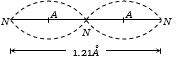
$A$ standing wave having $3$ nodes and $2$ antinodes is formed between two atoms having a distance of $1.21 \; \mathring{A}$ between them. The wavelength of the standing wave is .... $\mathring{A}$
A
$1.21$
B
$2.42$
C
$0.605$
D
$3.63$
Solution
(A) The distance between two consecutive nodes is $\frac{\lambda}{2}$.
In a standing wave with $3$ nodes and $2$ antinodes,there are $2$ loops.
The total length $L$ between the two extreme nodes is given by $L = 2 \times \frac{\lambda}{2} = \lambda$.
Given that the distance between the two atoms (which act as the extreme nodes) is $1.21 \; \mathring{A}$,we have $L = 1.21 \; \mathring{A}$.
Therefore,the wavelength $\lambda = 1.21 \; \mathring{A}$.
In a standing wave with $3$ nodes and $2$ antinodes,there are $2$ loops.
The total length $L$ between the two extreme nodes is given by $L = 2 \times \frac{\lambda}{2} = \lambda$.
Given that the distance between the two atoms (which act as the extreme nodes) is $1.21 \; \mathring{A}$,we have $L = 1.21 \; \mathring{A}$.
Therefore,the wavelength $\lambda = 1.21 \; \mathring{A}$.
0 likesView Solution
19
PhysicsEasyMCQAIPMT · 1998
$A$ vehicle with a horn of frequency $n$ is moving with a velocity of $30\, m/s$ in a direction perpendicular to the straight line joining the observer and the vehicle. The observer perceives the sound to have a frequency $n + n_1$. Then (if the sound velocity in air is $300\, m/s$):
A
$n_1 = 10\,n$
B
$n_1 = 0$
C
$n_1 = 0.1\,n$
D
$n_1 = -0.1\,n$
Solution
(B) The Doppler effect occurs when there is a relative velocity between the source and the observer along the line joining them.
In this problem,the vehicle is moving in a direction perpendicular to the line joining the observer and the vehicle.
Therefore,the component of the velocity of the source along the line joining the observer and the source is $v_s \cos(90^{\circ}) = 0$.
Since there is no relative motion along the line of sight,the frequency perceived by the observer remains the same as the source frequency.
Thus,the observed frequency is $n' = n$.
Given that the observed frequency is $n + n_1$,we have $n + n_1 = n$,which implies $n_1 = 0$.
In this problem,the vehicle is moving in a direction perpendicular to the line joining the observer and the vehicle.
Therefore,the component of the velocity of the source along the line joining the observer and the source is $v_s \cos(90^{\circ}) = 0$.
Since there is no relative motion along the line of sight,the frequency perceived by the observer remains the same as the source frequency.
Thus,the observed frequency is $n' = n$.
Given that the observed frequency is $n + n_1$,we have $n + n_1 = n$,which implies $n_1 = 0$.
0 likesView Solution
20
PhysicsMediumMCQAIPMT · 1998
$A$ thin circular ring of mass $M$ and radius $r$ is rotating about its axis with a constant angular velocity $\omega$. Two objects,each of mass $m$,are attached gently to the opposite ends of a diameter of the ring. The ring will now rotate with an angular velocity:
A
$\frac{\omega (M - 2m)}{M + 2m}$
B
$\frac{\omega M}{M + 2m}$
C
$\frac{\omega M}{M + m}$
D
$\frac{\omega (M + 2m)}{M}$
Solution
(B) The initial moment of inertia of the ring about its axis is $I = Mr^2$.
The initial angular momentum is $L = I\omega = Mr^2\omega$.
When two objects of mass $m$ are attached to the opposite ends of a diameter,the new moment of inertia $I'$ becomes the sum of the ring's moment of inertia and the moment of inertia of the two point masses: $I' = Mr^2 + m(r)^2 + m(r)^2 = (M + 2m)r^2$.
According to the principle of conservation of angular momentum,the external torque is zero,so $L_{initial} = L_{final}$.
$Mr^2\omega = (M + 2m)r^2\omega'$
Solving for the new angular velocity $\omega'$:
$\omega' = \frac{Mr^2\omega}{(M + 2m)r^2} = \frac{M\omega}{M + 2m}$.
The initial angular momentum is $L = I\omega = Mr^2\omega$.
When two objects of mass $m$ are attached to the opposite ends of a diameter,the new moment of inertia $I'$ becomes the sum of the ring's moment of inertia and the moment of inertia of the two point masses: $I' = Mr^2 + m(r)^2 + m(r)^2 = (M + 2m)r^2$.
According to the principle of conservation of angular momentum,the external torque is zero,so $L_{initial} = L_{final}$.
$Mr^2\omega = (M + 2m)r^2\omega'$
Solving for the new angular velocity $\omega'$:
$\omega' = \frac{Mr^2\omega}{(M + 2m)r^2} = \frac{M\omega}{M + 2m}$.
1 likesView Solution
21
PhysicsMediumMCQAIPMT · 1998
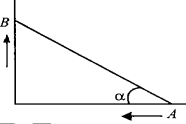
Two particles $A$ and $B$ are connected by a rigid rod $AB$. The rod slides along perpendicular rails as shown in the figure. The velocity of $A$ to the left is $10\; m/s$. What is the velocity of $B$ (in $m/s$) when the angle $\alpha = 60^{\circ}$?
A
$10$
B
$9.8$
C
$17.3$
D
$5.8$
Solution
(D) Let $L$ be the length of the rigid rod $AB$. Let $x$ be the distance of $A$ from the corner and $y$ be the distance of $B$ from the corner.
From the geometry,we have $L^2 = x^2 + y^2$.
Differentiating both sides with respect to time $t$,we get:
$0 = 2x \frac{dx}{dt} + 2y \frac{dy}{dt}$
$x \frac{dx}{dt} + y \frac{dy}{dt} = 0$
Given that the velocity of $A$ is $v_A = -\frac{dx}{dt} = 10\; m/s$ (since $x$ is decreasing).
So,$\frac{dx}{dt} = -10\; m/s$.
Substituting this into the equation:
$x(-10) + y \frac{dy}{dt} = 0$
$y \frac{dy}{dt} = 10x$
$\frac{dy}{dt} = 10 \left( \frac{x}{y} \right)$
From the triangle,$\frac{x}{y} = \cot(\alpha)$.
At $\alpha = 60^{\circ}$,$\frac{x}{y} = \cot(60^{\circ}) = \frac{1}{\sqrt{3}}$.
Therefore,the velocity of $B$ is $v_B = \frac{dy}{dt} = 10 \times \frac{1}{\sqrt{3}} = \frac{10}{1.732} \approx 5.77\; m/s$.
Rounding to one decimal place,we get $5.8\; m/s$.
From the geometry,we have $L^2 = x^2 + y^2$.
Differentiating both sides with respect to time $t$,we get:
$0 = 2x \frac{dx}{dt} + 2y \frac{dy}{dt}$
$x \frac{dx}{dt} + y \frac{dy}{dt} = 0$
Given that the velocity of $A$ is $v_A = -\frac{dx}{dt} = 10\; m/s$ (since $x$ is decreasing).
So,$\frac{dx}{dt} = -10\; m/s$.
Substituting this into the equation:
$x(-10) + y \frac{dy}{dt} = 0$
$y \frac{dy}{dt} = 10x$
$\frac{dy}{dt} = 10 \left( \frac{x}{y} \right)$
From the triangle,$\frac{x}{y} = \cot(\alpha)$.
At $\alpha = 60^{\circ}$,$\frac{x}{y} = \cot(60^{\circ}) = \frac{1}{\sqrt{3}}$.
Therefore,the velocity of $B$ is $v_B = \frac{dy}{dt} = 10 \times \frac{1}{\sqrt{3}} = \frac{10}{1.732} \approx 5.77\; m/s$.
Rounding to one decimal place,we get $5.8\; m/s$.
0 likesView Solution
22
PhysicsEasyMCQAIPMT · 1998
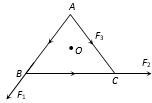
$ABC$ is an equilateral triangle with $O$ as its centre. $\vec F_1, \vec F_2$ and $\vec F_3$ represent three forces acting along the sides $AB, BC$ and $AC$ respectively. If the total torque about $O$ is zero,then the magnitude of $\vec F_3$ is
A
$({F_1} + {F_2})/2$
B
$2({F_1} + {F_2})$
C
$({F_1} + {F_2})$
D
$({F_1} - {F_2})$
Solution
(C) Let $x$ be the perpendicular distance from the center $O$ of the equilateral triangle to each of its sides.
Since the triangle is equilateral,the distance from the center to each side is the same.
The torque $\tau$ produced by a force $F$ about point $O$ is given by $\tau = F \times x$.
Looking at the directions of the forces $\vec F_1, \vec F_2$,and $\vec F_3$ along the sides of the triangle,we can see that $\vec F_1$ and $\vec F_2$ produce torques in the same rotational sense (e.g.,clockwise) about $O$,while $\vec F_3$ produces a torque in the opposite sense (e.g.,counter-clockwise).
For the total torque about $O$ to be zero,the sum of the torques must be zero:
$\tau_1 + \tau_2 - \tau_3 = 0$
$F_1 x + F_2 x - F_3 x = 0$
Dividing by $x$ (since $x \neq 0$):
$F_1 + F_2 - F_3 = 0$
Therefore,$F_3 = F_1 + F_2$.
Since the triangle is equilateral,the distance from the center to each side is the same.
The torque $\tau$ produced by a force $F$ about point $O$ is given by $\tau = F \times x$.
Looking at the directions of the forces $\vec F_1, \vec F_2$,and $\vec F_3$ along the sides of the triangle,we can see that $\vec F_1$ and $\vec F_2$ produce torques in the same rotational sense (e.g.,clockwise) about $O$,while $\vec F_3$ produces a torque in the opposite sense (e.g.,counter-clockwise).
For the total torque about $O$ to be zero,the sum of the torques must be zero:
$\tau_1 + \tau_2 - \tau_3 = 0$
$F_1 x + F_2 x - F_3 x = 0$
Dividing by $x$ (since $x \neq 0$):
$F_1 + F_2 - F_3 = 0$
Therefore,$F_3 = F_1 + F_2$.
0 likesView Solution
23
PhysicsMediumMCQAIPMT · 1998
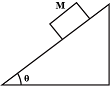
$A$ mass $M$ is placed on a smooth wedge of angle $\theta$ resting on a frictionless surface. To keep the mass $M$ at rest relative to the wedge,the wedge must be given a horizontal acceleration $a$ equal to:
A
$a$ is applied to the right and $a=g \tan \theta$
B
$a$ is applied to the left and $a=g \sin \theta$
C
$a$ is applied to the left and $a=g \cos \theta$
D
$a$ is applied to the left and $a=g \tan \theta$
Solution
(D) To keep the mass $M$ at rest relative to the wedge,we analyze the forces in the non-inertial frame of the wedge.
When the wedge accelerates to the left with acceleration $a$,a pseudo force $F_p = Ma$ acts on the mass $M$ towards the right.
The forces acting on the mass $M$ along the incline are:
$1$. The component of pseudo force $Ma \cos \theta$ acting up the incline.
$2$. The component of gravitational force $Mg \sin \theta$ acting down the incline.
For the mass to remain at rest relative to the wedge,these two forces must balance:
$Ma \cos \theta = Mg \sin \theta$
$a \cos \theta = g \sin \theta$
$a = g \frac{\sin \theta}{\cos \theta}$
$a = g \tan \theta$
Thus,an acceleration $a = g \tan \theta$ must be applied to the wedge towards the left.
When the wedge accelerates to the left with acceleration $a$,a pseudo force $F_p = Ma$ acts on the mass $M$ towards the right.
The forces acting on the mass $M$ along the incline are:
$1$. The component of pseudo force $Ma \cos \theta$ acting up the incline.
$2$. The component of gravitational force $Mg \sin \theta$ acting down the incline.
For the mass to remain at rest relative to the wedge,these two forces must balance:
$Ma \cos \theta = Mg \sin \theta$
$a \cos \theta = g \sin \theta$
$a = g \frac{\sin \theta}{\cos \theta}$
$a = g \tan \theta$
Thus,an acceleration $a = g \tan \theta$ must be applied to the wedge towards the left.
0 likesView Solution
24
PhysicsEasyMCQAIPMT · 1998
$A$ particle of mass $m$ and charge $q$ is placed at rest in a uniform electric field $E$ and then released. The kinetic energy attained by the particle after moving a distance $y$ is
A
$qE{y^2}$
B
$q{E^2}y$
C
$qEy$
D
${q^2}Ey$
Solution
(C) The force experienced by a charge $q$ in a uniform electric field $E$ is given by $F = qE$.
Since the particle starts from rest and moves a distance $y$ in the direction of the force,the work done by the electric field on the particle is $W = F \times y = (qE) \times y = qEy$.
According to the work-energy theorem,the work done by the electric field is equal to the change in kinetic energy of the particle.
Since the initial kinetic energy is $0$,the final kinetic energy attained by the particle is $K = qEy$.
Since the particle starts from rest and moves a distance $y$ in the direction of the force,the work done by the electric field on the particle is $W = F \times y = (qE) \times y = qEy$.
According to the work-energy theorem,the work done by the electric field is equal to the change in kinetic energy of the particle.
Since the initial kinetic energy is $0$,the final kinetic energy attained by the particle is $K = qEy$.
0 likesView Solution
25
PhysicsEasyMCQAIPMT · 1998
$A$ hollow insulated conducting sphere is given a positive charge of $10\,\mu C$. What will be the electric field at the centre of the sphere if its radius is $2\,m$?
A
$0$
B
$5$
C
$20$
D
$8$
Solution
(A) For a hollow conducting sphere,the charge resides entirely on its outer surface.
According to Gauss's Law,the electric field inside a closed conducting shell is always zero because there is no enclosed charge within any Gaussian surface drawn inside the sphere.
Therefore,the electric field at the centre of the sphere is $0\,N/C$.
According to Gauss's Law,the electric field inside a closed conducting shell is always zero because there is no enclosed charge within any Gaussian surface drawn inside the sphere.
Therefore,the electric field at the centre of the sphere is $0\,N/C$.
0 likesView Solution
26
PhysicsEasyMCQAIPMT · 1998
$A$ point $Q$ lies on the perpendicular bisector of an electric dipole with dipole moment $p$. If the distance of $Q$ from the dipole is $r$ (where $r$ is much larger than the size of the dipole),then the electric field at $Q$ is proportional to:
A
$p^{-1}$ and $r^{-2}$
B
$p$ and $r^{-2}$
C
$p^{-1}$ and $r^{-3}$
D
$p$ and $r^{-3}$
Solution
(D) The electric field at a point on the equatorial line (perpendicular bisector) of an electric dipole is given by the formula:
$E_{equatorial} = \frac{1}{4\pi\epsilon_0} \frac{p}{r^3}$
where $p$ is the dipole moment and $r$ is the distance from the center of the dipole.
From this expression,it is clear that the electric field $E$ is directly proportional to the dipole moment $p$ $(E \propto p)$ and inversely proportional to the cube of the distance $r$ $(E \propto r^{-3})$.
Therefore,the electric field at $Q$ is proportional to $p$ and $r^{-3}$.
$E_{equatorial} = \frac{1}{4\pi\epsilon_0} \frac{p}{r^3}$
where $p$ is the dipole moment and $r$ is the distance from the center of the dipole.
From this expression,it is clear that the electric field $E$ is directly proportional to the dipole moment $p$ $(E \propto p)$ and inversely proportional to the cube of the distance $r$ $(E \propto r^{-3})$.
Therefore,the electric field at $Q$ is proportional to $p$ and $r^{-3}$.
0 likesView Solution
27
PhysicsMediumMCQAIPMT · 1998
$A$ galvanometer having a resistance of $9 \, \Omega$ is shunted by a wire of resistance $2 \, \Omega$. If the total current is $1 \, A$, the part of it passing through the shunt will be ............ $A$.
A
$0.25$
B
$0.8$
C
$0.2$
D
$0.5$
Solution
(B) Let $G = 9 \, \Omega$ be the resistance of the galvanometer and $S = 2 \, \Omega$ be the resistance of the shunt.
Let $I = 1 \, A$ be the total current.
Let $I_s$ be the current passing through the shunt and $I_g$ be the current passing through the galvanometer.
According to the principle of parallel circuits, the voltage across the galvanometer and the shunt is the same: $V = I_g G = I_s S$.
Since $I = I_g + I_s$, we have $I_g = I - I_s$.
Substituting this into the voltage equation: $(I - I_s) G = I_s S$.
Rearranging to solve for $I_s$: $I G - I_s G = I_s S \implies I G = I_s (S + G)$.
Therefore, $I_s = I \times \frac{G}{S + G}$.
Substituting the given values: $I_s = 1 \times \frac{9}{2 + 9} = \frac{9}{11} \approx 0.818 \, A$.
Rounding to the nearest provided option, the current through the shunt is approximately $0.8 \, A$.
Let $I = 1 \, A$ be the total current.
Let $I_s$ be the current passing through the shunt and $I_g$ be the current passing through the galvanometer.
According to the principle of parallel circuits, the voltage across the galvanometer and the shunt is the same: $V = I_g G = I_s S$.
Since $I = I_g + I_s$, we have $I_g = I - I_s$.
Substituting this into the voltage equation: $(I - I_s) G = I_s S$.
Rearranging to solve for $I_s$: $I G - I_s G = I_s S \implies I G = I_s (S + G)$.
Therefore, $I_s = I \times \frac{G}{S + G}$.
Substituting the given values: $I_s = 1 \times \frac{9}{2 + 9} = \frac{9}{11} \approx 0.818 \, A$.
Rounding to the nearest provided option, the current through the shunt is approximately $0.8 \, A$.
0 likesView Solution
28
PhysicsMediumMCQAIPMT · 1998
Three equal resistors connected in series across a source of $e.m.f.$ together dissipate $10 \ W$. If the same resistors are connected in parallel across the same $e.m.f.$,then the power dissipated will be .............. $W$.
A
$10$
B
$30$
C
$10/3$
D
$90$
Solution
(D) Let the resistance of each resistor be $R$ and the source $e.m.f.$ be $V$.
In series connection,the equivalent resistance is $R_S = R + R + R = 3R$.
The power dissipated in series is $P_S = \frac{V^2}{R_S} = \frac{V^2}{3R} = 10 \ W$.
From this,we get $\frac{V^2}{R} = 30 \ W$.
In parallel connection,the equivalent resistance is $R_P = \frac{R}{3}$.
The power dissipated in parallel is $P_P = \frac{V^2}{R_P} = \frac{V^2}{R/3} = 3 \left( \frac{V^2}{R} \right)$.
Substituting the value $\frac{V^2}{R} = 30 \ W$,we get $P_P = 3 \times 30 = 90 \ W$.
In series connection,the equivalent resistance is $R_S = R + R + R = 3R$.
The power dissipated in series is $P_S = \frac{V^2}{R_S} = \frac{V^2}{3R} = 10 \ W$.
From this,we get $\frac{V^2}{R} = 30 \ W$.
In parallel connection,the equivalent resistance is $R_P = \frac{R}{3}$.
The power dissipated in parallel is $P_P = \frac{V^2}{R_P} = \frac{V^2}{R/3} = 3 \left( \frac{V^2}{R} \right)$.
Substituting the value $\frac{V^2}{R} = 30 \ W$,we get $P_P = 3 \times 30 = 90 \ W$.
0 likesView Solution
29
PhysicsEasyMCQAIPMT · 1998
$A$ $5\,^{\circ}\text{C}$ rise in temperature is observed in a conductor by passing a current. When the current is doubled the rise in temperature will be approximately ........... $^{\circ}\text{C}$
A
$16$
B
$10$
C
$20$
D
$12$
Solution
(C) The heat produced in a conductor due to the flow of current is given by Joule's law of heating: $H = i^2Rt$.
Since the rise in temperature $\Delta T$ is directly proportional to the heat produced $H$,we have $\Delta T \propto i^2$.
Given that the initial rise in temperature $\Delta T_1 = 5\,^{\circ}\text{C}$ for current $i_1 = i$.
When the current is doubled,$i_2 = 2i$.
The new rise in temperature $\Delta T_2$ is given by the ratio:
$\frac{\Delta T_2}{\Delta T_1} = \left(\frac{i_2}{i_1}\right)^2 = \left(\frac{2i}{i}\right)^2 = 4$.
Therefore,$\Delta T_2 = 4 \times \Delta T_1 = 4 \times 5\,^{\circ}\text{C} = 20\,^{\circ}\text{C}$.
Since the rise in temperature $\Delta T$ is directly proportional to the heat produced $H$,we have $\Delta T \propto i^2$.
Given that the initial rise in temperature $\Delta T_1 = 5\,^{\circ}\text{C}$ for current $i_1 = i$.
When the current is doubled,$i_2 = 2i$.
The new rise in temperature $\Delta T_2$ is given by the ratio:
$\frac{\Delta T_2}{\Delta T_1} = \left(\frac{i_2}{i_1}\right)^2 = \left(\frac{2i}{i}\right)^2 = 4$.
Therefore,$\Delta T_2 = 4 \times \Delta T_1 = 4 \times 5\,^{\circ}\text{C} = 20\,^{\circ}\text{C}$.
0 likesView Solution
30
PhysicsMediumMCQAIPMT · 1998
Two long parallel wires are at a distance of $1 \ m$. Both of them carry $1 \ A$ of current. The force of attraction per unit length between the two wires is
A
$1 \ N/m$
B
$2 \times 10^{-7} \ N/m$
C
$1 \times 10^{-2} \ N/m$
D
$4\pi \times 10^{-7} \ N/m$
Solution
(B) The force per unit length between two long parallel current-carrying wires is given by the formula: $\frac{F}{l} = \frac{\mu_0}{2\pi} \frac{i_1 i_2}{r}$.
Given: $i_1 = 1 \ A$,$i_2 = 1 \ A$,$r = 1 \ m$,and $\frac{\mu_0}{4\pi} = 10^{-7} \ T \cdot m/A$.
Substituting these values into the formula:
$\frac{F}{l} = 2 \times 10^{-7} \times \frac{1 \times 1}{1} = 2 \times 10^{-7} \ N/m$.
Given: $i_1 = 1 \ A$,$i_2 = 1 \ A$,$r = 1 \ m$,and $\frac{\mu_0}{4\pi} = 10^{-7} \ T \cdot m/A$.
Substituting these values into the formula:
$\frac{F}{l} = 2 \times 10^{-7} \times \frac{1 \times 1}{1} = 2 \times 10^{-7} \ N/m$.
0 likesView Solution
31
PhysicsEasyMCQAIPMT · 1998
For protecting a sensitive equipment from the external magnetic field,it should be
A
Placed inside an aluminium can
B
Placed inside an iron can
C
Wrapped with insulation around it when passing current through it
D
Surrounded with fine copper sheet
Solution
(B) Iron is a ferromagnetic substance,which has high magnetic permeability. When placed in an external magnetic field,the magnetic field lines prefer to pass through the iron rather than the interior space. This phenomenon is known as magnetic shielding. Therefore,to protect sensitive equipment from an external magnetic field,it should be placed inside an iron can.
0 likesView Solution
32
PhysicsEasyMCQAIPMT · 1998
$A$ step-up transformer operates on a $230\, V$ line and supplies a load of $2\, A$. The ratio of the primary and secondary windings is $1 : 25$. The current in the primary is.... (in $, A$)
A
$15$
B
$50$
C
$25$
D
$12.5$
Solution
(B) For an ideal transformer,the power input equals the power output,which implies the relationship between current and the number of turns is given by the inverse ratio: $\frac{I_p}{I_s} = \frac{N_s}{N_p}$.
Given:
Primary to secondary turns ratio $\frac{N_p}{N_s} = \frac{1}{25}$,so $\frac{N_s}{N_p} = 25$.
Secondary current $I_s = 2\, A$.
Using the formula: $I_p = I_s \times \frac{N_s}{N_p}$.
$I_p = 2\, A \times 25 = 50\, A$.
Therefore,the current in the primary coil is $50\, A$.
Given:
Primary to secondary turns ratio $\frac{N_p}{N_s} = \frac{1}{25}$,so $\frac{N_s}{N_p} = 25$.
Secondary current $I_s = 2\, A$.
Using the formula: $I_p = I_s \times \frac{N_s}{N_p}$.
$I_p = 2\, A \times 25 = 50\, A$.
Therefore,the current in the primary coil is $50\, A$.
0 likesView Solution
33
PhysicsMediumMCQAIPMT · 1998
Two coils have a mutual inductance $0.005 \, H$. The current changes in the first coil according to the equation $I = I_0 \sin(\omega t)$,where $I_0 = 10 \, A$ and $\omega = 100\pi \, rad/s$. The maximum value of the $e.m.f.$ in the second coil is:
A
$2\pi \, V$
B
$5\pi \, V$
C
$\pi \, V$
D
$4\pi \, V$
Solution
(B) The induced $e.m.f.$ in the second coil is given by $e = M \frac{di}{dt}$.
Given $M = 0.005 \, H$,$I = I_0 \sin(\omega t)$,$I_0 = 10 \, A$,and $\omega = 100\pi \, rad/s$.
Substituting the expression for $I$:
$e = M \frac{d}{dt} (I_0 \sin(\omega t)) = M I_0 \omega \cos(\omega t)$.
The maximum value of $e.m.f.$ $(e_{\max})$ occurs when $\cos(\omega t) = 1$.
$e_{\max} = M I_0 \omega$.
Substituting the values:
$e_{\max} = 0.005 \times 10 \times 100\pi = 5\pi \, V$.
Given $M = 0.005 \, H$,$I = I_0 \sin(\omega t)$,$I_0 = 10 \, A$,and $\omega = 100\pi \, rad/s$.
Substituting the expression for $I$:
$e = M \frac{d}{dt} (I_0 \sin(\omega t)) = M I_0 \omega \cos(\omega t)$.
The maximum value of $e.m.f.$ $(e_{\max})$ occurs when $\cos(\omega t) = 1$.
$e_{\max} = M I_0 \omega$.
Substituting the values:
$e_{\max} = 0.005 \times 10 \times 100\pi = 5\pi \, V$.
0 likesView Solution
34
PhysicsMediumMCQAIPMT · 1998
Light of wavelength $5000 \; \mathring A$ falls on a sensitive plate with photoelectric work function of $1.9 \; eV$. The kinetic energy of the photoelectron emitted will be ............ $eV$.
A
$0.58$
B
$2.48$
C
$1.24$
D
$1.16$
Solution
(A) The energy of the incident photon is given by $E = \frac{hc}{\lambda}$.
Using the approximation $hc \approx 12400 \; eV \cdot \mathring A$,we get $E = \frac{12400}{5000} = 2.48 \; eV$.
According to Einstein's photoelectric equation,$E = W_0 + K_{\max}$,where $W_0$ is the work function and $K_{\max}$ is the maximum kinetic energy.
Substituting the values: $2.48 = 1.9 + K_{\max}$.
Therefore,$K_{\max} = 2.48 - 1.9 = 0.58 \; eV$.
Using the approximation $hc \approx 12400 \; eV \cdot \mathring A$,we get $E = \frac{12400}{5000} = 2.48 \; eV$.
According to Einstein's photoelectric equation,$E = W_0 + K_{\max}$,where $W_0$ is the work function and $K_{\max}$ is the maximum kinetic energy.
Substituting the values: $2.48 = 1.9 + K_{\max}$.
Therefore,$K_{\max} = 2.48 - 1.9 = 0.58 \; eV$.
0 likesView Solution
35
PhysicsDifficultMCQAIPMT · 1998
In a photoemissive cell with exciting wavelength $\lambda$,the fastest electron has speed $v$. If the exciting wavelength is changed to $\frac{3\lambda}{4}$,the speed of the fastest emitted electron will be
A
$v(3/4)^{1/2}$
B
$v(4/3)^{1/2}$
C
$< v(4/3)^{1/2}$
D
$> v(4/3)^{1/2}$
Solution
(D) According to Einstein's photoelectric equation: $K_{\max} = \frac{hc}{\lambda} - W_0 = \frac{1}{2}mv^2$,where $W_0 = \frac{hc}{\lambda_0}$ is the work function.
Thus,$v = \sqrt{\frac{2hc}{m} \left( \frac{1}{\lambda} - \frac{1}{\lambda_0} \right)} = \sqrt{\frac{2hc}{m} \left( \frac{\lambda_0 - \lambda}{\lambda \lambda_0} \right)} \dots (i)$
When the wavelength is changed to $\lambda' = \frac{3\lambda}{4}$,the new velocity $v'$ is:
$v' = \sqrt{\frac{2hc}{m} \left( \frac{1}{3\lambda/4} - \frac{1}{\lambda_0} \right)} = \sqrt{\frac{2hc}{m} \left( \frac{4\lambda_0 - 3\lambda}{3\lambda \lambda_0} \right)} \dots (ii)$
Dividing $(ii)$ by $(i)$:
$\frac{v'}{v} = \sqrt{\frac{4\lambda_0 - 3\lambda}{3\lambda \lambda_0} \cdot \frac{\lambda \lambda_0}{\lambda_0 - \lambda}} = \sqrt{\frac{4}{3} \cdot \frac{\lambda_0 - 0.75\lambda}{\lambda_0 - \lambda}}$
Since $\lambda_0 > \lambda$,it follows that $(\lambda_0 - 0.75\lambda) > (\lambda_0 - \lambda)$.
Therefore,$\frac{\lambda_0 - 0.75\lambda}{\lambda_0 - \lambda} > 1$.
This implies $\frac{v'}{v} > \sqrt{\frac{4}{3}}$,or $v' > v(4/3)^{1/2}$.
Thus,$v = \sqrt{\frac{2hc}{m} \left( \frac{1}{\lambda} - \frac{1}{\lambda_0} \right)} = \sqrt{\frac{2hc}{m} \left( \frac{\lambda_0 - \lambda}{\lambda \lambda_0} \right)} \dots (i)$
When the wavelength is changed to $\lambda' = \frac{3\lambda}{4}$,the new velocity $v'$ is:
$v' = \sqrt{\frac{2hc}{m} \left( \frac{1}{3\lambda/4} - \frac{1}{\lambda_0} \right)} = \sqrt{\frac{2hc}{m} \left( \frac{4\lambda_0 - 3\lambda}{3\lambda \lambda_0} \right)} \dots (ii)$
Dividing $(ii)$ by $(i)$:
$\frac{v'}{v} = \sqrt{\frac{4\lambda_0 - 3\lambda}{3\lambda \lambda_0} \cdot \frac{\lambda \lambda_0}{\lambda_0 - \lambda}} = \sqrt{\frac{4}{3} \cdot \frac{\lambda_0 - 0.75\lambda}{\lambda_0 - \lambda}}$
Since $\lambda_0 > \lambda$,it follows that $(\lambda_0 - 0.75\lambda) > (\lambda_0 - \lambda)$.
Therefore,$\frac{\lambda_0 - 0.75\lambda}{\lambda_0 - \lambda} > 1$.
This implies $\frac{v'}{v} > \sqrt{\frac{4}{3}}$,or $v' > v(4/3)^{1/2}$.
0 likesView Solution
36
PhysicsEasyMCQAIPMT · 1998
In the Bohr model of a hydrogen atom,the centripetal force is furnished by the Coulomb attraction between the proton and the electron. If ${a_0}$ is the radius of the ground state orbit,$m$ is the mass,$e$ is the charge on the electron,and ${\varepsilon _0}$ is the vacuum permittivity,the speed of the electron is:
A
$0$
B
$\frac{e}{{\sqrt { {\varepsilon _0}{a_0}m} }}$
C
$\frac{e}{{\sqrt {4\pi {\varepsilon _0}{a_0}m} }}$
D
$\frac{{\sqrt {4\pi {\varepsilon _0}{a_0}m} }}{e}$
Solution
(C) The centripetal force required for the circular motion of the electron is provided by the electrostatic Coulomb force between the proton and the electron.
Equating the centripetal force to the Coulomb force:
$\frac{m{v^2}}{{a_0}} = \frac{1}{{4\pi {\varepsilon _0}}}\frac{{{e^2}}}{{a_0^2}}$
Canceling $a_0$ from both sides:
$m{v^2} = \frac{1}{{4\pi {\varepsilon _0}}}\frac{{{e^2}}}{{a_0}}$
Solving for $v^2$:
${v^2} = \frac{{{e^2}}}{{4\pi {\varepsilon _0}{a_0}m}}$
Taking the square root of both sides,we get the speed of the electron:
$v = \frac{e}{{\sqrt {4\pi {\varepsilon _0}{a_0}m} }}$
Thus,the correct option is $C$.
Equating the centripetal force to the Coulomb force:
$\frac{m{v^2}}{{a_0}} = \frac{1}{{4\pi {\varepsilon _0}}}\frac{{{e^2}}}{{a_0^2}}$
Canceling $a_0$ from both sides:
$m{v^2} = \frac{1}{{4\pi {\varepsilon _0}}}\frac{{{e^2}}}{{a_0}}$
Solving for $v^2$:
${v^2} = \frac{{{e^2}}}{{4\pi {\varepsilon _0}{a_0}m}}$
Taking the square root of both sides,we get the speed of the electron:
$v = \frac{e}{{\sqrt {4\pi {\varepsilon _0}{a_0}m} }}$
Thus,the correct option is $C$.
0 likesView Solution
37
PhysicsMediumMCQAIPMT · 1998
The atomic weight of boron is $10.81$ and it has two isotopes $_5B^{10}$ and $_5B^{11}$. The ratio of $_5B^{10} : _5B^{11}$ in nature is:
A
$19 : 81$
B
$10 : 11$
C
$15 : 16$
D
$81 : 19$
Solution
(A) Let the percentage of $_5B^{10}$ atoms be $x$. Then the percentage of $_5B^{11}$ atoms is $(100 - x)$.
The average atomic weight is given by the formula:
$\text{Average Atomic Weight} = \frac{(10 \times x) + (11 \times (100 - x))}{100} = 10.81$
Multiplying by $100$:
$10x + 1100 - 11x = 1081$
$-x = 1081 - 1100$
$-x = -19$
$x = 19$
So,the percentage of $_5B^{10}$ is $19\%$ and the percentage of $_5B^{11}$ is $81\%$.
Therefore,the ratio of $_5B^{10} : _5B^{11}$ is $19 : 81$.
The average atomic weight is given by the formula:
$\text{Average Atomic Weight} = \frac{(10 \times x) + (11 \times (100 - x))}{100} = 10.81$
Multiplying by $100$:
$10x + 1100 - 11x = 1081$
$-x = 1081 - 1100$
$-x = -19$
$x = 19$
So,the percentage of $_5B^{10}$ is $19\%$ and the percentage of $_5B^{11}$ is $81\%$.
Therefore,the ratio of $_5B^{10} : _5B^{11}$ is $19 : 81$.
0 likesView Solution
38
PhysicsEasyMCQAIPMT · 1998
Complete the equation for the following fission process:
$_{92}U^{235} + _0n^1 \to _{38}Sr^{90} + ....$
$_{92}U^{235} + _0n^1 \to _{38}Sr^{90} + ....$
A
$_{54}Xe^{143} + 3_0n^1$
B
$_{54}Xe^{145}$
C
$_{57}Xe^{142}$
D
$_{54}Xe^{142} + _0n^1$
Solution
(A) In a nuclear fission reaction,both the mass number and the atomic number must be conserved on both sides of the equation.
Given reaction: $_{92}U^{235} + _0n^1 \to _{38}Sr^{90} + X$
Let the unknown product $X$ be $_{Z}A^{A}$.
Conservation of mass number: $235 + 1 = 90 + A \implies 236 = 90 + A \implies A = 146$.
However,the standard fission of $U^{235}$ producing $Sr^{90}$ releases neutrons. Checking the options,option $A$ provides $_{54}Xe^{143} + 3_0n^1$.
Sum of mass numbers: $90 + 143 + 3(1) = 90 + 143 + 3 = 236$.
Sum of atomic numbers: $38 + 54 + 3(0) = 92$.
Since both are conserved,the correct completion is $_{54}Xe^{143} + 3_0n^1$.
Given reaction: $_{92}U^{235} + _0n^1 \to _{38}Sr^{90} + X$
Let the unknown product $X$ be $_{Z}A^{A}$.
Conservation of mass number: $235 + 1 = 90 + A \implies 236 = 90 + A \implies A = 146$.
However,the standard fission of $U^{235}$ producing $Sr^{90}$ releases neutrons. Checking the options,option $A$ provides $_{54}Xe^{143} + 3_0n^1$.
Sum of mass numbers: $90 + 143 + 3(1) = 90 + 143 + 3 = 236$.
Sum of atomic numbers: $38 + 54 + 3(0) = 92$.
Since both are conserved,the correct completion is $_{54}Xe^{143} + 3_0n^1$.
0 likesView Solution
39
PhysicsMediumMCQAIPMT · 1998
Half-lives of two radioactive substances $A$ and $B$ are $20 \text{ minutes}$ and $40 \text{ minutes}$ respectively. Initially,the samples of $A$ and $B$ have an equal number of nuclei. After $80 \text{ minutes}$,the ratio of the remaining number of $A$ and $B$ nuclei is:
A
$1 : 16$
B
$4 : 1$
C
$1 : 4$
D
$1 : 1$
Solution
(C) The number of half-lives $n$ is given by $n = \frac{t}{T_{1/2}}$.
For substance $A$,$n_A = \frac{80}{20} = 4$.
For substance $B$,$n_B = \frac{80}{40} = 2$.
The number of remaining nuclei is given by $N = N_0 \left( \frac{1}{2} \right)^n$.
Since initial numbers $N_0$ are equal,the ratio is $\frac{N_A}{N_B} = \frac{N_0 (1/2)^{n_A}}{N_0 (1/2)^{n_B}} = \frac{(1/2)^4}{(1/2)^2} = \frac{2^2}{2^4} = \frac{4}{16} = \frac{1}{4}$.
Thus,the ratio is $1 : 4$.
For substance $A$,$n_A = \frac{80}{20} = 4$.
For substance $B$,$n_B = \frac{80}{40} = 2$.
The number of remaining nuclei is given by $N = N_0 \left( \frac{1}{2} \right)^n$.
Since initial numbers $N_0$ are equal,the ratio is $\frac{N_A}{N_B} = \frac{N_0 (1/2)^{n_A}}{N_0 (1/2)^{n_B}} = \frac{(1/2)^4}{(1/2)^2} = \frac{2^2}{2^4} = \frac{4}{16} = \frac{1}{4}$.
Thus,the ratio is $1 : 4$.
0 likesView Solution
40
PhysicsEasyMCQAIPMT · 1998
$A$ nucleus $_n{X^m}$ emits one $\alpha$ and one $\beta$ particle. The resulting nucleus is:
A
$_{n}X^{m-4}$
B
$_{n-2}Y^{m-4}$
C
$_{n-4}Z^{m-4}$
D
$_{n-1}Z^{m-4}$
Solution
(D) The initial nucleus is $_n{X^m}$.
When it emits one $\alpha$ particle $(_{2}He^{4})$,the atomic number decreases by $2$ and the mass number decreases by $4$. The nucleus becomes $_{n-2}X^{m-4}$.
When this nucleus emits one $\beta$ particle $(_{-1}e^{0})$,the atomic number increases by $1$ while the mass number remains unchanged. The new atomic number is $(n-2) + 1 = n-1$.
Thus,the resulting nucleus is $_{n-1}Z^{m-4}$.
When it emits one $\alpha$ particle $(_{2}He^{4})$,the atomic number decreases by $2$ and the mass number decreases by $4$. The nucleus becomes $_{n-2}X^{m-4}$.
When this nucleus emits one $\beta$ particle $(_{-1}e^{0})$,the atomic number increases by $1$ while the mass number remains unchanged. The new atomic number is $(n-2) + 1 = n-1$.
Thus,the resulting nucleus is $_{n-1}Z^{m-4}$.
0 likesView Solution
41
PhysicsEasyMCQAIPMT · 1998
$A$ semiconductor device is connected in a series circuit with a battery and a resistance. $A$ current is found to pass through the circuit. If the polarity of the battery is reversed,the current drops almost to zero. The device may be
A
$A$ $P-$type semiconductor
B
An $N-$type semiconductor
C
$A$ $PN-$junction
D
An intrinsic semiconductor
Solution
(C) $PN-$junction diode allows current to flow when it is forward biased.
When the battery polarity is reversed,the $PN-$junction becomes reverse biased.
In reverse bias,the depletion layer width increases,offering very high resistance to the flow of current.
Consequently,the current drops almost to zero.
Therefore,the device is a $PN-$junction.
When the battery polarity is reversed,the $PN-$junction becomes reverse biased.
In reverse bias,the depletion layer width increases,offering very high resistance to the flow of current.
Consequently,the current drops almost to zero.
Therefore,the device is a $PN-$junction.
0 likesView Solution
42
PhysicsMediumMCQAIPMT · 1998
The transfer ratio of a transistor is $50$. The input resistance of the transistor when used in the common-emitter configuration is $1 \; k\Omega$. The peak value of the collector current for an $A.C.$ input voltage of $0.01 \; V$ peak is:
A
$100 \; \mu A$
B
$0.01 \; mA$
C
$0.25 \; mA$
D
$500 \; \mu A$
Solution
(D) Given: Transfer ratio (current gain) $\beta = 50$,Input resistance $R_i = 1 \; k\Omega = 1000 \; \Omega$,and Peak input voltage $V_i = 0.01 \; V$.
First,calculate the peak input current $i_b$ using Ohm's law: $i_b = \frac{V_i}{R_i} = \frac{0.01 \; V}{1000 \; \Omega} = 10^{-5} \; A$.
The relationship between collector current $i_c$ and base current $i_b$ is given by $\beta = \frac{i_c}{i_b}$.
Therefore,the peak collector current is $i_c = \beta \times i_b = 50 \times 10^{-5} \; A = 500 \times 10^{-6} \; A = 500 \; \mu A$.
First,calculate the peak input current $i_b$ using Ohm's law: $i_b = \frac{V_i}{R_i} = \frac{0.01 \; V}{1000 \; \Omega} = 10^{-5} \; A$.
The relationship between collector current $i_c$ and base current $i_b$ is given by $\beta = \frac{i_c}{i_b}$.
Therefore,the peak collector current is $i_c = \beta \times i_b = 50 \times 10^{-5} \; A = 500 \times 10^{-6} \; A = 500 \; \mu A$.
0 likesView Solution
43
PhysicsMediumMCQAIPMT · 1998
Which of the following logic gates will have an output of $1$?
A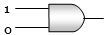
B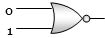
C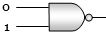
D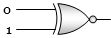
Solution
(C) Let us analyze the output for each gate with the given inputs:
$(A)$ For an $AND$ gate,the output $Y = A \cdot B$. With inputs $1$ and $0$,$Y = 1 \cdot 0 = 0$.
$(B)$ For a $NOR$ gate,the output $Y = \overline{A + B}$. With inputs $0$ and $1$,$Y = \overline{0 + 1} = \overline{1} = 0$.
$(C)$ For a $NAND$ gate,the output $Y = \overline{A \cdot B}$. With inputs $0$ and $1$,$Y = \overline{0 \cdot 1} = \overline{0} = 1$.
$(D)$ For an $XNOR$ gate,the output $Y = A \odot B$ (or $\overline{A \oplus B}$). With inputs $0$ and $1$,$Y = \overline{0 \oplus 1} = \overline{1} = 0$.
Thus,the $NAND$ gate produces an output of $1$.
$(A)$ For an $AND$ gate,the output $Y = A \cdot B$. With inputs $1$ and $0$,$Y = 1 \cdot 0 = 0$.
$(B)$ For a $NOR$ gate,the output $Y = \overline{A + B}$. With inputs $0$ and $1$,$Y = \overline{0 + 1} = \overline{1} = 0$.
$(C)$ For a $NAND$ gate,the output $Y = \overline{A \cdot B}$. With inputs $0$ and $1$,$Y = \overline{0 \cdot 1} = \overline{0} = 1$.
$(D)$ For an $XNOR$ gate,the output $Y = A \odot B$ (or $\overline{A \oplus B}$). With inputs $0$ and $1$,$Y = \overline{0 \oplus 1} = \overline{1} = 0$.
Thus,the $NAND$ gate produces an output of $1$.
0 likesView Solution
44
PhysicsMediumMCQAIPMT · 1998
The truth table given below is for which gate?
$A: 0, 0, 1, 1$
$B: 0, 1, 0, 1$
$C: 1, 1, 1, 0$
$A: 0, 0, 1, 1$
$B: 0, 1, 0, 1$
$C: 1, 1, 1, 0$
A
$XOR$
B
$OR$
C
$AND$
D
$NAND$
Solution
(D) For a $NAND$ gate,the output $C$ is given by the Boolean expression $C = \overline{A \cdot B}$.
Checking the values:
$1$. For $A = 0, B = 0$: $C = \overline{0 \cdot 0} = \overline{0} = 1$.
$2$. For $A = 0, B = 1$: $C = \overline{0 \cdot 1} = \overline{0} = 1$.
$3$. For $A = 1, B = 0$: $C = \overline{1 \cdot 0} = \overline{0} = 1$.
$4$. For $A = 1, B = 1$: $C = \overline{1 \cdot 1} = \overline{1} = 0$.
Comparing these results with the given table,the output matches the $NAND$ gate logic.
Checking the values:
$1$. For $A = 0, B = 0$: $C = \overline{0 \cdot 0} = \overline{0} = 1$.
$2$. For $A = 0, B = 1$: $C = \overline{0 \cdot 1} = \overline{0} = 1$.
$3$. For $A = 1, B = 0$: $C = \overline{1 \cdot 0} = \overline{0} = 1$.
$4$. For $A = 1, B = 1$: $C = \overline{1 \cdot 1} = \overline{1} = 0$.
Comparing these results with the given table,the output matches the $NAND$ gate logic.
0 likesView Solution
45
PhysicsDifficultMCQAIPMT · 1998
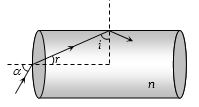
Light enters at an angle of incidence $\alpha$ into a transparent rod of refractive index $n.$ For what value of the refractive index of the material of the rod will the light,once entered into it,not leave it through its lateral face,regardless of the value of the angle of incidence $\alpha$?
A
$n > \sqrt{2}$
B
$n = 1$
C
$n = 1.1$
D
$n = 1.3$
Solution
(A) Let $\alpha$ be the angle of incidence at the end face of the rod and $r$ be the angle of refraction. By Snell's Law,$1 \cdot \sin \alpha = n \cdot \sin r$,so $\sin r = \frac{\sin \alpha}{n}$.
At the lateral surface,the angle of incidence is $i = 90^\circ - r$. For total internal reflection to occur,the angle of incidence $i$ must be greater than the critical angle $C$,where $\sin C = \frac{1}{n}$.
Thus,$i > C \implies \sin i > \sin C$.
Substituting $i = 90^\circ - r$,we get $\sin(90^\circ - r) > \sin C$,which simplifies to $\cos r > \frac{1}{n}$.
Squaring both sides,$\cos^2 r > \frac{1}{n^2} \implies 1 - \sin^2 r > \frac{1}{n^2}$.
Substituting $\sin r = \frac{\sin \alpha}{n}$,we have $1 - \frac{\sin^2 \alpha}{n^2} > \frac{1}{n^2}$.
Rearranging gives $1 > \frac{1 + \sin^2 \alpha}{n^2}$,or $n^2 > 1 + \sin^2 \alpha$.
Since this must hold for any angle of incidence $\alpha$,we consider the maximum value of $\sin^2 \alpha$,which is $1$ (when $\alpha = 90^\circ$).
Therefore,$n^2 > 1 + 1 = 2$,which means $n > \sqrt{2}$.
At the lateral surface,the angle of incidence is $i = 90^\circ - r$. For total internal reflection to occur,the angle of incidence $i$ must be greater than the critical angle $C$,where $\sin C = \frac{1}{n}$.
Thus,$i > C \implies \sin i > \sin C$.
Substituting $i = 90^\circ - r$,we get $\sin(90^\circ - r) > \sin C$,which simplifies to $\cos r > \frac{1}{n}$.
Squaring both sides,$\cos^2 r > \frac{1}{n^2} \implies 1 - \sin^2 r > \frac{1}{n^2}$.
Substituting $\sin r = \frac{\sin \alpha}{n}$,we have $1 - \frac{\sin^2 \alpha}{n^2} > \frac{1}{n^2}$.
Rearranging gives $1 > \frac{1 + \sin^2 \alpha}{n^2}$,or $n^2 > 1 + \sin^2 \alpha$.
Since this must hold for any angle of incidence $\alpha$,we consider the maximum value of $\sin^2 \alpha$,which is $1$ (when $\alpha = 90^\circ$).
Therefore,$n^2 > 1 + 1 = 2$,which means $n > \sqrt{2}$.
0 likesView Solution
46
PhysicsMediumMCQAIPMT · 1998
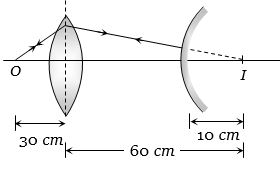
$A$ luminous object is placed at a distance of $30 \,cm$ from a convex lens of focal length $20 \,cm$. On the other side of the lens,at what distance from the lens should a convex mirror of radius of curvature $10 \,cm$ be placed in order to have an upright image of the object coincident with it (in $,cm$)?
A
$12$
B
$30$
C
$50$
D
$60$
Solution
(C) For the convex lens,the object distance $u = -30 \,cm$ and focal length $f = +20 \,cm$. Using the lens formula $\frac{1}{f} = \frac{1}{v} - \frac{1}{u}$:
$\frac{1}{20} = \frac{1}{v} - \frac{1}{-30}$
$\frac{1}{v} = \frac{1}{20} - \frac{1}{30} = \frac{3-2}{60} = \frac{1}{60}$
So,$v = 60 \,cm$. This means the lens forms a real image at $60 \,cm$ from the lens.
For the final image to coincide with the object,the light rays must fall normally on the convex mirror so that they retrace their path. This happens if the rays are directed towards the center of curvature of the mirror.
The radius of curvature of the mirror is $R = 10 \,cm$. Thus,the mirror must be placed such that its center of curvature coincides with the image formed by the lens.
The distance of the mirror from the lens is $d = v - R = 60 \,cm - 10 \,cm = 50 \,cm$.
$\frac{1}{20} = \frac{1}{v} - \frac{1}{-30}$
$\frac{1}{v} = \frac{1}{20} - \frac{1}{30} = \frac{3-2}{60} = \frac{1}{60}$
So,$v = 60 \,cm$. This means the lens forms a real image at $60 \,cm$ from the lens.
For the final image to coincide with the object,the light rays must fall normally on the convex mirror so that they retrace their path. This happens if the rays are directed towards the center of curvature of the mirror.
The radius of curvature of the mirror is $R = 10 \,cm$. Thus,the mirror must be placed such that its center of curvature coincides with the image formed by the lens.
The distance of the mirror from the lens is $d = v - R = 60 \,cm - 10 \,cm = 50 \,cm$.
0 likesView Solution
47
PhysicsEasyMCQAIPMT · 1998
The $21\, cm$ radio wave emitted by hydrogen in interstellar space is due to the interaction called the hyperfine interaction in atomic hydrogen. The energy of the emitted wave is nearly
A
$10^{-17}\,J$
B
$1\,J$
C
$7 \times 10^{-8}\,J$
D
$10^{-24}\,J$
Solution
(D) The energy $E$ of a photon is given by the formula $E = \frac{hc}{\lambda}$.
Given:
$h = 6.63 \times 10^{-34}\,J\cdot s$
$c = 3 \times 10^8\,m/s$
$\lambda = 21\,cm = 0.21\,m = 21 \times 10^{-2}\,m$
Substituting these values:
$E = \frac{6.63 \times 10^{-34} \times 3 \times 10^8}{21 \times 10^{-2}}$
$E = \frac{19.89 \times 10^{-26}}{21 \times 10^{-2}}$
$E \approx 0.947 \times 10^{-24}\,J$
$E \approx 10^{-24}\,J$.
Given:
$h = 6.63 \times 10^{-34}\,J\cdot s$
$c = 3 \times 10^8\,m/s$
$\lambda = 21\,cm = 0.21\,m = 21 \times 10^{-2}\,m$
Substituting these values:
$E = \frac{6.63 \times 10^{-34} \times 3 \times 10^8}{21 \times 10^{-2}}$
$E = \frac{19.89 \times 10^{-26}}{21 \times 10^{-2}}$
$E \approx 0.947 \times 10^{-24}\,J$
$E \approx 10^{-24}\,J$.
0 likesView Solution
48
PhysicsMediumMCQAIPMT · 1998
$A$ coil of one turn is made of a wire of a certain length,and then from the same length of wire,a coil of two turns is made. If the same current is passed in both cases,what is the ratio of the magnetic inductions at their centers?
A
$4 : 1$
B
$1 : 4$
C
$2 : 1$
D
$1 : 2$
Solution
(B) The magnetic field $B$ at the center of a circular coil of $N$ turns and radius $r$ carrying current $I$ is given by $B = \frac{\mu_0 N I}{2r}$.
Let $L$ be the total length of the wire.
For the first coil $(N_1 = 1)$: The circumference $2\pi r_1 = L$,so $r_1 = \frac{L}{2\pi}$. The magnetic field is $B_1 = \frac{\mu_0 (1) I}{2(L/2\pi)} = \frac{\mu_0 \pi I}{L}$.
For the second coil $(N_2 = 2)$: The total length $2(2\pi r_2) = L$,so $r_2 = \frac{L}{4\pi}$. The magnetic field is $B_2 = \frac{\mu_0 (2) I}{2(L/4\pi)} = \frac{4\mu_0 \pi I}{L}$.
Taking the ratio: $\frac{B_1}{B_2} = \frac{\mu_0 \pi I / L}{4\mu_0 \pi I / L} = \frac{1}{4}$.
Thus,the ratio is $1 : 4$.
Let $L$ be the total length of the wire.
For the first coil $(N_1 = 1)$: The circumference $2\pi r_1 = L$,so $r_1 = \frac{L}{2\pi}$. The magnetic field is $B_1 = \frac{\mu_0 (1) I}{2(L/2\pi)} = \frac{\mu_0 \pi I}{L}$.
For the second coil $(N_2 = 2)$: The total length $2(2\pi r_2) = L$,so $r_2 = \frac{L}{4\pi}$. The magnetic field is $B_2 = \frac{\mu_0 (2) I}{2(L/4\pi)} = \frac{4\mu_0 \pi I}{L}$.
Taking the ratio: $\frac{B_1}{B_2} = \frac{\mu_0 \pi I / L}{4\mu_0 \pi I / L} = \frac{1}{4}$.
Thus,the ratio is $1 : 4$.
0 likesView Solution
49
PhysicsEasyMCQAIPMT · 1998
The cause of the potential barrier in a $p-n$ junction diode is
A
depletion of positive charges near the junction
B
concentration of positive charges near the junction
C
depletion of negative charges near the junction
D
concentration of positive and negative charges near the junction
Solution
(D) During the formation of a $p-n$ junction,holes from the $p-$region diffuse into the $n-$region and electrons from the $n-$region diffuse into the $p-$region.
When an electron meets a hole,they recombine and neutralize each other,creating a thin layer at the junction that is devoid of free charge carriers. This is known as the depletion layer.
Due to the diffusion process,immobile ionized atoms are left behind: negative ions on the $p-$side and positive ions on the $n-$side.
This accumulation of immobile charges creates an electric field and a potential difference across the junction,which is known as the potential barrier.
When an electron meets a hole,they recombine and neutralize each other,creating a thin layer at the junction that is devoid of free charge carriers. This is known as the depletion layer.
Due to the diffusion process,immobile ionized atoms are left behind: negative ions on the $p-$side and positive ions on the $n-$side.
This accumulation of immobile charges creates an electric field and a potential difference across the junction,which is known as the potential barrier.
0 likesView Solution
Vedclass Products
For Students
Vedclass Test Series
Mock tests in real AIPMT style covering Physics with performance analysis. 5-day free trial.
Start Free TrialFor Teachers
Exam Paper Generator
Generate Set A/B/C/D Physics papers from 7.5L+ questions in 2 minutes. 3 chapters free.
Try FreeFor Institutes
Online Exam Module
Run live AIPMT mock exams with unlimited students, 360° analytics & white-label branding.
See DemoFrequently Asked Questions
How many Physics questions are in AIPMT 1998?
There are 49 Physics questions from the AIPMT 1998 paper on Vedclass, each with a detailed step-by-step solution in English.
Are AIPMT 1998 Physics solutions available in English?
Yes. All solutions on this page are in English. You can also switch to English or Hindi using the language buttons above the questions.
Can I practice AIPMT 1998 Physics as a timed test?
Yes. Use the Vedclass Test Series to attempt a full AIPMT mock test covering Physics with time limits and instant score analysis.
Can teachers create Physics papers from AIPMT previous year questions?
Yes. The Vedclass Exam Paper Generator lets teachers mix AIPMT Physics questions and generate Set A/B/C/D papers in minutes.
For Teachers & Institutes
Build a Custom Physics Paper
Pick AIPMT 1998 Physics questions, set difficulty, and generate Set A/B/C/D in 2 minutes.