
ChemistryQ1–71 of 71 questions
Page 1 of 1 · English
1
ChemistryMCQAIPMT · 1998
The cause of the potential barrier in a $P-N$ junction diode is
A
Depletion of positive charges near the junction
B
Concentration of positive charges near the junction
C
Depletion of negative charges near the junction
D
Concentration of positive and negative charges near the junction
Solution
(D) When a $P-N$ junction is formed,electrons diffuse from the $n$-region to the $p$-region and holes diffuse from the $p$-region to the $n$-region.
Due to this diffusion,the $n$-side near the junction becomes positively charged (due to donor ions) and the $p$-side near the junction becomes negatively charged (due to acceptor ions).
This accumulation of positive and negative charges near the junction creates an electric field,which opposes further diffusion of charge carriers.
This region of immobile ions is called the depletion layer,and the potential difference created across it is known as the potential barrier.
Due to this diffusion,the $n$-side near the junction becomes positively charged (due to donor ions) and the $p$-side near the junction becomes negatively charged (due to acceptor ions).
This accumulation of positive and negative charges near the junction creates an electric field,which opposes further diffusion of charge carriers.
This region of immobile ions is called the depletion layer,and the potential difference created across it is known as the potential barrier.
0 likesView Solution
2
ChemistryEasyMCQAIPMT · 1998
Given the numbers: $161 \ cm, 0.161 \ cm, 0.0161 \ cm$. The number of significant figures for the three numbers are
A
$3, 4$ and $5$ respectively
B
$3, 3$ and $3$ respectively
C
$3, 3$ and $4$ respectively
D
$3, 4$ and $4$ respectively
Solution
(B) Rules for significant figures state that all non-zero digits are significant. Zeros preceding the first non-zero digit are not significant.
$1$. For $161 \ cm$,all digits are non-zero,so there are $3$ significant figures.
$2$. For $0.161 \ cm$,the leading zero is not significant,so there are $3$ significant figures.
$3$. For $0.0161 \ cm$,the leading zeros are not significant,so there are $3$ significant figures.
Thus,the numbers have $3, 3$ and $3$ significant figures respectively.
$1$. For $161 \ cm$,all digits are non-zero,so there are $3$ significant figures.
$2$. For $0.161 \ cm$,the leading zero is not significant,so there are $3$ significant figures.
$3$. For $0.0161 \ cm$,the leading zeros are not significant,so there are $3$ significant figures.
Thus,the numbers have $3, 3$ and $3$ significant figures respectively.
2 likesView Solution
3
ChemistryMediumMCQAIPMT · 1998
Haemoglobin contains $0.33\%$ of iron by weight. The molecular weight of haemoglobin is approximately $67200$. The number of iron atoms (At. wt. of $Fe = 56$) present in one molecule of haemoglobin is
A
$6$
B
$1$
C
$4$
D
$2$
Solution
(C) Given that $100 \ g$ of haemoglobin $(Hb)$ contains $0.33 \ g$ of iron $(Fe)$.
Therefore,the mass of $Fe$ in $67200 \ g$ of $Hb$ is calculated as:
$\text{Mass of } Fe = \frac{67200 \times 0.33}{100} = 221.76 \ g$.
The number of iron atoms in one molecule of haemoglobin is given by the ratio of the mass of $Fe$ in one molecule to the atomic weight of $Fe$:
$\text{Number of } Fe \text{ atoms} = \frac{221.76}{56} = 3.96 \approx 4$.
Thus,there are $4$ iron atoms present in one molecule of haemoglobin.
Therefore,the mass of $Fe$ in $67200 \ g$ of $Hb$ is calculated as:
$\text{Mass of } Fe = \frac{67200 \times 0.33}{100} = 221.76 \ g$.
The number of iron atoms in one molecule of haemoglobin is given by the ratio of the mass of $Fe$ in one molecule to the atomic weight of $Fe$:
$\text{Number of } Fe \text{ atoms} = \frac{221.76}{56} = 3.96 \approx 4$.
Thus,there are $4$ iron atoms present in one molecule of haemoglobin.
0 likesView Solution
4
ChemistryMediumMCQAIPMT · 1998
The Bohr orbit radius for the hydrogen atom $(n = 1)$ is approximately $0.530 \ \mathring{A}$. The radius for the first excited state $(n = 2)$ orbit is ........... $\mathring{A}$
A
$0.13$
B
$1.06$
C
$4.77$
D
$2.12$
Solution
(D) The radius of the $n^{th}$ Bohr orbit is given by the formula $r_n = r_0 \times n^2$,where $r_0 = 0.530 \ \mathring{A}$ is the radius of the ground state $(n = 1)$.
For the first excited state,$n = 2$.
Substituting the values: $r_2 = 0.530 \ \mathring{A} \times (2)^2$.
$r_2 = 0.530 \ \mathring{A} \times 4 = 2.12 \ \mathring{A}$.
For the first excited state,$n = 2$.
Substituting the values: $r_2 = 0.530 \ \mathring{A} \times (2)^2$.
$r_2 = 0.530 \ \mathring{A} \times 4 = 2.12 \ \mathring{A}$.
0 likesView Solution
5
ChemistryMediumMCQAIPMT · 1998
In a $500 \ mL$ capacity vessel,$CO$ and $Cl_2$ are mixed to form $COCl_2$. At equilibrium,it contains $0.2 \ mol$ of $COCl_2$ and $0.1 \ mol$ of each of $CO$ and $Cl_2$. The equilibrium constant $K_c$ for the reaction $CO + Cl_2 \rightleftharpoons COCl_2$ is:
A
$5$
B
$10$
C
$15$
D
$20$
Solution
(B) The chemical equation is: $CO + Cl_2 \rightleftharpoons COCl_2$
First,calculate the molar concentrations at equilibrium:
$[CO] = \frac{0.1 \ mol}{0.5 \ L} = 0.2 \ M$
$[Cl_2] = \frac{0.1 \ mol}{0.5 \ L} = 0.2 \ M$
$[COCl_2] = \frac{0.2 \ mol}{0.5 \ L} = 0.4 \ M$
The expression for the equilibrium constant $K_c$ is:
$K_c = \frac{[COCl_2]}{[CO][Cl_2]}$
Substituting the values:
$K_c = \frac{0.4}{0.2 \times 0.2} = \frac{0.4}{0.04} = 10$
First,calculate the molar concentrations at equilibrium:
$[CO] = \frac{0.1 \ mol}{0.5 \ L} = 0.2 \ M$
$[Cl_2] = \frac{0.1 \ mol}{0.5 \ L} = 0.2 \ M$
$[COCl_2] = \frac{0.2 \ mol}{0.5 \ L} = 0.4 \ M$
The expression for the equilibrium constant $K_c$ is:
$K_c = \frac{[COCl_2]}{[CO][Cl_2]}$
Substituting the values:
$K_c = \frac{0.4}{0.2 \times 0.2} = \frac{0.4}{0.04} = 10$
0 likesView Solution
6
ChemistryMediumMCQAIPMT · 1998
The $pH$ value of a decinormal solution of $NH_4OH$ which is $20\%$ ionised,is
A
$13.3$
B
$14.7$
C
$12.3$
D
$12.95$
Solution
(C) For $NH_4OH$,the concentration $C = 0.1 \ M$ (decinormal).
Given the degree of ionization $\alpha = 20\% = 0.2$.
The concentration of hydroxide ions is $[OH^-] = C \times \alpha = 0.1 \times 0.2 = 0.02 \ M = 2 \times 10^{-2} \ M$.
Calculate $pOH$ as $pOH = -\log[OH^-] = -\log(2 \times 10^{-2}) = 2 - \log 2 = 2 - 0.301 = 1.699 \approx 1.7$.
Finally,calculate $pH$ using the relation $pH + pOH = 14$.
$pH = 14 - 1.7 = 12.3$.
Given the degree of ionization $\alpha = 20\% = 0.2$.
The concentration of hydroxide ions is $[OH^-] = C \times \alpha = 0.1 \times 0.2 = 0.02 \ M = 2 \times 10^{-2} \ M$.
Calculate $pOH$ as $pOH = -\log[OH^-] = -\log(2 \times 10^{-2}) = 2 - \log 2 = 2 - 0.301 = 1.699 \approx 1.7$.
Finally,calculate $pH$ using the relation $pH + pOH = 14$.
$pH = 14 - 1.7 = 12.3$.
0 likesView Solution
7
ChemistryEasyMCQAIPMT · 1998
Identify the correct statement regarding entropy.
A
At $0 \, ^\circ C$,the entropy of a perfectly crystalline substance is taken to be zero.
B
At absolute zero of temperature,the entropy of a perfectly crystalline substance is positive.
C
At absolute zero of temperature,the entropy of all crystalline substances is taken to be zero.
D
At absolute zero of temperature,the entropy of a perfectly crystalline substance is taken to be zero.
Solution
(D) This is the statement of the third law of thermodynamics. According to the third law,the entropy of a perfectly crystalline substance approaches zero as the temperature approaches absolute zero $(0 \, K)$.
0 likesView Solution
8
ChemistryEasyMCQAIPMT · 1998
One mole of an ideal gas at $300 \ K$ is expanded isothermally from an initial volume of $1 \ L$ to $10 \ L$. The change in internal energy for this process is ....... $cal$ $(R = 2 \ cal \ mol^{-1} \ K^{-1})$
A
$163.7$
B
$850.2$
C
$1381.1$
D
$0$
Solution
(D) For an ideal gas,the internal energy $(U)$ is a function of temperature only,i.e.,$U = f(T)$.
Since the process is isothermal,the temperature remains constant $(T_1 = T_2 = 300 \ K)$.
Therefore,the change in internal energy $(\Delta U)$ is given by $\Delta U = nC_v\Delta T$.
Since $\Delta T = 0$,the change in internal energy $\Delta U = 0$.
Since the process is isothermal,the temperature remains constant $(T_1 = T_2 = 300 \ K)$.
Therefore,the change in internal energy $(\Delta U)$ is given by $\Delta U = nC_v\Delta T$.
Since $\Delta T = 0$,the change in internal energy $\Delta U = 0$.
0 likesView Solution
9
ChemistryEasyMCQAIPMT · 1998
The first ionization potentials $\left( eV \right)$ of $Be$ and $B$ respectively are:
A
$8.29 \ eV, 9.32 \ eV$
B
$9.32 \ eV, 9.32 \ eV$
C
$8.29 \ eV, 8.29 \ eV$
D
$9.32 \ eV, 8.29 \ eV$
Solution
(D) The electronic configuration of $Be$ $(Z=4)$ is $1s^2 2s^2$.
The electronic configuration of $B$ $(Z=5)$ is $1s^2 2s^2 2p^1$.
$Be$ has a fully filled $2s$ orbital,which is more stable than the $2p$ orbital of $B$.
Therefore,more energy is required to remove an electron from $Be$ compared to $B$.
The first ionization potential of $Be$ is approximately $9.32 \ eV$ and that of $B$ is $8.29 \ eV$.
Thus,the correct option is $D$.
The electronic configuration of $B$ $(Z=5)$ is $1s^2 2s^2 2p^1$.
$Be$ has a fully filled $2s$ orbital,which is more stable than the $2p$ orbital of $B$.
Therefore,more energy is required to remove an electron from $Be$ compared to $B$.
The first ionization potential of $Be$ is approximately $9.32 \ eV$ and that of $B$ is $8.29 \ eV$.
Thus,the correct option is $D$.
0 likesView Solution
10
ChemistryMediumMCQAIPMT · 1998
Repeated use of which of the following fertilizers would increase the acidity of the soil?
A
Urea
B
Potassium nitrate
C
Ammonium sulphate
D
Superphosphate of lime
Solution
(C) $(NH_4)_2SO_4$ is a salt of a weak base $(NH_4OH)$ and a strong acid $(H_2SO_4)$.
Upon hydrolysis,it produces a strong acid:
$(NH_4)_2SO_4 + 2H_2O \to 2NH_4OH + H_2SO_4$.
The presence of $H_2SO_4$ leads to an increase in the acidity of the soil upon repeated application.
Upon hydrolysis,it produces a strong acid:
$(NH_4)_2SO_4 + 2H_2O \to 2NH_4OH + H_2SO_4$.
The presence of $H_2SO_4$ leads to an increase in the acidity of the soil upon repeated application.
0 likesView Solution
11
ChemistryMediumMCQAIPMT · 1998
$A$ $1 \ L$ flask is full of brown bromine vapour. The intensity of the brown colour of the vapour will not decrease appreciably on adding which of the following to the flask?
A
Pieces of marble
B
Carbon disulphide
C
Carbon tetrachloride
D
Animal charcoal powder
Solution
(A) Bromine vapour is a non-polar substance.
When $CS_2$ (Carbon disulphide) or $CCl_4$ (Carbon tetrachloride) is added,bromine dissolves in these solvents,reducing the vapour concentration and thus the intensity of the brown colour.
Animal charcoal powder adsorbs bromine gas,which also reduces the intensity of the brown colour.
Pieces of marble $(CaCO_3)$ do not react with bromine vapour,so the intensity of the brown colour does not decrease appreciably.
When $CS_2$ (Carbon disulphide) or $CCl_4$ (Carbon tetrachloride) is added,bromine dissolves in these solvents,reducing the vapour concentration and thus the intensity of the brown colour.
Animal charcoal powder adsorbs bromine gas,which also reduces the intensity of the brown colour.
Pieces of marble $(CaCO_3)$ do not react with bromine vapour,so the intensity of the brown colour does not decrease appreciably.
0 likesView Solution
12
ChemistryMediumMCQAIPMT · 1998
An organic compound containing $C$,$H$,and $N$ gave the following analysis: $C = 40\%$,$H = 13.33\%$,and $N = 46.67\%$. Its empirical formula would be:
A
$C_2H_7N_2$
B
$CH_5N$
C
$CH_4N$
D
$C_2H_7N$
Solution
(C) To find the empirical formula,we calculate the molar ratio of each element:
The ratio of $C:H:N$ is $1:4:1$.
Therefore,the empirical formula is $CH_4N$.
| $C = 40\% \rightarrow 40/12 = 3.33$ | $3.33/3.33 = 1$ |
| $H = 13.33\% \rightarrow 13.33/1 = 13.33$ | $13.33/3.33 = 4$ |
| $N = 46.67\% \rightarrow 46.67/14 = 3.33$ | $3.33/3.33 = 1$ |
The ratio of $C:H:N$ is $1:4:1$.
Therefore,the empirical formula is $CH_4N$.
0 likesView Solution
13
ChemistryMediumMCQAIPMT · 1998
Which one of the following orders is correct regarding the inductive effect of the substituents?
A
$-NR_2 < -OR > -F$
B
$-NR_2 > -OR > -F$
C
$-NR_2 < -OR < -F$
D
$-NR_2 > -OR < -F$
Solution
(C) The inductive effect ($-I$ effect) depends on the electronegativity of the atom attached to the carbon chain.
As the electronegativity of the atom increases,its ability to withdraw electrons through the sigma bond increases,thereby increasing the $-I$ effect.
The electronegativity order of the atoms is $N < O < F$.
Therefore,the order of the $-I$ effect for the given substituents is $-NR_2 < -OR < -F$.
As the electronegativity of the atom increases,its ability to withdraw electrons through the sigma bond increases,thereby increasing the $-I$ effect.
The electronegativity order of the atoms is $N < O < F$.
Therefore,the order of the $-I$ effect for the given substituents is $-NR_2 < -OR < -F$.
0 likesView Solution
14
ChemistryMediumMCQAIPMT · 1998
Which of the following compounds is not chiral?
A
$DCH_2CH_2CH_2Cl$
B
$CH_3CH_2CHDCl$
C
$CH_3CHDCH_2CH_2Cl$
D
$CH_2DCHClCH_3$
Solution
(A) compound is chiral if it contains at least one chiral center (a carbon atom bonded to four different groups).
$(A)$ $DCH_2-CH_2-CH_2-Cl$: This molecule has no chiral center because the carbon atoms are bonded to identical hydrogen atoms or are not bonded to four distinct groups.
$(B)$ $CH_3-CH_2-CHD-Cl$: The carbon atom attached to $D$ and $Cl$ is bonded to $H$,$D$,$Cl$,and an ethyl group $(-CH_2CH_3)$. Since these four groups are different,it is chiral.
$(C)$ $CH_3-CHD-CH_2-CH_2-Cl$: The carbon atom attached to $D$ is bonded to $H$,$D$,$CH_3$,and $-CH_2CH_2Cl$. Since these four groups are different,it is chiral.
$(D)$ $CH_2D-CHCl-CH_3$: The carbon atom attached to $Cl$ is bonded to $H$,$Cl$,$CH_2D$,and $CH_3$. Since these four groups are different,it is chiral.
Therefore,the correct option is $A$.
$(A)$ $DCH_2-CH_2-CH_2-Cl$: This molecule has no chiral center because the carbon atoms are bonded to identical hydrogen atoms or are not bonded to four distinct groups.
$(B)$ $CH_3-CH_2-CHD-Cl$: The carbon atom attached to $D$ and $Cl$ is bonded to $H$,$D$,$Cl$,and an ethyl group $(-CH_2CH_3)$. Since these four groups are different,it is chiral.
$(C)$ $CH_3-CHD-CH_2-CH_2-Cl$: The carbon atom attached to $D$ is bonded to $H$,$D$,$CH_3$,and $-CH_2CH_2Cl$. Since these four groups are different,it is chiral.
$(D)$ $CH_2D-CHCl-CH_3$: The carbon atom attached to $Cl$ is bonded to $H$,$Cl$,$CH_2D$,and $CH_3$. Since these four groups are different,it is chiral.
Therefore,the correct option is $A$.
0 likesView Solution
15
ChemistryDifficultMCQAIPMT · 1998
Identify the product $D$ in the following series of reaction: $CH_3COOH$ $\xrightarrow{LiAlH_4} A$ $\xrightarrow{H^{+}, 443 \ K} B$ $\xrightarrow{Br_2} C$ $\xrightarrow{alc. KOH} D$
A
Methane
B
Alcohol
C
Acetylene
D
Benzaldehyde
Solution
(C) $1$. $CH_3COOH \xrightarrow{LiAlH_4} CH_3CH_2OH$ $(A)$
$2$. $CH_3CH_2OH \xrightarrow{H^{+}, 443 \ K} CH_2=CH_2$ $(B)$
$3$. $CH_2=CH_2 \xrightarrow{Br_2} CH_2Br-CH_2Br$ $(C)$
$4$. $CH_2Br-CH_2Br \xrightarrow{alc. KOH} CH \equiv CH$ $(D)$
The product $D$ is $CH \equiv CH$,which is Acetylene.
$2$. $CH_3CH_2OH \xrightarrow{H^{+}, 443 \ K} CH_2=CH_2$ $(B)$
$3$. $CH_2=CH_2 \xrightarrow{Br_2} CH_2Br-CH_2Br$ $(C)$
$4$. $CH_2Br-CH_2Br \xrightarrow{alc. KOH} CH \equiv CH$ $(D)$
The product $D$ is $CH \equiv CH$,which is Acetylene.
0 likesView Solution
16
ChemistryMCQAIPMT · 1998
The vapour pressure of a solvent decreases by $10 \ mm$ of mercury when a non-volatile solute is added to the solvent. The mole fraction of the solute in the solution is $0.2$. What should be the mole fraction of the solute if the decrease in the vapour pressure is to be $20 \ mm$ of mercury?
A
$0.8$
B
$0.6$
C
$0.4$
D
$0.2$
Solution
(C) According to Raoult's law for non-volatile solutes,the relative lowering of vapour pressure is equal to the mole fraction of the solute: $\frac{P^0 - P_s}{P^0} = X_{solute}$.
Given,$P^0 - P_s = 10 \ mm \ Hg$ and $X_{solute} = 0.2$.
So,$\frac{10}{P^0} = 0.2 \Rightarrow P^0 = \frac{10}{0.2} = 50 \ mm \ Hg$.
Now,for a new decrease in vapour pressure of $20 \ mm \ Hg$:
$\frac{20}{P^0} = X'_{solute} \Rightarrow X'_{solute} = \frac{20}{50} = 0.4$.
The mole fraction of the solute should be $0.4$.
Given,$P^0 - P_s = 10 \ mm \ Hg$ and $X_{solute} = 0.2$.
So,$\frac{10}{P^0} = 0.2 \Rightarrow P^0 = \frac{10}{0.2} = 50 \ mm \ Hg$.
Now,for a new decrease in vapour pressure of $20 \ mm \ Hg$:
$\frac{20}{P^0} = X'_{solute} \Rightarrow X'_{solute} = \frac{20}{50} = 0.4$.
The mole fraction of the solute should be $0.4$.
0 likesView Solution
17
ChemistryMediumMCQAIPMT · 1998
In the crystals of which of the following ionic compounds would you expect maximum distance between the centres of cations and anions?
A
$LiF$
B
$CsF$
C
$CsI$
D
$LiI$
Solution
(C) The distance between the centres of cations and anions in an ionic crystal is given by the sum of their ionic radii,$d = r_{+} + r_{-}$.
To maximize this distance,we need to select the cation and anion with the largest ionic radii.
Among the given options,$Cs^{+}$ has the largest ionic radius among the cations $(Li^{+}, Cs^{+})$ and $I^{-}$ has the largest ionic radius among the anions $(F^{-}, I^{-})$.
Therefore,the compound with the maximum interionic distance is $CsI$.
To maximize this distance,we need to select the cation and anion with the largest ionic radii.
Among the given options,$Cs^{+}$ has the largest ionic radius among the cations $(Li^{+}, Cs^{+})$ and $I^{-}$ has the largest ionic radius among the anions $(F^{-}, I^{-})$.
Therefore,the compound with the maximum interionic distance is $CsI$.
0 likesView Solution
18
ChemistryMediumMCQAIPMT · 1998
Reaction between the following pairs will produce $H_2$ except:
A
$Na + \text{ethyl alcohol}$
B
$Fe + \text{steam}$
C
$Fe + H_2SO_4 \text{ (aq.)}$
D
$Cu + HCl \text{ (aq.)}$
Solution
(D) The correct answer is $(D)$.
$Cu + HCl \to \text{No reaction}$.
Copper is less reactive than hydrogen in the electrochemical series,as indicated by its positive standard reduction potential $(E_{Cu}^{0} = +0.34 \ V)$ compared to hydrogen $(E_{H}^{0} = 0.00 \ V)$.
Therefore,copper cannot displace hydrogen from dilute acids.
$Cu + HCl \to \text{No reaction}$.
Copper is less reactive than hydrogen in the electrochemical series,as indicated by its positive standard reduction potential $(E_{Cu}^{0} = +0.34 \ V)$ compared to hydrogen $(E_{H}^{0} = 0.00 \ V)$.
Therefore,copper cannot displace hydrogen from dilute acids.
0 likesView Solution
19
ChemistryMCQAIPMT · 1998
$A$ glucose molecule reacts with $X$ number of molecules of phenylhydrazine to yield osazone. The value of $X$ is
A
$1$
B
$3$
C
$2$
D
$4$
Solution
(B) The reaction of glucose with phenylhydrazine involves the formation of glucosazone.
In this reaction,one molecule of glucose reacts with $3$ molecules of phenylhydrazine.
The first molecule of phenylhydrazine reacts with the aldehyde group to form a phenylhydrazone.
The second and third molecules of phenylhydrazine are involved in the oxidation and subsequent formation of the osazone structure at the $C-2$ position.
Therefore,the value of $X$ is $3$.
In this reaction,one molecule of glucose reacts with $3$ molecules of phenylhydrazine.
The first molecule of phenylhydrazine reacts with the aldehyde group to form a phenylhydrazone.
The second and third molecules of phenylhydrazine are involved in the oxidation and subsequent formation of the osazone structure at the $C-2$ position.
Therefore,the value of $X$ is $3$.
0 likesView Solution
20
ChemistryMCQAIPMT · 1998
Aspirin is an acetylation product of
A
$o$-hydroxybenzoic acid
B
$o$-dihydroxybenzene
C
$m$-hydroxybenzoic acid
D
$p$-dihydroxybenzene
Solution
(A) Aspirin is prepared by the acetylation of salicylic acid ($o$-hydroxybenzoic acid) using acetic anhydride or acetyl chloride. The reaction is as follows:
$o$-hydroxybenzoic acid + $CH_3COCl \rightarrow \text{Aspirin} + HCl$
The structure of $o$-hydroxybenzoic acid is a benzene ring with a $-COOH$ group and an $-OH$ group at the ortho position. Therefore,the correct option is $(A)$.
$o$-hydroxybenzoic acid + $CH_3COCl \rightarrow \text{Aspirin} + HCl$
The structure of $o$-hydroxybenzoic acid is a benzene ring with a $-COOH$ group and an $-OH$ group at the ortho position. Therefore,the correct option is $(A)$.
0 likesView Solution
21
ChemistryMCQAIPMT · 1998
In $DNA$,the complementary bases are
A
Uracil and adenine; cytosine and guanine
B
Adenine and thymine; guanine and cytosine
C
Adenine and thymine; guanine and uracil
D
Adenine and guanine; thymine and cytosine
Solution
(B) In $DNA$,the nitrogenous bases pair specifically through hydrogen bonds.
$Adenine$ $(A)$ pairs with $Thymine$ $(T)$ via $2$ hydrogen bonds.
$Guanine$ $(G)$ pairs with $Cytosine$ $(C)$ via $3$ hydrogen bonds.
Therefore,the correct complementary base pairs are $Adenine$ and $Thymine$; $Guanine$ and $Cytosine$.
$Adenine$ $(A)$ pairs with $Thymine$ $(T)$ via $2$ hydrogen bonds.
$Guanine$ $(G)$ pairs with $Cytosine$ $(C)$ via $3$ hydrogen bonds.
Therefore,the correct complementary base pairs are $Adenine$ and $Thymine$; $Guanine$ and $Cytosine$.
0 likesView Solution
22
ChemistryMCQAIPMT · 1998
Which of the following is mismatched?
A
Vitamin $K$ - Beri-beri
B
Vitamin $C$ - Scurvy
C
Vitamin $A$ - Xerophthalmia
D
Vitamin $D$ - Rickets
Solution
(A) Vitamin $K$ is essential for blood clotting. Deficiency of Vitamin $K$ leads to excessive bleeding or hemorrhage. Beri-beri is caused by the deficiency of Vitamin $B_1$ (Thiamine). Therefore,the pair Vitamin $K$ - Beri-beri is mismatched.
0 likesView Solution
23
ChemistryMCQAIPMT · 1998
Genes that are involved in turning on or off the transcription of a set of structural genes are called
A
Polymorphic genes
B
Operator genes
C
Redundant genes
D
Regulatory genes
Solution
(D) Regulatory genes are responsible for producing proteins (repressors or activators) that bind to the operator or promoter regions to control the transcription of structural genes. While the operator gene acts as a switch,the regulatory gene is the source of the control signal. Therefore,regulatory genes are the primary entities involved in turning the transcription of structural genes on or off.
0 likesView Solution
24
ChemistryMCQAIPMT · 1998
Which important greenhouse gas,other than methane,is produced from agricultural fields?
A
Arsine
B
Sulphur dioxide
C
Ammonia
D
Nitrous oxide
Solution
(D) The correct answer is $D$.
In addition to $CO_2$,several other gases contribute to the greenhouse effect,including ozone,$CFCs$,nitrous oxide $(N_2O)$,and methane.
Agricultural fields are a significant source of nitrous oxide.
It is produced by the action of denitrifying bacteria on artificial nitrogenous fertilizers applied to poorly aerated (waterlogged) soils.
In addition to $CO_2$,several other gases contribute to the greenhouse effect,including ozone,$CFCs$,nitrous oxide $(N_2O)$,and methane.
Agricultural fields are a significant source of nitrous oxide.
It is produced by the action of denitrifying bacteria on artificial nitrogenous fertilizers applied to poorly aerated (waterlogged) soils.
0 likesView Solution
25
ChemistryMCQAIPMT · 1998
Phytochrome is involved in:
A
Phototropism
B
Photorespiration
C
Photoperiodism
D
Geotropism
Solution
(C) Phytochrome is a light-sensitive pigment protein found in plants that plays a crucial role in photoperiodism.
It exists in two interconvertible forms: $P_r$ (which absorbs red light) and $P_{fr}$ (which absorbs far-red light).
These pigments act as biological switches that allow plants to sense the duration of light and darkness,thereby regulating flowering and other developmental processes.
It exists in two interconvertible forms: $P_r$ (which absorbs red light) and $P_{fr}$ (which absorbs far-red light).
These pigments act as biological switches that allow plants to sense the duration of light and darkness,thereby regulating flowering and other developmental processes.
0 likesView Solution
26
ChemistryMCQAIPMT · 1998
Typhoid fever is caused by which of the following?
A
Giardia
B
Salmonella
C
Shigella
D
Escherichia
Solution
(B) Typhoid fever is a bacterial infection caused by the bacterium $Salmonella \text{ } typhi$.
It is transmitted through the ingestion of contaminated food and water.
Common symptoms include high fever, weakness, stomach pain, headache, and loss of appetite.
Therefore, the correct option is $B$.
It is transmitted through the ingestion of contaminated food and water.
Common symptoms include high fever, weakness, stomach pain, headache, and loss of appetite.
Therefore, the correct option is $B$.
0 likesView Solution
27
ChemistryMCQAIPMT · 1998
The Bohr orbit radius for the hydrogen atom $(n = 1)$ is approximately $0.530 \ \mathring{A}$. The radius for the first excited state $(n = 2)$ is ............. $\mathring{A}$.
A
$0.13$
B
$1.06$
C
$4.77$
D
$2.12$
Solution
(D) The radius of the $n^{th}$ Bohr orbit is given by the formula $r_n = r_0 \times n^2$,where $r_0 = 0.530 \ \mathring{A}$ is the radius of the first orbit $(n = 1)$.
For the first excited state,the principal quantum number is $n = 2$.
Substituting the values into the formula:
$r_2 = 0.530 \ \mathring{A} \times (2)^2$
$r_2 = 0.530 \ \mathring{A} \times 4$
$r_2 = 2.12 \ \mathring{A}$.
For the first excited state,the principal quantum number is $n = 2$.
Substituting the values into the formula:
$r_2 = 0.530 \ \mathring{A} \times (2)^2$
$r_2 = 0.530 \ \mathring{A} \times 4$
$r_2 = 2.12 \ \mathring{A}$.
0 likesView Solution
28
ChemistryMediumMCQAIPMT · 1998
The position of both an electron and a helium atom is known within $1.0 \, nm$ and the momentum of the electron is known within $50 \times 10^{-26} \, kg \, m \, s^{-1}$. The minimum uncertainty in the measurement of the momentum of the helium atom is
A
$50 \, kg \, m \, s^{-1}$
B
$60 \, kg \, m \, s^{-1}$
C
$80 \times 10^{-26} \, kg \, m \, s^{-1}$
D
$50 \times 10^{-26} \, kg \, m \, s^{-1}$
Solution
(D) According to Heisenberg's uncertainty principle,the product of uncertainty in position $(\Delta x)$ and uncertainty in momentum $(\Delta p)$ is given by: $\Delta x \cdot \Delta p \geq \frac{h}{4\pi}$.
Since the uncertainty in position $(\Delta x)$ is the same for both the electron and the helium atom $(1.0 \, nm)$,the uncertainty in momentum $(\Delta p)$ must also be the same for both particles to satisfy the inequality.
Given that the uncertainty in the momentum of the electron is $50 \times 10^{-26} \, kg \, m \, s^{-1}$,the minimum uncertainty in the measurement of the momentum of the helium atom will also be $50 \times 10^{-26} \, kg \, m \, s^{-1}$.
Since the uncertainty in position $(\Delta x)$ is the same for both the electron and the helium atom $(1.0 \, nm)$,the uncertainty in momentum $(\Delta p)$ must also be the same for both particles to satisfy the inequality.
Given that the uncertainty in the momentum of the electron is $50 \times 10^{-26} \, kg \, m \, s^{-1}$,the minimum uncertainty in the measurement of the momentum of the helium atom will also be $50 \times 10^{-26} \, kg \, m \, s^{-1}$.
0 likesView Solution
29
ChemistryDifficultMCQAIPMT · 1998
$IUPAC$ name for the compound
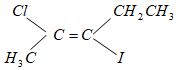
A
trans $3$-iodo,$4$-chloro,$pent-3$-ene
B
cis $3$-chloro,$3$-iodo,$pent-2$-ene
C
trans $2$-chloro,$3$-iodo,$pent-2$-ene
D
cis $3$-iodo,$4$-chloro,$pent-3$-ene
Solution
(C) $1$. Identify the longest carbon chain containing the double bond. The chain has $5$ carbons,so the parent alkane is $pentane$,and the alkene is $pent-2$-ene.
$2$. Number the chain to give the double bond the lowest possible locant. Numbering from left to right gives the double bond at position $2$.
$3$. Substituents are $chloro$ at position $2$ and $iodo$ at position $3$.
$4$. Determine the configuration: The high-priority groups ($Cl$ on $C-2$ and $CH_2CH_3$ on $C-3$) are on opposite sides of the double bond,which corresponds to the $trans$ configuration.
$5$. Combining these,the name is $trans-2-chloro-3-iodopent-2-ene$.
$2$. Number the chain to give the double bond the lowest possible locant. Numbering from left to right gives the double bond at position $2$.
$3$. Substituents are $chloro$ at position $2$ and $iodo$ at position $3$.
$4$. Determine the configuration: The high-priority groups ($Cl$ on $C-2$ and $CH_2CH_3$ on $C-3$) are on opposite sides of the double bond,which corresponds to the $trans$ configuration.
$5$. Combining these,the name is $trans-2-chloro-3-iodopent-2-ene$.
0 likesView Solution
30
ChemistryMediumMCQAIPMT · 1998
Which one of these is not compatible with arenes?
A
Greater stability
B
Delocalisation of $\pi$-electrons
C
Electrophilic additions
D
Resonance
Solution
(C) In arenes,electrophilic substitution reactions take place,and they do not typically undergo electrophilic addition reactions.
Benzene is a resonance hybrid of two structures,and its greater stability is due to the delocalization of $\pi$-electrons.
Benzene is a resonance hybrid of two structures,and its greater stability is due to the delocalization of $\pi$-electrons.
0 likesView Solution
31
ChemistryMCQAIPMT · 1998
Which of the following compounds will be most easily attacked by an electrophile?
A
Benzene
B
Chlorobenzene
C
Phenol
D
Toluene
Solution
(C) The reactivity of an aromatic ring towards an electrophilic substitution reaction depends on the electron density of the ring.
Groups that donate electrons to the ring (activating groups) increase the electron density,making the ring more susceptible to electrophilic attack.
In the given compounds:
$1$. Benzene: Reference compound.
$2$. Chlorobenzene: $-Cl$ is a deactivating group due to its strong $-I$ effect,which outweighs its $+M$ effect.
$3$. Phenol: The $-OH$ group is a strongly activating group due to its strong $+M$ effect,which significantly increases the electron density at the $o-$ and $p-$ positions.
$4$. Toluene: The $-CH_3$ group is a weakly activating group due to its $+I$ effect and hyperconjugation.
Therefore,phenol is the most reactive towards electrophilic attack.
Groups that donate electrons to the ring (activating groups) increase the electron density,making the ring more susceptible to electrophilic attack.
In the given compounds:
$1$. Benzene: Reference compound.
$2$. Chlorobenzene: $-Cl$ is a deactivating group due to its strong $-I$ effect,which outweighs its $+M$ effect.
$3$. Phenol: The $-OH$ group is a strongly activating group due to its strong $+M$ effect,which significantly increases the electron density at the $o-$ and $p-$ positions.
$4$. Toluene: The $-CH_3$ group is a weakly activating group due to its $+I$ effect and hyperconjugation.
Therefore,phenol is the most reactive towards electrophilic attack.
0 likesView Solution
32
ChemistryMediumMCQAIPMT · 1998
The $IUPAC$ name of the following compound is:
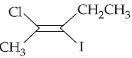
A
$trans-2-chloro-3-iodo-2-pentene$
B
$cis-3-iodo-4-chloro-3-pentene$
C
$trans-3-iodo-4-chloro-3-pentene$
D
$cis-2-chloro-3-iodo-2-pentene$
Solution
$(A)$ The longest carbon chain contains $5$ carbon atoms with a $C=C$ bond starting at the second carbon atom, so it is a $2$-pentene derivative.
The substituents are a chlorine atom $(Cl)$ at position $2$ and an iodine atom $(I)$ at position $3$.
Looking at the geometry across the $C=C$ bond, the higher priority groups (based on atomic number, $Cl$ vs $CH_3$ on one side, and $I$ vs $CH_2CH_3$ on the other) are on opposite sides of the double bond, which corresponds to the $E$ configuration, often referred to as $trans$ in simple cases where similar groups are on opposite sides.
Specifically, the $Cl$ and the $CH_2CH_3$ group are on opposite sides of the double bond, and the $CH_3$ and $I$ are on opposite sides. Thus, the configuration is $trans-2-chloro-3-iodo-2-pentene$.
The substituents are a chlorine atom $(Cl)$ at position $2$ and an iodine atom $(I)$ at position $3$.
Looking at the geometry across the $C=C$ bond, the higher priority groups (based on atomic number, $Cl$ vs $CH_3$ on one side, and $I$ vs $CH_2CH_3$ on the other) are on opposite sides of the double bond, which corresponds to the $E$ configuration, often referred to as $trans$ in simple cases where similar groups are on opposite sides.
Specifically, the $Cl$ and the $CH_2CH_3$ group are on opposite sides of the double bond, and the $CH_3$ and $I$ are on opposite sides. Thus, the configuration is $trans-2-chloro-3-iodo-2-pentene$.
0 likesView Solution
33
ChemistryMCQAIPMT · 1998
Lactose is composed of ......... .
A
Glucose $+$ Fructose
B
Glucose $+$ Glucose
C
Glucose $+$ Galactose
D
Fructose $+$ Galactose
Solution
(C) Lactose is a disaccharide sugar that is commonly found in milk.
It is composed of two monosaccharide units: $Glucose$ and $Galactose$.
These two units are linked together by a $\beta-1,4-glycosidic$ bond.
Therefore,the correct option is $C$.
It is composed of two monosaccharide units: $Glucose$ and $Galactose$.
These two units are linked together by a $\beta-1,4-glycosidic$ bond.
Therefore,the correct option is $C$.
0 likesView Solution
34
ChemistryMCQAIPMT · 1998
In mammals,histamine is secreted by .........
A
Fibroblasts
B
Histiocytes
C
Lymphocytes
D
Mast cells
Solution
(D) In mammals,histamine is a chemical mediator involved in inflammatory and allergic responses. It is primarily synthesized and released by $Mast \ cells$ (also known as mastocytes) and basophils. When these cells are activated by allergens or tissue injury,they undergo degranulation,releasing histamine into the surrounding tissue. Histamine causes vasodilation and increased capillary permeability,which are characteristic features of the inflammatory response.
0 likesView Solution
35
ChemistryMCQAIPMT · 1998
$A$ bullet is fired from a gun. The force on the bullet is given by $F = 600 - 2 \times 10^5 t$,where $F$ is in newton and $t$ is in second. The force on the bullet becomes zero as soon as it leaves the barrel. What is the impulse imparted to the bullet (in $N-s$)?
A
$0.9$
B
$1.8$
C
$0.45$
D
$9$
Solution
(A) The force on the bullet is given by $F = 600 - 2 \times 10^5 t$.
When the bullet leaves the barrel,the force becomes zero.
Setting $F = 0$,we get $600 - 2 \times 10^5 t = 0$.
Solving for $t$,$t = \frac{600}{2 \times 10^5} = 3 \times 10^{-3} \ s$.
Impulse $I$ is defined as the integral of force over time: $I = \int_{0}^{t} F \ dt$.
Substituting the values: $I = \int_{0}^{3 \times 10^{-3}} (600 - 2 \times 10^5 t) \ dt$.
Integrating,we get $I = [600t - 10^5 t^2]_0^{3 \times 10^{-3}}$.
Calculating the value: $I = 600(3 \times 10^{-3}) - 10^5(3 \times 10^{-3})^2$.
$I = 1.8 - 10^5(9 \times 10^{-6}) = 1.8 - 0.9 = 0.9 \ N-s$.
When the bullet leaves the barrel,the force becomes zero.
Setting $F = 0$,we get $600 - 2 \times 10^5 t = 0$.
Solving for $t$,$t = \frac{600}{2 \times 10^5} = 3 \times 10^{-3} \ s$.
Impulse $I$ is defined as the integral of force over time: $I = \int_{0}^{t} F \ dt$.
Substituting the values: $I = \int_{0}^{3 \times 10^{-3}} (600 - 2 \times 10^5 t) \ dt$.
Integrating,we get $I = [600t - 10^5 t^2]_0^{3 \times 10^{-3}}$.
Calculating the value: $I = 600(3 \times 10^{-3}) - 10^5(3 \times 10^{-3})^2$.
$I = 1.8 - 10^5(9 \times 10^{-6}) = 1.8 - 0.9 = 0.9 \ N-s$.
0 likesView Solution
36
ChemistryMCQAIPMT · 1998
If $\Delta U$ and $\Delta W$ represent the increase in internal energy and work done by the system respectively in a thermodynamic process,which of the following is true?
A
$\Delta U = -\Delta W$,in an isothermal process
B
$\Delta U = -\Delta W$,in an adiabatic process
C
$\Delta U = \Delta W$,in an isothermal process
D
$\Delta U = \Delta W$,in an adiabatic process
Solution
(B) According to the first law of thermodynamics,$Q = \Delta U + \Delta W$,where $Q$ is the heat supplied to the system,$\Delta U$ is the change in internal energy,and $\Delta W$ is the work done by the system.
In an adiabatic process,there is no exchange of heat between the system and the surroundings,so $Q = 0$.
Substituting $Q = 0$ into the first law equation: $0 = \Delta U + \Delta W$.
Rearranging the terms,we get $\Delta U = -\Delta W$.
Therefore,the correct statement is that in an adiabatic process,the increase in internal energy is equal to the negative of the work done by the system.
In an adiabatic process,there is no exchange of heat between the system and the surroundings,so $Q = 0$.
Substituting $Q = 0$ into the first law equation: $0 = \Delta U + \Delta W$.
Rearranging the terms,we get $\Delta U = -\Delta W$.
Therefore,the correct statement is that in an adiabatic process,the increase in internal energy is equal to the negative of the work done by the system.
0 likesView Solution
37
ChemistryMCQAIPMT · 1998
The radiant energy from the sun incident normally at the surface of the earth is $20 \, kcal/m^2-min$. What would have been the radiant energy incident normally on the earth if the sun had a temperature twice of the present one? ........... $kcal/m^2-min$
A
$40$
B
$80$
C
$160$
D
$320$
Solution
(D) According to the Stefan-Boltzmann law,the radiant energy $E$ emitted by a black body is proportional to the fourth power of its absolute temperature $T$,i.e.,$E \propto T^4$.
Let $E_1$ be the initial radiant energy and $T_1$ be the initial temperature of the sun. Given $E_1 = 20 \, kcal/m^2-min$.
Let $E_2$ be the new radiant energy and $T_2$ be the new temperature of the sun,where $T_2 = 2T_1$.
Using the ratio formula: $\frac{E_1}{E_2} = \left(\frac{T_1}{T_2}\right)^4$.
Substituting the values: $\frac{20}{E_2} = \left(\frac{T_1}{2T_1}\right)^4 = \left(\frac{1}{2}\right)^4 = \frac{1}{16}$.
Therefore,$E_2 = 20 \times 16 = 320 \, kcal/m^2-min$.
Let $E_1$ be the initial radiant energy and $T_1$ be the initial temperature of the sun. Given $E_1 = 20 \, kcal/m^2-min$.
Let $E_2$ be the new radiant energy and $T_2$ be the new temperature of the sun,where $T_2 = 2T_1$.
Using the ratio formula: $\frac{E_1}{E_2} = \left(\frac{T_1}{T_2}\right)^4$.
Substituting the values: $\frac{20}{E_2} = \left(\frac{T_1}{2T_1}\right)^4 = \left(\frac{1}{2}\right)^4 = \frac{1}{16}$.
Therefore,$E_2 = 20 \times 16 = 320 \, kcal/m^2-min$.
0 likesView Solution
38
ChemistryMCQAIPMT · 1998
Which of the following elements constitutes a major impurity in pig iron?
A
Carbon
B
Oxygen
C
Sulphur
D
Silicon
Solution
(A) Pig iron is the iron obtained from a blast furnace. It contains about $4 \%$ carbon and many other impurities in smaller amounts,such as $S$,$Si$,$P$,and $Mn$. Among these,carbon is the most significant impurity,as it is present in the highest percentage $(3-4.5 \%)$.
0 likesView Solution
39
ChemistryMCQAIPMT · 1998
The radiant energy from the sun incident normally at the surface of the earth is $20 \ kcal/m^2-min$. What would have been the radiant energy incident normally on the earth if the sun had a temperature twice of the present one? (in $kcal/m^2-min$)
A
$40$
B
$80$
C
$160$
D
$320$
Solution
(D) According to the Stefan-Boltzmann law,the radiant energy emitted by a black body is proportional to the fourth power of its absolute temperature,i.e.,$E \propto T^4$.
Let $E_1$ be the initial radiant energy and $T_1$ be the initial temperature of the sun. Let $E_2$ be the new radiant energy and $T_2$ be the new temperature.
Given: $E_1 = 20 \ kcal/m^2-min$ and $T_2 = 2T_1$.
Using the ratio formula:
$\frac{E_2}{E_1} = \left(\frac{T_2}{T_1}\right)^4$
Substituting the values:
$\frac{E_2}{20} = \left(\frac{2T_1}{T_1}\right)^4$
$\frac{E_2}{20} = (2)^4$
$\frac{E_2}{20} = 16$
$E_2 = 16 \times 20 = 320 \ kcal/m^2-min$.
Let $E_1$ be the initial radiant energy and $T_1$ be the initial temperature of the sun. Let $E_2$ be the new radiant energy and $T_2$ be the new temperature.
Given: $E_1 = 20 \ kcal/m^2-min$ and $T_2 = 2T_1$.
Using the ratio formula:
$\frac{E_2}{E_1} = \left(\frac{T_2}{T_1}\right)^4$
Substituting the values:
$\frac{E_2}{20} = \left(\frac{2T_1}{T_1}\right)^4$
$\frac{E_2}{20} = (2)^4$
$\frac{E_2}{20} = 16$
$E_2 = 16 \times 20 = 320 \ kcal/m^2-min$.
0 likesView Solution
40
ChemistryMCQAIPMT · 1998
In a $500 \ mL$ capacity vessel,$CO$ and $Cl_2$ are mixed to form $COCl_2$. At equilibrium,it contains $0.2 \ mole$ of $COCl_2$ and $0.1 \ mole$ of each of $CO$ and $Cl_2$. The equilibrium constant $K_c$ for the reaction,$CO(g) + Cl_2(g) \rightleftharpoons COCl_2(g)$ is:
A
$5$
B
$10$
C
$15$
D
$20$
Solution
(B) Given,Volume $V = 500 \ mL = 0.5 \ L$.
The balanced chemical equilibrium reaction is: $CO(g) + Cl_2(g) \rightleftharpoons COCl_2(g)$.
At equilibrium,the number of moles are: $n(CO) = 0.1 \ mol$,$n(Cl_2) = 0.1 \ mol$,$n(COCl_2) = 0.2 \ mol$.
Concentration is calculated as: $[Species] = \frac{n}{V(L)}$.
$[CO] = \frac{0.1 \ mol}{0.5 \ L} = 0.2 \ mol/L$.
$[Cl_2] = \frac{0.1 \ mol}{0.5 \ L} = 0.2 \ mol/L$.
$[COCl_2] = \frac{0.2 \ mol}{0.5 \ L} = 0.4 \ mol/L$.
The equilibrium constant expression is: $K_c = \frac{[COCl_2]}{[CO][Cl_2]}$.
Substituting the values: $K_c = \frac{0.4}{(0.2)(0.2)} = \frac{0.4}{0.04} = 10$.
Thus,the equilibrium constant $K_c$ is $10$.
The balanced chemical equilibrium reaction is: $CO(g) + Cl_2(g) \rightleftharpoons COCl_2(g)$.
At equilibrium,the number of moles are: $n(CO) = 0.1 \ mol$,$n(Cl_2) = 0.1 \ mol$,$n(COCl_2) = 0.2 \ mol$.
Concentration is calculated as: $[Species] = \frac{n}{V(L)}$.
$[CO] = \frac{0.1 \ mol}{0.5 \ L} = 0.2 \ mol/L$.
$[Cl_2] = \frac{0.1 \ mol}{0.5 \ L} = 0.2 \ mol/L$.
$[COCl_2] = \frac{0.2 \ mol}{0.5 \ L} = 0.4 \ mol/L$.
The equilibrium constant expression is: $K_c = \frac{[COCl_2]}{[CO][Cl_2]}$.
Substituting the values: $K_c = \frac{0.4}{(0.2)(0.2)} = \frac{0.4}{0.04} = 10$.
Thus,the equilibrium constant $K_c$ is $10$.
0 likesView Solution
41
ChemistryMCQAIPMT · 1998
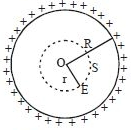
$A$ hollow insulated conducting sphere is given a positive charge of $10\,\mu C$. What will be the electric field at the centre of the sphere if its radius is $2\,m$?
A
$0$
B
$5$
C
$20$
D
$8$
Solution
(A) For a hollow conducting sphere,the charge resides entirely on its outer surface.
According to Gauss's law,the electric flux through any closed Gaussian surface is given by $\oint \vec{E} \cdot d\vec{S} = \frac{q_{enclosed}}{\varepsilon_0}$.
For any point inside the hollow sphere,we can choose a spherical Gaussian surface of radius $r < R$,where $R$ is the radius of the sphere.
Since there is no charge enclosed within this Gaussian surface $(q_{enclosed} = 0)$,the electric field $E$ at any point inside the sphere must be zero.
Therefore,the electric field at the centre of the sphere is $0$.
According to Gauss's law,the electric flux through any closed Gaussian surface is given by $\oint \vec{E} \cdot d\vec{S} = \frac{q_{enclosed}}{\varepsilon_0}$.
For any point inside the hollow sphere,we can choose a spherical Gaussian surface of radius $r < R$,where $R$ is the radius of the sphere.
Since there is no charge enclosed within this Gaussian surface $(q_{enclosed} = 0)$,the electric field $E$ at any point inside the sphere must be zero.
Therefore,the electric field at the centre of the sphere is $0$.
0 likesView Solution
42
ChemistryMCQAIPMT · 1998
Genes that are involved in turning on or off the transcription of a set of structural genes are called:
A
Polymorphic genes
B
Operator genes
C
Redundant genes
D
Regulatory genes
Solution
(D) Regulatory genes are responsible for controlling the expression of other genes by producing proteins (repressors or activators) that bind to specific $DNA$ sequences. In the context of an operon,these genes regulate the transcription of structural genes by turning them on or off. Therefore,the correct answer is $D$.
0 likesView Solution
43
ChemistryMediumMCQAIPMT · 1998
If nearly $10^5 \ C$ liberate $1 \ gm$ equivalent of aluminium,then the amount of aluminium (equivalent weight $9$) deposited through electrolysis in $20 \ minutes$ by a current of $50 \ A$ will be .............. $gm$.
A
$0.6$
B
$0.09$
C
$5.4$
D
$10.8$
Solution
(C) According to Faraday's law of electrolysis,the mass $m$ deposited is given by $m = \frac{E \times I \times t}{F}$,where $E$ is the equivalent weight,$I$ is current in amperes,$t$ is time in seconds,and $F$ is the charge required for $1 \ gm$ equivalent (given as $10^5 \ C$).
Given: $E = 9$,$I = 50 \ A$,$t = 20 \ minutes = 20 \times 60 \ s = 1200 \ s$,and $F = 10^5 \ C$.
Substituting the values: $m = \frac{9 \times 50 \times 1200}{10^5} = \frac{540000}{100000} = 5.4 \ gm$.
Given: $E = 9$,$I = 50 \ A$,$t = 20 \ minutes = 20 \times 60 \ s = 1200 \ s$,and $F = 10^5 \ C$.
Substituting the values: $m = \frac{9 \times 50 \times 1200}{10^5} = \frac{540000}{100000} = 5.4 \ gm$.
0 likesView Solution
44
ChemistryMediumMCQAIPMT · 1998
Which of the following elements shows the maximum number of different oxidation states in its compounds?
A
$Eu$
B
$La$
C
$Gd$
D
$Am$
Solution
(D) The elements provided include lanthanoids ($Eu$,$La$,$Gd$) and an actinoid $(Am)$.
Actinoids exhibit a greater range of oxidation states compared to lanthanoids due to the comparable energies of $5f$,$6d$,and $7s$ orbitals.
$Am$ (Americium) exhibits oxidation states ranging from $+2$ to $+6$ (and sometimes $+7$ in specific conditions).
In contrast,lanthanoids like $La$,$Eu$,and $Gd$ primarily show the $+3$ oxidation state,with $Eu$ also showing $+2$ and $Gd$ showing $+3$ as its most stable state.
Therefore,$Am$ shows the maximum number of different oxidation states.
Actinoids exhibit a greater range of oxidation states compared to lanthanoids due to the comparable energies of $5f$,$6d$,and $7s$ orbitals.
$Am$ (Americium) exhibits oxidation states ranging from $+2$ to $+6$ (and sometimes $+7$ in specific conditions).
In contrast,lanthanoids like $La$,$Eu$,and $Gd$ primarily show the $+3$ oxidation state,with $Eu$ also showing $+2$ and $Gd$ showing $+3$ as its most stable state.
Therefore,$Am$ shows the maximum number of different oxidation states.
0 likesView Solution
45
ChemistryMediumMCQAIPMT · 1998
When chlorine reacts with cold and dilute solution of sodium hydroxide,the products obtained are:
A
$Cl^{-} + ClO^{-}$
B
$Cl^{-} + ClO_2^{-}$
C
$Cl^{-} + ClO_3^{-}$
D
$Cl^{-} + ClO_4^{-}$
Solution
(A) When chlorine $(Cl_2)$ reacts with cold and dilute sodium hydroxide $(NaOH)$,it undergoes a disproportionation reaction.
In this reaction,chlorine is simultaneously oxidized and reduced to form chloride $(Cl^{-})$ and hypochlorite $(ClO^{-})$ ions.
The balanced chemical equation is: $2NaOH + Cl_2 \rightarrow NaCl + NaOCl + H_2O$.
The ionic form of this reaction is: $Cl_2 + 2OH^{-} \rightarrow Cl^{-} + ClO^{-} + H_2O$.
In this reaction,chlorine is simultaneously oxidized and reduced to form chloride $(Cl^{-})$ and hypochlorite $(ClO^{-})$ ions.
The balanced chemical equation is: $2NaOH + Cl_2 \rightarrow NaCl + NaOCl + H_2O$.
The ionic form of this reaction is: $Cl_2 + 2OH^{-} \rightarrow Cl^{-} + ClO^{-} + H_2O$.
0 likesView Solution
46
ChemistryMediumMCQAIPMT · 1998
Vapour pressure of $CCl_4$ at $25\,^{\circ}C$ is $143\,mm$ of $Hg$. $0.5\,g$ of a non-volatile solute (mol. wt. $= 65$) is dissolved in $100\,mL$ $CCl_4$. Find the vapour pressure of the solution (Density of $CCl_4 = 1.58\,g/cm^3$).
A
$141.43$
B
$94.39$
C
$199.34$
D
$143.99$
Solution
(A) Given: $P^0 = 143\,mm \, Hg$,$w = 0.5\,g$,$m = 65\,g/mol$,$V = 100\,mL$,$d = 1.58\,g/cm^3$.
Mass of solvent $(W)$ $= V \times d = 100\,mL \times 1.58\,g/mL = 158\,g$.
Molar mass of $CCl_4$ $(M)$ $= 12 + 4 \times 35.5 = 154\,g/mol$.
Using Raoult's law: $\frac{P^0 - P_s}{P^0} = \frac{w \times M}{m \times W}$.
$\frac{143 - P_s}{143} = \frac{0.5 \times 154}{65 \times 158} = \frac{77}{10270} \approx 0.0075$.
$143 - P_s = 143 \times 0.0075 = 1.0725$.
$P_s = 143 - 1.0725 = 141.9275 \approx 141.93\,mm \, Hg$.
Mass of solvent $(W)$ $= V \times d = 100\,mL \times 1.58\,g/mL = 158\,g$.
Molar mass of $CCl_4$ $(M)$ $= 12 + 4 \times 35.5 = 154\,g/mol$.
Using Raoult's law: $\frac{P^0 - P_s}{P^0} = \frac{w \times M}{m \times W}$.
$\frac{143 - P_s}{143} = \frac{0.5 \times 154}{65 \times 158} = \frac{77}{10270} \approx 0.0075$.
$143 - P_s = 143 \times 0.0075 = 1.0725$.
$P_s = 143 - 1.0725 = 141.9275 \approx 141.93\,mm \, Hg$.
0 likesView Solution
47
ChemistryEasyMCQAIPMT · 1998
$A$ $5 \%$ solution of cane sugar (mol. wt. $= 342$) is isotonic with $1 \%$ solution of a substance $X$. The molecular weight of $X$ is
A
$34.2$
B
$171.2$
C
$68.4$
D
$136.8$
Solution
(C) Two solutions are isotonic if they have the same molar concentration (molarity).
Molar concentration of cane sugar $= \frac{5 \ g}{342 \ g/mol} \times \frac{1000 \ mL}{100 \ mL} = \frac{50}{342} \ M$.
Molar concentration of substance $X$ $= \frac{1 \ g}{m \ g/mol} \times \frac{1000 \ mL}{100 \ mL} = \frac{10}{m} \ M$.
Since the solutions are isotonic,their molar concentrations are equal:
$\frac{10}{m} = \frac{50}{342}$.
Solving for $m$:
$m = \frac{342 \times 10}{50} = \frac{342}{5} = 68.4$.
Molar concentration of cane sugar $= \frac{5 \ g}{342 \ g/mol} \times \frac{1000 \ mL}{100 \ mL} = \frac{50}{342} \ M$.
Molar concentration of substance $X$ $= \frac{1 \ g}{m \ g/mol} \times \frac{1000 \ mL}{100 \ mL} = \frac{10}{m} \ M$.
Since the solutions are isotonic,their molar concentrations are equal:
$\frac{10}{m} = \frac{50}{342}$.
Solving for $m$:
$m = \frac{342 \times 10}{50} = \frac{342}{5} = 68.4$.
0 likesView Solution
48
ChemistryMediumMCQAIPMT · 1998
Schottky defect in crystals is observed when
A
Density of crystal is increased
B
Unequal number of cations and anions are missing from the lattice
C
An ion leaves its normal site and occupies an interstitial site
D
Equal number of cations and anions are missing from the lattice
Solution
(D) The Schottky defect occurs when an equal number of cations and anions are missing from their lattice sites,maintaining the electrical neutrality of the crystal. This leads to a decrease in the density of the crystal.
0 likesView Solution
49
ChemistryMediumMCQAIPMT · 1998
The edge length of a face-centred cubic unit cell is $508 \ pm$. If the radius of the cation is $110 \ pm$, the radius of the anion is .............. $pm$.
A
$285$
B
$398$
C
$144$
D
$618$
Solution
(C) In a face-centred cubic $(FCC)$ unit cell, the ions are in contact along the edge of the unit cell if we consider the rock salt structure (like $NaCl$).
For an $FCC$ unit cell, the edge length $a = 2(r_c + r_a)$.
Given, $a = 508 \ pm$ and $r_c = 110 \ pm$.
Substituting the values: $508 = 2(110 + r_a)$.
$254 = 110 + r_a$.
$r_a = 254 - 110 = 144 \ pm$.
For an $FCC$ unit cell, the edge length $a = 2(r_c + r_a)$.
Given, $a = 508 \ pm$ and $r_c = 110 \ pm$.
Substituting the values: $508 = 2(110 + r_a)$.
$254 = 110 + r_a$.
$r_a = 254 - 110 = 144 \ pm$.
0 likesView Solution
50
ChemistryMediumMCQAIPMT · 1998
The number of neutrons in a parent nucleus $X$,which gives a $_7N^{14}$ nucleus after two successive $\beta$ emissions,is:
A
$9$
B
$8$
C
$7$
D
$6$
Solution
(A) $\beta$ emission increases the atomic number by $1$ while the mass number remains unchanged.
Let the parent nucleus be $_Z X^A$.
After two successive $\beta$ emissions,the reaction is: $_Z X^A \xrightarrow{-2\beta} _{Z+2} N^{14}$.
Comparing the atomic number and mass number,we get $Z+2 = 7$,so $Z = 5$,and $A = 14$.
The parent nucleus is $_5 X^{14}$.
The number of neutrons in $_5 X^{14}$ is $A - Z = 14 - 5 = 9$.
Let the parent nucleus be $_Z X^A$.
After two successive $\beta$ emissions,the reaction is: $_Z X^A \xrightarrow{-2\beta} _{Z+2} N^{14}$.
Comparing the atomic number and mass number,we get $Z+2 = 7$,so $Z = 5$,and $A = 14$.
The parent nucleus is $_5 X^{14}$.
The number of neutrons in $_5 X^{14}$ is $A - Z = 14 - 5 = 9$.
0 likesView Solution
51
ChemistryMediumMCQAIPMT · 1998
Activation energy of a chemical reaction can be determined by
A
Changing concentration of reactants
B
Evaluating rate constant at standard temperature
C
Evaluating rate constants at two different temperatures
D
Evaluating velocities of reaction at two different temperatures
Solution
(C) The activation energy $(E_a)$ is determined using the Arrhenius equation at two different temperatures ($T_1$ and $T_2$).
According to the Arrhenius equation: $\log \frac{K_2}{K_1} = \frac{E_a}{2.303R} \left[ \frac{T_2 - T_1}{T_1 T_2} \right]$.
By measuring the rate constants ($K_1$ and $K_2$) at two different temperatures,the activation energy can be calculated.
According to the Arrhenius equation: $\log \frac{K_2}{K_1} = \frac{E_a}{2.303R} \left[ \frac{T_2 - T_1}{T_1 T_2} \right]$.
By measuring the rate constants ($K_1$ and $K_2$) at two different temperatures,the activation energy can be calculated.
0 likesView Solution
52
ChemistryMediumMCQAIPMT · 1998
During electrolysis of aqueous $NaOH$,$4 \ g$ of $O_2$ gas is liberated at $NTP$ at the anode. The volume of $H_2$ gas liberated at the cathode in $litres$ is $..............$
A
$2.8$
B
$5.6$
C
$11.2$
D
$22.4$
Solution
(B) The electrolysis of aqueous $NaOH$ involves the following reactions:
At anode: $4OH^- \rightarrow 2H_2O + O_2 + 4e^-$
At cathode: $4H_2O + 4e^- \rightarrow 2H_2 + 4OH^-$
From the stoichiometry,$1 \ mol$ of $O_2$ $(32 \ g)$ is produced by the transfer of $4 \ mol$ of electrons,which also produces $2 \ mol$ of $H_2$ gas.
Given mass of $O_2 = 4 \ g$,so moles of $O_2 = \frac{4}{32} = 0.125 \ mol$.
Since $1 \ mol$ of $O_2$ produces $2 \ mol$ of $H_2$,then $0.125 \ mol$ of $O_2$ will produce $0.125 \times 2 = 0.25 \ mol$ of $H_2$.
Volume of $H_2$ at $NTP = 0.25 \ mol \times 22.4 \ L/mol = 5.6 \ L$.
At anode: $4OH^- \rightarrow 2H_2O + O_2 + 4e^-$
At cathode: $4H_2O + 4e^- \rightarrow 2H_2 + 4OH^-$
From the stoichiometry,$1 \ mol$ of $O_2$ $(32 \ g)$ is produced by the transfer of $4 \ mol$ of electrons,which also produces $2 \ mol$ of $H_2$ gas.
Given mass of $O_2 = 4 \ g$,so moles of $O_2 = \frac{4}{32} = 0.125 \ mol$.
Since $1 \ mol$ of $O_2$ produces $2 \ mol$ of $H_2$,then $0.125 \ mol$ of $O_2$ will produce $0.125 \times 2 = 0.25 \ mol$ of $H_2$.
Volume of $H_2$ at $NTP = 0.25 \ mol \times 22.4 \ L/mol = 5.6 \ L$.
0 likesView Solution
53
ChemistryMediumMCQAIPMT · 1998
For the cell reaction $Cu^{2+}_{(C_1, aq)} + Zn_{(s)} \rightarrow Zn^{2+}_{(C_2, aq)} + Cu_{(s)}$ of an electrochemical cell,the change in free energy at a given temperature is a function of
A
ln $(C_1)$
B
ln $(C_2)$
C
ln $(C_1 + C_2)$
D
ln $(C_2 / C_1)$
Solution
(D) The Nernst equation for the given cell reaction is $E_{cell} = E^o_{cell} - \frac{RT}{nF} \ln \frac{[Zn^{2+}]}{[Cu^{2+}]} = E^o_{cell} - \frac{RT}{nF} \ln \frac{C_2}{C_1}$.
The relationship between Gibbs free energy change and cell potential is given by $\Delta G = -nF E_{cell}$.
Substituting the expression for $E_{cell}$,we get $\Delta G = -nF \left( E^o_{cell} - \frac{RT}{nF} \ln \frac{C_2}{C_1} \right) = -nF E^o_{cell} + RT \ln \frac{C_2}{C_1}$.
Thus,the change in free energy $\Delta G$ is a function of $\ln \left( \frac{C_2}{C_1} \right)$.
The relationship between Gibbs free energy change and cell potential is given by $\Delta G = -nF E_{cell}$.
Substituting the expression for $E_{cell}$,we get $\Delta G = -nF \left( E^o_{cell} - \frac{RT}{nF} \ln \frac{C_2}{C_1} \right) = -nF E^o_{cell} + RT \ln \frac{C_2}{C_1}$.
Thus,the change in free energy $\Delta G$ is a function of $\ln \left( \frac{C_2}{C_1} \right)$.
0 likesView Solution
54
ChemistryMediumMCQAIPMT · 1998
At the critical micelle concentration,the surfactant molecules
A
Decompose
B
Dissociate
C
Associate
D
Become completely soluble
Solution
(C) At $CMC$ (critical micellization concentration),the surfactant molecules associate to form micelles.
For soap,the $CMC$ value is approximately $10^{-3} \ mol \ L^{-1}$.
For soap,the $CMC$ value is approximately $10^{-3} \ mol \ L^{-1}$.
0 likesView Solution
55
ChemistryEasyMCQAIPMT · 1998
Which of the following ionic species will impart colour to an aqueous solution?
A
$Ti^{4+}$
B
$Cu^{+}$
C
$Zn^{2+}$
D
$Cr^{3+}$
Solution
(D) The colour of an aqueous solution of transition metal ions is generally due to the presence of unpaired $d$-electrons,which allow for $d-d$ transitions.
$1$. $Ti^{4+}$ $(3d^0)$: No unpaired electrons,colourless.
$2$. $Cu^{+}$ $(3d^{10})$: No unpaired electrons,colourless.
$3$. $Zn^{2+}$ $(3d^{10})$: No unpaired electrons,colourless.
$4$. $Cr^{3+}$ $(3d^3)$: Contains $3$ unpaired electrons,hence it is coloured.
Therefore,the correct option is $(D)$.
$1$. $Ti^{4+}$ $(3d^0)$: No unpaired electrons,colourless.
$2$. $Cu^{+}$ $(3d^{10})$: No unpaired electrons,colourless.
$3$. $Zn^{2+}$ $(3d^{10})$: No unpaired electrons,colourless.
$4$. $Cr^{3+}$ $(3d^3)$: Contains $3$ unpaired electrons,hence it is coloured.
Therefore,the correct option is $(D)$.
0 likesView Solution
56
ChemistryEasyMCQAIPMT · 1998
Which of the following elements constitutes a major impurity in pig iron?
A
Silicon
B
Oxygen
C
Sulphur
D
Graphite
Solution
(D) Pig iron is the iron obtained from blast furnaces and contains about $4 \%$ carbon and many impurities in smaller amounts (e.g.,$S, P, Si, Mn$).
Among the given options,graphite (an allotrope of carbon) is the major impurity,present in the range of $2.5 - 4.5 \%$.
Among the given options,graphite (an allotrope of carbon) is the major impurity,present in the range of $2.5 - 4.5 \%$.
0 likesView Solution
57
ChemistryMediumMCQAIPMT · 1998
$IUPAC$ name of $[Pt(NH_3)_3(Br)(NO_2)Cl]Cl$ is
A
Triamminechlorobromonitroplatinum $(IV)$ chloride
B
Triamminebromonitrochloroplatinum $(IV)$ chloride
C
Triamminebromochloronitroplatinum $(IV)$ chloride
D
Triamminenitrochlorobromoplatinum $(IV)$ chloride
Solution
(C) To name the coordination compound $[Pt(NH_3)_3(Br)(NO_2)Cl]Cl$,we follow the $IUPAC$ rules:
$1$. Name the ligands in alphabetical order: Ammine $(NH_3)$,Bromo $(Br^-)$,Chloro $(Cl^-)$,Nitro $(NO_2^-)$.
$2$. The prefix for three $NH_3$ ligands is 'triammine'.
$3$. Combining these,we get 'triamminebromochloronitro'.
$4$. The metal is platinum $(Pt)$. Since the complex is cationic,we use the name 'platinum'.
$5$. Calculate the oxidation state of $Pt$: $x + 3(0) + 1(-1) + 1(-1) + 1(-1) = +1$ (for the outer $Cl^-$),so $x - 3 = 1$,which gives $x = +4$.
$6$. The final name is Triamminebromochloronitroplatinum $(IV)$ chloride.
$1$. Name the ligands in alphabetical order: Ammine $(NH_3)$,Bromo $(Br^-)$,Chloro $(Cl^-)$,Nitro $(NO_2^-)$.
$2$. The prefix for three $NH_3$ ligands is 'triammine'.
$3$. Combining these,we get 'triamminebromochloronitro'.
$4$. The metal is platinum $(Pt)$. Since the complex is cationic,we use the name 'platinum'.
$5$. Calculate the oxidation state of $Pt$: $x + 3(0) + 1(-1) + 1(-1) + 1(-1) = +1$ (for the outer $Cl^-$),so $x - 3 = 1$,which gives $x = +4$.
$6$. The final name is Triamminebromochloronitroplatinum $(IV)$ chloride.
0 likesView Solution
58
ChemistryAdvancedMCQAIPMT · 1998
The total number of possible isomers for the complex compound $[Cu^{II}(NH_3)_4][Pt^{II}Cl_4]$ are
A
$60$
B
$7$
C
$5$
D
$6$
Solution
(D) The given complex is a coordination isomer. The possible isomers are formed by the exchange of ligands between the two coordination spheres:
$1. [Cu(NH_3)_4][PtCl_4]$
$2. [Cu(NH_3)_3Cl][PtCl_3(NH_3)]$
$3. [Cu(NH_3)_2Cl_2][PtCl_2(NH_3)_2]$ (cis-isomer)
$4. [Cu(NH_3)_2Cl_2][PtCl_2(NH_3)_2]$ (trans-isomer)
$5. [Cu(NH_3)Cl_3][PtCl(NH_3)_3]$
$6. [Pt(NH_3)_4][CuCl_4]$
Thus,the total number of possible isomers is $6$.
$1. [Cu(NH_3)_4][PtCl_4]$
$2. [Cu(NH_3)_3Cl][PtCl_3(NH_3)]$
$3. [Cu(NH_3)_2Cl_2][PtCl_2(NH_3)_2]$ (cis-isomer)
$4. [Cu(NH_3)_2Cl_2][PtCl_2(NH_3)_2]$ (trans-isomer)
$5. [Cu(NH_3)Cl_3][PtCl(NH_3)_3]$
$6. [Pt(NH_3)_4][CuCl_4]$
Thus,the total number of possible isomers is $6$.
0 likesView Solution
59
ChemistryMediumMCQAIPMT · 1998
$2-$bromopentane is heated with potassium ethoxide in ethanol. The major product obtained is
A
Pent$-1-$ene
B
cis pent$-2-$ene
C
trans pent$-2-$ene
D
$2-$ethoxypentane
Solution
(C) $CH_3-CH(Br)-CH_2-CH_2-CH_3 + C_2H_5OK \xrightarrow{C_2H_5OH} CH_3-CH=CH-CH_2-CH_3$ (Pent$-2-$ene).
When an alkyl halide reacts with an alcoholic base like potassium ethoxide,it undergoes a dehydrohalogenation reaction (elimination reaction) following Zaitsev's rule.
The reaction produces a mixture of pent$-1-$ene and pent$-2-$ene. Pent$-2-$ene is the more substituted alkene and is thus the major product.
Between the geometric isomers of pent$-2-$ene,the $trans$ isomer is more stable than the $cis$ isomer due to reduced steric hindrance between the alkyl groups. Therefore,$trans$ pent$-2-$ene is the major product.
When an alkyl halide reacts with an alcoholic base like potassium ethoxide,it undergoes a dehydrohalogenation reaction (elimination reaction) following Zaitsev's rule.
The reaction produces a mixture of pent$-1-$ene and pent$-2-$ene. Pent$-2-$ene is the more substituted alkene and is thus the major product.
Between the geometric isomers of pent$-2-$ene,the $trans$ isomer is more stable than the $cis$ isomer due to reduced steric hindrance between the alkyl groups. Therefore,$trans$ pent$-2-$ene is the major product.
0 likesView Solution
60
ChemistryMediumMCQAIPMT · 1998
In the following reaction,$'A'$ is:
$C_2H_5MgBr + CH_2(O)CH_2 \xrightarrow{H_2O} A$
$C_2H_5MgBr + CH_2(O)CH_2 \xrightarrow{H_2O} A$
A
$C_2H_5-CH_2-CHO$
B
$C_2H_5-CH_2-CH_2-OH$
C
$C_2H_5-CH_2-OH$
D
$C_2H_5-CHO$
Solution
(B) The Grignard reagent $(C_2H_5MgBr)$ acts as a nucleophile and attacks the less hindered carbon of the ethylene oxide (oxirane) ring.
This results in the opening of the ring to form an alkoxide intermediate: $C_2H_5-CH_2-CH_2-OMgBr$.
Subsequent hydrolysis with $H_2O$ converts the alkoxide into a primary alcohol: $C_2H_5-CH_2-CH_2-OH$ ($n$-butanol).
The overall reaction is: $C_2H_5MgBr + CH_2(O)CH_2 \xrightarrow{H_2O} C_2H_5-CH_2-CH_2-OH$.
This results in the opening of the ring to form an alkoxide intermediate: $C_2H_5-CH_2-CH_2-OMgBr$.
Subsequent hydrolysis with $H_2O$ converts the alkoxide into a primary alcohol: $C_2H_5-CH_2-CH_2-OH$ ($n$-butanol).
The overall reaction is: $C_2H_5MgBr + CH_2(O)CH_2 \xrightarrow{H_2O} C_2H_5-CH_2-CH_2-OH$.
0 likesView Solution
61
ChemistryDifficultMCQAIPMT · 1998
Which of the following will not give the iodoform test?
A
Ethanal
B
Ethanol
C
$2-$propanone
D
$3-$pentanone
Solution
(D) The iodoform test is given by compounds containing the $CH_3-C(=O)-$ group or the $CH_3-CH(OH)-$ group.
$3-$pentanone $(CH_3-CH_2-C(=O)-CH_2-CH_3)$ does not contain the $CH_3-C(=O)-$ group,therefore it does not give the iodoform test.
Thus,the correct option is $(D)$.
$3-$pentanone $(CH_3-CH_2-C(=O)-CH_2-CH_3)$ does not contain the $CH_3-C(=O)-$ group,therefore it does not give the iodoform test.
Thus,the correct option is $(D)$.
0 likesView Solution
62
ChemistryMediumMCQAIPMT · 1998
Which of the following compounds is resistant to nucleophilic attack by hydroxyl ions?
A
Methyl acetate
B
Acetonitrile
C
Dimethyl ether
D
Acetamide
Solution
(C) The correct answer is $C$.
Dimethyl ether $(CH_3-O-CH_3)$ is an ether.
Ethers are generally resistant to nucleophilic attack by hydroxyl ions $(OH^-)$ because the lone pairs on the oxygen atom and the electron-donating effect of the alkyl groups create high electron density around the oxygen,which repels the incoming nucleophile.
In contrast,esters $(CH_3COOCH_3)$,nitriles $(CH_3CN)$,and amides $(CH_3CONH_2)$ contain a carbonyl or cyano group that is highly susceptible to nucleophilic attack.
Dimethyl ether $(CH_3-O-CH_3)$ is an ether.
Ethers are generally resistant to nucleophilic attack by hydroxyl ions $(OH^-)$ because the lone pairs on the oxygen atom and the electron-donating effect of the alkyl groups create high electron density around the oxygen,which repels the incoming nucleophile.
In contrast,esters $(CH_3COOCH_3)$,nitriles $(CH_3CN)$,and amides $(CH_3CONH_2)$ contain a carbonyl or cyano group that is highly susceptible to nucleophilic attack.
0 likesView Solution
63
ChemistryDifficultMCQAIPMT · 1998
Which of the following esters cannot undergo Claisen self-condensation?
A
$CH_3-CH_2-CH_2-CH_2-COOC_2H_5$
B
$C_6H_5COOC_2H_5$
C
$C_6H_5CH_2COOC_2H_5$
D
$C_6H_{11}CH_2COOC_2H_5$
Solution
(B) The Claisen self-condensation reaction requires the presence of at least one $\alpha$-hydrogen atom in the ester molecule.
In $C_6H_5COOC_2H_5$ (ethyl benzoate),the carbon atom adjacent to the carbonyl group is part of the benzene ring and does not have any $\alpha$-hydrogen atom attached to it.
Therefore,it cannot undergo Claisen self-condensation.
Thus,the correct option is $(B)$.
In $C_6H_5COOC_2H_5$ (ethyl benzoate),the carbon atom adjacent to the carbonyl group is part of the benzene ring and does not have any $\alpha$-hydrogen atom attached to it.
Therefore,it cannot undergo Claisen self-condensation.
Thus,the correct option is $(B)$.
0 likesView Solution
64
ChemistryDifficultMCQAIPMT · 1998
The number of molecules of $ATP$ produced in the lipid metabolism of a molecule of palmitic acid is
A
$130$
B
$36$
C
$56$
D
$86$
Solution
(A) Palmitic acid is a $16$-carbon saturated fatty acid $(C_{16}H_{32}O_2)$.
It undergoes $\beta$-oxidation,which involves $7$ cycles to produce $8$ molecules of Acetyl-$CoA$,$7$ molecules of $FADH_2$,and $7$ molecules of $NADH$.
Each Acetyl-$CoA$ enters the Citric Acid Cycle to produce $10$ $ATP$ ($3$ $NADH$,$1$ $FADH_2$,$1$ $GTP/ATP$). Total from $8$ Acetyl-$CoA$ = $8 \times 10 = 80$ $ATP$.
Each $FADH_2$ produces $1.5$ $ATP$ and each $NADH$ produces $2.5$ $ATP$.
From $\beta$-oxidation: $7 \times 1.5 = 10.5$ $ATP$ and $7 \times 2.5 = 17.5$ $ATP$.
Total $ATP = 80 + 10.5 + 17.5 = 108$ $ATP$.
Subtracting $2$ $ATP$ used for activation of fatty acid to fatty acyl-$CoA$,the net yield is $106$ $ATP$.
However,in many older textbooks,the calculation is based on $3$ $ATP$ per $NADH$ and $2$ $ATP$ per $FADH_2$,leading to $129$ or $130$ $ATP$. Given the options,$130$ is the standard answer.
It undergoes $\beta$-oxidation,which involves $7$ cycles to produce $8$ molecules of Acetyl-$CoA$,$7$ molecules of $FADH_2$,and $7$ molecules of $NADH$.
Each Acetyl-$CoA$ enters the Citric Acid Cycle to produce $10$ $ATP$ ($3$ $NADH$,$1$ $FADH_2$,$1$ $GTP/ATP$). Total from $8$ Acetyl-$CoA$ = $8 \times 10 = 80$ $ATP$.
Each $FADH_2$ produces $1.5$ $ATP$ and each $NADH$ produces $2.5$ $ATP$.
From $\beta$-oxidation: $7 \times 1.5 = 10.5$ $ATP$ and $7 \times 2.5 = 17.5$ $ATP$.
Total $ATP = 80 + 10.5 + 17.5 = 108$ $ATP$.
Subtracting $2$ $ATP$ used for activation of fatty acid to fatty acyl-$CoA$,the net yield is $106$ $ATP$.
However,in many older textbooks,the calculation is based on $3$ $ATP$ per $NADH$ and $2$ $ATP$ per $FADH_2$,leading to $129$ or $130$ $ATP$. Given the options,$130$ is the standard answer.
0 likesView Solution
65
ChemistryDifficultMCQAIPMT · 1998
The second order Bragg's diffraction of $X$-rays with $\lambda = 1 \ \mathring{A}$ from a set of parallel planes in a metal occurs at an angle of $60^\circ$. The distance between the scattering planes in the crystal is ................ $\mathring{A}$.
A
$0.575$
B
$1$
C
$2$
D
$1.15$
Solution
(D) The Bragg's equation is given by $2d \sin \theta = n\lambda$.
Given: Order of diffraction $n = 2$,wavelength $\lambda = 1 \ \mathring{A}$,and angle $\theta = 60^\circ$.
Substituting the values into the equation:
$2 \times d \times \sin \ 60^\circ = 2 \times 1 \ \mathring{A}$
Since $\sin \ 60^\circ = \frac{\sqrt{3}}{2} \approx 0.8660$,we have:
$2 \times d \times 0.8660 = 2$
$d = \frac{2}{2 \times 0.8660} = \frac{1}{0.8660} \approx 1.1547 \ \mathring{A}$.
Rounding to two decimal places,$d = 1.15 \ \mathring{A}$.
Given: Order of diffraction $n = 2$,wavelength $\lambda = 1 \ \mathring{A}$,and angle $\theta = 60^\circ$.
Substituting the values into the equation:
$2 \times d \times \sin \ 60^\circ = 2 \times 1 \ \mathring{A}$
Since $\sin \ 60^\circ = \frac{\sqrt{3}}{2} \approx 0.8660$,we have:
$2 \times d \times 0.8660 = 2$
$d = \frac{2}{2 \times 0.8660} = \frac{1}{0.8660} \approx 1.1547 \ \mathring{A}$.
Rounding to two decimal places,$d = 1.15 \ \mathring{A}$.
0 likesView Solution
66
ChemistryDifficultMCQAIPMT · 1998
$AgCl$ precipitate dissolves in ammonia due to the formation of
A
$[Ag(NH_3)_2]OH$
B
$[Ag(NH_3)_2]Cl$
C
$[Ag(NH_3)_2]NO_3$
D
$[Ag(NH_3)_2]Cl_2$
Solution
(B) The dissolution of $AgCl$ in aqueous ammonia occurs because of the formation of a soluble complex ion,diamminesilver$(I)$ chloride.
The chemical equation for the reaction is:
$AgCl(s) + 2NH_3(aq) \to [Ag(NH_3)_2]Cl(aq)$
Thus,the correct product formed is $[Ag(NH_3)_2]Cl$.
The chemical equation for the reaction is:
$AgCl(s) + 2NH_3(aq) \to [Ag(NH_3)_2]Cl(aq)$
Thus,the correct product formed is $[Ag(NH_3)_2]Cl$.
0 likesView Solution
67
ChemistryMediumMCQAIPMT · 1998
In $DNA$,the complementary bases are
A
adenine and guanine; thymine and cytosine
B
uracil and adenine; cytosine and guanine
C
adenine and thymine; guanine and cytosine
D
adenine and thymine; guanine and uracil
Solution
(C) $DNA$ has a double helical structure.
These helices contain polynucleotide chains,and these chains are held together by hydrogen bonds.
In the $DNA$ double helix,adenine $(A)$ always pairs with thymine $(T)$ via two hydrogen bonds,and guanine $(G)$ always pairs with cytosine $(C)$ via three hydrogen bonds.
These helices contain polynucleotide chains,and these chains are held together by hydrogen bonds.
In the $DNA$ double helix,adenine $(A)$ always pairs with thymine $(T)$ via two hydrogen bonds,and guanine $(G)$ always pairs with cytosine $(C)$ via three hydrogen bonds.
0 likesView Solution
68
ChemistryMediumMCQAIPMT · 1998
The vapour pressure of a solvent decreases by $10 \ mm$ of $Hg$ when a non-volatile solute is added to the solvent. The mole fraction of the solute in the solution is $0.2$. What should be the mole fraction of the solvent if the decrease in the vapour pressure is to be $20 \ mm$ of $Hg$?
A
$0.8$
B
$0.6$
C
$0.4$
D
$0.2$
Solution
(B) According to Raoult's law,the relative lowering of vapour pressure is equal to the mole fraction of the solute: $\frac{\Delta p}{p^o} = x_{solute}$.
Given $\Delta p = 10 \ mm \ Hg$ and $x_{solute} = 0.2$,we have $\frac{10}{p^o} = 0.2$,which gives $p^o = \frac{10}{0.2} = 50 \ mm \ Hg$.
For the second case,where $\Delta p = 20 \ mm \ Hg$,the new mole fraction of the solute $(x'_{solute})$ is $\frac{20}{p^o} = \frac{20}{50} = 0.4$.
Since the sum of mole fractions of solute and solvent is $1$,the mole fraction of the solvent is $x_{solvent} = 1 - x'_{solute} = 1 - 0.4 = 0.6$.
Given $\Delta p = 10 \ mm \ Hg$ and $x_{solute} = 0.2$,we have $\frac{10}{p^o} = 0.2$,which gives $p^o = \frac{10}{0.2} = 50 \ mm \ Hg$.
For the second case,where $\Delta p = 20 \ mm \ Hg$,the new mole fraction of the solute $(x'_{solute})$ is $\frac{20}{p^o} = \frac{20}{50} = 0.4$.
Since the sum of mole fractions of solute and solvent is $1$,the mole fraction of the solvent is $x_{solvent} = 1 - x'_{solute} = 1 - 0.4 = 0.6$.
0 likesView Solution
69
ChemistryDifficultMCQAIPMT · 1998
Which of the following compounds will most easily be attacked by an electrophile?
A
Benzene
B
Toluene
C
Chlorobenzene
D
Phenol
Solution
(D) The reactivity of a benzene ring towards an electrophilic substitution reaction depends on the electron density of the ring.
Groups that donate electrons to the ring (via resonance or inductive effect) increase the electron density,making it more susceptible to electrophilic attack.
- In $C_6H_6$ (Benzene),there is no substituent.
- In $C_6H_5CH_3$ (Toluene),the $-CH_3$ group is electron-donating via the inductive effect and hyperconjugation.
- In $C_6H_5Cl$ (Chlorobenzene),the $-Cl$ group is electron-withdrawing via the inductive effect,although it donates electrons via resonance.
- In $C_6H_5OH$ (Phenol),the $-OH$ group is strongly electron-donating via resonance (+$M$ effect),which significantly increases the electron density of the benzene ring.
Therefore,phenol is the most reactive towards electrophilic attack.
Groups that donate electrons to the ring (via resonance or inductive effect) increase the electron density,making it more susceptible to electrophilic attack.
- In $C_6H_6$ (Benzene),there is no substituent.
- In $C_6H_5CH_3$ (Toluene),the $-CH_3$ group is electron-donating via the inductive effect and hyperconjugation.
- In $C_6H_5Cl$ (Chlorobenzene),the $-Cl$ group is electron-withdrawing via the inductive effect,although it donates electrons via resonance.
- In $C_6H_5OH$ (Phenol),the $-OH$ group is strongly electron-donating via resonance (+$M$ effect),which significantly increases the electron density of the benzene ring.
Therefore,phenol is the most reactive towards electrophilic attack.
0 likesView Solution
70
ChemistryDifficultMCQAIPMT · 1998
$A$ glucose molecule reacts with $X$ number of molecules of phenylhydrazine to yield osazone. The value of $X$ is
A
$4$
B
$1$
C
$2$
D
$3$
Solution
(D) The reaction of glucose with phenylhydrazine proceeds in three steps:
$1$. Glucose reacts with one molecule of phenylhydrazine to form phenylhydrazone.
$2$. The phenylhydrazone then reacts with a second molecule of phenylhydrazine,which acts as an oxidizing agent,to form an intermediate keto-imine.
$3$. Finally,this intermediate reacts with a third molecule of phenylhydrazine to form the stable osazone.
Thus,a total of $3$ molecules of phenylhydrazine are required for the formation of osazone from one molecule of glucose.
$1$. Glucose reacts with one molecule of phenylhydrazine to form phenylhydrazone.
$2$. The phenylhydrazone then reacts with a second molecule of phenylhydrazine,which acts as an oxidizing agent,to form an intermediate keto-imine.
$3$. Finally,this intermediate reacts with a third molecule of phenylhydrazine to form the stable osazone.
Thus,a total of $3$ molecules of phenylhydrazine are required for the formation of osazone from one molecule of glucose.
0 likesView Solution
71
ChemistryMediumMCQAIPMT · 1998
Aspirin is an acetylation product of
A
$o-$hydroxybenzoic acid
B
$o-$hydroxybenzene
C
$m-$hydroxybenzoic acid
D
$p-$dihydroxybenzene
Solution
(A) Aspirin (acetylsalicylic acid) is prepared by the acetylation of salicylic acid.
Salicylic acid is chemically known as $o-$hydroxybenzoic acid.
The reaction involves the treatment of salicylic acid with acetic anhydride in the presence of an acid catalyst.
Salicylic acid is chemically known as $o-$hydroxybenzoic acid.
The reaction involves the treatment of salicylic acid with acetic anhydride in the presence of an acid catalyst.
0 likesView Solution
Vedclass Products
For Students
Vedclass Test Series
Mock tests in real AIPMT style covering Chemistry with performance analysis. 5-day free trial.
Start Free TrialFor Teachers
Exam Paper Generator
Generate Set A/B/C/D Chemistry papers from 7.5L+ questions in 2 minutes. 3 chapters free.
Try FreeFor Institutes
Online Exam Module
Run live AIPMT mock exams with unlimited students, 360° analytics & white-label branding.
See DemoFrequently Asked Questions
How many Chemistry questions are in AIPMT 1998?
There are 71 Chemistry questions from the AIPMT 1998 paper on Vedclass, each with a detailed step-by-step solution in English.
Are AIPMT 1998 Chemistry solutions available in English?
Yes. All solutions on this page are in English. You can also switch to English or Hindi using the language buttons above the questions.
Can I practice AIPMT 1998 Chemistry as a timed test?
Yes. Use the Vedclass Test Series to attempt a full AIPMT mock test covering Chemistry with time limits and instant score analysis.
Can teachers create Chemistry papers from AIPMT previous year questions?
Yes. The Vedclass Exam Paper Generator lets teachers mix AIPMT Chemistry questions and generate Set A/B/C/D papers in minutes.
For Teachers & Institutes
Build a Custom Chemistry Paper
Pick AIPMT 1998 Chemistry questions, set difficulty, and generate Set A/B/C/D in 2 minutes.