
PhysicsQ1–47 of 47 questions
Page 1 of 1 · English
1
PhysicsMediumMCQAIPMT · 1996
The dimensions of impulse are equal to that of
A
Momentum
B
Force
C
Angular momentum
D
Torque
Solution
(A) The dimension of momentum is given by $p = mv = [M][L][T^{-1}] = [MLT^{-1}]$.
Impulse is defined as the product of force and time,$I = F \times \Delta t$.
The dimensions of force are $[MLT^{-2}]$ and time are $[T]$.
Therefore,the dimensions of impulse are $[MLT^{-2}] \times [T] = [MLT^{-1}]$.
Since the dimensions of impulse and momentum are both $[MLT^{-1}]$,they are equal.
Impulse is defined as the product of force and time,$I = F \times \Delta t$.
The dimensions of force are $[MLT^{-2}]$ and time are $[T]$.
Therefore,the dimensions of impulse are $[MLT^{-2}] \times [T] = [MLT^{-1}]$.
Since the dimensions of impulse and momentum are both $[MLT^{-1}]$,they are equal.
0 likesView Solution
2
PhysicsMediumMCQAIPMT · 1996
$A$ body dropped from a height $h$ with an initial speed zero,strikes the ground with a velocity $3 \ km/h$. Another body of the same mass is dropped from the same height $h$ with an initial speed of $4 \ km/h$. Find the final velocity of the second body with which it strikes the ground in $km/h$.
A
$3$
B
$4$
C
$5$
D
$12$
Solution
(C) For the first body,using the equation of motion $v^2 = u^2 + 2gh$:
Given $u = 0$,$v = 3 \ km/h$.
So,$3^2 = 0^2 + 2gh \implies 2gh = 9 \ (km/h)^2$.
For the second body,the initial speed $u = 4 \ km/h$ and it is dropped from the same height $h$.
Using the same equation $v'^2 = u^2 + 2gh$:
$v'^2 = (4)^2 + 2gh$.
Substituting $2gh = 9$:
$v'^2 = 16 + 9 = 25$.
$v' = \sqrt{25} = 5 \ km/h$.
Therefore,the final velocity is $5 \ km/h$.
Given $u = 0$,$v = 3 \ km/h$.
So,$3^2 = 0^2 + 2gh \implies 2gh = 9 \ (km/h)^2$.
For the second body,the initial speed $u = 4 \ km/h$ and it is dropped from the same height $h$.
Using the same equation $v'^2 = u^2 + 2gh$:
$v'^2 = (4)^2 + 2gh$.
Substituting $2gh = 9$:
$v'^2 = 16 + 9 = 25$.
$v' = \sqrt{25} = 5 \ km/h$.
Therefore,the final velocity is $5 \ km/h$.
0 likesView Solution
3
PhysicsEasyMCQAIPMT · 1996
$A$ body is whirled in a horizontal circle of radius $20 \,cm$. It has an angular velocity of $10 \,rad/s$. What is its linear velocity at any point on the circular path in $m/s$?
A
$10$
B
$2$
C
$20$
D
$\sqrt{2}$
Solution
(B) The relationship between linear velocity $(v)$,radius $(r)$,and angular velocity $(\omega)$ is given by the formula: $v = r \times \omega$.
Given:
Radius $r = 20 \,cm = 0.2 \,m$.
Angular velocity $\omega = 10 \,rad/s$.
Substituting the values into the formula:
$v = 0.2 \,m \times 10 \,rad/s = 2 \,m/s$.
Therefore,the linear velocity is $2 \,m/s$.
Given:
Radius $r = 20 \,cm = 0.2 \,m$.
Angular velocity $\omega = 10 \,rad/s$.
Substituting the values into the formula:
$v = 0.2 \,m \times 10 \,rad/s = 2 \,m/s$.
Therefore,the linear velocity is $2 \,m/s$.
0 likesView Solution
4
PhysicsEasyMCQAIPMT · 1996
$A$ man fires a bullet of mass $200 \,g$ at a speed of $5 \,m/s$. The gun has a mass of $1 \,kg$. With what velocity does the gun recoil backwards?
A
$0.1$
B
$10$
C
$1$
D
$0.01$
Solution
(C) According to the law of conservation of linear momentum,the total momentum before firing is equal to the total momentum after firing.
Initial momentum = $0$.
Final momentum = $m_B v_B + m_G v_G = 0$.
Here,$m_B = 200 \,g = 0.2 \,kg$,$v_B = 5 \,m/s$,and $m_G = 1 \,kg$.
$0.2 \times 5 + 1 \times v_G = 0$.
$1 + v_G = 0$.
$v_G = -1 \,m/s$.
The negative sign indicates that the gun recoils in the opposite direction to the bullet.
Therefore,the magnitude of the recoil velocity is $1 \,m/s$.
Initial momentum = $0$.
Final momentum = $m_B v_B + m_G v_G = 0$.
Here,$m_B = 200 \,g = 0.2 \,kg$,$v_B = 5 \,m/s$,and $m_G = 1 \,kg$.
$0.2 \times 5 + 1 \times v_G = 0$.
$1 + v_G = 0$.
$v_G = -1 \,m/s$.
The negative sign indicates that the gun recoils in the opposite direction to the bullet.
Therefore,the magnitude of the recoil velocity is $1 \,m/s$.
0 likesView Solution
5
PhysicsMediumMCQAIPMT · 1996
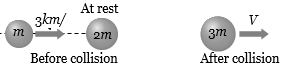
$A$ moving body of mass $m$ and velocity $3 \, km/h$ collides with a body of mass $2m$ at rest and sticks to it. Now the combined mass starts to move. What will be the combined velocity in $km/h$?
A
$3$
B
$2$
C
$1$
D
$4$
Solution
(C) According to the law of conservation of linear momentum,the total momentum before the collision is equal to the total momentum after the collision.
Initial momentum = $(m \times 3) + (2m \times 0) = 3m \, kg \cdot km/h$.
Final mass of the combined body = $m + 2m = 3m$.
Let the final velocity of the combined mass be $V$.
Final momentum = $(3m) \times V$.
Equating initial and final momentum:
$3m = 3m \times V$
$V = \frac{3m}{3m} = 1 \, km/h$.
Therefore,the combined velocity is $1 \, km/h$.
Initial momentum = $(m \times 3) + (2m \times 0) = 3m \, kg \cdot km/h$.
Final mass of the combined body = $m + 2m = 3m$.
Let the final velocity of the combined mass be $V$.
Final momentum = $(3m) \times V$.
Equating initial and final momentum:
$3m = 3m \times V$
$V = \frac{3m}{3m} = 1 \, km/h$.
Therefore,the combined velocity is $1 \, km/h$.
0 likesView Solution
6
PhysicsMediumMCQAIPMT · 1996
$A$ ball is dropped from a spacecraft revolving around the earth at a height of $120 \, km$. What will happen to the ball?
A
It will continue to move with velocity $v$ along the original orbit of the spacecraft.
B
It will move with the same speed tangentially to the spacecraft.
C
It will fall down to the earth gradually.
D
It will go very far in the space.
Solution
(A) When an object is dropped from a spacecraft orbiting the Earth,it possesses the same orbital velocity as the spacecraft at the moment of release.
According to Newton's first law of motion (Inertia),the object will continue to move with the same velocity $v$ along the original orbit of the spacecraft.
Since there is no external force acting on the ball to change its state of motion,it will not fall to the Earth nor move away into space; it will simply follow the same path as the spacecraft.
According to Newton's first law of motion (Inertia),the object will continue to move with the same velocity $v$ along the original orbit of the spacecraft.
Since there is no external force acting on the ball to change its state of motion,it will not fall to the Earth nor move away into space; it will simply follow the same path as the spacecraft.
0 likesView Solution
7
PhysicsEasyMCQAIPMT · 1996
At $0 \; K$,which of the following properties of a gas will be zero?
A
Kinetic energy
B
Potential energy
C
Vibrational energy
D
Density
Solution
(A) The average kinetic energy of a gas molecule is given by the formula $K.E. = \frac{3}{2} k_B T$,where $k_B$ is the Boltzmann constant and $T$ is the absolute temperature in Kelvin.
At $T = 0 \; K$,the kinetic energy becomes $K.E. = \frac{3}{2} k_B (0) = 0$.
Since the root mean square velocity $v_{rms} = \sqrt{\frac{3RT}{M}}$,at $T = 0 \; K$,$v_{rms} = 0$.
Therefore,the kinetic energy of the gas molecules becomes zero at absolute zero temperature.
At $T = 0 \; K$,the kinetic energy becomes $K.E. = \frac{3}{2} k_B (0) = 0$.
Since the root mean square velocity $v_{rms} = \sqrt{\frac{3RT}{M}}$,at $T = 0 \; K$,$v_{rms} = 0$.
Therefore,the kinetic energy of the gas molecules becomes zero at absolute zero temperature.
0 likesView Solution
8
PhysicsEasyMCQAIPMT · 1996
An ideal gas,undergoing adiabatic change,has which of the following pressure-temperature relationships?
A
$P^\gamma T^{1-\gamma} = \text{constant}$
B
$P^\gamma T^{\gamma-1} = \text{constant}$
C
$P^{\gamma-1} T^\gamma = \text{constant}$
D
$P^{1-\gamma} T^\gamma = \text{constant}$
Solution
(D) For an adiabatic process,the relationship between pressure $(P)$ and volume $(V)$ is given by $PV^\gamma = \text{constant}$.
From the ideal gas equation,$PV = RT$,we can write $V = \frac{RT}{P}$.
Substituting this into the adiabatic equation:
$P \left( \frac{RT}{P} \right)^\gamma = \text{constant}$
$P \cdot \frac{T^\gamma}{P^\gamma} = \text{constant}$
$P^{1-\gamma} T^\gamma = \text{constant}$.
Therefore,the correct option is $D$.
From the ideal gas equation,$PV = RT$,we can write $V = \frac{RT}{P}$.
Substituting this into the adiabatic equation:
$P \left( \frac{RT}{P} \right)^\gamma = \text{constant}$
$P \cdot \frac{T^\gamma}{P^\gamma} = \text{constant}$
$P^{1-\gamma} T^\gamma = \text{constant}$.
Therefore,the correct option is $D$.
0 likesView Solution
9
PhysicsMediumMCQAIPMT · 1996
$A$ diatomic gas initially at $18^oC$ is compressed adiabatically to one-eighth of its original volume. The temperature after compression will be
A
$10^oC$
B
$887^oC$
C
$668K$
D
$144^oC$
Solution
(C) For an adiabatic process,the relationship between temperature and volume is given by $T_1 V_1^{\gamma - 1} = T_2 V_2^{\gamma - 1}$.
Given: Initial temperature $T_1 = 18 + 273 = 291 \ K$,initial volume $V_1 = V$,final volume $V_2 = V/8$,and for a diatomic gas,the adiabatic index $\gamma = 1.4$.
Substituting the values: $T_2 = T_1 (V_1 / V_2)^{\gamma - 1}$.
$T_2 = 291 \times (V / (V/8))^{1.4 - 1} = 291 \times (8)^{0.4}$.
Since $8^{0.4} = (2^3)^{0.4} = 2^{1.2} \approx 2.297$.
$T_2 = 291 \times 2.297 \approx 668.4 \ K$.
Converting to Celsius: $668.4 - 273 = 395.4^oC$. Note: Based on the provided options,$668 \ K$ is the correct value.
Given: Initial temperature $T_1 = 18 + 273 = 291 \ K$,initial volume $V_1 = V$,final volume $V_2 = V/8$,and for a diatomic gas,the adiabatic index $\gamma = 1.4$.
Substituting the values: $T_2 = T_1 (V_1 / V_2)^{\gamma - 1}$.
$T_2 = 291 \times (V / (V/8))^{1.4 - 1} = 291 \times (8)^{0.4}$.
Since $8^{0.4} = (2^3)^{0.4} = 2^{1.2} \approx 2.297$.
$T_2 = 291 \times 2.297 \approx 668.4 \ K$.
Converting to Celsius: $668.4 - 273 = 395.4^oC$. Note: Based on the provided options,$668 \ K$ is the correct value.
2 likesView Solution
10
PhysicsMediumMCQAIPMT · 1996
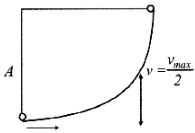
$A$ particle starts $S.H.M.$ from the mean position as shown in the figure. Its amplitude is $A$ and its time period is $T$. At a certain instant,its speed is half of its maximum speed. What is its displacement at this instant?
A
$\frac{A}{2}$
B
$\frac{A}{\sqrt{2}}$
C
$\frac{A\sqrt{3}}{2}$
D
$\frac{2A}{\sqrt{3}}$
Solution
(C) The maximum speed of a particle in $S.H.M.$ is given by $v_{\max} = \omega A$.
The speed $v$ at any displacement $y$ is given by $v = \omega \sqrt{A^2 - y^2}$.
According to the problem,the speed is half of the maximum speed,so $v = \frac{v_{\max}}{2} = \frac{\omega A}{2}$.
Equating the two expressions for speed:
$\frac{\omega A}{2} = \omega \sqrt{A^2 - y^2}$
Squaring both sides:
$\frac{A^2}{4} = A^2 - y^2$
Rearranging to solve for $y^2$:
$y^2 = A^2 - \frac{A^2}{4} = \frac{3A^2}{4}$
Taking the square root:
$y = \frac{\sqrt{3}A}{2}$
The speed $v$ at any displacement $y$ is given by $v = \omega \sqrt{A^2 - y^2}$.
According to the problem,the speed is half of the maximum speed,so $v = \frac{v_{\max}}{2} = \frac{\omega A}{2}$.
Equating the two expressions for speed:
$\frac{\omega A}{2} = \omega \sqrt{A^2 - y^2}$
Squaring both sides:
$\frac{A^2}{4} = A^2 - y^2$
Rearranging to solve for $y^2$:
$y^2 = A^2 - \frac{A^2}{4} = \frac{3A^2}{4}$
Taking the square root:
$y = \frac{\sqrt{3}A}{2}$
0 likesView Solution
11
PhysicsMediumMCQAIPMT · 1996
$A$ linear harmonic oscillator of force constant $2 \times 10^6 \, N/m$ and amplitude $0.01 \, m$ has a total mechanical energy of $160 \, J$. Its
A
Maximum potential energy is $100 \, J$
B
Maximum $K$.$E$. is $100 \, J$
C
Maximum $P$.$E$. is $160 \, J$
D
Both $(b)$ and $(c)$
Solution
(D) The total mechanical energy of the oscillator is given as $E = 160 \, J$.
For a linear harmonic oscillator,the energy associated with the harmonic oscillation (the kinetic energy part) is given by $E_{osc} = \frac{1}{2} k A^2$.
Substituting the given values: $E_{osc} = \frac{1}{2} \times (2 \times 10^6) \times (0.01)^2 = 10^6 \times 10^{-4} = 100 \, J$.
This $100 \, J$ represents the maximum kinetic energy $(K_{max})$ of the oscillator.
Since the total energy is $160 \, J$ and the oscillatory part is $100 \, J$,there must be an additional constant potential energy $U_0 = 160 - 100 = 60 \, J$.
The potential energy varies as $U(x) = U_0 + \frac{1}{2} k x^2$.
The maximum potential energy occurs at the extreme positions $(x = \pm A)$,which is $U_{max} = U_0 + \frac{1}{2} k A^2 = 60 + 100 = 160 \, J$.
Thus,both statements $(b)$ and $(c)$ are correct.
For a linear harmonic oscillator,the energy associated with the harmonic oscillation (the kinetic energy part) is given by $E_{osc} = \frac{1}{2} k A^2$.
Substituting the given values: $E_{osc} = \frac{1}{2} \times (2 \times 10^6) \times (0.01)^2 = 10^6 \times 10^{-4} = 100 \, J$.
This $100 \, J$ represents the maximum kinetic energy $(K_{max})$ of the oscillator.
Since the total energy is $160 \, J$ and the oscillatory part is $100 \, J$,there must be an additional constant potential energy $U_0 = 160 - 100 = 60 \, J$.
The potential energy varies as $U(x) = U_0 + \frac{1}{2} k x^2$.
The maximum potential energy occurs at the extreme positions $(x = \pm A)$,which is $U_{max} = U_0 + \frac{1}{2} k A^2 = 60 + 100 = 160 \, J$.
Thus,both statements $(b)$ and $(c)$ are correct.
0 likesView Solution
12
PhysicsEasyMCQAIPMT · 1996
Two sound waves having a phase difference of $60^{\circ}$ have a path difference of
A
$2 \lambda$
B
$\lambda / 2$
C
$\lambda / 6$
D
$\lambda / 3$
Solution
(C) The relationship between path difference $(\Delta x)$ and phase difference $(\phi)$ is given by the formula: $\Delta x = \frac{\lambda}{2\pi} \times \phi$.
Given phase difference $\phi = 60^{\circ}$.
Convert the phase difference into radians: $\phi = 60^{\circ} \times \frac{\pi}{180^{\circ}} = \frac{\pi}{3} \text{ radians}$.
Substitute the value of $\phi$ into the formula: $\Delta x = \frac{\lambda}{2\pi} \times \frac{\pi}{3}$.
Simplifying the expression: $\Delta x = \frac{\lambda}{6}$.
Therefore,the path difference is $\lambda / 6$.
Given phase difference $\phi = 60^{\circ}$.
Convert the phase difference into radians: $\phi = 60^{\circ} \times \frac{\pi}{180^{\circ}} = \frac{\pi}{3} \text{ radians}$.
Substitute the value of $\phi$ into the formula: $\Delta x = \frac{\lambda}{2\pi} \times \frac{\pi}{3}$.
Simplifying the expression: $\Delta x = \frac{\lambda}{6}$.
Therefore,the path difference is $\lambda / 6$.
0 likesView Solution
13
PhysicsMediumMCQAIPMT · 1996
The equation of a sound wave is $y = 0.0015 \sin (62.4x + 316t)$. The wavelength of this wave is ..... $unit$.
A
$0.2$
B
$0.1$
C
$0.3$
D
Cannot be calculated
Solution
(B) The standard equation of a traveling wave is given by $y = A \sin (kx + \omega t + \phi)$.
Comparing the given equation $y = 0.0015 \sin (62.4x + 316t)$ with the standard form,we identify the wave number $k$ as $62.4 \, \text{rad/unit}$.
The relationship between the wave number $k$ and the wavelength $\lambda$ is given by $k = \frac{2\pi}{\lambda}$.
Substituting the value of $k$,we get $62.4 = \frac{2 \times 3.14}{\lambda}$.
Solving for $\lambda$: $\lambda = \frac{6.28}{62.4} \approx 0.1 \, \text{unit}$.
Comparing the given equation $y = 0.0015 \sin (62.4x + 316t)$ with the standard form,we identify the wave number $k$ as $62.4 \, \text{rad/unit}$.
The relationship between the wave number $k$ and the wavelength $\lambda$ is given by $k = \frac{2\pi}{\lambda}$.
Substituting the value of $k$,we get $62.4 = \frac{2 \times 3.14}{\lambda}$.
Solving for $\lambda$: $\lambda = \frac{6.28}{62.4} \approx 0.1 \, \text{unit}$.
0 likesView Solution
14
PhysicsEasyMCQAIPMT · 1996
$A$ body,under the action of a force $\vec F = 6\hat i - 8\hat j + 10\hat k$,acquires an acceleration of $1\, m/s^2$. The mass of this body must be
A
$15\,kg$
B
$20\,kg$
C
$10\sqrt 2 \,kg$
D
$2\sqrt {10} \,kg$
Solution
(C) Given force vector $\vec F = 6\hat i - 8\hat j + 10\hat k$.
The magnitude of the force is given by $|\vec F| = \sqrt{6^2 + (-8)^2 + 10^2} = \sqrt{36 + 64 + 100} = \sqrt{200} = 10\sqrt 2 \,N$.
According to Newton's second law of motion,$F = ma$,where $m$ is the mass and $a$ is the acceleration.
Given acceleration $a = 1\, m/s^2$.
Therefore,$m = \frac{F}{a} = \frac{10\sqrt 2}{1} = 10\sqrt 2 \,kg$.
The magnitude of the force is given by $|\vec F| = \sqrt{6^2 + (-8)^2 + 10^2} = \sqrt{36 + 64 + 100} = \sqrt{200} = 10\sqrt 2 \,N$.
According to Newton's second law of motion,$F = ma$,where $m$ is the mass and $a$ is the acceleration.
Given acceleration $a = 1\, m/s^2$.
Therefore,$m = \frac{F}{a} = \frac{10\sqrt 2}{1} = 10\sqrt 2 \,kg$.
0 likesView Solution
15
PhysicsMediumMCQAIPMT · 1996
The equation of state of some gases can be expressed as $(P + \frac{a}{V^2}) = \frac{b\theta}{l}$,where $P$ is the pressure,$V$ is the volume,$\theta$ is the absolute temperature,and $a$ and $b$ are constants. The dimensional formula of $a$ is
A
$[ML^5T^{-2}]$
B
$[M^{-1}L^5T^2]$
C
$[ML^{-5}T^{-1}]$
D
$[ML^5T^1]$
Solution
(A) According to the principle of dimensional homogeneity,the dimensions of each term added or subtracted in an equation must be the same.
In the given equation $(P + \frac{a}{V^2}) = \frac{b\theta}{l}$,the term $P$ is added to $\frac{a}{V^2}$.
Therefore,$[P] = [\frac{a}{V^2}]$.
We know that the dimensional formula for pressure $P$ is $[ML^{-1}T^{-2}]$ and for volume $V$ is $[L^3]$.
Thus,$[a] = [P] \times [V^2]$.
Substituting the dimensions: $[a] = [ML^{-1}T^{-2}] \times [L^3]^2$.
$[a] = [ML^{-1}T^{-2}] \times [L^6]$.
$[a] = [ML^5T^{-2}]$.
In the given equation $(P + \frac{a}{V^2}) = \frac{b\theta}{l}$,the term $P$ is added to $\frac{a}{V^2}$.
Therefore,$[P] = [\frac{a}{V^2}]$.
We know that the dimensional formula for pressure $P$ is $[ML^{-1}T^{-2}]$ and for volume $V$ is $[L^3]$.
Thus,$[a] = [P] \times [V^2]$.
Substituting the dimensions: $[a] = [ML^{-1}T^{-2}] \times [L^3]^2$.
$[a] = [ML^{-1}T^{-2}] \times [L^6]$.
$[a] = [ML^5T^{-2}]$.
0 likesView Solution
16
PhysicsEasyMCQAIPMT · 1996
$A$ $10 \; N$ force is applied on a body,producing an acceleration of $1 \; m/s^2$ in it. The mass of the body is ...... $kg$.
A
$10$
B
$15$
C
$20$
D
$5$
Solution
(A) According to Newton's Second Law of Motion,the force $F$ applied to a body is equal to the product of its mass $m$ and acceleration $a$,given by the formula: $F = m \times a$.
To find the mass $m$,we rearrange the formula: $m = \frac{F}{a}$.
Given values are: Force $F = 10 \; N$ and acceleration $a = 1 \; m/s^2$.
Substituting these values into the formula: $m = \frac{10 \; N}{1 \; m/s^2} = 10 \; kg$.
Therefore,the mass of the body is $10 \; kg$.
To find the mass $m$,we rearrange the formula: $m = \frac{F}{a}$.
Given values are: Force $F = 10 \; N$ and acceleration $a = 1 \; m/s^2$.
Substituting these values into the formula: $m = \frac{10 \; N}{1 \; m/s^2} = 10 \; kg$.
Therefore,the mass of the body is $10 \; kg$.
0 likesView Solution
17
PhysicsMediumMCQAIPMT · 1996
The density of a cube is measured by measuring its mass and the length of its sides. If the maximum error in the measurement of mass and length are $3\%$ and $2\%$ respectively,then find the maximum error in the measurement of the density of the cube.
A
$12$
B
$14$
C
$7$
D
$9$
Solution
(D) The density $\rho$ of a cube is given by the formula $\rho = \frac{M}{V} = \frac{M}{L^3}$,where $M$ is the mass and $L$ is the length of the side of the cube.
Using the formula for relative error,the maximum percentage error in density is given by:
$\frac{\Delta \rho}{\rho} \times 100 = \frac{\Delta M}{M} \times 100 + 3 \times \left( \frac{\Delta L}{L} \times 100 \right)$
Given that the maximum error in mass $\frac{\Delta M}{M} \times 100 = 3\%$ and the maximum error in length $\frac{\Delta L}{L} \times 100 = 2\%$.
Substituting these values into the equation:
$\text{Percentage error in } \rho = 3\% + 3 \times (2\%) = 3\% + 6\% = 9\%$.
Therefore,the maximum error in the measurement of the density of the cube is $9\%$.
Using the formula for relative error,the maximum percentage error in density is given by:
$\frac{\Delta \rho}{\rho} \times 100 = \frac{\Delta M}{M} \times 100 + 3 \times \left( \frac{\Delta L}{L} \times 100 \right)$
Given that the maximum error in mass $\frac{\Delta M}{M} \times 100 = 3\%$ and the maximum error in length $\frac{\Delta L}{L} \times 100 = 2\%$.
Substituting these values into the equation:
$\text{Percentage error in } \rho = 3\% + 3 \times (2\%) = 3\% + 6\% = 9\%$.
Therefore,the maximum error in the measurement of the density of the cube is $9\%$.
0 likesView Solution
18
PhysicsEasyMCQAIPMT · 1996
What will be the formula for the mass of the Earth in terms of $g$,$R$,and $G$?
A
$G \frac{R}{g}$
B
$g \frac{R^{2}}{G}$
C
$g^{2} \frac{R}{G}$
D
$G \frac{g}{R}$
Solution
(B) The acceleration due to gravity $g$ on the surface of the Earth is given by the formula:
$g = \frac{GM}{R^2}$
where $G$ is the universal gravitational constant,$M$ is the mass of the Earth,and $R$ is the radius of the Earth.
To find the mass $M$,we rearrange the formula:
$M = \frac{gR^2}{G}$
Thus,the correct formula is $g \frac{R^2}{G}$.
$g = \frac{GM}{R^2}$
where $G$ is the universal gravitational constant,$M$ is the mass of the Earth,and $R$ is the radius of the Earth.
To find the mass $M$,we rearrange the formula:
$M = \frac{gR^2}{G}$
Thus,the correct formula is $g \frac{R^2}{G}$.
0 likesView Solution
19
PhysicsDifficultMCQAIPMT · 1996
The vectors $\vec{A}$ and $\vec{B}$ are such that $|\vec{A}+\vec{B}|=|\vec{A}-\vec{B}|$. The angle between the two vectors is: (in $^{\circ}$)
A
$60$
B
$75$
C
$45$
D
$90$
Solution
(D) The magnitude of the sum of two vectors is given by $|\vec{A}+\vec{B}|^2 = |\vec{A}|^2 + |\vec{B}|^2 + 2|\vec{A}||\vec{B}| \cos \theta$.
Similarly,the magnitude of the difference of two vectors is given by $|\vec{A}-\vec{B}|^2 = |\vec{A}|^2 + |\vec{B}|^2 - 2|\vec{A}||\vec{B}| \cos \theta$.
Given that $|\vec{A}+\vec{B}| = |\vec{A}-\vec{B}|$,we square both sides to get $|\vec{A}+\vec{B}|^2 = |\vec{A}-\vec{B}|^2$.
Substituting the expressions,we have $|\vec{A}|^2 + |\vec{B}|^2 + 2|\vec{A}||\vec{B}| \cos \theta = |\vec{A}|^2 + |\vec{B}|^2 - 2|\vec{A}||\vec{B}| \cos \theta$.
Canceling the common terms $|\vec{A}|^2$ and $|\vec{B}|^2$ from both sides,we get $2|\vec{A}||\vec{B}| \cos \theta = -2|\vec{A}||\vec{B}| \cos \theta$.
Rearranging the terms,we get $4|\vec{A}||\vec{B}| \cos \theta = 0$.
Since the vectors are non-zero,$|\vec{A}| \neq 0$ and $|\vec{B}| \neq 0$,therefore $\cos \theta = 0$.
This implies $\theta = 90^{\circ}$.
Similarly,the magnitude of the difference of two vectors is given by $|\vec{A}-\vec{B}|^2 = |\vec{A}|^2 + |\vec{B}|^2 - 2|\vec{A}||\vec{B}| \cos \theta$.
Given that $|\vec{A}+\vec{B}| = |\vec{A}-\vec{B}|$,we square both sides to get $|\vec{A}+\vec{B}|^2 = |\vec{A}-\vec{B}|^2$.
Substituting the expressions,we have $|\vec{A}|^2 + |\vec{B}|^2 + 2|\vec{A}||\vec{B}| \cos \theta = |\vec{A}|^2 + |\vec{B}|^2 - 2|\vec{A}||\vec{B}| \cos \theta$.
Canceling the common terms $|\vec{A}|^2$ and $|\vec{B}|^2$ from both sides,we get $2|\vec{A}||\vec{B}| \cos \theta = -2|\vec{A}||\vec{B}| \cos \theta$.
Rearranging the terms,we get $4|\vec{A}||\vec{B}| \cos \theta = 0$.
Since the vectors are non-zero,$|\vec{A}| \neq 0$ and $|\vec{B}| \neq 0$,therefore $\cos \theta = 0$.
This implies $\theta = 90^{\circ}$.
0 likesView Solution
20
PhysicsEasyMCQAIPMT · 1996
The energy stored in a capacitor of capacity $C$ which has been raised to a potential $V$ is given by
A
$\frac{1}{2} CV$
B
$\frac{1}{2} CV^2$
C
$CV$
D
$\frac{1}{2VC}$
Solution
(B) The energy stored in a capacitor is the work done in charging it.
If a capacitor of capacity $C$ is charged to a potential $V$,the work done $dW$ to bring an additional charge $dq$ is given by $dW = V' dq$,where $V' = q/C$.
Integrating this from $0$ to $Q$ (where $Q = CV$):
$U = \int_{0}^{Q} \frac{q}{C} dq = \frac{1}{C} \left[ \frac{q^2}{2} \right]_{0}^{Q} = \frac{Q^2}{2C}$.
Substituting $Q = CV$,we get $U = \frac{(CV)^2}{2C} = \frac{1}{2} CV^2$.
If a capacitor of capacity $C$ is charged to a potential $V$,the work done $dW$ to bring an additional charge $dq$ is given by $dW = V' dq$,where $V' = q/C$.
Integrating this from $0$ to $Q$ (where $Q = CV$):
$U = \int_{0}^{Q} \frac{q}{C} dq = \frac{1}{C} \left[ \frac{q^2}{2} \right]_{0}^{Q} = \frac{Q^2}{2C}$.
Substituting $Q = CV$,we get $U = \frac{(CV)^2}{2C} = \frac{1}{2} CV^2$.
0 likesView Solution
21
PhysicsMediumMCQAIPMT · 1996
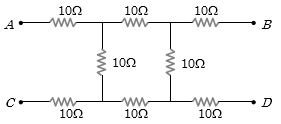
What will be the equivalent resistance between the two points $A$ and $D$ in the given circuit (in $Omega$)? (All resistors are $10 \ \Omega$ each.)
A
$10$
B
$20$
C
$30$
D
$40$
Solution
(C) To find the equivalent resistance between points $A$ and $D$,we analyze the circuit structure. The circuit consists of a ladder-like network.
$1$. The resistors connected to terminals $B$ and $C$ are open-circuited relative to the path between $A$ and $D$.
$2$. Specifically,the $10 \ \Omega$ resistor connected to $B$ is in series with nothing,and the $10 \ \Omega$ resistor connected to $C$ is in series with nothing.
$3$. Simplifying the network: The path from $A$ to $D$ involves the first $10 \ \Omega$ resistor,then a parallel combination of the middle vertical $10 \ \Omega$ resistor and the rest of the network.
$4$. By calculating the series and parallel combinations step-by-step,the equivalent resistance between $A$ and $D$ is found to be $30 \ \Omega$.
$1$. The resistors connected to terminals $B$ and $C$ are open-circuited relative to the path between $A$ and $D$.
$2$. Specifically,the $10 \ \Omega$ resistor connected to $B$ is in series with nothing,and the $10 \ \Omega$ resistor connected to $C$ is in series with nothing.
$3$. Simplifying the network: The path from $A$ to $D$ involves the first $10 \ \Omega$ resistor,then a parallel combination of the middle vertical $10 \ \Omega$ resistor and the rest of the network.
$4$. By calculating the series and parallel combinations step-by-step,the equivalent resistance between $A$ and $D$ is found to be $30 \ \Omega$.
0 likesView Solution
22
PhysicsEasyMCQAIPMT · 1996
The magnetic field $d\overrightarrow{B}$ due to a small current element $d\overrightarrow{l}$ at a distance $\overrightarrow{r}$ from an element carrying current $i$ is given by:
A
$d\overrightarrow{B} = \frac{\mu_0}{4\pi} i \left( \frac{d\overrightarrow{l} \times \overrightarrow{r}}{r} \right)$
B
$d\overrightarrow{B} = \frac{\mu_0}{4\pi} i^2 \left( \frac{d\overrightarrow{l} \times \overrightarrow{r}}{r} \right)$
C
$d\overrightarrow{B} = \frac{\mu_0}{4\pi} i^2 \left( \frac{d\overrightarrow{l} \times \overrightarrow{r}}{r^2} \right)$
D
$d\overrightarrow{B} = \frac{\mu_0}{4\pi} i \left( \frac{d\overrightarrow{l} \times \overrightarrow{r}}{r^3} \right)$
Solution
(D) According to the Biot-Savart Law,the magnetic field $dB$ due to a current element $idl$ at a distance $r$ is given by the magnitude: $dB = \frac{\mu_0}{4\pi} \frac{idl \sin \theta}{r^2}$.
In vector form,this is expressed as $d\overrightarrow{B} = \frac{\mu_0}{4\pi} \frac{i(d\overrightarrow{l} \times \widehat{r})}{r^2}$.
Since the unit vector $\widehat{r} = \frac{\overrightarrow{r}}{r}$,we substitute this into the equation:
$d\overrightarrow{B} = \frac{\mu_0}{4\pi} \frac{i(d\overrightarrow{l} \times \overrightarrow{r})}{r^2 \cdot r} = \frac{\mu_0}{4\pi} \frac{i(d\overrightarrow{l} \times \overrightarrow{r})}{r^3}$.
Thus,option $D$ is correct.
In vector form,this is expressed as $d\overrightarrow{B} = \frac{\mu_0}{4\pi} \frac{i(d\overrightarrow{l} \times \widehat{r})}{r^2}$.
Since the unit vector $\widehat{r} = \frac{\overrightarrow{r}}{r}$,we substitute this into the equation:
$d\overrightarrow{B} = \frac{\mu_0}{4\pi} \frac{i(d\overrightarrow{l} \times \overrightarrow{r})}{r^2 \cdot r} = \frac{\mu_0}{4\pi} \frac{i(d\overrightarrow{l} \times \overrightarrow{r})}{r^3}$.
Thus,option $D$ is correct.
0 likesView Solution
23
PhysicsEasyMCQAIPMT · 1996
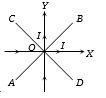
Two very thin metallic wires placed along $X$ and $Y$-axis carry equal currents as shown in the figure. $AB$ and $CD$ are lines at $45^\circ$ with the axes,with the origin of the axes at $O$. The magnetic field will be zero on the line:
A
$AB$
B
$CD$
C
Segment $OB$ only of line $AB$
D
Segment $OC$ only of line $CD$
Solution
(A) Let the current in both wires be $I$. The magnetic field due to a long straight wire at a distance $r$ is given by $B = \frac{\mu_0 I}{2\pi r}$.
For any point on the line $AB$ (which makes an angle of $45^\circ$ with the axes),the perpendicular distance from the $X$-axis and the $Y$-axis is the same,say $r$.
The magnetic field due to the wire along the $X$-axis at a point $(x, y)$ on $AB$ is directed into the plane (using the right-hand thumb rule),while the magnetic field due to the wire along the $Y$-axis is directed out of the plane.
Since the distances are equal and the currents are equal,the magnitudes of the magnetic fields are equal: $B_X = B_Y = \frac{\mu_0 I}{2\pi r}$.
Because the directions are opposite,the net magnetic field $B_{net} = B_X - B_Y = 0$ at every point on the line $AB$.
For any point on the line $AB$ (which makes an angle of $45^\circ$ with the axes),the perpendicular distance from the $X$-axis and the $Y$-axis is the same,say $r$.
The magnetic field due to the wire along the $X$-axis at a point $(x, y)$ on $AB$ is directed into the plane (using the right-hand thumb rule),while the magnetic field due to the wire along the $Y$-axis is directed out of the plane.
Since the distances are equal and the currents are equal,the magnitudes of the magnetic fields are equal: $B_X = B_Y = \frac{\mu_0 I}{2\pi r}$.
Because the directions are opposite,the net magnetic field $B_{net} = B_X - B_Y = 0$ at every point on the line $AB$.
0 likesView Solution
24
PhysicsMediumMCQAIPMT · 1996
$A$ metal ring is held horizontally and a bar magnet is dropped through the ring with its length along the axis of the ring. The acceleration of the falling magnet is
A
Equal to $g$
B
Less than $g$
C
More than $g$
D
Either $(a)$ or $(c)$
Solution
(B) According to Lenz's Law,the direction of the induced current in the ring is such that it opposes the cause that produces it.
When the magnet falls through the ring,the change in magnetic flux induces an emf and a current in the ring.
This induced current creates a magnetic field that exerts an upward repulsive force on the approaching pole of the magnet and an upward attractive force on the receding pole of the magnet.
Both these forces act against the gravitational force,resulting in a net downward force that is less than the weight of the magnet.
Therefore,the acceleration of the falling magnet is less than the acceleration due to gravity,$g$.
Note: If the ring is broken (not a closed loop),no induced current will flow,and the magnet will fall freely with acceleration $a = g$.
When the magnet falls through the ring,the change in magnetic flux induces an emf and a current in the ring.
This induced current creates a magnetic field that exerts an upward repulsive force on the approaching pole of the magnet and an upward attractive force on the receding pole of the magnet.
Both these forces act against the gravitational force,resulting in a net downward force that is less than the weight of the magnet.
Therefore,the acceleration of the falling magnet is less than the acceleration due to gravity,$g$.
Note: If the ring is broken (not a closed loop),no induced current will flow,and the magnet will fall freely with acceleration $a = g$.
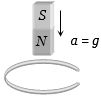
0 likesView Solution
25
PhysicsEasyMCQAIPMT · 1996
$A$ beam of electrons is moving with constant velocity in a region having electric and magnetic fields of strength $20 \ V m^{-1}$ and $0.5 \ T$ at right angles to the direction of motion of the electrons. What is the velocity of the electrons in $m s^{-1}$?
A
$20$
B
$40$
C
$8$
D
$5.5$
Solution
(B) When a charged particle moves with a constant velocity through a region containing both electric field $(E)$ and magnetic field $(B)$ that are mutually perpendicular to each other and to the velocity vector,the net Lorentz force acting on the particle is zero.
Given,the electric field $E = 20 \ V m^{-1}$ and the magnetic field $B = 0.5 \ T$.
The condition for the particle to move with constant velocity is given by the balance of electric and magnetic forces:
$qE = qvB$
$v = \frac{E}{B}$
Substituting the given values:
$v = \frac{20}{0.5} = 40 \ m s^{-1}$.
Thus,the velocity of the electrons is $40 \ m s^{-1}$.
Given,the electric field $E = 20 \ V m^{-1}$ and the magnetic field $B = 0.5 \ T$.
The condition for the particle to move with constant velocity is given by the balance of electric and magnetic forces:
$qE = qvB$
$v = \frac{E}{B}$
Substituting the given values:
$v = \frac{20}{0.5} = 40 \ m s^{-1}$.
Thus,the velocity of the electrons is $40 \ m s^{-1}$.
0 likesView Solution
26
PhysicsEasyMCQAIPMT · 1996
If a photon has velocity $c$ and frequency $\nu$,then which of the following represents its wavelength?
A
$\frac{h\nu}{c^2}$
B
$\frac{h\nu}{c}$
C
$\frac{c}{\nu}$
D
$h\nu$
Solution
(C) The energy of a photon is given by $E = h\nu$,where $h$ is Planck's constant and $\nu$ is the frequency.
Also,the relationship between the speed of light $c$,frequency $\nu$,and wavelength $\lambda$ is given by $c = \nu \lambda$.
Rearranging this formula to solve for wavelength $\lambda$,we get $\lambda = \frac{c}{\nu}$.
Also,the relationship between the speed of light $c$,frequency $\nu$,and wavelength $\lambda$ is given by $c = \nu \lambda$.
Rearranging this formula to solve for wavelength $\lambda$,we get $\lambda = \frac{c}{\nu}$.
0 likesView Solution
27
PhysicsEasyMCQAIPMT · 1996
The minimum wavelength of the $X$-rays produced by electrons accelerated through a potential difference of $V$ volts is directly proportional to
A
$\sqrt{V}$
B
$V^2$
C
$1/\sqrt{V}$
D
$1/V$
Solution
(D) The energy of an electron accelerated through a potential difference $V$ is given by $E = eV$.
When this electron strikes the target,it produces $X$-rays. The maximum energy of the emitted $X$-ray photon corresponds to the total kinetic energy of the electron,which is $E_{max} = h\nu_{max} = \frac{hc}{\lambda_{min}}$.
Equating the two,we get $eV = \frac{hc}{\lambda_{min}}$.
Rearranging for the minimum wavelength,we find $\lambda_{min} = \frac{hc}{eV}$.
Since $h$,$c$,and $e$ are constants,it follows that $\lambda_{min} \propto \frac{1}{V}$.
When this electron strikes the target,it produces $X$-rays. The maximum energy of the emitted $X$-ray photon corresponds to the total kinetic energy of the electron,which is $E_{max} = h\nu_{max} = \frac{hc}{\lambda_{min}}$.
Equating the two,we get $eV = \frac{hc}{\lambda_{min}}$.
Rearranging for the minimum wavelength,we find $\lambda_{min} = \frac{hc}{eV}$.
Since $h$,$c$,and $e$ are constants,it follows that $\lambda_{min} \propto \frac{1}{V}$.
0 likesView Solution
28
PhysicsEasyMCQAIPMT · 1996
According to Einstein's photoelectric equation,the graph between the kinetic energy of photoelectrons ejected and the frequency of incident radiation is
A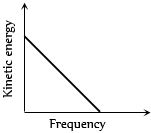
B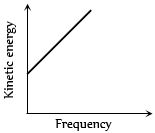
C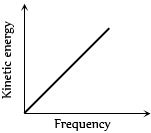
D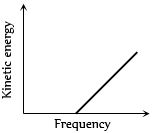
Solution
(D) According to Einstein's photoelectric equation:
$K_{\max} = h\nu - \phi_0$
where $K_{\max}$ is the maximum kinetic energy of the ejected photoelectrons,$h$ is Planck's constant,$\nu$ is the frequency of incident radiation,and $\phi_0 = h\nu_0$ is the work function of the metal.
Comparing this with the equation of a straight line $y = mx + c$:
Here,$y = K_{\max}$,$x = \nu$,$m = h$ (slope),and $c = -\phi_0$ (y-intercept).
Since the slope $h$ is positive and the intercept $-\phi_0$ is negative,the graph is a straight line that starts from a threshold frequency $\nu_0$ on the x-axis and has a positive slope. This corresponds to the graph where the line intersects the x-axis at $\nu_0$ and increases linearly for $\nu > \nu_0$.
$K_{\max} = h\nu - \phi_0$
where $K_{\max}$ is the maximum kinetic energy of the ejected photoelectrons,$h$ is Planck's constant,$\nu$ is the frequency of incident radiation,and $\phi_0 = h\nu_0$ is the work function of the metal.
Comparing this with the equation of a straight line $y = mx + c$:
Here,$y = K_{\max}$,$x = \nu$,$m = h$ (slope),and $c = -\phi_0$ (y-intercept).
Since the slope $h$ is positive and the intercept $-\phi_0$ is negative,the graph is a straight line that starts from a threshold frequency $\nu_0$ on the x-axis and has a positive slope. This corresponds to the graph where the line intersects the x-axis at $\nu_0$ and increases linearly for $\nu > \nu_0$.
0 likesView Solution
29
PhysicsEasyMCQAIPMT · 1996
In the Bohr's hydrogen atom model,the radius of the stationary orbit is directly proportional to ($n =$ principle quantum number)
A
$n^{-1}$
B
$n$
C
$n^{-2}$
D
$n^2$
Solution
(D) According to the Bohr model of the hydrogen atom,the radius of the $n^{th}$ stationary orbit is given by the formula:
$r_n = \frac{\varepsilon_0 n^2 h^2}{\pi Z m e^2}$
In this expression,$\varepsilon_0$ is the permittivity of free space,$h$ is Planck's constant,$Z$ is the atomic number,$m$ is the mass of the electron,and $e$ is the elementary charge.
Since all these parameters are constants for a given atom,the radius $r$ is directly proportional to the square of the principal quantum number $n$.
Therefore,$r \propto n^2$.
$r_n = \frac{\varepsilon_0 n^2 h^2}{\pi Z m e^2}$
In this expression,$\varepsilon_0$ is the permittivity of free space,$h$ is Planck's constant,$Z$ is the atomic number,$m$ is the mass of the electron,and $e$ is the elementary charge.
Since all these parameters are constants for a given atom,the radius $r$ is directly proportional to the square of the principal quantum number $n$.
Therefore,$r \propto n^2$.
0 likesView Solution
30
PhysicsEasyMCQAIPMT · 1996
The energy of a hydrogen atom in its ground state is $-13.6 \ eV$. The energy of the level corresponding to the quantum number $n = 2$ (first excited state) in the hydrogen atom is......$eV$.
A
$-2.72$
B
$-0.85$
C
$-0.54$
D
$-3.4$
Solution
(D) The energy of an electron in the $n^{th}$ orbit of a hydrogen atom is given by the formula: $E_n = \frac{-13.6 \ eV}{n^2}$.
For the first excited state,the quantum number is $n = 2$.
Substituting $n = 2$ into the formula:
$E_2 = \frac{-13.6 \ eV}{2^2} = \frac{-13.6 \ eV}{4} = -3.4 \ eV$.
For the first excited state,the quantum number is $n = 2$.
Substituting $n = 2$ into the formula:
$E_2 = \frac{-13.6 \ eV}{2^2} = \frac{-13.6 \ eV}{4} = -3.4 \ eV$.
0 likesView Solution
31
PhysicsDifficultMCQAIPMT · 1996
$A$ nucleus ruptures into two nuclear parts which have their velocity ratio equal to $2 : 1$. What will be the ratio of their nuclear size (nuclear radius)?
A
$2^{1/3} : 1$
B
$1 : 2^{1/3}$
C
$3^{1/2} : 1$
D
$1 : 3^{1/2}$
Solution
(B) According to the law of conservation of linear momentum,the initial momentum of the nucleus is zero,so the final momenta of the two parts must be equal and opposite: $m_1 v_1 = m_2 v_2$.
Given the velocity ratio $\frac{v_1}{v_2} = \frac{2}{1}$,we have $\frac{m_2}{m_1} = \frac{v_1}{v_2} = \frac{2}{1}$.
Since the density $\rho$ of nuclear matter is constant,the mass $m$ is proportional to the volume $V$,where $V = \frac{4}{3} \pi r^3$. Thus,$\frac{m_2}{m_1} = \frac{r_2^3}{r_1^3}$.
Equating the ratios: $\frac{r_2^3}{r_1^3} = \frac{2}{1}$.
Taking the cube root on both sides: $\frac{r_2}{r_1} = 2^{1/3}$.
Therefore,the ratio of their radii $r_1 : r_2 = 1 : 2^{1/3}$.
Given the velocity ratio $\frac{v_1}{v_2} = \frac{2}{1}$,we have $\frac{m_2}{m_1} = \frac{v_1}{v_2} = \frac{2}{1}$.
Since the density $\rho$ of nuclear matter is constant,the mass $m$ is proportional to the volume $V$,where $V = \frac{4}{3} \pi r^3$. Thus,$\frac{m_2}{m_1} = \frac{r_2^3}{r_1^3}$.
Equating the ratios: $\frac{r_2^3}{r_1^3} = \frac{2}{1}$.
Taking the cube root on both sides: $\frac{r_2}{r_1} = 2^{1/3}$.
Therefore,the ratio of their radii $r_1 : r_2 = 1 : 2^{1/3}$.
0 likesView Solution
32
PhysicsEasyMCQAIPMT · 1996
When $NPN$ transistor is used as an amplifier,
A
Electrons move from base to collector
B
Holes move from emitter to base
C
Electrons move from collector to base
D
Holes move from base to emitter
Solution
(A) In an $NPN$ transistor,the emitter is $N-$type,the base is $P-$type,and the collector is $N-$type. When used as an amplifier,the emitter-base junction is forward-biased and the collector-base junction is reverse-biased. Electrons,being the majority charge carriers in the $N-$type emitter,are injected into the base. Due to the thin base region,most of these electrons diffuse through the base and are collected by the collector. Thus,electrons move from the emitter to the base and then from the base to the collector.
0 likesView Solution
33
PhysicsEasyMCQAIPMT · 1996
$A$ truth table is given below. Which of the following logic gates corresponds to this truth table?
$A: 0, 1, 0, 1$
$B: 0, 0, 1, 1$
$Y: 1, 0, 0, 0$
$A: 0, 1, 0, 1$
$B: 0, 0, 1, 1$
$Y: 1, 0, 0, 0$
A
$XOR$ gate
B
$NOR$ gate
C
$AND$ gate
D
$OR$ gate
Solution
(B) The given truth table is:
$A=0, B=0 \implies Y=1$
$A=1, B=0 \implies Y=0$
$A=0, B=1 \implies Y=0$
$A=1, B=1 \implies Y=0$
For a $NOR$ gate,the output is defined by the Boolean expression $Y = \overline{A + B}$.
Calculating for each case:
$1$. For $A=0, B=0$: $Y = \overline{0+0} = \overline{0} = 1$.
$2$. For $A=1, B=0$: $Y = \overline{1+0} = \overline{1} = 0$.
$3$. For $A=0, B=1$: $Y = \overline{0+1} = \overline{1} = 0$.
$4$. For $A=1, B=1$: $Y = \overline{1+1} = \overline{1} = 0$.
This matches the given truth table. Therefore,the correct option is $B$.
$A=0, B=0 \implies Y=1$
$A=1, B=0 \implies Y=0$
$A=0, B=1 \implies Y=0$
$A=1, B=1 \implies Y=0$
For a $NOR$ gate,the output is defined by the Boolean expression $Y = \overline{A + B}$.
Calculating for each case:
$1$. For $A=0, B=0$: $Y = \overline{0+0} = \overline{0} = 1$.
$2$. For $A=1, B=0$: $Y = \overline{1+0} = \overline{1} = 0$.
$3$. For $A=0, B=1$: $Y = \overline{0+1} = \overline{1} = 0$.
$4$. For $A=1, B=1$: $Y = \overline{1+1} = \overline{1} = 0$.
This matches the given truth table. Therefore,the correct option is $B$.
0 likesView Solution
34
PhysicsEasyMCQAIPMT · 1996
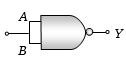
This symbol represents
A
$NOT$ gate
B
$OR$ gate
C
$AND$ gate
D
$NOR$ gate
Solution
$(A)$ The given symbol shows a $NAND$ gate where the two inputs $A$ and $B$ are shorted together to form a single input.
For a $NAND$ gate, the output is $Y = \overline{A \cdot B}$.
Since the inputs are shorted, $A = B = X$.
Therefore, the output becomes $Y = \overline{X \cdot X} = \overline{X}$.
This is the Boolean expression for a $NOT$ gate.
Thus, the combination acts as a $NOT$ gate.
For a $NAND$ gate, the output is $Y = \overline{A \cdot B}$.
Since the inputs are shorted, $A = B = X$.
Therefore, the output becomes $Y = \overline{X \cdot X} = \overline{X}$.
This is the Boolean expression for a $NOT$ gate.
Thus, the combination acts as a $NOT$ gate.
0 likesView Solution
35
PhysicsEasyMCQAIPMT · 1996
Light travels through a glass plate of thickness $t$ and having refractive index $n$. If $c$ is the velocity of light in vacuum,the time taken by the light to travel this thickness of glass is
A
$t / (nc)$
B
$tnc$
C
$nt / c$
D
$tc / n$
Solution
(C) The speed of light in a medium with refractive index $n$ is given by $v = c / n$,where $c$ is the speed of light in vacuum.
Time taken to travel a distance $t$ is given by the formula: $Time = \text{Distance} / \text{Speed}$.
Substituting the values,we get: $Time = t / (c / n) = (nt) / c$.
Therefore,the correct option is $C$.
Time taken to travel a distance $t$ is given by the formula: $Time = \text{Distance} / \text{Speed}$.
Substituting the values,we get: $Time = t / (c / n) = (nt) / c$.
Therefore,the correct option is $C$.
0 likesView Solution
36
PhysicsEasyMCQAIPMT · 1996
The refractive index of water is $1.33$. What will be the speed of light in water?
A
$3 \times 10^8 \ m/s$
B
$2.25 \times 10^8 \ m/s$
C
$4 \times 10^8 \ m/s$
D
$1.33 \times 10^8 \ m/s$
Solution
(B) The refractive index $\mu$ is defined as the ratio of the speed of light in a vacuum $(c)$ to the speed of light in the medium $(v)$: $\mu = \frac{c}{v}$.
Given: $\mu = 1.33$ and $c = 3 \times 10^8 \ m/s$.
Rearranging the formula to solve for $v$: $v = \frac{c}{\mu}$.
Substituting the values: $v = \frac{3 \times 10^8}{1.33} \approx 2.25 \times 10^8 \ m/s$.
Therefore,the speed of light in water is $2.25 \times 10^8 \ m/s$.
Given: $\mu = 1.33$ and $c = 3 \times 10^8 \ m/s$.
Rearranging the formula to solve for $v$: $v = \frac{c}{\mu}$.
Substituting the values: $v = \frac{3 \times 10^8}{1.33} \approx 2.25 \times 10^8 \ m/s$.
Therefore,the speed of light in water is $2.25 \times 10^8 \ m/s$.
0 likesView Solution
37
PhysicsMediumMCQAIPMT · 1996
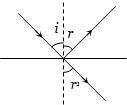
$A$ ray of light is incident at an angle $i$ from a denser to a rarer medium. The reflected and the refracted rays are mutually perpendicular. The angle of reflection is $r$ and the angle of refraction is $r'$. Then the critical angle $C$ will be:
A
$\sin^{-1}(\sin r)$
B
$\sin^{-1}(\tan r')$
C
$\sin^{-1}(\tan i)$
D
$\tan^{-1}(\sin i)$
Solution
(C) According to the law of reflection,the angle of incidence $i$ is equal to the angle of reflection $r$,so $i = r$.
Given that the reflected ray and the refracted ray are mutually perpendicular,the sum of the angle of reflection $r$,the angle between the reflected ray and the refracted ray $(90^{\circ})$,and the angle of refraction $r'$ is $180^{\circ}$.
Thus,$r + 90^{\circ} + r' = 180^{\circ}$,which implies $r' = 90^{\circ} - r$. Since $i = r$,we have $r' = 90^{\circ} - i$.
Applying Snell's law at the interface,the refractive index of the denser medium with respect to the rarer medium is given by $\mu = \frac{\sin r'}{\sin i}$.
We know that the critical angle $C$ is related to the refractive index by $\sin C = \frac{1}{\mu}$.
Therefore,$\sin C = \frac{\sin i}{\sin r'} = \frac{\sin i}{\sin(90^{\circ} - i)} = \frac{\sin i}{\cos i} = \tan i$.
Hence,the critical angle is $C = \sin^{-1}(\tan i)$.
Given that the reflected ray and the refracted ray are mutually perpendicular,the sum of the angle of reflection $r$,the angle between the reflected ray and the refracted ray $(90^{\circ})$,and the angle of refraction $r'$ is $180^{\circ}$.
Thus,$r + 90^{\circ} + r' = 180^{\circ}$,which implies $r' = 90^{\circ} - r$. Since $i = r$,we have $r' = 90^{\circ} - i$.
Applying Snell's law at the interface,the refractive index of the denser medium with respect to the rarer medium is given by $\mu = \frac{\sin r'}{\sin i}$.
We know that the critical angle $C$ is related to the refractive index by $\sin C = \frac{1}{\mu}$.
Therefore,$\sin C = \frac{\sin i}{\sin r'} = \frac{\sin i}{\sin(90^{\circ} - i)} = \frac{\sin i}{\cos i} = \tan i$.
Hence,the critical angle is $C = \sin^{-1}(\tan i)$.
0 likesView Solution
38
PhysicsMediumMCQAIPMT · 1996
If a convex lens of focal length $80 \;cm$ and a concave lens of focal length $50 \;cm$ are combined together,what will be their resulting power?
A
$+ 6.5 \; D$
B
$- 6.5 \; D$
C
$+ 7.5 \; D$
D
$- 0.75 \; D$
Solution
(D) The power of a lens is given by $P = \frac{1}{f}$ (where $f$ is in meters).
For a convex lens,the focal length $f_1 = + 80 \; cm = + 0.8 \; m$.
For a concave lens,the focal length $f_2 = - 50 \; cm = - 0.5 \; m$.
The power of the combination is $P = P_1 + P_2 = \frac{1}{f_1} + \frac{1}{f_2}$.
Substituting the values: $P = \frac{1}{0.8} + \frac{1}{-0.5} = 1.25 - 2.0 = - 0.75 \; D$.
For a convex lens,the focal length $f_1 = + 80 \; cm = + 0.8 \; m$.
For a concave lens,the focal length $f_2 = - 50 \; cm = - 0.5 \; m$.
The power of the combination is $P = P_1 + P_2 = \frac{1}{f_1} + \frac{1}{f_2}$.
Substituting the values: $P = \frac{1}{0.8} + \frac{1}{-0.5} = 1.25 - 2.0 = - 0.75 \; D$.
0 likesView Solution
39
PhysicsMediumMCQAIPMT · 1996
$f_V$ and $f_R$ are the focal lengths of a convex lens for violet and red light respectively,and $F_V$ and $F_R$ are the focal lengths of a concave lens for violet and red light respectively. Then:
A
$f_V < f_R$ and $F_V < F_R$
B
$f_V < f_R$ and $F_V > F_R$
C
$f_V > f_R$ and $F_V > F_R$
D
$f_V > f_R$ and $F_V < F_R$
Solution
(B) The refractive index of a material is higher for violet light than for red light $(n_V > n_R)$.
For a convex lens,the focal length is given by the lens maker's formula: $\frac{1}{f} = (n - 1) \left( \frac{1}{R_1} - \frac{1}{R_2} \right)$. Since $n_V > n_R$,the power of the lens is greater for violet light,meaning the focal length $f_V$ is smaller than $f_R$ $(f_V < f_R)$.
For a concave lens,the focal length is negative. The magnitude of the focal length $|F|$ follows the same logic as the convex lens,where $|F_V| < |F_R|$. Since both are negative,a smaller magnitude for a negative number implies a larger value: $F_V > F_R$ (e.g.,$-2 > -5$).
For a convex lens,the focal length is given by the lens maker's formula: $\frac{1}{f} = (n - 1) \left( \frac{1}{R_1} - \frac{1}{R_2} \right)$. Since $n_V > n_R$,the power of the lens is greater for violet light,meaning the focal length $f_V$ is smaller than $f_R$ $(f_V < f_R)$.
For a concave lens,the focal length is negative. The magnitude of the focal length $|F|$ follows the same logic as the convex lens,where $|F_V| < |F_R|$. Since both are negative,a smaller magnitude for a negative number implies a larger value: $F_V > F_R$ (e.g.,$-2 > -5$).
0 likesView Solution
40
PhysicsMediumMCQAIPMT · 1996
In a Fresnel biprism experiment,the two positions of the lens give separations between the virtual slits as $16 \; cm$ and $9 \; cm$ respectively. What is the actual distance of separation (in $cm$)?
A
$14$
B
$13$
C
$12$
D
$12.5$
Solution
(C) In a Fresnel biprism experiment,the actual distance of separation $d$ between the two virtual slits is given by the geometric mean of the two separations $d_1$ and $d_2$ obtained by the displacement method.
The formula is $d = \sqrt{d_1 d_2}$.
Given,$d_1 = 16 \; cm$ and $d_2 = 9 \; cm$.
Substituting the values,we get $d = \sqrt{16 \times 9} = \sqrt{144} = 12 \; cm$.
Therefore,the actual distance of separation is $12 \; cm$.
The formula is $d = \sqrt{d_1 d_2}$.
Given,$d_1 = 16 \; cm$ and $d_2 = 9 \; cm$.
Substituting the values,we get $d = \sqrt{16 \times 9} = \sqrt{144} = 12 \; cm$.
Therefore,the actual distance of separation is $12 \; cm$.
0 likesView Solution
41
PhysicsMediumMCQAIPMT · 1996
Which of the following dimensions will be the same as that of time?
A
$\frac{C}{L}$
B
$\frac{L}{R}$
C
$LC$
D
$\frac{R}{L}$
Solution
(B) The dimension of resistance $R$ is $[M L^2 T^{-3} I^{-2}]$.
The dimension of inductance $L$ is $[M L^2 T^{-2} I^{-2}]$.
The dimension of capacitance $C$ is $[M^{-1} L^{-2} T^4 I^2]$.
Checking option $B$:
$\frac{L}{R} = \frac{[M L^2 T^{-2} I^{-2}]}{[M L^2 T^{-3} I^{-2}]} = [T^1] = T$.
Checking option $C$:
$\sqrt{LC} = \sqrt{[M L^2 T^{-2} I^{-2}] \cdot [M^{-1} L^{-2} T^4 I^2]} = \sqrt{[T^2]} = [T^1] = T$.
Since both $B$ and $C$ result in the dimension of time,the question implies identifying expressions with time dimensions. Given the standard format,both $\frac{L}{R}$ and $\sqrt{LC}$ are correct.
The dimension of inductance $L$ is $[M L^2 T^{-2} I^{-2}]$.
The dimension of capacitance $C$ is $[M^{-1} L^{-2} T^4 I^2]$.
Checking option $B$:
$\frac{L}{R} = \frac{[M L^2 T^{-2} I^{-2}]}{[M L^2 T^{-3} I^{-2}]} = [T^1] = T$.
Checking option $C$:
$\sqrt{LC} = \sqrt{[M L^2 T^{-2} I^{-2}] \cdot [M^{-1} L^{-2} T^4 I^2]} = \sqrt{[T^2]} = [T^1] = T$.
Since both $B$ and $C$ result in the dimension of time,the question implies identifying expressions with time dimensions. Given the standard format,both $\frac{L}{R}$ and $\sqrt{LC}$ are correct.
0 likesView Solution
42
PhysicsMediumMCQAIPMT · 1996
The velocity of photons is proportional to (where $\nu=$ frequency)
A
Independent of $\nu$
B
$\sqrt{\nu}$
C
$\nu$
D
$\nu^2$
Solution
(A) Photons are quanta of electromagnetic radiation.
In a vacuum,all electromagnetic waves,including photons,travel at the speed of light,$c = 3 \times 10^8 \ m/s$.
The speed of light in a vacuum is a universal constant and is independent of the frequency $\nu$ or wavelength $\lambda$ of the radiation.
Therefore,the velocity of photons is independent of the frequency $\nu$.
In a vacuum,all electromagnetic waves,including photons,travel at the speed of light,$c = 3 \times 10^8 \ m/s$.
The speed of light in a vacuum is a universal constant and is independent of the frequency $\nu$ or wavelength $\lambda$ of the radiation.
Therefore,the velocity of photons is independent of the frequency $\nu$.
1 likesView Solution
43
PhysicsMediumMCQAIPMT · 1996
An electron of mass $m$ and charge $e$ is accelerated from rest through a potential difference $V$ in vacuum. Its final velocity will be
A
$\sqrt{\frac{2 e V}{m}}$
B
$\sqrt{\frac{e V}{m}}$
C
$\frac{e V}{2 m}$
D
$\frac{e V}{m}$
Solution
(A) When an electron is accelerated through a potential difference $V$,the work done by the electric field is equal to the change in its kinetic energy.
Work done $W = e V$.
Since the electron starts from rest,its initial kinetic energy is $0$.
By the work-energy theorem,the final kinetic energy $K = \frac{1}{2} m v^2$.
Equating the two: $\frac{1}{2} m v^2 = e V$.
Solving for $v$: $v^2 = \frac{2 e V}{m}$.
Therefore,the final velocity is $v = \sqrt{\frac{2 e V}{m}}$.
Work done $W = e V$.
Since the electron starts from rest,its initial kinetic energy is $0$.
By the work-energy theorem,the final kinetic energy $K = \frac{1}{2} m v^2$.
Equating the two: $\frac{1}{2} m v^2 = e V$.
Solving for $v$: $v^2 = \frac{2 e V}{m}$.
Therefore,the final velocity is $v = \sqrt{\frac{2 e V}{m}}$.
0 likesView Solution
44
PhysicsMediumMCQAIPMT · 1996
$A$ $10 \; eV$ electron is circulating in a plane at right angles to a uniform magnetic field of magnetic induction $10^{-4} \; Wb/m^2$ $(1.0 \; \text{gauss})$. The orbital radius of the electron is ........ $cm$.
A
$11$
B
$18$
C
$12$
D
$16$
Solution
(A) The kinetic energy of the electron is $K = 10 \; eV = 10 \times 1.6 \times 10^{-19} \; J = 1.6 \times 10^{-18} \; J$.
Using $K = \frac{1}{2}mv^2$, we find the velocity $v = \sqrt{\frac{2K}{m}} = \sqrt{\frac{2 \times 1.6 \times 10^{-18}}{9.1 \times 10^{-31}}} \approx 1.876 \times 10^6 \; m/s$.
The magnetic force provides the centripetal force: $qvB = \frac{mv^2}{r}$.
Thus, the radius $r = \frac{mv}{qB}$.
Substituting the values: $r = \frac{(9.1 \times 10^{-31} \; kg) \times (1.876 \times 10^6 \; m/s)}{(1.6 \times 10^{-19} \; C) \times (10^{-4} \; T)}$.
$r \approx 0.1067 \; m \approx 10.67 \; cm \approx 11 \; cm$.
Using $K = \frac{1}{2}mv^2$, we find the velocity $v = \sqrt{\frac{2K}{m}} = \sqrt{\frac{2 \times 1.6 \times 10^{-18}}{9.1 \times 10^{-31}}} \approx 1.876 \times 10^6 \; m/s$.
The magnetic force provides the centripetal force: $qvB = \frac{mv^2}{r}$.
Thus, the radius $r = \frac{mv}{qB}$.
Substituting the values: $r = \frac{(9.1 \times 10^{-31} \; kg) \times (1.876 \times 10^6 \; m/s)}{(1.6 \times 10^{-19} \; C) \times (10^{-4} \; T)}$.
$r \approx 0.1067 \; m \approx 10.67 \; cm \approx 11 \; cm$.
0 likesView Solution
45
PhysicsEasyMCQAIPMT · 1996
When arsenic is added as an impurity to silicon,the resulting material is
A
$n$-type conductor
B
$n$-type semiconductor
C
$p$-type semiconductor
D
none of these.
Solution
(B) Silicon $(Si)$ is a group-$14$ element with $4$ valence electrons.
Arsenic $(As)$ is a group-$15$ element with $5$ valence electrons.
When arsenic is added to silicon as an impurity (doping),$4$ of its valence electrons form covalent bonds with the surrounding silicon atoms.
The $5$th valence electron remains free to move,acting as a charge carrier.
Since the majority charge carriers are electrons (negative charge),the resulting material is an $n$-type semiconductor.
Arsenic $(As)$ is a group-$15$ element with $5$ valence electrons.
When arsenic is added to silicon as an impurity (doping),$4$ of its valence electrons form covalent bonds with the surrounding silicon atoms.
The $5$th valence electron remains free to move,acting as a charge carrier.
Since the majority charge carriers are electrons (negative charge),the resulting material is an $n$-type semiconductor.
0 likesView Solution
46
PhysicsEasyMCQAIPMT · 1996
An electron beam has a kinetic energy equal to $100\; eV$. Find its wavelength (in $\mathring{A}$) associated with the beam,given the mass of an electron $= 9.1 \times 10^{-31}\; kg$,$1\; eV = 1.6 \times 10^{-19}\; J$,and Planck's constant $= 6.6 \times 10^{-34}\; Js$.
A
$24.6$
B
$0.12$
C
$1.2$
D
$6.3$
Solution
(C) The de Broglie wavelength $\lambda$ is given by the formula: $\lambda = \frac{h}{p} = \frac{h}{\sqrt{2mE}}$.
Given:
$h = 6.6 \times 10^{-34}\; Js$
$m = 9.1 \times 10^{-31}\; kg$
$E = 100\; eV = 100 \times 1.6 \times 10^{-19}\; J = 1.6 \times 10^{-17}\; J$.
Substituting these values into the formula:
$\lambda = \frac{6.6 \times 10^{-34}}{\sqrt{2 \times 9.1 \times 10^{-31} \times 1.6 \times 10^{-17}}}$
$\lambda = \frac{6.6 \times 10^{-34}}{\sqrt{29.12 \times 10^{-48}}}$
$\lambda = \frac{6.6 \times 10^{-34}}{5.396 \times 10^{-24}}$
$\lambda \approx 1.22 \times 10^{-10}\; m$.
Since $1\; \mathring{A} = 10^{-10}\; m$,the wavelength is approximately $1.2\; \mathring{A}$.
Given:
$h = 6.6 \times 10^{-34}\; Js$
$m = 9.1 \times 10^{-31}\; kg$
$E = 100\; eV = 100 \times 1.6 \times 10^{-19}\; J = 1.6 \times 10^{-17}\; J$.
Substituting these values into the formula:
$\lambda = \frac{6.6 \times 10^{-34}}{\sqrt{2 \times 9.1 \times 10^{-31} \times 1.6 \times 10^{-17}}}$
$\lambda = \frac{6.6 \times 10^{-34}}{\sqrt{29.12 \times 10^{-48}}}$
$\lambda = \frac{6.6 \times 10^{-34}}{5.396 \times 10^{-24}}$
$\lambda \approx 1.22 \times 10^{-10}\; m$.
Since $1\; \mathring{A} = 10^{-10}\; m$,the wavelength is approximately $1.2\; \mathring{A}$.
0 likesView Solution
47
PhysicsEasyMCQAIPMT · 1996
$A$ point charge $+q$ is placed at the centre of a cube of side $L$. The electric flux emerging from the cube is
A
$\frac{q}{\varepsilon_0}$
B
Zero
C
$\frac{6 q L^2}{\varepsilon_0}$
D
$\frac{q}{6 L^2 \varepsilon_0}$
Solution
(A) According to Gauss's Law,the total electric flux $\phi$ through any closed surface is equal to the net charge enclosed by the surface divided by the permittivity of free space $\varepsilon_0$.
Mathematically,$\phi = \frac{q_{\text{enclosed}}}{\varepsilon_0}$.
In this problem,the point charge $+q$ is placed at the centre of the cube,which is a closed surface.
Therefore,the total electric flux emerging from the cube is $\phi = \frac{q}{\varepsilon_0}$.
Mathematically,$\phi = \frac{q_{\text{enclosed}}}{\varepsilon_0}$.
In this problem,the point charge $+q$ is placed at the centre of the cube,which is a closed surface.
Therefore,the total electric flux emerging from the cube is $\phi = \frac{q}{\varepsilon_0}$.
0 likesView Solution
Vedclass Products
For Students
Vedclass Test Series
Mock tests in real AIPMT style covering Physics with performance analysis. 5-day free trial.
Start Free TrialFor Teachers
Exam Paper Generator
Generate Set A/B/C/D Physics papers from 7.5L+ questions in 2 minutes. 3 chapters free.
Try FreeFor Institutes
Online Exam Module
Run live AIPMT mock exams with unlimited students, 360° analytics & white-label branding.
See DemoFrequently Asked Questions
How many Physics questions are in AIPMT 1996?
There are 47 Physics questions from the AIPMT 1996 paper on Vedclass, each with a detailed step-by-step solution in English.
Are AIPMT 1996 Physics solutions available in English?
Yes. All solutions on this page are in English. You can also switch to English or Hindi using the language buttons above the questions.
Can I practice AIPMT 1996 Physics as a timed test?
Yes. Use the Vedclass Test Series to attempt a full AIPMT mock test covering Physics with time limits and instant score analysis.
Can teachers create Physics papers from AIPMT previous year questions?
Yes. The Vedclass Exam Paper Generator lets teachers mix AIPMT Physics questions and generate Set A/B/C/D papers in minutes.
For Teachers & Institutes
Build a Custom Physics Paper
Pick AIPMT 1996 Physics questions, set difficulty, and generate Set A/B/C/D in 2 minutes.