
PhysicsQ1–51 of 51 questions
Page 1 of 1 · English
1
PhysicsMediumMCQAIPMT · 1994
The angle between the two vectors $\vec A = 3\hat i + 4\hat j + 5\hat k$ and $\vec B = 3\hat i + 4\hat j - 5\hat k$ will be....... $^o$
A
$90$
B
$0$
C
$60$
D
$45$
Solution
(A) The angle $\theta$ between two vectors $\vec A$ and $\vec B$ is given by the formula: $\cos \theta = \frac{\vec A \cdot \vec B}{|A||B|}$.
First,calculate the dot product $\vec A \cdot \vec B = (3)(3) + (4)(4) + (5)(-5) = 9 + 16 - 25 = 0$.
Next,calculate the magnitudes $|A| = \sqrt{3^2 + 4^2 + 5^2} = \sqrt{9 + 16 + 25} = \sqrt{50}$ and $|B| = \sqrt{3^2 + 4^2 + (-5)^2} = \sqrt{9 + 16 + 25} = \sqrt{50}$.
Substituting these values into the formula: $\cos \theta = \frac{0}{\sqrt{50} \cdot \sqrt{50}} = \frac{0}{50} = 0$.
Since $\cos \theta = 0$,the angle $\theta = 90^\circ$.
First,calculate the dot product $\vec A \cdot \vec B = (3)(3) + (4)(4) + (5)(-5) = 9 + 16 - 25 = 0$.
Next,calculate the magnitudes $|A| = \sqrt{3^2 + 4^2 + 5^2} = \sqrt{9 + 16 + 25} = \sqrt{50}$ and $|B| = \sqrt{3^2 + 4^2 + (-5)^2} = \sqrt{9 + 16 + 25} = \sqrt{50}$.
Substituting these values into the formula: $\cos \theta = \frac{0}{\sqrt{50} \cdot \sqrt{50}} = \frac{0}{50} = 0$.
Since $\cos \theta = 0$,the angle $\theta = 90^\circ$.
0 likesView Solution
2
PhysicsEasyMCQAIPMT · 1994
$A$ body,constrained to move in the $Y$-direction,is subjected to a force given by $\vec{F} = (-2\hat{i} + 15\hat{j} + 6\hat{k})\,N$. What is the work done by this force in moving the body a distance $10\,m$ along the $Y$-axis?
A
$20$
B
$150$
C
$160$
D
$190$
Solution
(B) The work done $W$ by a constant force $\vec{F}$ during a displacement $\vec{r}$ is given by the dot product: $W = \vec{F} \cdot \vec{r}$.
Given the force $\vec{F} = (-2\hat{i} + 15\hat{j} + 6\hat{k})\,N$.
The displacement is $10\,m$ along the $Y$-axis,so $\vec{r} = 10\hat{j}\,m$.
Substituting these into the formula:
$W = (-2\hat{i} + 15\hat{j} + 6\hat{k}) \cdot (10\hat{j})$
$W = (-2 \times 0) + (15 \times 10) + (6 \times 0)$
$W = 0 + 150 + 0 = 150\,J$.
Therefore,the work done is $150\,J$.
Given the force $\vec{F} = (-2\hat{i} + 15\hat{j} + 6\hat{k})\,N$.
The displacement is $10\,m$ along the $Y$-axis,so $\vec{r} = 10\hat{j}\,m$.
Substituting these into the formula:
$W = (-2\hat{i} + 15\hat{j} + 6\hat{k}) \cdot (10\hat{j})$
$W = (-2 \times 0) + (15 \times 10) + (6 \times 0)$
$W = 0 + 150 + 0 = 150\,J$.
Therefore,the work done is $150\,J$.
0 likesView Solution
3
PhysicsEasyMCQAIPMT · 1994
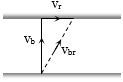
$A$ boat crosses a river with a velocity of $8 \, km/h$ relative to the water. If the resultant velocity of the boat with respect to the ground is $10 \, km/h$,then the velocity of the river water is...........$km/h$.
A
$12$
B
$6$
C
$5$
D
$10$
Solution
(B) Let $\overrightarrow{v_b}$ be the velocity of the boat relative to the water and $\overrightarrow{v_r}$ be the velocity of the river water relative to the ground.
The resultant velocity of the boat relative to the ground is given by $\overrightarrow{v_{bg}} = \overrightarrow{v_b} + \overrightarrow{v_r}$.
Since the boat crosses the river perpendicular to the flow,the vectors $\overrightarrow{v_b}$ and $\overrightarrow{v_r}$ are perpendicular to each other.
Therefore,the magnitude of the resultant velocity is $v_{bg} = \sqrt{v_b^2 + v_r^2}$.
Given $v_{bg} = 10 \, km/h$ and $v_b = 8 \, km/h$,we have:
$10 = \sqrt{8^2 + v_r^2}$
$100 = 64 + v_r^2$
$v_r^2 = 100 - 64 = 36$
$v_r = 6 \, km/h$.
The resultant velocity of the boat relative to the ground is given by $\overrightarrow{v_{bg}} = \overrightarrow{v_b} + \overrightarrow{v_r}$.
Since the boat crosses the river perpendicular to the flow,the vectors $\overrightarrow{v_b}$ and $\overrightarrow{v_r}$ are perpendicular to each other.
Therefore,the magnitude of the resultant velocity is $v_{bg} = \sqrt{v_b^2 + v_r^2}$.
Given $v_{bg} = 10 \, km/h$ and $v_b = 8 \, km/h$,we have:
$10 = \sqrt{8^2 + v_r^2}$
$100 = 64 + v_r^2$
$v_r^2 = 100 - 64 = 36$
$v_r = 6 \, km/h$.
0 likesView Solution
4
PhysicsEasyMCQAIPMT · 1994
The dimensions of pressure are
A
$MLT^{-2}$
B
$ML^{-2}T^{2}$
C
$ML^{-1}T^{-2}$
D
$M^{-1}L^{-1}$
Solution
(C) Pressure is defined as the force applied per unit area.
$P = \frac{F}{A}$
The dimensional formula for force $(F)$ is $[MLT^{-2}]$.
The dimensional formula for area $(A)$ is $[L^2]$.
Therefore,the dimensions of pressure are:
$[P] = \frac{[MLT^{-2}]}{[L^2]} = [ML^{-1}T^{-2}]$.
$P = \frac{F}{A}$
The dimensional formula for force $(F)$ is $[MLT^{-2}]$.
The dimensional formula for area $(A)$ is $[L^2]$.
Therefore,the dimensions of pressure are:
$[P] = \frac{[MLT^{-2}]}{[L^2]} = [ML^{-1}T^{-2}]$.
0 likesView Solution
5
PhysicsMediumMCQAIPMT · 1994
$A$ particle moves along a straight line such that its displacement at any time $t$ is given by $s = t^3 - 6t^2 + 3t + 4$ meters. The velocity when the acceleration is zero is ........ $m s^{-1}$.
A
$3$
B
$-12$
C
$42$
D
$-9$
Solution
(D) The displacement is given by $s = t^3 - 6t^2 + 3t + 4$.
Velocity $v$ is the first derivative of displacement with respect to time: $v = \frac{ds}{dt} = 3t^2 - 12t + 3$.
Acceleration $a$ is the derivative of velocity with respect to time: $a = \frac{dv}{dt} = 6t - 12$.
To find the time when acceleration is zero,set $a = 0$:
$6t - 12 = 0 \implies t = 2 \ s$.
Now,substitute $t = 2$ into the velocity equation:
$v = 3(2)^2 - 12(2) + 3 = 3(4) - 24 + 3 = 12 - 24 + 3 = -9 \ m s^{-1}$.
Velocity $v$ is the first derivative of displacement with respect to time: $v = \frac{ds}{dt} = 3t^2 - 12t + 3$.
Acceleration $a$ is the derivative of velocity with respect to time: $a = \frac{dv}{dt} = 6t - 12$.
To find the time when acceleration is zero,set $a = 0$:
$6t - 12 = 0 \implies t = 2 \ s$.
Now,substitute $t = 2$ into the velocity equation:
$v = 3(2)^2 - 12(2) + 3 = 3(4) - 24 + 3 = 12 - 24 + 3 = -9 \ m s^{-1}$.
0 likesView Solution
6
PhysicsDifficultMCQAIPMT · 1994
$A$ car accelerates from rest at a constant rate $\alpha$ for some time,after which it decelerates at a constant rate $\beta$ and comes to rest. If the total time elapsed is $t$,then the maximum velocity acquired by the car is
A
$\left( \frac{\alpha^2 + \beta^2}{\alpha \beta} \right) t$
B
$\left( \frac{\alpha^2 - \beta^2}{\alpha \beta} \right) t$
C
$\frac{(\alpha + \beta) t}{\alpha \beta}$
D
$\frac{\alpha \beta t}{\alpha + \beta}$
Solution
(D) Let the car accelerate at a constant rate $\alpha$ for time $t_1$. The maximum velocity $v$ attained is given by $v = u + \alpha t_1$. Since it starts from rest,$u = 0$,so $v = \alpha t_1$.
Next,the car decelerates at a constant rate $\beta$ for the remaining time $(t - t_1)$ until it comes to rest. Using the equation $v = u + at$ for the deceleration phase,we have $0 = v - \beta(t - t_1)$.
Substituting $v = \alpha t_1$ into the equation,we get $0 = \alpha t_1 - \beta t + \beta t_1$.
Rearranging the terms,we get $(\alpha + \beta) t_1 = \beta t$,which gives $t_1 = \frac{\beta}{\alpha + \beta} t$.
Substituting $t_1$ back into the expression for $v$,we get $v = \alpha \left( \frac{\beta}{\alpha + \beta} t \right) = \frac{\alpha \beta}{\alpha + \beta} t$.
Next,the car decelerates at a constant rate $\beta$ for the remaining time $(t - t_1)$ until it comes to rest. Using the equation $v = u + at$ for the deceleration phase,we have $0 = v - \beta(t - t_1)$.
Substituting $v = \alpha t_1$ into the equation,we get $0 = \alpha t_1 - \beta t + \beta t_1$.
Rearranging the terms,we get $(\alpha + \beta) t_1 = \beta t$,which gives $t_1 = \frac{\beta}{\alpha + \beta} t$.
Substituting $t_1$ back into the expression for $v$,we get $v = \alpha \left( \frac{\beta}{\alpha + \beta} t \right) = \frac{\alpha \beta}{\alpha + \beta} t$.
0 likesView Solution
7
PhysicsEasyMCQAIPMT · 1994
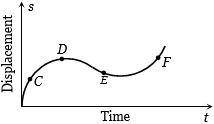
The displacement-time graph of a moving particle is shown below. The instantaneous velocity of the particle is negative at the point:
A
$D$
B
$F$
C
$C$
D
$E$
Solution
(D) The instantaneous velocity of a particle is given by the slope of the displacement-time graph at that point.
Mathematically,$v = \frac{ds}{dt}$.
- At point $C$,the slope is positive as the displacement is increasing.
- At point $D$,the slope is zero because it is at the peak of the curve.
- At point $E$,the slope is negative because the displacement is decreasing with time.
- At point $F$,the slope is positive as the displacement is increasing again.
Therefore,the instantaneous velocity is negative at point $E$.
Mathematically,$v = \frac{ds}{dt}$.
- At point $C$,the slope is positive as the displacement is increasing.
- At point $D$,the slope is zero because it is at the peak of the curve.
- At point $E$,the slope is negative because the displacement is decreasing with time.
- At point $F$,the slope is positive as the displacement is increasing again.
Therefore,the instantaneous velocity is negative at point $E$.
0 likesView Solution
8
PhysicsEasyMCQAIPMT · 1994
When a body moves with a constant speed along a circle,
A
No work is done on it
B
No acceleration is produced in the body
C
No force acts on the body
D
Its velocity remains constant
Solution
(A) In uniform circular motion,the body moves with a constant speed along a circular path.
Since the centripetal force $F$ acts towards the center of the circle and the displacement $ds$ is always along the tangent to the circle,the angle $\theta$ between the force and the displacement is $90^{\circ}$.
The work done $W$ is given by $W = \int F \cdot ds = \int F \cos(90^{\circ}) ds = 0$.
Therefore,no work is done on the body by the centripetal force.
Since the centripetal force $F$ acts towards the center of the circle and the displacement $ds$ is always along the tangent to the circle,the angle $\theta$ between the force and the displacement is $90^{\circ}$.
The work done $W$ is given by $W = \int F \cdot ds = \int F \cos(90^{\circ}) ds = 0$.
Therefore,no work is done on the body by the centripetal force.
0 likesView Solution
9
PhysicsEasyMCQAIPMT · 1994
$A$ second's pendulum is mounted in a rocket. Its period of oscillation decreases when the rocket
A
Comes down with uniform acceleration
B
Moves round the earth in a geostationary orbit
C
Moves up with a uniform velocity
D
Moves up with uniform acceleration
Solution
(D) The time period of a simple pendulum is given by $T = 2\pi \sqrt{\frac{l}{g_{eff}}}$,where $g_{eff}$ is the effective acceleration due to gravity.
For the period $T$ to decrease,the effective acceleration $g_{eff}$ must increase.
When a rocket moves up with a uniform acceleration $a$,the effective acceleration experienced by the pendulum is $g_{eff} = g + a$.
Since $g + a > g$,the effective gravity increases,which leads to a decrease in the time period $T$.
Therefore,the correct option is $D$.
For the period $T$ to decrease,the effective acceleration $g_{eff}$ must increase.
When a rocket moves up with a uniform acceleration $a$,the effective acceleration experienced by the pendulum is $g_{eff} = g + a$.
Since $g + a > g$,the effective gravity increases,which leads to a decrease in the time period $T$.
Therefore,the correct option is $D$.
0 likesView Solution
10
PhysicsMediumMCQAIPMT · 1994
$A$ satellite in force-free space sweeps stationary interplanetary dust at a rate $\frac{dM}{dt} = \alpha v$,where $M$ is the mass,$v$ is the velocity of the satellite,and $\alpha$ is a constant. What is the deceleration of the satellite?
A
$ - 2\alpha v^2/M$
B
$ - \alpha v^2/2M$
C
$ - \alpha v^2/M$
D
$ - \alpha v^2$
Solution
(C) The force acting on the satellite is given by Newton's second law for a variable mass system: $F = \frac{d}{dt}(Mv)$.
Since the satellite is in force-free space,the net external force $F = 0$.
Expanding the derivative,we get: $F = M \frac{dv}{dt} + v \frac{dM}{dt} = 0$.
Given the rate of mass accumulation is $\frac{dM}{dt} = \alpha v$,we substitute this into the equation:
$M \frac{dv}{dt} + v(\alpha v) = 0$.
Rearranging to solve for acceleration $a = \frac{dv}{dt}$:
$M \frac{dv}{dt} = -\alpha v^2$.
Therefore,the deceleration (or acceleration) is $a = -\frac{\alpha v^2}{M}$.
Since the satellite is in force-free space,the net external force $F = 0$.
Expanding the derivative,we get: $F = M \frac{dv}{dt} + v \frac{dM}{dt} = 0$.
Given the rate of mass accumulation is $\frac{dM}{dt} = \alpha v$,we substitute this into the equation:
$M \frac{dv}{dt} + v(\alpha v) = 0$.
Rearranging to solve for acceleration $a = \frac{dv}{dt}$:
$M \frac{dv}{dt} = -\alpha v^2$.
Therefore,the deceleration (or acceleration) is $a = -\frac{\alpha v^2}{M}$.
0 likesView Solution
11
PhysicsMediumMCQAIPMT · 1994
$A$ position-dependent force $F = 7 - 2x + 3x^2 \, N$ acts on a small body of mass $2 \, kg$ and displaces it from $x = 0$ to $x = 5 \, m$. The work done in joules is
A
$70$
B
$270$
C
$35$
D
$135$
Solution
(D) The work done by a variable force is given by the integral of the force with respect to displacement: $W = \int_{x_1}^{x_2} F(x) \, dx$.
Given $F(x) = 7 - 2x + 3x^2$,$x_1 = 0$,and $x_2 = 5$.
$W = \int_{0}^{5} (7 - 2x + 3x^2) \, dx$.
Integrating term by term:
$W = [7x - x^2 + x^3]_{0}^{5}$.
Substituting the limits:
$W = (7(5) - (5)^2 + (5)^3) - (7(0) - (0)^2 + (0)^3)$.
$W = (35 - 25 + 125) - 0$.
$W = 135 \, J$.
Given $F(x) = 7 - 2x + 3x^2$,$x_1 = 0$,and $x_2 = 5$.
$W = \int_{0}^{5} (7 - 2x + 3x^2) \, dx$.
Integrating term by term:
$W = [7x - x^2 + x^3]_{0}^{5}$.
Substituting the limits:
$W = (7(5) - (5)^2 + (5)^3) - (7(0) - (0)^2 + (0)^3)$.
$W = (35 - 25 + 125) - 0$.
$W = 135 \, J$.
0 likesView Solution
12
PhysicsEasyMCQAIPMT · 1994
The kinetic energy acquired by a mass $m$ in travelling a certain distance $d$ starting from rest under the action of a constant force is directly proportional to
A
$\sqrt{m}$
B
Independent of $m$
C
$1/\sqrt{m}$
D
$m$
Solution
(B) According to the work-energy theorem,the work done by the net force on an object is equal to the change in its kinetic energy.
Since the object starts from rest,the initial kinetic energy is $0$.
Work done $W = F \times d$.
Therefore,the final kinetic energy $K.E. = F \times d$.
Since the force $F$ and the distance $d$ are constant,the kinetic energy acquired depends only on the product of the force and the distance.
It does not depend on the mass $m$ of the object.
Thus,the kinetic energy is independent of $m$.
Since the object starts from rest,the initial kinetic energy is $0$.
Work done $W = F \times d$.
Therefore,the final kinetic energy $K.E. = F \times d$.
Since the force $F$ and the distance $d$ are constant,the kinetic energy acquired depends only on the product of the force and the distance.
It does not depend on the mass $m$ of the object.
Thus,the kinetic energy is independent of $m$.
0 likesView Solution
13
PhysicsMediumMCQAIPMT · 1994
If the gravitational force between two objects were proportional to $\frac{1}{R}$ (and not as $\frac{1}{R^2}$) where $R$ is the separation between them,then a particle in a circular orbit under such a force would have its orbital speed $v$ proportional to
A
$\frac{1}{R^2}$
B
$R^0$
C
$R^1$
D
$\frac{1}{R}$
Solution
(B) The gravitational force provides the necessary centripetal force for the particle to move in a circular orbit.
For a circular orbit,the centripetal force is given by $F_c = \frac{mv^2}{R}$.
According to the problem,the gravitational force is $F_g \propto \frac{1}{R}$,which can be written as $F_g = \frac{K}{R}$ for some constant $K$.
Equating the two forces: $\frac{mv^2}{R} = \frac{K}{R}$.
Canceling $R$ from both sides,we get $mv^2 = K$.
Since $m$ and $K$ are constants,$v^2$ is constant,which means $v$ is constant.
Therefore,$v \propto R^0$.
For a circular orbit,the centripetal force is given by $F_c = \frac{mv^2}{R}$.
According to the problem,the gravitational force is $F_g \propto \frac{1}{R}$,which can be written as $F_g = \frac{K}{R}$ for some constant $K$.
Equating the two forces: $\frac{mv^2}{R} = \frac{K}{R}$.
Canceling $R$ from both sides,we get $mv^2 = K$.
Since $m$ and $K$ are constants,$v^2$ is constant,which means $v$ is constant.
Therefore,$v \propto R^0$.
0 likesView Solution
14
PhysicsMediumMCQAIPMT · 1994
The distances of Neptune and Saturn from the Sun are nearly $10^{13} \ m$ and $10^{12} \ m$ respectively. Assuming that they move in circular orbits,their periodic times will be in the ratio:
A
$10\sqrt{10}$
B
$100$
C
$\sqrt{10}$
D
$1/\sqrt{10}$
Solution
(A) According to Kepler's third law of planetary motion,the square of the time period $T$ is proportional to the cube of the semi-major axis $R$ of the orbit: $T^2 \propto R^3$.
Given:
$R_1 = 10^{13} \ m$ (Neptune)
$R_2 = 10^{12} \ m$ (Saturn)
The ratio of the time periods is given by:
$\frac{T_1}{T_2} = \left( \frac{R_1}{R_2} \right)^{3/2}$
Substituting the values:
$\frac{T_1}{T_2} = \left( \frac{10^{13}}{10^{12}} \right)^{3/2}$
$\frac{T_1}{T_2} = (10)^{3/2}$
$\frac{T_1}{T_2} = 10^1 \cdot 10^{1/2} = 10\sqrt{10}$
Given:
$R_1 = 10^{13} \ m$ (Neptune)
$R_2 = 10^{12} \ m$ (Saturn)
The ratio of the time periods is given by:
$\frac{T_1}{T_2} = \left( \frac{R_1}{R_2} \right)^{3/2}$
Substituting the values:
$\frac{T_1}{T_2} = \left( \frac{10^{13}}{10^{12}} \right)^{3/2}$
$\frac{T_1}{T_2} = (10)^{3/2}$
$\frac{T_1}{T_2} = 10^1 \cdot 10^{1/2} = 10\sqrt{10}$
0 likesView Solution
15
PhysicsEasyMCQAIPMT · 1994
Which one of the following is a simple harmonic motion?
A
Wave moving through a string fixed at both ends
B
Earth spinning about its own axis
C
Ball bouncing between two rigid vertical walls
D
Particle moving in a circle with uniform speed
Solution
(A) Simple harmonic motion $(SHM)$ is a type of periodic motion where the restoring force is directly proportional to the displacement and acts in the direction opposite to that of displacement.
In a string fixed at both ends,the standing waves formed are a superposition of two traveling waves,and the particles of the string execute simple harmonic motion about their mean positions.
Therefore,the motion of particles in a string fixed at both ends is an example of simple harmonic motion.
In a string fixed at both ends,the standing waves formed are a superposition of two traveling waves,and the particles of the string execute simple harmonic motion about their mean positions.
Therefore,the motion of particles in a string fixed at both ends is an example of simple harmonic motion.
0 likesView Solution
16
PhysicsEasyMCQAIPMT · 1994
$A$ particle moving along the $X$-axis executes simple harmonic motion. The force acting on it is given by: (Where $A$ and $K$ are positive constants)
A
$-AKx$
B
$A \cos(Kx)$
C
$A \exp(-Kx)$
D
$AKx$
Solution
(A) For a particle executing Simple Harmonic Motion $(S.H.M.)$,the restoring force is directly proportional to the negative of the displacement from the mean position.
Mathematically,this is expressed as $F = -kx$,where $k$ is the force constant.
Given that $A$ and $K$ are positive constants,the force equation for this specific motion is $F = -AKx$.
Therefore,the correct option is $A$.
Mathematically,this is expressed as $F = -kx$,where $k$ is the force constant.
Given that $A$ and $K$ are positive constants,the force equation for this specific motion is $F = -AKx$.
Therefore,the correct option is $A$.
0 likesView Solution
17
PhysicsMediumMCQAIPMT · 1994
Which of the following equations represents a wave?
A
$Y = A(\omega t - kx)$
B
$Y = A \sin \omega t$
C
$Y = A \cos kx$
D
$Y = A \sin (at - bx + c)$
Solution
(D) The general equation of a simple harmonic progressive wave is given by $y = A \sin (\omega t - kx + \phi)$ or $y = A \sin (kx - \omega t + \phi)$.
Option $D$,$Y = A \sin (at - bx + c)$,represents a progressive wave because it is a function of $(at - bx)$,which satisfies the wave equation $\frac{\partial^2 y}{\partial t^2} = v^2 \frac{\partial^2 y}{\partial x^2}$,where the wave speed $v = \frac{a}{b}$.
Options $A$,$B$,and $C$ do not represent a traveling wave as they lack the necessary dependence on both space $(x)$ and time $(t)$ in the required functional form.
Option $D$,$Y = A \sin (at - bx + c)$,represents a progressive wave because it is a function of $(at - bx)$,which satisfies the wave equation $\frac{\partial^2 y}{\partial t^2} = v^2 \frac{\partial^2 y}{\partial x^2}$,where the wave speed $v = \frac{a}{b}$.
Options $A$,$B$,and $C$ do not represent a traveling wave as they lack the necessary dependence on both space $(x)$ and time $(t)$ in the required functional form.
0 likesView Solution
18
PhysicsEasyMCQAIPMT · 1994
$A$ standing wave is represented by $Y = A \sin(100t) \cos(0.01x)$,where $Y$ and $A$ are in millimetres,$t$ is in seconds,and $x$ is in metres. The velocity of the wave is ..... $m/s$.
A
$10000$
B
$1$
C
$10^{-4}$
D
Not derivable from above data
Solution
(A) The given equation for the standing wave is $Y = A \sin(100t) \cos(0.01x)$.
Comparing this with the standard equation of a standing wave $Y = A \sin(\omega t) \cos(kx)$,we identify the angular frequency $\omega = 100 \ rad/s$ and the wave number $k = 0.01 \ rad/m$.
The velocity of the wave $v$ is given by the ratio of angular frequency to wave number:
$v = \frac{\omega}{k} = \frac{100}{0.01} = 10000 \ m/s$.
Comparing this with the standard equation of a standing wave $Y = A \sin(\omega t) \cos(kx)$,we identify the angular frequency $\omega = 100 \ rad/s$ and the wave number $k = 0.01 \ rad/m$.
The velocity of the wave $v$ is given by the ratio of angular frequency to wave number:
$v = \frac{\omega}{k} = \frac{100}{0.01} = 10000 \ m/s$.
0 likesView Solution
19
PhysicsEasyMCQAIPMT · 1994
$A$ wave of frequency $100 \, Hz$ is sent along a string towards a fixed end. When this wave travels back after reflection,a node is formed at a distance of $10 \, cm$ from the fixed end of the string. The speed of the incident (and reflected) wave is .... $m/s$.
A
$40$
B
$20$
C
$10$
D
$5$
Solution
(B) At a fixed end,a node is always formed.
Given that a node is formed at a distance of $10 \, cm$ from the fixed end,this distance represents the distance between two consecutive nodes.
The distance between two consecutive nodes is given by $\frac{\lambda}{2} = 10 \, cm$.
Therefore,the wavelength $\lambda = 20 \, cm = 0.2 \, m$.
The speed of the wave $v$ is given by the formula $v = f \lambda$,where $f = 100 \, Hz$.
$v = 100 \times 0.2 = 20 \, m/s$.
Given that a node is formed at a distance of $10 \, cm$ from the fixed end,this distance represents the distance between two consecutive nodes.
The distance between two consecutive nodes is given by $\frac{\lambda}{2} = 10 \, cm$.
Therefore,the wavelength $\lambda = 20 \, cm = 0.2 \, m$.
The speed of the wave $v$ is given by the formula $v = f \lambda$,where $f = 100 \, Hz$.
$v = 100 \times 0.2 = 20 \, m/s$.
0 likesView Solution
20
PhysicsMediumMCQAIPMT · 1994
$A$ source of frequency $\nu$ gives $5$ beats/second when sounded with a source of frequency $200 \;Hz$. The second harmonic of frequency $2\nu$ of the source gives $10$ beats/second when sounded with a source of frequency $420 \;Hz$. The value of $\nu$ is .... $Hz$.
A
$195$
B
$205$
C
$200$
D
$210$
Solution
(B) The beat frequency is the absolute difference between the two frequencies.
Given,for frequency $\nu$ and $200 \;Hz$,the beat frequency is $5 \;Hz$.
So,$\nu = 200 \pm 5$,which means $\nu = 195 \;Hz$ or $\nu = 205 \;Hz$ ... $(i)$
For the second harmonic $2\nu$ and $420 \;Hz$,the beat frequency is $10 \;Hz$.
So,$2\nu = 420 \pm 10$,which means $2\nu = 410 \;Hz$ or $2\nu = 430 \;Hz$.
Dividing by $2$,we get $\nu = 205 \;Hz$ or $\nu = 215 \;Hz$ ... $(ii)$
Comparing equations $(i)$ and $(ii)$,the common value is $\nu = 205 \;Hz$.
Given,for frequency $\nu$ and $200 \;Hz$,the beat frequency is $5 \;Hz$.
So,$\nu = 200 \pm 5$,which means $\nu = 195 \;Hz$ or $\nu = 205 \;Hz$ ... $(i)$
For the second harmonic $2\nu$ and $420 \;Hz$,the beat frequency is $10 \;Hz$.
So,$2\nu = 420 \pm 10$,which means $2\nu = 410 \;Hz$ or $2\nu = 430 \;Hz$.
Dividing by $2$,we get $\nu = 205 \;Hz$ or $\nu = 215 \;Hz$ ... $(ii)$
Comparing equations $(i)$ and $(ii)$,the common value is $\nu = 205 \;Hz$.
0 likesView Solution
21
PhysicsEasyMCQAIPMT · 1994
Two identical balls $A$ and $B$ having velocities of $0.5 \, m s^{-1}$ and $-0.3 \, m s^{-1}$ respectively collide elastically in one dimension. The velocities of $B$ and $A$ after the collision respectively will be
A
$-0.3 \, m s^{-1}, 0.5 \, m s^{-1}$
B
$0.3 \, m s^{-1}, 0.5 \, m s^{-1}$
C
$-0.5 \, m s^{-1}, 0.3 \, m s^{-1}$
D
$0.5 \, m s^{-1}, -0.3 \, m s^{-1}$
Solution
(D) In an elastic collision between two bodies of equal mass,the velocities of the bodies are interchanged after the collision.
Given: Initial velocity of ball $A$ $(u_A)$ = $0.5 \, m s^{-1}$ and initial velocity of ball $B$ $(u_B)$ = $-0.3 \, m s^{-1}$.
Since the masses are identical and the collision is elastic,the final velocity of ball $A$ $(v_A)$ will be equal to $u_B$,and the final velocity of ball $B$ $(v_B)$ will be equal to $u_A$.
Therefore,$v_A = -0.3 \, m s^{-1}$ and $v_B = 0.5 \, m s^{-1}$.
The question asks for the velocities of $B$ and $A$ respectively,which are $v_B$ and $v_A$.
Thus,the velocities are $0.5 \, m s^{-1}$ and $-0.3 \, m s^{-1}$.
Given: Initial velocity of ball $A$ $(u_A)$ = $0.5 \, m s^{-1}$ and initial velocity of ball $B$ $(u_B)$ = $-0.3 \, m s^{-1}$.
Since the masses are identical and the collision is elastic,the final velocity of ball $A$ $(v_A)$ will be equal to $u_B$,and the final velocity of ball $B$ $(v_B)$ will be equal to $u_A$.
Therefore,$v_A = -0.3 \, m s^{-1}$ and $v_B = 0.5 \, m s^{-1}$.
The question asks for the velocities of $B$ and $A$ respectively,which are $v_B$ and $v_A$.
Thus,the velocities are $0.5 \, m s^{-1}$ and $-0.3 \, m s^{-1}$.
1 likesView Solution
22
PhysicsMediumMCQAIPMT · 1994
In an adiabatic change,the pressure $P$ and temperature $T$ of a monoatomic gas are related by the relation $P \propto T^C$,where $C$ equals
A
$5/3$
B
$2/5$
C
$3/5$
D
$5/2$
Solution
(D) For an adiabatic process,the relationship between pressure $P$ and temperature $T$ is given by $T^\gamma P^{1-\gamma} = \text{constant}$.
Rearranging this,we get $P^{1-\gamma} \propto T^{-\gamma}$,which implies $P \propto T^{-\frac{\gamma}{1-\gamma}}$ or $P \propto T^{\frac{\gamma}{\gamma-1}}$.
Comparing this with the given relation $P \propto T^C$,we find $C = \frac{\gamma}{\gamma-1}$.
For a monoatomic gas,the adiabatic index $\gamma = 5/3$.
Substituting the value of $\gamma$:
$C = \frac{5/3}{5/3 - 1} = \frac{5/3}{2/3} = 5/2$.
Rearranging this,we get $P^{1-\gamma} \propto T^{-\gamma}$,which implies $P \propto T^{-\frac{\gamma}{1-\gamma}}$ or $P \propto T^{\frac{\gamma}{\gamma-1}}$.
Comparing this with the given relation $P \propto T^C$,we find $C = \frac{\gamma}{\gamma-1}$.
For a monoatomic gas,the adiabatic index $\gamma = 5/3$.
Substituting the value of $\gamma$:
$C = \frac{5/3}{5/3 - 1} = \frac{5/3}{2/3} = 5/2$.
0 likesView Solution
23
PhysicsMediumMCQAIPMT · 1994
$A$ body of mass $5\; kg$ hangs from a spring and oscillates with a time period of $2\pi\; s$. If the body is removed,the length of the spring will decrease by:
A
$g/k\; m$
B
$g\; m$
C
$k/g\; m$
D
$2\pi\; m$
Solution
(B) Given mass $(m) = 5\; kg$ and time period $(T) = 2\pi\; s$.
The formula for the time period of a spring-mass system is $T = 2\pi \sqrt{\frac{m}{k}}$.
Substituting the values: $2\pi = 2\pi \sqrt{\frac{5}{k}}$.
Squaring both sides: $1 = \frac{5}{k}$,which gives the spring constant $k = 5\; N/m$.
When the body is hanging,the spring is stretched by an extension $x$ due to the weight $mg$. According to Hooke's Law,$mg = kx$.
Therefore,the decrease in length $x = \frac{mg}{k}$.
Substituting $m = 5\; kg$ and $k = 5\; N/m$: $x = \frac{5g}{5} = g\; m$.
The formula for the time period of a spring-mass system is $T = 2\pi \sqrt{\frac{m}{k}}$.
Substituting the values: $2\pi = 2\pi \sqrt{\frac{5}{k}}$.
Squaring both sides: $1 = \frac{5}{k}$,which gives the spring constant $k = 5\; N/m$.
When the body is hanging,the spring is stretched by an extension $x$ due to the weight $mg$. According to Hooke's Law,$mg = kx$.
Therefore,the decrease in length $x = \frac{mg}{k}$.
Substituting $m = 5\; kg$ and $k = 5\; N/m$: $x = \frac{5g}{5} = g\; m$.
0 likesView Solution
24
PhysicsEasyMCQAIPMT · 1994
In a rocket,fuel burns at the rate of $1\; kg/s$. This fuel is ejected from the rocket with a velocity of $60\; km/s$. This exerts a force on the rocket equal to ......... $N$.
A
$60$
B
$6000$
C
$60000$
D
$600$
Solution
(C) The thrust force $F$ exerted on a rocket is given by the formula $F = v \frac{dm}{dt}$,where $v$ is the velocity of the ejected fuel relative to the rocket and $\frac{dm}{dt}$ is the rate of fuel consumption.
Given:
Rate of fuel consumption $\frac{dm}{dt} = 1\; kg/s$
Velocity of ejected fuel $v = 60\; km/s = 60 \times 10^3\; m/s$
Substituting these values into the formula:
$F = (60 \times 10^3\; m/s) \times (1\; kg/s)$
$F = 60000\; N$
Therefore,the force exerted on the rocket is $60000\; N$.
Given:
Rate of fuel consumption $\frac{dm}{dt} = 1\; kg/s$
Velocity of ejected fuel $v = 60\; km/s = 60 \times 10^3\; m/s$
Substituting these values into the formula:
$F = (60 \times 10^3\; m/s) \times (1\; kg/s)$
$F = 60000\; N$
Therefore,the force exerted on the rocket is $60000\; N$.
0 likesView Solution
25
PhysicsMediumMCQAIPMT · 1994
The velocity of a train increases uniformly from $20 \; km/h$ to $60 \; km/h$ in $4 \; hours$. The distance travelled by the train during this period is .......... $km$.
A
$160$
B
$180$
C
$100$
D
$120$
Solution
(A) Given: Initial velocity $u = 20 \; km/h$,final velocity $v = 60 \; km/h$,and time $t = 4 \; h$.
First,we calculate the acceleration $a$ using the equation $v = u + at$:
$60 = 20 + (a \times 4)$
$40 = 4a$
$a = 10 \; km/h^2$.
Now,we calculate the distance $d$ using the equation $d = ut + \frac{1}{2}at^2$:
$d = (20 \times 4) + \frac{1}{2} \times 10 \times (4)^2$
$d = 80 + 5 \times 16$
$d = 80 + 80 = 160 \; km$.
First,we calculate the acceleration $a$ using the equation $v = u + at$:
$60 = 20 + (a \times 4)$
$40 = 4a$
$a = 10 \; km/h^2$.
Now,we calculate the distance $d$ using the equation $d = ut + \frac{1}{2}at^2$:
$d = (20 \times 4) + \frac{1}{2} \times 10 \times (4)^2$
$d = 80 + 5 \times 16$
$d = 80 + 80 = 160 \; km$.
0 likesView Solution
26
PhysicsMediumMCQAIPMT · 1994
$A$ loaded vertical spring executes $S.H.M.$ with a time period of $4\; sec$. The difference between the kinetic energy and potential energy of this system varies with a period of ........ $sec$.
A
$2$
B
$1$
C
$8$
D
$4$
Solution
(A) For a particle executing $S.H.M.$ with time period $T$,the kinetic energy $(K)$ and potential energy $(U)$ are given by:
$K = \frac{1}{2} k A^2 \cos^2(\omega t)$
$U = \frac{1}{2} k A^2 \sin^2(\omega t)$
The difference between kinetic and potential energy is:
$K - U = \frac{1}{2} k A^2 (\cos^2(\omega t) - \sin^2(\omega t)) = \frac{1}{2} k A^2 \cos(2\omega t)$
Since the angular frequency of the difference is $2\omega$,the new time period $T'$ is given by:
$T' = \frac{2\pi}{2\omega} = \frac{T}{2}$
Given $T = 4\; sec$,we have $T' = \frac{4}{2} = 2\; sec$.
$K = \frac{1}{2} k A^2 \cos^2(\omega t)$
$U = \frac{1}{2} k A^2 \sin^2(\omega t)$
The difference between kinetic and potential energy is:
$K - U = \frac{1}{2} k A^2 (\cos^2(\omega t) - \sin^2(\omega t)) = \frac{1}{2} k A^2 \cos(2\omega t)$
Since the angular frequency of the difference is $2\omega$,the new time period $T'$ is given by:
$T' = \frac{2\pi}{2\omega} = \frac{T}{2}$
Given $T = 4\; sec$,we have $T' = \frac{4}{2} = 2\; sec$.
0 likesView Solution
27
PhysicsMediumMCQAIPMT · 1994
The radius of the Earth is about $6400 \; km$ and that of Mars is $3200 \; km$. The mass of the Earth is about $10$ times the mass of Mars. An object weighs $200 \; N$ on the surface of the Earth. Its weight on the surface of Mars will be .......... $N$.
A
$80$
B
$20$
C
$6$
D
$40$
Solution
(A) Given: Radius of Earth $R_e = 6400 \; km$,Radius of Mars $R_m = 3200 \; km$.
Mass of Earth $M_e = 10 M_m$,Weight on Earth $W_e = 200 \; N$.
The weight of an object is given by $W = mg$,where $g = \frac{GM}{R^2}$.
Therefore,the ratio of weights is $\frac{W_m}{W_e} = \frac{m g_m}{m g_e} = \frac{M_m}{M_e} \times \left(\frac{R_e}{R_m}\right)^2$.
Substituting the values: $\frac{W_m}{200} = \frac{1}{10} \times \left(\frac{6400}{3200}\right)^2$.
$\frac{W_m}{200} = \frac{1}{10} \times (2)^2 = \frac{4}{10} = 0.4$.
$W_m = 200 \times 0.4 = 80 \; N$.
Mass of Earth $M_e = 10 M_m$,Weight on Earth $W_e = 200 \; N$.
The weight of an object is given by $W = mg$,where $g = \frac{GM}{R^2}$.
Therefore,the ratio of weights is $\frac{W_m}{W_e} = \frac{m g_m}{m g_e} = \frac{M_m}{M_e} \times \left(\frac{R_e}{R_m}\right)^2$.
Substituting the values: $\frac{W_m}{200} = \frac{1}{10} \times \left(\frac{6400}{3200}\right)^2$.
$\frac{W_m}{200} = \frac{1}{10} \times (2)^2 = \frac{4}{10} = 0.4$.
$W_m = 200 \times 0.4 = 80 \; N$.
0 likesView Solution
28
PhysicsMediumMCQAIPMT · 1994
If a sphere is rolling,the ratio of its rotational energy to the total kinetic energy is given by
A
$7 : 2$
B
$2 : 9$
C
$2 : 5$
D
$2 : 7$
Solution
(D) The total kinetic energy $(K_{total})$ of a rolling sphere is the sum of its linear kinetic energy $(K_{linear})$ and rotational kinetic energy $(K_{rotational})$.
$K_{total} = K_{linear} + K_{rotational} = \frac{1}{2}mv^2 + \frac{1}{2}I\omega^2$
For a solid sphere,the moment of inertia is $I = \frac{2}{5}mr^2$ and the angular velocity is $\omega = \frac{v}{r}$.
Substituting these values into the rotational kinetic energy expression:
$K_{rotational} = \frac{1}{2} \left(\frac{2}{5}mr^2\right) \left(\frac{v}{r}\right)^2 = \frac{1}{5}mv^2$.
Now,calculating the total kinetic energy:
$K_{total} = \frac{1}{2}mv^2 + \frac{1}{5}mv^2 = \left(\frac{5+2}{10}\right)mv^2 = \frac{7}{10}mv^2$.
The ratio of rotational kinetic energy to total kinetic energy is:
$\frac{K_{rotational}}{K_{total}} = \frac{\frac{1}{5}mv^2}{\frac{7}{10}mv^2} = \frac{1}{5} \times \frac{10}{7} = \frac{2}{7}$.
Thus,the ratio is $2:7$.
$K_{total} = K_{linear} + K_{rotational} = \frac{1}{2}mv^2 + \frac{1}{2}I\omega^2$
For a solid sphere,the moment of inertia is $I = \frac{2}{5}mr^2$ and the angular velocity is $\omega = \frac{v}{r}$.
Substituting these values into the rotational kinetic energy expression:
$K_{rotational} = \frac{1}{2} \left(\frac{2}{5}mr^2\right) \left(\frac{v}{r}\right)^2 = \frac{1}{5}mv^2$.
Now,calculating the total kinetic energy:
$K_{total} = \frac{1}{2}mv^2 + \frac{1}{5}mv^2 = \left(\frac{5+2}{10}\right)mv^2 = \frac{7}{10}mv^2$.
The ratio of rotational kinetic energy to total kinetic energy is:
$\frac{K_{rotational}}{K_{total}} = \frac{\frac{1}{5}mv^2}{\frac{7}{10}mv^2} = \frac{1}{5} \times \frac{10}{7} = \frac{2}{7}$.
Thus,the ratio is $2:7$.
0 likesView Solution
29
PhysicsMediumMCQAIPMT · 1994
An electric dipole of moment $p$ is placed in the position of stable equilibrium in a uniform electric field of intensity $E$. It is rotated through an angle $\theta$ from the initial position. The potential energy of the electric dipole in the final position is
A
$pE \cos \theta$
B
$pE \sin \theta$
C
$pE(1 - \cos \theta)$
D
$-pE \cos \theta$
Solution
(D) In a uniform electric field $E$,the potential energy $U$ of an electric dipole with dipole moment $p$ is given by the formula $U = -p \cdot E = -pE \cos \theta$,where $\theta$ is the angle between the dipole moment vector $p$ and the electric field vector $E$.
Initially,the dipole is in stable equilibrium,which means the angle between $p$ and $E$ is $0^\circ$.
When the dipole is rotated through an angle $\theta$ from this initial position,the new angle between the dipole moment and the electric field becomes $\theta$.
Therefore,the potential energy of the electric dipole in the final position is $U = -pE \cos \theta$.
Initially,the dipole is in stable equilibrium,which means the angle between $p$ and $E$ is $0^\circ$.
When the dipole is rotated through an angle $\theta$ from this initial position,the new angle between the dipole moment and the electric field becomes $\theta$.
Therefore,the potential energy of the electric dipole in the final position is $U = -pE \cos \theta$.
0 likesView Solution
30
PhysicsMediumMCQAIPMT · 1994
$A$ wire $50\, cm$ long and $1\, mm^2$ in cross-section carries a current of $4\, A$ when connected to a $2\, V$ battery. The resistivity of the wire is:
A
$1 \times 10^{-6}\, \Omega\cdot m$
B
$4 \times 10^{-6}\, \Omega\cdot m$
C
$5 \times 10^{-7}\, \Omega\cdot m$
D
$2 \times 10^{-7}\, \Omega\cdot m$
Solution
(A) Given:
Length $l = 50\, cm = 0.5\, m = 50 \times 10^{-2}\, m$
Area of cross-section $A = 1\, mm^2 = 1 \times 10^{-6}\, m^2$
Current $I = 4\, A$
Voltage $V = 2\, V$
Using Ohm's Law,the resistance $R$ is:
$R = \frac{V}{I} = \frac{2}{4} = 0.5\, \Omega$
The formula for resistance in terms of resistivity $\rho$ is:
$R = \rho \frac{l}{A}$
Rearranging for $\rho$:
$\rho = \frac{R \cdot A}{l} = \frac{0.5 \times 10^{-6}}{0.5} = 1 \times 10^{-6}\, \Omega\cdot m$
Thus,the resistivity of the wire is $1 \times 10^{-6}\, \Omega\cdot m$.
Length $l = 50\, cm = 0.5\, m = 50 \times 10^{-2}\, m$
Area of cross-section $A = 1\, mm^2 = 1 \times 10^{-6}\, m^2$
Current $I = 4\, A$
Voltage $V = 2\, V$
Using Ohm's Law,the resistance $R$ is:
$R = \frac{V}{I} = \frac{2}{4} = 0.5\, \Omega$
The formula for resistance in terms of resistivity $\rho$ is:
$R = \rho \frac{l}{A}$
Rearranging for $\rho$:
$\rho = \frac{R \cdot A}{l} = \frac{0.5 \times 10^{-6}}{0.5} = 1 \times 10^{-6}\, \Omega\cdot m$
Thus,the resistivity of the wire is $1 \times 10^{-6}\, \Omega\cdot m$.
0 likesView Solution
31
PhysicsEasyMCQAIPMT · 1994
An electric bulb is rated $60\,W$,$220\,V$. The resistance of its filament is ............. $\Omega$.
A
$708$
B
$870$
C
$807$
D
$780$
Solution
(C) The power $P$ and voltage $V$ of an electric bulb are related to its resistance $R$ by the formula: $P = \frac{V^2}{R}$.
Rearranging for $R$,we get $R = \frac{V^2}{P}$.
Given $V = 220\,V$ and $P = 60\,W$.
Substituting the values: $R = \frac{220 \times 220}{60} = \frac{48400}{60} \approx 806.67\,\Omega$.
Rounding to the nearest whole number,we get $R = 807\,\Omega$.
Rearranging for $R$,we get $R = \frac{V^2}{P}$.
Given $V = 220\,V$ and $P = 60\,W$.
Substituting the values: $R = \frac{220 \times 220}{60} = \frac{48400}{60} \approx 806.67\,\Omega$.
Rounding to the nearest whole number,we get $R = 807\,\Omega$.
0 likesView Solution
32
PhysicsEasyMCQAIPMT · 1994
$A$ circular loop of area $0.01\,m^2$ carrying a current of $10\,A$ is held perpendicular to a magnetic field of intensity $0.1\,T$. The torque acting on the loop is......$N-m$.
A
$0$
B
$0.01$
C
$0.001$
D
$0.8$
Solution
(A) Given:
Area $A = 0.01\,m^2$,Current $I = 10\,A$,Magnetic field $B = 0.1\,T$.
The loop is held perpendicular to the magnetic field,which means the angle between the area vector $\vec{A}$ and the magnetic field vector $\vec{B}$ is $\theta = 0^{\circ}$.
Formula:
The torque $\vec{\tau}$ acting on a current-carrying loop in a magnetic field is given by $\vec{\tau} = \vec{M} \times \vec{B}$,where $\vec{M}$ is the magnetic moment.
The magnitude of the torque is $\tau = M B \sin \theta$,where $M = I A$.
Calculation:
$M = I \times A = 10\,A \times 0.01\,m^2 = 0.1\,A\cdot m^2$.
Since the loop is perpendicular to the field,the angle $\theta$ between the normal to the loop (area vector) and the magnetic field is $0^{\circ}$.
$\tau = M B \sin(0^{\circ}) = 0.1 \times 0.1 \times 0 = 0\,N\cdot m$.
Area $A = 0.01\,m^2$,Current $I = 10\,A$,Magnetic field $B = 0.1\,T$.
The loop is held perpendicular to the magnetic field,which means the angle between the area vector $\vec{A}$ and the magnetic field vector $\vec{B}$ is $\theta = 0^{\circ}$.
Formula:
The torque $\vec{\tau}$ acting on a current-carrying loop in a magnetic field is given by $\vec{\tau} = \vec{M} \times \vec{B}$,where $\vec{M}$ is the magnetic moment.
The magnitude of the torque is $\tau = M B \sin \theta$,where $M = I A$.
Calculation:
$M = I \times A = 10\,A \times 0.01\,m^2 = 0.1\,A\cdot m^2$.
Since the loop is perpendicular to the field,the angle $\theta$ between the normal to the loop (area vector) and the magnetic field is $0^{\circ}$.
$\tau = M B \sin(0^{\circ}) = 0.1 \times 0.1 \times 0 = 0\,N\cdot m$.
0 likesView Solution
33
PhysicsMediumMCQAIPMT · 1994
$A$ bar magnet is oscillating in the Earth's magnetic field with a period $T$. What happens to its period and motion if its mass is quadrupled?
A
Motion remains $S.H.M.$ with time period $= 2T$
B
Motion remains $S.H.M.$ with time period $= 4T$
C
Motion remains $S.H.M.$ and period remains nearly constant
D
Motion remains $S.H.M.$ with time period $= T/2$
Solution
(A) The time period of a bar magnet oscillating in a magnetic field is given by $T = 2\pi \sqrt{\frac{I}{MB}}$,where $I$ is the moment of inertia,$M$ is the magnetic moment,and $B$ is the magnetic field.
For a bar magnet of mass $m$ and length $l$,the moment of inertia is $I = \frac{ml^2}{12}$.
Substituting this into the formula,we get $T = 2\pi \sqrt{\frac{ml^2}{12MB}}$.
This shows that $T \propto \sqrt{m}$.
If the mass $m$ is quadrupled $(m' = 4m)$,the new time period $T'$ becomes $T' = 2\pi \sqrt{\frac{4ml^2}{12MB}} = 2 \times (2\pi \sqrt{\frac{ml^2}{12MB}}) = 2T$.
The motion remains $S.H.M.$ because the restoring torque $\tau = -MB \sin \theta \approx -MB \theta$ for small oscillations.
For a bar magnet of mass $m$ and length $l$,the moment of inertia is $I = \frac{ml^2}{12}$.
Substituting this into the formula,we get $T = 2\pi \sqrt{\frac{ml^2}{12MB}}$.
This shows that $T \propto \sqrt{m}$.
If the mass $m$ is quadrupled $(m' = 4m)$,the new time period $T'$ becomes $T' = 2\pi \sqrt{\frac{4ml^2}{12MB}} = 2 \times (2\pi \sqrt{\frac{ml^2}{12MB}}) = 2T$.
The motion remains $S.H.M.$ because the restoring torque $\tau = -MB \sin \theta \approx -MB \theta$ for small oscillations.
0 likesView Solution
34
PhysicsMediumMCQAIPMT · 1994
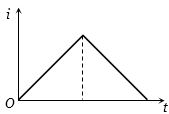
The current $I$ in an $A.C.$ circuit inductance coil varies with time according to the graph given below. Which one of the following graphs gives the variation of voltage with time?
A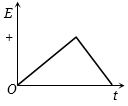
B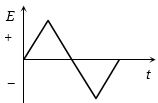
C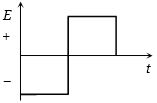
D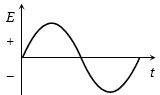
Solution
(D) The induced electromotive force $(emf)$ in an inductor is given by the formula $E = -L \frac{dI}{dt}$.
In the first half of the time interval,the current $I$ increases linearly with time,so the rate of change of current $\frac{dI}{dt}$ is a positive constant. Consequently,the induced $emf$ $E = -L \frac{dI}{dt}$ is a negative constant.
In the second half of the time interval,the current $I$ decreases linearly with time,so the rate of change of current $\frac{dI}{dt}$ is a negative constant. Consequently,the induced $emf$ $E = -L \frac{dI}{dt}$ is a positive constant.
Comparing this with the given options,the graph that shows a negative constant value followed by a positive constant value is represented by option $D$.
In the first half of the time interval,the current $I$ increases linearly with time,so the rate of change of current $\frac{dI}{dt}$ is a positive constant. Consequently,the induced $emf$ $E = -L \frac{dI}{dt}$ is a negative constant.
In the second half of the time interval,the current $I$ decreases linearly with time,so the rate of change of current $\frac{dI}{dt}$ is a negative constant. Consequently,the induced $emf$ $E = -L \frac{dI}{dt}$ is a positive constant.
Comparing this with the given options,the graph that shows a negative constant value followed by a positive constant value is represented by option $D$.
0 likesView Solution
35
PhysicsEasyMCQAIPMT · 1994
An $L-C-R$ circuit is connected to a source of $A.C.$ current. At resonance,the phase difference between the applied voltage and the current in the circuit is:
A
$0$
B
$\pi / 2$
C
$\pi$
D
$\pi / 4$
Solution
(A) At resonance,the inductive reactance $(X_L)$ is equal to the capacitive reactance $(X_C)$,i.e.,$X_L = X_C$.
In an $L-C-R$ series circuit,the net impedance $(Z)$ is given by $Z = \sqrt{R^2 + (X_L - X_C)^2}$.
At resonance,since $X_L - X_C = 0$,the impedance becomes $Z = R$.
This means the circuit behaves as a purely resistive circuit.
In a purely resistive circuit,the voltage and current are in the same phase.
Therefore,the phase difference $(\phi)$ between the applied voltage and the current is $0$.
In an $L-C-R$ series circuit,the net impedance $(Z)$ is given by $Z = \sqrt{R^2 + (X_L - X_C)^2}$.
At resonance,since $X_L - X_C = 0$,the impedance becomes $Z = R$.
This means the circuit behaves as a purely resistive circuit.
In a purely resistive circuit,the voltage and current are in the same phase.
Therefore,the phase difference $(\phi)$ between the applied voltage and the current is $0$.
0 likesView Solution
36
PhysicsMediumMCQAIPMT · 1994
The truth table given below is for which gate?
$A: 0, 0, 1, 1$
$B: 0, 1, 0, 1$
$C: 1, 1, 1, 0$
$A: 0, 0, 1, 1$
$B: 0, 1, 0, 1$
$C: 1, 1, 1, 0$
A
$XOR$
B
$OR$
C
$AND$
D
$NAND$
Solution
(D) For a $NAND$ gate,the output $C$ is given by the Boolean expression $C = \overline{A \cdot B}$.
Checking the values:
$1$. For $A = 0, B = 0$: $C = \overline{0 \cdot 0} = \overline{0} = 1$.
$2$. For $A = 0, B = 1$: $C = \overline{0 \cdot 1} = \overline{0} = 1$.
$3$. For $A = 1, B = 0$: $C = \overline{1 \cdot 0} = \overline{0} = 1$.
$4$. For $A = 1, B = 1$: $C = \overline{1 \cdot 1} = \overline{1} = 0$.
Comparing these results with the given table,the output matches the $NAND$ gate logic.
Checking the values:
$1$. For $A = 0, B = 0$: $C = \overline{0 \cdot 0} = \overline{0} = 1$.
$2$. For $A = 0, B = 1$: $C = \overline{0 \cdot 1} = \overline{0} = 1$.
$3$. For $A = 1, B = 0$: $C = \overline{1 \cdot 0} = \overline{0} = 1$.
$4$. For $A = 1, B = 1$: $C = \overline{1 \cdot 1} = \overline{1} = 0$.
Comparing these results with the given table,the output matches the $NAND$ gate logic.
0 likesView Solution
37
PhysicsEasyMCQAIPMT · 1994
Ray optics is valid when characteristic dimensions are:
A
Of the same order as the wavelength of light
B
Much smaller than the wavelength of light
C
Of the order of one millimetre
D
Much larger than the wavelength of light
Solution
(D) Ray optics is based on the assumption that light travels in straight lines. This approximation holds true when the characteristic dimensions of the obstacles or apertures (such as the size of a slit or an object) are much larger than the wavelength of light $(\lambda)$. If the dimensions are comparable to or smaller than $\lambda$, wave effects like diffraction become significant, and ray optics is no longer valid. Therefore, the correct condition is that the dimensions must be much larger than the wavelength of light.
0 likesView Solution
38
PhysicsMediumMCQAIPMT · 1994
$A$ point source of light is placed $4 \; m$ below the surface of water of refractive index $5/3$. The minimum diameter of a disc which should be placed over the source on the surface of water to cut-off all light coming out of water is ... $m$.
A
$2$
B
$6$
C
$4$
D
$3$
Solution
(B) The light from the source will be cut off if the disc covers the area corresponding to the critical angle $\theta_c$.
For a point source at depth $h$,the radius $r$ of the disc is given by $r = h \tan \theta_c$.
Since $\sin \theta_c = \frac{1}{\mu}$,we have $\tan \theta_c = \frac{1}{\sqrt{\mu^2 - 1}}$.
Substituting the given values $h = 4 \; m$ and $\mu = 5/3$:
$r = \frac{4}{\sqrt{(5/3)^2 - 1}} = \frac{4}{\sqrt{25/9 - 1}} = \frac{4}{\sqrt{16/9}} = \frac{4}{4/3} = 3 \; m$.
The minimum diameter of the disc is $D = 2r = 2 \times 3 = 6 \; m$.
For a point source at depth $h$,the radius $r$ of the disc is given by $r = h \tan \theta_c$.
Since $\sin \theta_c = \frac{1}{\mu}$,we have $\tan \theta_c = \frac{1}{\sqrt{\mu^2 - 1}}$.
Substituting the given values $h = 4 \; m$ and $\mu = 5/3$:
$r = \frac{4}{\sqrt{(5/3)^2 - 1}} = \frac{4}{\sqrt{25/9 - 1}} = \frac{4}{\sqrt{16/9}} = \frac{4}{4/3} = 3 \; m$.
The minimum diameter of the disc is $D = 2r = 2 \times 3 = 6 \; m$.
0 likesView Solution
39
PhysicsEasyMCQAIPMT · 1994
The colour of the sky is blue due to
A
Scattering of light
B
Total internal reflection
C
Total emission
D
None of the above
Solution
(A) According to Rayleigh's law of scattering, the intensity of scattered light $I$ is inversely proportional to the fourth power of its wavelength, given by $I \propto \frac{1}{\lambda^4}$.
Since the wavelength of blue light $(\lambda_{blue})$ is the shortest among the visible spectrum, it undergoes maximum scattering by the atmospheric particles.
Therefore, the sky appears blue to our eyes.
Since the wavelength of blue light $(\lambda_{blue})$ is the shortest among the visible spectrum, it undergoes maximum scattering by the atmospheric particles.
Therefore, the sky appears blue to our eyes.
0 likesView Solution
40
PhysicsEasyMCQAIPMT · 1994
The oscillating electric and magnetic vectors of an electromagnetic wave are oriented along
A
The same direction but differ in phase by $90^{\circ}$
B
The same direction and are in phase
C
Mutually perpendicular directions and are in phase
D
Mutually perpendicular directions and differ in phase by $90^{\circ}$
Solution
(C) In an electromagnetic wave,the oscillating electric field vector $\vec{E}$ and the magnetic field vector $\vec{B}$ are always mutually perpendicular to each other and also perpendicular to the direction of wave propagation.
Furthermore,these fields are in phase,which means they reach their maximum and minimum values at the same time and at the same spatial location.
Therefore,the correct option is $C$.
Furthermore,these fields are in phase,which means they reach their maximum and minimum values at the same time and at the same spatial location.
Therefore,the correct option is $C$.
0 likesView Solution
41
PhysicsEasyMCQAIPMT · 1994
Which of the following theories is the most satisfactory regarding the origin of the universe?
A
Big Bang theory
B
Pulsating theory
C
Steady state theory
D
None of these
Solution
(A) The $Big$ $Bang$ theory is widely accepted as the most satisfactory scientific explanation for the origin of the universe.
It proposes that the universe began as a hot,dense point approximately $13.8$ billion years ago and has been expanding and cooling ever since.
This theory is supported by significant observational evidence,such as the cosmic microwave background radiation and the observed redshift of distant galaxies.
It proposes that the universe began as a hot,dense point approximately $13.8$ billion years ago and has been expanding and cooling ever since.
This theory is supported by significant observational evidence,such as the cosmic microwave background radiation and the observed redshift of distant galaxies.
0 likesView Solution
42
PhysicsEasyMCQAIPMT · 1994
Which of the following electromagnetic radiations has the smallest wavelength?
A
$\gamma-$ rays
B
Microwaves
C
$UV$ waves
D
$X-$ rays
Solution
(A) The electromagnetic spectrum is ordered by frequency and wavelength. The order of increasing wavelength is: $\gamma-$ rays < $X-$ rays < $UV$ rays < Visible light < Infrared < Microwaves < Radio waves.
Since $\gamma-$ rays have the highest frequency,they possess the smallest wavelength among the given options.
Since $\gamma-$ rays have the highest frequency,they possess the smallest wavelength among the given options.
0 likesView Solution
43
PhysicsMediumMCQAIPMT · 1994
Four lenses of focal length $\pm 15\; cm$ and $\pm 150 \;cm$ are available for making a telescope. To produce the largest magnification,the focal length (in $cm$) of the eyepiece should be
A
$15$
B
$150$
C
$-15$
D
$-150$
Solution
(A) The magnification $M$ of an astronomical telescope is given by the formula $M = -\frac{f_o}{f_e}$,where $f_o$ is the focal length of the objective lens and $f_e$ is the focal length of the eyepiece.
To obtain the largest magnification,the ratio $\left| \frac{f_o}{f_e} \right|$ must be maximized.
This requires the objective lens to have the largest focal length $(f_o = 150\; cm)$ and the eyepiece to have the smallest focal length $(f_e = 15\; cm)$.
Thus,the focal length of the eyepiece should be $15\; cm$.
To obtain the largest magnification,the ratio $\left| \frac{f_o}{f_e} \right|$ must be maximized.
This requires the objective lens to have the largest focal length $(f_o = 150\; cm)$ and the eyepiece to have the smallest focal length $(f_e = 15\; cm)$.
Thus,the focal length of the eyepiece should be $15\; cm$.
0 likesView Solution
44
PhysicsMediumMCQAIPMT · 1994
Two cables of copper are of equal lengths. One of them has a single wire of area of cross-section $A$, while the other has $10$ wires of cross-sectional area $A / 10$ each. Determine their suitability for transporting $A.C.$ and $D.C.$
A
Only single strand for $A.C.$, either for $D.C.$
B
Only single strand for $D.C.$, either for $A.C.$
C
Only multiple strands for $A.C.$, only single strand for $D.C.$
D
Only multiple strands for $A.C.$, either for $D.C.$
Solution
(D) The phenomenon known as the $Skin \text{ } Effect$ causes the majority of $A.C.$ current to flow near the surface of a conductor.
For $A.C.$ transmission, using a single thick wire is inefficient because the interior of the wire carries very little current.
By using multiple thin strands, the total surface area is increased, which reduces the effective resistance for $A.C.$ and improves efficiency.
For $D.C.$ transmission, the current is distributed uniformly throughout the cross-section of the conductor, so either a single thick wire or multiple thin strands will function effectively.
Therefore, multiple strands are preferred for $A.C.$, while either type is suitable for $D.C.$
For $A.C.$ transmission, using a single thick wire is inefficient because the interior of the wire carries very little current.
By using multiple thin strands, the total surface area is increased, which reduces the effective resistance for $A.C.$ and improves efficiency.
For $D.C.$ transmission, the current is distributed uniformly throughout the cross-section of the conductor, so either a single thick wire or multiple thin strands will function effectively.
Therefore, multiple strands are preferred for $A.C.$, while either type is suitable for $D.C.$
0 likesView Solution
45
PhysicsEasyMCQAIPMT · 1994
In an $A.C.$ circuit,$I_{\text{rms}}$ and $I_{0}$ are related as:
A
$I_{\text{rms}} = \frac{1}{\pi} I_{0}$
B
$I_{\text{rms}} = \frac{1}{\sqrt{2}} I_{0}$
C
$I_{\text{rms}} = \sqrt{2} I_{0}$
D
$I_{\text{rms}} = \pi I_{0}$
Solution
(B) The root mean square $(I_{\text{rms}})$ value of an alternating current is defined as the square root of the mean of the squares of the instantaneous current over one complete cycle.
For a sinusoidal alternating current given by $I = I_{0} \sin(\omega t)$,the $I_{\text{rms}}$ is calculated as:
$I_{\text{rms}} = \sqrt{\frac{1}{T} \int_{0}^{T} I^{2} dt}$
Substituting $I = I_{0} \sin(\omega t)$:
$I_{\text{rms}} = \sqrt{\frac{1}{T} \int_{0}^{T} I_{0}^{2} \sin^{2}(\omega t) dt}$
$I_{\text{rms}} = I_{0} \sqrt{\frac{1}{T} \int_{0}^{T} \frac{1 - \cos(2\omega t)}{2} dt}$
$I_{\text{rms}} = I_{0} \sqrt{\frac{1}{2T} [t - \frac{\sin(2\omega t)}{2\omega}]_{0}^{T}}$
Since $\sin(2\omega T) = \sin(4\pi) = 0$,we get:
$I_{\text{rms}} = I_{0} \sqrt{\frac{T}{2T}} = \frac{I_{0}}{\sqrt{2}}$
Therefore,the correct relation is $I_{\text{rms}} = \frac{1}{\sqrt{2}} I_{0}$.
For a sinusoidal alternating current given by $I = I_{0} \sin(\omega t)$,the $I_{\text{rms}}$ is calculated as:
$I_{\text{rms}} = \sqrt{\frac{1}{T} \int_{0}^{T} I^{2} dt}$
Substituting $I = I_{0} \sin(\omega t)$:
$I_{\text{rms}} = \sqrt{\frac{1}{T} \int_{0}^{T} I_{0}^{2} \sin^{2}(\omega t) dt}$
$I_{\text{rms}} = I_{0} \sqrt{\frac{1}{T} \int_{0}^{T} \frac{1 - \cos(2\omega t)}{2} dt}$
$I_{\text{rms}} = I_{0} \sqrt{\frac{1}{2T} [t - \frac{\sin(2\omega t)}{2\omega}]_{0}^{T}}$
Since $\sin(2\omega T) = \sin(4\pi) = 0$,we get:
$I_{\text{rms}} = I_{0} \sqrt{\frac{T}{2T}} = \frac{I_{0}}{\sqrt{2}}$
Therefore,the correct relation is $I_{\text{rms}} = \frac{1}{\sqrt{2}} I_{0}$.
0 likesView Solution
46
PhysicsEasyMCQAIPMT · 1994
Identify the set in which all the three materials are good conductors of electricity.
A
$Cu, Ag$ and $Au$
B
$Cu, Si$ and $diamond$
C
$Cu, Ge$ and $Hg$
D
$Cu, Hg$ and $NaCl$
Solution
(A) Good conductors of electricity are materials that allow electric current to flow through them easily due to the presence of free electrons.
Metals like $Cu$ (Copper),$Ag$ (Silver),and $Au$ (Gold) have a large number of free electrons in their metallic lattice,making them excellent conductors.
$Si$ (Silicon) and $Ge$ (Germanium) are semiconductors.
$Diamond$ is an insulator.
$NaCl$ (Sodium Chloride) is an ionic solid that conducts electricity only in a molten state or aqueous solution,not in its solid state.
Therefore,the set containing $Cu, Ag$,and $Au$ consists entirely of good conductors.
Metals like $Cu$ (Copper),$Ag$ (Silver),and $Au$ (Gold) have a large number of free electrons in their metallic lattice,making them excellent conductors.
$Si$ (Silicon) and $Ge$ (Germanium) are semiconductors.
$Diamond$ is an insulator.
$NaCl$ (Sodium Chloride) is an ionic solid that conducts electricity only in a molten state or aqueous solution,not in its solid state.
Therefore,the set containing $Cu, Ag$,and $Au$ consists entirely of good conductors.
0 likesView Solution
47
PhysicsEasyMCQAIPMT · 1994
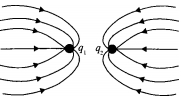
The given figure shows the electric field lines due to two charges $q_1$ and $q_2$. What are the signs of the two charges?
A
$q_{1}$ is positive but $q_{2}$ is negative
B
$q_{1}$ and $q_{2}$ both are negative
C
$q_{1}$ is negative but $q_{2}$ is positive
D
$q_{1}$ and $q_{2}$ both are positive
Solution
(B) Electric field lines originate from a positive charge and terminate on a negative charge.
In the given figure,the electric field lines are directed towards both charges $q_1$ and $q_2$.
Since the field lines are terminating at both charges,both $q_1$ and $q_2$ must be negative charges.
Therefore,both $q_1$ and $q_2$ are negative.
In the given figure,the electric field lines are directed towards both charges $q_1$ and $q_2$.
Since the field lines are terminating at both charges,both $q_1$ and $q_2$ must be negative charges.
Therefore,both $q_1$ and $q_2$ are negative.
0 likesView Solution
48
PhysicsEasyMCQAIPMT · 1994
Charge $q_{2}$ is at the centre of a circular path with radius $r$. Work done in carrying charge $q_{1}$,once around this equipotential path,would be
A
$\frac{1}{4 \pi \varepsilon_{0}} \times \frac{q_{1} q_{2}}{r^{2}}$
B
zero
C
$\frac{1}{4 \pi \varepsilon_{0}} \times \frac{q_{1} q_{2}}{r}$
D
infinity
Solution
(B) The electric potential $V$ at any point on a circular path of radius $r$ due to a charge $q_{2}$ at the center is given by $V = \frac{1}{4 \pi \varepsilon_{0}} \frac{q_{2}}{r}$.
Since $q_{2}$ and $r$ are constant,the potential $V$ is constant at all points on the circular path,making it an equipotential surface.
The work done $W$ in moving a charge $q_{1}$ between two points $A$ and $B$ is given by $W = q_{1}(V_{B} - V_{A})$.
Since the path is equipotential,the potential at the starting point and the ending point (after one full rotation) is the same,i.e.,$V_{A} = V_{B}$.
Therefore,the work done $W = q_{1}(V - V) = 0$.
Since $q_{2}$ and $r$ are constant,the potential $V$ is constant at all points on the circular path,making it an equipotential surface.
The work done $W$ in moving a charge $q_{1}$ between two points $A$ and $B$ is given by $W = q_{1}(V_{B} - V_{A})$.
Since the path is equipotential,the potential at the starting point and the ending point (after one full rotation) is the same,i.e.,$V_{A} = V_{B}$.
Therefore,the work done $W = q_{1}(V - V) = 0$.
0 likesView Solution
49
PhysicsEasyMCQAIPMT · 1994
$A$ hollow metallic sphere of radius $10 \; cm$ is charged such that the potential at its surface is $80 \; V$. The potential at the centre of the sphere would be (in $; V$)
A
$800$
B
$8$
C
$80$
D
$0$
Solution
(C) For a hollow metallic sphere,the electric field inside is zero $(E = 0)$.
Since the electric field is the negative gradient of the potential $(E = -dV/dr)$,if $E = 0$,then the potential $V$ must be constant throughout the interior.
Therefore,the potential at any point inside the sphere,including the centre,is equal to the potential at its surface.
Given that the potential at the surface is $80 \; V$,the potential at the centre is also $80 \; V$.
Since the electric field is the negative gradient of the potential $(E = -dV/dr)$,if $E = 0$,then the potential $V$ must be constant throughout the interior.
Therefore,the potential at any point inside the sphere,including the centre,is equal to the potential at its surface.
Given that the potential at the surface is $80 \; V$,the potential at the centre is also $80 \; V$.
0 likesView Solution
50
PhysicsMediumMCQAIPMT · 1994
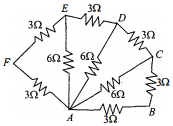
Six resistors of $3 \; \Omega$ each are connected along the sides of a hexagon and three resistors of $6 \; \Omega$ each are connected along $AC$, $AD$, and $AE$ as shown in the figure. The equivalent resistance between $A$ and $B$ is equal to
A
$3 \; \Omega$
B
$2 \; \Omega$
C
$6 \; \Omega$
D
$9 \; \Omega$
Solution
(B) The circuit can be simplified by observing the symmetry and series-parallel combinations.
$1$. The resistors along $AF$ and $FE$ are in series. Their equivalent resistance is $R_1 = 3 \; \Omega + 3 \; \Omega = 6 \; \Omega$.
$2$. This $R_1$ is in parallel with the $6 \; \Omega$ resistor connected along $AE$. The equivalent resistance $R_{AE}'$ is given by $\frac{1}{R_{AE}'} = \frac{1}{6} + \frac{1}{6} = \frac{2}{6} = \frac{1}{3} \Rightarrow R_{AE}' = 3 \; \Omega$.
$3$. Similarly, the resistors along $ED$ and $DC$ are in series with the $6 \; \Omega$ resistor along $AD$ in parallel, leading to an equivalent resistance of $3 \; \Omega$ between $A$ and $C$.
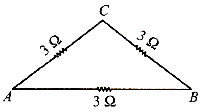
$4$. Finally, the circuit reduces to three resistors of $3 \; \Omega$ each connected between $A$ and $B$ (one directly, and two through path $C$).
$5$. The equivalent resistance $R_{eq}$ is the parallel combination of the direct $3 \; \Omega$ resistor and the series combination of the other two $3 \; \Omega$ resistors $(3+3=6 \; \Omega)$.
$6$. $R_{eq} = \frac{3 \times 6}{3 + 6} = \frac{18}{9} = 2 \; \Omega$.
$1$. The resistors along $AF$ and $FE$ are in series. Their equivalent resistance is $R_1 = 3 \; \Omega + 3 \; \Omega = 6 \; \Omega$.
$2$. This $R_1$ is in parallel with the $6 \; \Omega$ resistor connected along $AE$. The equivalent resistance $R_{AE}'$ is given by $\frac{1}{R_{AE}'} = \frac{1}{6} + \frac{1}{6} = \frac{2}{6} = \frac{1}{3} \Rightarrow R_{AE}' = 3 \; \Omega$.
$3$. Similarly, the resistors along $ED$ and $DC$ are in series with the $6 \; \Omega$ resistor along $AD$ in parallel, leading to an equivalent resistance of $3 \; \Omega$ between $A$ and $C$.
$4$. Finally, the circuit reduces to three resistors of $3 \; \Omega$ each connected between $A$ and $B$ (one directly, and two through path $C$).
$5$. The equivalent resistance $R_{eq}$ is the parallel combination of the direct $3 \; \Omega$ resistor and the series combination of the other two $3 \; \Omega$ resistors $(3+3=6 \; \Omega)$.
$6$. $R_{eq} = \frac{3 \times 6}{3 + 6} = \frac{18}{9} = 2 \; \Omega$.
0 likesView Solution
51
PhysicsEasyMCQAIPMT · 1994
$A$ flow of $10^{7}$ electrons per second in a conducting wire constitutes a current of
A
$1.6 \times 10^{12} \; A$
B
$1.6 \times 10^{26} \; A$
C
$1.6 \times 10^{-26} \; A$
D
$1.6 \times 10^{-12} \; A$
Solution
(D) The number of electrons flowing per unit time is given by $\frac{n}{t} = 10^{7} \; s^{-1}$.
The electric current $I$ is defined as the rate of flow of charge,$I = \frac{q}{t}$.
Since $q = ne$,where $e$ is the elementary charge $(e = 1.6 \times 10^{-19} \; C)$,we have $I = \frac{ne}{t} = \left(\frac{n}{t}\right) \times e$.
Substituting the given values: $I = 10^{7} \times (1.6 \times 10^{-19} \; C) = 1.6 \times 10^{-12} \; A$.
The electric current $I$ is defined as the rate of flow of charge,$I = \frac{q}{t}$.
Since $q = ne$,where $e$ is the elementary charge $(e = 1.6 \times 10^{-19} \; C)$,we have $I = \frac{ne}{t} = \left(\frac{n}{t}\right) \times e$.
Substituting the given values: $I = 10^{7} \times (1.6 \times 10^{-19} \; C) = 1.6 \times 10^{-12} \; A$.
0 likesView Solution
Vedclass Products
For Students
Vedclass Test Series
Mock tests in real AIPMT style covering Physics with performance analysis. 5-day free trial.
Start Free TrialFor Teachers
Exam Paper Generator
Generate Set A/B/C/D Physics papers from 7.5L+ questions in 2 minutes. 3 chapters free.
Try FreeFor Institutes
Online Exam Module
Run live AIPMT mock exams with unlimited students, 360° analytics & white-label branding.
See DemoFrequently Asked Questions
How many Physics questions are in AIPMT 1994?
There are 51 Physics questions from the AIPMT 1994 paper on Vedclass, each with a detailed step-by-step solution in English.
Are AIPMT 1994 Physics solutions available in English?
Yes. All solutions on this page are in English. You can also switch to English or Hindi using the language buttons above the questions.
Can I practice AIPMT 1994 Physics as a timed test?
Yes. Use the Vedclass Test Series to attempt a full AIPMT mock test covering Physics with time limits and instant score analysis.
Can teachers create Physics papers from AIPMT previous year questions?
Yes. The Vedclass Exam Paper Generator lets teachers mix AIPMT Physics questions and generate Set A/B/C/D papers in minutes.
For Teachers & Institutes
Build a Custom Physics Paper
Pick AIPMT 1994 Physics questions, set difficulty, and generate Set A/B/C/D in 2 minutes.