
BiologyQ1–100 of 196 questions
Page 1 of 3 · English
1
BiologyMediumMCQAIPMT · 1994
Binomial nomenclature means writing the name of a plant or animal in two words,which designate:
A
Genus and species
B
Species and variety
C
Order and family
D
Family and genus
Solution
(A) According to the binomial system of nomenclature,the name of a plant or animal is composed of two Latin or Latinized words.
For example,the scientific name of potato is $Solanum$ $tuberosum$.
The first word $(Solanum)$ indicates the generic name (Genus),and the second word $(tuberosum)$ denotes the specific epithet (species).
For example,the scientific name of potato is $Solanum$ $tuberosum$.
The first word $(Solanum)$ indicates the generic name (Genus),and the second word $(tuberosum)$ denotes the specific epithet (species).
0 likesView Solution
2
BiologyMediumMCQAIPMT · 1994
Who proposed the Binomial Nomenclature System?
A
Whittaker
B
Mendel
C
Carolus Linnaeus
D
Tippo
Solution
(C) The Binomial Nomenclature System was proposed by Carolus Linnaeus.
This system provides a distinct scientific name to each organism,consisting of two components: the generic name (genus) and the specific epithet (species).
This system provides a distinct scientific name to each organism,consisting of two components: the generic name (genus) and the specific epithet (species).
0 likesView Solution
3
BiologyMediumMCQAIPMT · 1994
What is a species?
A
Specific unit of evolution
B
Specific unit in the evolutionary history of a race
C
Specific class of evolution
D
Not related to evolution
Solution
(A) species is defined as the fundamental or basic unit of classification in biological taxonomy. In the context of evolutionary biology,it is considered the specific unit of evolution because it represents a group of organisms that can interbreed and produce fertile offspring,thereby sharing a common gene pool that evolves over time through natural selection and genetic drift.
0 likesView Solution
4
BiologyEasyMCQAIPMT · 1994
"Taxonomy without phylogeny is similar to bones without flesh" is the statement of
A
Oswald Tippo
B
John Hutchinson
C
Takhtajan
D
Bentham and Hooker
Solution
(C) The statement "Taxonomy without phylogeny is similar to bones without flesh" was proposed by the Russian botanist Armen Takhtajan. This quote emphasizes that a classification system based solely on morphological characteristics (taxonomy) is incomplete if it does not account for the evolutionary relationships (phylogeny) between organisms.
0 likesView Solution
5
BiologyMediumMCQAIPMT · 1994
There is no alternation of generation in $Escherichia$ $coli$ because there is no
A
Syngamy
B
Reduction division
C
Conjugation
D
None of these
Solution
(A AND B) Alternation of generation involves the regular alternation between a haploid $(n)$ gametophyte phase and a diploid $(2n)$ sporophyte phase.
This process requires both syngamy (fertilization) to restore the diploid state and reduction division (meiosis) to return to the haploid state.
$Escherichia$ $coli$ is a prokaryotic bacterium that exists primarily in a haploid state and reproduces asexually via binary fission.
Since it lacks both syngamy and meiosis (reduction division),it does not exhibit alternation of generation.
This process requires both syngamy (fertilization) to restore the diploid state and reduction division (meiosis) to return to the haploid state.
$Escherichia$ $coli$ is a prokaryotic bacterium that exists primarily in a haploid state and reproduces asexually via binary fission.
Since it lacks both syngamy and meiosis (reduction division),it does not exhibit alternation of generation.
0 likesView Solution
6
BiologyMediumMCQAIPMT · 1994
The protistan genome is characterized by:
A
Membrane-bound nucleoproteins embedded in the cytoplasm
B
Free nucleic acid aggregates
C
Gene-containing nucleoproteins condensed together in a loose mass
D
Nucleoprotein in direct contact with the cell substance
Solution
(A) Protists are eukaryotes,meaning they possess a well-defined nucleus enclosed by a nuclear membrane. Within this nucleus,the genetic material $(DNA)$ is organized into chromosomes,which consist of $DNA$ wrapped around histone proteins to form nucleoproteins. These nucleoproteins are contained within the nuclear envelope,separating them from the cytoplasm. Therefore,the protistan genome consists of membrane-bound nucleoproteins.
0 likesView Solution
7
BiologyMediumMCQAIPMT · 1994
Protists obtain food as:
A
Photosynthesizers,symbionts,and holotrophs
B
Photosynthesizers
C
Chemosynthesizers
D
Holotrophs
Solution
(A) Protists are a diverse group of eukaryotic organisms. Their modes of nutrition are highly varied:
$1$. Photosynthesizers: Many protists like diatoms and dinoflagellates contain chlorophyll and perform photosynthesis.
$2$. Symbionts: Some protists live in symbiotic relationships with other organisms (e.g.,Trichonympha in the gut of termites).
$3$. Holotrophs (Holozoic): Many protozoan protists,such as Amoeba and Paramecium,ingest food particles through phagocytosis.
Therefore,protists exhibit a combination of these nutritional strategies.
$1$. Photosynthesizers: Many protists like diatoms and dinoflagellates contain chlorophyll and perform photosynthesis.
$2$. Symbionts: Some protists live in symbiotic relationships with other organisms (e.g.,Trichonympha in the gut of termites).
$3$. Holotrophs (Holozoic): Many protozoan protists,such as Amoeba and Paramecium,ingest food particles through phagocytosis.
Therefore,protists exhibit a combination of these nutritional strategies.
0 likesView Solution
8
BiologyMediumMCQAIPMT · 1994
Mycorrhiza exhibits the phenomenon of
A
Antagonism
B
Endemism
C
Parasitism
D
Symbiosis
Solution
(D) $Mycorrhiza$ is a symbiotic association between a fungus and the roots of higher plants. In this relationship,both organisms benefit: the fungus helps the plant in the absorption of water and minerals (especially phosphorus) from the soil,while the plant provides the fungus with carbohydrates and shelter. Therefore,it is a classic example of symbiosis (mutualism).
0 likesView Solution
9
BiologyMediumMCQAIPMT · 1994
Which of the following is not common in $Funaria$ and $Selaginella$?
A
Roots
B
Archegonium
C
Embryo
D
Motile sperms
Solution
(A) $Funaria$ is a bryophyte,while $Selaginella$ is a pteridophyte.
$Selaginella$ possesses true roots,whereas $Funaria$ lacks true roots and instead has root-like structures called rhizoids.
Both $Funaria$ and $Selaginella$ produce an archegonium (female sex organ),form an embryo after fertilization,and have motile sperms (antherozoids) that require water for fertilization.
Therefore,roots are not common to both.
$Selaginella$ possesses true roots,whereas $Funaria$ lacks true roots and instead has root-like structures called rhizoids.
Both $Funaria$ and $Selaginella$ produce an archegonium (female sex organ),form an embryo after fertilization,and have motile sperms (antherozoids) that require water for fertilization.
Therefore,roots are not common to both.
0 likesView Solution
10
BiologyMediumMCQAIPMT · 1994
In $Selaginella$,reduction division occurs during the formation of
A
Sperms
B
Microspores only
C
Megaspores only
D
Both $(b)$ and $(c)$
Solution
(D) $Selaginella$ is a heterosporous pteridophyte,meaning it produces two types of spores: microspores and megaspores.
Reduction division,also known as meiosis,occurs in the spore mother cells located within the sporangia to produce these haploid spores.
Since both microspores and megaspores are produced via meiosis from their respective mother cells,reduction division occurs during the formation of both.
Therefore,the correct answer is $(d)$.
Reduction division,also known as meiosis,occurs in the spore mother cells located within the sporangia to produce these haploid spores.
Since both microspores and megaspores are produced via meiosis from their respective mother cells,reduction division occurs during the formation of both.
Therefore,the correct answer is $(d)$.
0 likesView Solution
11
BiologyMediumMCQAIPMT · 1994
When the sperms of $Funaria$ and $Pteris$ are put together near the archegonia of $Pteris$,only the sperms of $Pteris$ readily enter the archegonia and reach the egg. The reason being that
A
Sperms of $Funaria$ are killed when mixed with sperms of $Pteris$
B
Archegonia of $Pteris$ secrete a substance which repels sperms of $Funaria$
C
Archegonia of $Pteris$ secrete a chemical substance which attracts sperms of $Pteris$ chemotactically
D
Sperms of $Funaria$ are less motile
Solution
(C) The correct answer is $C$.
In bryophytes and pteridophytes,fertilization is dependent on water.
The movement of male gametes (antherozoids) towards the archegonia is a chemotactic response.
Archegonia of $Pteris$ secrete specific chemical substances,primarily malic acid,which act as a chemoattractant.
This chemical specifically attracts the sperms of $Pteris$ through chemotaxis,ensuring species-specific fertilization.
In bryophytes and pteridophytes,fertilization is dependent on water.
The movement of male gametes (antherozoids) towards the archegonia is a chemotactic response.
Archegonia of $Pteris$ secrete specific chemical substances,primarily malic acid,which act as a chemoattractant.
This chemical specifically attracts the sperms of $Pteris$ through chemotaxis,ensuring species-specific fertilization.
0 likesView Solution
12
BiologyMediumMCQAIPMT · 1994
Radial symmetry is often exhibited by animals having
A
One opening of alimentary canal
B
Aquatic mode of living
C
Benthos/sedentary nature
D
Ciliary mode of feeding
Solution
(C) Radial symmetry is a body plan where the organism can be divided into identical halves by any plane passing through the central axis. This type of symmetry is most commonly observed in animals that are sessile (sedentary) or slow-moving,such as Cnidarians and adult Echinoderms. Being sedentary allows these animals to interact with their environment from all directions equally,making radial symmetry an evolutionary advantage for such a lifestyle.
0 likesView Solution
13
BiologyMediumMCQAIPMT · 1994
Pseudocoelom develops from
A
Blastopore lip
B
Archenteron
C
Embryonic mesoderm
D
Blastocoel
Solution
(D) The pseudocoelom is a body cavity that is not lined by mesoderm.
During embryonic development,the blastocoel is the primary cavity formed within the blastula.
In organisms like Aschelminthes (roundworms),the blastocoel persists in the adult stage as the pseudocoelom,as the mesoderm does not line the cavity completely.
During embryonic development,the blastocoel is the primary cavity formed within the blastula.
In organisms like Aschelminthes (roundworms),the blastocoel persists in the adult stage as the pseudocoelom,as the mesoderm does not line the cavity completely.
0 likesView Solution
14
BiologyMediumMCQAIPMT · 1994
Among the following organisms, identify the completely non-parasitic form.
A
Sea anemone
B
Leech
C
Tapeworm
D
Mosquito
Solution
(A) The $Sea$ $anemone$ belongs to the phylum $Cnidaria$ (or $Coelenterata$).
It is a marine, sessile organism that is completely non-parasitic and lives as a predator or scavenger.
In contrast, $Leech$ (phylum $Annelida$) is an ectoparasite, $Tapeworm$ (phylum $Platyhelminthes$) is an endoparasite, and $Mosquito$ (phylum $Arthropoda$) is an ectoparasite that feeds on blood.
It is a marine, sessile organism that is completely non-parasitic and lives as a predator or scavenger.
In contrast, $Leech$ (phylum $Annelida$) is an ectoparasite, $Tapeworm$ (phylum $Platyhelminthes$) is an endoparasite, and $Mosquito$ (phylum $Arthropoda$) is an ectoparasite that feeds on blood.
0 likesView Solution
15
BiologyEasyMCQAIPMT · 1994
Which one of the following is an example of Platyhelminthes?
A
Trypanosoma
B
Schistosoma
C
Plasmodium
D
Wuchereria
Solution
(B) $Schistosoma$ is a genus of trematodes,commonly known as blood flukes,which belong to the phylum Platyhelminthes.
$Trypanosoma$ belongs to the phylum Protozoa (Protista).
$Plasmodium$ belongs to the phylum Protozoa (Protista).
$Wuchereria$ belongs to the phylum Aschelminthes (Nematoda).
$Trypanosoma$ belongs to the phylum Protozoa (Protista).
$Plasmodium$ belongs to the phylum Protozoa (Protista).
$Wuchereria$ belongs to the phylum Aschelminthes (Nematoda).
0 likesView Solution
16
BiologyMediumMCQAIPMT · 1994
Closed circulatory system occurs in
A
Snail
B
Cockroach
C
Cuttle Fish
D
All the above
Solution
(C) In a closed circulatory system, blood is pumped through vessels of varying diameters (arteries, veins, and capillaries).
Among the given options, $Cuttle Fish$ (which belongs to the class $Cephalopoda$ of the phylum $Mollusca$) possesses a closed circulatory system.
$Snail$ (a $Gastropod$) and $Cockroach$ (an $Arthropod$) both possess an open circulatory system where blood flows into open spaces called sinuses.
Among the given options, $Cuttle Fish$ (which belongs to the class $Cephalopoda$ of the phylum $Mollusca$) possesses a closed circulatory system.
$Snail$ (a $Gastropod$) and $Cockroach$ (an $Arthropod$) both possess an open circulatory system where blood flows into open spaces called sinuses.
0 likesView Solution
17
BiologyMediumMCQAIPMT · 1994
The common characteristic of all vertebrates without exception is:
A
Exoskeleton
B
Presence of a well-developed skull
C
Two pairs of functional appendages
D
Division of body into head,neck,trunk,and tail
Solution
(B) The subphylum $Vertebrata$ is characterized by the presence of a notochord during the embryonic period,which is replaced by a cartilaginous or bony vertebral column in the adult.
Additionally,all vertebrates possess a well-developed cranium (skull) that encloses the brain.
While other features like appendages or specific body divisions may vary or be absent in certain groups (e.g.,snakes lack appendages),the presence of a cranium is a diagnostic feature of all vertebrates.
Additionally,all vertebrates possess a well-developed cranium (skull) that encloses the brain.
While other features like appendages or specific body divisions may vary or be absent in certain groups (e.g.,snakes lack appendages),the presence of a cranium is a diagnostic feature of all vertebrates.
0 likesView Solution
18
BiologyMediumMCQAIPMT · 1994
The Casparian strips of the root endodermis contain a mixture of:
A
Cellulose and cutin
B
Cellulose and lignin
C
Lignin and suberin
D
Cellulose and suberin
Solution
(C) The Casparian strips are water-impermeable bands found in the endodermal cells of plant roots.
These strips are primarily composed of a waxy,hydrophobic substance called suberin.
In some cases,lignin may also be deposited along with suberin to provide additional structural support and impermeability.
Therefore,the correct composition is a mixture of lignin and suberin.
These strips are primarily composed of a waxy,hydrophobic substance called suberin.
In some cases,lignin may also be deposited along with suberin to provide additional structural support and impermeability.
Therefore,the correct composition is a mixture of lignin and suberin.
0 likesView Solution
19
BiologyMediumMCQAIPMT · 1994
In a stratified cambium,the fusiform initials are
A
Long and overlap each other at the ends
B
Short and overlap each other at the ends
C
Short and arranged in horizontal tiers
D
Short or long and overlap each other at the ends
Solution
(C) In a stratified cambium,the fusiform initials are relatively short and are arranged in horizontal tiers. This arrangement is characteristic of certain plants,such as some legumes,where the ends of the cells in one tier align with the ends of the cells in the adjacent tier,rather than overlapping.
0 likesView Solution
20
BiologyMediumMCQAIPMT · 1994
The waxy substance associated with the cell walls of cork cells that makes them impervious to water is:
A
Cutin
B
Suberin
C
Lignin
D
Hemicellulose
Solution
(B) Cork cells,also known as phellem,are formed during secondary growth in plants.
These cells have thick walls that are impregnated with a waxy,hydrophobic substance called $Suberin$.
$Suberin$ deposition makes the cell walls impervious to water and gases,which protects the inner tissues of the plant from desiccation and mechanical injury.
These cells have thick walls that are impregnated with a waxy,hydrophobic substance called $Suberin$.
$Suberin$ deposition makes the cell walls impervious to water and gases,which protects the inner tissues of the plant from desiccation and mechanical injury.
0 likesView Solution
21
BiologyMediumMCQAIPMT · 1994
All plastids have essentially the same structure because
A
They have to perform the same function
B
They are localized in the aerial parts of the plant
C
All plastids store starch,lipid,and proteins
D
One type of plastid can be differentiated into another type of plastid depending on cell requirements
Solution
(D) Plastids are organelles found in plant cells that are easily observed under a microscope. Based on the type of pigments,plastids can be classified into chloroplasts,chromoplasts,and leucoplasts. These plastids are derived from the same precursor organelle called proplastids. Depending on the specific requirements of the cell,one type of plastid can differentiate into another type,which is why they share a common structural foundation.
0 likesView Solution
22
BiologyMediumMCQAIPMT · 1994
Meaningful girdling (Ringing) experiments cannot be done on sugarcane because
A
Phloem is present inside the xylem
B
It can not tolerate the injury
C
Vascular bundles are scattered
D
Plants are very delicate
Solution
(C) In monocot plants like sugarcane and maize,the vascular bundles are scattered throughout the stem and are closed (lacking cambium).
Because they lack cambium,they do not exhibit secondary growth.
Therefore,it is impossible to isolate the phloem by removing a ring of bark (as the bark does not exist in the same way as in dicots),making the girdling experiment ineffective.
Because they lack cambium,they do not exhibit secondary growth.
Therefore,it is impossible to isolate the phloem by removing a ring of bark (as the bark does not exist in the same way as in dicots),making the girdling experiment ineffective.
0 likesView Solution
23
BiologyMediumMCQAIPMT · 1994
Conversion of starch to organic acid is essential for
A
Stomatal closure
B
Stomatal opening
C
Stomatal initiation
D
Stomatal growth
Solution
(B) According to the starch-sugar interconversion theory proposed by $Sayre$ $(1926)$,the opening and closing of stomata are regulated by the interconversion of starch and soluble sugars.
During the day,the $pH$ of the guard cells increases due to the consumption of $CO_2$ in photosynthesis.
This high $pH$ triggers the conversion of starch into organic acids (like malic acid) and glucose$-1-$phosphate.
This increases the osmotic concentration of the guard cells,leading to the endosmosis of water,which causes the guard cells to become turgid and the stomata to open.
Therefore,the conversion of starch to organic acid is essential for stomatal opening.
During the day,the $pH$ of the guard cells increases due to the consumption of $CO_2$ in photosynthesis.
This high $pH$ triggers the conversion of starch into organic acids (like malic acid) and glucose$-1-$phosphate.
This increases the osmotic concentration of the guard cells,leading to the endosmosis of water,which causes the guard cells to become turgid and the stomata to open.
Therefore,the conversion of starch to organic acid is essential for stomatal opening.
0 likesView Solution
24
BiologyMediumMCQAIPMT · 1994
During the transport of sugar or amino acids through the cell membrane,what is the movement of $Na^+$ ions?
A
$Na^+$ ions move against the direction of the concentration gradient.
B
$Na^+$ ions move in both directions irrespective of the concentration gradient.
C
There is no net movement of $Na^+$ ions.
D
$Na^+$ ions move in the direction of the concentration gradient.
Solution
(D) In secondary active transport,such as the symport of sugars or amino acids across the cell membrane,the transport protein utilizes the electrochemical gradient of $Na^+$ ions.
Specifically,$Na^+$ ions move into the cell down their concentration gradient (from a region of higher concentration outside to a region of lower concentration inside).
This movement of $Na^+$ ions provides the energy required to transport sugar or amino acid molecules against their own concentration gradient into the cell.
Therefore,$Na^+$ ions move in the direction of their concentration gradient.
Specifically,$Na^+$ ions move into the cell down their concentration gradient (from a region of higher concentration outside to a region of lower concentration inside).
This movement of $Na^+$ ions provides the energy required to transport sugar or amino acid molecules against their own concentration gradient into the cell.
Therefore,$Na^+$ ions move in the direction of their concentration gradient.
0 likesView Solution
25
BiologyMediumMCQAIPMT · 1994
The possible resource of phosphorus ions and nitrogen ions in soil generally get depleted because they are usually found as
A
Positively charged ions
B
Negatively charged ions
C
$A$ disproportionate mixture of negatively charged ions
D
Particles carrying no charge
Solution
(B) Plants absorb phosphorus from the soil primarily in the form of phosphate ions,specifically $H_2PO_4^-$ and $HPO_4^{2-}$.
Nitrogen is absorbed by plants primarily in the form of nitrate ions $(NO_3^-)$.
Since soil particles are generally negatively charged,they tend to repel these negatively charged ions,preventing them from binding strongly to the soil surface.
Consequently,these ions are easily leached away by water,leading to their depletion in the soil.
Nitrogen is absorbed by plants primarily in the form of nitrate ions $(NO_3^-)$.
Since soil particles are generally negatively charged,they tend to repel these negatively charged ions,preventing them from binding strongly to the soil surface.
Consequently,these ions are easily leached away by water,leading to their depletion in the soil.
0 likesView Solution
26
BiologyEasyMCQAIPMT · 1994
The two-pigment system theory of photosynthesis was proposed by,or the concept of evidence for the existence of two photosystems in photosynthesis was given by:
A
Hill
B
Blackman
C
Emerson
D
Arnon
Solution
(C) The correct answer is $C$. The concept of two photosystems was established through the discovery of the $Emerson$ effect. $Emerson$ observed that the rate of photosynthesis increases significantly when plants are exposed to both shorter and longer wavelengths of light simultaneously,compared to the sum of the rates when exposed to each wavelength separately. This led to the conclusion that there are two distinct groups of pigments,known as photosystems,which operate in the light-dependent reactions of photosynthesis.
0 likesView Solution
27
BiologyMediumMCQAIPMT · 1994
All life on Earth derives its energy directly or indirectly from the sun,except:
A
Mushroom and mould
B
Chemosynthetic bacteria
C
Symbiotic bacteria
D
Pathogenic bacteria
Solution
(B) . Chemosynthetic bacteria are able to manufacture all their organic food from inorganic raw materials in the absence of light.
These organisms obtain energy by oxidizing inorganic substances such as ammonia,nitrites,or sulfur compounds.
The general reaction for chemosynthesis is:
$6CO_2 + 24[H] \xrightarrow{\text{Enzymes/Energy}} C_6H_{12}O_6 + 6H_2O$
These organisms obtain energy by oxidizing inorganic substances such as ammonia,nitrites,or sulfur compounds.
The general reaction for chemosynthesis is:
$6CO_2 + 24[H] \xrightarrow{\text{Enzymes/Energy}} C_6H_{12}O_6 + 6H_2O$
0 likesView Solution
28
BiologyMediumMCQAIPMT · 1994
When the dark period of short-day plants is interrupted by a brief exposure of light,then the plant:
A
Will not flower at all
B
Flower immediately
C
Give more flowers
D
Turn into a long-day plant
Solution
(A) Short-day plants $(SDP)$ require a continuous,uninterrupted dark period that exceeds a specific critical duration to initiate flowering.
If this dark period is interrupted by even a brief exposure to light,the physiological process required for flowering is inhibited.
Therefore,the plant will not flower at all under these conditions.
If this dark period is interrupted by even a brief exposure to light,the physiological process required for flowering is inhibited.
Therefore,the plant will not flower at all under these conditions.
0 likesView Solution
29
BiologyEasyMCQAIPMT · 1994
Which one of the following is the correct pairing of the site of action and the substrate of $rennin$?
A
$Stomach-Casein$
B
$Stomach-Fat$
C
$Small \text{ } intestine-Protein$
D
$Mouth-Starch$
Solution
(A) $Rennin$ (also known as $chymosin$) is a proteolytic enzyme found in the gastric juice of infants.
It acts specifically on $casein$, which is the primary phosphoprotein found in milk.
The site of action for $rennin$ is the $stomach$.
Therefore, the correct pairing is $Stomach-Casein$.
It acts specifically on $casein$, which is the primary phosphoprotein found in milk.
The site of action for $rennin$ is the $stomach$.
Therefore, the correct pairing is $Stomach-Casein$.
0 likesView Solution
30
BiologyMediumMCQAIPMT · 1994
The first phase in the breakdown of glucose in an animal cell is:
A
Glycolysis
B
Electron transport system
C
Fermentation
D
Krebs cycle
Solution
(A) Glycolysis is the first phase in the breakdown of glucose.
It occurs in the cytoplasm of the cell.
During this process,one molecule of glucose $(6C)$ is broken down into two molecules of pyruvic acid $(3C)$.
This pathway is common to both aerobic and anaerobic respiration.
It occurs in the cytoplasm of the cell.
During this process,one molecule of glucose $(6C)$ is broken down into two molecules of pyruvic acid $(3C)$.
This pathway is common to both aerobic and anaerobic respiration.
0 likesView Solution
31
BiologyEasyMCQAIPMT · 1994
Prolonged deficiency of nicotinic acid in the human diet may lead to:
A
Beri-beri
B
Pellagra
C
Scurvy
D
Rickets
Solution
(B) The correct answer is $B$.
Nicotinic acid is also known as Vitamin $B_3$ or Niacin.
Prolonged deficiency of nicotinic acid leads to a condition known as Pellagra.
Pellagra is clinically characterized by the '$3D$' symptoms: dermatitis (scaly skin),diarrhea,and dementia (mental disturbance),often accompanied by inflammation of the mucous membranes.
Nicotinic acid is also known as Vitamin $B_3$ or Niacin.
Prolonged deficiency of nicotinic acid leads to a condition known as Pellagra.
Pellagra is clinically characterized by the '$3D$' symptoms: dermatitis (scaly skin),diarrhea,and dementia (mental disturbance),often accompanied by inflammation of the mucous membranes.
0 likesView Solution
32
BiologyMediumMCQAIPMT · 1994
Calcium deficiency in the body occurs in the absence of
A
Vitamin $B$
B
Vitamin $E$
C
Vitamin $C$
D
Vitamin $D$
Solution
(D) Vitamin $D$ is essential for the absorption of calcium from the gastrointestinal tract.
In the absence of Vitamin $D$,the body cannot absorb sufficient calcium from the diet,even if the intake is adequate.
This leads to calcium deficiency,which can cause conditions like rickets in children and osteomalacia in adults.
In the absence of Vitamin $D$,the body cannot absorb sufficient calcium from the diet,even if the intake is adequate.
This leads to calcium deficiency,which can cause conditions like rickets in children and osteomalacia in adults.
0 likesView Solution
33
BiologyEasyMCQAIPMT · 1994
Inhibition of gastric secretion is brought about by
A
Cholecystokinin
B
Pancreozymin
C
Gastrin
D
Enterogastrone
Solution
(D) $Enterogastrone$ is a hormone secreted by the duodenal epithelium.
It acts to inhibit gastric secretion and gastric motility when chyme enters the duodenum,thereby regulating the digestive process.
It acts to inhibit gastric secretion and gastric motility when chyme enters the duodenum,thereby regulating the digestive process.
0 likesView Solution
34
BiologyMediumMCQAIPMT · 1994
The respiratory substrate yielding the maximum number of $ATP$ molecules among the following is
A
Glycogen
B
Amylase
C
Ketogenic amino acid
D
Glucose
Solution
(A) The respiratory substrate that yields the maximum number of $ATP$ molecules is a polysaccharide like glycogen.
Glycogen is a polymer of glucose. When glycogen is broken down into glucose$-1-$phosphate and then enters the glycolytic pathway,it bypasses the initial phosphorylation step that consumes $1$ $ATP$ molecule.
Therefore,the net yield of $ATP$ from the oxidation of a glucose unit derived from glycogen is slightly higher than that of free glucose.
Among the given options,glycogen is the most efficient respiratory substrate for $ATP$ production.
Glycogen is a polymer of glucose. When glycogen is broken down into glucose$-1-$phosphate and then enters the glycolytic pathway,it bypasses the initial phosphorylation step that consumes $1$ $ATP$ molecule.
Therefore,the net yield of $ATP$ from the oxidation of a glucose unit derived from glycogen is slightly higher than that of free glucose.
Among the given options,glycogen is the most efficient respiratory substrate for $ATP$ production.
0 likesView Solution
35
BiologyMediumMCQAIPMT · 1994
The respiratory centre in the brain which controls inspiration and expiration is situated in
A
Medulla oblongata
B
Cerebellum
C
Hypothalamus
D
Pericardium
Solution
(A) Breathing is regulated by specialized centers in the brainstem.
$1$. The respiratory rhythm center is primarily located in the medulla oblongata region of the brain.
$2$. This center is responsible for the regulation of the respiratory rhythm,specifically controlling inspiration and expiration.
$3$. Additionally,a pneumotaxic center present in the pons region of the brain can moderate the functions of the respiratory rhythm center.
$4$. Therefore,the primary control for inspiration and expiration is situated in the medulla oblongata.
$1$. The respiratory rhythm center is primarily located in the medulla oblongata region of the brain.
$2$. This center is responsible for the regulation of the respiratory rhythm,specifically controlling inspiration and expiration.
$3$. Additionally,a pneumotaxic center present in the pons region of the brain can moderate the functions of the respiratory rhythm center.
$4$. Therefore,the primary control for inspiration and expiration is situated in the medulla oblongata.
0 likesView Solution
36
BiologyMediumMCQAIPMT · 1994
The typical 'Lubb-Dup' sounds heard in the heartbeat of a healthy person are due to:
A
Closing of the tricuspid and bicuspid valves
B
Blood flow through the aorta
C
Closing of the atrioventricular and semilunar valves
D
Closing of the semilunar valves
Solution
(C) The first heart sound,'$Lubb$',is a low-pitched,long-duration sound produced primarily by the closure of the atrioventricular valves (tricuspid and bicuspid valves) at the beginning of ventricular systole.
The second heart sound,'$Dup$',is a high-pitched,short-duration sound produced by the closure of the semilunar valves (aortic and pulmonary valves) at the beginning of ventricular diastole.
Therefore,the combination of these two sounds is due to the sequential closing of the atrioventricular valves followed by the semilunar valves.
The second heart sound,'$Dup$',is a high-pitched,short-duration sound produced by the closure of the semilunar valves (aortic and pulmonary valves) at the beginning of ventricular diastole.
Therefore,the combination of these two sounds is due to the sequential closing of the atrioventricular valves followed by the semilunar valves.
0 likesView Solution
37
BiologyMediumMCQAIPMT · 1994
The pace-setter in the heart is called
A
Purkinje fibres
B
Sino-atrial node $(SAN)$
C
Papillary muscle
D
Atrio-ventricular node $(AVN)$
Solution
(D) The heart has a specialized conducting system. The $Sino-atrial$ $node$ $(SAN)$ is known as the pacemaker because it generates the maximum number of action potentials to initiate the heartbeat. The $Atrio-ventricular$ $node$ $(AVN)$ is known as the pace-setter because it delays the impulse of contraction before transmitting it to the ventricles,thereby regulating the time interval between the contraction of the atria and the ventricles.
0 likesView Solution
38
BiologyMediumMCQAIPMT · 1994
If excess water passes out from the tissue without being restored by the kidneys,the cells would
A
Not be affected at all
B
Shrivel and die
C
Burst open and die
D
Take water from the plasma
Solution
(B) When excess water is lost from the tissues and not restored by the kidneys,the osmotic pressure of the extracellular fluid increases.
Due to the hypertonic environment created around the cells,water moves out of the cells via osmosis.
As a result,the cells lose their internal water content,causing them to shrivel (crenation) and eventually die.
Due to the hypertonic environment created around the cells,water moves out of the cells via osmosis.
As a result,the cells lose their internal water content,causing them to shrivel (crenation) and eventually die.
0 likesView Solution
39
BiologyMediumMCQAIPMT · 1994
Which one of the four parts mentioned below does not constitute a part of a single uriniferous tubule?
A
Bowman's capsule
B
Distal convoluted tubule
C
Loop of Henle
D
Collecting duct
Solution
(D) nephron (or uriniferous tubule) consists of the glomerulus and the renal tubule. The renal tubule includes the Bowman's capsule,proximal convoluted tubule $(PCT)$,loop of Henle,and distal convoluted tubule $(DCT)$. The collecting duct is a separate structure that receives the filtrate from the $DCT$ of several nephrons. Therefore,the collecting duct is not a part of a single uriniferous tubule.
0 likesView Solution
40
BiologyMediumMCQAIPMT · 1994
Which one of the following components is a part of the pectoral girdle?
A
Acetabulum
B
Hilum
C
Sternum
D
Glenoid cavity
Solution
(D) The pectoral girdle (shoulder girdle) consists of two bones: the clavicle and the scapula.
Each scapula contains a depression called the glenoid cavity,which articulates with the head of the humerus to form the shoulder joint.
In contrast,the acetabulum is a cup-like depression found in the pelvic girdle that articulates with the head of the femur.
The sternum is a part of the axial skeleton,and the hilum is a general anatomical term for a depression or pit where vessels and nerves enter an organ.
Each scapula contains a depression called the glenoid cavity,which articulates with the head of the humerus to form the shoulder joint.
In contrast,the acetabulum is a cup-like depression found in the pelvic girdle that articulates with the head of the femur.
The sternum is a part of the axial skeleton,and the hilum is a general anatomical term for a depression or pit where vessels and nerves enter an organ.
0 likesView Solution
41
BiologyMediumMCQAIPMT · 1994
The type of joint between the human skull bones is
A
Fibrous joint
B
Synovial joint
C
Cartilaginous joint
D
Synarthrodial joint
Solution
(A) The bones of the human skull are joined together by fibrous joints,specifically known as sutures.
These joints are immovable (synarthroses) and provide structural integrity to the cranium to protect the brain.
In fibrous joints,the bones are joined by dense fibrous connective tissue,which allows for no movement between the articulating bones.
These joints are immovable (synarthroses) and provide structural integrity to the cranium to protect the brain.
In fibrous joints,the bones are joined by dense fibrous connective tissue,which allows for no movement between the articulating bones.
0 likesView Solution
42
BiologyEasyMCQAIPMT · 1994
Coelom derived from blastocoel is known as
A
Pseudocoelom
B
Enterocoelom
C
Haemocoel
D
Schizocoel
Solution
(A) The body cavity that is derived from the embryonic blastocoel is called a $Pseudocoelom$.
It is found in organisms like $Aschelminthes$ (roundworms).
Unlike a true coelom,a $Pseudocoelom$ is not lined by a mesodermal epithelium; instead,the mesoderm is present as scattered pouches between the ectoderm and endoderm.
It is found in organisms like $Aschelminthes$ (roundworms).
Unlike a true coelom,a $Pseudocoelom$ is not lined by a mesodermal epithelium; instead,the mesoderm is present as scattered pouches between the ectoderm and endoderm.
0 likesView Solution
43
BiologyMediumMCQAIPMT · 1994
$A$ child's blood group is '$O$'. The parents' blood groups cannot be
A
$AB$ and $O$
B
$B$ and $O$
C
$A$ and $B$
D
$A$ and $A$
Solution
(A) The blood group '$O$' is determined by the genotype '$ii$'.
This means the child must have inherited one '$i$' allele from each parent.
If a parent has blood group '$AB$',their genotype is '$I^A I^B$'.
Such a parent can only pass on either the '$I^A$' allele or the '$I^B$' allele to their offspring,but never the '$i$' allele.
Therefore,if one parent has blood group '$AB$',it is impossible for them to have a child with blood group '$O$'.
This means the child must have inherited one '$i$' allele from each parent.
If a parent has blood group '$AB$',their genotype is '$I^A I^B$'.
Such a parent can only pass on either the '$I^A$' allele or the '$I^B$' allele to their offspring,but never the '$i$' allele.
Therefore,if one parent has blood group '$AB$',it is impossible for them to have a child with blood group '$O$'.
0 likesView Solution
44
BiologyMediumMCQAIPMT · 1994
Which of the following statements is correct regarding nitrogen fixation in legumes?
A
Legumes fix nitrogen through bacteria in their leaves.
B
Legumes fix nitrogen through bacteria in their roots.
C
Legumes fix nitrogen independent of bacteria.
D
Legumes do not fix nitrogen.
Solution
(B) Leguminous plants,such as peas and beans,form a symbiotic relationship with nitrogen-fixing bacteria,specifically $Rhizobium$. These bacteria reside in specialized structures called root nodules found on the roots of the plants. The bacteria convert atmospheric nitrogen into ammonia,which the plant can utilize for growth,while the plant provides the bacteria with carbohydrates and a protected environment.
0 likesView Solution
45
BiologyMediumMCQAIPMT · 1994
$A$ drupe develops in
A
mango
B
wheat
C
pea
D
tomato
Solution
(A) : Drupe is a fleshy fruit that develops from either one or several fused carpels and contains one or many seeds. The seeds are enclosed by the hard protective endocarp (pericarp) of the fruit,$e.g.$,mango. In mango,the pericarp is well differentiated into an outer thin epicarp,a middle fleshy edible mesocarp,and an inner stony hard endocarp.
0 likesView Solution
46
BiologyMediumMCQAIPMT · 1994
The thermal tolerance of thermophilic blue-green algae is due to:
A
Cell wall structure
B
Cellular organization
C
Mitochondrial structure
D
Homopolar bonds in their proteins
Solution
(D) Thermophilic blue-green algae (cyanobacteria) can survive in high-temperature environments due to the presence of specific structural adaptations in their proteins. These organisms possess proteins with a high proportion of homopolar bonds,which provide greater thermal stability and prevent denaturation at high temperatures. This allows them to maintain their metabolic functions even in extreme heat.
0 likesView Solution
47
BiologyMediumMCQAIPMT · 1994
The genetic material of Tobacco Mosaic Virus $(TMV)$ is:
A
Double-stranded $RNA$
B
Single-stranded $RNA$
C
Polyribonucleotide
D
Proteinaceous
Solution
(B) Tobacco Mosaic Virus $(TMV)$ is a well-known plant virus that infects a wide range of plants,especially tobacco.
It consists of a single strand of $RNA$ encapsulated within a protein coat called a capsid.
Therefore,the genetic material of $TMV$ is single-stranded $RNA$ $(ssRNA)$.
It consists of a single strand of $RNA$ encapsulated within a protein coat called a capsid.
Therefore,the genetic material of $TMV$ is single-stranded $RNA$ $(ssRNA)$.
0 likesView Solution
48
BiologyMediumMCQAIPMT · 1994
Protists obtain their food in which of the following ways?
A
Photosynthetic,symbiotic,and holotrophic
B
Photosynthetic
C
Chemosynthetic
D
Holotrophic
Solution
(A) Protists are a diverse group of eukaryotic organisms. Their mode of nutrition is highly varied:
$1$. Photosynthetic: Many protists like diatoms and dinoflagellates perform photosynthesis.
$2$. Symbiotic: Some live in symbiotic relationships with other organisms.
$3$. Holotrophic (Holozoic): Many protists like Amoeba ingest food particles through phagocytosis.
Therefore,protists exhibit a combination of these nutritional strategies.
$1$. Photosynthetic: Many protists like diatoms and dinoflagellates perform photosynthesis.
$2$. Symbiotic: Some live in symbiotic relationships with other organisms.
$3$. Holotrophic (Holozoic): Many protists like Amoeba ingest food particles through phagocytosis.
Therefore,protists exhibit a combination of these nutritional strategies.
0 likesView Solution
49
BiologyMediumMCQAIPMT · 1994
In the genome of a protozoan,the genetic material is organized as:
A
Membrane-bound nucleoproteins embedded in the cytoplasm.
B
Free nucleic acids aggregated together.
C
Genes containing nucleoproteins organized in a free mass.
D
Nucleoproteins in direct contact with the cellular material.
Solution
(C) Protozoans are eukaryotic organisms. In eukaryotes,the genetic material $(DNA)$ is associated with histone proteins to form nucleoproteins,which are organized into chromatin within the nucleus. The genome of a protozoan consists of genes associated with nucleoproteins,which are organized within the nuclear structure. Among the given options,option $C$ is the most appropriate description of this organization.
0 likesView Solution
50
BiologyEasyMCQAIPMT · 1994
Mycorrhiza represents a/an ...... relationship.
A
Symbiosis
B
Endemism
C
Antibiosis
D
Parasitism
Solution
(A) Mycorrhiza is a symbiotic association between a fungus and the roots of higher plants.
In this relationship,the fungus helps the plant in the absorption of essential nutrients like phosphorus from the soil,while the plant provides carbohydrates (food) to the fungus.
Since both organisms benefit from this association,it is classified as a symbiotic relationship (mutualism).
In this relationship,the fungus helps the plant in the absorption of essential nutrients like phosphorus from the soil,while the plant provides carbohydrates (food) to the fungus.
Since both organisms benefit from this association,it is classified as a symbiotic relationship (mutualism).
0 likesView Solution
51
BiologyMediumMCQAIPMT · 1994
Evolutionary classification is called
A
Artificial system
B
Natural system
C
Phylogenetic system
D
None of the above
Solution
(C) The classification system based on evolutionary relationships between organisms is known as the $Phylogenetic$ system of classification.
In this system,organisms are grouped based on their common evolutionary descent and genetic history.
In this system,organisms are grouped based on their common evolutionary descent and genetic history.
0 likesView Solution
52
BiologyMediumMCQAIPMT · 1994
The diseases produced by the fungus $Ustilago$ are known as smuts because:
A
They parasitize cereals
B
The affected host becomes completely black
C
Their mycelium is black
D
They produce a sooty mass of spores
Solution
(D) The fungi belonging to the genus $Ustilago$ are commonly known as smut fungi.
They are called 'smuts' because they produce a large,dark,powdery,sooty mass of spores (teliospores) on the infected parts of the host plant,such as the grains or inflorescence.
These spores give the affected plant parts a charred or burnt appearance,resembling soot.
They are called 'smuts' because they produce a large,dark,powdery,sooty mass of spores (teliospores) on the infected parts of the host plant,such as the grains or inflorescence.
These spores give the affected plant parts a charred or burnt appearance,resembling soot.
0 likesView Solution
53
BiologyMediumMCQAIPMT · 1994
The golden age of reptiles is
A
Palaeozoic
B
Mesozoic
C
Coenozoic
D
Proterozoic
Solution
(B) The $Mesozoic$ era is known as the 'Age of Reptiles' or the 'Golden Age of Reptiles'.
During this era,reptiles were the dominant terrestrial vertebrates,including the dinosaurs,which flourished and diversified significantly.
During this era,reptiles were the dominant terrestrial vertebrates,including the dinosaurs,which flourished and diversified significantly.
0 likesView Solution
54
BiologyMediumMCQAIPMT · 1994
An orthotropous ovule is one in which the micropyle and chalaza are:
A
In a straight line with the funiculus
B
Parallel to the funiculus
C
At right angles to the funiculus
D
Oblique to the funiculus
Solution
(A) In an orthotropous ovule,the body of the ovule is straight and not curved.
As a result,the micropyle,chalaza,and the funiculus all lie in a single straight vertical line.
This is considered the most primitive type of ovule and is found in members of the families Polygonaceae and Urticaceae.
As a result,the micropyle,chalaza,and the funiculus all lie in a single straight vertical line.
This is considered the most primitive type of ovule and is found in members of the families Polygonaceae and Urticaceae.
0 likesView Solution
55
BiologyMediumMCQAIPMT · 1994
What is true about cleavage in the fertilised egg in humans?
A
It is meroblastic.
B
It starts while the egg is in the fallopian tube.
C
It is identical to normal mitosis.
D
It starts when the egg reaches the uterus.
Solution
(B) . Cleavage in the fertilized egg (zygote) in humans is holoblastic and occurs in the fallopian tube (oviduct) as the zygote moves towards the uterus. Unlike normal mitosis,cleavage involves rapid cell divisions without significant growth between divisions,resulting in smaller cells called blastomeres.
0 likesView Solution
56
BiologyMediumMCQAIPMT · 1994
The extra-embryonic membranes of the mammalian embryo are derived from
A
Formative cells
B
Follicle cells
C
Inner cell mass
D
Trophoblast
Solution
(D) The extra-embryonic membranes (such as amnion,chorion,allantois,and yolk sac) are essential structures that support the development of the embryo.
In mammals,these membranes are derived from the trophoblast cells of the blastocyst.
The inner cell mass gives rise to the embryo proper,whereas the trophoblast differentiates into the extra-embryonic tissues that form the placenta and associated membranes.
In mammals,these membranes are derived from the trophoblast cells of the blastocyst.
The inner cell mass gives rise to the embryo proper,whereas the trophoblast differentiates into the extra-embryonic tissues that form the placenta and associated membranes.
0 likesView Solution
57
BiologyMediumMCQAIPMT · 1994
The cross used to ascertain whether the plant is homozygous or heterozygous is:
A
Linkage cross
B
Reciprocal cross
C
Test cross
D
Monohybrid cross
Solution
(C) Test cross: $A$ test cross is performed to determine the genotype of an individual showing a dominant phenotype.
In this cross,the individual is crossed with a homozygous recessive parent.
If the offspring show a $1:1$ phenotypic ratio,the individual is heterozygous.
If all offspring show the dominant trait,the individual is homozygous dominant.
In this cross,the individual is crossed with a homozygous recessive parent.
If the offspring show a $1:1$ phenotypic ratio,the individual is heterozygous.
If all offspring show the dominant trait,the individual is homozygous dominant.
0 likesView Solution
58
BiologyEasyMCQAIPMT · 1994
Mating among close relations is referred to as:
A
Permanent marriage
B
Line breeding
C
Inbreeding
D
Cross breeding
Solution
(C) The process of mating between individuals that are closely related (within the same breed for $4-6$ generations) is known as inbreeding. This practice increases homozygosity and is used to develop pure lines in animals.
0 likesView Solution
59
BiologyMediumMCQAIPMT · 1994
The frequency of a mutant gene in a population is expected to increase, if the gene is
A
Recessive
B
Dominant
C
Sex linked
D
Favourably selected
Solution
(D) The frequency of a mutant gene in a population increases if the gene provides a survival or reproductive advantage to the organism. This process is known as natural selection. When a gene is $Favourably \text{ } selected$, it enhances the fitness of the individuals carrying it, leading to an increase in its frequency over successive generations.
0 likesView Solution
60
BiologyEasyMCQAIPMT · 1994
Albinism is a congenital disorder resulting from the lack of the enzyme:
A
Catalase
B
Fructokinase
C
Tyrosinase
D
Xanthine oxidase
Solution
(C) Albinism is a genetic disorder characterized by the absence of pigment in the skin,hair,and eyes.
It is caused by a mutation in the genes that control the production of melanin.
The enzyme $Tyrosinase$ is essential for the synthesis of melanin from the amino acid tyrosine.
Due to the lack or inactivity of the $Tyrosinase$ enzyme,melanin cannot be produced,leading to the condition known as albinism.
It is caused by a mutation in the genes that control the production of melanin.
The enzyme $Tyrosinase$ is essential for the synthesis of melanin from the amino acid tyrosine.
Due to the lack or inactivity of the $Tyrosinase$ enzyme,melanin cannot be produced,leading to the condition known as albinism.
0 likesView Solution
61
BiologyMediumMCQAIPMT · 1994
Drosophila flies with one half of the body male and the other half female are referred to as:
A
Gynandromorph
B
Hermaphrodite
C
Super female
D
Intersex
Solution
(A) In $Drosophila$,occasionally flies are obtained in which one part of the body exhibits female characteristics and the other part exhibits male characteristics; these are known as gynandromorphs.
These individuals are formed due to the loss of one $X$ chromosome during an early mitotic division in a developing embryo that starts as a female with $2A + 2X$ chromosomes.
As a result,one half of the body retains the $XX$ (female) genotype,while the other half loses an $X$ chromosome,resulting in an $XO$ (male) genotype.
These individuals are formed due to the loss of one $X$ chromosome during an early mitotic division in a developing embryo that starts as a female with $2A + 2X$ chromosomes.
As a result,one half of the body retains the $XX$ (female) genotype,while the other half loses an $X$ chromosome,resulting in an $XO$ (male) genotype.
0 likesView Solution
62
BiologyMediumMCQAIPMT · 1994
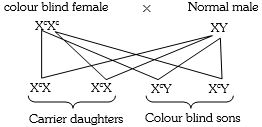
If a colour blind lady marries a normal man,their children will be:
A
Normal daughters and normal sons
B
Normal sons and carrier daughters
C
Colour blind sons and carrier daughters
D
Colour blind sons and colour blind daughters
Solution
(C) Colour blindness is an $X$-linked recessive disorder. Let the allele for normal vision be $X$ and the allele for colour blindness be $X^c$.
$A$ colour blind female has the genotype $X^cX^c$.
$A$ normal male has the genotype $XY$.
When they cross $(X^cX^c \times XY)$:
- The female produces gametes $X^c$ and $X^c$.
- The male produces gametes $X$ and $Y$.
The resulting offspring genotypes are:
- $X^cX$ (Carrier daughter)
- $X^cY$ (Colour blind son)
Therefore,all daughters will be carriers and all sons will be colour blind.
$A$ colour blind female has the genotype $X^cX^c$.
$A$ normal male has the genotype $XY$.
When they cross $(X^cX^c \times XY)$:
- The female produces gametes $X^c$ and $X^c$.
- The male produces gametes $X$ and $Y$.
The resulting offspring genotypes are:
- $X^cX$ (Carrier daughter)
- $X^cY$ (Colour blind son)
Therefore,all daughters will be carriers and all sons will be colour blind.
0 likesView Solution
63
BiologyMediumMCQAIPMT · 1994
$A$ normal woman whose father was albino marries a man who is albino. What proportion of normal and albino can be expected among their offspring?
A
$1$ normal : $1$ albino
B
All albino
C
$2$ normal : $1$ albino
D
All normal
Solution
(A) Albinism is an autosomal recessive trait. Let $A$ be the dominant allele for normal pigmentation and $a$ be the recessive allele for albinism.
$1$. The woman is normal but her father was albino $(aa)$,so she must carry one recessive allele. Her genotype is $Aa$.
$2$. The man is albino,so his genotype must be $aa$.
$3$. The cross is $Aa \times aa$.
$4$. The Punnett square results in offspring genotypes: $50\%$ $Aa$ (normal) and $50\%$ $aa$ (albino).
$5$. Therefore,the ratio of normal to albino offspring is $1:1$.
$1$. The woman is normal but her father was albino $(aa)$,so she must carry one recessive allele. Her genotype is $Aa$.
$2$. The man is albino,so his genotype must be $aa$.
$3$. The cross is $Aa \times aa$.
$4$. The Punnett square results in offspring genotypes: $50\%$ $Aa$ (normal) and $50\%$ $aa$ (albino).
$5$. Therefore,the ratio of normal to albino offspring is $1:1$.
0 likesView Solution
64
BiologyEasyMCQAIPMT · 1994
The genes,which are confined to the differential region of the $Y$ chromosome only,are called:
A
Mutant
B
Autosomal
C
Holandric
D
Completely sex-linked
Solution
(C) The genes present on the differential (non-homologous) region of the $Y$ chromosome are exclusively inherited from father to son.
These genes are known as Holandric genes.
Since they are located only on the $Y$ chromosome,they do not have corresponding alleles on the $X$ chromosome and are expressed in all males who inherit the $Y$ chromosome.
These genes are known as Holandric genes.
Since they are located only on the $Y$ chromosome,they do not have corresponding alleles on the $X$ chromosome and are expressed in all males who inherit the $Y$ chromosome.
0 likesView Solution
65
BiologyAdvancedMCQAIPMT · 1994
During the evolution of man, many changes have taken place in his ancestral characters. Which one of the following is an insignificant change?
A
Change of diet from hard, tough fruits and roots to soft food
B
Qualitative improvement in the structure of hands and skills for making tools
C
Disappearance of tail
D
Improvement in speech for communication and social behaviour
Solution
(NONE) In the context of human evolution, all the listed options (dietary changes, tool-making skills, loss of tail, and development of speech) represent significant evolutionary milestones that contributed to the survival and advancement of the human species. However, if this question is evaluated based on standard biological curriculum, it is often considered a flawed or ambiguous question because none of these changes are 'insignificant'. Each played a crucial role in the transition from ancestral primates to modern humans $(Homo \text{ } sapiens)$. Therefore, there is no correct option among the choices provided as all are highly significant.
0 likesView Solution
66
BiologyMediumMCQAIPMT · 1994
Which one of the following evidences does not favour the $Lamarckian$ concept of inheritance of acquired characters?
A
Melanization in peppered moth in industrial areas
B
Presence of webbed toes in aquatic birds
C
Lack of pigment in cave-dwelling animals
D
Absence of limbs in snakes
Solution
(A) $Lamarckism$ (Inheritance of Acquired Characters) suggests that organisms acquire traits during their lifetime due to use or disuse of organs and pass these to their offspring.
$A$. Melanization in peppered moth is an example of natural selection (industrial melanism),which supports $Darwinism$,not $Lamarckism$.
$B$. Webbed toes in aquatic birds were explained by $Lamarck$ as a result of the constant effort to swim.
$C$. Lack of pigment in cave-dwelling animals was explained by $Lamarck$ as a result of the disuse of eyes and other organs in the dark.
$D$. Absence of limbs in snakes was explained by $Lamarck$ as a result of the continuous disuse of limbs for crawling.
$A$. Melanization in peppered moth is an example of natural selection (industrial melanism),which supports $Darwinism$,not $Lamarckism$.
$B$. Webbed toes in aquatic birds were explained by $Lamarck$ as a result of the constant effort to swim.
$C$. Lack of pigment in cave-dwelling animals was explained by $Lamarck$ as a result of the disuse of eyes and other organs in the dark.
$D$. Absence of limbs in snakes was explained by $Lamarck$ as a result of the continuous disuse of limbs for crawling.
0 likesView Solution
67
BiologyEasyMCQAIPMT · 1994
Peking man $(Homo\ erectus\ pekinensis)$ was:
A
$1.2$ to $1.5$ metres tall
B
$1.65$ to $1.75$ metres tall
C
$1.55$ to $1.65$ metres tall
D
None of the above
Solution
(C) The Peking man,scientifically known as $Homo\ erectus\ pekinensis$,is a subspecies of $Homo\ erectus$.
Based on fossil evidence discovered at the Zhoukoudian site in China,the estimated height of the Peking man ranged approximately from $1.55$ to $1.65$ metres.
Therefore,option $C$ is the correct answer.
Based on fossil evidence discovered at the Zhoukoudian site in China,the estimated height of the Peking man ranged approximately from $1.55$ to $1.65$ metres.
Therefore,option $C$ is the correct answer.
0 likesView Solution
68
BiologyEasyMCQAIPMT · 1994
$A$ cell-coded protein that is formed in response to infection with most animal viruses is called
A
Antigen
B
Interferon
C
Histone
D
Antibody
Solution
(B) Interferons are a group of signaling proteins made and released by host cells in response to the presence of several viruses.
They are antiviral proteins that prevent further viral replication in neighboring uninfected cells.
When a cell is infected by a virus,it secretes interferons,which signal nearby cells to heighten their antiviral defenses.
Therefore,the correct answer is $B$ (Interferon).
They are antiviral proteins that prevent further viral replication in neighboring uninfected cells.
When a cell is infected by a virus,it secretes interferons,which signal nearby cells to heighten their antiviral defenses.
Therefore,the correct answer is $B$ (Interferon).
0 likesView Solution
69
BiologyMediumMCQAIPMT · 1994
The main reason why antibiotics could not solve all the problems of bacteria-mediated diseases is:
A
Insensitivity of the individual following prolonged exposure to antibiotics
B
Inactivation of antibiotics by bacterial enzymes
C
Decreased efficiency of the immune system
D
The development of mutant strains resistant to antibiotics
Solution
(D) The primary reason antibiotics have not eliminated bacterial diseases is the emergence of antibiotic resistance.
Bacteria undergo genetic mutations that allow them to survive in the presence of antibiotics.
These mutant strains,which possess resistance genes,multiply and pass these traits to subsequent generations,rendering the antibiotics ineffective against them.
While bacterial enzymes can also inactivate antibiotics,the widespread development of resistant mutant strains is the most significant global challenge.
Bacteria undergo genetic mutations that allow them to survive in the presence of antibiotics.
These mutant strains,which possess resistance genes,multiply and pass these traits to subsequent generations,rendering the antibiotics ineffective against them.
While bacterial enzymes can also inactivate antibiotics,the widespread development of resistant mutant strains is the most significant global challenge.
0 likesView Solution
70
BiologyMediumMCQAIPMT · 1994
$A$ metastatic cancerous tumour is termed as a 'sarcoma' if the disorder originates in:
A
Immune system
B
Epithelial cells
C
Connective tissue (e.g.,fibroblasts)
D
Circulatory system
Solution
(C) Cancer is classified based on the tissue of origin.
$1$. Carcinoma: Cancer arising from epithelial tissues (e.g.,skin,lining of organs).
$2$. Sarcoma: Cancer arising from connective tissues,such as bone,cartilage,fat,muscle,or fibrous tissues (like fibroblasts).
$3$. Leukemia/Lymphoma: Cancer arising from blood-forming cells or the immune system.
Therefore,a tumour originating in connective tissues like fibroblasts is termed a 'sarcoma'.
$1$. Carcinoma: Cancer arising from epithelial tissues (e.g.,skin,lining of organs).
$2$. Sarcoma: Cancer arising from connective tissues,such as bone,cartilage,fat,muscle,or fibrous tissues (like fibroblasts).
$3$. Leukemia/Lymphoma: Cancer arising from blood-forming cells or the immune system.
Therefore,a tumour originating in connective tissues like fibroblasts is termed a 'sarcoma'.
0 likesView Solution
71
BiologyEasyMCQAIPMT · 1994
$A$ disease caused by eating fish contaminated by industrial waste containing mercury compounds is known as
A
Bright's disease
B
Minamata disease
C
Hashimoto disease
D
Osteosclerosis
Solution
(B) Minamata disease is a neurological syndrome caused by severe mercury poisoning.
It was first discovered in Minamata city,Japan,in $1956$.
It is caused by the release of methylmercury in the industrial wastewater from a chemical factory,which bioaccumulates in shellfish and fish,and subsequently causes mercury poisoning in humans who consume them.
It was first discovered in Minamata city,Japan,in $1956$.
It is caused by the release of methylmercury in the industrial wastewater from a chemical factory,which bioaccumulates in shellfish and fish,and subsequently causes mercury poisoning in humans who consume them.
0 likesView Solution
72
BiologyEasyMCQAIPMT · 1994
Silk is produced by
A
Larva and adult moth
B
Larva
C
Adult moth
D
Cocoon
Solution
(B) Silk is produced by the larva of the silkworm. The larva secretes a proteinaceous fluid from its salivary glands,which hardens upon contact with air to form the silk thread used to construct the cocoon.
0 likesView Solution
73
BiologyMediumMCQAIPMT · 1994
Which among the following is the real product of the honey bee?
A
Honey
B
Bee wax
C
Propolis
D
Both $(b)$ and $(c)$
Solution
(D) The products of honey bees can be classified into those collected from plants and those secreted by the bees themselves.
Honey is primarily derived from nectar collected from flowers.
Bee wax is a natural secretion produced by the wax glands of worker honey bees.
Propolis is a resinous mixture that honey bees collect from tree buds and sap flows,which they then mix with their own secretions.
Therefore,both bee wax and propolis are considered products that involve the bees' own secretions or processing,making $(d)$ the correct answer.
Honey is primarily derived from nectar collected from flowers.
Bee wax is a natural secretion produced by the wax glands of worker honey bees.
Propolis is a resinous mixture that honey bees collect from tree buds and sap flows,which they then mix with their own secretions.
Therefore,both bee wax and propolis are considered products that involve the bees' own secretions or processing,making $(d)$ the correct answer.
0 likesView Solution
74
BiologyMediumMCQAIPMT · 1994
The major drawback of $DDT$ as a pesticide is that:
A
Organisms at once develop resistance to it
B
It is significantly less effective than other pesticides
C
Its cost of production is high
D
It is not easily and rapidly degraded in nature
Solution
(D) $DDT$ (Dichlorodiphenyltrichloroethane) is a persistent organic pollutant. The major drawback of $DDT$ is that it is non-biodegradable,meaning it is not easily and rapidly degraded by microorganisms in nature. Due to this,it accumulates in the environment and undergoes biomagnification through the food chain,leading to toxic effects in higher trophic levels.
0 likesView Solution
75
BiologyMediumMCQAIPMT · 1994
Which one among the following is likely to have the highest levels of $DDT$ deposition in its body?
A
Seagull
B
Crab
C
Eel
D
Phytoplankton
Solution
(A) The phenomenon of biomagnification refers to the increase in concentration of non-degradable pollutants (like $DDT$) at successive trophic levels.
In an aquatic food chain,the sequence is: $Phytoplankton \rightarrow Zooplankton \rightarrow Small \ Fish \rightarrow Eel \rightarrow Seagull$.
Since $DDT$ is fat-soluble and cannot be metabolized or excreted,it accumulates in the fatty tissues of organisms.
As we move up the food chain,the concentration of $DDT$ increases significantly.
Among the given options,the $Seagull$ is at the highest trophic level (top carnivore),and therefore,it will have the highest concentration of $DDT$ in its body.
In an aquatic food chain,the sequence is: $Phytoplankton \rightarrow Zooplankton \rightarrow Small \ Fish \rightarrow Eel \rightarrow Seagull$.
Since $DDT$ is fat-soluble and cannot be metabolized or excreted,it accumulates in the fatty tissues of organisms.
As we move up the food chain,the concentration of $DDT$ increases significantly.
Among the given options,the $Seagull$ is at the highest trophic level (top carnivore),and therefore,it will have the highest concentration of $DDT$ in its body.
0 likesView Solution
76
BiologyMediumMCQAIPMT · 1994
Mycorrhiza represents
A
Antagonism
B
Endemism
C
Symbiosis
D
Parasitism
Solution
(C) Mycorrhiza is a symbiotic association between a fungus and the roots of higher plants.
In this association,the fungus helps the plant in the absorption of essential nutrients like phosphorus from the soil,while the plant provides carbohydrates and shelter to the fungus.
Since both organisms benefit from this interaction,it is classified as symbiosis or mutualism.
In this association,the fungus helps the plant in the absorption of essential nutrients like phosphorus from the soil,while the plant provides carbohydrates and shelter to the fungus.
Since both organisms benefit from this interaction,it is classified as symbiosis or mutualism.
0 likesView Solution
77
BiologyMediumMCQAIPMT · 1994
Biological control of pests is
A
Polluting
B
Highly expensive
C
Self-perpetuating
D
Toxic
Solution
(C) Biological control refers to the use of biological methods for controlling plant diseases and pests.
$(c)$ The control organism,which parasitizes,preys upon,or inhibits the target pest,multiplies itself in the environment and is,therefore,self-perpetuating.
$(c)$ The control organism,which parasitizes,preys upon,or inhibits the target pest,multiplies itself in the environment and is,therefore,self-perpetuating.
0 likesView Solution
78
BiologyMediumMCQAIPMT · 1994
$A$ xeric environment is characterized by:
A
High precipitation
B
Low atmospheric humidity
C
Extremes of temperature
D
High rate of evaporation
Solution
(B) xeric environment refers to a dry habitat that supports only sparse vegetation.
Such environments are characterized by limited water availability,which leads to low atmospheric humidity,extreme temperature fluctuations between day and night,and a high rate of evaporation (transpiration) from the soil and organisms.
Therefore,all the given options ($B$,$C$,and $D$) are characteristic features of a xeric environment.
However,if this is a multiple-choice question where only one answer is expected,'Low atmospheric humidity' is a primary defining feature.
Such environments are characterized by limited water availability,which leads to low atmospheric humidity,extreme temperature fluctuations between day and night,and a high rate of evaporation (transpiration) from the soil and organisms.
Therefore,all the given options ($B$,$C$,and $D$) are characteristic features of a xeric environment.
However,if this is a multiple-choice question where only one answer is expected,'Low atmospheric humidity' is a primary defining feature.
0 likesView Solution
79
BiologyMediumMCQAIPMT · 1994
The character of an ecosystem is determined by the environmental factor which is in the shortest supply. This is known as the:
A
Law of minimum
B
Law of diminishing returns
C
Law of limiting factors
D
Law of supply and demand
Solution
(C) The principle stating that the growth or character of an ecosystem is controlled by the scarcest resource (the factor in the shortest supply) is known as Liebig's Law of the Minimum,which is a fundamental concept in ecology often referred to as the Law of Limiting Factors. Therefore,the correct answer is the Law of limiting factors.
0 likesView Solution
80
BiologyEasyMCQAIPMT · 1994
The largest amount of fresh water is found in:
A
Lakes and streams
B
Underground
C
Polar ice and glaciers
D
Rivers
Solution
(C) The total volume of water on Earth is vast,but only a small fraction is fresh water.
Of the total fresh water available,the majority is locked in polar ice caps and glaciers.
Approximately $68.7\%$ of all fresh water is stored in ice caps and glaciers,making it the largest reservoir of fresh water on the planet.
Therefore,the correct option is $C$.
Of the total fresh water available,the majority is locked in polar ice caps and glaciers.
Approximately $68.7\%$ of all fresh water is stored in ice caps and glaciers,making it the largest reservoir of fresh water on the planet.
Therefore,the correct option is $C$.
0 likesView Solution
81
BiologyMediumMCQAIPMT · 1994
The most important human activity leading to the extinction of wildlife is
A
Alteration and destruction of natural habitats
B
Hunting for commercially valuable wildlife products
C
Pollution of air and water
D
Introduction of alien species
Solution
(A) The most significant cause driving species to extinction is the alteration and destruction of natural habitats.
This process destroys essential breeding grounds,shelter,and food sources for various organisms.
As habitats shrink or disappear,populations become fragmented and unable to sustain themselves,leading to a decline in biodiversity.
This process destroys essential breeding grounds,shelter,and food sources for various organisms.
As habitats shrink or disappear,populations become fragmented and unable to sustain themselves,leading to a decline in biodiversity.
0 likesView Solution
82
BiologyEasyMCQAIPMT · 1994
In India,the rhinoceros is the most important protected species in:
A
Dachigam National Park
B
Kaziranga National Park
C
Sunderbans National Park
D
Dudhwa National Park
Solution
(B) The $1$-horned rhinoceros (Rhinoceros unicornis) is a flagship species of India.
Kaziranga National Park,located in the state of Assam,is world-famous for hosting the largest population of the one-horned rhinoceros.
It is a $UNESCO$ World Heritage Site and provides a protected habitat for these animals.
Kaziranga National Park,located in the state of Assam,is world-famous for hosting the largest population of the one-horned rhinoceros.
It is a $UNESCO$ World Heritage Site and provides a protected habitat for these animals.
0 likesView Solution
83
BiologyMediumMCQAIPMT · 1994
Identify the incorrect statement among the following statements regarding the effects of deforestation.
A
It destroys the natural habitat of wild animals.
B
It alters the local weather patterns.
C
It speeds up nutrient recycling.
D
It leads to soil erosion.
Solution
(C) Deforestation refers to the large-scale removal of forest cover.
$1$. It destroys the natural habitat of wild animals,leading to a loss of biodiversity.
$2$. It alters local weather patterns by reducing transpiration and affecting the water cycle.
$3$. It leads to soil erosion because tree roots,which bind the soil,are removed.
$4$. It slows down nutrient recycling because the decomposition of forest litter is disrupted and the nutrient-rich topsoil is lost.
Therefore,the statement that it 'speeds up nutrient recycling' is incorrect.
$1$. It destroys the natural habitat of wild animals,leading to a loss of biodiversity.
$2$. It alters local weather patterns by reducing transpiration and affecting the water cycle.
$3$. It leads to soil erosion because tree roots,which bind the soil,are removed.
$4$. It slows down nutrient recycling because the decomposition of forest litter is disrupted and the nutrient-rich topsoil is lost.
Therefore,the statement that it 'speeds up nutrient recycling' is incorrect.
0 likesView Solution
84
BiologyEasyMCQAIPMT · 1994
The Ranthambore National Park is located in:
A
Maharashtra
B
Uttar Pradesh
C
Gujarat
D
Rajasthan
Solution
(D) Ranthambore National Park is a famous wildlife sanctuary and national park located in the Sawai Madhopur district of southeastern Rajasthan,India. It is well-known for its population of Bengal tigers and is a significant site for biodiversity conservation.
0 likesView Solution
85
BiologyEasyMCQAIPMT · 1994
Binomial nomenclature was introduced by
A
Linnaeus
B
Darwin
C
Aristotle
D
De Candolle
Solution
(A) The system of binomial nomenclature was introduced by $Carl$ $Linnaeus$.
He proposed this system in his book $Species$ $Plantarum$ $(1753)$.
According to this system,each organism is given a scientific name consisting of two components: the genus and the specific epithet.
He proposed this system in his book $Species$ $Plantarum$ $(1753)$.
According to this system,each organism is given a scientific name consisting of two components: the genus and the specific epithet.
0 likesView Solution
86
BiologyMediumMCQAIPMT · 1994
With the exception of water,which one of the following is possibly the most important accessory chemical substance in industrial processes?
A
Petroleum
B
Rubber
C
Ethanol
D
Liquid nitrogen
Solution
(C) Sulfuric acid $(H_2SO_4)$ is often cited as the most important industrial chemical,but among the given options,$Ethanol$ $(C_2H_5OH)$ is widely used as a solvent,a chemical intermediate,and a fuel additive in various industrial processes. However,in the context of general industrial chemistry,$Ethanol$ is frequently recognized for its versatility as a reagent and solvent.
0 likesView Solution
87
BiologyMediumMCQAIPMT · 1994
In humans,at the end of the first meiotic division,the male germ cells differentiate into the
A
spermatids
B
spermatogonia
C
primary spermatocytes
D
secondary spermatocytes
Solution
(D) The correct answer is $D$.
During spermatogenesis,the $spermatogonia$ $(2n)$ undergo mitosis to increase in number.
Some $spermatogonia$ grow and differentiate into $primary$ $spermatocytes$ $(2n)$.
These $primary$ $spermatocytes$ undergo the first meiotic division $(Meiosis-I)$,which is a reductional division,to form two haploid $(n)$ cells known as $secondary$ $spermatocytes$.
Following this,the $secondary$ $spermatocytes$ undergo the second meiotic division $(Meiosis-II)$ to produce $spermatids$ $(n)$,which eventually differentiate into $spermatozoa$.
During spermatogenesis,the $spermatogonia$ $(2n)$ undergo mitosis to increase in number.
Some $spermatogonia$ grow and differentiate into $primary$ $spermatocytes$ $(2n)$.
These $primary$ $spermatocytes$ undergo the first meiotic division $(Meiosis-I)$,which is a reductional division,to form two haploid $(n)$ cells known as $secondary$ $spermatocytes$.
Following this,the $secondary$ $spermatocytes$ undergo the second meiotic division $(Meiosis-II)$ to produce $spermatids$ $(n)$,which eventually differentiate into $spermatozoa$.
0 likesView Solution
88
BiologyEasyMCQAIPMT · 1994
$Entamoeba coli$ causes which of the following?
A
Pyorrhea
B
Diarrhea
C
Dysentery
D
None of the above
Solution
(D) $Entamoeba coli$ is a non-pathogenic commensal organism found in the human intestine.
It does not cause any disease in humans.
$Entamoeba histolytica$ is the species responsible for causing amoebic dysentery.
Therefore, the correct answer is $None of the above$.
It does not cause any disease in humans.
$Entamoeba histolytica$ is the species responsible for causing amoebic dysentery.
Therefore, the correct answer is $None of the above$.
0 likesView Solution
89
BiologyMediumMCQAIPMT · 1994
Decomposers are organisms that,....
A
Induce tissue death by spreading chemical substances.
B
Act on living bodies and convert organic matter in cells into simpler forms.
C
Attack and kill plants and animals.
D
Act on dead bodies and break down complex organic matter into simpler substances.
Solution
(D) Decomposers are organisms,primarily bacteria and fungi,that obtain energy by breaking down dead organic matter.
They secrete digestive enzymes outside their bodies onto the dead organic material (extracellular digestion).
These enzymes break down complex organic compounds into simpler,inorganic substances.
This process is essential for nutrient cycling in the ecosystem,as it returns minerals to the soil for reuse by producers.
They secrete digestive enzymes outside their bodies onto the dead organic material (extracellular digestion).
These enzymes break down complex organic compounds into simpler,inorganic substances.
This process is essential for nutrient cycling in the ecosystem,as it returns minerals to the soil for reuse by producers.
0 likesView Solution
90
BiologyEasyMCQAIPMT · 1994
Which cellular component is associated with genetic engineering?
A
Plasmid
B
Mitochondria
C
Golgi body
D
Lomasomes
Solution
(A) In genetic engineering,$Plasmids$ are small,circular,double-stranded $DNA$ molecules that are distinct from a cell's chromosomal $DNA$. They are naturally found in bacteria and are widely used as vectors to transport foreign genetic material into a host cell. Therefore,$Plasmids$ are the essential cellular components associated with genetic engineering.
0 likesView Solution
91
BiologyMediumMCQAIPMT · 1994
Which is the main pollinator in agricultural crops?
A
Butterflies
B
Flies
C
Moths
D
Bees
Solution
(D) Bees ($Apis$ species) are considered the most important and efficient pollinators for a wide variety of agricultural crops. They visit flowers to collect nectar and pollen,facilitating cross-pollination,which significantly increases crop yield and quality. While other insects like butterflies,flies,and moths also act as pollinators,bees are the primary agents in most agricultural ecosystems.
0 likesView Solution
92
BiologyMediumMCQAIPMT · 1994
What is the process called where the pollen tube carries the male gametes to achieve fertilization?
A
Porogamy
B
Syngamy
C
Chalazogamy
D
Siphonogamy
Solution
(D) The process of fertilization in seed plants where the pollen tube acts as a conduit to transport male gametes to the female gametophyte is known as $Siphonogamy$.
$1$. $Porogamy$ refers to the entry of the pollen tube through the micropyle.
$2$. $Syngamy$ is the fusion of male and female gametes.
$3$. $Chalazogamy$ is the entry of the pollen tube through the chalaza.
Therefore,the correct term for the transport of male gametes via the pollen tube is $Siphonogamy$.
$1$. $Porogamy$ refers to the entry of the pollen tube through the micropyle.
$2$. $Syngamy$ is the fusion of male and female gametes.
$3$. $Chalazogamy$ is the entry of the pollen tube through the chalaza.
Therefore,the correct term for the transport of male gametes via the pollen tube is $Siphonogamy$.
0 likesView Solution
93
BiologyEasyMCQAIPMT · 1994
Which organic substance can withstand extreme environmental conditions and cannot be degraded by any known enzyme?
A
Cuticle
B
Sporopollenin
C
Lignin
D
Cellulose
Solution
(B) Sporopollenin is one of the most resistant organic materials known.
It is found in the exine of pollen grains.
It can withstand high temperatures,strong acids,and alkali conditions.
No enzyme that degrades sporopollenin has been discovered so far,which allows pollen grains to be well-preserved as fossils.
It is found in the exine of pollen grains.
It can withstand high temperatures,strong acids,and alkali conditions.
No enzyme that degrades sporopollenin has been discovered so far,which allows pollen grains to be well-preserved as fossils.
0 likesView Solution
94
BiologyMediumMCQAIPMT · 1994
Geitonogamy involves:
A
Fertilization of a flower of the same plant by pollen grains.
B
Fertilization of the same flower by pollen grains.
C
Fertilization of a flower by pollen grains from another flower of the same species.
D
Fertilization of a flower by pollen grains from a flower of a different species.
Solution
(A) Geitonogamy is a type of pollination where pollen grains from the anther of one flower are transferred to the stigma of another flower borne on the same plant.
Although it is functionally cross-pollination involving a pollinating agent,genetically it is similar to self-pollination because the pollen grains come from the same plant.
Although it is functionally cross-pollination involving a pollinating agent,genetically it is similar to self-pollination because the pollen grains come from the same plant.
0 likesView Solution
95
BiologyEasyMCQAIPMT · 1994
Ovulation occurs under the influence of ...........
A
$LH$
B
$FSH$
C
Estrogen
D
Progesterone
Solution
(A) Ovulation is the process of release of the secondary oocyte from the Graafian follicle. This process is triggered by a rapid surge of Luteinizing Hormone $(LH)$ secreted by the anterior pituitary gland,which is known as the $LH$ surge. This surge typically occurs around the $14^{th}$ day of the menstrual cycle.
0 likesView Solution
96
BiologyMediumMCQAIPMT · 1994
In human embryos, the extraembryonic membranes are derived from which of the following?
A
Inner cell mass
B
Trophoblast
C
Hypoblast
D
Follicular cells
Solution
(B) In human development, the blastocyst consists of an outer layer of cells called the $Trophoblast$ and an inner group of cells called the $Inner \text{ } cell \text{ } mass$.
The $Trophoblast$ layer is responsible for forming the extraembryonic membranes, such as the chorion and amnion, which facilitate the connection between the developing embryo and the maternal uterine wall (placenta formation).
The $Inner \text{ } cell \text{ } mass$ gives rise to the embryo proper.
Therefore, the correct answer is $Trophoblast$.
The $Trophoblast$ layer is responsible for forming the extraembryonic membranes, such as the chorion and amnion, which facilitate the connection between the developing embryo and the maternal uterine wall (placenta formation).
The $Inner \text{ } cell \text{ } mass$ gives rise to the embryo proper.
Therefore, the correct answer is $Trophoblast$.
0 likesView Solution
97
BiologyMediumMCQAIPMT · 1994
Which of the following statements is correct regarding the cleavage of a human zygote?
A
It is incomplete.
B
It starts when the ovum reaches the uterus.
C
It starts in the fallopian tube.
D
It is identical to normal mitosis.
Solution
(C) Cleavage in a human zygote is a series of rapid mitotic divisions that occur as the zygote moves through the fallopian tube (oviduct) towards the uterus.
Unlike normal mitosis,cleavage divisions do not involve cell growth between divisions,meaning the total size of the embryo remains the same while the number of cells (blastomeres) increases.
Therefore,cleavage starts in the fallopian tube while the zygote is still moving towards the uterus.
Unlike normal mitosis,cleavage divisions do not involve cell growth between divisions,meaning the total size of the embryo remains the same while the number of cells (blastomeres) increases.
Therefore,cleavage starts in the fallopian tube while the zygote is still moving towards the uterus.
0 likesView Solution
98
BiologyEasyMCQAIPMT · 1994
In a $28$-day human ovarian cycle,ovulation occurs on:
A
Day $1$
B
Day $5$
C
Day $14$
D
Day $28$
Solution
(C) The human ovarian cycle typically lasts for $28$ days.
Ovulation is the process where a mature ovarian follicle ruptures and releases an egg (ovum).
In a standard $28$-day cycle,ovulation is triggered by a surge in Luteinizing Hormone $(LH)$ and typically occurs at the midpoint of the cycle,which is the $14$th day.
Ovulation is the process where a mature ovarian follicle ruptures and releases an egg (ovum).
In a standard $28$-day cycle,ovulation is triggered by a surge in Luteinizing Hormone $(LH)$ and typically occurs at the midpoint of the cycle,which is the $14$th day.
0 likesView Solution
99
BiologyMediumMCQAIPMT · 1994
$A$ woman whose father was an albino marries an albino man. What will be the ratio of their offspring?
A
$2$ Normal : $1$ Albino
B
All Normal
C
All Albino
D
$1$ Normal : $1$ Albino
Solution
(D) Albinism is an autosomal recessive trait. Let $A$ be the dominant allele for normal skin pigmentation and $a$ be the recessive allele for albinism.
$1$. The woman's father was an albino $(aa)$,so she must have inherited one recessive allele $(a)$ from him. Since she is phenotypically normal,her genotype must be $Aa$.
$2$. The man is an albino,so his genotype must be $aa$.
$3$. The cross between the woman $(Aa)$ and the man $(aa)$ is: $Aa \times aa$.
$4$. The resulting offspring genotypes are $Aa$ (Normal) and $aa$ (Albino) in a $1:1$ ratio.
Therefore,the ratio of their offspring will be $1$ Normal : $1$ Albino.
$1$. The woman's father was an albino $(aa)$,so she must have inherited one recessive allele $(a)$ from him. Since she is phenotypically normal,her genotype must be $Aa$.
$2$. The man is an albino,so his genotype must be $aa$.
$3$. The cross between the woman $(Aa)$ and the man $(aa)$ is: $Aa \times aa$.
$4$. The resulting offspring genotypes are $Aa$ (Normal) and $aa$ (Albino) in a $1:1$ ratio.
Therefore,the ratio of their offspring will be $1$ Normal : $1$ Albino.
0 likesView Solution
100
BiologyEasyMCQAIPMT · 1994
$A$ gene located on the $Y$ chromosome is called:
A
Mutant gene
B
Sex-linked gene
C
Autosomal gene
D
Holandric gene
Solution
(D) Genes that are exclusively located on the $Y$ chromosome are known as holandric genes. These genes are transmitted directly from father to son. Since females do not possess a $Y$ chromosome,these traits are never expressed in females.
0 likesView Solution
Vedclass Products
For Students
Vedclass Test Series
Mock tests in real AIPMT style covering Biology with performance analysis. 5-day free trial.
Start Free TrialFor Teachers
Exam Paper Generator
Generate Set A/B/C/D Biology papers from 7.5L+ questions in 2 minutes. 3 chapters free.
Try FreeFor Institutes
Online Exam Module
Run live AIPMT mock exams with unlimited students, 360° analytics & white-label branding.
See DemoFrequently Asked Questions
How many Biology questions are in AIPMT 1994?
There are 196 Biology questions from the AIPMT 1994 paper on Vedclass, each with a detailed step-by-step solution in English.
Are AIPMT 1994 Biology solutions available in English?
Yes. All solutions on this page are in English. You can also switch to English or Hindi using the language buttons above the questions.
Can I practice AIPMT 1994 Biology as a timed test?
Yes. Use the Vedclass Test Series to attempt a full AIPMT mock test covering Biology with time limits and instant score analysis.
Can teachers create Biology papers from AIPMT previous year questions?
Yes. The Vedclass Exam Paper Generator lets teachers mix AIPMT Biology questions and generate Set A/B/C/D papers in minutes.
For Teachers & Institutes
Build a Custom Biology Paper
Pick AIPMT 1994 Biology questions, set difficulty, and generate Set A/B/C/D in 2 minutes.