
અ Gujarati
Heights and Distances Questions in Gujarati
Competitive Exam Quantitative Aptitude · Heights and Distances · Heights and Distances
73+
Questions
Gujarati
Language
100%
With Solutions
Showing 23 of 73 questions in Gujarati
51
MediumMCQ
જો $x = a \cos \theta + b \sin \theta$ અને $y = b \cos \theta - a \sin \theta$ હોય,તો $x^{2} + y^{2}$ ની કિંમત કેટલી થાય?
A
$ab$
B
$a^{2} + b^{2}$
C
$a^{2} - b^{2}$
D
$1$
Solution
(B) આપેલ છે:
$x = a \cos \theta + b \sin \theta$
$y = b \cos \theta - a \sin \theta$
બંને સમીકરણોનો વર્ગ કરતા:
$x^{2} = (a \cos \theta + b \sin \theta)^{2} = a^{2} \cos^{2} \theta + b^{2} \sin^{2} \theta + 2ab \sin \theta \cos \theta$
$y^{2} = (b \cos \theta - a \sin \theta)^{2} = b^{2} \cos^{2} \theta + a^{2} \sin^{2} \theta - 2ab \cos \theta \sin \theta$
$x^{2}$ અને $y^{2}$ નો સરવાળો કરતા:
$x^{2} + y^{2} = (a^{2} \cos^{2} \theta + b^{2} \sin^{2} \theta + 2ab \sin \theta \cos \theta) + (b^{2} \cos^{2} \theta + a^{2} \sin^{2} \theta - 2ab \cos \theta \sin \theta)$
$x^{2} + y^{2} = a^{2} (\cos^{2} \theta + \sin^{2} \theta) + b^{2} (\sin^{2} \theta + \cos^{2} \theta)$
આપણે જાણીએ છીએ કે $\sin^{2} \theta + \cos^{2} \theta = 1$,તેથી:
$x^{2} + y^{2} = a^{2}(1) + b^{2}(1) = a^{2} + b^{2}$
$x = a \cos \theta + b \sin \theta$
$y = b \cos \theta - a \sin \theta$
બંને સમીકરણોનો વર્ગ કરતા:
$x^{2} = (a \cos \theta + b \sin \theta)^{2} = a^{2} \cos^{2} \theta + b^{2} \sin^{2} \theta + 2ab \sin \theta \cos \theta$
$y^{2} = (b \cos \theta - a \sin \theta)^{2} = b^{2} \cos^{2} \theta + a^{2} \sin^{2} \theta - 2ab \cos \theta \sin \theta$
$x^{2}$ અને $y^{2}$ નો સરવાળો કરતા:
$x^{2} + y^{2} = (a^{2} \cos^{2} \theta + b^{2} \sin^{2} \theta + 2ab \sin \theta \cos \theta) + (b^{2} \cos^{2} \theta + a^{2} \sin^{2} \theta - 2ab \cos \theta \sin \theta)$
$x^{2} + y^{2} = a^{2} (\cos^{2} \theta + \sin^{2} \theta) + b^{2} (\sin^{2} \theta + \cos^{2} \theta)$
આપણે જાણીએ છીએ કે $\sin^{2} \theta + \cos^{2} \theta = 1$,તેથી:
$x^{2} + y^{2} = a^{2}(1) + b^{2}(1) = a^{2} + b^{2}$
0 likes
View Solution52
EasyMCQ
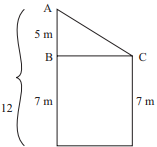
$7 \ m$ અને $12 \ m$ ઊંચાઈના બે થાંભલા સમતલ જમીન પર ઉભા છે. જો તેમના પાયા વચ્ચેનું અંતર $12 \ m$ હોય,તો તેમના ટોચના ભાગો વચ્ચેનું અંતર કેટલું હશે (મીટરમાં)?
A
$13$
B
$19$
C
$17$
D
$15$
Solution
(A) ધારો કે બે થાંભલાની ઊંચાઈ $h_1 = 12 \ m$ અને $h_2 = 7 \ m$ છે. તેમના પાયા વચ્ચેનું અંતર $d = 12 \ m$ છે.
જ્યારે આપણે ટૂંકા થાંભલાની ટોચથી ઊંચા થાંભલા સુધી એક આડી રેખા દોરીએ છીએ,ત્યારે એક કાટકોણ ત્રિકોણ બને છે.
આ ત્રિકોણનો પાયો થાંભલાઓ વચ્ચેના અંતર જેટલો એટલે કે $12 \ m$ છે.
આ ત્રિકોણની ઊભી ઊંચાઈ બે થાંભલાઓની ઊંચાઈનો તફાવત છે: $12 \ m - 7 \ m = 5 \ m$.
પાયથાગોરસના પ્રમેયનો ઉપયોગ કરીને,ટોચના ભાગો વચ્ચેનું અંતર $(AC)$ નીચે મુજબ મળે:
$AC^2 = (12)^2 + (5)^2$
$AC^2 = 144 + 25 = 169$
$AC = \sqrt{169} = 13 \ m$.
જ્યારે આપણે ટૂંકા થાંભલાની ટોચથી ઊંચા થાંભલા સુધી એક આડી રેખા દોરીએ છીએ,ત્યારે એક કાટકોણ ત્રિકોણ બને છે.
આ ત્રિકોણનો પાયો થાંભલાઓ વચ્ચેના અંતર જેટલો એટલે કે $12 \ m$ છે.
આ ત્રિકોણની ઊભી ઊંચાઈ બે થાંભલાઓની ઊંચાઈનો તફાવત છે: $12 \ m - 7 \ m = 5 \ m$.
પાયથાગોરસના પ્રમેયનો ઉપયોગ કરીને,ટોચના ભાગો વચ્ચેનું અંતર $(AC)$ નીચે મુજબ મળે:
$AC^2 = (12)^2 + (5)^2$
$AC^2 = 144 + 25 = 169$
$AC = \sqrt{169} = 13 \ m$.
0 likes
View Solution53
EasyMCQ
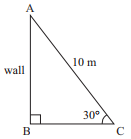
$10 \ m$ લાંબી સીડી દીવાલ સાથે ટેકવેલી છે. તે જમીન સાથે $30^{\circ}$ ના ખૂણે નમેલી છે. સીડીના નીચેના છેડાનું દીવાલથી અંતર ($m$ માં) કેટલું હશે? (આપેલ છે $\sqrt{3} = 1.732$)
A
$7.32$
B
$8.26$
C
$8.66$
D
$8.16$
Solution
(C) ધારો કે સીડી $AC$ છે,જ્યાં $AC = 10 \ m$ છે. ધારો કે દીવાલ $AB$ છે અને જમીન $BC$ છે. સીડી જમીન સાથે $30^{\circ}$ નો ખૂણો બનાવે છે,તેથી $\angle C = 30^{\circ}$ છે.
કાટકોણ ત્રિકોણ $ABC$ માં,આપણે સીડીના નીચેના છેડાનું દીવાલથી અંતર શોધવાનું છે,જે $BC$ છે.
ત્રિકોણમિતીય ગુણોત્તર $\cos \theta = \frac{\text{પાસેની બાજુ}}{\text{કર્ણ}}$ નો ઉપયોગ કરતા:
$\cos 30^{\circ} = \frac{BC}{AC}$
$\frac{\sqrt{3}}{2} = \frac{BC}{10}$
$BC = 10 \times \frac{\sqrt{3}}{2} = 5 \times \sqrt{3}$
આપેલ છે કે $\sqrt{3} = 1.732$,તેથી:
$BC = 5 \times 1.732 = 8.66 \ m$.
કાટકોણ ત્રિકોણ $ABC$ માં,આપણે સીડીના નીચેના છેડાનું દીવાલથી અંતર શોધવાનું છે,જે $BC$ છે.
ત્રિકોણમિતીય ગુણોત્તર $\cos \theta = \frac{\text{પાસેની બાજુ}}{\text{કર્ણ}}$ નો ઉપયોગ કરતા:
$\cos 30^{\circ} = \frac{BC}{AC}$
$\frac{\sqrt{3}}{2} = \frac{BC}{10}$
$BC = 10 \times \frac{\sqrt{3}}{2} = 5 \times \sqrt{3}$
આપેલ છે કે $\sqrt{3} = 1.732$,તેથી:
$BC = 5 \times 1.732 = 8.66 \ m$.
0 likes
View Solution54
EasyMCQ
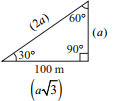
ટાવરના પાયાથી $100 \ m$ ના અંતરેથી ટાવરનો ઉત્સેધકોણ $30^{\circ}$ છે. તો ટાવરની ઊંચાઈ ($m$ માં) કેટલી હશે?
A
$100 \sqrt{3}$
B
$\frac{50}{\sqrt{3}}$
C
$50 \sqrt{3}$
D
$\frac{100}{\sqrt{3}}$
Solution
(D) ધારો કે ટાવરની ઊંચાઈ $h$ મીટર છે.
આપેલ છે કે ટાવરના પાયાથી અંતર $100 \ m$ છે અને ઉત્સેધકોણ $30^{\circ}$ છે.
કાટકોણ ત્રિકોણમાં,$\tan(\theta) = \frac{\text{સામેની બાજુ}}{\text{પાસેની બાજુ}}$.
અહીં,$\tan(30^{\circ}) = \frac{h}{100}$.
આપણે જાણીએ છીએ કે $\tan(30^{\circ}) = \frac{1}{\sqrt{3}}$.
તેથી,$\frac{1}{\sqrt{3}} = \frac{h}{100}$.
આમ,$h = \frac{100}{\sqrt{3}} \ m$.
આપેલ છે કે ટાવરના પાયાથી અંતર $100 \ m$ છે અને ઉત્સેધકોણ $30^{\circ}$ છે.
કાટકોણ ત્રિકોણમાં,$\tan(\theta) = \frac{\text{સામેની બાજુ}}{\text{પાસેની બાજુ}}$.
અહીં,$\tan(30^{\circ}) = \frac{h}{100}$.
આપણે જાણીએ છીએ કે $\tan(30^{\circ}) = \frac{1}{\sqrt{3}}$.
તેથી,$\frac{1}{\sqrt{3}} = \frac{h}{100}$.
આમ,$h = \frac{100}{\sqrt{3}} \ m$.
0 likes
View Solution55
MediumMCQ
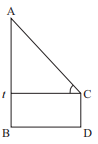
$6 \ ft$ ની ઊંચાઈ ધરાવતી વ્યક્તિ એક $\frac{26}{3} \ ft$ ઊંચા ઝાડ પર રહેલું ફળ તોડવા માંગે છે. જો વ્યક્તિ ઝાડના થડથી $\frac{8}{\sqrt{3}} \ ft$ દૂર ઉભી હોય,તો તેણે કેટલા ખૂણે પથ્થર ફેંકવો જોઈએ જેથી તે ફળને વાગે ($^{\circ}$ માં)?
A
$45$
B
$60$
C
$75$
D
$30$
Solution
(D) ધારો કે વ્યક્તિની ઊંચાઈ $CD = 6 \ ft$ છે.
ઝાડની ઊંચાઈ $AB = \frac{26}{3} \ ft$ છે.
વ્યક્તિ અને ઝાડ વચ્ચેનું અંતર $BD = \frac{8}{\sqrt{3}} \ ft$ છે.
ધારો કે $AB$ પર એક બિંદુ $E$ છે જેથી $CE$ એ $BD$ ને સમાંતર હોય. તેથી,$BE = CD = 6 \ ft$.
વ્યક્તિની આંખના સ્તરથી ઉપર ફળની ઊંચાઈ $AE = AB - BE = \frac{26}{3} - 6 = \frac{26 - 18}{3} = \frac{8}{3} \ ft$ છે.
ક્ષૈતિજ અંતર $CE = BD = \frac{8}{\sqrt{3}} \ ft$ છે.
કાટકોણ ત્રિકોણ $\Delta AEC$ માં,$\tan \theta = \frac{AE}{CE}$.
$\tan \theta = \frac{8/3}{8/\sqrt{3}} = \frac{8}{3} \times \frac{\sqrt{3}}{8} = \frac{\sqrt{3}}{3} = \frac{1}{\sqrt{3}}$.
તેથી,$\tan \theta = \frac{1}{\sqrt{3}}$ હોવાથી,$\theta = 30^{\circ}$ મળે છે.
ઝાડની ઊંચાઈ $AB = \frac{26}{3} \ ft$ છે.
વ્યક્તિ અને ઝાડ વચ્ચેનું અંતર $BD = \frac{8}{\sqrt{3}} \ ft$ છે.
ધારો કે $AB$ પર એક બિંદુ $E$ છે જેથી $CE$ એ $BD$ ને સમાંતર હોય. તેથી,$BE = CD = 6 \ ft$.
વ્યક્તિની આંખના સ્તરથી ઉપર ફળની ઊંચાઈ $AE = AB - BE = \frac{26}{3} - 6 = \frac{26 - 18}{3} = \frac{8}{3} \ ft$ છે.
ક્ષૈતિજ અંતર $CE = BD = \frac{8}{\sqrt{3}} \ ft$ છે.
કાટકોણ ત્રિકોણ $\Delta AEC$ માં,$\tan \theta = \frac{AE}{CE}$.
$\tan \theta = \frac{8/3}{8/\sqrt{3}} = \frac{8}{3} \times \frac{\sqrt{3}}{8} = \frac{\sqrt{3}}{3} = \frac{1}{\sqrt{3}}$.
તેથી,$\tan \theta = \frac{1}{\sqrt{3}}$ હોવાથી,$\theta = 30^{\circ}$ મળે છે.
0 likes
View Solution56
MediumMCQ
એક પતંગ જમીનથી $75 \ m$ ની ઊંચાઈએ ઉડી રહ્યો છે. દોરી સમતલ જમીન સાથે $\Theta$ ખૂણો બનાવે છે (જ્યાં $\cot \Theta = 8/15$ છે). દોરીમાં કોઈ ઢીલાશ નથી તેમ માનીને,દોરીની લંબાઈ ($m$ માં) કેટલી થાય?
A
$75$
B
$85$
C
$40$
D
$65$
Solution
(B) ધારો કે જમીનથી પતંગની ઊંચાઈ $AB = 75 \ m$ છે.
ધારો કે દોરી જમીન સાથે બનાવેલ ખૂણો $\angle ACB = \Theta$ છે.
આપેલ છે કે $\cot \Theta = 8/15$.
કાટકોણ ત્રિકોણ $\triangle ABC$ માં,$\cot \Theta = \frac{\text{પાસેની બાજુ}}{\text{સામેની બાજુ}} = \frac{BC}{AB}$.
તેથી,$\frac{BC}{75} = \frac{8}{15}$.
$BC = \frac{8 \times 75}{15} = 8 \times 5 = 40 \ m$.
દોરીની લંબાઈ એ કર્ણ $AC$ છે.
પાયથાગોરસના પ્રમેયનો ઉપયોગ કરતા,$AC = \sqrt{AB^2 + BC^2}$.
$AC = \sqrt{75^2 + 40^2} = \sqrt{5625 + 1600} = \sqrt{7225}$.
$AC = 85 \ m$.
ધારો કે દોરી જમીન સાથે બનાવેલ ખૂણો $\angle ACB = \Theta$ છે.
આપેલ છે કે $\cot \Theta = 8/15$.
કાટકોણ ત્રિકોણ $\triangle ABC$ માં,$\cot \Theta = \frac{\text{પાસેની બાજુ}}{\text{સામેની બાજુ}} = \frac{BC}{AB}$.
તેથી,$\frac{BC}{75} = \frac{8}{15}$.
$BC = \frac{8 \times 75}{15} = 8 \times 5 = 40 \ m$.
દોરીની લંબાઈ એ કર્ણ $AC$ છે.
પાયથાગોરસના પ્રમેયનો ઉપયોગ કરતા,$AC = \sqrt{AB^2 + BC^2}$.
$AC = \sqrt{75^2 + 40^2} = \sqrt{5625 + 1600} = \sqrt{7225}$.
$AC = 85 \ m$.

0 likes
View Solution57
EasyMCQ
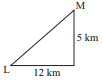
જો એક વ્યક્તિ બિંદુ $L$ થી પૂર્વ દિશામાં $12 \ km$ મુસાફરી કરે છે અને ત્યારબાદ ઉત્તર દિશામાં $5 \ km$ મુસાફરી કરીને બિંદુ $M$ પર પહોંચે છે,તો $L$ થી $M$ વચ્ચેનું ટૂંકામાં ટૂંકું અંતર કેટલું છે ($km$ માં)?
A
$14$
B
$12$
C
$17$
D
$13$
Solution
(D) વ્યક્તિ દ્વારા કાપવામાં આવેલ માર્ગ એક કાટકોણ ત્રિકોણ બનાવે છે જ્યાં પાયો $12 \ km$ (પૂર્વ) છે અને વેધ $5 \ km$ (ઉત્તર) છે.
શરૂઆતના બિંદુ $L$ અને અંતિમ બિંદુ $M$ વચ્ચેનું ટૂંકામાં ટૂંકું અંતર એ આ કાટકોણ ત્રિકોણનો કર્ણ છે.
પાયથાગોરસના પ્રમેયનો ઉપયોગ કરતા:
$\text{ટૂંકામાં ટૂંકું અંતર} = \sqrt{(\text{પાયો})^2 + (\text{વેધ})^2}$
$= \sqrt{12^2 + 5^2}$
$= \sqrt{144 + 25}$
$= \sqrt{169}$
$= 13 \ km$
શરૂઆતના બિંદુ $L$ અને અંતિમ બિંદુ $M$ વચ્ચેનું ટૂંકામાં ટૂંકું અંતર એ આ કાટકોણ ત્રિકોણનો કર્ણ છે.
પાયથાગોરસના પ્રમેયનો ઉપયોગ કરતા:
$\text{ટૂંકામાં ટૂંકું અંતર} = \sqrt{(\text{પાયો})^2 + (\text{વેધ})^2}$
$= \sqrt{12^2 + 5^2}$
$= \sqrt{144 + 25}$
$= \sqrt{169}$
$= 13 \ km$
0 likes
View Solution58
DifficultMCQ
જમીન પરના એક બિંદુ $P$ થી $10 \ m$ ઊંચી ઇમારતની ટોચનો ઉત્સેધકોણ $30^{\circ}$ છે. ઇમારતની ટોચ પર એક ધ્વજ ફરકાવવામાં આવ્યો છે અને $P$ થી ધ્વજદંડની ટોચનો ઉત્સેધકોણ $45^{\circ}$ છે. ધ્વજદંડની લંબાઈ શોધો. ($\sqrt{3} = 1.732$ લો) ($m$ માં)
A
$10(\sqrt{3}+2)$
B
$10(\sqrt{3}+1)$
C
$10 \sqrt{3}$
D
$7.32$
Solution
(D) ધારો કે ઇમારત $BC = 10 \ m$ છે અને ધ્વજદંડ $AB$ છે. ધારો કે $P$ એ જમીન પરનું બિંદુ છે.
$\Delta BCP$ માં,$\tan 30^{\circ} = \frac{BC}{CP} = \frac{10}{CP}$.
$\tan 30^{\circ} = \frac{1}{\sqrt{3}}$ હોવાથી,$\frac{1}{\sqrt{3}} = \frac{10}{CP}$,તેથી $CP = 10\sqrt{3} \ m$.
$\Delta ACP$ માં,$\tan 45^{\circ} = \frac{AC}{CP} = \frac{AB + BC}{CP}$.
$\tan 45^{\circ} = 1$ હોવાથી,$1 = \frac{AB + 10}{10\sqrt{3}}$.
તેથી,$AC = 10\sqrt{3} \ m$.
ધ્વજદંડની લંબાઈ $AB = AC - BC = 10\sqrt{3} - 10$.
$AB = 10(1.732) - 10 = 17.32 - 10 = 7.32 \ m$.
$\Delta BCP$ માં,$\tan 30^{\circ} = \frac{BC}{CP} = \frac{10}{CP}$.
$\tan 30^{\circ} = \frac{1}{\sqrt{3}}$ હોવાથી,$\frac{1}{\sqrt{3}} = \frac{10}{CP}$,તેથી $CP = 10\sqrt{3} \ m$.
$\Delta ACP$ માં,$\tan 45^{\circ} = \frac{AC}{CP} = \frac{AB + BC}{CP}$.
$\tan 45^{\circ} = 1$ હોવાથી,$1 = \frac{AB + 10}{10\sqrt{3}}$.
તેથી,$AC = 10\sqrt{3} \ m$.
ધ્વજદંડની લંબાઈ $AB = AC - BC = 10\sqrt{3} - 10$.
$AB = 10(1.732) - 10 = 17.32 - 10 = 7.32 \ m$.
0 likes
View Solution59
DifficultMCQ
$108 \; m$ ઊંચાઈ ધરાવતા ટાવરની ટોચ પરથી ટાવરની બંને બાજુએ રહેલી બે વસ્તુઓના અવસેધકોણ $30^{\circ}$ અને $45^{\circ}$ છે. તો તે બે વસ્તુઓ વચ્ચેનું અંતર કેટલું હશે?
A
$108(3+\sqrt{3}) \; m$
B
$108(3-\sqrt{3}) \; m$
C
$108(\sqrt{3}-1) \; m$
D
$108(\sqrt{3}+1) \; m$
Solution
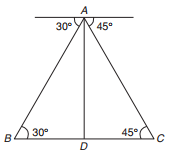
(D) ધારો કે $AD$ એ $108 \; m$ ઊંચાઈ ધરાવતો ટાવર છે અને $B$ તથા $C$ એ ટાવરની બંને બાજુએ રહેલી બે વસ્તુઓ છે.
આપેલ છે: $AD = 108 \; m$,$\angle ABD = 30^{\circ}$ અને $\angle ACD = 45^{\circ}$.
કાટકોણ ત્રિકોણ $\triangle ABD$ માં:
$\tan 30^{\circ} = \frac{AD}{BD}$
$\frac{1}{\sqrt{3}} = \frac{108}{BD}$
$BD = 108\sqrt{3} \; m$
કાટકોણ ત્રિકોણ $\triangle ADC$ માં:
$\tan 45^{\circ} = \frac{AD}{DC}$
$1 = \frac{108}{DC}$
$DC = 108 \; m$
વસ્તુઓ વચ્ચેનું અંતર $BC = BD + DC$ છે.
$BC = 108\sqrt{3} + 108 = 108(\sqrt{3} + 1) \; m$.
આપેલ છે: $AD = 108 \; m$,$\angle ABD = 30^{\circ}$ અને $\angle ACD = 45^{\circ}$.
કાટકોણ ત્રિકોણ $\triangle ABD$ માં:
$\tan 30^{\circ} = \frac{AD}{BD}$
$\frac{1}{\sqrt{3}} = \frac{108}{BD}$
$BD = 108\sqrt{3} \; m$
કાટકોણ ત્રિકોણ $\triangle ADC$ માં:
$\tan 45^{\circ} = \frac{AD}{DC}$
$1 = \frac{108}{DC}$
$DC = 108 \; m$
વસ્તુઓ વચ્ચેનું અંતર $BC = BD + DC$ છે.
$BC = 108\sqrt{3} + 108 = 108(\sqrt{3} + 1) \; m$.
0 likes
View Solution60
EasyMCQ
સપાટ જમીન પર ઉભેલા એક ટાવરનો પડછાયો જ્યારે સૂર્યનો ઉત્સેધકોણ $30^{\circ}$ હોય ત્યારે $60^{\circ}$ હોય તેના કરતા $40 \ m$ લાંબો માલૂમ પડે છે. ટાવરની ઊંચાઈ શોધો. ($m$ માં)
A
$20$
B
$20 \sqrt{3}$
C
$10$
D
$10 \sqrt{3}$
Solution
(B) ધારો કે ટાવરની ઊંચાઈ $h \ m$ છે.
જ્યારે સૂર્યનો ઉત્સેધકોણ $60^{\circ}$ હોય ત્યારે પડછાયાની લંબાઈ $x \ m$ છે તેમ ધારો.
ટાવર અને $60^{\circ}$ ના ખૂણે બનતા કાટકોણ ત્રિકોણમાં,$\tan 60^{\circ} = h / x$,તેથી $x = h / \sqrt{3}$.
જ્યારે સૂર્યનો ઉત્સેધકોણ $30^{\circ}$ હોય ત્યારે પડછાયાની લંબાઈ $(x + 40) \ m$ થાય છે.
ટાવર અને $30^{\circ}$ ના ખૂણે બનતા કાટકોણ ત્રિકોણમાં,$\tan 30^{\circ} = h / (x + 40)$,તેથી $x + 40 = h / \tan 30^{\circ} = h \sqrt{3}$.
$x = h / \sqrt{3}$ ને સમીકરણમાં મૂકતા: $h / \sqrt{3} + 40 = h \sqrt{3}$.
$40 = h \sqrt{3} - h / \sqrt{3} = h (\sqrt{3} - 1 / \sqrt{3}) = h ( (3 - 1) / \sqrt{3} ) = 2h / \sqrt{3}$.
$2h = 40 \sqrt{3}$,જેનું સાદું રૂપ આપતા $h = 20 \sqrt{3} \ m$ મળે છે.
જ્યારે સૂર્યનો ઉત્સેધકોણ $60^{\circ}$ હોય ત્યારે પડછાયાની લંબાઈ $x \ m$ છે તેમ ધારો.
ટાવર અને $60^{\circ}$ ના ખૂણે બનતા કાટકોણ ત્રિકોણમાં,$\tan 60^{\circ} = h / x$,તેથી $x = h / \sqrt{3}$.
જ્યારે સૂર્યનો ઉત્સેધકોણ $30^{\circ}$ હોય ત્યારે પડછાયાની લંબાઈ $(x + 40) \ m$ થાય છે.
ટાવર અને $30^{\circ}$ ના ખૂણે બનતા કાટકોણ ત્રિકોણમાં,$\tan 30^{\circ} = h / (x + 40)$,તેથી $x + 40 = h / \tan 30^{\circ} = h \sqrt{3}$.
$x = h / \sqrt{3}$ ને સમીકરણમાં મૂકતા: $h / \sqrt{3} + 40 = h \sqrt{3}$.
$40 = h \sqrt{3} - h / \sqrt{3} = h (\sqrt{3} - 1 / \sqrt{3}) = h ( (3 - 1) / \sqrt{3} ) = 2h / \sqrt{3}$.
$2h = 40 \sqrt{3}$,જેનું સાદું રૂપ આપતા $h = 20 \sqrt{3} \ m$ મળે છે.
0 likes
View Solution61
EasyMCQ
જ્યારે સૂર્યનો ઉત્સેધકોણ $30^{\circ}$ હોય ત્યારે એક ટાવરના પડછાયાની લંબાઈ $9 \text{ m}$ છે. ટાવરની ઊંચાઈ કેટલી હશે? ($m$ માં)
A
$4.5 \sqrt{3}$
B
$3 \sqrt{3}$
C
$4.5$
D
$9 \sqrt{3}$
Solution
(B) ધારો કે ટાવરની ઊંચાઈ $h$ છે અને પડછાયાની લંબાઈ $L = 9 \text{ m}$ છે.
આપેલ ઉત્સેધકોણ $\theta = 30^{\circ}$ છે.
ટાવર અને તેના પડછાયા દ્વારા બનતા કાટકોણ ત્રિકોણમાં,$\tan \theta = \frac{\text{ઊંચાઈ}}{\text{પડછાયાની લંબાઈ}}$.
કિંમતો મૂકતા: $\tan 30^{\circ} = \frac{h}{9}$.
આપણે જાણીએ છીએ કે $\tan 30^{\circ} = \frac{1}{\sqrt{3}}$,તેથી $\frac{1}{\sqrt{3}} = \frac{h}{9}$.
$h$ માટે ઉકેલતા: $h = \frac{9}{\sqrt{3}} = \frac{9 \times \sqrt{3}}{\sqrt{3} \times \sqrt{3}} = \frac{9 \sqrt{3}}{3} = 3 \sqrt{3} \text{ m}$.
આપેલ ઉત્સેધકોણ $\theta = 30^{\circ}$ છે.
ટાવર અને તેના પડછાયા દ્વારા બનતા કાટકોણ ત્રિકોણમાં,$\tan \theta = \frac{\text{ઊંચાઈ}}{\text{પડછાયાની લંબાઈ}}$.
કિંમતો મૂકતા: $\tan 30^{\circ} = \frac{h}{9}$.
આપણે જાણીએ છીએ કે $\tan 30^{\circ} = \frac{1}{\sqrt{3}}$,તેથી $\frac{1}{\sqrt{3}} = \frac{h}{9}$.
$h$ માટે ઉકેલતા: $h = \frac{9}{\sqrt{3}} = \frac{9 \times \sqrt{3}}{\sqrt{3} \times \sqrt{3}} = \frac{9 \sqrt{3}}{3} = 3 \sqrt{3} \text{ m}$.
0 likes
View Solution62
MediumMCQ
$169 \; cm$ ઊંચાઈ ધરાવતો એક માણસ એક થાંભલા પાસે ઊભો છે. તે $130 \; cm$ લાંબો પડછાયો પાડે છે. જો થાંભલો $420 \; cm$ લાંબો પડછાયો પાડતો હોય,તો થાંભલાની લંબાઈ ($cm$ માં) કેટલી હશે?
A
$323$
B
$546$
C
$550$
D
$589$
Solution
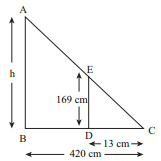
(B) ધારો કે $AB = h$ એ થાંભલાની ઊંચાઈ છે.
ધારો કે $DE = 169 \; cm$ એ માણસની ઊંચાઈ છે.
ધારો કે $CD = 130 \; cm$ એ માણસનો પડછાયો છે.
ધારો કે $BC = 420 \; cm$ એ થાંભલાનો પડછાયો છે.
સૂર્યના કિરણો સમાંતર હોવાથી,$AA$ સમરૂપતાની શરત મુજબ $\Delta CED$ એ $\Delta ABC$ ને સમરૂપ છે.
તેથી,તેમની અનુરૂપ બાજુઓનો ગુણોત્તર સમાન હોય છે:
$\frac{DE}{AB} = \frac{CD}{BC}$
આપેલ કિંમતો મૂકતા:
$\frac{169}{h} = \frac{130}{420}$
$h = \frac{169 \times 420}{130}$
$h = \frac{169 \times 42}{13}$
$h = 13 \times 42$
$h = 546 \; cm$
આમ,થાંભલાની ઊંચાઈ $546 \; cm$ છે.
ધારો કે $DE = 169 \; cm$ એ માણસની ઊંચાઈ છે.
ધારો કે $CD = 130 \; cm$ એ માણસનો પડછાયો છે.
ધારો કે $BC = 420 \; cm$ એ થાંભલાનો પડછાયો છે.
સૂર્યના કિરણો સમાંતર હોવાથી,$AA$ સમરૂપતાની શરત મુજબ $\Delta CED$ એ $\Delta ABC$ ને સમરૂપ છે.
તેથી,તેમની અનુરૂપ બાજુઓનો ગુણોત્તર સમાન હોય છે:
$\frac{DE}{AB} = \frac{CD}{BC}$
આપેલ કિંમતો મૂકતા:
$\frac{169}{h} = \frac{130}{420}$
$h = \frac{169 \times 420}{130}$
$h = \frac{169 \times 42}{13}$
$h = 13 \times 42$
$h = 546 \; cm$
આમ,થાંભલાની ઊંચાઈ $546 \; cm$ છે.
0 likes
View Solution63
MediumMCQ
એક ટાવરના પાયાથી $20 \; m$ દૂર આવેલા બિંદુથી ટાવરની ટોચનો ઉત્સેધકોણ $30^{\circ}$ છે. ટાવરની ઊંચાઈ શોધો.
A
$\frac{10}{\sqrt{3}} \; m$
B
$\frac{20}{\sqrt{3}} \; m$
C
$10 \sqrt{3} \; m$
D
$20 \sqrt{3} \; m$
Solution
(B) ધારો કે $AB$ એ ટાવરની ઊંચાઈ છે અને $C$ એ જમીન પરનું બિંદુ છે.
આપેલ છે કે ટાવરના પાયા $B$ થી બિંદુ $C$ નું અંતર $BC = 20 \; m$ છે.
ઉત્સેધકોણ $\angle ACB = 30^{\circ}$ છે.
કાટકોણ ત્રિકોણ $\triangle ABC$ માં:
$\tan(30^{\circ}) = \frac{\text{સામેની બાજુ}}{\text{પાસેની બાજુ}} = \frac{AB}{BC}$
આપણે જાણીએ છીએ કે $\tan(30^{\circ}) = \frac{1}{\sqrt{3}}$,તેથી:
$\frac{1}{\sqrt{3}} = \frac{AB}{20}$
$AB = \frac{20}{\sqrt{3}} \; m$.
આમ,ટાવરની ઊંચાઈ $\frac{20}{\sqrt{3}} \; m$ છે.
આપેલ છે કે ટાવરના પાયા $B$ થી બિંદુ $C$ નું અંતર $BC = 20 \; m$ છે.
ઉત્સેધકોણ $\angle ACB = 30^{\circ}$ છે.
કાટકોણ ત્રિકોણ $\triangle ABC$ માં:
$\tan(30^{\circ}) = \frac{\text{સામેની બાજુ}}{\text{પાસેની બાજુ}} = \frac{AB}{BC}$
આપણે જાણીએ છીએ કે $\tan(30^{\circ}) = \frac{1}{\sqrt{3}}$,તેથી:
$\frac{1}{\sqrt{3}} = \frac{AB}{20}$
$AB = \frac{20}{\sqrt{3}} \; m$.
આમ,ટાવરની ઊંચાઈ $\frac{20}{\sqrt{3}} \; m$ છે.
0 likes
View Solution64
DifficultMCQ
એક સમક્ષિતિજ સમતલ પર ઉભેલો ટાવર તેના પાયાથી $160 \; m$ દૂર આવેલા એક બિંદુએ અમુક ખૂણો આંતરે છે. ટાવર તરફ $100 \; m$ આગળ વધતા,ટાવર અગાઉ કરતા બમણો ખૂણો આંતરે છે. ટાવરની ઊંચાઈ ($m$ માં) શોધો:
A
$80$
B
$100$
C
$160$
D
$200$
Solution
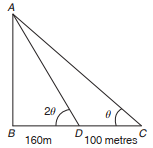
(A) ધારો કે $AB$ એ $h \; m$ ઊંચાઈનો ટાવર છે.
ધારો કે $C$ એ પ્રારંભિક બિંદુ છે જ્યાં $BC = 160 \; m$ અને $\angle ACB = \theta$ છે.
ટાવર તરફ $100 \; m$ ચાલ્યા પછી,આપણે બિંદુ $D$ પર પહોંચીએ છીએ,જ્યાં $CD = 100 \; m$ છે. તેથી,$BD = BC - CD = 160 - 100 = 60 \; m$.
બિંદુ $D$ પર,આંતરેલો ખૂણો $2\theta$ છે,તેથી $\angle ADB = 2\theta$.
$\triangle ABC$ માં,$\tan \theta = \frac{AB}{BC} = \frac{h}{160}$.
$\triangle ABD$ માં,$\tan 2\theta = \frac{AB}{BD} = \frac{h}{60}$.
સૂત્ર $\tan 2\theta = \frac{2 \tan \theta}{1 - \tan^2 \theta}$ નો ઉપયોગ કરતા:
$\frac{h}{60} = \frac{2(h/160)}{1 - (h/160)^2}$.
$\frac{h}{60} = \frac{h/80}{1 - h^2/25600}$.
$h$ વડે ભાગતા (કારણ કે $h \neq 0$):
$\frac{1}{60} = \frac{1/80}{(25600 - h^2)/25600} = \frac{320}{25600 - h^2}$.
$25600 - h^2 = 19200$.
$h^2 = 6400$.
$h = 80 \; m$.
ધારો કે $C$ એ પ્રારંભિક બિંદુ છે જ્યાં $BC = 160 \; m$ અને $\angle ACB = \theta$ છે.
ટાવર તરફ $100 \; m$ ચાલ્યા પછી,આપણે બિંદુ $D$ પર પહોંચીએ છીએ,જ્યાં $CD = 100 \; m$ છે. તેથી,$BD = BC - CD = 160 - 100 = 60 \; m$.
બિંદુ $D$ પર,આંતરેલો ખૂણો $2\theta$ છે,તેથી $\angle ADB = 2\theta$.
$\triangle ABC$ માં,$\tan \theta = \frac{AB}{BC} = \frac{h}{160}$.
$\triangle ABD$ માં,$\tan 2\theta = \frac{AB}{BD} = \frac{h}{60}$.
સૂત્ર $\tan 2\theta = \frac{2 \tan \theta}{1 - \tan^2 \theta}$ નો ઉપયોગ કરતા:
$\frac{h}{60} = \frac{2(h/160)}{1 - (h/160)^2}$.
$\frac{h}{60} = \frac{h/80}{1 - h^2/25600}$.
$h$ વડે ભાગતા (કારણ કે $h \neq 0$):
$\frac{1}{60} = \frac{1/80}{(25600 - h^2)/25600} = \frac{320}{25600 - h^2}$.
$25600 - h^2 = 19200$.
$h^2 = 6400$.
$h = 80 \; m$.
0 likes
View Solution65
MediumMCQ
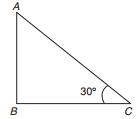
ટાવરના પાયાથી $50 \; m$ ના અંતરેથી ટાવરનો ઉત્સેધકોણ $30^{\circ}$ છે. ટાવરની ઊંચાઈ શોધો.
A
$50 \sqrt{3} \; m$
B
$\frac{50}{\sqrt{3}} \; m$
C
$75 \sqrt{3} \; m$
D
$\frac{75}{\sqrt{3}} \; m$
Solution
(B) ધારો કે $AB$ એ ટાવરની ઊંચાઈ $h \; m$ છે.
ધારો કે $C$ એ ટાવરના પાયા $B$ થી $50 \; m$ ના અંતરે આવેલું બિંદુ છે.
તેથી,$BC = 50 \; m$.
ઉત્સેધકોણ $\angle ACB = 30^{\circ}$ આપેલ છે.
કાટકોણ ત્રિકોણ $\triangle ABC$ માં:
$\tan 30^{\circ} = \frac{\text{સામેની બાજુ}}{\text{પાસેની બાજુ}} = \frac{AB}{BC}$
કિંમતો મૂકતા:
$\frac{1}{\sqrt{3}} = \frac{h}{50}$
$h = \frac{50}{\sqrt{3}} \; m$.
આમ,ટાવરની ઊંચાઈ $\frac{50}{\sqrt{3}} \; m$ છે.
ધારો કે $C$ એ ટાવરના પાયા $B$ થી $50 \; m$ ના અંતરે આવેલું બિંદુ છે.
તેથી,$BC = 50 \; m$.
ઉત્સેધકોણ $\angle ACB = 30^{\circ}$ આપેલ છે.
કાટકોણ ત્રિકોણ $\triangle ABC$ માં:
$\tan 30^{\circ} = \frac{\text{સામેની બાજુ}}{\text{પાસેની બાજુ}} = \frac{AB}{BC}$
કિંમતો મૂકતા:
$\frac{1}{\sqrt{3}} = \frac{h}{50}$
$h = \frac{50}{\sqrt{3}} \; m$.
આમ,ટાવરની ઊંચાઈ $\frac{50}{\sqrt{3}} \; m$ છે.
0 likes
View Solution66
MediumMCQ
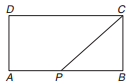
$ABCD$ એક લંબચોરસ છે જ્યાં $AB$ અને $BC$ ની લંબાઈનો ગુણોત્તર $3:2$ છે. જો $P$ એ $AB$ નું મધ્યબિંદુ હોય,તો $\sin(\angle CPB)$ નું મૂલ્ય શોધો.
A
$\frac{3}{5}$
B
$\frac{2}{5}$
C
$\frac{3}{4}$
D
$\frac{4}{5}$
Solution
(D) ધારો કે $AB = 3x$ એકમ અને $BC = 2x$ એકમ છે.
$P$ એ $AB$ નું મધ્યબિંદુ હોવાથી,$PB = \frac{AB}{2} = \frac{3x}{2}$ એકમ થાય.
કાટકોણ ત્રિકોણ $\triangle CPB$ માં,પાયથાગોરસના પ્રમેય મુજબ:
$CP = \sqrt{PB^2 + BC^2} = \sqrt{(\frac{3x}{2})^2 + (2x)^2}$
$CP = \sqrt{\frac{9x^2}{4} + 4x^2} = \sqrt{\frac{9x^2 + 16x^2}{4}} = \sqrt{\frac{25x^2}{4}} = \frac{5x}{2}$ એકમ.
હવે,$\triangle CPB$ માં,$\sin(\angle CPB) = \frac{\text{સામેની બાજુ}}{\text{કર્ણ}} = \frac{BC}{CP}$.
$\sin(\angle CPB) = \frac{2x}{\frac{5x}{2}} = 2x \cdot \frac{2}{5x} = \frac{4}{5}$.
$P$ એ $AB$ નું મધ્યબિંદુ હોવાથી,$PB = \frac{AB}{2} = \frac{3x}{2}$ એકમ થાય.
કાટકોણ ત્રિકોણ $\triangle CPB$ માં,પાયથાગોરસના પ્રમેય મુજબ:
$CP = \sqrt{PB^2 + BC^2} = \sqrt{(\frac{3x}{2})^2 + (2x)^2}$
$CP = \sqrt{\frac{9x^2}{4} + 4x^2} = \sqrt{\frac{9x^2 + 16x^2}{4}} = \sqrt{\frac{25x^2}{4}} = \frac{5x}{2}$ એકમ.
હવે,$\triangle CPB$ માં,$\sin(\angle CPB) = \frac{\text{સામેની બાજુ}}{\text{કર્ણ}} = \frac{BC}{CP}$.
$\sin(\angle CPB) = \frac{2x}{\frac{5x}{2}} = 2x \cdot \frac{2}{5x} = \frac{4}{5}$.
0 likes
View Solution67
MediumMCQ
પદાવલિ $\frac{\sin A}{1+\cos A}+\frac{\sin A}{1-\cos A}$ ની કિંમત શું થાય?
A
$2 \operatorname{cosec} A$
B
$2 \sec A$
C
$2 \sin A$
D
$2 \cos A$
Solution
(A) પદાવલિ $\frac{\sin A}{1+\cos A}+\frac{\sin A}{1-\cos A}$ ને સરળ બનાવવા માટે,આપણે સામાન્ય છેદ લઈએ છીએ:
$= \frac{\sin A(1-\cos A) + \sin A(1+\cos A)}{(1+\cos A)(1-\cos A)}$
$= \frac{\sin A - \sin A \cos A + \sin A + \sin A \cos A}{1 - \cos^2 A}$
$= \frac{2 \sin A}{\sin^2 A}$
$= \frac{2}{\sin A} = 2 \operatorname{cosec} A$
$= \frac{\sin A(1-\cos A) + \sin A(1+\cos A)}{(1+\cos A)(1-\cos A)}$
$= \frac{\sin A - \sin A \cos A + \sin A + \sin A \cos A}{1 - \cos^2 A}$
$= \frac{2 \sin A}{\sin^2 A}$
$= \frac{2}{\sin A} = 2 \operatorname{cosec} A$
0 likes
View Solution68
EasyMCQ
જો $r \sin \theta = 1$ અને $r \cos \theta = \sqrt{3}$ હોય,તો $(\sqrt{3} \tan \theta + 1)$ ની કિંમત શોધો.
A
$\sqrt{3}$
B
$\frac{1}{\sqrt{3}}$
C
$1$
D
$2$
Solution
(D) આપેલ સમીકરણો:
$r \sin \theta = 1$ --- $(1)$
$r \cos \theta = \sqrt{3}$ --- $(2)$
સમીકરણ $(1)$ ને સમીકરણ $(2)$ વડે ભાગતા:
$\frac{r \sin \theta}{r \cos \theta} = \frac{1}{\sqrt{3}}$
$\tan \theta = \frac{1}{\sqrt{3}}$
હવે,$(\sqrt{3} \tan \theta + 1)$ પદાવલિમાં $\tan \theta$ ની કિંમત મૂકતા:
$= \sqrt{3} \times \left( \frac{1}{\sqrt{3}} \right) + 1$
$= 1 + 1 = 2$
આમ,સાચો વિકલ્પ $(d)$ છે.
$r \sin \theta = 1$ --- $(1)$
$r \cos \theta = \sqrt{3}$ --- $(2)$
સમીકરણ $(1)$ ને સમીકરણ $(2)$ વડે ભાગતા:
$\frac{r \sin \theta}{r \cos \theta} = \frac{1}{\sqrt{3}}$
$\tan \theta = \frac{1}{\sqrt{3}}$
હવે,$(\sqrt{3} \tan \theta + 1)$ પદાવલિમાં $\tan \theta$ ની કિંમત મૂકતા:
$= \sqrt{3} \times \left( \frac{1}{\sqrt{3}} \right) + 1$
$= 1 + 1 = 2$
આમ,સાચો વિકલ્પ $(d)$ છે.
0 likes
View Solution69
DifficultMCQ
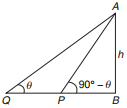
એક ટાવરના ટોચના ઉત્સેધકોણ,ટાવરના પાયાથી અનુક્રમે $a$ અને $b$ અંતરે આવેલા બિંદુઓ $P$ અને $Q$ થી,જે ટાવર સાથે એક જ સીધી રેખામાં છે,તે કોટિકોણ છે. ટાવરની ઊંચાઈ શોધો.
A
$\sqrt{ab}$
B
$\frac{a}{b}$
C
$ab$
D
$a^2 b^2$
Solution
(A) ધારો કે $AB$ એ $h$ એકમ ઊંચાઈ ધરાવતો ટાવર છે.
ધારો કે બિંદુઓ $P$ અને $Q$ ટાવરના પાયા $B$ થી અનુક્રમે $PB = a$ અને $QB = b$ અંતરે આવેલા છે.
આપેલ છે કે ઉત્સેધકોણ કોટિકોણ છે,તેથી ધારો કે $\angle AQB = \theta$ અને $\angle APB = 90^{\circ} - \theta$ છે.
$\triangle AQB$ માં,$\tan \theta = \frac{AB}{QB} = \frac{h}{b}$.
$\triangle APB$ માં,$\tan(90^{\circ} - \theta) = \frac{AB}{PB} = \frac{h}{a}$.
આપણે જાણીએ છીએ કે $\tan(90^{\circ} - \theta) = \cot \theta$,તેથી $\cot \theta = \frac{h}{a}$.
બંને સમીકરણોનો ગુણાકાર કરતા: $\tan \theta \cdot \cot \theta = \left(\frac{h}{b}\right) \cdot \left(\frac{h}{a}\right)$.
કારણ કે $\tan \theta \cdot \cot \theta = 1$,તેથી $1 = \frac{h^2}{ab}$.
આમ,$h^2 = ab$,જેનો અર્થ છે કે $h = \sqrt{ab}$.
ધારો કે બિંદુઓ $P$ અને $Q$ ટાવરના પાયા $B$ થી અનુક્રમે $PB = a$ અને $QB = b$ અંતરે આવેલા છે.
આપેલ છે કે ઉત્સેધકોણ કોટિકોણ છે,તેથી ધારો કે $\angle AQB = \theta$ અને $\angle APB = 90^{\circ} - \theta$ છે.
$\triangle AQB$ માં,$\tan \theta = \frac{AB}{QB} = \frac{h}{b}$.
$\triangle APB$ માં,$\tan(90^{\circ} - \theta) = \frac{AB}{PB} = \frac{h}{a}$.
આપણે જાણીએ છીએ કે $\tan(90^{\circ} - \theta) = \cot \theta$,તેથી $\cot \theta = \frac{h}{a}$.
બંને સમીકરણોનો ગુણાકાર કરતા: $\tan \theta \cdot \cot \theta = \left(\frac{h}{b}\right) \cdot \left(\frac{h}{a}\right)$.
કારણ કે $\tan \theta \cdot \cot \theta = 1$,તેથી $1 = \frac{h^2}{ab}$.
આમ,$h^2 = ab$,જેનો અર્થ છે કે $h = \sqrt{ab}$.
0 likes
View Solution70
DifficultMCQ
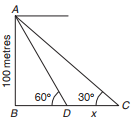
$100 \ m$ ઊંચા ટાવરની ટોચ પરથી એક માણસ ટાવર તરફ આવતી કારને $30^{\circ}$ ના અવસેધકોણ (angle of depression) પર જુએ છે. થોડા સમય પછી,અવસેધકોણ $60^{\circ}$ થાય છે. આ સમય દરમિયાન કાર દ્વારા કાપેલું અંતર ($m$ માં) કેટલું હશે?
A
$100 \sqrt{3}$
B
$\frac{200 \sqrt{3}}{3}$
C
$\frac{100 \sqrt{3}}{3}$
D
$200 \sqrt{3}$
Solution
(B) ધારો કે $AB$ એ $100 \ m$ ઊંચાઈનો ટાવર છે.
ધારો કે $C$ એ કારનું પ્રારંભિક સ્થાન છે અને $D$ એ થોડા સમય પછીનું અંતિમ સ્થાન છે.
ધારો કે કાર દ્વારા કાપેલું અંતર $CD = x \ m$ છે.
$\Delta ABD$ માં,ઉત્સેધકોણ $60^{\circ}$ છે.
$\tan 60^{\circ} = \frac{AB}{BD} \Rightarrow \sqrt{3} = \frac{100}{BD} \Rightarrow BD = \frac{100}{\sqrt{3}} \ m$.
$\Delta ABC$ માં,ઉત્સેધકોણ $30^{\circ}$ છે.
$\tan 30^{\circ} = \frac{AB}{BC} = \frac{AB}{BD + CD} \Rightarrow \frac{1}{\sqrt{3}} = \frac{100}{\frac{100}{\sqrt{3}} + x}$.
$\frac{100}{\sqrt{3}} + x = 100 \sqrt{3}$.
$x = 100 \sqrt{3} - \frac{100}{\sqrt{3}} = \frac{300 - 100}{\sqrt{3}} = \frac{200}{\sqrt{3}} \ m$.
છેદનું સંમેયીકરણ કરતા,$x = \frac{200 \sqrt{3}}{3} \ m$.
ધારો કે $C$ એ કારનું પ્રારંભિક સ્થાન છે અને $D$ એ થોડા સમય પછીનું અંતિમ સ્થાન છે.
ધારો કે કાર દ્વારા કાપેલું અંતર $CD = x \ m$ છે.
$\Delta ABD$ માં,ઉત્સેધકોણ $60^{\circ}$ છે.
$\tan 60^{\circ} = \frac{AB}{BD} \Rightarrow \sqrt{3} = \frac{100}{BD} \Rightarrow BD = \frac{100}{\sqrt{3}} \ m$.
$\Delta ABC$ માં,ઉત્સેધકોણ $30^{\circ}$ છે.
$\tan 30^{\circ} = \frac{AB}{BC} = \frac{AB}{BD + CD} \Rightarrow \frac{1}{\sqrt{3}} = \frac{100}{\frac{100}{\sqrt{3}} + x}$.
$\frac{100}{\sqrt{3}} + x = 100 \sqrt{3}$.
$x = 100 \sqrt{3} - \frac{100}{\sqrt{3}} = \frac{300 - 100}{\sqrt{3}} = \frac{200}{\sqrt{3}} \ m$.
છેદનું સંમેયીકરણ કરતા,$x = \frac{200 \sqrt{3}}{3} \ m$.
0 likes
View Solution71
MediumMCQ
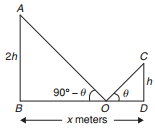
બે થાંભલાઓ એકબીજાથી $x \text{ m}$ દૂર છે અને એકની ઊંચાઈ બીજા કરતાં બમણી છે. જો તેમના પાયાને જોડતી રેખાના મધ્યબિંદુથી,એક નિરીક્ષક તેમના ટોચના ખૂણાઓને કોટિકોણ (complementary) તરીકે જુએ છે,તો ટૂંકા થાંભલાની ઊંચાઈ ($\text{m}$ માં) કેટલી હશે?
A
$\frac{x}{2 \sqrt{2}}$
B
$\frac{x}{4}$
C
$x \sqrt{2}$
D
$\frac{x}{\sqrt{2}}$
Solution
(A) ધારો કે ટૂંકા થાંભલાની ઊંચાઈ $h \text{ m}$ છે અને ઊંચા થાંભલાની ઊંચાઈ $2h \text{ m}$ છે.
ધારો કે થાંભલાઓ $CD$ અને $AB$ છે,જ્યાં $CD = h$ અને $AB = 2h$ છે.
તેમના પાયા $B$ અને $D$ વચ્ચેનું અંતર $x \text{ m}$ છે.
ધારો કે $O$ એ $BD$ નું મધ્યબિંદુ છે,તેથી $OB = OD = \frac{x}{2} \text{ m}$ થાય.
$\triangle OCD$ માંથી,$\tan \theta = \frac{CD}{OD} = \frac{h}{x/2} = \frac{2h}{x}$ મળે.
$\triangle OAB$ માંથી,ઉત્સેધકોણ $(90^{\circ} - \theta)$ છે,તેથી $\tan(90^{\circ} - \theta) = \frac{AB}{OB} = \frac{2h}{x/2} = \frac{4h}{x}$ મળે.
આપણે જાણીએ છીએ કે $\tan(90^{\circ} - \theta) = \cot \theta$,તેથી $\cot \theta = \frac{4h}{x}$ થાય.
બંને સમીકરણોનો ગુણાકાર કરતા: $\tan \theta \cdot \cot \theta = \left(\frac{2h}{x}\right) \cdot \left(\frac{4h}{x}\right)$ મળે.
કારણ કે $\tan \theta \cdot \cot \theta = 1$,તેથી $1 = \frac{8h^2}{x^2}$ મળે.
આમ,$h^2 = \frac{x^2}{8}$,જેનું સાદું રૂપ આપતા $h = \sqrt{\frac{x^2}{8}} = \frac{x}{2\sqrt{2}} \text{ m}$ મળે.
ધારો કે થાંભલાઓ $CD$ અને $AB$ છે,જ્યાં $CD = h$ અને $AB = 2h$ છે.
તેમના પાયા $B$ અને $D$ વચ્ચેનું અંતર $x \text{ m}$ છે.
ધારો કે $O$ એ $BD$ નું મધ્યબિંદુ છે,તેથી $OB = OD = \frac{x}{2} \text{ m}$ થાય.
$\triangle OCD$ માંથી,$\tan \theta = \frac{CD}{OD} = \frac{h}{x/2} = \frac{2h}{x}$ મળે.
$\triangle OAB$ માંથી,ઉત્સેધકોણ $(90^{\circ} - \theta)$ છે,તેથી $\tan(90^{\circ} - \theta) = \frac{AB}{OB} = \frac{2h}{x/2} = \frac{4h}{x}$ મળે.
આપણે જાણીએ છીએ કે $\tan(90^{\circ} - \theta) = \cot \theta$,તેથી $\cot \theta = \frac{4h}{x}$ થાય.
બંને સમીકરણોનો ગુણાકાર કરતા: $\tan \theta \cdot \cot \theta = \left(\frac{2h}{x}\right) \cdot \left(\frac{4h}{x}\right)$ મળે.
કારણ કે $\tan \theta \cdot \cot \theta = 1$,તેથી $1 = \frac{8h^2}{x^2}$ મળે.
આમ,$h^2 = \frac{x^2}{8}$,જેનું સાદું રૂપ આપતા $h = \sqrt{\frac{x^2}{8}} = \frac{x}{2\sqrt{2}} \text{ m}$ મળે.
0 likes
View Solution72
MediumMCQ
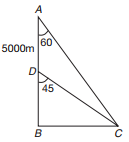
જમીનથી $5000 \; m$ ની ઊંચાઈએ ઉડતું એક વિમાન એક ક્ષણે બીજા વિમાનની બરાબર ઉપરથી પસાર થાય છે. તે ક્ષણે,જમીન પરના એક જ બિંદુથી બંને વિમાનોના ઉત્સેધકોણ અનુક્રમે $60^{\circ}$ અને $45^{\circ}$ છે. તે ક્ષણે બંને વિમાનો વચ્ચેનું શિરોલંબ અંતર કેટલું હશે?
A
$5000(\sqrt{3}-1) \; m$
B
$5000(3-\sqrt{3}) \; m$
C
$5000\left(1-\frac{1}{\sqrt{3}}\right) \; m$
D
$4500 \; m$
Solution
(C) ધારો કે બે વિમાનો $A$ અને $D$ બિંદુઓ પર છે. ધારો કે જમીન પરનું બિંદુ $C$ છે. પ્રથમ વિમાન $A$ ની ઊંચાઈ $AB = 5000 \; m$ છે.
ધારો કે બીજા વિમાન $D$ ની ઊંચાઈ $DB = h$ છે.
બિંદુ $C$ થી બિંદુ $B$ (વિમાનોની બરાબર નીચે) નું અંતર $BC = x$ છે.
$\Delta ABC$ માં,$\tan 60^{\circ} = \frac{AB}{BC} = \frac{5000}{x}$.
$\tan 60^{\circ} = \sqrt{3}$ હોવાથી,$x = \frac{5000}{\sqrt{3}} \; m$ મળે.
$\Delta DBC$ માં,$\tan 45^{\circ} = \frac{DB}{BC} = \frac{h}{x}$.
$\tan 45^{\circ} = 1$ હોવાથી,$h = x = \frac{5000}{\sqrt{3}} \; m$ મળે.
બંને વિમાનો વચ્ચેનું શિરોલંબ અંતર $AD = AB - DB = 5000 - h$ છે.
$AD = 5000 - \frac{5000}{\sqrt{3}} = 5000\left(1 - \frac{1}{\sqrt{3}}\right) \; m$.
ધારો કે બીજા વિમાન $D$ ની ઊંચાઈ $DB = h$ છે.
બિંદુ $C$ થી બિંદુ $B$ (વિમાનોની બરાબર નીચે) નું અંતર $BC = x$ છે.
$\Delta ABC$ માં,$\tan 60^{\circ} = \frac{AB}{BC} = \frac{5000}{x}$.
$\tan 60^{\circ} = \sqrt{3}$ હોવાથી,$x = \frac{5000}{\sqrt{3}} \; m$ મળે.
$\Delta DBC$ માં,$\tan 45^{\circ} = \frac{DB}{BC} = \frac{h}{x}$.
$\tan 45^{\circ} = 1$ હોવાથી,$h = x = \frac{5000}{\sqrt{3}} \; m$ મળે.
બંને વિમાનો વચ્ચેનું શિરોલંબ અંતર $AD = AB - DB = 5000 - h$ છે.
$AD = 5000 - \frac{5000}{\sqrt{3}} = 5000\left(1 - \frac{1}{\sqrt{3}}\right) \; m$.
0 likes
View Solution73
EasyMCQ
એક ઉભા ટાવરના પડછાયાની લંબાઈ તેની ઊંચાઈ કરતાં $\frac{1}{\sqrt{3}}$ ગણી છે. સૂર્યનો ઉન્નતકોણ કેટલો હશે ($^{\circ}$ માં)?
A
$30$
B
$45$
C
$60$
D
$90$
Solution
(C) ધારો કે $AB$ એ ટાવર છે અને $BC$ તેનો પડછાયો છે.
ટાવરની ઊંચાઈ $AB = x$ ધારો.
પ્રશ્ન મુજબ,પડછાયાની લંબાઈ $BC = \frac{1}{\sqrt{3}} \times AB = \frac{x}{\sqrt{3}}$.
કાટકોણ ત્રિકોણ $ABC$ માં,ઉન્નતકોણ $\theta$ નીચે મુજબ મળે છે:
$\tan \theta = \frac{\text{સામેની બાજુ}}{\text{પાસેની બાજુ}} = \frac{AB}{BC}$
$\tan \theta = \frac{x}{\frac{x}{\sqrt{3}}} = \sqrt{3}$
આપણે જાણીએ છીએ કે $\tan 60^{\circ} = \sqrt{3}$,તેથી $\theta = 60^{\circ}$.
આમ,સૂર્યનો ઉન્નતકોણ $60^{\circ}$ છે.
ટાવરની ઊંચાઈ $AB = x$ ધારો.
પ્રશ્ન મુજબ,પડછાયાની લંબાઈ $BC = \frac{1}{\sqrt{3}} \times AB = \frac{x}{\sqrt{3}}$.
કાટકોણ ત્રિકોણ $ABC$ માં,ઉન્નતકોણ $\theta$ નીચે મુજબ મળે છે:
$\tan \theta = \frac{\text{સામેની બાજુ}}{\text{પાસેની બાજુ}} = \frac{AB}{BC}$
$\tan \theta = \frac{x}{\frac{x}{\sqrt{3}}} = \sqrt{3}$
આપણે જાણીએ છીએ કે $\tan 60^{\circ} = \sqrt{3}$,તેથી $\theta = 60^{\circ}$.
આમ,સૂર્યનો ઉન્નતકોણ $60^{\circ}$ છે.

0 likes
View SolutionHeights and Distances — Heights and Distances · Frequently Asked Questions
1Are these Heights and Distances questions useful for JEE and NEET?
Yes. All questions in this section are mapped to JEE Main and NEET exam patterns. Previous year questions from JEE Main, NEET, GUJCET and state-level exams are included with full solutions.
2Can I switch to Hindi or Gujarati for these questions?
Yes. Use the language tabs in the hero section or the sidebar to view the same questions and solutions in English, Hindi or Gujarati.
3How do I generate a question paper from this subtopic?
Use the Vedclass Exam Paper Generator — select the chapter and subtopic, set difficulty, and generate Sets A, B, C, D automatically. First 3 chapters of every subject are free.
Vedclass Products
For Students
Vedclass Test Series
Mock tests in real JEE/NEET style with performance analysis. 5-day free trial.
Start Free TrialFor Teachers
Exam Paper Generator
Generate Set A/B/C/D papers from this chapter in 2 minutes. 3 chapters free.
Try FreeFor Institutes
Online Exam Module
Live online exams with unlimited students, 360° analytics & white-label branding.
See DemoFor Teachers & Institutes
Generate a Heights and Distances Exam Paper in 2 Minutes
Select subtopic & difficulty — Sets A, B, C, D auto-generated with No Repeat logic.
First 3 chapters of every subject are free — no payment required.