
A English
Heights and Distances Questions in English
Competitive Exam Quantitative Aptitude · Heights and Distances · Heights and Distances
73+
Questions
English
Language
100%
With Solutions
Showing 50 of 73 questions in English
1
DifficultMCQ
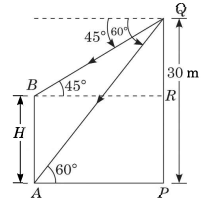
$A$ tower is $30 \ m$ high. An observer from the top of the tower makes an angle of depression of $60^{\circ}$ at the base of the building and an angle of depression of $45^{\circ}$ at the top of the building. What is the height of the building in metres?
A
$18$
B
$12 \sqrt{2}$
C
$10 \sqrt{3}$
D
$12.68$
Solution
(D) Let the height of the building $AB$ be $H$ metres.
Let $Q$ be the top of the tower and $P$ be the base of the tower. Given $QP = 30 \ m$.
In $\Delta APQ$,the angle of elevation from $A$ to $Q$ is equal to the angle of depression from $Q$ to $A$,which is $60^{\circ}$.
$\tan 60^{\circ} = \frac{QP}{AP} = \frac{30}{AP} = \sqrt{3}$
$AP = \frac{30}{\sqrt{3}} = 10 \sqrt{3} \ m$.
Let $R$ be a point on $QP$ such that $BR$ is horizontal. Then $BR = AP = 10 \sqrt{3} \ m$.
The angle of elevation from $B$ to $Q$ is equal to the angle of depression from $Q$ to $B$,which is $45^{\circ}$.
In $\Delta BRQ$,$\tan 45^{\circ} = \frac{QR}{BR} = 1$.
$QR = BR = 10 \sqrt{3} \ m$.
The height of the building $H = AB = RP = QP - QR$.
$H = 30 - 10 \sqrt{3} = 30 - 10(1.732) = 30 - 17.32 = 12.68 \ m$.
Let $Q$ be the top of the tower and $P$ be the base of the tower. Given $QP = 30 \ m$.
In $\Delta APQ$,the angle of elevation from $A$ to $Q$ is equal to the angle of depression from $Q$ to $A$,which is $60^{\circ}$.
$\tan 60^{\circ} = \frac{QP}{AP} = \frac{30}{AP} = \sqrt{3}$
$AP = \frac{30}{\sqrt{3}} = 10 \sqrt{3} \ m$.
Let $R$ be a point on $QP$ such that $BR$ is horizontal. Then $BR = AP = 10 \sqrt{3} \ m$.
The angle of elevation from $B$ to $Q$ is equal to the angle of depression from $Q$ to $B$,which is $45^{\circ}$.
In $\Delta BRQ$,$\tan 45^{\circ} = \frac{QR}{BR} = 1$.
$QR = BR = 10 \sqrt{3} \ m$.
The height of the building $H = AB = RP = QP - QR$.
$H = 30 - 10 \sqrt{3} = 30 - 10(1.732) = 30 - 17.32 = 12.68 \ m$.
0 likes
View Solution2
DifficultMCQ
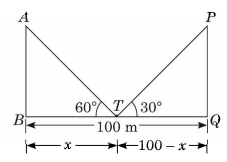
Two towers of equal height stand on either side of a wide road which is $100 \, m$ wide. At a point on the road between the towers, the angles of elevation of the tops of the towers are $60^{\circ}$ and $30^{\circ}$. Find their heights in metres. (in $\sqrt{3}$)
A
$20$
B
$26$
C
$30$
D
$25$
Solution
(D) Let $AB$ and $PQ$ be the two towers of equal height $h$ metres. Let $T$ be a point on the road $BQ$ such that $BT = x$ and $TQ = 100 - x$.
In $\Delta ABT$, $\tan 60^{\circ} = \frac{AB}{BT} = \frac{h}{x}$.
Therefore, $x = \frac{h}{\tan 60^{\circ}} = \frac{h}{\sqrt{3}}$.
In $\Delta PQT$, $\tan 30^{\circ} = \frac{PQ}{TQ} = \frac{h}{100 - x}$.
Therefore, $100 - x = \frac{h}{\tan 30^{\circ}} = h\sqrt{3}$.
Substituting $x = \frac{h}{\sqrt{3}}$ into the equation $100 - x = h\sqrt{3}$:
$100 = x + h\sqrt{3} = \frac{h}{\sqrt{3}} + h\sqrt{3}$.
$100 = h \left( \frac{1 + 3}{\sqrt{3}} \right) = h \left( \frac{4}{\sqrt{3}} \right)$.
$h = \frac{100 \sqrt{3}}{4} = 25 \sqrt{3} \, m$.
In $\Delta ABT$, $\tan 60^{\circ} = \frac{AB}{BT} = \frac{h}{x}$.
Therefore, $x = \frac{h}{\tan 60^{\circ}} = \frac{h}{\sqrt{3}}$.
In $\Delta PQT$, $\tan 30^{\circ} = \frac{PQ}{TQ} = \frac{h}{100 - x}$.
Therefore, $100 - x = \frac{h}{\tan 30^{\circ}} = h\sqrt{3}$.
Substituting $x = \frac{h}{\sqrt{3}}$ into the equation $100 - x = h\sqrt{3}$:
$100 = x + h\sqrt{3} = \frac{h}{\sqrt{3}} + h\sqrt{3}$.
$100 = h \left( \frac{1 + 3}{\sqrt{3}} \right) = h \left( \frac{4}{\sqrt{3}} \right)$.
$h = \frac{100 \sqrt{3}}{4} = 25 \sqrt{3} \, m$.
0 likes
View Solution3
MediumMCQ
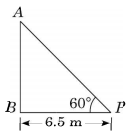
The angle of elevation of a ladder leaning against a house is $60^{\circ}$ and the foot of the ladder is $6.5 \ m$ from the house. Find the length of the ladder in metres.
A
$3.25$
B
$\frac{13}{\sqrt{3}}$
C
$13$
D
$15$
Solution
(C) Let the length of the ladder $AP$ be $l \ m$.
In the right-angled triangle $\Delta ABP$,the angle of elevation at the foot of the ladder $P$ is $\angle APB = 60^{\circ}$.
The distance from the foot of the ladder to the house is $BP = 6.5 \ m$.
Using the trigonometric ratio for cosine:
$\cos 60^{\circ} = \frac{\text{Base}}{\text{Hypotenuse}} = \frac{BP}{AP}$
$\frac{1}{2} = \frac{6.5}{l}$
$l = 6.5 \times 2 = 13 \ m$.
Thus,the length of the ladder is $13 \ m$.
In the right-angled triangle $\Delta ABP$,the angle of elevation at the foot of the ladder $P$ is $\angle APB = 60^{\circ}$.
The distance from the foot of the ladder to the house is $BP = 6.5 \ m$.
Using the trigonometric ratio for cosine:
$\cos 60^{\circ} = \frac{\text{Base}}{\text{Hypotenuse}} = \frac{BP}{AP}$
$\frac{1}{2} = \frac{6.5}{l}$
$l = 6.5 \times 2 = 13 \ m$.
Thus,the length of the ladder is $13 \ m$.
0 likes
View Solution4
DifficultMCQ
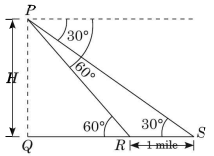
From an aeroplane vertically over a straight horizontal road,the angles of depression of two consecutive milestones on the opposite sides of the aeroplane are observed to be $30^{\circ}$ and $60^{\circ}$. Find the height in miles of the aeroplane above the road.
A
$\frac{\sqrt{3}}{2}$
B
$\frac{\sqrt{3}}{4}$
C
$\frac{\sqrt{3}}{8}$
D
$\frac{\sqrt{3}}{12}$
Solution
(A) Let $H$ be the height of the aeroplane above the road in miles.
Let $P$ be the position of the aeroplane and $Q$ be the point on the road directly below it.
Let $R$ and $S$ be the positions of the two consecutive milestones on the road.
The distance between two consecutive milestones is $RS = 1 \text{ mile}$.
In $\Delta PQR$,$\tan 60^{\circ} = \frac{H}{QR} \Rightarrow QR = \frac{H}{\sqrt{3}}$.
In $\Delta PQS$,$\tan 30^{\circ} = \frac{H}{QS} \Rightarrow QS = H\sqrt{3}$.
Since $QS = QR + RS$,we have $H\sqrt{3} = \frac{H}{\sqrt{3}} + 1$.
Multiplying by $\sqrt{3}$,we get $3H = H + \sqrt{3}$.
$2H = \sqrt{3} \Rightarrow H = \frac{\sqrt{3}}{2} \text{ miles}$.
Let $P$ be the position of the aeroplane and $Q$ be the point on the road directly below it.
Let $R$ and $S$ be the positions of the two consecutive milestones on the road.
The distance between two consecutive milestones is $RS = 1 \text{ mile}$.
In $\Delta PQR$,$\tan 60^{\circ} = \frac{H}{QR} \Rightarrow QR = \frac{H}{\sqrt{3}}$.
In $\Delta PQS$,$\tan 30^{\circ} = \frac{H}{QS} \Rightarrow QS = H\sqrt{3}$.
Since $QS = QR + RS$,we have $H\sqrt{3} = \frac{H}{\sqrt{3}} + 1$.
Multiplying by $\sqrt{3}$,we get $3H = H + \sqrt{3}$.
$2H = \sqrt{3} \Rightarrow H = \frac{\sqrt{3}}{2} \text{ miles}$.
0 likes
View Solution5
MediumMCQ
From the top of a cliff,$60 \ m$ high,the angles of depression of the top and bottom of a tower are observed to be $30^{\circ}$ and $60^{\circ}$ respectively. Find the height of the tower in $m$.
A
$40$
B
$50$
C
$30$
D
$35$
Solution
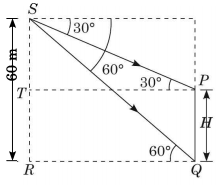
(A) Let $H$ be the height of the tower $PQ$. Let $S$ be the top of the cliff of height $60 \ m$. $R$ is the point on the ground directly below $S$.
In $\Delta S R Q$,$\tan 60^{\circ} = \frac{SR}{RQ} = \frac{60}{RQ}$.
Therefore,$RQ = \frac{60}{\tan 60^{\circ}} = \frac{60}{\sqrt{3}} = 20\sqrt{3} \ m$.
Since $RQ = TP$,we have $TP = 20\sqrt{3} \ m$.
In $\Delta STP$,$\tan 30^{\circ} = \frac{ST}{TP} = \frac{60 - H}{20\sqrt{3}}$.
$\frac{1}{\sqrt{3}} = \frac{60 - H}{20\sqrt{3}}$.
$20 = 60 - H$.
$H = 60 - 20 = 40 \ m$.
In $\Delta S R Q$,$\tan 60^{\circ} = \frac{SR}{RQ} = \frac{60}{RQ}$.
Therefore,$RQ = \frac{60}{\tan 60^{\circ}} = \frac{60}{\sqrt{3}} = 20\sqrt{3} \ m$.
Since $RQ = TP$,we have $TP = 20\sqrt{3} \ m$.
In $\Delta STP$,$\tan 30^{\circ} = \frac{ST}{TP} = \frac{60 - H}{20\sqrt{3}}$.
$\frac{1}{\sqrt{3}} = \frac{60 - H}{20\sqrt{3}}$.
$20 = 60 - H$.
$H = 60 - 20 = 40 \ m$.
0 likes
View Solution6
DifficultMCQ
The angle of elevation of the top of an unfinished tower at a point $120 \ m$ from its base is $45^{\circ}.$ How much higher (in $m$) must the tower be raised so that its angle of elevation is $60^{\circ}$ at the same point?
A
$90$
B
$92$
C
$97$
D
$87.84$
Solution
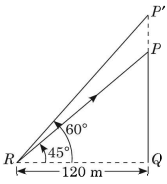
(D) Let $PQ$ be the height of the unfinished tower and $R$ be the point on the ground at a distance of $120 \ m$ from the base $Q$.
In $\Delta PQR$,$\tan 45^{\circ} = \frac{PQ}{RQ}$.
Since $\tan 45^{\circ} = 1$,we have $PQ = RQ = 120 \ m$.
Let the tower be raised to a height $P'$ such that the angle of elevation from $R$ becomes $60^{\circ}$.
In $\Delta P'QR$,$\tan 60^{\circ} = \frac{P'Q}{RQ}$.
Since $\tan 60^{\circ} = \sqrt{3}$,we have $P'Q = RQ \cdot \sqrt{3} = 120 \sqrt{3} \ m$.
The additional height required is $P'P = P'Q - PQ = 120 \sqrt{3} - 120 = 120(\sqrt{3} - 1) \ m$.
Using $\sqrt{3} \approx 1.732$,we get $P'P = 120(1.732 - 1) = 120 \times 0.732 = 87.84 \ m$.
In $\Delta PQR$,$\tan 45^{\circ} = \frac{PQ}{RQ}$.
Since $\tan 45^{\circ} = 1$,we have $PQ = RQ = 120 \ m$.
Let the tower be raised to a height $P'$ such that the angle of elevation from $R$ becomes $60^{\circ}$.
In $\Delta P'QR$,$\tan 60^{\circ} = \frac{P'Q}{RQ}$.
Since $\tan 60^{\circ} = \sqrt{3}$,we have $P'Q = RQ \cdot \sqrt{3} = 120 \sqrt{3} \ m$.
The additional height required is $P'P = P'Q - PQ = 120 \sqrt{3} - 120 = 120(\sqrt{3} - 1) \ m$.
Using $\sqrt{3} \approx 1.732$,we get $P'P = 120(1.732 - 1) = 120 \times 0.732 = 87.84 \ m$.
0 likes
View Solution7
DifficultMCQ
An observer on the top of a cliff,$200 \, m$ above the sea level,observes the angle of depression of two ships at anchor to be $45^{\circ}$ and $30^{\circ}$ respectively. Find the distance (in $m$) between the ships if the line joining them stretches to the base of the cliff.
A
$140$
B
$150$
C
$156$
D
$146.4$
Solution
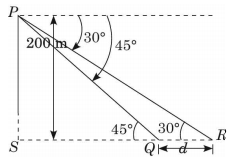
(D) Let the height of the cliff be $PS = 200 \, m$. Let the two ships be at points $Q$ and $R$ such that $S, Q, R$ are collinear.
In $\Delta PQS$,the angle of elevation is $45^{\circ}$.
$\tan 45^{\circ} = \frac{PS}{SQ} \implies 1 = \frac{200}{SQ} \implies SQ = 200 \, m$.
In $\Delta PRS$,the angle of elevation is $30^{\circ}$.
$\tan 30^{\circ} = \frac{PS}{SR} \implies \frac{1}{\sqrt{3}} = \frac{200}{SQ + QR}$.
$SQ + QR = 200\sqrt{3}$.
$200 + QR = 200(1.732) = 346.4$.
$QR = 346.4 - 200 = 146.4 \, m$.
Thus,the distance between the two ships is $146.4 \, m$.
In $\Delta PQS$,the angle of elevation is $45^{\circ}$.
$\tan 45^{\circ} = \frac{PS}{SQ} \implies 1 = \frac{200}{SQ} \implies SQ = 200 \, m$.
In $\Delta PRS$,the angle of elevation is $30^{\circ}$.
$\tan 30^{\circ} = \frac{PS}{SR} \implies \frac{1}{\sqrt{3}} = \frac{200}{SQ + QR}$.
$SQ + QR = 200\sqrt{3}$.
$200 + QR = 200(1.732) = 346.4$.
$QR = 346.4 - 200 = 146.4 \, m$.
Thus,the distance between the two ships is $146.4 \, m$.
0 likes
View Solution8
MediumMCQ
$A$ man is watching from the top of a tower a boat speeding away from the tower. The boat makes an angle of depression of $45^{\circ}$ with the man's eye when at a distance of $60 \ m$ from the tower. After $5 \ s$,the angle of depression becomes $30^{\circ}$. What is the approximate speed (in $km/hr$) of the boat,assuming that it is running in still water?
A
$32$
B
$36$
C
$38$
D
$40$
Solution
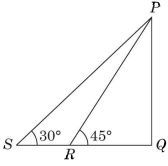
(A) Let $PQ$ be the tower and $R$ and $S$ be the two positions of the boat. Given $RQ = 60 \ m$,$\angle PSQ = 30^{\circ}$,and $\angle PRQ = 45^{\circ}$.
From $\Delta PQR$,$\tan 45^{\circ} = \frac{PQ}{RQ} = 1$.
Thus,$PQ = RQ = 60 \ m$.
From $\Delta PQS$,$\tan 30^{\circ} = \frac{PQ}{QS} = \frac{60}{RQ + RS} = \frac{60}{60 + RS} = \frac{1}{\sqrt{3}}$.
This implies $60 + RS = 60\sqrt{3}$.
So,$RS = 60(\sqrt{3} - 1) \ m$.
Using $\sqrt{3} \approx 1.732$,$RS = 60(1.732 - 1) = 60 \times 0.732 = 43.92 \ m$.
Speed of the boat = $\frac{\text{Distance}}{\text{Time}} = \frac{43.92 \ m}{5 \ s} = 8.784 \ m/s$.
To convert to $km/hr$,multiply by $\frac{18}{5}$:
Speed = $8.784 \times \frac{18}{5} = 31.62 \ km/hr$.
Rounding to the nearest integer,the speed is approximately $32 \ km/hr$.
From $\Delta PQR$,$\tan 45^{\circ} = \frac{PQ}{RQ} = 1$.
Thus,$PQ = RQ = 60 \ m$.
From $\Delta PQS$,$\tan 30^{\circ} = \frac{PQ}{QS} = \frac{60}{RQ + RS} = \frac{60}{60 + RS} = \frac{1}{\sqrt{3}}$.
This implies $60 + RS = 60\sqrt{3}$.
So,$RS = 60(\sqrt{3} - 1) \ m$.
Using $\sqrt{3} \approx 1.732$,$RS = 60(1.732 - 1) = 60 \times 0.732 = 43.92 \ m$.
Speed of the boat = $\frac{\text{Distance}}{\text{Time}} = \frac{43.92 \ m}{5 \ s} = 8.784 \ m/s$.
To convert to $km/hr$,multiply by $\frac{18}{5}$:
Speed = $8.784 \times \frac{18}{5} = 31.62 \ km/hr$.
Rounding to the nearest integer,the speed is approximately $32 \ km/hr$.
0 likes
View Solution9
MediumMCQ
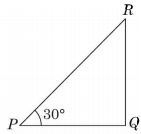
From a point $P$ on a level ground,the angle of elevation of the top of a tower is $30^{\circ}$. If the tower is $100 \ m$ high,the distance (in $m$) of point $P$ from the foot of the tower is:
A
$149$
B
$156$
C
$173$
D
$200$
Solution
(C) Let the tower be represented by $QR$ and the point on the ground be $P$.
Given: Height of the tower $QR = 100 \ m$,and the angle of elevation $\angle QPR = 30^{\circ}$.
Let the distance of point $P$ from the foot of the tower $Q$ be $PQ = x$.
In the right-angled triangle $\Delta PQR$,we have:
$\tan(30^{\circ}) = \frac{\text{Opposite side}}{\text{Adjacent side}} = \frac{QR}{PQ}$
$\frac{1}{\sqrt{3}} = \frac{100}{x}$
$x = 100 \sqrt{3} \ m$
Using $\sqrt{3} \approx 1.732$,we get:
$x = 100 \times 1.732 = 173.2 \ m$
Rounding to the nearest integer,the distance is $173 \ m$.
Given: Height of the tower $QR = 100 \ m$,and the angle of elevation $\angle QPR = 30^{\circ}$.
Let the distance of point $P$ from the foot of the tower $Q$ be $PQ = x$.
In the right-angled triangle $\Delta PQR$,we have:
$\tan(30^{\circ}) = \frac{\text{Opposite side}}{\text{Adjacent side}} = \frac{QR}{PQ}$
$\frac{1}{\sqrt{3}} = \frac{100}{x}$
$x = 100 \sqrt{3} \ m$
Using $\sqrt{3} \approx 1.732$,we get:
$x = 100 \times 1.732 = 173.2 \ m$
Rounding to the nearest integer,the distance is $173 \ m$.
0 likes
View Solution10
DifficultMCQ
$A$ man on the top of a vertical observation tower observes a car moving at a uniform speed coming directly towards it. If it takes $12$ minutes for the angle of depression to change from $30^{\circ}$ to $45^{\circ},$ how soon after this will the car reach the observation tower?
A
$14 \min 35 \sec$
B
$15 \min 49 \sec$
C
$16 \min 23 \sec$
D
$18 \min 5 \sec$
Solution
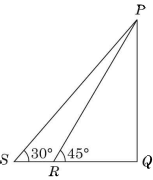
(C) Let $PQ$ be the height of the tower $H$. Let the car be at point $S$ initially and at point $R$ after $12$ minutes. The angles of depression are $30^{\circ}$ and $45^{\circ}$ respectively,which are equal to the angles of elevation $\angle PSQ = 30^{\circ}$ and $\angle PRQ = 45^{\circ}$.
In $\Delta PQR$,$\tan 45^{\circ} = \frac{PQ}{RQ} = 1 \implies PQ = RQ = H$.
In $\Delta PQS$,$\tan 30^{\circ} = \frac{PQ}{SQ} = \frac{1}{\sqrt{3}} \implies SQ = H\sqrt{3}$.
The distance $SR = SQ - RQ = H\sqrt{3} - H = H(\sqrt{3} - 1)$.
The car covers distance $SR$ in $12$ minutes. Let the time taken to cover distance $RQ$ be $t$ minutes.
Since speed is uniform,$\frac{SR}{12} = \frac{RQ}{t}$.
$\frac{H(\sqrt{3} - 1)}{12} = \frac{H}{t} \implies t = \frac{12}{\sqrt{3} - 1} = \frac{12(\sqrt{3} + 1)}{3 - 1} = 6(\sqrt{3} + 1) \approx 6(1.732 + 1) = 6(2.732) = 16.392 \text{ minutes}$.
$0.392 \text{ minutes} = 0.392 \times 60 \approx 23.5 \text{ seconds}$.
Thus,the time is $16 \text{ minutes } 23 \text{ seconds}$.
In $\Delta PQR$,$\tan 45^{\circ} = \frac{PQ}{RQ} = 1 \implies PQ = RQ = H$.
In $\Delta PQS$,$\tan 30^{\circ} = \frac{PQ}{SQ} = \frac{1}{\sqrt{3}} \implies SQ = H\sqrt{3}$.
The distance $SR = SQ - RQ = H\sqrt{3} - H = H(\sqrt{3} - 1)$.
The car covers distance $SR$ in $12$ minutes. Let the time taken to cover distance $RQ$ be $t$ minutes.
Since speed is uniform,$\frac{SR}{12} = \frac{RQ}{t}$.
$\frac{H(\sqrt{3} - 1)}{12} = \frac{H}{t} \implies t = \frac{12}{\sqrt{3} - 1} = \frac{12(\sqrt{3} + 1)}{3 - 1} = 6(\sqrt{3} + 1) \approx 6(1.732 + 1) = 6(2.732) = 16.392 \text{ minutes}$.
$0.392 \text{ minutes} = 0.392 \times 60 \approx 23.5 \text{ seconds}$.
Thus,the time is $16 \text{ minutes } 23 \text{ seconds}$.
0 likes
View Solution11
EasyMCQ
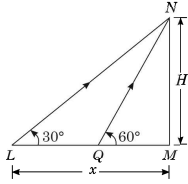
$A$ man standing at a point $P$ (or $L$ in the diagram) is watching the top of a tower $N$,which makes an angle of elevation of $30^{\circ}$ with the man's eye. The man walks some distance towards the tower to point $Q$ to watch its top and the angle of elevation becomes $60^{\circ}$. What is the distance (in units) between the base of the tower $M$ and the point $P$ (or $L$)?
A
$4 \sqrt{3}$
B
$8$
C
$12$
D
Data inadequate
Solution
(D) Let the height of the tower $NM = H$ and the distance $LM = x$.
In $\triangle NQM$,$\tan 60^{\circ} = \frac{NM}{QM} \implies \sqrt{3} = \frac{H}{QM} \implies QM = \frac{H}{\sqrt{3}}$.
In $\triangle NLM$,$\tan 30^{\circ} = \frac{NM}{LM} \implies \frac{1}{\sqrt{3}} = \frac{H}{x} \implies x = H\sqrt{3}$.
Since the height $H$ of the tower is not provided,the exact numerical value of $x$ cannot be determined.
Therefore,the data is inadequate.
In $\triangle NQM$,$\tan 60^{\circ} = \frac{NM}{QM} \implies \sqrt{3} = \frac{H}{QM} \implies QM = \frac{H}{\sqrt{3}}$.
In $\triangle NLM$,$\tan 30^{\circ} = \frac{NM}{LM} \implies \frac{1}{\sqrt{3}} = \frac{H}{x} \implies x = H\sqrt{3}$.
Since the height $H$ of the tower is not provided,the exact numerical value of $x$ cannot be determined.
Therefore,the data is inadequate.
0 likes
View Solution12
EasyMCQ
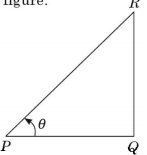
The angle of elevation of the sun,when the length of the shadow of a tree is $\sqrt{3}$ times the height of the tree,is (in $^{\circ}$)
A
$30$
B
$45$
C
$60$
D
$90$
Solution
(A) Let $QR$ represent the tree and $PQ$ represent its shadow,as shown in the figure.
It is given that the length of the shadow is $\sqrt{3}$ times the height of the tree,i.e.,$PQ = \sqrt{3} QR$.
In the right-angled triangle $\triangle PQR$,the angle of elevation $\theta$ is given by:
$\tan \theta = \frac{\text{Opposite side}}{\text{Adjacent side}} = \frac{QR}{PQ}$
Substituting the given value of $PQ$:
$\tan \theta = \frac{QR}{\sqrt{3} QR} = \frac{1}{\sqrt{3}}$
Since $\tan 30^{\circ} = \frac{1}{\sqrt{3}}$,we have:
$\theta = 30^{\circ}$
It is given that the length of the shadow is $\sqrt{3}$ times the height of the tree,i.e.,$PQ = \sqrt{3} QR$.
In the right-angled triangle $\triangle PQR$,the angle of elevation $\theta$ is given by:
$\tan \theta = \frac{\text{Opposite side}}{\text{Adjacent side}} = \frac{QR}{PQ}$
Substituting the given value of $PQ$:
$\tan \theta = \frac{QR}{\sqrt{3} QR} = \frac{1}{\sqrt{3}}$
Since $\tan 30^{\circ} = \frac{1}{\sqrt{3}}$,we have:
$\theta = 30^{\circ}$
0 likes
View Solution13
EasyMCQ
The angle of elevation of a ladder leaning against a wall is $45^{\circ},$ and the foot of the ladder is $4.242 \ m$ away from the wall. The length of the ladder is (in $m$):
A
$8.4$
B
$7.2$
C
$6$
D
$5.4$
Solution
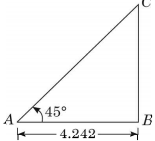
(C) In the figure,the ladder is represented by $AC$,where $AC$ is the hypotenuse of the right-angled triangle $ABC$.
The distance from the foot of the ladder to the wall is $AB = 4.242 \ m$.
Using the trigonometric ratio for cosine:
$\cos 45^{\circ} = \frac{\text{Adjacent}}{\text{Hypotenuse}} = \frac{AB}{AC}$
$\frac{1}{\sqrt{2}} = \frac{4.242}{AC}$
$AC = 4.242 \times \sqrt{2}$
Given $\sqrt{2} \approx 1.414$,we have:
$AC = 4.242 \times 1.414 \approx 6 \ m$.
Thus,the length of the ladder is $6 \ m$.
The distance from the foot of the ladder to the wall is $AB = 4.242 \ m$.
Using the trigonometric ratio for cosine:
$\cos 45^{\circ} = \frac{\text{Adjacent}}{\text{Hypotenuse}} = \frac{AB}{AC}$
$\frac{1}{\sqrt{2}} = \frac{4.242}{AC}$
$AC = 4.242 \times \sqrt{2}$
Given $\sqrt{2} \approx 1.414$,we have:
$AC = 4.242 \times 1.414 \approx 6 \ m$.
Thus,the length of the ladder is $6 \ m$.
0 likes
View Solution14
MediumMCQ
$A$ man standing on the bank of a river observes that the angle subtended by a tree on the opposite bank is $60^{\circ}$. When he moves $36 \ m$ away from the bank,he finds the angle to be $30^{\circ}$. Find the breadth of the river (in $m$).
A
$12$
B
$15$
C
$18$
D
$21$
Solution
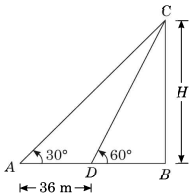
(C) Let the tree be represented by $BC$ with height $H$ and the breadth of the river be $DB = x$.
From the given figure,in $\triangle DBC$,$\tan 60^{\circ} = \frac{H}{x}$.
Since $\tan 60^{\circ} = \sqrt{3}$,we have $H = x\sqrt{3} \quad \dots(1)$.
In $\triangle ABC$,$\tan 30^{\circ} = \frac{H}{AB} = \frac{H}{36 + x}$.
Since $\tan 30^{\circ} = \frac{1}{\sqrt{3}}$,we have $H = \frac{36 + x}{\sqrt{3}} \quad \dots(2)$.
Equating $(1)$ and $(2)$:
$x\sqrt{3} = \frac{36 + x}{\sqrt{3}}$
$3x = 36 + x$
$2x = 36$
$x = 18 \ m$.
Thus,the breadth of the river is $18 \ m$.
From the given figure,in $\triangle DBC$,$\tan 60^{\circ} = \frac{H}{x}$.
Since $\tan 60^{\circ} = \sqrt{3}$,we have $H = x\sqrt{3} \quad \dots(1)$.
In $\triangle ABC$,$\tan 30^{\circ} = \frac{H}{AB} = \frac{H}{36 + x}$.
Since $\tan 30^{\circ} = \frac{1}{\sqrt{3}}$,we have $H = \frac{36 + x}{\sqrt{3}} \quad \dots(2)$.
Equating $(1)$ and $(2)$:
$x\sqrt{3} = \frac{36 + x}{\sqrt{3}}$
$3x = 36 + x$
$2x = 36$
$x = 18 \ m$.
Thus,the breadth of the river is $18 \ m$.
0 likes
View Solution15
DifficultMCQ
Two towers are situated on opposite banks of a river. One tower is $60 \ m$ high. From the top of this tower,the angles of depression of the top and the bottom of the other tower are $30^{\circ}$ and $60^{\circ}$ respectively. Find the width of the river and the height of the other tower (in $m$).
A
$20 \sqrt{3}, 40$
B
$40 \sqrt{3}, 20$
C
$20, 40 \sqrt{3}$
D
$40, 20 \sqrt{3}$
Solution
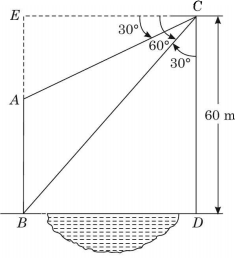
(A) Let $CD$ be the tower of height $60 \ m$ and $AB$ be the other tower of height $h$. Let the width of the river be $BD = x$.
From the diagram,$CD = 60 \ m$. The angle of depression of the top of tower $AB$ (point $A$) from $C$ is $30^{\circ}$,and the angle of depression of the bottom of tower $AB$ (point $B$) from $C$ is $60^{\circ}$.
In $\Delta CBD$,$\tan 60^{\circ} = \frac{CD}{BD} = \frac{60}{x}$.
Since $\tan 60^{\circ} = \sqrt{3}$,we have $\sqrt{3} = \frac{60}{x}$,which gives $x = \frac{60}{\sqrt{3}} = 20 \sqrt{3} \ m$. Thus,the width of the river is $20 \sqrt{3} \ m$.
Now,draw a horizontal line from $A$ to $CD$,meeting $CD$ at point $E$. Then $AE = BD = 20 \sqrt{3} \ m$ and $ED = AB = h$.
In $\Delta CAE$,$\tan 30^{\circ} = \frac{CE}{AE} = \frac{CE}{20 \sqrt{3}}$.
Since $\tan 30^{\circ} = \frac{1}{\sqrt{3}}$,we have $\frac{1}{\sqrt{3}} = \frac{CE}{20 \sqrt{3}}$,which gives $CE = 20 \ m$.
Therefore,the height of the other tower $AB = ED = CD - CE = 60 - 20 = 40 \ m$.
From the diagram,$CD = 60 \ m$. The angle of depression of the top of tower $AB$ (point $A$) from $C$ is $30^{\circ}$,and the angle of depression of the bottom of tower $AB$ (point $B$) from $C$ is $60^{\circ}$.
In $\Delta CBD$,$\tan 60^{\circ} = \frac{CD}{BD} = \frac{60}{x}$.
Since $\tan 60^{\circ} = \sqrt{3}$,we have $\sqrt{3} = \frac{60}{x}$,which gives $x = \frac{60}{\sqrt{3}} = 20 \sqrt{3} \ m$. Thus,the width of the river is $20 \sqrt{3} \ m$.
Now,draw a horizontal line from $A$ to $CD$,meeting $CD$ at point $E$. Then $AE = BD = 20 \sqrt{3} \ m$ and $ED = AB = h$.
In $\Delta CAE$,$\tan 30^{\circ} = \frac{CE}{AE} = \frac{CE}{20 \sqrt{3}}$.
Since $\tan 30^{\circ} = \frac{1}{\sqrt{3}}$,we have $\frac{1}{\sqrt{3}} = \frac{CE}{20 \sqrt{3}}$,which gives $CE = 20 \ m$.
Therefore,the height of the other tower $AB = ED = CD - CE = 60 - 20 = 40 \ m$.
0 likes
View Solution16
MediumMCQ
The ratio of the length of a rod and its shadow is $1 : \sqrt{3}$. The angle of elevation of the sun is (in $^{\circ}$)
A
$30$
B
$45$
C
$60$
D
$90$
Solution
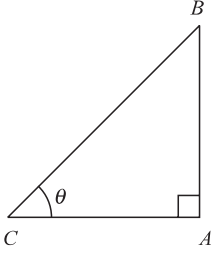
(A) Let $AB$ be the rod and $AC$ be its shadow.
Let $\angle ACB = \theta$.
Given that the ratio of the length of the rod to its shadow is $AB : AC = 1 : \sqrt{3}$.
Let $AB = x$,then $AC = \sqrt{3}x$.
In the right-angled triangle $\triangle ABC$,we have:
$\tan \theta = \frac{\text{Opposite side}}{\text{Adjacent side}} = \frac{AB}{AC}$
$\tan \theta = \frac{x}{\sqrt{3}x} = \frac{1}{\sqrt{3}}$
Since $\tan 30^{\circ} = \frac{1}{\sqrt{3}}$,we get $\theta = 30^{\circ}$.
Therefore,the angle of elevation of the sun is $30^{\circ}$.
Let $\angle ACB = \theta$.
Given that the ratio of the length of the rod to its shadow is $AB : AC = 1 : \sqrt{3}$.
Let $AB = x$,then $AC = \sqrt{3}x$.
In the right-angled triangle $\triangle ABC$,we have:
$\tan \theta = \frac{\text{Opposite side}}{\text{Adjacent side}} = \frac{AB}{AC}$
$\tan \theta = \frac{x}{\sqrt{3}x} = \frac{1}{\sqrt{3}}$
Since $\tan 30^{\circ} = \frac{1}{\sqrt{3}}$,we get $\theta = 30^{\circ}$.
Therefore,the angle of elevation of the sun is $30^{\circ}$.
0 likes
View Solution17
EasyMCQ
The angle of elevation of the sun when the length of the shadow of a pole is equal to its height is
A
$30^{\circ}$
B
$45^{\circ}$
C
$60^{\circ}$
D
None of these
Solution
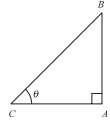
(B) Let the height of the pole be $AB = h$ and the length of its shadow be $AC = h$.
In the right-angled triangle $ABC$,where $\angle A = 90^{\circ}$ and $\angle C = \theta$ is the angle of elevation of the sun:
$\tan \theta = \frac{\text{Perpendicular}}{\text{Base}} = \frac{AB}{AC}$
$\tan \theta = \frac{h}{h} = 1$
Since $\tan 45^{\circ} = 1$,we have $\theta = 45^{\circ}$.
In the right-angled triangle $ABC$,where $\angle A = 90^{\circ}$ and $\angle C = \theta$ is the angle of elevation of the sun:
$\tan \theta = \frac{\text{Perpendicular}}{\text{Base}} = \frac{AB}{AC}$
$\tan \theta = \frac{h}{h} = 1$
Since $\tan 45^{\circ} = 1$,we have $\theta = 45^{\circ}$.
0 likes
View Solution18
EasyMCQ
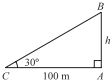
$A$ tower stands on a horizontal plane. $A$ man on the ground $100 \ m$ from the base of the tower finds the angle of elevation of the top of the tower to be $30^{\circ}$. What is the height of the tower (in $m$)?
A
$100$
B
$100 \sqrt{3}$
C
$\frac{100}{\sqrt{3}}$
D
None of these
Solution
(C) Let the height of the tower be $h \ m$.
Given that the distance from the base of the tower is $100 \ m$ and the angle of elevation is $30^{\circ}$.
In the right-angled triangle formed,we have:
$\tan(30^{\circ}) = \frac{\text{Height of the tower}}{\text{Distance from the base}}$
$\tan(30^{\circ}) = \frac{h}{100}$
Since $\tan(30^{\circ}) = \frac{1}{\sqrt{3}}$,we get:
$\frac{1}{\sqrt{3}} = \frac{h}{100}$
$h = \frac{100}{\sqrt{3}} \ m$.
Given that the distance from the base of the tower is $100 \ m$ and the angle of elevation is $30^{\circ}$.
In the right-angled triangle formed,we have:
$\tan(30^{\circ}) = \frac{\text{Height of the tower}}{\text{Distance from the base}}$
$\tan(30^{\circ}) = \frac{h}{100}$
Since $\tan(30^{\circ}) = \frac{1}{\sqrt{3}}$,we get:
$\frac{1}{\sqrt{3}} = \frac{h}{100}$
$h = \frac{100}{\sqrt{3}} \ m$.
0 likes
View Solution19
EasyMCQ
When the sun is $30^{\circ}$ above the horizontal,the length (in $m$) of the shadow cast by a building $50 \ m$ high is
A
$\frac{50}{\sqrt{3}}$
B
$50 \sqrt{3}$
C
$25$
D
$25 \sqrt{3}$
Solution
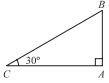
(B) Let $AB$ be the building and $AC$ be its shadow.
Given,height of the building $AB = 50 \ m$ and the angle of elevation of the sun $\theta = 30^{\circ}$.
In the right-angled triangle $\triangle ABC$,we have:
$\tan \theta = \frac{\text{Perpendicular}}{\text{Base}} = \frac{AB}{AC}$
$\tan 30^{\circ} = \frac{50}{AC}$
Since $\tan 30^{\circ} = \frac{1}{\sqrt{3}}$,we get:
$\frac{1}{\sqrt{3}} = \frac{50}{AC}$
$AC = 50 \sqrt{3} \ m$
Therefore,the length of the shadow is $50 \sqrt{3} \ m$.
Given,height of the building $AB = 50 \ m$ and the angle of elevation of the sun $\theta = 30^{\circ}$.
In the right-angled triangle $\triangle ABC$,we have:
$\tan \theta = \frac{\text{Perpendicular}}{\text{Base}} = \frac{AB}{AC}$
$\tan 30^{\circ} = \frac{50}{AC}$
Since $\tan 30^{\circ} = \frac{1}{\sqrt{3}}$,we get:
$\frac{1}{\sqrt{3}} = \frac{50}{AC}$
$AC = 50 \sqrt{3} \ m$
Therefore,the length of the shadow is $50 \sqrt{3} \ m$.
0 likes
View Solution20
MediumMCQ
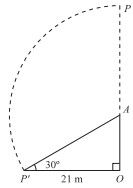
$A$ pole is broken by the wind. The top of the pole strikes the ground at an angle of $30^{\circ}$ and at a distance of $21 \ m$ from the foot of the pole. Find the total height of the pole (in $m$).
A
$21$
B
$21 \sqrt{3}$
C
$\frac{21}{\sqrt{3}}$
D
None of these
Solution
(B) Let $OP$ be the original pole,which breaks at point $A$. Let the top $P$ strike the ground at $P^{\prime}$.
Given: $OP^{\prime} = 21 \ m$ and $\angle OP^{\prime}A = 30^{\circ}$.
In $\triangle AOP^{\prime}$,$\tan 30^{\circ} = \frac{OA}{OP^{\prime}}$
$\frac{1}{\sqrt{3}} = \frac{OA}{21} \Rightarrow OA = \frac{21}{\sqrt{3}} = 7\sqrt{3} \ m$.
Also,$\cos 30^{\circ} = \frac{OP^{\prime}}{AP^{\prime}}$
$\frac{\sqrt{3}}{2} = \frac{21}{AP^{\prime}} \Rightarrow AP^{\prime} = \frac{42}{\sqrt{3}} = 14\sqrt{3} \ m$.
Since the broken part $AP$ is equal to $AP^{\prime}$,the total height of the pole is $OA + AP = OA + AP^{\prime}$.
Total height $= 7\sqrt{3} + 14\sqrt{3} = 21\sqrt{3} \ m$.
Given: $OP^{\prime} = 21 \ m$ and $\angle OP^{\prime}A = 30^{\circ}$.
In $\triangle AOP^{\prime}$,$\tan 30^{\circ} = \frac{OA}{OP^{\prime}}$
$\frac{1}{\sqrt{3}} = \frac{OA}{21} \Rightarrow OA = \frac{21}{\sqrt{3}} = 7\sqrt{3} \ m$.
Also,$\cos 30^{\circ} = \frac{OP^{\prime}}{AP^{\prime}}$
$\frac{\sqrt{3}}{2} = \frac{21}{AP^{\prime}} \Rightarrow AP^{\prime} = \frac{42}{\sqrt{3}} = 14\sqrt{3} \ m$.
Since the broken part $AP$ is equal to $AP^{\prime}$,the total height of the pole is $OA + AP = OA + AP^{\prime}$.
Total height $= 7\sqrt{3} + 14\sqrt{3} = 21\sqrt{3} \ m$.
0 likes
View Solution21
MediumMCQ
The upper part of a tree broken by the wind makes an angle of $30^{\circ}$ with the ground and the distance from the root to the point where the top of the tree touches the ground is $10 \ m$. What was the height of the tree?
A
$10 \sqrt{3}$
B
$\frac{10}{\sqrt{3}}$
C
$20 \sqrt{3}$
D
None of these
Solution
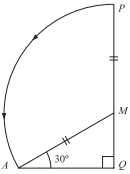
(A) Let the tree be represented by $PQ$,where $Q$ is the root and $M$ is the point where it breaks. When the top $P$ touches the ground at $A$,we have a right-angled triangle $\triangle MQA$ with $\angle MAQ = 30^{\circ}$ and $AQ = 10 \ m$.
In $\triangle MQA$:
$\tan 30^{\circ} = \frac{MQ}{AQ} \Rightarrow \frac{1}{\sqrt{3}} = \frac{MQ}{10} \Rightarrow MQ = \frac{10}{\sqrt{3}} \ m$.
Also,$\cos 30^{\circ} = \frac{AQ}{AM} \Rightarrow \frac{\sqrt{3}}{2} = \frac{10}{AM} \Rightarrow AM = \frac{20}{\sqrt{3}} \ m$.
Since the broken part $MP$ is equal to $AM$,the total height of the tree is $MQ + MP = MQ + AM$.
Height $= \frac{10}{\sqrt{3}} + \frac{20}{\sqrt{3}} = \frac{30}{\sqrt{3}} = 10\sqrt{3} \ m$.
In $\triangle MQA$:
$\tan 30^{\circ} = \frac{MQ}{AQ} \Rightarrow \frac{1}{\sqrt{3}} = \frac{MQ}{10} \Rightarrow MQ = \frac{10}{\sqrt{3}} \ m$.
Also,$\cos 30^{\circ} = \frac{AQ}{AM} \Rightarrow \frac{\sqrt{3}}{2} = \frac{10}{AM} \Rightarrow AM = \frac{20}{\sqrt{3}} \ m$.
Since the broken part $MP$ is equal to $AM$,the total height of the tree is $MQ + MP = MQ + AM$.
Height $= \frac{10}{\sqrt{3}} + \frac{20}{\sqrt{3}} = \frac{30}{\sqrt{3}} = 10\sqrt{3} \ m$.
0 likes
View Solution22
EasyMCQ
$A$ tower stands at the end of a straight road. The angles of elevation of the top of the tower from two points on the road $500 \ m$ apart are $45^{\circ}$ and $60^{\circ},$ respectively. Find the height of the tower.
A
$\frac{500 \sqrt{3}}{\sqrt{3}-1} \ m$
B
$500 \sqrt{3} \ m$
C
$\frac{500 \sqrt{3}}{\sqrt{3}+1} \ m$
D
$250(3+\sqrt{3}) \ m$
Solution
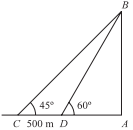
(D) Let the height of the tower $AB$ be $h$. Let the two points on the road be $C$ and $D$ such that $CD = 500 \ m$. Let $AD = x$.
In $\triangle ABD$,$\tan 60^{\circ} = \frac{AB}{AD} = \frac{h}{x} \implies x = \frac{h}{\sqrt{3}}$.
In $\triangle ABC$,$\tan 45^{\circ} = \frac{AB}{AC} = \frac{h}{x+500} \implies 1 = \frac{h}{\frac{h}{\sqrt{3}} + 500}$.
$h = \frac{h}{\sqrt{3}} + 500 \implies h(1 - \frac{1}{\sqrt{3}}) = 500 \implies h(\frac{\sqrt{3}-1}{\sqrt{3}}) = 500$.
$h = \frac{500 \sqrt{3}}{\sqrt{3}-1} \ m$.
Rationalizing the denominator: $h = \frac{500 \sqrt{3}(\sqrt{3}+1)}{3-1} = \frac{500(3+\sqrt{3})}{2} = 250(3+\sqrt{3}) \ m$.
In $\triangle ABD$,$\tan 60^{\circ} = \frac{AB}{AD} = \frac{h}{x} \implies x = \frac{h}{\sqrt{3}}$.
In $\triangle ABC$,$\tan 45^{\circ} = \frac{AB}{AC} = \frac{h}{x+500} \implies 1 = \frac{h}{\frac{h}{\sqrt{3}} + 500}$.
$h = \frac{h}{\sqrt{3}} + 500 \implies h(1 - \frac{1}{\sqrt{3}}) = 500 \implies h(\frac{\sqrt{3}-1}{\sqrt{3}}) = 500$.
$h = \frac{500 \sqrt{3}}{\sqrt{3}-1} \ m$.
Rationalizing the denominator: $h = \frac{500 \sqrt{3}(\sqrt{3}+1)}{3-1} = \frac{500(3+\sqrt{3})}{2} = 250(3+\sqrt{3}) \ m$.
0 likes
View Solution23
MediumMCQ
The shadow of a tower standing on a level plane is found to be $50 \ m$ longer when the sun's altitude is $30^{\circ}$ than when it is $60^{\circ} .$ Find the height of the tower. (In $m$)
A
$20 \sqrt{3}$
B
$\frac{25}{\sqrt{3}}$
C
$25 \sqrt{3}$
D
$50 \sqrt{3}$
Solution
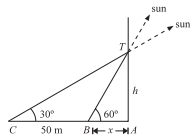
(C) Let the height of the tower be $h \ m$. Let $AB$ be the shadow when the sun's altitude is $60^{\circ}$ and $AC$ be the shadow when the sun's altitude is $30^{\circ}$.
Given,$BC = 50 \ m$.
In $\triangle TAB$,$\tan 60^{\circ} = \frac{h}{AB} \Rightarrow \sqrt{3} = \frac{h}{AB} \Rightarrow AB = \frac{h}{\sqrt{3}}$.
In $\triangle TAC$,$\tan 30^{\circ} = \frac{h}{AC} \Rightarrow \frac{1}{\sqrt{3}} = \frac{h}{AB + 50} \Rightarrow AB + 50 = h\sqrt{3}$.
Substituting $AB = \frac{h}{\sqrt{3}}$ in the second equation:
$\frac{h}{\sqrt{3}} + 50 = h\sqrt{3}$
$50 = h\sqrt{3} - \frac{h}{\sqrt{3}}$
$50 = h \left( \frac{3 - 1}{\sqrt{3}} \right) = h \left( \frac{2}{\sqrt{3}} \right)$
$h = \frac{50 \sqrt{3}}{2} = 25 \sqrt{3} \ m$.
Given,$BC = 50 \ m$.
In $\triangle TAB$,$\tan 60^{\circ} = \frac{h}{AB} \Rightarrow \sqrt{3} = \frac{h}{AB} \Rightarrow AB = \frac{h}{\sqrt{3}}$.
In $\triangle TAC$,$\tan 30^{\circ} = \frac{h}{AC} \Rightarrow \frac{1}{\sqrt{3}} = \frac{h}{AB + 50} \Rightarrow AB + 50 = h\sqrt{3}$.
Substituting $AB = \frac{h}{\sqrt{3}}$ in the second equation:
$\frac{h}{\sqrt{3}} + 50 = h\sqrt{3}$
$50 = h\sqrt{3} - \frac{h}{\sqrt{3}}$
$50 = h \left( \frac{3 - 1}{\sqrt{3}} \right) = h \left( \frac{2}{\sqrt{3}} \right)$
$h = \frac{50 \sqrt{3}}{2} = 25 \sqrt{3} \ m$.
0 likes
View Solution24
MediumMCQ
In a rectangle,if the angle between a diagonal and a side is $30^{\circ}$ and the length of the diagonal is $6 \text{ cm}$,the area (in $\text{cm}^2$) of the rectangle is:
A
$9$
B
$9\sqrt{3}$
C
$27$
D
$36$
Solution
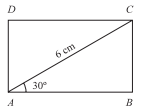
(B) Let $ABCD$ be the rectangle where $\angle BAC = 30^{\circ}$ and the diagonal $AC = 6 \text{ cm}$.
In the right-angled triangle $\triangle ABC$:
$\cos 30^{\circ} = \frac{AB}{AC} \Rightarrow \frac{\sqrt{3}}{2} = \frac{AB}{6} \Rightarrow AB = 3\sqrt{3} \text{ cm}$.
$\sin 30^{\circ} = \frac{BC}{AC} \Rightarrow \frac{1}{2} = \frac{BC}{6} \Rightarrow BC = 3 \text{ cm}$.
The area of the rectangle is $AB \times BC = (3\sqrt{3}) \times 3 = 9\sqrt{3} \text{ cm}^2$.
In the right-angled triangle $\triangle ABC$:
$\cos 30^{\circ} = \frac{AB}{AC} \Rightarrow \frac{\sqrt{3}}{2} = \frac{AB}{6} \Rightarrow AB = 3\sqrt{3} \text{ cm}$.
$\sin 30^{\circ} = \frac{BC}{AC} \Rightarrow \frac{1}{2} = \frac{BC}{6} \Rightarrow BC = 3 \text{ cm}$.
The area of the rectangle is $AB \times BC = (3\sqrt{3}) \times 3 = 9\sqrt{3} \text{ cm}^2$.
0 likes
View Solution25
EasyMCQ
The height of a tower is $100 \text{ m}$. When the angle of elevation of the sun changes from $30^{\circ}$ to $45^{\circ}$,the shadow of the tower becomes $x \text{ m}$ smaller. The value of $x$ is (in $\text{m}$):
A
$100$
B
$100 \sqrt{3}$
C
$100(\sqrt{3}-1)$
D
$\frac{100}{\sqrt{3}}$
Solution
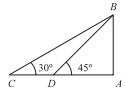
(C) Let $AB$ be the tower of height $100 \text{ m}$. Let $AC$ and $AD$ be the lengths of the shadows when the angle of elevation is $30^{\circ}$ and $45^{\circ}$ respectively.
In $\triangle ABD$,$\tan 45^{\circ} = \frac{AB}{AD} \Rightarrow 1 = \frac{100}{AD} \Rightarrow AD = 100 \text{ m}$.
In $\triangle ABC$,$\tan 30^{\circ} = \frac{AB}{AC} \Rightarrow \frac{1}{\sqrt{3}} = \frac{100}{AC} \Rightarrow AC = 100\sqrt{3} \text{ m}$.
The decrease in the length of the shadow is $x = AC - AD$.
$x = 100\sqrt{3} - 100 = 100(\sqrt{3} - 1) \text{ m}$.
In $\triangle ABD$,$\tan 45^{\circ} = \frac{AB}{AD} \Rightarrow 1 = \frac{100}{AD} \Rightarrow AD = 100 \text{ m}$.
In $\triangle ABC$,$\tan 30^{\circ} = \frac{AB}{AC} \Rightarrow \frac{1}{\sqrt{3}} = \frac{100}{AC} \Rightarrow AC = 100\sqrt{3} \text{ m}$.
The decrease in the length of the shadow is $x = AC - AD$.
$x = 100\sqrt{3} - 100 = 100(\sqrt{3} - 1) \text{ m}$.
0 likes
View Solution26
EasyMCQ
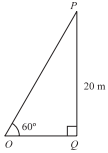
$A$ $20 \, m$ high electric pole stands upright on the ground with the help of a steel wire attached to its top and fixed on the ground. If the steel wire makes an angle of $60^{\circ}$ with the horizontal ground,find the length of the steel wire (in $m$).
A
$\frac{40}{\sqrt{3}}$
B
$40 \sqrt{3}$
C
$\frac{20}{\sqrt{3}}$
D
$20 \sqrt{3}$
Solution
(A) Let the height of the electric pole be $PQ = 20 \, m$ and the length of the steel wire be $OP$. The pole makes a right angle with the ground,so $\triangle OPQ$ is a right-angled triangle at $Q$.
Using the trigonometric ratio $\sin \theta = \frac{\text{Perpendicular}}{\text{Hypotenuse}}$:
$\sin 60^{\circ} = \frac{PQ}{OP}$
$\frac{\sqrt{3}}{2} = \frac{20}{OP}$
$OP = \frac{20 \times 2}{\sqrt{3}} = \frac{40}{\sqrt{3}} \, m$.
Thus,the length of the steel wire is $\frac{40}{\sqrt{3}} \, m$.
Using the trigonometric ratio $\sin \theta = \frac{\text{Perpendicular}}{\text{Hypotenuse}}$:
$\sin 60^{\circ} = \frac{PQ}{OP}$
$\frac{\sqrt{3}}{2} = \frac{20}{OP}$
$OP = \frac{20 \times 2}{\sqrt{3}} = \frac{40}{\sqrt{3}} \, m$.
Thus,the length of the steel wire is $\frac{40}{\sqrt{3}} \, m$.
0 likes
View Solution27
MediumMCQ
From the top of a lighthouse,$50 \ m$ above the sea,the angle of depression of an incoming boat is $30^{\circ}$. How far is the boat from the lighthouse?
A
$25 \sqrt{3} \ m$
B
$\frac{25}{\sqrt{3}} \ m$
C
$50 \sqrt{3} \ m$
D
$\frac{50}{\sqrt{3}} \ m$
Solution
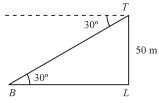
(C) Let $T$ be the top of the lighthouse and $L$ be the base of the lighthouse at sea level. Let $B$ be the position of the boat.
Given,height of the lighthouse $TL = 50 \ m$.
The angle of depression from the top $T$ to the boat $B$ is $30^{\circ}$.
Since the line of sight is parallel to the sea level,the angle of elevation from the boat $B$ to the top $T$ is also $30^{\circ}$ (alternate interior angles).
In the right-angled triangle $\triangle TBL$,we have:
$\tan(30^{\circ}) = \frac{\text{Opposite}}{\text{Adjacent}} = \frac{TL}{BL}$
$\frac{1}{\sqrt{3}} = \frac{50}{BL}$
$BL = 50 \sqrt{3} \ m$
Therefore,the boat is $50 \sqrt{3} \ m$ away from the lighthouse.
Given,height of the lighthouse $TL = 50 \ m$.
The angle of depression from the top $T$ to the boat $B$ is $30^{\circ}$.
Since the line of sight is parallel to the sea level,the angle of elevation from the boat $B$ to the top $T$ is also $30^{\circ}$ (alternate interior angles).
In the right-angled triangle $\triangle TBL$,we have:
$\tan(30^{\circ}) = \frac{\text{Opposite}}{\text{Adjacent}} = \frac{TL}{BL}$
$\frac{1}{\sqrt{3}} = \frac{50}{BL}$
$BL = 50 \sqrt{3} \ m$
Therefore,the boat is $50 \sqrt{3} \ m$ away from the lighthouse.
0 likes
View Solution28
EasyMCQ
From the top of a $25 \ m$ high cliff,the angle of elevation of a tower is found to be equal to the angle of depression of the foot of the tower. Find the height of the tower in $m$.
A
$40$
B
$48$
C
$50$
D
$52$
Solution
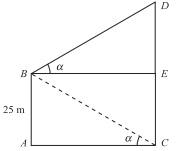
(C) Let $AB$ be the cliff of height $25 \ m$ and $CD$ be the tower.
Let the angle of elevation of the top of the tower $D$ from the top of the cliff $B$ be $\alpha$.
Let the angle of depression of the foot of the tower $C$ from the top of the cliff $B$ be $\alpha$.
Draw $BE \perp CD$,where $E$ is on $CD$.
In $\triangle ABC$,$\tan \alpha = \frac{AB}{AC} = \frac{25}{AC}$.
In $\triangle BDE$,$\tan \alpha = \frac{DE}{BE}$.
Since $BE = AC$,we have $\frac{DE}{BE} = \frac{25}{BE}$,which implies $DE = 25 \ m$.
Since $CE = AB = 25 \ m$,the total height of the tower $CD = CE + DE = 25 + 25 = 50 \ m$.
Let the angle of elevation of the top of the tower $D$ from the top of the cliff $B$ be $\alpha$.
Let the angle of depression of the foot of the tower $C$ from the top of the cliff $B$ be $\alpha$.
Draw $BE \perp CD$,where $E$ is on $CD$.
In $\triangle ABC$,$\tan \alpha = \frac{AB}{AC} = \frac{25}{AC}$.
In $\triangle BDE$,$\tan \alpha = \frac{DE}{BE}$.
Since $BE = AC$,we have $\frac{DE}{BE} = \frac{25}{BE}$,which implies $DE = 25 \ m$.
Since $CE = AB = 25 \ m$,the total height of the tower $CD = CE + DE = 25 + 25 = 50 \ m$.
0 likes
View Solution29
MediumMCQ
When the length of the shadow of a pole is equal to the height of the pole,then the angle of elevation of the source of light is: (in $^{\circ}$)
A
$30$
B
$45$
C
$60$
D
$75$
Solution
(B) Let the height of the pole be $h$ and the length of the shadow be $x$.
Given that the length of the shadow is equal to the height of the pole,we have $h = x$.
In the right-angled triangle formed by the pole and its shadow,the angle of elevation $\theta$ is given by:
$\tan \theta = \frac{\text{Height of the pole}}{\text{Length of the shadow}} = \frac{h}{x}$
Since $h = x$,we get:
$\tan \theta = \frac{h}{h} = 1$
We know that $\tan 45^{\circ} = 1$.
Therefore,$\theta = 45^{\circ}$.
Given that the length of the shadow is equal to the height of the pole,we have $h = x$.
In the right-angled triangle formed by the pole and its shadow,the angle of elevation $\theta$ is given by:
$\tan \theta = \frac{\text{Height of the pole}}{\text{Length of the shadow}} = \frac{h}{x}$
Since $h = x$,we get:
$\tan \theta = \frac{h}{h} = 1$
We know that $\tan 45^{\circ} = 1$.
Therefore,$\theta = 45^{\circ}$.
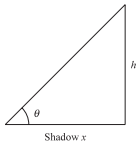
0 likes
View Solution30
MediumMCQ
From the top of a $60 \ m$ high lighthouse with its base at sea level,the angle of depression of a boat is $15^{\circ}$. The distance of the boat from the lighthouse is
A
$60\left(\frac{\sqrt{3}-1}{\sqrt{3}+1}\right) \ m$
B
$60\left(\frac{\sqrt{3}+1}{\sqrt{3}-1}\right) \ m$
C
$30\left(\frac{\sqrt{3}-1}{\sqrt{3}+1}\right) \ m$
D
$30\left(\frac{\sqrt{3}+1}{\sqrt{3}-1}\right) \ m$
Solution
(B) Let $AC$ be the lighthouse of height $60 \ m$ and $B$ be the position of the boat.
Let $x$ be the distance of the boat from the base of the lighthouse $(AB = x)$.
The angle of depression from the top $C$ to the boat $B$ is $15^{\circ}$,so the angle of elevation from the boat to the top is also $15^{\circ}$.
In $\triangle ABC$,$\tan 15^{\circ} = \frac{AC}{AB} = \frac{60}{x}$.
Therefore,$x = \frac{60}{\tan 15^{\circ}}$.
We know that $\tan 15^{\circ} = \tan(45^{\circ} - 30^{\circ}) = \frac{\tan 45^{\circ} - \tan 30^{\circ}}{1 + \tan 45^{\circ} \tan 30^{\circ}} = \frac{1 - \frac{1}{\sqrt{3}}}{1 + \frac{1}{\sqrt{3}}} = \frac{\sqrt{3}-1}{\sqrt{3}+1}$.
Substituting this into the equation for $x$:
$x = 60 \div \left(\frac{\sqrt{3}-1}{\sqrt{3}+1}\right) = 60 \left(\frac{\sqrt{3}+1}{\sqrt{3}-1}\right) \ m$.
Let $x$ be the distance of the boat from the base of the lighthouse $(AB = x)$.
The angle of depression from the top $C$ to the boat $B$ is $15^{\circ}$,so the angle of elevation from the boat to the top is also $15^{\circ}$.
In $\triangle ABC$,$\tan 15^{\circ} = \frac{AC}{AB} = \frac{60}{x}$.
Therefore,$x = \frac{60}{\tan 15^{\circ}}$.
We know that $\tan 15^{\circ} = \tan(45^{\circ} - 30^{\circ}) = \frac{\tan 45^{\circ} - \tan 30^{\circ}}{1 + \tan 45^{\circ} \tan 30^{\circ}} = \frac{1 - \frac{1}{\sqrt{3}}}{1 + \frac{1}{\sqrt{3}}} = \frac{\sqrt{3}-1}{\sqrt{3}+1}$.
Substituting this into the equation for $x$:
$x = 60 \div \left(\frac{\sqrt{3}-1}{\sqrt{3}+1}\right) = 60 \left(\frac{\sqrt{3}+1}{\sqrt{3}-1}\right) \ m$.
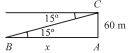
0 likes
View Solution31
MediumMCQ
On the level ground,the angle of elevation of the top of the tower is $30^{\circ}$. On moving $20 \ m$ nearer,the angle of elevation is $60^{\circ}$. The height of the tower is (in $m$):
A
$20 \sqrt{3}$
B
$10 \sqrt{3}$
C
$10(\sqrt{3}-1)$
D
None of these
Solution
(B) Let the height of the tower be $h$ and the distance from the tower to the second point be $x$.
In $\triangle BAQ$,$\tan 60^{\circ} = \frac{h}{x} \implies \sqrt{3} = \frac{h}{x} \implies h = x\sqrt{3} \quad \dots(1)$
In $\triangle BAP$,$\tan 30^{\circ} = \frac{h}{x+20} \implies \frac{1}{\sqrt{3}} = \frac{h}{x+20} \implies x+20 = h\sqrt{3} \quad \dots(2)$
Substitute $x = \frac{h}{\sqrt{3}}$ from $(1)$ into $(2)$:
$\frac{h}{\sqrt{3}} + 20 = h\sqrt{3}$
$20 = h\sqrt{3} - \frac{h}{\sqrt{3}}$
$20 = h \left( \frac{3-1}{\sqrt{3}} \right)$
$20 = h \left( \frac{2}{\sqrt{3}} \right)$
$h = \frac{20 \times \sqrt{3}}{2} = 10\sqrt{3} \ m$.
In $\triangle BAQ$,$\tan 60^{\circ} = \frac{h}{x} \implies \sqrt{3} = \frac{h}{x} \implies h = x\sqrt{3} \quad \dots(1)$
In $\triangle BAP$,$\tan 30^{\circ} = \frac{h}{x+20} \implies \frac{1}{\sqrt{3}} = \frac{h}{x+20} \implies x+20 = h\sqrt{3} \quad \dots(2)$
Substitute $x = \frac{h}{\sqrt{3}}$ from $(1)$ into $(2)$:
$\frac{h}{\sqrt{3}} + 20 = h\sqrt{3}$
$20 = h\sqrt{3} - \frac{h}{\sqrt{3}}$
$20 = h \left( \frac{3-1}{\sqrt{3}} \right)$
$20 = h \left( \frac{2}{\sqrt{3}} \right)$
$h = \frac{20 \times \sqrt{3}}{2} = 10\sqrt{3} \ m$.
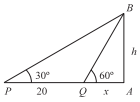
0 likes
View Solution32
EasyMCQ
The angle of elevation of the top of a tower from a point $20 \ m$ away from its base is $45^{\circ}$. The height of the tower is (in $m$):
A
$10$
B
$20$
C
$40$
D
$20 \sqrt{3}$
Solution
(B) Let the height of the tower be $h \ m$.
Given that the distance from the base of the tower to the point of observation is $20 \ m$.
The angle of elevation is $45^{\circ}$.
In the right-angled triangle formed,we have:
$\tan(45^{\circ}) = \frac{\text{Height of the tower}}{\text{Distance from the base}}$
$\tan(45^{\circ}) = \frac{h}{20}$
Since $\tan(45^{\circ}) = 1$,we have:
$1 = \frac{h}{20}$
$h = 20 \ m$.
Therefore,the height of the tower is $20 \ m$.
Given that the distance from the base of the tower to the point of observation is $20 \ m$.
The angle of elevation is $45^{\circ}$.
In the right-angled triangle formed,we have:
$\tan(45^{\circ}) = \frac{\text{Height of the tower}}{\text{Distance from the base}}$
$\tan(45^{\circ}) = \frac{h}{20}$
Since $\tan(45^{\circ}) = 1$,we have:
$1 = \frac{h}{20}$
$h = 20 \ m$.
Therefore,the height of the tower is $20 \ m$.
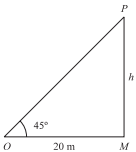
0 likes
View Solution33
EasyMCQ
At a point,$15 \, m$ away from the base of a $15 \, m$ high house,the angle of elevation of the top is (in $^{\circ}$)
A
$45$
B
$30$
C
$60$
D
$90$
Solution
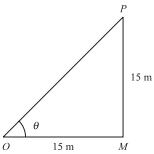
(A) Let $MP$ represent the house with height $15 \, m$.
Let $O$ be the point on the ground at a distance of $15 \, m$ from the base $M$ of the house.
In the right-angled triangle $\triangle OMP$,the angle of elevation of the top $P$ from point $O$ is $\theta$.
Using the trigonometric ratio for tangent:
$\tan \theta = \frac{\text{Opposite side}}{\text{Adjacent side}} = \frac{MP}{OM}$
$\tan \theta = \frac{15 \, m}{15 \, m} = 1$
Since $\tan 45^{\circ} = 1$,we have $\theta = 45^{\circ}$.
Let $O$ be the point on the ground at a distance of $15 \, m$ from the base $M$ of the house.
In the right-angled triangle $\triangle OMP$,the angle of elevation of the top $P$ from point $O$ is $\theta$.
Using the trigonometric ratio for tangent:
$\tan \theta = \frac{\text{Opposite side}}{\text{Adjacent side}} = \frac{MP}{OM}$
$\tan \theta = \frac{15 \, m}{15 \, m} = 1$
Since $\tan 45^{\circ} = 1$,we have $\theta = 45^{\circ}$.
0 likes
View Solution34
DifficultMCQ
The angles of depression from the top of a lighthouse to two boats,which are $60 \, m$ apart and in the same direction (due east),are $45^{\circ}$ and $30^{\circ}$. The height of the lighthouse is:
A
$60 \sqrt{3} \, m$
B
$30(\sqrt{3}-1) \, m$
C
$30(\sqrt{3}+1) \, m$
D
None of these
Solution
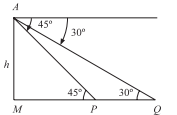
(C) Let $MA$ be the lighthouse of height $h$ meters. Let $P$ and $Q$ be the positions of the two boats such that $PQ = 60 \, m$.
In $\triangle AMP$,$\tan 45^{\circ} = \frac{MA}{MP} \implies 1 = \frac{h}{MP} \implies MP = h$.
In $\triangle AMQ$,$\tan 30^{\circ} = \frac{MA}{MQ} \implies \frac{1}{\sqrt{3}} = \frac{h}{MP + PQ} \implies \frac{1}{\sqrt{3}} = \frac{h}{h + 60}$.
Cross-multiplying,we get $h + 60 = h\sqrt{3}$.
Rearranging,$h(\sqrt{3} - 1) = 60$.
$h = \frac{60}{\sqrt{3} - 1}$.
Rationalizing the denominator,$h = \frac{60(\sqrt{3} + 1)}{(\sqrt{3} - 1)(\sqrt{3} + 1)} = \frac{60(\sqrt{3} + 1)}{3 - 1} = \frac{60(\sqrt{3} + 1)}{2} = 30(\sqrt{3} + 1) \, m$.
In $\triangle AMP$,$\tan 45^{\circ} = \frac{MA}{MP} \implies 1 = \frac{h}{MP} \implies MP = h$.
In $\triangle AMQ$,$\tan 30^{\circ} = \frac{MA}{MQ} \implies \frac{1}{\sqrt{3}} = \frac{h}{MP + PQ} \implies \frac{1}{\sqrt{3}} = \frac{h}{h + 60}$.
Cross-multiplying,we get $h + 60 = h\sqrt{3}$.
Rearranging,$h(\sqrt{3} - 1) = 60$.
$h = \frac{60}{\sqrt{3} - 1}$.
Rationalizing the denominator,$h = \frac{60(\sqrt{3} + 1)}{(\sqrt{3} - 1)(\sqrt{3} + 1)} = \frac{60(\sqrt{3} + 1)}{3 - 1} = \frac{60(\sqrt{3} + 1)}{2} = 30(\sqrt{3} + 1) \, m$.
0 likes
View Solution35
MediumMCQ
The angle of elevation of the top of a hill from each of the vertices $A, B, C$ of a horizontal triangle is $\alpha$. The height of the hill is
A
$b \tan \alpha \operatorname{cosec} B$
B
$\frac{a}{2} \tan \alpha \operatorname{cosec} A$
C
$\frac{c}{2} \tan \alpha \operatorname{cosec} C$
D
None of these
Solution
(B) Let $h$ be the height of the hill and $O$ be the foot of the hill on the horizontal plane.
Since the angle of elevation from each vertex $A, B, C$ is $\alpha$,we have $OA = OB = OC = h \cot \alpha$.
This implies that $O$ is the circumcentre of $\triangle ABC$ with circumradius $R = h \cot \alpha$.
In any triangle $ABC$,the circumradius $R$ is given by $R = \frac{a}{2 \sin A}$.
Equating the two expressions for $R$: $h \cot \alpha = \frac{a}{2 \sin A}$.
Therefore,$h = \frac{a \tan \alpha}{2 \sin A} = \frac{a}{2} \tan \alpha \operatorname{cosec} A$.
Since the angle of elevation from each vertex $A, B, C$ is $\alpha$,we have $OA = OB = OC = h \cot \alpha$.
This implies that $O$ is the circumcentre of $\triangle ABC$ with circumradius $R = h \cot \alpha$.
In any triangle $ABC$,the circumradius $R$ is given by $R = \frac{a}{2 \sin A}$.
Equating the two expressions for $R$: $h \cot \alpha = \frac{a}{2 \sin A}$.
Therefore,$h = \frac{a \tan \alpha}{2 \sin A} = \frac{a}{2} \tan \alpha \operatorname{cosec} A$.
0 likes
View Solution36
MediumMCQ
$A$ tower subtends an angle of $30^{\circ}$ at a point on the same level as the foot of the tower. At a second point,$h \ m$ above the first,the angle of depression of the foot of the tower is $60^{\circ}$. The horizontal distance of the tower from the point is
A
$h \cot 60^{\circ}$
B
$h \cot 30^{\circ}$
C
$\frac{h}{2} \cot 60^{\circ}$
D
$\frac{h}{2} \cot 30^{\circ}$
Solution
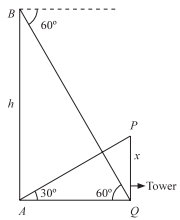
(A) Let $PQ = x$ be the height of the tower and $A$ be the point on the same level as the foot of the tower $Q$. Given $\angle PAQ = 30^{\circ}$.
Let $B$ be a point $h \ m$ vertically above $A$,so $AB = h$. The angle of depression of the foot of the tower $Q$ from $B$ is $60^{\circ}$,which implies $\angle BQA = 60^{\circ}$.
In the right-angled triangle $\triangle ABQ$,we have:
$\tan 60^{\circ} = \frac{AB}{AQ}$
$\sqrt{3} = \frac{h}{AQ}$
$AQ = \frac{h}{\sqrt{3}} = h \cot 60^{\circ}$.
Thus,the horizontal distance of the tower from the point $A$ is $h \cot 60^{\circ}$.
Let $B$ be a point $h \ m$ vertically above $A$,so $AB = h$. The angle of depression of the foot of the tower $Q$ from $B$ is $60^{\circ}$,which implies $\angle BQA = 60^{\circ}$.
In the right-angled triangle $\triangle ABQ$,we have:
$\tan 60^{\circ} = \frac{AB}{AQ}$
$\sqrt{3} = \frac{h}{AQ}$
$AQ = \frac{h}{\sqrt{3}} = h \cot 60^{\circ}$.
Thus,the horizontal distance of the tower from the point $A$ is $h \cot 60^{\circ}$.
0 likes
View Solution37
MediumMCQ
If a flagstaff of $6 \, m$ height placed on the top of a tower throws a shadow of $2 \sqrt{3} \, m$ along the ground,then the angle that the sun makes with the ground is
A
$60^{\circ}$
B
$30^{\circ}$
C
$45^{\circ}$
D
None of these
Solution
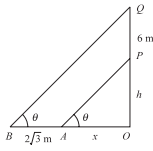
(A) Let $OP$ be the tower of height $h \, m$ and $PQ$ be the flagstaff of height $6 \, m$. Let the sun make an angle $\theta$ with the ground. Let $OA = x$ be the shadow of the tower and $AB = 2 \sqrt{3} \, m$ be the shadow of the flagstaff.
In $\triangle OAP$,$\tan \theta = \frac{OP}{OA} = \frac{h}{x}$.
In $\triangle OBQ$,$\tan \theta = \frac{OQ}{OB} = \frac{h + 6}{x + 2 \sqrt{3}}$.
Equating the two expressions for $\tan \theta$:
$\frac{h}{x} = \frac{h + 6}{x + 2 \sqrt{3}}$
$h(x + 2 \sqrt{3}) = x(h + 6)$
$hx + 2 \sqrt{3}h = hx + 6x$
$2 \sqrt{3}h = 6x$
$\frac{h}{x} = \frac{6}{2 \sqrt{3}} = \sqrt{3}$.
Since $\tan \theta = \frac{h}{x}$,we have $\tan \theta = \sqrt{3}$.
Therefore,$\theta = 60^{\circ}$.
In $\triangle OAP$,$\tan \theta = \frac{OP}{OA} = \frac{h}{x}$.
In $\triangle OBQ$,$\tan \theta = \frac{OQ}{OB} = \frac{h + 6}{x + 2 \sqrt{3}}$.
Equating the two expressions for $\tan \theta$:
$\frac{h}{x} = \frac{h + 6}{x + 2 \sqrt{3}}$
$h(x + 2 \sqrt{3}) = x(h + 6)$
$hx + 2 \sqrt{3}h = hx + 6x$
$2 \sqrt{3}h = 6x$
$\frac{h}{x} = \frac{6}{2 \sqrt{3}} = \sqrt{3}$.
Since $\tan \theta = \frac{h}{x}$,we have $\tan \theta = \sqrt{3}$.
Therefore,$\theta = 60^{\circ}$.
0 likes
View Solution38
MediumMCQ
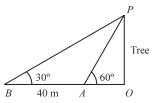
$A$ person standing on the bank of a river observes that the angle of elevation of the top of a tree on the opposite bank is $60^{\circ}$. When he moves $40 \ m$ away from the bank,he finds the angle of elevation to be $30^{\circ}$. The breadth of the river is (in $m$):
A
$40$
B
$60$
C
$20$
D
$30$
Solution
(C) Let $OP$ be the height of the tree and $OA$ be the breadth of the river.
In $\triangle OAP$,$\tan 60^{\circ} = \frac{OP}{OA} = \sqrt{3} \implies OP = OA \sqrt{3}$.
When the person moves $40 \ m$ away,the new distance from the bank is $OB = OA + 40$.
In $\triangle OBP$,$\tan 30^{\circ} = \frac{OP}{OB} = \frac{1}{\sqrt{3}}$.
Substituting $OP = OA \sqrt{3}$ into the second equation:
$\frac{OA \sqrt{3}}{OA + 40} = \frac{1}{\sqrt{3}}$
$3 OA = OA + 40$
$2 OA = 40$
$OA = 20 \ m$.
In $\triangle OAP$,$\tan 60^{\circ} = \frac{OP}{OA} = \sqrt{3} \implies OP = OA \sqrt{3}$.
When the person moves $40 \ m$ away,the new distance from the bank is $OB = OA + 40$.
In $\triangle OBP$,$\tan 30^{\circ} = \frac{OP}{OB} = \frac{1}{\sqrt{3}}$.
Substituting $OP = OA \sqrt{3}$ into the second equation:
$\frac{OA \sqrt{3}}{OA + 40} = \frac{1}{\sqrt{3}}$
$3 OA = OA + 40$
$2 OA = 40$
$OA = 20 \ m$.
0 likes
View Solution39
EasyMCQ
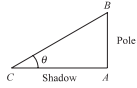
The angle of elevation of the sun when the length of the shadow of a pole is $\sqrt{3}$ times the height of the pole will be (in $^{\circ}$)
A
$30$
B
$60$
C
$90$
D
$45$
Solution
(A) Let the height of the pole be $AB = h$ and the length of the shadow be $AC = \sqrt{3}h$.
In the right-angled triangle $\triangle ABC$,the angle of elevation is $\theta$.
We know that $\tan \theta = \frac{\text{Perpendicular}}{\text{Base}} = \frac{AB}{AC}$.
Substituting the values,we get $\tan \theta = \frac{h}{\sqrt{3}h} = \frac{1}{\sqrt{3}}$.
Since $\tan 30^{\circ} = \frac{1}{\sqrt{3}}$,therefore $\theta = 30^{\circ}$.
In the right-angled triangle $\triangle ABC$,the angle of elevation is $\theta$.
We know that $\tan \theta = \frac{\text{Perpendicular}}{\text{Base}} = \frac{AB}{AC}$.
Substituting the values,we get $\tan \theta = \frac{h}{\sqrt{3}h} = \frac{1}{\sqrt{3}}$.
Since $\tan 30^{\circ} = \frac{1}{\sqrt{3}}$,therefore $\theta = 30^{\circ}$.
0 likes
View Solution40
EasyMCQ
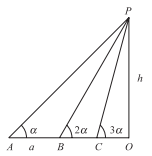
The angle of elevation of the top of a $TV$ tower from three points $A, B, C$ in a straight line through the foot of the tower are $\alpha, 2 \alpha, 3 \alpha$ respectively. If $AB = a$,the height of the tower is
A
$a \tan \alpha$
B
$a \sin \alpha$
C
$a \sin 2 \alpha$
D
$a \sin 3 \alpha$
Solution
(C) Let $OP = h$ be the height of the tower,where $O$ is the foot of the tower.
In $\triangle OAP$,$\angle OAP = \alpha$. Thus,$OA = h \cot \alpha$.
In $\triangle OBP$,$\angle OBP = 2 \alpha$. Thus,$OB = h \cot 2 \alpha$.
Given $AB = a$,we have $OA - OB = a$.
Therefore,$h \cot \alpha - h \cot 2 \alpha = a$.
$h (\frac{\cos \alpha}{\sin \alpha} - \frac{\cos 2 \alpha}{\sin 2 \alpha}) = a$.
$h (\frac{\sin 2 \alpha \cos \alpha - \cos 2 \alpha \sin \alpha}{\sin \alpha \sin 2 \alpha}) = a$.
Using the identity $\sin(A - B) = \sin A \cos B - \cos A \sin B$,we get:
$h (\frac{\sin(2 \alpha - \alpha)}{\sin \alpha \sin 2 \alpha}) = a$.
$h (\frac{\sin \alpha}{\sin \alpha \sin 2 \alpha}) = a$.
$h (\frac{1}{\sin 2 \alpha}) = a$.
$h = a \sin 2 \alpha$.
Thus,the height of the tower is $a \sin 2 \alpha$.
In $\triangle OAP$,$\angle OAP = \alpha$. Thus,$OA = h \cot \alpha$.
In $\triangle OBP$,$\angle OBP = 2 \alpha$. Thus,$OB = h \cot 2 \alpha$.
Given $AB = a$,we have $OA - OB = a$.
Therefore,$h \cot \alpha - h \cot 2 \alpha = a$.
$h (\frac{\cos \alpha}{\sin \alpha} - \frac{\cos 2 \alpha}{\sin 2 \alpha}) = a$.
$h (\frac{\sin 2 \alpha \cos \alpha - \cos 2 \alpha \sin \alpha}{\sin \alpha \sin 2 \alpha}) = a$.
Using the identity $\sin(A - B) = \sin A \cos B - \cos A \sin B$,we get:
$h (\frac{\sin(2 \alpha - \alpha)}{\sin \alpha \sin 2 \alpha}) = a$.
$h (\frac{\sin \alpha}{\sin \alpha \sin 2 \alpha}) = a$.
$h (\frac{1}{\sin 2 \alpha}) = a$.
$h = a \sin 2 \alpha$.
Thus,the height of the tower is $a \sin 2 \alpha$.
0 likes
View Solution41
MediumMCQ
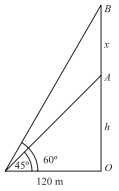
The angle of elevation of the top of an unfinished tower at a point distant $120 \ m$ from its base is $45^{\circ}$. If the elevation of the top at the same point is to be $60^{\circ}$,the tower must be raised to a height of:
A
$120(\sqrt{3}+1) \ m$
B
$120(\sqrt{3}-1) \ m$
C
$10(\sqrt{3}+1) \ m$
D
None of these
Solution
(B) Let the initial height of the tower be $h$ and the additional height required be $x$. The distance from the base is $120 \ m$.
From the first condition,the angle of elevation is $45^{\circ}$:
$\tan 45^{\circ} = \frac{h}{120}$
$1 = \frac{h}{120} \implies h = 120 \ m$.
From the second condition,the angle of elevation of the new top is $60^{\circ}$:
$\tan 60^{\circ} = \frac{h+x}{120}$
$\sqrt{3} = \frac{120+x}{120}$
$120\sqrt{3} = 120 + x$
$x = 120\sqrt{3} - 120$
$x = 120(\sqrt{3}-1) \ m$.
Thus,the tower must be raised by $120(\sqrt{3}-1) \ m$.
From the first condition,the angle of elevation is $45^{\circ}$:
$\tan 45^{\circ} = \frac{h}{120}$
$1 = \frac{h}{120} \implies h = 120 \ m$.
From the second condition,the angle of elevation of the new top is $60^{\circ}$:
$\tan 60^{\circ} = \frac{h+x}{120}$
$\sqrt{3} = \frac{120+x}{120}$
$120\sqrt{3} = 120 + x$
$x = 120\sqrt{3} - 120$
$x = 120(\sqrt{3}-1) \ m$.
Thus,the tower must be raised by $120(\sqrt{3}-1) \ m$.
0 likes
View Solution42
MediumMCQ
$A$ person walking along a straight road towards a hill observes at two points,separated by a distance of $\sqrt{3} \text{ km}$,that the angles of elevation of the hill are $30^{\circ}$ and $60^{\circ}$. The height of the hill is
A
$\frac{3}{2} \text{ km}$
B
$\sqrt{\frac{2}{3}} \text{ km}$
C
$\frac{\sqrt{3}+1}{2} \text{ km}$
D
$\sqrt{3} \text{ km}$
Solution
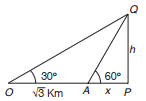
(A) Let $h$ be the height of the hill $QP$ and $x$ be the distance from the second point $A$ to the base $P$ of the hill.
In $\triangle QPA$,$\tan 60^{\circ} = \frac{h}{x} \implies \sqrt{3} = \frac{h}{x} \implies h = \sqrt{3}x$.
In $\triangle QPO$,the distance $OA = \sqrt{3} \text{ km}$,so $OP = OA + AP = \sqrt{3} + x$.
$\tan 30^{\circ} = \frac{h}{\sqrt{3} + x} \implies \frac{1}{\sqrt{3}} = \frac{h}{\sqrt{3} + x} \implies \sqrt{3}h = \sqrt{3} + x$.
Substitute $h = \sqrt{3}x$ into the equation: $\sqrt{3}(\sqrt{3}x) = \sqrt{3} + x \implies 3x = \sqrt{3} + x \implies 2x = \sqrt{3} \implies x = \frac{\sqrt{3}}{2} \text{ km}$.
Therefore,$h = \sqrt{3} \times \frac{\sqrt{3}}{2} = \frac{3}{2} \text{ km}$.
In $\triangle QPA$,$\tan 60^{\circ} = \frac{h}{x} \implies \sqrt{3} = \frac{h}{x} \implies h = \sqrt{3}x$.
In $\triangle QPO$,the distance $OA = \sqrt{3} \text{ km}$,so $OP = OA + AP = \sqrt{3} + x$.
$\tan 30^{\circ} = \frac{h}{\sqrt{3} + x} \implies \frac{1}{\sqrt{3}} = \frac{h}{\sqrt{3} + x} \implies \sqrt{3}h = \sqrt{3} + x$.
Substitute $h = \sqrt{3}x$ into the equation: $\sqrt{3}(\sqrt{3}x) = \sqrt{3} + x \implies 3x = \sqrt{3} + x \implies 2x = \sqrt{3} \implies x = \frac{\sqrt{3}}{2} \text{ km}$.
Therefore,$h = \sqrt{3} \times \frac{\sqrt{3}}{2} = \frac{3}{2} \text{ km}$.
0 likes
View Solution43
MediumMCQ
The tops of two poles of height $20 \ m$ and $14 \ m$ are connected by a wire. If the wire makes an angle $30^{\circ}$ with the horizontal,then the length of the wire is $m$.
A
$12$
B
$10$
C
$8$
D
None of these
Solution
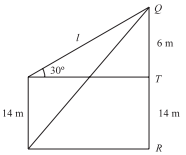
(A) Let the heights of the two poles be $h_1 = 20 \ m$ and $h_2 = 14 \ m$.
The difference in the heights of the poles is $h_1 - h_2 = 20 \ m - 14 \ m = 6 \ m$.
Let the length of the wire be $l$.
In the right-angled triangle formed by the wire,the horizontal line,and the vertical difference between the poles,the angle of elevation is $30^{\circ}$.
Using the sine ratio: $\sin 30^{\circ} = \frac{\text{Opposite}}{\text{Hypotenuse}} = \frac{6}{l}$.
Since $\sin 30^{\circ} = \frac{1}{2}$,we have $\frac{1}{2} = \frac{6}{l}$.
Therefore,$l = 6 \times 2 = 12 \ m$.
The difference in the heights of the poles is $h_1 - h_2 = 20 \ m - 14 \ m = 6 \ m$.
Let the length of the wire be $l$.
In the right-angled triangle formed by the wire,the horizontal line,and the vertical difference between the poles,the angle of elevation is $30^{\circ}$.
Using the sine ratio: $\sin 30^{\circ} = \frac{\text{Opposite}}{\text{Hypotenuse}} = \frac{6}{l}$.
Since $\sin 30^{\circ} = \frac{1}{2}$,we have $\frac{1}{2} = \frac{6}{l}$.
Therefore,$l = 6 \times 2 = 12 \ m$.
0 likes
View Solution44
EasyMCQ
$A$ man is standing near a $6 \, m$ long pole which casts an $8 \, m$ long shadow. If the man casts a shadow of $2.4 \, m$,what is the height of the man (in $m$)?
A
$1.4$
B
$1.6$
C
$1.8$
D
$2.0$
Solution
(C) Let the height of the pole be $H = 6 \, m$ and the length of its shadow be $S = 8 \, m$.
Let the height of the man be $h$ and the length of his shadow be $s = 2.4 \, m$.
Since the angle of elevation of the sun is the same for both the pole and the man,the ratio of height to shadow length is constant.
$\frac{H}{S} = \frac{h}{s}$
Substituting the given values:
$\frac{6}{8} = \frac{h}{2.4}$
$\frac{3}{4} = \frac{h}{2.4}$
$h = \frac{3}{4} \times 2.4$
$h = 3 \times 0.6 = 1.8 \, m$.
Thus,the height of the man is $1.8 \, m$.
Let the height of the man be $h$ and the length of his shadow be $s = 2.4 \, m$.
Since the angle of elevation of the sun is the same for both the pole and the man,the ratio of height to shadow length is constant.
$\frac{H}{S} = \frac{h}{s}$
Substituting the given values:
$\frac{6}{8} = \frac{h}{2.4}$
$\frac{3}{4} = \frac{h}{2.4}$
$h = \frac{3}{4} \times 2.4$
$h = 3 \times 0.6 = 1.8 \, m$.
Thus,the height of the man is $1.8 \, m$.
0 likes
View Solution45
DifficultMCQ
The angle of elevation of the top of a tower at a point $G$ on the ground is $30^{\circ}$. On walking $20 \ m$ towards the tower,the angle of elevation becomes $60^{\circ}$. The height of the tower is equal to
A
$\frac{10}{\sqrt{3}} \ m$
B
$20 \sqrt{3} \ m$
C
$\frac{20}{\sqrt{3}} \ m$
D
$10 \sqrt{3} \ m$
Solution
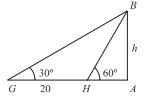
(D) Let $AB = h$ be the height of the tower and $A$ be the foot of the tower.
Let $GA = x$ be the initial distance from the tower.
In $\triangle GAB$,$\tan 30^{\circ} = \frac{AB}{GA} = \frac{h}{x}$.
Since $\tan 30^{\circ} = \frac{1}{\sqrt{3}}$,we have $\frac{h}{x} = \frac{1}{\sqrt{3}}$,so $x = h\sqrt{3}$.
After walking $20 \ m$ towards the tower,the new distance is $HA = x - 20$.
In $\triangle HAB$,$\tan 60^{\circ} = \frac{AB}{HA} = \frac{h}{x - 20}$.
Since $\tan 60^{\circ} = \sqrt{3}$,we have $\frac{h}{x - 20} = \sqrt{3}$,so $h = \sqrt{3}(x - 20)$.
Substituting $x = h\sqrt{3}$ into the equation: $h = \sqrt{3}(h\sqrt{3} - 20)$.
$h = 3h - 20\sqrt{3}$.
$2h = 20\sqrt{3}$.
$h = 10\sqrt{3} \ m$.
Let $GA = x$ be the initial distance from the tower.
In $\triangle GAB$,$\tan 30^{\circ} = \frac{AB}{GA} = \frac{h}{x}$.
Since $\tan 30^{\circ} = \frac{1}{\sqrt{3}}$,we have $\frac{h}{x} = \frac{1}{\sqrt{3}}$,so $x = h\sqrt{3}$.
After walking $20 \ m$ towards the tower,the new distance is $HA = x - 20$.
In $\triangle HAB$,$\tan 60^{\circ} = \frac{AB}{HA} = \frac{h}{x - 20}$.
Since $\tan 60^{\circ} = \sqrt{3}$,we have $\frac{h}{x - 20} = \sqrt{3}$,so $h = \sqrt{3}(x - 20)$.
Substituting $x = h\sqrt{3}$ into the equation: $h = \sqrt{3}(h\sqrt{3} - 20)$.
$h = 3h - 20\sqrt{3}$.
$2h = 20\sqrt{3}$.
$h = 10\sqrt{3} \ m$.
0 likes
View Solution46
MediumMCQ
The angle of elevation of an aeroplane from a point on the ground is $60^{\circ}$. After flying for $30$ seconds, the angle of elevation changes to $30^{\circ}$. If the aeroplane is flying at a constant height of $4500 \text{ m}$, what is the speed (in $\text{m/s}$) of the aeroplane (in $\sqrt{3}$)?
A
$50$
B
$100$
C
$200$
D
$300$
Solution
(B) Let the height of the aeroplane be $h = 4500 \text{ m}$.
Let the initial position be $A$ and the final position be $B$.
At point $A$, the angle of elevation is $60^{\circ}$. Let the distance from the point on the ground to the point directly below $A$ be $x$.
$\tan(60^{\circ}) = \frac{4500}{x} \implies \sqrt{3} = \frac{4500}{x} \implies x = \frac{4500}{\sqrt{3}} = 1500\sqrt{3} \text{ m}$.
At point $B$, the angle of elevation is $30^{\circ}$. Let the total distance from the point on the ground to the point directly below $B$ be $y$.
$\tan(30^{\circ}) = \frac{4500}{y} \implies \frac{1}{\sqrt{3}} = \frac{4500}{y} \implies y = 4500\sqrt{3} \text{ m}$.
The distance covered by the aeroplane is $d = y - x = 4500\sqrt{3} - 1500\sqrt{3} = 3000\sqrt{3} \text{ m}$.
The time taken is $t = 30 \text{ s}$.
Speed $= \frac{\text{Distance}}{\text{Time}} = \frac{3000\sqrt{3}}{30} = 100\sqrt{3} \text{ m/s}$.
Let the initial position be $A$ and the final position be $B$.
At point $A$, the angle of elevation is $60^{\circ}$. Let the distance from the point on the ground to the point directly below $A$ be $x$.
$\tan(60^{\circ}) = \frac{4500}{x} \implies \sqrt{3} = \frac{4500}{x} \implies x = \frac{4500}{\sqrt{3}} = 1500\sqrt{3} \text{ m}$.
At point $B$, the angle of elevation is $30^{\circ}$. Let the total distance from the point on the ground to the point directly below $B$ be $y$.
$\tan(30^{\circ}) = \frac{4500}{y} \implies \frac{1}{\sqrt{3}} = \frac{4500}{y} \implies y = 4500\sqrt{3} \text{ m}$.
The distance covered by the aeroplane is $d = y - x = 4500\sqrt{3} - 1500\sqrt{3} = 3000\sqrt{3} \text{ m}$.
The time taken is $t = 30 \text{ s}$.
Speed $= \frac{\text{Distance}}{\text{Time}} = \frac{3000\sqrt{3}}{30} = 100\sqrt{3} \text{ m/s}$.
0 likes
View Solution47
MediumMCQ
The tops of two poles of height $60 \ m$ and $35 \ m$ are connected by a rope. If the rope makes an angle with the horizontal whose tangent is $\frac{5}{9}$,then what is the distance (in $m$) between the two poles?
A
$63$
B
$30$
C
$25$
D
$45$
Solution
(D) Let the two poles be $AB$ and $CD$ with heights $60 \ m$ and $35 \ m$ respectively.
Let $DE$ be the horizontal line from $D$ to the pole $AB$,meeting $AB$ at $E$.
Then $BE = CD = 35 \ m$.
The height $AE = AB - BE = 60 - 35 = 25 \ m$.
In the right-angled triangle $\triangle AED$,the angle of depression/elevation is $\phi$.
Given $\tan \phi = \frac{5}{9}$.
In $\triangle AED$,$\tan \phi = \frac{AE}{DE}$.
Substituting the values,$\frac{5}{9} = \frac{25}{DE}$.
$DE = \frac{25 \times 9}{5} = 5 \times 9 = 45 \ m$.
Thus,the distance between the two poles is $45 \ m$.
Let $DE$ be the horizontal line from $D$ to the pole $AB$,meeting $AB$ at $E$.
Then $BE = CD = 35 \ m$.
The height $AE = AB - BE = 60 - 35 = 25 \ m$.
In the right-angled triangle $\triangle AED$,the angle of depression/elevation is $\phi$.
Given $\tan \phi = \frac{5}{9}$.
In $\triangle AED$,$\tan \phi = \frac{AE}{DE}$.
Substituting the values,$\frac{5}{9} = \frac{25}{DE}$.
$DE = \frac{25 \times 9}{5} = 5 \times 9 = 45 \ m$.
Thus,the distance between the two poles is $45 \ m$.

0 likes
View Solution48
DifficultMCQ
The distance between two pillars is $120 \text{ m}$. The height of one pillar is thrice the other. The angles of elevation of their tops from the midpoint of the line connecting their feet are complementary to each other. The height (in $\text{m}$) of the taller pillar is (Use: $\sqrt{3} = 1.732$)
A
$34.54$
B
$51.96$
C
$69.28$
D
$103.92$
Solution
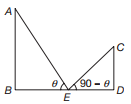
(D) Let the height of the shorter pillar $CD = h$ and the height of the taller pillar $AB = 3h$.
The distance between the pillars $BD = 120 \text{ m}$.
Let $E$ be the midpoint of $BD$,so $BE = ED = 60 \text{ m}$.
In $\triangle ABE$,$\tan \theta = \frac{AB}{BE} = \frac{3h}{60} = \frac{h}{20} \quad ... (i)$
In $\triangle CDE$,$\tan(90^\circ - \theta) = \frac{CD}{ED} = \frac{h}{60} \implies \cot \theta = \frac{h}{60} \quad ... (ii)$
Multiplying $(i)$ and $(ii)$:
$\tan \theta \cdot \cot \theta = \frac{h}{20} \cdot \frac{h}{60}$
$1 = \frac{h^2}{1200}$
$h^2 = 1200$
$h = \sqrt{1200} = 20\sqrt{3} \text{ m}$.
The height of the taller pillar is $3h = 3 \times 20\sqrt{3} = 60\sqrt{3} \text{ m}$.
Using $\sqrt{3} = 1.732$,height $= 60 \times 1.732 = 103.92 \text{ m}$.
The distance between the pillars $BD = 120 \text{ m}$.
Let $E$ be the midpoint of $BD$,so $BE = ED = 60 \text{ m}$.
In $\triangle ABE$,$\tan \theta = \frac{AB}{BE} = \frac{3h}{60} = \frac{h}{20} \quad ... (i)$
In $\triangle CDE$,$\tan(90^\circ - \theta) = \frac{CD}{ED} = \frac{h}{60} \implies \cot \theta = \frac{h}{60} \quad ... (ii)$
Multiplying $(i)$ and $(ii)$:
$\tan \theta \cdot \cot \theta = \frac{h}{20} \cdot \frac{h}{60}$
$1 = \frac{h^2}{1200}$
$h^2 = 1200$
$h = \sqrt{1200} = 20\sqrt{3} \text{ m}$.
The height of the taller pillar is $3h = 3 \times 20\sqrt{3} = 60\sqrt{3} \text{ m}$.
Using $\sqrt{3} = 1.732$,height $= 60 \times 1.732 = 103.92 \text{ m}$.
0 likes
View Solution49
MediumMCQ
The angle of elevation of an aeroplane as observed from a point $30 \ m$ above the transparent water surface of a lake is $30^{\circ}$ and the angle of depression of the image of the aeroplane in the water of the lake is $60^{\circ}$. The height of the aeroplane from the water surface of the lake is (in $m$):
A
$60$
B
$45$
C
$50$
D
$75$
Solution
(A) Let $H$ be the height of the aeroplane from the water surface of the lake.
Let the point of observation be $P$,which is $30 \ m$ above the water surface.
The height of the aeroplane above the point $P$ is $(H - 30) \ m$.
The depth of the image of the aeroplane in the lake is $H$ below the water surface.
Therefore,the total depth of the image from the point $P$ is $(H + 30) \ m$.
Let $x$ be the horizontal distance of the aeroplane from the point of observation.
From the angle of elevation: $\tan(30^{\circ}) = \frac{H - 30}{x} \implies x = \frac{H - 30}{\tan(30^{\circ})} = (H - 30)\sqrt{3}$.
From the angle of depression of the image: $\tan(60^{\circ}) = \frac{H + 30}{x} \implies x = \frac{H + 30}{\tan(60^{\circ})} = \frac{H + 30}{\sqrt{3}}$.
Equating the two expressions for $x$: $(H - 30)\sqrt{3} = \frac{H + 30}{\sqrt{3}}$.
$3(H - 30) = H + 30$.
$3H - 90 = H + 30$.
$2H = 120$.
$H = 60 \ m$.
Let the point of observation be $P$,which is $30 \ m$ above the water surface.
The height of the aeroplane above the point $P$ is $(H - 30) \ m$.
The depth of the image of the aeroplane in the lake is $H$ below the water surface.
Therefore,the total depth of the image from the point $P$ is $(H + 30) \ m$.
Let $x$ be the horizontal distance of the aeroplane from the point of observation.
From the angle of elevation: $\tan(30^{\circ}) = \frac{H - 30}{x} \implies x = \frac{H - 30}{\tan(30^{\circ})} = (H - 30)\sqrt{3}$.
From the angle of depression of the image: $\tan(60^{\circ}) = \frac{H + 30}{x} \implies x = \frac{H + 30}{\tan(60^{\circ})} = \frac{H + 30}{\sqrt{3}}$.
Equating the two expressions for $x$: $(H - 30)\sqrt{3} = \frac{H + 30}{\sqrt{3}}$.
$3(H - 30) = H + 30$.
$3H - 90 = H + 30$.
$2H = 120$.
$H = 60 \ m$.
0 likes
View Solution50
DifficultMCQ
Two posts are $2 \text{ m}$ apart. Both posts are on the same side of a tree. If the angles of depression of these posts when observed from the top of the tree are $45^{\circ}$ and $60^{\circ}$ respectively,then the height of the tree is:
A
$(3-\sqrt{3}) \text{ m}$
B
$(3+\sqrt{3}) \text{ m}$
C
$(-3+\sqrt{3}) \text{ m}$
D
$(3-\sqrt{2}) \text{ m}$
Solution
(B) Let $AD$ be the height of the tree,$h$. Let $C$ and $B$ be the positions of the two posts on the ground such that $CB = 2 \text{ m}$. Let $DC = x \text{ m}$.
In $\Delta ADC$,the angle of elevation is $60^{\circ}$:
$\tan 60^{\circ} = \frac{AD}{DC} = \frac{h}{x}$
$\sqrt{3} = \frac{h}{x} \implies x = \frac{h}{\sqrt{3}} \quad \dots(i)$
In $\Delta ADB$,the angle of elevation is $45^{\circ}$:
$\tan 45^{\circ} = \frac{AD}{DB} = \frac{h}{x+2}$
$1 = \frac{h}{x+2} \implies x+2 = h \implies x = h-2 \quad \dots(ii)$
Equating $(i)$ and $(ii)$:
$\frac{h}{\sqrt{3}} = h-2$
$2 = h - \frac{h}{\sqrt{3}} = h \left(1 - \frac{1}{\sqrt{3}}\right) = h \left(\frac{\sqrt{3}-1}{\sqrt{3}}\right)$
$h = \frac{2\sqrt{3}}{\sqrt{3}-1}$
Rationalizing the denominator:
$h = \frac{2\sqrt{3}(\sqrt{3}+1)}{(\sqrt{3}-1)(\sqrt{3}+1)} = \frac{2(3+\sqrt{3})}{3-1} = \frac{2(3+\sqrt{3})}{2} = (3+\sqrt{3}) \text{ m}$.
In $\Delta ADC$,the angle of elevation is $60^{\circ}$:
$\tan 60^{\circ} = \frac{AD}{DC} = \frac{h}{x}$
$\sqrt{3} = \frac{h}{x} \implies x = \frac{h}{\sqrt{3}} \quad \dots(i)$
In $\Delta ADB$,the angle of elevation is $45^{\circ}$:
$\tan 45^{\circ} = \frac{AD}{DB} = \frac{h}{x+2}$
$1 = \frac{h}{x+2} \implies x+2 = h \implies x = h-2 \quad \dots(ii)$
Equating $(i)$ and $(ii)$:
$\frac{h}{\sqrt{3}} = h-2$
$2 = h - \frac{h}{\sqrt{3}} = h \left(1 - \frac{1}{\sqrt{3}}\right) = h \left(\frac{\sqrt{3}-1}{\sqrt{3}}\right)$
$h = \frac{2\sqrt{3}}{\sqrt{3}-1}$
Rationalizing the denominator:
$h = \frac{2\sqrt{3}(\sqrt{3}+1)}{(\sqrt{3}-1)(\sqrt{3}+1)} = \frac{2(3+\sqrt{3})}{3-1} = \frac{2(3+\sqrt{3})}{2} = (3+\sqrt{3}) \text{ m}$.
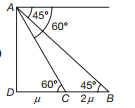
0 likes
View SolutionHeights and Distances — Heights and Distances · Frequently Asked Questions
1Are these Heights and Distances questions useful for JEE and NEET?
Yes. All questions in this section are mapped to JEE Main and NEET exam patterns. Previous year questions from JEE Main, NEET, GUJCET and state-level exams are included with full solutions.
2Can I switch to Hindi or Gujarati for these questions?
Yes. Use the language tabs in the hero section or the sidebar to view the same questions and solutions in English, Hindi or Gujarati.
3How do I generate a question paper from this subtopic?
Use the Vedclass Exam Paper Generator — select the chapter and subtopic, set difficulty, and generate Sets A, B, C, D automatically. First 3 chapters of every subject are free.
Vedclass Products
For Students
Vedclass Test Series
Mock tests in real JEE/NEET style with performance analysis. 5-day free trial.
Start Free TrialFor Teachers
Exam Paper Generator
Generate Set A/B/C/D papers from this chapter in 2 minutes. 3 chapters free.
Try FreeFor Institutes
Online Exam Module
Live online exams with unlimited students, 360° analytics & white-label branding.
See DemoFor Teachers & Institutes
Generate a Heights and Distances Exam Paper in 2 Minutes
Select subtopic & difficulty — Sets A, B, C, D auto-generated with No Repeat logic.
First 3 chapters of every subject are free — no payment required.