
A English
Young's Double Slit Experiment (YDSE) Questions in English
Class 12 Physics · Wave Optics · Young's Double Slit Experiment (YDSE)
616+
Questions
English
Language
100%
With Solutions
Showing 47 of 616 questions in English
451
MediumMCQ
In Young's double slit experiment using monochromatic light of wavelength $\lambda$,the maximum intensity of light at a point on the screen is $K$ units. The intensity of light at a point where the path difference is $\frac{\lambda}{6}$ is: $(\cos 60^{\circ}=\sin 30^{\circ}=0.5, \sin 60^{\circ}=\cos 30^{\circ}=\frac{\sqrt{3}}{2})$
A
$\frac{3K}{4}$
B
$\frac{K}{4}$
C
$\frac{K}{2}$
D
$K$
Solution
(A) The intensity $I$ at any point in an interference pattern is given by $I = I_{max} \cos^2(\frac{\phi}{2})$,where $I_{max} = K$ and $\phi$ is the phase difference.
Phase difference $\phi$ is related to path difference $\Delta x$ by the formula $\phi = \frac{2\pi}{\lambda} \Delta x$.
Given path difference $\Delta x = \frac{\lambda}{6}$,the phase difference is $\phi = \frac{2\pi}{\lambda} \times \frac{\lambda}{6} = \frac{\pi}{3}$.
Substituting this into the intensity formula: $I = K \cos^2(\frac{\pi/3}{2}) = K \cos^2(\frac{\pi}{6})$.
Since $\cos(\frac{\pi}{6}) = \cos(30^{\circ}) = \frac{\sqrt{3}}{2}$,we have $I = K (\frac{\sqrt{3}}{2})^2 = K (\frac{3}{4}) = \frac{3K}{4}$.
Phase difference $\phi$ is related to path difference $\Delta x$ by the formula $\phi = \frac{2\pi}{\lambda} \Delta x$.
Given path difference $\Delta x = \frac{\lambda}{6}$,the phase difference is $\phi = \frac{2\pi}{\lambda} \times \frac{\lambda}{6} = \frac{\pi}{3}$.
Substituting this into the intensity formula: $I = K \cos^2(\frac{\pi/3}{2}) = K \cos^2(\frac{\pi}{6})$.
Since $\cos(\frac{\pi}{6}) = \cos(30^{\circ}) = \frac{\sqrt{3}}{2}$,we have $I = K (\frac{\sqrt{3}}{2})^2 = K (\frac{3}{4}) = \frac{3K}{4}$.
0 likes
View Solution452
MediumMCQ
The fringe width in an interference pattern is $X$. The distance between the sixth dark fringe from one side of the central bright band to the fourth bright fringe on the other side is: (in $X$)
A
$1.5$
B
$2$
C
$5.5$
D
$9.5$
Solution
(D) The fringe width is given by $W = \frac{\lambda D}{d} = X$ (given).
The position of the $n^{\text{th}}$ bright fringe from the central maximum is $y_n = n \frac{\lambda D}{d} = nX$.
For the $4^{\text{th}}$ bright fringe,$y_4 = 4X$.
The position of the $n^{\text{th}}$ dark fringe from the central maximum is $y'_n = (2n - 1) \frac{\lambda D}{2d} = (2n - 1) \frac{X}{2}$.
For the $6^{\text{th}}$ dark fringe,$y'_6 = (2(6) - 1) \frac{X}{2} = \frac{11X}{2} = 5.5X$.
Since the fringes are on opposite sides of the central bright band,the total distance is the sum of the magnitudes of their positions:
Total distance $= y_4 + y'_6 = 4X + 5.5X = 9.5X$.
The position of the $n^{\text{th}}$ bright fringe from the central maximum is $y_n = n \frac{\lambda D}{d} = nX$.
For the $4^{\text{th}}$ bright fringe,$y_4 = 4X$.
The position of the $n^{\text{th}}$ dark fringe from the central maximum is $y'_n = (2n - 1) \frac{\lambda D}{2d} = (2n - 1) \frac{X}{2}$.
For the $6^{\text{th}}$ dark fringe,$y'_6 = (2(6) - 1) \frac{X}{2} = \frac{11X}{2} = 5.5X$.
Since the fringes are on opposite sides of the central bright band,the total distance is the sum of the magnitudes of their positions:
Total distance $= y_4 + y'_6 = 4X + 5.5X = 9.5X$.
0 likes
View Solution453
MediumMCQ
In Young's double-slit experiment,the $n^{\text{th}}$ maximum of wavelength $\lambda_1$ is at a distance of $y_1$ from the central maximum. When the wavelength of the source is changed to $\lambda_2$,the $(\frac{n}{3})^{\text{th}}$ maximum is at a distance of $y_2$ from its central maximum. The ratio $\frac{y_1}{y_2}$ is:
A
$\frac{3 \lambda_1}{\lambda_2}$
B
$\frac{3 \lambda_2}{\lambda_1}$
C
$\frac{\lambda_1}{3 \lambda_2}$
D
$\frac{\lambda_2}{3 \lambda_1}$
Solution
(A) The position of the $n^{\text{th}}$ maximum in Young's double-slit experiment is given by $y_n = \frac{n \lambda D}{d}$.
For the $n^{\text{th}}$ maximum with wavelength $\lambda_1$,the distance is $y_1 = \frac{n \lambda_1 D}{d} \quad (i)$.
For the $(\frac{n}{3})^{\text{th}}$ maximum with wavelength $\lambda_2$,the distance is $y_2 = \frac{(\frac{n}{3}) \lambda_2 D}{d} \quad (ii)$.
Taking the ratio of $(i)$ and $(ii)$:
$\frac{y_1}{y_2} = \frac{\frac{n \lambda_1 D}{d}}{\frac{n \lambda_2 D}{3d}} = \frac{n \lambda_1 D}{d} \times \frac{3d}{n \lambda_2 D} = \frac{3 \lambda_1}{\lambda_2}$.
Thus,the ratio $\frac{y_1}{y_2}$ is $\frac{3 \lambda_1}{\lambda_2}$.
For the $n^{\text{th}}$ maximum with wavelength $\lambda_1$,the distance is $y_1 = \frac{n \lambda_1 D}{d} \quad (i)$.
For the $(\frac{n}{3})^{\text{th}}$ maximum with wavelength $\lambda_2$,the distance is $y_2 = \frac{(\frac{n}{3}) \lambda_2 D}{d} \quad (ii)$.
Taking the ratio of $(i)$ and $(ii)$:
$\frac{y_1}{y_2} = \frac{\frac{n \lambda_1 D}{d}}{\frac{n \lambda_2 D}{3d}} = \frac{n \lambda_1 D}{d} \times \frac{3d}{n \lambda_2 D} = \frac{3 \lambda_1}{\lambda_2}$.
Thus,the ratio $\frac{y_1}{y_2}$ is $\frac{3 \lambda_1}{\lambda_2}$.
0 likes
View Solution454
MediumMCQ
In Young's double slit experiment,the slits are separated by $0.6 \ mm$ and the screen is placed at a distance of $1.2 \ m$ from the slits. It is observed that the tenth bright fringe is at a distance of $8.85 \ mm$ from the third dark fringe on the same side. The wavelength of light used is: (in $Å$)
A
$5440$
B
$5890$
C
$5900$
D
$6630$
Solution
(C) For the $n^{\text{th}}$ bright fringe,the position is given by $y_n = \frac{n \lambda D}{d}$.
For the $10^{\text{th}}$ bright fringe $(n=10)$:
$y_{10} = \frac{10 \lambda D}{d} = \frac{10 \times \lambda \times 1.2}{0.6 \times 10^{-3}} = (20 \times 10^3) \lambda \quad \dots(i)$
For the $n^{\text{th}}$ dark fringe,the position is given by $y'_n = \frac{(2n-1) \lambda D}{2d}$.
For the $3^{\text{rd}}$ dark fringe $(n=3)$:
$y'_3 = \frac{(2 \times 3 - 1) \lambda D}{2d} = \frac{5 \lambda D}{2d} = \frac{5 \times \lambda \times 1.2}{2 \times 0.6 \times 10^{-3}} = (5 \times 10^3) \lambda \quad \dots(ii)$
Given that the distance between them is $8.85 \ mm$:
$y_{10} - y'_3 = 8.85 \times 10^{-3} \ m$
$(20 \times 10^3) \lambda - (5 \times 10^3) \lambda = 8.85 \times 10^{-3}$
$(15 \times 10^3) \lambda = 8.85 \times 10^{-3}$
$\lambda = \frac{8.85 \times 10^{-3}}{15 \times 10^3} = 0.59 \times 10^{-6} \ m = 5.9 \times 10^{-7} \ m$
$\lambda = 5900 \ Å$.
For the $10^{\text{th}}$ bright fringe $(n=10)$:
$y_{10} = \frac{10 \lambda D}{d} = \frac{10 \times \lambda \times 1.2}{0.6 \times 10^{-3}} = (20 \times 10^3) \lambda \quad \dots(i)$
For the $n^{\text{th}}$ dark fringe,the position is given by $y'_n = \frac{(2n-1) \lambda D}{2d}$.
For the $3^{\text{rd}}$ dark fringe $(n=3)$:
$y'_3 = \frac{(2 \times 3 - 1) \lambda D}{2d} = \frac{5 \lambda D}{2d} = \frac{5 \times \lambda \times 1.2}{2 \times 0.6 \times 10^{-3}} = (5 \times 10^3) \lambda \quad \dots(ii)$
Given that the distance between them is $8.85 \ mm$:
$y_{10} - y'_3 = 8.85 \times 10^{-3} \ m$
$(20 \times 10^3) \lambda - (5 \times 10^3) \lambda = 8.85 \times 10^{-3}$
$(15 \times 10^3) \lambda = 8.85 \times 10^{-3}$
$\lambda = \frac{8.85 \times 10^{-3}}{15 \times 10^3} = 0.59 \times 10^{-6} \ m = 5.9 \times 10^{-7} \ m$
$\lambda = 5900 \ Å$.
0 likes
View Solution455
MediumMCQ
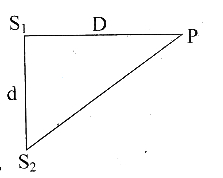
In Young's double slit experiment,the distance between the two coherent sources is '$d$' and the distance between the source and screen is '$D$'. When the wavelength $(\lambda)$ of the light source used is $\frac{d^2}{3D}$,then the $n^{\text{th}}$ dark fringe is observed on the screen,exactly in front of one of the slits. The value of '$n$' is
A
$1$
B
$2$
C
$3$
D
$4$
Solution
(B) Let the point $P$ be exactly in front of slit $S_1$. The distance $S_1P = D$ and $S_2P = \sqrt{D^2 + d^2}$.
Using the binomial expansion for $S_2P$:
$S_2P = D(1 + \frac{d^2}{D^2})^{1/2} \approx D(1 + \frac{d^2}{2D^2}) = D + \frac{d^2}{2D}$.
The path difference $\Delta x$ at point $P$ is:
$\Delta x = S_2P - S_1P = (D + \frac{d^2}{2D}) - D = \frac{d^2}{2D}$.
For the $n^{\text{th}}$ dark fringe,the condition for path difference is:
$\Delta x = (2n - 1) \frac{\lambda}{2}$.
Given $\lambda = \frac{d^2}{3D}$,we substitute this into the condition:
$\frac{d^2}{2D} = (2n - 1) \frac{d^2}{6D}$.
Dividing both sides by $\frac{d^2}{D}$:
$\frac{1}{2} = \frac{2n - 1}{6}$.
$3 = 2n - 1 \Rightarrow 2n = 4 \Rightarrow n = 2$.
Using the binomial expansion for $S_2P$:
$S_2P = D(1 + \frac{d^2}{D^2})^{1/2} \approx D(1 + \frac{d^2}{2D^2}) = D + \frac{d^2}{2D}$.
The path difference $\Delta x$ at point $P$ is:
$\Delta x = S_2P - S_1P = (D + \frac{d^2}{2D}) - D = \frac{d^2}{2D}$.
For the $n^{\text{th}}$ dark fringe,the condition for path difference is:
$\Delta x = (2n - 1) \frac{\lambda}{2}$.
Given $\lambda = \frac{d^2}{3D}$,we substitute this into the condition:
$\frac{d^2}{2D} = (2n - 1) \frac{d^2}{6D}$.
Dividing both sides by $\frac{d^2}{D}$:
$\frac{1}{2} = \frac{2n - 1}{6}$.
$3 = 2n - 1 \Rightarrow 2n = 4 \Rightarrow n = 2$.
0 likes
View Solution456
MediumMCQ
How is the interference pattern affected when violet light replaces sodium light?
A
The fringes become brighter.
B
The fringes become faint.
C
Fringewidth decreases.
D
Fringewidth increases.
Solution
(C) In Young's double slit experiment,the fringe width $W$ is given by the formula $W = \frac{\lambda D}{d}$,where $\lambda$ is the wavelength of light,$D$ is the distance between the screen and the slits,and $d$ is the distance between the two slits.
Since the wavelength of violet light $(\lambda_{violet} \approx 400 \ nm)$ is significantly smaller than the wavelength of sodium light $(\lambda_{sodium} \approx 589 \ nm)$,the fringe width $W$ will decrease when violet light is used instead of sodium light.
Since the wavelength of violet light $(\lambda_{violet} \approx 400 \ nm)$ is significantly smaller than the wavelength of sodium light $(\lambda_{sodium} \approx 589 \ nm)$,the fringe width $W$ will decrease when violet light is used instead of sodium light.
0 likes
View Solution457
EasyMCQ
The phase difference between two waves giving rise to a dark fringe in Young's double-slit experiment is (where $n$ is an integer):
A
zero
B
$(4n+1) \frac{\pi}{2}$
C
$(2n-1) \pi$
D
$(2n+1) \frac{\pi}{2}$
Solution
(C) In Young's double-slit experiment,dark fringes are formed due to destructive interference.
For destructive interference,the path difference $\Delta x$ must be an odd multiple of half-wavelength,i.e.,$\Delta x = (2n-1) \frac{\lambda}{2}$.
The relationship between phase difference $\Delta \phi$ and path difference $\Delta x$ is given by $\Delta \phi = \frac{2\pi}{\lambda} \Delta x$.
Substituting the value of $\Delta x$: $\Delta \phi = \frac{2\pi}{\lambda} \times (2n-1) \frac{\lambda}{2} = (2n-1) \pi$.
Thus,the phase difference for a dark fringe is $(2n-1) \pi$.
For destructive interference,the path difference $\Delta x$ must be an odd multiple of half-wavelength,i.e.,$\Delta x = (2n-1) \frac{\lambda}{2}$.
The relationship between phase difference $\Delta \phi$ and path difference $\Delta x$ is given by $\Delta \phi = \frac{2\pi}{\lambda} \Delta x$.
Substituting the value of $\Delta x$: $\Delta \phi = \frac{2\pi}{\lambda} \times (2n-1) \frac{\lambda}{2} = (2n-1) \pi$.
Thus,the phase difference for a dark fringe is $(2n-1) \pi$.
0 likes
View Solution458
EasyMCQ
In Young's double slit experiment,$I_{min}$ is the minimum intensity and $I_1$ is the intensity at a point where the path difference is $\frac{\lambda}{4}$,where $\lambda$ is the wavelength of light used. The ratio $I_{min} / I_1$ is (Intensities of the two interfering waves are same).
A
$0.5$
B
$0$
C
$1$
D
$2$
Solution
(B) Let the intensities of the two individual waves be $I_0$. The resultant intensity $I$ is given by $I = I_0 + I_0 + 2\sqrt{I_0 I_0} \cos \phi = 2I_0(1 + \cos \phi) = 4I_0 \cos^2(\phi/2)$.
- The minimum intensity $I_{min}$ occurs when $\phi = \pi$,so $I_{min} = 4I_0 \cos^2(\pi/2) = 0$.
- The path difference $\Delta x = \lambda/4$ corresponds to a phase difference $\phi = \frac{2\pi}{\lambda} \Delta x = \frac{2\pi}{\lambda} \cdot \frac{\lambda}{4} = \frac{\pi}{2}$.
- The intensity $I_1$ at this point is $I_1 = 4I_0 \cos^2(\pi/4) = 4I_0 (1/\sqrt{2})^2 = 2I_0$.
- The ratio $I_{min} / I_1 = 0 / 2I_0 = 0$.
- The minimum intensity $I_{min}$ occurs when $\phi = \pi$,so $I_{min} = 4I_0 \cos^2(\pi/2) = 0$.
- The path difference $\Delta x = \lambda/4$ corresponds to a phase difference $\phi = \frac{2\pi}{\lambda} \Delta x = \frac{2\pi}{\lambda} \cdot \frac{\lambda}{4} = \frac{\pi}{2}$.
- The intensity $I_1$ at this point is $I_1 = 4I_0 \cos^2(\pi/4) = 4I_0 (1/\sqrt{2})^2 = 2I_0$.
- The ratio $I_{min} / I_1 = 0 / 2I_0 = 0$.
0 likes
View Solution459
DifficultMCQ
In Young's double slit experiment,the intensity at a point is $\frac{1}{4}$ of the maximum intensity. The angular position of this point is
A
$\sin ^{-1}\left(\frac{\lambda}{D}\right)$
B
$\sin ^{-1}\left(\frac{\lambda}{2 d}\right)$
C
$\sin ^{-1}\left(\frac{\lambda}{3 d}\right)$
D
$\sin ^{-1}\left(\frac{\lambda}{4 d}\right)$
Solution
(C) For any point in the interference pattern,the intensity $I$ is given by $I = I_{\max} \cos^2 \left(\frac{\phi}{2}\right)$.
Given that $I = \frac{I_{\max}}{4}$,we have $\frac{I_{\max}}{4} = I_{\max} \cos^2 \left(\frac{\phi}{2}\right)$.
This simplifies to $\cos^2 \left(\frac{\phi}{2}\right) = \frac{1}{4}$,which implies $\cos \left(\frac{\phi}{2}\right) = \frac{1}{2}$.
Thus,$\frac{\phi}{2} = 60^{\circ} = \frac{\pi}{3}$,so the phase difference $\phi = \frac{2\pi}{3}$.
The phase difference is related to the path difference $\Delta x$ by $\phi = \left(\frac{2\pi}{\lambda}\right) \Delta x$.
Substituting $\Delta x = d \sin \theta$,we get $\frac{2\pi}{3} = \left(\frac{2\pi}{\lambda}\right) d \sin \theta$.
Solving for $\sin \theta$,we find $\sin \theta = \frac{\lambda}{3d}$,which means $\theta = \sin^{-1} \left(\frac{\lambda}{3d}\right)$.
Given that $I = \frac{I_{\max}}{4}$,we have $\frac{I_{\max}}{4} = I_{\max} \cos^2 \left(\frac{\phi}{2}\right)$.
This simplifies to $\cos^2 \left(\frac{\phi}{2}\right) = \frac{1}{4}$,which implies $\cos \left(\frac{\phi}{2}\right) = \frac{1}{2}$.
Thus,$\frac{\phi}{2} = 60^{\circ} = \frac{\pi}{3}$,so the phase difference $\phi = \frac{2\pi}{3}$.
The phase difference is related to the path difference $\Delta x$ by $\phi = \left(\frac{2\pi}{\lambda}\right) \Delta x$.
Substituting $\Delta x = d \sin \theta$,we get $\frac{2\pi}{3} = \left(\frac{2\pi}{\lambda}\right) d \sin \theta$.
Solving for $\sin \theta$,we find $\sin \theta = \frac{\lambda}{3d}$,which means $\theta = \sin^{-1} \left(\frac{\lambda}{3d}\right)$.
0 likes
View Solution460
EasyMCQ
In a double slit experiment,the distance between slits is increased $10$ times,whereas their distance from the screen is halved. The fringe width:
A
remains the same.
B
becomes $\frac{1}{10}$ times.
C
becomes $\frac{1}{20}$ times.
D
becomes $\frac{1}{90}$ times.
Solution
(C) The formula for fringe width $(\beta)$ in a Young's double slit experiment is given by $\beta = \frac{D \lambda}{d}$,where $D$ is the distance between the slits and the screen,$\lambda$ is the wavelength of light,and $d$ is the distance between the slits.
Given that the new distance between slits $d' = 10d$ and the new distance from the screen $D' = \frac{D}{2}$.
The new fringe width $\beta'$ is given by $\beta' = \frac{D' \lambda}{d'} = \frac{(\frac{D}{2}) \lambda}{10d} = \frac{D \lambda}{20d}$.
Since $\beta = \frac{D \lambda}{d}$,we have $\beta' = \frac{\beta}{20}$.
Thus,the fringe width becomes $\frac{1}{20}$ times the original fringe width.
Given that the new distance between slits $d' = 10d$ and the new distance from the screen $D' = \frac{D}{2}$.
The new fringe width $\beta'$ is given by $\beta' = \frac{D' \lambda}{d'} = \frac{(\frac{D}{2}) \lambda}{10d} = \frac{D \lambda}{20d}$.
Since $\beta = \frac{D \lambda}{d}$,we have $\beta' = \frac{\beta}{20}$.
Thus,the fringe width becomes $\frac{1}{20}$ times the original fringe width.
0 likes
View Solution461
DifficultMCQ
In Young's double slit experiment, the fringe width is $2 \, mm$. The separation between the $13^{\text{th}}$ bright fringe and the $4^{\text{th}}$ dark fringe from the centre of the screen on the same side will be: (in $mm$.)
A
$13$
B
$17$
C
$19$
D
$23$
Solution
(C) Given: Fringe width $W = 2 \, mm$.
The distance of the $n^{\text{th}}$ bright fringe from the centre of the screen is $y_n = nW$.
The distance of the $n^{\text{th}}$ dark fringe from the centre of the screen is $y'_n = (n - 0.5)W$.
For the $13^{\text{th}}$ bright fringe, $n = 13$: $y_{13} = 13 \times 2 = 26 \, mm$.
For the $4^{\text{th}}$ dark fringe, $n = 4$: $y'_4 = (4 - 0.5) \times 2 = 3.5 \times 2 = 7 \, mm$.
The separation between them is $y_{13} - y'_4 = 26 \, mm - 7 \, mm = 19 \, mm$.
The distance of the $n^{\text{th}}$ bright fringe from the centre of the screen is $y_n = nW$.
The distance of the $n^{\text{th}}$ dark fringe from the centre of the screen is $y'_n = (n - 0.5)W$.
For the $13^{\text{th}}$ bright fringe, $n = 13$: $y_{13} = 13 \times 2 = 26 \, mm$.
For the $4^{\text{th}}$ dark fringe, $n = 4$: $y'_4 = (4 - 0.5) \times 2 = 3.5 \times 2 = 7 \, mm$.
The separation between them is $y_{13} - y'_4 = 26 \, mm - 7 \, mm = 19 \, mm$.
0 likes
View Solution462
DifficultMCQ
In Young's double slit experiment,the wavelength of light used is $\lambda$. The intensity at a point is $I$ where the path difference is $\frac{\lambda}{4}$. If $I_0$ denotes the maximum intensity,then the ratio $\frac{I}{I_0}$ is: (Given: $\sin \frac{\pi}{4} = \cos \frac{\pi}{4} = \frac{1}{\sqrt{2}}$)
A
$\frac{1}{\sqrt{2}}$
B
$\frac{1}{2}$
C
$\frac{3}{4}$
D
$\frac{\sqrt{3}}{2}$
Solution
(B) The relationship between phase difference $\Delta \phi$ and path difference $\Delta x$ is given by $\Delta \phi = \frac{2\pi}{\lambda} \Delta x$.
For a path difference $\Delta x = \frac{\lambda}{4}$,the phase difference is $\Delta \phi = \frac{2\pi}{\lambda} \times \frac{\lambda}{4} = \frac{\pi}{2}$.
The intensity $I$ at any point in an interference pattern is given by $I = I_0 \cos^2 \left( \frac{\Delta \phi}{2} \right)$,where $I_0$ is the maximum intensity.
Substituting the value of $\Delta \phi = \frac{\pi}{2}$ into the formula:
$\frac{I}{I_0} = \cos^2 \left( \frac{\pi/2}{2} \right) = \cos^2 \left( \frac{\pi}{4} \right)$.
Since $\cos \left( \frac{\pi}{4} \right) = \frac{1}{\sqrt{2}}$,we have $\frac{I}{I_0} = \left( \frac{1}{\sqrt{2}} \right)^2 = \frac{1}{2}$.
For a path difference $\Delta x = \frac{\lambda}{4}$,the phase difference is $\Delta \phi = \frac{2\pi}{\lambda} \times \frac{\lambda}{4} = \frac{\pi}{2}$.
The intensity $I$ at any point in an interference pattern is given by $I = I_0 \cos^2 \left( \frac{\Delta \phi}{2} \right)$,where $I_0$ is the maximum intensity.
Substituting the value of $\Delta \phi = \frac{\pi}{2}$ into the formula:
$\frac{I}{I_0} = \cos^2 \left( \frac{\pi/2}{2} \right) = \cos^2 \left( \frac{\pi}{4} \right)$.
Since $\cos \left( \frac{\pi}{4} \right) = \frac{1}{\sqrt{2}}$,we have $\frac{I}{I_0} = \left( \frac{1}{\sqrt{2}} \right)^2 = \frac{1}{2}$.
0 likes
View Solution463
MediumMCQ
Two sources of light are $0.6 \, mm$ apart and the screen is placed at a distance of $1.2 \, m$ from them. $A$ light of wavelength $6000 \, \mathring{A}$ is used. The phase difference between the two light waves interfering on the screen at a point at a distance of $3 \, mm$ from the central bright band is:
A
$6 \pi \, \text{radian}$
B
$3 \pi \, \text{radian}$
C
$4 \pi \, \text{radian}$
D
$5 \pi \, \text{radian}$
Solution
(D) Given: Slit separation $d = 0.6 \, mm = 0.6 \times 10^{-3} \, m$, distance to screen $D = 1.2 \, m$, wavelength $\lambda = 6000 \, \mathring{A} = 6000 \times 10^{-10} \, m$, and position on screen $y = 3 \, mm = 3 \times 10^{-3} \, m$.
The path difference $\Delta x$ at a point $y$ is given by $\Delta x = \frac{d \cdot y}{D}$.
Substituting the values: $\Delta x = \frac{(0.6 \times 10^{-3} \, m) \times (3 \times 10^{-3} \, m)}{1.2 \, m} = \frac{1.8 \times 10^{-6}}{1.2} \, m = 1.5 \times 10^{-6} \, m$.
The phase difference $\Delta \phi$ is related to path difference by $\Delta \phi = \frac{2 \pi}{\lambda} \cdot \Delta x$.
Substituting the values: $\Delta \phi = \frac{2 \pi}{6000 \times 10^{-10}} \times 1.5 \times 10^{-6} = \frac{2 \pi \times 1.5 \times 10^{-6}}{6 \times 10^{-7}} = \frac{3 \pi \times 10^{-6}}{6 \times 10^{-7}} = 0.5 \pi \times 10 = 5 \pi \, \text{radian}$.
The path difference $\Delta x$ at a point $y$ is given by $\Delta x = \frac{d \cdot y}{D}$.
Substituting the values: $\Delta x = \frac{(0.6 \times 10^{-3} \, m) \times (3 \times 10^{-3} \, m)}{1.2 \, m} = \frac{1.8 \times 10^{-6}}{1.2} \, m = 1.5 \times 10^{-6} \, m$.
The phase difference $\Delta \phi$ is related to path difference by $\Delta \phi = \frac{2 \pi}{\lambda} \cdot \Delta x$.
Substituting the values: $\Delta \phi = \frac{2 \pi}{6000 \times 10^{-10}} \times 1.5 \times 10^{-6} = \frac{2 \pi \times 1.5 \times 10^{-6}}{6 \times 10^{-7}} = \frac{3 \pi \times 10^{-6}}{6 \times 10^{-7}} = 0.5 \pi \times 10 = 5 \pi \, \text{radian}$.
0 likes
View Solution464
MediumMCQ
In Young's double slit experiment,the separation between the slits is doubled without changing other settings of the experiment. To obtain the same fringe width,the distance '$D$' of the screen from the slits should be made:
A
$D/2$
B
$D/\sqrt{2}$
C
$2D$
D
$4D$
Solution
(C) The formula for fringe width $(W)$ in Young's double slit experiment is given by:
$W = \frac{\lambda D}{d}$
where $\lambda$ is the wavelength of light,$D$ is the distance between the slits and the screen,and $d$ is the separation between the slits.
According to the problem,the slit separation is doubled,so the new separation $d' = 2d$.
We want the fringe width to remain the same,so $W' = W$.
Substituting the values into the formula:
$W' = \frac{\lambda D'}{d'} = \frac{\lambda D'}{2d}$
Since $W = W'$,we have:
$\frac{\lambda D}{d} = \frac{\lambda D'}{2d}$
By canceling $\lambda$ and $d$ from both sides,we get:
$D = \frac{D'}{2}$
Therefore,$D' = 2D$.
Thus,the distance of the screen from the slits should be doubled.
$W = \frac{\lambda D}{d}$
where $\lambda$ is the wavelength of light,$D$ is the distance between the slits and the screen,and $d$ is the separation between the slits.
According to the problem,the slit separation is doubled,so the new separation $d' = 2d$.
We want the fringe width to remain the same,so $W' = W$.
Substituting the values into the formula:
$W' = \frac{\lambda D'}{d'} = \frac{\lambda D'}{2d}$
Since $W = W'$,we have:
$\frac{\lambda D}{d} = \frac{\lambda D'}{2d}$
By canceling $\lambda$ and $d$ from both sides,we get:
$D = \frac{D'}{2}$
Therefore,$D' = 2D$.
Thus,the distance of the screen from the slits should be doubled.
0 likes
View Solution465
DifficultMCQ
$A$ double slit experiment is immersed in water of refractive index $1.33$. The slit separation is $1 \,mm$, and the distance between the slit and the screen is $1.33 \,m$. The slits are illuminated by light of wavelength $6300 \,Å$. The fringe width is:
A
$4.9 \times 10^{-4} \,m$
B
$5.8 \times 10^{-4} \,m$
C
$6.3 \times 10^{-4} \,m$
D
$8.6 \times 10^{-4} \,m$
Solution
(C) The wavelength of light in a medium is given by $\lambda_{\text{liquid}} = \frac{\lambda_{\text{air}}}{\mu}$.
Given $\lambda_{\text{air}} = 6300 \,Å = 6300 \times 10^{-10} \,m$ and $\mu = 1.33$.
So, $\lambda_{\text{liquid}} = \frac{6300 \times 10^{-10}}{1.33} \,m$.
The fringe width $W$ is given by $W = \frac{\lambda_{\text{liquid}} \times D}{d}$.
Here, $D = 1.33 \,m$ and $d = 1 \,mm = 10^{-3} \,m$.
Substituting the values:
$W = \frac{(6300 \times 10^{-10} / 1.33) \times 1.33}{10^{-3}}$
$W = \frac{6300 \times 10^{-10}}{10^{-3}} = 6300 \times 10^{-7} \,m = 6.3 \times 10^{-4} \,m$.
Given $\lambda_{\text{air}} = 6300 \,Å = 6300 \times 10^{-10} \,m$ and $\mu = 1.33$.
So, $\lambda_{\text{liquid}} = \frac{6300 \times 10^{-10}}{1.33} \,m$.
The fringe width $W$ is given by $W = \frac{\lambda_{\text{liquid}} \times D}{d}$.
Here, $D = 1.33 \,m$ and $d = 1 \,mm = 10^{-3} \,m$.
Substituting the values:
$W = \frac{(6300 \times 10^{-10} / 1.33) \times 1.33}{10^{-3}}$
$W = \frac{6300 \times 10^{-10}}{10^{-3}} = 6300 \times 10^{-7} \,m = 6.3 \times 10^{-4} \,m$.
0 likes
View Solution466
EasyMCQ
In Young's double-slit experiment,green light is incident on two slits. The interference pattern is observed on a screen. Which one of the following changes would cause the observed fringes to be more closely spaced?
A
Reducing the separation between the slits
B
Using blue light instead of green light
C
Using red light instead of green light
D
Moving the screen away from the slits
Solution
(B) The formula for fringe width is $W = \frac{\lambda D}{d}$.
From this relation,we see that $W \propto \lambda$,$W \propto D$,and $W \propto \frac{1}{d}$.
To make the fringes more closely spaced,the fringe width $W$ must decrease.
Since $W \propto \lambda$,decreasing the wavelength $\lambda$ will decrease the fringe width.
The wavelength of blue light is shorter than that of green light $(\lambda_{\text{blue}} < \lambda_{\text{green}})$.
Therefore,using blue light instead of green light will cause the fringes to be more closely spaced.
From this relation,we see that $W \propto \lambda$,$W \propto D$,and $W \propto \frac{1}{d}$.
To make the fringes more closely spaced,the fringe width $W$ must decrease.
Since $W \propto \lambda$,decreasing the wavelength $\lambda$ will decrease the fringe width.
The wavelength of blue light is shorter than that of green light $(\lambda_{\text{blue}} < \lambda_{\text{green}})$.
Therefore,using blue light instead of green light will cause the fringes to be more closely spaced.
0 likes
View Solution467
MediumMCQ
In Young's double slit experiment,the fifth maximum with wavelength $\lambda_1$ is at a distance $y_1$ and the same maximum with wavelength $\lambda_2$ is at a distance $y_2$ measured from the central bright band. Then $\frac{y_1}{y_2}$ is equal to [where $D$ and $d$ are constant].
A
$\frac{\lambda_1}{\lambda_2}$
B
$\frac{\lambda_2}{\lambda_1}$
C
$\frac{\lambda_1^2}{\lambda_2^2}$
D
$\frac{\lambda_2^2}{\lambda_1^2}$
Solution
(A) The position of the $n^{th}$ bright fringe (maximum) from the central maxima in Young's double slit experiment is given by the formula: $y_n = \frac{n \lambda D}{d}$.
For the fifth maximum $(n = 5)$ with wavelength $\lambda_1$,the distance is $y_1 = \frac{5 \lambda_1 D}{d}$.
For the fifth maximum $(n = 5)$ with wavelength $\lambda_2$,the distance is $y_2 = \frac{5 \lambda_2 D}{d}$.
Taking the ratio of the two distances:
$\frac{y_1}{y_2} = \frac{\frac{5 \lambda_1 D}{d}}{\frac{5 \lambda_2 D}{d}} = \frac{\lambda_1}{\lambda_2}$.
For the fifth maximum $(n = 5)$ with wavelength $\lambda_1$,the distance is $y_1 = \frac{5 \lambda_1 D}{d}$.
For the fifth maximum $(n = 5)$ with wavelength $\lambda_2$,the distance is $y_2 = \frac{5 \lambda_2 D}{d}$.
Taking the ratio of the two distances:
$\frac{y_1}{y_2} = \frac{\frac{5 \lambda_1 D}{d}}{\frac{5 \lambda_2 D}{d}} = \frac{\lambda_1}{\lambda_2}$.
0 likes
View Solution468
DifficultMCQ
In Young's double slit experiment,the intensities at two points,for the path difference $\frac{\lambda}{4}$ and $\frac{\lambda}{3}$ (where $\lambda$ is the wavelength of light used),are $I_1$ and $I_2$ respectively. If $I_0$ denotes the intensity produced by each one of the individual slits,then $\frac{I_1+I_2}{I_0}$ is equal to:
A
$1$
B
$2$
C
$3$
D
$4$
Solution
(C) The phase difference $\phi$ is related to the path difference $\Delta x$ by the formula $\phi = \frac{2\pi}{\lambda} \Delta x$.
For the first point,the path difference is $\Delta x_1 = \frac{\lambda}{4}$.
Thus,$\phi_1 = \frac{2\pi}{\lambda} \times \frac{\lambda}{4} = \frac{\pi}{2}$.
The resultant intensity $I$ is given by $I = 4I_0 \cos^2(\frac{\phi}{2}) = 2I_0(1 + \cos \phi)$.
For $\phi_1 = \frac{\pi}{2}$,$I_1 = 2I_0(1 + \cos(\frac{\pi}{2})) = 2I_0(1 + 0) = 2I_0$.
For the second point,the path difference is $\Delta x_2 = \frac{\lambda}{3}$.
Thus,$\phi_2 = \frac{2\pi}{\lambda} \times \frac{\lambda}{3} = \frac{2\pi}{3}$.
For $\phi_2 = \frac{2\pi}{3}$,$I_2 = 2I_0(1 + \cos(\frac{2\pi}{3})) = 2I_0(1 - \frac{1}{2}) = 2I_0(\frac{1}{2}) = I_0$.
Therefore,$\frac{I_1 + I_2}{I_0} = \frac{2I_0 + I_0}{I_0} = \frac{3I_0}{I_0} = 3$.
For the first point,the path difference is $\Delta x_1 = \frac{\lambda}{4}$.
Thus,$\phi_1 = \frac{2\pi}{\lambda} \times \frac{\lambda}{4} = \frac{\pi}{2}$.
The resultant intensity $I$ is given by $I = 4I_0 \cos^2(\frac{\phi}{2}) = 2I_0(1 + \cos \phi)$.
For $\phi_1 = \frac{\pi}{2}$,$I_1 = 2I_0(1 + \cos(\frac{\pi}{2})) = 2I_0(1 + 0) = 2I_0$.
For the second point,the path difference is $\Delta x_2 = \frac{\lambda}{3}$.
Thus,$\phi_2 = \frac{2\pi}{\lambda} \times \frac{\lambda}{3} = \frac{2\pi}{3}$.
For $\phi_2 = \frac{2\pi}{3}$,$I_2 = 2I_0(1 + \cos(\frac{2\pi}{3})) = 2I_0(1 - \frac{1}{2}) = 2I_0(\frac{1}{2}) = I_0$.
Therefore,$\frac{I_1 + I_2}{I_0} = \frac{2I_0 + I_0}{I_0} = \frac{3I_0}{I_0} = 3$.
0 likes
View Solution469
MediumMCQ
In Young's double slit experiment,when a glass plate of refractive index $1.44$ is introduced in the path of one of the interfering beams,the fringes are displaced by a distance $y$. If this plate is replaced by another plate of the same thickness but of refractive index $1.66$,the fringes will be displaced by a distance:
A
$\frac{3 y}{2}$
B
$\frac{2 y}{3}$
C
$\frac{5 y}{4}$
D
$\frac{4 y}{5}$
Solution
(A) The fringe shift $y$ due to the introduction of a glass plate of thickness $t$ and refractive index $\mu$ is given by the formula: $y = \frac{D}{\text{d}} (\mu - 1) t = \frac{\beta}{\lambda} (\mu - 1) t$.
Given for the first plate,$\mu_1 = 1.44$,the displacement is $y_1 = y = \frac{\beta}{\lambda} (1.44 - 1) t = 0.44 t \frac{\beta}{\lambda}$.
For the second plate,$\mu_2 = 1.66$,the new displacement $y_2$ is: $y_2 = \frac{\beta}{\lambda} (1.66 - 1) t = 0.66 t \frac{\beta}{\lambda}$.
Taking the ratio of the two displacements: $\frac{y_2}{y_1} = \frac{0.66}{0.44} = \frac{66}{44} = \frac{3}{2}$.
Therefore,$y_2 = \frac{3}{2} y$.
Given for the first plate,$\mu_1 = 1.44$,the displacement is $y_1 = y = \frac{\beta}{\lambda} (1.44 - 1) t = 0.44 t \frac{\beta}{\lambda}$.
For the second plate,$\mu_2 = 1.66$,the new displacement $y_2$ is: $y_2 = \frac{\beta}{\lambda} (1.66 - 1) t = 0.66 t \frac{\beta}{\lambda}$.
Taking the ratio of the two displacements: $\frac{y_2}{y_1} = \frac{0.66}{0.44} = \frac{66}{44} = \frac{3}{2}$.
Therefore,$y_2 = \frac{3}{2} y$.
0 likes
View Solution470
MediumMCQ
The ratio of intensities of two points on a screen in Young's double slit experiment when waves from the two slits have a path difference of $\frac{\lambda}{4}$ and $\frac{\lambda}{6}$ is $(\cos 90^{\circ}=0, \cos 60^{\circ}=0.5)$.
A
$2: 1$
B
$2: 3$
C
$3: 4$
D
$3: 5$
Solution
(B) The intensity at a point due to interference is given by $I = I_1 + I_2 + 2\sqrt{I_1 I_2} \cos \phi$.
For a path difference $\Delta x$,the phase difference is $\phi = \frac{2\pi}{\lambda} \Delta x$.
For path difference $\Delta x_1 = \frac{\lambda}{4}$,the phase difference is $\phi_1 = \frac{2\pi}{\lambda} \times \frac{\lambda}{4} = \frac{\pi}{2}$.
For path difference $\Delta x_2 = \frac{\lambda}{6}$,the phase difference is $\phi_2 = \frac{2\pi}{\lambda} \times \frac{\lambda}{6} = \frac{\pi}{3}$.
Assuming equal intensity of the interfering waves,$I_1 = I_2 = I_0$,the intensity formula becomes $I = 2I_0(1 + \cos \phi) = 4I_0 \cos^2(\frac{\phi}{2})$.
For $\phi_1 = \frac{\pi}{2}$,$I_1 = 2I_0(1 + \cos 90^{\circ}) = 2I_0(1 + 0) = 2I_0$.
For $\phi_2 = \frac{\pi}{3}$,$I_2 = 2I_0(1 + \cos 60^{\circ}) = 2I_0(1 + 0.5) = 2I_0(1.5) = 3I_0$.
The ratio of intensities is $\frac{I_1}{I_2} = \frac{2I_0}{3I_0} = \frac{2}{3}$.
For a path difference $\Delta x$,the phase difference is $\phi = \frac{2\pi}{\lambda} \Delta x$.
For path difference $\Delta x_1 = \frac{\lambda}{4}$,the phase difference is $\phi_1 = \frac{2\pi}{\lambda} \times \frac{\lambda}{4} = \frac{\pi}{2}$.
For path difference $\Delta x_2 = \frac{\lambda}{6}$,the phase difference is $\phi_2 = \frac{2\pi}{\lambda} \times \frac{\lambda}{6} = \frac{\pi}{3}$.
Assuming equal intensity of the interfering waves,$I_1 = I_2 = I_0$,the intensity formula becomes $I = 2I_0(1 + \cos \phi) = 4I_0 \cos^2(\frac{\phi}{2})$.
For $\phi_1 = \frac{\pi}{2}$,$I_1 = 2I_0(1 + \cos 90^{\circ}) = 2I_0(1 + 0) = 2I_0$.
For $\phi_2 = \frac{\pi}{3}$,$I_2 = 2I_0(1 + \cos 60^{\circ}) = 2I_0(1 + 0.5) = 2I_0(1.5) = 3I_0$.
The ratio of intensities is $\frac{I_1}{I_2} = \frac{2I_0}{3I_0} = \frac{2}{3}$.
0 likes
View Solution471
MediumMCQ
The path difference between two identical light waves at a point $Q$ on the screen is $3 \mu m$. If the wavelength of the waves is $5000 \text{ Å}$,then at point $Q$ there is:
A
$3^{\text{rd}}$ dark band
B
$4^{\text{th}}$ bright band
C
$5^{\text{th}}$ dark band
D
$6^{\text{th}}$ bright band
Solution
(D) Given path difference $\Delta x = 3 \mu m = 3 \times 10^{-6} \text{ m}$.
The wavelength $\lambda = 5000 \text{ Å} = 5000 \times 10^{-10} \text{ m} = 5 \times 10^{-7} \text{ m}$.
For constructive interference (bright band),the condition is $\Delta x = n \lambda$,where $n = 0, 1, 2, 3, \dots$.
Substituting the values: $3 \times 10^{-6} = n \times (5 \times 10^{-7})$.
$n = \frac{3 \times 10^{-6}}{5 \times 10^{-7}} = \frac{30}{5} = 6$.
Since $n = 6$ is an integer,the point $Q$ corresponds to the $6^{\text{th}}$ bright band.
The wavelength $\lambda = 5000 \text{ Å} = 5000 \times 10^{-10} \text{ m} = 5 \times 10^{-7} \text{ m}$.
For constructive interference (bright band),the condition is $\Delta x = n \lambda$,where $n = 0, 1, 2, 3, \dots$.
Substituting the values: $3 \times 10^{-6} = n \times (5 \times 10^{-7})$.
$n = \frac{3 \times 10^{-6}}{5 \times 10^{-7}} = \frac{30}{5} = 6$.
Since $n = 6$ is an integer,the point $Q$ corresponds to the $6^{\text{th}}$ bright band.
0 likes
View Solution472
MediumMCQ
In Young's double slit experiment,the $8^{\text{th}}$ maximum with wavelength $\lambda_1$ is at a distance $d_1$ from the central maximum,and the $6^{\text{th}}$ maximum with wavelength $\lambda_2$ is at a distance $d_2$ from the central maximum. Then,the ratio $\frac{d_2}{d_1}$ is:
A
$\frac{3 \lambda_1}{4 \lambda_2}$
B
$\frac{3 \lambda_2}{4 \lambda_1}$
C
$\frac{4 \lambda_1}{3 \lambda_2}$
D
$\frac{4 \lambda_2}{3 \lambda_1}$
Solution
(B) The distance of the $n^{\text{th}}$ maximum from the central maximum in Young's double slit experiment is given by the formula: $d = \frac{n \lambda D}{a}$,where $n$ is the order of the maximum,$\lambda$ is the wavelength,$D$ is the distance to the screen,and $a$ is the slit separation.
Since $D$ and $a$ are constant,we have $d \propto n \lambda$.
For the $8^{\text{th}}$ maximum with wavelength $\lambda_1$: $d_1 = 8 \lambda_1 \times (\frac{D}{a})$.
For the $6^{\text{th}}$ maximum with wavelength $\lambda_2$: $d_2 = 6 \lambda_2 \times (\frac{D}{a})$.
Taking the ratio $\frac{d_2}{d_1}$:
$\frac{d_2}{d_1} = \frac{6 \lambda_2}{8 \lambda_1} = \frac{3 \lambda_2}{4 \lambda_1}$.
Since $D$ and $a$ are constant,we have $d \propto n \lambda$.
For the $8^{\text{th}}$ maximum with wavelength $\lambda_1$: $d_1 = 8 \lambda_1 \times (\frac{D}{a})$.
For the $6^{\text{th}}$ maximum with wavelength $\lambda_2$: $d_2 = 6 \lambda_2 \times (\frac{D}{a})$.
Taking the ratio $\frac{d_2}{d_1}$:
$\frac{d_2}{d_1} = \frac{6 \lambda_2}{8 \lambda_1} = \frac{3 \lambda_2}{4 \lambda_1}$.
0 likes
View Solution473
MediumMCQ
In Young's double-slit experiment,the intensity at a point where the path difference is $\frac{\lambda}{4}$ is $I$. If the maximum intensity is $I_0$,then the ratio $\frac{I_0}{I}$ is:
A
$2: 1$
B
$1: 4$
C
$1: 2$
D
$4: 1$
Solution
(A) The intensity at any point in an interference pattern is given by $I = I_0 \cos^2 \left( \frac{\phi}{2} \right)$,where $I_0$ is the maximum intensity and $\phi$ is the phase difference.
Given the path difference $\Delta x = \frac{\lambda}{4}$,the phase difference $\phi$ is calculated as $\phi = \frac{2\pi}{\lambda} \times \Delta x = \frac{2\pi}{\lambda} \times \frac{\lambda}{4} = \frac{\pi}{2}$.
Substituting this into the intensity formula: $I = I_0 \cos^2 \left( \frac{\pi/2}{2} \right) = I_0 \cos^2 \left( \frac{\pi}{4} \right)$.
Since $\cos \left( \frac{\pi}{4} \right) = \frac{1}{\sqrt{2}}$,we have $I = I_0 \left( \frac{1}{\sqrt{2}} \right)^2 = \frac{I_0}{2}$.
Therefore,the ratio $\frac{I_0}{I} = \frac{I_0}{I_0/2} = 2$,which is $2: 1$.
Given the path difference $\Delta x = \frac{\lambda}{4}$,the phase difference $\phi$ is calculated as $\phi = \frac{2\pi}{\lambda} \times \Delta x = \frac{2\pi}{\lambda} \times \frac{\lambda}{4} = \frac{\pi}{2}$.
Substituting this into the intensity formula: $I = I_0 \cos^2 \left( \frac{\pi/2}{2} \right) = I_0 \cos^2 \left( \frac{\pi}{4} \right)$.
Since $\cos \left( \frac{\pi}{4} \right) = \frac{1}{\sqrt{2}}$,we have $I = I_0 \left( \frac{1}{\sqrt{2}} \right)^2 = \frac{I_0}{2}$.
Therefore,the ratio $\frac{I_0}{I} = \frac{I_0}{I_0/2} = 2$,which is $2: 1$.
0 likes
View Solution474
EasyMCQ
The path difference between two interfering light waves meeting at a point on the screen is $\left(\frac{87}{2}\right) \lambda$. The band obtained at that point is
A
$87^{\text{th}}$ bright band
B
$44^{\text{th}}$ dark band
C
$87^{\text{th}}$ dark band
D
$44^{\text{th}}$ bright band
Solution
(B) The condition for constructive interference (bright band) is path difference $\Delta x = n\lambda$,where $n = 0, 1, 2, \dots$
The condition for destructive interference (dark band) is path difference $\Delta x = (2n - 1) \frac{\lambda}{2}$,where $n = 1, 2, 3, \dots$
Given path difference $\Delta x = \frac{87}{2} \lambda = 87 \left( \frac{\lambda}{2} \right)$.
Comparing this with the condition for the dark band: $(2n - 1) \frac{\lambda}{2} = 87 \frac{\lambda}{2}$.
$2n - 1 = 87$
$2n = 88$
$n = 44$.
Therefore,the point corresponds to the $44^{\text{th}}$ dark band.
The condition for destructive interference (dark band) is path difference $\Delta x = (2n - 1) \frac{\lambda}{2}$,where $n = 1, 2, 3, \dots$
Given path difference $\Delta x = \frac{87}{2} \lambda = 87 \left( \frac{\lambda}{2} \right)$.
Comparing this with the condition for the dark band: $(2n - 1) \frac{\lambda}{2} = 87 \frac{\lambda}{2}$.
$2n - 1 = 87$
$2n = 88$
$n = 44$.
Therefore,the point corresponds to the $44^{\text{th}}$ dark band.
0 likes
View Solution475
MediumMCQ
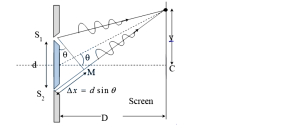
In Young's double slit experiment,the two slits are $d$ distance apart. The interference pattern is observed on the screen at a distance $D$ from the slits. The first dark fringe is observed on the screen directly opposite to one of the slits. The wavelength of the light is:
A
$\frac{D^2}{2 d}$
B
$\frac{d^2}{D}$
C
$\frac{d^2}{2 D}$
D
$\frac{D^2}{d}$
Solution
(B) The path difference $\Delta x$ at a point $P$ on the screen at a distance $y$ from the center is given by $\Delta x = d \sin \theta \approx d \tan \theta = d \left( \frac{y}{D} \right)$.
For a dark fringe,the path difference must be an odd multiple of half the wavelength: $\Delta x = (2n - 1) \frac{\lambda}{2}$,where $n = 1, 2, 3, \dots$.
The first dark fringe corresponds to $n = 1$,so $\Delta x = \frac{\lambda}{2}$.
The problem states that the first dark fringe is observed directly opposite to one of the slits. The distance of the slits from the center is $d/2$. Thus,$y = d/2$.
Substituting these values into the path difference formula:
$\frac{d}{2} \cdot \frac{d}{D} = \frac{\lambda}{2}$
$\frac{d^2}{D} = \lambda$
Therefore,the wavelength of the light is $\lambda = \frac{d^2}{D}$.
For a dark fringe,the path difference must be an odd multiple of half the wavelength: $\Delta x = (2n - 1) \frac{\lambda}{2}$,where $n = 1, 2, 3, \dots$.
The first dark fringe corresponds to $n = 1$,so $\Delta x = \frac{\lambda}{2}$.
The problem states that the first dark fringe is observed directly opposite to one of the slits. The distance of the slits from the center is $d/2$. Thus,$y = d/2$.
Substituting these values into the path difference formula:
$\frac{d}{2} \cdot \frac{d}{D} = \frac{\lambda}{2}$
$\frac{d^2}{D} = \lambda$
Therefore,the wavelength of the light is $\lambda = \frac{d^2}{D}$.
0 likes
View Solution476
EasyMCQ
In Young's double-slit experiment,we get $15$ fringes per $cm$ on the screen using light of wavelength $5600$ Å. For the same setting,how many fringes per $cm$ will be obtained with light of wavelength $7000$ Å?
A
$18$
B
$10$
C
$12$
D
$15$
Solution
(C) The fringe width $\beta$ is given by $\beta = \frac{\lambda D}{d}$.
Since the number of fringes per unit length $n$ is inversely proportional to the fringe width $\beta$,we have $n \propto \frac{1}{\beta}$.
Therefore,$n \propto \frac{1}{\lambda}$,which implies $n_1 \lambda_1 = n_2 \lambda_2$.
Given $n_1 = 15$ fringes/$cm$,$\lambda_1 = 5600$ Å,and $\lambda_2 = 7000$ Å.
Substituting the values: $15 \times 5600 = n_2 \times 7000$.
$n_2 = \frac{15 \times 5600}{7000} = \frac{15 \times 56}{70} = \frac{15 \times 8}{10} = \frac{120}{10} = 12$.
Thus,$12$ fringes per $cm$ will be obtained.
Since the number of fringes per unit length $n$ is inversely proportional to the fringe width $\beta$,we have $n \propto \frac{1}{\beta}$.
Therefore,$n \propto \frac{1}{\lambda}$,which implies $n_1 \lambda_1 = n_2 \lambda_2$.
Given $n_1 = 15$ fringes/$cm$,$\lambda_1 = 5600$ Å,and $\lambda_2 = 7000$ Å.
Substituting the values: $15 \times 5600 = n_2 \times 7000$.
$n_2 = \frac{15 \times 5600}{7000} = \frac{15 \times 56}{70} = \frac{15 \times 8}{10} = \frac{120}{10} = 12$.
Thus,$12$ fringes per $cm$ will be obtained.
0 likes
View Solution477
EasyMCQ
In Young's double slit experiment with monochromatic light, fringes are obtained on a screen placed at some distance from the slits. If the screen is moved by $5 \times 10^{-2} \, m$ towards the slits, the change in fringe width is $3 \times 10^{-5} \, m$. If the separation between the slits is $10^{-3} \, m$, the wavelength of light used is (in $\text{\AA}$)
A
$6000$
B
$5000$
C
$4500$
D
$3000$
Solution
(A) The fringe width $\omega$ in Young's double slit experiment is given by $\omega = \frac{\lambda D}{d}$, where $\lambda$ is the wavelength, $D$ is the distance of the screen from the slits, and $d$ is the slit separation.
Given the change in screen distance $\Delta D = 5 \times 10^{-2} \, m$ and the change in fringe width $\Delta \omega = 3 \times 10^{-5} \, m$, the relationship is $\Delta \omega = \frac{\lambda (\Delta D)}{d}$.
Rearranging for $\lambda$: $\lambda = \frac{d \cdot \Delta \omega}{\Delta D}$.
Substituting the values: $\lambda = \frac{(10^{-3} \, m)(3 \times 10^{-5} \, m)}{5 \times 10^{-2} \, m} = \frac{3 \times 10^{-8}}{5 \times 10^{-2}} = 0.6 \times 10^{-6} \, m$.
Converting to $\text{\AA}$: $\lambda = 0.6 \times 10^{-6} \times 10^{10} \, \text{\AA} = 6000 \, \text{\AA}$.
Given the change in screen distance $\Delta D = 5 \times 10^{-2} \, m$ and the change in fringe width $\Delta \omega = 3 \times 10^{-5} \, m$, the relationship is $\Delta \omega = \frac{\lambda (\Delta D)}{d}$.
Rearranging for $\lambda$: $\lambda = \frac{d \cdot \Delta \omega}{\Delta D}$.
Substituting the values: $\lambda = \frac{(10^{-3} \, m)(3 \times 10^{-5} \, m)}{5 \times 10^{-2} \, m} = \frac{3 \times 10^{-8}}{5 \times 10^{-2}} = 0.6 \times 10^{-6} \, m$.
Converting to $\text{\AA}$: $\lambda = 0.6 \times 10^{-6} \times 10^{10} \, \text{\AA} = 6000 \, \text{\AA}$.
0 likes
View Solution478
DifficultMCQ
In Young's double slit experiment,the angular width of fringes is $0.20$ radians for sodium light of wavelength $5890 \text{ Å}$. If the complete system is dipped in water,then the angular width of fringes will be [Refractive index of water $\mu = \frac{4}{3}$]
A
$0.30$ radians
B
$0.15$ radians
C
$0.11$ radians
D
$0.22$ radians
Solution
(B) The angular fringe width $\theta$ is given by the formula:
$\theta = \frac{\lambda}{d}$
Given,in air,$\theta = 0.20$ radians.
When the entire system is immersed in water,the wavelength of light changes to $\lambda' = \frac{\lambda}{\mu}$,where $\mu$ is the refractive index of water.
The new angular fringe width $\theta'$ is:
$\theta' = \frac{\lambda'}{d} = \frac{\lambda}{\mu d} = \frac{\theta}{\mu}$
Given $\mu = \frac{4}{3}$,we have:
$\theta' = \frac{0.20}{4/3} = 0.20 \times \frac{3}{4} = 0.15$ radians.
Thus,the angular width of the fringes in water is $0.15$ radians.
$\theta = \frac{\lambda}{d}$
Given,in air,$\theta = 0.20$ radians.
When the entire system is immersed in water,the wavelength of light changes to $\lambda' = \frac{\lambda}{\mu}$,where $\mu$ is the refractive index of water.
The new angular fringe width $\theta'$ is:
$\theta' = \frac{\lambda'}{d} = \frac{\lambda}{\mu d} = \frac{\theta}{\mu}$
Given $\mu = \frac{4}{3}$,we have:
$\theta' = \frac{0.20}{4/3} = 0.20 \times \frac{3}{4} = 0.15$ radians.
Thus,the angular width of the fringes in water is $0.15$ radians.

0 likes
View Solution479
EasyMCQ
In Young's double slit experiment,the slit separation is made threefold by keeping the remaining setup the same. The fringe width becomes
A
$\frac{1}{9}$ times
B
$\frac{1}{3}$ times
C
$9$ times
D
$3$ times
Solution
(B) The fringe width $\beta$ in Young's double slit experiment is given by the formula: $\beta = \frac{\lambda D}{d}$,where $\lambda$ is the wavelength of light,$D$ is the distance between the slits and the screen,and $d$ is the separation between the two slits.
Given that the slit separation $d$ is made threefold,i.e.,$d' = 3d$,while $\lambda$ and $D$ remain constant.
The new fringe width $\beta'$ will be: $\beta' = \frac{\lambda D}{d'} = \frac{\lambda D}{3d} = \frac{1}{3} \beta$.
Therefore,the fringe width becomes $\frac{1}{3}$ times the original fringe width.
Given that the slit separation $d$ is made threefold,i.e.,$d' = 3d$,while $\lambda$ and $D$ remain constant.
The new fringe width $\beta'$ will be: $\beta' = \frac{\lambda D}{d'} = \frac{\lambda D}{3d} = \frac{1}{3} \beta$.
Therefore,the fringe width becomes $\frac{1}{3}$ times the original fringe width.
0 likes
View Solution480
EasyMCQ
In Young's double slit experiment,with a source of light having wavelength $6300 Å$,the first maxima will occur when the
A
path difference is $9200 Å$
B
phase difference is $\pi$ radian
C
phase difference is $\frac{\pi}{2}$ radian
D
path difference is $6300 Å$
Solution
(D) In Young's double slit experiment,the condition for constructive interference (maxima) is given by the path difference $\Delta x = n \lambda$,where $n = 0, 1, 2, ...$ and $\lambda$ is the wavelength of light.
For the central maximum,$n = 0$,and for the first maximum,$n = 1$.
Given the wavelength $\lambda = 6300 Å$,the path difference for the first maximum is $\Delta x = 1 \times 6300 Å = 6300 Å$.
For the central maximum,$n = 0$,and for the first maximum,$n = 1$.
Given the wavelength $\lambda = 6300 Å$,the path difference for the first maximum is $\Delta x = 1 \times 6300 Å = 6300 Å$.
0 likes
View Solution481
MediumMCQ
In Young's double slit experiment,the intensity at a point where the path difference is $\frac{\lambda}{4}$ [$\lambda$ is the wavelength of light used] is $I$. If $I_0$ is the maximum intensity,then $\frac{I}{I_0}$ is equal to:
A
$3:2$
B
$2:3$
C
$3:4$
D
$1:2$
Solution
(D) Let $I'$ be the intensity of each individual wave. The resultant intensity $I$ is given by the formula:
$I = 4I' \cos^2 \left( \frac{\phi}{2} \right)$
where $\phi$ is the phase difference.
The maximum intensity $I_0$ occurs when $\cos^2 \left( \frac{\phi}{2} \right) = 1$,so $I_0 = 4I'$.
Given the path difference $\Delta x = \frac{\lambda}{4}$,the phase difference $\phi$ is calculated as:
$\phi = \frac{2\pi}{\lambda} \times \Delta x = \frac{2\pi}{\lambda} \times \frac{\lambda}{4} = \frac{\pi}{2}$.
Substituting this into the intensity formula:
$I = 4I' \cos^2 \left( \frac{\pi/2}{2} \right) = 4I' \cos^2 \left( \frac{\pi}{4} \right) = 4I' \times \left( \frac{1}{\sqrt{2}} \right)^2 = 4I' \times \frac{1}{2} = 2I'$.
Therefore,the ratio is:
$\frac{I}{I_0} = \frac{2I'}{4I'} = \frac{1}{2}$.
$I = 4I' \cos^2 \left( \frac{\phi}{2} \right)$
where $\phi$ is the phase difference.
The maximum intensity $I_0$ occurs when $\cos^2 \left( \frac{\phi}{2} \right) = 1$,so $I_0 = 4I'$.
Given the path difference $\Delta x = \frac{\lambda}{4}$,the phase difference $\phi$ is calculated as:
$\phi = \frac{2\pi}{\lambda} \times \Delta x = \frac{2\pi}{\lambda} \times \frac{\lambda}{4} = \frac{\pi}{2}$.
Substituting this into the intensity formula:
$I = 4I' \cos^2 \left( \frac{\pi/2}{2} \right) = 4I' \cos^2 \left( \frac{\pi}{4} \right) = 4I' \times \left( \frac{1}{\sqrt{2}} \right)^2 = 4I' \times \frac{1}{2} = 2I'$.
Therefore,the ratio is:
$\frac{I}{I_0} = \frac{2I'}{4I'} = \frac{1}{2}$.
0 likes
View Solution482
EasyMCQ
In Young's double slit experiment,the $n^{\text{th}}$ maximum of wavelength $\lambda_1$ is at a distance $y_1$ from the central maximum. When the wavelength of the source is changed to $\lambda_2$,the $(n/2)^{\text{th}}$ maximum is at $y_2$ from its central maximum. The ratio $y_1/y_2$ is:
A
$\frac{\lambda_1}{\lambda_2}$
B
$\frac{2 \lambda_1}{\lambda_2}$
C
$\frac{2 \lambda_2}{\lambda_1}$
D
$\frac{\lambda_1}{2 \lambda_2}$
Solution
(B) The position of the $n^{\text{th}}$ bright fringe (maximum) in Young's double slit experiment is given by $y_n = \frac{n \lambda D}{d}$.
For the first case,the $n^{\text{th}}$ maximum with wavelength $\lambda_1$ is at distance $y_1 = \frac{n \lambda_1 D}{d}$.
For the second case,the $(n/2)^{\text{th}}$ maximum with wavelength $\lambda_2$ is at distance $y_2 = \frac{(n/2) \lambda_2 D}{d} = \frac{n \lambda_2 D}{2d}$.
Now,taking the ratio of $y_1$ and $y_2$:
$\frac{y_1}{y_2} = \frac{(n \lambda_1 D / d)}{(n \lambda_2 D / 2d)} = \frac{n \lambda_1 D}{d} \times \frac{2d}{n \lambda_2 D} = \frac{2 \lambda_1}{\lambda_2}$.
Therefore,the ratio is $\frac{2 \lambda_1}{\lambda_2}$.
For the first case,the $n^{\text{th}}$ maximum with wavelength $\lambda_1$ is at distance $y_1 = \frac{n \lambda_1 D}{d}$.
For the second case,the $(n/2)^{\text{th}}$ maximum with wavelength $\lambda_2$ is at distance $y_2 = \frac{(n/2) \lambda_2 D}{d} = \frac{n \lambda_2 D}{2d}$.
Now,taking the ratio of $y_1$ and $y_2$:
$\frac{y_1}{y_2} = \frac{(n \lambda_1 D / d)}{(n \lambda_2 D / 2d)} = \frac{n \lambda_1 D}{d} \times \frac{2d}{n \lambda_2 D} = \frac{2 \lambda_1}{\lambda_2}$.
Therefore,the ratio is $\frac{2 \lambda_1}{\lambda_2}$.
0 likes
View Solution483
EasyMCQ
In Young's experiment, fringes are obtained on a screen placed at a distance of $75 \,cm$ from the slits. When the separation between two narrow slits is doubled, the fringe width decreases. In order to obtain the initial fringe width, the screen should be moved by:
A
$150 \,cm$ away from the slits
B
$75 \,cm$ towards the slits
C
$75 \,cm$ away from the slits
D
$150 \,cm$ towards the slits
Solution
(C) The fringe width $\beta$ in Young's double-slit experiment is given by $\beta = \frac{\lambda D}{d}$, where $\lambda$ is the wavelength, $D$ is the distance of the screen from the slits, and $d$ is the separation between the slits.
Initially, $\beta_1 = \frac{\lambda D_1}{d_1}$, where $D_1 = 75 \,cm$.
When the slit separation is doubled, $d_2 = 2d_1$. To keep the fringe width constant $(\beta_2 = \beta_1)$, we must have $\frac{\lambda D_2}{d_2} = \frac{\lambda D_1}{d_1}$.
Substituting $d_2 = 2d_1$, we get $\frac{D_2}{2d_1} = \frac{D_1}{d_1}$, which implies $D_2 = 2D_1$.
$D_2 = 2 \times 75 \,cm = 150 \,cm$.
The screen must be moved from $75 \,cm$ to $150 \,cm$, which means it should be moved $150 \,cm - 75 \,cm = 75 \,cm$ away from the slits.
Initially, $\beta_1 = \frac{\lambda D_1}{d_1}$, where $D_1 = 75 \,cm$.
When the slit separation is doubled, $d_2 = 2d_1$. To keep the fringe width constant $(\beta_2 = \beta_1)$, we must have $\frac{\lambda D_2}{d_2} = \frac{\lambda D_1}{d_1}$.
Substituting $d_2 = 2d_1$, we get $\frac{D_2}{2d_1} = \frac{D_1}{d_1}$, which implies $D_2 = 2D_1$.
$D_2 = 2 \times 75 \,cm = 150 \,cm$.
The screen must be moved from $75 \,cm$ to $150 \,cm$, which means it should be moved $150 \,cm - 75 \,cm = 75 \,cm$ away from the slits.
0 likes
View Solution484
EasyMCQ
In Young's double slit experiment,the $10^{\text{th}}$ maximum of wavelength $\lambda_1$ is at a distance of $Y_1$ from the central maximum. When the wavelength of the source is changed to $\lambda_2$,the $5^{\text{th}}$ maximum is at a distance $Y_2$ from the central maximum. The ratio $\frac{Y_1}{Y_2}$ is
A
$\frac{2 \lambda_1}{\lambda_2}$
B
$\frac{\lambda_2}{2 \lambda_1}$
C
$\frac{2 \lambda_2}{\lambda_1}$
D
$\frac{\lambda_1}{2 \lambda_2}$
Solution
(A) The position of the $n^{\text{th}}$ bright fringe (maximum) in Young's double slit experiment is given by $Y_n = \frac{n \lambda D}{d}$,where $D$ is the distance between the slits and the screen,and $d$ is the distance between the slits.
For the $10^{\text{th}}$ maximum with wavelength $\lambda_1$,the distance is $Y_1 = \frac{10 \lambda_1 D}{d}$.
For the $5^{\text{th}}$ maximum with wavelength $\lambda_2$,the distance is $Y_2 = \frac{5 \lambda_2 D}{d}$.
Taking the ratio of $Y_1$ to $Y_2$:
$\frac{Y_1}{Y_2} = \frac{10 \lambda_1 D / d}{5 \lambda_2 D / d} = \frac{10 \lambda_1}{5 \lambda_2} = \frac{2 \lambda_1}{\lambda_2}$.
For the $10^{\text{th}}$ maximum with wavelength $\lambda_1$,the distance is $Y_1 = \frac{10 \lambda_1 D}{d}$.
For the $5^{\text{th}}$ maximum with wavelength $\lambda_2$,the distance is $Y_2 = \frac{5 \lambda_2 D}{d}$.
Taking the ratio of $Y_1$ to $Y_2$:
$\frac{Y_1}{Y_2} = \frac{10 \lambda_1 D / d}{5 \lambda_2 D / d} = \frac{10 \lambda_1}{5 \lambda_2} = \frac{2 \lambda_1}{\lambda_2}$.
0 likes
View Solution485
MediumMCQ
In Young's double slit experiment using monochromatic light of wavelength $\lambda$,the maximum intensity of light at a point on the screen is $K$ units. What is the intensity of light at a point where the path difference is $\frac{\lambda}{3}$?
A
$\frac{K}{4}$
B
$\frac{3K}{4}$
C
$K$
D
$\frac{K}{2}$
Solution
(A) The intensity $I$ in Young's double slit experiment is given by the formula: $I = 4I_0 \cos^2(\frac{\phi}{2})$,where $I_0$ is the intensity of each individual slit and $\phi$ is the phase difference.
Maximum intensity $K$ occurs when $\cos^2(\frac{\phi}{2}) = 1$,so $K = 4I_0$.
The phase difference $\phi$ is related to the path difference $\Delta x$ by the formula: $\phi = \frac{2\pi}{\lambda} \Delta x$.
Given the path difference $\Delta x = \frac{\lambda}{3}$,the phase difference is $\phi = \frac{2\pi}{\lambda} \times \frac{\lambda}{3} = \frac{2\pi}{3}$.
Substituting this into the intensity formula: $I = K \cos^2(\frac{2\pi/3}{2}) = K \cos^2(\frac{\pi}{3})$.
Since $\cos(\frac{\pi}{3}) = \frac{1}{2}$,we get $I = K (\frac{1}{2})^2 = \frac{K}{4}$.
Maximum intensity $K$ occurs when $\cos^2(\frac{\phi}{2}) = 1$,so $K = 4I_0$.
The phase difference $\phi$ is related to the path difference $\Delta x$ by the formula: $\phi = \frac{2\pi}{\lambda} \Delta x$.
Given the path difference $\Delta x = \frac{\lambda}{3}$,the phase difference is $\phi = \frac{2\pi}{\lambda} \times \frac{\lambda}{3} = \frac{2\pi}{3}$.
Substituting this into the intensity formula: $I = K \cos^2(\frac{2\pi/3}{2}) = K \cos^2(\frac{\pi}{3})$.
Since $\cos(\frac{\pi}{3}) = \frac{1}{2}$,we get $I = K (\frac{1}{2})^2 = \frac{K}{4}$.
0 likes
View Solution486
DifficultMCQ
In Young's double-slit experiment,in the interference pattern,a minimum is observed exactly in front of one slit. The distance between the two coherent sources is $d$ and $D$ is the distance between the sources and the screen. The possible wavelengths used are inversely proportional to
A
$D, 5D, 9D, \ldots$
B
$D, 3D, 5D, \ldots$
C
$3D, 4D, 5D, \ldots$
D
$3D, 7D, 10D, \ldots$
Solution
(B) In Young's double-slit experiment,the path difference $\Delta x$ at a point exactly in front of one slit is given by $\Delta x = \frac{d^2}{2D}$.
For a minimum (destructive interference) to occur at this point,the path difference must be an odd multiple of $\frac{\lambda}{2}$,i.e.,$\Delta x = (2n-1)\frac{\lambda}{2}$ where $n = 1, 2, 3, \ldots$.
Equating the two expressions: $\frac{d^2}{2D} = (2n-1)\frac{\lambda}{2}$.
This simplifies to $\lambda = \frac{d^2}{(2n-1)D}$.
For $n=1, 2, 3, \ldots$,the values of $(2n-1)$ are $1, 3, 5, \ldots$.
Thus,$\lambda$ is proportional to $\frac{1}{D}, \frac{1}{3D}, \frac{1}{5D}, \ldots$.
Therefore,the possible wavelengths are inversely proportional to $D, 3D, 5D, \ldots$.
For a minimum (destructive interference) to occur at this point,the path difference must be an odd multiple of $\frac{\lambda}{2}$,i.e.,$\Delta x = (2n-1)\frac{\lambda}{2}$ where $n = 1, 2, 3, \ldots$.
Equating the two expressions: $\frac{d^2}{2D} = (2n-1)\frac{\lambda}{2}$.
This simplifies to $\lambda = \frac{d^2}{(2n-1)D}$.
For $n=1, 2, 3, \ldots$,the values of $(2n-1)$ are $1, 3, 5, \ldots$.
Thus,$\lambda$ is proportional to $\frac{1}{D}, \frac{1}{3D}, \frac{1}{5D}, \ldots$.
Therefore,the possible wavelengths are inversely proportional to $D, 3D, 5D, \ldots$.
0 likes
View Solution487
EasyMCQ
In Young's experiment with a monochromatic source and two slits,if one of the slits is covered with black opaque paper,the fringes will
A
be darker
B
be narrower
C
be broader
D
not be observed
Solution
(D) In Young's double-slit experiment,the formation of interference fringes requires the superposition of coherent light waves originating from two separate slits.
When one of the slits is covered with black opaque paper,light can only pass through the remaining single slit.
Since there is no longer a second source to interfere with the light from the first,the condition for interference is lost.
Consequently,no interference pattern (fringes) will be observed on the screen.
When one of the slits is covered with black opaque paper,light can only pass through the remaining single slit.
Since there is no longer a second source to interfere with the light from the first,the condition for interference is lost.
Consequently,no interference pattern (fringes) will be observed on the screen.
0 likes
View Solution488
MediumMCQ
In $YDSE$, the distance of the slits from the screen is increased by $25 \%$ and the separation between the slits is halved. If $W$ represents the original fringe width, the new fringe width is (in $\,W$)
A
$2$
B
$2.5$
C
$4$
D
$1.5$
Solution
(B) The formula for fringe width in $YDSE$ is given by $W = \frac{\lambda D}{d}$, where $\lambda$ is the wavelength, $D$ is the distance between the slits and the screen, and $d$ is the separation between the slits.
Let the original fringe width be $W_1 = \frac{\lambda D_1}{d_1} = W$.
According to the problem, the new distance $D_2 = D_1 + 0.25 D_1 = 1.25 D_1$ and the new separation $d_2 = \frac{d_1}{2}$.
The new fringe width $W_2$ is given by $W_2 = \frac{\lambda D_2}{d_2}$.
Substituting the values, we get $W_2 = \frac{\lambda (1.25 D_1)}{(d_1 / 2)} = 1.25 \times 2 \times \frac{\lambda D_1}{d_1}$.
Since $W = \frac{\lambda D_1}{d_1}$, we have $W_2 = 2.5 W$.
Let the original fringe width be $W_1 = \frac{\lambda D_1}{d_1} = W$.
According to the problem, the new distance $D_2 = D_1 + 0.25 D_1 = 1.25 D_1$ and the new separation $d_2 = \frac{d_1}{2}$.
The new fringe width $W_2$ is given by $W_2 = \frac{\lambda D_2}{d_2}$.
Substituting the values, we get $W_2 = \frac{\lambda (1.25 D_1)}{(d_1 / 2)} = 1.25 \times 2 \times \frac{\lambda D_1}{d_1}$.
Since $W = \frac{\lambda D_1}{d_1}$, we have $W_2 = 2.5 W$.
0 likes
View Solution489
MediumMCQ
In $YDSE$ experiment,the $4^{\text{th}}$ dark band is formed opposite to one of the slits. The wavelength of light used is ($d=$ distance between the slits,$D=$ distance between source and the screen)
A
$\frac{d^2}{14 D}$
B
$\frac{d^2}{7 D}$
C
$\frac{d^2}{9 D}$
D
$\frac{d^2}{11 D}$
Solution
(B) The position of the $n^{\text{th}}$ dark fringe from the central maximum is given by $y_n = (n - 0.5) \frac{\lambda D}{d}$.
For the $4^{\text{th}}$ dark band,$n = 4$,so $y_4 = (4 - 0.5) \frac{\lambda D}{d} = 3.5 \frac{\lambda D}{d}$.
Since the dark band is formed opposite to one of the slits,its distance from the central axis is $y = \frac{d}{2}$.
Equating the two expressions: $\frac{d}{2} = 3.5 \frac{\lambda D}{d}$.
Rearranging for $\lambda$: $\lambda = \frac{d^2}{2 \times 3.5 D} = \frac{d^2}{7 D}$.
For the $4^{\text{th}}$ dark band,$n = 4$,so $y_4 = (4 - 0.5) \frac{\lambda D}{d} = 3.5 \frac{\lambda D}{d}$.
Since the dark band is formed opposite to one of the slits,its distance from the central axis is $y = \frac{d}{2}$.
Equating the two expressions: $\frac{d}{2} = 3.5 \frac{\lambda D}{d}$.
Rearranging for $\lambda$: $\lambda = \frac{d^2}{2 \times 3.5 D} = \frac{d^2}{7 D}$.
0 likes
View Solution490
EasyMCQ
In Young's double slit experiment,the distance of the $n^{\text{th}}$ dark band from the central bright band in terms of bandwidth '$\beta$' is:
A
$n \beta$
B
$(n-1) \beta$
C
$(n-0.5) \beta$
D
$(n+0.5) \beta$
Solution
(C) In Young's double slit experiment,the position of the $n^{\text{th}}$ dark fringe from the central bright fringe is given by the formula:
$y_n = (n - \frac{1}{2}) \beta$
where $n = 1, 2, 3, \dots$ represents the order of the dark fringe.
Thus,the distance is $(n - 0.5) \beta$.
$y_n = (n - \frac{1}{2}) \beta$
where $n = 1, 2, 3, \dots$ represents the order of the dark fringe.
Thus,the distance is $(n - 0.5) \beta$.
0 likes
View Solution491
MediumMCQ
The path difference between two interfering light waves meeting at a point on the screen is $\left(\frac{57}{2}\right) \lambda$. The band obtained at that point is
A
$29^{\text{th}}$ bright band
B
$57^{\text{th}}$ dark band
C
$57^{\text{th}}$ bright band
D
$29^{\text{th}}$ dark band
Solution
(D) The path difference is given as $\Delta x = \frac{57}{2} \lambda = 28.5 \lambda$.
For constructive interference (bright band),the path difference must be an integral multiple of $\lambda$,i.e.,$\Delta x = n \lambda$ where $n = 1, 2, 3, \dots$. Since $28.5 \lambda$ is not an integer multiple,it is not a bright band.
For destructive interference (dark band),the path difference is given by $\Delta x = (n - \frac{1}{2}) \lambda$,where $n = 1, 2, 3, \dots$.
Equating the two: $28.5 \lambda = (n - 0.5) \lambda$.
Solving for $n$: $n - 0.5 = 28.5$,which gives $n = 29$.
Therefore,the point corresponds to the $29^{\text{th}}$ dark band.
For constructive interference (bright band),the path difference must be an integral multiple of $\lambda$,i.e.,$\Delta x = n \lambda$ where $n = 1, 2, 3, \dots$. Since $28.5 \lambda$ is not an integer multiple,it is not a bright band.
For destructive interference (dark band),the path difference is given by $\Delta x = (n - \frac{1}{2}) \lambda$,where $n = 1, 2, 3, \dots$.
Equating the two: $28.5 \lambda = (n - 0.5) \lambda$.
Solving for $n$: $n - 0.5 = 28.5$,which gives $n = 29$.
Therefore,the point corresponds to the $29^{\text{th}}$ dark band.
0 likes
View Solution492
MediumMCQ
In Young's double slit experiment,the $6^{\text{th}}$ maximum with wavelength $\lambda_{1}$ is at a distance $d_{1}$ from the central maximum and the $4^{\text{th}}$ maximum with wavelength $\lambda_{2}$ is at distance $d_{2}$ from the central maximum. Then the ratio $\frac{d_{1}}{d_{2}}$ is:
A
$\frac{2}{3} \frac{\lambda_{1}}{\lambda_{2}}$
B
$\frac{3}{2} \frac{\lambda_{1}}{\lambda_{2}}$
C
$\frac{2}{3} \frac{\lambda_{2}}{\lambda_{1}}$
D
$\frac{3}{2} \frac{\lambda_{2}}{\lambda_{1}}$
Solution
(B) The position of the $n^{\text{th}}$ maximum in Young's double slit experiment is given by $y_n = \frac{n \lambda D}{d}$,where $n$ is the order of the maximum,$\lambda$ is the wavelength,$D$ is the distance between the slits and the screen,and $d$ is the slit separation.
For the $6^{\text{th}}$ maximum with wavelength $\lambda_1$,the distance is $d_1 = \frac{6 \lambda_1 D}{d}$.
For the $4^{\text{th}}$ maximum with wavelength $\lambda_2$,the distance is $d_2 = \frac{4 \lambda_2 D}{d}$.
Taking the ratio of $d_1$ to $d_2$:
$\frac{d_1}{d_2} = \frac{6 \lambda_1 D / d}{4 \lambda_2 D / d} = \frac{6 \lambda_1}{4 \lambda_2} = \frac{3}{2} \frac{\lambda_1}{\lambda_2}$.
For the $6^{\text{th}}$ maximum with wavelength $\lambda_1$,the distance is $d_1 = \frac{6 \lambda_1 D}{d}$.
For the $4^{\text{th}}$ maximum with wavelength $\lambda_2$,the distance is $d_2 = \frac{4 \lambda_2 D}{d}$.
Taking the ratio of $d_1$ to $d_2$:
$\frac{d_1}{d_2} = \frac{6 \lambda_1 D / d}{4 \lambda_2 D / d} = \frac{6 \lambda_1}{4 \lambda_2} = \frac{3}{2} \frac{\lambda_1}{\lambda_2}$.
0 likes
View Solution493
MediumMCQ
$A$ double slit experiment is immersed in water of refractive index $1.33$. The slit separation is $1 \,mm$, and the distance between the slit and the screen is $1.33 \,m$. The slits are illuminated by light of wavelength $6300 \,Å$. The fringe width is:
A
$6.9 \times 10^{-4} \,m$
B
$6.3 \times 10^{-4} \,m$
C
$5.8 \times 10^{-4} \,m$
D
$8.6 \times 10^{-4} \,m$
Solution
(B) The fringe width $\beta$ in a medium of refractive index $\mu$ is given by $\beta = \frac{\lambda_w D}{d}$.
Here, the wavelength in water is $\lambda_w = \frac{\lambda_{air}}{\mu} = \frac{6300 \times 10^{-10} \,m}{1.33}$.
Given: $D = 1.33 \,m$, $d = 1 \,mm = 10^{-3} \,m$, and $\mu = 1.33$.
Substituting these values into the formula:
$\beta = \frac{(6300 \times 10^{-10} / 1.33) \times 1.33}{10^{-3}} \,m$.
$\beta = \frac{6300 \times 10^{-10}}{10^{-3}} \,m$.
$\beta = 6300 \times 10^{-7} \,m = 6.3 \times 10^{-4} \,m$.
Here, the wavelength in water is $\lambda_w = \frac{\lambda_{air}}{\mu} = \frac{6300 \times 10^{-10} \,m}{1.33}$.
Given: $D = 1.33 \,m$, $d = 1 \,mm = 10^{-3} \,m$, and $\mu = 1.33$.
Substituting these values into the formula:
$\beta = \frac{(6300 \times 10^{-10} / 1.33) \times 1.33}{10^{-3}} \,m$.
$\beta = \frac{6300 \times 10^{-10}}{10^{-3}} \,m$.
$\beta = 6300 \times 10^{-7} \,m = 6.3 \times 10^{-4} \,m$.
0 likes
View Solution494
MediumMCQ
In Young's double slit experiment,green light is incident on the two slits. The interference pattern is observed on a screen. Which one of the following changes would cause the observed fringes to be more closely spaced?
A
Reducing the separation between the slits.
B
Using blue light instead of green light.
C
Using red light instead of green light.
D
Moving the screen away from the slits.
Solution
(B) The fringe width $\beta$ in Young's double slit experiment is given by the formula $\beta = \frac{\lambda D}{d}$,where $\lambda$ is the wavelength of light,$D$ is the distance between the slits and the screen,and $d$ is the separation between the slits.
To make the fringes more closely spaced,the fringe width $\beta$ must be decreased.
From the formula,$\beta \propto \lambda$ and $\beta \propto \frac{1}{d}$.
Since the wavelength of blue light is shorter than that of green light $(\lambda_{blue} < \lambda_{green})$,using blue light will decrease the fringe width $\beta$.
Therefore,the correct option is $B$.
To make the fringes more closely spaced,the fringe width $\beta$ must be decreased.
From the formula,$\beta \propto \lambda$ and $\beta \propto \frac{1}{d}$.
Since the wavelength of blue light is shorter than that of green light $(\lambda_{blue} < \lambda_{green})$,using blue light will decrease the fringe width $\beta$.
Therefore,the correct option is $B$.
0 likes
View Solution495
EasyMCQ
Young's double slit experiment is performed in water,instead of air,then fringe width
A
decreases.
B
becomes infinite.
C
increases.
D
remains same.
Solution
(A) The fringe width $\beta$ in Young's double slit experiment is given by the formula $\beta = \frac{\lambda D}{d}$,where $\lambda$ is the wavelength of light,$D$ is the distance between the slits and the screen,and $d$ is the distance between the two slits.
When the experiment is performed in water,the wavelength of light changes to $\lambda' = \frac{\lambda}{\mu}$,where $\mu$ is the refractive index of water $(\mu > 1)$.
Since $\mu > 1$,the new wavelength $\lambda'$ is smaller than the original wavelength $\lambda$ in air.
Consequently,the new fringe width $\beta' = \frac{\lambda' D}{d} = \frac{\lambda D}{\mu d} = \frac{\beta}{\mu}$.
Since $\mu > 1$,the fringe width $\beta'$ decreases.
When the experiment is performed in water,the wavelength of light changes to $\lambda' = \frac{\lambda}{\mu}$,where $\mu$ is the refractive index of water $(\mu > 1)$.
Since $\mu > 1$,the new wavelength $\lambda'$ is smaller than the original wavelength $\lambda$ in air.
Consequently,the new fringe width $\beta' = \frac{\lambda' D}{d} = \frac{\lambda D}{\mu d} = \frac{\beta}{\mu}$.
Since $\mu > 1$,the fringe width $\beta'$ decreases.
0 likes
View Solution496
EasyMCQ
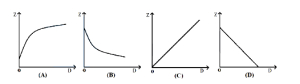
$A$ graph is plotted between the fringe-width $(z)$ and the distance $(D)$ between the slit and the eye-piece,keeping other parameters constant. Which of the following graphs is correct?
A
$(A)$
B
$(B)$
C
$(C)$
D
$(D)$
Solution
(C) In Young's Double Slit Experiment,the fringe-width $(z)$ is given by the formula:
$z = \frac{\lambda D}{d}$
where $\lambda$ is the wavelength of light,$D$ is the distance between the slits and the screen (or eye-piece),and $d$ is the distance between the two slits.
Since $\lambda$ and $d$ are kept constant,we have $z \propto D$.
This represents a linear relationship passing through the origin,which corresponds to a straight line graph.
Looking at the given options,graph $(C)$ represents a direct linear relationship $(z \propto D)$.
Therefore,the correct graph is $(C)$.
$z = \frac{\lambda D}{d}$
where $\lambda$ is the wavelength of light,$D$ is the distance between the slits and the screen (or eye-piece),and $d$ is the distance between the two slits.
Since $\lambda$ and $d$ are kept constant,we have $z \propto D$.
This represents a linear relationship passing through the origin,which corresponds to a straight line graph.
Looking at the given options,graph $(C)$ represents a direct linear relationship $(z \propto D)$.
Therefore,the correct graph is $(C)$.
0 likes
View Solution497
EasyMCQ
In Young's double slit experiment,the distance between the slits is $3 \,mm$ and the slits are $2 \,m$ away from the screen. Two interference patterns can be obtained on the screen due to light of wavelength $480 \,nm$ and $600 \,nm$ respectively. The separation on the screen between the $5^{th}$ order bright fringes on the two interference patterns is
A
$6 \times 10^{-4} \,m$
B
$8 \times 10^{-4} \,m$
C
$12 \times 10^{-4} \,m$
D
$4 \times 10^{-4} \,m$
Solution
(D) Given: Slit separation $d = 3 \,mm = 3 \times 10^{-3} \,m$,distance to screen $D = 2 \,m$,wavelengths $\lambda_1 = 480 \,nm = 480 \times 10^{-9} \,m$ and $\lambda_2 = 600 \,nm = 600 \times 10^{-9} \,m$.
The position of the $n^{th}$ order bright fringe is given by $y_n = n \frac{\lambda D}{d}$.
For the $5^{th}$ order bright fringe of the first wavelength: $y_5^{(1)} = 5 \frac{\lambda_1 D}{d}$.
For the $5^{th}$ order bright fringe of the second wavelength: $y_5^{(2)} = 5 \frac{\lambda_2 D}{d}$.
The separation between these fringes is $\Delta y = y_5^{(2)} - y_5^{(1)} = \frac{5D}{d} (\lambda_2 - \lambda_1)$.
Substituting the values: $\Delta y = \frac{5 \times 2}{3 \times 10^{-3}} \times (600 - 480) \times 10^{-9} \,m$.
$\Delta y = \frac{10}{3 \times 10^{-3}} \times 120 \times 10^{-9} \,m = \frac{1200}{3} \times 10^{-6} \,m = 400 \times 10^{-6} \,m = 4 \times 10^{-4} \,m$.
The position of the $n^{th}$ order bright fringe is given by $y_n = n \frac{\lambda D}{d}$.
For the $5^{th}$ order bright fringe of the first wavelength: $y_5^{(1)} = 5 \frac{\lambda_1 D}{d}$.
For the $5^{th}$ order bright fringe of the second wavelength: $y_5^{(2)} = 5 \frac{\lambda_2 D}{d}$.
The separation between these fringes is $\Delta y = y_5^{(2)} - y_5^{(1)} = \frac{5D}{d} (\lambda_2 - \lambda_1)$.
Substituting the values: $\Delta y = \frac{5 \times 2}{3 \times 10^{-3}} \times (600 - 480) \times 10^{-9} \,m$.
$\Delta y = \frac{10}{3 \times 10^{-3}} \times 120 \times 10^{-9} \,m = \frac{1200}{3} \times 10^{-6} \,m = 400 \times 10^{-6} \,m = 4 \times 10^{-4} \,m$.
0 likes
View SolutionWave Optics — Young's Double Slit Experiment (YDSE) · Frequently Asked Questions
1Are these Wave Optics questions useful for JEE and NEET?
Yes. All questions in this section are mapped to JEE Main and NEET exam patterns. Previous year questions from JEE Main, NEET, GUJCET and state-level exams are included with full solutions.
2Can I switch to Hindi or Gujarati for these questions?
Yes. Use the language tabs in the hero section or the sidebar to view the same questions and solutions in English, Hindi or Gujarati.
3How do I generate a question paper from this subtopic?
Use the Vedclass Exam Paper Generator — select the chapter and subtopic, set difficulty, and generate Sets A, B, C, D automatically. First 3 chapters of every subject are free.
Vedclass Products
For Students
Vedclass Test Series
Mock tests in real JEE/NEET style with performance analysis. 5-day free trial.
Start Free TrialFor Teachers
Exam Paper Generator
Generate Set A/B/C/D papers from this chapter in 2 minutes. 3 chapters free.
Try FreeFor Institutes
Online Exam Module
Live online exams with unlimited students, 360° analytics & white-label branding.
See DemoFor Teachers & Institutes
Generate a Wave Optics Exam Paper in 2 Minutes
Select subtopic & difficulty — Sets A, B, C, D auto-generated with No Repeat logic.
First 3 chapters of every subject are free — no payment required.