
A English
Young's Double Slit Experiment (YDSE) Questions in English
Class 12 Physics · Wave Optics · Young's Double Slit Experiment (YDSE)
616+
Questions
English
Language
100%
With Solutions
Showing 48 of 616 questions in English
501
EasyMCQ
In Young's double slit experiment,the ratio of intensities at two points on a screen when waves from the two slits have a path difference of $0$ and $\frac{\lambda}{4}$ is
$\left[\cos 0^{\circ}=\sin 90^{\circ}=1, \sin 0^{\circ}=\cos 90^{\circ}=0\right]$
$\left[\cos 0^{\circ}=\sin 90^{\circ}=1, \sin 0^{\circ}=\cos 90^{\circ}=0\right]$
A
$2: 1$
B
$3: 1$
C
$2: 3$
D
$3: 2$
Solution
(A) The intensity at any point on the screen is given by $I = 4I_0 \cos^2 \left( \frac{\phi}{2} \right)$,where $\phi$ is the phase difference.
The phase difference $\phi$ is related to path difference $\Delta x$ by $\phi = \frac{2\pi}{\lambda} \Delta x$.
For path difference $\Delta x_1 = 0$,the phase difference $\phi_1 = 0$. Thus,$I_1 = 4I_0 \cos^2(0) = 4I_0$.
For path difference $\Delta x_2 = \frac{\lambda}{4}$,the phase difference $\phi_2 = \frac{2\pi}{\lambda} \times \frac{\lambda}{4} = \frac{\pi}{2}$.
The intensity $I_2 = 4I_0 \cos^2 \left( \frac{\pi/2}{2} \right) = 4I_0 \cos^2 \left( \frac{\pi}{4} \right) = 4I_0 \left( \frac{1}{\sqrt{2}} \right)^2 = 4I_0 \times \frac{1}{2} = 2I_0$.
The ratio of intensities is $\frac{I_1}{I_2} = \frac{4I_0}{2I_0} = \frac{2}{1}$ or $2:1$.
The phase difference $\phi$ is related to path difference $\Delta x$ by $\phi = \frac{2\pi}{\lambda} \Delta x$.
For path difference $\Delta x_1 = 0$,the phase difference $\phi_1 = 0$. Thus,$I_1 = 4I_0 \cos^2(0) = 4I_0$.
For path difference $\Delta x_2 = \frac{\lambda}{4}$,the phase difference $\phi_2 = \frac{2\pi}{\lambda} \times \frac{\lambda}{4} = \frac{\pi}{2}$.
The intensity $I_2 = 4I_0 \cos^2 \left( \frac{\pi/2}{2} \right) = 4I_0 \cos^2 \left( \frac{\pi}{4} \right) = 4I_0 \left( \frac{1}{\sqrt{2}} \right)^2 = 4I_0 \times \frac{1}{2} = 2I_0$.
The ratio of intensities is $\frac{I_1}{I_2} = \frac{4I_0}{2I_0} = \frac{2}{1}$ or $2:1$.
0 likes
View Solution502
MediumMCQ
In Young's double slit experiment,the fifth dark fringe is formed opposite to one of the slits. If $D$ is the distance between the slits and the screen and $d$ is the separation between the slits,then the wavelength of light used is:
A
$\frac{d^2}{5 D}$
B
$\frac{d^2}{9 D}$
C
$\frac{d^2}{6 D}$
D
$\frac{d^2}{15 D}$
Solution
(B) The position of the $n^{th}$ dark fringe in Young's double slit experiment is given by:
$x_n = \frac{D}{d} (2n - 1) \frac{\lambda}{2}$
Rearranging for wavelength $\lambda$:
$\lambda = \frac{2 x_n d}{D(2n - 1)} \quad \dots (i)$
Given that the fifth dark fringe $(n=5)$ is formed opposite to one of the slits,the distance of this fringe from the central axis is half the distance between the slits:
$x_5 = \frac{d}{2} \implies 2x_5 = d$
Substituting $n=5$ and $2x_5 = d$ into equation $(i)$:
$\lambda = \frac{(2x_5) d}{D(2 \times 5 - 1)}$
$\lambda = \frac{d \cdot d}{D(10 - 1)}$
$\lambda = \frac{d^2}{9D}$
$x_n = \frac{D}{d} (2n - 1) \frac{\lambda}{2}$
Rearranging for wavelength $\lambda$:
$\lambda = \frac{2 x_n d}{D(2n - 1)} \quad \dots (i)$
Given that the fifth dark fringe $(n=5)$ is formed opposite to one of the slits,the distance of this fringe from the central axis is half the distance between the slits:
$x_5 = \frac{d}{2} \implies 2x_5 = d$
Substituting $n=5$ and $2x_5 = d$ into equation $(i)$:
$\lambda = \frac{(2x_5) d}{D(2 \times 5 - 1)}$
$\lambda = \frac{d \cdot d}{D(10 - 1)}$
$\lambda = \frac{d^2}{9D}$
0 likes
View Solution503
EasyMCQ
In Young's double-slit experiment,in an interference pattern,the second minimum is observed exactly in front of one slit. The distance between the slits is $d$ and the distance between the slits and the screen is $D$. The wavelength of the light source used is:
A
$d^2 / 2D$
B
$d^2 / 2D$
C
$d^2 / 3D$
D
$d^2 / 4D$
Solution
(C) The position of the slits is at $y = \pm d/2$. The second minimum occurs at $y = d/2$.
For a minimum in Young's double-slit experiment,the path difference is given by $\Delta x = (n - 1/2)\lambda$,where $n = 2$ for the second minimum.
Thus,$\Delta x = (2 - 1/2)\lambda = (3/2)\lambda$.
Also,the path difference is given by $\Delta x = d \sin \theta \approx d \tan \theta = d(y/D)$.
Substituting $y = d/2$,we get $\Delta x = d(d/2D) = d^2 / 2D$.
Equating the two expressions for path difference: $(3/2)\lambda = d^2 / 2D$.
Solving for $\lambda$,we get $\lambda = (d^2 / 2D) \times (2/3) = d^2 / 3D$.
For a minimum in Young's double-slit experiment,the path difference is given by $\Delta x = (n - 1/2)\lambda$,where $n = 2$ for the second minimum.
Thus,$\Delta x = (2 - 1/2)\lambda = (3/2)\lambda$.
Also,the path difference is given by $\Delta x = d \sin \theta \approx d \tan \theta = d(y/D)$.
Substituting $y = d/2$,we get $\Delta x = d(d/2D) = d^2 / 2D$.
Equating the two expressions for path difference: $(3/2)\lambda = d^2 / 2D$.
Solving for $\lambda$,we get $\lambda = (d^2 / 2D) \times (2/3) = d^2 / 3D$.
0 likes
View Solution504
EasyMCQ
The distance between two coherent sources is $1 \ mm$. The screen is placed at a distance of $1 \ m$ from the sources. If the distance of the third bright fringe is $1.2 \ mm$ from the central fringe, the wavelength of light used is:
A
$4000 \ \mathring{A}$
B
$5000 \ \mathring{A}$
C
$6000 \ \mathring{A}$
D
$7200 \ \mathring{A}$
Solution
(A) The position of the $n^{th}$ bright fringe (maxima) is given by the formula:
$y_n = \frac{n D \lambda}{d}$
Rearranging the formula to solve for wavelength $\lambda$:
$\lambda = \frac{y_n d}{n D}$
Given values:
$n = 3$
$y_n = 1.2 \ mm = 1.2 \times 10^{-3} \ m$
$D = 1 \ m$
$d = 1 \ mm = 1 \times 10^{-3} \ m$
Substituting these values into the formula:
$\lambda = \frac{(1.2 \times 10^{-3} \ m) \times (1 \times 10^{-3} \ m)}{3 \times 1 \ m}$
$\lambda = \frac{1.2 \times 10^{-6}}{3} \ m$
$\lambda = 0.4 \times 10^{-6} \ m = 4 \times 10^{-7} \ m$
Converting to $\mathring{A}$s $(\mathring{A})$, where $1 \ \mathring{A} = 10^{-10} \ m$:
$\lambda = 4000 \times 10^{-10} \ m = 4000 \ \mathring{A}$
$y_n = \frac{n D \lambda}{d}$
Rearranging the formula to solve for wavelength $\lambda$:
$\lambda = \frac{y_n d}{n D}$
Given values:
$n = 3$
$y_n = 1.2 \ mm = 1.2 \times 10^{-3} \ m$
$D = 1 \ m$
$d = 1 \ mm = 1 \times 10^{-3} \ m$
Substituting these values into the formula:
$\lambda = \frac{(1.2 \times 10^{-3} \ m) \times (1 \times 10^{-3} \ m)}{3 \times 1 \ m}$
$\lambda = \frac{1.2 \times 10^{-6}}{3} \ m$
$\lambda = 0.4 \times 10^{-6} \ m = 4 \times 10^{-7} \ m$
Converting to $\mathring{A}$s $(\mathring{A})$, where $1 \ \mathring{A} = 10^{-10} \ m$:
$\lambda = 4000 \times 10^{-10} \ m = 4000 \ \mathring{A}$
0 likes
View Solution505
MediumMCQ
Two coherent sources $P$ and $Q$ produce interference at point $A$ on the screen,where a dark band is formed between the $4^{\text{th}}$ bright band and the $5^{\text{th}}$ bright band. The wavelength of the light used is $6000 \text{ Å}$. The path difference between $PA$ and $QA$ is:
A
$1.4 \times 10^{-4} \text{ cm}$
B
$2.7 \times 10^{-4} \text{ cm}$
C
$4.5 \times 10^{-4} \text{ cm}$
D
$6.2 \times 10^{-4} \text{ cm}$
Solution
(B) For constructive interference (bright bands),the path difference is $\Delta x = n\lambda$,where $n = 0, 1, 2, \dots$
For destructive interference (dark bands),the path difference is $\Delta x = (n + \frac{1}{2})\lambda$,where $n = 0, 1, 2, \dots$
The $4^{\text{th}}$ bright band corresponds to $n = 4$ $(\Delta x = 4\lambda)$ and the $5^{\text{th}}$ bright band corresponds to $n = 5$ $(\Delta x = 5\lambda)$.
$A$ dark band formed between the $4^{\text{th}}$ and $5^{\text{th}}$ bright band corresponds to $n = 4$ in the dark band formula: $\Delta x = (4 + \frac{1}{2})\lambda = 4.5\lambda$.
Given $\lambda = 6000 \text{ Å} = 6000 \times 10^{-10} \text{ m} = 6 \times 10^{-7} \text{ m} = 6 \times 10^{-5} \text{ cm}$.
Path difference $\Delta x = 4.5 \times (6 \times 10^{-5} \text{ cm}) = 27 \times 10^{-5} \text{ cm} = 2.7 \times 10^{-4} \text{ cm}$.
For destructive interference (dark bands),the path difference is $\Delta x = (n + \frac{1}{2})\lambda$,where $n = 0, 1, 2, \dots$
The $4^{\text{th}}$ bright band corresponds to $n = 4$ $(\Delta x = 4\lambda)$ and the $5^{\text{th}}$ bright band corresponds to $n = 5$ $(\Delta x = 5\lambda)$.
$A$ dark band formed between the $4^{\text{th}}$ and $5^{\text{th}}$ bright band corresponds to $n = 4$ in the dark band formula: $\Delta x = (4 + \frac{1}{2})\lambda = 4.5\lambda$.
Given $\lambda = 6000 \text{ Å} = 6000 \times 10^{-10} \text{ m} = 6 \times 10^{-7} \text{ m} = 6 \times 10^{-5} \text{ cm}$.
Path difference $\Delta x = 4.5 \times (6 \times 10^{-5} \text{ cm}) = 27 \times 10^{-5} \text{ cm} = 2.7 \times 10^{-4} \text{ cm}$.
0 likes
View Solution506
EasyMCQ
In Young's double slit experiment,if the slit widths are in the ratio $1:9$,the ratio of the intensity at minima to that at maxima will be:
A
$1:4$
B
$1:9$
C
$1:2$
D
$1:3$
Solution
(A) The intensity of light $I$ is directly proportional to the slit width $w$ $(I \propto w)$.
Given the ratio of slit widths is $w_1 / w_2 = 1 / 9$,the ratio of intensities of the two sources is $I_1 / I_2 = 1 / 9$.
Since intensity $I \propto a^2$ (where $a$ is the amplitude),the ratio of amplitudes is $a_1 / a_2 = \sqrt{I_1 / I_2} = \sqrt{1 / 9} = 1 / 3$.
Let $a_1 = a$ and $a_2 = 3a$.
The ratio of minimum intensity to maximum intensity is given by the formula:
$\frac{I_{\text{min}}}{I_{\text{max}}} = \left( \frac{a_1 - a_2}{a_1 + a_2} \right)^2$
Substituting the values:
$\frac{I_{\text{min}}}{I_{\text{max}}} = \left( \frac{a - 3a}{a + 3a} \right)^2 = \left( \frac{-2a}{4a} \right)^2 = \left( -\frac{1}{2} \right)^2 = \frac{1}{4}$.
Given the ratio of slit widths is $w_1 / w_2 = 1 / 9$,the ratio of intensities of the two sources is $I_1 / I_2 = 1 / 9$.
Since intensity $I \propto a^2$ (where $a$ is the amplitude),the ratio of amplitudes is $a_1 / a_2 = \sqrt{I_1 / I_2} = \sqrt{1 / 9} = 1 / 3$.
Let $a_1 = a$ and $a_2 = 3a$.
The ratio of minimum intensity to maximum intensity is given by the formula:
$\frac{I_{\text{min}}}{I_{\text{max}}} = \left( \frac{a_1 - a_2}{a_1 + a_2} \right)^2$
Substituting the values:
$\frac{I_{\text{min}}}{I_{\text{max}}} = \left( \frac{a - 3a}{a + 3a} \right)^2 = \left( \frac{-2a}{4a} \right)^2 = \left( -\frac{1}{2} \right)^2 = \frac{1}{4}$.
0 likes
View Solution507
MediumMCQ
In a Young's double slit experiment,the fringe width is found to be $2 \,mm$,when light of wavelength $6000 \text{ Å}$ is used. Find the change in fringe width if the whole apparatus is immersed in water of refractive index $1.33$. (in $\,mm$)
A
$0.5$
B
$1$
C
$1.5$
D
$2$
Solution
(A) The fringe width in air is given by $\beta = \frac{\lambda D}{d} = 2 \,mm$.
When the apparatus is immersed in a medium of refractive index $\mu$,the wavelength of light changes to $\lambda' = \frac{\lambda}{\mu}$.
Consequently,the new fringe width $\beta'$ becomes $\beta' = \frac{\lambda' D}{d} = \frac{\lambda D}{\mu d} = \frac{\beta}{\mu}$.
Given $\beta = 2 \,mm$ and $\mu = 1.33$,we have $\beta' = \frac{2}{1.33} \approx 1.5 \,mm$.
The change in fringe width is $\Delta \beta = \beta - \beta' = 2 \,mm - 1.5 \,mm = 0.5 \,mm$.
When the apparatus is immersed in a medium of refractive index $\mu$,the wavelength of light changes to $\lambda' = \frac{\lambda}{\mu}$.
Consequently,the new fringe width $\beta'$ becomes $\beta' = \frac{\lambda' D}{d} = \frac{\lambda D}{\mu d} = \frac{\beta}{\mu}$.
Given $\beta = 2 \,mm$ and $\mu = 1.33$,we have $\beta' = \frac{2}{1.33} \approx 1.5 \,mm$.
The change in fringe width is $\Delta \beta = \beta - \beta' = 2 \,mm - 1.5 \,mm = 0.5 \,mm$.
0 likes
View Solution508
MediumMCQ
If fringe width is $0.4 \,mm$, the distance between the fifth bright and third dark band on the same side is: (in $\,mm$)
A
$1$
B
$2$
C
$3$
D
$4$
Solution
(A) The fringe width is given by $\beta = \frac{\lambda D}{d} = 0.4 \,mm$.
The position of the $n_{1}$-th bright fringe from the central maximum is given by $x_{n_1} = n_1 \beta$.
For the fifth bright fringe $(n_1 = 5)$:
$x_5 = 5 \beta = 5 \times 0.4 \,mm = 2.0 \,mm$.
The position of the $n_2$-th dark fringe from the central maximum is given by $x_{n_2} = (n_2 - 0.5) \beta$.
For the third dark fringe $(n_2 = 3)$:
$x_3 = (3 - 0.5) \beta = 2.5 \beta = 2.5 \times 0.4 \,mm = 1.0 \,mm$.
The distance between the fifth bright and third dark band on the same side is:
$\Delta x = x_5 - x_3 = 2.0 \,mm - 1.0 \,mm = 1.0 \,mm$.
The position of the $n_{1}$-th bright fringe from the central maximum is given by $x_{n_1} = n_1 \beta$.
For the fifth bright fringe $(n_1 = 5)$:
$x_5 = 5 \beta = 5 \times 0.4 \,mm = 2.0 \,mm$.
The position of the $n_2$-th dark fringe from the central maximum is given by $x_{n_2} = (n_2 - 0.5) \beta$.
For the third dark fringe $(n_2 = 3)$:
$x_3 = (3 - 0.5) \beta = 2.5 \beta = 2.5 \times 0.4 \,mm = 1.0 \,mm$.
The distance between the fifth bright and third dark band on the same side is:
$\Delta x = x_5 - x_3 = 2.0 \,mm - 1.0 \,mm = 1.0 \,mm$.
0 likes
View Solution509
EasyMCQ
In an interference experiment, the third bright fringe is obtained at a point on the screen with light of wavelength $700 \, nm$. What should be the wavelength of the light source in order to obtain the $5^{th}$ bright fringe at the same point (in $nm$)?
A
$500$
B
$630$
C
$750$
D
$420$
Solution
(D) The condition for the $n^{th}$ bright fringe in a Young's double-slit experiment is given by $y = n \frac{\lambda D}{d}$.
Since the position $y$ is the same for both cases, we have $n_{1} \lambda_{1} = n_{2} \lambda_{2}$.
Given: $n_{1} = 3$, $\lambda_{1} = 700 \, nm$, and $n_{2} = 5$.
Substituting the values: $3 \times 700 = 5 \times \lambda_{2}$.
$\lambda_{2} = \frac{3 \times 700}{5} = 3 \times 140 = 420 \, nm$.
Since the position $y$ is the same for both cases, we have $n_{1} \lambda_{1} = n_{2} \lambda_{2}$.
Given: $n_{1} = 3$, $\lambda_{1} = 700 \, nm$, and $n_{2} = 5$.
Substituting the values: $3 \times 700 = 5 \times \lambda_{2}$.
$\lambda_{2} = \frac{3 \times 700}{5} = 3 \times 140 = 420 \, nm$.
0 likes
View Solution510
EasyMCQ
In an interference experiment,the spacing between successive maxima or minima is
A
$\lambda d / D$
B
$\lambda D / d$
C
$d D / \lambda$
D
$\lambda d / 4 D$
Solution
(B) In an interference experiment,the distance between two consecutive bright fringes (maxima) or two consecutive dark fringes (minima) is known as the fringe width,denoted by $\beta$.
According to the theory of Young's double-slit experiment,the fringe width is given by the formula:
$\beta = \frac{D \lambda}{d}$
where $D$ is the distance between the screen and the slits,$\lambda$ is the wavelength of the light used,and $d$ is the distance between the two slits.
According to the theory of Young's double-slit experiment,the fringe width is given by the formula:
$\beta = \frac{D \lambda}{d}$
where $D$ is the distance between the screen and the slits,$\lambda$ is the wavelength of the light used,and $d$ is the distance between the two slits.
0 likes
View Solution511
EasyMCQ
In Young's double-slit experiment,the slits are separated by $0.28 \ mm$ and the screen is placed $1.4 \ m$ away. The distance between the central bright fringe and the fourth bright fringe is measured to be $1.2 \ cm$. Then the wavelength of light used in the experiment is . . . . . . . (in $nm$)
A
$660$
B
$550$
C
$600$
D
$500$
Solution
(C) Given:
Slit separation $d = 0.28 \ mm = 0.28 \times 10^{-3} \ m$
Distance to screen $D = 1.4 \ m$
Distance of $n^{th}$ bright fringe $x_n = 1.2 \ cm = 1.2 \times 10^{-2} \ m$
Order of fringe $n = 4$
The formula for the position of the $n^{th}$ bright fringe is given by:
$x_n = \frac{n \lambda D}{d}$
Rearranging for wavelength $\lambda$:
$\lambda = \frac{x_n d}{n D}$
Substituting the values:
$\lambda = \frac{(1.2 \times 10^{-2} \ m) \times (0.28 \times 10^{-3} \ m)}{4 \times 1.4 \ m}$
$\lambda = \frac{0.336 \times 10^{-5}}{5.6} \ m$
$\lambda = 0.06 \times 10^{-5} \ m = 6 \times 10^{-7} \ m$
Converting to nanometers $(1 \ nm = 10^{-9} \ m)$:
$\lambda = 600 \times 10^{-9} \ m = 600 \ \text{nm}$
Therefore,the correct option is $C$.
Slit separation $d = 0.28 \ mm = 0.28 \times 10^{-3} \ m$
Distance to screen $D = 1.4 \ m$
Distance of $n^{th}$ bright fringe $x_n = 1.2 \ cm = 1.2 \times 10^{-2} \ m$
Order of fringe $n = 4$
The formula for the position of the $n^{th}$ bright fringe is given by:
$x_n = \frac{n \lambda D}{d}$
Rearranging for wavelength $\lambda$:
$\lambda = \frac{x_n d}{n D}$
Substituting the values:
$\lambda = \frac{(1.2 \times 10^{-2} \ m) \times (0.28 \times 10^{-3} \ m)}{4 \times 1.4 \ m}$
$\lambda = \frac{0.336 \times 10^{-5}}{5.6} \ m$
$\lambda = 0.06 \times 10^{-5} \ m = 6 \times 10^{-7} \ m$
Converting to nanometers $(1 \ nm = 10^{-9} \ m)$:
$\lambda = 600 \times 10^{-9} \ m = 600 \ \text{nm}$
Therefore,the correct option is $C$.
0 likes
View Solution512
EasyMCQ
Two slits are made $10 \ mm$ apart and the screen is placed $1.5 \ m$ away. What is the fringe separation when a wavelength of $7000 \ \mathring{A}$ is used (in $\mu m$)?
A
$105$
B
$1.05$
C
$10.5$
D
$0.105$
Solution
(A) The fringe width (fringe separation) $\beta$ is given by the formula: $\beta = \frac{\lambda D}{d}$.
Given:
Wavelength $\lambda = 7000 \ \mathring{A} = 7000 \times 10^{-10} \ m = 7 \times 10^{-7} \ m$.
Distance between slits $d = 10 \ mm = 10 \times 10^{-3} \ m = 10^{-2} \ m$.
Distance to the screen $D = 1.5 \ m$.
Substituting these values into the formula:
$\beta = \frac{7 \times 10^{-7} \times 1.5}{10^{-2}}$
$\beta = 7 \times 1.5 \times 10^{-5} \ m$
$\beta = 10.5 \times 10^{-5} \ m$
$\beta = 105 \times 10^{-6} \ m$
$\beta = 105 \ \mu m$.
Therefore,the correct option is $A$.
Given:
Wavelength $\lambda = 7000 \ \mathring{A} = 7000 \times 10^{-10} \ m = 7 \times 10^{-7} \ m$.
Distance between slits $d = 10 \ mm = 10 \times 10^{-3} \ m = 10^{-2} \ m$.
Distance to the screen $D = 1.5 \ m$.
Substituting these values into the formula:
$\beta = \frac{7 \times 10^{-7} \times 1.5}{10^{-2}}$
$\beta = 7 \times 1.5 \times 10^{-5} \ m$
$\beta = 10.5 \times 10^{-5} \ m$
$\beta = 105 \times 10^{-6} \ m$
$\beta = 105 \ \mu m$.
Therefore,the correct option is $A$.
0 likes
View Solution513
EasyMCQ
The wavelength of light $500 \, nm$ is used in a Young's double slit experiment. The distance between the slits and the screen is $100 \, cm$ and the slits are separated by $1 \, mm$. Find the distance between the fifth $(5^{th})$ and third $(3^{rd})$ bright fringes. (in $mm$)
A
$3$
B
$2$
C
$1$
D
$4$
Solution
(C) The position of the $n^{th}$ bright fringe in a Young's double slit experiment is given by $y_n = \frac{n \lambda D}{d}$.
Given:
$\lambda = 500 \, nm = 500 \times 10^{-9} \, m = 5 \times 10^{-7} \, m$
$D = 100 \, cm = 1 \, m$
$d = 1 \, mm = 10^{-3} \, m$
The distance between the fifth $(n=5)$ and third $(n=3)$ bright fringes is $\Delta y = y_5 - y_3$.
$\Delta y = \frac{5 \lambda D}{d} - \frac{3 \lambda D}{d} = \frac{2 \lambda D}{d}$.
Substituting the values:
$\Delta y = \frac{2 \times (5 \times 10^{-7} \, m) \times (1 \, m)}{10^{-3} \, m}$.
$\Delta y = 10 \times 10^{-4} \, m = 10^{-3} \, m$.
$\Delta y = 1 \, mm$.
Given:
$\lambda = 500 \, nm = 500 \times 10^{-9} \, m = 5 \times 10^{-7} \, m$
$D = 100 \, cm = 1 \, m$
$d = 1 \, mm = 10^{-3} \, m$
The distance between the fifth $(n=5)$ and third $(n=3)$ bright fringes is $\Delta y = y_5 - y_3$.
$\Delta y = \frac{5 \lambda D}{d} - \frac{3 \lambda D}{d} = \frac{2 \lambda D}{d}$.
Substituting the values:
$\Delta y = \frac{2 \times (5 \times 10^{-7} \, m) \times (1 \, m)}{10^{-3} \, m}$.
$\Delta y = 10 \times 10^{-4} \, m = 10^{-3} \, m$.
$\Delta y = 1 \, mm$.
0 likes
View Solution514
EasyMCQ
The distance between two slits is $3 \ mm$ and the screen is placed at $2 \ m$ distance. When blue-green light of wavelength $500 \ nm$ is used, then the distance between two consecutive fringes will be (in $mm$)?
A
$0.5$
B
$0.43$
C
$0.33$
D
$0.4$
Solution
(C) The fringe width (distance between two consecutive fringes) is given by the formula: $\beta = \frac{\lambda D}{d}$.
Given values are:
$\lambda = 500 \ nm = 500 \times 10^{-9} \ m = 5 \times 10^{-7} \ m$
$D = 2 \ m$
$d = 3 \ mm = 3 \times 10^{-3} \ m$
Substituting these values into the formula:
$\beta = \frac{5 \times 10^{-7} \times 2}{3 \times 10^{-3}}$
$\beta = \frac{10 \times 10^{-7}}{3 \times 10^{-3}}$
$\beta = \frac{10}{3} \times 10^{-4} \ m$
$\beta = 3.33 \times 10^{-4} \ m$
$\beta = 0.333 \times 10^{-3} \ m = 0.33 \ mm$.
Therefore, the correct option is $C$.
Given values are:
$\lambda = 500 \ nm = 500 \times 10^{-9} \ m = 5 \times 10^{-7} \ m$
$D = 2 \ m$
$d = 3 \ mm = 3 \times 10^{-3} \ m$
Substituting these values into the formula:
$\beta = \frac{5 \times 10^{-7} \times 2}{3 \times 10^{-3}}$
$\beta = \frac{10 \times 10^{-7}}{3 \times 10^{-3}}$
$\beta = \frac{10}{3} \times 10^{-4} \ m$
$\beta = 3.33 \times 10^{-4} \ m$
$\beta = 0.333 \times 10^{-3} \ m = 0.33 \ mm$.
Therefore, the correct option is $C$.
0 likes
View Solution515
EasyMCQ
In Young's experiment,the fourth bright fringe produced by light of $5000 \mathring{A}$ superposes on the fifth bright fringe of an unknown wavelength. The unknown wavelength is . . . . . . $\mathring{A}$.
A
$5000$
B
$4000$
C
$6000$
D
$8000$
Solution
(B) The condition for the $n$-th bright fringe in Young's Double Slit Experiment is given by $y_n = \frac{n \lambda D}{d}$.
Since the fringes superpose,their positions must be equal: $y_4 = y_5$.
Therefore,$n_1 \lambda_1 = n_2 \lambda_2$.
Given $n_1 = 4$,$\lambda_1 = 5000 \ \mathring{A}$,and $n_2 = 5$.
Substituting the values: $4 \times 5000 = 5 \times \lambda_2$.
$\lambda_2 = \frac{4 \times 5000}{5} = 4000 \ \mathring{A}$.
Since the fringes superpose,their positions must be equal: $y_4 = y_5$.
Therefore,$n_1 \lambda_1 = n_2 \lambda_2$.
Given $n_1 = 4$,$\lambda_1 = 5000 \ \mathring{A}$,and $n_2 = 5$.
Substituting the values: $4 \times 5000 = 5 \times \lambda_2$.
$\lambda_2 = \frac{4 \times 5000}{5} = 4000 \ \mathring{A}$.
0 likes
View Solution516
EasyMCQ
Which of the following statements is incorrect regarding interference fringes?
A
Fringes are due to a limited portion of the wavefront.
B
All bright fringes are equally bright.
C
The distance between two consecutive fringes is constant.
D
Fringes are due to the use of coherent sources.
Solution
(B) In an ideal Young's Double Slit Experiment $(YDSE)$,the intensity of all bright fringes is considered equal. However,in real-world interference patterns,the intensity of bright fringes decreases as we move away from the central maximum due to the diffraction effect caused by the finite width of the slits. Therefore,the statement that 'all bright fringes are equally bright' is technically incorrect in a practical physical context compared to the other fundamental properties of interference.
0 likes
View Solution517
EasyMCQ
In Young's double slit experiment,if the distance between two slits is equal to the wavelength of the light used,then the maximum number of bright fringes obtained on the screen will be . . . . . . .
A
infinite
B
$3$
C
$7$
D
$5$
Solution
(B) For bright fringes in Young's double slit experiment,the condition is given by $d \sin \theta = n \lambda$,where $d$ is the slit separation,$\theta$ is the angle,$n$ is the order of the fringe,and $\lambda$ is the wavelength.
Given that $d = \lambda$,the equation becomes $\lambda \sin \theta = n \lambda$,which simplifies to $\sin \theta = n$.
Since the maximum value of $\sin \theta$ is $1$,we have $n \leq 1$.
The possible integer values for $n$ are $-1, 0, 1$.
Thus,there are $3$ bright fringes in total.
Given that $d = \lambda$,the equation becomes $\lambda \sin \theta = n \lambda$,which simplifies to $\sin \theta = n$.
Since the maximum value of $\sin \theta$ is $1$,we have $n \leq 1$.
The possible integer values for $n$ are $-1, 0, 1$.
Thus,there are $3$ bright fringes in total.
0 likes
View Solution518
EasyMCQ
In Young's double-slit experiment,the distance between slits is $0.2 \ mm$ and the distance between slits and screen is $1.5 \ m$. The wavelength of light used is $600 \ nm$. The distance between any two consecutive bright fringes is . . . . . . $mm$. (in $mm$)
A
$4.5$
B
$0.5$
C
$0.8$
D
$2.0$
Solution
(A) The distance between any two consecutive bright fringes is known as fringe width,denoted by $\beta$.
The formula for fringe width is $\beta = \frac{\lambda D}{d}$.
Given values are:
Wavelength $\lambda = 600 \ nm = 600 \times 10^{-9} \ m$.
Distance between slits and screen $D = 1.5 \ m$.
Distance between slits $d = 0.2 \ mm = 0.2 \times 10^{-3} \ m$.
Substituting these values into the formula:
$\beta = \frac{600 \times 10^{-9} \times 1.5}{0.2 \times 10^{-3}}$
$\beta = \frac{900 \times 10^{-9}}{0.2 \times 10^{-3}}$
$\beta = 4500 \times 10^{-6} \ m$
$\beta = 4.5 \times 10^{-3} \ m = 4.5 \ mm$.
Thus,the distance between any two consecutive bright fringes is $4.5 \ mm$.
The formula for fringe width is $\beta = \frac{\lambda D}{d}$.
Given values are:
Wavelength $\lambda = 600 \ nm = 600 \times 10^{-9} \ m$.
Distance between slits and screen $D = 1.5 \ m$.
Distance between slits $d = 0.2 \ mm = 0.2 \times 10^{-3} \ m$.
Substituting these values into the formula:
$\beta = \frac{600 \times 10^{-9} \times 1.5}{0.2 \times 10^{-3}}$
$\beta = \frac{900 \times 10^{-9}}{0.2 \times 10^{-3}}$
$\beta = 4500 \times 10^{-6} \ m$
$\beta = 4.5 \times 10^{-3} \ m = 4.5 \ mm$.
Thus,the distance between any two consecutive bright fringes is $4.5 \ mm$.
0 likes
View Solution519
EasyMCQ
$A$ fringe width of a certain interference pattern is $\beta = 0.002 \text{ cm}$. What is the distance of the $5^{\text{th}}$ dark fringe from the center?
A
$1 \times 10^{-2} \text{ cm}$
B
$11 \times 10^{-2} \text{ cm}$
C
$1.1 \times 10^{-2} \text{ cm}$
D
None of the above
Solution
(D) The fringe width is given as $\beta = 0.002 \text{ cm}$.
For a Young's double-slit interference pattern,the distance of the $n^{\text{th}}$ dark fringe from the central bright fringe is given by the formula $x_n = (n - 0.5) \beta$,where $n$ is the order of the dark fringe $(n = 1, 2, 3, \dots)$.
For the $5^{\text{th}}$ dark fringe,$n = 5$.
Substituting the values: $x_5 = (5 - 0.5) \times 0.002 \text{ cm}$.
$x_5 = 4.5 \times 0.002 \text{ cm} = 0.009 \text{ cm}$.
Converting to scientific notation: $0.009 \text{ cm} = 0.9 \times 10^{-2} \text{ cm}$.
Comparing this result with the given options,none of the options match the calculated value.
Therefore,the correct choice is $D$.
For a Young's double-slit interference pattern,the distance of the $n^{\text{th}}$ dark fringe from the central bright fringe is given by the formula $x_n = (n - 0.5) \beta$,where $n$ is the order of the dark fringe $(n = 1, 2, 3, \dots)$.
For the $5^{\text{th}}$ dark fringe,$n = 5$.
Substituting the values: $x_5 = (5 - 0.5) \times 0.002 \text{ cm}$.
$x_5 = 4.5 \times 0.002 \text{ cm} = 0.009 \text{ cm}$.
Converting to scientific notation: $0.009 \text{ cm} = 0.9 \times 10^{-2} \text{ cm}$.
Comparing this result with the given options,none of the options match the calculated value.
Therefore,the correct choice is $D$.
0 likes
View Solution520
DifficultMCQ
In a Young's double slit experiment,the screen is at a distance of $0.5 \ m$ from the slits. For a monochromatic light of wavelength $500 \ nm$ and slit separation of $0.5 \ mm$,the distance of the $3^{rd}$ maxima from the $2^{nd}$ minima on the other side is:
A
$2.75 \ mm$
B
$2.5 \ mm$
C
$2.25 \ mm$
D
None of the above
Solution
(C) Given: Wavelength $\lambda = 500 \ nm = 500 \times 10^{-9} \ m$,Distance $D = 0.5 \ m$,Slit separation $d = 0.5 \ mm = 0.5 \times 10^{-3} \ m$.
Position of $n^{th}$ maxima is $x_n = \frac{n \lambda D}{d}$. For $n=3$,$x_3 = \frac{3 \lambda D}{d}$.
Position of $m^{th}$ minima on the other side is $x'_m = \frac{(2m-1) \lambda D}{2d}$. For $m=2$,$x'_2 = \frac{(2 \times 2 - 1) \lambda D}{2d} = \frac{3 \lambda D}{2d}$.
The total distance between them is $x = x_3 + x'_2 = \frac{3 \lambda D}{d} + \frac{3 \lambda D}{2d} = \frac{9 \lambda D}{2d}$.
Substituting the values: $x = \frac{9 \times 500 \times 10^{-9} \times 0.5}{2 \times 0.5 \times 10^{-3}} = \frac{4500 \times 10^{-9}}{2 \times 10^{-3}} = 2250 \times 10^{-6} \ m = 2.25 \ mm$.
Position of $n^{th}$ maxima is $x_n = \frac{n \lambda D}{d}$. For $n=3$,$x_3 = \frac{3 \lambda D}{d}$.
Position of $m^{th}$ minima on the other side is $x'_m = \frac{(2m-1) \lambda D}{2d}$. For $m=2$,$x'_2 = \frac{(2 \times 2 - 1) \lambda D}{2d} = \frac{3 \lambda D}{2d}$.
The total distance between them is $x = x_3 + x'_2 = \frac{3 \lambda D}{d} + \frac{3 \lambda D}{2d} = \frac{9 \lambda D}{2d}$.
Substituting the values: $x = \frac{9 \times 500 \times 10^{-9} \times 0.5}{2 \times 0.5 \times 10^{-3}} = \frac{4500 \times 10^{-9}}{2 \times 10^{-3}} = 2250 \times 10^{-6} \ m = 2.25 \ mm$.
0 likes
View Solution521
MediumMCQ
In Young's double-slit experiment,if yellow light is replaced by blue light,the interference fringes become
A
wider
B
narrower
C
brighter
D
darker
Solution
(B) In Young's double-slit experiment,the fringe width $\beta$ is given by the formula $\beta = \frac{\lambda D}{d}$.
From this relation,we can see that the fringe width is directly proportional to the wavelength of the light used,i.e.,$\beta \propto \lambda$.
The wavelength of yellow light $(\lambda_{yellow})$ is greater than the wavelength of blue light $(\lambda_{blue})$.
Since the wavelength decreases when replacing yellow light with blue light,the fringe width $\beta$ will also decrease.
Therefore,the interference fringes become narrower.
From this relation,we can see that the fringe width is directly proportional to the wavelength of the light used,i.e.,$\beta \propto \lambda$.
The wavelength of yellow light $(\lambda_{yellow})$ is greater than the wavelength of blue light $(\lambda_{blue})$.
Since the wavelength decreases when replacing yellow light with blue light,the fringe width $\beta$ will also decrease.
Therefore,the interference fringes become narrower.
0 likes
View Solution522
DifficultMCQ
In Young's double slit experiment, an electron beam is used to produce interference fringes of width $\beta_1$. Now the electron beam is replaced by a beam of protons with the same experimental set-up and same speed. The fringe width obtained is $\beta_2$. The correct relation between $\beta_1$ and $\beta_2$ is
A
$\beta_1=\beta_2$
B
No fringes are formed
C
$\beta_1 < \beta_2$
D
$\beta_1 > \beta_2$
Solution
(D) In Young's double slit experiment, the fringe width is given by $\beta = \frac{D \lambda}{d}$.
Since the experimental setup ($D$ and $d$) remains the same, $\beta \propto \lambda$.
According to the de Broglie hypothesis, the wavelength $\lambda$ is given by $\lambda = \frac{h}{mv}$.
For the same speed $v$, the wavelength is inversely proportional to the mass $m$ of the particle, i.e., $\lambda \propto \frac{1}{m}$.
Since the mass of a proton $(m_p)$ is much greater than the mass of an electron $(m_e)$, we have $m_p > m_e$.
Therefore, the wavelength of the proton beam $(\lambda_2)$ will be smaller than the wavelength of the electron beam $(\lambda_1)$, i.e., $\lambda_2 < \lambda_1$.
Since $\beta \propto \lambda$, it follows that $\beta_2 < \beta_1$, or $\beta_1 > \beta_2$.
Since the experimental setup ($D$ and $d$) remains the same, $\beta \propto \lambda$.
According to the de Broglie hypothesis, the wavelength $\lambda$ is given by $\lambda = \frac{h}{mv}$.
For the same speed $v$, the wavelength is inversely proportional to the mass $m$ of the particle, i.e., $\lambda \propto \frac{1}{m}$.
Since the mass of a proton $(m_p)$ is much greater than the mass of an electron $(m_e)$, we have $m_p > m_e$.
Therefore, the wavelength of the proton beam $(\lambda_2)$ will be smaller than the wavelength of the electron beam $(\lambda_1)$, i.e., $\lambda_2 < \lambda_1$.
Since $\beta \propto \lambda$, it follows that $\beta_2 < \beta_1$, or $\beta_1 > \beta_2$.
0 likes
View Solution523
DifficultMCQ
In the Young's double slit experiment,the intensity of light passing through each of the two slits is $2 \times 10^{-2} \ W \ m^{-2}$. The screen-slit distance is very large in comparison with the slit-slit distance. The fringe width is $\beta$. The distance between the central maximum and a point $P$ on the screen is $x = \frac{\beta}{3}$. Then,the total light intensity at the point is
A
$8 \times 10^{-2} \ W \ m^{-2}$
B
$4 \times 10^{-2} \ W \ m^{-2}$
C
$2 \times 10^{-2} \ W \ m^{-2}$
D
$16 \times 10^{-2} \ W \ m^{-2}$
Solution
(C) Given,$I_0 = 2 \times 10^{-2} \ W \ m^{-2}$ and $x = \frac{\beta}{3}$.
In $YDSE$,the path difference $\Delta x$ at a point $x$ is given by $\Delta x = \frac{xd}{D}$.
Since the fringe width $\beta = \frac{\lambda D}{d}$,we have $\frac{d}{D} = \frac{\lambda}{\beta}$.
Substituting this into the path difference formula: $\Delta x = x \times \frac{\lambda}{\beta} = \frac{\beta}{3} \times \frac{\lambda}{\beta} = \frac{\lambda}{3}$.
The phase difference $\Delta \phi$ is given by $\Delta \phi = \frac{2\pi}{\lambda} \Delta x = \frac{2\pi}{\lambda} \times \frac{\lambda}{3} = \frac{2\pi}{3}$.
The resultant intensity $I$ is given by $I = 4I_0 \cos^2\left(\frac{\Delta \phi}{2}\right)$.
Substituting the values: $I = 4I_0 \cos^2\left(\frac{2\pi/3}{2}\right) = 4I_0 \cos^2\left(\frac{\pi}{3}\right)$.
Since $\cos(\frac{\pi}{3}) = \frac{1}{2}$,we get $I = 4I_0 \times (\frac{1}{2})^2 = 4I_0 \times \frac{1}{4} = I_0$.
Therefore,$I = 2 \times 10^{-2} \ W \ m^{-2}$.
In $YDSE$,the path difference $\Delta x$ at a point $x$ is given by $\Delta x = \frac{xd}{D}$.
Since the fringe width $\beta = \frac{\lambda D}{d}$,we have $\frac{d}{D} = \frac{\lambda}{\beta}$.
Substituting this into the path difference formula: $\Delta x = x \times \frac{\lambda}{\beta} = \frac{\beta}{3} \times \frac{\lambda}{\beta} = \frac{\lambda}{3}$.
The phase difference $\Delta \phi$ is given by $\Delta \phi = \frac{2\pi}{\lambda} \Delta x = \frac{2\pi}{\lambda} \times \frac{\lambda}{3} = \frac{2\pi}{3}$.
The resultant intensity $I$ is given by $I = 4I_0 \cos^2\left(\frac{\Delta \phi}{2}\right)$.
Substituting the values: $I = 4I_0 \cos^2\left(\frac{2\pi/3}{2}\right) = 4I_0 \cos^2\left(\frac{\pi}{3}\right)$.
Since $\cos(\frac{\pi}{3}) = \frac{1}{2}$,we get $I = 4I_0 \times (\frac{1}{2})^2 = 4I_0 \times \frac{1}{4} = I_0$.
Therefore,$I = 2 \times 10^{-2} \ W \ m^{-2}$.
0 likes
View Solution524
MediumMCQ
The fringe width for red colour as compared to that for violet colour is approximately (in $times$)
A
$2$
B
$4$
C
$8$
D
$3$
Solution
(A) We know that the fringe width $\beta$ is given by the formula: $\beta = \frac{D \lambda}{d}$, where $D$ is the distance between the screen and the source, $d$ is the distance between the slits, and $\lambda$ is the wavelength of light used.
From this relation, we can see that $\beta \propto \lambda$.
We know that the wavelength of red light $(\lambda_{\text{red}} \approx 700 \, nm)$ is approximately twice the wavelength of violet light $(\lambda_{\text{violet}} \approx 400 \, nm$, though the ratio is often approximated as $2$ in physics problems).
Therefore, the ratio of fringe widths is $\frac{\beta_{\text{red}}}{\beta_{\text{violet}}} = \frac{\lambda_{\text{red}}}{\lambda_{\text{violet}}} \approx \frac{700}{400} \approx 1.75$, which is approximately $2$.
Thus, $\beta_{\text{red}} \approx 2 \beta_{\text{violet}}$.
From this relation, we can see that $\beta \propto \lambda$.
We know that the wavelength of red light $(\lambda_{\text{red}} \approx 700 \, nm)$ is approximately twice the wavelength of violet light $(\lambda_{\text{violet}} \approx 400 \, nm$, though the ratio is often approximated as $2$ in physics problems).
Therefore, the ratio of fringe widths is $\frac{\beta_{\text{red}}}{\beta_{\text{violet}}} = \frac{\lambda_{\text{red}}}{\lambda_{\text{violet}}} \approx \frac{700}{400} \approx 1.75$, which is approximately $2$.
Thus, $\beta_{\text{red}} \approx 2 \beta_{\text{violet}}$.
0 likes
View Solution525
MediumMCQ
In the Young's double slit experiment,a monochromatic source of wavelength $\lambda$ is used. The intensity of light passing through each slit is $I_{0}$. The intensity of light reaching the screen $S_{C}$ at a point $P$,at a distance $x$ from $O$,is given by (Take $d \ll D$):
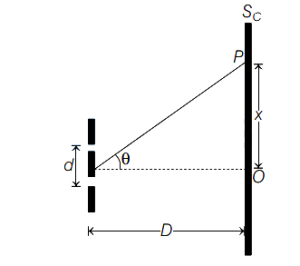
A
$I_{0} \cos ^{2}\left(\frac{\pi D}{\lambda d} x\right)$
B
$4 I_{0} \cos ^{2}\left(\frac{\pi d}{\lambda D} x\right)$
C
$I_{0} \sin ^{2}\left(\frac{\pi d}{2 \lambda D} x\right)$
D
$4 I_{0} \cos \left(\frac{\pi d}{2 \lambda D} x\right)$
Solution
(B) The path difference between the waves reaching point $P$ from the two slits is given by $\Delta x = \frac{xd}{D}$.
The corresponding phase difference $\phi$ is given by $\phi = \frac{2\pi}{\lambda} \Delta x = \frac{2\pi}{\lambda} \left(\frac{xd}{D}\right)$.
The resultant intensity $I_P$ at point $P$ for two coherent sources of equal intensity $I_0$ is given by the formula $I_P = 4I_0 \cos^2\left(\frac{\phi}{2}\right)$.
Substituting the value of $\phi$:
$I_P = 4I_0 \cos^2\left(\frac{1}{2} \cdot \frac{2\pi xd}{\lambda D}\right)$
$I_P = 4I_0 \cos^2\left(\frac{\pi dx}{\lambda D}\right)$.
The corresponding phase difference $\phi$ is given by $\phi = \frac{2\pi}{\lambda} \Delta x = \frac{2\pi}{\lambda} \left(\frac{xd}{D}\right)$.
The resultant intensity $I_P$ at point $P$ for two coherent sources of equal intensity $I_0$ is given by the formula $I_P = 4I_0 \cos^2\left(\frac{\phi}{2}\right)$.
Substituting the value of $\phi$:
$I_P = 4I_0 \cos^2\left(\frac{1}{2} \cdot \frac{2\pi xd}{\lambda D}\right)$
$I_P = 4I_0 \cos^2\left(\frac{\pi dx}{\lambda D}\right)$.
0 likes
View Solution526
EasyMCQ
In Young's double slit experiment, the distance between the slits and the screen is $1.2 \, m$ and the distance between the two slits is $2.4 \, mm$. If a thin transparent mica sheet of thickness $1 \, \mu m$ and refractive index $1.5$ is introduced in the path of one of the interfering beams, the shift in the position of the central bright fringe is (in $ \, mm$)
A
$2$
B
$0.5$
C
$0.125$
D
$0.25$
Solution
(D) Given: Distance between slits and screen $D = 1.2 \, m$, distance between slits $d = 2.4 \, mm = 2.4 \times 10^{-3} \, m$, thickness of mica sheet $t = 1 \, \mu m = 1 \times 10^{-6} \, m$, and refractive index $\mu = 1.5$.
When a transparent sheet is introduced in the path of one of the interfering beams, the shift in the position of the central bright fringe is given by the formula:
$y = (\mu - 1) t \frac{D}{d}$
Substituting the given values:
$y = (1.5 - 1) \times (1 \times 10^{-6} \, m) \times \frac{1.2 \, m}{2.4 \times 10^{-3} \, m}$
$y = 0.5 \times 10^{-6} \times \frac{1.2}{2.4 \times 10^{-3}}$
$y = 0.5 \times 10^{-6} \times 0.5 \times 10^{3}$
$y = 0.25 \times 10^{-3} \, m = 0.25 \, mm$
Thus, the shift in the position of the central bright fringe is $0.25 \, mm$.
When a transparent sheet is introduced in the path of one of the interfering beams, the shift in the position of the central bright fringe is given by the formula:
$y = (\mu - 1) t \frac{D}{d}$
Substituting the given values:
$y = (1.5 - 1) \times (1 \times 10^{-6} \, m) \times \frac{1.2 \, m}{2.4 \times 10^{-3} \, m}$
$y = 0.5 \times 10^{-6} \times \frac{1.2}{2.4 \times 10^{-3}}$
$y = 0.5 \times 10^{-6} \times 0.5 \times 10^{3}$
$y = 0.25 \times 10^{-3} \, m = 0.25 \, mm$
Thus, the shift in the position of the central bright fringe is $0.25 \, mm$.
0 likes
View Solution527
MediumMCQ
In Young's double slit experiment using monochromatic light of wavelength $ \lambda $, the intensity of light at a point on the screen where path difference is $ \lambda $ is $ K $ units. The intensity of light at a point where path difference is $ \frac{\lambda}{3} $ is:
A
$ 4 \,K $
B
$ K $
C
$ 2 \,K $
D
$ \frac{K}{4} $
Solution
(D) The intensity $ I $ at any point is given by $ I = I_{max} \cos^2 \left( \frac{\phi}{2} \right) $, where $ \phi $ is the phase difference.
Given that at path difference $ \Delta x = \lambda $, the intensity is $ K $. Since $ \Delta x = \lambda $ corresponds to a phase difference $ \phi = 2\pi $, we have $ K = I_{max} \cos^2 \left( \frac{2\pi}{2} \right) = I_{max} \cos^2(\pi) = I_{max} $.
Now, for a path difference $ \Delta x = \frac{\lambda}{3} $, the phase difference is $ \phi = \frac{2\pi}{\lambda} \cdot \Delta x = \frac{2\pi}{\lambda} \cdot \frac{\lambda}{3} = \frac{2\pi}{3} $.
The intensity at this point is $ I = I_{max} \cos^2 \left( \frac{\phi}{2} \right) = K \cos^2 \left( \frac{2\pi/3}{2} \right) $.
$ I = K \cos^2 \left( \frac{\pi}{3} \right) = K \left( \frac{1}{2} \right)^2 = \frac{K}{4} $.
Given that at path difference $ \Delta x = \lambda $, the intensity is $ K $. Since $ \Delta x = \lambda $ corresponds to a phase difference $ \phi = 2\pi $, we have $ K = I_{max} \cos^2 \left( \frac{2\pi}{2} \right) = I_{max} \cos^2(\pi) = I_{max} $.
Now, for a path difference $ \Delta x = \frac{\lambda}{3} $, the phase difference is $ \phi = \frac{2\pi}{\lambda} \cdot \Delta x = \frac{2\pi}{\lambda} \cdot \frac{\lambda}{3} = \frac{2\pi}{3} $.
The intensity at this point is $ I = I_{max} \cos^2 \left( \frac{\phi}{2} \right) = K \cos^2 \left( \frac{2\pi/3}{2} \right) $.
$ I = K \cos^2 \left( \frac{\pi}{3} \right) = K \left( \frac{1}{2} \right)^2 = \frac{K}{4} $.
0 likes
View Solution528
DifficultMCQ
In Young's double slit experiment,two wavelengths $\lambda_{1} = 780 \ nm$ and $\lambda_{2} = 520 \ nm$ are used to obtain interference fringes. If the $n^{\text{th}}$ bright band due to $\lambda_{1}$ coincides with $(n+1)^{\text{th}}$ bright band due to $\lambda_{2}$,then the value of $n$ is:
A
$04$
B
$03$
C
$02$
D
$06$
Solution
(C) The condition for the $n^{\text{th}}$ bright fringe in Young's double slit experiment is given by $y_n = \frac{n \lambda D}{d}$.
Given that the $n^{\text{th}}$ bright band of $\lambda_{1}$ coincides with the $(n+1)^{\text{th}}$ bright band of $\lambda_{2}$,we have:
$\frac{n \lambda_{1} D}{d} = \frac{(n+1) \lambda_{2} D}{d}$
Canceling the common terms $\frac{D}{d}$,we get:
$n \lambda_{1} = (n+1) \lambda_{2}$
Substituting the given values $\lambda_{1} = 780 \ nm$ and $\lambda_{2} = 520 \ nm$:
$n(780) = (n+1)(520)$
$780n = 520n + 520$
$780n - 520n = 520$
$260n = 520$
$n = \frac{520}{260} = 2$
Thus,the value of $n$ is $2$.
Given that the $n^{\text{th}}$ bright band of $\lambda_{1}$ coincides with the $(n+1)^{\text{th}}$ bright band of $\lambda_{2}$,we have:
$\frac{n \lambda_{1} D}{d} = \frac{(n+1) \lambda_{2} D}{d}$
Canceling the common terms $\frac{D}{d}$,we get:
$n \lambda_{1} = (n+1) \lambda_{2}$
Substituting the given values $\lambda_{1} = 780 \ nm$ and $\lambda_{2} = 520 \ nm$:
$n(780) = (n+1)(520)$
$780n = 520n + 520$
$780n - 520n = 520$
$260n = 520$
$n = \frac{520}{260} = 2$
Thus,the value of $n$ is $2$.
0 likes
View Solution529
DifficultMCQ
In Young's double slit experiment,slits are separated by $2 \,mm$ and the screen is placed at a distance of $1.2 \,m$ from the slits. Light consisting of two wavelengths $6500 \text{ Å}$ and $5200 \text{ Å}$ are used to obtain interference fringes. Then the separation between the fourth bright fringes of two different patterns produced by the two wavelengths is (in $\,mm$)
A
$0.312$
B
$0.123$
C
$0.213$
D
$0.412$
Solution
(A) The position of the $n^{th}$ bright fringe is given by the formula:
$y = \frac{n \lambda D}{d}$
where $\lambda$ is the wavelength,$D$ is the distance of the screen from the slits,and $d$ is the separation between the slits.
For the fourth bright fringe $(n=4)$,the positions for the two wavelengths are:
$y_1 = \frac{4 \lambda_1 D}{d}$ and $y_2 = \frac{4 \lambda_2 D}{d}$
The separation between these two fringes is:
$\Delta y = y_1 - y_2 = \frac{4 D}{d} (\lambda_1 - \lambda_2)$
Given values:
$n = 4$
$D = 1.2 \,m$
$d = 2 \,mm = 2 \times 10^{-3} \,m$
$\lambda_1 = 6500 \text{ Å} = 6500 \times 10^{-10} \,m$
$\lambda_2 = 5200 \text{ Å} = 5200 \times 10^{-10} \,m$
Substituting these values into the formula:
$\Delta y = \frac{4 \times 1.2}{2 \times 10^{-3}} \times (6500 - 5200) \times 10^{-10} \,m$
$\Delta y = \frac{4.8}{2 \times 10^{-3}} \times 1300 \times 10^{-10} \,m$
$\Delta y = 2.4 \times 10^3 \times 1300 \times 10^{-10} \,m$
$\Delta y = 3120 \times 10^{-7} \,m = 0.312 \times 10^{-3} \,m$
$\Delta y = 0.312 \,mm$
Thus,the separation between the fourth bright fringes is $0.312 \,mm$.
$y = \frac{n \lambda D}{d}$
where $\lambda$ is the wavelength,$D$ is the distance of the screen from the slits,and $d$ is the separation between the slits.
For the fourth bright fringe $(n=4)$,the positions for the two wavelengths are:
$y_1 = \frac{4 \lambda_1 D}{d}$ and $y_2 = \frac{4 \lambda_2 D}{d}$
The separation between these two fringes is:
$\Delta y = y_1 - y_2 = \frac{4 D}{d} (\lambda_1 - \lambda_2)$
Given values:
$n = 4$
$D = 1.2 \,m$
$d = 2 \,mm = 2 \times 10^{-3} \,m$
$\lambda_1 = 6500 \text{ Å} = 6500 \times 10^{-10} \,m$
$\lambda_2 = 5200 \text{ Å} = 5200 \times 10^{-10} \,m$
Substituting these values into the formula:
$\Delta y = \frac{4 \times 1.2}{2 \times 10^{-3}} \times (6500 - 5200) \times 10^{-10} \,m$
$\Delta y = \frac{4.8}{2 \times 10^{-3}} \times 1300 \times 10^{-10} \,m$
$\Delta y = 2.4 \times 10^3 \times 1300 \times 10^{-10} \,m$
$\Delta y = 3120 \times 10^{-7} \,m = 0.312 \times 10^{-3} \,m$
$\Delta y = 0.312 \,mm$
Thus,the separation between the fourth bright fringes is $0.312 \,mm$.
0 likes
View Solution530
EasyMCQ
In Young's double slit experiment,the source is white light. One slit is covered with a red filter and the other with a blue filter. There shall be
A
Alternate red and blue fringes
B
Alternate dark and pink fringes
C
Alternate dark and yellow fringes
D
No interference
Solution
(D) The conditions for sustained interference are as follows: The sources must be coherent,meaning they should have the same frequency (wavelength) and a constant phase difference.
In this experiment,one slit is covered with a red filter (transmitting only red light) and the other with a blue filter (transmitting only blue light).
Since the wavelengths of red light and blue light are significantly different,the two sources are incoherent.
Because the sources are incoherent,they cannot produce a stable interference pattern on the screen.
Therefore,no interference pattern will be observed.
In this experiment,one slit is covered with a red filter (transmitting only red light) and the other with a blue filter (transmitting only blue light).
Since the wavelengths of red light and blue light are significantly different,the two sources are incoherent.
Because the sources are incoherent,they cannot produce a stable interference pattern on the screen.
Therefore,no interference pattern will be observed.
0 likes
View Solution531
DifficultMCQ
In Young's double slit experiment, fringes of width $\beta$ are produced on a screen kept at a distance of $1 \,m$ from the slit. When the screen is moved away by $5 \times 10^{-2} \,m$, fringe width changes by $3 \times 10^{-5} \,m$. The separation between the slits is $1 \times 10^{-3} \,m$. The wavelength of the light used is (in $\,nm$)
A
$400$
B
$500$
C
$600$
D
$700$
Solution
(C) The fringe width in Young's double slit experiment is given by $\beta = \frac{\lambda D}{d}$.
When the screen distance $D$ is changed by $\Delta D$, the change in fringe width $\Delta \beta$ is given by $\Delta \beta = \frac{\lambda \Delta D}{d}$.
Given:
$\Delta D = 5 \times 10^{-2} \,m$
$\Delta \beta = 3 \times 10^{-5} \,m$
$d = 1 \times 10^{-3} \,m$
Rearranging the formula for wavelength $\lambda$:
$\lambda = \frac{\Delta \beta \cdot d}{\Delta D}$
Substituting the values:
$\lambda = \frac{(3 \times 10^{-5} \,m) \times (1 \times 10^{-3} \,m)}{5 \times 10^{-2} \,m}$
$\lambda = \frac{3 \times 10^{-8}}{5 \times 10^{-2}} \,m$
$\lambda = 0.6 \times 10^{-6} \,m = 6 \times 10^{-7} \,m$
Converting to nanometers $(1 \,nm = 10^{-9} \,m)$:
$\lambda = 600 \times 10^{-9} \,m = 600 \,nm$.
When the screen distance $D$ is changed by $\Delta D$, the change in fringe width $\Delta \beta$ is given by $\Delta \beta = \frac{\lambda \Delta D}{d}$.
Given:
$\Delta D = 5 \times 10^{-2} \,m$
$\Delta \beta = 3 \times 10^{-5} \,m$
$d = 1 \times 10^{-3} \,m$
Rearranging the formula for wavelength $\lambda$:
$\lambda = \frac{\Delta \beta \cdot d}{\Delta D}$
Substituting the values:
$\lambda = \frac{(3 \times 10^{-5} \,m) \times (1 \times 10^{-3} \,m)}{5 \times 10^{-2} \,m}$
$\lambda = \frac{3 \times 10^{-8}}{5 \times 10^{-2}} \,m$
$\lambda = 0.6 \times 10^{-6} \,m = 6 \times 10^{-7} \,m$
Converting to nanometers $(1 \,nm = 10^{-9} \,m)$:
$\lambda = 600 \times 10^{-9} \,m = 600 \,nm$.
0 likes
View Solution532
EasyMCQ
For sustained interference fringes in a double-slit experiment,the essential condition$(s)$ is/are:
$1$. Sources must be coherent.
$2$. The intensities of the two sources must be equal.
Here,the correct option$(s)$ is/are:
$1$. Sources must be coherent.
$2$. The intensities of the two sources must be equal.
Here,the correct option$(s)$ is/are:
A
Neither $(1)$ nor $(2)$
B
Both $(1)$ and $(2)$
C
Only $(1)$
D
Only $(2)$
Solution
(B) For sustained interference,the sources must be coherent,which is a necessary condition for a stable interference pattern.
Additionally,for high-contrast fringes (where the intensity at the minima is zero),the intensities of the two sources must be equal.
Therefore,both conditions are essential for ideal,sustained interference fringes.
Additionally,for high-contrast fringes (where the intensity at the minima is zero),the intensities of the two sources must be equal.
Therefore,both conditions are essential for ideal,sustained interference fringes.
0 likes
View Solution533
EasyMCQ
If the two slits in Young's double slit experiment are of unequal width,then
A
the dark fringes are not perfectly dark
B
the bright fringes will have unequal spacing
C
the bright fringes will have unequal brightness
D
the fringes do not appear
Solution
(A) In Young's double slit experiment,the intensity of light $I$ is proportional to the width of the slit $w$ $(I \propto w)$.
If the slits have unequal widths,the intensities of the light waves from the two slits,$I_{1}$ and $I_{2}$,will be unequal $(I_{1} \neq I_{2})$.
The intensity of the interference pattern is given by $I = I_{1} + I_{2} + 2\sqrt{I_{1}I_{2}} \cos \phi$.
The minimum intensity is given by $I_{\min} = (\sqrt{I_{1}} - \sqrt{I_{2}})^2$.
Since $I_{1} \neq I_{2}$,the value of $I_{\min}$ is greater than zero $(I_{\min} > 0)$.
Therefore,the dark fringes are not perfectly dark.
If the slits have unequal widths,the intensities of the light waves from the two slits,$I_{1}$ and $I_{2}$,will be unequal $(I_{1} \neq I_{2})$.
The intensity of the interference pattern is given by $I = I_{1} + I_{2} + 2\sqrt{I_{1}I_{2}} \cos \phi$.
The minimum intensity is given by $I_{\min} = (\sqrt{I_{1}} - \sqrt{I_{2}})^2$.
Since $I_{1} \neq I_{2}$,the value of $I_{\min}$ is greater than zero $(I_{\min} > 0)$.
Therefore,the dark fringes are not perfectly dark.
0 likes
View Solution534
EasyMCQ
Consider the following statements in the case of Young's double slit experiment.
$(1)$ $A$ slit $S$ is necessary if we use an ordinary extended source of light.
$(2)$ $A$ slit $S$ is not needed if we use an ordinary but well-collimated beam of light.
$(3)$ $A$ slit $S$ is not needed if we use a spatially coherent source of light.
Which of the above statements are correct?
$(1)$ $A$ slit $S$ is necessary if we use an ordinary extended source of light.
$(2)$ $A$ slit $S$ is not needed if we use an ordinary but well-collimated beam of light.
$(3)$ $A$ slit $S$ is not needed if we use a spatially coherent source of light.
Which of the above statements are correct?
A
$(1)$,$(2)$ and $(3)$
B
$(1)$ and $(2)$
C
$(2)$ and $(3)$
D
$(1)$ and $(3)$
Solution
(D) In Young's double slit experiment,the primary requirement for interference is the presence of coherent sources.
Statement $(1)$ is correct: An ordinary extended source of light is incoherent,so a single slit $S$ is required to act as a point source to ensure spatial coherence.
Statement $(2)$ is incorrect: Even if a beam is well-collimated,it does not guarantee the spatial coherence required for the two slits to act as secondary coherent sources.
Statement $(3)$ is correct: If the source is already spatially coherent,the light waves arriving at the two slits maintain a constant phase difference,making the initial slit $S$ redundant.
Therefore,statements $(1)$ and $(3)$ are correct.
Statement $(1)$ is correct: An ordinary extended source of light is incoherent,so a single slit $S$ is required to act as a point source to ensure spatial coherence.
Statement $(2)$ is incorrect: Even if a beam is well-collimated,it does not guarantee the spatial coherence required for the two slits to act as secondary coherent sources.
Statement $(3)$ is correct: If the source is already spatially coherent,the light waves arriving at the two slits maintain a constant phase difference,making the initial slit $S$ redundant.
Therefore,statements $(1)$ and $(3)$ are correct.
0 likes
View Solution535
DifficultMCQ
Young's double slit experiment gives interference fringes of width $0.3 \,mm$. $A$ thin glass plate made of material of refractive index $1.5$ is kept in the path of light from one of the slits,then the fringe width becomes
A
zero
B
$0.3 \,mm$
C
$0.45 \,mm$
D
$0.15 \,mm$
Solution
(B) The fringe width $\beta$ in Young's double slit experiment is given by $\beta = \frac{\lambda D}{d}$,where $\lambda$ is the wavelength of light,$D$ is the distance between the slits and the screen,and $d$ is the distance between the two slits.
When a thin glass plate of thickness $t$ and refractive index $\mu$ is introduced in the path of light from one of the slits,the optical path length increases by $(\mu - 1)t$.
This causes the entire interference pattern to shift by a distance $y_0 = \frac{D}{d}(\mu - 1)t$.
However,the fringe width $\beta$ depends only on the wavelength $\lambda$,the distance $D$,and the slit separation $d$. Since these parameters remain unchanged,the fringe width remains constant.
Therefore,the fringe width remains $0.3 \,mm$.
When a thin glass plate of thickness $t$ and refractive index $\mu$ is introduced in the path of light from one of the slits,the optical path length increases by $(\mu - 1)t$.
This causes the entire interference pattern to shift by a distance $y_0 = \frac{D}{d}(\mu - 1)t$.
However,the fringe width $\beta$ depends only on the wavelength $\lambda$,the distance $D$,and the slit separation $d$. Since these parameters remain unchanged,the fringe width remains constant.
Therefore,the fringe width remains $0.3 \,mm$.
0 likes
View Solution536
MediumMCQ
In Young's double slit experiment,a third slit is made in between the double slits. Then
A
intensity of fringes totally disappears
B
only bright light is observed on the screen
C
fringes of unequal width are formed
D
contrast between bright and dark fringes is reduced
Solution
(D) In Young's double slit experiment,the interference pattern is formed by the superposition of light waves from two coherent sources. If a third slit is introduced between the two slits,it acts as an additional source of light. This additional light contributes to the background illumination on the screen,which does not participate in the interference pattern. As a result,the intensity of the dark fringes increases,while the intensity of the bright fringes remains relatively unchanged. This leads to a decrease in the visibility or contrast between the bright and dark fringes.
0 likes
View Solution537
MediumMCQ
In a two-slit experiment with monochromatic light, fringes are obtained on a screen placed at some distance from the slits. If the screen is moved by $5 \times 10^{-2} \, m$ towards the slits, the change in fringe width is $3 \times 10^{-5} \, m$. If the separation between the slits is $10^{-3} \, m$, the wavelength of light used is: (in $\text{Å}$)
A
$6000$
B
$5000$
C
$3000$
D
$4500$
Solution
(A) The fringe width $\beta$ in a Young's double-slit experiment is given by $\beta = \frac{\lambda D}{d}$, where $\lambda$ is the wavelength, $D$ is the distance of the screen from the slits, and $d$ is the slit separation.
When the screen is moved by $\Delta D = 5 \times 10^{-2} \, m$, the change in fringe width is $\Delta \beta = 3 \times 10^{-5} \, m$.
From the formula, the change in fringe width is $\Delta \beta = \frac{\lambda}{d} \Delta D$.
Rearranging for $\lambda$, we get $\lambda = \frac{\Delta \beta \cdot d}{\Delta D}$.
Substituting the given values:
$\lambda = \frac{(3 \times 10^{-5} \, m) \times (10^{-3} \, m)}{5 \times 10^{-2} \, m}$.
$\lambda = \frac{3 \times 10^{-8}}{5 \times 10^{-2}} \, m = 0.6 \times 10^{-6} \, m = 6 \times 10^{-7} \, m$.
Converting to $\text{Å}$ $(1 \, \text{Å} = 10^{-10} \, m)$:
$\lambda = 6000 \times 10^{-10} \, m = 6000 \, \text{Å}$.
When the screen is moved by $\Delta D = 5 \times 10^{-2} \, m$, the change in fringe width is $\Delta \beta = 3 \times 10^{-5} \, m$.
From the formula, the change in fringe width is $\Delta \beta = \frac{\lambda}{d} \Delta D$.
Rearranging for $\lambda$, we get $\lambda = \frac{\Delta \beta \cdot d}{\Delta D}$.
Substituting the given values:
$\lambda = \frac{(3 \times 10^{-5} \, m) \times (10^{-3} \, m)}{5 \times 10^{-2} \, m}$.
$\lambda = \frac{3 \times 10^{-8}}{5 \times 10^{-2}} \, m = 0.6 \times 10^{-6} \, m = 6 \times 10^{-7} \, m$.
Converting to $\text{Å}$ $(1 \, \text{Å} = 10^{-10} \, m)$:
$\lambda = 6000 \times 10^{-10} \, m = 6000 \, \text{Å}$.
0 likes
View Solution538
MediumMCQ
In Young's double slit experiment with a sodium vapour lamp of wavelength $589 \ nm$ and the slits $0.589 \ mm$ apart,the half angular width of the central maximum is
A
$\sin^{-1}(0.001)$
B
$\sin^{-1}(0.00001)$
C
$\sin^{-1}(0.0001)$
D
$\sin^{-1}(0.01)$
Solution
(A) In Young's double slit experiment,the half angular width $\theta$ of the central maximum is given by the relation $\sin \theta = \frac{\lambda}{d}$.
Given wavelength $\lambda = 589 \ nm = 589 \times 10^{-9} \ m$.
Given slit separation $d = 0.589 \ mm = 0.589 \times 10^{-3} \ m$.
Substituting the values:
$\sin \theta = \frac{589 \times 10^{-9}}{0.589 \times 10^{-3}}$
$\sin \theta = \frac{589 \times 10^{-9}}{589 \times 10^{-6}} = 10^{-3} = 0.001$.
Therefore,$\theta = \sin^{-1}(0.001)$.
Given wavelength $\lambda = 589 \ nm = 589 \times 10^{-9} \ m$.
Given slit separation $d = 0.589 \ mm = 0.589 \times 10^{-3} \ m$.
Substituting the values:
$\sin \theta = \frac{589 \times 10^{-9}}{0.589 \times 10^{-3}}$
$\sin \theta = \frac{589 \times 10^{-9}}{589 \times 10^{-6}} = 10^{-3} = 0.001$.
Therefore,$\theta = \sin^{-1}(0.001)$.
0 likes
View Solution539
MediumMCQ
In Young's double slit experiment,the wavelengths of red and blue lights used are $7.5 \times 10^{-5} \text{ cm}$ and $5 \times 10^{-5} \text{ cm}$ respectively. If the $n^{\text{th}}$ bright fringe of red color coincides with the $(n+1)^{\text{th}}$ bright fringe of blue color,then the value of $n$ is:
A
$1$
B
$2$
C
$4$
D
$8$
Solution
(B) The condition for the position of the $n^{\text{th}}$ bright fringe in Young's double slit experiment is given by $y_n = \frac{n \lambda D}{d}$.
For the $n^{\text{th}}$ bright fringe of red light $(\lambda_r = 7.5 \times 10^{-5} \text{ cm})$,the position is $y_r = \frac{n \lambda_r D}{d}$.
For the $(n+1)^{\text{th}}$ bright fringe of blue light $(\lambda_b = 5 \times 10^{-5} \text{ cm})$,the position is $y_b = \frac{(n+1) \lambda_b D}{d}$.
Since the fringes coincide,$y_r = y_b$,which implies $n \lambda_r = (n+1) \lambda_b$.
Substituting the given values: $n(7.5 \times 10^{-5}) = (n+1)(5 \times 10^{-5})$.
Dividing both sides by $10^{-5}$,we get $7.5n = 5(n+1)$.
$7.5n = 5n + 5$.
$2.5n = 5$.
$n = \frac{5}{2.5} = 2$.
Thus,the value of $n$ is $2$.
For the $n^{\text{th}}$ bright fringe of red light $(\lambda_r = 7.5 \times 10^{-5} \text{ cm})$,the position is $y_r = \frac{n \lambda_r D}{d}$.
For the $(n+1)^{\text{th}}$ bright fringe of blue light $(\lambda_b = 5 \times 10^{-5} \text{ cm})$,the position is $y_b = \frac{(n+1) \lambda_b D}{d}$.
Since the fringes coincide,$y_r = y_b$,which implies $n \lambda_r = (n+1) \lambda_b$.
Substituting the given values: $n(7.5 \times 10^{-5}) = (n+1)(5 \times 10^{-5})$.
Dividing both sides by $10^{-5}$,we get $7.5n = 5(n+1)$.
$7.5n = 5n + 5$.
$2.5n = 5$.
$n = \frac{5}{2.5} = 2$.
Thus,the value of $n$ is $2$.
0 likes
View Solution540
MediumMCQ
In Young's double slit experiment,the wavelength of monochromatic light is increased by $20 \%$ and the distance between the two slits is decreased by $25 \%$. If the initial fringe width is $0.3 \ mm$,then the final fringe width is (in $mm$)
A
$0.72$
B
$0.60$
C
$0.16$
D
$0.48$
Solution
(D) The fringe width $\beta$ in Young's double slit experiment is given by the formula $\beta = \frac{\lambda D}{d}$,where $\lambda$ is the wavelength,$D$ is the distance between the screen and the slits,and $d$ is the distance between the two slits.
Given that $\lambda' = \lambda + 0.20\lambda = 1.20\lambda$ and $d' = d - 0.25d = 0.75d$.
The new fringe width $\beta'$ is given by $\beta' = \frac{\lambda' D}{d'} = \frac{1.20\lambda D}{0.75d}$.
Substituting $\beta = \frac{\lambda D}{d}$,we get $\beta' = \frac{1.20}{0.75} \beta = 1.6 \beta$.
Given the initial fringe width $\beta = 0.3 \ mm$,the final fringe width is $\beta' = 1.6 \times 0.3 \ mm = 0.48 \ mm$.
Given that $\lambda' = \lambda + 0.20\lambda = 1.20\lambda$ and $d' = d - 0.25d = 0.75d$.
The new fringe width $\beta'$ is given by $\beta' = \frac{\lambda' D}{d'} = \frac{1.20\lambda D}{0.75d}$.
Substituting $\beta = \frac{\lambda D}{d}$,we get $\beta' = \frac{1.20}{0.75} \beta = 1.6 \beta$.
Given the initial fringe width $\beta = 0.3 \ mm$,the final fringe width is $\beta' = 1.6 \times 0.3 \ mm = 0.48 \ mm$.
0 likes
View Solution541
MediumMCQ
In Young's double slit experiment,the distance between the slits is $0.2 \ cm$,the distance between the screen and the slits is $1 \ m$. If the wavelength of light used in the experiment is $5000 \ Å$,then the distance between two consecutive dark fringes on the screen is (in $mm$)
A
$0.25$
B
$0.26$
C
$0.27$
D
$0.28$
Solution
(A) The fringe width $\beta$ in Young's double slit experiment is given by the formula $\beta = \frac{\lambda D}{d}$.
Here,the wavelength $\lambda = 5000 \ Å = 5000 \times 10^{-10} \ m = 5 \times 10^{-7} \ m$.
The distance between the screen and the slits $D = 1 \ m$.
The distance between the slits $d = 0.2 \ cm = 0.2 \times 10^{-2} \ m = 2 \times 10^{-3} \ m$.
Substituting these values into the formula:
$\beta = \frac{5 \times 10^{-7} \times 1}{2 \times 10^{-3}}$
$\beta = 2.5 \times 10^{-4} \ m$
Converting this to millimeters:
$\beta = 2.5 \times 10^{-4} \times 10^3 \ mm = 0.25 \ mm$.
Therefore,the distance between two consecutive dark fringes is $0.25 \ mm$.
Here,the wavelength $\lambda = 5000 \ Å = 5000 \times 10^{-10} \ m = 5 \times 10^{-7} \ m$.
The distance between the screen and the slits $D = 1 \ m$.
The distance between the slits $d = 0.2 \ cm = 0.2 \times 10^{-2} \ m = 2 \times 10^{-3} \ m$.
Substituting these values into the formula:
$\beta = \frac{5 \times 10^{-7} \times 1}{2 \times 10^{-3}}$
$\beta = 2.5 \times 10^{-4} \ m$
Converting this to millimeters:
$\beta = 2.5 \times 10^{-4} \times 10^3 \ mm = 0.25 \ mm$.
Therefore,the distance between two consecutive dark fringes is $0.25 \ mm$.
0 likes
View Solution542
EasyMCQ
In Young's double slit experiment,if the distance between the slits is increased to $3$ times the initial distance,then the ratio of initial and final fringe widths is
A
$1: 9$
B
$9: 1$
C
$3: 1$
D
$1: 3$
Solution
(C) The fringe width $\beta$ in Young's double slit experiment is given by the formula $\beta = \frac{\lambda D}{d}$,where $\lambda$ is the wavelength of light,$D$ is the distance between the slits and the screen,and $d$ is the distance between the two slits.
From the formula,we can see that the fringe width is inversely proportional to the slit separation,i.e.,$\beta \propto \frac{1}{d}$.
Let the initial slit separation be $d_1 = d$ and the initial fringe width be $\beta_1 = \beta$.
Given that the final slit separation is $d_2 = 3d$.
Therefore,the final fringe width $\beta_2$ is given by $\beta_2 = \frac{\lambda D}{3d} = \frac{\beta}{3}$.
The ratio of the initial fringe width to the final fringe width is $\frac{\beta_1}{\beta_2} = \frac{\beta}{\beta/3} = 3:1$.
From the formula,we can see that the fringe width is inversely proportional to the slit separation,i.e.,$\beta \propto \frac{1}{d}$.
Let the initial slit separation be $d_1 = d$ and the initial fringe width be $\beta_1 = \beta$.
Given that the final slit separation is $d_2 = 3d$.
Therefore,the final fringe width $\beta_2$ is given by $\beta_2 = \frac{\lambda D}{3d} = \frac{\beta}{3}$.
The ratio of the initial fringe width to the final fringe width is $\frac{\beta_1}{\beta_2} = \frac{\beta}{\beta/3} = 3:1$.
0 likes
View Solution543
MediumMCQ
In Young's double slit experiment,if the distance between the slits is $2 \ mm$ and the distance of the screen from the slits is $100 \ cm$,the fringe width is $0.36 \ mm$. If the distance between the slits is decreased by $0.5 \ mm$ and the distance of the screen from the slits is increased by $50 \ cm$,the fringe width becomes (in $mm$)
A
$0.84$
B
$0.96$
C
$0.48$
D
$0.72$
Solution
(D) The formula for fringe width in Young's double slit experiment is $\beta = \frac{\lambda D}{d}$,where $\lambda$ is the wavelength,$D$ is the distance of the screen from the slits,and $d$ is the distance between the slits.
Initially,$d_1 = 2 \ mm$,$D_1 = 100 \ cm = 1000 \ mm$,and $\beta_1 = 0.36 \ mm$.
Thus,$0.36 = \frac{\lambda \times 1000}{2} \implies \lambda = \frac{0.36 \times 2}{1000} = 0.00072 \ mm$.
Now,the new distance between the slits is $d_2 = 2 \ mm - 0.5 \ mm = 1.5 \ mm$.
The new distance of the screen is $D_2 = 100 \ cm + 50 \ cm = 150 \ cm = 1500 \ mm$.
The new fringe width $\beta_2$ is given by $\beta_2 = \frac{\lambda D_2}{d_2}$.
Substituting the values: $\beta_2 = \frac{0.00072 \times 1500}{1.5} = \frac{0.00072 \times 1000}{1} = 0.72 \ mm$.
Initially,$d_1 = 2 \ mm$,$D_1 = 100 \ cm = 1000 \ mm$,and $\beta_1 = 0.36 \ mm$.
Thus,$0.36 = \frac{\lambda \times 1000}{2} \implies \lambda = \frac{0.36 \times 2}{1000} = 0.00072 \ mm$.
Now,the new distance between the slits is $d_2 = 2 \ mm - 0.5 \ mm = 1.5 \ mm$.
The new distance of the screen is $D_2 = 100 \ cm + 50 \ cm = 150 \ cm = 1500 \ mm$.
The new fringe width $\beta_2$ is given by $\beta_2 = \frac{\lambda D_2}{d_2}$.
Substituting the values: $\beta_2 = \frac{0.00072 \times 1500}{1.5} = \frac{0.00072 \times 1000}{1} = 0.72 \ mm$.
0 likes
View Solution544
EasyMCQ
In Young's double-slit experiment with monochromatic light of wavelength $6000 \text{ Å}$, the fringe width is $3 \text{ mm}$. If the distance between the screen and slits is increased by $50 \%$ and the distance between the slits is decreased by $10 \%$, then the new fringe width is: (in $\text{ mm}$)
A
$12$
B
$5$
C
$6$
D
$10$
Solution
(B) The formula for fringe width in Young's double-slit experiment is $\beta = \frac{\lambda D}{d}$.
Given initial fringe width $\beta_1 = \frac{\lambda D}{d} = 3 \text{ mm}$.
According to the problem, the new distance $D' = D + 0.5D = 1.5D$ and the new slit separation $d' = d - 0.1d = 0.9d$.
The new fringe width $\beta_2$ is given by $\beta_2 = \frac{\lambda D'}{d'} = \frac{\lambda (1.5D)}{0.9d}$.
Simplifying this, $\beta_2 = \frac{1.5}{0.9} \times \frac{\lambda D}{d} = \frac{15}{9} \times \beta_1 = \frac{5}{3} \times 3 \text{ mm}$.
Therefore, $\beta_2 = 5 \text{ mm}$.
Given initial fringe width $\beta_1 = \frac{\lambda D}{d} = 3 \text{ mm}$.
According to the problem, the new distance $D' = D + 0.5D = 1.5D$ and the new slit separation $d' = d - 0.1d = 0.9d$.
The new fringe width $\beta_2$ is given by $\beta_2 = \frac{\lambda D'}{d'} = \frac{\lambda (1.5D)}{0.9d}$.
Simplifying this, $\beta_2 = \frac{1.5}{0.9} \times \frac{\lambda D}{d} = \frac{15}{9} \times \beta_1 = \frac{5}{3} \times 3 \text{ mm}$.
Therefore, $\beta_2 = 5 \text{ mm}$.
0 likes
View Solution545
MediumMCQ
In Young's double slit experiment,the intensity at a point where the path difference is $\frac{\lambda}{6}$ ($\lambda$ being the wavelength of the light used) is $I$. If $I_0$ denotes the maximum intensity,then $\frac{I}{I_0}$ is equal to:
A
$\frac{1}{\sqrt{2}}$
B
$\frac{\sqrt{3}}{2}$
C
$\frac{1}{2}$
D
$\frac{3}{4}$
Solution
(D) In Young's double slit experiment $(YDSE)$,the path difference is given as $\Delta x = \frac{\lambda}{6}$.
Assuming the intensities of the two slits are equal,let $I_1 = I_2 = I_s$.
The phase difference $\Delta \phi$ is given by $\Delta \phi = \frac{2 \pi}{\lambda} \Delta x = \frac{2 \pi}{\lambda} \times \frac{\lambda}{6} = \frac{\pi}{3}$.
The resultant intensity $I$ at any point is given by $I = I_1 + I_2 + 2 \sqrt{I_1 I_2} \cos(\Delta \phi)$.
Substituting the values: $I = I_s + I_s + 2 \sqrt{I_s I_s} \cos(\frac{\pi}{3}) = 2 I_s + 2 I_s (\frac{1}{2}) = 2 I_s + I_s = 3 I_s$.
The maximum intensity $I_0$ occurs when $\cos(\Delta \phi) = 1$,so $I_0 = I_1 + I_2 + 2 \sqrt{I_1 I_2} = (\sqrt{I_s} + \sqrt{I_s})^2 = (2 \sqrt{I_s})^2 = 4 I_s$.
Therefore,the ratio $\frac{I}{I_0} = \frac{3 I_s}{4 I_s} = \frac{3}{4}$.
Assuming the intensities of the two slits are equal,let $I_1 = I_2 = I_s$.
The phase difference $\Delta \phi$ is given by $\Delta \phi = \frac{2 \pi}{\lambda} \Delta x = \frac{2 \pi}{\lambda} \times \frac{\lambda}{6} = \frac{\pi}{3}$.
The resultant intensity $I$ at any point is given by $I = I_1 + I_2 + 2 \sqrt{I_1 I_2} \cos(\Delta \phi)$.
Substituting the values: $I = I_s + I_s + 2 \sqrt{I_s I_s} \cos(\frac{\pi}{3}) = 2 I_s + 2 I_s (\frac{1}{2}) = 2 I_s + I_s = 3 I_s$.
The maximum intensity $I_0$ occurs when $\cos(\Delta \phi) = 1$,so $I_0 = I_1 + I_2 + 2 \sqrt{I_1 I_2} = (\sqrt{I_s} + \sqrt{I_s})^2 = (2 \sqrt{I_s})^2 = 4 I_s$.
Therefore,the ratio $\frac{I}{I_0} = \frac{3 I_s}{4 I_s} = \frac{3}{4}$.
0 likes
View Solution546
EasyMCQ
In Young's double slit experiment,two slits are placed $2 \ mm$ from each other. An interference pattern is observed on a screen placed $2 \ m$ from the plane of the slits. The fringe width for light of wavelength $400 \ nm$ is:
A
$0.4 \times 10^{-6} \ m$
B
$4 \times 10^{-6} \ m$
C
$0.4 \times 10^{-3} \ m$
D
$400 \ m$
Solution
(C) In Young's double slit experiment $(YDSE)$,the fringe width $\beta$ is given by the formula: $\beta = \frac{\lambda D}{d}$.
Given values are:
Slit separation,$d = 2 \ mm = 2 \times 10^{-3} \ m$.
Distance to screen,$D = 2 \ m$.
Wavelength of light,$\lambda = 400 \ nm = 400 \times 10^{-9} \ m$.
Substituting these values into the formula:
$\beta = \frac{(400 \times 10^{-9} \ m) \times (2 \ m)}{2 \times 10^{-3} \ m}$.
$\beta = \frac{800 \times 10^{-9}}{2 \times 10^{-3}} \ m$.
$\beta = 400 \times 10^{-6} \ m = 0.4 \times 10^{-3} \ m$.
Given values are:
Slit separation,$d = 2 \ mm = 2 \times 10^{-3} \ m$.
Distance to screen,$D = 2 \ m$.
Wavelength of light,$\lambda = 400 \ nm = 400 \times 10^{-9} \ m$.
Substituting these values into the formula:
$\beta = \frac{(400 \times 10^{-9} \ m) \times (2 \ m)}{2 \times 10^{-3} \ m}$.
$\beta = \frac{800 \times 10^{-9}}{2 \times 10^{-3}} \ m$.
$\beta = 400 \times 10^{-6} \ m = 0.4 \times 10^{-3} \ m$.
0 likes
View Solution547
EasyMCQ
In a Young's double slit experiment,if the wavelength of light is increased by $50 \%$ and the distance between the slits is doubled,then the percentage change in fringe width is (in $\%$)
A
$75$
B
$50$
C
$25$
D
$15$
Solution
(C) The fringe width $\beta$ in a Young's double slit experiment is given by $\beta = \frac{D \lambda}{d}$.
Given that the wavelength is increased by $50 \%$,the new wavelength is $\lambda' = \lambda + 0.50 \lambda = 1.50 \lambda$.
The distance between the slits is doubled,so $d' = 2d$.
The new fringe width $\beta'$ is $\beta' = \frac{D \lambda'}{d'} = \frac{D (1.50 \lambda)}{2d} = 0.75 \beta$.
The percentage change in fringe width is given by $\frac{\beta' - \beta}{\beta} \times 100 \%$.
Substituting the values: $\frac{0.75 \beta - \beta}{\beta} \times 100 \% = -0.25 \times 100 \% = -25 \%$.
The magnitude of the percentage change is $25 \%$.
Given that the wavelength is increased by $50 \%$,the new wavelength is $\lambda' = \lambda + 0.50 \lambda = 1.50 \lambda$.
The distance between the slits is doubled,so $d' = 2d$.
The new fringe width $\beta'$ is $\beta' = \frac{D \lambda'}{d'} = \frac{D (1.50 \lambda)}{2d} = 0.75 \beta$.
The percentage change in fringe width is given by $\frac{\beta' - \beta}{\beta} \times 100 \%$.
Substituting the values: $\frac{0.75 \beta - \beta}{\beta} \times 100 \% = -0.25 \times 100 \% = -25 \%$.
The magnitude of the percentage change is $25 \%$.
0 likes
View Solution548
EasyMCQ
In a Young's double slit experiment,a laser light of wavelength $560 \,nm$ produces an interference pattern with consecutive bright fringes' separation of $7.2 \,mm$. Now,another light is used to produce an interference pattern with consecutive bright fringes' separation of $8.1 \,mm$. The wavelength of the second light is: (in $\,nm$)
A
$680$
B
$630$
C
$650$
D
$540$
Solution
(B) The fringe width $\beta$ in a Young's double slit experiment is given by the formula $\beta = \frac{\lambda D}{d}$,where $\lambda$ is the wavelength,$D$ is the distance between the slits and the screen,and $d$ is the distance between the two slits.
Given $\lambda_1 = 560 \,nm$ and $\beta_1 = 7.2 \,mm$.
For the second light,$\beta_2 = 8.1 \,mm$.
Since $D$ and $d$ are constant,we have $\beta \propto \lambda$,which implies $\frac{\beta_1}{\beta_2} = \frac{\lambda_1}{\lambda_2}$.
Rearranging for $\lambda_2$,we get $\lambda_2 = \lambda_1 \times \frac{\beta_2}{\beta_1}$.
Substituting the values: $\lambda_2 = 560 \,nm \times \frac{8.1 \,mm}{7.2 \,mm} = 560 \times \frac{81}{72} = 560 \times \frac{9}{8} = 70 \times 9 = 630 \,nm$.
Thus,the wavelength of the second light is $630 \,nm$.
Given $\lambda_1 = 560 \,nm$ and $\beta_1 = 7.2 \,mm$.
For the second light,$\beta_2 = 8.1 \,mm$.
Since $D$ and $d$ are constant,we have $\beta \propto \lambda$,which implies $\frac{\beta_1}{\beta_2} = \frac{\lambda_1}{\lambda_2}$.
Rearranging for $\lambda_2$,we get $\lambda_2 = \lambda_1 \times \frac{\beta_2}{\beta_1}$.
Substituting the values: $\lambda_2 = 560 \,nm \times \frac{8.1 \,mm}{7.2 \,mm} = 560 \times \frac{81}{72} = 560 \times \frac{9}{8} = 70 \times 9 = 630 \,nm$.
Thus,the wavelength of the second light is $630 \,nm$.
0 likes
View SolutionWave Optics — Young's Double Slit Experiment (YDSE) · Frequently Asked Questions
1Are these Wave Optics questions useful for JEE and NEET?
Yes. All questions in this section are mapped to JEE Main and NEET exam patterns. Previous year questions from JEE Main, NEET, GUJCET and state-level exams are included with full solutions.
2Can I switch to Hindi or Gujarati for these questions?
Yes. Use the language tabs in the hero section or the sidebar to view the same questions and solutions in English, Hindi or Gujarati.
3How do I generate a question paper from this subtopic?
Use the Vedclass Exam Paper Generator — select the chapter and subtopic, set difficulty, and generate Sets A, B, C, D automatically. First 3 chapters of every subject are free.
Vedclass Products
For Students
Vedclass Test Series
Mock tests in real JEE/NEET style with performance analysis. 5-day free trial.
Start Free TrialFor Teachers
Exam Paper Generator
Generate Set A/B/C/D papers from this chapter in 2 minutes. 3 chapters free.
Try FreeFor Institutes
Online Exam Module
Live online exams with unlimited students, 360° analytics & white-label branding.
See DemoFor Teachers & Institutes
Generate a Wave Optics Exam Paper in 2 Minutes
Select subtopic & difficulty — Sets A, B, C, D auto-generated with No Repeat logic.
First 3 chapters of every subject are free — no payment required.