
A English
Single Slit Diffraction of Light Questions in English
Class 12 Physics · Wave Optics · Single Slit Diffraction of Light
276+
Questions
English
Language
100%
With Solutions
Showing 49 of 276 questions in English
1
EasyMCQ
Ray optics fails when
A
The size of the obstacle is $5 \ cm$
B
The size of the obstacle is $3 \ cm$
C
The size of the obstacle is less than the wavelength of light
D
$(a)$ and $(b)$ both
Solution
(C) Ray optics is based on the assumption that light travels in straight lines. This approximation holds true only when the size of the obstacle or aperture is much larger than the wavelength of light $(\lambda)$.
When the size of the obstacle becomes comparable to or smaller than the wavelength of light, diffraction effects become significant, and the ray approximation is no longer valid.
Therefore, ray optics fails when the size of the obstacle is less than or comparable to the wavelength of light.
When the size of the obstacle becomes comparable to or smaller than the wavelength of light, diffraction effects become significant, and the ray approximation is no longer valid.
Therefore, ray optics fails when the size of the obstacle is less than or comparable to the wavelength of light.
0 likes
View Solution2
EasyMCQ
Light appears to travel in straight lines since
A
It is not absorbed by the atmosphere
B
It is reflected by the atmosphere
C
Its wavelength is very small
D
Its velocity is very large
Solution
(C) The phenomenon of light bending around obstacles is known as diffraction. Diffraction is significant only when the size of the obstacle or aperture is comparable to the wavelength of the light. Since the wavelength of visible light is extremely small ($400 \, nm$ to $700 \, nm$), it does not show noticeable diffraction around common objects in our daily life. Consequently, light appears to travel in straight lines, a principle known as rectilinear propagation of light. Therefore, the correct option is $C$.
0 likes
View Solution3
MediumMCQ
$A$ slit of width $a$ is illuminated by white light. For red light $(\lambda = 6500 \; \mathring{A})$,the first minima is obtained at $\theta = 30^\circ$. Then the value of $a$ will be
A
$3250 \; \mathring{A}$
B
$6.5 \times 10^{-4} \; mm$
C
$1.3 \; \mu m$
D
$2.6 \times 10^{-4} \; cm$
Solution
(C) For the first minima in single slit diffraction,the condition is given by $a \sin \theta = n \lambda$.
For the first minima,$n = 1$,so $a \sin \theta = \lambda$.
Given $\lambda = 6500 \; \mathring{A} = 6500 \times 10^{-10} \; m$ and $\theta = 30^\circ$.
Substituting the values: $a \sin(30^\circ) = 6500 \times 10^{-10} \; m$.
Since $\sin(30^\circ) = 0.5$,we have $a(0.5) = 6500 \times 10^{-10} \; m$.
$a = 2 \times 6500 \times 10^{-10} \; m = 13000 \times 10^{-10} \; m = 1.3 \times 10^{-6} \; m$.
Since $1 \; \mu m = 10^{-6} \; m$,we get $a = 1.3 \; \mu m$.
For the first minima,$n = 1$,so $a \sin \theta = \lambda$.
Given $\lambda = 6500 \; \mathring{A} = 6500 \times 10^{-10} \; m$ and $\theta = 30^\circ$.
Substituting the values: $a \sin(30^\circ) = 6500 \times 10^{-10} \; m$.
Since $\sin(30^\circ) = 0.5$,we have $a(0.5) = 6500 \times 10^{-10} \; m$.
$a = 2 \times 6500 \times 10^{-10} \; m = 13000 \times 10^{-10} \; m = 1.3 \times 10^{-6} \; m$.
Since $1 \; \mu m = 10^{-6} \; m$,we get $a = 1.3 \; \mu m$.
0 likes
View Solution4
MediumMCQ
The light of wavelength $6328 \ \mathring{A}$ is incident on a slit of width $0.2 \ mm$ perpendicularly. The angular width of the central maxima will be.....$^o$
A
$0.36$
B
$0.18$
C
$0.72$
D
$0.09$
Solution
(A) The angular half-width of the central maxima for a single slit diffraction is given by $\sin \theta = \frac{\lambda}{a}$.
Since $\theta$ is very small,$\sin \theta \approx \theta = \frac{\lambda}{a}$.
Given $\lambda = 6328 \times 10^{-10} \ m$ and $a = 0.2 \times 10^{-3} \ m$.
$\theta = \frac{6328 \times 10^{-10}}{0.2 \times 10^{-3}} = 3.164 \times 10^{-3} \ \text{radians}$.
To convert radians to degrees,multiply by $\frac{180}{\pi}$:
$\theta = 3.164 \times 10^{-3} \times \frac{180}{3.14159} \approx 0.18^o$.
The total angular width of the central maxima is $2\theta = 2 \times 0.18^o = 0.36^o$.
Since $\theta$ is very small,$\sin \theta \approx \theta = \frac{\lambda}{a}$.
Given $\lambda = 6328 \times 10^{-10} \ m$ and $a = 0.2 \times 10^{-3} \ m$.
$\theta = \frac{6328 \times 10^{-10}}{0.2 \times 10^{-3}} = 3.164 \times 10^{-3} \ \text{radians}$.
To convert radians to degrees,multiply by $\frac{180}{\pi}$:
$\theta = 3.164 \times 10^{-3} \times \frac{180}{3.14159} \approx 0.18^o$.
The total angular width of the central maxima is $2\theta = 2 \times 0.18^o = 0.36^o$.
0 likes
View Solution5
EasyMCQ
The bending of a beam of light around the corners of obstacles is called
A
Reflection
B
Diffraction
C
Refraction
D
Interference
Solution
(B) The correct answer is $B$.
Diffraction is defined as the phenomenon of bending of light around the corners of an obstacle or an aperture into the region of geometrical shadow.
This occurs when the size of the obstacle or aperture is comparable to the wavelength of the light wave.
Diffraction is defined as the phenomenon of bending of light around the corners of an obstacle or an aperture into the region of geometrical shadow.
This occurs when the size of the obstacle or aperture is comparable to the wavelength of the light wave.
0 likes
View Solution6
EasyMCQ
The penetration of light into the region of geometrical shadow is called:
A
Polarisation
B
Interference
C
Diffraction
D
Refraction
Solution
(C) The phenomenon of bending of light around the corners of an obstacle or an aperture into the region of geometrical shadow is known as $Diffraction$.
This occurs when the size of the obstacle or aperture is comparable to the wavelength of light.
This occurs when the size of the obstacle or aperture is comparable to the wavelength of light.
0 likes
View Solution7
MediumMCQ
$A$ slit of size $0.15 \,cm$ is placed at $2.1 \,m$ from a screen. On illuminating it by a light of wavelength $5 \times 10^{-5} \,cm$,the width of the central maxima will be:
A
$70 \,mm$
B
$0.14 \,mm$
C
$1.4 \,mm$
D
$0.14 \,cm$
Solution
(C) The width of the central maxima in a single-slit diffraction pattern is given by the formula: $w = \frac{2 \lambda D}{d}$.
Given values are:
Slit width $d = 0.15 \,cm = 0.15 \times 10^{-2} \,m = 1.5 \times 10^{-3} \,m$.
Distance from screen $D = 2.1 \,m$.
Wavelength $\lambda = 5 \times 10^{-5} \,cm = 5 \times 10^{-7} \,m$.
Substituting these values into the formula:
$w = \frac{2 \times (5 \times 10^{-7} \,m) \times (2.1 \,m)}{1.5 \times 10^{-3} \,m}$.
$w = \frac{21 \times 10^{-7}}{1.5 \times 10^{-3}} \,m$.
$w = 14 \times 10^{-4} \,m = 1.4 \times 10^{-3} \,m$.
Since $10^{-3} \,m = 1 \,mm$,the width is $1.4 \,mm$.
Given values are:
Slit width $d = 0.15 \,cm = 0.15 \times 10^{-2} \,m = 1.5 \times 10^{-3} \,m$.
Distance from screen $D = 2.1 \,m$.
Wavelength $\lambda = 5 \times 10^{-5} \,cm = 5 \times 10^{-7} \,m$.
Substituting these values into the formula:
$w = \frac{2 \times (5 \times 10^{-7} \,m) \times (2.1 \,m)}{1.5 \times 10^{-3} \,m}$.
$w = \frac{21 \times 10^{-7}}{1.5 \times 10^{-3}} \,m$.
$w = 14 \times 10^{-4} \,m = 1.4 \times 10^{-3} \,m$.
Since $10^{-3} \,m = 1 \,mm$,the width is $1.4 \,mm$.
0 likes
View Solution8
EasyMCQ
$A$ diffraction pattern is obtained by using a beam of red light. What will happen if the red light is replaced by blue light?
A
Bands will become narrower and crowd together
B
Bands become broader and further apart
C
No change will take place
D
Bands disappear
Solution
(A) The width of the diffraction bands is given by the formula $\beta = \frac{D\lambda}{d}$,where $D$ is the distance of the screen from the slit,$\lambda$ is the wavelength of light,and $d$ is the slit width.
From this relation,it is clear that the band width is directly proportional to the wavelength,i.e.,$\beta \propto \lambda$.
Since the wavelength of blue light $(\lambda_{\text{blue}})$ is smaller than the wavelength of red light $(\lambda_{\text{red}})$,the diffraction bands produced by blue light will be narrower and more crowded together compared to those produced by red light.
From this relation,it is clear that the band width is directly proportional to the wavelength,i.e.,$\beta \propto \lambda$.
Since the wavelength of blue light $(\lambda_{\text{blue}})$ is smaller than the wavelength of red light $(\lambda_{\text{red}})$,the diffraction bands produced by blue light will be narrower and more crowded together compared to those produced by red light.
0 likes
View Solution9
EasyMCQ
Angular width $(\beta)$ of the central maximum of a diffraction pattern on a single slit does not depend upon
A
Distance between the slit and the screen
B
Wavelength of light used
C
Width of the slit
D
Frequency of light used
Solution
(A) For a single slit diffraction pattern, the condition for the first minimum is $d \sin \theta = \lambda$, where $d$ is the slit width and $\lambda$ is the wavelength of light.
Since $\theta$ is very small, $\sin \theta \approx \theta$, so $\theta = \frac{\lambda}{d}$.
The angular width of the central maximum is $2\theta = \frac{2\lambda}{d}$.
This expression shows that the angular width depends on the wavelength $(\lambda)$ and the slit width $(d)$.
Since frequency $(f)$ is related to wavelength by $\lambda = \frac{c}{f}$, the angular width also depends on the frequency.
However, it does not depend on the distance $(D)$ between the slit and the screen.
Since $\theta$ is very small, $\sin \theta \approx \theta$, so $\theta = \frac{\lambda}{d}$.
The angular width of the central maximum is $2\theta = \frac{2\lambda}{d}$.
This expression shows that the angular width depends on the wavelength $(\lambda)$ and the slit width $(d)$.
Since frequency $(f)$ is related to wavelength by $\lambda = \frac{c}{f}$, the angular width also depends on the frequency.
However, it does not depend on the distance $(D)$ between the slit and the screen.
0 likes
View Solution10
EasyMCQ
Yellow light is used in a single slit diffraction experiment with a slit width of $0.6 \, mm$. If the yellow light is replaced by $X$-rays,then the pattern will reveal:
A
That the central maxima is narrower
B
No diffraction pattern
C
More number of fringes
D
Less number of fringes
Solution
(B) Diffraction occurs when the slit width is comparable to the wavelength of the incident electromagnetic waves.
The wavelength of yellow light is approximately $589 \, nm$ $(5.89 \times 10^{-7} \, m)$,which is of the order of the slit width $(0.6 \, mm = 6 \times 10^{-4} \, m)$.
The wavelength of $X$-rays is typically in the range of $0.01 \, nm$ to $10 \, nm$ ($10^{-11} \, m$ to $10^{-8} \, m$).
Since the wavelength of $X$-rays is extremely small compared to the slit width $(0.6 \, mm)$,the condition for diffraction is not satisfied.
Therefore,no diffraction pattern will be observed.
The wavelength of yellow light is approximately $589 \, nm$ $(5.89 \times 10^{-7} \, m)$,which is of the order of the slit width $(0.6 \, mm = 6 \times 10^{-4} \, m)$.
The wavelength of $X$-rays is typically in the range of $0.01 \, nm$ to $10 \, nm$ ($10^{-11} \, m$ to $10^{-8} \, m$).
Since the wavelength of $X$-rays is extremely small compared to the slit width $(0.6 \, mm)$,the condition for diffraction is not satisfied.
Therefore,no diffraction pattern will be observed.
0 likes
View Solution11
MediumMCQ
$A$ plane wavefront $(\lambda = 6 \times 10^{-7} \, m)$ falls on a slit $0.4 \, mm$ wide. $A$ convex lens of focal length $0.8 \, m$ placed behind the slit focuses the light on a screen. What is the linear diameter of the second maximum in $mm$?
A
$6$
B
$12$
C
$3$
D
$9$
Solution
(A) For secondary maxima in single slit diffraction,the condition is given by $d \sin \theta = (n + \frac{1}{2}) \lambda$,where $n$ is the order of the maximum.
For the second maximum,$n = 2$,so $d \sin \theta = \frac{5\lambda}{2}$.
Since $\theta$ is very small,$\sin \theta \approx \theta = \frac{x}{f}$,where $x$ is the distance from the central axis and $f$ is the focal length.
Thus,$d \cdot \frac{x}{f} = \frac{5\lambda}{2} \implies x = \frac{5\lambda f}{2d}$.
The linear diameter of the second maximum is the distance between the second maxima on either side of the central axis,which is $2x$.
$2x = \frac{5\lambda f}{d} = \frac{5 \times (6 \times 10^{-7} \, m) \times 0.8 \, m}{0.4 \times 10^{-3} \, m}$.
$2x = \frac{24 \times 10^{-7}}{0.4 \times 10^{-3}} = 60 \times 10^{-4} \, m = 6 \times 10^{-3} \, m = 6 \, mm$.
For the second maximum,$n = 2$,so $d \sin \theta = \frac{5\lambda}{2}$.
Since $\theta$ is very small,$\sin \theta \approx \theta = \frac{x}{f}$,where $x$ is the distance from the central axis and $f$ is the focal length.
Thus,$d \cdot \frac{x}{f} = \frac{5\lambda}{2} \implies x = \frac{5\lambda f}{2d}$.
The linear diameter of the second maximum is the distance between the second maxima on either side of the central axis,which is $2x$.
$2x = \frac{5\lambda f}{d} = \frac{5 \times (6 \times 10^{-7} \, m) \times 0.8 \, m}{0.4 \times 10^{-3} \, m}$.
$2x = \frac{24 \times 10^{-7}}{0.4 \times 10^{-3}} = 60 \times 10^{-4} \, m = 6 \times 10^{-3} \, m = 6 \, mm$.
0 likes
View Solution12
EasyMCQ
Red light is generally used to observe the diffraction pattern from a single slit. If blue light is used instead of red light,then the diffraction pattern:
A
Will be more clear
B
Will contract
C
Will expand
D
Will not be visualized
Solution
(B) The width of the central maximum in a single-slit diffraction pattern is given by $\beta = \frac{2D\lambda}{a}$,where $\lambda$ is the wavelength of light,$D$ is the distance of the screen from the slit,and $a$ is the slit width.
Since the wavelength of blue light is less than the wavelength of red light,i.e.,$\lambda_{\text{Blue}} < \lambda_{\text{Red}}$,the fringe width is directly proportional to the wavelength $(\beta \propto \lambda)$.
Therefore,when blue light is used,the diffraction pattern will contract.
Since the wavelength of blue light is less than the wavelength of red light,i.e.,$\lambda_{\text{Blue}} < \lambda_{\text{Red}}$,the fringe width is directly proportional to the wavelength $(\beta \propto \lambda)$.
Therefore,when blue light is used,the diffraction pattern will contract.
0 likes
View Solution13
EasyMCQ
In the experiment of diffraction at a single slit,if the slit width is decreased,the width of the central maximum
A
Increases in both Fresnel and Fraunhofer diffraction
B
Decreases both in Fresnel and Fraunhofer diffraction
C
Increases in Fresnel diffraction but decreases in Fraunhofer diffraction
D
Decreases in Fresnel diffraction but increases in Fraunhofer diffraction
Solution
(A) The width of the central maximum in a single slit diffraction pattern is given by the formula $w = \frac{2 \lambda D}{a}$,where $\lambda$ is the wavelength of light,$D$ is the distance of the screen from the slit,and $a$ is the slit width.
From this relation,it is clear that the width of the central maximum $w$ is inversely proportional to the slit width $a$ $(w \propto \frac{1}{a})$.
Therefore,if the slit width $a$ is decreased,the width of the central maximum $w$ increases.
This relationship holds true for both Fresnel and Fraunhofer diffraction patterns as the fundamental geometric dependence on the aperture size remains consistent.
From this relation,it is clear that the width of the central maximum $w$ is inversely proportional to the slit width $a$ $(w \propto \frac{1}{a})$.
Therefore,if the slit width $a$ is decreased,the width of the central maximum $w$ increases.
This relationship holds true for both Fresnel and Fraunhofer diffraction patterns as the fundamental geometric dependence on the aperture size remains consistent.
0 likes
View Solution14
MediumMCQ
Light of wavelength $589.3 \, nm$ is incident normally on a slit of width $0.1 \, mm$. What will be the angular width of the central diffraction maximum in degrees?
A
$0.68$
B
$1.02$
C
$0.34$
D
None of these
Solution
(A) The angular width of the central diffraction maximum for a single slit is given by the formula: $\beta = \frac{2\lambda}{a}$,where $\lambda$ is the wavelength and $a$ is the slit width.
Given: $\lambda = 589.3 \, nm = 589.3 \times 10^{-9} \, m$ and $a = 0.1 \, mm = 0.1 \times 10^{-3} \, m$.
Substituting the values: $\beta = \frac{2 \times 589.3 \times 10^{-9}}{0.1 \times 10^{-3}} \, rad$.
$\beta = 2 \times 589.3 \times 10^{-5} \, rad = 1178.6 \times 10^{-5} \, rad = 0.011786 \, rad$.
To convert radians to degrees,multiply by $\frac{180}{\pi}$:
$\beta_{deg} = 0.011786 \times \frac{180}{3.14159} \approx 0.675^\circ \approx 0.68^\circ$.
Given: $\lambda = 589.3 \, nm = 589.3 \times 10^{-9} \, m$ and $a = 0.1 \, mm = 0.1 \times 10^{-3} \, m$.
Substituting the values: $\beta = \frac{2 \times 589.3 \times 10^{-9}}{0.1 \times 10^{-3}} \, rad$.
$\beta = 2 \times 589.3 \times 10^{-5} \, rad = 1178.6 \times 10^{-5} \, rad = 0.011786 \, rad$.
To convert radians to degrees,multiply by $\frac{180}{\pi}$:
$\beta_{deg} = 0.011786 \times \frac{180}{3.14159} \approx 0.675^\circ \approx 0.68^\circ$.
0 likes
View Solution15
EasyMCQ
The phenomenon of diffraction of light was discovered by
A
Huygens
B
Newton
C
Fresnel
D
Grimaldi
Solution
(D) The phenomenon of diffraction of light was first observed and described by the Italian scientist Francesco Maria Grimaldi in the $17^{th}$ century. He coined the term 'diffraction' from the Latin word 'diffringere',meaning to break into pieces. Therefore,the correct option is $D$.
0 likes
View Solution16
MediumMCQ
The radius $r$ of the $n^{th}$ half-period zone is proportional to:
A
$\sqrt{n}$
B
$\frac{1}{\sqrt{n}}$
C
$n^2$
D
$\frac{1}{n}$
Solution
(A) The radius $r_n$ of the $n^{th}$ half-period zone is given by the formula $r_n = \sqrt{n b \lambda}$,where $b$ is the distance of the point of observation from the wavefront and $\lambda$ is the wavelength of light.
Since $b$ and $\lambda$ are constants for a given setup,the radius $r_n$ is directly proportional to the square root of the zone number $n$.
Therefore,$r_n \propto \sqrt{n}$.
Since $b$ and $\lambda$ are constants for a given setup,the radius $r_n$ is directly proportional to the square root of the zone number $n$.
Therefore,$r_n \propto \sqrt{n}$.
0 likes
View Solution17
EasyMCQ
In a diffraction pattern produced by a thin wire,what happens to the fringe width when the diameter of the wire is increased?
A
Decreases
B
Increases
C
Remains unchanged
D
Depends on the wavelength
Solution
(A) The fringe width $\beta$ in a diffraction pattern produced by a wire (which acts like a single slit of width $d$) is given by the formula: $\beta = \frac{\lambda D}{d}$,where $\lambda$ is the wavelength of light,$D$ is the distance of the screen from the wire,and $d$ is the diameter of the wire.
From the formula,it is clear that the fringe width $\beta$ is inversely proportional to the diameter of the wire $d$ (i.e.,$\beta \propto \frac{1}{d}$).
Therefore,when the diameter $d$ of the wire is increased,the fringe width $\beta$ decreases.
From the formula,it is clear that the fringe width $\beta$ is inversely proportional to the diameter of the wire $d$ (i.e.,$\beta \propto \frac{1}{d}$).
Therefore,when the diameter $d$ of the wire is increased,the fringe width $\beta$ decreases.
0 likes
View Solution18
EasyMCQ
When a compact disc is illuminated by a source of white light,coloured 'lanes' are observed. This is due to
A
Dispersion
B
Diffraction
C
Interference
D
Refraction
Solution
(B) The coloured 'lanes' observed on a compact disc $(CD)$ when illuminated by white light are primarily due to the phenomenon of diffraction.
The surface of a $CD$ contains a series of closely spaced,microscopic tracks (grooves) that act as a reflection diffraction grating.
When white light strikes these grooves,the light waves are diffracted at different angles depending on their wavelength (colour).
This causes the white light to spread out into its constituent spectral colours,creating the rainbow-like appearance observed on the disc's surface.
The surface of a $CD$ contains a series of closely spaced,microscopic tracks (grooves) that act as a reflection diffraction grating.
When white light strikes these grooves,the light waves are diffracted at different angles depending on their wavelength (colour).
This causes the white light to spread out into its constituent spectral colours,creating the rainbow-like appearance observed on the disc's surface.
0 likes
View Solution19
EasyMCQ
The diffraction effect can be observed in
A
Only sound waves
B
Only light waves
C
Only ultrasonic waves
D
Sound as well as light waves
Solution
(D) Diffraction is a general characteristic of all types of waves, including mechanical waves (like sound) and electromagnetic waves (like light).
For diffraction to be significant, the size of the obstacle or aperture must be comparable to the wavelength of the wave.
Since sound waves have wavelengths in the range of centimeters to meters, they easily diffract around common obstacles.
Light waves have very small wavelengths (in the range of $400 \, nm$ to $700 \, nm$), so they require very small apertures or obstacles to exhibit observable diffraction.
Therefore, the diffraction effect can be observed in both sound and light waves.
For diffraction to be significant, the size of the obstacle or aperture must be comparable to the wavelength of the wave.
Since sound waves have wavelengths in the range of centimeters to meters, they easily diffract around common obstacles.
Light waves have very small wavelengths (in the range of $400 \, nm$ to $700 \, nm$), so they require very small apertures or obstacles to exhibit observable diffraction.
Therefore, the diffraction effect can be observed in both sound and light waves.
0 likes
View Solution20
EasyMCQ
If we observe the single slit Fraunhofer diffraction with wavelength $\lambda$ and slit width $e$,the width of the central maxima is $2\theta$. On decreasing the slit width for the same $\lambda$,what happens to $\theta$?
A
$\theta$ increases
B
$\theta$ remains unchanged
C
$\theta$ decreases
D
$\theta$ increases or decreases depending on the intensity of light
Solution
(A) In single slit Fraunhofer diffraction,the angular width of the central maximum is given by $2\theta = \frac{2\lambda}{e}$,where $e$ is the slit width and $\lambda$ is the wavelength of light.
From this relation,we can see that the angular half-width $\theta = \frac{\lambda}{e}$.
Since $\theta$ is inversely proportional to the slit width $e$ (i.e.,$\theta \propto \frac{1}{e}$),decreasing the slit width $e$ will cause the value of $\theta$ to increase.
Therefore,the correct option is $A$.
From this relation,we can see that the angular half-width $\theta = \frac{\lambda}{e}$.
Since $\theta$ is inversely proportional to the slit width $e$ (i.e.,$\theta \propto \frac{1}{e}$),decreasing the slit width $e$ will cause the value of $\theta$ to increase.
Therefore,the correct option is $A$.
0 likes
View Solution21
EasyMCQ
When light is incident on a diffraction grating,the zero-order principal maximum will be:
A
One of the component colours
B
Absent
C
Spectrum of the colours
D
White
Solution
(D) The condition for principal maxima in a diffraction grating is given by $d \sin \theta = n \lambda$,where $d$ is the grating element,$\theta$ is the angle of diffraction,$n$ is the order of the maximum,and $\lambda$ is the wavelength of light.
For the zero-order principal maximum,we set $n = 0$.
This gives $d \sin \theta = 0$,which implies $\sin \theta = 0$ or $\theta = 0^\circ$ for all wavelengths $\lambda$.
Since all wavelengths are diffracted at the same angle $\theta = 0^\circ$,they overlap at the central position.
Therefore,the zero-order maximum consists of the original white light.
For the zero-order principal maximum,we set $n = 0$.
This gives $d \sin \theta = 0$,which implies $\sin \theta = 0$ or $\theta = 0^\circ$ for all wavelengths $\lambda$.
Since all wavelengths are diffracted at the same angle $\theta = 0^\circ$,they overlap at the central position.
Therefore,the zero-order maximum consists of the original white light.
0 likes
View Solution22
EasyMCQ
In order to see diffraction,the thickness of the film must be of the order of:
A
$100 \; \mathring{A}$
B
$10,000 \; \mathring{A}$
C
$1 \; \text{mm}$
D
$1 \; \text{cm}$
Solution
(B) Diffraction of light occurs when the size of the obstacle or the aperture (in this case,the thickness of the film) is comparable to the wavelength of the incident light.
Visible light has a wavelength range of approximately $4,000 \; \mathring{A}$ to $7,500 \; \mathring{A}$.
Among the given options,$10,000 \; \mathring{A}$ is the only value that is of the same order of magnitude as the wavelength of visible light.
Therefore,option $B$ is the correct answer.
Visible light has a wavelength range of approximately $4,000 \; \mathring{A}$ to $7,500 \; \mathring{A}$.
Among the given options,$10,000 \; \mathring{A}$ is the only value that is of the same order of magnitude as the wavelength of visible light.
Therefore,option $B$ is the correct answer.
0 likes
View Solution23
EasyMCQ
Diffraction effects are easier to notice in the case of sound waves than in the case of light waves because
A
Sound waves are longitudinal
B
Sound is perceived by the ear
C
Sound waves are mechanical waves
D
Sound waves are of longer wavelength
Solution
(D) Diffraction is the bending of waves around the corners of an obstacle or through an aperture. The condition for significant diffraction is that the size of the obstacle or aperture must be comparable to the wavelength of the wave. Sound waves have wavelengths in the range of $10^{-2} \ m$ to $10^1 \ m$,which is comparable to the size of everyday objects. In contrast,light waves have very small wavelengths (approximately $400 \ nm$ to $700 \ nm$),making diffraction effects for light difficult to observe without specialized equipment.
0 likes
View Solution24
MediumMCQ
$A$ parallel monochromatic beam of light is incident normally on a narrow slit. $A$ diffraction pattern is formed on a screen placed perpendicular to the direction of the incident beam. At the first maximum of the diffraction pattern,the phase difference between the rays coming from the edges of the slit is
A
$0$
B
$\frac{\pi}{2}$
C
$\pi$
D
$3\pi$
Solution
(D) The path difference between the rays coming from the edges of a slit of width $d$ at an angle $\theta$ is given by $\Delta x = d \sin \theta$.
For a single slit diffraction pattern,the condition for the $n^{th}$ secondary maximum is given by $d \sin \theta = (n + \frac{1}{2}) \lambda$,where $n = 1, 2, 3, \dots$.
For the first secondary maximum,$n = 1$,so $d \sin \theta = \frac{3\lambda}{2}$.
The phase difference $\phi$ is related to the path difference $\Delta x$ by the formula $\phi = \frac{2\pi}{\lambda} \Delta x$.
Substituting the value of path difference for the first secondary maximum: $\phi = \frac{2\pi}{\lambda} \times \frac{3\lambda}{2} = 3\pi$.
Therefore,the phase difference is $3\pi$.
For a single slit diffraction pattern,the condition for the $n^{th}$ secondary maximum is given by $d \sin \theta = (n + \frac{1}{2}) \lambda$,where $n = 1, 2, 3, \dots$.
For the first secondary maximum,$n = 1$,so $d \sin \theta = \frac{3\lambda}{2}$.
The phase difference $\phi$ is related to the path difference $\Delta x$ by the formula $\phi = \frac{2\pi}{\lambda} \Delta x$.
Substituting the value of path difference for the first secondary maximum: $\phi = \frac{2\pi}{\lambda} \times \frac{3\lambda}{2} = 3\pi$.
Therefore,the phase difference is $3\pi$.
0 likes
View Solution25
EasyMCQ
$A$ parallel beam of monochromatic light of wavelength $5000 \; \mathring{A}$ is incident normally on a single narrow slit of width $0.001 \; mm$. The light is focused by a convex lens on a screen placed on the focal plane. The first minimum will be formed for the angle of diffraction equal to ........$^o$.
A
$0$
B
$15$
C
$30$
D
$60$
Solution
(C) For the first minimum in a single slit diffraction pattern,the condition is given by $d \sin \theta = n \lambda$,where $n = 1$ for the first minimum.
Given: Wavelength $\lambda = 5000 \; \mathring{A} = 5000 \times 10^{-10} \; m = 5 \times 10^{-7} \; m$.
Slit width $d = 0.001 \; mm = 10^{-3} \; mm = 10^{-6} \; m$.
Substituting the values into the formula: $\sin \theta = \frac{\lambda}{d} = \frac{5 \times 10^{-7}}{10^{-6}} = 0.5$.
Therefore,$\theta = \sin^{-1}(0.5) = 30^o$.
Given: Wavelength $\lambda = 5000 \; \mathring{A} = 5000 \times 10^{-10} \; m = 5 \times 10^{-7} \; m$.
Slit width $d = 0.001 \; mm = 10^{-3} \; mm = 10^{-6} \; m$.
Substituting the values into the formula: $\sin \theta = \frac{\lambda}{d} = \frac{5 \times 10^{-7}}{10^{-6}} = 0.5$.
Therefore,$\theta = \sin^{-1}(0.5) = 30^o$.
0 likes
View Solution26
EasyMCQ
The condition for observing Fraunhofer diffraction from a single slit is that the light wavefront incident on the slit should be
A
Spherical
B
Cylindrical
C
Plane
D
Elliptical
Solution
(C) Fraunhofer diffraction occurs when both the source of light and the screen are effectively at an infinite distance from the aperture or slit.
In this configuration,the light rays reaching the slit are parallel to each other.
Since parallel rays correspond to a plane wavefront,the incident wavefront must be plane.
In this configuration,the light rays reaching the slit are parallel to each other.
Since parallel rays correspond to a plane wavefront,the incident wavefront must be plane.
0 likes
View Solution27
EasyMCQ
To observe diffraction,the size of an obstacle:
A
Should be of the same order as wavelength
B
Should be much larger than the wavelength
C
Have no relation to wavelength
D
Should be exactly $\frac{\lambda}{2}$
Solution
(A) Diffraction is the phenomenon of bending of light around the corners of an obstacle or an aperture.
For significant diffraction to occur,the size of the obstacle or the aperture $(d)$ must be comparable to the wavelength of the incident light $(\lambda)$.
Mathematically,this condition is expressed as $d \approx \lambda$ or $d$ should be of the same order as $\lambda$.
For significant diffraction to occur,the size of the obstacle or the aperture $(d)$ must be comparable to the wavelength of the incident light $(\lambda)$.
Mathematically,this condition is expressed as $d \approx \lambda$ or $d$ should be of the same order as $\lambda$.
0 likes
View Solution28
MediumMCQ
In the far-field diffraction pattern of a single slit under polychromatic illumination,the first minimum with the wavelength ${\lambda _1}$ is found to be coincident with the third maximum at ${\lambda _2}$. So,
A
$3{\lambda _1} = 0.3{\lambda _2}$
B
$3{\lambda _1} = {\lambda _2}$
C
${\lambda _1} = 3.5{\lambda _2}$
D
$0.3{\lambda _1} = 3{\lambda _2}$
Solution
(C) For a single slit diffraction pattern,the position of the $n^{th}$ minimum is given by $y_n = \frac{n{\lambda}D}{d}$.
For the first minimum $(n=1)$ with wavelength ${\lambda _1}$,the position is $y_1 = \frac{1 \cdot {\lambda _1}D}{d} = \frac{{\lambda _1}D}{d}$.
The position of the $m^{th}$ secondary maximum is given by $y'_m = \frac{(2m+1){\lambda}D}{2d}$.
For the third maximum $(m=3)$ with wavelength ${\lambda _2}$,the position is $y'_3 = \frac{(2 \times 3 + 1){\lambda _2}D}{2d} = \frac{7{\lambda _2}D}{2d} = 3.5\frac{{\lambda _2}D}{d}$.
Since the first minimum and third maximum coincide,we equate their positions:
$\frac{{\lambda _1}D}{d} = 3.5\frac{{\lambda _2}D}{d}$.
Therefore,${\lambda _1} = 3.5{\lambda _2}$.
For the first minimum $(n=1)$ with wavelength ${\lambda _1}$,the position is $y_1 = \frac{1 \cdot {\lambda _1}D}{d} = \frac{{\lambda _1}D}{d}$.
The position of the $m^{th}$ secondary maximum is given by $y'_m = \frac{(2m+1){\lambda}D}{2d}$.
For the third maximum $(m=3)$ with wavelength ${\lambda _2}$,the position is $y'_3 = \frac{(2 \times 3 + 1){\lambda _2}D}{2d} = \frac{7{\lambda _2}D}{2d} = 3.5\frac{{\lambda _2}D}{d}$.
Since the first minimum and third maximum coincide,we equate their positions:
$\frac{{\lambda _1}D}{d} = 3.5\frac{{\lambda _2}D}{d}$.
Therefore,${\lambda _1} = 3.5{\lambda _2}$.
0 likes
View Solution29
MediumMCQ
Light of wavelength $\lambda = 5000 \ \mathring{A}$ falls normally on a narrow slit. $A$ screen is placed at a distance of $1 \ m$ from the slit and perpendicular to the direction of light. The first minima of the diffraction pattern is situated at $5 \ mm$ from the centre of the central maximum. The width of the slit is ....... $mm$.
A
$0.1$
B
$1$
C
$0.5$
D
$0.2$
Solution
(A) For a single slit diffraction pattern,the position of the $n^{th}$ minima is given by the formula: $x_n = \frac{n \lambda D}{d}$.
Here,$n = 1$ for the first minima.
Given values are: $\lambda = 5000 \ \mathring{A} = 5000 \times 10^{-10} \ m = 5 \times 10^{-7} \ m$,$D = 1 \ m$,and $x_1 = 5 \ mm = 5 \times 10^{-3} \ m$.
Substituting these values into the formula:
$5 \times 10^{-3} = \frac{1 \times 5 \times 10^{-7} \times 1}{d}$
$d = \frac{5 \times 10^{-7}}{5 \times 10^{-3}} \ m$
$d = 10^{-4} \ m = 0.1 \ mm$.
Therefore,the width of the slit is $0.1 \ mm$.
Here,$n = 1$ for the first minima.
Given values are: $\lambda = 5000 \ \mathring{A} = 5000 \times 10^{-10} \ m = 5 \times 10^{-7} \ m$,$D = 1 \ m$,and $x_1 = 5 \ mm = 5 \times 10^{-3} \ m$.
Substituting these values into the formula:
$5 \times 10^{-3} = \frac{1 \times 5 \times 10^{-7} \times 1}{d}$
$d = \frac{5 \times 10^{-7}}{5 \times 10^{-3}} \ m$
$d = 10^{-4} \ m = 0.1 \ mm$.
Therefore,the width of the slit is $0.1 \ mm$.
0 likes
View Solution30
DifficultMCQ
The width of the $nth$ $HPZ$ (Half Period Zone) will be:
A
$\sqrt{nb\lambda}$
B
$\sqrt{b\lambda} [\sqrt{n} - \sqrt{n-1}]$
C
$(\sqrt{n} - \sqrt{n-1})$
D
$\frac{\sqrt{b\lambda}}{[\sqrt{n} - \sqrt{n-1}]}$
Solution
(B) The radius of the $nth$ $HPZ$ is given by $r_n = \sqrt{nb\lambda}$,where $b$ is the distance of the point of observation from the wavefront and $\lambda$ is the wavelength of light.
The width of the $nth$ $HPZ$ is defined as the difference between the radius of the $nth$ zone and the $(n-1)th$ zone.
$B_n = r_n - r_{n-1}$
Substituting the values:
$B_n = \sqrt{nb\lambda} - \sqrt{(n-1)b\lambda}$
Factoring out $\sqrt{b\lambda}$:
$B_n = \sqrt{b\lambda} [\sqrt{n} - \sqrt{n-1}]$
The width of the $nth$ $HPZ$ is defined as the difference between the radius of the $nth$ zone and the $(n-1)th$ zone.
$B_n = r_n - r_{n-1}$
Substituting the values:
$B_n = \sqrt{nb\lambda} - \sqrt{(n-1)b\lambda}$
Factoring out $\sqrt{b\lambda}$:
$B_n = \sqrt{b\lambda} [\sqrt{n} - \sqrt{n-1}]$
0 likes
View Solution31
MediumMCQ
$A$ single slit of width $a$ is illuminated by violet light of wavelength $400 \ nm$ and the width of the diffraction pattern is measured as $y.$ When half of the slit width is covered and illuminated by yellow light of wavelength $600 \ nm$,the width of the diffraction pattern is
A
The pattern vanishes and the width is zero
B
$y / 3$
C
$3y$
D
None of these
Solution
(C) The width of the central maximum in a single-slit diffraction pattern is given by $y = \frac{2 \lambda D}{a}$,where $\lambda$ is the wavelength,$D$ is the distance to the screen,and $a$ is the slit width.
Initially,$y = \frac{2 \lambda_1 D}{a_1}$,where $\lambda_1 = 400 \ nm$ and $a_1 = a$.
In the second case,the new slit width is $a_2 = a/2$ and the new wavelength is $\lambda_2 = 600 \ nm$.
The new width $y'$ is given by $y' = \frac{2 \lambda_2 D}{a_2} = \frac{2 \times 600 \times D}{a/2} = \frac{4 \times 600 \times D}{a} = \frac{2400 D}{a}$.
Comparing this with the initial width $y = \frac{800 D}{a}$,we get $\frac{y'}{y} = \frac{2400}{800} = 3$.
Therefore,$y' = 3y$.
Initially,$y = \frac{2 \lambda_1 D}{a_1}$,where $\lambda_1 = 400 \ nm$ and $a_1 = a$.
In the second case,the new slit width is $a_2 = a/2$ and the new wavelength is $\lambda_2 = 600 \ nm$.
The new width $y'$ is given by $y' = \frac{2 \lambda_2 D}{a_2} = \frac{2 \times 600 \times D}{a/2} = \frac{4 \times 600 \times D}{a} = \frac{2400 D}{a}$.
Comparing this with the initial width $y = \frac{800 D}{a}$,we get $\frac{y'}{y} = \frac{2400}{800} = 3$.
Therefore,$y' = 3y$.
0 likes
View Solution32
EasyMCQ
Radio waves diffract around buildings,although light waves do not. The reason is that radio waves
A
Travel with a speed larger than $c$
B
Have a much larger wavelength than light
C
Carry information
D
Are not electromagnetic waves
Solution
(B) The correct answer is $(b)$. Both radio waves and light waves are electromagnetic $(EM)$ waves,differing only in their frequency and wavelength ranges.
For diffraction to occur significantly,the size of the obstacle must be comparable to the wavelength of the wave.
Visible light has a very short wavelength (typically around $400$ nm to $700$ nm),which is much smaller than the size of buildings,so it does not diffract around them.
Radio waves have much longer wavelengths (ranging from meters to kilometers),which are comparable to the size of buildings,allowing them to bend or diffract around these obstacles.
For diffraction to occur significantly,the size of the obstacle must be comparable to the wavelength of the wave.
Visible light has a very short wavelength (typically around $400$ nm to $700$ nm),which is much smaller than the size of buildings,so it does not diffract around them.
Radio waves have much longer wavelengths (ranging from meters to kilometers),which are comparable to the size of buildings,allowing them to bend or diffract around these obstacles.
0 likes
View Solution33
DifficultMCQ
$A$ circular disc is placed in front of a narrow source. When the point of observation is at a distance of $1 \, m$ from the disc,the disc covers the first $HPZ$ (Half Period Zone). The intensity at this point is $I_0$. The intensity at a point at a distance of $25 \, cm$ from the disc will be:
A
$I_1 = 0.531 I_0$
B
$I_1 = 0.053 I_0$
C
$I_1 = 53 I_0$
D
$I_1 = 5.03 I_0$
Solution
(A) The number of Half Period Zones $(n)$ covered by a circular disc of radius $a$ at a distance $b$ from the observation point is given by $n = \frac{a^2}{\lambda b}$.
Since the source and disc are fixed,$n \cdot b = \text{constant}$.
For the first case,$n_1 = 1$ and $b_1 = 1 \, m$.
For the second case,$b_2 = 25 \, cm = 0.25 \, m$.
Thus,$n_2 = \frac{n_1 b_1}{b_2} = \frac{1 \times 1}{0.25} = 4$.
When the disc covers $n$ zones,the resultant amplitude $R$ is given by $R = R_1 - R_2 + R_3 - R_4 + R_5 - \dots \pm R_n$.
For $n=1$,$R = R_1$,so $I_0 = R_1^2$.
For $n=4$,$R' = R_1 - R_2 + R_3 - R_4$. Since $R_n \approx \frac{R_{n-1} + R_{n+1}}{2}$,we have $R' \approx \frac{R_1}{2} - \frac{R_5}{2} \approx \frac{R_1}{2}$.
More accurately,using the Fresnel diffraction formula for intensity,$I = I_0 (0.531)$.
Therefore,$I_1 = 0.531 I_0$.
Since the source and disc are fixed,$n \cdot b = \text{constant}$.
For the first case,$n_1 = 1$ and $b_1 = 1 \, m$.
For the second case,$b_2 = 25 \, cm = 0.25 \, m$.
Thus,$n_2 = \frac{n_1 b_1}{b_2} = \frac{1 \times 1}{0.25} = 4$.
When the disc covers $n$ zones,the resultant amplitude $R$ is given by $R = R_1 - R_2 + R_3 - R_4 + R_5 - \dots \pm R_n$.
For $n=1$,$R = R_1$,so $I_0 = R_1^2$.
For $n=4$,$R' = R_1 - R_2 + R_3 - R_4$. Since $R_n \approx \frac{R_{n-1} + R_{n+1}}{2}$,we have $R' \approx \frac{R_1}{2} - \frac{R_5}{2} \approx \frac{R_1}{2}$.
More accurately,using the Fresnel diffraction formula for intensity,$I = I_0 (0.531)$.
Therefore,$I_1 = 0.531 I_0$.
0 likes
View Solution34
DifficultMCQ
$A$ wavefront presents one,two and three $HPZ$ at points $A, B$ and $C$ respectively. If the ratio of consecutive amplitudes of $HPZ$ is $4 : 3$,then the ratio of resultant intensities at these points will be
A
$169 : 16 : 256$
B
$256 : 16 : 169$
C
$256 : 16 : 196$
D
$256 : 196 : 16$
Solution
(B) Let the amplitudes of the first,second,and third $HPZ$ be $R_1, R_2, R_3$ respectively. Given the ratio of consecutive amplitudes is $R_2/R_1 = R_3/R_2 = 3/4$.
At point $A$ (one $HPZ$): $I_A = R_1^2$.
At point $B$ (two $HPZ$): $I_B = (R_1 - R_2)^2 = R_1^2(1 - R_2/R_1)^2 = R_1^2(1 - 3/4)^2 = R_1^2(1/4)^2 = R_1^2/16$.
At point $C$ (three $HPZ$): $I_C = (R_1 - R_2 + R_3)^2 = R_1^2(1 - R_2/R_1 + R_3/R_1)^2 = R_1^2(1 - 3/4 + (3/4)^2)^2 = R_1^2(1 - 3/4 + 9/16)^2 = R_1^2((16 - 12 + 9)/16)^2 = R_1^2(13/16)^2 = (169/256)R_1^2$.
Thus,$I_A : I_B : I_C = R_1^2 : (R_1^2/16) : (169/256)R_1^2 = 256 : 16 : 169$.
At point $A$ (one $HPZ$): $I_A = R_1^2$.
At point $B$ (two $HPZ$): $I_B = (R_1 - R_2)^2 = R_1^2(1 - R_2/R_1)^2 = R_1^2(1 - 3/4)^2 = R_1^2(1/4)^2 = R_1^2/16$.
At point $C$ (three $HPZ$): $I_C = (R_1 - R_2 + R_3)^2 = R_1^2(1 - R_2/R_1 + R_3/R_1)^2 = R_1^2(1 - 3/4 + (3/4)^2)^2 = R_1^2(1 - 3/4 + 9/16)^2 = R_1^2((16 - 12 + 9)/16)^2 = R_1^2(13/16)^2 = (169/256)R_1^2$.
Thus,$I_A : I_B : I_C = R_1^2 : (R_1^2/16) : (169/256)R_1^2 = 256 : 16 : 169$.
0 likes
View Solution35
DifficultMCQ
$A$ circular disc is placed in front of a narrow source. When the point of observation is $2 \, m$ from the disc,it covers the first $HPZ$. The intensity at this point is $I$. When the point of observation is $25 \, cm$ from the disc,the intensity will be:
A
$(\frac{R_6}{R_2})^2 I$
B
$(\frac{R_7}{R_2})^2 I$
C
$(\frac{R_8}{R_2})^2 I$
D
$(\frac{R_9}{R_2})^2 I$
Solution
(D) The number of Half Period Zones $(HPZ)$ covered by a circular obstacle is given by the relation $n_1 b_1 = n_2 b_2$,where $n$ is the number of $HPZ$ and $b$ is the distance from the disc.
Given $n_1 = 1$ and $b_1 = 2 \, m = 200 \, cm$.
For the second case,$b_2 = 25 \, cm$.
Substituting the values: $1 \times 200 = n_2 \times 25 \implies n_2 = 8$.
When $n$ zones are covered,the resultant amplitude $A$ is given by $A = A_1 - A_2 + A_3 - A_4 + ... \pm A_n$.
For an even number of zones $n$,the resultant amplitude is $A = \frac{A_n}{2}$.
Since intensity $I \propto A^2$,the intensity for $n=8$ is $I_2 = (A_8/2)^2$.
Comparing this to the first case where $n=1$,$I_1 = A_1^2 = I$.
Using the property of $HPZ$ amplitudes,$A_n \approx A_{n+1}$,the intensity at $n=8$ is equivalent to the amplitude contribution of the $9^{th}$ zone divided by $2$,i.e.,$I_2 = (R_9/2)^2$.
Thus,$I_2 = (R_9/R_2)^2 I$.
Given $n_1 = 1$ and $b_1 = 2 \, m = 200 \, cm$.
For the second case,$b_2 = 25 \, cm$.
Substituting the values: $1 \times 200 = n_2 \times 25 \implies n_2 = 8$.
When $n$ zones are covered,the resultant amplitude $A$ is given by $A = A_1 - A_2 + A_3 - A_4 + ... \pm A_n$.
For an even number of zones $n$,the resultant amplitude is $A = \frac{A_n}{2}$.
Since intensity $I \propto A^2$,the intensity for $n=8$ is $I_2 = (A_8/2)^2$.
Comparing this to the first case where $n=1$,$I_1 = A_1^2 = I$.
Using the property of $HPZ$ amplitudes,$A_n \approx A_{n+1}$,the intensity at $n=8$ is equivalent to the amplitude contribution of the $9^{th}$ zone divided by $2$,i.e.,$I_2 = (R_9/2)^2$.
Thus,$I_2 = (R_9/R_2)^2 I$.
0 likes
View Solution36
DifficultMCQ
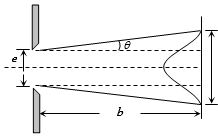
In a single slit diffraction of light of wavelength $\lambda$ by a slit of width $e$,the size of the central maximum on a screen at a distance $b$ is
A
$2b\lambda + e$
B
$\frac{2b\lambda}{e}$
C
$\frac{2b\lambda}{e} + e$
D
$\frac{2b\lambda}{e} - e$
Solution
(C) For a single slit of width $e$,the condition for the first minimum is given by $e \sin \theta = \lambda$.
Since $\theta$ is very small,we can approximate $\sin \theta \approx \theta$.
Thus,$\theta = \frac{\lambda}{e}$.
The angular width of the central maximum is $2\theta = \frac{2\lambda}{e}$.
The linear width of the central maximum on a screen at a distance $b$ is the distance between the two first-order minima on either side of the central point.
This is given by $w = 2b\theta + e = 2b \left( \frac{\lambda}{e} \right) + e = \frac{2b\lambda}{e} + e$.
Since $\theta$ is very small,we can approximate $\sin \theta \approx \theta$.
Thus,$\theta = \frac{\lambda}{e}$.
The angular width of the central maximum is $2\theta = \frac{2\lambda}{e}$.
The linear width of the central maximum on a screen at a distance $b$ is the distance between the two first-order minima on either side of the central point.
This is given by $w = 2b\theta + e = 2b \left( \frac{\lambda}{e} \right) + e = \frac{2b\lambda}{e} + e$.
0 likes
View Solution37
MediumMCQ
The angular width of the central maxima in the Fraunhofer diffraction pattern of a slit is measured. The slit is illuminated by light of wavelength $6000 \ \mathring A$. When the slit is illuminated by light of another wavelength,the angular width decreases by $30\%$. The wavelength of this light will be ...... $\mathring A$.
A
$6000$
B
$4200$
C
$3000$
D
$1800$
Solution
(B) The angular width of the central maximum in a single-slit diffraction pattern is given by $\beta = \frac{2\lambda}{d}$,where $\lambda$ is the wavelength of light and $d$ is the slit width.
Since $\beta \propto \lambda$,we have $\frac{\beta_1}{\beta_2} = \frac{\lambda_1}{\lambda_2}$.
Given $\lambda_1 = 6000 \ \mathring A$ and the angular width decreases by $30\%$,the new angular width $\beta_2 = \beta_1 - 0.30\beta_1 = 0.70\beta_1$.
Substituting these values: $\frac{\beta_1}{0.70\beta_1} = \frac{6000}{\lambda_2}$.
$\frac{1}{0.70} = \frac{6000}{\lambda_2} \Rightarrow \lambda_2 = 6000 \times 0.70 = 4200 \ \mathring A$.
Since $\beta \propto \lambda$,we have $\frac{\beta_1}{\beta_2} = \frac{\lambda_1}{\lambda_2}$.
Given $\lambda_1 = 6000 \ \mathring A$ and the angular width decreases by $30\%$,the new angular width $\beta_2 = \beta_1 - 0.30\beta_1 = 0.70\beta_1$.
Substituting these values: $\frac{\beta_1}{0.70\beta_1} = \frac{6000}{\lambda_2}$.
$\frac{1}{0.70} = \frac{6000}{\lambda_2} \Rightarrow \lambda_2 = 6000 \times 0.70 = 4200 \ \mathring A$.
0 likes
View Solution38
DifficultMCQ
The ratio of intensities of consecutive maxima in the diffraction pattern due to a single slit is
A
$1 : 4 : 9$
B
$1 : 2 : 3$
C
$1 : \frac{4}{9\pi^2} : \frac{4}{25\pi^2}$
D
$1 : \frac{1}{\pi^2} : \frac{9}{\pi^2}$
Solution
(C) The intensity of the diffraction pattern is given by $I = I_0 \left[ \frac{\sin \alpha}{\alpha} \right]^2$,where $\alpha = \frac{\pi d \sin \theta}{\lambda}$.
For the central maximum,$n=0$,$\alpha = 0$,and $I = I_0$.
For secondary maxima,the condition is $\alpha = \left( n + \frac{1}{2} \right) \pi$,where $n = 1, 2, 3, \dots$.
Substituting this into the intensity formula:
$I_n = I_0 \left[ \frac{\sin((n + 1/2)\pi)}{(n + 1/2)\pi} \right]^2 = I_0 \left[ \frac{\pm 1}{(n + 1/2)\pi} \right]^2 = \frac{I_0}{(n + 1/2)^2 \pi^2} = \frac{4 I_0}{(2n + 1)^2 \pi^2}$.
For $n=0$ (central),$I_0 = I_0$.
For $n=1$ (first secondary),$I_1 = \frac{4 I_0}{9 \pi^2}$.
For $n=2$ (second secondary),$I_2 = \frac{4 I_0}{25 \pi^2}$.
Thus,the ratio is $I_0 : I_1 : I_2 = 1 : \frac{4}{9 \pi^2} : \frac{4}{25 \pi^2}$.
For the central maximum,$n=0$,$\alpha = 0$,and $I = I_0$.
For secondary maxima,the condition is $\alpha = \left( n + \frac{1}{2} \right) \pi$,where $n = 1, 2, 3, \dots$.
Substituting this into the intensity formula:
$I_n = I_0 \left[ \frac{\sin((n + 1/2)\pi)}{(n + 1/2)\pi} \right]^2 = I_0 \left[ \frac{\pm 1}{(n + 1/2)\pi} \right]^2 = \frac{I_0}{(n + 1/2)^2 \pi^2} = \frac{4 I_0}{(2n + 1)^2 \pi^2}$.
For $n=0$ (central),$I_0 = I_0$.
For $n=1$ (first secondary),$I_1 = \frac{4 I_0}{9 \pi^2}$.
For $n=2$ (second secondary),$I_2 = \frac{4 I_0}{25 \pi^2}$.
Thus,the ratio is $I_0 : I_1 : I_2 = 1 : \frac{4}{9 \pi^2} : \frac{4}{25 \pi^2}$.
0 likes
View Solution39
MediumMCQ
Light is incident normally on a diffraction grating through which the first order diffraction is seen at $32^\circ$. The second order diffraction will be seen at
A
$48^\circ$
B
$64^\circ$
C
$80^\circ$
D
There is no second order diffraction in this case
Solution
(D) The diffraction grating equation is given by $(e + d) \sin \theta_n = n\lambda$,where $(e + d)$ is the grating element,$\theta_n$ is the angle of diffraction,and $n$ is the order of diffraction.
For the first order $(n = 1)$,we have $\sin \theta_1 = \frac{\lambda}{e + d} = \sin 32^\circ$.
Since $\sin 32^\circ \approx 0.5299$,we have $\frac{\lambda}{e + d} \approx 0.5299$.
For the second order $(n = 2)$,the equation becomes $\sin \theta_2 = \frac{2\lambda}{e + d} = 2 \times \sin 32^\circ$.
Calculating this,$\sin \theta_2 = 2 \times 0.5299 = 1.0598$.
Since the value of $\sin \theta_2$ cannot exceed $1$,the second order diffraction is not possible.
For the first order $(n = 1)$,we have $\sin \theta_1 = \frac{\lambda}{e + d} = \sin 32^\circ$.
Since $\sin 32^\circ \approx 0.5299$,we have $\frac{\lambda}{e + d} \approx 0.5299$.
For the second order $(n = 2)$,the equation becomes $\sin \theta_2 = \frac{2\lambda}{e + d} = 2 \times \sin 32^\circ$.
Calculating this,$\sin \theta_2 = 2 \times 0.5299 = 1.0598$.
Since the value of $\sin \theta_2$ cannot exceed $1$,the second order diffraction is not possible.
0 likes
View Solution40
EasyMCQ
In diffraction,all fringes have .....
A
equal intensity.
B
different widths.
C
equal width.
D
complete darkness.
Solution
(B) In single-slit diffraction,the width of the central maximum is $2\lambda D/a$,while the width of the secondary maxima is $\lambda D/a$. Since the central maximum is twice as wide as the secondary maxima,all fringes do not have equal width.
0 likes
View Solution41
MediumMCQ
$A$ plane wavefront of monochromatic light is incident normally on a narrow slit. $A$ diffraction pattern is formed on a screen. What is the phase difference between the waves originating from the top and bottom edges of the slit at the position of the first minimum?
A
$0 \, rad$
B
$\pi/2 \, rad$
C
$\pi \, rad$
D
$2\pi \, rad$
Solution
(D) The phase difference $\phi$ between the waves originating from the top and bottom edges of a slit of width $d$ is given by $\phi = \frac{2\pi}{\lambda} (d \sin \theta)$.
For the first minimum in a single-slit diffraction pattern,the condition is $d \sin \theta = \lambda$.
Substituting this condition into the phase difference formula:
$\phi = \frac{2\pi}{\lambda} (\lambda) = 2\pi \, rad$.
Thus,the phase difference between the waves from the top and bottom edges at the first minimum is $2\pi \, rad$.
For the first minimum in a single-slit diffraction pattern,the condition is $d \sin \theta = \lambda$.
Substituting this condition into the phase difference formula:
$\phi = \frac{2\pi}{\lambda} (\lambda) = 2\pi \, rad$.
Thus,the phase difference between the waves from the top and bottom edges at the first minimum is $2\pi \, rad$.
0 likes
View Solution42
EasyMCQ
In the diffraction pattern of a single slit,the width of the secondary maxima compared to the central maximum is:
A
Half
B
Equal
C
Double
D
Four times
Solution
(A) For a single slit of width $a$,the angular width of the central maximum is given by $\Delta \theta = \frac{2\lambda}{a}$.
The angular width of the secondary maxima is given by $\Delta \theta' = \frac{\lambda}{a}$.
Comparing these,the width of the secondary maxima is half the width of the central maximum.
The angular width of the secondary maxima is given by $\Delta \theta' = \frac{\lambda}{a}$.
Comparing these,the width of the secondary maxima is half the width of the central maximum.
0 likes
View Solution43
EasyMCQ
In the diffraction due to a single slit,the central fringe ...
A
has minimum intensity.
B
has maximum intensity.
C
intensity does not depend on the width of the slit.
D
none of the above.
Solution
(B) In single-slit diffraction,the central maximum is formed at the center of the screen where all secondary wavelets arrive in phase.
Therefore,the central fringe has the maximum intensity.
As we move away from the center,the intensity decreases rapidly.
Therefore,the central fringe has the maximum intensity.
As we move away from the center,the intensity decreases rapidly.
0 likes
View Solution44
EasyMCQ
In the diffraction pattern of a single slit,the width of the secondary maxima compared to the central maximum is:
A
Equal
B
Less
C
Slightly more
D
Half
Solution
(D) In a single slit diffraction pattern,the angular width of the central maximum is given by $\beta_0 = \frac{2\lambda}{a}$,where $\lambda$ is the wavelength of light and $a$ is the slit width.
The angular width of the secondary maxima is given by $\beta = \frac{\lambda}{a}$.
Comparing these two,we find that $\beta = \frac{1}{2} \beta_0$.
Therefore,the width of the secondary maxima is half the width of the central maximum.
The angular width of the secondary maxima is given by $\beta = \frac{\lambda}{a}$.
Comparing these two,we find that $\beta = \frac{1}{2} \beta_0$.
Therefore,the width of the secondary maxima is half the width of the central maximum.
0 likes
View Solution45
EasyMCQ
In Fraunhofer diffraction by a single slit,if the slit width is $a$,the wavelength is $\lambda$,and the focal length of the lens is $f$,what is the linear width of the central maximum?
A
$\frac{f\lambda}{a}$
B
$\frac{fa}{\lambda}$
C
$\frac{2f\lambda}{a}$
D
$\frac{f\lambda}{2a}$
Solution
(C) In Fraunhofer diffraction due to a single slit,the angular width of the central maximum is given by $\Delta \theta = \frac{2\lambda}{a}$.
To find the linear width $w$ of the central maximum on the screen placed at the focal plane of a lens with focal length $f$,we use the relation $w = f \times \Delta \theta$.
Substituting the value of $\Delta \theta$,we get $w = f \times \left( \frac{2\lambda}{a} \right) = \frac{2f\lambda}{a}$.
Thus,the linear width of the central maximum is $\frac{2f\lambda}{a}$.
To find the linear width $w$ of the central maximum on the screen placed at the focal plane of a lens with focal length $f$,we use the relation $w = f \times \Delta \theta$.
Substituting the value of $\Delta \theta$,we get $w = f \times \left( \frac{2\lambda}{a} \right) = \frac{2f\lambda}{a}$.
Thus,the linear width of the central maximum is $\frac{2f\lambda}{a}$.
0 likes
View Solution46
MediumMCQ
In the case of Fraunhofer diffraction due to a single slit,the intensity of the central maximum is $I_0$. If the width of the slit is doubled,what will be the new intensity of the central maximum?
A
$I_0$
B
$I_0/2$
C
$2I_0$
D
$4I_0$
Solution
(D) In Fraunhofer diffraction by a single slit of width $a$,the intensity at the central maximum is given by $I_0 \propto a^2$.
When the width of the slit is doubled,the new width becomes $a' = 2a$.
The new intensity $I'$ will be proportional to the square of the new width: $I' \propto (a')^2 = (2a)^2 = 4a^2$.
Since $I_0 \propto a^2$,we have $I' = 4I_0$.
Therefore,the intensity of the central maximum becomes $4I_0$.
When the width of the slit is doubled,the new width becomes $a' = 2a$.
The new intensity $I'$ will be proportional to the square of the new width: $I' \propto (a')^2 = (2a)^2 = 4a^2$.
Since $I_0 \propto a^2$,we have $I' = 4I_0$.
Therefore,the intensity of the central maximum becomes $4I_0$.
0 likes
View Solution47
EasyMCQ
Red light is generally used to observe a diffraction pattern. If green light is used instead of red light,the diffraction pattern will.....
A
become more visible
B
shrink (become closer)
C
expand (become wider)
D
disappear
Solution
(B) The width of the central maximum in a single-slit diffraction pattern is given by the formula $\beta = \frac{2\lambda D}{a}$,where $\lambda$ is the wavelength of light,$D$ is the distance of the screen from the slit,and $a$ is the slit width.
Since the wavelength of green light $(\lambda_{green})$ is smaller than the wavelength of red light $(\lambda_{red})$,the width of the diffraction pattern $\beta$ is directly proportional to the wavelength $(\beta \propto \lambda)$.
Therefore,when green light is used,the diffraction pattern will shrink or become closer together.
Since the wavelength of green light $(\lambda_{green})$ is smaller than the wavelength of red light $(\lambda_{red})$,the width of the diffraction pattern $\beta$ is directly proportional to the wavelength $(\beta \propto \lambda)$.
Therefore,when green light is used,the diffraction pattern will shrink or become closer together.
0 likes
View Solution48
DifficultMCQ
Light of wavelength $6000 \, \mathring A$ is incident on a slit of width $0.30 \, mm$. $A$ screen is placed at a distance of $2 \, m$ from the slit. Find the position of the first minimum.
A
$4 \times 10^{-5} \, m$
B
$4 \times 10^{-3} \, m$
C
$4 \times 10^{3} \, m$
D
$4 \times 10^{-7} \, m$
Solution
(B) For diffraction at a single slit,the condition for the $n^{th}$ minimum is given by $a \sin \theta = n \lambda$.
Given: Wavelength $\lambda = 6000 \, \mathring A = 6 \times 10^{-7} \, m$,Slit width $a = 0.30 \, mm = 3 \times 10^{-4} \, m$,Distance $D = 2 \, m$.
For small angles,$\sin \theta \approx \tan \theta = \frac{x}{D}$.
Substituting this into the condition: $a \left( \frac{x}{D} \right) = n \lambda$.
For the first minimum,$n = 1$. Therefore,$x = \frac{n \lambda D}{a}$.
$x = \frac{1 \times (6 \times 10^{-7} \, m) \times (2 \, m)}{3 \times 10^{-4} \, m}$.
$x = \frac{12 \times 10^{-7}}{3 \times 10^{-4}} \, m = 4 \times 10^{-3} \, m$.
Given: Wavelength $\lambda = 6000 \, \mathring A = 6 \times 10^{-7} \, m$,Slit width $a = 0.30 \, mm = 3 \times 10^{-4} \, m$,Distance $D = 2 \, m$.
For small angles,$\sin \theta \approx \tan \theta = \frac{x}{D}$.
Substituting this into the condition: $a \left( \frac{x}{D} \right) = n \lambda$.
For the first minimum,$n = 1$. Therefore,$x = \frac{n \lambda D}{a}$.
$x = \frac{1 \times (6 \times 10^{-7} \, m) \times (2 \, m)}{3 \times 10^{-4} \, m}$.
$x = \frac{12 \times 10^{-7}}{3 \times 10^{-4}} \, m = 4 \times 10^{-3} \, m$.
0 likes
View Solution49
EasyMCQ
In Fraunhofer diffraction due to a single slit,the direction of the second secondary maximum is given by ....... ($a$ is the width of the slit).
A
$a \sin \theta = \frac{\lambda}{2}$
B
$a \cos \theta = \frac{3\lambda}{2}$
C
$a \sin \theta = \lambda$
D
$a \sin \theta = \frac{3\lambda}{2}$
Solution
(D) For a single slit Fraunhofer diffraction,the condition for the $n^{\text{th}}$ secondary maxima is given by the path difference:
$a \sin \theta = (2n + 1) \frac{\lambda}{2}$,where $n = 1, 2, 3, \dots$
For the second secondary maximum,we substitute $n = 2$:
$a \sin \theta = (2(2) + 1) \frac{\lambda}{2} = \frac{5\lambda}{2}$.
However,in standard physics problems of this type,the 'second secondary maximum' often refers to the case where $n=1$ is the first and $n=2$ is the second. If the question implies the first secondary maximum $(n=1)$,the result is $\frac{3\lambda}{2}$. Given the options provided,the correct expression for the second secondary maximum is $a \sin \theta = \frac{3\lambda}{2}$ (referring to the first secondary maximum) or the question implies the index $n=1$ for the first secondary maximum. Based on standard textbook conventions where the first secondary maximum is at $n=1$,the condition is $a \sin \theta = \frac{3\lambda}{2}$.
$a \sin \theta = (2n + 1) \frac{\lambda}{2}$,where $n = 1, 2, 3, \dots$
For the second secondary maximum,we substitute $n = 2$:
$a \sin \theta = (2(2) + 1) \frac{\lambda}{2} = \frac{5\lambda}{2}$.
However,in standard physics problems of this type,the 'second secondary maximum' often refers to the case where $n=1$ is the first and $n=2$ is the second. If the question implies the first secondary maximum $(n=1)$,the result is $\frac{3\lambda}{2}$. Given the options provided,the correct expression for the second secondary maximum is $a \sin \theta = \frac{3\lambda}{2}$ (referring to the first secondary maximum) or the question implies the index $n=1$ for the first secondary maximum. Based on standard textbook conventions where the first secondary maximum is at $n=1$,the condition is $a \sin \theta = \frac{3\lambda}{2}$.
0 likes
View SolutionWave Optics — Single Slit Diffraction of Light · Frequently Asked Questions
1Are these Wave Optics questions useful for JEE and NEET?
Yes. All questions in this section are mapped to JEE Main and NEET exam patterns. Previous year questions from JEE Main, NEET, GUJCET and state-level exams are included with full solutions.
2Can I switch to Hindi or Gujarati for these questions?
Yes. Use the language tabs in the hero section or the sidebar to view the same questions and solutions in English, Hindi or Gujarati.
3How do I generate a question paper from this subtopic?
Use the Vedclass Exam Paper Generator — select the chapter and subtopic, set difficulty, and generate Sets A, B, C, D automatically. First 3 chapters of every subject are free.
Vedclass Products
For Students
Vedclass Test Series
Mock tests in real JEE/NEET style with performance analysis. 5-day free trial.
Start Free TrialFor Teachers
Exam Paper Generator
Generate Set A/B/C/D papers from this chapter in 2 minutes. 3 chapters free.
Try FreeFor Institutes
Online Exam Module
Live online exams with unlimited students, 360° analytics & white-label branding.
See DemoFor Teachers & Institutes
Generate a Wave Optics Exam Paper in 2 Minutes
Select subtopic & difficulty — Sets A, B, C, D auto-generated with No Repeat logic.
First 3 chapters of every subject are free — no payment required.