
A English
Wave Nature and Interference of Light (Intensity) Questions in English
Class 12 Physics · Wave Optics · Wave Nature and Interference of Light (Intensity)
229+
Questions
English
Language
100%
With Solutions
Showing 49 of 229 questions in English
1
EasyMCQ
Coherent sources are characterized by the same
A
Phase and phase velocity
B
Wavelength,amplitude and phase velocity
C
Wavelength,amplitude and frequency
D
Both $(b)$ and $(c)$
Solution
(D) Coherent sources are defined as sources that emit waves of the same frequency and maintain a constant phase difference over time.
Since the speed of a wave $v$ is related to its wavelength $\lambda$ and frequency $f$ by the equation $v = f \lambda$,if two waves have the same wavelength and frequency,they must have the same phase velocity.
In many contexts,the terms wavelength,frequency,and phase velocity are used to describe the characteristics of coherent sources.
Therefore,both options $(b)$ and $(c)$ describe the necessary conditions for coherence in standard wave physics.
Thus,the correct option is $(d)$.
Since the speed of a wave $v$ is related to its wavelength $\lambda$ and frequency $f$ by the equation $v = f \lambda$,if two waves have the same wavelength and frequency,they must have the same phase velocity.
In many contexts,the terms wavelength,frequency,and phase velocity are used to describe the characteristics of coherent sources.
Therefore,both options $(b)$ and $(c)$ describe the necessary conditions for coherence in standard wave physics.
Thus,the correct option is $(d)$.
0 likes
View Solution2
MediumMCQ
The two interfering waves have intensities in the ratio $9 : 4$. The ratio of intensities of maxima and minima in the interference pattern will be
A
$1:25$
B
$25:1$
C
$9:4$
D
$4:9$
Solution
(B) Given the ratio of intensities of two waves is $\frac{I_1}{I_2} = \frac{9}{4}$.
Let the amplitudes be $A_1$ and $A_2$. Since $I \propto A^2$,the ratio of amplitudes is $\frac{A_1}{A_2} = \sqrt{\frac{I_1}{I_2}} = \sqrt{\frac{9}{4}} = \frac{3}{2}$.
The ratio of maximum to minimum intensity is given by the formula $\frac{I_{\max}}{I_{\min}} = \left( \frac{A_1 + A_2}{A_1 - A_2} \right)^2$.
Substituting the values,we get $\frac{I_{\max}}{I_{\min}} = \left( \frac{3 + 2}{3 - 2} \right)^2 = \left( \frac{5}{1} \right)^2 = \frac{25}{1}$.
Therefore,the ratio is $25:1$.
Let the amplitudes be $A_1$ and $A_2$. Since $I \propto A^2$,the ratio of amplitudes is $\frac{A_1}{A_2} = \sqrt{\frac{I_1}{I_2}} = \sqrt{\frac{9}{4}} = \frac{3}{2}$.
The ratio of maximum to minimum intensity is given by the formula $\frac{I_{\max}}{I_{\min}} = \left( \frac{A_1 + A_2}{A_1 - A_2} \right)^2$.
Substituting the values,we get $\frac{I_{\max}}{I_{\min}} = \left( \frac{3 + 2}{3 - 2} \right)^2 = \left( \frac{5}{1} \right)^2 = \frac{25}{1}$.
Therefore,the ratio is $25:1$.
0 likes
View Solution3
EasyMCQ
The displacements of two interfering light waves are given by $y_1 = 4 \sin \omega t$ and $y_2 = 3 \sin (\omega t + \frac{\pi}{2})$. What is the amplitude of the resultant wave?
A
$5$
B
$7$
C
$1$
D
$0$
Solution
(A) The given equations for the two waves are $y_1 = a_1 \sin \omega t$ and $y_2 = a_2 \sin (\omega t + \phi)$.
Comparing these with the given equations,we have $a_1 = 4$,$a_2 = 3$,and the phase difference $\phi = \frac{\pi}{2}$.
The amplitude $A$ of the resultant wave is given by the formula $A = \sqrt{a_1^2 + a_2^2 + 2a_1 a_2 \cos \phi}$.
Since $\cos(\frac{\pi}{2}) = 0$,the formula simplifies to $A = \sqrt{a_1^2 + a_2^2}$.
Substituting the values,$A = \sqrt{4^2 + 3^2} = \sqrt{16 + 9} = \sqrt{25} = 5$.
Comparing these with the given equations,we have $a_1 = 4$,$a_2 = 3$,and the phase difference $\phi = \frac{\pi}{2}$.
The amplitude $A$ of the resultant wave is given by the formula $A = \sqrt{a_1^2 + a_2^2 + 2a_1 a_2 \cos \phi}$.
Since $\cos(\frac{\pi}{2}) = 0$,the formula simplifies to $A = \sqrt{a_1^2 + a_2^2}$.
Substituting the values,$A = \sqrt{4^2 + 3^2} = \sqrt{16 + 9} = \sqrt{25} = 5$.
0 likes
View Solution4
EasyMCQ
If the wavelength of light is $4000 \mathring A$,then the number of waves in $1 \ mm$ length will be
A
$25$
B
$0.25$
C
$0.25 \times 10^4$
D
$25 \times 10^4$
Solution
(C) The wavelength of light is given as $\lambda = 4000 \mathring A = 4000 \times 10^{-10} \ m = 4 \times 10^{-7} \ m$.
The total length is $L = 1 \ mm = 10^{-3} \ m$.
The number of waves $n$ is given by the ratio of the total length to the wavelength:
$n = \frac{L}{\lambda} = \frac{10^{-3} \ m}{4 \times 10^{-7} \ m}$.
$n = \frac{1}{4} \times 10^{-3 - (-7)} = 0.25 \times 10^4$.
Therefore,the number of waves is $0.25 \times 10^4$.
The total length is $L = 1 \ mm = 10^{-3} \ m$.
The number of waves $n$ is given by the ratio of the total length to the wavelength:
$n = \frac{L}{\lambda} = \frac{10^{-3} \ m}{4 \times 10^{-7} \ m}$.
$n = \frac{1}{4} \times 10^{-3 - (-7)} = 0.25 \times 10^4$.
Therefore,the number of waves is $0.25 \times 10^4$.
0 likes
View Solution5
EasyMCQ
$A$ laser is a coherent source because it contains
A
Many wavelengths
B
Uncoordinated wave of a particular wavelength
C
Coordinated wave of many wavelengths
D
Coordinated waves of a particular wavelength
Solution
(D) $LASER$ is the acronym for Light Amplification by Stimulated Emission of Radiation.
$A$ laser beam is intense,monochromatic (meaning it consists of a single wavelength),collimated,and highly coherent.
Coherence implies that the waves are in phase and maintain a constant phase relationship,which is a characteristic of coordinated waves of a single wavelength.
$A$ laser beam is intense,monochromatic (meaning it consists of a single wavelength),collimated,and highly coherent.
Coherence implies that the waves are in phase and maintain a constant phase relationship,which is a characteristic of coordinated waves of a single wavelength.
0 likes
View Solution6
EasyMCQ
When a light wave undergoes reflection at the interface from air to glass,the change in phase of the reflected wave is equal to
A
$0$
B
$\frac{\pi}{2}$
C
$\pi$
D
$2\pi$
Solution
(C) When light travels from a rarer medium (air) to a denser medium (glass) and reflects off the interface,it undergoes a phase change of $\pi$ radians. This is a standard result in wave optics known as Stokes' law of reflection,which states that reflection from a denser medium introduces a phase shift of $\pi$.
0 likes
View Solution7
EasyMCQ
When a light wave goes from air into water,the quality that remains unchanged is its
A
Speed
B
Amplitude
C
Frequency
D
Wavelength
Solution
(C) When light travels from one medium to another,its speed and wavelength change due to the change in the refractive index of the medium.
However,the frequency of light depends only on the source of the light and remains constant regardless of the medium it travels through.
Mathematically,if $\nu$ is the frequency,$v$ is the speed,and $\lambda$ is the wavelength,then $v = \nu \lambda$.
In a medium with refractive index $\mu$,the new speed $v' = v/\mu$ and the new wavelength $\lambda' = \lambda/\mu$.
Thus,the new frequency $\nu' = v'/\lambda' = (v/\mu) / (\lambda/\mu) = v/\lambda = \nu$.
Therefore,the frequency remains unchanged.
However,the frequency of light depends only on the source of the light and remains constant regardless of the medium it travels through.
Mathematically,if $\nu$ is the frequency,$v$ is the speed,and $\lambda$ is the wavelength,then $v = \nu \lambda$.
In a medium with refractive index $\mu$,the new speed $v' = v/\mu$ and the new wavelength $\lambda' = \lambda/\mu$.
Thus,the new frequency $\nu' = v'/\lambda' = (v/\mu) / (\lambda/\mu) = v/\lambda = \nu$.
Therefore,the frequency remains unchanged.
0 likes
View Solution8
EasyMCQ
Which of the following is not a correct statement?
A
The wavelength of red light is greater than the wavelength of green light.
B
The wavelength of blue light is smaller than the wavelength of orange light.
C
The frequency of green light is greater than the frequency of blue light.
D
The frequency of violet light is greater than the frequency of blue light.
Solution
(C) The relationship between wavelength $(\lambda)$ and frequency $(f)$ is given by $c = f\lambda$, where $c$ is the speed of light. Thus, $f = c/\lambda$. This implies that frequency is inversely proportional to wavelength $(f \propto 1/\lambda)$.
In the visible spectrum $(VIBGYOR)$, the wavelength increases from violet to red $(\lambda_V < \lambda_I < \lambda_B < \lambda_G < \lambda_Y < \lambda_O < \lambda_R)$.
Consequently, the frequency decreases from violet to red $(f_V > f_I > f_B > f_G > f_Y > f_O > f_R)$.
Option $A$ is correct because $\lambda_R > \lambda_G$.
Option $B$ is correct because $\lambda_B < \lambda_O$.
Option $C$ is incorrect because the frequency of green light is smaller than the frequency of blue light $(f_G < f_B)$.
Option $D$ is correct because $f_V > f_B$.
Therefore, the incorrect statement is $C$.
In the visible spectrum $(VIBGYOR)$, the wavelength increases from violet to red $(\lambda_V < \lambda_I < \lambda_B < \lambda_G < \lambda_Y < \lambda_O < \lambda_R)$.
Consequently, the frequency decreases from violet to red $(f_V > f_I > f_B > f_G > f_Y > f_O > f_R)$.
Option $A$ is correct because $\lambda_R > \lambda_G$.
Option $B$ is correct because $\lambda_B < \lambda_O$.
Option $C$ is incorrect because the frequency of green light is smaller than the frequency of blue light $(f_G < f_B)$.
Option $D$ is correct because $f_V > f_B$.
Therefore, the incorrect statement is $C$.
0 likes
View Solution9
EasyMCQ
The distance between a point source of light and a screen is $60 \ cm$. If this distance is increased to $180 \ cm$,what will be the intensity on the screen compared to the original intensity?
A
$(1/9)$ times
B
$(1/3)$ times
C
$3$ times
D
$9$ times
Solution
(A) The intensity $I$ of light from a point source follows the inverse square law,$I \propto \frac{1}{r^2}$,where $r$ is the distance from the source.
Given initial distance $r_1 = 60 \ cm$ and final distance $r_2 = 180 \ cm$.
The ratio of the intensities is given by $\frac{I_2}{I_1} = \frac{r_1^2}{r_2^2}$.
Substituting the values: $\frac{I_2}{I_1} = \left( \frac{60}{180} \right)^2 = \left( \frac{1}{3} \right)^2 = \frac{1}{9}$.
Therefore,the new intensity is $(1/9)$ times the original intensity.
Given initial distance $r_1 = 60 \ cm$ and final distance $r_2 = 180 \ cm$.
The ratio of the intensities is given by $\frac{I_2}{I_1} = \frac{r_1^2}{r_2^2}$.
Substituting the values: $\frac{I_2}{I_1} = \left( \frac{60}{180} \right)^2 = \left( \frac{1}{3} \right)^2 = \frac{1}{9}$.
Therefore,the new intensity is $(1/9)$ times the original intensity.
0 likes
View Solution10
EasyMCQ
Two coherent sources of light can be obtained by
A
Two different lamps
B
Two different lamps but of the same power
C
Two different lamps of same power and having the same colour
D
None of the above
Solution
(D) Coherent sources are defined as sources that emit light waves of the same frequency and maintain a constant phase difference over time.
Independent light sources,such as two different lamps,emit light due to independent atomic transitions.
These transitions occur randomly and independently in each source,leading to rapid and unpredictable changes in the phase of the emitted light.
Therefore,it is physically impossible to obtain coherent light from two independent light sources.
Thus,the correct option is $D$.
Independent light sources,such as two different lamps,emit light due to independent atomic transitions.
These transitions occur randomly and independently in each source,leading to rapid and unpredictable changes in the phase of the emitted light.
Therefore,it is physically impossible to obtain coherent light from two independent light sources.
Thus,the correct option is $D$.
0 likes
View Solution11
EasyMCQ
The phenomenon of interference is shown by
A
Longitudinal mechanical waves only
B
Transverse mechanical waves only
C
Electromagnetic waves only
D
All the above types of waves
Solution
(D) Interference is a general property of waves. It occurs when two or more waves of the same frequency and constant phase difference superpose each other. This phenomenon is observed in all types of waves,including longitudinal mechanical waves (e.g.,sound waves),transverse mechanical waves (e.g.,waves on a string),and electromagnetic waves (e.g.,light waves). Therefore,the correct option is $D$.
0 likes
View Solution12
MediumMCQ
Two coherent monochromatic light beams of intensities $I$ and $4I$ are superposed. The maximum and minimum possible intensities in the resulting beam are
A
$5I$ and $I$
B
$5I$ and $3I$
C
$9I$ and $I$
D
$9I$ and $3I$
Solution
(C) The intensity of the resultant wave in interference is given by $I_{res} = I_1 + I_2 + 2\sqrt{I_1 I_2} \cos \phi$.
For maximum intensity, $\cos \phi = 1$, so $I_{max} = (\sqrt{I_1} + \sqrt{I_2})^2$.
Given $I_1 = I$ and $I_2 = 4I$, we have $I_{max} = (\sqrt{I} + \sqrt{4I})^2 = (\sqrt{I} + 2\sqrt{I})^2 = (3\sqrt{I})^2 = 9I$.
For minimum intensity, $\cos \phi = -1$, so $I_{min} = (\sqrt{I_1} - \sqrt{I_2})^2$.
Thus, $I_{min} = (\sqrt{I} - \sqrt{4I})^2 = (\sqrt{I} - 2\sqrt{I})^2 = (-\sqrt{I})^2 = I$.
Therefore, the maximum and minimum intensities are $9I$ and $I$ respectively.
For maximum intensity, $\cos \phi = 1$, so $I_{max} = (\sqrt{I_1} + \sqrt{I_2})^2$.
Given $I_1 = I$ and $I_2 = 4I$, we have $I_{max} = (\sqrt{I} + \sqrt{4I})^2 = (\sqrt{I} + 2\sqrt{I})^2 = (3\sqrt{I})^2 = 9I$.
For minimum intensity, $\cos \phi = -1$, so $I_{min} = (\sqrt{I_1} - \sqrt{I_2})^2$.
Thus, $I_{min} = (\sqrt{I} - \sqrt{4I})^2 = (\sqrt{I} - 2\sqrt{I})^2 = (-\sqrt{I})^2 = I$.
Therefore, the maximum and minimum intensities are $9I$ and $I$ respectively.
0 likes
View Solution13
EasyMCQ
By a monochromatic wave,we mean
A
$A$ single ray
B
$A$ single ray of a single colour
C
Wave having a single wavelength
D
Many rays of a single colour
Solution
(C) The term $monochromatic$ is derived from the Greek words $mono$ (meaning single) and $chroma$ (meaning colour). However,in physics,a monochromatic wave is defined as a wave that consists of a single,specific wavelength or frequency. While monochromatic light often appears as a single colour to the human eye,the scientific definition strictly refers to the presence of a single wavelength. Therefore,option $C$ is the most accurate definition.
0 likes
View Solution14
EasyMCQ
Two identical light sources $S_1$ and $S_2$ emit light of same wavelength $\lambda$. These light rays will exhibit interference if
A
Their phase differences remain constant
B
Their phases are distributed randomly
C
Their light intensities remain constant
D
Their light intensities change randomly
Solution
(A) For two light sources to produce a stable interference pattern,they must be coherent.
Coherent sources are defined as sources that emit light waves of the same frequency and wavelength,and maintain a constant phase difference over time.
If the phase difference between the two sources varies randomly with time,the interference pattern will shift rapidly,resulting in a uniform average intensity rather than a stable interference pattern.
Therefore,the condition for observing interference is that the phase difference between the light waves must remain constant.
Coherent sources are defined as sources that emit light waves of the same frequency and wavelength,and maintain a constant phase difference over time.
If the phase difference between the two sources varies randomly with time,the interference pattern will shift rapidly,resulting in a uniform average intensity rather than a stable interference pattern.
Therefore,the condition for observing interference is that the phase difference between the light waves must remain constant.
0 likes
View Solution15
EasyMCQ
The wave nature of light is confirmed because:
A
Light rays travel in a straight line
B
Light exhibits the phenomena of reflection and refraction
C
Light exhibits the phenomenon of interference
D
Light causes the phenomenon of photoelectric effect
Solution
(C) The wave nature of light is confirmed by phenomena such as interference,diffraction,and polarization,which cannot be explained by the particle theory of light.
Interference occurs when two or more light waves superpose to form a resultant wave of greater,lower,or the same amplitude.
Since interference is a characteristic property of waves,its observation in light confirms that light behaves as a wave.
Therefore,option $C$ is the correct answer.
Interference occurs when two or more light waves superpose to form a resultant wave of greater,lower,or the same amplitude.
Since interference is a characteristic property of waves,its observation in light confirms that light behaves as a wave.
Therefore,option $C$ is the correct answer.
0 likes
View Solution16
EasyMCQ
If $L$ is the coherence length and $c$ is the velocity of light,the coherence time is
A
$cL$
B
$\frac{L}{c}$
C
$\frac{c}{L}$
D
$\frac{1}{Lc}$
Solution
(B) The coherence time $(\tau_c)$ is defined as the time interval over which the phase of a light wave remains predictable.
It is related to the coherence length $(L)$ and the velocity of light $(c)$ by the formula:
$\tau_c = \frac{L}{c}$
Therefore,the correct option is $B$.
It is related to the coherence length $(L)$ and the velocity of light $(c)$ by the formula:
$\tau_c = \frac{L}{c}$
Therefore,the correct option is $B$.
0 likes
View Solution17
MediumMCQ
If the amplitude ratio of two sources producing interference is $3:5$,the ratio of intensities at maxima and minima is
A
$25:16$
B
$5:3$
C
$16:1$
D
$25:9$
Solution
(C) Given the ratio of amplitudes of two sources is $\frac{a_1}{a_2} = \frac{3}{5}$.
The intensity $I$ is proportional to the square of the amplitude,$I \propto a^2$.
The ratio of maximum intensity to minimum intensity in an interference pattern is given by the formula:
$\frac{I_{\max}}{I_{\min}} = \frac{(a_1 + a_2)^2}{(a_1 - a_2)^2}$.
Substituting the given values:
$\frac{I_{\max}}{I_{\min}} = \frac{(3 + 5)^2}{(3 - 5)^2} = \frac{8^2}{(-2)^2} = \frac{64}{4} = \frac{16}{1}$.
Therefore,the ratio of intensities at maxima and minima is $16:1$.
The intensity $I$ is proportional to the square of the amplitude,$I \propto a^2$.
The ratio of maximum intensity to minimum intensity in an interference pattern is given by the formula:
$\frac{I_{\max}}{I_{\min}} = \frac{(a_1 + a_2)^2}{(a_1 - a_2)^2}$.
Substituting the given values:
$\frac{I_{\max}}{I_{\min}} = \frac{(3 + 5)^2}{(3 - 5)^2} = \frac{8^2}{(-2)^2} = \frac{64}{4} = \frac{16}{1}$.
Therefore,the ratio of intensities at maxima and minima is $16:1$.
1 likes
View Solution18
EasyMCQ
For constructive interference to take place between two monochromatic light waves of wavelength $\lambda$, the path difference should be
A
$(2n - 1)\frac{\lambda}{4}$
B
$(2n - 1)\frac{\lambda}{2}$
C
$n\lambda$
D
$(2n + 1)\frac{\lambda}{2}$
Solution
(C) For constructive interference, the two light waves must arrive at a point in phase.
This occurs when the path difference $\Delta x$ between the waves is an integer multiple of the wavelength $\lambda$.
Mathematically, the condition for constructive interference is given by $\Delta x = n\lambda$, where $n = 0, 1, 2, 3, \dots$.
Therefore, the correct option is $C$.
This occurs when the path difference $\Delta x$ between the waves is an integer multiple of the wavelength $\lambda$.
Mathematically, the condition for constructive interference is given by $\Delta x = n\lambda$, where $n = 0, 1, 2, 3, \dots$.
Therefore, the correct option is $C$.
0 likes
View Solution19
EasyMCQ
Two sources of waves are called coherent if
A
Both have the same amplitude of vibrations
B
Both produce waves of the same wavelength
C
Both produce waves of the same wavelength having constant phase difference
D
Both produce waves having the same velocity
Solution
(C) Two sources of waves are defined as coherent if they emit waves of the same frequency (or wavelength) and maintain a constant phase difference over time. If the phase difference changes with time,the interference pattern will not be stable,and the sources will be considered incoherent. Therefore,option $C$ is the correct definition.
0 likes
View Solution20
MediumMCQ
If two light waves having the same frequency have an intensity ratio of $4:1$ and they interfere,the ratio of maximum to minimum intensity in the pattern will be:
A
$9:1$
B
$3:1$
C
$25:9$
D
$16:25$
Solution
(A) Given the ratio of intensities of two light waves is $\frac{I_1}{I_2} = \frac{4}{1}$.
Let the amplitudes be $A_1$ and $A_2$. Since $I \propto A^2$,the ratio of amplitudes is $\frac{A_1}{A_2} = \sqrt{\frac{I_1}{I_2}} = \sqrt{\frac{4}{1}} = \frac{2}{1}$.
The ratio of maximum to minimum intensity is given by the formula $\frac{I_{\max}}{I_{\min}} = \left( \frac{A_1 + A_2}{A_1 - A_2} \right)^2$.
Substituting the values,we get $\frac{I_{\max}}{I_{\min}} = \left( \frac{2 + 1}{2 - 1} \right)^2 = \left( \frac{3}{1} \right)^2 = \frac{9}{1}$.
Thus,the ratio is $9:1$.
Let the amplitudes be $A_1$ and $A_2$. Since $I \propto A^2$,the ratio of amplitudes is $\frac{A_1}{A_2} = \sqrt{\frac{I_1}{I_2}} = \sqrt{\frac{4}{1}} = \frac{2}{1}$.
The ratio of maximum to minimum intensity is given by the formula $\frac{I_{\max}}{I_{\min}} = \left( \frac{A_1 + A_2}{A_1 - A_2} \right)^2$.
Substituting the values,we get $\frac{I_{\max}}{I_{\min}} = \left( \frac{2 + 1}{2 - 1} \right)^2 = \left( \frac{3}{1} \right)^2 = \frac{9}{1}$.
Thus,the ratio is $9:1$.
0 likes
View Solution21
EasyMCQ
Two light sources are said to be coherent if they are obtained from
A
Two independent point sources emitting light of the same wavelength
B
$A$ single point source
C
$A$ wide source
D
Two ordinary bulbs emitting light of different wavelengths
Solution
(B) Two light sources are coherent if they emit light waves of the same frequency and maintain a constant phase difference over time.
When two sources are derived from a single original source (e.g.,using a slit or a mirror),the wavefront is divided into two parts.
These two resulting wavefronts act as if they emanated from two sources having a fixed phase relationship,thus satisfying the condition for coherence.
When two sources are derived from a single original source (e.g.,using a slit or a mirror),the wavefront is divided into two parts.
These two resulting wavefronts act as if they emanated from two sources having a fixed phase relationship,thus satisfying the condition for coherence.
0 likes
View Solution22
MediumMCQ
Two waves having intensities in the ratio $25 : 4$ produce interference. The ratio of the maximum to the minimum intensity is
A
$5:2$
B
$7:3$
C
$49:9$
D
$9:49$
Solution
(C) Given the ratio of intensities of two waves is $\frac{I_1}{I_2} = \frac{25}{4}$.
Let the amplitudes of the waves be $A_1$ and $A_2$. Since intensity $I \propto A^2$,the ratio of amplitudes is $\frac{A_1}{A_2} = \sqrt{\frac{I_1}{I_2}} = \sqrt{\frac{25}{4}} = \frac{5}{2}$.
The ratio of maximum to minimum intensity is given by the formula $\frac{I_{\max}}{I_{\min}} = \left( \frac{A_1 + A_2}{A_1 - A_2} \right)^2$.
Substituting the values,we get $\frac{I_{\max}}{I_{\min}} = \left( \frac{5 + 2}{5 - 2} \right)^2 = \left( \frac{7}{3} \right)^2 = \frac{49}{9}$.
Let the amplitudes of the waves be $A_1$ and $A_2$. Since intensity $I \propto A^2$,the ratio of amplitudes is $\frac{A_1}{A_2} = \sqrt{\frac{I_1}{I_2}} = \sqrt{\frac{25}{4}} = \frac{5}{2}$.
The ratio of maximum to minimum intensity is given by the formula $\frac{I_{\max}}{I_{\min}} = \left( \frac{A_1 + A_2}{A_1 - A_2} \right)^2$.
Substituting the values,we get $\frac{I_{\max}}{I_{\min}} = \left( \frac{5 + 2}{5 - 2} \right)^2 = \left( \frac{7}{3} \right)^2 = \frac{49}{9}$.
0 likes
View Solution23
MediumMCQ
For the sustained interference of light,the necessary condition is that the two sources should
A
Have constant phase difference
B
Be narrow
C
Be close to each other
D
Of same amplitude
Solution
(A) The essential condition for sustained interference is that the two sources of light must be coherent.
Coherent sources are defined as sources that emit light waves of the same frequency and maintain a constant phase difference over time.
If the phase difference between the two sources changes randomly with time,the interference pattern will shift rapidly,and the time-averaged intensity will be uniform,making the interference pattern invisible to the human eye.
Therefore,the correct condition is that the sources must have a constant phase difference.
Coherent sources are defined as sources that emit light waves of the same frequency and maintain a constant phase difference over time.
If the phase difference between the two sources changes randomly with time,the interference pattern will shift rapidly,and the time-averaged intensity will be uniform,making the interference pattern invisible to the human eye.
Therefore,the correct condition is that the sources must have a constant phase difference.
0 likes
View Solution24
EasyMCQ
Which of the following is conserved when light waves interfere?
A
Intensity
B
Energy
C
Amplitude
D
Momentum
Solution
(B) In the phenomenon of interference of light,the energy is redistributed in space. The energy that is missing from the points of destructive interference is transferred to the points of constructive interference. Therefore,the total energy of the system remains constant,meaning energy is conserved.
0 likes
View Solution25
EasyMCQ
The intensity of light depends upon:
A
Velocity
B
Wavelength
C
Amplitude
D
Frequency
Solution
(C) The intensity $(I)$ of a light wave is directly proportional to the square of its amplitude $(a)$.
Mathematically,this is expressed as $I \propto a^2$.
Therefore,the intensity of light depends upon the amplitude of the wave.
Mathematically,this is expressed as $I \propto a^2$.
Therefore,the intensity of light depends upon the amplitude of the wave.
0 likes
View Solution26
EasyMCQ
The ratio of the amplitudes of two interfering waves is $3 : 4$. What is the ratio of their intensities?
A
$16/9$
B
$49:1$
C
$9/16$
D
None of these
Solution
(C) The intensity $I$ of a wave is directly proportional to the square of its amplitude $a$,i.e.,$I \propto a^2$.
Given the ratio of amplitudes is $\frac{a_1}{a_2} = \frac{3}{4}$.
The ratio of their intensities is given by $\frac{I_1}{I_2} = \left( \frac{a_1}{a_2} \right)^2$.
Substituting the values: $\frac{I_1}{I_2} = \left( \frac{3}{4} \right)^2 = \frac{9}{16}$.
Therefore,the ratio of their intensities is $9:16$.
Given the ratio of amplitudes is $\frac{a_1}{a_2} = \frac{3}{4}$.
The ratio of their intensities is given by $\frac{I_1}{I_2} = \left( \frac{a_1}{a_2} \right)^2$.
Substituting the values: $\frac{I_1}{I_2} = \left( \frac{3}{4} \right)^2 = \frac{9}{16}$.
Therefore,the ratio of their intensities is $9:16$.
0 likes
View Solution27
MediumMCQ
Two coherent sources of intensities,$I_1$ and $I_2$ produce an interference pattern. The maximum intensity in the interference pattern will be
A
$I_1 + I_2$
B
$I_1^2 + I_2^2$
C
$(I_1 + I_2)^2$
D
$(\sqrt{I_1} + \sqrt{I_2})^2$
Solution
(D) The resultant intensity $I_R$ of two coherent sources is given by the formula: $I_R = I_1 + I_2 + 2\sqrt{I_1 I_2} \cos \phi$,where $\phi$ is the phase difference between the two waves.
For maximum intensity,the phase difference $\phi$ must be an even multiple of $\pi$,i.e.,$\phi = 0, 2\pi, 4\pi, \dots$,which makes $\cos \phi = 1$.
Substituting $\cos \phi = 1$ into the formula,we get: $I_{max} = I_1 + I_2 + 2\sqrt{I_1 I_2}$.
This expression can be written as a perfect square: $I_{max} = (\sqrt{I_1} + \sqrt{I_2})^2$.
For maximum intensity,the phase difference $\phi$ must be an even multiple of $\pi$,i.e.,$\phi = 0, 2\pi, 4\pi, \dots$,which makes $\cos \phi = 1$.
Substituting $\cos \phi = 1$ into the formula,we get: $I_{max} = I_1 + I_2 + 2\sqrt{I_1 I_2}$.
This expression can be written as a perfect square: $I_{max} = (\sqrt{I_1} + \sqrt{I_2})^2$.
0 likes
View Solution28
EasyMCQ
Coherent sources are those sources for which
A
Phase difference remains constant
B
Frequency remains constant
C
Both phase difference and frequency remain constant
D
None of these
Solution
(C) Coherent sources are defined as sources that emit light waves of the same frequency and wavelength,and maintain a constant phase difference over time.
If the phase difference between the waves emitted by two sources changes with time,the sources are called incoherent.
Therefore,for a source to be coherent,both the frequency must be constant and the phase difference must remain constant.
If the phase difference between the waves emitted by two sources changes with time,the sources are called incoherent.
Therefore,for a source to be coherent,both the frequency must be constant and the phase difference must remain constant.
0 likes
View Solution29
EasyMCQ
The wave nature of light is verified by
A
Interference
B
Photoelectric effect
C
Reflection
D
Refraction
Solution
(A) The wave nature of light is primarily verified by phenomena such as interference,diffraction,and polarization.
$(a)$ Interference is a characteristic property of waves,confirming the wave nature of light.
$(b)$ The photoelectric effect verifies the particle nature (quantum nature) of light.
$(c)$ and $(d)$ Reflection and refraction can be explained by both the wave theory (Huygens' principle) and the particle theory (Fermat's principle/Newton's corpuscular theory),so they do not exclusively verify the wave nature.
$(a)$ Interference is a characteristic property of waves,confirming the wave nature of light.
$(b)$ The photoelectric effect verifies the particle nature (quantum nature) of light.
$(c)$ and $(d)$ Reflection and refraction can be explained by both the wave theory (Huygens' principle) and the particle theory (Fermat's principle/Newton's corpuscular theory),so they do not exclusively verify the wave nature.
0 likes
View Solution30
MediumMCQ
Two coherent sources of different intensities send waves which interfere. The ratio of maximum intensity to the minimum intensity is $25$. The intensities of the sources are in the ratio:
A
$25:1$
B
$5:1$
C
$9:4$
D
$25:16$
Solution
(C) Let the intensities of the two sources be $I_1$ and $I_2$. The maximum and minimum intensities in an interference pattern are given by $I_{\max} = (\sqrt{I_1} + \sqrt{I_2})^2$ and $I_{\min} = (\sqrt{I_1} - \sqrt{I_2})^2$.
Given $\frac{I_{\max}}{I_{\min}} = 25$,we have $\left( \frac{\sqrt{I_1} + \sqrt{I_2}}{\sqrt{I_1} - \sqrt{I_2}} \right)^2 = 25$.
Taking the square root on both sides,$\frac{\sqrt{I_1} + \sqrt{I_2}}{\sqrt{I_1} - \sqrt{I_2}} = 5$.
Let $x = \sqrt{\frac{I_1}{I_2}}$. Then $\frac{x+1}{x-1} = 5$.
$x + 1 = 5x - 5 \Rightarrow 4x = 6 \Rightarrow x = \frac{3}{2}$.
Therefore,$\frac{I_1}{I_2} = x^2 = \left( \frac{3}{2} \right)^2 = \frac{9}{4}$.
Given $\frac{I_{\max}}{I_{\min}} = 25$,we have $\left( \frac{\sqrt{I_1} + \sqrt{I_2}}{\sqrt{I_1} - \sqrt{I_2}} \right)^2 = 25$.
Taking the square root on both sides,$\frac{\sqrt{I_1} + \sqrt{I_2}}{\sqrt{I_1} - \sqrt{I_2}} = 5$.
Let $x = \sqrt{\frac{I_1}{I_2}}$. Then $\frac{x+1}{x-1} = 5$.
$x + 1 = 5x - 5 \Rightarrow 4x = 6 \Rightarrow x = \frac{3}{2}$.
Therefore,$\frac{I_1}{I_2} = x^2 = \left( \frac{3}{2} \right)^2 = \frac{9}{4}$.
0 likes
View Solution31
EasyMCQ
The frequency of a light ray having a wavelength of $3000 \ \mathring A$ is
A
$9 \times 10^{13} \ \text{cycles/sec}$
B
$10^{15} \ \text{cycles/sec}$
C
$90 \ \text{cycles/sec}$
D
$3000 \ \text{cycles/sec}$
Solution
(B) The relationship between frequency $(\nu)$,speed of light $(c)$,and wavelength $(\lambda)$ is given by the formula: $\nu = \frac{c}{\lambda}$.
Given:
Speed of light,$c = 3 \times 10^8 \ \text{m/s}$.
Wavelength,$\lambda = 3000 \ \mathring A = 3000 \times 10^{-10} \ \text{m} = 3 \times 10^{-7} \ \text{m}$.
Substituting the values into the formula:
$\nu = \frac{3 \times 10^8}{3 \times 10^{-7}} = 10^{15} \ \text{Hz}$ (or $\text{cycles/sec}$).
Therefore,the correct option is $B$.
Given:
Speed of light,$c = 3 \times 10^8 \ \text{m/s}$.
Wavelength,$\lambda = 3000 \ \mathring A = 3000 \times 10^{-10} \ \text{m} = 3 \times 10^{-7} \ \text{m}$.
Substituting the values into the formula:
$\nu = \frac{3 \times 10^8}{3 \times 10^{-7}} = 10^{15} \ \text{Hz}$ (or $\text{cycles/sec}$).
Therefore,the correct option is $B$.
0 likes
View Solution32
EasyMCQ
What is the path difference for destructive interference?
A
$n \lambda$
B
$n(\lambda + 1)$
C
$\frac{(n + 1)\lambda}{2}$
D
$\frac{(2n + 1)\lambda}{2}$
Solution
(D) For destructive interference,the waves must arrive at the point out of phase by an odd multiple of $\pi$ radians.
This corresponds to a path difference that is an odd multiple of half the wavelength $(\frac{\lambda}{2})$.
Mathematically,the path difference $\Delta x$ is given by $\Delta x = (2n + 1) \frac{\lambda}{2}$,where $n = 0, 1, 2, 3, \dots$.
Therefore,the correct option is $(d)$.
This corresponds to a path difference that is an odd multiple of half the wavelength $(\frac{\lambda}{2})$.
Mathematically,the path difference $\Delta x$ is given by $\Delta x = (2n + 1) \frac{\lambda}{2}$,where $n = 0, 1, 2, 3, \dots$.
Therefore,the correct option is $(d)$.
1 likes
View Solution33
MediumMCQ
If an interference pattern has maximum and minimum intensities in a $36:1$ ratio,then what will be the ratio of the amplitudes?
A
$5:7$
B
$7:4$
C
$4:7$
D
$7:5$
Solution
(D) The ratio of maximum intensity to minimum intensity is given by $\frac{I_{\max}}{I_{\min}} = \left( \frac{a_1 + a_2}{a_1 - a_2} \right)^2$.
Given $\frac{I_{\max}}{I_{\min}} = \frac{36}{1}$.
Taking the square root on both sides,we get $\frac{a_1 + a_2}{a_1 - a_2} = \sqrt{\frac{36}{1}} = 6$.
By applying componendo and dividendo,$\frac{(a_1 + a_2) + (a_1 - a_2)}{(a_1 + a_2) - (a_1 - a_2)} = \frac{6 + 1}{6 - 1}$.
This simplifies to $\frac{2a_1}{2a_2} = \frac{7}{5}$.
Therefore,the ratio of amplitudes is $\frac{a_1}{a_2} = 7:5$.
Given $\frac{I_{\max}}{I_{\min}} = \frac{36}{1}$.
Taking the square root on both sides,we get $\frac{a_1 + a_2}{a_1 - a_2} = \sqrt{\frac{36}{1}} = 6$.
By applying componendo and dividendo,$\frac{(a_1 + a_2) + (a_1 - a_2)}{(a_1 + a_2) - (a_1 - a_2)} = \frac{6 + 1}{6 - 1}$.
This simplifies to $\frac{2a_1}{2a_2} = \frac{7}{5}$.
Therefore,the ratio of amplitudes is $\frac{a_1}{a_2} = 7:5$.
0 likes
View Solution34
MediumMCQ
Intensities of the two waves of light are $I$ and $4I$. The maximum intensity of the resultant wave after superposition is (in $I$)
A
$5$
B
$9$
C
$16$
D
$25$
Solution
(B) The resultant intensity $I_{res}$ of two interfering waves is given by the formula: $I_{res} = I_1 + I_2 + 2\sqrt{I_1 I_2} \cos \phi$.
For maximum intensity,the phase difference $\phi$ must be $0$,so $\cos \phi = 1$.
Thus,the maximum intensity is given by: $I_{max} = I_1 + I_2 + 2\sqrt{I_1 I_2} = (\sqrt{I_1} + \sqrt{I_2})^2$.
Given $I_1 = I$ and $I_2 = 4I$.
Substituting these values: $I_{max} = (\sqrt{I} + \sqrt{4I})^2 = (\sqrt{I} + 2\sqrt{I})^2 = (3\sqrt{I})^2 = 9I$.
For maximum intensity,the phase difference $\phi$ must be $0$,so $\cos \phi = 1$.
Thus,the maximum intensity is given by: $I_{max} = I_1 + I_2 + 2\sqrt{I_1 I_2} = (\sqrt{I_1} + \sqrt{I_2})^2$.
Given $I_1 = I$ and $I_2 = 4I$.
Substituting these values: $I_{max} = (\sqrt{I} + \sqrt{4I})^2 = (\sqrt{I} + 2\sqrt{I})^2 = (3\sqrt{I})^2 = 9I$.
0 likes
View Solution35
EasyMCQ
As a result of interference of two coherent sources of light,energy is
A
Increased
B
Redistributed and the distribution does not vary with time
C
Decreased
D
Redistributed and the distribution changes with time
Solution
(B) In the phenomenon of interference,the total energy of the system is conserved.
When two coherent sources of light interfere,the light energy is not created or destroyed; it is simply redistributed in space.
This results in regions of constructive interference (maxima) and destructive interference (minima).
Since the sources are coherent,the phase difference between the waves at any given point remains constant over time.
Therefore,the interference pattern (the spatial distribution of energy) does not change with time.
When two coherent sources of light interfere,the light energy is not created or destroyed; it is simply redistributed in space.
This results in regions of constructive interference (maxima) and destructive interference (minima).
Since the sources are coherent,the phase difference between the waves at any given point remains constant over time.
Therefore,the interference pattern (the spatial distribution of energy) does not change with time.
0 likes
View Solution36
EasyMCQ
To demonstrate the phenomenon of interference,we require two sources which emit radiation:
A
Of the same frequency and having a definite phase relationship
B
Of nearly the same frequency
C
Of the same frequency
D
Of different wavelengths
Solution
(A) For the phenomenon of interference to be observed,the two sources of light must be coherent.
Coherent sources are defined as sources that emit radiation of the same frequency and maintain a constant phase difference over time.
If the phase difference changes randomly,the interference pattern will not be stable and will not be observable.
Therefore,the correct requirement is that the sources must have the same frequency and a definite (constant) phase relationship.
Coherent sources are defined as sources that emit radiation of the same frequency and maintain a constant phase difference over time.
If the phase difference changes randomly,the interference pattern will not be stable and will not be observable.
Therefore,the correct requirement is that the sources must have the same frequency and a definite (constant) phase relationship.
0 likes
View Solution37
EasyMCQ
If the distance between a point source and a screen is doubled,then the intensity of light on the screen will become:
A
Four times
B
Double
C
Half
D
One-fourth
Solution
(D) The intensity $I$ of light from a point source follows the inverse square law with respect to the distance $r$ from the source.
Mathematically,$I \propto \frac{1}{r^2}$.
If the initial distance is $r_1 = r$ and the final distance is $r_2 = 2r$,the new intensity $I'$ is given by:
$I' \propto \frac{1}{(2r)^2} = \frac{1}{4r^2} = \frac{1}{4} I$.
Therefore,the intensity becomes one-fourth of its original value.
Mathematically,$I \propto \frac{1}{r^2}$.
If the initial distance is $r_1 = r$ and the final distance is $r_2 = 2r$,the new intensity $I'$ is given by:
$I' \propto \frac{1}{(2r)^2} = \frac{1}{4r^2} = \frac{1}{4} I$.
Therefore,the intensity becomes one-fourth of its original value.
0 likes
View Solution38
MediumMCQ
Two waves of intensity $I$ undergo interference. The maximum intensity obtained is
A
$I / 2$
B
$I$
C
$2I$
D
$4I$
Solution
(D) The resultant intensity $I_R$ of two interfering waves with intensities $I_1$ and $I_2$ is given by the formula:
$I_R = I_1 + I_2 + 2\sqrt{I_1 I_2} \cos \phi$
where $\phi$ is the phase difference between the waves.
For maximum intensity,the phase difference $\phi$ must be $0^\circ$ (or an even multiple of $\pi$),which makes $\cos \phi = 1$.
Given $I_1 = I$ and $I_2 = I$,we substitute these values into the formula:
$I_{max} = I + I + 2\sqrt{I \cdot I} \cos 0^\circ$
$I_{max} = 2I + 2\sqrt{I^2} (1)$
$I_{max} = 2I + 2I = 4I$
Therefore,the maximum intensity obtained is $4I$.
$I_R = I_1 + I_2 + 2\sqrt{I_1 I_2} \cos \phi$
where $\phi$ is the phase difference between the waves.
For maximum intensity,the phase difference $\phi$ must be $0^\circ$ (or an even multiple of $\pi$),which makes $\cos \phi = 1$.
Given $I_1 = I$ and $I_2 = I$,we substitute these values into the formula:
$I_{max} = I + I + 2\sqrt{I \cdot I} \cos 0^\circ$
$I_{max} = 2I + 2\sqrt{I^2} (1)$
$I_{max} = 2I + 2I = 4I$
Therefore,the maximum intensity obtained is $4I$.
0 likes
View Solution39
EasyMCQ
In the interference pattern,energy is
A
Created at the position of maxima
B
Destroyed at the position of minima
C
Conserved but is redistributed
D
None of the above
Solution
(C) In the interference of light,the total energy is neither created nor destroyed.
Instead,energy is transferred from the regions of destructive interference (minima) to the regions of constructive interference (maxima).
The average energy over the entire pattern remains equal to the sum of the energies of the individual interfering waves.
Therefore,the phenomenon of interference is in complete agreement with the law of conservation of energy.
Instead,energy is transferred from the regions of destructive interference (minima) to the regions of constructive interference (maxima).
The average energy over the entire pattern remains equal to the sum of the energies of the individual interfering waves.
Therefore,the phenomenon of interference is in complete agreement with the law of conservation of energy.
0 likes
View Solution40
MediumMCQ
Two coherent sources of intensity ratio $1 : 4$ produce an interference pattern. The fringe visibility will be
A
$1$
B
$0.8$
C
$0.4$
D
$0.6$
Solution
(B) Given the ratio of intensities of two coherent sources is $\frac{I_1}{I_2} = \frac{1}{4}$.
Let $I_1 = k$ and $I_2 = 4k$.
The formula for fringe visibility $V$ is given by $V = \frac{2\sqrt{I_1 I_2}}{I_1 + I_2}$.
Substituting the values,we get $V = \frac{2\sqrt{k \times 4k}}{k + 4k}$.
$V = \frac{2 \times 2k}{5k} = \frac{4k}{5k} = 0.8$.
Thus,the fringe visibility is $0.8$.
Let $I_1 = k$ and $I_2 = 4k$.
The formula for fringe visibility $V$ is given by $V = \frac{2\sqrt{I_1 I_2}}{I_1 + I_2}$.
Substituting the values,we get $V = \frac{2\sqrt{k \times 4k}}{k + 4k}$.
$V = \frac{2 \times 2k}{5k} = \frac{4k}{5k} = 0.8$.
Thus,the fringe visibility is $0.8$.
0 likes
View Solution41
EasyMCQ
Diffraction and interference of light suggest
A
Nature of light is electromagnetic
B
Wave nature
C
Nature is quantum
D
Nature of light is transverse
Solution
(B) Interference is a phenomenon resulting from the superposition of waves originating from two coherent sources.
Diffraction is a phenomenon resulting from the superposition of secondary wavelets originating from different parts of the same wavefront.
Both of these phenomena cannot be explained by the corpuscular theory of light.
Therefore,diffraction and interference provide strong evidence for the wave nature of light.
Diffraction is a phenomenon resulting from the superposition of secondary wavelets originating from different parts of the same wavefront.
Both of these phenomena cannot be explained by the corpuscular theory of light.
Therefore,diffraction and interference provide strong evidence for the wave nature of light.
0 likes
View Solution42
EasyMCQ
The wavelength of light visible to the human eye is of the order of:
A
$10^{-2} \, m$
B
$10^{-10} \, m$
C
$1 \, m$
D
$6 \times 10^{-7} \, m$
Solution
(D) The visible spectrum of light ranges approximately from $400 \, nm$ to $700 \, nm$.
Converting these values to meters,we get $400 \times 10^{-9} \, m$ to $700 \times 10^{-9} \, m$,which is $4 \times 10^{-7} \, m$ to $7 \times 10^{-7} \, m$.
Among the given options,$6 \times 10^{-7} \, m$ falls within this range.
Therefore,the correct option is $D$.
Converting these values to meters,we get $400 \times 10^{-9} \, m$ to $700 \times 10^{-9} \, m$,which is $4 \times 10^{-7} \, m$ to $7 \times 10^{-7} \, m$.
Among the given options,$6 \times 10^{-7} \, m$ falls within this range.
Therefore,the correct option is $D$.
0 likes
View Solution43
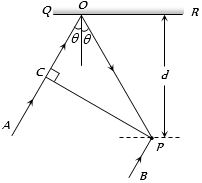
DifficultMCQ
In the adjacent diagram,$CP$ represents a wavefront and $AO$ & $BP$ are the corresponding two rays. Find the condition on $\theta$ for constructive interference at $P$ between the ray $BP$ and the reflected ray $OP$.
A
$cos \theta = 3 \lambda / 2d$
B
$cos \theta = \lambda / 4d$
C
$sec \theta - cos \theta = \lambda / d$
D
$sec \theta - cos \theta = 4 \lambda / d$
Solution
(B) From the geometry,the distance from $O$ to the line containing $P$ is $d$. Thus,$PO = d \sec \theta$.
Since $CP$ is a wavefront,the optical path length from $C$ to $P$ is equal to the path length from $O$ to $P$ along the ray $AO$. The path difference between the ray $BP$ and the reflected ray $OP$ is $\Delta = CO + OP$.
In $\triangle COP$,$CO = PO \cos 2\theta = d \sec \theta \cos 2\theta$.
Thus,$\Delta = d \sec \theta + d \sec \theta \cos 2\theta = d \sec \theta (1 + \cos 2\theta) = d \sec \theta (2 \cos^2 \theta) = 2d \cos \theta$.
Since the ray $OP$ undergoes reflection at the surface $QR$,there is an additional phase shift of $\pi$,which corresponds to a path difference of $\lambda / 2$.
For constructive interference,the total path difference must be an odd multiple of $\lambda / 2$ (due to the $\pi$ phase shift): $\Delta = \lambda / 2$.
$2d \cos \theta = \lambda / 2 \implies \cos \theta = \lambda / 4d$.
Since $CP$ is a wavefront,the optical path length from $C$ to $P$ is equal to the path length from $O$ to $P$ along the ray $AO$. The path difference between the ray $BP$ and the reflected ray $OP$ is $\Delta = CO + OP$.
In $\triangle COP$,$CO = PO \cos 2\theta = d \sec \theta \cos 2\theta$.
Thus,$\Delta = d \sec \theta + d \sec \theta \cos 2\theta = d \sec \theta (1 + \cos 2\theta) = d \sec \theta (2 \cos^2 \theta) = 2d \cos \theta$.
Since the ray $OP$ undergoes reflection at the surface $QR$,there is an additional phase shift of $\pi$,which corresponds to a path difference of $\lambda / 2$.
For constructive interference,the total path difference must be an odd multiple of $\lambda / 2$ (due to the $\pi$ phase shift): $\Delta = \lambda / 2$.
$2d \cos \theta = \lambda / 2 \implies \cos \theta = \lambda / 4d$.
0 likes
View Solution44
MediumMCQ
Four light waves are represented by:
$(i)$ $y = a_1 \sin \omega t$
(ii) $y = a_2 \sin (\omega t + \phi)$
(iii) $y = a_1 \sin 2\omega t$
(iv) $y = a_2 \sin 2(\omega t + \phi)$
Interference fringes may be observed due to the superposition of:
$(i)$ $y = a_1 \sin \omega t$
(ii) $y = a_2 \sin (\omega t + \phi)$
(iii) $y = a_1 \sin 2\omega t$
(iv) $y = a_2 \sin 2(\omega t + \phi)$
Interference fringes may be observed due to the superposition of:
A
$(i)$ and $(ii)$
B
$(i)$ and $(iii)$
C
$(iii)$ and $(iv)$
D
$(i)$ and $(ii)$ as well as $(iii)$ and $(iv)$
Solution
(D) For interference fringes to be observed,the superposing waves must have the same frequency and a constant phase difference.
$1$. Waves $(i)$ and $(ii)$ have the same angular frequency $\omega$. Thus,they can produce interference.
$2$. Waves $(iii)$ and $(iv)$ have the same angular frequency $2\omega$. Thus,they can also produce interference.
Therefore,interference fringes can be observed due to the superposition of $(i)$ and $(ii)$ or $(iii)$ and $(iv)$.
$1$. Waves $(i)$ and $(ii)$ have the same angular frequency $\omega$. Thus,they can produce interference.
$2$. Waves $(iii)$ and $(iv)$ have the same angular frequency $2\omega$. Thus,they can also produce interference.
Therefore,interference fringes can be observed due to the superposition of $(i)$ and $(ii)$ or $(iii)$ and $(iv)$.
0 likes
View Solution45
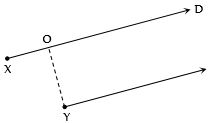
MediumMCQ
Two point sources $X$ and $Y$ emit waves of the same frequency and speed,but $Y$ lags in phase behind $X$ by $2\pi l$ radians. If there is a maximum in direction $D$,the distance $XO$ (where $n$ is an integer) is given by:
A
$\frac{\lambda}{2}(n - l)$
B
$\lambda(n + l)$
C
$\frac{\lambda}{2}(n + l)$
D
$\lambda(n - l)$
Solution
(B) For constructive interference (maxima),the net phase difference $\Delta \phi$ must be an integer multiple of $2\pi$.
Let $\phi_X$ and $\phi_Y$ be the phases of waves from $X$ and $Y$ at a point. The phase difference due to path difference $\Delta x = (YO - XO)$ is $\frac{2\pi}{\lambda} \Delta x$.
Given that $Y$ lags behind $X$ by $2\pi l$,the total phase difference is $\Delta \phi = \frac{2\pi}{\lambda}(YO - XO) - 2\pi l$.
For maxima,$\Delta \phi = 2\pi n$,where $n$ is an integer.
$2\pi n = \frac{2\pi}{\lambda}(YO - XO) - 2\pi l$.
Assuming the path difference $(YO - XO)$ is such that the condition simplifies to the distance $XO$ relative to the phase lag,the standard condition for maxima is $\frac{2\pi}{\lambda}(XO) = 2\pi(n + l)$.
Thus,$XO = \lambda(n + l)$.
Let $\phi_X$ and $\phi_Y$ be the phases of waves from $X$ and $Y$ at a point. The phase difference due to path difference $\Delta x = (YO - XO)$ is $\frac{2\pi}{\lambda} \Delta x$.
Given that $Y$ lags behind $X$ by $2\pi l$,the total phase difference is $\Delta \phi = \frac{2\pi}{\lambda}(YO - XO) - 2\pi l$.
For maxima,$\Delta \phi = 2\pi n$,where $n$ is an integer.
$2\pi n = \frac{2\pi}{\lambda}(YO - XO) - 2\pi l$.
Assuming the path difference $(YO - XO)$ is such that the condition simplifies to the distance $XO$ relative to the phase lag,the standard condition for maxima is $\frac{2\pi}{\lambda}(XO) = 2\pi(n + l)$.
Thus,$XO = \lambda(n + l)$.
0 likes
View Solution46
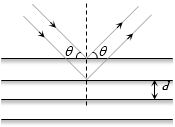
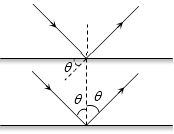
MediumMCQ
$A$ beam with wavelength $\lambda$ falls on a stack of partially reflecting planes with separation $d$. The angle $\theta$ that the beam should make with the planes so that the beams reflected from successive planes may interfere constructively is (where $n = 1, 2, \dots$)
A
$\sin^{-1}\left(\frac{n\lambda}{d}\right)$
B
$\tan^{-1}\left(\frac{n\lambda}{d}\right)$
C
$\sin^{-1}\left(\frac{n\lambda}{2d}\right)$
D
$\cos^{-1}\left(\frac{n\lambda}{2d}\right)$
Solution
(C) The path difference between the beams reflected from two successive planes is given by $\Delta x = 2d \sin \theta$,where $\theta$ is the glancing angle (the angle between the incident beam and the plane).
For constructive interference,the path difference must be an integer multiple of the wavelength:
$\Delta x = n\lambda$
Substituting the expression for path difference:
$2d \sin \theta = n\lambda$
$\sin \theta = \frac{n\lambda}{2d}$
$\theta = \sin^{-1}\left(\frac{n\lambda}{2d}\right)$
Thus,the correct option is $C$.
For constructive interference,the path difference must be an integer multiple of the wavelength:
$\Delta x = n\lambda$
Substituting the expression for path difference:
$2d \sin \theta = n\lambda$
$\sin \theta = \frac{n\lambda}{2d}$
$\theta = \sin^{-1}\left(\frac{n\lambda}{2d}\right)$
Thus,the correct option is $C$.
0 likes
View Solution47
DifficultMCQ
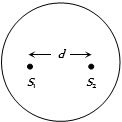
Two coherent sources separated by a distance $d$ are radiating in phase with a wavelength $\lambda$. $A$ detector moves in a large circle around the two sources in the plane of the two sources. The angular position of the $n = 4$ interference maxima is given as
A
${\sin ^{ - 1}}\frac{{n\lambda }}{d}$
B
${\cos ^{ - 1}}\frac{{4\lambda }}{d}$
C
${\tan ^{ - 1}}\frac{d}{{4\lambda }}$
D
${\cos ^{ - 1}}\frac{\lambda }{{4d}}$
Solution
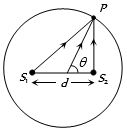
(B) The path difference $\Delta x$ at a point $P$ on the circle is given by the projection of the separation $d$ onto the line connecting the point $P$ to the sources. From the geometry,$\Delta x = d \cos \theta$,where $\theta$ is the angle with the line joining the sources.
For constructive interference (maxima) at point $P$,the condition is $\Delta x = n\lambda$.
Equating the two expressions for path difference:
$d \cos \theta = n\lambda$
$\cos \theta = \frac{n\lambda}{d}$
$\theta = \cos^{-1} \left( \frac{n\lambda}{d} \right)$
Given $n = 4$,the angular position is $\theta = \cos^{-1} \left( \frac{4\lambda}{d} \right)$.
For constructive interference (maxima) at point $P$,the condition is $\Delta x = n\lambda$.
Equating the two expressions for path difference:
$d \cos \theta = n\lambda$
$\cos \theta = \frac{n\lambda}{d}$
$\theta = \cos^{-1} \left( \frac{n\lambda}{d} \right)$
Given $n = 4$,the angular position is $\theta = \cos^{-1} \left( \frac{4\lambda}{d} \right)$.
0 likes
View Solution48
DifficultMCQ
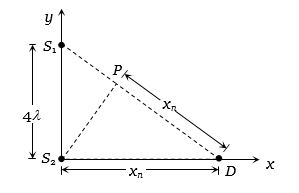
Two coherent sources $S_1$ and $S_2$ are separated by a distance four times the wavelength $\lambda$ of the source. The sources lie along the $y$-axis,whereas a detector moves along the $+x$-axis. Leaving the origin and far-off points,the number of points where maxima are observed is
A
$2$
B
$3$
C
$4$
D
$5$
Solution
(B) Let the distance between the sources be $d = 4\lambda$. The detector is at a point $D$ on the $x$-axis at a distance $x$ from the origin (which is $S_2$).
The path difference $\Delta x$ between the waves reaching $D$ from $S_1$ and $S_2$ is given by $\Delta x = S_1D - S_2D$.
In the right-angled triangle $\Delta S_1S_2D$,$S_1D = \sqrt{d^2 + x^2} = \sqrt{(4\lambda)^2 + x^2}$ and $S_2D = x$.
For maxima,the path difference must be an integer multiple of the wavelength: $\Delta x = n\lambda$,where $n$ is an integer.
So,$\sqrt{16\lambda^2 + x^2} - x = n\lambda$.
Rearranging gives $\sqrt{16\lambda^2 + x^2} = n\lambda + x$.
Squaring both sides: $16\lambda^2 + x^2 = n^2\lambda^2 + 2nx\lambda + x^2$.
$16\lambda^2 - n^2\lambda^2 = 2nx\lambda$.
$x = \frac{(16 - n^2)\lambda}{2n}$.
For $x > 0$,we must have $16 - n^2 > 0$,which means $n^2 < 16$,so $n$ can be $1, 2, 3$.
If $n=1$,$x = \frac{15\lambda}{2} = 7.5\lambda$.
If $n=2$,$x = \frac{12\lambda}{4} = 3\lambda$.
If $n=3$,$x = \frac{7\lambda}{6} \approx 1.17\lambda$.
Thus,there are $3$ points where maxima are observed.
The path difference $\Delta x$ between the waves reaching $D$ from $S_1$ and $S_2$ is given by $\Delta x = S_1D - S_2D$.
In the right-angled triangle $\Delta S_1S_2D$,$S_1D = \sqrt{d^2 + x^2} = \sqrt{(4\lambda)^2 + x^2}$ and $S_2D = x$.
For maxima,the path difference must be an integer multiple of the wavelength: $\Delta x = n\lambda$,where $n$ is an integer.
So,$\sqrt{16\lambda^2 + x^2} - x = n\lambda$.
Rearranging gives $\sqrt{16\lambda^2 + x^2} = n\lambda + x$.
Squaring both sides: $16\lambda^2 + x^2 = n^2\lambda^2 + 2nx\lambda + x^2$.
$16\lambda^2 - n^2\lambda^2 = 2nx\lambda$.
$x = \frac{(16 - n^2)\lambda}{2n}$.
For $x > 0$,we must have $16 - n^2 > 0$,which means $n^2 < 16$,so $n$ can be $1, 2, 3$.
If $n=1$,$x = \frac{15\lambda}{2} = 7.5\lambda$.
If $n=2$,$x = \frac{12\lambda}{4} = 3\lambda$.
If $n=3$,$x = \frac{7\lambda}{6} \approx 1.17\lambda$.
Thus,there are $3$ points where maxima are observed.
0 likes
View Solution49
MediumMCQ
Among the two interfering monochromatic sources $A$ and $B$; $A$ is ahead of $B$ in phase by $66^\circ$. If the observation is taken from point $P$,such that $PB - PA = \lambda / 4$. Then the phase difference between the waves from $A$ and $B$ reaching $P$ is.....$^\circ$.
A
$156$
B
$140$
C
$136$
D
$126$
Solution
(A) The total phase difference at point $P$ is the sum of the initial phase difference and the phase difference caused by the path difference.
Initial phase difference $\phi_i = 66^\circ$ (where $A$ is ahead of $B$).
Path difference $\Delta x = PB - PA = \lambda / 4$.
The phase difference due to path difference is given by $\phi_p = \frac{2\pi}{\lambda} \times \Delta x = \frac{360^\circ}{\lambda} \times \frac{\lambda}{4} = 90^\circ$.
Since $A$ is ahead of $B$ by $66^\circ$,and the path $PB$ is longer than $PA$ by $\lambda/4$,the wave from $B$ lags behind the wave from $A$ due to the path difference.
The total phase difference $\Delta \phi = 66^\circ + 90^\circ = 156^\circ$.
Initial phase difference $\phi_i = 66^\circ$ (where $A$ is ahead of $B$).
Path difference $\Delta x = PB - PA = \lambda / 4$.
The phase difference due to path difference is given by $\phi_p = \frac{2\pi}{\lambda} \times \Delta x = \frac{360^\circ}{\lambda} \times \frac{\lambda}{4} = 90^\circ$.
Since $A$ is ahead of $B$ by $66^\circ$,and the path $PB$ is longer than $PA$ by $\lambda/4$,the wave from $B$ lags behind the wave from $A$ due to the path difference.
The total phase difference $\Delta \phi = 66^\circ + 90^\circ = 156^\circ$.
0 likes
View SolutionWave Optics — Wave Nature and Interference of Light (Intensity) · Frequently Asked Questions
1Are these Wave Optics questions useful for JEE and NEET?
Yes. All questions in this section are mapped to JEE Main and NEET exam patterns. Previous year questions from JEE Main, NEET, GUJCET and state-level exams are included with full solutions.
2Can I switch to Hindi or Gujarati for these questions?
Yes. Use the language tabs in the hero section or the sidebar to view the same questions and solutions in English, Hindi or Gujarati.
3How do I generate a question paper from this subtopic?
Use the Vedclass Exam Paper Generator — select the chapter and subtopic, set difficulty, and generate Sets A, B, C, D automatically. First 3 chapters of every subject are free.
Vedclass Products
For Students
Vedclass Test Series
Mock tests in real JEE/NEET style with performance analysis. 5-day free trial.
Start Free TrialFor Teachers
Exam Paper Generator
Generate Set A/B/C/D papers from this chapter in 2 minutes. 3 chapters free.
Try FreeFor Institutes
Online Exam Module
Live online exams with unlimited students, 360° analytics & white-label branding.
See DemoFor Teachers & Institutes
Generate a Wave Optics Exam Paper in 2 Minutes
Select subtopic & difficulty — Sets A, B, C, D auto-generated with No Repeat logic.
First 3 chapters of every subject are free — no payment required.