
A English
Fresnel distance, Diffraction through circular slit, concept of Airy Disc, Rayleigh Criterion of Resolution , Fraunhofer diffraction Questions in English
Class 12 Physics · Wave Optics · Fresnel distance, Diffraction through circular slit, concept of Airy Disc, Rayleigh Criterion of Resolution , Fraunhofer diffraction
46+
Questions
English
Language
100%
With Solutions
Showing 43 of 46 questions in English
1
EasyMCQ
The cause of Fraunhofer lines is
A
Reflection of radiations by chromosphere
B
Absorption of radiations by chromosphere
C
Emission of radiations by chromosphere
D
Transmission of radiations by chromosphere
Solution
(B) The Fraunhofer lines are dark absorption lines observed in the solar spectrum.
When the continuous light emitted from the Sun's photosphere passes through the cooler outer layer known as the chromosphere,specific wavelengths of light are absorbed by the atoms present in the chromosphere.
This selective absorption of light results in the appearance of dark lines in the otherwise continuous spectrum of the Sun,which are known as Fraunhofer lines.
When the continuous light emitted from the Sun's photosphere passes through the cooler outer layer known as the chromosphere,specific wavelengths of light are absorbed by the atoms present in the chromosphere.
This selective absorption of light results in the appearance of dark lines in the otherwise continuous spectrum of the Sun,which are known as Fraunhofer lines.
0 likes
View Solution2
EasyMCQ
Fraunhofer lines are produced by
A
The element present in the photosphere of the sun
B
The elements present in the chromosphere of the sun
C
The vapour of the element present in the chromosphere of the sun
D
The carbon dioxide present in the atmosphere
Solution
(C) Fraunhofer lines are dark absorption lines observed in the solar spectrum.
These lines are produced when the continuous spectrum emitted by the hot photosphere of the sun passes through the cooler gases and vapours of elements present in the sun's chromosphere.
As the light passes through these cooler vapours,specific wavelengths corresponding to the characteristic absorption spectra of these elements are absorbed,resulting in the dark lines known as Fraunhofer lines.
Therefore,the correct option is $C$.
These lines are produced when the continuous spectrum emitted by the hot photosphere of the sun passes through the cooler gases and vapours of elements present in the sun's chromosphere.
As the light passes through these cooler vapours,specific wavelengths corresponding to the characteristic absorption spectra of these elements are absorbed,resulting in the dark lines known as Fraunhofer lines.
Therefore,the correct option is $C$.
0 likes
View Solution3
EasyMCQ
The Fraunhofer spectrum is a
A
Line absorption spectrum
B
Band absorption spectrum
C
Line emission spectrum
D
Band emission spectrum
Solution
(A) The Fraunhofer lines are observed in the solar spectrum.
These lines are formed when the atoms in the cooler outer layers of the Sun (the chromosphere) absorb specific wavelengths of light emitted by the hotter inner layers (the photosphere).
Since these atoms absorb discrete wavelengths,they produce dark lines in the continuous spectrum of the Sun.
Therefore,the Fraunhofer spectrum is a line absorption spectrum.
These lines are formed when the atoms in the cooler outer layers of the Sun (the chromosphere) absorb specific wavelengths of light emitted by the hotter inner layers (the photosphere).
Since these atoms absorb discrete wavelengths,they produce dark lines in the continuous spectrum of the Sun.
Therefore,the Fraunhofer spectrum is a line absorption spectrum.
0 likes
View Solution4
MediumMCQ
What will be the angle of diffraction for the first minimum due to Fraunhofer diffraction with a source of light of wavelength $550 \,nm$ and a slit of width $0.55 \,mm$ (in $,rad$)?
A
$0.001$
B
$0.01$
C
$1$
D
$0.1$
Solution
(A) For Fraunhofer diffraction at a single slit,the condition for the $n^{th}$ minimum is given by $d \sin \theta = n \lambda$.
Here,$d$ is the slit width,$\lambda$ is the wavelength of light,and $\theta$ is the angle of diffraction.
For the first minimum,we set $n = 1$.
Given values are $\lambda = 550 \,nm = 550 \times 10^{-9} \,m$ and $d = 0.55 \,mm = 0.55 \times 10^{-3} \,m$.
Substituting these values into the formula: $\sin \theta = \frac{n \lambda}{d} = \frac{1 \times 550 \times 10^{-9}}{0.55 \times 10^{-3}}$.
$\sin \theta = \frac{550 \times 10^{-9}}{550 \times 10^{-6}} = 10^{-3}$.
Since $\theta$ is very small,$\sin \theta \approx \theta$.
Therefore,$\theta = 0.001 \,rad$.
Here,$d$ is the slit width,$\lambda$ is the wavelength of light,and $\theta$ is the angle of diffraction.
For the first minimum,we set $n = 1$.
Given values are $\lambda = 550 \,nm = 550 \times 10^{-9} \,m$ and $d = 0.55 \,mm = 0.55 \times 10^{-3} \,m$.
Substituting these values into the formula: $\sin \theta = \frac{n \lambda}{d} = \frac{1 \times 550 \times 10^{-9}}{0.55 \times 10^{-3}}$.
$\sin \theta = \frac{550 \times 10^{-9}}{550 \times 10^{-6}} = 10^{-3}$.
Since $\theta$ is very small,$\sin \theta \approx \theta$.
Therefore,$\theta = 0.001 \,rad$.
0 likes
View Solution5
EasyMCQ
In Fresnel diffraction,if the distance between the disc and the screen is decreased,the intensity of the central bright spot will
A
Increase
B
Decrease
C
Remain constant
D
None of these
Solution
(B) In the case of diffraction by a circular disc (Poisson's spot),the intensity at the center depends on the number of Half-Period Zones $(HPZ)$ blocked by the disc.
The number of $HPZ$ blocked is given by $n = \frac{A}{\pi \lambda d}$,where $A$ is the area of the disc,$\lambda$ is the wavelength,and $d$ is the distance between the disc and the screen.
Since $A, \pi,$ and $\lambda$ are constants,we have $n \propto \frac{1}{d}$.
When the distance $d$ is decreased,the number of blocked $HPZ$ $(n)$ increases.
As more $HPZ$ are blocked,the destructive interference at the center increases,which leads to a decrease in the intensity of the central bright spot.
The number of $HPZ$ blocked is given by $n = \frac{A}{\pi \lambda d}$,where $A$ is the area of the disc,$\lambda$ is the wavelength,and $d$ is the distance between the disc and the screen.
Since $A, \pi,$ and $\lambda$ are constants,we have $n \propto \frac{1}{d}$.
When the distance $d$ is decreased,the number of blocked $HPZ$ $(n)$ increases.
As more $HPZ$ are blocked,the destructive interference at the center increases,which leads to a decrease in the intensity of the central bright spot.
0 likes
View Solution6
MediumMCQ
The direction of the first secondary maximum in the Fraunhofer diffraction pattern at a single slit is given by ($a$ is the width of the slit):
A
$a \sin \theta = \frac{\lambda}{2}$
B
$a \cos \theta = \frac{3\lambda}{2}$
C
$a \sin \theta = \lambda$
D
$a \sin \theta = \frac{3\lambda}{2}$
Solution
(D) For a single slit of width $a$,the condition for the $n^{th}$ secondary maxima in Fraunhofer diffraction is given by the path difference:
$a \sin \theta = (2n + 1) \frac{\lambda}{2}$,where $n = 1, 2, 3, ...$
For the first secondary maximum,we substitute $n = 1$:
$a \sin \theta = (2(1) + 1) \frac{\lambda}{2} = \frac{3\lambda}{2}$
Thus,the correct option is $D$.
$a \sin \theta = (2n + 1) \frac{\lambda}{2}$,where $n = 1, 2, 3, ...$
For the first secondary maximum,we substitute $n = 1$:
$a \sin \theta = (2(1) + 1) \frac{\lambda}{2} = \frac{3\lambda}{2}$
Thus,the correct option is $D$.
0 likes
View Solution7
EasyMCQ
What do the Fraunhofer lines in the solar spectrum indicate?
A
Absorption of certain wavelengths in the photosphere of the Sun.
B
Absorption of certain wavelengths in the chromosphere of the Sun.
C
The Sun does not emit all wavelengths.
D
Nuclear reactions occurring in the Sun.
Solution
(B) Fraunhofer lines are dark absorption lines observed in the solar spectrum.
These lines are formed because the cooler gases in the Sun's chromosphere absorb specific wavelengths of light emitted by the hotter photosphere beneath it.
Therefore,they indicate the absorption of certain wavelengths by the elements present in the Sun's chromosphere.
These lines are formed because the cooler gases in the Sun's chromosphere absorb specific wavelengths of light emitted by the hotter photosphere beneath it.
Therefore,they indicate the absorption of certain wavelengths by the elements present in the Sun's chromosphere.
0 likes
View Solution8
MediumMCQ
$A$ plane wavefront of wavelength $6000 \, \mathring A$ is incident on a slit of width $0.2 \, mm$. $A$ Fraunhofer diffraction pattern is obtained on a screen at a distance of $2 \, m$ from the slit. What is the width of the central maximum in $mm$?
A
$10$
B
$12$
C
$8$
D
$2$
Solution
(B) Given: Wavelength $\lambda = 6000 \, \mathring A = 6000 \times 10^{-10} \, m$.
Slit width $a = 0.2 \, mm = 0.2 \times 10^{-3} \, m$.
Distance of screen $D = 2 \, m$.
The angular width of the central maximum is given by $2\theta = \frac{2\lambda}{a}$.
The linear width of the central maximum is $W = D \times (2\theta) = \frac{2\lambda D}{a}$.
Substituting the values: $W = \frac{2 \times 6000 \times 10^{-10} \times 2}{0.2 \times 10^{-3}}$.
$W = \frac{24000 \times 10^{-10}}{0.2 \times 10^{-3}} = \frac{2.4 \times 10^{-6}}{0.2 \times 10^{-3}} = 12 \times 10^{-3} \, m = 12 \, mm$.
Slit width $a = 0.2 \, mm = 0.2 \times 10^{-3} \, m$.
Distance of screen $D = 2 \, m$.
The angular width of the central maximum is given by $2\theta = \frac{2\lambda}{a}$.
The linear width of the central maximum is $W = D \times (2\theta) = \frac{2\lambda D}{a}$.
Substituting the values: $W = \frac{2 \times 6000 \times 10^{-10} \times 2}{0.2 \times 10^{-3}}$.
$W = \frac{24000 \times 10^{-10}}{0.2 \times 10^{-3}} = \frac{2.4 \times 10^{-6}}{0.2 \times 10^{-3}} = 12 \times 10^{-3} \, m = 12 \, mm$.
0 likes
View Solution9
MediumMCQ
Find the half-angular width of the central maximum in the Fraunhofer diffraction pattern produced by a slit of width $12 \times 10^{-5} \text{ cm}$,when illuminated by monochromatic light of wavelength $6000 \, \mathring{A}$. (Answer in degrees)
A
$20$
B
$30$
C
$40$
D
$35$
Solution
(B) The condition for the first minimum in a single-slit Fraunhofer diffraction pattern is given by $a \sin \theta = n \lambda$. For the first minimum,$n = 1$,so $\sin \theta = \frac{\lambda}{a}$.
Here,the slit width $a = 12 \times 10^{-5} \text{ cm} = 12 \times 10^{-7} \text{ m}$.
The wavelength $\lambda = 6000 \, \mathring{A} = 6000 \times 10^{-10} \text{ m} = 6 \times 10^{-7} \text{ m}$.
Substituting the values: $\sin \theta = \frac{6 \times 10^{-7}}{12 \times 10^{-7}} = \frac{6}{12} = 0.5$.
Since $\sin \theta = 0.5$,the half-angular width $\theta = \arcsin(0.5) = 30^{\circ}$.
Here,the slit width $a = 12 \times 10^{-5} \text{ cm} = 12 \times 10^{-7} \text{ m}$.
The wavelength $\lambda = 6000 \, \mathring{A} = 6000 \times 10^{-10} \text{ m} = 6 \times 10^{-7} \text{ m}$.
Substituting the values: $\sin \theta = \frac{6 \times 10^{-7}}{12 \times 10^{-7}} = \frac{6}{12} = 0.5$.
Since $\sin \theta = 0.5$,the half-angular width $\theta = \arcsin(0.5) = 30^{\circ}$.
0 likes
View Solution10
MediumMCQ
In a Fresnel diffraction arrangement,the screen is at a distance of $2 \ m$ from a circular aperture. It is found that for light of wavelengths ${\lambda _1}$ and ${\lambda _2},$ the radius of the $4^{th}$ zone for ${\lambda _1}$ coincides with the radius of the $5^{th}$ zone for ${\lambda _2}.$ Then the ratio ${\lambda _1}:{\lambda _2}$ is
A
$\sqrt {4/5} $
B
$\sqrt {5/4} $
C
$5/4$
D
$4/5$
Solution
(C) The radius of the $n^{th}$ Fresnel zone is given by the formula $r_n = \sqrt{n b \lambda}$,where $b$ is the distance from the aperture to the screen and $\lambda$ is the wavelength of light.
Given that the radius of the $4^{th}$ zone for wavelength ${\lambda _1}$ is equal to the radius of the $5^{th}$ zone for wavelength ${\lambda _2}$,we have:
$r_4 = \sqrt{4 b \lambda_1}$
$r_5 = \sqrt{5 b \lambda_2}$
Since $r_4 = r_5$,we equate the expressions:
$\sqrt{4 b \lambda_1} = \sqrt{5 b \lambda_2}$
Squaring both sides,we get:
$4 b \lambda_1 = 5 b \lambda_2$
Dividing both sides by $b$ (where $b \neq 0$):
$4 \lambda_1 = 5 \lambda_2$
Therefore,the ratio is:
$\frac{\lambda_1}{\lambda_2} = \frac{5}{4}$
Given that the radius of the $4^{th}$ zone for wavelength ${\lambda _1}$ is equal to the radius of the $5^{th}$ zone for wavelength ${\lambda _2}$,we have:
$r_4 = \sqrt{4 b \lambda_1}$
$r_5 = \sqrt{5 b \lambda_2}$
Since $r_4 = r_5$,we equate the expressions:
$\sqrt{4 b \lambda_1} = \sqrt{5 b \lambda_2}$
Squaring both sides,we get:
$4 b \lambda_1 = 5 b \lambda_2$
Dividing both sides by $b$ (where $b \neq 0$):
$4 \lambda_1 = 5 \lambda_2$
Therefore,the ratio is:
$\frac{\lambda_1}{\lambda_2} = \frac{5}{4}$
0 likes
View Solution11
MediumMCQ
The diagrams below show the intensity distribution in diffraction of light of two sources. In which of the following cases the sources are just resolved?
A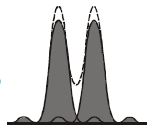
B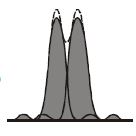
C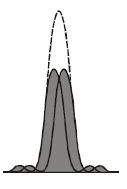
D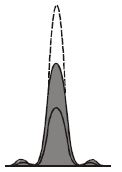
Solution
(B) According to the Rayleigh criterion,two point sources are said to be 'just resolved' when the central maximum of the diffraction pattern of one source falls exactly on the first minimum of the diffraction pattern of the other source.
In this condition,the resultant intensity curve shows a distinct dip between the two central maxima,which is approximately $80\%$ of the peak intensity.
Looking at the provided diagrams:
- Diagram $A$ shows two sources that are well-separated (resolved).
- Diagram $B$ shows the condition where the central maximum of one coincides with the first minimum of the other,which is the definition of 'just resolved'.
- Diagram $C$ shows the sources closer than the Rayleigh limit (unresolved).
- Diagram $D$ shows the sources very close,appearing as a single source (unresolved).
Therefore,the correct representation is Diagram $B$.
In this condition,the resultant intensity curve shows a distinct dip between the two central maxima,which is approximately $80\%$ of the peak intensity.
Looking at the provided diagrams:
- Diagram $A$ shows two sources that are well-separated (resolved).
- Diagram $B$ shows the condition where the central maximum of one coincides with the first minimum of the other,which is the definition of 'just resolved'.
- Diagram $C$ shows the sources closer than the Rayleigh limit (unresolved).
- Diagram $D$ shows the sources very close,appearing as a single source (unresolved).
Therefore,the correct representation is Diagram $B$.
0 likes
View Solution12
MediumMCQ
What will be the angular width of the central maxima in Fraunhofer diffraction when light of wavelength $6000 \,\mathring{A}$ is used and the slit width is $12 \times 10^{-5} \, \text{cm}$? (in $rad$)
A
$2$
B
$3$
C
$1$
D
$8$
Solution
(C) The angular width of the central maxima in Fraunhofer diffraction is given by the formula: $\omega_{\theta} = \frac{2\lambda}{a}$.
Given:
Wavelength $\lambda = 6000 \, \mathring{A} = 6000 \times 10^{-10} \, \text{m} = 6 \times 10^{-7} \, \text{m}$.
Slit width $a = 12 \times 10^{-5} \, \text{cm} = 12 \times 10^{-7} \, \text{m}$.
Substituting the values into the formula:
$\omega_{\theta} = \frac{2 \times 6 \times 10^{-7} \, \text{m}}{12 \times 10^{-7} \, \text{m}}$.
$\omega_{\theta} = \frac{12 \times 10^{-7}}{12 \times 10^{-7}} = 1 \, \text{rad}$.
Thus,the angular width is $1 \, \text{rad}$.
Given:
Wavelength $\lambda = 6000 \, \mathring{A} = 6000 \times 10^{-10} \, \text{m} = 6 \times 10^{-7} \, \text{m}$.
Slit width $a = 12 \times 10^{-5} \, \text{cm} = 12 \times 10^{-7} \, \text{m}$.
Substituting the values into the formula:
$\omega_{\theta} = \frac{2 \times 6 \times 10^{-7} \, \text{m}}{12 \times 10^{-7} \, \text{m}}$.
$\omega_{\theta} = \frac{12 \times 10^{-7}}{12 \times 10^{-7}} = 1 \, \text{rad}$.
Thus,the angular width is $1 \, \text{rad}$.
0 likes
View Solution13
MediumMCQ
For what distance is ray optics a good approximation when the aperture is $4 \, mm$ wide and the wavelength is $500 \, nm$ (in $, m$)?
A
$22$
B
$32$
C
$42$
D
$52$
Solution
(B) The Fresnel distance $(z_F)$ is the distance for which ray optics is a good approximation. It is given by the formula: $z_F = \frac{a^2}{\lambda}$.
Given:
Aperture width $(a)$ = $4 \, mm = 4 \times 10^{-3} \, m$.
Wavelength $(\lambda)$ = $500 \, nm = 500 \times 10^{-9} \, m$.
Substituting the values:
$z_F = \frac{(4 \times 10^{-3})^2}{500 \times 10^{-9}}$
$z_F = \frac{16 \times 10^{-6}}{5 \times 10^{-7}}$
$z_F = \frac{16}{5} \times 10^1 = 3.2 \times 10 = 32 \, m$.
Given:
Aperture width $(a)$ = $4 \, mm = 4 \times 10^{-3} \, m$.
Wavelength $(\lambda)$ = $500 \, nm = 500 \times 10^{-9} \, m$.
Substituting the values:
$z_F = \frac{(4 \times 10^{-3})^2}{500 \times 10^{-9}}$
$z_F = \frac{16 \times 10^{-6}}{5 \times 10^{-7}}$
$z_F = \frac{16}{5} \times 10^1 = 3.2 \times 10 = 32 \, m$.
0 likes
View Solution14
MediumMCQ
The angular width of the central maxima in Fraunhofer diffraction for $\lambda = 6000 \; \mathring{A}$ is $\theta_{0}$. When the same slit is illuminated by another monochromatic light,the angular width decreases by $30 \%$. The wavelength of this light is ....... $\mathring{A}$.
A
$1800$
B
$4200$
C
$6000$
D
$420$
Solution
(B) The angular width of the central maxima in Fraunhofer diffraction is given by $\theta = \frac{2\lambda}{d}$,where $\lambda$ is the wavelength and $d$ is the slit width.
Since $\theta \propto \lambda$,we have the ratio $\frac{\theta_2}{\theta_1} = \frac{\lambda_2}{\lambda_1}$.
Given that the angular width decreases by $30 \%$,the new angular width $\theta_2 = \theta_0 - 0.30\theta_0 = 0.70\theta_0$.
Substituting the values: $\frac{0.70\theta_0}{\theta_0} = \frac{\lambda_2}{6000 \; \mathring{A}}$.
$0.70 = \frac{\lambda_2}{6000 \; \mathring{A}}$.
$\lambda_2 = 0.70 \times 6000 \; \mathring{A} = 4200 \; \mathring{A}$.
Since $\theta \propto \lambda$,we have the ratio $\frac{\theta_2}{\theta_1} = \frac{\lambda_2}{\lambda_1}$.
Given that the angular width decreases by $30 \%$,the new angular width $\theta_2 = \theta_0 - 0.30\theta_0 = 0.70\theta_0$.
Substituting the values: $\frac{0.70\theta_0}{\theta_0} = \frac{\lambda_2}{6000 \; \mathring{A}}$.
$0.70 = \frac{\lambda_2}{6000 \; \mathring{A}}$.
$\lambda_2 = 0.70 \times 6000 \; \mathring{A} = 4200 \; \mathring{A}$.
0 likes
View Solution15
Easy
For what distance is ray optics a good approximation when the aperture is $3\; mm$ wide and the wavelength is $500\; nm$?
Solution
(18 M) The Fresnel distance $(z_{F})$ is the distance for which ray optics is a good approximation. It is given by the formula $z_{F} = \frac{a^{2}}{\lambda}$,where $a$ is the aperture width and $\lambda$ is the wavelength.
Given: $a = 3\; mm = 3 \times 10^{-3}\; m$ and $\lambda = 500\; nm = 5 \times 10^{-7}\; m$.
Substituting the values:
$z_{F} = \frac{(3 \times 10^{-3})^{2}}{5 \times 10^{-7}}$
$z_{F} = \frac{9 \times 10^{-6}}{5 \times 10^{-7}}$
$z_{F} = 1.8 \times 10^{1} = 18\; m$.
Thus,ray optics is a good approximation for distances up to $18\; m$.
Given: $a = 3\; mm = 3 \times 10^{-3}\; m$ and $\lambda = 500\; nm = 5 \times 10^{-7}\; m$.
Substituting the values:
$z_{F} = \frac{(3 \times 10^{-3})^{2}}{5 \times 10^{-7}}$
$z_{F} = \frac{9 \times 10^{-6}}{5 \times 10^{-7}}$
$z_{F} = 1.8 \times 10^{1} = 18\; m$.
Thus,ray optics is a good approximation for distances up to $18\; m$.
0 likes
View Solution16
Easy
Estimate the distance for which ray optics is a good approximation for an aperture of $4 \; mm$ and wavelength $400 \; nm$.
Solution
(40 M) Fresnel's distance $(Z_{F})$ is the distance for which ray optics is a good approximation.
It is given by the relation:
$Z_{F} = \frac{a^{2}}{\lambda}$
Where:
Aperture width,$a = 4 \; mm = 4 \times 10^{-3} \; m$
Wavelength of light,$\lambda = 400 \; nm = 400 \times 10^{-9} \; m$
Substituting the values:
$Z_{F} = \frac{(4 \times 10^{-3})^{2}}{400 \times 10^{-9}}$
$Z_{F} = \frac{16 \times 10^{-6}}{400 \times 10^{-9}}$
$Z_{F} = \frac{16}{400} \times 10^{3} = 0.04 \times 1000 = 40 \; m$
Therefore,the distance for which ray optics is a good approximation is $40 \; m$.
It is given by the relation:
$Z_{F} = \frac{a^{2}}{\lambda}$
Where:
Aperture width,$a = 4 \; mm = 4 \times 10^{-3} \; m$
Wavelength of light,$\lambda = 400 \; nm = 400 \times 10^{-9} \; m$
Substituting the values:
$Z_{F} = \frac{(4 \times 10^{-3})^{2}}{400 \times 10^{-9}}$
$Z_{F} = \frac{16 \times 10^{-6}}{400 \times 10^{-9}}$
$Z_{F} = \frac{16}{400} \times 10^{3} = 0.04 \times 1000 = 40 \; m$
Therefore,the distance for which ray optics is a good approximation is $40 \; m$.
0 likes
View Solution17
MediumMCQ
Two towers on top of two hills are $40 \, km$ apart. The line joining them passes $50 \, m$ above a hill halfway between the towers. What is the longest wavelength of radio waves (in $cm$),which can be sent between the towers without appreciable diffraction effects?
A
$6.4$
B
$9.6$
C
$12.5$
D
$16.5$
Solution
(C) The distance between the two towers is $D = 40 \, km = 40,000 \, m$. The hill is located at the midpoint,so the distance from either tower to the hill is $Z_F = D/2 = 20,000 \, m$.
For radio waves to travel between the towers without significant diffraction,the Fresnel distance $Z_F$ must be at least equal to the distance to the obstacle. The condition for the Fresnel distance is given by $Z_F = \frac{a^2}{\lambda}$,where $a$ is the size of the aperture (or the clearance height) and $\lambda$ is the wavelength.
Here,the clearance height is $a = 50 \, m$.
Rearranging the formula to solve for the wavelength $\lambda$:
$\lambda = \frac{a^2}{Z_F}$
Substituting the values:
$\lambda = \frac{(50 \, m)^2}{20,000 \, m} = \frac{2500}{20,000} \, m = 0.125 \, m$.
Converting the wavelength to centimeters:
$\lambda = 0.125 \, m \times 100 \, cm/m = 12.5 \, cm$.
Thus,the longest wavelength is $12.5 \, cm$.
For radio waves to travel between the towers without significant diffraction,the Fresnel distance $Z_F$ must be at least equal to the distance to the obstacle. The condition for the Fresnel distance is given by $Z_F = \frac{a^2}{\lambda}$,where $a$ is the size of the aperture (or the clearance height) and $\lambda$ is the wavelength.
Here,the clearance height is $a = 50 \, m$.
Rearranging the formula to solve for the wavelength $\lambda$:
$\lambda = \frac{a^2}{Z_F}$
Substituting the values:
$\lambda = \frac{(50 \, m)^2}{20,000 \, m} = \frac{2500}{20,000} \, m = 0.125 \, m$.
Converting the wavelength to centimeters:
$\lambda = 0.125 \, m \times 100 \, cm/m = 12.5 \, cm$.
Thus,the longest wavelength is $12.5 \, cm$.
0 likes
View Solution18
Medium
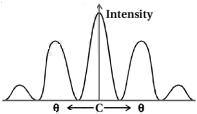
In Fraunhofer diffraction,draw the graph of the intensity of light on the screen versus the diffraction angle $\theta$ and write its characteristics.
Solution
(N/A) In Fraunhofer diffraction,the graph of the intensity of light on the screen versus the diffraction angle $\theta$ is shown in the figure.
From the graph,it can be observed that the intensity of the central maxima is the highest.
$(i)$ All minima have zero light intensity.
$(ii)$ The intensity of the secondary maxima decreases as the angle of diffraction increases. Thus,the intensity decreases as the order increases,and the width of the maxima also decreases.
$(iii)$ As the ratio $\frac{\lambda}{a}$ is small,the diffraction effect is less,and if it is large,the diffraction effect is more.
From the graph,it can be observed that the intensity of the central maxima is the highest.
$(i)$ All minima have zero light intensity.
$(ii)$ The intensity of the secondary maxima decreases as the angle of diffraction increases. Thus,the intensity decreases as the order increases,and the width of the maxima also decreases.
$(iii)$ As the ratio $\frac{\lambda}{a}$ is small,the diffraction effect is less,and if it is large,the diffraction effect is more.
0 likes
View Solution19
Medium
Explain that for a greater distance,the spreading due to diffraction dominates over that due to ray optics. $OR$ Explain the importance of Fresnel distance.
Solution
(N/A) An aperture of size $a$ illuminated by a parallel beam sends diffracted light into an angle $\theta$,where the angular width is $\theta \approx \frac{\lambda}{a}$.
In travelling a distance $z$,the diffracted beam acquires a width $w = z \theta = \frac{z \lambda}{a}$ due to diffraction.
The Fresnel distance $z_F$ is defined as the distance at which the spreading due to diffraction becomes equal to the size of the aperture $a$.
Setting $a = \frac{z_F \lambda}{a}$,we get $z_F = \frac{a^2}{\lambda}$.
For distances $z \ll z_F$,the spreading due to diffraction is negligible compared to the size of the aperture,and the beam travels in a straight line,which is consistent with ray optics.
For distances $z > z_F$,the spreading due to diffraction dominates over the spreading due to ray optics. Thus,ray optics is an approximation valid only when the wavelength $\lambda \to 0$ or for distances $z \ll z_F$.
In travelling a distance $z$,the diffracted beam acquires a width $w = z \theta = \frac{z \lambda}{a}$ due to diffraction.
The Fresnel distance $z_F$ is defined as the distance at which the spreading due to diffraction becomes equal to the size of the aperture $a$.
Setting $a = \frac{z_F \lambda}{a}$,we get $z_F = \frac{a^2}{\lambda}$.
For distances $z \ll z_F$,the spreading due to diffraction is negligible compared to the size of the aperture,and the beam travels in a straight line,which is consistent with ray optics.
For distances $z > z_F$,the spreading due to diffraction dominates over the spreading due to ray optics. Thus,ray optics is an approximation valid only when the wavelength $\lambda \to 0$ or for distances $z \ll z_F$.
0 likes
View Solution20
EasyMCQ
The limit of resolution of a telescope and a microscope is imposed because of which phenomenon?
A
Diffraction
B
Interference
C
Refraction
D
Polarization
Solution
(A) The limit of resolution of optical instruments like telescopes and microscopes is fundamentally imposed by the phenomenon of $Diffraction$.
When light passes through a circular aperture (like the objective lens of a telescope or microscope),it does not form a perfect point image due to the wave nature of light.
Instead,it forms a diffraction pattern consisting of a central bright spot (Airy disk) surrounded by concentric dark and bright rings.
According to the Rayleigh criterion,two point objects are just resolved when the central maximum of the diffraction pattern of one coincides with the first minimum of the diffraction pattern of the other.
Therefore,diffraction sets the ultimate limit on the resolving power of these instruments.
When light passes through a circular aperture (like the objective lens of a telescope or microscope),it does not form a perfect point image due to the wave nature of light.
Instead,it forms a diffraction pattern consisting of a central bright spot (Airy disk) surrounded by concentric dark and bright rings.
According to the Rayleigh criterion,two point objects are just resolved when the central maximum of the diffraction pattern of one coincides with the first minimum of the diffraction pattern of the other.
Therefore,diffraction sets the ultimate limit on the resolving power of these instruments.
0 likes
View Solution21
Medium
What is Fresnel distance? Write its formula.
Solution
(N/A) The Fresnel distance is defined as the distance from a slit or aperture at which the spreading of light due to diffraction becomes comparable to the size of the aperture itself.
Beyond this distance,the ray optics approximation (rectilinear propagation of light) is no longer valid,and diffraction effects become significant.
It acts as a limit to the validity of ray optics.
The formula for Fresnel distance $(z_F)$ is given by:
$z_F = \frac{a^2}{\lambda}$
Where:
$a$ = size of the aperture or slit width
$\lambda$ = wavelength of the light used
Beyond this distance,the ray optics approximation (rectilinear propagation of light) is no longer valid,and diffraction effects become significant.
It acts as a limit to the validity of ray optics.
The formula for Fresnel distance $(z_F)$ is given by:
$z_F = \frac{a^2}{\lambda}$
Where:
$a$ = size of the aperture or slit width
$\lambda$ = wavelength of the light used
0 likes
View Solution22
AdvancedMCQ
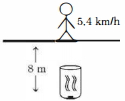
$A$ student is jogging on a straight path with a speed of $5.4 \,km/h$. Perpendicular to the path is a pipe with its opening $8 \,m$ from the road (see figure). The diameter of the pipe is $0.45 \,m$. At the other end of the pipe is a speaker emitting sound of $1280 \,Hz$ towards the opening of the pipe. As the student passes in front of the pipe,she hears the speaker sound for $T$ seconds. $T$ is in the range (Take speed of sound $= 320 \,m/s$):
A
$6-12$
B
$12-18$
C
$3-6$
D
$18-22$
Solution
(A) Given: Speed of student $v = 5.4 \,km/h = 5.4 \times \frac{5}{18} \,m/s = 1.5 \,m/s$.
Distance of pipe opening from the path $D = 8 \,m$.
Diameter of the pipe $d = 0.45 \,m$.
Frequency of sound $f = 1280 \,Hz$.
Speed of sound $v_s = 320 \,m/s$.
First,calculate the wavelength of the sound: $\lambda = \frac{v_s}{f} = \frac{320}{1280} = 0.25 \,m$.
The diffraction of sound waves at the circular opening of the pipe follows the condition for the first minimum: $\sin \theta = 1.22 \frac{\lambda}{d}$.
For small angles,$\sin \theta \approx \tan \theta = \frac{y}{D}$,where $y$ is the distance from the center of the central maximum to the first minimum.
$y = 1.22 \frac{\lambda}{d} D = 1.22 \times \frac{0.25}{0.45} \times 8 = 1.22 \times \frac{1}{1.8} \times 8 \approx 5.42 \,m$.
The width of the central maximum is $2y = 2 \times 5.42 = 10.84 \,m$.
The time $T$ for which the sound is heard is the time taken to cover this width: $T = \frac{2y}{v} = \frac{10.84}{1.5} \approx 7.23 \,s$.
This value lies in the range of $6-12$ seconds.
Distance of pipe opening from the path $D = 8 \,m$.
Diameter of the pipe $d = 0.45 \,m$.
Frequency of sound $f = 1280 \,Hz$.
Speed of sound $v_s = 320 \,m/s$.
First,calculate the wavelength of the sound: $\lambda = \frac{v_s}{f} = \frac{320}{1280} = 0.25 \,m$.
The diffraction of sound waves at the circular opening of the pipe follows the condition for the first minimum: $\sin \theta = 1.22 \frac{\lambda}{d}$.
For small angles,$\sin \theta \approx \tan \theta = \frac{y}{D}$,where $y$ is the distance from the center of the central maximum to the first minimum.
$y = 1.22 \frac{\lambda}{d} D = 1.22 \times \frac{0.25}{0.45} \times 8 = 1.22 \times \frac{1}{1.8} \times 8 \approx 5.42 \,m$.
The width of the central maximum is $2y = 2 \times 5.42 = 10.84 \,m$.
The time $T$ for which the sound is heard is the time taken to cover this width: $T = \frac{2y}{v} = \frac{10.84}{1.5} \approx 7.23 \,s$.
This value lies in the range of $6-12$ seconds.
0 likes
View Solution23
EasyMCQ
The condition for observing Fraunhofer diffraction from a single slit is that the wave front incident on the slit should be ............
A
Spherical
B
Cylindrical
C
Plane
D
Elliptical
Solution
(C) In Fraunhofer diffraction,the source of light and the screen are effectively at an infinite distance from the aperture (slit).
Because the source is at an infinite distance,the wave front incident on the slit is a plane wave front.
Therefore,the correct condition is that the incident wave front must be plane.
Because the source is at an infinite distance,the wave front incident on the slit is a plane wave front.
Therefore,the correct condition is that the incident wave front must be plane.
0 likes
View Solution24
MediumMCQ
In Fraunhofer diffraction,light of wavelength $6328 \ \mathring{A}$ is incident perpendicularly on a slit of width $0.2 \ mm$. The angular width of the secondary maxima or minima will be: (in $^{\circ}$)
A
$0.36$
B
$0.18$
C
$0.72$
D
$0.09$
Solution
(B) In Fraunhofer diffraction due to a single slit of width $a$,the angular position of the $n^{th}$ minima is given by $\sin \theta = \frac{n \lambda}{a}$. For small angles,$\theta \approx \frac{n \lambda}{a}$.
The angular width of the secondary maxima or minima is given by $\Delta \theta = \frac{\lambda}{a}$.
Given: $\lambda = 6328 \times 10^{-10} \ m$ and $a = 0.2 \times 10^{-3} \ m$.
$\Delta \theta = \frac{6328 \times 10^{-10}}{0.2 \times 10^{-3}} \ rad = 3.164 \times 10^{-3} \ rad$.
To convert radians to degrees,multiply by $\frac{180^{\circ}}{\pi}$:
$\Delta \theta = 3.164 \times 10^{-3} \times \frac{180}{3.14159} \approx 0.18^{\circ}$.
The angular width of the secondary maxima or minima is given by $\Delta \theta = \frac{\lambda}{a}$.
Given: $\lambda = 6328 \times 10^{-10} \ m$ and $a = 0.2 \times 10^{-3} \ m$.
$\Delta \theta = \frac{6328 \times 10^{-10}}{0.2 \times 10^{-3}} \ rad = 3.164 \times 10^{-3} \ rad$.
To convert radians to degrees,multiply by $\frac{180^{\circ}}{\pi}$:
$\Delta \theta = 3.164 \times 10^{-3} \times \frac{180}{3.14159} \approx 0.18^{\circ}$.
0 likes
View Solution25
MediumMCQ
In a Fraunhofer diffraction,light of wavelength $\lambda$ is incident on a slit of width $d$. The diffraction pattern is observed on a screen placed at a distance $D$. If the linear width of the central maximum is equal to two times the width of the slit,then the value of $D$ is:
A
$\frac{d^2}{\lambda}$
B
$\frac{d^2}{2 \lambda}$
C
$\frac{d^2}{3 \lambda}$
D
$\frac{d^2}{4 \lambda}$
Solution
(A) The linear width of the central maximum in a Fraunhofer diffraction pattern is given by the formula $w = \frac{2 \lambda D}{d}$.
According to the problem,the linear width of the central maximum is equal to two times the width of the slit,so $w = 2d$.
Equating the two expressions: $\frac{2 \lambda D}{d} = 2d$.
Dividing both sides by $2$,we get $\frac{\lambda D}{d} = d$.
Solving for $D$,we find $D = \frac{d^2}{\lambda}$.
According to the problem,the linear width of the central maximum is equal to two times the width of the slit,so $w = 2d$.
Equating the two expressions: $\frac{2 \lambda D}{d} = 2d$.
Dividing both sides by $2$,we get $\frac{\lambda D}{d} = d$.
Solving for $D$,we find $D = \frac{d^2}{\lambda}$.
0 likes
View Solution26
MediumMCQ
In a Fraunhofer diffraction pattern,the slit width is $0.2 \ mm$ and the screen is at $2 \ m$ away from the lens. If the distance between the first minimum on either side of the central maximum is $1 \ cm$,the wavelength of light used is: (in $Å$)
A
$2000$
B
$4000$
C
$5000$
D
$10000$
Solution
(C) For Fraunhofer diffraction,the position of the $n^{th}$ minimum is given by $a \sin \theta = n \lambda$. For small angles,$\sin \theta \approx \theta = \frac{y_n}{D}$,where $y_n$ is the distance from the central maximum.
Thus,$y_n = \frac{n \lambda D}{a}$.
The distance between the first minima on either side of the central maximum is $2y_1 = \frac{2 \lambda D}{a}$.
Given: $a = 0.2 \ mm = 2 \times 10^{-4} \ m$,$D = 2 \ m$,and $2y_1 = 1 \ cm = 10^{-2} \ m$.
Substituting the values: $10^{-2} = \frac{2 \times \lambda \times 2}{2 \times 10^{-4}}$.
$10^{-2} = \frac{4 \lambda}{2 \times 10^{-4}} = 2 \times 10^4 \lambda$.
$\lambda = \frac{10^{-2}}{2 \times 10^4} = 0.5 \times 10^{-6} \ m = 5000 \times 10^{-10} \ m = 5000 \ Å$.
Thus,$y_n = \frac{n \lambda D}{a}$.
The distance between the first minima on either side of the central maximum is $2y_1 = \frac{2 \lambda D}{a}$.
Given: $a = 0.2 \ mm = 2 \times 10^{-4} \ m$,$D = 2 \ m$,and $2y_1 = 1 \ cm = 10^{-2} \ m$.
Substituting the values: $10^{-2} = \frac{2 \times \lambda \times 2}{2 \times 10^{-4}}$.
$10^{-2} = \frac{4 \lambda}{2 \times 10^{-4}} = 2 \times 10^4 \lambda$.
$\lambda = \frac{10^{-2}}{2 \times 10^4} = 0.5 \times 10^{-6} \ m = 5000 \times 10^{-10} \ m = 5000 \ Å$.
0 likes
View Solution27
MediumMCQ
In Fraunhofer diffraction pattern,slit width is $0.3 \ mm$ and screen is at $1.5 \ m$ away from the lens. If wavelength of light used is $4500 \ Å$,then the distance between the first minimum on either side of the central maximum is [ $\theta$ is small and measured in radian.] (in $mm$)
A
$1.5$
B
$2.25$
C
$3.25$
D
$4.5$
Solution
(D) Given: Slit width $a = 0.3 \ mm = 0.3 \times 10^{-3} \ m$,Screen distance $D = 1.5 \ m$,Wavelength $\lambda = 4500 \ Å = 4500 \times 10^{-10} \ m$.
For Fraunhofer diffraction,the position of the $n^{th}$ minimum is given by $a \sin \theta = n \lambda$. For small $\theta$,$\sin \theta \approx \theta = \frac{y}{D}$.
Thus,$a \left( \frac{y}{D} \right) = n \lambda \implies y_n = \frac{n \lambda D}{a}$.
The distance of the first minimum $(n=1)$ from the central maximum is $y_1 = \frac{\lambda D}{a}$.
The distance between the first minimum on either side of the central maximum is $2y_1 = \frac{2 \lambda D}{a}$.
Substituting the values: $2y_1 = \frac{2 \times 4500 \times 10^{-10} \times 1.5}{0.3 \times 10^{-3}}$.
$2y_1 = \frac{13500 \times 10^{-10}}{0.3 \times 10^{-3}} = 45000 \times 10^{-7} \ m = 4.5 \times 10^{-3} \ m = 4.5 \ mm$.
For Fraunhofer diffraction,the position of the $n^{th}$ minimum is given by $a \sin \theta = n \lambda$. For small $\theta$,$\sin \theta \approx \theta = \frac{y}{D}$.
Thus,$a \left( \frac{y}{D} \right) = n \lambda \implies y_n = \frac{n \lambda D}{a}$.
The distance of the first minimum $(n=1)$ from the central maximum is $y_1 = \frac{\lambda D}{a}$.
The distance between the first minimum on either side of the central maximum is $2y_1 = \frac{2 \lambda D}{a}$.
Substituting the values: $2y_1 = \frac{2 \times 4500 \times 10^{-10} \times 1.5}{0.3 \times 10^{-3}}$.
$2y_1 = \frac{13500 \times 10^{-10}}{0.3 \times 10^{-3}} = 45000 \times 10^{-7} \ m = 4.5 \times 10^{-3} \ m = 4.5 \ mm$.
0 likes
View Solution28
EasyMCQ
The angular separation of the central maximum in the Fraunhofer diffraction pattern is measured. The slit is illuminated by light of wavelength $6000 Å$. If the slit is illuminated by light of another wavelength,the angular separation decreases by $20 \%$. The wavelength of light used is (in $Å$)
A
$6400$
B
$5600$
C
$4800$
D
$4400$
Solution
(C) The angular width of the central maximum in a Fraunhofer diffraction pattern is given by the formula: $\theta = \frac{2 \lambda}{a}$,where $\lambda$ is the wavelength of light and $a$ is the slit width.
From this relation,we can see that $\theta \propto \lambda$.
Let the initial wavelength be $\lambda_1 = 6000 Å$ and the initial angular width be $\theta_1$.
When the wavelength is changed to $\lambda_2$,the angular width becomes $\theta_2 = \theta_1 - 0.20 \theta_1 = 0.80 \theta_1$.
Using the proportionality $\frac{\theta_2}{\theta_1} = \frac{\lambda_2}{\lambda_1}$,we get:
$\frac{0.80 \theta_1}{\theta_1} = \frac{\lambda_2}{6000 Å}$
$0.80 = \frac{\lambda_2}{6000 Å}$
$\lambda_2 = 0.80 \times 6000 Å = 4800 Å$.
From this relation,we can see that $\theta \propto \lambda$.
Let the initial wavelength be $\lambda_1 = 6000 Å$ and the initial angular width be $\theta_1$.
When the wavelength is changed to $\lambda_2$,the angular width becomes $\theta_2 = \theta_1 - 0.20 \theta_1 = 0.80 \theta_1$.
Using the proportionality $\frac{\theta_2}{\theta_1} = \frac{\lambda_2}{\lambda_1}$,we get:
$\frac{0.80 \theta_1}{\theta_1} = \frac{\lambda_2}{6000 Å}$
$0.80 = \frac{\lambda_2}{6000 Å}$
$\lambda_2 = 0.80 \times 6000 Å = 4800 Å$.
0 likes
View Solution29
MediumMCQ
In Fraunhofer diffraction pattern, slit width is $0.2 \, mm$ and screen is at $2 \, m$ away from the lens. If wavelength of light used is $5000 \, \mathring{A}$, then the distance between the first minimum on either side of the central maximum is (assume $\theta$ is small and measured in radians).
A
$2 \times 10^{-2} \, m$
B
$10^{-1} \, m$
C
$10^{-2} \, m$
D
$10^{-3} \, m$
Solution
(C) Given: Slit width $a = 0.2 \, mm = 0.2 \times 10^{-3} \, m$.
Distance of screen $D = 2 \, m$.
Wavelength $\lambda = 5000 \, \mathring{A} = 5000 \times 10^{-10} \, m = 5 \times 10^{-7} \, m$.
The position of the $n^{th}$ minimum in a single slit diffraction pattern is given by $a \sin \theta = n \lambda$.
For small $\theta$, $\sin \theta \approx \theta = \frac{y}{D}$.
Thus, $y_n = \frac{n \lambda D}{a}$.
The distance between the first minima on either side of the central maximum is the width of the central maximum, given by $w = y_1 - (-y_1) = 2 y_1 = \frac{2 \lambda D}{a}$.
Substituting the values: $w = \frac{2 \times (5 \times 10^{-7} \, m) \times (2 \, m)}{0.2 \times 10^{-3} \, m} = \frac{20 \times 10^{-7}}{0.2 \times 10^{-3}} = 100 \times 10^{-4} \, m = 10^{-2} \, m$.
Distance of screen $D = 2 \, m$.
Wavelength $\lambda = 5000 \, \mathring{A} = 5000 \times 10^{-10} \, m = 5 \times 10^{-7} \, m$.
The position of the $n^{th}$ minimum in a single slit diffraction pattern is given by $a \sin \theta = n \lambda$.
For small $\theta$, $\sin \theta \approx \theta = \frac{y}{D}$.
Thus, $y_n = \frac{n \lambda D}{a}$.
The distance between the first minima on either side of the central maximum is the width of the central maximum, given by $w = y_1 - (-y_1) = 2 y_1 = \frac{2 \lambda D}{a}$.
Substituting the values: $w = \frac{2 \times (5 \times 10^{-7} \, m) \times (2 \, m)}{0.2 \times 10^{-3} \, m} = \frac{20 \times 10^{-7}}{0.2 \times 10^{-3}} = 100 \times 10^{-4} \, m = 10^{-2} \, m$.
0 likes
View Solution30
EasyMCQ
In a Fraunhofer diffraction pattern,the slit width is $0.5 \ mm$ and the screen is at $2 \ m$ away from the lens. If the wavelength of the light used is $5500 \ Å$,then the distance between the first minima on either side of the central maximum is (assume $\theta$ is small and measured in radians). (in $mm$)
A
$1.1$
B
$2.2$
C
$4.4$
D
$5.5$
Solution
(C) The distance of the $1^{st}$ minima from the central maxima is given by $y_{1d} = \frac{\lambda D}{a}$.
Here,$\lambda = 5500 \ Å = 5500 \times 10^{-10} \ m$,$D = 2 \ m$,and $a = 0.5 \ mm = 0.5 \times 10^{-3} \ m$.
The distance between two minima on either side of the central maxima is $2 y_{1d} = \frac{2 \lambda D}{a}$.
Substituting the values: $2 y_{1d} = \frac{2 \times 5500 \times 10^{-10} \times 2}{0.5 \times 10^{-3}} = \frac{22000 \times 10^{-10}}{0.5 \times 10^{-3}} = 44000 \times 10^{-7} \ m = 4.4 \times 10^{-3} \ m = 4.4 \ mm$.
Here,$\lambda = 5500 \ Å = 5500 \times 10^{-10} \ m$,$D = 2 \ m$,and $a = 0.5 \ mm = 0.5 \times 10^{-3} \ m$.
The distance between two minima on either side of the central maxima is $2 y_{1d} = \frac{2 \lambda D}{a}$.
Substituting the values: $2 y_{1d} = \frac{2 \times 5500 \times 10^{-10} \times 2}{0.5 \times 10^{-3}} = \frac{22000 \times 10^{-10}}{0.5 \times 10^{-3}} = 44000 \times 10^{-7} \ m = 4.4 \times 10^{-3} \ m = 4.4 \ mm$.
0 likes
View Solution31
MediumMCQ
For what distance is ray optics a good approximation when the aperture is $ 4 \,mm $ and the wavelength of light is $ 400 \,nm $ (in $\,m$)?
A
$24$
B
$40$
C
$18$
D
$30$
Solution
(B) The Fresnel distance $(Z_F)$ is the distance for which ray optics is a good approximation. It is given by the formula: $Z_F = \frac{a^2}{\lambda}$.
Given:
Aperture,$a = 4 \,mm = 4 \times 10^{-3} \,m$.
Wavelength,$\lambda = 400 \,nm = 400 \times 10^{-9} \,m$.
Substituting the values into the formula:
$Z_F = \frac{(4 \times 10^{-3})^2}{400 \times 10^{-9}}$
$Z_F = \frac{16 \times 10^{-6}}{4 \times 10^{-7}}$
$Z_F = 4 \times 10^1 = 40 \,m$.
Thus,ray optics is a good approximation for a distance of $40 \,m$.
Given:
Aperture,$a = 4 \,mm = 4 \times 10^{-3} \,m$.
Wavelength,$\lambda = 400 \,nm = 400 \times 10^{-9} \,m$.
Substituting the values into the formula:
$Z_F = \frac{(4 \times 10^{-3})^2}{400 \times 10^{-9}}$
$Z_F = \frac{16 \times 10^{-6}}{4 \times 10^{-7}}$
$Z_F = 4 \times 10^1 = 40 \,m$.
Thus,ray optics is a good approximation for a distance of $40 \,m$.
0 likes
View Solution32
DifficultMCQ
In a Fraunhofer diffraction experiment at a single slit using light of wavelength $400 \ nm$,the first minimum is formed at an angle of $30^{\circ}$. The direction $\theta'$ of the first secondary maximum is given by
A
$\sin^{-1}\left(\frac{2}{3}\right)$
B
$\sin^{-1}\left(\frac{3}{4}\right)$
C
$\sin^{-1}\left(\frac{1}{4}\right)$
D
$\tan^{-1}\left(\frac{2}{3}\right)$
Solution
(B) For the first diffraction minimum,the condition is given by $a \sin \theta = n\lambda$. For $n=1$,$a \sin \theta = \lambda$.
Given $\theta = 30^{\circ}$,we have $a = \frac{\lambda}{\sin 30^{\circ}} = 2\lambda$.
For the first secondary maximum,the condition is $a \sin \theta' = \frac{3\lambda}{2}$.
Substituting the value of $a = 2\lambda$ into the equation:
$2\lambda \sin \theta' = \frac{3\lambda}{2}$
$\sin \theta' = \frac{3\lambda}{2 \times 2\lambda} = \frac{3}{4}$.
Therefore,$\theta' = \sin^{-1}\left(\frac{3}{4}\right)$.
Given $\theta = 30^{\circ}$,we have $a = \frac{\lambda}{\sin 30^{\circ}} = 2\lambda$.
For the first secondary maximum,the condition is $a \sin \theta' = \frac{3\lambda}{2}$.
Substituting the value of $a = 2\lambda$ into the equation:
$2\lambda \sin \theta' = \frac{3\lambda}{2}$
$\sin \theta' = \frac{3\lambda}{2 \times 2\lambda} = \frac{3}{4}$.
Therefore,$\theta' = \sin^{-1}\left(\frac{3}{4}\right)$.
0 likes
View Solution33
DifficultMCQ
$A$ single slit Fraunhofer diffraction pattern is formed with white light. For what wavelength of light does the third secondary maximum in the diffraction pattern coincide with the second secondary maximum in the pattern for red light of wavelength $6500 Å$ (in $Å$)?
A
$4400$
B
$4100$
C
$4642.8$
D
$9100$
Solution
(C) The condition for the $n^{th}$ secondary maximum in a single slit diffraction pattern is given by $x_n = \frac{(2n+1) \lambda D}{2a}$,where $n$ is the order of the secondary maximum.
For the second secondary maximum $(n=2)$ of red light $(\lambda_1 = 6500 Å)$: $x_2 = \frac{(2(2)+1) \lambda_1 D}{2a} = \frac{5 \lambda_1 D}{2a}$.
For the third secondary maximum $(n=3)$ of an unknown wavelength $(\lambda_2)$: $x_3 = \frac{(2(3)+1) \lambda_2 D}{2a} = \frac{7 \lambda_2 D}{2a}$.
Since the maxima coincide,$x_2 = x_3$,which implies $\frac{5 \lambda_1 D}{2a} = \frac{7 \lambda_2 D}{2a}$.
Simplifying,we get $5 \lambda_1 = 7 \lambda_2$.
Substituting $\lambda_1 = 6500 Å$,we have $5 \times 6500 = 7 \times \lambda_2$.
$\lambda_2 = \frac{32500}{7} Å \approx 4642.8 Å$.
For the second secondary maximum $(n=2)$ of red light $(\lambda_1 = 6500 Å)$: $x_2 = \frac{(2(2)+1) \lambda_1 D}{2a} = \frac{5 \lambda_1 D}{2a}$.
For the third secondary maximum $(n=3)$ of an unknown wavelength $(\lambda_2)$: $x_3 = \frac{(2(3)+1) \lambda_2 D}{2a} = \frac{7 \lambda_2 D}{2a}$.
Since the maxima coincide,$x_2 = x_3$,which implies $\frac{5 \lambda_1 D}{2a} = \frac{7 \lambda_2 D}{2a}$.
Simplifying,we get $5 \lambda_1 = 7 \lambda_2$.
Substituting $\lambda_1 = 6500 Å$,we have $5 \times 6500 = 7 \times \lambda_2$.
$\lambda_2 = \frac{32500}{7} Å \approx 4642.8 Å$.
0 likes
View Solution34
MediumMCQ
$A$ Fraunhofer diffraction pattern due to a narrow slit is obtained on a screen placed at a distance $D$ from the slit whose slit width is $a$. The distance of the first secondary maximum from the central maximum is
A
$\frac{3 D \lambda}{a}$
B
$\frac{3 D \lambda}{2 a}$
C
$\frac{2 D \lambda}{3 a}$
D
$\frac{2 D \lambda}{a}$
Solution
(B) In a Fraunhofer diffraction pattern,the condition for secondary maxima is given by the formula:
$\theta = (2n + 1) \frac{\lambda}{2a}$
For the first secondary maximum,we take $n = 1$:
$\theta = (2(1) + 1) \frac{\lambda}{2a} = \frac{3 \lambda}{2a}$
The distance $x$ of the secondary maximum from the central maximum on a screen at distance $D$ is given by $x = D \tan \theta$. For small angles,$\tan \theta \approx \theta$:
$x = D \theta = D \left( \frac{3 \lambda}{2a} \right) = \frac{3 D \lambda}{2a}$
$\theta = (2n + 1) \frac{\lambda}{2a}$
For the first secondary maximum,we take $n = 1$:
$\theta = (2(1) + 1) \frac{\lambda}{2a} = \frac{3 \lambda}{2a}$
The distance $x$ of the secondary maximum from the central maximum on a screen at distance $D$ is given by $x = D \tan \theta$. For small angles,$\tan \theta \approx \theta$:
$x = D \theta = D \left( \frac{3 \lambda}{2a} \right) = \frac{3 D \lambda}{2a}$
0 likes
View Solution35
MediumMCQ
For an aperture of $5 \times 10^{-3} \ m$ and a monochromatic light of wavelength $\lambda$, the distance for which ray optics becomes a good approximation is $50 \ m$, then $\lambda=$ (in $\text{Å}$)
A
$5000$
B
$6000$
C
$5400$
D
$6500$
Solution
(A) The Fresnel distance $(z_F)$ is the distance up to which ray optics is a good approximation. It is given by the formula:
$z_F = \frac{a^2}{\lambda}$
where $a$ is the aperture size and $\lambda$ is the wavelength of light.
Given:
Aperture $a = 5 \times 10^{-3} \ m$
Fresnel distance $z_F = 50 \ m$
Substituting the values into the formula:
$50 = \frac{(5 \times 10^{-3})^2}{\lambda}$
$50 = \frac{25 \times 10^{-6}}{\lambda}$
$\lambda = \frac{25 \times 10^{-6}}{50}$
$\lambda = 0.5 \times 10^{-6} \ m$
$\lambda = 5 \times 10^{-7} \ m$
Converting to $\text{Å}$s $(\text{Å})$:
$1 \ \text{Å} = 10^{-10} \ m$
$\lambda = 5 \times 10^{-7} \times 10^{10} \ \text{Å} = 5000 \ \text{Å}$
Therefore, the correct option is $A$.
$z_F = \frac{a^2}{\lambda}$
where $a$ is the aperture size and $\lambda$ is the wavelength of light.
Given:
Aperture $a = 5 \times 10^{-3} \ m$
Fresnel distance $z_F = 50 \ m$
Substituting the values into the formula:
$50 = \frac{(5 \times 10^{-3})^2}{\lambda}$
$50 = \frac{25 \times 10^{-6}}{\lambda}$
$\lambda = \frac{25 \times 10^{-6}}{50}$
$\lambda = 0.5 \times 10^{-6} \ m$
$\lambda = 5 \times 10^{-7} \ m$
Converting to $\text{Å}$s $(\text{Å})$:
$1 \ \text{Å} = 10^{-10} \ m$
$\lambda = 5 \times 10^{-7} \times 10^{10} \ \text{Å} = 5000 \ \text{Å}$
Therefore, the correct option is $A$.
0 likes
View Solution36
MediumMCQ
The distance for which ray optics becomes a good approximation for an aperture of $0.3 \ cm$ and a light of wavelength $6000 \ Å$ is (in $m$)
A
$12$
B
$15$
C
$24$
D
$30$
Solution
(B) The Fresnel distance $(z_F)$ is the distance at which ray optics is a good approximation for an aperture of size $a$ and wavelength $\lambda$. It is given by the formula: $z_F = \frac{a^2}{\lambda}$.
Given:
Aperture $a = 0.3 \ cm = 0.3 \times 10^{-2} \ m = 3 \times 10^{-3} \ m$.
Wavelength $\lambda = 6000 \ Å = 6000 \times 10^{-10} \ m = 6 \times 10^{-7} \ m$.
Substituting the values into the formula:
$z_F = \frac{(3 \times 10^{-3})^2}{6 \times 10^{-7}}$
$z_F = \frac{9 \times 10^{-6}}{6 \times 10^{-7}}$
$z_F = 1.5 \times 10^1 = 15 \ m$.
Therefore,the correct option is $B$.
Given:
Aperture $a = 0.3 \ cm = 0.3 \times 10^{-2} \ m = 3 \times 10^{-3} \ m$.
Wavelength $\lambda = 6000 \ Å = 6000 \times 10^{-10} \ m = 6 \times 10^{-7} \ m$.
Substituting the values into the formula:
$z_F = \frac{(3 \times 10^{-3})^2}{6 \times 10^{-7}}$
$z_F = \frac{9 \times 10^{-6}}{6 \times 10^{-7}}$
$z_F = 1.5 \times 10^1 = 15 \ m$.
Therefore,the correct option is $B$.
0 likes
View Solution37
MediumMCQ
If the slit width is $2 \, mm$ and the wavelength of light used is $4000 \, Å$, then the Fresnel distance is nearly:
A
$2 \, mm$
B
$10 \, m$
C
$20 \, km$
D
$2 \, \mu m$
Solution
(B) The formula for Fresnel distance $(Z_F)$ is given by $Z_F = \frac{a^2}{\lambda}$, where $a$ is the slit width and $\lambda$ is the wavelength of light.
Given:
Slit width $a = 2 \, mm = 2 \times 10^{-3} \, m$
Wavelength $\lambda = 4000 \, Å = 4 \times 10^{-7} \, m$
Substituting these values into the formula:
$Z_F = \frac{(2 \times 10^{-3})^2}{4 \times 10^{-7}}$
$Z_F = \frac{4 \times 10^{-6}}{4 \times 10^{-7}}$
$Z_F = 10 \, m$
Therefore, the Fresnel distance is $10 \, m$.
Given:
Slit width $a = 2 \, mm = 2 \times 10^{-3} \, m$
Wavelength $\lambda = 4000 \, Å = 4 \times 10^{-7} \, m$
Substituting these values into the formula:
$Z_F = \frac{(2 \times 10^{-3})^2}{4 \times 10^{-7}}$
$Z_F = \frac{4 \times 10^{-6}}{4 \times 10^{-7}}$
$Z_F = 10 \, m$
Therefore, the Fresnel distance is $10 \, m$.
0 likes
View Solution38
MediumMCQ
Fresnel diffraction is produced due to light rays falling on a small obstacle. The intensity of light at a point on a screen beyond an obstacle depends on
A
the focal length of lens used for observation
B
the number of half-period zones that superpose at the point
C
the square of the sum of the number of half period zones
D
the thickness of the obstacle
Solution
(B) In Fresnel diffraction,the source of light and the screen are at finite distances from the obstacle or aperture. No lenses are required to make the rays parallel. The resulting diffraction pattern at any point on the screen is determined by the superposition of wavelets originating from different half-period zones of the wavefront. The intensity at a specific point depends on the number of half-period zones that contribute to the superposition at that point,as these zones can interfere constructively or destructively.
0 likes
View Solution39
MediumMCQ
In the Fraunhofer diffraction experiment,$L$ is the distance between the screen and the obstacle,$b$ is the size of the obstacle,and $\lambda$ is the wavelength of the incident light. The general condition for the applicability of Fraunhofer diffraction is:
A
$\frac{b^2}{L \lambda} \gg 1$
B
$\frac{b^2}{L \lambda} = 1$
C
$\frac{b^2}{L \lambda} \ll 1$
D
$\frac{b^2}{L \lambda} \neq 1$
Solution
(C) Fraunhofer diffraction occurs when the source of light and the screen are effectively at an infinite distance from the obstacle or aperture.
In practical terms,this is achieved when the Fresnel distance $z_F = \frac{b^2}{\lambda}$ is much smaller than the distance $L$ between the obstacle and the screen.
Therefore,the condition is $L \gg \frac{b^2}{\lambda}$,which can be rearranged as $\frac{b^2}{L \lambda} \ll 1$.
In practical terms,this is achieved when the Fresnel distance $z_F = \frac{b^2}{\lambda}$ is much smaller than the distance $L$ between the obstacle and the screen.
Therefore,the condition is $L \gg \frac{b^2}{\lambda}$,which can be rearranged as $\frac{b^2}{L \lambda} \ll 1$.
0 likes
View Solution40
MediumMCQ
Consider the following statements $A$ and $B$ and identify the correct answer:
$A$. Fresnel's diffraction pattern occurs when the source of light or the screen on which the diffraction pattern is seen,or when both are at a finite distance from the aperture.
$B$. Diffracted light can be used to estimate the helical structure of nucleic acids.
$A$. Fresnel's diffraction pattern occurs when the source of light or the screen on which the diffraction pattern is seen,or when both are at a finite distance from the aperture.
$B$. Diffracted light can be used to estimate the helical structure of nucleic acids.
A
$A$ and $B$ are true
B
$A$ and $B$ are false
C
$A$ is true but $B$ is false
D
$A$ is false but $B$ is true
Solution
(A) Statement $A$ is true: In Fresnel diffraction,the source of light and the screen are at a finite distance from the diffracting aperture or obstacle. This is in contrast to Fraunhofer diffraction,where both are at an infinite distance.
Statement $B$ is true: $X$-ray diffraction (a form of diffraction) is a standard technique used to determine the molecular structure of complex biological molecules,including the helical structure of nucleic acids like $DNA$.
Therefore,both statements $A$ and $B$ are correct.
Statement $B$ is true: $X$-ray diffraction (a form of diffraction) is a standard technique used to determine the molecular structure of complex biological molecules,including the helical structure of nucleic acids like $DNA$.
Therefore,both statements $A$ and $B$ are correct.
0 likes
View Solution41
MediumMCQ
$A$ light beam of wavelength $800 \,nm$ passes through a single slit and is projected on a screen kept at $5 \,m$ away from the slit. What should be the slit width for the ray optics approximation to be valid (in $\,mm$)?
A
$0.5$
B
$2$
C
$1.5$
D
$0.25$
Solution
(B) The ray optics approximation is valid up to the Fresnel distance $(z_f)$, which is defined as the distance at which the spreading of the beam due to diffraction becomes comparable to the size of the aperture.
It is given by the formula: $z_f = \frac{a^2}{\lambda}$.
Given values: Fresnel distance $z_f = 5 \,m$, wavelength $\lambda = 800 \,nm = 800 \times 10^{-9} \,m$.
Rearranging the formula for slit width $a$: $a = \sqrt{z_f \cdot \lambda}$.
Substituting the values: $a = \sqrt{5 \times 800 \times 10^{-9} \,m^2}$.
$a = \sqrt{4000 \times 10^{-9} \,m^2} = \sqrt{4 \times 10^{-6} \,m^2}$.
$a = 2 \times 10^{-3} \,m = 2 \,mm$.
It is given by the formula: $z_f = \frac{a^2}{\lambda}$.
Given values: Fresnel distance $z_f = 5 \,m$, wavelength $\lambda = 800 \,nm = 800 \times 10^{-9} \,m$.
Rearranging the formula for slit width $a$: $a = \sqrt{z_f \cdot \lambda}$.
Substituting the values: $a = \sqrt{5 \times 800 \times 10^{-9} \,m^2}$.
$a = \sqrt{4000 \times 10^{-9} \,m^2} = \sqrt{4 \times 10^{-6} \,m^2}$.
$a = 2 \times 10^{-3} \,m = 2 \,mm$.
0 likes
View Solution42
EasyMCQ
For Fraunhofer diffraction to occur:
A
Light source should be at infinity
B
Both source and screen should be at infinity
C
Only the source should be at finite distance
D
Both source and screen should be at finite distance
Solution
(B) In Fraunhofer diffraction,the source of light and the screen are effectively at an infinite distance from the diffracting aperture or obstacle.
This ensures that the wavefronts incident on the aperture are plane wavefronts,and the diffracted rays reaching the screen are parallel to each other.
Therefore,both the source and the screen must be at infinity relative to the diffracting element.
This ensures that the wavefronts incident on the aperture are plane wavefronts,and the diffracted rays reaching the screen are parallel to each other.
Therefore,both the source and the screen must be at infinity relative to the diffracting element.
0 likes
View Solution43
EasyMCQ
Find the correct condition$(s)$ for Fraunhofer diffraction due to a single slit.
A
Source is at infinite distance and the incident beam has converged at the slit
B
Source is near to the slit and the incident beam is parallel
C
Source is at infinity and the incident beam is parallel
D
Source is near to the slit and the incident beam has converged at the slit
Solution
(C) In Fraunhofer diffraction,the source of light and the screen are effectively at an infinite distance from the aperture (slit).
This implies that the wavefronts incident on the slit are plane wavefronts,which means the incident beam must be parallel.
This condition is practically achieved by placing the light source at the focus of a converging lens,or by placing the source at an infinite distance from the slit.
Therefore,the correct condition is that the source is at infinity and the incident beam is parallel.
This implies that the wavefronts incident on the slit are plane wavefronts,which means the incident beam must be parallel.
This condition is practically achieved by placing the light source at the focus of a converging lens,or by placing the source at an infinite distance from the slit.
Therefore,the correct condition is that the source is at infinity and the incident beam is parallel.
0 likes
View SolutionWave Optics — Fresnel distance, Diffraction through circular slit, concept of Airy Disc, Rayleigh Criterion of Resolution , Fraunhofer diffraction · Frequently Asked Questions
1Are these Wave Optics questions useful for JEE and NEET?
Yes. All questions in this section are mapped to JEE Main and NEET exam patterns. Previous year questions from JEE Main, NEET, GUJCET and state-level exams are included with full solutions.
2Can I switch to Hindi or Gujarati for these questions?
Yes. Use the language tabs in the hero section or the sidebar to view the same questions and solutions in English, Hindi or Gujarati.
3How do I generate a question paper from this subtopic?
Use the Vedclass Exam Paper Generator — select the chapter and subtopic, set difficulty, and generate Sets A, B, C, D automatically. First 3 chapters of every subject are free.
Vedclass Products
For Students
Vedclass Test Series
Mock tests in real JEE/NEET style with performance analysis. 5-day free trial.
Start Free TrialFor Teachers
Exam Paper Generator
Generate Set A/B/C/D papers from this chapter in 2 minutes. 3 chapters free.
Try FreeFor Institutes
Online Exam Module
Live online exams with unlimited students, 360° analytics & white-label branding.
See DemoFor Teachers & Institutes
Generate a Wave Optics Exam Paper in 2 Minutes
Select subtopic & difficulty — Sets A, B, C, D auto-generated with No Repeat logic.
First 3 chapters of every subject are free — no payment required.