
A English
Young's Double Slit Experiment (YDSE) Questions in English
Class 12 Physics · Wave Optics · Young's Double Slit Experiment (YDSE)
616+
Questions
English
Language
100%
With Solutions
Showing 49 of 616 questions in English
351
DifficultMCQ
$A$ light of wavelength $500 \, nm$ is incident on a Young's double-slit. The distance between the slits and the screen is $D = 1.8 \, m$ and the distance between the slits is $d = 0.4 \, mm$. If the screen moves with a speed of $4 \, m/s$,with what speed will the first maxima move? (in $mm/s$)
A
$4$
B
$5$
C
$3$
D
$2$
Solution
(B) The position of the $n^{th}$ maxima in a Young's double-slit experiment is given by $y_n = \frac{n \lambda D}{d}$.
For the first maxima,$n = 1$,so $y_1 = \frac{\lambda D}{d}$.
To find the speed at which the first maxima moves,we differentiate the position with respect to time $t$:
$v = \frac{dy_1}{dt} = \frac{\lambda}{d} \frac{dD}{dt}$.
Given values are $\lambda = 500 \, nm = 500 \times 10^{-9} \, m$,$d = 0.4 \, mm = 0.4 \times 10^{-3} \, m$,and $\frac{dD}{dt} = 4 \, m/s$.
Substituting these values into the equation:
$v = \frac{500 \times 10^{-9} \, m}{0.4 \times 10^{-3} \, m} \times 4 \, m/s$.
$v = \frac{500 \times 10^{-6}}{0.4} \times 4 = 500 \times 10^{-6} \times 10 = 5000 \times 10^{-6} \, m/s = 5 \times 10^{-3} \, m/s$.
Converting to $mm/s$:
$v = 5 \, mm/s$.
For the first maxima,$n = 1$,so $y_1 = \frac{\lambda D}{d}$.
To find the speed at which the first maxima moves,we differentiate the position with respect to time $t$:
$v = \frac{dy_1}{dt} = \frac{\lambda}{d} \frac{dD}{dt}$.
Given values are $\lambda = 500 \, nm = 500 \times 10^{-9} \, m$,$d = 0.4 \, mm = 0.4 \times 10^{-3} \, m$,and $\frac{dD}{dt} = 4 \, m/s$.
Substituting these values into the equation:
$v = \frac{500 \times 10^{-9} \, m}{0.4 \times 10^{-3} \, m} \times 4 \, m/s$.
$v = \frac{500 \times 10^{-6}}{0.4} \times 4 = 500 \times 10^{-6} \times 10 = 5000 \times 10^{-6} \, m/s = 5 \times 10^{-3} \, m/s$.
Converting to $mm/s$:
$v = 5 \, mm/s$.
0 likes
View Solution352
MediumMCQ
The distance of the $5^{\text{th}}$ dark fringe from the center is $4 \, mm$. If $D = 2 \, m$ and $\lambda = 600 \, nm$,then the distance between the slits is (in $mm$):
A
$1.35$
B
$2.00$
C
$3.25$
D
$10.35$
Solution
(A) The distance of the $n^{\text{th}}$ dark fringe from the center in a Young's Double Slit Experiment is given by $y_n = (2n - 1) \frac{\lambda D}{2d}$.
For the $5^{\text{th}}$ dark fringe,$n = 5$,so $y_5 = (2(5) - 1) \frac{\lambda D}{2d} = \frac{9 \lambda D}{2d}$.
Given $y_5 = 4 \, mm = 4 \times 10^{-3} \, m$,$D = 2 \, m$,and $\lambda = 600 \, nm = 600 \times 10^{-9} \, m = 6 \times 10^{-7} \, m$.
Substituting these values into the formula:
$4 \times 10^{-3} = \frac{9 \times (6 \times 10^{-7}) \times 2}{2d}$.
$4 \times 10^{-3} = \frac{9 \times 6 \times 10^{-7}}{d}$.
$d = \frac{54 \times 10^{-7}}{4 \times 10^{-3}} = 13.5 \times 10^{-4} \, m = 1.35 \times 10^{-3} \, m$.
Therefore,$d = 1.35 \, mm$.
For the $5^{\text{th}}$ dark fringe,$n = 5$,so $y_5 = (2(5) - 1) \frac{\lambda D}{2d} = \frac{9 \lambda D}{2d}$.
Given $y_5 = 4 \, mm = 4 \times 10^{-3} \, m$,$D = 2 \, m$,and $\lambda = 600 \, nm = 600 \times 10^{-9} \, m = 6 \times 10^{-7} \, m$.
Substituting these values into the formula:
$4 \times 10^{-3} = \frac{9 \times (6 \times 10^{-7}) \times 2}{2d}$.
$4 \times 10^{-3} = \frac{9 \times 6 \times 10^{-7}}{d}$.
$d = \frac{54 \times 10^{-7}}{4 \times 10^{-3}} = 13.5 \times 10^{-4} \, m = 1.35 \times 10^{-3} \, m$.
Therefore,$d = 1.35 \, mm$.
0 likes
View Solution353
DifficultMCQ
In $YDSE$,$a=2 \, mm$,$D=2 \, m$,and $\lambda=500 \, nm$. Find the distance of the point on the screen from the central maxima where the intensity becomes $50 \%$ of the central maxima (in $\mu m$).
A
$1000$
B
$500$
C
$250$
D
$125$
Solution
(D) The intensity at any point in $YDSE$ is given by $I = I_{0} \cos^{2} \left( \frac{\phi}{2} \right)$,where $I_{0}$ is the maximum intensity and $\phi$ is the phase difference.
Given that the intensity $I = \frac{I_{0}}{2}$,we have:
$\frac{I_{0}}{2} = I_{0} \cos^{2} \left( \frac{\phi}{2} \right)$
$\cos^{2} \left( \frac{\phi}{2} \right) = \frac{1}{2}$
$\cos \left( \frac{\phi}{2} \right) = \frac{1}{\sqrt{2}}$
$\frac{\phi}{2} = \frac{\pi}{4} \implies \phi = \frac{\pi}{2}$.
The path difference $\Delta x$ is related to the phase difference $\phi$ by $\Delta x = \frac{\lambda}{2\pi} \phi$.
Substituting $\phi = \frac{\pi}{2}$,we get $\Delta x = \frac{\lambda}{2\pi} \times \frac{\pi}{2} = \frac{\lambda}{4}$.
The distance $y$ from the central maxima is given by $y = \frac{\Delta x D}{a}$.
Substituting the values $\Delta x = \frac{\lambda}{4}$,$D = 2 \, m$,$a = 2 \times 10^{-3} \, m$,and $\lambda = 500 \times 10^{-9} \, m$:
$y = \frac{\lambda D}{4a} = \frac{500 \times 10^{-9} \times 2}{4 \times 2 \times 10^{-3}}$
$y = \frac{1000 \times 10^{-9}}{8 \times 10^{-3}} = 125 \times 10^{-6} \, m = 125 \, \mu m$.
Given that the intensity $I = \frac{I_{0}}{2}$,we have:
$\frac{I_{0}}{2} = I_{0} \cos^{2} \left( \frac{\phi}{2} \right)$
$\cos^{2} \left( \frac{\phi}{2} \right) = \frac{1}{2}$
$\cos \left( \frac{\phi}{2} \right) = \frac{1}{\sqrt{2}}$
$\frac{\phi}{2} = \frac{\pi}{4} \implies \phi = \frac{\pi}{2}$.
The path difference $\Delta x$ is related to the phase difference $\phi$ by $\Delta x = \frac{\lambda}{2\pi} \phi$.
Substituting $\phi = \frac{\pi}{2}$,we get $\Delta x = \frac{\lambda}{2\pi} \times \frac{\pi}{2} = \frac{\lambda}{4}$.
The distance $y$ from the central maxima is given by $y = \frac{\Delta x D}{a}$.
Substituting the values $\Delta x = \frac{\lambda}{4}$,$D = 2 \, m$,$a = 2 \times 10^{-3} \, m$,and $\lambda = 500 \times 10^{-9} \, m$:
$y = \frac{\lambda D}{4a} = \frac{500 \times 10^{-9} \times 2}{4 \times 2 \times 10^{-3}}$
$y = \frac{1000 \times 10^{-9}}{8 \times 10^{-3}} = 125 \times 10^{-6} \, m = 125 \, \mu m$.
0 likes
View Solution354
MediumMCQ
$A$ fringe width of $6 \ mm$ was produced for two slits separated by $1 \ mm$ apart. The screen is placed $10 \ m$ away. The wavelength of light used is $'x' \ nm$. The value of $'x'$ to the nearest integer is
A
$400$
B
$600$
C
$500$
D
$700$
Solution
(B) The formula for fringe width in Young's Double Slit Experiment is given by $\beta = \frac{\lambda D}{d}$.
Here,$\beta = 6 \ mm = 6 \times 10^{-3} \ m$,$d = 1 \ mm = 1 \times 10^{-3} \ m$,and $D = 10 \ m$.
Rearranging the formula to solve for wavelength $\lambda$:
$\lambda = \frac{\beta d}{D} = \frac{(6 \times 10^{-3} \ m) \times (1 \times 10^{-3} \ m)}{10 \ m}$.
$\lambda = \frac{6 \times 10^{-6}}{10} \ m = 6 \times 10^{-7} \ m$.
To convert this to nanometers $(nm)$,we multiply by $10^9$:
$\lambda = 6 \times 10^{-7} \times 10^9 \ nm = 600 \ nm$.
Thus,the value of $x$ is $600$.
Here,$\beta = 6 \ mm = 6 \times 10^{-3} \ m$,$d = 1 \ mm = 1 \times 10^{-3} \ m$,and $D = 10 \ m$.
Rearranging the formula to solve for wavelength $\lambda$:
$\lambda = \frac{\beta d}{D} = \frac{(6 \times 10^{-3} \ m) \times (1 \times 10^{-3} \ m)}{10 \ m}$.
$\lambda = \frac{6 \times 10^{-6}}{10} \ m = 6 \times 10^{-7} \ m$.
To convert this to nanometers $(nm)$,we multiply by $10^9$:
$\lambda = 6 \times 10^{-7} \times 10^9 \ nm = 600 \ nm$.
Thus,the value of $x$ is $600$.
0 likes
View Solution355
DifficultMCQ
In Young's double slit arrangement, slits are separated by a gap of $0.5 \, mm$, and the screen is placed at a distance of $0.5 \, m$ from them. The distance between the first and the third bright fringe formed when the slits are illuminated by a monochromatic light of $5890 \, \text{Å}$ is
A
$1178 \times 10^{-9} \, m$
B
$1178 \times 10^{-6} \, m$
C
$1178 \times 10^{-12} \, m$
D
$5890 \times 10^{-7} \, m$
Solution
(B) The fringe width $\beta$ is given by the formula $\beta = \frac{\lambda D}{d}$.
Given: $\lambda = 5890 \, \text{Å} = 5890 \times 10^{-10} \, m$, $D = 0.5 \, m$, and $d = 0.5 \, mm = 0.5 \times 10^{-3} \, m$.
Substituting the values: $\beta = \frac{5890 \times 10^{-10} \times 0.5}{0.5 \times 10^{-3}} = 5890 \times 10^{-7} \, m = 589 \times 10^{-6} \, m$.
The distance between the $n^{th}$ and $m^{th}$ bright fringe is $(n-m) \beta$.
For the first and third bright fringe, the distance is $(3-1) \beta = 2 \beta$.
Distance $= 2 \times 589 \times 10^{-6} \, m = 1178 \times 10^{-6} \, m$.
Given: $\lambda = 5890 \, \text{Å} = 5890 \times 10^{-10} \, m$, $D = 0.5 \, m$, and $d = 0.5 \, mm = 0.5 \times 10^{-3} \, m$.
Substituting the values: $\beta = \frac{5890 \times 10^{-10} \times 0.5}{0.5 \times 10^{-3}} = 5890 \times 10^{-7} \, m = 589 \times 10^{-6} \, m$.
The distance between the $n^{th}$ and $m^{th}$ bright fringe is $(n-m) \beta$.
For the first and third bright fringe, the distance is $(3-1) \beta = 2 \beta$.
Distance $= 2 \times 589 \times 10^{-6} \, m = 1178 \times 10^{-6} \, m$.
0 likes
View Solution356
DifficultMCQ
In a Young's double slit experiment,the width of one of the slits is three times the other slit. The amplitude of the light coming from a slit is proportional to the slit width. Find the ratio of the maximum to the minimum intensity in the interference pattern.
A
$1: 4$
B
$3: 1$
C
$4: 1$
D
$2: 1$
Solution
(C) Given that the amplitude $A$ is proportional to the slit width $w$,we have $A \propto w$.
Let the widths be $w_1$ and $w_2$,where $w_2 = 3w_1$. Therefore,the amplitudes are $A_1$ and $A_2 = 3A_1$.
The intensity $I$ is proportional to the square of the amplitude,$I \propto A^2$.
The ratio of maximum to minimum intensity is given by the formula:
$\frac{I_{\max}}{I_{\min}} = \left(\frac{A_1 + A_2}{|A_1 - A_2|}\right)^2$
Substituting $A_2 = 3A_1$ into the equation:
$\frac{I_{\max}}{I_{\min}} = \left(\frac{A_1 + 3A_1}{|A_1 - 3A_1|}\right)^2$
$= \left(\frac{4A_1}{2A_1}\right)^2$
$= (2)^2 = 4$
Thus,the ratio is $4: 1$.
Let the widths be $w_1$ and $w_2$,where $w_2 = 3w_1$. Therefore,the amplitudes are $A_1$ and $A_2 = 3A_1$.
The intensity $I$ is proportional to the square of the amplitude,$I \propto A^2$.
The ratio of maximum to minimum intensity is given by the formula:
$\frac{I_{\max}}{I_{\min}} = \left(\frac{A_1 + A_2}{|A_1 - A_2|}\right)^2$
Substituting $A_2 = 3A_1$ into the equation:
$\frac{I_{\max}}{I_{\min}} = \left(\frac{A_1 + 3A_1}{|A_1 - 3A_1|}\right)^2$
$= \left(\frac{4A_1}{2A_1}\right)^2$
$= (2)^2 = 4$
Thus,the ratio is $4: 1$.
0 likes
View Solution357
MediumMCQ
In a Young's double slit experiment,two slits are separated by $2 \, mm$ and the screen is placed $1 \, m$ away. When light of wavelength $500 \, nm$ is used,the fringe separation will be ........ $mm$.
A
$0.25$
B
$0.50$
C
$0.75$
D
$1$
Solution
(A) The formula for fringe width (fringe separation) in a Young's double slit experiment is given by $\beta = \frac{\lambda D}{d}$.
Given values are:
Wavelength $\lambda = 500 \, nm = 500 \times 10^{-9} \, m$.
Distance between slits $d = 2 \, mm = 2 \times 10^{-3} \, m$.
Distance to the screen $D = 1 \, m$.
Substituting these values into the formula:
$\beta = \frac{500 \times 10^{-9} \times 1}{2 \times 10^{-3}}$
$\beta = 250 \times 10^{-6} \, m$
$\beta = 0.25 \times 10^{-3} \, m$
Since $10^{-3} \, m = 1 \, mm$,we get $\beta = 0.25 \, mm$.
Given values are:
Wavelength $\lambda = 500 \, nm = 500 \times 10^{-9} \, m$.
Distance between slits $d = 2 \, mm = 2 \times 10^{-3} \, m$.
Distance to the screen $D = 1 \, m$.
Substituting these values into the formula:
$\beta = \frac{500 \times 10^{-9} \times 1}{2 \times 10^{-3}}$
$\beta = 250 \times 10^{-6} \, m$
$\beta = 0.25 \times 10^{-3} \, m$
Since $10^{-3} \, m = 1 \, mm$,we get $\beta = 0.25 \, mm$.
0 likes
View Solution358
DifficultMCQ
If the source of light used in a Young's double slit experiment is changed from red to violet:
A
consecutive fringe lines will come closer.
B
the central bright fringe will become a dark fringe.
C
the fringes will become brighter.
D
the intensity of minima will increase.
Solution
(A) The fringe width $\beta$ in a Young's double slit experiment is given by the formula $\beta = \frac{\lambda D}{d}$,where $\lambda$ is the wavelength of light,$D$ is the distance between the screen and the slits,and $d$ is the distance between the slits.
We know that the wavelength of red light $\lambda_{R}$ is greater than the wavelength of violet light $\lambda_{V}$ (i.e.,$\lambda_{R} > \lambda_{V}$).
Since $\beta$ is directly proportional to $\lambda$ $(\beta \propto \lambda)$,it follows that $\beta_{R} > \beta_{V}$.
When the light source is changed from red to violet,the fringe width decreases,which means the consecutive fringe lines will come closer together.
We know that the wavelength of red light $\lambda_{R}$ is greater than the wavelength of violet light $\lambda_{V}$ (i.e.,$\lambda_{R} > \lambda_{V}$).
Since $\beta$ is directly proportional to $\lambda$ $(\beta \propto \lambda)$,it follows that $\beta_{R} > \beta_{V}$.
When the light source is changed from red to violet,the fringe width decreases,which means the consecutive fringe lines will come closer together.
0 likes
View Solution359
DifficultMCQ
White light is passed through a double slit and interference is observed on a screen $1.5 \, m$ away. The separation between the slits is $0.3 \, mm$. The first violet and red fringes are formed $2.0 \, mm$ and $3.5 \, mm$ away from the central white fringes. The difference in wavelengths of red and violet light is $.... \, nm$.
A
$150$
B
$1300$
C
$300$
D
$600$
Solution
(C) The position of the $n^{th}$ bright fringe is given by $y = n \frac{D \lambda}{d}$.
For the first bright fringe $(n = 1)$,the position is $y = \frac{D \lambda}{d}$.
Given $D = 1.5 \, m$,$d = 0.3 \, mm = 0.3 \times 10^{-3} \, m$.
For red light,$y_r = 3.5 \, mm = 3.5 \times 10^{-3} \, m$. Thus,$\lambda_r = \frac{y_r d}{D} = \frac{3.5 \times 10^{-3} \times 0.3 \times 10^{-3}}{1.5} = 0.7 \times 10^{-6} \, m = 700 \, nm$.
For violet light,$y_v = 2.0 \, mm = 2.0 \times 10^{-3} \, m$. Thus,$\lambda_v = \frac{y_v d}{D} = \frac{2.0 \times 10^{-3} \times 0.3 \times 10^{-3}}{1.5} = 0.4 \times 10^{-6} \, m = 400 \, nm$.
The difference in wavelengths is $\Delta \lambda = \lambda_r - \lambda_v = 700 \, nm - 400 \, nm = 300 \, nm$.
For the first bright fringe $(n = 1)$,the position is $y = \frac{D \lambda}{d}$.
Given $D = 1.5 \, m$,$d = 0.3 \, mm = 0.3 \times 10^{-3} \, m$.
For red light,$y_r = 3.5 \, mm = 3.5 \times 10^{-3} \, m$. Thus,$\lambda_r = \frac{y_r d}{D} = \frac{3.5 \times 10^{-3} \times 0.3 \times 10^{-3}}{1.5} = 0.7 \times 10^{-6} \, m = 700 \, nm$.
For violet light,$y_v = 2.0 \, mm = 2.0 \times 10^{-3} \, m$. Thus,$\lambda_v = \frac{y_v d}{D} = \frac{2.0 \times 10^{-3} \times 0.3 \times 10^{-3}}{1.5} = 0.4 \times 10^{-6} \, m = 400 \, nm$.
The difference in wavelengths is $\Delta \lambda = \lambda_r - \lambda_v = 700 \, nm - 400 \, nm = 300 \, nm$.
0 likes
View Solution360
DifficultMCQ
In a Young's double slit experiment, the slits are separated by $0.3 \, mm$ and the screen is $1.5 \, m$ away from the plane of slits. The distance between the fourth bright fringes on both sides of the central bright fringe is $2.4 \, cm$. The frequency of light used is $.......... \times 10^{14} \, Hz$.
A
$0.5$
B
$5.5$
C
$50$
D
$5$
Solution
(D) The distance of the $n^{th}$ bright fringe from the central fringe is given by $y_n = \frac{n \lambda D}{d}$.
The distance between the $4^{th}$ bright fringe on both sides is $2 y_4 = 2 \times \frac{4 \lambda D}{d} = \frac{8 \lambda D}{d}$.
Given: $2 y_4 = 2.4 \, cm = 2.4 \times 10^{-2} \, m$, $D = 1.5 \, m$, $d = 0.3 \, mm = 0.3 \times 10^{-3} \, m$.
Using $\lambda = \frac{c}{f}$, we have $\frac{8 \times c \times D}{f \times d} = 2.4 \times 10^{-2}$.
Substituting the values: $\frac{8 \times (3 \times 10^8) \times 1.5}{f \times (0.3 \times 10^{-3})} = 2.4 \times 10^{-2}$.
$\frac{36 \times 10^8}{f \times 0.3 \times 10^{-3}} = 2.4 \times 10^{-2}$.
$f = \frac{36 \times 10^{11}}{0.3 \times 2.4 \times 10^{-2}} = \frac{36 \times 10^{13}}{0.72} = 50 \times 10^{13} = 5 \times 10^{14} \, Hz$.
The distance between the $4^{th}$ bright fringe on both sides is $2 y_4 = 2 \times \frac{4 \lambda D}{d} = \frac{8 \lambda D}{d}$.
Given: $2 y_4 = 2.4 \, cm = 2.4 \times 10^{-2} \, m$, $D = 1.5 \, m$, $d = 0.3 \, mm = 0.3 \times 10^{-3} \, m$.
Using $\lambda = \frac{c}{f}$, we have $\frac{8 \times c \times D}{f \times d} = 2.4 \times 10^{-2}$.
Substituting the values: $\frac{8 \times (3 \times 10^8) \times 1.5}{f \times (0.3 \times 10^{-3})} = 2.4 \times 10^{-2}$.
$\frac{36 \times 10^8}{f \times 0.3 \times 10^{-3}} = 2.4 \times 10^{-2}$.
$f = \frac{36 \times 10^{11}}{0.3 \times 2.4 \times 10^{-2}} = \frac{36 \times 10^{13}}{0.72} = 50 \times 10^{13} = 5 \times 10^{14} \, Hz$.
0 likes
View Solution361
DifficultMCQ
The width of one of the two slits in a Young's double slit experiment is three times the other slit. If the amplitude of the light coming from a slit is proportional to the slit-width,the ratio of minimum to maximum intensity in the interference pattern is $x: 4$ where $x$ is ..... .
A
$1$
B
$1.4$
C
$14$
D
$10$
Solution
(A) Given that the amplitude $A$ is proportional to the slit width $w$,so $A \propto w$.
Since intensity $I$ is proportional to the square of the amplitude,$I \propto A^2 \propto w^2$.
Let the widths be $w_1 = 3w_0$ and $w_2 = w_0$. Then the intensities are $I_1$ and $I_2$ such that $\frac{I_1}{I_2} = \left(\frac{w_1}{w_2}\right)^2 = \left(\frac{3}{1}\right)^2 = 9$.
Thus,$I_1 = 9I_2$. Let $I_2 = I$,then $I_1 = 9I$.
The ratio of minimum to maximum intensity is given by $\frac{I_{\min}}{I_{\max}} = \left(\frac{\sqrt{I_1} - \sqrt{I_2}}{\sqrt{I_1} + \sqrt{I_2}}\right)^2$.
Substituting the values: $\frac{I_{\min}}{I_{\max}} = \left(\frac{\sqrt{9I} - \sqrt{I}}{\sqrt{9I} + \sqrt{I}}\right)^2 = \left(\frac{3\sqrt{I} - \sqrt{I}}{3\sqrt{I} + \sqrt{I}}\right)^2 = \left(\frac{2\sqrt{I}}{4\sqrt{I}}\right)^2 = \left(\frac{1}{2}\right)^2 = \frac{1}{4}$.
Given the ratio is $x:4$,we have $\frac{x}{4} = \frac{1}{4}$,which implies $x = 1$.
Since intensity $I$ is proportional to the square of the amplitude,$I \propto A^2 \propto w^2$.
Let the widths be $w_1 = 3w_0$ and $w_2 = w_0$. Then the intensities are $I_1$ and $I_2$ such that $\frac{I_1}{I_2} = \left(\frac{w_1}{w_2}\right)^2 = \left(\frac{3}{1}\right)^2 = 9$.
Thus,$I_1 = 9I_2$. Let $I_2 = I$,then $I_1 = 9I$.
The ratio of minimum to maximum intensity is given by $\frac{I_{\min}}{I_{\max}} = \left(\frac{\sqrt{I_1} - \sqrt{I_2}}{\sqrt{I_1} + \sqrt{I_2}}\right)^2$.
Substituting the values: $\frac{I_{\min}}{I_{\max}} = \left(\frac{\sqrt{9I} - \sqrt{I}}{\sqrt{9I} + \sqrt{I}}\right)^2 = \left(\frac{3\sqrt{I} - \sqrt{I}}{3\sqrt{I} + \sqrt{I}}\right)^2 = \left(\frac{2\sqrt{I}}{4\sqrt{I}}\right)^2 = \left(\frac{1}{2}\right)^2 = \frac{1}{4}$.
Given the ratio is $x:4$,we have $\frac{x}{4} = \frac{1}{4}$,which implies $x = 1$.
0 likes
View Solution362
DifficultMCQ
In the Young's double slit experiment,the distance between the slits varies in time as $d(t) = d_{0} + a_{0} \sin \omega t$; where $d_{0}$,$\omega$,and $a_{0}$ are constants. The difference between the largest fringe width and the smallest fringe width obtained over time is given as:
A
$\frac{\lambda D}{d_{0}+a_{0}}$
B
$\frac{2 \lambda D a_{0}}{d_{0}^{2}-a_{0}^{2}}$
C
$\frac{2 \lambda D d_{0}}{d_{0}^{2}-a_{0}^{2}}$
D
$\frac{\lambda D}{d_{0}^{2}} a_{0}$
Solution
(B) The fringe width is given by $\beta = \frac{\lambda D}{d}$.
For the fringe width to be maximum,the slit separation $d$ must be minimum,and for the fringe width to be minimum,the slit separation $d$ must be maximum.
The slit separation is $d(t) = d_{0} + a_{0} \sin \omega t$.
The maximum value of $d$ is $d_{\max} = d_{0} + a_{0}$ and the minimum value of $d$ is $d_{\min} = d_{0} - a_{0}$.
Therefore,the minimum fringe width is $\beta_{\min} = \frac{\lambda D}{d_{0} + a_{0}}$ and the maximum fringe width is $\beta_{\max} = \frac{\lambda D}{d_{0} - a_{0}}$.
The difference between the largest and smallest fringe width is $\beta_{\max} - \beta_{\min} = \frac{\lambda D}{d_{0} - a_{0}} - \frac{\lambda D}{d_{0} + a_{0}}$.
Simplifying this expression: $\beta_{\max} - \beta_{\min} = \lambda D \left( \frac{(d_{0} + a_{0}) - (d_{0} - a_{0})}{d_{0}^{2} - a_{0}^{2}} \right) = \frac{2 \lambda D a_{0}}{d_{0}^{2} - a_{0}^{2}}$.
For the fringe width to be maximum,the slit separation $d$ must be minimum,and for the fringe width to be minimum,the slit separation $d$ must be maximum.
The slit separation is $d(t) = d_{0} + a_{0} \sin \omega t$.
The maximum value of $d$ is $d_{\max} = d_{0} + a_{0}$ and the minimum value of $d$ is $d_{\min} = d_{0} - a_{0}$.
Therefore,the minimum fringe width is $\beta_{\min} = \frac{\lambda D}{d_{0} + a_{0}}$ and the maximum fringe width is $\beta_{\max} = \frac{\lambda D}{d_{0} - a_{0}}$.
The difference between the largest and smallest fringe width is $\beta_{\max} - \beta_{\min} = \frac{\lambda D}{d_{0} - a_{0}} - \frac{\lambda D}{d_{0} + a_{0}}$.
Simplifying this expression: $\beta_{\max} - \beta_{\min} = \lambda D \left( \frac{(d_{0} + a_{0}) - (d_{0} - a_{0})}{d_{0}^{2} - a_{0}^{2}} \right) = \frac{2 \lambda D a_{0}}{d_{0}^{2} - a_{0}^{2}}$.
0 likes
View Solution363
MediumMCQ
In Young's double slit experiment,if the source of light changes from orange to blue,then
A
the central bright fringe will become a dark fringe.
B
the distance between consecutive fringes will decrease.
C
the distance between consecutive fringes will increase.
D
the intensity of the minima will increase.
Solution
(B) The fringe width $\beta$ in Young's double slit experiment is given by the formula $\beta = \frac{\lambda D}{d}$.
Here,$\lambda$ is the wavelength of the light used,$D$ is the distance between the slits and the screen,and $d$ is the distance between the two slits.
When the source of light changes from orange to blue,the wavelength $\lambda$ decreases because the wavelength of blue light is shorter than that of orange light.
Since $\beta \propto \lambda$,as the wavelength $\lambda$ decreases,the fringe width $\beta$ (the distance between consecutive fringes) also decreases.
Here,$\lambda$ is the wavelength of the light used,$D$ is the distance between the slits and the screen,and $d$ is the distance between the two slits.
When the source of light changes from orange to blue,the wavelength $\lambda$ decreases because the wavelength of blue light is shorter than that of orange light.
Since $\beta \propto \lambda$,as the wavelength $\lambda$ decreases,the fringe width $\beta$ (the distance between consecutive fringes) also decreases.
0 likes
View Solution364
MediumMCQ
In a Young's double slit experiment,a student observes $8$ fringes in a certain segment of the screen when a monochromatic light of $600 \ nm$ wavelength is used. If the wavelength of light is changed to $400 \ nm$,then the number of fringes he would observe in the same region of the screen is:
A
$8$
B
$9$
C
$12$
D
$6$
Solution
(C) The width of the segment on the screen is given by $y = n \beta$,where $\beta = \frac{\lambda D}{d}$ is the fringe width.
Thus,$y = n \lambda \left(\frac{D}{d}\right)$.
Since the segment length $y$ and the experimental setup parameters $D$ and $d$ remain constant,we have $n_1 \lambda_1 = n_2 \lambda_2$.
Given $n_1 = 8$,$\lambda_1 = 600 \ nm$,and $\lambda_2 = 400 \ nm$.
Substituting the values: $8 \times 600 = n_2 \times 400$.
$n_2 = \frac{8 \times 600}{400} = \frac{4800}{400} = 12$.
Therefore,the student will observe $12$ fringes.
Thus,$y = n \lambda \left(\frac{D}{d}\right)$.
Since the segment length $y$ and the experimental setup parameters $D$ and $d$ remain constant,we have $n_1 \lambda_1 = n_2 \lambda_2$.
Given $n_1 = 8$,$\lambda_1 = 600 \ nm$,and $\lambda_2 = 400 \ nm$.
Substituting the values: $8 \times 600 = n_2 \times 400$.
$n_2 = \frac{8 \times 600}{400} = \frac{4800}{400} = 12$.
Therefore,the student will observe $12$ fringes.
0 likes
View Solution365
MediumMCQ
In Young's double slit experiment,the two slits are $0.6 \; mm$ apart. The interference pattern is observed on a screen at a distance of $80 \; cm$ from the slits. The first dark fringe is observed on the screen directly opposite to one of the slits. The wavelength of light is $\dots \; nm$.
A
$450$
B
$550$
C
$650$
D
$750$
Solution
(A) Given: Slit separation $d = 0.6 \; mm = 0.6 \times 10^{-3} \; m$. Screen distance $D = 80 \; cm = 0.8 \; m$.
The position of the first dark fringe from the central axis is given by $y = \frac{D \lambda}{2d}$.
According to the problem,the first dark fringe is observed directly opposite to one of the slits,which means its distance from the central axis is $y = \frac{d}{2}$.
Equating the two expressions: $\frac{D \lambda}{2d} = \frac{d}{2}$.
Solving for wavelength $\lambda$: $\lambda = \frac{d^2}{D}$.
Substituting the values: $\lambda = \frac{(0.6 \times 10^{-3})^2}{0.8} = \frac{0.36 \times 10^{-6}}{0.8} = 0.45 \times 10^{-6} \; m$.
Converting to nanometers: $\lambda = 450 \times 10^{-9} \; m = 450 \; nm$.
The position of the first dark fringe from the central axis is given by $y = \frac{D \lambda}{2d}$.
According to the problem,the first dark fringe is observed directly opposite to one of the slits,which means its distance from the central axis is $y = \frac{d}{2}$.
Equating the two expressions: $\frac{D \lambda}{2d} = \frac{d}{2}$.
Solving for wavelength $\lambda$: $\lambda = \frac{d^2}{D}$.
Substituting the values: $\lambda = \frac{(0.6 \times 10^{-3})^2}{0.8} = \frac{0.36 \times 10^{-6}}{0.8} = 0.45 \times 10^{-6} \; m$.
Converting to nanometers: $\lambda = 450 \times 10^{-9} \; m = 450 \; nm$.
0 likes
View Solution366
MediumMCQ
In a Young's double slit experiment,the angular width of a fringe is $0.35^{\circ}$ on a screen placed at $2\,m$ away for a particular wavelength of $450\,nm$. The angular width of the fringe,when the whole system is immersed in a medium of refractive index $7/5$,is $\frac{1}{\alpha}$. The value of $\alpha$ is ..............
A
$1$
B
$4$
C
$5$
D
$0$
Solution
(B) The angular width of a fringe in a Young's double slit experiment is given by $\theta = \frac{\lambda}{d}$,where $\lambda$ is the wavelength and $d$ is the slit separation.
When the system is immersed in a medium of refractive index $\mu$,the wavelength changes to $\lambda' = \frac{\lambda}{\mu}$.
Therefore,the new angular width $\theta'$ is given by $\theta' = \frac{\lambda'}{d} = \frac{\lambda}{\mu d} = \frac{\theta}{\mu}$.
Given $\theta = 0.35^{\circ}$ and $\mu = 7/5 = 1.4$.
Thus,$\theta' = \frac{0.35^{\circ}}{1.4} = \frac{0.35}{1.4} = \frac{35}{140} = \frac{1}{4}^{\circ}$.
Comparing this with $\frac{1}{\alpha}$,we get $\alpha = 4$.
When the system is immersed in a medium of refractive index $\mu$,the wavelength changes to $\lambda' = \frac{\lambda}{\mu}$.
Therefore,the new angular width $\theta'$ is given by $\theta' = \frac{\lambda'}{d} = \frac{\lambda}{\mu d} = \frac{\theta}{\mu}$.
Given $\theta = 0.35^{\circ}$ and $\mu = 7/5 = 1.4$.
Thus,$\theta' = \frac{0.35^{\circ}}{1.4} = \frac{0.35}{1.4} = \frac{35}{140} = \frac{1}{4}^{\circ}$.
Comparing this with $\frac{1}{\alpha}$,we get $\alpha = 4$.
0 likes
View Solution367
DifficultMCQ
In a double slit experiment with monochromatic light,fringes are obtained on a screen placed at some distance from the plane of slits. If the screen is moved by $5 \times 10^{-2} \,m$ towards the slits,the change in fringe width is $3 \times 10^{-3} \,cm$. If the distance between the slits is $1 \,mm$,then the wavelength of the light will be . . . . . . $nm$.
A
$500$
B
$600$
C
$700$
D
$900$
Solution
(B) The fringe width $\beta$ in a Young's double slit experiment is given by $\beta = \frac{\lambda D}{d}$,where $\lambda$ is the wavelength,$D$ is the distance to the screen,and $d$ is the slit separation.
When the screen is moved by $\Delta D$,the change in fringe width $\Delta \beta$ is given by $\Delta \beta = \frac{\lambda}{d} \Delta D$.
Given: $\Delta D = 5 \times 10^{-2} \,m$,$\Delta \beta = 3 \times 10^{-3} \,cm = 3 \times 10^{-5} \,m$,and $d = 1 \,mm = 10^{-3} \,m$.
Rearranging the formula for $\lambda$: $\lambda = \frac{\Delta \beta \cdot d}{\Delta D}$.
Substituting the values: $\lambda = \frac{3 \times 10^{-5} \times 10^{-3}}{5 \times 10^{-2}} = \frac{3 \times 10^{-8}}{5 \times 10^{-2}} = 0.6 \times 10^{-6} \,m$.
Converting to nanometers: $\lambda = 600 \times 10^{-9} \,m = 600 \,nm$.
When the screen is moved by $\Delta D$,the change in fringe width $\Delta \beta$ is given by $\Delta \beta = \frac{\lambda}{d} \Delta D$.
Given: $\Delta D = 5 \times 10^{-2} \,m$,$\Delta \beta = 3 \times 10^{-3} \,cm = 3 \times 10^{-5} \,m$,and $d = 1 \,mm = 10^{-3} \,m$.
Rearranging the formula for $\lambda$: $\lambda = \frac{\Delta \beta \cdot d}{\Delta D}$.
Substituting the values: $\lambda = \frac{3 \times 10^{-5} \times 10^{-3}}{5 \times 10^{-2}} = \frac{3 \times 10^{-8}}{5 \times 10^{-2}} = 0.6 \times 10^{-6} \,m$.
Converting to nanometers: $\lambda = 600 \times 10^{-9} \,m = 600 \,nm$.
0 likes
View Solution368
DifficultMCQ
Using Young's double slit experiment,a monochromatic light of wavelength $5000 \,\mathring A$ produces fringes of fringe width $0.5 \,mm$. If another monochromatic light of wavelength $6000 \,\mathring A$ is used and the separation between the slits is doubled,then the new fringe width will be ............... $mm$.
A
$0.5$
B
$1.0$
C
$0.6$
D
$0.3$
Solution
(D) The formula for fringe width is $\beta = \frac{D \lambda}{d}$,where $D$ is the distance between the screen and the slits,$\lambda$ is the wavelength,and $d$ is the slit separation.
Given for the first case:
$\lambda_1 = 5000 \,\mathring A$,$d_1 = d$,$\beta_1 = 0.5 \,mm$.
So,$\beta_1 = \frac{D \lambda_1}{d} = 0.5 \,mm$ ... $(I)$
For the second case:
$\lambda_2 = 6000 \,\mathring A$,$d_2 = 2d$,$\beta_2 = ?$
So,$\beta_2 = \frac{D \lambda_2}{d_2} = \frac{D \times 6000 \,\mathring A}{2d}$ ... $(II)$
Dividing $(II)$ by $(I)$:
$\frac{\beta_2}{\beta_1} = \frac{D \times 6000 \,\mathring A / 2d}{D \times 5000 \,\mathring A / d} = \frac{6000}{2 \times 5000} = \frac{6}{10} = 0.6$
Therefore,$\beta_2 = 0.6 \times \beta_1 = 0.6 \times 0.5 \,mm = 0.3 \,mm$.
Given for the first case:
$\lambda_1 = 5000 \,\mathring A$,$d_1 = d$,$\beta_1 = 0.5 \,mm$.
So,$\beta_1 = \frac{D \lambda_1}{d} = 0.5 \,mm$ ... $(I)$
For the second case:
$\lambda_2 = 6000 \,\mathring A$,$d_2 = 2d$,$\beta_2 = ?$
So,$\beta_2 = \frac{D \lambda_2}{d_2} = \frac{D \times 6000 \,\mathring A}{2d}$ ... $(II)$
Dividing $(II)$ by $(I)$:
$\frac{\beta_2}{\beta_1} = \frac{D \times 6000 \,\mathring A / 2d}{D \times 5000 \,\mathring A / d} = \frac{6000}{2 \times 5000} = \frac{6}{10} = 0.6$
Therefore,$\beta_2 = 0.6 \times \beta_1 = 0.6 \times 0.5 \,mm = 0.3 \,mm$.
0 likes
View Solution369
MediumMCQ
In Young's double-slit experiment,the fringe width is $12 \ mm$. If the entire arrangement is placed in water of refractive index $\frac{4}{3}$,then the fringe width becomes (in $mm$):
A
$16$
B
$9$
C
$48$
D
$12$
Solution
(B) The fringe width in Young's double-slit experiment is given by the formula $\beta = \frac{\lambda D}{d}$,where $\lambda$ is the wavelength of light,$D$ is the distance between the slits and the screen,and $d$ is the distance between the two slits.
When the entire arrangement is placed in a medium with refractive index $\mu$,the wavelength of light changes to $\lambda' = \frac{\lambda}{\mu}$.
Consequently,the new fringe width $\beta'$ becomes $\beta' = \frac{\lambda' D}{d} = \frac{\lambda D}{\mu d} = \frac{\beta}{\mu}$.
Given $\beta = 12 \ mm$ and $\mu = \frac{4}{3}$,the new fringe width is $\beta' = \frac{12}{4/3} = 12 \times \frac{3}{4} = 9 \ mm$.
When the entire arrangement is placed in a medium with refractive index $\mu$,the wavelength of light changes to $\lambda' = \frac{\lambda}{\mu}$.
Consequently,the new fringe width $\beta'$ becomes $\beta' = \frac{\lambda' D}{d} = \frac{\lambda D}{\mu d} = \frac{\beta}{\mu}$.
Given $\beta = 12 \ mm$ and $\mu = \frac{4}{3}$,the new fringe width is $\beta' = \frac{12}{4/3} = 12 \times \frac{3}{4} = 9 \ mm$.
0 likes
View Solution370
MediumMCQ
In a Young's double slit experiment,a laser light of $560\,nm$ produces an interference pattern with consecutive bright fringes' separation of $7.2\,mm$. Now another light is used to produce an interference pattern with consecutive bright fringes' separation of $8.1\,mm$. The wavelength of the second light is $......nm$.
A
$600$
B
$620$
C
$630$
D
$645$
Solution
(C) The fringe width $\beta$ in a Young's double slit experiment is given by $\beta = \frac{\lambda D}{d}$.
Since $D$ and $d$ are constant,we have $\beta \propto \lambda$.
Therefore,$\frac{\beta_2}{\beta_1} = \frac{\lambda_2}{\lambda_1}$.
Given $\beta_1 = 7.2\,mm$,$\lambda_1 = 560\,nm$,and $\beta_2 = 8.1\,mm$.
Substituting the values: $\frac{8.1}{7.2} = \frac{\lambda_2}{560}$.
$\lambda_2 = \frac{8.1}{7.2} \times 560 = \frac{9}{8} \times 560$.
$\lambda_2 = 9 \times 70 = 630\,nm$.
Since $D$ and $d$ are constant,we have $\beta \propto \lambda$.
Therefore,$\frac{\beta_2}{\beta_1} = \frac{\lambda_2}{\lambda_1}$.
Given $\beta_1 = 7.2\,mm$,$\lambda_1 = 560\,nm$,and $\beta_2 = 8.1\,mm$.
Substituting the values: $\frac{8.1}{7.2} = \frac{\lambda_2}{560}$.
$\lambda_2 = \frac{8.1}{7.2} \times 560 = \frac{9}{8} \times 560$.
$\lambda_2 = 9 \times 70 = 630\,nm$.
0 likes
View Solution371
AdvancedMCQ
$A$ source simultaneously emitting light at two wavelengths $400 \,nm$ and $800 \,nm$ is used in the Young's double slit experiment. If the intensity of light at the slit for each wavelength is $I_{0}$,then the maximum intensity that can be observed at any point on the screen is
A
$I_{0}$
B
$2 I_{0}$
C
$4 I_{0}$
D
$8 I_{0}$
Solution
(D) In Young's double slit experiment,the intensity at any point on the screen is the sum of the intensities due to individual wavelengths because they are incoherent with respect to each other.
For a single wavelength with slit intensity $I_{0}$,the maximum intensity is given by $I_{\max} = (\sqrt{I_{0}} + \sqrt{I_{0}})^2 = 4I_{0}$.
Since the source emits two wavelengths,$400 \,nm$ and $800 \,nm$,each with slit intensity $I_{0}$,the maximum intensity for each wavelength is $4I_{0}$.
At the central maximum,both wavelengths produce their respective maximum intensities simultaneously.
Therefore,the total maximum intensity is $I_{\text{total}} = 4I_{0} + 4I_{0} = 8I_{0}$.
For a single wavelength with slit intensity $I_{0}$,the maximum intensity is given by $I_{\max} = (\sqrt{I_{0}} + \sqrt{I_{0}})^2 = 4I_{0}$.
Since the source emits two wavelengths,$400 \,nm$ and $800 \,nm$,each with slit intensity $I_{0}$,the maximum intensity for each wavelength is $4I_{0}$.
At the central maximum,both wavelengths produce their respective maximum intensities simultaneously.
Therefore,the total maximum intensity is $I_{\text{total}} = 4I_{0} + 4I_{0} = 8I_{0}$.
0 likes
View Solution372
AdvancedMCQ
In Young's double slit experiment,the amplitudes of the two waves incident on the two slits are $A$ and $2A$. If $I_{0}$ is the maximum intensity,then the intensity at a spot on the screen,where the phase difference between the two interfering waves is $\phi$,is:
A
$I_{0} \cos^{2}(\phi / 2)$
B
$\frac{I_{0}}{3} \sin^{2}(\phi / 2)$
C
$\frac{I_{0}}{9}(5+4 \cos \phi)$
D
$\frac{I_{0}}{9}(5+8 \cos \phi)$
Solution
(C) The resultant intensity $I$ when two waves with amplitudes $A_{1}$ and $A_{2}$ interfere with a phase difference $\phi$ is given by $I = I_{1} + I_{2} + 2\sqrt{I_{1}I_{2}} \cos \phi$.
Since intensity $I \propto A^{2}$,we can write $I = A_{1}^{2} + A_{2}^{2} + 2A_{1}A_{2} \cos \phi$.
Given $A_{1} = A$ and $A_{2} = 2A$,the resultant intensity is:
$I = A^{2} + (2A)^{2} + 2(A)(2A) \cos \phi = A^{2}(1 + 4 + 4 \cos \phi) = A^{2}(5 + 4 \cos \phi) \quad \dots (i)$.
The maximum intensity $I_{0}$ occurs when $\cos \phi = 1$:
$I_{0} = A^{2}(5 + 4(1)) = 9A^{2} \implies A^{2} = \frac{I_{0}}{9} \quad \dots (ii)$.
Substituting $(ii)$ into $(i)$,we get:
$I = \frac{I_{0}}{9}(5 + 4 \cos \phi)$.
Since intensity $I \propto A^{2}$,we can write $I = A_{1}^{2} + A_{2}^{2} + 2A_{1}A_{2} \cos \phi$.
Given $A_{1} = A$ and $A_{2} = 2A$,the resultant intensity is:
$I = A^{2} + (2A)^{2} + 2(A)(2A) \cos \phi = A^{2}(1 + 4 + 4 \cos \phi) = A^{2}(5 + 4 \cos \phi) \quad \dots (i)$.
The maximum intensity $I_{0}$ occurs when $\cos \phi = 1$:
$I_{0} = A^{2}(5 + 4(1)) = 9A^{2} \implies A^{2} = \frac{I_{0}}{9} \quad \dots (ii)$.
Substituting $(ii)$ into $(i)$,we get:
$I = \frac{I_{0}}{9}(5 + 4 \cos \phi)$.
0 likes
View Solution373
AdvancedMCQ
Electrons accelerated from rest by an electrostatic potential are collimated and sent through a Young's double slit experiment. The fringe width is $\omega$. If the accelerating potential is doubled,then the width is now close to ............. $\omega$.
A
$0.5$
B
$0.7$
C
$1.0$
D
$2.0$
Solution
(B) When electrons are accelerated through a potential of $V$ volts,the momentum $p$ gained by the electrons is $p = \sqrt{2meV}$,where $m$ is the mass of the electron,$e$ is the charge,and $V$ is the potential.
The de Broglie wavelength $\lambda$ associated with these electrons is $\lambda = \frac{h}{p} = \frac{h}{\sqrt{2meV}}$.
The fringe width $\beta$ in a Young's double slit experiment is given by $\beta = \frac{\lambda D}{d}$,where $D$ is the distance to the screen and $d$ is the slit separation.
Substituting $\lambda$,we get $\beta = \frac{hD}{d\sqrt{2meV}}$. Thus,$\beta \propto \frac{1}{\sqrt{V}}$.
If the potential is doubled $(V_f = 2V_i)$,the new fringe width $\beta_f$ is $\beta_f = \frac{\beta_i}{\sqrt{2}} = \frac{\omega}{\sqrt{2}} \approx 0.707\omega$.
Therefore,the width is close to $0.7\omega$.
The de Broglie wavelength $\lambda$ associated with these electrons is $\lambda = \frac{h}{p} = \frac{h}{\sqrt{2meV}}$.
The fringe width $\beta$ in a Young's double slit experiment is given by $\beta = \frac{\lambda D}{d}$,where $D$ is the distance to the screen and $d$ is the slit separation.
Substituting $\lambda$,we get $\beta = \frac{hD}{d\sqrt{2meV}}$. Thus,$\beta \propto \frac{1}{\sqrt{V}}$.
If the potential is doubled $(V_f = 2V_i)$,the new fringe width $\beta_f$ is $\beta_f = \frac{\beta_i}{\sqrt{2}} = \frac{\omega}{\sqrt{2}} \approx 0.707\omega$.
Therefore,the width is close to $0.7\omega$.
0 likes
View Solution374
AdvancedMCQ
$A$ beam of monoenergetic electrons,which have been accelerated from rest by a potential $U$,is used to form an interference pattern in a Young's double slit experiment. The electrons are now accelerated by potential $4U$. Then,the fringe width
A
remains same
B
is half the original fringe width
C
is twice the original fringe width
D
is one-fourth the original fringe width
Solution
(B) Accelerated electrons exhibit wave nature and therefore they form an interference pattern. The fringe width $\beta$ of the pattern is given by $\beta = \frac{\lambda D}{d}$,where $\lambda$ is the de Broglie wavelength associated with the electrons.
The de Broglie wavelength is given by $\lambda = \frac{h}{p} = \frac{h}{\sqrt{2mK}} = \frac{h}{\sqrt{2meU}}$.
Substituting this into the fringe width formula,we get $\beta = \frac{hD}{d\sqrt{2meU}}$.
Since $h, D, d, m,$ and $e$ are constants,we have $\beta \propto \frac{1}{\sqrt{U}}$.
Let $\beta_i$ be the initial fringe width with potential $U$ and $\beta_f$ be the final fringe width with potential $4U$.
Then,$\frac{\beta_f}{\beta_i} = \sqrt{\frac{U}{4U}} = \sqrt{\frac{1}{4}} = \frac{1}{2}$.
Therefore,$\beta_f = \frac{1}{2} \beta_i$,which means the fringe width becomes half of its initial value.
The de Broglie wavelength is given by $\lambda = \frac{h}{p} = \frac{h}{\sqrt{2mK}} = \frac{h}{\sqrt{2meU}}$.
Substituting this into the fringe width formula,we get $\beta = \frac{hD}{d\sqrt{2meU}}$.
Since $h, D, d, m,$ and $e$ are constants,we have $\beta \propto \frac{1}{\sqrt{U}}$.
Let $\beta_i$ be the initial fringe width with potential $U$ and $\beta_f$ be the final fringe width with potential $4U$.
Then,$\frac{\beta_f}{\beta_i} = \sqrt{\frac{U}{4U}} = \sqrt{\frac{1}{4}} = \frac{1}{2}$.
Therefore,$\beta_f = \frac{1}{2} \beta_i$,which means the fringe width becomes half of its initial value.
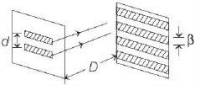
0 likes
View Solution375
MediumMCQ
In a Young's double slit experiment,the intensity of light at each slit is $I_0$. An interference pattern is observed along a direction parallel to the line $S_1 S_2$ on screen $S$. Find the minimum,maximum,and the intensity averaged over the entire screen,respectively.
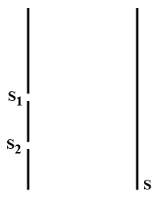
A
$0, 4 I_0, 2 I_0$
B
$I_0, 2 I_0, 3 I_0 / 2$
C
$0, 4 I_0, I_0$
D
$0, 2 I_0, I_0$
Solution
(A) In a Young's double slit experiment,the resultant intensity $I$ at any point on the screen is given by $I = I_1 + I_2 + 2\sqrt{I_1 I_2} \cos \phi$,where $I_1 = I_2 = I_0$.
Thus,$I = 2 I_0 + 2 I_0 \cos \phi = 4 I_0 \cos^2(\phi / 2)$.
$1$. The minimum intensity occurs when $\cos^2(\phi / 2) = 0$,so $I_{\min} = 0$.
$2$. The maximum intensity occurs when $\cos^2(\phi / 2) = 1$,so $I_{\max} = 4 I_0$.
$3$. The average intensity $I_{\text{avg}}$ over the entire screen is the average of $I_{\max}$ and $I_{\min}$ for a sinusoidal interference pattern,which is $I_{\text{avg}} = \frac{I_{\max} + I_{\min}}{2} = \frac{4 I_0 + 0}{2} = 2 I_0$.
Therefore,the values are $0, 4 I_0, 2 I_0$.
Thus,$I = 2 I_0 + 2 I_0 \cos \phi = 4 I_0 \cos^2(\phi / 2)$.
$1$. The minimum intensity occurs when $\cos^2(\phi / 2) = 0$,so $I_{\min} = 0$.
$2$. The maximum intensity occurs when $\cos^2(\phi / 2) = 1$,so $I_{\max} = 4 I_0$.
$3$. The average intensity $I_{\text{avg}}$ over the entire screen is the average of $I_{\max}$ and $I_{\min}$ for a sinusoidal interference pattern,which is $I_{\text{avg}} = \frac{I_{\max} + I_{\min}}{2} = \frac{4 I_0 + 0}{2} = 2 I_0$.
Therefore,the values are $0, 4 I_0, 2 I_0$.
0 likes
View Solution376
MediumMCQ
In a Young's double slit experiment,light from a laser source falls on a pair of very narrow slits separated by $1.0 \,\mu m$ and bright fringes separated by $1.0 \,mm$ are observed on a distant screen. If the frequency of the laser light is doubled,the separation of the bright fringes is .......$\,mm$?
A
$0.25$
B
$0.5$
C
$1.0$
D
$2.0$
Solution
(B) In Young's double slit experiment,the fringe width (fringe separation) $\beta$ is given by the formula:
$\beta = \frac{\lambda D}{d}$
Since the wavelength $\lambda$ is related to the frequency $f$ by $\lambda = \frac{c}{f}$,where $c$ is the speed of light,we can substitute this into the formula:
$\beta = \frac{cD}{fd}$
Assuming the distance between the slits $d$ and the distance to the screen $D$ remain constant,the fringe width is inversely proportional to the frequency:
$\beta \propto \frac{1}{f}$
Given that the initial fringe separation $\beta_1 = 1.0 \,mm$ at frequency $f_1 = f$,when the frequency is doubled $(f_2 = 2f)$,the new fringe separation $\beta_2$ will be:
$\beta_2 = \beta_1 \times \frac{f_1}{f_2} = 1.0 \,mm \times \frac{f}{2f} = 0.5 \,mm$
Therefore,the new separation of the bright fringes is $0.5 \,mm$.
$\beta = \frac{\lambda D}{d}$
Since the wavelength $\lambda$ is related to the frequency $f$ by $\lambda = \frac{c}{f}$,where $c$ is the speed of light,we can substitute this into the formula:
$\beta = \frac{cD}{fd}$
Assuming the distance between the slits $d$ and the distance to the screen $D$ remain constant,the fringe width is inversely proportional to the frequency:
$\beta \propto \frac{1}{f}$
Given that the initial fringe separation $\beta_1 = 1.0 \,mm$ at frequency $f_1 = f$,when the frequency is doubled $(f_2 = 2f)$,the new fringe separation $\beta_2$ will be:
$\beta_2 = \beta_1 \times \frac{f_1}{f_2} = 1.0 \,mm \times \frac{f}{2f} = 0.5 \,mm$
Therefore,the new separation of the bright fringes is $0.5 \,mm$.
0 likes
View Solution377
AdvancedMCQ
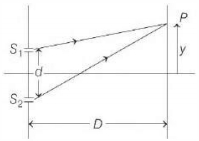
In Young's double slit experiment,the distance between the two slits is $0.1 \,mm$,the distance between the slits and the screen is $1 \,m$ and the wavelength of the light used is $600 \,nm$. The intensity at a point on the screen is $75 \%$ of the maximum intensity. Find the smallest distance in $mm$ of this point from the central fringe.
A
$1.0$
B
$2.0$
C
$0.5$
D
$1.5$
Solution
(A) Let the intensity of each individual source be $I_0$. The maximum intensity is $I_{max} = 4I_0$.
Given that the intensity at a point is $75 \%$ of the maximum intensity,we have $I = 0.75 \times 4I_0 = 3I_0$.
Using the formula for intensity in interference,$I = 4I_0 \cos^2(\phi/2)$,where $\phi$ is the phase difference:
$3I_0 = 4I_0 \cos^2(\phi/2) \implies \cos^2(\phi/2) = 3/4 \implies \cos(\phi/2) = \sqrt{3}/2$.
Thus,$\phi/2 = \pi/6$,which gives the phase difference $\phi = \pi/3$.
The relation between phase difference $\phi$ and path difference $\Delta x$ is $\phi = (2\pi/\lambda) \Delta x$. Therefore,$\Delta x = (\lambda/2\pi) \times \phi = (\lambda/2\pi) \times (\pi/3) = \lambda/6$.
In Young's double slit experiment,the path difference at a distance $y$ from the central fringe is $\Delta x = yd/D$.
Equating the two expressions for path difference: $yd/D = \lambda/6$.
Solving for $y$: $y = (\lambda D) / (6d)$.
Substituting the given values: $\lambda = 600 \times 10^{-9} \,m$,$D = 1 \,m$,$d = 0.1 \times 10^{-3} \,m$.
$y = (600 \times 10^{-9} \times 1) / (6 \times 0.1 \times 10^{-3}) = (600 \times 10^{-9}) / (0.6 \times 10^{-3}) = 1000 \times 10^{-6} \,m = 1 \times 10^{-3} \,m = 1 \,mm$.
Given that the intensity at a point is $75 \%$ of the maximum intensity,we have $I = 0.75 \times 4I_0 = 3I_0$.
Using the formula for intensity in interference,$I = 4I_0 \cos^2(\phi/2)$,where $\phi$ is the phase difference:
$3I_0 = 4I_0 \cos^2(\phi/2) \implies \cos^2(\phi/2) = 3/4 \implies \cos(\phi/2) = \sqrt{3}/2$.
Thus,$\phi/2 = \pi/6$,which gives the phase difference $\phi = \pi/3$.
The relation between phase difference $\phi$ and path difference $\Delta x$ is $\phi = (2\pi/\lambda) \Delta x$. Therefore,$\Delta x = (\lambda/2\pi) \times \phi = (\lambda/2\pi) \times (\pi/3) = \lambda/6$.
In Young's double slit experiment,the path difference at a distance $y$ from the central fringe is $\Delta x = yd/D$.
Equating the two expressions for path difference: $yd/D = \lambda/6$.
Solving for $y$: $y = (\lambda D) / (6d)$.
Substituting the given values: $\lambda = 600 \times 10^{-9} \,m$,$D = 1 \,m$,$d = 0.1 \times 10^{-3} \,m$.
$y = (600 \times 10^{-9} \times 1) / (6 \times 0.1 \times 10^{-3}) = (600 \times 10^{-9}) / (0.6 \times 10^{-3}) = 1000 \times 10^{-6} \,m = 1 \times 10^{-3} \,m = 1 \,mm$.
0 likes
View Solution378
EasyMCQ
The fringe width in Young's double-slit experiment can be increased if we decrease
A
Separation of the slits
B
Distance between the source and the screen
C
Wavelength of the source
D
All of these
Solution
(A) The formula for fringe width $(\beta)$ in Young's double-slit experiment is given by $\beta = \frac{\lambda D}{d}$,where $\lambda$ is the wavelength of the light source,$D$ is the distance between the slits and the screen,and $d$ is the separation between the two slits.
From the relation $\beta \propto \frac{1}{d}$,it is clear that the fringe width is inversely proportional to the separation between the slits.
Therefore,if we decrease the separation of the slits $(d)$,the fringe width $(\beta)$ will increase.
Thus,the correct option is $A$.
From the relation $\beta \propto \frac{1}{d}$,it is clear that the fringe width is inversely proportional to the separation between the slits.
Therefore,if we decrease the separation of the slits $(d)$,the fringe width $(\beta)$ will increase.
Thus,the correct option is $A$.
0 likes
View Solution379
EasyMCQ
In Young's double-slit experiment,which of the following statements is correct?
A
There are two virtual sources of light from the same monochromatic source of light.
B
Both the slits receive light from a single monochromatic source of light.
C
Two separate monochromatic sources of light of the same wavelength are used.
D
None of these.
Solution
(B) In Young's double-slit experiment,the two slits act as coherent sources of light.
Coherent sources are sources that emit light waves of the same frequency and maintain a constant phase difference.
To achieve this,both slits must be illuminated by a single monochromatic source of light.
Therefore,the correct statement is that both slits receive light from a single monochromatic source of light.
Thus,the correct option is $(b)$.
Coherent sources are sources that emit light waves of the same frequency and maintain a constant phase difference.
To achieve this,both slits must be illuminated by a single monochromatic source of light.
Therefore,the correct statement is that both slits receive light from a single monochromatic source of light.
Thus,the correct option is $(b)$.
0 likes
View Solution380
EasyMCQ
In a Young's double slit experiment,the wavelength of red light is $7.8 \times 10^{-5} \,cm$ and that of blue light is $5.2 \times 10^{-5} \,cm$. The value of $n$ for which $(n+1)^{\text{th}}$ blue bright band coincides with $n^{\text{th}}$ bright red band is ..........
A
$1$
B
$2$
C
$3$
D
$4$
Solution
(B) The position of the $n^{\text{th}}$ bright fringe from the central maximum is given by $y_n = \frac{n \lambda D}{d}$.
For the $n^{\text{th}}$ red bright band: $y_{R,n} = \frac{n \lambda_R D}{d}$.
For the $(n+1)^{\text{th}}$ blue bright band: $y_{B,n+1} = \frac{(n+1) \lambda_B D}{d}$.
Given that these two bands coincide,we have $y_{R,n} = y_{B,n+1}$.
Therefore,$\frac{n \lambda_R D}{d} = \frac{(n+1) \lambda_B D}{d}$.
Canceling $D/d$ from both sides,we get $n \lambda_R = (n+1) \lambda_B$.
Substituting the given values: $n(7.8 \times 10^{-5}) = (n+1)(5.2 \times 10^{-5})$.
$7.8n = 5.2n + 5.2$.
$2.6n = 5.2$.
$n = 2$.
For the $n^{\text{th}}$ red bright band: $y_{R,n} = \frac{n \lambda_R D}{d}$.
For the $(n+1)^{\text{th}}$ blue bright band: $y_{B,n+1} = \frac{(n+1) \lambda_B D}{d}$.
Given that these two bands coincide,we have $y_{R,n} = y_{B,n+1}$.
Therefore,$\frac{n \lambda_R D}{d} = \frac{(n+1) \lambda_B D}{d}$.
Canceling $D/d$ from both sides,we get $n \lambda_R = (n+1) \lambda_B$.
Substituting the given values: $n(7.8 \times 10^{-5}) = (n+1)(5.2 \times 10^{-5})$.
$7.8n = 5.2n + 5.2$.
$2.6n = 5.2$.
$n = 2$.
0 likes
View Solution381
EasyMCQ
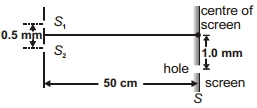
In Young's double slit experiment shown in the figure,$S_1$ and $S_2$ are coherent sources and $S$ is the screen having a hole at a point $1.0 \, mm$ away from the central line. White light ($400 \, nm$ to $700 \, nm$) is sent through the slits. Which wavelength passing through the hole has strong intensity (in $, nm$)? (Given: $d = 0.5 \, mm$,$D = 50 \, cm$)
A
$400$
B
$700$
C
$500$
D
$667$
Solution
(C) For constructive interference at the hole,the path difference $\Delta x$ must be an integer multiple of the wavelength $\lambda$.
$\Delta x = d \sin \theta \approx d \frac{y}{D} = n \lambda$
Given: $y = 1.0 \, mm = 10^{-3} \, m$,$d = 0.5 \, mm = 0.5 \times 10^{-3} \, m$,$D = 50 \, cm = 0.5 \, m$.
Substituting the values:
$n \lambda = \frac{d \cdot y}{D} = \frac{(0.5 \times 10^{-3} \, m) \times (1.0 \times 10^{-3} \, m)}{0.5 \, m} = 1.0 \times 10^{-6} \, m = 1000 \, nm$.
So,$\lambda = \frac{1000}{n} \, nm$.
For $n = 1$,$\lambda = 1000 \, nm$ (not in range).
For $n = 2$,$\lambda = 500 \, nm$ (in range).
For $n = 3$,$\lambda = 333.3 \, nm$ (not in range).
Thus,the wavelength with strong intensity is $500 \, nm$.
$\Delta x = d \sin \theta \approx d \frac{y}{D} = n \lambda$
Given: $y = 1.0 \, mm = 10^{-3} \, m$,$d = 0.5 \, mm = 0.5 \times 10^{-3} \, m$,$D = 50 \, cm = 0.5 \, m$.
Substituting the values:
$n \lambda = \frac{d \cdot y}{D} = \frac{(0.5 \times 10^{-3} \, m) \times (1.0 \times 10^{-3} \, m)}{0.5 \, m} = 1.0 \times 10^{-6} \, m = 1000 \, nm$.
So,$\lambda = \frac{1000}{n} \, nm$.
For $n = 1$,$\lambda = 1000 \, nm$ (not in range).
For $n = 2$,$\lambda = 500 \, nm$ (in range).
For $n = 3$,$\lambda = 333.3 \, nm$ (not in range).
Thus,the wavelength with strong intensity is $500 \, nm$.
0 likes
View Solution382
MediumMCQ
In Young's double slit experiment,the intensity at a point where the path difference is $\frac{\lambda}{6}$ is $I$. If $I_0$ denotes the maximum intensity,find the ratio $\frac{I}{I_0}$.
A
$\frac{1}{\sqrt{2}}$
B
$\frac{\sqrt{3}}{2}$
C
$\frac{1}{2}$
D
$\frac{3}{4}$
Solution
(D) The phase difference $\Delta \phi$ is related to the path difference $\Delta x$ by the formula $\Delta \phi = \frac{2 \pi}{\lambda} \Delta x$.
Given $\Delta x = \frac{\lambda}{6}$,we have $\Delta \phi = \frac{2 \pi}{\lambda} \times \frac{\lambda}{6} = \frac{\pi}{3}$.
The intensity $I$ at any point is given by $I = I_0 \cos^2 \left( \frac{\Delta \phi}{2} \right)$,where $I_0$ is the maximum intensity.
Substituting the value of $\Delta \phi$,we get $I = I_0 \cos^2 \left( \frac{\pi/3}{2} \right) = I_0 \cos^2 \left( \frac{\pi}{6} \right)$.
Since $\cos \left( \frac{\pi}{6} \right) = \frac{\sqrt{3}}{2}$,we have $I = I_0 \left( \frac{\sqrt{3}}{2} \right)^2 = I_0 \times \frac{3}{4}$.
Therefore,the ratio $\frac{I}{I_0} = \frac{3}{4}$.
Given $\Delta x = \frac{\lambda}{6}$,we have $\Delta \phi = \frac{2 \pi}{\lambda} \times \frac{\lambda}{6} = \frac{\pi}{3}$.
The intensity $I$ at any point is given by $I = I_0 \cos^2 \left( \frac{\Delta \phi}{2} \right)$,where $I_0$ is the maximum intensity.
Substituting the value of $\Delta \phi$,we get $I = I_0 \cos^2 \left( \frac{\pi/3}{2} \right) = I_0 \cos^2 \left( \frac{\pi}{6} \right)$.
Since $\cos \left( \frac{\pi}{6} \right) = \frac{\sqrt{3}}{2}$,we have $I = I_0 \left( \frac{\sqrt{3}}{2} \right)^2 = I_0 \times \frac{3}{4}$.
Therefore,the ratio $\frac{I}{I_0} = \frac{3}{4}$.
0 likes
View Solution383
EasyMCQ
In Young's double slit interference experiment,the slit separation is made $3$ folds. The fringe width becomes ......... times.
A
$\frac{1}{3}$
B
$\frac{1}{9}$
C
$3$
D
$9$
Solution
(A) The fringe width $\beta$ in Young's double slit experiment is given by the formula: $\beta = \frac{\lambda D}{d}$,where $\lambda$ is the wavelength of light,$D$ is the distance between the slits and the screen,and $d$ is the slit separation.
According to the problem,the slit separation $d$ is made $3$ folds,so the new slit separation $d' = 3d$.
The new fringe width $\beta'$ is given by: $\beta' = \frac{\lambda D}{d'} = \frac{\lambda D}{3d}$.
Substituting the original formula: $\beta' = \frac{1}{3} \left( \frac{\lambda D}{d} \right) = \frac{\beta}{3}$.
Therefore,the fringe width becomes $\frac{1}{3}$ times the original fringe width.
According to the problem,the slit separation $d$ is made $3$ folds,so the new slit separation $d' = 3d$.
The new fringe width $\beta'$ is given by: $\beta' = \frac{\lambda D}{d'} = \frac{\lambda D}{3d}$.
Substituting the original formula: $\beta' = \frac{1}{3} \left( \frac{\lambda D}{d} \right) = \frac{\beta}{3}$.
Therefore,the fringe width becomes $\frac{1}{3}$ times the original fringe width.
0 likes
View Solution384
EasyMCQ
In Young's double slit experiment,the distance between the slits is reduced to half and the distance between the slit and the screen is doubled,then the fringe width:
A
Will not change
B
Will become half
C
Will be doubled
D
Will become four times
Solution
(D) The formula for fringe width $\beta$ in Young's double slit experiment is given by $\beta = \frac{\lambda D}{d}$,where $\lambda$ is the wavelength of light,$D$ is the distance between the slit and the screen,and $d$ is the distance between the slits.
Given that the new distance between the slits is $d' = \frac{d}{2}$ and the new distance between the slit and the screen is $D' = 2D$.
The new fringe width $\beta'$ is given by:
$\beta' = \frac{\lambda D'}{d'} = \frac{\lambda (2D)}{d/2} = 4 \left( \frac{\lambda D}{d} \right) = 4\beta$.
Therefore,the fringe width becomes four times the original fringe width.
Given that the new distance between the slits is $d' = \frac{d}{2}$ and the new distance between the slit and the screen is $D' = 2D$.
The new fringe width $\beta'$ is given by:
$\beta' = \frac{\lambda D'}{d'} = \frac{\lambda (2D)}{d/2} = 4 \left( \frac{\lambda D}{d} \right) = 4\beta$.
Therefore,the fringe width becomes four times the original fringe width.
0 likes
View Solution385
EasyMCQ
In Young's experiment,the separation between the $5^{\text{th}}$ maxima and the $3^{\text{rd}}$ minima is how many times the fringe width?
A
$5$
B
$3$
C
$2.5$
D
$2$
Solution
(C) The position of the $n^{\text{th}}$ maximum is given by $y_n = \frac{n \lambda D}{d}$.
For the $5^{\text{th}}$ maximum $(n=5)$,$y_5 = \frac{5 \lambda D}{d}$.
The position of the $n^{\text{th}}$ minimum is given by $y'_n = \frac{(2n-1) \lambda D}{2d}$.
For the $3^{\text{rd}}$ minimum $(n=3)$,$y'_3 = \frac{(2(3)-1) \lambda D}{2d} = \frac{5 \lambda D}{2d}$.
The separation between them is $\Delta y = y_5 - y'_3 = \frac{5 \lambda D}{d} - \frac{5 \lambda D}{2d} = \frac{5 \lambda D}{2d}$.
Since the fringe width $\beta = \frac{\lambda D}{d}$,the separation is $\Delta y = 2.5 \beta$.
Therefore,the separation is $2.5$ times the fringe width.
For the $5^{\text{th}}$ maximum $(n=5)$,$y_5 = \frac{5 \lambda D}{d}$.
The position of the $n^{\text{th}}$ minimum is given by $y'_n = \frac{(2n-1) \lambda D}{2d}$.
For the $3^{\text{rd}}$ minimum $(n=3)$,$y'_3 = \frac{(2(3)-1) \lambda D}{2d} = \frac{5 \lambda D}{2d}$.
The separation between them is $\Delta y = y_5 - y'_3 = \frac{5 \lambda D}{d} - \frac{5 \lambda D}{2d} = \frac{5 \lambda D}{2d}$.
Since the fringe width $\beta = \frac{\lambda D}{d}$,the separation is $\Delta y = 2.5 \beta$.
Therefore,the separation is $2.5$ times the fringe width.
0 likes
View Solution386
EasyMCQ
In a Young's double slit experiment,the source illuminating the slits is changed from blue to violet. The width of the fringes
A
Increases
B
Decreases
C
Becomes unequal
D
Remains same
Solution
(B) The fringe width $\beta$ in a Young's double slit experiment is given by the formula $\beta = \frac{\lambda D}{d}$,where $\lambda$ is the wavelength of the light,$D$ is the distance between the slits and the screen,and $d$ is the distance between the two slits.
The wavelength of violet light is shorter than the wavelength of blue light $(\lambda_{\text{violet}} < \lambda_{\text{blue}})$.
Since the fringe width $\beta$ is directly proportional to the wavelength $\lambda$ $(\beta \propto \lambda)$,a decrease in wavelength results in a decrease in the fringe width.
Therefore,when the source is changed from blue to violet,the width of the fringes decreases.
The wavelength of violet light is shorter than the wavelength of blue light $(\lambda_{\text{violet}} < \lambda_{\text{blue}})$.
Since the fringe width $\beta$ is directly proportional to the wavelength $\lambda$ $(\beta \propto \lambda)$,a decrease in wavelength results in a decrease in the fringe width.
Therefore,when the source is changed from blue to violet,the width of the fringes decreases.
0 likes
View Solution387
EasyMCQ
In Young's double slit experiment,when two light waves form the third minimum,they have:
A
Phase difference of $3 \pi$
B
Path difference of $3 \lambda$
C
Phase difference of $\frac{5 \pi}{2}$
D
Path difference of $\frac{5 \lambda}{2}$
Solution
(D) In Young's double slit experiment,the condition for the $n^{th}$ minimum is given by the path difference $\Delta x = (2n - 1) \frac{\lambda}{2}$,where $n = 1, 2, 3, \dots$.
For the third minimum,we substitute $n = 3$ into the formula.
$\Delta x = (2(3) - 1) \frac{\lambda}{2} = (6 - 1) \frac{\lambda}{2} = \frac{5 \lambda}{2}$.
Therefore,the path difference for the third minimum is $\frac{5 \lambda}{2}$.
For the third minimum,we substitute $n = 3$ into the formula.
$\Delta x = (2(3) - 1) \frac{\lambda}{2} = (6 - 1) \frac{\lambda}{2} = \frac{5 \lambda}{2}$.
Therefore,the path difference for the third minimum is $\frac{5 \lambda}{2}$.
0 likes
View Solution388
EasyMCQ
In Young's double slit experiment,the $10^{th}$ order maximum is obtained at a point of observation in the interference pattern for a wavelength $\lambda_1 = 7000 \; \mathring{A}$. If the source is replaced by another one of wavelength $\lambda_2 = 5000 \; \mathring{A}$,what will be the order of the maximum at the same point (in $^{th}$)?
A
$12$
B
$14$
C
$16$
D
$18$
Solution
(B) The condition for the $n^{th}$ order maximum in Young's double slit experiment is given by $y = \frac{n \lambda D}{d}$.
Since the point of observation $y$ remains the same,the product $n \lambda$ must be constant for both sources.
Therefore,$n_1 \lambda_1 = n_2 \lambda_2$.
Given $n_1 = 10$,$\lambda_1 = 7000 \; \mathring{A}$,and $\lambda_2 = 5000 \; \mathring{A}$.
Substituting the values: $10 \times 7000 = n_2 \times 5000$.
$n_2 = \frac{10 \times 7000}{5000} = \frac{70000}{5000} = 14$.
Thus,the $14^{th}$ order maximum will be obtained at the same point.
Since the point of observation $y$ remains the same,the product $n \lambda$ must be constant for both sources.
Therefore,$n_1 \lambda_1 = n_2 \lambda_2$.
Given $n_1 = 10$,$\lambda_1 = 7000 \; \mathring{A}$,and $\lambda_2 = 5000 \; \mathring{A}$.
Substituting the values: $10 \times 7000 = n_2 \times 5000$.
$n_2 = \frac{10 \times 7000}{5000} = \frac{70000}{5000} = 14$.
Thus,the $14^{th}$ order maximum will be obtained at the same point.
0 likes
View Solution389
EasyMCQ
In a Young's double slit experiment,the angular width of a fringe formed on a distant screen is $1^{\circ}$. The wavelength of the light used is $6280 \; \mathring{A}$. The distance between the two coherent sources is $...........\,mm$.
A
$0.036$
B
$0.12$
C
$6$
D
$4$
Solution
(A) The angular fringe width $\alpha$ is given by the formula $\alpha = \frac{\lambda}{d}$,where $\lambda$ is the wavelength of light and $d$ is the distance between the two coherent sources.
Rearranging the formula to solve for $d$,we get $d = \frac{\lambda}{\alpha}$.
Given values are $\lambda = 6280 \; \mathring{A} = 6280 \times 10^{-10} \; m$ and $\alpha = 1^{\circ}$.
First,convert the angular width from degrees to radians: $\alpha = 1^{\circ} = \frac{\pi}{180} \text{ rad} \approx \frac{3.14}{180} \text{ rad}$.
Substituting these values into the formula:
$d = \frac{6280 \times 10^{-10} \times 180}{3.14}$.
$d = \frac{6280 \times 10^{-10} \times 180}{3.14} = 2000 \times 10^{-10} \times 180 = 360000 \times 10^{-10} \; m$.
$d = 3.6 \times 10^{-5} \; m$.
To convert meters to millimeters,multiply by $10^3$:
$d = 3.6 \times 10^{-5} \times 10^3 \; mm = 3.6 \times 10^{-2} \; mm = 0.036 \; mm$.
Rearranging the formula to solve for $d$,we get $d = \frac{\lambda}{\alpha}$.
Given values are $\lambda = 6280 \; \mathring{A} = 6280 \times 10^{-10} \; m$ and $\alpha = 1^{\circ}$.
First,convert the angular width from degrees to radians: $\alpha = 1^{\circ} = \frac{\pi}{180} \text{ rad} \approx \frac{3.14}{180} \text{ rad}$.
Substituting these values into the formula:
$d = \frac{6280 \times 10^{-10} \times 180}{3.14}$.
$d = \frac{6280 \times 10^{-10} \times 180}{3.14} = 2000 \times 10^{-10} \times 180 = 360000 \times 10^{-10} \; m$.
$d = 3.6 \times 10^{-5} \; m$.
To convert meters to millimeters,multiply by $10^3$:
$d = 3.6 \times 10^{-5} \times 10^3 \; mm = 3.6 \times 10^{-2} \; mm = 0.036 \; mm$.
0 likes
View Solution390
MediumMCQ
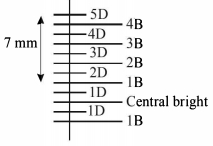
If the distance between the first maxima and the fifth minima of a double slit pattern is $7\,mm$ and the slits are separated by $0.15\,mm$ with the screen $50\,cm$ from the slits,then find the wavelength of the light used in $nm$.
A
$200$
B
$100$
C
$800$
D
$600$
Solution
(D) The position of the $n^{th}$ bright fringe (maxima) is $y_n = n\beta$,where $\beta$ is the fringe width.
For the first maxima $(n=1)$,$y_{max,1} = 1\beta$.
The position of the $n^{th}$ dark fringe (minima) is $y'_n = (n - 0.5)\beta$.
For the fifth minima $(n=5)$,$y_{min,5} = (5 - 0.5)\beta = 4.5\beta$.
The distance between the first maxima and the fifth minima is given as $y_{min,5} - y_{max,1} = 4.5\beta - 1\beta = 3.5\beta = 7\,mm$.
Therefore,the fringe width $\beta = \frac{7\,mm}{3.5} = 2\,mm = 2 \times 10^{-3}\,m$.
The formula for fringe width is $\beta = \frac{\lambda D}{d}$,where $D = 50\,cm = 0.5\,m$ and $d = 0.15\,mm = 0.15 \times 10^{-3}\,m$.
Rearranging for wavelength $\lambda = \frac{\beta d}{D} = \frac{(2 \times 10^{-3}\,m)(0.15 \times 10^{-3}\,m)}{0.5\,m} = \frac{0.3 \times 10^{-6}}{0.5}\,m = 0.6 \times 10^{-6}\,m = 600 \times 10^{-9}\,m = 600\,nm$.
For the first maxima $(n=1)$,$y_{max,1} = 1\beta$.
The position of the $n^{th}$ dark fringe (minima) is $y'_n = (n - 0.5)\beta$.
For the fifth minima $(n=5)$,$y_{min,5} = (5 - 0.5)\beta = 4.5\beta$.
The distance between the first maxima and the fifth minima is given as $y_{min,5} - y_{max,1} = 4.5\beta - 1\beta = 3.5\beta = 7\,mm$.
Therefore,the fringe width $\beta = \frac{7\,mm}{3.5} = 2\,mm = 2 \times 10^{-3}\,m$.
The formula for fringe width is $\beta = \frac{\lambda D}{d}$,where $D = 50\,cm = 0.5\,m$ and $d = 0.15\,mm = 0.15 \times 10^{-3}\,m$.
Rearranging for wavelength $\lambda = \frac{\beta d}{D} = \frac{(2 \times 10^{-3}\,m)(0.15 \times 10^{-3}\,m)}{0.5\,m} = \frac{0.3 \times 10^{-6}}{0.5}\,m = 0.6 \times 10^{-6}\,m = 600 \times 10^{-9}\,m = 600\,nm$.
0 likes
View Solution391
EasyMCQ
In Young's double-slit experiment,the position of the $5^{\text{th}}$ bright fringe from the central maximum is $5\,cm$. The distance between the slits and the screen is $1\,m$ and the wavelength of the monochromatic light used is $600\,nm$. The separation between the slits is $........\mu m$.
A
$60$
B
$48$
C
$12$
D
$36$
Solution
(A) Given:
Distance between slits and screen,$D = 1\,m$.
Wavelength of light,$\lambda = 600\,nm = 600 \times 10^{-9}\,m$.
Position of the $n^{\text{th}}$ bright fringe,$y_n = 5\,cm = 5 \times 10^{-2}\,m$.
Order of the fringe,$n = 5$.
The formula for the position of the $n^{\text{th}}$ bright fringe is given by:
$y_n = \frac{n \lambda D}{d}$
Substituting the given values:
$5 \times 10^{-2} = \frac{5 \times 600 \times 10^{-9} \times 1}{d}$
Rearranging for $d$:
$d = \frac{5 \times 600 \times 10^{-9}}{5 \times 10^{-2}}$
$d = 600 \times 10^{-7}\,m = 60 \times 10^{-6}\,m$
Since $1\,\mu m = 10^{-6}\,m$,we have:
$d = 60\,\mu m$.
Distance between slits and screen,$D = 1\,m$.
Wavelength of light,$\lambda = 600\,nm = 600 \times 10^{-9}\,m$.
Position of the $n^{\text{th}}$ bright fringe,$y_n = 5\,cm = 5 \times 10^{-2}\,m$.
Order of the fringe,$n = 5$.
The formula for the position of the $n^{\text{th}}$ bright fringe is given by:
$y_n = \frac{n \lambda D}{d}$
Substituting the given values:
$5 \times 10^{-2} = \frac{5 \times 600 \times 10^{-9} \times 1}{d}$
Rearranging for $d$:
$d = \frac{5 \times 600 \times 10^{-9}}{5 \times 10^{-2}}$
$d = 600 \times 10^{-7}\,m = 60 \times 10^{-6}\,m$
Since $1\,\mu m = 10^{-6}\,m$,we have:
$d = 60\,\mu m$.
0 likes
View Solution392
MediumMCQ
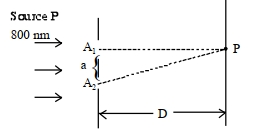
In a Young's double slit experiment,two slits are illuminated with light of wavelength $\lambda = 800 \, nm$. The line joining $A_1 P$ is perpendicular to $A_1 A_2$ as shown in the figure. If the first minimum is detected at $P$,the value of slit separation '$a$' will be $......... \, mm$. The distance of the screen from the slits is $D = 5 \, cm$.
A
$0.4$
B
$0.5$
C
$0.2$
D
$0.1$
Solution
(C) The condition for the first minimum at point $P$ is given by the path difference $\Delta x = A_2 P - A_1 P = \frac{\lambda}{2}$.
From the geometry of the figure,$A_1 P = D$ and $A_2 P = \sqrt{D^2 + a^2}$.
Thus,$\sqrt{D^2 + a^2} - D = \frac{\lambda}{2}$.
Using the binomial approximation for $a \ll D$,we have $\sqrt{D^2 + a^2} = D(1 + \frac{a^2}{D^2})^{1/2} \approx D(1 + \frac{a^2}{2D^2}) = D + \frac{a^2}{2D}$.
Substituting this into the path difference equation: $(D + \frac{a^2}{2D}) - D = \frac{\lambda}{2}$.
This simplifies to $\frac{a^2}{2D} = \frac{\lambda}{2}$,which gives $a = \sqrt{\lambda D}$.
Given $\lambda = 800 \, nm = 800 \times 10^{-9} \, m = 8 \times 10^{-7} \, m$ and $D = 5 \, cm = 0.05 \, m$.
$a = \sqrt{8 \times 10^{-7} \times 0.05} = \sqrt{40 \times 10^{-9}} = \sqrt{400 \times 10^{-10}} = 20 \times 10^{-5} \, m = 0.2 \times 10^{-3} \, m = 0.2 \, mm$.
From the geometry of the figure,$A_1 P = D$ and $A_2 P = \sqrt{D^2 + a^2}$.
Thus,$\sqrt{D^2 + a^2} - D = \frac{\lambda}{2}$.
Using the binomial approximation for $a \ll D$,we have $\sqrt{D^2 + a^2} = D(1 + \frac{a^2}{D^2})^{1/2} \approx D(1 + \frac{a^2}{2D^2}) = D + \frac{a^2}{2D}$.
Substituting this into the path difference equation: $(D + \frac{a^2}{2D}) - D = \frac{\lambda}{2}$.
This simplifies to $\frac{a^2}{2D} = \frac{\lambda}{2}$,which gives $a = \sqrt{\lambda D}$.
Given $\lambda = 800 \, nm = 800 \times 10^{-9} \, m = 8 \times 10^{-7} \, m$ and $D = 5 \, cm = 0.05 \, m$.
$a = \sqrt{8 \times 10^{-7} \times 0.05} = \sqrt{40 \times 10^{-9}} = \sqrt{400 \times 10^{-10}} = 20 \times 10^{-5} \, m = 0.2 \times 10^{-3} \, m = 0.2 \, mm$.
1 likes
View Solution393
MediumMCQ
In a Young's double slit experiment,the intensities at two points,for the path difference $\frac{\lambda}{4}$ and $\frac{\lambda}{3}$ ($\lambda$ being the wavelength of light used) are $I_1$ and $I_2$ respectively. If $I_0$ denotes the intensity produced by each one of the individual slits,then $\frac{I_1 + I_2}{I_0} = \dots$
A
$2$
B
$1$
C
$3$
D
$4$
Solution
(C) The resultant intensity in a Young's double slit experiment is given by $I = 4I_0 \cos^2\left(\frac{\Delta\phi}{2}\right)$,where $\Delta\phi$ is the phase difference.
Phase difference $\Delta\phi$ is related to path difference $\Delta x$ by $\Delta\phi = \frac{2\pi}{\lambda} \Delta x$.
For path difference $\Delta x_1 = \frac{\lambda}{4}$,the phase difference is $\Delta\phi_1 = \frac{2\pi}{\lambda} \cdot \frac{\lambda}{4} = \frac{\pi}{2}$.
Thus,$I_1 = 4I_0 \cos^2\left(\frac{\pi/2}{2}\right) = 4I_0 \cos^2\left(\frac{\pi}{4}\right) = 4I_0 \cdot \left(\frac{1}{\sqrt{2}}\right)^2 = 2I_0$.
For path difference $\Delta x_2 = \frac{\lambda}{3}$,the phase difference is $\Delta\phi_2 = \frac{2\pi}{\lambda} \cdot \frac{\lambda}{3} = \frac{2\pi}{3}$.
Thus,$I_2 = 4I_0 \cos^2\left(\frac{2\pi/3}{2}\right) = 4I_0 \cos^2\left(\frac{\pi}{3}\right) = 4I_0 \cdot \left(\frac{1}{2}\right)^2 = I_0$.
Therefore,$\frac{I_1 + I_2}{I_0} = \frac{2I_0 + I_0}{I_0} = 3$.
Phase difference $\Delta\phi$ is related to path difference $\Delta x$ by $\Delta\phi = \frac{2\pi}{\lambda} \Delta x$.
For path difference $\Delta x_1 = \frac{\lambda}{4}$,the phase difference is $\Delta\phi_1 = \frac{2\pi}{\lambda} \cdot \frac{\lambda}{4} = \frac{\pi}{2}$.
Thus,$I_1 = 4I_0 \cos^2\left(\frac{\pi/2}{2}\right) = 4I_0 \cos^2\left(\frac{\pi}{4}\right) = 4I_0 \cdot \left(\frac{1}{\sqrt{2}}\right)^2 = 2I_0$.
For path difference $\Delta x_2 = \frac{\lambda}{3}$,the phase difference is $\Delta\phi_2 = \frac{2\pi}{\lambda} \cdot \frac{\lambda}{3} = \frac{2\pi}{3}$.
Thus,$I_2 = 4I_0 \cos^2\left(\frac{2\pi/3}{2}\right) = 4I_0 \cos^2\left(\frac{\pi}{3}\right) = 4I_0 \cdot \left(\frac{1}{2}\right)^2 = I_0$.
Therefore,$\frac{I_1 + I_2}{I_0} = \frac{2I_0 + I_0}{I_0} = 3$.
0 likes
View Solution394
MediumMCQ
Two light waves of wavelengths $800 \, nm$ and $600 \, nm$ are used in Young's double slit experiment to obtain interference fringes on a screen placed $7 \, m$ away from the plane of the slits. If the two slits are separated by $0.35 \, mm$,then the shortest distance from the central bright maximum to the point where the bright fringes of the two wavelengths coincide will be $............. \, mm$.
A
$45$
B
$46$
C
$48$
D
$47$
Solution
(C) The fringe width for a wavelength $\lambda$ is given by $\omega = \frac{\lambda D}{d}$.
Given: $\lambda_1 = 800 \, nm = 8 \times 10^{-7} \, m$,$\lambda_2 = 600 \, nm = 6 \times 10^{-7} \, m$,$D = 7 \, m$,and $d = 0.35 \, mm = 3.5 \times 10^{-4} \, m$.
Calculating fringe widths:
$\omega_1 = \frac{8 \times 10^{-7} \times 7}{3.5 \times 10^{-4}} = 16 \times 10^{-3} \, m = 16 \, mm$.
$\omega_2 = \frac{6 \times 10^{-7} \times 7}{3.5 \times 10^{-4}} = 12 \times 10^{-3} \, m = 12 \, mm$.
The bright fringes coincide at a distance $y$ from the central maximum where $y = n_1 \omega_1 = n_2 \omega_2$,where $n_1$ and $n_2$ are integers.
To find the shortest distance,we calculate the Least Common Multiple $(LCM)$ of $\omega_1$ and $\omega_2$.
$LCM(16, 12) = 48 \, mm$.
Thus,the shortest distance is $48 \, mm$.
Given: $\lambda_1 = 800 \, nm = 8 \times 10^{-7} \, m$,$\lambda_2 = 600 \, nm = 6 \times 10^{-7} \, m$,$D = 7 \, m$,and $d = 0.35 \, mm = 3.5 \times 10^{-4} \, m$.
Calculating fringe widths:
$\omega_1 = \frac{8 \times 10^{-7} \times 7}{3.5 \times 10^{-4}} = 16 \times 10^{-3} \, m = 16 \, mm$.
$\omega_2 = \frac{6 \times 10^{-7} \times 7}{3.5 \times 10^{-4}} = 12 \times 10^{-3} \, m = 12 \, mm$.
The bright fringes coincide at a distance $y$ from the central maximum where $y = n_1 \omega_1 = n_2 \omega_2$,where $n_1$ and $n_2$ are integers.
To find the shortest distance,we calculate the Least Common Multiple $(LCM)$ of $\omega_1$ and $\omega_2$.
$LCM(16, 12) = 48 \, mm$.
Thus,the shortest distance is $48 \, mm$.
0 likes
View Solution395
EasyMCQ
If the screen is moved away from the plane of the slits in a Young's double slit experiment,then the
A
angular separation of the fringes increases
B
angular separation of the fringes decreases
C
linear separation of the fringes increases
D
linear separation of the fringes decreases
Solution
(C) The linear fringe width $\beta$ in a Young's double slit experiment is given by the formula $\beta = \frac{\lambda D}{d}$,where $\lambda$ is the wavelength of light,$D$ is the distance between the slits and the screen,and $d$ is the distance between the two slits.
When the screen is moved away from the plane of the slits,the distance $D$ increases.
Since $\beta \propto D$,an increase in $D$ leads to an increase in the linear fringe width $\beta$.
Therefore,the linear separation of the fringes increases.
When the screen is moved away from the plane of the slits,the distance $D$ increases.
Since $\beta \propto D$,an increase in $D$ leads to an increase in the linear fringe width $\beta$.
Therefore,the linear separation of the fringes increases.
0 likes
View Solution396
MediumMCQ
$A$ beam of light consisting of two wavelengths $7000 \; \mathring{A}$ and $5500 \; \mathring{A}$ is used to obtain an interference pattern in Young's double-slit experiment. The distance between the slits is $2.5 \; mm$ and the distance between the plane of the slits and the screen is $150 \; cm$. The least distance from the central fringe,where the bright fringes due to both the wavelengths coincide,is $n \times 10^{-5} \; m$. The value of $n$ is .............
A
$461$
B
$460$
C
$462$
D
$469$
Solution
(C) Given: $\lambda_1 = 7000 \; \mathring{A} = 7000 \times 10^{-10} \; m$,$\lambda_2 = 5500 \; \mathring{A} = 5500 \times 10^{-10} \; m$,$d = 2.5 \; mm = 2.5 \times 10^{-3} \; m$,$D = 150 \; cm = 1.5 \; m$.
The condition for the coincidence of bright fringes is $y_n = y_m$,where $y_n = \frac{n \lambda_1 D}{d}$ and $y_m = \frac{m \lambda_2 D}{d}$.
Equating the two,we get $n \lambda_1 = m \lambda_2$,which implies $\frac{n}{m} = \frac{\lambda_2}{\lambda_1} = \frac{5500}{7000} = \frac{11}{14}$.
For the least distance,we take the smallest integer values $n = 11$ and $m = 14$.
The distance $y$ is given by $y = \frac{n \lambda_1 D}{d} = \frac{11 \times 7000 \times 10^{-10} \times 1.5}{2.5 \times 10^{-3}}$.
$y = \frac{11 \times 7000 \times 1.5}{2.5} \times 10^{-7} = \frac{115500}{2.5} \times 10^{-7} = 46200 \times 10^{-7} = 462 \times 10^{-5} \; m$.
Comparing this with $n \times 10^{-5} \; m$,we get $n = 462$.
The condition for the coincidence of bright fringes is $y_n = y_m$,where $y_n = \frac{n \lambda_1 D}{d}$ and $y_m = \frac{m \lambda_2 D}{d}$.
Equating the two,we get $n \lambda_1 = m \lambda_2$,which implies $\frac{n}{m} = \frac{\lambda_2}{\lambda_1} = \frac{5500}{7000} = \frac{11}{14}$.
For the least distance,we take the smallest integer values $n = 11$ and $m = 14$.
The distance $y$ is given by $y = \frac{n \lambda_1 D}{d} = \frac{11 \times 7000 \times 10^{-10} \times 1.5}{2.5 \times 10^{-3}}$.
$y = \frac{11 \times 7000 \times 1.5}{2.5} \times 10^{-7} = \frac{115500}{2.5} \times 10^{-7} = 46200 \times 10^{-7} = 462 \times 10^{-5} \; m$.
Comparing this with $n \times 10^{-5} \; m$,we get $n = 462$.
0 likes
View Solution397
MediumMCQ
The width of the fringe is $2\,mm$ on the screen in a double-slit experiment for light of wavelength $400\,nm$. The width of the fringe for light of wavelength $600\,nm$ will be $..............\,mm$.
A
$4$
B
$1.33$
C
$3$
D
$2$
Solution
(C) The formula for fringe width $(\beta)$ in a Young's double-slit experiment is given by $\beta = \frac{D\lambda}{d}$,where $D$ is the distance between the slits and the screen,$\lambda$ is the wavelength of light,and $d$ is the distance between the slits.
Since $D$ and $d$ remain constant,the fringe width is directly proportional to the wavelength: $\beta \propto \lambda$.
Therefore,we can write the ratio as $\frac{\beta_2}{\beta_1} = \frac{\lambda_2}{\lambda_1}$.
Given $\beta_1 = 2\,mm$,$\lambda_1 = 400\,nm$,and $\lambda_2 = 600\,nm$.
Substituting these values: $\frac{\beta_2}{2\,mm} = \frac{600\,nm}{400\,nm} = \frac{3}{2}$.
Solving for $\beta_2$: $\beta_2 = 2\,mm \times 1.5 = 3\,mm$.
Since $D$ and $d$ remain constant,the fringe width is directly proportional to the wavelength: $\beta \propto \lambda$.
Therefore,we can write the ratio as $\frac{\beta_2}{\beta_1} = \frac{\lambda_2}{\lambda_1}$.
Given $\beta_1 = 2\,mm$,$\lambda_1 = 400\,nm$,and $\lambda_2 = 600\,nm$.
Substituting these values: $\frac{\beta_2}{2\,mm} = \frac{600\,nm}{400\,nm} = \frac{3}{2}$.
Solving for $\beta_2$: $\beta_2 = 2\,mm \times 1.5 = 3\,mm$.
0 likes
View Solution398
MediumMCQ
The ratio of intensities at two points $P$ and $Q$ on the screen in a Young's double-slit experiment,where the phase differences between two waves of the same amplitude are $\pi / 3$ and $\pi / 2$ respectively,is:
A
$1: 3$
B
$3: 1$
C
$3: 2$
D
$2: 3$
Solution
(C) The resultant intensity $I$ for two waves of equal intensity $I_0$ with a phase difference $\phi$ is given by the formula: $I = I_0 + I_0 + 2\sqrt{I_0 I_0} \cos \phi = 2I_0(1 + \cos \phi) = 4I_0 \cos^2(\phi/2)$.
For point $P$,the phase difference is $\phi_1 = \pi/3$. The intensity $I_P$ is:
$I_P = 2I_0(1 + \cos(\pi/3)) = 2I_0(1 + 0.5) = 3I_0$.
For point $Q$,the phase difference is $\phi_2 = \pi/2$. The intensity $I_Q$ is:
$I_Q = 2I_0(1 + \cos(\pi/2)) = 2I_0(1 + 0) = 2I_0$.
The ratio of intensities at $P$ and $Q$ is:
$\frac{I_P}{I_Q} = \frac{3I_0}{2I_0} = \frac{3}{2}$ or $3:2$.
For point $P$,the phase difference is $\phi_1 = \pi/3$. The intensity $I_P$ is:
$I_P = 2I_0(1 + \cos(\pi/3)) = 2I_0(1 + 0.5) = 3I_0$.
For point $Q$,the phase difference is $\phi_2 = \pi/2$. The intensity $I_Q$ is:
$I_Q = 2I_0(1 + \cos(\pi/2)) = 2I_0(1 + 0) = 2I_0$.
The ratio of intensities at $P$ and $Q$ is:
$\frac{I_P}{I_Q} = \frac{3I_0}{2I_0} = \frac{3}{2}$ or $3:2$.
0 likes
View Solution399
MediumMCQ
In a Young's double slit experiment,the ratio of the amplitude of light coming from the slits is $2:1$. The ratio of the maximum to minimum intensity in the interference pattern is:
A
$9:1$
B
$4:1$
C
$2:1$
D
$25:9$
Solution
(A) Given the ratio of amplitudes of light from the two slits is $\frac{A_1}{A_2} = \frac{2}{1}$.
The intensity $I$ is proportional to the square of the amplitude,$I \propto A^2$.
The formula for the ratio of maximum intensity to minimum intensity is given by:
$\frac{I_{\max}}{I_{\min}} = \left( \frac{A_1 + A_2}{A_1 - A_2} \right)^2$.
Substituting the given values:
$\frac{I_{\max}}{I_{\min}} = \left( \frac{2 + 1}{2 - 1} \right)^2 = \left( \frac{3}{1} \right)^2 = \frac{9}{1}$.
Therefore,the ratio of maximum to minimum intensity is $9:1$.
The intensity $I$ is proportional to the square of the amplitude,$I \propto A^2$.
The formula for the ratio of maximum intensity to minimum intensity is given by:
$\frac{I_{\max}}{I_{\min}} = \left( \frac{A_1 + A_2}{A_1 - A_2} \right)^2$.
Substituting the given values:
$\frac{I_{\max}}{I_{\min}} = \left( \frac{2 + 1}{2 - 1} \right)^2 = \left( \frac{3}{1} \right)^2 = \frac{9}{1}$.
Therefore,the ratio of maximum to minimum intensity is $9:1$.
0 likes
View SolutionWave Optics — Young's Double Slit Experiment (YDSE) · Frequently Asked Questions
1Are these Wave Optics questions useful for JEE and NEET?
Yes. All questions in this section are mapped to JEE Main and NEET exam patterns. Previous year questions from JEE Main, NEET, GUJCET and state-level exams are included with full solutions.
2Can I switch to Hindi or Gujarati for these questions?
Yes. Use the language tabs in the hero section or the sidebar to view the same questions and solutions in English, Hindi or Gujarati.
3How do I generate a question paper from this subtopic?
Use the Vedclass Exam Paper Generator — select the chapter and subtopic, set difficulty, and generate Sets A, B, C, D automatically. First 3 chapters of every subject are free.
Vedclass Products
For Students
Vedclass Test Series
Mock tests in real JEE/NEET style with performance analysis. 5-day free trial.
Start Free TrialFor Teachers
Exam Paper Generator
Generate Set A/B/C/D papers from this chapter in 2 minutes. 3 chapters free.
Try FreeFor Institutes
Online Exam Module
Live online exams with unlimited students, 360° analytics & white-label branding.
See DemoFor Teachers & Institutes
Generate a Wave Optics Exam Paper in 2 Minutes
Select subtopic & difficulty — Sets A, B, C, D auto-generated with No Repeat logic.
First 3 chapters of every subject are free — no payment required.