
A English
Nuclear Fission, Fusion and Nuclear Reactor Questions in English
Class 12 Physics · Nuclei · Nuclear Fission, Fusion and Nuclear Reactor
345+
Questions
English
Language
100%
With Solutions
Showing 39 of 345 questions in English
301
MediumMCQ
If the binding energy per nucleon of deuteron $({ }_1 H^2)$ is $1.15 \text{ MeV}$ and an $\alpha$-particle has a binding energy of $7.1 \text{ MeV}$ per nucleon,then the energy released per nucleon in the given reaction is ${ }_1 H^2 + { }_1 H^2 \rightarrow { }_2 He^4 + Q$. (in $\text{ MeV}$)
A
$23.8$
B
$26.1$
C
$5.95$
D
$28.9$
Solution
(C) The reaction is ${ }_1 H^2 + { }_1 H^2 \rightarrow { }_2 He^4 + Q$.
Total binding energy of reactants: Each deuteron has $2$ nucleons,and there are $2$ deuterons. Total nucleons = $4$. Binding energy per nucleon = $1.15 \text{ MeV}$. Total binding energy = $4 \times 1.15 \text{ MeV} = 4.6 \text{ MeV}$.
Total binding energy of products: The $\alpha$-particle $({ }_2 He^4)$ has $4$ nucleons. Binding energy per nucleon = $7.1 \text{ MeV}$. Total binding energy = $4 \times 7.1 \text{ MeV} = 28.4 \text{ MeV}$.
Energy released $(Q)$ = (Total binding energy of products) - (Total binding energy of reactants) = $28.4 \text{ MeV} - 4.6 \text{ MeV} = 23.8 \text{ MeV}$.
The energy released per nucleon is calculated by dividing the total energy released by the total number of nucleons in the product nucleus $({ }_2 He^4)$,which is $4$.
Energy released per nucleon = $23.8 \text{ MeV} / 4 = 5.95 \text{ MeV}$.
Total binding energy of reactants: Each deuteron has $2$ nucleons,and there are $2$ deuterons. Total nucleons = $4$. Binding energy per nucleon = $1.15 \text{ MeV}$. Total binding energy = $4 \times 1.15 \text{ MeV} = 4.6 \text{ MeV}$.
Total binding energy of products: The $\alpha$-particle $({ }_2 He^4)$ has $4$ nucleons. Binding energy per nucleon = $7.1 \text{ MeV}$. Total binding energy = $4 \times 7.1 \text{ MeV} = 28.4 \text{ MeV}$.
Energy released $(Q)$ = (Total binding energy of products) - (Total binding energy of reactants) = $28.4 \text{ MeV} - 4.6 \text{ MeV} = 23.8 \text{ MeV}$.
The energy released per nucleon is calculated by dividing the total energy released by the total number of nucleons in the product nucleus $({ }_2 He^4)$,which is $4$.
Energy released per nucleon = $23.8 \text{ MeV} / 4 = 5.95 \text{ MeV}$.
0 likes
View Solution302
MediumMCQ
The decrease in the mass of Uranium in a nuclear reactor operating at a power of $12 \text{ MW}$ per day is (Energy released in one ${}_{92}U^{235}$ fission is about $200 \text{ MeV}$):
A
$12.64 \times 10^{-2} \text{ kg}$
B
$11.50 \times 10^{-2} \text{ kg}$
C
$12.64 \text{ kg}$
D
$12.64 \text{ g}$
Solution
(D) Given: Power $P = 12 \text{ MW} = 12 \times 10^6 \text{ J/s}$.
Time $t = 1 \text{ day} = 24 \times 3600 \text{ s} = 86400 \text{ s}$.
Energy released per fission $E = 200 \text{ MeV} = 200 \times 10^6 \times 1.6 \times 10^{-19} \text{ J} = 3.2 \times 10^{-11} \text{ J}$.
Total energy produced in one day $E_{total} = P \times t = 12 \times 10^6 \times 86400 \text{ J} = 1.0368 \times 10^{12} \text{ J}$.
Number of fissions $n = \frac{E_{total}}{E} = \frac{1.0368 \times 10^{12}}{3.2 \times 10^{-11}} = 3.24 \times 10^{22}$.
Mass of one atom of ${}_{92}U^{235} = \frac{235}{6.023 \times 10^{23}} \text{ g}$.
Total mass consumed $m = n \times \text{mass of one atom} = \frac{3.24 \times 10^{22} \times 235}{6.023 \times 10^{23}} \approx 12.64 \text{ g}$.
Time $t = 1 \text{ day} = 24 \times 3600 \text{ s} = 86400 \text{ s}$.
Energy released per fission $E = 200 \text{ MeV} = 200 \times 10^6 \times 1.6 \times 10^{-19} \text{ J} = 3.2 \times 10^{-11} \text{ J}$.
Total energy produced in one day $E_{total} = P \times t = 12 \times 10^6 \times 86400 \text{ J} = 1.0368 \times 10^{12} \text{ J}$.
Number of fissions $n = \frac{E_{total}}{E} = \frac{1.0368 \times 10^{12}}{3.2 \times 10^{-11}} = 3.24 \times 10^{22}$.
Mass of one atom of ${}_{92}U^{235} = \frac{235}{6.023 \times 10^{23}} \text{ g}$.
Total mass consumed $m = n \times \text{mass of one atom} = \frac{3.24 \times 10^{22} \times 235}{6.023 \times 10^{23}} \approx 12.64 \text{ g}$.
0 likes
View Solution303
DifficultMCQ
If the energy released per fission of a ${ }_{92}^{235} U$ nucleus is $200 \text{ MeV}$, the energy released in the fission of $0.1 \text{ kg}$ of ${ }_{92}^{235} U$ in kilowatt-hour is:
A
$22.8 \times 10^5$
B
$22.8 \times 10^7$
C
$11.4 \times 10^5$
D
$850 \times 10^{10}$
Solution
(A) Energy released per fission per atom, $E = 200 \text{ MeV} = 200 \times 10^6 \times 1.6 \times 10^{-19} \text{ J} = 3.2 \times 10^{-11} \text{ J}$.
Number of atoms in $0.1 \text{ kg}$ of ${ }_{92}^{235} U$ is $N = \frac{m}{M} \times N_A = \frac{0.1 \text{ kg}}{235 \times 10^{-3} \text{ kg/mol}} \times 6.023 \times 10^{23} \text{ atoms/mol} \approx 2.563 \times 10^{23} \text{ atoms}$.
Total energy released in Joules is $E_{total} = N \times E = 2.563 \times 10^{23} \times 3.2 \times 10^{-11} \text{ J} \approx 8.2016 \times 10^{12} \text{ J}$.
Since $1 \text{ kWh} = 3.6 \times 10^6 \text{ J}$, the energy in $\text{kWh}$ is $E_{kWh} = \frac{8.2016 \times 10^{12}}{3.6 \times 10^6} \approx 2.278 \times 10^6 \text{ kWh} \approx 22.8 \times 10^5 \text{ kWh}$.
Number of atoms in $0.1 \text{ kg}$ of ${ }_{92}^{235} U$ is $N = \frac{m}{M} \times N_A = \frac{0.1 \text{ kg}}{235 \times 10^{-3} \text{ kg/mol}} \times 6.023 \times 10^{23} \text{ atoms/mol} \approx 2.563 \times 10^{23} \text{ atoms}$.
Total energy released in Joules is $E_{total} = N \times E = 2.563 \times 10^{23} \times 3.2 \times 10^{-11} \text{ J} \approx 8.2016 \times 10^{12} \text{ J}$.
Since $1 \text{ kWh} = 3.6 \times 10^6 \text{ J}$, the energy in $\text{kWh}$ is $E_{kWh} = \frac{8.2016 \times 10^{12}}{3.6 \times 10^6} \approx 2.278 \times 10^6 \text{ kWh} \approx 22.8 \times 10^5 \text{ kWh}$.
0 likes
View Solution304
EasyMCQ
The following is not used as a nuclear fuel.
A
uranium
B
thorium
C
plutonium
D
titanium
Solution
(D) Nuclear fuels are materials that can be consumed by nuclear fission or fusion to produce energy. Uranium,thorium,and plutonium are well-known radioactive elements used in nuclear reactors. Titanium is a transition metal known for its high strength-to-weight ratio and corrosion resistance,but it is not a radioactive material capable of sustaining a nuclear chain reaction. Therefore,it is not used as a nuclear fuel.
0 likes
View Solution305
EasyMCQ
The process that mainly takes place in stars to produce energy is:
A
nuclear fission
B
nuclear fusion
C
ionization
D
annihilation
Solution
(B) Deep inside the core of stars,protons collide with each other at extremely high speeds due to high temperature and pressure. These collisions result in the formation of a helium nucleus,releasing a tremendous amount of energy in the process. This specific nuclear reaction is known as nuclear fusion.
0 likes
View Solution306
EasyMCQ
Fusion reaction is initiated with the help of
A
low temperature
B
high temperature
C
neutron
D
any particle
Solution
(B) Nuclear fusion is a process in which two light nuclei combine to form a heavier nucleus. This process requires overcoming the strong electrostatic repulsion between the positively charged nuclei. To achieve this,the nuclei must have extremely high kinetic energy,which is provided by maintaining a very high temperature (on the order of $10^7$ to $10^8 \ K$). Therefore,fusion reactions are initiated with the help of high temperature.
0 likes
View Solution307
EasyMCQ
The energy released when one nucleus of ${ }_{92} U^{235}$ undergoes fission is $188 MeV$. The energy released when $100 g$ of ${ }_{92} U^{235}$ undergoes fission is:
A
$3.55 \times 10^{12} J$
B
$7.71 \times 10^{12} J$
C
$3.55 \times 10^{13} J$
D
$7.71 \times 10^{13} J$
Solution
(B) Given,energy released per nucleus fission,$E_0 = 188 MeV$ and mass,$m = 100 g$.
First,calculate the number of nuclei $N$ in $100 g$ of ${ }_{92} U^{235}$:
$N = \frac{m}{M} \times N_A = \frac{100}{235} \times 6.022 \times 10^{23} \approx 2.56 \times 10^{23}$ nuclei.
Next,convert the energy released per nucleus into Joules:
$E_0' = 188 \times 10^6 \times 1.6 \times 10^{-19} J = 300.8 \times 10^{-13} J$.
The total energy released $E$ for $N$ nuclei is:
$E = N \times E_0' = (2.56 \times 10^{23}) \times (300.8 \times 10^{-13} J) \approx 7.71 \times 10^{12} J$.
Thus,the correct option is $B$.
First,calculate the number of nuclei $N$ in $100 g$ of ${ }_{92} U^{235}$:
$N = \frac{m}{M} \times N_A = \frac{100}{235} \times 6.022 \times 10^{23} \approx 2.56 \times 10^{23}$ nuclei.
Next,convert the energy released per nucleus into Joules:
$E_0' = 188 \times 10^6 \times 1.6 \times 10^{-19} J = 300.8 \times 10^{-13} J$.
The total energy released $E$ for $N$ nuclei is:
$E = N \times E_0' = (2.56 \times 10^{23}) \times (300.8 \times 10^{-13} J) \approx 7.71 \times 10^{12} J$.
Thus,the correct option is $B$.
0 likes
View Solution308
DifficultMCQ
In the fusion reaction,${ }_1 H^2+{ }_1 H^2 \rightarrow{ }_2 He^4+Q$,where $Q$ is the energy released. If $c$ is the speed of light and $m$ is the mass of each deuterium nucleus,then the mass of the helium nucleus formed is:
A
$2m + \frac{Q}{c^2}$
B
$\frac{Q}{mc^2}$
C
$m + \frac{Q}{c^2}$
D
$2m - \frac{Q}{c^2}$
Solution
(D) According to the law of conservation of mass-energy,the total mass-energy before the reaction must equal the total mass-energy after the reaction.
Initial mass = $m + m = 2m$.
Final mass = $M_{He} + \frac{Q}{c^2}$ (where $M_{He}$ is the mass of the helium nucleus).
Equating the two: $2m = M_{He} + \frac{Q}{c^2}$.
Therefore,the mass of the helium nucleus is $M_{He} = 2m - \frac{Q}{c^2}$.
Initial mass = $m + m = 2m$.
Final mass = $M_{He} + \frac{Q}{c^2}$ (where $M_{He}$ is the mass of the helium nucleus).
Equating the two: $2m = M_{He} + \frac{Q}{c^2}$.
Therefore,the mass of the helium nucleus is $M_{He} = 2m - \frac{Q}{c^2}$.
0 likes
View Solution309
DifficultMCQ
In the nuclear fusion reaction ${ }_1 H^2+{ }_1 H^3 \rightarrow{ }_2 He^4+n$, if the repulsive potential energy between the two nuclei is $2.07 \times 10^{-14} \,J$, then the temperature at which the gases must be heated to initiate the reaction is (Boltzmann constant $k = 1.38 \times 10^{-23} \,JK^{-1}$).
A
$10^9 \,K$
B
$10^7 \,K$
C
$10^5 \,K$
D
$10^{12} \,K$
Solution
(A) To initiate a nuclear fusion reaction, the kinetic energy of the nuclei must be sufficient to overcome the repulsive electrostatic potential energy barrier.
According to the kinetic theory of gases, the average kinetic energy of a particle at temperature $T$ is given by $E = \frac{3}{2} kT$, where $k$ is the Boltzmann constant.
Equating the kinetic energy to the potential energy barrier $U = 2.07 \times 10^{-14} \,J$:
$\frac{3}{2} kT = U$
$T = \frac{2U}{3k}$
Substituting the given values:
$T = \frac{2 \times 2.07 \times 10^{-14}}{3 \times 1.38 \times 10^{-23}}$
$T = \frac{4.14 \times 10^{-14}}{4.14 \times 10^{-23}}$
$T = 10^9 \,K$
Therefore, the required temperature is $10^9 \,K$.
According to the kinetic theory of gases, the average kinetic energy of a particle at temperature $T$ is given by $E = \frac{3}{2} kT$, where $k$ is the Boltzmann constant.
Equating the kinetic energy to the potential energy barrier $U = 2.07 \times 10^{-14} \,J$:
$\frac{3}{2} kT = U$
$T = \frac{2U}{3k}$
Substituting the given values:
$T = \frac{2 \times 2.07 \times 10^{-14}}{3 \times 1.38 \times 10^{-23}}$
$T = \frac{4.14 \times 10^{-14}}{4.14 \times 10^{-23}}$
$T = 10^9 \,K$
Therefore, the required temperature is $10^9 \,K$.
0 likes
View Solution310
DifficultMCQ
$U^{235}$ nuclear reactor generates energy at a rate of $3.70 \times 10^7 \text{ J/s}$. Each fission liberates $185 \text{ MeV}$ of useful energy. If the reactor has to operate for $144 \times 10^4 \text{ s}$, then the mass of the fuel needed is (Assume Avogadro's number $= 6 \times 10^{23} \text{ mol}^{-1}$, $1 \text{ eV} = 1.6 \times 10^{-19} \text{ J}$) (in $\text{ kg}$)
A
$70.5$
B
$0.705$
C
$13.1$
D
$1.31$
Solution
(B) Total energy required $E = P \times t = (3.70 \times 10^7 \text{ J/s}) \times (144 \times 10^4 \text{ s}) = 5.328 \times 10^{13} \text{ J}$.
Energy released per fission $E_f = 185 \text{ MeV} = 185 \times 10^6 \times 1.6 \times 10^{-19} \text{ J} = 2.96 \times 10^{-11} \text{ J}$.
Number of fissions $N = E / E_f = (5.328 \times 10^{13}) / (2.96 \times 10^{-11}) = 1.8 \times 10^{24} \text{ atoms}$.
Mass of fuel $m = (N / N_A) \times M = (1.8 \times 10^{24} / 6 \times 10^{23}) \times 235 \text{ g} = 0.3 \times 235 \text{ g} = 70.5 \text{ g} = 0.0705 \text{ kg}$.
Re-evaluating the calculation: $N = 1.8 \times 10^{24}$ atoms. Mass $= (1.8 \times 10^{24} / 6 \times 10^{23}) \times 235 = 3 \times 235 = 705 \text{ g} = 0.705 \text{ kg}$.
Energy released per fission $E_f = 185 \text{ MeV} = 185 \times 10^6 \times 1.6 \times 10^{-19} \text{ J} = 2.96 \times 10^{-11} \text{ J}$.
Number of fissions $N = E / E_f = (5.328 \times 10^{13}) / (2.96 \times 10^{-11}) = 1.8 \times 10^{24} \text{ atoms}$.
Mass of fuel $m = (N / N_A) \times M = (1.8 \times 10^{24} / 6 \times 10^{23}) \times 235 \text{ g} = 0.3 \times 235 \text{ g} = 70.5 \text{ g} = 0.0705 \text{ kg}$.
Re-evaluating the calculation: $N = 1.8 \times 10^{24}$ atoms. Mass $= (1.8 \times 10^{24} / 6 \times 10^{23}) \times 235 = 3 \times 235 = 705 \text{ g} = 0.705 \text{ kg}$.
0 likes
View Solution311
MediumMCQ
In a nuclear reactor,the fuel is consumed at the rate of $1 \times 10^{-3} \text{ g s}^{-1}$. The power generated in kW is
A
$9 \times 10^{14}$
B
$9 \times 10^7$
C
$9 \times 10^8$
D
$9 \times 10^{12}$
Solution
(B) The rate of mass consumption is given by $\frac{\Delta m}{\Delta t} = 1 \times 10^{-3} \text{ g s}^{-1} = 10^{-6} \text{ kg s}^{-1}$.
According to Einstein's mass-energy equivalence principle,the power $P$ generated is given by $P = \frac{\Delta E}{\Delta t} = \left(\frac{\Delta m}{\Delta t}\right) c^2$.
Substituting the values,where $c = 3 \times 10^8 \text{ m s}^{-1}$:
$P = 10^{-6} \text{ kg s}^{-1} \times (3 \times 10^8 \text{ m s}^{-1})^2$.
$P = 10^{-6} \times 9 \times 10^{16} \text{ W}$.
$P = 9 \times 10^{10} \text{ W}$.
Since $1 \text{ kW} = 10^3 \text{ W}$,we convert the power to kW:
$P = \frac{9 \times 10^{10}}{10^3} \text{ kW} = 9 \times 10^7 \text{ kW}$.
According to Einstein's mass-energy equivalence principle,the power $P$ generated is given by $P = \frac{\Delta E}{\Delta t} = \left(\frac{\Delta m}{\Delta t}\right) c^2$.
Substituting the values,where $c = 3 \times 10^8 \text{ m s}^{-1}$:
$P = 10^{-6} \text{ kg s}^{-1} \times (3 \times 10^8 \text{ m s}^{-1})^2$.
$P = 10^{-6} \times 9 \times 10^{16} \text{ W}$.
$P = 9 \times 10^{10} \text{ W}$.
Since $1 \text{ kW} = 10^3 \text{ W}$,we convert the power to kW:
$P = \frac{9 \times 10^{10}}{10^3} \text{ kW} = 9 \times 10^7 \text{ kW}$.
0 likes
View Solution312
EasyMCQ
In the Sun,the important source of energy is
A
proton-proton cycle
B
carbon-nitrogen cycle
C
carbon-carbon cycle
D
nitrogen-nitrogen cycle
Solution
(A) In the Sun,the primary source of energy is the proton-proton cycle.
In this cycle,hydrogen nuclei undergo a series of nuclear fusion reactions to form helium nuclei.
During this fusion process,a significant amount of mass is converted into energy according to Einstein's mass-energy equivalence principle,$E = mc^2$.
In this cycle,hydrogen nuclei undergo a series of nuclear fusion reactions to form helium nuclei.
During this fusion process,a significant amount of mass is converted into energy according to Einstein's mass-energy equivalence principle,$E = mc^2$.
0 likes
View Solution313
Easy
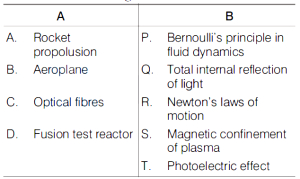
Match the following items in Column-$A$ with their corresponding principles in Column-$B$:
| Column-$A$ | Column-$B$ |
|---|---|
| $A$. Rocket propulsion | $P$. Bernoulli's principle in fluid dynamics |
| $B$. Aeroplane | $Q$. Total internal reflection of light |
| $C$. Optical fibres | $R$. Newton's laws of motion |
| $D$. Fusion test reactor | $S$. Magnetic confinement of plasma |
| $T$. Photoelectric effect |
Solution
(A-R, B-P, C-Q, D-S) The correct matches are as follows:
$A$. Rocket propulsion is based on Newton's third law of motion,which corresponds to $R$.
$B$. The lift of an aeroplane is explained by Bernoulli's principle in fluid dynamics,which corresponds to $P$.
$C$. Optical fibres work on the principle of total internal reflection of light,which corresponds to $Q$.
$D$. Fusion test reactors use magnetic confinement of plasma to sustain the fusion process,which corresponds to $S$.
Therefore,the correct matching is $A-R, B-P, C-Q, D-S$.
$A$. Rocket propulsion is based on Newton's third law of motion,which corresponds to $R$.
$B$. The lift of an aeroplane is explained by Bernoulli's principle in fluid dynamics,which corresponds to $P$.
$C$. Optical fibres work on the principle of total internal reflection of light,which corresponds to $Q$.
$D$. Fusion test reactors use magnetic confinement of plasma to sustain the fusion process,which corresponds to $S$.
Therefore,the correct matching is $A-R, B-P, C-Q, D-S$.
0 likes
View Solution314
EasyMCQ
The physics behind a fusion test reactor is:
A
Newton's law of motion
B
Trapping and cooling of atoms by laser beams and magnetic fields
C
Magnetic confinement of plasma
D
Motion of charged particles in electromagnetic fields
Solution
(C) Magnetic confinement fusion is an approach to generate thermonuclear fusion power that uses magnetic fields to confine fusion fuel in the form of a plasma.
In order to overcome the electrostatic repulsion between the nuclei,they must have a temperature of tens of millions of degrees,creating a plasma.
This plasma is then confined using strong magnetic fields to prevent it from touching the reactor walls.
In order to overcome the electrostatic repulsion between the nuclei,they must have a temperature of tens of millions of degrees,creating a plasma.
This plasma is then confined using strong magnetic fields to prevent it from touching the reactor walls.
0 likes
View Solution315
MediumMCQ
The scientific principle that forms the basis of the Tokamak technology is
A
Controlled nuclear fission
B
Motion of charged particles in electromagnetic fields
C
Magnetic confinement of plasma
D
Superconductivity
Solution
(C) The scientific principle that forms the basis of the Tokamak technology is the magnetic confinement of plasma.
In a Tokamak,a strong magnetic field is used to confine hot plasma in the shape of a torus (a doughnut shape).
This magnetic confinement prevents the high-temperature plasma from touching the walls of the reactor,which is essential for achieving controlled thermonuclear fusion.
In a Tokamak,a strong magnetic field is used to confine hot plasma in the shape of a torus (a doughnut shape).
This magnetic confinement prevents the high-temperature plasma from touching the walls of the reactor,which is essential for achieving controlled thermonuclear fusion.
0 likes
View Solution316
EasyMCQ
The average energy of a neutron produced in the fission of ${ }_{92}^{235} U$ is
A
$160 \times 10^{-13} \,J$
B
$320 \times 10^{-15} \,J$
C
$320 \times 10^{-13} \,J$
D
$160 \times 10^{-15} \,J$
Solution
(B) In the fission of ${ }_{92}^{235} U$,the neutrons produced are fast neutrons.
These neutrons have a kinetic energy distribution,but their average energy is approximately $2 \,MeV$.
We know that $1 \,eV = 1.6 \times 10^{-19} \,J$.
Therefore,$2 \,MeV = 2 \times 10^6 \times 1.6 \times 10^{-19} \,J$.
$2 \,MeV = 3.2 \times 10^{-13} \,J$.
This can be written as $320 \times 10^{-15} \,J$.
These neutrons have a kinetic energy distribution,but their average energy is approximately $2 \,MeV$.
We know that $1 \,eV = 1.6 \times 10^{-19} \,J$.
Therefore,$2 \,MeV = 2 \times 10^6 \times 1.6 \times 10^{-19} \,J$.
$2 \,MeV = 3.2 \times 10^{-13} \,J$.
This can be written as $320 \times 10^{-15} \,J$.
0 likes
View Solution317
MediumMCQ
If the number of uranium nuclei required per hour to produce a power of $64 \text{ kW}$ is $7.2 \times 10^{18}$,then the energy released per fission is
A
$0.64 \times 10^{-10} \text{ J}$
B
$3.2 \times 10^{-13} \text{ J}$
C
$0.32 \times 10^{-10} \text{ J}$
D
$3.2 \times 10^{-10} \text{ J}$
Solution
(C) Power $P = 64 \text{ kW} = 64 \times 10^3 \text{ W} = 64 \times 10^3 \text{ J/s}$.
Total energy produced in one hour $(t = 3600 \text{ s})$ is $E = P \times t = 64 \times 10^3 \times 3600 \text{ J} = 2304 \times 10^5 \text{ J} = 2.304 \times 10^8 \text{ J}$.
Number of nuclei $N = 7.2 \times 10^{18}$.
Energy released per fission $\epsilon = E / N = (2.304 \times 10^8) / (7.2 \times 10^{18}) \text{ J}$.
$\epsilon = 0.32 \times 10^{-10} \text{ J}$.
Total energy produced in one hour $(t = 3600 \text{ s})$ is $E = P \times t = 64 \times 10^3 \times 3600 \text{ J} = 2304 \times 10^5 \text{ J} = 2.304 \times 10^8 \text{ J}$.
Number of nuclei $N = 7.2 \times 10^{18}$.
Energy released per fission $\epsilon = E / N = (2.304 \times 10^8) / (7.2 \times 10^{18}) \text{ J}$.
$\epsilon = 0.32 \times 10^{-10} \text{ J}$.
0 likes
View Solution318
EasyMCQ
An $\alpha$-particle of energy $E$ is liberated during the decay of a nucleus of mass number $236$. The total energy released in this process is
A
$58 E$
B
$59 E$
C
$\frac{58 E}{59}$
D
$\frac{59 E}{58}$
Solution
(D) In the decay of a nucleus with mass number $A = 236$,the $\alpha$-particle $(m_{\alpha} = 4)$ and the daughter nucleus $(m_d = 232)$ are produced.
Given the kinetic energy of the $\alpha$-particle is $(KE)_{\alpha} = E$.
Since the total momentum is conserved,the magnitudes of the momenta of the $\alpha$-particle and the daughter nucleus are equal: $P_{\alpha} = P_d = P$.
The kinetic energy is given by $KE = \frac{P^2}{2m}$,which implies $KE \propto \frac{1}{m}$.
Therefore,the ratio of kinetic energies is $\frac{(KE)_d}{(KE)_{\alpha}} = \frac{m_{\alpha}}{m_d} = \frac{4}{232} = \frac{1}{58}$.
Thus,$(KE)_d = \frac{E}{58}$.
The total energy released $(Q)$ is the sum of the kinetic energies of the products: $Q = (KE)_{\alpha} + (KE)_d = E + \frac{E}{58} = \frac{59 E}{58}$.
Given the kinetic energy of the $\alpha$-particle is $(KE)_{\alpha} = E$.
Since the total momentum is conserved,the magnitudes of the momenta of the $\alpha$-particle and the daughter nucleus are equal: $P_{\alpha} = P_d = P$.
The kinetic energy is given by $KE = \frac{P^2}{2m}$,which implies $KE \propto \frac{1}{m}$.
Therefore,the ratio of kinetic energies is $\frac{(KE)_d}{(KE)_{\alpha}} = \frac{m_{\alpha}}{m_d} = \frac{4}{232} = \frac{1}{58}$.
Thus,$(KE)_d = \frac{E}{58}$.
The total energy released $(Q)$ is the sum of the kinetic energies of the products: $Q = (KE)_{\alpha} + (KE)_d = E + \frac{E}{58} = \frac{59 E}{58}$.
0 likes
View Solution319
DifficultMCQ
What will be the energy released in joule,in the process of fission by $1 \text{ mg}$ of ${ }_{92}^{240} U$? Assume energy release per fission is $200 \text{ MeV}$. [Use Avogadro's number as $6 \times 10^{23}$ and $1 \text{ eV} = 1.6 \times 10^{-19} \text{ J}$]
A
$6.2 \times 10^7 \text{ J}$
B
$7.0 \times 10^7 \text{ J}$
C
$8.0 \times 10^7 \text{ J}$
D
$8.2 \times 10^7 \text{ J}$
Solution
(C) The number of moles $n$ is given by $n = \frac{m}{M} = \frac{N}{N_A}$,where $m$ is the mass,$M$ is the molar mass,$N$ is the number of atoms,and $N_A$ is Avogadro's number.
Given $m = 1 \text{ mg} = 10^{-3} \text{ g}$,$M = 240 \text{ g/mol}$,and $N_A = 6 \times 10^{23} \text{ atoms/mol}$.
The number of atoms $N$ is:
$N = \frac{m}{M} \times N_A = \frac{10^{-3}}{240} \times 6 \times 10^{23} = 2.5 \times 10^{18} \text{ atoms}$.
The energy released per fission is $E_f = 200 \text{ MeV} = 200 \times 10^6 \times 1.6 \times 10^{-19} \text{ J} = 3.2 \times 10^{-11} \text{ J}$.
Total energy released $E = N \times E_f = 2.5 \times 10^{18} \times 3.2 \times 10^{-11} \text{ J} = 8.0 \times 10^7 \text{ J}$.
Given $m = 1 \text{ mg} = 10^{-3} \text{ g}$,$M = 240 \text{ g/mol}$,and $N_A = 6 \times 10^{23} \text{ atoms/mol}$.
The number of atoms $N$ is:
$N = \frac{m}{M} \times N_A = \frac{10^{-3}}{240} \times 6 \times 10^{23} = 2.5 \times 10^{18} \text{ atoms}$.
The energy released per fission is $E_f = 200 \text{ MeV} = 200 \times 10^6 \times 1.6 \times 10^{-19} \text{ J} = 3.2 \times 10^{-11} \text{ J}$.
Total energy released $E = N \times E_f = 2.5 \times 10^{18} \times 3.2 \times 10^{-11} \text{ J} = 8.0 \times 10^7 \text{ J}$.
0 likes
View Solution320
MediumMCQ
The energy released by the fission of one uranium nucleus is $200 \text{ MeV}$. The number of fissions per second required to produce $128 \text{ W}$ power is:
A
$6 \times 10^{12}$
B
$2 \times 10^{12}$
C
$8 \times 10^{12}$
D
$4 \times 10^{12}$
Solution
(D) Energy released per fission $E = 200 \text{ MeV} = 200 \times 10^6 \times 1.6 \times 10^{-19} \text{ J} = 3.2 \times 10^{-11} \text{ J}$.
Power $P = 128 \text{ W} = 128 \text{ J/s}$.
Let $n$ be the number of fissions per second.
Then,$P = n \times E$.
$n = \frac{P}{E} = \frac{128}{3.2 \times 10^{-11}}$.
$n = \frac{1280}{3.2} \times 10^{10} = 400 \times 10^{10} = 4 \times 10^{12} \text{ fissions/s}$.
Power $P = 128 \text{ W} = 128 \text{ J/s}$.
Let $n$ be the number of fissions per second.
Then,$P = n \times E$.
$n = \frac{P}{E} = \frac{128}{3.2 \times 10^{-11}}$.
$n = \frac{1280}{3.2} \times 10^{10} = 400 \times 10^{10} = 4 \times 10^{12} \text{ fissions/s}$.
0 likes
View Solution321
EasyMCQ
The operation of a nuclear reactor is said to be critical when the value of the neutron multiplication factor $K$ is:
A
$K=0$
B
$K > 1$
C
$K=1$
D
$0 < K < 1$
Solution
(C) The neutron multiplication factor $K$ (also denoted as $k$) is defined as the ratio of the number of neutrons produced in a given generation to the number of neutrons produced in the preceding generation.
When $K = 1$,the rate of neutron production is equal to the rate of neutron loss,meaning the chain reaction is self-sustaining at a constant power level.
This state is known as the critical state of a nuclear reactor.
If $K < 1$,the reactor is subcritical,and the chain reaction dies out.
If $K > 1$,the reactor is supercritical,and the power level increases exponentially.
When $K = 1$,the rate of neutron production is equal to the rate of neutron loss,meaning the chain reaction is self-sustaining at a constant power level.
This state is known as the critical state of a nuclear reactor.
If $K < 1$,the reactor is subcritical,and the chain reaction dies out.
If $K > 1$,the reactor is supercritical,and the power level increases exponentially.
0 likes
View Solution322
EasyMCQ
Nuclear fission and fusion can be explained on the basis of
A
Einstein's theory of relativity
B
Einstein specific heat equation
C
Einstein mass-energy equation
D
Einstein photoelectric equation
Solution
(C) In nuclear fission and fusion, energy is released due to the change in mass of the nuclei.
According to Einstein's mass-energy equivalence principle, mass can be converted into energy and vice-versa, given by the equation $E = mc^2$.
In fission, a heavy nucleus splits into lighter nuclei, and in fusion, lighter nuclei combine to form a heavier nucleus.
In both processes, the total mass of the products is slightly less than the total mass of the reactants.
This mass defect $(\Delta m)$ is converted into energy according to the equation $E = (\Delta m)c^2$.
Therefore, both nuclear fission and fusion are explained by Einstein's mass-energy equation.
According to Einstein's mass-energy equivalence principle, mass can be converted into energy and vice-versa, given by the equation $E = mc^2$.
In fission, a heavy nucleus splits into lighter nuclei, and in fusion, lighter nuclei combine to form a heavier nucleus.
In both processes, the total mass of the products is slightly less than the total mass of the reactants.
This mass defect $(\Delta m)$ is converted into energy according to the equation $E = (\Delta m)c^2$.
Therefore, both nuclear fission and fusion are explained by Einstein's mass-energy equation.
0 likes
View Solution323
MediumMCQ
In the following nuclear reaction,$x$ is: ${ }_{13} Al^{27} + { }_2 He^4 \rightarrow { }_0 n^1 + X$
A
${ }_{15} P^{31}$
B
${ }_{14} Si^{30}$
C
${ }_{15} P^{30}$
D
${ }_{15} Si^{31}$
Solution
(C) In a nuclear reaction,both the mass number and the atomic number are conserved.
Given reaction: ${ }_{13} Al^{27} + { }_2 He^4 \rightarrow { }_0 n^1 + X$
Conservation of mass number $(A)$:
$27 + 4 = 1 + A_X$
$31 = 1 + A_X \Rightarrow A_X = 30$
Conservation of atomic number $(Z)$:
$13 + 2 = 0 + Z_X$
$15 = Z_X$
Since the atomic number is $15$,the element is Phosphorus $(P)$.
Therefore,$X = { }_{15} P^{30}$.
Hence,option $C$ is correct.
Given reaction: ${ }_{13} Al^{27} + { }_2 He^4 \rightarrow { }_0 n^1 + X$
Conservation of mass number $(A)$:
$27 + 4 = 1 + A_X$
$31 = 1 + A_X \Rightarrow A_X = 30$
Conservation of atomic number $(Z)$:
$13 + 2 = 0 + Z_X$
$15 = Z_X$
Since the atomic number is $15$,the element is Phosphorus $(P)$.
Therefore,$X = { }_{15} P^{30}$.
Hence,option $C$ is correct.
0 likes
View Solution324
MediumMCQ
In the nuclear fission of one nucleus of $U^{235}$,the energy released is $188 \text{ MeV}$. The energy released in the nuclear fission of $235 \text{ g}$ of $U^{235}$ is nearly (Avogadro number $= 6.02 \times 10^{23} \text{ mol}^{-1}$)
A
$28.8 \times 10^{12} \text{ J}$
B
$23.5 \times 10^{12} \text{ J}$
C
$36.2 \times 10^{12} \text{ J}$
D
$18.11 \times 10^{12} \text{ J}$
Solution
(D) The number of atoms in $235 \text{ g}$ of $U^{235}$ is equal to the Avogadro number,$N_A = 6.02 \times 10^{23}$.
Energy released per nucleus $= 188 \text{ MeV} = 188 \times 1.6 \times 10^{-13} \text{ J} = 3.008 \times 10^{-11} \text{ J}$.
Total energy released $= N_A \times \text{Energy per nucleus}$.
Total energy $= (6.02 \times 10^{23}) \times (3.008 \times 10^{-11} \text{ J}) \approx 18.11 \times 10^{12} \text{ J}$.
Energy released per nucleus $= 188 \text{ MeV} = 188 \times 1.6 \times 10^{-13} \text{ J} = 3.008 \times 10^{-11} \text{ J}$.
Total energy released $= N_A \times \text{Energy per nucleus}$.
Total energy $= (6.02 \times 10^{23}) \times (3.008 \times 10^{-11} \text{ J}) \approx 18.11 \times 10^{12} \text{ J}$.
0 likes
View Solution325
EasyMCQ
Heavy water is used as a moderator in a nuclear reactor because
A
It controls the energy released in the reactor
B
It absorbs neutrons and stops the chain reaction
C
It cools the reactor faster
D
It slows down the fast-moving neutrons
Solution
(D) In a nuclear reactor,fast-moving neutrons produced during fission have high kinetic energy.
To sustain a chain reaction,these neutrons need to be slowed down to thermal energies so they can effectively cause further fission in $U^{235}$ nuclei.
Heavy water $(D_2O)$ is used as a moderator because it is effective at slowing down these fast-moving neutrons through elastic collisions without absorbing them significantly.
To sustain a chain reaction,these neutrons need to be slowed down to thermal energies so they can effectively cause further fission in $U^{235}$ nuclei.
Heavy water $(D_2O)$ is used as a moderator because it is effective at slowing down these fast-moving neutrons through elastic collisions without absorbing them significantly.
0 likes
View Solution326
EasyMCQ
$113$. Energy released in the fission of a single uranium nucleus is $200 \text{ MeV}$. Then the number of fissions per second to produce $5 \text{ mW}$ power is
A
$1.56 \times 10^8$
B
$1.56 \times 10^{13}$
C
$3.12 \times 10^8$
D
$3.12 \times 10^{13}$
Solution
(A) Power $P = 5 \text{ mW} = 5 \times 10^{-3} \text{ W}$.
Energy released per fission $E = 200 \text{ MeV} = 200 \times 10^6 \times 1.6 \times 10^{-19} \text{ J} = 3.2 \times 10^{-11} \text{ J}$.
Let $n$ be the number of fissions per second.
Power $P = n \times E$.
Therefore,$n = \frac{P}{E} = \frac{5 \times 10^{-3} \text{ J/s}}{3.2 \times 10^{-11} \text{ J/fission}}$.
$n = \frac{5}{3.2} \times 10^8 = 1.5625 \times 10^8 \text{ fissions/s}$.
Thus,the number of fissions per second is $1.56 \times 10^8$.
Energy released per fission $E = 200 \text{ MeV} = 200 \times 10^6 \times 1.6 \times 10^{-19} \text{ J} = 3.2 \times 10^{-11} \text{ J}$.
Let $n$ be the number of fissions per second.
Power $P = n \times E$.
Therefore,$n = \frac{P}{E} = \frac{5 \times 10^{-3} \text{ J/s}}{3.2 \times 10^{-11} \text{ J/fission}}$.
$n = \frac{5}{3.2} \times 10^8 = 1.5625 \times 10^8 \text{ fissions/s}$.
Thus,the number of fissions per second is $1.56 \times 10^8$.
0 likes
View Solution327
MediumMCQ
$A$ tokamak fusion test reactor works on
A
bombardment of thermal neutrons with uranium-$235$
B
magnetic confinement of plasma
C
electric discharge under high voltage bias
D
acceleration of charged particles in electromagnetic fields
Solution
(B) tokamak reactor uses magnetic fields to confine hot plasma in a doughnut-shaped region.
Plasma is heated to extremely high temperatures to achieve conditions suitable for thermonuclear fusion.
The primary mechanism for maintaining the stability and position of this high-temperature plasma is magnetic confinement.
Plasma is heated to extremely high temperatures to achieve conditions suitable for thermonuclear fusion.
The primary mechanism for maintaining the stability and position of this high-temperature plasma is magnetic confinement.
0 likes
View Solution328
MediumMCQ
$A$ $^{235}U$ nuclear reactor generates energy at a rate of $3.70 \times 10^7 \text{ J/s}$. Each fission liberates $185 \text{ MeV}$ of useful energy. If the reactor has to operate for $144 \times 10^4 \text{ s}$, the mass of the fuel needed is (Assume Avogadro's number $= 6 \times 10^{23} \text{ mol}^{-1}$, $1 \text{ eV} = 1.6 \times 10^{-19} \text{ J}$) (in $\text{ kg}$)
A
$70.5$
B
$0.705$
C
$13.1$
D
$1.31$
Solution
(B) Total energy required $E = \text{Power} \times \text{Time} = (3.70 \times 10^7 \text{ J/s}) \times (144 \times 10^4 \text{ s}) = 5.328 \times 10^{13} \text{ J}$.
Energy per fission $\epsilon = 185 \text{ MeV} = 185 \times 10^6 \times 1.6 \times 10^{-19} \text{ J} = 2.96 \times 10^{-11} \text{ J}$.
Number of fissions required $N = \frac{E}{\epsilon} = \frac{5.328 \times 10^{13}}{2.96 \times 10^{-11}} = 1.8 \times 10^{24} \text{ atoms}$.
Mass of fuel $m = \frac{N \times M}{N_A} = \frac{1.8 \times 10^{24} \times 235}{6 \times 10^{23}} = 705 \text{ g} = 0.705 \text{ kg}$.
Energy per fission $\epsilon = 185 \text{ MeV} = 185 \times 10^6 \times 1.6 \times 10^{-19} \text{ J} = 2.96 \times 10^{-11} \text{ J}$.
Number of fissions required $N = \frac{E}{\epsilon} = \frac{5.328 \times 10^{13}}{2.96 \times 10^{-11}} = 1.8 \times 10^{24} \text{ atoms}$.
Mass of fuel $m = \frac{N \times M}{N_A} = \frac{1.8 \times 10^{24} \times 235}{6 \times 10^{23}} = 705 \text{ g} = 0.705 \text{ kg}$.
0 likes
View Solution329
DifficultMCQ
If $200 \text{ MeV}$ of energy is released in the fission of one nucleus of ${ }_{92}^{236} U$,the number of nuclei that must undergo fission to release an energy of $1000 \text{ J}$ is
A
$3.125 \times 10^{13}$
B
$6.25 \times 10^{13}$
C
$12.5 \times 10^{13}$
D
$3.125 \times 10^{14}$
Solution
(A) Energy released in the fission of one nucleus is $E_1 = 200 \text{ MeV}$.
Converting this energy into Joules:
$E_1 = 200 \times 1.6 \times 10^{-13} \text{ J} = 3.2 \times 10^{-11} \text{ J}$.
We need to find the number of nuclei $(n)$ required to release a total energy $E_{total} = 1000 \text{ J}$.
The relationship is $E_{total} = n \times E_1$.
Therefore,$n = \frac{E_{total}}{E_1} = \frac{1000}{3.2 \times 10^{-11}}$.
$n = \frac{10^3}{3.2 \times 10^{-11}} = \frac{1}{3.2} \times 10^{14} = 0.3125 \times 10^{14} = 3.125 \times 10^{13}$ nuclei.
Converting this energy into Joules:
$E_1 = 200 \times 1.6 \times 10^{-13} \text{ J} = 3.2 \times 10^{-11} \text{ J}$.
We need to find the number of nuclei $(n)$ required to release a total energy $E_{total} = 1000 \text{ J}$.
The relationship is $E_{total} = n \times E_1$.
Therefore,$n = \frac{E_{total}}{E_1} = \frac{1000}{3.2 \times 10^{-11}}$.
$n = \frac{10^3}{3.2 \times 10^{-11}} = \frac{1}{3.2} \times 10^{14} = 0.3125 \times 10^{14} = 3.125 \times 10^{13}$ nuclei.
0 likes
View Solution330
MediumMCQ
Consider the following statements $A$ and $B$. Identify the correct choice in the given answer.
$A$. $p-n, p-p$ and $n-n$ forces between nucleons are not equal and charge dependent.
$B$. In a nuclear reactor,the fission reaction will be in an accelerating state if the value of the neutron reproduction factor $k > 1$.
$A$. $p-n, p-p$ and $n-n$ forces between nucleons are not equal and charge dependent.
$B$. In a nuclear reactor,the fission reaction will be in an accelerating state if the value of the neutron reproduction factor $k > 1$.
A
Both $A$ and $B$ are correct
B
Both $A$ and $B$ are wrong
C
$A$ is wrong and $B$ is correct
D
$A$ is correct and $B$ is wrong
Solution
(C) The nuclear force acting between proton-neutron $(p-n)$,proton-proton $(p-p)$,and neutron-neutron $(n-n)$ are approximately equal and charge independent. Therefore,statement $A$ is wrong.
In a nuclear reactor,the neutron reproduction factor (often denoted as $k$) represents the ratio of the number of neutrons produced in one generation to the number of neutrons in the preceding generation. If $k > 1$,the chain reaction is supercritical and the fission rate increases exponentially (accelerating state). Therefore,statement $B$ is correct.
In a nuclear reactor,the neutron reproduction factor (often denoted as $k$) represents the ratio of the number of neutrons produced in one generation to the number of neutrons in the preceding generation. If $k > 1$,the chain reaction is supercritical and the fission rate increases exponentially (accelerating state). Therefore,statement $B$ is correct.
0 likes
View Solution331
MediumMCQ
In a nuclear reactor,the main purpose of the moderator is to
A
Initiate the fission process by giving away its neutron
B
Slow down the fast neutrons
C
Cool down the excess of heat generated in the reactor
D
Absorb excess of neutrons and control the reaction rate
Solution
(B) In a nuclear reactor,the neutrons produced during fission are fast-moving. These fast neutrons are less likely to cause further fission in $U^{235}$ nuclei. The moderator (such as heavy water,graphite,or ordinary water) is used to slow down these fast neutrons to thermal energies,making them more effective at sustaining the chain reaction. Control rods are used to absorb excess neutrons to regulate the reaction rate,while coolants are used to remove excess heat.
0 likes
View Solution332
EasyMCQ
If $5 \ mg$ of ${}^{235}U$ is completely destroyed in an atom bomb,then the approximate total energy released is (given that the energy released per fission is $200 \ MeV$).
A
$4 \times 10^8 \ J$
B
$6 \times 10^9 \ J$
C
$5 \times 10^7 \ J$
D
$3 \times 10^{10} \ J$
Solution
(A) The number of uranium atoms $N$ in $5 \ mg$ of ${}^{235}U$ is given by $N = \frac{m}{M} \times N_A$,where $m = 5 \times 10^{-3} \ g$,$M = 235 \ g/mol$,and $N_A = 6.022 \times 10^{23} \ atoms/mol$.
$N = \frac{5 \times 10^{-3}}{235} \times 6.022 \times 10^{23} \approx 1.28 \times 10^{19} \ atoms$.
The total energy released $E$ is $N \times E_{fission}$,where $E_{fission} = 200 \ MeV = 200 \times 10^6 \times 1.6 \times 10^{-19} \ J = 3.2 \times 10^{-11} \ J$.
$E = 1.28 \times 10^{19} \times 3.2 \times 10^{-11} \ J \approx 4.096 \times 10^8 \ J$.
Thus,the approximate energy released is $4 \times 10^8 \ J$.
$N = \frac{5 \times 10^{-3}}{235} \times 6.022 \times 10^{23} \approx 1.28 \times 10^{19} \ atoms$.
The total energy released $E$ is $N \times E_{fission}$,where $E_{fission} = 200 \ MeV = 200 \times 10^6 \times 1.6 \times 10^{-19} \ J = 3.2 \times 10^{-11} \ J$.
$E = 1.28 \times 10^{19} \times 3.2 \times 10^{-11} \ J \approx 4.096 \times 10^8 \ J$.
Thus,the approximate energy released is $4 \times 10^8 \ J$.
0 likes
View Solution333
MediumMCQ
For nuclei with mass number close to $119$ and $238$, the binding energies per nucleon are approximately $7.6 \text{ MeV}$ and $8.6 \text{ MeV}$ respectively. If a nucleus of mass number $238$ breaks into two nuclei of nearly equal masses, what will be the approximate amount of energy released in the process of fission (in $\text{ MeV}$)?
A
$214$
B
$119$
C
$2047$
D
$1142$
Solution
(A) The binding energy per nucleon $(BE/A)$ for a nucleus of mass number $A = 238$ is $7.6 \text{ MeV}$, and for a nucleus of mass number $A = 119$, it is $8.6 \text{ MeV}$.
Total binding energy of the parent nucleus $(A = 238)$ is $E_1 = 238 \times 7.6 \text{ MeV} = 1808.8 \text{ MeV}$.
When the nucleus splits into two fragments of mass number $119$ each, the total binding energy of the product nuclei is $E_2 = 2 \times (119 \times 8.6 \text{ MeV}) = 238 \times 8.6 \text{ MeV} = 2046.8 \text{ MeV}$.
The energy released in the fission process is $\Delta E = E_2 - E_1 = 2046.8 \text{ MeV} - 1808.8 \text{ MeV} = 238 \text{ MeV}$.
Among the given options, $214 \text{ MeV}$ is the closest approximate value.
Total binding energy of the parent nucleus $(A = 238)$ is $E_1 = 238 \times 7.6 \text{ MeV} = 1808.8 \text{ MeV}$.
When the nucleus splits into two fragments of mass number $119$ each, the total binding energy of the product nuclei is $E_2 = 2 \times (119 \times 8.6 \text{ MeV}) = 238 \times 8.6 \text{ MeV} = 2046.8 \text{ MeV}$.
The energy released in the fission process is $\Delta E = E_2 - E_1 = 2046.8 \text{ MeV} - 1808.8 \text{ MeV} = 238 \text{ MeV}$.
Among the given options, $214 \text{ MeV}$ is the closest approximate value.
0 likes
View Solution334
EasyMCQ
The energy released by the fission of one uranium atom is $200 MeV$. The number of fissions per second required to produce $3.2 W$ of power is (Take $1 eV = 1.6 \times 10^{-19} J$).
A
$10^7$
B
$10^{10}$
C
$10^{15}$
D
$10^{11}$
Solution
(D) The energy released per fission is $E_{fission} = 200 MeV$.
Converting this energy into Joules: $E_{fission} = 200 \times 10^6 \times 1.6 \times 10^{-19} J = 3.2 \times 10^{-11} J$.
The power required is $P = 3.2 W$,which means $3.2 J$ of energy is required per second.
The number of fissions per second $(n)$ is given by the ratio of total power to energy per fission:
$n = \frac{P}{E_{fission}} = \frac{3.2 J/s}{3.2 \times 10^{-11} J} = 10^{11} \text{ fissions/second}$.
Converting this energy into Joules: $E_{fission} = 200 \times 10^6 \times 1.6 \times 10^{-19} J = 3.2 \times 10^{-11} J$.
The power required is $P = 3.2 W$,which means $3.2 J$ of energy is required per second.
The number of fissions per second $(n)$ is given by the ratio of total power to energy per fission:
$n = \frac{P}{E_{fission}} = \frac{3.2 J/s}{3.2 \times 10^{-11} J} = 10^{11} \text{ fissions/second}$.
0 likes
View Solution335
EasyMCQ
The average energy released per fission for the nucleus of $_{92}^{235} U$ is $190 \text{ MeV}$. When all the atoms of $47 \text{ g}$ pure $_{92}^{235} U$ undergo fission process,the energy released is $\alpha \times 10^{23} \text{ MeV}$. The value of $\alpha$ is . . . . . . . . . . . (Avogadro Number $= 6 \times 10^{23} \text{ per mole}$)
A
$114$
B
$228$
C
$190$
D
$456$
Solution
(B) The molar mass of $_{92}^{235} U$ is $235 \text{ g/mol}$.
Number of moles in $47 \text{ g}$ of $_{92}^{235} U$ is $n = \frac{47 \text{ g}}{235 \text{ g/mol}} = 0.2 \text{ moles} = \frac{1}{5} \text{ moles}$.
Total number of atoms $N = n \times N_A = \frac{1}{5} \times 6 \times 10^{23} = 1.2 \times 10^{23} \text{ atoms}$.
Energy released per fission is $190 \text{ MeV}$.
Total energy released $= N \times 190 \text{ MeV} = (1.2 \times 10^{23}) \times 190 \text{ MeV} = 228 \times 10^{23} \text{ MeV}$.
Comparing this with $\alpha \times 10^{23} \text{ MeV}$,we get $\alpha = 228$.
Number of moles in $47 \text{ g}$ of $_{92}^{235} U$ is $n = \frac{47 \text{ g}}{235 \text{ g/mol}} = 0.2 \text{ moles} = \frac{1}{5} \text{ moles}$.
Total number of atoms $N = n \times N_A = \frac{1}{5} \times 6 \times 10^{23} = 1.2 \times 10^{23} \text{ atoms}$.
Energy released per fission is $190 \text{ MeV}$.
Total energy released $= N \times 190 \text{ MeV} = (1.2 \times 10^{23}) \times 190 \text{ MeV} = 228 \times 10^{23} \text{ MeV}$.
Comparing this with $\alpha \times 10^{23} \text{ MeV}$,we get $\alpha = 228$.
0 likes
View Solution336
MediumMCQ
The minimum frequency of a photon required to break a particle of mass $15.348 \ amu$ into $4 \ \alpha$ particles is . . . . . . $kHz$.
[Mass of $He$ nucleus = $4.002 \ amu$,$1 \ amu = 1.66 \times 10^{-27} \ kg$,$h = 6.6 \times 10^{-34} \ J \cdot s$ and $c = 3 \times 10^8 \ m/s$]
[Mass of $He$ nucleus = $4.002 \ amu$,$1 \ amu = 1.66 \times 10^{-27} \ kg$,$h = 6.6 \times 10^{-34} \ J \cdot s$ and $c = 3 \times 10^8 \ m/s$]
A
$9 \times 10^{19}$
B
$9 \times 10^{20}$
C
$14.94 \times 10^{20}$
D
$14.94 \times 10^{19}$
Solution
(C) The mass defect $\Delta m$ is the difference between the mass of the products and the initial mass.
$\Delta m = (4 \times 4.002 \ amu) - 15.348 \ amu = 16.008 \ amu - 15.348 \ amu = 0.66 \ amu$.
Convert the mass defect to $kg$: $\Delta m = 0.66 \times 1.66 \times 10^{-27} \ kg = 1.0956 \times 10^{-27} \ kg$.
The energy required $E = \Delta m c^2 = 1.0956 \times 10^{-27} \times (3 \times 10^8)^2 = 1.0956 \times 10^{-27} \times 9 \times 10^{16} = 9.8604 \times 10^{-11} \ J$.
Using $E = h\nu$,the frequency $\nu = E / h = (9.8604 \times 10^{-11}) / (6.6 \times 10^{-34}) \approx 1.494 \times 10^{23} \ Hz$.
Converting to $kHz$: $\nu = 1.494 \times 10^{23} / 10^3 = 1.494 \times 10^{20} \ kHz$.
$\Delta m = (4 \times 4.002 \ amu) - 15.348 \ amu = 16.008 \ amu - 15.348 \ amu = 0.66 \ amu$.
Convert the mass defect to $kg$: $\Delta m = 0.66 \times 1.66 \times 10^{-27} \ kg = 1.0956 \times 10^{-27} \ kg$.
The energy required $E = \Delta m c^2 = 1.0956 \times 10^{-27} \times (3 \times 10^8)^2 = 1.0956 \times 10^{-27} \times 9 \times 10^{16} = 9.8604 \times 10^{-11} \ J$.
Using $E = h\nu$,the frequency $\nu = E / h = (9.8604 \times 10^{-11}) / (6.6 \times 10^{-34}) \approx 1.494 \times 10^{23} \ Hz$.
Converting to $kHz$: $\nu = 1.494 \times 10^{23} / 10^3 = 1.494 \times 10^{20} \ kHz$.
0 likes
View Solution337
MediumMCQ
Choose the correct option to complete the net effect of the fusion reaction that occurs in the Sun: $4_1^1H + 2e^- \rightarrow$ . . . . . . $+ 2\nu + 6\gamma +$ . . . . . .
A
$^3_2He, 5.49 \text{ MeV}$
B
$^4_2He, 26.7 \text{ MeV}$
C
$^4_2He, 22.86 \text{ MeV}$
D
$^3_2He, 0.42 \text{ MeV}$
Solution
(B) The proton-proton chain reaction,which is the primary fusion process in the Sun,can be represented by the net equation:
$4_1^1H + 2e^- \rightarrow ^4_2He + 2\nu_e + 26.7 \text{ MeV}$.
In this process,four hydrogen nuclei (protons) fuse to form one helium nucleus $(^4_2He)$,releasing two neutrinos $(
u_e)$ and a total energy of approximately $26.7 \text{ MeV}$.
$4_1^1H + 2e^- \rightarrow ^4_2He + 2\nu_e + 26.7 \text{ MeV}$.
In this process,four hydrogen nuclei (protons) fuse to form one helium nucleus $(^4_2He)$,releasing two neutrinos $(
u_e)$ and a total energy of approximately $26.7 \text{ MeV}$.
0 likes
View Solution338
DifficultMCQ
The energy released if hydrogen atoms are combined to form $^{4}_{2}He$ is . . . . . . MeV. (Take binding energies per nucleon of $^{2}H$ and $^{4}_{2}He$ as $1.1$ MeV and $7.2$ MeV,respectively)
A
$6.1$
B
$24.4$
C
$26.6$
D
$5$
Solution
(B) The nuclear fusion reaction is: $2 \times ^{2}_{1}H \to ^{4}_{2}He$.
Binding energy of one $^{2}_{1}H$ nucleus $= 2 \times 1.1 \text{ MeV} = 2.2 \text{ MeV}$.
Total binding energy of reactants $= 2 \times 2.2 \text{ MeV} = 4.4 \text{ MeV}$.
Binding energy of one $^{4}_{2}He$ nucleus $= 4 \times 7.2 \text{ MeV} = 28.8 \text{ MeV}$.
Energy released $= \text{Binding energy of product} - \text{Binding energy of reactants}$.
Energy released $= 28.8 \text{ MeV} - 4.4 \text{ MeV} = 24.4 \text{ MeV}$.
Binding energy of one $^{2}_{1}H$ nucleus $= 2 \times 1.1 \text{ MeV} = 2.2 \text{ MeV}$.
Total binding energy of reactants $= 2 \times 2.2 \text{ MeV} = 4.4 \text{ MeV}$.
Binding energy of one $^{4}_{2}He$ nucleus $= 4 \times 7.2 \text{ MeV} = 28.8 \text{ MeV}$.
Energy released $= \text{Binding energy of product} - \text{Binding energy of reactants}$.
Energy released $= 28.8 \text{ MeV} - 4.4 \text{ MeV} = 24.4 \text{ MeV}$.
0 likes
View Solution339
DifficultMCQ
The energy released when $\frac{7}{17.13} \text{ kg}$ of $^7_3\text{Li}$ is converted into $^4_2\text{He}$ by proton bombardment is $\alpha \times 10^{32} \text{ eV}$. The value of $\alpha$ is . . . . . . . (Nearest integer) (Mass of $^7_3\text{Li} = 7.0183 \text{ u}$,mass of $^4_2\text{He} = 4.004 \text{ u}$,mass of proton $= 1.008 \text{ u}$,$1 \text{ u} = 931 \text{ MeV/c}^2$,and Avogadro number $N_A = 6.0 \times 10^{23} \text{ mol}^{-1}$)
A
$5$
B
$6$
C
$8$
D
$10$
Solution
(B) The nuclear reaction is: $^7_3\text{Li} + ^1_1\text{H} \rightarrow 2(^4_2\text{He})$.
Mass of reactants $= 7.0183 \text{ u} + 1.008 \text{ u} = 8.0263 \text{ u}$.
Mass of products $= 2 \times 4.004 \text{ u} = 8.008 \text{ u}$.
Mass defect $\Delta m = 8.0263 \text{ u} - 8.008 \text{ u} = 0.0183 \text{ u}$.
Energy released per reaction $= 0.0183 \times 931 \text{ MeV} = 17.0373 \text{ MeV} = 1.70373 \times 10^7 \text{ eV}$.
Number of moles in $\frac{7}{17.13} \text{ kg}$ (i.e.,$\frac{7000}{17.13} \text{ g}$) of $^7_3\text{Li}$ (molar mass $\approx 7 \text{ g/mol}$): $n = \frac{7000 / 17.13}{7} = \frac{1000}{17.13} \approx 58.377 \text{ mol}$.
Total number of atoms $N = n \times N_A = 58.377 \times 6.0 \times 10^{23} \approx 3.5026 \times 10^{25}$.
Total energy released $= N \times (1.70373 \times 10^7 \text{ eV}) \approx 3.5026 \times 10^{25} \times 1.70373 \times 10^7 \text{ eV} \approx 5.967 \times 10^{32} \text{ eV}$.
Comparing with $\alpha \times 10^{32} \text{ eV}$,we get $\alpha \approx 5.967$. The nearest integer is $6$.
Mass of reactants $= 7.0183 \text{ u} + 1.008 \text{ u} = 8.0263 \text{ u}$.
Mass of products $= 2 \times 4.004 \text{ u} = 8.008 \text{ u}$.
Mass defect $\Delta m = 8.0263 \text{ u} - 8.008 \text{ u} = 0.0183 \text{ u}$.
Energy released per reaction $= 0.0183 \times 931 \text{ MeV} = 17.0373 \text{ MeV} = 1.70373 \times 10^7 \text{ eV}$.
Number of moles in $\frac{7}{17.13} \text{ kg}$ (i.e.,$\frac{7000}{17.13} \text{ g}$) of $^7_3\text{Li}$ (molar mass $\approx 7 \text{ g/mol}$): $n = \frac{7000 / 17.13}{7} = \frac{1000}{17.13} \approx 58.377 \text{ mol}$.
Total number of atoms $N = n \times N_A = 58.377 \times 6.0 \times 10^{23} \approx 3.5026 \times 10^{25}$.
Total energy released $= N \times (1.70373 \times 10^7 \text{ eV}) \approx 3.5026 \times 10^{25} \times 1.70373 \times 10^7 \text{ eV} \approx 5.967 \times 10^{32} \text{ eV}$.
Comparing with $\alpha \times 10^{32} \text{ eV}$,we get $\alpha \approx 5.967$. The nearest integer is $6$.
0 likes
View SolutionNuclei — Nuclear Fission, Fusion and Nuclear Reactor · Frequently Asked Questions
1Are these Nuclei questions useful for JEE and NEET?
Yes. All questions in this section are mapped to JEE Main and NEET exam patterns. Previous year questions from JEE Main, NEET, GUJCET and state-level exams are included with full solutions.
2Can I switch to Hindi or Gujarati for these questions?
Yes. Use the language tabs in the hero section or the sidebar to view the same questions and solutions in English, Hindi or Gujarati.
3How do I generate a question paper from this subtopic?
Use the Vedclass Exam Paper Generator — select the chapter and subtopic, set difficulty, and generate Sets A, B, C, D automatically. First 3 chapters of every subject are free.
Vedclass Products
For Students
Vedclass Test Series
Mock tests in real JEE/NEET style with performance analysis. 5-day free trial.
Start Free TrialFor Teachers
Exam Paper Generator
Generate Set A/B/C/D papers from this chapter in 2 minutes. 3 chapters free.
Try FreeFor Institutes
Online Exam Module
Live online exams with unlimited students, 360° analytics & white-label branding.
See DemoFor Teachers & Institutes
Generate a Nuclei Exam Paper in 2 Minutes
Select subtopic & difficulty — Sets A, B, C, D auto-generated with No Repeat logic.
First 3 chapters of every subject are free — no payment required.