
A English
Mix Examples-Nuclei Questions in English
Class 12 Physics · Nuclei · Mix Examples-Nuclei
10+
Questions
English
Language
100%
With Solutions
Showing 10 of 10 questions in English
1
MediumMCQ
The graph between the number of decayed atoms $N'$ of a radioactive element and time $t$ is:
A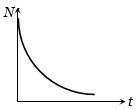
B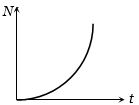
C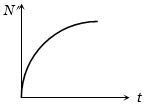
D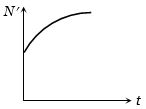
Solution
(C) The number of undecayed radioactive atoms at time $t$ is given by $N = N_0 e^{-\lambda t}$.
The number of decayed atoms $N'$ at time $t$ is the difference between the initial number of atoms $N_0$ and the remaining atoms $N$:
$N' = N_0 - N = N_0 - N_0 e^{-\lambda t} = N_0(1 - e^{-\lambda t})$.
At $t = 0$,$N' = N_0(1 - e^0) = 0$.
As $t \to \infty$,$N' \to N_0$.
This represents a curve that starts from the origin $(0,0)$ and increases exponentially,approaching the horizontal asymptote $N' = N_0$. This matches the graph shown in option $C$.
The number of decayed atoms $N'$ at time $t$ is the difference between the initial number of atoms $N_0$ and the remaining atoms $N$:
$N' = N_0 - N = N_0 - N_0 e^{-\lambda t} = N_0(1 - e^{-\lambda t})$.
At $t = 0$,$N' = N_0(1 - e^0) = 0$.
As $t \to \infty$,$N' \to N_0$.
This represents a curve that starts from the origin $(0,0)$ and increases exponentially,approaching the horizontal asymptote $N' = N_0$. This matches the graph shown in option $C$.
0 likes
View Solution2
DifficultMCQ
$A$ radioactive nucleus emits an $\alpha$-particle to become a stable nucleus. If the velocity of the $\alpha$-particle is $\upsilon$ and the mass number of the original radioactive nucleus is $A$,what will be the velocity of the daughter nucleus?
A
$\frac{4\upsilon}{A - 4}$
B
$\frac{2\upsilon}{A - 4}$
C
$\frac{4\upsilon}{A + 4}$
D
$\frac{2\upsilon}{A + 4}$
Solution
(A) According to the law of conservation of linear momentum,the initial momentum of the system is zero because the parent nucleus is at rest.
Let $M$ be the mass of the parent nucleus,$m_{\alpha} = 4$ be the mass of the $\alpha$-particle,and $m_d = A - 4$ be the mass of the daughter nucleus.
Since the initial momentum is zero,the final momentum must also be zero:
$P_{initial} = P_{final}$
$0 = m_d \upsilon' + m_{\alpha} \upsilon$
Here,$\upsilon'$ is the velocity of the daughter nucleus and $\upsilon$ is the velocity of the $\alpha$-particle.
$(A - 4) \upsilon' + 4 \upsilon = 0$
$(A - 4) \upsilon' = -4 \upsilon$
$\upsilon' = -\frac{4 \upsilon}{A - 4}$
The magnitude of the velocity of the daughter nucleus is $\frac{4 \upsilon}{A - 4}$.
Let $M$ be the mass of the parent nucleus,$m_{\alpha} = 4$ be the mass of the $\alpha$-particle,and $m_d = A - 4$ be the mass of the daughter nucleus.
Since the initial momentum is zero,the final momentum must also be zero:
$P_{initial} = P_{final}$
$0 = m_d \upsilon' + m_{\alpha} \upsilon$
Here,$\upsilon'$ is the velocity of the daughter nucleus and $\upsilon$ is the velocity of the $\alpha$-particle.
$(A - 4) \upsilon' + 4 \upsilon = 0$
$(A - 4) \upsilon' = -4 \upsilon$
$\upsilon' = -\frac{4 \upsilon}{A - 4}$
The magnitude of the velocity of the daughter nucleus is $\frac{4 \upsilon}{A - 4}$.

0 likes
View Solution3
DifficultMCQ
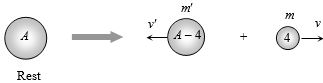
$A$ stationary nucleus (mass number = $A$) emits an $\alpha$-particle with velocity $v$. Find the velocity of the daughter nucleus.
A
$2v/(A + 4)$
B
$4v/(A + 4)$
C
$4v/(A - 4)$
D
$2v/(A - 4)$
Solution
(C) According to the law of conservation of linear momentum,the total initial momentum of the system is zero because the nucleus is initially at rest.
Let $M$ be the mass of the parent nucleus,$m_{\alpha}$ be the mass of the $\alpha$-particle,and $m_d$ be the mass of the daughter nucleus.
Since mass is proportional to the mass number,we have $M \propto A$,$m_{\alpha} \propto 4$,and $m_d \propto (A - 4)$.
Initial momentum $P_i = 0$.
Final momentum $P_f = m_d v' - m_{\alpha} v = 0$,where $v'$ is the velocity of the daughter nucleus.
Substituting the mass numbers: $(A - 4)v' - 4v = 0$.
Therefore,$(A - 4)v' = 4v$.
Solving for $v'$,we get $v' = \frac{4v}{A - 4}$.
Let $M$ be the mass of the parent nucleus,$m_{\alpha}$ be the mass of the $\alpha$-particle,and $m_d$ be the mass of the daughter nucleus.
Since mass is proportional to the mass number,we have $M \propto A$,$m_{\alpha} \propto 4$,and $m_d \propto (A - 4)$.
Initial momentum $P_i = 0$.
Final momentum $P_f = m_d v' - m_{\alpha} v = 0$,where $v'$ is the velocity of the daughter nucleus.
Substituting the mass numbers: $(A - 4)v' - 4v = 0$.
Therefore,$(A - 4)v' = 4v$.
Solving for $v'$,we get $v' = \frac{4v}{A - 4}$.
0 likes
View Solution4
MediumMCQ
Both the nucleus and the atom of some element are in their respective first excited states. They get de-excited by emitting photons of wavelengths $\lambda_N$ and $\lambda_A$ respectively. The ratio $\frac{\lambda_N}{\lambda_A}$ is closest to
A
$10^{-6}$
B
$10$
C
$10^{-1}$
D
$10^{-10}$
Solution
(A) The energy of a photon is given by $E = \frac{hc}{\lambda}$.
From this,we have $\lambda = \frac{hc}{E}$,which implies $\frac{\lambda_N}{\lambda_A} = \frac{E_A}{E_N}$.
Here,$E_N$ is the energy of the photon emitted during nuclear de-excitation,which is typically in the order of $MeV$ $(10^6 \ eV)$.
$E_A$ is the energy of the photon emitted during atomic de-excitation,which is typically in the order of a few $eV$ (e.g.,$1-10 \ eV$).
Therefore,the ratio $\frac{\lambda_N}{\lambda_A} = \frac{E_A}{E_N} \approx \frac{1 \ eV}{10^6 \ eV} = 10^{-6}$.
From this,we have $\lambda = \frac{hc}{E}$,which implies $\frac{\lambda_N}{\lambda_A} = \frac{E_A}{E_N}$.
Here,$E_N$ is the energy of the photon emitted during nuclear de-excitation,which is typically in the order of $MeV$ $(10^6 \ eV)$.
$E_A$ is the energy of the photon emitted during atomic de-excitation,which is typically in the order of a few $eV$ (e.g.,$1-10 \ eV$).
Therefore,the ratio $\frac{\lambda_N}{\lambda_A} = \frac{E_A}{E_N} \approx \frac{1 \ eV}{10^6 \ eV} = 10^{-6}$.
0 likes
View Solution5
DifficultMCQ
Consider the following statements:
$A.$ Atoms of each element emit a characteristic spectrum.
$B.$ According to Bohr's postulate, an electron in a hydrogen atom revolves in a certain stationary orbit.
$C.$ The density of nuclear matter depends on the size of the nucleus.
$D.$ A free neutron is stable, but a free proton decay is possible.
$E.$ Radioactivity is an indication of the instability of nuclei.
Choose the correct answer from the options given below:
$A.$ Atoms of each element emit a characteristic spectrum.
$B.$ According to Bohr's postulate, an electron in a hydrogen atom revolves in a certain stationary orbit.
$C.$ The density of nuclear matter depends on the size of the nucleus.
$D.$ A free neutron is stable, but a free proton decay is possible.
$E.$ Radioactivity is an indication of the instability of nuclei.
Choose the correct answer from the options given below:
A
$A, B$ and $E$ only
B
$B$ and $D$ only
C
$A, C$ and $E$ only
D
$A, B, C, D$ and $E$
Solution
$(A)$ True: Atoms of each element emit a characteristic spectrum due to electronic transitions.
$(B)$ True: According to Bohr's postulate, electrons revolve in specific orbits where angular momentum is quantized $(mvr = \frac{nh}{2\pi})$, known as stationary orbits.
$(C)$ False: The density of nuclear matter is independent of the mass number $(A)$ and is approximately constant for all nuclei $(\approx 2.3 \times 10^{17} \, kg/m^3)$.
$(D)$ False: A free neutron is unstable and decays into a proton, an electron, and an antineutrino $(n \rightarrow p + e^- + \bar{\nu}_e)$, whereas a free proton is stable.
$(E)$ True: Radioactivity is a spontaneous process resulting from the instability of atomic nuclei.
Therefore, statements $A, B,$ and $E$ are correct.
$(B)$ True: According to Bohr's postulate, electrons revolve in specific orbits where angular momentum is quantized $(mvr = \frac{nh}{2\pi})$, known as stationary orbits.
$(C)$ False: The density of nuclear matter is independent of the mass number $(A)$ and is approximately constant for all nuclei $(\approx 2.3 \times 10^{17} \, kg/m^3)$.
$(D)$ False: A free neutron is unstable and decays into a proton, an electron, and an antineutrino $(n \rightarrow p + e^- + \bar{\nu}_e)$, whereas a free proton is stable.
$(E)$ True: Radioactivity is a spontaneous process resulting from the instability of atomic nuclei.
Therefore, statements $A, B,$ and $E$ are correct.
0 likes
View Solution6
MediumMCQ
Which of the alternatives gives the correct match of Column-$I$ with Column-$II$?
| Column-$I$ | Column-$II$ |
| $a.$ Binding energy per nucleon for ${ }^{56} Fe$ | $(i)$ $5.5 \,MeV$ |
| $b.$ Energy of $\alpha$-particle in Geiger-Marsden experiment | $(ii)$ $200 \,MeV$ |
| $c.$ Energy of photon of visible light | $(iii)$ $8.75 \,MeV$ |
| $d.$ Energy released in fission of a uranium nucleus | $(iv)$ $2 \,eV$ |
A
$a(i), b(iii), c(iv), d(ii)$
B
$a(iii), b(i), c(ii), d(iv)$
C
$a(iii), b(i), c(iv), d(ii)$
D
$a(i), b(iv), c(ii), d(iii)$
Solution
(C) The correct matches are as follows:
$1$. The binding energy per nucleon for ${ }^{56} Fe$ is approximately $8.75 \,MeV$, which is the most stable nucleus. Thus, $a \rightarrow (iii)$.
$2$. The energy of $\alpha$-particles used in the Geiger-Marsden experiment is typically around $5.5 \,MeV$. Thus, $b \rightarrow (i)$.
$3$. The energy of a photon of visible light ranges from approximately $1.6 \,eV$ to $3.2 \,eV$, so $2 \,eV$ is a representative value. Thus, $c \rightarrow (iv)$.
$4$. The energy released in the fission of a single uranium nucleus is approximately $200 \,MeV$. Thus, $d \rightarrow (ii)$.
Therefore, the correct sequence is $a(iii), b(i), c(iv), d(ii)$.
$1$. The binding energy per nucleon for ${ }^{56} Fe$ is approximately $8.75 \,MeV$, which is the most stable nucleus. Thus, $a \rightarrow (iii)$.
$2$. The energy of $\alpha$-particles used in the Geiger-Marsden experiment is typically around $5.5 \,MeV$. Thus, $b \rightarrow (i)$.
$3$. The energy of a photon of visible light ranges from approximately $1.6 \,eV$ to $3.2 \,eV$, so $2 \,eV$ is a representative value. Thus, $c \rightarrow (iv)$.
$4$. The energy released in the fission of a single uranium nucleus is approximately $200 \,MeV$. Thus, $d \rightarrow (ii)$.
Therefore, the correct sequence is $a(iii), b(i), c(iv), d(ii)$.
0 likes
View Solution7
DifficultMCQ
From the statements given below:
$(A)$ The angular momentum of an electron in $n^{\text{th}}$ orbit is an integral multiple of $\hbar$.
$(B)$ Nuclear forces do not obey inverse square law.
$(C)$ Nuclear forces are spin dependent.
$(D)$ Nuclear forces are central and charge independent.
$(E)$ Stability of nucleus is inversely proportional to the value of packing fraction.
Choose the correct answer from the options given below:
$(A)$ The angular momentum of an electron in $n^{\text{th}}$ orbit is an integral multiple of $\hbar$.
$(B)$ Nuclear forces do not obey inverse square law.
$(C)$ Nuclear forces are spin dependent.
$(D)$ Nuclear forces are central and charge independent.
$(E)$ Stability of nucleus is inversely proportional to the value of packing fraction.
Choose the correct answer from the options given below:
A
$(A), (B), (C), (D)$ only
B
$(A), (C), (D), (E)$ only
C
$(A), (B), (C), (E)$ only
D
$(B), (C), (D), (E)$ only
Solution
(C) Statement $(A)$ is correct according to Bohr's postulate: $L = n\hbar$.
Statement $(B)$ is correct because nuclear forces are short-range and do not follow the inverse square law like gravitational or electrostatic forces.
Statement $(C)$ is correct as nuclear forces depend on the relative spin orientations of nucleons.
Statement $(D)$ is incorrect because nuclear forces are non-central forces.
Statement $(E)$ is correct because a lower packing fraction indicates a higher binding energy per nucleon,leading to greater nuclear stability.
Therefore,statements $(A), (B), (C),$ and $(E)$ are correct.
Statement $(B)$ is correct because nuclear forces are short-range and do not follow the inverse square law like gravitational or electrostatic forces.
Statement $(C)$ is correct as nuclear forces depend on the relative spin orientations of nucleons.
Statement $(D)$ is incorrect because nuclear forces are non-central forces.
Statement $(E)$ is correct because a lower packing fraction indicates a higher binding energy per nucleon,leading to greater nuclear stability.
Therefore,statements $(A), (B), (C),$ and $(E)$ are correct.
0 likes
View Solution8
AdvancedMCQ
Column $II$ gives certain systems undergoing a process. Column $I$ suggests changes in some of the parameters related to the system. Match the statements in Column $I$ to the appropriate process$(es)$ from Column $II$.
| Column $I$ | Column $II$ |
| $(A)$ The energy of the system is increased | $(p)$ $System:$ $A$ capacitor, initially uncharged. $Process:$ It is connected to a battery. |
| $(B)$ Mechanical energy is provided to the system, which is converted into energy of random motion of its parts | $(q)$ $System:$ $A$ gas in an adiabatic container fitted with an adiabatic piston. $Process:$ The gas is compressed by pushing the piston. |
| $(C)$ Internal energy of the system is converted into its mechanical energy | $(r)$ $System:$ $A$ gas in a rigid container. $Process:$ The gas gets cooled due to colder atmosphere surrounding it. |
| $(D)$ Mass of the system is decreased | $(s)$ $System:$ $A$ heavy nucleus, initially at rest. $Process:$ The nucleus fissions into two fragments of nearly equal masses and some neutrons are emitted. |
| $(t)$ $System:$ $A$ resistive wire loop. $Process:$ The loop is placed in a time-varying magnetic field perpendicular to its plane. |
A
$A-p, q, t; B-q; C-s; D-s$
B
$A-p, q, t; B-q; C-s; D-s$
C
$A-p, s, t; B-r; C-s; D-t$
D
$A-p, r, s; B-q; C-q; D-p$
Solution
$(A)$ The energy of the system increases in $(p)$ (charging a capacitor), $(q)$ (adiabatic compression increases internal energy), and $(t)$ (induced current causes heating).
$(B)$ In $(q)$, mechanical work done on the piston increases the random kinetic energy of gas molecules.
$(C)$ In $(s)$, the mass-energy equivalence $E = mc^2$ implies that the decrease in mass is converted into the kinetic energy of the fragments (mechanical energy).
$(D)$ In $(s)$, nuclear fission results in a mass defect, meaning the mass of the system decreases.
Therefore, the correct matching is: $A-(p, q, t), B-q, C-s, D-s$.
$(B)$ In $(q)$, mechanical work done on the piston increases the random kinetic energy of gas molecules.
$(C)$ In $(s)$, the mass-energy equivalence $E = mc^2$ implies that the decrease in mass is converted into the kinetic energy of the fragments (mechanical energy).
$(D)$ In $(s)$, nuclear fission results in a mass defect, meaning the mass of the system decreases.
Therefore, the correct matching is: $A-(p, q, t), B-q, C-s, D-s$.
0 likes
View Solution9
DifficultMCQ
Match List $I$ of the nuclear processes with List $II$ containing parent nucleus and one of the end products of each process and then select the correct answer using the codes given below the lists:
Codes: $P \quad Q \quad R \quad S$
| List $I$ | List $II$ |
| $P$. Alpha decay | $1$. ${ }_{8}^{15} O \rightarrow{ }_{7}^{15} N + \dots$ |
| $Q$. $\beta^{+}$ decay | $2$. ${ }_{92}^{238} U \rightarrow{ }_{90}^{234} Th + \dots$ |
| $R$. Fission | $3$. ${ }_{83}^{185} Bi \rightarrow{ }_{82}^{184} Pb + \dots$ |
| $S$. Proton emission | $4$. ${ }_{94}^{239} Pu \rightarrow{ }_{57}^{140} La + \dots$ |
Codes: $P \quad Q \quad R \quad S$
A
$4 \quad 2 \quad 1 \quad 3$
B
$1 \quad 3 \quad 2 \quad 4$
C
$2 \quad 1 \quad 4 \quad 3$
D
$4 \quad 3 \quad 2 \quad 1$
Solution
(C) In $\alpha$ decay,the mass number decreases by $4$ and the atomic number decreases by $2$. This matches process $2$ $({ }_{92}^{238} U \rightarrow{ }_{90}^{234} Th + { }_{2}^{4} He)$. So,$P-2$.
In $\beta^{+}$ decay,the mass number remains unchanged while the atomic number decreases by $1$. This matches process $1$ $({ }_{8}^{15} O \rightarrow{ }_{7}^{15} N + { }_{+1}^{0} e)$. So,$Q-1$.
In nuclear fission,a heavy parent nucleus splits into two smaller,roughly equal fragments. This matches process $4$ $({ }_{94}^{239} Pu \rightarrow{ }_{57}^{140} La + \dots)$. So,$R-4$.
In proton emission,a proton is ejected,so both the mass number and atomic number decrease by $1$. This matches process $3$ $({ }_{83}^{185} Bi \rightarrow{ }_{82}^{184} Pb + { }_{1}^{1} H)$. So,$S-3$.
Therefore,the correct matching is $P-2, Q-1, R-4, S-3$.
In $\beta^{+}$ decay,the mass number remains unchanged while the atomic number decreases by $1$. This matches process $1$ $({ }_{8}^{15} O \rightarrow{ }_{7}^{15} N + { }_{+1}^{0} e)$. So,$Q-1$.
In nuclear fission,a heavy parent nucleus splits into two smaller,roughly equal fragments. This matches process $4$ $({ }_{94}^{239} Pu \rightarrow{ }_{57}^{140} La + \dots)$. So,$R-4$.
In proton emission,a proton is ejected,so both the mass number and atomic number decrease by $1$. This matches process $3$ $({ }_{83}^{185} Bi \rightarrow{ }_{82}^{184} Pb + { }_{1}^{1} H)$. So,$S-3$.
Therefore,the correct matching is $P-2, Q-1, R-4, S-3$.
0 likes
View Solution10
MediumMCQ
During the disintegration of a radioactive nucleus of mass number $208$ at rest,two alpha particles each with kinetic energy $E$ are emitted. The total kinetic energy of the emitted alpha particles and the daughter nucleus after the disintegration is
A
$\frac{51 E}{25}$
B
$\frac{51 E}{50}$
C
$\frac{52 E}{25}$
D
$\frac{26 E}{25}$
Solution
(A) Let the mass number of the parent nucleus be $A = 208$. The mass of an alpha particle is $m_{\alpha} \approx 4$ atomic mass units.
Two alpha particles are emitted,each with kinetic energy $E$. The total kinetic energy of the alpha particles is $K_{\alpha} = 2E$.
The momentum of each alpha particle is $p_{\alpha} = \sqrt{2 m_{\alpha} E}$.
Since the parent nucleus is at rest,the total momentum must be zero: $\vec{p}_{d} + \vec{p}_{\alpha 1} + \vec{p}_{\alpha 2} = 0$,where $\vec{p}_{d}$ is the momentum of the daughter nucleus.
Assuming the alpha particles are emitted in opposite directions,the net momentum of the alpha particles is zero,so the daughter nucleus remains at rest $(K_{d} = 0)$.
However,if they are emitted at an angle,the daughter nucleus must recoil. But the question asks for the total kinetic energy released in the disintegration,which is the sum of the kinetic energies of all products.
The total energy released $Q$ is the sum of kinetic energies: $Q = K_{\alpha 1} + K_{\alpha 2} + K_{d}$.
Given the symmetry and the conservation of momentum,the total kinetic energy is the sum of the energies of the particles: $K_{total} = E + E + K_{d}$.
For a nucleus of mass $208$ emitting two alpha particles ($8$ units),the daughter nucleus has mass $200$. The recoil energy $K_{d} = \frac{p_{d}^2}{2M_{d}}$.
Using conservation of momentum for the system,the total kinetic energy is $K_{total} = 2E(1 + \frac{m_{\alpha}}{M_{d}}) = 2E(1 + \frac{4}{200}) = 2E(1 + \frac{1}{50}) = 2E(\frac{51}{50}) = \frac{51E}{25}$.
Two alpha particles are emitted,each with kinetic energy $E$. The total kinetic energy of the alpha particles is $K_{\alpha} = 2E$.
The momentum of each alpha particle is $p_{\alpha} = \sqrt{2 m_{\alpha} E}$.
Since the parent nucleus is at rest,the total momentum must be zero: $\vec{p}_{d} + \vec{p}_{\alpha 1} + \vec{p}_{\alpha 2} = 0$,where $\vec{p}_{d}$ is the momentum of the daughter nucleus.
Assuming the alpha particles are emitted in opposite directions,the net momentum of the alpha particles is zero,so the daughter nucleus remains at rest $(K_{d} = 0)$.
However,if they are emitted at an angle,the daughter nucleus must recoil. But the question asks for the total kinetic energy released in the disintegration,which is the sum of the kinetic energies of all products.
The total energy released $Q$ is the sum of kinetic energies: $Q = K_{\alpha 1} + K_{\alpha 2} + K_{d}$.
Given the symmetry and the conservation of momentum,the total kinetic energy is the sum of the energies of the particles: $K_{total} = E + E + K_{d}$.
For a nucleus of mass $208$ emitting two alpha particles ($8$ units),the daughter nucleus has mass $200$. The recoil energy $K_{d} = \frac{p_{d}^2}{2M_{d}}$.
Using conservation of momentum for the system,the total kinetic energy is $K_{total} = 2E(1 + \frac{m_{\alpha}}{M_{d}}) = 2E(1 + \frac{4}{200}) = 2E(1 + \frac{1}{50}) = 2E(\frac{51}{50}) = \frac{51E}{25}$.
0 likes
View SolutionNuclei — Mix Examples-Nuclei · Frequently Asked Questions
1Are these Nuclei questions useful for JEE and NEET?
Yes. All questions in this section are mapped to JEE Main and NEET exam patterns. Previous year questions from JEE Main, NEET, GUJCET and state-level exams are included with full solutions.
2Can I switch to Hindi or Gujarati for these questions?
Yes. Use the language tabs in the hero section or the sidebar to view the same questions and solutions in English, Hindi or Gujarati.
3How do I generate a question paper from this subtopic?
Use the Vedclass Exam Paper Generator — select the chapter and subtopic, set difficulty, and generate Sets A, B, C, D automatically. First 3 chapters of every subject are free.
Vedclass Products
For Students
Vedclass Test Series
Mock tests in real JEE/NEET style with performance analysis. 5-day free trial.
Start Free TrialFor Teachers
Exam Paper Generator
Generate Set A/B/C/D papers from this chapter in 2 minutes. 3 chapters free.
Try FreeFor Institutes
Online Exam Module
Live online exams with unlimited students, 360° analytics & white-label branding.
See DemoFor Teachers & Institutes
Generate a Nuclei Exam Paper in 2 Minutes
Select subtopic & difficulty — Sets A, B, C, D auto-generated with No Repeat logic.
First 3 chapters of every subject are free — no payment required.