
A English
Nuclear Fission, Fusion and Nuclear Reactor Questions in English
Class 12 Physics · Nuclei · Nuclear Fission, Fusion and Nuclear Reactor
345+
Questions
English
Language
100%
With Solutions
Showing 50 of 345 questions in English
201
Medium
The $Q$ value of a nuclear reaction $A+b \rightarrow C+d$ is defined by $Q=\left[m_{A}+m_{b}-m_{C}-m_{d}\right] c^{2}$ where the masses refer to the respective nuclei. Determine from the given data the $Q$ value of the following reactions and state whether the reactions are exothermic or endothermic.
$(i) \;_{1}^{1} H+_{1}^{3} H \rightarrow_{1}^{2} H+_{1}^{2} H$
$(ii)\;_{6}^{12} C+_{6}^{12} C \rightarrow_{10}^{20} N e+_{2}^{4} H e$
Atomic masses are given to be:
$m(_{1}^{1}H) = 1.007825 \; u$
$m(_{1}^{2}H) = 2.014102 \; u$
$m(_{1}^{3}H) = 3.016049 \; u$
$m(_{6}^{12}C) = 12.000000 \; u$
$m(_{10}^{20}Ne) = 19.992439 \; u$
$m(_{2}^{4}He) = 4.002603 \; u$
$(i) \;_{1}^{1} H+_{1}^{3} H \rightarrow_{1}^{2} H+_{1}^{2} H$
$(ii)\;_{6}^{12} C+_{6}^{12} C \rightarrow_{10}^{20} N e+_{2}^{4} H e$
Atomic masses are given to be:
$m(_{1}^{1}H) = 1.007825 \; u$
$m(_{1}^{2}H) = 2.014102 \; u$
$m(_{1}^{3}H) = 3.016049 \; u$
$m(_{6}^{12}C) = 12.000000 \; u$
$m(_{10}^{20}Ne) = 19.992439 \; u$
$m(_{2}^{4}He) = 4.002603 \; u$
Solution
(N/A) $(i)$ The given nuclear reaction is: $_{1}^{1} H+_{1}^{3} H \rightarrow_{1}^{2} H+_{1}^{2} H$
Using the formula $Q = [m(_{1}^{1}H) + m(_{1}^{3}H) - 2m(_{1}^{2}H)]c^{2}$:
$Q = [1.007825 + 3.016049 - 2(2.014102)] \; u \cdot c^{2}$
$Q = [4.023874 - 4.028204] \; u \cdot c^{2} = -0.00433 \; u \cdot c^{2}$
Since $1 \; u \cdot c^{2} = 931.5 \; MeV$,$Q = -0.00433 \times 931.5 \approx -4.033 \; MeV$.
As $Q < 0$,the reaction is endothermic.
$(ii)$ The given nuclear reaction is: $_{6}^{12} C+_{6}^{12} C \rightarrow_{10}^{20} N e+_{2}^{4} H e$
Using the formula $Q = [2m(_{6}^{12}C) - m(_{10}^{20}Ne) - m(_{2}^{4}He)]c^{2}$:
$Q = [2(12.000000) - 19.992439 - 4.002603] \; u \cdot c^{2}$
$Q = [24.000000 - 23.995042] \; u \cdot c^{2} = 0.004958 \; u \cdot c^{2}$
$Q = 0.004958 \times 931.5 \approx 4.618 \; MeV$.
As $Q > 0$,the reaction is exothermic.
Using the formula $Q = [m(_{1}^{1}H) + m(_{1}^{3}H) - 2m(_{1}^{2}H)]c^{2}$:
$Q = [1.007825 + 3.016049 - 2(2.014102)] \; u \cdot c^{2}$
$Q = [4.023874 - 4.028204] \; u \cdot c^{2} = -0.00433 \; u \cdot c^{2}$
Since $1 \; u \cdot c^{2} = 931.5 \; MeV$,$Q = -0.00433 \times 931.5 \approx -4.033 \; MeV$.
As $Q < 0$,the reaction is endothermic.
$(ii)$ The given nuclear reaction is: $_{6}^{12} C+_{6}^{12} C \rightarrow_{10}^{20} N e+_{2}^{4} H e$
Using the formula $Q = [2m(_{6}^{12}C) - m(_{10}^{20}Ne) - m(_{2}^{4}He)]c^{2}$:
$Q = [2(12.000000) - 19.992439 - 4.002603] \; u \cdot c^{2}$
$Q = [24.000000 - 23.995042] \; u \cdot c^{2} = 0.004958 \; u \cdot c^{2}$
$Q = 0.004958 \times 931.5 \approx 4.618 \; MeV$.
As $Q > 0$,the reaction is exothermic.
0 likes
View Solution202
Medium
Suppose we think of the fission of a $^{56}_{26} Fe$ nucleus into two equal fragments,$^{28}_{13} Al$. Is the fission energetically possible? Argue by working out the $Q$-value of the process.
Given: $m(^{56}_{26} Fe) = 55.93494 \; u$ and $m(^{28}_{13} Al) = 27.98191 \; u$.
Given: $m(^{56}_{26} Fe) = 55.93494 \; u$ and $m(^{28}_{13} Al) = 27.98191 \; u$.
Solution
(N/A) The fission of $^{56}_{26} Fe$ can be represented as:
$^{56}_{26} Fe \rightarrow 2 \; ^{28}_{13} Al$
Given:
Atomic mass of $m(^{56}_{26} Fe) = 55.93494 \; u$
Atomic mass of $m(^{28}_{13} Al) = 27.98191 \; u$
The $Q$-value of this nuclear reaction is calculated as:
$Q = [m(^{56}_{26} Fe) - 2 \times m(^{28}_{13} Al)] \times c^2$
$Q = [55.93494 - 2 \times 27.98191] \; u \times c^2$
$Q = [55.93494 - 55.96382] \; u \times c^2$
$Q = -0.02888 \; u \times c^2$
Since $1 \; u = 931.5 \; MeV/c^2$:
$Q = -0.02888 \times 931.5 \; MeV$
$Q = -26.902 \; MeV$
Since the $Q$-value is negative,the fission is not energetically possible. For a fission reaction to be spontaneous or energetically possible,the $Q$-value must be positive.
$^{56}_{26} Fe \rightarrow 2 \; ^{28}_{13} Al$
Given:
Atomic mass of $m(^{56}_{26} Fe) = 55.93494 \; u$
Atomic mass of $m(^{28}_{13} Al) = 27.98191 \; u$
The $Q$-value of this nuclear reaction is calculated as:
$Q = [m(^{56}_{26} Fe) - 2 \times m(^{28}_{13} Al)] \times c^2$
$Q = [55.93494 - 2 \times 27.98191] \; u \times c^2$
$Q = [55.93494 - 55.96382] \; u \times c^2$
$Q = -0.02888 \; u \times c^2$
Since $1 \; u = 931.5 \; MeV/c^2$:
$Q = -0.02888 \times 931.5 \; MeV$
$Q = -26.902 \; MeV$
Since the $Q$-value is negative,the fission is not energetically possible. For a fission reaction to be spontaneous or energetically possible,the $Q$-value must be positive.
0 likes
View Solution203
MediumMCQ
The fission properties of $_{94}^{239} Pu$ are very similar to those of $_{92}^{235} U$. The average energy released per fission is $180 \; MeV$. How much energy, in $MeV$, is released if all the atoms in $1 \; kg$ of pure $_{94}^{239} Pu$ undergo fission?
A
$1.931 \times 10^{28}$
B
$6.022 \times 10^{23}$
C
$6.248 \times 10^{22}$
D
$4.536 \times 10^{26}$
Solution
(D) Average energy released per fission of $_{94}^{239} Pu$, $E_{avg} = 180 \; MeV$.
Mass of pure $_{94}^{239} Pu$, $m = 1 \; kg = 1000 \; g$.
Avogadro number, $N_A = 6.023 \times 10^{23} \; \text{atoms/mol}$.
Atomic mass of $_{94}^{239} Pu = 239 \; g/mol$.
The number of atoms $N$ in $1 \; kg$ of $_{94}^{239} Pu$ is given by:
$N = \frac{m}{M} \times N_A = \frac{1000}{239} \times 6.023 \times 10^{23} \approx 2.52 \times 10^{24} \; \text{atoms}$.
Total energy released $E = N \times E_{avg}$.
$E = (2.52 \times 10^{24}) \times 180 \; MeV = 4.536 \times 10^{26} \; MeV$.
Therefore, the total energy released is $4.536 \times 10^{26} \; MeV$.
Mass of pure $_{94}^{239} Pu$, $m = 1 \; kg = 1000 \; g$.
Avogadro number, $N_A = 6.023 \times 10^{23} \; \text{atoms/mol}$.
Atomic mass of $_{94}^{239} Pu = 239 \; g/mol$.
The number of atoms $N$ in $1 \; kg$ of $_{94}^{239} Pu$ is given by:
$N = \frac{m}{M} \times N_A = \frac{1000}{239} \times 6.023 \times 10^{23} \approx 2.52 \times 10^{24} \; \text{atoms}$.
Total energy released $E = N \times E_{avg}$.
$E = (2.52 \times 10^{24}) \times 180 \; MeV = 4.536 \times 10^{26} \; MeV$.
Therefore, the total energy released is $4.536 \times 10^{26} \; MeV$.
0 likes
View Solution204
MediumMCQ
$A$ $1000 \; MW$ fission reactor consumes half of its fuel in $5.00 \; y$. How much $_{92}^{235} U$ (in $kg$) did it contain initially? Assume that the reactor operates $80 \%$ of the time, that all the energy generated arises from the fission of $_{92}^{235} U$, and that this nuclide is consumed only by the fission process.
A
$3076$
B
$1538$
C
$2446$
D
$3486$
Solution
(A) The energy released per fission of one $_{92}^{235} U$ nucleus is $200 \; MeV = 200 \times 10^6 \times 1.6 \times 10^{-19} \; J = 3.2 \times 10^{-11} \; J$.
The number of atoms in $1 \; g$ of $_{92}^{235} U$ is $N = \frac{6.023 \times 10^{23}}{235} \approx 2.563 \times 10^{21} \; \text{atoms/g}$.
Energy released per gram of $_{92}^{235} U$ is $E_g = N \times 3.2 \times 10^{-11} \; J/g \approx 8.20 \times 10^{10} \; J/g$.
The reactor power is $P = 1000 \; MW = 10^9 \; W$. It operates $80 \%$ of the time over $5 \; y$.
Total time in seconds $T = 5 \times 365.25 \times 24 \times 3600 \approx 1.578 \times 10^8 \; s$.
Total energy produced $E_{total} = P \times T \times 0.80 = 10^9 \times 1.578 \times 10^8 \times 0.80 = 1.2624 \times 10^{17} \; J$.
Mass of fuel consumed $m = \frac{E_{total}}{E_g} = \frac{1.2624 \times 10^{17}}{8.20 \times 10^{10}} \approx 1.539 \times 10^6 \; g = 1539 \; kg$.
Since half the fuel is consumed in $5 \; y$, the initial mass $M_0 = 2 \times 1539 \approx 3078 \; kg$. The closest option is $3076 \; kg$.
The number of atoms in $1 \; g$ of $_{92}^{235} U$ is $N = \frac{6.023 \times 10^{23}}{235} \approx 2.563 \times 10^{21} \; \text{atoms/g}$.
Energy released per gram of $_{92}^{235} U$ is $E_g = N \times 3.2 \times 10^{-11} \; J/g \approx 8.20 \times 10^{10} \; J/g$.
The reactor power is $P = 1000 \; MW = 10^9 \; W$. It operates $80 \%$ of the time over $5 \; y$.
Total time in seconds $T = 5 \times 365.25 \times 24 \times 3600 \approx 1.578 \times 10^8 \; s$.
Total energy produced $E_{total} = P \times T \times 0.80 = 10^9 \times 1.578 \times 10^8 \times 0.80 = 1.2624 \times 10^{17} \; J$.
Mass of fuel consumed $m = \frac{E_{total}}{E_g} = \frac{1.2624 \times 10^{17}}{8.20 \times 10^{10}} \approx 1.539 \times 10^6 \; g = 1539 \; kg$.
Since half the fuel is consumed in $5 \; y$, the initial mass $M_0 = 2 \times 1539 \approx 3078 \; kg$. The closest option is $3076 \; kg$.
0 likes
View Solution205
MediumMCQ
How long can an electric lamp of $100\; W$ be kept glowing by the fusion of $2.0\; kg$ of deuterium? Take the fusion reaction as $_{1}^{2} H + _{1}^{2} H \rightarrow _{2}^{3} He + n + 3.27\; MeV$.
A
$7.6 \times 10^{5}\; years$
B
$4.9 \times 10^{4}\; years$
C
$9.4 \times 10^{3}\; years$
D
$1.6 \times 10^{6}\; years$
Solution
(B) The given fusion reaction is: $_{1}^{2} H + _{1}^{2} H \rightarrow _{2}^{3} He + n + 3.27\; MeV$.
Mass of deuterium,$m = 2.0\; kg = 2000\; g$.
Number of moles in $2000\; g$ of deuterium = $\frac{2000}{2} = 1000\; moles$.
Number of atoms in $2000\; g$ of deuterium = $1000 \times 6.023 \times 10^{23} = 6.023 \times 10^{26}\; atoms$.
Since $2\; atoms$ of deuterium release $3.27\; MeV$ of energy,the total energy $E$ released by $6.023 \times 10^{26}\; atoms$ is:
$E = \frac{6.023 \times 10^{26}}{2} \times 3.27\; MeV = 3.0115 \times 10^{26} \times 3.27\; MeV \approx 9.8476 \times 10^{26}\; MeV$.
Converting energy to Joules:
$E = 9.8476 \times 10^{26} \times 1.6 \times 10^{-13}\; J = 1.5756 \times 10^{14}\; J$.
Power of the lamp $P = 100\; W = 100\; J/s$.
Time $t = \frac{E}{P} = \frac{1.5756 \times 10^{14}}{100} = 1.5756 \times 10^{12}\; seconds$.
Converting time to years:
$t = \frac{1.5756 \times 10^{12}}{60 \times 60 \times 24 \times 365} \approx 4.99 \times 10^{4}\; years \approx 4.9 \times 10^{4}\; years$.
Mass of deuterium,$m = 2.0\; kg = 2000\; g$.
Number of moles in $2000\; g$ of deuterium = $\frac{2000}{2} = 1000\; moles$.
Number of atoms in $2000\; g$ of deuterium = $1000 \times 6.023 \times 10^{23} = 6.023 \times 10^{26}\; atoms$.
Since $2\; atoms$ of deuterium release $3.27\; MeV$ of energy,the total energy $E$ released by $6.023 \times 10^{26}\; atoms$ is:
$E = \frac{6.023 \times 10^{26}}{2} \times 3.27\; MeV = 3.0115 \times 10^{26} \times 3.27\; MeV \approx 9.8476 \times 10^{26}\; MeV$.
Converting energy to Joules:
$E = 9.8476 \times 10^{26} \times 1.6 \times 10^{-13}\; J = 1.5756 \times 10^{14}\; J$.
Power of the lamp $P = 100\; W = 100\; J/s$.
Time $t = \frac{E}{P} = \frac{1.5756 \times 10^{14}}{100} = 1.5756 \times 10^{12}\; seconds$.
Converting time to years:
$t = \frac{1.5756 \times 10^{12}}{60 \times 60 \times 24 \times 365} \approx 4.99 \times 10^{4}\; years \approx 4.9 \times 10^{4}\; years$.
0 likes
View Solution206
Medium
Calculate the height of the potential barrier for a head-on collision of two deuterons. (Hint: The height of the potential barrier is given by the Coulomb repulsion between the two deuterons when they just touch each other. Assume that they can be taken as hard spheres of radius $2.0 \; fm$.)
Solution
(D) When two deuterons collide head-on,the distance between their centres,$d$,is the sum of their radii.
Radius of a deuteron nucleus $= 2.0 \; fm = 2.0 \times 10^{-15} \; m$.
Thus,$d = 2.0 \times 10^{-15} + 2.0 \times 10^{-15} = 4.0 \times 10^{-15} \; m$.
The charge on each deuteron nucleus is equal to the elementary charge $e = 1.6 \times 10^{-19} \; C$.
The potential energy $V$ of the two-deuteron system is given by the Coulomb potential: $V = \frac{1}{4 \pi \epsilon_0} \frac{e^2}{d}$.
Using $\frac{1}{4 \pi \epsilon_0} = 9.0 \times 10^9 \; N \cdot m^2/C^2$:
$V = \frac{9.0 \times 10^9 \times (1.6 \times 10^{-19})^2}{4.0 \times 10^{-15}} \; J$.
To convert to $eV$,divide by $e = 1.6 \times 10^{-19} \; C$:
$V = \frac{9.0 \times 10^9 \times 1.6 \times 10^{-19}}{4.0 \times 10^{-15}} \; eV = 3.6 \times 10^5 \; eV = 360 \; keV$.
Hence,the height of the potential barrier is $360 \; keV$.
Radius of a deuteron nucleus $= 2.0 \; fm = 2.0 \times 10^{-15} \; m$.
Thus,$d = 2.0 \times 10^{-15} + 2.0 \times 10^{-15} = 4.0 \times 10^{-15} \; m$.
The charge on each deuteron nucleus is equal to the elementary charge $e = 1.6 \times 10^{-19} \; C$.
The potential energy $V$ of the two-deuteron system is given by the Coulomb potential: $V = \frac{1}{4 \pi \epsilon_0} \frac{e^2}{d}$.
Using $\frac{1}{4 \pi \epsilon_0} = 9.0 \times 10^9 \; N \cdot m^2/C^2$:
$V = \frac{9.0 \times 10^9 \times (1.6 \times 10^{-19})^2}{4.0 \times 10^{-15}} \; J$.
To convert to $eV$,divide by $e = 1.6 \times 10^{-19} \; C$:
$V = \frac{9.0 \times 10^9 \times 1.6 \times 10^{-19}}{4.0 \times 10^{-15}} \; eV = 3.6 \times 10^5 \; eV = 360 \; keV$.
Hence,the height of the potential barrier is $360 \; keV$.
0 likes
View Solution207
Medium
Under certain circumstances,a nucleus can decay by emitting a particle more massive than an $\alpha$-particle. Consider the following decay processes:
$_{88}^{223} Ra \rightarrow _{82}^{209} Pb + _{6}^{14} C$
$_{88}^{223} Ra \rightarrow _{86}^{219} Rn + _{2}^{4} He$
Calculate the $Q$-values for these decays and determine that both are energetically allowed.
$_{88}^{223} Ra \rightarrow _{82}^{209} Pb + _{6}^{14} C$
$_{88}^{223} Ra \rightarrow _{86}^{219} Rn + _{2}^{4} He$
Calculate the $Q$-values for these decays and determine that both are energetically allowed.
Solution
(N/A) For the $_{6}^{14} C$ emission reaction:
$^{223}_{88} Ra \rightarrow _{82}^{209} Pb + _{6}^{14} C$
Given masses: $m(^{223}_{88} Ra) = 223.01850 \, u$,$m(_{82}^{209} Pb) = 208.98107 \, u$,$m(_{6}^{14} C) = 14.00324 \, u$.
The $Q$-value is $Q = (m_{initial} - m_{final}) c^2$.
$Q = (223.01850 - 208.98107 - 14.00324) \, u \times c^2 = 0.03419 \, u \times c^2$.
Using $1 \, u = 931.5 \, MeV/c^2$,we get $Q = 0.03419 \times 931.5 \, MeV = 31.848 \, MeV$.
Since $Q > 0$,the reaction is energetically allowed.
For the $_{2}^{4} He$ emission reaction:
$^{223}_{88} Ra \rightarrow _{86}^{219} Rn + _{2}^{4} He$
Given masses: $m(^{223}_{88} Ra) = 223.01850 \, u$,$m(_{86}^{219} Rn) = 219.00948 \, u$,$m(_{2}^{4} He) = 4.00260 \, u$.
The $Q$-value is $Q = (223.01850 - 219.00948 - 4.00260) \, u \times c^2 = 0.00642 \, u \times c^2$.
$Q = 0.00642 \times 931.5 \, MeV = 5.98 \, MeV$.
Since $Q > 0$,the reaction is energetically allowed.
$^{223}_{88} Ra \rightarrow _{82}^{209} Pb + _{6}^{14} C$
Given masses: $m(^{223}_{88} Ra) = 223.01850 \, u$,$m(_{82}^{209} Pb) = 208.98107 \, u$,$m(_{6}^{14} C) = 14.00324 \, u$.
The $Q$-value is $Q = (m_{initial} - m_{final}) c^2$.
$Q = (223.01850 - 208.98107 - 14.00324) \, u \times c^2 = 0.03419 \, u \times c^2$.
Using $1 \, u = 931.5 \, MeV/c^2$,we get $Q = 0.03419 \times 931.5 \, MeV = 31.848 \, MeV$.
Since $Q > 0$,the reaction is energetically allowed.
For the $_{2}^{4} He$ emission reaction:
$^{223}_{88} Ra \rightarrow _{86}^{219} Rn + _{2}^{4} He$
Given masses: $m(^{223}_{88} Ra) = 223.01850 \, u$,$m(_{86}^{219} Rn) = 219.00948 \, u$,$m(_{2}^{4} He) = 4.00260 \, u$.
The $Q$-value is $Q = (223.01850 - 219.00948 - 4.00260) \, u \times c^2 = 0.00642 \, u \times c^2$.
$Q = 0.00642 \times 931.5 \, MeV = 5.98 \, MeV$.
Since $Q > 0$,the reaction is energetically allowed.
0 likes
View Solution208
Medium
Consider the fission of $_{92}^{238} U$ by fast neutrons. In one fission event,no neutrons are emitted and the final end products,after the beta decay of the primary fragments,are $_{58}^{140} Ce$ and $_{44}^{99} Ru$. Calculate the $Q$-value for this fission process. The relevant atomic and particle masses are:
$m(_{92}^{238} U) = 238.05079 \; u$
$m(_{58}^{140} Ce) = 139.90543 \; u$
$m(_{44}^{99} Ru) = 98.90594 \; u$
$m(_{0}^{1} n) = 1.008665 \; u$
$m(_{92}^{238} U) = 238.05079 \; u$
$m(_{58}^{140} Ce) = 139.90543 \; u$
$m(_{44}^{99} Ru) = 98.90594 \; u$
$m(_{0}^{1} n) = 1.008665 \; u$
Solution
(A) The nuclear reaction for the fission of $_{92}^{238} U$ by a neutron,resulting in $_{58}^{140} Ce$ and $_{44}^{99} Ru$ with the emission of $10$ $\beta$-particles,is:
$_{92}^{238} U + _{0}^{1} n \rightarrow _{58}^{140} Ce + _{44}^{99} Ru + 10 \; _{-1}^{0} e$
The $Q$-value is calculated using the mass defect $\Delta m$:
$Q = [m(_{92}^{238} U) + m(_{0}^{1} n) - m(_{58}^{140} Ce) - m(_{44}^{99} Ru)] c^2$
Note: The mass of the $10$ electrons emitted in $\beta$-decay is accounted for by using atomic masses,as the total number of electrons remains conserved in the process $(92 = 58 + 44 - 10)$.
Substituting the given values:
$Q = [238.05079 + 1.008665 - 139.90543 - 98.90594] \; u \times c^2$
$Q = [239.059455 - 238.81137] \; u \times c^2$
$Q = 0.248085 \; u \times c^2$
Using $1 \; u = 931.5 \; MeV/c^2$:
$Q = 0.248085 \times 931.5 \; MeV \approx 231.09 \; MeV$
Thus,the $Q$-value of the fission process is approximately $231.09 \; MeV$.
$_{92}^{238} U + _{0}^{1} n \rightarrow _{58}^{140} Ce + _{44}^{99} Ru + 10 \; _{-1}^{0} e$
The $Q$-value is calculated using the mass defect $\Delta m$:
$Q = [m(_{92}^{238} U) + m(_{0}^{1} n) - m(_{58}^{140} Ce) - m(_{44}^{99} Ru)] c^2$
Note: The mass of the $10$ electrons emitted in $\beta$-decay is accounted for by using atomic masses,as the total number of electrons remains conserved in the process $(92 = 58 + 44 - 10)$.
Substituting the given values:
$Q = [238.05079 + 1.008665 - 139.90543 - 98.90594] \; u \times c^2$
$Q = [239.059455 - 238.81137] \; u \times c^2$
$Q = 0.248085 \; u \times c^2$
Using $1 \; u = 931.5 \; MeV/c^2$:
$Q = 0.248085 \times 931.5 \; MeV \approx 231.09 \; MeV$
Thus,the $Q$-value of the fission process is approximately $231.09 \; MeV$.
0 likes
View Solution209
Medium
Consider the $D-T$ reaction (deuterium-tritium fusion):
$_{1}^{2} H +_{1}^{3} H \rightarrow_{2}^{4} He + n$
$(a)$ Calculate the energy released in $MeV$ in this reaction from the data:
$m(_{1}^{2} H) = 2.014102 \; u$
$m(_{1}^{3} H) = 3.016049 \; u$
$(b)$ Consider the radius of both deuterium and tritium to be approximately $2.0 \; fm$. What is the kinetic energy needed to overcome the Coulomb repulsion between the two nuclei? To what temperature must the gas be heated to initiate the reaction?
$_{1}^{2} H +_{1}^{3} H \rightarrow_{2}^{4} He + n$
$(a)$ Calculate the energy released in $MeV$ in this reaction from the data:
$m(_{1}^{2} H) = 2.014102 \; u$
$m(_{1}^{3} H) = 3.016049 \; u$
$(b)$ Consider the radius of both deuterium and tritium to be approximately $2.0 \; fm$. What is the kinetic energy needed to overcome the Coulomb repulsion between the two nuclei? To what temperature must the gas be heated to initiate the reaction?
Solution
(N/A) The given $D$-$T$ nuclear reaction is:
$_{1}^{2} H + _{1}^{3} H \rightarrow _{2}^{4} He + n$
Given masses:
$m(_{1}^{2} H) = 2.014102 \; u$
$m(_{1}^{3} H) = 3.016049 \; u$
$m(_{2}^{4} He) = 4.002603 \; u$
$m(n) = 1.008665 \; u$
The $Q$-value is given by: $Q = [m(_{1}^{2} H) + m(_{1}^{3} H) - m(_{2}^{4} He) - m(n)] c^2$
$Q = [2.014102 + 3.016049 - 4.002603 - 1.008665] \; u \cdot c^2 = 0.018883 \; u \cdot c^2$
Since $1 \; u = 931.5 \; MeV/c^2$,$Q = 0.018883 \times 931.5 \; MeV = 17.59 \; MeV$.
$(b)$ Radius $r \approx 2.0 \; fm = 2.0 \times 10^{-15} \; m$. The distance at contact is $d = 2r = 4.0 \times 10^{-15} \; m$.
The Coulomb potential energy is $V = \frac{1}{4\pi\epsilon_0} \frac{e^2}{d} = (9 \times 10^9) \frac{(1.6 \times 10^{-19})^2}{4.0 \times 10^{-15}} = 5.76 \times 10^{-14} \; J$.
Converting to $eV$: $V = \frac{5.76 \times 10^{-14}}{1.6 \times 10^{-19}} = 3.6 \times 10^5 \; eV = 360 \; keV$.
For thermal initiation,the average kinetic energy $KE = \frac{3}{2} kT$ per particle. For two particles,the total energy required is $3kT = V$.
$T = \frac{V}{3k} = \frac{5.76 \times 10^{-14}}{3 \times 1.38 \times 10^{-23}} \approx 1.39 \times 10^9 \; K$.
$_{1}^{2} H + _{1}^{3} H \rightarrow _{2}^{4} He + n$
Given masses:
$m(_{1}^{2} H) = 2.014102 \; u$
$m(_{1}^{3} H) = 3.016049 \; u$
$m(_{2}^{4} He) = 4.002603 \; u$
$m(n) = 1.008665 \; u$
The $Q$-value is given by: $Q = [m(_{1}^{2} H) + m(_{1}^{3} H) - m(_{2}^{4} He) - m(n)] c^2$
$Q = [2.014102 + 3.016049 - 4.002603 - 1.008665] \; u \cdot c^2 = 0.018883 \; u \cdot c^2$
Since $1 \; u = 931.5 \; MeV/c^2$,$Q = 0.018883 \times 931.5 \; MeV = 17.59 \; MeV$.
$(b)$ Radius $r \approx 2.0 \; fm = 2.0 \times 10^{-15} \; m$. The distance at contact is $d = 2r = 4.0 \times 10^{-15} \; m$.
The Coulomb potential energy is $V = \frac{1}{4\pi\epsilon_0} \frac{e^2}{d} = (9 \times 10^9) \frac{(1.6 \times 10^{-19})^2}{4.0 \times 10^{-15}} = 5.76 \times 10^{-14} \; J$.
Converting to $eV$: $V = \frac{5.76 \times 10^{-14}}{1.6 \times 10^{-19}} = 3.6 \times 10^5 \; eV = 360 \; keV$.
For thermal initiation,the average kinetic energy $KE = \frac{3}{2} kT$ per particle. For two particles,the total energy required is $3kT = V$.
$T = \frac{V}{3k} = \frac{5.76 \times 10^{-14}}{3 \times 1.38 \times 10^{-23}} \approx 1.39 \times 10^9 \; K$.
0 likes
View Solution210
Medium
Calculate and compare the energy released by
$(a)$ fusion of $1.0 \; kg$ of hydrogen deep within the Sun and
$(b)$ the fission of $1.0 \; kg$ of $^{235} U$ in a fission reactor.
$(a)$ fusion of $1.0 \; kg$ of hydrogen deep within the Sun and
$(b)$ the fission of $1.0 \; kg$ of $^{235} U$ in a fission reactor.
Solution
(A) Amount of hydrogen,$m = 1 \; kg = 1000 \; g$. One mole,i.e.,$1 \; g$ of hydrogen $(^1_1 H)$ contains $6.023 \times 10^{23}$ atoms.
Therefore,$1000 \; g$ of $^1_1 H$ contains $6.023 \times 10^{26}$ atoms.
Within the Sun,four $^1_1 H$ nuclei combine to form one $^4_2 He$ nucleus. In this process,$26 \; MeV$ of energy is released. Hence,the energy released from the fusion of $1 \; kg$ of $^1_1 H$ is:
$E_1 = \frac{6.023 \times 10^{26}}{4} \times 26 \; MeV = 39.15 \times 10^{26} \; MeV$.
$(b)$ Amount of $^{235}_{92} U = 1000 \; g$. One mole,i.e.,$235 \; g$ of $^{235}_{92} U$ contains $6.023 \times 10^{23}$ atoms.
Therefore,$1000 \; g$ of $^{235}_{92} U$ contains $\frac{6.023 \times 10^{23} \times 1000}{235}$ atoms.
It is known that the energy released in the fission of one atom of $^{235}_{92} U$ is $200 \; MeV$.
Hence,energy released from the fission of $1 \; kg$ of $^{235}_{92} U$ is:
$E_2 = \frac{6.023 \times 10^{23} \times 1000}{235} \times 200 \; MeV \approx 5.13 \times 10^{26} \; MeV$.
Comparing the two:
$\frac{E_1}{E_2} = \frac{39.15 \times 10^{26}}{5.13 \times 10^{26}} \approx 7.63 \approx 8$.
Therefore,the energy released in the fusion of $1 \; kg$ of hydrogen is nearly $8$ times the energy released in the fission of $1 \; kg$ of uranium.
Therefore,$1000 \; g$ of $^1_1 H$ contains $6.023 \times 10^{26}$ atoms.
Within the Sun,four $^1_1 H$ nuclei combine to form one $^4_2 He$ nucleus. In this process,$26 \; MeV$ of energy is released. Hence,the energy released from the fusion of $1 \; kg$ of $^1_1 H$ is:
$E_1 = \frac{6.023 \times 10^{26}}{4} \times 26 \; MeV = 39.15 \times 10^{26} \; MeV$.
$(b)$ Amount of $^{235}_{92} U = 1000 \; g$. One mole,i.e.,$235 \; g$ of $^{235}_{92} U$ contains $6.023 \times 10^{23}$ atoms.
Therefore,$1000 \; g$ of $^{235}_{92} U$ contains $\frac{6.023 \times 10^{23} \times 1000}{235}$ atoms.
It is known that the energy released in the fission of one atom of $^{235}_{92} U$ is $200 \; MeV$.
Hence,energy released from the fission of $1 \; kg$ of $^{235}_{92} U$ is:
$E_2 = \frac{6.023 \times 10^{23} \times 1000}{235} \times 200 \; MeV \approx 5.13 \times 10^{26} \; MeV$.
Comparing the two:
$\frac{E_1}{E_2} = \frac{39.15 \times 10^{26}}{5.13 \times 10^{26}} \approx 7.63 \approx 8$.
Therefore,the energy released in the fusion of $1 \; kg$ of hydrogen is nearly $8$ times the energy released in the fission of $1 \; kg$ of uranium.
0 likes
View Solution211
Medium
Suppose India had a target of producing by $2020\; AD$, $200,000\; MW$ of electric power, ten percent of which was to be obtained from nuclear power plants. Suppose we are given that, on an average, the efficiency of utilization (i.e., conversion to electric energy) of thermal energy produced in a reactor was $25\%$. How much amount of fissionable uranium would our country need per year by $2020$? Take the heat energy per fission of $^{235}_{92}U$ to be about $200\; MeV$.
Solution
(N/A) Total electric power target, $P = 2 \times 10^{5} \; MW = 2 \times 10^{11} \; W$.
Nuclear power required, $P_{n} = 10\% \text{ of } P = 0.1 \times 2 \times 10^{11} = 2 \times 10^{10} \; J/s$.
Total energy required per year, $E_{total} = P_{n} \times (365 \times 24 \times 3600) \; s = 2 \times 10^{10} \times 3.1536 \times 10^{7} = 6.3072 \times 10^{17} \; J$.
Energy per fission, $E_{f} = 200 \; MeV = 200 \times 10^{6} \times 1.6 \times 10^{-19} \; J = 3.2 \times 10^{-11} \; J$.
Efficiency of reactor, $\eta = 25\% = 0.25$.
Useful energy per fission, $E_{u} = \eta \times E_{f} = 0.25 \times 3.2 \times 10^{-11} = 8 \times 10^{-12} \; J$.
Number of fissions required per year, $N = \frac{E_{total}}{E_{u}} = \frac{6.3072 \times 10^{17}}{8 \times 10^{-12}} = 7.884 \times 10^{28} \; \text{atoms}$.
Mass of $1 \; \text{mole}$ of $^{235}U = 235 \; g = 0.235 \; kg$.
Number of atoms in $1 \; \text{mole} = 6.023 \times 10^{23}$.
Mass of uranium required, $M = \frac{N}{N_{A}} \times 0.235 = \frac{7.884 \times 10^{28}}{6.023 \times 10^{23}} \times 0.235 \approx 3.076 \times 10^{4} \; kg$.
Nuclear power required, $P_{n} = 10\% \text{ of } P = 0.1 \times 2 \times 10^{11} = 2 \times 10^{10} \; J/s$.
Total energy required per year, $E_{total} = P_{n} \times (365 \times 24 \times 3600) \; s = 2 \times 10^{10} \times 3.1536 \times 10^{7} = 6.3072 \times 10^{17} \; J$.
Energy per fission, $E_{f} = 200 \; MeV = 200 \times 10^{6} \times 1.6 \times 10^{-19} \; J = 3.2 \times 10^{-11} \; J$.
Efficiency of reactor, $\eta = 25\% = 0.25$.
Useful energy per fission, $E_{u} = \eta \times E_{f} = 0.25 \times 3.2 \times 10^{-11} = 8 \times 10^{-12} \; J$.
Number of fissions required per year, $N = \frac{E_{total}}{E_{u}} = \frac{6.3072 \times 10^{17}}{8 \times 10^{-12}} = 7.884 \times 10^{28} \; \text{atoms}$.
Mass of $1 \; \text{mole}$ of $^{235}U = 235 \; g = 0.235 \; kg$.
Number of atoms in $1 \; \text{mole} = 6.023 \times 10^{23}$.
Mass of uranium required, $M = \frac{N}{N_{A}} \times 0.235 = \frac{7.884 \times 10^{28}}{6.023 \times 10^{23}} \times 0.235 \approx 3.076 \times 10^{4} \; kg$.
0 likes
View Solution212
EasyMCQ
By which process is the energy released from the Sun?
A
Nuclear fission
B
Nuclear fusion
C
Chemical reaction
D
Gravitational contraction
Solution
(B) The energy released from the Sun is primarily due to the process of nuclear fusion.
In the core of the Sun,hydrogen nuclei (protons) undergo fusion to form helium nuclei.
This process releases a tremendous amount of energy in the form of electromagnetic radiation,as the mass of the resulting helium nucleus is slightly less than the sum of the masses of the original hydrogen nuclei,with the mass difference being converted into energy according to Einstein's mass-energy equivalence principle,$E = mc^2$.
In the core of the Sun,hydrogen nuclei (protons) undergo fusion to form helium nuclei.
This process releases a tremendous amount of energy in the form of electromagnetic radiation,as the mass of the resulting helium nucleus is slightly less than the sum of the masses of the original hydrogen nuclei,with the mass difference being converted into energy according to Einstein's mass-energy equivalence principle,$E = mc^2$.
0 likes
View Solution213
Medium
Mention the use of controlled nuclear fission. Mention the use of uncontrolled nuclear fission.
Solution
(N/A) $1$. Controlled nuclear fission: It is used in nuclear reactors to generate electricity. In this process,the chain reaction is regulated using control rods (like cadmium or boron) to absorb excess neutrons,ensuring a steady release of energy.
$2$. Uncontrolled nuclear fission: It is the principle behind the working of nuclear weapons (e.g.,atomic bombs). In this process,the chain reaction is allowed to proceed without any regulation,leading to a rapid and massive release of energy in a very short time.
$2$. Uncontrolled nuclear fission: It is the principle behind the working of nuclear weapons (e.g.,atomic bombs). In this process,the chain reaction is allowed to proceed without any regulation,leading to a rapid and massive release of energy in a very short time.
0 likes
View Solution214
Easy
Explain an example in which heat transfer is necessary.
Solution
(N/A) In a nuclear reactor,heat transfer systems must be installed to ensure that the enormous energy produced by nuclear fission in the core is transferred out sufficiently fast. This process prevents the reactor core from overheating and potentially melting down.
0 likes
View Solution215
Medium
What is nuclear fission and nuclear fusion?
Solution
(N/A) Nuclear fission is a process in which a heavy nucleus,such as $U^{235}$,splits into two smaller,lighter nuclei when bombarded with a neutron. This process releases a significant amount of energy and additional neutrons,which can trigger a chain reaction.
Nuclear fusion is a process in which two light nuclei,such as isotopes of hydrogen ($H^2$ and $H^3$),combine to form a single,heavier nucleus under conditions of extreme temperature and pressure. This process also releases a vast amount of energy,which is the primary source of energy in stars and the Sun.
Nuclear fusion is a process in which two light nuclei,such as isotopes of hydrogen ($H^2$ and $H^3$),combine to form a single,heavier nucleus under conditions of extreme temperature and pressure. This process also releases a vast amount of energy,which is the primary source of energy in stars and the Sun.
0 likes
View Solution216
Medium
Explain the phenomenon of nuclear fission.
Solution
Nuclear fission is a process in which a heavy nucleus $(A > 230)$ is bombarded with neutrons,causing it to split into two smaller nuclei of comparable mass,accompanied by the release of neutrons and a large amount of energy.
Neutrons are electrically neutral,meaning they do not experience Coulomb repulsion when approaching the positively charged nucleus. This makes them ideal projectiles for inducing fission.
When a slow neutron strikes a $^{235}_{92}U$ nucleus,it forms an unstable $^{236}_{92}U$ nucleus,which then undergoes fission. $A$ typical reaction is:
${ }_{92}^{235} U + { }_{0}^{1} n \rightarrow { }_{92}^{236} U \rightarrow { }_{56}^{144} Ba + { }_{36}^{89} Kr + 3({ }_{0}^{1} n) + Q$
Other possible fission products include:
${ }_{92}^{235} U + { }_{0}^{1} n \rightarrow { }_{92}^{236} U \rightarrow { }_{51}^{133} Sb + { }_{41}^{99} Nb + 4({ }_{0}^{1} n) + Q$
${ }_{92}^{235} U + { }_{0}^{1} n \rightarrow { }_{92}^{236} U \rightarrow { }_{54}^{140} Xe + { }_{38}^{94} Sr + 2({ }_{0}^{1} n) + Q$
The fission fragments are typically radioactive and reach stability through successive $\beta$-particle emissions.
The neutrons produced in these reactions are fast,with energies around $2 \text{ MeV}$.
$Q$ represents the energy released,which is approximately $200 \text{ MeV}$ per fission event. This energy is primarily released as the kinetic energy of the fission fragments and $\gamma$-rays.
Neutrons are electrically neutral,meaning they do not experience Coulomb repulsion when approaching the positively charged nucleus. This makes them ideal projectiles for inducing fission.
When a slow neutron strikes a $^{235}_{92}U$ nucleus,it forms an unstable $^{236}_{92}U$ nucleus,which then undergoes fission. $A$ typical reaction is:
${ }_{92}^{235} U + { }_{0}^{1} n \rightarrow { }_{92}^{236} U \rightarrow { }_{56}^{144} Ba + { }_{36}^{89} Kr + 3({ }_{0}^{1} n) + Q$
Other possible fission products include:
${ }_{92}^{235} U + { }_{0}^{1} n \rightarrow { }_{92}^{236} U \rightarrow { }_{51}^{133} Sb + { }_{41}^{99} Nb + 4({ }_{0}^{1} n) + Q$
${ }_{92}^{235} U + { }_{0}^{1} n \rightarrow { }_{92}^{236} U \rightarrow { }_{54}^{140} Xe + { }_{38}^{94} Sr + 2({ }_{0}^{1} n) + Q$
The fission fragments are typically radioactive and reach stability through successive $\beta$-particle emissions.
The neutrons produced in these reactions are fast,with energies around $2 \text{ MeV}$.
$Q$ represents the energy released,which is approximately $200 \text{ MeV}$ per fission event. This energy is primarily released as the kinetic energy of the fission fragments and $\gamma$-rays.
0 likes
View Solution217
Medium
$A$ nucleus with mass number $A = 240$ and binding energy per nucleon $= 7.6 \,MeV$ breaks into two fragments each of $A = 120$ with binding energy per nucleon $= 8.5 \,MeV$. Calculate the released energy.
Solution
(216 MEV) The binding energy of the parent nucleus with $A = 240$ is given by:
$E_{b1} = 240 \times 7.6 \,MeV = 1824 \,MeV$
The binding energy of the two daughter fragments,each with $A = 120$,is given by:
$E_{b2} = 2 \times (120 \times 8.5 \,MeV) = 2 \times 1020 \,MeV = 2040 \,MeV$
The energy released in the process is the difference between the total binding energy of the products and the binding energy of the parent nucleus:
$Q = E_{b2} - E_{b1}$
$Q = 2040 \,MeV - 1824 \,MeV = 216 \,MeV$
$E_{b1} = 240 \times 7.6 \,MeV = 1824 \,MeV$
The binding energy of the two daughter fragments,each with $A = 120$,is given by:
$E_{b2} = 2 \times (120 \times 8.5 \,MeV) = 2 \times 1020 \,MeV = 2040 \,MeV$
The energy released in the process is the difference between the total binding energy of the products and the binding energy of the parent nucleus:
$Q = E_{b2} - E_{b1}$
$Q = 2040 \,MeV - 1824 \,MeV = 216 \,MeV$
0 likes
View Solution218
Difficult
What is a nuclear chain reaction? Explain the difficulties and their removal for its successful operation.
Solution
(N/A) nuclear chain reaction is a process where neutrons released from the fission of one nucleus trigger further fission events in other nuclei,leading to a self-sustaining series of reactions.
On average,$2.5$ neutrons are released per fission of a ${ }_{92}^{235} U$ nucleus. These extra neutrons can initiate further fission processes.
If the chain reaction is uncontrolled,it leads to an explosive energy release,as in a nuclear bomb. If controlled,the energy can be harnessed for power generation in a nuclear reactor.
Difficulties and their removal:
$(i)$ Fast neutrons are less likely to cause fission in ${ }_{92}^{235} U$ and tend to escape the reactor. To solve this,a moderator is used to slow down the neutrons. Materials like water,heavy water $(D_2O)$,and graphite are used as moderators. They slow down fast neutrons through elastic scattering,making them more effective at inducing fission.
$(ii)$ The multiplication factor $K$ (ratio of fissions in one generation to the preceding one) must be maintained at $K=1$ for a steady,critical state. If $K > 1$,the reactor becomes supercritical,leading to an exponential power increase. If $K < 1$,the reaction dies out. Control rods (e.g.,cadmium or boron) are used to absorb excess neutrons and maintain $K=1$.
On average,$2.5$ neutrons are released per fission of a ${ }_{92}^{235} U$ nucleus. These extra neutrons can initiate further fission processes.
If the chain reaction is uncontrolled,it leads to an explosive energy release,as in a nuclear bomb. If controlled,the energy can be harnessed for power generation in a nuclear reactor.
Difficulties and their removal:
$(i)$ Fast neutrons are less likely to cause fission in ${ }_{92}^{235} U$ and tend to escape the reactor. To solve this,a moderator is used to slow down the neutrons. Materials like water,heavy water $(D_2O)$,and graphite are used as moderators. They slow down fast neutrons through elastic scattering,making them more effective at inducing fission.
$(ii)$ The multiplication factor $K$ (ratio of fissions in one generation to the preceding one) must be maintained at $K=1$ for a steady,critical state. If $K > 1$,the reactor becomes supercritical,leading to an exponential power increase. If $K < 1$,the reaction dies out. Control rods (e.g.,cadmium or boron) are used to absorb excess neutrons and maintain $K=1$.
0 likes
View Solution219
Medium
What is a nuclear reactor? Explain its principle,construction,and working.
Solution
(N/A) nuclear reactor is a device in which a nuclear chain reaction is initiated,maintained,and controlled.
Principle: It works on the principle of a controlled nuclear fission chain reaction,where energy is released at a constant,manageable rate.
Construction:
$1$. Core: The central part containing the fuel,such as enriched uranium $({ }_{92}^{235} U)$.
$2$. Fuel: Fissile materials like ${ }_{92}^{235} U$,${ }_{92}^{238} U$,or ${ }_{94}^{239} Pu$ are used. The fuel is kept in rods made of aluminum or stainless steel.
$3$. Moderator: Substances like heavy water $(D_2O)$,graphite,or beryllium oxide are used to slow down fast neutrons to thermal energies.
$4$. Control Rods: Rods made of neutron-absorbing materials like cadmium or boron are used to control the rate of the chain reaction by absorbing excess neutrons.
$5$. Reflector: Surrounds the core to minimize neutron leakage.
$6$. Coolant: $A$ fluid (like water,heavy water,or liquid sodium) circulates through the core to remove the heat generated by fission.
$7$. Shielding: The entire reactor is enclosed in a thick concrete vessel to prevent the escape of harmful radiation.
Working:
The fission of fuel nuclei releases heat. The coolant absorbs this heat and transfers it to a heat exchanger (steam generator). The heat exchanger uses this energy to convert water into steam,which then drives turbines to generate electricity. The control rods are inserted or withdrawn to maintain a steady power output.
Principle: It works on the principle of a controlled nuclear fission chain reaction,where energy is released at a constant,manageable rate.
Construction:
$1$. Core: The central part containing the fuel,such as enriched uranium $({ }_{92}^{235} U)$.
$2$. Fuel: Fissile materials like ${ }_{92}^{235} U$,${ }_{92}^{238} U$,or ${ }_{94}^{239} Pu$ are used. The fuel is kept in rods made of aluminum or stainless steel.
$3$. Moderator: Substances like heavy water $(D_2O)$,graphite,or beryllium oxide are used to slow down fast neutrons to thermal energies.
$4$. Control Rods: Rods made of neutron-absorbing materials like cadmium or boron are used to control the rate of the chain reaction by absorbing excess neutrons.
$5$. Reflector: Surrounds the core to minimize neutron leakage.
$6$. Coolant: $A$ fluid (like water,heavy water,or liquid sodium) circulates through the core to remove the heat generated by fission.
$7$. Shielding: The entire reactor is enclosed in a thick concrete vessel to prevent the escape of harmful radiation.
Working:
The fission of fuel nuclei releases heat. The coolant absorbs this heat and transfers it to a heat exchanger (steam generator). The heat exchanger uses this energy to convert water into steam,which then drives turbines to generate electricity. The control rods are inserted or withdrawn to maintain a steady power output.
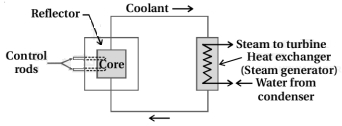
0 likes
View Solution220
Medium
Mention the disadvantages of the nuclear reactor.
Solution
(N/A) The fission process in a nuclear reactor generates considerable waste products.
These nuclear wastes need special care for treatment since they are radioactive and hazardous.
Elaborate safety measures,both for reactor operation as well as handling and reprocessing the spent fuel,are required.
An appropriate plan is being evolved to study the possibility of converting radioactive waste into less active and short-lived material.
These nuclear wastes need special care for treatment since they are radioactive and hazardous.
Elaborate safety measures,both for reactor operation as well as handling and reprocessing the spent fuel,are required.
An appropriate plan is being evolved to study the possibility of converting radioactive waste into less active and short-lived material.
0 likes
View Solution221
Medium
What is nuclear fusion? Explain giving its nuclear equations and write down the definition of thermonuclear fusion.
Solution
(N/A) Nuclear fusion is a process in which two light nuclei combine to form a single heavier nucleus,resulting in the release of a large amount of energy.
Examples of nuclear fusion reactions:
$(1)$ ${ }_{1}^{1} H + { }_{1}^{1} H \rightarrow { }_{1}^{2} H + e^{+} + \nu + 0.42 \text{ MeV}$
(Proton + Proton $\rightarrow$ Deuteron + Positron + Neutrino + Energy)
$(2)$ ${ }_{1}^{2} H + { }_{1}^{2} H \rightarrow { }_{2}^{3} He + { }_{0}^{1} n + 3.27 \text{ MeV}$
(Deuteron + Deuteron $\rightarrow$ Helium-$3$ + Neutron + Energy)
$(3)$ ${ }_{1}^{2} H + { }_{1}^{2} H \rightarrow { }_{1}^{3} H + { }_{1}^{1} H + 4.03 \text{ MeV}$
(Deuteron + Deuteron $\rightarrow$ Triton + Proton + Energy)
For fusion to occur,nuclei must overcome the electrostatic Coulomb repulsion. This requires high kinetic energy,typically achieved at temperatures around $10^{7} \text{ K}$ to $10^{9} \text{ K}$.
Using the relation $K = \frac{3}{2} k_{B} T$,where $K \approx 400 \text{ keV}$,the required temperature is:
$T = \frac{2K}{3k_{B}} \approx 3 \times 10^{9} \text{ K}$.
Thermonuclear fusion is defined as the process of nuclear fusion achieved by raising the temperature of the system to such an extent that the particles possess sufficient kinetic energy to overcome the Coulomb repulsive barrier.
Examples of nuclear fusion reactions:
$(1)$ ${ }_{1}^{1} H + { }_{1}^{1} H \rightarrow { }_{1}^{2} H + e^{+} + \nu + 0.42 \text{ MeV}$
(Proton + Proton $\rightarrow$ Deuteron + Positron + Neutrino + Energy)
$(2)$ ${ }_{1}^{2} H + { }_{1}^{2} H \rightarrow { }_{2}^{3} He + { }_{0}^{1} n + 3.27 \text{ MeV}$
(Deuteron + Deuteron $\rightarrow$ Helium-$3$ + Neutron + Energy)
$(3)$ ${ }_{1}^{2} H + { }_{1}^{2} H \rightarrow { }_{1}^{3} H + { }_{1}^{1} H + 4.03 \text{ MeV}$
(Deuteron + Deuteron $\rightarrow$ Triton + Proton + Energy)
For fusion to occur,nuclei must overcome the electrostatic Coulomb repulsion. This requires high kinetic energy,typically achieved at temperatures around $10^{7} \text{ K}$ to $10^{9} \text{ K}$.
Using the relation $K = \frac{3}{2} k_{B} T$,where $K \approx 400 \text{ keV}$,the required temperature is:
$T = \frac{2K}{3k_{B}} \approx 3 \times 10^{9} \text{ K}$.
Thermonuclear fusion is defined as the process of nuclear fusion achieved by raising the temperature of the system to such an extent that the particles possess sufficient kinetic energy to overcome the Coulomb repulsive barrier.
0 likes
View Solution222
Difficult
Explain the process of thermonuclear fusion as a source of energy in the Sun and stars.
Solution
(N/A) Thermonuclear fusion is the source of energy output in the interior of stars and the Sun.
The interior of the Sun has a temperature of $1.5 \times 10^{7} \ K$,which is considerably less than the estimated temperature required for the fusion of particles of average energy.
Fusion in the Sun involves protons whose energies are much above the average energy.
The fusion reaction in the Sun is a multistep process.
Fusion reactions occur through the following two cycles:
$(1)$ Proton-proton $(P-P)$ cycle
$(2)$ Carbon-nitrogen $(C-N)$ cycle
The fuel in the Sun is hydrogen in its core,and hydrogen is burned into helium.
The proton-proton cycle is represented by the following sets of reactions:
$(i)$ ${ }_{1}^{1} H + { }_{1}^{1} H \rightarrow { }_{1}^{2} H + e^{+} + \nu + 0.42 \ MeV$ ... $(1)$
In this reaction,two hydrogen nuclei combine to produce a deuteron,a positron,and a neutrino with a release of $0.42 \ MeV$ of energy.
$(ii)$ $e^{+} + e^{-} \rightarrow \gamma + \gamma + 1.02 \ MeV$ ... $(2)$
In this reaction,a positron and an electron combine to produce two $\gamma$-radiations with a release of $1.02 \ MeV$ of energy.
$(iii)$ ${ }_{1}^{2} H + { }_{1}^{1} H \rightarrow { }_{2}^{3} He + \gamma + 5.49 \ MeV$ ... $(3)$
In this reaction,a deuteron and a hydrogen nucleus (proton) combine to produce light helium and gamma radiation with a release of $5.49 \ MeV$ of energy.
For the fourth reaction to occur,the first three reactions must occur twice.
The net effect from these sets of reactions is as follows:
$4({ }_{1}^{1} H) + 2e^{-} \rightarrow { }_{2}^{4} He + 2\nu + 6\gamma + 26.7 \ MeV$
Hence,in short,four hydrogen atoms combine to form one ${ }_{2}^{4} He$ atom with a release of $26.7 \ MeV$ of energy.
The interior of the Sun has a temperature of $1.5 \times 10^{7} \ K$,which is considerably less than the estimated temperature required for the fusion of particles of average energy.
Fusion in the Sun involves protons whose energies are much above the average energy.
The fusion reaction in the Sun is a multistep process.
Fusion reactions occur through the following two cycles:
$(1)$ Proton-proton $(P-P)$ cycle
$(2)$ Carbon-nitrogen $(C-N)$ cycle
The fuel in the Sun is hydrogen in its core,and hydrogen is burned into helium.
The proton-proton cycle is represented by the following sets of reactions:
$(i)$ ${ }_{1}^{1} H + { }_{1}^{1} H \rightarrow { }_{1}^{2} H + e^{+} + \nu + 0.42 \ MeV$ ... $(1)$
In this reaction,two hydrogen nuclei combine to produce a deuteron,a positron,and a neutrino with a release of $0.42 \ MeV$ of energy.
$(ii)$ $e^{+} + e^{-} \rightarrow \gamma + \gamma + 1.02 \ MeV$ ... $(2)$
In this reaction,a positron and an electron combine to produce two $\gamma$-radiations with a release of $1.02 \ MeV$ of energy.
$(iii)$ ${ }_{1}^{2} H + { }_{1}^{1} H \rightarrow { }_{2}^{3} He + \gamma + 5.49 \ MeV$ ... $(3)$
In this reaction,a deuteron and a hydrogen nucleus (proton) combine to produce light helium and gamma radiation with a release of $5.49 \ MeV$ of energy.
For the fourth reaction to occur,the first three reactions must occur twice.
The net effect from these sets of reactions is as follows:
$4({ }_{1}^{1} H) + 2e^{-} \rightarrow { }_{2}^{4} He + 2\nu + 6\gamma + 26.7 \ MeV$
Hence,in short,four hydrogen atoms combine to form one ${ }_{2}^{4} He$ atom with a release of $26.7 \ MeV$ of energy.
0 likes
View Solution223
Medium
How can fusion reactors provide unlimited power to humanity?
Solution
(N/A) The natural thermonuclear fusion process in a star is replicated in a thermonuclear fusion device. In controlled fusion reactors,the aim is to generate steady power by heating the nuclear fuel to a temperature in the range of $10^{8} \ K$.
At these temperatures,the fuel exists as a mixture of positive ions and electrons,known as plasma. The primary challenge is to confine this plasma,as no physical container can withstand such extreme temperatures.
Several countries around the world,including India,are developing advanced magnetic and inertial confinement techniques to address this. If successful,fusion reactors will provide a clean,safe,and almost unlimited source of energy to humanity.
At these temperatures,the fuel exists as a mixture of positive ions and electrons,known as plasma. The primary challenge is to confine this plasma,as no physical container can withstand such extreme temperatures.
Several countries around the world,including India,are developing advanced magnetic and inertial confinement techniques to address this. If successful,fusion reactors will provide a clean,safe,and almost unlimited source of energy to humanity.
0 likes
View Solution224
EasyMCQ
What is nuclear energy?
A
Energy released during a chemical reaction.
B
Energy released during a nuclear reaction, such as fission or fusion.
C
Energy stored in the gravitational field of the nucleus.
D
Energy required to keep electrons in orbit.
Solution
(B) Nuclear energy is the energy released during nuclear reactions, such as nuclear fission or nuclear fusion.
It arises from the conversion of mass into energy, as described by Einstein's mass-energy equivalence principle, $E = \Delta mc^2$.
In these processes, the total mass of the products is slightly less than the total mass of the reactants, and this 'mass defect' $(\Delta m)$ is converted into a large amount of energy.
It arises from the conversion of mass into energy, as described by Einstein's mass-energy equivalence principle, $E = \Delta mc^2$.
In these processes, the total mass of the products is slightly less than the total mass of the reactants, and this 'mass defect' $(\Delta m)$ is converted into a large amount of energy.
0 likes
View Solution225
EasyMCQ
How much energy is produced by the fission of $1\, kg$ of uranium?
A
$9 \times 10^{13} \, J$
B
$8.2 \times 10^{13} \, J$
C
$7.5 \times 10^{13} \, J$
D
$6.5 \times 10^{13} \, J$
Solution
(B) The energy released per fission of a $U^{235}$ nucleus is approximately $200 \, MeV$.
First,calculate the number of atoms in $1 \, kg$ of $U^{235}$.
The number of atoms $N = (m / M) \times N_A$,where $m = 1000 \, g$,$M = 235 \, g/mol$,and $N_A = 6.023 \times 10^{23} \, atoms/mol$.
$N = (1000 / 235) \times 6.023 \times 10^{23} \approx 2.56 \times 10^{24} \, atoms$.
The total energy $E = N \times 200 \, MeV$.
$E = 2.56 \times 10^{24} \times 200 \times 1.6 \times 10^{-13} \, J$.
$E \approx 8.2 \times 10^{13} \, J$.
First,calculate the number of atoms in $1 \, kg$ of $U^{235}$.
The number of atoms $N = (m / M) \times N_A$,where $m = 1000 \, g$,$M = 235 \, g/mol$,and $N_A = 6.023 \times 10^{23} \, atoms/mol$.
$N = (1000 / 235) \times 6.023 \times 10^{23} \approx 2.56 \times 10^{24} \, atoms$.
The total energy $E = N \times 200 \, MeV$.
$E = 2.56 \times 10^{24} \times 200 \times 1.6 \times 10^{-13} \, J$.
$E \approx 8.2 \times 10^{13} \, J$.
0 likes
View Solution226
EasyMCQ
How much energy is produced from the combustion of $1\, kg$ of coal?
A
$3 \times 10^7 \, J$
B
$3 \times 10^8 \, J$
C
$3 \times 10^9 \, J$
D
$3 \times 10^{10} \, J$
Solution
(A) The energy released from the combustion of coal is a chemical process.
Typically,the heat of combustion for coal is approximately $30 \, MJ/kg$ or $3 \times 10^7 \, J/kg$.
Therefore,the combustion of $1 \, kg$ of coal produces $3 \times 10^7 \, J$ of energy.
This value is significantly lower than the energy released in nuclear processes,which is the context of the chapter.
Typically,the heat of combustion for coal is approximately $30 \, MJ/kg$ or $3 \times 10^7 \, J/kg$.
Therefore,the combustion of $1 \, kg$ of coal produces $3 \times 10^7 \, J$ of energy.
This value is significantly lower than the energy released in nuclear processes,which is the context of the chapter.
1 likes
View Solution227
EasyMCQ
What is nuclear fission?
A
The process of splitting a heavy nucleus into two lighter nuclei.
B
The process of combining two light nuclei to form a heavier nucleus.
C
The process of radioactive decay by emitting an alpha particle.
D
The process of converting mass into energy through chemical reactions.
Solution
(A) Nuclear fission is a nuclear reaction in which the nucleus of a heavy atom,such as $U^{235}$ or $Pu^{239}$,splits into two or more smaller,lighter nuclei (fission fragments) upon bombardment by a neutron.
This process is accompanied by the release of a large amount of energy and the emission of additional neutrons.
The mass of the resulting products is slightly less than the mass of the original nucleus,and this 'mass defect' is converted into energy according to Einstein's mass-energy equivalence principle,$E = \Delta m c^2$.
This process is accompanied by the release of a large amount of energy and the emission of additional neutrons.
The mass of the resulting products is slightly less than the mass of the original nucleus,and this 'mass defect' is converted into energy according to Einstein's mass-energy equivalence principle,$E = \Delta m c^2$.
0 likes
View Solution228
EasyMCQ
How much $MeV$ energy is emitted by the fission of one nucleus of uranium-$235$ (in $MeV$)?
A
$100$
B
$200$
C
$300$
D
$400$
Solution
(B) The nuclear fission of a single nucleus of uranium-$235$ $(^{235}U)$ occurs when it absorbs a slow neutron.
This process releases a significant amount of energy due to the mass defect between the reactants and the products.
The average energy released per fission of a $U-235$ nucleus is approximately $200 \ MeV$.
Therefore,the correct option is $B$.
This process releases a significant amount of energy due to the mass defect between the reactants and the products.
The average energy released per fission of a $U-235$ nucleus is approximately $200 \ MeV$.
Therefore,the correct option is $B$.
0 likes
View Solution229
EasyMCQ
The energy released in an atom bomb is obtained from?
A
Chemical reaction
B
Nuclear fission
C
Nuclear fusion
D
Radioactive decay
Solution
(B) An atom bomb operates on the principle of uncontrolled nuclear fission. In this process,heavy nuclei like $U^{235}$ or $Pu^{239}$ are bombarded with neutrons,causing them to split into smaller nuclei. This splitting releases a significant amount of energy due to the mass defect,where the mass of the products is slightly less than the mass of the reactants,and this mass difference is converted into energy according to Einstein's mass-energy equivalence principle,$E = \Delta m c^2$.
0 likes
View Solution230
EasyMCQ
On average,how many neutrons are released from the fission of a single $U^{235}$ nucleus?
A
$1$
B
$2.5$
C
$3.5$
D
$4$
Solution
(B) When a $U^{235}$ nucleus undergoes fission by absorbing a slow neutron,it splits into lighter nuclei and releases energy along with neutrons.
On average,the number of neutrons released per fission event of $U^{235}$ is approximately $2.5$.
On average,the number of neutrons released per fission event of $U^{235}$ is approximately $2.5$.
0 likes
View Solution231
Medium
What is a moderator? Name the material used as a moderator in a nuclear reactor.
Solution
(N/A) moderator is a substance used in a nuclear reactor to slow down the fast-moving neutrons produced during nuclear fission.
Fast neutrons are less likely to cause further fission in $U^{235}$ nuclei compared to thermal (slow) neutrons.
By colliding with the nuclei of the moderator material,the kinetic energy of the neutrons is reduced,making them 'thermal' neutrons.
Common materials used as moderators include heavy water $(D_2O)$,graphite,and ordinary water $(H_2O)$.
Fast neutrons are less likely to cause further fission in $U^{235}$ nuclei compared to thermal (slow) neutrons.
By colliding with the nuclei of the moderator material,the kinetic energy of the neutrons is reduced,making them 'thermal' neutrons.
Common materials used as moderators include heavy water $(D_2O)$,graphite,and ordinary water $(H_2O)$.
0 likes
View Solution232
EasyMCQ
What are control rods in a nuclear reactor?
A
Rods used to increase the rate of fission.
B
Rods used to absorb excess neutrons to control the fission chain reaction.
C
Rods used to cool the reactor core.
D
Rods used to provide fuel for the reactor.
Solution
(B) In a nuclear reactor,control rods are made of materials that have a high neutron absorption cross-section,such as $Cadmium$ or $Boron$.
Their primary function is to regulate the rate of the nuclear fission chain reaction by absorbing excess neutrons.
By inserting or withdrawing these rods into the reactor core,the operator can control the number of neutrons available for fission,thereby maintaining a steady power output or shutting down the reactor safely.
Their primary function is to regulate the rate of the nuclear fission chain reaction by absorbing excess neutrons.
By inserting or withdrawing these rods into the reactor core,the operator can control the number of neutrons available for fission,thereby maintaining a steady power output or shutting down the reactor safely.
0 likes
View Solution233
Easy
Define the multiplication factor $(k)$ in the context of a nuclear chain reaction.
Solution
(N/A) The multiplication factor $(k)$ is defined as the ratio of the number of neutrons present at the beginning of a particular generation to the number of neutrons present at the beginning of the preceding generation.
Mathematically,$k = \frac{\text{Number of neutrons in a given generation}}{\text{Number of neutrons in the preceding generation}}$.
- If $k = 1$,the chain reaction is steady (critical state).
- If $k > 1$,the chain reaction is accelerating (supercritical state).
- If $k < 1$,the chain reaction dies out (subcritical state).
Mathematically,$k = \frac{\text{Number of neutrons in a given generation}}{\text{Number of neutrons in the preceding generation}}$.
- If $k = 1$,the chain reaction is steady (critical state).
- If $k > 1$,the chain reaction is accelerating (supercritical state).
- If $k < 1$,the chain reaction dies out (subcritical state).
0 likes
View Solution234
EasyMCQ
How much energy is released by the fusion of four hydrogen atoms to form a helium nucleus (in $MeV$)?
A
$26.7$
B
$13.6$
C
$6.7$
D
$3.4$
Solution
(A) In the process of nuclear fusion, four hydrogen nuclei (protons) fuse to form one helium nucleus $(^4_2He)$.
The reaction is given by: $4^1_1H \rightarrow ^4_2He + 2e^+ + 2\nu_e + \text{Energy}$.
The mass defect $(\Delta m)$ for this reaction is approximately $0.0286 \ u$.
Using the energy equivalence $E = \Delta m \times 931.5 \ MeV/u$, we get:
$E = 0.0286 \times 931.5 \approx 26.7 \ MeV$.
Therefore, the energy released is $26.7 \ MeV$.
The reaction is given by: $4^1_1H \rightarrow ^4_2He + 2e^+ + 2\nu_e + \text{Energy}$.
The mass defect $(\Delta m)$ for this reaction is approximately $0.0286 \ u$.
Using the energy equivalence $E = \Delta m \times 931.5 \ MeV/u$, we get:
$E = 0.0286 \times 931.5 \approx 26.7 \ MeV$.
Therefore, the energy released is $26.7 \ MeV$.
0 likes
View Solution235
EasyMCQ
State the principle of an atomic bomb and identify the nuclear process that occurs within it.
A
Nuclear Fusion
B
Nuclear Fission
C
Alpha Decay
D
Beta Decay
Solution
(B) The principle of an atomic bomb is based on the uncontrolled chain reaction of nuclear fission.
In this process,a heavy nucleus (such as $U^{235}$ or $Pu^{239}$) is bombarded with neutrons,causing it to split into smaller nuclei while releasing a large amount of energy and additional neutrons.
These additional neutrons trigger further fission events in a rapid,self-sustaining,and explosive manner.
Therefore,the nuclear process involved is nuclear fission.
In this process,a heavy nucleus (such as $U^{235}$ or $Pu^{239}$) is bombarded with neutrons,causing it to split into smaller nuclei while releasing a large amount of energy and additional neutrons.
These additional neutrons trigger further fission events in a rapid,self-sustaining,and explosive manner.
Therefore,the nuclear process involved is nuclear fission.
0 likes
View Solution236
MediumMCQ
Which nuclear process occurs in a hydrogen bomb? Or,state the principle of a hydrogen bomb.
A
Nuclear fission
B
Nuclear fusion
C
Radioactive decay
D
Chemical reaction
Solution
(B) hydrogen bomb operates on the principle of nuclear fusion.
In this process,light nuclei,typically isotopes of hydrogen like deuterium $(^2H)$ and tritium $(^3H)$,combine to form a heavier nucleus (helium,$^4He$) at extremely high temperatures and pressures.
This fusion reaction releases a tremendous amount of energy,far exceeding that of a nuclear fission bomb.
In this process,light nuclei,typically isotopes of hydrogen like deuterium $(^2H)$ and tritium $(^3H)$,combine to form a heavier nucleus (helium,$^4He$) at extremely high temperatures and pressures.
This fusion reaction releases a tremendous amount of energy,far exceeding that of a nuclear fission bomb.
0 likes
View Solution237
MediumMCQ
In a reactor, $2 \, kg$ of ${ }_{92} U ^{235}$ fuel is fully used up in $30$ days. The energy released per fission is $200 \, MeV$. Given that the Avogadro number, $N_A = 6.023 \times 10^{26} \, \text{per kilo mole}$ and $1 \, eV = 1.6 \times 10^{-19} \, J$. The power output of the reactor is close to $..... \, MW$.
A
$125$
B
$60$
C
$35$
D
$54$
Solution
(B) $1$. Calculate the number of uranium atoms in $2 \, kg$ of ${ }_{92} U ^{235}$:
$n = \frac{\text{mass}}{\text{molar mass}} \times N_A = \frac{2 \, kg}{235 \, kg/kmol} \times 6.023 \times 10^{26} \, \text{atoms/kmol} \approx 5.126 \times 10^{24} \, \text{atoms}$.
$2$. Calculate the total energy released $(E)$:
$E = n \times 200 \, MeV = 5.126 \times 10^{24} \times 200 \times 10^6 \times 1.6 \times 10^{-19} \, J \approx 1.64 \times 10^{14} \, J$.
$3$. Calculate the power output $(P)$:
$P = \frac{E}{t}$, where $t = 30 \, \text{days} = 30 \times 24 \times 3600 \, s = 2.592 \times 10^6 \, s$.
$P = \frac{1.64 \times 10^{14}}{2.592 \times 10^6} \approx 6.326 \times 10^7 \, W = 63.26 \, MW$.
The value is closest to $60 \, MW$.
$n = \frac{\text{mass}}{\text{molar mass}} \times N_A = \frac{2 \, kg}{235 \, kg/kmol} \times 6.023 \times 10^{26} \, \text{atoms/kmol} \approx 5.126 \times 10^{24} \, \text{atoms}$.
$2$. Calculate the total energy released $(E)$:
$E = n \times 200 \, MeV = 5.126 \times 10^{24} \times 200 \times 10^6 \times 1.6 \times 10^{-19} \, J \approx 1.64 \times 10^{14} \, J$.
$3$. Calculate the power output $(P)$:
$P = \frac{E}{t}$, where $t = 30 \, \text{days} = 30 \times 24 \times 3600 \, s = 2.592 \times 10^6 \, s$.
$P = \frac{1.64 \times 10^{14}}{2.592 \times 10^6} \approx 6.326 \times 10^7 \, W = 63.26 \, MW$.
The value is closest to $60 \, MW$.
0 likes
View Solution238
MediumMCQ
Given that the mass of ${ }_{3}^{7} Li = 7.0160 \, u$,the mass of ${ }_{2}^{4} He = 4.0026 \, u$,and the mass of ${ }_{1}^{1} H = 1.0079 \, u$. When $20 \, g$ of ${ }_{3}^{7} Li$ is converted into ${ }_{2}^{4} He$ by proton capture,the energy liberated (in $kWh$) is: [Take $1 \, u = 931.5 \, MeV/c^2$ and $1 \, kWh = 3.6 \times 10^6 \, J$]
A
$8 \times 10^{6}$
B
$1.33 \times 10^{6}$
C
$6.82 \times 10^{5}$
D
$4.5 \times 10^{5}$
Solution
(B) The nuclear reaction is: ${ }_{3}^{7} Li + { }_{1}^{1} H \rightarrow 2 { }_{2}^{4} He$.
The mass defect $\Delta m$ for one reaction is: $\Delta m = (m_{Li} + m_{H}) - 2(m_{He}) = (7.0160 + 1.0079) - 2(4.0026) = 8.0239 - 8.0052 = 0.0187 \, u$.
The energy released per reaction is $Q = \Delta m \times 931.5 \, MeV = 0.0187 \times 931.5 \approx 17.42 \, MeV$.
Number of $Li$ atoms in $20 \, g$: $N = \frac{20}{7} \times 6.022 \times 10^{23} \approx 1.72 \times 10^{24}$ atoms.
Total energy $E = N \times Q = (1.72 \times 10^{24}) \times (17.42 \times 10^6 \times 1.6 \times 10^{-19} \, J) \approx 4.79 \times 10^{12} \, J$.
Converting to $kWh$: $E_{kWh} = \frac{4.79 \times 10^{12}}{3.6 \times 10^6} \approx 1.33 \times 10^6 \, kWh$.
The mass defect $\Delta m$ for one reaction is: $\Delta m = (m_{Li} + m_{H}) - 2(m_{He}) = (7.0160 + 1.0079) - 2(4.0026) = 8.0239 - 8.0052 = 0.0187 \, u$.
The energy released per reaction is $Q = \Delta m \times 931.5 \, MeV = 0.0187 \times 931.5 \approx 17.42 \, MeV$.
Number of $Li$ atoms in $20 \, g$: $N = \frac{20}{7} \times 6.022 \times 10^{23} \approx 1.72 \times 10^{24}$ atoms.
Total energy $E = N \times Q = (1.72 \times 10^{24}) \times (17.42 \times 10^6 \times 1.6 \times 10^{-19} \, J) \approx 4.79 \times 10^{12} \, J$.
Converting to $kWh$: $E_{kWh} = \frac{4.79 \times 10^{12}}{3.6 \times 10^6} \approx 1.33 \times 10^6 \, kWh$.
0 likes
View Solution239
EasyMCQ
When a uranium isotope ${ }_{92}^{235} U$ is bombarded with a neutron,it generates ${ }_{36}^{89} Kr$,three neutrons and:
A
${ }_{36}^{103} Kr$
B
${ }_{56}^{144} Ba$
C
${ }_{91}^{40} Zr$
D
${ }_{36}^{101} Kr$
Solution
(B) The nuclear fission reaction is given by the conservation of mass number and atomic number.
Let the unknown nucleus be ${ }_{Z}^{A} X$.
The reaction is: ${ }_{92}^{235} U + { }_{0}^{1} n \rightarrow { }_{36}^{89} Kr + { }_{Z}^{A} X + 3({ }_{0}^{1} n)$.
Conservation of mass number $(A)$: $235 + 1 = 89 + A + 3(1) \Rightarrow 236 = 92 + A \Rightarrow A = 144$.
Conservation of atomic number $(Z)$: $92 + 0 = 36 + Z + 3(0) \Rightarrow 92 = 36 + Z \Rightarrow Z = 56$.
The element with atomic number $56$ is Barium $(Ba)$.
Thus,the missing nucleus is ${ }_{56}^{144} Ba$.
Let the unknown nucleus be ${ }_{Z}^{A} X$.
The reaction is: ${ }_{92}^{235} U + { }_{0}^{1} n \rightarrow { }_{36}^{89} Kr + { }_{Z}^{A} X + 3({ }_{0}^{1} n)$.
Conservation of mass number $(A)$: $235 + 1 = 89 + A + 3(1) \Rightarrow 236 = 92 + A \Rightarrow A = 144$.
Conservation of atomic number $(Z)$: $92 + 0 = 36 + Z + 3(0) \Rightarrow 92 = 36 + Z \Rightarrow Z = 56$.
The element with atomic number $56$ is Barium $(Ba)$.
Thus,the missing nucleus is ${ }_{56}^{144} Ba$.
0 likes
View Solution240
EasyMCQ
The principle of controlled chain reaction is used in
A
atomic energy reactor
B
atom bomb
C
core of sun
D
artificial radioactivity
Solution
(A) controlled chain reaction is a process where the rate of nuclear fission is maintained at a constant level by absorbing excess neutrons. This principle is utilized in an atomic energy reactor to generate power safely. In contrast,an atom bomb uses an uncontrolled chain reaction. Therefore,the correct option is $A$.
0 likes
View Solution241
MediumMCQ
$A$ nucleus with mass number $240$ breaks into two fragments each of mass number $120$. The binding energy per nucleon of the unfragmented nucleus is $7.6 \, MeV$,while that of the fragments is $8.5 \, MeV$. The total gain in the binding energy in the process is (in $MeV$):
A
$0.9$
B
$9.4$
C
$804$
D
$216$
Solution
(D) The initial nucleus has a mass number $A = 240$ and binding energy per nucleon $BE_{initial} = 7.6 \, MeV$.
The total binding energy of the initial nucleus is $240 \times 7.6 = 1824 \, MeV$.
After the process,the nucleus breaks into two fragments,each with mass number $A = 120$ and binding energy per nucleon $BE_{final} = 8.5 \, MeV$.
The total binding energy of the two fragments is $2 \times (120 \times 8.5) = 240 \times 8.5 = 2040 \, MeV$.
The gain in binding energy is the difference between the total binding energy of the products and the reactants:
$Q = BE_{products} - BE_{reactants} = 2040 \, MeV - 1824 \, MeV = 216 \, MeV$.
The total binding energy of the initial nucleus is $240 \times 7.6 = 1824 \, MeV$.
After the process,the nucleus breaks into two fragments,each with mass number $A = 120$ and binding energy per nucleon $BE_{final} = 8.5 \, MeV$.
The total binding energy of the two fragments is $2 \times (120 \times 8.5) = 240 \times 8.5 = 2040 \, MeV$.
The gain in binding energy is the difference between the total binding energy of the products and the reactants:
$Q = BE_{products} - BE_{reactants} = 2040 \, MeV - 1824 \, MeV = 216 \, MeV$.
0 likes
View Solution242
MediumMCQ
Two lighter nuclei combine to form a comparatively heavier nucleus by the relation given below:
${ }_{1}^{2} X +{ }_{1}^{2} X ={ }_{2}^{4} Y$
The binding energies per nucleon of ${ }_{1}^{2} X$ and ${ }_{2}^{4} Y$ are $1.1 \, MeV$ and $7.6 \, MeV$ respectively. The energy released in this process is in $MeV$.
${ }_{1}^{2} X +{ }_{1}^{2} X ={ }_{2}^{4} Y$
The binding energies per nucleon of ${ }_{1}^{2} X$ and ${ }_{2}^{4} Y$ are $1.1 \, MeV$ and $7.6 \, MeV$ respectively. The energy released in this process is in $MeV$.
A
$25$
B
$26$
C
$23$
D
$22$
Solution
(B) The energy released in a nuclear reaction is given by the difference between the total binding energy of the products and the total binding energy of the reactants.
Total binding energy of the product $({ }_{2}^{4} Y)$: $4 \times 7.6 \, MeV = 30.4 \, MeV$.
Total binding energy of the reactants $(2 \times { }_{1}^{2} X)$: $2 \times (2 \times 1.1 \, MeV) = 4.4 \, MeV$.
Energy released = (Total binding energy of products) - (Total binding energy of reactants)
Energy released = $30.4 \, MeV - 4.4 \, MeV = 26 \, MeV$.
Total binding energy of the product $({ }_{2}^{4} Y)$: $4 \times 7.6 \, MeV = 30.4 \, MeV$.
Total binding energy of the reactants $(2 \times { }_{1}^{2} X)$: $2 \times (2 \times 1.1 \, MeV) = 4.4 \, MeV$.
Energy released = (Total binding energy of products) - (Total binding energy of reactants)
Energy released = $30.4 \, MeV - 4.4 \, MeV = 26 \, MeV$.
0 likes
View Solution243
DifficultMCQ
$A$ nuclear fuel rod generates energy at a rate of $5 \times 10^8 \,W/m^3$. It is in the shape of a cylinder of radius $4.0 \,mm$ and length $0.20 \,m$. $A$ coolant of specific heat $4 \times 10^3 \,J \cdot kg^{-1} \cdot K^{-1}$ flows past it at a rate of $0.2 \,kg/s$. The temperature rise in this coolant is approximately ............ $^{\circ}C$.
A
$2$
B
$6$
C
$12$
D
$30$
Solution
(B) The energy generated per unit volume of the fuel rod is $P_v = 5 \times 10^8 \,W/m^3$.
The volume of the cylindrical rod is $V = \pi r^2 h = \pi \times (4 \times 10^{-3} \,m)^2 \times 0.2 \,m = \pi \times 16 \times 10^{-6} \times 0.2 \,m^3 = 3.2 \pi \times 10^{-6} \,m^3$.
The total energy generated per second (power) by the fuel rod is $P = P_v \times V = (5 \times 10^8) \times (3.2 \pi \times 10^{-6}) = 1600 \pi \,W$.
The heat absorbed by the coolant per unit time is given by $Q = m_f c \Delta T$,where $m_f$ is the mass flow rate,$c$ is the specific heat,and $\Delta T$ is the temperature rise.
Given $m_f = 0.2 \,kg/s$ and $c = 4 \times 10^3 \,J \cdot kg^{-1} \cdot K^{-1}$,the rate of heat absorption is $Q = 0.2 \times 4000 \times \Delta T = 800 \Delta T \,W$.
Equating the power generated to the heat absorbed: $800 \Delta T = 1600 \pi$.
$\Delta T = \frac{1600 \pi}{800} = 2 \pi \approx 2 \times 3.14 = 6.28 \,^{\circ}C$.
Thus,the temperature rise is approximately $6 \,^{\circ}C$.
The volume of the cylindrical rod is $V = \pi r^2 h = \pi \times (4 \times 10^{-3} \,m)^2 \times 0.2 \,m = \pi \times 16 \times 10^{-6} \times 0.2 \,m^3 = 3.2 \pi \times 10^{-6} \,m^3$.
The total energy generated per second (power) by the fuel rod is $P = P_v \times V = (5 \times 10^8) \times (3.2 \pi \times 10^{-6}) = 1600 \pi \,W$.
The heat absorbed by the coolant per unit time is given by $Q = m_f c \Delta T$,where $m_f$ is the mass flow rate,$c$ is the specific heat,and $\Delta T$ is the temperature rise.
Given $m_f = 0.2 \,kg/s$ and $c = 4 \times 10^3 \,J \cdot kg^{-1} \cdot K^{-1}$,the rate of heat absorption is $Q = 0.2 \times 4000 \times \Delta T = 800 \Delta T \,W$.
Equating the power generated to the heat absorbed: $800 \Delta T = 1600 \pi$.
$\Delta T = \frac{1600 \pi}{800} = 2 \pi \approx 2 \times 3.14 = 6.28 \,^{\circ}C$.
Thus,the temperature rise is approximately $6 \,^{\circ}C$.
0 likes
View Solution244
AdvancedMCQ
Carbon-$11$ decays to boron-$11$ according to the following formula:
${ }_{6}^{11} C \rightarrow{ }_{5}^{11} B +e^{+}+ v _{e}+0.96 \,MeV$
Assume that,positrons $\left(e^{+}\right)$ produced in the decay combine with free electrons in the atmosphere and annihilate each other almost immediately. Also,assume that the neutrinos $\left(v _{e}\right)$ are massless and do not interact with the environment. At $t=0$,we have $1 \,\mu g$ of ${ }_{6}^{11} C$. If the half-life of the decay process is $t _{0}$,the net energy produced between time $t=0$ and $t=2 t _{0}$ will be nearly ........... $MeV$.
${ }_{6}^{11} C \rightarrow{ }_{5}^{11} B +e^{+}+ v _{e}+0.96 \,MeV$
Assume that,positrons $\left(e^{+}\right)$ produced in the decay combine with free electrons in the atmosphere and annihilate each other almost immediately. Also,assume that the neutrinos $\left(v _{e}\right)$ are massless and do not interact with the environment. At $t=0$,we have $1 \,\mu g$ of ${ }_{6}^{11} C$. If the half-life of the decay process is $t _{0}$,the net energy produced between time $t=0$ and $t=2 t _{0}$ will be nearly ........... $MeV$.
A
$8 \times 10^{18}$
B
$8 \times 10^{16}$
C
$4 \times 10^{18}$
D
$4 \times 10^{16}$
Solution
(B) The decay reaction is ${ }_{6}^{11} C \rightarrow{ }_{5}^{11} B +e^{+}+ v _{e}+0.96 \,MeV$.
When the positron $e^{+}$ annihilates with an electron $e^{-}$,the energy released is $2 \times m _{e} c^{2} = 2 \times 0.511 \,MeV \approx 1.02 \,MeV$.
Total energy released per decay = $0.96 \,MeV + 1.02 \,MeV = 1.98 \,MeV \approx 2 \,MeV$.
Initial mass $M _{0} = 1 \,\mu g = 10^{-6} \,g$ of ${ }_{6}^{11} C$.
Number of atoms $N _{0} = \frac{M _{0}}{A} \times N _{A} = \frac{10^{-6}}{11} \times 6.023 \times 10^{23} \approx 5.475 \times 10^{16} \,atoms$.
In time $t = 2 t _{0}$,the fraction of atoms decayed is $1 - (1/2)^{2} = 1 - 1/4 = 3/4 = 0.75$.
Number of atoms decayed $N = 0.75 \times N _{0} = 0.75 \times 5.475 \times 10^{16} \approx 4.1 \times 10^{16} \,atoms$.
Total energy $E = N \times 1.98 \,MeV \approx 4.1 \times 10^{16} \times 2 \,MeV \approx 8.2 \times 10^{16} \,MeV$.
Given the options,the closest value is $8 \times 10^{16} \,MeV$.
When the positron $e^{+}$ annihilates with an electron $e^{-}$,the energy released is $2 \times m _{e} c^{2} = 2 \times 0.511 \,MeV \approx 1.02 \,MeV$.
Total energy released per decay = $0.96 \,MeV + 1.02 \,MeV = 1.98 \,MeV \approx 2 \,MeV$.
Initial mass $M _{0} = 1 \,\mu g = 10^{-6} \,g$ of ${ }_{6}^{11} C$.
Number of atoms $N _{0} = \frac{M _{0}}{A} \times N _{A} = \frac{10^{-6}}{11} \times 6.023 \times 10^{23} \approx 5.475 \times 10^{16} \,atoms$.
In time $t = 2 t _{0}$,the fraction of atoms decayed is $1 - (1/2)^{2} = 1 - 1/4 = 3/4 = 0.75$.
Number of atoms decayed $N = 0.75 \times N _{0} = 0.75 \times 5.475 \times 10^{16} \approx 4.1 \times 10^{16} \,atoms$.
Total energy $E = N \times 1.98 \,MeV \approx 4.1 \times 10^{16} \times 2 \,MeV \approx 8.2 \times 10^{16} \,MeV$.
Given the options,the closest value is $8 \times 10^{16} \,MeV$.
0 likes
View Solution245
AdvancedMCQ
The electrostatic energy of a nucleus of charge $Ze$ is equal to $\frac{k Z^2 e^2}{R}$,where $k$ is a constant and $R$ is the nuclear radius. The nucleus divides into two daughter nuclei of charges $\frac{Ze}{2}$ and equal radii. The change in electrostatic energy in the process when they are far apart is
A
$\frac{0.375 k Z^2 e^2}{R}$
B
$\frac{0.125 k Z^2 e^2}{R}$
C
$\frac{k Z^2 e^2}{R}$
D
$\frac{0.5 k Z^2 e^2}{R}$
Solution
(A) Initial electrostatic energy of the nucleus is $U_1 = \frac{k Z^2 e^2}{R}$.
Since the density of nuclear matter is constant,the volume of the nucleus is proportional to its mass number $A$. If the nucleus splits into two equal daughter nuclei,each has mass number $A/2$. Since $R \propto A^{1/3}$,the radius $r$ of each daughter nucleus is $r = R / 2^{1/3}$.
The final electrostatic energy $U_2$ of the two daughter nuclei (when far apart) is the sum of the energies of the two individual nuclei:
$U_2 = 2 \times \frac{k (Z/2)^2 e^2}{r} = 2 \times \frac{k (Z^2/4) e^2}{R / 2^{1/3}} = \frac{k Z^2 e^2}{2 R} \times 2^{1/3} = \frac{k Z^2 e^2}{R} \times 2^{1/3-1} = \frac{k Z^2 e^2}{R} \times 2^{-2/3}$.
Using $2^{2/3} \approx 1.587$,we get $2^{-2/3} \approx 1 / 1.587 \approx 0.63$.
Thus,$U_2 \approx 0.63 U_1$.
The change in electrostatic energy is $\Delta U = U_1 - U_2 = U_1 - 0.63 U_1 = 0.37 U_1 \approx 0.375 \frac{k Z^2 e^2}{R}$.
Since the density of nuclear matter is constant,the volume of the nucleus is proportional to its mass number $A$. If the nucleus splits into two equal daughter nuclei,each has mass number $A/2$. Since $R \propto A^{1/3}$,the radius $r$ of each daughter nucleus is $r = R / 2^{1/3}$.
The final electrostatic energy $U_2$ of the two daughter nuclei (when far apart) is the sum of the energies of the two individual nuclei:
$U_2 = 2 \times \frac{k (Z/2)^2 e^2}{r} = 2 \times \frac{k (Z^2/4) e^2}{R / 2^{1/3}} = \frac{k Z^2 e^2}{2 R} \times 2^{1/3} = \frac{k Z^2 e^2}{R} \times 2^{1/3-1} = \frac{k Z^2 e^2}{R} \times 2^{-2/3}$.
Using $2^{2/3} \approx 1.587$,we get $2^{-2/3} \approx 1 / 1.587 \approx 0.63$.
Thus,$U_2 \approx 0.63 U_1$.
The change in electrostatic energy is $\Delta U = U_1 - U_2 = U_1 - 0.63 U_1 = 0.37 U_1 \approx 0.375 \frac{k Z^2 e^2}{R}$.
0 likes
View Solution246
DifficultMCQ
On fission,a $U^{235}$ nucleus releases $3 \times 10^{-11} \, J$ of energy. In a $1 \, GW$ nuclear reactor,$4.2 \%$ of this energy is converted to useful energy. The $U^{235}$ consumed (in grams) in half an hour is closest to (Avogadro number $N_A = 6.023 \times 10^{23}$)
A
$5$
B
$50$
C
$500$
D
$1000$
Solution
(C) The power output of the reactor is $P = 1 \, GW = 10^9 \, J/s$.
The useful energy required in half an hour $(t = 1800 \, s)$ is $E_{useful} = P \times t = 10^9 \times 1800 = 1.8 \times 10^{12} \, J$.
Since only $4.2 \%$ of the total fission energy is converted to useful energy,the total energy required from fission is $E_{total} = \frac{E_{useful}}{0.042} = \frac{1.8 \times 10^{12}}{0.042} \approx 4.286 \times 10^{13} \, J$.
The number of $U^{235}$ nuclei required is $N = \frac{E_{total}}{3 \times 10^{-11} \, J/nucleus} = \frac{4.286 \times 10^{13}}{3 \times 10^{-11}} \approx 1.428 \times 10^{24} \, nuclei$.
The number of moles is $n = \frac{N}{N_A} = \frac{1.428 \times 10^{24}}{6.023 \times 10^{23}} \approx 2.37 \, moles$.
The mass of $U^{235}$ consumed is $m = n \times M = 2.37 \times 235 \approx 557 \, g$.
Comparing this with the given options,the closest value is $500 \, g$.
The useful energy required in half an hour $(t = 1800 \, s)$ is $E_{useful} = P \times t = 10^9 \times 1800 = 1.8 \times 10^{12} \, J$.
Since only $4.2 \%$ of the total fission energy is converted to useful energy,the total energy required from fission is $E_{total} = \frac{E_{useful}}{0.042} = \frac{1.8 \times 10^{12}}{0.042} \approx 4.286 \times 10^{13} \, J$.
The number of $U^{235}$ nuclei required is $N = \frac{E_{total}}{3 \times 10^{-11} \, J/nucleus} = \frac{4.286 \times 10^{13}}{3 \times 10^{-11}} \approx 1.428 \times 10^{24} \, nuclei$.
The number of moles is $n = \frac{N}{N_A} = \frac{1.428 \times 10^{24}}{6.023 \times 10^{23}} \approx 2.37 \, moles$.
The mass of $U^{235}$ consumed is $m = n \times M = 2.37 \times 235 \approx 557 \, g$.
Comparing this with the given options,the closest value is $500 \, g$.
0 likes
View Solution247
EasyMCQ
When two nuclei of mass $X$ and $Y$ respectively fuse to form a nucleus of mass $m$ along with the liberation of some energy, then
A
$X+Y > m$
B
$X-Y=m$
C
$X+Y=m$
D
$X+Y < m$
Solution
(A) In a nuclear fusion reaction, the mass of the product nucleus $(m)$ is always less than the sum of the masses of the reactant nuclei $(X+Y)$.
This difference in mass, known as the mass defect $(\Delta M = (X+Y) - m)$, is converted into energy according to Einstein's mass-energy equivalence principle, $E = \Delta M c^2$.
Therefore, since energy is liberated, the mass must decrease, implying $X+Y > m$.
This difference in mass, known as the mass defect $(\Delta M = (X+Y) - m)$, is converted into energy according to Einstein's mass-energy equivalence principle, $E = \Delta M c^2$.
Therefore, since energy is liberated, the mass must decrease, implying $X+Y > m$.
0 likes
View Solution248
EasyMCQ
$A$ neutron strikes a ${ }_{92}^{235}U$ nucleus and as a result ${ }_{38}^{93}Kr$ and ${ }_{56}^{140}Ba$ are produced along with:
A
$\alpha$-particle
B
$1$-neutron
C
$3$-neutrons
D
$2$-$\beta$-particles
Solution
(C) The nuclear fission reaction is given by: ${ }_{0}^{1}n + { }_{92}^{235}U \rightarrow { }_{38}^{93}Kr + { }_{56}^{140}Ba + x({ }_{0}^{1}n)$.
Applying the law of conservation of mass number:
$1 + 235 = 93 + 140 + x(1)$.
$236 = 233 + x$.
$x = 236 - 233 = 3$.
Therefore,$3$ neutrons are produced in the reaction.
Applying the law of conservation of mass number:
$1 + 235 = 93 + 140 + x(1)$.
$236 = 233 + x$.
$x = 236 - 233 = 3$.
Therefore,$3$ neutrons are produced in the reaction.
0 likes
View Solution249
EasyMCQ
If $1 \, g$ of hydrogen is converted into $0.993 \, g$ of helium in a thermonuclear reaction,the energy released in the reaction is ......... $J$.
A
$63 \times 10^7$
B
$63 \times 10^{10}$
C
$63 \times 10^{14}$
D
$63 \times 10^{20}$
Solution
(B) The mass defect $\Delta m$ is the difference between the initial mass and the final mass.
$\Delta m = 1 \, g - 0.993 \, g = 0.007 \, g$.
Converting the mass defect into $SI$ units (kilograms):
$\Delta m = 0.007 \times 10^{-3} \, kg = 7 \times 10^{-6} \, kg$.
The energy released $E$ is given by Einstein's mass-energy equivalence formula $E = \Delta m c^2$,where $c = 3 \times 10^8 \, m/s$.
$E = (7 \times 10^{-6} \, kg) \times (3 \times 10^8 \, m/s)^2$.
$E = 7 \times 10^{-6} \times 9 \times 10^{16} \, J$.
$E = 63 \times 10^{10} \, J$.
$\Delta m = 1 \, g - 0.993 \, g = 0.007 \, g$.
Converting the mass defect into $SI$ units (kilograms):
$\Delta m = 0.007 \times 10^{-3} \, kg = 7 \times 10^{-6} \, kg$.
The energy released $E$ is given by Einstein's mass-energy equivalence formula $E = \Delta m c^2$,where $c = 3 \times 10^8 \, m/s$.
$E = (7 \times 10^{-6} \, kg) \times (3 \times 10^8 \, m/s)^2$.
$E = 7 \times 10^{-6} \times 9 \times 10^{16} \, J$.
$E = 63 \times 10^{10} \, J$.
0 likes
View Solution250
EasyMCQ
Control rods used in nuclear reactors are made of:
A
Stainless steel
B
Graphite
C
Cadmium
D
Plutonium
Solution
(C) In a nuclear reactor,control rods are used to control the rate of the fission reaction by absorbing excess neutrons.
Materials like $Cadmium$ or $Boron$ are commonly used for this purpose because they have a high neutron absorption cross-section.
Therefore,the correct option is $C$.
Materials like $Cadmium$ or $Boron$ are commonly used for this purpose because they have a high neutron absorption cross-section.
Therefore,the correct option is $C$.
0 likes
View SolutionNuclei — Nuclear Fission, Fusion and Nuclear Reactor · Frequently Asked Questions
1Are these Nuclei questions useful for JEE and NEET?
Yes. All questions in this section are mapped to JEE Main and NEET exam patterns. Previous year questions from JEE Main, NEET, GUJCET and state-level exams are included with full solutions.
2Can I switch to Hindi or Gujarati for these questions?
Yes. Use the language tabs in the hero section or the sidebar to view the same questions and solutions in English, Hindi or Gujarati.
3How do I generate a question paper from this subtopic?
Use the Vedclass Exam Paper Generator — select the chapter and subtopic, set difficulty, and generate Sets A, B, C, D automatically. First 3 chapters of every subject are free.
Vedclass Products
For Students
Vedclass Test Series
Mock tests in real JEE/NEET style with performance analysis. 5-day free trial.
Start Free TrialFor Teachers
Exam Paper Generator
Generate Set A/B/C/D papers from this chapter in 2 minutes. 3 chapters free.
Try FreeFor Institutes
Online Exam Module
Live online exams with unlimited students, 360° analytics & white-label branding.
See DemoFor Teachers & Institutes
Generate a Nuclei Exam Paper in 2 Minutes
Select subtopic & difficulty — Sets A, B, C, D auto-generated with No Repeat logic.
First 3 chapters of every subject are free — no payment required.