
A English
Biot-Savart's Law and its application Questions in English
Class 12 Physics · Moving Charges and Magnetism · Biot-Savart's Law and its application
706+
Questions
English
Language
100%
With Solutions
Showing 50 of 706 questions in English
251
DifficultMCQ
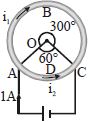
$A$ cell is connected between the points $A$ and $C$ of a circular conductor $ABCD$ of center $O$ with angle $AOC = 60^o$. If $B_1$ and $B_2$ are the magnitudes of the magnetic fields at $O$ due to the currents in $ABC$ and $ADC$ respectively,the ratio $B_1/B_2$ is
A
$0.2$
B
$6$
C
$1$
D
$5$
Solution
(C) The magnetic field at the center of a circular arc of radius $R$ carrying current $I$ subtending an angle $\theta$ at the center is given by $B = \frac{\mu_0 I \theta}{4 \pi R}$.
Let $R$ be the radius of the circular conductor. The current $I$ from the cell splits into two parts $I_1$ and $I_2$ through the arcs $ABC$ and $ADC$ respectively.
The resistance of an arc is proportional to its length,which is proportional to the angle subtended at the center. Let $\theta_1 = 300^o$ be the angle for arc $ABC$ and $\theta_2 = 60^o$ be the angle for arc $ADC$.
Since the arcs are in parallel,the potential difference $V$ across them is the same: $V = I_1 R_1 = I_2 R_2$,where $R_1 \propto \theta_1$ and $R_2 \propto \theta_2$.
Thus,$I_1 \theta_1 = I_2 \theta_2$,which implies $I_1 (300^o) = I_2 (60^o)$,or $I_1 = \frac{I_2}{5}$.
The magnetic field due to arc $ABC$ is $B_1 = \frac{\mu_0 I_1 \theta_1}{4 \pi R}$ and due to arc $ADC$ is $B_2 = \frac{\mu_0 I_2 \theta_2}{4 \pi R}$.
The ratio is $\frac{B_1}{B_2} = \frac{I_1 \theta_1}{I_2 \theta_2}$.
Substituting $I_1 \theta_1 = I_2 \theta_2$,we get $\frac{B_1}{B_2} = \frac{I_2 \theta_2}{I_2 \theta_2} = 1$.
Let $R$ be the radius of the circular conductor. The current $I$ from the cell splits into two parts $I_1$ and $I_2$ through the arcs $ABC$ and $ADC$ respectively.
The resistance of an arc is proportional to its length,which is proportional to the angle subtended at the center. Let $\theta_1 = 300^o$ be the angle for arc $ABC$ and $\theta_2 = 60^o$ be the angle for arc $ADC$.
Since the arcs are in parallel,the potential difference $V$ across them is the same: $V = I_1 R_1 = I_2 R_2$,where $R_1 \propto \theta_1$ and $R_2 \propto \theta_2$.
Thus,$I_1 \theta_1 = I_2 \theta_2$,which implies $I_1 (300^o) = I_2 (60^o)$,or $I_1 = \frac{I_2}{5}$.
The magnetic field due to arc $ABC$ is $B_1 = \frac{\mu_0 I_1 \theta_1}{4 \pi R}$ and due to arc $ADC$ is $B_2 = \frac{\mu_0 I_2 \theta_2}{4 \pi R}$.
The ratio is $\frac{B_1}{B_2} = \frac{I_1 \theta_1}{I_2 \theta_2}$.
Substituting $I_1 \theta_1 = I_2 \theta_2$,we get $\frac{B_1}{B_2} = \frac{I_2 \theta_2}{I_2 \theta_2} = 1$.
0 likes
View Solution252
DifficultMCQ
The magnetic induction at the centre of a current-carrying circular coil of radius $10 \, cm$ is $5\sqrt{5}$ times the magnetic induction at a point on its axis. The distance of the point from the centre of the coil (in $cm$) is
A
$5$
B
$10$
C
$20$
D
$25$
Solution
(C) The magnetic field at any point on the axis of a current-carrying coil at a distance $x$ from the centre is given by:
$B_{a} = \frac{\mu_{0} n i r^{2}}{2(r^{2} + x^{2})^{3/2}}$
At the centre,$x = 0$,so the magnetic field is:
$B_{c} = \frac{\mu_{0} n i}{2r}$
Taking the ratio:
$\frac{B_{c}}{B_{a}} = \frac{\mu_{0} n i}{2r} \times \frac{2(r^{2} + x^{2})^{3/2}}{\mu_{0} n i r^{2}} = \frac{(r^{2} + x^{2})^{3/2}}{r^{3}}$
Given $B_{c} = 5\sqrt{5} B_{a}$,we have:
$5\sqrt{5} = \frac{(r^{2} + x^{2})^{3/2}}{r^{3}}$
Substituting $r = 10 \, cm$:
$5\sqrt{5} = \frac{(100 + x^{2})^{3/2}}{1000}$
$5000\sqrt{5} = (100 + x^{2})^{3/2}$
Squaring both sides:
$(5000)^{2} \times 5 = (100 + x^{2})^{3}$
$125 \times 10^{6} = (100 + x^{2})^{3}$
Taking the cube root:
$500 = 100 + x^{2}$
$x^{2} = 400$
$x = 20 \, cm$
$B_{a} = \frac{\mu_{0} n i r^{2}}{2(r^{2} + x^{2})^{3/2}}$
At the centre,$x = 0$,so the magnetic field is:
$B_{c} = \frac{\mu_{0} n i}{2r}$
Taking the ratio:
$\frac{B_{c}}{B_{a}} = \frac{\mu_{0} n i}{2r} \times \frac{2(r^{2} + x^{2})^{3/2}}{\mu_{0} n i r^{2}} = \frac{(r^{2} + x^{2})^{3/2}}{r^{3}}$
Given $B_{c} = 5\sqrt{5} B_{a}$,we have:
$5\sqrt{5} = \frac{(r^{2} + x^{2})^{3/2}}{r^{3}}$
Substituting $r = 10 \, cm$:
$5\sqrt{5} = \frac{(100 + x^{2})^{3/2}}{1000}$
$5000\sqrt{5} = (100 + x^{2})^{3/2}$
Squaring both sides:
$(5000)^{2} \times 5 = (100 + x^{2})^{3}$
$125 \times 10^{6} = (100 + x^{2})^{3}$
Taking the cube root:
$500 = 100 + x^{2}$
$x^{2} = 400$
$x = 20 \, cm$
0 likes
View Solution253
MediumMCQ
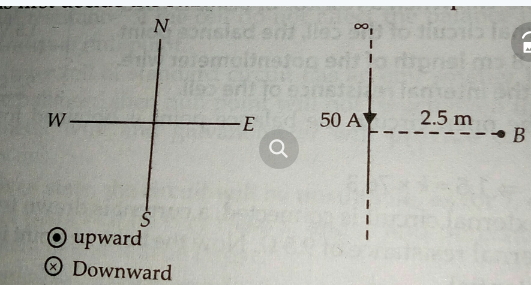
$A$ long straight wire in the horizontal plane carries a current of $50\, A$ in the north to south direction. Find the magnitude and direction of the magnetic field $B$ at a point $2.5\, m$ east of the wire.
A
$4 \times 10^{-6} \, T$ upwards
B
$6 \times 10^{-6} \, T$ downwards
C
$4 \times 10^{-6} \, T$ east
D
Both $(A)$ and $(C)$
Solution
(A) The magnetic field $B$ produced by a long straight current-carrying wire at a distance $r$ is given by the formula:
$B = \frac{\mu_0 I}{2 \pi r}$
Given:
$I = 50 \, A$
$r = 2.5 \, m$
$\mu_0 = 4 \pi \times 10^{-7} \, T \cdot m/A$
Substituting the values:
$B = \frac{(4 \pi \times 10^{-7}) \times 50}{2 \pi \times 2.5}$
$B = \frac{2 \times 10^{-7} \times 50}{2.5}$
$B = \frac{100 \times 10^{-7}}{2.5} = 40 \times 10^{-7} = 4 \times 10^{-6} \, T$
According to the Right-Hand Thumb Rule, if the current flows from North to South, and the point is to the East of the wire, the magnetic field lines curl around the wire. At a point to the East of the wire, the direction of the magnetic field is vertically upwards (out of the horizontal plane).
$B = \frac{\mu_0 I}{2 \pi r}$
Given:
$I = 50 \, A$
$r = 2.5 \, m$
$\mu_0 = 4 \pi \times 10^{-7} \, T \cdot m/A$
Substituting the values:
$B = \frac{(4 \pi \times 10^{-7}) \times 50}{2 \pi \times 2.5}$
$B = \frac{2 \times 10^{-7} \times 50}{2.5}$
$B = \frac{100 \times 10^{-7}}{2.5} = 40 \times 10^{-7} = 4 \times 10^{-6} \, T$
According to the Right-Hand Thumb Rule, if the current flows from North to South, and the point is to the East of the wire, the magnetic field lines curl around the wire. At a point to the East of the wire, the direction of the magnetic field is vertically upwards (out of the horizontal plane).
0 likes
View Solution254
DifficultMCQ
$A$ circular coil of wire consisting of $100$ turns,each of radius $8.0 \, cm$,carries a current of $0.40 \, A$. What is the magnitude of the magnetic field $B$ at the centre of the coil?
A
$2\pi \times 10^{-4} \, T$
B
$\pi \times 10^{-4} \, T$
C
$4\pi \times 10^{-4} \, T$
D
$10^{-7} \, T$
Solution
(B) The magnetic field $B$ at the centre of a circular coil with $n$ turns is given by the formula:
$B = \frac{\mu_0 n I}{2r}$
Given:
Number of turns,$n = 100$
Radius,$r = 8.0 \, cm = 0.08 \, m$
Current,$I = 0.40 \, A$
Permeability of free space,$\mu_0 = 4\pi \times 10^{-7} \, T \cdot m/A$
Substituting the values:
$B = \frac{(4\pi \times 10^{-7}) \times 100 \times 0.40}{2 \times 0.08}$
$B = \frac{4\pi \times 10^{-7} \times 40}{0.16}$
$B = \frac{160\pi \times 10^{-7}}{0.16}$
$B = 1000\pi \times 10^{-7} \, T = \pi \times 10^{-4} \, T$
Thus,the magnitude of the magnetic field is $\pi \times 10^{-4} \, T$.
$B = \frac{\mu_0 n I}{2r}$
Given:
Number of turns,$n = 100$
Radius,$r = 8.0 \, cm = 0.08 \, m$
Current,$I = 0.40 \, A$
Permeability of free space,$\mu_0 = 4\pi \times 10^{-7} \, T \cdot m/A$
Substituting the values:
$B = \frac{(4\pi \times 10^{-7}) \times 100 \times 0.40}{2 \times 0.08}$
$B = \frac{4\pi \times 10^{-7} \times 40}{0.16}$
$B = \frac{160\pi \times 10^{-7}}{0.16}$
$B = 1000\pi \times 10^{-7} \, T = \pi \times 10^{-4} \, T$
Thus,the magnitude of the magnetic field is $\pi \times 10^{-4} \, T$.
0 likes
View Solution255
MediumMCQ
$A$ long straight wire carries a current of $35\, A$. What is the magnitude of the magnetic field $B$ at a point $20\, cm$ from the wire?
A
$3.5 \times 10^{-5}\, T$
B
$7 \times 10^{-5}\, T$
C
$10^{-5}\, T$
D
$2 \times 10^{-5}\, T$
Solution
(A) The current flowing through the long straight wire is $I = 35\, A$.
The distance of the point from the wire is $r = 20\, cm = 0.2\, m$.
The magnetic field $B$ at a distance $r$ from a long straight current-carrying wire is given by the formula:
$B = \frac{\mu_0 I}{2 \pi r}$
Substituting the values:
$B = \frac{(4 \pi \times 10^{-7}\, T \cdot m/A) \times 35\, A}{2 \pi \times 0.2\, m}$
$B = \frac{2 \times 10^{-7} \times 35}{0.2}\, T$
$B = \frac{70 \times 10^{-7}}{0.2}\, T$
$B = 350 \times 10^{-7}\, T = 3.5 \times 10^{-5}\, T$.
The distance of the point from the wire is $r = 20\, cm = 0.2\, m$.
The magnetic field $B$ at a distance $r$ from a long straight current-carrying wire is given by the formula:
$B = \frac{\mu_0 I}{2 \pi r}$
Substituting the values:
$B = \frac{(4 \pi \times 10^{-7}\, T \cdot m/A) \times 35\, A}{2 \pi \times 0.2\, m}$
$B = \frac{2 \times 10^{-7} \times 35}{0.2}\, T$
$B = \frac{70 \times 10^{-7}}{0.2}\, T$
$B = 350 \times 10^{-7}\, T = 3.5 \times 10^{-5}\, T$.
0 likes
View Solution256
MediumMCQ
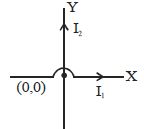
Two long straight conductors with currents $I_1$ and $I_2$ are placed along $X$ and $Y$-axes respectively. The equation of the locus of points of zero magnetic induction is:
A
$Y = X$
B
$Y = \frac{I_2 X}{I_1}$
C
$Y = \frac{I_1}{I_2} X$
D
$Y = \frac{X}{I_1 I_2}$
Solution
(C) The magnetic field due to a long straight conductor at a distance $r$ is given by $B = \frac{\mu_0 I}{2 \pi r}$.
For a conductor carrying current $I_1$ along the $X$-axis,the magnetic field at a point $(x, y)$ is $B_1 = \frac{\mu_0 I_1}{2 \pi y}$ (directed perpendicular to the $XY$-plane).
For a conductor carrying current $I_2$ along the $Y$-axis,the magnetic field at a point $(x, y)$ is $B_2 = \frac{\mu_0 I_2}{2 \pi x}$ (directed perpendicular to the $XY$-plane).
For the net magnetic field to be zero,the magnitudes of the magnetic fields must be equal and opposite in direction: $B_1 = B_2$.
$\frac{\mu_0 I_1}{2 \pi y} = \frac{\mu_0 I_2}{2 \pi x}$
$\frac{I_1}{y} = \frac{I_2}{x}$
Rearranging for $Y$,we get $Y = \frac{I_1}{I_2} X$.
For a conductor carrying current $I_1$ along the $X$-axis,the magnetic field at a point $(x, y)$ is $B_1 = \frac{\mu_0 I_1}{2 \pi y}$ (directed perpendicular to the $XY$-plane).
For a conductor carrying current $I_2$ along the $Y$-axis,the magnetic field at a point $(x, y)$ is $B_2 = \frac{\mu_0 I_2}{2 \pi x}$ (directed perpendicular to the $XY$-plane).
For the net magnetic field to be zero,the magnitudes of the magnetic fields must be equal and opposite in direction: $B_1 = B_2$.
$\frac{\mu_0 I_1}{2 \pi y} = \frac{\mu_0 I_2}{2 \pi x}$
$\frac{I_1}{y} = \frac{I_2}{x}$
Rearranging for $Y$,we get $Y = \frac{I_1}{I_2} X$.
0 likes
View Solution257
MediumMCQ
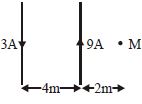
Calculate the magnetic field at point $M$ for the given current distribution.
A
$\frac{2\mu_0}{\pi} \odot$
B
$\frac{5\mu_0}{2\pi} \otimes$
C
$\frac{2\mu_0}{\pi} \otimes$
D
$\frac{\mu_0}{2\pi} \otimes$
Solution
(B) The magnetic field $B$ due to an infinitely long straight wire at a distance $r$ is given by $B = \frac{\mu_0 I}{2\pi r}$.
For the wire carrying $9 \text{ A}$ current (upward),the point $M$ is at a distance $r_1 = 2 \text{ m}$ to the right. Using the right-hand thumb rule,the direction of the magnetic field at $M$ is into the page $(\otimes)$.
$B_1 = \frac{\mu_0 (9)}{2\pi (2)} = \frac{9\mu_0}{4\pi} \otimes$.
For the wire carrying $3 \text{ A}$ current (downward),the point $M$ is at a distance $r_2 = 4 + 2 = 6 \text{ m}$ to the right. Using the right-hand thumb rule,the direction of the magnetic field at $M$ is into the page $(\otimes)$.
$B_2 = \frac{\mu_0 (3)}{2\pi (6)} = \frac{3\mu_0}{12\pi} = \frac{\mu_0}{4\pi} \otimes$.
Since both magnetic fields are in the same direction (into the page),the net magnetic field $B_{net}$ is:
$B_{net} = B_1 + B_2 = \frac{9\mu_0}{4\pi} + \frac{\mu_0}{4\pi} = \frac{10\mu_0}{4\pi} = \frac{5\mu_0}{2\pi} \otimes$.
For the wire carrying $9 \text{ A}$ current (upward),the point $M$ is at a distance $r_1 = 2 \text{ m}$ to the right. Using the right-hand thumb rule,the direction of the magnetic field at $M$ is into the page $(\otimes)$.
$B_1 = \frac{\mu_0 (9)}{2\pi (2)} = \frac{9\mu_0}{4\pi} \otimes$.
For the wire carrying $3 \text{ A}$ current (downward),the point $M$ is at a distance $r_2 = 4 + 2 = 6 \text{ m}$ to the right. Using the right-hand thumb rule,the direction of the magnetic field at $M$ is into the page $(\otimes)$.
$B_2 = \frac{\mu_0 (3)}{2\pi (6)} = \frac{3\mu_0}{12\pi} = \frac{\mu_0}{4\pi} \otimes$.
Since both magnetic fields are in the same direction (into the page),the net magnetic field $B_{net}$ is:
$B_{net} = B_1 + B_2 = \frac{9\mu_0}{4\pi} + \frac{\mu_0}{4\pi} = \frac{10\mu_0}{4\pi} = \frac{5\mu_0}{2\pi} \otimes$.
0 likes
View Solution258
EasyMCQ
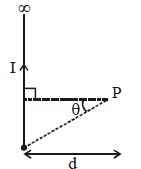
Find the magnetic field due to a semi-infinite length wire at point $P$ as shown in the figure.
A
$B_p = \frac{{\mu _0}I}{{4\pi d}}[\sin \theta + 1]$
B
$B_p = \frac{{\mu _0}d}{{4\pi I}}[\sin \theta ]$
C
$B_p = \frac{{\mu _0}I}{{4\pi d}}[\sin \theta + \sin \theta ]$
D
$B_p = \frac{{\mu _0}I}{{4\pi d}}[\sin 90^\circ + \sin 90^\circ]$
Solution
(A) The magnetic field $B$ at a distance $d$ from a finite wire carrying current $I$ subtending angles $\theta_1$ and $\theta_2$ at point $P$ is given by $B = \frac{{\mu _0}I}{{4\pi d}}(\sin \theta_1 + \sin \theta_2)$.
In the given figure,the wire is semi-infinite,meaning one end is at the perpendicular projection of $P$ on the wire (angle $\theta_1 = 0^\circ$) and the other end extends to infinity (angle $\theta_2 = 90^\circ$).
However,based on the geometry provided in the diagram,the angle $\theta$ is defined between the perpendicular and the line connecting $P$ to the finite end of the wire.
Thus,the angles are $\theta_1 = \theta$ and $\theta_2 = 90^\circ$.
Substituting these into the formula,we get $B_p = \frac{{\mu _0}I}{{4\pi d}}(\sin \theta + \sin 90^\circ)$.
Since $\sin 90^\circ = 1$,the expression becomes $B_p = \frac{{\mu _0}I}{{4\pi d}}(\sin \theta + 1)$.
In the given figure,the wire is semi-infinite,meaning one end is at the perpendicular projection of $P$ on the wire (angle $\theta_1 = 0^\circ$) and the other end extends to infinity (angle $\theta_2 = 90^\circ$).
However,based on the geometry provided in the diagram,the angle $\theta$ is defined between the perpendicular and the line connecting $P$ to the finite end of the wire.
Thus,the angles are $\theta_1 = \theta$ and $\theta_2 = 90^\circ$.
Substituting these into the formula,we get $B_p = \frac{{\mu _0}I}{{4\pi d}}(\sin \theta + \sin 90^\circ)$.
Since $\sin 90^\circ = 1$,the expression becomes $B_p = \frac{{\mu _0}I}{{4\pi d}}(\sin \theta + 1)$.
0 likes
View Solution259
EasyMCQ
In the Biot-Savart law,the direction of the magnetic field is determined by which of the following cross products in the expression $d\vec B = \frac{\mu_0}{4\pi} \frac{I d\vec l \times \vec r}{r^3}$?
A
$\vec r \times I d\vec l$
B
$I d\vec l \times \vec r$
C
Both $(A)$ and $(B)$
D
None of these
Solution
(B) The Biot-Savart law states that the magnetic field $d\vec B$ due to a current element $I d\vec l$ at a position vector $\vec r$ is given by the formula:
$d\vec B = \frac{\mu_0}{4\pi} \frac{I d\vec l \times \vec r}{r^3}$.
In this vector product,the order of the cross product is $d\vec l \times \vec r$. Since the cross product is anti-commutative (i.e.,$\vec A \times \vec B = -(\vec B \times \vec A)$),the direction is specifically determined by the term $I d\vec l \times \vec r$. Therefore,option $(B)$ is the correct representation.
$d\vec B = \frac{\mu_0}{4\pi} \frac{I d\vec l \times \vec r}{r^3}$.
In this vector product,the order of the cross product is $d\vec l \times \vec r$. Since the cross product is anti-commutative (i.e.,$\vec A \times \vec B = -(\vec B \times \vec A)$),the direction is specifically determined by the term $I d\vec l \times \vec r$. Therefore,option $(B)$ is the correct representation.
0 likes
View Solution260
DifficultMCQ
If a wire of length $L$ forms a loop of radius $R$ and has $n$ turns,find the magnetic field at the center of the loop if the current flowing in the loop is $I$.
A
$\frac{\mu_0}{4\pi} \frac{I}{R^2} \times L^2$
B
$\frac{\mu_0}{4\pi} \frac{I}{R^2} \times L \times n^2$
C
$\frac{\mu_0 I}{4\pi} \frac{4\pi^2 n^2}{L}$
D
$\frac{\mu_0}{4\pi} I \cdot 4\pi^2 \cdot n^2 \cdot L$
Solution
(C) The total length of the wire $L$ is equal to the circumference of the loop multiplied by the number of turns $n$: $L = n(2\pi R)$.
From this,we find the radius $R = \frac{L}{2\pi n}$.
The magnetic field $B$ at the center of a circular coil with $n$ turns is given by $B = n \left( \frac{\mu_0 I}{2R} \right)$.
Substituting the value of $R$ into the formula: $B = n \left( \frac{\mu_0 I}{2(L / 2\pi n)} \right)$.
Simplifying the expression: $B = n \left( \frac{\mu_0 I \cdot 2\pi n}{2L} \right) = \frac{\mu_0 I \cdot 2\pi n^2}{2L} = \frac{\mu_0 I \cdot \pi n^2}{L}$.
To match the given options,we multiply and divide by $4\pi$: $B = \frac{\mu_0 I}{4\pi} \cdot \frac{4\pi^2 n^2}{L}$.
From this,we find the radius $R = \frac{L}{2\pi n}$.
The magnetic field $B$ at the center of a circular coil with $n$ turns is given by $B = n \left( \frac{\mu_0 I}{2R} \right)$.
Substituting the value of $R$ into the formula: $B = n \left( \frac{\mu_0 I}{2(L / 2\pi n)} \right)$.
Simplifying the expression: $B = n \left( \frac{\mu_0 I \cdot 2\pi n}{2L} \right) = \frac{\mu_0 I \cdot 2\pi n^2}{2L} = \frac{\mu_0 I \cdot \pi n^2}{L}$.
To match the given options,we multiply and divide by $4\pi$: $B = \frac{\mu_0 I}{4\pi} \cdot \frac{4\pi^2 n^2}{L}$.
0 likes
View Solution261
DifficultMCQ
$A$ coil of $50$ turns and $4$ cm radius carries $2$ $A$ current. The magnetic field at its centre is ....... $mT$.
A
$3.14$
B
$157$
C
$15.7$
D
$1.57$
Solution
(D) The magnetic field $B$ at the centre of a circular coil with $N$ turns is given by the formula: $B = \frac{N \mu_0 I}{2r}$.
Given: $N = 50$,$r = 4 \text{ cm} = 4 \times 10^{-2} \text{ m}$,$I = 2 \text{ A}$,and $\mu_0 = 4\pi \times 10^{-7} \text{ T m/A}$.
Substituting the values:
$B = \frac{50 \times (4\pi \times 10^{-7}) \times 2}{2 \times 4 \times 10^{-2}}$
$B = \frac{50 \times 4\pi \times 10^{-7} \times 2}{8 \times 10^{-2}}$
$B = \frac{400\pi \times 10^{-7}}{8 \times 10^{-2}}$
$B = 50\pi \times 10^{-5} \text{ T}$
$B = 50 \times 3.14159 \times 10^{-5} \text{ T} \approx 1.57 \times 10^{-3} \text{ T}$.
Since $1 \text{ mT} = 10^{-3} \text{ T}$,the magnetic field is $1.57 \text{ mT}$.
Given: $N = 50$,$r = 4 \text{ cm} = 4 \times 10^{-2} \text{ m}$,$I = 2 \text{ A}$,and $\mu_0 = 4\pi \times 10^{-7} \text{ T m/A}$.
Substituting the values:
$B = \frac{50 \times (4\pi \times 10^{-7}) \times 2}{2 \times 4 \times 10^{-2}}$
$B = \frac{50 \times 4\pi \times 10^{-7} \times 2}{8 \times 10^{-2}}$
$B = \frac{400\pi \times 10^{-7}}{8 \times 10^{-2}}$
$B = 50\pi \times 10^{-5} \text{ T}$
$B = 50 \times 3.14159 \times 10^{-5} \text{ T} \approx 1.57 \times 10^{-3} \text{ T}$.
Since $1 \text{ mT} = 10^{-3} \text{ T}$,the magnetic field is $1.57 \text{ mT}$.
0 likes
View Solution262
DifficultMCQ
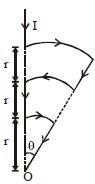
Shown in the figure is a conductor carrying a current $I$. The magnetic field intensity at the point $O$ (common centre of all the three arcs) is
A
$\frac {5\mu _0I\theta }{24\,\pi r}$
B
$\frac {\mu _0I\theta }{24\,\pi r}$
C
$\frac {11\mu _0I\theta }{24\,\pi r}$
D
zero
Solution
(A) The magnetic field due to an arc of radius $R$ subtending an angle $\theta$ at the center is given by $B = \frac{\mu_0 I \theta}{4 \pi R}$.
In the given figure,there are three arcs with radii $r$,$2r$,and $3r$ respectively,all subtending the same angle $\theta$ at point $O$.
Using the right-hand rule,the magnetic field due to the arc of radius $r$ is directed into the page,the arc of radius $2r$ is directed out of the page,and the arc of radius $3r$ is directed into the page.
Let $B_1, B_2, B_3$ be the magnetic fields due to the arcs of radii $r, 2r, 3r$ respectively.
$B_1 = \frac{\mu_0 I \theta}{4 \pi r}$ (inward)
$B_2 = \frac{\mu_0 I \theta}{4 \pi (2r)} = \frac{\mu_0 I \theta}{8 \pi r}$ (outward)
$B_3 = \frac{\mu_0 I \theta}{4 \pi (3r)} = \frac{\mu_0 I \theta}{12 \pi r}$ (inward)
The net magnetic field $B$ at $O$ is $B = B_1 - B_2 + B_3$.
$B = \frac{\mu_0 I \theta}{4 \pi} \left[ \frac{1}{r} - \frac{1}{2r} + \frac{1}{3r} \right]$
$B = \frac{\mu_0 I \theta}{4 \pi r} \left[ 1 - \frac{1}{2} + \frac{1}{3} \right]$
$B = \frac{\mu_0 I \theta}{4 \pi r} \left[ \frac{6 - 3 + 2}{6} \right] = \frac{\mu_0 I \theta}{4 \pi r} \left[ \frac{5}{6} \right] = \frac{5 \mu_0 I \theta}{24 \pi r}$.
In the given figure,there are three arcs with radii $r$,$2r$,and $3r$ respectively,all subtending the same angle $\theta$ at point $O$.
Using the right-hand rule,the magnetic field due to the arc of radius $r$ is directed into the page,the arc of radius $2r$ is directed out of the page,and the arc of radius $3r$ is directed into the page.
Let $B_1, B_2, B_3$ be the magnetic fields due to the arcs of radii $r, 2r, 3r$ respectively.
$B_1 = \frac{\mu_0 I \theta}{4 \pi r}$ (inward)
$B_2 = \frac{\mu_0 I \theta}{4 \pi (2r)} = \frac{\mu_0 I \theta}{8 \pi r}$ (outward)
$B_3 = \frac{\mu_0 I \theta}{4 \pi (3r)} = \frac{\mu_0 I \theta}{12 \pi r}$ (inward)
The net magnetic field $B$ at $O$ is $B = B_1 - B_2 + B_3$.
$B = \frac{\mu_0 I \theta}{4 \pi} \left[ \frac{1}{r} - \frac{1}{2r} + \frac{1}{3r} \right]$
$B = \frac{\mu_0 I \theta}{4 \pi r} \left[ 1 - \frac{1}{2} + \frac{1}{3} \right]$
$B = \frac{\mu_0 I \theta}{4 \pi r} \left[ \frac{6 - 3 + 2}{6} \right] = \frac{\mu_0 I \theta}{4 \pi r} \left[ \frac{5}{6} \right] = \frac{5 \mu_0 I \theta}{24 \pi r}$.
0 likes
View Solution263
MediumMCQ
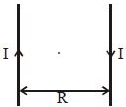
Two long straight wires,each carrying a current $I$ in opposite directions,are separated by a distance $R$. The magnetic induction at a point midway between the wires is
A
Zero
B
$\frac{\mu_0 I}{\pi R}$
C
$\frac{2\mu_0 I}{\pi R}$
D
$\frac{\mu_0 I}{4\pi R}$
Solution
(C) The magnetic field $B$ due to a long straight wire at a distance $r$ is given by $B = \frac{\mu_0 I}{2\pi r}$.
For two wires separated by distance $R$,the distance of the midpoint from each wire is $r = R/2$.
Using the right-hand rule,the magnetic field produced by both wires at the midpoint points in the same direction (into the plane of the paper).
Therefore,the total magnetic field is the sum of the fields from both wires:
$B_{total} = B_1 + B_2 = \frac{\mu_0 I}{2\pi (R/2)} + \frac{\mu_0 I}{2\pi (R/2)}$
$B_{total} = \frac{\mu_0 I}{\pi R} + \frac{\mu_0 I}{\pi R} = \frac{2\mu_0 I}{\pi R}$.
For two wires separated by distance $R$,the distance of the midpoint from each wire is $r = R/2$.
Using the right-hand rule,the magnetic field produced by both wires at the midpoint points in the same direction (into the plane of the paper).
Therefore,the total magnetic field is the sum of the fields from both wires:
$B_{total} = B_1 + B_2 = \frac{\mu_0 I}{2\pi (R/2)} + \frac{\mu_0 I}{2\pi (R/2)}$
$B_{total} = \frac{\mu_0 I}{\pi R} + \frac{\mu_0 I}{\pi R} = \frac{2\mu_0 I}{\pi R}$.
1 likes
View Solution264
MediumMCQ
Equal currents $I$ are flowing in three infinitely long wires along the positive $x$,$y$,and $z$ directions. The magnetic field at a point $(0, 0, -a)$ would be:
A
$\frac{\mu_0 I}{2\pi a}(\hat{j} - \hat{i})$
B
$\frac{\mu_0 I}{2\pi a}(\hat{i} - \hat{j})$
C
$\frac{\mu_0 I}{2\pi a}(\hat{i} + \hat{j})$
D
$\frac{\mu_0 I}{2\pi a}(-\hat{i} - \hat{j})$
Solution
(A) The magnetic field due to an infinitely long wire carrying current $I$ at a perpendicular distance $a$ is given by $B = \frac{\mu_0 I}{2\pi a}$. The direction is given by the right-hand rule.
$1$. For the wire along the positive $x$-axis: The position vector from the wire to the point $(0, 0, -a)$ is in the $-z$ direction. Using the right-hand rule,the magnetic field at $(0, 0, -a)$ is $\vec{B}_1 = \frac{\mu_0 I}{2\pi a} \hat{j}$.
$2$. For the wire along the positive $y$-axis: The position vector from the wire to the point $(0, 0, -a)$ is in the $-z$ direction. Using the right-hand rule,the magnetic field at $(0, 0, -a)$ is $\vec{B}_2 = \frac{\mu_0 I}{2\pi a} (-\hat{i})$.
$3$. For the wire along the positive $z$-axis: The point $(0, 0, -a)$ lies on the line of the wire itself. Therefore,the magnetic field due to this wire is $\vec{B}_3 = 0$.
$4$. The net magnetic field is $\vec{B}_{net} = \vec{B}_1 + \vec{B}_2 + \vec{B}_3 = \frac{\mu_0 I}{2\pi a} (\hat{j} - \hat{i})$.
$1$. For the wire along the positive $x$-axis: The position vector from the wire to the point $(0, 0, -a)$ is in the $-z$ direction. Using the right-hand rule,the magnetic field at $(0, 0, -a)$ is $\vec{B}_1 = \frac{\mu_0 I}{2\pi a} \hat{j}$.
$2$. For the wire along the positive $y$-axis: The position vector from the wire to the point $(0, 0, -a)$ is in the $-z$ direction. Using the right-hand rule,the magnetic field at $(0, 0, -a)$ is $\vec{B}_2 = \frac{\mu_0 I}{2\pi a} (-\hat{i})$.
$3$. For the wire along the positive $z$-axis: The point $(0, 0, -a)$ lies on the line of the wire itself. Therefore,the magnetic field due to this wire is $\vec{B}_3 = 0$.
$4$. The net magnetic field is $\vec{B}_{net} = \vec{B}_1 + \vec{B}_2 + \vec{B}_3 = \frac{\mu_0 I}{2\pi a} (\hat{j} - \hat{i})$.
0 likes
View Solution265
DifficultMCQ
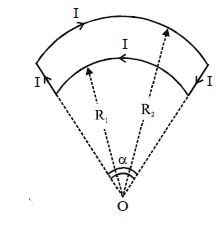
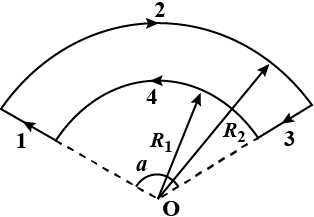
The magnetic induction at the centre $O$ of the current-carrying bent wire shown in the adjoining figure is
A
$\frac{\mu_0 I}{4\pi R_1} \alpha$
B
$\frac{\mu_0 I}{4\pi R_2} \alpha$
C
$\frac{\mu_0 I \alpha}{4\pi} \left( \frac{1}{R_1} - \frac{1}{R_2} \right)$
D
$\frac{\mu_0 I \alpha}{4\pi} \left( \frac{1}{R_1} + \frac{1}{R_2} \right)$
Solution
(C) The magnetic field at point $O$ is the vector sum of the magnetic fields due to the four segments of the wire.
$1$. For segments $1$ and $3$,the point $O$ lies on the axis of the wire. Therefore,the magnetic field due to these segments is $0$.
$2$. For the circular arc segments $2$ and $4$,the magnetic field at the center is given by $B = \frac{\mu_0 I \theta}{4\pi R}$,where $\theta = \alpha$ is the angle subtended at the center.
$3$. Using the right-hand rule:
- For arc $2$ (radius $R_2$),the current flows in a direction that produces a magnetic field directed into the page (inward).
- For arc $4$ (radius $R_1$),the current flows in a direction that produces a magnetic field directed out of the page (outward).
$4$. The net magnetic field $B_{net}$ is:
$B_{net} = B_4 - B_2 = \frac{\mu_0 I \alpha}{4\pi R_1} - \frac{\mu_0 I \alpha}{4\pi R_2}$
$B_{net} = \frac{\mu_0 I \alpha}{4\pi} \left( \frac{1}{R_1} - \frac{1}{R_2} \right)$
$1$. For segments $1$ and $3$,the point $O$ lies on the axis of the wire. Therefore,the magnetic field due to these segments is $0$.
$2$. For the circular arc segments $2$ and $4$,the magnetic field at the center is given by $B = \frac{\mu_0 I \theta}{4\pi R}$,where $\theta = \alpha$ is the angle subtended at the center.
$3$. Using the right-hand rule:
- For arc $2$ (radius $R_2$),the current flows in a direction that produces a magnetic field directed into the page (inward).
- For arc $4$ (radius $R_1$),the current flows in a direction that produces a magnetic field directed out of the page (outward).
$4$. The net magnetic field $B_{net}$ is:
$B_{net} = B_4 - B_2 = \frac{\mu_0 I \alpha}{4\pi R_1} - \frac{\mu_0 I \alpha}{4\pi R_2}$
$B_{net} = \frac{\mu_0 I \alpha}{4\pi} \left( \frac{1}{R_1} - \frac{1}{R_2} \right)$
0 likes
View Solution266
DifficultMCQ
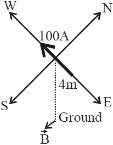
$A$ horizontal overhead power line is at a height of $4\, m$ from the ground and carries a current of $100\, A$ from west to east. The magnetic field directly below it on the ground is $(\mu_0 = 4\pi \times 10^{-7}\, T\, m A^{-1})$.
A
$5 \times 10^{-6}\, T$ northward
B
$5 \times 10^{-6}\, T$ southward
C
$2.5 \times 10^{-7}\, T$ northward
D
$2.5 \times 10^{-7}\, T$ southward
Solution
(B) The magnetic field $B$ due to a long straight current-carrying wire at a distance $r$ is given by the formula:
$B = \frac{\mu_0}{4\pi} \frac{2I}{r}$
Given:
Current $I = 100\, A$
Distance $r = 4\, m$
Permeability constant $\frac{\mu_0}{4\pi} = 10^{-7}\, T\, m A^{-1}$
Substituting the values:
$B = 10^{-7} \times \frac{2 \times 100}{4} = 10^{-7} \times 50 = 5 \times 10^{-6}\, T$
According to the Right-Hand Thumb Rule,if the current flows from west to east,the magnetic field lines circle the wire. Directly below the wire,the magnetic field is directed towards the south.
$B = \frac{\mu_0}{4\pi} \frac{2I}{r}$
Given:
Current $I = 100\, A$
Distance $r = 4\, m$
Permeability constant $\frac{\mu_0}{4\pi} = 10^{-7}\, T\, m A^{-1}$
Substituting the values:
$B = 10^{-7} \times \frac{2 \times 100}{4} = 10^{-7} \times 50 = 5 \times 10^{-6}\, T$
According to the Right-Hand Thumb Rule,if the current flows from west to east,the magnetic field lines circle the wire. Directly below the wire,the magnetic field is directed towards the south.
0 likes
View Solution267
DifficultMCQ
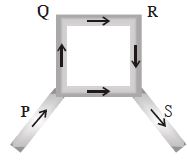
$PQRS$ is a square loop made of uniform conducting wire. If the current enters the loop at $P$ and leaves at $S$, then the magnetic field will be
A
Maximum at the centre of the loop
B
Zero at the centre of loop
C
Zero at all points inside the loop
D
Zero at all points outside of the loop
Solution
(B) The square loop is divided into two parallel paths between points $P$ and $S$. One path is the side $PS$ itself, and the other path is the series combination of sides $PQ$, $QR$, and $RS$.
Since the wire is uniform, the resistance of each side is proportional to its length. Let the side length be $a$. The resistance of path $PS$ is $R_1 = \lambda a$, and the resistance of path $PQRS$ is $R_2 = 3\lambda a$, where $\lambda$ is the resistance per unit length.
According to the Biot-Savart law, the magnetic field $B$ at the center due to a straight wire segment of length $L$ carrying current $I$ is given by $B = \frac{\mu_0 I}{4\pi d}(\sin \theta_1 + \sin \theta_2)$, where $d$ is the perpendicular distance from the center to the wire.
For the square loop, the current splits at $P$ and recombines at $S$. The magnetic field produced by the path $PQRS$ at the center is the vector sum of the fields produced by segments $PQ$, $QR$, and $RS$. Due to symmetry and the direction of current flow, the magnetic field produced by the path $PQRS$ at the center is exactly equal and opposite to the magnetic field produced by the path $PS$ at the center.
Therefore, the net magnetic field at the center of the loop is zero.
Since the wire is uniform, the resistance of each side is proportional to its length. Let the side length be $a$. The resistance of path $PS$ is $R_1 = \lambda a$, and the resistance of path $PQRS$ is $R_2 = 3\lambda a$, where $\lambda$ is the resistance per unit length.
According to the Biot-Savart law, the magnetic field $B$ at the center due to a straight wire segment of length $L$ carrying current $I$ is given by $B = \frac{\mu_0 I}{4\pi d}(\sin \theta_1 + \sin \theta_2)$, where $d$ is the perpendicular distance from the center to the wire.
For the square loop, the current splits at $P$ and recombines at $S$. The magnetic field produced by the path $PQRS$ at the center is the vector sum of the fields produced by segments $PQ$, $QR$, and $RS$. Due to symmetry and the direction of current flow, the magnetic field produced by the path $PQRS$ at the center is exactly equal and opposite to the magnetic field produced by the path $PS$ at the center.
Therefore, the net magnetic field at the center of the loop is zero.
0 likes
View Solution268
DifficultMCQ
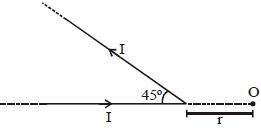
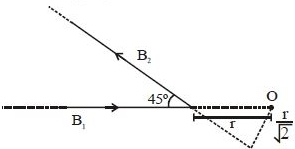
Find the magnetic induction at point $O$ in the given figure.
A
$\frac{\mu _0 I}{4\pi r}\left( \sqrt{2} + 1 \right)$
B
$\frac{\mu _0 I}{4\pi r}\left( \sqrt{2} - 1 \right)$
C
$\frac{\mu _0 I}{4\pi r}\left( 2\sqrt{2} + 1 \right)$
D
$\frac{\mu _0 I}{2\pi r}\left( 2\sqrt{2} - 1 \right)$
Solution
(B) The magnetic field at point $O$ due to the straight wire segment lying on the axis passing through $O$ is $B_1 = 0$ because the point $O$ lies on the axis of the wire.
For the second wire segment, the perpendicular distance $d$ from point $O$ to the wire is $d = r \sin 45^{\circ} = \frac{r}{\sqrt{2}}$.
The magnetic field due to a finite wire segment is given by $B = \frac{\mu_0 I}{4 \pi d} (\sin \theta_1 + \sin \theta_2)$.
Here, one end is at infinity $(\theta_1 = 90^{\circ})$ and the other end makes an angle $\theta_2 = 45^{\circ}$ with the perpendicular.
Thus, $B_2 = \frac{\mu_0 I}{4 \pi (r/\sqrt{2})} (\sin 90^{\circ} - \sin 45^{\circ}) = \frac{\mu_0 I \sqrt{2}}{4 \pi r} (1 - \frac{1}{\sqrt{2}}) = \frac{\mu_0 I}{4 \pi r} (\sqrt{2} - 1)$.
The total magnetic induction at $O$ is $B = B_1 + B_2 = \frac{\mu_0 I}{4 \pi r} (\sqrt{2} - 1)$.
For the second wire segment, the perpendicular distance $d$ from point $O$ to the wire is $d = r \sin 45^{\circ} = \frac{r}{\sqrt{2}}$.
The magnetic field due to a finite wire segment is given by $B = \frac{\mu_0 I}{4 \pi d} (\sin \theta_1 + \sin \theta_2)$.
Here, one end is at infinity $(\theta_1 = 90^{\circ})$ and the other end makes an angle $\theta_2 = 45^{\circ}$ with the perpendicular.
Thus, $B_2 = \frac{\mu_0 I}{4 \pi (r/\sqrt{2})} (\sin 90^{\circ} - \sin 45^{\circ}) = \frac{\mu_0 I \sqrt{2}}{4 \pi r} (1 - \frac{1}{\sqrt{2}}) = \frac{\mu_0 I}{4 \pi r} (\sqrt{2} - 1)$.
The total magnetic induction at $O$ is $B = B_1 + B_2 = \frac{\mu_0 I}{4 \pi r} (\sqrt{2} - 1)$.
0 likes
View Solution269
DifficultMCQ
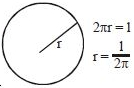
$A$ direct current is passing through a wire. It is bent to form a coil of one turn. Now,it is further bent to form a coil of two turns but at a smaller radius. Find the ratio of the magnetic induction at the centre of this two-turn coil to that at the centre of the one-turn coil.
A
$1 : 4$
B
$4 : 1$
C
$2 : 1$
D
$1 : 1$
Solution
(B) Let the length of the wire be $\ell$.
For a coil of one turn with radius $r$,the circumference is $2\pi r = \ell$,so $r = \frac{\ell}{2\pi}$.
The magnetic induction at the centre is $B_1 = \frac{\mu_0 I}{2r} = \frac{\mu_0 I}{2(\ell / 2\pi)} = \frac{\mu_0 I \pi}{\ell}$.
For a coil of two turns with radius $r'$,the total length is $2(2\pi r') = \ell$,so $r' = \frac{\ell}{4\pi}$.
The magnetic induction at the centre for $N=2$ turns is $B_2 = \frac{N \mu_0 I}{2r'} = \frac{2 \mu_0 I}{2(\ell / 4\pi)} = \frac{4 \mu_0 I \pi}{\ell}$.
The ratio of the magnetic induction of the two-turn coil to the one-turn coil is $\frac{B_2}{B_1} = \frac{4 \mu_0 I \pi / \ell}{\mu_0 I \pi / \ell} = \frac{4}{1}$.
For a coil of one turn with radius $r$,the circumference is $2\pi r = \ell$,so $r = \frac{\ell}{2\pi}$.
The magnetic induction at the centre is $B_1 = \frac{\mu_0 I}{2r} = \frac{\mu_0 I}{2(\ell / 2\pi)} = \frac{\mu_0 I \pi}{\ell}$.
For a coil of two turns with radius $r'$,the total length is $2(2\pi r') = \ell$,so $r' = \frac{\ell}{4\pi}$.
The magnetic induction at the centre for $N=2$ turns is $B_2 = \frac{N \mu_0 I}{2r'} = \frac{2 \mu_0 I}{2(\ell / 4\pi)} = \frac{4 \mu_0 I \pi}{\ell}$.
The ratio of the magnetic induction of the two-turn coil to the one-turn coil is $\frac{B_2}{B_1} = \frac{4 \mu_0 I \pi / \ell}{\mu_0 I \pi / \ell} = \frac{4}{1}$.
0 likes
View Solution270
AdvancedMCQ
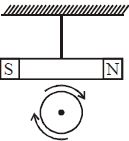
$A$ negative charge is given to a non-conducting loop and the loop is rotated in the plane of paper about its centre as shown in the figure. The magnetic field produced by the ring affects a small magnet placed above the ring in the same plane.
A
The magnet does not rotate.
B
The magnet rotates clockwise as seen from below.
C
The magnet rotates anticlockwise as seen from below.
D
No effect on the magnet is there.
Solution
(B) When a negative charge rotates in a clockwise direction,it is equivalent to a positive current flowing in the anticlockwise direction.
According to the right-hand thumb rule,the magnetic field produced by this current loop will be directed out of the plane of the paper.
This makes the ring act as a magnetic dipole with its North pole facing towards the observer (out of the plane).
The small magnet placed above the ring has its South pole facing the ring's North pole.
Since opposite poles attract,the South pole of the small magnet will be attracted towards the North pole of the equivalent magnetic dipole formed by the ring.
As the ring rotates,the magnetic field distribution changes,causing a torque on the small magnet,which results in the magnet rotating in a clockwise direction when viewed from below.
According to the right-hand thumb rule,the magnetic field produced by this current loop will be directed out of the plane of the paper.
This makes the ring act as a magnetic dipole with its North pole facing towards the observer (out of the plane).
The small magnet placed above the ring has its South pole facing the ring's North pole.
Since opposite poles attract,the South pole of the small magnet will be attracted towards the North pole of the equivalent magnetic dipole formed by the ring.
As the ring rotates,the magnetic field distribution changes,causing a torque on the small magnet,which results in the magnet rotating in a clockwise direction when viewed from below.
0 likes
View Solution271
MediumMCQ
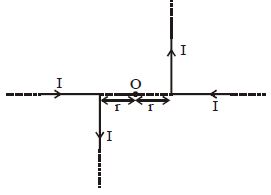
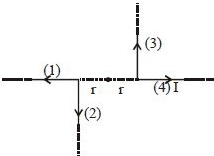
Two infinite wires bent in the form of an $L$ shape carry current $I$ as shown. What is the magnetic field at $O$?
A
$\frac{\mu_0 I}{4\pi r}$
B
$\frac{\mu_0 I}{2\pi r} \odot$
C
$\frac{\mu_0 I}{4\pi r} \odot$
D
$\frac{\mu_0 I}{2\sqrt{2}\pi r}$
Solution
(B) The wire segments lying on the same line as point $O$ (segments $1$ and $4$) produce zero magnetic field at $O$ because the point $O$ lies on their axes.
For the two perpendicular segments (segments $2$ and $3$),each acts as a semi-infinite wire at distance $r$ from point $O$.
The magnetic field due to a semi-infinite wire at a perpendicular distance $r$ is given by $B = \frac{\mu_0 I}{4\pi r}$.
Using the right-hand rule,both segments $2$ and $3$ produce a magnetic field directed outwards (represented by $\odot$) at point $O$.
Therefore,the total magnetic field at $O$ is $B_{total} = B_2 + B_3 = \frac{\mu_0 I}{4\pi r} + \frac{\mu_0 I}{4\pi r} = \frac{2\mu_0 I}{4\pi r} = \frac{\mu_0 I}{2\pi r} \odot$.
For the two perpendicular segments (segments $2$ and $3$),each acts as a semi-infinite wire at distance $r$ from point $O$.
The magnetic field due to a semi-infinite wire at a perpendicular distance $r$ is given by $B = \frac{\mu_0 I}{4\pi r}$.
Using the right-hand rule,both segments $2$ and $3$ produce a magnetic field directed outwards (represented by $\odot$) at point $O$.
Therefore,the total magnetic field at $O$ is $B_{total} = B_2 + B_3 = \frac{\mu_0 I}{4\pi r} + \frac{\mu_0 I}{4\pi r} = \frac{2\mu_0 I}{4\pi r} = \frac{\mu_0 I}{2\pi r} \odot$.
0 likes
View Solution272
DifficultMCQ
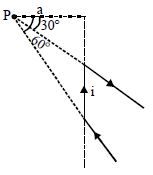
Find the magnetic field at point $P$ in the given diagram.
A
$\frac{\mu_0 i}{4\pi a}(\sqrt{3} - 1) \odot $
B
$\frac{\mu_0 i}{8\pi a}(1 - \sqrt{3}) \odot $
C
$\frac{\mu_0 i}{8\pi a}(\sqrt{3} - 1) \odot $
D
$\frac{\mu_0 i}{4\pi a}(1 - \sqrt{3}) \odot $
Solution
(A) The magnetic field due to a finite wire at a perpendicular distance $r$ is given by $B = \frac{\mu_0 i}{4\pi r}(\sin \theta_1 + \sin \theta_2)$.
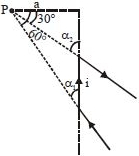
Alternatively,using the angles $\alpha_1$ and $\alpha_2$ with the wire,the formula is $B = \frac{\mu_0 i}{4\pi r}(\cos \alpha_1 - \cos \alpha_2)$.
From the diagram,the perpendicular distance from $P$ to the wire is $r = a \sin 30^{\circ} = a/2$.
The angles are $\alpha_1 = 30^{\circ}$ and $\alpha_2 = 60^{\circ}$.
Substituting these values: $B = \frac{\mu_0 i}{4\pi (a/2)}(\cos 30^{\circ} - \cos 60^{\circ})$.
$B = \frac{\mu_0 i}{2\pi a}(\frac{\sqrt{3}}{2} - \frac{1}{2}) = \frac{\mu_0 i}{4\pi a}(\sqrt{3} - 1) \odot $.
Alternatively,using the angles $\alpha_1$ and $\alpha_2$ with the wire,the formula is $B = \frac{\mu_0 i}{4\pi r}(\cos \alpha_1 - \cos \alpha_2)$.
From the diagram,the perpendicular distance from $P$ to the wire is $r = a \sin 30^{\circ} = a/2$.
The angles are $\alpha_1 = 30^{\circ}$ and $\alpha_2 = 60^{\circ}$.
Substituting these values: $B = \frac{\mu_0 i}{4\pi (a/2)}(\cos 30^{\circ} - \cos 60^{\circ})$.
$B = \frac{\mu_0 i}{2\pi a}(\frac{\sqrt{3}}{2} - \frac{1}{2}) = \frac{\mu_0 i}{4\pi a}(\sqrt{3} - 1) \odot $.
0 likes
View Solution273
DifficultMCQ
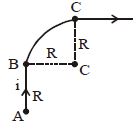
The magnetic field at the centre $C$ of the circular arc is:
A
$\frac{{\mu _0}i}{{4\pi R}}\left[ {\frac{1}{{\sqrt 2 }} + \frac{\pi }{2} + 1} \right]$
B
$\frac{{\mu _0}i}{{4\pi R}}\left[ {2 + \frac{\pi }{2}} \right]$
C
$\frac{{\mu _0}i}{{2\pi R}}\left[ {\frac{1}{{\sqrt 2 }} + \frac{\pi }{2} + 1} \right]$
D
$\frac{{\mu _0}i}{{2\pi R}}\left[ {2 + \frac{\pi }{2}} \right]$
Solution
(A) The total magnetic field at point $C$ is the vector sum of the magnetic fields due to the three segments: the straight wire $AB$, the quarter-circular arc $BC$, and the semi-infinite straight wire starting from $C$.
$1$. Magnetic field due to the straight wire $AB$ at distance $R$ from the wire:
$B_1 = \frac{\mu_0 i}{4\pi R} (\sin 45^\circ + \sin 0^\circ) = \frac{\mu_0 i}{4\pi R} \left(\frac{1}{\sqrt{2}}\right) \otimes$
$2$. Magnetic field due to the quarter-circular arc $BC$ of radius $R$:
$B_2 = \frac{\mu_0 i}{4\pi R} \times \frac{\pi}{2} = \frac{\mu_0 i}{8R} = \frac{\mu_0 i}{4\pi R} \times \frac{\pi}{2} \otimes$
$3$. Magnetic field due to the semi-infinite straight wire starting from $C$:
$B_3 = \frac{\mu_0 i}{4\pi R} (\sin 90^\circ + \sin 0^\circ) = \frac{\mu_0 i}{4\pi R} \otimes$
Since all fields are directed into the plane $(\otimes)$, the net magnetic field is:
$B_{\text{net}} = B_1 + B_2 + B_3 = \frac{\mu_0 i}{4\pi R} \left[ \frac{1}{\sqrt{2}} + \frac{\pi}{2} + 1 \right] \otimes$
$1$. Magnetic field due to the straight wire $AB$ at distance $R$ from the wire:
$B_1 = \frac{\mu_0 i}{4\pi R} (\sin 45^\circ + \sin 0^\circ) = \frac{\mu_0 i}{4\pi R} \left(\frac{1}{\sqrt{2}}\right) \otimes$
$2$. Magnetic field due to the quarter-circular arc $BC$ of radius $R$:
$B_2 = \frac{\mu_0 i}{4\pi R} \times \frac{\pi}{2} = \frac{\mu_0 i}{8R} = \frac{\mu_0 i}{4\pi R} \times \frac{\pi}{2} \otimes$
$3$. Magnetic field due to the semi-infinite straight wire starting from $C$:
$B_3 = \frac{\mu_0 i}{4\pi R} (\sin 90^\circ + \sin 0^\circ) = \frac{\mu_0 i}{4\pi R} \otimes$
Since all fields are directed into the plane $(\otimes)$, the net magnetic field is:
$B_{\text{net}} = B_1 + B_2 + B_3 = \frac{\mu_0 i}{4\pi R} \left[ \frac{1}{\sqrt{2}} + \frac{\pi}{2} + 1 \right] \otimes$
0 likes
View Solution274
DifficultMCQ
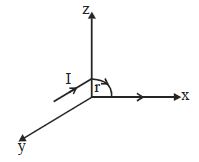
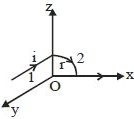
The adjoining figure shows a conductor carrying a current $i$. The magnetic field at the origin is
A
$ - \frac{{\mu _0 i}}{{4r}}\,\left( {\frac{{\hat i}}{\pi } + \frac{{\hat j}}{2}} \right)$
B
$\frac{{\mu _0 i}}{{4r}}\,\left( {\frac{{\hat i}}{\pi } - \frac{{\hat j}}{2}} \right)$
C
$\frac{{\mu _0 i}}{{4r}}\,\left( {\frac{{\hat i}}{2} - \frac{{\hat j}}{\pi }} \right)$
D
$\frac{{\mu _0 i}}{{4r}}\,\left( {\frac{{2\hat i}}{\pi } + \hat j} \right)$
Solution
(A) The total magnetic field at the origin is the vector sum of the fields produced by the different segments of the wire: $\overrightarrow{B}_{0} = \overrightarrow{B}_{1} + \overrightarrow{B}_{2} + \overrightarrow{B}_{3}$.
Segment $1$ is a semi-infinite straight wire carrying current $i$ along the $y$-axis towards the origin. The magnetic field at the origin due to this segment is $\overrightarrow{B}_{1} = \frac{\mu_{0} i}{4 \pi r} (-\hat{i})$.
Segment $2$ is a quarter-circular arc of radius $r$ in the $xy$-plane. The magnetic field at the center of a full circular loop is $\frac{\mu_{0} i}{2r}$. For a quarter-circle,it is $\frac{1}{4} \times \frac{\mu_{0} i}{2r} = \frac{\mu_{0} i}{8r}$. Using the right-hand rule,the direction is along $(-\hat{k})$. However,based on the standard interpretation of such problems where the arc is in the $xy$-plane,the field is $\overrightarrow{B}_{2} = \frac{1}{4} \left( \frac{\mu_{0} i}{2r} \right) (-\hat{k}) = \frac{\mu_{0} i}{8r} (-\hat{k})$.
Segment $3$ is a straight wire passing through the origin,so the magnetic field due to it at the origin is $\overrightarrow{B}_{3} = 0$.
Summing these,$\overrightarrow{B}_{0} = -\frac{\mu_{0} i}{4r} \left[ \frac{\hat{i}}{\pi} + \frac{\hat{k}}{2} \right]$. Given the options provided,the intended answer corresponds to the vector sum $\overrightarrow{B}_{0} = -\frac{\mu_{0} i}{4r} \left[ \frac{\hat{i}}{\pi} + \frac{\hat{j}}{2} \right]$.
Segment $1$ is a semi-infinite straight wire carrying current $i$ along the $y$-axis towards the origin. The magnetic field at the origin due to this segment is $\overrightarrow{B}_{1} = \frac{\mu_{0} i}{4 \pi r} (-\hat{i})$.
Segment $2$ is a quarter-circular arc of radius $r$ in the $xy$-plane. The magnetic field at the center of a full circular loop is $\frac{\mu_{0} i}{2r}$. For a quarter-circle,it is $\frac{1}{4} \times \frac{\mu_{0} i}{2r} = \frac{\mu_{0} i}{8r}$. Using the right-hand rule,the direction is along $(-\hat{k})$. However,based on the standard interpretation of such problems where the arc is in the $xy$-plane,the field is $\overrightarrow{B}_{2} = \frac{1}{4} \left( \frac{\mu_{0} i}{2r} \right) (-\hat{k}) = \frac{\mu_{0} i}{8r} (-\hat{k})$.
Segment $3$ is a straight wire passing through the origin,so the magnetic field due to it at the origin is $\overrightarrow{B}_{3} = 0$.
Summing these,$\overrightarrow{B}_{0} = -\frac{\mu_{0} i}{4r} \left[ \frac{\hat{i}}{\pi} + \frac{\hat{k}}{2} \right]$. Given the options provided,the intended answer corresponds to the vector sum $\overrightarrow{B}_{0} = -\frac{\mu_{0} i}{4r} \left[ \frac{\hat{i}}{\pi} + \frac{\hat{j}}{2} \right]$.
0 likes
View Solution275
MediumMCQ
The magnetic field due to a straight conductor of uniform cross section of radius $a$ and carrying a steady current is represented by
A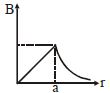
B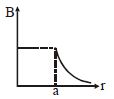
C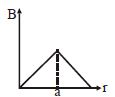
D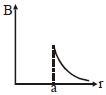
Solution
(A) For a long straight cylindrical conductor of radius $a$ carrying a steady current $I$ uniformly distributed over its cross-section:
$1$. Inside the conductor $(r < a)$: The magnetic field $B$ is given by $B = \frac{\mu_0 I r}{2 \pi a^2}$. This shows that $B \propto r$,which is a linear relationship starting from the origin ($B=0$ at $r=0$).
$2$. Outside the conductor $(r > a)$: The magnetic field $B$ is given by $B = \frac{\mu_0 I}{2 \pi r}$. This shows that $B \propto \frac{1}{r}$,which is a hyperbolic relationship.
$3$. At the surface $(r = a)$: The magnetic field is maximum,$B_{max} = \frac{\mu_0 I}{2 \pi a}$.
Comparing these characteristics with the given graphs,the graph in option $A$ correctly shows a linear increase for $r < a$ and a hyperbolic decrease for $r > a$.
$1$. Inside the conductor $(r < a)$: The magnetic field $B$ is given by $B = \frac{\mu_0 I r}{2 \pi a^2}$. This shows that $B \propto r$,which is a linear relationship starting from the origin ($B=0$ at $r=0$).
$2$. Outside the conductor $(r > a)$: The magnetic field $B$ is given by $B = \frac{\mu_0 I}{2 \pi r}$. This shows that $B \propto \frac{1}{r}$,which is a hyperbolic relationship.
$3$. At the surface $(r = a)$: The magnetic field is maximum,$B_{max} = \frac{\mu_0 I}{2 \pi a}$.
Comparing these characteristics with the given graphs,the graph in option $A$ correctly shows a linear increase for $r < a$ and a hyperbolic decrease for $r > a$.
0 likes
View Solution276
DifficultMCQ
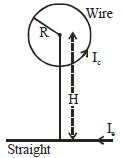
$A$ circular loop of wire and a long straight wire carry currents $I_c$ and $I_e$,respectively,as shown in the figure. Assuming that these are placed in the same plane,the magnetic field will be zero at the centre of the loop when the separation $H$ is:
A
$\frac{I_e R}{I_c \pi}$
B
$\frac{I_c R}{I_e \pi}$
C
$\frac{\pi I_c}{I_e R}$
D
$\frac{I_e \pi}{I_c R}$
Solution
(A) The magnetic field at the centre of a circular loop of radius $R$ carrying current $I_c$ is given by $B_{loop} = \frac{\mu_0 I_c}{2R}$.
The magnetic field at a distance $H$ from a long straight wire carrying current $I_e$ is given by $B_{straight} = \frac{\mu_0 I_e}{2 \pi H}$.
For the net magnetic field at the centre of the loop to be zero,the magnitudes of these two fields must be equal:
$B_{loop} = B_{straight}$
$\frac{\mu_0 I_c}{2R} = \frac{\mu_0 I_e}{2 \pi H}$
Solving for $H$:
$\frac{I_c}{R} = \frac{I_e}{\pi H}$
$H = \frac{I_e R}{\pi I_c}$
The magnetic field at a distance $H$ from a long straight wire carrying current $I_e$ is given by $B_{straight} = \frac{\mu_0 I_e}{2 \pi H}$.
For the net magnetic field at the centre of the loop to be zero,the magnitudes of these two fields must be equal:
$B_{loop} = B_{straight}$
$\frac{\mu_0 I_c}{2R} = \frac{\mu_0 I_e}{2 \pi H}$
Solving for $H$:
$\frac{I_c}{R} = \frac{I_e}{\pi H}$
$H = \frac{I_e R}{\pi I_c}$
0 likes
View Solution277
MediumMCQ
$A$ steady electric current is flowing through a cylindrical wire. Which of the following statements is/are correct?
$(a)$ The electric field at the axis of the wire is zero.
$(b)$ The magnetic field at the axis of the wire is zero.
$(c)$ The electric field in the vicinity of the wire is zero.
$(d)$ The magnetic field in the vicinity of the wire is zero.
$(a)$ The electric field at the axis of the wire is zero.
$(b)$ The magnetic field at the axis of the wire is zero.
$(c)$ The electric field in the vicinity of the wire is zero.
$(d)$ The magnetic field in the vicinity of the wire is zero.
A
$a, b, c$
B
$b, c$
C
only $c$
D
only $b$
Solution
(B) For a cylindrical wire carrying a steady current $I$:
$1$. Inside the wire,there is an electric field $E = J/\sigma$ (where $J$ is current density and $\sigma$ is conductivity) to maintain the steady current flow. Thus,the electric field at the axis is not zero.
$2$. According to Ampere's circuital law,the magnetic field $B$ at a distance $r$ from the axis (where $r < R$) is given by $B = \frac{\mu_0 I r}{2\pi R^2}$. At the axis,$r = 0$,so the magnetic field $B = 0$.
$3$. Outside the wire (in the vicinity),the electric field is zero because the wire is electrically neutral. However,the magnetic field outside is given by $B = \frac{\mu_0 I}{2\pi r}$,which is not zero.
Therefore,statements $(b)$ and $(c)$ are correct.
$1$. Inside the wire,there is an electric field $E = J/\sigma$ (where $J$ is current density and $\sigma$ is conductivity) to maintain the steady current flow. Thus,the electric field at the axis is not zero.
$2$. According to Ampere's circuital law,the magnetic field $B$ at a distance $r$ from the axis (where $r < R$) is given by $B = \frac{\mu_0 I r}{2\pi R^2}$. At the axis,$r = 0$,so the magnetic field $B = 0$.
$3$. Outside the wire (in the vicinity),the electric field is zero because the wire is electrically neutral. However,the magnetic field outside is given by $B = \frac{\mu_0 I}{2\pi r}$,which is not zero.
Therefore,statements $(b)$ and $(c)$ are correct.
0 likes
View Solution278
MediumMCQ
$A$ circular coil is in the $y-z$ plane with its centre at the origin. The coil carries a constant current. Assuming the direction of the magnetic field at $x = -25 \, cm$ to be the positive direction of the magnetic field,which of the following graphs shows the variation of the magnetic field along the $x-$ axis?
A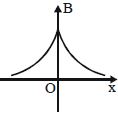
B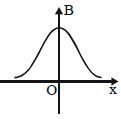
C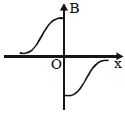
D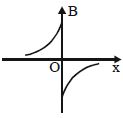
Solution
(B) The direction of the magnetic field at every point on the axis of a current-carrying circular coil remains the same,although its magnitude varies. Therefore,the magnetic field $B$ always remains positive along the axis.
Consequently,graphs $(3)$ and $(4)$ are incorrect as they show negative values for the magnetic field.
The magnitude of the magnetic field on the axis of a circular coil is given by:
$B = \frac{\mu_{0} N i a^{2}}{2(a^{2} + x^{2})^{3/2}}$
where $a$ is the radius of the coil,$N$ is the number of turns,and $i$ is the current.
At the origin $(x = 0)$,the magnetic field is maximum:
$B = \frac{\mu_{0} N i}{2a}$
As $x \rightarrow \pm \infty$,the magnetic field $B \rightarrow 0$.
The slope of the graph is given by the derivative:
$\frac{dB}{dx} = -\frac{3 \mu_{0} N i a^{2} x}{2(a^{2} + x^{2})^{5/2}}$
At $x = 0$,the slope $\frac{dB}{dx} = 0$. This means the tangent to the graph at $x = 0$ is parallel to the $x-$ axis,indicating a local maximum.
Comparing this behavior with the given options,graph $(2)$ correctly represents the variation of the magnetic field along the $x-$ axis.
Consequently,graphs $(3)$ and $(4)$ are incorrect as they show negative values for the magnetic field.
The magnitude of the magnetic field on the axis of a circular coil is given by:
$B = \frac{\mu_{0} N i a^{2}}{2(a^{2} + x^{2})^{3/2}}$
where $a$ is the radius of the coil,$N$ is the number of turns,and $i$ is the current.
At the origin $(x = 0)$,the magnetic field is maximum:
$B = \frac{\mu_{0} N i}{2a}$
As $x \rightarrow \pm \infty$,the magnetic field $B \rightarrow 0$.
The slope of the graph is given by the derivative:
$\frac{dB}{dx} = -\frac{3 \mu_{0} N i a^{2} x}{2(a^{2} + x^{2})^{5/2}}$
At $x = 0$,the slope $\frac{dB}{dx} = 0$. This means the tangent to the graph at $x = 0$ is parallel to the $x-$ axis,indicating a local maximum.
Comparing this behavior with the given options,graph $(2)$ correctly represents the variation of the magnetic field along the $x-$ axis.
0 likes
View Solution279
DifficultMCQ
An electron moves in a circular orbit with a uniform speed $v$. It produces a magnetic field $B$ at the centre of the circle. The radius of the circle is proportional to
A
$\sqrt{\frac{v}{B}}$
B
$\frac{v}{B}$
C
$\frac{B}{v}$
D
$\sqrt{\frac{B}{v}}$
Solution
(A) The magnetic field $B$ at the center of a circular loop carrying current $I$ is given by $B = \frac{\mu_0 I}{2R}$.
Since the electron moves in a circle of radius $R$ with speed $v$,the time period $T$ is $T = \frac{2\pi R}{v}$.
The equivalent current $I$ is $I = \frac{e}{T} = \frac{ev}{2\pi R}$.
Substituting $I$ into the magnetic field formula: $B = \frac{\mu_0}{2R} \left( \frac{ev}{2\pi R} \right) = \frac{\mu_0 ev}{4\pi R^2}$.
Rearranging for $R^2$: $R^2 = \frac{\mu_0 ev}{4\pi B}$.
Therefore,$R \propto \sqrt{\frac{v}{B}}$.
Since the electron moves in a circle of radius $R$ with speed $v$,the time period $T$ is $T = \frac{2\pi R}{v}$.
The equivalent current $I$ is $I = \frac{e}{T} = \frac{ev}{2\pi R}$.
Substituting $I$ into the magnetic field formula: $B = \frac{\mu_0}{2R} \left( \frac{ev}{2\pi R} \right) = \frac{\mu_0 ev}{4\pi R^2}$.
Rearranging for $R^2$: $R^2 = \frac{\mu_0 ev}{4\pi B}$.
Therefore,$R \propto \sqrt{\frac{v}{B}}$.
0 likes
View Solution280
DifficultMCQ
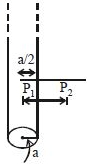
$A$ long straight wire of radius $a$ carries a steady current $i$. The current is uniformly distributed across its cross-section. The ratio of the magnetic field at $a/2$ and $2a$ is
A
$1/2$
B
$1/4$
C
$4$
D
$1$
Solution
(D) For a point inside the wire at distance $r < a$, the magnetic field is given by $B_{in} = \frac{\mu_0 i r}{2 \pi a^2}$.
At $r = a/2$, the magnetic field is $B_1 = \frac{\mu_0 i (a/2)}{2 \pi a^2} = \frac{\mu_0 i}{4 \pi a}$.
For a point outside the wire at distance $r > a$, the magnetic field is given by $B_{out} = \frac{\mu_0 i}{2 \pi r}$.
At $r = 2a$, the magnetic field is $B_2 = \frac{\mu_0 i}{2 \pi (2a)} = \frac{\mu_0 i}{4 \pi a}$.
The ratio of the magnetic field at $a/2$ and $2a$ is $\frac{B_1}{B_2} = \frac{\mu_0 i / 4 \pi a}{\mu_0 i / 4 \pi a} = 1$.
At $r = a/2$, the magnetic field is $B_1 = \frac{\mu_0 i (a/2)}{2 \pi a^2} = \frac{\mu_0 i}{4 \pi a}$.
For a point outside the wire at distance $r > a$, the magnetic field is given by $B_{out} = \frac{\mu_0 i}{2 \pi r}$.
At $r = 2a$, the magnetic field is $B_2 = \frac{\mu_0 i}{2 \pi (2a)} = \frac{\mu_0 i}{4 \pi a}$.
The ratio of the magnetic field at $a/2$ and $2a$ is $\frac{B_1}{B_2} = \frac{\mu_0 i / 4 \pi a}{\mu_0 i / 4 \pi a} = 1$.
0 likes
View Solution281
MediumMCQ
$A$ circular loop of a wire and a long straight wire carry currents $I_c$ and $I_e$,respectively,as shown in the figure. Assuming that these are placed in the same plane,the magnetic field will be zero at the centre of the loop when the separation $H$ is:
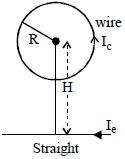
A
$\frac{I_e R}{I_c \pi}$
B
$\frac{I_c R}{I_e \pi}$
C
$\frac{\pi I_c}{I_e R}$
D
$\frac{I_e \pi}{I_c R}$
Solution
(A) The magnetic field at the centre of a circular loop of radius $R$ carrying current $I_c$ is given by $B_{loop} = \frac{\mu_0 I_c}{2R}$.
The magnetic field at a distance $H$ from a long straight wire carrying current $I_e$ is given by $B_{straight} = \frac{\mu_0 I_e}{2\pi H}$.
For the net magnetic field at the centre of the loop to be zero,the magnitudes of these two magnetic fields must be equal and their directions must be opposite.
Equating the magnitudes:
$\frac{\mu_0 I_c}{2R} = \frac{\mu_0 I_e}{2\pi H}$
Solving for $H$:
$\frac{I_c}{R} = \frac{I_e}{\pi H}$
$H = \frac{I_e R}{\pi I_c}$
The magnetic field at a distance $H$ from a long straight wire carrying current $I_e$ is given by $B_{straight} = \frac{\mu_0 I_e}{2\pi H}$.
For the net magnetic field at the centre of the loop to be zero,the magnitudes of these two magnetic fields must be equal and their directions must be opposite.
Equating the magnitudes:
$\frac{\mu_0 I_c}{2R} = \frac{\mu_0 I_e}{2\pi H}$
Solving for $H$:
$\frac{I_c}{R} = \frac{I_e}{\pi H}$
$H = \frac{I_e R}{\pi I_c}$
0 likes
View Solution282
MediumMCQ
What is the magnetic field at a distance $R$ from a coil of radius $r$ carrying current $I$ along its axis?
A
$\frac{\mu_0 I R^2}{2(R^2 + r^2)^{3/2}}$
B
$\frac{\mu_0 I r^2}{2(R^2 + r^2)^{3/2}}$
C
$\frac{\mu_0 I}{2r}$
D
$\frac{\mu_0 I}{2R}$
Solution
(B) According to the Biot-Savart law,the magnetic field $B$ at a point on the axis of a circular coil of radius $r$ carrying current $I$ at a distance $R$ from its center is given by the formula:
$B = \frac{\mu_0 I r^2}{2(R^2 + r^2)^{3/2}}$
Here,$\mu_0$ is the permeability of free space,$I$ is the current,$r$ is the radius of the coil,and $R$ is the axial distance from the center of the coil.
$B = \frac{\mu_0 I r^2}{2(R^2 + r^2)^{3/2}}$
Here,$\mu_0$ is the permeability of free space,$I$ is the current,$r$ is the radius of the coil,and $R$ is the axial distance from the center of the coil.
0 likes
View Solution283
MediumMCQ
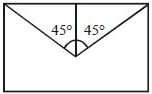
The magnetic field due to a square loop of side $a$ carrying a current $I$ at its centre is:
A
$\frac{\mu_0 I}{2a}$
B
$\frac{\mu_0 I}{\sqrt{2}\pi a}$
C
$\frac{\mu_0 I}{2\pi a}$
D
$\sqrt{2} \frac{\mu_0 I}{\pi a}$
Solution
(D) The magnetic field $B$ due to a straight wire of length $L$ at a perpendicular distance $r$ is given by $B = \frac{\mu_0 I}{4 \pi r} (\sin \theta_1 + \sin \theta_2)$.
For a square loop of side $a$,the distance from the centre to each side is $r = a/2$.
The angles subtended by the corners at the centre are $\theta_1 = 45^{\circ}$ and $\theta_2 = 45^{\circ}$.
The magnetic field due to one side is $B_1 = \frac{\mu_0 I}{4 \pi (a/2)} (\sin 45^{\circ} + \sin 45^{\circ}) = \frac{\mu_0 I}{2 \pi a} (\frac{1}{\sqrt{2}} + \frac{1}{\sqrt{2}}) = \frac{\mu_0 I}{2 \pi a} (\frac{2}{\sqrt{2}}) = \frac{\mu_0 I}{\sqrt{2} \pi a}$.
Since there are $4$ identical sides,the total magnetic field is $B = 4 \times B_1 = 4 \times \frac{\mu_0 I}{\sqrt{2} \pi a} = 2\sqrt{2} \frac{\mu_0 I}{\pi a}$.
Wait,re-evaluating: $B = 4 \times \frac{\mu_0 I}{4 \pi (a/2)} (2 \sin 45^{\circ}) = \frac{\mu_0 I}{\pi a} \times 2 \times \frac{1}{\sqrt{2}} = \sqrt{2} \frac{\mu_0 I}{\pi a}$.
For a square loop of side $a$,the distance from the centre to each side is $r = a/2$.
The angles subtended by the corners at the centre are $\theta_1 = 45^{\circ}$ and $\theta_2 = 45^{\circ}$.
The magnetic field due to one side is $B_1 = \frac{\mu_0 I}{4 \pi (a/2)} (\sin 45^{\circ} + \sin 45^{\circ}) = \frac{\mu_0 I}{2 \pi a} (\frac{1}{\sqrt{2}} + \frac{1}{\sqrt{2}}) = \frac{\mu_0 I}{2 \pi a} (\frac{2}{\sqrt{2}}) = \frac{\mu_0 I}{\sqrt{2} \pi a}$.
Since there are $4$ identical sides,the total magnetic field is $B = 4 \times B_1 = 4 \times \frac{\mu_0 I}{\sqrt{2} \pi a} = 2\sqrt{2} \frac{\mu_0 I}{\pi a}$.
Wait,re-evaluating: $B = 4 \times \frac{\mu_0 I}{4 \pi (a/2)} (2 \sin 45^{\circ}) = \frac{\mu_0 I}{\pi a} \times 2 \times \frac{1}{\sqrt{2}} = \sqrt{2} \frac{\mu_0 I}{\pi a}$.
0 likes
View Solution284
MediumMCQ
$A$ square coil of side $a$ carries a current $I$. The magnetic field at the centre of the coil is
A
$\frac{\mu_0 I}{a\pi}$
B
$\frac{\sqrt{2}\mu_0 I}{a\pi}$
C
$\frac{\mu_0 I}{\sqrt{2}a\pi}$
D
$\frac{2\sqrt{2}\mu_0 I}{a\pi}$
Solution
(D) The magnetic field due to a straight wire of length $L$ at a perpendicular distance $d$ is given by $B = \frac{\mu_0 I}{4\pi d}(\sin \theta_1 + \sin \theta_2)$.
For a square coil of side $a$,the distance from the centre to any side is $d = a/2$.
The angles subtended by the corners at the centre are $\theta_1 = \theta_2 = 45^\circ$ (or $\pi/4$ radians).
The magnetic field due to one side is $B_{\text{side}} = \frac{\mu_0 I}{4\pi (a/2)}(\sin 45^\circ + \sin 45^\circ) = \frac{\mu_0 I}{2\pi a}(\frac{1}{\sqrt{2}} + \frac{1}{\sqrt{2}}) = \frac{\mu_0 I}{2\pi a}(\frac{2}{\sqrt{2}}) = \frac{\sqrt{2}\mu_0 I}{2\pi a} = \frac{\mu_0 I}{\sqrt{2}\pi a}$.
Since there are $4$ identical sides,the total magnetic field at the centre is $B_{\text{total}} = 4 \times B_{\text{side}} = 4 \times \frac{\mu_0 I}{\sqrt{2}\pi a} = \frac{4}{\sqrt{2}} \frac{\mu_0 I}{\pi a} = \frac{2\sqrt{2}\mu_0 I}{\pi a}$.
For a square coil of side $a$,the distance from the centre to any side is $d = a/2$.
The angles subtended by the corners at the centre are $\theta_1 = \theta_2 = 45^\circ$ (or $\pi/4$ radians).
The magnetic field due to one side is $B_{\text{side}} = \frac{\mu_0 I}{4\pi (a/2)}(\sin 45^\circ + \sin 45^\circ) = \frac{\mu_0 I}{2\pi a}(\frac{1}{\sqrt{2}} + \frac{1}{\sqrt{2}}) = \frac{\mu_0 I}{2\pi a}(\frac{2}{\sqrt{2}}) = \frac{\sqrt{2}\mu_0 I}{2\pi a} = \frac{\mu_0 I}{\sqrt{2}\pi a}$.
Since there are $4$ identical sides,the total magnetic field at the centre is $B_{\text{total}} = 4 \times B_{\text{side}} = 4 \times \frac{\mu_0 I}{\sqrt{2}\pi a} = \frac{4}{\sqrt{2}} \frac{\mu_0 I}{\pi a} = \frac{2\sqrt{2}\mu_0 I}{\pi a}$.
0 likes
View Solution285
MediumMCQ
If we double the radius of a coil keeping the current through it unchanged,then the magnetic field at any point at a large distance from the centre becomes approximately
A
double
B
three times
C
four times
D
one-fourth
Solution
(C) The magnetic field $B$ on the axis of a circular coil of radius $R$ at a large distance $x$ $(x \gg R)$ from the center is given by the formula:
$B_{\text{axis}} = \frac{\mu_{0} N I R^{2}}{2 x^{3}}$
From this expression,we can see that the magnetic field is directly proportional to the square of the radius of the coil:
$B \propto R^{2}$
If the radius $R$ is doubled $(R' = 2R)$,the new magnetic field $B'$ becomes:
$B' \propto (2R)^{2} = 4R^{2}$
Therefore,$B' = 4B$.
Thus,the magnetic field becomes four times the original value.
$B_{\text{axis}} = \frac{\mu_{0} N I R^{2}}{2 x^{3}}$
From this expression,we can see that the magnetic field is directly proportional to the square of the radius of the coil:
$B \propto R^{2}$
If the radius $R$ is doubled $(R' = 2R)$,the new magnetic field $B'$ becomes:
$B' \propto (2R)^{2} = 4R^{2}$
Therefore,$B' = 4B$.
Thus,the magnetic field becomes four times the original value.
0 likes
View Solution286
MediumMCQ
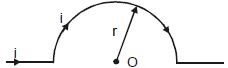
$A$ portion of a conductive wire is bent in the form of a semicircle of radius $r$ as shown in the figure. At the centre $O$ of the semicircle,the magnetic induction will be:
A
zero
B
infinite
C
$\frac{\mu_0}{4\pi} \cdot \frac{\pi i}{r} \text{ gauss}$
D
$\frac{\mu_0}{4\pi} \cdot \frac{\pi i}{r} \text{ tesla}$
Solution
(D) According to the Biot-Savart Law,the magnetic field $dB$ due to a current element $idl$ is given by $dB = \frac{\mu_0}{4\pi} \frac{idl \sin \theta}{r^2}$.
For the straight segments of the wire,the angle $\theta$ between the current element and the position vector to the centre $O$ is either $0^{\circ}$ or $180^{\circ}$. Since $\sin(0^{\circ}) = 0$ and $\sin(180^{\circ}) = 0$,the straight parts contribute zero magnetic field at the centre $O$.
For the semicircular portion,the magnetic field at the centre is half of that produced by a full circular loop of radius $r$. The magnetic field at the centre of a full circular loop is $B = \frac{\mu_0 i}{2r}$.
Therefore,the magnetic field due to the semicircle is $B_{semi} = \frac{1}{2} \left( \frac{\mu_0 i}{2r} \right) = \frac{\mu_0 i}{4r}$.
This can be rewritten as $\frac{\mu_0}{4\pi} \cdot \frac{\pi i}{r} \text{ tesla}$.
For the straight segments of the wire,the angle $\theta$ between the current element and the position vector to the centre $O$ is either $0^{\circ}$ or $180^{\circ}$. Since $\sin(0^{\circ}) = 0$ and $\sin(180^{\circ}) = 0$,the straight parts contribute zero magnetic field at the centre $O$.
For the semicircular portion,the magnetic field at the centre is half of that produced by a full circular loop of radius $r$. The magnetic field at the centre of a full circular loop is $B = \frac{\mu_0 i}{2r}$.
Therefore,the magnetic field due to the semicircle is $B_{semi} = \frac{1}{2} \left( \frac{\mu_0 i}{2r} \right) = \frac{\mu_0 i}{4r}$.
This can be rewritten as $\frac{\mu_0}{4\pi} \cdot \frac{\pi i}{r} \text{ tesla}$.
0 likes
View Solution287
EasyMCQ
Assertion: In electric circuits,wires carrying currents in opposite directions are often twisted together.
Reason: If the wires are not twisted together,the combination of the wires forms a current loop,and the magnetic field generated by the loop might affect adjacent circuits or components.
Reason: If the wires are not twisted together,the combination of the wires forms a current loop,and the magnetic field generated by the loop might affect adjacent circuits or components.
A
If both Assertion and Reason are correct and the Reason is a correct explanation of the Assertion.
B
If both Assertion and Reason are correct but Reason is not a correct explanation of the Assertion.
C
If the Assertion is correct but Reason is incorrect.
D
If both the Assertion and Reason are incorrect.
Solution
(A) When two wires carrying currents in opposite directions are twisted together,the magnetic field produced by one wire is equal and opposite to the magnetic field produced by the other wire at any point in the surrounding space.
As a result,the net magnetic field at any point outside the twisted pair is effectively zero.
If the wires are not twisted,they form a loop that generates a magnetic field,which can cause electromagnetic interference $(EMI)$ in nearby sensitive electronic components or circuits.
Therefore,twisting the wires minimizes the magnetic flux and prevents unwanted induction in adjacent circuits.
Thus,both the Assertion and the Reason are correct,and the Reason is the correct explanation of the Assertion.
As a result,the net magnetic field at any point outside the twisted pair is effectively zero.
If the wires are not twisted,they form a loop that generates a magnetic field,which can cause electromagnetic interference $(EMI)$ in nearby sensitive electronic components or circuits.
Therefore,twisting the wires minimizes the magnetic flux and prevents unwanted induction in adjacent circuits.
Thus,both the Assertion and the Reason are correct,and the Reason is the correct explanation of the Assertion.
0 likes
View Solution288
MediumMCQ
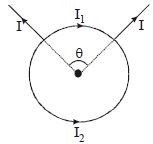
Assertion : The magnetic field at the centre of the circular coil in the following figure due to the currents $I_1$ and $I_2$ is zero.
Reason : $I_1 = I_2$ implies that the fields due to the current $I_1$ and $I_2$ will be balanced.
Reason : $I_1 = I_2$ implies that the fields due to the current $I_1$ and $I_2$ will be balanced.
A
If both Assertion and Reason are correct and Reason is the correct explanation of Assertion.
B
If both Assertion and Reason are correct,but Reason is not the correct explanation of Assertion.
C
If Assertion is correct but Reason is incorrect.
D
If both the Assertion and Reason are incorrect.
Solution
(D) The magnetic field at the center of a circular arc of radius $R$ carrying current $I$ and subtending an angle $\phi$ at the center is given by $B = \frac{\phi}{2\pi} \cdot \frac{\mu_0 I}{2R}$.
For the given coil,the current $I$ splits into $I_1$ and $I_2$ along arcs subtending angles $\theta$ and $(2\pi - \theta)$ respectively.
The magnetic field due to arc $I_1$ is $B_1 = \frac{\theta}{2\pi} \cdot \frac{\mu_0 I_1}{2R}$ (directed into the page).
The magnetic field due to arc $I_2$ is $B_2 = \frac{2\pi - \theta}{2\pi} \cdot \frac{\mu_0 I_2}{2R}$ (directed out of the page).
For the net magnetic field to be zero,$B_1 = B_2$,which implies $\theta I_1 = (2\pi - \theta) I_2$.
This condition is not satisfied simply by $I_1 = I_2$ unless $\theta = \pi$ (i.e.,the currents split into two semicircles). Therefore,the Assertion is generally false,and the Reason is also incorrect as $I_1 = I_2$ does not guarantee zero field unless the geometry is symmetric.
For the given coil,the current $I$ splits into $I_1$ and $I_2$ along arcs subtending angles $\theta$ and $(2\pi - \theta)$ respectively.
The magnetic field due to arc $I_1$ is $B_1 = \frac{\theta}{2\pi} \cdot \frac{\mu_0 I_1}{2R}$ (directed into the page).
The magnetic field due to arc $I_2$ is $B_2 = \frac{2\pi - \theta}{2\pi} \cdot \frac{\mu_0 I_2}{2R}$ (directed out of the page).
For the net magnetic field to be zero,$B_1 = B_2$,which implies $\theta I_1 = (2\pi - \theta) I_2$.
This condition is not satisfied simply by $I_1 = I_2$ unless $\theta = \pi$ (i.e.,the currents split into two semicircles). Therefore,the Assertion is generally false,and the Reason is also incorrect as $I_1 = I_2$ does not guarantee zero field unless the geometry is symmetric.
0 likes
View Solution289
MediumMCQ
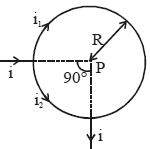
$A$ straight conductor carrying current $i$ splits into two parts as shown in the figure. The radius of the circular loop is $R$. The total magnetic field at the centre $P$ of the loop is
A
$0$
B
$\frac {3 \mu_{0} i} {32 R}$,outward
C
$\frac {3 \mu_{0} i} {32 R}$,inward
D
$\frac{\mu_{0} i}{2 R}$,inward
Solution
(A) The current $i$ splits into $i_1$ and $i_2$ at the junction. Since the two arcs are in parallel,the potential difference across them is the same. Thus,$i_1 R_1 = i_2 R_2$,where $R_1$ and $R_2$ are the resistances of the arcs. Since $R \propto \text{length} \propto \theta$,we have $i_1 \theta_1 = i_2 \theta_2$. Given $\theta_1 = 90^\circ = \pi/2$ and $\theta_2 = 270^\circ = 3\pi/2$,we get $i_1(\pi/2) = i_2(3\pi/2)$,which implies $i_2 = 3i_1$. Since $i_1 + i_2 = i$,we have $i_1 + 3i_1 = i$,so $i_1 = i/4$ and $i_2 = 3i/4$.
The magnetic field at the center due to an arc of angle $\theta$ is $B = \frac{\mu_0 i \theta}{4 \pi R}$.
For the upper arc (angle $270^\circ = 3\pi/2$): $B_1 = \frac{\mu_0 i_1 (3\pi/2)}{4 \pi R} = \frac{3 \mu_0 i_1}{8 R} = \frac{3 \mu_0 (i/4)}{8 R} = \frac{3 \mu_0 i}{32 R}$ (inward).
For the lower arc (angle $90^\circ = \pi/2$): $B_2 = \frac{\mu_0 i_2 (\pi/2)}{4 \pi R} = \frac{\mu_0 i_2}{8 R} = \frac{\mu_0 (3i/4)}{8 R} = \frac{3 \mu_0 i}{32 R}$ (outward).
Since $B_1$ and $B_2$ are equal in magnitude and opposite in direction,the net magnetic field at the center $P$ is $B_{net} = B_1 - B_2 = 0$.
The magnetic field at the center due to an arc of angle $\theta$ is $B = \frac{\mu_0 i \theta}{4 \pi R}$.
For the upper arc (angle $270^\circ = 3\pi/2$): $B_1 = \frac{\mu_0 i_1 (3\pi/2)}{4 \pi R} = \frac{3 \mu_0 i_1}{8 R} = \frac{3 \mu_0 (i/4)}{8 R} = \frac{3 \mu_0 i}{32 R}$ (inward).
For the lower arc (angle $90^\circ = \pi/2$): $B_2 = \frac{\mu_0 i_2 (\pi/2)}{4 \pi R} = \frac{\mu_0 i_2}{8 R} = \frac{\mu_0 (3i/4)}{8 R} = \frac{3 \mu_0 i}{32 R}$ (outward).
Since $B_1$ and $B_2$ are equal in magnitude and opposite in direction,the net magnetic field at the center $P$ is $B_{net} = B_1 - B_2 = 0$.
0 likes
View Solution290
Medium
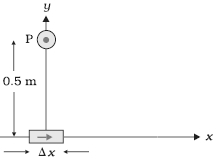
An element $\Delta l = \Delta x \hat{i}$ is placed at the origin and carries a large current $I = 10 \; A$ (Figure). What is the magnetic field on the $y$-axis at a distance of $0.5 \; m$? Given $\Delta x = 1 \; cm$.
Solution
(N/A) According to the Biot-Savart Law,the magnetic field $dB$ due to a current element $Idl$ is given by:
$|dB| = \frac{\mu_0}{4\pi} \frac{I dl \sin \theta}{r^2}$
Given values:
$dl = \Delta x = 1 \; cm = 10^{-2} \; m$
$I = 10 \; A$
$r = 0.5 \; m$
$\frac{\mu_0}{4\pi} = 10^{-7} \; T \cdot m/A$
Since the element is along the $x$-axis and the point is on the $y$-axis,the angle $\theta = 90^{\circ}$,so $\sin \theta = 1$.
Substituting the values:
$|dB| = \frac{10^{-7} \times 10 \times 10^{-2}}{(0.5)^2}$
$|dB| = \frac{10^{-8}}{0.25} = 4 \times 10^{-8} \; T$
The direction of the field is determined by the cross product $dl \times r$. Since $dl = \Delta x \hat{i}$ and the position vector $r = y \hat{j}$,the direction is $\hat{i} \times \hat{j} = \hat{k}$. Thus,the magnetic field is in the $+z$-direction.
$|dB| = \frac{\mu_0}{4\pi} \frac{I dl \sin \theta}{r^2}$
Given values:
$dl = \Delta x = 1 \; cm = 10^{-2} \; m$
$I = 10 \; A$
$r = 0.5 \; m$
$\frac{\mu_0}{4\pi} = 10^{-7} \; T \cdot m/A$
Since the element is along the $x$-axis and the point is on the $y$-axis,the angle $\theta = 90^{\circ}$,so $\sin \theta = 1$.
Substituting the values:
$|dB| = \frac{10^{-7} \times 10 \times 10^{-2}}{(0.5)^2}$
$|dB| = \frac{10^{-8}}{0.25} = 4 \times 10^{-8} \; T$
The direction of the field is determined by the cross product $dl \times r$. Since $dl = \Delta x \hat{i}$ and the position vector $r = y \hat{j}$,the direction is $\hat{i} \times \hat{j} = \hat{k}$. Thus,the magnetic field is in the $+z$-direction.
0 likes
View Solution291
Medium
$A$ straight wire carrying a current of $12\; A$ is bent into a semi-circular arc of radius $2.0\; cm$ as shown in Figure $(a)$. Consider the magnetic field $B$ at the centre of the arc.
$(a)$ What is the magnetic field due to the straight segments?
$(b)$ In what way does the contribution to $B$ from the semicircle differ from that of a circular loop and in what way does it resemble?
$(c)$ Would your answer be different if the wire were bent into a semi-circular arc of the same radius but in the opposite way as shown in Figure $(b)$?
$(a)$ What is the magnetic field due to the straight segments?
$(b)$ In what way does the contribution to $B$ from the semicircle differ from that of a circular loop and in what way does it resemble?
$(c)$ Would your answer be different if the wire were bent into a semi-circular arc of the same radius but in the opposite way as shown in Figure $(b)$?
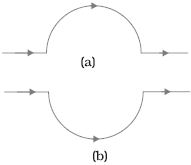
Solution
(N/A) For the straight segments,the current element $dl$ and the position vector $r$ are parallel to each other at every point. According to the Biot-Savart law,$dB = \frac{\mu_0}{4\pi} \frac{I(dl \times r)}{r^3}$. Since $dl \times r = 0$,the straight segments do not contribute to the magnetic field $B$ at the centre.
$(b)$ For the semicircular arc,the contributions from all current elements $dl$ are in the same direction (perpendicular to the plane of the paper,pointing inwards). Thus,they add up in magnitude. The magnitude of the magnetic field at the centre of a full circular loop is $B_{loop} = \frac{\mu_0 I}{2R}$. For a semicircle,the magnitude is exactly half of this,i.e.,$B = \frac{\mu_0 I}{4R}$.
Given $I = 12\; A$ and $R = 2.0 \times 10^{-2}\; m$,$B = \frac{4\pi \times 10^{-7} \times 12}{4 \times 2.0 \times 10^{-2}} = 1.884 \times 10^{-4}\; T \approx 1.9 \times 10^{-4}\; T$. The direction is normal to the plane of the paper,going into it.
$(c)$ Yes,the magnitude of $B$ remains the same $(1.9 \times 10^{-4}\; T)$,but the direction is reversed (out of the plane of the paper) because the current flows in the opposite sense.
$(b)$ For the semicircular arc,the contributions from all current elements $dl$ are in the same direction (perpendicular to the plane of the paper,pointing inwards). Thus,they add up in magnitude. The magnitude of the magnetic field at the centre of a full circular loop is $B_{loop} = \frac{\mu_0 I}{2R}$. For a semicircle,the magnitude is exactly half of this,i.e.,$B = \frac{\mu_0 I}{4R}$.
Given $I = 12\; A$ and $R = 2.0 \times 10^{-2}\; m$,$B = \frac{4\pi \times 10^{-7} \times 12}{4 \times 2.0 \times 10^{-2}} = 1.884 \times 10^{-4}\; T \approx 1.9 \times 10^{-4}\; T$. The direction is normal to the plane of the paper,going into it.
$(c)$ Yes,the magnitude of $B$ remains the same $(1.9 \times 10^{-4}\; T)$,but the direction is reversed (out of the plane of the paper) because the current flows in the opposite sense.
0 likes
View Solution292
MediumMCQ
Consider a tightly wound $100$ turn coil of radius $10 \; cm$,carrying a current of $1 \; A$. What is the magnitude of the magnetic field at the centre of the coil?
A
$1.26 \times 10^{-3} \; T$
B
$9.42 \times 10^{-4} \; T$
C
$6.28 \times 10^{-4} \; T$
D
$3.14 \times 10^{-4} \; T$
Solution
(C) The magnetic field at the center of a circular coil with $N$ turns is given by the formula:
$B = \frac{\mu_0 N I}{2 R}$
Given:
Number of turns $N = 100$
Radius $R = 10 \; cm = 0.1 \; m$
Current $I = 1 \; A$
Permeability of free space $\mu_0 = 4 \pi \times 10^{-7} \; T \cdot m/A$
Substituting the values:
$B = \frac{(4 \pi \times 10^{-7}) \times 100 \times 1}{2 \times 0.1}$
$B = \frac{4 \pi \times 10^{-5}}{0.2}$
$B = 2 \pi \times 10^{-4} \; T$
$B \approx 6.28 \times 10^{-4} \; T$
$B = \frac{\mu_0 N I}{2 R}$
Given:
Number of turns $N = 100$
Radius $R = 10 \; cm = 0.1 \; m$
Current $I = 1 \; A$
Permeability of free space $\mu_0 = 4 \pi \times 10^{-7} \; T \cdot m/A$
Substituting the values:
$B = \frac{(4 \pi \times 10^{-7}) \times 100 \times 1}{2 \times 0.1}$
$B = \frac{4 \pi \times 10^{-5}}{0.2}$
$B = 2 \pi \times 10^{-4} \; T$
$B \approx 6.28 \times 10^{-4} \; T$
0 likes
View Solution293
MediumMCQ
$A$ circular coil of wire consisting of $100$ turns,each of radius $8.0 \; cm$,carries a current of $0.40 \; A$. What is the magnitude of the magnetic field $B$ at the centre of the coil?
A
$1.56 \times 10^{-3} \; T$
B
$3.14 \times 10^{-4} \; T$
C
$6.28 \times 10^{-4} \; T$
D
$9.42 \times 10^{-4} \; T$
Solution
(B) Number of turns on the circular coil,$n = 100$.
Radius of each turn,$r = 8.0 \; cm = 0.08 \; m$.
Current flowing in the coil,$I = 0.40 \; A$.
The magnitude of the magnetic field at the centre of the coil is given by the formula:
$B = \frac{\mu_0 n I}{2r}$
Substituting the values:
$B = \frac{(4\pi \times 10^{-7} \; T \cdot m/A) \times 100 \times 0.40}{2 \times 0.08 \; m}$
$B = \frac{4\pi \times 10^{-7} \times 40}{0.16}$
$B = \frac{160\pi \times 10^{-7}}{0.16} = 1000\pi \times 10^{-7} = \pi \times 10^{-4} \; T$
Using $\pi \approx 3.14$,we get:
$B = 3.14 \times 10^{-4} \; T$.
Radius of each turn,$r = 8.0 \; cm = 0.08 \; m$.
Current flowing in the coil,$I = 0.40 \; A$.
The magnitude of the magnetic field at the centre of the coil is given by the formula:
$B = \frac{\mu_0 n I}{2r}$
Substituting the values:
$B = \frac{(4\pi \times 10^{-7} \; T \cdot m/A) \times 100 \times 0.40}{2 \times 0.08 \; m}$
$B = \frac{4\pi \times 10^{-7} \times 40}{0.16}$
$B = \frac{160\pi \times 10^{-7}}{0.16} = 1000\pi \times 10^{-7} = \pi \times 10^{-4} \; T$
Using $\pi \approx 3.14$,we get:
$B = 3.14 \times 10^{-4} \; T$.
0 likes
View Solution294
EasyMCQ
$A$ long straight wire carries a current of $35\; A$. What is the magnitude of the field $B$ at a point $20\; cm$ from the wire?
A
$4.5 \times 10^{-6} \;T$
B
$2.5 \times 10^{-4} \;T$
C
$3.5 \times 10^{-5} \;T$
D
$7.5 \times 10^{-5} \;T$
Solution
(C) Current in the wire,$I = 35 \; A$.
Distance of a point from the wire,$r = 20 \; cm = 0.2 \; m$.
The magnitude of the magnetic field $B$ at a distance $r$ from a long straight wire is given by the formula:
$B = \frac{\mu_0}{4\pi} \cdot \frac{2I}{r}$
Where $\frac{\mu_0}{4\pi} = 10^{-7} \; T \cdot m/A$.
Substituting the values:
$B = 10^{-7} \times \frac{2 \times 35}{0.2}$
$B = 10^{-7} \times \frac{70}{0.2}$
$B = 10^{-7} \times 350$
$B = 3.5 \times 10^{-5} \; T$.
Thus,the magnitude of the magnetic field is $3.5 \times 10^{-5} \; T$.
Distance of a point from the wire,$r = 20 \; cm = 0.2 \; m$.
The magnitude of the magnetic field $B$ at a distance $r$ from a long straight wire is given by the formula:
$B = \frac{\mu_0}{4\pi} \cdot \frac{2I}{r}$
Where $\frac{\mu_0}{4\pi} = 10^{-7} \; T \cdot m/A$.
Substituting the values:
$B = 10^{-7} \times \frac{2 \times 35}{0.2}$
$B = 10^{-7} \times \frac{70}{0.2}$
$B = 10^{-7} \times 350$
$B = 3.5 \times 10^{-5} \; T$.
Thus,the magnitude of the magnetic field is $3.5 \times 10^{-5} \; T$.
0 likes
View Solution295
MediumMCQ
$A$ long straight wire in the horizontal plane carries a current of $50 \; A$ in the north to south direction. Give the magnitude and direction of $B$ at a point $2.5 \; m$ east of the wire.
A
$2 \times 10^{-5} \; T$
B
$6 \times 10^{-5} \; T$
C
$8 \times 10^{-6} \; T$
D
$4 \times 10^{-6} \; T$
Solution
(D) Current in the wire,$I = 50 \; A$.
The point is $2.5 \; m$ away to the east of the wire.
Therefore,the distance of the point from the wire is $r = 2.5 \; m$.
The magnitude of the magnetic field $B$ at a distance $r$ from a long straight wire is given by the formula:
$B = \frac{\mu_0 I}{2 \pi r} = \frac{\mu_0 (2I)}{4 \pi r}$
Substituting the values:
$B = \frac{4 \pi \times 10^{-7} \times 50}{2 \pi \times 2.5}$
$B = \frac{2 \times 10^{-7} \times 50}{2.5}$
$B = \frac{100 \times 10^{-7}}{2.5} = 40 \times 10^{-7} = 4 \times 10^{-6} \; T$.
According to the Right-Hand Thumb Rule,if the current flows from north to south,the magnetic field lines circle the wire. At a point to the east of the wire,the direction of the magnetic field is vertically upward.
The point is $2.5 \; m$ away to the east of the wire.
Therefore,the distance of the point from the wire is $r = 2.5 \; m$.
The magnitude of the magnetic field $B$ at a distance $r$ from a long straight wire is given by the formula:
$B = \frac{\mu_0 I}{2 \pi r} = \frac{\mu_0 (2I)}{4 \pi r}$
Substituting the values:
$B = \frac{4 \pi \times 10^{-7} \times 50}{2 \pi \times 2.5}$
$B = \frac{2 \times 10^{-7} \times 50}{2.5}$
$B = \frac{100 \times 10^{-7}}{2.5} = 40 \times 10^{-7} = 4 \times 10^{-6} \; T$.
According to the Right-Hand Thumb Rule,if the current flows from north to south,the magnetic field lines circle the wire. At a point to the east of the wire,the direction of the magnetic field is vertically upward.
0 likes
View Solution296
Easy
$A$ horizontal overhead power line carries a current of $90 \;A$ in east to west direction. What is the magnitude and direction of the magnetic field due to the current $1.5 \;m$ below the line?
Solution
(A) Current in the power line,$I = 90 \;A$.
Point is located below the power line at a distance,$r = 1.5 \;m$.
The magnetic field $B$ due to a long straight current-carrying wire is given by the formula:
$B = \frac{\mu_0 I}{2 \pi r}$
Substituting the values:
$B = \frac{4 \pi \times 10^{-7} \times 90}{2 \pi \times 1.5}$
$B = \frac{2 \times 10^{-7} \times 90}{1.5} = 1.2 \times 10^{-5} \;T$.
The current is flowing from East to West. According to the Right-Hand Thumb Rule,if you point your thumb in the direction of the current (West),your fingers curl around the wire. Below the wire,the fingers point towards the South. Thus,the direction of the magnetic field is towards the South.
Point is located below the power line at a distance,$r = 1.5 \;m$.
The magnetic field $B$ due to a long straight current-carrying wire is given by the formula:
$B = \frac{\mu_0 I}{2 \pi r}$
Substituting the values:
$B = \frac{4 \pi \times 10^{-7} \times 90}{2 \pi \times 1.5}$
$B = \frac{2 \times 10^{-7} \times 90}{1.5} = 1.2 \times 10^{-5} \;T$.
The current is flowing from East to West. According to the Right-Hand Thumb Rule,if you point your thumb in the direction of the current (West),your fingers curl around the wire. Below the wire,the fingers point towards the South. Thus,the direction of the magnetic field is towards the South.
0 likes
View Solution297
MediumMCQ
Two concentric circular coils $X$ and $Y$ of radii $16\; cm$ and $10\; cm$ respectively,lie in the same vertical plane containing the north to south direction. Coil $X$ has $20$ turns and carries a current of $16\; A$. Coil $Y$ has $25$ turns and carries a current of $18\; A$. The sense of the current in $X$ is anticlockwise,and clockwise in $Y$,for an observer looking at the coils facing west. Give the magnitude and direction of the net magnetic field due to the coils at their centre.
A
$5.34 \times 10^{-3}\; T$ (towards North)
B
$7.24 \times 10^{-3}\; T$ (towards West)
C
$1.57 \times 10^{-3}\; T$ (towards West)
D
$1.57 \times 10^{-3}\; T$ (towards East)
Solution
(C) Radius of coil $X$,$r_{1} = 16\; cm = 0.16\; m$.
Radius of coil $Y$,$r_{2} = 10\; cm = 0.1\; m$.
Number of turns in coil $X$,$n_{1} = 20$.
Number of turns in coil $Y$,$n_{2} = 25$.
Current in coil $X$,$I_{1} = 16\; A$.
Current in coil $Y$,$I_{2} = 18\; A$.
The magnetic field at the centre of a circular coil is $B = \frac{\mu_{0} n I}{2 r}$.
For coil $X$,$B_{1} = \frac{4\pi \times 10^{-7} \times 20 \times 16}{2 \times 0.16} = 4\pi \times 10^{-4}\; T$ (towards East).
For coil $Y$,$B_{2} = \frac{4\pi \times 10^{-7} \times 25 \times 18}{2 \times 0.10} = 9\pi \times 10^{-4}\; T$ (towards West).
Since the fields are in opposite directions,the net magnetic field is $B = B_{2} - B_{1} = (9\pi - 4\pi) \times 10^{-4} = 5\pi \times 10^{-4}\; T$.
$B \approx 1.57 \times 10^{-3}\; T$ (towards West).
Radius of coil $Y$,$r_{2} = 10\; cm = 0.1\; m$.
Number of turns in coil $X$,$n_{1} = 20$.
Number of turns in coil $Y$,$n_{2} = 25$.
Current in coil $X$,$I_{1} = 16\; A$.
Current in coil $Y$,$I_{2} = 18\; A$.
The magnetic field at the centre of a circular coil is $B = \frac{\mu_{0} n I}{2 r}$.
For coil $X$,$B_{1} = \frac{4\pi \times 10^{-7} \times 20 \times 16}{2 \times 0.16} = 4\pi \times 10^{-4}\; T$ (towards East).
For coil $Y$,$B_{2} = \frac{4\pi \times 10^{-7} \times 25 \times 18}{2 \times 0.10} = 9\pi \times 10^{-4}\; T$ (towards West).
Since the fields are in opposite directions,the net magnetic field is $B = B_{2} - B_{1} = (9\pi - 4\pi) \times 10^{-4} = 5\pi \times 10^{-4}\; T$.
$B \approx 1.57 \times 10^{-3}\; T$ (towards West).
0 likes
View Solution298
Medium
For a circular coil of radius $R$ and $N$ turns carrying current $I$,the magnitude of the magnetic field at a point on its axis at a distance $x$ from its centre is given by,
$B=\frac{\mu_{0} I R^{2} N}{2\left(x^{2}+R^{2}\right)^{3 / 2}}$
$(a)$ Show that this reduces to the familiar result for field at the centre of the coil.
$(b)$ Consider two parallel co-axial circular coils of equal radius $R$ and number of turns $N,$ carrying equal currents in the same direction,and separated by a distance $R$. Show that the field on the axis around the mid-point between the coils is uniform over a distance that is small as compared to $R,$ and is given by,
$B=0.72 \frac{\mu_{0} N I}{R}, \quad \text { approximately }$
$B=\frac{\mu_{0} I R^{2} N}{2\left(x^{2}+R^{2}\right)^{3 / 2}}$
$(a)$ Show that this reduces to the familiar result for field at the centre of the coil.
$(b)$ Consider two parallel co-axial circular coils of equal radius $R$ and number of turns $N,$ carrying equal currents in the same direction,and separated by a distance $R$. Show that the field on the axis around the mid-point between the coils is uniform over a distance that is small as compared to $R,$ and is given by,
$B=0.72 \frac{\mu_{0} N I}{R}, \quad \text { approximately }$
Solution
(A) Radius of circular coil $= R$
Number of turns on the coil $= N$
Current in the coil $= I$
Magnetic field at a point on its axis at distance $x$ is given by the relation,
$B=\frac{\mu_{0} I R^{2} N}{2\left(x^{2}+R^{2}\right)^{3 / 2}}$
Where,$\mu_{0} =$ Permeability of free space.
$(a)$ If the magnetic field at the centre of the coil is considered,then $x=0$.
$\therefore B=\frac{\mu_{0} I R^{2} N}{2 R^{3}}=\frac{\mu_{0} I N}{2 R}$
This is the familiar result for the magnetic field at the centre of the coil.
$(b)$ Radii of two parallel co-axial circular coils $= R$. Number of turns on each coil $= N$. Current in both coils $= I$. Distance between both coils $= R$.
Let us consider point $Q$ at distance $d$ from the midpoint. One coil is at a distance of $\frac{R}{2}+d$ and the other is at $\frac{R}{2}-d$ from point $Q$.
Magnetic field at point $Q$ is $B = B_{1} + B_{2}$.
$B = \frac{\mu_{0} N I R^{2}}{2} \left[ \left( (\frac{R}{2}+d)^{2} + R^{2} \right)^{-3/2} + \left( (\frac{R}{2}-d)^{2} + R^{2} \right)^{-3/2} \right]$
Using binomial expansion for $d \ll R$ and neglecting higher-order terms of $d/R$:
$B \approx \frac{\mu_{0} N I R^{2}}{2} \left( \frac{5R^{2}}{4} \right)^{-3/2} \left[ (1 - \frac{4d}{5R})^{-3/2} + (1 + \frac{4d}{5R})^{-3/2} \right]$
Using $(1+x)^{n} \approx 1+nx$:
$B \approx \frac{\mu_{0} N I R^{2}}{2} (\frac{4}{5R^{2}})^{3/2} [1 + \frac{6d}{5R} + 1 - \frac{6d}{5R}]$
$B = \frac{\mu_{0} N I R^{2}}{2} \cdot \frac{8}{5\sqrt{5}R^{3}} \cdot 2 = \frac{4}{5\sqrt{5}} \frac{\mu_{0} N I}{R} \approx 0.72 \frac{\mu_{0} N I}{R}$
Number of turns on the coil $= N$
Current in the coil $= I$
Magnetic field at a point on its axis at distance $x$ is given by the relation,
$B=\frac{\mu_{0} I R^{2} N}{2\left(x^{2}+R^{2}\right)^{3 / 2}}$
Where,$\mu_{0} =$ Permeability of free space.
$(a)$ If the magnetic field at the centre of the coil is considered,then $x=0$.
$\therefore B=\frac{\mu_{0} I R^{2} N}{2 R^{3}}=\frac{\mu_{0} I N}{2 R}$
This is the familiar result for the magnetic field at the centre of the coil.
$(b)$ Radii of two parallel co-axial circular coils $= R$. Number of turns on each coil $= N$. Current in both coils $= I$. Distance between both coils $= R$.
Let us consider point $Q$ at distance $d$ from the midpoint. One coil is at a distance of $\frac{R}{2}+d$ and the other is at $\frac{R}{2}-d$ from point $Q$.
Magnetic field at point $Q$ is $B = B_{1} + B_{2}$.
$B = \frac{\mu_{0} N I R^{2}}{2} \left[ \left( (\frac{R}{2}+d)^{2} + R^{2} \right)^{-3/2} + \left( (\frac{R}{2}-d)^{2} + R^{2} \right)^{-3/2} \right]$
Using binomial expansion for $d \ll R$ and neglecting higher-order terms of $d/R$:
$B \approx \frac{\mu_{0} N I R^{2}}{2} \left( \frac{5R^{2}}{4} \right)^{-3/2} \left[ (1 - \frac{4d}{5R})^{-3/2} + (1 + \frac{4d}{5R})^{-3/2} \right]$
Using $(1+x)^{n} \approx 1+nx$:
$B \approx \frac{\mu_{0} N I R^{2}}{2} (\frac{4}{5R^{2}})^{3/2} [1 + \frac{6d}{5R} + 1 - \frac{6d}{5R}]$
$B = \frac{\mu_{0} N I R^{2}}{2} \cdot \frac{8}{5\sqrt{5}R^{3}} \cdot 2 = \frac{4}{5\sqrt{5}} \frac{\mu_{0} N I}{R} \approx 0.72 \frac{\mu_{0} N I}{R}$
0 likes
View Solution299
Easy
Describe Oersted's observation.
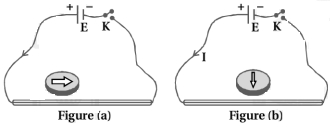
Solution
(N/A) As shown in the figure,a conducting wire is connected to a battery.
$A$ magnetic needle is placed near the conducting wire,which is stable in the North-South direction.
When the key is closed,the current flowing through the straight wire causes a deflection in the nearby magnetic compass needle. The alignment of the needle becomes tangential to an imaginary circle that has the straight wire as its center and its plane perpendicular to the wire. This situation is depicted in figure $(a)$.
Here,the needle is sufficiently close to the wire so that the Earth's magnetic field may be ignored.
Reversing the direction of the current reverses the orientation of the needle,which is depicted in figure $(b)$.
The deflection increases upon increasing the current or bringing the needle closer to the wire. This observation leads to the conclusion that moving charges or currents produce a magnetic field in the surrounding space.
$A$ magnetic needle is placed near the conducting wire,which is stable in the North-South direction.
When the key is closed,the current flowing through the straight wire causes a deflection in the nearby magnetic compass needle. The alignment of the needle becomes tangential to an imaginary circle that has the straight wire as its center and its plane perpendicular to the wire. This situation is depicted in figure $(a)$.
Here,the needle is sufficiently close to the wire so that the Earth's magnetic field may be ignored.
Reversing the direction of the current reverses the orientation of the needle,which is depicted in figure $(b)$.
The deflection increases upon increasing the current or bringing the needle closer to the wire. This observation leads to the conclusion that moving charges or currents produce a magnetic field in the surrounding space.
0 likes
View Solution300
Medium
Explain the experiment which demonstrates the magnetic field produced due to a straight long current-carrying wire.
Solution
(N/A) The experiment involves a long,straight current-carrying wire placed perpendicular to the plane of a sheet of paper. $A$ ring of small magnetic compass needles is placed around the wire to map the magnetic field.
$(a)$ When the current flows out of the plane of the paper (represented by a dot),the compass needles align in a counter-clockwise direction.
$(b)$ When the current flows into the plane of the paper (represented by a cross),the compass needles align in a clockwise direction.
$(c)$ If iron filings are sprinkled on the paper around the wire,they arrange themselves in concentric circles,representing the magnetic field lines.
The darkened ends of the needles represent the north poles. The effect of the Earth's magnetic field is assumed to be negligible. This experiment confirms that an electric current flowing through a conductor induces a magnetic field around it,which follows the right-hand thumb rule.
$(a)$ When the current flows out of the plane of the paper (represented by a dot),the compass needles align in a counter-clockwise direction.
$(b)$ When the current flows into the plane of the paper (represented by a cross),the compass needles align in a clockwise direction.
$(c)$ If iron filings are sprinkled on the paper around the wire,they arrange themselves in concentric circles,representing the magnetic field lines.
The darkened ends of the needles represent the north poles. The effect of the Earth's magnetic field is assumed to be negligible. This experiment confirms that an electric current flowing through a conductor induces a magnetic field around it,which follows the right-hand thumb rule.
0 likes
View SolutionMoving Charges and Magnetism — Biot-Savart's Law and its application · Frequently Asked Questions
1Are these Moving Charges and Magnetism questions useful for JEE and NEET?
Yes. All questions in this section are mapped to JEE Main and NEET exam patterns. Previous year questions from JEE Main, NEET, GUJCET and state-level exams are included with full solutions.
2Can I switch to Hindi or Gujarati for these questions?
Yes. Use the language tabs in the hero section or the sidebar to view the same questions and solutions in English, Hindi or Gujarati.
3How do I generate a question paper from this subtopic?
Use the Vedclass Exam Paper Generator — select the chapter and subtopic, set difficulty, and generate Sets A, B, C, D automatically. First 3 chapters of every subject are free.
Vedclass Products
For Students
Vedclass Test Series
Mock tests in real JEE/NEET style with performance analysis. 5-day free trial.
Start Free TrialFor Teachers
Exam Paper Generator
Generate Set A/B/C/D papers from this chapter in 2 minutes. 3 chapters free.
Try FreeFor Institutes
Online Exam Module
Live online exams with unlimited students, 360° analytics & white-label branding.
See DemoFor Teachers & Institutes
Generate a Moving Charges and Magnetism Exam Paper in 2 Minutes
Select subtopic & difficulty — Sets A, B, C, D auto-generated with No Repeat logic.
First 3 chapters of every subject are free — no payment required.