
A English
Ampere’s circuital law and its application (Solenoid and Toroid) Questions in English
Class 12 Physics · Moving Charges and Magnetism · Ampere’s circuital law and its application (Solenoid and Toroid)
206+
Questions
English
Language
100%
With Solutions
Showing 50 of 206 questions in English
151
EasyMCQ
The relative permeability in a core of a solenoid is $400$. The windings of a solenoid are insulated from the core and carry a current of $2 \ A$. If the number of turns is $1000$ per meter,then the magnetic intensity inside the core of the solenoid is . . . . . . $\frac{A}{m}$.
A
$2 \times 10^{-3}$
B
$2 \times 10^3$
C
$2.5 \times 10^3$
D
$2.5 \times 10^{-3}$
Solution
(B) The magnetic intensity $H$ inside a solenoid is given by the formula $H = nI$,where $n$ is the number of turns per unit length and $I$ is the current flowing through the solenoid.
Given:
Number of turns per meter,$n = 1000 \ m^{-1}$.
Current,$I = 2 \ A$.
Substituting these values into the formula:
$H = 1000 \times 2 = 2000 \ \frac{A}{m}$.
This can be written in scientific notation as $2 \times 10^3 \ \frac{A}{m}$.
Therefore,the correct option is $B$.
Given:
Number of turns per meter,$n = 1000 \ m^{-1}$.
Current,$I = 2 \ A$.
Substituting these values into the formula:
$H = 1000 \times 2 = 2000 \ \frac{A}{m}$.
This can be written in scientific notation as $2 \times 10^3 \ \frac{A}{m}$.
Therefore,the correct option is $B$.
0 likes
View Solution152
EasyMCQ
$A$ solenoid has a core of a material with relative permeability of $400$. The solenoid windings are insulated from the core and carry a current of $2 \text{ A}$. If the number of turns is $1000$ per meter,then the value of magnetic intensity will be . . . . . . .
A
$8 \times 10^5 \text{ A m}^{-1}$
B
$2 \times 10^3 \text{ A m}^{-1}$
C
$2 \times 10^{-3} \text{ A m}^{-1}$
D
$8 \times 10^{-5} \text{ A m}^{-1}$
Solution
(B) The magnetic intensity $H$ inside a solenoid is given by the formula $H = nI$,where $n$ is the number of turns per unit length and $I$ is the current flowing through the solenoid.
Given:
Number of turns per unit length $n = 1000 \text{ m}^{-1}$
Current $I = 2 \text{ A}$
Relative permeability $\mu_r = 400$ (Note: This value is not required to calculate magnetic intensity $H$,as $H$ depends only on the geometry and current).
Substituting the values into the formula:
$H = 1000 \times 2$
$H = 2000 \text{ A m}^{-1}$
$H = 2 \times 10^3 \text{ A m}^{-1}$
Therefore,the correct option is $B$.
Given:
Number of turns per unit length $n = 1000 \text{ m}^{-1}$
Current $I = 2 \text{ A}$
Relative permeability $\mu_r = 400$ (Note: This value is not required to calculate magnetic intensity $H$,as $H$ depends only on the geometry and current).
Substituting the values into the formula:
$H = 1000 \times 2$
$H = 2000 \text{ A m}^{-1}$
$H = 2 \times 10^3 \text{ A m}^{-1}$
Therefore,the correct option is $B$.
0 likes
View Solution153
EasyMCQ
$A$ solenoid of length $0.5 \ m$ has a radius of $1 \ cm$ and is made up of $250$ turns. It carries a current of $5 \ A$. What is the magnitude of the magnetic field inside the solenoid?
A
$3.14 \times 10^{-3} \ T$
B
$6.28 \times 10^{-3} \ T$
C
$62.8 \times 10^{-3} \ T$
D
Zero
Solution
(A) The magnetic field $B$ inside a long solenoid is given by the formula: $B = \mu_0 n I$, where $n = N/l$ is the number of turns per unit length.
Given:
Length $l = 0.5 \ m$
Number of turns $N = 250$
Current $I = 5 \ A$
Permeability of free space $\mu_0 = 4\pi \times 10^{-7} \ T \cdot m/A$
Substituting the values:
$B = \frac{\mu_0 N I}{l}$
$B = \frac{4 \pi \times 10^{-7} \times 250 \times 5}{0.5}$
$B = \frac{4 \times 3.14159 \times 10^{-7} \times 1250}{0.5}$
$B = 8 \pi \times 10^{-7} \times 1250$
$B = 10000 \pi \times 10^{-7} \ T$
$B = \pi \times 10^{-3} \ T \approx 3.14 \times 10^{-3} \ T$.
Given:
Length $l = 0.5 \ m$
Number of turns $N = 250$
Current $I = 5 \ A$
Permeability of free space $\mu_0 = 4\pi \times 10^{-7} \ T \cdot m/A$
Substituting the values:
$B = \frac{\mu_0 N I}{l}$
$B = \frac{4 \pi \times 10^{-7} \times 250 \times 5}{0.5}$
$B = \frac{4 \times 3.14159 \times 10^{-7} \times 1250}{0.5}$
$B = 8 \pi \times 10^{-7} \times 1250$
$B = 10000 \pi \times 10^{-7} \ T$
$B = \pi \times 10^{-3} \ T \approx 3.14 \times 10^{-3} \ T$.
0 likes
View Solution154
EasyMCQ
$A$ solenoid has a core of a material with relative permeability $400$. The windings of the solenoid are insulated from the core and carry a current of $1 \text{ A}$. If the number of turns is $1000 \text{ per metre}$,the magnetic field $(B)$ is . . . . . . $\text{T}$. (Given: $\mu_0 = 4\pi \times 10^{-7} \text{ SI units}$)
A
$1.6\pi \times 10^2$
B
$16\pi \times 10^2$
C
$16\pi \times 10^{-2}$
D
$0.16\pi \times 10^{-2}$
Solution
(C) The magnetic field inside a solenoid with a magnetic core is given by the formula:
$B = \mu_0 \mu_r n I$
Where:
$\mu_0 = 4\pi \times 10^{-7} \text{ T m/A}$
$\mu_r = 400$
$n = 1000 \text{ turns/m}$
$I = 1 \text{ A}$
Substituting the values:
$B = (4\pi \times 10^{-7}) \times 400 \times 1000 \times 1$
$B = 4\pi \times 4 \times 10^5 \times 10^{-7}$
$B = 16\pi \times 10^{-2} \text{ T}$
$B = \mu_0 \mu_r n I$
Where:
$\mu_0 = 4\pi \times 10^{-7} \text{ T m/A}$
$\mu_r = 400$
$n = 1000 \text{ turns/m}$
$I = 1 \text{ A}$
Substituting the values:
$B = (4\pi \times 10^{-7}) \times 400 \times 1000 \times 1$
$B = 4\pi \times 4 \times 10^5 \times 10^{-7}$
$B = 16\pi \times 10^{-2} \text{ T}$
0 likes
View Solution155
EasyMCQ
$A$ solenoid of length $0.25 \ m$ has a radius of $1 \ cm$ and is made up of $500$ turns. It carries a current of $2.5 \ A$. What is the magnitude of the magnetic field inside the solenoid? (Take $\mu_0 = 4 \pi \times 10^{-7} \ SI$ units).
A
$6.28 \times 10^{-3} \ T$
B
$6.28 \times 10^{-2} \ T$
C
$6.28 \times 10^{-4} \ T$
D
$6.28 \times 10^{-1} \ T$
Solution
(A) The magnetic field $B$ inside a long solenoid is given by the formula $B = \mu_0 n I$, where $n = N/l$ is the number of turns per unit length.
Given:
Length $l = 0.25 \ m$
Number of turns $N = 500$
Current $I = 2.5 \ A$
Permeability $\mu_0 = 4 \pi \times 10^{-7} \ T \cdot m/A$
Calculation:
$n = \frac{500}{0.25} = 2000 \ turns/m$
$B = (4 \pi \times 10^{-7}) \times 2000 \times 2.5$
$B = 4 \times 3.14 \times 10^{-7} \times 5000$
$B = 12.56 \times 10^{-4} \ T = 6.28 \times 2 \times 10^{-4} \ T = 6.28 \times 10^{-3} \ T$.
Given:
Length $l = 0.25 \ m$
Number of turns $N = 500$
Current $I = 2.5 \ A$
Permeability $\mu_0 = 4 \pi \times 10^{-7} \ T \cdot m/A$
Calculation:
$n = \frac{500}{0.25} = 2000 \ turns/m$
$B = (4 \pi \times 10^{-7}) \times 2000 \times 2.5$
$B = 4 \times 3.14 \times 10^{-7} \times 5000$
$B = 12.56 \times 10^{-4} \ T = 6.28 \times 2 \times 10^{-4} \ T = 6.28 \times 10^{-3} \ T$.
0 likes
View Solution156
EasyMCQ
$A$ solenoid of length $0.5 \ m$ has a radius of $1 \ cm$ and is made up of $1000$ turns. It carries a current of $10 \ A$. What is the magnitude of the magnetic field inside the solenoid?
A
$2.51 \times 10^{-2} \ T$
B
$1.71 \times 10^{-2} \ T$
C
$6.28 \times 10^{-3} \ T$
D
$7.23 \times 10^{-3} \ T$
Solution
(A) The magnetic field $B$ inside a long solenoid is given by the formula: $B = \mu_0 n I$,where $n = \frac{N}{l}$ is the number of turns per unit length.
Given:
Length $l = 0.5 \ m$
Number of turns $N = 1000$
Current $I = 10 \ A$
Permeability of free space $\mu_0 = 4\pi \times 10^{-7} \ T \cdot m/A$
Substituting the values:
$n = \frac{1000}{0.5} = 2000 \ turns/m$
$B = (4\pi \times 10^{-7}) \times 2000 \times 10$
$B = 8\pi \times 10^{-3} \ T$
$B \approx 25.12 \times 10^{-3} \ T = 2.51 \times 10^{-2} \ T$.
Given:
Length $l = 0.5 \ m$
Number of turns $N = 1000$
Current $I = 10 \ A$
Permeability of free space $\mu_0 = 4\pi \times 10^{-7} \ T \cdot m/A$
Substituting the values:
$n = \frac{1000}{0.5} = 2000 \ turns/m$
$B = (4\pi \times 10^{-7}) \times 2000 \times 10$
$B = 8\pi \times 10^{-3} \ T$
$B \approx 25.12 \times 10^{-3} \ T = 2.51 \times 10^{-2} \ T$.
0 likes
View Solution157
EasyMCQ
There are $50$ turns per $cm$ length in a very long solenoid. It carries a current of $2.5 \ A$. The magnetic field at its centre on the axis is . . . . . . $T$.
A
$2 \pi \times 10^{-3}$
B
$5 \pi \times 10^{-3}$
C
$6 \pi \times 10^{-3}$
D
$4 \pi \times 10^{-3}$
Solution
(B) The magnetic field $B$ at the center of a long solenoid is given by the formula $B = \mu_0 n I$,where $n$ is the number of turns per unit length and $I$ is the current.
Given:
Number of turns per unit length $n = 50 \text{ turns/cm} = 50 \times 10^2 \text{ turns/m} = 5000 \text{ turns/m}$.
Current $I = 2.5 \ A$.
Permeability of free space $\mu_0 = 4 \pi \times 10^{-7} \ T \cdot m/A$.
Substituting the values:
$B = (4 \pi \times 10^{-7}) \times (5000) \times (2.5)$
$B = 4 \pi \times 10^{-7} \times 12500$
$B = 4 \pi \times 1.25 \times 10^{-3}$
$B = 5 \pi \times 10^{-3} \ T$.
Given:
Number of turns per unit length $n = 50 \text{ turns/cm} = 50 \times 10^2 \text{ turns/m} = 5000 \text{ turns/m}$.
Current $I = 2.5 \ A$.
Permeability of free space $\mu_0 = 4 \pi \times 10^{-7} \ T \cdot m/A$.
Substituting the values:
$B = (4 \pi \times 10^{-7}) \times (5000) \times (2.5)$
$B = 4 \pi \times 10^{-7} \times 12500$
$B = 4 \pi \times 1.25 \times 10^{-3}$
$B = 5 \pi \times 10^{-3} \ T$.
0 likes
View Solution158
EasyMCQ
$A$ very long straight wire of radius $r$ carries current $I$. The intensity of the magnetic field $B$ at a point,lying at a perpendicular distance $a$ from the axis is proportional to: (where $a < r$)
A
$a^2$
B
$1/a^2$
C
$1/a$
D
$a$
Solution
(D) For a long straight wire of radius $r$ carrying a uniform current $I$,the magnetic field $B$ at a distance $a$ from the axis inside the wire $(a < r)$ is given by Ampere's Law.
Using Ampere's circuital law: $\oint B \cdot dl = \mu_0 I_{enclosed}$.
For a point inside the wire,the enclosed current $I_{enclosed} = I \times (\frac{\pi a^2}{\pi r^2}) = I \frac{a^2}{r^2}$.
Thus,$B(2 \pi a) = \mu_0 I \frac{a^2}{r^2}$.
Solving for $B$,we get $B = \frac{\mu_0 I a}{2 \pi r^2}$.
Since $\mu_0$,$I$,and $r$ are constants,$B \propto a$.
Using Ampere's circuital law: $\oint B \cdot dl = \mu_0 I_{enclosed}$.
For a point inside the wire,the enclosed current $I_{enclosed} = I \times (\frac{\pi a^2}{\pi r^2}) = I \frac{a^2}{r^2}$.
Thus,$B(2 \pi a) = \mu_0 I \frac{a^2}{r^2}$.
Solving for $B$,we get $B = \frac{\mu_0 I a}{2 \pi r^2}$.
Since $\mu_0$,$I$,and $r$ are constants,$B \propto a$.
0 likes
View Solution159
EasyMCQ
$A$ closely wound solenoid $120 \ cm$ long has $4$ layers of windings of $400$ turns each. The diameter of the solenoid is $1.8 \ cm$. If the current carried is $8.0 \ A$,estimate the magnitude of $B$ inside the solenoid near its centre.
A
$5.12 \pi \times 10^{-7} \ T$
B
$4.27 \pi \times 10^{-3} \ T$
C
$5.12 \pi \times 10^{-3} \ T$
D
$8 \pi \times 10^{-3} \ T$
Solution
(B) The magnetic field $B$ inside a long solenoid near its centre is given by the formula $B = \mu_0 n I$,where $n$ is the number of turns per unit length.
Given:
Length of solenoid $L = 120 \ cm = 1.2 \ m$.
Number of layers $= 4$.
Turns per layer $= 400$.
Total number of turns $N = 4 \times 400 = 1600$.
Current $I = 8.0 \ A$.
Number of turns per unit length $n = \frac{N}{L} = \frac{1600}{1.2} = \frac{4000}{3} \ m^{-1}$.
Substituting the values into the formula:
$B = (4 \pi \times 10^{-7} \ T \cdot m/A) \times (\frac{4000}{3} \ m^{-1}) \times (8.0 \ A)$.
$B = 4 \pi \times 10^{-7} \times \frac{32000}{3} \ T$.
$B = \frac{128000}{3} \pi \times 10^{-7} \ T$.
$B \approx 42666.67 \pi \times 10^{-7} \ T$.
$B \approx 4.266 \pi \times 10^{-3} \ T$.
Rounding to two decimal places,we get $B \approx 4.27 \pi \times 10^{-3} \ T$.
Given:
Length of solenoid $L = 120 \ cm = 1.2 \ m$.
Number of layers $= 4$.
Turns per layer $= 400$.
Total number of turns $N = 4 \times 400 = 1600$.
Current $I = 8.0 \ A$.
Number of turns per unit length $n = \frac{N}{L} = \frac{1600}{1.2} = \frac{4000}{3} \ m^{-1}$.
Substituting the values into the formula:
$B = (4 \pi \times 10^{-7} \ T \cdot m/A) \times (\frac{4000}{3} \ m^{-1}) \times (8.0 \ A)$.
$B = 4 \pi \times 10^{-7} \times \frac{32000}{3} \ T$.
$B = \frac{128000}{3} \pi \times 10^{-7} \ T$.
$B \approx 42666.67 \pi \times 10^{-7} \ T$.
$B \approx 4.266 \pi \times 10^{-3} \ T$.
Rounding to two decimal places,we get $B \approx 4.27 \pi \times 10^{-3} \ T$.
0 likes
View Solution160
EasyMCQ
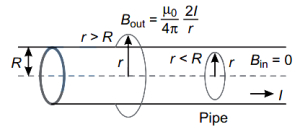
$A$ direct current $I$ flows along the length of an infinitely long straight thin-walled pipe. Then the magnetic field is
A
uniform throughout the pipe but not zero
B
zero only along the axis of the pipe
C
zero at any point inside the pipe
D
maximum at the centre and minimum at the edge
Solution
(C) According to Ampere's circuital law,the line integral of the magnetic field $\vec{B}$ around any closed path is equal to $\mu_{0}$ times the net current $I_{\text{enclosed}}$ passing through the surface bounded by the path: $\oint \vec{B} \cdot d\vec{l} = \mu_{0} I_{\text{enclosed}}$.
For an internal point inside the pipe where the radial distance $r < R$ (where $R$ is the radius of the pipe),any closed circular path drawn inside the pipe encloses zero net current because the current flows only through the walls of the pipe.
Thus,$I_{\text{enclosed}} = 0$.
Applying Ampere's law: $B(2 \pi r) = \mu_{0}(0) \implies B = 0$.
Therefore,the magnetic field is zero at any point inside the pipe.
For an external point where $r > R$,the path encloses the total current $I$,so $B(2 \pi r) = \mu_{0} I \implies B = \frac{\mu_{0} I}{2 \pi r}$.
Hence,option $(c)$ is correct.
For an internal point inside the pipe where the radial distance $r < R$ (where $R$ is the radius of the pipe),any closed circular path drawn inside the pipe encloses zero net current because the current flows only through the walls of the pipe.
Thus,$I_{\text{enclosed}} = 0$.
Applying Ampere's law: $B(2 \pi r) = \mu_{0}(0) \implies B = 0$.
Therefore,the magnetic field is zero at any point inside the pipe.
For an external point where $r > R$,the path encloses the total current $I$,so $B(2 \pi r) = \mu_{0} I \implies B = \frac{\mu_{0} I}{2 \pi r}$.
Hence,option $(c)$ is correct.
0 likes
View Solution161
MediumMCQ
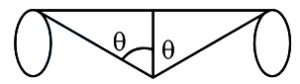
$A$ solenoid is $1 \ m$ long and $4 \ cm$ in diameter. It has five layers of windings of $1000$ turns each and carries a current of $7 \ A$. The magnetic field at the centre of the solenoid is
A
$0.4396 \times 10^{-5} \ T$
B
$4.396 \times 10^{-2} \ T$
C
$43.96 \times 10^{-2} \ T$
D
$439.6 \ T$
Solution
(B) Given: Length of solenoid $\ell = 1 \ m$,Diameter $d = 4 \ cm$,Radius $r = 2 \ cm = 0.02 \ m$.
Total number of turns $N = 5 \times 1000 = 5000$.
Current $I = 7 \ A$.
The magnetic field at the centre of a finite solenoid is given by $B = \frac{\mu_0 N I}{2\ell} (\cos \theta_1 + \cos \theta_2)$.
Since the solenoid is long compared to its radius,we can approximate the field using the formula for an ideal solenoid $B = \mu_0 n I$,where $n = N/\ell$.
$B = \frac{\mu_0 N I}{\ell} = \frac{4\pi \times 10^{-7} \times 5000 \times 7}{1}$.
$B = 4\pi \times 10^{-7} \times 35000 = 14\pi \times 10^{-3} \ T$.
$B \approx 14 \times 3.14159 \times 10^{-3} \ T = 43.98 \times 10^{-3} \ T = 4.398 \times 10^{-2} \ T$.
Rounding to the given options,the correct value is $4.396 \times 10^{-2} \ T$.
Total number of turns $N = 5 \times 1000 = 5000$.
Current $I = 7 \ A$.
The magnetic field at the centre of a finite solenoid is given by $B = \frac{\mu_0 N I}{2\ell} (\cos \theta_1 + \cos \theta_2)$.
Since the solenoid is long compared to its radius,we can approximate the field using the formula for an ideal solenoid $B = \mu_0 n I$,where $n = N/\ell$.
$B = \frac{\mu_0 N I}{\ell} = \frac{4\pi \times 10^{-7} \times 5000 \times 7}{1}$.
$B = 4\pi \times 10^{-7} \times 35000 = 14\pi \times 10^{-3} \ T$.
$B \approx 14 \times 3.14159 \times 10^{-3} \ T = 43.98 \times 10^{-3} \ T = 4.398 \times 10^{-2} \ T$.
Rounding to the given options,the correct value is $4.396 \times 10^{-2} \ T$.
0 likes
View Solution162
EasyMCQ
$A$ solenoid of length $50 \,cm$ having $100$ turns carries a current of $2.5 \,A$. The magnetic field at one end of the solenoid is
A
$6.28 \times 10^{-4} \,T$
B
$1.57 \times 10^{-4} \,T$
C
$9.42 \times 10^{-4} \,T$
D
$3.14 \times 10^{-4} \,T$
Solution
(D) Given,length of solenoid,$l = 50 \,cm = 0.5 \,m$.
Number of turns,$N = 100$.
Current,$I = 2.5 \,A$.
Number of turns per unit length in the solenoid is given by $n = \frac{N}{l} = \frac{100}{0.5} = 200 \,turns/m$.
The magnetic field at one end of a long solenoid is given by the formula $B = \frac{\mu_0 n I}{2}$.
Substituting the values,we get $B = \frac{4\pi \times 10^{-7} \times 200 \times 2.5}{2}$.
$B = 2\pi \times 10^{-7} \times 500 = 1000\pi \times 10^{-7} = \pi \times 10^{-4} \,T$.
Using $\pi \approx 3.14$,we get $B = 3.14 \times 10^{-4} \,T$.
Number of turns,$N = 100$.
Current,$I = 2.5 \,A$.
Number of turns per unit length in the solenoid is given by $n = \frac{N}{l} = \frac{100}{0.5} = 200 \,turns/m$.
The magnetic field at one end of a long solenoid is given by the formula $B = \frac{\mu_0 n I}{2}$.
Substituting the values,we get $B = \frac{4\pi \times 10^{-7} \times 200 \times 2.5}{2}$.
$B = 2\pi \times 10^{-7} \times 500 = 1000\pi \times 10^{-7} = \pi \times 10^{-4} \,T$.
Using $\pi \approx 3.14$,we get $B = 3.14 \times 10^{-4} \,T$.
0 likes
View Solution163
MediumMCQ
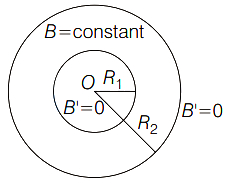
$A$ toroid with thick windings of $N$ turns has inner and outer radii $R_{1}$ and $R_{2}$,respectively. If it carries a steady current $I$,the variation of the magnetic field due to the toroid with radial distance $r$ is correctly graphed in
A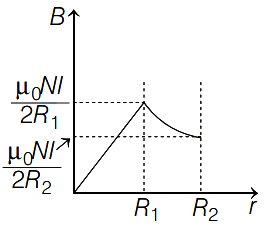
B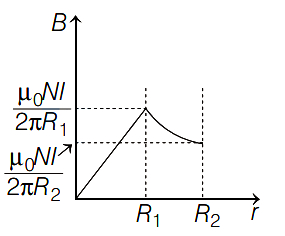
C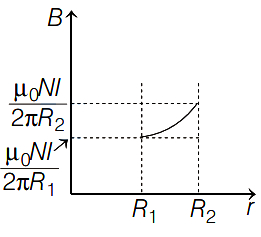
D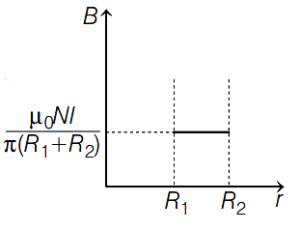
Solution
(C) The magnetic field $B$ due to a toroid is determined using Ampere's circuital law:
$(i)$ For $r < R_{1}$ (inside the hollow space of the toroid),the net current enclosed is zero,so $B = 0$.
(ii) For $R_{1} < r < R_{2}$ (inside the core of the toroid),the magnetic field is given by $B = \frac{\mu_{0} N I}{2 \pi r}$.
(iii) For $r > R_{2}$ (outside the toroid),the net current enclosed by the Amperian loop is zero,so $B = 0$.
Since the question asks for the variation of the magnetic field with radial distance $r$ within the core,and the options provided represent the behavior across the cross-section,the correct representation for the field inside the toroid is a curve proportional to $1/r$,which is shown in graph $C$.
$(i)$ For $r < R_{1}$ (inside the hollow space of the toroid),the net current enclosed is zero,so $B = 0$.
(ii) For $R_{1} < r < R_{2}$ (inside the core of the toroid),the magnetic field is given by $B = \frac{\mu_{0} N I}{2 \pi r}$.
(iii) For $r > R_{2}$ (outside the toroid),the net current enclosed by the Amperian loop is zero,so $B = 0$.
Since the question asks for the variation of the magnetic field with radial distance $r$ within the core,and the options provided represent the behavior across the cross-section,the correct representation for the field inside the toroid is a curve proportional to $1/r$,which is shown in graph $C$.
0 likes
View Solution164
EasyMCQ
$A$ long cylindrical wire of radius $R$ carries a uniform current $I$ flowing through it. The variation of magnetic field $B$ with distance $r$ from the axis of the wire is shown by:
A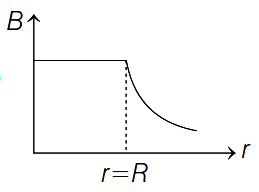
B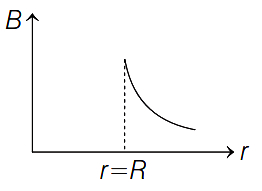
C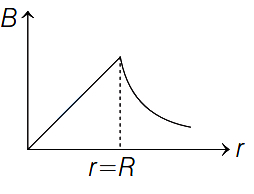
D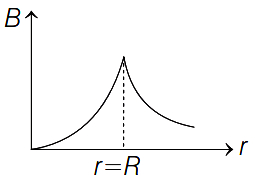
Solution
(C) For a long cylindrical wire of radius $R$ carrying a uniform current $I$:
$1$. Inside the wire $(r < R)$,the magnetic field $B_{\text{in}}$ is given by $B_{\text{in}} = \frac{\mu_0 I r}{2 \pi R^2}$. Since $\mu_0, I, R$ are constants,we have $B_{\text{in}} \propto r$. This represents a straight line passing through the origin.
$2$. Outside the wire $(r > R)$,the magnetic field $B_{\text{out}}$ is given by $B_{\text{out}} = \frac{\mu_0 I}{2 \pi r}$. Since $\mu_0, I$ are constants,we have $B_{\text{out}} \propto \frac{1}{r}$. This represents a rectangular hyperbola.
$3$. At the surface $(r = R)$,the magnetic field is maximum,$B_{\text{max}} = \frac{\mu_0 I}{2 \pi R}$.
Combining these,the graph shows a linear increase for $r < R$ and a hyperbolic decrease for $r > R$,which corresponds to Graph $C$.
$1$. Inside the wire $(r < R)$,the magnetic field $B_{\text{in}}$ is given by $B_{\text{in}} = \frac{\mu_0 I r}{2 \pi R^2}$. Since $\mu_0, I, R$ are constants,we have $B_{\text{in}} \propto r$. This represents a straight line passing through the origin.
$2$. Outside the wire $(r > R)$,the magnetic field $B_{\text{out}}$ is given by $B_{\text{out}} = \frac{\mu_0 I}{2 \pi r}$. Since $\mu_0, I$ are constants,we have $B_{\text{out}} \propto \frac{1}{r}$. This represents a rectangular hyperbola.
$3$. At the surface $(r = R)$,the magnetic field is maximum,$B_{\text{max}} = \frac{\mu_0 I}{2 \pi R}$.
Combining these,the graph shows a linear increase for $r < R$ and a hyperbolic decrease for $r > R$,which corresponds to Graph $C$.
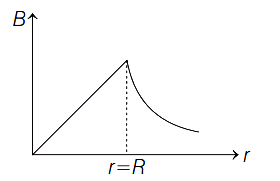
0 likes
View Solution165
MediumMCQ
$A$ toroid has $500$ turns per metre length. If it carries a current of $2 \text{ A}$, the magnetic energy density inside the toroid is: (in $\text{ J/m}^3$)
A
$6.28$
B
$0.628$
C
$3.14$
D
$0.314$
Solution
(B) The magnetic field $B$ inside a toroid is given by $B = \mu_0 n I$, where $n$ is the number of turns per unit length and $I$ is the current.
Given: $n = 500 \text{ m}^{-1}$, $I = 2 \text{ A}$, $\mu_0 = 4\pi \times 10^{-7} \text{ T m/A}$.
The magnetic energy density $u_B$ is given by $u_B = \frac{B^2}{2\mu_0}$.
Substituting $B = \mu_0 n I$ into the formula, we get $u_B = \frac{(\mu_0 n I)^2}{2\mu_0} = \frac{\mu_0 n^2 I^2}{2}$.
Calculating the value: $u_B = \frac{(4\pi \times 10^{-7}) \times (500)^2 \times (2)^2}{2}$.
$u_B = \frac{(4\pi \times 10^{-7}) \times 250000 \times 4}{2} = 2\pi \times 10^{-7} \times 10^6 = 2\pi \times 10^{-1} = 0.2 \times 3.14 = 0.628 \text{ J/m}^3$.
Given: $n = 500 \text{ m}^{-1}$, $I = 2 \text{ A}$, $\mu_0 = 4\pi \times 10^{-7} \text{ T m/A}$.
The magnetic energy density $u_B$ is given by $u_B = \frac{B^2}{2\mu_0}$.
Substituting $B = \mu_0 n I$ into the formula, we get $u_B = \frac{(\mu_0 n I)^2}{2\mu_0} = \frac{\mu_0 n^2 I^2}{2}$.
Calculating the value: $u_B = \frac{(4\pi \times 10^{-7}) \times (500)^2 \times (2)^2}{2}$.
$u_B = \frac{(4\pi \times 10^{-7}) \times 250000 \times 4}{2} = 2\pi \times 10^{-7} \times 10^6 = 2\pi \times 10^{-1} = 0.2 \times 3.14 = 0.628 \text{ J/m}^3$.
0 likes
View Solution166
MediumMCQ
$A$ long solenoid with $ 40 $ turns per cm carries a current of $ 1 \,A $. The magnetic energy stored per unit volume is $ J m^{-3} $. (in $\pi$)
A
$3.2$
B
$32$
C
$1.6$
D
$6.4$
Solution
(A) Given: Number of turns per unit length $ n = 40 \text{ turns/cm} = 4000 \text{ turns/m} = 4 \times 10^3 \text{ m}^{-1} $.
Current $ I = 1 \text{ A} $.
The magnetic energy stored per unit volume $ u_m $ is given by the formula $ u_m = \frac{1}{2} \frac{B^2}{\mu_0} = \frac{1}{2} \mu_0 n^2 I^2 $.
Substituting the values:
$ u_m = \frac{1}{2} \times (4\pi \times 10^{-7} \text{ T m/A}) \times (4 \times 10^3 \text{ m}^{-1})^2 \times (1 \text{ A})^2 $.
$ u_m = \frac{1}{2} \times 4\pi \times 10^{-7} \times 16 \times 10^6 \times 1 $.
$ u_m = 2\pi \times 16 \times 10^{-1} $.
$ u_m = 32\pi \times 0.1 = 3.2\pi \text{ J m}^{-3} $.
Current $ I = 1 \text{ A} $.
The magnetic energy stored per unit volume $ u_m $ is given by the formula $ u_m = \frac{1}{2} \frac{B^2}{\mu_0} = \frac{1}{2} \mu_0 n^2 I^2 $.
Substituting the values:
$ u_m = \frac{1}{2} \times (4\pi \times 10^{-7} \text{ T m/A}) \times (4 \times 10^3 \text{ m}^{-1})^2 \times (1 \text{ A})^2 $.
$ u_m = \frac{1}{2} \times 4\pi \times 10^{-7} \times 16 \times 10^6 \times 1 $.
$ u_m = 2\pi \times 16 \times 10^{-1} $.
$ u_m = 32\pi \times 0.1 = 3.2\pi \text{ J m}^{-3} $.
0 likes
View Solution167
EasyMCQ
$A$ solenoid has a length of $0.4 \,m$, a radius of $1 \,cm$, and $400$ turns of wire. If a current of $5 \,A$ is passed through this solenoid, what is the magnetic field inside the solenoid?
A
$6.28 \times 10^{-3} \,T$
B
$6.28 \times 10^{-2} \,T$
C
$6.28 \times 10^{-4} \,T$
D
$6.28 \,T$
Solution
(A) Given: Length of solenoid $l = 0.4 \,m$, number of turns $N = 400$, current $I = 5 \,A$.
The number of turns per unit length $n = \frac{N}{l} = \frac{400}{0.4} = 1000 \,m^{-1}$.
The magnetic field inside a long solenoid is given by $B = \mu_0 n I$.
Substituting the values: $B = (4\pi \times 10^{-7}) \times 1000 \times 5$.
$B = 4 \times 3.14159 \times 10^{-7} \times 5000$.
$B = 20 \times 3.14159 \times 10^{-4} = 62.83 \times 10^{-4} = 6.28 \times 10^{-3} \,T$.
The number of turns per unit length $n = \frac{N}{l} = \frac{400}{0.4} = 1000 \,m^{-1}$.
The magnetic field inside a long solenoid is given by $B = \mu_0 n I$.
Substituting the values: $B = (4\pi \times 10^{-7}) \times 1000 \times 5$.
$B = 4 \times 3.14159 \times 10^{-7} \times 5000$.
$B = 20 \times 3.14159 \times 10^{-4} = 62.83 \times 10^{-4} = 6.28 \times 10^{-3} \,T$.
0 likes
View Solution168
MediumMCQ
$A$ particle of mass $2.2 \times 10^{-30} \,kg$ and charge $1.6 \times 10^{-19} \,C$ is moving at a speed of $10 \,km/s$ in a circular path of radius $2.8 \,cm$ inside a solenoid. The solenoid has $25 \,turns/cm$ and its magnetic field is perpendicular to the plane of the particle's path. The current in the solenoid is (Take $\mu_0 = 4\pi \times 10^{-7} \,H/m$) (in $\,mA$)
A
$1.25$
B
$10.20$
C
$2.50$
D
$1.56$
Solution
(D) Given: Mass $m = 2.2 \times 10^{-30} \,kg$,Charge $q = 1.6 \times 10^{-19} \,C$,Velocity $v = 10 \,km/s = 10^4 \,m/s$,Radius $r = 2.8 \,cm = 2.8 \times 10^{-2} \,m$,Turns per unit length $n = 25 \,turns/cm = 2500 \,turns/m$.
For a charged particle in a magnetic field,the radius of the circular path is given by $r = \frac{mv}{Bq}$.
The magnetic field inside a solenoid is $B = \mu_0 n I$.
Substituting $B$ into the radius formula: $r = \frac{mv}{(\mu_0 n I)q}$.
Rearranging for current $I$: $I = \frac{mv}{\mu_0 n q r}$.
Substituting the values: $I = \frac{2.2 \times 10^{-30} \times 10^4}{4\pi \times 10^{-7} \times 2500 \times 1.6 \times 10^{-19} \times 2.8 \times 10^{-2}}$.
$I = \frac{2.2 \times 10^{-26}}{4 \times 3.14159 \times 10^{-7} \times 2500 \times 1.6 \times 10^{-19} \times 2.8 \times 10^{-2}} \approx 1.56 \times 10^{-3} \,A = 1.56 \,mA$.
For a charged particle in a magnetic field,the radius of the circular path is given by $r = \frac{mv}{Bq}$.
The magnetic field inside a solenoid is $B = \mu_0 n I$.
Substituting $B$ into the radius formula: $r = \frac{mv}{(\mu_0 n I)q}$.
Rearranging for current $I$: $I = \frac{mv}{\mu_0 n q r}$.
Substituting the values: $I = \frac{2.2 \times 10^{-30} \times 10^4}{4\pi \times 10^{-7} \times 2500 \times 1.6 \times 10^{-19} \times 2.8 \times 10^{-2}}$.
$I = \frac{2.2 \times 10^{-26}}{4 \times 3.14159 \times 10^{-7} \times 2500 \times 1.6 \times 10^{-19} \times 2.8 \times 10^{-2}} \approx 1.56 \times 10^{-3} \,A = 1.56 \,mA$.
0 likes
View Solution169
MediumMCQ
The maximum magnetic field produced by a current of $12 \ A$ passing through a copper wire of diameter $1.2 \ mm$ is (in $mT$)
A
$2$
B
$4$
C
$1.5$
D
$8$
Solution
(B) The magnetic field $B$ at the surface of a wire carrying current $I$ is given by the formula derived from Ampere's Law: $B = \frac{\mu_0 I}{2 \pi r}$.
Here,the current $I = 12 \ A$.
The diameter of the wire is $d = 1.2 \ mm = 1.2 \times 10^{-3} \ m$.
The radius $r = \frac{d}{2} = 0.6 \times 10^{-3} \ m$.
The permeability of free space $\mu_0 = 4 \pi \times 10^{-7} \ T \cdot m/A$.
Substituting the values:
$B = \frac{(4 \pi \times 10^{-7}) \times 12}{2 \pi \times 0.6 \times 10^{-3}}$
$B = \frac{2 \times 10^{-7} \times 12}{0.6 \times 10^{-3}}$
$B = \frac{24 \times 10^{-7}}{0.6 \times 10^{-3}} = 40 \times 10^{-4} \ T = 4 \times 10^{-3} \ T = 4 \ mT$.
Thus,the maximum magnetic field is $4 \ mT$.
Here,the current $I = 12 \ A$.
The diameter of the wire is $d = 1.2 \ mm = 1.2 \times 10^{-3} \ m$.
The radius $r = \frac{d}{2} = 0.6 \times 10^{-3} \ m$.
The permeability of free space $\mu_0 = 4 \pi \times 10^{-7} \ T \cdot m/A$.
Substituting the values:
$B = \frac{(4 \pi \times 10^{-7}) \times 12}{2 \pi \times 0.6 \times 10^{-3}}$
$B = \frac{2 \times 10^{-7} \times 12}{0.6 \times 10^{-3}}$
$B = \frac{24 \times 10^{-7}}{0.6 \times 10^{-3}} = 40 \times 10^{-4} \ T = 4 \times 10^{-3} \ T = 4 \ mT$.
Thus,the maximum magnetic field is $4 \ mT$.
0 likes
View Solution170
EasyMCQ
Among the following,Ampere's circuital law is represented by
A
$\oint B \cdot dl = 0$
B
$\oint B \cdot dl = \mu_0 I$
C
$\oint B \cdot dl = \frac{\mu_0}{I}$
D
$\oint B \cdot dl = \mu_0$
Solution
(B) Ampere's circuital law states that the line integral of the magnetic field $B$ around any closed loop is equal to $\mu_0$ times the total current $I$ passing through the surface enclosed by the loop.
Mathematically,this is expressed as $\oint B \cdot dl = \mu_0 I$.
Mathematically,this is expressed as $\oint B \cdot dl = \mu_0 I$.
0 likes
View Solution171
EasyMCQ
If the magnetic field inside a solenoid is $B$,then the magnetic energy stored in it per unit volume is (where $c$ is the speed of light in vacuum and $\varepsilon_0$ is the permittivity of free space).
A
$\varepsilon_0 c^2 B^2$
B
$\frac{\varepsilon_0 c^2 B^2}{2}$
C
$2 \varepsilon_0 c^2 B^2$
D
$\frac{\varepsilon_0 c^2 B^2}{4}$
Solution
(B) The magnetic energy density $(u_B)$ stored in a magnetic field $B$ is given by the formula: $u_B = \frac{B^2}{2\mu_0}$.
We know that the speed of light in vacuum is $c = \frac{1}{\sqrt{\mu_0 \varepsilon_0}}$,which implies $c^2 = \frac{1}{\mu_0 \varepsilon_0}$.
From this,we can express the permeability of free space as $\mu_0 = \frac{1}{\varepsilon_0 c^2}$.
Substituting this value of $\mu_0$ into the energy density formula:
$u_B = \frac{B^2}{2(1 / \varepsilon_0 c^2)}$
$u_B = \frac{\varepsilon_0 c^2 B^2}{2}$.
Therefore,the correct option is $B$.
We know that the speed of light in vacuum is $c = \frac{1}{\sqrt{\mu_0 \varepsilon_0}}$,which implies $c^2 = \frac{1}{\mu_0 \varepsilon_0}$.
From this,we can express the permeability of free space as $\mu_0 = \frac{1}{\varepsilon_0 c^2}$.
Substituting this value of $\mu_0$ into the energy density formula:
$u_B = \frac{B^2}{2(1 / \varepsilon_0 c^2)}$
$u_B = \frac{\varepsilon_0 c^2 B^2}{2}$.
Therefore,the correct option is $B$.
0 likes
View Solution172
MediumMCQ
$A$ solenoid of $1 \ m$ length and $3.55 \ cm$ inner diameter carries a current of $5 \ A$. If the solenoid consists of five closely packed layers each with $700$ turns along its length,then the magnetic field at its centre is (in $mT$)
A
$22$
B
$35$
C
$44$
D
$15$
Solution
(A) The magnetic field $B$ at the centre of a long solenoid is given by the formula $B = \mu_0 n I$,where $n$ is the number of turns per unit length.
Given:
Length $L = 1 \ m$
Current $I = 5 \ A$
Number of layers $= 5$
Turns per layer $= 700$
Total number of turns $N = 5 \times 700 = 3500$
Since the length is $1 \ m$,the number of turns per unit length $n = N / L = 3500 / 1 = 3500 \ m^{-1}$.
The permeability of free space $\mu_0 = 4\pi \times 10^{-7} \ T \cdot m/A$.
Substituting the values:
$B = (4\pi \times 10^{-7}) \times 3500 \times 5$
$B = 20\pi \times 3500 \times 10^{-7}$
$B = 70000\pi \times 10^{-7}$
$B = 7\pi \times 10^{-3} \ T$
Using $\pi \approx 3.14$,$B \approx 7 \times 3.14 \times 10^{-3} \ T = 21.98 \times 10^{-3} \ T \approx 22 \ mT$.
Thus,the correct option is $A$.
Given:
Length $L = 1 \ m$
Current $I = 5 \ A$
Number of layers $= 5$
Turns per layer $= 700$
Total number of turns $N = 5 \times 700 = 3500$
Since the length is $1 \ m$,the number of turns per unit length $n = N / L = 3500 / 1 = 3500 \ m^{-1}$.
The permeability of free space $\mu_0 = 4\pi \times 10^{-7} \ T \cdot m/A$.
Substituting the values:
$B = (4\pi \times 10^{-7}) \times 3500 \times 5$
$B = 20\pi \times 3500 \times 10^{-7}$
$B = 70000\pi \times 10^{-7}$
$B = 7\pi \times 10^{-3} \ T$
Using $\pi \approx 3.14$,$B \approx 7 \times 3.14 \times 10^{-3} \ T = 21.98 \times 10^{-3} \ T \approx 22 \ mT$.
Thus,the correct option is $A$.
0 likes
View Solution173
MediumMCQ
The magnetic field at the centre of a long solenoid having $400$ turns per unit length and carrying a current $i$ is $6.24 \times 10^{-2} \,T$. The magnetic field at the centre of another long solenoid having $200$ turns per unit length and carrying a current $\frac{i}{2}$ is
A
$1.56 \times 10^{-2} \,T$
B
$2.4 \times 10^{-2} \,T$
C
$26 \times 10^{-2} \,T$
D
$2.6 \times 10^{-2} \,T$
Solution
$(A)$ The magnetic field $B$ at the centre of a long solenoid is given by the formula $B = \mu_0 n i$,where $n$ is the number of turns per unit length and $i$ is the current.
For the first solenoid: $B_1 = \mu_0 n_1 i_1 = 6.24 \times 10^{-2} \,T$,where $n_1 = 400$ and $i_1 = i$.
So,$\mu_0 (400) i = 6.24 \times 10^{-2} \,T$.
For the second solenoid: $n_2 = 200$ and $i_2 = \frac{i}{2}$.
The magnetic field $B_2 = \mu_0 n_2 i_2 = \mu_0 (200) \left( \frac{i}{2} \right) = \mu_0 (100) i$.
Comparing $B_2$ with $B_1$: $B_2 = \frac{\mu_0 (100) i}{\mu_0 (400) i} \times B_1 = \frac{1}{4} \times 6.24 \times 10^{-2} \,T$.
$B_2 = 1.56 \times 10^{-2} \,T$.
For the first solenoid: $B_1 = \mu_0 n_1 i_1 = 6.24 \times 10^{-2} \,T$,where $n_1 = 400$ and $i_1 = i$.
So,$\mu_0 (400) i = 6.24 \times 10^{-2} \,T$.
For the second solenoid: $n_2 = 200$ and $i_2 = \frac{i}{2}$.
The magnetic field $B_2 = \mu_0 n_2 i_2 = \mu_0 (200) \left( \frac{i}{2} \right) = \mu_0 (100) i$.
Comparing $B_2$ with $B_1$: $B_2 = \frac{\mu_0 (100) i}{\mu_0 (400) i} \times B_1 = \frac{1}{4} \times 6.24 \times 10^{-2} \,T$.
$B_2 = 1.56 \times 10^{-2} \,T$.
0 likes
View Solution174
EasyMCQ
Two toroids with number of turns $400$ and $200$ have average radii $30 \ cm$ and $60 \ cm$ respectively. If they carry the same current,the ratio of magnetic fields in these two toroids is:
A
$2:1$
B
$1:4$
C
$2:3$
D
$4:1$
Solution
(D) The magnetic field $B$ inside a toroid is given by the formula:
$B = \mu_0 \left( \frac{N}{2 \pi R} \right) I$
where $N$ is the number of turns,$R$ is the average radius,and $I$ is the current.
From the formula,we see that $B \propto \frac{N}{R}$.
Given:
$N_1 = 400, R_1 = 30 \ cm$
$N_2 = 200, R_2 = 60 \ cm$
Since the current $I$ is the same for both,the ratio of the magnetic fields is:
$\frac{B_1}{B_2} = \left( \frac{N_1}{N_2} \right) \times \left( \frac{R_2}{R_1} \right)$
$\frac{B_1}{B_2} = \left( \frac{400}{200} \right) \times \left( \frac{60}{30} \right)$
$\frac{B_1}{B_2} = 2 \times 2 = 4$
Therefore,the ratio is $4:1$.
$B = \mu_0 \left( \frac{N}{2 \pi R} \right) I$
where $N$ is the number of turns,$R$ is the average radius,and $I$ is the current.
From the formula,we see that $B \propto \frac{N}{R}$.
Given:
$N_1 = 400, R_1 = 30 \ cm$
$N_2 = 200, R_2 = 60 \ cm$
Since the current $I$ is the same for both,the ratio of the magnetic fields is:
$\frac{B_1}{B_2} = \left( \frac{N_1}{N_2} \right) \times \left( \frac{R_2}{R_1} \right)$
$\frac{B_1}{B_2} = \left( \frac{400}{200} \right) \times \left( \frac{60}{30} \right)$
$\frac{B_1}{B_2} = 2 \times 2 = 4$
Therefore,the ratio is $4:1$.
0 likes
View Solution175
MediumMCQ
$A$ solenoid has a core of a material with relative permeability $400$. The windings of the solenoid are insulated from the core and carry a current of $4 \,A$. If the number of turns is $500$ per metre,then the magnetizing field is
A
$2 \pi \times 10^3 \,Am^{-1}$
B
$1 \times 10^3 \,Am^{-1}$
C
$4 \times 10^3 \,Am^{-1}$
D
None of the above
Solution
(D) The magnetizing field (or magnetic intensity) $H$ of a solenoid is given by the formula $H = nI$,where $n$ is the number of turns per unit length and $I$ is the current flowing through the windings.
Given:
$n = 500 \,m^{-1}$
$I = 4 \,A$
Substituting these values into the formula:
$H = 500 \times 4 = 2000 \,Am^{-1}$
$H = 2 \times 10^3 \,Am^{-1}$
Comparing this result with the given options,none of the options match $2000 \,Am^{-1}$. Therefore,the correct option is $D$.
Given:
$n = 500 \,m^{-1}$
$I = 4 \,A$
Substituting these values into the formula:
$H = 500 \times 4 = 2000 \,Am^{-1}$
$H = 2 \times 10^3 \,Am^{-1}$
Comparing this result with the given options,none of the options match $2000 \,Am^{-1}$. Therefore,the correct option is $D$.
0 likes
View Solution176
EasyMCQ
$A$ toroid has a non-ferromagnetic core of inner radius $24 \ cm$ and outer radius $25 \ cm$,around which $4900$ turns of a wire are wound. If the current in the wire is $12 \ A$,the magnetic field inside the core of the toroid is: (in $mT$)
A
$56$
B
$54$
C
$42$
D
$48$
Solution
(D) The mean radius $r$ of the toroid is given by the average of the inner and outer radii:
$r = \frac{r_1 + r_2}{2} = \frac{24 \ cm + 25 \ cm}{2} = 24.5 \ cm = 24.5 \times 10^{-2} \ m$
Given number of turns $N = 4900$ and current $I = 12 \ A$.
The magnetic field $B$ inside the core of a toroid is given by the formula:
$B = \frac{\mu_0 N I}{2 \pi r}$
Substituting the values:
$B = \frac{(4 \pi \times 10^{-7} \ T \cdot m/A) \times 4900 \times 12}{2 \pi \times 24.5 \times 10^{-2} \ m}$
$B = \frac{2 \times 10^{-7} \times 4900 \times 12}{24.5 \times 10^{-2}}$
$B = \frac{2 \times 4900 \times 12}{24.5} \times 10^{-5}$
$B = \frac{117600}{24.5} \times 10^{-5} = 4800 \times 10^{-5} \ T = 48 \times 10^{-3} \ T = 48 \ mT$.
$r = \frac{r_1 + r_2}{2} = \frac{24 \ cm + 25 \ cm}{2} = 24.5 \ cm = 24.5 \times 10^{-2} \ m$
Given number of turns $N = 4900$ and current $I = 12 \ A$.
The magnetic field $B$ inside the core of a toroid is given by the formula:
$B = \frac{\mu_0 N I}{2 \pi r}$
Substituting the values:
$B = \frac{(4 \pi \times 10^{-7} \ T \cdot m/A) \times 4900 \times 12}{2 \pi \times 24.5 \times 10^{-2} \ m}$
$B = \frac{2 \times 10^{-7} \times 4900 \times 12}{24.5 \times 10^{-2}}$
$B = \frac{2 \times 4900 \times 12}{24.5} \times 10^{-5}$
$B = \frac{117600}{24.5} \times 10^{-5} = 4800 \times 10^{-5} \ T = 48 \times 10^{-3} \ T = 48 \ mT$.
0 likes
View Solution177
MediumMCQ
$A$ closely wound solenoid of length $1 \,m$ has $5$ layers of $500$ turns each. If the magnitude of the magnetic field inside the solenoid near its centre is $4.4 \,mT$, the current carried is: (in $\,A$)
A
$1.4$
B
$1.5$
C
$1.6$
D
$1.8$
Solution
(A) The magnetic field $B$ inside a long solenoid is given by the formula $B = \mu_0 n I$, where $n$ is the number of turns per unit length.
Given:
Length $L = 1 \,m$
Number of layers $= 5$
Turns per layer $= 500$
Total number of turns $N = 5 \times 500 = 2500$
Number of turns per unit length $n = N / L = 2500 / 1 = 2500 \,m^{-1}$
Magnetic field $B = 4.4 \,mT = 4.4 \times 10^{-3} \,T$
Permeability of free space $\mu_0 = 4\pi \times 10^{-7} \,T \cdot m/A$
Substituting the values into the formula:
$4.4 \times 10^{-3} = (4\pi \times 10^{-7}) \times 2500 \times I$
$4.4 \times 10^{-3} = (4 \times 3.14159 \times 10^{-7}) \times 2500 \times I$
$4.4 \times 10^{-3} = 3.14159 \times 10^{-3} \times I$
$I = 4.4 / 3.14159 \approx 1.4 \,A$
Therefore, the current carried is $1.4 \,A$.
Given:
Length $L = 1 \,m$
Number of layers $= 5$
Turns per layer $= 500$
Total number of turns $N = 5 \times 500 = 2500$
Number of turns per unit length $n = N / L = 2500 / 1 = 2500 \,m^{-1}$
Magnetic field $B = 4.4 \,mT = 4.4 \times 10^{-3} \,T$
Permeability of free space $\mu_0 = 4\pi \times 10^{-7} \,T \cdot m/A$
Substituting the values into the formula:
$4.4 \times 10^{-3} = (4\pi \times 10^{-7}) \times 2500 \times I$
$4.4 \times 10^{-3} = (4 \times 3.14159 \times 10^{-7}) \times 2500 \times I$
$4.4 \times 10^{-3} = 3.14159 \times 10^{-3} \times I$
$I = 4.4 / 3.14159 \approx 1.4 \,A$
Therefore, the current carried is $1.4 \,A$.
0 likes
View Solution178
MediumMCQ
$A$ long thin hollow metallic cylinder of radius $R$ carries a current $i$ ampere. The magnetic induction $B$ at a distance $r$ from the axis varies as shown in:
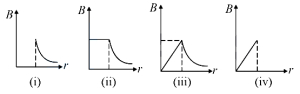
A
$(i)$
B
$(ii)$
C
$(iii)$
D
$(iv)$
Solution
(A) According to Ampere's circuital law,$\oint \vec{B} \cdot d\vec{l} = \mu_0 I_{\text{enclosed}}$.
For a point inside the hollow cylinder $(r < R)$,the enclosed current $I_{\text{enclosed}} = 0$. Therefore,$B(2\pi r) = 0$,which implies $B = 0$ for $r < R$.
For a point outside the hollow cylinder $(r \geq R)$,the enclosed current $I_{\text{enclosed}} = i$. Therefore,$B(2\pi r) = \mu_0 i$,which implies $B = \frac{\mu_0 i}{2\pi r}$.
This shows that the magnetic field is zero inside the cylinder and decreases as $1/r$ outside the cylinder. Graph $(i)$ correctly represents this behavior.
For a point inside the hollow cylinder $(r < R)$,the enclosed current $I_{\text{enclosed}} = 0$. Therefore,$B(2\pi r) = 0$,which implies $B = 0$ for $r < R$.
For a point outside the hollow cylinder $(r \geq R)$,the enclosed current $I_{\text{enclosed}} = i$. Therefore,$B(2\pi r) = \mu_0 i$,which implies $B = \frac{\mu_0 i}{2\pi r}$.
This shows that the magnetic field is zero inside the cylinder and decreases as $1/r$ outside the cylinder. Graph $(i)$ correctly represents this behavior.
0 likes
View Solution179
MediumMCQ
$A$ coil wrapped around a toroid has an inner radius of $20 \,cm$ and an outer radius of $25 \,cm$. If the wire wrapping makes $800$ turns and carries a current of $12 \,A$, the maximum and minimum values of the magnetic field within the toroid are:
A
$9.6 \,mT, 7.68 \,mT$
B
$4 \,mT, 2.5 \,mT$
C
$7 \,mT, 5.6 \,mT$
D
$6.6 \,mT, 3.3 \,mT$
Solution
(A) Given: Inner radius $r_1 = 20 \,cm = 0.2 \,m$, Outer radius $r_2 = 25 \,cm = 0.25 \,m$, Number of turns $N = 800$, Current $I = 12 \,A$.
The magnetic field $B$ inside a toroid at a distance $r$ from the center is given by $B = \frac{\mu_0 N I}{2 \pi r}$.
Since $B \propto \frac{1}{r}$, the magnetic field is maximum at the minimum radius $(r_1)$ and minimum at the maximum radius $(r_2)$.
Maximum magnetic field: $B_{\max} = \frac{4 \pi \times 10^{-7} \times 800 \times 12}{2 \pi \times 0.2} = \frac{2 \times 10^{-7} \times 9600}{0.2} = 9.6 \times 10^{-3} \,T = 9.6 \,mT$.
Minimum magnetic field: $B_{\min} = \frac{4 \pi \times 10^{-7} \times 800 \times 12}{2 \pi \times 0.25} = \frac{2 \times 10^{-7} \times 9600}{0.25} = 7.68 \times 10^{-3} \,T = 7.68 \,mT$.
The magnetic field $B$ inside a toroid at a distance $r$ from the center is given by $B = \frac{\mu_0 N I}{2 \pi r}$.
Since $B \propto \frac{1}{r}$, the magnetic field is maximum at the minimum radius $(r_1)$ and minimum at the maximum radius $(r_2)$.
Maximum magnetic field: $B_{\max} = \frac{4 \pi \times 10^{-7} \times 800 \times 12}{2 \pi \times 0.2} = \frac{2 \times 10^{-7} \times 9600}{0.2} = 9.6 \times 10^{-3} \,T = 9.6 \,mT$.
Minimum magnetic field: $B_{\min} = \frac{4 \pi \times 10^{-7} \times 800 \times 12}{2 \pi \times 0.25} = \frac{2 \times 10^{-7} \times 9600}{0.25} = 7.68 \times 10^{-3} \,T = 7.68 \,mT$.
0 likes
View Solution180
EasyMCQ
Choose the wrong statement to complete: An ideal solenoid has
A
the turns widely separated.
B
the turns closely wound.
C
the length is very much greater than the radius.
D
the magnetic field inside almost uniform.
Solution
(A) An ideal solenoid is defined as a coil where the length $L$ is much greater than its radius $R$ $(L \gg R)$ and the turns are closely wound. In such a configuration,the magnetic field inside the solenoid is almost uniform and parallel to the axis. Therefore,the statement that the turns are widely separated is incorrect.
0 likes
View Solution181
DifficultMCQ
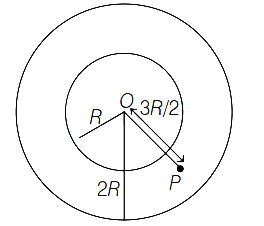
The figure shows the cross-sectional view of a hollow cylindrical conductor with inner radius $R$ and outer radius $2R$,carrying a uniformly distributed current $i$ along its axis. The magnetic induction at point $P$ at a distance $3R/2$ from the axis of the cylinder will be
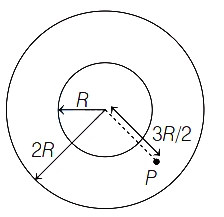
A
zero
B
$\frac{5 \mu_0 i}{72 \pi R}$
C
$\frac{7 \mu_0 i}{18 \pi R}$
D
$\frac{5 \mu_0 i}{36 \pi R}$
Solution
(D) To find the magnetic field at a point $P$ at a distance $r = 3R/2$ from the axis,we use Ampere's circuital law: $\oint B \cdot dl = \mu_0 I_{\text{enclosed}}$.
Since the current $i$ is uniformly distributed over the cross-sectional area $A = \pi(2R)^2 - \pi R^2 = 3\pi R^2$,the current density $J = \frac{i}{3\pi R^2}$.
The current enclosed by the Amperian loop of radius $r = 3R/2$ is $I_{\text{enclosed}} = J \times \text{Area}_{\text{enclosed}} = J \times \pi(r^2 - R^2) = \frac{i}{3\pi R^2} \times \pi \left( \left(\frac{3R}{2}\right)^2 - R^2 \right) = \frac{i}{3R^2} \times \left( \frac{9R^2}{4} - R^2 \right) = \frac{i}{3R^2} \times \frac{5R^2}{4} = \frac{5i}{12}$.
Applying Ampere's law: $B(2\pi r) = \mu_0 I_{\text{enclosed}}$.
$B \times 2\pi \left(\frac{3R}{2}\right) = \mu_0 \left(\frac{5i}{12}\right)$.
$B(3\pi R) = \frac{5\mu_0 i}{12}$.
$B = \frac{5\mu_0 i}{36\pi R}$.
Since the current $i$ is uniformly distributed over the cross-sectional area $A = \pi(2R)^2 - \pi R^2 = 3\pi R^2$,the current density $J = \frac{i}{3\pi R^2}$.
The current enclosed by the Amperian loop of radius $r = 3R/2$ is $I_{\text{enclosed}} = J \times \text{Area}_{\text{enclosed}} = J \times \pi(r^2 - R^2) = \frac{i}{3\pi R^2} \times \pi \left( \left(\frac{3R}{2}\right)^2 - R^2 \right) = \frac{i}{3R^2} \times \left( \frac{9R^2}{4} - R^2 \right) = \frac{i}{3R^2} \times \frac{5R^2}{4} = \frac{5i}{12}$.
Applying Ampere's law: $B(2\pi r) = \mu_0 I_{\text{enclosed}}$.
$B \times 2\pi \left(\frac{3R}{2}\right) = \mu_0 \left(\frac{5i}{12}\right)$.
$B(3\pi R) = \frac{5\mu_0 i}{12}$.
$B = \frac{5\mu_0 i}{36\pi R}$.
0 likes
View Solution182
MediumMCQ
$A$ closely wound solenoid of $1200$ turns and area of cross-section $5 \,cm^2$ carries a current. If the magnetic moment of the solenoid is $1.2 \,J \,T^{-1}$, then the current through the solenoid is (in $\,A$)
A
$2.5$
B
$2$
C
$3$
D
$1.5$
Solution
(B) The magnetic moment $M$ of a solenoid is given by the formula: $M = N I A$, where $N$ is the number of turns, $I$ is the current, and $A$ is the area of cross-section.
Given:
$N = 1200$
$A = 5 \,cm^2 = 5 \times 10^{-4} \,m^2$
$M = 1.2 \,J \,T^{-1}$
Substituting the values into the formula:
$1.2 = 1200 \times I \times (5 \times 10^{-4})$
$1.2 = 1200 \times 5 \times 10^{-4} \times I$
$1.2 = 6000 \times 10^{-4} \times I$
$1.2 = 0.6 \times I$
$I = \frac{1.2}{0.6} = 2 \,A$
Therefore, the current through the solenoid is $2 \,A$.
Given:
$N = 1200$
$A = 5 \,cm^2 = 5 \times 10^{-4} \,m^2$
$M = 1.2 \,J \,T^{-1}$
Substituting the values into the formula:
$1.2 = 1200 \times I \times (5 \times 10^{-4})$
$1.2 = 1200 \times 5 \times 10^{-4} \times I$
$1.2 = 6000 \times 10^{-4} \times I$
$1.2 = 0.6 \times I$
$I = \frac{1.2}{0.6} = 2 \,A$
Therefore, the current through the solenoid is $2 \,A$.
0 likes
View Solution183
EasyMCQ
$A$ toroid of $n$ turns,mean radius $R$ and cross-sectional radius $a$ carries current $I$. It is placed on a horizontal table taken as $xy$-plane. Its magnetic moment $m$ is:
A
is non-zero and points in the $z$-direction by symmetry
B
points along the axis of the toroid $(m=m\phi)$
C
is zero,otherwise there would be a field falling as $\frac{1}{r^3}$ at large distances outside the toroid
D
is pointing radially outwards
Solution
(C) toroid is essentially a solenoid bent into a circular shape. The magnetic field lines produced by a toroid are confined entirely within its core,forming concentric circles.
Because the magnetic field is confined within the toroid,the net magnetic field outside the toroid is zero.
If the magnetic moment $m$ were non-zero,the toroid would act like a magnetic dipole at large distances,producing a magnetic field that falls off as $\frac{1}{r^3}$.
Since the magnetic field outside an ideal toroid is zero,its magnetic moment $m$ must be zero.
Because the magnetic field is confined within the toroid,the net magnetic field outside the toroid is zero.
If the magnetic moment $m$ were non-zero,the toroid would act like a magnetic dipole at large distances,producing a magnetic field that falls off as $\frac{1}{r^3}$.
Since the magnetic field outside an ideal toroid is zero,its magnetic moment $m$ must be zero.
0 likes
View Solution184
EasyMCQ
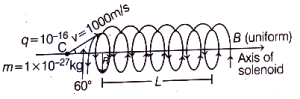
$A$ particle of mass $1 \times 10^{-27} \ kg$ and charge $1 \times 10^{-16} \ C$ enters a uniform magnetic field within a solenoid at a speed of $1000 \ m/s$. The velocity vector makes an angle of $60^{\circ}$ with the axis of the solenoid. The solenoid has $5000$ turns along its length $L$ and carries a current of $5 \ A$. The number of revolutions the particle makes along the helical path within the solenoid by the time it emerges from the solenoid's opposite end is:
A
$5 \times 10^5$
B
$1 \times 10^6$
C
$\pi \times 10^5$
D
$3 \times 10^6$
Solution
(B) Given: mass $m = 1 \times 10^{-27} \ kg$,charge $q = 1 \times 10^{-16} \ C$,speed $v = 1000 \ m/s$,angle $\theta = 60^{\circ}$,number of turns $N = 5000$,current $I = 5 \ A$.
The velocity components are:
$v_{\parallel} = v \cos 60^{\circ} = 1000 \times 0.5 = 500 \ m/s$ (along the axis)
$v_{\perp} = v \sin 60^{\circ} = 1000 \times \frac{\sqrt{3}}{2} = 500\sqrt{3} \ m/s$ (perpendicular to the axis)
The magnetic field inside the solenoid is $B = \mu_0 n I = \mu_0 (N/L) I$.
The time taken to travel the length $L$ of the solenoid is $t = \frac{L}{v_{\parallel}} = \frac{L}{500}$.
The time period of one revolution in the magnetic field is $T = \frac{2\pi m}{qB}$.
The number of revolutions $n'$ is given by $n' = \frac{t}{T} = \frac{L/v_{\parallel}}{2\pi m / qB} = \frac{L \cdot q \cdot B}{v_{\parallel} \cdot 2\pi m}$.
Substituting $B = \frac{\mu_0 N I}{L}$:
$n' = \frac{L \cdot q \cdot (\mu_0 N I / L)}{v_{\parallel} \cdot 2\pi m} = \frac{q \mu_0 N I}{v_{\parallel} \cdot 2\pi m}$.
Plugging in the values:
$n' = \frac{10^{-16} \times (4\pi \times 10^{-7}) \times 5000 \times 5}{500 \times 2\pi \times 10^{-27}}$
$n' = \frac{10^{-16} \times 4\pi \times 10^{-7} \times 25000}{1000\pi \times 10^{-27}}$
$n' = \frac{10^{-16} \times 10^{-7} \times 10^5}{10^{-27} \times 10^2} = \frac{10^{-18}}{10^{-25}} = 10^7 / 10 = 10^6$.
Thus,the number of revolutions is $1 \times 10^6$.
The velocity components are:
$v_{\parallel} = v \cos 60^{\circ} = 1000 \times 0.5 = 500 \ m/s$ (along the axis)
$v_{\perp} = v \sin 60^{\circ} = 1000 \times \frac{\sqrt{3}}{2} = 500\sqrt{3} \ m/s$ (perpendicular to the axis)
The magnetic field inside the solenoid is $B = \mu_0 n I = \mu_0 (N/L) I$.
The time taken to travel the length $L$ of the solenoid is $t = \frac{L}{v_{\parallel}} = \frac{L}{500}$.
The time period of one revolution in the magnetic field is $T = \frac{2\pi m}{qB}$.
The number of revolutions $n'$ is given by $n' = \frac{t}{T} = \frac{L/v_{\parallel}}{2\pi m / qB} = \frac{L \cdot q \cdot B}{v_{\parallel} \cdot 2\pi m}$.
Substituting $B = \frac{\mu_0 N I}{L}$:
$n' = \frac{L \cdot q \cdot (\mu_0 N I / L)}{v_{\parallel} \cdot 2\pi m} = \frac{q \mu_0 N I}{v_{\parallel} \cdot 2\pi m}$.
Plugging in the values:
$n' = \frac{10^{-16} \times (4\pi \times 10^{-7}) \times 5000 \times 5}{500 \times 2\pi \times 10^{-27}}$
$n' = \frac{10^{-16} \times 4\pi \times 10^{-7} \times 25000}{1000\pi \times 10^{-27}}$
$n' = \frac{10^{-16} \times 10^{-7} \times 10^5}{10^{-27} \times 10^2} = \frac{10^{-18}}{10^{-25}} = 10^7 / 10 = 10^6$.
Thus,the number of revolutions is $1 \times 10^6$.
0 likes
View Solution185
MediumMCQ
$A$ toroid has an iron core with an internal magnetic field of $10 \pi \text{ mT}$,when the current in the winding of $1500 \text{ turns/m}$ is $10 \text{ A}$. Determine the field due to magnetization $(\mu_0 = 4 \pi \times 10^{-7} \text{ H m}^{-1})$.
A
$(4 \pi) \text{ mT}$
B
$(10 \pi) \text{ mT}$
C
$(\frac{8}{\pi}) \text{ mT}$
D
$(\frac{\pi}{4}) \text{ mT}$
Solution
(A) The magnetic field produced by the current in the toroid winding is given by $B = \mu_0 n I$.
Given: $\mu_0 = 4 \pi \times 10^{-7} \text{ H m}^{-1}$,$n = 1500 \text{ turns/m}$,and $I = 10 \text{ A}$.
$B = 4 \pi \times 10^{-7} \times 1500 \times 10 = 6 \pi \times 10^{-3} \text{ T} = 6 \pi \text{ mT}$.
The total internal magnetic field $B_0$ is given as $10 \pi \text{ mT}$.
The total magnetic field is the sum of the field due to the current and the field due to magnetization $(B_m)$:
$B_0 = B + B_m$.
Therefore,$B_m = B_0 - B = 10 \pi \text{ mT} - 6 \pi \text{ mT} = 4 \pi \text{ mT}$.
Given: $\mu_0 = 4 \pi \times 10^{-7} \text{ H m}^{-1}$,$n = 1500 \text{ turns/m}$,and $I = 10 \text{ A}$.
$B = 4 \pi \times 10^{-7} \times 1500 \times 10 = 6 \pi \times 10^{-3} \text{ T} = 6 \pi \text{ mT}$.
The total internal magnetic field $B_0$ is given as $10 \pi \text{ mT}$.
The total magnetic field is the sum of the field due to the current and the field due to magnetization $(B_m)$:
$B_0 = B + B_m$.
Therefore,$B_m = B_0 - B = 10 \pi \text{ mT} - 6 \pi \text{ mT} = 4 \pi \text{ mT}$.
0 likes
View Solution186
MediumMCQ
$A$ solenoid of length $50 \ cm$ and radius $10 \ cm$ has two closely wound layers of windings,each with $100$ turns. If a current of $2.5 \ A$ is passing through the windings,the magnetic field (in $10^{-4} \ T$) at a point $5 \ cm$ from the axis is:
A
$2 \pi$
B
$31.4$
C
$4 \pi$
D
Zero
Solution
(C) The magnetic field inside an ideal solenoid is given by $B = \mu_0 n I$,where $n$ is the number of turns per unit length.
Given: Length $L = 0.5 \ m$,Radius $R = 0.1 \ m$,Current $I = 2.5 \ A$.
Total turns $N = 2 \times 100 = 200$.
Number of turns per unit length $n = N / L = 200 / 0.5 = 400 \ turns/m$.
The magnetic field $B = \mu_0 n I = (4 \pi \times 10^{-7}) \times 400 \times 2.5$.
$B = (4 \pi \times 10^{-7}) \times 1000 = 4 \pi \times 10^{-4} \ T$.
Since the point is $5 \ cm$ from the axis,it lies inside the solenoid (as $5 \ cm < 10 \ cm$).
Thus,the magnetic field is $4 \pi \times 10^{-4} \ T$.
Given: Length $L = 0.5 \ m$,Radius $R = 0.1 \ m$,Current $I = 2.5 \ A$.
Total turns $N = 2 \times 100 = 200$.
Number of turns per unit length $n = N / L = 200 / 0.5 = 400 \ turns/m$.
The magnetic field $B = \mu_0 n I = (4 \pi \times 10^{-7}) \times 400 \times 2.5$.
$B = (4 \pi \times 10^{-7}) \times 1000 = 4 \pi \times 10^{-4} \ T$.
Since the point is $5 \ cm$ from the axis,it lies inside the solenoid (as $5 \ cm < 10 \ cm$).
Thus,the magnetic field is $4 \pi \times 10^{-4} \ T$.
0 likes
View Solution187
MediumMCQ
$A$ solenoid of $1000$ turns per metre has a core of material with relative permeability $400$. The windings of the solenoid are insulated from the core and a current of $2 \ A$ is passed through the solenoid. Then the value of the magnetic intensity inside the solenoid is
A
$2 \times 10^3 \ Am^{-1}$
B
$1.0 \ Am^{-1}$
C
$8 \times 10^5 \ Am^{-1}$
D
$794 \ Am^{-1}$
Solution
(A) The magnetic intensity $H$ inside a solenoid is given by the formula $H = nI$,where $n$ is the number of turns per unit length and $I$ is the current flowing through the solenoid.
Given:
Number of turns per unit length,$n = 1000 \ turns/m = 10^3 \ m^{-1}$.
Current,$I = 2 \ A$.
Relative permeability,$\mu_r = 400$ (Note: Magnetic intensity $H$ is independent of the core material).
Substituting the values:
$H = 10^3 \ m^{-1} \times 2 \ A = 2000 \ Am^{-1} = 2 \times 10^3 \ Am^{-1}$.
Thus,the magnetic intensity inside the solenoid is $2 \times 10^3 \ Am^{-1}$.
Given:
Number of turns per unit length,$n = 1000 \ turns/m = 10^3 \ m^{-1}$.
Current,$I = 2 \ A$.
Relative permeability,$\mu_r = 400$ (Note: Magnetic intensity $H$ is independent of the core material).
Substituting the values:
$H = 10^3 \ m^{-1} \times 2 \ A = 2000 \ Am^{-1} = 2 \times 10^3 \ Am^{-1}$.
Thus,the magnetic intensity inside the solenoid is $2 \times 10^3 \ Am^{-1}$.
0 likes
View Solution188
MediumMCQ
$A$ closely wound solenoid of $80 \,cm$ long has $5$ layers of windings of $400$ turns each. The diameter of the solenoid is $1.8 \,cm$. If the current carried is $8 \,A$, then the magnitude of the magnetic field inside the solenoid near its centre is approximately
A
$1.5 \times 10^{-2} \,T$
B
$2.5 \times 10^{-2} \,T$
C
$3.5 \times 10^{-2} \,T$
D
$4.5 \times 10^{-2} \,T$
Solution
(B) Length of the solenoid, $L = 80 \,cm = 0.8 \,m$.
Total number of turns, $N = 5 \times 400 = 2000$.
Current, $i = 8 \,A$.
Number of turns per unit length, $n = \frac{N}{L} = \frac{2000}{0.8} = 2500 \,turns/m$.
The magnetic field $B$ inside a long solenoid near its centre is given by $B = \mu_0 ni$.
Substituting the values:
$B = (4 \pi \times 10^{-7} \,T \cdot m/A) \times (2500 \,m^{-1}) \times (8 \,A)$.
$B = 4 \times 3.14159 \times 10^{-7} \times 20000$.
$B = 12.566 \times 10^{-3} \times 2 = 2.513 \times 10^{-2} \,T$.
Thus, the magnitude of the magnetic field is approximately $2.5 \times 10^{-2} \,T$.
Total number of turns, $N = 5 \times 400 = 2000$.
Current, $i = 8 \,A$.
Number of turns per unit length, $n = \frac{N}{L} = \frac{2000}{0.8} = 2500 \,turns/m$.
The magnetic field $B$ inside a long solenoid near its centre is given by $B = \mu_0 ni$.
Substituting the values:
$B = (4 \pi \times 10^{-7} \,T \cdot m/A) \times (2500 \,m^{-1}) \times (8 \,A)$.
$B = 4 \times 3.14159 \times 10^{-7} \times 20000$.
$B = 12.566 \times 10^{-3} \times 2 = 2.513 \times 10^{-2} \,T$.
Thus, the magnitude of the magnetic field is approximately $2.5 \times 10^{-2} \,T$.
0 likes
View Solution189
EasyMCQ
$A$ current $i$ flows in an infinitely long,straight and thin-walled pipe. Then,
A
the magnetic field at all the points inside the pipe is same,but not zero
B
the magnetic field at any point inside the pipe is zero
C
the magnetic field is zero only on the axis of the pipe
D
the magnetic field is different at different points inside the pipe
Solution
(B) According to Ampere's Circuital Law,the line integral of the magnetic field $\vec{B}$ around any closed loop is equal to $\mu_0$ times the net current $i_{\text{enclosed}}$ passing through the surface bounded by the loop.
$\oint \vec{B} \cdot d\vec{l} = \mu_0 i_{\text{enclosed}}$
For any point inside a thin-walled pipe,we can choose an Amperian loop (a circle) that lies entirely inside the pipe.
Since the current $i$ flows only through the walls of the pipe,the current enclosed by this loop is $i_{\text{enclosed}} = 0$.
Therefore,$\oint \vec{B} \cdot d\vec{l} = 0$,which implies that the magnetic field $\vec{B}$ at any point inside the pipe is zero.
$\oint \vec{B} \cdot d\vec{l} = \mu_0 i_{\text{enclosed}}$
For any point inside a thin-walled pipe,we can choose an Amperian loop (a circle) that lies entirely inside the pipe.
Since the current $i$ flows only through the walls of the pipe,the current enclosed by this loop is $i_{\text{enclosed}} = 0$.
Therefore,$\oint \vec{B} \cdot d\vec{l} = 0$,which implies that the magnetic field $\vec{B}$ at any point inside the pipe is zero.
0 likes
View Solution190
EasyMCQ
$A$ toroid has a core (non-ferromagnetic) of inner radius $24 \ cm$ and outer radius $26 \ cm$ around which $2000$ turns of a wire are wound. If the current in the wire is $12 \ A$,the magnetic field inside the core of the toroid is:
A
$1.92 \times 10^{-2} \ T$
B
$1.88 \times 10^{-2} \ T$
C
$2.12 \times 10^{-2} \ T$
D
$1.98 \times 10^{-2} \ T$
Solution
(A) Given:
Inner radius $r_1 = 24 \ cm = 0.24 \ m$
Outer radius $r_2 = 26 \ cm = 0.26 \ m$
Number of turns $N = 2000$
Current $I = 12 \ A$
The mean radius $r$ of the toroid is given by:
$r = \frac{r_1 + r_2}{2} = \frac{24 + 26}{2} = 25 \ cm = 0.25 \ m$
The magnetic field $B$ inside the core of a toroid is given by the formula:
$B = \mu_0 n I$
where $n$ is the number of turns per unit length,$n = \frac{N}{2 \pi r}$.
Substituting the values:
$B = \mu_0 \left( \frac{N}{2 \pi r} \right) I$
$B = (4 \pi \times 10^{-7}) \times \left( \frac{2000}{2 \pi \times 0.25} \right) \times 12$
$B = (2 \times 10^{-7}) \times \left( \frac{2000}{0.25} \right) \times 12$
$B = (2 \times 10^{-7}) \times 8000 \times 12$
$B = 192000 \times 10^{-7} \ T$
$B = 1.92 \times 10^{-2} \ T$
Inner radius $r_1 = 24 \ cm = 0.24 \ m$
Outer radius $r_2 = 26 \ cm = 0.26 \ m$
Number of turns $N = 2000$
Current $I = 12 \ A$
The mean radius $r$ of the toroid is given by:
$r = \frac{r_1 + r_2}{2} = \frac{24 + 26}{2} = 25 \ cm = 0.25 \ m$
The magnetic field $B$ inside the core of a toroid is given by the formula:
$B = \mu_0 n I$
where $n$ is the number of turns per unit length,$n = \frac{N}{2 \pi r}$.
Substituting the values:
$B = \mu_0 \left( \frac{N}{2 \pi r} \right) I$
$B = (4 \pi \times 10^{-7}) \times \left( \frac{2000}{2 \pi \times 0.25} \right) \times 12$
$B = (2 \times 10^{-7}) \times \left( \frac{2000}{0.25} \right) \times 12$
$B = (2 \times 10^{-7}) \times 8000 \times 12$
$B = 192000 \times 10^{-7} \ T$
$B = 1.92 \times 10^{-2} \ T$
0 likes
View Solution191
DifficultMCQ
$A$ long solenoid has $70 \text{ turns } cm^{-1}$ and carries current $I$. An electron moves within the solenoid in a circle of radius $2.5 \text{ cm}$ perpendicular to the solenoid axis. If the speed of the electron is $4.4 \times 10^6 \text{ m s}^{-1}$, then the current $I$ in the solenoid is (Take $\mu_0 = 4 \pi \times 10^{-7} \text{ SI unit}$, mass of electron $= 9 \times 10^{-31} \text{ kg}$, charge of electron $= 1.6 \times 10^{-19} \text{ C}$) (in $\text{ mA}$)
A
$98.5$
B
$112.5$
C
$125$
D
$175.0$
Solution
(B) Given:
$n = 70 \text{ turns } cm^{-1} = 7000 \text{ turns } m^{-1}$
$r = 2.5 \text{ cm} = 0.025 \text{ m}$
$v = 4.4 \times 10^6 \text{ m s}^{-1}$
$m = 9 \times 10^{-31} \text{ kg}$
$q = 1.6 \times 10^{-19} \text{ C}$
The centripetal force required for circular motion is provided by the magnetic Lorentz force:
$\frac{mv^2}{r} = qvB$
For a long solenoid, the magnetic field $B$ is given by:
$B = \mu_0 n I$
Substituting $B$ into the force equation:
$\frac{mv^2}{r} = qv(\mu_0 n I)$
Solving for current $I$:
$I = \frac{mv}{q \mu_0 n r}$
Substituting the values:
$I = \frac{(9 \times 10^{-31}) \times (4.4 \times 10^6)}{(1.6 \times 10^{-19}) \times (4 \pi \times 10^{-7}) \times (7000) \times (0.025)}$
$I = \frac{39.6 \times 10^{-25}}{1.6 \times 4 \times 3.14159 \times 10^{-7} \times 175}$
$I = \frac{39.6 \times 10^{-25}}{3518.57 \times 10^{-7}} \approx 0.1125 \text{ A} = 112.5 \text{ mA}$
$n = 70 \text{ turns } cm^{-1} = 7000 \text{ turns } m^{-1}$
$r = 2.5 \text{ cm} = 0.025 \text{ m}$
$v = 4.4 \times 10^6 \text{ m s}^{-1}$
$m = 9 \times 10^{-31} \text{ kg}$
$q = 1.6 \times 10^{-19} \text{ C}$
The centripetal force required for circular motion is provided by the magnetic Lorentz force:
$\frac{mv^2}{r} = qvB$
For a long solenoid, the magnetic field $B$ is given by:
$B = \mu_0 n I$
Substituting $B$ into the force equation:
$\frac{mv^2}{r} = qv(\mu_0 n I)$
Solving for current $I$:
$I = \frac{mv}{q \mu_0 n r}$
Substituting the values:
$I = \frac{(9 \times 10^{-31}) \times (4.4 \times 10^6)}{(1.6 \times 10^{-19}) \times (4 \pi \times 10^{-7}) \times (7000) \times (0.025)}$
$I = \frac{39.6 \times 10^{-25}}{1.6 \times 4 \times 3.14159 \times 10^{-7} \times 175}$
$I = \frac{39.6 \times 10^{-25}}{3518.57 \times 10^{-7}} \approx 0.1125 \text{ A} = 112.5 \text{ mA}$
0 likes
View Solution192
DifficultMCQ
$A$ long solenoid with $10.0 \text{ turns/cm}$ and a radius of $8 \text{ cm}$ carries a current of $7 \text{ mA}$. $A$ current-carrying straight conductor is located along the central axis of the solenoid. If the direction of the resulting magnetic field is $60^{\circ}$ to the axial direction at a point $5 \text{ cm}$ from the axis of the solenoid along the radial direction, then the current in the conductor is. [Take $\sqrt{2}=1.4, \sqrt{3}=1.7$] (in $\text{ A}$)
A
$3.41$
B
$4.21$
C
$3.74$
D
$4.5$
Solution
(C) The magnetic field due to a long solenoid at any point inside it is directed along its axis: $B_s = \mu_0 n I_s$. Given $n = 10 \text{ turns/cm} = 1000 \text{ turns/m}$ and $I_s = 7 \times 10^{-3} \text{ A}$. Thus, $B_s = 4\pi \times 10^{-7} \times 1000 \times 7 \times 10^{-3} = 28\pi \times 10^{-7} \text{ T}$.
The magnetic field due to the straight conductor at a distance $r = 5 \text{ cm} = 0.05 \text{ m}$ is directed tangentially: $B_c = \frac{\mu_0 I_c}{2\pi r}$.
The resultant magnetic field makes an angle $\theta = 60^{\circ}$ with the axis. Therefore, $\tan(60^{\circ}) = \frac{B_c}{B_s}$.
$\sqrt{3} = \frac{\mu_0 I_c / (2\pi r)}{\mu_0 n I_s} = \frac{I_c}{2\pi r n I_s}$.
$I_c = \sqrt{3} \times 2\pi r n I_s = 1.7 \times 2 \times 3.14 \times 0.05 \times 1000 \times 7 \times 10^{-3}$.
$I_c = 1.7 \times 6.28 \times 0.05 \times 7 = 3.7366 \text{ A} \approx 3.74 \text{ A}$.
The magnetic field due to the straight conductor at a distance $r = 5 \text{ cm} = 0.05 \text{ m}$ is directed tangentially: $B_c = \frac{\mu_0 I_c}{2\pi r}$.
The resultant magnetic field makes an angle $\theta = 60^{\circ}$ with the axis. Therefore, $\tan(60^{\circ}) = \frac{B_c}{B_s}$.
$\sqrt{3} = \frac{\mu_0 I_c / (2\pi r)}{\mu_0 n I_s} = \frac{I_c}{2\pi r n I_s}$.
$I_c = \sqrt{3} \times 2\pi r n I_s = 1.7 \times 2 \times 3.14 \times 0.05 \times 1000 \times 7 \times 10^{-3}$.
$I_c = 1.7 \times 6.28 \times 0.05 \times 7 = 3.7366 \text{ A} \approx 3.74 \text{ A}$.
0 likes
View Solution193
MediumMCQ
The magnetic field intensity $(H)$ at the centre of a long solenoid carrying a current of $2 \ A$ is found to be $1000 \ A/m$. The number of turns per centimeter of the solenoid is: (Use $\mu_0 = 4 \pi \times 10^{-7} \ T \ m \ A^{-1}$)
A
$500$
B
$50$
C
$5$
D
$100$
Solution
(C) The magnetic field intensity $(H)$ inside a long solenoid is given by the formula $H = n \cdot I$,where $n$ is the number of turns per unit length and $I$ is the current flowing through the solenoid.
Given:
$H = 1000 \ A/m$
$I = 2 \ A$
Using the formula $H = n \cdot I$:
$1000 = n \times 2$
$n = 500 \ \text{turns/meter}$.
To convert turns per meter to turns per centimeter:
$n = 500 \ \text{turns/m} = 500 \ \text{turns} / 100 \ \text{cm} = 5 \ \text{turns/cm}$.
Thus,the number of turns per centimeter is $5$.
Given:
$H = 1000 \ A/m$
$I = 2 \ A$
Using the formula $H = n \cdot I$:
$1000 = n \times 2$
$n = 500 \ \text{turns/meter}$.
To convert turns per meter to turns per centimeter:
$n = 500 \ \text{turns/m} = 500 \ \text{turns} / 100 \ \text{cm} = 5 \ \text{turns/cm}$.
Thus,the number of turns per centimeter is $5$.
0 likes
View Solution194
EasyMCQ
If the number of turns per unit length of a solenoid is doubled,what happens to the magnetic field in the solenoid?
A
It remains unchanged
B
It becomes half
C
It doubles
D
It quadruples
Solution
(C) The magnetic field $B$ inside a long solenoid is given by the formula: $B = \mu_0 n i$,where $\mu_0$ is the permeability of free space,$n$ is the number of turns per unit length,and $i$ is the current flowing through the solenoid.
Since the magnetic field $B$ is directly proportional to the number of turns per unit length $n$ $(B \propto n)$,if the value of $n$ is doubled,the magnetic field $B$ will also double.
Since the magnetic field $B$ is directly proportional to the number of turns per unit length $n$ $(B \propto n)$,if the value of $n$ is doubled,the magnetic field $B$ will also double.
0 likes
View Solution195
EasyMCQ
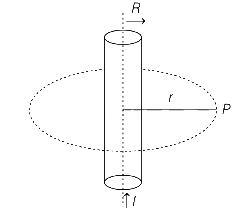
The magnetic field at point $P$ in the given figure,due to a current $I$ flowing through a cylindrical conductor of radius $R$,is:
A
$\frac{\mu_0 I}{4 \pi r} \text{ T}$
B
$\frac{\mu_0 I}{2 \pi r} \text{ T}$
C
$\frac{\mu_0 I}{2 \pi R} \text{ T}$
D
$\frac{\mu_0 I}{4 \pi R} \text{ T}$
Solution
(B) According to Ampere's Circuital Law,for a long straight cylindrical conductor carrying a current $I$,the magnetic field $B$ at an external point $P$ at a distance $r$ from the axis of the conductor (where $r > R$) is given by:
$B = \frac{\mu_0 I}{2 \pi r}$
Here,$\mu_0$ is the permeability of free space,$I$ is the current,and $r$ is the radial distance from the center of the conductor to point $P$.
$B = \frac{\mu_0 I}{2 \pi r}$
Here,$\mu_0$ is the permeability of free space,$I$ is the current,and $r$ is the radial distance from the center of the conductor to point $P$.
0 likes
View Solution196
MediumMCQ
$A$ $50 \ cm$ long solenoid has a winding of $400$ turns. What current must pass through it to produce a magnetic field of induction $4 \pi \times 10^{-3} \ T$ at the centre (in $A$)?
A
$10.5$
B
$12.5$
C
$25.0$
D
$20.0$
Solution
(B) The magnetic field at the center of a long solenoid is given by $B = \mu_0 n I$,where $n$ is the number of turns per unit length $(n = N/L)$.
Given:
Length $L = 50 \ cm = 0.5 \ m$
Number of turns $N = 400$
Magnetic field $B = 4 \pi \times 10^{-3} \ T$
Permeability of free space $\mu_0 = 4 \pi \times 10^{-7} \ T \cdot m/A$
First,calculate the number of turns per unit length:
$n = \frac{N}{L} = \frac{400}{0.5} = 800 \ turns/m$
Now,substitute the values into the formula $B = \mu_0 n I$:
$4 \pi \times 10^{-3} = (4 \pi \times 10^{-7}) \times 800 \times I$
$I = \frac{4 \pi \times 10^{-3}}{4 \pi \times 10^{-7} \times 800}$
$I = \frac{10^{-3}}{10^{-7} \times 800} = \frac{10^4}{800} = \frac{100}{8} = 12.5 \ A$.
Given:
Length $L = 50 \ cm = 0.5 \ m$
Number of turns $N = 400$
Magnetic field $B = 4 \pi \times 10^{-3} \ T$
Permeability of free space $\mu_0 = 4 \pi \times 10^{-7} \ T \cdot m/A$
First,calculate the number of turns per unit length:
$n = \frac{N}{L} = \frac{400}{0.5} = 800 \ turns/m$
Now,substitute the values into the formula $B = \mu_0 n I$:
$4 \pi \times 10^{-3} = (4 \pi \times 10^{-7}) \times 800 \times I$
$I = \frac{4 \pi \times 10^{-3}}{4 \pi \times 10^{-7} \times 800}$
$I = \frac{10^{-3}}{10^{-7} \times 800} = \frac{10^4}{800} = \frac{100}{8} = 12.5 \ A$.
0 likes
View Solution197
EasyMCQ
$A$ solenoid has a core of a material with relative permeability $\frac{800}{\pi}$. The windings of the solenoid are insulated from the core and carry a current of $2 \text{ A}$. If the number of turns is $1000 \text{ turns/m}$, find the magnetic field $B$. (in $\text{ mT}$)
A
$640$
B
$330$
C
$480$
D
$560$
Solution
(A) Given: Relative permeability, $\mu_r = \frac{800}{\pi}$.
Current, $I = 2 \text{ A}$.
Number of turns per unit length, $n = 1000 \text{ m}^{-1}$.
The magnetic field intensity $H$ inside the solenoid is given by $H = nI$.
$H = 1000 \times 2 = 2000 \text{ A/m} = 2 \times 10^3 \text{ A/m}$.
The magnetic field $B$ is given by $B = \mu H = \mu_0 \mu_r H$.
Substituting the values: $B = (4\pi \times 10^{-7}) \times (\frac{800}{\pi}) \times (2 \times 10^3)$.
$B = 4 \times 10^{-7} \times 800 \times 2 \times 10^3$.
$B = 6400 \times 10^{-4} \text{ T} = 0.64 \text{ T}$.
Since $1 \text{ T} = 1000 \text{ mT}$, $B = 0.64 \times 1000 \text{ mT} = 640 \text{ mT}$.
Current, $I = 2 \text{ A}$.
Number of turns per unit length, $n = 1000 \text{ m}^{-1}$.
The magnetic field intensity $H$ inside the solenoid is given by $H = nI$.
$H = 1000 \times 2 = 2000 \text{ A/m} = 2 \times 10^3 \text{ A/m}$.
The magnetic field $B$ is given by $B = \mu H = \mu_0 \mu_r H$.
Substituting the values: $B = (4\pi \times 10^{-7}) \times (\frac{800}{\pi}) \times (2 \times 10^3)$.
$B = 4 \times 10^{-7} \times 800 \times 2 \times 10^3$.
$B = 6400 \times 10^{-4} \text{ T} = 0.64 \text{ T}$.
Since $1 \text{ T} = 1000 \text{ mT}$, $B = 0.64 \times 1000 \text{ mT} = 640 \text{ mT}$.
0 likes
View Solution198
MediumMCQ
The ratio of the magnetic field inside a solenoid at an axial point well inside and at an axial end point is
A
$2$
B
$1$/$2$
C
$1$
D
$3$/$2$
Solution
(A) The magnetic field at an axial point of a solenoid is given by $B = \frac{\mu_0 n I}{2}(\cos \theta_1 - \cos \theta_2)$.
For a point well inside the solenoid (at the center),$\theta_1 = 0^{\circ}$ and $\theta_2 = 180^{\circ}$.
Thus,$B_{\text{center}} = \frac{\mu_0 n I}{2}(\cos 0^{\circ} - \cos 180^{\circ}) = \frac{\mu_0 n I}{2}(1 - (-1)) = \mu_0 n I$.
For a point at the axial end of the solenoid,$\theta_1 = 90^{\circ}$ and $\theta_2 = 180^{\circ}$.
Thus,$B_{\text{end}} = \frac{\mu_0 n I}{2}(\cos 90^{\circ} - \cos 180^{\circ}) = \frac{\mu_0 n I}{2}(0 - (-1)) = \frac{\mu_0 n I}{2}$.
The ratio of the magnetic field at the center to the end is $\frac{B_{\text{center}}}{B_{\text{end}}} = \frac{\mu_0 n I}{\frac{\mu_0 n I}{2}} = 2$.
For a point well inside the solenoid (at the center),$\theta_1 = 0^{\circ}$ and $\theta_2 = 180^{\circ}$.
Thus,$B_{\text{center}} = \frac{\mu_0 n I}{2}(\cos 0^{\circ} - \cos 180^{\circ}) = \frac{\mu_0 n I}{2}(1 - (-1)) = \mu_0 n I$.
For a point at the axial end of the solenoid,$\theta_1 = 90^{\circ}$ and $\theta_2 = 180^{\circ}$.
Thus,$B_{\text{end}} = \frac{\mu_0 n I}{2}(\cos 90^{\circ} - \cos 180^{\circ}) = \frac{\mu_0 n I}{2}(0 - (-1)) = \frac{\mu_0 n I}{2}$.
The ratio of the magnetic field at the center to the end is $\frac{B_{\text{center}}}{B_{\text{end}}} = \frac{\mu_0 n I}{\frac{\mu_0 n I}{2}} = 2$.
0 likes
View Solution199
EasyMCQ
Consider two solenoids $X$ and $Y$ such that the area and length of $Y$ are twice that of $X$ respectively and the magnetic energy stored in both the solenoids is same,then the ratio of magnitude of magnetic fields of the two solenoids $\frac{|B_X|}{|B_Y|}$ is
A
$1$ : $4$
B
$2$ : $1$
C
$1$ : $2$
D
$4$ : $1$
Solution
(B) The magnetic energy $U$ stored in a solenoid is given by $U = \frac{B^2 V}{2 \mu_0}$,where $B$ is the magnetic field,$V$ is the volume,and $\mu_0$ is the permeability of free space.
Given that the magnetic energy stored in both solenoids is the same,$U_X = U_Y$.
Therefore,$\frac{B_X^2 V_X}{2 \mu_0} = \frac{B_Y^2 V_Y}{2 \mu_0}$,which simplifies to $B_X^2 V_X = B_Y^2 V_Y$.
Since volume $V = A \times L$,we have $B_X^2 A_X L_X = B_Y^2 A_Y L_Y$.
Given $A_Y = 2 A_X$ and $L_Y = 2 L_X$,we substitute these into the equation:
$B_X^2 A_X L_X = B_Y^2 (2 A_X) (2 L_X)$.
$B_X^2 A_X L_X = 4 B_Y^2 A_X L_X$.
Dividing both sides by $A_X L_X$,we get $B_X^2 = 4 B_Y^2$.
Thus,$\frac{B_X^2}{B_Y^2} = 4$,which implies $\frac{|B_X|}{|B_Y|} = \sqrt{4} = 2$.
Therefore,the ratio is $2 : 1$.
Given that the magnetic energy stored in both solenoids is the same,$U_X = U_Y$.
Therefore,$\frac{B_X^2 V_X}{2 \mu_0} = \frac{B_Y^2 V_Y}{2 \mu_0}$,which simplifies to $B_X^2 V_X = B_Y^2 V_Y$.
Since volume $V = A \times L$,we have $B_X^2 A_X L_X = B_Y^2 A_Y L_Y$.
Given $A_Y = 2 A_X$ and $L_Y = 2 L_X$,we substitute these into the equation:
$B_X^2 A_X L_X = B_Y^2 (2 A_X) (2 L_X)$.
$B_X^2 A_X L_X = 4 B_Y^2 A_X L_X$.
Dividing both sides by $A_X L_X$,we get $B_X^2 = 4 B_Y^2$.
Thus,$\frac{B_X^2}{B_Y^2} = 4$,which implies $\frac{|B_X|}{|B_Y|} = \sqrt{4} = 2$.
Therefore,the ratio is $2 : 1$.
0 likes
View Solution200
EasyMCQ
$A$ solenoid of length $2 \ m$ carries a current of $20 \ A$. The diameter of the solenoid is $3 \ cm$. If the magnetic field inside the solenoid is $20 \ mT$,then the length of wire forming the solenoid is (assume $\mu_0 = 4 \pi \times 10^{-7} \ H/m$) (in $m$)
A
$100$
B
$125$
C
$175$
D
$150$
Solution
(D) For a solenoid,the magnetic field is given by $B = \mu_0 n I$,where $n$ is the number of turns per unit length.
Given: $I = 20 \ A$,$l = 2 \ m$,$B = 20 \ mT = 20 \times 10^{-3} \ T$,and diameter $d = 3 \ cm = 3 \times 10^{-2} \ m$.
Radius $r = \frac{d}{2} = 1.5 \times 10^{-2} \ m$.
Calculating the number of turns per unit length $n$:
$n = \frac{B}{\mu_0 I} = \frac{20 \times 10^{-3}}{4 \pi \times 10^{-7} \times 20} = \frac{10^4}{4 \pi} \ m^{-1}$.
Total number of turns $N = n \times l = \frac{10^4}{4 \pi} \times 2 = \frac{10^4}{2 \pi}$.
The length of the wire is the total number of turns multiplied by the circumference of one turn:
$L_{wire} = N \times (2 \pi r) = \left( \frac{10^4}{2 \pi} \right) \times (2 \pi \times 1.5 \times 10^{-2}) = 10^4 \times 1.5 \times 10^{-2} = 1.5 \times 10^2 \ m = 150 \ m$.
Given: $I = 20 \ A$,$l = 2 \ m$,$B = 20 \ mT = 20 \times 10^{-3} \ T$,and diameter $d = 3 \ cm = 3 \times 10^{-2} \ m$.
Radius $r = \frac{d}{2} = 1.5 \times 10^{-2} \ m$.
Calculating the number of turns per unit length $n$:
$n = \frac{B}{\mu_0 I} = \frac{20 \times 10^{-3}}{4 \pi \times 10^{-7} \times 20} = \frac{10^4}{4 \pi} \ m^{-1}$.
Total number of turns $N = n \times l = \frac{10^4}{4 \pi} \times 2 = \frac{10^4}{2 \pi}$.
The length of the wire is the total number of turns multiplied by the circumference of one turn:
$L_{wire} = N \times (2 \pi r) = \left( \frac{10^4}{2 \pi} \right) \times (2 \pi \times 1.5 \times 10^{-2}) = 10^4 \times 1.5 \times 10^{-2} = 1.5 \times 10^2 \ m = 150 \ m$.
0 likes
View SolutionMoving Charges and Magnetism — Ampere’s circuital law and its application (Solenoid and Toroid) · Frequently Asked Questions
1Are these Moving Charges and Magnetism questions useful for JEE and NEET?
Yes. All questions in this section are mapped to JEE Main and NEET exam patterns. Previous year questions from JEE Main, NEET, GUJCET and state-level exams are included with full solutions.
2Can I switch to Hindi or Gujarati for these questions?
Yes. Use the language tabs in the hero section or the sidebar to view the same questions and solutions in English, Hindi or Gujarati.
3How do I generate a question paper from this subtopic?
Use the Vedclass Exam Paper Generator — select the chapter and subtopic, set difficulty, and generate Sets A, B, C, D automatically. First 3 chapters of every subject are free.
Vedclass Products
For Students
Vedclass Test Series
Mock tests in real JEE/NEET style with performance analysis. 5-day free trial.
Start Free TrialFor Teachers
Exam Paper Generator
Generate Set A/B/C/D papers from this chapter in 2 minutes. 3 chapters free.
Try FreeFor Institutes
Online Exam Module
Live online exams with unlimited students, 360° analytics & white-label branding.
See DemoFor Teachers & Institutes
Generate a Moving Charges and Magnetism Exam Paper in 2 Minutes
Select subtopic & difficulty — Sets A, B, C, D auto-generated with No Repeat logic.
First 3 chapters of every subject are free — no payment required.