
A English
Ampere’s circuital law and its application (Solenoid and Toroid) Questions in English
Class 12 Physics · Moving Charges and Magnetism · Ampere’s circuital law and its application (Solenoid and Toroid)
206+
Questions
English
Language
100%
With Solutions
Showing 50 of 206 questions in English
51
EasyMCQ
$A$ thin hollow copper pipe carries a direct current. Which of the following statements is incorrect?
A
Magnetic field inside the pipe is zero.
B
Magnetic field is not zero outside the pipe.
C
Electric field on the surface of the pipe is not zero.
D
Electric field outside the pipe is not zero.
Solution
(D) For a thin hollow copper pipe carrying a steady direct current $(I)$:
$1$. According to Ampere's Circuital Law, the magnetic field inside a hollow conductor is zero because the enclosed current is zero.
$2$. Outside the pipe, the magnetic field is given by $B = \frac{\mu_0 I}{2 \pi r}$, which is not zero.
$3$. For a current-carrying conductor, there is a potential gradient along the length of the pipe to maintain the current. This implies an electric field exists along the surface and inside the conductor.
$4$. However, outside the pipe, in the surrounding space, the electric field is zero because the pipe is electrically neutral (it carries a current, not a net static charge).
$5$. Therefore, the statement that the electric field outside the pipe is not zero is incorrect.
$1$. According to Ampere's Circuital Law, the magnetic field inside a hollow conductor is zero because the enclosed current is zero.
$2$. Outside the pipe, the magnetic field is given by $B = \frac{\mu_0 I}{2 \pi r}$, which is not zero.
$3$. For a current-carrying conductor, there is a potential gradient along the length of the pipe to maintain the current. This implies an electric field exists along the surface and inside the conductor.
$4$. However, outside the pipe, in the surrounding space, the electric field is zero because the pipe is electrically neutral (it carries a current, not a net static charge).
$5$. Therefore, the statement that the electric field outside the pipe is not zero is incorrect.
0 likes
View Solution52
EasyMCQ
$A$ long solenoid produces a magnetic field $B$ on its axis. If it is cut into four equal parts and,for the same current,half the number of turns are wound on any one piece,the value of the magnetic field on its axis becomes:
A
$\frac{B}{4}$
B
$2B$
C
$4B$
D
$\frac{B}{2}$
Solution
(B) The magnetic field on the axis of a long solenoid is given by $B = \mu_{0} nI$,where $n = \frac{N}{\ell}$ is the number of turns per unit length.
When the solenoid is cut into four equal parts,the length of each piece becomes $\ell^{\prime} = \frac{\ell}{4}$.
The problem states that half the original number of turns are wound on this piece,so $N^{\prime} = \frac{N}{2}$.
The new number of turns per unit length is $n^{\prime} = \frac{N^{\prime}}{\ell^{\prime}} = \frac{N/2}{\ell/4} = \frac{4N}{2\ell} = 2 \left(\frac{N}{\ell}\right) = 2n$.
Since the current $I$ remains the same,the new magnetic field $B^{\prime}$ is:
$B^{\prime} = \mu_{0} n^{\prime} I = \mu_{0} (2n) I = 2(\mu_{0} nI) = 2B$.
When the solenoid is cut into four equal parts,the length of each piece becomes $\ell^{\prime} = \frac{\ell}{4}$.
The problem states that half the original number of turns are wound on this piece,so $N^{\prime} = \frac{N}{2}$.
The new number of turns per unit length is $n^{\prime} = \frac{N^{\prime}}{\ell^{\prime}} = \frac{N/2}{\ell/4} = \frac{4N}{2\ell} = 2 \left(\frac{N}{\ell}\right) = 2n$.
Since the current $I$ remains the same,the new magnetic field $B^{\prime}$ is:
$B^{\prime} = \mu_{0} n^{\prime} I = \mu_{0} (2n) I = 2(\mu_{0} nI) = 2B$.
0 likes
View Solution53
MediumMCQ
$A$ current $i$ ampere flows along an infinitely long straight thin-walled tube. The magnetic induction at any point inside the tube is:
A
$\infty$
B
zero
C
$\frac{\mu_0}{4\pi} \cdot \frac{2i}{r} \text{ Tesla}$
D
$\frac{2i}{r} \text{ Tesla}$
Solution
(B) According to Ampere's Circuital Law,the line integral of the magnetic field $\vec{B}$ around any closed path is equal to $\mu_0$ times the net current $I_{\text{enclosed}}$ passing through the area enclosed by the path.
For any point inside an infinitely long thin-walled tube,we can consider a circular Amperian loop of radius $r$ (where $r < R$,$R$ being the radius of the tube) centered on the axis of the tube.
Since the current $i$ flows only along the surface of the tube,the current enclosed by this Amperian loop is $I_{\text{enclosed}} = 0$.
Applying Ampere's Law: $\oint \vec{B} \cdot d\vec{\ell} = \mu_0 I_{\text{enclosed}}$.
Since $I_{\text{enclosed}} = 0$,we get $\oint \vec{B} \cdot d\vec{\ell} = 0$.
Therefore,the magnetic induction $B$ at any point inside the tube is $0$.
For any point inside an infinitely long thin-walled tube,we can consider a circular Amperian loop of radius $r$ (where $r < R$,$R$ being the radius of the tube) centered on the axis of the tube.
Since the current $i$ flows only along the surface of the tube,the current enclosed by this Amperian loop is $I_{\text{enclosed}} = 0$.
Applying Ampere's Law: $\oint \vec{B} \cdot d\vec{\ell} = \mu_0 I_{\text{enclosed}}$.
Since $I_{\text{enclosed}} = 0$,we get $\oint \vec{B} \cdot d\vec{\ell} = 0$.
Therefore,the magnetic induction $B$ at any point inside the tube is $0$.
0 likes
View Solution54
EasyMCQ
Which of the following statements is incorrect for a current-carrying solenoid?
A
Its pattern of field lines is just like the pattern of field lines of a bar magnet.
B
It is used to produce a uniform magnetic field.
C
Its magnetic field does not depend on the radius of the cross-section of the frame.
D
When it is freely suspended,it always stays perpendicular to the magnetic meridian.
Solution
(D) current-carrying solenoid behaves exactly like a bar magnet. When a bar magnet or a current-carrying solenoid is freely suspended,it aligns itself along the magnetic meridian (North-South direction) due to the Earth's magnetic field. Therefore,the statement that it stays perpendicular to the magnetic meridian is incorrect.
0 likes
View Solution55
DifficultMCQ
$A$ solenoid has $N$ turns,length $l$,and cross-sectional radius $r$. If a current $i$ flows through the solenoid,what is the magnetic field at the axial midpoint? (Given $l \simeq r$)
A
$\frac{N\mu_0 i}{\sqrt{l^2 + r^2}}$
B
$\frac{N\mu_0 i}{(4l^2 + r^2)^{3/2}}$
C
$\frac{N\mu_0 i}{\sqrt{4r^2 + l^2}}$
D
$\frac{N\mu_0 i}{(4r^2 + l^2)^{3/2}}$
Solution
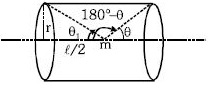
(C) The magnetic field $B$ at the axial midpoint of a finite solenoid is given by the formula:
$B = \frac{\mu_0 n i}{2} (\cos \theta_1 + \cos \theta_2)$
For the midpoint,$\theta_1 = \theta_2 = \theta$. Thus,$B = \mu_0 n i \cos \theta$.
Here,$n = \frac{N}{l}$ is the number of turns per unit length.
From the geometry of the solenoid,$\cos \theta = \frac{l/2}{\sqrt{r^2 + (l/2)^2}} = \frac{l}{\sqrt{4r^2 + l^2}}$.
Substituting these values into the expression for $B$:
$B = \mu_0 \left(\frac{N}{l}\right) i \left(\frac{l}{\sqrt{4r^2 + l^2}}\right)$
$B = \frac{N \mu_0 i}{\sqrt{4r^2 + l^2}}$
$B = \frac{\mu_0 n i}{2} (\cos \theta_1 + \cos \theta_2)$
For the midpoint,$\theta_1 = \theta_2 = \theta$. Thus,$B = \mu_0 n i \cos \theta$.
Here,$n = \frac{N}{l}$ is the number of turns per unit length.
From the geometry of the solenoid,$\cos \theta = \frac{l/2}{\sqrt{r^2 + (l/2)^2}} = \frac{l}{\sqrt{4r^2 + l^2}}$.
Substituting these values into the expression for $B$:
$B = \mu_0 \left(\frac{N}{l}\right) i \left(\frac{l}{\sqrt{4r^2 + l^2}}\right)$
$B = \frac{N \mu_0 i}{\sqrt{4r^2 + l^2}}$
0 likes
View Solution56
MediumMCQ
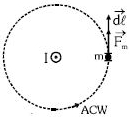
An imaginary north pole of $10 \, Am$ is rotating around an infinitely long current-carrying wire at $30 \, \text{revolutions/min}$ on a circular path. If the current in the wire is $5 \, A$, then calculate the work done in one second.
A
$2\pi \times 10^{-4} \, J$
B
$\pi \times 10^{-5} \, J$
C
$\pi \times 10^{-4} \, J$
D
$3\pi \times 10^{-4} \, J$
Solution
(B) The magnetic potential difference between two points in a magnetic field is given by the work done in moving a unit north pole. For a closed loop around a current-carrying wire, the work done $W$ is given by $W = m \oint \vec{B} \cdot d\vec{l}$, where $m$ is the pole strength.
From Ampere's Circuital Law, $\oint \vec{B} \cdot d\vec{l} = \mu_0 I$.
Therefore, the work done in one complete revolution is $W_{rev} = m \mu_0 I$.
Given: $m = 10 \, Am$, $I = 5 \, A$, and $\mu_0 = 4\pi \times 10^{-7} \, T \cdot m/A$.
$W_{rev} = 10 \times (4\pi \times 10^{-7}) \times 5 = 200\pi \times 10^{-7} = 2\pi \times 10^{-5} \, J$.
The frequency of revolution is $30 \, \text{rpm} = 0.5 \, \text{revolutions/sec}$.
Work done in one second = $(\text{Work per revolution}) \times (\text{Number of revolutions per second}) = (2\pi \times 10^{-5} \, J) \times 0.5 = \pi \times 10^{-5} \, J$.
From Ampere's Circuital Law, $\oint \vec{B} \cdot d\vec{l} = \mu_0 I$.
Therefore, the work done in one complete revolution is $W_{rev} = m \mu_0 I$.
Given: $m = 10 \, Am$, $I = 5 \, A$, and $\mu_0 = 4\pi \times 10^{-7} \, T \cdot m/A$.
$W_{rev} = 10 \times (4\pi \times 10^{-7}) \times 5 = 200\pi \times 10^{-7} = 2\pi \times 10^{-5} \, J$.
The frequency of revolution is $30 \, \text{rpm} = 0.5 \, \text{revolutions/sec}$.
Work done in one second = $(\text{Work per revolution}) \times (\text{Number of revolutions per second}) = (2\pi \times 10^{-5} \, J) \times 0.5 = \pi \times 10^{-5} \, J$.
0 likes
View Solution57
DifficultMCQ
An infinitely long hollow conducting cylinder with inner radius $R/2$ and outer radius $R$ carries a uniform current density along its length. The magnitude of the magnetic field,$|\vec B |$ as a function of the radial distance $r$ from the axis is best represented by:
A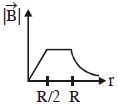
B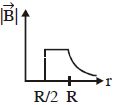
C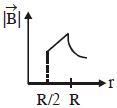
D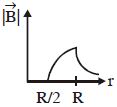
Solution
(D) For an infinitely long hollow cylinder with inner radius $a = R/2$ and outer radius $b = R$ carrying a uniform current density $J$:
$1$. For $r < R/2$,the enclosed current is $0$,so $B = 0$.
$2$. For $R/2 \le r \le R$,using Ampere's Law $\oint \vec B \cdot d\vec l = \mu_0 I_{enc}$,we have $B(2\pi r) = \mu_0 J \pi (r^2 - (R/2)^2)$. Thus,$B = \frac{\mu_0 J}{2r} (r^2 - R^2/4) = \frac{\mu_0 J}{2} (r - R^2/4r)$.
$3$. For $r > R$,the total current $I = J \pi (R^2 - (R/2)^2) = J \pi (3R^2/4)$ is enclosed. Thus,$B(2\pi r) = \mu_0 I$,which gives $B = \frac{\mu_0 I}{2\pi r}$,meaning $B \propto 1/r$.
Comparing this behavior: $B=0$ for $r < R/2$,$B$ increases then decreases within the conductor,and $B \propto 1/r$ for $r > R$. Graph $D$ correctly represents this variation.
$1$. For $r < R/2$,the enclosed current is $0$,so $B = 0$.
$2$. For $R/2 \le r \le R$,using Ampere's Law $\oint \vec B \cdot d\vec l = \mu_0 I_{enc}$,we have $B(2\pi r) = \mu_0 J \pi (r^2 - (R/2)^2)$. Thus,$B = \frac{\mu_0 J}{2r} (r^2 - R^2/4) = \frac{\mu_0 J}{2} (r - R^2/4r)$.
$3$. For $r > R$,the total current $I = J \pi (R^2 - (R/2)^2) = J \pi (3R^2/4)$ is enclosed. Thus,$B(2\pi r) = \mu_0 I$,which gives $B = \frac{\mu_0 I}{2\pi r}$,meaning $B \propto 1/r$.
Comparing this behavior: $B=0$ for $r < R/2$,$B$ increases then decreases within the conductor,and $B \propto 1/r$ for $r > R$. Graph $D$ correctly represents this variation.
0 likes
View Solution58
MediumMCQ
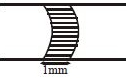
$A$ long solenoid is fabricated by closely winding a wire of radius $0.5 \, mm$ over a cylindrical frame so that the successive turns nearly touch each other. What is the magnetic field at the centre of the solenoid if it carries a current of $5 \, A$?
A
$2 \pi \times 10^{-2} \, T$
B
$2 \pi \times 10^{-3} \, T$
C
$2 \pi \times 10^{-4} \, T$
D
$2 \pi \times 10^{-5} \, T$
Solution
(B) The magnetic field $B$ at the centre of a long solenoid is given by $B = \mu_0 n I$,where $n = \frac{N}{L}$ is the number of turns per unit length.
Given that the wire has a radius $r = 0.5 \, mm$,the diameter of the wire is $d = 2r = 1 \, mm = 10^{-3} \, m$.
Since the turns are closely wound,the number of turns per unit length is $n = \frac{1}{d} = \frac{1}{2r} = \frac{1}{10^{-3} \, m} = 10^3 \, m^{-1}$.
The current $I = 5 \, A$.
Substituting these values into the formula:
$B = \mu_0 n I = (4 \pi \times 10^{-7} \, T \cdot m/A) \times (10^3 \, m^{-1}) \times (5 \, A)$
$B = 20 \pi \times 10^{-4} \, T$
$B = 2 \pi \times 10^{-3} \, T$.
Given that the wire has a radius $r = 0.5 \, mm$,the diameter of the wire is $d = 2r = 1 \, mm = 10^{-3} \, m$.
Since the turns are closely wound,the number of turns per unit length is $n = \frac{1}{d} = \frac{1}{2r} = \frac{1}{10^{-3} \, m} = 10^3 \, m^{-1}$.
The current $I = 5 \, A$.
Substituting these values into the formula:
$B = \mu_0 n I = (4 \pi \times 10^{-7} \, T \cdot m/A) \times (10^3 \, m^{-1}) \times (5 \, A)$
$B = 20 \pi \times 10^{-4} \, T$
$B = 2 \pi \times 10^{-3} \, T$.
0 likes
View Solution59
MediumMCQ
The current in the windings of a toroid is $2.0\,A$. There are $400\,turns$ and the mean circumferential length is $40\,cm$. If the inside magnetic field is $1.0\,T$, the relative permeability is near to
A
$100$
B
$200$
C
$300$
D
$400$
Solution
(D) The magnetic field inside a toroid filled with a medium is given by the formula:
$B = \frac{\mu_0 \mu_r N i}{L}$
where $L = 2 \pi r$ is the mean circumferential length.
Given values:
$i = 2.0\,A$
$N = 400\,turns$
$L = 40\,cm = 0.4\,m$
$B = 1.0\,T$
$\mu_0 = 4 \pi \times 10^{-7}\,T \cdot m/A$
Rearranging the formula to solve for relative permeability $\mu_r$:
$\mu_r = \frac{B \cdot L}{\mu_0 \cdot N \cdot i}$
Substituting the values:
$\mu_r = \frac{1.0 \times 0.4}{4 \pi \times 10^{-7} \times 400 \times 2.0}$
$\mu_r = \frac{0.4}{3200 \pi \times 10^{-7}}$
$\mu_r = \frac{0.4}{3.2 \pi \times 10^{-4}} = \frac{4000}{3.2 \pi} \approx \frac{4000}{10.05} \approx 398$
Rounding to the nearest given option, we get $\mu_r \approx 400$.
$B = \frac{\mu_0 \mu_r N i}{L}$
where $L = 2 \pi r$ is the mean circumferential length.
Given values:
$i = 2.0\,A$
$N = 400\,turns$
$L = 40\,cm = 0.4\,m$
$B = 1.0\,T$
$\mu_0 = 4 \pi \times 10^{-7}\,T \cdot m/A$
Rearranging the formula to solve for relative permeability $\mu_r$:
$\mu_r = \frac{B \cdot L}{\mu_0 \cdot N \cdot i}$
Substituting the values:
$\mu_r = \frac{1.0 \times 0.4}{4 \pi \times 10^{-7} \times 400 \times 2.0}$
$\mu_r = \frac{0.4}{3200 \pi \times 10^{-7}}$
$\mu_r = \frac{0.4}{3.2 \pi \times 10^{-4}} = \frac{4000}{3.2 \pi} \approx \frac{4000}{10.05} \approx 398$
Rounding to the nearest given option, we get $\mu_r \approx 400$.
0 likes
View Solution60
MediumMCQ
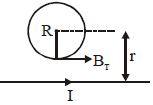
In the following diagram,there is a straight wire carrying a current $I$. Consider a circular path with radius $R$ near it. If $\vec{B}_T$ is the tangential component of the magnetic field along the circular path,then find the value of the integral $\oint \vec{B}_T \cdot d\vec{l}$.
A
$\mu_0 I$
B
$\frac{\mu_0 I}{2}$
C
$\mu_0 I / 4$
D
Zero
Solution
(D) According to Ampere's circuital law,the line integral of the magnetic field $\vec{B}$ around any closed loop is equal to $\mu_0$ times the net current $I_{\text{enclosed}}$ passing through the surface bounded by the loop.
$\oint \vec{B} \cdot d\vec{l} = \mu_0 I_{\text{enclosed}}$
In this problem,the circular path of radius $R$ does not enclose the straight wire carrying current $I$. Therefore,the net current enclosed by the circular path is $I_{\text{enclosed}} = 0$.
Since the integral is taken over the closed circular path,and the magnetic field produced by the external wire is conservative in the region not containing the wire,the line integral of the tangential component $\vec{B}_T$ around the closed loop is zero.
Thus,$\oint \vec{B}_T \cdot d\vec{l} = 0$.
$\oint \vec{B} \cdot d\vec{l} = \mu_0 I_{\text{enclosed}}$
In this problem,the circular path of radius $R$ does not enclose the straight wire carrying current $I$. Therefore,the net current enclosed by the circular path is $I_{\text{enclosed}} = 0$.
Since the integral is taken over the closed circular path,and the magnetic field produced by the external wire is conservative in the region not containing the wire,the line integral of the tangential component $\vec{B}_T$ around the closed loop is zero.
Thus,$\oint \vec{B}_T \cdot d\vec{l} = 0$.
0 likes
View Solution61
DifficultMCQ
$A$ current of $1/4\pi \ A$ is flowing through a toroid. It has $1000$ turns per meter. The value of the magnetic field (in $Wb/m^2$) along its axis is:
A
$10^{-2}$
B
$10^{-3}$
C
$10^{-4}$
D
$10^{-7}$
Solution
(C) The magnetic field $B$ inside a toroid is given by the formula $B = \mu_0 n I$,where $\mu_0$ is the permeability of free space,$n$ is the number of turns per unit length,and $I$ is the current.
Given:
$n = 1000 \ m^{-1}$
$I = \frac{1}{4\pi} \ A$
$\mu_0 = 4\pi \times 10^{-7} \ T \cdot m/A$
Substituting the values into the formula:
$B = (4\pi \times 10^{-7}) \times 1000 \times \left(\frac{1}{4\pi}\right)$
$B = 10^{-7} \times 10^3$
$B = 10^{-4} \ Wb/m^2$.
Given:
$n = 1000 \ m^{-1}$
$I = \frac{1}{4\pi} \ A$
$\mu_0 = 4\pi \times 10^{-7} \ T \cdot m/A$
Substituting the values into the formula:
$B = (4\pi \times 10^{-7}) \times 1000 \times \left(\frac{1}{4\pi}\right)$
$B = 10^{-7} \times 10^3$
$B = 10^{-4} \ Wb/m^2$.
0 likes
View Solution62
MediumMCQ
Assertion: The magnetic field produced by a current-carrying solenoid is independent of its length and cross-sectional area.
Reason: The magnetic field inside the solenoid is uniform.
Reason: The magnetic field inside the solenoid is uniform.
A
If both Assertion and Reason are correct and the Reason is a correct explanation of the Assertion.
B
If both Assertion and Reason are correct but Reason is not a correct explanation of the Assertion.
C
If the Assertion is correct but Reason is incorrect.
D
If both the Assertion and Reason are incorrect.
Solution
(A) For an ideal solenoid of infinite length,the magnetic field inside is given by $B = \mu_0 n i$,where $n$ is the number of turns per unit length and $i$ is the current.
This expression shows that the magnetic field $B$ depends only on the number of turns per unit length and the current,making it independent of the total length $l$ and the cross-sectional area $A$ of the solenoid.
Inside an ideal solenoid,the magnetic field is uniform and parallel to the axis.
Therefore,both the Assertion and the Reason are correct,and the Reason correctly explains why the field is independent of the solenoid's dimensions (as the uniform field is a property of the ideal solenoid model).
Thus,the correct option is $A$.
This expression shows that the magnetic field $B$ depends only on the number of turns per unit length and the current,making it independent of the total length $l$ and the cross-sectional area $A$ of the solenoid.
Inside an ideal solenoid,the magnetic field is uniform and parallel to the axis.
Therefore,both the Assertion and the Reason are correct,and the Reason correctly explains why the field is independent of the solenoid's dimensions (as the uniform field is a property of the ideal solenoid model).
Thus,the correct option is $A$.
0 likes
View Solution63
EasyMCQ
Assertion : If the current in a solenoid is reversed in direction while keeping the same magnitude,the magnetic field energy stored in the solenoid decreases.
Reason : Magnetic field energy density is proportional to the square of the current.
Reason : Magnetic field energy density is proportional to the square of the current.
A
If both Assertion and Reason are correct and Reason is the correct explanation of Assertion.
B
If both Assertion and Reason are correct,but Reason is not the correct explanation of Assertion.
C
If Assertion is correct but Reason is incorrect.
D
If both the Assertion and Reason are incorrect.
Solution
(C) The magnetic field $B$ inside a solenoid is given by $B = \mu_0 n I$,where $I$ is the current.
The magnetic field energy density $u$ is given by $u = \frac{B^2}{2\mu_0} = \frac{(\mu_0 n I)^2}{2\mu_0} = \frac{1}{2} \mu_0 n^2 I^2$.
Since the energy density $u$ is proportional to $I^2$,reversing the direction of the current (i.e.,changing $I$ to $-I$) does not change the value of $I^2$.
Therefore,the magnetic field energy stored in the solenoid remains constant.
Since the Assertion claims the energy decreases,the Assertion is incorrect.
The Reason states that energy density is proportional to the square of the current,which is correct.
Thus,the Assertion is incorrect and the Reason is correct.
The magnetic field energy density $u$ is given by $u = \frac{B^2}{2\mu_0} = \frac{(\mu_0 n I)^2}{2\mu_0} = \frac{1}{2} \mu_0 n^2 I^2$.
Since the energy density $u$ is proportional to $I^2$,reversing the direction of the current (i.e.,changing $I$ to $-I$) does not change the value of $I^2$.
Therefore,the magnetic field energy stored in the solenoid remains constant.
Since the Assertion claims the energy decreases,the Assertion is incorrect.
The Reason states that energy density is proportional to the square of the current,which is correct.
Thus,the Assertion is incorrect and the Reason is correct.
0 likes
View Solution64
MediumMCQ
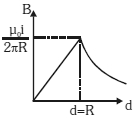
$A$ cylindrical conductor of radius $R$ is carrying a constant current. The plot of the magnitude of the magnetic field,$B$ with the distance $d$,from the centre of the conductor,is correctly represented by the figure:
A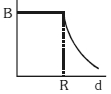
B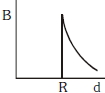
C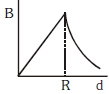
D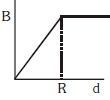
Solution
(C) According to Ampere's circuital law,the magnetic field $B$ at a distance $d$ from the axis of a long cylindrical conductor of radius $R$ carrying a current $I$ is given by:
For $d \leq R$ (inside the conductor),$B = \frac{\mu_{0}Id}{2 \pi R^{2}}$,which shows that $B \propto d$ (a linear relationship).
For $d > R$ (outside the conductor),$B = \frac{\mu_{0} I}{2 \pi d}$,which shows that $B \propto \frac{1}{d}$ (a hyperbolic relationship).
At the surface $(d = R)$,the magnetic field is maximum,$B_{max} = \frac{\mu_{0} I}{2 \pi R}$.
Comparing this with the given options,the graph that shows a linear increase up to $d = R$ and a hyperbolic decrease for $d > R$ is represented by Figure $C$.
For $d \leq R$ (inside the conductor),$B = \frac{\mu_{0}Id}{2 \pi R^{2}}$,which shows that $B \propto d$ (a linear relationship).
For $d > R$ (outside the conductor),$B = \frac{\mu_{0} I}{2 \pi d}$,which shows that $B \propto \frac{1}{d}$ (a hyperbolic relationship).
At the surface $(d = R)$,the magnetic field is maximum,$B_{max} = \frac{\mu_{0} I}{2 \pi R}$.
Comparing this with the given options,the graph that shows a linear increase up to $d = R$ and a hyperbolic decrease for $d > R$ is represented by Figure $C$.
0 likes
View Solution65
MediumMCQ
Two toroids $1$ and $2$ have total number of turns $200$ and $100$ respectively with average radii $40 \; cm$ and $20 \; cm$ respectively. If they carry the same current $i$,the ratio of the magnetic fields along the two loops is
A
$1:1$
B
$4:1$
C
$2:1$
D
$1:2$
Solution
(A) The magnetic field $B$ inside a toroid is given by the formula $B = \frac{\mu_0 N i}{2 \pi r}$,where $N$ is the total number of turns,$i$ is the current,and $r$ is the average radius.
Given for toroid $1$: $N_1 = 200$,$r_1 = 40 \; cm$.
Given for toroid $2$: $N_2 = 100$,$r_2 = 20 \; cm$.
Since the current $i$ is the same for both,the ratio of the magnetic fields is:
$\frac{B_1}{B_2} = \frac{\frac{\mu_0 N_1 i}{2 \pi r_1}}{\frac{\mu_0 N_2 i}{2 \pi r_2}} = \frac{N_1}{N_2} \times \frac{r_2}{r_1}$
Substituting the values:
$\frac{B_1}{B_2} = \left( \frac{200}{100} \right) \times \left( \frac{20}{40} \right) = 2 \times \frac{1}{2} = 1$
Therefore,the ratio is $1:1$.
Given for toroid $1$: $N_1 = 200$,$r_1 = 40 \; cm$.
Given for toroid $2$: $N_2 = 100$,$r_2 = 20 \; cm$.
Since the current $i$ is the same for both,the ratio of the magnetic fields is:
$\frac{B_1}{B_2} = \frac{\frac{\mu_0 N_1 i}{2 \pi r_1}}{\frac{\mu_0 N_2 i}{2 \pi r_2}} = \frac{N_1}{N_2} \times \frac{r_2}{r_1}$
Substituting the values:
$\frac{B_1}{B_2} = \left( \frac{200}{100} \right) \times \left( \frac{20}{40} \right) = 2 \times \frac{1}{2} = 1$
Therefore,the ratio is $1:1$.
0 likes
View Solution66
DifficultMCQ
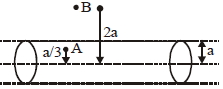
$A$ long,straight wire of radius $a$ carries a current distributed uniformly over its cross-section. The ratio of the magnetic fields due to the wire at distance $\frac{a}{3}$ and $2a$ respectively from the axis of the wire is
A
$\frac{2}{3}$
B
$\frac{3}{2}$
C
$\frac{1}{2}$
D
$2$
Solution
(A) Let the total current be $I$ and current density be $J = \frac{I}{\pi a^2}$.
For a point inside the wire at distance $r < a$,using Ampere's law: $\oint \vec{B} \cdot d\vec{\ell} = \mu_0 I_{enclosed}$.
$B(2\pi r) = \mu_0 (J \cdot \pi r^2) \Rightarrow B = \frac{\mu_0 J r}{2}$.
At $r = \frac{a}{3}$,$B_A = \frac{\mu_0 J (a/3)}{2} = \frac{\mu_0 J a}{6}$.
For a point outside the wire at distance $r > a$,the wire acts as a long straight wire carrying current $I$ at its axis.
$B(2\pi r) = \mu_0 I = \mu_0 (J \pi a^2) \Rightarrow B = \frac{\mu_0 J a^2}{2r}$.
At $r = 2a$,$B_B = \frac{\mu_0 J a^2}{2(2a)} = \frac{\mu_0 J a}{4}$.
The ratio is $\frac{B_A}{B_B} = \frac{\mu_0 J a / 6}{\mu_0 J a / 4} = \frac{4}{6} = \frac{2}{3}$.
For a point inside the wire at distance $r < a$,using Ampere's law: $\oint \vec{B} \cdot d\vec{\ell} = \mu_0 I_{enclosed}$.
$B(2\pi r) = \mu_0 (J \cdot \pi r^2) \Rightarrow B = \frac{\mu_0 J r}{2}$.
At $r = \frac{a}{3}$,$B_A = \frac{\mu_0 J (a/3)}{2} = \frac{\mu_0 J a}{6}$.
For a point outside the wire at distance $r > a$,the wire acts as a long straight wire carrying current $I$ at its axis.
$B(2\pi r) = \mu_0 I = \mu_0 (J \pi a^2) \Rightarrow B = \frac{\mu_0 J a^2}{2r}$.
At $r = 2a$,$B_B = \frac{\mu_0 J a^2}{2(2a)} = \frac{\mu_0 J a}{4}$.
The ratio is $\frac{B_A}{B_B} = \frac{\mu_0 J a / 6}{\mu_0 J a / 4} = \frac{4}{6} = \frac{2}{3}$.
0 likes
View Solution67
Medium
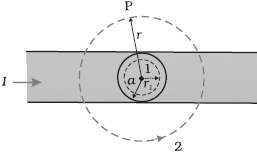
The figure shows a long straight wire of circular cross-section (radius $a$) carrying a steady current $I$. The current $I$ is uniformly distributed across this cross-section. Calculate the magnetic field in the region $r < a$ and $r > a$.
Solution
(N/A) Consider the case $r > a$. The Amperian loop,labelled $2$,is a circle concentric with the cross-section. For this loop,the path length is $L = 2 \pi r$.
The current enclosed by the loop is $I_e = I$.
Using Ampere's circuital law,$\oint B \cdot dl = \mu_0 I_e$,we get:
$B(2 \pi r) = \mu_0 I$
$B = \frac{\mu_0 I}{2 \pi r}$
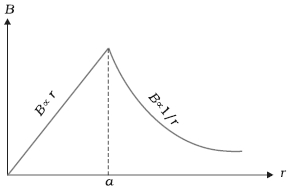
Thus,$B \propto \frac{1}{r}$ for $r > a$.
$(b)$ Consider the case $r < a$. The Amperian loop is a circle labelled $1$ with radius $r$.
The path length is $L = 2 \pi r$.
Since the current is uniformly distributed,the current enclosed $I_e$ is proportional to the area of the loop:
$I_e = I \left( \frac{\pi r^2}{\pi a^2} \right) = I \frac{r^2}{a^2}$.
Using Ampere's circuital law:
$B(2 \pi r) = \mu_0 \left( I \frac{r^2}{a^2} \right)$
$B = \left( \frac{\mu_0 I}{2 \pi a^2} \right) r$
Thus,$B \propto r$ for $r < a$.
The current enclosed by the loop is $I_e = I$.
Using Ampere's circuital law,$\oint B \cdot dl = \mu_0 I_e$,we get:
$B(2 \pi r) = \mu_0 I$
$B = \frac{\mu_0 I}{2 \pi r}$
Thus,$B \propto \frac{1}{r}$ for $r > a$.
$(b)$ Consider the case $r < a$. The Amperian loop is a circle labelled $1$ with radius $r$.
The path length is $L = 2 \pi r$.
Since the current is uniformly distributed,the current enclosed $I_e$ is proportional to the area of the loop:
$I_e = I \left( \frac{\pi r^2}{\pi a^2} \right) = I \frac{r^2}{a^2}$.
Using Ampere's circuital law:
$B(2 \pi r) = \mu_0 \left( I \frac{r^2}{a^2} \right)$
$B = \left( \frac{\mu_0 I}{2 \pi a^2} \right) r$
Thus,$B \propto r$ for $r < a$.
0 likes
View Solution68
MediumMCQ
$A$ solenoid of length $0.5\; m$ has a radius of $1\; cm$ and is made up of $500$ turns. It carries a current of $5\; A$. What is the magnitude of the magnetic field inside the solenoid?
A
$6.28 \times 10^{-3} \;T$
B
$3.14 \times 10^{-3} \;T$
C
$9.42 \times 10^{-3} \;T$
D
$1.56 \times 10^{-2} \;T$
Solution
(A) The number of turns per unit length is given by $n = \frac{N}{l}$.
Given $N = 500$ and $l = 0.5\; m$, we have $n = \frac{500}{0.5} = 1000\; \text{turns}/m$.
The length $l = 0.5\; m$ and radius $r = 0.01\; m$. Since $l \gg r$, we can treat this as an ideal long solenoid.
The magnetic field $B$ inside a long solenoid is given by $B = \mu_0 n I$.
Substituting the values: $\mu_0 = 4\pi \times 10^{-7}\; T\cdot m/A$, $n = 1000\; m^{-1}$, and $I = 5\; A$.
$B = (4 \times 3.14 \times 10^{-7}) \times 1000 \times 5$
$B = 20 \times 3.14 \times 10^{-4} = 62.8 \times 10^{-4} = 6.28 \times 10^{-3}\; T$.
Given $N = 500$ and $l = 0.5\; m$, we have $n = \frac{500}{0.5} = 1000\; \text{turns}/m$.
The length $l = 0.5\; m$ and radius $r = 0.01\; m$. Since $l \gg r$, we can treat this as an ideal long solenoid.
The magnetic field $B$ inside a long solenoid is given by $B = \mu_0 n I$.
Substituting the values: $\mu_0 = 4\pi \times 10^{-7}\; T\cdot m/A$, $n = 1000\; m^{-1}$, and $I = 5\; A$.
$B = (4 \times 3.14 \times 10^{-7}) \times 1000 \times 5$
$B = 20 \times 3.14 \times 10^{-4} = 62.8 \times 10^{-4} = 6.28 \times 10^{-3}\; T$.
0 likes
View Solution69
EasyMCQ
$A$ closely wound solenoid $80\; cm$ long has $5$ layers of windings of $400$ turns each. The diameter of the solenoid is $1.8\; cm$. If the current carried is $8.0\; A$,estimate the magnitude of $B$ inside the solenoid near its centre.
A
$2.5 \times 10^{-2}\; T$
B
$5.5 \times 10^{-2}\; T$
C
$9.3 \times 10^{-2}\; T$
D
$7.4 \times 10^{-3}\; T$
Solution
(A) Length of the solenoid,$l = 80\; cm = 0.8\; m$.
There are $5$ layers of windings of $400$ turns each on the solenoid.
Therefore,the total number of turns on the solenoid,$N = 5 \times 400 = 2000$.
Current carried by the solenoid,$I = 8.0\; A$.
The magnitude of the magnetic field inside the solenoid near its centre is given by the formula $B = \frac{\mu_0 N I}{l}$.
Here,$\mu_0 = 4\pi \times 10^{-7}\; T\; m\; A^{-1}$.
Substituting the values: $B = \frac{4\pi \times 10^{-7} \times 2000 \times 8.0}{0.8}$.
$B = 4\pi \times 10^{-7} \times 2000 \times 10 = 8\pi \times 10^{-3} \approx 2.512 \times 10^{-2}\; T$.
Thus,the magnitude of the magnetic field is approximately $2.5 \times 10^{-2}\; T$.
There are $5$ layers of windings of $400$ turns each on the solenoid.
Therefore,the total number of turns on the solenoid,$N = 5 \times 400 = 2000$.
Current carried by the solenoid,$I = 8.0\; A$.
The magnitude of the magnetic field inside the solenoid near its centre is given by the formula $B = \frac{\mu_0 N I}{l}$.
Here,$\mu_0 = 4\pi \times 10^{-7}\; T\; m\; A^{-1}$.
Substituting the values: $B = \frac{4\pi \times 10^{-7} \times 2000 \times 8.0}{0.8}$.
$B = 4\pi \times 10^{-7} \times 2000 \times 10 = 8\pi \times 10^{-3} \approx 2.512 \times 10^{-2}\; T$.
Thus,the magnitude of the magnetic field is approximately $2.5 \times 10^{-2}\; T$.
0 likes
View Solution70
Medium
$A$ magnetic field of $100 \;G$ $(1 \;G = 10^{-4} \;T)$ is required which is uniform in a region of linear dimension about $10 \;cm$ and area of cross-section about $10^{-3} \;m^2$. The maximum current-carrying capacity of a given coil of wire is $15 \;A$ and the number of turns per unit length that can be wound round a core is at most $1000 \;turns \;m^{-1}$. Suggest some appropriate design particulars of a solenoid for the required purpose. Assume the core is not ferromagnetic.
Solution
(A) The magnetic field $B$ produced by a solenoid is given by $B = \mu_0 n I$,where $n$ is the number of turns per unit length and $I$ is the current.
Given $B = 100 \;G = 10^{-2} \;T$.
Using $\mu_0 = 4\pi \times 10^{-7} \;T \;m \;A^{-1}$,we have $n I = \frac{B}{\mu_0} = \frac{10^{-2}}{4\pi \times 10^{-7}} \approx 7958 \;A \;m^{-1}$.
Since the maximum $n = 1000 \;turns \;m^{-1}$ and maximum $I = 15 \;A$,the product $n I$ can be as high as $15000 \;A \;m^{-1}$.
To achieve $n I \approx 7958 \;A \;m^{-1}$,we can choose $n = 800 \;turns \;m^{-1}$ and $I \approx 10 \;A$.
For a uniform field over a length of $10 \;cm$,the solenoid length should be significantly larger,e.g.,$L = 50 \;cm$. The radius should be large enough to accommodate the cross-section,e.g.,$r = 2 \;cm$ (area $\approx 1.25 \times 10^{-3} \;m^2$).
Thus,a solenoid of length $50 \;cm$,radius $2 \;cm$,$400$ turns,and current $10 \;A$ is a suitable design.
Given $B = 100 \;G = 10^{-2} \;T$.
Using $\mu_0 = 4\pi \times 10^{-7} \;T \;m \;A^{-1}$,we have $n I = \frac{B}{\mu_0} = \frac{10^{-2}}{4\pi \times 10^{-7}} \approx 7958 \;A \;m^{-1}$.
Since the maximum $n = 1000 \;turns \;m^{-1}$ and maximum $I = 15 \;A$,the product $n I$ can be as high as $15000 \;A \;m^{-1}$.
To achieve $n I \approx 7958 \;A \;m^{-1}$,we can choose $n = 800 \;turns \;m^{-1}$ and $I \approx 10 \;A$.
For a uniform field over a length of $10 \;cm$,the solenoid length should be significantly larger,e.g.,$L = 50 \;cm$. The radius should be large enough to accommodate the cross-section,e.g.,$r = 2 \;cm$ (area $\approx 1.25 \times 10^{-3} \;m^2$).
Thus,a solenoid of length $50 \;cm$,radius $2 \;cm$,$400$ turns,and current $10 \;A$ is a suitable design.
0 likes
View Solution71
Medium
$A$ toroid has a core (non-ferromagnetic) of inner radius $25 \; cm$ and outer radius $26 \; cm,$ around which $3500$ turns of a wire are wound. If the current in the wire is $11 \; A$,what is the magnetic field:
$(a)$ outside the toroid,
$(b)$ inside the core of the toroid,and
$(c)$ in the empty space surrounded by the toroid?
$(a)$ outside the toroid,
$(b)$ inside the core of the toroid,and
$(c)$ in the empty space surrounded by the toroid?
Solution
(B) Given:
Inner radius $r_{1} = 25 \; cm = 0.25 \; m$
Outer radius $r_{2} = 26 \; cm = 0.26 \; m$
Number of turns $N = 3500$
Current $I = 11 \; A$
$(a)$ The magnetic field outside a toroid is zero because the net current enclosed by an Amperian loop outside the toroid is zero.
$(b)$ The magnetic field inside the core of a toroid is given by $B = \frac{\mu_{0} N I}{l}$,where $l$ is the mean circumference.
Mean radius $r = \frac{r_{1} + r_{2}}{2} = \frac{0.25 + 0.26}{2} = 0.255 \; m$
Mean length $l = 2 \pi r = 2 \pi (0.255) = 0.51 \pi \; m$
Using $\mu_{0} = 4 \pi \times 10^{-7} \; T \cdot m \cdot A^{-1}$:
$B = \frac{4 \pi \times 10^{-7} \times 3500 \times 11}{0.51 \pi} = \frac{4 \times 10^{-7} \times 38500}{0.51} \approx 3.02 \times 10^{-2} \; T$
$(c)$ The magnetic field in the empty space surrounded by the toroid is zero,as the net current enclosed by an Amperian loop in this region is zero.
Inner radius $r_{1} = 25 \; cm = 0.25 \; m$
Outer radius $r_{2} = 26 \; cm = 0.26 \; m$
Number of turns $N = 3500$
Current $I = 11 \; A$
$(a)$ The magnetic field outside a toroid is zero because the net current enclosed by an Amperian loop outside the toroid is zero.
$(b)$ The magnetic field inside the core of a toroid is given by $B = \frac{\mu_{0} N I}{l}$,where $l$ is the mean circumference.
Mean radius $r = \frac{r_{1} + r_{2}}{2} = \frac{0.25 + 0.26}{2} = 0.255 \; m$
Mean length $l = 2 \pi r = 2 \pi (0.255) = 0.51 \pi \; m$
Using $\mu_{0} = 4 \pi \times 10^{-7} \; T \cdot m \cdot A^{-1}$:
$B = \frac{4 \pi \times 10^{-7} \times 3500 \times 11}{0.51 \pi} = \frac{4 \times 10^{-7} \times 38500}{0.51} \approx 3.02 \times 10^{-2} \; T$
$(c)$ The magnetic field in the empty space surrounded by the toroid is zero,as the net current enclosed by an Amperian loop in this region is zero.
0 likes
View Solution72
MediumMCQ
$A$ solenoid $60 \;cm$ long and of radius $4.0\; cm$ has $3$ layers of windings of $300$ turns each. $A$ $2.0 \;cm$ long wire of mass $2.5\; g$ lies inside the solenoid (near its centre) normal to its axis; both the wire and the axis of the solenoid are in the horizontal plane. The wire is connected through two leads parallel to the axis of the solenoid to an external battery which supplies a current of $6.0\; A$ in the wire. What value of current (in $A$) in the windings of the solenoid can support the weight of the wire? $(g=9.8\; m \,s ^{-2})$
A
$64$
B
$82$
C
$108$
D
$156$
Solution
(C) Length of the solenoid,$L = 0.6 \; m$.
Radius of the solenoid,$r = 0.04 \; m$.
Total number of turns,$N = 3 \times 300 = 900$.
Length of the wire,$l = 0.02 \; m$.
Mass of the wire,$m = 2.5 \times 10^{-3} \; kg$.
Current in the wire,$i = 6.0 \; A$.
Acceleration due to gravity,$g = 9.8 \; m \; s^{-2}$.
The magnetic field inside the solenoid is $B = \frac{\mu_0 N I}{L}$,where $I$ is the current in the solenoid.
The magnetic force on the wire is $F = B i l = \frac{\mu_0 N I i l}{L}$.
For the magnetic force to support the weight of the wire,$F = mg$.
Thus,$\frac{\mu_0 N I i l}{L} = mg$.
Rearranging for $I$: $I = \frac{mgL}{\mu_0 N i l}$.
Substituting the values: $I = \frac{2.5 \times 10^{-3} \times 9.8 \times 0.6}{4 \pi \times 10^{-7} \times 900 \times 6.0 \times 0.02}$.
$I = \frac{0.0147}{1.357 \times 10^{-4}} \approx 108 \; A$.
Radius of the solenoid,$r = 0.04 \; m$.
Total number of turns,$N = 3 \times 300 = 900$.
Length of the wire,$l = 0.02 \; m$.
Mass of the wire,$m = 2.5 \times 10^{-3} \; kg$.
Current in the wire,$i = 6.0 \; A$.
Acceleration due to gravity,$g = 9.8 \; m \; s^{-2}$.
The magnetic field inside the solenoid is $B = \frac{\mu_0 N I}{L}$,where $I$ is the current in the solenoid.
The magnetic force on the wire is $F = B i l = \frac{\mu_0 N I i l}{L}$.
For the magnetic force to support the weight of the wire,$F = mg$.
Thus,$\frac{\mu_0 N I i l}{L} = mg$.
Rearranging for $I$: $I = \frac{mgL}{\mu_0 N i l}$.
Substituting the values: $I = \frac{2.5 \times 10^{-3} \times 9.8 \times 0.6}{4 \pi \times 10^{-7} \times 900 \times 6.0 \times 0.02}$.
$I = \frac{0.0147}{1.357 \times 10^{-4}} \approx 108 \; A$.
0 likes
View Solution73
Medium
Calculate the axial magnetic field of a finite solenoid.
Solution
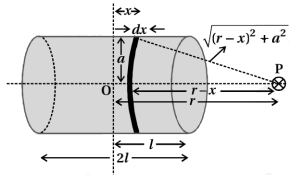
(N/A) Consider a solenoid of length $2l$ and radius $a$,with $n$ turns per unit length. We want to find the magnetic field at a point $P$ on the axis at a distance $r$ from the center $O$.
Consider a thin circular element of thickness $dx$ at a distance $x$ from the center $O$. The number of turns in this element is $n dx$. Let $I$ be the current flowing through the solenoid.
The magnetic field $dB$ due to this circular element at point $P$ is given by the formula for the magnetic field on the axis of a circular coil:
$dB = \frac{\mu_0 (n dx) I a^2}{2[(r-x)^2 + a^2]^{3/2}}$
To find the total magnetic field $B$,we integrate this expression from $x = -l$ to $x = +l$:
$B = \int_{-l}^{l} \frac{\mu_0 n I a^2}{2[(r-x)^2 + a^2]^{3/2}} dx$
For a point $P$ far from the solenoid ($r \gg a$ and $r \gg l$),we can approximate the denominator:
$[(r-x)^2 + a^2]^{3/2} \approx r^3$
Substituting this into the integral:
$B \approx \frac{\mu_0 n I a^2}{2r^3} \int_{-l}^{l} dx$
$B \approx \frac{\mu_0 n I a^2}{2r^3} [x]_{-l}^{l} = \frac{\mu_0 n I a^2}{2r^3} (2l)$
Since the total number of turns $N = n(2l)$,we have:
$B = \frac{\mu_0 N I a^2}{2r^3} = \frac{\mu_0}{4\pi} \frac{2(N I \pi a^2)}{r^3} = \frac{\mu_0}{4\pi} \frac{2m}{r^3}$,where $m = N I A$ is the magnetic dipole moment.
Consider a thin circular element of thickness $dx$ at a distance $x$ from the center $O$. The number of turns in this element is $n dx$. Let $I$ be the current flowing through the solenoid.
The magnetic field $dB$ due to this circular element at point $P$ is given by the formula for the magnetic field on the axis of a circular coil:
$dB = \frac{\mu_0 (n dx) I a^2}{2[(r-x)^2 + a^2]^{3/2}}$
To find the total magnetic field $B$,we integrate this expression from $x = -l$ to $x = +l$:
$B = \int_{-l}^{l} \frac{\mu_0 n I a^2}{2[(r-x)^2 + a^2]^{3/2}} dx$
For a point $P$ far from the solenoid ($r \gg a$ and $r \gg l$),we can approximate the denominator:
$[(r-x)^2 + a^2]^{3/2} \approx r^3$
Substituting this into the integral:
$B \approx \frac{\mu_0 n I a^2}{2r^3} \int_{-l}^{l} dx$
$B \approx \frac{\mu_0 n I a^2}{2r^3} [x]_{-l}^{l} = \frac{\mu_0 n I a^2}{2r^3} (2l)$
Since the total number of turns $N = n(2l)$,we have:
$B = \frac{\mu_0 N I a^2}{2r^3} = \frac{\mu_0}{4\pi} \frac{2(N I \pi a^2)}{r^3} = \frac{\mu_0}{4\pi} \frac{2m}{r^3}$,where $m = N I A$ is the magnetic dipole moment.
0 likes
View Solution74
Easy
Explain Ampere's circuital law.
Solution
(N/A) Ampere's circuital law provides an alternative and appealing way to express the relationship between a magnetic field and the current that produces it.
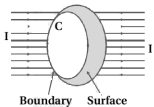
Consider an open surface with a boundary. The surface has a current passing through it.
We consider the boundary to be made up of a number of small line elements. Consider one such element of length $d\vec{l}$.
We take the value of the tangential component of the magnetic field $B_{T}$ at this element and multiply it by the length of that element $dl$:
$B_{T} dl = \vec{B} \cdot d\vec{l}$
As the number of elements increases,the sum tends to a line integral.
Ampere's circuital law states: The line integral of the magnetic field $\vec{B}$ around any closed loop is equal to $\mu_{0}$ times the total current $I$ passing through the surface enclosed by the loop.
Mathematically,$\oint \vec{B} \cdot d\vec{l} = \mu_{0} \Sigma I$
Where $\Sigma I$ is the algebraic sum of the currents enclosed by the loop.
The sign convention for the current is determined by the right-hand rule: If the fingers of the right hand are curled in the direction of the loop integration,then the thumb points in the direction of the positive current.
Consider an open surface with a boundary. The surface has a current passing through it.
We consider the boundary to be made up of a number of small line elements. Consider one such element of length $d\vec{l}$.
We take the value of the tangential component of the magnetic field $B_{T}$ at this element and multiply it by the length of that element $dl$:
$B_{T} dl = \vec{B} \cdot d\vec{l}$
As the number of elements increases,the sum tends to a line integral.
Ampere's circuital law states: The line integral of the magnetic field $\vec{B}$ around any closed loop is equal to $\mu_{0}$ times the total current $I$ passing through the surface enclosed by the loop.
Mathematically,$\oint \vec{B} \cdot d\vec{l} = \mu_{0} \Sigma I$
Where $\Sigma I$ is the algebraic sum of the currents enclosed by the loop.
The sign convention for the current is determined by the right-hand rule: If the fingers of the right hand are curled in the direction of the loop integration,then the thumb points in the direction of the positive current.
0 likes
View Solution75
Medium
Using Ampere's circuital law,derive the expression for the magnetic field at a perpendicular distance $r$ from an infinitely long current-carrying wire. Explain it.
Solution
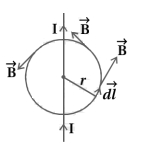
(N/A) Consider an infinitely long straight wire carrying a current $I$. To find the magnetic field at a distance $r$ from the wire,we choose a circular Amperean loop of radius $r$ centered on the wire.
The magnetic field lines due to a straight current-carrying wire are concentric circles. Therefore,at any point on the loop,the magnetic field $\vec{B}$ is tangential to the loop.
From the symmetry of the setup,the magnitude of the magnetic field $B$ is constant at all points on the loop. Thus,the line integral of the magnetic field is:
$\oint \vec{B} \cdot d\vec{l} = \oint B dl \cos 0^{\circ}$
$= B \oint dl$
$= B(2\pi r)$
According to Ampere's circuital law:
$\oint \vec{B} \cdot d\vec{l} = \mu_{0} I$
Equating the two expressions:
$B(2\pi r) = \mu_{0} I$
Therefore,the magnetic field is:
$B = \frac{\mu_{0} I}{2\pi r}$
The magnetic field lines due to a straight current-carrying wire are concentric circles. Therefore,at any point on the loop,the magnetic field $\vec{B}$ is tangential to the loop.
From the symmetry of the setup,the magnitude of the magnetic field $B$ is constant at all points on the loop. Thus,the line integral of the magnetic field is:
$\oint \vec{B} \cdot d\vec{l} = \oint B dl \cos 0^{\circ}$
$= B \oint dl$
$= B(2\pi r)$
According to Ampere's circuital law:
$\oint \vec{B} \cdot d\vec{l} = \mu_{0} I$
Equating the two expressions:
$B(2\pi r) = \mu_{0} I$
Therefore,the magnetic field is:
$B = \frac{\mu_{0} I}{2\pi r}$
0 likes
View Solution76
Medium
What is a solenoid? Provide information about the magnetic field through a qualitative discussion.
Solution
(N/A) solenoid is an insulated copper wire wound closely in the form of a helix. $A$ long solenoid is defined as one where the length is very large compared to its diameter.
If its length is shorter than its radius,it is called a short solenoid.
It consists of a long wire wound in the form of a helix where neighboring turns are closely spaced. Thus,each turn can be regarded as a circular loop.
Enamelled wires are used for winding so that turns are insulated from each other.
The net magnetic field is the vector sum of the fields due to all the individual turns.
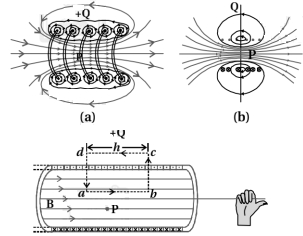
Figure $(a)$ shows a section of this solenoid in an enlarged manner.
Figure $(b)$ shows the entire finite solenoid with its magnetic field.
In figure $(a)$,it is clear from the circular loops that the field between two neighboring turns cancels out.
In figure $(b)$,we see that the field at the interior midpoint $P$ is uniform,strong,and directed along the axis of the solenoid.
The field at the exterior midpoint $Q$ is weak and directed along the axis of the solenoid with no perpendicular or normal component.
As the solenoid is made longer,it appears like a long cylindrical metal sheet.
The field outside the solenoid approaches zero. We assume that the field outside is zero.
The field inside becomes everywhere parallel to the axis.
If its length is shorter than its radius,it is called a short solenoid.
It consists of a long wire wound in the form of a helix where neighboring turns are closely spaced. Thus,each turn can be regarded as a circular loop.
Enamelled wires are used for winding so that turns are insulated from each other.
The net magnetic field is the vector sum of the fields due to all the individual turns.
Figure $(a)$ shows a section of this solenoid in an enlarged manner.
Figure $(b)$ shows the entire finite solenoid with its magnetic field.
In figure $(a)$,it is clear from the circular loops that the field between two neighboring turns cancels out.
In figure $(b)$,we see that the field at the interior midpoint $P$ is uniform,strong,and directed along the axis of the solenoid.
The field at the exterior midpoint $Q$ is weak and directed along the axis of the solenoid with no perpendicular or normal component.
As the solenoid is made longer,it appears like a long cylindrical metal sheet.
The field outside the solenoid approaches zero. We assume that the field outside is zero.
The field inside becomes everywhere parallel to the axis.
0 likes
View Solution77
Difficult
Derive the expression for the magnetic field inside a long straight solenoid.
Solution
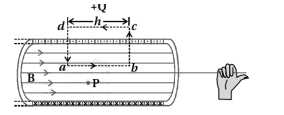
(N/A) The figure shows the sectional view of a long solenoid. At various turns of the solenoid,the current comes out of the plane of the paper at points marked $\odot$ and enters the plane of the paper at points marked $\otimes$.
To determine the magnetic field $B$ at any point inside,consider a rectangular closed path $abcd$ as the Amperean loop.
According to Ampere's circuital law:
$\oint \overrightarrow{B} \cdot \overrightarrow{dl} = \int_{a}^{b} \overrightarrow{B} \cdot \overrightarrow{dl} + \int_{b}^{c} \overrightarrow{B} \cdot \overrightarrow{dl} + \int_{c}^{d} \overrightarrow{B} \cdot \overrightarrow{dl} + \int_{d}^{a} \overrightarrow{B} \cdot \overrightarrow{dl} \quad \dots(1)$
The $cd$ part is outside the solenoid. The magnetic field outside is zero,so $\int_{c}^{d} \overrightarrow{B} \cdot \overrightarrow{dl} = 0$. For the $bc$ and $da$ parts,the magnetic field is perpendicular to the path,so $\int_{b}^{c} \overrightarrow{B} \cdot \overrightarrow{dl} = \int_{d}^{a} \overrightarrow{B} \cdot \overrightarrow{dl} = 0$.
Thus,equation $(1)$ simplifies to:
$\oint \overrightarrow{B} \cdot \overrightarrow{dl} = \int_{a}^{b} \overrightarrow{B} \cdot \overrightarrow{dl} = \int_{a}^{b} B dl \cos 0^{\circ} = B \int_{a}^{b} dl = B h$
(Where $h$ is the length of part $ab$).
Suppose $n$ is the number of turns per unit length. The total number of turns in length $h$ is $nh$. If $I$ is the current in each turn,the total current enclosed by the loop is $I_{e} = I(nh) \quad \dots(2)$.
Applying Ampere's circuital law,$\oint \overrightarrow{B} \cdot \overrightarrow{dl} = \mu_{0} I_{e}$:
$Bh = \mu_{0} (nhI)$
$B = \mu_{0} nI$
To determine the magnetic field $B$ at any point inside,consider a rectangular closed path $abcd$ as the Amperean loop.
According to Ampere's circuital law:
$\oint \overrightarrow{B} \cdot \overrightarrow{dl} = \int_{a}^{b} \overrightarrow{B} \cdot \overrightarrow{dl} + \int_{b}^{c} \overrightarrow{B} \cdot \overrightarrow{dl} + \int_{c}^{d} \overrightarrow{B} \cdot \overrightarrow{dl} + \int_{d}^{a} \overrightarrow{B} \cdot \overrightarrow{dl} \quad \dots(1)$
The $cd$ part is outside the solenoid. The magnetic field outside is zero,so $\int_{c}^{d} \overrightarrow{B} \cdot \overrightarrow{dl} = 0$. For the $bc$ and $da$ parts,the magnetic field is perpendicular to the path,so $\int_{b}^{c} \overrightarrow{B} \cdot \overrightarrow{dl} = \int_{d}^{a} \overrightarrow{B} \cdot \overrightarrow{dl} = 0$.
Thus,equation $(1)$ simplifies to:
$\oint \overrightarrow{B} \cdot \overrightarrow{dl} = \int_{a}^{b} \overrightarrow{B} \cdot \overrightarrow{dl} = \int_{a}^{b} B dl \cos 0^{\circ} = B \int_{a}^{b} dl = B h$
(Where $h$ is the length of part $ab$).
Suppose $n$ is the number of turns per unit length. The total number of turns in length $h$ is $nh$. If $I$ is the current in each turn,the total current enclosed by the loop is $I_{e} = I(nh) \quad \dots(2)$.
Applying Ampere's circuital law,$\oint \overrightarrow{B} \cdot \overrightarrow{dl} = \mu_{0} I_{e}$:
$Bh = \mu_{0} (nhI)$
$B = \mu_{0} nI$
0 likes
View Solution78
Medium
What is a toroid? Obtain the formula for the magnitude of the magnetic field due to a current-carrying toroid.
Solution
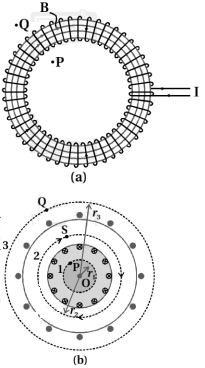
(N/A) toroid is a device consisting of a large number of turns of insulated wire wound on a hollow ring.
$A$ solenoid bent into the form of a closed ring is called a toroidal solenoid.
Let it carry a current $I$.
By Ampere's circuital law,we consider a circular Amperian loop of radius $r$ inside the toroid. The magnetic field $\vec{B}$ is tangential to the loop at every point.
According to Ampere's circuital law:
$\oint \vec{B} \cdot d\vec{l} = \mu_0 I_{enclosed}$
For a loop of radius $r$ inside the toroid,the total current enclosed is $N I$,where $N$ is the total number of turns.
$\oint B dl = B (2 \pi r) = \mu_0 N I$
Therefore,the magnitude of the magnetic field inside the toroid is:
$B = \frac{\mu_0 N I}{2 \pi r}$
If $n = \frac{N}{2 \pi r}$ is the number of turns per unit length,then $B = \mu_0 n I$.
$A$ solenoid bent into the form of a closed ring is called a toroidal solenoid.
Let it carry a current $I$.
By Ampere's circuital law,we consider a circular Amperian loop of radius $r$ inside the toroid. The magnetic field $\vec{B}$ is tangential to the loop at every point.
According to Ampere's circuital law:
$\oint \vec{B} \cdot d\vec{l} = \mu_0 I_{enclosed}$
For a loop of radius $r$ inside the toroid,the total current enclosed is $N I$,where $N$ is the total number of turns.
$\oint B dl = B (2 \pi r) = \mu_0 N I$
Therefore,the magnitude of the magnetic field inside the toroid is:
$B = \frac{\mu_0 N I}{2 \pi r}$
If $n = \frac{N}{2 \pi r}$ is the number of turns per unit length,then $B = \mu_0 n I$.
0 likes
View Solution79
EasyMCQ
Ampere's circuital law is associated with which law?
A
Biot-Savart law
B
Gauss's law in electrostatics
C
Faraday's law
D
Kirchhoff's law
Solution
(B) Ampere's circuital law relates the integrated magnetic field around a closed loop to the electric current passing through the loop.
It is the magnetic analogue of Gauss's law in electrostatics.
Just as Gauss's law relates the electric flux through a closed surface to the enclosed charge,Ampere's circuital law relates the line integral of the magnetic field around a closed path to the current enclosed by that path.
Therefore,it is associated with Gauss's law in electrostatics.
It is the magnetic analogue of Gauss's law in electrostatics.
Just as Gauss's law relates the electric flux through a closed surface to the enclosed charge,Ampere's circuital law relates the line integral of the magnetic field around a closed path to the current enclosed by that path.
Therefore,it is associated with Gauss's law in electrostatics.
0 likes
View Solution80
Medium
State Ampere's circuital law and explain its mathematical expression.
Solution
(N/A) Ampere's circuital law states that the line integral of the magnetic field $\vec{B}$ around any closed loop is equal to $\mu_0$ times the total current $I$ passing through the surface enclosed by the loop.
Mathematically,it is expressed as: $\oint \vec{B} \cdot d\vec{l} = \mu_0 I_{enclosed}$.
Here,$\oint$ represents the line integral over a closed path,$\vec{B}$ is the magnetic field,$d\vec{l}$ is the infinitesimal element of the path,$\mu_0$ is the permeability of free space,and $I_{enclosed}$ is the net current threading the loop.
Mathematically,it is expressed as: $\oint \vec{B} \cdot d\vec{l} = \mu_0 I_{enclosed}$.
Here,$\oint$ represents the line integral over a closed path,$\vec{B}$ is the magnetic field,$d\vec{l}$ is the infinitesimal element of the path,$\mu_0$ is the permeability of free space,and $I_{enclosed}$ is the net current threading the loop.
0 likes
View Solution81
Medium
What is an Amperian loop?
Solution
(N/A) An Amperian loop is an imaginary closed loop or path in space,chosen to apply Ampere's circuital law to calculate the magnetic field produced by a current distribution.
It is analogous to a Gaussian surface in electrostatics.
The loop is typically chosen such that the magnetic field $B$ is either constant along the path or perpendicular to it,simplifying the line integral $\oint B \cdot dl = \mu_0 I_{\text{enclosed}}$.
It is analogous to a Gaussian surface in electrostatics.
The loop is typically chosen such that the magnetic field $B$ is either constant along the path or perpendicular to it,simplifying the line integral $\oint B \cdot dl = \mu_0 I_{\text{enclosed}}$.
0 likes
View Solution82
EasyMCQ
Ampere's law is true for which type of current?
A
Steady current
B
Time-varying current
C
Both steady and time-varying current
D
None of the above
Solution
(A) Ampere's circuital law,in its original form,relates the line integral of the magnetic field $\vec{B}$ around a closed loop to the steady current $I$ passing through the surface enclosed by the loop: $\oint \vec{B} \cdot d\vec{l} = \mu_0 I$.
This original form is strictly valid only for steady currents (direct current) that do not change with time.
For time-varying currents,the law is incomplete and must be modified by adding the displacement current term,as proposed by Maxwell,to become the Ampere-Maxwell law: $\oint \vec{B} \cdot d\vec{l} = \mu_0 (I_c + I_d)$,where $I_c$ is the conduction current and $I_d$ is the displacement current.
Therefore,in the context of the standard Ampere's circuital law taught in introductory physics,it is considered true for steady currents.
This original form is strictly valid only for steady currents (direct current) that do not change with time.
For time-varying currents,the law is incomplete and must be modified by adding the displacement current term,as proposed by Maxwell,to become the Ampere-Maxwell law: $\oint \vec{B} \cdot d\vec{l} = \mu_0 (I_c + I_d)$,where $I_c$ is the conduction current and $I_d$ is the displacement current.
Therefore,in the context of the standard Ampere's circuital law taught in introductory physics,it is considered true for steady currents.
0 likes
View Solution83
Medium
An infinitely long cylindrical wire of radius $a$ carries a steady current $I$ uniformly distributed across its cross-section. Determine the magnetic field $B$ at a distance $r$ from the axis for: $(a) r > a$,$(b) r = a$,$(c) r < a$,and $(d)$ at the axis $(r = 0)$.
Solution
(N/A) Using Ampere's circuital law: $\oint B \cdot dl = \mu_0 I_{\text{enclosed}}$.
$(a)$ For $r > a$: The enclosed current is $I$. Thus,$B(2\pi r) = \mu_0 I$,which gives $B = \frac{\mu_0 I}{2\pi r}$.
$(b)$ For $r = a$: The magnetic field is $B = \frac{\mu_0 I}{2\pi a}$.
$(c)$ For $r < a$: The current density $J = \frac{I}{\pi a^2}$. The enclosed current $I_{\text{enclosed}} = J(\pi r^2) = I \frac{r^2}{a^2}$. Applying Ampere's law: $B(2\pi r) = \mu_0 I \frac{r^2}{a^2}$,which gives $B = \frac{\mu_0 I r}{2\pi a^2}$.
$(d)$ At the axis $(r = 0)$: Substituting $r = 0$ into the expression for $r < a$,we get $B = 0$.
$(a)$ For $r > a$: The enclosed current is $I$. Thus,$B(2\pi r) = \mu_0 I$,which gives $B = \frac{\mu_0 I}{2\pi r}$.
$(b)$ For $r = a$: The magnetic field is $B = \frac{\mu_0 I}{2\pi a}$.
$(c)$ For $r < a$: The current density $J = \frac{I}{\pi a^2}$. The enclosed current $I_{\text{enclosed}} = J(\pi r^2) = I \frac{r^2}{a^2}$. Applying Ampere's law: $B(2\pi r) = \mu_0 I \frac{r^2}{a^2}$,which gives $B = \frac{\mu_0 I r}{2\pi a^2}$.
$(d)$ At the axis $(r = 0)$: Substituting $r = 0$ into the expression for $r < a$,we get $B = 0$.
0 likes
View Solution84
Medium
What is a solenoid? And what is a long solenoid? Explain.
Solution
(N/A) solenoid is a long wire wound in a close-packed helix. When an electric current flows through it,it produces a magnetic field similar to that of a bar magnet.
$A$ long solenoid is defined as a solenoid whose length $(L)$ is much greater than its radius $(R)$,i.e.,$L \gg R$.
In a long solenoid,the magnetic field inside is nearly uniform and directed along the axis of the solenoid. The magnetic field outside the solenoid is negligible. For an ideal long solenoid,the magnetic field at any point inside is given by $B = \mu_0 n I$,where $\mu_0$ is the permeability of free space,$n$ is the number of turns per unit length,and $I$ is the current flowing through the solenoid.
$A$ long solenoid is defined as a solenoid whose length $(L)$ is much greater than its radius $(R)$,i.e.,$L \gg R$.
In a long solenoid,the magnetic field inside is nearly uniform and directed along the axis of the solenoid. The magnetic field outside the solenoid is negligible. For an ideal long solenoid,the magnetic field at any point inside is given by $B = \mu_0 n I$,where $\mu_0$ is the permeability of free space,$n$ is the number of turns per unit length,and $I$ is the current flowing through the solenoid.
0 likes
View Solution85
MediumMCQ
What is the magnetic field outside an ideal solenoid?
A
Zero
B
Uniform
C
Non-uniform
D
Infinite
Solution
(A) For an ideal solenoid,which is infinitely long and has closely wound turns,the magnetic field lines are parallel to the axis inside the solenoid.
Outside the ideal solenoid,the magnetic field is zero because the magnetic field lines do not form a closed loop outside the solenoid,and the contributions from the upper and lower halves of the windings cancel each other out.
Therefore,the magnetic field outside an ideal solenoid is $0$.
Outside the ideal solenoid,the magnetic field is zero because the magnetic field lines do not form a closed loop outside the solenoid,and the contributions from the upper and lower halves of the windings cancel each other out.
Therefore,the magnetic field outside an ideal solenoid is $0$.
0 likes
View Solution86
Easy
Write the equation for the magnetic field at an inside point of a very long solenoid.
Solution
(N/A) For a very long solenoid (ideal solenoid) carrying a current $I$ with $n$ turns per unit length,the magnetic field $B$ at an inside point is given by the formula:
$B = \mu_0 n I$
where:
$B$ is the magnetic field strength in Tesla $(T)$,
$\mu_0$ is the permeability of free space $(4\pi \times 10^{-7} \ T \cdot m/A)$,
$n$ is the number of turns per unit length $(N/L)$,
$I$ is the current flowing through the solenoid in Amperes $(A)$.
$B = \mu_0 n I$
where:
$B$ is the magnetic field strength in Tesla $(T)$,
$\mu_0$ is the permeability of free space $(4\pi \times 10^{-7} \ T \cdot m/A)$,
$n$ is the number of turns per unit length $(N/L)$,
$I$ is the current flowing through the solenoid in Amperes $(A)$.
0 likes
View Solution87
EasyMCQ
Give the formula for the magnetic field due to a toroid.
A
$B = \mu_0 n I$
B
$B = \mu_0 N I / (2 \pi r)$
C
$B = \mu_0 N I$
D
$B = 0$
Solution
(B) toroid is a hollow circular ring on which a large number of turns of a wire are closely wound.
According to Ampere's circuital law,for a toroid with $N$ total turns carrying current $I$,the magnetic field $B$ at a distance $r$ from the center (inside the core) is given by:
$\oint B \cdot dl = \mu_0 I_{enclosed}$
Since the path is a circle of radius $r$,$\oint dl = 2 \pi r$.
The total current enclosed by the path is $N \times I$.
Therefore,$B(2 \pi r) = \mu_0 N I$.
Thus,the magnetic field is $B = \frac{\mu_0 N I}{2 \pi r}$.
According to Ampere's circuital law,for a toroid with $N$ total turns carrying current $I$,the magnetic field $B$ at a distance $r$ from the center (inside the core) is given by:
$\oint B \cdot dl = \mu_0 I_{enclosed}$
Since the path is a circle of radius $r$,$\oint dl = 2 \pi r$.
The total current enclosed by the path is $N \times I$.
Therefore,$B(2 \pi r) = \mu_0 N I$.
Thus,the magnetic field is $B = \frac{\mu_0 N I}{2 \pi r}$.
0 likes
View Solution88
EasyMCQ
When a current flows through a solenoid,the solenoid acts as what?
A
$A$ straight wire
B
$A$ bar magnet
C
$A$ circular loop
D
$A$ capacitor
Solution
(B) solenoid is a long coil of wire wound in a tightly packed helix. When an electric current flows through it,it produces a magnetic field similar to that of a bar magnet. The magnetic field lines inside the solenoid are parallel and uniform,while outside they resemble the field lines of a bar magnet,with one end acting as the North pole and the other as the South pole. Therefore,a current-carrying solenoid behaves as a bar magnet.
0 likes
View Solution89
Easy
Write the equation of magnetic field on the axis of a current-carrying finite solenoid.
Solution
(N/A) For a finite solenoid of length $2L$,radius $R$,and $n$ turns per unit length carrying current $I$,the magnetic field $B$ at a point $P$ on its axis at a distance $x$ from the center is given by:
$B = \frac{\mu_0 n I}{2} [\cos \theta_1 + \cos \theta_2]$
Where $\theta_1$ and $\theta_2$ are the angles subtended by the ends of the solenoid at the point $P$ on the axis.
Alternatively,in terms of distance $x$ from the center:
$B = \frac{\mu_0 n I}{2} \left[ \frac{L-x}{\sqrt{R^2 + (L-x)^2}} + \frac{L+x}{\sqrt{R^2 + (L+x)^2}} \right]$
$B = \frac{\mu_0 n I}{2} [\cos \theta_1 + \cos \theta_2]$
Where $\theta_1$ and $\theta_2$ are the angles subtended by the ends of the solenoid at the point $P$ on the axis.
Alternatively,in terms of distance $x$ from the center:
$B = \frac{\mu_0 n I}{2} \left[ \frac{L-x}{\sqrt{R^2 + (L-x)^2}} + \frac{L+x}{\sqrt{R^2 + (L+x)^2}} \right]$
0 likes
View Solution90
EasyMCQ
What are electromagnets?
A
Permanent magnets made of steel.
B
Temporary magnets made of soft iron core with a current-carrying solenoid.
C
Magnets that do not require electricity to function.
D
Magnets made from natural lodestone.
Solution
(B) An electromagnet is a type of magnet in which the magnetic field is produced by an electric current.
It typically consists of a coil of wire (solenoid) wrapped around a core of soft iron.
When an electric current flows through the coil,the soft iron core becomes magnetized,creating a strong magnetic field.
When the current is switched off,the magnetic field disappears,making it a temporary magnet.
It typically consists of a coil of wire (solenoid) wrapped around a core of soft iron.
When an electric current flows through the coil,the soft iron core becomes magnetized,creating a strong magnetic field.
When the current is switched off,the magnetic field disappears,making it a temporary magnet.
0 likes
View Solution91
EasyMCQ
How can the magnetic field of a solenoid be increased for a given current?
A
By increasing the number of turns per unit length.
B
By inserting a soft iron core inside the solenoid.
C
Both $(A)$ and $(B)$.
D
None of the above.
Solution
(C) The magnetic field of a solenoid is given by the formula $B = \mu_0 n I$, where $n$ is the number of turns per unit length and $I$ is the electric current.
$1$. If we increase the number of turns per unit length $(n)$, the magnetic field increases.
$2$. If a ferromagnetic material (core) like soft iron is placed inside the solenoid, the magnetic field increases many times due to its relative permeability $(\mu_r)$ $(B = \mu_0 \mu_r n I)$.
Therefore, the correct option is $(C)$.
$1$. If we increase the number of turns per unit length $(n)$, the magnetic field increases.
$2$. If a ferromagnetic material (core) like soft iron is placed inside the solenoid, the magnetic field increases many times due to its relative permeability $(\mu_r)$ $(B = \mu_0 \mu_r n I)$.
Therefore, the correct option is $(C)$.
0 likes
View Solution92
Difficult
Verify Ampere's law for the magnetic field of a point dipole with dipole moment $\vec{M} = M\hat{k}$. Take $C$ as the closed curve running clockwise along the quarter circle of radius $R$ and center at the origin,in the first quadrant of the $x-z$ plane.
Solution
(A) The magnetic field of a point dipole $\vec{M} = M\hat{k}$ at a position $\vec{r}$ is given by $\vec{B}(\vec{r}) = \frac{\mu_0}{4\pi} \left[ \frac{3(\vec{M} \cdot \hat{r})\hat{r} - \vec{M}}{r^3} \right]$.
Ampere's law states that $\oint_C \vec{B} \cdot d\vec{l} = \mu_0 I_{enclosed}$.
For a point dipole,the magnetic field is conservative in regions excluding the origin,meaning $\nabla \times \vec{B} = 0$ for $\vec{r} \neq 0$.
Since the path $C$ is a closed loop that does not enclose any current source (the dipole is a point source at the origin,and the path is in the $x-z$ plane),the total current enclosed $I_{enclosed} = 0$.
Therefore,$\oint_C \vec{B} \cdot d\vec{l} = 0$,which verifies Ampere's law as $0 = \mu_0(0)$.
Ampere's law states that $\oint_C \vec{B} \cdot d\vec{l} = \mu_0 I_{enclosed}$.
For a point dipole,the magnetic field is conservative in regions excluding the origin,meaning $\nabla \times \vec{B} = 0$ for $\vec{r} \neq 0$.
Since the path $C$ is a closed loop that does not enclose any current source (the dipole is a point source at the origin,and the path is in the $x-z$ plane),the total current enclosed $I_{enclosed} = 0$.
Therefore,$\oint_C \vec{B} \cdot d\vec{l} = 0$,which verifies Ampere's law as $0 = \mu_0(0)$.
0 likes
View Solution93
Advanced
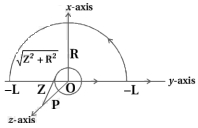
Consider a circular current-carrying loop of radius $R$ in the $x-y$ plane with its centre at the origin. Consider the line integral $\Im(L) = \left| \int_{-L}^{L} \vec{B} \cdot d\vec{l} \right|$ taken along the $z$-axis.
$(a)$ Show that $\Im(L)$ monotonically increases with $L$.
$(b)$ Use an appropriate Amperian loop to show that $\Im(\infty) = \mu_0 I$,where $I$ is the current in the wire.
$(c)$ Verify this result directly.
$(d)$ Suppose we replace the circular coil with a square coil of side $R$ carrying the same current $I$. What can you say about $\Im(L)$ and $\Im(\infty)$?
$(a)$ Show that $\Im(L)$ monotonically increases with $L$.
$(b)$ Use an appropriate Amperian loop to show that $\Im(\infty) = \mu_0 I$,where $I$ is the current in the wire.
$(c)$ Verify this result directly.
$(d)$ Suppose we replace the circular coil with a square coil of side $R$ carrying the same current $I$. What can you say about $\Im(L)$ and $\Im(\infty)$?
Solution
(N/A) The magnetic field $\vec{B}$ on the $z$-axis is directed along the $z$-axis. Thus,$\vec{B} \cdot d\vec{l} = B_z dz$. Since $B_z$ is always positive (or negative depending on current direction) along the $z$-axis,the integral $\int_{-L}^{L} B_z dz$ represents the area under the $B_z$ vs $z$ curve. As $L$ increases,the integral accumulates more area,so $\Im(L)$ monotonically increases.
$(b)$ Consider an Amperian loop consisting of the segment on the $z$-axis from $-L$ to $L$ and a large semi-circular arc of radius $r \to \infty$ in the $x-y$ plane. By Ampere's Law,$\oint \vec{B} \cdot d\vec{l} = \mu_0 I_{enclosed}$. As $r \to \infty$,the contribution from the arc vanishes because $B \propto 1/r^3$. Thus,$\int_{-L}^{L} B_z dz + 0 = \mu_0 I$,so $\Im(\infty) = \mu_0 I$.
$(c)$ The magnetic field on the axis of a circular loop is $B_z = \frac{\mu_0 I R^2}{2(z^2 + R^2)^{3/2}}$. Integrating from $-\infty$ to $\infty$: $\int_{-\infty}^{\infty} \frac{\mu_0 I R^2}{2(z^2 + R^2)^{3/2}} dz$. Let $z = R \tan \theta$,then $dz = R \sec^2 \theta d\theta$. The integral becomes $\frac{\mu_0 I}{2} \int_{-\pi/2}^{\pi/2} \cos \theta d\theta = \frac{\mu_0 I}{2} [\sin \theta]_{-\pi/2}^{\pi/2} = \mu_0 I$.
$(d)$ For a square coil,the symmetry is different,but the total flux linked or the line integral along the axis still follows the same topological constraints of Ampere's law. Thus,$\Im(\infty)$ remains $\mu_0 I$ due to the same enclosed current,while $\Im(L)$ will still monotonically increase.
$(b)$ Consider an Amperian loop consisting of the segment on the $z$-axis from $-L$ to $L$ and a large semi-circular arc of radius $r \to \infty$ in the $x-y$ plane. By Ampere's Law,$\oint \vec{B} \cdot d\vec{l} = \mu_0 I_{enclosed}$. As $r \to \infty$,the contribution from the arc vanishes because $B \propto 1/r^3$. Thus,$\int_{-L}^{L} B_z dz + 0 = \mu_0 I$,so $\Im(\infty) = \mu_0 I$.
$(c)$ The magnetic field on the axis of a circular loop is $B_z = \frac{\mu_0 I R^2}{2(z^2 + R^2)^{3/2}}$. Integrating from $-\infty$ to $\infty$: $\int_{-\infty}^{\infty} \frac{\mu_0 I R^2}{2(z^2 + R^2)^{3/2}} dz$. Let $z = R \tan \theta$,then $dz = R \sec^2 \theta d\theta$. The integral becomes $\frac{\mu_0 I}{2} \int_{-\pi/2}^{\pi/2} \cos \theta d\theta = \frac{\mu_0 I}{2} [\sin \theta]_{-\pi/2}^{\pi/2} = \mu_0 I$.
$(d)$ For a square coil,the symmetry is different,but the total flux linked or the line integral along the axis still follows the same topological constraints of Ampere's law. Thus,$\Im(\infty)$ remains $\mu_0 I$ due to the same enclosed current,while $\Im(L)$ will still monotonically increase.
0 likes
View Solution94
MediumMCQ
$A$ long solenoid of $50\, cm$ length having $100$ turns carries a current of $2.5\, A$. The magnetic field at the centre of the solenoid is $...... \times 10^{-5}\, T$. $(\mu_{0} = 4\pi \times 10^{-7}\, T\, m\, A^{-1})$
A
$3.14$
B
$62.8$
C
$31.4$
D
$6.28$
Solution
(B) The magnetic field $B$ at the centre of a long solenoid is given by the formula: $B = \mu_{0} n I$,where $n = \frac{N}{\ell}$.
Given:
Length $\ell = 50\, cm = 0.5\, m$
Number of turns $N = 100$
Current $I = 2.5\, A$
Permeability $\mu_{0} = 4\pi \times 10^{-7}\, T\, m\, A^{-1}$
Substituting the values:
$B = (4\pi \times 10^{-7}) \times \left(\frac{100}{0.5}\right) \times 2.5$
$B = (4 \times 3.14159 \times 10^{-7}) \times 200 \times 2.5$
$B = 12.566 \times 10^{-7} \times 500$
$B = 6283.18 \times 10^{-7} = 6.283 \times 10^{-4}\, T$
To express this in the form $...... \times 10^{-5}\, T$:
$B = 62.83 \times 10^{-5}\, T$
Rounding to the nearest option,the value is $62.8$.
Given:
Length $\ell = 50\, cm = 0.5\, m$
Number of turns $N = 100$
Current $I = 2.5\, A$
Permeability $\mu_{0} = 4\pi \times 10^{-7}\, T\, m\, A^{-1}$
Substituting the values:
$B = (4\pi \times 10^{-7}) \times \left(\frac{100}{0.5}\right) \times 2.5$
$B = (4 \times 3.14159 \times 10^{-7}) \times 200 \times 2.5$
$B = 12.566 \times 10^{-7} \times 500$
$B = 6283.18 \times 10^{-7} = 6.283 \times 10^{-4}\, T$
To express this in the form $...... \times 10^{-5}\, T$:
$B = 62.83 \times 10^{-5}\, T$
Rounding to the nearest option,the value is $62.8$.
0 likes
View Solution95
MediumMCQ
In a toroid,the magnetic field on the axis is to be calculated given the radius $r = 0.5 \, cm$,current $I = 1.5 \, A$,number of turns $N = 250$,and relative permeability $\mu_r = 700$. Find the magnetic field $B$ (in Tesla). (in $.5$)
A
$7$
B
$10$
C
$4$
D
$15$
Solution
(B) The magnetic field $B$ inside a toroid is given by the formula:
$B = \mu_0 \mu_r n I$
where $n = \frac{N}{2 \pi r}$ is the number of turns per unit length.
Substituting the values: $N = 250$,$r = 0.5 \, cm = 0.5 \times 10^{-2} \, m$,$I = 1.5 \, A$,$\mu_r = 700$,and $\mu_0 = 4 \pi \times 10^{-7} \, T \cdot m/A$.
$B = (4 \pi \times 10^{-7}) \times 700 \times \left[ \frac{250}{2 \pi \times 0.5 \times 10^{-2}} \right] \times 1.5$
$B = (2 \times 10^{-7}) \times 700 \times \left[ \frac{250}{0.5 \times 10^{-2}} \right] \times 1.5$
$B = (14 \times 10^{-5}) \times (50000) \times 1.5$
$B = 14 \times 5 \times 1.5 \times 10^{-1} = 10.5 \, T$.
$B = \mu_0 \mu_r n I$
where $n = \frac{N}{2 \pi r}$ is the number of turns per unit length.
Substituting the values: $N = 250$,$r = 0.5 \, cm = 0.5 \times 10^{-2} \, m$,$I = 1.5 \, A$,$\mu_r = 700$,and $\mu_0 = 4 \pi \times 10^{-7} \, T \cdot m/A$.
$B = (4 \pi \times 10^{-7}) \times 700 \times \left[ \frac{250}{2 \pi \times 0.5 \times 10^{-2}} \right] \times 1.5$
$B = (2 \times 10^{-7}) \times 700 \times \left[ \frac{250}{0.5 \times 10^{-2}} \right] \times 1.5$
$B = (14 \times 10^{-5}) \times (50000) \times 1.5$
$B = 14 \times 5 \times 1.5 \times 10^{-1} = 10.5 \, T$.
0 likes
View Solution96
DifficultMCQ
$A$ coaxial cable consists of an inner wire of radius $a$ surrounded by an outer shell of inner and outer radii $b$ and $c$ respectively. The inner wire carries an electric current $i_o$,which is distributed uniformly across its cross-sectional area. The outer shell carries an equal current in the opposite direction,also distributed uniformly. What will be the ratio of the magnetic field at a distance $x$ from the axis when $(i)$ $x < a$ and $(ii)$ $a < x < b$?
A
$\frac{x^2}{a^2}$
B
$\frac{a^2}{x^2}$
C
$\frac{x^2}{b^2 - a^2}$
D
$\frac{b^2 - a^2}{x^2}$
Solution
(A) Using Ampere's circuital law,$\oint \vec{B} \cdot d\vec{l} = \mu_0 I_{\text{enclosed}}$.
Case $(i)$: For $x < a$,the current enclosed by an Amperian loop of radius $x$ is $I_{\text{enclosed}} = i_o \left( \frac{\pi x^2}{\pi a^2} \right) = i_o \frac{x^2}{a^2}$.
Applying Ampere's law: $B_1 (2 \pi x) = \mu_0 i_o \frac{x^2}{a^2} \implies B_1 = \frac{\mu_0 i_o x}{2 \pi a^2}$.
Case $(ii)$: For $a < x < b$,the current enclosed by an Amperian loop of radius $x$ is the total current of the inner wire,$I_{\text{enclosed}} = i_o$.
Applying Ampere's law: $B_2 (2 \pi x) = \mu_0 i_o \implies B_2 = \frac{\mu_0 i_o}{2 \pi x}$.
The ratio of the magnetic fields is $\frac{B_1}{B_2} = \frac{\frac{\mu_0 i_o x}{2 \pi a^2}}{\frac{\mu_0 i_o}{2 \pi x}} = \frac{x}{a^2} \cdot x = \frac{x^2}{a^2}$.
Case $(i)$: For $x < a$,the current enclosed by an Amperian loop of radius $x$ is $I_{\text{enclosed}} = i_o \left( \frac{\pi x^2}{\pi a^2} \right) = i_o \frac{x^2}{a^2}$.
Applying Ampere's law: $B_1 (2 \pi x) = \mu_0 i_o \frac{x^2}{a^2} \implies B_1 = \frac{\mu_0 i_o x}{2 \pi a^2}$.
Case $(ii)$: For $a < x < b$,the current enclosed by an Amperian loop of radius $x$ is the total current of the inner wire,$I_{\text{enclosed}} = i_o$.
Applying Ampere's law: $B_2 (2 \pi x) = \mu_0 i_o \implies B_2 = \frac{\mu_0 i_o}{2 \pi x}$.
The ratio of the magnetic fields is $\frac{B_1}{B_2} = \frac{\frac{\mu_0 i_o x}{2 \pi a^2}}{\frac{\mu_0 i_o}{2 \pi x}} = \frac{x}{a^2} \cdot x = \frac{x^2}{a^2}$.
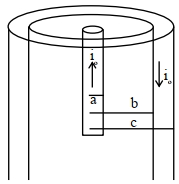
0 likes
View Solution97
MediumMCQ
$A$ thick current-carrying cable of radius $R$ carries current $I$ uniformly distributed across its cross-section. The variation of magnetic field $B(r)$ due to the cable with the distance $r$ from the axis of the cable is represented by:
A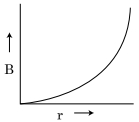
B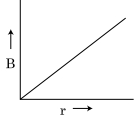
C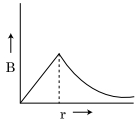
D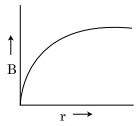
Solution
(C) For a thick cylindrical cable of radius $R$ carrying a uniformly distributed current $I$:
$1$. Inside the cable $(r < R)$: Using Ampere's circuital law,the magnetic field is given by $B_{\text{in}} = \frac{\mu_0 I r}{2 \pi R^2}$. This shows that $B \propto r$,which is a linear relationship.
$2$. Outside the cable $(r > R)$: The magnetic field is given by $B_{\text{out}} = \frac{\mu_0 I}{2 \pi r}$. This shows that $B \propto 1/r$,which is a hyperbolic relationship.
$3$. At the surface $(r = R)$: The magnetic field is maximum,$B_0 = \frac{\mu_0 I}{2 \pi R}$.
Therefore,the graph increases linearly from the center to the surface and then decreases hyperbolically as the distance increases beyond the surface.
$1$. Inside the cable $(r < R)$: Using Ampere's circuital law,the magnetic field is given by $B_{\text{in}} = \frac{\mu_0 I r}{2 \pi R^2}$. This shows that $B \propto r$,which is a linear relationship.
$2$. Outside the cable $(r > R)$: The magnetic field is given by $B_{\text{out}} = \frac{\mu_0 I}{2 \pi r}$. This shows that $B \propto 1/r$,which is a hyperbolic relationship.
$3$. At the surface $(r = R)$: The magnetic field is maximum,$B_0 = \frac{\mu_0 I}{2 \pi R}$.
Therefore,the graph increases linearly from the center to the surface and then decreases hyperbolically as the distance increases beyond the surface.
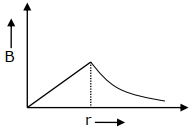
0 likes
View Solution98
EasyMCQ
$A$ long solenoid of radius $1\,mm$ has $100$ turns per $mm$. If $1\,A$ current flows in the solenoid,the magnetic field strength at the centre of the solenoid is:
A
$12.56 \times 10^{-2}\,T$
B
$12.56 \times 10^{-4}\,T$
C
$6.28 \times 10^{-4}\,T$
D
$6.28 \times 10^{-2}\,T$
Solution
(A) The magnetic field $B$ at the centre of a long solenoid is given by the formula $B = \mu_0 n i$,where $n$ is the number of turns per unit length and $i$ is the current.
Given:
Number of turns per unit length $n = 100 \text{ turns/mm} = 100 \times 10^3 \text{ turns/m} = 10^5 \text{ turns/m}$.
Current $i = 1\,A$.
Permeability of free space $\mu_0 = 4\pi \times 10^{-7} \text{ T}\,\text{m/A}$.
Substituting the values:
$B = (4\pi \times 10^{-7}) \times (10^5) \times (1)$
$B = 4\pi \times 10^{-2} \text{ T}$
$B \approx 4 \times 3.14 \times 10^{-2} \text{ T} = 12.56 \times 10^{-2} \text{ T}$.
Given:
Number of turns per unit length $n = 100 \text{ turns/mm} = 100 \times 10^3 \text{ turns/m} = 10^5 \text{ turns/m}$.
Current $i = 1\,A$.
Permeability of free space $\mu_0 = 4\pi \times 10^{-7} \text{ T}\,\text{m/A}$.
Substituting the values:
$B = (4\pi \times 10^{-7}) \times (10^5) \times (1)$
$B = 4\pi \times 10^{-2} \text{ T}$
$B \approx 4 \times 3.14 \times 10^{-2} \text{ T} = 12.56 \times 10^{-2} \text{ T}$.
0 likes
View Solution99
MediumMCQ
From Ampere's circuital law for a long straight wire of circular cross-section carrying a steady current,the variation of magnetic field in the inside and outside region of the wire is :
A
a linearly increasing function of distance up to the boundary of the wire and then linearly decreasing for the outside region.
B
a linearly increasing function of distance $r$ up to the boundary of the wire and then decreasing one with $1/r$ dependence for the outside region.
C
a linearly decreasing function of distance up to the boundary of the wire and then a linearly increasing one for the outside region.
D
uniform and remains constant for both the regions.
Solution
(B) According to Ampere's circuital law,for a long straight wire of radius $R$ carrying a steady current $I$:
$1$. Inside the wire $(r < R)$: The magnetic field $B$ is given by $B = \frac{\mu_0 I r}{2 \pi R^2}$. Thus,$B \propto r$,which means the magnetic field increases linearly with distance $r$ from the center.
$2$. Outside the wire $(r > R)$: The magnetic field $B$ is given by $B = \frac{\mu_0 I}{2 \pi r}$. Thus,$B \propto 1/r$,which means the magnetic field decreases as $1/r$ with distance $r$ from the center.
Therefore,the magnetic field increases linearly up to the boundary $(r = R)$ and then decreases as $1/r$ for the outside region.
$1$. Inside the wire $(r < R)$: The magnetic field $B$ is given by $B = \frac{\mu_0 I r}{2 \pi R^2}$. Thus,$B \propto r$,which means the magnetic field increases linearly with distance $r$ from the center.
$2$. Outside the wire $(r > R)$: The magnetic field $B$ is given by $B = \frac{\mu_0 I}{2 \pi r}$. Thus,$B \propto 1/r$,which means the magnetic field decreases as $1/r$ with distance $r$ from the center.
Therefore,the magnetic field increases linearly up to the boundary $(r = R)$ and then decreases as $1/r$ for the outside region.
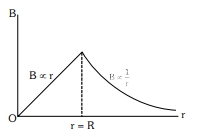
0 likes
View Solution100
EasyMCQ
$A$ long straight wire with a circular cross-section having radius $R$ is carrying a steady current $I$. The current $I$ is uniformly distributed across this cross-section. Then the variation of magnetic field due to current $I$ with distance $r$ $(r < R)$ from its centre will be:
A
$B \propto r^{2}$
B
$B \propto r$
C
$B \propto \frac{1}{r^{2}}$
D
$B \propto \frac{1}{r}$
Solution
(B) According to Ampere's circuital law,the line integral of the magnetic field $\vec{B}$ around a closed path is equal to $\mu_{0}$ times the current enclosed by the path: $\oint \vec{B} \cdot d\vec{l} = \mu_{0} I_{\text{enclosed}}$.
For a point at a distance $r < R$ from the centre,we consider an Amperian loop of radius $r$.
The current density $J$ is uniform,so $J = \frac{I}{\pi R^{2}}$.
The current enclosed by the loop of radius $r$ is $I_{\text{enclosed}} = J \cdot (\pi r^{2}) = \frac{I}{\pi R^{2}} \cdot \pi r^{2} = I \frac{r^{2}}{R^{2}}$.
Applying Ampere's law: $B(2\pi r) = \mu_{0} \left( I \frac{r^{2}}{R^{2}} \right)$.
Solving for $B$,we get $B = \frac{\mu_{0} I r}{2\pi R^{2}}$.
Since $\mu_{0}$,$I$,and $R$ are constants,we have $B \propto r$.
For a point at a distance $r < R$ from the centre,we consider an Amperian loop of radius $r$.
The current density $J$ is uniform,so $J = \frac{I}{\pi R^{2}}$.
The current enclosed by the loop of radius $r$ is $I_{\text{enclosed}} = J \cdot (\pi r^{2}) = \frac{I}{\pi R^{2}} \cdot \pi r^{2} = I \frac{r^{2}}{R^{2}}$.
Applying Ampere's law: $B(2\pi r) = \mu_{0} \left( I \frac{r^{2}}{R^{2}} \right)$.
Solving for $B$,we get $B = \frac{\mu_{0} I r}{2\pi R^{2}}$.
Since $\mu_{0}$,$I$,and $R$ are constants,we have $B \propto r$.
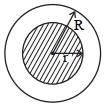
0 likes
View SolutionMoving Charges and Magnetism — Ampere’s circuital law and its application (Solenoid and Toroid) · Frequently Asked Questions
1Are these Moving Charges and Magnetism questions useful for JEE and NEET?
Yes. All questions in this section are mapped to JEE Main and NEET exam patterns. Previous year questions from JEE Main, NEET, GUJCET and state-level exams are included with full solutions.
2Can I switch to Hindi or Gujarati for these questions?
Yes. Use the language tabs in the hero section or the sidebar to view the same questions and solutions in English, Hindi or Gujarati.
3How do I generate a question paper from this subtopic?
Use the Vedclass Exam Paper Generator — select the chapter and subtopic, set difficulty, and generate Sets A, B, C, D automatically. First 3 chapters of every subject are free.
Vedclass Products
For Students
Vedclass Test Series
Mock tests in real JEE/NEET style with performance analysis. 5-day free trial.
Start Free TrialFor Teachers
Exam Paper Generator
Generate Set A/B/C/D papers from this chapter in 2 minutes. 3 chapters free.
Try FreeFor Institutes
Online Exam Module
Live online exams with unlimited students, 360° analytics & white-label branding.
See DemoFor Teachers & Institutes
Generate a Moving Charges and Magnetism Exam Paper in 2 Minutes
Select subtopic & difficulty — Sets A, B, C, D auto-generated with No Repeat logic.
First 3 chapters of every subject are free — no payment required.