
A English
Transformer Questions in English
Class 12 Physics · Electromagnetic Induction · Transformer
166+
Questions
English
Language
100%
With Solutions
Showing 48 of 166 questions in English
101
DifficultMCQ
Primary side of a transformer is connected to $230 \ V, 50 \ Hz$ supply. The turns ratio of primary to secondary winding is $10:1$. The load resistance connected to the secondary side is $46 \ \Omega$. The power consumed in it is: (in $W$)
A
$12.5$
B
$10.0$
C
$11.5$
D
$12.0$
Solution
(C) The transformer equation is given by $\frac{V_1}{V_2} = \frac{N_1}{N_2}$.
Given $V_1 = 230 \ V$ and $\frac{N_1}{N_2} = 10$,we have $\frac{230}{V_2} = 10$.
Thus,the secondary voltage is $V_2 = \frac{230}{10} = 23 \ V$.
The power consumed by the load resistance $R = 46 \ \Omega$ is given by $P = \frac{V_2^2}{R}$.
Substituting the values,$P = \frac{23 \times 23}{46} = \frac{529}{46} = 11.5 \ W$.
Given $V_1 = 230 \ V$ and $\frac{N_1}{N_2} = 10$,we have $\frac{230}{V_2} = 10$.
Thus,the secondary voltage is $V_2 = \frac{230}{10} = 23 \ V$.
The power consumed by the load resistance $R = 46 \ \Omega$ is given by $P = \frac{V_2^2}{R}$.
Substituting the values,$P = \frac{23 \times 23}{46} = \frac{529}{46} = 11.5 \ W$.
0 likes
View Solution102
DifficultMCQ
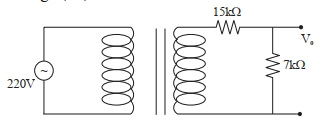
The primary coil of a transformer is connected to a $220 \,V$ $AC$ source. The number of turns in the primary and secondary coils are $100$ and $10$ respectively. The secondary coil is connected to two resistors in series as shown in the figure. The output voltage $\left(V_0\right)$ is: (in $\,V$)
A
$7$
B
$15$
C
$44$
D
$22$
Solution
(A) For an ideal transformer, the ratio of voltages is equal to the ratio of the number of turns:
$\frac{V_p}{V_s} = \frac{N_p}{N_s}$
Given $V_p = 220 \,V$, $N_p = 100$, and $N_s = 10$, we have:
$\frac{220}{V_s} = \frac{100}{10} = 10$
$V_s = \frac{220}{10} = 22 \,V$
This secondary voltage $V_s = 22 \,V$ is applied across two resistors in series: $R_1 = 15 \,k\Omega$ and $R_2 = 7 \,k\Omega$.
The output voltage $V_0$ is the voltage across the $7 \,k\Omega$ resistor, which can be calculated using the voltage divider rule:
$V_0 = V_s \times \left( \frac{R_2}{R_1 + R_2} \right)$
$V_0 = 22 \times \left( \frac{7 \,k\Omega}{15 \,k\Omega + 7 \,k\Omega} \right)$
$V_0 = 22 \times \left( \frac{7}{22} \right) = 7 \,V$
$\frac{V_p}{V_s} = \frac{N_p}{N_s}$
Given $V_p = 220 \,V$, $N_p = 100$, and $N_s = 10$, we have:
$\frac{220}{V_s} = \frac{100}{10} = 10$
$V_s = \frac{220}{10} = 22 \,V$
This secondary voltage $V_s = 22 \,V$ is applied across two resistors in series: $R_1 = 15 \,k\Omega$ and $R_2 = 7 \,k\Omega$.
The output voltage $V_0$ is the voltage across the $7 \,k\Omega$ resistor, which can be calculated using the voltage divider rule:
$V_0 = V_s \times \left( \frac{R_2}{R_1 + R_2} \right)$
$V_0 = 22 \times \left( \frac{7 \,k\Omega}{15 \,k\Omega + 7 \,k\Omega} \right)$
$V_0 = 22 \times \left( \frac{7}{22} \right) = 7 \,V$
0 likes
View Solution103
DifficultMCQ
$A$ power transmission line feeds input power at $2.3 \text{ kV}$ to a step-down transformer with its primary winding having $3000$ turns. The output power is delivered at $230 \text{ V}$ by the transformer. The current in the primary of the transformer is $5 \text{ A}$ and its efficiency is $90 \%$. The winding of the transformer is made of copper. The output current of the transformer is . . . . . . $A$.
A
$45$
B
$40$
C
$50$
D
$55$
Solution
(A) The input power $P_{\text{in}}$ is given by the product of primary voltage $V_p$ and primary current $I_p$.
$P_{\text{in}} = V_p \times I_p = 2300 \text{ V} \times 5 \text{ A} = 11500 \text{ W}$.
Efficiency $\eta$ is defined as the ratio of output power $P_{\text{out}}$ to input power $P_{\text{in}}$.
Given $\eta = 90\% = 0.9$,so $P_{\text{out}} = \eta \times P_{\text{in}} = 0.9 \times 11500 \text{ W} = 10350 \text{ W}$.
The output power is also given by $P_{\text{out}} = V_s \times I_s$,where $V_s = 230 \text{ V}$ is the output voltage.
$10350 \text{ W} = 230 \text{ V} \times I_s$.
$I_s = \frac{10350}{230} \text{ A} = 45 \text{ A}$.
$P_{\text{in}} = V_p \times I_p = 2300 \text{ V} \times 5 \text{ A} = 11500 \text{ W}$.
Efficiency $\eta$ is defined as the ratio of output power $P_{\text{out}}$ to input power $P_{\text{in}}$.
Given $\eta = 90\% = 0.9$,so $P_{\text{out}} = \eta \times P_{\text{in}} = 0.9 \times 11500 \text{ W} = 10350 \text{ W}$.
The output power is also given by $P_{\text{out}} = V_s \times I_s$,where $V_s = 230 \text{ V}$ is the output voltage.
$10350 \text{ W} = 230 \text{ V} \times I_s$.
$I_s = \frac{10350}{230} \text{ A} = 45 \text{ A}$.
0 likes
View Solution104
DifficultMCQ
$A$ transformer has an efficiency of $80 \%$ and works at $10 \ V$ and $4 \ kW$. If the secondary voltage is $240 \ V$, then the current in the secondary coil is: (in $A$)
A
$1.59$
B
$13.33$
C
$1.33$
D
$15.1$
Solution
(B) Efficiency $(\eta)$ is defined as the ratio of output power to input power: $\eta = \frac{P_{out}}{P_{in}}$.
Given: Input power $P_{in} = 4 \ kW = 4000 \ W$, Efficiency $\eta = 80\% = 0.8$, Secondary voltage $V_S = 240 \ V$.
The output power is $P_{out} = V_S \times I_S$.
Using the efficiency formula: $0.8 = \frac{V_S \times I_S}{P_{in}}$.
Substituting the values: $0.8 = \frac{240 \times I_S}{4000}$.
$I_S = \frac{0.8 \times 4000}{240} = \frac{3200}{240}$.
$I_S = 13.33 \ A$.
Given: Input power $P_{in} = 4 \ kW = 4000 \ W$, Efficiency $\eta = 80\% = 0.8$, Secondary voltage $V_S = 240 \ V$.
The output power is $P_{out} = V_S \times I_S$.
Using the efficiency formula: $0.8 = \frac{V_S \times I_S}{P_{in}}$.
Substituting the values: $0.8 = \frac{240 \times I_S}{4000}$.
$I_S = \frac{0.8 \times 4000}{240} = \frac{3200}{240}$.
$I_S = 13.33 \ A$.
0 likes
View Solution105
MediumMCQ
In an ideal transformer,the turns ratio is $\frac{N_p}{N_S} = \frac{1}{2}$. The ratio $V_s : V_p$ is equal to (the symbols carry their usual meaning):
A
$2 : 1$
B
$1 : 1$
C
$1 : 4$
D
$1 : 2$
Solution
(A) For an ideal transformer,the relationship between the voltage ratio and the turns ratio is given by the formula: $\frac{V_s}{V_p} = \frac{N_s}{N_p}$.
Given the turns ratio $\frac{N_p}{N_s} = \frac{1}{2}$,we can find the inverse ratio $\frac{N_s}{N_p} = \frac{2}{1}$.
Substituting this into the transformer equation,we get $\frac{V_s}{V_p} = \frac{2}{1}$.
Therefore,the ratio $V_s : V_p$ is $2 : 1$.
Given the turns ratio $\frac{N_p}{N_s} = \frac{1}{2}$,we can find the inverse ratio $\frac{N_s}{N_p} = \frac{2}{1}$.
Substituting this into the transformer equation,we get $\frac{V_s}{V_p} = \frac{2}{1}$.
Therefore,the ratio $V_s : V_p$ is $2 : 1$.
0 likes
View Solution106
DifficultMCQ
$A$ thermal power plant produces electric power of $600 \ kW$ at $4000 \ V$,which is to be transported to a place $20 \ km$ away from the power plant for consumers' usage. It can be transported either directly with a cable of large current carrying capacity or by using a combination of step-up and step-down transformers at the two ends. The drawback of the direct transmission is the large energy dissipation. In the method using transformers,the dissipation is much smaller. In this method,a step-up transformer is used at the plant side so that the current is reduced to a smaller value. At the consumers' end,a step-down transformer is used to supply power to the consumers at the specified lower voltage. It is reasonable to assume that the power cable is purely resistive and the transformers are ideal with a power factor unity. All the currents and voltages mentioned are rms values.
$1.$ If the direct transmission method with a cable of resistance $0.4 \ \Omega \ km^{-1}$ is used,the power dissipation (in %) during transmission is:
$(A) 20$ $(B) 30$ $(C) 40$ $(D) 50$
$2.$ In the method using the transformers,assume that the ratio of the number of turns in the primary to that in the secondary in the step-up transformer is $1:10$. If the power to the consumers has to be supplied at $200 \ V$,the ratio of the number of turns in the primary to that in the secondary in the step-down transformer is:
$(A) 200:1$ $(B) 150:1$ $(C) 100:1$ $(D) 50:1$
Give the answer for question $1$ and $2$.
$1.$ If the direct transmission method with a cable of resistance $0.4 \ \Omega \ km^{-1}$ is used,the power dissipation (in %) during transmission is:
$(A) 20$ $(B) 30$ $(C) 40$ $(D) 50$
$2.$ In the method using the transformers,assume that the ratio of the number of turns in the primary to that in the secondary in the step-up transformer is $1:10$. If the power to the consumers has to be supplied at $200 \ V$,the ratio of the number of turns in the primary to that in the secondary in the step-down transformer is:
$(A) 200:1$ $(B) 150:1$ $(C) 100:1$ $(D) 50:1$
Give the answer for question $1$ and $2$.
A
$(B, A)$
B
$(B, C)$
C
$(C, A)$
D
$(A, D)$
Solution
(A) $1.$ Given power $P = 600 \ kW = 6 \times 10^5 \ W$,voltage $V = 4000 \ V$.
Current $I = P/V = (6 \times 10^5) / 4000 = 150 \ A$.
Total resistance $R = 0.4 \ \Omega \ km^{-1} \times 20 \ km = 8 \ \Omega$.
Power dissipation $P_d = I^2 R = (150)^2 \times 8 = 22500 \times 8 = 180,000 \ W = 180 \ kW$.
Percentage dissipation $= (180 / 600) \times 100 = 30 \%$.
$2.$ Step-up transformer ratio $N_p/N_s = 1:10$. Output voltage $V_s = V_p \times (N_s/N_p) = 4000 \times 10 = 40,000 \ V$.
For the step-down transformer,input voltage $V'_p = 40,000 \ V$ and output voltage $V'_s = 200 \ V$.
Ratio $N'_p/N'_s = V'_p/V'_s = 40,000 / 200 = 200:1$.
Current $I = P/V = (6 \times 10^5) / 4000 = 150 \ A$.
Total resistance $R = 0.4 \ \Omega \ km^{-1} \times 20 \ km = 8 \ \Omega$.
Power dissipation $P_d = I^2 R = (150)^2 \times 8 = 22500 \times 8 = 180,000 \ W = 180 \ kW$.
Percentage dissipation $= (180 / 600) \times 100 = 30 \%$.
$2.$ Step-up transformer ratio $N_p/N_s = 1:10$. Output voltage $V_s = V_p \times (N_s/N_p) = 4000 \times 10 = 40,000 \ V$.
For the step-down transformer,input voltage $V'_p = 40,000 \ V$ and output voltage $V'_s = 200 \ V$.
Ratio $N'_p/N'_s = V'_p/V'_s = 40,000 / 200 = 200:1$.
0 likes
View Solution107
DifficultMCQ
$A$ transformer has $100$ turns in the primary coil and carries $8 A$ current. If the input power is $1 \text{ kW}$,the number of turns in the secondary coil,to have $500 \text{ V}$ output,will be $:-$
A
$100$
B
$200$
C
$400$
D
$300$
Solution
(C) Given: Primary turns $N_P = 100$,Primary current $I_P = 8 \text{ A}$,Input power $P_i = 1 \text{ kW} = 1000 \text{ W}$,Secondary voltage $V_S = 500 \text{ V}$.
Input power $P_i = V_P \times I_P$,so $1000 = V_P \times 8$.
Therefore,primary voltage $V_P = \frac{1000}{8} = 125 \text{ V}$.
Using the transformer ratio formula: $\frac{V_S}{V_P} = \frac{N_S}{N_P}$.
Substituting the values: $\frac{500}{125} = \frac{N_S}{100}$.
$4 = \frac{N_S}{100}$.
$N_S = 400$ turns.
Input power $P_i = V_P \times I_P$,so $1000 = V_P \times 8$.
Therefore,primary voltage $V_P = \frac{1000}{8} = 125 \text{ V}$.
Using the transformer ratio formula: $\frac{V_S}{V_P} = \frac{N_S}{N_P}$.
Substituting the values: $\frac{500}{125} = \frac{N_S}{100}$.
$4 = \frac{N_S}{100}$.
$N_S = 400$ turns.
0 likes
View Solution108
DifficultMCQ
$A$ step-down transformer transforms $220 \text{ V}$ to $11 \text{ V}$. If the currents in the primary and secondary coils are $5 \text{ A}$ and $90 \text{ A}$ respectively,the efficiency of the transformer is: (in $\%$)
A
$70$
B
$40$
C
$20$
D
$90$
Solution
(D) The efficiency $(\eta)$ of a transformer is defined as the ratio of output power to input power.
$\eta = \frac{P_{\text{out}}}{P_{\text{in}}} \times 100 = \frac{V_s I_s}{V_p I_p} \times 100$
Given:
Primary voltage $(V_p)$ = $220 \text{ V}$
Secondary voltage $(V_s)$ = $11 \text{ V}$
Primary current $(I_p)$ = $5 \text{ A}$
Secondary current $(I_s)$ = $90 \text{ A}$
Substituting the values:
$\eta = \frac{11 \times 90}{220 \times 5} \times 100$
$\eta = \frac{990}{1100} \times 100 = 0.9 \times 100 = 90 \%$
$\eta = \frac{P_{\text{out}}}{P_{\text{in}}} \times 100 = \frac{V_s I_s}{V_p I_p} \times 100$
Given:
Primary voltage $(V_p)$ = $220 \text{ V}$
Secondary voltage $(V_s)$ = $11 \text{ V}$
Primary current $(I_p)$ = $5 \text{ A}$
Secondary current $(I_s)$ = $90 \text{ A}$
Substituting the values:
$\eta = \frac{11 \times 90}{220 \times 5} \times 100$
$\eta = \frac{990}{1100} \times 100 = 0.9 \times 100 = 90 \%$
0 likes
View Solution109
MediumMCQ
An ideal transformer converts $220 \ V$ $AC$ to $3.3 \ kV$ $AC$ to transmit a power of $4.4 \ kW$. If the primary coil has $600$ turns,then the alternating current in the secondary coil is:
A
$\frac{5}{3} \ A$
B
$\frac{1}{4} \ A$
C
$\frac{4}{3} \ A$
D
$\frac{2}{3} \ A$
Solution
(C) For an ideal transformer,the power input is equal to the power output.
Given power $P = 4.4 \ kW = 4400 \ W$.
The secondary voltage $V_s = 3.3 \ kV = 3300 \ V$.
Since $P = V_s \times I_s$,where $I_s$ is the current in the secondary coil,we have:
$I_s = \frac{P}{V_s} = \frac{4400 \ W}{3300 \ V} = \frac{44}{33} \ A = \frac{4}{3} \ A$.
Thus,the current in the secondary coil is $\frac{4}{3} \ A$.
Given power $P = 4.4 \ kW = 4400 \ W$.
The secondary voltage $V_s = 3.3 \ kV = 3300 \ V$.
Since $P = V_s \times I_s$,where $I_s$ is the current in the secondary coil,we have:
$I_s = \frac{P}{V_s} = \frac{4400 \ W}{3300 \ V} = \frac{44}{33} \ A = \frac{4}{3} \ A$.
Thus,the current in the secondary coil is $\frac{4}{3} \ A$.
0 likes
View Solution110
MediumMCQ
$A$ current of $5 \text{ A}$ is flowing at $220 \text{ V}$ in a primary coil of a transformer. If the voltage produced in the secondary coil is $2200 \text{ V}$ and $50 \%$ of power is lost, then the current in the secondary coil will be (in $\text{ A}$)
A
$2.5$
B
$5$
C
$0.25$
D
$0.025$
Solution
(C) The input power in the primary coil is given by $P_{in} = V_p \times I_p = 220 \text{ V} \times 5 \text{ A} = 1100 \text{ W}$.
Given that $50 \%$ of the power is lost, the output power in the secondary coil is $P_{out} = 50 \% \text{ of } P_{in} = 0.5 \times 1100 \text{ W} = 550 \text{ W}$.
The output power is also given by $P_{out} = V_s \times I_s$, where $V_s = 2200 \text{ V}$.
Substituting the values, $550 \text{ W} = 2200 \text{ V} \times I_s$.
Therefore, $I_s = \frac{550}{2200} \text{ A} = 0.25 \text{ A}$.
Given that $50 \%$ of the power is lost, the output power in the secondary coil is $P_{out} = 50 \% \text{ of } P_{in} = 0.5 \times 1100 \text{ W} = 550 \text{ W}$.
The output power is also given by $P_{out} = V_s \times I_s$, where $V_s = 2200 \text{ V}$.
Substituting the values, $550 \text{ W} = 2200 \text{ V} \times I_s$.
Therefore, $I_s = \frac{550}{2200} \text{ A} = 0.25 \text{ A}$.
0 likes
View Solution111
EasyMCQ
An $80 \text{ W}$ lamp is connected to the secondary of a step-down transformer, where the primary is connected to an $AC$ mains of $220 \text{ V}$. Assuming the transformer to be ideal, the current in the primary winding is nearly: (in $\text{ A}$)
A
$3.6$
B
$2.8$
C
$0.36$
D
$0.28$
Solution
(C) For an ideal transformer, the power input in the primary coil is equal to the power output in the secondary coil.
Given: Power output $(P_{out})$ = $80 \text{ W}$, Primary voltage $(V_p)$ = $220 \text{ V}$.
Since the transformer is ideal, $P_{in} = P_{out} = 80 \text{ W}$.
The power input is given by the formula $P_{in} = V_p \times I_p$, where $I_p$ is the current in the primary winding.
Therefore, $I_p = \frac{P_{in}}{V_p} = \frac{80 \text{ W}}{220 \text{ V}}$.
$I_p = \frac{8}{22} \text{ A} \approx 0.3636 \text{ A}$.
Rounding to two decimal places, the current in the primary winding is approximately $0.36 \text{ A}$.
Given: Power output $(P_{out})$ = $80 \text{ W}$, Primary voltage $(V_p)$ = $220 \text{ V}$.
Since the transformer is ideal, $P_{in} = P_{out} = 80 \text{ W}$.
The power input is given by the formula $P_{in} = V_p \times I_p$, where $I_p$ is the current in the primary winding.
Therefore, $I_p = \frac{P_{in}}{V_p} = \frac{80 \text{ W}}{220 \text{ V}}$.
$I_p = \frac{8}{22} \text{ A} \approx 0.3636 \text{ A}$.
Rounding to two decimal places, the current in the primary winding is approximately $0.36 \text{ A}$.
0 likes
View Solution112
EasyMCQ
$A$ transformer having efficiency $90 \%$ is working on $200 \ V$ and $3 \ kW$ power supply. If the current in the secondary coil is $6 \ A$, the voltage across the secondary coil and the current in the primary coil are respectively:
A
$300 \ V, 15 \ A$
B
$450 \ V, 15 \ A$
C
$450 \ V, 13.5 \ A$
D
$600 \ V, 15 \ A$
Solution
(B) Given: Efficiency $\eta = 90 \% = 0.9$, Input Voltage $V_p = 200 \ V$, Input Power $P_{in} = 3 \ kW = 3000 \ W$, Secondary Current $I_s = 6 \ A$.
First, calculate the primary current $I_p$ using the input power formula: $P_{in} = V_p \times I_p$.
$3000 \ W = 200 \ V \times I_p \implies I_p = \frac{3000}{200} = 15 \ A$.
Next, calculate the output power $P_{out}$ using efficiency: $P_{out} = \eta \times P_{in}$.
$P_{out} = 0.9 \times 3000 \ W = 2700 \ W$.
Finally, calculate the secondary voltage $V_s$ using the output power formula: $P_{out} = V_s \times I_s$.
$2700 \ W = V_s \times 6 \ A \implies V_s = \frac{2700}{6} = 450 \ V$.
Thus, the secondary voltage is $450 \ V$ and the primary current is $15 \ A$.
First, calculate the primary current $I_p$ using the input power formula: $P_{in} = V_p \times I_p$.
$3000 \ W = 200 \ V \times I_p \implies I_p = \frac{3000}{200} = 15 \ A$.
Next, calculate the output power $P_{out}$ using efficiency: $P_{out} = \eta \times P_{in}$.
$P_{out} = 0.9 \times 3000 \ W = 2700 \ W$.
Finally, calculate the secondary voltage $V_s$ using the output power formula: $P_{out} = V_s \times I_s$.
$2700 \ W = V_s \times 6 \ A \implies V_s = \frac{2700}{6} = 450 \ V$.
Thus, the secondary voltage is $450 \ V$ and the primary current is $15 \ A$.
0 likes
View Solution113
MediumMCQ
$A$ transformer is used to step up an alternating e.m.f. of $220 \ V$ to $4.4 \ kV$ to transmit $6.6 \ kW$ of power. The primary coil has $1000$ turns. The current rating of the secondary coil is (Transformer is ideal): (in $A$)
A
$0.8$
B
$1.2$
C
$1.5$
D
$1.8$
Solution
(C) For an ideal transformer,the power input at the primary coil is equal to the power output at the secondary coil.
Given power $P = 6.6 \ kW = 6.6 \times 10^3 \ W$.
Secondary voltage $V_s = 4.4 \ kV = 4.4 \times 10^3 \ V$.
Since $P = V_s \times I_s$ for an ideal transformer,
$I_s = \frac{P}{V_s} = \frac{6.6 \times 10^3}{4.4 \times 10^3} \ A$.
$I_s = \frac{6.6}{4.4} \ A = 1.5 \ A$.
Thus,the current rating of the secondary coil is $1.5 \ A$.
Given power $P = 6.6 \ kW = 6.6 \times 10^3 \ W$.
Secondary voltage $V_s = 4.4 \ kV = 4.4 \times 10^3 \ V$.
Since $P = V_s \times I_s$ for an ideal transformer,
$I_s = \frac{P}{V_s} = \frac{6.6 \times 10^3}{4.4 \times 10^3} \ A$.
$I_s = \frac{6.6}{4.4} \ A = 1.5 \ A$.
Thus,the current rating of the secondary coil is $1.5 \ A$.
0 likes
View Solution114
EasyMCQ
$A$ transformer has $120$ turns in the primary coil and carries $5 \text{ A}$ current. Input power is $1 \text{ kW}$. To have $560 \text{ V}$ output, the number of turns in the secondary coil will be:
A
$168$
B
$200$
C
$336$
D
$400$
Solution
(C) Given: Primary turns $N_p = 120$, Primary current $I_p = 5 \text{ A}$, Input power $P_{in} = 1 \text{ kW} = 1000 \text{ W}$, Secondary voltage $V_s = 560 \text{ V}$.
First, calculate the primary voltage $V_p$ using the power formula $P = V_p I_p$:
$V_p = \frac{P_{in}}{I_p} = \frac{1000 \text{ W}}{5 \text{ A}} = 200 \text{ V}$.
Using the transformer turns ratio formula $\frac{N_s}{N_p} = \frac{V_s}{V_p}$:
$\frac{N_s}{120} = \frac{560}{200}$.
Solving for $N_s$:
$N_s = \frac{120 \times 560}{200} = \frac{120 \times 56}{20} = 6 \times 56 = 336$.
Therefore, the number of turns in the secondary coil is $336$.
First, calculate the primary voltage $V_p$ using the power formula $P = V_p I_p$:
$V_p = \frac{P_{in}}{I_p} = \frac{1000 \text{ W}}{5 \text{ A}} = 200 \text{ V}$.
Using the transformer turns ratio formula $\frac{N_s}{N_p} = \frac{V_s}{V_p}$:
$\frac{N_s}{120} = \frac{560}{200}$.
Solving for $N_s$:
$N_s = \frac{120 \times 560}{200} = \frac{120 \times 56}{20} = 6 \times 56 = 336$.
Therefore, the number of turns in the secondary coil is $336$.
0 likes
View Solution115
EasyMCQ
The number of turns in the primary coil of a transformer is $1000$ and in the secondary coil is $3000$. If $80 \ V$ a.c. is applied to the primary,the potential difference per turn of the secondary coil is: (in $V$)
A
$0.02$
B
$0.04$
C
$0.08$
D
$0.16$
Solution
(C) In an ideal transformer,the induced electromotive force $(EMF)$ per turn is the same for both the primary and secondary coils.
Given:
Number of turns in primary,$N_p = 1000$
Number of turns in secondary,$N_s = 3000$
Voltage applied to primary,$V_p = 80 \ V$
The potential difference per turn is given by the ratio $\frac{V}{N}$.
For the primary coil,the potential difference per turn is $\frac{V_p}{N_p} = \frac{80 \ V}{1000} = 0.08 \ V$.
Since the flux linked per turn is the same for both coils in an ideal transformer,the potential difference per turn in the secondary coil is equal to the potential difference per turn in the primary coil.
Therefore,the potential difference per turn of the secondary coil is $0.08 \ V$.
Given:
Number of turns in primary,$N_p = 1000$
Number of turns in secondary,$N_s = 3000$
Voltage applied to primary,$V_p = 80 \ V$
The potential difference per turn is given by the ratio $\frac{V}{N}$.
For the primary coil,the potential difference per turn is $\frac{V_p}{N_p} = \frac{80 \ V}{1000} = 0.08 \ V$.
Since the flux linked per turn is the same for both coils in an ideal transformer,the potential difference per turn in the secondary coil is equal to the potential difference per turn in the primary coil.
Therefore,the potential difference per turn of the secondary coil is $0.08 \ V$.
0 likes
View Solution116
EasyMCQ
If a transformer of an audio amplifier has an output impedance of $8000 \ \Omega$ and the speaker has an input impedance of $8 \ \Omega$,what should be the ratio of the primary to secondary turns of this transformer connected between the amplifier output and the loudspeaker?
A
$1000: 1$
B
$100: 1$
C
$1: 32$
D
$32: 1$
Solution
(D) The impedance matching condition for a transformer is given by the relation: $\frac{Z_p}{Z_s} = \left(\frac{N_p}{N_s}\right)^2$.
Given: Primary impedance $Z_p = 8000 \ \Omega$ and secondary impedance $Z_s = 8 \ \Omega$.
Substituting the values: $\frac{8000}{8} = \left(\frac{N_p}{N_s}\right)^2$.
$1000 = \left(\frac{N_p}{N_s}\right)^2$.
Taking the square root on both sides: $\frac{N_p}{N_s} = \sqrt{1000} = 10\sqrt{10}$.
Since $\sqrt{10} \approx 3.16$,we get $\frac{N_p}{N_s} \approx 10 \times 3.16 = 31.6 \approx 32$.
Therefore,the ratio of primary to secondary turns is $32: 1$.
Given: Primary impedance $Z_p = 8000 \ \Omega$ and secondary impedance $Z_s = 8 \ \Omega$.
Substituting the values: $\frac{8000}{8} = \left(\frac{N_p}{N_s}\right)^2$.
$1000 = \left(\frac{N_p}{N_s}\right)^2$.
Taking the square root on both sides: $\frac{N_p}{N_s} = \sqrt{1000} = 10\sqrt{10}$.
Since $\sqrt{10} \approx 3.16$,we get $\frac{N_p}{N_s} \approx 10 \times 3.16 = 31.6 \approx 32$.
Therefore,the ratio of primary to secondary turns is $32: 1$.
0 likes
View Solution117
MediumMCQ
$A$ transformer has $20$ turns in the primary and $100$ turns in the secondary coil. An $AC$ voltage of $V_{\text{in}} = 600 \sin 314t$ is applied to the primary terminal of the transformer. The maximum value of the secondary output voltage obtained in volts is:
A
$600$
B
$300$
C
$3000$
D
$6000$
Solution
(C) The transformer equation relating the voltage and the number of turns is given by:
$\frac{V_s}{V_p} = \frac{N_s}{N_p}$
Given:
Number of turns in primary coil,$N_p = 20$
Number of turns in secondary coil,$N_s = 100$
Maximum primary voltage,$V_{p, \text{max}} = 600 \text{ V}$
To find the maximum secondary voltage $(V_{s, \text{max}})$,we use the ratio:
$V_{s, \text{max}} = \frac{N_s}{N_p} \times V_{p, \text{max}}$
$V_{s, \text{max}} = \frac{100}{20} \times 600$
$V_{s, \text{max}} = 5 \times 600 = 3000 \text{ V}$
Thus,the maximum value of the secondary output voltage is $3000 \text{ V}$.
$\frac{V_s}{V_p} = \frac{N_s}{N_p}$
Given:
Number of turns in primary coil,$N_p = 20$
Number of turns in secondary coil,$N_s = 100$
Maximum primary voltage,$V_{p, \text{max}} = 600 \text{ V}$
To find the maximum secondary voltage $(V_{s, \text{max}})$,we use the ratio:
$V_{s, \text{max}} = \frac{N_s}{N_p} \times V_{p, \text{max}}$
$V_{s, \text{max}} = \frac{100}{20} \times 600$
$V_{s, \text{max}} = 5 \times 600 = 3000 \text{ V}$
Thus,the maximum value of the secondary output voltage is $3000 \text{ V}$.
0 likes
View Solution118
MediumMCQ
The number of turns in the primary and the secondary coils of a transformer are $1000$ and $3000$ respectively. If $80 \,V$ a.c. is applied to the primary coil of the transformer,then the potential difference per turn of the secondary coil would be: (in $\,V$)
A
$240$
B
$2400$
C
$0.24$
D
$0.08$
Solution
(D) The transformer equation is given by $\frac{E_p}{E_s} = \frac{N_p}{N_s}$.
Given $E_p = 80 \,V$,$N_p = 1000$,and $N_s = 3000$.
Substituting the values: $\frac{80}{E_s} = \frac{1000}{3000}$.
$E_s = 80 \times 3 = 240 \,V$.
The potential difference per turn in the secondary coil is $\frac{E_s}{N_s}$.
$\text{Potential difference per turn} = \frac{240}{3000} = 0.08 \,V$.
Given $E_p = 80 \,V$,$N_p = 1000$,and $N_s = 3000$.
Substituting the values: $\frac{80}{E_s} = \frac{1000}{3000}$.
$E_s = 80 \times 3 = 240 \,V$.
The potential difference per turn in the secondary coil is $\frac{E_s}{N_s}$.
$\text{Potential difference per turn} = \frac{240}{3000} = 0.08 \,V$.
0 likes
View Solution119
EasyMCQ
An ideal transformer is used to step up an alternating e.m.f. of $220 \,V$ to $4.4 \,kV$ to transmit $6.6 \,kW$ of power. The primary coil has $100$ turns. What is the current rating of the secondary coil (in $\,A$)?
A
$1.0$
B
$0.75$
C
$2.5$
D
$1.5$
Solution
(D) For an ideal transformer, the power input is equal to the power output.
Given power $P = 6.6 \,kW = 6600 \,W$.
The secondary voltage $V_s = 4.4 \,kV = 4400 \,V$.
The power in the secondary coil is given by $P = V_s \times I_s$.
Substituting the values: $6600 \,W = 4400 \,V \times I_s$.
Solving for the secondary current $I_s$: $I_s = \frac{6600}{4400} \,A = 1.5 \,A$.
Given power $P = 6.6 \,kW = 6600 \,W$.
The secondary voltage $V_s = 4.4 \,kV = 4400 \,V$.
The power in the secondary coil is given by $P = V_s \times I_s$.
Substituting the values: $6600 \,W = 4400 \,V \times I_s$.
Solving for the secondary current $I_s$: $I_s = \frac{6600}{4400} \,A = 1.5 \,A$.
0 likes
View Solution120
EasyMCQ
$A$ step-down transformer has a $N_{S}$ to $N_{P}$ ratio of $1: 20$. If $8 \, V$ are developed across a $0.4 \, \Omega$ secondary load, the primary current will be: (in $ \, A$)
A
$1$
B
$0.5$
C
$4$
D
$2$
Solution
(A) Given: Ratio of secondary turns to primary turns $\frac{N_{S}}{N_{P}} = \frac{1}{20}$.
Secondary voltage $V_{S} = 8 \, V$.
Secondary resistance $R_{S} = 0.4 \, \Omega$.
First, calculate the secondary current $I_{S}$ using Ohm's law: $I_{S} = \frac{V_{S}}{R_{S}} = \frac{8 \, V}{0.4 \, \Omega} = 20 \, A$.
For an ideal transformer, the relationship between currents and turns is given by $\frac{I_{P}}{I_{S}} = \frac{N_{S}}{N_{P}}$.
Substituting the values: $I_{P} = I_{S} \times \frac{N_{S}}{N_{P}} = 20 \, A \times \frac{1}{20} = 1 \, A$.
Therefore, the primary current is $1 \, A$.
Secondary voltage $V_{S} = 8 \, V$.
Secondary resistance $R_{S} = 0.4 \, \Omega$.
First, calculate the secondary current $I_{S}$ using Ohm's law: $I_{S} = \frac{V_{S}}{R_{S}} = \frac{8 \, V}{0.4 \, \Omega} = 20 \, A$.
For an ideal transformer, the relationship between currents and turns is given by $\frac{I_{P}}{I_{S}} = \frac{N_{S}}{N_{P}}$.
Substituting the values: $I_{P} = I_{S} \times \frac{N_{S}}{N_{P}} = 20 \, A \times \frac{1}{20} = 1 \, A$.
Therefore, the primary current is $1 \, A$.
0 likes
View Solution121
EasyMCQ
$A$ current of $5 \,A$ is flowing at $220 \,V$ in the primary coil of a transformer. If the voltage produced in the secondary coil is $2200 \,V$ and $50 \%$ of power is lost, then the current in the secondary will be (in $A$)
A
$2.5$
B
$0.5$
C
$0.25$
D
$5$
Solution
(C) Let $I$ be the current flowing through the secondary coil.
Input power in the primary coil is $P_{in} = V \times i = 220 \,V \times 5 \,A = 1100 \,W$.
Since $50 \%$ of the power is lost, the output power $P_{out}$ is $50 \%$ of the input power.
$P_{out} = 0.50 \times P_{in} = 0.50 \times 1100 \,W = 550 \,W$.
The output power is also given by $P_{out} = V^{\prime} \times I$, where $V^{\prime} = 2200 \,V$.
Therefore, $2200 \,V \times I = 550 \,W$.
$I = \frac{550}{2200} \,A = 0.25 \,A$.
Input power in the primary coil is $P_{in} = V \times i = 220 \,V \times 5 \,A = 1100 \,W$.
Since $50 \%$ of the power is lost, the output power $P_{out}$ is $50 \%$ of the input power.
$P_{out} = 0.50 \times P_{in} = 0.50 \times 1100 \,W = 550 \,W$.
The output power is also given by $P_{out} = V^{\prime} \times I$, where $V^{\prime} = 2200 \,V$.
Therefore, $2200 \,V \times I = 550 \,W$.
$I = \frac{550}{2200} \,A = 0.25 \,A$.
0 likes
View Solution122
EasyMCQ
The primary and secondary voltage of an ideal step-down transformer is $200 \,V$ and $25 \,V$ respectively. The secondary is connected to a device,which draws a current of $2 \,A$. The current in the primary is (in $\,mA$)
A
$25$
B
$42$
C
$160$
D
$250$
Solution
(D) For an ideal (lossless) transformer,the power input at the primary coil equals the power output at the secondary coil due to the conservation of energy:
$P_P = P_S$
$V_P I_P = V_S I_S$
Given:
$V_P = 200 \,V$
$V_S = 25 \,V$
$I_S = 2 \,A$
Substituting the values into the equation:
$200 \,V \times I_P = 25 \,V \times 2 \,A$
$200 \times I_P = 50$
$I_P = \frac{50}{200} \,A$
$I_P = 0.25 \,A$
Converting to milliamperes:
$I_P = 0.25 \times 1000 \,mA = 250 \,mA$
$P_P = P_S$
$V_P I_P = V_S I_S$
Given:
$V_P = 200 \,V$
$V_S = 25 \,V$
$I_S = 2 \,A$
Substituting the values into the equation:
$200 \,V \times I_P = 25 \,V \times 2 \,A$
$200 \times I_P = 50$
$I_P = \frac{50}{200} \,A$
$I_P = 0.25 \,A$
Converting to milliamperes:
$I_P = 0.25 \times 1000 \,mA = 250 \,mA$
0 likes
View Solution123
MediumMCQ
$A$ transformer having an efficiency of $90 \%$ is working on a $200 \ V$ and $3 \ kW$ power supply. If the current in the secondary coil is $6 \ A$,the voltage across the secondary coil and the current in the primary coil respectively are:
A
$450 \ V, 12 \ A$
B
$600 \ V, 15 \ A$
C
$300 \ V, 15 \ A$
D
$450 \ V, 15 \ A$
Solution
(D) Given: Efficiency $\eta = 90 \% = 0.9$,Primary voltage $V_P = 200 \ V$,Primary power $P_P = 3 \ kW = 3000 \ W$,Secondary current $I_S = 6 \ A$.
First,calculate the primary current $I_P$ using $P_P = V_P \times I_P$:
$I_P = \frac{P_P}{V_P} = \frac{3000 \ W}{200 \ V} = 15 \ A$.
Next,calculate the output power (secondary power) $P_S$ using efficiency: $P_S = \eta \times P_P = 0.9 \times 3000 \ W = 2700 \ W$.
Finally,calculate the secondary voltage $V_S$ using $P_S = V_S \times I_S$:
$V_S = \frac{P_S}{I_S} = \frac{2700 \ W}{6 \ A} = 450 \ V$.
Thus,the secondary voltage is $450 \ V$ and the primary current is $15 \ A$.
First,calculate the primary current $I_P$ using $P_P = V_P \times I_P$:
$I_P = \frac{P_P}{V_P} = \frac{3000 \ W}{200 \ V} = 15 \ A$.
Next,calculate the output power (secondary power) $P_S$ using efficiency: $P_S = \eta \times P_P = 0.9 \times 3000 \ W = 2700 \ W$.
Finally,calculate the secondary voltage $V_S$ using $P_S = V_S \times I_S$:
$V_S = \frac{P_S}{I_S} = \frac{2700 \ W}{6 \ A} = 450 \ V$.
Thus,the secondary voltage is $450 \ V$ and the primary current is $15 \ A$.
0 likes
View Solution124
MediumMCQ
In an ideal step-down transformer, out of the following quantities, which quantity increases in the secondary coil?
A
Power
B
Voltage
C
Current
D
Frequency
Solution
(C) For an ideal transformer, the input power equals the output power, meaning $P_{in} = P_{out}$.
Since $P = V \times I$, we have $V_{p}I_{p} = V_{s}I_{s}$, which implies $\frac{V_{s}}{V_{p}} = \frac{I_{p}}{I_{s}}$.
In a step-down transformer, the secondary voltage $V_{s}$ is less than the primary voltage $V_{p}$ $(V_{s} < V_{p})$.
According to the relation $\frac{V_{s}}{V_{p}} = \frac{I_{p}}{I_{s}}$, if $V_{s} < V_{p}$, then $I_{s} > I_{p}$.
Therefore, the current increases in the secondary coil.
Since $P = V \times I$, we have $V_{p}I_{p} = V_{s}I_{s}$, which implies $\frac{V_{s}}{V_{p}} = \frac{I_{p}}{I_{s}}$.
In a step-down transformer, the secondary voltage $V_{s}$ is less than the primary voltage $V_{p}$ $(V_{s} < V_{p})$.
According to the relation $\frac{V_{s}}{V_{p}} = \frac{I_{p}}{I_{s}}$, if $V_{s} < V_{p}$, then $I_{s} > I_{p}$.
Therefore, the current increases in the secondary coil.
0 likes
View Solution125
EasyMCQ
In a step-up transformer,which one of the following statements is correct?
A
Number of turns in the secondary coil is less than in primary coil
B
Voltage in secondary coil is less than in primary coil
C
Current in the primary coil is more than current in the secondary coil
D
Current in the primary coil is equal to current in the secondary coil
Solution
(C) step-up transformer increases the voltage,meaning $V_s > V_p$.
Since the power in an ideal transformer is conserved $(P_p = P_s)$,we have $V_p I_p = V_s I_s$.
Because $V_s > V_p$,it follows that $I_p > I_s$.
Therefore,the current in the primary coil is greater than the current in the secondary coil.
Since the power in an ideal transformer is conserved $(P_p = P_s)$,we have $V_p I_p = V_s I_s$.
Because $V_s > V_p$,it follows that $I_p > I_s$.
Therefore,the current in the primary coil is greater than the current in the secondary coil.
0 likes
View Solution126
MediumMCQ
$A$ step-down transformer is used to reduce the main supply from $V_1$ volt to $V_2$ volt. The primary coil draws a current $I_1$ $A$ and the secondary coil draws $I_2$ $A$. $(I_1 < I_2)$. The ratio of input power to output power is
A
$\frac{V_1 V_2}{I_1 I_2}$
B
$\frac{I_1 V_1}{I_2 V_2}$
C
$\frac{I_1 I_2}{V_1 V_2}$
D
$\frac{V_1 I_2}{V_2 I_1}$
Solution
(B) The input power to the transformer is given by $P_{\text{in}} = V_1 I_1$.
The output power from the transformer is given by $P_{\text{out}} = V_2 I_2$.
The ratio of input power to output power is $\frac{P_{\text{in}}}{P_{\text{out}}} = \frac{V_1 I_1}{V_2 I_2}$.
Assuming an ideal transformer,the input power equals the output power,so the ratio is $1:1$. However,based on the provided options and the general definition of power,the ratio is $\frac{V_1 I_1}{V_2 I_2}$. Since this specific expression is not explicitly listed in the options,we re-evaluate the question context. In many textbook problems,if the transformer is assumed to be ideal,the ratio is $1$. Given the options provided,option $B$ represents the ratio of input power to output power.
The output power from the transformer is given by $P_{\text{out}} = V_2 I_2$.
The ratio of input power to output power is $\frac{P_{\text{in}}}{P_{\text{out}}} = \frac{V_1 I_1}{V_2 I_2}$.
Assuming an ideal transformer,the input power equals the output power,so the ratio is $1:1$. However,based on the provided options and the general definition of power,the ratio is $\frac{V_1 I_1}{V_2 I_2}$. Since this specific expression is not explicitly listed in the options,we re-evaluate the question context. In many textbook problems,if the transformer is assumed to be ideal,the ratio is $1$. Given the options provided,option $B$ represents the ratio of input power to output power.
0 likes
View Solution127
MediumMCQ
$A$ step-down transformer has a turns ratio of $20:1$. If $8 \, V$ is applied across a $0.4 \, \Omega$ secondary coil, then the primary current will be: (in $ \, A$)
A
$2$
B
$1$
C
$0.5$
D
$4$
Solution
(B) Given, turns ratio $\frac{N_p}{N_s} = \frac{20}{1}$.
Secondary voltage $V_s = 8 \, V$ and secondary resistance $R_s = 0.4 \, \Omega$.
The secondary current $I_s$ is calculated using Ohm's law: $I_s = \frac{V_s}{R_s} = \frac{8}{0.4} = 20 \, A$.
For an ideal transformer, the relation between currents and turns ratio is $\frac{I_p}{I_s} = \frac{N_s}{N_p}$.
Substituting the values: $\frac{I_p}{20} = \frac{1}{20}$.
Therefore, the primary current $I_p = 1 \, A$.
Secondary voltage $V_s = 8 \, V$ and secondary resistance $R_s = 0.4 \, \Omega$.
The secondary current $I_s$ is calculated using Ohm's law: $I_s = \frac{V_s}{R_s} = \frac{8}{0.4} = 20 \, A$.
For an ideal transformer, the relation between currents and turns ratio is $\frac{I_p}{I_s} = \frac{N_s}{N_p}$.
Substituting the values: $\frac{I_p}{20} = \frac{1}{20}$.
Therefore, the primary current $I_p = 1 \, A$.
0 likes
View Solution128
MediumMCQ
$A$ step-up transformer operates on $220 \,V$ and supplies a current of $2 \,A$. The ratio of primary and secondary windings is $1:20$. The current in the primary is (in $\,A$)
A
$5$
B
$2$
C
$40$
D
$20$
Solution
(C) For an ideal transformer, the power input equals the power output, which implies $V_p I_p = V_s I_s$.
Also, the transformation ratio is given by $\frac{N_s}{N_p} = \frac{V_s}{V_p} = \frac{I_p}{I_s}$.
Given the ratio of primary to secondary windings is $\frac{N_p}{N_s} = 1:20$, we have $\frac{N_s}{N_p} = 20$.
Using the relation $\frac{I_p}{I_s} = \frac{N_s}{N_p}$, we get $I_p = I_s \times \left(\frac{N_s}{N_p}\right)$.
Given $I_s = 2 \,A$ and $\frac{N_s}{N_p} = 20$, we calculate $I_p = 2 \,A \times 20 = 40 \,A$.
Also, the transformation ratio is given by $\frac{N_s}{N_p} = \frac{V_s}{V_p} = \frac{I_p}{I_s}$.
Given the ratio of primary to secondary windings is $\frac{N_p}{N_s} = 1:20$, we have $\frac{N_s}{N_p} = 20$.
Using the relation $\frac{I_p}{I_s} = \frac{N_s}{N_p}$, we get $I_p = I_s \times \left(\frac{N_s}{N_p}\right)$.
Given $I_s = 2 \,A$ and $\frac{N_s}{N_p} = 20$, we calculate $I_p = 2 \,A \times 20 = 40 \,A$.
0 likes
View Solution129
MediumMCQ
$A$ step-up transformer has $300$ turns of primary winding and $450$ turns of secondary winding. The primary is connected to $150 \ V$ and the current flowing through it is $9 \ A$. The current and voltage in the secondary are:
A
$6.0 \ A, 225 \ V$
B
$13.5 \ A, 100 \ V$
C
$4.5 \ A, 100 \ V$
D
$13.5 \ A, 225 \ V$
Solution
(A) Given that,number of turns in primary winding,$N_{p} = 300$.
Number of turns in secondary winding,$N_{s} = 450$.
Primary voltage,$V_{p} = 150 \ V$.
Primary current,$I_{p} = 9 \ A$.
For a transformer,the relationship between voltage and turns is given by $\frac{V_{s}}{V_{p}} = \frac{N_{s}}{N_{p}}$.
Substituting the values: $\frac{V_{s}}{150} = \frac{450}{300}$.
$\Rightarrow V_{s} = \frac{450}{300} \times 150 = 1.5 \times 150 = 225 \ V$.
Assuming an ideal transformer,the power input equals the power output: $V_{p} I_{p} = V_{s} I_{s}$.
Substituting the values: $150 \times 9 = 225 \times I_{s}$.
$\Rightarrow I_{s} = \frac{1350}{225} = 6.0 \ A$.
Thus,the secondary current is $6.0 \ A$ and the secondary voltage is $225 \ V$.
Number of turns in secondary winding,$N_{s} = 450$.
Primary voltage,$V_{p} = 150 \ V$.
Primary current,$I_{p} = 9 \ A$.
For a transformer,the relationship between voltage and turns is given by $\frac{V_{s}}{V_{p}} = \frac{N_{s}}{N_{p}}$.
Substituting the values: $\frac{V_{s}}{150} = \frac{450}{300}$.
$\Rightarrow V_{s} = \frac{450}{300} \times 150 = 1.5 \times 150 = 225 \ V$.
Assuming an ideal transformer,the power input equals the power output: $V_{p} I_{p} = V_{s} I_{s}$.
Substituting the values: $150 \times 9 = 225 \times I_{s}$.
$\Rightarrow I_{s} = \frac{1350}{225} = 6.0 \ A$.
Thus,the secondary current is $6.0 \ A$ and the secondary voltage is $225 \ V$.
0 likes
View Solution130
MediumMCQ
An ideal transformer converts $220 V$ $AC$ to $3.3 kV$ $AC$. It transmits the power of $4.4 kW$. If the primary coil has $600$ turns,then the alternating current in the secondary coil is
A
$\frac{1}{3} A$
B
$\frac{4}{3} A$
C
$\frac{5}{3} A$
D
$\frac{7}{3} A$
Solution
(B) For an ideal transformer,the input power is equal to the output power.
Given: $P = 4.4 kW = 4400 W$,$V_p = 220 V$,$V_s = 3.3 kV = 3300 V$.
Since $P = V_s \times I_s$ for the secondary coil:
$I_s = \frac{P}{V_s} = \frac{4400}{3300} A$.
$I_s = \frac{44}{33} A = \frac{4}{3} A$.
Thus,the alternating current in the secondary coil is $\frac{4}{3} A$.
Given: $P = 4.4 kW = 4400 W$,$V_p = 220 V$,$V_s = 3.3 kV = 3300 V$.
Since $P = V_s \times I_s$ for the secondary coil:
$I_s = \frac{P}{V_s} = \frac{4400}{3300} A$.
$I_s = \frac{44}{33} A = \frac{4}{3} A$.
Thus,the alternating current in the secondary coil is $\frac{4}{3} A$.
0 likes
View Solution131
EasyMCQ
The instrument which works on the principle of mutual inductance is
A
galvanometer
B
ammeter
C
potentiometer
D
transformer
Solution
(D) Mutual inductance is the phenomenon where a change in current in one coil induces an electromotive force $(EMF)$ in a neighboring coil. $A$ transformer consists of two coils,the primary and the secondary,wound on a common core. When an alternating current flows through the primary coil,it creates a changing magnetic flux that links with the secondary coil,inducing an $EMF$ in it. Therefore,the transformer operates on the principle of mutual inductance.
0 likes
View Solution132
EasyMCQ
$A$ transformer is a device which converts
A
low voltage at low current into high voltage at high current
B
high voltage at low current into low voltage at high current
C
high voltage at high current into low voltage at low current
D
electrical power into mechanical power
Solution
(B) transformer is an electrical device that operates on the principle of mutual induction. It is used to change the magnitude of alternating voltage and current. Specifically,it converts high alternating voltage at low current into low alternating voltage at high current (step-down) or vice-versa (step-up),while keeping the frequency constant.
0 likes
View Solution133
EasyMCQ
$A$ transformer works on
A
$DC$ only
B
$AC$ only
C
Both $AC$ and $DC$
D
high voltage only
Solution
(B) transformer operates on the principle of mutual induction.
Mutual induction requires a changing magnetic flux,which is produced by a time-varying current.
Since $AC$ (Alternating Current) changes its magnitude and direction periodically,it produces a changing magnetic flux in the primary coil,which induces an $EMF$ in the secondary coil.
$DC$ (Direct Current) is constant and does not produce a changing magnetic flux; therefore,a transformer cannot work on $DC$.
Mutual induction requires a changing magnetic flux,which is produced by a time-varying current.
Since $AC$ (Alternating Current) changes its magnitude and direction periodically,it produces a changing magnetic flux in the primary coil,which induces an $EMF$ in the secondary coil.
$DC$ (Direct Current) is constant and does not produce a changing magnetic flux; therefore,a transformer cannot work on $DC$.
0 likes
View Solution134
EasyMCQ
In a step-down transformer,the number of turns in:
A
primary are less
B
primary are more
C
primary and secondary are equal
D
secondary are infinite
Solution
(B) step-down transformer is a device used to decrease the voltage of an alternating current. According to the transformer equation,$\frac{V_s}{V_p} = \frac{N_s}{N_p}$,where $V_s$ and $V_p$ are the voltages of the secondary and primary coils,and $N_s$ and $N_p$ are the number of turns in the secondary and primary coils,respectively. For a step-down transformer,the output voltage $V_s$ is less than the input voltage $V_p$. Therefore,the number of turns in the primary coil $(N_p)$ must be greater than the number of turns in the secondary coil $(N_s)$.
0 likes
View Solution135
MediumMCQ
$A$ transformer is used to light a $100 \,W$ and $110 \,V$ lamp from a $220 \,V$ mains. If the main current is $0.5 \,A$, the efficiency of the transformer is approximately (in $\%$)
A
$30$
B
$50$
C
$90$
D
$10$
Solution
(C) The efficiency of a transformer is defined as the ratio of output power to input power.
$\eta = \frac{\text{Output Power}}{\text{Input Power}}$
Given:
Output power $(P_{out})$ = $100 \,W$
Input voltage $(V_p)$ = $220 \,V$
Input current $(I_p)$ = $0.5 \,A$
Input power $(P_{in})$ = $V_p \times I_p = 220 \,V \times 0.5 \,A = 110 \,W$
Efficiency $(\eta)$ = $\frac{100 \,W}{110 \,W} \approx 0.909$
$\eta \approx 90.9 \% \approx 90 \%$
Thus, the efficiency is approximately $90 \%$.
$\eta = \frac{\text{Output Power}}{\text{Input Power}}$
Given:
Output power $(P_{out})$ = $100 \,W$
Input voltage $(V_p)$ = $220 \,V$
Input current $(I_p)$ = $0.5 \,A$
Input power $(P_{in})$ = $V_p \times I_p = 220 \,V \times 0.5 \,A = 110 \,W$
Efficiency $(\eta)$ = $\frac{100 \,W}{110 \,W} \approx 0.909$
$\eta \approx 90.9 \% \approx 90 \%$
Thus, the efficiency is approximately $90 \%$.
0 likes
View Solution136
EasyMCQ
$A$ $220 V$ input is supplied to a transformer. The output circuit draws a current of $2.0 A$ at $440 V$. If the ratio of output to input power is $0.8$,then the current drawn by the primary winding is: (in $A$)
A
$3.6$
B
$5.0$
C
$2.5$
D
$2.8$
Solution
(B) Given,input voltage supplied to the transformer,$V_1 = 220 V$.
Output voltage,$V_2 = 440 V$.
Output current,$i_2 = 2.0 A$.
The efficiency (ratio of output power to input power) is given by $\eta = \frac{P_2}{P_1} = 0.8$.
We know that $P_2 = V_2 \times i_2$ and $P_1 = V_1 \times i_1$.
Substituting the values: $\frac{V_2 \times i_2}{V_1 \times i_1} = 0.8$.
$\frac{440 \times 2.0}{220 \times i_1} = 0.8$.
$2 \times 2.0 = 0.8 \times i_1$.
$4.0 = 0.8 \times i_1$.
$i_1 = \frac{4.0}{0.8} = 5.0 A$.
Therefore,the current drawn by the primary winding is $5.0 A$.
Output voltage,$V_2 = 440 V$.
Output current,$i_2 = 2.0 A$.
The efficiency (ratio of output power to input power) is given by $\eta = \frac{P_2}{P_1} = 0.8$.
We know that $P_2 = V_2 \times i_2$ and $P_1 = V_1 \times i_1$.
Substituting the values: $\frac{V_2 \times i_2}{V_1 \times i_1} = 0.8$.
$\frac{440 \times 2.0}{220 \times i_1} = 0.8$.
$2 \times 2.0 = 0.8 \times i_1$.
$4.0 = 0.8 \times i_1$.
$i_1 = \frac{4.0}{0.8} = 5.0 A$.
Therefore,the current drawn by the primary winding is $5.0 A$.
0 likes
View Solution137
EasyMCQ
If the primary coil of a transformer has $100$ turns and the secondary has $200$ turns,then for an input of $220 \ V$ at $10 \ A$,the output current in the step-up transformer will be . . . . . . . (in $A$)
A
$0.05$
B
$50.0$
C
$0.5$
D
$5.0$
Solution
(D) Given:
Primary turns $N_{1} = 100$
Secondary turns $N_{2} = 200$
Input current $I_{1} = 10 \ A$
Input voltage $V_{1} = 220 \ V$
For an ideal transformer,the power input equals the power output: $V_{1}I_{1} = V_{2}I_{2}$.
Also,the transformer ratio is given by $\frac{N_{2}}{N_{1}} = \frac{V_{2}}{V_{1}} = \frac{I_{1}}{I_{2}}$.
Using the current relation: $\frac{N_{2}}{N_{1}} = \frac{I_{1}}{I_{2}}$.
Substituting the values: $\frac{200}{100} = \frac{10}{I_{2}}$.
$2 = \frac{10}{I_{2}}$.
$I_{2} = \frac{10}{2} = 5.0 \ A$.
Primary turns $N_{1} = 100$
Secondary turns $N_{2} = 200$
Input current $I_{1} = 10 \ A$
Input voltage $V_{1} = 220 \ V$
For an ideal transformer,the power input equals the power output: $V_{1}I_{1} = V_{2}I_{2}$.
Also,the transformer ratio is given by $\frac{N_{2}}{N_{1}} = \frac{V_{2}}{V_{1}} = \frac{I_{1}}{I_{2}}$.
Using the current relation: $\frac{N_{2}}{N_{1}} = \frac{I_{1}}{I_{2}}$.
Substituting the values: $\frac{200}{100} = \frac{10}{I_{2}}$.
$2 = \frac{10}{I_{2}}$.
$I_{2} = \frac{10}{2} = 5.0 \ A$.
0 likes
View Solution138
EasyMCQ
For an ideal transformer,if $N_S > N_P$,then . . . . . . .
A
$V_S < V_P$
B
$V_S > V_P$
C
$V_S = V_P$
D
None of these.
Solution
(B) For an ideal transformer,the relationship between the voltage and the number of turns in the primary and secondary coils is given by the transformer equation: $\frac{V_S}{V_P} = \frac{N_S}{N_P}$.
Given that $N_S > N_P$,it follows that $\frac{N_S}{N_P} > 1$.
Therefore,$\frac{V_S}{V_P} > 1$,which implies $V_S > V_P$.
This type of transformer is known as a step-up transformer.
Given that $N_S > N_P$,it follows that $\frac{N_S}{N_P} > 1$.
Therefore,$\frac{V_S}{V_P} > 1$,which implies $V_S > V_P$.
This type of transformer is known as a step-up transformer.
0 likes
View Solution139
EasyMCQ
Which of the following is correct for a real transformer?
A
$P_{in} > P_{out}$
B
$P_{in} < P_{out}$
C
$P_{in} = P_{out}$
D
None of these
Solution
(A) In an ideal transformer, the input power $(P_{in})$ is equal to the output power $(P_{out})$, meaning there are no energy losses.
However, in a real transformer, energy losses occur due to factors such as copper loss (resistance of windings), iron loss (hysteresis and eddy currents), and flux leakage.
Due to these losses, the output power $(P_{out})$ is always less than the input power $(P_{in})$.
Therefore, the correct relationship is $P_{in} > P_{out}$.
However, in a real transformer, energy losses occur due to factors such as copper loss (resistance of windings), iron loss (hysteresis and eddy currents), and flux leakage.
Due to these losses, the output power $(P_{out})$ is always less than the input power $(P_{in})$.
Therefore, the correct relationship is $P_{in} > P_{out}$.
0 likes
View Solution140
EasyMCQ
Which of the following statements is correct regarding a step-down transformer?
A
Output voltage > Input voltage
B
Output power < Input power
C
Number of turns in primary coil = Number of turns in secondary coil
D
None of these
Solution
(B) step-down transformer is designed to decrease the voltage, meaning the output voltage is less than the input voltage $(V_s < V_p)$.
In an ideal transformer, the output power equals the input power $(P_{out} = P_{in})$.
However, in a real-world transformer, there are energy losses due to factors like resistance of windings (copper loss), eddy currents, and hysteresis.
Therefore, the output power is always slightly less than the input power $(P_{out} < P_{in})$.
In an ideal transformer, the output power equals the input power $(P_{out} = P_{in})$.
However, in a real-world transformer, there are energy losses due to factors like resistance of windings (copper loss), eddy currents, and hysteresis.
Therefore, the output power is always slightly less than the input power $(P_{out} < P_{in})$.
0 likes
View Solution141
EasyMCQ
The output power in a step-up transformer used in practice is . . . . . .
A
Greater than the input power.
B
Equal to the input power.
C
Less than the input power.
D
None of these.
Solution
(C) The correct answer is $C$.
In a practical transformer,there are various energy losses such as hysteresis loss,eddy current loss,copper loss,and flux leakage.
Due to these energy losses,the output power is always less than the input power.
Therefore,the efficiency of a practical transformer is always less than unity $(1)$.
In a practical transformer,there are various energy losses such as hysteresis loss,eddy current loss,copper loss,and flux leakage.
Due to these energy losses,the output power is always less than the input power.
Therefore,the efficiency of a practical transformer is always less than unity $(1)$.
0 likes
View Solution142
EasyMCQ
In a step-up transformer,the transformation ratio is $4:1$. If a Leclanche cell having an $EMF$ of $1.5 \ V$ is connected to the primary coil of the transformer,then the voltage obtained across its secondary coil is . . . . . . .
A
$1.5 \ V$
B
$3 \ V$
C
$6 \ V$
D
Zero
Solution
(D) The correct answer is $D$.
Transformers operate on the principle of electromagnetic induction,which requires a changing magnetic flux.
$A$ Leclanche cell provides a constant direct current $(DC)$.
Since a $DC$ source does not produce a changing magnetic flux in the primary coil,there is no induced $EMF$ in the secondary coil.
Therefore,the voltage obtained across the secondary coil is $0 \ V$.
Transformers operate on the principle of electromagnetic induction,which requires a changing magnetic flux.
$A$ Leclanche cell provides a constant direct current $(DC)$.
Since a $DC$ source does not produce a changing magnetic flux in the primary coil,there is no induced $EMF$ in the secondary coil.
Therefore,the voltage obtained across the secondary coil is $0 \ V$.
0 likes
View Solution143
EasyMCQ
The quantity that remains unchanged in the output with respect to the input in an ideal transformer is . . . . . . .
A
frequency
B
current
C
voltage
D
none of these.
Solution
(A) In an ideal transformer,the primary and secondary coils are linked by a common magnetic flux that oscillates at the same rate as the input alternating current source.
Since the frequency of the induced electromotive force $(EMF)$ in the secondary coil depends solely on the frequency of the magnetic flux variation,which is determined by the input source,the frequency remains constant.
Therefore,the frequency of the output voltage is the same as the frequency of the input voltage.
Since the frequency of the induced electromotive force $(EMF)$ in the secondary coil depends solely on the frequency of the magnetic flux variation,which is determined by the input source,the frequency remains constant.
Therefore,the frequency of the output voltage is the same as the frequency of the input voltage.
0 likes
View Solution144
EasyMCQ
$A$ transformer with $80 \%$ efficiency works at $4 \text{ kW}$ and $100 \text{ V}$. If the secondary voltage is $240 \text{ V}$, then the primary current is . . . . . . . (in $A$)
A
$0.4$
B
$40$
C
$10$
D
$4$
Solution
(B) Given: Power input $P_{in} = 4 \text{ kW} = 4000 \text{ W}$, Primary voltage $V_p = 100 \text{ V}$, Efficiency $\eta = 80 \% = 0.8$.
The power input to a transformer is given by the product of primary voltage and primary current: $P_{in} = V_p \times I_p$.
Rearranging the formula to solve for the primary current $I_p$:
$I_p = \frac{P_{in}}{V_p}$
Substituting the given values:
$I_p = \frac{4000 \text{ W}}{100 \text{ V}} = 40 \text{ A}$.
Thus, the primary current is $40 \text{ A}$.
The power input to a transformer is given by the product of primary voltage and primary current: $P_{in} = V_p \times I_p$.
Rearranging the formula to solve for the primary current $I_p$:
$I_p = \frac{P_{in}}{V_p}$
Substituting the given values:
$I_p = \frac{4000 \text{ W}}{100 \text{ V}} = 40 \text{ A}$.
Thus, the primary current is $40 \text{ A}$.
0 likes
View Solution145
EasyMCQ
$A$ power transmission line feeds input power at $2300 \ V$ to a step-down transformer with its primary winding having $4000$ turns. What should be the number of turns in the secondary in order to get output power at $230 \ V$?
A
$4000$
B
$40$
C
$400$
D
$2300$
Solution
(C) The transformer equation is given by $\frac{V_s}{V_p} = \frac{N_s}{N_p}$.
Given:
Primary voltage $V_p = 2300 \ V$
Secondary voltage $V_s = 230 \ V$
Primary turns $N_p = 4000$
Substituting these values into the equation:
$\frac{230}{2300} = \frac{N_s}{4000}$
$N_s = \frac{230 \times 4000}{2300}$
$N_s = \frac{1}{10} \times 4000 = 400$.
Therefore,the number of turns in the secondary winding should be $400$.
Given:
Primary voltage $V_p = 2300 \ V$
Secondary voltage $V_s = 230 \ V$
Primary turns $N_p = 4000$
Substituting these values into the equation:
$\frac{230}{2300} = \frac{N_s}{4000}$
$N_s = \frac{230 \times 4000}{2300}$
$N_s = \frac{1}{10} \times 4000 = 400$.
Therefore,the number of turns in the secondary winding should be $400$.
0 likes
View Solution146
EasyMCQ
An ideal transformer has a turns ratio of $10$. When the primary is connected to $220 \ V$,$50 \ Hz$ as a source,the power output is
A
$10$ times the power input
B
$\frac{1}{10}$ th the power input
C
equal to the power input
D
zero
Solution
(C) By definition,an ideal transformer is one that has no energy losses due to resistance in the windings,hysteresis,or eddy currents.
Therefore,the power input to the primary coil is equal to the power output from the secondary coil.
Mathematically,$P_{\text{in}} = P_{\text{out}}$.
Therefore,the power input to the primary coil is equal to the power output from the secondary coil.
Mathematically,$P_{\text{in}} = P_{\text{out}}$.
0 likes
View Solution147
DifficultMCQ
$A$ step-up transformer operates on a $230 \ V$ line and a load current of $2 \ A$. The ratio of primary and secondary windings is $1:25$. Then the current in the primary is (in $A$)
A
$25$
B
$50$
C
$15$
D
$12.5$
Solution
(B) For an ideal transformer,the power input equals the power output,which implies the relationship between currents and turns ratio is given by $\frac{I_P}{I_S} = \frac{N_S}{N_P}$.
Given the turns ratio $\frac{N_P}{N_S} = \frac{1}{25}$,we have $\frac{N_S}{N_P} = 25$.
The load current (secondary current) is $I_S = 2 \ A$.
Substituting these values into the formula: $I_P = I_S \times \frac{N_S}{N_P}$.
$I_P = 2 \ A \times 25 = 50 \ A$.
Therefore,the current in the primary winding is $50 \ A$.
Given the turns ratio $\frac{N_P}{N_S} = \frac{1}{25}$,we have $\frac{N_S}{N_P} = 25$.
The load current (secondary current) is $I_S = 2 \ A$.
Substituting these values into the formula: $I_P = I_S \times \frac{N_S}{N_P}$.
$I_P = 2 \ A \times 25 = 50 \ A$.
Therefore,the current in the primary winding is $50 \ A$.
0 likes
View Solution148
EasyMCQ
For a transformer,the turns ratio is $3$ and its efficiency is $0.75$. The current flowing in the primary coil is $2 \,A$ and the voltage applied to it is $100 \,V$. Then the voltage and the current flowing in the secondary coil are ... respectively.
A
$150 \,V, 1.5 \,A$
B
$300 \,V, 0.5 \,A$
C
$300 \,V, 1.5 \,A$
D
$150 \,V, 0.5 \,A$
Solution
(B) Given: Turns ratio $\frac{n_{s}}{n_{p}} = 3$,Efficiency $\eta = 0.75$,Primary current $I_{p} = 2 \,A$,Primary voltage $V_{p} = 100 \,V$.
For a transformer,the voltage ratio is equal to the turns ratio: $\frac{V_{s}}{V_{p}} = \frac{n_{s}}{n_{p}} = 3$.
Therefore,$V_{s} = 3 \times V_{p} = 3 \times 100 \,V = 300 \,V$.
Efficiency $\eta$ is defined as the ratio of output power to input power: $\eta = \frac{V_{s} I_{s}}{V_{p} I_{p}}$.
Substituting the values: $0.75 = \frac{300 \times I_{s}}{100 \times 2}$.
$0.75 = \frac{300 \times I_{s}}{200} = 1.5 \times I_{s}$.
$I_{s} = \frac{0.75}{1.5} = 0.5 \,A$.
Thus,the secondary voltage is $300 \,V$ and the secondary current is $0.5 \,A$.
For a transformer,the voltage ratio is equal to the turns ratio: $\frac{V_{s}}{V_{p}} = \frac{n_{s}}{n_{p}} = 3$.
Therefore,$V_{s} = 3 \times V_{p} = 3 \times 100 \,V = 300 \,V$.
Efficiency $\eta$ is defined as the ratio of output power to input power: $\eta = \frac{V_{s} I_{s}}{V_{p} I_{p}}$.
Substituting the values: $0.75 = \frac{300 \times I_{s}}{100 \times 2}$.
$0.75 = \frac{300 \times I_{s}}{200} = 1.5 \times I_{s}$.
$I_{s} = \frac{0.75}{1.5} = 0.5 \,A$.
Thus,the secondary voltage is $300 \,V$ and the secondary current is $0.5 \,A$.
0 likes
View SolutionElectromagnetic Induction — Transformer · Frequently Asked Questions
1Are these Electromagnetic Induction questions useful for JEE and NEET?
Yes. All questions in this section are mapped to JEE Main and NEET exam patterns. Previous year questions from JEE Main, NEET, GUJCET and state-level exams are included with full solutions.
2Can I switch to Hindi or Gujarati for these questions?
Yes. Use the language tabs in the hero section or the sidebar to view the same questions and solutions in English, Hindi or Gujarati.
3How do I generate a question paper from this subtopic?
Use the Vedclass Exam Paper Generator — select the chapter and subtopic, set difficulty, and generate Sets A, B, C, D automatically. First 3 chapters of every subject are free.
Vedclass Products
For Students
Vedclass Test Series
Mock tests in real JEE/NEET style with performance analysis. 5-day free trial.
Start Free TrialFor Teachers
Exam Paper Generator
Generate Set A/B/C/D papers from this chapter in 2 minutes. 3 chapters free.
Try FreeFor Institutes
Online Exam Module
Live online exams with unlimited students, 360° analytics & white-label branding.
See DemoFor Teachers & Institutes
Generate a Electromagnetic Induction Exam Paper in 2 Minutes
Select subtopic & difficulty — Sets A, B, C, D auto-generated with No Repeat logic.
First 3 chapters of every subject are free — no payment required.