
A English
Transformer Questions in English
Class 12 Physics · Electromagnetic Induction · Transformer
166+
Questions
English
Language
100%
With Solutions
Showing 49 of 166 questions in English
51
MediumMCQ
$A$ transformer may be used to provide maximum power transfer between two $AC$ circuits that have different impedances $Z_1$ and $Z_2$. The ratio of turns $N_1/N_2$ needed to meet this condition is given by :-
A
$\frac{N_1}{N_2}=\frac{Z_1}{Z_2}$
B
$\frac{N_1}{N_2}=\frac{Z_2}{Z_1}$
C
$\frac{N_1}{N_2}=\sqrt{\frac{Z_2}{Z_1}}$
D
$\frac{N_1}{N_2}=\sqrt{\frac{Z_1}{Z_2}}$
Solution
(D) For maximum power transfer,the impedance of the source must match the impedance of the load as seen through the transformer.
Let the primary circuit have impedance $Z_1$ and the secondary circuit have impedance $Z_2$.
The transformer transforms the load impedance $Z_2$ to the primary side as $Z_2' = (N_1/N_2)^2 Z_2$.
For maximum power transfer,the primary impedance $Z_1$ must equal the reflected load impedance $Z_2'$.
So,$Z_1 = (N_1/N_2)^2 Z_2$.
Rearranging this,we get $(N_1/N_2)^2 = Z_1/Z_2$.
Taking the square root on both sides,we get $N_1/N_2 = \sqrt{Z_1/Z_2}$.
Let the primary circuit have impedance $Z_1$ and the secondary circuit have impedance $Z_2$.
The transformer transforms the load impedance $Z_2$ to the primary side as $Z_2' = (N_1/N_2)^2 Z_2$.
For maximum power transfer,the primary impedance $Z_1$ must equal the reflected load impedance $Z_2'$.
So,$Z_1 = (N_1/N_2)^2 Z_2$.
Rearranging this,we get $(N_1/N_2)^2 = Z_1/Z_2$.
Taking the square root on both sides,we get $N_1/N_2 = \sqrt{Z_1/Z_2}$.
0 likes
View Solution52
MediumMCQ
$A$ power transformer (step-up) with a $1:8$ turn ratio has $60\, Hz, 120\, V$ across the primary; the load in the secondary is $10^4\ \Omega$. The current in the secondary is:
A
$96\ A$
B
$0.96\ A$
C
$9.6\ A$
D
$96\ mA$
Solution
(D) The turn ratio of the transformer is given by $\frac{N_2}{N_1} = \frac{8}{1}$.
The relation between primary voltage $(V_1)$ and secondary voltage $(V_2)$ is $\frac{V_2}{V_1} = \frac{N_2}{N_1}$.
Given $V_1 = 120\, V$,we calculate $V_2$ as:
$V_2 = V_1 \times \frac{N_2}{N_1} = 120 \times 8 = 960\, V$.
The current in the secondary coil $(I_2)$ is determined by Ohm's Law using the load resistance $(R_L = 10^4\ \Omega)$:
$I_2 = \frac{V_2}{R_L} = \frac{960}{10^4} = 0.096\, A$.
Converting to milliamperes:
$I_2 = 0.096 \times 1000\, mA = 96\, mA$.
The relation between primary voltage $(V_1)$ and secondary voltage $(V_2)$ is $\frac{V_2}{V_1} = \frac{N_2}{N_1}$.
Given $V_1 = 120\, V$,we calculate $V_2$ as:
$V_2 = V_1 \times \frac{N_2}{N_1} = 120 \times 8 = 960\, V$.
The current in the secondary coil $(I_2)$ is determined by Ohm's Law using the load resistance $(R_L = 10^4\ \Omega)$:
$I_2 = \frac{V_2}{R_L} = \frac{960}{10^4} = 0.096\, A$.
Converting to milliamperes:
$I_2 = 0.096 \times 1000\, mA = 96\, mA$.
0 likes
View Solution53
MediumMCQ
If a step-up transformer has a turn ratio of $5$,a frequency of $50 \, Hz$,the root mean square $(RMS)$ value of the potential difference on the primary is $100 \, V$,and the resistance of the secondary winding is $500 \, \Omega$,then the peak value of the voltage in the secondary winding will be (the efficiency of the transformer is $100 \%$).
A
$500 \sqrt{2} \, V$
B
$10 \sqrt{2} \, V$
C
$50 \sqrt{2} \, V$
D
$20 \sqrt{2} \, V$
Solution
(A) The turn ratio of the transformer is given as $k = \frac{N_s}{N_p} = 5$.
The $RMS$ voltage of the primary coil is $V_{p(rms)} = 100 \, V$.
For an ideal transformer,the relation between the secondary voltage $(V_s)$ and primary voltage $(V_p)$ is given by $\frac{V_s}{V_p} = \frac{N_s}{N_p}$.
Therefore,the $RMS$ voltage of the secondary coil is $V_{s(rms)} = 5 \times 100 \, V = 500 \, V$.
The peak value of the voltage $(V_0)$ is related to the $RMS$ value by the formula $V_0 = \sqrt{2} \times V_{rms}$.
Thus,the peak value of the voltage in the secondary winding is $V_{s(peak)} = \sqrt{2} \times 500 = 500 \sqrt{2} \, V$.
The $RMS$ voltage of the primary coil is $V_{p(rms)} = 100 \, V$.
For an ideal transformer,the relation between the secondary voltage $(V_s)$ and primary voltage $(V_p)$ is given by $\frac{V_s}{V_p} = \frac{N_s}{N_p}$.
Therefore,the $RMS$ voltage of the secondary coil is $V_{s(rms)} = 5 \times 100 \, V = 500 \, V$.
The peak value of the voltage $(V_0)$ is related to the $RMS$ value by the formula $V_0 = \sqrt{2} \times V_{rms}$.
Thus,the peak value of the voltage in the secondary winding is $V_{s(peak)} = \sqrt{2} \times 500 = 500 \sqrt{2} \, V$.
0 likes
View Solution54
MediumMCQ
$A$ transformer is used to light a $140\, W$, $24\, V$ lamp from a $240\, V$ $AC$ mains. The current in the main cable is $0.7\, A$. The efficiency of the transformer is......$\%$
A
$63.8$
B
$94$
C
$83.3$
D
$48$
Solution
(C) The efficiency $\eta$ of a transformer is defined as the ratio of output power $(P_o)$ to input power $(P_i)$, expressed as a percentage: $\eta = \frac{P_o}{P_i} \times 100$.
The input power $P_i$ is calculated using the voltage and current from the mains: $P_i = V_{in} \times I_{in} = 240\, V \times 0.7\, A = 168\, W$.
The output power $P_o$ is given as $140\, W$.
Substituting these values into the efficiency formula:
$\eta = \frac{140}{168} \times 100 = \frac{5}{6} \times 100 \approx 83.33\%$.
Therefore, the efficiency of the transformer is approximately $83.3\%$.
The input power $P_i$ is calculated using the voltage and current from the mains: $P_i = V_{in} \times I_{in} = 240\, V \times 0.7\, A = 168\, W$.
The output power $P_o$ is given as $140\, W$.
Substituting these values into the efficiency formula:
$\eta = \frac{140}{168} \times 100 = \frac{5}{6} \times 100 \approx 83.33\%$.
Therefore, the efficiency of the transformer is approximately $83.3\%$.
0 likes
View Solution55
DifficultMCQ
$A$ transformer has $100$ turns in the primary coil and carries $8$ $A$ current. If input power is $1$ $kW$, the number of turns in the secondary coil to have $500$ $V$ output will be
A
$100$
B
$200$
C
$400$
D
$300$
Solution
(C) Given: Primary turns $N_1 = 100$, Primary current $I_1 = 8$ $A$, Input power $P_{in} = 1000$ $W$, Secondary voltage $V_2 = 500$ $V$.
First, calculate the primary voltage $V_1$ using $P_{in} = V_1 I_1$:
$1000 = V_1 \times 8 \Rightarrow V_1 = 125$ $V$.
For an ideal transformer, the ratio of turns is equal to the ratio of voltages:
$\frac{N_2}{N_1} = \frac{V_2}{V_1}$
$\frac{N_2}{100} = \frac{500}{125}$
$\frac{N_2}{100} = 4$
$N_2 = 400$ turns.
First, calculate the primary voltage $V_1$ using $P_{in} = V_1 I_1$:
$1000 = V_1 \times 8 \Rightarrow V_1 = 125$ $V$.
For an ideal transformer, the ratio of turns is equal to the ratio of voltages:
$\frac{N_2}{N_1} = \frac{V_2}{V_1}$
$\frac{N_2}{100} = \frac{500}{125}$
$\frac{N_2}{100} = 4$
$N_2 = 400$ turns.
0 likes
View Solution56
EasyMCQ
$A$ step-up transformer has a turns ratio of $10:1$. $A$ cell of $e.m.f. = 5 \, V$ is connected to the primary coil. What is the secondary voltage developed?
A
$20$
B
$10$
C
$50$
D
$0$
Solution
(D) transformer works on the principle of electromagnetic induction,which requires a time-varying magnetic flux ($AC$ current).
$1$. The input provided is a cell,which produces a constant $D.C.$ voltage.
$2$. $A$ $D.C.$ voltage does not produce a changing magnetic flux in the primary coil.
$3$. Since there is no change in magnetic flux,no induced $e.m.f.$ is generated in the secondary coil according to Faraday's Law of Induction.
$4$. Therefore,the secondary voltage developed is $0 \, V$.
$1$. The input provided is a cell,which produces a constant $D.C.$ voltage.
$2$. $A$ $D.C.$ voltage does not produce a changing magnetic flux in the primary coil.
$3$. Since there is no change in magnetic flux,no induced $e.m.f.$ is generated in the secondary coil according to Faraday's Law of Induction.
$4$. Therefore,the secondary voltage developed is $0 \, V$.
0 likes
View Solution57
EasyMCQ
In a transformer,the number of turns in primary and secondary are $500$ and $2000$ respectively. If the current in the primary is $48 \ A$,the current in the secondary is......$A$.
A
$12$
B
$24$
C
$48$
D
$144$
Solution
(A) For an ideal transformer,the power input equals the power output,which implies $V_{p} i_{p} = V_{s} i_{s}$.
Since the voltage ratio is proportional to the turns ratio,we have $\frac{V_{s}}{V_{p}} = \frac{N_{s}}{N_{p}} = \frac{i_{p}}{i_{s}}$.
Given: $N_{p} = 500$,$N_{s} = 2000$,and $i_{p} = 48 \ A$.
Substituting the values into the relation $\frac{N_{s}}{N_{p}} = \frac{i_{p}}{i_{s}}$:
$\frac{2000}{500} = \frac{48}{i_{s}}$
$4 = \frac{48}{i_{s}}$
$i_{s} = \frac{48}{4} = 12 \ A$.
Since the voltage ratio is proportional to the turns ratio,we have $\frac{V_{s}}{V_{p}} = \frac{N_{s}}{N_{p}} = \frac{i_{p}}{i_{s}}$.
Given: $N_{p} = 500$,$N_{s} = 2000$,and $i_{p} = 48 \ A$.
Substituting the values into the relation $\frac{N_{s}}{N_{p}} = \frac{i_{p}}{i_{s}}$:
$\frac{2000}{500} = \frac{48}{i_{s}}$
$4 = \frac{48}{i_{s}}$
$i_{s} = \frac{48}{4} = 12 \ A$.
0 likes
View Solution58
MediumMCQ
$A$ power transmission line feeds input power at $2300\,V$ to a step-down transformer with its primary windings having $4000$ turns,giving the output power at $230\,V.$ If the current in the primary of the transformer is $5\,A,$ and its efficiency is $90\%,$ the output current would be......$A$
A
$20$
B
$40$
C
$45$
D
$25$
Solution
(C) Given: Primary voltage $V_{P} = 2300\,V$,Secondary voltage $V_{S} = 230\,V$,Primary current $I_{P} = 5\,A$,Efficiency $\eta = 90\% = 0.9$.
The efficiency of a transformer is defined as the ratio of output power $(P_{S})$ to input power $(P_{P})$:
$\eta = \frac{P_{S}}{P_{P}} \Rightarrow P_{S} = \eta \times P_{P}$.
Since power $P = V \times I$,we can write:
$V_{S} \times I_{S} = 0.9 \times (V_{P} \times I_{P})$.
Substituting the given values:
$230 \times I_{S} = 0.9 \times 2300 \times 5$.
Solving for $I_{S}$:
$I_{S} = \frac{0.9 \times 2300 \times 5}{230} = 0.9 \times 10 \times 5 = 45\,A$.
Therefore,the output current is $45\,A$.
The efficiency of a transformer is defined as the ratio of output power $(P_{S})$ to input power $(P_{P})$:
$\eta = \frac{P_{S}}{P_{P}} \Rightarrow P_{S} = \eta \times P_{P}$.
Since power $P = V \times I$,we can write:
$V_{S} \times I_{S} = 0.9 \times (V_{P} \times I_{P})$.
Substituting the given values:
$230 \times I_{S} = 0.9 \times 2300 \times 5$.
Solving for $I_{S}$:
$I_{S} = \frac{0.9 \times 2300 \times 5}{230} = 0.9 \times 10 \times 5 = 45\,A$.
Therefore,the output current is $45\,A$.
0 likes
View Solution59
DifficultMCQ
$A$ power transmission line feeds input power at $2300 \, V$ to a step-down transformer with its primary windings having $4000$ turns. The output power is delivered at $230 \, V$ by the transformer. If the current in the primary of the transformer is $5 \, A$ and its efficiency is $90 \%$,the output current would be......$A$.
A
$50$
B
$45$
C
$35$
D
$25$
Solution
(B) The efficiency $\eta$ of a transformer is defined as the ratio of output power $P_s$ to input power $P_p$,i.e.,$\eta = \frac{P_s}{P_p}$.
Given: Input voltage $V_p = 2300 \, V$,Input current $I_p = 5 \, A$,Output voltage $V_s = 230 \, V$,and Efficiency $\eta = 90 \% = 0.9$.
Input power $P_p = V_p \times I_p = 2300 \, V \times 5 \, A = 11500 \, W$.
Output power $P_s = \eta \times P_p = 0.9 \times 11500 \, W = 10350 \, W$.
Since $P_s = V_s \times I_s$,the output current $I_s = \frac{P_s}{V_s} = \frac{10350 \, W}{230 \, V} = 45 \, A$.
Given: Input voltage $V_p = 2300 \, V$,Input current $I_p = 5 \, A$,Output voltage $V_s = 230 \, V$,and Efficiency $\eta = 90 \% = 0.9$.
Input power $P_p = V_p \times I_p = 2300 \, V \times 5 \, A = 11500 \, W$.
Output power $P_s = \eta \times P_p = 0.9 \times 11500 \, W = 10350 \, W$.
Since $P_s = V_s \times I_s$,the output current $I_s = \frac{P_s}{V_s} = \frac{10350 \, W}{230 \, V} = 45 \, A$.
0 likes
View Solution60
MediumMCQ
$A$ transformer consisting of $300$ turns in the primary and $150$ turns in the secondary gives output power of $2.2\, kW$. If the current in the secondary coil is $10\, A$,then the input voltage and current in the primary coil are
A
$440\, V$ and $5\, A$
B
$440\, V$ and $20\, A$
C
$220\, V$ and $20\, A$
D
$220\, V$ and $10\, A$
Solution
(A) Given: Number of turns in primary $N_{p} = 300$,Number of turns in secondary $N_{s} = 150$,Output power $P_{s} = 2.2\, kW = 2200\, W$,Secondary current $I_{s} = 10\, A$.
First,calculate the secondary voltage $V_{s}$ using $P_{s} = V_{s} I_{s}$:
$2200 = V_{s} \times 10 \Rightarrow V_{s} = 220\, V$.
Using the transformer ratio $\frac{V_{p}}{V_{s}} = \frac{N_{p}}{N_{s}}$:
$\frac{V_{p}}{220} = \frac{300}{150} = 2 \Rightarrow V_{p} = 440\, V$.
Assuming an ideal transformer,input power $P_{p} = P_{s} = 2200\, W$:
$P_{p} = V_{p} I_{p} \Rightarrow 2200 = 440 \times I_{p} \Rightarrow I_{p} = \frac{2200}{440} = 5\, A$.
Thus,the input voltage is $440\, V$ and the input current is $5\, A$.
First,calculate the secondary voltage $V_{s}$ using $P_{s} = V_{s} I_{s}$:
$2200 = V_{s} \times 10 \Rightarrow V_{s} = 220\, V$.
Using the transformer ratio $\frac{V_{p}}{V_{s}} = \frac{N_{p}}{N_{s}}$:
$\frac{V_{p}}{220} = \frac{300}{150} = 2 \Rightarrow V_{p} = 440\, V$.
Assuming an ideal transformer,input power $P_{p} = P_{s} = 2200\, W$:
$P_{p} = V_{p} I_{p} \Rightarrow 2200 = 440 \times I_{p} \Rightarrow I_{p} = \frac{2200}{440} = 5\, A$.
Thus,the input voltage is $440\, V$ and the input current is $5\, A$.
0 likes
View Solution61
MediumMCQ
$A$ step-down transformer converts transmission line voltage from $11000 \, V$ to $220 \, V$. The primary of the transformer has $6000 \, \text{turns}$ and the efficiency of the transformer is $60 \%$. If the output power is $9 \, kW$, then the input power will be ........ $kW$.
A
$11$
B
$12$
C
$14$
D
$15$
Solution
(D) Given:
Primary voltage, $V_{P} = 11000 \, V$
Secondary voltage, $V_{S} = 220 \, V$
Number of primary turns, $N_{P} = 6000$
Efficiency, $\eta = 60 \% = 0.6$
Output power, $P_{O} = 9 \, kW$
Efficiency is defined as the ratio of output power to input power:
$\eta = \frac{P_{O}}{P_{i}}$
Rearranging the formula to find the input power $(P_{i})$:
$P_{i} = \frac{P_{O}}{\eta}$
Substituting the given values:
$P_{i} = \frac{9 \, kW}{0.6}$
$P_{i} = 15 \, kW$
Therefore, the input power is $15 \, kW$.
Primary voltage, $V_{P} = 11000 \, V$
Secondary voltage, $V_{S} = 220 \, V$
Number of primary turns, $N_{P} = 6000$
Efficiency, $\eta = 60 \% = 0.6$
Output power, $P_{O} = 9 \, kW$
Efficiency is defined as the ratio of output power to input power:
$\eta = \frac{P_{O}}{P_{i}}$
Rearranging the formula to find the input power $(P_{i})$:
$P_{i} = \frac{P_{O}}{\eta}$
Substituting the given values:
$P_{i} = \frac{9 \, kW}{0.6}$
$P_{i} = 15 \, kW$
Therefore, the input power is $15 \, kW$.
0 likes
View Solution62
MediumMCQ
An ideal transformer has $500$ and $5000$ turns in primary and secondary windings respectively. If the primary coil is connected to a $6\, V$ battery, then the secondary voltage is....$V$
A
$0$
B
$0.6$
C
$6$
D
$60$
Solution
(A) transformer operates on the principle of electromagnetic induction, which requires a changing magnetic flux to induce an electromotive force $(EMF)$ in the secondary coil.
Since a battery provides a direct current $(DC)$ supply, the current flowing through the primary coil is constant.
A constant current produces a constant magnetic flux, which does not change with time.
According to Faraday's law of induction, the induced $EMF$ is proportional to the rate of change of magnetic flux $(e = -d\Phi/dt)$.
Since the flux is constant, $d\Phi/dt = 0$, and therefore, the induced secondary voltage is $0\, V$.
Since a battery provides a direct current $(DC)$ supply, the current flowing through the primary coil is constant.
A constant current produces a constant magnetic flux, which does not change with time.
According to Faraday's law of induction, the induced $EMF$ is proportional to the rate of change of magnetic flux $(e = -d\Phi/dt)$.
Since the flux is constant, $d\Phi/dt = 0$, and therefore, the induced secondary voltage is $0\, V$.
0 likes
View Solution63
MediumMCQ
In a step-up transformer,the turn ratio is $8:1$. $A$ $60\,Hz, 120\,V$ input is connected to its primary coil. The load resistance in the secondary coil is $10^4\,\Omega$. Find the current in the secondary coil.
A
$96\,A$
B
$0.96\,A$
C
$9.6\,A$
D
$96\,mA$
Solution
(D) Given,the turn ratio $\frac{N_s}{N_p} = 8:1 = 8$.
Input voltage $V_p = 120\,V$.
For an ideal transformer,the ratio of voltages is equal to the turn ratio:
$\frac{V_s}{V_p} = \frac{N_s}{N_p} = 8$.
Therefore,the secondary voltage $V_s = 8 \times V_p = 8 \times 120\,V = 960\,V$.
The load resistance $R_s = 10^4\,\Omega$.
Using Ohm's law,the current in the secondary coil $I_s = \frac{V_s}{R_s}$.
$I_s = \frac{960}{10^4} = 960 \times 10^{-4} = 96 \times 10^{-3}\,A$.
$I_s = 96\,mA$.
Input voltage $V_p = 120\,V$.
For an ideal transformer,the ratio of voltages is equal to the turn ratio:
$\frac{V_s}{V_p} = \frac{N_s}{N_p} = 8$.
Therefore,the secondary voltage $V_s = 8 \times V_p = 8 \times 120\,V = 960\,V$.
The load resistance $R_s = 10^4\,\Omega$.
Using Ohm's law,the current in the secondary coil $I_s = \frac{V_s}{R_s}$.
$I_s = \frac{960}{10^4} = 960 \times 10^{-4} = 96 \times 10^{-3}\,A$.
$I_s = 96\,mA$.
0 likes
View Solution64
EasyMCQ
$A$ generator at a utility company produces $100 \, A$ of current at $4000 \, V$. The voltage is stepped up to $240,000 \, V$ by a transformer before it is sent on a high voltage transmission line. The current in the transmission line is ....... $A$.
A
$3.67$
B
$2.67$
C
$1.67$
D
$2.40$
Solution
(C) For an ideal transformer,the power input equals the power output,assuming no energy losses.
The relationship is given by $V_p I_p = V_s I_s$,where $V_p$ and $I_p$ are the primary voltage and current,and $V_s$ and $I_s$ are the secondary voltage and current.
Given:
Primary voltage $V_p = 4000 \, V$
Primary current $I_p = 100 \, A$
Secondary voltage $V_s = 240,000 \, V$
Substituting the values into the equation:
$4000 \times 100 = 240,000 \times I_s$
$400,000 = 240,000 \times I_s$
$I_s = \frac{400,000}{240,000}$
$I_s = \frac{40}{24} = \frac{5}{3} \approx 1.67 \, A$.
The relationship is given by $V_p I_p = V_s I_s$,where $V_p$ and $I_p$ are the primary voltage and current,and $V_s$ and $I_s$ are the secondary voltage and current.
Given:
Primary voltage $V_p = 4000 \, V$
Primary current $I_p = 100 \, A$
Secondary voltage $V_s = 240,000 \, V$
Substituting the values into the equation:
$4000 \times 100 = 240,000 \times I_s$
$400,000 = 240,000 \times I_s$
$I_s = \frac{400,000}{240,000}$
$I_s = \frac{40}{24} = \frac{5}{3} \approx 1.67 \, A$.
0 likes
View Solution65
MediumMCQ
$A$ $100\%$ efficient transformer has $100$ turns in the primary and $25$ turns in its secondary coil. If the current in the secondary coil is $4 \text{ A}$, then the current in the primary coil is ... $ \text{A}$
A
$1$
B
$4$
C
$8$
D
$16$
Solution
(A) For a $100\%$ efficient transformer, the input power equals the output power.
$P_{in} = P_{out}$
$V_{p} I_{p} = V_{s} I_{s}$
We know that for an ideal transformer, the ratio of currents is inversely proportional to the ratio of turns:
$\frac{I_{p}}{I_{s}} = \frac{N_{s}}{N_{p}}$
Given:
$N_{p} = 100$
$N_{s} = 25$
$I_{s} = 4 \text{ A}$
Substituting the values:
$\frac{I_{p}}{4} = \frac{25}{100}$
$\frac{I_{p}}{4} = \frac{1}{4}$
$I_{p} = 1 \text{ A}$
Therefore, the current in the primary coil is $1 \text{ A}$.
$P_{in} = P_{out}$
$V_{p} I_{p} = V_{s} I_{s}$
We know that for an ideal transformer, the ratio of currents is inversely proportional to the ratio of turns:
$\frac{I_{p}}{I_{s}} = \frac{N_{s}}{N_{p}}$
Given:
$N_{p} = 100$
$N_{s} = 25$
$I_{s} = 4 \text{ A}$
Substituting the values:
$\frac{I_{p}}{4} = \frac{25}{100}$
$\frac{I_{p}}{4} = \frac{1}{4}$
$I_{p} = 1 \text{ A}$
Therefore, the current in the primary coil is $1 \text{ A}$.
0 likes
View Solution66
DifficultMCQ
$A$ transformer is employed to reduce $220\, V$ to $11\, V$. The primary draws a current of $5\, A$ and the secondary $90\, A$. The efficiency of the transformer is......$\%$
A
$20$
B
$40$
C
$70$
D
$90$
Solution
(D) The efficiency of a transformer is defined as the ratio of output power to input power.
Efficiency $(\eta) = \frac{P_{\text{output}}}{P_{\text{input}}} \times 100 = \frac{V_s I_s}{V_p I_p} \times 100$
Given:
Primary voltage $V_p = 220\, V$,Primary current $I_p = 5\, A$
Secondary voltage $V_s = 11\, V$,Secondary current $I_s = 90\, A$
Input power $P_{\text{input}} = V_p \times I_p = 220 \times 5 = 1100\, W$
Output power $P_{\text{output}} = V_s \times I_s = 11 \times 90 = 990\, W$
Efficiency $\eta = \frac{990}{1100} \times 100 = 0.9 \times 100 = 90\, \%$
Efficiency $(\eta) = \frac{P_{\text{output}}}{P_{\text{input}}} \times 100 = \frac{V_s I_s}{V_p I_p} \times 100$
Given:
Primary voltage $V_p = 220\, V$,Primary current $I_p = 5\, A$
Secondary voltage $V_s = 11\, V$,Secondary current $I_s = 90\, A$
Input power $P_{\text{input}} = V_p \times I_p = 220 \times 5 = 1100\, W$
Output power $P_{\text{output}} = V_s \times I_s = 11 \times 90 = 990\, W$
Efficiency $\eta = \frac{990}{1100} \times 100 = 0.9 \times 100 = 90\, \%$
0 likes
View Solution67
EasyMCQ
The output voltage of an ideal transformer,connected to a $240 \, V$ $a.c.$ mains,is $24 \, V$. When this transformer is used to light a bulb with rating $(24 \, V, 24 \, W)$,calculate the current in the primary coil of the circuit.
A
$0.3$
B
$0.1$
C
$0.8$
D
$1.02$
Solution
(B) For an ideal transformer,the input power is equal to the output power.
Input power $P_{in} = E_{P} I_{P}$
Output power $P_{out} = E_{S} I_{S} = 24 \, W$
Since $P_{in} = P_{out}$,we have $E_{P} I_{P} = 24 \, W$.
Given $E_{P} = 240 \, V$,we can calculate the primary current $I_{P}$ as:
$I_{P} = \frac{24 \, W}{240 \, V} = 0.1 \, A$.
Input power $P_{in} = E_{P} I_{P}$
Output power $P_{out} = E_{S} I_{S} = 24 \, W$
Since $P_{in} = P_{out}$,we have $E_{P} I_{P} = 24 \, W$.
Given $E_{P} = 240 \, V$,we can calculate the primary current $I_{P}$ as:
$I_{P} = \frac{24 \, W}{240 \, V} = 0.1 \, A$.
0 likes
View Solution68
DifficultMCQ
$A$ step-down transformer is connected to a $2400\,V$ line, and $80\,A$ of current is found to flow in the output load. The ratio of the turns in the primary and secondary coil is $20:1$. If the transformer efficiency is $100\%$, then the current flowing in the primary coil will be......$A$.
A
$1600$
B
$20$
C
$4$
D
$1.5$
Solution
(C) For an ideal transformer with $100\%$ efficiency, the input power equals the output power: $P_{in} = P_{out}$.
Since $P = V \cdot I$, we have $V_p \cdot I_p = V_s \cdot I_s$.
The transformer ratio is given by $\frac{V_p}{V_s} = \frac{n_p}{n_s} = \frac{I_s}{I_p}$.
Given $\frac{n_p}{n_s} = 20:1$ and $I_s = 80\,A$.
Substituting the values: $\frac{I_s}{I_p} = \frac{n_p}{n_s} \implies \frac{80}{I_p} = \frac{20}{1}$.
Solving for $I_p$: $I_p = \frac{80}{20} = 4\,A$.
Since $P = V \cdot I$, we have $V_p \cdot I_p = V_s \cdot I_s$.
The transformer ratio is given by $\frac{V_p}{V_s} = \frac{n_p}{n_s} = \frac{I_s}{I_p}$.
Given $\frac{n_p}{n_s} = 20:1$ and $I_s = 80\,A$.
Substituting the values: $\frac{I_s}{I_p} = \frac{n_p}{n_s} \implies \frac{80}{I_p} = \frac{20}{1}$.
Solving for $I_p$: $I_p = \frac{80}{20} = 4\,A$.
0 likes
View Solution69
EasyMCQ
$A$ power transmission line feeds input power at $2300\; V$ to a step-down transformer with its primary windings having $4000$ turns. What should be the number of turns in the secondary in order to get output power at $230\; V$?
A
$300$
B
$400$
C
$500$
D
$600$
Solution
(B) Input voltage,$V_1 = 2300\; V$.
Number of turns in the primary coil,$n_1 = 4000$.
Output voltage,$V_2 = 230\; V$.
Let the number of turns in the secondary coil be $n_2$.
The relationship between voltage and the number of turns in a transformer is given by the formula:
$\frac{V_1}{V_2} = \frac{n_1}{n_2}$
Substituting the given values:
$\frac{2300}{230} = \frac{4000}{n_2}$
$10 = \frac{4000}{n_2}$
$n_2 = \frac{4000}{10} = 400$.
Thus,the number of turns in the secondary coil should be $400$.
Number of turns in the primary coil,$n_1 = 4000$.
Output voltage,$V_2 = 230\; V$.
Let the number of turns in the secondary coil be $n_2$.
The relationship between voltage and the number of turns in a transformer is given by the formula:
$\frac{V_1}{V_2} = \frac{n_1}{n_2}$
Substituting the given values:
$\frac{2300}{230} = \frac{4000}{n_2}$
$10 = \frac{4000}{n_2}$
$n_2 = \frac{4000}{10} = 400$.
Thus,the number of turns in the secondary coil should be $400$.
0 likes
View Solution70
Medium
$A$ small town with a demand of $800 \; kW$ of electric power at $220 \; V$ is situated $15 \; km$ away from an electric plant generating power at $440 \; V$. The resistance of the two-wire line carrying power is $0.5 \; \Omega/km$. The town gets power from the line through a $4000-220 \; V$ step-down transformer at a sub-station in the town.
$(a)$ Estimate the line power loss in the form of heat.
$(b)$ How much power must the plant supply,assuming there is negligible power loss due to leakage?
$(c)$ Characterise the step-up transformer at the plant.
$(a)$ Estimate the line power loss in the form of heat.
$(b)$ How much power must the plant supply,assuming there is negligible power loss due to leakage?
$(c)$ Characterise the step-up transformer at the plant.
Solution
(N/A) Total electric power required,$P = 800 \; kW = 800 \times 10^3 \; W$.
Supply voltage at the town,$V = 220 \; V$.
Voltage at which the electric plant generates power,$V' = 440 \; V$.
Distance between the town and the power generating station,$d = 15 \; km$.
Resistance of the two-wire line $= 0.5 \; \Omega/km$.
Total resistance of the wires,$R = (15 + 15) \times 0.5 = 15 \; \Omega$.
$A$ step-down transformer of rating $4000-220 \; V$ is used in the sub-station.
Input voltage to the transformer,$V_1 = 4000 \; V$.
The current in the transmission line is $I = \frac{P}{V_1} = \frac{800 \times 10^3}{4000} = 200 \; A$.
$(a)$ Line power loss $= I^2 R = (200)^2 \times 15 = 40000 \times 15 = 600,000 \; W = 600 \; kW$.
$(b)$ Total power supplied by the plant $= \text{Power required} + \text{Power loss} = 800 \; kW + 600 \; kW = 1400 \; kW$.
$(c)$ Voltage drop in the power line $= I \times R = 200 \times 15 = 3000 \; V$.
Total voltage transmitted from the plant $= \text{Voltage at transformer input} + \text{Voltage drop} = 4000 \; V + 3000 \; V = 7000 \; V$.
Since the plant generates at $440 \; V$,the step-up transformer rating is $440 \; V - 7000 \; V$.
Supply voltage at the town,$V = 220 \; V$.
Voltage at which the electric plant generates power,$V' = 440 \; V$.
Distance between the town and the power generating station,$d = 15 \; km$.
Resistance of the two-wire line $= 0.5 \; \Omega/km$.
Total resistance of the wires,$R = (15 + 15) \times 0.5 = 15 \; \Omega$.
$A$ step-down transformer of rating $4000-220 \; V$ is used in the sub-station.
Input voltage to the transformer,$V_1 = 4000 \; V$.
The current in the transmission line is $I = \frac{P}{V_1} = \frac{800 \times 10^3}{4000} = 200 \; A$.
$(a)$ Line power loss $= I^2 R = (200)^2 \times 15 = 40000 \times 15 = 600,000 \; W = 600 \; kW$.
$(b)$ Total power supplied by the plant $= \text{Power required} + \text{Power loss} = 800 \; kW + 600 \; kW = 1400 \; kW$.
$(c)$ Voltage drop in the power line $= I \times R = 200 \times 15 = 3000 \; V$.
Total voltage transmitted from the plant $= \text{Voltage at transformer input} + \text{Voltage drop} = 4000 \; V + 3000 \; V = 7000 \; V$.
Since the plant generates at $440 \; V$,the step-up transformer rating is $440 \; V - 7000 \; V$.
0 likes
View Solution71
Medium
$A$ small town with a demand of $800 \; kW$ of electric power at $220 \; V$ is situated $15 \; km$ away from an electric plant generating power at $440 \; V$. The resistance of the two-wire line carrying power is $0.5 \; \Omega/km$. The town gets power from the line through a $40,000-220 \; V$ step-down transformer at a sub-station in the town.
$(a)$ Estimate the line power loss in the form of heat.
$(b)$ How much power must the plant supply,assuming there is negligible power loss due to leakage?
$(c)$ Characterise the step-up transformer at the plant.
(Neglect,as before,leakage losses). Hence,explain why high-voltage transmission is preferred?
$(a)$ Estimate the line power loss in the form of heat.
$(b)$ How much power must the plant supply,assuming there is negligible power loss due to leakage?
$(c)$ Characterise the step-up transformer at the plant.
(Neglect,as before,leakage losses). Hence,explain why high-voltage transmission is preferred?
Solution
(A) Given: Power $P = 800 \; kW = 8 \times 10^5 \; W$,Voltage at town $V_1 = 40,000 \; V$,Distance $d = 15 \; km$,Resistance per unit length $r = 0.5 \; \Omega/km$.
Total resistance $R = (15 + 15) \times 0.5 = 15 \; \Omega$.
Current in the line $I = P / V_1 = (800 \times 10^3) / 40,000 = 20 \; A$.
$(a)$ Line power loss $P_{loss} = I^2 R = (20)^2 \times 15 = 400 \times 15 = 6,000 \; W = 6 \; kW$.
$(b)$ Total power supplied by the plant $P_{total} = P + P_{loss} = 800 \; kW + 6 \; kW = 806 \; kW$.
$(c)$ Voltage drop in the line $V_{drop} = I \times R = 20 \times 15 = 300 \; V$. Voltage at the output of the step-up transformer $V_{out} = V_1 + V_{drop} = 40,000 + 300 = 40,300 \; V$. Since the plant generates at $440 \; V$,the step-up transformer is $440 \; V - 40,300 \; V$.
High-voltage transmission is preferred because power loss $P_{loss} = I^2 R = (P/V)^2 R$ is inversely proportional to the square of the transmission voltage $V^2$. Increasing $V$ significantly reduces $I^2 R$ losses.
Total resistance $R = (15 + 15) \times 0.5 = 15 \; \Omega$.
Current in the line $I = P / V_1 = (800 \times 10^3) / 40,000 = 20 \; A$.
$(a)$ Line power loss $P_{loss} = I^2 R = (20)^2 \times 15 = 400 \times 15 = 6,000 \; W = 6 \; kW$.
$(b)$ Total power supplied by the plant $P_{total} = P + P_{loss} = 800 \; kW + 6 \; kW = 806 \; kW$.
$(c)$ Voltage drop in the line $V_{drop} = I \times R = 20 \times 15 = 300 \; V$. Voltage at the output of the step-up transformer $V_{out} = V_1 + V_{drop} = 40,000 + 300 = 40,300 \; V$. Since the plant generates at $440 \; V$,the step-up transformer is $440 \; V - 40,300 \; V$.
High-voltage transmission is preferred because power loss $P_{loss} = I^2 R = (P/V)^2 R$ is inversely proportional to the square of the transmission voltage $V^2$. Increasing $V$ significantly reduces $I^2 R$ losses.
0 likes
View Solution72
Medium
Which device is used to transmit voltage over large distances and why?
Solution
(N/A) transformer is used to transmit voltage over large distances.
It is used because it can step up the voltage to a very high level for transmission,which significantly reduces the current flowing through the transmission lines.
Since power loss due to heating is given by $P_{loss} = I^2 R$,reducing the current $I$ minimizes energy loss during transmission over long distances.
It is used because it can step up the voltage to a very high level for transmission,which significantly reduces the current flowing through the transmission lines.
Since power loss due to heating is given by $P_{loss} = I^2 R$,reducing the current $I$ minimizes energy loss during transmission over long distances.
0 likes
View Solution73
Difficult
What is a transformer? Write its principle and describe its construction.
Solution
(N/A) transformer is an electrical device that increases or decreases the $AC$ voltage.
Transformers that increase the voltage are called step-up transformers,while transformers that decrease the voltage are called step-down transformers.
Principle: $A$ transformer works on the principle of mutual electromagnetic induction.
Construction: $A$ transformer consists of two sets of coils insulated from each other.
As shown in figure $(a)$ and $(b)$,the coils are wound on a soft-iron core,either one on top of the other or on separate limbs of the core. One of the coils,called the primary coil,has $N_{p}$ turns.
The other coil is called the secondary coil and has $N_{s}$ turns. The primary coil is the input coil,and the secondary coil is the output coil of the transformer.
The coils are wound in two ways:
$(1)$ Core type: Coils are wound on a soft-iron core on separate limbs of the core as shown in figure $(b)$.
$(2)$ Shell type: Coils are wound on a soft-iron core,either one on top of the other as shown in figure $(a)$.
Transformers that increase the voltage are called step-up transformers,while transformers that decrease the voltage are called step-down transformers.
Principle: $A$ transformer works on the principle of mutual electromagnetic induction.
Construction: $A$ transformer consists of two sets of coils insulated from each other.
As shown in figure $(a)$ and $(b)$,the coils are wound on a soft-iron core,either one on top of the other or on separate limbs of the core. One of the coils,called the primary coil,has $N_{p}$ turns.
The other coil is called the secondary coil and has $N_{s}$ turns. The primary coil is the input coil,and the secondary coil is the output coil of the transformer.
The coils are wound in two ways:
$(1)$ Core type: Coils are wound on a soft-iron core on separate limbs of the core as shown in figure $(b)$.
$(2)$ Shell type: Coils are wound on a soft-iron core,either one on top of the other as shown in figure $(a)$.
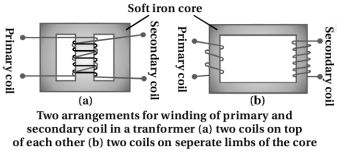
0 likes
View Solution74
Medium
Write the working procedure of a transformer.
Solution
(N/A) When an alternating voltage is applied to the primary coil,the resulting current produces an alternating magnetic flux which links the secondary coil and induces an electromotive force (emf) in it.
The value of the induced emf depends on the number of turns in the secondary coil.
Let us consider an ideal transformer in which the primary coil has negligible resistance and all the magnetic flux in the core links both the primary and secondary windings.
If no load is connected to the secondary coil and $N_{p}$ and $N_{s}$ are the number of turns in the primary and secondary coils respectively,then the induced emf in the primary coil is:
$\varepsilon_{p} = -N_{p} \frac{d \phi}{d t} \quad \dots (1)$
And the induced emf in the secondary coil is:
$\varepsilon_{s} = -N_{s} \frac{d \phi}{d t} \quad \dots (2)$
Since $\varepsilon_{p} = V_{p}$ and $\varepsilon_{s} = V_{s}$,where $V_{p}$ and $V_{s}$ are the voltages across the primary and secondary coils respectively,equations $(1)$ and $(2)$ can be written as:
$V_{p} = -N_{p} \frac{d \phi}{d t}$ and $V_{s} = -N_{s} \frac{d \phi}{d t}$
Therefore,$\frac{V_{s}}{V_{p}} = \frac{N_{s}}{N_{p}}$.
The above relation is based on three assumptions:
$(1)$ The primary resistance and current are small.
$(2)$ The same magnetic flux links both the primary and secondary coils as very little flux escapes from the core.
$(3)$ The secondary current is small.
The ratio of the number of turns in the secondary coil $N_{s}$ to the number of turns in the primary coil $N_{p}$ is called the transformation ratio $\lambda$.
If the secondary coil has a greater number of turns than the primary $(N_{s} > N_{p})$,the voltage is stepped up. This is called a step-up transformer.
If the secondary coil has fewer turns than the primary $(N_{s} < N_{p})$,then $V_{s} < V_{p}$. This is called a step-down transformer,where the voltage is reduced.
The value of the induced emf depends on the number of turns in the secondary coil.
Let us consider an ideal transformer in which the primary coil has negligible resistance and all the magnetic flux in the core links both the primary and secondary windings.
If no load is connected to the secondary coil and $N_{p}$ and $N_{s}$ are the number of turns in the primary and secondary coils respectively,then the induced emf in the primary coil is:
$\varepsilon_{p} = -N_{p} \frac{d \phi}{d t} \quad \dots (1)$
And the induced emf in the secondary coil is:
$\varepsilon_{s} = -N_{s} \frac{d \phi}{d t} \quad \dots (2)$
Since $\varepsilon_{p} = V_{p}$ and $\varepsilon_{s} = V_{s}$,where $V_{p}$ and $V_{s}$ are the voltages across the primary and secondary coils respectively,equations $(1)$ and $(2)$ can be written as:
$V_{p} = -N_{p} \frac{d \phi}{d t}$ and $V_{s} = -N_{s} \frac{d \phi}{d t}$
Therefore,$\frac{V_{s}}{V_{p}} = \frac{N_{s}}{N_{p}}$.
The above relation is based on three assumptions:
$(1)$ The primary resistance and current are small.
$(2)$ The same magnetic flux links both the primary and secondary coils as very little flux escapes from the core.
$(3)$ The secondary current is small.
The ratio of the number of turns in the secondary coil $N_{s}$ to the number of turns in the primary coil $N_{p}$ is called the transformation ratio $\lambda$.
If the secondary coil has a greater number of turns than the primary $(N_{s} > N_{p})$,the voltage is stepped up. This is called a step-up transformer.
If the secondary coil has fewer turns than the primary $(N_{s} < N_{p})$,then $V_{s} < V_{p}$. This is called a step-down transformer,where the voltage is reduced.
0 likes
View Solution75
Medium
Using the equation of power for an ideal transformer,prove $\frac{I_p}{I_s} = \frac{V_s}{V_p} = \frac{N_s}{N_p}$.
Solution
(N/A) For an ideal transformer,the efficiency is $100 \%$,meaning there are no energy losses. Therefore,the input power is equal to the output power.
Since power $P = VI$,we have:
$\text{Input power} = \text{Output power}$
$I_p V_p = I_s V_s$
$\frac{I_p}{I_s} = \frac{V_s}{V_p} \quad \dots (1)$
For an ideal transformer,the ratio of voltages is equal to the ratio of the number of turns in the coils:
$\frac{V_s}{V_p} = \frac{N_s}{N_p} \quad \dots (2)$
Combining equations $(1)$ and $(2)$,we get:
$\frac{I_p}{I_s} = \frac{V_s}{V_p} = \frac{N_s}{N_p}$
This equation shows that the ratio of currents is inversely proportional to the ratio of voltages and turns.
Since power $P = VI$,we have:
$\text{Input power} = \text{Output power}$
$I_p V_p = I_s V_s$
$\frac{I_p}{I_s} = \frac{V_s}{V_p} \quad \dots (1)$
For an ideal transformer,the ratio of voltages is equal to the ratio of the number of turns in the coils:
$\frac{V_s}{V_p} = \frac{N_s}{N_p} \quad \dots (2)$
Combining equations $(1)$ and $(2)$,we get:
$\frac{I_p}{I_s} = \frac{V_s}{V_p} = \frac{N_s}{N_p}$
This equation shows that the ratio of currents is inversely proportional to the ratio of voltages and turns.
0 likes
View Solution76
DifficultMCQ
How does a transformer affect the voltage and current?
A
It increases both voltage and current.
B
It decreases both voltage and current.
C
It increases voltage and decreases current,or vice versa,based on the turns ratio.
D
It keeps both voltage and current constant.
Solution
(C) For an ideal transformer,the relationship is given by $\frac{I_{p}}{I_{s}} = \frac{V_{s}}{V_{p}} = \frac{N_{s}}{N_{p}}$.
$(i)$ If the secondary coil has a greater number of turns than the primary $(N_{s} > N_{p})$,the voltage is stepped up $(V_{s} > V_{p})$. This means the voltage increases in the secondary compared to the primary,and since power is conserved,the current in the secondary becomes less than in the primary $(I_{s} < I_{p})$.
$(ii)$ If the secondary coil has a lesser number of turns than the primary $(N_{s} < N_{p})$,the voltage is stepped down $(V_{s} < V_{p})$. This means the voltage decreases in the secondary compared to the primary,and the current in the secondary becomes more than in the primary $(I_{s} > I_{p})$.
$(i)$ If the secondary coil has a greater number of turns than the primary $(N_{s} > N_{p})$,the voltage is stepped up $(V_{s} > V_{p})$. This means the voltage increases in the secondary compared to the primary,and since power is conserved,the current in the secondary becomes less than in the primary $(I_{s} < I_{p})$.
$(ii)$ If the secondary coil has a lesser number of turns than the primary $(N_{s} < N_{p})$,the voltage is stepped down $(V_{s} < V_{p})$. This means the voltage decreases in the secondary compared to the primary,and the current in the secondary becomes more than in the primary $(I_{s} > I_{p})$.
0 likes
View Solution77
Medium
Due to which reasons do energy losses occur in an actual transformer?
Solution
(N/A) $(i)$ Flux Leakage: Not all of the flux due to the primary coil passes through the secondary coil due to poor design of the core or air gaps in the core. It can be reduced by winding the primary and secondary coils one over the other.
$(ii)$ Resistance of the windings: The wire used for the winding has some resistance,and so energy is lost due to heat produced in the wire $(I^{2}R)$. In high current,low voltage windings,these are minimized by using thick wire.
$(iii)$ Eddy Currents: The alternating magnetic flux induces eddy currents in the iron core,causing heating. This effect is reduced by using a laminated core.
$(iv)$ Hysteresis: The magnetization of the core is repeatedly reversed by the alternating magnetic field. The resulting expenditure of energy in the core appears as heat and is kept to a minimum by using a magnetic material with low hysteresis loss.
$(v)$ Humming/Buzzing: Transformers work on $AC$ voltage; hence,in each cycle,the dimensions of the core change due to magnetostriction. As a result,the transformer produces a buzzing noise,leading to the dissipation of some electrical energy as sound.
$(ii)$ Resistance of the windings: The wire used for the winding has some resistance,and so energy is lost due to heat produced in the wire $(I^{2}R)$. In high current,low voltage windings,these are minimized by using thick wire.
$(iii)$ Eddy Currents: The alternating magnetic flux induces eddy currents in the iron core,causing heating. This effect is reduced by using a laminated core.
$(iv)$ Hysteresis: The magnetization of the core is repeatedly reversed by the alternating magnetic field. The resulting expenditure of energy in the core appears as heat and is kept to a minimum by using a magnetic material with low hysteresis loss.
$(v)$ Humming/Buzzing: Transformers work on $AC$ voltage; hence,in each cycle,the dimensions of the core change due to magnetostriction. As a result,the transformer produces a buzzing noise,leading to the dissipation of some electrical energy as sound.
0 likes
View Solution78
Difficult
Explain the use of a transformer for the distribution of power over long distances.
Solution
(N/A) Transformers are essential for the large-scale transmission and distribution of electric energy over long distances.
The voltage output from the power generator is stepped up using a step-up transformer. This increase in voltage results in a corresponding decrease in current for a given power level $(P = VI)$,which significantly reduces the $I^{2}R$ power loss (heat loss) in the transmission lines.
The high-voltage electricity is then transmitted over long distances to area sub-stations located near the consumers.
At these sub-stations,the voltage is stepped down to safer levels. It is further stepped down at local distribution sub-stations and utility poles before a standard power supply of $240 \ V$ reaches our homes.
The voltage output from the power generator is stepped up using a step-up transformer. This increase in voltage results in a corresponding decrease in current for a given power level $(P = VI)$,which significantly reduces the $I^{2}R$ power loss (heat loss) in the transmission lines.
The high-voltage electricity is then transmitted over long distances to area sub-stations located near the consumers.
At these sub-stations,the voltage is stepped down to safer levels. It is further stepped down at local distribution sub-stations and utility poles before a standard power supply of $240 \ V$ reaches our homes.
0 likes
View Solution79
Medium
Write important uses of transformer.
Solution
(N/A) $(1)$ Small transformers are used in radio receivers,telephones,and loudspeakers.
$(2)$ They are used in TVs,refrigerators,air-conditioners,and computers,and also function as voltage regulators.
$(3)$ They are used for stabilizing power supplies.
$(4)$ Step-up transformers are used to generate high voltage for long-distance power transmission.
$(5)$ Step-down transformers are used for melting metals in induction furnaces.
$(6)$ Step-up transformers are used in the production of $X$-rays.
$(7)$ Electrical energy generated at power stations is transmitted to consumers through transformers.
$(2)$ They are used in TVs,refrigerators,air-conditioners,and computers,and also function as voltage regulators.
$(3)$ They are used for stabilizing power supplies.
$(4)$ Step-up transformers are used to generate high voltage for long-distance power transmission.
$(5)$ Step-down transformers are used for melting metals in induction furnaces.
$(6)$ Step-up transformers are used in the production of $X$-rays.
$(7)$ Electrical energy generated at power stations is transmitted to consumers through transformers.
0 likes
View Solution80
Medium
Write the principle of a transformer.
Solution
(N/A) transformer works on the principle of $Mutual \text{ } Induction$.
According to this principle, when the magnetic flux linked with a coil changes, an induced electromotive force $(EMF)$ is produced in the neighboring coil.
In a transformer, an alternating current $(AC)$ flowing through the primary coil creates a time-varying magnetic flux in the core, which is linked to the secondary coil, thereby inducing an alternating $EMF$ in the secondary coil.
According to this principle, when the magnetic flux linked with a coil changes, an induced electromotive force $(EMF)$ is produced in the neighboring coil.
In a transformer, an alternating current $(AC)$ flowing through the primary coil creates a time-varying magnetic flux in the core, which is linked to the secondary coil, thereby inducing an alternating $EMF$ in the secondary coil.
0 likes
View Solution81
Medium
Why is a soft iron core used in a transformer?
Solution
(N/A) soft iron core is used in a transformer for two primary reasons:
$1$. High Magnetic Permeability: Soft iron has high magnetic permeability,which allows it to easily magnetize and demagnetize. This ensures that the magnetic flux produced by the primary coil is efficiently linked to the secondary coil,minimizing flux leakage.
$2$. Low Hysteresis Loss: Soft iron has a narrow hysteresis loop,which means the energy dissipated as heat during each cycle of magnetization and demagnetization (hysteresis loss) is very low. This increases the overall efficiency of the transformer.
$1$. High Magnetic Permeability: Soft iron has high magnetic permeability,which allows it to easily magnetize and demagnetize. This ensures that the magnetic flux produced by the primary coil is efficiently linked to the secondary coil,minimizing flux leakage.
$2$. Low Hysteresis Loss: Soft iron has a narrow hysteresis loop,which means the energy dissipated as heat during each cycle of magnetization and demagnetization (hysteresis loss) is very low. This increases the overall efficiency of the transformer.
0 likes
View Solution82
Easy
Write two types of transformer.
Solution
(N/A) The two types of transformers based on their construction and function are:
$1$. $Step-up$ transformer: This transformer increases the voltage of an alternating current $(AC)$ supply. In this,the number of turns in the secondary coil $(N_s)$ is greater than the number of turns in the primary coil $(N_p)$,i.e.,$N_s > N_p$.
$2$. $Step-down$ transformer: This transformer decreases the voltage of an alternating current $(AC)$ supply. In this,the number of turns in the secondary coil $(N_s)$ is less than the number of turns in the primary coil $(N_p)$,i.e.,$N_s < N_p$.
$1$. $Step-up$ transformer: This transformer increases the voltage of an alternating current $(AC)$ supply. In this,the number of turns in the secondary coil $(N_s)$ is greater than the number of turns in the primary coil $(N_p)$,i.e.,$N_s > N_p$.
$2$. $Step-down$ transformer: This transformer decreases the voltage of an alternating current $(AC)$ supply. In this,the number of turns in the secondary coil $(N_s)$ is less than the number of turns in the primary coil $(N_p)$,i.e.,$N_s < N_p$.
0 likes
View Solution83
EasyMCQ
What is the transformation ratio of a transformer?
A
The ratio of the number of turns in the primary coil to the number of turns in the secondary coil.
B
The ratio of the number of turns in the secondary coil to the number of turns in the primary coil.
C
The ratio of the input power to the output power.
D
The ratio of the primary current to the secondary current.
Solution
(B) The transformation ratio,often denoted by $k$ or $r$,is defined as the ratio of the number of turns in the secondary coil $(N_s)$ to the number of turns in the primary coil $(N_p)$.
Mathematically,it is expressed as $k = \frac{N_s}{N_p}$.
For an ideal transformer,this ratio is also equal to the ratio of the secondary voltage $(V_s)$ to the primary voltage $(V_p)$,i.e.,$k = \frac{V_s}{V_p} = \frac{I_p}{I_s}$.
Mathematically,it is expressed as $k = \frac{N_s}{N_p}$.
For an ideal transformer,this ratio is also equal to the ratio of the secondary voltage $(V_s)$ to the primary voltage $(V_p)$,i.e.,$k = \frac{V_s}{V_p} = \frac{I_p}{I_s}$.
0 likes
View Solution84
MediumMCQ
In an ideal transformer, can power increase or decrease? State whether this statement is true or false.
A
True
B
False
C
Depends on the load
D
Depends on the frequency
Solution
(B) In an ideal transformer, there are no energy losses due to resistance, hysteresis, or eddy currents. According to the principle of conservation of energy, the power input must equal the power output. Therefore, $P_{in} = P_{out}$. The power cannot increase or decrease. Thus, the statement is false.
0 likes
View Solution85
EasyMCQ
"In a step-down transformer, the output current decreases." This statement is true or false?
A
True
B
False
Solution
(B) In an ideal transformer, the power input equals the power output: $P_{in} = P_{out}$.
Since $P = V \times I$, we have $V_p I_p = V_s I_s$.
For a step-down transformer, the secondary voltage is less than the primary voltage $(V_s < V_p)$.
To maintain the equality $V_p I_p = V_s I_s$, the secondary current must be greater than the primary current $(I_s > I_p)$.
Therefore, the output current increases, not decreases. The statement is false.
Since $P = V \times I$, we have $V_p I_p = V_s I_s$.
For a step-down transformer, the secondary voltage is less than the primary voltage $(V_s < V_p)$.
To maintain the equality $V_p I_p = V_s I_s$, the secondary current must be greater than the primary current $(I_s > I_p)$.
Therefore, the output current increases, not decreases. The statement is false.
0 likes
View Solution86
Easy
$A$ $60\, W$ load is connected to the secondary of a transformer whose primary draws line voltage. If a current of $0.54\, A$ flows in the load,what is the current in the primary coil? Comment on the type of transformer being used.
Solution
(0.27 A) Given: Load power $P_{S} = 60\, W$,Secondary current $I_{S} = 0.54\, A$,Primary voltage $V_{P} = 220\, V$ (standard line voltage).
Step $1$: Calculate the secondary voltage $V_{S}$.
$P_{S} = V_{S} I_{S} \implies V_{S} = \frac{P_{S}}{I_{S}} = \frac{60}{0.54} \approx 111.1\, V \approx 110\, V$.
Step $2$: Determine the transformer type.
Since $V_{S} < V_{P}$ $(110\, V < 220\, V)$,the transformer is a step-down transformer.
Step $3$: Calculate the primary current $I_{P}$ using the ideal transformer relation $V_{P} I_{P} = V_{S} I_{S}$.
$I_{P} = \frac{V_{S} I_{S}}{V_{P}} = \frac{60}{220} \approx 0.27\, A$.
Thus,the current in the primary coil is $0.27\, A$ and it is a step-down transformer.
Step $1$: Calculate the secondary voltage $V_{S}$.
$P_{S} = V_{S} I_{S} \implies V_{S} = \frac{P_{S}}{I_{S}} = \frac{60}{0.54} \approx 111.1\, V \approx 110\, V$.
Step $2$: Determine the transformer type.
Since $V_{S} < V_{P}$ $(110\, V < 220\, V)$,the transformer is a step-down transformer.
Step $3$: Calculate the primary current $I_{P}$ using the ideal transformer relation $V_{P} I_{P} = V_{S} I_{S}$.
$I_{P} = \frac{V_{S} I_{S}}{V_{P}} = \frac{60}{220} \approx 0.27\, A$.
Thus,the current in the primary coil is $0.27\, A$ and it is a step-down transformer.
0 likes
View Solution87
Medium
$1\, MW$ power is to be delivered from a power station to a town $10\, km$ away. One uses a pair of $Cu$ wires of radius $0.5\, cm$ for this purpose. Calculate the fraction of ohmic losses to power transmitted if
$(a)$ power is transmitted at $220\, V$. Comment on the feasibility of doing this.
$(b)$ a step-up transformer is used to boost the voltage to $11000\, V$,power is transmitted,then a step-down transformer is used to bring voltage to $220\, V$.
Given: $\rho_{Cu} = 1.7 \times 10^{-8}\, \Omega \cdot m$.
$(a)$ power is transmitted at $220\, V$. Comment on the feasibility of doing this.
$(b)$ a step-up transformer is used to boost the voltage to $11000\, V$,power is transmitted,then a step-down transformer is used to bring voltage to $220\, V$.
Given: $\rho_{Cu} = 1.7 \times 10^{-8}\, \Omega \cdot m$.
Solution
(B) Length of copper wire $L = 2 \times 10\, km = 20000\, m$. Resistance $R = \rho \frac{L}{A} = \frac{1.7 \times 10^{-8} \times 20000}{\pi \times (0.5 \times 10^{-2})^2} \approx 4.33\, \Omega$. Current $I = \frac{P}{V} = \frac{10^6}{220} \approx 4545.45\, A$. Power loss $P_{loss} = I^2 R = (4545.45)^2 \times 4.33 \approx 8.95 \times 10^7\, W$. Since $P_{loss} > P_{transmitted}$,this is not feasible.
$(b)$ New current $I' = \frac{P}{V'} = \frac{10^6}{11000} \approx 90.91\, A$. Power loss $P'_{loss} = (I')^2 R = (90.91)^2 \times 4.33 \approx 35785\, W$. Fraction of power loss $= \frac{35785}{10^6} \approx 0.0358$ or $3.58\%$.
$(b)$ New current $I' = \frac{P}{V'} = \frac{10^6}{11000} \approx 90.91\, A$. Power loss $P'_{loss} = (I')^2 R = (90.91)^2 \times 4.33 \approx 35785\, W$. Fraction of power loss $= \frac{35785}{10^6} \approx 0.0358$ or $3.58\%$.
0 likes
View Solution88
MediumMCQ
$A$ transformer with a turns ratio $\frac{N_{1}}{N_{2}} = \frac{50}{1}$ is connected to a $120 \ V$ $AC$ supply. If the primary and secondary circuit resistances are $1.5 \ k\Omega$ and $1 \ \Omega$ respectively,find the power output (in $W$).
A
$5.76$
B
$11.4$
C
$2.89$
D
$7.56$
Solution
(A) The turns ratio is given by $\frac{N_{1}}{N_{2}} = \frac{50}{1}$.
For an ideal transformer,the voltage ratio is equal to the turns ratio: $\frac{V_{1}}{V_{2}} = \frac{N_{1}}{N_{2}}$.
Given $V_{1} = 120 \ V$,we have $\frac{120}{V_{2}} = \frac{50}{1}$.
Solving for $V_{2}$,we get $V_{2} = \frac{120}{50} = 2.4 \ V$.
The power output is dissipated across the secondary resistance $R_{2} = 1 \ \Omega$.
Using the formula $P_{\text{out}} = \frac{V_{2}^{2}}{R_{2}}$,we substitute the values:
$P_{\text{out}} = \frac{(2.4)^{2}}{1} = 5.76 \ W$.
For an ideal transformer,the voltage ratio is equal to the turns ratio: $\frac{V_{1}}{V_{2}} = \frac{N_{1}}{N_{2}}$.
Given $V_{1} = 120 \ V$,we have $\frac{120}{V_{2}} = \frac{50}{1}$.
Solving for $V_{2}$,we get $V_{2} = \frac{120}{50} = 2.4 \ V$.
The power output is dissipated across the secondary resistance $R_{2} = 1 \ \Omega$.
Using the formula $P_{\text{out}} = \frac{V_{2}^{2}}{R_{2}}$,we substitute the values:
$P_{\text{out}} = \frac{(2.4)^{2}}{1} = 5.76 \ W$.
0 likes
View Solution89
EasyMCQ
In a transformer,the number of turns in the primary coil is $140$ and that in the secondary coil is $280$. If the current in the primary coil is $4 \ A$,then the current in the secondary coil is (in $A$):
A
$4$
B
$2$
C
$6$
D
$10$
Solution
(B) For an ideal transformer,the power input equals the power output,which implies that the ratio of the number of turns is inversely proportional to the ratio of the currents.
The relationship is given by: $\frac{N_p}{N_s} = \frac{i_s}{i_p}$
Given:
$N_p = 140$
$N_s = 280$
$i_p = 4 \ A$
Substituting the values into the formula:
$\frac{140}{280} = \frac{i_s}{4}$
$\frac{1}{2} = \frac{i_s}{4}$
$i_s = \frac{4}{2} = 2 \ A$
Therefore,the current in the secondary coil is $2 \ A$.
The relationship is given by: $\frac{N_p}{N_s} = \frac{i_s}{i_p}$
Given:
$N_p = 140$
$N_s = 280$
$i_p = 4 \ A$
Substituting the values into the formula:
$\frac{140}{280} = \frac{i_s}{4}$
$\frac{1}{2} = \frac{i_s}{4}$
$i_s = \frac{4}{2} = 2 \ A$
Therefore,the current in the secondary coil is $2 \ A$.
0 likes
View Solution90
MediumMCQ
$A$ transformer consists of $500$ turns in the primary coil and $10$ turns in the secondary coil with a load of $10\, \Omega$. Find the current in the primary coil when the voltage across the secondary coil is $50\, V$. (in $A$)
A
$0.1$
B
$1$
C
$0.5$
D
$2$
Solution
(A) Given:
Number of turns in primary coil,$N_{p} = 500$
Number of turns in secondary coil,$N_{s} = 10$
Load resistance,$R = 10\, \Omega$
Voltage across secondary coil,$V_{s} = 50\, V$
Step $1$: Calculate the current in the secondary coil $(I_{s})$.
Using Ohm's law,$I_{s} = \frac{V_{s}}{R} = \frac{50\, V}{10\, \Omega} = 5\, A$.
Step $2$: Use the transformer ratio to find the current in the primary coil $(I_{p})$.
For an ideal transformer,the ratio of currents is inversely proportional to the ratio of turns:
$\frac{I_{p}}{I_{s}} = \frac{N_{s}}{N_{p}}$
$I_{p} = I_{s} \times \left( \frac{N_{s}}{N_{p}} \right)$
$I_{p} = 5\, A \times \left( \frac{10}{500} \right)$
$I_{p} = 5 \times \frac{1}{50} = \frac{1}{10} = 0.1\, A$.
Number of turns in primary coil,$N_{p} = 500$
Number of turns in secondary coil,$N_{s} = 10$
Load resistance,$R = 10\, \Omega$
Voltage across secondary coil,$V_{s} = 50\, V$
Step $1$: Calculate the current in the secondary coil $(I_{s})$.
Using Ohm's law,$I_{s} = \frac{V_{s}}{R} = \frac{50\, V}{10\, \Omega} = 5\, A$.
Step $2$: Use the transformer ratio to find the current in the primary coil $(I_{p})$.
For an ideal transformer,the ratio of currents is inversely proportional to the ratio of turns:
$\frac{I_{p}}{I_{s}} = \frac{N_{s}}{N_{p}}$
$I_{p} = I_{s} \times \left( \frac{N_{s}}{N_{p}} \right)$
$I_{p} = 5\, A \times \left( \frac{10}{500} \right)$
$I_{p} = 5 \times \frac{1}{50} = \frac{1}{10} = 0.1\, A$.
0 likes
View Solution91
MediumMCQ
For an ideal transformer with primary voltage $E_{p} = 1000 \, V$ and primary current $I_{p} = 50 \, A$,if the secondary voltage is $220 \, V$ and it supplies power to $80$ houses,what is the equivalent resistance of the secondary circuit (in $\Omega$)?
A
$2$
B
$3$
C
$1$
D
$4$
Solution
(C) For an ideal transformer,the input power is equal to the output power.
$P_{\text{in}} = P_{\text{out}}$
$E_{p} I_{p} = \frac{V_{s}^{2}}{R_{s}}$
Substituting the given values:
$1000 \times 50 = \frac{220^{2}}{R_{s}}$
$50000 = \frac{48400}{R_{s}}$
$R_{s} = \frac{48400}{50000} = 0.968 \, \Omega$
Rounding to the nearest integer,we get $R_{s} \approx 1 \, \Omega$.
$P_{\text{in}} = P_{\text{out}}$
$E_{p} I_{p} = \frac{V_{s}^{2}}{R_{s}}$
Substituting the given values:
$1000 \times 50 = \frac{220^{2}}{R_{s}}$
$50000 = \frac{48400}{R_{s}}$
$R_{s} = \frac{48400}{50000} = 0.968 \, \Omega$
Rounding to the nearest integer,we get $R_{s} \approx 1 \, \Omega$.
0 likes
View Solution92
MediumMCQ
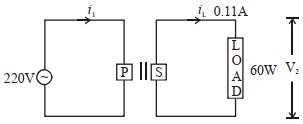
For the given circuit,comment on the type of transformer used:
A
Auxiliary transformer
B
Auto transformer
C
Step-up transformer
D
Step-down transformer
Solution
(C) Given,primary voltage $V_P = 220 \ V$,secondary power $P_S = 60 \ W$,and secondary current $I_S = 0.11 \ A$.
The secondary voltage $V_S$ is given by the formula $V_S = \frac{P_S}{I_S}$.
Substituting the values,$V_S = \frac{60}{0.11} \approx 545.45 \ V$.
Since $V_S > V_P$ $(545.45 \ V > 220 \ V)$,the secondary voltage is greater than the primary voltage.
Therefore,the transformer is a step-up transformer.
The secondary voltage $V_S$ is given by the formula $V_S = \frac{P_S}{I_S}$.
Substituting the values,$V_S = \frac{60}{0.11} \approx 545.45 \ V$.
Since $V_S > V_P$ $(545.45 \ V > 220 \ V)$,the secondary voltage is greater than the primary voltage.
Therefore,the transformer is a step-up transformer.
0 likes
View Solution93
MediumMCQ
$A$ common transistor radio set requires $12\,V$ $(D.C.)$ for its operation. The $D.C.$ source is constructed by using a transformer and a rectifier circuit,which are operated at $220\,V$ $(A.C.)$ on standard domestic $A.C.$ supply. If the number of turns in the secondary coil is $24$,then the number of turns in the primary coil is:
A
$220$
B
$110$
C
$440$
D
$880$
Solution
(C) The transformer follows the turns ratio formula: $\frac{N_P}{N_S} = \frac{V_P}{V_S}$.
Given:
Primary voltage $V_P = 220\,V$
Secondary voltage $V_S = 12\,V$
Number of turns in secondary $N_S = 24$
Substituting the values into the formula:
$\frac{N_P}{24} = \frac{220}{12}$
$N_P = \frac{220 \times 24}{12}$
$N_P = 220 \times 2 = 440$.
Therefore,the number of turns in the primary coil is $440$.
Given:
Primary voltage $V_P = 220\,V$
Secondary voltage $V_S = 12\,V$
Number of turns in secondary $N_S = 24$
Substituting the values into the formula:
$\frac{N_P}{24} = \frac{220}{12}$
$N_P = \frac{220 \times 24}{12}$
$N_P = 220 \times 2 = 440$.
Therefore,the number of turns in the primary coil is $440$.
0 likes
View Solution94
MediumMCQ
$A$ step-down transformer connected to an $AC$ mains supply of $220 \, V$ is made to operate a $11 \, V, 44 \, W$ lamp. Ignoring power losses in the transformer,what is the current in the primary circuit? (In $A$)
A
$0.2$
B
$0.4$
C
$2$
D
$4$
Solution
(A) Given that the transformer is ideal (ignoring power losses),the input power is equal to the output power.
$P_{\text{in}} = P_{\text{out}}$
Since $P_{\text{out}} = 44 \, W$ and $V_p = 220 \, V$,we use the relation $P_{\text{in}} = V_p \times I_p$.
$220 \times I_p = 44$
$I_p = \frac{44}{220} \, A$
$I_p = \frac{1}{5} \, A = 0.2 \, A$
Therefore,the current in the primary circuit is $0.2 \, A$.
$P_{\text{in}} = P_{\text{out}}$
Since $P_{\text{out}} = 44 \, W$ and $V_p = 220 \, V$,we use the relation $P_{\text{in}} = V_p \times I_p$.
$220 \times I_p = 44$
$I_p = \frac{44}{220} \, A$
$I_p = \frac{1}{5} \, A = 0.2 \, A$
Therefore,the current in the primary circuit is $0.2 \, A$.
0 likes
View Solution95
MediumMCQ
$A$ transformer operating at primary voltage $8\,kV$ and secondary voltage $160\,V$ serves a load of $80\,kW$. Assuming the transformer to be ideal with a purely resistive load and working on unity power factor,the resistances in the primary and secondary circuits would be:
A
$800\,\Omega$ and $1.06\,\Omega$
B
$10\,\Omega$ and $500\,\Omega$
C
$800\,\Omega$ and $0.32\,\Omega$
D
$1.06\,\Omega$ and $500\,\Omega$
Solution
(C) For an ideal transformer,the power delivered to the load is the same as the power drawn from the source.
Given: Primary voltage $V_p = 8\,kV = 8000\,V$,Secondary voltage $V_s = 160\,V$,Power $P = 80\,kW = 80000\,W$.
The resistance in the primary circuit $R_p$ is given by $P = \frac{V_p^2}{R_p}$.
$R_p = \frac{V_p^2}{P} = \frac{(8000)^2}{80000} = \frac{64 \times 10^6}{8 \times 10^4} = 8 \times 10^2 = 800\,\Omega$.
The resistance in the secondary circuit $R_s$ is given by $P = \frac{V_s^2}{R_s}$.
$R_s = \frac{V_s^2}{P} = \frac{(160)^2}{80000} = \frac{25600}{80000} = 0.32\,\Omega$.
Thus,the resistances are $800\,\Omega$ and $0.32\,\Omega$.
Given: Primary voltage $V_p = 8\,kV = 8000\,V$,Secondary voltage $V_s = 160\,V$,Power $P = 80\,kW = 80000\,W$.
The resistance in the primary circuit $R_p$ is given by $P = \frac{V_p^2}{R_p}$.
$R_p = \frac{V_p^2}{P} = \frac{(8000)^2}{80000} = \frac{64 \times 10^6}{8 \times 10^4} = 8 \times 10^2 = 800\,\Omega$.
The resistance in the secondary circuit $R_s$ is given by $P = \frac{V_s^2}{R_s}$.
$R_s = \frac{V_s^2}{P} = \frac{(160)^2}{80000} = \frac{25600}{80000} = 0.32\,\Omega$.
Thus,the resistances are $800\,\Omega$ and $0.32\,\Omega$.
0 likes
View Solution96
MediumMCQ
The primary and the secondary coils of a transformer contain $10$ and $100$ turns, respectively. The primary coil is connected to a battery that supplies a constant voltage of $1.5 \, V$. The voltage across the secondary coil is .................. $V$.
A
$1.5$
B
$0.15$
C
$0.0$
D
$15$
Solution
(C) transformer works on the principle of electromagnetic induction, which requires a time-varying magnetic flux to induce an electromotive force $(EMF)$ in the secondary coil.
The primary coil is connected to a battery, which provides a constant direct current $(DC)$ voltage of $1.5 \, V$.
Since the current is constant, the magnetic flux linked with the primary coil remains constant.
Because the magnetic flux does not change with time, there is no change in the magnetic flux linked with the secondary coil $(\frac{d\Phi}{dt} = 0)$.
According to Faraday's law of induction, the induced $EMF$ in the secondary coil is given by $e = -N \frac{d\Phi}{dt}$. Since $\frac{d\Phi}{dt} = 0$, the induced voltage across the secondary coil is $0 \, V$.
The primary coil is connected to a battery, which provides a constant direct current $(DC)$ voltage of $1.5 \, V$.
Since the current is constant, the magnetic flux linked with the primary coil remains constant.
Because the magnetic flux does not change with time, there is no change in the magnetic flux linked with the secondary coil $(\frac{d\Phi}{dt} = 0)$.
According to Faraday's law of induction, the induced $EMF$ in the secondary coil is given by $e = -N \frac{d\Phi}{dt}$. Since $\frac{d\Phi}{dt} = 0$, the induced voltage across the secondary coil is $0 \, V$.
0 likes
View Solution97
EasyMCQ
$A$ step-up transformer operates on a $220 \,V$ line and supplies $2.2 \,A$. The ratio of primary to secondary winding turns is $11:50$. The output voltage in the secondary is .......... $V$.
A
$220$
B
$100$
C
$1000$
D
$50$
Solution
(C) The transformer equation relating the number of turns and voltage is given by: $\frac{V_s}{V_p} = \frac{N_s}{N_p}$.
Given:
Primary voltage $(V_p)$ = $220 \,V$.
Ratio of primary to secondary turns $(\frac{N_p}{N_s})$ = $11:50$,which means $\frac{N_s}{N_p} = \frac{50}{11}$.
Substituting these values into the formula:
$V_s = V_p \times \frac{N_s}{N_p}$
$V_s = 220 \times \frac{50}{11}$
$V_s = 20 \times 50 = 1000 \,V$.
Therefore,the output voltage in the secondary is $1000 \,V$.
Given:
Primary voltage $(V_p)$ = $220 \,V$.
Ratio of primary to secondary turns $(\frac{N_p}{N_s})$ = $11:50$,which means $\frac{N_s}{N_p} = \frac{50}{11}$.
Substituting these values into the formula:
$V_s = V_p \times \frac{N_s}{N_p}$
$V_s = 220 \times \frac{50}{11}$
$V_s = 20 \times 50 = 1000 \,V$.
Therefore,the output voltage in the secondary is $1000 \,V$.
0 likes
View Solution98
MediumMCQ
An ideal transformer with a purely resistive load operates at $12\,kV$ on the primary side. It supplies electrical energy to a number of nearby houses at $120\,V$. The average rate of energy consumption in the houses served by the transformer is $60\,kW$. The value of the resistive load $(R_s)$ required in the secondary circuit will be $.........\,m\Omega$.
A
$250$
B
$260$
C
$290$
D
$240$
Solution
(D) Given:
Primary voltage,$V_p = 12\,kV = 12 \times 10^3\,V$
Secondary voltage,$V_s = 120\,V$
Power consumption,$P_s = 60\,kW = 60 \times 10^3\,W$
For an ideal transformer,the power in the secondary circuit is given by $P_s = V_s \times I_s$.
Therefore,the secondary current $I_s = \frac{P_s}{V_s} = \frac{60 \times 10^3}{120} = 500\,A$.
Using Ohm's law for the secondary resistive load $R_s$:
$R_s = \frac{V_s}{I_s} = \frac{120}{500} = 0.24\,\Omega$.
Converting to $m\Omega$:
$R_s = 0.24 \times 10^3\,m\Omega = 240\,m\Omega$.
Primary voltage,$V_p = 12\,kV = 12 \times 10^3\,V$
Secondary voltage,$V_s = 120\,V$
Power consumption,$P_s = 60\,kW = 60 \times 10^3\,W$
For an ideal transformer,the power in the secondary circuit is given by $P_s = V_s \times I_s$.
Therefore,the secondary current $I_s = \frac{P_s}{V_s} = \frac{60 \times 10^3}{120} = 500\,A$.
Using Ohm's law for the secondary resistive load $R_s$:
$R_s = \frac{V_s}{I_s} = \frac{120}{500} = 0.24\,\Omega$.
Converting to $m\Omega$:
$R_s = 0.24 \times 10^3\,m\Omega = 240\,m\Omega$.
0 likes
View Solution99
EasyMCQ
$A$ $12\,V, 60\,W$ lamp is connected to the secondary of a step-down transformer, whose primary is connected to $AC$ mains of $220\,V$. Assuming the transformer to be ideal, the current in the primary winding is $..........\,A$.
A
$0.37$
B
$0.27$
C
$2.7$
D
$3.7$
Solution
(B) For an ideal transformer, the input power is equal to the output power.
$P_{in} = P_{out}$
Since $P_{out} = 60\,W$ (power of the lamp) and $P_{in} = V_P \times I_P$, where $V_P = 220\,V$ is the primary voltage.
$220 \times I_P = 60$
$I_P = \frac{60}{220}$
$I_P \approx 0.27\,A$
Therefore, the current in the primary winding is $0.27\,A$.
$P_{in} = P_{out}$
Since $P_{out} = 60\,W$ (power of the lamp) and $P_{in} = V_P \times I_P$, where $V_P = 220\,V$ is the primary voltage.
$220 \times I_P = 60$
$I_P = \frac{60}{220}$
$I_P \approx 0.27\,A$
Therefore, the current in the primary winding is $0.27\,A$.
0 likes
View SolutionElectromagnetic Induction — Transformer · Frequently Asked Questions
1Are these Electromagnetic Induction questions useful for JEE and NEET?
Yes. All questions in this section are mapped to JEE Main and NEET exam patterns. Previous year questions from JEE Main, NEET, GUJCET and state-level exams are included with full solutions.
2Can I switch to Hindi or Gujarati for these questions?
Yes. Use the language tabs in the hero section or the sidebar to view the same questions and solutions in English, Hindi or Gujarati.
3How do I generate a question paper from this subtopic?
Use the Vedclass Exam Paper Generator — select the chapter and subtopic, set difficulty, and generate Sets A, B, C, D automatically. First 3 chapters of every subject are free.
Vedclass Products
For Students
Vedclass Test Series
Mock tests in real JEE/NEET style with performance analysis. 5-day free trial.
Start Free TrialFor Teachers
Exam Paper Generator
Generate Set A/B/C/D papers from this chapter in 2 minutes. 3 chapters free.
Try FreeFor Institutes
Online Exam Module
Live online exams with unlimited students, 360° analytics & white-label branding.
See DemoFor Teachers & Institutes
Generate a Electromagnetic Induction Exam Paper in 2 Minutes
Select subtopic & difficulty — Sets A, B, C, D auto-generated with No Repeat logic.
First 3 chapters of every subject are free — no payment required.